Article

ML-CDAE: Multi-Lead Convolutional Denoising Autoencoder for Denoising 12-Lead ECG Signals

1
Department Life Science Engineering, Technische Hochschule Mittelhessen, 35390 Giessen, Germany
2
Department of Biomedical Engineering, University of Duhok, Duhok 42001, Iraq
*
Author to whom correspondence should be addressed.
Signals 2026, 7(1), 18; https://doi.org/10.3390/signals7010018
Submission received: 20 December 2025 / Revised: 25 January 2026 / Accepted: 5 February 2026 / Published: 19 February 2026
(This article belongs to the Special Issue Advanced Methods of Biomedical Signal Processing II)

Abstract

Background: Electrocardiography (ECG), particularly the 12-lead configuration, is a crucial method for identifying heart rhythm abnormalities. However, its effectiveness can be reduced by noise contamination. State-of-the-art denoising methods based on neural networks have demonstrated promising performance in denoising complex biosignals like ECG. However, most of these methods have focused on denoising single-lead ECG recordings. Methods: This research aims to leverage the inherent correlation among multi-lead ECG signals. Therefore, a multi-lead convolutional denoising autoencoder (ML-CDAE) model is proposed, to learn more effective representations, leading simultaneously to improved denoising performance and enhanced quality of 12-lead ECG recordings. Results: The findings indicate that ML-CDAE consistently outperforms a single-lead convolutional denoising autoencoder (SL-CDAE) and fully convolutional denoising autoencoder (FCN-DAE) model in denoising ECG signals corrupted by a mixture of physical noises. In particular, the mean squared error ( MSE ) and signal-to-noise ratio improvement ( SNR imp ) are used as evaluation metrics to assess the performance. Conclusions: The strong correlation among multi-lead ECG signals can be leveraged not only to enhance the denoising performance of the ML-CDAE model but also to simultaneously denoise 12-lead ECG signals more successfully compared to both the SL-CDAE and FCN-DAE models.

1. Introduction

Electrocardiography (ECG) is an efficient, non-invasive, and low-cost tool widely employed for the accurate analysis and diagnosis of arrhythmia and other cardio diseases. However, ECG signals are usually contaminated by various types of noise, including baseline wander (BW), motion artifacts (MA), and electrode movement (EM) [1]. The presence of these noise components has the potential to obscure crucial diagnostic features of the ECG, including the P-wave, QRS complex, and T-wave. This may result in misdiagnosis of cardiac abnormalities [2].
In practice, the 12-lead ECG represents the most routine and crucial diagnostic tool for identifying arrhythmias. Zhang et al. [3] investigated inter-lead relationships in a 12-lead ECG dataset by analyzing the impact of lead absence on deep neural networks and quantifying the correlation strength of individual leads through a projection-based process, demonstrating that the removal of certain leads can substantially degrade diagnostic performance.
Several approaches have been reported in the literature for ECG signal denoising. In recent years, neural network-based denoising algorithms, commonly referred to as denoising autoencoders (DAEs), have shown promising performance in noise reduction. These include fully convolutional DAEs [1,4], stacked denoising autoencoders [5], and the running denoising autoencoder (RunDAE) model [6]. Convolutional DAEs have demonstrated promising performance in denoising biomedical signals, such as ECG. One notable advantage of the convolutional DAE model is their ability to denoise ECG signals without relying on an R-peak detection algorithm to align input segments. However, a significant drawback of convolutional DAE models is their complexity, as they require multiple hidden layers and long input segments to achieve effective denoising performance [6].
In [1], the proposed convolutional DAE, i.e., the well-known fully convolutional neural network (FCN)-based DAE, demonstrated superior denoising performance in removing physical noises from ECG signals. Bouny, Khalil, and Adib (2021) further demonstrated the effectiveness of the convolutional DAE model in removing additive Gaussian white noise from ECG signals, with promising results in terms of signal-to-noise ratio ( SNR ) and root mean square error ( RMSE ) [7]. In [8], a stacked contractive denoising autoencoder was proposed for ECG signal denoising which showed significant improvements in SNR and RMSE . These studies in general suggest that convolutional DAE models, including FCN-based and stacked contractive variants, are effective in denoising ECG signals, with potential applications in clinical practice.
Ref. [9] investigated the effects of correlated, uncorrelated, and jittered datasets on denoising autoencoder (DAE) performance, demonstrating that correlated ECG segments across Einthoven leads I, II, and III require fewer hidden neurons for effective denoising. In addition, a novel architecture termed the multiple parallel hidden layers DAE (MPHL-DAE) was introduced in [10], which showed promise in capturing distinct ECG signal features and achieved superior or comparable signal-to-noise ratio improvements ( SNR imp ) compared with the conventional multiple hidden layers DAE (MHL-DAE).
However, these ECG denoising methods often rely on single-lead processing, which fails to exploit the inherent correlations between different leads in a standard 12-lead ECG. This limitation can result in suboptimal denoising performance. The utilization of multiple single-lead models can be time-consuming and computationally expensive, particularly with a high number of hidden layers, without leveraging the benefits of correlations between ECG leads to reduce the presence of contaminating noises. Moreover, the MPHL-DAE model and convolutional DAE model have only been evaluated on Gaussian white noise; In [10], the authors suggest evaluating MPHL-DAE performance on other types of noise that can affect ECG signals (e.g., baseline wander, electrode movement).
Multi-lead autoencoders can leverage the natural correlation between ECG leads to denoise signals by analyzing all leads simultaneously, efficiently isolating clean signals from noise. This correlation could enhance the autoencoder’s ability to learn a more accurate and robust representation of the ECG signals, resulting in better denoising performance. For example, the network can recognize that similar leads should have similar QRS complex shapes. By processing multiple leads simultaneously, this type of autoencoder can learn complex noise patterns that are often difficult to remove using traditional filtering techniques. Multi-lead autoencoders can also be trained in an unsupervised manner, eliminating the need for large, labeled datasets of clean and noisy ECGs. This approach is advantageous because obtaining high-quality clean ECG recordings can be challenging [11].
Therefore, we propose a multi-lead convolutional denoising autoencoder (ML-CDAE) for ECG signal denoising. The architecture of the ML-CDAE is inspired by the multiple-input and multiple-output neural network (MIMO-NN) framework [12]. We then compare its performance with the traditional single-lead convolutional denoising autoencoder (SL-CDAE) and the current state-of-the-art FCN-DAE model using both quantitative and qualitative metrics such as SNR imp and MSE .

2. Background

2.1. ECG Configuration

Today, a standard ECG consists of 12 leads, obtained from various electrode placements and providing comprehensive views of the heart’s electrical activity from different body positions/sites. These leads include three limb Einthoven leads (I, II, III), three augmented Goldberger leads (aVR, aVL, aVF), and six precordial Wilson leads (V1–V6). Each lead captures specific information about the heart’s electrical function, helping clinicians to diagnose abnormalities with precision [13].

2.2. Importance of ECG in Clinical Practice

In clinical practice, ECG is an invaluable tool for rapidly assessing cardiac function without the need for invasive procedures or significant expense. From acute myocardial injury detection to complex arrhythmias and structural heart disease, it can serve several purposes for diagnosis. It is acknowledged that ECG significantly influences patient management by helping to differentiate between cardiac and non-cardiac chest pain, locating arrhythmia origins, and monitoring disease progression. In addition to this, atrial and ventricular enlargement detection helps to identify patients who might be at risk of atrial fibrillation or cardiovascular diseases in general. In addition, the ECG aids in diagnosing pericarditis, monitoring its resolution, and identifying complications such as pericardial effusion or cardiac tamponade. Although recording ECG is straightforward, its interpretation can be difficult, as even subtle changes can inform critical diagnostic decisions [14].

2.3. Types of Noise in ECG

2.3.1. Baseline Wandering (BW)

The baseline of an ECG is the isoelectric line, representing the zero electrical potential used as reference to measure the heart’s electrical activity. BW in ECG is the instability of the isoelectric line which causes it to shift up and down. This wandering can occur due to breathing, movement, or sweating, all of which change electrical characteristics at the skin–electrode interface [1,15,16]. This noise is typically very similar in all leads because it is an interference common to the whole signal. Therefore, it has strong inter-lead correlation, especially for physically adjacent leads (e.g., precordial leads V1–V6) or mathematically related leads (e.g., the limb leads) [17]. Moreover, respiration-induced wander often follows a predictable sinusoidal or quasi-periodic pattern across all leads [18]. Its effect differs only according to the placement of the leads or the movement of the patient.
The importance of BW frequency interpretation is great, as ECG signal frequency components are greatly useful in disease diagnosis. BW mainly affects low frequencies within the range 0.15–0.3 Hz [15]; therefore, low-frequency components may be distorted when the baseline shifts, making their correct interpretation difficult [1,16].
The wandering baseline significantly influences the ECG reads, potentially leading to healthcare diagnosis errors. Therefore, it is critical to identify and correct baseline drift in ECG to guarantee accurate understanding and diagnosis [16].

2.3.2. Motion Artifacts (MA)

Another type of noise that can have a significant impact on the ECG signal is motion artifacts (MA). When the patient is moving, various types of movements, such as slight movements due to muscle tremors or strong muscle contraction, can affect the ECG signal. These corruptions are often repetitive and can be attributed to specific parts of the cardiac cycle, depending on what physiological motion is causing the artifact. Some important artifacts to be aware of occur during coughing or abrupt patient movement. These are identifiable as short, sharp spikes within the ECG trace that are often many times the amplitude of the QRS complex itself. Such artifacts are unsuitable for heart rate algorithms based on R-wave peak detection; the presence of high-amplitude, short-duration signals can lead to false positives and an overall incorrect heart rate calculation [19,20].
Low-frequency drift caused by MA can exhibit partial correlation across ECG leads, particularly in nearby leads, as movement often affects electrodes in a spatially correlated manner [17]. However, the degree of correlation depends on the type and direction of movement. For example, limb leads are more affected during limb movements, whereas precordial leads may have less correlated distortions due to their placement [18].
Eliminating MA represents the greatest challenge among noise types due to its spectrum typically overlapping with crucial spectral components of the ECG signal. This interference complicates the separation process for traditional signal-processing techniques.

2.3.3. Electrode Movement (EM)

The last common source of noise in ECG is electrode movement. Movement of the electrodes on the skin generates low-frequency noise in the ECG. Electrodes are the vital part for acquiring ECG signals. They are conductive pads which are placed on the skin and connected to the data acquisition system [21].
EM noise typically causes localized interference on specific leads with weak-to-moderate correlation between the leads. Noise in adjacent leads is partially correlated, as a movement affects several electrodes simultaneously, but usually in an inconsistent manner. It can also be correlated across the leads but may vary in intensity depending on the quality of electrode contact at each site [22].
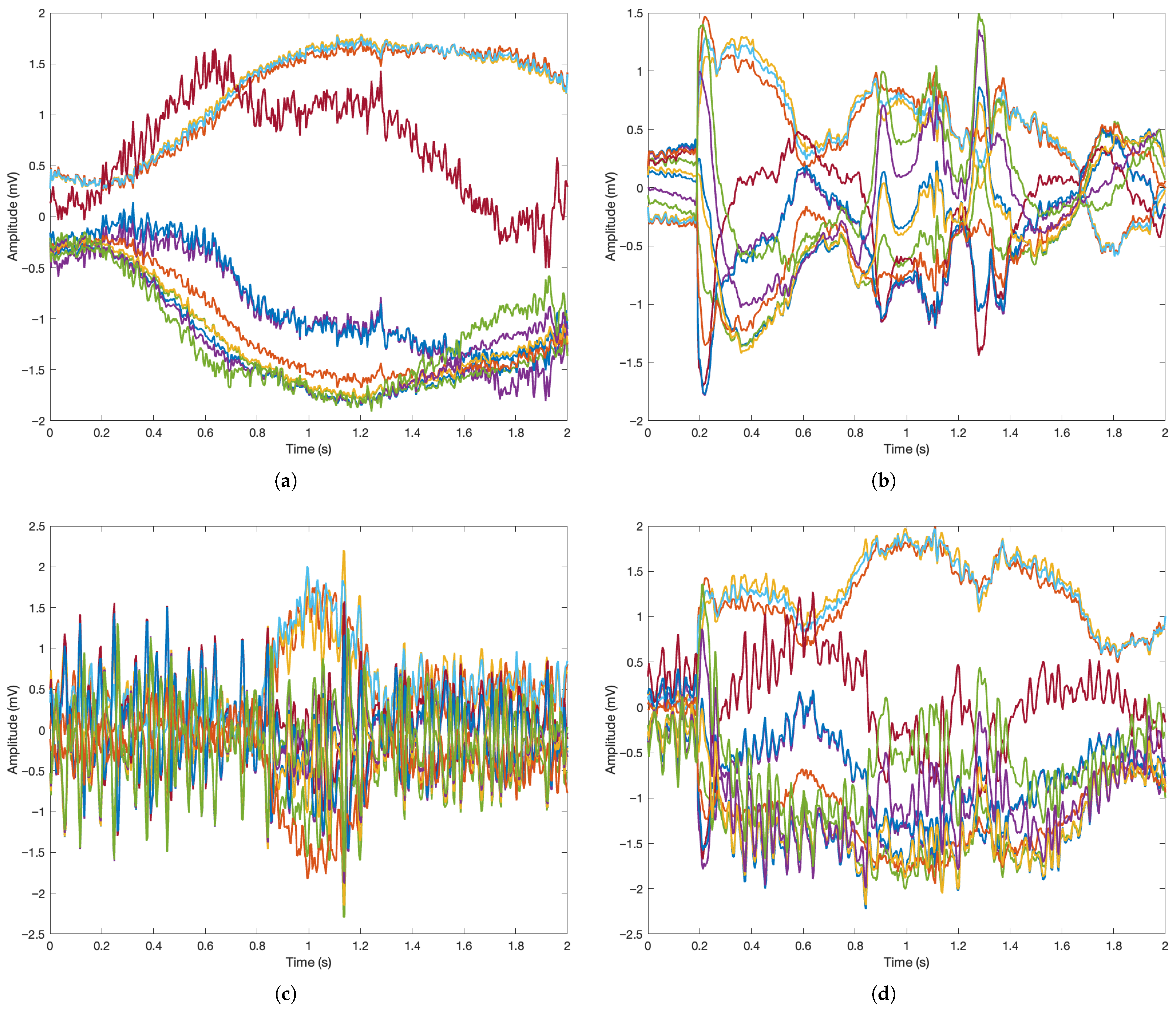
The impedance of the skin–electrode interface can directly indicate changes in the surface between the skin and electrode, and, consequently, the quality of the ECG. Figure 1 shows four types of noises from 12-lead ECG, and Table 1 represents the degree of correlation of each noise type.

2.4. 12-Lead ECG Correlation

The 12-lead electrocardiogram has made a major contribution to the diagnosis of heart disease in cardiology, and it is used for studying the heart’s electrical impulses from several angles. Each of the 12 leads captures the electrical impulses of the heart, creating a picture of the functioning of the organ. The leads are then placed strategically so as to sense electrical activity from many angles, thereby providing clear insight into the rhythm and structure of the heart [13]. To comprehend the correlation of a 12-lead ECG is to know and understand all the relationships between the ECG leads. Such correlation is important because it provides important inferences for abnormal patterns that do not show obvious abnormalities when just analyzing each lead [25].
The ECG signal is dependent on space and time. The leads collect the electrical signals at several critical sites on the human body; therefore, each lead gives a different perspective on heart activity. Also, the signals indicate the temporal nature of the heart’s electrical cycle, from the depolarization to the repolarization cycle in cardiac muscle contraction [26]. Thus, correlating the leads makes the interpretation easier in ECG. It is easier to create models with identified correlated noise patterns in multiple leads and further clarifies understanding of the signal compared to using a single lead. Further, inter-lead correlation helps to identify and diagnose complex cardiovascular conditions as it helps indicate shallow variations and abnormalities that other analyses using a single lead may overlook [3].
To study the inter-lead relationships, the correlation of the 12 leads should be computed. At the beginning, the ECG signals from all 12 leads are synchronized and preprocessed to eliminate artifacts or noise. The linear dependency between operating pairs of leads is calculated by means of Pearson’s correlation coefficient. This coefficient is calculated as follows:
r x y = ( x i x ¯ ) ( y i y ¯ ) ( x i x ¯ ) 2 ( y i y ¯ ) 2 : 1 < = r x y < = 1
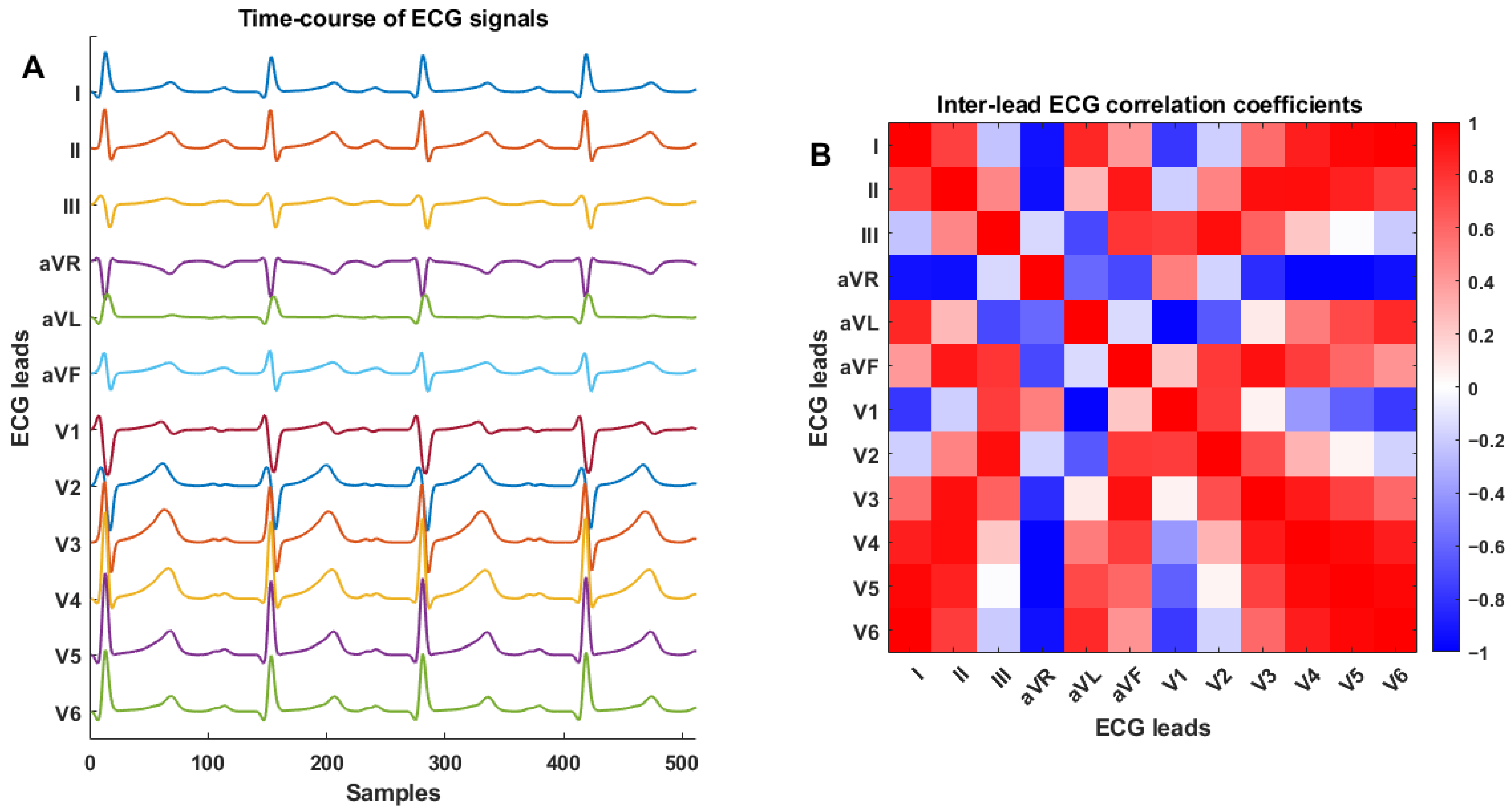
Here, x i and y i are the individual data points from two leads, and x ¯ and y ¯ are their respective means [13]. The output can then be visualized in a correlation matrix such as in Figure 2, which identifies which leads are correlated, to a greater degree, with each other [25]. With the analysis of this last matrix, it is now possible to have a deeper insight into the interaction taking place between the leads; strong relationships will have high correlation coefficients and weaker correlations will have low values [3]. Figure 2 illustrates the inter-lead relationships among the 12-lead ECG signals, demonstrating a very strong correlation between most leads. However, leads V1, V2, and aVL show slightly lower correlation with the other leads.
By taking into consideration a huge number of correlated lead signals across different channels, multi-lead convolutional denoising autoencoders (ML-CDAEs) can effectively reduce noise and enhance signal quality. When multi-lead signals are received, ML-CDAEs can correlate all kinds of redundancy and relationships between both multi- and single-lead approaches [27]. Thus, by processing multiple leads simultaneously, ML-CDAEs isolate and remove noise better than single-lead approaches. The inter-lead correlation therefore becomes a strong concept to develop in any or all advanced denoising techniques. The technology used in these models will create a scenario that allows them to differentiate real cardiac signals from noise and therefore produce cleaner and more accurate ECG readings, facilitating more reliable diagnoses and monitoring through ECG, allowing for better patient outcomes and cardiac care [25].
To conclude, the 12-lead ECG correlation is one of the key features of present-day ECG analysis, permitting more precise and comprehensive evaluation of heart health. This can allow the development of very novel approaches like ML-CDAEs, which can significantly improve the quality and accuracy of denoising ECG signals and, hence, the relevance of this aspect in the advancement of cardiac diagnostics [3].

3. Materials and Methods

3.1. Data Acquisition and Preparation

In this work, both simulated and real multi-lead ECG datasets were employed to develop and evaluate the proposed ML-CDAE denoising model. For controlled experimentation and the availability of ground-truth signals, a well-established ECG signal simulator was used to generate clean 12-lead ECG recordings [23,28]. Obtaining noise-free multi-lead ECG recordings in real clinical settings is inherently challenging; therefore, the simulator provides an effective framework for systematic analysis. The simulated ECG signals include all 12 standard leads: bipolar limb leads (I, II, III), augmented unipolar limb leads (aVR, aVL, aVF), and unipolar chest leads (V1–V6).
To enhance realism and ensure applicability to real-world scenarios, recorded physical noise from the MIT-BIH stress test noise database was incorporated into the simulated ECG signals [24]. Specifically, a mixture of physical noises (MoN), including muscle artifacts, electrode motion artifacts, and baseline wander, was added to the clean ECG signals. The noise signals were superimposed on the corresponding ECG leads to preserve inter-lead consistency. All simulated ECG signals were generated at a sampling frequency of 250 Hz. Sixty-second recordings were generated for each lead from 50 simulated subjects. The resulting dataset was divided into training (60%), validation (20%), and testing (20%) subsets.
The training and validation datasets were corrupted with input signal-to-noise ratio SNR in levels of −5 dB, 0 dB, and 5 dB. To evaluate model generalization under unseen noise conditions, the testing dataset was corrupted with SNR in levels of −7 dB, 0 dB, and 7 dB.
In addition to simulated data, real ECG recordings from the ST-Petersburg INCART 12-Lead Arrhythmia Database [29] were used to further validate the proposed model. This database consists of 12-lead ECG recordings sampled at 257 Hz. A total of 75 records were initially considered. To each record, an automatic screening procedure was applied to extract the cleanest continuous 60 s fragment corresponding to the lowest estimated noise level, following the algorithm described in [30]. The fragment selection was based on the average noise level computed across all 12 leads, ensuring a global assessment of signal quality rather than lead-specific optimization. The selected 60 s fragments share identical time stamps across all leads, thereby preserving inter-lead temporal alignment and physiological correlation. This step ensured the selection of high-quality, multi-lead reference segments suitable for denoising experiments.
Prior to segmentation and model input, the real ECG recordings were normalized on a per-lead basis using min–max normalization. For each lead, signal amplitudes were linearly scaled to the range [0, 1] based on the minimum and maximum values computed over the corresponding 60 s reference segment. This normalization step was applied to reduce inter-patient and inter-lead amplitude variability while preserving relative waveform morphology and inter-lead relationships. The same normalization procedure was applied consistently across training, validation, and testing subsets.
From the extracted segments, 60 recordings were randomly selected for training, while the remaining 15 were reserved exclusively for testing the proposed model. To maintain consistency with the simulated data experiments, the same noise types and SNR in levels were applied to the real ECG recordings.
Finally, both simulated and real noisy ECG signals were segmented into fixed-length windows of 256, 512, and 1024 samples each. This segmentation strategy was adopted to investigate the effect of segment length on the denoising performance of the proposed ML-CDAE and SL-CDAE model.

3.2. Architecture of ML-CDAE Model

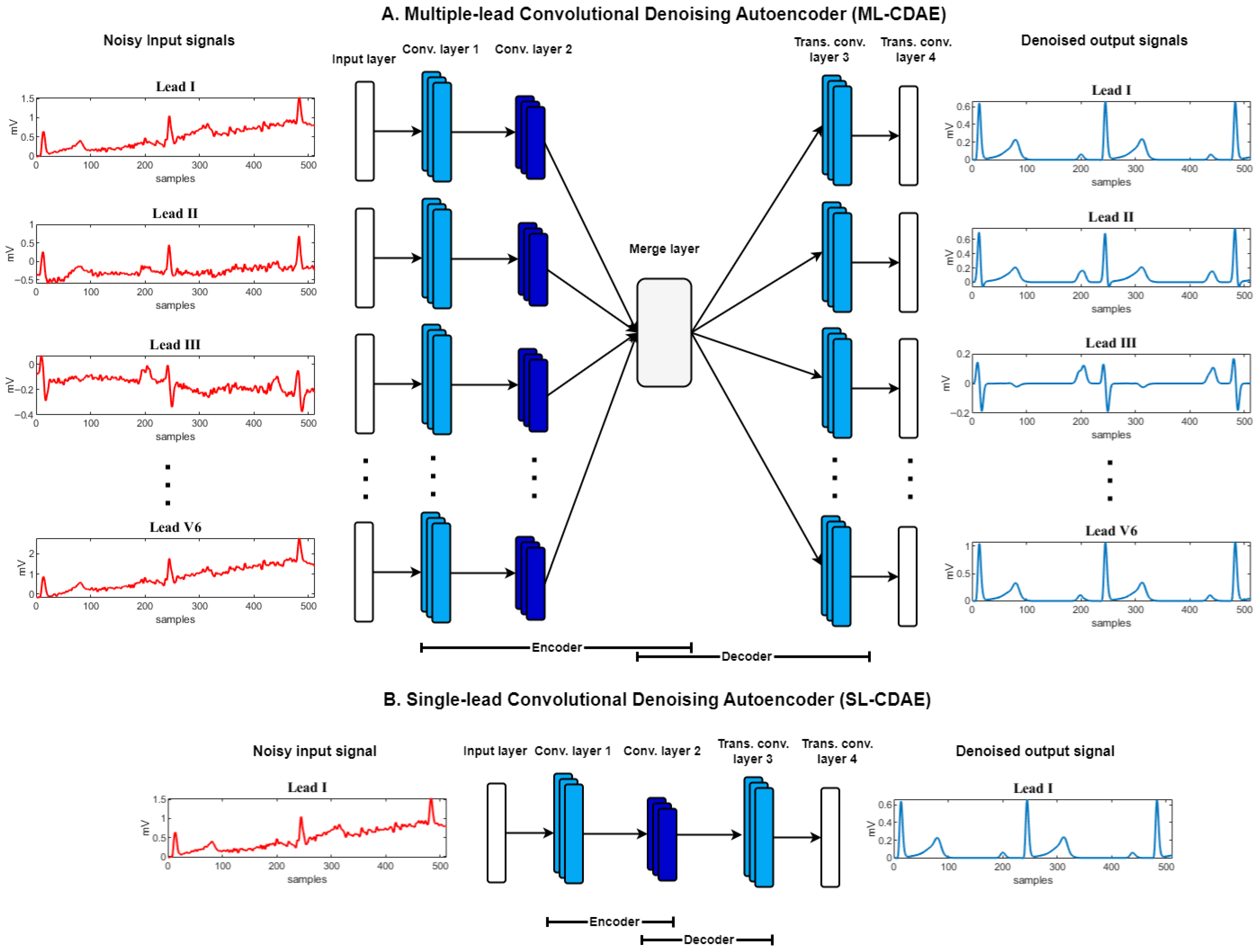
The proposed convolutional denoising autoencoder has a multiple-input and multiple-output (MIMO) architecture to process/denoise multi-lead ECG signals simultaneously, as shown in Figure 3A. Thus, we denote this model as the multi-lead convolutional denoising autoencoder (ML-CDAE). The ML-CDAE model is designed to accommodate multiple inputs to leverage the inter-lead correlation among the 12-lead ECG signals, in contrast to the single-lead convolutional denoising autoencoder (SL-CDAE) (see Figure 3B), which processes a single input to produce a single output (SISO). The encoder component of the ML-CDAE model consists of two sequential convolutional layers for each input. The outputs of the second convolutional layers (referred to as Conv. Layer 2) are concatenated using a merge layer, which computes the average of these outputs. The first and second convolutional layers utilize kernels of size 16 and 8, respectively, with 128 filters each. Within these layers, the number of neurons is progressively reduced by applying a stride of 2 and using zero-padding at each hidden layer. In the decoder section of the ML-CDAE, the output from the merge layer is passed through two additional transpose convolutional layers. These layers are designed with hyperparameters which are a mirror of the encoder’s hidden layers. However, the final transpose convolutional layer contains only a single filter, to produce an output that matches the length of the input segment.
The following equations achieve the output functions of each layer [1]:
z = f ( W x + b ) ,
x ^ = g ( W ^ z + b ^ ) ,
where W and b represent the weight and bias matrices of the encoder layer, respectively, and W ^ and b ^ represent the weight and bias matrices of the decoder layer, respectively. Meanwhile, f and g denote non-linear activation functions.
The single-lead CDAE model shares the same architecture as the ML-CDAE model in terms of the number of hidden layers and their hyperparameters, providing a fair comparison. However, it is designed for a single input layer and excludes the merge layer used in the ML-CDAE, as depicted in Figure 3B. The proposed models, ML-CDAE and SL-CDAE, were implemented using the following hardware and software setup:
  • Processor (CPU): Apple M1 chip with an 8-core CPU (4 performance cores and 4 efficiency cores) (Apple Inc., Cupertino, CA, USA).
  • Graphics Processing Unit (GPU): Integrated 8-core GPU (Apple Inc., Cupertino, CA, USA).
  • Memory (RAM): 8 GB unified memory.
  • Software environment: Python (v3.9.13); TensorFlow (v2.11); NumPy (v1.23.5); SciPy (v1.9.3).
For compilation, the mean square error and adaptive moment estimation (considering the following values of learning rate ϵ = 1 × 10 3 , exponential decay rate α = 1 × 10 6 ) were used as a loss function and optimizer. We compiled all the proposed models with epoch = 200 and ReLU as activation function.

3.3. Performance Evaluation

The performance of the proposed models was evaluated based on the SNR imp of the ECG signals achieved by the network. SNR imp is a metric that quantifies the improvement in signal strength relative to the noise level following the application of ML-CDAE. Greater separation between the pure ECG signal and other noise can be seen at higher SNR values. It shows how good the signal becomes after its denoising process [4]. This metric is estimated for a channel L of a signal as follows:
SNR imp , L = 10 log 10 m = 1 M X n o i s y L , m X c l e a n L , m 2 m = 1 M X d e n o i s e d L , m X c l e a n L , m 2
Another metric that can be used to evaluate the results of using ML-CDAE is the mean square error ( MSE ). The MSE estimates the average squared difference between the denoised ECG and the clean ECG signal, expressing the potential error resulting from the denoising process. Lower values of MSE indicate high performance. Its equation is as follows [1]:
MSE L = 1 M m = 1 M X c l e a n L , m X d e n o i s e d L , m 2
where M denotes the total number of samples.

4. Results

To assess the benefit of exploiting inter-lead correlations, the following models were evaluated with different input segment lengths (256, 512, and 1024):
  • Multi-Lead Convolutional Denoising Autoencoder (ML-CDAE): The proposed model, which simultaneously processes all 12 ECG leads to leverage their inherent spatial and physiological correlations.
  • Single-Lead Convolutional Denoising Autoencoder (SL-CDAE): A baseline configuration trained and evaluated on individual ECG leads independently, representing the common single-lead denoising strategy adopted in many existing state-of-the-art methods.
  • Fully Convolutional Network Denoising Autoencoder (FCN-DAE): A representative state-of-the-art deep learning model based on a fully convolutional encoder–decoder architecture, originally proposed for single-lead ECG denoising in [1]. The FCN-DAE consists exclusively of 12 stacked convolutional layers, enabling end-to-end signal reconstruction while preserving temporal resolution. In this study, the original network depth and configuration were retained, and the model was adapted only with respect to the input dimensionality to accommodate the ECG data used in the experiments.

4.1. Evaluation Using Simulated ECG Signals

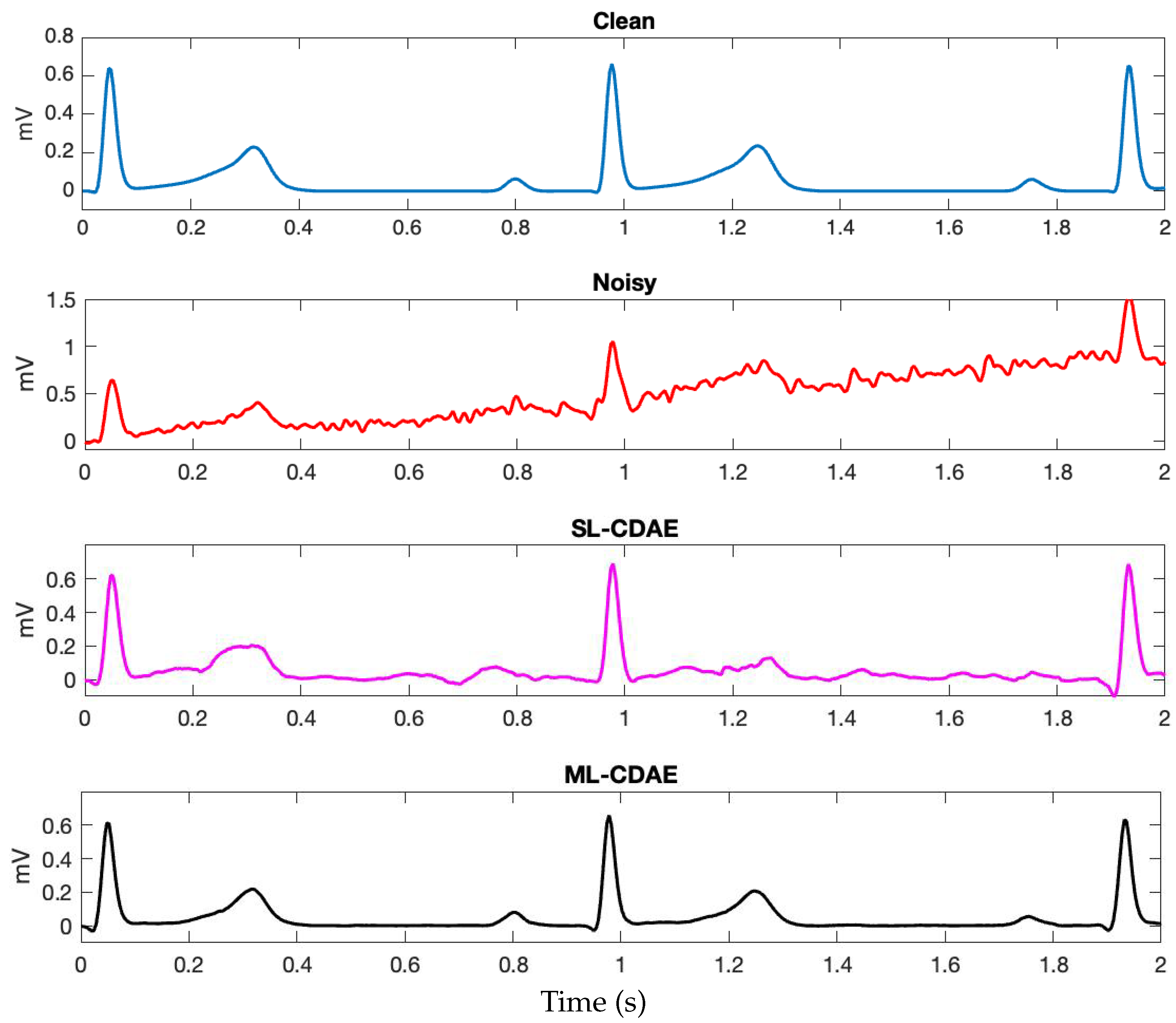
The proposed ML-CDAE and the SL-CDAE models were first evaluated using simulated 12-lead ECG signals corrupted with a mixture of realistic noise sources. This controlled setting enabled a quantitative assessment of denoising performance against known clean ground-truth signals. The evaluation was conducted across different ECG segment lengths to analyze the robustness of each model with respect to the temporal context. In general, the results demonstrated the effectiveness of the proposed ML-CDAE model in suppressing noise components while preserving ECG morphological fidelity compared to the SL-CDAE model, as shown in Figure 4. The time-domain comparison indicates that SL-CDAE fails to adequately reconstruct the P- and T-waves and introduces spurious artifacts in baseline regions, reflecting its limited ability to distinguish noise from the underlying ECG signal. In contrast, ML-CDAE provides an excellent reconstruction that closely matches the clean ECG waveform, although minor deviations persist due to the inherent challenges associated with separating muscle noise from ECG characteristics.
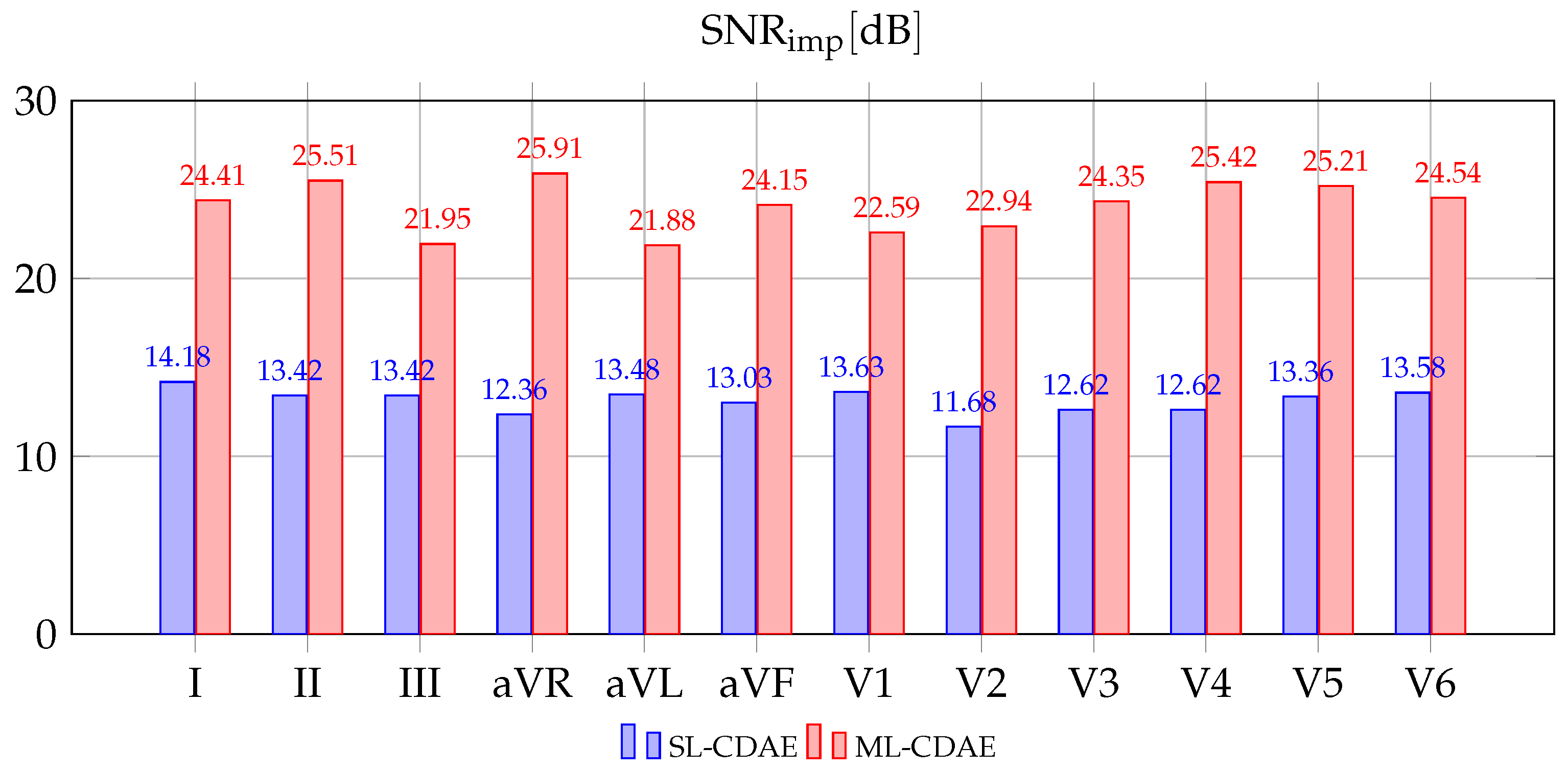
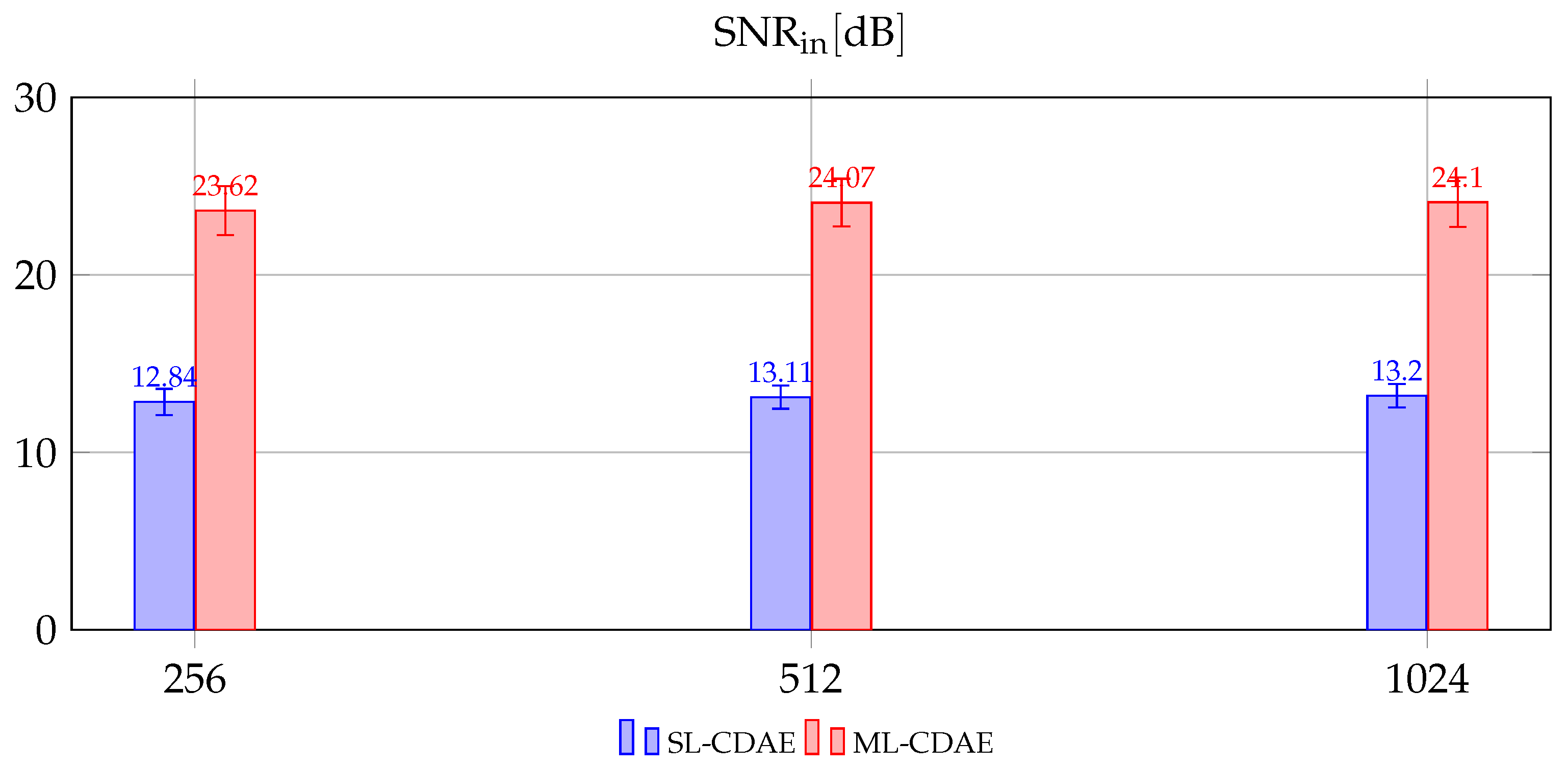
As shown in Figure 5 and Figure 6, ML-CDAE consistently achieves superior denoising performance across all ECG leads, yielding high SNR imp values of approximately 24 dB, compared to around 13 dB for the SL-CDAE when denoising simulated ECG signals at different segment lengths. Increasing the segment length from 256 to 1024 samples leads to a modest improvement in SNR imp for both models; however, the performance gain is more pronounced for SL-CDAE. In contrast, ML-CDAE exhibits a relatively stable SNR imp across varying segment lengths, indicating greater robustness and reduced sensitivity to segmentation size while maintaining consistently higher denoising effectiveness.
Table 2 and Table 3 list the SNR imp and MSE for all noise levels and configurations. The worst performance of the two configurations is shown by SL-CDAE, indicating lower SNR imp values and high overall reconstruction errors. ML-CDAE achieves the lowest MSE . This highlights the effectiveness of ML-CDAE in minimizing the difference between the reconstructed and original signals.

4.2. Evaluation Using Real ECG Signals

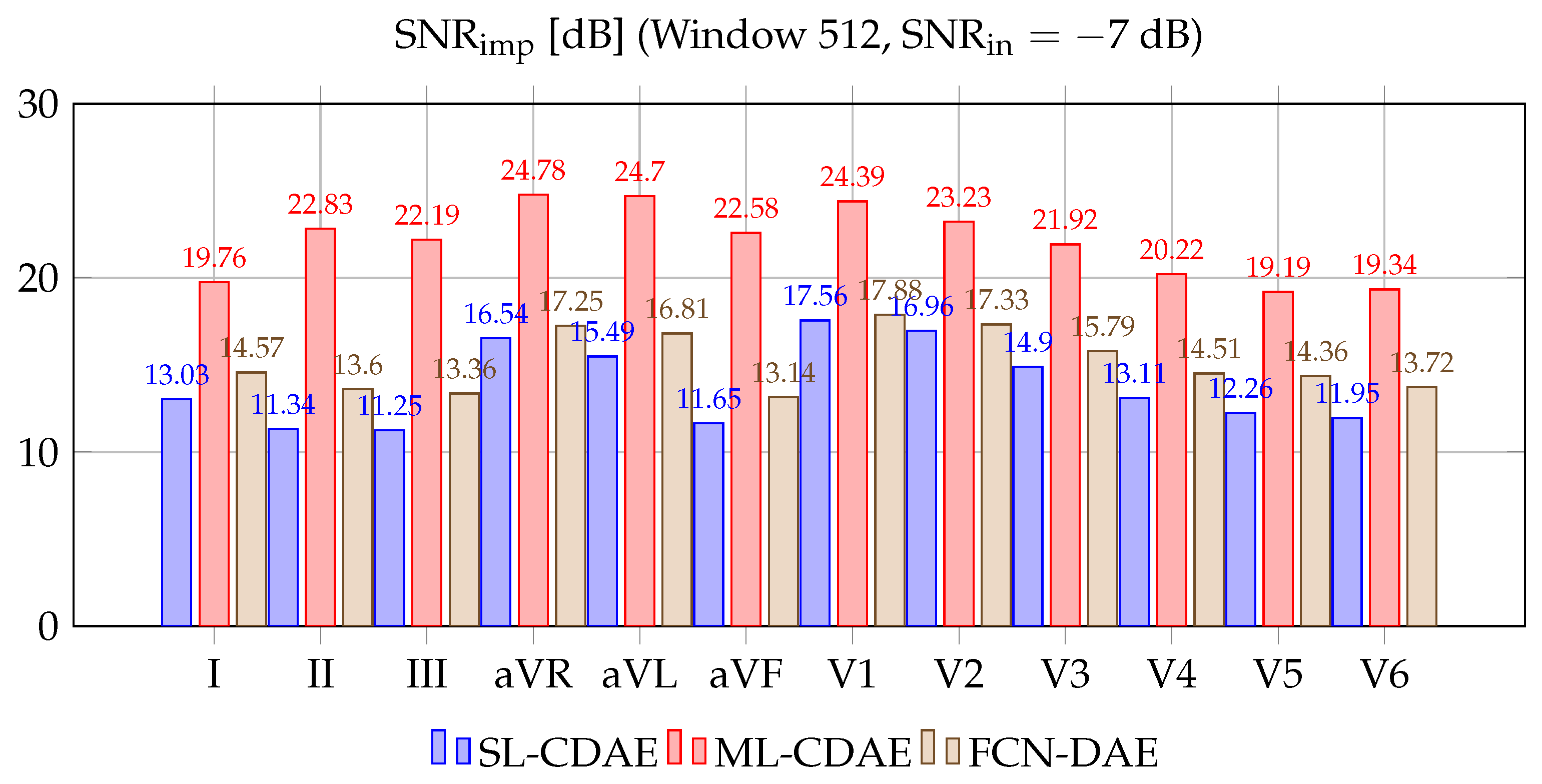
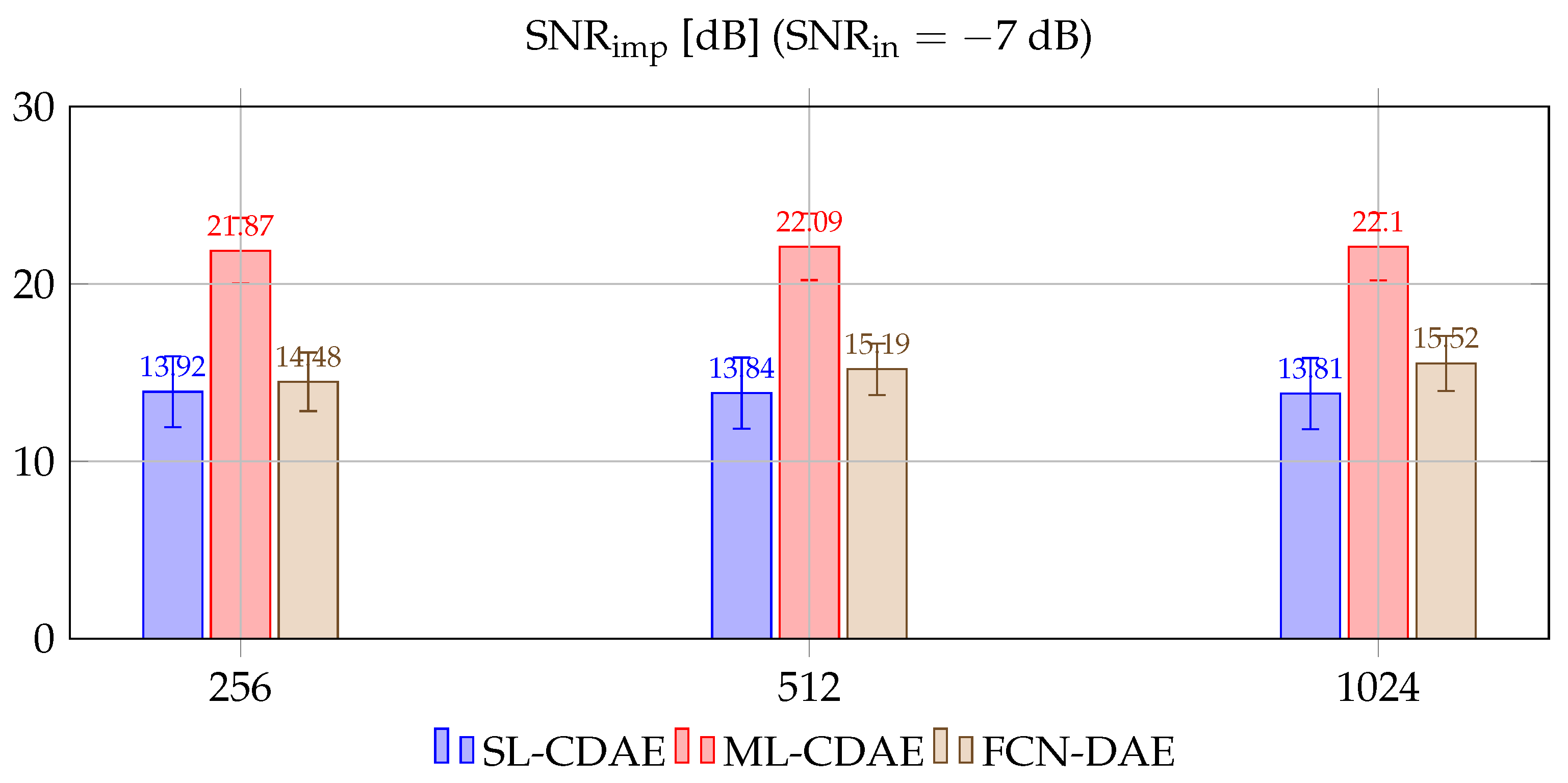
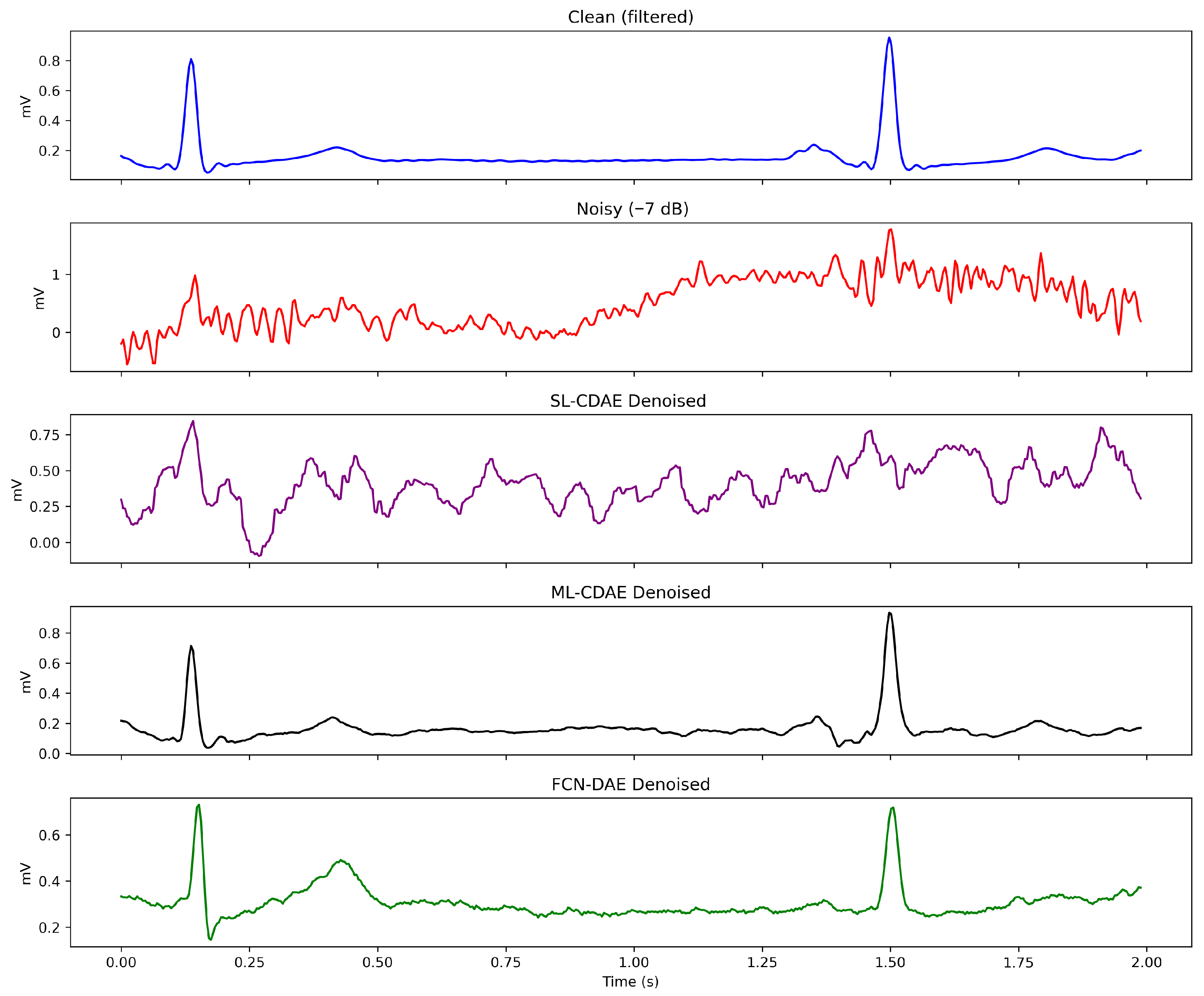
To further validate the practical applicability of the proposed approach, the ML-CDAE was also evaluated using real 12-lead ECG recordings. In this case, the same experimental protocol and performance metrics were applied to ensure consistency with the simulated data analysis. The denoising performance of ML-CDAE was compared against SL-CDAE and FCN-DAE, highlighting the advantage of multi-lead modeling when dealing with real-world ECG signals that exhibit complex noise characteristics and inter-lead dependencies. This evaluation confirms the robustness and generalization capability of the proposed ML-CDAE framework under realistic recording conditions. Figure 7 and Figure 8 illustrate that the ML-CDAE consistently achieves superior denoising performance across all ECG leads when applied to real recorded ECG signals. The proposed ML-CDAE attains SNR imp values of approximately 22 dB across different segment lengths, clearly outperforming the SL-CDAE and FCN-DAE models, which achieve around 13 dB and 14 dB, respectively, under the same experimental conditions. However, the FCN-DAE shows improved performance with increasing window length, which is consistent with its reliance on longer temporal contexts and a large number of hidden layers; nevertheless, it does not close the performance gap with the ML-CDAE. This observation is further supported by the time-domain visualization of the denoised ECG signals produced by the SL-CDAE, ML-CDAE, and FCN-DAE models, as illustrated in Figure 9. At the severe noise level of SNR in = 7 dB, the SL-CDAE fails to adequately reconstruct the underlying ECG morphology, exhibiting pronounced residual noise and distorted waveform characteristics. In contrast, the ML-CDAE demonstrates superior noise suppression and more faithful recovery of clinically relevant features, particularly the QRS complexes, while the FCN-DAE provides moderate improvement with remaining baseline fluctuations.

4.3. Statistical Analysis

To support these observations statistically, paired comparisons were performed using Wilcoxon signed-rank tests with the ECG lead as the paired unit ( n = 12 ). Bonferroni correction was applied across the three SNR in conditions within each metric to control the family-wise error rate. Table 4 and Table 5 summarize the ML-CDAE vs. SL-CDAE comparisons across SNR conditions, while Table 6 and Table 7 provide two-sided comparisons among models at window 512 and SNR in = 7 dB. Across all reported tests, the improvements are statistically significant after correction and accompanied by large effect sizes, supporting that the observed performance gains are systematic rather than incidental. Wilcoxon signed-rank tests were used because results are paired by ECG lead, and normality of the denoising metrics is not assumed. Each condition yields 12 paired observations (the 12 standard ECG leads). Bonferroni correction was applied across the three SNR in conditions within each metric. Effect size r was computed as r = z / n using the standardized Wilcoxon statistic.

4.4. Model Size and Complexity

This evaluation assessed the feasibility of deploying the ML-CDAE, SL-CDAE, and FCN-DAE models for real-time clinical applications in wearable devices by analyzing their model size and latency time per input segment, as shown in Table 8. The ML-CDAE model has a significantly greater memory footprint (12,498 KB) than FCN-DAE (3120 KB), mainly because each hidden layer uses 128 filters. However, compared to the latency time of the FCN-DAE model (6.4 ms), the ML-CDAE model achieves a lower latency time per segment (3.4 ms).

5. Discussion

For both real and simulated ECG recordings, the results indicate that ML-CDAE outperforms SL-CDAE across all tested segment lengths and noise levels in key metrics such as SNR imp and MSE . This improvement arises from the model’s ability to exploit correlations between multiple leads in a standard 12-lead ECG. By analyzing signals from multiple leads, ML-CDAE can more effectively distinguish clean ECG signals from noise, thereby enhancing the denoising process [3]. The redundancy in multi-lead recordings allows the model to compensate for noise present in individual leads [25], improving robustness against common clinical interferences such as baseline wander, motion artifacts, and electrode motion noise [26]. Similar benefits have been observed in tensor decomposition approaches for single- and multi-lead ECG denoising [31]. This means it can also better remove noise that is present on multiple leads.
Including model size and latency time in this discussion highlights the feasibility of deploying the proposed models in real-time clinical and wearable device applications. Although the ML-CDAE model has a larger memory footprint (approximately 12,498 KB) compared to FCN-DAE (3120 KB), this increase is primarily attributed to its multi-input architecture and large number of filters per layer, which enables hierarchical feature learning and enhanced denoising capability. Despite its larger model size, ML-CDAE demonstrates superior computational efficiency, processing 12-lead input segments simultaneously with a latency time of only 3.4 ms, whereas FCN-DAE requires nearly twice the inference time (6.4 ms) for the same task. Considering the trade-off between memory consumption and computational cost, along with the improved denoising performance, ML-CDAE presents a favorable balance that makes it particularly well suited for real-time multi-lead ECG denoising applications, particularly when optimizations such as model pruning, quantization, or reduced-precision arithmetic are applied.
Clinically, the improved denoising of ML-CDAE has direct benefits. Cleaner ECG signals improve the accuracy of arrhythmia detection and preserve critical waveform features such as P-waves, QRS complexes, and T-waves, reducing the risk of misdiagnosis (see Figure 4). Moreover, its ability to operate effectively in an unsupervised manner enhances accessibility for widespread clinical use [11].

6. Conclusions

In conclusion, taking advantage of the correlation among inter-lead ECG recordings is a significant step towards effective and real-time 12-lead ECG denoising. ML-CDAE enhances the clarity and accuracy of heart signals by leveraging correlations across leads, resulting in improved diagnostic accuracy and potentially better patient outcomes. To fully exploit the capabilities of ML-CDAEs in clinical settings, future research should focus on optimizing their architecture, exploring cross-learning strategies, and evaluating performance across diverse clinical datasets. Another important area for future work is dealing with scenarios in which one or more ECG leads are missing or severely impaired, to ensure that the model can perform reliable noise reduction even under incomplete or very difficult data conditions. With continued research and development, such algorithms could become a valuable tool for enhancing ECG quality and supporting improved patient care.

Author Contributions

Conceptualization, F.S. and T.S.; methodology, M.A.; software, M.A.; resources, M.A.; validation, M.A.; formal analysis, M.A.; investigation, M.A.; resources, F.S.; writing—original draft, M.A.; writing—review and editing, F.S. and T.S.; supervision, F.S. and T.S. All authors have read and agreed to the published version of the manuscript.

Funding

This research was supported by the Deutscher Akademischer Austauschdienst (DAAD) through a PhD scholarship awarded to Fars Samann (Grant No. 57507871).

Institutional Review Board Statement

Not applicable.

Informed Consent Statement

Not applicable.

Data Availability Statement

The original data presented in the study are openly available in ‘Model for Simulating ECG and PPG signals with arrhythmia Episodes’, PhysioNet, at https://doi.org/10.13026/s32e-sv15, and the ST-Petersburg INCART 12-Lead Arrhythmia Database, PhysioNet, at https://doi.org/10.13026/C2V88N.

Conflicts of Interest

The authors declare no conflicts of interest.

References

  1. Chiang, H.T.; Hsieh, Y.Y.; Fu, S.W.; Hung, K.H.; Tsao, Y.; Chien, S.Y. Noise Reduction in ECG Signals Using Fully Convolutional Denoising Autoencoders. IEEE Access 2019, 7, 60806–60813. [Google Scholar] [CrossRef]
  2. Wijaya, C.; Andrian, N.; Harahap, M.; Christnatalis, N.; Turnip, M.; Turnip, A. Abnormalities State Detection from P-Wave, QRS Complex, and T-Wave in Noisy ECG. J. Phys. Conf. Ser. 2019, 1230, 012015. [Google Scholar] [CrossRef]
  3. Zhang, C.; Li, J.; Pang, S.; Xu, F.; Zhou, S. A 12-lead ECG correlation network model exploring the inter-lead relationships. Europhys. Lett. 2022, 140, 31001. [Google Scholar] [CrossRef]
  4. Fotiadou, E.; Vullings, R. Multi-Channel Fetal ECG Denoising with Deep Convolutional Neural Networks. Front. Pediatr. 2020, 8, 2296–2360. [Google Scholar] [CrossRef]
  5. Nurmaini, S.; Darmawahyuni, A.; Sakti Mukti, A.; Rachmatullah, M.; Firdaus, F.; Tutuko, B. Deep Learning-Based Stacked Denoising and Autoencoder for ECG Heartbeat Classification. Electronics 2020, 9, 135. [Google Scholar] [CrossRef]
  6. Samann, F.; Schanze, T. RunDAE model: Running denoising autoencoder models for denoising ECG signals. Comput. Biol. Med. 2023, 166, 107553. [Google Scholar] [CrossRef] [PubMed]
  7. El Bouny, L.; Khalil, M.; Adib, A. Convolutional Denoising Auto-Encoder Based AWGN Removal from ECG Signal. In Proceedings of the 2021 International Conference on INnovations in Intelligent SysTems and Applications (INISTA), Hammamet, Tunisia, 6–8 October 2021; pp. 1–6. [Google Scholar]
  8. Xiong, P.; Wang, H.; Liu, M.; Lin, F.; Hou, Z.; Liu, X. A stacked contractive denoising auto-encoder for ECG signal denoising. Physiol. Meas. 2016, 37, 2214–2230. [Google Scholar] [CrossRef] [PubMed]
  9. Samann, F.; Schanze, T. Multiple ECG segments denoising autoencoder model. Biomed. Eng. 2023, 68, 275–284. [Google Scholar] [CrossRef]
  10. Samann, F.; Schanze, T. Multiple parallel hidden layers autoencoder for denoising ECG signal. Curr. Dir. Biomed. Eng. 2022, 8, 161–164. [Google Scholar] [CrossRef]
  11. Mvuh, F.; Ebode Ko’a, C.O.V.; Bodo, B. Multichannel high noise level ECG denoising based on adversarial deep learning. Sci. Rep. 2024, 14, 801. [Google Scholar] [CrossRef]
  12. Li, Z.; He, X.; Li, Y.; Nikkhoo, S.; Yang, W.; Thiele, L.; Liu, C. MIMONet: Multi-Input Multi-Output On-Device Deep Learning. arXiv 2023, arXiv:2307.11962. [Google Scholar]
  13. Goldberger, A.L.; Goldberger, Z.D.; Shvilkin, A. Chapter 4—ECG Leads. Goldberger’s Clinical Electrocardiography: A Simplified Approach, 9th ed.; Elsevier: Philadelphia, PA, USA, 2018; pp. 21–31. [Google Scholar]
  14. Rafie, N.; Kashou, A.H.; Noseworthy, P.A. ECG Interpretation: Clinical Relevance, Challenges, and Advances. Hearts 2021, 2, 505–513. [Google Scholar] [CrossRef]
  15. Kumar, A.; Tomar, H.; Mehla, V.K.; Komaragiri, R.; Kumar, M. Stationary wavelet transform based ECG signal denoising method. ISA Trans. 2021, 114, 251–262. [Google Scholar] [CrossRef]
  16. Romero, F.P.; Piñol, D.C.; Vázquez-Seisdedos, C.R. DeepFilter: An ECG baseline wander removal filter using deep learning techniques. Biomed. Signal Process. Control 2021, 70, 102992. [Google Scholar] [CrossRef]
  17. Morgado, E.; Alonso-Atienza, F.; Santiago-Mozos, R.; Barquero-Pérez, Ó.; Silva, I.; Ramos, J.; Mark, R. Quality estimation of the electrocardiogram using cross-correlation among leads. BioMed. Eng. OnLine 2015, 14, 59. [Google Scholar] [CrossRef]
  18. Zhang, Z.; Silva, I.; Wu, D.; Zheng, J.; Wu, H.; Wang, W. Adaptive motion artefact reduction in respiration and ECG signals for wearable healthcare monitoring systems. Med. Biol. Eng. Comput. 2014, 52, 1019–1030. [Google Scholar] [CrossRef] [PubMed]
  19. Pérez-Riera, A.R.; Barbosa-Barros, R.; Daminello-Raimundo, R.; de Abreu, L.C. Main artifacts in electrocardiography. Ann. Noninvasive Electrocardiol. 2018, 23, e12494. [Google Scholar] [CrossRef]
  20. Patel, S.I. Electrocardiographic artifacts during electroconvulsive therapy. J. Electrocardiol. 2009, 42, 307–309. [Google Scholar] [CrossRef] [PubMed]
  21. Gan, Y.; Rahajandraibe, W.; Vauche, R.; Ravelo, B.; Lorriere, N.; Bouchakour, R. A new method to reduce motion artifact in electrocardiogram based on an innovative skin-electrode impedance model. Biomed. Signal Process. Control 2022, 76, 103640. [Google Scholar] [CrossRef]
  22. Clifford, G. ECG Statistics, Noise, Artifacts, and Missing Data. Adv. Methods Tools Ecg Data Anal. 2006, 6, 18. [Google Scholar]
  23. Sološenko, A.; Petrėnas, A.; Paliakaitė, B.; Marozas, V.; Sörnmo, L. Model for Simulating ECG and PPG Signals with Arrhythmia Episodes, Version 1.3.1; PhysioNet: Cambridge, MA, USA, 2022. [Google Scholar] [CrossRef]
  24. Moody, G.; Muldrow, W.; Mark, R. A noise stress test for arrhythmia detectors. Comput. Cardiol. 1984, 11, 381–384. [Google Scholar]
  25. Jain, U.; Butchy, A.; Leasure, M.; Covalesky, V.; McCormick, D.; Mintz, G. Redundancy and Novelty Between ECG Leads Based on Linear Correlation. In Proceedings of the 16th International Joint Conference on Biomedical Engineering Systems and Technologies (BIOSTEC 2023)—BIOSIGNALS, Lisbon, Portugal, 16–18 February 2023; pp. 359–365. [Google Scholar]
  26. Fabricius Ekenberg, L.; Høfsten, D.E.; Rasmussen, S.M.; Mølgaard, J.; Hasbak, P.; Sørensen, H.B.D.; Meyhoff, C.S.; Aasvang, E.K. Wireless Single-Lead versus Standard 12-Lead ECG, for ST-Segment Deviation during Adenosine Cardiac Stress Scintigraphy. Sensors 2023, 6, 2962. [Google Scholar] [CrossRef] [PubMed]
  27. Geng, C.; Huang, H.; Langerman, J. Multipoint Channel Charting with Multiple-Input Multiple-Output Convolutional Autoencoder. In Proceedings of the 2020 IEEE/ION Position, Location and Navigation Symposium (PLANS), Portland, OR, USA, 23–26 April 2020; pp. 1022–1028. [Google Scholar]
  28. Goldberger, A.L.; Amaral, L.A.N.; Glass, L.; Hausdorff, J.M.; Ivanov, P.C.; Mark, R.G.; Mietus, J.E.; Moody, G.B.; Peng, C.K.; Stanley, H.E. PhysioBank, PhysioToolkit, and PhysioNet. Circulation 2000, 101, e215–e220. [Google Scholar] [CrossRef] [PubMed]
  29. Tihonenko, V.; Khaustov, A.; Ivanov, S.; Rivin, A. St.-Petersburg Institute of Cardiological Technics 12-Lead Arrhythmia Database, Version 1.0.0; PhysioNet: Cambridge, MA, USA, 2007. [Google Scholar] [CrossRef]
  30. Samann, F. Towards Real-Time ECG Signal Denoising Using Sparse and Shallow Running Denoising Autoencoder. Ph.D. Thesis, Technische Hochschule Mittelhessen, Giessen, Germany, 2025. [Google Scholar] [CrossRef]
  31. Schanze, T. Tensor decomposition-based compression and noise reduction of multichannel ECG signals. Passer J. Basic Appl. Sci. 2024, 6, 326–340. [Google Scholar] [CrossRef]
Figure 1. The timecourse of real recorded 12-lead physical noise signals obtained by [23,24] with an RMS of 0.5 mV and sampling frequency of 250 Hz. The noise in each ECG channel (lead) is represented using a different color: (a) baseline wandering; (b) electrodes movement; (c) motion artifacts; (d) mixture of noises.
Signals 07 00018 g001
Figure 2. (A) Time course of 12-lead ECG signals obtained by [23]. (B) The inter-lead relationships among the 12-lead ECG signals, quantified using Pearson’s correlation coefficient, where a value of 1 indicates a high positive correlation (strong similarity), 0 indicates no correlation (no similarity), and −1 indicates a high negative correlation (strong inverse relationship).
Signals 07 00018 g002
Figure 3. (A) The architecture of the multi-lead convolutional denoising autoencoder (ML-CDAE), considering 12 leads. (B) The architecture of the single-lead convolutional denoising autoencoder (SL-CDAE).
Signals 07 00018 g003
Figure 4. Time-domain comparison of clean, noisy, and denoised ECG signals illustrating the performance of SL-CDAE and ML-CDAE for simulated ECG signal I (in case of SL = 512, SNR in = 7 dB ). Note: all 12 leads were contaminated with noise.
Signals 07 00018 g004
Figure 5. Comparing SNR imp when using SL-CDAE and ML-CDAE for a segment length of 512 at SNR in = 7 dB .
Signals 07 00018 g005
Figure 6. Average SNR imp across 12 ECG leads vs. segment length at SNR in = 7 dB in case of simulated ECG signals. Error bars show standard deviation across leads (L=12).
Signals 07 00018 g006
Figure 7. Lead-wise SNR imp comparison at segment length 512 and SNR in = 7 dB. ML-CDAE exceeds SL-CDAE and FCN-DAE across all leads, indicating a consistent multi-lead gain.
Signals 07 00018 g007
Figure 8. Average SNR imp across 12 ECG leads vs. segment length at SNR in = 7 dB in case of real recorded ECG signals. Error bars show standard deviation across leads ( L = 12 ).
Signals 07 00018 g008
Figure 9. Time-domain comparison of clean, noisy, and denoised ECG signals illustrating the performance of SL-CDAE and ML-CDAE for real recorded ECG signal I (in case of segment length = 512, SNR in = 7 dB ). Note: all 12 leads were contaminated with noise.
Signals 07 00018 g009
Table 1. Inter -lead correlation of each noise type.
Noise TypeSourceCorrelation Across Leads
Baseline WanderingRespiration, motionStrongly correlated
Motion ArtifactsPatient movementPartially correlated
Electrode MovementPoor contact, displacementWeakly correlated
Table 2. SNR imp of SL-CDAE and ML-CDAE with a segment length 512 for different SNR in (−7, 0, 7) dB .
SL-CDAEML-CDAE
SNR in 7 dB 0 dB 7 dB 7 dB 0 dB 7 dB
I14.1811.288.0824.4121.2815.91
II13.4210.988.6925.5122.3116.89
III13.4210.597.6721.9518.5513.01
aVR12.369.126.3625.9122.8917.16
aVL13.4710.847.2321.8818.6313.24
aVF13.0211.176.8924.1521.1415.84
V113.6310.897.3622.5918.3412.44
V211.689.727.6722.9419.3113.49
V312.6211.208.5624.3521.9616.79
V412.6210.317.3025.4223.3918.68
V513.3610.587.5525.2122.2616.94
V613.5810.737.3924.5420.9915.48
Table 3. MSE of SL-CDAE and ML-CDAE with segment length of 512 for different SNR in (−7, 0, 7) dB .
SL-CDAEML-CDAE
SNR in 7 dB 0 dB 7 dB 7 dB 0 dB 7 dB
I0.00150.00060.00020.1453 ×   10 3 0.0596 ×  10 3 0.0410 ×  10 3
II0.00270.00100.00030.1688 ×  10 3 0.0705 ×  10 3 0.0489 ×  10 3
III0.00120.00040.00020.1635 ×  10 3 0.0715 ×  10 3 0.0509 ×  10 3
aVR0.00250.00110.00040.1120 ×  10 3 0.0447 ×  10 3 0.0304 ×  10 3
aVL0.00080.00030.00010.1158 ×  10 3 0.0488 ×  10 3 0.0339 ×  10 3
aVF0.00160.00050.00020.1262 ×  10 3 0.0503 ×  10 3 0.0340 ×  10 3
V10.00410.00150.00070.5177 ×  10 3 0.2748 ×  10 3 0.2168 ×  10 3
V20.01130.00350.00110.8402 ×  10 3 0.3867 ×  10 3 0.2946 ×  10 3
V30.01380.00380.00140.9263 ×  10 3 0.3202 ×  10 3 0.2100 ×  10 3
V40.01280.00430.00170.6717 ×  10 3 0.2133 ×  10 3 0.1262 ×  10 3
V50.00780.00300.00120.5129 ×  10 3 0.2020 ×  10 3 0.1368 ×  10 3
V60.00410.00160.00070.3292 ×  10 3 0.1485 ×  10 3 0.1056 ×  10 3
Table 4. Wilcoxon signed-rank test results for SNR imp comparing SL-CDAE and ML-CDAE across ECG leads ( n = 12 pairs). Bonferroni correction across three SNR in conditions ( α Bonf = 0.0167 ).
SNR in (dB)SL (Median [IQR])ML (Median [IQR])Wp p Bonf r
−713.39 [12.62, 13.50]24.38 [22.85, 25.26]00.00050.00151.00
010.79 [10.51, 11.03]21.21 [19.14, 22.27]00.00050.00151.00
707.47 [07.28, 07.77]15.88 [13.43, 16.90]00.00050.00151.00
Table 5. Wilcoxon signed-rank test results for MSE comparing SL-CDAE and ML-CDAE across ECG leads ( n = 12 pairs). Bonferroni correction across three SNR in conditions ( α Bonf = 0.0167 ).
SNR in (dB)SL (Median [IQR])ML (Median [IQR])Wp p Bonf r
−70.00340 [0.00158, 0.00868]0.00025 [0.00014, 0.00056]00.00050.0015−1.00
00.00130 [0.00058, 0.00313]0.00011 [0.00006, 0.00023]00.00050.0015−1.00
70.00055 [0.00020, 0.00113]0.00008 [0.00004, 0.00016]00.00050.0015−1.00
Table 6. Wilcoxon signed-rank tests for SNR imp at window 512 and SNR in = 7 dB ( n = 12 leads), Bonferroni correction across three SNR in conditions ( α Bonf = 0.0167 ).
Comparison SNR in (dB)ML (Median [IQR])Other (Median [IQR])Wp p Bonf r
ML vs. SL−722.39 [20.10, 23.52]13.07 [11.88, 15.75]00.00050.00051.00
ML vs. FCN-DAE−722.39 [20.10, 23.52]14.54 [13.69, 16.92]00.00050.00051.00
Table 7. Wilcoxon signed-rank tests for MSE at window 512 and SNR in = 7 dB ( n = 12 leads), Bonferroni correction across three SNR in conditions ( α Bonf = 0.0167 ).
Comparison SNR in (dB)ML (Median [IQR])Other (Median [IQR])Wp p Bonf r
ML vs. SL−70.0086 [0.0064, 0.01055]0.0547 [0.0462, 0.0607]00.00050.00051.00
ML vs. FCN-DAE−70.0086 [0.0064, 0.01055]0.0418 [0.0365, 0.0436]00.00050.00051.00
Table 8. Model size and latency time comparison for ML-CDAE, SL-CDAE, and FCN-DAE models across 12 leads in case of segment length 512.
ModelModel Size (KB)Latency Time per Segment (ms)
ML-CDAE12,4983.4
SL-CDAE12,5044.7
FCN-DAE31206.4
Disclaimer/Publisher’s Note: The statements, opinions and data contained in all publications are solely those of the individual author(s) and contributor(s) and not of MDPI and/or the editor(s). MDPI and/or the editor(s) disclaim responsibility for any injury to people or property resulting from any ideas, methods, instructions or products referred to in the content.