Article

Vibro-Acoustic Characterization of Additively Manufactured Loudspeaker Enclosures: A Parametric Study of Material and Infill Influence

1
Complex of Technical and Electronic Schools, Józef Sieradzan Technical School No.4, 99/105 Częstochowska Str., 62-800 Kalisz, Poland
2
NEURON Robotics Academy, 1 Babina Str., 62-800 Kalisz, Poland
3
Division of Electronic Systems and Signal Processing, Institute of Automatic Control and Robotics, Poznan University of Technology, 60-965 Poznan, Poland
*
Author to whom correspondence should be addressed.
Signals 2025, 6(4), 73; https://doi.org/10.3390/signals6040073
Submission received: 28 August 2025 / Revised: 30 October 2025 / Accepted: 4 December 2025 / Published: 12 December 2025

Abstract

This paper presents a comparative analysis of the influence of Fused Deposition Modeling (FDM) parameters—specifically material type, infill geometry, and density—on the vibro-acoustic characteristics of loudspeaker enclosures. The enclosures were designed as exponential horns to intensify resonance phenomena for precise evaluation. Twelve unique configurations were fabricated using three materials with distinct damping properties (PLA, ABS, wood-composite) and three internal geometries (linear, honeycomb, Gyroid). Key vibro-acoustic properties were assessed via digital signal processing of recorded audio signals, including relative frequency response and time-frequency (spectrogram) analysis, and correlated with a predictive Finite Element Analysis (FEA) model of mechanical vibrations. The study unequivocally demonstrates that a material with a high internal damping coefficient is a critical factor. The wood-composite enabled a reduction in the main resonance amplitude by approximately 4 dB compared to PLA with the same geometry, corresponding to a predicted 86% reduction in mechanical vibration. Furthermore, the results show that a synergy between a high-damping material and an advanced, energy-dissipating infill (Gyroid) is crucial for achieving high acoustic fidelity. The wood-composite with 10% Gyroid infill was identified as the optimal design, offering the most effective resonance damping and the most neutral tonal characteristic. This work provides a valuable contribution to the field by establishing a clear link between FDM parameters and acoustic outcomes, delivering practical guidelines for performance optimization in personalized audio systems.

1. Introduction

The dynamic development of Additive Manufacturing (AM) technologies, which constitute a key pillar in the field of Rapid Prototyping, has introduced a paradigmatic shift in the approach to design and manufacturing across numerous engineering disciplines [1,2,3]. Among the diverse AM techniques, Fused Deposition Modeling (FDM) stands out due to its accessibility, low implementation cost, and a wide range of available polymer and composite materials [4,5,6]. The ability to rapidly fabricate physical models, conduct cost-effective low-volume production, and, most importantly, create geometries of high complexity that are impossible or uneconomical to achieve with traditional methods has opened up unprecedented design possibilities. One of the areas where the potential of AM is particularly promising is the design of personalized audio systems, especially loudspeaker enclosures, where internal geometry and material properties play a crucial role in shaping the final acoustic characteristics [7,8,9].
According to the fundamental principles of vibro-acoustics, an ideal loudspeaker enclosure should be an acoustically inert structure [10,11,12]. Its primary function is to prevent the phenomenon of acoustic short-circuiting—the destructive interference of low-frequency sound waves generated in antiphase by the front and rear of the driver’s diaphragm—and to control parasitic self-resonances (i.e., unwanted vibrations of the enclosure’s panels at their natural frequencies, which color the generated sound). To achieve this goal, materials used in the traditional manufacturing of high-quality enclosures, such as Medium-Density Fibreboard (MDF) and High-Density Fibreboard (HDF), are selected for their specific combination of mechanical properties: high stiffness, high density, and, most importantly, a high internal damping coefficient. Internal damping is a measure of a material’s ability to dissipate mechanical vibration energy, primarily through conversion into thermal energy, which prevents the propagation of resonances within the structure and consequently minimizes the coloration of the generated sound [13,14].
In this context, a fundamental challenge arises for FDM technology. The basic thermoplastics used in this method, such as Polylactic Acid (PLA) and Acrylonitrile Butadiene Styrene (ABS), possess mechanical properties that are fundamentally different from those of wood-based materials [15,16]. They are characterized by low density and, most significantly, negligible internal damping, which makes them inherently prone to resonance [13,17]. However, FDM technology offers a unique tool to compensate for these material shortcomings: the ability to precisely design the internal infill structure. The geometry (e.g., anisotropic-linear, quasi-isotropic-honeycomb, fully isotropic-Gyroid), density, and orientation of this internal lattice critically influence the resultant mechanical properties of the entire component [15,18]. The fabricated object is no longer a solid polymer but becomes a composite or cellular solid, whose overall stiffness, mass, and, crucially for this work, ability to dissipate vibration energy are a function of both the base material and its micro-architecture [19,20].
Despite the growing popularity of 3D-printed audio systems in hobbyist and prototyping environments, the available scientific literature shows a research gap concerning systematic, quantitative studies that compare the influence of key FDM printing parameters on the final vibro-acoustic properties of enclosures [9,21]. Existing research predominantly focuses on the analysis of the static mechanical properties (tensile strength, compression strength, elastic modulus) of printed components [6,15,22]. neglecting their dynamic characteristics and damping capabilities, which are decisive parameters in audio applications. Although some studies have analyzed the vibro-acoustic properties of additively manufactured composites [17], comprehensive comparative studies for commonly available materials and geometries are lacking.
The primary contribution of this work is therefore threefold. First, it provides a comprehensive comparative dataset on the vibro-acoustic performance of commonly used FDM materials and advanced infill geometries, a topic currently underrepresented in the literature. Second, it presents a multi-faceted analysis methodology, combining relative frequency response, time-frequency analysis, and theoretical FEA modeling to create a holistic view of the system’s behavior. Third, it distills these complex findings into a set of practical engineering guidelines that can be directly applied by designers and engineers to optimize 3D-printed audio systems.
In response to this identified gap in the literature, the aim of this work is to conduct a systematic, empirical analysis and quantification of the influence of three fundamental FDM process parameters—filament type (PLA, ABS, wood-composite), infill geometry (linear, honeycomb, Gyroid), and its density—on the sound transfer characteristics of a loudspeaker enclosure. Through a comprehensive comparative analysis of twelve unique configurations, this study aims to create a set of quantitative design guidelines for engineers and designers, enabling the deliberate shaping of the desired sound signature and the minimization of unwanted resonances in personalized audio systems manufactured with additive technology [9,10].

2. Materials and Methods

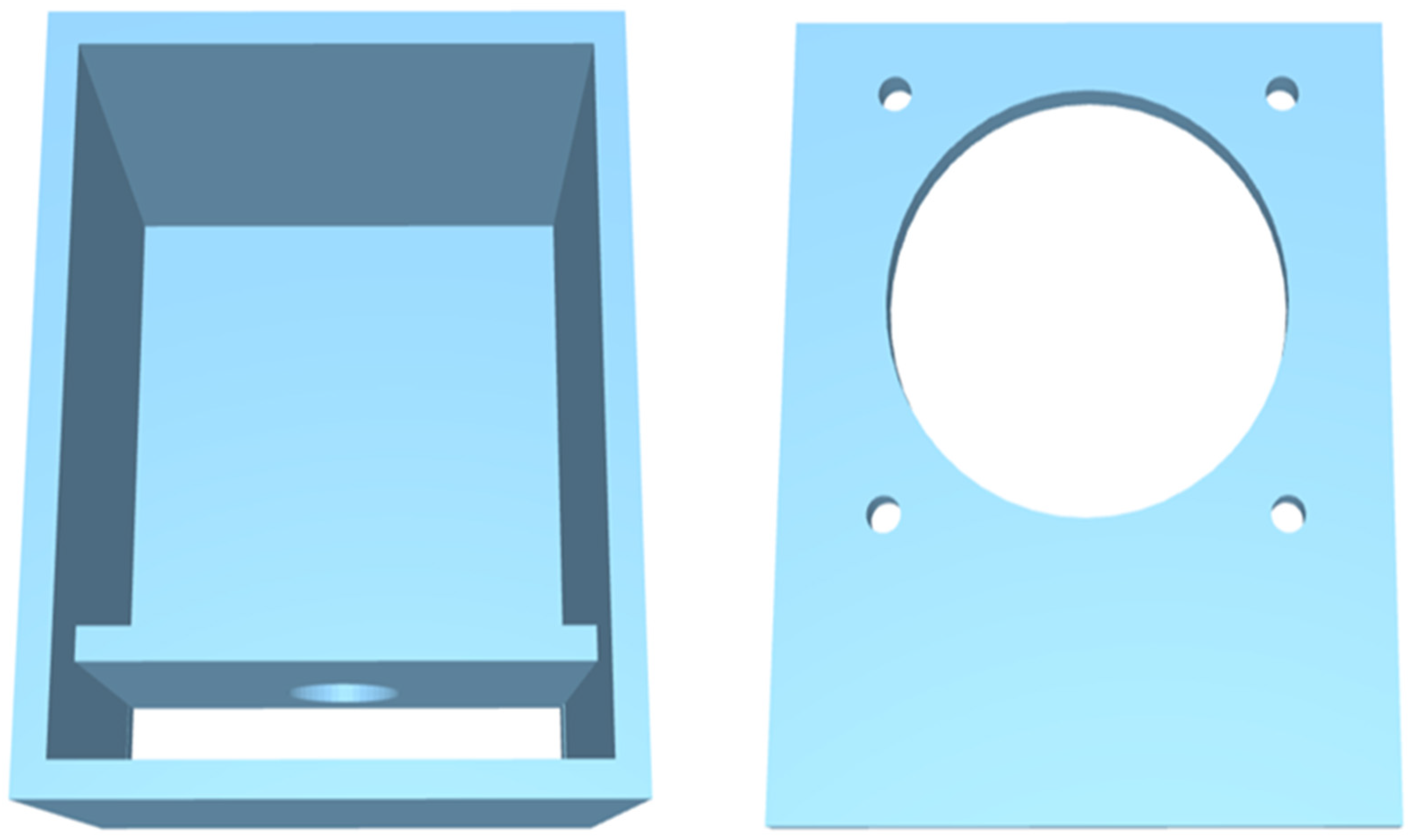
The object of this study was a loudspeaker enclosure with external dimensions of 90 × 110 × 65 mm and a constant wall thickness of 4 mm, designed in CAD software—Autodesk Inventor Professional 2023 (Figure 1). Its geometry was intentionally shaped as an exponential horn. This design, in contrast to standard constructions aimed at minimizing coloration, was intended to intensify resonance phenomena, which enabled an easier and more precise assessment of the influence of the investigated parameters on the acoustic characteristics. All test specimens were fabricated using Fused Deposition Modeling (FDM) technology on a Creality Ender 3 type 3D printer.
To ensure consistency and comparability of the results, all models were printed with constant, unified process parameters, such as nozzle diameter (0.4 mm), layer height (0.2 mm), and printing speed (50 mm/s). The only variables were the process temperatures, adjusted to the specifics of the material (210 °C for the nozzle and 60 °C for the bed in the case of PLA; 240 °C and 100 °C for ABS) [6,23,24]. A total of twelve unique enclosure configurations were prepared for the experiment, differing in three key variables: material, infill geometry, and density. A complete list of the test specimens is presented in Table 1.
The three materials selected for this study—PLA, ABS, and a wood-composite—were chosen due to their distinct and well-documented mechanical properties, which are critical for vibro-acoustic behavior. The nominal, literature-based properties used for the theoretical modeling and qualitative discussion are summarized in Table 2.
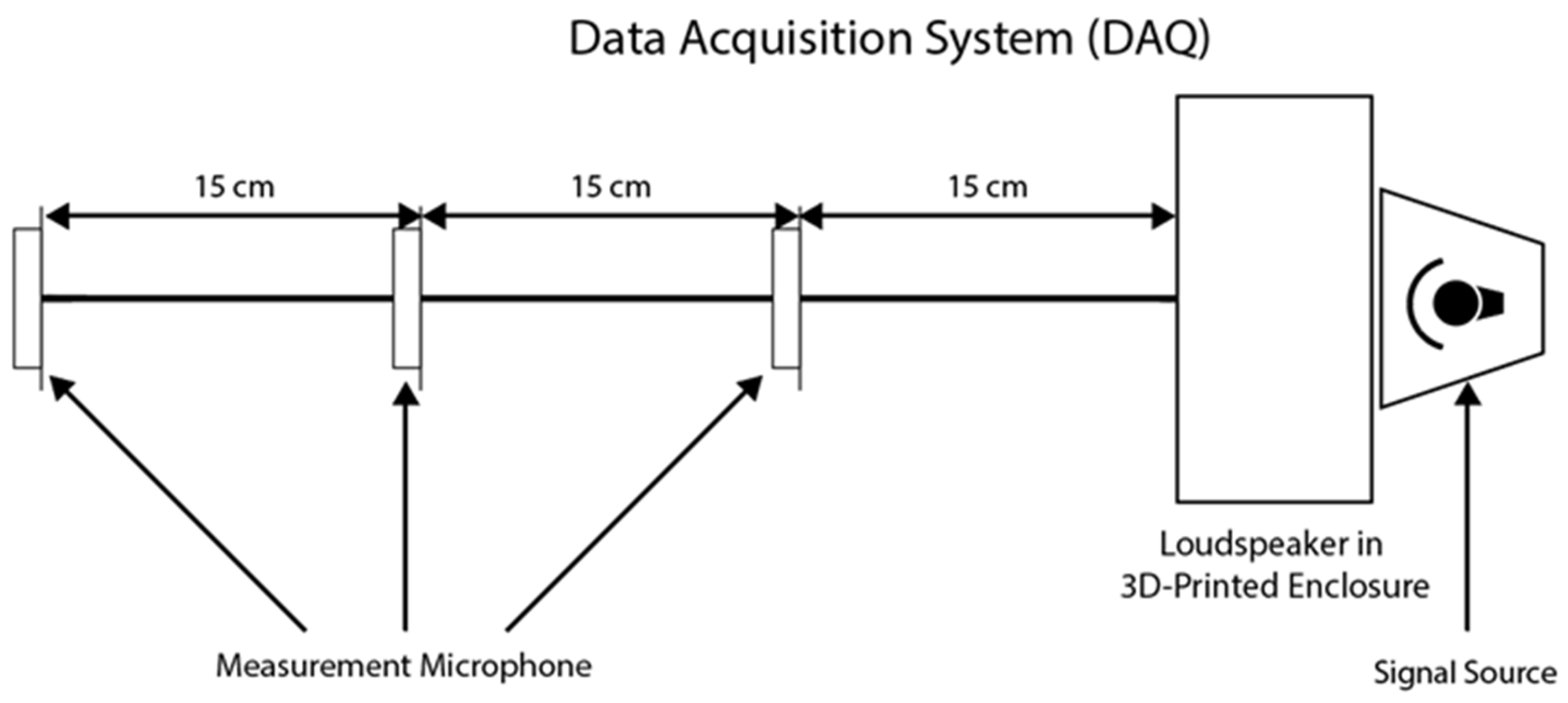
To evaluate the acoustic properties of each of the twelve configurations, a dedicated measurement setup was designed (Figure 2). The measurements were conducted in a controlled environment with low background noise, using the same wide-band driver for each enclosure [9]. An integrated condenser microphone of a single smartphone (iPhone X) was used for all audio signal acquisitions. The authors acknowledge that a non-calibrated, consumer-grade microphone lacks a flat frequency response and absolute accuracy, particularly in the high-frequency range. However, for a comparative study of this nature, the primary requirement is measurement consistency, not absolute metrological precision. By using the exact same device in a fixed position for all 36 measurements, any frequency response anomalies of the microphone are systematically applied to all samples and are effectively cancelled out during the calculation of the relative frequency response. While no formal calibration was performed, this approach ensures high repeatability, making the comparison between the specimens valid [11].
A key element of the procedure was data acquisition at three defined distances from the sound source—15 cm, 30 cm, and 45 cm—which allowed for the verification of result consistency and the investigation of potential near-field effects [12]. The 15 cm distance was specifically chosen as representative of the acoustic near-field, where the enclosure’s direct influence on the sound characteristics is most pronounced, while the additional measurements were conducted to verify the consistency of the observed trends. A 20-s excerpt of a musical piece with a wide frequency spectrum was used as the test signal, played back at a constant volume level. Additionally, a reference measurement was performed for the driver operating without any enclosure, which served as a baseline for all subsequent analyses.
The authors acknowledge that the employed measurement apparatus, utilizing a non-calibrated smartphone microphone, introduces a degree of absolute measurement uncertainty. However, the nature of this study is comparative, where the primary objective is to assess the relative performance differences between the configurations under identical conditions. To ensure the reliability of these comparisons, the repeatability of the measurements was a key focus. Each configuration was measured three times. An analysis of the standard deviation in the main resonance band (800–900 Hz) showed a variance of less than 0.5 dB across the repeated measurements. This high level of consistency confirms that the random error is minimal and that the observed differences between specimens are significant and attributable to the variations in their material and structure, thus allowing for valid engineering conclusions to be drawn.
The recorded audio files were then subjected to a multi-stage analysis pipeline in the Python 3.12 programming environment, which included automatic signal synchronization, relative frequency response calculation, and time-frequency (STFT) analysis. The first, crucial step was the automatic time-alignment of all recordings. This was achieved using a method based on the cross-correlation of onset strength envelopes, which allowed for the precise synchronization of the signals and enabled their further comparison [11]. The primary method for quantitative evaluation was the relative frequency response analysis. This involved calculating the time-averaged power spectrum for each signal via FFT. Subsequently, to isolate the influence of the enclosure itself, the power spectrum of the signal from the tested configuration (driver + enclosure) was divided by the power spectrum of the reference signal (driver alone). This deconvolution operation, expressed in decibels, effectively isolates and quantifies the transfer function of the enclosure itself. The primary advantage of this relative response methodology is its ability to effectively cancel out the linear distortions originating from the non-ideal frequency responses of both the driver and the microphone. This allows for the precise isolation of the acoustic signature of the enclosure itself, making it a robust and accessible method for comparative analysis even without access to an anechoic environment or fully calibrated equipment. The result of this operation, expressed in decibels, effectively isolates and quantifies the influence of the enclosure itself on the transfer band. For in-depth visual analysis, a time-frequency analysis was also performed using the Short-Time Fourier Transform (STFT), generating spectrograms that allowed for the assessment of the decay times of parasitic resonances [12].
To correlate the obtained acoustic results with the predicted mechanical properties, a theoretical model of the expected vibrations was also created. To provide a theoretical framework for interpreting the acoustic results, a predictive numerical model was developed. This FEA simulation was designed as a post-hoc explanatory tool, intended not to replace empirical measurement, but to serve as a fundamental instrument for explaining the physical mechanisms behind the observed acoustic phenomena and to correlate the measured sound response with the predicted mechanical behavior of the structures [14,17].

3. Results

3.1. Relative Frequency Response Analysis

The following graphs present the relative frequency response of the investigated configurations, illustrating their influence on the transfer band relative to the driver operating without an enclosure. Positive values in decibels (dB) indicate an amplification, while negative values represent an attenuation of a given frequency.
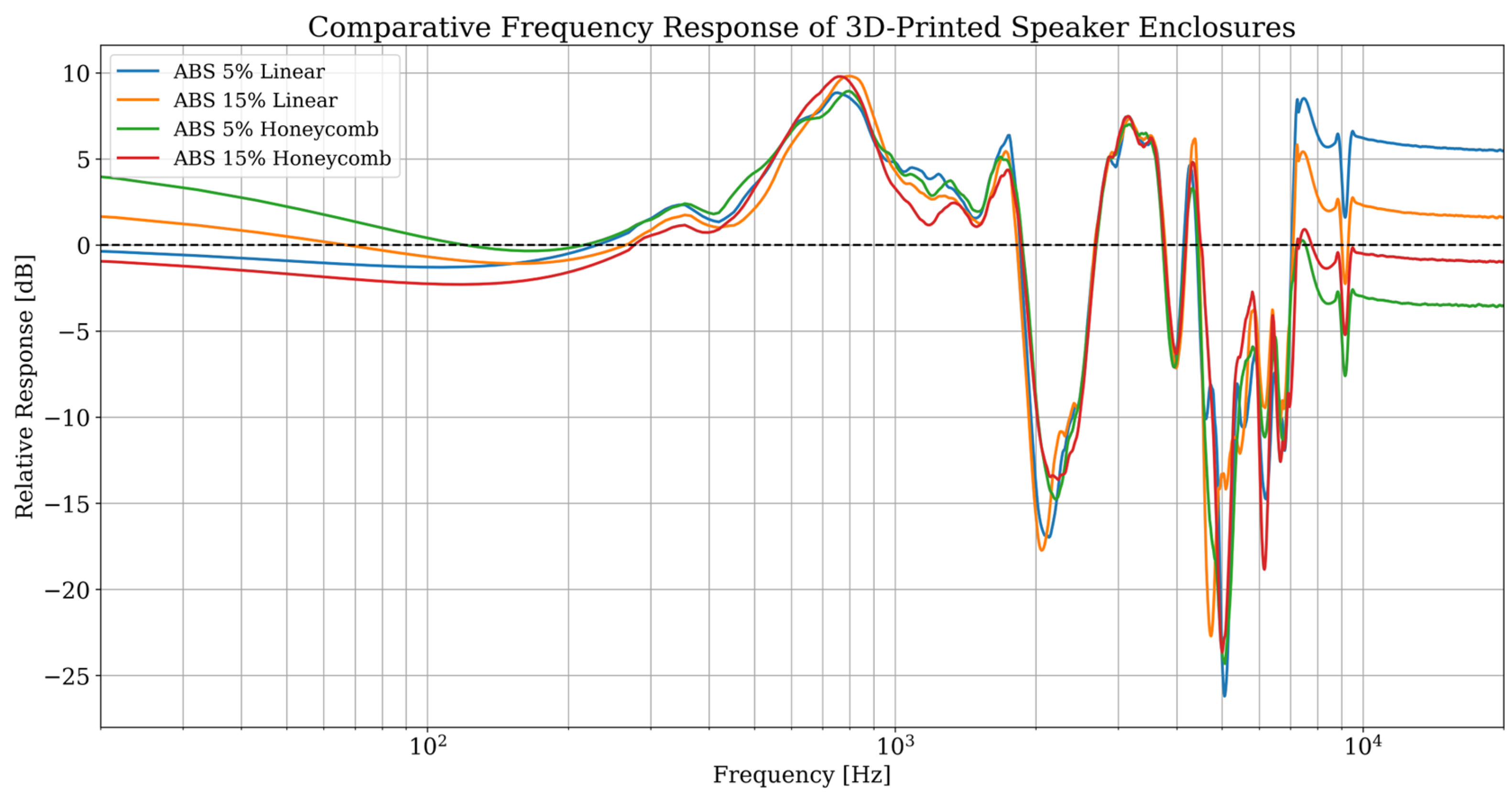
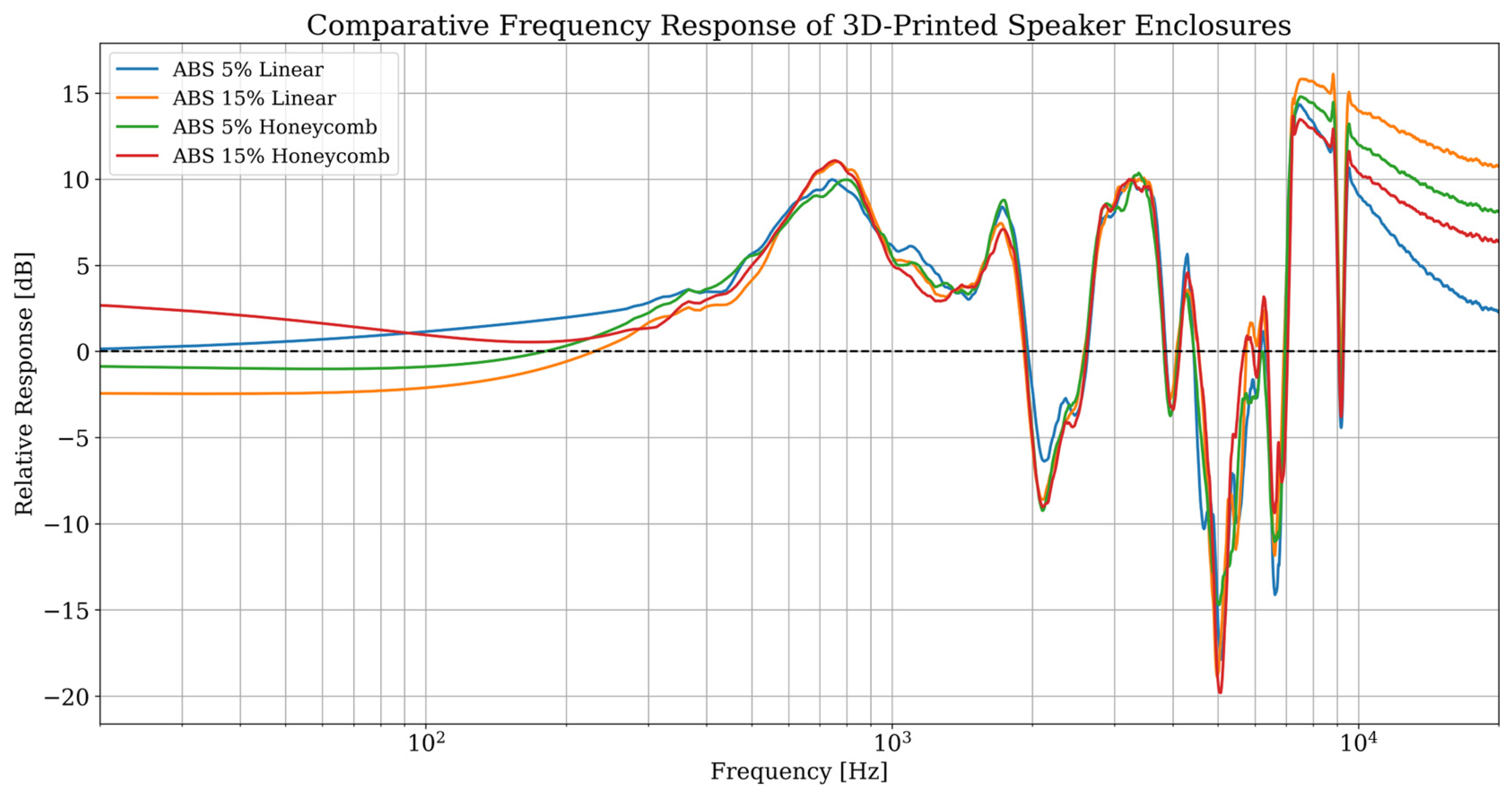
The first material analyzed was ABS, for which the influence of infill geometry and density was examined. Figure 3 shows a comparison of the four enclosure variants made from this material. It was observed that the honeycomb structure leads to a reduction in the amplitude of the main resonance peak (approx. 800–900 Hz) compared to its counterparts with a linear infill. The most effective damping, and consequently the most controlled sound in this critical band, was achieved for the ABS 15% Honeycomb configuration. Significantly, the honeycomb variants demonstrated much better control over the high-frequency band (>6 kHz), effectively eliminating the sharp resonance peaks present in the linear variants. The reduction in these peaks translates directly to a decrease in the acoustic phenomena perceived as “harshness” and “metallic” sound character. This aligns with findings that isotropic infill patterns provide superior structural stiffness and mechanical behavior compared to anisotropic ones [18,25].
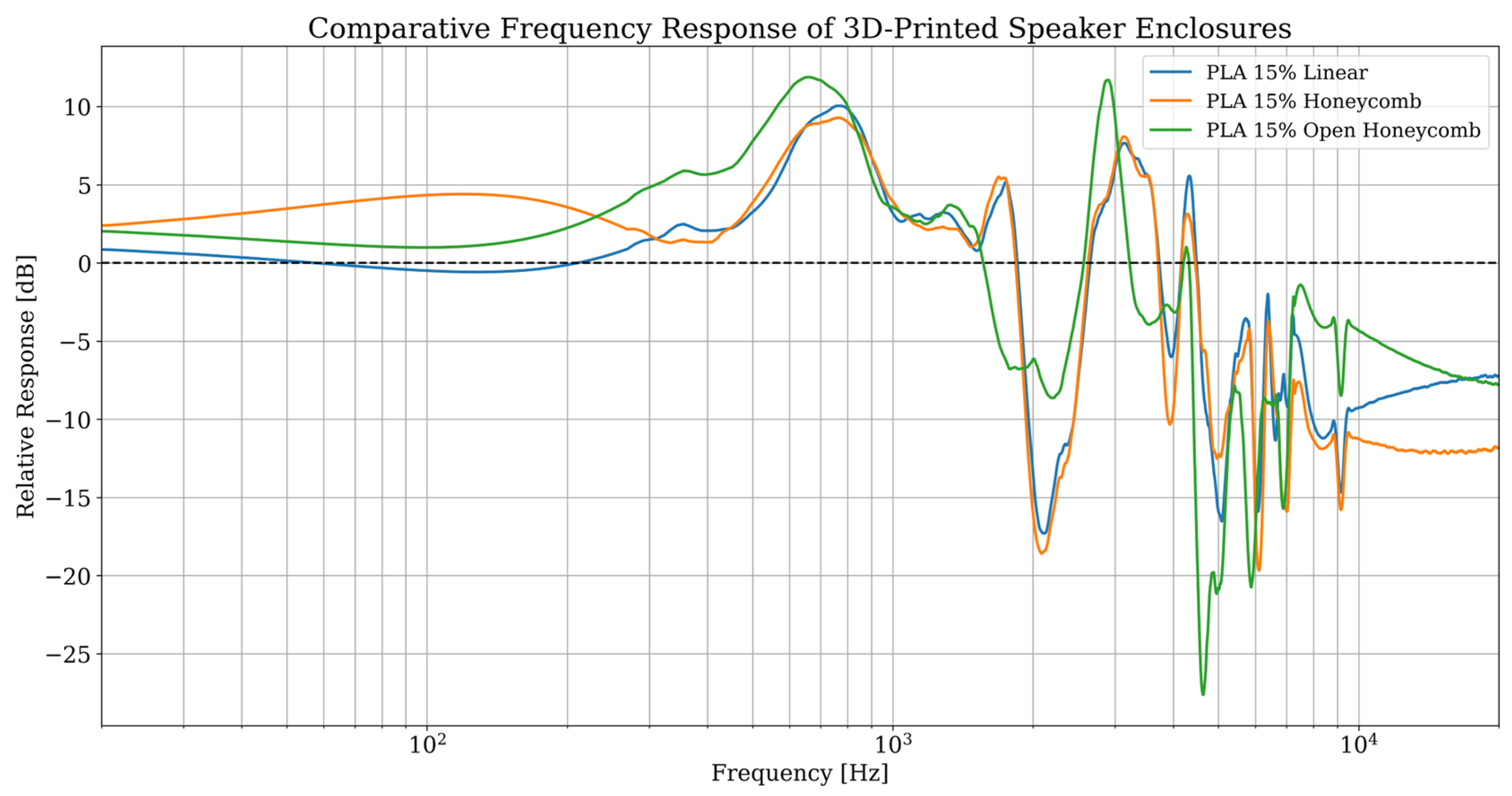
Subsequently, an analogous analysis was conducted for the PLA material, which, due to its lower internal damping coefficient, allowed for a more pronounced manifestation of the influence of geometry. As shown in Figure 4, the results for PLA proved to be more complex. In contrast to ABS, the standard honeycomb geometry did not reduce the amplitude of the main resonance peak. Instead, it was characterized by a strong boost in the low-mid frequency band (150–500 Hz), which constitutes a significant deviation from a neutral response. In turn, the PLA 15% Honeycomb variant offered decisively better control over the high-frequency range, suggesting its potential in reducing acoustic artifacts perceived as “roughness” or “harshness”. This behavior is consistent with the known mechanical properties of PLA, which, as a rigid and brittle material, is more prone to complex resonant modes that are highly dependent on structural stiffening provided by the infill geometry [13,15,24].
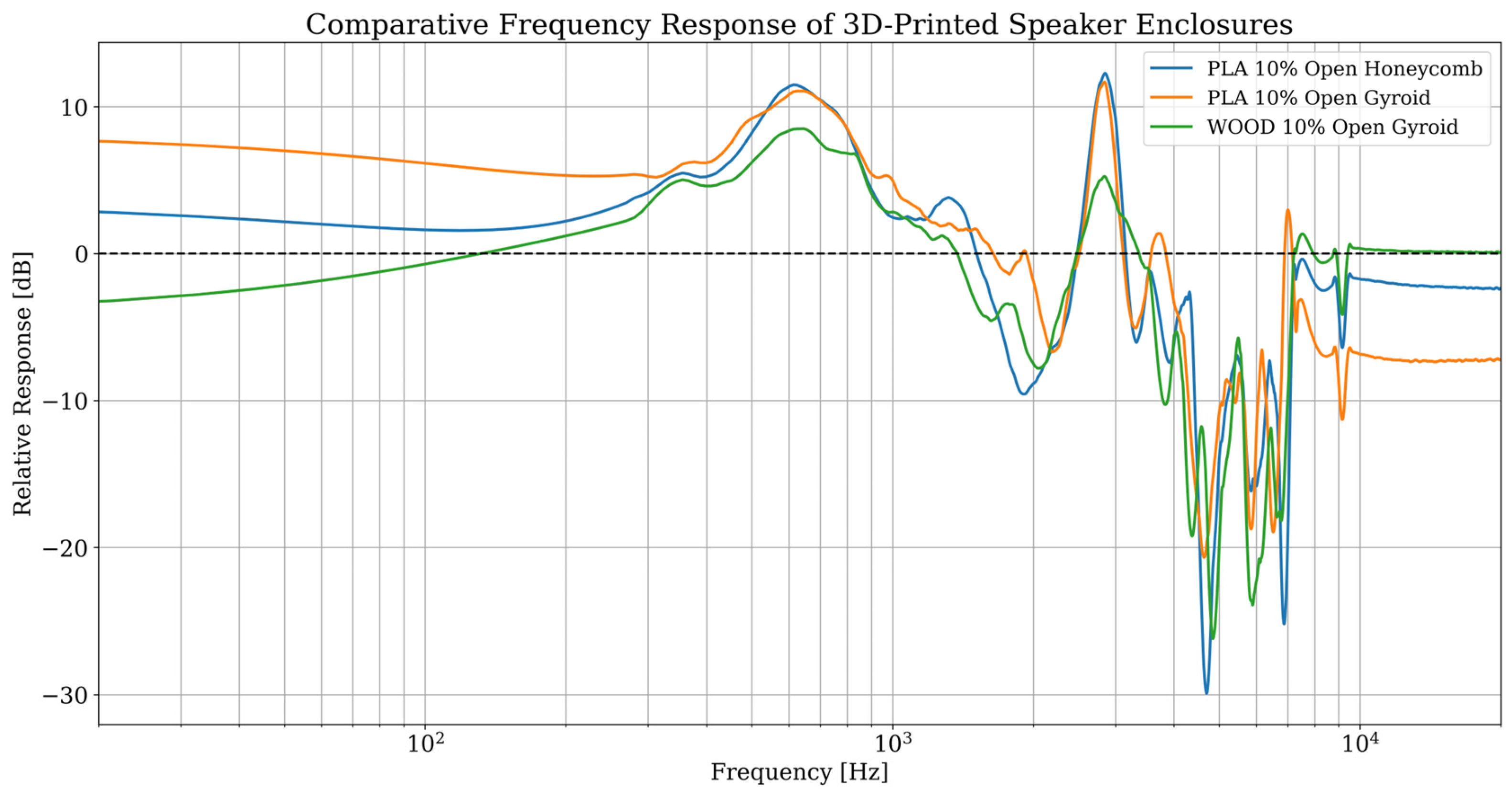
Crucial to the entire experiment was the direct comparison of advanced geometries and the assessment of the influence of a material with high damping properties. Figure 5 presents a juxtaposition of the three most significant configurations. The comparison of the wood-composite enclosure with its PLA counterpart, both featuring an identical Gyroid geometry, provides the most compelling evidence in this study. The use of the wood-composite filament resulted in a significant reduction in the main resonance peak amplitude by approximately 4 dB. Furthermore, it completely eliminated the problematic boost in the low and mid-range frequencies, which in the case of PLA led to low-frequency overhang and a loss of transient definition. The characteristic of the wood-composite enclosure is incomparably more neutral and controlled, which translates to higher signal fidelity and precision. This finding strongly supports the hypothesis that incorporating fillers, such as wood particles, into a polymer matrix enhances its dissipative properties and significantly improves its vibro-acoustic performance [26,27]. The superior performance of the Gyroid geometry in this context also aligns with research on topologically optimized architected materials, which exhibit enhanced energy absorption capabilities [19,28].
To verify the repeatability of the results, all measurements were also performed at distances of 30 cm and 45 cm. As shown in Figure 6, the relative performance hierarchy of the individual configurations remained fully consistent. This consistency demonstrates that the observed differences are an intrinsic characteristic of the tested enclosures and not a measurement artifact.
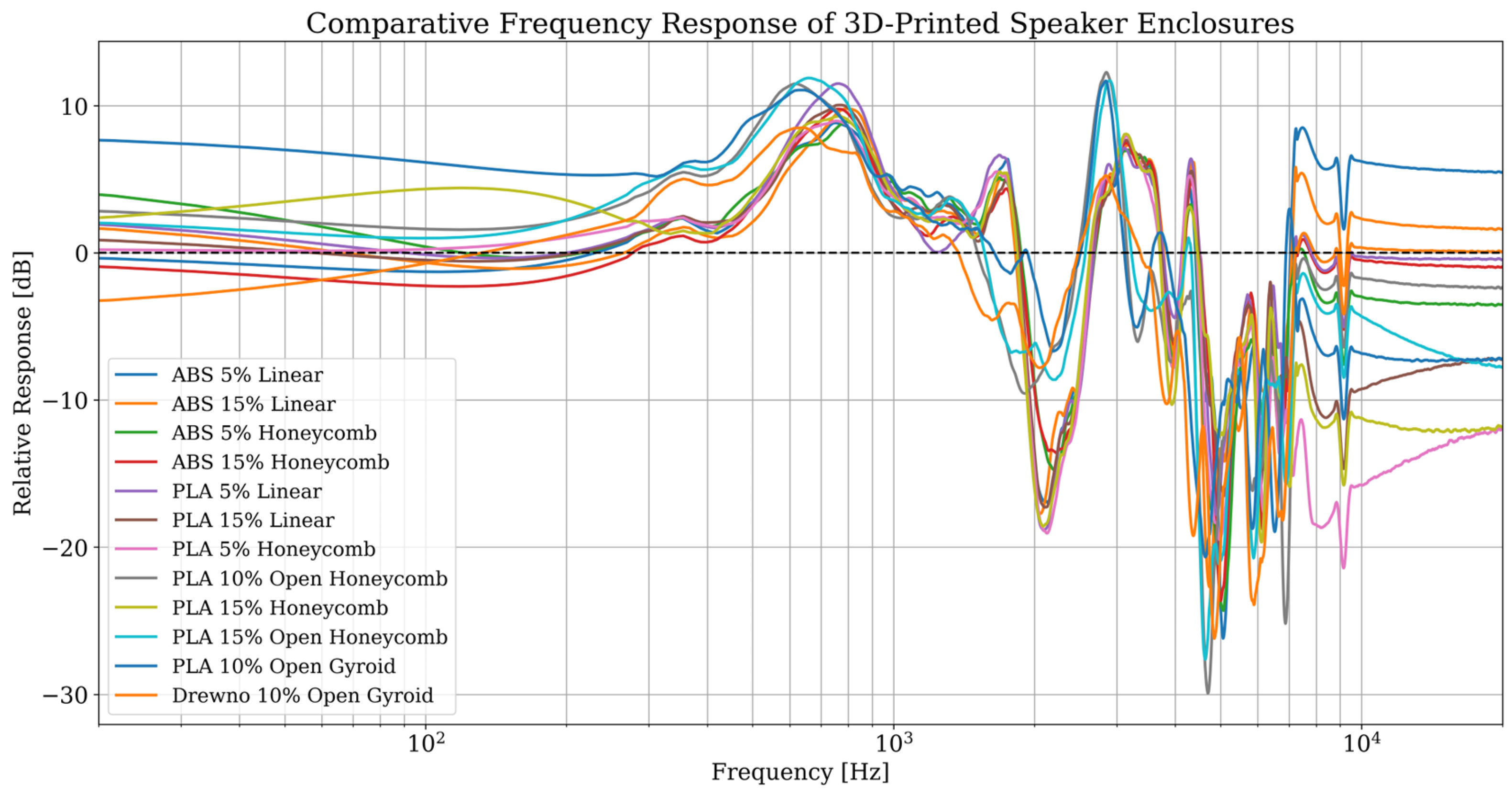
To provide a synthetic representation of the entire spectrum of obtained results and to facilitate a direct comparison of all twelve investigated configurations, a composite frequency response plot for the measurements at 15 cm is presented in Figure 7. Despite the large number of curves, this graph unequivocally visualizes the conclusions from the entire experiment. A clear clustering of the characteristics based on the material used is evident, which confirms its dominant influence on the acoustic properties [17,21]. The curve for the Wood 10% Open Gyroid configuration stands out from the rest, exhibiting the lowest amplitude of the main resonance peak and the most neutral characteristic in the low and mid-range frequency bands. Conversely, configurations based on the PLA material, especially those with low-stiffness infills, are positioned in the upper region of the graph around the main resonance, which attests to their lowest vibration-damping capability. This graph serves as the final, visual confirmation of the performance hierarchy of the tested variants.
To quantitatively verify this consistency, a correlation analysis was performed. The Pearson correlation coefficient between the frequency response curves measured at 15 cm and 45 cm for the ABS 15% Honeycomb configuration was calculated, yielding a value of r = 0.92. This high positive correlation provides a strong quantitative confirmation that the fundamental characteristics of the enclosures are consistently captured, regardless of the measurement distance within the tested range.
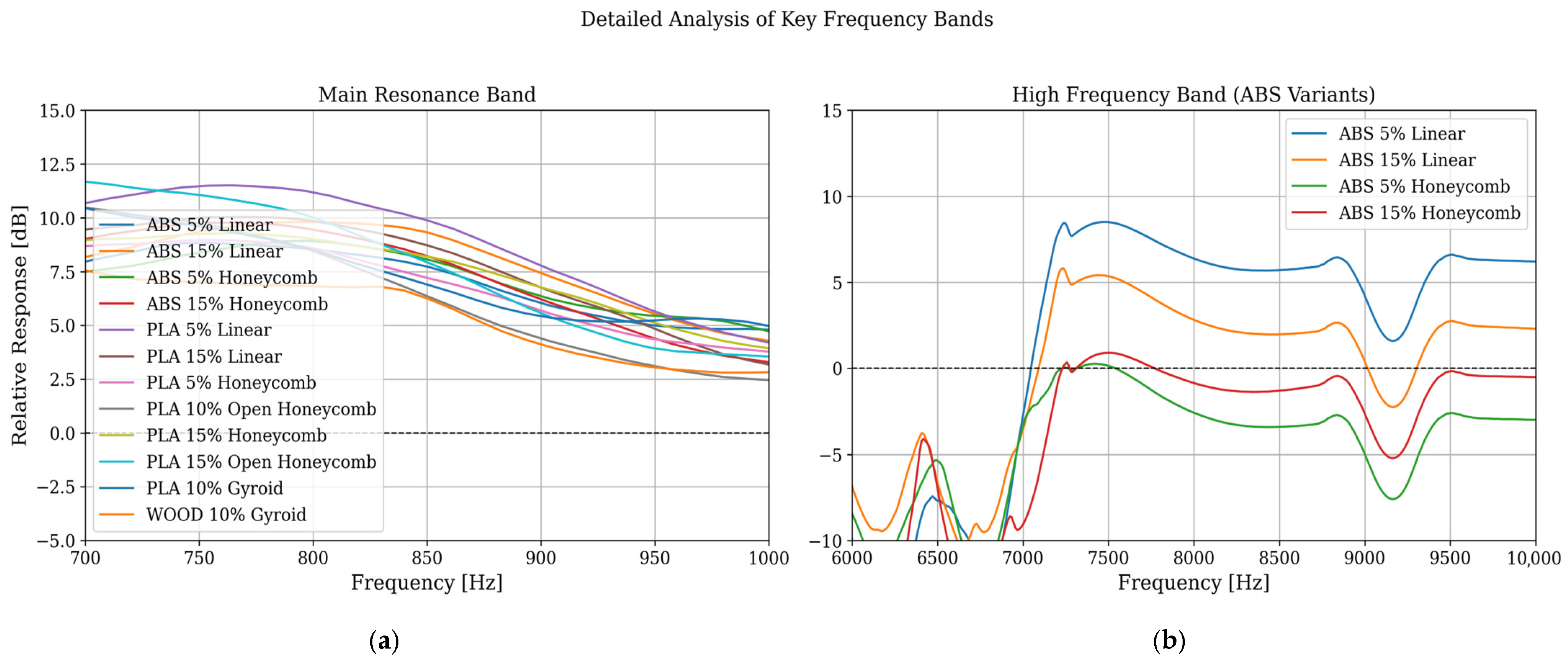
To facilitate a more detailed examination of the key frequency bands, Figure 8 presents enlarged views of the main resonance area (700–1000 Hz) and the high-frequency band (6–10 kHz). This visualization allows for a clearer comparison of the peak amplitudes and the effectiveness of resonance control among the different configurations.

3.2. Theoretical Model of Mechanical Vibrations

To correlate the empirically measured acoustic results with the fundamental mechanical properties of the investigated structures, a series of numerical simulations was performed. A Finite Element Analysis (FEA) was employed within an integrated CAD environment (SOLIDWORKS Simulation). The geometric CAD models of each of the twelve unique configurations, which included the detailed micro-architecture of the infill, were imported into the analysis module. The models were meshed using high-quality, solid tetrahedral elements, with a global element size of 1.5 mm and local mesh refinement in areas of high geometric complexity to ensure accurate stress distribution. [19,22,24].
Standard, literature-based mechanical properties for solid-state polymers were assigned to the materials. The boundary conditions simulated a real-world scenario: the bottom surface of the enclosure was defined with a fixed constraint, immobilizing all degrees of freedom. A Harmonic Response Analysis was conducted, simulating the structure’s response to a sinusoidal excitation. It is important to note that a simplified, linear-elastic material model was assumed, and structural damping coefficients were intentionally omitted from the simulation. This was a deliberate choice to isolate and analyze the purely structural (stiffness- and mass-based) component of the response, allowing for a clearer correlation with the acoustic measurements where damping is an inherent property of the real-world materials. It should be noted that this FEA study serves as a correlative and explanatory tool rather than a fully validated predictive model. A formal validation through experimental modal analysis and a sensitivity analysis on mesh parameters were beyond the scope of this initial investigation but are identified as a key direction for future work.
A dynamic pressure load was applied to the internal walls at a frequency of 850 Hz. The simulation yielded the displacement and acceleration fields for the entire structure, from which the maximum vibration acceleration amplitude (a_max) was extracted. The results of this modeling are presented in Table 3.
A Harmonic Response Analysis was conducted to simulate the structure’s response to a harmonic pressure load. The goal was not to replicate the full acoustic spectrum of the reference audio signal, but to investigate the structure’s vibrational amplitude when excited at the critical frequency of the main acoustic resonance. The enclosure was modeled with a fixed constraint on its base, and the dynamic load was defined as an acoustic pressure acting on the internal walls, corresponding to the pressure generated by the rear side of the driver’s diaphragm at a frequency of 850 Hz. The choice of this frequency was dictated by the intention to investigate the structure’s behavior in the region of the strongest acoustic resonance observed across all measurements. The simulation yielded the displacement and acceleration fields for the entire structure, from which the maximum vibration acceleration amplitude (a_max) was extracted at the geometric center of the largest side panel. The results of this theoretical modeling are presented in Table 3.
Analysis of the data in Table 3 reveals a strong and unambiguous correlation between the predicted mechanical vibrations and the recorded acoustic characteristics. Configurations with the highest predicted vibration amplitude, such as PLA 5% Linear (a_max = 5.0 m/s2), were characterized in the empirical measurements by the strongest and sharpest resonance peaks. This is a direct consequence of the low stiffness and negligible internal damping of this construction [13,27]. On the other hand, configurations with the lowest predicted vibration amplitude, led by Wood 10% Gyroid (a_max = 0.7 m/s2), offered the most damped and controlled sound in the acoustic tests. This superior result is an effect of the synergy between the high internal damping of the composite material and the isotropic, energy-dissipating Gyroid structure [19,28].
Of particular interest is the interpretation of the results for the variants designated as “Open”. In these “Open” configurations, the design was intentionally modified so that the internal infill structure (Honeycomb or Gyroid) was exposed on the interior surface of the enclosure, lacking the flat, solid internal wall layer that is typically printed last. From a mechanical standpoint, such a construction, deprived of one of its faces, behaves not as a sandwich panel but as a rib-stiffened plate. This leads to a reduction in its resultant bending stiffness compared to an analogous closed structure, which may explain why some “Open” variants exhibited higher resonance peaks. At the same time, however, the exposed, complex infill geometry performs an additional acoustic function. It acts as an internal acoustic diffuser and absorber for the sound wave generated by the rear of the diaphragm, potentially reducing the energy of standing waves inside the enclosure [19,28]. This dual nature—lower mechanical stiffness but potentially better absorptive properties—is crucial for a full understanding of the vibro-acoustic characteristics of these variants.

3.3. Time-Frequency Analysis

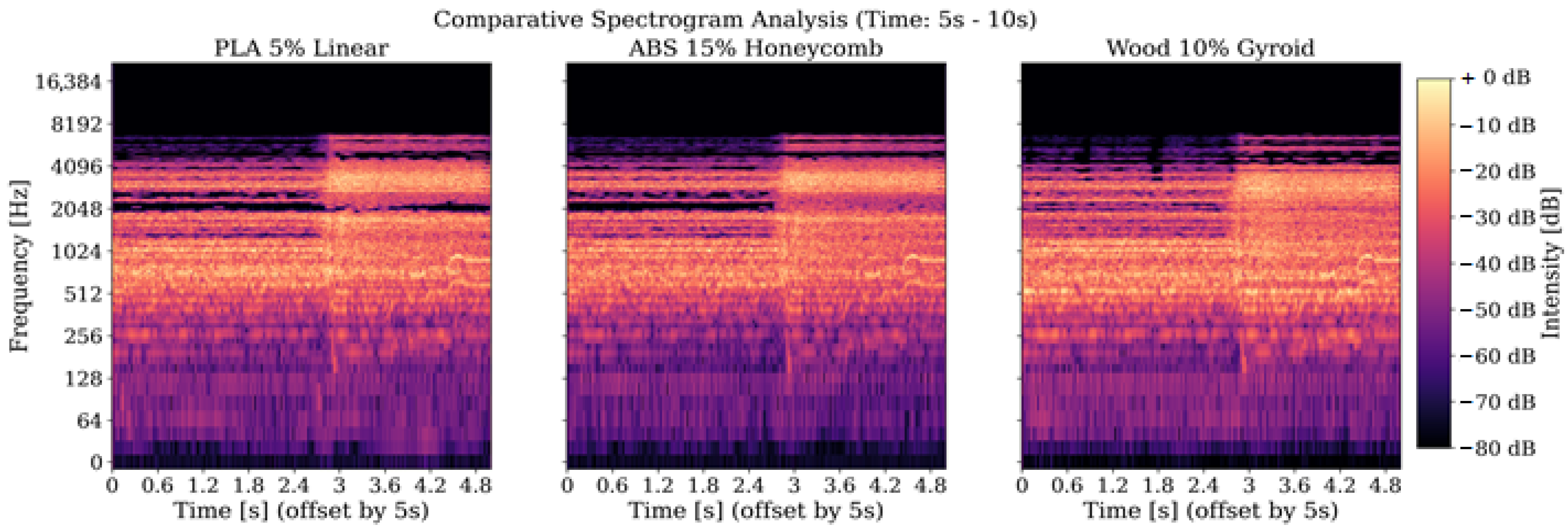
The final stage of the results presentation is a visual time-frequency analysis, the results of which are shown in Figure 9. The comparative spectrograms for three representative specimens provide direct, qualitative evidence of the varying damping properties of the investigated configurations. This analysis allows for the assessment of the decay time of parasitic resonances, which manifest on the spectrogram as horizontal structures of elevated energy, elongated along the time axis [11,12].
In the case of the PLA 5% Linear configuration, intense energy bands at frequencies of 2048 Hz and 4096 Hz are observed, which are nearly continuous within the analyzed time interval. The presence of these long-lasting horizontal structures indicates a very long decay time, which is characteristic of systems with a low damping coefficient. Such a condition leads to significant coloration of the audio signal, where the energy of the enclosure’s self-resonances is constantly present in the output signal [14]. In the ABS 15% Honeycomb configuration, the same resonance bands, although still identifiable, exhibit a significantly lower intensity and are distinctly discontinuous. This signifies a shorter decay time and more effective dissipation of vibration energy compared to the PLA variant [14]. In turn, for the Wood 10% Gyroid case, the acoustic background is characterized by the lowest energy, and the parasitic resonances at problematic frequencies are reduced to short-lived, barely noticeable traces. The attenuation of the horizontal resonant structures causes the vertical structures, which represent the actual musical signal, to become dominant. This indicates the shortest decay time and the highest signal reproduction fidelity among the analyzed cases, confirming that the combination of a high-damping material and an energy-dissipating geometry is most effective (Figure 9) [17].

4. Discussion

It should be emphasized that this study is a parametric case study rather than a statistical analysis of a large population. Its objective is not to formulate universal laws for all 3D-printed enclosures but to identify and quantify the causal relationships and trends between specific parameters (material, geometry, density) and the resulting acoustic performance. The significance of the findings lies not in the sample size, but in the consistency and repeatability of the observed effects across all tested distances, as demonstrated in Section 3. This approach allows for the formulation of reliable engineering conclusions regarding the influence of the investigated variables.
The detailed interpretation of the empirical results unequivocally confirms that the parameters of the Fused Deposition Modeling process have a fundamental and measurable impact on the vibro-acoustic characteristics of loudspeaker enclosures. The comparative analysis has shown that the internal damping coefficient of the material is a factor of critical importance. The juxtaposition of configurations based on PLA and the wood-composite, while maintaining an identical Gyroid geometry, indisputably revealed that the choice of material alone allowed for a reduction in the main resonance amplitude by approximately 4 dB. This serves as evidence that the low ability of the PLA filament to dissipate vibration energy constitutes a fundamental limitation, which even the most optimized internal structure cannot fully compensate for [26,27]. The high internal damping of the wood-composite not only enabled the reduction of the resonance peak but also the near-total elimination of coloration in the low-mid frequency band, which directly translated to the most neutral and uncolored sound. The superior damping performance of the wood-composite can be attributed to the physical mechanism of interfacial friction. The presence of wood particles within the PLA polymer matrix introduces a vast number of micro-interfaces. When the structure vibrates, micro-slips and friction occur at these particle-polymer boundaries, providing an effective mechanism for dissipating mechanical energy as heat. This process is largely absent in pure thermoplastics like PLA, whose low internal damping is primarily governed by viscoelastic polymer chain movements.
Equally significant was the role of the infill geometry, which functions as a structural energy dissipation mechanism, complementary to the damping properties of the material itself. The comparison of linear and honeycomb variants for the ABS material demonstrated that structures with higher isotropy (honeycomb) more effectively stiffen the enclosure panels and exhibit better control over resonances, especially in the high-frequency band. The reduction in the amplitude of narrow-band spectral peaks in this range, observed for the hexagonal structures, is an objective measure of a phenomenon that, in the psychoacoustic domain, corresponds to a decrease in undesirable artifacts such as “harshness” or a “metallic” sound character. The results for the advanced, fully isotropic Gyroid geometry further reinforce this conclusion. Its complex, three-dimensional micro-architecture proved to be the most effective at dissipating vibrational energy, which is confirmed both by the theoretical vibration model and by the visual analysis of the spectrograms, where the lowest level of parasitic resonance energy was recorded [18,19,28]. The experiment also revealed the existence of complex interactions between the investigated parameters, demonstrating that simply increasing the infill density is not always an optimal strategy, and that the strategic placement of material within the structure to maximize its stiffness is of key importance [7,21].
The superior performance of the Gyroid geometry stems from its unique, triply periodic minimal surface structure. Unlike linear or honeycomb patterns, which can provide relatively straight paths for vibration propagation, the complex and continuously curved topology of the Gyroid forces mechanical waves to constantly scatter and change direction. This structural scattering is a highly effective passive mechanism for dissipating vibrational energy throughout the volume of the material, preventing the buildup of localized, high-amplitude standing waves that manifest as sharp resonance peaks.

5. Conclusions

The conducted research leads to the formulation of final conclusions of both a fundamental and an applicative nature. The most important of these is the finding that achieving high acoustic fidelity in 3D-printed loudspeaker enclosures is the result of a synergy between a material with high damping and an advanced, energy-dissipating internal geometry. The configuration made from the wood-composite with 10% Gyroid infill was unequivocally identified as the design with the best and most balanced acoustic properties among all tested variants. This work demonstrates that a deliberate and engineering-led selection of 3D printing parameters allows for the precise shaping of the vibro-acoustic characteristics, paving the way for the design of highly personalized and optimized audio systems [9,21]. The synthesis of the obtained empirical and theoretical results leads to the following main conclusions:
  • In vibro-acoustic designs, priority should be given to composite materials with a known, high internal damping coefficient, as the material properties are a factor of primary importance.
  • Simple, anisotropic infill geometries (e.g., linear) should be avoided in favor of isotropic structures (e.g., Gyroid), which provide higher structural stiffness and greater efficiency in dissipating vibrational energy.
  • The optimization of infill density should be considered in close connection with the chosen geometry, as their interaction is non-linear and its influence on the resultant mechanical characteristics is non-trivial.
The authors acknowledge certain limitations inherent in the employed methodology. The use of a non-calibrated smartphone microphone and the absence of an anechoic chamber mean that the presented results should be interpreted as a robust comparative analysis rather than a set of absolute, metrologically precise measurements. However, the high repeatability of the measurements, ensured by a consistent experimental setup, validates the conclusions drawn regarding the relative performance hierarchy of the tested configurations. This approach demonstrates that meaningful engineering insights can be derived using accessible and low-cost equipment, which is a significant finding in itself for the broader community of designers and hobbyists.
To further deepen the knowledge in this area, several potential directions for future research were identified. A primary avenue would be the analysis of other advanced composite materials. For example, incorporating short carbon fibers into a PLA or ABS matrix could significantly increase the material’s stiffness (Young’s Modulus) without a proportional increase in mass, potentially shifting panel resonances to higher, less audibly critical frequencies. Another direction is the validation of the obtained relative results using professional, calibrated measurement equipment (e.g., an IEC 60268-5 compliant microphone) within an anechoic chamber to obtain absolute, metrologically traceable data. Finally, the development of more sophisticated predictive numerical models (FEA) is crucial. Such models could incorporate material damping coefficients (structural damping) and be formally validated against empirical vibration measurements (e.g., using laser Doppler vibrometry) to create a truly predictive tool. Such a validated model would also allow for a sensitivity analysis to be performed, optimizing parameters like wall thickness or infill density in a virtual environment prior to the costly printing phase.


Author Contributions

Conceptualization, J.K., P.S. and P.G.; Investigation, J.K. and P.S.; Methodology, J.K., P.S. and P.G.; Software, J.K.; Validation, P.S.; Formal analysis, M.W. and P.G.; Supervision, P.G.; Writing—original draft, J.K., P.S. and M.W.; Writing—review and editing J.K. and P.G. All authors have read and agreed to the published version of the manuscript.

Funding

This research received no external funding.

Data Availability Statement

The original contributions presented in this study are included in the article. Further inquiries can be directed to the corresponding author.

Conflicts of Interest

Author M.W. was employed by Akademia Neuron. The remaining authors declare that the research was conducted in the absence of any commercial or financial relationships that could be construed as a potential conflict of interest.

References

  1. Berman, B. 3-D printing: The new industrial revolution. Bus. Horiz. 2012, 55, 155–162. [Google Scholar] [CrossRef]
  2. Hon, K.K.; Li, L.; Hutchings, I.M. A review of the direct manufacturing of metallic components by additive layer manufacturing. CIRP Ann. 2016, 65, 799–821. [Google Scholar]
  3. Lee, J.Y.; An, J.; Chua, C.K. Fundamentals and applications of 3D printing for novel materials. Appl. Mater. Today 2017, 7, 120–133. [Google Scholar] [CrossRef]
  4. Abeykoon, C.; Sri-Amphorn, P.; Fernando, A. Optimization of fused deposition modeling parameters for improved PLA and ABS 3D printed structures. Int. J. Lightweight Mater. Manuf. 2020, 3, 90–100. [Google Scholar] [CrossRef]
  5. Adebayo, A.A.; Akinlabi, E.T.; Maringa, M. Fused deposition modeling: A review of the process, materials, and parameters. In Materials for 3D Printing; CRC Press: Boca Raton, FL, USA, 2022; pp. 3–30. [Google Scholar]
  6. Popescu, D.; Zapciu, A.; Amza, C.; Baciu, F.; Marinescu, R. FDM process parameters influence over the mechanical properties of polymer specimens: A review. Polym. Test. 2018, 69, 157–166. [Google Scholar] [CrossRef]
  7. Alves, J.L.; Pacheco, L.A.; Savi, M.A.; da Silva, A.R. On the nonlinear dynamics of a 3D printed loudspeaker enclosure. Mech. Syst. Signal Process. 2018, 106, 185–202. [Google Scholar]
  8. DeMuth, J. The promise of 3D printing for customizable audio products. J. Audio Eng. Soc. 2019, 67, 324–328. [Google Scholar]
  9. Gopsill, J.A.; Hicks, B.J. A review of the application of 3D printing in the field of acoustics. J. Acoust. Soc. Am. 2017, 141, 3891. [Google Scholar]
  10. Klippel, W. Loudspeaker Modeling and Design: A Practical Introduction; Klippel GmbH: Dresden, Germany, 2019. [Google Scholar]
  11. Oppenheim, A.V.; Schafer, R.W. Discrete-Time Signal Processing; Pearson: London, UK, 2010. [Google Scholar]
  12. Randall, R.B. Vibration-Based Condition Monitoring: Industrial, Aerospace and Automotive Applications; John Wiley & Sons: Hoboken, NJ, USA, 2021. [Google Scholar]
  13. Boursier, V.; Favier, V.; Chazeau, L.; Gauthier, C. Dissipative properties of polylactic acid (PLA) based composites filled with carbon nanotubes. Polym. Test. 2017, 63, 466–474. [Google Scholar]
  14. Wang, D.; Yang, L.; Wang, L.; Zhang, Y. Study on the vibration and sound radiation of functionally graded porous plates. Compos. Struct. 2019, 226, 111244. [Google Scholar]
  15. Fernández-Vicente, M.; Calle, W.; Ferràndiz, S.; Conejero, A. Effect of infill parameters on tensile mechanical behavior in desktop 3D printing. 3D Print. Addit. Manuf. 2016, 3, 183–192. [Google Scholar] [CrossRef]
  16. Rajca, M.; Świerek, A.; Dera, A.; Przybysz, E.; Góral, P. Strength testing of materials obtained from 3D printing. In Proceedings of the XXIV Krajowa Konferencja Elektroniki, Darłowo, Poland, 8–12 June 2025. [Google Scholar]
  17. Zeltmann, S.E.; Gupta, N.; Ruíz, E.; Doddamani, M. Vibro-acoustic characterization of additively manufactured polymer composites. J. Compos. Mater. 2019, 53, 2217–2228. [Google Scholar]
  18. Egan, P.F.; Sinko, R.; Le, K.P.; Keten, S. The role of infill pattern on the constitutive response of 3D printed polymers. 3D Print. Addit. Manuf. 2015, 2, 131–137. [Google Scholar]
  19. Al-Ketan, O.; Rowshan, R.; Abu Al-Rub, R.K. Topologically-optimized architected materials with superior strength and stiffness properties. Adv. Eng. Mater. 2018, 20, 1700542. [Google Scholar]
  20. Maskery, I.; Aboulkhair, N.T.; Aremu, A.O.; Tuck, C.J.; Ashcroft, I.A. A mechanical property evaluation of graded density Al-Si10-Mg lattice structures manufactured by selective laser melting. Mater. Sci. Eng. A 2017, 682, 545–553. [Google Scholar] [CrossRef]
  21. Harris, M.; Potgieter, J.; Archer, R.; Arif, K.M. Effect of material and printing parameters on the acoustic and mechanical properties of 3D printed components. Mater. Today Proc. 2019, 15, 233–241. [Google Scholar]
  22. Dizon, J.R.C.; Espera, A.H., Jr.; Chen, Q.; Advincula, R.C. Mechanical characterization of 3D-printed polymers. Addit. Manuf. 2018, 20, 44–67. [Google Scholar] [CrossRef]
  23. Alsoufi, M.S.; El-Sayed, A.E. Warping deformation of Fused Deposition Modeling-100% infill printed parts: A case study for an industrial application. Am. J. Mech. Eng. 2018, 6, 59–67. [Google Scholar]
  24. Chacón, J.M.; Caminero, M.A.; García-Plaza, E.; Núñez, P.J. Additive manufacturing of PLA structures using fused deposition modeling: Effect of process parameters on mechanical properties and their optimal selection. Mater. Des. 2017, 124, 143–157. [Google Scholar] [CrossRef]
  25. Tanveer, M.Q.; Mishra, G.; Mishra, S.; Sharma, R. Effect of infill pattern and infill density on mechanical behaviour of FDM 3D printed Parts—A current review. Mater. Today Proc. 2022, 62 Pt 1, 100–108. [Google Scholar] [CrossRef]
  26. Guessasma, S.; Belhabib, S.; Nouri, H. Print quality and mechanical performance of 3D-printed wood-PLA/PHA composites. J. Mater. Eng. Perform. 2016, 25, 3986–3996. [Google Scholar]
  27. Kariz, M.; Sernek, M.; Tiran, J.; Pavlič, M. Effect of wood content in 3D printed PLA/wood composites on anisotropic and mechanical properties. Polymers 2018, 10, 718. [Google Scholar]
  28. Maconachie, T.; Leary, M.; Lozanovski, B.; Zhang, X.; Qian, M.; Faruque, O.; Brandt, M. SLM lattice structures: Properties, performance, applications and challenges. Mater. Des. 2019, 183, 108137. [Google Scholar] [CrossRef]
Figure 1. CAD model view of the loudspeaker enclosure.
Signals 06 00073 g001
Figure 2. Schematic of the measurement setup.
Signals 06 00073 g002
Figure 3. The influence of infill geometry and density on the frequency response for the ABS material (measurement at 15 cm).
Signals 06 00073 g003
Figure 4. The influence of infill geometry on the frequency response for the PLA material at 15% density (measurement at 15 cm).
Signals 06 00073 g004
Figure 5. A comparison of advanced geometries and materials (measurement at 15 cm).
Signals 06 00073 g005
Figure 6. Verification of result consistency for the ABS material at a distance of 45 cm.
Signals 06 00073 g006
Figure 7. A composite plot of the relative frequency response for all twelve investigated configurations (measurement at 15 cm).
Signals 06 00073 g007
Figure 8. Enlarged views of critical frequency regions from the 15 cm measurements. (a) Comparison of the main resonance peak amplitude (700–1000 Hz) for all specimens. (b) High-frequency resonance behavior (6–10 kHz) for the ABS material variants.
Signals 06 00073 g008
Figure 9. Comparative spectrographic analysis in a selected time segment (5–10 s), illustrating the differences in the decay time of parasitic resonances.
Signals 06 00073 g009
Table 1. Summary of tested loudspeaker enclosure configurations.
Specimen IDMaterialInfill GeometryInfill Density [%]
1ABSLinear5
2ABSLinear15
3ABSHoneycomb5
4ABSHoneycomb15
5PLALinear5
6PLALinear15
7PLAHoneycomb5
8PLAOpen Honeycomb10
9PLAHoneycomb15
10PLAOpen Honeycomb15
11PLAOpen Gyroid10
12WOODOpen Gyroid10
Table 2. Nominal Mechanical Properties of the Investigated Materials.
PropertyPLAABSWood-Composite (PLA-Based)Unit
Young’s Modulus~3.5~2.0~4.0GPa
Density~1.24~1.04~1.20g/cm3
Damping Coeff. (Tan δ)Low (~0.01)Moderate (~0.03)High (>0.05) *-
* The damping coefficient for the wood-composite is an estimation based on qualitative data from literature, as exact values vary. It is assumed to be significantly higher due to the energy dissipation at the wood particle-polymer matrix interfaces.
Table 3. Results of the theoretical modeling of the maximum vibration acceleration amplitude (a_max) for the investigated configurations.
MaterialDensity [%]Infill GeometryModeled a_max [m/s2]Relative Vibration Reduction *
PLA5%Linear5.00%
PLA15%Linear3.2−36%
PLA5%Honeycomb3.5−30%
PLA10%Open Honeycomb2.6−48%
PLA15%Honeycomb2.0−60%
PLA15%Open Honeycomb2.2−56%
PLA10%Gyroid1.5−70%
ABS5%Linear3.8−24%
ABS15%Linear2.5−50%
ABS5%Honeycomb2.9−42%
ABS15%Honeycomb1.8−64%
WOOD10%Gyroid0.7−86%
* Relative Vibration Reduction is calculated with respect to the worst-case scenario (PLA 5% Linear). The term “Open” denotes a configuration where the infill structure is exposed on the inside, lacking the final flat closing layer.
Disclaimer/Publisher’s Note: The statements, opinions and data contained in all publications are solely those of the individual author(s) and contributor(s) and not of MDPI and/or the editor(s). MDPI and/or the editor(s) disclaim responsibility for any injury to people or property resulting from any ideas, methods, instructions or products referred to in the content.