Technical Note

Discretization of Digital Controllers Comprising Second-Order Notch Filters

Applied Energy Laboratory, School of Electrical and Computer Engineering, Ben-Gurion University of the Negev, Beer-Sheva 8410501, Israel
Signals 2025, 6(4), 69; https://doi.org/10.3390/signals6040069 (registering DOI)
Submission received: 12 August 2025 / Revised: 25 September 2025 / Accepted: 17 November 2025 / Published: 1 December 2025

Abstract

Second-order notch filters (NFs) with constant coefficients are often used as part of feedback controllers in grid-connected power conversion systems to prevent unwanted harmonic content polluting the closed control loops. In practice, the value of the mains frequency resides within a certain known range rather than remaining constant. Hence, the correct selection of NF coefficients is crucial for ensuring that the desired performance is maintained within the whole expected mains frequency range. Bilinear transformation (BLT) with notch frequency prewarping is often adopted to convert an NF from a continuous to a digital form. While accurately preserving the notch frequency location, the method reduces the filter bandwidth. As a remedy, BLT with both notch frequency and damping ratio prewarping may be employed. Nevertheless, some inaccuracy remains under low sampling-to-notch frequency ratios. This technical note demonstrates that the issue may be solved by prewarping the boundary values of the expected harmonic frequency range rather than the notch frequency and/or damping factor before applying the BLT. Simulation results accurately support the presented issue and proposed solution.

1. Introduction

Notch filters are often employed in flexible mechatronic systems to suppress resonances [1,2,3,4,5,6,7,8,9,10] and mains-connected power electronic systems to cope with multiples of mains frequency harmonics [11,12,13,14,15,16]. Power grid interfacing energy conversion systems are required to comply with different power quality standards (e.g., IEC 61000, IEEE 519, etc.) when exchanging the current with the mains [17]. In particular, the mains current should follow a corresponding voltage shape (typically sinusoidal with some inevitable harmonic content). As a result, the power exchanged with the grid contains both DC and pulsating components. Consequently, real-time controllers directing the energy conversion system operation often comprise one (or several) second-order notch filter (NF) to minimize the influence of pulsating power components on closed-loop control performance [18,19,20,21,22]. The situation is further complicated by the fact that mains frequency does not remain constant, residing within a certain range around the nominal value [23]. Hence, the attenuation attained by the NF should be sufficient within the whole relevant frequency range. On the other hand, the sampling time should be reduced as much as possible to allow for low-cost digital controller implementation while accommodating all the necessary operations within a single sampling period. Nevertheless, NF discretization accuracy issues under low sampling-to-notch frequency ratios have been identified in the literature [24,25,26,27], and some remedies were proposed (e.g., prewarping of both the notch frequency and damping factor of the filter) [28,29]. Yet, this technical note demonstrates that some inaccuracy remains when bilinear transform (BLT)-based discretization [30] under ultra-low sampling-to-notch frequency ratios is carried out. To solve this issue, an alternative prewarping method is suggested, allowing the digital NF to accurately attain the desired attenuation within a prescribed bandwidth. Existing accuracy issues and the proposed methodology are validated by simulations.

2. Notch Filter Under Consideration

In this work, single second-order NF-based linear controllers for grid-connected converters of the Laplace domain form [31]
C ( s ) = C 1 ( s ) F ( s )
are considered for brevity (yet without loss of generality since a multi-notch structure would be typically realized by, e.g., cascaded connection of single-notch second-order sections), where C1(s) denotes the stabilizing term (e.g., of P, PD, PI or PID type), and F(s) represents a second-order NF tuned to a certain (e.g., second [32]) mains frequency harmonic, typically present in the DC link voltage of unity power factor operating single-phase grid-interfacing power converters [33]. Discretization methods of the C1(s) term have been widely studied in the literature (see, e.g., [34,35,36,37]) and are thus not included in this work. Thus, only the discretization of a generalized second-order NF given by
F ( s ) = s 2 + ω f 2 s 2 + 2 ξ f ω f s + ω f 2
with ωf and ξf denoting corresponding notch frequency and damping factor, respectively, is discussed thereafter. While C1(s) controls both the DC gain and crossover frequency of the control loop, the NF influences the certain harmonic frequency residing either within or outside the control bandwidth without affecting the two above-mentioned performance merits, since F(0) = F() = 1. Meanwhile, the value of the mains frequency in practical power grids resides within a well-defined range rather than remaining constant [23]. Consequently, the NF should be designed to attain the required attenuation within the whole frequency range of interest (defined thereafter as [ω1,ω2]). In general, the requirement may be formulated as
F ( ω ) G ( ω ) , ω 1 < ω < ω 2
with G(ω) denoting the required attenuation envelope (typically linear in logarithmic scale [38,39]). In case the notch frequency in (2) is placed so that
ω 1 < ω f < ω 2
the constraint (3) reduces to
F ( ω 1 ) G ( ω 1 ) G 1 , F ( ω 2 ) G ( ω 2 ) G 2
due to NF properties, as shown in Figure 1. Moreover, the required attenuation envelope (cf. (3)) is usually a monotonically increasing function of frequency [33], so that G1 < G2 is expected in practice (yet a generalized case is assumed in the subsequent discussion for the sake of completeness).
Noticing that the magnitude frequency response of the NF in (2) is given by
F ( ω ) = 1 1 + 4 ξ f 2 ω ω f 2 ω f 2 ω 2 2
combining (5) with (6) yields two boundary conditions given by
1 1 + 4 ξ f 2 ω 1 ω f 2 ω f 2 ω 1 2 2 = G 1 , 1 1 + 4 ξ f 2 ω 2 ω f 2 ω f 2 ω 2 2 2 = G 2
Solving (7), the required notch frequency and damping factor of the NF in (2) are obtained as functions of the requirements in (5) as
ω f = ω 2 1 + ω 1 ω 2 G 1 2 1 G 2 2 1 1 + ω 2 ω 1 G 1 2 1 G 2 2 1 = ω 1 1 + ω 2 ω 1 G 1 2 1 G 2 2 1 1 + ω 1 ω 2 G 1 2 1 G 2 2 1
and
ξ f = 1 2 G 1 2 1 1 + ω 2 ω 1 G 1 2 1 G 2 2 1 1 + ω 1 ω 2 G 1 2 1 G 2 2 1 1 + ω 1 ω 2 G 1 2 1 G 2 2 1 1 + ω 2 ω 1 G 1 2 1 G 2 2 1
respectively. It is interesting to note that in the case
G 1 = G 2 = G 0
The notch frequency is the geometric mean of the expected harmonic frequency range boundary values
ω f = ω 1 ω 2 ω f 0
with the corresponding damping factor given by
ξ f = 1 2 G 0 2 1 ω 2 ω 1 ω f 0 ξ f 0 .
Consequently, the following notch frequency location shift is expected if G1G2,
G 1 < G 2 ω f < ω f 0 , G 1 > G 2 ω f > ω f 0
Substituting (8) and (9) into (2), the transfer function in (2) may be reformulated as a function of constraints in (5), namely
F ( s ) = s 2 + 1 + ω 2 ω 1 G 1 2 1 G 2 2 1 1 + ω 1 ω 2 G 1 2 1 G 2 2 1 ω 1 2 s 2 + G 1 2 1 1 + ω 2 ω 1 G 1 2 1 G 2 2 1 1 + ω 1 ω 2 G 1 2 1 G 2 2 1 1 ω 1 s + 1 + ω 2 ω 1 G 1 2 1 G 2 2 1 1 + ω 1 ω 2 G 1 2 1 G 2 2 1 ω 1 2

3. Discretization Issues

As an example, consider the case presented in [39], where the NF in (2) is employed in a grid-interfacing AC/DC power converter as part of a DC link voltage controller to attenuate the magnitude of a second mains frequency harmonic inevitably entering the control loop. This is required to keep the total harmonic distortion of the grid-side current below a certain value (namely, 5%). A nominal grid frequency of 50 Hz with ± 2% uncertainty is considered so that (cf. (3)) (an interested reader is referred to [39] for further details).
2 π 98 = ω 1 < ω [ r a d / s ] < ω 2 = 2 π 102
The required filter gain values at boundary frequencies (cf. (5)) were obtained in [35] as
F ( ω 1 ) = 0.0867 = 21.24 [ d B ] , F ( ω 2 ) = 0.0902 = 20.89 [ d B ] .
Substituting (15) and (16) into (8) and (9) yields
ω f = 2 π 99.94 [ r a d / s ] , ξ f = 0.2252 .
The resulting continuous transfer function of the NF in (2) is then given by
F ( s ) = s 2 + 3.943 10 5 s 2 + 282.9 s + 3.943 10 5 .
In the subsequent discussion, the sampling interval is denoted as Ts[s]. The corresponding angular frequency is then defined by
ω s = 2 π T s [ r a d / s ]

3.1. Discretization by Notch Frequency Prewarping

Prewarping the notch frequency, there is
ω f p = π 1 ω s ω f tan π ω f ω s ω f .
Defining the sampling-to-notch frequency ratio as
r = ω s / ω f ,
The expression for the prewarped notch frequency in (20) may be rewritten as
ω f p = r π tan π r ω f .
Substituting ωf in (2) with ωfp in (22) and applying the BLT defined by [30,40]
s = 2 T s z 1 z + 1 = ω s π z 1 z + 1 ,
the corresponding digital filter is obtained as
F ( z ) = ω s π z 1 z + 1 2 + ω s π tan π ω f ω s 2 ω s π z 1 z + 1 2 + 2 ξ f ω s π 2 tan π ω f ω s z 1 z + 1 + ω s π tan π ω f ω s 2 .
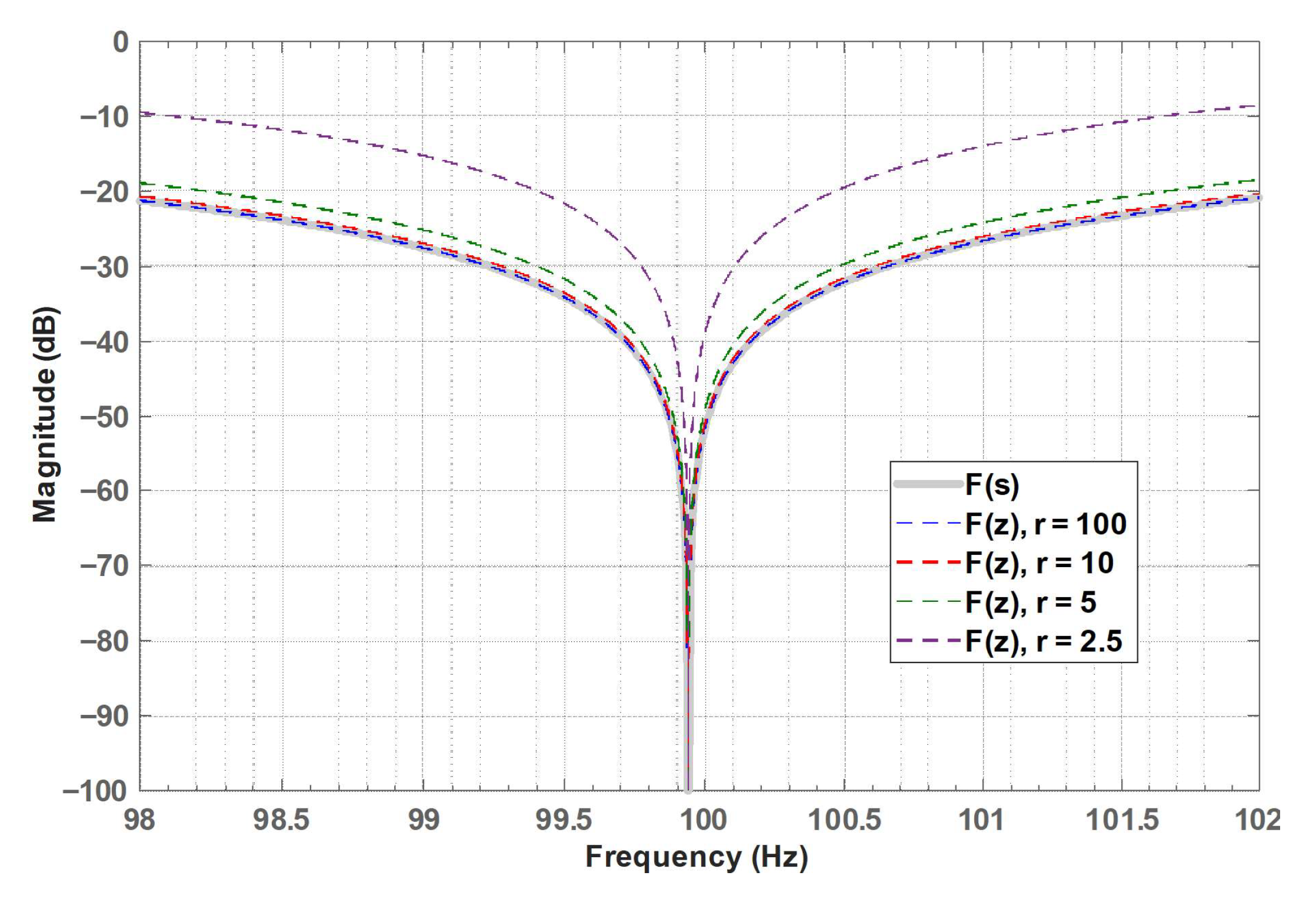
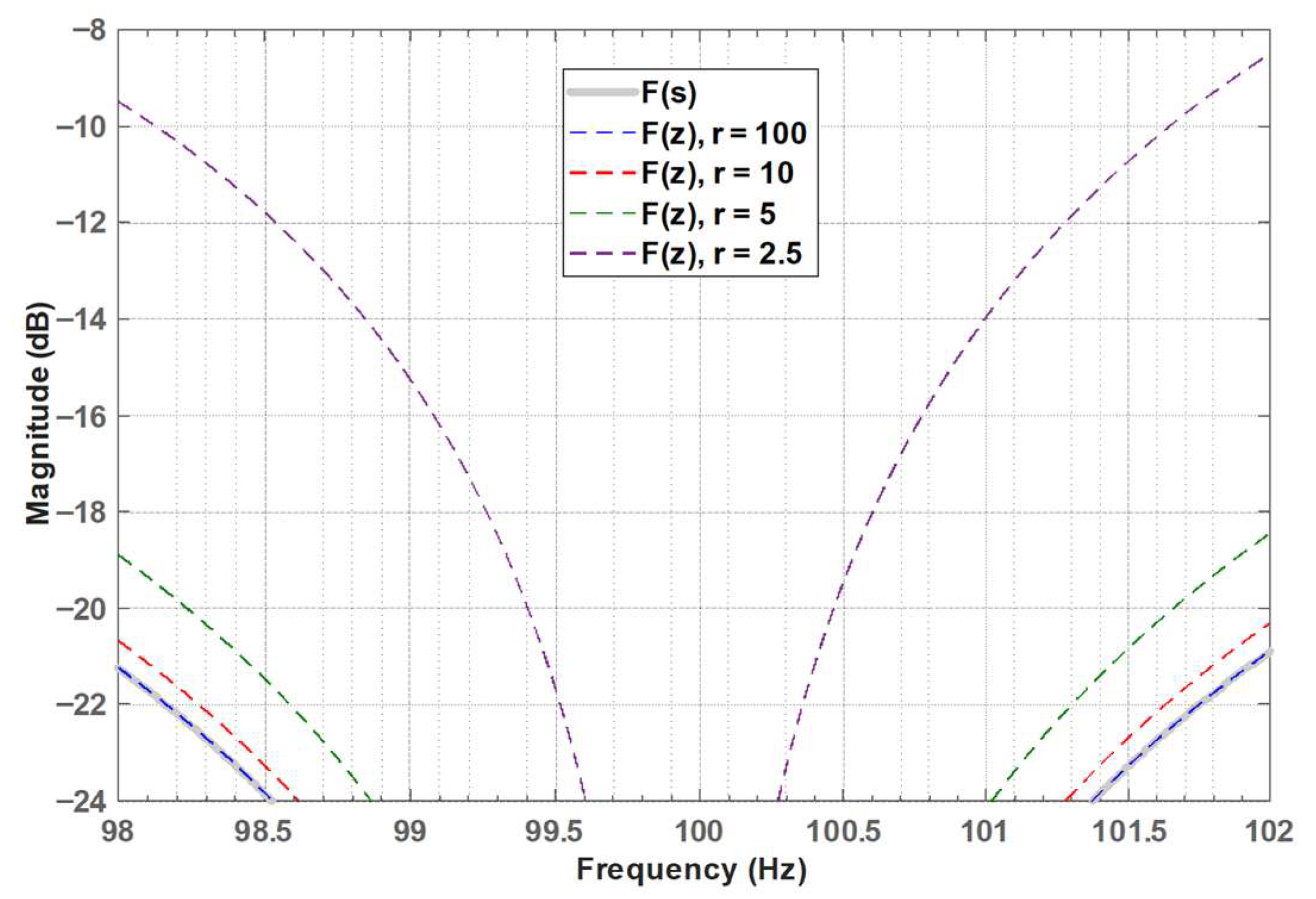
The magnitude frequency responses of the continuous NF in (18) and the digital NF in (24) for different values of r are depicted in Figure 2, with values of gains at boundary frequencies of interest summarized in Table 1. It may be concluded that while the digital filter matches well with its continuous counterpart for r > 10, a reduction in the sampling-to-notch frequency ratio below 10 yields significant bandwidth narrowing even though the notch frequency is accurately preserved.

3.2. Discretization by Notch Frequency and Damping Factor Prewarping

To improve the discretization accuracy under low sampling-to-notch frequency ratios, it was suggested in [28,29] to prewarp the filter damping factor as
ξ f p = ω f sin ω f T s ξ f
in addition to the notch frequency prewarping in (20). Applying the BLT in (23) to (2) with ωf and ξf substituted with ωfp in (22) and ξfp in (25), respectively, the corresponding digital filter is obtained as
F ( z ) = ω s π z 1 z + 1 2 + ω s π tan π ω f ω s 2 ω s π z 1 z + 1 2 + 2 ω f sin 2 π ω f ω s ξ f ω s π 2 tan π ω f ω s z 1 z + 1 + ω s π tan π ω f ω s 2 .
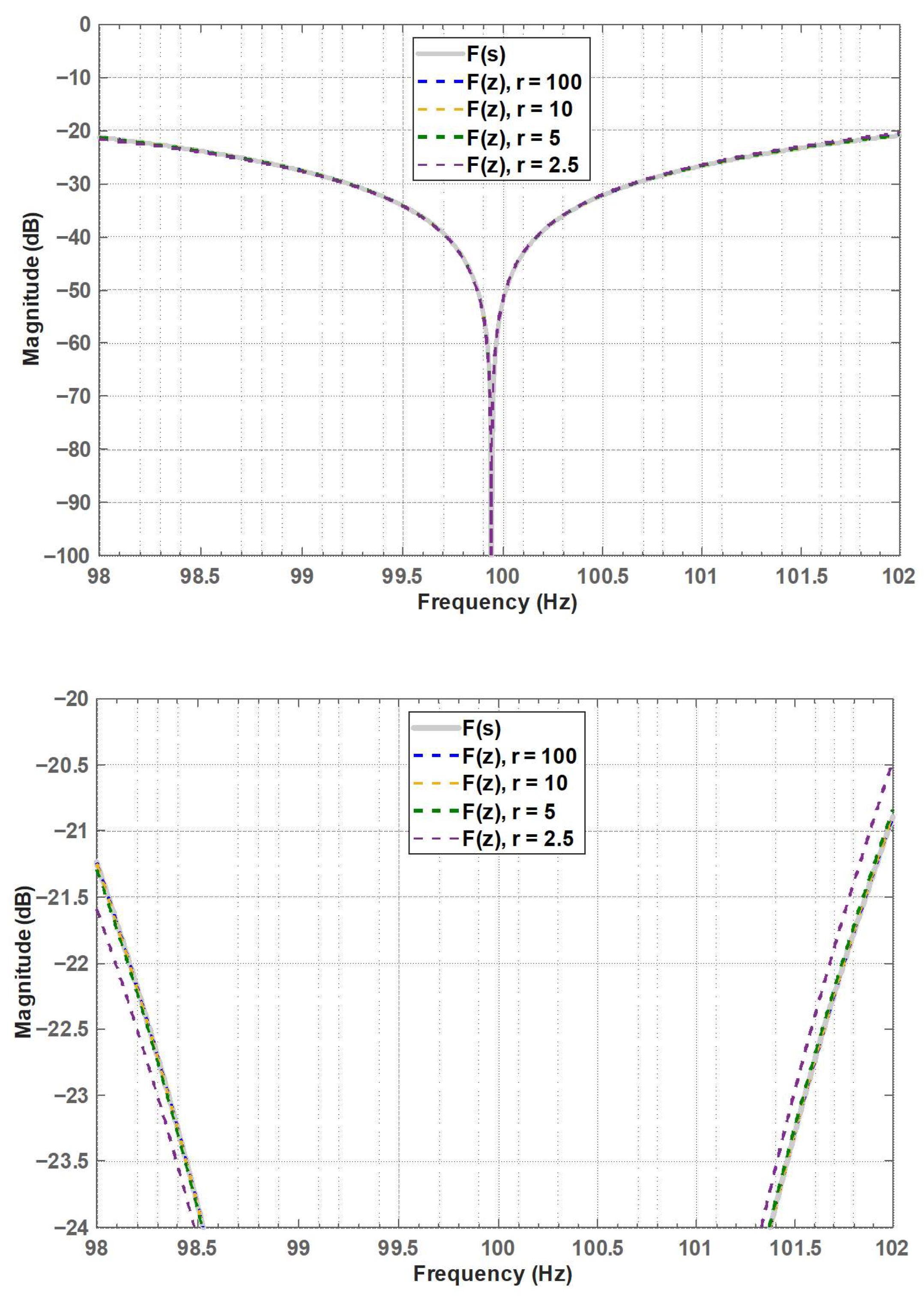
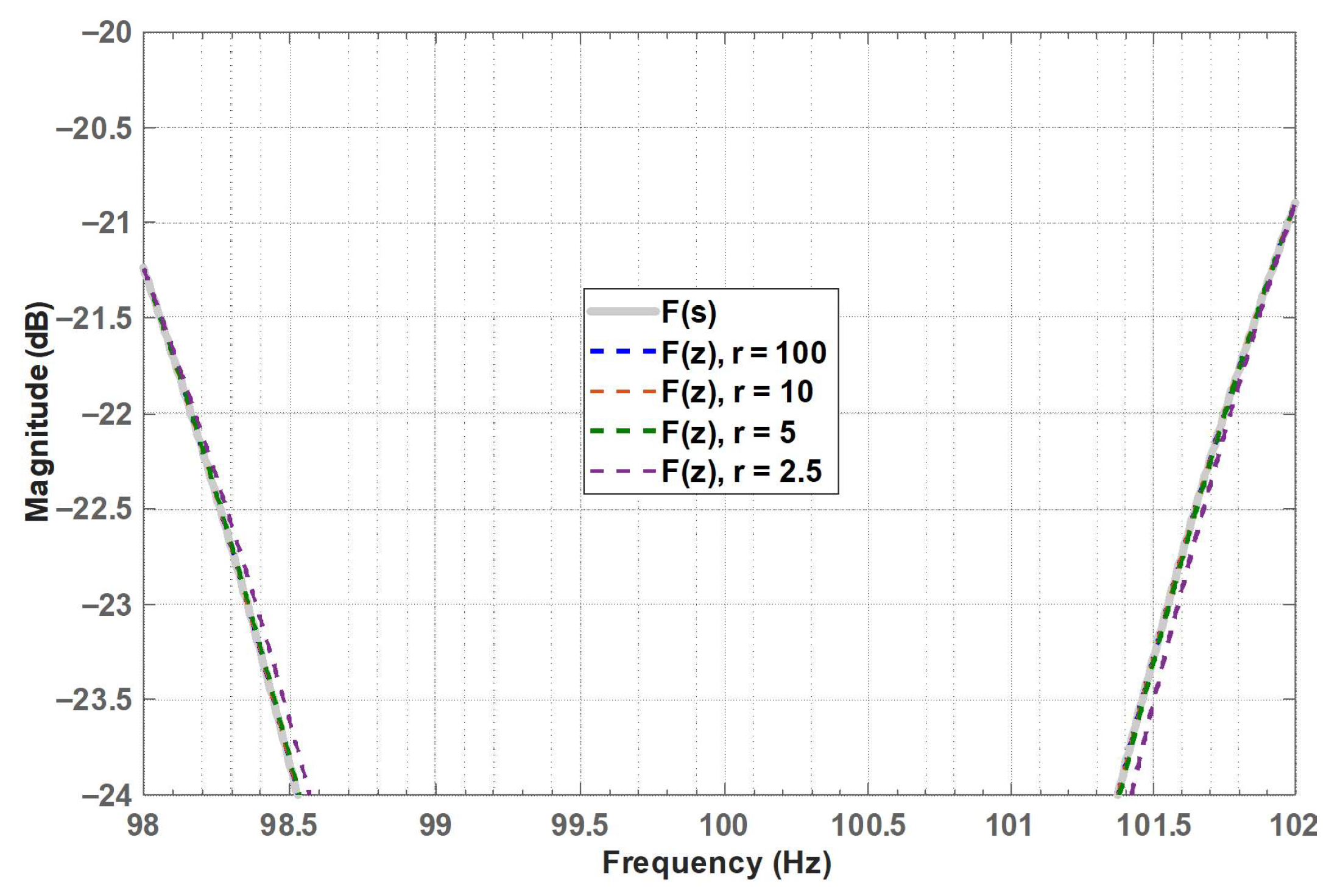
The magnitude frequency responses of the continuous NF in (18) and the digital NF in (26) for different values of r are depicted in Figure 3, with values of gains at boundary frequencies of interest summarized in Table 2. It may be concluded that while the digital filter matches well with its continuous counterpart for r > 5, a reduction in the sampling-to-notch frequency ratio to 2.5 yields a slight notch frequency shift, accompanied with a gain decrease at sub-resonant frequencies and a gain increase at super-resonant frequencies. As the result, the filter overperforms at ω1 and underperforms at ω2.

3.3. Discretization by Boundary Frequency Prewarping

To solve the above-demonstrated issue of the discretization accuracy under ultra-low sampling-to-notch frequency ratios, it is proposed to prewarp the boundary values of the relevant bandwidth of interest rather than the notch frequency and damping factor, i.e.,
ω 1 p = π 1 ω s ω 1 tan π ω 1 ω s ω 1 , ω 2 p = π 1 ω s ω 2 tan π ω 2 ω s ω 2 .
Applying the BLT in (23) to (14) with ω1 and ω2 substituted with ω1p and ω2p in (27), respectively, the corresponding digital filter is obtained as
F ( z ) = ω s π z 1 z + 1 2 + 1 + ω s π tan π ω 2 ω s ω s π tan π ω 1 ω s G 1 2 1 G 2 2 1 1 + ω s π tan π ω 1 ω s ω s π tan π ω 2 ω s G 1 2 1 G 2 2 1 ω s π tan π ω 1 ω s 2 ω s π z 1 z + 1 2 + A z 1 z + 1 + 1 + ω s π tan π ω 2 ω s ω s π tan π ω 1 ω s G 1 2 1 G 2 2 1 1 + ω s π tan π ω 1 ω s ω s π tan π ω 2 ω s G 1 2 1 G 2 2 1 ω s π tan π ω 1 ω s 2 ,
with
A = G 1 2 1 1 + ω s π tan π ω 2 ω s ω s π tan π ω 1 ω s G 1 2 1 G 2 2 1 1 + ω s π tan π ω 1 ω s ω s π tan π ω 2 ω s G 1 2 1 G 2 2 1 1 ω s π 2 tan π ω 1 ω s .
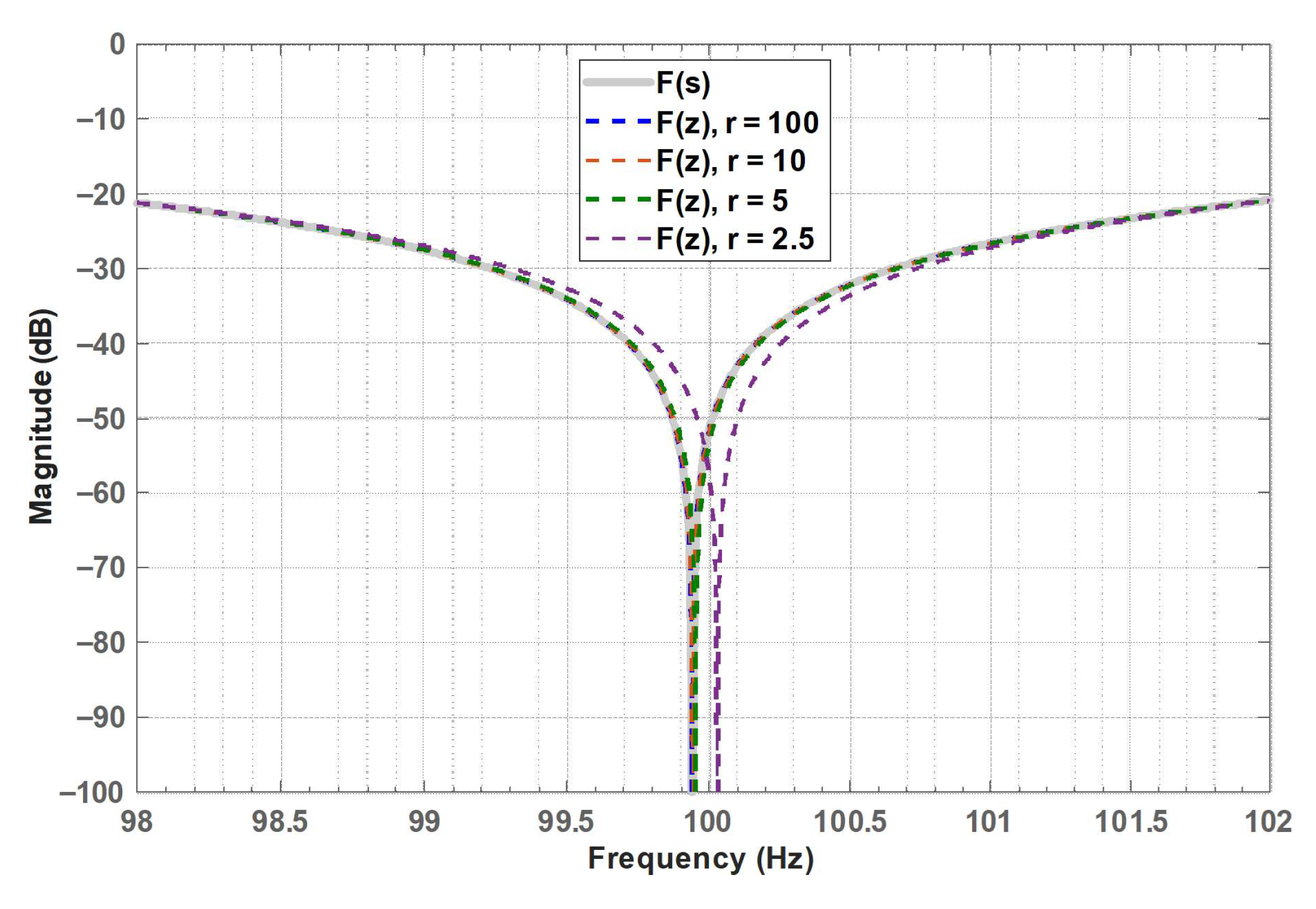
Magnitude frequency responses of the continuous NF in (18) and the digital NF in (28) for different values of r are depicted in Figure 4, with values of gains at boundary frequencies of interest summarized in Table 3. It is evident that despite the noticeable notch frequency shift at r = 2.5, the constraints in (16) are accurately met for all values of r, as desired.

4. Simulations

To validate both the revealed issue and the proposed solution, the worst case of r ≈ 2.5 (i.e., angular sampling frequency of ωs = 2π∙250 rad/s) was examined by simulations using PSIM 2025 software.
The discretization of (18) by BLT with notch frequency prewarping (cf. (22)) yields a digital filter given by (cf. (24))
F d 1 ( z ) = 0.8829 z 2 + 1.427 z + 0.8829 z 2 + 1.427 z + 0.7657 .
The discretization of (18) by BLT with notch frequency and damping factor prewarping (cf. (20), (25)) yields a digital filter given by (cf. (26))
F d 2 ( z ) = 0.6387 z 2 + 1.032 z + 0.6387 z 2 + 1.032 z + 0.2773 .
The discretization of (18) by BLT with boundary frequency prewarping (cf. (27)) yields a digital filter of the following form (cf. (28)),
F d 3 ( z ) = 0.6381 z 2 + 1.033 z + 0.6381 z 2 + 1.033 z + 0.2761
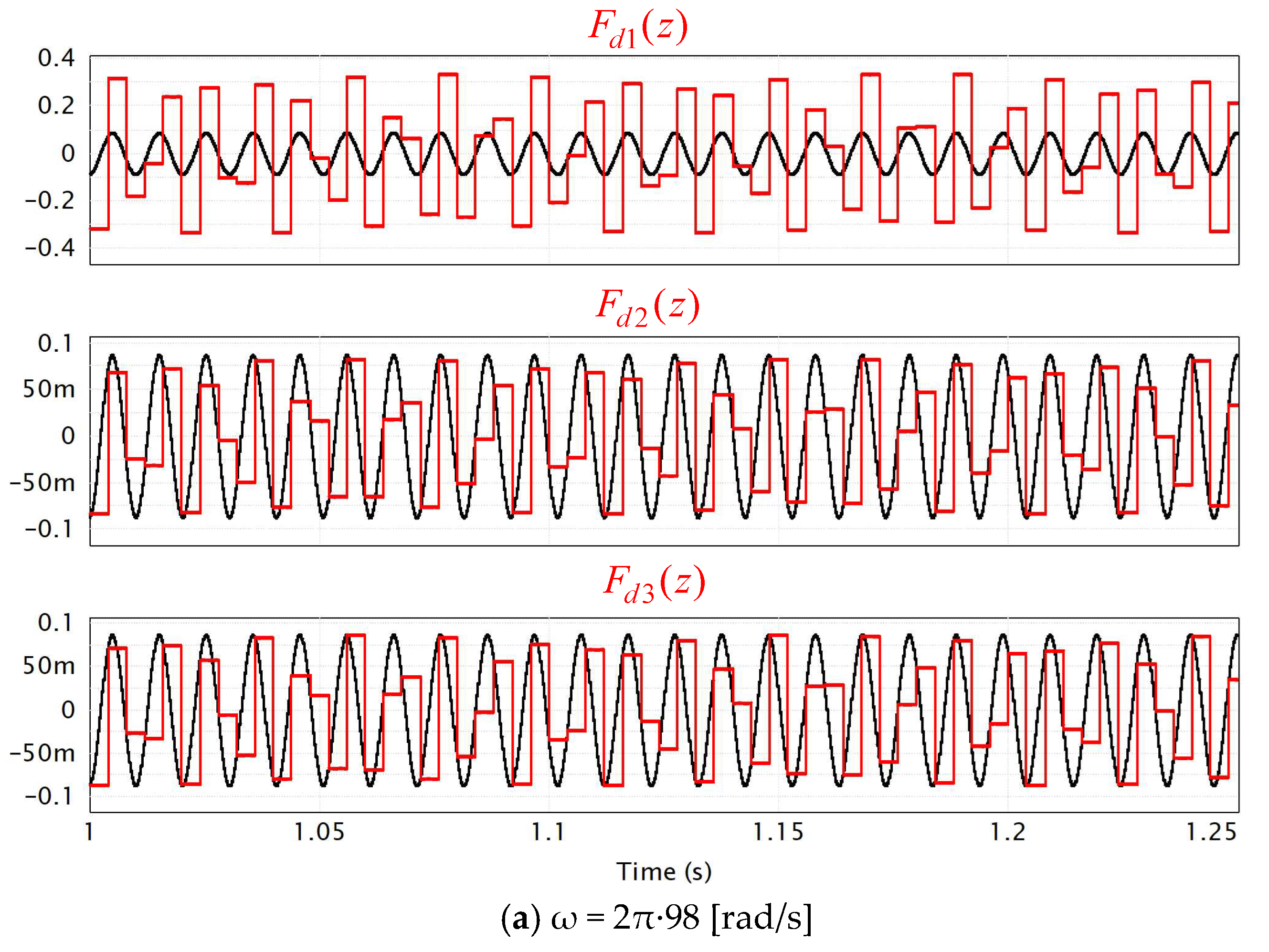
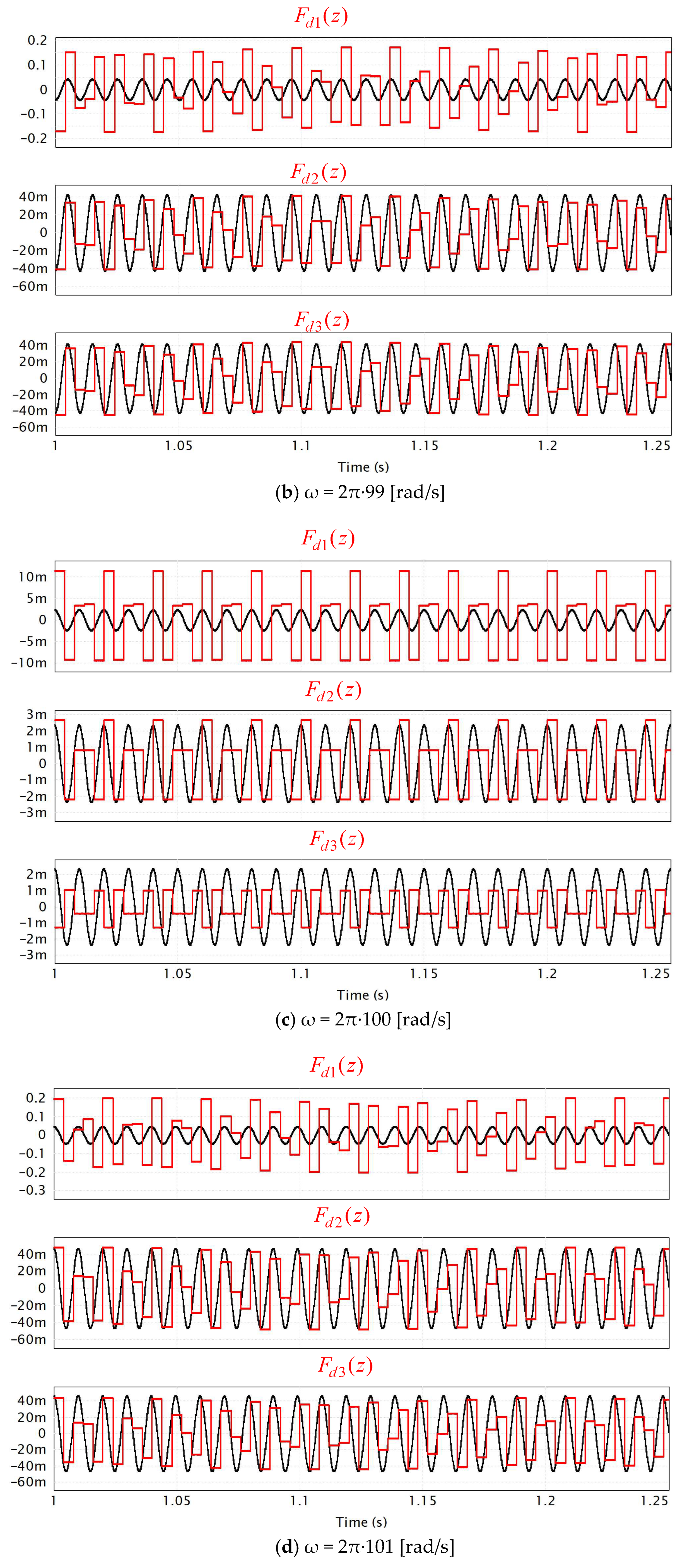
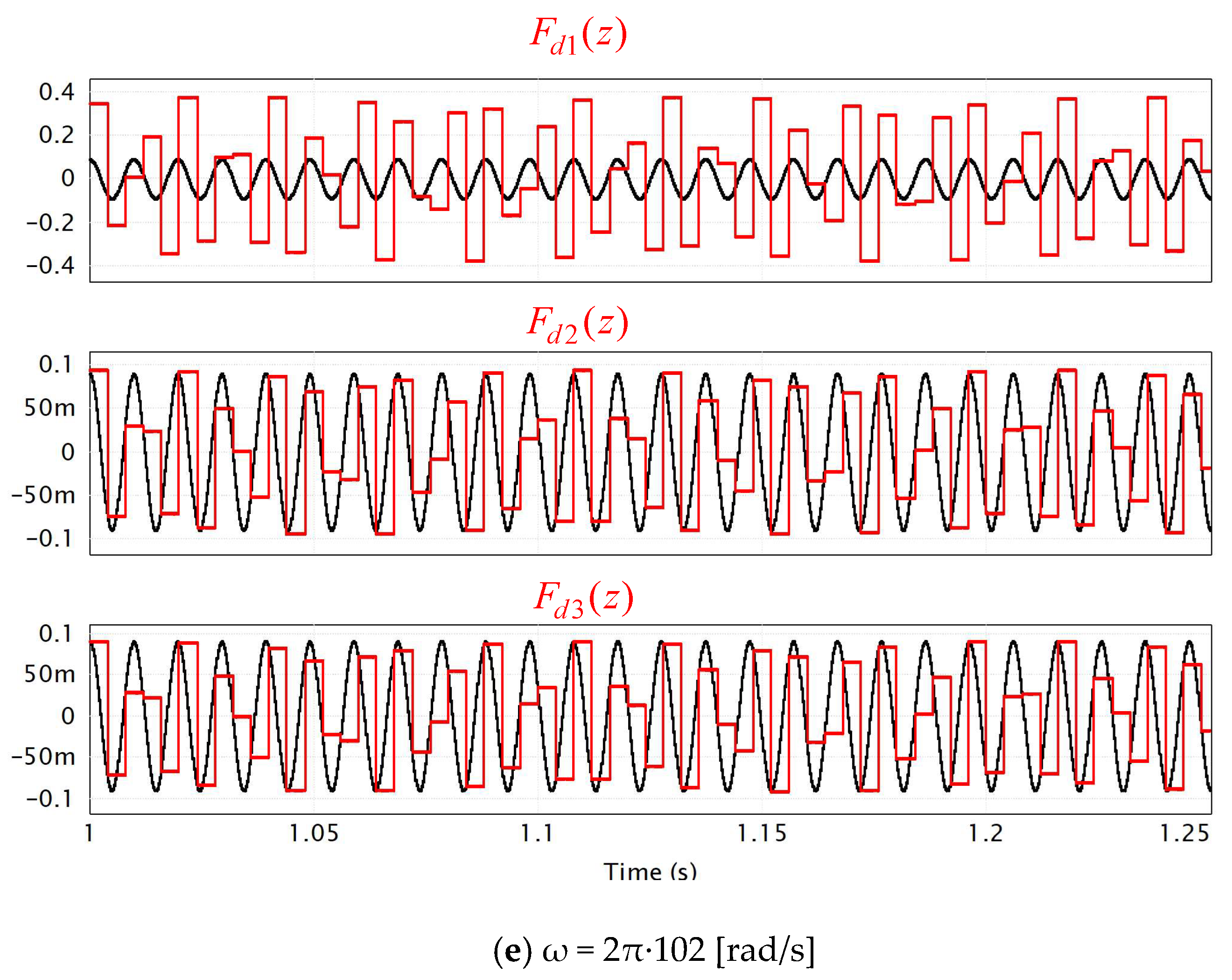
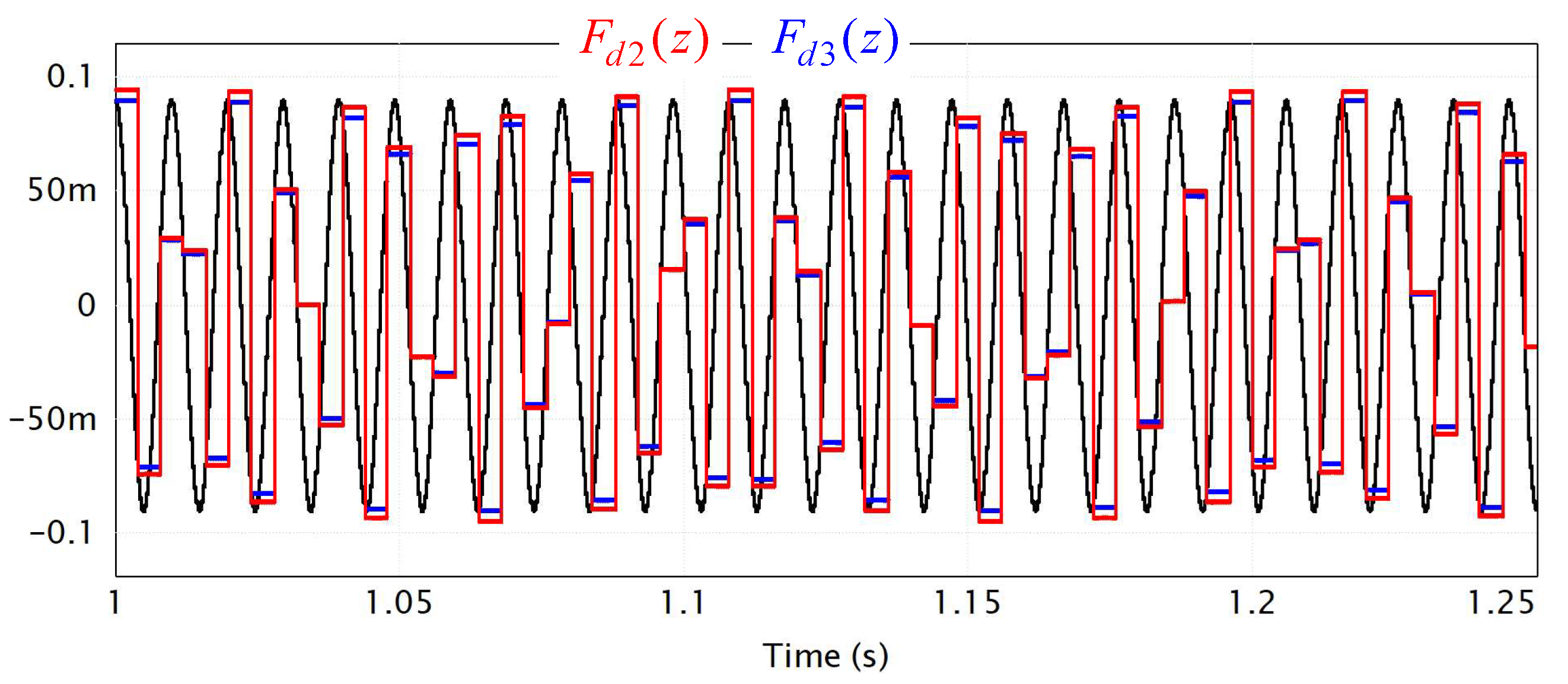
Within the simulation framework (carried out at 1 μs step), unity magnitude sinusoids at different frequencies residing withing the range defined in (15) (at 1 Hz increments) were concurrently applied to the continuous filter, F(s) (cf. (18)), and the three digital filters, Fd1(z) Fd2(z) and Fd3(z) (cf. (30)–(32), respectively. Corresponding steady-state responses are depicted in Figure 5 (black waveforms are the continuous filter outputs), with the resulting filter gains summarized in Table 4. It is evident that steady-state time-domain responses accurately match corresponding analytical frequency-domain predictions (cf. Figure 2, Figure 3 and Figure 4 and Table 1, Table 2 and Table 3).
While the digital NF Fd1(z) obtained by the BLT with notch frequency prewarping is unable to meet either of the constraints in (15), its counterpart Fd2(z) created by the BLT with notch frequency and damping factor prewarping slightly overperforms at sub-resonant frequencies while underperforming at super-resonant frequencies, as expected. On the other hand, the digital NF Fd2(z) obtained by the BLT with the proposed boundary frequency prewarping accurately complies with both constraints in (15), even though its notch frequency does not match that of the continuous template. In order to further verify the difference between the performances of Fd2(z) and Fd3(z) at ω2, corresponding responses were superimposed along with the response of F(s) in Figure 6. It is evident that while the magnitude of the Fd2(z) response slightly exceeds that of F(s), the response of Fd3(z) corresponds to that of F(s), as desired. Consequently, the discretization of the second-order NF by the BLT with notch frequency and/or damping ratio prewarping should be avoided under ultra-low sampling-to-notch frequency ratios, and boundary frequency prewarping should be adopted instead.

5. Conclusions

In this technical note, we demonstrated that adopting the bilinear transformation with notch frequency and/or dampling factor prewarping to convert an NF from a continuous to digital form results in some inaccuracy (~0.5 dB at super-resonant range) under low sampling-to-notch frequency ratios. Such an outcome may not be tolerable when the NF is employed within a real-time digital controller to attenuate certain harmonics residing within a defined frequency range. It was then suggested to resolve the issue by prewarping the boundary values of the frequency range of interest (instead of notch frequency and dampling factor) prior to applying the BLT. The simulation results accurately validated the proposed solution. Future work on this subject includes the experimental validation of the proposed methodology.

Funding

This research received no external funding.

Data Availability Statement

The original contributions presented in this study are included in the article. Further inquiries can be directed to the author.

Conflicts of Interest

The author declares no conflicts of interest.

References

  1. Mori, T. Design of a servo control system using a notch filter for a flexible arm and its applications. Electr. Eng. Jpn. 2013, 183, 39–50. [Google Scholar] [CrossRef]
  2. Liu, C.-C.; Tsai, M.-S.; Hong, M.-Q.; Tang, P.-Y. Development of a novel tuning approach of the notch filter of the servo feed drive system. J. Manuf. Mater. Process. 2020, 4, 21. [Google Scholar] [CrossRef]
  3. Guan, X.; Peng, H.; Li, H.; Zhang, J. Dynamic Balance Correction of Active Magnetic Bearing Rotor Based on Adaptive Notch Filter and Influence Coefficient Method. Appl. Sci. 2025, 15, 4147. [Google Scholar] [CrossRef]
  4. Gong, L.; Luo, W.; Li, Y.; Chen, J.; Hua, Z. Rotor Unbalanced Vibration Control of Active Magnetic Bearing High-Speed Motor via Adaptive Fuzzy Controller Based on Switching Notch Filter. Appl. Sci. 2025, 15, 3681. [Google Scholar] [CrossRef]
  5. Zeng, K.; Zhou, Y.; Xu, Y.; Zhou, J. Modal Vibration Suppression for Magnetically Levitated Rotor Considering Significant Gyroscopic Effects and Interface Contact. Actuators 2025, 14, 76. [Google Scholar] [CrossRef]
  6. Luo, J.; Ruan, X.; Wang, J.; Su, R.; Hu, L. Precise Control of Following Motion Under Perturbed Gap Flow Field. Actuators 2025, 14, 364. [Google Scholar] [CrossRef]
  7. Liu, Y.; Du, J.; Zhao, X.; Song, Y.; Wang, Y. High-Frequency Harmonic Suppression Strategy and Modified Notch Filter-Based Active Damping for Low-Inductance HPMSM. Appl. Sci. 2023, 13, 11309. [Google Scholar] [CrossRef]
  8. Sasaki, M.; Muguro, J.; Njeri, W.; Doss, A.S.A. Adaptive Notch Filter in a Two-Link Flexible Manipulator for the Compensation of Vibration and Gravity-Induced Distortion. Vibration 2023, 6, 286–302. [Google Scholar] [CrossRef]
  9. Hu, H.; Wei, J.; Wang, H.; Xiao, P.; Zeng, Y.; Liu, K. Analysis of the Notch Filter Insertion Position for Natural Frequency Vibration Suppression in a Magnetic Suspended Flywheel Energy Storage System. Actuators 2023, 12, 22. [Google Scholar] [CrossRef]
  10. Hossain, A.; Rahman, M.A. Comparative Analysis among Single-Stage, Dual-Stage, and Triple-Stage Actuator Systems Applied to a Hard Disk Drive Servo System. Actuators 2019, 8, 65. [Google Scholar] [CrossRef]
  11. Kim, T.; Ivantysynova, M. Active Vibration Control of Swash Plate-Type Axial Piston Machines with Two-Weight Notch Least Mean Square/Filtered-x Least Mean Square (LMS/FxLMS) Filters. Energies 2017, 10, 645. [Google Scholar] [CrossRef]
  12. Kobori, Y.; Sun, Y.; Kobayashi, H. Selective Notch Frequency Technology for EMI Noise Reduction in DC–DC Converters: A Review. Sensors 2025, 25, 3196. [Google Scholar] [CrossRef]
  13. Seifi, K.; Moallem, M. Synchronization and Control of a Single-Phase Grid-Tied Inverter under Harmonic Distortion. Electronics 2023, 12, 860. [Google Scholar] [CrossRef]
  14. Abaza, A.; El-Sehiemy, R.A.; Said, M.; Ghoniem, R.M.; Barakat, A.F. Implementation of an Electronically Based Active Power Filter Associated with a Digital Controller for Harmonics Elimination and Power Factor Correction. Electronics 2022, 11, 2205. [Google Scholar] [CrossRef]
  15. Butt, O.M.; Butt, T.M.; Ashfaq, M.H.; Talha, M.; Raihan, S.R.S.; Hussain, M.M. Simulative Study to Reduce DC-Link Capacitor of Drive Train for Electric Vehicles. Energies 2022, 15, 4499. [Google Scholar] [CrossRef]
  16. Li, B.; Huang, S.; Chen, X. Performance Improvement for Two-Stage Single-Phase Grid-Connected Converters Using a Fast DC Bus Control Scheme and a Novel Synchronous Frame Current Controller. Energies 2017, 10, 389. [Google Scholar] [CrossRef]
  17. Taul, M.G.; Wang, X.; Davari, P.; Blaabjerg, F. Current reference generation based on next-generation grid code requirements of grid-tied converters during asymmetrical faults. IEEE J. Emerg. Sel. Top. Power Electron. 2020, 8, 3784–3797. [Google Scholar] [CrossRef]
  18. El-Aroudi, A.; Cid-Pastor, A.; Martinez-Salamero, L. Suppression of line frequency instabilities in PFC AC-DC power supplies by feedback notch filtering the pre-regulator output voltage. IEEE Trans. Circuits Syst. I Regul. Pap. 2013, 60, 796–809. [Google Scholar] [CrossRef]
  19. Borafker, S.; Strajnikov, P.; Kuperman, A. Design of dual-notch-filter-based controllers for enhancing the dynamic response of universal single-phase grid-connected power converters. Appl. Sci. 2023, 13, 10144. [Google Scholar] [CrossRef]
  20. Taghizadeh, S.; Hossain, M.J.; Lu, J.; Karimi-Ghartemani, M. An Enhanced DC-bus voltage-control loop for single-phase grid-connected DC/AC converters. IEEE Trans. Power Electron. 2019, 34, 5819–5829. [Google Scholar] [CrossRef]
  21. Karimi-Ghartemani, M.; Khajehoddin, S.A.; Jain, P.K.; Bakhshai, A. A systematic approach to DC-bus control design in single-phase grid-connected renewable converters. IEEE Trans. Power Electron. 2013, 28, 3158–3166. [Google Scholar] [CrossRef]
  22. Yang, L.; Chen, Y.; Wang, H.; Luo, A.; Huai, K. Oscillation Suppression Method by Two Notch Filters for Parallel Inverters under Weak Grid Conditions. Energies 2018, 11, 3441. [Google Scholar] [CrossRef]
  23. Ruban, N.; Kinshin, A.; Gusev, A. Review of grid codes: Ranges of frequency variation. AIP Conf. Proc. 2019, 2135, 20049. [Google Scholar]
  24. Reiss, J.D. Design of audio parametric equalizer filters directly in the digital domain. IEEE Trans. Audio Speech Lang. Process. 2011, 19, 1843–1848. [Google Scholar] [CrossRef]
  25. Jin, L.H.; Kim, Y.C.; De La Barra, B.A.L. Issues in linear feedback control design with notch filters. In Proceedings of the Chinese Control Conference, Harbin, China, 7–11 August 2006. [Google Scholar]
  26. Harvey, R.; Mandic, D.P.; Kolonic, D.H. Some potential pitfalls with s to z-plane mappings. In Proceedings of the IEEE International Conference on Acoustics, Speech, and Signal Processing, Istanbul, Turkey, 7–11 August 2006. [Google Scholar]
  27. Yepes, A.G.; Freijedo, F.D.; Doval-Gandoy, J.; López, Ó.; Malvar, J.; Fernandez-Comesaña, P. Effects of discretization methods on the performance of resonant controllers. IEEE Trans. Power Electron. 2010, 25, 1692–1712. [Google Scholar] [CrossRef]
  28. Direct Design of Discrete-Time Notch (or Resonant Gain) Filter in State Space or as Second-Order-Section. Available online: https://dsp.stackexchange.com/questions/97778/direct-design-of-discrete-time-notch-or-resonant-gain-filter-in-state-space-or (accessed on 1 October 2025).
  29. Kim, T.-I.; Han, J.-S.; Oh, T.-H.; Kim, Y.-S.; Lee, S.-H.; Cho, D.-I.D. A new accurate discretization method for high-frequency component mechatronic systems. Mechatronics 2019, 62, 102250. [Google Scholar] [CrossRef]
  30. Lo Presti, L. Prewarping techniques in filter simulation by bilinear transformation. Sig. Process. 1983, 5, 523–529. [Google Scholar] [CrossRef]
  31. Strajnikov, P.; Kuperman, A. Selection of PI+Notch voltage controller coefficients to attain desired steady-state and transient performance in PFC rectifiers. IEEE J. Emerg. Sel. Top. Power Electron. 2022, 10, 6534–6544. [Google Scholar] [CrossRef]
  32. Levron, Y.; Canaday, S.; Erickson, R.W. Bus voltage control with zero distortion and high bandwidth for single-phase solar inverters. IEEE Trans. Power Electron. 2016, 31, 258–269. [Google Scholar] [CrossRef]
  33. Strajnikov, P.; Kuperman, A. DC link capacitance reduction in PFC rectifiers employing PI+Notch voltage controllers. IEEE Trans. Power Electron. 2023, 1, 977–986. [Google Scholar] [CrossRef]
  34. Talapiden, K.; Shakhin, Y.; Thao, N.G.M.; Do, T.D. Digital disturbance observer design with comparison of different discretization methods for permanent magnet motor drives. IEEE Access 2024, 12, 100892–100907. [Google Scholar] [CrossRef]
  35. Yanarates, C.; Zhou, Z.; Aytac, A. Investigating the impact of discretization techniques on real-time digital control of DC-DC boost converters: A comprehensive analysis. Heliyon 2024, 10, e39591. [Google Scholar] [CrossRef] [PubMed]
  36. Mon-Nzongo, D.L.; Lin, S.; Ipoum-Ngome, P.G.; Lai, C.; Jin, T.; Rodriguez, J. A fast-digital current regulator based on matched pole-zero deiscretization for PMSM. Trans. Transp. Electrif. 2025, 11, 9371–9387. [Google Scholar] [CrossRef]
  37. Singha, A.K.; Kapat, S.; Banerjee, S.; Pal, J. Nonlinear analysis of discretization effects in a digital current mode controlled boost converters. IEEE J. Emerg. Sel. Top. Circuits Syst. 2015, 5, 336–344. [Google Scholar] [CrossRef]
  38. Aminov, Y.; Kuperman, A. Simple linear DC link voltage controller to improve transient response of PFC rectifiers under stability and current quality constraints. In Proceedings of the IEEE Innovative Smart Grid Technologies Conference, Dubai, United Arab Emirates, 23–26 November 2025. [Google Scholar]
  39. Aminov, Y.; Kuperman, A. Design of P+Notch DC link voltage controllers for PFC rectifiers operating under prescribed phase margin and THD constraints. In Proceedings of the International IEEE Conference on Power Electronics Smart Grid and Renewable Energy, Hubli, India, 18–21 December 2025. [Google Scholar]
  40. Song, Q.; Liu, J.; Heldwein, M.L.; Klaß, S. Intelligent closed-loop fluxgate current sensor using digital proportional–integral–derivative control with single-neuron pre-optimization. Signals 2025, 6, 14. [Google Scholar] [CrossRef]
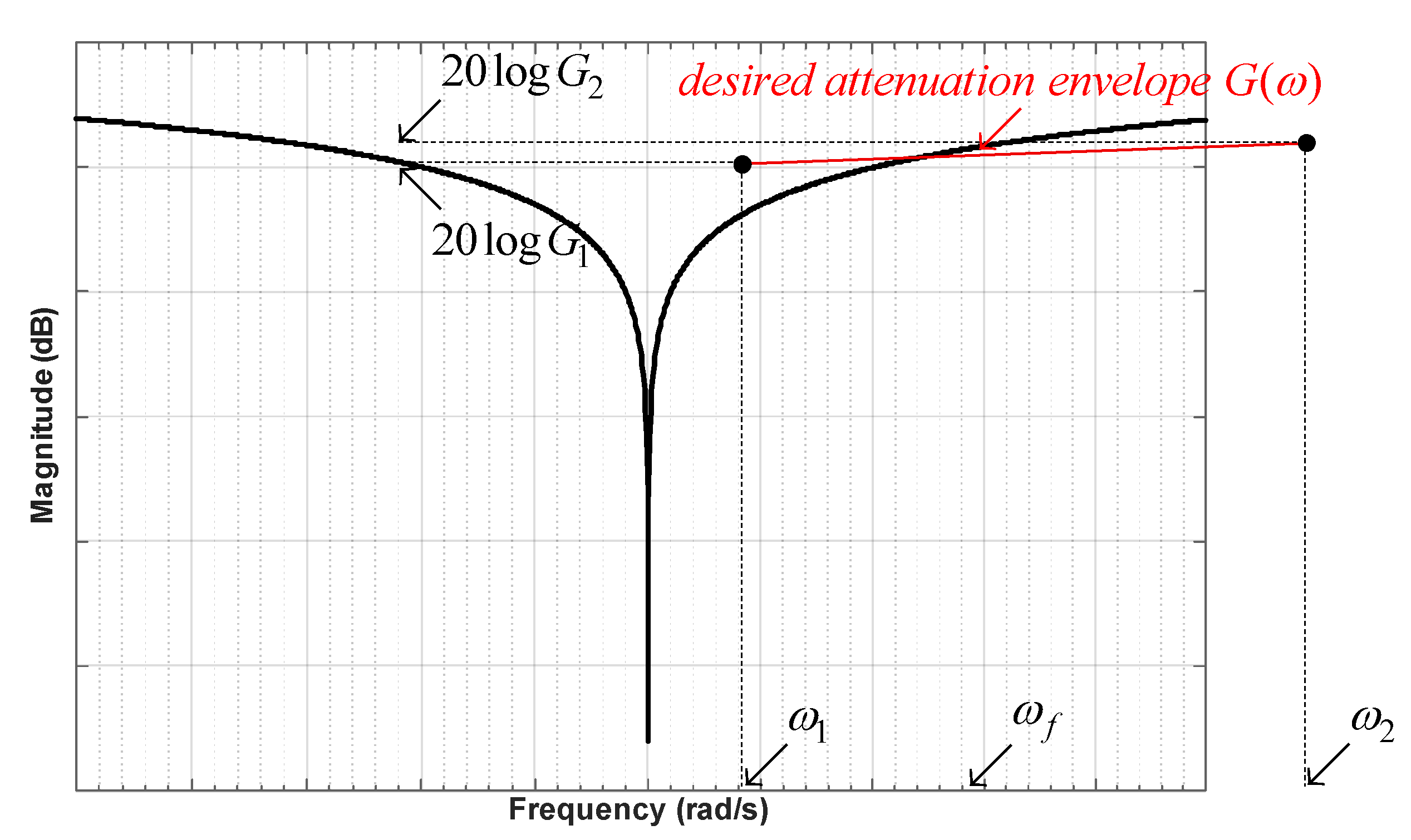
Figure 1. Magnitude frequency response of analog NF in (1), designed according to (3)–(5).
Signals 06 00069 g001
Figure 2. Magnitude frequency responses of continuous NF in (18) and digital NF in (24) for different values of r. Top—general view; bottom—zoomed view.
Signals 06 00069 g002aSignals 06 00069 g002b
Figure 3. Magnitude frequency responses of continuous NF in (18) and digital NF in (26) for different values of r. Top—general view. Bottom—zoomed view.
Signals 06 00069 g003
Figure 4. Magnitude frequency responses of continuous NF in (18) and digital NF in (28) for different values of r. Top—general view. Bottom—zoomed view.
Signals 06 00069 g004aSignals 06 00069 g004b
Figure 5. Simulated steady-state responses to unity magnitude sinusoidal input of analog filter F(s), digital filter (BLT with prewarped notch frequency) Fd1(z), digital filter (BLT with prewarped notch frequency and damping ratio) Fd2(z), and digital filter (BLT with prewarped boundary frequencies) Fd3(z) for r ≈ 2.5. Black curves are the continuous filter outputs; red curves are digital filter outputs.
Signals 06 00069 g005aSignals 06 00069 g005bSignals 06 00069 g005c
Figure 6. Simulated steady-state responses to unity magnitude sinusoidal input of analog filter F(s), digital filter (BLT with prewarped notch frequency and damping ratio) Fd2(z), and digital filter (BLT with prewarped boundary frequencies) Fd3(z) for r ≈ 2.5 at ω = 2π∙102 [rad/s]. Black curve is the continuous filter output; red and blue curves are digital filters’, Fd2(z) and Fd3(z), outputs, respectively.
Signals 06 00069 g006
Table 1. Analog vs. digital (BLT with prewarped notch frequency) filter performances for different sampling-to-notch frequency ratios.
Analogr = 100r = 10r = 5r = 2.5
G1 [dB]−21.2−21.2−20.7−18.9−9.5
G2 [dB]−20.9−20.9−20.3−18.4−8.5
Table 2. Analog vs. digital (BLT with prewarped notch frequency and damping factor) filter performances for different sampling-to-notch frequency ratios.
Analogr = 100r = 10r = 5r = 2.5
G1 [dB]−21.2−21.2−21.25−21.3−21.6
G2 [dB]−20.9−20.9−20.88−20.84−20.45
Table 3. Analog vs. digital (BLT with prewarped boundary frequencies) filter performances for different sampling-to-notch frequency ratios.
Analog r = 100 r = 10 r = 5 r = 2.5
G1 [dB]−21.2−21.2−21.2−21.2−21.2
G2 [dB]−20.9−20.9−20.9−20.9−20.9
Table 4. Summary of steady-state filter gains at different frequencies within the range (14) for r ≈ 2.5.
ω [rad/s]2π∙982π∙992π∙1002π∙1012π∙102
F(s)0.0870.0420.00260.0470.09
Fd1(z)0.3360.1720.0120.20.376
Fd2(z)0.0830.0410.00270.0480.095
Fd3(z)0.0870.0450.00120.0440.09
Disclaimer/Publisher’s Note: The statements, opinions and data contained in all publications are solely those of the individual author(s) and contributor(s) and not of MDPI and/or the editor(s). MDPI and/or the editor(s) disclaim responsibility for any injury to people or property resulting from any ideas, methods, instructions or products referred to in the content.