Non-Invasive Techniques for fECG Analysis in Fetal Heart Monitoring: A Systematic Review



Abstract
1. Introduction
1.1. Methods
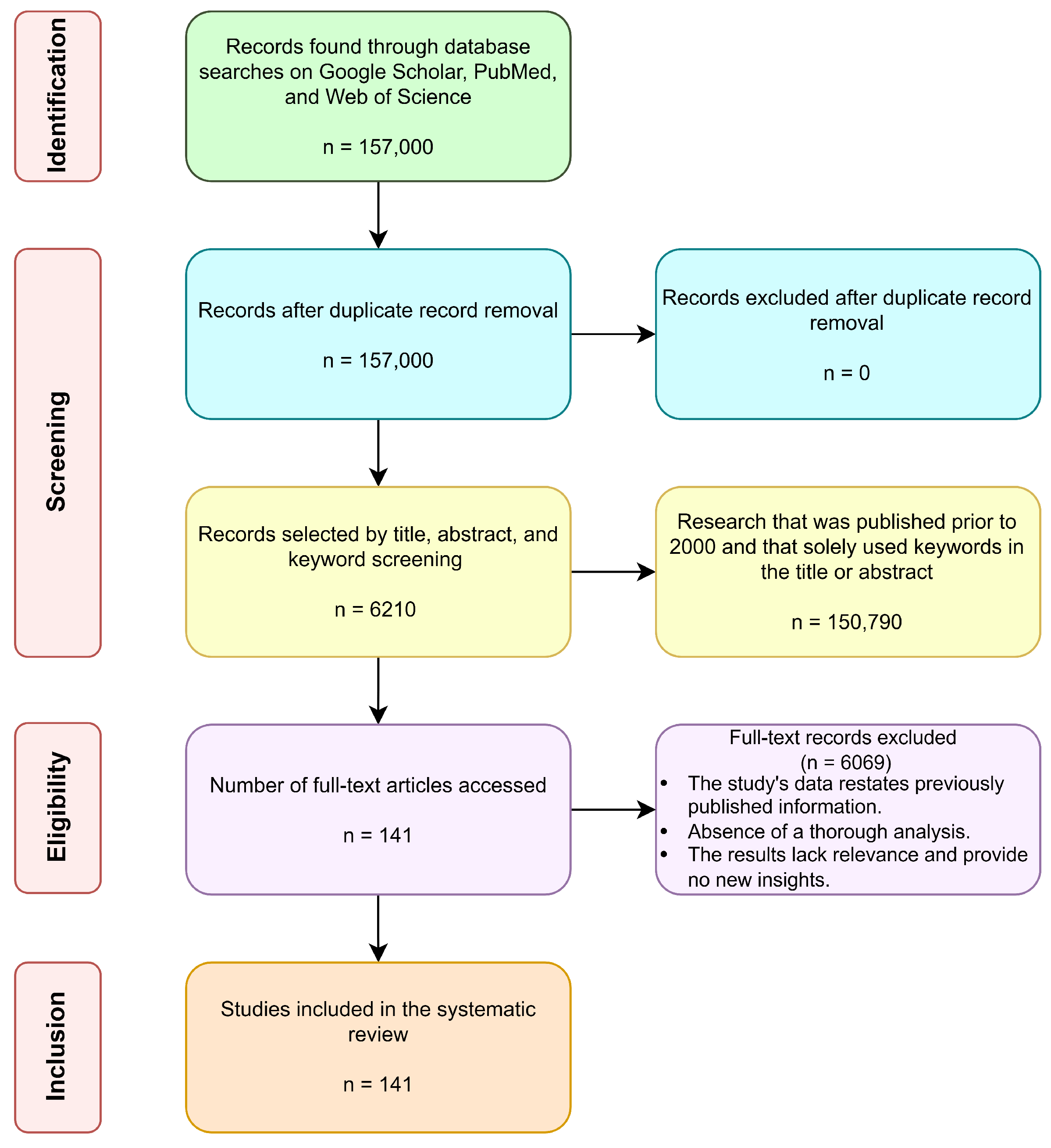
- Identification Phase:
- Screening Phase:
- A focus on the isolation of fECG from aECG signals.
- A report on novel methodologies for the identification of fECG.
- An inclusion of analysis of ECG biomarkers (such as R-R interval and FHR), specifically for analyzing fetal heart growth.
- An implementation of hardware-based techniques for the real-time acquisition and processing of fECG signals.
- Eligibility Phase:
- Restating previously published data.
- Lack of in-depth analysis or novel insights.
- Insufficient focus on FHR, RR-interval processing, and diagnostic information identification.
- Inclusion Phase:
1.2. Novel Contributions
- Analysis of the growth of fetal hearts during the gestation period and its correlation with fECG signals.
- Summarization regarding the various defects associated with fetus and their complications during the gestation period.
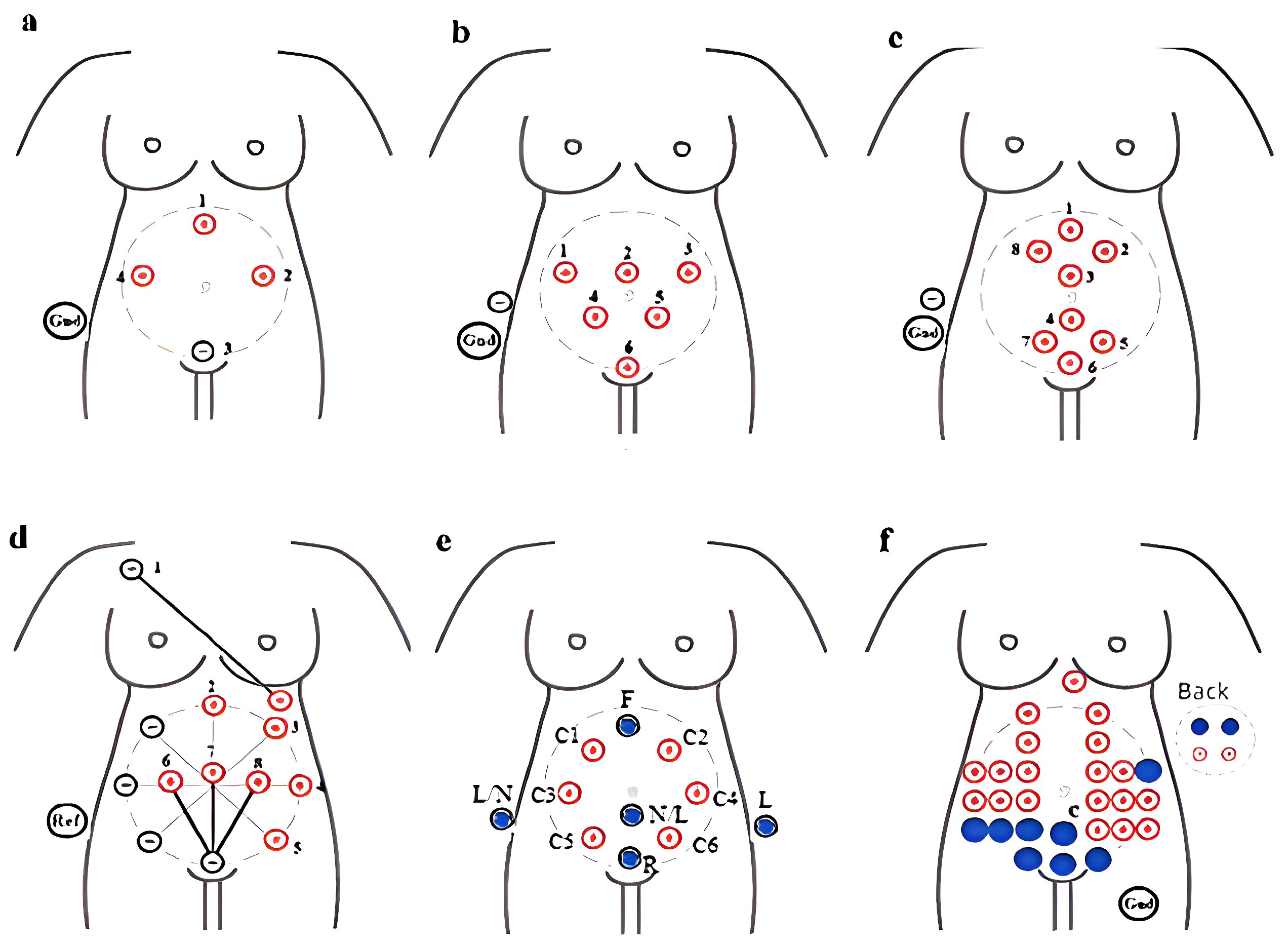
- Summarization of the methods used for acquiring fECG from an expecting mother along with positioning electrodes.
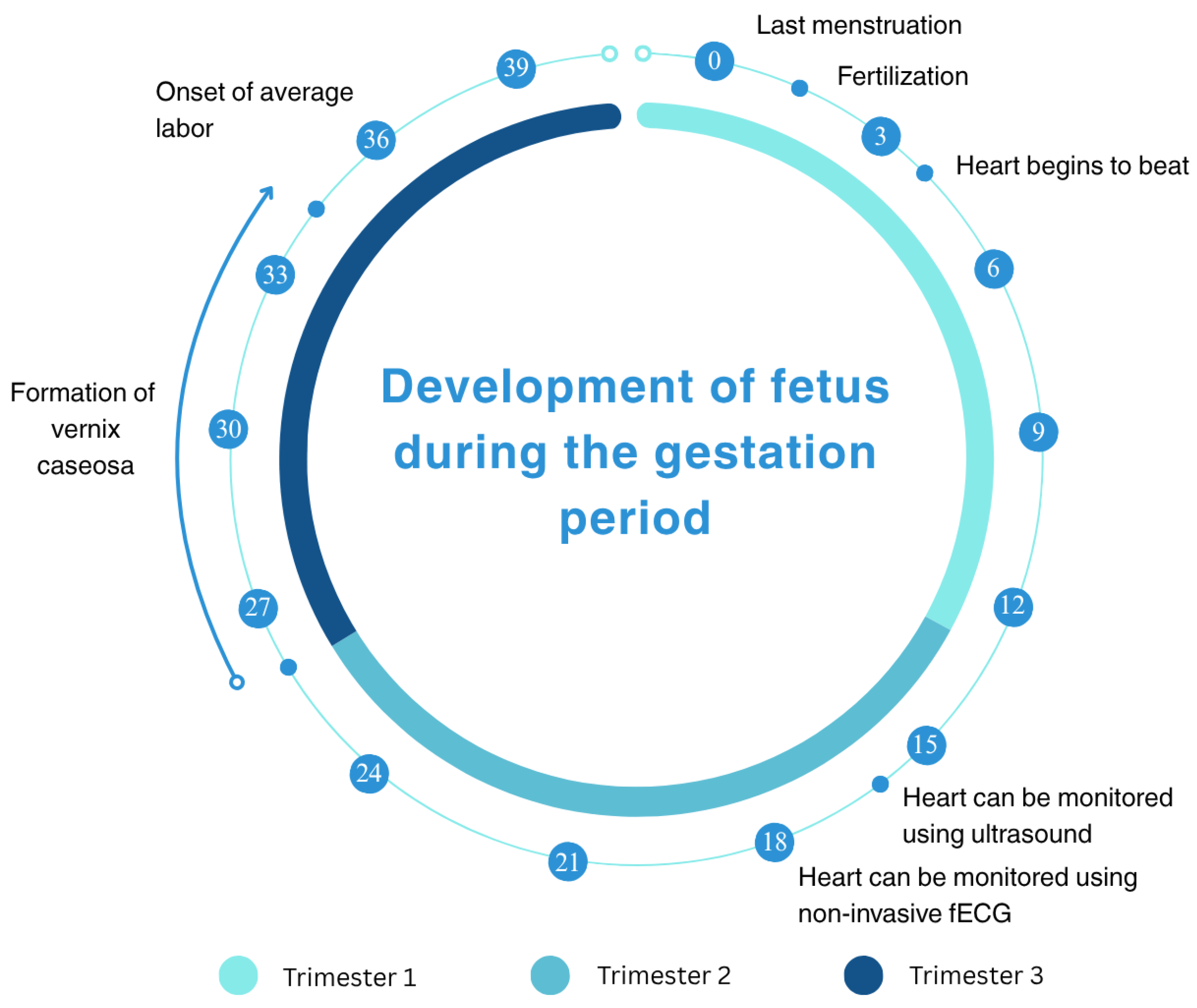
- Development of the fetal heart and acquisition techniques of fECG signals for predicting fetal diseases.
- Summarization of the publicly available fECG databases for analysis.
- Descriptions of the various performance metrics for evaluating the efficacy of fECG extraction techniques along with their corresponding limitations.
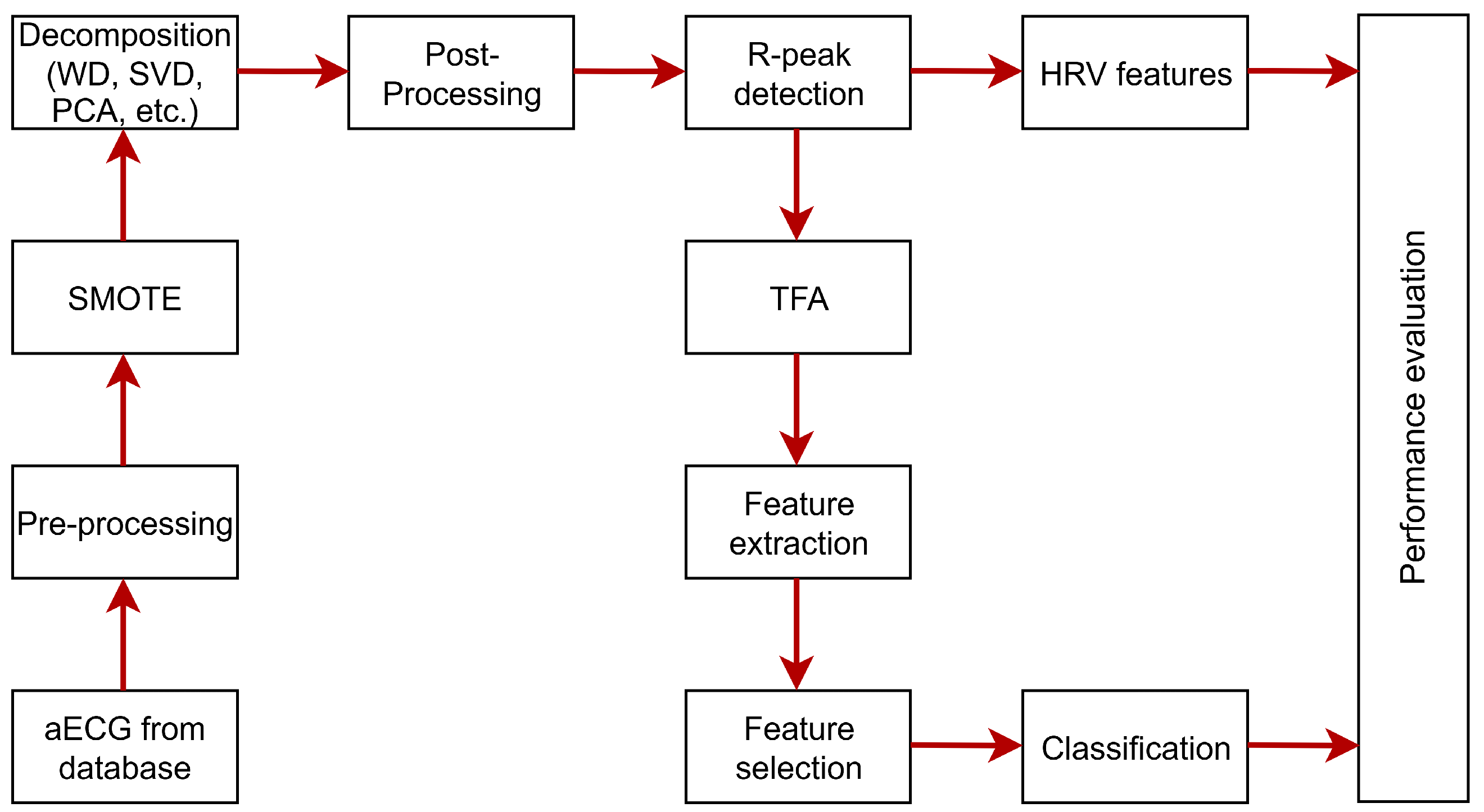
- A proposed technique that is achieved by considering the potential benefits of fECG analysis techniques.
2. Significance of fECG Signal and Method of Acquisition
Method of Acquisition of fECG Signal in Clinical Practice
- Signal conduction barriers: Anatomical layers, such as amniotic fluid, fat tissues, and vernix caseosa, impede the signal conduction between the fetus and the mother’s abdomen. The layers include intestines, fetal membranes, fat, muscle, uterus, placenta, and amniotic fluid [70].
- Inconsistent heart rhythm: The fetal heart chamber’s growth from the 2nd to 37th week lead to variability in the rhythm.
- Fetal movements: Locating the fetal heart position is challenging due to the movement of the fetus inside the uterus. This leads to the improper positioning of electrodes on the maternal abdomen when capturing fECG signals.
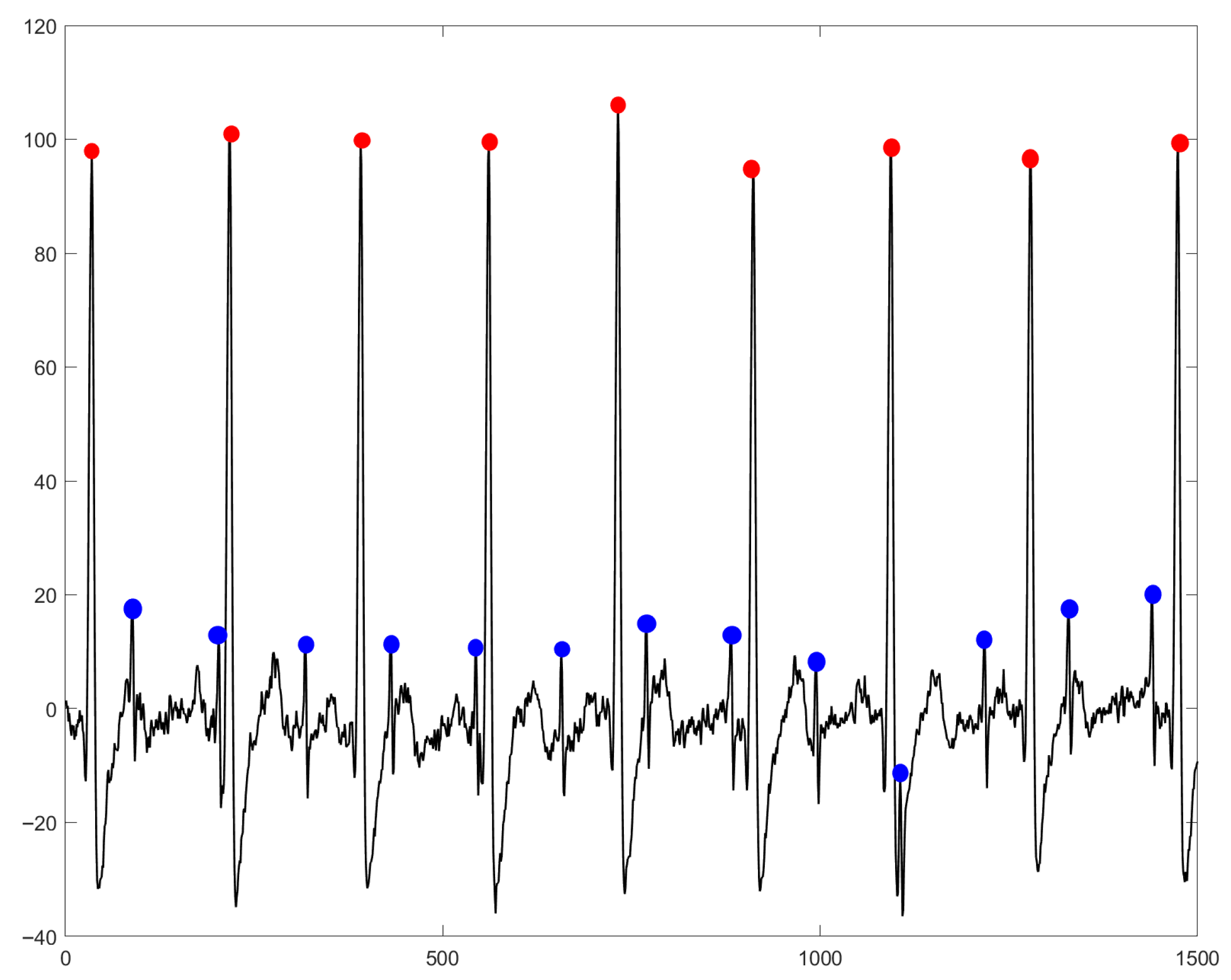
- Signal disturbances: Noises, PLI, artifacts, and UCs degrade fECG signal quality. The dynamic growth of the fetal heart throughout gestation further complicates consistent signal recording.
3. Databases
4. Metrics Used for the Evaluation of the Model’s Performance
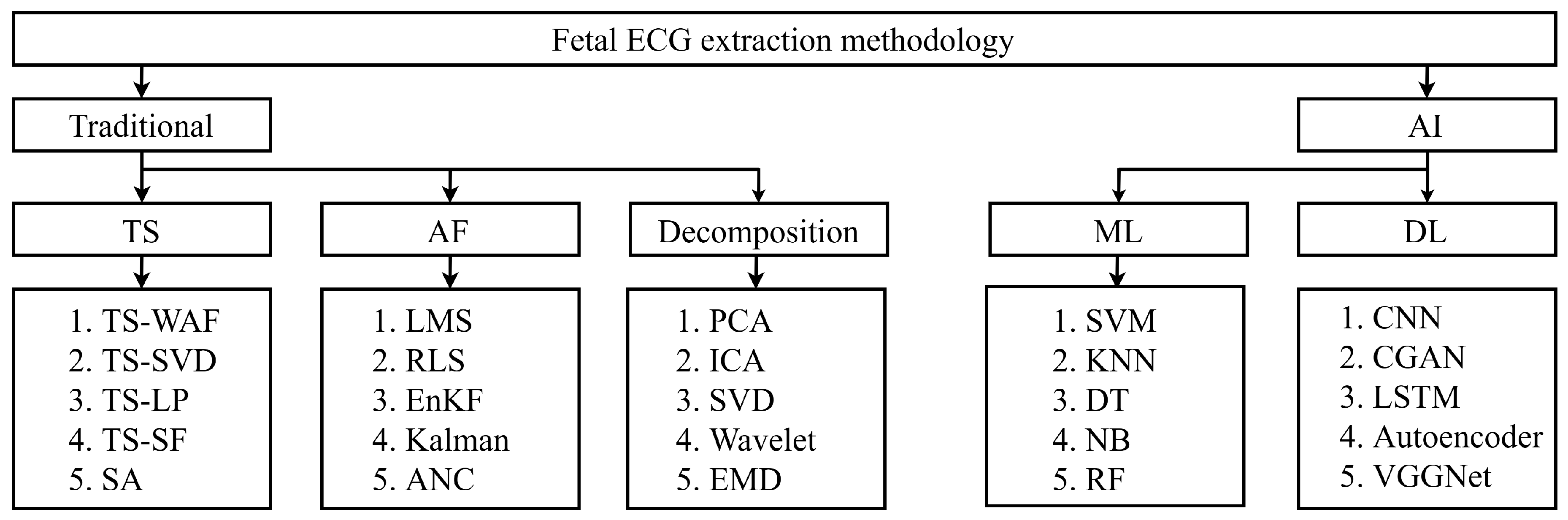
5. Algorithms for Extracting fECG
5.1. Template Subtraction-Based Methods
5.2. Adaptive Filtering-Based Methods
5.3. Wavelet Decomposition-Based Methods
5.4. Blind Source Separation-Based Methods
5.5. Machine Learning-Based Methods
5.6. Deep Learning-Based Methods
6. Discussion
Suggested Approach for fECG Extraction Based on the Potential Strength of Various Techniques
7. Conclusions
Author Contributions
Funding
Institutional Review Board Statement
Informed Consent Statement
Data Availability Statement
Acknowledgments
Conflicts of Interest
Abbreviations
| AF | Adaptive Filtering |
| ACF | Adaptive Comb Filter |
| ADALINE | Adaptive Linear Neuron |
| ADFECG | Abdominal and Direct Fetal Electrocardiogram |
| aECG | Abdominal Electrocardiogram |
| AEFLN | Adaptive Exponential Functional Link Network |
| AFL | Atrial-Flutter |
| AHA | American Heart Association |
| AI | Artificial Intelligence |
| ANC | Adaptive Noise Canceler |
| ANFIS | Adaptive-Neuro-Fuzzy Inference-System |
| ATF | Adaptive Threshold Filter |
| AV | Atrioventricular |
| BCG | Ballistocardiogram |
| BLMS | Block Least Mean Squares |
| BPF | Band Pass Filter |
| bpm | Beats Per Minute |
| BSS | Blind Source Separation |
| BTV | Bilateral Total Variation |
| CAD | Computer-Aided Diagnosis |
| CAG | Coronary Angiography |
| CEEMDAN | Complementary Ensemble Empirical Mode Decomposition with |
| Adaptive Noise | |
| CGAN | Conditional Generative Adversarial Networks |
| CHD | Congenital Heart Diseases |
| CNN | Convolutional Neural Network |
| CTG | Cardiotocography |
| CVDs | Cardio Vascular Diseases |
| CWT | Continuous Wavelet Transform |
| DL | Deep Learning |
| DLMS | Delay Least Mean Squares |
| DNN | Deep Neural Network |
| DT | Decision Tree |
| DTW | Dynamic Time Warping |
| DWT | Discrete Wavelet Transform |
| ECG | Electrocardiogram |
| EKF | Extended Kalman Filter |
| EMD | Empirical Mode Decomposition |
| EEMD | Ensemble Empirical Mode Decomposition |
| EnKF | Ensemble Kalman Filter |
| EWT | Empirical Wavelet Transform |
| fECG | Fetal Electrocardiogram |
| FECGDARHA | Fetal Electrocardiograms, and Direct and Abdominal with Reference |
| Heart beat Annotations | |
| FECGSYN | Fetal ECG Synthetic Database |
| FHR | Fetal Heart Rate |
| FICA | Fast Independent Component Analysis |
| FIR | Finite Impulse Response |
| FLANN | Functional Link Artificial Neural Network |
| FrFT | Fractional Fourier Transform |
| FRPDA | Fetal R-Peak Detection Accuracy |
| FTF | Fast Transversal Filter |
| GA | Genetic Algorithm |
| HIE | Hypoxic–Ischemic Encephalopathy |
| HR | Heart Rate |
| HRV | Heart Rate Variability |
| ICA | Independent Component Analysis |
| IMAF | Input-Mode Adaptive Filtering |
| IMFs | Intrinsic Mode Functions |
| ISE | Invasive Scalp Electrodes |
| ITM | Idempotent Transformation Matrix |
| JADE | Joint Approximate Diagonalization of Eigen Matrices |
| KNN | K-Nearest Neighbor |
| LC | Linear Combiner |
| LDASG | Low-Distortion Adaptive Savitzky–Golay |
| LLMS | Leaky Least Mean Squares |
| LMF | Least Mean Fourth |
| LMMN | Least Mean Mixed-Norm |
| LMS | Least Mean Squares |
| LP | Linear Prediction |
| LR | Logistic Regression |
| LSTM | Long Short-Term Memory |
| MAE | Mean Absolute Error |
| mECG | Maternal Electrocardiogram |
| MITDB | MIT-BIH Arrhythmia Database |
| ML | Machine Learning |
| MLE | Maximum Likelihood Estimation |
| MSANC | Multi-Sensor-Adaptive-Noise-Canceller |
| MSE | Mean Square Error |
| NB | Naive Bayes |
| NIFECG | Non-Invasive Fetal Electrocardiogram |
| NIFEA | Non-Invasive Fetal Electrocardiogram Arrhythmia |
| NLMS | Normalized Least Mean Squares |
| NMF | Non-Negative Matrix Factorization |
| NN | Neural Network |
| NSTDB | MIT-BIH Noise Stress Test Database |
| OLED | Organic Light-Emitting Diode |
| OMAF | Output-Mode Adaptive Filtering |
| PCA | Principal Component Analysis |
| CA | Periodic Component Analysis |
| PCC | Pearson Correlation Coefficient |
| PCG | Phonocardiogram |
| PLI | Power Line Interference |
| PPV | Positive Predictive Value |
| PRD | Peak Root Mean Square Difference |
| RFs | Random Forests |
| RLS | Recursive Least Squares |
| RMSE | Root Mean Square Error |
| RNN | Recurrent Neural Network |
| SA | Sinoatrial |
| SCS | Spectral Correlation Score |
| SF | Scaling Factor |
| SIR | Signal-to-Interference Ratio |
| SMOTE | Synthetic Minority Over-sampling Technique |
| SNR | Signal-to-Noise Ratio |
| SpO2 | Blood Oxygen Saturation |
| SQI | Signal Quality Indicator |
| SSNF | Spatially Selective Noise Filtration |
| ST | Stationary Transform |
| STFT | Short-Time Fourier Transform |
| SVD | Singular Value Decomposition |
| SVM | Support Vector Machine |
| SW | Smooth Window |
| SWT | Stationary Wavelet Transform |
| TD | Tensor Decomposition |
| TFA | Time-Frequency Analysis |
| TS | Template Subtraction |
| UC | Uterine Contraction |
| UWT | Undecimated Wavelet Transform |
| VGGNet | Visual Geometry Group Network |
| WAF | Weighted Adaptive Filter |
| WD | Wavelet Decomposition |
| WLSR | Weighted Least Square Regression |
| WS | Wavelet Shrinkage |
| WT | Wavelet Transform |
References
- Imtiaz, M.N.; Khan, N. Pan-Tompkins++: A robust approach to detect R-peaks in ECG signals. In Proceedings of the 2022 IEEE International Conference on Bioinformatics and Biomedicine (BIBM), Las Vegas, NV, USA, 6–8 December 2022; pp. 2905–2912. [Google Scholar] [CrossRef]
- Ghonchi, H.; Abolghasemi, V. A Dual attention-based autoencoder model for fetal ECG extraction from abdominal signals. IEEE Sens. J. 2022, 22, 22908–22918. [Google Scholar] [CrossRef]
- Jaros, R.; Barnova, K.; Kahankova, R.V.; Pelisek, J.; Litschmannova, M.; Martinek, R. Independent component analysis algorithms for non-invasive fetal electrocardiography. PLoS ONE 2023, 18, 1–31. [Google Scholar] [CrossRef] [PubMed]
- Biloborodova, T.; Scislo, L.; Skarga-Bandurova, I.; Sachenko, A.; Molgad, A.; Povoroznjuk, O.; Yevsieiva, Y. Fetal ECG signal processing and identification of hypoxic pregnancy conditions in-utero. Math. Biosci. Eng. 2021, 18, 4919–4942. [Google Scholar] [CrossRef] [PubMed]
- Sutha, P.; Jayanthi, V. Fetal electrocardiogram extraction and analysis using adaptive noise cancellation and wavelet transformation techniques. J. Med. Syst. 2018, 42, 1–18. [Google Scholar] [CrossRef]
- Fang, B.; Chen, J.; Liu, Y.; Wang, W.; Wang, K.; Singh, A.K.; Lv, Z. Dual-channel neural network for atrial fibrillation detection from a single lead ECG wave. IEEE J. Biomed. Health Inform. 2023, 27, 2296–2305. [Google Scholar] [CrossRef]
- Pawłowski, R.; Al-Ani, F.; Samjeed, A.; Buszko, K.; Khandoker, A. Investigating asymmetry in fetal and maternal heart rate accelerations and decelerations. Sci. Rep. 2025, 15, 1–18. [Google Scholar] [CrossRef]
- Karmakar, D.; Paul, T.; Keenan, E.; Palaniswami, M.; Constable, K.; Spessot, E.; Brownfoot, F. Consumer insights from a feasibility study on remote and extended use of a novel non-invasive wearable fetal electrocardiogram monitor. npj Digit. Med. 2025, 8, 1–8. [Google Scholar] [CrossRef]
- Kariniemi, V.; Hukkinen, K. Quantification of fetal heart rate variability by magnetocardiography and direct electrocardiography. Am. J. Obstet. Gynecol. 1977, 128, 526–530. [Google Scholar] [CrossRef]
- Smyth, C.N.; Farrow, J.L. Present place in obstetrics for foetal phonocardiography and electrocardiography. Br. Med. J. 1958, 2, 1005–1009. [Google Scholar] [CrossRef]
- Sureau, C. Historical perspectives: Forgotten past, unpredictable future. Baillieres Clin. Obs. Gynaecol. 1996, 10, 167–184. [Google Scholar] [CrossRef]
- Kahankova, R.; Martinek, R.; Jaros, R.; Behbehani, K.; Matonia, A.; Jezewski, M.; Behar, J.A. A review of signal processing techniques for non-invasive fetal electrocardiography. IEEE Rev. Biomed. Eng. 2020, 13, 51–73. [Google Scholar] [CrossRef]
- Nair, K.D.D.; Gilvaz, S.; Menon, B.; Singh, P. Accuracy of a noninvasive, wearable, wireless, ECG-based, intrapartum monitoring tool against the conventional ultrasound-based CTG. J. Obstet. Gynecol. India 2025, 75, 340–347. [Google Scholar] [CrossRef] [PubMed]
- Aggarwal, G.; Wei, Y. Non-invasive fetal electrocardiogram monitoring techniques: Potential and future research opportunities in smart textiles. Signals 2021, 2, 392–412. [Google Scholar] [CrossRef]
- Wakai, R.; Lengle, J.; Leuthold, A. Transmission of electric and magnetic foetal cardiac signals in a case of ectopia cordis: The dominant role of the vernix caseosa. Phys. Med. Biol. 2000, 45, 1989–1995. [Google Scholar] [CrossRef] [PubMed]
- Moor, B.D.; Gersem, P.D.; Schutter, B.D.; Favoreel, W. DAISY: A database for identification of systems. J. A 1997, 38, 4–5. [Google Scholar]
- Jaros, R.; Tomicova, E.; Martinek, R. Template subtraction based methods for non-invasive fetal electrocardiography extraction. Sci. Rep. 2024, 14, 1–15. [Google Scholar] [CrossRef]
- Ramli, D.A.; Shiong, Y.H.; Hassan, N. Blind source separation (BSS) of mixed maternal and fetal electrocardiogram (ECG) signal: A comparative study. Procedia Comput. Sci. 2020, 176, 582–591. [Google Scholar] [CrossRef]
- Ghazdali, A.; Hakim, A.; Laghrib, A.; Mamouni, N.; Raghay, S. A new method for the extraction of fetal ECG from the dependent abdominal signals using blind source separation and adaptive noise cancellation techniques. Theor. Biol. Med Model. 2015, 12, 1–20. [Google Scholar] [CrossRef]
- Dhas, D.E.; Suchetha, M. Extraction of fetal ECG from abdominal and thorax ECG using a non-causal adaptive filter architecture. IEEE Trans. Biomed. Circuits Syst. 2022, 16, 981–990. [Google Scholar] [CrossRef]
- Kahankova, R.; Mikolasova, M.; Martinek, R. Optimization of adaptive filter control parameters for non-invasive fetal electrocardiogram extraction. PLoS ONE 2022, 17, 1–23. [Google Scholar] [CrossRef]
- Vaidya, R.R.; Chaitra, N. Comparison of adaptive filters in extraction of fetal ECG. In Proceedings of the 2020 International Conference on Smart Electronics and Communication (ICOSEC), Tamilnadu, India, 10–12 September 2020; pp. 1066–1070. [Google Scholar] [CrossRef]
- Shokouhmand, A.; Tavassolian, N. Fetal electrocardiogram extraction using dual-path source separation of single-channel non-invasive abdominal recordings. IEEE Trans. Biomed. Eng. 2023, 70, 283–295. [Google Scholar] [CrossRef] [PubMed]
- Cardoso, J. Multidimensional independent component analysis. In Proceedings of the 1998 IEEE International Conference on Acoustics, Speech and Signal Processing, ICASSP ’98, Seattle, WA, USA, 15 May 1998; Volume 4, pp. 1941–1944. [Google Scholar] [CrossRef]
- de Lathauwer, L.; de Moor, B.; Vandewalle, J. Fetal electrocardiogram extraction by blind source subspace separation. IEEE Trans. Biomed. Eng. 2000, 47, 567–572. [Google Scholar] [CrossRef] [PubMed]
- Nasiri, M.; Faez, K.; Nasrabadi, A.M. A new method for extraction of fetal electrocardiogram signal based on adaptive nero-fuzzy inference system. In Proceedings of the IEEE International Conference on Signal and Image Processing Applications (ICSIPA), Kuala Lumpur, MA, USA, 16–18 November 2011; pp. 456–461. [Google Scholar] [CrossRef]
- Sana, F.; Ballal, T.; Shadaydeh, M.; Hoteit, I.; Al-Naffouri, T.Y. Fetal ECG extraction exploiting joint sparse supports in a dual dictionary framework. Biomed. Signal Process. Control 2019, 48, 46–60. [Google Scholar] [CrossRef]
- Abel, J.D.K.; Samiappan, D. Automatic detection of fetal QRS complex using time-frequency image based features and deep learning architecture. In Proceedings of the 2022 3rd International Conference on Electronics and Sustainable Communication Systems (ICESC), Coimbatore, India, 17–19 August 2022; pp. 778–782. [Google Scholar] [CrossRef]
- Dia, N.; Fontecave-Jallon, J.; Resendiz, M.; Faisant, M.C.; Equy, V.; Riethmuller, D.; Gumery, P.Y.; Rivet, B. Fetal heart rate estimation by non-invasive single abdominal electrocardiography in real clinical conditions. Biomed. Signal Process. Control 2022, 71, 103187. [Google Scholar] [CrossRef]
- Barnova, K.; Martinek, R.; Kahankova, R.V.; Jaros, R.; Snasel, V.; Mirjalili, S. Artificial intelligence and machine learning in electronic fetal monitoring. Arch. Comput. Methods Eng. 2024, 31, 2557–2588. [Google Scholar] [CrossRef]
- Ma, Y.; Xiao, Y.; Wei, G.; Sun, J. Foetal ECG extraction using non-linear adaptive noise canceller with multiple primary channels. IET Signal Process. 2018, 12, 219–227. [Google Scholar] [CrossRef]
- Shadaydeh, M.; Xiao, Y.; Ward, R.K. Extraction of fetal ECG using adaptive Volterra filters. In Proceedings of the 16th European Signal Processing Conference (EUSIPCO 2008), Lausanne, Switzerland, 25–29 August 2008; pp. 1–5. [Google Scholar]
- Rajaguru, S.; D.V., P. Maternal ECG cancellation in abdominal signal using ANFIS and wavelets. J. Appl. Sci. 2010, 10, 868–877. [Google Scholar] [CrossRef]
- Ungureanu, G.M.; Bergmans, J.W.; Oei, S.G.; Ungureanu, A.; Wolf, W. The event synchronous canceller algorithm removes maternal ECG from abdominal signals without affecting the fetal ECG. Comput. Biol. Med. 2009, 39, 562–567. [Google Scholar] [CrossRef]
- Ahmadieh, H.; Asl, B.M. Fetal ECG extraction via Type-2 adaptive neuro-fuzzy inference systems. Comput. Methods Programs Biomed. 2017, 142, 101–108. [Google Scholar] [CrossRef]
- Poian, G.D.; Bernardini, R.; Rinaldo, R. Separation and analysis of fetal-ECG signals from compressed sensed abdominal ECG recordings. IEEE Trans. Biomed. Eng. 2016, 63, 1269–1279. [Google Scholar] [CrossRef]
- Yuan, L.; Zhou, Z.; Yuan, Y.; Wu, S. An improved FastICA method for fetal ECG extraction. Comput. Math. Methods Med. 2018, 1–7. [Google Scholar] [CrossRef]
- Sheikh, M.; Marai, M.S.; Alhutaish, R. Online detection and extraction of fECG signals using ICA: A comparative study. J. Eng. Res. Rep. 2020, 15, 10–18. [Google Scholar] [CrossRef]
- Martinek, R.; Kahankova, R.; Jezewski, J.; Jaros, R.; Mohylova, J.; Fajkus, M.; Nedoma, J.; Janku, P.; Nazeran, H. Comparative effectiveness of ICA and PCA in extraction of fetal ECG from abdominal signals: Toward non-invasive fetal monitoring. Front. Physiol. 2018, 9, 1–25. [Google Scholar] [CrossRef] [PubMed]
- Rahmati, A.K.; Setarehdan, S.; Araabi, B. A PCA/ICA based fetal ECG extraction from mother abdominal recordings by means of a novel data-driven approach to fetal ECG quality assessment. J. Biomed. Phys. Eng. 2017, 7, 37–50. [Google Scholar]
- Ziani, S.; Farhaoui, Y.; Moutaib, M. Extraction of fetal electrocardiogram by combining deep learning and SVD-ICA-NMF methods. Big Data Min. Anal. 2023, 6, 301–310. [Google Scholar] [CrossRef]
- He, P.; Chen, X. A method for extracting fetal ECG based on EMD-NMF single channel blind source separation algorithm. Technol. Health Care 2015, 24, S17–S26. [Google Scholar] [CrossRef]
- Gurve, D.; Krishnan, S. Separation of fetal-ECG from single-channel abdominal ECG using activation scaled non-negative matrix factorization. IEEE J. Biomed. Health Inform. 2020, 24, 669–680. [Google Scholar] [CrossRef]
- Ziani, S.; Jbari, A.; Bellarbi, L.; Farhaoui, Y. Blind maternal-fetal ECG separation based on the time-scale image TSI and SVD–ICA methods. Procedia Comput. Sci. 2018, 134, 322–327. [Google Scholar] [CrossRef]
- Gupta, V.; Mittal, M. A comparison of ECG signal pre-processing using FrFT, FrWT and IPCA for improved analysis. IRBM 2019, 40, 145–156. [Google Scholar] [CrossRef]
- Sameni, R.; Jutten, C.; Shamsollahi, M.B. Multichannel electrocardiogram decomposition using periodic component analysis. IEEE Trans. Biomed. Eng. 2008, 55, 1935–1940. [Google Scholar] [CrossRef]
- Akhbari, M.; Niknazar, M.; Jutten, C.; Shamsollahi, M.B.; Rivet, B. Fetal electrocardiogram R-peak detection using robust tensor decomposition and extended Kalman filtering. Comput. Cardiol. 2013, 40, 189–192. [Google Scholar] [CrossRef]
- Diwan, S.; Sahu, M.; Bhateja, V. Elicitation of fetal ECG from abdominal recordings using blind source separation techniques and robust set membership affine projection algorithm for signal quality enhancement. Comput. Biol. Med. 2024, 178, 108764. [Google Scholar] [CrossRef]
- Page, M.J.; McKenzie, J.E.; Bossuyt, P.M.; Boutron, I.; Hoffmann, T.C.; Mulrow, C.D.; Shamseer, L.; Tetzlaff, J.M.; Akl, E.A.; Brennan, S.E.; et al. The PRISMA 2020 statement: An updated guideline for reporting systematic reviews. BMJ 2021, 372, 1–9. [Google Scholar] [CrossRef] [PubMed]
- Tan, C.M.J.; Lewandowski, A.J. The transitional heart: From early embryonic and fetal development to neonatal life. Fetal Diagn. Ther. 2020, 47, 373–386. [Google Scholar] [CrossRef] [PubMed]
- Abel, J.D.K.; Dhanalakshmi, S.; Kumar, R. A comprehensive survey on signal processing and machine learning techniques for non-invasive fetal ECG extraction. Multimed. Tools Appl. 2023, 82, 1373–1400. [Google Scholar] [CrossRef]
- Miyoshi, T. Fetal arrhythmias: Current evidence of prenatal diagnosis and management. J. Obstet. Gynaecol. Res. 2025, 51, e16256. [Google Scholar] [CrossRef]
- Shekhawat, D.; Chaudhary, D.; Kumar, A.; Kalwar, A.; Mishra, N.; Sharma, D. Binarized spiking neural network optimized with momentum search algorithm for fetal arrhythmia detection and classification from ECG signals. Biomed. Signal Process. Control 2024, 89, 105713. [Google Scholar] [CrossRef]
- Bentaleb, D.; Khatar, Z. Multi-criteria Bayesian optimization of empirical mode decomposition and hybrid filters fusion for enhanced ECG signal denoising and classification: Cardiac arrhythmia and myocardial infarction cases. Comput. Biol. Med. 2025, 184, 109462. [Google Scholar] [CrossRef]
- Gupta, K.; Bajaj, V.; Ansari, I.A. Integrated S-transform-based learning system for detection of arrhythmic fetus. IEEE Trans. Instrum. Meas. 2023, 72, 1–8. [Google Scholar] [CrossRef]
- Zhang, Y.; Gu, A.; Xiao, Z.; Cai, K.D.Z.; Zhao, L.; Yang, C.; Li, J.; Zhang, H.; Liu, C. An effective integrated framework for fetal QRS complex detection based on abdominal ECG signal. J. Med. Biol. Eng. 2024, 44, 99–113. [Google Scholar] [CrossRef]
- Oldenburg, J.T.; Macklin, M. Changes in the conduction of the fetal electrocardiogram to the maternal abdominal surface during gestation. Am. J. Obstet. Gynecol. 1977, 129, 425–433. [Google Scholar] [CrossRef] [PubMed]
- Oostendorp, T.F.; van Oosterom, A.; Jongsma, H.W. The effect of changes in the conductive medium on the fetal ECG throughout gestation. Clin. Phys. Physiol. Meas. 1989, 10, 11–20. [Google Scholar] [CrossRef] [PubMed]
- Oostendorp, T.F.; van Oosterom, A.; Jongsma, H.W. Electrical properties of tissues involved in the conduction of foetal ECG. Med. Biol. Eng. Comput. 1989, 27, 322–324. [Google Scholar] [CrossRef] [PubMed]
- Oostendorp, T.F.; van Oosterom, A.; Jongsma, H.W. The fetal ECG throughout the second half of gestation. Clin. Phys. Physiol. Meas. 1989, 10, 147–160. [Google Scholar] [CrossRef]
- Behar, J.; Andreotti, F.; Zaunseder, S.; Oster, J.; Clifford, G.D. A practical guide to non-invasive foetal electrocardiogram extraction and analysis. Physiol. Meas. 2016, 37, R1–R35. [Google Scholar] [CrossRef]
- Stinstra, J.G. The Reliability of the Fetal Magnetocardiogram. Ph.D. Thesis, University of Twente, Twente, The Netherlands, 2001; pp. 1–214. [Google Scholar] [CrossRef]
- Marchon, N.; Naik, G. Electrode positioning for monitoring fetal ECG: A review. In Proceedings of the 2015 International Conference on Information Processing (ICIP), Pune, India, 16–19 December 2015; pp. 5–10. [Google Scholar] [CrossRef]
- Rooijakkers, M.J.; Rabotti, C.; Oei, S.G.; Mischi, M. Low-complexity R-peak detection for ambulatory fetal monitoring. Physiol. Meas. 2012, 33, 1135–1150. [Google Scholar] [CrossRef]
- Marchon, N.; Naik, G.; Pai, R. ECG electrode configuration to extract real time fECG signals. Procedia Comput. Sci. 2018, 125, 501–508. [Google Scholar] [CrossRef]
- Ali, M.A.S.; Zeng, X. A novel technique for extraction foetal electrocardiogram using adaptive filtering and simple genetic algorithm. Am. J. Biostat. 2010, 1, 75–81. [Google Scholar] [CrossRef]
- Sameni, R.; Clifford, G.D.; Jutten, C.; Shamsollahi, M.B. Multichannel ECG and noise modeling: Application to maternal and fetal ECG signals. Eurasip J. Adv. Signal Process. 2007, 2007, 043407. [Google Scholar] [CrossRef]
- Vullings, R.; Petersa, C.; Mischi, M.; Oei, G.; Bergmans, J. Maternal ECG removal from non-invasive fetal ECG recordings. In Proceedings of the 2006 International Conference of the IEEE Engineering in Medicine and Biology Society, New York, NY, USA, 30 August–3 September 2006; pp. 1394–1397. [Google Scholar] [CrossRef]
- Dash, S.S.; Nath, M.K.; Anbalagan, T. Identification of fECG from aECG recordings using ICA over EMD. In Proceedings of the 4th International Conference on Medical Imaging and Computer-Aided Diagnosis, Manchester, UK, 19–21 November 2024; Volume 1166, pp. 236–248. [Google Scholar] [CrossRef]
- Samjeed, A.; Wahbah, M.; Hadjileontiadis, L.; Khandoker, A.H. Fetal ECG-based analysis reveals the impact of fetal movements and maternal respiration on maternal-fetal heart rate synchronization. PLoS ONE 2024, 19, 1–17. [Google Scholar] [CrossRef]
- Andreotti, F.; Behar, J.; Zaunseder, S.; Oster, J.; Clifford, G.D. An open-source framework for stress-testing non-invasive foetal ECG extraction algorithms. Physiol. Meas. 2016, 37, 627–648. [Google Scholar] [CrossRef]
- Goldberger, A.L.; Amaral, L.A.N.; Glass, L.; Hausdorff, J.M.; Ivanov, P.C.; Mark, R.G.; Mietus, J.E.; Moody, G.B.; Peng, C.K.; Stanley, H.E. PhysioBank, PhysioToolkit, and PhysioNet: Components of a new research resource for complex physiologic signals. Circ. Electron. Pages 2000, 101, 215–220. [Google Scholar] [CrossRef]
- Jezewski, J.; Matonia, A.; Kupka, T.; Roj, D.; Czabanski, R. Determination of the fetal heart rate from abdominal signals: Evaluation of beat-to-beat accuracy in relation to the direct fetal electrocardiogram. Biomed. Eng. Tech. 2012, 57, 383–394. [Google Scholar] [CrossRef]
- Behar, J.A.; Bonnemains, L.; Shulgin, V.; Oster, J.; Ostras, O.; Lakhno, I. Noninvasive fetal electrocardiography for the detection of fetal arrhythmias. Prenat. Diagn. 2019, 39, 178–187. [Google Scholar] [CrossRef]
- Matonia, A.; Jezewski, J.; Kupka, T.; Jezewski, M.; Horoba, K.; Wrobel, J.; Czabanski, R.; Kahankowa, R. Fetal electrocardiograms, direct and abdominal with reference heartbeat annotations. Sci. Data 2020, 7, 1–14. [Google Scholar] [CrossRef] [PubMed]
- Qu, R.; Song, T.; Wei, G.; Wei, L.; Cao, W.; Song, J. Integrating contrastive learning and cycle generative adversarial networks for non-invasive fetal ECG extraction. Pediatr. Cardiol. 2024, 46, 2078–2088. [Google Scholar] [CrossRef] [PubMed]
- Nguyen-Quang, T.; Le, T.; Minh, D.N.; Cao, H.; Han, H.D. Fetal QRS detection from single-channel abdominal ECG by adaptive improved clustering. In Proceedings of the IEEE 20th International Conference on Body Sensor Networks (BSN), Chicago, IL, USA, 15–17 October 2024; pp. 1–4. [Google Scholar] [CrossRef]
- Sarafan, S.; Le, T.; Naderi, A.M.; Nguyen, Q.D.; Kuo, B.T.Y.; Ghirmai, T.; Han, H.D.; Lau, M.P.H.; Cao, H. Investigation of methods to extract fetal electrocardiogram from the mother’s abdominal signal in practical scenarios. Technologies 2020, 8, 33. [Google Scholar] [CrossRef]
- Kanjilal, P.P.; Palit, S.; Saha, G. Fetal ECG extraction from single-channel maternal ECG using singular value decomposition. IEEE Trans. Biomed. Eng. 1997, 44, 51–59. [Google Scholar] [CrossRef] [PubMed]
- Vullings, R.; Peters, C.H.L.; Sluijter, R.J.; Mischi, M.; Oei, S.G.; Bergmans, J.W.M. Dynamic segmentation and linear prediction for maternal ECG removal in antenatal abdominal recordings. Physiol. Meas. 2009, 30, 1–8. [Google Scholar] [CrossRef]
- Cerutti, S.; Baselli, G.; Civardi, S.; Ferrazzi, E.; Marconi, A.M.; Pagani, M.; Pardi, G. Variability analysis of fetal heart rate signals as obtained from abdominal electrocardiographic recordings. J. Perinat. Med. 1986, 14, 445–452. [Google Scholar] [CrossRef]
- Martens, S.M.M.; Rabotti, C.; Mischi, M.; Sluijter, R.J. A robust fetal ECG detection method for abdominal recordings. Physiol. Meas. 2007, 28, 1–16. [Google Scholar] [CrossRef] [PubMed]
- Souriau, R.; Fontecave-Jallon, J.; Rivet, B. Fetal ECG denoising using dynamic time warping template subtraction. In Proceedings of the 2022 44th Annual International Conference of the IEEE Engineering in Medicine & Biology Society (EMBC), Glasgow, UK, 11–15 July 2022; pp. 4978–4981. [Google Scholar] [CrossRef]
- Liu, G.; Luan, Y. An adaptive integrated algorithm for noninvasive fetal ECG separation and noise reduction based on ICA-EEMD-WS. Med. Biol. Eng. Comput. 2015, 53, 1113–1127. [Google Scholar] [CrossRef] [PubMed]
- Krupa, A.J.D.; Dhanalakshmi, S.; Sanjana, N.; Manivannan, N.; Kumar, R.; Tripathy, S. Fetal heart rate estimation using fractional Fourier transform and wavelet analysis. Biocybern. Biomed. Eng. 2021, 41, 1533–1547. [Google Scholar] [CrossRef]
- Krupa, A.J.D.; Dhanalakshmi, S.; Kumar, R. Joint time-frequency analysis and non-linear estimation for fetal ECG extraction. Biomed. Signal Process. Control 2022, 75, 103569. [Google Scholar] [CrossRef]
- Le, P.K.T.; Vo, V.T.; Tran, L.G. Increasing temporal accuracy of noninvasive fetal electrocardiogram QRS detection with modified superimposition template subtraction. Physiol. Meas. 2025, 46, 075005. [Google Scholar] [CrossRef]
- Liu, H.; Chen, D.; Sun, G. Detection of fetal ECG R wave from single-lead abdominal ECG using a combination of RR time-series smoothing and template-matching approach. IEEE Access 2019, 7, 66633–66643. [Google Scholar] [CrossRef]
- Xuan, Y.; Zhang, X.; Liy, S.S.; Shen, Z.; Xie, X.; Garcia, L.P.; Togneri, R. A new approach to extract fetal electrocardiogram using affine combination of adaptive filters. In Proceedings of the ICASSP 2023—2023 IEEE International Conference on Acoustics, Speech and Signal Processing (ICASSP), Rhodes Island, Greece, 4–10 June 2023; pp. 1–5. [Google Scholar] [CrossRef]
- Sulas, E.; Urru, M.; Tumbarello, R.; Raffo, L.; Pani, D. Systematic analysis of single- and multi-reference adaptive filters for non-invasive fetal electrocardiography. Math. Biosci. Eng. 2020, 17, 286–308. [Google Scholar] [CrossRef]
- Martinek, R.; Kahankova, R.; Skutova, H.; Koudelka, P.; Zidek, J.; Koziorek, J. Adaptive signal processing techniques for extracting abdominal fetal electrocardiogram. In Proceedings of the 2016 10th International Symposium on Communication Systems, Networks and Digital Signal Processing (CSNDSP), Prague, Czech Republic, 20–22 July 2016; pp. 1–6. [Google Scholar] [CrossRef]
- Niknazar, M.; Rivet, B.; Jutten, C. Fetal ECG extraction by extended state Kalman filtering based on single-channel recordings. IEEE Trans. Biomed. Eng. 2013, 60, 1345–1352. [Google Scholar] [CrossRef]
- Fotiadou, E.; van Laar, J.O.E.H.; Oei, S.G.; Vullings, R. Enhancement of low-quality fetal electrocardiogram based on time-sequenced adaptive filtering. Med Biol. Eng. Comput. 2018, 56, 2313–2323. [Google Scholar] [CrossRef]
- Kahankova, R.; Martinek, R.; Bilik, P. Fetal ECG extraction from abdominal ECG using RLS based adaptive algorithms. In Proceedings of the 18th International Carpathian Control Conference (ICCC), Sinaia, Romania, 28–31 May 2017; pp. 337–342. [Google Scholar] [CrossRef]
- Dhas, D.E.; Suchetha, M. Impact of linearization in abdominal ECG for non-causal filtering structure in fetal ECG extraction. In Proceedings of the 7th International Conference on Trends in Electronics and Informatics (ICOEI), Tirunelveli, India, 11–13 April 2023; pp. 214–220. [Google Scholar] [CrossRef]
- Kahankova, R.; Martinek, R.; Mikolášová, M.; Jaroš, R. Adaptive linear neuron for fetal electrocardiogram extraction. In Proceedings of the IEEE 20th International Conference on e-Health Networking, Applications and Services (Healthcom), Ostrava, Czech Republic, 17–20 September 2018; pp. 1–5. [Google Scholar] [CrossRef]
- Abel, J.D.K.; Samiappan, D.; Kumar, R.; Kumar, S.P. Multiple sub-filter adaptive noise canceller for fetal ECG extraction. Procedia Comput. Sci. 2019, 165, 182–188. [Google Scholar] [CrossRef]
- Rodriguez, R.R.B.; Mapolon, R.J.A.; Reyes, R.S. A non-intrusive single channel abdominal fetal electrocardiogram monitor using singular value decomposition. In Proceedings of the 2021 3rd International Conference on Electrical, Control and Instrumentation Engineering (ICECIE), Kuala Lumpur, MA, USA, 27 November 2021; pp. 1–8. [Google Scholar] [CrossRef]
- Mekhfioui, M.; Benahmed, A.; Chebak, A.; Elgouri, R.; Hlou, L. The development and implementation of innovative blind source separation techniques for real-time extraction and analysis of fetal and maternal electrocardiogram signals. Bioengineering 2024, 11, 512. [Google Scholar] [CrossRef]
- Faiz, M.M.U.; Kale, I. Removal of multiple artifacts from ECG signal using cascaded multistage adaptive noise cancellers. Array 2022, 14, 100133. [Google Scholar] [CrossRef]
- Siew, H.S.H.; Alshebly, Y.S.; Nafea, M. Fetal ECG extraction using Savitzky-Golay and Butterworth filters. In Proceedings of the IEEE International Conference on Automatic Control and Intelligent Systems (I2CACIS), Shah Alam, MA, USA, 25 June 2022; pp. 215–220. [Google Scholar] [CrossRef]
- Sarafan, S.; Le, T.; Lau, M.P.H.; Hameed, A.; Ghirmai, T.; Cao, H. Fetal electrocardiogram extraction from the mother’s abdominal signal using the ensemble Kalman filter. Sensors 2022, 22, 2788. [Google Scholar] [CrossRef] [PubMed]
- Huang, H.; Hu, S.; Sun, Y. A discrete curvature estimation based low-distortion adaptive Savitzky–Golay filter for ECG denoising. Sensors 2019, 19, 1617. [Google Scholar] [CrossRef] [PubMed]
- Martinek, R.; Kahankova, R.; Nazeran, H.; Konecny, J.; Jezewski, J.; Janku, P.; Bilik, P.; Zidek, J.; Nedoma, J.; Fajkus, M. Non-invasive fetal monitoring: A maternal surface ECG electrode placement-based novel approach for optimization of adaptive filter control parameters using the LMS and RLS algorithms. Sensors 2017, 17, 1154. [Google Scholar] [CrossRef]
- Suganthy, M.; Manjula, S. Enhancement of SNR in fetal ECG signal extraction using combined SWT and WLSR in parallel EKF. Clust. Comput. 2018, 22, 3875–3881. [Google Scholar] [CrossRef]
- Taha, L.Y.; Abdel-Raheem, E. Fetal ECG extraction using input-mode and output-mode adaptive filters with blind source separation. Can. J. Electr. Comput. Eng. 2020, 43, 295–304. [Google Scholar] [CrossRef]
- Wang, K.; Tu, C.; Qian, C.M.; Lin, R.; Doyle, D.; Fujiwara, Y. Noise removal in single-lead capacitive ECG with adaptive filtering and singular value decomposition. IEEE Access 2024, 12, 152777–152785. [Google Scholar] [CrossRef]
- Zarzoso, V.; Nandi, A.; Bacharakis, E. Maternal and foetal ECG separation using blind source separation methods. IMA J. Math. Appl. Med. Biol. 1997, 14, 207–225. [Google Scholar] [CrossRef]
- Chai, Q.W.; Kong, L.; Pan, J.S.; Zheng, W.M. A novel discrete artificial bee colony algorithm combined with adaptive filtering to extract fetal electrocardiogram signals. Expert Syst. Appl. 2024, 247, 123173. [Google Scholar] [CrossRef]
- Breesha, S.R.; Vinsley, S.S. Automated extraction of fetal ECG signal features using twinned filter and integrated methodologies. Circuits Syst. Signal Process. 2024, 43, 661–683. [Google Scholar] [CrossRef]
- Algumaei, A.; Azam, M.; Bouguila, N. Novel approach for ECG separation using adaptive constrained IVABMGGMM. Digit. Signal Process. 2024, 149, 104476. [Google Scholar] [CrossRef]
- Wu, S.; Shen, Y.; Zhou, Z.; Lin, L.; Zeng, Y.; Gao, X. Research of fetal ECG extraction using wavelet analysis and adaptive filtering. Comput. Biol. Med. 2013, 43, 1622–1627. [Google Scholar] [CrossRef] [PubMed]
- Zhang, N.; Zhang, J.; Li, H.; Mumini, O.O.; Samuel, O.W.; Ivanov, K.; Wang, L. A novel technique for fetal ECG extraction using single-channel abdominal recording. Sensors 2017, 17, 457. [Google Scholar] [CrossRef]
- Darsana, P.; Kumar, V.N. Extracting fetal ECG signals through a hybrid technique utilizing two wavelet-based denoising algorithms. IEEE Access 2023, 11, 91696–91708. [Google Scholar] [CrossRef]
- Sharma, A.; V, D.G.; R, D.; G, M.R.; Anandaram, H. Extraction of fetal ECG using ANFIS and the Undecimated-Wavelet Transform. In Proceedings of the 2022 IEEE 3rd Global Conference for Advancement in Technology (GCAT), Bangalore, India, 7–9 October 2022; pp. 1–5. [Google Scholar] [CrossRef]
- Manea, I.; Taralunga, D. Fetal ECG extraction from abdominal signals using empirical wavelet transform. In Proceedings of the 2022 E-Health and Bioengineering Conference (EHB), Online, 17–19 November 2022; pp. 1–4. [Google Scholar] [CrossRef]
- Jallouli, M.; Arfaoui, S.; Mabrouk, A.B.; Cattani, C. Clifford wavelet entropy for fetal ECG extraction. Entropy 2021, 23, 844. [Google Scholar] [CrossRef]
- Azzerboni, B.; la Foresta, F.; Mammone, N.; Morabito, F.C. A new approach based on wavelet-ICA algorithms for fetal electrocardiogram extraction. In Proceedings of the 13th European Symposium on Artificial Neural Networks, Bruges, Belgium, 27–29 April 2005; pp. 1–6. [Google Scholar]
- Baldazzi, G.; Corda, M.; Solinas, G.; Pani, D. Wavelet-based algorithms for noninvasive fetal ECG post-processing: A methodological review. Biomed. Signal Process. Control 2026, 11, 108350. [Google Scholar] [CrossRef]
- Kim, C.M.; Park, H.M.; Kim, T.; Choi, Y.K.; Lee, S.Y. FPGA implementation of ICA algorithm for blind signal separation and adaptive noise canceling. IEEE Trans. Neural Netw. 2003, 14, 1038–1046. [Google Scholar] [CrossRef]
- Samuel, B.; Hota, M.K. A novel hybrid method for calculating the fetal heart rate from the non-invasive abdominal electrocardiogram signal. Biomed. Signal Process. Control 2024, 94, 106277. [Google Scholar] [CrossRef]
- Islam, R.; Tarique, M. Blind source separation of fetal ECG using fast independent component analysis and principle component analysis. Int. J. Sci. Technol. Res. 2020, 9, 80–95. [Google Scholar]
- Kaur, P.; Dewan, L. Comparative assessment of BSS techniques for non-invasive extraction of fetal ECG from abdominal ECG signal. J. Inst. Eng. (India) Ser. B 2023, 104, 641–649. [Google Scholar] [CrossRef]
- Barnova, K.; Martinek, R.; Jaros, R.; Kahankova, R.; Behbehani, K.; Snasel, V. System for adaptive extraction of non-invasive fetal electrocardiogram. Appl. Soft Comput. 2021, 113, 107940. [Google Scholar] [CrossRef]
- Mirza, S.; Bhole, K.; Singh, P. Fetal ECG extraction and QRS detection using independent component analysis. In Proceedings of the 16th IEEE International Colloquium on Signal Processing & Its Applications (CSPA), Langkawi, MY, USA, 28–29 February 2020; pp. 157–161. [Google Scholar] [CrossRef]
- Yerande, V.; Bhole, K.; Sonawane, D.; Patil, C. A hybrid technique for non-invasive fetal ECG extraction and heart rate estimation from the mother’s abdomen signal. In Proceedings of the International Conference on Artificial Intelligence of Things (ICAIoT), Istanbul, Turkey, 29–30 December 2022; pp. 1–6. [Google Scholar] [CrossRef]
- Ruben, M.C.; Luis, C.O.J.; Susana, H.M.; Mar, E.; Isabel, R. Fast technique for noninvasive fetal ECG extraction. IEEE Trans. Biomed. Eng. 2011, 58, 227–230. [Google Scholar] [CrossRef]
- Taha, L.; Abdel-Raheem, E. A null space-based blind source separation for fetal electrocardiogram signals. Sensors 2020, 20, 3536. [Google Scholar] [CrossRef] [PubMed]
- Kotas, M.P.; AlShrouf, A.M. Spatio-spectral independent component analysis for fetal ECG extraction from two-channel maternal abdominal signals. Biocybern. Biomed. Eng. 2024, 44, 247–263. [Google Scholar] [CrossRef]
- Li, T.; Sun, L.; Zhao, L.; Wang, T.; Xie, B. Joint improved fast independent component analysis and singular value decomposition for fetal electrocardiogram extraction. Crit. Rev. Biomed. Eng. 2024, 52, 1–14. [Google Scholar] [CrossRef] [PubMed]
- Arslan, Ö.; Engin, E.Z. Speech enhancement using adaptive thresholding based on gamma distribution of Teager energy operated intrinsic mode functions. Turk. J. Electr. Eng. Comput. Sci. 2019, 27, 1355–1370. [Google Scholar] [CrossRef]
- Joseph, X.; Waktola, A.T.; Senay, D.; Breesha, S. An enhanced classification technique for fetal ECG signal separation to diagnose fetal heart diseases. In Proceedings of the 2019 IEEE International Conference on Intelligent Techniques in Control, Optimization and Signal Processing (INCOS), Tamilnadu, India, 11–13 April 2019; pp. 1–5. [Google Scholar] [CrossRef]
- AbuHantash, F.; Khandoker, A.H.; Apostolidis, G.K.; Hadjileontiadis, L.J. Swarm decomposition of abdominal signals for non-invasive fetal ECG extraction. In Proceedings of the 2021 43rd Annual International Conference of the IEEE Engineering in Medicine & Biology Society (EMBC), Virtual, 1–5 November 2021; pp. 775–778. [Google Scholar] [CrossRef]
- Salini, Y.; Mohanty, S.N.; Ramesh, J.V.N.; Yang, M.; Chalapathi, M.M.V. Cardiotocography data analysis for fetal health classification using machine learning models. IEEE Access 2024, 12, 26005–26022. [Google Scholar] [CrossRef]
- Hoyer, D.; Żebrowski, J.; Cysarz, D.; Gonçalves, H.; Pytlik, A.; Amorim-Costa, C.; Bernardes, J.; de Campos, D.A.; Witte, O.W.; Schleußner, E.; et al. Monitoring fetal maturation—Objectives, techniques and indices of autonomic function. Physiol. Meas. 2017, 38, R61–R88. [Google Scholar] [CrossRef]
- Shi, X.; Yamamoto, K.; Ohtsuki, T.; Matsui, Y.; Owada, K. Unsupervised learning-based non-invasive fetal ECG muti-level signal quality assessment. Bioengineering 2023, 10, 66. [Google Scholar] [CrossRef]
- Bai, J.; Wang, W.; Kang, X.; Zhou, B.; Li, R.; Pan, X.; Lu, Y.; Zheng, Z. Machine learning-based prediction of fetal health using cardiotocography. Authorea 2024, 1–11. [Google Scholar] [CrossRef]
- Telagathoti, D.B.; Sailusha, P.; Dolly, R.; Garlapati, Y.R. Investigation on maternal and fetal heart signal extraction using adaptive filtering techniques and integrating with block sparse Bayesian learning. In Proceedings of the 2021 3rd International Conference on Signal Processing and Communication (ICPSC), Coimbatore, India, 13–14 May 2021; pp. 751–756. [Google Scholar] [CrossRef]
- Andreotti, F.; Gräßer, F.; Malberg, H.; Zaunseder, S. Non-invasive fetal ECG signal quality assessment for multichannel heart rate estimation. IEEE Trans. Biomed. Eng. 2017, 64, 2793–2802. [Google Scholar] [CrossRef]
- Zhang, W.T.; Huang, Z.Z.; Ma, Y.Y.; Zhang, D.J. A fast adaptive LPCA method for fetal ECG extraction based on multichannel signals. IEEE Trans. Instrum. Meas. 2024, 73, 1–11. [Google Scholar] [CrossRef]
- Zou, X.; Zhang, H.; Jiang, Z.; Zhang, K.; Xu, Y. Toward accurate extraction of bearing fault modulation characteristics with novel time–frequency modulation bispectrum and modulation Gini index analysis. Mech. Syst. Signal Process. 2024, 219, 111629. [Google Scholar] [CrossRef]
- Galli, A.; Peri, E.; Hamelmann, P.; Mischi, M. Improved mECG removal and fECG extraction by integrated periodic components analysis and singular value decomposition. In Proceedings of the IEEE International Symposium on Medical Measurements and Applications (MeMeA), Eindhoven, The Netherlands, 26–28 June 2024; pp. 1–6. [Google Scholar] [CrossRef]
- Lin, Y.; Liu, H.; Ruan, L.; Chen, Z.; Xu, J. Advancing non-invasive fetal health monitoring: A time–frequency approach to extracting fetal electrocardiogram signals. Biomed. Signal Process. Control 2024, 95, 106477. [Google Scholar] [CrossRef]
- Li, H.; Liu, L.; Zhao, J.; Li, Z.; Liu, M.; Li, T. FetalCare: A home telemonitoring system for wearable fetal-ECG and EHG acquisition during pregnancy. IEEE Sens. J. 2024, 24, 15175–15186. [Google Scholar] [CrossRef]
- Diao, Q.; Liu, J.; Zhang, N.; Xu, D. An iterative algorithm for quaternion eigenvalue problems in signal processing. IEEE Signal Process. Lett. 2024, 31, 2505–2509. [Google Scholar] [CrossRef]
- Basak, P.; Sakib, A.N.; Chowdhury, M.E.; Al-Emadi, N.; Yalcin, H.C.; Pedersen, S.; Mahmud, S.; Kiranyaz, S.; Al-Maadeed, S. A novel deep learning technique for morphology preserved fetal ECG extraction from mother ECG using 1D-CycleGAN. Expert Syst. Appl. 2024, 235, 1–17. [Google Scholar] [CrossRef]
- Pachiyannan, P.; Alsulami, M.; Alsadie, D.; Saudagar, A.K.J.; AlKhathami, M.; Poonia, R.C. A novel machine learning-based prediction method for early detection and diagnosis of congenital heart disease using ECG signal processing. Technologies 2024, 12, 4. [Google Scholar] [CrossRef]
- Arain, Z.; Iliodromiti, S.; Slabaugh, G.; David, A.L.; Chowdhury, T.T. Machine learning and disease prediction in obstetrics. Curr. Res. Physiol. 2023, 6, 100099. [Google Scholar] [CrossRef]
- Zhao, T.; Fu, X.; Zhan, Y.Z.J.; Chen, K.; Li, Z. Noncontact monitoring of heart rate variability using a fiber optic sensor. IEEE Internet Things J. 2023, 10, 14988–14994. [Google Scholar] [CrossRef]
- Liu, Y.; Chen, J.; Fang, B.; Chen, Y.; Lv, Z. Ensemble learning-based atrial fibrillation detection from single lead ECG wave for wireless body sensor network. IEEE Trans. Netw. Sci. Eng. 2023, 10, 2627–2636. [Google Scholar] [CrossRef]
- Darmawahyuni, A.; Tutuko, B.; Nurmaini, S.; Rachmatullah, M.N.; Ardiansyah, M.; Firdaus, F.; Sapitri, A.I.; Islami, A. Accurate fetal QRS-complex classification from abdominal electrocardiogram using deep learning. Int. J. Comput. Intell. Syst. 2023, 16, 1–10. [Google Scholar] [CrossRef]
- Habineza, T.; Ribeiro, A.H.; Gedon, D.; Behar, J.A.; Ribeiro, A.L.P.; Schön, T.B. End-to-end risk prediction of atrial fibrillation from the 12-Lead ECG by deep neural networks. J. Electrocardiol. 2023, 81, 193–200. [Google Scholar] [CrossRef] [PubMed]
- Lee, K.J.; Lee, B. End-to-end deep learning architecture for separating maternal and fetal ECGs using W-Net. IEEE Access 2022, 10, 39782–39788. [Google Scholar] [CrossRef]
- Samuel, B.; Hota, M.K. A nonlinear functional link multilayer perceptron using Volterra series as an adaptive noise canceler for the extraction of fetal electrocardiogram. Ann. Biomed. Eng. 2024, 52, 627–637. [Google Scholar] [CrossRef]
- Yildirim, Ö. A novel wavelet sequence based on deep bidirectional LSTM network model for ECG signal classification. Comput. Biol. Med. 2018, 96, 189–202. [Google Scholar] [CrossRef]
- Hsu, K.T.; Nguyen, T.N.; Krishnan, A.N.; Govindan, R.; Shekhar, R. Maternal ECG-guided neural network for improved fetal electrocardiogram extraction. Biomed. Signal Process. Control 2025, 99, 106793. [Google Scholar] [CrossRef]
- Wang, X.; Han, Y.; Deng, Y. CSGSA-Net: Canonical-structured graph sparse attention network for fetal ECG estimation. Biomed. Signal Process. Control 2023, 82, 104556. [Google Scholar] [CrossRef]
- Chen, Y.; Wang, J.; Zhang, J.; Zhang, J.; Qin, Z.; Liu, X. Supervised convolutional encoder-decoder with gated linear units for detecting fetal R-peaks. IEEE Access 2025, 13, 4290. [Google Scholar] [CrossRef]
- Wahbah, M.; Zitouni, M.S.; Sakaji, R.A.; Funamoto, K.; Widatalla, N.; Krishnan, A.; Kimura, Y.; Khandoker, A.H. A deep learning framework for noninvasive fetal ECG signal extraction. Front. Physiol. 2024, 15, 1329313. [Google Scholar] [CrossRef]
- Chen, L.; Wu, S.; Zhou, Z. Fetal ECG signal extraction from maternal abdominal ECG signals using attention R2W-Net. Sensors 2025, 25, 601. [Google Scholar] [CrossRef]
- Yang, Y.; Chen, L.; Wu, S. Enhancing fetal electrocardiogram signal extraction accuracy through a CycleGan utilizing combined CNN–BiLSTM architecture. Sensors 2024, 24, 2948. [Google Scholar] [CrossRef]
- Wang, X.; He, Z.; Lin, Z.; Han, Y.; Liu, T.; Lu, J.; Xie, S. PA2Net: Period-aware attention network for robust fetal ECG detection. IEEE Trans. Instrum. Meas. 2022, 71, 1–12. [Google Scholar] [CrossRef]



| S. No. | Dataset | Signal Duration (min) | Sampling Frequency (Hz) | No. of Signals | Description | Annotations | No. of Subjects |
|---|---|---|---|---|---|---|---|
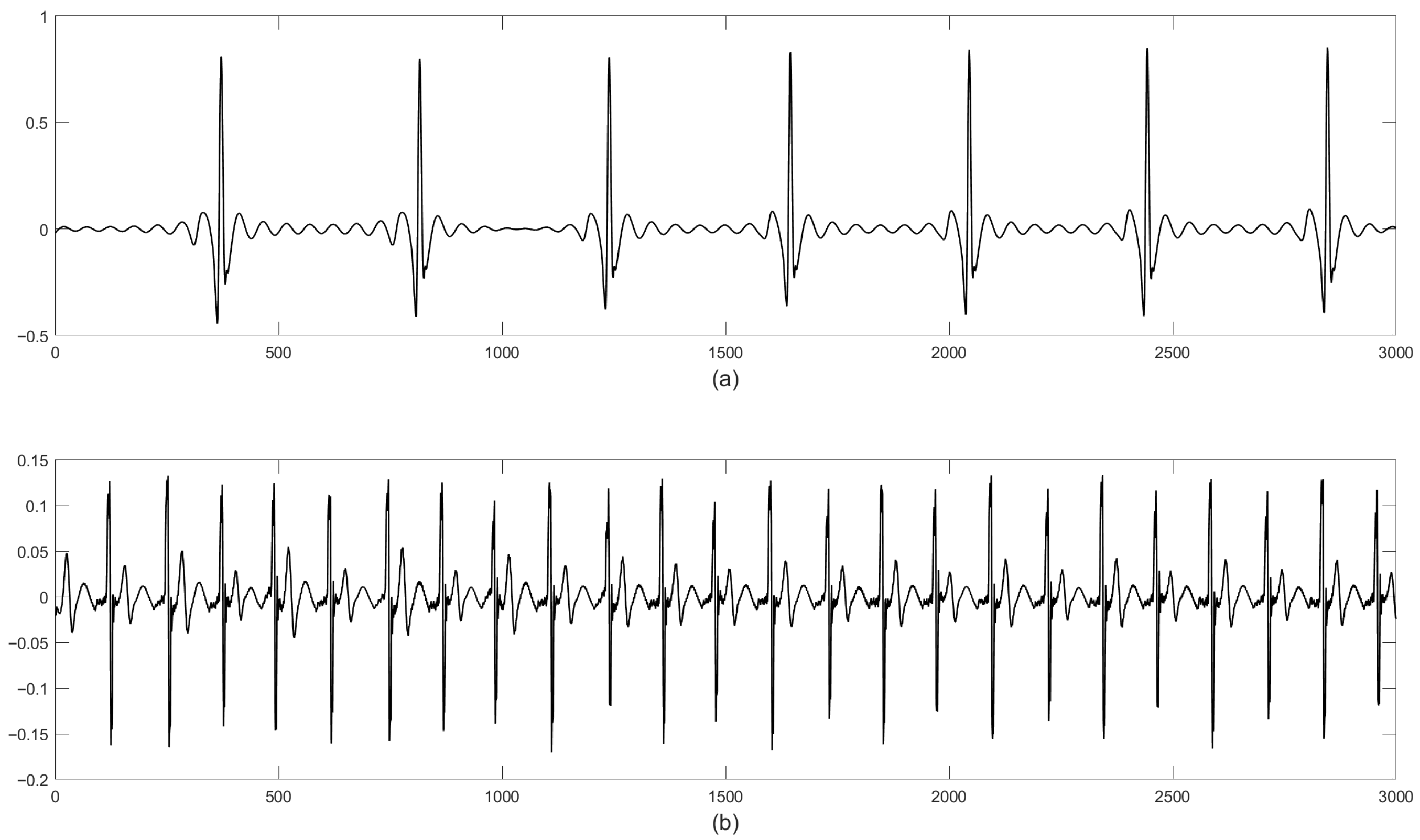
| 1 | FECGSYN | 1 | 1000 | 5 | 4-aECG, 1-mECG | Yes | 10 |
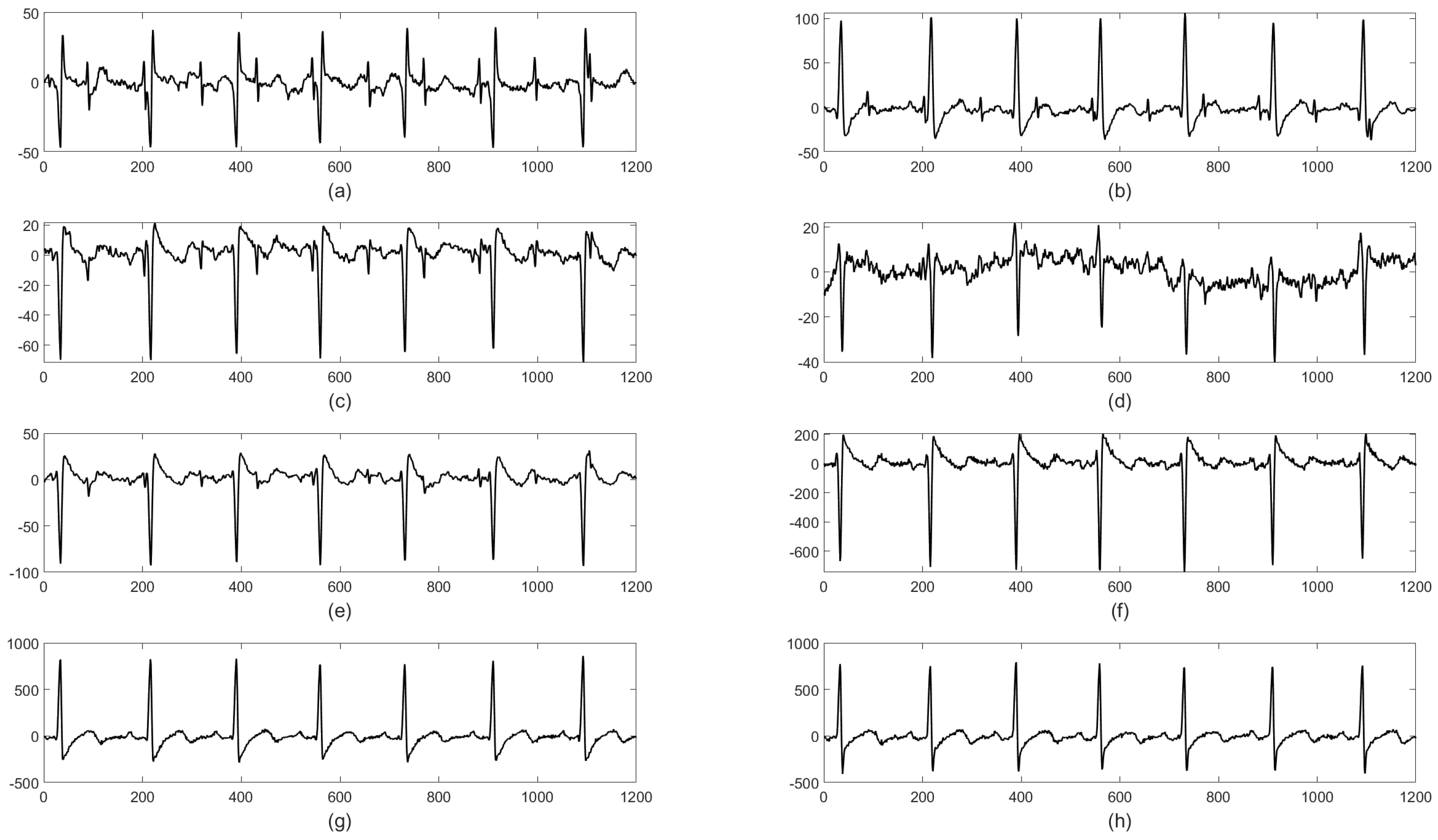
| 2 | ADFECG | 5 | 1000 | 5 | 4-aECG, 1-direct fECG | Yes | 5 |
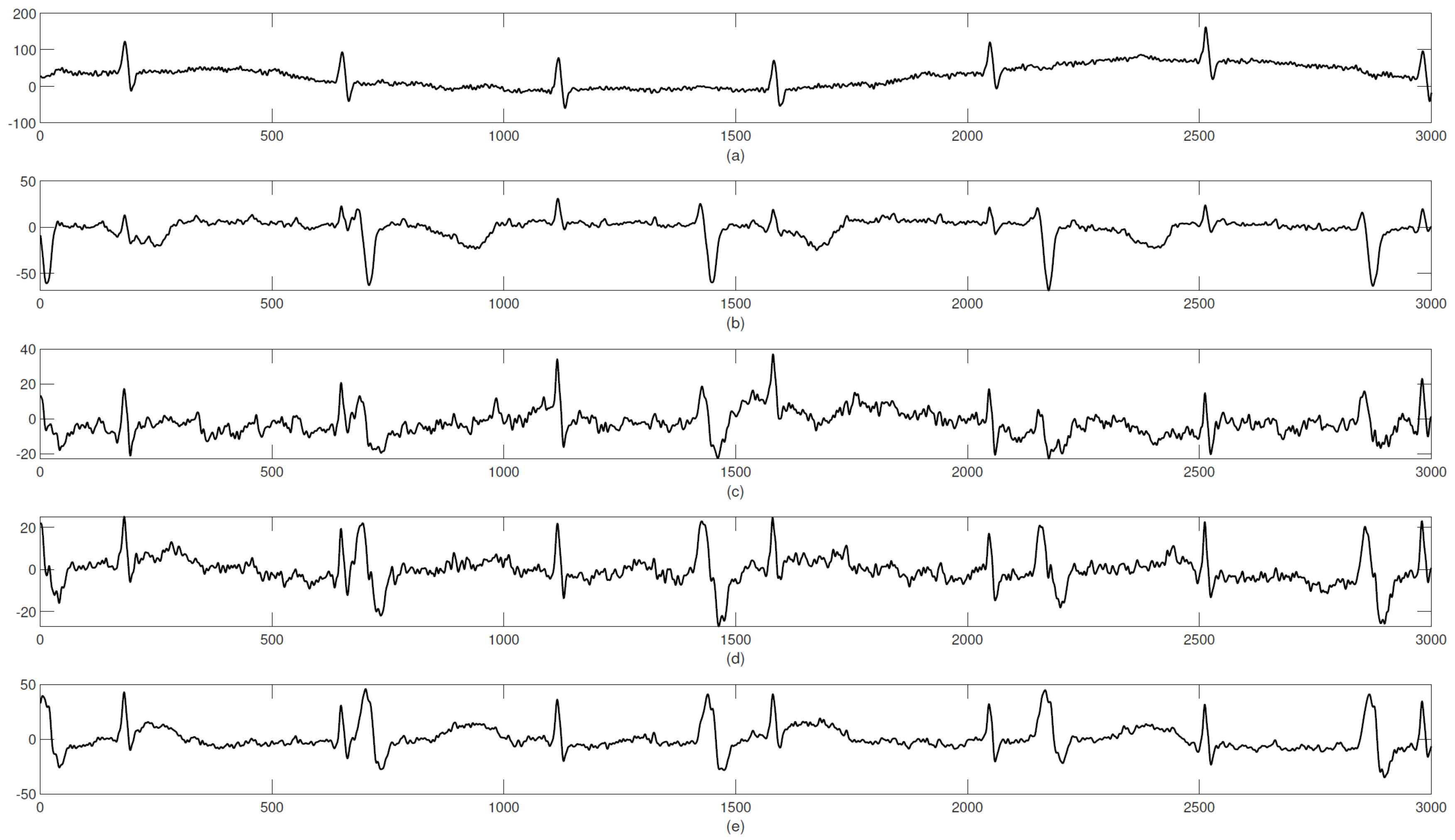
| 3 | NIFECG | 1.9–46.3 | 1000 | 55 | 4-aECG, 2-mECG | No | 1 |
| 4 | CinC 2013 (Set-A) | 1 | 1000 | 75 | 4-aECG | Yes | - |
| 5 | CinC 2013 (Set-B) | 1 | 1000 | 100 | 4-aECG | No | - |
| 6 | NIFEA | 10–13 | 500/1000 | 26 | 4/5-aECG, 1-mECG | No | 26 |
| 7 | DaISy | 0.17 | 250 | 1 | 5-aECG, 3-mECG | No | - |
| 8 | FECGDARHA | 25 | aECG-500, fECG-1000 | 4 | - | Yes | - |
| S.No. | Metric | Representation | Range | Remark | |
|---|---|---|---|---|---|
| 01. | Confusion matrix-based parameters for the detection of R-R peaks | Precision (Positive) (P) | Accuracy of positive prediction | ||
| 02. | PPV | ||||
| 03. | Recall (Positive) (R) | Identification of correct positive occurrences | |||
| Recall (Negative) | Identification of correct negative occurrences | ||||
| 04. | F-measure | - | Harmonic mean b/w precision and recall | ||
| F-measure (Positive) | - | Harmonic mean b/w precision and recall (positive) | |||
| F-measure (Negative) | - | Harmonic mean b/w precision and recall (negative) | |||
| 05. | Sensitivity | Measure of how effectively a model can identify positive instances | |||
| 06. | Accuracy | Gold standard measure for correct prediction | |||
| 07. | Gmean (Gm) | - | |||
| 08. | MCC | Used for unbalanced class | |||
| 09. | Normalised MCC | ||||
| 10. | Quality assessment parameters | SNR | - | Larger value is preferred | |
| 11. | SDNN | - | - | ||
| 12. | r-MSSD | - | - | ||
| 13. | MSE | - | Should be 0 | ||
| 14. | Correlation coefficient | - | Should be high | ||
| S. No. | Author(s), Year | Database | Method | Performance (F1-Score) | Remarks |
|---|---|---|---|---|---|
| 01. | Sarafan et al. (2020) [78] | Challenge 2013 | TS | 71.02% (with motion noise), 82.65% (without motion noise) | Poor performance for few techniques. * Limited dataset. * Fetal diseases were not identified. * Failed in presence of noise and overlapping conditions. * Difficult to select proper feature for fECG and mECG. * Multi-class conditions were not considered. |
| 02. | Andreotti et al. (2016) [71] | Synthetic multi- channel database | TS-SVD, TS-SF, TS-EKF | 96% | |
| 03. | Liu et al. (2019) [88] | Challenge 2013 | TM | 95% | |
| 04. | Gurve et al. (2020) [43] | ADFECGDB, Challenge 2013 | NMF | 84% | |
| 05. | Krupa et al. (2021) [85] | DaISy, Challenge 2013, Real-time signals (obtained from Powerlab) | Fr-FT-DWT | 99.42% | |
| 06. | Krupa et al. (2022) [86] | DaISy, Challenge 2013, ADFECGDB, NIFEADB | ST | 98.27%, 98.67%, 99.27%, 99.94% | |
| 07. | Jaros et al. (2024) [17] | FECGDARHA | TS, TS-SVD, TS-LP, TS-SF, SA | 95.71%, 95.93%, 95.30%, 95.82%, 95.99% |
| S. No. | Author(s), Year | Databases | Method | Performance (F1-Score) | Remark |
|---|---|---|---|---|---|
| 01. | Xuan et al. (2023) [89] | DaISy | RLS and LMS | 93.02% | * Performance depends on selection of reference mECG and adaptive algorithm. * Experimented on limited dataset. * Poor performance for fECG extraction. * Fetal heart abnormalities were not studied. |
| 02. | Ma et al. (2018) [31] | NIFECGDB, DaISy | MSANC | 99.76% | |
| 03. | Fotiadou et al. (2018) [93] | FECGSYNDB, ADFECGDB | TS-AF-LMS | - | |
| 04. | Wei et al. (2013) [112] | DaISy, NIFECGDB | ACF | - | |
| 05. | Zhang et al. (2017) [113] | ADFECGDB | ANC-SVD-SW | 99.65% | |
| 06. | Abel et al. (2019) [97] | DaISy | MSF-ANC, SLF-ANC | 91.66%, 81.48% | |
| 07. | Sarafan et al. (2022) [102] | Challenge 2013 | EnKF | 97.25% |
| S. No. | Author(s), Year | Database | Method | Performance (Accuracy) | Remarks |
|---|---|---|---|---|---|
| 01. | Darsana et al. (2023) [114] | DaISy, NIFECG | RLS-WT-SSNF | 97.01%, 94.35% | Fails to identify abnormal heart rate activity. |
| 02. | Wu et al. (2013) [112] | DaISy | SSNF-SWT | - | - |
| 03. | Sharma et al. (2022) [115] | Simulated | ANFIS-UWT | - | - |
| 04. | Manea et al. (2022) [116] | Challenge 2013 | EMD-EWT- normalization | 93.47% | Poor performance |
| 05. | Jallouli et al. (2021) [117] | DaISy, Challenge 2013 | WT-entropy | 100% | Limited database |
| S. No. | Author(s), Year | Database | Method | Performance (F1-Score) | Remarks |
|---|---|---|---|---|---|
| 01. | Zhang et al. (2017) [113] | ADFECGDB, clincal data | ANC-SVD-SW | 99.61% (r01), 99.28% (r07), 98.58% | * Performance depends on nature of aECG and selection of BSS algorithm. * Nature of noises need to be known prior to use BSS algorithm. * Sequence of ICs was not maintained. * Experimented on few BSS algorithms. |
| 02. | Samuel et al. (2024) [121] | Challenge 2013, ADFECGDB DaISy | FICA-AEFLN-WT | 95.29% | |
| 03. | Liu et al. (2015) [84] | OSET/ECGSYN, ADFECGDB | FICA-EEMD-WS | - | |
| 04. | Islam et al. (2020) [122] | DaISy | FICA-PCA | - | |
| 05. | Barnova et al. (2021) [124] | Challenge 2013, FECGDARHA, FECGSYNDB, ADFECGDB | ICA-FTF-CEEMDAN | 95.86%, 84.62%, 97.30% | |
| 06. | Jaros et al. (2023) [3] | FECGDARHA | FICA-FTF | 91.14% | |
| 07. | Taha et al. (2020) [106] | DaISy, Challenge 2013, FECGSYNDB | ITM | - |
| S. No. | Author(s), Year | Database | Method | Performance | Remarks |
|---|---|---|---|---|---|
| 01. | Joseph et al. (2019) [132] | PhysioNet ATM | NB classifier | Accuracy: 96.56% | * Limited dataset * Poor classification performance for two classes. * CVDs were not studied. |
| 02. | AbuHantash et al. (2021) [133] | PhysioNet ATM | Swarm decomposition | Sensitivity: 97.4% | |
| 03. | Salini et al. (2024) [134] | Publicly available data | RF | Accuracy: 93% | |
| 04. | Andreotti et al. (2016) [71] | Clinical database | NB | - |
| S. No. | Author(s), Year | Database | Method | Performance | Remarks |
|---|---|---|---|---|---|
| 01. | Basak et al. (2024) [146] | ADFECGDB, FECGDARHA | 1-D CycleGAN | F1-score: 92.6% | * More computation with less performance for two classes. * Limited datasets |
| 02. | Pachiyannan et al. (2024) [147] | PhysioNet ATM | CNN-Bi-LSTM | Accuracy: 94.28% | |
| 03. | Fang et al. (2023) [6] | Challenge 2013 | Bi-LSTM | Accuracy: 100% | |
| 04. | Habineza et al. (2023) [152] | CODE dataset | DNN | AUC score: 84.5% | |
| 05. | Ghonchi et al. (2022) [2] | NIFECG-I, NIFECG-II, ADFECGDB | Autoencoder- Bi-LSTM | F1-score: 98.1% (overall) | |
| 06. | Lee et al. (2022) [153] | Simulated, Challenge 2013, ADFECG | W-Net | F1-score: 97% (simulated), 96.91% (CinC), 98.81% (ADFECG) |
Disclaimer/Publisher’s Note: The statements, opinions and data contained in all publications are solely those of the individual author(s) and contributor(s) and not of MDPI and/or the editor(s). MDPI and/or the editor(s) disclaim responsibility for any injury to people or property resulting from any ideas, methods, instructions or products referred to in the content. |
© 2025 by the authors. Licensee MDPI, Basel, Switzerland. This article is an open access article distributed under the terms and conditions of the Creative Commons Attribution (CC BY) license (https://creativecommons.org/licenses/by/4.0/).
Share and Cite
Dash, S.S.; Nath, M.K. Non-Invasive Techniques for fECG Analysis in Fetal Heart Monitoring: A Systematic Review. Signals 2025, 6, 61. https://doi.org/10.3390/signals6040061
Dash SS, Nath MK. Non-Invasive Techniques for fECG Analysis in Fetal Heart Monitoring: A Systematic Review. Signals. 2025; 6(4):61. https://doi.org/10.3390/signals6040061
Chicago/Turabian StyleDash, Sanghamitra Subhadarsini, and Malaya Kumar Nath. 2025. "Non-Invasive Techniques for fECG Analysis in Fetal Heart Monitoring: A Systematic Review" Signals 6, no. 4: 61. https://doi.org/10.3390/signals6040061
APA StyleDash, S. S., & Nath, M. K. (2025). Non-Invasive Techniques for fECG Analysis in Fetal Heart Monitoring: A Systematic Review. Signals, 6(4), 61. https://doi.org/10.3390/signals6040061