Clipping Noise Compensation with Neural Networks in OFDM Systems



Abstract
1. Introduction
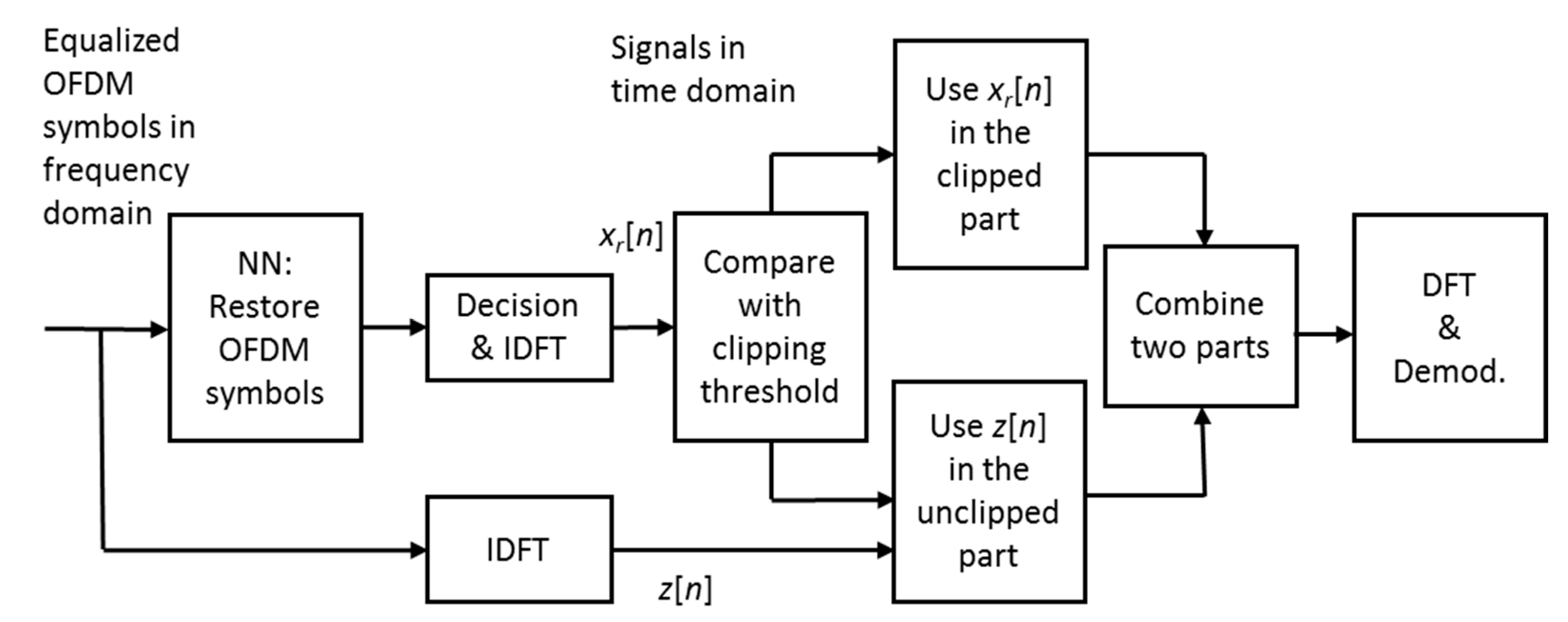
2. Clipping Noise Compensation
3. Results
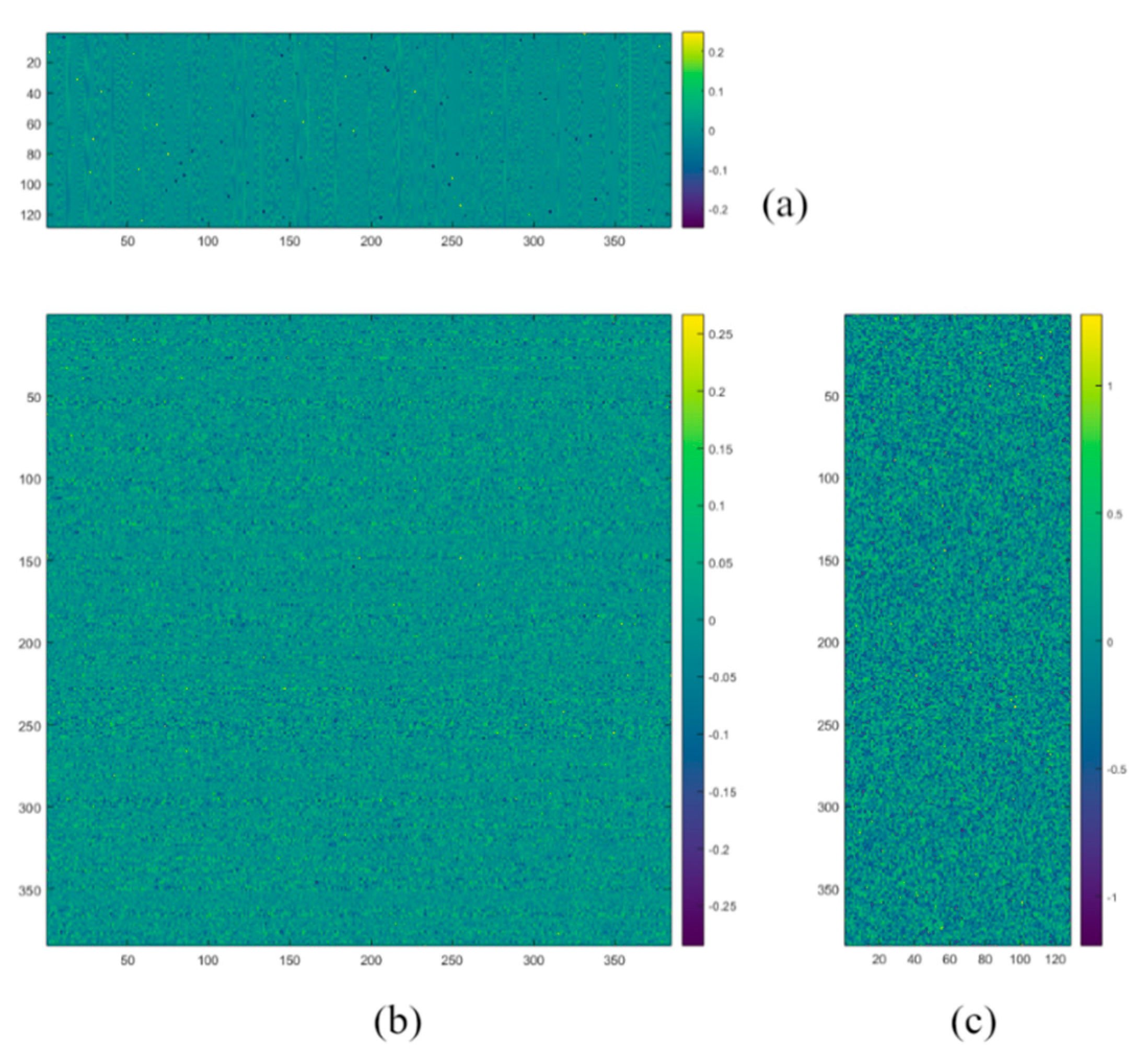
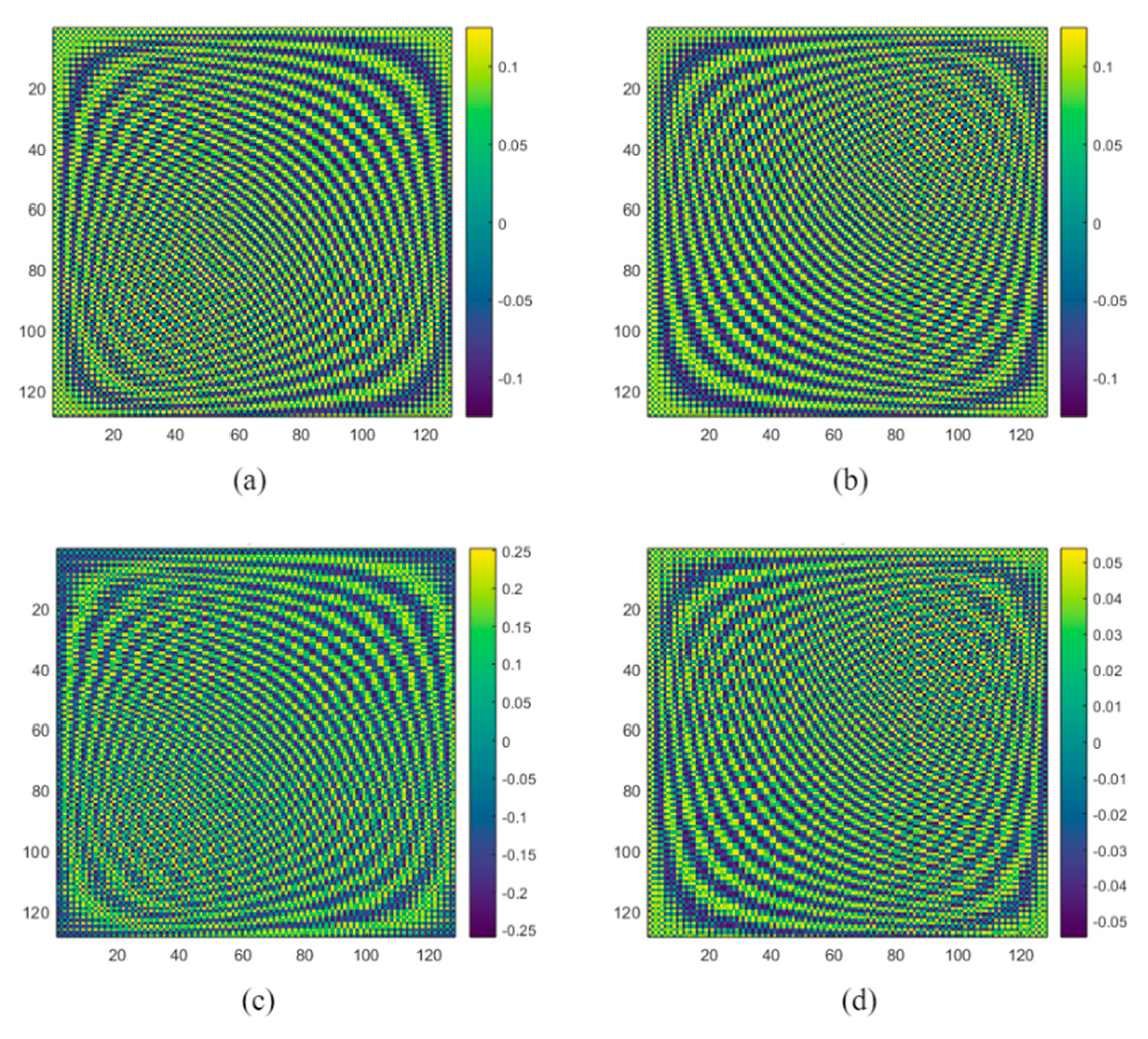
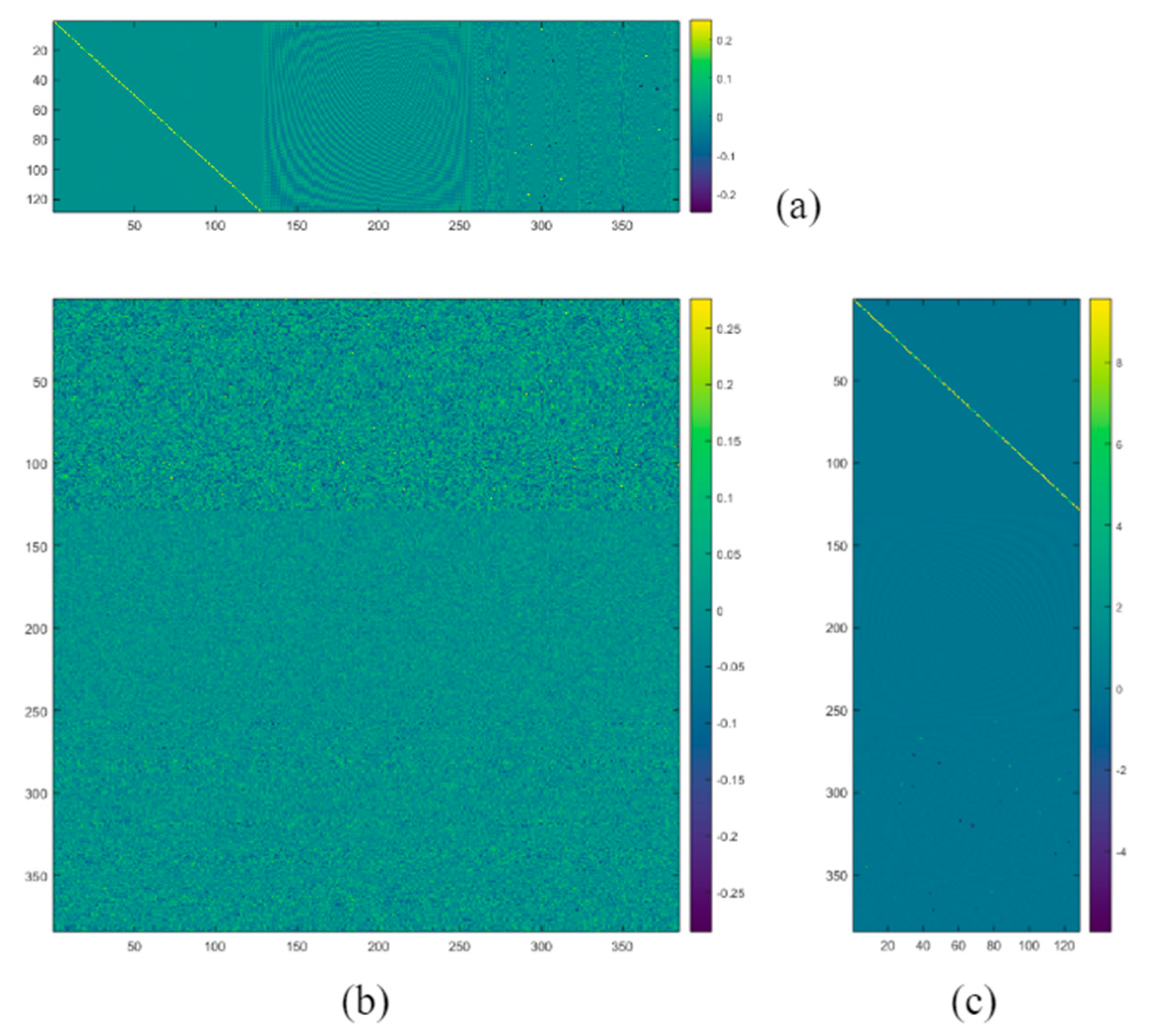
3.1. Interpretation of NN Weight Matrices
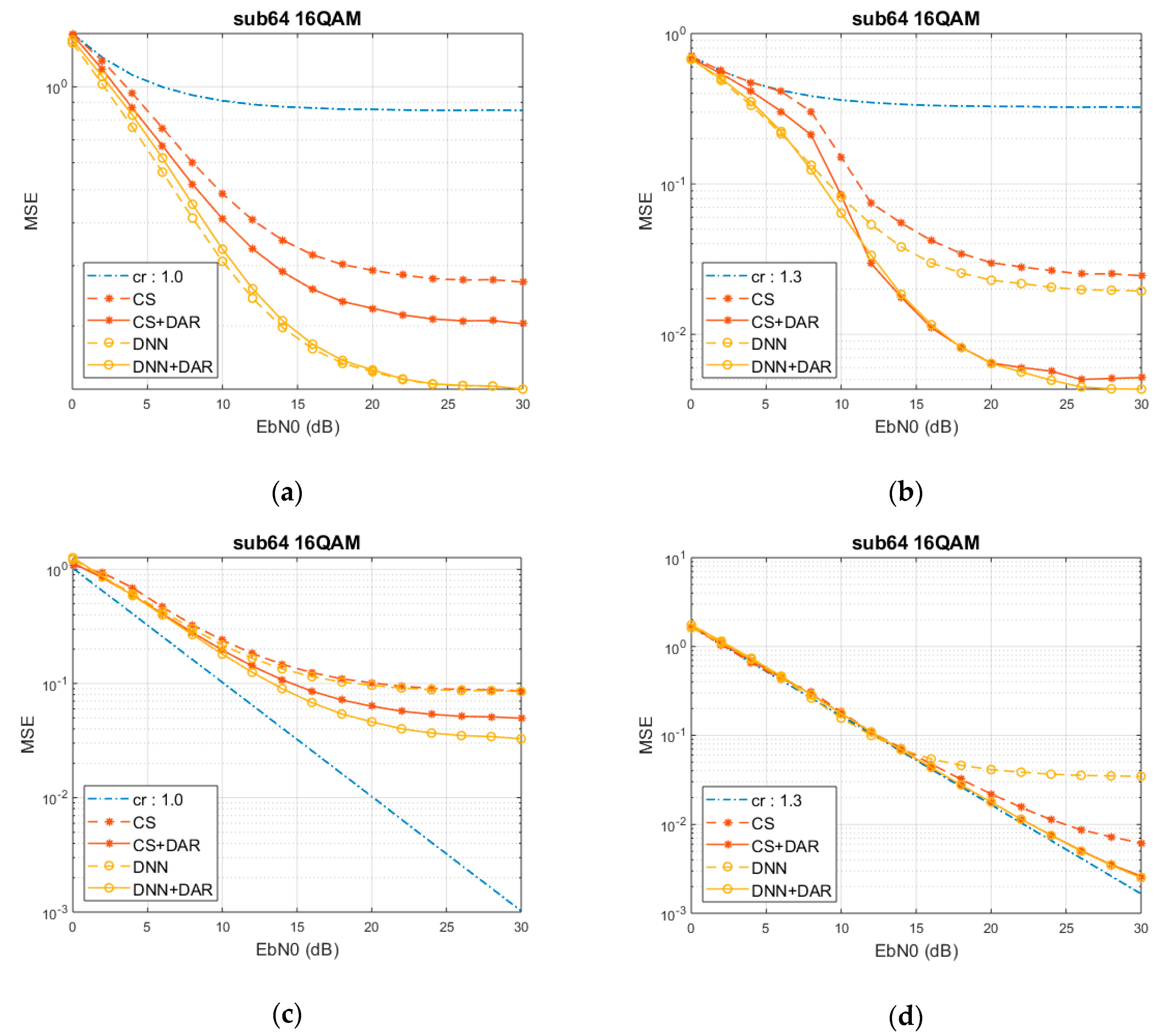
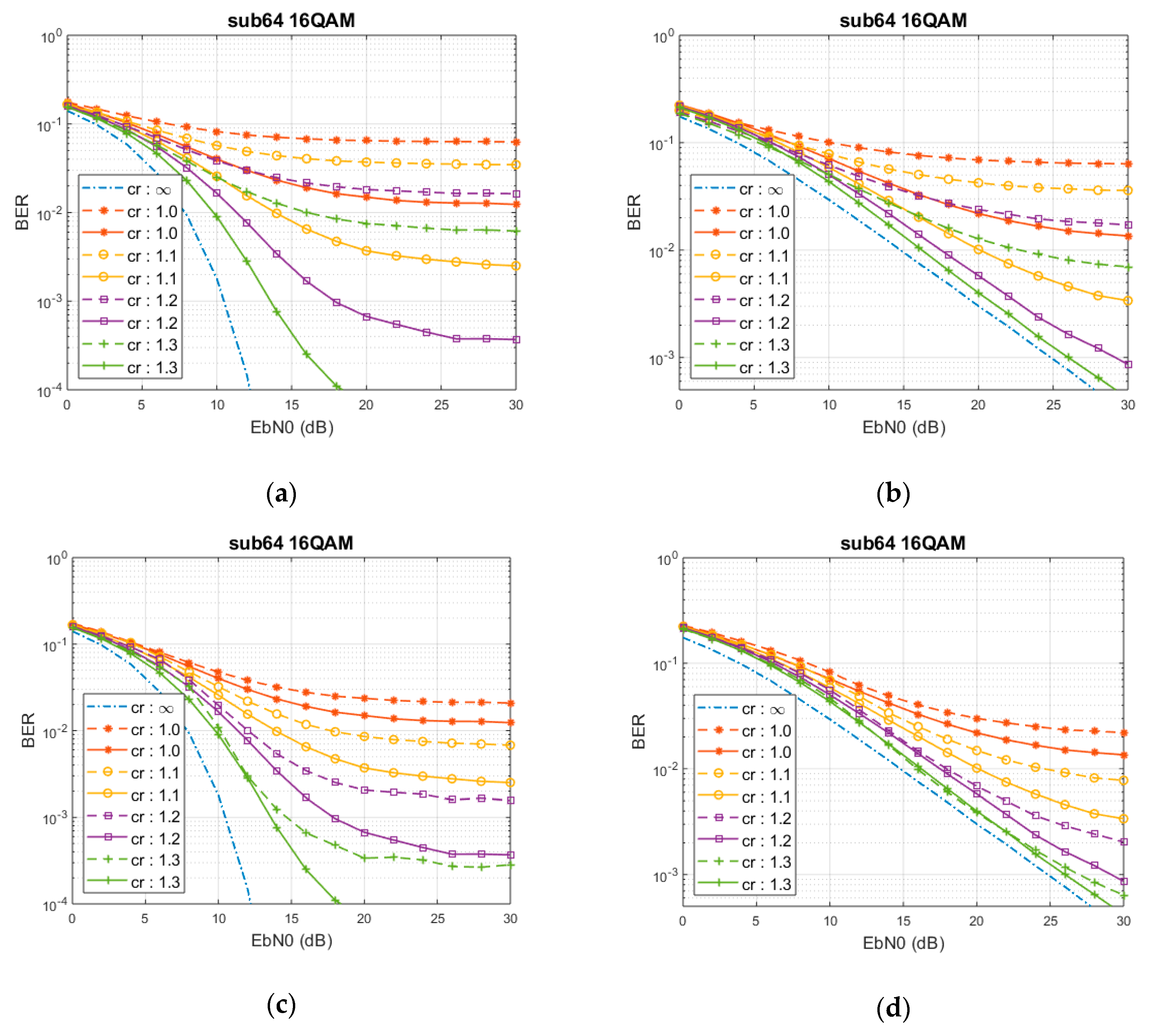
3.2. MSE and BER Performances
4. Conclusions
Author Contributions
Funding
Acknowledgments
Conflicts of Interest
References
- Tse, D.; Viswanath, P. Fundamentals of Wireless Communication; Cambridge University Press: Cambridge, UK, 2005; pp. 95–99. [Google Scholar]
- Ochiai, H.; Imai, H. On the distribution of the peak-to-average power ratio in OFDM signals. IEEE Trans. Commun. 1995, 49, 282–289. [Google Scholar] [CrossRef]
- Cimini, L.J.; Sollenberger, N.R. Peak-to-average power ratio reduction of an OFDM signal using partial transmit sequences. IEEE Commun. Lett. 2000, 4, 86–88. [Google Scholar] [CrossRef]
- Bauml, R.W.; Fischer, R.F.H.; Huber, J.B. Reducing the peak-to-average power ratio of multicarrier modulation by selected mapping. Electron. Lett. 1996, 32, 2056–2057. [Google Scholar] [CrossRef]
- BKrongold, B.S.; Jones, D.L. An active-set approach for OFDM PAR reduction via tone reservation. IEEE Trans. Signal Proc. 2004, 52, 495–509. [Google Scholar] [CrossRef]
- Rahmatallah, Y.; Mohan, S. Peak-to-average power ratio reduction in OFDM systems: A survey and taxonomy. IEEE Commun. Surv. Tutor. 2013, 15, 1567–1592. [Google Scholar] [CrossRef]
- Ochiai, H.; Imai, H. Performance of the deliberate clipping with adaptive symbol selection for strictly band-limited OFDM systems. IEEE J. Sel. Areas Commun. 2000, 18, 2270–2277. [Google Scholar] [CrossRef]
- Ochiai, H.; Imai, H. Performance analysis of deliberately clipped OFDM signals. IEEE Trans. Commun. 2002, 50, 89–101. [Google Scholar] [CrossRef]
- O’Shea, T.; Hoydis, J. An introduction to deep learning for the physical layer. IEEE Trans. Cogn. Commun. Netw. 2017, 3, 563–575. [Google Scholar] [CrossRef]
- Ye, H.; Li, G.Y.; Juang, B. Power of deep learning for channel estimation and signal detection in OFDM systems. IEEE Wireless Commun. Lett. 2018, 7, 114–117. [Google Scholar] [CrossRef]
- Samuel, N.; Diskin, T.; Wiesel, A. Deep MIMO detection. In Proceedings of the IEEE 18th International Workshop on Signal Processing Advances in Wireless Communications (SPAWC), Sapporo, Japan, 3–6 July 2017. [Google Scholar] [CrossRef]
- Farsad, N.; Goldsmith, A. Detection algorithms for communication systems using deep learning. arXiv 2017, arXiv:1705.08044. [Google Scholar]
- Nachmani, E.; Be’ery, Y.Y.; Burshtein, D. Learning to decode linear codes using deep learning. In Proceedings of the 54th Annual Allerton Conference on Communication, Control, and Computing, Monticello, IL, USA, 27–30 September 2016. [Google Scholar] [CrossRef]
- Saxena, V.; Jaldén, J.; Bengtsson, M.; Tullberg, H. Deep Learning for Frame Error Probability Prediction in BICM-OFDM Systems. In Proceedings of the IEEE ICASSP, Calgary, AB, Canada, 15–20 April 2018. [Google Scholar] [CrossRef]
- Darsena, D.; Gelli, G.; Melito, F.; Verde, F.; Vitello, A. Impulse noise mitigation for MIMO-OFDM wireless networks with linear equalization. In Proceedings of the IEEE M&N, Naples, Italy, 7–8 October 2013. [Google Scholar] [CrossRef]
- Anoh, K.; Tanriover, C.; Adebisi, B.; Hammoudeh, M. A new approach to iterative clipping and filtering PAPR reduction scheme for OFDM systems. IEEE Access 2017, 6, 17533–17544. [Google Scholar] [CrossRef]
- Kim, D.; Stuber, G.L. Clipping noise mitigation for OFDM by decision-aided reconstruction. IEEE Commun. Lett. 1999, 3, 4–6. [Google Scholar] [CrossRef]
- Kim, K.; Park, H.; No, J.; Chung, H.; Shin, D. Clipping noise cancelation for OFDM systems using reliable observations based on compressed sensing. IEEE Trans. Broadcast. 2015, 61, 116–118. [Google Scholar] [CrossRef]
- Samuel, N.; Diskin, T.; Wiesel, A. Learning to detect. IEEE Trans. Signal Proc. 2019, 67, 2554–2564. [Google Scholar] [CrossRef]
- Darsena, D.; Gelli, G.; Paura, L.; Verde, F. Widely linear equalization and blind channel identification for interference-contaminated multicarrier systems. IEEE Trans. Signal Proc. 2005, 53, 1163–1177. [Google Scholar] [CrossRef]
- Darsena, D.; Gelli, G.; Paura, L.; Verde, F. A constrained maximum-SINR NBI-resistant receiver for OFDM systems. IEEE Trans. Signal Proc. 2007, 55, 3032–3047. [Google Scholar] [CrossRef]
- Wang, H.W.; Lin, D.W.; Sang, T.H. OFDM signal detection in doubly selective channels with blockwise whitening of residual intercarrier interference and noise. IEEE J. Sel. Areas Comm. 2012, 30, 684–694. [Google Scholar] [CrossRef]
- Lin, H.D.; Sang, T.H.; Chen, J.T. Low-cost perturbation-based equalizers for OFDMA mobile systems. IEICE Trans. Comm. 2012, 95, 3509–3518. [Google Scholar] [CrossRef]
- Kingma, D.; Ba, J. ADAM: A method for stochastic optimization. arXiv 2014, arXiv:1412.6980. [Google Scholar]
- Glorot, X.; Bengio, Y. Understanding the difficulty of training deep feedforward neural networks. In Proceedings of the 13th International Conference on Artificial Intelligence and Statistics (AISTATS), Sardinia, Italy, 13–15 May 2010. [Google Scholar]
- Abadi, M.; Barham, P.; Chen, J.; Chen, Z.; Davis, A.; Dean, J.; Devin, M.; Ghemawat, S.; Irving, G.; Isard, M.; et al. Tensorflow: A system for large-scale machine learning. In Proceedings of the 12th USENIX Symposium on Operating Systems Design and Implementation (OSDI), Savannah, GA, USA, 2–4 November 2016. [Google Scholar]
- Yang, F.; Gao, J.; Liu, S.; Song, J. Clipping noise elimination for OFDM systems by compressed sensing with partially aware support. IEEE Trans. Broadast. 2017, 63, 103–110. [Google Scholar] [CrossRef]
- Yang, L.; Song, K.; Siu, Y.M. Iterative clipping noise recovery of OFDM signals based on compressed sensing. IEEE Trans. Broadcast. 2017, 63, 706–713. [Google Scholar] [CrossRef]


© 2020 by the authors. Licensee MDPI, Basel, Switzerland. This article is an open access article distributed under the terms and conditions of the Creative Commons Attribution (CC BY) license (http://creativecommons.org/licenses/by/4.0/).
Share and Cite
Sang, T.-H.; Xu, Y.-C. Clipping Noise Compensation with Neural Networks in OFDM Systems. Signals 2020, 1, 100-109. https://doi.org/10.3390/signals1010005
Sang T-H, Xu Y-C. Clipping Noise Compensation with Neural Networks in OFDM Systems. Signals. 2020; 1(1):100-109. https://doi.org/10.3390/signals1010005
Chicago/Turabian StyleSang, Tzu-Hsien, and You-Cheng Xu. 2020. "Clipping Noise Compensation with Neural Networks in OFDM Systems" Signals 1, no. 1: 100-109. https://doi.org/10.3390/signals1010005
APA StyleSang, T.-H., & Xu, Y.-C. (2020). Clipping Noise Compensation with Neural Networks in OFDM Systems. Signals, 1(1), 100-109. https://doi.org/10.3390/signals1010005