
Review

A Review of Microperforated Panel-Based Structures for Low Frequency Sound Absorption

1
Harman Professional, Inc., 8500 Balboa Boulevard Northridge, Los Angeles, CA 91325, USA
2
Institute for Physical and Information Technologies (ITEFI), Spanish National Research Council (CSIC), 28006 Madrid, Spain
*
Author to whom correspondence should be addressed.
Acoustics 2026, 8(2), 35; https://doi.org/10.3390/acoustics8020035
Submission received: 27 March 2026 / Revised: 15 May 2026 / Accepted: 28 May 2026 / Published: 30 May 2026

Abstract

The use of sound absorption materials has traditionally been restricted to medium-to-high frequencies due to their limitations at low frequencies, where the large wavelength of sound waves imposes rather bulky solutions. However, recent materials and designs allow for the absorption of sound waves with more practical sizes and weights, reviving interest in this frequency range. Some of these low-frequency absorbers, also named acoustic metamaterials or sub-wavelength sound absorbers, based on microperforated panels, are reviewed in this article. These include multilayer and multicavity microperforated panels, hybrid passive–active absorbers, multiple Helmholtz resonators, and microperforated panels with labyrinthine cavities or sonic black holes.

1. Introduction

Acoustic energy can be lost or escape from a sound field through absorption due to dissipative processes (mainly viscous and thermal dissipation). The range that sound can travel in open spaces is limited by air absorption and by interaction with boundaries (scattering and reflection). In many applications, sound-absorbing materials (SAM) are used for noise control applications and acoustic conditioning in halls by transforming sound waves into heat energy.
The first-generation SAM, most used in noise control applications, are porous materials and Helmholtz resonators (HR). Porous materials consist of a rigid or flexible frame filled with many air cavities (pores). The pores can be open or closed. Open-pore rigid-frame porous materials are the most commonly used absorbers in acoustic buildings. Porous absorbers are classified as fibrous (mineral wool), cellular (foams), or granular. A porous SAM is characterized by its constitutive parameters: porosity, flow resistivity, tortuosity, etc. The calculation of the sound absorption coefficient is carried out through an impedance model. An impedance model calculates the acoustic variables (acoustic impedance and propagation constant) as a function of the constitutive parameters of the SAM [1].
Impedance models can also be used to estimate the constitutive parameters of SAM from sound absorption measurements (inverse estimation). Simulated annealing, for instance, is a very appropriate technique for optimizing the constitutive parameters of a SAM for maximum sound absorption [2].
There are empirical, phenomenological, and microstructural models [3]. Microstructural models solve the wave equation in the medium, considering its complex structure, and are variations of the Biot model [4]. Finite element techniques can be applied to solve the resulting equations of the Biot model. The phenomenological approach models the material as a compressible fluid where dissipation occurs through viscous and thermal effects, due to particle velocity gradients and thermal gradients, respectively. The most well-known phenomenological model is the Johnson–Allard–Champoux (JAC) model [4]. On the other hand, empirical models fit the impedance and propagation constant of the SAM to the constitutive parameters using empirical data. The most widely used semi-empirical model is the Delany–Bazley model [5].
Helmholtz resonators (HR) were proposed to provide narrowband absorption [6]. An HR consists of a cavity opened by a hole, also known as the neck. The acoustic impedance of an HR consists of the compliance of the volume in the cavity plus the impedance of the neck (with a resistive term, associated with the radiation resistance of the hole, and a reactive term, due to movement of the air in the neck). The absorption coefficient of an HR is a narrowband curve with a peak at a frequency that depends on the diameter and thickness of the hole and the volume of the cavity. The larger the product of cavity volume and neck thickness, the lower the resonance frequency. HR are currently employed in many noise control applications, including room acoustics, aircraft, vehicles, payload fairings, and mufflers [6]. In addition, modifying the neck design of conventional Helmholtz resonators (HR) shifts the resonance to lower frequencies, even with moderate air volumes.
For numerous noise control applications, porous materials perform sound absorption at a reasonable cost. However, in many applications requiring strict cleanliness (food industry or clean rooms used for the production of microelectronic devices) and healthcare (hospitals) conditions, they can be discouraged as they can potentially release particles. These materials are also not recommended in engine exhaust tubes, since the flow of high-velocity gases can drag the porous material [7]. This encouraged the development of a second-generation absorber, named microperforated panel (MPP) [8,9]. An MPP consists of a panel of thickness t, perforated with circular holes of sub-millimetric diameter d, with an open surface/total surface ratio, or porosity, ϕ. The acoustic impedance of this MPP, Z1, is complex with resistive and reactive components. This MPP will provide significant sound absorption when its Z1 is matched to the real air impedance, Z0. Therefore, to counteract the reactive part of Z1, an additional imaginary impedance is needed. This imaginary impedance is yielded by an air cavity of thickness D. Thus, a single-layer MPP (SL-MPP) is obtained, whose frequency band can be tuned by the proper choice of the parameter series (d, t, ϕ, D). Furthermore, SL-MPPs are suitable for aesthetic designs [10].
The absorption coefficient of a device can be directly obtained from its input impedance. The most prominent models for the acoustic impedance of an MPP are the Maa model [8,9] and the equivalent fluid (EF) model [11]. The Maa model adds to the hole impedance (first proposed by Crandall), the impedances of the edge (suggested by Ingard), and the air cavity. The EF model also uses the Crandall impedance for holes, but the edge impedance is calculated using tortuosity, as in the porous materials modeling. The acoustic impedance of an MPP contains resistive and reactive terms. The resistance comes from viscous losses due to the relative displacement between layers in the hole, which move at distinct velocities, and from flow distortion at the edges. The reactive term contains losses due to the movement of an air cylinder that is longer than the thickness of the orifice, making it heavier and more difficult to move.
Figure 1 illustrates the absorption curve of an SL-MPP with D = 20 mm and different combinations of the (d, t, ϕ) parameters. An MPP over-perforated with very small holes provides an absorption curve of more than two octaves displaced toward high frequencies (blue curve). As the hole diameter increases and the perforation ratio decreases, the absorption curve becomes narrower and moves to lower frequencies (red and orange curves). Eventually, when the panel is perforated with a single, larger hole, the SL-MPP becomes an HR (magenta curve).
The absorption frequency band of a SL-MPP can, of course, be moved to lower frequencies by increasing the cavity depth D. But this provides a bulky, non-practical absorber for most noise control applications. Therefore, SL-MPP also offers limited low-frequency absorption. Multi-layer MPP (ML-MPP) and multi-cavity MPP (MC-MPP) structures can be used to move the absorption curve towards the low-frequency side while providing broadband absorption. These structures are reviewed in Section 2.
The need for sound absorption at low frequencies and the inherent limitations of first- and second-generation SAMs have encouraged research on third-generation SAMs, especially aimed at designing limited thickness materials for sound absorption in the frequency range below 400–500 Hz. For instance, the λ/4 condition for a classical SAM at 200 Hz requires a thickness of roughly 43 cm, which is too bulky for most noise-control applications. Since these third-generation absorbers aim to provide sound absorption with much smaller thickness, they are also called sub-wavelength absorbers. Other names for these SAMs include intelligent materials or acoustic metamaterials [12,13,14,15], absorbers with space coiling or labyrinthine structures [16], sonic black holes [17], and others. Most of these materials are hybrid structures, such as HR combined with MPP [18], honeycomb with perforated faceplates [19,20], MPP with labyrinthine cavities [21,22,23], and others [24,25,26]. Some of these third-generation low-frequency absorbers using hybrid structures based on MPPs will be reviewed in Section 3, Section 4, Section 5 and Section 6.

2. ML-MPP and MC-MPP for Sound Absorption at Low Frequencies

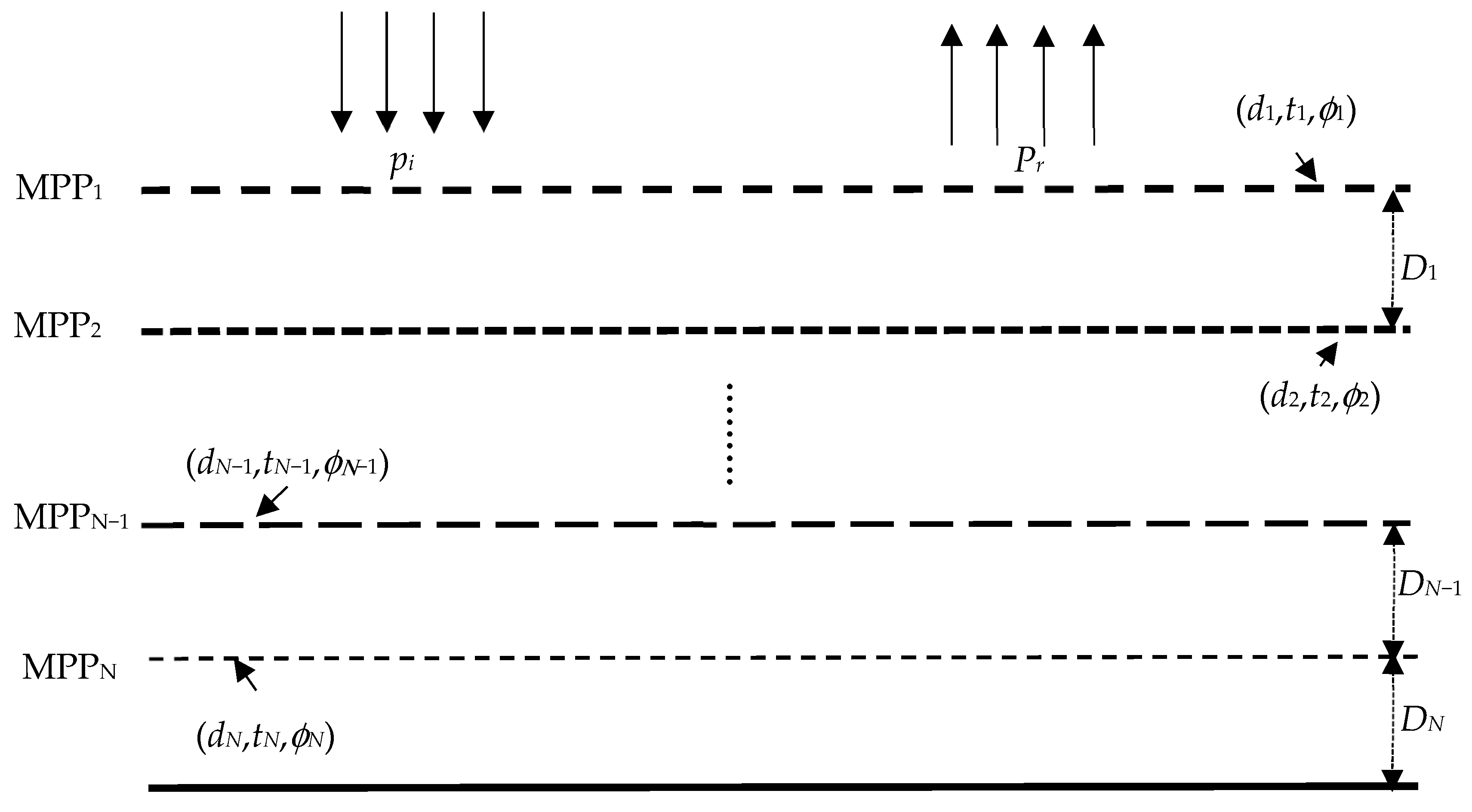
The SL-MPP absorption frequency bandwidth can be widened by designing a multi-layer MPP (ML-MPP) [27]. Figure 2 shows a sketch of such an ML-MPP of N layers. In an ML-MPP, the overall acoustic impedance is the series combination of each single MPP.
According to the Equivalent Fluid model [4], the acoustic impedance of each MPP is
Z M P P , n = i ω ρ 0 α , n t n ϕ n 1 + σ n ϕ n i ρ 0 ω α . n 1 + i 4 ω ρ 0 α , n 2 μ σ n 2 ϕ n 2 r n 2 1 2 ,
where (rn = dn/2, tn, ϕn), for n = 1,…,N, are the parameters of each MPP,
σ n = 8 μ ϕ n r n 2 ,
is the flow resistivity in the holes, μ is the air viscosity, and
α , n = 1 + 0.85 d n t n .
For the ML-MPP of Figure 2
Z D , N = i Z 0 c o t k D N ,
Z N = Z M P P , N + Z D , N ,
Z N 1 = Z M P P , N 1 + Z 0 Z N c o s k D N 1 + i Z 0 s i n k D N 1 Z 0 c o s k D N 1 + i Z N s i n k D N 1 ,
and finally
Z 1 = Z M P P , 1 + Z 0 Z 2 c o s k D 1 + i Z 0 s i n k D 1 Z 0 c o s k D 1 + i Z N 2 s i n k D 1 ,
where D1, D2, …, DN are the air cavities’ thicknesses, k is the air wavenumber, and ZMPP,1, ZMPP,2, …, ZMPP,N are the acoustic impedances of the first, second, and N-th MPPs, respectively, given by Equations (1)–(3). These equations allow one to obtain the input impedance Z1 of the ML-MPP. The normal incidence reflection, R, and absorption, α, coefficients are
R = Z 1 Z 0 Z 1 + Z 0 ,
α = 1 R 2 .
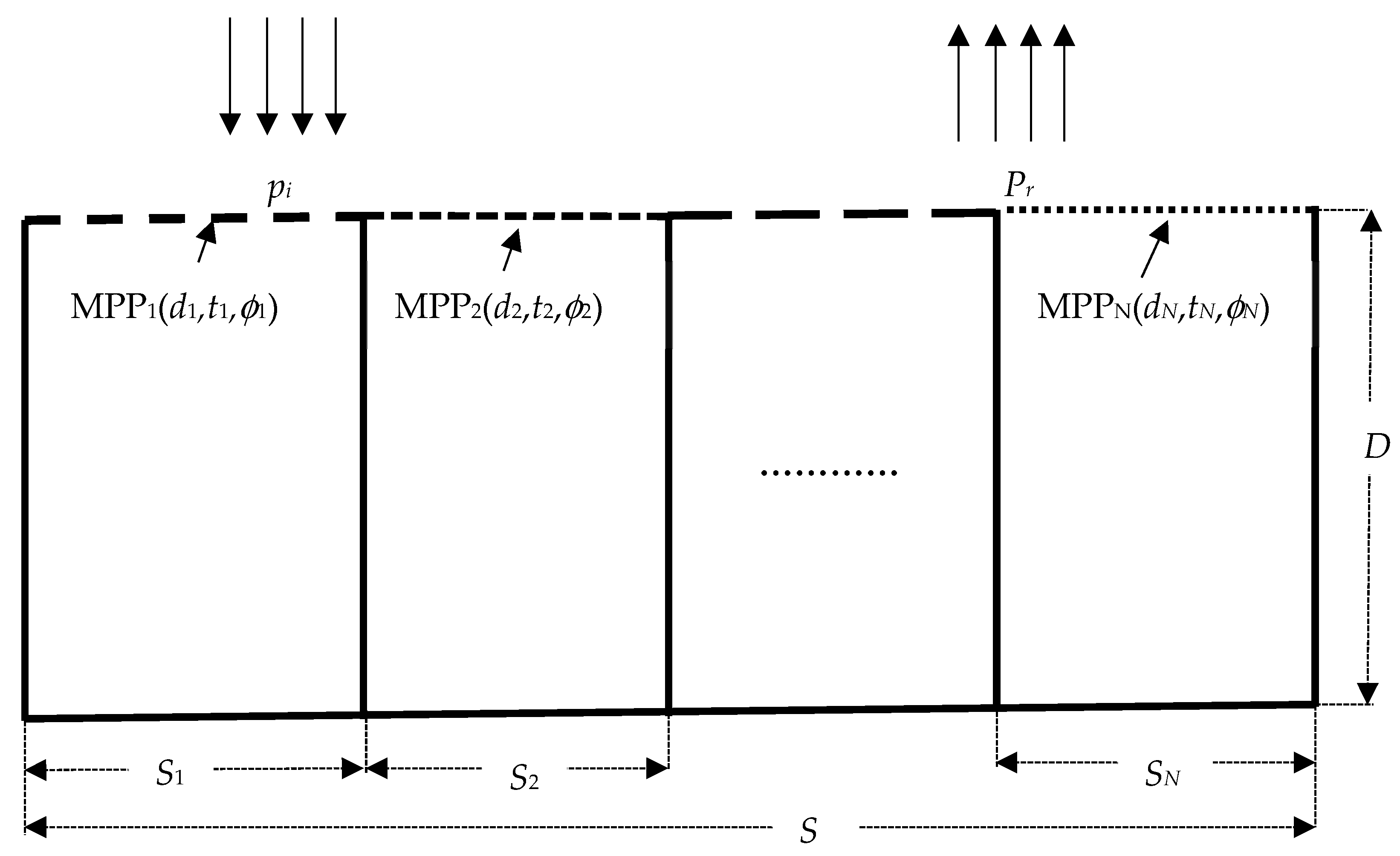
However, a recent proposal suggested the possibility of moving the absorption curve towards the low-frequency side by a parallel combination of multiple MPP [21]. This provides the multiple-cavity MPP (MC-MPP) shown in Figure 3. It consists of N MPP, with parameters (dn, tn, ϕn), n = 1, …, N, located side-by-side, with a partitioned back cavity of thickness D. Let S1, S2, …, SN, and S be the areas of sub-cavity 1, sub-cavity 2, …, sub-cavity N, and total cavity, respectively.
The input impedance, Z1, of this MC-MPP is
1 Z 1 = n = 1 N A n Z M P P n + Z D ,
where
A n = S n S ,
and ZMPP,n and ZD, are given by Equations (1) and (4), respectively.
Therefore, an N-layer MPP depends on 4N parameters (dn, tn, ϕn, Dn) whilst an N-cavity MPP depends on 4N + 1 parameters (dn, tn, ϕn, Sn) plus D. Their performance as acoustic absorbers can be optimized by simulated annealing [28].
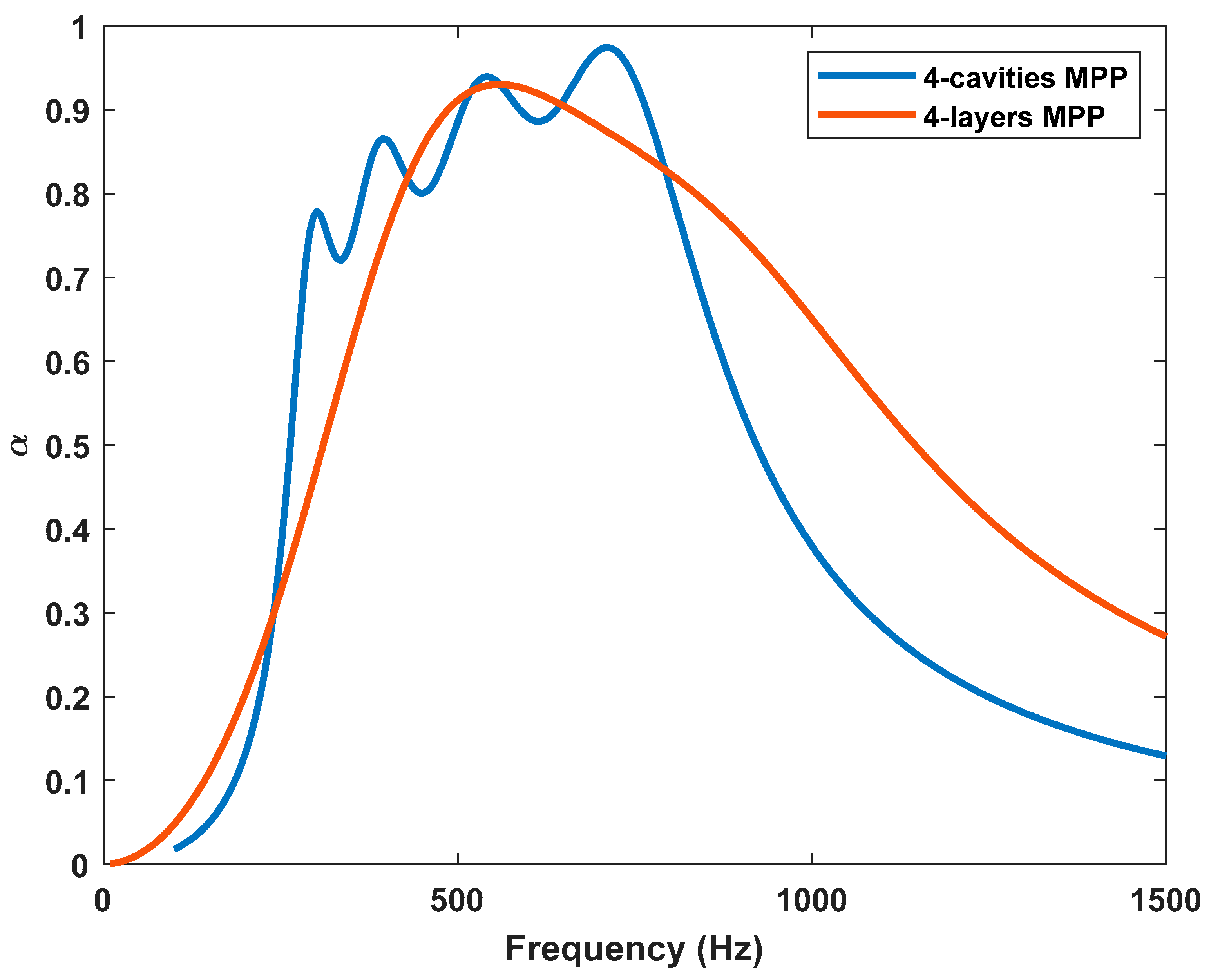
As an example, let us compare the performance of a 4-layer MPP and a 4-cavity MPP, both with a total thickness of 50 mm. For the 4-layer MPP, all cavities have the same thickness, Dn = 12.5 mm. For the 4-cavity MPP, the four MPPs have the same tn = 3.5 mm. Figure 4 shows the absorption curves of both 4-layer and 4-cavity MPPs optimized to provide maximum absorption in the frequency band (200, 800) Hz. The mean sound absorption in this frequency band of the 4-layer and 4-cavity MPPs were 75.5% and 79%, respectively. Clearly, the 4-cavity MPP outperforms the sound absorption of the 4-layer MPP at low frequencies, at the cost of lower absorption at high frequencies. At 241 Hz, the frequency of half absorption, the 4-cavity MPP is a deep sub-wavelength (λ/28) absorber.
The above results for 4-layer versus 4-cavity MPP can be extended to other multiple structures. Table 1 and Table 2 summarize the parameters of 2L-MPP versus 2C-MPP and 3L-MPP versus 3C-MPP, respectively, optimized to provide maximum absorption in the frequency band of (200, 500) Hz, with a total thickness of D = 5 cm. The average sound absorption in this frequency range, <α>, is also included for comparison. In both cases, the MC-MPP outperforms the ML-MPP in this frequency range.

3. Hybrid Passive–Active Absorbers Based on MPP

These acoustic absorbers provide effective strategies for the reduction and dissipation of sound at low frequencies. Hybrid passive–active sound absorption systems can combine passive absorption at medium-to-high frequencies, provided by MPP materials [29], with the active absorption at low frequencies, provided by an active control system. This class is included in this Review because the passive layer remains MPP-based, while the active component extends the low-frequency absorption range beyond what the passive structure alone can provide.
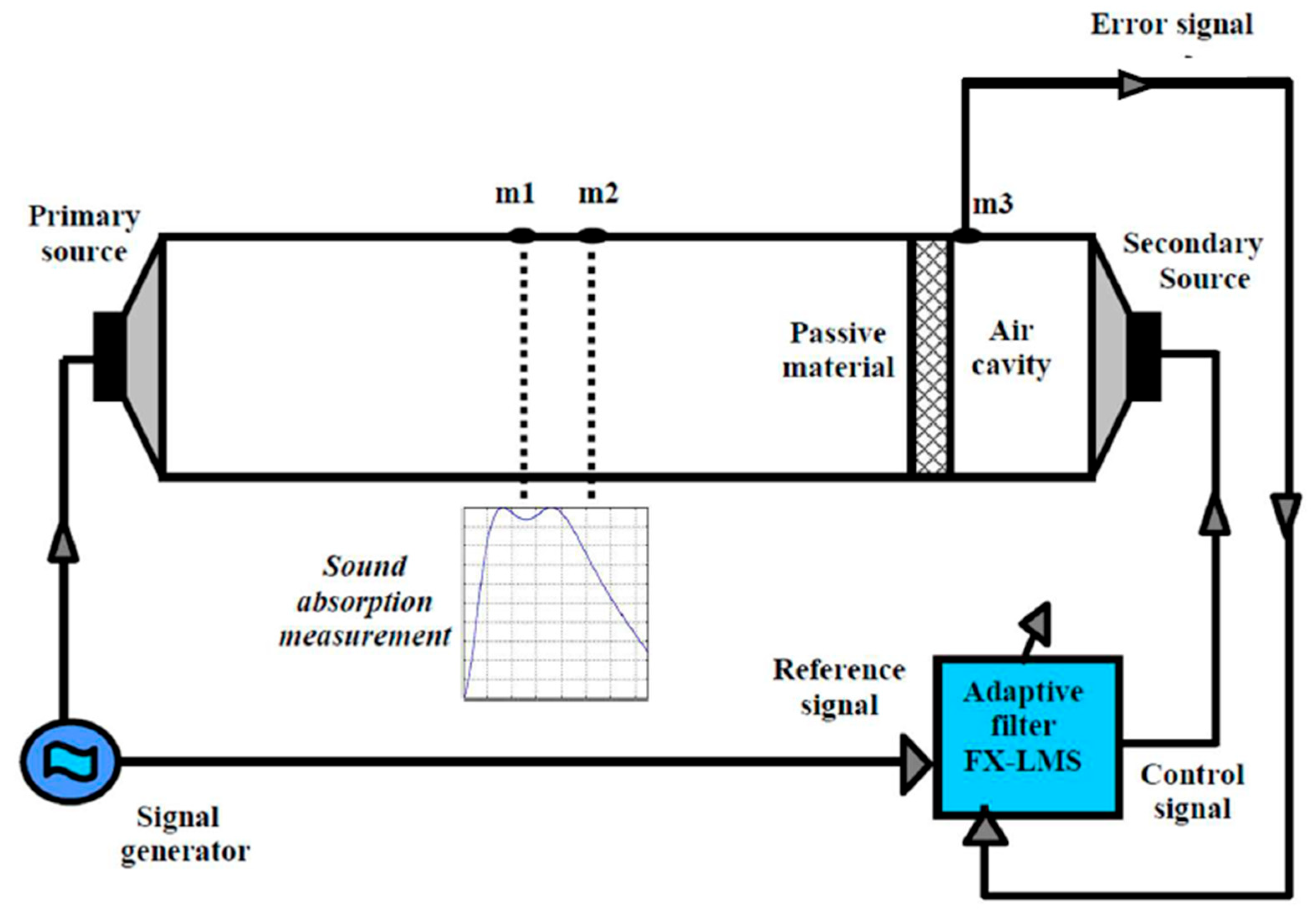
Figure 5 shows the experimental setup for the measurement of the hybrid passive–active absorption of an acoustic material. It consists of an impedance tube modified to implement the transfer function method with active absorption. In addition to the two measurement microphones for the transfer function method (m1, m2), a third microphone, m3, is located in the air cavity behind the material sample. The hard back wall is replaced by an active secondary source, which can be either a loudspeaker or a plane actuator [30]. The primary wave field is set inside the duct by the primary loudspeaker. An adaptive filter, implementing the FX-LMS algorithm [31], uses the reference and control signals from the microphone m3 in the cavity to feed the control signal to the secondary source to minimize the error signal (pressure-release control condition [30]). Under this condition, the measurement of the absorption coefficient is carried out by the transfer function method [32] using the signals recorded by microphones m1 and m2.
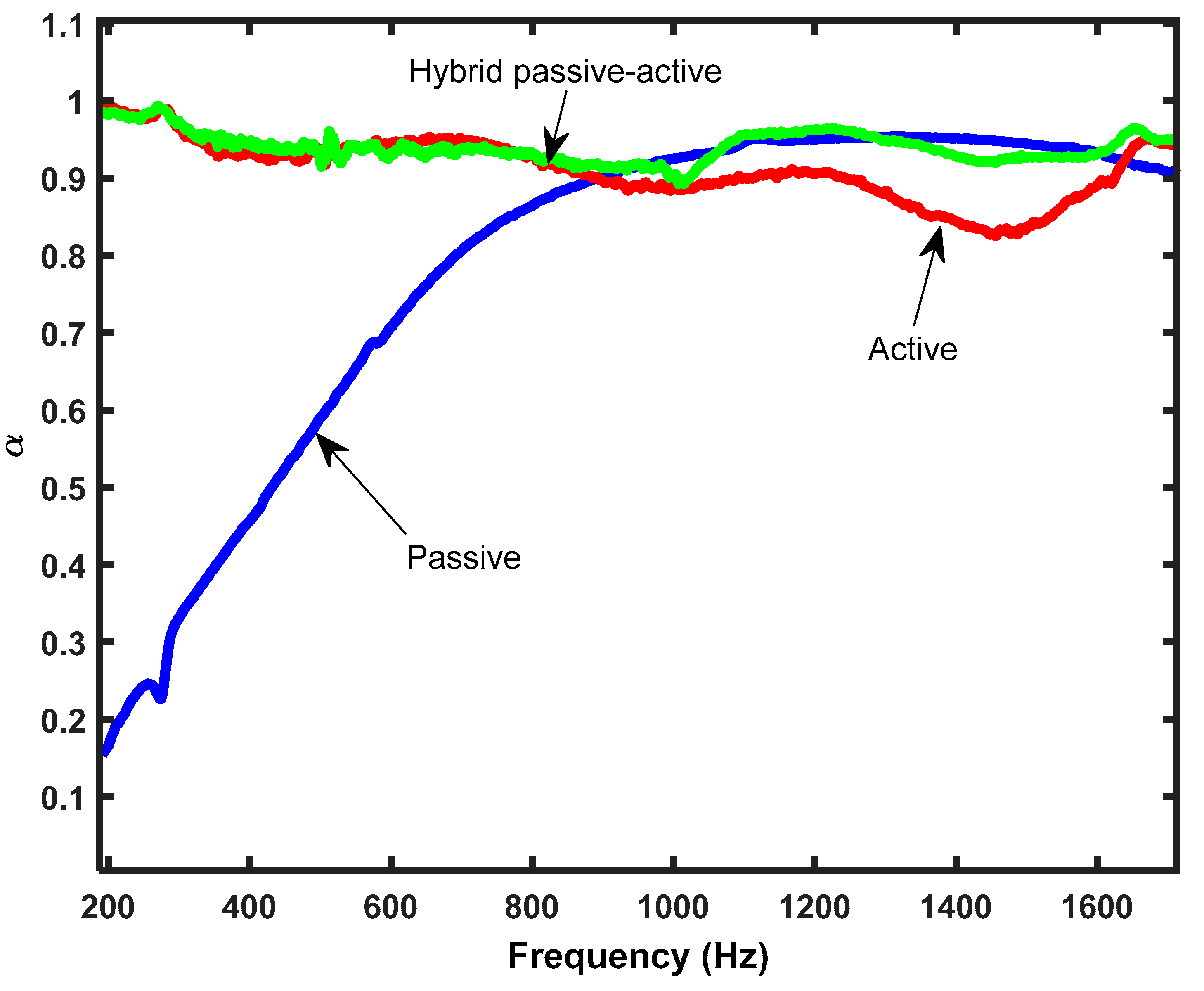
Figure 6 shows the sound absorption performance of one of these hybrid passive–active systems. It consists of an MPP with an air cavity 45 mm deep. Thus, the total thickness of the passive system is 45 mm. Passive-only (blue) and active-only (red) absorption curves are also shown for comparison with passive–active absorption (green). The average hybrid passive absorption in the frequency band of (200, 1600) Hz was 94%. In this case, the length of the hybrid passive–active absorber at 200 Hz was λ/38. Therefore, this hybrid passive–active system also functions as a deep sub-wavelength structure.
Thus, hybrid passive–active systems provide an appropriate structure to achieve high absorption over a broadband frequency range with reduced thickness. The passive part (MPP) provides absorption at medium-to-high frequencies. The intrinsic limitation of absorption performance at low frequencies is overcome by using an active system that implements the pressure-release condition just behind the passive layer.

4. Multiple Helmholtz Resonators

The sound absorption performance of conventional HR can be improved in the low-frequency range either by designing extended necks that shift the resonant frequencies to a lower range or by assembling units that broaden the absorption frequency band [19]. They can also be combined with MPP to improve their absorption at higher frequencies.
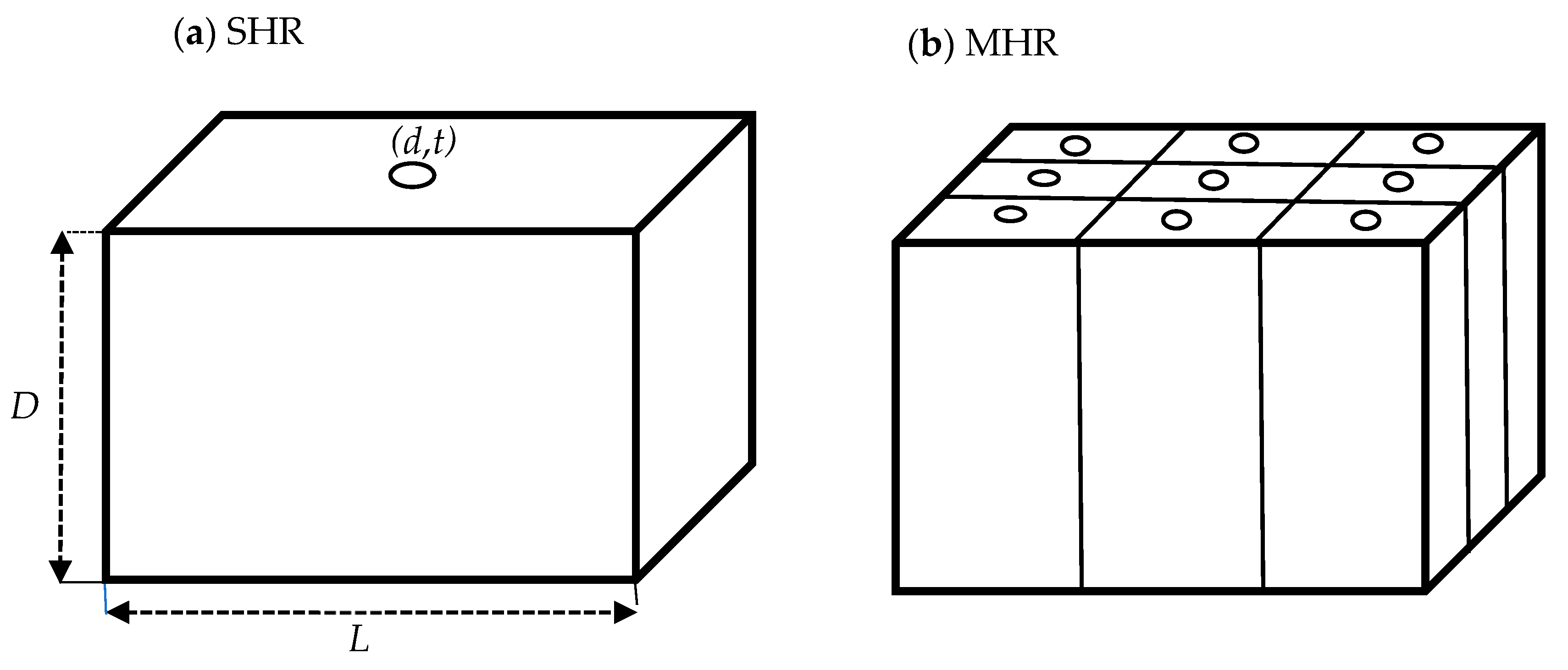
A single Helmholtz resonator (SHR) consists of a hole of diameter d and length t (the neck) inserted in a cavity of depth D and width L, as shown in Figure 7a. By partitioning the cavity into N sub-cavities, with a hole in each of them, a multiple Helmholtz resonator (MHR) is obtained, Figure 7b.
Since an MHR consists of N parallel-connected SHR, its acoustic impedance is
Z 1 = 1 1 N 1 Z n ,
where Zn are the acoustic impedances of each SHR, given by
Zn = Zhn + Zcn,
being Zhn and Zcn, the acoustic impedances of the holes and the cavities of each SHR.
Mathematical equations for Zhn and Zcn can be found in many acoustic books [3,4]. Bi et al. [33] proposed the equations
Z h n = i ω ρ 0 l n ϕ n 1 2 B 1 η n 1 η n 1 B 0 η n 1 1 + 2 μ η n ϕ n d n + i 0.85 ω ρ 0 d j n ϕ n ,
and
Z c n = i Z c e c o t ( k c e D n ) ,
where B0 and B1 are the zero and first-order Bessel functions, ϕn is the perforation ratio
ϕ n = d n D n + 2 t n 2 ,
ηn is the perforation constant
η n = d n ρ 0 ω 4 μ ,
μ is the air viscosity (1.8 × 10⁻⁵ Pa s), dn and tn are the diameter and thickness of each hole, Dn is the thickness of the cavity, and Zce and Kce are the effective characteristic impedance and effective transfer constant in the aperture [33].
The absorption coefficient of the MHR, as in Equation (9), will be
α = 1 Z 1 Z 0 Z 1 + Z 0 2 ,
being Z0 = ρ0 c0 the air impedance.
Therefore, the sound absorption of an MHR depends on the thickness of the aperture tn, the diameter of the perforated hole dn, the thickness of the cavity Dn, the perforation ratio ϕn of each SHR, and the total number of single Helmholtz resonators N. If all SHRs have the same parameters, there will be just one resonance peak. These parameters could be adjusted to get multiple resonance peaks, which in turn increases the absorption bandwidth [34].
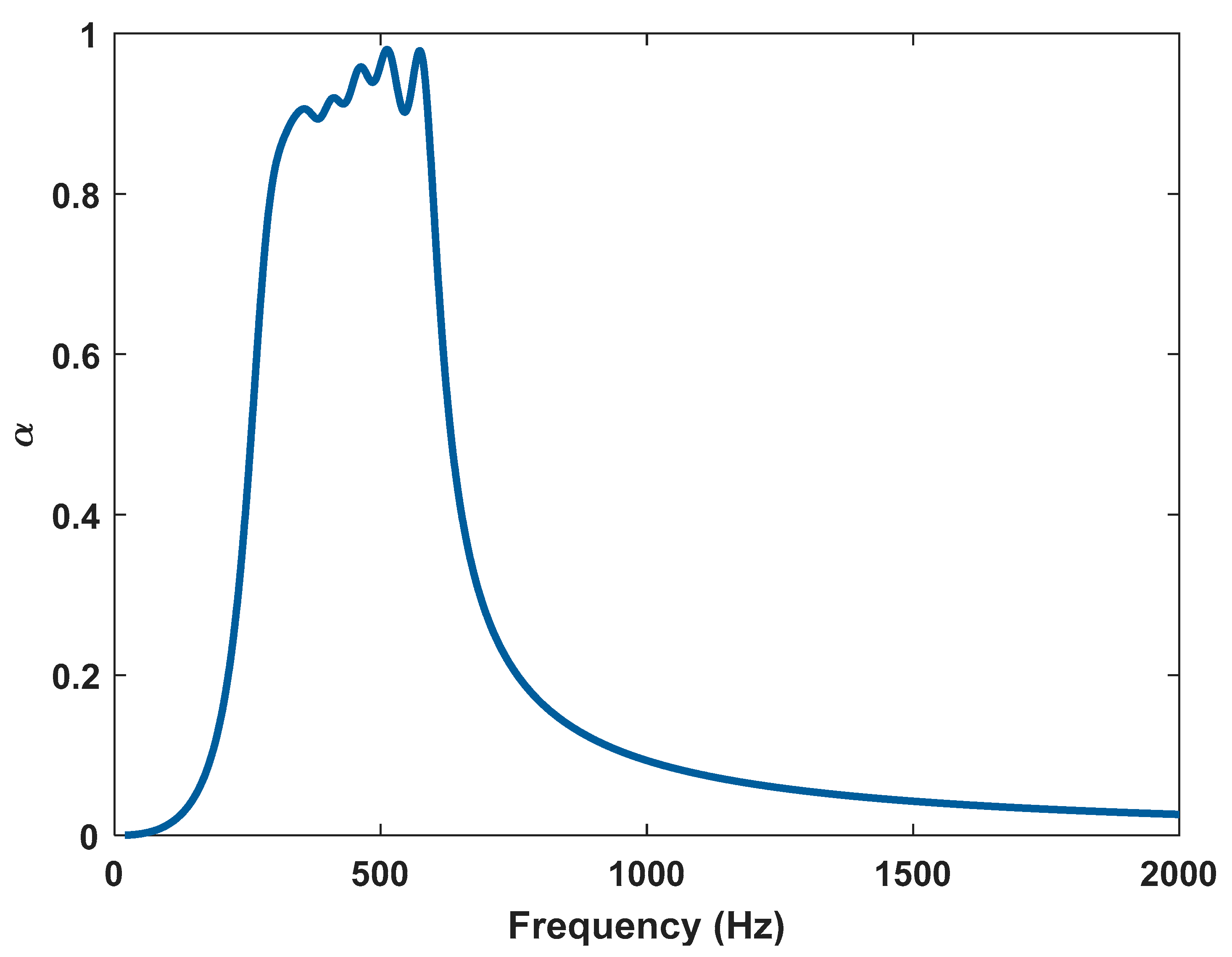
Peng et al. [19] showed that these MHRs can also be modeled as MPPs with a partitioned honeycomb cavity. They called this absorber a composite honeycomb metasurface panel (CHMP). Other names for this absorber are microperforated honeycomb metasurface panel (MHMP) [35] and honeycomb microperforated plate (HMPP) [36]. As an example, Figure 8 shows the theoretical sound absorption coefficient of a CHMP of 9 SHR optimized to provide maximum absorption between 250 Hz and 600 Hz.
The CHMP has a constant panel thickness (t = 0.3 mm), a cavity depth (D = 50 mm), and hole radii rn = dn/2 = [0.4, 0.4, 0.4, 0.5, 0.5, 0.6, 0.7, 0.8, 1] mm. The mean absorption in this frequency band was 88%.
This model has been extrapolated to other similar geometries by many authors [37,38,39]. For instance, a multiple structure of three-embedded single HR was able to provide sound absorption in the frequency band of (250, 430) Hz with a total cavity thickness of 69 mm [40].
Notice that the above-discussed modified HRs increase the frequency band of absorption, but they are still limited in providing absorption in a wideband, including both low and high frequencies. To this end, Almeida et al. [18] proposed a hybrid acoustic material consisting of a hybrid HR + foam structure. They obtained an absorber with an average absorption of 49.3% in the frequency range between 100 Hz and 3600 Hz, with a total thickness of 65 mm. Zhang and Xin [41] further explored the proposal of a hybrid multiple HR + porous liner structure. Every unit consisted of a single HR (similar to that of Figure 7a), with internal walls lined with polyurethane foam. A multiple structure with six of these single hybrid HR + foam units, with a total thickness of 50 mm, provided almost perfect absorption (α > 0.9) in the range of (280, 500) Hz, which corresponds to almost an octave, for a λ/24 sub-wavelength absorber.
Therefore, the final absorption of an MHR is mainly carried out by the resonance effect of each SHR and assisted by the coupling effect between different resonators [42]. This MHR can be combined either with MPPs or with a porous absorber to provide absorption performance in a rather wideband, which makes it suitable for practical applications in noise control and sound conditioning in halls.

5. MPP Combined with Coiled-Up Cavities

In both SL-MPP and SHR absorbers, the air cavity depth and the frequency of the absorption peak are correlated. The larger the cavity depth, the lower the frequency peak. For this reason, these absorbers are too bulky for low frequencies. However, the frequency of the peak can be lowered by designing coiled-up or labyrinthine cavities. This affords sub-wavelength absorbers, which are very useful for low-frequency sound absorption with reduced thickness [42,43,44]. These absorbers consist of a perforated plate (hole, slit, MPP) over a labyrinthine cavity. Table 3 summarizes distinct combinations of perforated plates and cavities.

5.1. Symmetrical Coiled-Up Cavities

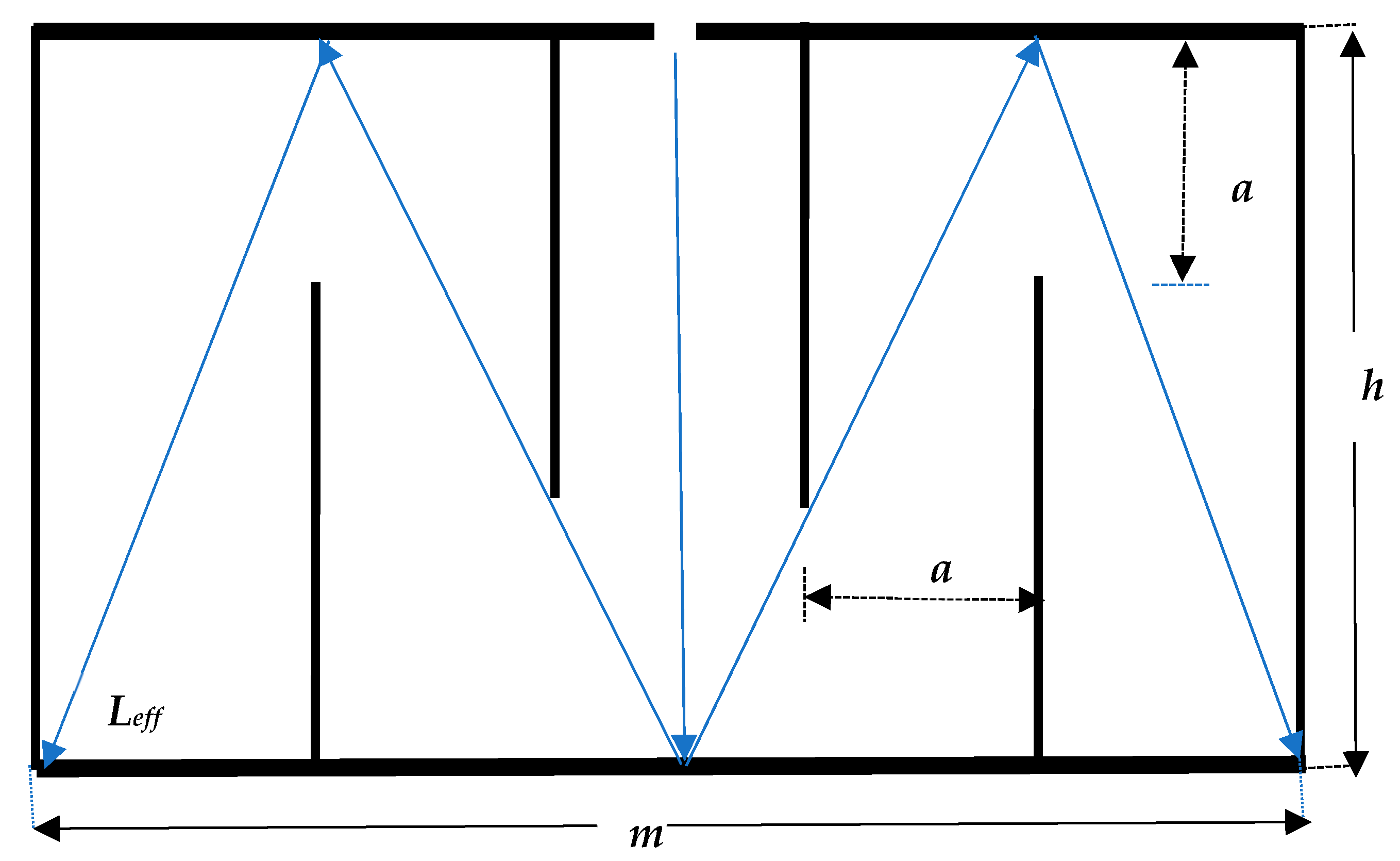
Figure 9 shows the geometry of one of them, consisting of a slit over a symmetrical coiled-up cavity. The acoustic impedance of this absorber is [43]
Z 1 = Z p + ξ 1 Z e 1   ×   Z p + ξ 2 Z e 2 Z p + ξ 1 Z e 1 + ξ 2 Z e 2 ,
where Zp is the acoustic impedance of the perforated plate, Ze1 and Ze2 are the acoustic impedances of the coiled-up channels, and ξ i = S 0 / S i , i = 1, 2, is the area modifying factor maintaining the conservation of the volume velocity flow [16]. In this case, S0 and Si are the areas of the unit cell and the coiled-up channels, respectively.
The acoustic impedance of the perforated plate with slits, Zp, can be obtained with the equation of the EF model (Equation (1)), with (d, t, l) being the slit width, thickness, and length, and ϕ the equivalent porosity (open surface/total surface) [57].
The acoustic impedances of the coiled-up cavities are
Z e 1 = Z e 2 = i ρ e q C e q c o t ω ρ e q C e q L e f f ,
where Leff is the effective propagation length, and ρeq and Ceq are the complex density and compressibility functions, respectively. Appropriate equations for these functions in specific coiled-up cavities, assuming that plane waves propagate in the symmetrical labyrinth, can be found in [16]. Table 4 summarizes the cross-sectional space width of the passage between coiled-up cavities (a in Figure 9), the effective length, the half-absorption bandwidth (f1, f2), and the absorption peak (fp) for a cell with a panel with a slit of (d, t, l) = (0.38 mm, 2.4 mm, 13 mm), and a cavity of depth 36 mm and back surface of (45 mm × 16 mm) subdivided in n = 5, 7, 9 and 11 coiled-up spaces.
Leff depends on the number of coiled-up spaces. The larger this number, the greater the effective length and the lower the frequency peak of the absorption curve [16]. This slotted panel, combined with a coiled-up cavity, is a sub-wavelength absorber. For instance, in the design with n = 11, the absorption peak at 245 Hz corresponds to a λ/39 absorber.

5.2. Multicoiled Metasurfaces

Other authors have proposed similar geometries with multi-coiled-up cavities. Table 5 summarizes some of the absorption frequency bands provided by these authors, with the corresponding total thicknesses of the absorbers. All of them exhibit deep sub-wavelength absorption performances.

5.3. Deep Learning Designs

Donda et al. [58] introduced a multi-coiled acoustic metasurface able to provide almost perfect absorption at ultra-low, narrowband frequencies with ultrathin thickness. This single multi-coiled structure afforded absorption at 50 Hz with a total thickness of 13 mm (λ/527). Furthermore, a 3 × 3 supercell of these single units, with the same total thickness, provided absorption higher than 90% in the frequency range of (49, 52) Hz. They further obtained an even deeper sub-wavelength absorber using a deep-learning-based metasurface [59]. This improved ultrathin metasurface provided perfect absorption at 38.6 Hz with a total thickness of 13 mm (λ/684).

5.4. Combinations of Coiled-Up Structures with Other Absorbers

If another absorber is added to the coiled-up structure combined with an MPP, the absorption band can be increased on the high-frequency side. For instance, Panahi et al. [60] proposed integrating the MPP + coiled-up structure with a Helmholtz resonator with a slit aperture. The proposed absorber, with a total thickness of 41 mm, provided absorption in the frequency band of (360, 2200) Hz with a bandwidth-to-thickness ratio of 44.87. The proposed meta-absorber operated in a sub-wavelength regime corresponding to λ/23.17. Wang et al. [61], on the other hand, proposed a meta-absorber consisting of an MPP-coiled-up structure combined with a porous absorber. This metamaterial, with a total thickness of 60 mm, provided an average absorption of 0.8 in the frequency band of (190, 1200) Hz.

6. Sonic Black Holes Based on MPP

A sonic black hole (SBH) is an acoustic metamaterial capable of providing almost full absorption in a wide frequency band [62]. The standard configuration of an SBH consists of a discrete set of rings with inner radii that decrease according to the same power law. Deng et al. [63] analyzed the interesting continuous problem in which the number of rings becomes very large, in a duct termination with different profiles. They concluded that a nearly oscillation-free reflection coefficient can be achieved using a long SBH.
An SBH incorporates two physical phenomena: wave-energy focalization and dissipation [64]. By using, for instance, a duct with an internal diameter that decreases according to a power–law relationship, the wave velocity of bending-propagating waves can be gradually decelerated, leading to wavelength compression and energy focalization. Dissipation can be provided by another mechanism, such as viscous and thermal losses in microperforated walls and panels. Both of these physical phenomena provide near-perfect absorption in a wide band, including low frequencies.
The standard SBH tube is made of a sequence of MPPs inside a duct with decreasing inner radius and separated by cavities of the same depth [65]. The duct is assumed to be filled with air, and the inserted MPPs are assumed to be rigid. The inner diameter of the duct (and so the diameters of subsequent MPP) follows a decreasing law variation (linear, quadratic, etc.).
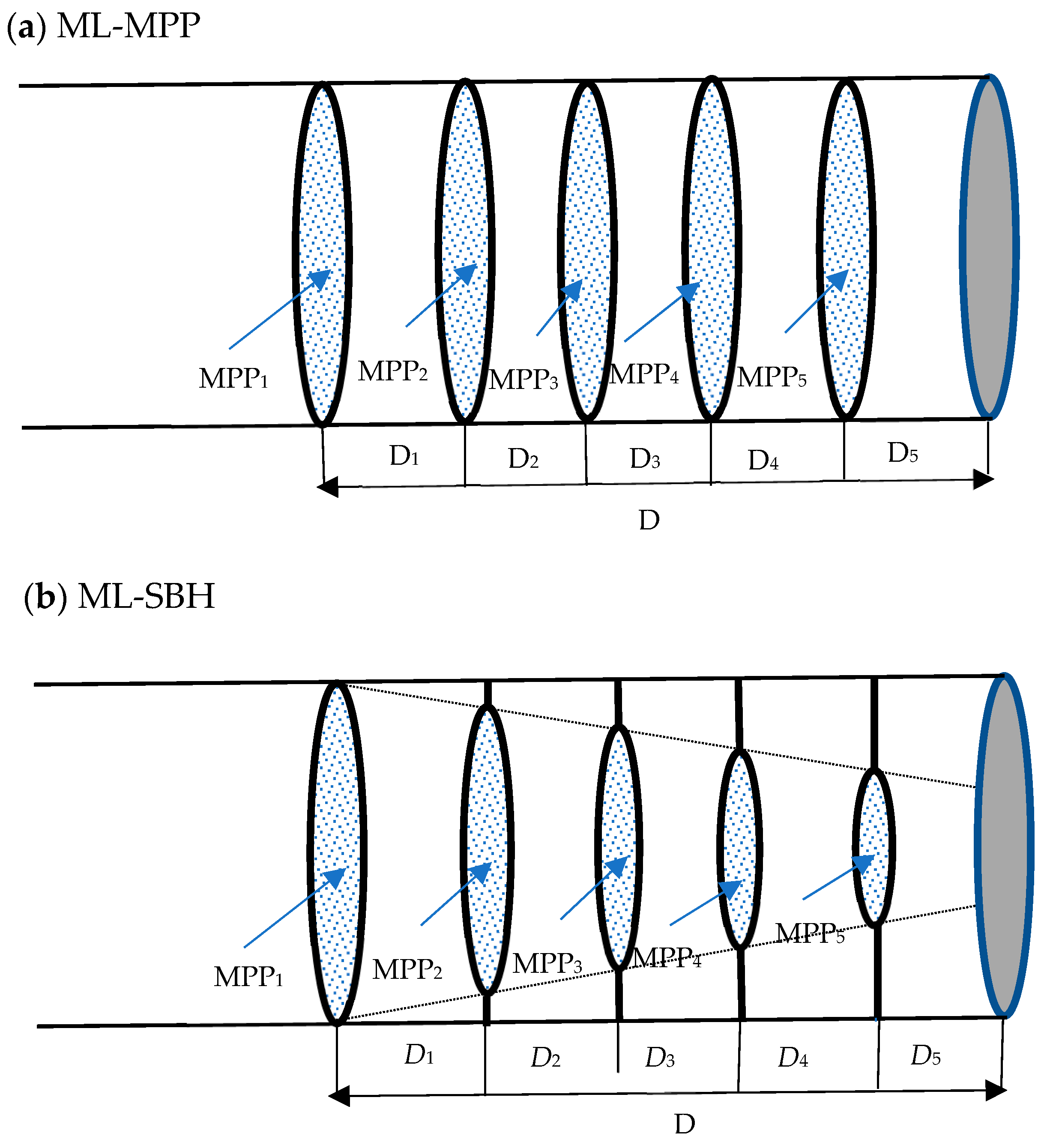
The performance of a multilayer SBH (ML-SBH) can be compared with that of a conventional multilayer MPP (ML-MPP) for the case of five layers, Figure 10. In the ML-MPP, five MPPs of equal diameter, with parameters (di, ti, ϕi, Di), are fitted into a cylindrical tube. In the ML-SBH, five MPPs of decaying diameter, with parameters (di, ti, ϕi, Di), are fitted in a conical tube. The input impedance to the ML-SBH, Z1, can also be obtained by the transfer method from the impedance of the last cavity. Specific equations for the ML-SBH with MPPs with equal parameters are given by Chen et al. [66]. Explicitly, the state vector (p, u) at the termination, (pN, uN), and at the entrance, (p1, u1), of the ML-SBH are related by
p 1 u 1 = T 11 T 12 T 21 T 2 p N u N = T p N u N ,
where T is the total transfer function, given by the product of the transfer functions of each layer, T 1 n   T 2 n   T 3 n , specified by
T 1 n = 1 Z M P P , n S M P P n 0 1 T 2 n = cos k D n j Z 0 S n sin k D n j S n Z 0 sin k D n cos k D n T 3 n = 1 0 Y c a v n 1 ,
where ZMPP,n is given by Equation (1), S M P P n = π   h r , n 2 is the area on the n-th MPP, S n = π   h c , n 2 is the cross-sectional area of the region between the MPP and the duct, Dn is the depth of each n-th cavity, and Y c a v n is the admittance of the toroidal cavity surrounding the conical cavity
Y c a v n = j k Z 0 V c a v n = j k Z 0 π D n ( R 2 h r , n 2 ) .
From Equation (20), the input impedance to the ML-SBH is
Z 1 = S p 1 u 1 ,
being S the cross-sectional area of the duct. Once the acoustic input impedance is calculated, the sound absorption coefficient can be obtained from Equation (8).
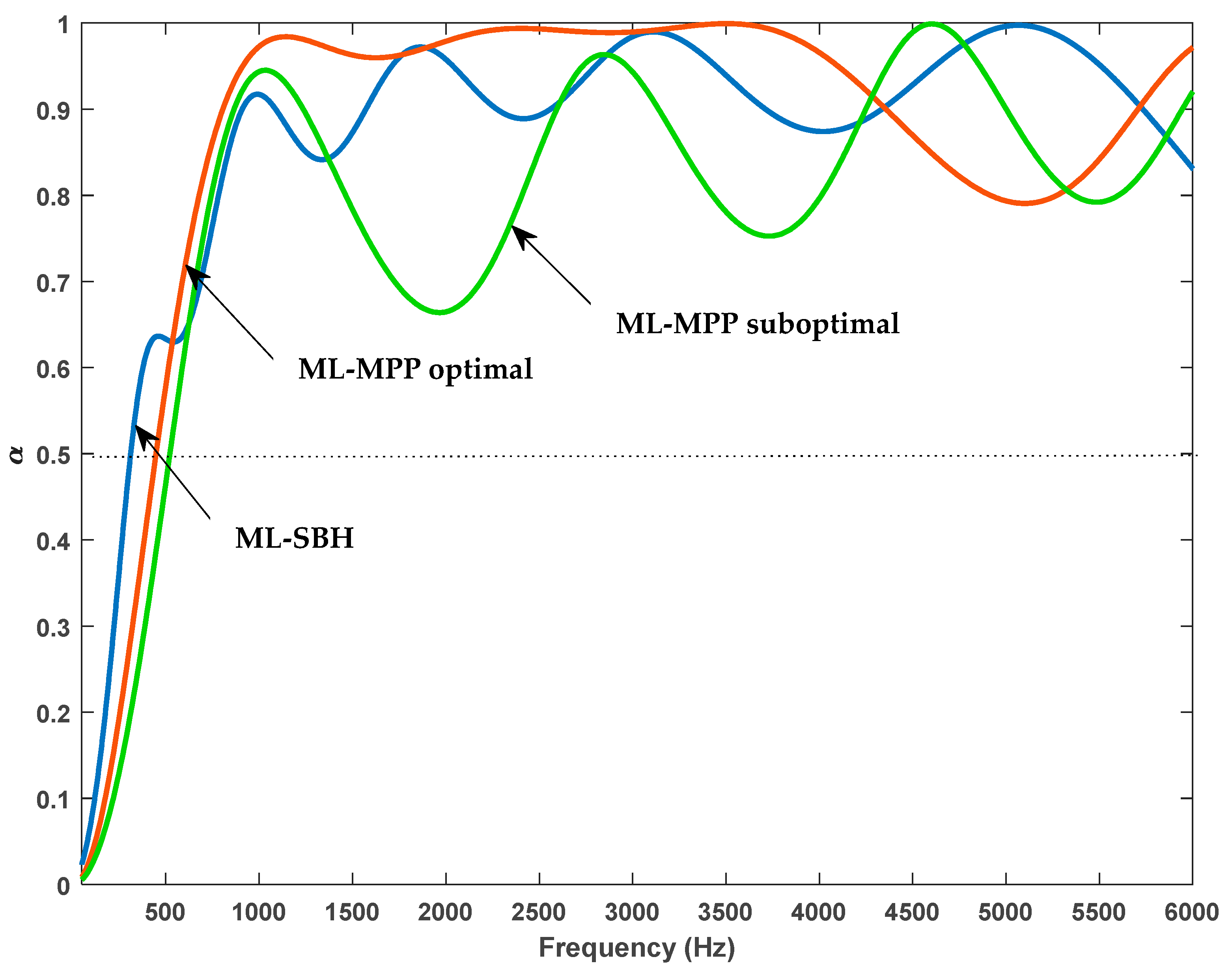
Figure 11 shows the absorption coefficient of a five-layer ML-SBH of total length 60 mm, with five inserted MPPs separated by 12 mm, with parameters (d, t, ϕ) = (0.2 mm, 0.2 mm, 4%). The radius of the tube decreases linearly from 30 mm (input surface of the ML-SBH) to 1 mm (back wall of the ML-SBH).
The cut-off frequency at α = 0.5 is 312 Hz. Thus, the total thickness of the ML-SBH at this frequency is λ/18.
Two absorption curves of the ML-MPP with the same total thickness (60 mm) are also shown for comparison. The first one (green curve) corresponds to the ML-MPP with the same parameters as the ML-SBH. Specifically, this suboptimal ML-MPP consists of five MPPs with the same parameters (d, t, ϕ) = (0.2 mm, 0.2 mm, 4%) and equal cavities D = 12 mm. This ML-MPP clearly underperforms the ML-SBH with the same parameters. The cut-off frequency at α = 0.5 is 538 Hz, and the absorption curve has several deep peaks and troughs. In the second one (red curve), the parameters of each MPP have been optimized by simulated annealing to provide maximum absorption from 400 Hz to 6 kHz [2]. This optimized ML-MPP also consists of five equally spaced MPPs but with different constitutive parameters: (d1, t1, ϕ1) = (0.47 mm, 0.37 mm, 7.4%), (d2, t2, ϕ2) = (0.17 mm, 0.6 mm, 4.2%), (d3, t3, ϕ3) = (0.11 mm, 0.46 mm, 4%), (d4, t4, ϕ4) = (0.1 mm, 0.4 mm, 7%), and (d5, t5, ϕ5) = (0.8 mm, 0.17 mm, 5.6%). The cut-off frequency at α = 0.5 is 458 Hz, which corresponds to λ/12, but the absorption curve overperforms that of the ML-SBH between 538 Hz and 4342 Hz. Nevertheless, for a fair comparison between both architectures, the MPP components of the ML-SBH should also be optimized.
Many of these sub-wavelength designs require extremely small holes. The machining of such small holes has evolved from the former, very expensive, drilling with laser technologies to the current, cheaper, 3D printing [67]. A technique, borrowed from advanced circuitry applications, allows the perforation of very precise holes using epoxy laminates. Compared with laser technology, this technique reduces the cost of MPP manufacturing by roughly 1/15 [67].

7. Comparative Discussion

A comparative assessment of the absorption performance of the structures discussed in Section 2, Section 3, Section 4, Section 5 and Section 6, based on common grounds such as operating mechanism, bandwidth definition, thickness penalty, or the conditions under which the quoted absorption values were obtained, is summarized in Table 6.
Since an MPP is the common element in all of these structures, they share the same absorption mechanism, specifically, viscous losses in the holes of the covering panel. However, they diverge in the mechanism that moves the absorption curve towards the low-frequency range. In ML-MPP, MC-MPP, MHR, MPP, and SBH, the partitioning of the cavity is linked to the possibility of using many distinct MPPs with different parameters. In the MPP with coiled-up cavities, the labyrinthine structure of the cavities allows for an increase in the effective length that the sound waves travel. In the passive-active system, on the other hand, low-frequency absorption is provided by the active system, which tries to release the sound pressure at the error microphone.
The absorption band of the examples discussed in Section 2, Section 3, Section 4, Section 5 and Section 6 is shown in the third column of Table 6. ML-MPP, MC-MPP, and MHR afford absorption over slightly more than one octave, starting at 200 Hz. MPP combined with coiled-up structures is a narrowband absorber. To increase the sound absorption of these systems at higher frequencies, they must be combined with other materials (for instance, porous absorbers). Passive–active absorbers and SBH are able to provide broadband sound absorption. It should be noticed that the reported bandwidths and thicknesses correspond to representative examples discussed in the manuscript, not to general performance limits for each absorber class.
The total thickness of representative structures reviewed in Section 2, Section 3, Section 4, Section 5 and Section 6 is shown in the fourth column. The ratio of the total thickness of the systems to the wavelength at the lower working frequency is also shown. Although all of them have the capability of performing on a deep sub-wavelength scale, the passive-active absorbers and the labyrinthine structures stand out, with total thicknesses as small as λ/38 of the sound wavelength, which is much smaller than that of conventional absorbers.
Some comments concerning the operating conditions of these metamaterials are included in the fifth column. The ML-MPP, MC-MPP, and SBH require fitting many parameters. For instance, the sound absorption provided by a 4L-MPP depends on 12 parameters (d, t, ϕ of each constitutive MPP). Therefore, an important issue regarding the use of these metamaterials for low-frequency sound absorption is the implementation of some optimization strategy. Simulated annealing has been shown to be a good strategy to optimize ML-MPP and MC-MPP [2,28]. Machine-learning-assisted tools have been proposed for the optimal design of periodic/porous metamaterial-like acoustic treatments under thickness constraints [68]. Novel functional applications, involving the use of these machine learning techniques, are expected to provide the optimal parametric design of such metamaterials [69].

8. Summary and Conclusions

The possibility of designing deep-subwavelength sound absorbers has revived interest in these materials at low frequencies. These broadband sound absorbers are also named metamaterials. Classical porous, HR, and MPP absorbers can nowadays be hybridized with other structures to provide high sound absorption from low to high frequencies. Some of these structures include multilayer and multiple-cavity MPPs, hybrid MPP-active systems, multiple HRs combined with either porous or MPP materials, multilayer MPPs combined with labyrinthine cavities, and multilayer MPPs in ducts with conical cavities of decreasing radius (SBH).
The parameters of these hybrid systems based on MPP can be optimized to afford deep sub-wavelength absorbers. Hybrid passive–active systems and MPP combined with coiled-up cavities are more capable of absorbing low frequencies with the smallest thickness.
Some of the reviewed structures (passive–active and SBH) are particularly well-suited for broadband sound absorption, including at low frequencies. The others provide low-frequency absorption in a band of around one octave width. However, they can be combined with other absorbers (such as porous materials) to increase the absorption bandwidth towards the high-frequency side.

Author Contributions

All authors contributed equally to the article. All authors have read and agreed to the published version of the manuscript.

Funding

This research received no external funding.

Institutional Review Board Statement

Not applicable.

Informed Consent Statement

Not applicable.

Data Availability Statement

No new data were created in this article.

Conflicts of Interest

Author Santiago Ortiz was employed by the company Harman Professional, Inc. The remaining authors declare that the research was conducted in the absence of any commercial or financial relationships that could be construed as a potential conflict of interest.

References

  1. Cobo, P.; Simón, F. A comparison of impedance models for the inverse estimation of the non-acoustical parameters of granular absorbers. Appl. Acoust. 2018, 104, 119–126. [Google Scholar] [CrossRef]
  2. Ruiz, H.; Cobo, P.; Jacobsen, F. Optimization of multiple-layer microperforated panels by simulated annealing. Appl. Acoust. 2011, 72, 772–776. [Google Scholar] [CrossRef]
  3. Cobo, P. Absorción del Sonido; Biblioteca de Ciencias, CSIC: Madrid, Spain, 2015. [Google Scholar]
  4. Allard, J.F.; Atalla, N. Propagation of Sound in Porous Media: Modelling Sound Absorbing Materials; Wiley: Chichester, UK, 2009. [Google Scholar]
  5. Delany, M.E.; Bazley, E.N. Acoustic properties of fibrous absorbent materials. Appl. Acoust. 1970, 3, 105–116. [Google Scholar] [CrossRef]
  6. Mahesh, K.; Ranjith, S.K.; Mini, R.S. Recent Advancements in Helmholtz Resonator Based Low-Frequency Acoustic Absorbers: A Critical Review. Arch. Comput. Methods Eng. 2024, 31, 2079–2107. [Google Scholar] [CrossRef]
  7. Cobo, P.; Ruiz, H.; Alvarez, J. Double-layer microperforated panel/porous absorber as liner for anechoic closing of the test section in wind tunnels. Acta Acust. United Acust. 2010, 96, 914–922. [Google Scholar] [CrossRef]
  8. Maa, D.Y. Microperforated-panel wideband absorbers. Noise Control Eng. J. 1987, 29, 77–84. [Google Scholar] [CrossRef]
  9. Maa, D.Y. Potential of microperforated panel absorber. J. Acoust. Soc. Am. 1998, 104, 2861–2866. [Google Scholar] [CrossRef]
  10. Lee, H.P.; Kumar, S.; Aow, J.W. Proof-of-Concept Design for MPP Acoustic Absorbers with Elements of Art. Designs 2021, 5, 72. [Google Scholar] [CrossRef]
  11. Atalla, N.; Sgard, J.F. Modeling of perforated plates and screens using rigid frame porous models. J. Sound Vib. 2007, 303, 195–208. [Google Scholar] [CrossRef]
  12. Chang, L.; Jiang, A.; Rao, M.; Ma, F.; Huang, H.; Zhu, Z.; Zhang, Y.; Wu, Y.; Li, B.; Hu, Y. Progress of low-frequency sound absorption research utilizing intelligent materials and acoustic metamaterials. RSC Adv. 2021, 11, 37784–37800. [Google Scholar] [CrossRef]
  13. Arjunan, A.; Baroutaji, A.; Robinson, J.; Vance, A.; Arafat, A. Acoustic metamaterials for sound absorption and insulation in buildings. Build. Environ. 2024, 251, 111250. [Google Scholar] [CrossRef]
  14. Yang, M.; Sheng, P. Sound absorption structures: From porous media to acoustic metamaterials. Annu. Rev. Mater. Res. 2017, 47, 83–114. [Google Scholar] [CrossRef]
  15. Assouar, B.; Liang, B.; Wu, Y.; Li, Y.; Cheng, J.C.; Jing, Y. Acoustic metasurfaces. Nat. Rev. Mater. 2018, 3, 460–472. [Google Scholar] [CrossRef]
  16. Almeida, G.; Vergara, E.F.; Barbosa, L.R.; Brum, R. Low-frequency sound absorption of a metamaterial with symmetrical-coiled-up spaces. Appl. Acoust. 2021, 172, 107593. [Google Scholar] [CrossRef]
  17. Bezancon, G.; Doutres, O.; Umnova, O.; Leclaire, P.; Dupont, T. Thin metamaterial using acoustic black hole profiles for broadband sound absorption. Appl. Acoust. 2024, 216, 109744. [Google Scholar] [CrossRef]
  18. Almeida, G.; Vergara, E.F.; Barbosa, L.R.; Zanatta, L.; Zimmermann, K.; Mikulski, R.; Bahú, V. Sound energy control in a wide frequency domain by a hybrid acoustic material. In Proceedings of the COBEM 2023, 27th ABCM International Congress of Mechanical Engineering, Florianopolis, Brazil, 4–8 December 2023. COB-2023-0163. [Google Scholar]
  19. Peng, X.; Ji, J.; Jing, Y. Composite honeycomb metasurface panel for broadband sound absorption. J. Acoust. Soc. Am. 2018, 144, EL255–EL261. [Google Scholar] [CrossRef] [PubMed]
  20. Chen, W.; Lu, C.; Wang, X.; Liu, S. The acoustic performances of a subwavelength hierarchical honeycomb structure: Analytical, numerical, and experimental investigations. J. Acoust. Soc. Am. 2023, 153, 1754–1765. [Google Scholar] [CrossRef]
  21. Li, X.; Wu, Q.; Kang, L.; Liu, B. Design of multiple parallel-arranged perforated panel absorbers for low frequency sound absorption. Materials 2019, 12, 2099. [Google Scholar] [CrossRef] [PubMed]
  22. Prasetiyo, I.; Sihar, I.; Sudarsono, A.S. Sound absorption characteristics of thin parallel microperforated panel (MPP) for random incidence field. Appl. Acoust. 2022, 201, 109131. [Google Scholar] [CrossRef]
  23. Wang, Y.; Yuan, H.; Wang, Y.; Xu, J.; Yu, H.; Zhang, C.; Ren, L. A study on ultra-thin and ultra-broadband acoustic performance of micro-perforated plate coupled with coiled-up space structure. Appl. Acoust. 2022, 200, 109048. [Google Scholar] [CrossRef]
  24. Xie, S.; Li, Z.; Yan, H.; Yang, S. Ultra-broadband sound absorption performance of a multi-cavity composite structure filled with polyurethane. Appl. Acoust. 2022, 189, 108612. [Google Scholar] [CrossRef]
  25. Ma, P.S.; Kim, H.S.; Lee, S.H.; Seo, Y.H. Quasi-perfect absorption of broadband low-frequency sound in a two-port system based on a micro-perforated panel resonator. Appl. Acoust. 2022, 186, 108449. [Google Scholar] [CrossRef]
  26. Zhao, X.D.; Yu, Y.J.; Wu, Y.J. Improving low-frequency sound absorption of micro-perforated panel absorbers by using mechanical impedance plate combined with Helmholtz resonators. Appl. Acoust. 2016, 114, 92–98. [Google Scholar] [CrossRef]
  27. Cobo, P.; de la Colina, C.; Roibas, E.; Chimeno, M.; Simón, F. A wideband triple-layer microperforated panel sound absorber. Comp. Struct. 2019, 226, 111226. [Google Scholar] [CrossRef]
  28. Cobo, P.; Simón, F.; de la Colina, C. Comparison of Multiple-layer Versus Multiple-cavity Microperforated Panels for Sound Absorption at Low Frequency. Noise Cont. Eng. J. 2021, 69, 341–350. [Google Scholar] [CrossRef]
  29. Cobo, P.; Pfretzschner, J.; Cuesta, M.; Anthony, D. Hybrid passive–active absorption using microperforated panels. J. Acoust. Soc. Am. 2004, 116, 2118–2125. [Google Scholar] [CrossRef]
  30. Cuesta, M.; Cobo, P.; Fernández, A.; Pfretzschner, J. Using a thin actuator as secondary source for hybrid passive/active absorption in an impedance tube. Appl. Acoust. 2006, 67, 15–27. [Google Scholar] [CrossRef]
  31. Nelson, P.A.; Elliott, S.J. Active Control of Sound; Academic Press: London, UK, 1992; pp. 195–198. [Google Scholar]
  32. ISO 10534-2; Acoustics—Determination of Sound Absorption Coefficient and Impedance in Impedance Tubes. Part 2: Transfer Function Method. International Organization for Standardization: Geneva, Switzerland, 1998.
  33. Bi, S.; Wang, E.; Shen, X.; Yang, F.; Zhang, X.; Yang, X.; Yin, Q.; Shen, C.; Xu, M.; Wan, J. Enhancement of sound absorption performance of Helmholtz resonators by space division and chamber grouping. Appl. Acoust. 2023, 216, 109352. [Google Scholar] [CrossRef]
  34. Kim, S.R.; Kim, Y.-H.; Jang, J.-H. A theoretical model to predict the low-frequency sound absorption of a Helmholtz resonator array. J. Acoust. Soc. Am. 2006, 119, 1933–1936. [Google Scholar] [CrossRef]
  35. Xie, S.; Wang, D.; Feng, Z.; Yang, S. Sound absorption performance of microperforated honeycomb metasurface panels with a combination of multiple orifice diameters. Appl. Acoust. 2020, 158, 107046. [Google Scholar] [CrossRef]
  36. Yan, S.; Wu, J.; Chen, J.; Xiong, Y.; Mao, Q.; Zhang, X. Optimization design and analysis of honeycomb micro-perforated plate broadband sound absorber. Appl. Acoust. 2022, 186, 108487. [Google Scholar] [CrossRef]
  37. Yan, F.; Bi, S.; Shen, X.; Yang, X.; Wang, X.; Zhang, X.; Xue, J.; Zhang, X.; Yin, Q.; Dai, J.; et al. Adjustable and extensible hexagonal acoustic metamaterial cell combining multiple parallel Helmholtz resonators with optional apertures. J. Mech. Sci. Technol. 2023, 37, 6385–6403. [Google Scholar] [CrossRef]
  38. Papadakis, N.M.; Stavroulakis, G.E. Tunable Helmholtz Resonators Using Multiple Necks. Micromachines 2023, 14, 1932. [Google Scholar] [CrossRef] [PubMed]
  39. Mahesh, K.; Mini, R.S. Investigation on the Acoustic Performance of Multiple Helmholtz Resonator Configurations. Appl. Acoust. 2021, 49, 355–369. [Google Scholar] [CrossRef]
  40. Zhu, J.; Qu, Y.; Su, H.; Zhang, J.; Meng, G. A multi-layer overlapping structure for continuous broadband acoustic wave absorption at lower-frequencies. Appl. Acoust. 2022, 187, 108496. [Google Scholar] [CrossRef]
  41. Zhang, W.; Xin, F. Broadband low-frequency sound absorption via Helmholtz resonators with porous material lining. J. Sound Vib. 2024, 578, 118330. [Google Scholar] [CrossRef]
  42. Yang, X.; Li, Q.; Shen, X.; Zhou, B.; Wang, N.; Wang, E.; Zhang, X.; Shen, C.; Wang, H.; Jiang, S. Interlayer Parallel Connection of Multiple Helmholtz Resonators for Optional Broadband Low Frequency Sound Absorption. Materials 2025, 18, 682. [Google Scholar] [CrossRef]
  43. Almeida, G.; Vergara, E.F.; Barbosa, L.R.; Mikulski, R.Z. Low-frequency sound absorption with bandwidth expanded by symmetric labyrinthine acoustic metamaterial. In Proceedings of the COBEM 2021, 26th ABCM International Congress of Mechanical Engineering, Florianopolis, Brazil, 22–26 November 2021. COB-2021-0197. [Google Scholar]
  44. Almeida, G.; Vergara, E.F.; Barbosa, L.R.; Lenzi, A.; Birch, R. Sound absorption metasurface with symmetrical coiled spaces and micro slit of variable depth. Appl. Acoust. 2021, 183, 108312. [Google Scholar] [CrossRef]
  45. Almeida, G.; Vergara, E.F.; Barbosa, L.R.; Lenzi, A.; Marece, P.; Birch, R. Acoustic analysis of a metasurface for normal and random incidence sound waves. Phys. Lett. A 2022, 451, 128417. [Google Scholar] [CrossRef]
  46. Almeida, G.; Vergara, E.F.; Barbosa, L.R.; Lenzi, A.; Cassettari, I.; Mikulski, R. Sound absorption performance of a labyrinthine metamaterial with arbitrary cross-sectional microperforations. J. Braz. Soc. Mech. Sci. Eng. 2023, 45, 607. [Google Scholar] [CrossRef]
  47. Zhu, Y.F.; Donda, K.; Fan, S.; Cao, L.; Assouar, B. Broadband ultra-thin acoustic metasurface absorber with coiled structure. Appl. Phys. Express 2019, 12, 114002. [Google Scholar] [CrossRef]
  48. Zhu, Y.; Merkel, A.; Donda, K.; Fan, S.; Cao, L.; Assouar, B. Nonlocal acoustic metasurface for ultrabroadband sound absorption. Phys. Rev. B 2021, 103, 064102. [Google Scholar] [CrossRef]
  49. Li, Y.; Yan, J.; Peng, Y. Multiscale porous with coiled-up channel for low-frequency broadband sound absorption. Int. J. Mech. Sci. 2022, 219, 107014. [Google Scholar] [CrossRef]
  50. Xiang, L.; Wang, G.; Luo, G.; Shen, J.; Deng, Z.; Wen, S. Optimization of hybrid microperforated panel and nonuniform space-coiling channels for broadband low-frequency acoustic absorption. Appl. Acoust. 2024, 216, 109763. [Google Scholar] [CrossRef]
  51. Xie, S.; Yang, S.; Yan, H.; Li, Z. Sound absorption performance of a conch-imitating cavity structure. Sci. Prog. 2022, 105, 368504221075167. [Google Scholar] [CrossRef]
  52. Bocaccio, M.; Bucciarelli, F.; Malfense Fierro, G.P.; Meo, M. Microperforated Panel and deep subwavelength Archimedean-inspired spiral cavities for multi-tonal and broadband sound absorption. Appl. Acoust. 2021, 176, 107901. [Google Scholar] [CrossRef]
  53. Catapane, G.; Petrone, G.; Robin, O.; Verdiere, K. Coiled quarter wavelength resonators for low-frequency sound absorption under plane wave and diffuse acoustic field excitations. Appl. Acoust. 2023, 209, 109402. [Google Scholar] [CrossRef]
  54. Chen, J.S.; Chung, Y.T.; Wang, C.Y.; Lo, W.Y.; Liu, C.H.; Yu, C.H.; Chang, I.L.; Lin, T.T. Ultrathin arch-like labyrinthine acoustic metasurface for low-frequency sound absorption. Appl. Acoust. 2023, 209, 109142. [Google Scholar] [CrossRef]
  55. Liu, Y.; Zeng, X.; Ren, S.; Sun, W.; Zeng, Y.; Wang, H.; Lei, Y. Broadband low-frequency sound-absorbing metastructure based on an impedance-matching coiled-up cavity with continuously variable cross section. J. Appl. Phys. 2023, 134, 085104. [Google Scholar] [CrossRef]
  56. Lü, C.; Tang, S.; Wu, J.L.; Jiang, Y. Low-frequency acoustic absorption realized by ultrasparse coiling-up metasurfaces. Results Phys. 2023, 49, 106488. [Google Scholar] [CrossRef]
  57. Cobo, P. Modelling of Microperforated Panel Absorbers with Circular and Slit Hole Geometries. Acoustics 2021, 3, 665–678. [Google Scholar] [CrossRef]
  58. Donda, K.; Zhu, Y.; Fan, S.W.; Cao, L.; Li, Y.; Assouar, B. Extreme low-frequency ultrathin acoustic absorbing metasurface. Appl. Phys. Lett. 2019, 115, 173506. [Google Scholar] [CrossRef]
  59. Donda, K.; Zhu, Y.; Merkel, A.; Fan, S.-W.; Cao, L.; Wan, S.; Assouar, B. Low-frequency absorbing acoustic metasurfaces: Deep learning approach. Smart Mater. Struct. 2021, 30, 085003. [Google Scholar] [CrossRef]
  60. Panahi, E.; Braghin, F.; Corigliano, A.; Sangiuliano, L.; D’Alessandro, L. Thin meta-absorber for low-frequency broadband sound absorption: Design, optimization, and experiments. Mech. Adv. Mater. Struct. 2026, 23, 2637872. [Google Scholar] [CrossRef]
  61. Wang, Y.; Zhang, D.; Guo, W.; Yang, L.; Wang, Y.; Yu, H. Low-frequency broadband absorber with porous material-coupled convoluted resonant cavity. J. Appl. Phys. 2026, 139, 125102. [Google Scholar] [CrossRef]
  62. Liang, X.; Liang, H.; Chu, J.; Wang, W.; Li, N.; Yang, Z.; Zhou, G.; Gao, N.; Hu, C.; Zhou, Z. A modified sonic black hole structure for improving and broadening sound absorption. Appl. Acoust. 2023, 210, 109440. [Google Scholar] [CrossRef]
  63. Deng, J.; Guasch, O.; Guilardi, D. Solution and analysis of a continuum model of sonic black hole for duct terminations. Appl. Math. Model. 2024, 129, 191–205. [Google Scholar] [CrossRef]
  64. Li, S.; Xia, J.; Yu, X.; Zhang, X.; Cheng, L. A sonic black hole structure with perforated boundary for slow wave generation. J. Sound Vib. 2023, 559, 117781. [Google Scholar] [CrossRef]
  65. Zhang, X.; Chen, L. Broadband and low frequency sound absorption by Sonic black holes with Micro-perforated boundaries. J. Sound Vib. 2021, 512, 116401. [Google Scholar] [CrossRef]
  66. Chen, Y.; Yu, K.; Fu, Q.; Zhang, J.; Lu, X.; Du, X.; Sun, X. A broadband and low-frequency sound absorber of sonic black holes with multi-layered micro-perforated panels. Appl. Acoust. 2024, 217, 109817. [Google Scholar] [CrossRef]
  67. Cobo, P.; Simón, F. Multiple-Layer Microperforated Panels as Sound Absorbers in Buildings: A Review. Buildings 2019, 9, 53. [Google Scholar] [CrossRef]
  68. Casaburo, A.; Magliacano, D.; Petrone, G.; Franco, F.; De Rosa, S. Optimizing the acoustic properties of a meta-material using machine learning techniques. In Proceedings of the InterNoise 2021, Washington, DC, USA, 1–4 August 2021; pp. 3044–3055. [Google Scholar]
  69. Bacigalupo, A.; Gnecco, G.; Lepidi, M.; Gambarotta, L. Machine-learning techniques for the optimal design of acoustic metamaterials. J. Optim. Theory Appl. 2020, 187, 630–653. [Google Scholar] [CrossRef]
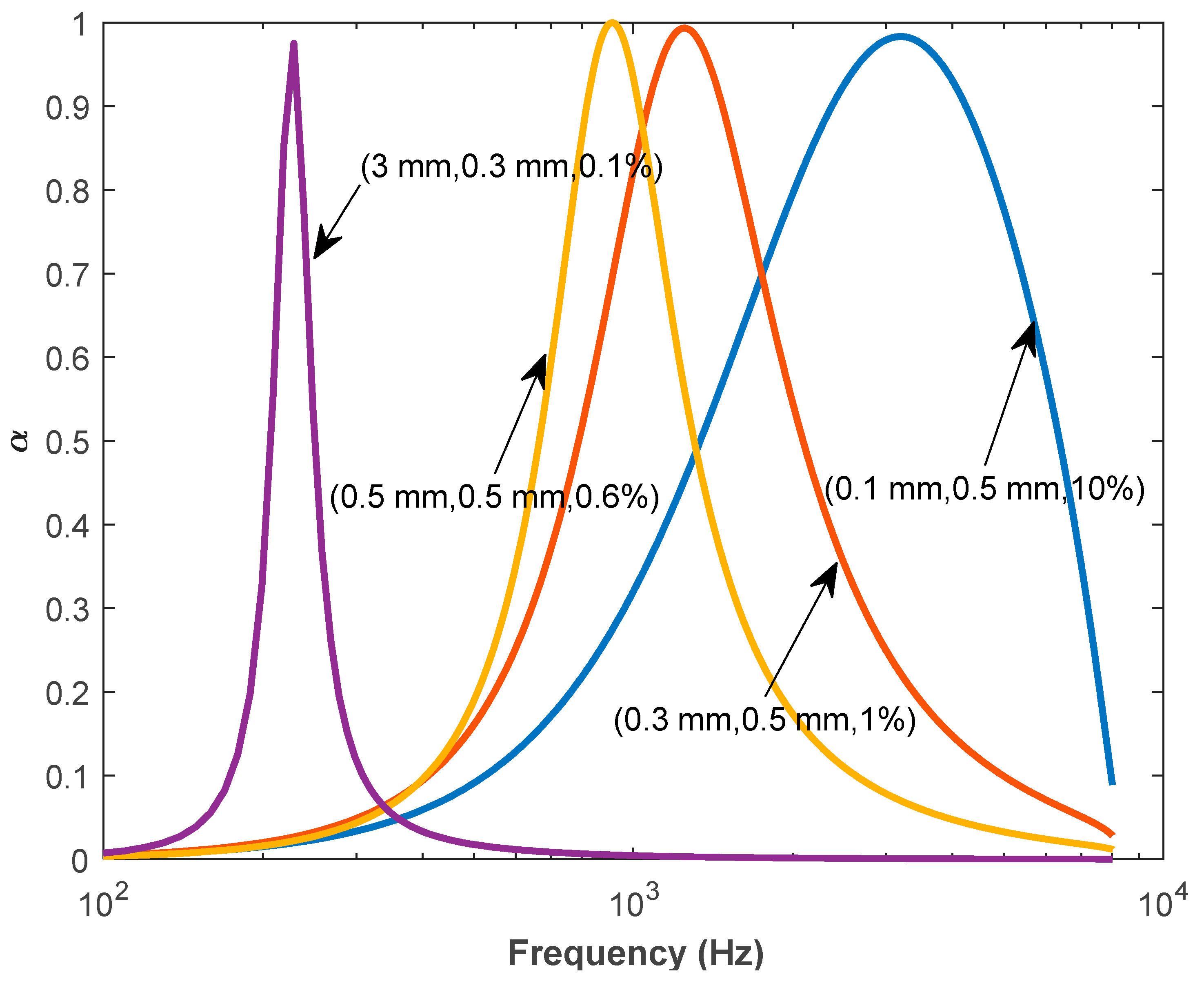
Figure 1. Sound absorption of a SL-MPP for D = 20 mm and different values of (d, t, ϕ).
Acoustics 08 00035 g001
Figure 2. Sketch of a ML-MPP composed of N layers of constitutive parameters (dn, tn, ϕn, Dn).
Acoustics 08 00035 g002
Figure 3. Sketch of an MC-MPP of thickness D with parameters and constitutive parameters (dn, tn, ϕn). The cavity of total surface S is partitioned into sub-cavities of surfaces S1, S2, …, SN.
Acoustics 08 00035 g003
Figure 4. Absorption curves of a 4-layer MPP with equal cavities Dn = 12.5 mm (Dtotal = 50 mm) and parameters (d1, t1, ϕ1, d2, t2, ϕ2, d3, t3, ϕ3, d4, t4, ϕ4) = (0.3 mm, 2.1 mm, 3.6%, 3.2 mm, 3.1 mm, 8.5%, 0.6 mm, 1.9 mm, 6.8%, 0.5 mm, 4.4 mm, 13.6%) and a 4-cavity MPP with S1 = S2 = S3 = S4 = S/4, Dtotal = 50 mm and parameters (d1, t1, ϕ1, d2, t2, ϕ2, d3, t3, ϕ3, d4, t4, ϕ4) = (0.8 mm, 3.5 mm, 1.4%, 0.6 mm, 3.5 mm, 5%, 1 mm, 3.5 mm, 0.8%, 0.6 mm, 3.5 mm, 2.7%).
Acoustics 08 00035 g004
Figure 5. Experimental setup for the measurement of the hybrid passive–active sound absorption in a tube impedance. A primary loudspeaker at one end of the tube generates the sound. The passive absorber is assembled on the opposite side of the tube. Microphones m1 and m2 are used to measure the sound absorption by the transfer function method. The active system includes an error microphone m3, just behind the absorber, a secondary loudspeaker, at the opposite end of the tube, and an adaptive filter.
Acoustics 08 00035 g005
Figure 6. Passive (red curve), active (red curve), and hybrid passive–active (green curve) sound absorption with an MPP of parameters (d, t, ϕ) = (3 mm, 3 mm, 10%) and an air cavity of thickness 45 mm.
Acoustics 08 00035 g006
Figure 7. (a) Single HR with depth D, width L and orifice of diameter d and length t, and (b) multiple HR with the cavity partitioned into N sub-cavities.
Acoustics 08 00035 g007
Figure 8. Sound absorption of a CHMP containing 9 SHR. All SHR have the same t = 0.3 mm, and D = 50 mm, and hole radii rn = dn/2 = [0.4, 0.4, 0.4, 0.5, 0.5, 0.6, 0.7, 0.8, 1] mm.
Acoustics 08 00035 g008
Figure 9. Geometry of an acoustic absorber with a slitted opening and a double coiled-up symmetrical cavity. Symmetrical coiled-up channels have a width, a. Leff is the effective length of propagation.
Acoustics 08 00035 g009
Figure 10. Geometry of (a) an ML-MPP, and (b) an ML-SBH, consisting of five MPPs and five cavities, with the same total thickness D. The MPPs in the ML-SBH have decreasing radius.
Acoustics 08 00035 g010
Figure 11. Sound absorption coefficient of a five-layer ML-SBH with total length D = 60 mm, and five MPP of parameters (d, t, ϕ, D) = (0.2 mm, 0.2 mm, 4%, 12 mm) with linearly decreasing radius from 30 mm to 1 mm. The sound absorption of a five-layer ML-MPP with the same parameters (suboptimal) and with parameters optimized for maximum absorption (optimal) is also shown for comparison.
Acoustics 08 00035 g011
Table 1. Parameters of 2L-MPP and 2C-MPP optimized for maximum absorption in the frequency band (200, 500) Hz with total thickness D = 5 cm.
2L-MPPd1 (mm)12C-MPPd3 (mm)0.815
t1 (mm)6.2t3 (mm)2.52
ϕ1 (mm)1.58ϕ3 (mm)0.5
D1 (cm)3.91A30.5
d2 (mm)1.76d4 (mm)0.635
t2 (mm)6.76t4 (mm)2.52
ϕ2 (mm)0.29ϕ4 (mm)1.19
D2 (cm)1.09A40.5
<α>0.55<α>0.61
Table 2. Parameters of 3L-MPP and 3C-MPP optimized for maximum absorption in the frequency band (200, 500) Hz with total thickness D = 5 cm.
3L-MPPd1 (mm)0.53C-MPPd4 (mm)0.94
t1 (mm)6.5t4 (mm)5.4
ϕ1 (%)2.23ϕ4 (%)1.39
D1 (cm)2A40.33
d2 (mm)1.58d5 (mm)0.9
t2 (mm)5.0t5 (mm)5.4
ϕ2 (%)9.9ϕ5 (%)2.57
D2 (cm)2A50.33
d3 (mm)1.62d6 (mm)1.92
t3 (mm)5t6 (mm)5.4
ϕ3 (%)9.6ϕ6 (%)5.49
D3 (cm)1.0A60.33
α 0.59 α 0.63
Table 3. Distinct structures, with different opening and cavity geometries, for acoustic absorbers with labyrinthine cavities.
OpeningCavityReferences
Circles, slits, or holes with other geometriesCoiled-up channels[43,44,45,46,47,48,49]
MPPCoiled-up channels[22,23,50]
MPPConch-like[24,51]
Holes, slitsSpiral-like, arch-like, and others[52,53,54,55,56]
Table 4. Cross-sectional space width between coiled-up passages with cavity depth of 36 mm (a), effective propagation length (Leff), absorption bandwidth and absorption peak of a labyrinthine absorber with a different number of coiled-up spaces n.
n = 5n = 7n = 9n = 11
a (mm)8.05.434.03.1
Leff (mm)131.7167.2202.8238.7
(f1, f2) (Hz)(260, 468)(250, 390)(235, 330)(215, 285)
fp (Hz)340315278245
Table 5. Absorption frequency bands and total thicknesses of some multi-coiled-up cavities included in the cited references.
Absorption Frequency Band (Hz)Total Thickness (mm)Reference
(240, 504)36[43]
(453, 671)16[46]
(450, 1004)52[47]
(415, 905)30[23]
(450, 1010)30[20]
(350, 1000)51.5[55]
Table 6. Summary of performance of the low-frequency absorbing structures.
Operating MechanismBandwidthThickness
Subwavelength
Conditions
ML-MPP and MC-MPPDissipation by viscous losses in the minute holes(200, 500) Hz50 mm
λ/28
MC-MPP outperforms ML-MPP. Many parameters to optimize
Hybrid passive-active systemPassive high-frequency absorption is provided by the MPP. The active system affords low-frequency absorption(200, 1600) Hz45 mm
λ/38
Requires an active system (control microphone + secondary source + adaptive filter) to implement the active absorption
MHRDissipation by viscous losses in the multiple necks of the SHR, combined with the coupling effect between different resonators(250, 600) Hz50 mm
λ/27
Easy design but limited to afford broadband absorption. Can be hybridized with other structures to increase the absorption band
MPP with coiled-up cavitiesLow-frequency absorption is provided by labyrinthine cavities, which increase the effective depth(215, 285) Hz36 mm
λ/39
Narrowband sound absorption. Multi-coiled structures can be designed to increase the absorption band
SBHDissipation by viscous losses in the holes plus energy focalization in the conical tube(300, 6000) Hz60 mm
λ/18
Broadband sound absorption. Its performance depends on many parameters. Must be optimized
Disclaimer/Publisher’s Note: The statements, opinions and data contained in all publications are solely those of the individual author(s) and contributor(s) and not of MDPI and/or the editor(s). MDPI and/or the editor(s) disclaim responsibility for any injury to people or property resulting from any ideas, methods, instructions or products referred to in the content.