Article

Numerical Investigation of Stiffness Saturation and Damping Effects on Underwater Acoustic Radiation of Composite Grillage Structures


1
China Coast Guard Research Center, China Coast Guard Academy, Ningbo 315800, China
2
Ship and Ocean College, Naval University of Engineering, Wuhan 430033, China
3
Hubei Defense Science and Technology Key Laboratory of Ship Explosion Damage and Protection, Wuhan University of Technology, Wuhan 430063, China
*
Author to whom correspondence should be addressed.
Acoustics 2026, 8(2), 24; https://doi.org/10.3390/acoustics8020024
Submission received: 19 January 2026 / Revised: 18 March 2026 / Accepted: 24 March 2026 / Published: 1 April 2026

Abstract

Enhancing the vibroacoustic performance of underwater vehicles remains a critical challenge in marine engineering. Increasing geometric stiffness is a conventional strategy to suppress vibration, yet its effectiveness in reducing underwater sound radiation can be practically limited. This paper presents a numerical investigation of the vibroacoustic response of composite grillage sandwich structures, with a focus on separating the contributions of geometric stiffening and core damping. A coupled acoustic structural model is developed based on the equivalent single layer theory and implemented in a finite element framework, then validated against analytical benchmark solutions. The parametric study reveals a stiffness saturation phenomenon in the acoustic domain. Although increasing rib height significantly reduces the mean square velocity, the radiated sound power reaches a saturation plateau and can even show a slight rebound at higher frequencies. This behavior is attributed to an increase in structural phase velocity that shifts modal components toward a more efficient radiation regime, thereby increasing radiation efficiency. To address this limitation, the damping modulation role of the core material is examined. The results show that introducing a high damping core into the grillage skeleton suppresses broadband noise and resonance peaks, without a comparable rise in radiation efficiency that may accompany geometric stiffening. The study indicates that a hierarchical synergistic design strategy that uses geometric stiffness for load bearing and low frequency control, while leveraging core damping to mitigate the acoustic saturation limit, provides useful physical insight into more efficient noise control approaches than purely stiffness based approaches.

1. Introduction

Composite sandwich structures, characterized by their high specific stiffness and strength, excellent corrosion resistance, and design flexibility, have been increasingly favored in the construction of underwater vehicle hulls, sonar domes, and marine superstructures [1,2,3,4]. Unlike traditional metallic counterparts, these multi-phase structures offer unique opportunities for tailoring dynamic properties to meet stringent acoustic stealth requirements [5,6].
However, the efficient design of such lightweight structures faces a critical challenge: minimizing flow-induced vibration and the resulting underwater radiated noise, which directly affects the acoustic signature and overall vibroacoustic performance of underwater platforms [7,8]. In this context, considerable efforts have been devoted to developing analytical and numerical frameworks that describe the coupling between stochastic fluid excitation and structural responses, particularly under turbulent boundary layer conditions [7]. These studies have significantly advanced the understanding of excitation mechanisms and their role in driving structural vibration and acoustic radiation.
Despite these advances, most existing investigations are predominantly excitation-oriented, with primary emphasis placed on accurately characterizing fluid loading and its transmission to structural systems. In comparison, the role of intrinsic structural parameters—such as stiffness distribution, damping characteristics, and structural configuration—as active design variables for vibroacoustic regulation remains less systematically explored. Recent investigations have highlighted that while composite materials offer high specific stiffness and strength, their vibroacoustic behavior in heavy fluid environments is complex due to the strong fluid–structure interaction (FSI) and the coupling effects between stiffeners and base panels [9,10]. Consequently, exploring novel suppression strategies—such as damping modulation and metamaterial concepts—has become a focal point in marine engineering research [11].
Conventionally, structural stiffening is the most direct approach to vibration control. By increasing the geometric dimensions of stiffeners or ribs (i.e., enhancing geometric stiffness), engineers aim to shift the natural frequencies of the structure away from the excitation bandwidth and reduce the vibration amplitude.
Although the theoretical trade-off between structural stiffness and acoustic radiation efficiency is well-established in classical acoustics for simple plates [12,13], its implications for the practical design of complex underwater grillage structures remain less transparent. In engineering practice, conventional design indices based on mechanical impedance (i.e., stiffness maximization) effectively target vibration suppression but often fail to linearly correlate with the final radiated noise reduction due to the intricate fluid-structure interaction. Consequently, engineers may inadvertently push the structure into a high-radiation efficiency regime by blindly increasing geometric stiffness. This paper does not attempt to replace existing analytical theories, but rather provides a numerical perspective to illustrate their practical implications in complex grillage structures, the strategy of maximizing stiffness encounters a distinct region of diminishing returns in acoustic performance. Furthermore, the study validates that incorporating core damping serves as a vital compensatory dimension, bridging the gap between vibration suppression and noise control, where stiffness-based methods become inefficient. This perspective aligns with recent frontiers in marine engineering, where functional concepts such as acoustic metamaterials and gradient damping layers are increasingly explored to overcome the acoustic limitations of traditional stiffened structures [14].
This paper aims to investigate the competitive and complementary mechanisms between geometric stiffness and core damping. A numerical model for composite grillage plates is established, incorporating frequency-dependent complex moduli to accurately represent damping behaviors. The study first analyzes the influence of rib height to quantify the stiffness saturation effect and identifies the underlying role of radiation efficiency. Subsequently, the modulation characteristics of high-damping cores are evaluated as a compensatory measure.

2. Theoretical Framework and Numerical Model

An efficient and accurate prediction of the underwater vibroacoustic response of complex grillage structures requires a balanced modeling strategy that accounts for both computational cost and physical fidelity. In this study, a hierarchical framework is adopted to decouple the global dynamic analysis from the local material characterization.
At the structural scale, the macroscopic vibroacoustic coupling is governed by the First-order Shear Deformation Theory (FSDT), which serves as the physical basis for the finite element formulation. At the material scale, the mechanical behavior of the complex grillage core with viscoelastic damping is characterized using the IAHM, through which equivalent complex stiffness properties are derived and subsequently incorporated into the global solver (see Section 2.2).
To ensure the reliability of the proposed framework, the acoustic–structure coupling algorithm is further validated against analytical benchmark solutions using a standard stiffened plate model.

2.1. Governing Equations and Numerical Implementation

The global dynamic behavior of the structure is described based on the FSDT. This formulation is adopted to ensure consistency between the theoretical model and the finite element implementation.
The displacement field ( u , v , w ) at an arbitrary point ( x , y , z ) is expressed as:
u ( x , y , z , t ) = u 0 ( x , y , t ) + z ϕ x ( x , y , t ) , v ( x , y , z , t ) = v 0 ( x , y , t ) + z ϕ y ( x , y , t ) , w ( x , y , z , t ) = w 0 ( x , y , t ) ,
where ( u 0 , v 0 , w 0 ) are the mid-plane displacements, ϕ x and ϕ y denote the rotations of the normal about the y- and x-axes, respectively, and z is the thickness coordinate measured from the mid-surface.
This formulation is presented to explicitly establish the kinematic assumptions underlying the numerical model.
For numerical implementation, the governing equations are solved using the finite element method in ABAQUS. The S4R shell element (4-node, reduced integration) is employed, whose formulation is based on Mindlin–Reissner theory and is, therefore, consistent with the FSDT assumptions.This ensures that the equivalent stiffness matrix D (i.e., the effective stiffness matrix in the FSDT framework), derived in the subsequent section, can be directly mapped to the shell section properties, maintaining consistency between the theoretical formulation and the numerical model.

2.2. Homogenization of Grillage Core via IAHM

Directly modeling the detailed lattice grid with 3D solid elements is computationally prohibitive for the parametric investigation of large-scale structures. To generate accurate constitutive inputs for the FSDT-based global solver, the Improved Asymptotic Homogenization Method (IAHM) [15,16] is employed.
The IAHM is employed to address two critical aspects that determine the simulation fidelity:
Transverse shear correction: Since FSDT assumes a constant transverse shear strain, accurate shear stiffness parameters are vital. The IAHM solves the perturbation equations on a Representative Volume Element (RVE) to obtain strictly derived equivalent transverse shear moduli, compensating for the kinematic simplifications of the shell elements.
Complex modulus transmission: To investigate the damping modulation effect, the viscoelasticity of the core is introduced via the complex modulus E * ( ω ) = E ( ω ) ( 1 + i η ( ω ) ) . Consequently, the IAHM yields a complex-valued effective stiffness matrix D e f f = D + i D .
Integration with global model: The derived equivalent properties are implemented in the global FE model. Specifically, the real parts of the stiffness matrix ( D ) are input via the ’General Shell Section’ option to define the orthotropic stiffness. The imaginary parts are converted into frequency-dependent structural loss factors. Note that while the IAHM framework fully supports frequency-dependent inputs, a constant loss factor is adopted in the comparative system-level analysis (Section 4) to evaluate the effects of core material types.

2.3. Calibration of the Vibroacoustic Solver

Prior to extending the analysis to complex grillage structures, the accuracy of the underwater acoustic–structure coupling algorithm, particularly the treatment of fluid loading, must be verified.
A standard simply supported stiffened plate, consistent with the analytical benchmark model in Ref. [17], is adopted for calibration. Table 1 compares the first five dimensionless natural frequencies predicted by the present FSDT-FEM framework with the analytical solutions. The maximum relative error is below 3.5%, demonstrating high accuracy in modal prediction.
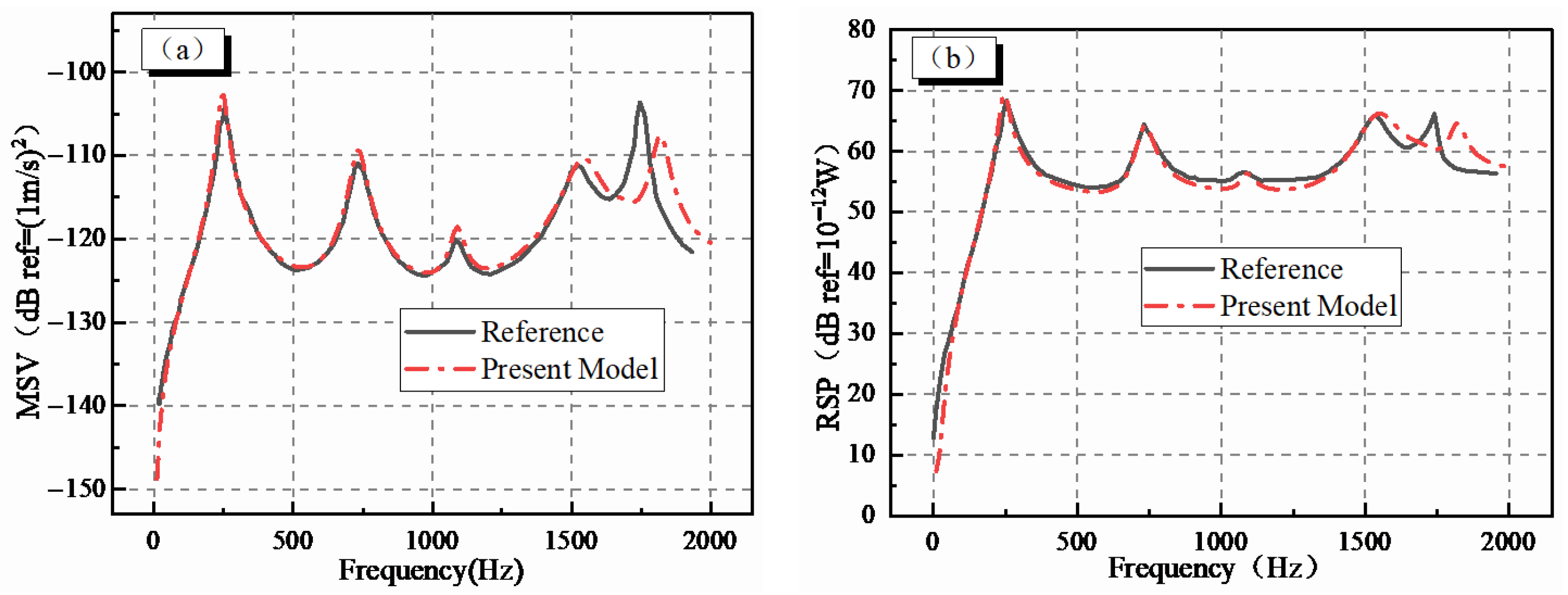
In addition, the forced vibroacoustic response is validated. Figure 1 presents the Mean Square Velocity (MSV) and Radiated Sound Power (RSP), expressed in decibel scale using standard reference quantities following Ref. [17].
For consistency with the benchmark, the MSV is expressed in level form using a reference velocity of v ref = 1 m / s . The resulting negative dB values are consistent with the benchmark definition and do not affect the relative response trends.
As shown in Figure 1, the numerical results exhibit excellent agreement with the analytical reference curves over the frequency range of 10–2000 Hz. The alignment of resonance peaks further confirms that the present solver accurately captures the hydro-elastic coupling behavior.
Since the adopted FSDT-FEM framework is based on fundamental continuum mechanics and wave propagation theory, it provides a robust and scalable approach for predicting vibroacoustic responses across different geometric configurations, provided that sufficient mesh resolution is maintained with respect to the wavelength.

3. Stiffness Saturation: Quantifying the Design Limit

3.1. Problem Description and Parametric Setup

A representative component-level stiffened plate ( 600 mm × 600 mm ) is selected as the baseline model to assess the influence of geometric stiffening. The geometric variable considered is the rib height H, which ranges from 10 mm to 30 mm, representing a progressive increase in bending stiffness.

3.2. Divergence Between Vibration and Acoustic Responses

The vibroacoustic response magnitude is quantified in terms of the mean square velocity level ( L v ) and the radiated sound power level ( L W ). For the subsequent parametric analyses in Section 3 and Section 4, standard underwater acoustic reference values are adopted to reflect engineering practice. These quantities are defined as:
L v = 10 log 10 v 2 v 0 2 , L W = 10 log 10 W W 0 .
where the reference velocity is v 0 = 5 × 10 8 m / s and the reference power is W 0 = 1 × 10 12 W . Unless otherwise specified, the dB values reported in this component-level analysis represent the total levels integrated over the frequency range of 10–1000 Hz. This frequency band is sufficient to capture the transition from the stiffness-controlled regime to the radiation-controlled regime for the 600 mm stiffened plate.
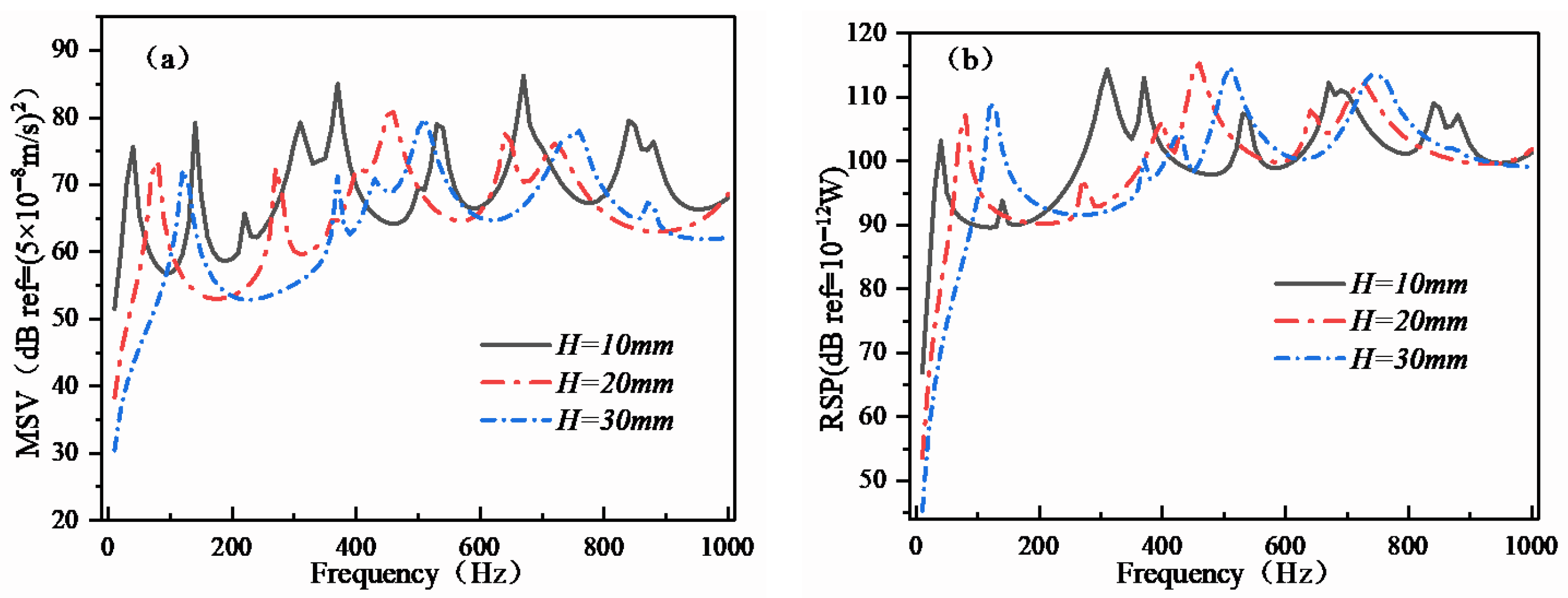
The results reveal a clear decoupling between structural vibration and acoustic radiation. As shown in Figure 2a, increasing the rib height leads to a significant reduction in vibration level. When H increases from 10 mm to 30 mm, L v decreases by 4.3 dB, from 93.8 dB to 89.5 dB, confirming that geometric stiffening effectively restrains structural motion.
However, the acoustic response shown in Figure 2b exhibits a fundamentally different trend. Despite the reduced vibration level, L W does not decrease accordingly; instead, it remains nearly unchanged and even shows a slight increase, from 124.5 dB to 125.0 dB. This contrast indicates the existence of a “stiffness saturation point”, beyond which further structural reinforcement fails to produce any meaningful acoustic benefit.

3.3. Engineering Implication: The Soft Limit

The discrepancy between vibration reduction and noise reduction can be explained by the fundamental relationship of radiated power:
W ( ω ) = ρ c S σ ( ω ) v 2 .
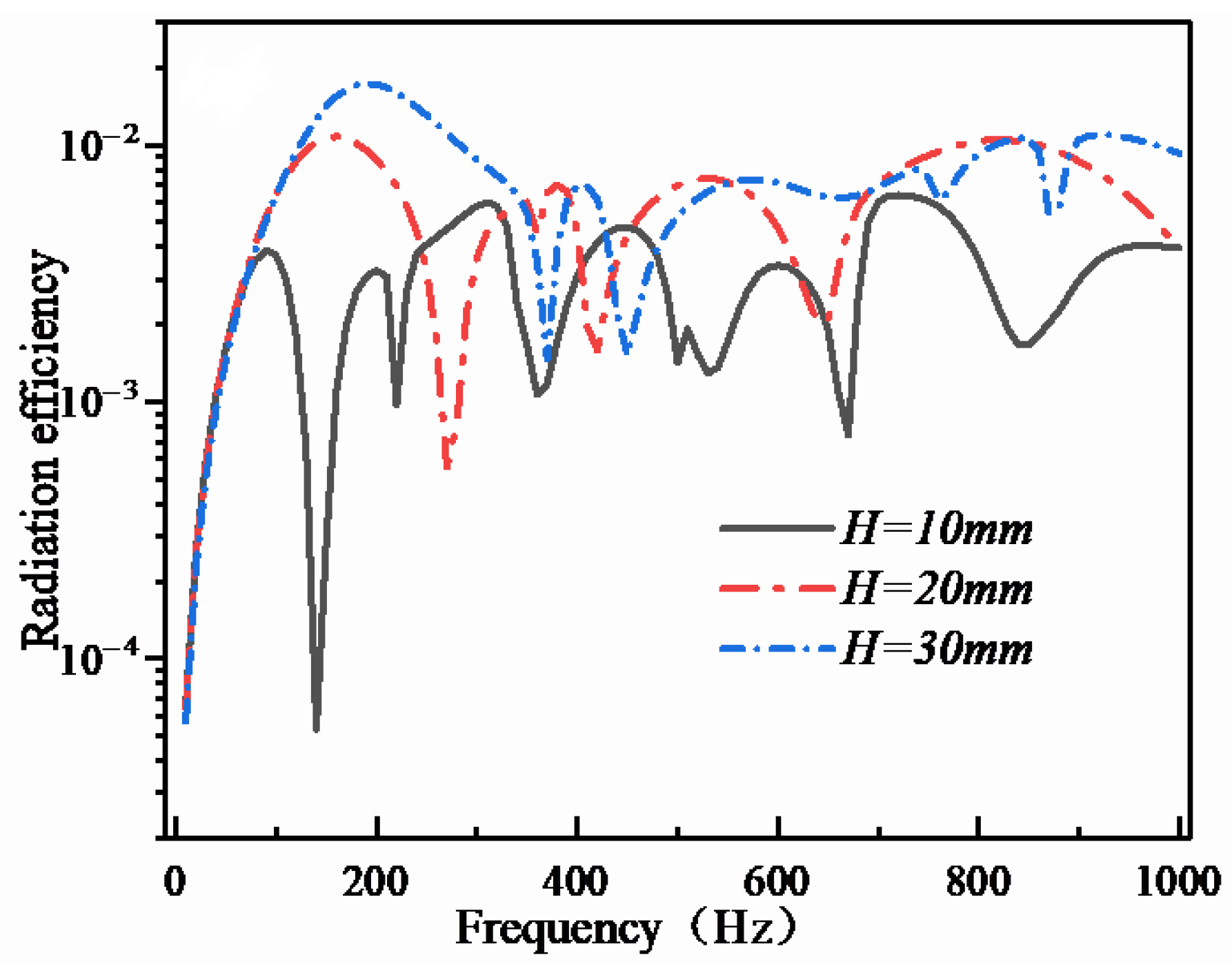
where ω is the angular frequency, ρ c is the characteristic impedance of water, S is the radiation area, σ ( ω ) is the radiation efficiency, and v 2 is the mean square velocity. As shown in Figure 3, increasing geometric stiffness accelerates bending waves, shifting the coincidence frequency lower and significantly increasing σ in the frequency band of interest. This increase in σ counteracts the reduction in v 2 , leading to the observed power saturation [7].
Although defining a universal dimensionless threshold for all composite structures is difficult because of material anisotropy, the engineering trend observed here is clear: beyond a certain stiffness level, the “penalty effect” of increased radiation efficiency becomes dominant, neutralizing the gains from reduced vibration velocity. Therefore, relying solely on geometric stiffening is inefficient for broad-band acoustic stealth.

4. Influence of Core Damping: Modulation Effect in Large-Scale Grillage

4.1. From Component Mechanism to System Application

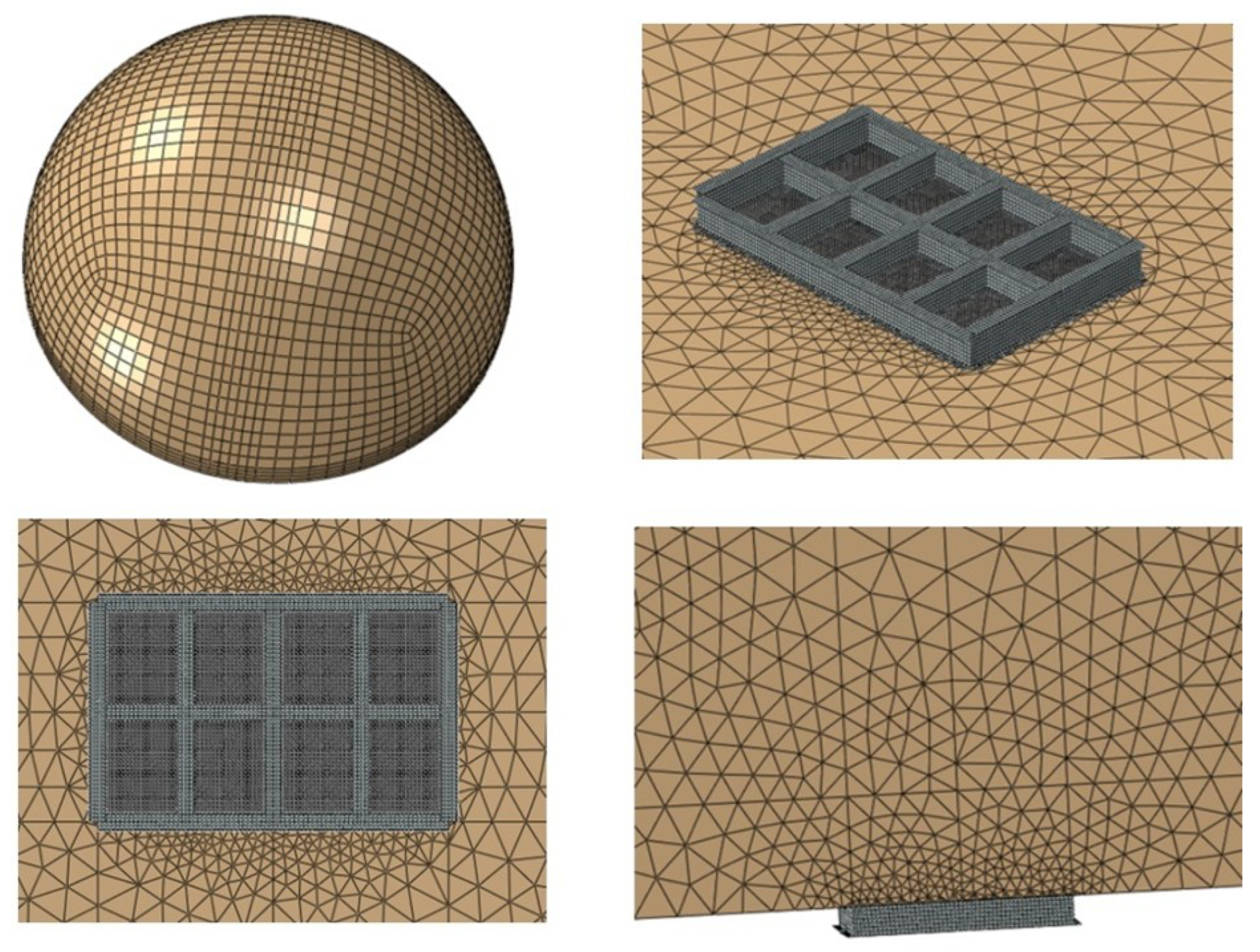
An infinite water environment is simulated by introducing a hemispherical fluid domain above the grillage, as illustrated in Figure 4. The radius of the hemispherical domain is taken as ten times the plate length ( R = 6 m) to ensure accurate capture of near-field acoustic radiation characteristics.
A key question, therefore, arises as to whether the damping modulation strategy can effectively serve as a compensatory solution in complex engineering structures. To address this, the investigation is extended to a full-scale composite grillage structure.
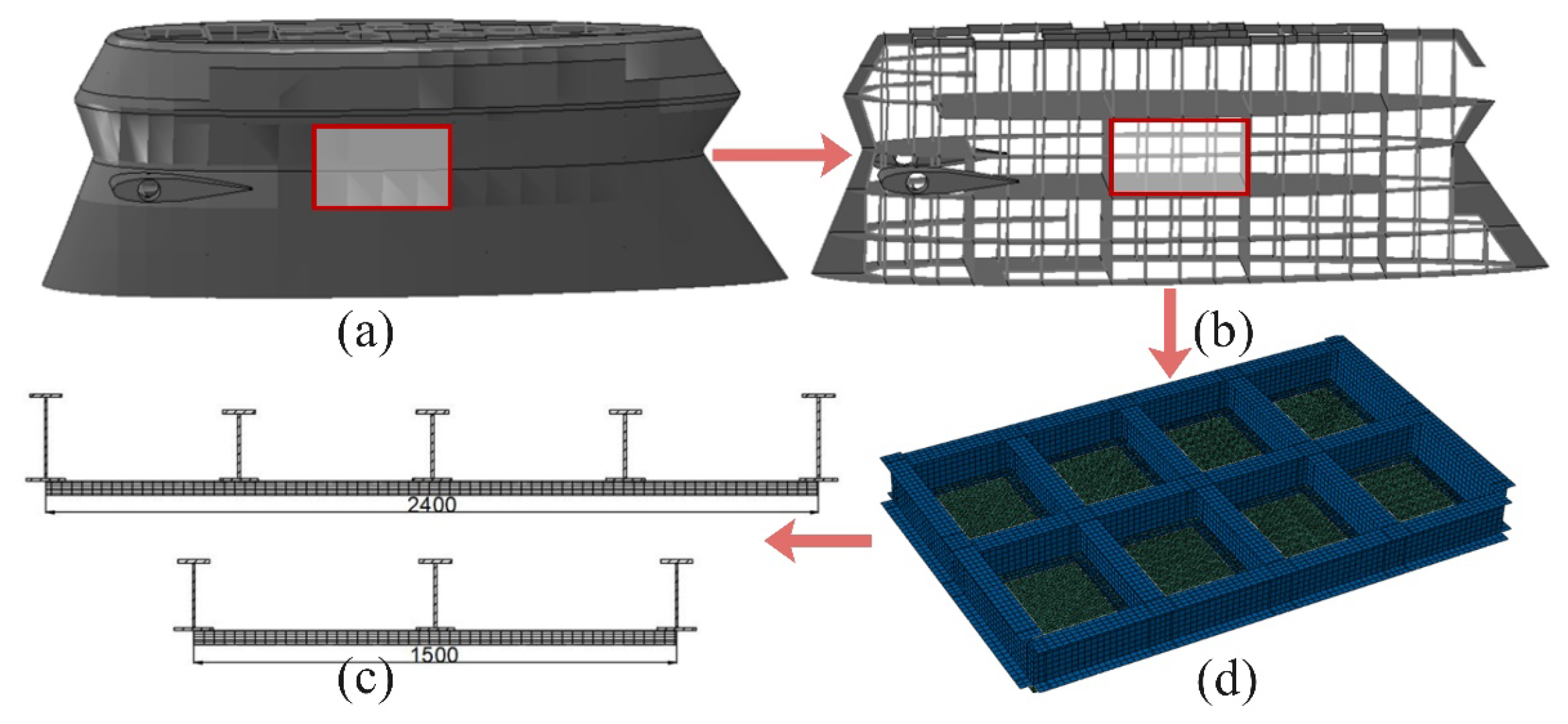
The geometric configuration of the model is shown in Figure 5. The panel measures 2400 mm × 1500 mm and is reinforced by a bidirectional grid of ribs. The detailed geometric parameters and environmental boundary conditions are summarized in Table 2.
Based on the homogenization framework validated in Section 2, two representative core configurations are considered for comparison. Case A employs a conventional PVC foam core and represents a stiffness-dominated design, whereas Case B adopts a high-damping composite core and represents a damping-modulated design. The corresponding material parameters are listed in Table 3, where E c , ν c , and η c denote the Young’s modulus, Poisson’s ratio, and loss factor of the core material, respectively. This setup enables a direct evaluation of the effect of core damping on the system-level vibroacoustic response.
The numerical model is implemented in ABAQUS. The composite skins and ribs are discretized using S4R shell elements, whereas the surrounding fluid domain is modeled with AC3D4 acoustic tetrahedral elements. The grillage edges are fully clamped to represent the structural connection to the submarine hull, and a unit harmonic point force ( 1 N ) is applied at the geometric center in the normal direction.
An unbounded underwater environment is represented by assigning ACIN3D4 infinite acoustic elements to the outer surface of the hemispherical fluid domain. This treatment satisfies the Sommerfeld radiation condition and suppresses artificial wave reflections. The bidirectional fluid–structure interaction is implemented through the surface-based acoustic–structural coupling procedure in ABAQUS, which enforces the compatibility condition between acoustic pressure and structural normal acceleration at the wetted interface. The radiated sound power is obtained by integrating the acoustic intensity over the fluid–structure interface using the built-in post-processing algorithm of ABAQUS.
Numerical accuracy is ensured by refining both the structural and acoustic meshes such that at least six elements per acoustic wavelength are maintained at the highest frequency of interest. A mesh sensitivity analysis further confirms that additional refinement produces no noticeable change in the predicted MSV and RSP responses.
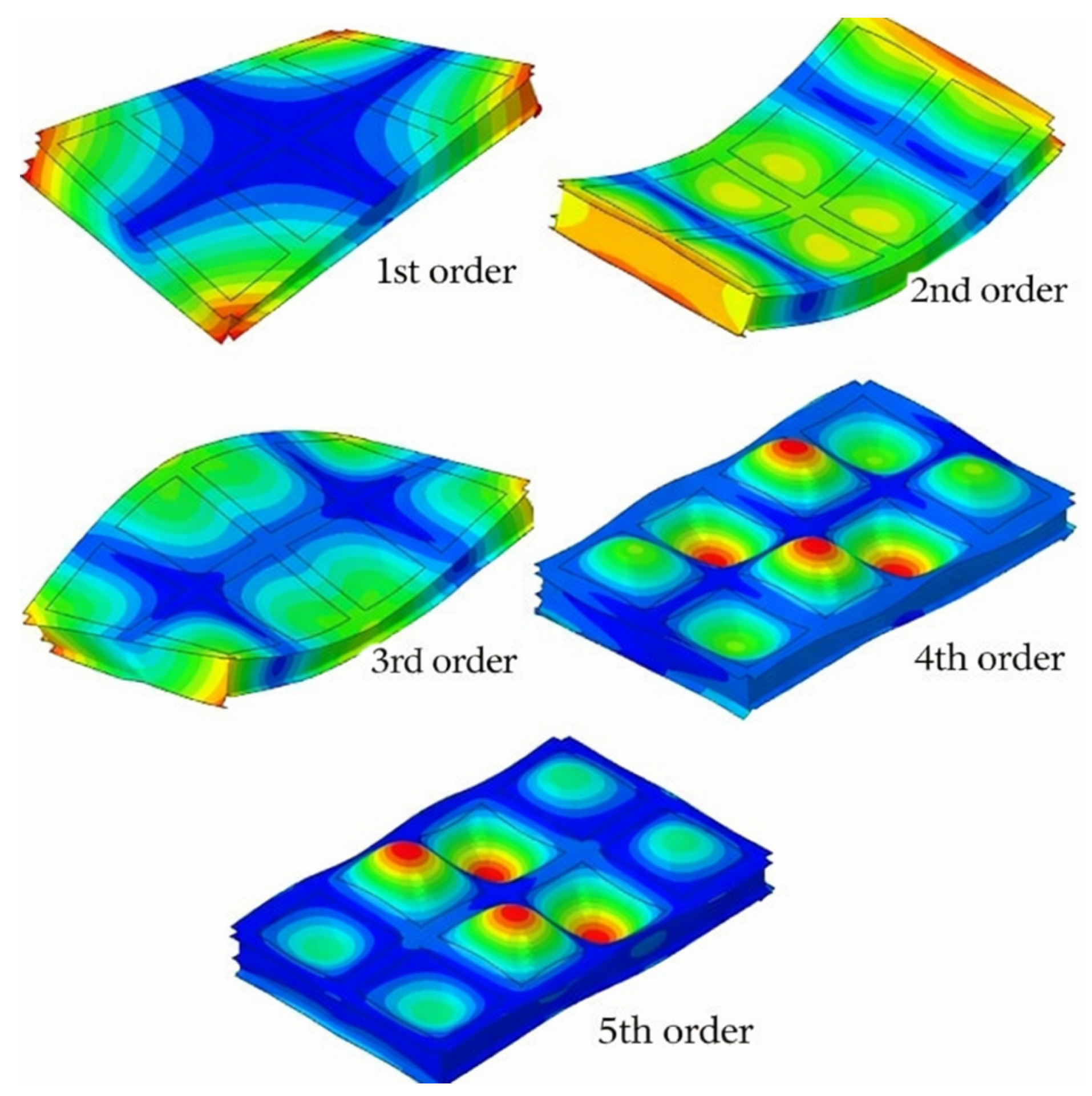
A primary concern when introducing high-damping materials is the potential reduction in global structural stiffness. While a comprehensive static load-bearing analysis is beyond the scope of the present study, the fundamental natural frequency is adopted as a proxy for assessing global stiffness. Table 4 compares the first five natural frequencies in vacuum. It is observed that replacing the stiff PVC core (Case A) with the softer high-damping core (Case B) results in only a marginal decrease in the fundamental frequency (from 29.38 Hz to 29.25 Hz, a drop of less than 0.5%).
Although higher-order modes (4th and 5th) exhibit a moderate frequency reduction (8%), their mode shapes, as shown in Figure 6, indicate predominantly localized panel vibrations rather than global structural deformation, whereas the first three modes involve global bending of the entire grillage. Since global dynamic stiffness is governed by low-order modes, the negligible variation in the first three natural frequencies (<1%) confirms that the overall structural stiffness is preserved. Although the 4th and 5th modes fall within the analyzed frequency band (10–1000 Hz), their spatially localized deformation limits their contribution to the global response and acoustic radiation. Therefore, the introduction of the high-damping core does not compromise the global structural integrity.

4.2. Broadband Acoustic Suppression

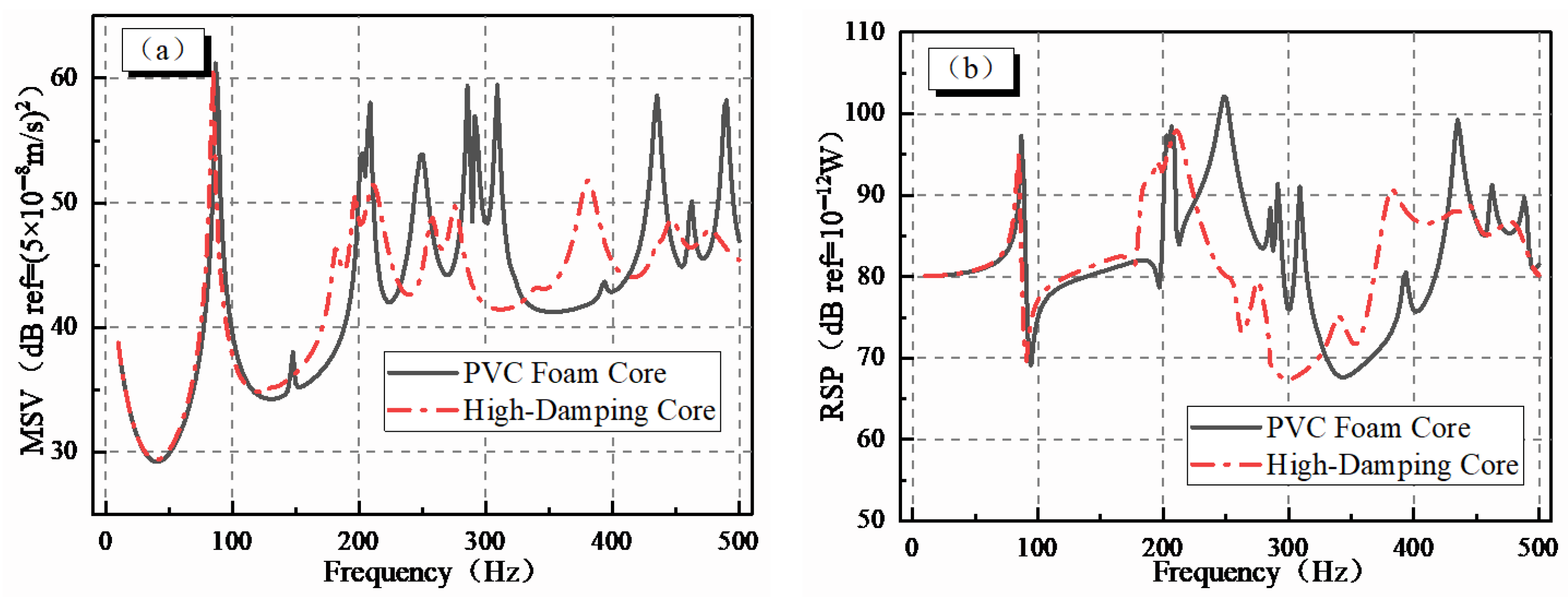
Figure 7 compares the Radiated Sound Power (RSP). Distinct from the saturation phenomenon observed in Section 3, the damping modulation strategy demonstrates a significant net acoustic gain.
Resonance suppression: At resonance peaks, where stiffness control usually fails, the high-damping core dissipates significant vibrational energy.
Band-integrated rerformance: For the full-scale grillage system, the analysis focuses on the 10–500 Hz band, which dominates the underwater acoustic signature. Within this frequency range, the total radiated sound power level is reduced by 2.73 dB. It should be noted that the response exhibits frequency-dependent variations. The observed local increase in certain frequency ranges is primarily associated with a shift of resonance peaks toward lower frequencies due to stiffness reduction, rather than an actual amplification of structural response. Overall, the damping modulation strategy effectively reduces resonance peak amplitudes and redistributes the spectral response, leading to a net reduction in band-integrated acoustic radiation.

4.3. Mechanism of Functional Decoupling

The superior performance of Case B verifies the concept of “Functional Decoupling” in composite design. In the proposed grillage system, the stiff skeleton is responsible for resisting deformation and determining the low-frequency impedance, thereby providing the primary load-bearing function, while the dissipative core converts kinetic energy into heat, particularly in the mid-to-high frequency range, serving as the main acoustic control mechanism.
Unlike geometric stiffening, which alters wave propagation speeds and may drive the structure into the high-radiation-efficiency regime, core damping acts purely through energy dissipation. This confirms that material damping represents a critical supplementary dimension in the structural design space, enabling further reduction of noise levels in frequency ranges where stiffness-based strategies have already reached their saturation limit.

5. Conclusions

This paper presented a numerical investigation into the underwater vibroacoustic characteristics of composite grillage structures, focusing on the distinct roles of geometric stiffening and core damping. The following key conclusions are drawn:
1.
Clarification of design limits: The study quantifies the limitations of geometric stiffening in underwater environments. It highlights that the “stiffness saturation” is not merely a theoretical concept but a practical barrier in grillage design, occurring when the radiation efficiency penalty offsets the vibration reduction benefits.
2.
Efficacy of damping modulation: To overcome this limit, the core damping modulation strategy was verified on a full-scale grillage system. Results demonstrate that utilizing a high-damping core provides a significant net acoustic gain, effectively suppressing broadband noise and resonance peaks without inducing the radiation efficiency penalties associated with stiffening.
3.
Hierarchical synergistic design strategy: Consequently, a hierarchical synergistic design perspective is suggested: geometric stiffness should be prioritized for structural load-bearing and low-frequency vibration control, while core damping should be leveraged to address the mid-to-high frequency radiation. This approach offers a pragmatic framework to achieve a balanced low-noise design in the absence of fully unified quantitative analytical laws.

Author Contributions

Conceptualization, D.W. and Z.Z.; methodology, D.W.; software, D.W.; validation, D.W. and Y.Z.; formal analysis, D.W.; investigation, D.W.; resources, Z.Z. and Y.Z.; data curation, D.W.; writing—original draft preparation, D.W.; writing—review and editing, Z.Z. and Y.Z.; visualization, D.W.; supervision, Z.Z. and Y.Z.; project administration, Y.Z. All authors have read and agreed to the published version of the manuscript.

Funding

This research was funded by the National Key Laboratory of Electromagnetic Energy, Grant No. 614221725020103, and the China Postdoctoral Science Foundation, Grant No. 2023M744282.

Institutional Review Board Statement

Not applicable.

Informed Consent Statement

Not applicable.

Data Availability Statement

The data presented in this study are available on request from the corresponding author.

Conflicts of Interest

The author declares no conflict of interest.

Abbreviations

The following abbreviations are used in this manuscript:
FSDTFirst-order Shear Deformation Theory
FEMFinite Element Method
FSIFluid–Structure Interaction
MSVMean Square Velocity
RSPRadiated Sound Power
RVERepresentative Volume Element
IAHMImproved Asymptotic Homogenization Method

References

  1. Zhang, Y.; Sun, Z.; Yu, T. Vibro-Acoustic Coupling Characteristics Underwater of Disc-Shaped Double-Layer Shell with Stiffeners. J. Mar. Sci. Eng. 2025, 13, 1821. [Google Scholar] [CrossRef]
  2. Mouritz, A.P.; Gellert, E.; Burchill, P.; Challis, K. Review of advanced composite structures for naval ships and submarines. Compos. Struct. 2001, 53, 21–42. [Google Scholar] [CrossRef]
  3. Rubino, F.; Nisticò, A.; Tucci, F.; Carlone, P. Marine Application of Fiber Reinforced Composites: A Review. J. Mar. Sci. Eng. 2020, 8, 26. [Google Scholar] [CrossRef]
  4. Wasti, S.; Kamath, D.; Armstrong, K.; Clarkson, C.; Tekinalp, H.; Ozcan, S.; Vaidya, U. Life cycle assessment of coir fiber-reinforced composites for automotive applications. J. Clean. Prod. 2024, 485, 144368. [Google Scholar] [CrossRef]
  5. Yin, Z.; Wei, Y.; Zhong, J.; Sun, Y.; Yang, J.; Zhang, W.; Zhao, H. Mechanisms and design of composite sandwich structures for underwater sound absorption. J. Phys. Conf. Ser. 2025, 3080, 012184. [Google Scholar] [CrossRef]
  6. Caresta, M.; Kessissoglou, N.J. Acoustic signature of a submarine hull under harmonic excitation. Appl. Acoust. 2010, 71, 17–31. [Google Scholar] [CrossRef]
  7. Zhou, Z.; Mei, Z.; Wu, D.; Chen, G. Vibroacoustic behavior of submerged stiffened composite plates excited by a turbulent boundary layer. J. Sound Vib. 2022, 528, 116894. [Google Scholar] [CrossRef]
  8. Smith, T.A.; Rigby, J. Underwater radiated noise from marine vessels: A review of noise reduction methods and technology. Ocean Eng. 2022, 266, 112863. [Google Scholar] [CrossRef]
  9. Song, X.; Jin, G.; Li, H.; Zhong, S.; Ye, T.; Chen, Y. Vibro-acoustic modeling of the turbulent excited cavity-plate-exterior space coupled system. Int. J. Mech. Sci. 2024, 279, 109627. [Google Scholar] [CrossRef]
  10. Zou, M.; Liu, S.; Qi, L. An analytical formulation for the underwater acoustic radiation of a cylindrical shell with an internal flexural floor based on the reciprocity theorem. Appl. Acoust. 2019, 154, 18–27. [Google Scholar] [CrossRef]
  11. Sun, Y.; Li, Y.; Zhang, G.; Lee, H.P.; Zheng, H.; Li, F. Inertial amplification stiffened meta-panels for low-frequency sound insulation. Int. J. Mech. Sci. 2025, 290, 110116. [Google Scholar] [CrossRef]
  12. Fahy, F.; Gardonio, P. Sound and Structural Vibration: Radiation, Transmission and Response; Academic Press: Oxford, UK, 2007. [Google Scholar]
  13. Wallace, C.E. Radiation Resistance of a Rectangular Panel. J. Acoust. Soc. Am. 1972, 51, 946–952. [Google Scholar] [CrossRef]
  14. Dong, G.; Wu, F. Design and Acoustic Performance Research of Underwater Acoustic Absorption Metamaterials. Materials 2025, 18, 5075. [Google Scholar] [CrossRef] [PubMed]
  15. Wu, D.; Mei, Z.; Hu, H.; Zhu, Y. An improved asymptotic homogenization method for vibration analysis of composite sandwich plates with lattice grids. Compos. Struct. 2023, 308, 116629. [Google Scholar] [CrossRef]
  16. Wu, D.; Mei, Z.; Zhu, Y.; Hu, H. Development of an ABAQUS plug-in for predicting composite plates stiffness with in-plane periodicity. SoftwareX 2023, 21, 101281. [Google Scholar] [CrossRef]
  17. Berry, A.; Locqueteau, C. Vibration and sound radiation of fluid-loaded stiffened plates with consideration of in-plane deformation. J. Acoust. Soc. Am. 1996, 100, 312–319. [Google Scholar] [CrossRef]
Figure 1. Vibroacoustic response validation: (a) mean square velocity; (b) radiated sound power.
Acoustics 08 00024 g001
Figure 2. Vibration and acoustic radiation changes of different reinforcement heights (a) the mean square velocity (b) the radiated acoustic power.
Acoustics 08 00024 g002
Figure 3. The radiated efficiency changes of different reinforcement heights.
Acoustics 08 00024 g003
Figure 4. Finite element model of the composite grillage structure and the surrounding hemispherical fluid domain for underwater vibro-acoustic analysis.
Acoustics 08 00024 g004
Figure 5. Geometric definition of the composite grillage structure: (a) Submarine sail structure; (b) Internal skeleton frame; (c) Cross-sectional dimensions; (d) Finite element mesh ( 2400 mm × 1500 mm ).
Acoustics 08 00024 g005
Figure 6. Mode shapes of the first five natural frequencies.
Acoustics 08 00024 g006
Figure 7. Comparison of vibration and sound response of different filling core frame (a) mean square velocity (b) radiated sound power.
Acoustics 08 00024 g007
Table 1. Comparison of dimensionless natural frequencies with benchmark [17] solutions.
Mode OrderPresent ModelReferenceRelative Error (%)
12.3712.373−0.08%
24.9724.8183.20%
36.8526.910−0.84%
47.6247.627−0.04%
59.0159.023−0.09%
Table 2. Key parameters of the full-scale composite grillage model.
CategoryParameterSymbolValue
GeometryPanel dimensions L × W 2400 mm × 1500 mm
Skin thickness h s 4 mm
Core thickness h c 30 mm
Rib height H rib 30 mm
Rib spacing S x , S y 300 mm
PhysicsBoundary conditionFully clamped
Fluid density ρ f 1000 kg / m 3
Fluid sound speed c f 1500 m / s
Table 3. Material properties of the core layers for the comparative study.
ConfigurationCore Type E c ν c η c Design Strategy
Case APVC foam 500 MPa 0.210.02Stiffness-dominated
Case BHigh-damping core 50 MPa 0.400.40Damping-modulated
Table 4. Comparison of natural frequencies in vacuum for different core configurations.
Mode OrderCase A (PVC Core) [Hz]Case B (High-Damping Core) [Hz]Difference (%)
129.3829.25−0.44%
2144.40145.27+0.60%
3164.89164.14−0.45%
4331.93304.05−8.40%
5334.95309.04−7.73%
Disclaimer/Publisher’s Note: The statements, opinions and data contained in all publications are solely those of the individual author(s) and contributor(s) and not of MDPI and/or the editor(s). MDPI and/or the editor(s) disclaim responsibility for any injury to people or property resulting from any ideas, methods, instructions or products referred to in the content.