Article

Soundscapes Across Mountains and Cities: A Linguistic Study in the Trentino Region

by
Giacomo Gozzi
1,*,
Simone Torresin
1 and
Linda Badan
2
1
Department of Civil, Environmental and Mechanical engineering, University of Trento, 38123 Trento, Italy
2
Department of Linguistic and Literary Studies, University of Padua, 35137 Padova, Italy
*
Author to whom correspondence should be addressed.
Acoustics 2026, 8(1), 8; https://doi.org/10.3390/acoustics8010008
Submission received: 11 December 2025 / Revised: 14 January 2026 / Accepted: 26 January 2026 / Published: 30 January 2026
(This article belongs to the Collection Historical Acoustics)

Abstract

Trentino, a sparsely populated and almost entirely mountainous region in northeastern Italy, has so far received little attention in linguistic studies on soundscapes, which provide an important cultural ecosystem service. This study analyzes the responses of 68 participants—31 from mountain areas and 37 from urban areas—to an open-ended questionnaire adapted from Guastavino, using a mixed-methods approach to investigate: (1) differences in current and ideal soundscape perception between residents of urban and mountain areas in Trentino; (2) how these findings compare with Guastavino’s study conducted in a purely urban context; (3) the role of Trentino’s multilingual context in shaping the description and understanding of the soundscape. Findings reveal that, in addition to a latent substratum of the dialectal component, differences emerge mainly in the description of ideal soundscapes. Urban participants evaluate human sounds more negatively and use metonymic expressions for mechanical noises. Mountain participants align their ideal soundscape more closely with their lived experience, often identifying the sound source rather than the sound itself. Tranquility and silence are central values across both groups for the ideal soundscape and for the current one, cognitively linked to natural environments, which therefore remains a cultural legacy to be preserved.

1. Introduction

Soundscapes constitute an important cultural ecosystem service [1], understood as the “non-material benefits people obtain from ecosystems through spiritual enrichment, cognitive development, reflection, recreation, and aesthetic experiences” [2]. The perception and interpretation of the acoustic environment by humans (i.e., the soundscape [3]) can be particularly relevant as cultural ecosystem services in mountain regions [4], where tranquility and natural sounds are expected to predominate [5] but may be threatened by increasing tourism pressure, due to overtourism phenomena in popular areas of scenic beauty [6,7]. This study aims to examine similarities and differences in how residents of mountain and urban areas describe both ideal and current soundscapes, using Trentino—a sparsely populated and predominantly mountainous region in northeastern Italy—as a case study. While soundscape studies have shown a growing interest in recent years toward linguistic descriptions [8], the work addresses the scarcity of linguistic research in Italian on soundscapes, and specifically on soundscapes in mountain contexts. Trentino’s multilingual setting further enhances the relevance of this investigation. Understanding whether there are differences in the perception and interpretation of soundscapes between urban and mountain environments can help determine whether soundscape management strategies should be universal or tailored to specific local contexts.
In recent years, attention to soundscapes in mountain and/or protected areas has increased [9,10,11,12]. Nevertheless, the relationship between language and soundscape perception has been investigated primarily in urban contexts [13,14]. The present study takes as its starting point Guastavino’s research [15], which used a questionnaire administered to 77 respondents and a psycholinguistic analysis of verbal descriptions to examine how ideal and current urban soundscapes are perceived and evaluated in three large French cities. Guastavino’s study effectively demonstrated that a narrative approach and open-ended questionnaires can yield rich, detailed linguistic data. This qualitative evidence serves as a valuable complement to the structured questionnaire-based methods established following the publication of the ISO 12913 standards [16]. As explained by Aletta et al. [17], one of the three principal methods employed in soundscape research is based on recalling the auditory experiences from memory. This approach entails the use of narrative as a means of expressing concepts, opinions, and cognitively embodied experiences (referring to the notion of embodiment [18]), through which participants articulate their perceptions of both the ideal and the real soundscape. Qualitative research methods (i.e., semi-structured interviews) play a central role in this research, as it facilitates a deeper understanding of individual perceptions and experiences related to the soundscape, as shown in other studies [19,20]. Indeed, the qualitative approach captures nuances that quantitative data may overlook.
Although this study was conducted in Italian, in Trentino there is still a strong sense of belonging and influence from the dialectal linguistic component, as well as from the three minority languages protected at the provincial level (Ladin [21,22], Mòcheno [23,24], and Cimbrian [25,26]). The Trentino dialect is not an officially recognized language. It belongs to the Gallo-Romance group and shows strong influence from both Venetian and Lombard dialects. Dialect remains a deeply rooted and vibrant marker of local identity, and is therefore a key aspect to consider and explore when studying how residents of the region conceptualize its soundscape.
The present research investigates the following questions:
  • What is the difference in the perception of the current and ideal soundscape between people living in urban contexts versus those living in mountain contexts in Trentino?
  • How do these differences compare with the study by Guastavino conducted in a purely urban context?
  • What role does Trentino’s multilingual context play in shaping the description and understanding of the soundscape, in relation to the different living environments (urban vs. mountain) in which participants reside?
In the following the questionnaire design (Section 2.1), the data collection procedures (Section 2.2), and the analytical approach adopted in this study (Section 2.3) are described. The results are then presented according to the three research questions, focusing, respectively, on the comparison between ideal and current soundscapes (Section 3.1), the differences with Guastavino’s study (Section 3.2), and the influence of local dialects on soundscape descriptions (Section 3.3).

2. Materials and Methods

The following section outlines the design of the questionnaire employed as the interview protocol, the interview procedure, and the analytical framework applied to the collected interview material, integrating both quantitative and qualitative analyses.

2.1. Questionnaire

The study is based on the free and spontaneous responses to the questionnaire modeled on the one used in Guastavino [15], translated in Italian and administered to 68 adult participants—31 from the mountain group and 37 from the urban group. Among them, 12 were students and professors from the University of Trento, while affiliations with other universities were not recorded. All interviews were conducted within the Autonomous Province of Trento, in the municipalities of (urban context) Trento, Levico Terme, Caldonazzo, Pergine Valsugana, (mountain context) Altopiano della Vigolana, Fierozzo, and Palú del Fèrsina.
The mountain context refers to areas located above 700 m above sea level, according to the altimetric classification criteria adopted by ISTAT (Italian National Institute of Statistics) [27], and with a population below 3000 inhabitants. The urban context includes all settlements located below this elevation. Hamlets and small towns with fewer than 3000 inhabitants were also classified as urban areas, provided that they were situated below 700 m above sea level.
As mentioned above, the proposed questionnaire was entirely modeled on the one employed in Guastavino’s study [15] to analyze the soundscape in three French cities and is presented in Table 1. The slight modifications made to the administered Guastavino’s questionnaire shift the focus from the urban soundscape to the one experienced by the interviewees, creating a context that differs significantly from that of French cities. The adjective “urban” was removed from Questions 1, 2, 3, and 4, while the phrase “non-urban” was added. The term “transportation” was replaced with “traffico” (“traffic”) in Question 5, as it more closely reflects contemporary usage in Italian compared to “mezzi di trasporto.” According to the Treccani Italian dictionary [28], “traffico” inherently encompasses all types of transport, including the movement of passengers and goods. The term can refer both to circulation across different modes (maritime, air, rail) and more specifically to vehicles circulating on roads. In Question 4, the singular form “environment” was retained in Italian, as using the plural would have required additional clarification (e.g., “Which environments?”). Question 3 refers to the perception of high- or low-pitched sounds, which, from a physical standpoint, relates to the fact that sounds audible to humans can be divided into three categories: low-frequency sounds (low-pitched), ranging from 20 Hz to 250 Hz; mid-frequency sounds, from 250 Hz to 2000 Hz; and high-frequency sounds (high-pitched), from 2000 Hz to 20,000 Hz. A comparison between the original questionnaire used in Guastavino’s study and the one employed in the present study is provided in Table 1.

2.2. Procedure

All interviews were conducted in person. The transcriptions are available as Supplementary Materials.
The average duration of the interviews differed by nearly one minute between the mountain group (≈5 min and 42 s) and the urban group (≈6 min and 39 s). Most interviews were conducted indoors (94.1% of the total participants, N = 68)—at participants’ residences, workplaces, study environments, or in incidental locations—while a smaller proportion took place outdoors (5.9%), typically near workplaces or study sites.
Participants were selected by the interviewer through convenience sampling. All individuals not officially residing in the Trentino region (12%) had been domiciled there for at least one year and were all classified as belonging to the urban group due to their previous urban background. Conversely, individuals officially residing in the region but domiciled elsewhere (3%) had lived outside the region for less than six years. For quantitative analysis purposes, individual occurrences were also taken into account.
Of the 68 interviews, 66 were recorded using a Zoom H6 recorder (Zoom Corporation, Tokyo, Japan) and 2 using an iPhone SE 2020 (Apple Inc., Cupertino, CA, USA). The recordings were subsequently transcribed automatically using the Microsoft 365 Dictation tool and then manually reviewed. During the review process, punctuation was corrected—such as the use of ellipses (…) to indicate prolonged pauses or unfinished sentences—as well as interjections (e.g., diciamo—let’s say, ehm, mhm, beh, ecco—so, cioè—that is, or /′t∫ε/, the latter commonly used among younger speakers) and unintelligible words. Functional and unintentional repetitions were preserved in the transcripts. However, the quotations included in this article have been adapted to standard written language, with a focus on the content of the responses rather than their original spoken form.

2.3. Analysis

The recordings were listened to twice and the transcriptions were corrected. An analysis was then conducted on the participants’ open-ended responses to the five questionnaire questions. A total of 681 descriptions were obtained and analyzed qualitatively, following the procedure outlined in Guastavino [15]. The analysis began with a manual count of the occurrences of sounds, noises, objects, or perceptions described by the participants. The categories were then represented graphically, using—where possible—the same sound categories adopted by Guastavino [15], and maintaining the same graphical representation.
Both the ideal and the current soundscapes were analyzed by classifying participants’ responses as either negative, highlighting elements they wished to avoid, or positive, specifying elements that could or could not be present, with the distinction between positive and negative judgments applied consistently. Within these descriptions, multiple occurrences of different categories and subcategories—as organized by Guastavino—could appear. For example, in a response to the first question about the ideal soundscape, one participant from the mountain group expressed a preference for nature sounds in general (=1 occurrence in the “Nature” category, subcategory “Nature”, which reflects a general preference for natural environments), birdsong (=1 occurrence in the “Birds” category), and the sound of the wind (=1 occurrence in the “Nature” category, =1 occurrence subcategory “Wind”). In total, this results in 2 occurrences for the “Nature” category (1 occurrence in the “Nature” subcategory and 1 in the “Wind” subcategory), plus 1 occurrence in the “Birds” category.
In cases where a sound source was described by the participant using several examples belonging to the same subcategory, (e.g., “flowing water, perhaps a river or a stream”), only one occurrence was counted in the “Nature” category, subcategory “Water.” If, on the other hand, an explanatory sentence listed two sound sources belonging to different categories or subcategories—for example, “perhaps birdsong, or alternatively wild animals”—these were counted separately (=1 occurrence in the “Birds” category and 1 occurrence in the “Nature” category, subcategory “Other animals”). Two further examples illustrate this coding procedure. The expression “the rustling of leaves” was counted as 2 occurrences in the “Nature” category—1 occurrence in the “Wind” subcategory and 1 in the “Leaves” subcategory. By contrast, the expression “the rustling of the wind through the leaves” was coded as 2 occurrences in the “Nature” category: 1 occurrence in a single subcategory (as rustling and wind are contiguous and pertain to the same subcategory), and 1 occurrence in the “Leaves” subcategory. Non-contiguous references indicating two possible distinct sound sources were counted separately, even if they belonged to the same subcategory. For instance, in the description “…there might be some animal. It could also be a sound made by the dog,” two occurrences were recorded in the “Nature” category and two in the “Animals” subcategory.
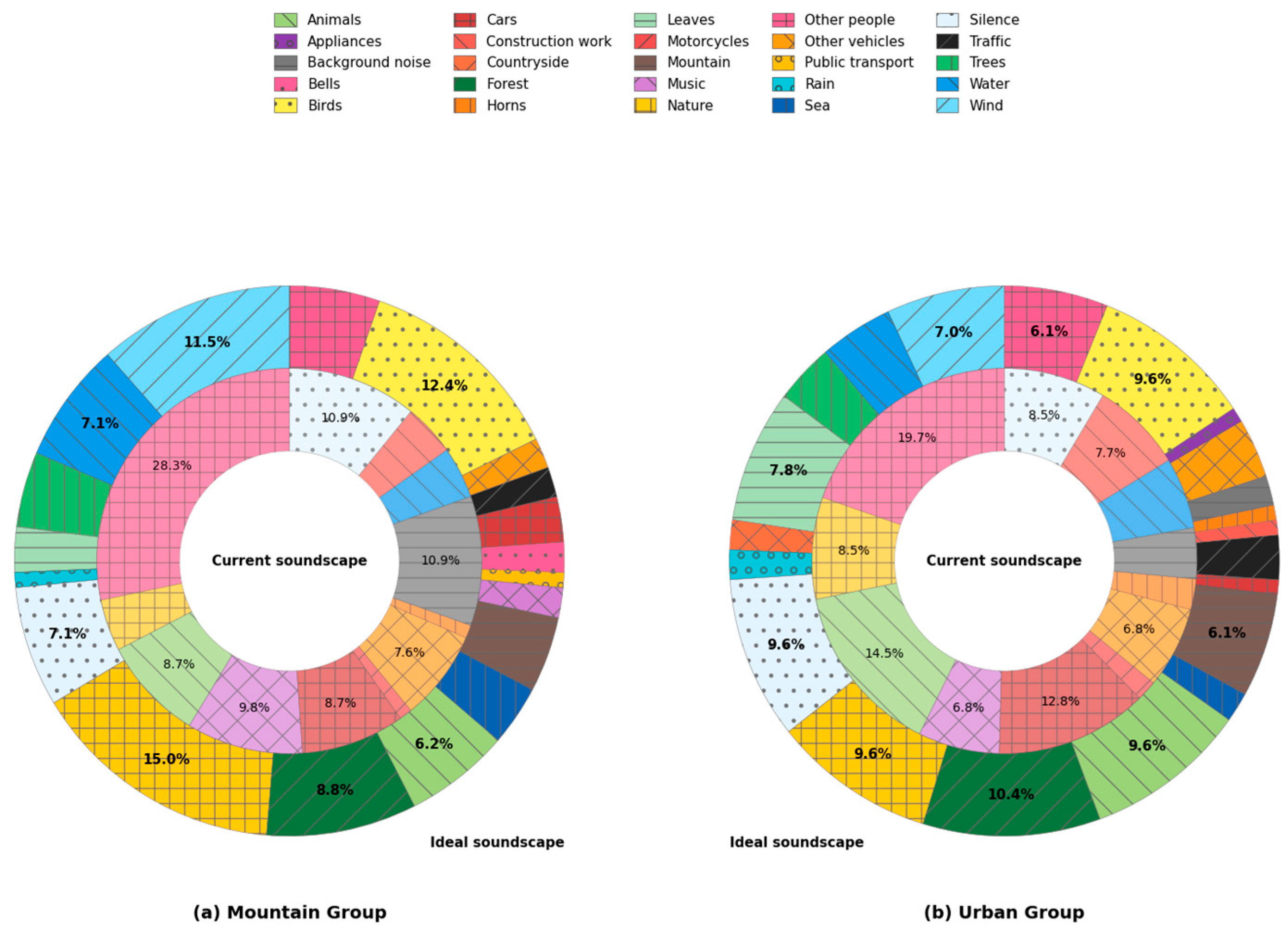
Figure 1 provides an overview of the data collected on the ideal soundscape (Question 1) and the current soundscape (Question 2). To simplify visualization, positive and negative judgments have been combined, and two separate donut charts are shown for each group (Mountain and Urban), with the outer ring showing the total occurrences per category and subcategory for Question 1, and the inner ring showing the total occurrences per category for Question 2.
Starting from the number of occurrences within the categories and subcategories, as just described, Fisher’s exact test [29] was performed to assess differences between proportions of the categories and subcategories (i.e., positive vs. negative judgments) in two group variables (mountain vs. urban samples). Analyses were performed in SPSS (version 30.0). The significance threshold was set at 0.05.

3. Results

The results are organized according to the three research questions (see Section 1). The first research question is examined in greater detail in order to highlight the most salient categories of sound sources identified in the participants’ responses.

3.1. The Ideal vs. Current Soundscape

The ideal soundscape was investigated only in the first question of the questionnaire adapted from Guastavino (Table 1), whereas the remaining four questions focused on the participants’ current soundscape.
When asked to describe their ideal soundscape (Question 1), most respondents in both groups referred to environments containing one or more natural sound sources—93.5% of the mountain group and 91.9% of the urban group. Within the 68 total descriptions collected, the percentage of responses describing a sound object versus those describing a soundscape as a whole are as follows: 74% of responses describe a sound object, while 26% describe the ideal soundscape in the mountain group, and 76% describe a sound object, while 24% describe the ideal soundscape in the urban group. Table 2 summarizes these distributions, providing a clear overview of the proportions for each group.
In the second question participants tended to reflect on multiple familiar contexts; therefore, during the interviews, when in doubt, they were prompted to consider their home, workplace, or frequented locations. A total of 209 descriptions were collected. Negative and positive judgments were equally distributed across both groups: 50% negative and 50% positive. Lower exposure to mechanical sounds correlates with increased negative judgments toward human-generated noises and background noises. Five participants (3 from the mountain group and 2 from the urban group) reported no unpleasant sounds in their environment; thus, they were excluded from the occurrence count.
The third question proved challenging for the interviewees. The difficulty in defining a high sound versus a high-pitched sound stems from the common perception that these must be loud, and therefore inevitably noticeable. 32% of the mountain group and 22% of the urban group responded that they either do not have or do not recognize high-pitched sounds, compared to 48% of the mountain group and 27% of the urban group for low-pitched sounds. In general, high-pitched sounds are considered more annoying than low-pitched sounds, which are described as more continuous and related to background noise.
The fourth question focused on background noise. 81% of the mountain group reported perceiving a background noise, 6% said they did not perceive any, and 13% stated they did not perceive it but were still able to describe either its characteristics or some of its components. Similar percentages were found in the urban group: 86% gave affirmative responses (i.e., they could hear background noise in their environment), 8% responded negatively, and 5% gave negative responses but still included additional descriptions.
The fifth question explored the impact of traffic noise in urban and non-urban areas. A total of 128 descriptions were collected: 59 from the mountain group (with two participants unable to describe traffic noise) and 69 from the urban group. Among those who made a comparison, the majority (65%) found traffic noise more annoying in urban areas than in non-urban ones. A smaller portion (25%) found it more bothersome in non-urban areas, where it is unexpected or out of place within the visual landscape. 10% of the mountain group reported not being sensitive to traffic noise, as did 16% of the urban group.
In the following sections we will examine the categories that emerged from participants’ answers to the five questionnaire questions, comparing how the ideal soundscape is conceptualized in relation to the current soundscape.

3.1.1. Nature

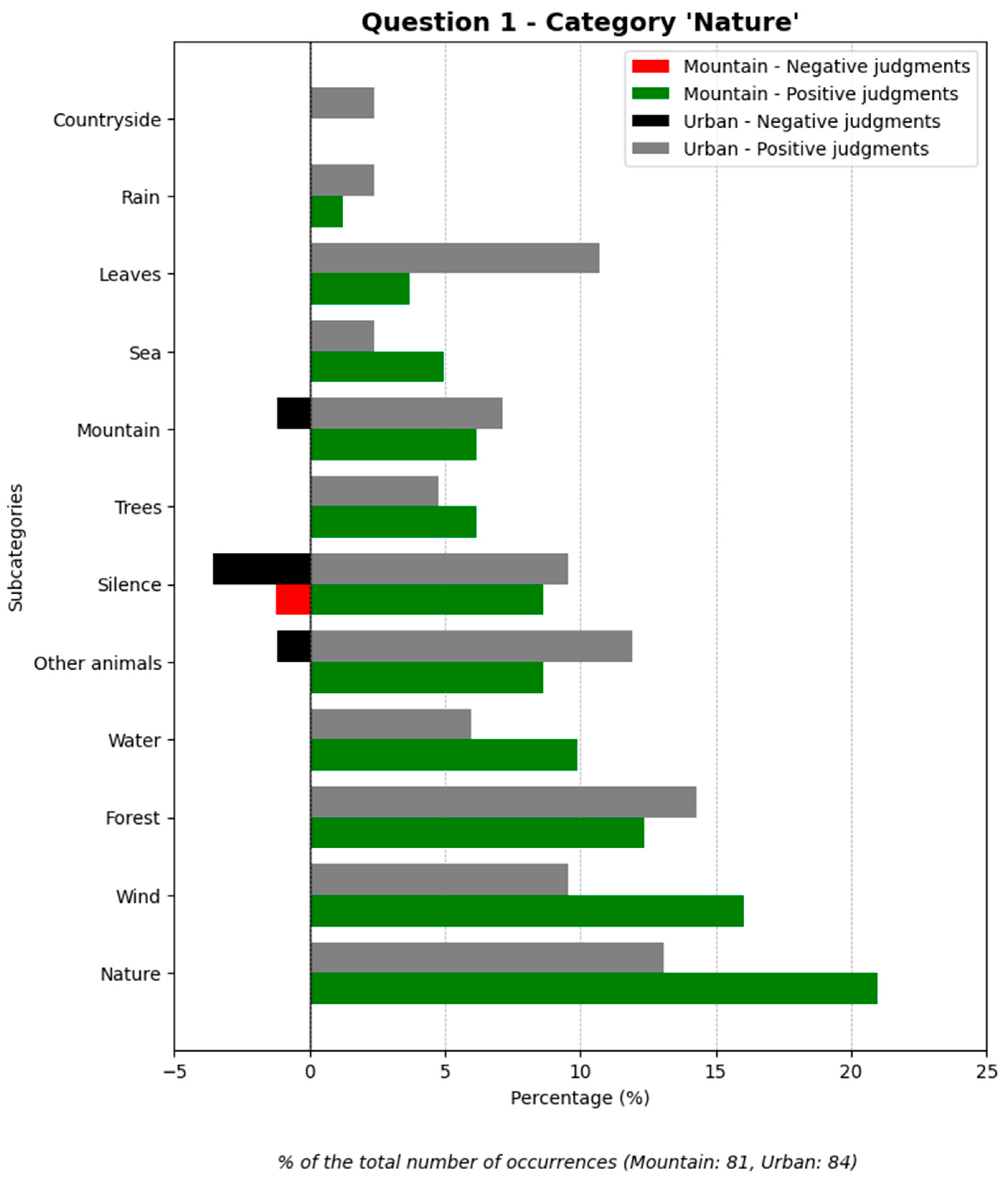
As seen in Figure 2, a strong preference emerges for the “Nature” category: 58% (n = 18) of the mountain group express a general preference for a natural soundscape, as does 35.1% (n = 13) of the urban group (subcategory “Nature”). Among them, only one respondent from the mountain group explicitly prefers the natural landscape in general, while all others mention both the general environment and specific natural elements. 35.5% (n = 11) of the mountain group refer exclusively to natural elements, compared to 56.8% (n = 21) of the urban group. 6.5% (n = 2) of the mountain group and 8.1% (n = 3) of the urban group do not mention nature at all. However, differences between the two groups in mentioning general nature, specific natural elements, both, or not mentioning nature at all, were not substantiated by statistical significance (p = 0.187). The term “Nature” appears 18 times in the mountain group and 13 times in the urban group, used either: as a place (“surrounded by nature”, “in nature”), as an object of a statement (“I love nature,” “anything related to nature”), or most commonly, as a specifier (“background,” “sounds”, “noises” of nature). Other related terms include: “natural” and “naturalistic”. This variety suggests that respondents attribute a complex and multifaceted meaning to nature, beyond merely referring to a physical space. The concept of “nature” is deeply rooted in personal perception and aspirations, likely associated with tranquility, balance, and connection with the environment. This is further emphasized by negative statements related to the concept of “anthropogenic” influence, implying human impact on the environment: “Free from noise caused by human activities… less human interference,” “not too urbanized”, and “fewer anthropogenic sounds”. Similarly, the term “pollution” carries a negative connotation: “Less polluted” and “I would avoid… sound pollution”. Notably, all these responses come from participants in an urban context.
In response to the second question, 13% of the mountain group, compared with 27% of the urban group, indicated a general preference for the natural environment, using the same types of descriptions found in their accounts of the ideal soundscape: “I find natural sounds pleasant…”, “the sounds of nature”, and “nature-related sounds”.

3.1.2. Wind

A strictly sound-related noun frequently mentioned by participants is “fruscio” (“rustling”), reported by 6% of the mountain group and 11% of the urban group. This term was incorporated into the broader “wind” subcategory, which is more widely represented overall. In Figure 3, occurrences of “rustling” were merged with those of “wind” and therefore counted as a single occurrence whenever both appeared within the same description.

3.1.3. Forest, Trees and Leaves

The third most common subcategory “forest”. Although “woods” and “forest” are often used as synonyms (one case in the urban group), they differ in scale and human intervention: a “wood” is smaller and managed by humans; a “forest” is larger and less disturbed by human activity. Both terms were grouped into a single category labelled “Forest”, as reported in Figure 3. Interestingly, “forest” is absent from mountain-group responses, despite the greater presence of wooded areas in those regions. Conversely, urban respondents idealize forests more often, possibly due to a more abstract, romanticized view of natural spaces. Through metonymy, respondents also refer to “trees” (16% mountain, 11% urban) and “leaves” (6% mountain, 27% urban). Metonymy is a figure of speech in which one word or phrase is substituted for another with which it is closely associated, often based on a part-whole or cause-effect relationship. This metonymic shift—from a whole ecosystem (forest) to its parts (trees, leaves)—illustrates how concepts expand semantically, reflecting how people perceive and structure their experiences.

3.1.4. Other Animals and Animals

In the first question the more general terms “animals” are mentioned by 16% of participants in the mountain group and 22% in the urban group. These references were included in the “Other animals” subcategory shown in Figure 3. This also includes specific animal sources such as “seagulls”, as well as “cows”. Domestic animals also appear: “dogs” and “cat”. Other sources reported include the “bellowing of the deer”, the “sound of the rooster”, “crickets”, and more generic mentions of “wild creatures”.
Among the category “animals” (Question 2) there is a noticeable increase in the presence of “cats” among pleasant sounds, while “dogs” are reported as the most disturbing element, accounting for half of all negative comments in this category—along with a single mention of a “guinea fowl” farm. The multinomial probability distributions for this category are not significantly different (p = 0.624). The urban group expresses a slightly lower preference for animal sounds overall (n = 12, 70.6%) compared to the mountain group (n = 7, 87.5%), while the mountain group also reports fewer negative comments (n = 1, 12.5%) than the urban group (n = 5, 29.4%).
In the third question different high-pitched sounds have been recorded such as “dogs”. Other animals that could fall under “birds” were reported separately, including a parrot, a guineafowl, and a hawk circling around chicken coops. The only low-pitched animal sound mentioned was a pig grunt.

3.1.5. Silence

As shown in Figure 3, a small number of negative responses stand out when referring to the concept of “silence” and require some clarification. The following statements were categorized as negative: “Everything’s fine, just not too much silence because too much silence makes me anxious”; “not total silence”; “a quiet environment, but not too quiet”; and “when the background noise becomes very loud, it’s intrusive for me, just like deafening silence.” Two of these comments tend to soften the idea of “silence,” while the other two describe its effect on the listener—one physical (“deafening”) and one emotional (“anxiety”).
Statistically, the data related to the “silence” category does not show any significant results. The positive and negative responses from the two groups follow the same multinomial probability distribution, p = 0.603. However, the mountain group shows a higher preference for silence (n = 7, 87.5%) compared to the urban group (n = 8, 72.7%). The urban group also gave a greater number of negative responses (n = 3, 27.3%) than the mountain group (n = 1, 12.5%).
In line with previous responses (in 9% of cases the answer was consistent for the same participant), 39% of participants from the mountain group and 30% from the urban group described “silence” as a pleasant element in their sound environment. The term itself raised some interpretative issues, as participants’ responses varied across questions, similar to what was observed in Question 1. Although no specific questions were asked about the meaning attributed to the term, Riccardo Martorana’s interpretation in his thesis is a useful reference: “a psychophysical state in which a limited use of mental and physical energy is required” [30] (p. 13).
This definition supports the claim that over one-third of respondents frequently perceive “silence” in their sound environment, and that this silence contributes to a state of emotional calm and low energy expenditure—a hallmark of a healthy soundscape.
This aligns with the concept of embodiment [18]: the perception of silence as pleasant and linked to a low level of psychophysical activation underscores the central role of sensory experience in the interpretation of silence. Such a state is perceived as harmonious, where the acoustic environment does not generate stress and demands only minimal mental and physical effort. As further evidence of this in the fourth question regarding the background noise some participants of the urban group described “semi-silence” and “natural silence” as a constant component distinct from mechanical sounds.

3.1.6. Mountain

The third subcategory is the “mountain”, mentioned by 27% of the mountain group and 35% of the urban group. However, 8% of the urban group refers to it in relation to other elements rather than as a preference, balancing the percentage between the two groups. Notably, only in the urban context is the mountain explicitly linked to the verb “to walk”. This suggests that high-altitude hiking is idealized by those who do not experience it daily but seek it out, also for its soundscape.

3.1.7. Sea

The fourth and final environment is the “sea”—“marine landscape”, described by 13% of the mountain group and 5% of the urban group. More than half of the respondents simultaneously mention the “sound of the waves” (notably, they never use the word “sound” for the sea, only “noise”), indicating a strong relationship between context (frame) and sound object (domain). This is demonstrated by the fact that descriptions consistently follow the sequence “sea” → “waves”. This pattern suggests that respondents have a well-defined mental representation of the marine landscape, where the sound of the waves is an essential feature spontaneously associated with the sea. Additionally, in the urban group, the word “seagulls” is included in this sequence (“The sea, I like the noise of the waves… and the seagulls…”; “the noise of the sea… the seagulls”), whereas this element is absent in the mountain group. Only in one case from the mountain group is the “lake” mentioned alongside the sea, marking the only occurrence of this reference across all responses—despite Trentino having several alpine and non-alpine lakes.

3.1.8. Birds

The second most represented category (Question 1) is “Birds”: 66% of participants in both groups preferred—ranging from the general to the more specific—the “sound,” “noise,” “song,” “chirping,” or “twittering” of “birds” or “little birds” (“uccellini”). The use of the diminutive little birds may reflect a visually grounded relationship with the sound source, in contrast to the more general type of birds. Indeed, the most common and vocally prominent species in the study areas are small-sized birds—such as blackcaps, blackbirds, chiffchaffs, coal tits, great tits, wrens, house sparrows, cuckoos, and migrants such as martins, swallows, and swifts [31].
The concept of prototype, as developed by Eleanor Rosch [32,33], helps explain this phenomenon. The fact that the song of “birds” and “little birds” constitutes the most appreciated sound source suggests the presence of a cultural and sensory prototype of bird song, commonly associated with pleasantness and serenity, likely rooted in positive and natural experiences. Birdsong often signals a peaceful environment free from threats, a perception partially supported by scientific literature.
This connection with nature is also shaped by a personal, subjective form of embodiment—not necessarily entirely positive [34]—although in mountain contexts the presence of animals, particularly birds, has a stronger influence as a pleasant and ideal component. This is further highlighted by the fact that the forest or woods frame is not always mentioned alongside birdsong, which is instead perceived as an autonomous and sought-after sound across different environments.
Also in Question 3, the most frequently mentioned animal sound in the high-pitched category was “birds”, often referred to simply as “chirping”.

3.1.9. Other People

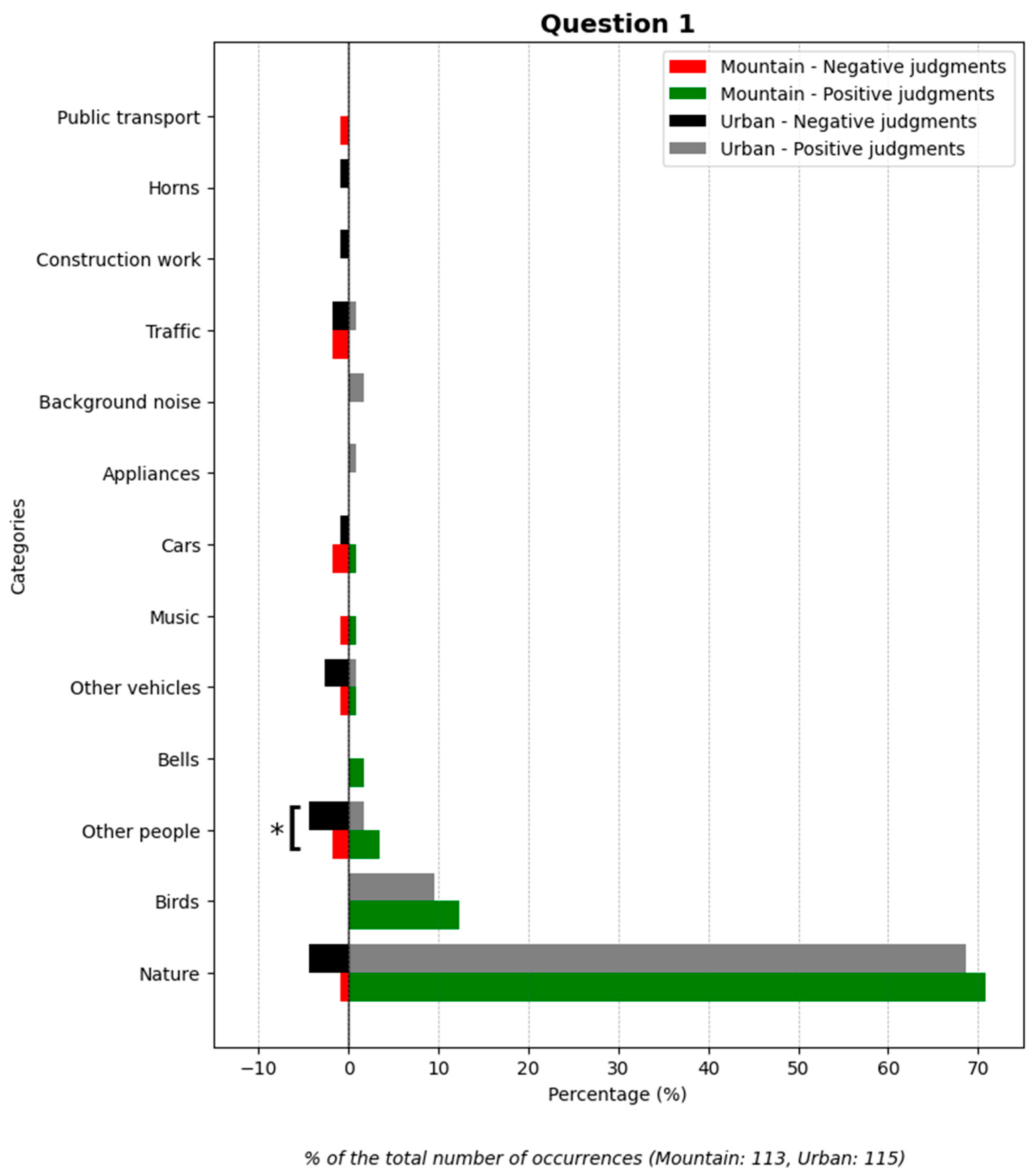
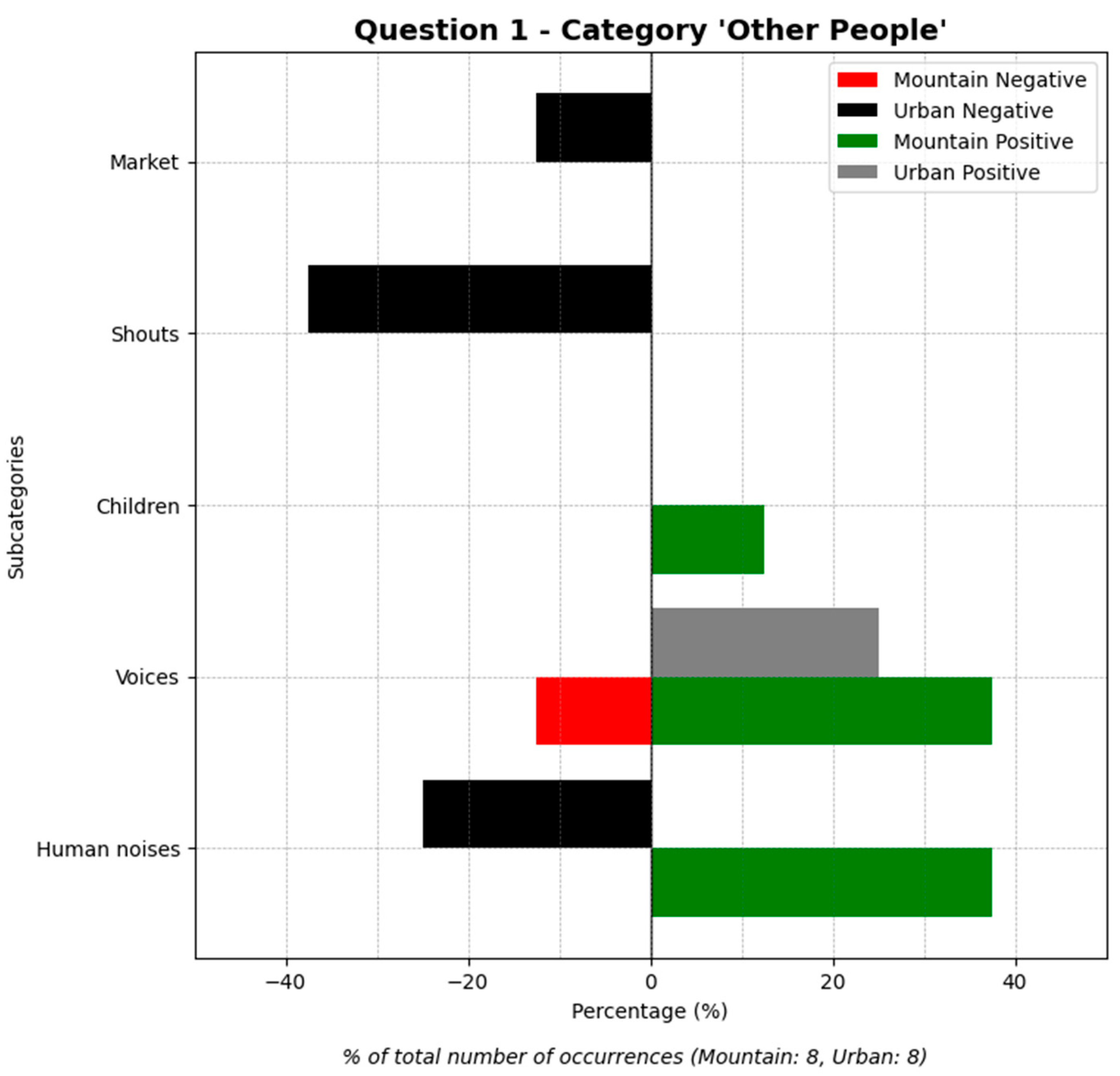
While describing their ideal soundscape mountain participants gave only one negative occurrence, compared to three-quarters negative in the urban group. This qualitative observation is supported by the statistical analyses of occurrences (Figure 4). Eight participants from the mountain group perceive the sounds produced by “Other People” more positively (n = 7, 87.5% vs. n = 2, 25.0%) compared to the urban group, which instead perceives them more negatively (n = 6, 75.0% vs. n = 1, 12.5%). The two multinomial probability distributions were not equal between the two groups (p = 0.041).
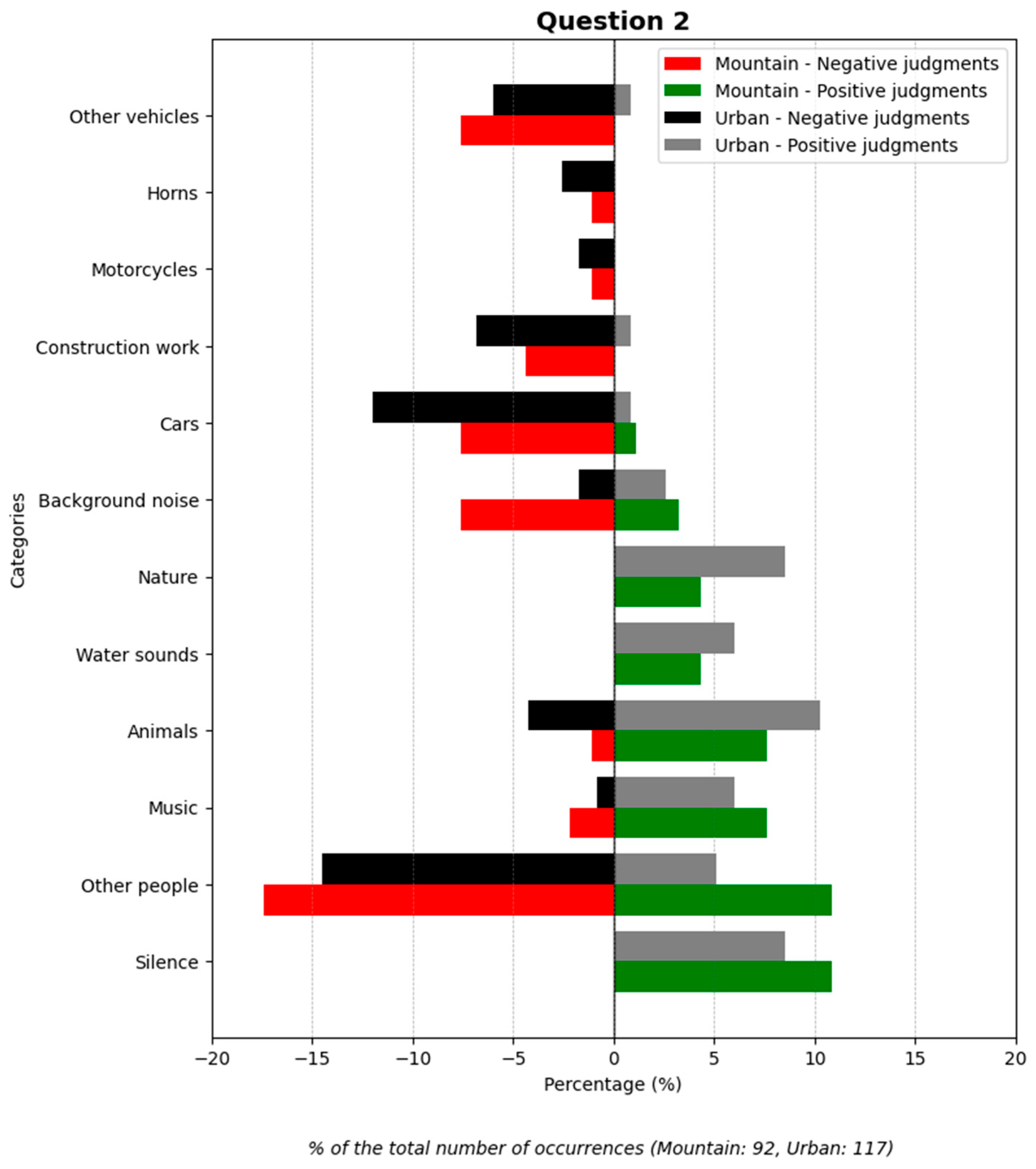
As can be seen in Figure 1, the percentage of judgments for the category “Other people” is much higher in the current soundscape, where the sum of positive and negative judgments accounts for nearly one fifth of the total occurrences in both groups, most often directed at strangers: the most frequent being “shouting” and “screaming,” followed by “arguments,” “murmuring,” “people arguing,” “people talking too much,” and “people speaking too loudly.” However, negative remarks also appear in work and home settings, such as: “my husband snoring,” “maybe being five people in the office,” “my colleagues squeal,” “the noise of housemates being loud,” and “the general noise from my neighbors”. Positive comments, on the other hand, tend to be associated more with family contexts than with the general public, as in: “the sound of people talking”. The two multinomial probability distributions are not significantly different between the groups (p = 0.382). The mountain group reported a greater number of positive comments (n = 10, 38.5%) compared to the urban group (n = 6, 26.1%), while the urban group made more negative remarks (n = 17, 73.9%) than the mountain group (n = 16, 61.5%).
As for the third question, participants tended to associate sounds with the person performing the action rather than the object itself, such as a chainsaw or lawnmower: “some craftsman, some lumberjack,” “a lumberjack cutting down trees… when you hear a chainsaw going all day,” “when the neighbor cuts the grass, she goes /bru/,” and “someone doing work, like cutting grass in the fields, chopping wood.” The siren of a firetruck is also mentioned: “unless the firefighters drive by below the road.” The other high-pitched sounds associated with other people are mainly “screams”, expressed in different ways: “when they scream at night”, which can also be linked to “children”, or to their crying, and to “mom” or “women”. Low-pitched sounds produced by other people are also associated with fixtures and fittings, such as “the lock turning”, “slamming doors”, or “the front door of the building”. Other examples include the low male voice of a family member—“my husband speaking” and “my son mumbling”—or sounds made by neighbors, such as “footsteps, people upstairs moving things around, people playing guitar” and “people throwing out glass”.
In responses to the fifth question on traffic, the category “people” accounted for 15% of all occurrences. For this reason, the “people” category was included: it was perceived by many participants as a fundamental—and primarily negative—component of traffic. The reported annoyance was related not only to sound but also to psychological factors associated with a stressful environment, particularly for drivers, who must maintain a higher level of concentration. By contrast, individuals experiencing traffic as bystanders tend to perceive it in a more neutral way, especially in a small city. This is reflected in the fact that many negative descriptions combine human actions with horn noise, for example: “people honking,” “they honk the horn because everyone is nervous,” “horns… people in a hurry,” “horn noise or people shouting angrily,” “it creates tension, people are stressed… the defining feature of traffic is the horn,” “the horn and the angry people there,” “the car going by, if they honk the horn,” “someone shouts, someone wants to pass, someone honks, someone goes—it’s all chaos,” and “a lot of horn noise or also people turning suddenly.” Issues related to pollution or unpleasant odors emerged in only three interviews.

3.1.10. Other Vehicles

For the “Other Vehicles” category (Figure 2), the only other category with enough data for Fisher’s exact test, the two multinomial probability distributions are identical (p = 1.000). The mountain group rated “Other Vehicles” positively (n = 1, 50.0%, vs. n = 2, 25.0%), whereas the urban group was more critical (n = 3, 75.0%, vs. n = 1, 50.0%).
The “other vehicles” (Question 2) category includes public transport such as “train,” “bus,” and “tram,” but more notably encompasses “heavy vehicles,” “trucks,” “tractors,” “snowplows,” and “ambulances.”. Also, through paraphrases like “the bus braking” and “truck brakes”. The statistical analysis does not yield significant results (p = 1.000), as the mountain group did not express any positive opinions (n = 0, 0.0%), compared to one positive response in the urban group (n = 1, 12.5%).
Other vehicles described as producing high-pitched sounds (Question 3) include helicopters, while sounds from trains, tractors, and garbage trucks are perceived as low-pitched.

3.1.11. Cars

Even though silence is frequently mentioned, the presence of mechanical noise remains a significant part of the daily soundscape. This does not exclude participants from regularly experiencing the sounds produced by “cars” in their daily lives—such as those listed in Figure 4: “braking,” “accelerating,” “revving,” “roaring engines,” and “turbo.” Notably, there are no references to specific parts like “brakes”; instead, de-verbal nouns are preferred. Negative comments about “traffic” have also been included in this category.
Cars are mostly perceived as producing high-pitched sounds (Question 3). Some urban participants also mentioned specific parts, such as windshield wipers, which are perceived as high-pitched, and brakes, as in “the screeching of brakes.” The engine, on the other hand, is perceived as low-pitched, for example: “the engine of the pick-up truck”.
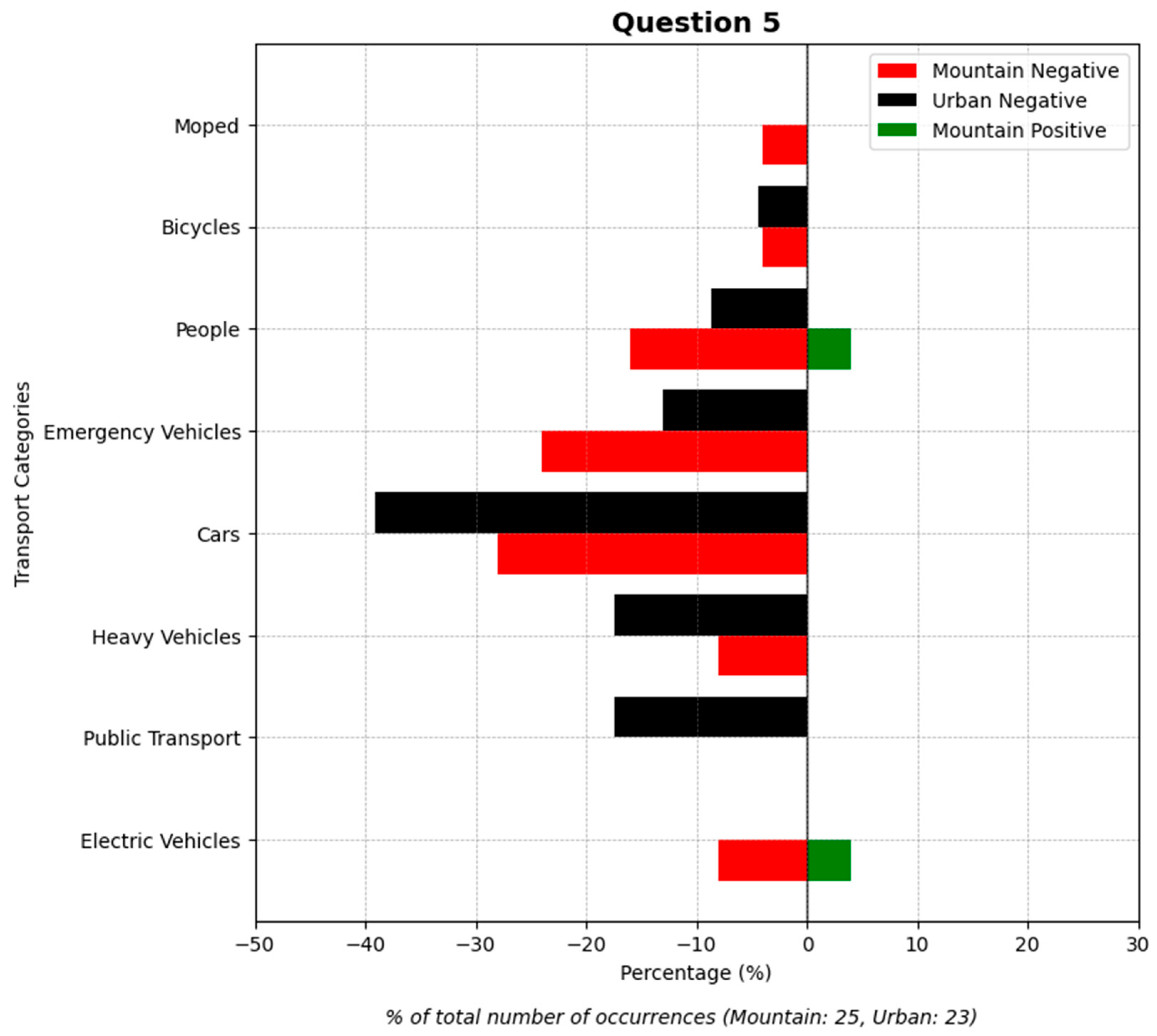
As shown in Figure 5, the positive evaluations come exclusively from the mountain group. The two multinomial probability distributions are the same across both groups with respect to negative evaluations, p = 0.197. We report only the percentage data for the negative judgements of the four most represented categories: “cars” (mountain n = 7, 28.0%, vs. urban n = 9, 39.1%), “emergency vehicles” (mountain n = 6, 24.0%, vs. urban n = 3, 13.0%), and equally “people” (mountain n = 4, 16.0%, vs. urban n = 2, 8.7%) and “heavy vehicles” (mountain n = 2, 8.0%, vs. urban n = 4, 17.4%).

3.1.12. Traffic

Traffic is the most frequently mentioned element associated with background noise (Question 4), cited by 19.3% of participants in the mountain group and 35.1% in the urban group. Other mentioned sources include airplanes and tractors, the latter reflecting the agricultural character of the region. As for the perceived frequency of these sounds, responses range from always/constantly to often/almost always. The highest frequencies are found in the urban group, with 9 explicit mentions of always/constantly, compared to 3 in the mountain group, and 4 mentions of often/almost always in the urban group, versus 2 in the mountain group.
As shown in Table 3, 96% of the responses about traffic were negative. In Question 5 some urban participants also mentioned specific parts, such as windshield wipers, which are perceived as high-pitched, and brakes, which were described in various ways—through paraphrases like “the bus braking”, “truck brakes”, and “the screeching of brakes.” The engine, on the other hand, is perceived as low-pitched, for example: “the engine of the pick-up truck”. Other vehicles described as producing high-pitched sounds include helicopters, while sounds from trains, tractors, and garbage trucks are perceived as low-pitched.

3.1.13. Car Horn

In addition to the descriptions already presented in Section 3.1.11, among car-related sounds, car horns emerged as the most consistently annoying. Although they were mentioned only four times in responses to Question 2, they were cited much more frequently in Question 5 (Figure 6), reported by 54% of participants in the mountain group and 68% in the urban group. In addition, car horns were consistently perceived as high-pitched sounds in responses to Question 3.

3.1.14. Construction Work

Only one participant mentioned construction works referring to own ideal soundscape. This category includes sounds perceived as high-pitched, such as: “when working with wood, the circular saw,” “construction site,” and “demolition equipment,” as reported by the mountain group; and “the drill” and “a saw, a circular saw, or a hammer”, as reported by the urban group. Only three low-pitched sound descriptions were reported, all from the urban group. One was more general: “The noises from renovation or complete reconstruction work are low-pitched, in the sense that they are… they’re persistent and low-pitched.” The other two were more specific: “a lawnmower, a chainsaw,” and “for example the drill, I think it’s the drill, those kinds of works.”
These have been mentioned as background sounds that includes also gardening activities that was present only once in the mountain group (i.e., “lawnmower”), while construction noise is referred to by a single participant in the urban group (i.e., “construction companies”).

3.1.15. Music

Mountain group had one positive and one negative judgement over music describing the ideal soundscape. In the second question music has been cited by 23% of the mountain group and 19% of the urban group. It is generally preferred and intentionally chosen within one’s sound environment. From a statistical perspective, no significant differences emerged (p = 1.000), as the mountain group shows a slightly lower preference for music (n = 7, 77.8%) compared to the urban group (n = 7, 87.5%). The urban group reported only one negative comment (n = 1, 12.5%), while the mountain group had two (n = 2, 22.2%).

3.1.16. Background Noise

References to “stove,” “radiator,” and “fire”—included in the “background noise” category—can be attributed to the winter season, during which the interviews were conducted. This category also includes more general terms such as “white noise,” “brown noise,” and “everyday personal sounds.” For this category (Question 2) the multinomial probability distribution is the same across both groups (p = 0.329), as the mountain group shows a lower preference for background noise (n = 3, 30.0% vs. n = 3, 60.0%) compared to the urban group, and evaluates it more negatively (n = 7, 70.0% vs. n = 2, 40.0%).

3.1.17. Household Appliances

The noises produced by household appliances are frequently mentioned by both groups, especially the urban one. This is likely due to the fact that the “urban soundscape” was not specifically defined, allowing participants to include sounds from their own homes. Among the high-pitched sounds, the following are commonly reported, in order: vacuum cleaner, dishwasher, alarm, washing machine, dryer, intercom, pipe whistling, stove, and alarm clocks. Some household appliances are perceived as producing both high-pitched and low-pitched sounds, such as the dishwasher and when the washing machine starts spinning. Others, instead, are perceived only as low-pitched, like refrigerators, computer fans, hair dryer, and radiators. Some participants also provide more general descriptions, noting the presence of a background noise (Question 4) without identifying its specific components, often described as a “hum”, “whistle”, or “continuous vibration”. Other commonly reported indoor sound sources include “roller shutters”, “chair”, “water bottles”, “furniture”, and “clock”.

3.2. Differences with Guastavino’s Study in Urban Context

The first point to keep in mind when comparing the present study with Guastavino’s reference paper is that the adapted questionnaire does not focus exclusively on the urban soundscape. This has undoubtedly influenced participants’ responses to some extent, and caution is therefore required when interpreting the two studies side by side. Another point of divergence emerges in the process of translating the questionnaire from English into Italian: in the fifth question of the English term “transportation”, which in Italian typically refers to public transportation rather than vehicular traffic, was translated with the word “traffico” (traffic) instead. Nevertheless, it is undeniable that the context of the three French cities differs substantially from that of the Trentino mountain environment, starting from the lack of comparable infrastructure: there is no subway or tram system (only one mention of either).
Beyond the differences in the questionnaire, however, several findings remain particularly noteworthy. Regarding mechanical sound sources unlike in Guastavino’s study, public transportation does not receive positive evaluations, even in connection with issues such as air pollution. The same applies to electric vehicles, which are often perceived as dangerous precisely because they are too quiet. Another point to reflect on concerns the few opinions expressed about motorcycles in the present study, all of which were negative, both in Question 2 and Question 5. The most likely explanation is the time of year when the interviews were conducted—between November and January—a period during which two-wheeled vehicles are less commonly used due to low temperatures.
In the “Other people” category for Question 1 in Guastavino’s study, the subcategory “cellular phones” was present; in the current study, however, mobile phones were never mentioned, nor were “pedestrians”. Instead, music is mentioned explicitly, not through metonymy or as a byproduct of human activity
The category that is most important to highlight, however, is that of “silence,” which, as Guastavino notes [15] (p. 947), “was never spontaneously evoked.” In the Trentino context, by contrast, it is frequently mentioned in both the ideal and the current soundscape.
From a linguistic perspective, however, one element not reported in Guastavino’s study is the use of onomatopoeias, which appeared in eight responses: four used to describe background sounds, one for high-pitched sounds, and three for traffic noise. Examples included: /bru/ for a lawnmower, /χ/ for a whistle, /bip/, which occurred twice, for sounds from “electronic devices”, /tip tap/ to suggest footsteps on a stone floor, /bi′bi/ and /biː/ to represent car horns in responses about traffic noise, /brum/ as the sound of an unpleasant truck, and /tr̩ː/ for the noise made by a card hitting bicycle spokes (known in English as a spoke card) in response to Question 5. Onomatopoeias can also be interpreted as a form of metaphor [35], in which a sound is used to represent a broader concept. For example, the sound /bip/ associated with electronic devices semantically expands the idea of “technological sound,” extending it to a wider range of sound experiences related to technology.

3.3. Dialectal Influences

This chapter briefly presents some of the influences of the Trentino dialect observed during the interviews. While the interviews were conducted in Italian—as was the original reference study, conducted in French—the dialectal component, though experiencing a sharp decline, remains present in this region’s linguistically diverse landscape. The phenomena represent common linguistic strategies among bilingual or multilingual speakers:
  • “In città, invece, me dà en fastidio il rumore de ’na città ente ’na maniera” (“In the city, it annoys me, the noise of the city in such a way”).
Another example features only the subject proclitic, functioning more as a loan from dialect than a full instance of code-switching:
  • “Il traffico in generale l’è un’esasperazione, mi verrebbe da dire… L’è ’n casino proprio il traffico” (“Traffic in general is just exasperating… It’s really a mess”).
Two lexical items of dialectal origin were recorded:
  • “zòpele” (felted wool slippers).
  • “rozza” (a man-made irrigation channel, i.e., roggia in standard Italian).
At the morphological level, dialect influence appears in the frequent use of apocope (i.e., word-final vowel dropping) in high-frequency verbs such as “to do”–“fare” and “to have”–“avere”:
  • “giù fan sempre i giri” (“down there they’re always doing rounds”).
  • “in ufficio che han cinque chiamate” (“at the office, where they have five calls”).
A diatopic phenomenon also appears in the use of subject clitic proclisis, which refers to a grammatical phenomenon in which a clitic pronoun (e.g., mi, ti, lo, la, ci, ne in Italian) is placed before the verb rather than after it:
  • “persone che c’hanno quelle voci molto stridule” (“people who have very shrill voices”).
  • “adesso c’ho la fontanella del gatto che va” (“right now I’ve got the cat’s water fountain running”).
This may stem from a morphological reanalysis of the local dialect form g’ho (from gh’ò, “I have”) toward the central Italian variant “c’ho”.
At the syntactic level, dialect influence is evident in resumptive pronouns, such as:
  • “il fiume che scende sotto casa, quello lo senti… Quello lì è proprio un sottofondo” (“the river that flows below the house—you really hear that… That one is truly background noise”), which reflects the structure: “quel lì t’el senti… quel lì l’è propi…” in the Trentino dialect.
Also notable is the use of verbal periphrasis:
  • “una roba che va su di volume” (“something that increases in volume”),
  • “la circonvallazione e va su a Trento” (“the bypass that goes up toward Trento”),which, though characteristic of dialect, also appears in colloquial Italian.


4. Discussion

4.1. Ideal and Current Soundscape in Mountain and Urban Groups

The present study revealed differences between the two groups, which emerged more clearly from the qualitative analysis than from the quantitative analysis of the collected data. From a linguistic perspective, some of the most notable divergences concern the perception of the “Other people” category, the broader use of metonymy by the urban group when describing mechanical sounds, and the tendency among mountain participants to describe the person associated with a given sound source rather than the mechanical device producing it (e.g., “when my neighbor cuts the grass” instead of “the lawnmower”).
Regarding differences between urban and non-urban settings, Zhang et al. [36] found that rural inhabitants preferred listening to music, while urban residents favored the sound of birds. This pattern does not emerge in the present study: music is mentioned positively and negatively by both groups while bird sounds are more frequently appreciated by mountain residents than by those in urban areas. The degree of urbanization seems to play a significant role. This pattern was noted by a cross-cultural study involving 122 participants in Greece and the UK was conducted across the cities of Athens (3,774,059 inhabitants) and London (8.9 million), the town of Chania (53,910 inhabitants), and the village of Dermatianika (512 inhabitants) [37]. The study highlighted the importance of considering cultural and geographic context in soundscape research. Based on the ISO/TS 12913-2:2018 guidelines, the most notable differences among the three groups were found in the perception of chaotic, vibrant ⇆ monotonous, and eventful ⇆ uneventful attributes. Natural sounds were described as more monotonous by city dwellers, while technological sounds were perceived as more chaotic by village residents. Human sounds showed the least perceptual differences across all three groups. In contrast, in the present study, the perception of “Other people” emerged as the category showing the most noticeable differences between urban and mountain groups. Regarding natural sounds, the mountain group more frequently described elements positively when referring to their ideal soundscape, whereas the urban group expressed more positive comments for the current soundscape. Since monotony was rarely mentioned in participants’ responses, a direct comparison with the previous study is difficult. Nevertheless, it is noteworthy that the two groups focused their comments in opposite ways when contrasting ideal versus current soundscapes. Papadakis et al. also recommend conducting comparative studies between similar residential contexts—i.e., city with city, town with town, and village with village. In the present study, this was not entirely feasible; however, given the relatively low level of urbanization of the region, this limitation is unlikely to have introduced major distortions related to differences in residential context.

4.2. Guastavino’s vs. Present Study

The positive and negative descriptions of the ideal soundscape differ substantially from those reported in Guastavino’s study [15] (pp. 946–948). While Guastavino identified the category “Other people” (25%) as the most frequently represented in descriptions of the ideal urban soundscape, the present study shows a clear predominance of descriptions oriented toward the “Nature” category. Therefore, the ideal soundscape described by interviewees from Trentino evokes predominantly natural environments—whether forested, mountainous, or marine—with mechanical sounds largely absent, due to the region’s low level of anthropization and the abundance of green spaces and nature-based recreational activities. These sounds, in a region as strongly nature-dominated as Trentino, therefore also acquire a cultural value and thus serve as cultural ecosystem services, given that they are particularly idealized by the inhabitants themselves. This may also explain why both groups express strong criticism toward sounds produced by other people (Questions 1 and 2). The phenomenon described by Félonneau [38] and cited in Guastavino [15] (p. 947) characterizes interviewees as “urbanophobes”, meaning they hold negative attitudes toward city life.
In describing their actual soundscape (Questions 2 to 5), a setting emerges that is different from that of large French cities. Positive and negative evaluations are balanced in both groups (50% vs. 50%), whereas in Guastavino there were more negative comments (64% vs. 26%) [15] (p. 948). A category of sounds that is relatively prominent in Guastavino’s study [15]—and which deserves consideration here—concerns two-wheeled vehicles (motorcycles, scooters, bicycles, electric scooters), which are only marginally mentioned in the present work. Motorcycle traffic is a known issue in Alpine areas [39,40], although it remains unclear to what extent it affects the specific locations where the interviews for this study were conducted. When indoor sound sources (e.g., household appliances, family members, domestic activities) are excluded and only outdoor sound sources are considered—thus aligning the analysis with approaches used for urban soundscape studies—Trentino appears as a region with a strong agricultural vocation and still largely non-urbanized. This is reflected in the reported sound sources, ranging from “tractors” to wildlife, both of which are absent in the reference study [15].
This study is influenced by the period in which the interviews were conducted (November 2024 to January 2025), by the limited number of participants, by the absence of sensitive demographic data (such as gender, age, and educational background), and by the geographically restricted setting within the region. Moreover, the interviews were not always conducted in a neutral, isolated environment—such as a laboratory or a dedicated room—but in outdoor spaces (5.9% of cases) or in the participants’ homes, residences, or places of study, sometimes in the presence of individuals not involved in the interview.

4.3. Influence of the Trentino Multilingual Context

While the explicit linguistic focus of this study was on semantic patterns in Italian, the data reveal a more profound layer of influence: the latent but structuring presence of the Trentino dialect. This substrate shapes not only lexical choices but also the very syntactic and narrative frameworks through which participants articulate their sonic experiences, offering a crucial lens to understand the interplay between language, perception, and cultural context. The sporadic yet significant emergence of dialectal lexemes, such as “zòpele” for felt slippers or “rozza” for a specific type of irrigation channel, transcends simple code-mixing. It points to fundamental lexical gaps in standard Italian for the precise, culturally situated auditory phenomena of the region. The sound of water in a “rozza”, a human-made feature integral to the Alpine landscape, carries connotations of managed hydrology and pastoral life absent from the generic “ruscello” (stream). When participants default to Italian, a degree of semantic specificity is inevitably lost, suggesting that their reported soundscapes are already linguistically filtered. This implies that the conceptual categorization of sounds may be inherently different, and more nuanced, for native dialect speakers, as their primary linguistic repertoire offers a more granular taxonomy for locally salient sonic events.
Beyond vocabulary, the dialect’s influence permeates morphosyntax, subtly conditioning how agency and emphasis are expressed. The persistent apocope (i.e., word-final vowel dropping) in high-frequency verbs (“fan” for “fanno”, “han” for “hanno”) is a morphophonological trait characteristic of the Trentino dialect that surfaces in the Italian responses. Its occurrence, particularly during the cognitively demanding task of recalling and describing sensory memories, indicates a regression to a deeply automatized, informal register closely tied to personal experience. Similarly, the use of subject clitic proclisis—where a clitic pronoun is placed before the verb rather than after it (e.g., “c’hanno”, “c’ho”)—and resumptive pronouns, as in the construction “il fiume… quello lo senti” (the river… that one you hear), directly mirrors dialectal syntactic patterns. These are not errors but syntactic calques that import a discursive style of topicalization and contrast. This style frames sound description within a narrative of agency and presence, linguistically enacting the cognitive process of isolating a sonic “figure” from the environmental “ground.” This syntactic tendency provides a formal underpinning for the key qualitative finding that mountain participants often personify sound sources, describing human activities (“when the neighbour cuts the grass”) rather than anonymized mechanical objects (“the lawnmower”).
The most telling instance may be the single clear case of code-mixing: “me dà en fastidio il rumore de ‘na città.” Here, the switch to dialect occurs precisely at the moment of expressing a subjective, affective judgment (“it annoys me”). This aligns with psycholinguistic theory positing that a speaker’s first language or dialect is often the preferred vehicle for emotional and evaluative expression. Numerous studies have explored code-mixing; among the pioneers in the field is Auer [41]. Code-switching, by contrast, refers to the alternation between languages during a conversation or speech, typically occurring between complete utterances or sentences (“Il traffico in generale l’è un’esasperazione, mi verrebbe da dire… L’è ’n casino proprio il traffico”). In the context of Italian, one of the seminal studies was conducted by Alfonzetti [42]. It suggests that the dialect serves as a more authentic conduit for the felt experience of sound, while standard Italian may be employed for more detached, taxonomic description. Consequently, an Italian-only protocol risks capturing a translated, and potentially attenuated, version of the affective dimension of soundscape perception.
In conclusion, the multilingual context of Trentino plays a profound yet elusive role. It is not merely a backdrop but an active, alternative conceptual framework that competes with the standard language. The choice to conduct interviews in Italian did not neutralize this framework but rendered it subterranean, where it continued to shape semantics, syntax, and emotional emphasis. The dialectal substrate thus acts as a mediator, influencing how the sonic environment is segmented, framed, and evaluated linguistically. This finding has significant methodological implications: to truly access the culturally grounded perception of soundscape in linguistically diverse regions, research instruments must be designed to engage with the full repertoire of speakers, including their local linguistic varieties. The authentic soundscape, it appears, is not only heard but also articulated through a specific linguistic filter, one that this study shows remains potent even when ostensibly switched off.

5. Limitations and Future Research

The results of this study should be interpreted in light of several limitations. First, the findings may be influenced by the period during which the interviews were conducted (November 2024 to January 2025). This timing may have affected the sound sources recalled by participants, particularly in the case of soundscapes subject to seasonal variation. However, it should be noted that a temporal proximity effect in soundscape evaluation has not been consistently confirmed in the literature [43]. In addition, the study involved a relatively small sample size and covered a geographically limited area within the region. The sample cannot be considered representative of the local population, and no age or gender balancing was planned or implemented, as no demographic information (e.g., age, gender, educational background) was collected. Interviews were not always conducted in quiet or controlled environments (e.g., a laboratory or dedicated interview room). In a small proportion of cases (5.9%), interviews took place outdoors or in participants’ homes, residences, or places of study, sometimes in the presence of individuals not directly involved in the interview. These conditions may have introduced distraction factors, including auditory distractions. Furthermore, the study was conducted exclusively in Standard Italian. This may have discouraged some participants from expressing themselves in the language (“dialect”) they habitually use in family or work contexts. Moreover, participant recruitment was not balanced across linguistic groups.
While the aim of the present study was to capture and document differences in soundscape perception, we acknowledge that, in the absence of objective acoustic data, it is not possible to determine whether the observed differences stem from perceptual differences between the two groups, from differences in the acoustic environments themselves, or from a combination of both factors. This limitation reflects the focus of our contribution, which lies in highlighting perceptual representations that are particularly relevant from a policy-making perspective, where decisions increasingly need to consider how sound environments are remembered, evaluated, and described by those who experience them, including both human and broader ecological systems. To provide a more comprehensive understanding, future studies could integrate linguistic characterizations of soundscapes with objective acoustic measurements. Such an approach would help bridge perceptual insights with physical data, thereby supporting the development of more actionable and implementable strategies for territorial management.
Given these limitations, future research could more systematically investigate the role of multilingualism by conducting targeted surveys focused on native speakers of dialect, recruiting balanced samples across linguistic communities, and employing questionnaires translated into local dialects to better capture linguistic and perceptual differences in soundscape descriptions.

6. Conclusions

The 31 participants from the mountain group and the 37 from the urban group show differences, particularly in the way they describe their ideal soundscape, as evidenced especially by the qualitative analysis of the collected data. Overall, both groups prefer natural sounds over mechanical ones, yet they exhibit different attitudes toward sounds produced by other people: mountain participants are more inclined to regard human activity positively, but view it negatively when associated with traffic and excessive behaviors such as shouting and rowdiness, which are more frequently reported by urban participants.
Mountain residents are generally more satisfied with their soundscape, while urban residents tend to downplay the impact of traffic compared to other large cities. From a linguistic perspective, both groups prefer to describe the soundscape by detailing its components—i.e., the sound sources—rather than by referring to subjective feelings or the physical properties of objects. The urban group makes greater use of metonymy—that is, a figure of speech in which one element is used to stand for a related concept or the whole—when describing mechanical sounds, whereas the mountain group tends to personify a human activity rather than naming its source (for example, “firefighters” instead of “firetruck sirens”).
Dialect, although not explicitly discouraged, was used relatively infrequently even by speakers for whom it is a native variety. Clear cases of dialect influence appeared in one instance of code-switching and one of code-mixing, in two purely dialectal lexical items, and in a few morphological interferences affecting standard Italian. The appreciation expressed by many participants toward their current soundscape suggests that it constitutes a cultural heritage worth preserving, including its linguistic component—an aspect in which much remains to be explored. It is recommended that future questionnaires be designed in a way that aligns more closely with the spoken language of the interviewees (dialect rather than Standard Italian), in order to better capture expressive and semantic potentials that did not emerge in this study.
Overall, the study highlights the importance of the natural soundscape in these areas, both as a resource for the well-being of their inhabitants and as a cultural ecosystem service. The current state of research suggests that the Trentino soundscape—which could also be the case for other mountainous areas, or specifically the Alpine region—should be regarded as cultural heritage to be protected and enhanced in its most positive components which, as described by the participants in this study, are inextricably linked to nature and to direct contact with it.

Supplementary Materials

The following supporting information can be downloaded at: https://www.mdpi.com/article/10.3390/acoustics8010008/s1, Table S1: Raw Data from Interviews.

Author Contributions

Investigation, G.G.; data curation, G.G.; writing—original draft preparation, G.G.; writing—review and editing, S.T. and L.B.; visualization, G.G.; supervision, S.T. and L.B. All authors have read and agreed to the published version of the manuscript.

Funding

This research received no external funding.

Institutional Review Board Statement

The research is classified as low-risk and therefore did not require approval from the Research Ethics Committee of the University of Trento, according to the outcomes of the Ethics Self-Assessment with identification number 2025-044ESA.

Informed Consent Statement

Participants received a Data Protection Notice for Scientific Research Purposes and gave their informed consent to the audio recording and use of the recorded material.

Data Availability Statement

Data is contained within the article or Supplementary Materials.

Conflicts of Interest

The authors declare no conflicts of interest.

References

  1. Chen, Z.; Hermes, J.; Liu, J.; von Haaren, C. How to integrate the soundscape resource into landscape planning? A perspective from ecosystem services. Ecol. Indic. 2022, 141, 109156. [Google Scholar] [CrossRef]
  2. Corvalan, C.; Hales, S.; McMichael, A.J. Ecosystems and Human Well-Being: Health Synthesis; World Health Organization: Geneva, Switzerland, 2005. [Google Scholar]
  3. ISO 12913-1:2014; Acoustics—Soundscape—Part 1: Definition and Conceptual Framework. International Organisation for Standardization: Geneva, Switzerland, 2014.
  4. Levenhagen, M.J.; Miller, Z.D.; Petrelli, A.R.; Ferguson, L.A.; Shr, Y.-H.; Gomes, D.G.E.; Taff, B.D.; White, C.; Fristrup, K.; Monz, C.; et al. Ecosystem services enhanced through soundscape management link people and wildlife. People Nat. 2021, 3, 176–189. [Google Scholar] [CrossRef]
  5. Purves, R.S.; Wartmann, F.M. Characterising and mapping potential and experienced tranquillity: From a state of mind to a cultural ecosystem service. Geogr. Compass 2023, 17, e12726. [Google Scholar] [CrossRef]
  6. Ebner, M.; Schirpke, U. Participatory mapping of human-nature interactions in mountain landscapes: Instances of experiential multi-functionality. Landsc. Urban Plan. 2025, 263, 105453. [Google Scholar] [CrossRef]
  7. Oberman, T.; Torresin, S.; Aletta, F.; Kang, J.; Latini, A.; Gozzi, G. Human sounds and associated tonality disrupting perceived soundscapes in protected natural areas. Sci. Rep. 2025, 15, 28759. [Google Scholar] [CrossRef] [PubMed]
  8. Aletta, F.; Mitchell, A.; Oberman, T.; Kang, J.; Khelil, S.; Bouzir, T.A.K.; Berkouk, D.; Xie, H.; Zhang, Y.; Zhang, R.; et al. Soundscape descriptors in eighteen languages: Translation and validation through listening experiments. Appl. Acoust. 2024, 224, 110109. [Google Scholar] [CrossRef]
  9. Ebner, M.; Tappeiner, U.; Schirpke, U. From valleys to peaks: Characterizing soundscapes in the Northern European Limestone Alps. Landsc. Ecol. 2025, 40, 91. [Google Scholar] [CrossRef]
  10. Ferrari, R.; Rupf, R.; Reutz, B. Alpine soundscapes: Sounds and their consequences for perceived recreational quality–A case study Parc Ela in Switzerland. Ecomont J. Prot. Mt. Areas Res. 2023, 15, 4–12. [Google Scholar] [CrossRef]
  11. Bai, Z.; Zhang, S. Effects of different natural soundscapes on human psychophysiology in national forest park. Sci. Rep. 2024, 14, 17462. [Google Scholar] [CrossRef]
  12. Schirpke, U.; Ebner, M. Mapping spatio-temporal patterns of soundscapes in a mountain landscape. Appl. Geogr. 2025, 183, 103722. [Google Scholar] [CrossRef]
  13. Dubois, D.; Guastavino, C.; Raimbault, M. A Cognitive Approach to Urban Soundscapes: Using Verbal Data to Access Everyday Life Auditory Categories. Acta Acust. United Acust. 2006, 92, 865–874. [Google Scholar]
  14. Cance, C.; Guastavino, C.; Dubois, D. Languages and conceptualization of soundscapes: A cross-linguistic analysis. J. Acoust. Soc. Am. 2011, 130, 2495. [Google Scholar] [CrossRef]
  15. Guastavino, C. The Ideal Urban Soundscape: Investigating the Sound Quality of French Cities. Acta Acust. United Acust. 2006, 92, 945–951. [Google Scholar]
  16. Aletta, F.; Torresin, S. Adoption of ISO/TS 12913-2:2018 Protocols for Data Collection From Individuals in Soundscape Studies: An Overview of the Literature. Curr. Pollut. Rep. 2023, 9, 710–723. [Google Scholar] [CrossRef]
  17. Aletta, F.; Kang, J.; Axelsson, Ö. Soundscape descriptors and a conceptual framework for developing predictive soundscape models. Landsc. Urban Plan. 2016, 149, 65–74. [Google Scholar] [CrossRef]
  18. Gibbs, R.W., Jr. Embodiment and Cognitive Science; Cambridge University Press: Cambridge, UK, 2005. [Google Scholar]
  19. Çankaya Topak, S.; Yılmazer, S. A comparative study on indoor soundscape assessment via a mixed method: A case of the high school environment. Appl. Acoust. 2022, 189, 108554. [Google Scholar] [CrossRef]
  20. Davies, W.J.; Adams, M.; Bruce, N.; Marselle, M. The positive soundscape project: A synthesis of results from many disciplines. In INTER-NOISE and NOISE-CON Congress and Conference Proceedings; Institute of Noise Control Engineering: Ottawa, ON, Canada, 2009. [Google Scholar]
  21. Forni, M. Gramatica Ladin Gherdëina; Istitut Ladin Micurá de Rü: San Martin de Tor, Italy, 2019; Available online: https://bia.unibz.it/esploro/outputs/bookReview/Forni-Marco-Gramatica-ladin-gherd%C3%ABina-San/991006092333901241 (accessed on 13 October 2025).
  22. Chiocchetti, N.; Iori, V. Grammatica del Ladin Fascian; Istituto Culturale Ladino: Vigo di Fassa, Italy, 2025; Available online: https://www.libraccio.it/libro/9788886053419/nadia-chiocchetti-vigilio-iori/grammatica-del-ladin-fascian.html (accessed on 13 October 2025).
  23. Bidese, E.; Cognola, F. Introduzione Alla Linguistica del Mòcheno; Rosenberg & Sellier: Torino, Italy, 2013. [Google Scholar]
  24. Rowley, A.R. Liacht as de Sproch. Grammatica Della Lingua Mòchena-Grammatik des Deutsch-Fersentalerischen. Ediz. Tedesca e Italiana; Bersntoler Kulturinstitut: Palù del Fersina, Italy, 2017. [Google Scholar]
  25. Panieri, L. De Zimbrische Zunga von Siban Komaün. Grammatica Della Lingua Cimbra dei Sette Comuni; Istituto di Cultura Cimbra di Roana: Vicenza, Italy, 2022; Available online: https://www.academia.edu/96242430/De_Zimbrische_Zunga_von_Siban_Koma%C3%BCn_Grammatica_della_lingua_cimbra_dei_Sette_Comuni (accessed on 13 October 2025).
  26. Bidese, E. Il Cimbro Negli Studi di Linguistica. Con CD-ROM; Unipress: Padova, Italy, 2010. [Google Scholar]
  27. Istat, A. APP1 Comunie Popolazione Per Zona Altimetrica.xlsx. Available online: https://doi.org/10.1481/Istat.RapportoTerritorio.2020.APP1 (accessed on 30 December 2025).
  28. “Tràffico–Significato ed etimologia–Vocabolario,” Treccani. Available online: https://www.treccani.it/vocabolario/traffico/ (accessed on 31 December 2025).
  29. Cochran, W.G. Some methods for strengthening the common x2 tests. Biometrics 1954, 10, 417–451. [Google Scholar] [CrossRef]
  30. Martorana, R. Representation of Silence in Soundscape Perception. Master’s Thesis, Media Technology, Leiden University, Leiden, The Netherlands, 2017. [Google Scholar] [CrossRef]
  31. Pedrini, P.; Caldonazzi, M.; Zanghellini, S. Atlante degli Uccelli nidificanti e svernanti in provincia di Trento. Museo Tridentino di Scienze Naturali, Trento. Studi Trentini di Scienze Naturali. Acta Biol. 2005, 80, 35–577. [Google Scholar]
  32. Rosch, E.H. Natural categories. Cognit. Psychol. 1973, 4, 328–350. [Google Scholar] [CrossRef]
  33. Arduini, S.; Fabbri, R. Che cos’è la Linguistica Cognitiva; Carocci: Roma, Italy, 2008. [Google Scholar]
  34. Bates, V.; Hickman, C.; Manchester, H.; Prior, J.; Singer, S. Beyond landscape’s visible realm: Recorded sound, nature, and wellbeing. Health Place 2020, 61, 102271. [Google Scholar] [CrossRef]
  35. Akita, K. Constraints on the semantic extension of onomatopoeia. Public J. Semiot. 2013, 5, 21–37. [Google Scholar] [CrossRef]
  36. Zhang, J.; Li, T.; Cui, P.; Yin, Q.; Dai, C. Research on the Differences of Outdoor Sound Perception and Sound Preference between Urban and Rural Residential Areas. For. Chem. Rev. 2021, 456–486. [Google Scholar]
  37. Papadakis, N.M.; Aletta, F.; Kang, J.; Oberman, T.; Mitchell, A.; Aroni, I.; Stavroulakis, G.E. City, town, village: Potential differences in residents soundscape perception using ISO/TS 12913-2:2018. Appl. Acoust. 2023, 213, 12. [Google Scholar] [CrossRef]
  38. Félonneau, M.-L. Love and loathing of the city: Urbanophilia and urbanophobia, topological identity and perceived incivilities. J. Environ. Psychol. 2004, 24, 43–52. [Google Scholar] [CrossRef]
  39. Orsi, F.; Scuttari, A.; Marcher, A. How much traffic is too much? Finding the right vehicle quota for a scenic mountain road in the Italian Alps. Case Stud. Transp. Policy 2020, 8, 1270–1284. [Google Scholar] [CrossRef]
  40. Lechner, C.; Schnaiter, D.; Siebert, U.; Böse-O’Reilly, S. Effects of Motorcycle Noise on Annoyance—A Cross-Sectional Study in the Alps. Int. J. Environ. Res. Public Health 2020, 17, 1580. [Google Scholar] [CrossRef] [PubMed]
  41. Auer, J.C.P. Bilingual Conversation; John Benjamins: Amsterdam, The Netherlands; Philadelphia, PA, USA, 1984. [Google Scholar]
  42. Alfonzetti, G. Il Discorso Bilingue; Franco Angeli: Milano, Italy, 1992. [Google Scholar]
  43. Steffens, J.; Steele, D.; Guastavino, C. Situational and person-related factors influencing momentary and retrospective soundscape evaluations in day-to-day life. J. Acoust. Soc. Am. 2017, 141, 1414–1425. [Google Scholar] [CrossRef] [PubMed]
Figure 1. It provides an overall overview of the soundscape data from Question 1 e 2, where occurrences represent the sum of positive and negative judgments. Percentages below 6% are not labelled to improve figure clarity. Categories that do not appear in the charts correspond to sound sources with no occurrences. (a) Donut chart for the Mountain group, showing the ideal soundscape (outer ring) and the current soundscape (inner ring). Percentages refer to the total number of occurrences for the Mountain group (Ideal: N = 113; Current: N = 92). (b) Donut chart for the Urban group, structured in the same way. Percentages refer to the total number of occurrences for the Urban group (Ideal: N = 115; Current: N = 117).
Acoustics 08 00008 g001
Figure 2. Categories of sound sources emerging from participants’ spontaneous responses on the ideal soundscape (Question 1). * p ≤ 0.05.
Acoustics 08 00008 g002
Figure 3. Subcategories of sound sources within the “Nature” category in Figure 2 (Question 1). * p ≤ 0.05.
Acoustics 08 00008 g003
Figure 4. Subcategories of the main category “Other people” Figure 2 (Question 1). Subcategory “Human noises” refers to all sounds directly related to human actions that do not involve the use of the voice, whereas subcategory “Voices” includes vocal sounds such as speaking, shouting, whispering, or crying. * p ≤ 0.05.
Acoustics 08 00008 g004
Figure 5. Qualitative evaluation of perceived sounds. The sound source categories emerged from the analysis of the open-ended responses (Question 2). The percentages were calculated based on the total number of occurrences, following the method used in Guastavino’s Figure 5 [15]. * p ≤ 0.05.
Acoustics 08 00008 g005
Figure 6. Shows the occurrences of means of transport in response to Question 5. The categories are defined as described in the caption of Table 2. * p ≤ 0.05.
Acoustics 08 00008 g006
Table 1. Comparison between Guastavino’s questionnaire [15] (p. 946) and the one used in the present study. Differences are highlighted in bold.
GuastavinoPresent Study
  • According to you, what would be the ideal urban soundscape?
  • In your urban sonic environment, what do you find pleasant/unpleasant?
  • In your urban sonic environment, are there high-pitched/low-pitched sounds? If so, describe them.
  • Do you perceive background noise in urban environments? If so, under which circumstances? How would you describe it?
  • In urban areas, are you sensitive to transportation noise? Describe its characteristics.
  • According to you, what would be the ideal soundscape?
  • In your sonic environment, what do you find pleasant/unpleasant?
  • In your sonic environment, are there high-pitched/low-pitched sounds? If so, describe them.
  • Do you perceive background noise in the environment? If so, under which circumstances? How would you describe it?
  • In non-urban and urban areas, are you sensitive to traffic noise? Describe its characteristics.
Table 2. Distribution of responses for Question 1 by group. Percentages indicate the proportion of Sound Object versus Soundscape descriptions and the share of participants mentioning or not mentioning natural sounds. All values are expressed as percentages (%).
GroupSound ObjectsSoundscapeMentioning Natural SoundsNot Mentioning Natural Sounds
Mountain (N = 31)742693.56.5
Urban (N = 37)762491.98.1
Table 3. Analysis of verbal descriptions of traffic noise in response to Question 5 from both groups (urban and mountain). This table (as in Figure 6) includes only the occurrences where vehicles are explicitly mentioned, excluding metonymic references. Qualitative judgments are indicated with a plus sign (+) for positive evaluations and a minus sign (–) for negative ones, 0 = not mentioned/no data. There is an almost complete absence of data regarding temporal aspects and frequency range. The “public transport” category includes trains, buses, and trams. The “heavy vehicles” category covers trucks and agricultural machinery, while the “emergency vehicles” category groups together ambulances, helicopters, and sirens in general 1.
Means of TransportElectric VehiclesPublic TransportHeavy VehiclesCarsEmergency VehiclesBicyclesPeopleMoped
% of Occurrence681333194152
Qualitative
Judgment
−/+−/+−/+
Temporal Aspect000continuous0000
Intensitylighthighhigh0highlighthigh0
Frequency Range0low000000
1 Compared to Guastavino [15], cars have a higher percentage of occurrence (33% versus 17%). The categories Subway and Motorcycle are entirely absent, while references to Bus and Train/Tramway have been grouped under the broader category Public Transport, which accounts for 5% of mentions—significantly lower than the 13% for Train/Tramway and 22% for Bus reported by Guastavino.
Disclaimer/Publisher’s Note: The statements, opinions and data contained in all publications are solely those of the individual author(s) and contributor(s) and not of MDPI and/or the editor(s). MDPI and/or the editor(s) disclaim responsibility for any injury to people or property resulting from any ideas, methods, instructions or products referred to in the content.