Article

Psychoacoustic Study of Simple-Tone Dyads: Frequency Ratio and Pitch

by
Stefania Kaklamani
and
Constantinos Simserides
*
Department of Physics, National and Kapodistrian University of Athens, Panepistimiopolis, Zografos, GR-15784 Athens, Greece
*
Author to whom correspondence should be addressed.
Acoustics 2026, 8(1), 14; https://doi.org/10.3390/acoustics8010014
Submission received: 3 January 2026 / Revised: 2 February 2026 / Accepted: 4 February 2026 / Published: 9 February 2026

Abstract

This study investigates how listeners perceive consonance and dissonance in dyads composed of simple (sine) tones, focusing on the effects of frequency ratio (R) and mean frequency (F). Seventy adult participants—categorized by musical training, gender, and age group—rated randomly ordered dyads using binary preference responses (“like” or “dislike”). Dyads represented standard Western intervals but were constructed with sine tones rather than musical notes, preserving interval ratios while varying absolute pitch. Statistical analyses reveal a consistent decrease in preference with increasing mean frequency, regardless of interval class or participant group. Octaves, fifths, fourths, and sixths showed a nearly linear decline in preference with increasing F. Major seconds were among the least preferred. Musicians rated octaves and certain consonant intervals more positively than non-musicians, while gender and age groups exhibited different sensitivity to high frequencies. The findings suggest that both interval structure and pitch range shape the perception of consonance in simple-tone dyads, with possible psychoacoustic explanations involving frequency sensitivity and auditory fatigue at higher frequencies.

1. Introduction

The perception of consonance and dissonance is a long-standing topic in music psychology and psychoacoustics. Helmholtz proposed that dissonance arises from interference (“roughness”) caused by beating between closely spaced frequencies, which stimulate overlapping regions of the inner ear basilar membrane [1,2,3]. The association between consonance and temporal regularity was already noted by Galileo Galilei in the 17th century [4]. Later work challenged this purely physiological account. For instance, diotic presentations of dyads (both tones presented to both ears) are rated as more consonant than dichotic presentations [5], even though the latter should reduce interference effects, suggesting that cognitive and cultural factors play significant roles [6]. Specifically, Bones et al. conclude that “When both notes of a consonant dyad were presented to both ears, the dyad was perceived as being more consonant than when the two notes were presented to separate ears.” Many studies have focused on the perception differences of music and musical tones between musicians and non-musicians and on the impact that musical training and musical expertise can have on the way people receive and process this kind of information. In an experiment by McLachlan et al. [7], it was found that musical training improves pitch matching and accuracy and that recognition mechanisms are integral to pitch processing. The results showed that the dissonance of a stimulus is not linked to its physical properties and their ratio, but, rather, to familiarity with that pitch combination [6,8]. This supports the cognitive incongruence model, which suggests that the dissonance grade of a musical sound has to do with a mismatch between pitch information arriving at the auditory cortex and recognition mechanisms as well as periodicity processing in the brainstem and the mid brain. Consequently, the dissonance rate of a sound must be reduced after we hear it many times and as we become more familiar with the relationship of frequencies that constitute the sound [5,9]. The connection between consonance and simple frequency rational ratios perhaps shows a familiarity with rational numbers due to cultural reasons. Recent research has shown a connection between the preference for a musical sound and the similarity of its spectrum to the spectra of a human voice [10,11]. Bowling et al. [10] managed to categorize every possible chromatic dyad (two-note chords) played on a piano, in consonance rank, beginning with the least consonant and reaching an octave. This work was expanded to three-note chords and four-note chords. Terhardt [12] conducted experiments in which subjects listened to dyads composed of simple and composite tones, including harmonics. These dyads consisted of two tones, one fixed at La4 and the other varying gradually, increasing the interval between them up to an octave (La5). Subjects rated the dyads for “consonance” and “roughness”. A key question is whether the specific choice of musical notes to construct dyads influences these results. Our study contributes to this discussion by focusing exclusively on simple (sine) tones, maintaining frequency ratios but excluding standard musical notes.
Gender differences have been studied in the past, e.g., in Refs. [13,14]. An experiment studied the preferences of men and women relative to male or female voices [15] in a frequency regime (143–285 Hz for female voices and 86–152 Hz for male voices), which is very small relative to the frequency regime of our experiment (200–5000 Hz). Other studies [16,17,18] have advanced our understanding of consonance by disentangling psychoacoustic and cultural factors using rich harmonic or timbral stimuli. In contrast, the present study isolates pitch and frequency ratio using simple sine dyads to explore how mean frequency and interval class affect preference, with minimal influence from learned musical timbre or harmonic complexity. Aging effects have also been studied in the past, e.g., in Refs. [19,20,21,22]. Morrell et al. [23] studied age-specific reference ranges for hearing level and change in hearing level for men and women at 500, 1000, 2000, and 4000 Hz, using data from the Baltimore Longitudinal Study of Aging. These persons were screened for otological disorders and noise-induced hearing loss. Their results provide reference for detecting when a person deviates from the normal pattern. Pearson et al. [13] also used data from the Baltimore Longitudinal Study of Aging. It appears that females as a group have greater hearing sensitivity, greater susceptibility to noise exposure at high frequencies, shorter latencies in their auditory brainstem responses, more spontaneous otoacoustic emissions (SOAEs), and stronger click-evoked otoacoustic emissions than males as a group [14]. In an experiment with single tones, involving eight male and eight female University students, sounds with frequencies from 60 Hz to 5000 Hz were presented and subjects were asked to choose the most pleasant: sounds with high frequencies were rarely chosen [24]. In an experiment with 205 subjects, they had to choose the “most pleasant” sound delivered through an earphone by turning a control knob on a continuously variable audio oscillator [25]. Most subjects chose a frequency in a relatively narrow (≈350 Hz) band centered around 400 Hz. The preferences did not appear influenced by sex or age [25]. Recent studies address differences between young normal-hearing and older hearing-impaired listeners [26], probe the neural dynamics of musicians’ and non-musicians’ consonant/dissonant perception with an electrical encephalogram (EEG) and functional magnetic resonance imaging (fMRI) [27], and study consonance perception in congenital amusia [28,29] or address the problem of consonance from a musical point of view [30].
In this study, we explore how listeners evaluate the consonance of dyads constructed from sine tones, varying both the frequency ratio and the mean frequency. Unlike studies that use continuous or Likert-type scales, we used a binary preference response (“like” vs. “dislike”) to simplify the task and encourage intuitive judgments. We analyze how preference is modulated by musical training, gender, and age group. Our stimuli cover a wide frequency range (200–5000 Hz), allowing us to assess pitch range effects across listener groups. Our study aims to clarify how interval class and pitch height jointly influence perceived consonance when stripped of timbral and harmonic context. We seek to determine whether preferences for particular intervals persist across pitch ranges and listener demographics or whether they diminish in the absence of learned harmonic cues.
The participants were 70 Greek adults with diverse musical backgrounds. While most psychoacoustic studies implicitly assume cultural homogeneity, it is worth noting that Greek popular and traditional music often incorporates interval structures that differ from the Western classical canon, which may influence listener expectations. We divided subjects into groups: musicians vs. non-musicians, men vs. women, and age groups.
To construct a simple-tone dyad (which could be called, for brevity, ditonia) we used simple (sine) tones that do not correspond to notes but preserve the frequency rational ratios of Western musical intervals.
Section 2 is devoted to methods: In Section 2.1 (Stimuli) we define the physical properties of simple-tone dyads. In Section 2.2 (Procedure) we explain the experimental details and software. In Section 2.3 (Participants) we describe the persons involved as subjects. In Section 2.4 (Data Analysis) we explain the response, preference and statistics used to analyze experimental data. In Section 3 we present and discuss our results: In Section 3.1 we study the total set of subjects as a whole. Then, we study musicians vs. non-musicians (Section 3.2), men vs. women (Section 3.3), and age groups (Section 3.4). In Section 4 we state conclusions.

2. Methods

2.1. Stimuli: Simple-Tone Dyads

We define a simple-tone dyad, y, as a superposition of two simple (sine) tones, y 1 and y 2 , with frequencies and periods f 1 = 1 / T 1 and f 2 = 1 / T 2 , respectively, i.e.,
y 1 ( t ) = A 1 sin ( 2 π f 1 t + ϕ 1 ) ,
y 2 ( t ) = A 2 sin ( 2 π f 2 t + ϕ 2 ) ,
y ( t ) = y 1 ( t ) + y 2 ( t ) ,
where t is time, ϕ 1 , ϕ 2 are initial phases, and A 1 , A 2 are amplitudes. In the case of equal frequencies, amplitudes and initial phases, the composed wave has double the amplitude of the components and hence quadruple loudness. In case of equal frequencies and amplitudes but with initial phase difference π , the composed wave has zero amplitude. We call R the frequency ratio, F the mean frequency, and Δ ϕ the phase difference, i.e.,
R = f 2 f 1 , F = f 1 + f 2 2 , Δ ϕ = ϕ 2 ϕ 1 .
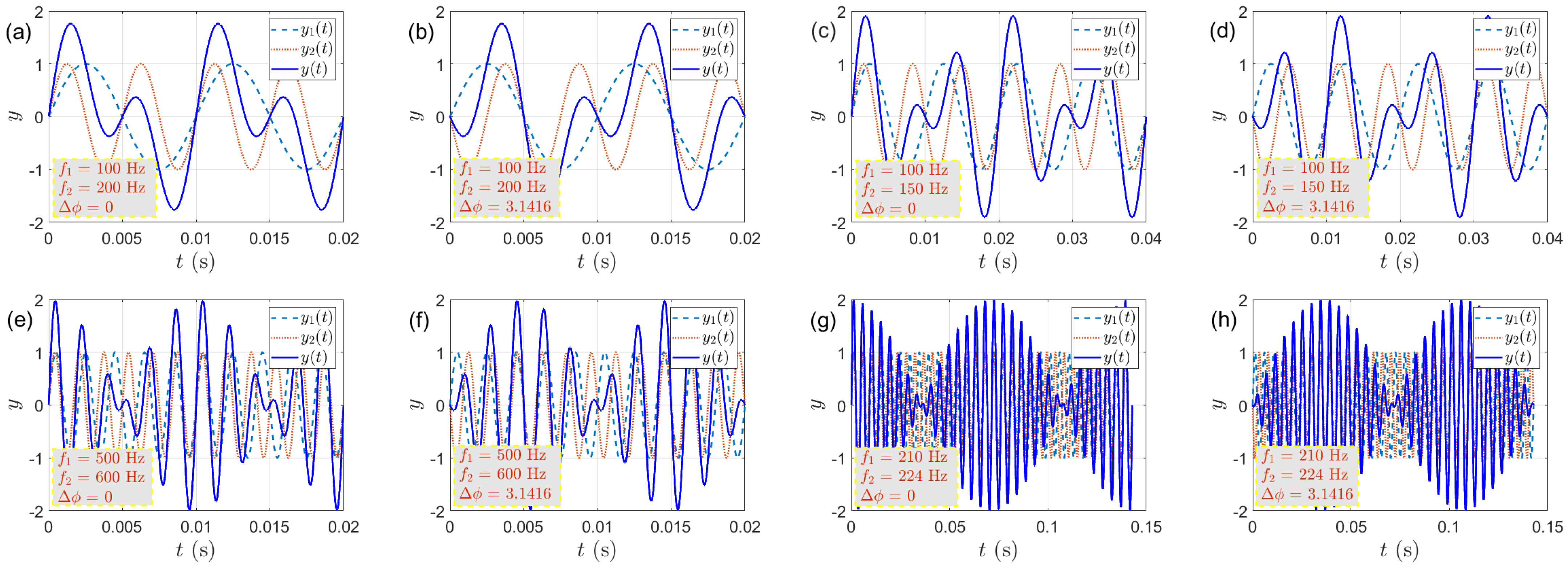
In Figure 1 we give examples of characteristic superpositions of simple-tone dyads. An octave, R = 2 / 1 , is shown in (a) and (b). During one period, the waveform of the first (second) tone makes one (two) complete movement(s). The composed waveform is periodic with period T = 1 T 1 = 2 T 2 . A pure fifth, R = 3 / 2 , is illustrated in (c) and (d). During one period the waveform of the first (second) tone makes two (three) complete movements. The composed waveform is periodic with period T = 2 T 1 = 3 T 2 . A minor third, R = 6 / 5 , is shown in (e) and (f). During one period the waveform of the first (second) tone makes five (six) complete movements. The composed waveform is periodic with period T = 5 T 1 = 6 T 2 . Finally, a minor second, R = 16 / 15 , is depicted in (g) and (h). During one period the waveform of the first (second) tone makes fifteen (sixteen) complete movements. The composed waveform is periodic with period T = 15 T 1 = 16 T 2 . We observe the increasing complexity of the composed waveform from the octave ( R = 2 / 1 ) to the minor second ( R = 16 / 15 ) where a beat is formed. A complete list of simple-tone dyads used in our experiment is shown in Table A1 in Appendix A. In our experiment, the simple-tone dyads were constructed with the software Audacity. Our simple tones, constituting a dyad, do not correspond to usual notes, but we keep the ratio of frequencies. For example, to construct an octave we do not take 220 Hz (A3) and 440 Hz (A4) but 200 Hz and 400 Hz.
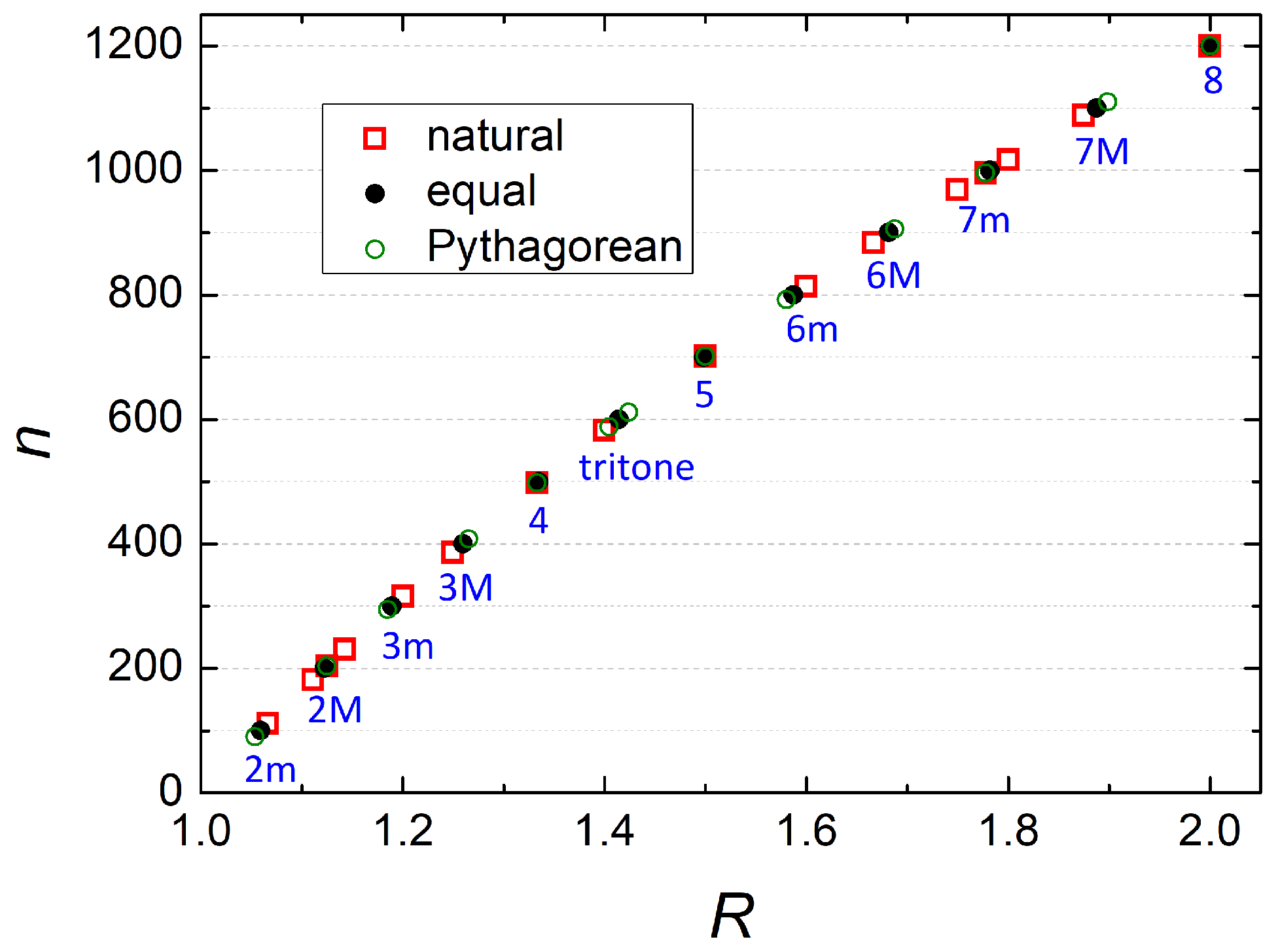
Our simple-tone dyads correspond to natural intervals: R is a fraction of natural numbers. We list below our natural intervals together with relevant equal temperament and Pythagorean intervals. An equal temperament interval is defined with the help of cents. An octave has 1200 cents and is divided according to the equal temperament into 12 semitones of a 100 cents each. The number of cents n is given by n = 1200 log 2 ( f 2 / f 1 ) . A Pythagorean interval [31,32] has R equal to an integer (positive or negative) power of 2 divided by another integer power of 3. For example, the octave with R = 2 = 2 1 / 3 0 , the fifth with R = 3 / 2 = 3 1 / 2 1 , and the fourth with R = 4 / 3 = 2 2 / 3 1 are Pythagorean intervals. These Pythagorean intervals coincide with the corresponding natural intervals and equal temperament intervals. However, other Pythagorean intervals do not exactly coincide. For example, the minor second, 2 m, which we take as a natural interval with R = 16 / 15 = 1.0 6 ¯ , corresponds to a Pythagorean interval with the closest fraction of the form 2 k / 3 l , that is 256 / 243 = 2 8 / 3 5 1.053 . Table 1 and Figure 2 illustrate the natural, equal and Pythagorean intervals in terms of cents (n) vs. frequency ratio (R).

2.2. Procedure

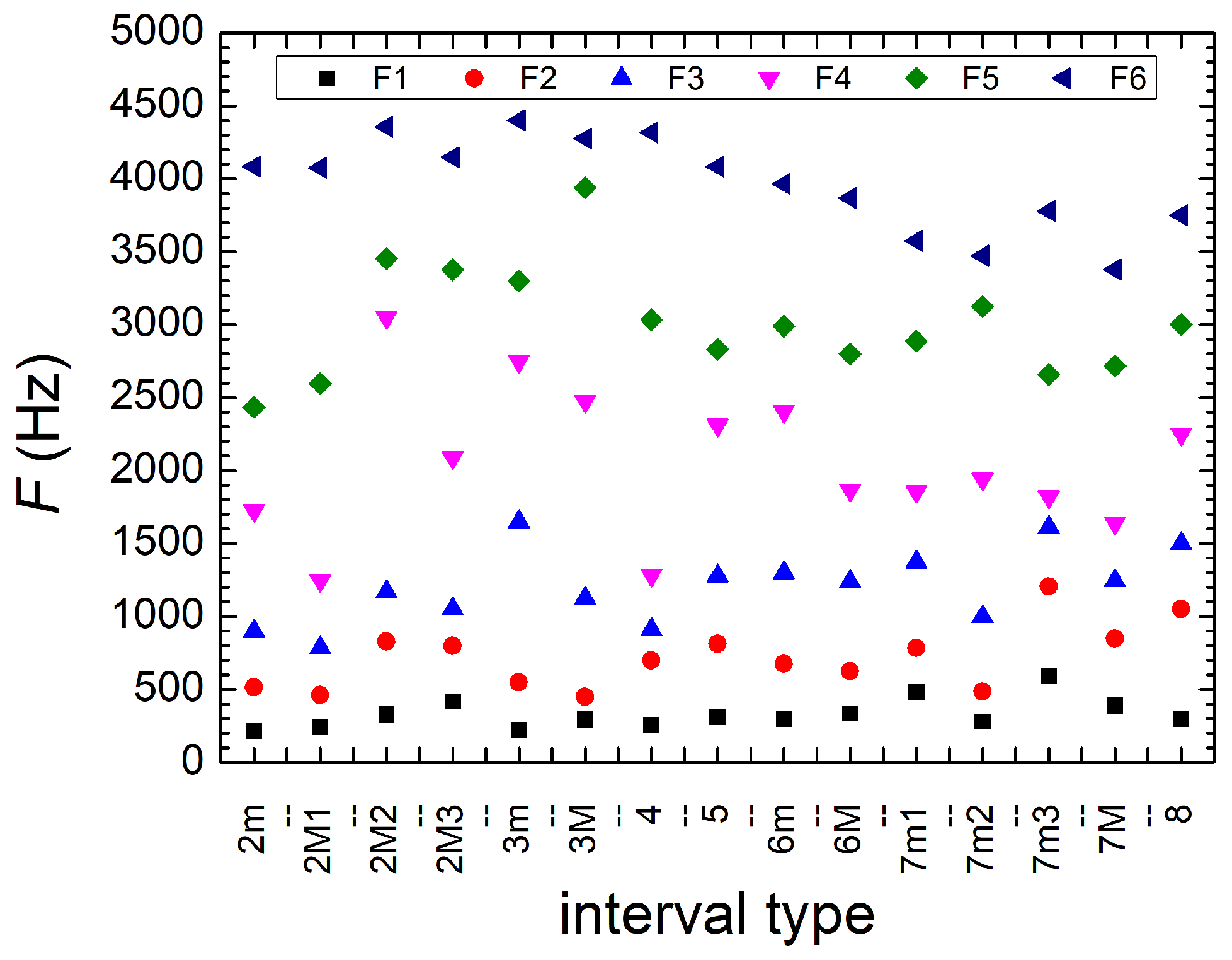
To present the set of stimuli, we employed the open software PsychoPy3, written in Python 3.13. We used headphones to reduce outer noise. The experiment was conducted in two quiet rooms at the Departments of Physics and Musical Studies of the National and Kapodistrian University of Athens. The experiment had a duration of ≈5–10 min. Each subject listened to 90 simple-tone dyads in random order. In Table A1 in Appendix A, we present the full list of simple-tone dyads, created by the software Audacity. We show the name of the musical interval (the number of semitones), a codename, the ratio of frequencies, R = f 2 f 1 , the mean frequency, F = f 1 + f 2 2 , and the pair of frequencies. Tritone (6 semitones) with R = 7 / 5 = 1.4 was not included in the experiment. For the cases of major second and minor seventh we have included three different R fractions. Figure 3 shows the mean frequencies F of these simple-tone dyads for each type of interval. Looking now at Figure 3 we may think that we could use equal F values for all types of intervals, but maybe this way we would have investigated only six specific F values.
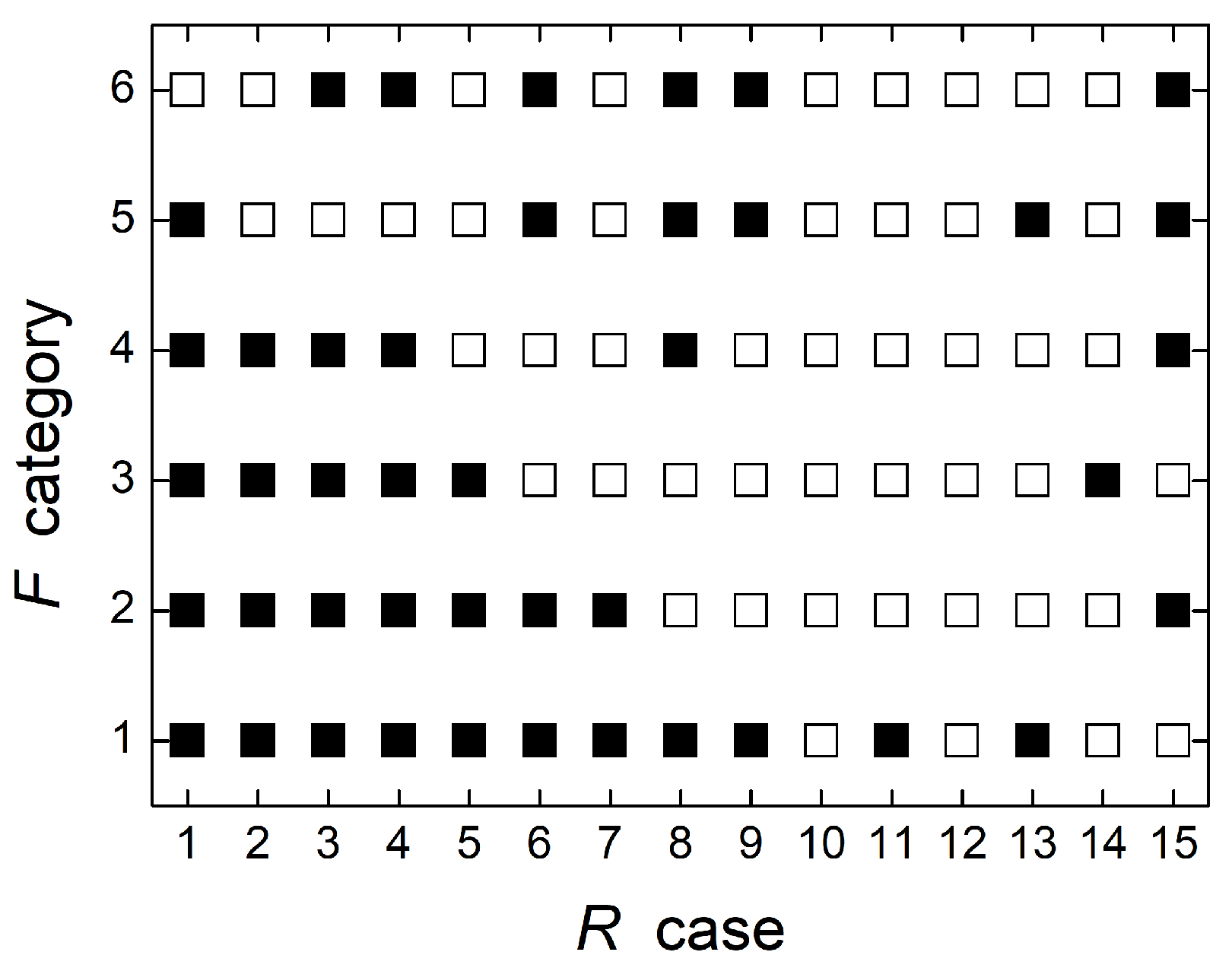
For each subject a new random sequence was produced. Subjects had to answer whether or not they liked each simple-tone dyad by pressing two buttons on the keyboard, Yes (→) or No (←). A binary like/dislike format was chosen to reflect intuitive, categorical judgments of dyadic pleasantness, which align with real-world listening behavior and reduce cognitive load in large stimulus sets. While continuous scales allow finer gradations, binary responses can reduce intra-subject variability and simplify interpretation, especially in studies emphasizing group-level patterns. During the experiment, the listener heard a simple-tone dyad of duration 2 s and then had as much time as necessary to decide whether they liked it or not and press the relevant button. By pressing the button, the program continued to the next dyad, and again the listener had time to evaluate it as pleasant or unpleasant. The experiment continued this way until the list of all dyads had been presented. With the last response, the experiment ended. The responses were automatically registered in a spreadsheet, together with relevant information, e.g., response time, the time the first Yes or No was recorded, etc. A presentation of responses, ρ , of a random subject, for all simple-tone dyads, i.e., for each F category (1 → 6 corresponds to increasing frequency) and for each R case, is given in Figure A1 in Appendix A. Participants listened to the stimuli through headphones connected to a calibrated computer system and were instructed to adjust the playback volume to a comfortable level before beginning the experiment. Although absolute sound pressure levels (SPLs) were not precisely measured, all participants were tested in the same controlled laboratory setting, using identical equipment in a quiet environment. This ensured consistent relative stimulus levels and stable listening conditions across participants. All participants reported having normal hearing and no history of auditory disorders. While formal audiometric screening was not conducted, the use of a relatively young adult cohort and stimuli within the standard audiometric range minimizes the likelihood of undiagnosed hearing loss affecting the core results. Participant-controlled volume, while introducing variability in absolute listening level, ensured comfort and consistent within-subject conditions, preserving the internal validity of relative preference judgments between dyads.

2.3. Participants

The set of subjects consists of 70 persons. Subjects originate from different environments (students and professors from the Department of Physics, School of Natural Sciences, Department of Musical Studies, and Philosophical School, National and Kapodistrian University of Athens, the authors’ friends and relatives and persons who responded to our call on social media). The set of subjects can be divided into 39 women and 31 men. Their age is between 19 and 86 years. Of the 70 participants, 47 reported no formal musical training or significant engagement with music, whereas 23 were either professional musicians or had played a musical instrument for at least seven years. All participants were from Greece and primarily exposed to Western musical traditions. While this study centers on Western interval classes, future work should examine cross-cultural variation in consonance judgments. Greek popular and traditional music includes harmonic structures that sometimes differ from Western classical norms, which may have subtly influenced listeners’ responses—though all stimuli used culturally neutral sine tones.
The Ethics Committee of the National and Kapodistrian University of Athens approved the experiments (decision 134/2024, 29 February 2024). All experiments were performed in accordance with relevant guidelines and regulations. A signed consent form was obtained from all participants.

2.4. Data Analysis: Response, Preference, and Statistics

Subjects responded with Yes or No, which was translated by us to 1 or 0, respectively. These are the responses, ρ . We defined the preferences, P, as mean values of the responses. Responses and preferences were analyzed. We present these mean values and mean errors (standard deviations/square root of the number of measurements). For the total set of 70 persons, we created relevant P diagrams. When we compared between two groups of subjects (e.g., musicians vs. non-musicians, men vs. women, or age groups), in addition to the P diagrams, we compared the two groups via statistical methods. Our samples are independent; hence, we had to employ an adequate criterion. To check whether these mean values were extracted from the normal distribution or not, we performed the Shapiro–Wilk test [33]. It occurred that preferences were not extracted from the normal distribution, a basic prerequisite for using a parametric method like the t-test [34]. Therefore, we employed the Mann–Whitney (MW) test [35], a non-parametric rank sum criterion for comparison between two independent samples, where normality is not a prerequisite. The Mann–Whitney test is not identical to the Wilcoxon test [36], although both are non-parametric and involve summation of ranks. The Mann–Whitney test refers to independent samples; the Wilcoxon test refers to dependent samples. The MW criterion is reliable for samples with population ν > 6 . Hence, in some cases, for preferences, we had to construct larger groups to increase the population well above ν = 6 . These larger groups were constructed based on the simplicity of the ratio R, cf. Table 2. Fourths, fifths and octaves with irreducible R of small numerator and denominator belong to the 3rd larger group. Seconds with irreducible R of large numerator and denominator belong to the 1st larger group. Sevenths constitute the 4th larger group. Intermediate cases, thirds and sixths, belong to the 2nd larger group. The standard p-value [37] is usually considered 0.05. For the MW text we used different implementations, a home-made Excel procedure written by us and a free code in MATLAB 24.2 written by G. Cardillo [38].
We realized that, approximately, preferences fall with increasing pitch. Although these falls in preference as a function of mean frequency, P ( F ) , are not linear, to have a crude idea of how steep the falls are, we performed linear fits of P ( F ) = A F + B . We estimated slope A and its error δ A , intercept B and its error δ B and adjusted R squared R 2 to evaluate the quality of fits. Finally, we calculated (a) P ¯ ( R ) , i.e., the mean over all F categories for each R case, and (b) P ¯ ( F ) , i.e., the mean over all R cases for each F category.

3. Results and Discussion

3.1. Overall Preference Patterns

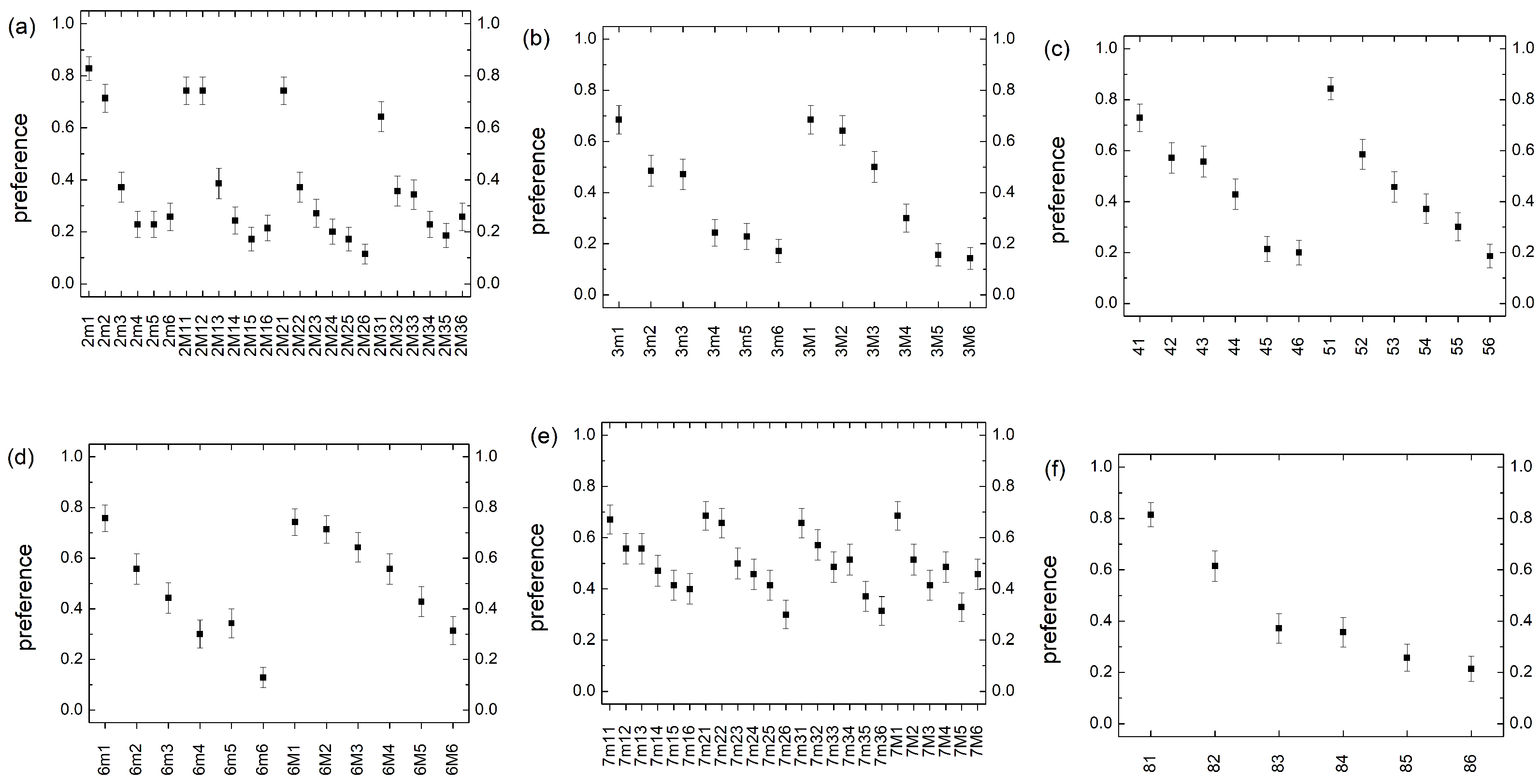
In Figure 4 we depict preference, P, diagrams (mean values and mean errors) for the total set of subjects for each R case. The general trend is a decrease in P as F increases. The dyads with larger P are mainly those of F category 1 (the dyad of lower F for each R case) and then F category 2 follows. F category 1 for all R cases has the highest P. For fifths ( R = 3 / 2 ), octaves ( R = 2 / 1 ) and minor 2nds ( R = 16 / 15 ), for F category 1, P is above 0.8. Then follow fourths ( R = 4 / 3 ) and sixths [majors ( R = 5 / 3 ) and minors ( R = 8 / 5 )], where the F category 1 has P between 0.7 and 0.8. In other words, the majority of listeners describe F category 1 as pleasant. Unexpectedly, certain dyads such as 2m1, 2M11, and 2M21 exhibit relatively high P values. For example, 2m1 corresponds to the lowest F = 217 Hz ( f 1 = 210 Hz, f 2 = 224 Hz, Δ f = 14 Hz) and has clear beats. However, it is not characterized as unpleasant by most of the listeners. We observe in Figure 4 that with increasing F, P shows an almost “linear” fall for thirds, fourths, fifths, sixths and octaves, an effect less pronounced for seconds and sevenths. With increasing F, P falls towards 0.2 or 0.1. For seconds and sevenths, P is more dispersed; however P still falls, as a general trend, with increasing F. Overall, seconds appear to be rated as the most unpleasant among the dyads.
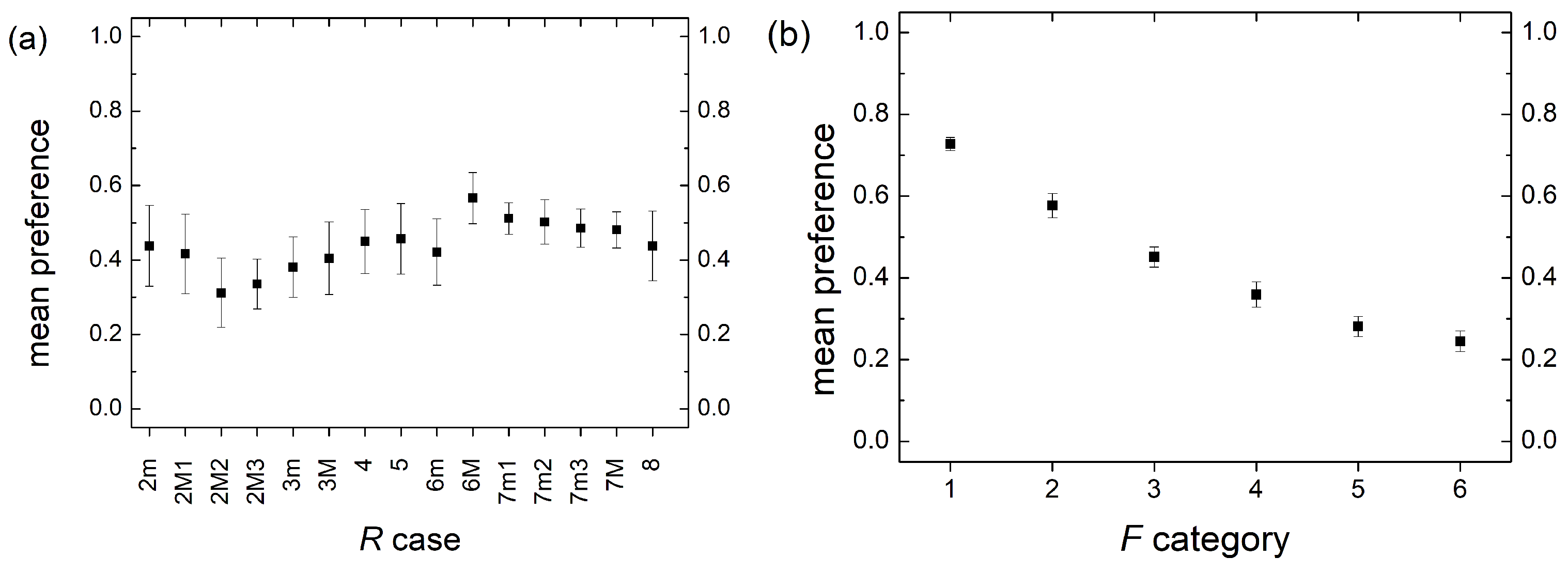
Preference, P, is itself a mean value, cf. Section 2.4. In Figure 5a we present the mean P over all F categories for each R case, P ¯ ( R ) . The R case with the greatest P ¯ ( R ) is 6M ( P ¯ 0.57 ), while 7m2 and 7m1 follow. On the other hand, the R cases with the lowest P ¯ ( R ) are 2M2 and 2M3 ( P ¯ 0.31 and 0.34 , respectively). Most P ¯ ( R ) values have large errors of the mean value, of the order of 0.1 (between ≈ 0.04 and 0.11 ); therefore, the picture is not very clear. In Figure 5b we present the mean P over all R cases for each F category, P ¯ ( F ) . Clearly, with increasing F, P ¯ ( F ) falls and the errors of mean values are of the order of 0.01 (between ≈ 0.01 and 0.03 ), almost invisible in that scale, while mean values are of order of 0.5 . The lower F category 1 simple-tone dyads have much higher P ¯ (≈ 0.73 ) compared to the rest; e.g., F categories 4, 5, and 6 have P ¯ < 0.4 .
Terhardt [12] conducted experiments presenting dyads consisting of two tones—one fixed at La4 and the other varying gradually up to an octave (La5) [12]. Listeners rated these dyads for “consonance” and “roughness”. Concerning consonance, our results agree with the minimum at seconds shown by Terhardt [12], but do not confirm the monotonous increase shown in his idealized curve. In Figure 1 of this famous work [12], an evaluation of “consonance” and “roughness” of single, isolated dyads as a function of interval width was presented. The presentation, according to Terhardt, was “slightly idealized” and included data obtained from Plomp and Levelt [39], Kameoka and Kyriyagawa [40,41] and Terhard [42]. The interval width was represented by the higher note, whereas the lower was kept at La4 (440 Hz). Terhardt also noted that “Although only a limited number of dyads was involved (i.e., interval changed in discrete steps), the results are represented by continuous curves. The “most dissonant” interval of pure-tone dyads corresponds to the minimum of the solid curve.” In other words, this was a curve of “evaluation” versus the highest note of the dyad, from La4 to La5. This evaluation begins with a value of 1 at La4, which we interpret as either a dyad consisting of two simultaneous La4 notes or a single La4. In any case, Terhardt’s curve falls rapidly at minor seconds and shows a clear minimum at major seconds, as in our results. But then, Terhardt shows a monotonous increase in “evaluation” up to the octave, while in our results the increase is certainly not monotonous for the general public (this Section 3.1, Figure 5a), and musicians show two local maxima at the major sixth and octave, cf. Section 3.2, Figure 6 and especially Figure 7a. In the same work [12], when composite tones including harmonics were considered, the interactions became more complex, resulting in perceptual patterns that diverged from those observed with simple tones. These differences likely arise from the harmonic interactions and resulting roughness, highlighting the nuanced nature of consonance perception in complex sounds. Regarding Terhardt’s Figure 2, where he evaluated “the width of the most dissonant interval”, we have not run a similar experiment, but we find that with increasing frequency, the feeling of consonance decreases, as shown in Figure 5b and in all similar figures below concerning comparison of nominal groups.
Inference: In all, for the general public, increased mean frequency (F) makes simple-tone dyads less pleasant. For octaves, fifths, fourths, and sixths the feeling of consonance shows an almost “linear” fall with increasing F. Seconds and sevenths are more dispersed, but still increased F increases the feeling of dissonance. Seconds seem the most unpleasant simple-tone dyads.

3.2. Effects of Musical Training

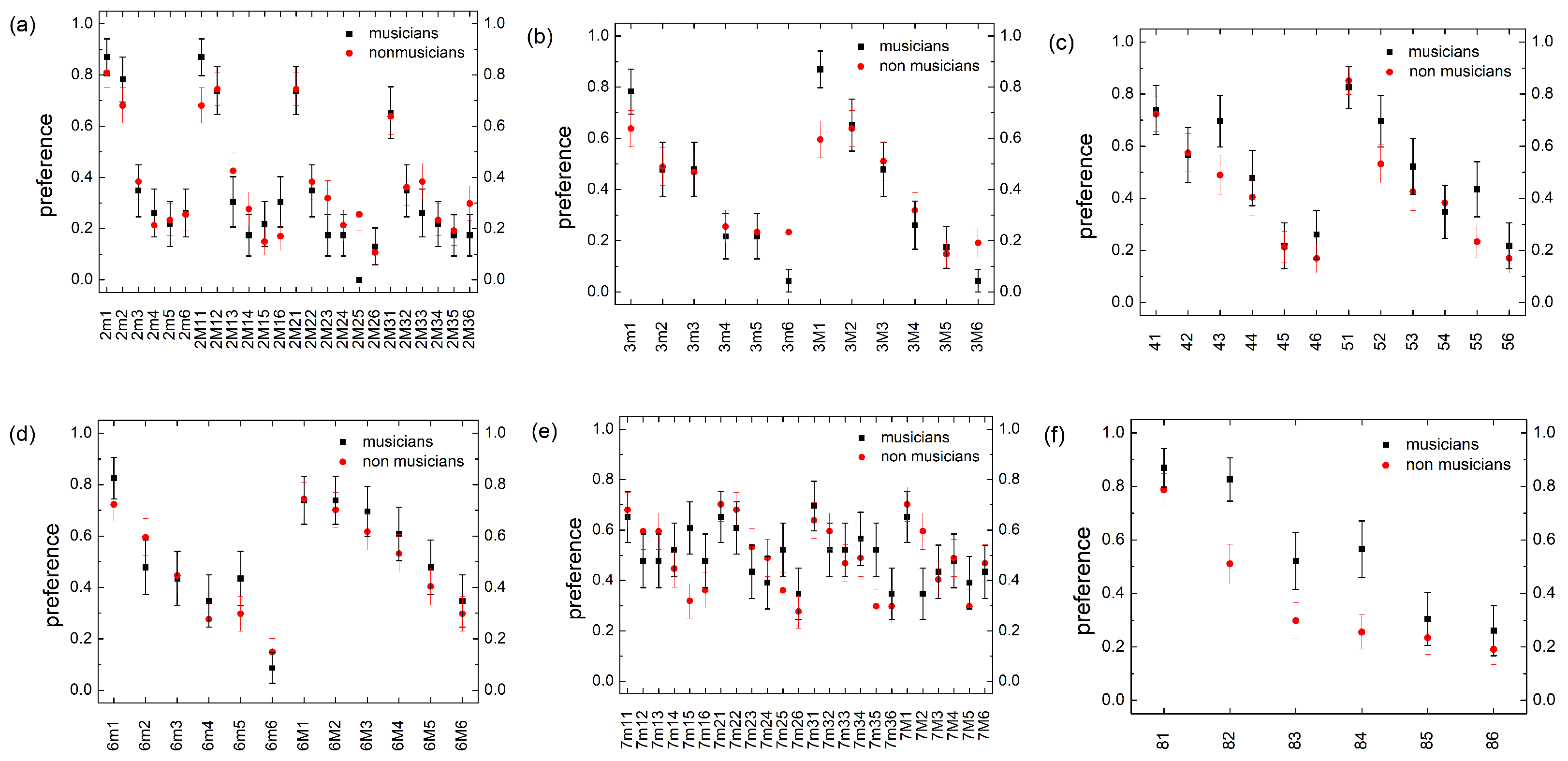
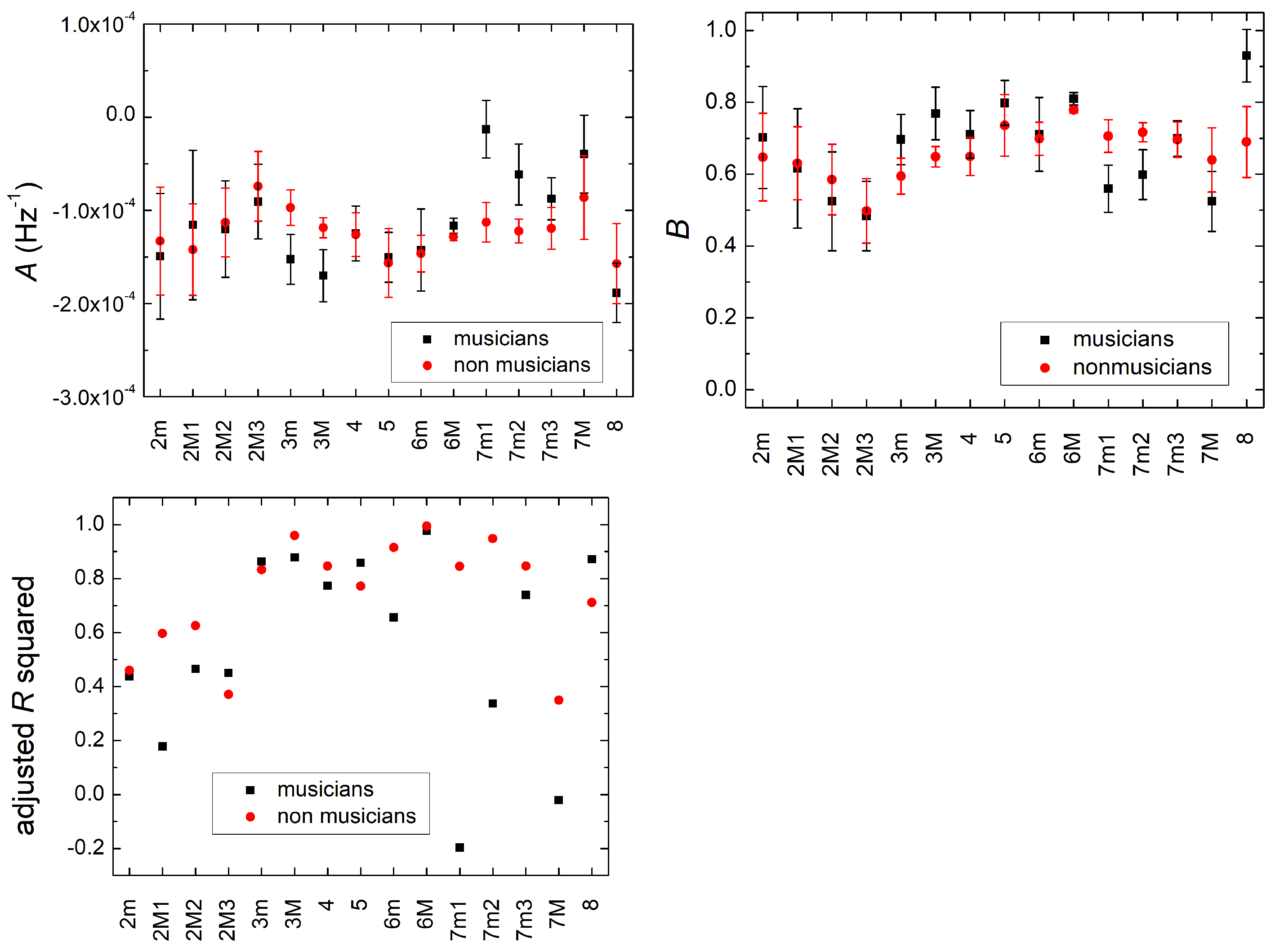
In Figure 6 we compare preferences of musicians (black squares) with those of non-musicians (red circles). For musicians, the errors are larger because the number of musicians who participated in the experiment was 23 (compared to 47 non-musicians). Octaves show the most pronounced divergence in preferences between musicians and non-musicians: musicians seem to like octaves ( R = 2 / 1 ) more than non-musicians. For musicians, for the lower F categories (1 to 4), P > 0.5 . For F categories 2, 3, and 4, we have the largest separation; for F categories 1, 5, and 6, the separation remains high. For octaves, linear fits P ( F ) = A F + B give for musicians B 0.93 ± 0.07 , A ( 1.9 ± 0.3 ) × 10 4 Hz−1 (with adjusted R squared, R 2 0.87 ) and for non-musicians B 0.69 ± 0.10 , A ( 1.6 ± 0.4 ) × 10 4 Hz−1 ( R 2 0.71 ). Hence, for octaves, the falls in P ( F ) have a similar slope, but preferences of musicians are higher. For fifths ( R = 3 / 2 ), this observation is not so strong; i.e., for musicians B 0.80 ± 0.06 , A ( 1.5 ± 0.3 ) × 10 4 Hz−1 ( R 2 0.86 ) and for non-musicians B 0.74 ± 0.09 , A ( 1.6 ± 0.4 ) × 10 4 Hz−1 ( R 2 0.77 ). All calculated slopes A, intercepts B, and adjusted R squared R 2 for the groups musicians–non-musicians can be found in Figure A2 in Appendix A. The fits are not generally good; i.e., the relationships P ( F ) are not generally straight lines. However, all slopes are clearly negative (but we notice that sevenths have very small negative slopes): we find again that with increasing pitch, the feeling of consonance decreases. We also notice that the most negative slopes are those for octaves and major thirds; maybe in those cases dissonance comes mainly from increasing the mean frequency.
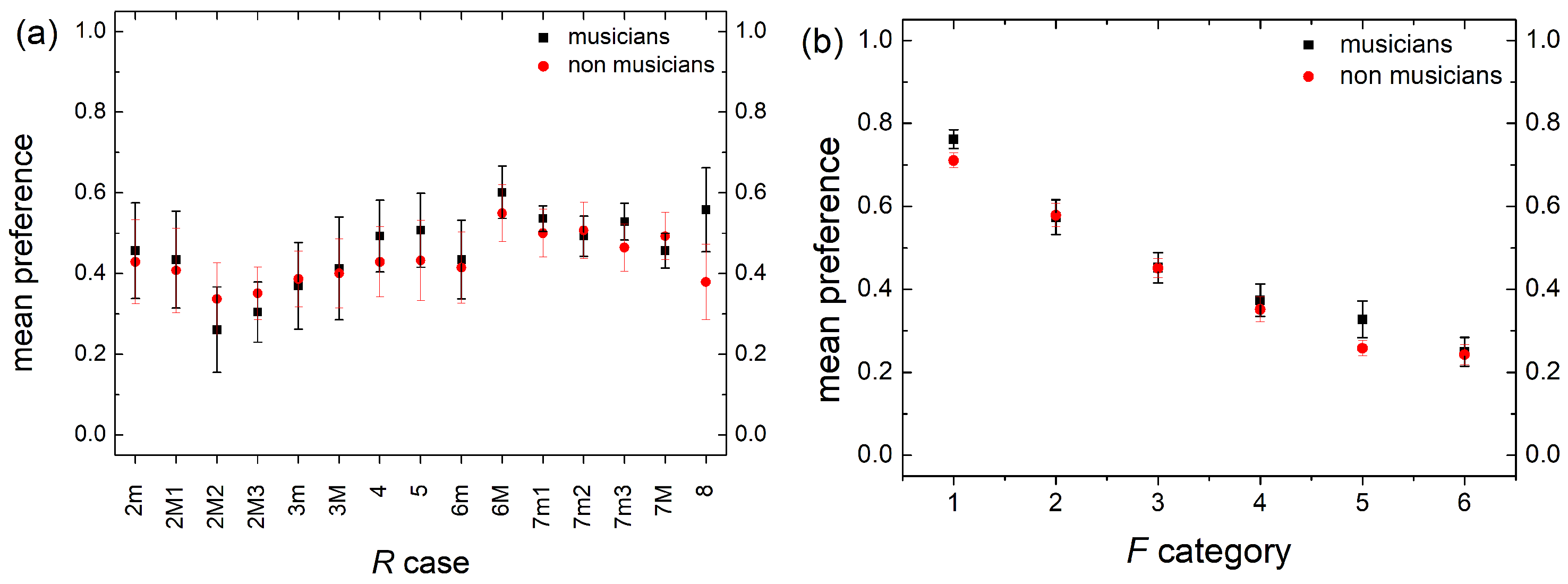
In Figure 7a we show the mean P over all F categories for each R case, P ¯ ( R ) . The R cases with the greatest P ¯ ( R ) are 6M ( P ¯ 0.60 ) and 8 ( P ¯ 0.56 ) for musicians and 6M ( P ¯ 0.55 ) for non-musicians. The results suggest that musicians have a greater preference for 4, 5, 6M, and 8 (and maybe 7m) and maybe less preference for 2M and 7M. Notice that for octaves the error bars touch each other very little. The R cases with the lowest P ¯ ( R ) are 2M2 and 2M3 both for musicians ( P ¯ 0.26 and 0.30 ) and non-musicians ( P ¯ 0.34 and 0.35 ). Most P ¯ ( R ) values have errors of the order of 0.1 (musicians: min 0.03 , max 0.13 ; non-musicians: min 0.06 , max 0.10 ). In Figure 7b, we present the mean P over all R cases for each F category, P ¯ ( F ) . Clearly, with increasing F, P ¯ ( F ) falls both for musicians and non-musicians. Errors are of the order of 0.01 (musicians: min 0.02 , max 0.04 ; non-musicians: min 0.02 , max 0.03 ).
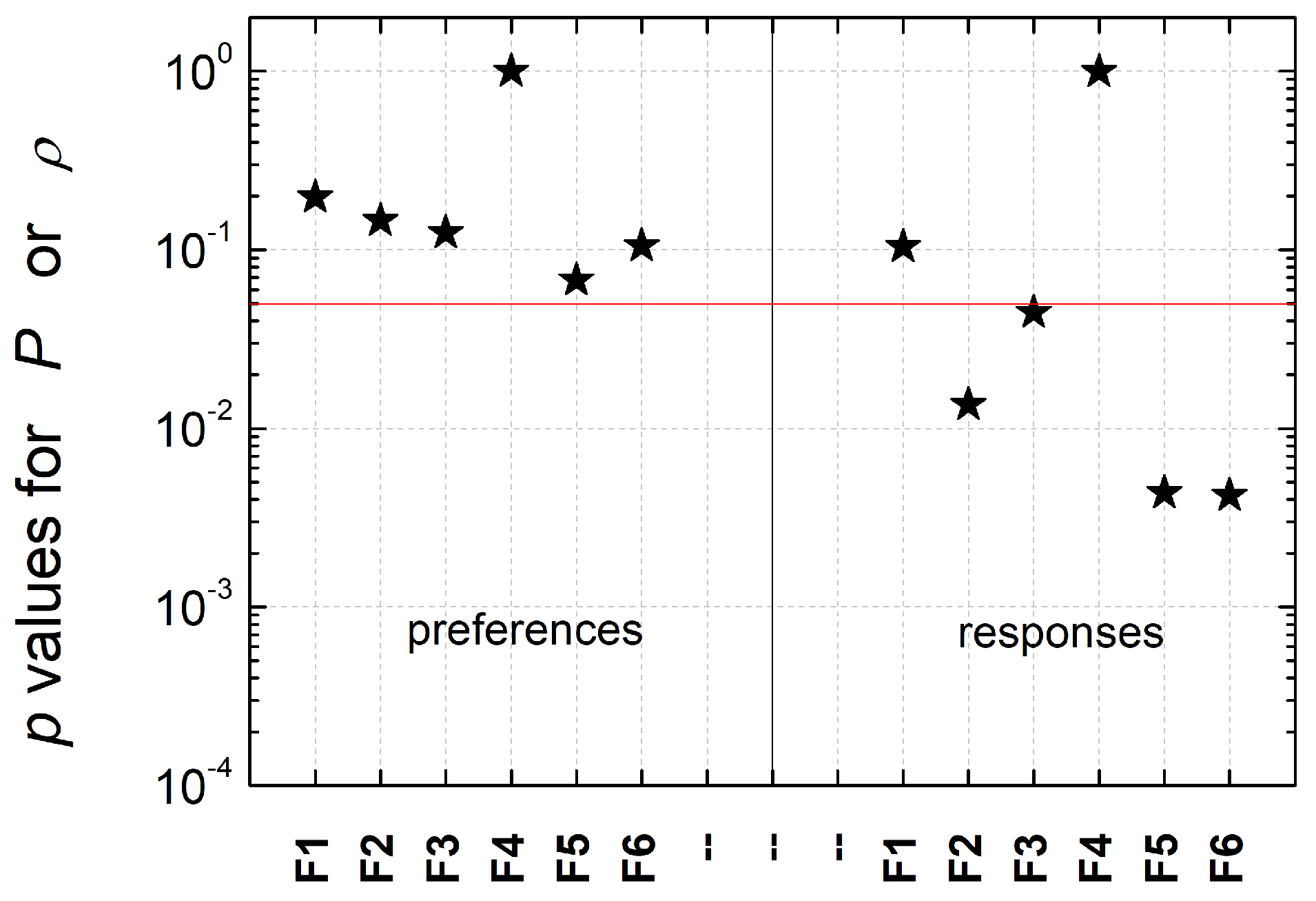
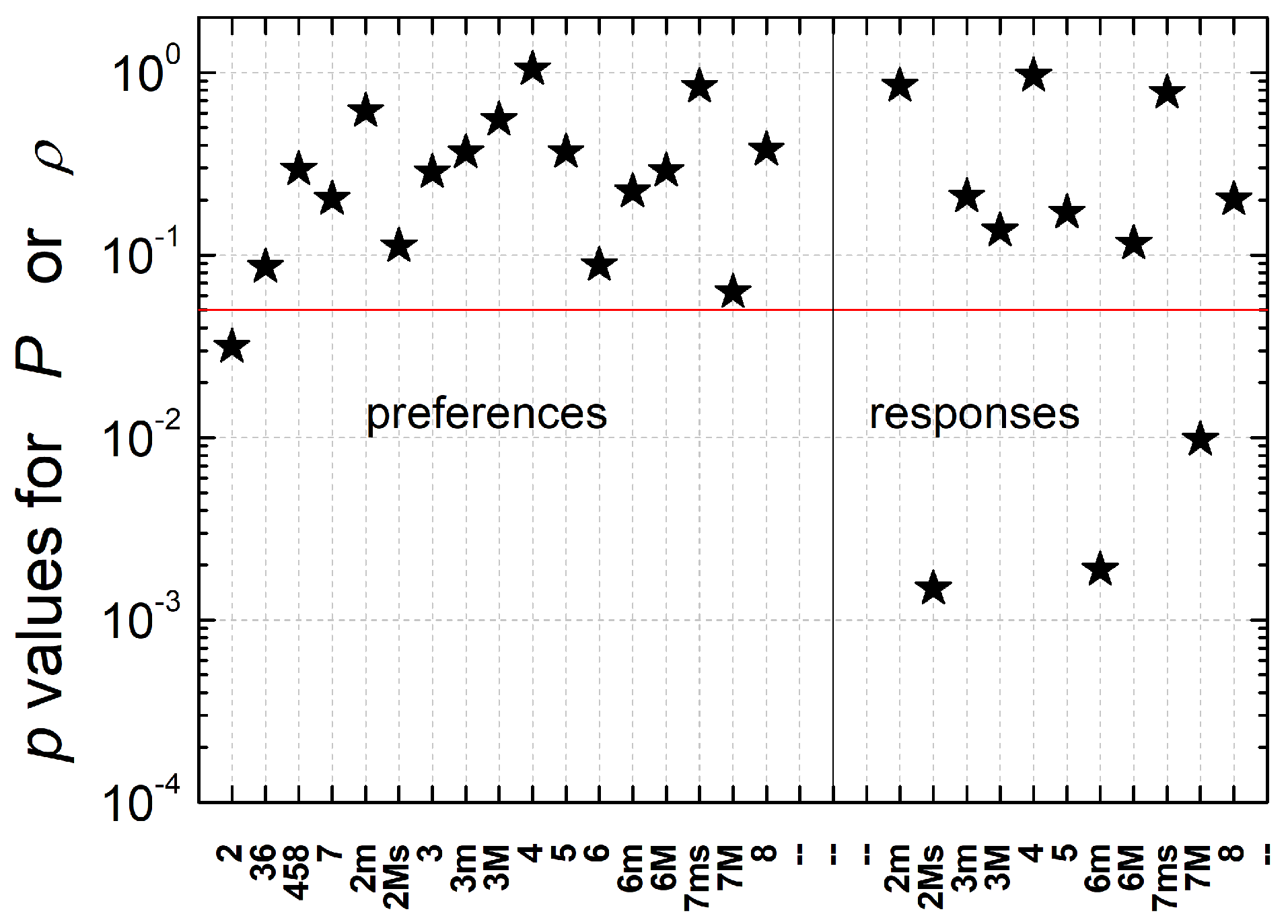
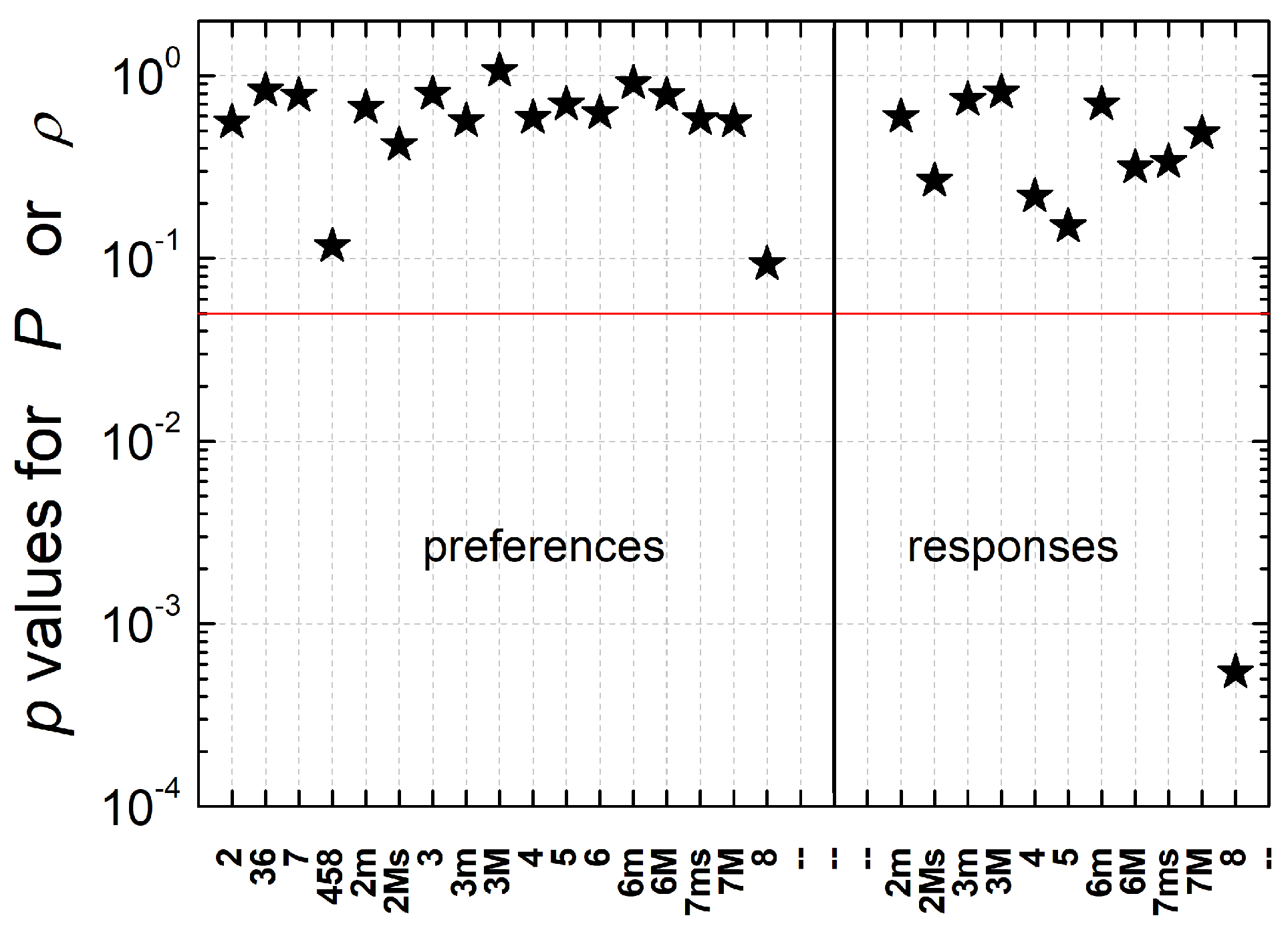
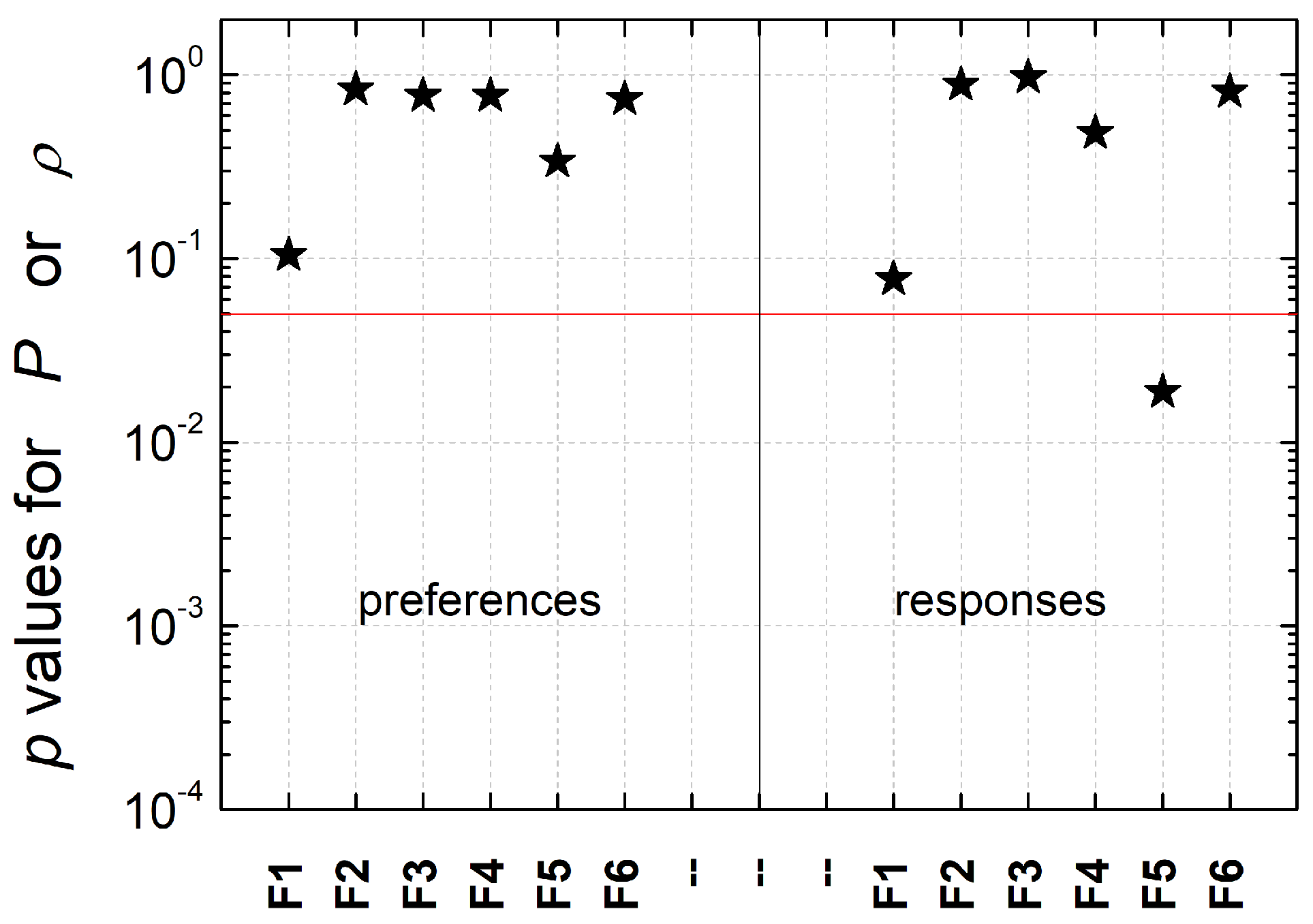
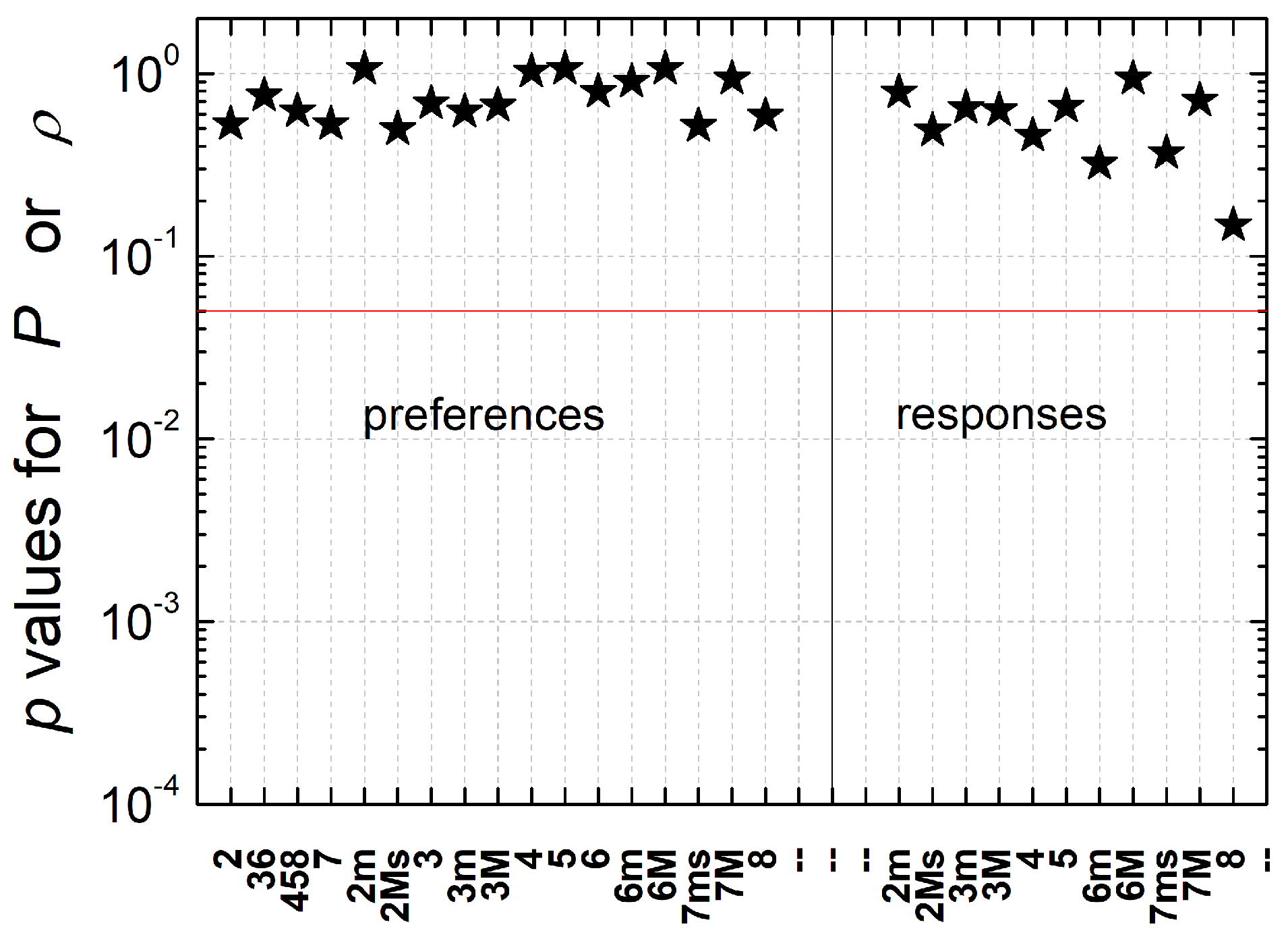
We performed the Mann–Whitney test for the four larger groups (cf. Table 2). An illustration of the MW tests is shown in Figure A3 (for all R cases) and in Figure A4 (for all F categories). These MW tests confirm the inferences of Figure 7a,b. Each of the first, second and fourth larger groups contains 24 preference values for musicians and 24 preference values for non-musicians and the third larger group contains 18 preference values for musicians and 18 preference values for non-musicians [six F categories for each R case]. These preference values are the mean values shown in Figure 6. From the results of the MW test, we deduce that for all larger groups the results for musicians and non-musicians are not significantly different at the 0.05 p-level. For the third larger group (fourths, fifths, octaves), the differences between musicians and non-musicians were not statistically significant at the 0.05 level. However, when we examined each interval separately using the Mann–Whitney test, the p-value for octaves was smaller than for fourths or fifths. While still not significant in this group-level analysis, this suggested a potential trend. To explore this further, we conducted an additional analysis using individual responses rather than averaged preferences. In this finer-grained test, octaves yielded a statistically significant difference between musicians and non-musicians ( p 0.0005), while the other intervals did not. These results support the conclusion that the perception of octaves differs significantly between the two groups. No significant differences were observed for the other simple-tone dyads, with p-values of approximately 0.15 for fifths and 0.22 for fourths. While these are not significant, they may suggest weak trends that could be examined in future research. We note that no corrections for multiple comparisons were applied, and these results should therefore be interpreted with caution.
Inference: For octaves, the falls in P ( F ) show a similar slope between groups, but the overall preference level is higher for musicians. For fifths, a similar trend is observed, though less pronounced. Across all R cases, with increasing pitch, consonance ratings tend to decrease for both groups. MW tests on preference scores for the combined group of fourths, fifths, and octaves did not show a statistically significant difference at the 0.05 level, though the result approaches this threshold. When analyzing individual R cases, octaves yielded the lowest p-value among all intervals, indicating a possible trend, although not reaching statistical significance. In contrast, the MW test on responses (i.e., raw response data, without averaging) showed a statistically significant difference between musicians and non-musicians for octaves ( p 0.0005). This result suggests that the perception of octaves differs reliably between the two groups. The averaged preference scores P ( R ) indicate that musicians rate octaves (8), and possibly fourths (4), fifths (5), and major sixths (6M), higher than non-musicians. Both groups rated the intervals 2M2 and 2M3 lowest. Finally, P ( F ) is a decreasing function both for musicians and non-musicians.

3.3. Effects of Gender

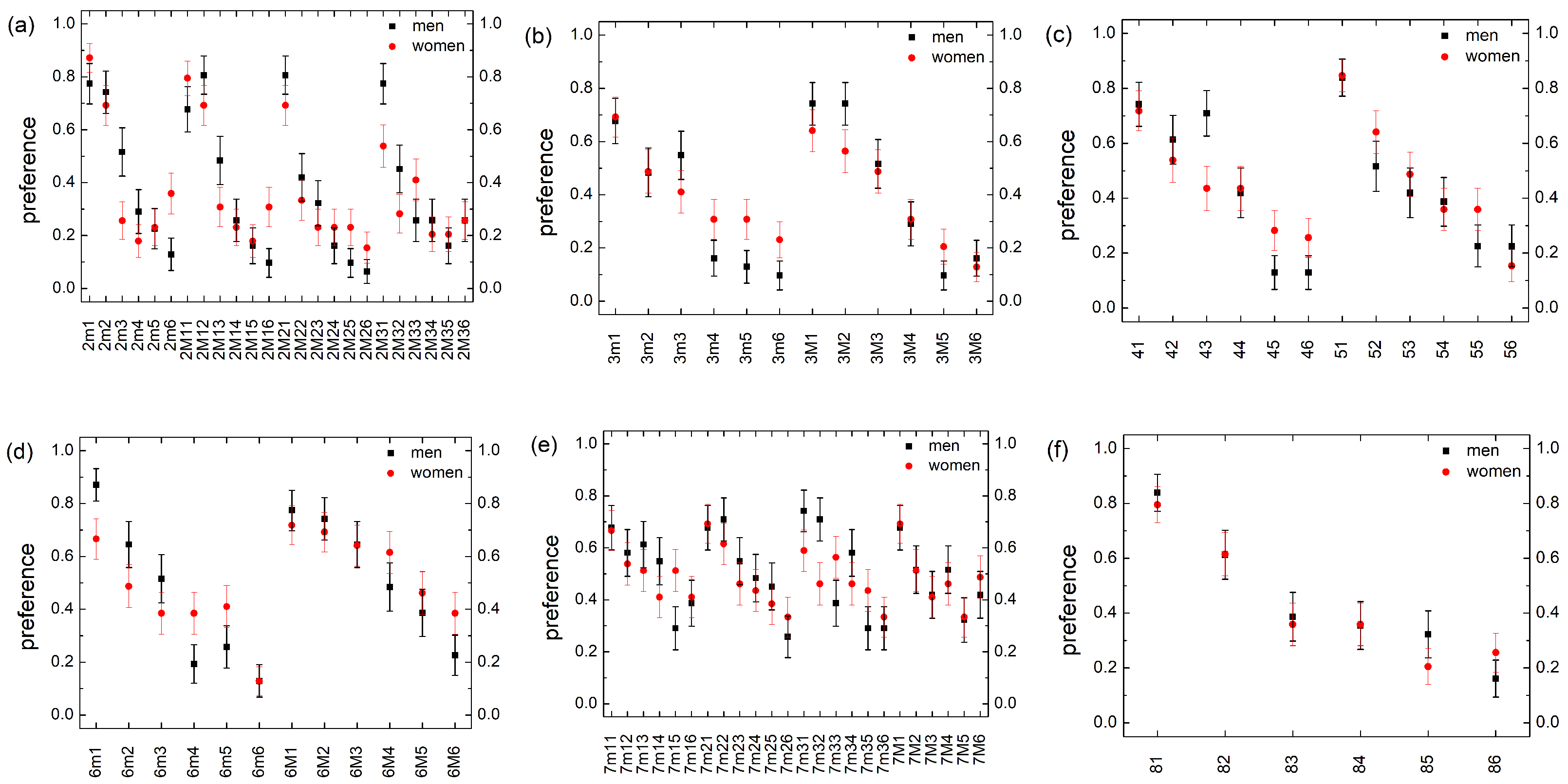
In Figure 8 we compare the preferences of men (black squares) with those of women (red circles). These do not seem to show strong differences at a first glance. We observe again the decrease in preferences with increasing pitch, both for men and women. The preferences of both groups start from 0.9 to 0.8 for lower F categories and fall between 0.2 and 0.1 for the higher F categories. The preferences of sevenths, for men or women, are higher than 0.2. In some R cases, for lower F categories men score high but for higher F categories their scores fall significantly; i.e., there is a large extent of scores. In some R cases women score higher for higher F categories, but their scores have a smaller variation range. This pattern may suggest that men are less tolerant of higher frequencies, though further investigation is needed.
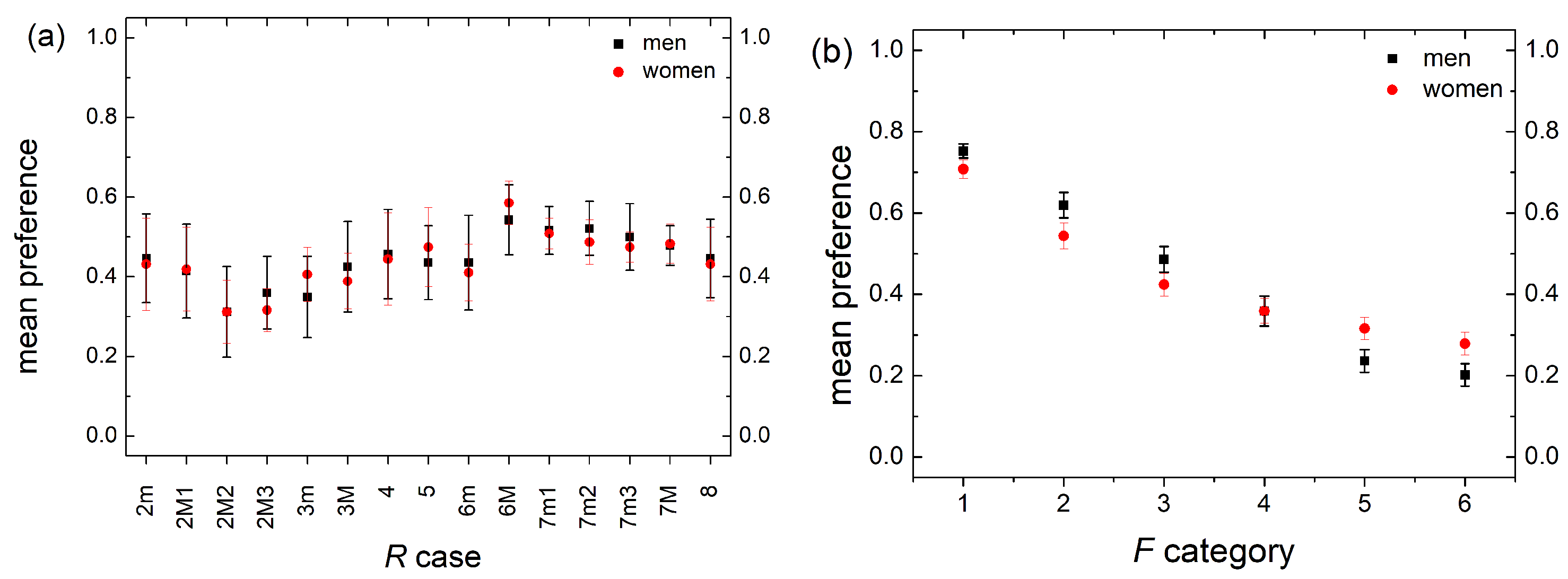
In Figure 9a we present the mean over all F categories for each R case, P ¯ ( R ) . Errors are rather large. Errors for women are a little smaller (39 women vs. 31 men). The P ¯ ( R ) of the two groups does not show great differences. In Figure 9b we show the mean over all R cases for each F category, P ¯ ( F ) . Again, we observe that high-F simple-tone dyads have a lower P ¯ ( F ) than low-F simple-tone dyads: we find again that the feeling of consonance decreases with increasing pitch. However, there is a significant difference between men and women: clearly, for the lower F categories, P ¯ ( F ) is higher for men; for the higher F categories, P ¯ ( F ) is higher for women. In other words, for lower pitches men show higher preferences, but for higher pitches women show higher preferences.
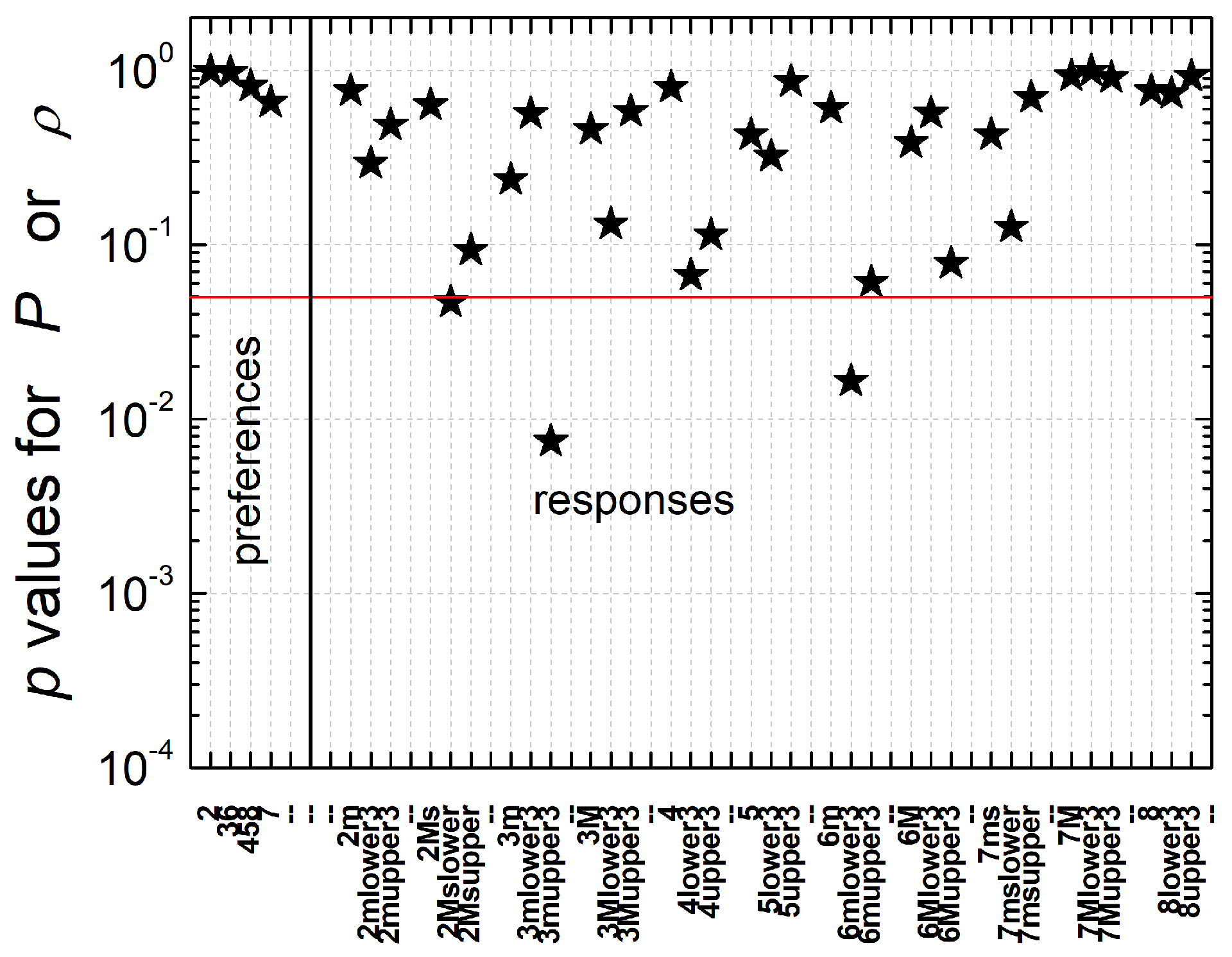
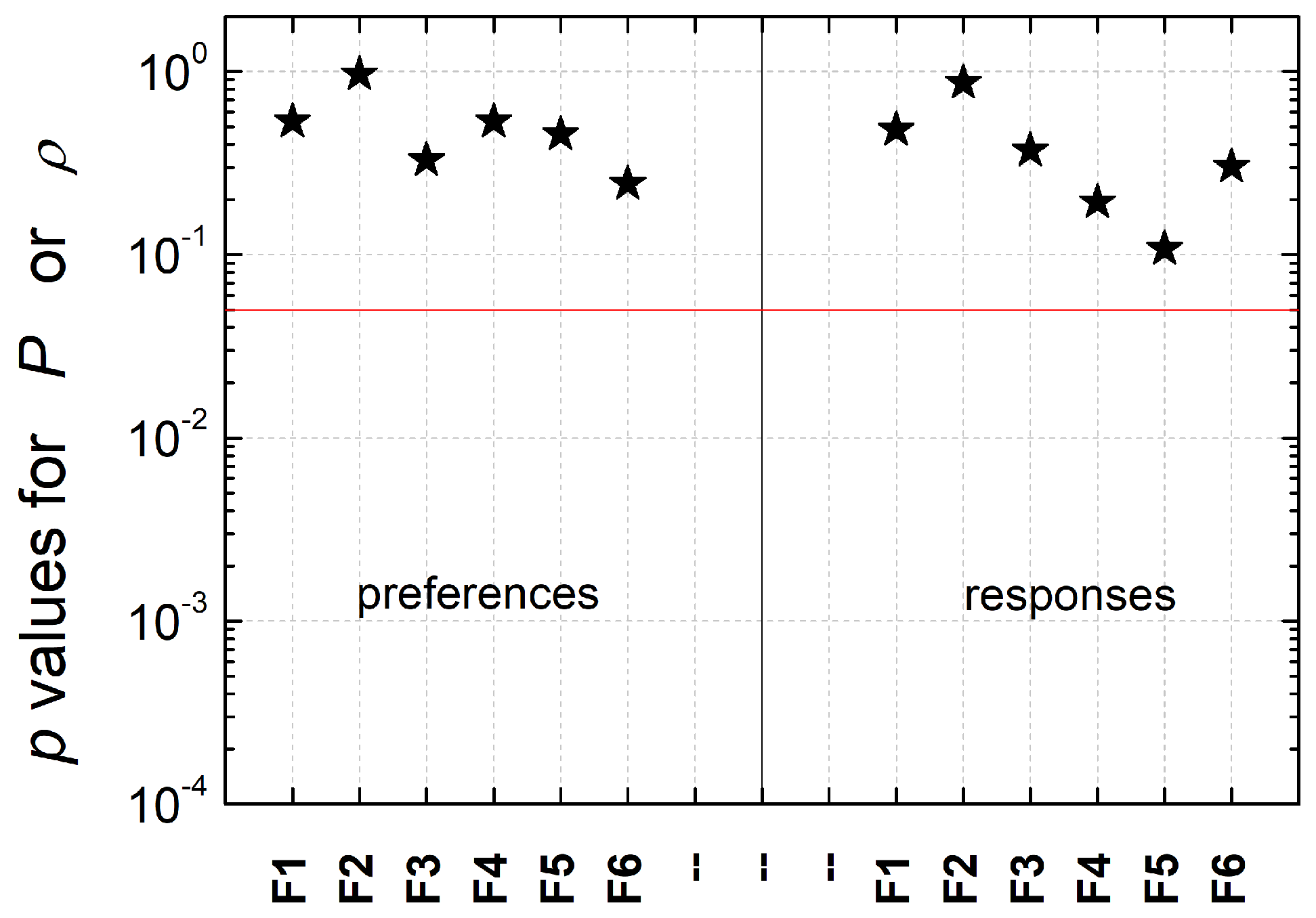
However, from the MW rank sum test for preferences between the groups men and women, we realize that statistically significant differences in preferences do not exist. We repeated the MW test for responses, i.e., without averaging first. We also checked dividing the responses into the lower three/upper three F cases. The results suggest that only in a few cases is there a significant difference (at least at the 0.05 level) between the responses of men and women. Men seem to dislike higher frequencies more than women. An illustration of MW tests comparing the groups men and women is shown in Appendix A, in Figure A5 (for all R cases) and in Figure A6 (for all F categories). These MW tests confirm the inferences of Figure 9a,b.
Gender differences play a role in auditory perception. Longitudinal studies, such as Pearson et al. [13], have consistently found that men experience faster and greater declines in hearing sensitivity than women, especially in the high-frequency range relevant for musical perception. This disparity may contribute to subtle differences in dyad perception and pitch discrimination between genders. McFadden [14] further supports this by showing that women tend to have stronger otoacoustic emissions, indicating better cochlear (outer hair cell) function, which is often linked to finer frequency resolution. Additionally, a large-scale global study by Koerner et al. [22] confirmed that women exhibit, on average, approximately 2 dB greater cochlear sensitivity than men, even when controlling for age and environment. These gender-based auditory differences may influence how pitch intervals and consonance are perceived and should be considered in psychoacoustic models.
Inference: As a general trend, for lower F men show higher preferences, but this is reversed for higher F, where women show higher preferences. The results suggest that men dislike high frequencies more than women. The results also suggest that the scores of men have higher variation than the scores of women.

3.4. Effects of Age

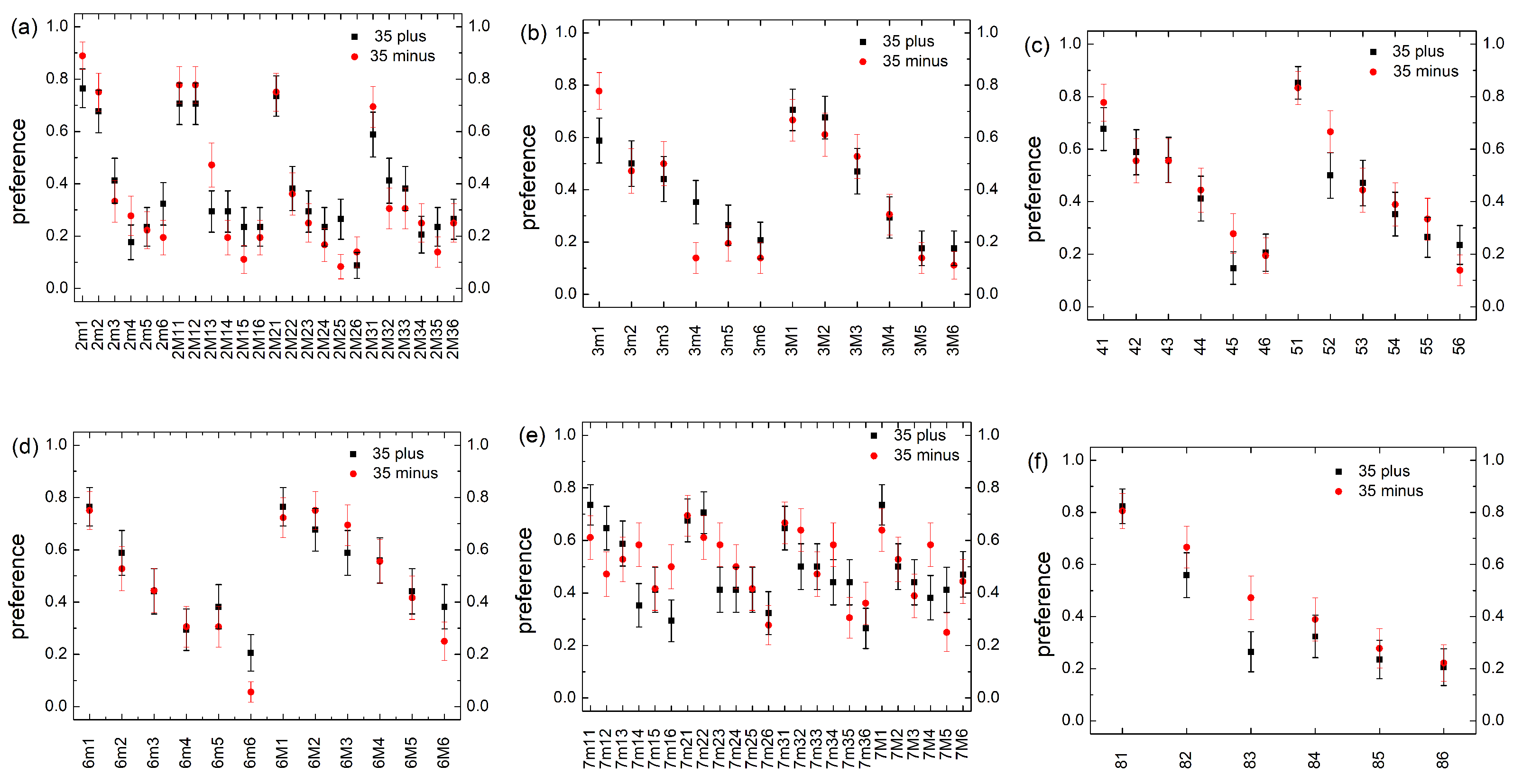
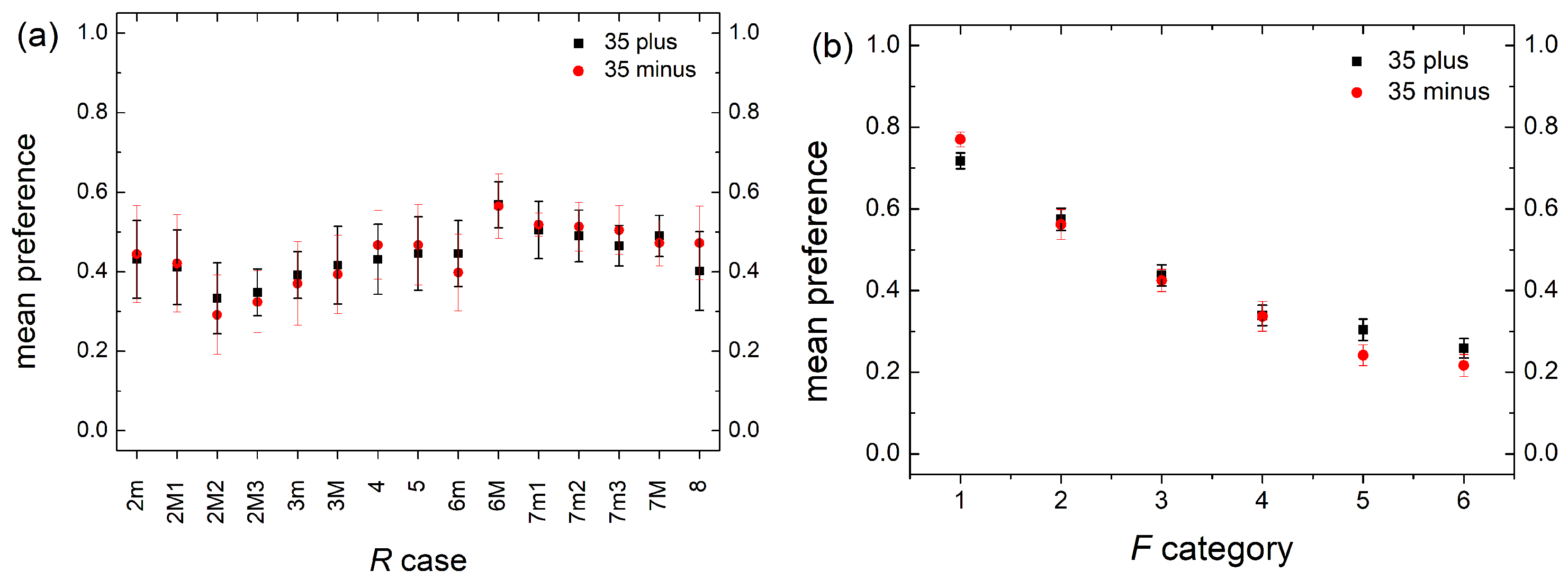
We now compare age groups, taking as borderlines 35 or 50 years of age. In Figure 10 we compare preferences of subjects above 35 years of age (34 persons, black squares) with those below 35 years of age (36 persons, red circles). Next, in Figure 11 we depict, for groups over 35 and under 35, in (a) the mean over all F categories for each R case P ¯ ( R ) , and in (b) the mean over all R cases for each F category, P ¯ ( F ) . The main observation from Figure 11a is that there are no significant differences between the two age groups for the perception of frequency ratio R cases, as the mean values of one group are within the mean errors of the other group and vice versa, which is also confirmed by the MW tests shown in Appendix A and in Figure A7 (for all R cases). The MW tests for all F categories are shown in Figure A8 in Appendix A. For the perception of mean frequency F categories, the preferences of persons under 35 in Figure 11b seem to cover a wider range. The MW tests confirm the inferences of Figure 11a,b.
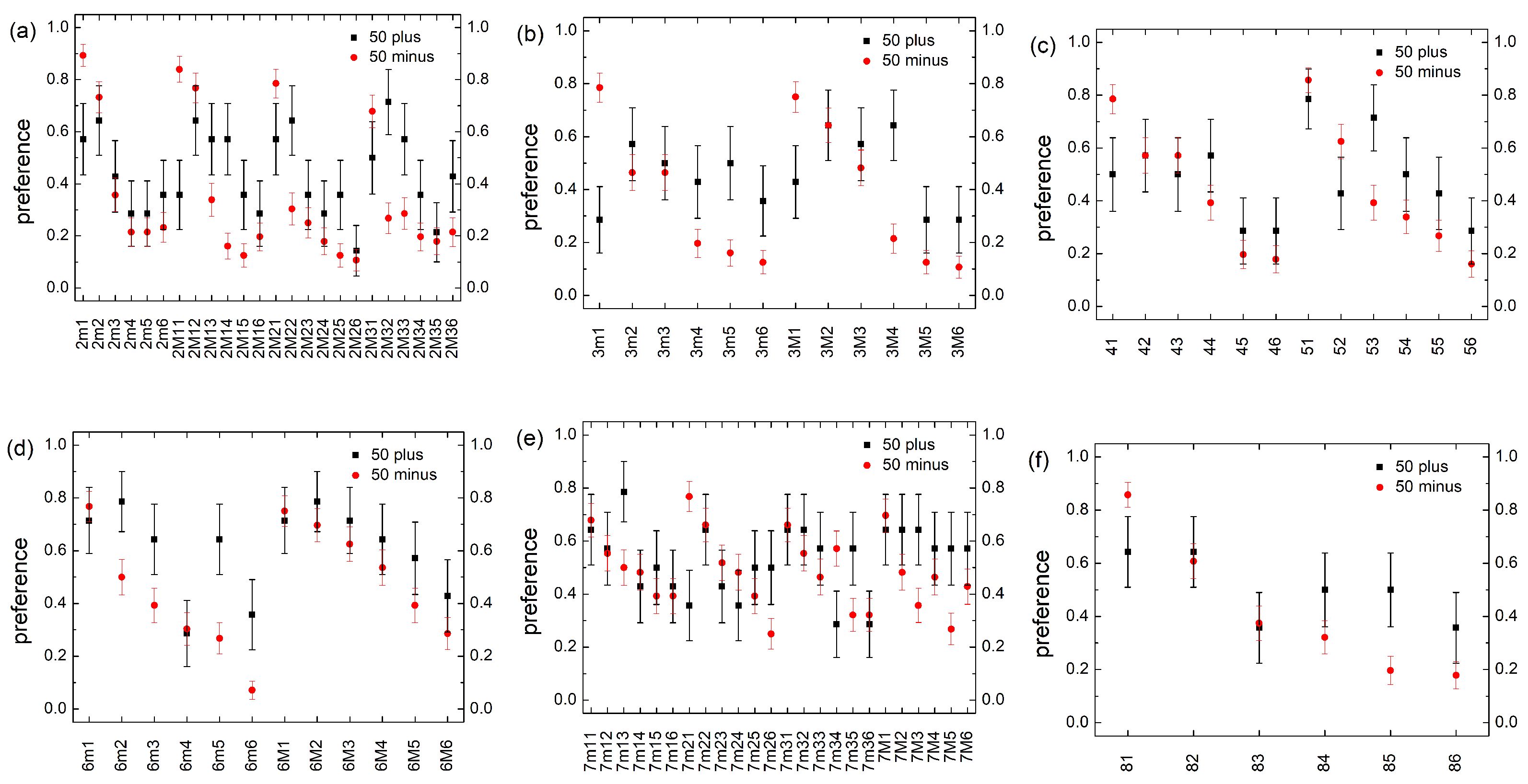
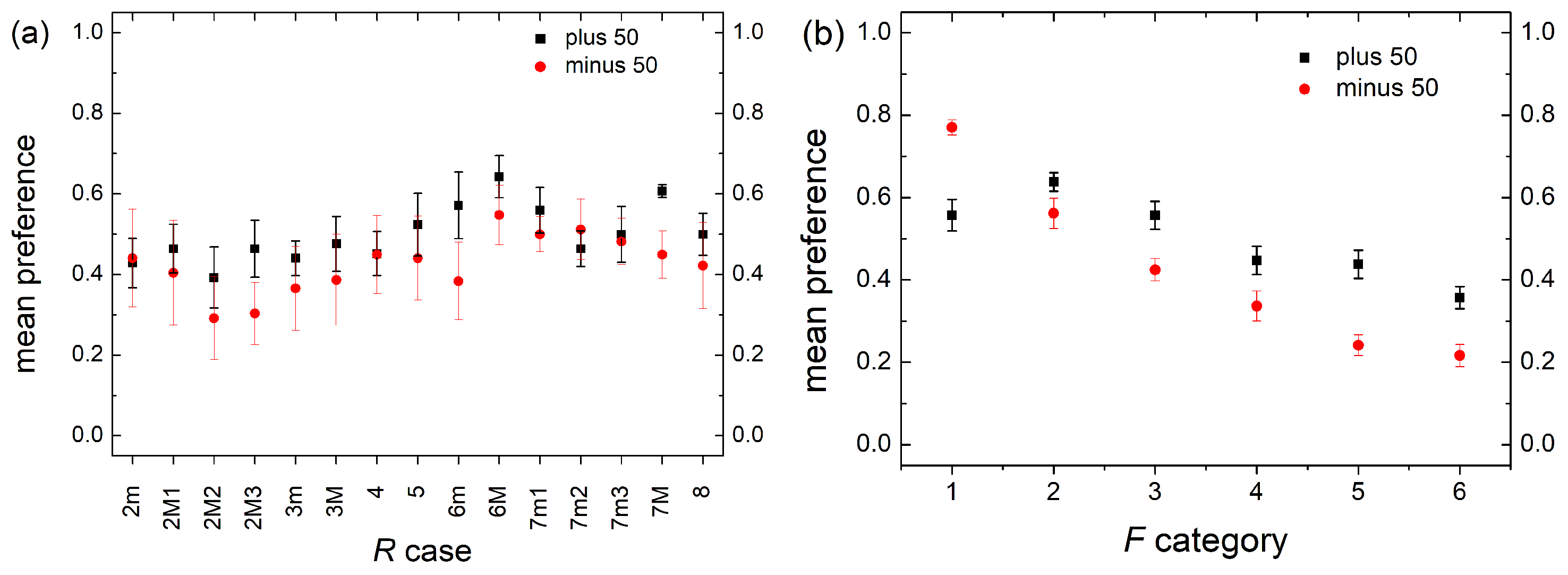
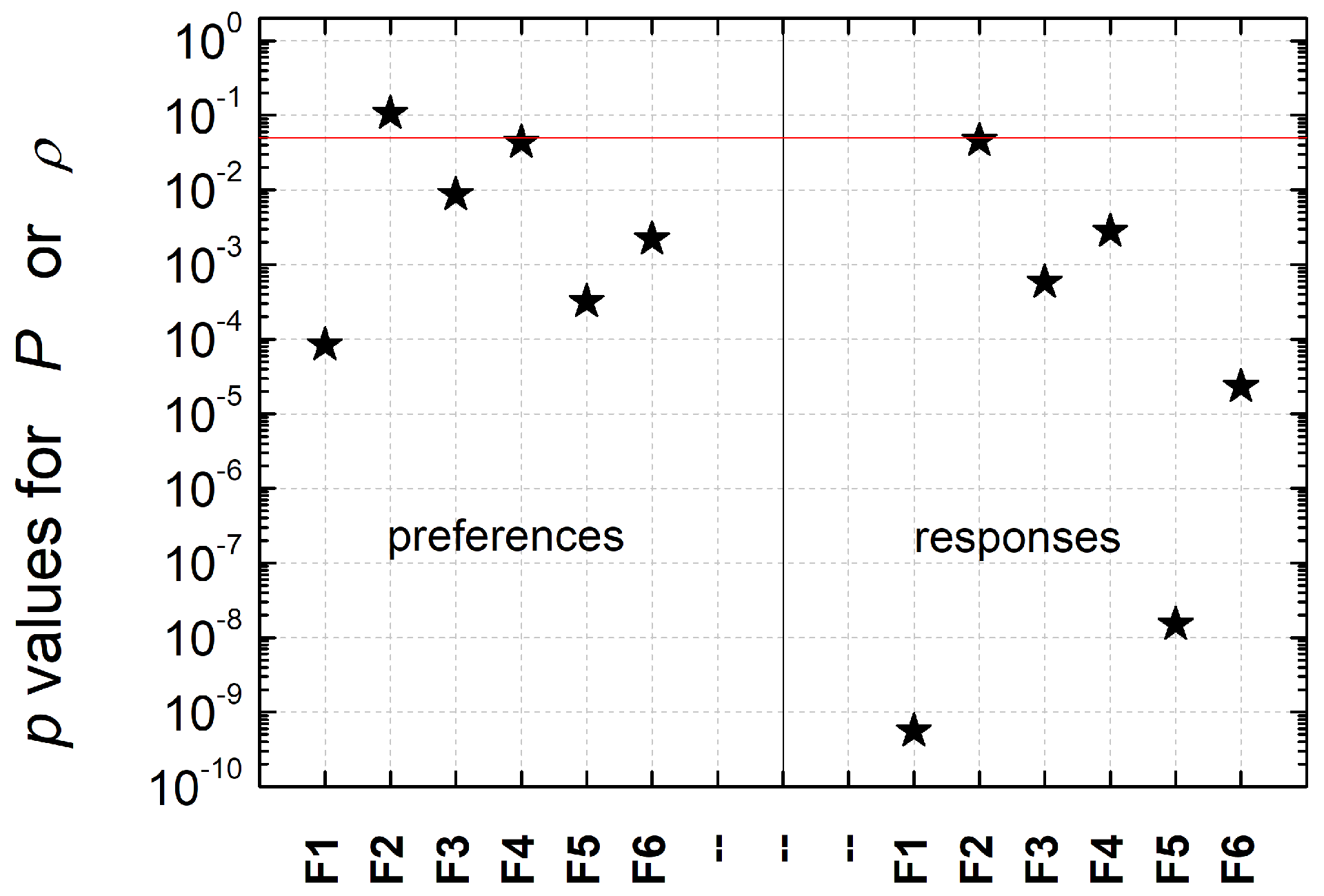
Next, in Figure 12 we compare the preferences of subjects above 50 years of age (14 persons, black squares) with those below 50 years of age (56 persons, red circles). In Figure 13 we depict, for groups over 50 and under 50, in (a) the mean over all F categories for each R case, P ¯ ( R ) , and in (b) the mean over all R cases for each F category, P ¯ ( F ) . The main observation from Figure 13a is that there are some differences between the two age groups for the perception of frequency ratio R cases; for some R cases the mean values of one group are not within the mean errors of the other group. The main observation from Figure 13b is that there are differences between the two age groups for the perception of mean frequency F categories; for all F categories the mean values of one group are not within the mean errors of the other group. This behavior is also confirmed by the MW tests shown in Appendix A, in Figure A9 (for all R cases) and in Figure A10 (for all F categories). These MW tests confirm the inferences of Figure 13a,b. It is impressive that in Figure A10 the logarithmic vertical axis starts from 10−10 in contrast to all other MW tests where it starts from 10−4. Such very small p values show clearly that these differences are significant. For the perception of mean frequency F categories, the preferences of persons under 50 in Figure 13b cover a wider range.
Numerous studies have shown that aging affects auditory perception, including the perception of musical intervals and dyads. Older adults often experience reduced pitch discrimination and less distinct differentiation between consonant and dissonant dyads, even in the absence of clinically significant hearing loss. Bones and Plack [19] demonstrated that older listeners rate dissonant dyads as more pleasant and show reduced preference for consonance, a change attributed to diminished temporal neural coding in the auditory brainstem. Lentz et al. [20] found that age-related declines in multiple psychoacoustic tasks—such as modulation detection and mistuning sensitivity—persist even after controlling for cognitive factors and hearing thresholds, suggesting that central auditory aging plays a key role. Additionally, Tufts et al. [21] showed that sensorineural hearing loss, common in aging, leads to broadened auditory filters, resulting in a compressed perceptual range between consonant and dissonant dyads. These results imply that the reduced clarity in interval perception with age may arise from both peripheral (cochlear) and central (neural coding) factors.
Inference: The results suggest that age plays a role in the perception of R and F. For the perception of mean frequency F categories, the preferences of younger persons cover a wider range and there are also differences in the perception of frequency ratio R cases and mean frequency F categories.

4. Conclusions

We mainly studied two quantities, responses [1 (like), 0 (dislike)], ρ , and preferences, P, defined as mean values of responses. Responses and preferences were statistically analyzed. Two important parameters were used: the ratio of frequencies, R, and the mean value of frequencies, F. We first studied the whole set of 70 persons and then we divided subjects into two groups (musicians–non-musicians, men–women, and age groups). Such divisions stem from the possibility that different perceptions of sound may exist due to a person’s involvement with music for many years, due to gender or due to biological reasons such as differentiation of hearing in older ages. We utilized mean values and their errors and compared responses and preferences with the Mann–Whitney rank sum test and the least squares method.
For the general public: Increased mean frequency F makes simple-tone dyads less pleasant. For octaves, fifths, fourths, and sixths the feeling of consonance shows an almost “linear” fall with increasing F. Seconds and sevenths are more dispersed, but still increased F increases the feeling of dissonance. Seconds seem to be the most unpleasant simple-tone dyads.
For groups musicians–non-musicians: For octaves, the falls in P ( F ) show a similar slope between groups, but the overall preference level is higher for musicians. For fifths, a similar trend is observed, though less pronounced. Across all R cases, with increasing pitch, consonance ratings tend to decrease for both groups. MW tests on preference scores for the combined group of fourths, fifths, and octaves did not show a statistically significant difference at the 0.05 level, though the result approaches this threshold. When analyzing individual R cases, octaves yielded the lowest p-value among all intervals, indicating a possible trend, although not reaching statistical significance. In contrast, the MW test on responses (i.e., raw response data, without averaging) showed a statistically significant difference between musicians and non-musicians for octaves ( p 0.0005). This result suggests that the perception of octaves differs reliably between the two groups. The averaged preference scores P ( R ) indicate that musicians rate octaves (8), and possibly fourths (4), fifths (5), and major sixths (6M), higher than non-musicians. Both groups rated the intervals 2M2 and 2M3 lowest. Finally, P ( F ) is a decreasing function both for musicians and non-musicians.
For the groups men–women: As a general trend, for lower F men show higher preferences, but this is reversed for higher F, where women show higher preferences. The results suggest that men dislike high frequencies more than women. The results also suggest that the scores of men have higher variation than the scores of women.
For the age groups: The results suggest that age plays an important role in the perception of R and F. For the perception of mean frequency F categories, the preferences of younger persons cover a wider range. There are also differences in the perception of frequency ratio R cases (in some cases) and mean frequency F categories (for all categories).
Relative to R, seconds accumulate the most dislikes and are therefore found more dissonant. This is obvious from the mean preferences of the total set shown in Figure 5 and from the relevant diagrams of group comparisons, i.e., Figure 7, Figure 9, Figure 11 and Figure 13. Among seconds, major seconds of type 2M2 ( R = 9 / 8 ) and 2M3 ( R = 8 / 7 ) are generally perceived as more dissonant. From Figure 5 and from Figure 7, Figure 9, Figure 11 and Figure 13, we realize that as R increases, simple-tone dyads are perceived as somewhat more acceptable. After seconds, there is a somehow upward trend in the listeners’ responses. As for the intervals widely considered consonant (fourths, fifths, major sixths, and octaves) the general picture from the experiment is different. For the general set, the mean preferences for fourths, fifths and octaves are not greater than for sevenths; however, major sixths maintain the maximum of mean preferences for the general set. Musicians find octaves more consonant than non-musicians, as might be expected; also musicians almost find fourths, fifths and major sixths more consonant than non-musicians (cf. Figure 7).
Terhardt’s [12] work referred to presenting dyads consisting of two tones—one fixed at La4 and the other varying gradually up to an octave (La5)—while listeners rated these dyads for “consonance” and “roughness”. Our results agree with the minimum at seconds shown by Terhardt [12], but do not confirm the monotonous increase up to the octave shown in his idealized curve. In our results the increase is not monotonous for the general public (Figure 5a), and musicians show two local maxima at the major sixth and octave, cf. Figure 7a.
It is worth noting that 2m1 has a rather high preference. It is a minor second, R = 16 / 15 , f 1 = 210 Hz, f 2 = 224 Hz, F = 217 Hz, Δ f = 14 Hz. Clearly, a beat is formed, cf. Figure 1g,h. We guess that this high preference stems from its low pitch. This extreme example fits our general conclusion that lower frequencies are more pleasant.
As for the mean frequency F, it is clear that higher frequencies collect more negative answers. A general trend is that with increasing F, positive answers become less probable. This is a general observation for the total set, but it can also be seen for musicians–non-musicians, men and women and for age groups above/below 35 or above/below 50. This lower preference for higher frequencies was also expressed immediately after the experiment when the subjects were interviewed. From this decrease in positive responses or preferences there is no exception for octaves or fifths and fourths, although the slopes of the decreases are not identical. One possible explanation for the decrease in likes with increasing frequency is that the human ear is most sensitive to sounds in the 2000–5000 Hz range, as indicated by the Fletcher–Munson curves [43,44]. Hence, in this region, sounds will be somewhat piercing and will maximally stimulate our ears, consistent with the frequency dependence of perceived loudness and auditory sharpness at higher frequencies [45,46]. In addition, in the event that a sound with low F is followed by a sound with high F, our auditory system moves on the Fletcher–Munson curve suddenly from a higher point to a lower point, so that it must respond to this change in a relatively short time, reflecting the frequency dependence of equal-loudness contours and temporal loudness processing [46]. This effect could be strengthened by the fact that between two consecutive sounds there was a short time when no sound was heard, so absolute silence was succeeded by a sound with a high F and therefore high perceived intensity, consistent with auditory adaptation and loudness enhancement at sound onset [47,48].
Another possible reason for not preferring sounds with high frequencies might be that simple sounds in general are, due to the lack of harmonics, somewhat drier and more penetrating than complex sounds of corresponding frequencies. For example, a note with a frequency of about 3000 Hz on the piano corresponds to a note in its last, highest, octave. This sound is not as piercing as its plain-tone counterpart, but somewhat more rounded.
From the results of our experiments and from the discussion above it seems that consonance or dissonance is a complex multiparametric issue. It is certainly a topic that will not cease to concern people in general, whether they have something to do with music or simply find it interesting.
Plomp and Levelt, decades ago, performed experiments with simple and composite tones to study consonance relative to the frequency interval between the two tones [39] and showed differences between the case where dyads consisted of simple tones and the case where they consisted of complex sounds including harmonics. Bowling and Purves included a diagram with composite musical intervals, listed by increasing degree of consonance [11]. This diagram was extracted from data, collected from 1898 to 2012, taken from various experiments with composite sounds: the intervals considered consonant are fourth, fifth and octave (the most consonant); third and sixth follow, while the last are seventh and second. Hence, for composite sounds, including harmonics, it seems that there is a differentiation as to what seems consonant or dissonant. It is our intention to include harmonics in our future work, in a systematic way, along the lines of and with the methods described in the present work. The present study was designed to focus on responses and preferences as functions of mean frequency and frequency ratio, rather than to provide a full psychoacoustic parameterization. The separation between frequency-related effects and loudness-related effects represents an important topic for future work, which will build upon the results reported here.

Author Contributions

C.S. conceived the experiment. S.K. and C.S. conducted the experiment. S.K. and C.S. collaborated in the final arrangement of experimental details. C.S. and S.K. analyzed results. Both authors reviewed the manuscript. All authors have read and agreed to the published version of the manuscript.

Funding

APC was partially covered by CS referee vouchers and partially by Project with code 17454 of the Rectorate of the National and Kapodistrian University of Athens “Participation in International Conferences or Publications in International Journals”.

Institutional Review Board Statement

The Ethics Committee of the National and Kapodistrian University of Athens approved the experiments (decision 134/2024, 29 February 2024). All experiments were performed in accordance with relevant guidelines and regulations. A signed consent form was obtained from all participants.

Informed Consent Statement

Informed consent was obtained from all subjects involved in the study.

Data Availability Statement

The data that support the findings of this study were obtained from human participants under a protocol approved by the Ethics Committee of the National and Kapodistrian University of Athens requiring anonymization prior to sharing. The anonymized data are available from the corresponding author (Constantinos Simserides, csimseri@phys.uoa.gr) upon reasonable request.

Acknowledgments

We thank Orestis Toufektsis, Institute of Composition, Theory of Music, History of Music, and Conducting, University of Music and Performing Arts, Graz, Austria, for critical reading of the manuscript and suggestions.

Conflicts of Interest

The authors declare no conflicts of interest.

Abbreviations

The following abbreviations are used in this manuscript:
MWMann–Whitney
SPLsound pressure level
SOAEspontaneous otoacoustic emission

Appendix A

A presentation of responses, ρ , of a random subject is given in Figure A1. A complete list of simple-tone dyads used in this work is given in Table A1. In Figure A2 we present the slopes, intercepts, and adjusted R squared of the linear fits P = A F + B , where P is the preference and F is the mean frequency of simple-tone dyads for the groups musicians–non-musicians. The fits are not generally good: the relationships P ( F ) are not straight lines. Still, we can make a crude estimation: all slopes are clearly negative (but sevenths have very small negative slopes). Hence, with increasing pitch, the feeling of consonance decreases. We also notice that the most negative slopes are those for octaves and major thirds. The p values of the Mann–Whitney tests on preferences (P) and responses ( ρ ) comparing groups are given in Figure A3 (musicians vs. non-musicians, R cases), in Figure A4 (musicians vs. non-musicians, F categories), in Figure A5 (men vs. women, R cases), in Figure A6 (men vs. women, F categories), in Figure A7 (age above vs. below 35, R cases), in Figure A8 (age above vs. below 35, F categories), in Figure A9 (age above vs. below 50, R cases), and in Figure A10 (age above vs. below 50, F categories).
Figure A1. A random subject: responses, ρ , for all simple-tone dyads, i.e., for each F category and for each R case. Yes = pleasant (full square) corresponds to → button. No = unpleasant (empty square) corresponds to ← button.
Acoustics 08 00014 g0a1
Table A1. A complete list of simple-tone dyads used in this work. First column: name (number of semitones). Second column: codename. Third column: ratio of frequencies, R = f 2 f 1 . Fourth column: mean frequency, F = f 1 + f 2 2 . Fifth column: couple of frequencies. The overline digits denote the repeating digits of a rational number.
IntervalCodenameRF (Hz) f 2 , f 1 (Hz)
minor 2nd
(1)
2m1 217224, 210
2m2 514.6531.2, 498
2m316/15899928, 870
2m4= 1725 . 6 ¯ 1781 . 3 ¯ , 1670
2m5 1.0 6 ¯ 2433.52512, 2355
2m6 4081 . 6 ¯ 4213.3, 3950
major 2nd
(2)
2M11 242 . 7 ¯ 255 . 5 ¯ , 230
2M12 461.2 7 ¯ 485 . 5 ¯ , 437
2M1310/9 785 . 3 ¯ 826 . 6 ¯ , 744
2M14= 1245 . 5 ¯ 1311 . 1 ¯ , 1180
2M15 1 . 1 ¯ 2596 . 6 ¯ 2733 . 3 ¯ , 2460
2M16 4074 . 4 ¯ 4288 . 8 ¯ , 3860
major 2nd
(2)
2M21 329.375348.75, 310
2M22 828.75877.5, 780
2M239/81168.751237.5, 1100
2M24=3049.3753228.75, 2870
2M251.1253453.1253656.25, 3250
2M26 4356.254612.5, 4100
major 2nd
(2)
2M31 417.857445.714, 390
2M32 797.142850.285, 744
2M338/71052.1421122.285, 982
2M34=2089.2852228.571, 1950
2M35 1 . 142857 ¯ 33753600, 3150
2M36 4146.4284422.857, 3870
minor 3rd
(3)
3m1 220240, 200
3m2 550600, 500
3m36/516501800, 1500
3m4=27503000, 2500
3m51.233003600, 3000
3m6 44004800, 4000
major 3rd
(4)
3M1 292.5325, 260
3M2 450500, 400
3M35/411251250, 1000
3M4=24752750, 2200
3M51.253937.54375, 3500
3M6 42754750, 3800
pure 4th
(5)
41 256 . 6 ¯ 293 . 3 ¯ , 220
42 700800, 600
434/39101040, 780
44 1283 . 3 ¯ 1466 . 6 ¯ , 1100
45 1 . 3 ¯ 3033 . 3 ¯ 3466 . 6 ¯ , 2600
46 4316 . 6 ¯ 4933 . 3 ¯ , 3700
pure 5th
(7)
51 312.5375, 250
52 812.5975, 650
533/21277.51533, 1022
54=2312.52775, 1850
551.52832.53399, 2266
56 4082.54899, 3266
minor 6th
(8)
6m1 299368, 230
6m2 676832, 520
6m38/513001600, 1000
6m4=24052960, 1850
6m51.629903680, 2300
6m6 39654880, 3050
major 6th
(9)
6M1 333 . 3 ¯ 416 . 6 ¯ , 250
6M2 626 . 6 ¯ 783 . 3 ¯ , 470
6M35/312401550, 930
6M4= 1866 . 6 ¯ 2333 . 3 ¯ , 1400
6M5 1 . 6 ¯ 28003500, 2100
6M6 3866 . 6 ¯ 4833 . 3 ¯ , 2900
minor 7th
(10)
7m11 481.25612.5, 350
7m12 783.75997.5, 570
7m137/413751750, 1000
7m14=1856.252362.5, 1350
7m151.752887.53675, 2100
7m16 35754550, 2600
minor 7th
(10)
7m21 277 . 7 ¯ 355 . 5 ¯ , 200
7m22 486 . 1 ¯ 622 . 2 ¯ , 350
7m2316/910001280, 720
7m24= 1944 . 4 ¯ 2488 . 8 ¯ , 1400
7m25 1 . 7 ¯ 31254000, 2250
7m26 3472 . 2 ¯ 4444 . 4 ¯ , 2500
minor 7th
(10)
7m31 588756, 420
7m32 12041548, 860
7m339/516102070, 1150
7m34=18202340, 1300
7m351.826603420, 1900
7m36 37804860, 2700
major 7th
(11)
7M1 388.125506.25, 270
7M2 848.1251106.25, 590
7M315/81243.43751621.875, 865
7M4=1638.752137.5, 1140
7M51.8752716.8753543.75, 1890
7M6 3378.1254406.25, 2350
pure 8th
(12)
81 300400, 200
82 10501400, 700
832/115002000, 1000
84=22503000, 1500
85230004000, 2000
86 37505000, 2500
Figure A2. Slopes, intercepts and adjusted R squared for linear fits P = A F + B for the groups musicians and non-musicians.
Acoustics 08 00014 g0a2
Figure A3. R cases: p-values of Mann–Whitney tests on preferences (P) and responses ( ρ ), comparing musicians and non-musicians. The horizontal red line shows the 0.05 p-level. The vertical line divides preferences from responses.
Acoustics 08 00014 g0a3
Figure A4. F categories: p-values of Mann–Whitney tests on preferences (P) and responses ( ρ ), comparing musicians and non-musicians. The horizontal red line shows the 0.05 p-level. The vertical line divides preferences from responses.
Acoustics 08 00014 g0a4
Figure A5. R cases: p-values of the Mann–Whitney tests on preferences (P) and responses ( ρ ), comparing men and women. The horizontal red line shows the 0.05 p-level. The vertical line divides preferences from responses.
Acoustics 08 00014 g0a5
Figure A6. F categories: p-values of the Mann–Whitney tests on preferences (P) and responses ( ρ ), comparing men and women. The horizontal red line shows the 0.05 p-level. The vertical line divides preferences from responses.
Acoustics 08 00014 g0a6
Figure A7. p-values of the Mann–Whitney tests on preferences (P) and responses ( ρ ), comparing the age groups above 35 and below 35, relative to R cases. The horizontal red line shows the 0.05 p-level. The vertical line divides preferences from responses.
Acoustics 08 00014 g0a7
Figure A8. p-values of the Mann–Whitney tests on preferences (P) and responses ( ρ ), comparing the age groups above 35 and below 35, relative to F categories. The horizontal red line shows the 0.05 p-level. The vertical line divides preferences from responses.
Acoustics 08 00014 g0a8
Figure A9. p-values of the Mann–Whitney tests on preferences (P) and responses ( ρ ), comparing the age groups above 50 and below 50, relative to R cases. The horizontal red line shows the 0.05 p-level. The vertical line divides preferences from responses.
Acoustics 08 00014 g0a9
Figure A10. p-values of the Mann–Whitney tests on preferences (P) and responses ( ρ ), comparing the age groups above 50 and below 50, relative to F categories. The horizontal red line shows the 0.05 p-level. The vertical line divides preferences from responses.
Acoustics 08 00014 g0a10

References

  1. Helmholtz, H.V. Die Lehre von den Tonempfindungen als physiologische Grundlage für die Theorie der Musik; Friedrich Vieweg und Sohn: Braunschweig, Germany, 1863; Available online: https://archive.org/details/b21717114 (accessed on 3 February 2026).
  2. Helmholtz, H.V. On the Sensations of Tone as a Physiological Basis for the Theory of Music, 3rd English ed., revised ed.; Longmans, Green, and Co.: London, UK; New York, NY, USA, 1895; Available online: https://archive.org/details/onsensationsofto00helmrich (accessed on 3 February 2026).
  3. Helmholtz, H.V. On the Sensations of Tone as a Physiological Basis for the Theory of Music; Ellis, A.J., Translator; Dover Publications: New York, NY, USA, 1954; Available online: https://openlibrary.org/books/OL6151495M/On_the_sensations_of_tone_as_a_physiological_basis_for_the_theory_of_music (accessed on 3 February 2026).
  4. Galilei, G. Discorsi e Dimostrazioni Matematiche Intorno a due nuove Scienze; Elsevier: Leiden, The Netherlands, 1638. [Google Scholar]
  5. Bones, O.; Hopkins, K.; Krishnan, A.; Plack, C.J. Phase locked neural activity in the human brainstem predicts preference for musical consonance. Neuropsychologia 2014, 58, 23–32. [Google Scholar] [CrossRef] [PubMed]
  6. Lahdelma, I.; Eerola, T. Cultural familiarity and musical expertise impact the pleasantness of consonance/dissonance but not its perceived tension. Sci. Rep. 2020, 10, 8693. [Google Scholar] [CrossRef] [PubMed]
  7. McLachlan, N.; Marco, D.; Light, M.; Wilson, S. Consonance and Pitch. J. Exp. Psychol. 2013, 142, 1142–1158. [Google Scholar] [CrossRef] [PubMed]
  8. Guernsey, M. The Rôle of Consonance and Dissonance in Music. Am. J. Psychol. 1928, 40, 173–204. [Google Scholar] [CrossRef]
  9. McDermott, J.H.; Lehr, A.J.; Oxenham, A.J. Individual Differences Reveal the Basis of Consonance. Curr. Biol. 2010, 20, 1035–1041. [Google Scholar] [CrossRef]
  10. Bowling, D.L.; Purves, D.; Gill, K.Z. Vocal similarity predicts the relative attraction of musical chords. Proc. Natl. Acad. Sci. USA 2017, 115, 216–221. [Google Scholar] [CrossRef]
  11. Bowling, D.L.; Purves, D. A biological rationale for musical consonance. Proc. Natl. Acad. Sci. USA 2015, 112, 11155–11160. [Google Scholar] [CrossRef]
  12. Terhardt, E. The Concept of Musical Consonance: A Link between Music and Psychoacoustics. Music Percept. 1984, 1, 276–295. [Google Scholar] [CrossRef]
  13. Pearson, J.D.; Morrell, C.H.; Gordon-Salant, S.; Brant, L.J.; Jeffrey Metter, E.; Klein, L.L.; Fozard, J.L. Gender differences in a longitudinal study of age-associated hearing loss. J. Acoust. Soc. Am. 1995, 97, 1196–1205. [Google Scholar] [CrossRef]
  14. McFadden, D. Sex differences in the auditory system. Dev. Neuropsychol. 1998, 14, 261–298. [Google Scholar] [CrossRef]
  15. Re, D.E.; O’Connor, J.J.M.; Bennett, P.J.; Feinberg, D.R. Preferences for Very Low and Very High Voice Pitch in Humans. PLoS ONE 2012, 7, e32719. [Google Scholar] [CrossRef] [PubMed]
  16. Harrison, P.M.C.; Pearce, M.T. Simultaneous Consonance in Music Perception and Composition. Psychol. Rev. 2020, 127, 216–244. [Google Scholar] [CrossRef] [PubMed]
  17. McDermott, J.H.; Schultz, A.F.; Undurraga, E.A.; Godoy, R.A. Indifference to dissonance in native Amazonians reveals cultural variation in music perception. Nature 2016, 535, 547–550. [Google Scholar] [CrossRef] [PubMed]
  18. Marjieh, R.; Harrison, P.M.C.; Lee, H.; Deligiannaki, F.; Jacoby, N. Timbral effects on consonance disentangle psychoacoustic mechanisms and suggest perceptual origins for musical scales. Nat. Commun. 2024, 15, 1482. [Google Scholar] [CrossRef]
  19. Bones, O.; Plack, C.J. Losing the Music: Aging Affects the Perception and Subcortical Neural Representation of Musical Harmony. J. Neurosci. 2015, 35, 4071–4080. [Google Scholar] [CrossRef]
  20. Lentz, J.J.; Humes, L.E.; Kidd, G.R. Differences in Auditory Perception Between Young and Older Adults When Controlling for Differences in Hearing Loss and Cognition. Trends Hear. 2022, 26, 23312165211066180. [Google Scholar] [CrossRef]
  21. Tufts, J.B.; Molis, M.R.; Leek, M.R. Perception of dissonance by people with normal hearing and sensorineural hearing loss. J. Acoust. Soc. Am. 2005, 118, 955–967. [Google Scholar] [CrossRef]
  22. Koerner, T.K.; Zhang, Y. Differential effects of hearing impairment and age on electrophysiological and behavioral measures of speech in noise. Hear. Res. 2018, 370, 130–142. [Google Scholar] [CrossRef]
  23. Morrell, C.H.; Gordon-Salant, S.; Pearson, J.D.; Brant, L.J.; Fozard, J.L. Age- and gender-specific reference ranges for hearing level and longitudinal changes in hearing level. J. Acoust. Soc. Am. 1996, 100, 1949–1967. [Google Scholar] [CrossRef]
  24. Vitz, P.C. Preference for tones as a function of frequency (hertz) and intensity (decibels). Percept. Psychophys. 1972, 11, 84–88. [Google Scholar] [CrossRef][Green Version]
  25. Patchett, R.F. Human sound frequency preferences. Percept. Mot. Ski. 1979, 49, 324–326. [Google Scholar] [CrossRef]
  26. Siedenburg, K.; Röttges, S.; Wagener, K.C.; Hohmann, V. Can You Hear Out the Melody? Testing Musical Scene Perception in Young Normal-Hearing and Older Hearing-Impaired Listeners. Trends Hear. 2020, 24, 2331216520945826. [Google Scholar] [CrossRef] [PubMed]
  27. Jo, H.S.; Hsieh, T.H.; Chien, W.C.; Shaw, F.Z.; Liang, S.F.; Kung, C.C. Probing the neural dynamics of musicians’ and non-musicians’ consonant/dissonant perception: Joint analyses of electrical encephalogram (EEG) and functional magnetic resonance imaging (fMRI). NeuroImage 2024, 298, 120784. [Google Scholar] [CrossRef] [PubMed]
  28. Norman-Haignere, S.V.; Albouy, P.; Caclin, A.; McDermott, J.H.; Kanwisher, N.G.; Tillmann, B. Pitch-Responsive Cortical Regions in Congenital Amusia. J. Neurosci. 2016, 36, 2986–2994. [Google Scholar] [CrossRef] [PubMed]
  29. Graves, J.E.; Pralus, A.; Fornoni, L.; Oxenham, A.J.; Tillmann, B.; Caclin, A. Consonance Perception in Congenital Amusia: Behavioral and Brain Responses to Harmonicity and Beating Cues. J. Cogn. Neurosci. 2023, 35, 765–780. [Google Scholar] [CrossRef]
  30. Giannos, K.; Cambouropoulos, E. Sequential consonance/dissonance: Effects of chord directionality, cadences, and voice leading. Psychol. Music. 2025, 0, 1–18. [Google Scholar] [CrossRef]
  31. Benward, B.; Saker, M.N. Music: In Theory and Practice, 7th ed.; McGraw-Hill: Boston, MA, USA, 2003; Available online: https://www.worldcat.org/oclc/61691613 (accessed on 3 February 2026).
  32. Benson, D.C. A Smoother Pebble: Mathematical Explorations, 1st ed.; Oxford University Press: Oxford, UK, 2003; Available online: https://www.worldcat.org/oclc/50919818 (accessed on 3 February 2026).
  33. Shapiro, S.S.; Wilk, M.B. An analysis of variance test for normality (complete samples). Biometrika 1965, 52, 591–611. [Google Scholar] [CrossRef]
  34. Gosset, W.S. (published under the pseudonym “Student”). The probable error of a mean. Biometrika 1908, 6, 1–25. [Google Scholar] [CrossRef]
  35. Mann, H.B.; Whitney, D.R. On a Test of Whether one of Two Random Variables is Stochastically Larger than the Other. Ann. Math. Stat. 1947, 18, 50–60. [Google Scholar] [CrossRef]
  36. Wilcoxon, F. Individual Comparisons by Ranking Methods. Biom. Bull. 1945, 1, 80–83. [Google Scholar] [CrossRef]
  37. Fisher, R.A. Statistical Methods for Research Workers. In Breakthroughs in Statistics: Methodology and Distribution; Springer: New York, NY, USA, 1992; pp. 66–70. [Google Scholar] [CrossRef]
  38. Cardillo, G. MWWTEST: Mann-Whitney-Wilcoxon Nonparametric Test for Two Unpaired Samples (A MATLAB Code for Mann-Whitney-Wilcoxon Test). 2023. Available online: https://www.mathworks.com/matlabcentral/fileexchange/25830 (accessed on 3 February 2026).
  39. Plomp, R.; Levelt, W.J.M. Tonal consonance and critical bandwidth. J. Acoust. Soc. Am. 1965, 38, 548–560. [Google Scholar] [CrossRef]
  40. Kameoka, A.; Kuriyagawa, M. Consonance theory Part I: Consonance of Dyads. J. Acoust. Soc. Am. 1969, 45, 1451–1459. [Google Scholar] [CrossRef]
  41. Kameoka, A.; Kuriyagawa, M. Consonance theory Part II: Consonance of Complex Tones and Its Calculation Method. J. Acoust. Soc. Am. 1969, 45, 1460–1469. [Google Scholar] [CrossRef]
  42. Terhardt, E. The Two-Component Theory of Musical Consonance. In Psychophysics and Physiology of Hearing; Evans, E.F., Wilson, J.P., Eds.; Academic Press: London, UK, 1977. [Google Scholar]
  43. Fletcher, H.; Munson, W.A. Loudness, its definition, measurement and calculation. Bell Syst. Tech. J. 1933, 12, 377–430. [Google Scholar] [CrossRef]
  44. Fletcher, H.; Munson, W.A. Loudness, Its Definition, Measurement and Calculation. J. Acoust. Soc. Am. 1933, 5, 82–108. [Google Scholar] [CrossRef]
  45. Fastl, H.; Zwicker, E. Psychoacoustics: Facts and Models, 3rd ed.; Springer: Berlin/Heidelberg, Germany, 2007; 463p. [Google Scholar] [CrossRef]
  46. Moore, B.C.J. An Introduction to the Psychology of Hearing, 6th ed.; Brill: Boston, MA, USA, 2013; 460p. [Google Scholar]
  47. Viemeister, N.F.; Bacon, S.P. Intensity discrimination, increment detection, and magnitude estimation for 1-kHz tones. J. Acoust. Soc. Am. 1988, 84, 172–178. [Google Scholar] [CrossRef]
  48. Plack, C.J. The Sense of Hearing, 4th ed.; Routledge: New York, NY, USA, 2023; 344p. [Google Scholar]
Figure 1. Octave, R = 2 / 1 , example with f 1 = 100 Hz, f 2 = 200 Hz, F = 150 Hz: (a) Δ ϕ = 0 and (b) Δ ϕ = π . Fifth, R = 3 / 2 , example with f 1 = 100 Hz, f 2 = 150 Hz, F = 125 Hz: (c) Δ ϕ = 0 and (d) Δ ϕ = π . Minor third, R = 6 / 5 , example with f 1 = 500 Hz, f 2 = 600 Hz, F = 550 Hz: (e) Δ ϕ = 0 and (f) Δ ϕ = π . Minor second, R = 16 / 15 , example with f 1 = 210 Hz, f 2 = 224 Hz, F = 217 Hz: (g) Δ ϕ = 0 and (h) Δ ϕ = π .
Acoustics 08 00014 g001
Figure 2. Natural, equal and Pythagorean intervals in cents (n) vs. frequency ratio (R). We used natural intervals.
Acoustics 08 00014 g002
Figure 3. Mean frequencies of the simple-tone dyads for each type of interval used in our experiment.
Acoustics 08 00014 g003
Figure 4. Mean values and errors of responses or preference, P, for the total set of subjects (70 persons) for each simple-tone dyad: (a) seconds, (b) thirds, (c) fourths and fifths, (d) sixths, (e) sevenths, and (f) octaves.
Acoustics 08 00014 g004
Figure 5. Total set of subjects (70 persons): mean values and errors of P. (a) Mean over all F categories for each R case, P ¯ ( R ) . (b) Mean over all R cases for each F category, P ¯ ( F ) .
Acoustics 08 00014 g005
Figure 6. Mean values of responses or preference, P, for groups musicians (black squares, 23 persons) and non-musicians (red circles, 47 persons) for each simple-tone dyad: (a) seconds, (b) thirds, (c) fourths and fifths, (d) sixths, (e) sevenths, and (f) octaves. Errors are larger for musicians compared to those for non-musicians.
Acoustics 08 00014 g006
Figure 7. Mean values and errors of P for musicians (black squares, 23 persons) and non-musicians (red circles, 47 persons). (a) Mean over all F categories for each R case, P ¯ ( R ) . (b) Mean over all R cases for each F category, P ¯ ( F ) .
Acoustics 08 00014 g007
Figure 8. Mean values and errors of responses or preference, P, for groups men (black squares, 31 persons) and women (red circles, 39 persons): (a) seconds, (b) thirds, (c) fourths and fifths, (d) sixths, (e) sevenths, and (f) octaves.
Acoustics 08 00014 g008
Figure 9. Mean values and errors of P for men (black squares, 31 persons) and women (red circles, 39 persons). (a) Mean over all F categories for each R case, P ¯ ( R ) . (b) Mean over all R cases for each F category, P ¯ ( F ) .
Acoustics 08 00014 g009
Figure 10. Mean values and errors of responses or preference, P, for age groups above 35 (black squares, 34 persons) and below 35 (red circles, 36 persons): (a) seconds, (b) thirds, (c) fourths and fifths, (d) sixths, (e) sevenths, and (f) octaves.
Acoustics 08 00014 g010
Figure 11. Mean values and errors of P for groups over 35 (black squares, 34 persons) and under 35 (red circles, 36 persons). (a) Mean over all F categories for each R case, P ¯ ( R ) . (b) Mean over all R cases for each F category, P ¯ ( F ) .
Acoustics 08 00014 g011
Figure 12. Mean values and errors of responses or preference, P, for age groups above 50 (black squares, 14 persons) and below 50 (red circles, 56 persons): (a) seconds, (b) thirds, (c) fourths and fifths, (d) sixths, (e) sevenths, and (f) octaves.
Acoustics 08 00014 g012
Figure 13. Mean values and errors of P for groups over 50 (black squares, 14 persons) and under 50 (red circles, 56 persons). (a) Mean over all F categories for each R case, P ¯ ( R ) . (b) Mean over all R cases for each F category, P ¯ ( F ) .
Acoustics 08 00014 g013
Table 1. Intervals for various types. M means major, m minor, d diminished, and a augmented, and pure intervals are shown without an additional symbol. The overline digits denote the repeating digits of a rational number. Precisely, (a) ≈ 1.053 means 1.053497942386831275720164609 , (b) ≈ 1.405 means 1.404663923182441700960219478737997256515775034293552812071330589849108367626886145 , and (c) ≈ 1.580 means 1.580246913 .
IntervalR
(Natural)
Cents
(Natural)
R
(Equal)
Cents
(Equal)
R
(Pythagorean)
Cents
(Pythagorean)
2m 16 / 15 = 1.0 6 ¯ 111.731291.05946100 256 / 243 = 2 8 / 3 5 1.053 (a)90.225
2M1 10 / 9 = 1 . 1 ¯ 182.40371
2M2 9 / 8 = 1.125 203.911.12246200 9 / 8 = 3 2 / 2 3 = 1.125 203.91
2M3 8 / 7 = 1 . 142857 ¯ 231.17409
3m 6 / 5 = 1.2 315.641291.18921300 32 / 27 = 2 5 / 3 3 = 1 . 185 ¯ 294.135
3M 5 / 4 = 1.25 386.313711.25992400 81 / 64 = 3 4 / 2 6 = 1.265625 407.82
4 4 / 3 = 1 . 3 ¯ 498.0451.33484500 4 / 3 = 2 2 / 3 1 = 1 . 3 ¯ 498.045
5d 1024 / 729 = 2 10 / 3 6 1.405 (b)588.26999
tritone 7 / 5 = 1.4 582.512191.41421600
4a 729 / 512 = 3 6 / 2 9 = 1.423828125 611.73001
5 3 / 2 = 1.5 701.9551.49831700 3 / 2 = 3 1 / 2 1 = 1.5 701.955
6m 8 / 5 = 1.6 813.686291.5874800 128 / 81 = 2 7 / 3 4 1.580 (c)792.18
6M 5 / 3 = 1 . 6 ¯ 884.358711.68179900 27 / 16 = 3 3 / 2 4 = 1.6875 905.865
7m1 7 / 4 = 1.75 968.82591
7m2 16 / 9 = 1 . 7 ¯ 996.091.78181000 16 / 9 = 2 4 / 3 2 = 1 . 7 ¯ 996.09
7m3 9 / 5 = 1.8 1017.59629
7M 15 / 8 = 1.875 1088.268711.887751100 243 / 128 = 3 5 / 2 7 = 1.8984375 1109.775
8 2 / 1 = 2 12002 /11200 2 / 1 = 2 1 / 3 0 =21200
Table 2. Simple-tone dyad larger groups for the preference MW test.
Larger GroupR CasesR
1st2m, 2M1, 2M2, 2M316/15, 10/9, 9/8, 8/7
2nd3m, 3M, 6m, 6M6/5, 5/4, 8/5, 5/3
3rd4, 5, 84/3, 3/2, 2/1
4th7m1, 7m2, 7m3, 7M7/4, 16/9, 9/5, 15/8
Disclaimer/Publisher’s Note: The statements, opinions and data contained in all publications are solely those of the individual author(s) and contributor(s) and not of MDPI and/or the editor(s). MDPI and/or the editor(s) disclaim responsibility for any injury to people or property resulting from any ideas, methods, instructions or products referred to in the content.