
Psychoacoustic Study of Simple-Tone Dyads: Frequency Ratio and Pitch



Abstract
1. Introduction
2. Methods
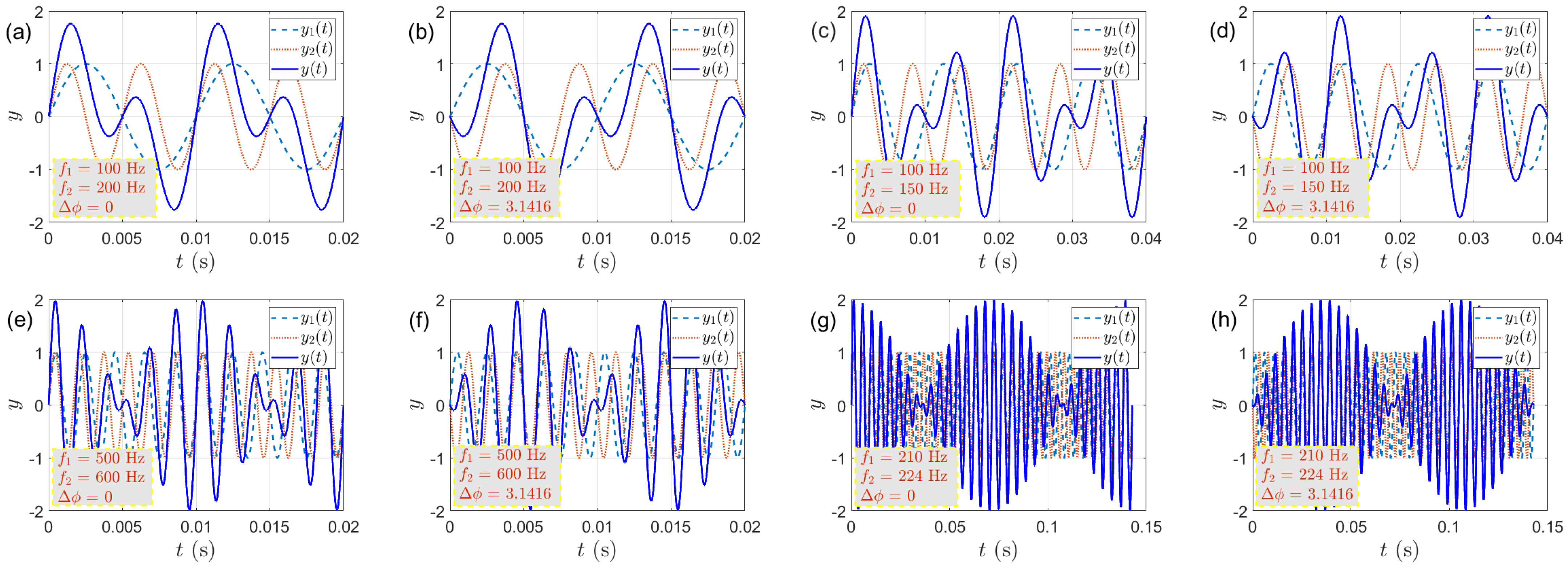
2.1. Stimuli: Simple-Tone Dyads
2.2. Procedure
2.3. Participants
2.4. Data Analysis: Response, Preference, and Statistics
3. Results and Discussion
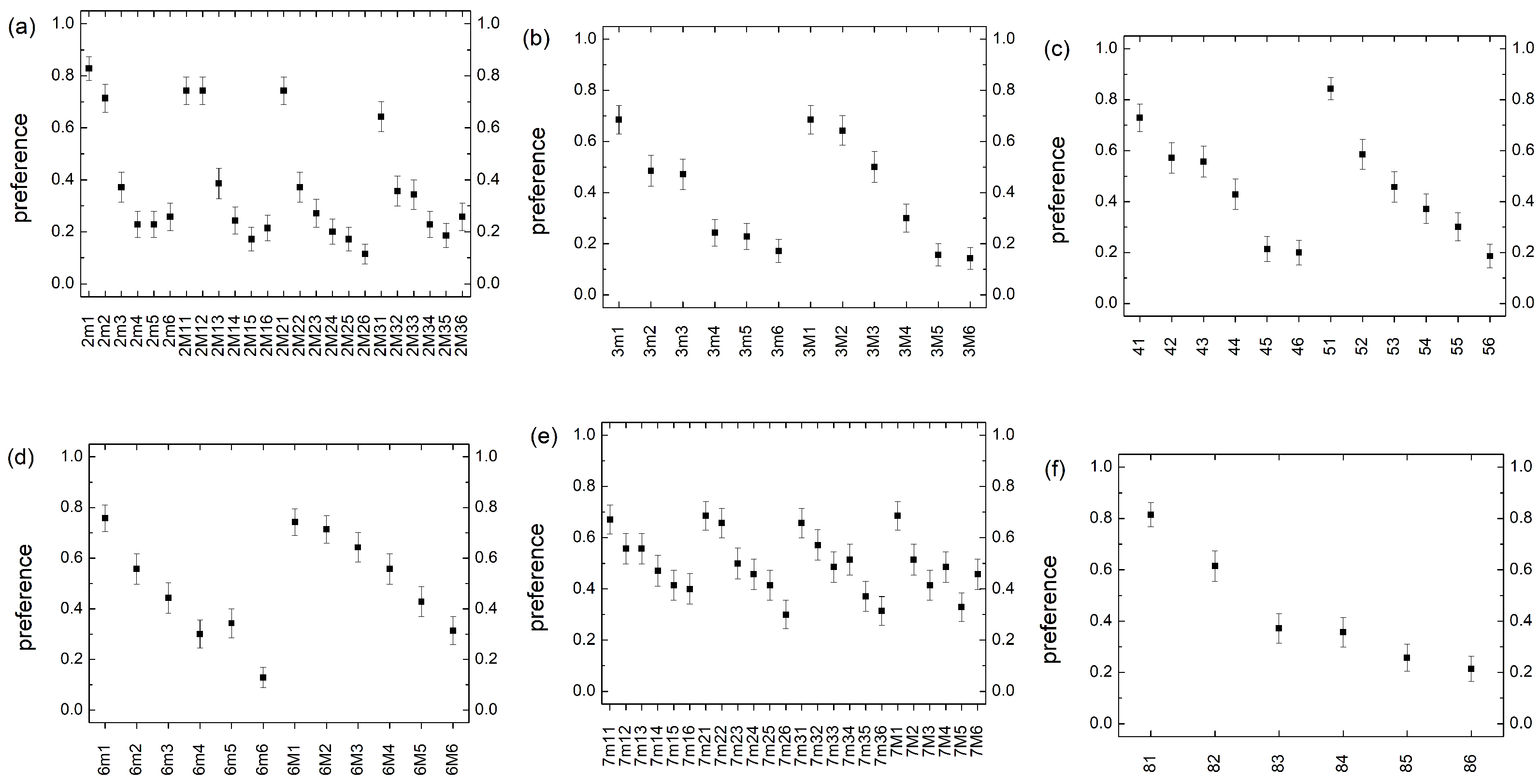
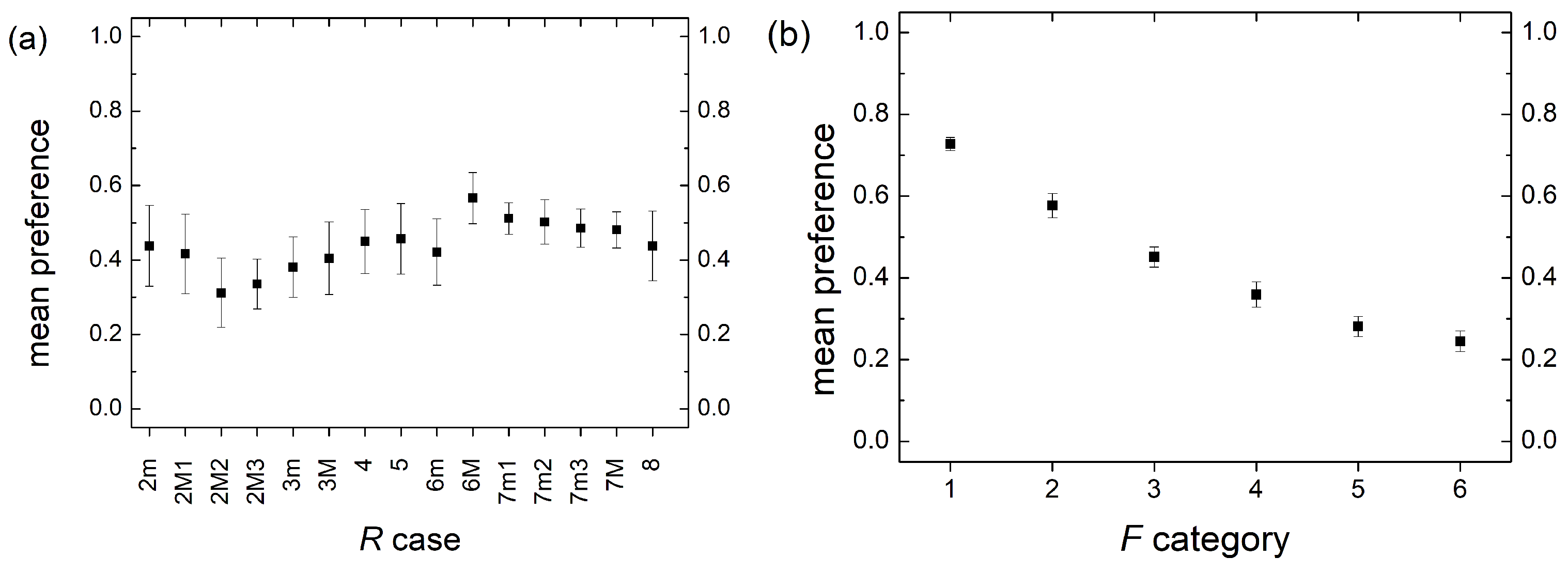
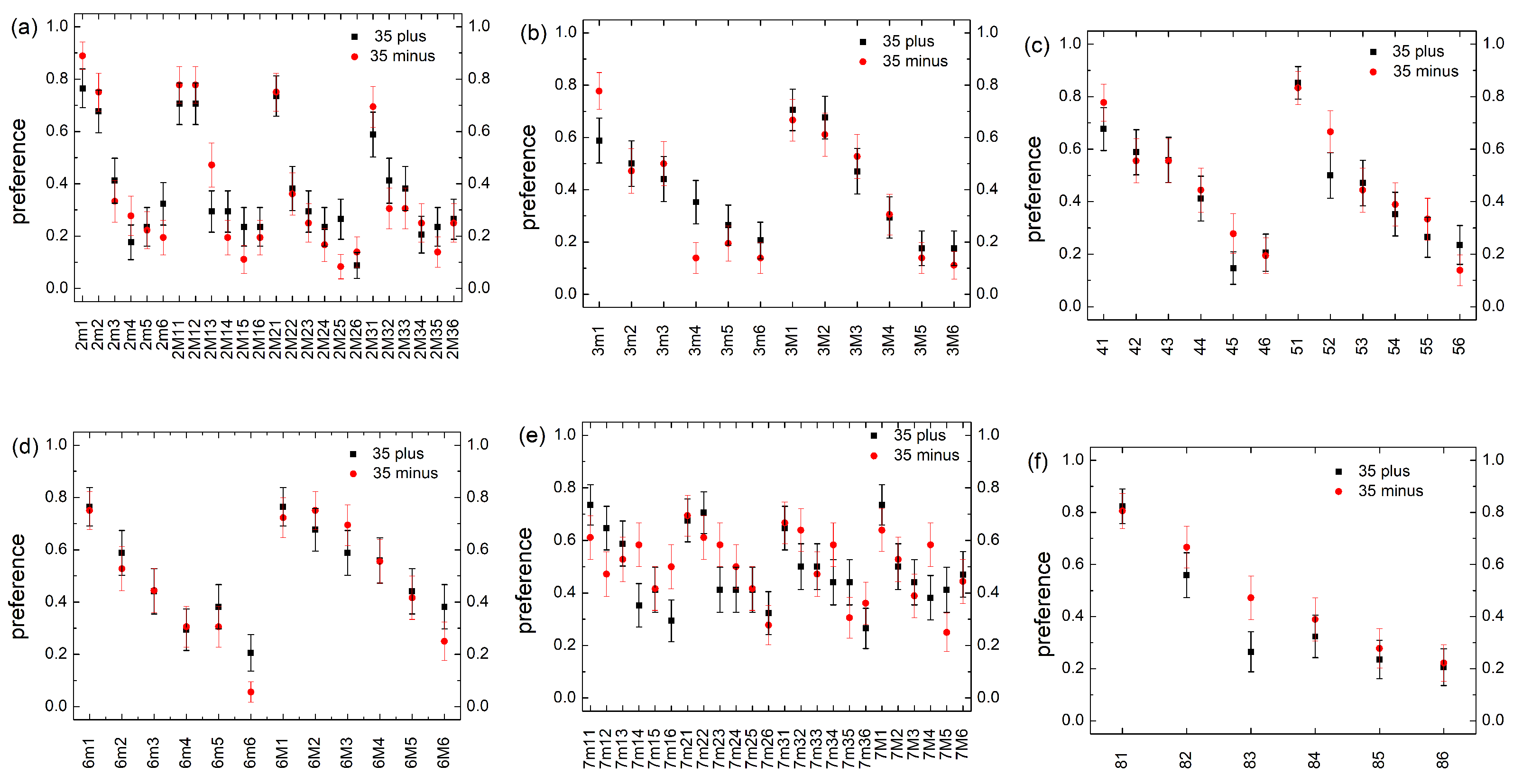
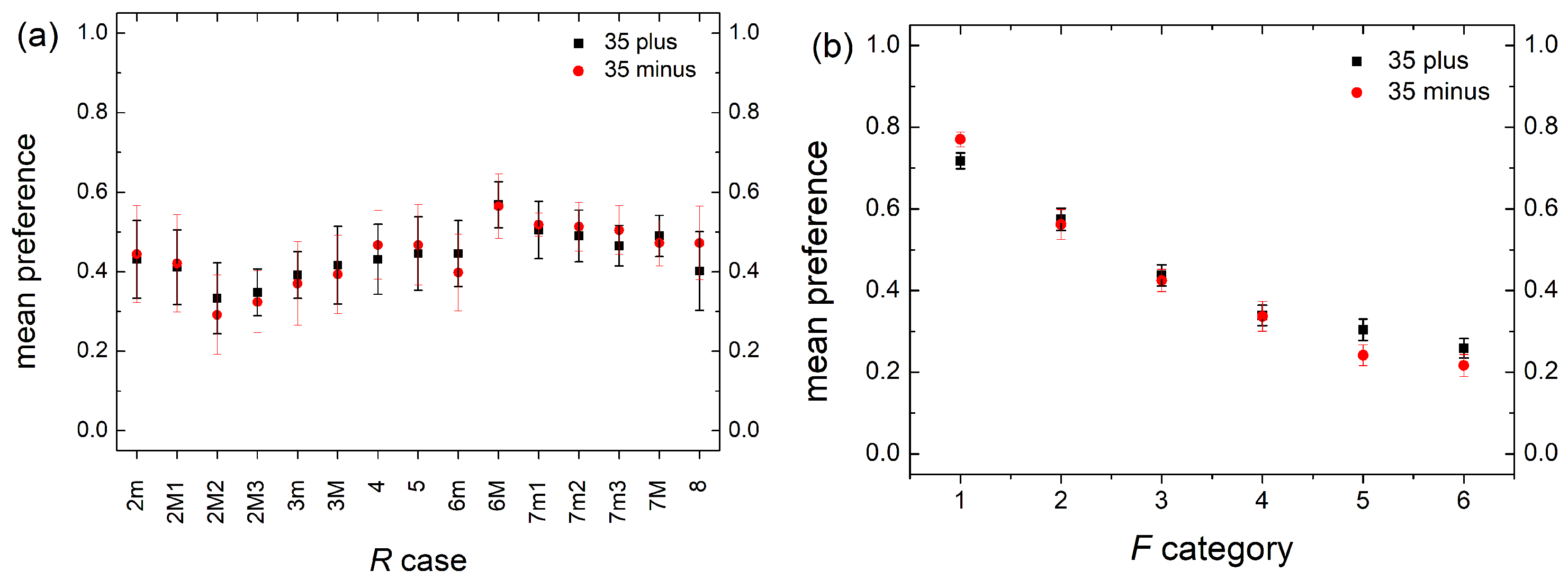
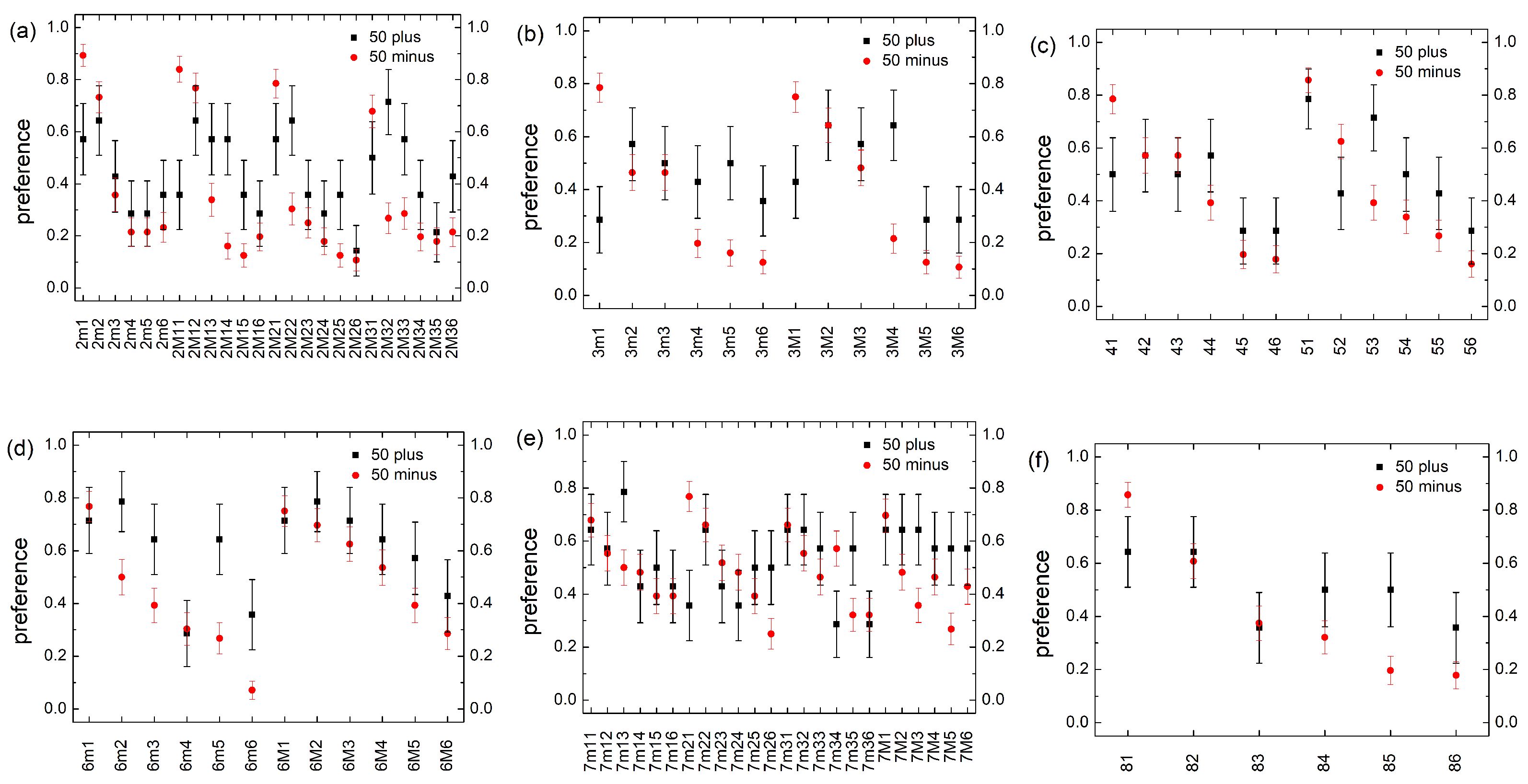
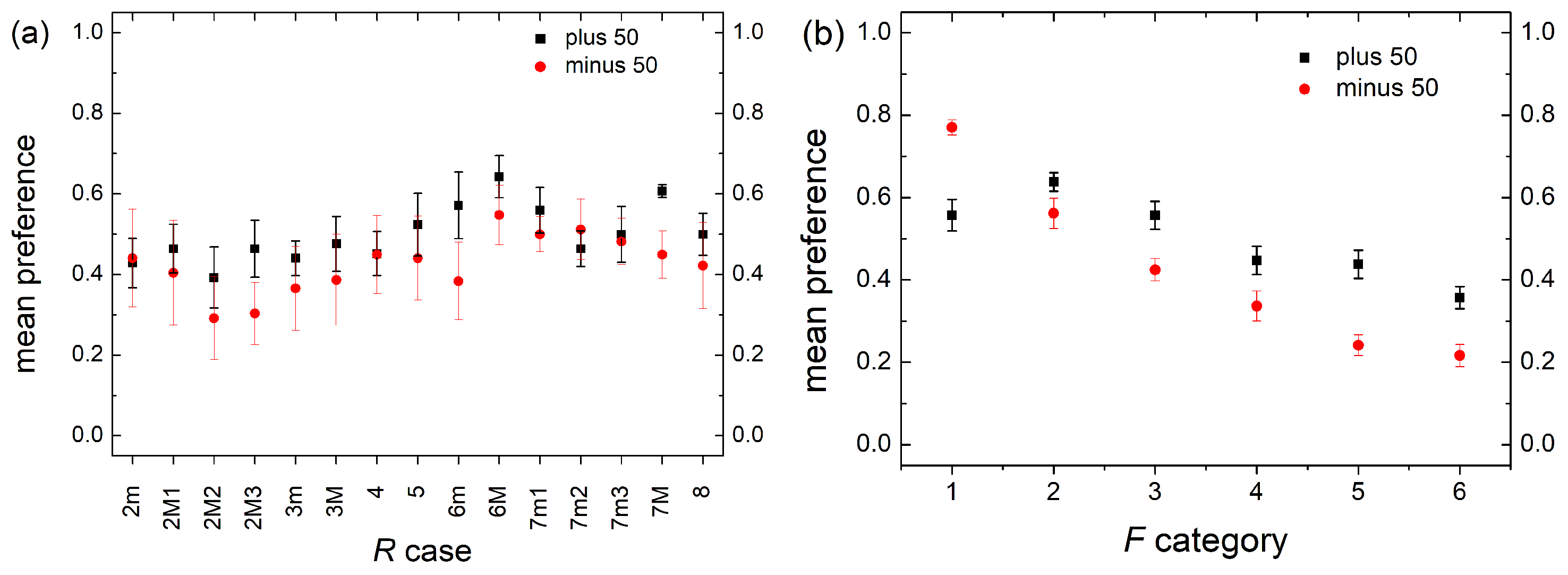
3.1. Overall Preference Patterns
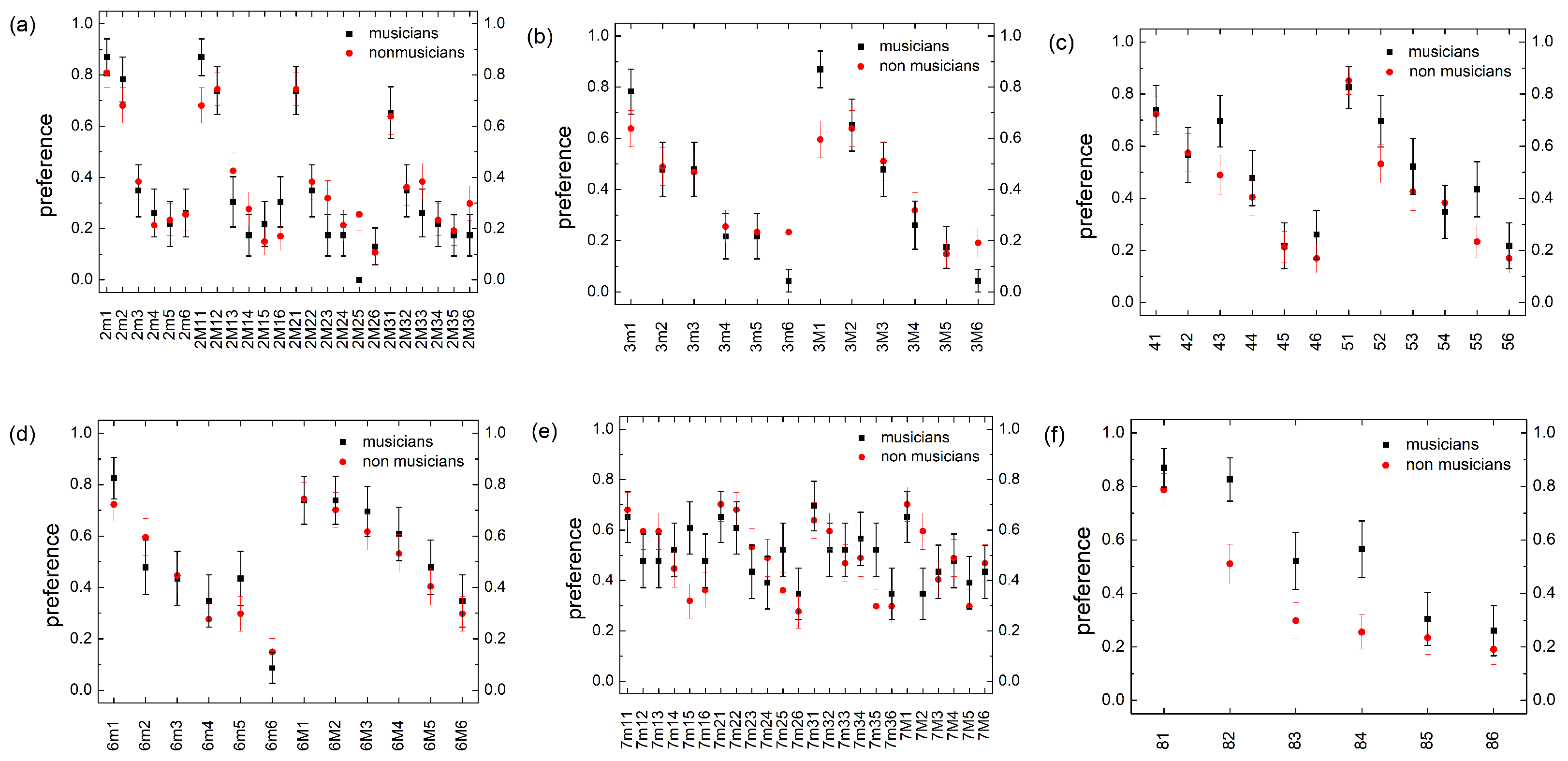
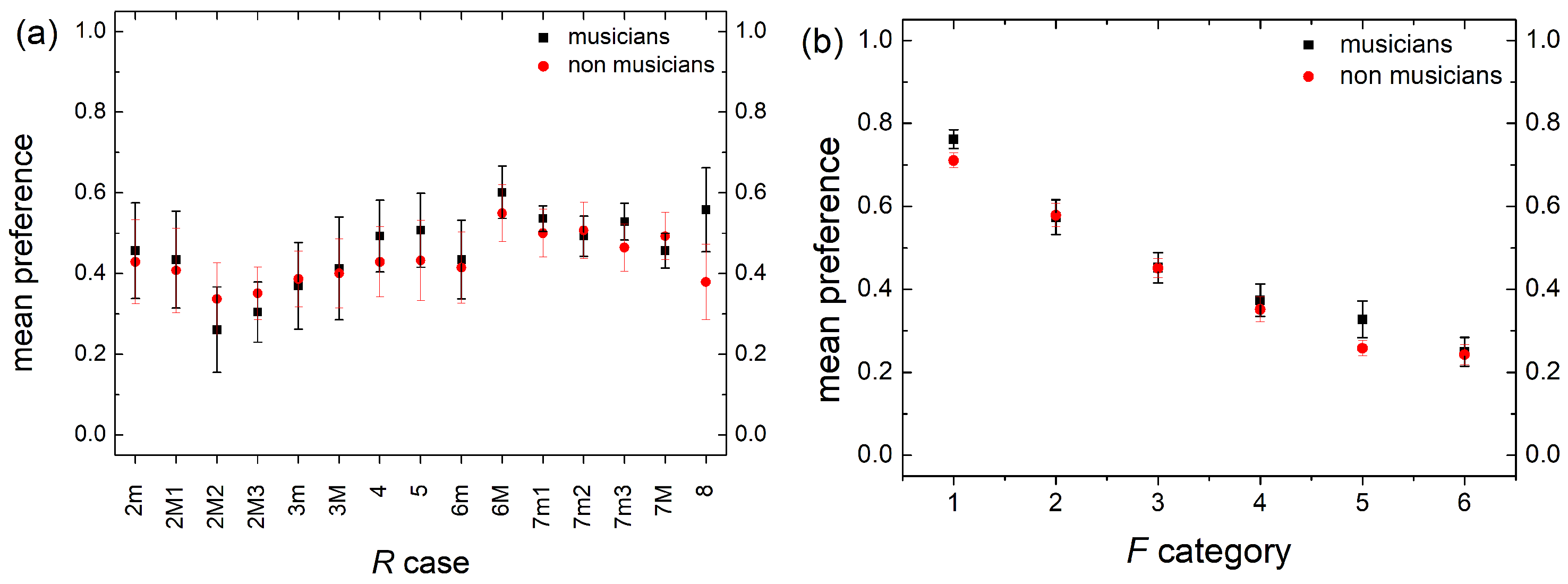
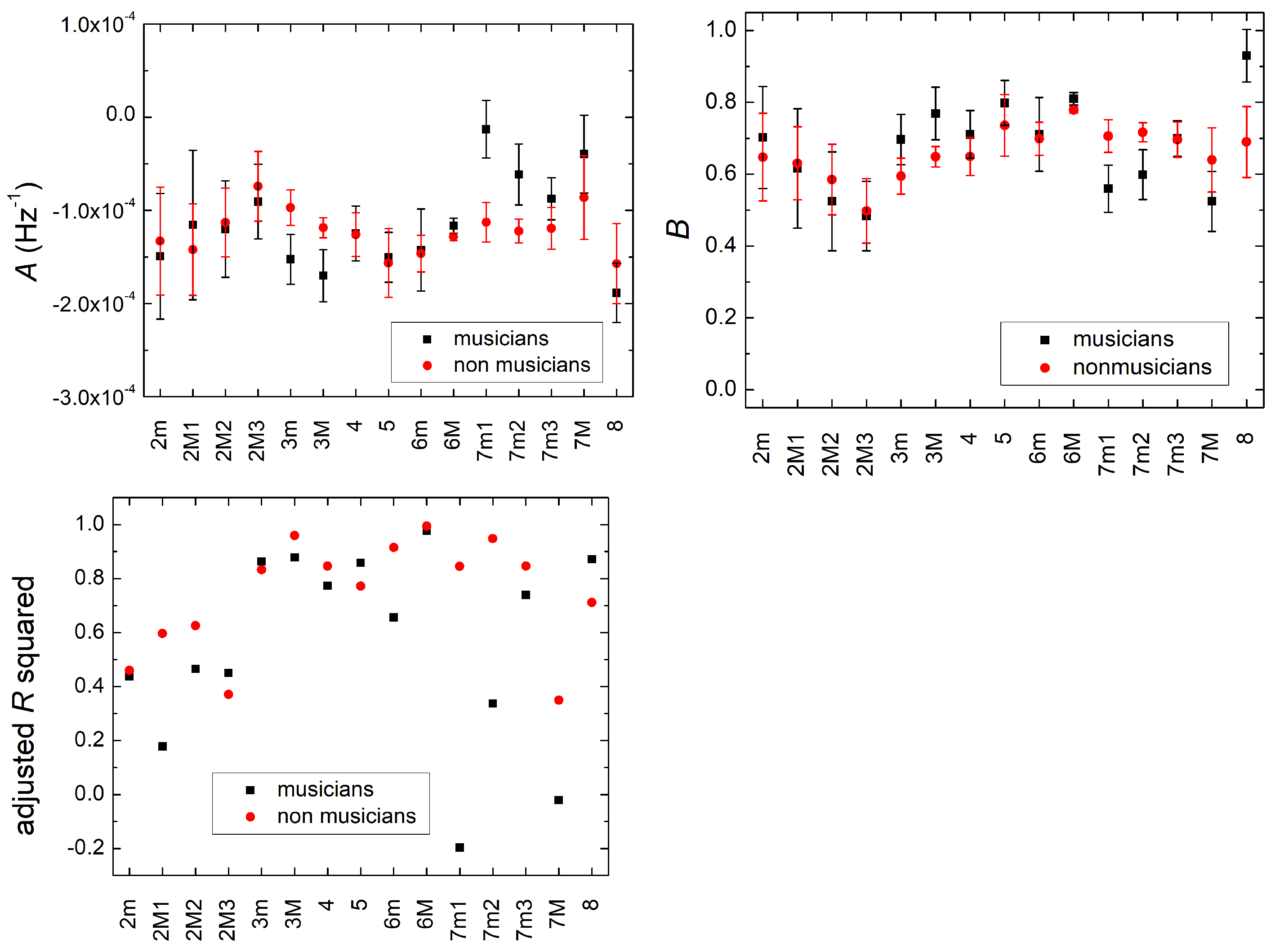
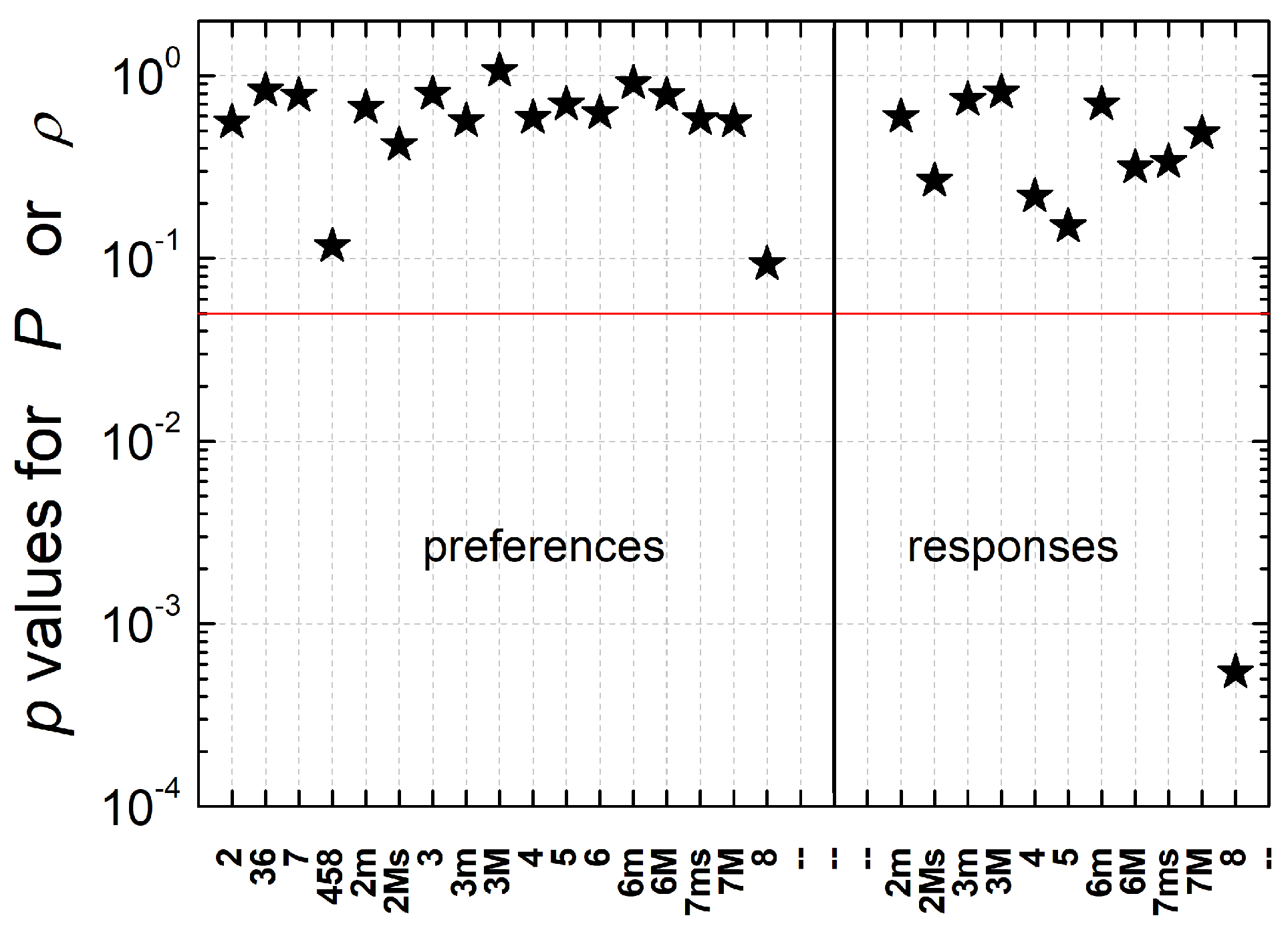
3.2. Effects of Musical Training
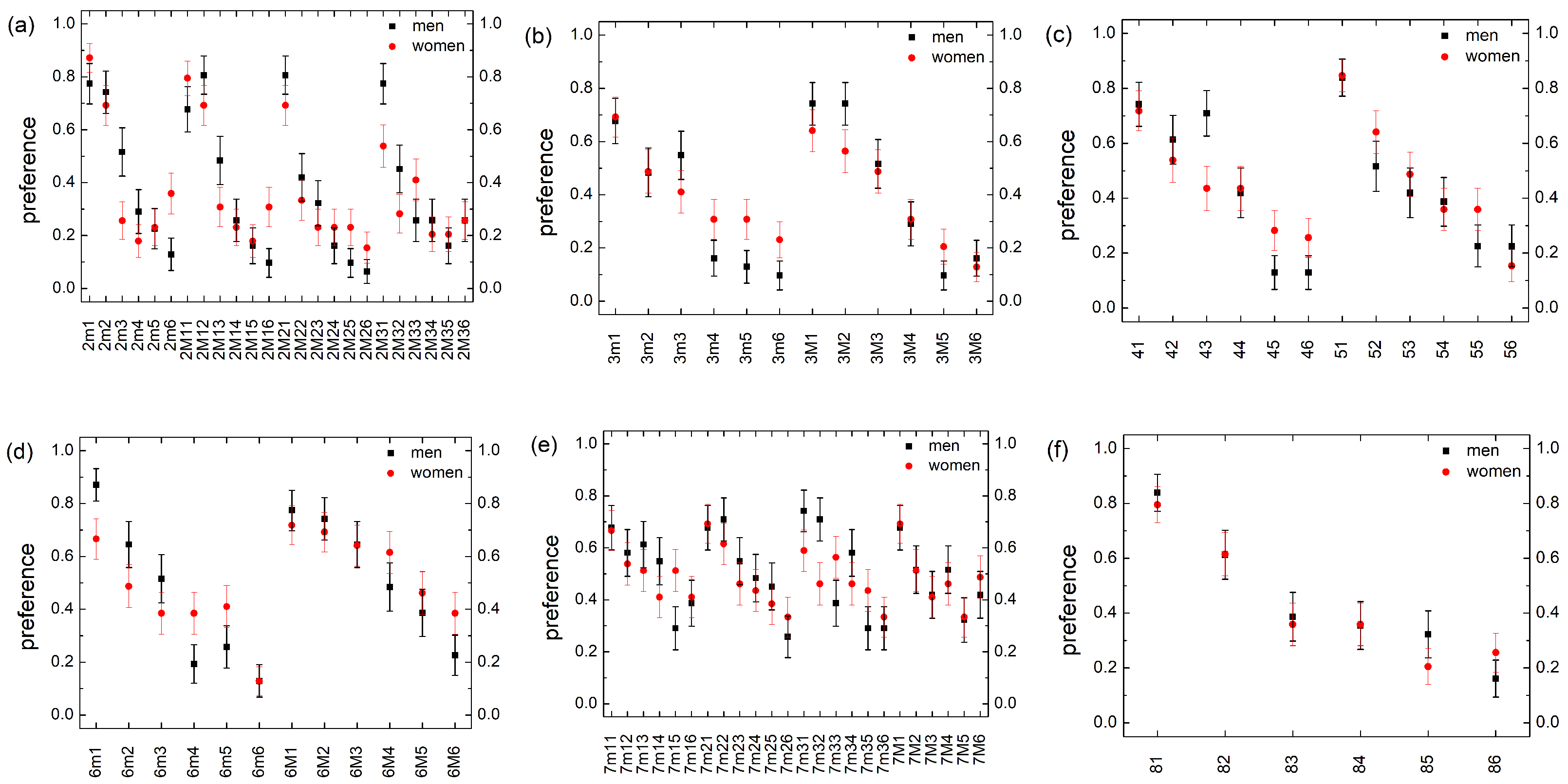
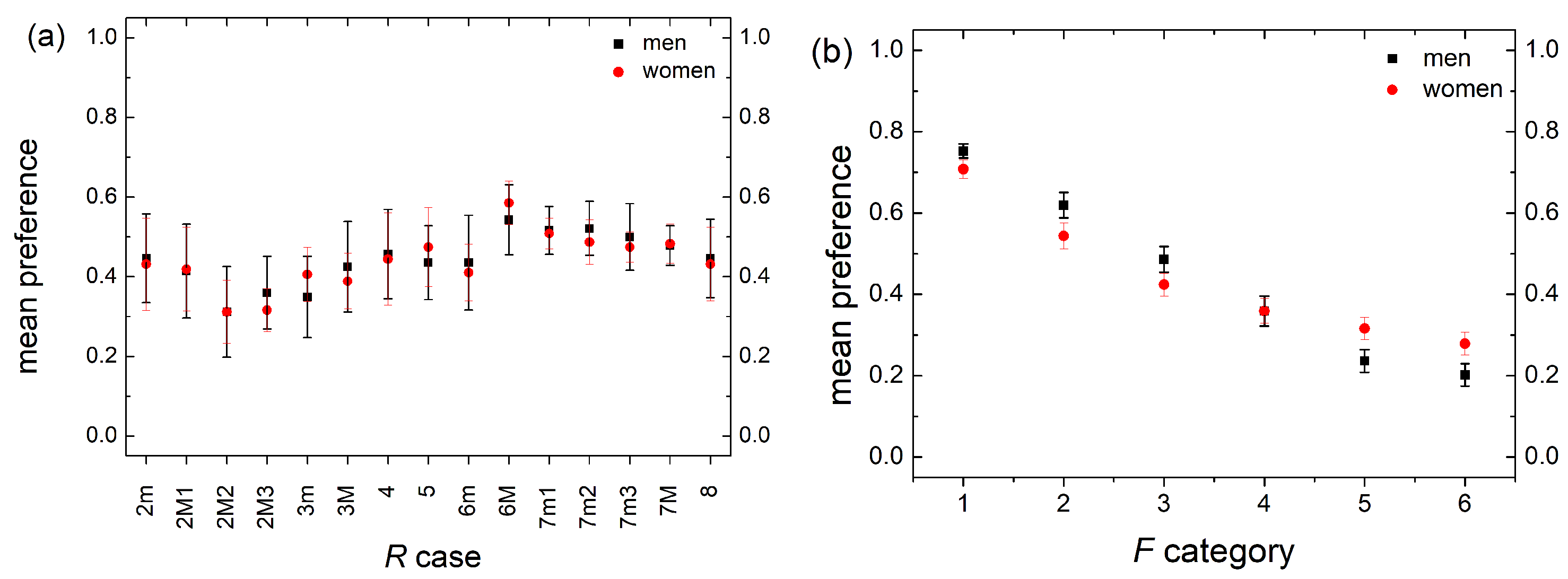
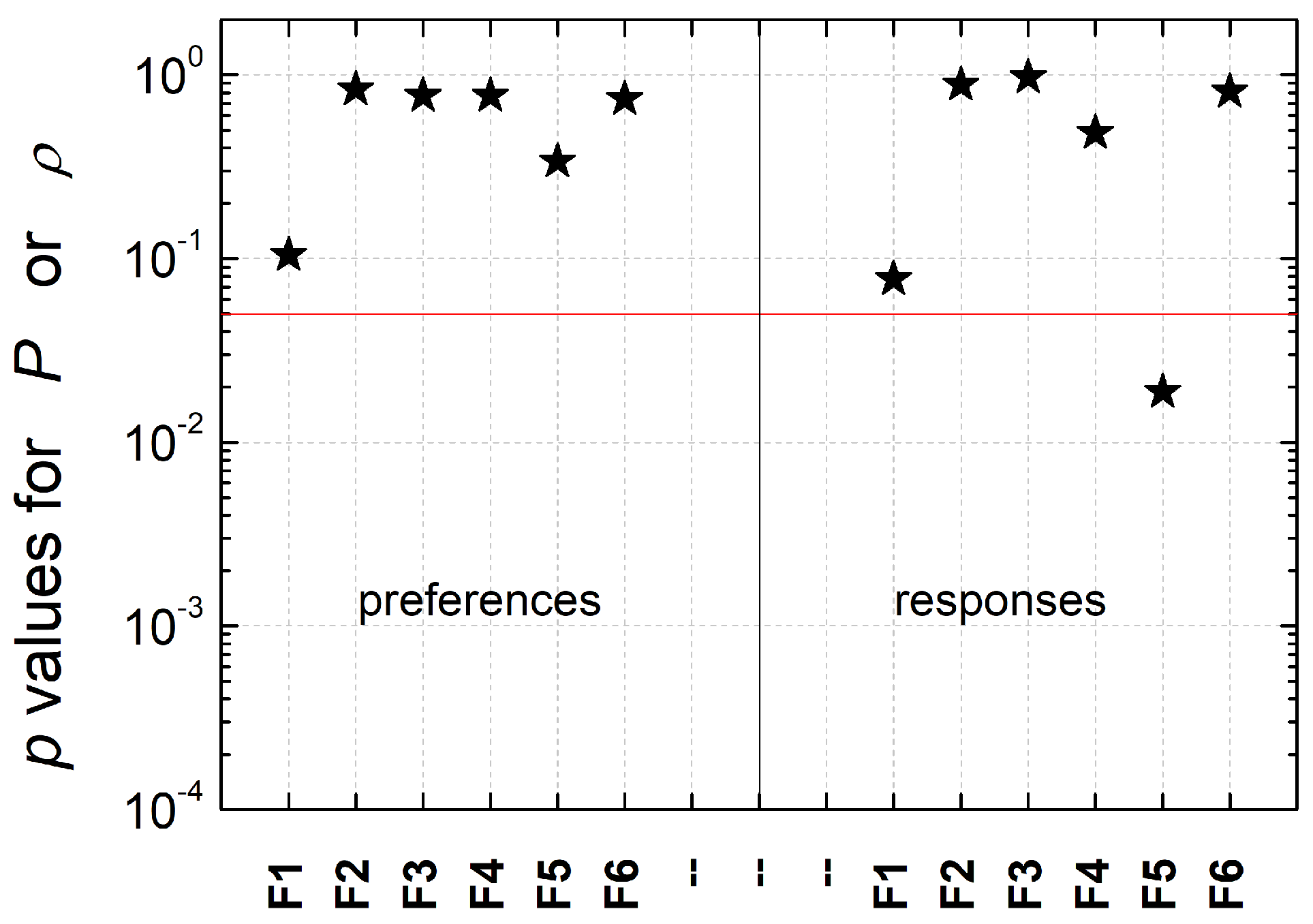
3.3. Effects of Gender
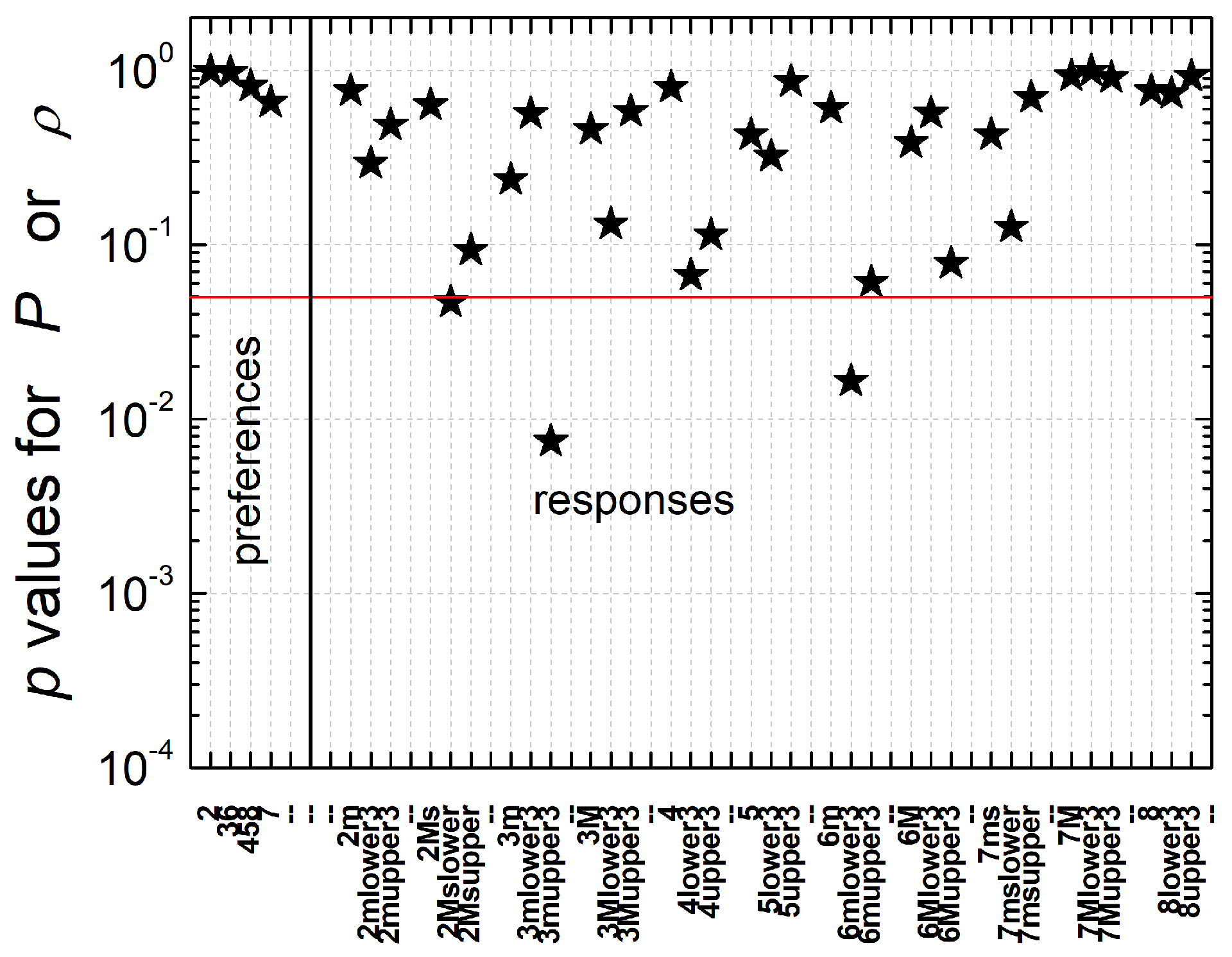
3.4. Effects of Age
4. Conclusions
Author Contributions
Funding
Institutional Review Board Statement
Informed Consent Statement
Data Availability Statement
Acknowledgments
Conflicts of Interest
Abbreviations
| MW | Mann–Whitney |
| SPL | sound pressure level |
| SOAE | spontaneous otoacoustic emission |
Appendix A

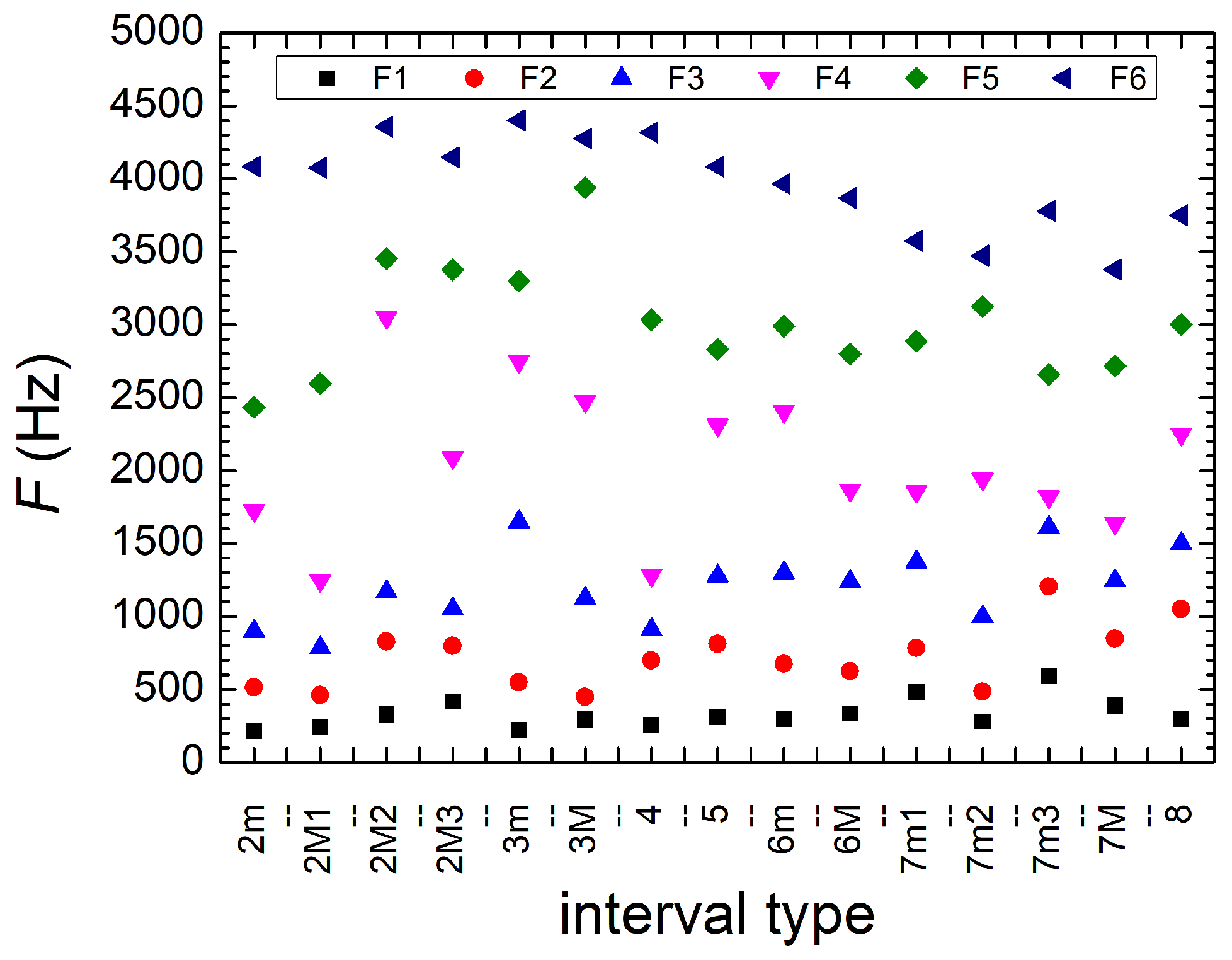
| Interval | Codename | R | F (Hz) | , (Hz) |
|---|---|---|---|---|
| minor 2nd (1) | 2m1 | 217 | 224, 210 | |
| 2m2 | 514.6 | 531.2, 498 | ||
| 2m3 | 16/15 | 899 | 928, 870 | |
| 2m4 | = | , 1670 | ||
| 2m5 | 2433.5 | 2512, 2355 | ||
| 2m6 | 4213.3, 3950 | |||
| major 2nd (2) | 2M11 | , 230 | ||
| 2M12 | , 437 | |||
| 2M13 | 10/9 | , 744 | ||
| 2M14 | = | , 1180 | ||
| 2M15 | , 2460 | |||
| 2M16 | , 3860 | |||
| major 2nd (2) | 2M21 | 329.375 | 348.75, 310 | |
| 2M22 | 828.75 | 877.5, 780 | ||
| 2M23 | 9/8 | 1168.75 | 1237.5, 1100 | |
| 2M24 | = | 3049.375 | 3228.75, 2870 | |
| 2M25 | 1.125 | 3453.125 | 3656.25, 3250 | |
| 2M26 | 4356.25 | 4612.5, 4100 | ||
| major 2nd (2) | 2M31 | 417.857 | 445.714, 390 | |
| 2M32 | 797.142 | 850.285, 744 | ||
| 2M33 | 8/7 | 1052.142 | 1122.285, 982 | |
| 2M34 | = | 2089.285 | 2228.571, 1950 | |
| 2M35 | 3375 | 3600, 3150 | ||
| 2M36 | 4146.428 | 4422.857, 3870 | ||
| minor 3rd (3) | 3m1 | 220 | 240, 200 | |
| 3m2 | 550 | 600, 500 | ||
| 3m3 | 6/5 | 1650 | 1800, 1500 | |
| 3m4 | = | 2750 | 3000, 2500 | |
| 3m5 | 1.2 | 3300 | 3600, 3000 | |
| 3m6 | 4400 | 4800, 4000 | ||
| major 3rd (4) | 3M1 | 292.5 | 325, 260 | |
| 3M2 | 450 | 500, 400 | ||
| 3M3 | 5/4 | 1125 | 1250, 1000 | |
| 3M4 | = | 2475 | 2750, 2200 | |
| 3M5 | 1.25 | 3937.5 | 4375, 3500 | |
| 3M6 | 4275 | 4750, 3800 | ||
| pure 4th (5) | 41 | , 220 | ||
| 42 | 700 | 800, 600 | ||
| 43 | 4/3 | 910 | 1040, 780 | |
| 44 | ≈ | , 1100 | ||
| 45 | , 2600 | |||
| 46 | , 3700 | |||
| pure 5th (7) | 51 | 312.5 | 375, 250 | |
| 52 | 812.5 | 975, 650 | ||
| 53 | 3/2 | 1277.5 | 1533, 1022 | |
| 54 | = | 2312.5 | 2775, 1850 | |
| 55 | 1.5 | 2832.5 | 3399, 2266 | |
| 56 | 4082.5 | 4899, 3266 | ||
| minor 6th (8) | 6m1 | 299 | 368, 230 | |
| 6m2 | 676 | 832, 520 | ||
| 6m3 | 8/5 | 1300 | 1600, 1000 | |
| 6m4 | = | 2405 | 2960, 1850 | |
| 6m5 | 1.6 | 2990 | 3680, 2300 | |
| 6m6 | 3965 | 4880, 3050 | ||
| major 6th (9) | 6M1 | , 250 | ||
| 6M2 | , 470 | |||
| 6M3 | 5/3 | 1240 | 1550, 930 | |
| 6M4 | = | , 1400 | ||
| 6M5 | 2800 | 3500, 2100 | ||
| 6M6 | , 2900 | |||
| minor 7th (10) | 7m11 | 481.25 | 612.5, 350 | |
| 7m12 | 783.75 | 997.5, 570 | ||
| 7m13 | 7/4 | 1375 | 1750, 1000 | |
| 7m14 | = | 1856.25 | 2362.5, 1350 | |
| 7m15 | 1.75 | 2887.5 | 3675, 2100 | |
| 7m16 | 3575 | 4550, 2600 | ||
| minor 7th (10) | 7m21 | , 200 | ||
| 7m22 | , 350 | |||
| 7m23 | 16/9 | 1000 | 1280, 720 | |
| 7m24 | = | , 1400 | ||
| 7m25 | 3125 | 4000, 2250 | ||
| 7m26 | , 2500 | |||
| minor 7th (10) | 7m31 | 588 | 756, 420 | |
| 7m32 | 1204 | 1548, 860 | ||
| 7m33 | 9/5 | 1610 | 2070, 1150 | |
| 7m34 | = | 1820 | 2340, 1300 | |
| 7m35 | 1.8 | 2660 | 3420, 1900 | |
| 7m36 | 3780 | 4860, 2700 | ||
| major 7th (11) | 7M1 | 388.125 | 506.25, 270 | |
| 7M2 | 848.125 | 1106.25, 590 | ||
| 7M3 | 15/8 | 1243.4375 | 1621.875, 865 | |
| 7M4 | = | 1638.75 | 2137.5, 1140 | |
| 7M5 | 1.875 | 2716.875 | 3543.75, 1890 | |
| 7M6 | 3378.125 | 4406.25, 2350 | ||
| pure 8th (12) | 81 | 300 | 400, 200 | |
| 82 | 1050 | 1400, 700 | ||
| 83 | 2/1 | 1500 | 2000, 1000 | |
| 84 | = | 2250 | 3000, 1500 | |
| 85 | 2 | 3000 | 4000, 2000 | |
| 86 | 3750 | 5000, 2500 |





References
- Helmholtz, H.V. Die Lehre von den Tonempfindungen als physiologische Grundlage für die Theorie der Musik; Friedrich Vieweg und Sohn: Braunschweig, Germany, 1863; Available online: https://archive.org/details/b21717114 (accessed on 3 February 2026).
- Helmholtz, H.V. On the Sensations of Tone as a Physiological Basis for the Theory of Music, 3rd English ed., revised ed.; Longmans, Green, and Co.: London, UK; New York, NY, USA, 1895; Available online: https://archive.org/details/onsensationsofto00helmrich (accessed on 3 February 2026).
- Helmholtz, H.V. On the Sensations of Tone as a Physiological Basis for the Theory of Music; Ellis, A.J., Translator; Dover Publications: New York, NY, USA, 1954; Available online: https://openlibrary.org/books/OL6151495M/On_the_sensations_of_tone_as_a_physiological_basis_for_the_theory_of_music (accessed on 3 February 2026).
- Galilei, G. Discorsi e Dimostrazioni Matematiche Intorno a due nuove Scienze; Elsevier: Leiden, The Netherlands, 1638. [Google Scholar]
- Bones, O.; Hopkins, K.; Krishnan, A.; Plack, C.J. Phase locked neural activity in the human brainstem predicts preference for musical consonance. Neuropsychologia 2014, 58, 23–32. [Google Scholar] [CrossRef] [Scilit] [PubMed]
- Lahdelma, I.; Eerola, T. Cultural familiarity and musical expertise impact the pleasantness of consonance/dissonance but not its perceived tension. Sci. Rep. 2020, 10, 8693. [Google Scholar] [CrossRef] [Scilit] [PubMed]
- McLachlan, N.; Marco, D.; Light, M.; Wilson, S. Consonance and Pitch. J. Exp. Psychol. 2013, 142, 1142–1158. [Google Scholar] [CrossRef] [Scilit] [PubMed]
- Guernsey, M. The Rôle of Consonance and Dissonance in Music. Am. J. Psychol. 1928, 40, 173–204. [Google Scholar] [CrossRef] [Scilit]
- McDermott, J.H.; Lehr, A.J.; Oxenham, A.J. Individual Differences Reveal the Basis of Consonance. Curr. Biol. 2010, 20, 1035–1041. [Google Scholar] [CrossRef] [Scilit]
- Bowling, D.L.; Purves, D.; Gill, K.Z. Vocal similarity predicts the relative attraction of musical chords. Proc. Natl. Acad. Sci. USA 2017, 115, 216–221. [Google Scholar] [CrossRef] [Scilit]
- Bowling, D.L.; Purves, D. A biological rationale for musical consonance. Proc. Natl. Acad. Sci. USA 2015, 112, 11155–11160. [Google Scholar] [CrossRef] [Scilit]
- Terhardt, E. The Concept of Musical Consonance: A Link between Music and Psychoacoustics. Music Percept. 1984, 1, 276–295. [Google Scholar] [CrossRef] [Scilit]
- Pearson, J.D.; Morrell, C.H.; Gordon-Salant, S.; Brant, L.J.; Jeffrey Metter, E.; Klein, L.L.; Fozard, J.L. Gender differences in a longitudinal study of age-associated hearing loss. J. Acoust. Soc. Am. 1995, 97, 1196–1205. [Google Scholar] [CrossRef] [Scilit]
- McFadden, D. Sex differences in the auditory system. Dev. Neuropsychol. 1998, 14, 261–298. [Google Scholar] [CrossRef] [Scilit]
- Re, D.E.; O’Connor, J.J.M.; Bennett, P.J.; Feinberg, D.R. Preferences for Very Low and Very High Voice Pitch in Humans. PLoS ONE 2012, 7, e32719. [Google Scholar] [CrossRef] [Scilit] [PubMed]
- Harrison, P.M.C.; Pearce, M.T. Simultaneous Consonance in Music Perception and Composition. Psychol. Rev. 2020, 127, 216–244. [Google Scholar] [CrossRef] [Scilit] [PubMed]
- McDermott, J.H.; Schultz, A.F.; Undurraga, E.A.; Godoy, R.A. Indifference to dissonance in native Amazonians reveals cultural variation in music perception. Nature 2016, 535, 547–550. [Google Scholar] [CrossRef] [Scilit] [PubMed]
- Marjieh, R.; Harrison, P.M.C.; Lee, H.; Deligiannaki, F.; Jacoby, N. Timbral effects on consonance disentangle psychoacoustic mechanisms and suggest perceptual origins for musical scales. Nat. Commun. 2024, 15, 1482. [Google Scholar] [CrossRef] [Scilit]
- Bones, O.; Plack, C.J. Losing the Music: Aging Affects the Perception and Subcortical Neural Representation of Musical Harmony. J. Neurosci. 2015, 35, 4071–4080. [Google Scholar] [CrossRef] [Scilit]
- Lentz, J.J.; Humes, L.E.; Kidd, G.R. Differences in Auditory Perception Between Young and Older Adults When Controlling for Differences in Hearing Loss and Cognition. Trends Hear. 2022, 26, 23312165211066180. [Google Scholar] [CrossRef] [Scilit]
- Tufts, J.B.; Molis, M.R.; Leek, M.R. Perception of dissonance by people with normal hearing and sensorineural hearing loss. J. Acoust. Soc. Am. 2005, 118, 955–967. [Google Scholar] [CrossRef] [Scilit]
- Koerner, T.K.; Zhang, Y. Differential effects of hearing impairment and age on electrophysiological and behavioral measures of speech in noise. Hear. Res. 2018, 370, 130–142. [Google Scholar] [CrossRef] [Scilit]
- Morrell, C.H.; Gordon-Salant, S.; Pearson, J.D.; Brant, L.J.; Fozard, J.L. Age- and gender-specific reference ranges for hearing level and longitudinal changes in hearing level. J. Acoust. Soc. Am. 1996, 100, 1949–1967. [Google Scholar] [CrossRef] [Scilit]
- Vitz, P.C. Preference for tones as a function of frequency (hertz) and intensity (decibels). Percept. Psychophys. 1972, 11, 84–88. [Google Scholar] [CrossRef] [Scilit]
- Patchett, R.F. Human sound frequency preferences. Percept. Mot. Ski. 1979, 49, 324–326. [Google Scholar] [CrossRef] [Scilit]
- Siedenburg, K.; Röttges, S.; Wagener, K.C.; Hohmann, V. Can You Hear Out the Melody? Testing Musical Scene Perception in Young Normal-Hearing and Older Hearing-Impaired Listeners. Trends Hear. 2020, 24, 2331216520945826. [Google Scholar] [CrossRef] [Scilit] [PubMed]
- Jo, H.S.; Hsieh, T.H.; Chien, W.C.; Shaw, F.Z.; Liang, S.F.; Kung, C.C. Probing the neural dynamics of musicians’ and non-musicians’ consonant/dissonant perception: Joint analyses of electrical encephalogram (EEG) and functional magnetic resonance imaging (fMRI). NeuroImage 2024, 298, 120784. [Google Scholar] [CrossRef] [Scilit] [PubMed]
- Norman-Haignere, S.V.; Albouy, P.; Caclin, A.; McDermott, J.H.; Kanwisher, N.G.; Tillmann, B. Pitch-Responsive Cortical Regions in Congenital Amusia. J. Neurosci. 2016, 36, 2986–2994. [Google Scholar] [CrossRef] [Scilit] [PubMed]
- Graves, J.E.; Pralus, A.; Fornoni, L.; Oxenham, A.J.; Tillmann, B.; Caclin, A. Consonance Perception in Congenital Amusia: Behavioral and Brain Responses to Harmonicity and Beating Cues. J. Cogn. Neurosci. 2023, 35, 765–780. [Google Scholar] [CrossRef] [Scilit]
- Giannos, K.; Cambouropoulos, E. Sequential consonance/dissonance: Effects of chord directionality, cadences, and voice leading. Psychol. Music. 2025, 0, 1–18. [Google Scholar] [CrossRef] [Scilit]
- Benward, B.; Saker, M.N. Music: In Theory and Practice, 7th ed.; McGraw-Hill: Boston, MA, USA, 2003; Available online: https://www.worldcat.org/oclc/61691613 (accessed on 3 February 2026).
- Benson, D.C. A Smoother Pebble: Mathematical Explorations, 1st ed.; Oxford University Press: Oxford, UK, 2003; Available online: https://www.worldcat.org/oclc/50919818 (accessed on 3 February 2026).
- Shapiro, S.S.; Wilk, M.B. An analysis of variance test for normality (complete samples). Biometrika 1965, 52, 591–611. [Google Scholar] [CrossRef] [Scilit]
- Gosset, W.S. (published under the pseudonym “Student”). The probable error of a mean. Biometrika 1908, 6, 1–25. [Google Scholar] [CrossRef]
- Mann, H.B.; Whitney, D.R. On a Test of Whether one of Two Random Variables is Stochastically Larger than the Other. Ann. Math. Stat. 1947, 18, 50–60. [Google Scholar] [CrossRef] [Scilit]
- Wilcoxon, F. Individual Comparisons by Ranking Methods. Biom. Bull. 1945, 1, 80–83. [Google Scholar] [CrossRef] [Scilit]
- Fisher, R.A. Statistical Methods for Research Workers. In Breakthroughs in Statistics: Methodology and Distribution; Springer: New York, NY, USA, 1992; pp. 66–70. [Google Scholar] [CrossRef] [Scilit]
- Cardillo, G. MWWTEST: Mann-Whitney-Wilcoxon Nonparametric Test for Two Unpaired Samples (A MATLAB Code for Mann-Whitney-Wilcoxon Test). 2023. Available online: https://www.mathworks.com/matlabcentral/fileexchange/25830 (accessed on 3 February 2026).
- Plomp, R.; Levelt, W.J.M. Tonal consonance and critical bandwidth. J. Acoust. Soc. Am. 1965, 38, 548–560. [Google Scholar] [CrossRef] [Scilit]
- Kameoka, A.; Kuriyagawa, M. Consonance theory Part I: Consonance of Dyads. J. Acoust. Soc. Am. 1969, 45, 1451–1459. [Google Scholar] [CrossRef] [Scilit]
- Kameoka, A.; Kuriyagawa, M. Consonance theory Part II: Consonance of Complex Tones and Its Calculation Method. J. Acoust. Soc. Am. 1969, 45, 1460–1469. [Google Scholar] [CrossRef] [Scilit]
- Terhardt, E. The Two-Component Theory of Musical Consonance. In Psychophysics and Physiology of Hearing; Evans, E.F., Wilson, J.P., Eds.; Academic Press: London, UK, 1977. [Google Scholar]
- Fletcher, H.; Munson, W.A. Loudness, its definition, measurement and calculation. Bell Syst. Tech. J. 1933, 12, 377–430. [Google Scholar] [CrossRef] [Scilit]
- Fletcher, H.; Munson, W.A. Loudness, Its Definition, Measurement and Calculation. J. Acoust. Soc. Am. 1933, 5, 82–108. [Google Scholar] [CrossRef] [Scilit]
- Fastl, H.; Zwicker, E. Psychoacoustics: Facts and Models, 3rd ed.; Springer: Berlin/Heidelberg, Germany, 2007; 463p. [Google Scholar] [CrossRef] [Scilit]
- Moore, B.C.J. An Introduction to the Psychology of Hearing, 6th ed.; Brill: Boston, MA, USA, 2013; 460p. [Google Scholar]
- Viemeister, N.F.; Bacon, S.P. Intensity discrimination, increment detection, and magnitude estimation for 1-kHz tones. J. Acoust. Soc. Am. 1988, 84, 172–178. [Google Scholar] [CrossRef] [Scilit]
- Plack, C.J. The Sense of Hearing, 4th ed.; Routledge: New York, NY, USA, 2023; 344p. [Google Scholar]




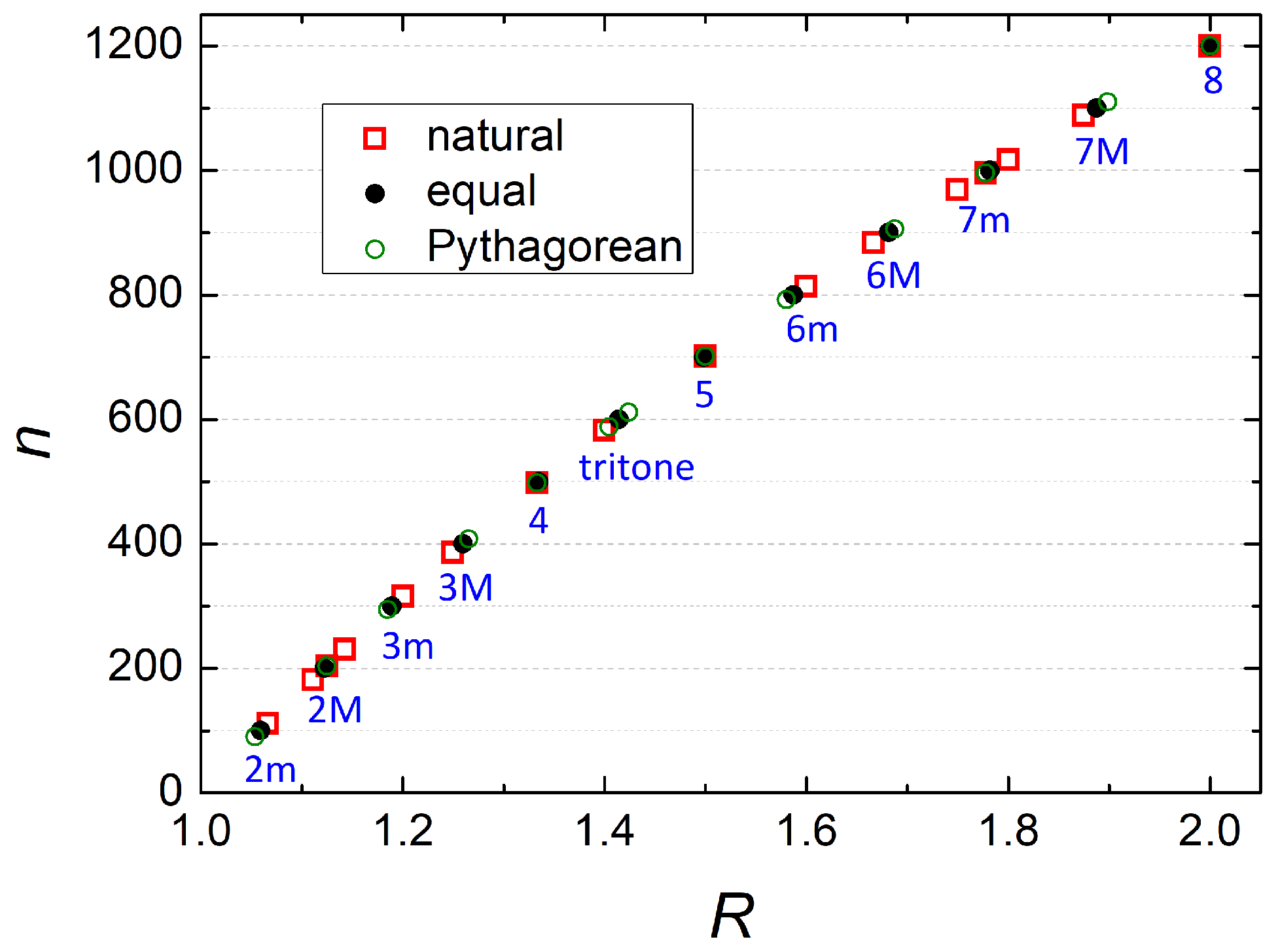
| Interval | R (Natural) | Cents (Natural) | R (Equal) | Cents (Equal) | R (Pythagorean) | Cents (Pythagorean) |
|---|---|---|---|---|---|---|
| 2m | 111.73129 | 1.05946 | 100 | (a) | 90.225 | |
| 2M1 | 182.40371 | |||||
| 2M2 | 203.91 | 1.12246 | 200 | 203.91 | ||
| 2M3 | 231.17409 | |||||
| 3m | 315.64129 | 1.18921 | 300 | 294.135 | ||
| 3M | 386.31371 | 1.25992 | 400 | 407.82 | ||
| 4 | 498.045 | 1.33484 | 500 | 498.045 | ||
| 5d | (b) | 588.26999 | ||||
| tritone | 582.51219 | 1.41421 | 600 | |||
| 4a | 611.73001 | |||||
| 5 | 701.955 | 1.49831 | 700 | 701.955 | ||
| 6m | 813.68629 | 1.5874 | 800 | (c) | 792.18 | |
| 6M | 884.35871 | 1.68179 | 900 | 905.865 | ||
| 7m1 | 968.82591 | |||||
| 7m2 | 996.09 | 1.7818 | 1000 | 996.09 | ||
| 7m3 | 1017.59629 | |||||
| 7M | 1088.26871 | 1.88775 | 1100 | 1109.775 | ||
| 8 | 1200 | 2 /1 | 1200 | =2 | 1200 |
| Larger Group | R Cases | R |
|---|---|---|
| 1st | 2m, 2M1, 2M2, 2M3 | 16/15, 10/9, 9/8, 8/7 |
| 2nd | 3m, 3M, 6m, 6M | 6/5, 5/4, 8/5, 5/3 |
| 3rd | 4, 5, 8 | 4/3, 3/2, 2/1 |
| 4th | 7m1, 7m2, 7m3, 7M | 7/4, 16/9, 9/5, 15/8 |
Disclaimer/Publisher’s Note: The statements, opinions and data contained in all publications are solely those of the individual author(s) and contributor(s) and not of MDPI and/or the editor(s). MDPI and/or the editor(s) disclaim responsibility for any injury to people or property resulting from any ideas, methods, instructions or products referred to in the content. |
© 2026 by the authors. Licensee MDPI, Basel, Switzerland. This article is an open access article distributed under the terms and conditions of the Creative Commons Attribution (CC BY) license.
Share and Cite
Kaklamani, S.; Simserides, C. Psychoacoustic Study of Simple-Tone Dyads: Frequency Ratio and Pitch. Acoustics 2026, 8, 14. https://doi.org/10.3390/acoustics8010014
Kaklamani S, Simserides C. Psychoacoustic Study of Simple-Tone Dyads: Frequency Ratio and Pitch. Acoustics. 2026; 8(1):14. https://doi.org/10.3390/acoustics8010014
Chicago/Turabian StyleKaklamani, Stefania, and Constantinos Simserides. 2026. "Psychoacoustic Study of Simple-Tone Dyads: Frequency Ratio and Pitch" Acoustics 8, no. 1: 14. https://doi.org/10.3390/acoustics8010014
APA StyleKaklamani, S., & Simserides, C. (2026). Psychoacoustic Study of Simple-Tone Dyads: Frequency Ratio and Pitch. Acoustics, 8(1), 14. https://doi.org/10.3390/acoustics8010014