1. Introduction
Wireless acoustic/vibroacoustic, hydroacoustic digital navigation and communication systems are an essential part of modern research and robotic complexes in acoustic logging tasks in geophysics [
1,
2], in communication between support vessels, remotely operated and autonomous unmanned underwater vehicles (ROV and AUV), and bottom stations. Navigation and data telemetry in such systems directly depend on the quality of the communication channel. Due to multiple noises, environmental dynamics, and object movement, it is particularly important to improve the efficiency of such communication systems in the absence of other means of signal transmission over significant distances in these environments [
3,
4]. Recent studies have highlighted the challenges and advancements in acoustic telemetry of targets and the scattering of acoustic waves on rough surfaces, which are important for enhancing the reliability and performance of acoustic communication systems in complex and dynamic environments [
5,
6].
There is a significant number of papers and studies devoted to hydroacoustic communication and navigation systems. The effectiveness of certain algorithms is evaluated under specific conditions, and when the parameters of the underwater communication channel change, adjustments are required to ensure the operability of communication devices. Attempts to evaluate the characteristics of the hydroacoustic channel with adaptive adjustment of signal transmission and reception systems are complicated by the range of underwater signal propagation. Moreover, the relevance of the results obtained quickly decreases over time. Algorithms for generating signals that are resistant to the dynamics of underwater communication channel parameters, Doppler frequency shifts, multiple additive interference from ships, biological activity, and other sea noise exist; they are implemented in hardware and are actively used in practice [
7]. However, the efficient information transfer rate is often no more than tens to hundreds of bits/s at distances of several kilometers, and high-speed transmission modes (tens of kbit/s) rarely show stable performance due to the need for error correction and retransmission of information. The bandwidth limitation of underwater communications is directly determined by the significant frequency dependence of the signal propagation range and the narrow bandwidth of resonant transceivers. Typical values for the frequency bandwidth of hydroacoustic systems are several kHz, while values for spectral communication efficiency at distances of 1–3 km usually do not exceed 0.01–0.1 bits/s/Hz [
3].
Along with radio systems (DVB-T, Wi-Fi, LTE-4G, 5G), orthogonal frequency division multiplexing algorithms have become quite popular in hydroacoustics due to the availability of hardware platforms for implementation using FFT (Fast Fourier Transform) and IFFT (Inverse Fast Fourier Transform), resistance to multipath propagation, and high spectral efficiency [
8,
9]. OFDM methods can also be actively used in conjunction with modern neural network signal processing algorithms, allowing for the qualitative improvement of the noise immunity of communication systems [
10]. However, the key disadvantages of OFDM—high peak-to-average power ratio (PAPR) of the signal and sensitivity to Doppler frequency shift and non-stationarity of the hydroacoustic channel—have led OFDM in hydroacoustics to become more of a subject of a large number of scientific research projects and tests rather than a technology with stable characteristics that is actually used in practice. High spectral efficiency values of 1 to 6 bits/s/Hz at bandwidths of up to tens of kbps at ranges of several hundred meters remain rarely observed in experimental marine trials [
11,
12].
The peak factor of OFDM signals is a random variable and depends on the digital information transmitted at
N subcarrier frequencies of the OFDM signal. Peak factor reduction is an area of scientific research that has been considered for both DSL (Digital Subscriber Line) and wireless OFDM systems. Many methods have been proposed, including amplitude limiting (clipping) methods [
13,
14,
15,
16,
17], selective mapping methods [
18,
19,
20,
21], and peak reduction subcarriers [
22,
23,
24]. Coding methods [
25], Trellis shaping [
26,
27], tone injection [
28,
29], active constellation extension [
30], and partial transmit sequences [
31,
32] are also widely used. Recently, active research has been conducted in the field of differentially chaotic OFDM-DCSK subcarrier manipulation systems with incoherent reception of informational symbols, which also allows reducing PAPR and enables operation in non-stationary communication channels [
33,
34,
35,
36]. However, a number of features of the method can decrease spectral efficiency due to the spreading factor, whereas differential OFDM coding in certain cases (when the coherence time of the communication channel is less than two symbol durations) can lead to a sharp rise in BER (Bit Error Rate).
The above methods can be evaluated and compared based on various criteria, such as peak factor reduction efficiency, OFDM signal distortion level, data transfer rate redundancy, implementation complexity, etc.
Given that the superposition of a large number of information-modulated OFDM subcarriers results in a substantial increase in the signal’s peak power, the power amplifier is required to operate with a significant output back-off to accommodate this peak level. Such an operation is necessary to suppress nonlinear distortions inherent to OFDM and to prevent the introduction of transmission errors already at the signal formation stage. An analogous constraint applies to all other components of the transmit–receiver chain. In a number of cases, even heavily mitigated OFDM amplitude excursions do not permit the utilization of the transmitter’s full nominal radiated power, which adversely affects the achievable signal-to-noise ratio at the receiver and consequently limits the effective range of systems employing OFDM modulation. Under these conditions, the PAPR issue becomes a critical limiting factor, leading to a pronounced deterioration in interference robustness and a reduction in the operational range of underwater acoustic communication systems.
In earlier work [
37], the authors conducted a comprehensive investigation of an OFDM method employing frequency-domain subcarrier coding, which demonstrated substantial robustness to the non-stationary nature of the underwater acoustic communication channel. The key features of the method included: bipolar coding of OFDM subcarrier frequencies; the use of combined randomization matrices for OFDM based on novel pseudorandom sequences (with lengths of up to 52 bits) aimed at minimizing the peak-to-average power ratio; transmission of the signal without the need for any prior estimation of the transfer characteristics of the underwater acoustic propagation environment; frame synchronization of OFDM symbols without resorting to a fast Fourier transform (FFT) window; noncoherent symbol demodulation; robustness to nonlinear distortions enabling high energy efficiency of the proposed solutions; the selection of optimal subcarrier spacing to ensure resilience to Doppler shifts in the underwater acoustic propagation medium; and a unified signal-processing framework applicable to both narrowband OFDM and broadband multitone signals. The principal elements contributing to the reduction in the OFDM signal PAPR are the binary randomization codes with superior autocorrelation properties, whose lengths are chosen to coincide with the number of OFDM subcarriers.
The method proposed in [
37] relied on short codes (up to 52 bits in length) obtained through numerical search, which has limitations regarding its performance and scalability. In the present work, we overcome this limitation by introducing a novel machine-learning–based approach for generating optimal long-bit codes, thereby enabling an increase in the number of OFDM subcarriers and, consequently, an overall enhancement of system throughput.
2. Materials and Methods
2.1. Randomization of Multitone OFDM Signals with Frequency-Domain Binary Coding
If
denotes a single OFDM symbol within the signal’s passband, and
is the root-mean-square value of
, then the PAPR is defined as:
The maximum value of the OFDM signal’s peak factor is determined by the number of subcarriers and is given by .
The analytical model employed for the radiated OFDM spectra and signals is defined by the following expressions (2) and (3), respectively:
where
and
are
-th bits of vectors
and
defined over
and
respectively, but evaluated in the
-th dimensional vector Euclidean space,
denotes the signal spectrum;
is the randomization vector constructed from newly obtained binary pseudorandom sequences (in the ±1 format);
is a specialized binary modulation symbol vector;
is the lower frequency of the OFDM spectrum;
is the subcarrier spacing; and
is the radiated signal.
The basis of the OFDM signal frequency coding described in [
37] lies in variations in the vector
, represented in the format
, which allows for the generation of broadband multitone signals with varying spectral expansion factors. The rationale for the subcarrier spacing
and the number of subcarriers
can be based on the typical frequency bands
for underwater acoustic systems, ranging from 1 to 10 kHz, and the maximum Doppler shifts induced by sea surface motion and the movement of underwater vehicles and vessels at speeds of up to 2 m/s. Under these conditions, the typical Doppler shift values range from 7 to 16 Hz for central emission frequencies of 10–20 kHz. Therefore, assuming a minimum subcarrier spacing of
Hz, the number
of OFDM subcarriers can range from 50 to 500. Consequently, the size of the required OFDM subcarrier randomization binary codes
also ranges from 50 to 500 bits.
The expression for the maximum achievable throughput in a non-stationary multipath underwater acoustic environment for the considered noncoherent multitone systems with a minimized peak factor at a given distance is given by . According to the analytical model, the ultimate spectral efficiency for the considered OFDM mode is bit/s/Hz or lower, which may further decrease when additional guard intervals are introduced.
The throughput, taking into account the guard intervals
implemented to prevent intersymbol interference caused by multipath propagation in the underwater acoustic channel, is estimated using the following formula:
The product
is typically chosen not to exceed 0.25 in OFDM systems in order to maintain high throughput. The bit error probability
(BER) for the proposed OFDM algorithm under additive white Gaussian noise (AWGN) conditions is given by the expression:
where
is the energy per bit and
is the noise power spectral density.
The principal elements contributing to the OFDM signal PAPR reduction are the random binary codes . The primary requirements for these code sequences are their optimal autocorrelation properties for the selected length .
It is well known that the best autocorrelation functions
are those satisfying the conditions:
where
denotes the signal energy of
, corresponding to the main peak of the autocorrelation function (ACF), while the sidelobes are minimized in magnitude. This expression applies both to discrete signals
and to the randomization binary codes
. It is well established that binary codes with optimal autocorrelation properties, when employed for the randomization of multitone OFDM signals, enable the PAPR to be reduced to values close to 2–3. This, in turn, enhances the energy efficiency of the transmitted signal by allowing near-optimal utilization of the power amplifier over the OFDM symbol emission interval [
9].
Widely known and extensively used in radio and underwater acoustic communication systems, M-type pseudorandom sequences and their various modifications are subject to several limitations due to the code lengths, which are calculated as
. Consequently, they offer a very limited choice of lengths and exhibit relatively high levels of autocorrelation function (ACF) sidelobes, given by
. Other well-known sequences include Barker codes with lengths up to 13 elements, de Bruijn sequences, and Gordon–Mills–Welch sequences [
38,
39]. Barker codes possess a unique property: the magnitudes of the sidelobes of their ACF do not exceed 1 for a code length of
.
Clearly, for multitone OFDM systems with the number of subcarriers ranging from
to 500, code combinations
of equivalent lengths with optimal ACF are required. In [
40], the authors described a numerical search algorithm for binary sequences of lengths from 14 to 52 elements with superior autocorrelation properties and identified 891,668 unique code sequences across the entire code space that outperform all known sequences of the same lengths. However, searching for sequences with optimal ACF of lengths greater than 52 using exhaustive search is extremely computationally demanding, and the computation time grows unboundedly with an increase in code length. This necessitates the development and application of alternative methods for searching or synthesizing the required binary code sequences with minimal ACF sidelobe levels.
The application of the optimized numerical search algorithm described in [
40], which accounts for previously identified short codes across the entire code space, to long-length codes is a time-consuming and labor-intensive process, even on relatively modern computing devices. Practically, the search for all optimal codes (according to the criterion of minimizing ACF sidelobes) of length 52 elements required approximately six months on a computational server equipped with eight cores at 3 GHz.
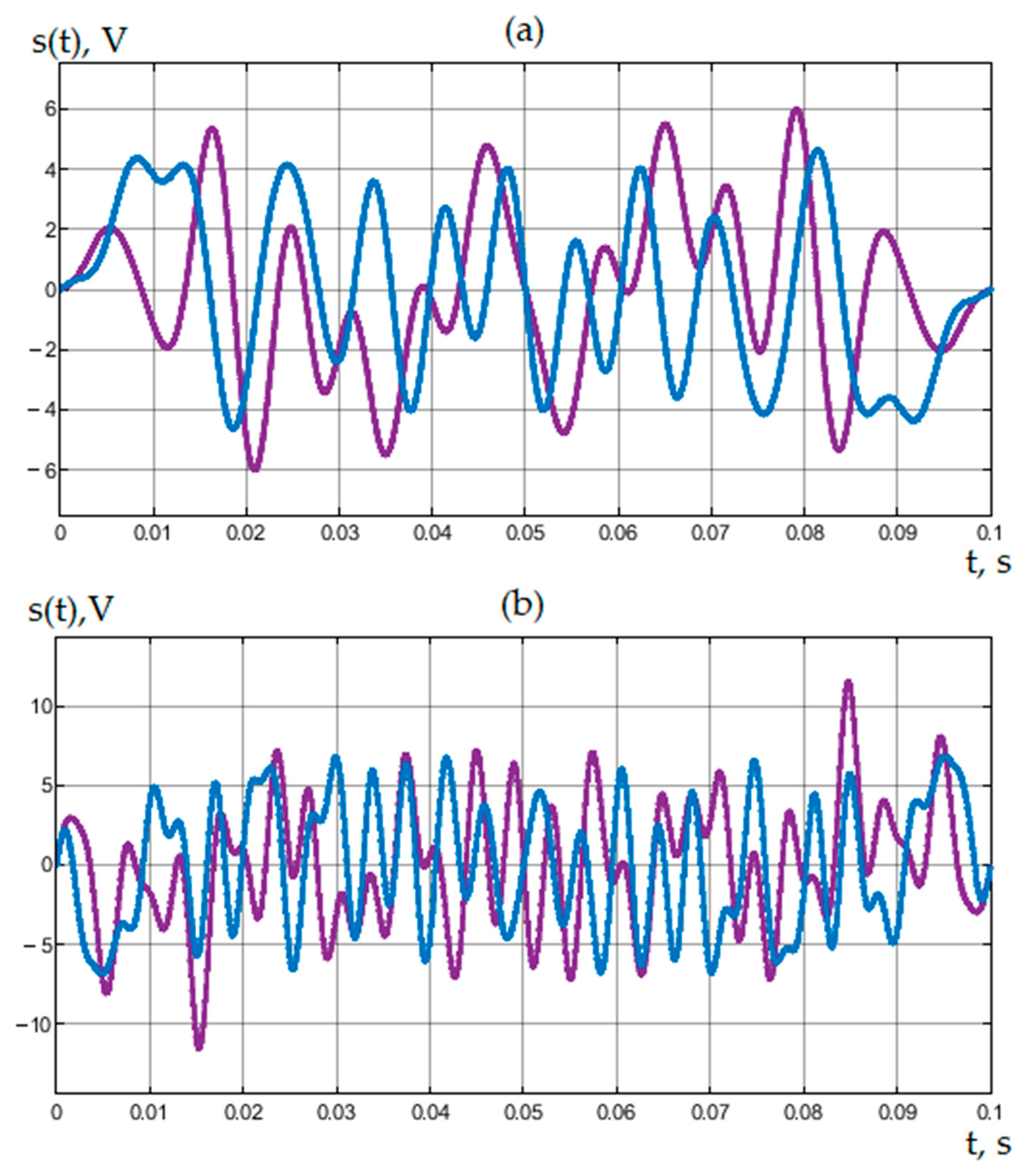
Examples of randomized OFDM signals
, constructed according to expression (3) with a unit modulation vector
for randomization codes
of lengths 15 and 31 elements, are shown in
Figure 1a,b, respectively. For comparison, newly discovered codes and M-sequences of the corresponding lengths were used. The energy gains due to PAPR reduction when using codes of length
elements (discovered code and M-sequence) are
, whereas for codes of length
elements, it is
.
Due to the necessity of employing randomization sequences with lengths ranging from 50 to 500 elements, depending on the number of OFDM subcarriers in the underwater acoustic communication system, the search or synthesis of such codes has to be performed using alternative methods, as exhaustive algorithms are infeasible for long-length codes. The authors conducted an analysis of 891,668 identified codes to uncover their characteristic patterns. The study examined the frequency of occurrence of RLE (Run-Length Encoding) blocks in binary sequences of lengths 14 to 52 elements, obtained using the developed software application. For example, a 13-symbol Barker sequence (1111100110101) is represented in RLE format as (5221111). Analysis of the code structures revealed characteristic numbers of RLE blocks, from which the proportions relative to the total code length were calculated. This observation is consistent with the Wiener–Khinchin theorem, as specific RLE blocks correspond to particular frequencies within the code, and the nonuniform distribution of block lengths reflects the uniformity of the code’s spectral density.
For classical pseudorandom sequences, such as M-sequences and related families, the proportion of a given RLE block group within the code is described by , where is the length of the RLE block. This relationship determines the characteristic properties of M-sequence families (including Gold and Kasami codes), such as cyclicity, balance, and correlation.
However, analysis of the structures of the newly discovered codes in the database of 891,668 sequences of lengths 14 to 52 revealed that the above distribution shifts closer to , describing the proportions of repetitions of identical blocks of bits. That is, single “1”s and “0”s constitute approximately one-quarter of the code length, doublets “11” and “00” about 12.5%, triplets “111” and “000” about 6%, and so forth. Using a dataset of codes, their RLE tables, given observed block distribution patterns within the codes, a neural network model was developed for the rapid generation of longer codes with optimal autocorrelation properties.
2.2. Implemented Neural Network for Generating Pseudorandom Sequences to Reduce OFDM PAPR
The problem of generating pseudorandom sequences encompasses a wide range of classical and modern approaches—from deterministic methods (M-sequences, Gold, Kasami, and Barker codes) to neural network-based methods (autoencoders, generative adversarial networks—GANs). A comprehensive comparison of these approaches in terms of complexity, correlation properties, and computational efficiency would require a dedicated review study. In the present work, the focus is placed on investigating the capability of a GAN to reproduce and extend families of binary codes with optimal autocorrelation properties.
To synthesize binary sequences of arbitrary lengths with autocorrelation functions exhibiting minimal sidelobe levels, a GAN was developed. The GAN consists of two neural subnetworks: a generator implemented as a multilayer perceptron (MLP) comprising an input layer, three fully connected hidden layers (256 and 512 neurons), and an output layer of 150 neurons (
Figure 2); a discriminator, also an MLP, consisting of an input layer, two fully connected hidden layers (512 and 256 neurons), and an output layer (
Figure 3). The developed system follows the classical GAN framework, wherein the two MLPs are trained adversarially: the discriminator minimizes binary cross-entropy to distinguish real and generated data, while the generator is trained to maximize the discriminator’s error.
The generator is a fully connected network with a latent input vector
, two hidden layers (256 and 512 neurons with ReLU—rectified linear unit—activation), and an output layer of 150 neurons with a sigmoid activation function, producing binary sequences of length 150 bits (
Figure 2).
The discriminator is a fully connected network with an input of shape
, two hidden layers (512 and 256 neurons with ReLU activation), and a single output neuron with sigmoid activation, returning the probability that the input sequence is real (
Figure 3).
The binary cross-entropy loss function was used to train both the discriminator and the generator. This function minimizes the divergence between the distributions of real and generated data, ensuring stable adversarial training. Its selection is motivated by its robustness in adversarial learning and its effectiveness in binary classification tasks, enabling reliable differentiation between real 37-bit sequences and synthesized 150-bit sequences.
Codes of length 37 bits were used for training, despite the existence of known 52-bit codes, because significantly more of the 37-bit codes were discovered to have good autocorrelation properties. Specifically, 220-bit sequences were used for training to increase the size of the training dataset.
The discriminator received the 37-bit codes and, as feedback, generated 150-bit codes. The generator uses the aforementioned RLE patterns in the codes as additional features during generator training. These RLE templates were not directly included in the loss function but were used to pre-train the generator and constrain its latent space, ensuring that the distribution of run-lengths in the generated sequences statistically matched the RLE patterns of the original codes.
Thus, training was conducted not only on the binary sequences themselves but also using features derived from their RLE representations, guiding the network toward generating codes with realistic run-length distributions and enhanced autocorrelation properties.
The GAN was trained using the Adam (Adaptive Moment Estimation) optimizer with a learning rate of , a batch size of 32, and 2000 training epochs.
During training, the discriminator minimizes the classification error, striving to clearly distinguish real and generated data. Conversely, the generator maximizes the error of the discriminator by producing data that closely resembles the real sequences, achieving a balance between the network components and ensuring stable convergence of the training process. The input data comprised 37-bit binary codes along with their RLE representations, with the latter serving as additional features to preserve a statistically accurate distribution of run-lengths.
This configuration ensured stable adversarial training convergence, maintained a balance between the generator and discriminator, and prevented mode collapse.
At one stage of neural network development, the generator successfully learned to produce pseudorandom binary sequences of up to 150 bits in length, with RLE block distributions closely matching those of the training data—a basis of 891,668 previously identified codes with optimal autocorrelation functions (ACF).
During one training iteration, the discriminator was trained to understand the structure of reference 37-bit codes, expanded to a length of 150 bits. RLE patterns and bit dependencies were analyzed, including permissible combinations, the balance between “0”s and “1”s, and specific correlations. Based on feedback from the discriminator, the generator internalized these patterns, producing 150-bit pseudorandom sequences with ACF properties, which were then ranked by the main peak-to-maximum sidelobe ratio.
The following five codes represent the best sequences with respect to the relation “ACF peak/maximum sidelobe” equal to , obtained after training on the 37-bit code dataset:
- (1)
0×1ac9e750fc0271c148da7fa76a0bcef2993968;
- (2)
0×1849e750fc0271c148da7fa76a0bcef2993968;
- (3)
0×1849e750fc0271c149fa7fa76a0bdef2993968;
- (4)
0×18c9e750fc0271c149fa7fa76a0bd6f2993968;
- (5)
0×1849e740fc0271c149fa7fa76a0bdef2993968.
In the authors’ earlier studies on this topic, the developed pseudorandom sequence generation was based on an autoencoder. This generation performed well in producing hundreds of pseudorandom sequences, achieving the best relation of 7.14. The advantages of the autoencoder-based model include its simplicity, fast training, and interpretability. However, the autoencoder essentially reproduces the training set by perturbing codes with additional Gaussian noise. This leads to a limitation: a restriction on the number of possible new sequences when the training dataset is insufficient.
A test was conducted comparing the two developed networks (GAN and autoencoder) for generating 500 new pseudorandom sequences of 150 bits in length, trained using a dataset of 220 previously identified 37-bit pseudorandom sequences.
Table 1 shows the obtained results for comparison.
A comparative analysis of the two approaches—the autoencoder-based model and the generative adversarial network (GAN) model—demonstrates that both are capable of producing pseudorandom binary sequences with autocorrelation properties exhibiting sufficiently low sidelobe levels, utilizing the basis of 891,668 previously identified codes, their RLE tables, and the observed distribution patterns within the codes. The distinction lies in the generation mechanism and the variability of the resulting sequences. The autoencoder model provides stable reconstruction of the training sequences, showing high metric reliability and controlled behavior when perturbing the latent space. However, the introduction of random noise into the latent code leads only to minor variations in the output bit structures, thereby limiting the diversity of generated sequences. In contrast, the GAN model produces a more diverse distribution of sequences, enabling the generation of new bit combinations while preserving the statistical structure and correlative characteristics. The application of the GAN model, therefore, allows the generation of new sequences with similar statistical properties but with a higher degree of variability, enhancing the potential for designing adaptive and secure communication systems.
Despite its more complex and sensitive training process, the GAN model demonstrates the capability to generate new families of pseudorandom codes with target lengths ranging from 53 to 500 elements, suitable for randomizing OFDM subcarrier vectors to reduce PAPR and increase the energy efficiency of long-range underwater acoustic communication systems while maintaining specified levels of interference resilience.
3. Results and Discussion
Taking into account the previously established rationale for the subcarrier spacing and the number of OFDM subcarriers ranging from 50 to 500 for typical frequency bands of underwater acoustic communication systems, a numerical model of a communication system was developed in accordance with the expressions (2) and (3) and the modulation and decoding principles described above.
The primary principle for OFDM subcarrier randomization to achieve low PAPR signals was a selective approach to forming OFDM symbol frames: the randomization vector for each OFDM frame of duration , together with the guard interval , is chosen from the set of codes generated by the GAN neural network, such that the resulting OFDM symbol exhibits minimal PAPR. Further modulation is performed using a specialized binary modulation symbol vector defined as .
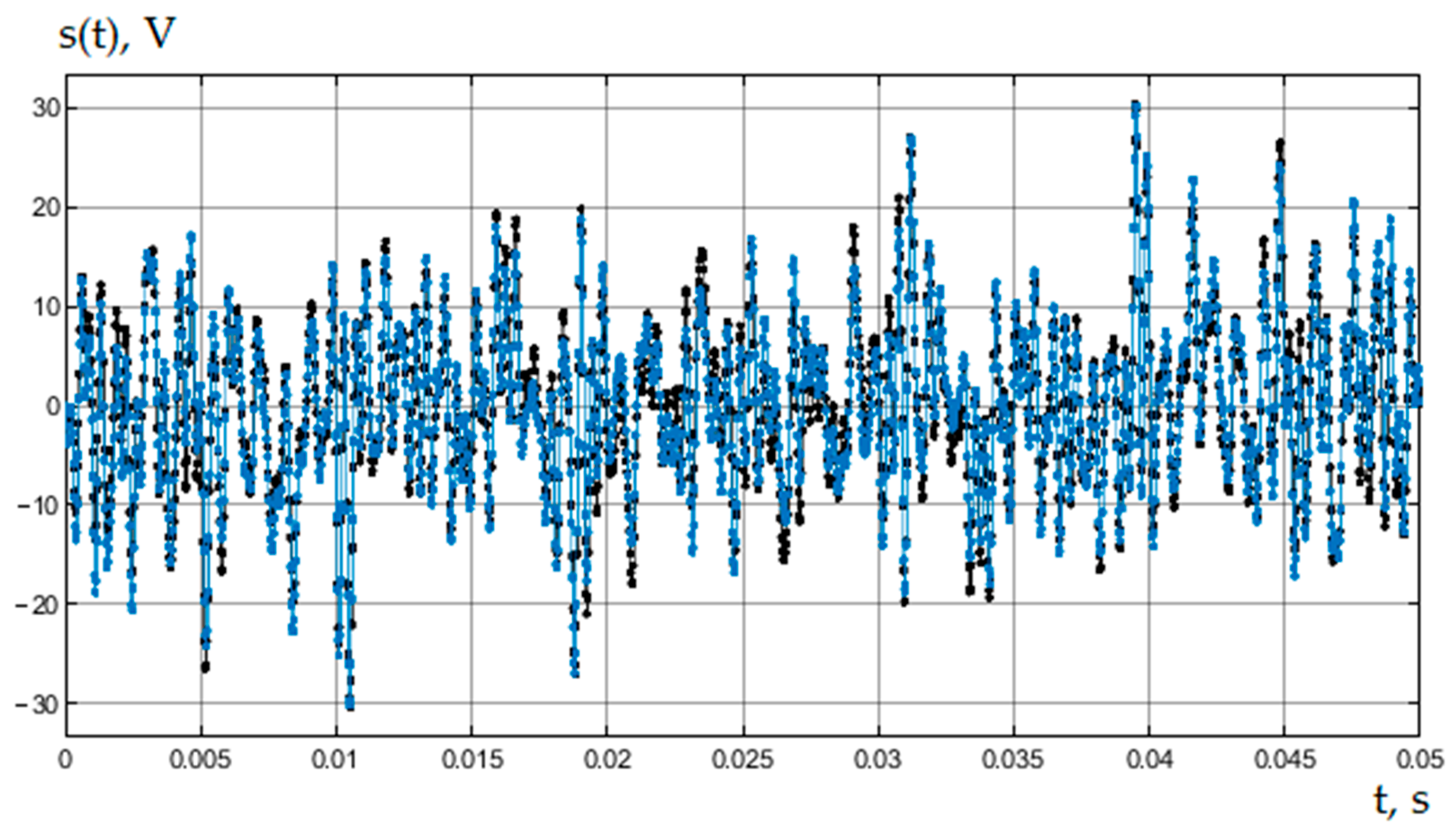
Figure 4 illustrates randomized OFDM signals with
subcarriers, exhibiting an average PAPR of 9.7 dB. The 150-element randomization codes were selected from the set of generated sequences.
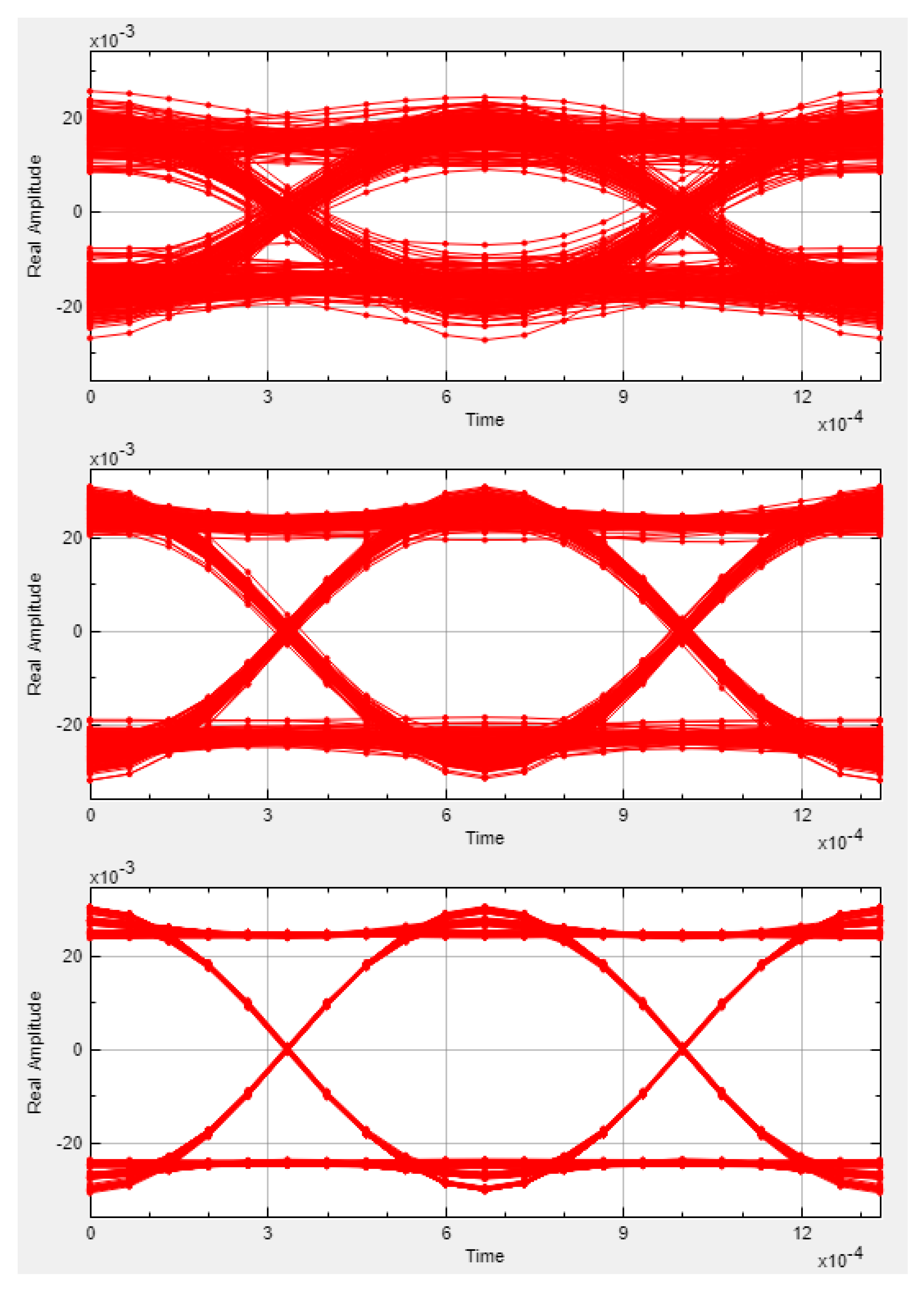
To evaluate the robustness of OFDM signals generated using the proposed algorithm against nonlinear distortions, and to enhance the overall energy efficiency of the transmitting system, amplitude clipping of the generated signal was performed in the numerical model at levels of , , and , where is the root-mean-square (RMS) amplitude of the OFDM signal. The assessment of distortions under modulation and amplitude clipping was conducted using eye diagrams of the demodulated signal, in the absence of additive white Gaussian noise and additional multiplicative interference.
Since the rate is defined as
, amplitude clipping of the randomized OFDM signals at levels of
,
, and
results in maximum signal values corresponding to these levels, with PAPR values equal to 1, 4, and 9, respectively. However, at the clipping level of
, the eye diagrams in
Figure 5 exhibit unacceptable distortion in terms of intersymbol interference, phase jitter, and overall signal-to-noise ratio degradation. Based on numerical simulations, for subsequent field experiments, amplitude clipping levels were chosen in the range of
to
. While
could increase the average transmitted power, it also raised phase distortions of demodulated OFDM symbols and reduced the signal-to-noise ratio to approximately 17 dB, as shown in
Figure 5.
For marine experiments, the frequency characteristics of the generated OFDM signals were matched to the transmit/receive piezoceramic transducers. For a typical piezoceramic transducer with a resonance frequency of 12 kHz, the bandwidth ranges from 10 to 13 kHz, where with a minimum subcarrier spacing Hz, the number of subcarriers is . According to expression (4), the maximum system throughput is bit/s without accounting for guard intervals . The maximum communication range in the underwater acoustic channel under favorable hydrological conditions has been estimated to be at least , yielding approximately 10 km. By damping the resonant characteristics of the piezoceramic transducer, the bandwidth can be substantially extended from 7 to 17 kHz, which reduces the effective transmitted acoustic power and communication range, while increasing throughput to kbps. This represents an upper bound under minimal reverberation interference in the channel for . The spectral efficiency of the OFDM system with frequency-coded subcarriers according to the algorithm is given by and does not exceed 0.5 bit/s/Hz for minimal guard intervals .
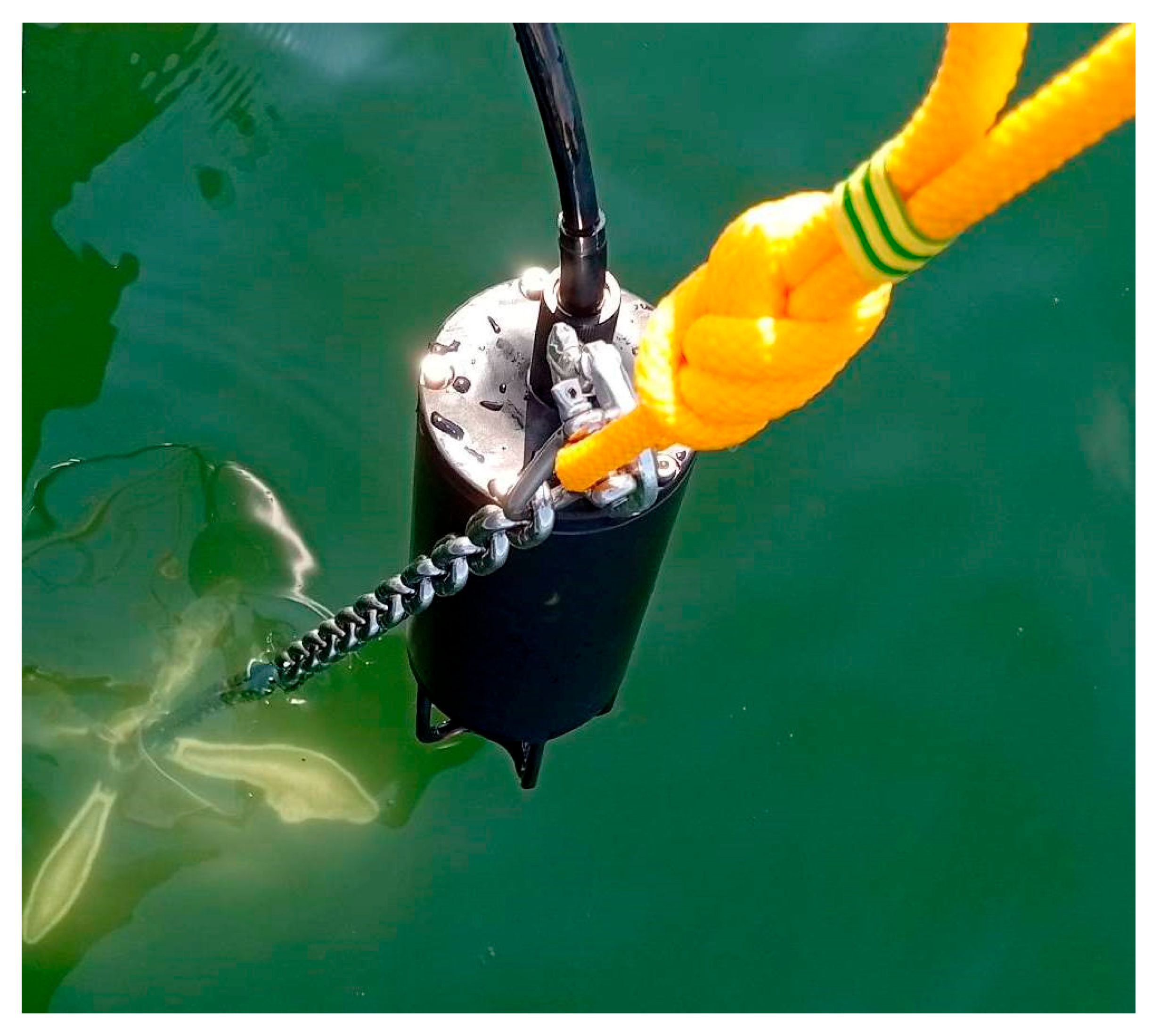
In situ experiments. Field experiments were conducted to evaluate the effectiveness of the proposed OFDM subcarrier randomization approach using GAN-generated codes and the transmission of signals with minimized PAPR through additional amplitude clipping. The experiments were performed in shallow sea conditions (depths up to 25 m) at ranges of 200, 800, 2900, and 4200 m. The tests took place during summer hydrological conditions on two vessels. The transmitting antenna and a Class D amplifier were configured to operate in the 10–13 kHz frequency band, while the receiving hydrophone, deployed from the second vessel, is shown in
Figure 6.
Signal transmission with an average level of 3 kPa was performed from a stationary vessel, with a water depth of 21 m at the transmission point. The transmitter was positioned at a depth of 14 m. At the reception points located at 200, 800, 2900, and 4200 m, water depths were 19, 17, 15, and 14 m, respectively. The receiving hydrophone was deployed at a depth of 10 m. The drift of the vessel carrying the receiving hydrophone reached up to 0.7 m/s toward the transmission point. Sea conditions varied dynamically throughout the day and did not exceed 2–3 points on the Beaufort scale. These conditions contributed to significant non-stationarity of the underwater acoustic channel due to multiple dynamic signal reflections from the sea surface.
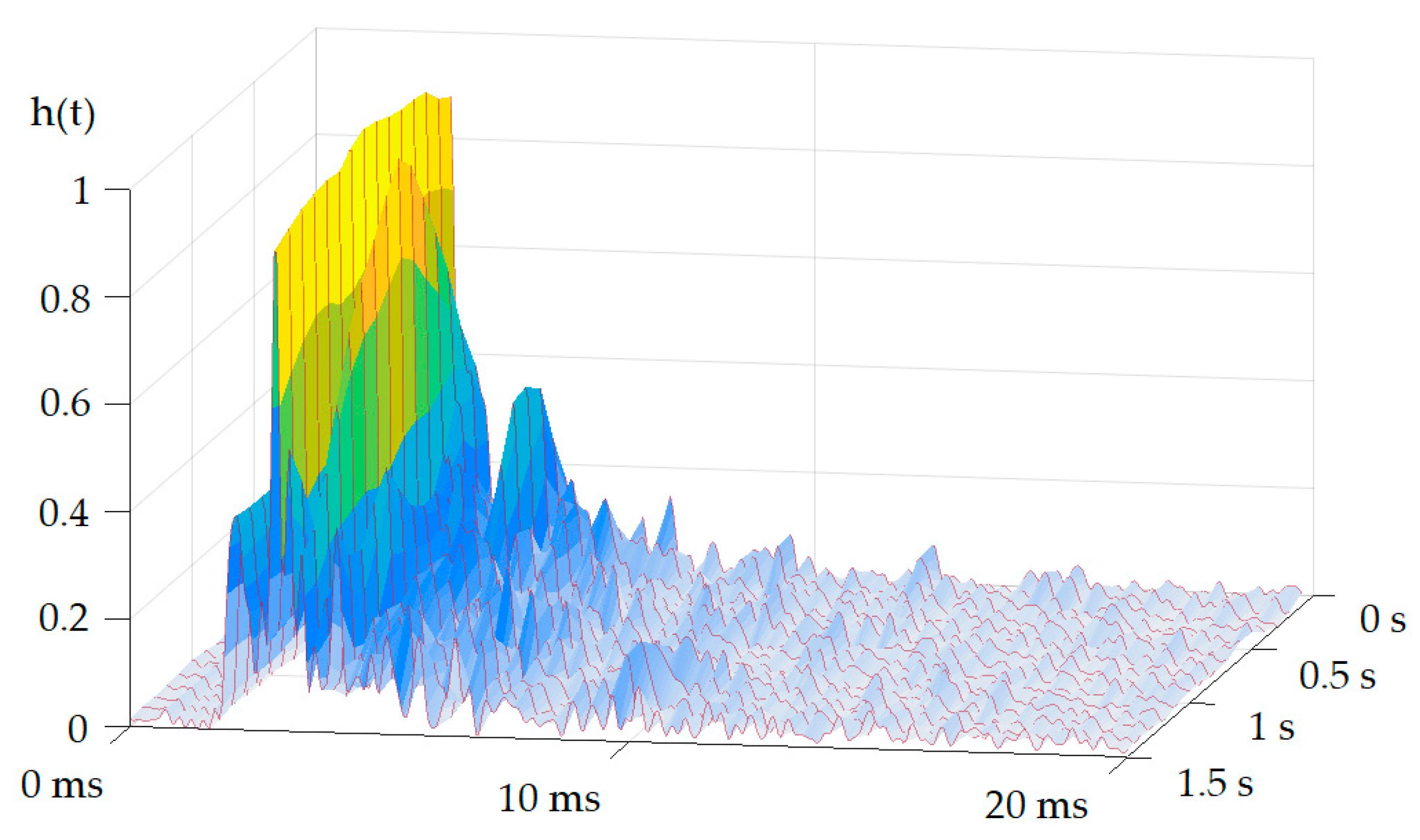
Prior to the transmission of informational OFDM packets, synchronizing pulses were emitted to provide an overall assessment of the channel impulse response
, Doppler shifts, and their temporal dynamics over the interval [0, 1.5] seconds. An example of a dynamically changing impulse response is shown in
Figure 7. The data were obtained at a distance of 2900 m during vessel drift with the receiving hydrophone moving at 0.5 m/s toward the transmission point.
The observed variations in indicate significant non-stationarity of the propagation medium, with channel coherence times not exceeding 50–300 ms for individual multipath components and Doppler frequency shifts ranging from 2 to 10 Hz. Reverberation interference is concentrated within a 5–7 ms interval.
For the OFDM symbol transmission system with a symbol duration of s, the guard interval was set to 10 ms. According to expression (4), the resulting system throughput is kbps, given a subcarrier spacing of Hz and a number of subcarriers .
Considering that the average PAPR of OFDM signals in classical methods, even with standard subcarrier phase randomization, is approximately 12–15 dB ( dB for ), the reduction in PAPR to 6–10 dB through GAN-based code randomization and additional amplitude clipping provides an energy gain of up to 6 dB or more.
Two types of OFDM packets were transmitted into the underwater acoustic channel using amplitude clipping levels of
and
, corresponding to PAPR values of 6 dB and 9.5 dB, respectively. An example of an OFDM signal with PAPR ≈ 9.7 dB is shown in
Figure 4.
At each distance of 200, 800, 2900, and 4200 m, reception of thirty 10-s packet series (30 × 12,500 bits) was performed for the two PAPR regimes separately. Considering that a PAPR of 6 dB increases the average transmitted power under
amplitude clipping while simultaneously raising phase distortions during reception (as shown in
Figure 5), an equivalent interference resilience was expected in the PAPR 9.5 dB regime, but with a lower level of modulation distortions. For each distance, the bit error probabilities
were evaluated for each transmission regime across the thirty 12,500-bit packets.
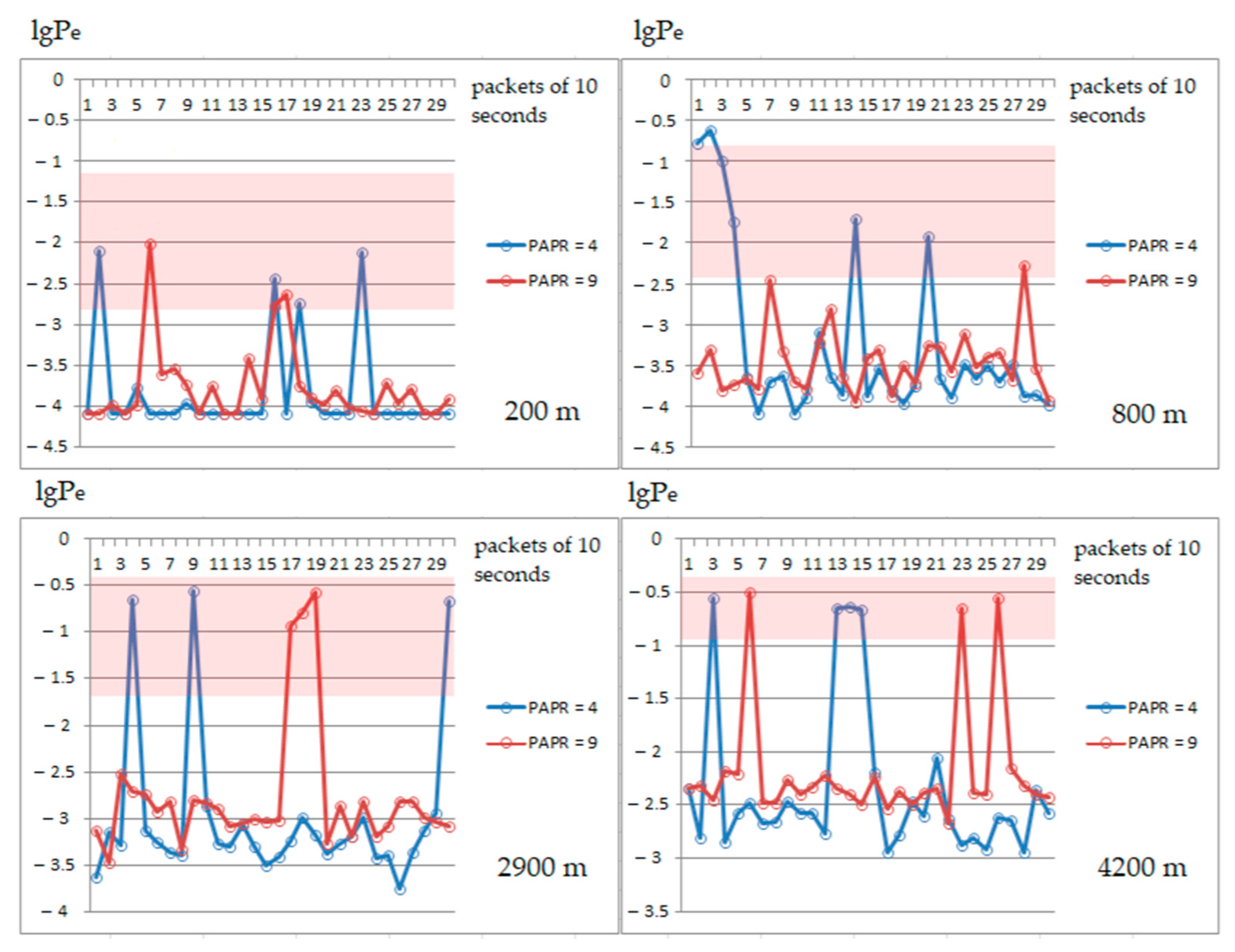
The resulting plots of logarithms of bit error probabilities,
, for the reception of thirty 10-s OFDM packet series (30 × 12,500 bits) in the PAPR 6 dB and 9.5 dB transmission regimes are presented in
Figure 8. Given the series length of 10 s containing 12,500 bits, error probabilities below
were not evaluated.
Considering that numerous modulation schemes and signal processing principles have been proposed for underwater acoustic communication over the past decades, in most cases, it is not possible to reliably compare their performance. This is because manufacturers of acoustic systems and researchers typically conduct field tests under different environmental conditions, and even within a single experiment, the variability of the communication channel characteristics can be significant.
It should be noted that previously developed FM-OFDM and OFDM-DBPSK algorithms, which performed successfully on similar antennas under quasi-stationary and under-ice acoustic conditions [
41,
42], exhibited significantly poorer bit error probability
performance in the aforementioned type of non-stationary channel with short coherence times. This is primarily due to the inapplicability of differential coding schemes, even in the absence of advanced equalization and synchronization methods in all tested approaches (red areas in
Figure 8).
Due to summer biological activity, the underwater acoustic channel was significantly affected by stochastic impulsive noise with pulse durations ranging from 5 to 15 ms. Additionally, small-scale signal fading in the shallow sea during vessel drift with the receiving hydrophone further impacted reception quality. These phenomena led to bit error rates rising to 0.5 in certain cases or resulted in unacceptable communication quality with BER levels of to . All tests conducted at different distances demonstrate the effectiveness of using GAN-generated code randomization combined with additional amplitude clipping at the level (PAPR = 4 (6 dB)). This approach provides an additional energy gain of up to 6 dB in the signal-to-noise ratio over long distances, which is particularly important under conditions of multiple sources of interference and multiplicative distortions in the underwater acoustic channel.
Significant PAPR reduction for OFDM signals with subcarriers in this scenario is achieved through the application of new pseudorandom sequences generated by the GAN, enabling the transmission of signals with substantial amplitude clipping at .




 ,
,