Article

Anatomical Reconstruction After Metabolic Bariatric Surgery (MBS): Indications and Biochemical Responses in Post-Bariatric Hyperinsulinemic Hypoglycemia Patients—A Single-Center Case Series

1
Department of Surgery, Wolfson Medical Center, Holon 5822012, Israel
2
Department of Internal Medicine, Wolfson Medical Center, Holon 5822012, Israel
3
Department of Surgery, Ronald Reagan UCLA Medical Center, David Geffen School of Medicine, University of California, Los Angeles (UCLA), Los Angeles, CA 90095, USA
*
Authors to whom correspondence should be addressed.
Gastrointest. Disord. 2026, 8(3), 37; https://doi.org/10.3390/gidisord8030037
Submission received: 25 June 2026 / Revised: 23 July 2026 / Accepted: 25 July 2026 / Published: 27 July 2026

Abstract

Introduction: Anatomical gastrointestinal reconstruction following metabolic bariatric surgery (MBS) is a revisional procedure used for refractory complications, including malnutrition, intractable reflux, recurrent marginal ulcer disease, and post-bariatric hyperinsulinemic hypoglycemia (PBHH). Objective: This study aims to describe the indications, perioperative outcomes, and short-term results of laparoscopic anatomical reconstruction in a single-center series, focusing on patients with PBHH. Methods: We retrospectively reviewed 11 consecutive patients who underwent reconstruction following MBS at a single tertiary center. Perioperative outcomes, weight changes, and biochemical responses to standardized dual-modality (oral and intravenous) glucose suppression testing were analyzed. Results: Between 2018 and 2025, 11 patients completed laparoscopic anatomical reconstruction. The anatomy immediately preceding reconstruction was OAGB in nine patients (81.8%) and RYGB in two (18.2%). The indications overlapped; the most common were severe malnutrition (n = 9), marginal ulcer disease (n = 6), and PBHH (n = 4; three biochemically confirmed, one clinically diagnosed). Ten of eleven procedures (90.9%) were completed laparoscopically, with no 30-day Clavien–Dindo grade III–IV complications. Among the four PBHH patients, symptomatic resolution was achieved in all four, with residual asymptomatic biochemical hypoglycemia in one. Weight gain occurred in 10 of the 11 patients (mean 8.1 ± 4.9 kg) at a median follow-up of 7 months (IQR 3–12). Conclusions: In this preliminary series, laparoscopic anatomical reconstruction was feasible, though the small sample precludes conclusions regarding safety. Incretin hormones were not measured; the mechanistic contribution of restored foregut anatomy is inferred from prior literature rather than demonstrated here. Standardized dual-modality glucose suppression testing was central to patient selection and to documenting the biochemical response.

1. Introduction

Metabolic bariatric surgery (MBS) remains the most effective long-term intervention for clinically severe obesity, with nearly 600,000 procedures performed annually in recent years and a global volume projected to exceed one million by 2025 [1]. One-anastomosis gastric bypass (OAGB) and Roux-en-Y gastric bypass (RYGB) are among the most performed procedures, offering durable weight loss and the resolution of associated medical problems, including type 2 diabetes mellitus, hypertension, and dyslipidemia [2]. However, the profound anatomical and physiological alterations induced by these procedures may give rise to a spectrum of late complications requiring surgical revision, including severe protein-energy malnutrition, intractable gastroesophageal or biliary reflux, refractory marginal ulcer disease, and post-bariatric hyperinsulinemic hypoglycemia (PBHH) [3].
Anatomical gastrointestinal reconstruction, defined as the surgical restoration of native gastrointestinal continuity, constitutes a comprehensive revisional approach for these refractory complications. By restoring pyloric function and duodenal nutrient exposure, reconstruction addresses the shared anatomical substrate underlying many post-bariatric sequelae: the loss of regulated gastric emptying and bypassed foregut physiology [4]. Despite its growing clinical application, the published data on anatomical reconstruction are derived predominantly from small single-center series and pooled analyses thereof, and no standardized operative algorithm has been established [3].
Among the indications for reconstruction, PBHH is particularly noteworthy given its potential for severe neuroglycopenic events, including loss of consciousness, seizures, and motor vehicle accidents, and its complex multifactorial pathophysiology. PBHH is characterized by exaggerated postprandial GLP-1 secretion driving inappropriate hyperinsulinemia, and affects approximately one third of patients undergoing gastric bypass when assessed by validated symptom questionnaires, though severe neuroglycopenic episodes requiring hospitalization occur in fewer than 1% [5]. This complication occurs in a subset of patients refractory to dietary modification, endoscopic intervention, and pharmacological management [5,6,7]. In this context, anatomical reconstruction offers a surgical approach that restores foregut anatomy, with the aim of reducing the exaggerated insulin secretory response. The incretin basis of this response is derived from prior physiological studies [6,8] and was not measured in the present series.
Biochemical outcomes after reconstruction for post-bariatric hypoglycemia have been reported previously, including symptom and hormonal responses after RYGB reversal [9,10,11], and OAGB-specific reversal outcomes have been meta-analyzed [12]. The present series adds to this literature in a narrower but distinct respect: to our knowledge, it is the first predominantly OAGB reconstruction cohort in which every patient with PBHH underwent standardized dual-modality (oral and intravenous) glucose suppression testing before and after reconstruction, allowing a within-patient comparison of the insulin and C-peptide response by both routes. We present a single-center consecutive series of 11 patients who underwent laparoscopic anatomical gastrointestinal reconstruction following MBS, describing the spectrum of indications, perioperative outcomes, and short-term results. Emphasis is placed on the four patients with PBHH—three biochemically confirmed and one clinically diagnosed—in whom standardized dual-modality glucose suppression testing enables a direct quantitative comparison of pre- and postoperative insulin and C-peptide dynamics.

2. Results

2.1. Patient Characteristics and Indications

Eleven consecutive patients (nine females, two males; mean age 49.0 ± 12.3 years) underwent anatomical reconstruction during the study period. Counting the anatomy immediately preceding reconstruction, the index procedure was OAGB in nine patients (81.8%) and RYGB in two patients (18.2%); one RYGB case followed primary OAGB and one followed a primary sleeve gastrectomy. When counted by the primary (first) bariatric procedure, nine patients had OAGB, and two had a sleeve gastrectomy as their initial operation. Seven patients (63.6%) underwent direct reconstruction without prior surgical revision (five had no prior intervention; two had undergone endoscopic procedures only), while four patients (36.4%) had undergone at least one interim surgical revisional procedure prior to anatomical reconstruction. Mean BMI decreased from 42.8 ± 4.9 kg/m2 at the primary procedure to 21.4 ± 3.8 kg/m2 at reconstruction; the mean weight loss was 56.3 ± 17.3 kg; and four patients (36.4%) had a BMI below 20 kg/m2, reflecting the severity of nutritional depletion in this cohort. The mean interval from the primary bariatric procedure to reconstruction was 6.2 ± 3.7 years (median 5.7, range 1.1–14). Baseline characteristics are summarized in Table 1.
The indications for surgery are detailed in Table 2. The indications were not mutually exclusive, with 8 of 11 patients (72.7%) presenting with multiple concurrent complications. The most common were severe malnutrition in nine patients (81.8%), marginal ulcer disease (including one perforation requiring emergency intervention) in six (54.5%), chronic diarrhea in five (45.5%), PBHH in four (36.4%; three biochemically confirmed, one clinically diagnosed), intractable reflux or esophagitis in four (36.4%), and anastomotic leak or fistula in one (9.1%). Individual patient details are presented in Table 3.
Patient 7 underwent reconstruction following emergency presentation with marginal ulcer perforation and subsequent re-perforation; pre-bariatric weight was not precisely documented, and weight loss was not a component of his indication; therefore, his baseline weight loss is reported as not available. This patient is excluded from the weight-loss summary statistics.

2.2. Perioperative Outcomes

Ten of the eleven procedures (90.9%) were completed laparoscopically; one required conversion to open surgery. The operative strategy was adapted to the individual anatomical configuration in each case. In one patient with a prior sleeve gastrectomy converted to RYGB, the absence of a native gastric remnant precluded a standard gastro-gastrostomy; a modified Branco–Zorron anastomotic technique was employed in this case to achieve pyloric continuity [13]. There were no 30-day Clavien–Dindo grade III or IV complications. Two patients (18.2%) experienced minor grade I–II complications: one anastomotic stricture was successfully managed with serial endoscopic balloon dilations, and one transient febrile episode of unknown origin was treated conservatively with antibiotics. No patient required reoperation or intensive care unit admission. The complications listed in Table 3 refer to events arising from the original bariatric anatomy that prompted reconstruction; the Clavien–Dindo grading reported here refers only to complications occurring within 30 days of the reconstruction procedure itself. The mean operative time was 164 ± 30 min (range 120–200), with a mean estimated blood loss of 82 ± 33 mL. The median length of stay was 8 days (range 5–20), and there were no 30-day readmissions. Serum albumin increased in 10 of the 11 patients following reconstruction, shifting from a mean of 2.7 to 3.7 g/dL.

2.3. Short-Term Outcomes

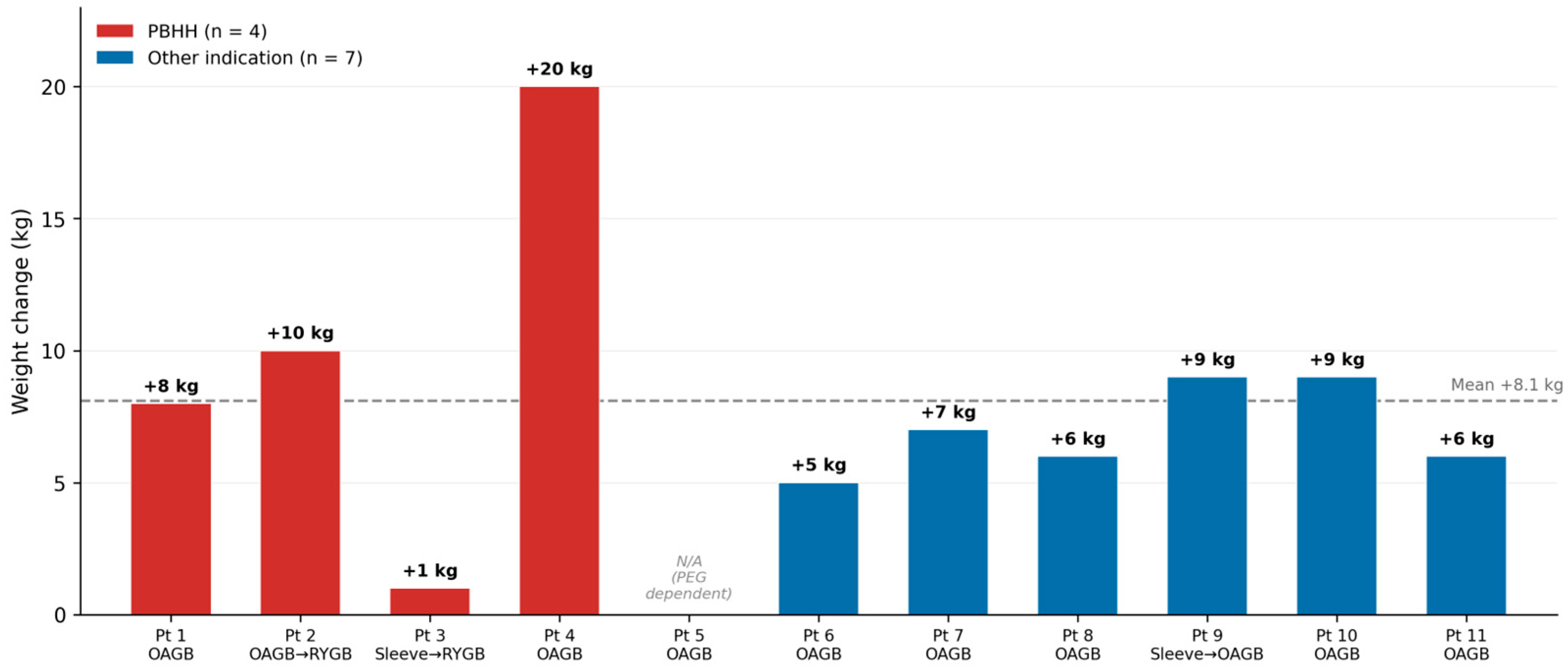
At a median follow-up of 7 months (IQR 3–12), 10 of the 11 patients (90.9%) demonstrated postoperative weight gain, with a mean gain of 8.1 ± 4.9 kg and a mean increase in BMI of 3.2 ± 1.8 kg/m2 (Table 4, Figure 1). Symptom resolution was achieved in six of six patients with marginal ulcer disease (100%), five of five with chronic diarrhea (100%), three of four with reflux disease (75.0%), and four of four PBHH patients (100%). Nutritional status improved in eight of nine patients with severe malnutrition (88.9%), though three patients required ongoing nutritional supplementation. Ten of eleven patients reported being satisfied or very satisfied at follow-up.

2.4. PBHH Subgroup: Biochemical and Clinical Outcomes

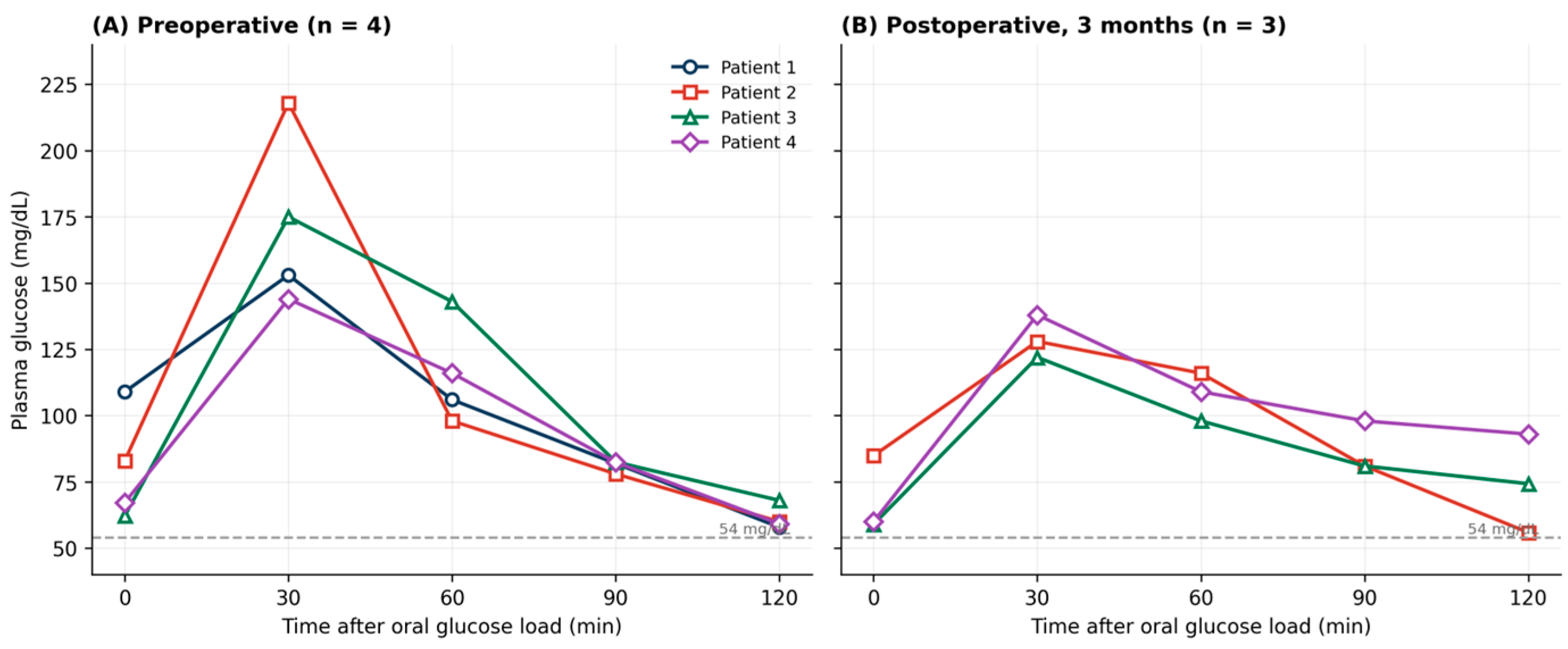
The four patients diagnosed with PBHH underwent preoperative dual-modality glucose suppression testing (Table 5). Among the three patients meeting the biochemical criteria, oral glucose tolerance test nadirs ranged from 57.9 to 60.0 mg/dL, and all three demonstrated an inappropriate insulin response, with peak insulin during declining or hypoglycemic-range glucose levels ranging from 36.8 to 106 µU/mL and peak C-peptide from 6.35 to 12.8 ng/mL. Fasting insulin was appropriately suppressed in all four patients, and fasting glucose was within normal limits in three. Patient 3 did not meet the biochemical criteria: her fasting glucose was mildly low at 62.2 mg/dL with a concurrent fasting insulin of 2.2 µU/mL—a pattern inconsistent with endogenous hyperinsulinism—and her glucose did not fall below this fasting value at any point during testing (post-load minimum 68 mg/dL at 120 min), with insulin peaking at 30 min, coincident with peak glucose rather than during declining glucose. She is therefore reported here as clinically diagnosed but biochemically unconfirmed.
Following anatomical reconstruction, the hypoglycemic symptoms resolved in all four patients. Biochemical outcomes were assessed separately. Formal postoperative suppression testing at 3 months was performed in three patients (Patients 2, 3, and 4); Patient 1 underwent early postoperative glucose monitoring only. Of the two biochemically confirmed patients who were retested, one (Patient 4) demonstrated complete biochemical resolution, with no postoperative glucose values below 60 mg/dL. The other (Patient 2), who had the highest preoperative peak insulin (106 µU/mL) and C-peptide (12.8 ng/mL) in the cohort, demonstrated biochemical improvement at 3 months, with peak insulin falling to 22.8 µU/mL and C-peptide to 2.29 ng/mL; however, a residual asymptomatic glucose nadir of 55.9 mg/dL persisted on OGTT, representing persistent biochemical but not symptomatic hypoglycemia. Patient 3, who did not meet the biochemical criteria preoperatively, showed no postoperative glucose values below 60 mg/dL. The pre- and postoperative glucose tolerance test trajectories are shown individually for each patient with available serial data in Figure 2. The mean weight increase within the PBHH subgroup was 9.8 kg at the most recent follow-up (range +1 to +20 kg). No patient within the PBHH group required further surgical procedures, enteral feeding, or parenteral nutrition subsequent to reconstruction.

3. Discussion

The perioperative outcomes observed in this series are broadly consistent with the available evidence on anatomical reconstruction following MBS, although the absence of a comparator group precludes any formal comparison. Prior series have reported substantial morbidity after reconstruction, including a pooled postoperative morbidity rate of 42% in the systematic review of Pucher et al. [3] and complications in three of five patients undergoing laparoscopic RYGB reversal reported by Campos et al. [9]. In the present series, 2 of the 11 patients experienced Clavien–Dindo grade I–II complications, with no grade III–IV events. The small sample size means the cohort is underpowered to detect uncommon but serious complications—including anastomotic leak, bleeding, stricture, recurrent ulceration, dumping, reflux recurrence, or the need for reoperation—and these results should therefore be interpreted as preliminary rather than as evidence of established safety.
Symptom improvement was observed across the indication groups (marginal ulcer disease: six of six; chronic diarrhea: five of five; malnutrition: eight of nine; PBHH: four of four; reflux: three of four). Improvement rates of a similar order have been described in prior reconstruction series [3,14], though the absence of a comparator group precludes any comparison of efficacy. Notably, most patients presented with multiple concurrent complications, a feature of the refractory post-bariatric population, which may explain why reconstruction—by restoring foregut anatomy rather than addressing a single isolated complication—was associated with improvement across several coexisting indications. Weight recovery was observed in the majority of patients (mean +8.1 kg). In this cohort—whose mean BMI at reconstruction was 21.4 kg/m2, with more than one third below 20 kg/m2—the gain observed represents therapeutic nutritional recovery rather than undesirable recurrent weight gain. We distinguish this restorative weight gain in malnourished patients from recurrent weight gain in patients whose primary indication was not nutritional, in whom continued weight surveillance remains appropriate; recurrent weight gain was not an intended endpoint of reconstruction.
The mean BMI of 21.4 kg/m2 at reconstruction stands in stark contrast to the mean pre-bariatric BMI of 42.8 kg/m2, reflecting the severity of nutritional depletion that can follow malabsorptive bariatric procedures [3]. OAGB accounted for the majority of index procedures, reflecting its growing use worldwide, rising from 6.6% to 7.6% of all bariatric procedures between 2018 and 2021 per IFSO data [1], but also its specific risk profile for protein-energy malnutrition, bile reflux esophagitis, and marginal ulceration, particularly when performed without adequate nutritional follow-up or outside established patient selection criteria [14]. The mean interval of 6.2 years from the primary bariatric procedure to reconstruction underscores the chronicity of these complications and the frequent delay between symptom onset and definitive surgical management [3]. The predominance of female patients in this cohort (81.8%) reflects the well-documented female preponderance among patients undergoing OAGB and those presenting with post-bariatric nutritional and metabolic complications, consistent with the published registry data.
The high prevalence of multiple concurrent complications (8 of 11 patients) is a defining feature of patients referred for anatomical reconstruction and distinguishes this population from those managed with simpler revisional procedures [3]. This complexity necessitates a multidisciplinary approach integrating surgery, endocrinology, gastroenterology, and clinical nutrition, and highlights the importance of institutional expertise in revisional bariatric surgery.

3.1. PBHH: Pathophysiology and the Rationale for Anatomical Reconstruction

PBHH pathophysiology is multifactorial, driven principally by the loss of pyloric regulation following gastric bypass, which permits accelerated nutrient delivery to the proximal jejunum. This triggers exaggerated GLP-1 secretion from intestinal L-cells, with postprandial GLP-1 levels rising up to tenfold above non-surgical controls in symptomatic patients [6]. A recent meta-analysis of 1806 patients confirmed that RYGB confers a 50% higher risk of postoperative hypoglycemia than a sleeve gastrectomy, with the risk doubling when questionnaire-based ascertainment is used, and demonstrated significantly lower glucose nadirs on OGTT in RYGB patients [15]. The resulting hyperinsulinemia is further compounded by reduced pancreatic beta-cell suppression in response to falling glucose, decreased insulin clearance, and—in a subset of patients—impaired counterregulatory glucagon responses [6,7,8]. Salehi et al. demonstrated in a landmark mechanistic study that an intravenous infusion of the GLP-1 receptor antagonist exendin-9-39 (Ex-9) completely corrected postprandial hypoglycemia in all of the nine symptomatic post-bypass patients studied, reducing insulin secretion by 50% and abolishing neuroglycopenic episodes, establishing GLP-1 as a dominant pathogenic mediator [6].
This mechanistic understanding frames the rationale for anatomical reconstruction: by restoring pyloric continuity and duodenal nutrient exposure, reconstruction is hypothesized to re-establish the physiological brake on gastric emptying and to reduce the insulin secretory drive. In the cited physiological literature, this effect is mediated by attenuated incretin secretion [4,6], although incretin hormones were not measured in the present series.
The glucose value of 60 mg/dL used in this series served as a screening and resolution cut-off rather than a diagnostic threshold. It was set conservatively above the 54 mg/dL Endocrine Society and ASMBS consensus cutoff to maximize sensitivity in a surgical decision-making context [16], while the diagnosis itself rested on the combined clinical and biochemical picture described in Section 4.3. We acknowledge explicitly that, on formal provocative testing, none of the three biochemically confirmed PBHH patients reached a nadir below 54 mg/dL (values 57.9, 60.0, and 59.2 mg/dL), and that under the strict ≤54 mg/dL (≤3.0 mmol/L) criterion used by the Endocrine Society, the ASMBS position statement [17], and the real-world cohort of de Heide et al. [18], the biochemical hypoglycemia in these three patients is borderline. The fourth patient did not demonstrate biochemical hypoglycemia on provocative testing at all, and is reported here as clinically diagnosed but biochemically unconfirmed. We therefore based the diagnosis on the combined clinical and biochemical picture—documented neuroglycopenic symptoms with inappropriate insulin and C-peptide responses—rather than on the nadir value alone, consistent with the approach of Campos et al. [9] and with the evidence showing that mildly low glucose nadirs in symptomatic patients may reflect clinically relevant incretin dysregulation [8]. This mechanism stands in contrast to insulinoma, which characteristically produces fasting hypoglycemia with inappropriately elevated insulin. In all four patients, fasting insulin was appropriately suppressed (range 0.5–2.2 µU/mL), and cross-sectional imaging was unremarkable. Patient 3 had a mildly low fasting glucose of 62.2 mg/dL, but with a concurrent fasting insulin of 2.2 µU/mL—a pattern inconsistent with endogenous hyperinsulinism.
The biochemical response observed in this series is consistent with this rationale. Among the three patients who underwent formal postoperative testing, peak insulin was attenuated—most notably in the patient with the highest preoperative insulin burden, in whom peak insulin fell from 106 to 22.8 µU/mL and C-peptide from 12.8 to 2.29 ng/mL. These changes were accompanied by a complete clinical resolution of hypoglycemia in all four patients and no requirement for additional pharmacological or surgical intervention in any. These findings are consistent with the mechanistic series by Campos et al. [9], who demonstrated both the feasibility and efficacy of laparoscopic RYGB reversal in five patients with refractory PBHH, and with the larger retrospective series by Vilallonga et al. [19], who reported hypoglycemia resolution or significant improvement in 16 patients undergoing reversal to normal anatomy.

3.2. Partial Response and Residual Hypoglycemia

One patient represents an instructive case of a partial biochemical response. Despite substantial reductions in peak insulin and C-peptide, a residual asymptomatic glucose nadir of 55.9 mg/dL persisted at 3 months in oral testing. This pattern may reflect an incomplete correction of incretin dysregulation, residual hypersensitivity of pancreatic beta-cells, or impaired counterregulatory hormonal responses that are not fully normalized by anatomical restoration alone [8]. Current evidence acknowledges the heterogeneity of PBHH and notes that multiple overlapping mechanisms may sustain a hypoglycemic phenotype beyond anatomical correction [7,8]. Ongoing biochemical surveillance with continuous glucose monitoring and adjunctive pharmacotherapy is appropriate in such patients. In the largest real-world series to date, de Heide et al. reported a pharmacotherapy efficacy of 45–75% across 120 PBHH patients, with long-acting somatostatin analogs and GLP-1 receptor agonists performing best in terms of efficacy and tolerability [18]. For patients with a partial surgical response, stepwise pharmacological augmentation—beginning with acarbose and escalating through SGLT-2 inhibitors, somatostatin analogs, or GLP-1 receptor agonists as tolerated—represents a rational adjunctive strategy [2,7,20].
This case illustrates that anatomical reconstruction cannot be regarded as uniformly definitive for PBHH: one of four patients retained biochemical hypoglycemia despite marked improvement, and because follow-up was limited, the long-term risk of recurrence in the remaining patients is unknown. Reconstruction should therefore be presented as a treatment associated with symptom improvement rather than a guaranteed cure.

3.3. Evolving Pharmacological Landscape

The pharmacological management of PBHH is evolving rapidly. The GLP-1 receptor antagonist avexitide has demonstrated statistically significant reductions in hypoglycemic events in Phase 2 trials and has completed enrollment in the pivotal Phase 3 LUCIDITY trial (78 participants), with topline data anticipated in the second half of 2026 [21]. SGLT-2 inhibitors such as empagliflozin and calcium channel blockers represent additional emerging options [20]. Nevertheless, anatomical reconstruction is the only intervention that restores the foregut anatomy underlying PBHH, offering potential for symptom resolution without the need for chronic pharmacotherapy, though durability beyond the first postoperative year remains to be established. This is an advantage particularly relevant in patients with multiple concurrent complications, suboptimal nutritional status, or a high neuroglycopenic burden.

3.4. Limitations

This study has several limitations inherent to its retrospective, single-center design and small sample size, which preclude formal statistical inference and limit generalizability. With only 11 patients, this study is underpowered to detect uncommon but clinically important complications, and the absence of such events in this series cannot be interpreted as evidence that reconstruction is free of these risks. The cohort was also clinically heterogeneous, encompassing reconstruction for PBHH, marginal ulceration, malnutrition, reflux, chronic diarrhea, fistula, and complex revisional anatomy; because few patients fell within each indication, indication-specific efficacy cannot be assessed, and outcomes are reported descriptively for the cohort. The reconstructive techniques were likewise heterogeneous—including OAGB reversal, RYGB reversal, and modified Branco–Zorron reconstruction—and differed substantially in complexity and risk, so that procedure-specific outcomes could not be distinguished. Follow-up beyond 12 months is limited in most patients, and durability therefore remains unestablished.
Several constraints affect the diagnostic and biochemical characterization. Diagnostic assessment relied on oral and intravenous glucose suppression testing rather than mixed-meal tolerance testing or continuous glucose monitoring; because oral glucose provocation may overestimate glycemic excursions relative to a mixed meal, these modalities would provide a more physiologically representative assessment and should be incorporated prospectively. Postoperative biochemical assessment was not uniform, with formal suppression testing repeated at 3 months in three of the four PBHH patients but not in the fourth. A supervised 72 h fast with proinsulin measurement—the reference standard for excluding insulinoma—was not performed; although the strictly postprandial symptom pattern, appropriately suppressed fasting insulin, and unremarkable cross-sectional imaging make primary insulinoma highly unlikely, we cannot formally exclude it. Serial nutritional laboratory data were limited to serum albumin, which was consistently available, whereas prealbumin and micronutrient panels were not systematically obtained. Biliopancreatic limb and common channel lengths at the primary OAGB were not consistently documented in the operative records available to us and could not be reported; this is a meaningful limitation, as limb length is a principal determinant of malnutrition after OAGB and its absence constrains interpretation of the nutritional recovery we observed.
Outcomes were determined from a retrospective chart review using clinician documentation rather than prospectively administered validated symptom or quality-of-life instruments, which may introduce assessment bias and limits the precision of the reported resolution categories. Finally, although the total institutional bariatric volume during the study period is reported, the number of post-bariatric patients evaluated for reconstruction and ultimately managed non-operatively could not be reconstructed retrospectively, as referral and selection decisions were individualized rather than protocol-driven; selection bias therefore cannot be excluded.
The rarity and complexity of this patient population make prospective randomization difficult, and multicenter collaboration will be needed to overcome the constraints of a single-center series such as this one. Notwithstanding these limitations, the use of standardized dual-modality glucose suppression testing in every PBHH patient represents a methodological strength that supports the objectivity of the reported biochemical outcomes and provides a reproducible framework for future comparative studies. Prospective multicenter registries with standardized follow-up protocols are warranted.

4. Materials and Methods

4.1. Study Design and Ethics

This is a retrospective consecutive case series of all patients who underwent laparoscopic anatomical gastrointestinal reconstruction following MBS at our hospital. This study was approved by the Wolfson Medical Center Institutional Review Board (approval number WMC-0054-21, granted on 8 May 2021), and informed consent was waived owing to its retrospective nature. This study is reported in accordance with the STROBE (Strengthening the Reporting of Observational Studies in Epidemiology) statement for observational research; a completed STROBE checklist is provided in Supplementary File S1.
Data were collected from prospectively maintained surgical and endocrinological databases, which are updated contemporaneously with each operation and clinic encounter. All records were cross-checked independently against the hospital electronic medical record and operative reports by two authors, and discrepancies were resolved by review of the primary source documentation. Missing values are reported as such and were not imputed; where a parameter was not recorded—for example, weight change in the percutaneous endoscopic gastrostomy-dependent patient—this is stated explicitly in the relevant table.

4.2. Patient Population and Inclusion Criteria

All consecutive patients who underwent anatomical reconstruction of the gastrointestinal tract following a primary or revisional bariatric procedure were eligible for inclusion. Patients were referred for surgical consideration after failure of conservative, endoscopic, and pharmacological management of the presenting complication. Selection for reconstruction was based on persistent refractory symptoms despite optimized non-operative management, together with anatomical or biochemical findings indicating that restoration of foregut continuity was likely to address the underlying mechanism.
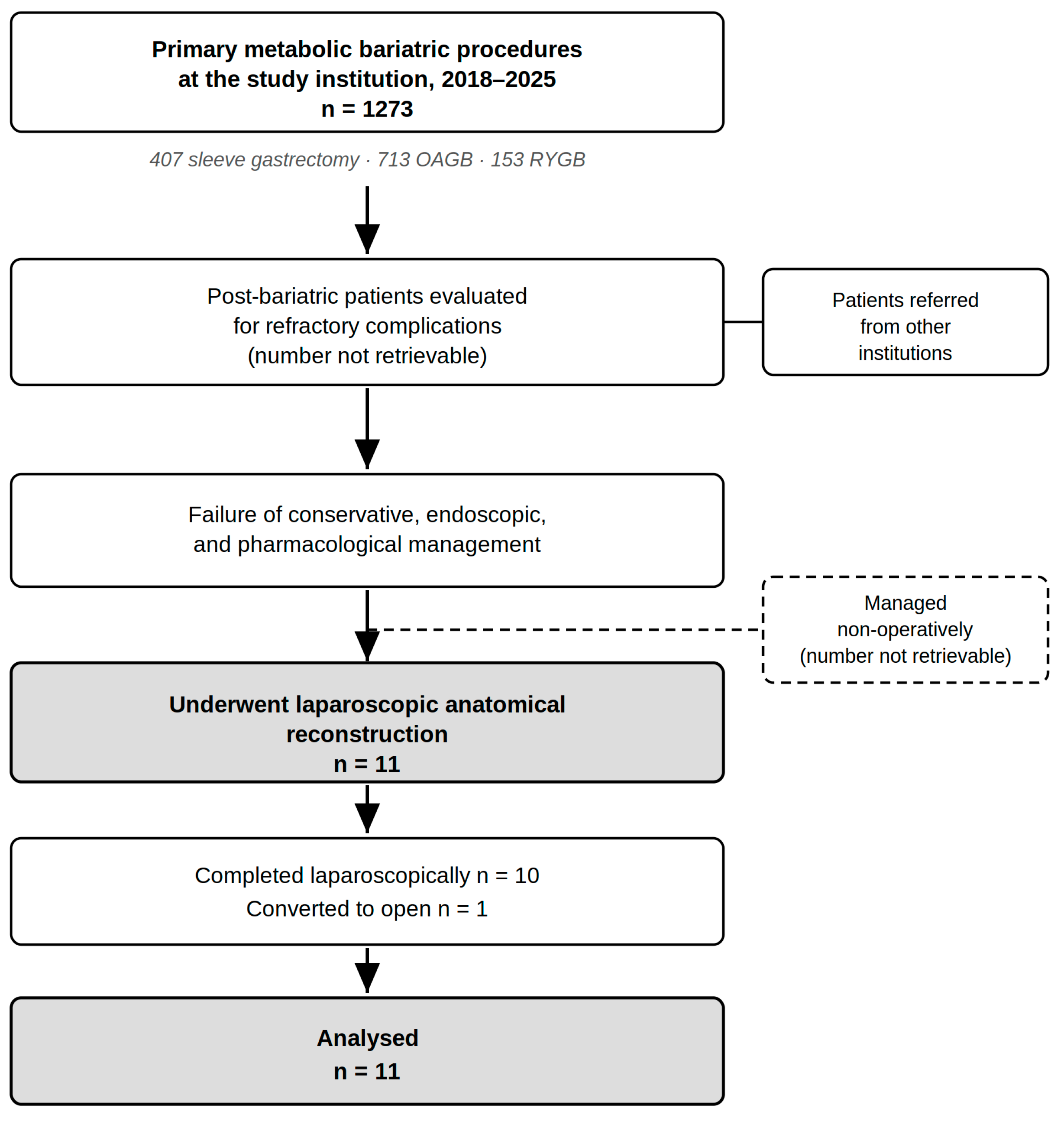
During the study period, 1273 primary metabolic bariatric procedures were performed at our institution (407 sleeve gastrectomies, 713 one-anastomosis gastric bypasses, and 153 Roux-en-Y gastric bypasses), and 11 patients underwent anatomical reconstruction (Figure 3). Several patients had undergone their index bariatric procedure at other institutions and were referred to our center for management of refractory complications; the reconstruction cohort therefore does not represent a simple fraction of the institutional bariatric denominator. Because the decision to offer reconstruction was individualized in complex, refractory cases rather than governed by a fixed protocol, the number of post-bariatric patients evaluated but ultimately managed non-operatively could not be reliably reconstructed from the retrospective record; this is acknowledged as a limitation.
The patient flow of 1273 primary metabolic bariatric procedures performed at the study institution between 2018 and 2025 (407 sleeve gastrectomies, 713 OAGB, and 153 RYGB), together with an unrecorded number of patients referred from other institutions for management of refractory post-bariatric complications, included 11 patients who underwent laparoscopic anatomical reconstruction and were analyzed. Because referral and selection decisions were individualized rather than protocol-driven, the number of patients evaluated but ultimately managed non-operatively could not be reliably retrieved from the retrospective record.

4.3. Diagnosis of PBHH

The diagnosis of PBHH was established on clinical and biochemical grounds consistent with the ASMBS position statement on postprandial hyperinsulinemic hypoglycemia [17]. The diagnostic criteria were: (1) prior bariatric surgery; (2) documented postprandial neuroglycopenic or autonomic symptoms occurring more than 6 months after the index procedure, thereby excluding early dumping syndrome; (3) provocative glucose suppression testing demonstrating an inappropriate insulin and C-peptide response—defined as a paradoxical rise in insulin during a declining or hypoglycemic-range glucose level, with C-peptide remaining ≥ 0.6 ng/mL, indicating endogenous, non-suppressed insulin secretion—together with a low or borderline glucose nadir on provocative testing; and (4) a failure of at least two non-operative treatment modalities. Consistent with the recognized limitations of provocative testing in post-bariatric anatomy, the diagnosis was based on the combined clinical and biochemical picture rather than on any single glucose threshold. A glucose value of 60 mg/dL was used as a screening cut-off to identify patients for further evaluation, and subsequently as the cut-off for defining biochemical resolution (Section 4.6); it was not applied as a diagnostic threshold in isolation. All four patients met criteria (1), (2), and (4); three also met criterion (3), whereas one patient (Patient 3) did not and is reported throughout as clinically diagnosed and biochemically unconfirmed. Insulinoma was considered and evaluated as described below.

4.4. Preoperative Assessment

All patients underwent a comprehensive multidisciplinary preoperative evaluation, including upper gastrointestinal endoscopy, cross-sectional abdominal imaging, nutritional assessment (BMI, serum albumin), and dietary consultation with a clinical dietitian. Patients meeting the criteria for severe malnutrition (albumin < 3.0 g/dL or BMI < 18.5 kg/m2) underwent preoperative nutritional optimization. Nutritional optimization, both before and after reconstruction, was individualized on the basis of a dietitian-led assessment rather than a fixed institutional protocol and included oral nutritional supplementation and, where required, enteral support.
Endocrinological evaluation was performed in all patients with suspected PBHH. These patients underwent standardized dual-modality glucose suppression testing with both oral (PO-GTT, also referred to as OGTT: 75 g glucose, with glucose, insulin, and C-peptide sampling at 0, 30, 60, 90, and 120 min) and intravenous (IV-GTT) protocols; this was the provocative protocol available uniformly across the study period, as mixed-meal tolerance testing and continuous glucose monitoring were not routinely available for this cohort. Postoperative suppression testing was intended at a minimum of 3 months after reconstruction to allow for surgical recovery and metabolic stabilization; resolution of PBHH was assessed only in patients who underwent formal postoperative testing at this interval.
Insulinoma was considered unlikely on the basis of several supportive features: appropriately suppressed fasting insulin in all four patients (range 0.5–2.2 µU/mL); the strictly postprandial timing of symptoms; and unremarkable pancreatic cross-sectional imaging. One patient had a mildly low fasting glucose of 62.2 mg/dL, but with a concurrent fasting insulin of 2.2 µU/mL—a pattern inconsistent with endogenous hyperinsulinism. A supervised 72 h fast with paired proinsulin measurement, the recognized reference standard for excluding insulinoma, was not performed; this is acknowledged as a limitation.

4.5. Surgical Technique

All procedures were performed laparoscopically by the senior bariatric surgical team. The operative strategy was tailored to each patient’s specific bariatric history and current anatomical configuration. Consequently, the reconstructive procedures were not uniform and encompassed OAGB reversal, RYGB reversal, and modified Branco–Zorron reconstruction, which differ substantially in technical complexity and operative risk. Outcomes are therefore reported for the cohort as a whole and should not be interpreted as procedure-specific, given the small number of patients undergoing each technique. For OAGB patients, reconstruction involved a takedown of the gastrojejunal anastomosis, restoration of gastric continuity through either a linear stapled or hand-sewn gastro-gastrostomy, and re-establishment of small bowel continuity by jejuno-jejunal anastomosis. For patients with prior sleeve gastrectomy converted to RYGB, reconstruction utilized a modified Branco–Zorron anastomotic technique to reconnect the gastric pouch to the remnant gastric antrum using part of the jejunal alimentary limb as a bridge [13]. All anastomoses were performed intracorporeally, with routine intraoperative methylene blue dye and pneumatic leak testing.

4.6. Outcome Measures

The primary outcomes included 30-day complications categorized according to the Clavien–Dindo grading system, symptom resolution, and weight change at the most recent follow-up. For PBHH patients, outcomes additionally included resolution of hypoglycemic episodes and biochemical response to postoperative glucose suppression testing. Symptomatic resolution was defined as the absence of hypoglycemic symptoms at the most recent follow-up. Biochemical resolution was defined, using the same 60 mg/dL cut-off applied at screening, as the absence of glucose values below 60 mg/dL in formal postoperative suppression testing; this was assessed only in patients who underwent such testing. Partial improvement was defined as a reduction in the frequency or severity of events without resolution.
Indications were not mutually exclusive; each condition was counted whenever it was documented as a clinical indication contributing to the decision to reconstruct, and a single patient could therefore contribute to more than one indication category. Severe malnutrition was defined objectively as a serum albumin below 3.0 g/dL and/or a body mass index below 18.5 kg/m2 at the time of reconstruction. Nutritional improvement was defined as a documented rise in serum albumin together with clinical resolution of dependence on artificial nutritional support. For non-PBHH indications, symptom resolution was defined as a clinician-documented absence of the presenting symptom at the most recent follow-up, and partial improvement was defined as a documented reduction in symptom frequency or severity without complete resolution. Patient satisfaction was recorded from the treating surgeon’s clinic documentation using a four-point descriptive scale (very satisfied, satisfied, neutral, dissatisfied). All outcome determinations were based on a retrospective review of clinical records rather than prospectively administered validated instruments; this is acknowledged as a limitation.
Given the small sample size, no formal statistical hypothesis testing was performed. Data are reported descriptively as counts, proportions, or means with standard deviations, and all findings should be interpreted as descriptive observations rather than as statistically validated effects.


5. Conclusions

Post-bariatric refractory complications represent an escalating clinical challenge as the global volume of MBS continues to rise. Anatomical reconstruction represents one option within the management of these complications. The present series cannot define its place relative to pharmacological, endoscopic, or less extensive surgical alternatives, and we do not propose it as a preferred or first-line approach; determining when reconstruction should be selected over other options will require a comparative, prospective study. When performed by experienced teams with rigorous, multidisciplinary patient selection, it can be accomplished laparoscopically, with a low observed rate of major complications in this small series and clinical improvement across the principal indications. In the PBHH subgroup, restoration of pyloric continuity and duodenal nutrient exposure was associated with a reduced hyperinsulinemic response, as reflected in the observed decreases in peak insulin and C-peptide; the incretin basis of this response is inferred from the mechanistic framework established by Salehi et al. [6] and Arora and Patti [4] rather than demonstrated by direct incretin measurement in the present series. The integration of standardized dual-modality glucose suppression testing into the preoperative and postoperative evaluation of PBHH patients offers a reproducible, objective framework for measuring responses that future series should adopt. Prospective multicenter registries with standardized long-term follow-up are the necessary next step to define optimal patient selection criteria, refine the surgical algorithm, and establish the durability of these outcomes beyond the first postoperative year.

Supplementary Materials

The following supporting information can be downloaded at https://www.mdpi.com/article/10.3390/gidisord8030037/s1, File S1: Completed STROBE checklist for cohort studies.

Author Contributions

C.A. and F.K.: study conception, data acquisition, surgical assistance, and manuscript drafting; E.L., M.S., M.R. and C.A.: endocrinological assessment, perioperative metabolic management, and critical revision; A.G., R.R., M.J. and S.L.: manuscript drafting and surgical assistance. M.S.: study conception, surgical procedures, supervision, and final manuscript approval. All authors have read and agreed to the published version of the manuscript.

Funding

This research received no external funding.

Institutional Review Board Statement

This study was approved by the Wolfson Medical Center Institutional Review Board (WMC-0054-21, granted on 8 May 2021), with informed consent waived owing to its retrospective design.

Informed Consent Statement

Informed consent was waived due to this study’s retrospective nature.

Data Availability Statement

The datasets generated and analyzed during the current study are not publicly available due to patient confidentiality constraints but are available from the corresponding authors on reasonable request and subject to institutional approval.

Conflicts of Interest

The authors declare no conflicts of interest.

References

  1. Angrisani, L.; Santonicola, A.; Iovino, P.; Palma, R.; Kow, L.; Prager, G.; Ramos, A.; Shikora, S.; Collaborative Study Group for the IFSO Worldwide Survey. IFSO Worldwide Survey 2020–2021: Current Trends for Bariatric and Metabolic Procedures. Obes. Surg. 2024, 34, 1075–1085. [Google Scholar] [CrossRef] [PubMed]
  2. Alkhaled, L.; Al-Kurd, A.; Butsch, W.S.; Kashyap, S.R.; Aminian, A. Diagnosis and Management of Post-Bariatric Surgery Hypoglycemia. Expert Rev. Endocrinol. Metab. 2023, 18, 459–468. [Google Scholar] [CrossRef] [PubMed]
  3. Pucher, P.H.; Lord, A.C.; Sodergren, M.H.; Ahmed, A.R.; Darzi, A.; Purkayastha, S. Reversal to Normal Anatomy after Failed Gastric Bypass: Systematic Review of Indications, Techniques, and Outcomes. Surg. Obes. Relat. Dis. 2016, 12, 1351–1356. [Google Scholar] [CrossRef] [PubMed]
  4. Arora, I.; Patti, M.-E. Can Reversal of RYGB Also Reverse Hypoglycemia? Mol. Metab. 2018, 9, 1–3. [Google Scholar] [CrossRef] [PubMed]
  5. Lee, C.J.; Clark, J.M.; Schweitzer, M.; Magnuson, T.; Steele, K.; Koerner, O.; Brown, T.T. Prevalence of and Risk Factors for Hypoglycemic Symptoms after Gastric Bypass and Sleeve Gastrectomy: Postsurgical Hypoglycemic Symptoms. Obesity 2015, 23, 1079–1084. [Google Scholar] [CrossRef] [PubMed]
  6. Salehi, M.; Gastaldelli, A.; D’Alessio, D.A. Blockade of Glucagon-like Peptide 1 Receptor Corrects Postprandial Hypoglycemia After Gastric Bypass. Gastroenterology 2014, 146, 669–680.e2. [Google Scholar] [CrossRef]
  7. Lawler, H.M.; McGinnis, T.; Patti, M.-E. Diagnosis and Management of Post-Bariatric Hypoglycemia. J. Am. Board Fam. Med. 2025, 38, 383–394. [Google Scholar] [CrossRef] [PubMed]
  8. Salehi, M.; Vella, A.; McLaughlin, T.; Patti, M.-E. Hypoglycemia After Gastric Bypass Surgery: Current Concepts and Controversies. J. Clin. Endocrinol. Metab. 2018, 103, 2815–2826. [Google Scholar] [CrossRef] [PubMed]
  9. Campos, G.M.; Ziemelis, M.; Paparodis, R.; Ahmed, M.; Belt Davis, D. Laparoscopic Reversal of Roux-En-Y Gastric Bypass: Technique and Utility for Treatment of Endocrine Complications. Surg. Obes. Relat. Dis. 2014, 10, 36–43. [Google Scholar] [CrossRef] [PubMed]
  10. Lee, C.J.; Brown, T.; Magnuson, T.H.; Egan, J.M.; Carlson, O.; Elahi, D. Hormonal Response to a Mixed-Meal Challenge after Reversal of Gastric Bypass for Hypoglycemia. J. Clin. Endocrinol. Metab. 2013, 98, E1208–E1212. [Google Scholar] [CrossRef] [PubMed]
  11. Davis, D.B.; Khoraki, J.; Ziemelis, M.; Sirinvaravong, S.; Han, J.Y.; Campos, G.M. Roux En Y Gastric Bypass Hypoglycemia Resolves with Gastric Feeding or Reversal: Confirming a Non-Pancreatic Etiology. Mol. Metab. 2018, 9, 15–27. [Google Scholar] [CrossRef] [PubMed]
  12. Kermansaravi, M.; Shahmiri, S.S.; Davarpanah Jazi, A.H.; Valizadeh, R.; Weiner, R.A.; Chiappetta, S. Reversal to Normal Anatomy after One-Anastomosis/Mini Gastric Bypass, Indications and Results: A Systematic Review and Meta-Analysis. Surg. Obes. Relat. Dis. 2021, 17, 1489–1496. [Google Scholar] [CrossRef] [PubMed]
  13. Zorron, R.; Branco, A.; Sampaio, J.; Bothe, C.; Junghans, T.; Rasim, G.; Pratschke, J.; Guel-Klein, S. One-Anastomosis Jejunal Interposition with Gastric Remnant Resection (Branco-Zorron Switch) for Severe Recurrent Hyperinsulinemic Hypoglycemia after Gastric Bypass for Morbid Obesity. Obes. Surg. 2017, 27, 990–996. [Google Scholar] [CrossRef] [PubMed]
  14. Mahawar, K.K.; Carr, W.R.J.; Balupuri, S.; Small, P.K. Controversy Surrounding ‘Mini’ Gastric Bypass. Obes. Surg. 2014, 24, 324–333. [Google Scholar] [CrossRef] [PubMed]
  15. Artsitas, S.; Artsitas, D.; Smparounis, S.; Theodorou, D.; Zografos, G.C. Hypoglycemia Rates and Glycemic Hormonal Response after Laparoscopic Roux-En-Y Gastric Bypass versus Sleeve Gastrectomy: A Meta-Analysis of Comparative Studies. Bull. Natl. Res. Cent. 2023, 47, 172. [Google Scholar] [CrossRef]
  16. Cryer, P.E.; Axelrod, L.; Grossman, A.B.; Heller, S.R.; Montori, V.M.; Seaquist, E.R.; Service, F.J. Evaluation and Management of Adult Hypoglycemic Disorders: An Endocrine Society Clinical Practice Guideline. J. Clin. Endocrinol. Metab. 2009, 94, 709–728. [Google Scholar] [CrossRef] [PubMed]
  17. Eisenberg, D.; Azagury, D.E.; Ghiassi, S.; Grover, B.T.; Kim, J.J. ASMBS Position Statement on Postprandial Hyperinsulinemic Hypoglycemia after Bariatric Surgery. Surg. Obes. Relat. Dis. 2017, 13, 371–378. [Google Scholar] [CrossRef] [PubMed]
  18. De Heide, L.J.M.; Wouda, S.H.T.; Peters, V.J.T.; Oosterwerff-Suiker, M.; Gerdes, V.A.; Emous, M.; Van Beek, A.P. Medical and Surgical Treatment of Postbariatric Hypoglycaemia: Retrospective Data from Daily Practice. Diabetes Obes. Metab. 2023, 25, 735–747. [Google Scholar] [CrossRef] [PubMed]
  19. Vilallonga, R.; Rodríguez-Luna, M.R.; Roriz-Silva, R.; Caubet, E.; Gonzalez, O.; Ruiz De Gordejuela, A.; Ciudin, A.; Armengol, M.; Fort, J.M. Reversal to Normal Anatomy (With Sleeve Gastrectomy) for Severe Hypoglycemia. Surg. Innov. 2021, 28, 536–543. [Google Scholar] [CrossRef] [PubMed]
  20. Carpentieri, G.B.; Gonçalves, S.E.A.B.; Casagrande, M.Z.; Mourad, W.M.; Pinto, L.G.C.; Zanella, M.T. SGLT2 Inhibition with Empagliflozin as a Possible Therapeutic Option for Postprandial Hypoglycemia After Bariatric Surgery. Obes. Surg. 2022, 32, 2664–2671. [Google Scholar] [CrossRef] [PubMed]
  21. Amylyx Pharmaceuticals. A Phase 3, Randomized, Double-Blind, Placebo-Controlled Study of Avexitide (AVX-001) in Post-Bariatric Hypoglycemia (LUCIDITY). ClinicalTrials.gov Identifier: NCT06747468. Available online: https://clinicaltrials.gov/study/NCT06747468 (accessed on 17 July 2026).
Figure 1. Postoperative weight change following anatomical reconstruction in all 11 patients. Red bars represent patients with post-bariatric hyperinsulinemic hypoglycemia (PBHH, n = 4); blue bars represent the remaining patients (n = 7). Weight gain was documented in 10 of 11 patients; Patient 5 remained percutaneous endoscopic gastrostomy-dependent, and no weight change value was available. The dashed line indicates the mean weight gain of 8.1 kg among the 10 patients with available values. OAGB, one-anastomosis gastric bypass; RYGB, Roux-en-Y gastric bypass.
Gastrointestdisord 08 00037 g001
Figure 2. Individual plasma glucose trajectories during oral glucose tolerance testing before and after anatomical reconstruction. (A) Preoperative trajectories for all four patients with PBHH. (B) Postoperative trajectories at 3 months for the three patients who underwent formal postoperative suppression testing; Patient 1 underwent early postoperative glucose monitoring only and is therefore not represented. Each line represents a single patient. The dashed line indicates the 54 mg/dL (3.0 mmol/L) Endocrine Society threshold for biochemical hypoglycemia. Given the small sample, individual trajectories are presented rather than group means.
Gastrointestdisord 08 00037 g002
Figure 3. Patient flow through this study.
Gastrointestdisord 08 00037 g003
Table 1. Baseline characteristics and surgical details of patients undergoing anatomical reconstruction (n = 11).
CharacteristicValue
Demographics
   Age, yr, mean ± SD49.0 ± 12.3
   Female sex, n (%)9 (81.8)
Primary bariatric procedure
   One-anastomosis gastric bypass, n (%)9 (81.8)
   Sleeve gastrectomy, n (%)2 (18.2)
Secondary bariatric procedure ‡
   None, n (%)8 (72.7)
   Conversion to RYGB, n (%)2 (18.2)
   OAGB after sleeve gastrectomy, n (%)1 (9.1)
Anthropometric data
   BMI at primary surgery, kg/m2, mean ± SD42.8 ± 4.9
   BMI at reconstruction, kg/m2, mean ± SD21.4 ± 3.8
   Weight loss, kg, mean ± SD (n = 10) *56.3 ± 17.3
   Patients with BMI < 20 kg/m2, n (%)4 (36.4)
Time to reconstruction
   Years from the primary bariatric procedure, mean ± SD6.2 ± 3.7
Prior interventions, n (%) ‡
   None5 (45.5)
   Endoscopic intervention2 (18.2)
   Other surgical interventions †4 (36.4)
BMI = body mass index; OAGB = one-anastomosis gastric bypass; RYGB = Roux-en-Y gastric bypass; SD = standard deviation. † Includes gastrostomy (n = 1), primary ulcer repair (n = 1), internal hernia repair (n = 1), hiatal hernia repair (n = 1). ‡ Categories are independent: “Secondary bariatric procedure” refers to a subsequent bariatric operation performed before reconstruction, whereas “Prior interventions” refers to non-bariatric endoscopic or surgical procedures. Each grouping sums to the full cohort (n = 11); * Patient 7 excluded; pre-bariatric weight not documented.
Table 2. Indications for anatomical reconstruction and perioperative outcomes.
Variablen (%)
Indications for reconstruction *
    Post-bariatric hyperinsulinemic hypoglycemia (PBHH) †4 (36.4)
    Marginal ulcer disease (including perforation) ‡6 (54.5)
    Severe malnutrition/underweight9 (81.8)
    Intractable reflux/esophagitis4 (36.4)
    Anastomotic leak or fistula1 (9.1)
    Chronic diarrhea5 (45.5)
Concurrent complications
    Patients with multiple concurrent complications (≥2)8 (72.7)
Surgical approach
    Laparoscopic10 (90.9)
    Conversion to open1 (9.1)
30-day complications
    None9 (81.8)
    Clavien–Dindo grade I–II2 (18.2)
    Clavien–Dindo grade III–IV0 (0)
* Indications are not mutually exclusive; a single patient may contribute to more than one category. † PBHH = post-bariatric hyperinsulinemic hypoglycemia, diagnosed by the combined clinical and biochemical criteria described in the Methods Section; three of the four met the biochemical criteria, and one was diagnosed on clinical grounds. ‡ Includes one patient presenting with marginal ulcer perforation requiring emergency surgical intervention.
Table 3. Patient characteristics and outcomes after anatomical reconstruction (n = 11).
PtAge/SexPrimary SurgeryBMI Initial →
Pre-Reversal
Wt Loss (kg)Time to ReversalPrimary ComplicationsPrior InterventionsReversal DateWt Change
150/FOAGB (01/2018)40 → 28405.7 yrNeuroglycopenic hypoglycemia *, diarrhea, malnutritionAnastomotic narrowing, re-suturing10/2023+8 kg
246/MOAGB (05/2021)38 → 20302.4 yrDysphagia, esophagitis → RYGB → gastritis, reflux, malnutrition, hypoglycemia *, diarrhea, SBOStent; RYGB (11/2021)10/2023+10 kg
372/FSleeve (03/2013)46.8 → 197110.7 yrMild reflux → RYGB → dumping, neuroglycopenic hypoglycemia *, severe malnutritionRYGB (12/2014), ventral hernia repair12/2023+1 kg
445/FOAGB (09/2020)51 → 24903.3 yrDiarrhea, malnutrition, hypoglycemia *, marginal ulcerGastrostomy → leak, sepsis, TPN01/2024+20 kg
543/FOAGB (2017)40 → 20705.3 yrSevere underweight (BMI 17), marginal ulcer, bradycardia, syncopeNone05/2022PEG-dependent
641/FOAGB (2022)41 → 21501.1 yrSuspected leak d8 → abscess, gastro-gastric fistula, marginal ulcer, malnutritionStent (2022)08/2023+5 kg
724/MOAGB (2020)40 → 25N/A4.1 yrMarginal ulcer perforation (emergency), re-perforation 2024Primary repair (2021)01/2025+7 kg
847/FOAGB (2018)40 → 24606.8 yrSBO (internal hernia), marginal ulcerInternal hernia repair (2021)03/2025+6 kg
946/FSleeve (2010)39 → 194514 yrrecurrent weight gain → OAGB → abscesses, underweight, marginal ulcer, diarrheaOAGB (2022)01/2024+9 kg
1068/FOAGB (2014)50 → 16538.0 yrSevere esophagitis, hiatal hernia, weight loss, diarrheaConservative, hiatal hernia repair07/2022+9 kg
1169/FOAGB (2016)51 → 17546.3 yrSevere esophagitis, significant weight lossNone08/2023+6 kg
* Post-bariatric hyperinsulinemic hypoglycemia (PBHH) diagnosed by the combined clinical and biochemical criteria described in the Methods Section (Patients 1–4). OAGB = one-anastomosis gastric bypass; RYGB = Roux-en-Y gastric bypass; SBO = small bowel obstruction; PEG = percutaneous endoscopic gastrostomy; TPN = total parenteral nutrition; N/A = not available.
Table 4. Short-term outcomes after anatomical reconstruction.
Outcome MeasureValue
Follow-up
    Duration, mo, median (IQR)7 (3–12)
Weight changes
    Patients with weight gain, n (%)10 (90.9)
    Weight gain, kg, mean ± SD8.1 ± 4.9
    BMI increase, kg/m2, mean ± SD3.2 ± 1.8
Symptom resolution, n/N (%)
    Hypoglycemia (PBHH patients)4/4 (100)
    Marginal ulcer disease6/6 (100)
    Diarrhea resolution5/5 (100)
    Reflux/esophagitis3/4 (75.0)
Biochemical resolution, n/N (%)
Hypoglycemia (PBHH patients)1/2 tested †
Nutritional status
    Improved/normalized *8/9 (88.9)
    Required ongoing supplementation3/9 (33.3)
Patient satisfaction, n (%)
    Satisfied/very satisfied10/11 (90.9)
* Among the patients meeting criteria for severe malnutrition, (n = 9). IQR = interquartile range; PBHH = post-bariatric hyperinsulinemic hypoglycemia; SD = standard deviation. † Among the three biochemically confirmed patients, two underwent postoperative suppression testing: one demonstrated complete biochemical resolution, and one retained a residual asymptomatic nadir of 55.9 mg/dL. The third was not tested postoperatively. Patient 3 had no baseline biochemical abnormality and is therefore not evaluable for biochemical resolution.
Table 5. Glucose suppression test results in the four patients diagnosed with post-bariatric hyperinsulinemic hypoglycemia (n = 4; three biochemically confirmed, one clinically diagnosed).
PatientPreoperative FindingsPostoperative FindingsClinical Outcome
1Nadir glucose: 57.9 mg/dL
Peak insulin: 40.9 µU/mL
Peak C-peptide: 6.35 ng/mL
Day 1: normal glucose ranges;
no early hypoglycemic episodes.
No formal postoperative suppression testing was performed.
Symptomatic resolution; biochemical response not assessed postoperatively
2Nadir glucose: 60.0 mg/dL
Peak insulin: 106 µU/mL
Peak C-peptide: 12.8 ng/mL
3 mo: nadir glucose 55.9 mg/dL
Peak insulin: 22.8 µU/mL
Peak C-peptide: 2.29 ng/mL
Symptomatic resolution; residual asymptomatic biochemical hypoglycemia *
3Fasting glucose: 62.2 mg/dL; post-load minimum: 68 mg/dL (120 min)
Peak insulin: 27.7 µU/mL (30 min)
Peak C-peptide: 5.23 ng/mL
Mild symptomatic episodes §
3 mo: post-load minimum 74.3 mg/dL
Peak insulin: 21.9 µU/mL
Peak C-peptide: 2.33 ng/mL
Symptomatic resolution; biochemical criteria not met at baseline (clinical diagnosis)
4Nadir glucose: 59.2 mg/dL
Peak insulin: 36.8 µU/mL
Peak C-peptide: 9.75 ng/mL
3 mo: normal glucose response
No hypoglycemia documented
+20 kg weight gain
Symptomatic and biochemical resolution
Glucose nadir values in the three biochemically confirmed patients occurred at 90–120 min after oral glucose load. Normal serum insulin reference range: 5–30 µU/mL. Diagnosis was based on the inappropriate temporal pattern of insulin and C-peptide relative to glucose, not on absolute peak values. * Patient 2: residual asymptomatic glucose nadir 55.9 mg/dL at 3 months; peak insulin reduced from 106 to 22.8 µU/mL and C-peptide from 12.8 to 2.29 ng/mL. § Patient 3 did not meet the biochemical criteria: her glucose did not fall below her fasting value at any point during testing, and her insulin peaked at 30 min coincident with peak glucose (175 mg/dL) rather than during declining glucose. She was diagnosed on clinical grounds.
Disclaimer/Publisher’s Note: The statements, opinions and data contained in all publications are solely those of the individual author(s) and contributor(s) and not of MDPI and/or the editor(s). MDPI and/or the editor(s) disclaim responsibility for any injury to people or property resulting from any ideas, methods, instructions or products referred to in the content.