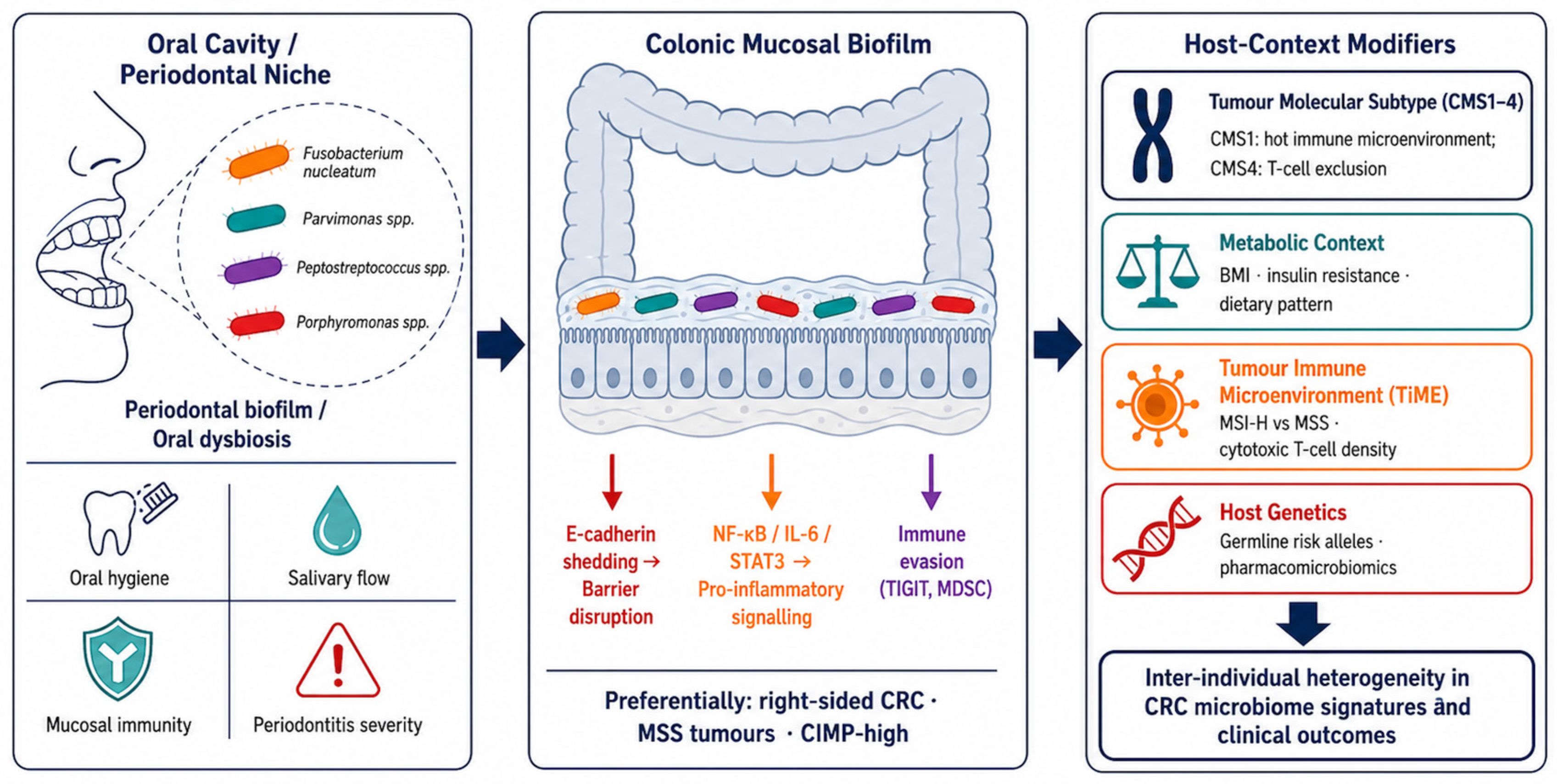

Rethinking Colorectal Cancer Microbiome: From Universal Biomarkers to Patient-Stratified Signatures



Abstract
1. Introduction
2. Materials and Methods
3. The Converging Evidence for a Universal CRC Microbiome Signature
4. The Oral-to-Gut Microbial Axis: A Key Mechanism with Context-Dependent Consequences
5. Fusobacterium Nucleatum: A Paradigm of Host-Context-Dependent Microbial Oncogenesis
6. Host Metabolic Context as a Modulator of Microbiome–CRC Risk
7. Tumor Molecular Subtype and Microbiome: Beyond Stage and Location
8. Clinical Translation: Screening, Prognosis, and Therapeutic Modulation
9. Towards Patient-Stratified Microbiome Biomarkers: Analytical Frameworks
10. Limitations and Research Priorities
11. Conclusions
Author Contributions
Funding
Institutional Review Board Statement
Informed Consent Statement
Data Availability Statement
Conflicts of Interest
Abbreviations
| CRC | Colorectal cancer |
| FIT | Fecal immunochemical testing |
| AUC | Area under the curve |
| LODO | Leave-one-dataset-out |
| SGB | Species-level genome bin |
| MSS | Microsatellite-stable |
| MSI-H | Microsatellite instability-high |
| Fn | Fusobacterium nucleatum |
| MPE | Molecular pathological epidemiology |
| CIMP | CpG island methylator phenotype |
| TiME | Tumor immune microenvironment |
| NK | Natural killer (cells) |
| TIGIT | T cell immunoreceptor with Ig and ITIM domains |
| LPS | Lipopolysaccharide |
| SCFA | Short-chain fatty acid |
| ETBF | Enterotoxigenic Bacteroides fragilis |
| BMI | Body mass index |
| EO-CRC | Early-Onset Colorectal Cancer |
| CMS | Consensus molecular subtypes |
| XAI | Explainable artificial intelligence |
| SHAP | SHapley Additive exPlanations |
| NMF | Non-negative matrix factorisation |
| MOFA | Multi-omics factor analysis |
References
- Wu, S.; Zhang, Y.; Lin, Z.; Wei, M. Global burden of colorectal cancer in 2022 and projections to 2050: Incidence and mortality estimates from GLOBOCAN. BMC Cancer 2025, 25, 1770. [Google Scholar] [CrossRef] [PubMed]
- Cardoso, R.; Guo, F.; Heisser, T.; De Schutter, H.; Van Damme, N.; Nilbert, M.C.; Christensen, J.; Bouvier, A.M.; Bouvier, V.; Launoy, G.; et al. Overall and stage-specific survival of patients with screen-detected colorectal cancer in European countries: A population-based study in 9 countries. Lancet Reg. Health Eur. 2022, 21, 100458. [Google Scholar] [CrossRef]
- Badero, O.J.; Meribole, E.S.; Omokore, O.; Quadri, I.O.; Kingdom, P.; Ifeanyichukwu, O.C.; Ogunnoiki, S.O.; Samuel-Ogunnoiki, P.M.; Adeyoola, O.; Osibowale, B.; et al. Gut Microbiota and Colorectal Cancer: Is Microbial Dysbiosis in Carcinogenesis an Emerging Risk Factor? Cureus 2026, 18, e102283. [Google Scholar] [CrossRef]
- Shen, F.; Xu, C.; Wang, C. Gut Microbiome Diagnostic Biomarkers for Colorectal Cancer. Turk. J. Gastroenterol. 2025, 37, 62–74. [Google Scholar] [CrossRef]
- Yan, R.; Zheng, R.; Han, Y.; Song, G.; Huo, B.; Sun, H. Meta-analysis of gut microbiome reveals patterns of dysbiosis in colorectal cancer patients. J. Med. Microbiol. 2025, 74, 002042. [Google Scholar] [CrossRef]
- Gonzalez, A.; Fullaondo, A.; Odriozola, A. Microbiota-associated mechanisms in colorectal cancer. Adv. Genet. 2024, 112, 123–205. [Google Scholar] [CrossRef] [PubMed]
- Bautista, J.; Lamas-Maceiras, M.; Hidalgo-Tinoco, C.; Guerra-Guerrero, A.; Betancourt-Velarde, A.; Lopez-Cortes, A. Gut microbiome-driven colorectal cancer via immune, metabolic, neural, and endocrine axes reprogramming. npj Biofilms Microbiomes 2026, 12, 21. [Google Scholar] [CrossRef] [PubMed]
- Castellarin, M.; Warren, R.L.; Freeman, J.D.; Dreolini, L.; Krzywinski, M.; Strauss, J.; Barnes, R.; Watson, P.; Allen-Vercoe, E.; Moore, R.A.; et al. Fusobacterium nucleatum infection is prevalent in human colorectal carcinoma. Genome Res. 2012, 22, 299–306. [Google Scholar] [CrossRef]
- Kostic, A.D.; Gevers, D.; Pedamallu, C.S.; Michaud, M.; Duke, F.; Earl, A.M.; Ojesina, A.I.; Jung, J.; Bass, A.J.; Tabernero, J.; et al. Genomic analysis identifies association of Fusobacterium with colorectal carcinoma. Genome Res. 2012, 22, 292–298. [Google Scholar] [CrossRef]
- Toprak, N.U.; Yagci, A.; Gulluoglu, B.M.; Akin, M.L.; Demirkalem, P.; Celenk, T.; Soyletir, G. A possible role of Bacteroides fragilis enterotoxin in the aetiology of colorectal cancer. Clin. Microbiol. Infect. 2006, 12, 782–786. [Google Scholar] [CrossRef]
- Wu, S.; Rhee, K.J.; Albesiano, E.; Rabizadeh, S.; Wu, X.; Yen, H.R.; Huso, D.L.; Brancati, F.L.; Wick, E.; McAllister, F.; et al. A human colonic commensal promotes colon tumorigenesis via activation of T helper type 17 T cell responses. Nat. Med. 2009, 15, 1016–1022. [Google Scholar] [CrossRef]
- Yu, J.; Feng, Q.; Wong, S.H.; Zhang, D.; Liang, Q.Y.; Qin, Y.; Tang, L.; Zhao, H.; Stenvang, J.; Li, Y.; et al. Metagenomic analysis of faecal microbiome as a tool towards targeted non-invasive biomarkers for colorectal cancer. Gut 2017, 66, 70–78. [Google Scholar] [CrossRef] [PubMed]
- Wirbel, J.; Pyl, P.T.; Kartal, E.; Zych, K.; Kashani, A.; Milanese, A.; Fleck, J.S.; Voigt, A.Y.; Palleja, A.; Ponnudurai, R.; et al. Meta-analysis of fecal metagenomes reveals global microbial signatures that are specific for colorectal cancer. Nat. Med. 2019, 25, 679–689. [Google Scholar] [CrossRef]
- Thomas, A.M.; Manghi, P.; Asnicar, F.; Pasolli, E.; Armanini, F.; Zolfo, M.; Beghini, F.; Manara, S.; Karcher, N.; Pozzi, C.; et al. Metagenomic analysis of colorectal cancer datasets identifies cross-cohort microbial diagnostic signatures and a link with choline degradation. Nat. Med. 2019, 25, 667–678, Erratum in Nat. Med. 2019, 25, 1948. [Google Scholar] [CrossRef]
- Yachida, S.; Mizutani, S.; Shiroma, H.; Shiba, S.; Nakajima, T.; Sakamoto, T.; Watanabe, H.; Masuda, K.; Nishimoto, Y.; Kubo, M.; et al. Metagenomic and metabolomic analyses reveal distinct stage-specific phenotypes of the gut microbiota in colorectal cancer. Nat. Med. 2019, 25, 968–976. [Google Scholar] [CrossRef] [PubMed]
- Piccinno, G.; Thompson, K.N.; Manghi, P.; Ghazi, A.R.; Thomas, A.M.; Blanco-Miguez, A.; Asnicar, F.; Mladenovic, K.; Pinto, F.; Armanini, F.; et al. Pooled analysis of 3,741 stool metagenomes from 18 cohorts for cross-stage and strain-level reproducible microbial biomarkers of colorectal cancer. Nat. Med. 2025, 31, 2416–2429. [Google Scholar] [CrossRef]
- Zhao, Z.; Yuan, Z.; Li, Y.; Huang, X. The Balance and Imbalance of Microbial Communities: Oral-Gut Microbiota and Colorectal Cancer. Am. J. Clin. Oncol. 2025, 48, 501–508. [Google Scholar] [CrossRef]
- Zhou, S.H.; Du, Y.; Xue, W.Q.; He, M.J.; Zhou, T.; Zhao, Z.Y.; Pei, L.; Chen, Y.W.; Xie, J.R.; Huang, C.L.; et al. Oral microbiota signature predicts the prognosis of colorectal carcinoma. npj Biofilms Microbiomes 2025, 11, 71. [Google Scholar] [CrossRef]
- Kudra, A.; Muszynski, D.; Sobocki, B.K.; Atzeni, A.; Carbone, L.; Kazmierczak-Siedlecka, K.; Polom, K.; Kalinowski, L. Insights into oral microbiome and colorectal cancer—On the way of searching new perspectives. Front. Cell Infect. Microbiol. 2023, 13, 1159822. [Google Scholar] [CrossRef]
- Wang, X.; Jia, Y.; Wen, L.; Mu, W.; Wu, X.; Liu, T.; Liu, X.; Fang, J.; Luan, Y.; Chen, P.; et al. Porphyromonas gingivalis Promotes Colorectal Carcinoma by Activating the Hematopoietic NLRP3 Inflammasome. Cancer Res. 2022, 81, 2745–2759, Erratum in Cancer Res. 2022, 82, 2196. [Google Scholar] [CrossRef] [PubMed]
- Rubinstein, M.R.; Wang, X.; Liu, W.; Hao, Y.; Cai, G.; Han, Y.W. Fusobacterium nucleatum promotes colorectal carcinogenesis by modulating E-cadherin/beta-catenin signaling via its FadA adhesin. Cell Host Microbe 2013, 14, 195–206. [Google Scholar] [CrossRef] [PubMed]
- Chung, L.; Thiele Orberg, E.; Geis, A.L.; Chan, J.L.; Fu, K.; DeStefano Shields, C.E.; Dejea, C.M.; Fathi, P.; Chen, J.; Finard, B.B.; et al. Bacteroides fragilis Toxin Coordinates a Pro-carcinogenic Inflammatory Cascade via Targeting of Colonic Epithelial Cells. Cell Host Microbe 2018, 23, 203–214.e5. [Google Scholar] [CrossRef]
- Yang, J.; Wang, X.; Hu, T.; Huang, H.; Chen, G.; Jin, B.; Zeng, G.; Liu, J. Entero-toxigenic Bacteroides fragilis contributes to intestinal barrier injury and colorectal cancer progression by mediating the BFT/STAT3/ZEB2 pathway. Cell Cycle 2024, 23, 70–82. [Google Scholar] [CrossRef] [PubMed]
- Drewes, J.L.; White, J.R.; Dejea, C.M.; Fathi, P.; Iyadorai, T.; Vadivelu, J.; Roslani, A.C.; Wick, E.C.; Mongodin, E.F.; Loke, M.F.; et al. High-resolution bacterial 16S rRNA gene profile meta-analysis and biofilm status reveal common colorectal cancer consortia. npj Biofilms Microbiomes 2017, 3, 34, Erratum in npj Biofilms Microbiomes 2019, 5, 2. [Google Scholar] [CrossRef]
- Dejea, C.M.; Fathi, P.; Craig, J.M.; Boleij, A.; Taddese, R.; Geis, A.L.; Wu, X.; DeStefano Shields, C.E.; Hechenbleikner, E.M.; Huso, D.L.; et al. Patients with familial adenomatous polyposis harbor colonic biofilms containing tumorigenic bacteria. Science 2018, 359, 592–597. [Google Scholar] [CrossRef]
- Kushwaha, M.; Dalal, N.; Chaudhary, S.; Ahmed, A.; Makharia, G.K.; Singh, A.K.; Kumar, A. Colorectal cancer biofilm composition reveals distinct bacterial species signature. Appl. Microbiol. Biotechnol. 2025, 109, 159. [Google Scholar] [CrossRef]
- Mima, K.; Nishihara, R.; Qian, Z.R.; Cao, Y.; Sukawa, Y.; Nowak, J.A.; Yang, J.; Dou, R.; Masugi, Y.; Song, M.; et al. Fusobacterium Association of Dietary Inflammatory Potential With Colorectal Cancer Risk in Men and Womennucleatum in colorectal carcinoma tissue and patient prognosis. Gut 2016, 65, 1973–1980. [Google Scholar] [CrossRef]
- He, X.; Zhao, Q.; Zhang, J.; Shi, J.; Wan, N.; Tang, B.; Tian, B.; Li, P. Potential and application of Fusobacterium nucleatum in the diagnosis and treatment of colorectal cancer. Front. Microbiol. 2025, 16, 1652702. [Google Scholar] [CrossRef]
- Wang, Y.; Wen, Y.; Wang, J.; Lai, X.; Xu, Y.; Zhang, X.; Zhu, X.; Ruan, C.; Huang, Y. Clinicopathological differences of high Fusobacterium nucleatum levels in colorectal cancer: A review and meta-analysis. Front. Microbiol. 2022, 13, 945463. [Google Scholar] [CrossRef]
- Yu, T.; Guo, F.; Yu, Y.; Sun, T.; Ma, D.; Han, J.; Qian, Y.; Kryczek, I.; Sun, D.; Nagarsheth, N.; et al. Fusobacterium nucleatum Promotes Chemoresistance to Colorectal Cancer by Modulating Autophagy. Cell 2017, 170, 548–563.e16. [Google Scholar] [CrossRef] [PubMed]
- Zepeda-Rivera, M.; Minot, S.S.; Bouzek, H.; Wu, H.; Blanco-Miguez, A.; Manghi, P.; Jones, D.S.; LaCourse, K.D.; Wu, Y.; McMahon, E.F.; et al. A distinct Fusobacterium nucleatum clade dominates the colorectal cancer niche. Nature 2024, 628, 424–432. [Google Scholar] [CrossRef]
- Hamada, T.; Zhang, X.; Mima, K.; Bullman, S.; Sukawa, Y.; Nowak, J.A.; Kosumi, K.; Masugi, Y.; Twombly, T.S.; Cao, Y.; et al. Fusobacterium nucleatum in Colorectal Cancer Relates to Immune Response Differentially by Tumor Microsatellite Instability Status. Cancer Immunol. Res. 2018, 6, 1327–1336. [Google Scholar] [CrossRef]
- Li, Q.; Luo, W.; Xiao, L.; Xu, X.; Peng, X.; Cheng, L.; Zhou, X.; Zheng, X. Microbial manipulators: Fusobacterium nucleatum modulates the tumor immune microenvironment in colorectal cancer. J. Oral Microbiol. 2025, 17, 2544169. [Google Scholar] [CrossRef] [PubMed]
- Gur, C.; Ibrahim, Y.; Isaacson, B.; Yamin, R.; Abed, J.; Gamliel, M.; Enk, J.; Bar-On, Y.; Stanietsky-Kaynan, N.; Coppenhagen-Glazer, S.; et al. Binding of the Fap2 protein of Fusobacterium nucleatum to human inhibitory receptor TIGIT protects tumors from immune cell attack. Immunity 2015, 42, 344–355. [Google Scholar] [CrossRef]
- Moseeb, H.M.; Aizaz, M.M.; Aiza, K.; Hafsa, T.H.; Sania, M.; Kamran, Z.; Shamama, Z.T.; Usama, A.M.; Maroof, Q.P.; Feroze, F.; et al. From obesity to cancer: Gut microbiome mechanisms, biomarkers, and U.S. public health strategies. Oncoscience 2025, 12, 175–188. [Google Scholar] [CrossRef]
- Tilg, H.; Adolph, T.E.; Gerner, R.R.; Moschen, A.R. The Intestinal Microbiota in Colorectal Cancer. Cancer Cell 2018, 33, 954–964. [Google Scholar] [CrossRef] [PubMed]
- Sheflin, A.M.; Whitney, A.K.; Weir, T.L. Cancer-promoting effects of microbial dysbiosis. Curr. Oncol. Rep. 2014, 16, 406. [Google Scholar] [CrossRef] [PubMed]
- Song, M.; Chan, A.T.; Sun, J. Influence of the Gut Microbiome, Diet, and Environment on Risk of Colorectal Cancer. Gastroenterology 2020, 158, 322–340. [Google Scholar] [CrossRef]
- Liu, L.; Tabung, F.K.; Zhang, X.; Nowak, J.A.; Qian, Z.R.; Hamada, T.; Nevo, D.; Bullman, S.; Mima, K.; Kosumi, K.; et al. Diets That Promote Colon Inflammation Associate With Risk of Colorectal Carcinomas That Contain Fusobacterium nucleatum. Clin. Gastroenterol. Hepatol. 2018, 16, 1622–1631.e3. [Google Scholar] [CrossRef]
- Raisch, J.; Buc, E.; Bonnet, M.; Sauvanet, P.; Vazeille, E.; de Vallee, A.; Dechelotte, P.; Darcha, C.; Pezet, D.; Bonnet, R.; et al. Colon cancer-associated B2 Escherichia coli colonize gut mucosa and promote cell proliferation. World J. Gastroenterol. 2014, 20, 6560–6572. [Google Scholar] [CrossRef] [PubMed]
- de Oliveira Alves, N.; Dalmasso, G.; Nikitina, D.; Vaysse, A.; Ruez, R.; Ledoux, L.; Pedron, T.; Bergsten, E.; Boulard, O.; Autier, L.; et al. The colibactin-producing Escherichia coli alters the tumor microenvironment to immunosuppressive lipid overload facilitating colorectal cancer progression and chemoresistance. Gut Microbes 2024, 16, 2320291. [Google Scholar] [CrossRef]
- Tabung, F.K.; Liu, L.; Wang, W.; Fung, T.T.; Wu, K.; Smith-Warner, S.A.; Cao, Y.; Hu, F.B.; Ogino, S.; Fuchs, C.S.; et al. Association of Dietary Inflammatory Potential With Colorectal Cancer Risk in Men and Women. JAMA Oncol. 2018, 4, 366–373, Erratum in JAMA Oncol. 2019, 5, 579. [Google Scholar] [CrossRef]
- Vich Vila, A.; Collij, V.; Sanna, S.; Sinha, T.; Imhann, F.; Bourgonje, A.R.; Mujagic, Z.; Jonkers, D.; Masclee, A.A.M.; Fu, J.; et al. Impact of commonly used drugs on the composition and metabolic function of the gut microbiota. Nat. Commun. 2020, 11, 362. [Google Scholar] [CrossRef] [PubMed]
- Cao, Y.; Wu, K.; Mehta, R.; Drew, D.A.; Song, M.; Lochhead, P.; Nguyen, L.H.; Izard, J.; Fuchs, C.S.; Garrett, W.S.; et al. Long-term use of antibiotics and risk of colorectal adenoma. Gut 2018, 67, 672–678. [Google Scholar] [CrossRef] [PubMed]
- Guinney, J.; Dienstmann, R.; Wang, X.; de Reynies, A.; Schlicker, A.; Soneson, C.; Marisa, L.; Roepman, P.; Nyamundanda, G.; Angelino, P.; et al. The consensus molecular subtypes of colorectal cancer. Nat. Med. 2015, 21, 1350–1356. [Google Scholar] [CrossRef] [PubMed]
- Purcell, R.V.; Visnovska, M.; Biggs, P.J.; Schmeier, S.; Frizelle, F.A. Distinct gut microbiome patterns associate with consensus molecular subtypes of colorectal cancer. Sci. Rep. 2017, 7, 11590. [Google Scholar] [CrossRef]
- Lee, J.A.; Yoo, S.Y.; Oh, H.J.; Jeong, S.; Cho, N.Y.; Kang, G.H.; Kim, J.H. Differential immune microenvironmental features of microsatellite-unstable colorectal cancers according to Fusobacterium nucleatum status. Cancer Immunol. Immunother. 2021, 70, 47–59. [Google Scholar] [CrossRef]
- Wang, J.; Cong, Y.; Tang, B.; Liu, J.; Pu, K. Integrative analysis of multi-omics data and gut microbiota composition reveals prognostic subtypes and predicts immunotherapy response in colorectal cancer using machine learning. Sci. Rep. 2025, 15, 25268. [Google Scholar] [CrossRef]
- Novielli, P.; Baldi, S.; Romano, D.; Magarelli, M.; Diacono, D.; Di Bitonto, P.; Nannini, G.; Di Gloria, L.; Bellotti, R.; Amedei, A.; et al. Personalized colorectal cancer risk assessment through explainable AI and Gut microbiome profiling. Gut Microbes 2025, 17, 2543124. [Google Scholar] [CrossRef]
- Wu, Y.; Jiao, N.; Zhu, R.; Zhang, Y.; Wu, D.; Wang, A.J.; Fang, S.; Tao, L.; Li, Y.; Cheng, S.; et al. Identification of microbial markers across populations in early detection of colorectal cancer. Nat. Commun. 2021, 12, 3063. [Google Scholar] [CrossRef]
- Zwezerijnen-Jiwa, F.H.; Sivov, H.; Paizs, P.; Zafeiropoulou, K.; Kinross, J. A systematic review of microbiome-derived biomarkers for early colorectal cancer detection. Neoplasia 2023, 36, 100868. [Google Scholar] [CrossRef]
- Mehmood, M.S.; Hajj, F. Noninvasive early detection of colorectal cancer through gut microbiome-derived biomarkers. Ann. Med. Surg. 2026, 88, 997–998. [Google Scholar] [CrossRef]
- Birch, R.J.; Burr, N.E.; Taylor, J.C.; Downing, A.; Quirke, P.; Morris, E.J.A.; Turvill, J.; Thoufeeq, M. Inequalities in colorectal cancer diagnosis by ethnic group: A population-level study in the English National Health Service. BMJ Open Gastroenterol. 2025, 12, e001629. [Google Scholar] [CrossRef]
- Petersen, A.E.; Zafeiropoulou, K.; Ghiboub, M.; van Helsdingen, C.P.M.; Konsten, J.L.M.; Bouvy, N.D.; Stoot, J.; Tanis, P.J.; de Jonge, W.J.; Derikx, J.P.M. Preoperative Gut Microbiome in Patients With Colorectal Cancer: Potential for Fecal Biomarker-Based Recurrence Risk Prediction. JCO Oncol. Adv. 2026, 3, e2500042. [Google Scholar] [CrossRef]
- Wang, X.; Fang, Y.; Liang, W.; Wong, C.C.; Qin, H.; Gao, Y.; Liang, M.; Song, L.; Zhang, Y.; Fan, M.; et al. Fusobacterium nucleatum facilitates anti-PD-1 therapy in microsatellite stable colorectal cancer. Cancer Cell 2024, 42, 1729–1746.e8. [Google Scholar] [CrossRef]
- Chang, Y.; Long, M.; Shan, H.; Liu, L.; Zhong, S.; Luo, J.L. Combining gut microbiota modulation and immunotherapy: A promising approach for treating microsatellite stable colorectal cancer. Crit. Rev. Oncol. Hematol. 2025, 208, 104629. [Google Scholar] [CrossRef]
- Kabwe, M.; Ayelign, B.; Afshar-Sterle, S.; Buchert, M.; Tucci, J. Bacteriophage FNU1 negates Fusobacterium nucleatum induced cell growth, migration and chemotherapy resistance in gastrointestinal cancer cells. Front. Cell Infect. Microbiol. 2025, 15, 1721411. [Google Scholar] [CrossRef] [PubMed]
- Lam, H.Y.P.; Lai, M.J.; Wang, P.C.; Wu, W.J.; Chen, L.K.; Fan, H.W.; Tseng, C.C.; Peng, S.Y.; Chang, K.C. A Novel Bacteriophage with the Potential to Inhibit Fusobacterium nucleatum-Induced Proliferation of Colorectal Cancer Cells. Antibiotics 2025, 14, 45. [Google Scholar] [CrossRef] [PubMed]
- Pasolli, E.; Truong, D.T.; Malik, F.; Waldron, L.; Segata, N. Machine Learning Meta-analysis of Large Metagenomic Datasets: Tools and Biological Insights. PLoS Comput. Biol. 2016, 12, e1004977. [Google Scholar] [CrossRef] [PubMed]
- Marcos-Zambrano, L.J.; Karaduzovic-Hadziabdic, K.; Loncar Turukalo, T.; Przymus, P.; Trajkovik, V.; Aasmets, O.; Berland, M.; Gruca, A.; Hasic, J.; Hron, K.; et al. Applications of Machine Learning in Human Microbiome Studies: A Review on Feature Selection, Biomarker Identification, Disease Prediction and Treatment. Front. Microbiol. 2021, 12, 634511. [Google Scholar] [CrossRef]
- Mallick, H.; Rahnavard, A.; McIver, L.J.; Ma, S.; Zhang, Y.; Nguyen, L.H.; Tickle, T.L.; Weingart, G.; Ren, B.; Schwager, E.H.; et al. Multivariable association discovery in population-scale meta-omics studies. PLoS Comput. Biol. 2021, 17, e1009442. [Google Scholar] [CrossRef] [PubMed]
- Qin, Y.; Tong, X.; Mei, W.J.; Cheng, Y.; Zou, Y.; Han, K.; Yu, J.; Jie, Z.; Zhang, T.; Zhu, S.; et al. Consistent signatures in the human gut microbiome of old- and young-onset colorectal cancer. Nat. Commun. 2024, 15, 3396. [Google Scholar] [CrossRef] [PubMed]
- Adnan, D.; Trinh, J.Q.; Sharma, D.; Alsayid, M.; Bishehsari, F. Early-onset Colon Cancer Shows a Distinct Intestinal Microbiome and a Host-Microbe Interaction. Cancer Prev. Res. 2024, 17, 29–38. [Google Scholar] [CrossRef]
- Zeng, S.; Almeida, A.; Mu, D.; Wang, S. Temporal variations of the gut microbiome in human health. Lancet Microbe 2026, 101388, online first. [Google Scholar] [CrossRef]


| Study | Journal | N Metagenomes | Key Contribution | AUC/Key Finding |
|---|---|---|---|---|
| [12] | Gut | 128 + validation | First cross-population fecal metagenomic classifier with qPCR confirmation | 0.72–0.84 |
| [13] | Nat. Med. | 969 (8 cohorts) | Core 29-species CRC signature; multi-study training improves cross-study generalization | ~0.80 |
| [14] | Nat. Med. | 969 (5 + 2 cohorts) | Cross-cohort reproducibility; enrichment of oral taxa; choline degradation pathway | 0.84 |
| [15] | Nat. Med. | 616 | Stage-specific microbiome and metabolome shifts from adenoma to CRC | Adenoma-CRC continuum |
| [16] | Nat. Med. | 3741 (18 cohorts) | Largest pooled analysis; strain-level resolution; 19 novel SGBs; Fn clade diversity | ~0.85 (LODO) |
| Study | Journal | N Metagenomes |
|---|---|---|
| Stratified & interaction-aware ML | Tests taxon discriminatory power within CMS or clinical subgroups | Overfitting risk; requires large subgroups |
| Hierarchical mixed-effects models | Disentangles technical from biological inter-patient variability | Assumes linearity; requires compositional data transformation |
| Integrative multi-omics clustering | Reveals patient subgroups invisible from single data layers | Latent factor interpretability requires external validation |
| NMF-based class discovery | Unsupervised molecular pattern discovery in high-dimensional data | Optimal k (components) has no universal selection criterion |
| Pseudo-longitudinal trajectory modeling | Re-interprets stage-matched cohorts as microbial state transitions | Cross-sectional data cannot capture true within-individual dynamics |
Disclaimer/Publisher’s Note: The statements, opinions and data contained in all publications are solely those of the individual author(s) and contributor(s) and not of MDPI and/or the editor(s). MDPI and/or the editor(s) disclaim responsibility for any injury to people or property resulting from any ideas, methods, instructions or products referred to in the content. |
© 2026 by the authors. Licensee MDPI, Basel, Switzerland. This article is an open access article distributed under the terms and conditions of the Creative Commons Attribution (CC BY) license.
Share and Cite
Schena, C.A.; Laterza, V.; Covino, M.; Rosa, F. Rethinking Colorectal Cancer Microbiome: From Universal Biomarkers to Patient-Stratified Signatures. Gastrointest. Disord. 2026, 8, 26. https://doi.org/10.3390/gidisord8020026
Schena CA, Laterza V, Covino M, Rosa F. Rethinking Colorectal Cancer Microbiome: From Universal Biomarkers to Patient-Stratified Signatures. Gastrointestinal Disorders. 2026; 8(2):26. https://doi.org/10.3390/gidisord8020026
Chicago/Turabian StyleSchena, Carlo Alberto, Vito Laterza, Marcello Covino, and Fausto Rosa. 2026. "Rethinking Colorectal Cancer Microbiome: From Universal Biomarkers to Patient-Stratified Signatures" Gastrointestinal Disorders 8, no. 2: 26. https://doi.org/10.3390/gidisord8020026
APA StyleSchena, C. A., Laterza, V., Covino, M., & Rosa, F. (2026). Rethinking Colorectal Cancer Microbiome: From Universal Biomarkers to Patient-Stratified Signatures. Gastrointestinal Disorders, 8(2), 26. https://doi.org/10.3390/gidisord8020026