Article

Prognostic Factors for Survival in Surgically Treated Patients with Gastrointestinal Stromal Tumors: A Single-Center 15-Year Retrospective Analysis

1
University Clinical Hospital Center Bezanijska Kosa, 11 000 Belgrade, Serbia
2
Faculty of Medicine, University of Belgrade, 11 000 Belgrade, Serbia
*
Author to whom correspondence should be addressed.
Gastrointest. Disord. 2026, 8(2), 18; https://doi.org/10.3390/gidisord8020018
Submission received: 26 February 2026 / Revised: 27 March 2026 / Accepted: 2 April 2026 / Published: 16 April 2026

Abstract

Background: Gastrointestinal stromal tumors (GISTs) are the most common mesenchymal tumors of the gastrointestinal tract (GIT). This study aims to report the experience in the surgical treatment of GIST patients, evaluate the prognostic factors and discuss some controversial issues regarding the significance of microscopically margin-negative resection in GIST patients and the importance of tumor rupture during intraoperative surgical manipulation. Methods: Fifty-four GIST patients with primary disease without metastasis were admitted and treated during the past 15 years. Patients initially presenting with metastatic lesions and those who underwent adjuvant systemic therapy prior to surgical treatment were excluded from the study. Results: The median patient follow-up was 84 weeks. The 5-year overall survival was 34.34% and disease-free survival (DFS) was 35.37%. The median DFS was 244 weeks. In multivariate analysis, survival was affected by a high mitotic rate, resection margin status and the tumor rupture occurrence. Tumor size and tumor location did not show an impact. Conclusions: Surgical resection remains the mainstay of GIST treatment. Mitotic rate, resection margin status, and the occurrence of tumor rupture were predicators for DFS in patients presenting with primary disease. Recurrence of disease after resection was predominantly intra-abdominal and involved the original tumor size and the liver.

1. Introduction

Gastrointestinal stromal tumors (GISTs) represent a distinctive class of mesenchymal tumors of the gastrointestinal tract (GIT) accounting for 0.1% to 3.0% of all gastrointestinal tumors [1]. While originally considered a rare entity, the incidence of GIST (recognized as a specific subtype of neoplasm in 2000 [2]) is about two to seven times higher than originally thought, which is undoubtedly due to the increased use of upper gastrointestinal endoscopy. Over 90% of GISTs occur in adults over 40 years of age, with a median age of 63 years, without gender predominance.
GISTs primarily originate from gastrointestinal pacemaker cells known as interstitial cells of Cajal that control the gut or form a precursor of these cells [3]. Moreover, the development of most cases of GISTs is associated with activating mutations in the receptor tyrosine kinase genes KIT and PDGFRA [4]. GISTs usually arise as a submucosal or subserosal mass in the stomach (60%), the small intestine (25%), or, less commonly (<3%), in the colon, the rectum, the esophagus, the mesentery, or the omentum [5]. These tumors exhibit a wide spectrum of clinical behaviors, ranging from indolent, slow-growing lesions to aggressive, rapidly progressing malignancies. Although the prognosis for patients with GISTs is mainly associated with the tumor size (>2 cm) and mitotic index (or >5/50 HPF), small GISTs with a low mitotic index can also have a malignant course with metastasis [6].
All GISTs are categorized into low, intermediate, and high-risk tumors using one of two criteria: the NIH (The National Institutes of Health) criteria, which is based on the evaluation of the size and mitotic rate of the tumors, or the Armed Forces Institute of Pathology (AFIP) criteria that considers a third prognostic factor—tumor location [7,8]. Diagnosis of GI malignancies is often invasive, requiring biopsy and pathologic analysis, while the standard treatment of localized GISTs is complete surgical resection; nonetheless, the relapse rate remains around 50% [9]. The introduction of adjuvant imatinib has significantly improved recurrence-free and overall survival in patients with high-risk GIST, and current guidelines recommend its use based on risk stratification following complete resection. Treatment duration and patient selection remain areas of ongoing investigation, particularly in subgroups defined by molecular and clinicopathological risk factors [10].
Tumor rupture, whether spontaneous or intraoperative, is recognized as one of the most adverse prognostic factors in GIST, associated with a markedly increased risk of peritoneal dissemination and recurrence [11]. In contrast, the prognostic significance of microscopic resection margins (R1 resection) remains controversial. While traditionally considered a negative factor, recent multicenter analyses suggest that R1 resection may not independently predict recurrence when adjusted for tumor biology and rupture status [12].
The aim of this study was to report our experience in the surgical treatment of GIST patients, to evaluate the prognostic factors and to discuss some controversial issues regarding the significance of microscopically margin-negative resection in GIST patients and the importance of tumor rupture during intraoperative surgical manipulation.

2. Results

2.1. Demographic Data of Patients with Gastrointestinal Stromal Tumors

A total of 54 patients diagnosed with GISTs were analyzed. The cohort included 27 males (50.0%) and 27 females (50.0%). The mean age at diagnosis was 60.9 ± 14.4 years. The most common tumor site was the stomach (49.0%), followed by the small intestine (33.1%) and the retroperitoneum (7.4%). Regarding mitotic activity, 24 tumors (18.8%) had ≤5 mitoses per 50 high-power fields (HPF), 14 tumors (25.9%) had 5–10 mitoses, and 16 tumors (29.6%) had >10 mitoses.
Immunohistochemical analysis revealed positivity for CD117 in 50 cases (92.6%) and CD34 in 39 cases (72.2%). Alpha-smooth muscle actin (α-SMA) and S-100 protein were each expressed in 26 tumors (48.1%). A Ki67 index >5% was observed in 40 cases (74.1%), while only 6 tumors (11.1%) showed a Ki67 index <5%.
Tumor size ranged from 1 to 42 cm, with a median of 18 cm. Most tumors were between 5 and 10 cm (35.2%), followed by >10 cm (31.5%), 2–5 cm (27.8%), and <2 cm (n = 3, 5.6%).
Based on the NIH risk classification, 25 patients (46.3%) were classified as low-risk, 7 (13.0%) as intermediate-risk, and 22 (40.7%) as high-risk. Complete (R0) resection was achieved in 44 patients (81.5%), while 6 patients (11.1%) had R1 resections, and 4 patients (7.4%) had R2 resections.
During follow-up, tumor recurrence was observed in 33 patients (61.1%). Of these, 16 (29.6%) experienced local recurrence, while 17 patients (31.5%) developed distant metastases, all of which involved the liver. All patient characteristics are shown in Table 1.

2.2. Survival

In total, 54 patients underwent curative surgery; the median follow-up period was 26 (1–270) months. Overall, among 54 patients with GISTs who underwent surgical resection, 19 disease-related events were recorded. With respect to age, patients younger than 60 years had a mean DFS of 102.7 months (95% CI: 45.8–159.6) compared with 89.0 months (95% CI: 62.3–115.7) in patients aged 60 years or older. The cumulative DFS rates were 72.7% and 62.8%, respectively, with no statistically significant difference between age groups (p = 0.508) (Table 2).
Regarding gender, female patients demonstrated a longer mean DFS compared with male patients (113.2 months [95% CI: 82.5–143.9] vs. 56.6 months [95% CI: 28.1–85.2]). The cumulative DFS was 70.4% in females and 59.3% in males; however, this difference did not reach statistical significance (p = 0.056).
Analysis according to tumor site showed a mean DFS of 61.1 months (95% CI: 38.8–83.4) for gastric GISTs and 105.5 months (95% CI: 71.7–139.3) for non-gastric tumors. Cumulative DFS rates were comparable between the two groups (64.5% vs. 65.2%), with no significant difference observed (p = 0.355).
Tumor size was not significantly associated with DFS. Patients with tumors smaller than 5 cm had the longest mean DFS (135.1 months; 95% CI: 91.7–178.4) and the highest cumulative DFS rate (86.7%), compared with those with tumors measuring 5–10 cm (mean DFS 70.9 months; 95% CI: 38.9–102.9; cumulative DFS 50.0%) and larger than 10 cm (mean DFS 79.1 months; 95% CI: 40.7–117.5; cumulative DFS 64.3%). These differences were not statistically significant (p = 0.177).
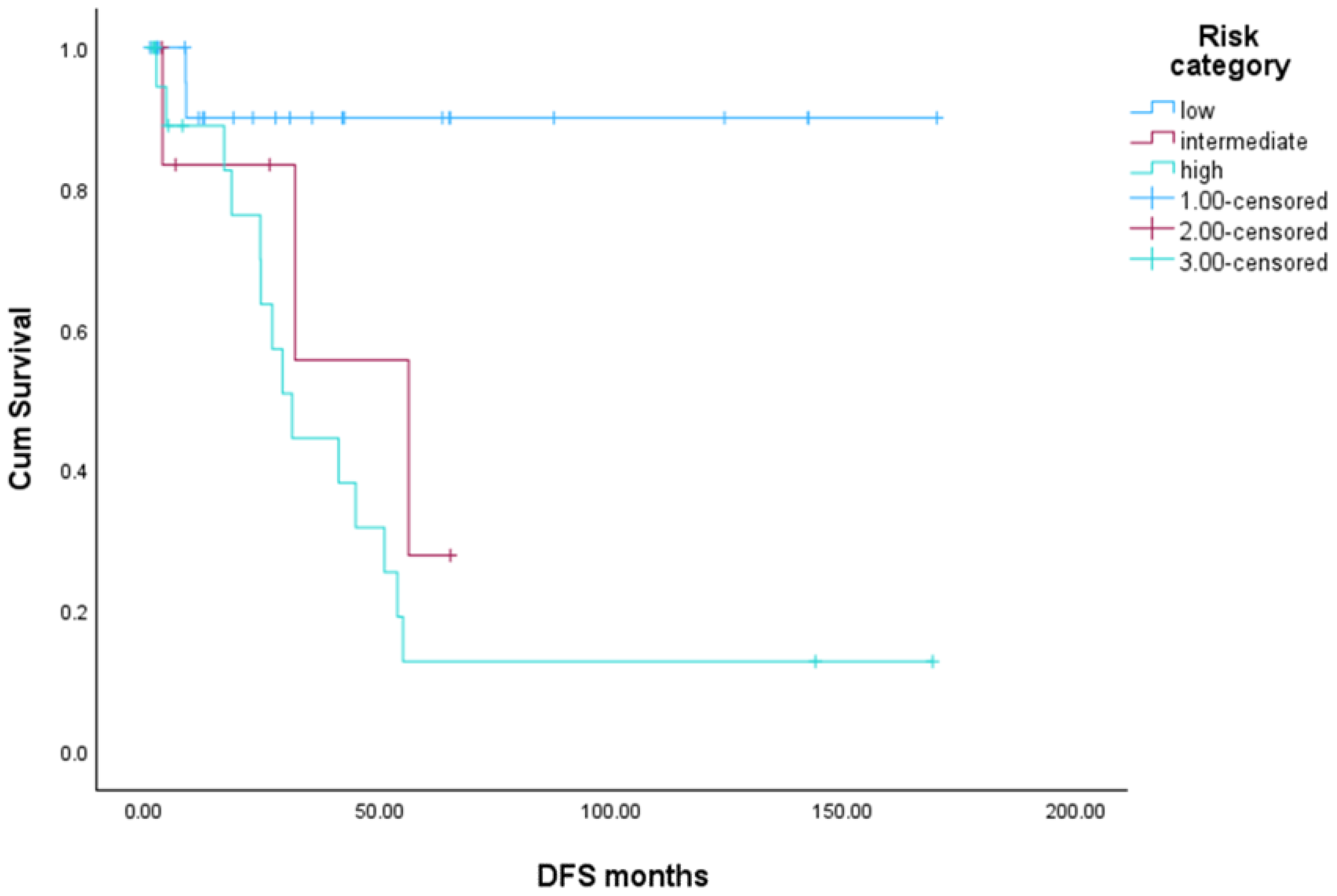
In contrast, risk category was strongly associated with DFS. Patients classified as low risk had a markedly prolonged mean DFS of 153.9 months (95% CI: 132.6–175.2) and a cumulative DFS of 92.0%, compared with intermediate-risk patients (mean DFS 42.9 months; 95% CI: 23.4–62.5; cumulative DFS 57.1%) and high-risk patients (mean DFS 48.1 months; 95% CI: 24.2–72.0; cumulative DFS 33.3%). These differences were statistically significant (p < 0.001) (Figure 1).
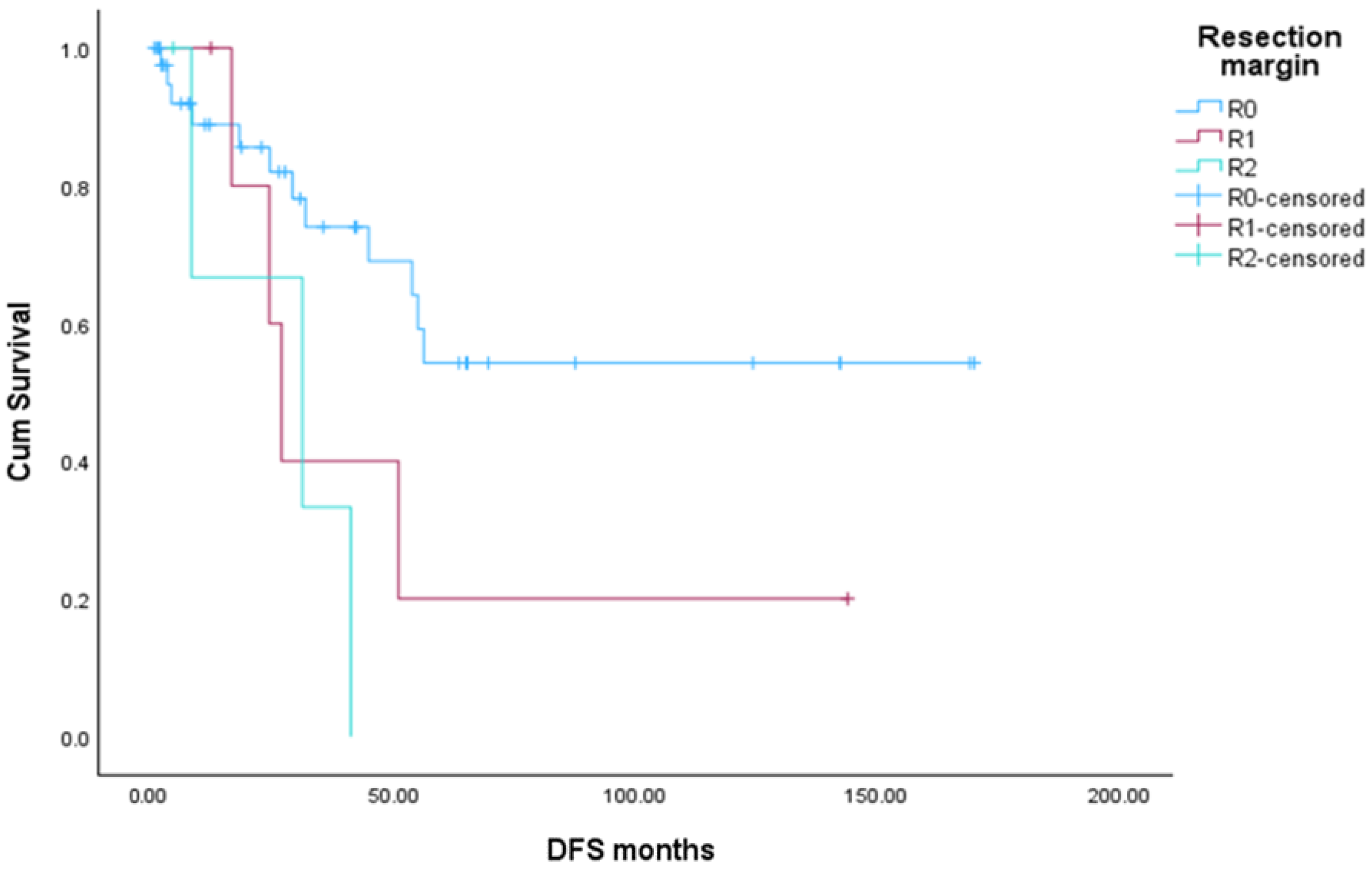
Similarly, resection margin status significantly influenced DFS. Patients who achieved R0 resection had a mean DFS of 107.0 months (95% CI: 79.6–134.4) and a cumulative DFS of 72.7%, whereas patients with R1 and R2 resections demonstrated progressively shorter DFS and lower cumulative DFS rates (33.3% and 25.0%, respectively). The difference among resection margin groups was statistically significant (p = 0.032) (Figure 2).
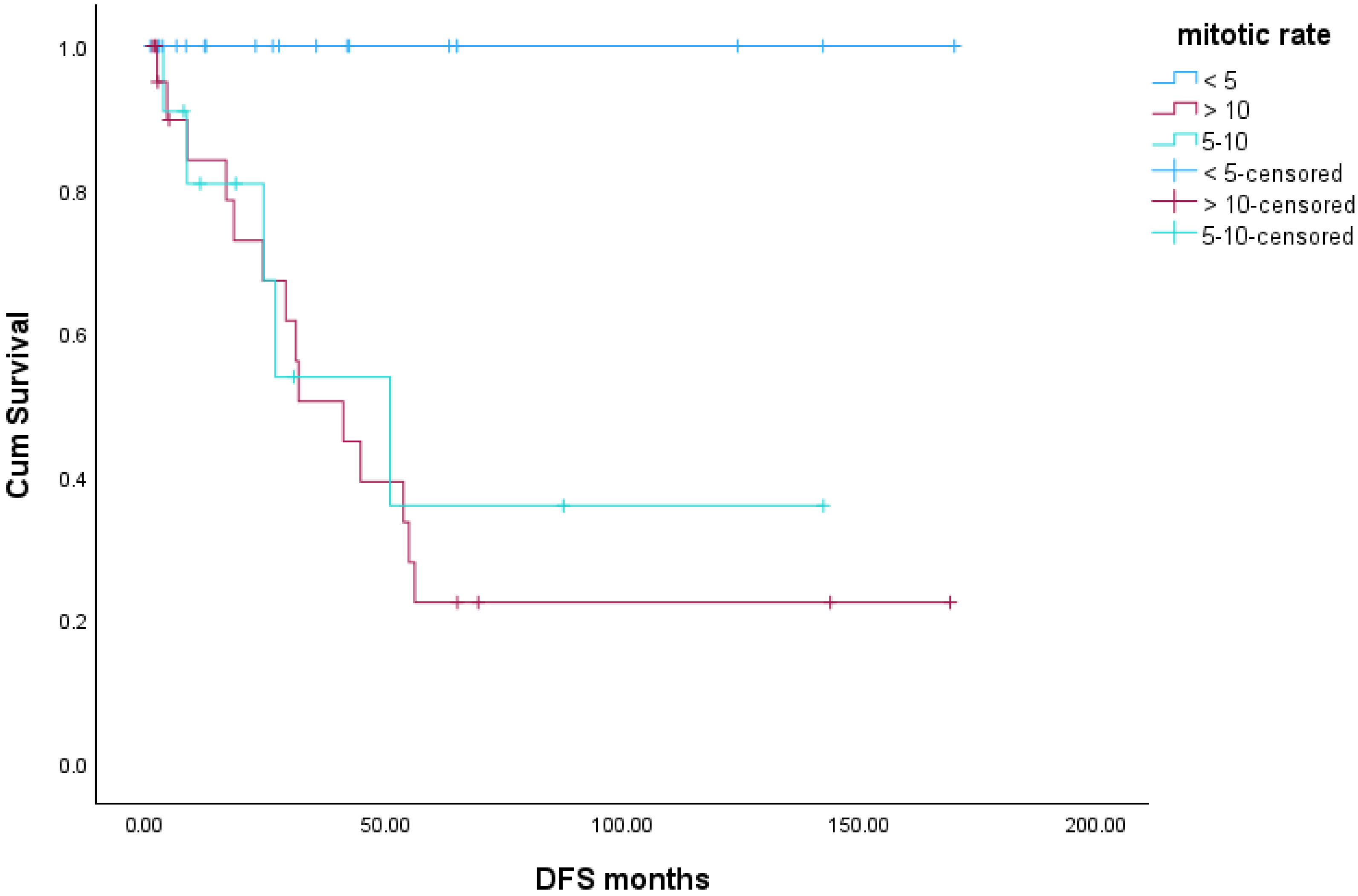
Regarding the mitotic rate, all patients with fewer than 5 mitoses per high-power field (HPF) were censored during follow-up, resulting in a cumulative DFS of 100%; therefore, mean DFS could not be calculated for this group. Patients with 5–10 mitoses per HPF and those with more than 10 mitoses per HPF exhibited cumulative DFS rates of 54.5% and 39.1%, respectively. The difference in DFS according to mitotic rate was statistically significant (p = 0.003) (Figure 3).

3. Discussion

In this retrospective cohort of patients with GISTs undergoing surgical resection, DFS was primarily influenced by tumor-related prognostic factors rather than patient demographics. Risk category, mitotic activity, and resection margin status were significantly associated with DFS, whereas age, sex, tumor location, and tumor size showed no statistically significant impact.
GISTs most commonly arise in the stomach (55.6%), followed by the small intestine (31.8%) [13], a distribution similar to our findings. Although GISTs can occur across all age groups, the disease predominantly affects older adults, with a median age at diagnosis typically between 60 and 65 years, in line with our findings and prior reports [14,15,16]. Importantly, emerging evidence suggests that the epidemiology of GIST is evolving [16,17]. A large population-based study demonstrated a sustained increase in GIST incidence over the past two decades, particularly for gastric and small intestinal tumors, across age, sex, racial and ethnic groups [16]. Persistent survival disparities among racial and ethnic minoritized populations further underscore the need to investigate underlying biological and health care-related factors [16,18].
The recurrence rate observed in our cohort was relatively high, with more than half of patients developing either local recurrence or distant metastases during follow-up. Previous studies have reported recurrence rates ranging from 23.5% to 50%, particularly among patients with high-risk tumors [19,20], suggesting that our findings are consistent with published data. Risk stratification is central to the management of resectable GIST, as it determines the need for adjuvant imatinib, which significantly improves recurrence-free survival [21]. Importantly, evidence from randomized trials has demonstrated that extending adjuvant imatinib therapy to 3 years, compared with 1 year, confers a significant overall survival benefit in patients with high-risk disease. Current guidelines therefore recommend at least 3 years of adjuvant therapy in patients with high-risk GIST, as defined by validated risk stratification models [10]. However, because many patients are cured by surgery alone, accurately identifying those who truly benefit from adjuvant therapy remains a key clinical challenge.
Among all variables analyzed, NIH risk classification emerged as the strongest predictor of DFS. Patients classified as low risk demonstrated excellent outcomes, with a cumulative DFS exceeding 90%, whereas intermediate- and high-risk patients experienced substantially shorter DFS. These findings are in line with prior studies validating the NIH criteria as a robust prognostic tool [20,22,23,24,25]. In a multicenter Chinese cohort spanning 17 years, only the modified NIH risk category independently predicted DFS after curative resection of gastric GISTs [26]. This supports the continued use of risk stratification to guide postoperative surveillance and adjuvant treatment decisions.
Mitotic activity was also strongly associated with DFS. Notably, no disease-related events were observed among patients with fewer than five mitoses per HPF during follow-up, reflecting the indolent behavior of tumors with low proliferative activity. In contrast, increasing mitotic rates were associated with progressively worse DFS, consistent with the established role of mitotic count as a marker of tumor aggressiveness in GIST [24,25,26,27].
Resection margin status significantly influenced DFS, with superior outcomes observed after R0 resection. Patients with R1 and R2 resections experienced progressively poorer DFS. As R1 resections in our study included cases of intraoperative tumor rupture, the inferior outcomes in this group may reflect the increased risk of peritoneal dissemination associated with tumor rupture, highlighting the importance of careful surgical handling and complete macroscopic resection. Data from both the European multicenter study [12] and the Oslo cohort [28] show that R1 resection does not independently affect recurrence in GIST. Tumor rupture, which often accompanies R1 margins, is the primary predictor of recurrence [28].
In contrast, age, sex, tumor size, and anatomical location were not significantly associated with DFS in our cohort. While gastric GISTs have been reported to exhibit a more favorable prognosis than non-gastric tumors [20,29], our results did not demonstrate a statistically significant difference, possibly due to sample size limitations or the heterogeneous distribution of risk categories across tumor sites. Previous studies have also described a slight male predominance in GIST incidence [20] and suggested male sex as an independent adverse prognostic factor [30]. However, this association was not confirmed in our analysis. Similarly, tumor size, widely recognized as a key prognostic determinant and a core component of contemporary risk stratification systems and guidelines [18,28], did not emerge as a significant predictor of DFS in our cohort, likely owing to interactions with other risk variables and the overall composition of the study population.
Immunohistochemical analysis confirmed high expression rates of CD117 and CD34, consistent with the typical diagnostic profile of GIST [31]. However, these markers were not evaluated as prognostic variables in the present study, as their primary role remains diagnostic rather than predictive of clinical outcome.
This study has several limitations, including its retrospective design, relatively small sample size, and single-center setting, which may limit generalizability. Additionally, an important limitation of this study is the absence of adjuvant imatinib therapy in the survival analysis. Detailed data regarding post-recurrence management were not available for this cohort of patients. Nevertheless, strengths include detailed pathological characterization, long-term follow-up in selected patients, and comprehensive analysis of established prognostic factors. The study provides clinically relevant insights into prognostic stratification after GIST resection and reinforces the central role of tumor biology in guiding postoperative management.

4. Materials and Methods

Fifty-four GIST patients with primary disease without metastasis were admitted and treated in our clinic during the past 15 years. The study cohort comprised consecutive patients fulfilling the predefined inclusion criteria during the study period, and follow-up was performed according to institutional protocol with regular clinical and radiological assessments. Patients initially presenting with metastatic lesions as well as patients who underwent adjuvant systemic therapy prior to surgical treatment were excluded from the study. Disease free survival (DFS) was calculated from the date of surgical intervention to the date of recurrence or death or last follow-up.
The National Institutes of Health (Fletcher) classification was used to classify patients into low, intermediate and high-risk for disease progression.
Prior to surgical treatment, all patients were evaluated: a full laboratory workup, computed tomography (CT) of the chest, the abdomen and the pelvis were performed. When indicated, upper or lower GIT endoscopies were performed. CT or ultrasound-guided biopsy are not part of the evaluation in our clinic as they may cause tumor rupture, hemorrhage and peritoneal seedling with negative impact on final outcome.
The treatment philosophy with regard to GIST emphasizes complete gross removal of the tumor (R0). Resections are classified as incomplete (R2) when the tumor is unresectable at exploration or when gross residual disease is present after resection and complete (R1, R0) when all gross diseases are excised regardless of microscopic margins.
When tumor rupture during intraoperative surgical manipulation occurred, resection was classified as an R1 resection regardless of microscopic margins, due to peritoneal seedling.
The histologic diagnosis of all tumors and immune-histochemical characteristics including expression of CD117 and CD34 were confirmed by experienced members of the pathology department in our clinic.

Statistical Analysis

Categorical variables are presented with numbers and percentages. Normality of distribution was tested by graphical and mathematical methods. Continuous variables were presented as means (±standard deviations) according to normality of distribution.
Tumor, patient and treatment variables were analyzed using Kaplan–Meier estimates to identify factors that predict survival and contribute to local tumor recurrence. Clinicopathological variables included in the analysis were selected a priori based on previously published literature and established prognostic relevance in GISTs.
The level of significance was set at 0.05. Statistical analysis was performed using the IBM SPSS 21 (Chicago, IL, USA, 2012) package.

5. Conclusions

Our study found that DFS in patients with gastrointestinal stromal tumors is predominantly determined by tumor biology and surgical completeness. Risk classification, mitotic activity, and resection margin status remain key determinants of prognosis and should guide postoperative management and surveillance strategies.

Author Contributions

Conceptualization, B.T., H.J. and B.C.; methodology, H.J., B.T. and I.N.; validation B.T., B.C., I.N. and H.J.; formal analysis, I.N., B.T. and H.J.; software, H.J., I.N. and B.T. investigation, J.G., I.N., H.J., B.T., S.T. and B.C.; data curation, H.J., B.C., B.T., J.G. and S.T.; resources, H.J., B.C., S.T. and B.T.; project administration, H.J., B.C., S.T., J.G. and B.T. writing—original draft, J.G., B.T., H.J., I.N. and B.C.; writing—review and editing, H.J., B.T., S.T., B.C., J.G. and I.N.; visualization, H.J., B.T., J.G., I.N. and S.T.; supervision, B.T. All authors have read and agreed to the published version of the manuscript.

Funding

This research received no external funding.

Institutional Review Board Statement

The study protocol was approved by the University Clinical Hospital Center Bezanijska Kosa ethics committee (protocol number 488, date 19 January 2024), according to the principles of the Declaration of Helsinki of 1975, as revised in 2008.

Informed Consent Statement

Not applicable.

Data Availability Statement

The data presented in this study are available on request from the corresponding author. The data are not publicly available due to privacy.

Acknowledgments

We would like to acknowledge the contribution of the board-certified pathologists at our institution for their assistance in the histopathological evaluation and immunohistochemical analysis of the study specimens.

Conflicts of Interest

The authors declare no conflicts of interest.

References

  1. El-Menyar, A.; Mekkodathil, A.A.; Al-Thani, H. Diagnosis and management of gastrointestinal stromal tumors: An up-to-date literature review. J. Cancer Res. Ther. 2017, 13, 889–900. [Google Scholar] [CrossRef]
  2. Ma, G.L.; Murphy, J.D.; Martinez, M.E.; Sicklick, J.K. Epidemiology of Gastrointestinal Stromal Tumors in the Era of Histology Codes: Results of a Population-Based Study. Cancer Epidemiol. Biomark. Prev. 2015, 24, 298–302. [Google Scholar] [CrossRef]
  3. Corless, C.L.; Barnett, C.M.; Heinrich, M.C. Gastrointestinal stromal tumours: Origin and molecular oncology. Nat. Rev. Cancer 2011, 11, 865–878. [Google Scholar] [CrossRef]
  4. Barbieri, M.A.; Sorbara, E.E.; Russo, G.; Cicala, G.; Franchina, T.; Santarpia, M.; Silvestris, N.; Spina, E. Neuropsychiatric Adverse Drug Reactions with Tyrosine Kinase Inhibitors in Gastrointestinal Stromal Tumors: An Analysis from the European Spontaneous Adverse Event Reporting System. Cancers 2023, 15, 1851. [Google Scholar] [CrossRef]
  5. Catalano, F.; Cremante, M.; Dalmasso, B.; Pirrone, C.; Lagodin D’Amato, A.; Grassi, M.; Comandini, D. Molecular Tailored Therapeutic Options for Advanced Gastrointestinal Stromal Tumors (GISTs): Current Practice and Future Perspectives. Cancers 2023, 15, 2074. [Google Scholar] [CrossRef]
  6. Pallio, S.; Crinò, S.F.; Maida, M.; Sinagra, E.; Tripodi, V.F.; Facciorusso, A.; Ofosu, A.; Conti Bellocchi, M.C.; Shahini, E.; Melita, G. Endoscopic Ultrasound Advanced Techniques for Diagnosis of Gastrointestinal Stromal Tumours. Cancers 2023, 15, 1285. [Google Scholar] [CrossRef]
  7. Miettinen, M.; Wa’El El-Rifai, L.; Sobin, H.; Lasota, J. Evaluation of malignancy and prognosis of gastrointestinal stromal tumors: A review. Hum. Pathol. 2002, 5, 478–483. [Google Scholar] [CrossRef] [PubMed]
  8. Miettinen, M.; Lasota, J. Gastrointestinal Stromal Tumors: Review on Morphology, Molecular Pathology, Prognosis, and Differential Diagnosis. Arch. Pathol. Lab. Med. 2006, 130, 1466–1478. [Google Scholar] [CrossRef]
  9. Blesius, A.; Cassier, P.A.; Bertucci, F.; Fayette, J.; Ray-Coquard, I.; Bui, B.; Adenis, A.; Rios, M.; Cupissol, D.; Pérol, D.; et al. Neoadjuvant imatinib in patients with locally advanced non metastatic GIST in the prospective BFR14 trial. BMC Cancer 2011, 11, 72. [Google Scholar] [CrossRef] [PubMed]
  10. Joensuu, H. KIT and PDGFRA variants and the survival of patients with gastrointestinal stromal tumor treated with adjuvant imatinib. Cancers 2023, 15, 3879. [Google Scholar] [CrossRef] [PubMed]
  11. Nishida, T.; Cho, H.; Hirota, S.; Masuzawa, T.; Chiguchi, G.; Tsujinaka, T.; Kinki GIST Study Group. Clinicopathological features and prognosis of primary GISTs with tumor rupture in the real world. Ann. Surg. Oncol. 2018, 25, 1961–1969. [Google Scholar] [CrossRef] [PubMed]
  12. Thibaut, F.; Veziant, J.; Warlaumont, M.; Gauthier, V.; Lefèvre, J.; Gronnier, C.; Bonnet, S.; Mabrut, J.Y.; Regimbeau, J.M.; Benhaim, L.; et al. Prognostic impact of positive microscopic margins (R1 resection) in patients with gastrointestinal stromal tumours: Results of a multicenter European study. Eur. J. Surg. Oncol. 2024, 50, 108310. [Google Scholar] [CrossRef] [PubMed]
  13. Søreide, K.; Sandvik, O.M.; Søreide, J.A.; Giljaca, V.; Jureckova, A.; Bulusu, V.R. Global epidemiology of gastrointestinal stromal tumours (GIST): A systematic review of population-based cohort studies. Cancer Epidemiol. 2016, 40, 39–46. [Google Scholar] [CrossRef]
  14. von Mehren, M.; Joensuu, H. Gastrointestinal stromal tumors. J. Clin. Oncol. 2018, 36, 136–143. [Google Scholar] [CrossRef]
  15. Joensuu, H.; Hohenberger, P.; Corless, C.L. Gastrointestinal stromal tumour. Lancet. 2013, 382, 973–983. [Google Scholar] [CrossRef]
  16. Alvarez, C.S.; Piazuelo, M.B.; Fleitas-Kanonnikoff, T.; Ruhl, J.; Pérez-Fidalgo, J.A.; Camargo, M.C. Incidence and survival outcomes of gastrointestinal stromal tumors. JAMA Netw. Open 2024, 7, e2428828. [Google Scholar] [CrossRef] [PubMed]
  17. Eskitzis, P.; Michou, V.; Theoti, R.; Antoniou, A.; Tsavlis, D.; Anestakis, D. Unraveling gastric and small intestine gastrointestinal stromal tumors: A review of our current knowledge. Gastrointest. Disord. 2024, 6, 842–857. [Google Scholar] [CrossRef]
  18. Ulanja, M.B.; Rishi, M.; Beutler, B.D.; Konam, K.G.; Ambika, S.; Hinojosa, T.; Djankpa, F.T.; Yang, W.; Gullapalli, N. Racial disparity in incidence and survival for gastrointestinal stromal tumors (GISTs): An analysis of the SEER database. J. Racial Ethn. Health Disparities 2019, 6, 1035–1043. [Google Scholar] [CrossRef]
  19. Plumb, A.A.; Kochhar, R.; Leahy, M.; Taylor, M.B. Patterns of recurrence of gastrointestinal stromal tumour (GIST) following complete resection: Implications for follow-up. Clin. Radiol. 2013, 68, 770–775. [Google Scholar] [CrossRef]
  20. Joensuu, H.; Vehtari, A.; Riihimäki, J.; Nishida, T.; Steigen, S.E.; Brabec, P.; Plank, L.; Nilsson, B.; Cirilli, C.; Braconi, C.; et al. Risk of recurrence of gastrointestinal stromal tumour after surgery: An analysis of pooled population-based cohorts. Lancet Oncol. 2012, 13, 265–274. [Google Scholar] [CrossRef]
  21. Dematteo, R.P.; Ballman, K.V.; Antonescu, C.R.; Maki, R.G.; Pisters, P.W.; Demetri, G.D.; Blackstein, M.E.; Blanke, C.D.; von Mehren, M.; Brennan, M.F.; et al. Adjuvant imatinib mesylate after resection of localised, primary gastrointestinal stromal tumour: A randomised, double-blind, placebo-controlled trial. Lancet 2009, 373, 1097–1104. [Google Scholar] [CrossRef]
  22. Bischof, D.A.; Kim, Y.; Dodson, R.; Jimenez, M.C.; Behman, R.; Cocieru, A.; Fisher, S.B.; Groeschl, R.T.; Squires, M.H.; Maithel, S.K.; et al. Conditional disease-free survival after surgical resection of gastrointestinal stromal tumors: A multi-institutional analysis of 502 patients. JAMA Surg. 2015, 150, 299–306. [Google Scholar] [CrossRef]
  23. Schmieder, M.; Henne-Bruns, D.; Mayer, B.; Knippschild, U.; Rolke, C.; Schwab, M.; Kramer, K. Comparison of different risk classification systems in 558 patients with gastrointestinal stromal tumors after R0-resection. Front. Pharmacol. 2016, 7, 504. [Google Scholar] [CrossRef]
  24. Feng, F.; Tian, Y.; Liu, S.; Zheng, G.; Liu, Z.; Xu, G.; Guo, M.; Lian, X.; Fan, D.; Zhang, H. Combination of PLR, MLR, MWR, and tumor size could significantly increase the prognostic value for gastrointestinal stromal tumors. Medicine 2016, 95, e3248. [Google Scholar] [CrossRef]
  25. Xu, S.J.; Zhang, S.Y.; Dong, L.Y.; Lin, G.S.; Zhou, Y.J. Dynamic survival analysis of gastrointestinal stromal tumors (GISTs): A 10-year follow-up based on conditional survival. BMC Cancer 2021, 21, 1170. [Google Scholar] [CrossRef] [PubMed]
  26. Yang, Z.; Feng, X.; Zhang, P.; Chen, T.; Qiu, H.; Zhou, Y.; Du, C.; Yin, X.; Pan, F.; Zheng, G.; et al. Clinicopathological outcomes and prognosis of elderly patients (≥65 years) with gastric gastrointestinal stromal tumors undergoing curative-intent resection: A multicenter data review. J. Gastrointest. Surg. 2019, 23, 904–913. [Google Scholar] [CrossRef] [PubMed]
  27. Zhang, H.; Liu, Q. Prognostic indicators for gastrointestinal stromal tumors: A review. Transl. Oncol. 2020, 13, 100812. [Google Scholar] [CrossRef]
  28. Hølmebakk, T.; Bjerkehagen, B.; Hompland, I.; Stoldt, S.; Boye, K. Relationship between R1 resection, tumour rupture and recurrence in resected gastrointestinal stromal tumour. Br. J. Surg. 2019, 106, 419–426. [Google Scholar] [CrossRef]
  29. Miettinen, M.; Lasota, J. Gastrointestinal stromal tumors: Pathology and prognosis at different sites. Semin. Diagn. Pathol. 2006, 23, 70–83. [Google Scholar] [CrossRef] [PubMed]
  30. Moga, D.F.; Vlădoiu, G.; Frățilă, A.M.; Dan, A.A.; Popa, D.; Oprea, V. Understanding gastric GIST: From pathophysiology to personalized treatment. J. Clin. Med. 2024, 13, 3997. [Google Scholar] [CrossRef]
  31. Miettinen, M.; Sobin, L.H.; Sarlomo-Rikala, M. Immunohistochemical spectrum of GISTs at different sites and their differential diagnosis with a reference to CD117 (KIT). Mod. Pathol. 2000, 13, 1134–1142. [Google Scholar] [CrossRef] [PubMed]
Figure 1. DFS of patients who underwent surgical resection in relation to risk category. Patients classified as low risk had a markedly prolonged mean DFS and a cumulative DFS, compared with intermediate-risk patients and high-risk patients.
Gastrointestdisord 08 00018 g001
Figure 2. DFS of patients who underwent surgical resection in relation to resection margin status. Patients with R1 and R2 resections demonstrated progressively shorter DFS and lower cumulative DFS rates.
Gastrointestdisord 08 00018 g002
Figure 3. DFS of patients who underwent surgical resection in relation to mitotic rate. Patients with 5–10 mitoses per HPF and those with more than 10 mitoses per HPF exhibited cumulative DFS rates of 54.5% and 39.1%, respectively.
Gastrointestdisord 08 00018 g003
Table 1. Demographic data of patients with gastrointestinal stromal tumors.
VariableCategoryNumber (%)
GenderMale27 (50.0%)
Female27 (50.0%)
Age (years) 60.9 ± 14.4
Tumor SiteStomach32 (49.0%)
Small intestine18 (33.1%)
Retroperitoneal4 (7.4%)
Mitotic count≤5/50 HPF24 (18.8%)
5–10/50 HPF14 (25.9%)
>10/50 HPF16 (29.6%)
CD117 Positive 50 (92.6%)
CD34 Positive 39 (72.2%)
Alpha-SMA Positive 26 (48.1%)
S-100 Positive 26 (48.1%)
Ki67 < 5% 6 (11.1%)
Ki67 > 5% 40 (74.1%)
Tumor size (cm)<2 cm3 (5.6%)
2–5 cm15 (27.8%)
5–10 cm19 (35.2%)
>10 cm17 (31.5%)
Risk categoryLow Risk25 (46.3%)
Intermediate Risk7 (13.0%)
High Risk22 (40.7%)
ResectionR044 (81.5%)
R16 (11.1%)
R24 (7.4%)
Recurrences (Total) 33 (61.1%)
Local Recurrence 16 (29.6%)
Distant Metastases (Liver) 17 (31.5%)
Table 2. Disease-free survival of patients with GIST who underwent resection in relation to risk factors (n = 54).
NumberMean DFS (Months, 95% CI)Cumulative DFS (%)p Value
Age (years)
<6011102.7 (45.8–159.6)72.70.508
≥604389.0 (62.3–115.7)62.8
Gender
Male2756.6 (28.1–85.2)59.30.056
Female27113.2 (82.5–143.9)70.4
Site
Gastric3161.1 (38.8–83.4)64.50.355
Others23105.5 (71.7–139.3)65.2
Size (cm)
<515135.1 (91.7–178.4)86.70.177
5–102470.9 (38.9–102.9)50.0
>101479.1 (40.7–117.5)64.3
Risk category
Low25153.9 (132.6–175.2)92.0<0.001
Intermediate742.9 (23.4–62.5)57.1
High2148.1 (24.2–72.0)33.3
Resection margin
R044107.0 (79.6–134.4)72.70.032
R1652.4 (11.0–93.8)33.3
R2426.7 (7.5–45.8)25.0
Mitotic rate (HPF)
<520b1000.003
5–1023b54.5
>1011b39.1
Disclaimer/Publisher’s Note: The statements, opinions and data contained in all publications are solely those of the individual author(s) and contributor(s) and not of MDPI and/or the editor(s). MDPI and/or the editor(s) disclaim responsibility for any injury to people or property resulting from any ideas, methods, instructions or products referred to in the content.