Article

Early Identification of Patients with Steroid Non-Response in Acute Severe Ulcerative Colitis: External Validation of the ASUC Score and Comparison with Established Prognostic Models


1
Gastroenterology Department, Unidade Local de Saúde Gaia Espinho, R. Conceição Fernandes S/N, 4434-502 Vila Nova de Gaia, Portugal
2
Department of Medical Sciences, University of Aveiro, 3810-193 Aveiro, Portugal
*
Author to whom correspondence should be addressed.
Gastrointest. Disord. 2026, 8(1), 15; https://doi.org/10.3390/gidisord8010015
Submission received: 2 November 2025 / Revised: 4 February 2026 / Accepted: 7 February 2026 / Published: 23 March 2026

Abstract

Background/Objectives: Acute severe ulcerative colitis (ASUC) affects up to one quarter of patients with ulcerative colitis and carries a substantial risk of colectomy. Early recognition of the need for escalation beyond intravenous (IV) corticosteroids is essential, yet most indices—such as the Oxford criteria—require reassessment on day 3, delaying rescue therapy. The ASUC score, based on admission albumin, C-reactive protein (CRP), endoscopic severity (Ulcerative Colitis Endoscopic Index of Severity, UCEIS), and pre-admission steroid use, was recently proposed to predict early escalation at admission. This study aimed to externally validate the ASUC score and compare its performance with established indices. Methods: We performed a single-center retrospective validation study including consecutive ASUC admissions (2015–2024). The primary outcome was escalation beyond IV steroids, defined as medical rescue therapy with infliximab or ciclosporin and/or colectomy during the index hospitalization. As a sensitivity analysis providing a more specific estimate of IV corticosteroid non-response, we repeated analyses restricting the outcome to medical rescue therapy alone. The model performance was assessed for discrimination (AUC and bootstrap-corrected 2000 resamples), calibration (intercept, slope, and Brier score), and clinical utility (decision-curve analysis). Comparator indices included Albumin-CRP-Endoscopy score (ACE), Admission Model for Acute Severe Colitis (ADMIT-ASC), Oxford Day 3, Lindgren, and Edinburgh. Predefined subgroup analyses (exploratory and underpowered) evaluated infection and biologic exposure. Results: Ninety-one admissions were included overall. The primary validation was performed in the infection-free cohort (n = 77), and infected cases (n = 14) were analyzed separately. In the infection-free cohort, 17/77 (22.1%) required escalation beyond IV steroids during the index hospitalization (medical rescue therapy and/or colectomy), and 5/91 (5.5%) underwent colectomy within 90 days. The ASUC score showed excellent discrimination (Area under the receiver-operating characteristic curve [AUC] 0.89, 95% Confidence Interval [CI] 0.81–0.95), good calibration (intercept 0.26, slope 1.29), and net clinical benefit across 30–50% thresholds. In the rescue-only sensitivity analysis, discrimination remained high (AUC 0.86, 95% CI 0.77–0.94). At a cut-off of ≥2, sensitivity 94% and specificity 78% outperformed other indices (AUC 0.62–0.83). Exploratory subgroup analyses were imprecise due to small sample sizes; discrimination was lower in the infected-only subgroup (AUC 0.71), and estimates in biologic-experienced patients were unstable because of severe imbalance. Conclusions: The ASUC score accurately identified patients likely to require escalation beyond IV steroids on the day of admission, outperforming or matching established day-3 indices. Its simplicity and reliability support its integration into early ASUC management to expedite rescue therapy and potentially improve outcomes.

1. Introduction

Ulcerative colitis is an immune-mediated disease of the colonic mucosa with potentially severe, life-threatening flares [1,2]. Approximately one in four patients will experience acute severe ulcerative colitis (ASUC), requiring hospitalization for intensive medical therapy or surgery [3,4]. Despite advances in management, up to 40% of patients fail to respond to intravenous corticosteroids and require rescue therapy with infliximab or ciclosporin, or colectomy [5,6]. Early identification of patients unlikely to respond to intravenous corticosteroids is essential to avoid treatment delays and prevent complications. However, commonly used tools, such as the Oxford criteria, depend on day-3 parameters, which can postpone escalation. Patients already receiving oral corticosteroids at admission represent a distinct, high-risk phenotype with increased likelihood of rescue or colectomy [7,8]. Because this feature is underrepresented in legacy scores, incorporating pre-admission steroid exposure can improve early risk stratification.
To address these limitations, Subhaharan et al. [9] proposed the ASUC score, a simple, admission-based score combining albumin, pre-admission steroid use, endoscopic severity (Ulcerative Colitis Endoscopic Index of Severity, UCEIS [10]), and C-reactive protein, to predict the need for escalation beyond IV corticosteroids at admission. In the derivation cohort (n = 194), the model showed good discrimination (AUC 0.776), and an ASUC threshold ≥2 identified a high-risk group with a high probability of requiring medical rescue therapy and increased odds of colectomy, supporting earlier escalation considerations. However, the ASUC score has not yet undergone independent external validation, and its calibration, decision-analytic utility, and comparative performance versus existing indices remain uncertain.
We aimed to externally validate the admission-based ASUC score for predicting escalation beyond IV corticosteroids at admission by assessing discrimination, calibration, and clinical utility (decision-curve analysis). A sensitivity analysis restricting the outcome to medical rescue therapy alone was prespecified to provide a more specific estimate of IV corticosteroid non-response. Secondary objectives were: (i) to perform model updating if miscalibration was detected; (ii) to benchmark the ASUC score against existing indices (ACE [11], ADMIT-ASC [12], Oxford Day 3 [13], Lindgren [14], and Edinburgh [15]); and (iii) to explore performance in predefined subgroups with superimposed infection (Cytomegalovirus or Clostridioides difficile) and biologic exposure at admission.

2. Results

2.1. Study Population

The validation cohort comprised 91 admissions meeting criteria for acute severe ulcerative colitis (ASUC). The primary validation cohort excluded admissions with superimposed infection (infection-free n = 77), while admissions with superimposed infection (n = 14) were analyzed separately as a predefined exploratory subgroup. UCEIS was documented contemporaneously in 23/91 admissions (25%) and retrospectively derived in 68/91 (75%). Fourteen cases (15%) had superimposed infection with Cytomegalovirus or Clostridioides difficile. Overall, 18/91 admissions (19.8%) required rescue escalation during the index hospitalization (medical rescue therapy and/or colectomy). In the primary infection-free cohort, 17/77 (22.1%) required rescue escalation. Medical rescue therapy was used in 16 admissions (13 infliximab; 3 ciclosporin), and four admissions underwent colectomy during the index hospitalization (with overlap between groups). Within 90 days, one additional colectomy occurred (overall 5/91, 5.5%), and three patients (3.3%) were readmitted. Demographic, clinical, endoscopic, and laboratory features are summarized in Table 1.
Formal hypothesis testing between patients with response and patients with non-response was intentionally avoided, as the aim was model validation rather than exploratory inference. Between-group standardized mean differences (SMDs) are shown in Supplementary Table S2. The most pronounced imbalances were found for pre-admission corticosteroid use (SMD 0.83) and stool frequency (SMD 0.81), both higher among patients with non-response. Moderate differences were observed for female sex (SMD 0.56), day-3 CRP (0.64), and UCEIS (0.57). Other variables, including age, disease duration, albumin, disease extent, and prior biologic exposure, showed negligible differences. Infectious co-triggers were uncommon and evenly distributed across groups.

2.2. The Performance of the ASUC Score

The ASUC score demonstrated excellent discrimination for predicting escalation beyond IV steroid non-response (medical rescue therapy and/or colectomy), with an AUC score of 0.89 [95% CI 0.81–0.95], bootstrap-corrected (2000 iterations). Model discrimination remained stable after internal validation and when restricted to each patient’s first hospitalization (AUC 0.82 [0.69–0.92]; calibration slope 1.64; intercept −4.13; Brier 0.12), confirming robustness.
Operating characteristics across candidate cut-offs are summarized in Table 2. The previously published Youden threshold (≥2) achieved high sensitivity (94%) and acceptable specificity (78%), providing the best balance for early clinical decision-making.
In a sensitivity analysis restricted to medical rescue therapy only (excluding colectomy), providing a more specific estimate of IV corticosteroid non-response, discrimination remained high (AUC 0.86 [95% CI 0.77–0.94]) and performance at ASUC ≥2 was similar (sensitivity 93%, specificity 76%, negative predictive value [NPV] 98%). Restricting the outcome reduced the number of events from 17/77 (22.1%) to 15/77 (19.5%), as two admissions underwent colectomy without prior medical rescue.

2.3. Calibration

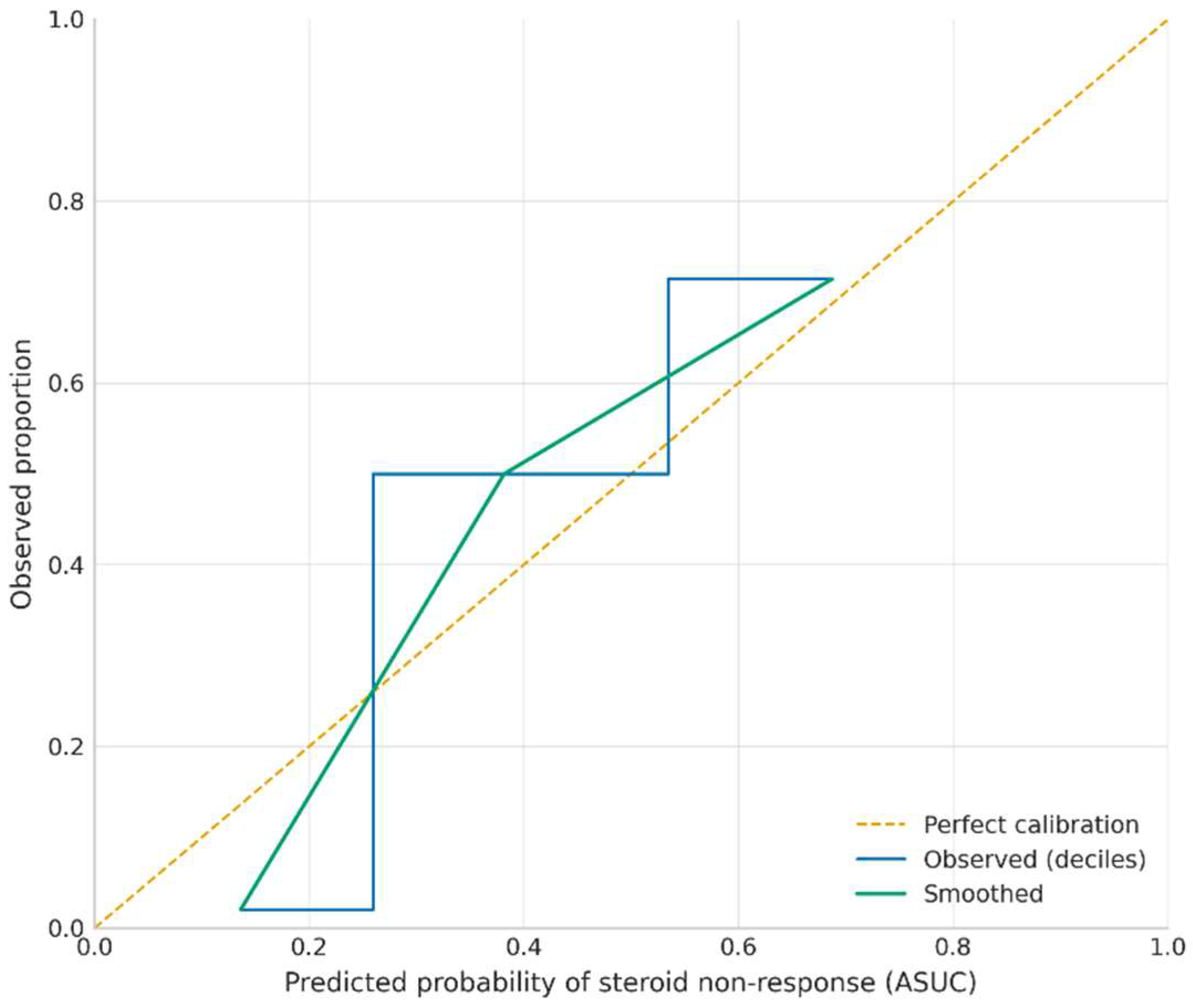
Calibration was adequate with an intercept of 0.26 and a slope of 1.29. The Brier score of 0.11 indicated good overall accuracy. The bootstrap-corrected calibration curve (Figure 1) showed close agreement between predicted and observed probabilities across deciles of risk.

2.4. Clinical Utility

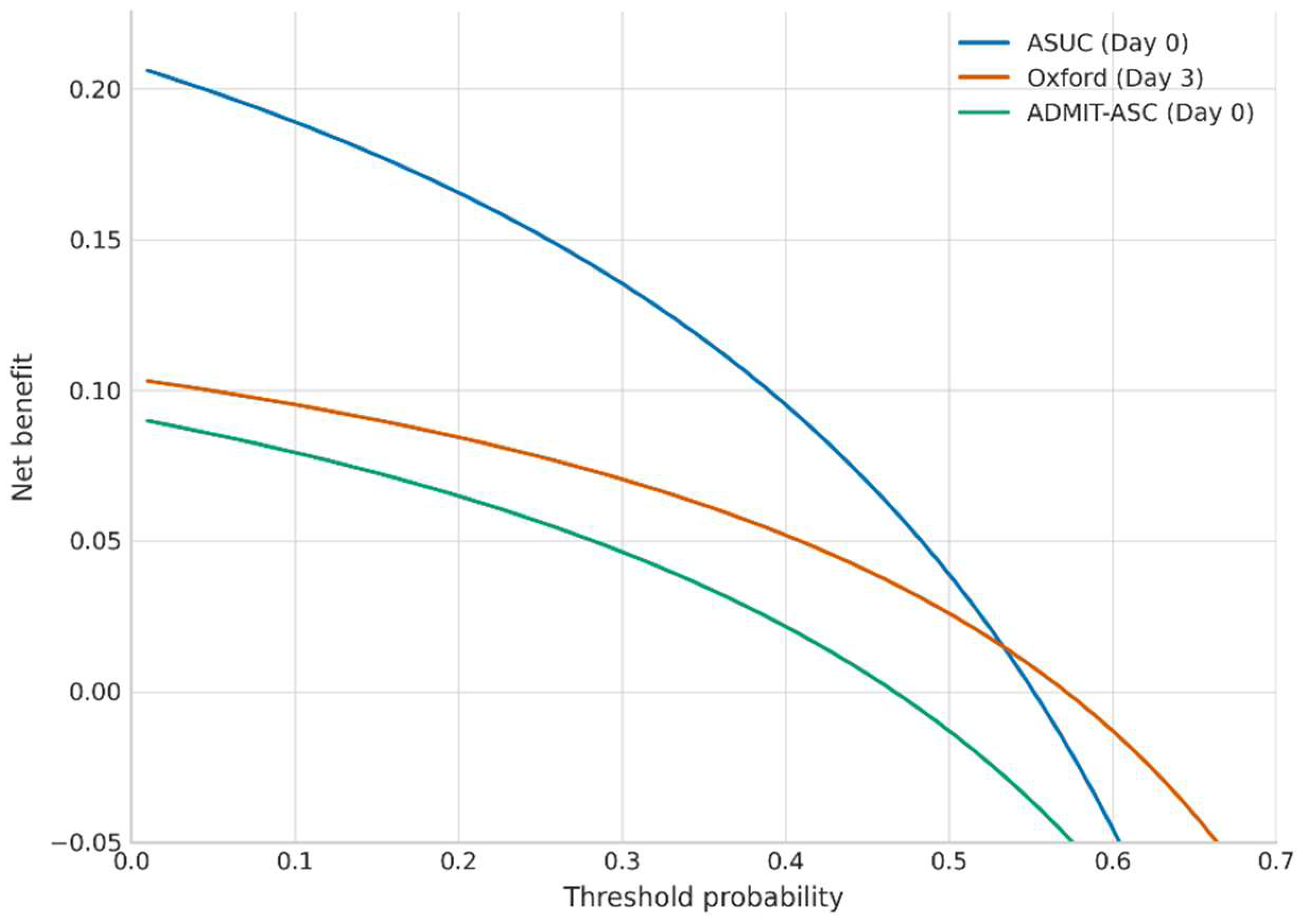
Decision-curve analysis (Figure 2) demonstrated the consistent net clinical benefit of the ASUC score across threshold probabilities between approximately 10–70%. Within this range, ASUC outperformed both “treat-all” and “treat-none” strategies, supporting its clinical usefulness for early risk stratification. Results were consistent in the first admission-only sensitivity analysis, confirming stability of the net benefit across decision thresholds. The net benefit values at representative 30%, 40%, and 50% thresholds are presented in Supplementary Table S3.

2.5. Misclassification Analysis

Only one false negative (ASUC < 2) was identified, characterized by high stool frequency but borderline systemic inflammation, suggesting a phenotype with marked mucosal but limited biochemical activity. False positives (ASUC ≥ 2 among patients with response) had higher UCEIS and CRP and lower albumin than true negatives, but adding these variables to the ASUC score did not materially improve discrimination (ΔAUC < 0.02), indicating that overcalls reflected threshold trade-offs rather than missing predictors.

2.6. Comparison with Oxford and Other Indices

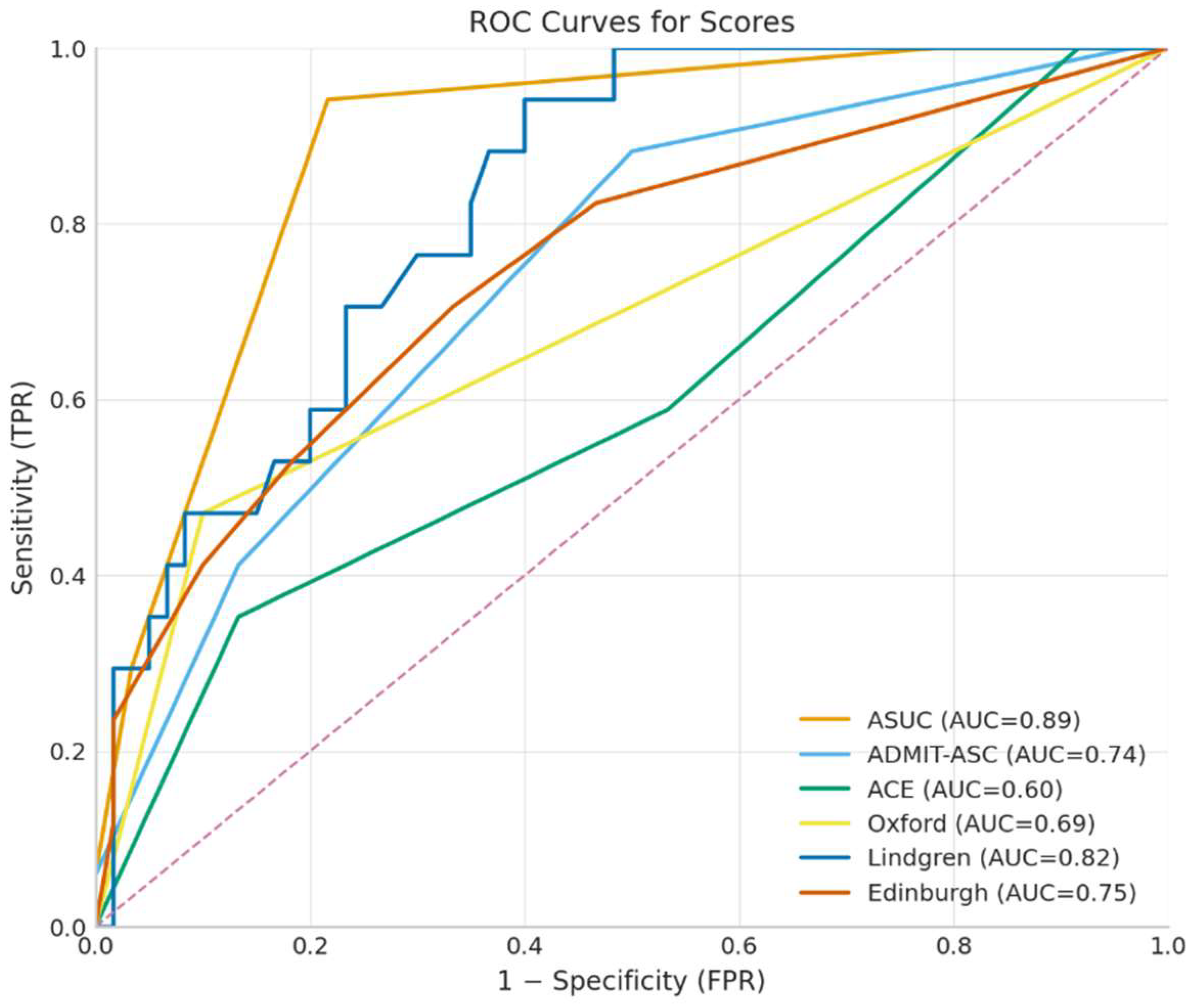
At published cut-offs (Table 3), the ASUC score showed the highest sensitivity (94%) with acceptable specificity (78%), whereas ADMIT-ASC and Oxford favored specificity (0.87–0.90) at the cost of sensitivity (0.41–0.47). Pairwise DeLong tests confirmed superior discrimination for the ASUC score compared with other indices (ΔAUC +0.25, p = 0.02 vs. ACE; +0.20, p = 0.04 vs. Oxford; +0.15, p = 0.06 vs. ADMIT-ASC), while differences versus Lindgren and Edinburgh were smaller (ΔAUC ≤ 0.08, Not Significant [NS])—Figure 3. Prevalence and non-response rates above each published cut-off are detailed in Supplementary Table S4.
Among ASUC false positives (n = 13), only 2 (15%) were Oxford-positive and eight (62%) ADMIT-positive, showing that most cases flagged early by ASUC would not have triggered escalation under Oxford-based criteria. Conversely, among true patients with non-response correctly identified by ASUC (n = 16), 9 (56%) were Oxford-negative, suggesting that an Oxford-only approach might delay rescue therapy in over half of such patients.
In a direct head-to-head comparison with the Oxford Day-3 criterion, ASUC ≥ 2 identified 16 of 17 patients with non-response (94%), versus eight (47%) by Oxford. Discordant pairs favored ASUC (9 vs. 1; McNemar p = 0.021), and the event- net reclassification index (NRI) = +0.47 (95% CI 0.21–0.73) confirmed superior early capture of true events. Decision-curve analysis (Figure 2) further demonstrated greater net clinical benefit for ASUC across decision thresholds between 30 and 50% predicted risk, whereas an ADMIT-ASC–based binary strategy performed below the “treat-none” reference.
Reclassification metrics (Supplementary Table S5) confirmed consistent improvement of ASUC over ADMIT-ASC and Oxford, supporting more accurate overall risk stratification.

2.7. Subgroup and Sensitivity Analyses

Subgroup sample sizes were small (patients/admissions with superimposed infection n = 14; patients with prior biologic exposure n = 16; patients without prior biologic exposure n = 75), so estimates should be interpreted cautiously. Including patients with intercurrent infection (Cytomegalovirus or Clostridioides difficile) caused only minor deterioration in overall model performance (AUC 0.89 → 0.88; slope 2.35 → 2.12; Brier 0.108 → 0.110). Within the subgroup with superimposed infection only, discrimination was lower (AUC 0.71), but this estimate is imprecise given the small sample size. Across biologic-exposure strata, discrimination was similar in patients without prior biologic exposure (n = 75, events = 14; AUC 0.86 [0.77–0.93]). In patients with prior biologic exposure (n = 16; events = 4), the apparent discrimination was very high; however, this estimate is statistically unstable and likely optimistic due to severe class imbalance and quasi-complete separation. Consequently, calibration parameters could not be reliably estimated, and these subgroup results should be interpreted as exploratory and underpowered, rather than evidence of differential model performance. Detailed subgroup metrics are reported in Supplementary Table S7.
Formal interaction testing between ASUCs and biologic exposure was underpowered and uninformative and is not interpreted as evidence for or against effect modification.

3. Discussion

This study provided the first independent external validation of the admission-based ASUC score and confirmed its strong ability to predict corticosteroid non-response at hospital admission. Applied to a real-world cohort, the model demonstrated excellent discrimination (AUC 0.89), good calibration, and consistent clinical benefit across decision thresholds. Importantly, when the outcome was restricted to medical rescue therapy alone (rescue-only sensitivity analysis), performance remained high, providing a more specific estimate for IV corticosteroid non-response. Together, these results showed that accurate risk stratification in acute severe ulcerative colitis (ASUC) was achievable from admission data alone, allowing earlier, evidence-based escalation planning without waiting for day-3 reassessment. Our findings validated and extended the original derivation by Subhaharan et al. [9], who reported an AUC score of 0.78 and showed that patients scoring ≥ 2 were at high risk of steroid failure and colectomy. Differences in case mix and local practice—lower event prevalence, consistent endoscopic scoring, and standardized rescue thresholds—likely explain the slightly higher discrimination observed here, rather than model overfitting. In addition, the primary endpoint was a composite of medical rescue (infliximab/ciclosporin) and colectomy, which represent different escalation pathways and decision thresholds. Therefore, between-center variation in when to initiate rescue therapy and when to proceed to surgery may influence event prevalence, predictive values, and calibration, and could partly affect apparent model performance in other settings. Accordingly, model performance (particularly calibration and the practical implications of a given cut-off) may differ in healthcare systems and centers with different admission pathways, endoscopy timing/scoring practices, and rescue selection thresholds.
Corticosteroid failure remains common in ASUC, yet conventional indices, such as the Oxford criteria, identify patients with non-response only after 72 h. The ASUC score provides an earlier, pragmatic framework for treatment planning. In our cohort, ASUC ≥ 2 identified 94% of true patients with non-response compared with 47% by the Oxford index, suggesting that nearly half of eventual rescue candidates would not be flagged under day-3 criteria. This time advantage could shorten delays to infliximab or ciclosporin and reduce colectomy risk. The ASUC score also outperformed or matched comparator indices (ACE AUC 0.62; ADMIT-ASC 0.74; Lindgren 0.83; Edinburgh 0.80). Incorporating pre-admission steroid use—an indicator of refractory disease—clearly strengthened discrimination. Reclassification analyses (NRI ≈ 1.0; IDI ≈ 0.2) further confirmed superior individual-level stratification over ADMIT-ASC and Oxford. Misclassification analysis clarified the model’s clinical behavior. Only one false negative (ASUC < 2) was observed—an inflammatory phenotype with high stool frequency but limited systemic response, a limitation shared by all CRP-based indices. False positives (ASUC ≥ 2 among responders) had higher UCEIS and CRP and lower albumin than true negatives, but adding these variables individually did not improve discrimination (ΔAUC < 0.02).
Such overestimation reflects the sensitivity–specificity balance rather than missing predictors. Clinically, these patients likely represent borderline high-risk cases warranting closer observation and early senior/multidisciplinary discussion; however, ASUC ≥ 2 should be viewed as an early risk stratifier, rather than an automatic trigger for immediate rescue therapy. If a patient with ASUC ≥ 2 demonstrates clear clinical improvement by day 3 (Oxford Criteria), escalation should not be reflexive, and continued intravenous steroids with close monitoring and standard day-3 response reassessment are appropriate, reserving rescue for persistent severe disease or a plateau/worsening trajectory. Calibration showed close agreement between predicted and observed probabilities (intercept 0.26, slope 1.29), indicating no systematic miscalibration; formal model updating was therefore unnecessary. Bootstrap correction and sensitivity analysis limited to first admissions produced comparable results, confirming robustness. Results were consistent in sensitivity analyses, excluding colectomy and defining non-response as medical rescue therapy only (AUC 0.86; sensitivity 93% and specificity 76% at ASUC ≥ 2).
Including patients with intercurrent infection had little effect on overall performance (AUC 0.89 → 0.88; Brier 0.108 → 0.110). However, subgroup analyses were prespecified but exploratory and underpowered (infected n = 14; biologic-experienced n = 16), so estimates should be interpreted cautiously. Within the small infected-only subgroup, discrimination was lower (AUC 0.71), but this estimate is imprecise given the small sample size. In biologic-naïve patients, discrimination remained good (AUC 0.86), consistent with the overall cohort. In biologic-experienced patients, however, subgroup estimates were too imprecise for inference: the small and imbalanced sample produced apparent over-performance driven by quasi-complete separation, precluding reliable calibration assessment. Accordingly, these findings should be regarded as exploratory and require confirmation in larger, adequately powered cohorts, rather than evidence of superior or differential performance by biologic exposure. Interaction testing in these strata was underpowered and is not interpreted as evidence for or against effect modification.
These findings are consistent with prior evidence linking hypoalbuminemia, elevated CRP, and severe endoscopic activity to steroid failure [6,7]. More recent work from the ADMIT-ASC consortium emphasized similar variables but omitted steroid exposure; our results show that integrating this clinical dimension refines early risk prediction [12]. The ASUC score thus consolidates established predictors into a single, easily applied admission-day tool, translating long-standing observations into actionable early decision support.
From a clinical perspective, disease extent is also often considered relevant for steroid non-response and colectomy; however, extent is not directly captured by UCEIS, which reflects endoscopic severity rather than anatomic distribution. In our cohort, extent (E3 vs. non-E3) showed negligible imbalance between patients with response and patients with non-response (SMD 0.12; Supplementary Table S2), and we, therefore, did not identify a clear signal of prognostic contribution beyond severity and systemic inflammation in this validation sample. Because our objective was external validation of a prespecified score, we did not perform formal predictor–outcome testing or model expansion; larger cohorts are needed to determine whether incorporating extent provides incremental predictive value.
In practical terms, an AUC score of 0.89 means the score correctly distinguishes roughly nine of ten pairs of patients with response vs. non-response, a level of accuracy rarely achieved by clinical indices alone. Decision-curve analysis confirmed consistent net benefit across thresholds between 30% and 50%, the range where escalation decisions are most uncertain. The observed gain corresponds to identifying approximately one additional patient with non-response per 10–15 patients without unnecessary rescue. Because the model uses routine laboratory and endoscopic data, it can be integrated into admission workflows to prompt early rescue escalation planning.
Key strengths include adherence to Transparent Reporting of a multivariable prediction model for Individual Prognosis Or Diagnosis (TRIPOD) [16] standards, near-complete data capture, and comprehensive assessment of discrimination, calibration, and decision-analytic performance. The single-center design and modest sample size limited the precision of prespecified subgroup estimates and precluded reliable subgroup calibration assessment, and colectomy was infrequent (n = 5), preventing separate modeling of this component. In addition, our structured inpatient pathway (including consistent endoscopic assessment and standardized rescue decision-making) may limit transportability to settings with different endoscopy protocols and more heterogeneous thresholds for infliximab, ciclosporin, or early surgery, where event prevalence and predictive values may differ. Another limitation concerns UCEIS scoring: although inter-observer agreement was excellent, many scores were derived retrospectively from endoscopy reports and stored images, which may introduce measurement variability. However, scoring was performed blinded to outcomes, so any residual misclassification is likely to be largely non-differential and would tend to attenuate associations and apparent model performance rather than inflate them. Overall, consistent findings across sensitivity analyses support the model’s stability. Broader multicenter validation and prospective evaluation of ASUC-guided escalation algorithms are warranted to confirm transportability and quantify clinical impact.

4. Materials and Methods

4.1. Study Design, Setting and Reporting Framework

This was a single-center, retrospective cohort study conducted at Unidade Local de Saúde Gaia-Espinho, including consecutive ASUC admissions between 2015 and 2024.
Reporting followed TRIPOD recommendations. Risk of bias was appraised using Prediction model Risk Of Bias ASsessment Tool (PROBAST) [17]. Because cohort assembly was simple and explicitly described in the text, a separate flow diagram was deemed unnecessary.

4.2. Participants

Adults (≥18 years) admitted with acute severe ulcerative colitis, defined by modified Truelove & Witts criteria (≥6 bloody stools/day plus ≥1 systemic marker: heart rate > 90 bpm, temperature > 37.8 °C, hemoglobin < 105 g/L, or C-reactive protein [CRP] > 3 mg/dL), were consecutively included. We excluded Crohn’s disease, inflammatory bowel disease (IBD)-unclassified, ischemic or infectious colitis, pregnancy, and non-ASUC admissions. Readmissions within 90 days for the same flare were considered a single episode. Patients with superimposed infection (Cytomegalovirus or Clostridioides difficile) were excluded from the primary validation cohort and analyzed separately as a predefined exploratory “infected” subgroup. This exclusion was prespecified primarily on pathophysiological grounds: CMV colitis and C. difficile infection can mimic or exacerbate an ASUC flare and drive symptoms and systemic inflammation through partially distinct mechanisms, potentially altering corticosteroid responsiveness and the predictor–outcome relationship (particularly for CRP and endoscopic severity). Moreover, excluding superimposed infection is embedded in standard ASUC diagnostic pathways and aligns with the intended use of most prognostic indices developed for immune-mediated ASUC flares. To preserve a clinically coherent target condition for validation (immune-mediated ASUC), we therefore performed the primary validation in an infection-free cohort and then quantified the impact of this real-world heterogeneity in prespecified subgroup and sensitivity analyses.

4.3. Data Collection and Inpatient Management

For each admission, demographics, disease history (extent, duration, and prior therapies), vital signs, stool frequency, and rectal bleeding were recorded. At admission (day 0), the institutional protocol included laboratory testing (CRP, albumin, complete blood count, electrolytes, and renal function), abdominal radiography, stool testing for C. difficile, and flexible sigmoidoscopy with biopsies for CMV. Management followed international guidelines, including high-dose IV corticosteroids, IV fluids, nutritional support, and thromboprophylaxis. Corticosteroid response was assessed on day 3 using the Oxford criteria [9]. Steroid-refractory cases received rescue therapy (infliximab or ciclosporin) and/or underwent colectomy after multidisciplinary review. The choice of medical rescue (infliximab vs. ciclosporin) and the timing of surgery were individualized based on clinical trajectory and patient-specific factors (e.g., contraindications and prior treatment exposure).

4.4. Outcomes

The primary outcome was escalation beyond IV corticosteroid during the index hospitalization, defined as the need for medical rescue therapy with ciclosporin or infliximab and/or colectomy. Secondary outcomes were 90-day colectomy and readmission rates. As a sensitivity analysis providing a more specific estimate of IV corticosteroid non-response, the primary outcome was redefined as need for medical rescue therapy only (excluding colectomy).

4.5. Index Calculation

The ASUC score was calculated at admission using four binary predictors (albumin ≤ 3 g/dL, CRP ≥ 10 mg/dL, UCEIS ≥ 7, and ongoing oral corticosteroid use), assigning 1 point each (range 0–4), as described by Subhaharan et al. For benchmarking, the ACE, ADMIT-ASC (day 0), Oxford Day 3 , Lindgren, and Edinburgh indices were computed per their original definitions and intended timepoints. Indices requiring non-routine variables (e.g., procalcitonin, day-3 albumin, infliximab troughs, fecal calprotectin, or segmental UCEIS) were not assessed due to missingness or lack of standardization. Definitions and components of all prognostic indices are summarized in Supplementary Table S1.

4.6. Endoscopic Scoring

UCEIS was documented contemporaneously in 23/91 admissions (25%). For the remaining 68/91 (75%), two experienced endoscopists, blinded to outcomes, retrospectively derived UCEIS subscores (vascular pattern, bleeding, and erosions/ulcers) from the original endoscopy reports and stored images using the published UCEIS descriptors. When one or more subscores were not explicitly recorded as such, narrative descriptions and available images were used to derive the missing component(s), as routine reporting in our unit typically captured the elements required for UCEIS scoring. Disagreements were resolved by consensus; no statistical imputation was performed for endoscopic subscores. The Mayo Endoscopic Subscore (MES) was routinely documented contemporaneously in endoscopy reports throughout the study period.

4.7. Statistical Analysis

Analyses prioritized performance estimation over hypothesis testing. All performance analyses were complete cases (predictor missingness < 5%). Continuous variables were summarized as mean ± SD or median [IQR], categorical as n (%). For each index, we evaluated:
  • Discrimination: Area under the ROC curve (AUC) with 95% CIs from 2000-bootstrap resamples, and pairwise AUC score comparisons used the DeLong test.
  • Calibration: Calibration-in-the-large (intercept), calibration slope, and bootstrap-corrected smooth calibration plots. Intercept/slope updating was prespecified if systematic miscalibration occurred.
  • Clinical utility: Decision-curve analysis (DCA), quantifying net benefit across 10–70% threshold probabilities for early rescue escalation, with bootstrap smoothing (2000 resamples).
Operating characteristics (sensitivity, specificity, PPV, NPV, LR+, and LR−) were computed for published cut-offs using exact 95% CIs (Clopper–Pearson/Wilson). The published ASUC threshold (≥2) was prespecified for operating characteristic analyses. Reclassification metrics (NRI/IDI) were exploratory.
Prespecified subgroup analyses evaluated model performance (discrimination, calibration, and DCA) according to biologic exposure at admission and infection status. Given small subgroup sizes, these analyses were exploratory and underpowered, and estimates are interpreted cautiously. Interaction testing was exploratory and is not interpreted as evidence for or against effect modification. A sensitivity analysis was restricted to the first hospitalization per patient to ensure independence of observations. Analyses used SPSS v25 and R v4.2.3. Two-sided p < 0.05 was considered significant only for non-exploratory tests.

5. Conclusions

The ASUC score accurately identifies patients at high risk of escalation beyond IV steroids on the day of admission, outperforming traditional indices that depend on day-3 data. Its simplicity, reproducibility, and demonstrated clinical utility make it a strong candidate for incorporation into early management pathways for acute severe ulcerative colitis, where timely rescue therapy remains essential to prevent avoidable colectomy and improve outcomes.

Supplementary Materials

The following supporting information can be downloaded at: https://www.mdpi.com/article/10.3390/gidisord8010015/s1; Supplementary Table S1. Definitions and components of prognostic indices for corticosteroid response in acute severe ulcerative colitis; Supplementary Table S2. Between-group effect sizes for baseline variables (patients with non-response vs. patients with response) in the complete cohort; Supplementary Table S3. Net benefit values at 30%, 40%, and 50% risk thresholds; Supplementary Table S4. Prevalence and event rate above published cut-offs for each prognostic index; Supplementary Table S5. Category-free Net Reclassification Index (NRI) and Integrated Discrimination Improvement (IDI) for ASUC versus ADMIT-ASC and Oxford; Supplementary Table S6. Calibration and discrimination of the ASUC score by infection status; Supplementary Table S7. Calibration and discrimination of the ASUC score in biologic-naïve and biologic-experienced patients; Supplementary Table S8. Sensitivity analysis restricted to the first hospitalization per patient; Figure S1. A calibration plot for the ASUC score (restricted to first admission per patient); Figure S2. Decision-curve analysis (restricted to first admission per patient).

Author Contributions

Conceptualization, Methodology and Formal Analysis: P.M., R.P., J.C.S., and A.P.; Software: P.M.; Validation and Supervision: R.P., A.P., and T.F.; Investigation: P.M., J.C., A.P., C.C., P.T., and R.F.; Resources: T.F.; Data curation and Writing—Original Draft Preparation: P.M.; Writing—Review and Editing: all authors; Visualization: P.M. and A.P.; Project administration: A.P. and R.P. All authors have read and agreed to the published version of the manuscript.

Funding

This research received no external funding.

Institutional Review Board Statement

This study was approved by the Institutional Ethics Committee of Unidade Local de Saúde Gaia-Espinho (2025-422468191692206e4f2787) and conducted in accordance with the Declaration of Helsinki and applicable national data-protection regulations.

Informed Consent Statement

Owing to the retrospective design and use of routinely collected clinical data, informed consent was waived.

Data Availability Statement

The original contributions presented in this study are included in the article. Further inquiries can be directed to the corresponding author.

Conflicts of Interest

The authors declare no conflicts of interest.

Abbreviations

The following abbreviations are used in this manuscript:
5-ASA5-Aminosalicylate
ACEAlbumin-CRP-Endoscopy score
ADAAdalimumab
ADMIT-ASCAdmission Model for Acute Severe Colitis
ASUCAcute Severe Ulcerative Colitis
AUCArea under the receiver–operating characteristic curve
AZAAzathioprine
Brier scoreMean squared error of predicted probabilities
CIConfidence interval
CMVCytomegalovirus
CRPC-reactive protein
CTComputed tomography
DDay (as in D0, D3)
DCADecision-curve analysis
FPFalse positive
FNFalse negative
IBDInflammatory bowel disease
IDIIntegrated Discrimination Improvement
IQRInterQuartile Range
IVIntravenous
LR+/LRPositive/Negative likelihood ratio
MESMayo Endoscopic Subscore
NRINet Reclassification Index
NPVNegative predictive value
PPVPositive predictive value
PROBASTPrediction model Risk Of Bias ASsessment Tool
ROCReceiver operating characteristic
SMDStandardized mean difference
TRIPODTransparent Reporting of a multivariable prediction model for Individual Prognosis or Diagnosis
UCEISUlcerative Colitis Endoscopic Index of Severity
UCUlcerative colitis
ULSGEUnidade Local de Saúde Gaia-Espinho

References

  1. Le Berre, C.; Honap, S.; Peyrin-Biroulet, L. Ulcerative colitis. Lancet 2023, 402, 571–584. [Google Scholar] [CrossRef] [PubMed]
  2. Raine, T.; Bonovas, S.; Burisch, J.; Kucharzik, T.; Adamina, M.; Annese, V.; Bachmann, O.; Bettenworth, D.; Chaparro, M.; Czuber-Dochan, W.; et al. ECCO Guidelines on Therapeutics in Ulcerative Colitis: Medical Treatment. J. Crohn’s Colitis 2022, 16, 2–17. [Google Scholar] [CrossRef] [PubMed]
  3. Rubin, D.T.; Ananthakrishnan, A.N.; Siegel, C.A.; Barnes, E.L.; Long, M.D. ACG Clinical Guideline Update: Ulcerative Colitis in Adults. Am. J. Gastroenterol. 2025, 120, 1187–1224. [Google Scholar] [CrossRef] [PubMed]
  4. Vuyyuru, S.K.; Alphonsus, L.; De Silva, T.A.; Solitano, V.; Guizzetti, L.; Ponich, T.; Beaton, M.; Gregor, J.; Yan, B.; Sey, M.; et al. Day 3 Oxford criteria predict steroid non-response for acute severe ulcerative colitis in the post-biologic era. J. Crohn’s Colitis. 2025, 19, jjaf131. [Google Scholar] [CrossRef] [PubMed]
  5. Angkeow, J.; Rothman, A.; Chaaban, L.; Paul, N.; Melia, J. Systematic Review: Outcome Prediction in Acute Severe Ulcerative Colitis. Gastro Hep Adv. 2024, 3, 260–270. [Google Scholar] [CrossRef] [PubMed]
  6. Jamal, F.; Ivanov, M.; Elmasry, S.; Gonzalez, A.J.; Malik, T.A. Acute Severe Ulcerative Colitis (ASUC): Clinical Features, Initial Management, and the Role of Advanced Therapies. Biomedicines 2025, 13, 2544. [Google Scholar] [CrossRef] [PubMed]
  7. Moran, G.W.; Gordon, M.; Sinopolou, V.; Radford, S.J.; Darie, A.M.; Vuyyuru, S.K.; Alrubaiy, L.; Arebi, N.; Blackwell, J.; Butler, T.D.; et al. British Society of Gastroenterology guidelines on inflammatory bowel disease in adults: 2025. Gut 2025, 74, s1–s101, Correction in Gut 2025, 74, e20. [Google Scholar] [CrossRef] [PubMed]
  8. Barnes, A.; Spizzo, P.; Mountifield, R. Corticosteroid exposure prior to admission and predicting need for rescue therapy in acute severe ulcerative colitis. Intern. Med. J. 2022, 52, 828–833. [Google Scholar] [CrossRef] [PubMed]
  9. Deloshaan, S.; Pradeep, K.R.; Dheeraj, S.; Hadi, M.; Maneesha, B.; Naveed, I.; Carolyn, M.; John, E.; Waled, M. P069 Admission steroid use, serum albumin and endoscopic severity predict intravenous steroid failure in patients with acute severe ulcerative colitis. Am. J. Gastroenterol. 2020, 115, S18. [Google Scholar] [CrossRef] [PubMed]
  10. Travis, S.P.L.; Schnell, D.; Krzeski, P.; Abreu, M.T.; Altman, D.G.; Colombel, J.-F.; Feagan, B.G.; Hanauer, S.B.; Lémann, M.; Lichtenstein, G.R.; et al. Developing an instrument to assess the endoscopic severity of ulcerative colitis: The Ulcerative Colitis Endoscopic Index of Severity (UCEIS). Gut 2012, 61, 535–542. [Google Scholar] [CrossRef] [PubMed]
  11. Grant, R.K.; Jones, G.R.; Plevris, N.; Lynch, R.W.; Jenkinson, P.W.; Lees, C.W.; Manship, T.A.; Jagger, F.A.M.; Brindle, W.M.; Shivakumar, M.; et al. The ACE (Albumin, CRP and Endoscopy) index in acute colitis: A simple clinical index on admission that predicts outcome in patients with acute ulcerative colitis. Inflamm. Bowel Dis. 2021, 27, 451–457. [Google Scholar] [CrossRef] [PubMed]
  12. Adams, A.; Gupta, V.; Mohsen, W.; Chapman, T.P.; Subhaharan, D.; Kakkadasam Ramaswamy, P.; Kumar, S.; Kedia, S.; McGregor, C.G.; Ambrose, T.; et al. Early management of acute severe UC in the biologics era: Development and international validation of a prognostic clinical index to predict steroid response. Gut 2023, 72, 433–442. [Google Scholar] [CrossRef] [PubMed]
  13. Travis, S.P.L.; Farrant, J.M.; Ricketts, C.; Nolan, D.J.; Mortensen, N.M.; Kettlewell, M.G.; Jewell, D.P. Predicting outcome in severe ulcerative colitis. Gut 1996, 38, 905–910. [Google Scholar] [CrossRef]
  14. Lindgren, S.C.; Flood, L.M.; Kilander, A.F.; Löfberg, R.; Persson, T.B.; Sjödahl, R.I. Early predictors of glucocorticosteroid treatment failure in severe and moderately severe attacks of ulcerative colitis. Eur. J. Gastroenterol. Hepatol. 1998, 10, 831–835. [Google Scholar] [CrossRef]
  15. Ho, G.T.; Mowat, C.; Goddard, C.J.; Fennell, J.M.; Shah, N.B.; Prescott, R.J.; Satsangi, J. Predicting the outcome of severe ulcerative colitis: Development of a novel risk score to aid early selection of patients for second-line medical therapy or surgery. Aliment. Pharmacol. Ther. 2004, 19, 1079–1087. [Google Scholar] [CrossRef] [PubMed]
  16. Collins, G.S.; Reitsma, J.B.; Altman, D.G.; Moons, K.G.M. Transparent reporting of a multivariable prediction model for individual prognosis or diagnosis (TRIPOD): The TRIPOD Statement. Eur. J. Clin. Investig. 2015, 45, 204–214. [Google Scholar] [CrossRef] [PubMed]
  17. Wolff, R.F.; Moons, K.G.M.; Riley, R.D.; Whiting, P.F.; Westwood, M.; Collins, G.S.; Reitsma, J.B.; Kleijnen, J.; Mallett, S. PROBAST Group†. PROBAST: A Tool to Assess the Risk of Bias and Applicability of Prediction Model Studies. Ann. Intern Med. 2019, 170, 51–58. [Google Scholar] [CrossRef] [PubMed]
Figure 1. A bootstrap-corrected calibration curve of the ASUC score.
Gastrointestdisord 08 00015 g001
Figure 2. A comparative decision-curve analysis (DCA) of the ASUC, Oxford, and ADMIT-ASC indices.
Gastrointestdisord 08 00015 g002
Figure 3. Receiver operating characteristic (ROC) curves comparing the discriminative performance of prognostic indices for escalation beyond IV steroids (medical rescue therapy and/or colectomy).
Gastrointestdisord 08 00015 g003
Table 1. Patient demographic, clinical, endoscopic, and laboratory characteristics.
Patient Characteristics
Age (years)42.3 ± 17.0C. difficile co-infection5 (5.3%)
Female sex57 (62.6%)Other bacteria2 (2.2%)
Disease duration (years)3 [4.3]Day 1 CRP (mg/dL)8.7 ± 7.6
Extension E3 (extensive colitis)60 (65.9%)Day 1 albumin (g/dL)3.30 ± 0.64
ASA-5 use67 (73.6%)Day 1 UCEIS5.7 ± 1.3
Azathioprine use13 (14.3%)Day 1 MES = 366 (72.5%)
Biologic exposure at admission16 (17.6%)Day 3 stool frequency4.1 ± 2.8
Pre-admission oral corticosteroids35 (38.5%)Stool frequency average5.8 ± 3.2
Duration of steroid therapy (days)14 [28.1]Day 3 CRP (mg/dL)2 [2.1]
CMV co-infection10 (11%)Colonic Dilatation > 5.5 cm6 (6.6%)
Continuous variables are expressed as mean ± standard deviation (SD) or median [IQR], as appropriate. Categorical variables are shown as counts (percentages). ASA-5, 5-aminosalicylate; C. difficile, Clostridioides difficile; CMV, cytomegalovirus; UCEIS, Ulcerative Colitis Endoscopic Index of Severity; MES, Mayo Endoscopic Subscore; CRP, C-reactive protein.
Table 2. Discriminative performance of the ASUC score for predicting need for rescue escalation (medical rescue therapy and/or colectomy).
Cut-Off (≥)SeSpPPVNPVLR+LR−
01.000.000.221.00
11.000.220.271.001.280.00
20.940.780.550.984.340.08
30.290.970.710.838.820.73
40.061.001.000.790.94
The performance estimates in Table 2 refer to the primary infection-free validation cohort (n = 77). The operating characteristics of the ASUC score across candidate cut-offs for the outcome “rescue escalation (medical rescue therapy and/or colectomy)”; PPV, positive predictive value; NPV, negative predictive value; LR+, positive likelihood ratio; LR−, negative likelihood ratio.
Table 3. Discrimination and clinical performance of ASUC and comparator indices at published cut-offs (validation cohort).
ScoreRangeAUCAUC
95% CI
Cut-OffSeSpPPVNPVLR+LR−
ACE D00–50.620.45–0.78≥30.410.880.500.843.530.67
ADMIT-ASC D00–30.740.61–0.85≥30.410.870.470.843.090.68
ASUC D00–40.890.81–0.95≥20.940.780.550.984.340.08
Edinburgh D30–90.800.69–0.90≥40.410.900.540.844.120.65
Lindgren D3>80.830.71–0.93>80.760.750.460.923.060.31
Oxford D3+/−0.690.56–0.8110.470.900.570.864.710.59
AUCs with 95% CIs (bootstrap), and performance at the published cut-offs: ASUC ≥ 2; Lindgren > 8; Edinburgh ≥ 4; ADMIT-ASC ≥ 3; Oxford = 1 (binary); ACE ≥ 3. Day 0 (D0) refers to admission; Day 3 (D3) refers to the third day of IV steroids. LR+ and LR—computed with Haldane–Anscombe correction when needed. Se, sensitivity; Sp, specificity; PPV, positive predictive value; NPV, negative predictive value; LR+, positive likelihood ratio; LR−, negative likelihood ratio.
Disclaimer/Publisher’s Note: The statements, opinions and data contained in all publications are solely those of the individual author(s) and contributor(s) and not of MDPI and/or the editor(s). MDPI and/or the editor(s) disclaim responsibility for any injury to people or property resulting from any ideas, methods, instructions or products referred to in the content.