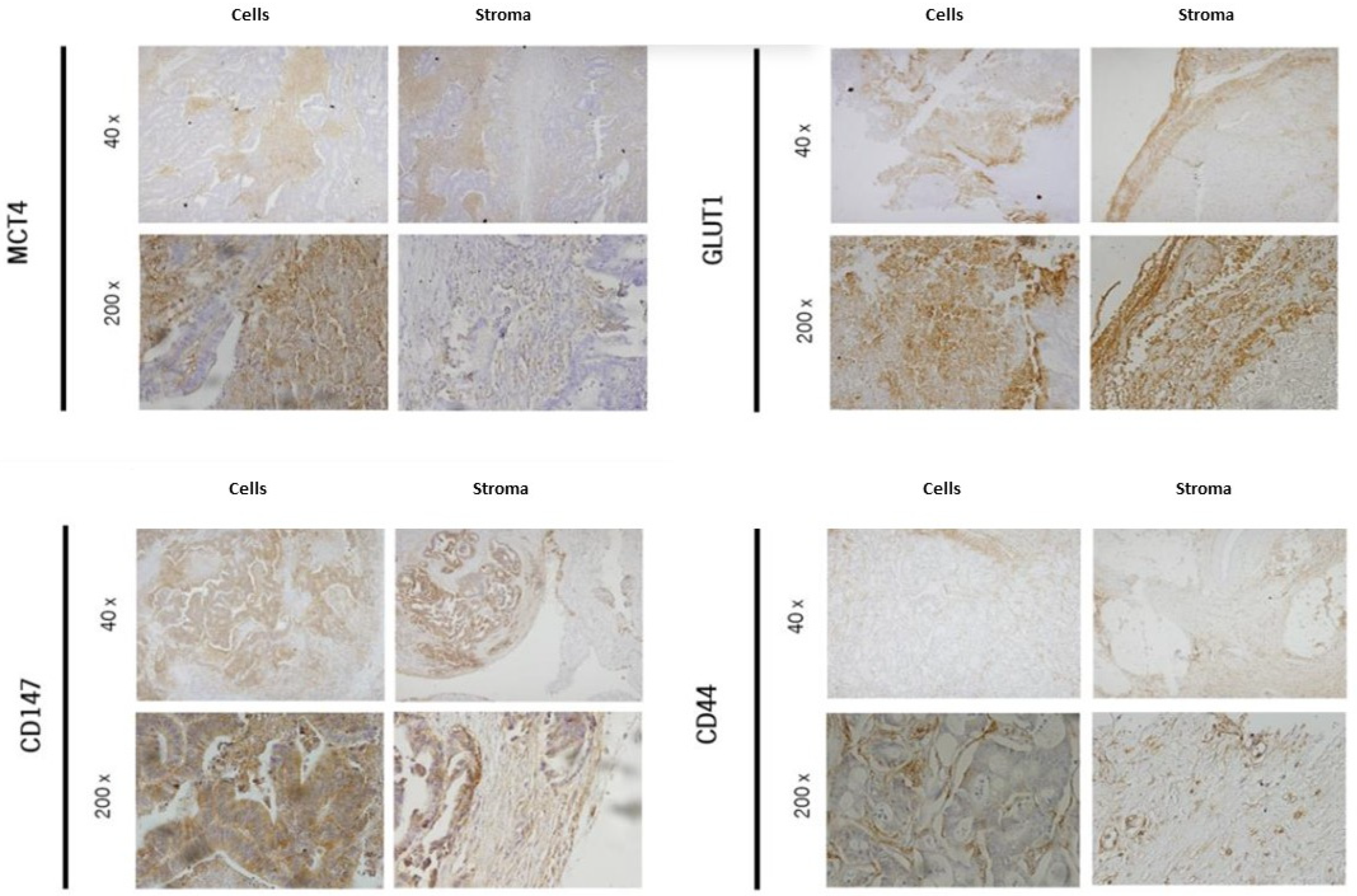

Metabolic Compartmentalization in Colorectal Cancer Hepatic Metastases and Correlation with Tumor Aggressiveness

 and
and Abstract
Share and Cite
Castro, N.; Fernandes, M.; Pereira, A.; Costa, M.; Machado, N.; Branco, C.; Veiga, C.; Longatto-Filho, A.; Martins, S.F. Metabolic Compartmentalization in Colorectal Cancer Hepatic Metastases and Correlation with Tumor Aggressiveness. Gastrointest. Disord. 2024, 6, 692-705. https://doi.org/10.3390/gidisord6030046
Castro N, Fernandes M, Pereira A, Costa M, Machado N, Branco C, Veiga C, Longatto-Filho A, Martins SF. Metabolic Compartmentalization in Colorectal Cancer Hepatic Metastases and Correlation with Tumor Aggressiveness. Gastrointestinal Disorders. 2024; 6(3):692-705. https://doi.org/10.3390/gidisord6030046
Chicago/Turabian StyleCastro, Nuno, Mariana Fernandes, Ana Pereira, Mariana Costa, Nuno Machado, Cláudio Branco, Carlos Veiga, Adhemar Longatto-Filho, and Sandra F. Martins. 2024. "Metabolic Compartmentalization in Colorectal Cancer Hepatic Metastases and Correlation with Tumor Aggressiveness" Gastrointestinal Disorders 6, no. 3: 692-705. https://doi.org/10.3390/gidisord6030046
APA StyleCastro, N., Fernandes, M., Pereira, A., Costa, M., Machado, N., Branco, C., Veiga, C., Longatto-Filho, A., & Martins, S. F. (2024). Metabolic Compartmentalization in Colorectal Cancer Hepatic Metastases and Correlation with Tumor Aggressiveness. Gastrointestinal Disorders, 6(3), 692-705. https://doi.org/10.3390/gidisord6030046