Article

Effect of Heat Treatment on the Corrosion Behavior of Additively Manufactured and Cast AlSi10Mg

by
Fynn Buhl
,
Kilian Feil
,
Nic Tusch
,
André Korten
and
Philipp Schempp
*
Institute for Material and Process Technology, TH Köln (University of Applied Sciences), Betzdorfer Straße 2, 50679 Cologne, Germany
*
Author to whom correspondence should be addressed.
These authors contributed equally to this work.
Corros. Mater. Degrad. 2026, 7(1), 5; https://doi.org/10.3390/cmd7010005
Submission received: 27 November 2025 / Revised: 13 January 2026 / Accepted: 20 January 2026 / Published: 22 January 2026

Abstract

This study investigates the corrosion resistance of aluminum alloy AlSi10Mg to evaluate the influence of both manufacturing methods and heat treatments on its durability. The research compares samples produced via laser powder bed fusion (LPBF) and conventional casting, with subsets subjected to either no, T5 (artificial aging), and T6 (solution annealing and aging) heat treatment. All samples were exposed to an accelerated cyclic corrosion test, using immersion and drying cycles. Corrosion performance was quantified via mass loss (ML) measurements and analyzed using metallography. The analysis revealed that heat treatment (factor A) is the only statistically significant factor affecting mass loss. Even short exposure to the corrosive environment caused clearly visible surface changes. This suggests a significant decrease in corrosion resistance, linked to microstructural changes. While LPBF parts exhibited lower mass loss in the as-manufactured and T5 states, the T6 treatment negatively impacted both manufacturing routes.

1. Introduction

Aluminum alloy AlSi10Mg is a widely used cast alloy known for its high strength, low density, good thermal properties, and versatile post-processing capabilities. These attributes make it an attractive material for applications in automotive, aerospace, and automation industries [1,2,3].
In recent years, the alloy has also gained prominence in additive manufacturing (AM), particularly through laser powder bed fusion (LPBF). This transition from traditional casting to AM enables new design freedoms and lightweight structures, but it also introduces challenges regarding post-processing and long-term durability, especially corrosion resistance [4,5].
This study contributes to the field of materials science by investigating how manufacturing route and post-processing influence the corrosion behavior of metallic materials. Specifically, the research compares additively manufactured (LPBF) and conventionally cast samples of AlSi10Mg, each subjected to T5 (artificial aging) and T6 (solution annealing and aging) heat treatments. The objective is to systematically evaluate how these processes affect corrosion performance. While electrochemical polarization tests offer data on instantaneous corrosion kinetics, this study focuses on accelerated cyclic exposure to prioritize the evaluation of degradation and morphological stability under simulated service conditions.
Previous studies have provided valuable insights but often lack direct comparability due to differences in processing parameters and testing conditions. Moreover, findings on the influence of heat treatment on corrosion behavior remain contradictory. Some authors report improved corrosion resistance after T6 treatment, attributed to microstructural homogenization and porosity reduction, whereas others observe deterioration due to silicon spheroidization and galvanic effects, which can impair the alloy’s oxide layer stability [6,7,8]. This inconsistency highlights a research gap concerning the combined effects of manufacturing route and heat treatment on the corrosion resistance of AlSi10Mg.
Given its dual relevance for casting and additive manufacturing, the investigation of alloy-specific corrosion behavior is becoming increasingly urgent [9]. AlSi10Mg offers a unique opportunity to compare the microstructural evolution and corrosion mechanisms of both processes. This work therefore addresses the following research question:
How do heat treatments T5 and T6 influence the corrosion behavior of AlSi10Mg produced via additive manufacturing (LPBF) and conventional casting under accelerated cyclic and saltwater exposure?

2. Scientific Context and Related Work

2.1. AlSi10Mg: Properties and Corrosion Behavior

The material investigated is AlSi10Mg, an aluminum alloy that is available both in fine powder form for metal 3D printing and as cast ingots for conventional sand casting.
Based on its chemical composition, the alloy contains 7–11% silicon and 0.2–0.45% magnesium. Silicon improves the castability of the melt. Magnesium, conversely, increases strength through the formation of Mg2Si. The filling density of the powder is approximately 1.4 g/cm3, whereby the density determined metallographically using a 10 × 10 × 10 mm3 sample block is 99.76% of solid aluminum [10].
Additionally, the alloying elements magnesium and silicon increase the material’s corrosion resistance [10,11].
The density of solid aluminum is around 2.7 g/cm3, a property that makes the material interesting for use in lightweight construction applications, as already mentioned in Section 1. When used in additive manufacturing processes, the material exhibits a tensile strength of up to 405 MPa, indicating a high strength-to-weight ratio [10,11,12].
This alloy has excellent casting properties and is commonly used to produce thin-walled, complex cast parts. Due to its near-eutectic composition, it melts over a narrow temperature interval between the solidus and liquidus temperatures rather than at a single temperature. This limited solidification range promotes good castability and reduces the tendency for solidification cracking. In addition to its mechanical properties, the alloy exhibits superior thermal and electrical conductivity, which further improves after heat treatment [1,10].
The material characteristics of AlSi10Mg in ingot form differ only slightly from those of the powdered alloy and are measured using Optical Emission Spectroscopy (OES). It contains 7% silicon and 0.33% magnesium by weight. These properties are verified by the manufacturer’s inspection certificate. A comparison of the chemical composition is provided in Table 1. The alloy’s melting point is 596 °C, with a lower solidification limit of 557 °C [13].
Prior studies present a multifaceted view. On the one hand, a homogeneous microstructure combined with the absence of iron-based intermetallic phases is associated with improved corrosion resistance. On the other hand, investigations emphasize that the presence of a weaker passive layer may diminish the protective effect, thereby adversely affecting the overall corrosion behavior [9].
As outlined in [14], the chemical composition of aluminum alloys largely defines their corrosion resistance potential. In addition, alloys produced via additive manufacturing are significantly more susceptible to localized corrosion, primarily due to their higher porosity and non-uniform microstructure. The pores not only act as stress concentrators but also lower the corrosion potential and facilitate electrolyte penetration, while the non-homogeneous microstructure leads to the formation of a weaker and less protective passive layer, which promotes pitting and crevice corrosion.
In accordance with [9], it was also noted that poor passive layers lead to crevice corrosion.

2.2. Manufacturing Processes

Metal casting is a manufacturing process in which molten metal is poured into a mold to create a component with desired shape. Several techniques can be used to create molds. Negative impressions in quartz sand during the casting process are formed by compacting the sand around a pattern, which is subsequently removed to create a cavity that precisely replicates the external geometry of the desired component [12,14].
In contrast, LPBF is a 3D metal printing process that uses a precise, powerful laser beam to produce three-dimensional components. This micro-welding process enables solid components to be produced from powdered metal [11,15,16,17].
The laser moves slowly and at a constant speed over the surface to sinter a thin layer of powder (in the order of microns). This causes the metal particles to fuse [18,19].
A major advantage of LPBF compared to cast parts is that LPBF enhances bonding between layers. Additionally, the amount of powder waste is kept very low, because the material used for support structures can be re-used [11,15,17].
Additionally, the LPBF process enables the fabrication of geometrically complex components that cannot be realized using conventional casting techniques. This includes the integration of internal undercuts, conformal hollow channels, and free-form surfaces without the need for draft angles.
This also leads to an improvement in corrosion resistance. As stated in [20], the combination of the LPBF process and a subsequent heat treatment makes the passive layer formed on the AlSi10Mg material more effective and protective than a protective layer formed spontaneously in air.
Furthermore, [6] investigated the corrosion behavior of Ti6Al4V in various biofluids and reported superior corrosion resistance for LPBF-produced components compared to their cast counterparts. This improvement is attributed to a thicker and more stable oxide layer, associated with the presence of α-martensitic phases. SEM analysis reveals a needle-like microstructure in LPBF samples, whereas cast samples exhibit a uniform distribution of α and β cells.
Moreover, LPBF can lead to some disadvantages regarding inconsistent densification and a lower quality of the laser sintered parts [17].
Laser-sintered parts often require post-processing to achieve the desired quality standard due to their rough surface finish. In addition, inherent porosity and microcracks within the material can reduce its mechanical strength and durability. Finally, residual stresses during cooling can distort the part, compromising its dimensional accuracy and structural integrity.

3. Materials and Methods

3.1. Experimental Design

The experimental approach aims to quantify the effects and interactions of the most relevant influencing variables on the corrosion resistance of AlSi10Mg [21,22].
Two key factors are derived from the research objective: heat treatment (factor A) and manufacturing process (factor B). Their respective levels are summarized in Table 2. The experimental series was designed to identify and evaluate potential interactions between these parameters.
A randomized full-factorial design was implemented with mass loss (ML) as the response variable. To achieve a power of 0.9 (α = 0.05) for an expected effect size of Cohen’s f = 1.5, power analysis (G*Power 3.1.9.7) necessitated a total sample size of N = 12 [23,24]. This provides two replications per factor combination, as detailed in Table 3.

3.2. Sample Manufacturing

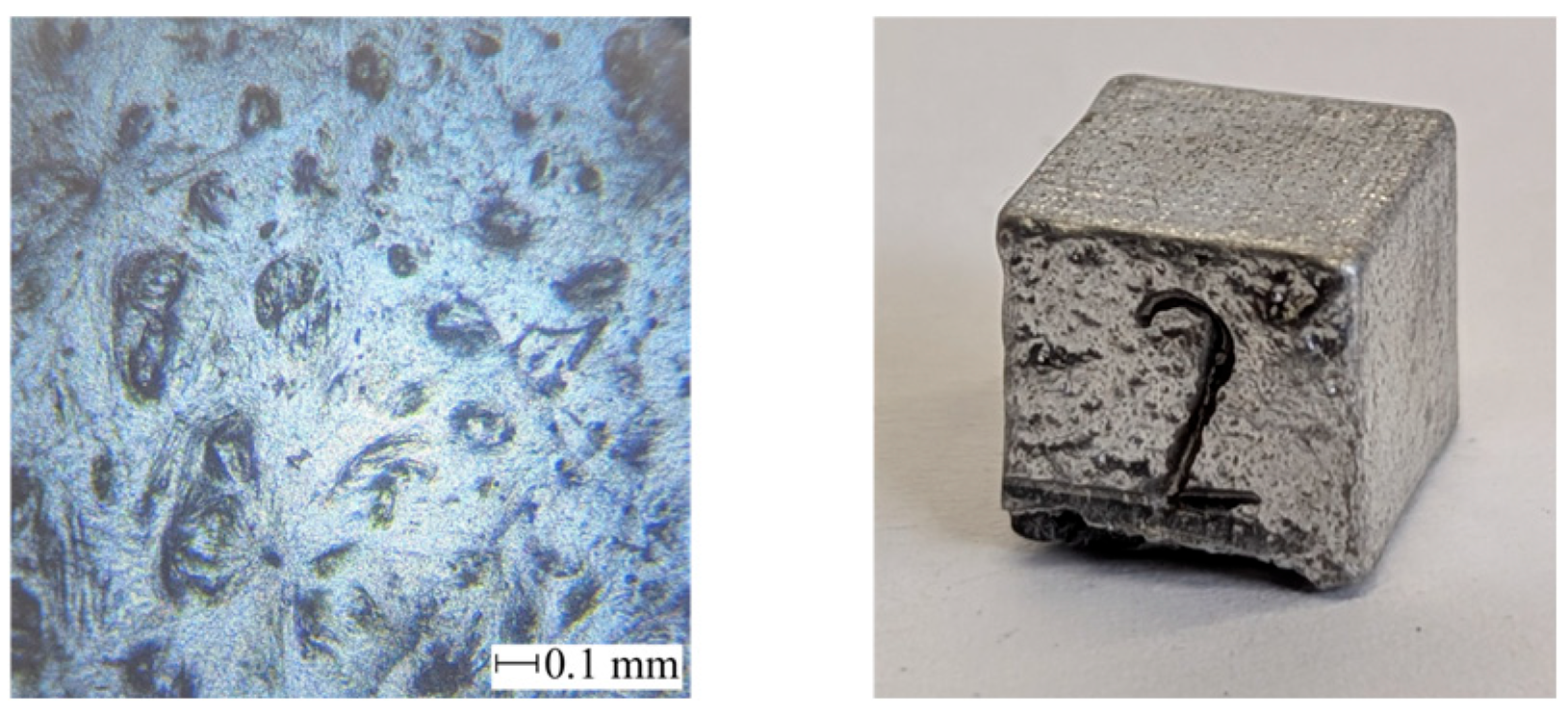
A total of six 10 × 10 × 10 mm samples of the aluminum alloy AlSi10Mg were fabricated via casting, using a negative form, while six additional cubes were produced using the LPBF additive manufacturing process. The used dimensions match common sizes used in previous work [8].
The casting molds were produced using Fused Deposition Modeling (FDM) with PLA. This approach was employed to leverage the advantages of rapid tooling regarding production speed and cost-effectiveness.
A representative image of the resulting cast surface is presented in Figure 1.
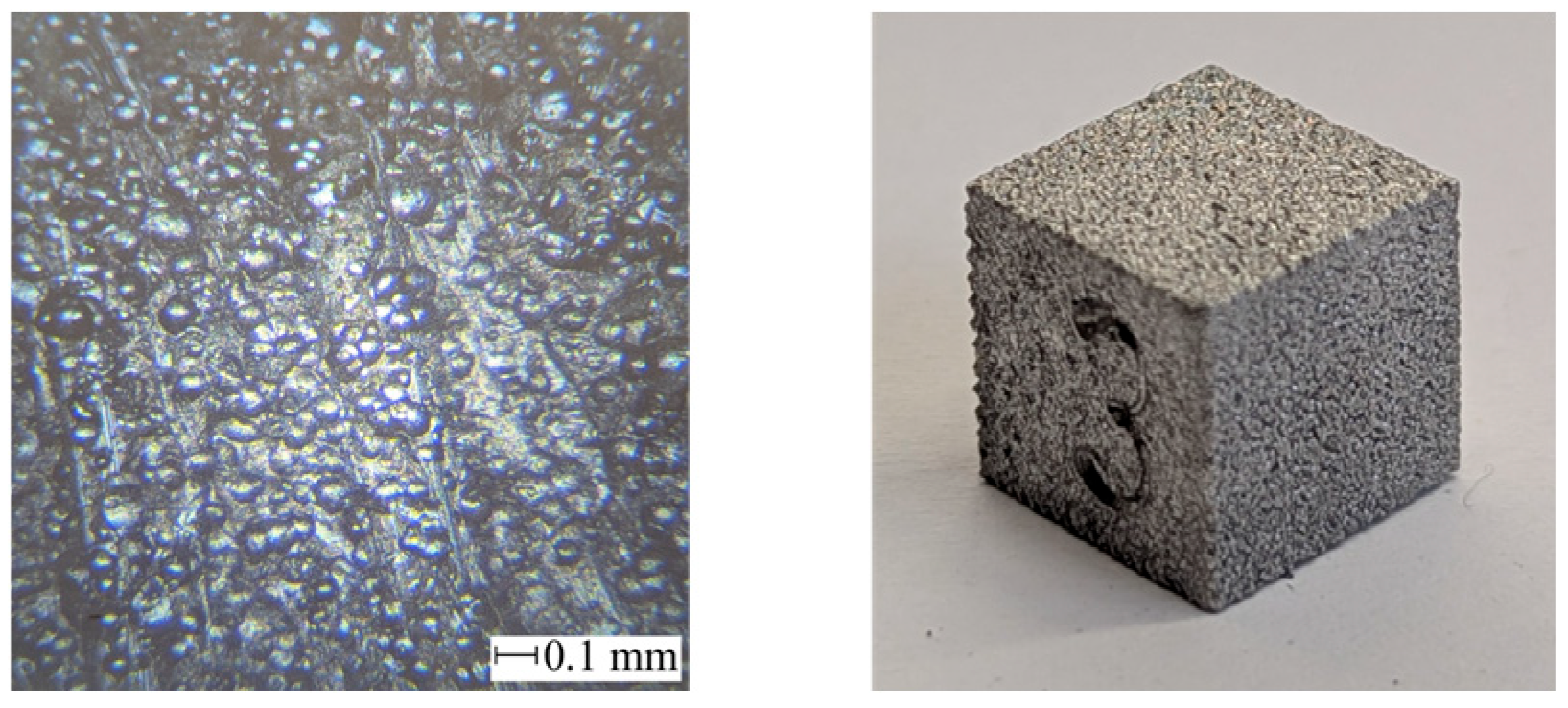
For the additively manufactured samples, an EOS M290 single laser (EOS GmbH, Kralling, Germany) was used. The layer thickness was set to 60 µm. Manufacturing was performed externally. Following the printing process, all samples underwent micro-blasting as a surface treatment to remove residual powder particles and to homogenize the surface finish. A representative image of the resulting printed surface is presented in Figure 2.
Subsequently, the support structures for the printed and cast cubes were manually removed, and any remaining surface irregularities were mechanically smoothed to ensure consistent surface quality across all samples.

3.3. Sample Preparation

To ensure traceability throughout subsequent testing and analysis, each sample was subsequently stamped with a unique identification number. According to the predefined experimental design, the 12 AlSi10Mg samples were subjected to different post-processes in order to quantify the effects of varying heat treatment strategies. Specifically, four samples remained in the as-manufactured condition without any heat treatment, while the remaining eight were divided equally between the T5 and T6 heat treatments (see Table 3).
The classification of the T5 and T6 heat treatment conditions is based on standards specifically developed for additively manufactured parts. These standards are provided by the manufacturer of the 3D printer used in this study and were validated against the existing literature and expert industry consensus [2,8,25,26].
In order to enable a direct comparison between the printed and cast components, identical heat treatment parameters were applied to the cast samples.
To reach heat treatment T5, artificial aging was performed after fabrication at 165 °C for 6 h (±2 °C), without prior solution treatment, followed by slow cooling in air at room temperature. For heat treatment T6, the samples first underwent solution annealing at 530 °C for 0.5 h (±2 °C), followed by quenching in water at room temperature (measured: 22.3 °C), ensuring a transfer time from furnace to water of less than 10 s. Subsequently, the samples were subjected to the same artificial aging procedure as that used for the T5 treatment (165 °C for 6 h) to achieve the T6 temperature [2].
To verify the effectiveness of the heat treatment, hardness measurements were carried out before and after post-processing. The Brinell hardness was measured using a tungsten carbide ball indenter (HBW). The applied test parameters followed the standard specifications—a ball diameter of 2.5 mm, 62.5 kgf (612.92 N) load, and 10 s dwell time, denoted as HBW 2.5/62.5/10—in accordance with DIN EN ISO 6506 [27,28]. Preliminary trials were conducted to determine the appropriate load application (force factor) for the Brinell hardness. The results are listed in Section 4.1 [27,28].
As required by DIN 50905 [29], each sample was weighed to an accuracy of five decimals on a suitable balance (used device: Mettler Toledo XS205 DualRange (Mettler-Toledo GmbH, Gießen, Germany)). The measured weight of each sample prior to corrosion exposure is listed in Table 4.

3.4. Corrosion Exposure

The exposure methodology of this work is based on a cyclic corrosion test pursuant to VDA 233-102 [30]. The primary objective is to generate corrosion processes and reproducible corrosion patterns that correlate well with the results obtained during driving and after outdoor weathering [30].
It is important to note that components with unpainted metal coatings were not explicitly included in the scope of application at the time of standardization, but this does not exclude uncoated metals. (due to the uncoated surface, artificial damage or pre-damage is not included in this work) [31].
In this work, the adapted conditions include a defined NaCl immersion and drying phase. The methodology is clearly based on the standard. However, this study does not make any statements on the long-term coating resistance.
The exposure sequence per cycle shown in Table 5 is based on [31].
A total of 20 cycles were performed. The total exposure time was therefore 20 × 6 h = 120 h. After every 4th cycle (24 h), an interim optical evaluation was performed (prior to cycle 1 and after cycles 4, 8, 12, 16, and 20).
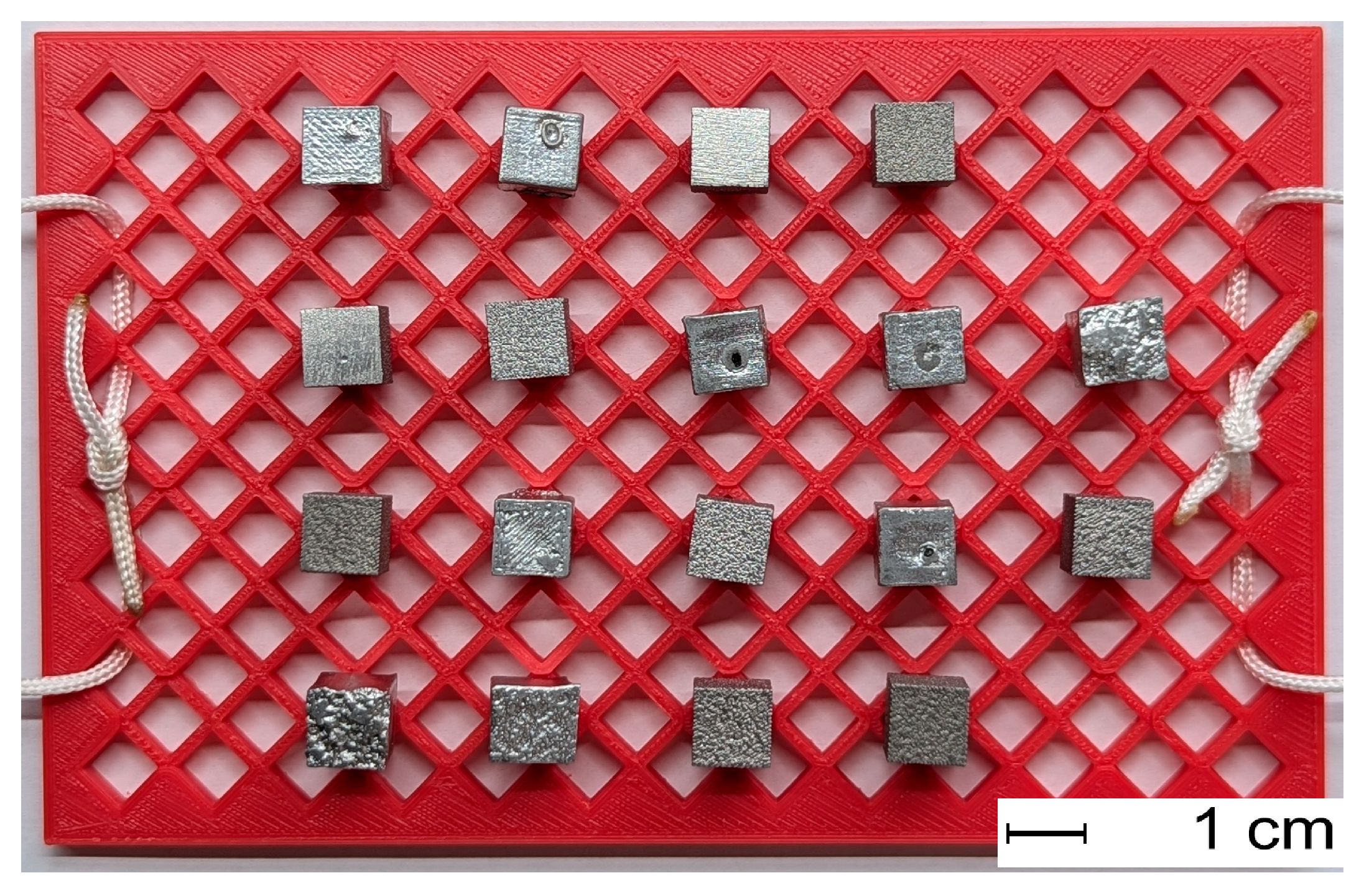
Prior to exposure, all samples were cleaned with acetone to remove machining residues and surface contaminants according to [32]. To ensure consistent exposure, a custom grid holder (sample tray) was developed to position the cubic samples securely in the test chamber. The samples were positioned with the identification number facing downward to ensure uniform exposure of all surfaces relevant to the environmental conditions. The temperature of the NaCl solution was kept constant at 35 °C ± 5 °C. Figure 3 shows the sample tray shortly before the start of exposure in cycle 1.
This approach simulates real-world environmental stressors, particularly for components in lightweight applications exposed to marine or de-icing conditions. The procedure ensures the comparability and robustness of corrosion data across different manufacturing and treatment conditions [33].

3.5. Corrosion Characterization

There is currently no universally accepted standard for quantifying corrosion resistance. Therefore, this study followed the mass loss (ML) method, as it is the most commonly applied approach in the recent literature dealing with similar alloys and test conditions [34,35,36,37,38,39,40,41,42,43].
This method offers a practical and widely comparable indicator of corrosion severity [7,33,44].
As stated in [29], each sample was weighed with a precision of five digits (10 µg) both before and after corrosion exposure (balance: Mettler Toledo XS205 DualRange (Mettler-Toledo GmbH, Gießen, Germany)). Afterwards, corrosion products were removed in accordance with DIN EN ISO 8407 [45] using a nitric acid (HNO3) solution with a density of 1.42 g/mL (immersion for 5 min). This chemical treatment ensures the complete removal of corrosion residues without attacking the base metal [45].
The difference in weight was used to calculate mass loss. This allows for a direct comparison of corrosion performance between samples [29,32].
Furthermore, metallographic analyses were conducted to identify the location, morphology, and depth of the corrosion attack. These investigations are based on the qualitative evaluation of the corroded areas using microscopic imaging and allow for additional interpretation of corrosion mechanisms.
Therefore, clusters of four samples were embedded in phenol (6 min holding time, 11 min cooling phase, 290 bar pressure) and grouped according to their heat treatment (as-manufactured, T5, or T6). The grinding process consisted of four cycles (10 min each and water-cooled) with grain sizes of 320, 600, 1200, and 2500, followed by polishing with 1µ dispersion. The samples were then etched for 3 min in 5% sodium hydroxide solution (NaOH) [46,47].
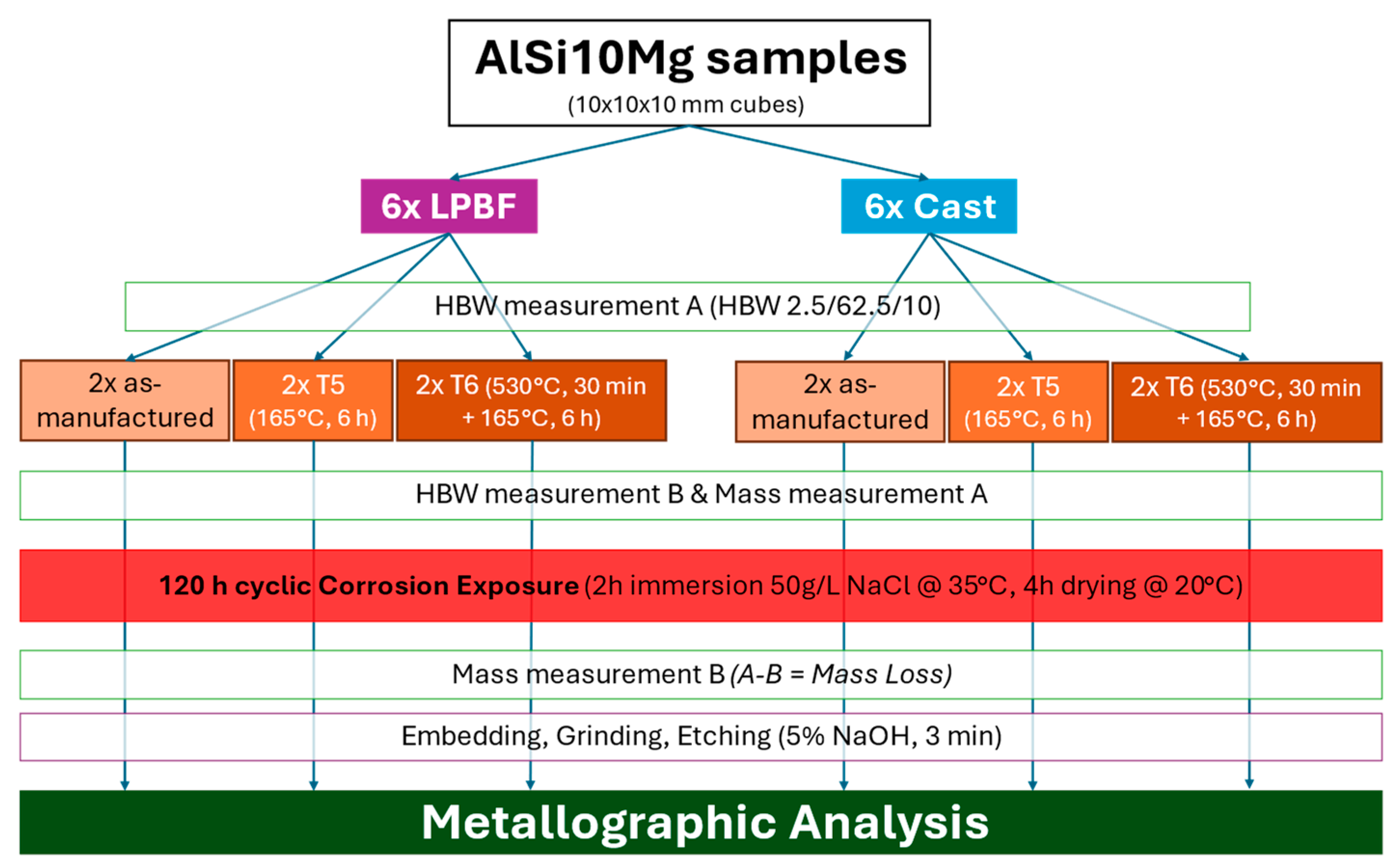
In summary, the chronological sequence of the applied experimental procedure is illustrated in Figure 4.

4. Results and Discussion

4.1. Heat Treatment

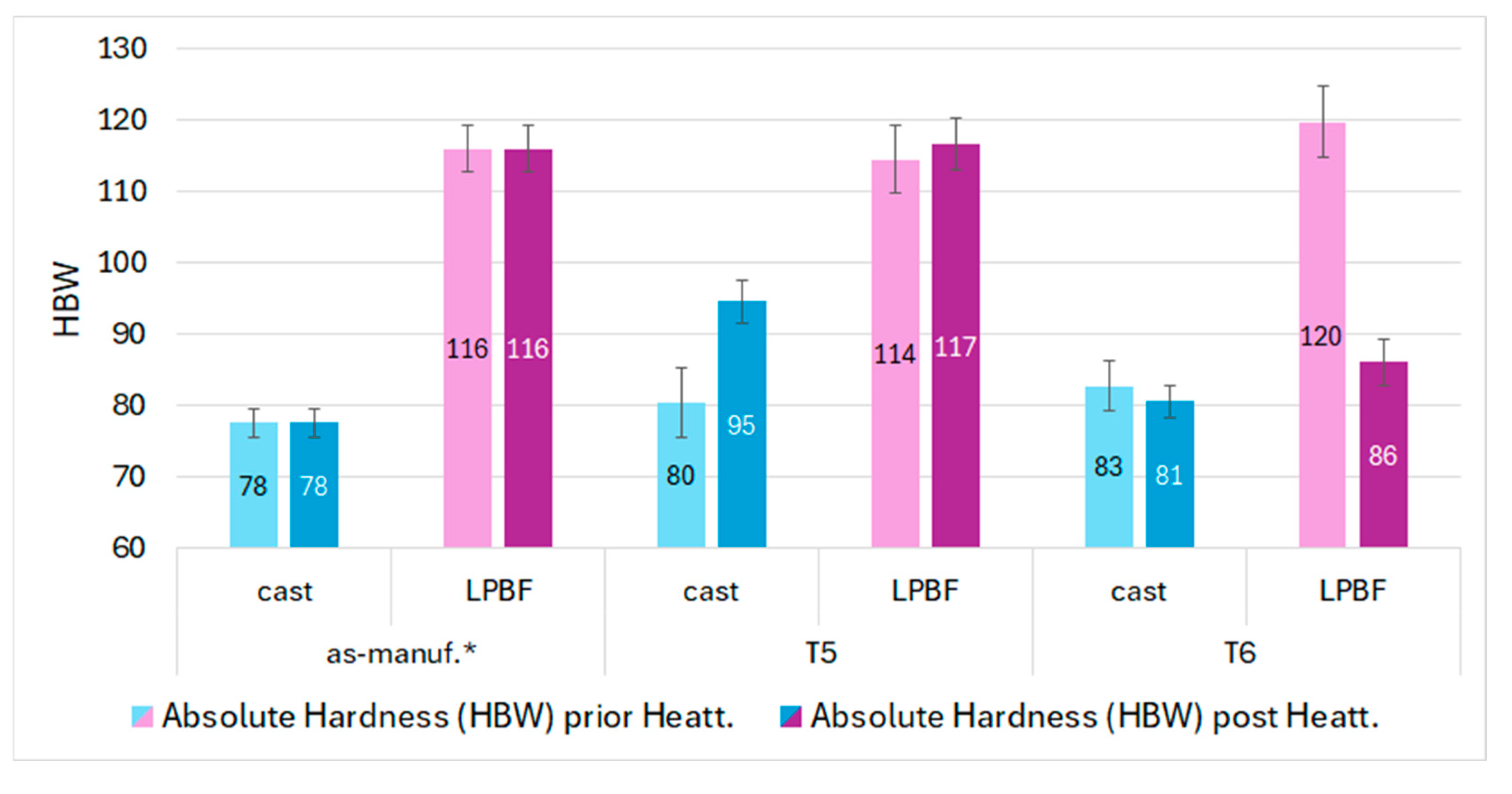
Figure 5 illustrates the HBW (2.5/62.5/10) hardness before and after heat treatment. The bar chart displays mean values and standard deviations, with lighter and more saturated shades representing the states before and after treatment, respectively.
The above diagram shows significant differences in hardness for both manufacturing processes, as well as the different states of heat treatment. There are two main factors that influence hardness for the set of experiments of this study:
  • Microstructure (here: particularly the number, size, and density of silicon precipitations in the aluminum matrix);
  • Residual stresses (here: the distortion of the atomic lattice due to rapid cooling during manufacturing and/or heat treatment).
In the as-manufactured state, the hardness of the additively manufactured probes was approximately 50% higher than that of the cast probes. This difference is mainly attributed to the extremely fine microstructure and the silicon-supersaturated aluminum matrix formed during the LPBF process as a result of very high cooling rates compared to casting [4]. The layer-wise solidification in thin layers of approximately 60 µm leads to cooling rates typically exceeding 105 K/s, whereas the cast cubes solidified at significantly lower cooling rates (<103 K/s) [4,5]. As a result, the LPBF microstructure consists of very fine and homogeneously dispersed silicon particles and, to a minor extent, Mg2Si precipitations, which increase strength and hardness. These differences are confirmed by the micrographs shown in Section 4.3.
Residual stresses may additionally contribute to the higher hardness of LPBF parts in the as-manufactured condition due to rapid cooling [12]. However, since residual stresses are generally removed by stress relief, they are expected to be eliminated during subsequent heat treatments, particularly under conditions T5 and T6. Any residual stresses present after annealing are therefore mainly related to rapid cooling during quenching rather than the manufacturing route.
Heat treatment T5 is intended to promote precipitation hardening by forming fine-dispersed silicon particles in the aluminum matrix. In this study, a hardening effect of approximately 20% was observed only for the cast probes, while no significant change in hardness was measured for the LPBF probes. This indicates that the LPBF process already produces a near peak-aged condition, whereas the coarser cast microstructure exhibits a higher potential for precipitation hardening during treatment T5.
Heat treatment T6 includes a solution treatment that homogenizes the alloy and removes microstructural effects related to the manufacturing process, followed by rapid quenching and aging. During aging, the supersaturated silicon gradually diffuses out of the aluminum matrix and coalesces into isolated idiomorphic particles decorating the aluminum grains. This microstructural coarsening leads to significant softening, which is not compensated for by the possible precipitation of Mg2Si particles. Consequently, similar hardness values are obtained for LPBF and cast probes in the T6 condition, which are 10–20% lower than in the T5 state due to overaging [8,26]. Comparable studies showed similar results [47].

4.2. Mass Loss

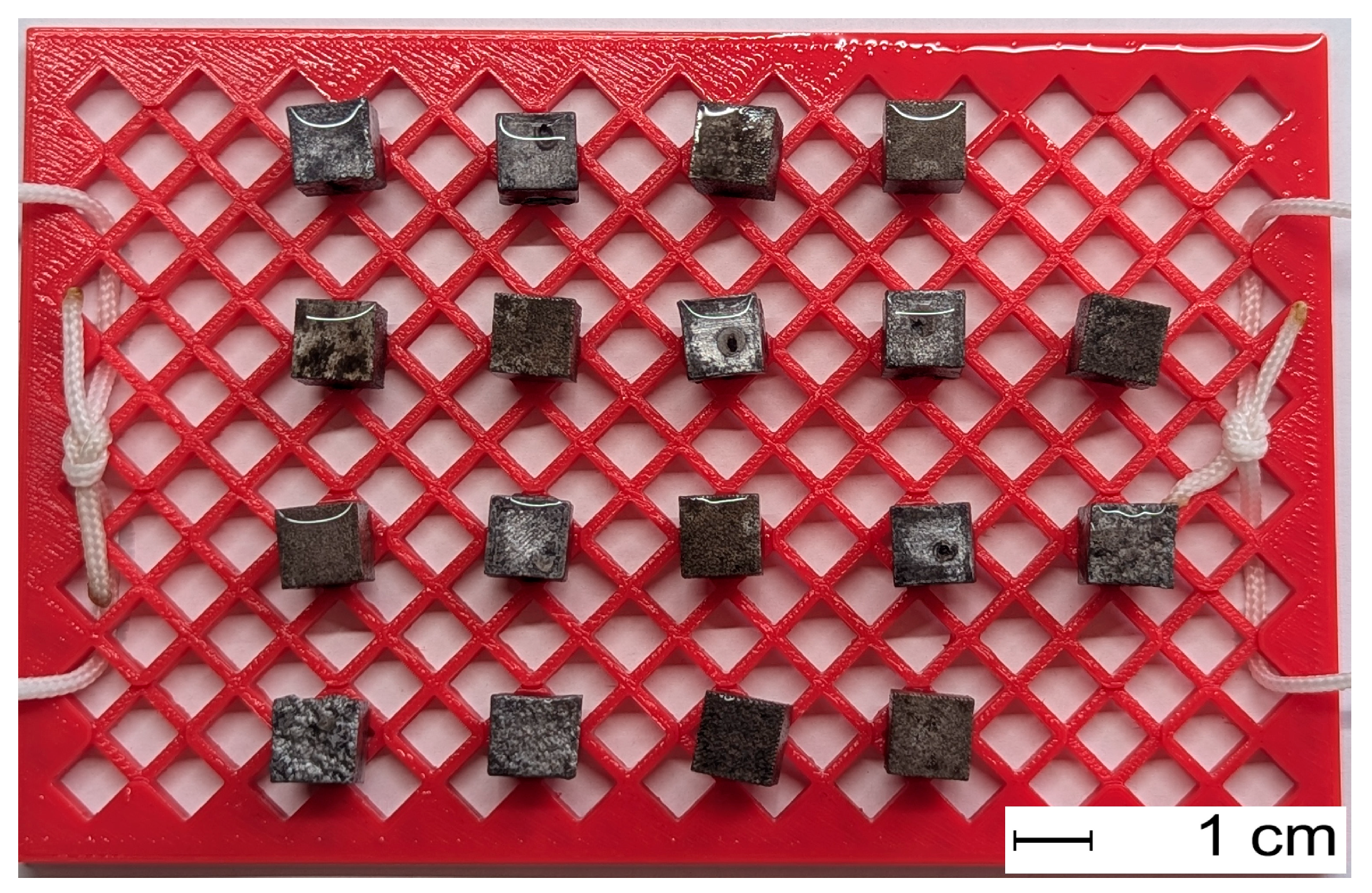
Figure 6 shows the sample tray after 120 h of exposure after the 20th (last) cycle. The specific parameters for the cyclic corrosion tests, including the temperatures and durations of the immersion and dry phases, are detailed in Table 5 and illustrated in Figure 4.
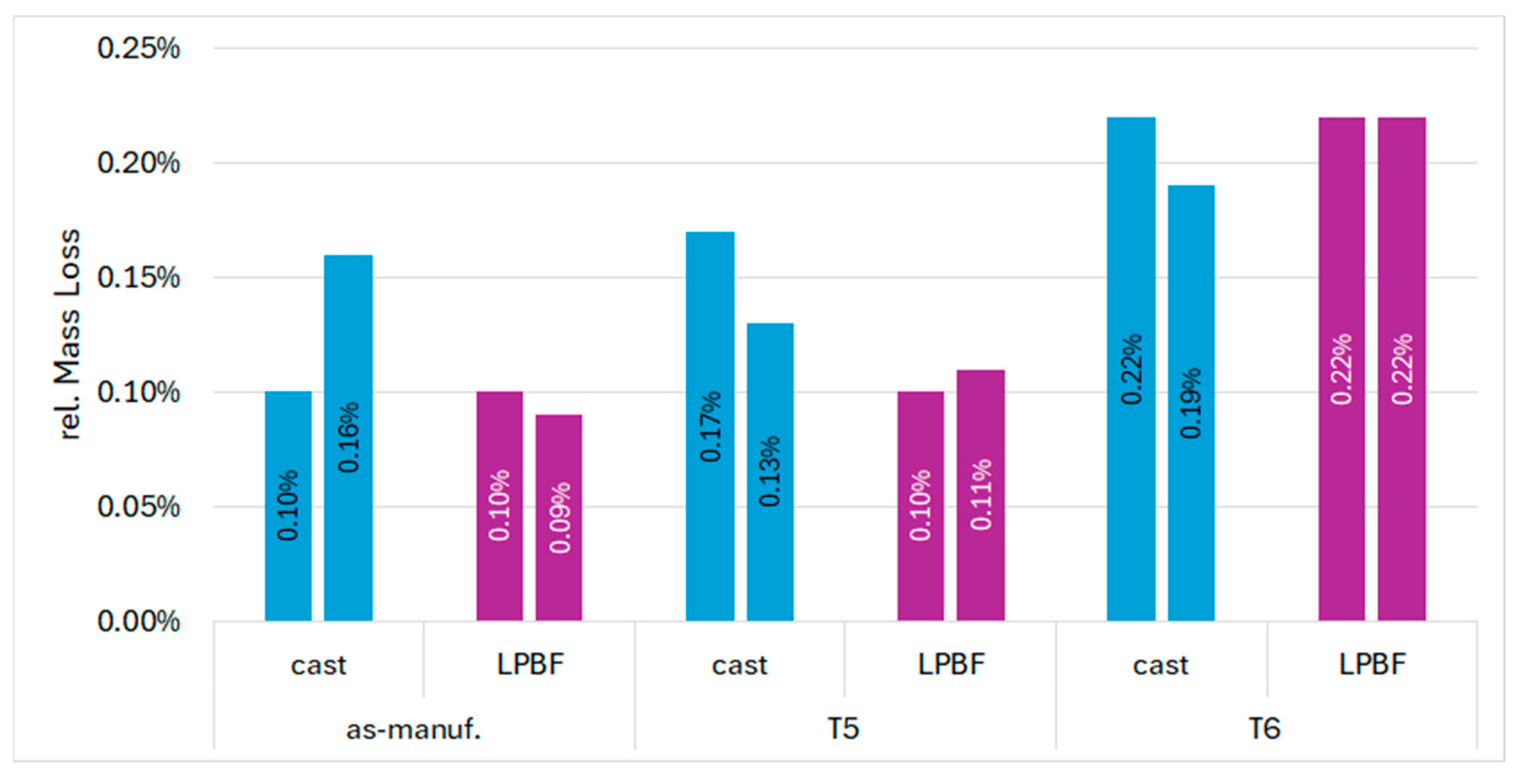
The corrosion products formed on the sample surfaces are clearly visible, providing initial qualitative evidence of material degradation. After chemical cleaning and complete drying, each sample was weighed again. The measured differences to the original weight of the respective sample are summarized in Figure 7. The two bars in each category representing the two individual samples. All samples were comparable in size and shape.
The mass loss measurements reveal slight differences in corrosion behavior depending on heat treatment and manufacturing process. On average, the samples lost approximately 0.15% of their original mass.
LPBF samples consistently exhibit lower relative mass loss under both the as-manufactured and T5 conditions. They also show reduced variability compared to cast samples across all conditions. Notably, while heat treatment T5 and especially T6 substantially increase mass loss in cast materials, at least for heat treatment T5, they have minimal to no adverse effect on LPBF samples. The T6 LPBF samples showed slightly more mass loss than the cast ones but much more than for the LPBF samples under the T5 condition. However, for the T6 condition, LPBF samples experience an increase in mass loss, reaching values higher than those of the cast samples under the same treatment, significantly exceeding their own T5 performance. This suggests a decrease in corrosion resistance after heat treatment T6, particularly impacting LPBF samples.
These results are consistent with [48], which states that the increased solubility of Si in the α-Al matrix during T6 solution treatment leads to (at least partial) dissolution of the Al–Si eutectic phase. Although the annealing duration in [48] was shorter than in the treatment applied here, the fundamental mechanism of Si redistribution remains comparable. Rapid quenching retains this supersaturated, non-equilibrium microstructure. Consequently, rather than being eliminated, the eutectic phase undergoes redistribution, resulting in a finer and more interconnected morphology, as described in [44] (for visual reference, see Section 4.3). This microstructural modification reduces the effectiveness of the eutectic phase in limiting galvanic interactions with the aluminum matrix, which is associated with the decreased corrosion resistance observed for the T6 condition.
In contrast, studies [49,50] observed higher corrosion resistances for T6 heat-treated samples, compared to as-manufactured conditions. These differences may be attributed to different manufacturing techniques and other applied corrosion exposure methods. As discussed in Section 3.1, this again illustrates the need to standardize test procedures to improve comparability.
From the obtained data, a Cohen’s f of 1.53 was calculated. This matches the pre-experimental estimation of Section 3.1.
A subsequent analysis of interactions between the influencing variables and their effects on corrosion was performed using Minitab Statistical Software (Version 3.1.9.7) [51].
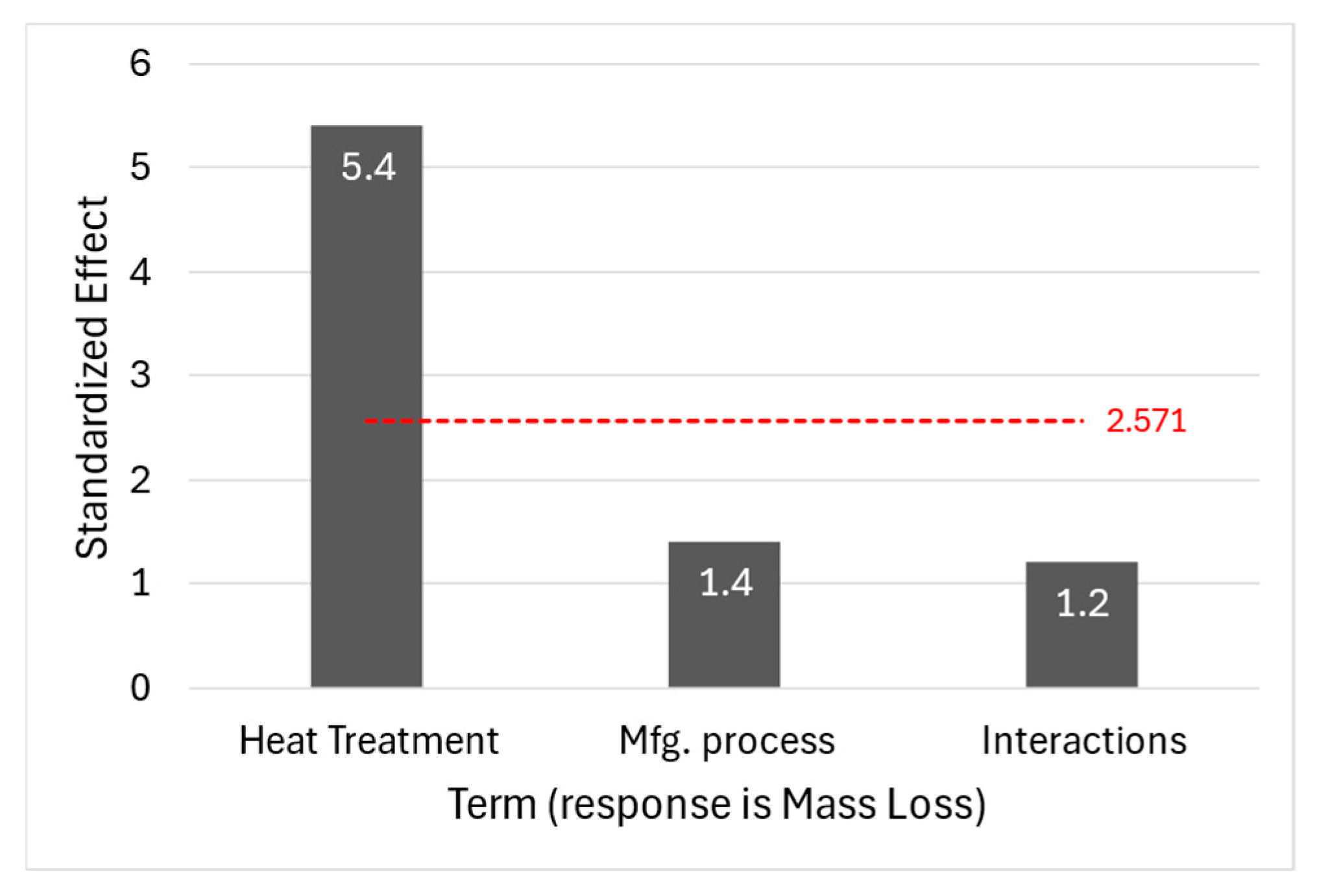
Figure 8 presents a Pareto diagram of the standardized effects, which shows the relative influences of the investigated process parameters on the target value of mass loss.
This analysis was based on a significance level of α = 0.05, with the red-dashed horizontal line marking the corresponding significance limit at a standardized effect of 2.571. It can be recognized that the heat treatment (factor A) has the largest and only statistically significant effect on mass loss. In contrast, both standardized effects of the manufacturing process (factor B) and the effect of the interaction between heat treatment and manufacturing process (term AB) are well below the significance threshold. This indicates that these factors do not make a significant contribution to the variation in mass loss at the selected confidence level. Consequently, and in accordance with Figure 7, heat treatment is the decisive parameter, the setting of which is expected to have the greatest influence on mass loss and therefore corrosion behavior.
This finding suggests that the primary mechanisms of mass loss are likely driven by the thermal conditions of the heat treatment process. The non-significance of the manufacturing process (factor B) implies that microstructure or initial residual stresses caused by different manufacturing processes play a negligible role under the given heat treatment conditions.
Given these insights, the statistical evaluation of the experimental design model, as presented in Table 6, is of high importance.
The standard error of the residuals (S) is ~0.0002, and this indicates a very low spread of the measured values around those predicted by the model. This suggests a good fit of the model to the available data. The coefficient of determination R2 = 91.20% shows that a large part of the total variance is explained by the model. The adjusted coefficient of determination R2adj = 80.64% remains at a high level, indicating that most of the explained variance is due to actual systematic effects rather than overfitting. The predictive coefficient of determination R2pred = 49.32% further confirms a moderate predictive ability of the model on independent data. This indicates that additional influencing factors such as surface roughness or microstructure homogeneity should be considered in order to further improve the model quality in future investigations. However, this also greatly increases the costs of the experiment.
While the associated Pareto diagram provides insight into the relative effects of the factors within the current dataset, its conclusions regarding external validity should still be interpreted with caution.

4.3. Metallurgical Analysis

To extend the above statistical evaluation, microscopic surface analyses were conducted to qualitatively assess corrosion morphology and to identify characteristic degradation patterns associated with heat treatment and manufacturing process.
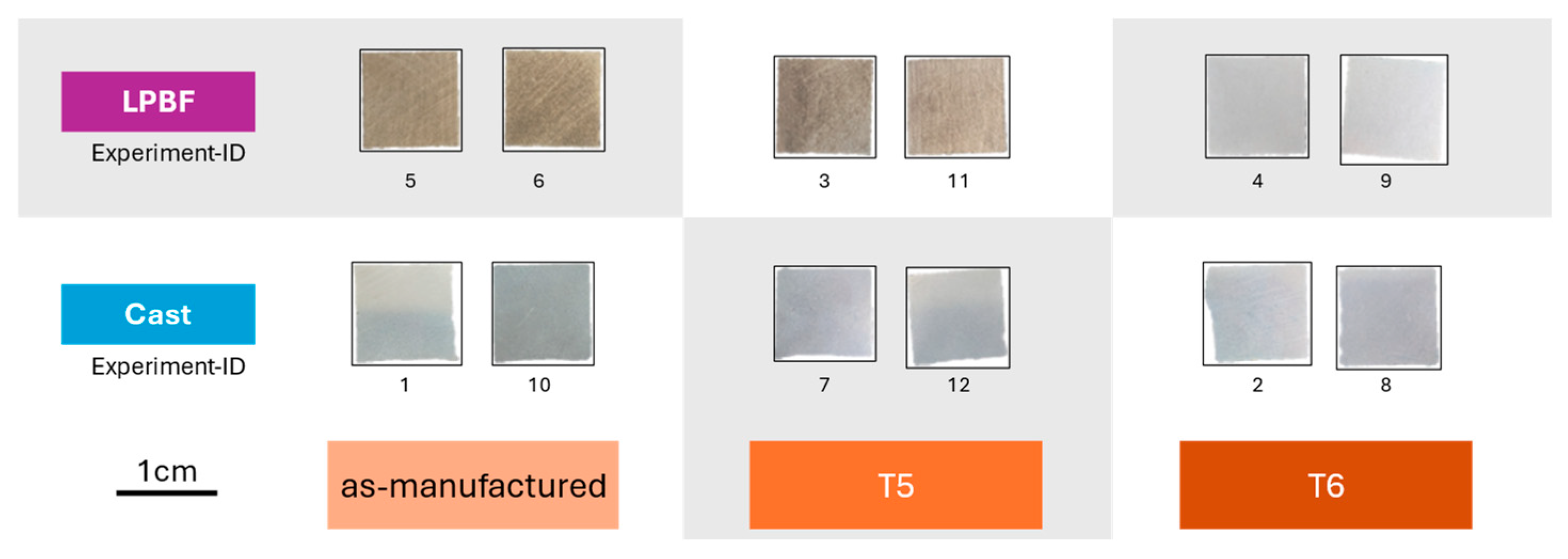
Figure 9 shows the clustered samples prepared for metallurgical analysis (embedded, ground, and polished and etched; samples were sectioned, and the embedding material is not shown).
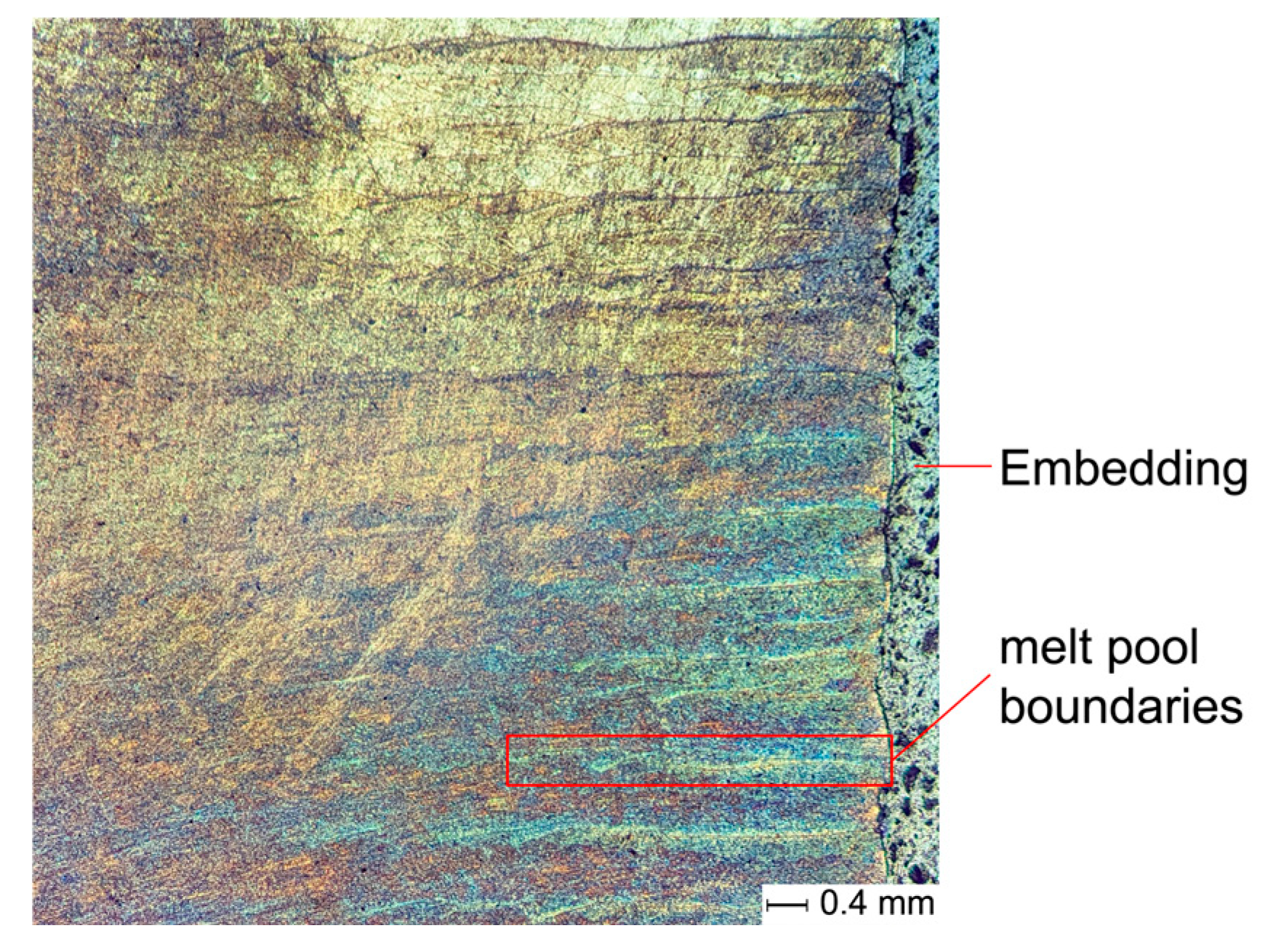
As shown in Figure 9 and highlighted in Figure 10, samples manufactured using additive processes reveal a distinct brownish pigmentation. This is due to the fine cellular microstructure and the accumulation of silicon at the cell boundaries, which can be seen as a residue during NaOH etching. Micro-galvanic effects and oxide residues result in a colored surface that is not present in homogeneously solidified cast material [20,43].
The accumulation of silicon at cell boundaries is reduced by subsequent heat treatment, resulting in the homogenization of the microstructure. This is accompanied by a reduction in brownish pigmentation.
However, conventionally cast samples do not exhibit silicon accumulation at cell boundaries due to their more homogeneous microstructure, not showing any brownish pigmentation during etching [52].
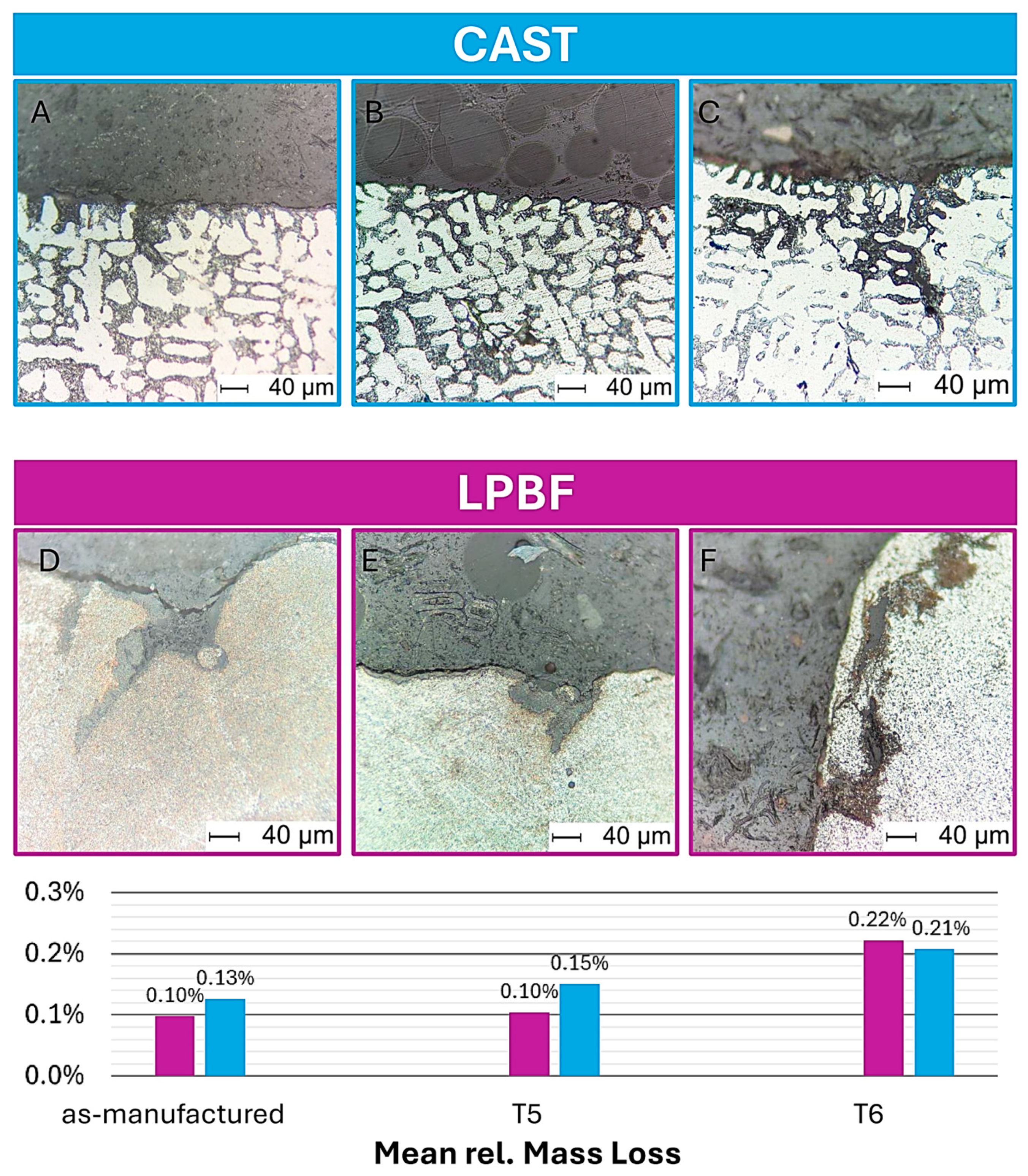
Figure 11 illustrates representative microstructures of areas exposed to corrosion for both LPBF and cast samples across all three heat treatment conditions. In addition, the respective means of relative mass loss are indicated to allow a direct comparison between microstructural changes and material degradation.
Qualitative observations corroborate the quantitative mass loss data. The results obtained under both the as-manufactured and T5 conditions exhibited minimal and comparable degradation, whereas the T6 condition showed noticeably more extensive corrosion. The visible surface damage across all specimens reflects this behavior, confirming that a significant increase in corrosion rate occurred only following the T6 treatment. Under the as-manufactured and T5 conditions, LPBF samples exhibited localized, small-scale, and pitting-like corrosion (D & E), whereas cast samples showed more general edge degradation (A & B). Under T6 conditions (C & F), although corrosion increased on cast specimens, the extent of damage increased even more markedly in LPBF samples.
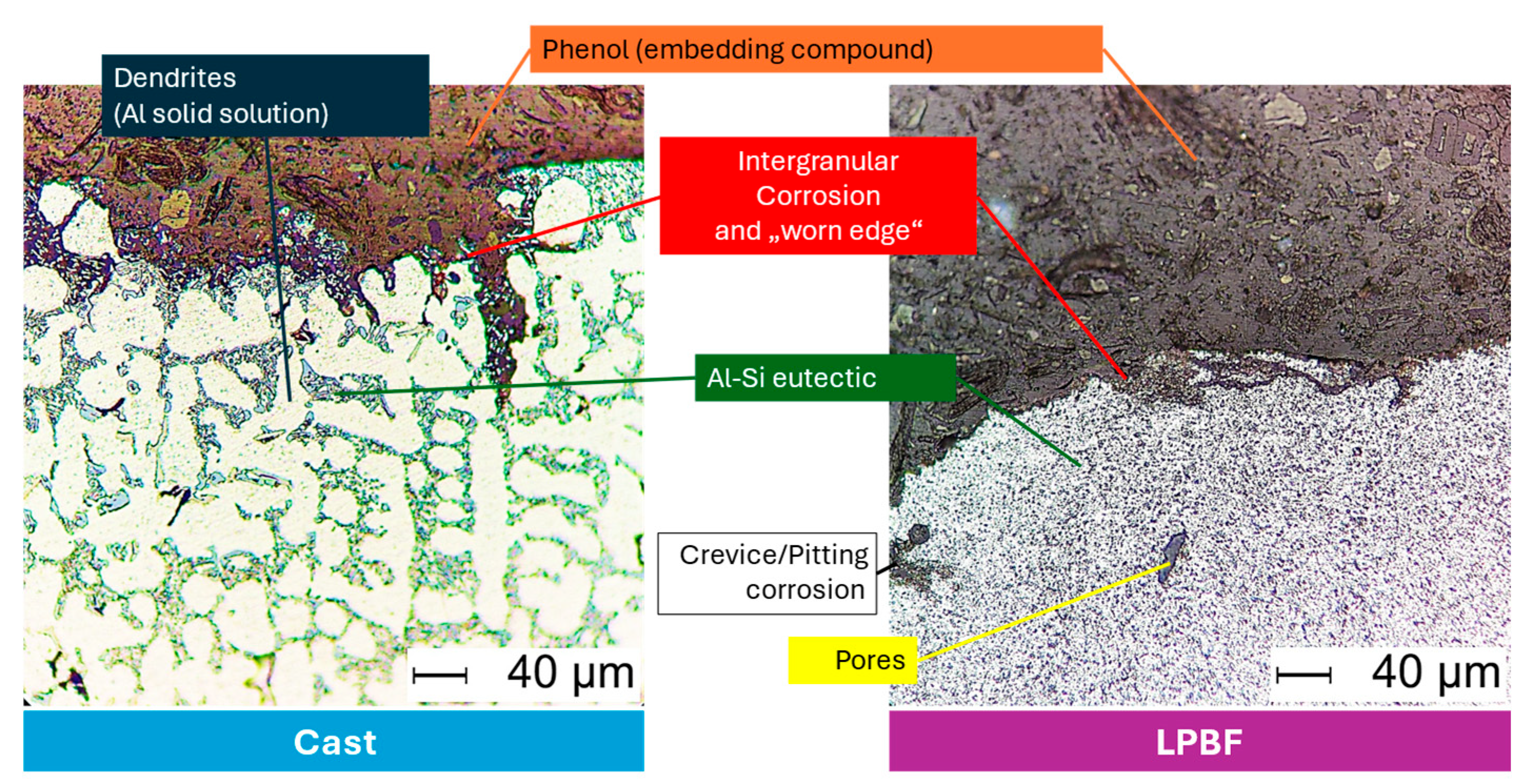
To further highlight the most relevant microstructural changes, selected detail images are presented in Figure 12. They focus on key differences observed between manufacturing processes after corrosion exposure.
The microstructure of aluminum alloys significantly affects their corrosion behavior [53]. The observed corrosion behavior directly correlates with the microstructural differences between LPBF and cast samples: The fine, homogeneous, and cellular structure of LPBF alloys promotes localized pitting, while the coarse dendritic α-Al phases and heterogeneous eutectic matrix in cast specimens facilitate more widespread galvanic corrosion (see Figure 11 and Figure 12).
During the solidification of the AlSi10Mg alloy, primary α-Al solid solutions initially form a dendritic structure (Figure 12). This phase solidifies preferentially and exhibits comparatively noble electrochemical behavior. As solidification progresses, the residual melt becomes enriched in silicon and magnesium, ultimately forming an Al-Si eutectic structure that may contain intermetallic phases such as Mg2Si [8].
In conventional casting, this process occurs under slow cooling rates (typically 10–100 K/s), resulting in
  • Coarse dendritic α-Al phases (bright, tree-like structures);
  • A heterogeneous eutectic matrix with lamellar/globular silicon-rich phases (darker);
  • Pronounced Si segregation at grain boundaries.
[8,54,55]
LPBF with rapid cooling (106–108 K/s) produces
  • Fine cellular α-Al cells (<1 µm) surrounded by coral-like silicon networks;
  • A supersaturated α-Al matrix with a homogeneous Si distribution;
  • Minimal phase segregation due to ultra-fast solidification.
[8,54,55]
The electrochemical potential of the eutectic phase is lower than for the α-Al matrix. In a corrosive medium such as salt water, the electrochemical potential difference between the α-Al dendrites and the eutectic phase results in the growth of localized galvanic cells [56,57,58,59]. It should be noted that the passive oxide film can produce some electrically insulating barrier, reducing the potential for galvanic corrosion. Nevertheless, electrochemical corrosion typically deteriorates the passive layer, eventually allowing galvanic corrosion to start on a larger scale [14]. Furthermore, there may be some effect of under-deposit corrosion (under corrosion products) during the drying cycles regarding the above results. This was not further investigated in this study.
Another study [59] employed Scanning Kelvin Probe Force Microscopy to quantify microstructural Volta potential differences, which correlate with local work function variations. Under the as-manufactured condition, melt pool edges exhibited a higher potential difference (133 ± 9 mV) compared to melt pool centers (88 ± 6 mV), reflecting heterogeneous electrochemical activity across the microstructure [59].
After a 2 h heat treatment at 300 °C, the potential gap decreased to 94 ± 8 mV at the edges and 60 ± 6 mV at the centers, indicating partial microstructural homogenization. Following a 2 h treatment at 400 °C, the potential difference further stabilized at 86 ± 10 mV with no observable distinction between edge and center regions, confirming complete spheroidization of the Si network revealing a reduced corrosion susceptibility [59].
The less noble eutectic areas act as anodes and are preferentially corroded [60]. This galvanic corrosion manifests as intergranular corrosion, which spreads along grain boundaries and selectively degrades the material.
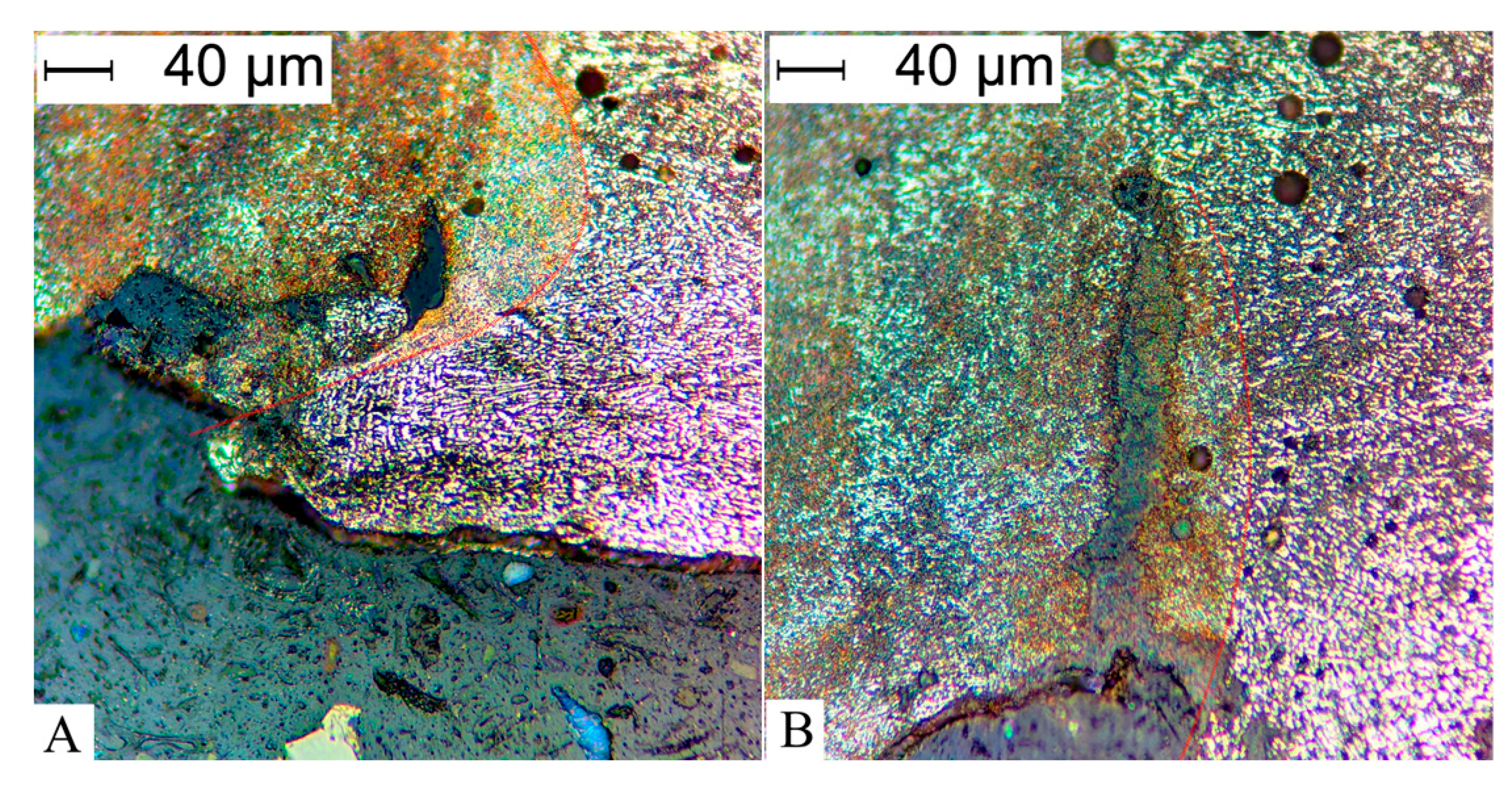
Figure 13 shows the representative microstructure of the LPBF samples. While exhibiting the fine-grained morphology of additive manufacturing (orange-toned areas), the structure also reveals isolated regions with cast-like appearance (purple-toned areas), likely due to different cooling rates. This results from the typical layer-by-layer manufacturing/solidification of LPBF samples [61]. Notably, the corrosion attack is more pronounced on the “LPBF side”.
The observation that samples produced using a single manufacturing method exhibit both microstructural types supports the interaction effects identified in Figure 8. This suggests that heat treatment has the capability to override or substantially alter the as-manufactured microstructure, thereby emerging as the more dominant factor on material properties compared to the manufacturing process itself.

5. Conclusions

In this study, the effects and interactions regarding corrosion resistance of heat treated, additively manufactured, and conventionally cast AlSi10Mg were investigated.
The major conclusions from this work are summarized as follows:
  • Heat treatment has the largest significant effect on mass loss and therefore corrosion resistance.
  • Microstructural differences between LPBF and cast AlSi10Mg appear to influence initial corrosion stages. Under the tested conditions, the fine LPBF structure favors localized pitting, whereas the coarser cast structure suggests a higher susceptibility to localized galvanic effects confined to phase contact zones during cyclic exposure.
  • Observation of both microstructural types within one manufacturing route supports the calculated interactions.
  • Brownish pigmentation after etching reflects Si accumulation in AM samples, that is reduction via heat treatment, which is absent in cast material, highlighting esthetic impacts of process choice.
  • Even relatively short exposures to the corrosive environment were sufficient to induce clearly visible changes on the sample surfaces.
Study Limitations:
  • This study was originally intended to produce cast and LPBF samples using identical powder material. However, the powder could not be fused and cast, meaning that conventional ingots had to be used instead. This can result in slight differences in the material composition that influences microstructure and corrosion behavior.
  • T6 heat-treated LPBF samples showed lower hardness values than under as-manufactured conditions, which is likely due to overaging during precipitation hardening.
  • For technical reasons, the corrosion test was based on the VDA 233-102 standard, but with immersion/drying cycles instead of salt spray. Although this milder method is based on the standard, it only provides a limited degree of comparability. Even a relatively short exposure to the corrosive environment was sufficient to induce clearly visible changes on the sample surfaces but only provides limited representation of long-term corrosion processes.
  • Some LPBF samples exhibited areas with a cast-like microstructure, which may be due to local differences in cooling. This effect requires further investigation.
  • As the study was limited to AISi10Mg with NaCl cycles, the results cannot be easily transferred to other alloys, heat treatments, or environments.
  • Including more experimental factors like surface roughness could improve the statistical model but increase costs.

Author Contributions

Conceptualization, F.B., K.F., N.T. and A.K.; methodology, F.B., K.F., N.T. and A.K.; formal analysis, F.B.; investigation, F.B., K.F., N.T. and A.K.; writing—original draft preparation, F.B., K.F., N.T. and A.K.; writing—review and editing, F.B. and K.F.; supervision, P.S.; project administration, P.S. All authors have read and agreed to the published version of the manuscript.

Funding

This research received no external funding.

Data Availability Statement

The original contributions presented in this study are included in the article. Further inquiries can be directed to the corresponding author.

Acknowledgments

We would like to thank LIGHTWAY GmbH for their great support in specimen manufacturing. We are also grateful to the Institute for Material and Process Technology (IMPT) at TH Köln for providing laboratory facilities and for financially supporting our research project. We would also like to thank GermannGuss AG, Flawil, Switzerland, Schmitz-Metallographie GmbH, Herzogenrath, Germany and Iris de Graeve (Vrije Universiteit Brussel), Chair of Corrosion and Corrosion Protection of Additively Manufactured Metals Task Force, European Federation of Corrosion (EFC), for providing their expertise in various heat treatment processes, metallography, and corrosion behavior. The APC was funded by the Publication Service of the University Library at University of Applied Sciences Cologne.

Conflicts of Interest

The authors declare no conflicts of interest.

Abbreviations

The following abbreviations are used in this manuscript:
AMadditive manufacturing
LPBFlaser powder bed fusion
T5artificial aging
T6solution annealing and aging
MLmass loss
FDMFused Layer Modeling
NaOHsodium hydroxide solution
HBWBrinell hardness

References

  1. Ashby, M.F.; Shercliff, H.; Cebon, D. Materials: Engineering, Science, Processing and Design, 4th ed.; Butterworth-Heinemann: Amsterdam, The Netherlands, 2019. [Google Scholar]
  2. EOS GmbH. MDS EOS Aluminium AlSi10Mg. Available online: https://www.eos.info/de-de/metall-loesungen/metall-materialien/datenblatt/mds-eos-aluminium-alsi10mg (accessed on 21 May 2025).
  3. Aluminum (AlSi10Mg) für Metall-3D-Druck|Materialise. Available online: https://www.materialise.com/de/industrie/3d-druck-materialien/aluminium (accessed on 12 June 2025).
  4. Sander, G.; Tan, J.; Balan, P.; Gharbi, O.; Feenstra, D.R.; Singer, L.; Thomas, S.; Kelly, R.G.; Scully, J.R.; Birbilis, N. Corrosion of Additively Manufactured Alloys: A Review. Corrosion 2018, 74, 1318–1350. [Google Scholar] [CrossRef]
  5. Gebhardt, A.; Hötter, J.-S. Additive Manufacturing: 3D Printing for Prototyping and Manufacturing; Hanser Publishers: Munich, Germany, 2016. [Google Scholar]
  6. Goyal, V.; Prasad, N.K.; Verma, G. Experimental investigations into corrosion behaviour of DMLS manufactured Ti6Al4V alloy in different biofluids for orthopedic implants. Mater. Today Commun. 2025, 42, 111158. [Google Scholar] [CrossRef]
  7. Lancea, C.; Chicos, L.A.; Zaharia, S.M.; Pop, M.A.; Semenescu, A.; Florea, B.; Chivu, O.R. Accelerated Corrosion Analysis of AlSi10Mg Alloy Manufactured by Selective Laser Melting (SLM). Rev. Chim. 2018, 69, 975–981. [Google Scholar] [CrossRef]
  8. Alghamdi, F.; Haghshenas, M. Microstructural and small-scale characterization of additive manufactured AlSi10Mg alloy. SN Appl. Sci. 2019, 1, 255. [Google Scholar] [CrossRef]
  9. Tiwari, A.; Singh, G.; Jayaganthan, R. Improved Corrosion Resistance Behaviour of AlSi10Mg Alloy due to Selective Laser Melting. Coatings 2023, 13, 225. [Google Scholar] [CrossRef]
  10. m4p Material Solutions GmbH. Metals for Printing. Available online: https://www.metals4printing.com/path/app/?qs_page=F2E685075C7378F5FE3FA2BE952763874D72F446&qs_productId=66C7E3D00AB776D70D51499F7CE71EF6E03E03B1# (accessed on 21 May 2025).
  11. Prasad, R.M.; Kempaiah, U.N.; Santhosh, N.; Naik, N.C.K.; Nagaraj, B.; Prakash, C.; Al-Mansour, A.I.; Alam, S.; Majdi, H.S.; Mohammed, S.J. DMLS-Based Additive Manufacturing of AlSi10Mg Alloy Samples and Investigation of Heat Treatment Effects on Mechanical Properties for Biomedical Applications. J. Inst. Eng. India Ser. D 2024, 105. [Google Scholar] [CrossRef]
  12. Kempen, K.; Thijs, L.; van Humbeeck, J.; Kruth, J.-P. Mechanical Properties of AlSi10Mg Produced by Selective Laser Melting. Phys. Procedia 2012, 39, 439–446. [Google Scholar] [CrossRef]
  13. Zinn Gießerei Göhler. Alu-Gusslegierung AlSi10Mg in Barren. Available online: https://zinn-giesserei-goehler.com/produkt/alu-gusslegierung-alsi10mg-in-barren/ (accessed on 12 June 2025).
  14. Kaufman, J.G.; Rooy, E.L. Aluminum Alloy Castings: Properties, Processes, and Applications; ASM International: Materials Park, OH, USA, 2010. [Google Scholar]
  15. Zhu, C.; Liu, T.; Qian, F.; Chen, W.; Chandrasekaran, S.; Yao, B.; Song, Y.; Duoss, E.B.; Kuntz, J.D.; Spadaccini, C.M.; et al. 3D printed functional nanomaterials for electrochemical energy storage. Nano Today 2017, 15, 107–120. [Google Scholar] [CrossRef]
  16. DIN EN ISO/ASTM 52900:2022-03; Additive Fertigung—Grundlagen—Terminologie. DIN: Berlin, Germany, 2022.
  17. Nandy, J.; Sarangi, H.; Sahoo, S. A Review on Direct Metal Laser Sintering: Process Features and Microstructure Modeling. Lasers Manuf. Mater. Process. 2019, 6, 280–316. [Google Scholar] [CrossRef]
  18. N’Dri, N.; Mindt, H.-W.; Shula, B.; Megahed, M.; Peralta, A.; Kantzos, P.; Neumann, J. DMLS Process Modelling and Validation. In TMS 2015 144th Annual Meeting & Exhibition; Springer: Cham, Switzerland, 2015; pp. 389–396. [Google Scholar]
  19. Yarasi, S.R.; Kitahara, A.R.; Holm, E.A.; Rollett, A.D. Powder Bed Fusion. In Springer Handbook of Additive Manufacturing; Springer: Cham, Switzerland, 2023; pp. 389–405. [Google Scholar] [CrossRef]
  20. Cabrini, M.; Lorenzi, S.; Pastore, T.; Pellegrini, S.; Ambrosio, E.P.; Calignano, F.; Manfredi, D.; Pavese, M.; Fino, P. Effect of heat treatment on corrosion resistance of DMLS AlSi10Mg alloy. Electrochim. Acta 2016, 206, 346–355. [Google Scholar] [CrossRef]
  21. Gu, X.; Zhang, J.; Fan, X.; Dai, N.; Xiao, Y.; Zhang, L.-C. Abnormal corrosion behavior of selective laser melted AlSi10Mg alloy induced by heat treatment at 300 °C. J. Alloys Compd. 2019, 803, 314–324. [Google Scholar] [CrossRef]
  22. Gu, X.-H.; Zhang, J.-X.; Fan, X.-L.; Zhang, L.-C. Corrosion Behavior of Selective Laser Melted AlSi10Mg Alloy in NaCl Solution and Its Dependence on Heat Treatment. Acta Metall. Sin. 2020, 33, 327–337. [Google Scholar] [CrossRef]
  23. Walther, B. Eine (Kurze) Einführung in G*Power. Available online: https://bjoernwalther.com/eine-kurze-einfuehrung-in-gpower/ (accessed on 20 May 2025).
  24. Tocci, M.; Pola, A.; Girelli, L.; Lollio, F.; Montesano, L.; Gelfi, M. Wear and Cavitation Erosion Resistance of an AlMgSc Alloy Produced by DMLS. Metals 2019, 9, 308. [Google Scholar] [CrossRef]
  25. DIN EN 515; Aluminium Werkstoffzustände. DIN Media GmbH: Berlin, Germany, 2017.
  26. GermannGuss AG. Available online: https://germannguss.ch/ (accessed on 6 July 2025).
  27. DIN EN ISO 6506-1; Härteprüfung nach Brinell—Teil 1: Prüfverfahren. DIN Media GmbH: Berlin, Germany, 2015.
  28. DIN EN ISO 6506-4; Härteprüfung nach Brinell—Teil 4: Tabelle zur Bestimmung der Härte. DIN Media GmbH: Berlin, Germany, 2015.
  29. DIN 50905; Korrosion der Metalle. DIN Media GmbH: Berlin, Germany, 2022.
  30. VDA 233-102; Zyklische Korrosionsprüfung von Werkstoffen und Bauteilen im Automobilbau. Verband der Automobilindustrie e. V. (VDA): Berlin, Germany, 2013.
  31. DIN EN ISO 11997; Beschichtungsstoffe—Bestimmung der Beständigkeit bei zyklischen Korrosionsbedingungen. DIN Media GmbH: Berlin, Germany, 2024.
  32. DIN EN ISO 9227; Korrosionsprüfungen in künstlichen Atmosphären—Salzsprühnebelprüfungen. DIN Media GmbH: Berlin, Germany, 2024.
  33. Barile, C.; Casavola, C.; Vimalathithan, P.K.; Renna, G. Corrosion Resistance Behaviour of recycled AlSi10Mg alloy: Surface Morphology and Acoustic Emission Investigation. IOP Conf. Ser. Mater. Sci. Eng. 2022, 1214, 12037. [Google Scholar] [CrossRef]
  34. Biserova-Tahchieva, A.; Biezma-Moraleda, M.V.; Llorca-Isern, N.; Gonzalez-Lavin, J.; Linhardt, P. Additive Manufacturing Processes in Selected Corrosion Resistant Materials: A State of Knowledge Review. Materials 2023, 16, 1893. [Google Scholar] [CrossRef] [PubMed]
  35. Furbino, M.; Del Olmo, R.; Revilla, R.I.; Graeve, I.d. Corrosion behavior of steel parts repaired using additive manufacturing: Overview and research perspective. Mater. Des. 2025, 252, 113769. [Google Scholar] [CrossRef]
  36. Hemmasian Ettefagh, A.; Guo, S.; Raush, J. Corrosion performance of additively manufactured stainless steel parts: A review. Addit. Manuf. 2021, 37, 101689. [Google Scholar] [CrossRef]
  37. Khan, H.M.; Özer, G.; Yilmaz, M.S.; Koc, E. Corrosion of Additively Manufactured Metallic Components: A Review. Arab. J. Sci. Eng. 2022, 47, 5465–5490. [Google Scholar] [CrossRef]
  38. Ko, G.; Kim, W.; Kwon, K.; Lee, T.-K. The Corrosion of Stainless Steel Made by Additive Manufacturing: A Review. Metals 2021, 11, 516. [Google Scholar] [CrossRef]
  39. Liu, H.; Bae, J.-H.; Kang, J.-W.; Lee, J.-S.; Kim, J.-Y.; You, B.-S. Effect of cooling rate on corrosion resistance and behavior of micro-alloyed cast AZ91-Ca-Y alloy. J. Magnes. Alloys 2025, 13, 2202–2221. [Google Scholar] [CrossRef]
  40. Mahajan, A.; Devgan, S. Recent advances in surface engineering of additive manufactured materials for enhancing corrosion resistance. Prog. Addit. Manuf. 2025, 10, 1103–1118. [Google Scholar] [CrossRef]
  41. Moura de Souza Soares, F.; Barbosa, D.M.; Reis Corado, H.P.; Carvalho Santana, A.I.d.; Elias, C.N. Surface morphology, roughness, and corrosion resistance of dental implants produced by additive manufacturing. J. Mater. Res. Technol. 2022, 21, 3844–3855. [Google Scholar] [CrossRef]
  42. Renner, P.; Jha, S.; Chen, Y.; Raut, A.; Mehta, S.G.; Liang, H. A Review on Corrosion and Wear of Additively Manufactured Alloys. J. Tribol. 2021, 143, 4804. [Google Scholar] [CrossRef]
  43. Revilla, R.I.; Verkens, D.; Rubben, T.; Graeve, I.d. Corrosion and Corrosion Protection of Additively Manufactured Aluminium Alloys-A Critical Review. Materials 2020, 13, 4804. [Google Scholar] [CrossRef]
  44. Gatto, A.; Cappelletti, C.; Defanti, S.; Fabbri, F. The Corrosion Behaviour of Additively Manufactured AlSi10Mg Parts Compared to Traditional Al Alloys. Metals 2023, 13, 913. [Google Scholar] [CrossRef]
  45. DIN EN ISO 8407; Korrosion von Metallen und Legierungen—Entfernen von Korrosionsprodukten von Korrosionsprüfkörpern. DIN Media GmbH: Berlin, Germany, 2021.
  46. Beckert, M.; Klemm, H. Handbuch der Metallographischen Ätzverfahren; VEB Deutscher Verlag für Grundstoffindustrie: Leipzig, Germany, 1976. [Google Scholar]
  47. Fousová, M.; Dvorský, D.; Michalcová, A.; Vojtěch, D. Changes in the microstructure and mechanical properties of additively manufactured AlSi10Mg alloy after exposure to elevated temperatures. Mater. Charact. 2018, 137, 119–126. [Google Scholar] [CrossRef]
  48. Di Egidio, G.; Ceschini, L.; Morri, A.; Martini, C.; Merlin, M. A Novel T6 Rapid Heat Treatment for AlSi10Mg Alloy Produced by Laser-Based Powder Bed Fusion: Comparison with T5 and Conventional T6 Heat Treatments. Met. Mater. Trans. B 2022, 53, 284–303. [Google Scholar] [CrossRef]
  49. Arun, K.; Ramu, M.; Kota, P.K. Studies on mechanical and corrosion behaviour of heat-treated AlSi10Mg alloy fabricated by PBF-LM. Prog. Addit. Manuf. 2024, 9, 1061–1070. [Google Scholar] [CrossRef]
  50. Girelli, L.; Tocci, M.; Conte, M.; Giovanardi, R.; Veronesi, P.; Gelfi, M.; Pola, A. Effect of the T6 heat treatment on corrosion behavior of additive manufactured and gravity cast AlSi10Mg alloy. Mater. Corros. 2019, 70, 1808–1816. [Google Scholar] [CrossRef]
  51. Minitab Statistical Software. Available online: https://www.minitab.com/en-us/ (accessed on 14 July 2025).
  52. Sathishkumar, A.; Soundararajan, R.; Sivasankaran, S. Effect of Direct Aging on the Microstructure and Mechanical Behavior of AlSi10Mg Alloy: Casting Versus Selective Laser Melting. J. Mater. Eng. Perform. 2022, 32, 3215–3229. [Google Scholar] [CrossRef]
  53. Lüddecke, A.; Pannitz, O.; Zetzener, H.; Sehrt, J.T.; Kwade, A. Powder properties and flowability measurements of tailored nanocomposites for powder bed fusion applications. Mater. Des. 2021, 202, 109536. [Google Scholar] [CrossRef]
  54. Snopiński, P.; Król, M.; Pagáč, M.; Petrů, J.; Hajnyš, J.; Mikuszewski, T.; Tański, T. Effects of equal channel angular pressing and heat treatments on the microstructures and mechanical properties of selective laser melted and cast AlSi10Mg alloys. Archiv. Civ. Mech. Eng. 2021, 21, 92. [Google Scholar] [CrossRef]
  55. KIENSCHERF Strahl- & Oberflächentechnik e.K. Aluminiumkorrosion Aluminiumkorrosion. Available online: http://www.kienscherf-wuppertal.de/aluminiumkorrosion.php (accessed on 15 July 2025).
  56. Gandolfi, M.; Xavier, M.G.C.; Gomes, L.F.; Reyes, R.A.V.; Garcia, A.; Spinelli, J.E. Relationship between Microstructure Evolution and Tensile Properties of AlSi10Mg Alloys with Varying Mg Content and Solidification Cooling Rates. Metals 2021, 11, 1019. [Google Scholar] [CrossRef]
  57. Neuser, M.; Grydin, O.; Frolov, Y.; Schaper, M. Influence of solidification rates and heat treatment on the mechanical performance and joinability of the cast aluminium alloy AlSi10Mg. Prod. Eng. Res. Devel. 2022, 16, 193–202. [Google Scholar] [CrossRef]
  58. Lachowicz, M.; Lachowicz, M.; Gertruda, A. Assessment of the Possibility of Galvanic Corrosion in Aluminum Microchannel Heat Exchangers. Crystals 2022, 12, 1439. [Google Scholar] [CrossRef]
  59. Cabrini, M.; Lorenzi, S.; Testa, C.; Manfredi, D.; Lombardi, M.; Aversa, A.; Andreatta, F.; Fedrizzi, L.; Dekhtyar, Y.; Sorokins, H.; et al. Effect of Heat Treatment on Microstructure and Selective Corrosion of LPBF-AlSi10Mg by Means of SKPFM and Exo-Electron Emission. Materials 2021, 14, 5602. [Google Scholar] [CrossRef] [PubMed]
  60. Ikeuba, A.I.; Njoku, C.N.; Ekerenam, O.O.; Njoku, D.I.; Udoh, I.I.; Daniel, E.F.; Uzoma, P.C.; Etim, I.-I.N.; Okonkwo, B.O. A review of the electrochemical and galvanic corrosion behavior of important intermetallic compounds in the context of aluminum alloys. RSC Adv. 2024, 14, 31921–31953. [Google Scholar] [CrossRef] [PubMed]
  61. Farshidianfar, M.H.; Khajepour, A.; Gerlich, A.P. Effect of real-time cooling rate on microstructure in Laser Additive Manufacturing. J. Mater. Process. Technol. 2016, 231, 468–478. [Google Scholar] [CrossRef]
Figure 1. Surface of cast cube (1 cm3; left: 70× magnified).
Cmd 07 00005 g001
Figure 2. Surface of printed cube (1 cm3; left: 70× magnified).
Cmd 07 00005 g002
Figure 3. Sample tray immediately before exposure.
Cmd 07 00005 g003
Figure 4. Schematic representation of the experimental procedure timeline.
Cmd 07 00005 g004
Figure 5. Change in hardnesses after heat treatment. * No heat treatment applied.
Cmd 07 00005 g005
Figure 6. Sample tray after 120 h of cyclic exposure.
Cmd 07 00005 g006
Figure 7. rel. Mass loss after 120 h cyclic exposure.
Cmd 07 00005 g007
Figure 8. Pareto diagram of the standardized effects on mass loss (α = 0.05).
Cmd 07 00005 g008
Figure 9. Macroscopic view of etched samples (excluding the surrounding embedding material).
Cmd 07 00005 g009
Figure 10. Representative surface discoloration due to oxides in the LPBF sample (LPBF, heat treatment T5, 25× magnification).
Cmd 07 00005 g010
Figure 11. Cast samples (AC) and Microstructures of LPBF (DF) post-corrosion (all heat treatments, 500× magnification). The mean relative mass loss is included.
Cmd 07 00005 g011
Figure 12. Representative microstructural constituents and structures in cast and LPBF samples (heat treatment T6, 500× magnification, digitally post-processed).
Cmd 07 00005 g012
Figure 13. Representative microstructure of LPBF samples showing also cast-like morphology (heat treatment T5, 500× magnification, digitally post-processed). (A,B) show different regions of the specimen.
Cmd 07 00005 g013
Table 1. Chemical composition (wt.%) of the materials used.
MaterialSiMgFeTiCuMnZn
Cast ingot7%0.330.090.11<0.01<0.01<0.01
LPBF Powder [10]9–11%0.2–0.45<0.55<0.15<0.07<0.45<0.15
Table 2. Overview of factors and their levels.
FactorValue 1Value 2Value 3
heat treatmentas-manufacturedT5T6
manufacturing processLPBFcast
Table 3. Experimental procedure.
ExperimentHeat TreatmentManufacturing Process
1as-manufacturedcast
2T6cast
3T5LPBF
4T6LPBF
5as-manufacturedLPBF
6as-manufacturedLPBF
7T5cast
8T6cast
9T6LPBF
10as-manufacturedcast
11T5LPBF
12T5cast
Table 4. Measured weights prior to corrosion exposure.
ExperimentHeat TreatmentManufacturing
Process
Weight [g]
1as-manufacturedcast2.37674
2T6cast2.42331
3T5LPBF2.54009
4T6LPBF2.52670
5as-manufacturedLPBF2.34234
6as-manufacturedLPBF2.54515
7T5cast2.50525
8T6cast2.55228
9T6LPBF2.46320
10as-manufacturedcast2.31001
11T5LPBF2.52388
12T5cast2.54734
Table 5. Corrosion exposure sequence.
StageConditionDuration [h]
1Immersion: 50 g/L NaCl-Solution, 35 °C2
2Drying at room temperature air4
3Back to stage 1total duration per
cycle (stage 1–2): 6 h
Table 6. Statistical summary of the model.
SR2R2adjR2pred
0.000231191.20%80.64%49.32%
Disclaimer/Publisher’s Note: The statements, opinions and data contained in all publications are solely those of the individual author(s) and contributor(s) and not of MDPI and/or the editor(s). MDPI and/or the editor(s) disclaim responsibility for any injury to people or property resulting from any ideas, methods, instructions or products referred to in the content.