Article

Atomic Layer Deposition of Oxide-Based Nanocoatings for Regulation of AZ31 Alloy Biocorrosion in Ringer’s Solution


1
Institute of Metallurgy of Mechanical Engineering and Transport, Peter the Great Saint Petersburg Polytechnic University, Polytechnicheskaya, 29, Saint Petersburg 195221, Russia
2
Saint Petersburg State University, Universitetskaya Nab., 7/9, Saint Petersburg 199034, Russia
3
Institute of Cytology of the Russian Academy of Sciences (RAS), Tikhoretsky Ave., 4, Saint Petersburg 194064, Russia
4
Department of Radiation Oncology, Klinikum Rechts der Isar, Technical University of Munich (TUM), Ismaninger Str. 25, 81675 Munich, Germany
5
Poly-Orth International, Sharon, MA 02067, USA
6
Department of Orthopaedics and Rehabilitation Medicine, Tufts University School of Medicine, Boston, MA 02111, USA
*
Authors to whom correspondence should be addressed.
Corros. Mater. Degrad. 2026, 7(1), 3; https://doi.org/10.3390/cmd7010003
Submission received: 27 November 2025 / Revised: 20 December 2025 / Accepted: 24 December 2025 / Published: 26 December 2025
(This article belongs to the Special Issue Advances in Material Surface Corrosion and Protection)

Abstract

Research into methods for regulating the biocorrosion rate of biodegradable magnesium implants is one of the most urgent tasks in the field of biomedical materials science. Atomic layer deposition (ALD) is a highly effective method for the preparation of nanocoatings, which can be used to regulate the biodegradation rate. The present paper presents the findings of a research study in which the most commonly used simple oxide ALD coatings (Al2O3, TiO2, and ZnO) were examined, in addition to mixed coatings obtained by alternating ALD cycles of the application of ZnO-TiO2 (ZTO) and Al2O3-TiO2 (ATO). The coating thicknesses exhibited a variation within the most typical range for ALD coatings, measuring between 20 and 80 nanometres. The biocorrosion testing was conducted in Ringer’s physiological solution through the measurement of potentiodynamic polarisation curves and impedance spectroscopy. The findings demonstrated that, for Al2O3 coatings, the protective properties exhibited an increase with increasing thickness, while for TiO2, the trend was found to be dependent on the type of precursor utilised. The protective properties of titanium tetraisopropoxide (TTIP) have been observed to increase with increasing thickness. Conversely, the protective properties of titanium tetrachloride (TiCl4) have been observed to decrease. The application of mixed ZTO oxides with a thickness of 40 nm has been demonstrated to reduce the corrosion current by 1.7 and 3.4 times, depending on the use of TiCl4 or TTIP. Furthermore, the effectiveness of ATO coatings of similar thicknesses has been shown to be higher, with a reduction in corrosion currents of 54 and 24 times for samples obtained using TiCl4 and TTIP, respectively. A thorough analysis of the collected data unequivocally demonstrates the superior efficacy of mixed oxides in comparison to their pure oxide counterparts.

1. Introduction

The utilisation of biodegradable metal implants has garnered significant attention from researchers over the past decade [1,2,3]. These materials present a promising alternative to implants made of traditional metallic materials, such as Co-Cr alloys, titanium and its alloys, and steel, as they eliminate the need for repeat surgeries to remove the implant [4,5]. A number of promising biomaterials have been identified as suitable for the manufacture of biodegradable implants, including magnesium and its alloys [6]. There are three reasons why these materials are important: firstly, their ability to dissolve in the body (biodegradation); secondly, their good biocompatibility; and thirdly, their sufficient strength and mechanical characteristics, which are similar to those of bone tissue [7,8].
However, the relatively high rate of biodegradation of these materials in the body leads to premature loss of mechanical strength [9]. The rapid biodegradation of magnesium alloys also leads to excessive hydrogen release, which can accumulate in tissues, forming gas bubbles [10,11]. This, in turn, can cause necrosis of surrounding tissues, inflammation, and other complications [12]. The most effective approach to controlling the rate of magnesium biodegradation is to modify the surface by applying coatings [13,14,15].
A plethora of studies have been conducted to enhance the corrosion resistance of magnesium alloys through the application of coatings employing diverse methodologies [13,14], encompassing conversion coatings [16,17], micro-arc oxidation (MAO) [18,19,20,21], electrolytic deposition [22,23], physical vapor deposition (PVD) [24,25], and dipping and immersion methods [26,27]. However, most of these methods create coatings that are very thick, have a lot of holes and pores, and are full of imperfections. These defects can cause uncontrolled biocorrosion.
A method that does not possess these disadvantages is atomic layer deposition (ALD) [28,29,30,31,32]. ALD is a method of producing thin coatings that are characterised by high uniformity, continuity, and conformality [33]. ALD is based on cyclic self-limiting reactions of gaseous reagents with surface chemical groups exclusively on the surface of the substrate, which makes it possible to control the thickness and composition of the resulting coatings with high precision [34,35].
To date, a series of studies employing the atomic layer deposition (ALD) technique have been conducted on the surface of Mg1Ca [29], Mg-Sr [36], and AZ31 [30,31,32,37,38]. In the majority of cases, the preparation of simple oxide coatings was undertaken, including ZrO2 [29,30,31,32,36,39,40], TiO2 [28,32,40,41,42], Al2O3 [37,38], and HfO2 [32]. Despite the fact that the ALD process facilitates the deposition of mixed-composition and multilayer coatings, and that these coatings have been shown to exhibit enhanced effectiveness in comparison to their simple counterparts, only a single study has been published that presents the results of mixed HfZrO2 [39] coatings, and a single study has been published on ZrO2-Al2O3 multilayer coatings [43]. The findings demonstrate that ALD nanocoatings, despite their thinness, have the capacity to reduce corrosion currents by more than three orders of magnitude [32] and hydrogen evolution rates by more than an order of magnitude [40]. Concurrently, there is an absence of systematic publications that compare different ALD coatings, and insufficient attention has been paid to the influence of the thickness and type of precursors used in ALD. A single comparative study of ALD coatings of TiO2, ZrO2, and HfO2 [32] was conducted, which demonstrated the advantage of HfO2. Furthermore, only three studies have investigated the effect of the thickness of Al2O3 [37] and ZrO2 [30,36] coatings on their anti-corrosion properties on the surface of magnesium alloys.
In the present study, a comparative analysis was conducted on the efficacy of ALD nanocoatings on AZ31 biomedical magnesium alloy in reducing biocorrosion in a physiological Ringer’s solution, utilising electro-chemical methods. In selecting a suitable coating, the most active and commonly used ALD coatings in the field of biocompatible materials were considered, including TiO2, Al2O3, ZnO of various thicknesses, as well as mixed coatings of ZnO-TiO2 (ZTO) and Al2O3-TiO2 (ATO).

2. Materials and Methods

2.1. Sample Preparation

A Russian-made magnesium alloy of MA2-1nч grade, analogous to the well-known AZ31 alloy, was selected as the biodegradable material to be studied. Energy-dispersive X-ray fluorescence spectroscopy (ED-XRF) revealed that, in addition to magnesium, the alloy contains approximately 4% aluminium, 1% zinc, and 0.3% manganese, as well as trace amounts of silicon, nickel, and iron. Rods of the alloy with diameters of 18 mm and 8 mm were cut into 10 mm thick cylinders and 3 mm thick discs, respectively, using a Buehler IsoMet 1000 cutting machine (Buehler, Lake Bluff, IL, USA). These were then cast in epoxy resin and polished on a Buehler MiniMet 1000 (Buehler, Lake Bluff, IL, USA) to a mirror finish using 400, 1000-, and 2000-grit sandpaper, followed by diamond suspension with particle sizes of 9, 6, 3, and 1 μm. After polishing, the discs were washed three times in isopropyl alcohol in an ultrasonic bath and dried in a nitrogen stream. The samples were stored in a glove box in an inert atmosphere.

2.2. Atomic Layer Deposition (ALD) of Coatings

Polished AZ31 alloy discs and silicon wafers were used as substrates for atomic layer deposition (ALD). TiO2 coatings with thicknesses of 20, 40, and 60 nm; Al2O3 coatings with thicknesses of 20, 40, and 80 nm; and ZnO coatings with a thickness of 40 nm, mixed ZnO–TiO2 (ZTO) and Al2O3–TiO2 (ATO) coatings with a thickness of approximately 40 nm, were obtained by ALD on an AZ31 alloy using a Nanoserf setup (Nanoengineering Ltd., Moscow, Russia). Trimethylaluminium (Al(CH3)3), diethylzinc (Zn(C2H5)2), and titanium chloride (TiCl4) or titanium tetraisopropoxide (TTIP) were used as the precursors for the ALD of aluminium-, zinc-, and titanium-containing coatings, respectively [44]. Deionised water was used as a co-reagent in all cases. The temperature in the reactor was maintained at 200 °C during all of the studied ALD processes. High-purity nitrogen (N2, 99.9999%) was used as a carrier gas to transport reagents to the reaction chamber and to purge the chamber.
In each cycle of the ALD of simple oxide coatings, a metal-containing reagent was sequentially pulsed in, followed by N2 purging, the pulsing in of deionised water, and purging so to remove the reaction products and excess water. This process was then repeated. For Al2O3 synthesis, Al(CH3)3 and H2O were exposed for 50 ms and N2 was purged for 10 s. For ZnO synthesis, Zn(C2H5)2 was pulsed for 50 ms and H2O for 100 ms, with N2 purging for 10 s. For TiO2 synthesis using TiCl4, the reagent was pulsed for 100 ms, H2O for 100 ms, and N2 was purged for 10 s. The operating pressure in the reactor was 12 mmHg. Al(CH3)3, Zn(C2H5)2, TiCl4, and H2O were stored in special containers at room temperature (20 °C) and entered the reactor as saturated vapor. TTIP has relatively low vapor pressure (<0.02 mmHg at 20 °C). Therefore, for TiO2 synthesis using TTIP, an alternative supply scheme was used. A TTIP solution chemically inert solvent—isooctane (1/20, v/v)—was introduced into a heated reactor via an injection nozzle to ensure improved mass transfer and uniform distribution of the precursor. One ALD cycle for TiO2 deposition using TTIP included the following steps: H2O injection for 50 ms; N2 purging for 12 s; reactor evacuation for 5 s; TTIP injection in a mixture with isooctane for 3 ms; reactor evacuation for 5 s; repeated N2 purging for 12 s. The list of synthesised simple oxide coatings and the conditions of their synthesis are presented in Table 1.
Mixed oxide coatings (ZTO: ZnO-TiO2 and ATO: Al2O3-TiO2) were synthesised using a supercycle approach. One supercycle consisted of synthesising a sequence of single cycles of simple oxides in a 1:1 ratio—one cycle of ZnO followed by one cycle of TiO2 for ZTO, and one cycle of Al2O3 followed by one cycle of TiO2 for ATO. These supercycles were then repeated multiple times until the desired coating thickness was reached. The total number of supercycles was calculated based on the growth per cycle (GPC) of the simple oxide coatings (TiO2-TiCl4—0.055 nm/cycle, TiO2-TTIP—0.04 nm/cycle, Al2O3—0.125 nm/cycle, and ZnO—0.18 nm/cycle), and was chosen so that the final thickness of the mixed oxide coatings would be approximately 40 nm. The synthesis conditions and characteristics of the mixed oxide coatings are presented in Table 1.

2.3. Sample Characterisation

The thickness measurements of the samples deposited on silicon were carried out by spectral ellipsometer using an Ellips-1891 SAG instrument (CNT, Novosibirsk, Russia). The thickness of the Al2O3 and TiO2 coatings on the surface of the AZ31 alloy was measured using energy-dispersive X-ray fluorescence analysis (ED-XRF) with an EDX 800-HS2 spectrometer (Shimadzu, Kyoto, Japan) in a vacuum. The thicknesses were calculated from the intensities of AlKα (1.49 KeV) and TiKα (4.55 KeV) peaks using PCEDX-E Version 1.02 software. Surface morphology of the samples was studied by scanning electron microscopy (SEM) with a Zeiss Merlin (Carl Zeiss, Oberkochen, Germany) in 2–3 spots on the surface, with magnifications from 10,000 to 300,000. The accelerating voltage was 20 kV. SEs (secondary electrons) and In-Lens detectors were used during the measurements. Qualitative and quantitative elemental analyses of the coatings were performed using an attachment for energy-dispersive X-ray microanalysis (EDS), the Oxford Instruments INCAx-act. X-ray diffraction (XRD) symmetrical θ/2θ modes were employed to characterise the crystallinity and phase structures of the coatings using a Bruker D8 DISCOVER high-resolution diffractometer, with monochromatic Cu Kα radiation for 2θ angles ranging from 20 to 70° with a scan step of 0.05°.

2.4. Electrochemical Corrosion Analysis

Electrochemical corrosion measurements were performed on a SmartStat PS 50 potentiostat–galvanostat (SmartStat, Chernogolovka, Russia) using a three-electrode electrochemical cell comprising magnesium alloy samples (18 mm in diameter) as the working electrode (working area of 2.54 cm2), a platinum counter electrode of the ETPL-01 M brand, and a silver chloride reference electrode of the ECp-10106 brand (Ag|AgCl|3.5 M KCl; E0 = 0.208 mV). The measurements were carried out in Ringer’s physiological solution at a temperature of +37.0 °C. The Ringer’s solution was composed of 8.69 g/L (0.869 wt%) NaCl, 0.30 g/L (0.03 wt%) KCl, and 0.48 g/L (0.048 wt%) CaCl2. Before taking measurements, the solution was bubbled with nitrogen (200 mL/min for 30 min) to remove dissolved oxygen.
Prior to the measurement process, the open circuit potential was recorded for a duration of 30 min. The electrochemical impedance was subsequently measured at the steady-state potential of the open circuit within the frequency range of 0.3 MHz to 30 Hz. This measurement was conducted at 10 points per decade of frequency, with an amplitude of 20 mV being employed for the measurement signal. The solution resistance compensation correction was then determined from the impedance data, and finally the linear polarisation resistance was measured at a potential sweep rate of 1 mV/s in the range 1.8–1.2 V relative to the reference electrode. Such a relatively high sweep rate was chosen due to the high corrosion activity of the studied samples. The results were processed and equilibrium corrosion currents were calculated in accordance with ASTM G102. All potentiodynamic polarisation curves were processed in Smartsoft v. 5.164 software (Scribner Associates Inc., Southern Pines, NC, USA) using a non-linear least squares algorithm based on the Levenberg–Marquardt method, involving simulating a data set based on a Tafel equation. The EIS curves were fitted with Zview 4.1 software.

3. Results

3.1. Thickness and Surface Morphology of ALD Coatings

3.1.1. Thickness Measurement of Oxide Coatings

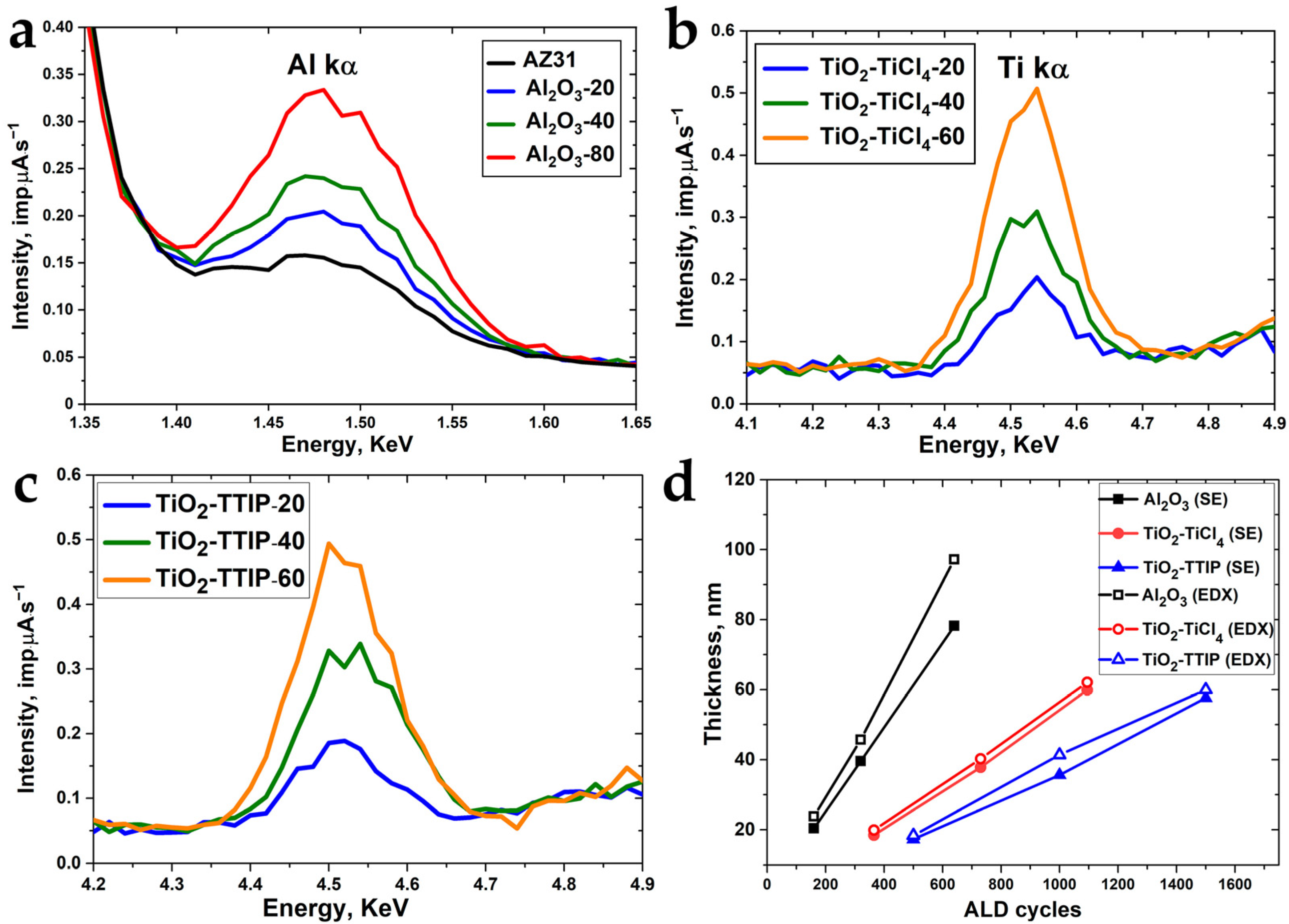
The thickness of the coatings was measured by spectral ellipsometry, with single-crystal silicon witnesses located adjacent to the magnesium alloy samples during the ALD process. The findings demonstrated that the coating thickness on silicon was closely aligned with the nominal value, exhibiting a maximum deviation of 5–10% (see Table 1 for details). A marginally more substantial deviation was documented for the TiO2-TTIP specimens, which exhibited a thickness of up to 13.5% less than the anticipated value. As the growth of coatings on silicon can differ from that on the magnesium alloy, we also evaluated the thickness of the coatings using ED-XRF data (Figure 1a–c). As can be seen from the figures, the intensity of the AlKα (1.49 keV) and TiKα (4.55 keV) peaks in the Al2O3 and TiO2 coatings increases proportionally to the thickness of the coatings. Using the known densities of the TiO2 (3.9 g/cm3) and Al2O3 (3.95 g/cm3) coatings, we calculated their respective thicknesses. The calculation results and values obtained by ellipsometry are shown in Figure 1d. A comparison of the data reveals that the thicknesses of the TiO2 coatings on silicon and AZ31 are very similar, whereas the thicknesses of the Al2O3 coatings on the magnesium alloy are significantly higher. This deviation may be due to a genuinely higher growth rate per cycle on the alloy surface, or to measurement errors caused by the weak signal of the thin coating and the significant amount of aluminium in the substrate composition, which needs to be taken into account. Unfortunately, it was not possible to calculate the thicknesses of mixed coatings due to a lack of reliable density data for these coatings.

3.1.2. Surface Morphology of Oxide Coatings with Different Thickness

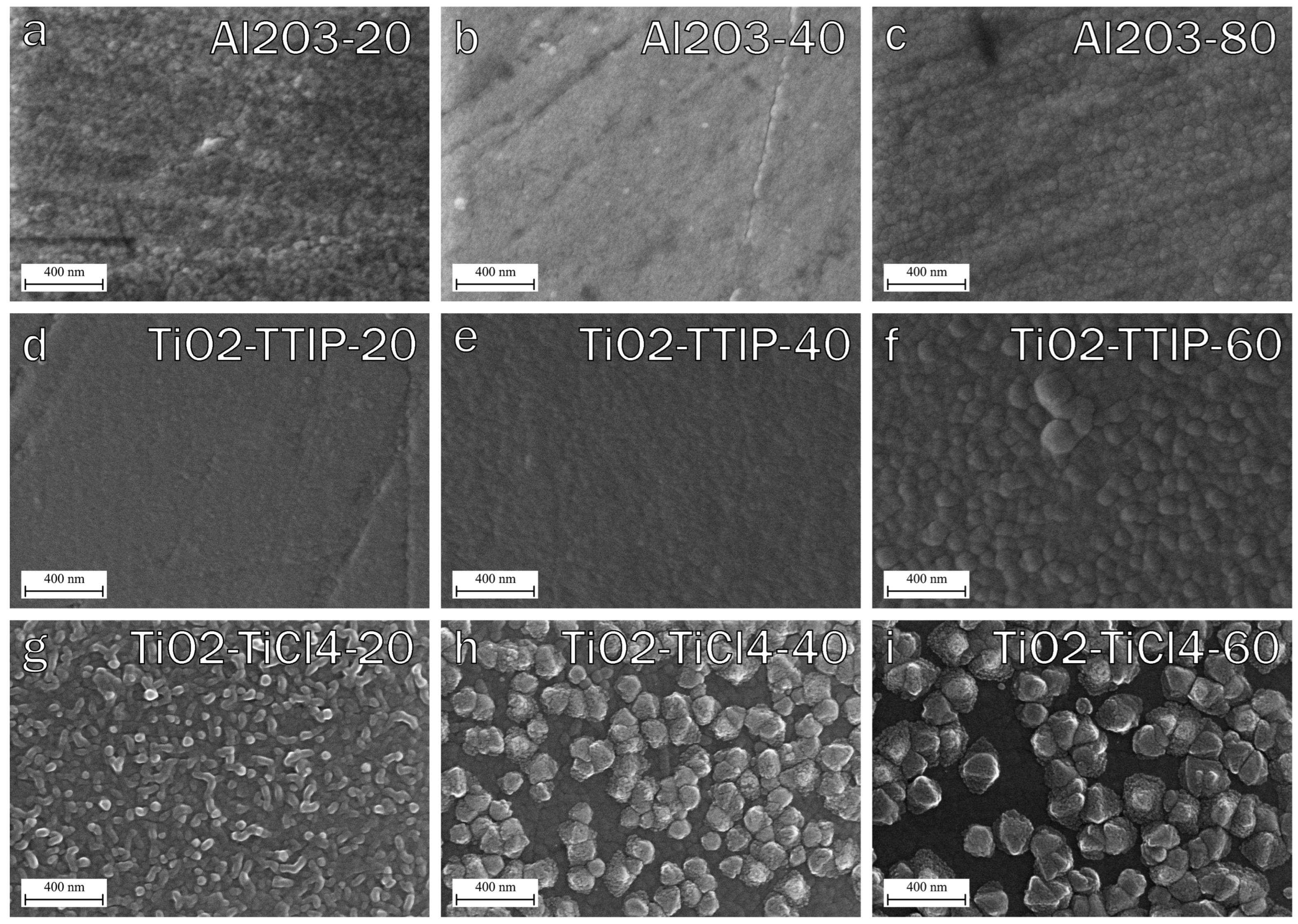
The surface morphology of the samples was evaluated using scanning electron microscopy at various magnifications, with two to three points on each sample being analysed. As illustrated in Figure 2, SEM images of AZ31 alloy samples with simple oxide coatings of varying thicknesses are presented. The aluminium oxide coatings are characterised by their continuity, uniformity, homogeneity, and absence of visible defects (Figure 2a–c). Furthermore, their morphology remains constant as the thickness increases. TiO2 coatings obtained using TTIP are also continuous, uniform, homogeneous, and free of visible defects (Figure 2d–f). The morphology of the 60 nm thick titanium oxide-based coating is characterised by tightly packed particles ranging in size from 30 to 150 nm. TiO2 coatings obtained using TiCl4 are distinguished by the presence of irregularly shaped particles, the size of which increases with increasing coating thickness, and reaching 150–200 nm in diameter (Figure 2g–i).

3.1.3. Surface Morphology of Mixed Oxide Coatings

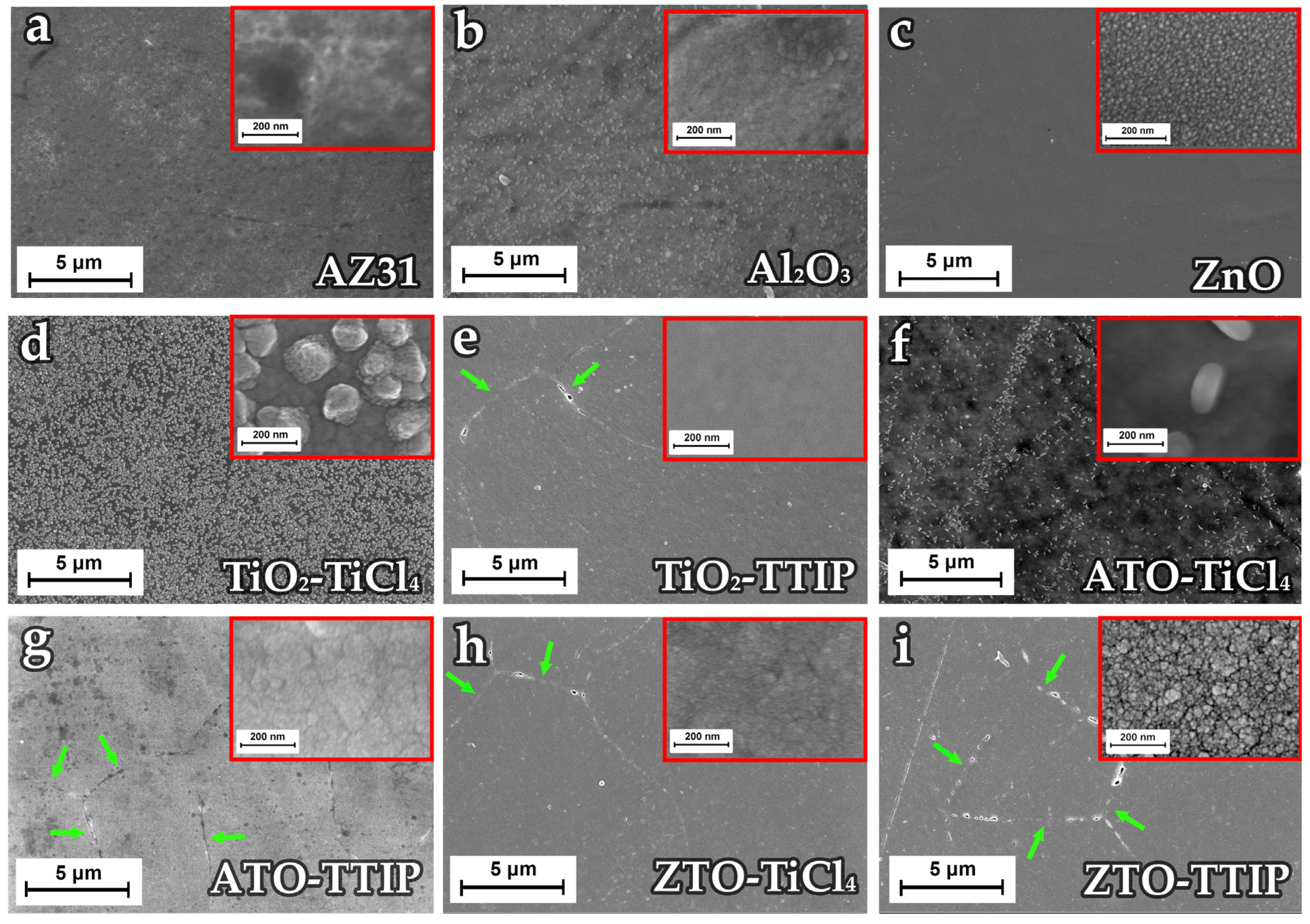
Figure 3 presents the SEM images of an AZ31 alloy substrate in the absence of coatings (Figure 3a), an alloy coated with pure Al2O3, TiO2, and ZnO (Figure 3b–e), and mixed oxide coatings of ZTO and ATO (Figure 3f–i) with a thickness of 40 nm. In the majority of low-magnification SEM images, the grain boundaries of the AZ31 substrate are clearly visible (see green arrows). Zinc oxide coatings are characterised by zincite nanoparticles [37,45] measuring between 20 and 40 nanometres (see Figure 3c, inset). Elongated particles with lengths of 100–150 nm are visible for the ATO-TiCl4 sample, while for the ATO-TTIP sample, individual particles are not characteristic and the surface is smooth and homogeneous (Figure 3g). The surface of the ZTO samples obtained using TTIP and TiCl4 is also uniform. Concurrently, a dense layer of nanostructures forming the applied coating is clearly visible on the surface of the ZTO-TTIP sample (Figure 3i, inset). It can be hypothesised that the similar layer is characteristic of the other mixed oxides; however, it was not possible to achieve a clear image of them (Figure 3g,h, insets).

3.2. Composition of ALD Coatings

The composition of all coatings with a 40 nm thickness was studied using energy-dispersive X-ray spectroscopy. Because EDS signals originate from several micrometres of material, the use of this method for the analysis of coatings with a thickness of 40 nm has a significant inaccuracy. Nevertheless, it was determined that only coatings derived from TiCl4 contain chlorine (Table 2). The highest chlorine content (0.49 at. %) was observed for pure titanium oxide. It is challenging to analyse the composition and ratio of metals in the ATO and ZTO series samples due to the presence of aluminium and zinc in the substrate, and as the detection depth of this method reaches several micrometres.
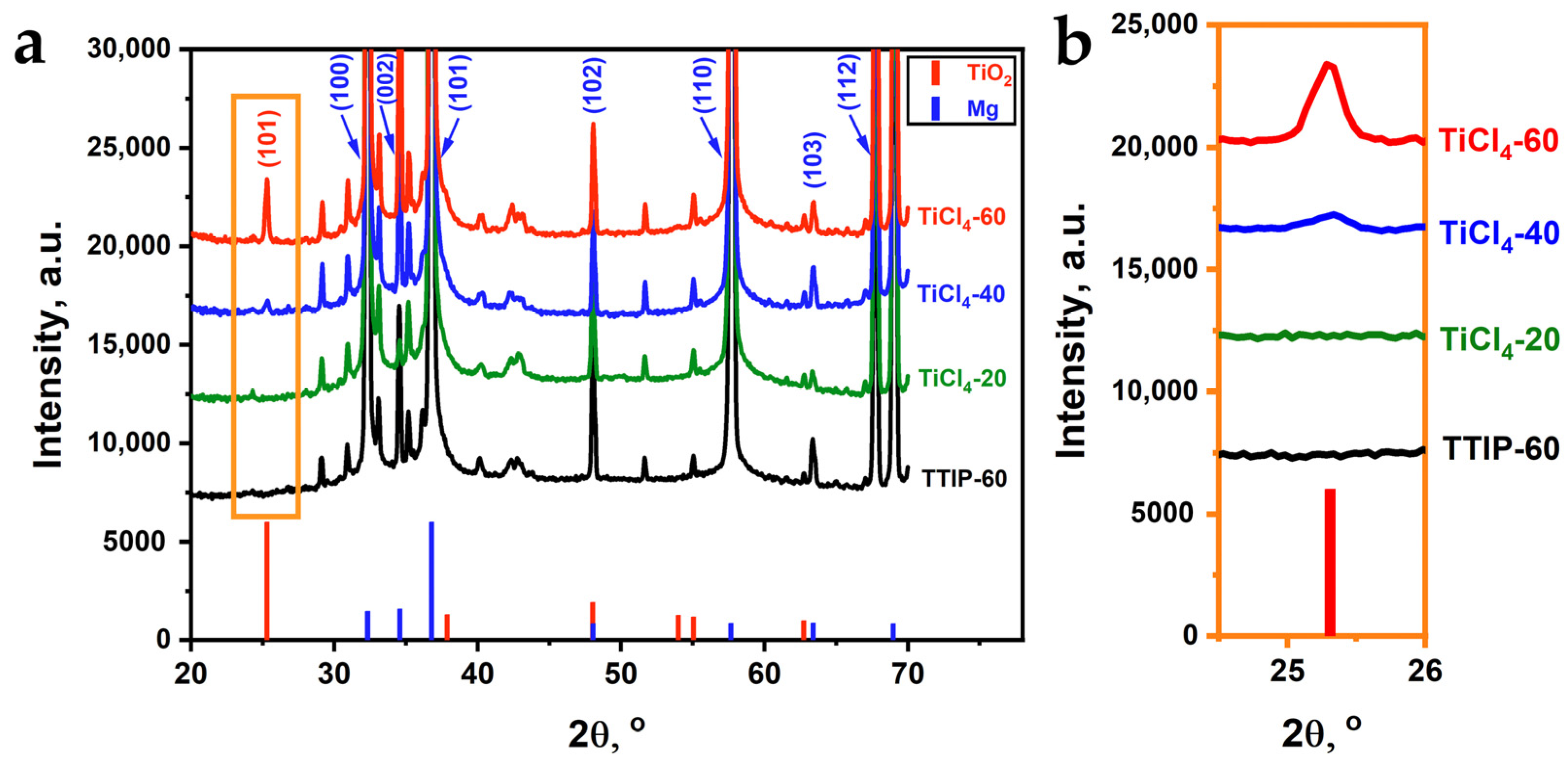
As revealed by SEM, particles that appeared to be crystals were observed on the surface of the TiO2-TiCl4 series samples. Consequently, XRD analysis was performed on these samples, as well as on the thickest TiO2-TTIP-60 sample (Figure 4). The vast majority of detected peaks correspond to the substrate material. However, the XRD pattern of TiO2-TiCl4-60 exhibited a peak at 25.3°, corresponding to the (101) plane of the anatase crystal modification of TiO2. This particular sample is distinguished by a barely perceptible shoulder at 37.9, which corresponds to the (004) plane of anatase and overlaps with an intense peak (101) of the magnesium substrate. A peak at approximately 25.3° is also observed for TiO2-TiCl4-40, but with a much lower intensity. The absence of this peak in the TiO2-TiCl4-20 and TiO2-TTIP-60 samples suggests that these coatings are amorphous or possess a negligible degree of crystallinity.

3.3. Potentiodynamic Polarisation Tests

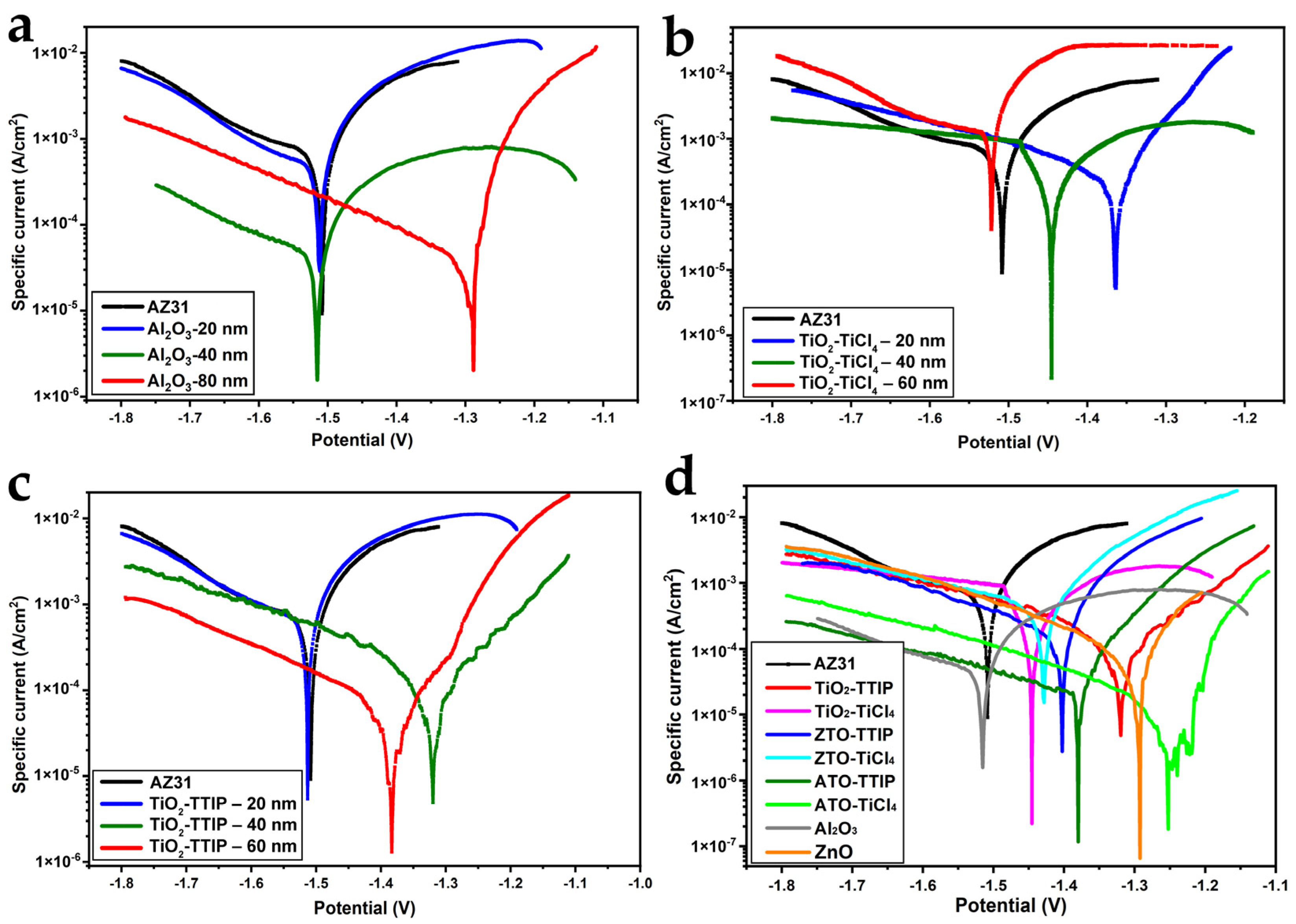
The electrochemical corrosion properties of samples were studied in Ringer’s solution. Figure S1 shows the open-circuit potential (OCP) versus time curves for all studied samples. The samples are characterised by a slight increase in potential during the first few minutes, and then stabilisation. The measured potentiodynamic polarisation curves of the samples are presented in Figure 5 and the results of Tafel processing polarisation curves are presented in Table 3. It has been demonstrated that an increase in the thickness of Al2O3 coatings results in a reduction in both the current and the corresponding corrosion rate. This reduction reaches a value exceeding 18 times for the thickest coating compared to the uncoated sample. A similar decrease in corrosion currents is characteristic of TiO2-TTIP coatings, but for TiO2-TiCl4, the opposite trend is observed, with an increase in corrosion currents as the thickness increases. Concurrently, for samples with coating thicknesses of 40 and 60 nm, the corrosion currents are even higher than for the uncoated magnesium alloy sample. According to the literature data for specimens with chemically inert coatings, a positive shift in corrosion potential has been shown to improve corrosion resistance [38,46]. A positive shift is indeed observed for Al2O3-80, TiO2-TTIP-40, and TiO2-TTIP-60 coatings, while for coatings with lower thicknesses, the corrosion potential is close to that of uncoated magnesium alloy. For the TiO2-TiCl4 series samples, a strong positive shift from −1.508 to −1.364 V is observed for the sample with a minimum coating thickness of 20 nm, followed by a decrease in potential with increasing thickness.
A detailed analysis of the polarisation curves (Figure 5d and Table 4) for mixed oxide coatings was conducted, which demonstrated that 40 nm thick ZTO coatings can reduce the corrosion current by 1.7 and 3.4 times for ZTO-TiCl4 and ZTO-TTIP samples, respectively. However, the reduction in corrosion currents for these mixed systems does not exceed that for TiO2-TTIP samples and is significantly lower than for ZnO coatings of a similar thickness. Concurrently, the efficacy of 40 nm thick ATO coatings is enhanced, with a reduction in corrosion currents of 54 and 24 times observed for samples obtained using TiCl4 and TTIP, respectively.

3.4. Electrochemical Impedance Spectroscopy

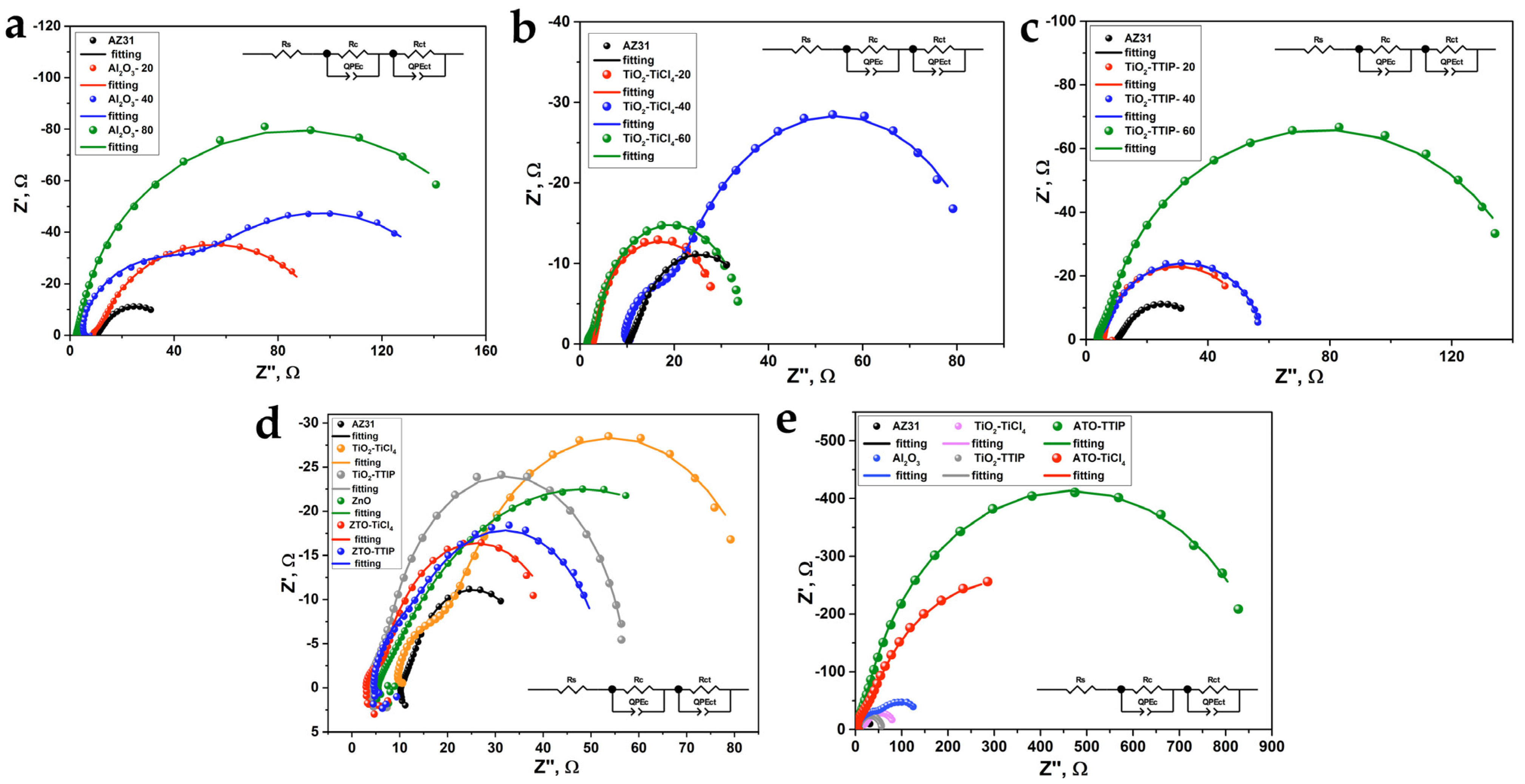
In order to perform an analysis of the individual sub-processes associated with electrochemical corrosion, the experimental setup included the conduction of EIS measurements. Nyquist and Bode plot fitting were performed using an equivalent circuit model comprising three resistances and two constant phase elements (QP), as illustrated in Figure 6, Figures S2 and S3. As demonstrated in the Nyquist plots, depicted in Figure 6, the diameter of the curves exhibited an increase in proportion to the Al2O3 thickness. The findings of the fitting process are documented in Table 5 and Table 6, where Rs is the electrolyte resistance, Rct and QPEct are the charge transfer resistance and non-ideal capacitive element, and Rc and QPEc is the resistance and non-ideal capacitive element of the coatings. The presence of Rc with an extremely low resistance of approximately 8.4 Ohm*cm2 is also indicative of the sample without the ALD coating, likely resulting from surface oxidation and the presence of a native oxide/hydroxide layer. The Rc value for the Al2O3 and TiO2-TTIP series samples is significantly higher and increases noticeably with an increasing coating thickness. It is noteworthy that for the Al2O3-20 and Al2O3-40 samples, the Rc values are very close (223 and 226 Ohm*cm2, respectively). However, for the sample with a thickness of 40 nm, a very high Rct of 146 Ohm*cm2 is characteristic. This phenomenon is likely attributable to the development of an additional layer with a relatively high thickness. Such a layer can be a natural surface oxide/hydroxide layer, as well as a layer of corrosion products on the magnesium alloy. The TiO2-TiCl4 series samples exhibited an enhancement in coating resistance, with an increase from 49.8 to 171 Ohm*cm2, accompanied by an augmentation in thickness from 20 to 40 nm. This was followed by a decline to 76.2 Ohm*cm2. A comparable reliance on thickness is evident in the Rct model.
For the mixed oxides of the ZTO system, Rc values (87.9 and 97.5 Ohm*cm2) are considerably lower than Rc for pure ZnO (210.3 Ohm*cm2) and TiO2 of analogous thickness (116 Ohm*cm2 for TiO2-TTIP and 171 Ohm*cm2 for TiO2-TiCl4). A similar relationship between samples is observed when considering the total resistance Rc + Rct. The ATO coating samples exhibit a high degree of resistance, both for the coating itself and for the charge transfer layer. For the ATO-TTIP samples, the measured resistance values are 1982 and 313 Ohm*cm2, respectively, while for the ATO-TiCl4 samples, the measured values are 1321 and 226 Ohm*cm2. These values exceed the resistances of pure Al2O3 and TiO2 oxides of a similar thickness by a significant margin.

4. Discussion

A significant amount of research has been dedicated to exploring methods for regulating the biodegradation of magnesium alloys through the application of diverse coatings. However, the comparative analysis is complicated by differences in methodology, the lack of universally recognised testing standards, and differences in the experimental skills of researchers. Immersion approaches and electrochemical methods are particularly useful in analysing the biocorrosion of magnesium alloys. The former approach entails the placement of samples in various physiological solutions, followed by the measurement of the loss of sample mass, the amount of hydrogen released, or the change in solution pH at multiple time intervals. Electrochemical methods are both faster and more widely used. These methods involve measuring potentiodynamic potential curves followed by Tafel processing to determine corrosion currents, corrosion potentials, and polarisation resistance. In addition to potentiodynamic curves, impedance spectroscopy is typically employed to analyse the contribution of various elements to the overall corrosion resistance and diffusion processes. Both types of measurements were taken in various physiological solutions, including 0.9 and 3.5% NaCl, Ringer’s solution, phosphate buffer solution, simulated body fluid, Minimum Essential Medium (MEM), Dulbecco’s Modified Eagle’s Medium (DMEM), etc. [47]. It is important to note that each of these solutions, with the exception of NaCl, has undergone various modifications, which can result in significant variations in measurement results.
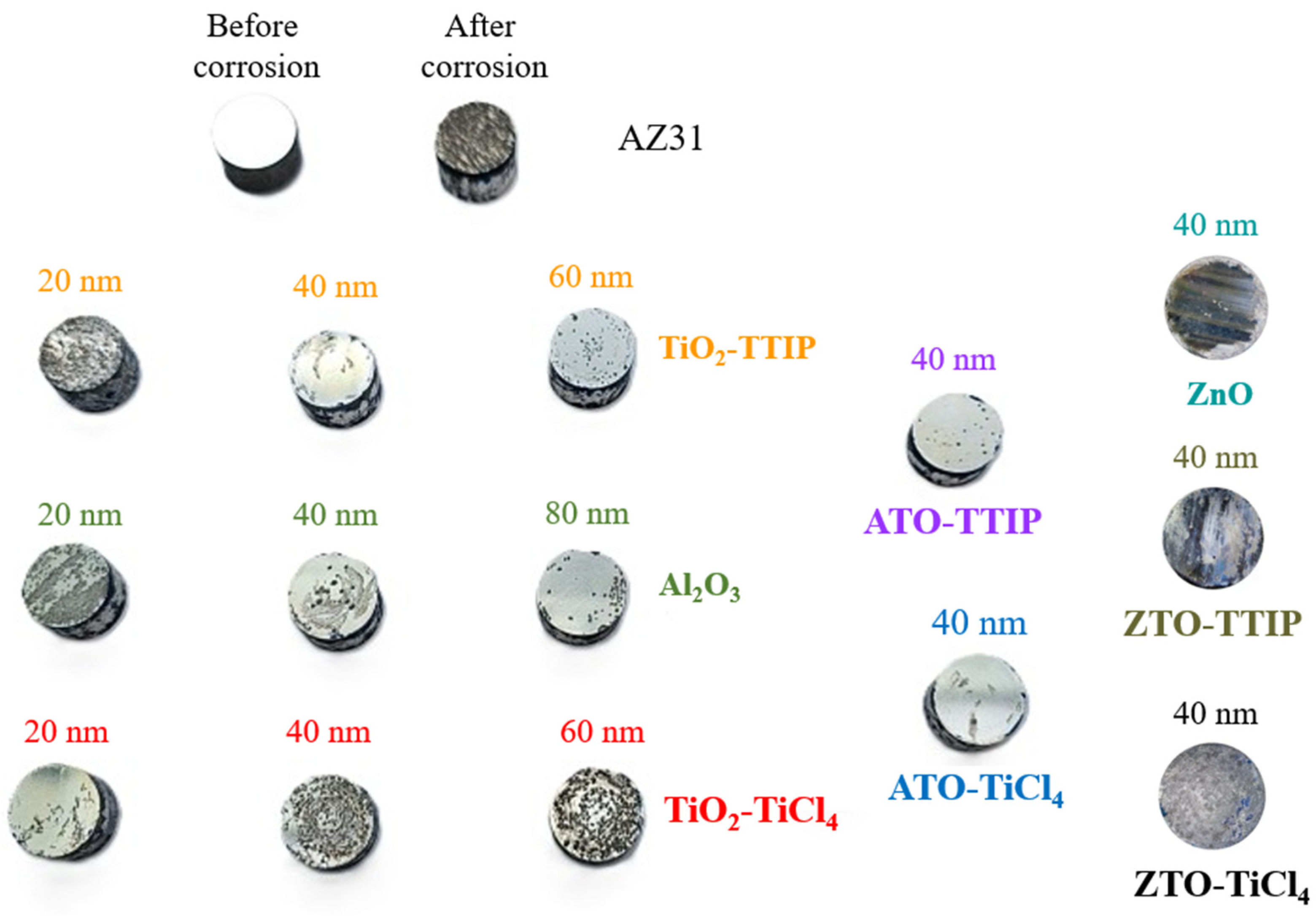
In this regard, a comparative study of the effectiveness of different types of coatings within a single experimental study may be of considerable importance. Our electrochemical studies of coatings of varying compositions and thicknesses in one of the simplest physiological solutions—Ringer’s solution—have yielded a number of noteworthy observations. In the case of the Al2O3 and TiO2-TTIP coatings, which are amorphous, homogeneous, and whose morphology and relief repeat the relief of the substrate, an increase in thickness naturally reduces currents and the corrosion rate. Concurrently, an analysis of the appearance of the samples following corrosion tests (Figure 7) enables the assessment of alterations in the nature of corrosion. The Al2O3-20 sample exhibited a substantial area affected by both general and pitting corrosion, while the Al2O3-40 sample demonstrated a significantly reduced area of general corrosion, and the Al2O3-80 sample solely exhibited areas of pitting corrosion. For the TiO2-TTIP series samples, visually apparent general corrosion is observed exclusively for samples with coatings measuring 20 nm in thickness. It is hypothesised that this alteration in nature resulted in a substantial change in the corrosion potential (Figure 5 and Table 3).
It is well established that the structure of TiO2 coatings is depended on the type of precursor utilised [44,48]. This discrepancy is discernible in the SEM and XRD data (Figure 2 and Figure 4) and exerts a substantial influence on their anti-corrosion properties. In contrast to TiO2-TTIP, TiO2-TiCl4 coatings consist of relatively large grains of anatase and an amorphous layer surrounding them, as previously demonstrated in our work using transmission electron microscopy [44]. An increase in the coating thickness may favour the formation of a crystalline phase and reduce the proportion and thickness of the amorphous phase, which may reduce the protective properties. Photographs of samples after corrosion testing demonstrate the presence of pitting corrosion, as well as an increase in the number and size of pitting corrosion areas, concomitant with an increase in the nominal thickness of the coatings. Although EDX analysis revealed a trace amount of chlorine in these coatings, its presence is unlikely to have had a significant effect on the nature of corrosion in a physiological solution consisting of metal chlorides.
ZnO and both types of ZTO coatings differ significantly in their morphologies. ZnO consists of a layer of a large number of separate nanostructures, while ZTO coatings are characterised by a more continuous and uniform layer of nanostructures. A close examination of the samples indicates that the corrosion mechanisms of all of them are similar and appear to be of a continuous nature. In the case of ATO coatings, a pitting corrosion mechanism is observed, and these coatings have the best protective properties among all those studied. For coatings with a thickness of 40 nm, the reduction in corrosion currents reaches 54 and 24 times for ATO-TiCl4 and ATO-TTIP, respectively. These values are significantly higher than those of all other coatings studied and indicate the prospects of this type of mixed coating for controlling the biocorrosion of magnesium alloys.
The protective properties of nanolaminates and mixed oxides of ATO are well known to be superior to those of simple oxides of TiO2 and Al2O3. In particular, it has been demonstrated that ATO is more effective at protecting polyimide from oxygen erosion [49], and much more effective at protecting copper from corrosion in water [50] and in 0.1 M NaCl solution [51]. The authors cite various reasons for this advantage. Abdulagatov et al. argue that TiO2 has nucleation problems and contains more pinholes, while Al2O3 is not stable enough on copper, and ATOs do not have this disadvantage [50]. Fusco et al. also note the insufficient stability of aluminium oxide to dissolution, and suggest that alternating layers of Al2O3 and TiO2 cover defects in each of them [51]. Yan et al., in turn, argue that ATO’s advantage lies in the fact that incorporating Al into the coating’s structure can inhibit TiO2 crystallisation, reduce grain boundary defects, and form denser, more compact coatings [49]. Our previous study showed that pitting corrosion occurs in defective areas of aluminium oxide coatings [37], so reducing the number of defects and forming a more continuous, compact, and homogeneous coating in terms of composition and structure seems to be the most likely reason for the protective properties of these coatings. In the case of ZTO, as we have previously demonstrated [45,52], there are issues with the mixing of ZnO and TiO2, which results in a heterogeneous and inhomogeneous coating and, consequently, inferior anti-corrosion properties.
Despite the demonstrated effectiveness of ATO coatings, further detailed research is required. Given the focus of this study on mixed coatings with an Al2O3/TiO2 cycle ratio of 1:1, it would be a worthwhile endeavour to extend the investigation to other ratios, with the objective of identifying more efficacious ones. Moreover, the electrochemical methods employed preclude a reliable evaluation of the long-term stability, a prerequisite for practical application, and the effectiveness of these coatings over several weeks. Consequently, immersion studies employing more complex physiological solutions of various compositions are imperative and are scheduled for implementation in the future.

5. Conclusions

A comparative study of various oxide atomic layer deposition (ALD) coatings revealed their effectiveness in reducing the biocorrosion of the AZ31 magnesium alloy. However, increasing the thickness does not invariably result in enhanced protective properties. The effectiveness of TiO2 coatings depends on the precursor used: titanium tetrachloride or titanium tetraisopropoxide. Applying TTIP results in uniform, conformal coatings with a smooth relief. These coatings’ protective properties increase as the thickness increases. Conversely, using TiCl4 as an ALD precursor results in a granular coating structure with no increase in protective properties as the thickness increases. Meanwhile, the disparity in titanium precursors does not significantly influence the morphology or protective properties of mixed ATO and ZTO coatings. ATO coatings have been shown to exhibit significantly higher protective properties than simple Al2O3 and TiO2 oxide coatings of similar thickness. These coatings have been shown to reduce corrosion currents by 24 to 54 times compared to an uncoated AZ31 magnesium alloy.

Supplementary Materials

The following supporting information can be downloaded at: https://www.mdpi.com/article/10.3390/cmd7010003/s1. Figure S1: Plots of open circuit potential (OCP) vs. time for uncoated AZ31 and AZ31 with coatings.; Figure S2: EIS Bode plots of phase angle vs. frequency with fitting for (a) Al2O3, (b) TiO2-TiCl4, (c) TiO2-TTIP, (d) ZTO, and (e) ATO samples; Figure S3. EIS Bode plots of |Z| vs. frequency with fitting for (a) Al2O3, (b) TiO2-TiCl4, (c) TiO2-TTIP, (d) ZTO, and (e) ATO samples.

Author Contributions

Conceptualisation, D.N., M.M., and M.S.; methodology, D.N., L.K., S.K., and M.P.; validation, V.V., A.I., and M.M.; formal analysis, D.N.; investigation, D.N., L.K., S.K., M.R., and A.P.G.; resources, D.N., S.E.C., and M.S.; data curation, D.N. and L.K.; writing—original draft preparation, D.N., L.K., and V.V.; writing—review and editing, M.S. and M.M.; visualisation, L.K. and V.V.; supervision, D.N. and M.M.; project administration, D.N., M.M., and M.S.; funding acquisition, D.N., M.P., and S.E.C. All authors have read and agreed to the published version of the manuscript.

Funding

The main part of the research was conducted under the financial support of the Russian Science Foundation grant (project No. 24-73-00115), https://www.rscf.ru/project/24-73-00115/ (accessed on 20 November 2025). Composition analysis of the samples was carried out by Maxim Shevtsov, Mark Pitkin, and Stephanie E. Combs, and was supported by Grant R44AR079960 from the National Institute of Arthritis and Musculoskeletal and Skin Diseases, NIH, and the Technische Universität München (TUM) within the DFG funding program Open Access Publishing.

Data Availability Statement

The raw data supporting the conclusions of this article will be made available by the authors on request.

Acknowledgments

This research was conducted using the equipment of the resource centres of the Research Park of the St. Petersburg State University Innovative Technologies of Composite Nanomaterials, X-ray Diffraction Studies, and Nanotechnology Interdisciplinary Center.

Conflicts of Interest

The authors declare no conflicts of interest. The funders had no role in the design of the study; in the collection, analyses, or interpretation of data; in the writing of the manuscript; or in the decision to publish the results.

References

  1. Gao, X.; Zhu, Z.; Zhang, H.; Yang, J.; Zhu, Z.; Tiwari, S.K. Research Progress on Corrosion Behavior of Magnesium Alloy Composites in Practical Service Conditions. Adv. Sustain. Syst. 2025, 9, e00660. [Google Scholar] [CrossRef]
  2. Sekar, P.; Narendranath, S.; Desai, V. Recent progress in in vivo studies and clinical applications of magnesium based biodegradable implants—A review. J. Magnes. Alloys 2021, 9, 1147–1163. [Google Scholar] [CrossRef]
  3. Zhang, J.; Miao, J.; Balasubramani, N.; Cho, D.H.; Avey, T.; Chang, C.-Y.; Luo, A.A. Magnesium research and applications: Past, present and future. J. Magnes. Alloys 2023, 11, 3867–3895. [Google Scholar] [CrossRef]
  4. Xia, B.; Liu, Y.; Xing, Y.; Shi, Z.; Pan, X. Biodegradable Medical Implants: Reshaping Future Medical Practice. Adv. Sci. 2025, 12, e08014. [Google Scholar] [CrossRef] [PubMed]
  5. Mohd Salaha, Z.F.; Abdullah, N.N.A.A.; Chan, K.F.; Gan, H.-S.; Mohd Yusop, M.Z.; Ramlee, M.H. Biodegradable orthopaedic implants: A systematic review of in vitro and in vivo evaluations of magnesium, iron, and zinc alloys. Results Eng. 2025, 27, 105746. [Google Scholar] [CrossRef]
  6. Zheng, Y.F.; Gu, X.N.; Witte, F. Biodegradable metals. Mater. Sci. Eng. R Rep. 2014, 77, 1–34. [Google Scholar] [CrossRef]
  7. Gonfa, B.K.; Jiru, M.G.; Esleman, E.A. Advancing metallic implant: A review of magnesium alloys as bio-absorbable alternatives to orthopedic devices. Results Eng. 2025, 27, 106091. [Google Scholar] [CrossRef]
  8. He, X.; Li, Y.; Zou, D.; Zu, H.; Li, W.; Zheng, Y. An overview of magnesium-based implants in orthopaedics and a prospect of its application in spine fusion. Bioact. Mater. 2024, 39, 456–478. [Google Scholar] [CrossRef]
  9. Chakraborty Banerjee, P.; Al-Saadi, S.; Choudhary, L.; Harandi, S.E.; Singh, R. Magnesium Implants: Prospects and Challenges. Materials 2019, 12, 36. [Google Scholar] [CrossRef]
  10. Ben Amara, H.; Martinez, D.C.; Shah, F.A.; Loo, A.J.; Emanuelsson, L.; Norlindh, B.; Willumeit-Romer, R.; Plocinski, T.; Swieszkowski, W.; Palmquist, A.; et al. Magnesium implant degradation provides immunomodulatory and proangiogenic effects and attenuates peri-implant fibrosis in soft tissues. Bioact. Mater. 2023, 26, 353–369. [Google Scholar] [CrossRef]
  11. Zhao, D.; Wang, T.; Kuhlmann, J.; Dong, Z.; Chen, S.; Joshi, M.; Salunke, P.; Shanov, V.N.; Hong, D.; Kumta, P.N.; et al. In vivo monitoring the biodegradation of magnesium alloys with an electrochemical H2 sensor. Acta Biomater. 2016, 36, 361–368. [Google Scholar] [CrossRef]
  12. Sun, Y.; Helmholz, H.; Willumeit-Römer, R. Peri-implant gas accumulation in response to magnesium-based musculoskeletal biomaterials: Reframing current evidence for preclinical research and clinical evaluation. J. Magnes. Alloys 2024, 12, 59–71. [Google Scholar] [CrossRef]
  13. Ren, J.; Zhao, Z.; Li, H.; Wang, D.; Shuai, C.; Yang, Y. Surface Coatings on Biomedical Magnesium Alloys. Materials 2025, 18, 3411. [Google Scholar] [CrossRef]
  14. Singh, N.; Batra, U.; Kumar, K.; Ahuja, N.; Mahapatro, A. Progress in bioactive surface coatings on biodegradable Mg alloys: A critical review towards clinical translation. Bioact. Mater. 2023, 19, 717–757. [Google Scholar] [CrossRef]
  15. Sarian, M.N.; Iqbal, N.; Sotoudehbagha, P.; Razavi, M.; Ahmed, Q.U.; Sukotjo, C.; Hermawan, H. Potential bioactive coating system for high-performance absorbable magnesium bone implants. Bioact. Mater. 2022, 12, 42–63. [Google Scholar] [CrossRef] [PubMed]
  16. Capitaine, B.P.D.; López, A.G.M.; Magaña, J.C.T.; Aguilar, G.G.; Reyes, J.L.R. Electrochemical characterization of conversion coatings of phosphates plus nanostructured TiO2 over magnesium in a simulated body fluid. J. Solid State Electrochem. 2023, 27, 3091–3099. [Google Scholar] [CrossRef]
  17. Pommiers, S.; Frayret, J.; Castetbon, A.; Potin-Gautier, M. Alternative conversion coatings to chromate for the protection of magnesium alloys. Corros. Sci. 2014, 84, 135–146. [Google Scholar] [CrossRef]
  18. Barati Darband, G.; Aliofkhazraei, M.; Hamghalam, P.; Valizade, N. Plasma electrolytic oxidation of magnesium and its alloys: Mechanism, properties and applications. J. Magnes. Alloys 2017, 5, 74–132. [Google Scholar] [CrossRef]
  19. Mashtalyar, D.V.; Imshinetskiy, I.M.; Kashepa, V.V.; Nadaraia, K.V.; Piatkova, M.A.; Pleshkova, A.I.; Fomenko, K.A.; Ustinov, A.Y.; Sinebryukhov, S.L.; Gnedenkov, S.V. Effect of Ta2O5 nanoparticles on bioactivity, composition, structure, in vitro and in vivo behavior of PEO coatings on Mg-alloy. J. Magnes. Alloys 2024, 12, 2360–2379. [Google Scholar] [CrossRef]
  20. Ma, Y.; Mei, J.; Ouyang, J.; Wu, P.; Wang, S.; Yang, J.; He, Y.; Zheng, W.; Li, H.; Lu, C.; et al. Structure and corrosion resistance of electron-beam-strengthened and micro-arc oxidized coatings on magnesium alloy AZ31. J. Vac. Sci. Technol. A 2023, 41, 053101. [Google Scholar] [CrossRef]
  21. Li, Z.; Wang, Y.; Wang, B.; Yuan, M.; Xun, M.; Zhang, H. Progress in the study of micro-arc oxidation film layers on biomedical metal surfaces. Corros. Rev. 2025, 43, 175–187. [Google Scholar] [CrossRef]
  22. Liu, P.; Pan, X.; Yang, W.; Cai, K.; Chen, Y. Al2O3–ZrO2 ceramic coatings fabricated on WE43 magnesium alloy by cathodic plasma electrolytic deposition. Mater. Lett. 2012, 70, 16–18. [Google Scholar] [CrossRef]
  23. Ji, R.; Peng, G.; Zhang, S.; Li, Z.; Li, J.; Fang, T.; Zhang, Z.; Wang, Y.; He, Y.; Wu, J. The fabrication of a CeO2 coating via cathode plasma electrolytic deposition for the corrosion resistance of AZ31 magnesium alloy. Ceram. Int. 2018, 44, 19885–19891. [Google Scholar] [CrossRef]
  24. Zarka, M.; Dikici, B.; Niinomi, M.; Ezirmik, K.V.; Nakai, M.; Yilmazer, H. A systematic study of β-type Ti-based PVD coatings on magnesium for biomedical application. Vacuum 2021, 183, 109850. [Google Scholar] [CrossRef]
  25. Hoche, H.; Schmidt, J.; Groß, S.; Troßmann, T.; Berger, C. PVD coating and substrate pretreatment concepts for corrosion and wear protection of magnesium alloys. Surf. Coat. Technol. 2011, 205, S145–S150. [Google Scholar] [CrossRef]
  26. Merino, E.; Duran, A.; Cere, S.; Castro, Y. Hybrid Epoxy-Alkyl Sol-Gel Coatings Reinforced with SiO2 Nanoparticles for Corrosion Protection of Anodized AZ31B Mg Alloy. Gels 2022, 8, 242. [Google Scholar] [CrossRef]
  27. Hu, C.; Le, Q.; Zhou, X.; Cheng, C.; Guo, R.; Li, X.; Li, D.; Zhang, X. The growth and corrosion mechanism of Zn-based coating on AZ31 magnesium alloys by novel hot-dip process. Mater. Charact. 2022, 189, 111988. [Google Scholar] [CrossRef]
  28. Kania, A.; Szindler, M.M.; Szindler, M. Structure and Corrosion Behavior of TiO2 Thin Films Deposited by ALD on a Biomedical Magnesium Alloy. Coatings 2021, 11, 70. [Google Scholar] [CrossRef]
  29. Lin, P.C.; Lin, K.F.; Chiu, C.; Semenov, V.I.; Lin, H.C.; Chen, M.J. Effect of atomic layer plasma treatment on TALD-ZrO2 film to improve the corrosion protection of Mg-Ca alloy. Surf. Coat. Technol. 2021, 427, 127811. [Google Scholar] [CrossRef]
  30. Liu, X.; Yang, Q.; Li, Z.; Yuan, W.; Zheng, Y.; Cui, Z.; Yang, X.; Yeung, K.W.K.; Wu, S. A combined coating strategy based on atomic layer deposition for enhancement of corrosion resistance of AZ31 magnesium alloy. Appl. Surf. Sci. 2018, 434, 1101–1111. [Google Scholar] [CrossRef]
  31. Peron, M.; Berto, F.; Torgersen, J. Stress corrosion cracking behavior of zirconia ALD–coated AZ31 alloy in simulated body fluid. Mater. Des. Process. Commun. 2019, 2, e126. [Google Scholar] [CrossRef]
  32. Peron, M.; Cogo, S.; Bjelland, M.; Bin Afif, A.; Dadlani, A.; Greggio, E.; Berto, F.; Torgersen, J. On the evaluation of ALD TiO2, ZrO2 and HfO2 coatings on corrosion and cytotoxicity performances. J. Magnes. Alloys 2021, 9, 1806–1819. [Google Scholar] [CrossRef]
  33. Cremers, V.; Puurunen, R.L.; Dendooven, J. Conformality in atomic layer deposition: Current status overview of analysis and modelling. Appl. Phys. Rev. 2019, 6, 21302. [Google Scholar] [CrossRef]
  34. George, S.M. Atomic Layer Deposition: An Overview. Chem. Rev. 2010, 110, 111–131. [Google Scholar] [CrossRef]
  35. Kessels, E.; Devi, A.; Park, J.-S.; Ritala, M.; Yanguas-Gil, A.; Wiemer, C. Atomic layer deposition. Nat. Rev. Methods Primers 2025, 5, 66. [Google Scholar] [CrossRef]
  36. Yang, Q.; Yuan, W.; Liu, X.; Zheng, Y.; Cui, Z.; Yang, X.; Pan, H.; Wu, S. Atomic layer deposited ZrO2 nanofilm on Mg-Sr alloy for enhanced corrosion resistance and biocompatibility. Acta Biomater 2017, 58, 515–526. [Google Scholar] [CrossRef]
  37. Kozlova, L.A.; Vartiajnen, V.V.; Kirichenko, S.O.; Rytova, M.A.; Godun, A.P.; Kolesnichenko, Y.V.; Yudintceva, N.M.; Kalganov, V.D.; Lozhkin, M.S.; Morozova, N.E.; et al. Regulation of biocorrosion of AZ31-type magnesium alloy by atomic layer deposition of Al2O3 nanocoatings. Surf. Interfaces 2025, 69, 106775. [Google Scholar] [CrossRef]
  38. Xu, F.; Luo, L.; Xiong, L.; Liu, Y. Microstructure and corrosion behavior of ALD Al2O3 film on AZ31 magnesium alloy with different surface roughness. J. Magnes. Alloys 2020, 8, 480–492. [Google Scholar] [CrossRef]
  39. Lin, P.-C.; Lin, K.; Lin, Y.-H.; Yang, K.-C.; Semenov, V.I.; Lin, H.-C.; Chen, M.-J. Improvement of Corrosion Resistance and Biocompatibility of Biodegradable Mg–Ca Alloy by ALD HfZrO2 Film. Coatings 2022, 12, 212. [Google Scholar] [CrossRef]
  40. Peron, M.; Bin Afif, A.; Dadlani, A.L.; Berto, F.; Torgersen, J. Improving stress corrosion cracking behavior of AZ31 alloy with conformal thin titania and zirconia coatings for biomedical applications. J. Mech. Behav. Biomed. Mater. 2020, 111, 104005. [Google Scholar] [CrossRef] [PubMed]
  41. Peron, M.; Bertolini, R.; Cogo, S. On the corrosion, stress corrosion and cytocompatibility performances of ALD TiO2 and ZrO2 coated magnesium alloys. J. Mech. Behav. Biomed. Mater. 2022, 125, 104945. [Google Scholar] [CrossRef]
  42. Yang, F.; Chang, R.; Webster, T.J. Atomic Layer Deposition Coating of TiO2 Nano-Thin Films on Magnesium-Zinc Alloys to Enhance Cytocompatibility for Bioresorbable Vascular Stents. Int. J. Nanomed. 2019, 14, 9955–9970. [Google Scholar] [CrossRef] [PubMed]
  43. Chen, H.-J.; Yang, K.-C.; Lin, P.-C.; Lin, K.; Chen, M.-J.; Wang, C.-C.; Chiu, C.; Lin, H.-C. Multilayer Al2O3/ZrO2 coatings via PEALD for enhanced corrosion resistance and biocompatibility of biodegradable Mg–Ca alloys. Mater. Chem. Phys. 2025, 345, 131297. [Google Scholar] [CrossRef]
  44. Nazarov, D.; Ezhov, I.; Yudintceva, N.; Mitrofanov, I.; Shevtsov, M.; Rudakova, A.; Maximov, M. MG-63 and FetMSC Cell Response on Atomic Layer Deposited TiO2 Nanolayers Prepared Using Titanium Tetrachloride and Tetraisopropoxide. Coatings 2022, 12, 668. [Google Scholar] [CrossRef]
  45. Nazarov, D.; Kozlova, L.; Rudakova, A.; Zemtsova, E.; Yudintceva, N.; Ovcharenko, E.; Koroleva, A.; Kasatkin, I.; Kraeva, L.; Rogacheva, E.; et al. Atomic Layer Deposition of Chlorine Containing Titanium–Zinc Oxide Nanofilms Using the Supercycle Approach. Coatings 2023, 13, 960. [Google Scholar] [CrossRef]
  46. Esmaily, M.; Svensson, J.E.; Fajardo, S.; Birbilis, N.; Frankel, G.S.; Virtanen, S.; Arrabal, R.; Thomas, S.; Johansson, L.G. Fundamentals and advances in magnesium alloy corrosion. Prog. Mater. Sci. 2017, 89, 92–193. [Google Scholar] [CrossRef]
  47. Mei, D.; Lamaka, S.V.; Lu, X.; Zheludkevich, M.L. Selecting medium for corrosion testing of bioabsorbable magnesium and other metals—A critical review. Corros. Sci. 2020, 171, 108722. [Google Scholar] [CrossRef]
  48. Niemelä, J.-P.; Marin, G.; Karppinen, M. Titanium dioxide thin films by atomic layer deposition: A review. Semicond. Sci. Technol. 2017, 32, 093005. [Google Scholar] [CrossRef]
  49. Yan, C.; Li, J.; Wang, H.; Tong, H.; Ye, X.; Wang, K.; Yuan, X.; Liu, C.; Li, H. Growth and atomic oxygen erosion resistance of Al2O3-doped TiO2 thin film formed on polyimide by atomic layer deposition. RSC Adv. 2024, 14, 34833–34842. [Google Scholar] [CrossRef]
  50. Abdulagatov, A.I.; Yan, Y.; Cooper, J.R.; Zhang, Y.; Gibbs, Z.M.; Cavanagh, A.S.; Yang, R.G.; Lee, Y.C.; George, S.M. Al2O3 and TiO2 atomic layer deposition on copper for water corrosion resistance. ACS Appl. Mater. Interfaces 2011, 3, 4593–4601. [Google Scholar] [CrossRef] [PubMed]
  51. Fusco, M.A.; Oldham, C.J.; Parsons, G.N. Investigation of the Corrosion Behavior of Atomic Layer Deposited Al2O3/TiO2 Nanolaminate Thin Films on Copper in 0.1 M NaCl. Materials 2019, 12, 672. [Google Scholar] [CrossRef] [PubMed]
  52. Nazarov, D.V.; Kozlova, L.A.; Yudintceva, N.M.; Ovcharenko, E.A.; Rudakova, A.V.; Kirichenko, S.O.; Rogacheva, E.V.; Kraeva, L.A.; Borisov, E.V.; Popovich, A.A.; et al. Atomic layer deposition of biocompatible multifunctional ZnO-TiO2 nanocoatings on the surface of additively manufactured nitinol. Appl. Surf. Sci. 2024, 675, 160974. [Google Scholar] [CrossRef]
Figure 1. Alkα ED-XRF spectrum for AZ31 with Al2O3 coatings of different thicknesses (a). Tikα ED-XRF spectrum for AZ31 with TiO2-TiCl4 (b) and TiO2-TTIP coatings (c). Dependences of coating thicknesses on the number of ALD cycles from ED-XRF data on AZ31 alloy and on the silicon surface from ellipsometry (d).
Cmd 07 00003 g001
Figure 2. SEM images of the surface of polished AZ31 alloy with Al2O3 coatings of 20 nm (a), 40 nm (b), and 80 nm (c) thicknesses; TiO2-TTIP of 20 nm (d), 40 nm (e), and 60 nm (f) thicknesses; TiO2-TiCl4 of 20 nm (g), 40 nm (h), and 60 nm (i) thicknesses.
Cmd 07 00003 g002
Figure 3. SEM images of the surface of polished AZ31 alloy (a); alloy with 40 nm coatings of Al2O3 (b), ZnO (c), TiO2-TiCl4 (d), TiO2-TTIP (e), ATO-TiCl4 (f), ATO-TTIP (g), ZTO-TiCl4 (h), and ZTO-TTIP (i). Larger magnification figures are shown in the insets marked in red. The green arrows indicate the grain boundaries of the substrate.
Cmd 07 00003 g003
Figure 4. XRD patterns of samples with TiO2 coatings with different thicknesses deposited on AZ31 alloy using TiCl4 and TTIP as precursors (a); the enlarged area with the most intense peak of the anatase crystal structure (b).
Cmd 07 00003 g004
Figure 5. Potentiodynamic polarisation curves of the specimens in Ringer solution for Al2O3 (a), TiO2-TiCl4 (b), TiO2-TTIP (c), and mixed samples (d).
Cmd 07 00003 g005
Figure 6. EIS Nyquist plots with fittings and equivalent circuits for Al2O3 (a), TiO2-TiCl4 (b), TiO2-TTIP (c), ZTO (d), and ATO (e) samples.
Cmd 07 00003 g006
Figure 7. Photos of the samples after electrochemical corrosion tests. Black points are spots of pitting corrosion.
Cmd 07 00003 g007
Table 1. Conditions for atomic layer deposition of simple and mixed oxide coatings with results of thickness measurements by spectral ellipsometry.
SamplePrecursorsEstimated Thickness, nmNumber of CyclesNumber of SupercyclesThickness, nm
(SE)
Al2O3Al(CH3)320160-20.4
40320-39.6
80640-78.2
TiO2TiCl420365-18.5
40730-37.8
601095-59.9
TTIP20500-17.3
401000-35.6
601500-57.6
ZnOZn(C2H5)240222-39.8
ZTOTTIP, Zn(C2H5)24036418240.2
TiCl4, Zn(C2H5)24034017041.5
ATOTTIP, Al(CH3)34050025037.1
TiCl4, Al(CH3)34046023037.6
Table 2. Results of elemental analysis of 40 nm coatings on AZ31 alloy based on EDS results.
SampleO, at. %Mg, at. %Al, at. %Cl, at. %Ti, at. %Zn, at. %
TiO2-TTIP18.0173.753.87-3.910.44
TiO2-TiCl435.3254.943.090.495.810.35
ZTO-TTIP9.0686.832.80-0.231.08
ZTO-TiCl46.3589.723.060.020.370.49
ATO-TTIP9.9085.014.41-0.360.32
ATO-TiCl421.2270.866.100.091.200.52
Al2O327.1961.1711.30--0.34
Table 3. Corrosion parameters obtained via Tafel treatment of polarisation curves for samples with simple oxide coatings.
CoatingThickness, nmIcorr, A/cm2E0, BCorrosion Rate, mm/YearPolarisation Resistance, Ohm*cm2
AZ3107.29 × 104−1.50816.0928.5
Al2O3204.56 × 104−1.51310.0524.9
404.25 × 10⁵−1.5140.9478.6
804.01 × 10⁵−1.2890.88158.0
TiO2-TTIP205.96 × 104−1.51513.1423.9
402.22 × 10⁴−1.3194.90227.1
606.20 × 10⁵−1.3841.37508.3
TiO2-TiCl4203.83 × 104−1.3648.4473.2
408.07 × 10⁴−1.44517.8175.5
601.17 × 10³−1.52325.825.8
Table 4. Corrosion parameters obtained via Tafel treatment of potentiodynamic polarisation curves for samples with mixed oxide coatings.
SampleIcorr, A/cm2E0, BCorrosion Rate, mm/YearPolarisation Resistance, Ohm*cm2
AZ317.29 × 10−4−1.50816.128.5
ZnO6.62 × 10−5−1.2921.46260
ZTO-TTIP2.15 × 10−4−1.4034.7394.2
ZTO-TiCl44.24 × 10−4−1.4279.3651.5
TiO2-TTIP2.22 × 10−4−1.3194.90227
TiO2-TiCl48.07 × 10−4−1.44517.875.5
ATO-TTIP2.99 × 10−5−1.3800.66418
ATO-TiCl41.35 × 10−5−1.2460.303230
Al2O34.25 × 10−5−1.5140.9478.6
Table 5. Electrochemical data obtained via equivalent circuit fitting of EIS curves of samples with simple oxide coatings.
Thickness, nmRs, Ohm*cm2Rct, Ohm*cm2QPEct-Q, Ohm*cm−2QPEct-nRc, Ohm*cm2QPEc-Q, Ohm*cm−2QPEc-n
026.763.82.92 × 10−60.988.44.29 × 10−60.83
Al2O3
2022.79.81.55 × 10−60.832235.83 × 10−70.99
4012.91463.25 × 10−70.902265.75 × 10−70.99
806.947.03.15 × 10−70.923829.33 × 10−70.99
TiO2-TTIP
2014.338.71.17 × 10−60.9784.64.33 × 10−60.97
409.520.37.76 × 10−70.951164.36 × 10−70.99
6010.050.64.17 × 10−70.963145.00 × 10−70.96
TiO2-TiCl4
206.919.61.94 × 10−60.9549.83.39 × 10−60.99
4024.333.03.28 × 10−70.841717.95 × 10−80.99
604.110.23.31 × 10−60.9776.21.32 × 10−60.90
Table 6. Electrochemical data obtained via equivalent circuit fitting of EIS curves of samples with mixed oxide coatings.
SampleRs, Ohm*cm2Rct, Ohm*cm2QPEct-Q, Ohm*cm−2QPEct-nRc, Ohm*cm2QPEc-Q, Ohm*cm−2QPEc-n
AZ3126.763.82.92 × 10−60.988.44.29 × 10−60.83
ZnO14.06.92.33 × 10−60.98210.32.14 × 10−60.61
ZTO-TTIP12.236.06.54 × 10−70.8587.93.18 × 10−70.99
ZTO-TiCl47.412.09.45 × 10−70.8697.52.28 × 10−70.94
ATO-TTIP10.23134.17 × 10−80.9219827.60 × 10−80.99
ATO-TiCl47.72267.44 × 10−80.8913217.17 × 10−80.99
Disclaimer/Publisher’s Note: The statements, opinions and data contained in all publications are solely those of the individual author(s) and contributor(s) and not of MDPI and/or the editor(s). MDPI and/or the editor(s) disclaim responsibility for any injury to people or property resulting from any ideas, methods, instructions or products referred to in the content.