Article

Molecular Adsorption Versus Particulate Loading: Structure–Activity Relationship of Sulfonated Cobalt Phthalocyanine in Sulfur Cathodes


1
Shenzhen Research Institute, Shandong University, Shenzhen 518057, China
2
Key Laboratory for Liquid-Solid Structural Evolution and Processing of Materials (Ministry of Education), School of Materials Science and Engineering, Shandong University, Ji’nan 250061, China
*
Author to whom correspondence should be addressed.
Surfaces 2026, 9(1), 16; https://doi.org/10.3390/surfaces9010016
Submission received: 19 December 2025 / Revised: 31 January 2026 / Accepted: 2 February 2026 / Published: 5 February 2026

Abstract

The dispersion state of molecular catalysts critically determines sulfur utilization efficiency and redox kinetics in lithium–sulfur cells. Cobalt phthalocyanine (CoPc) exhibits intrinsic catalytic activity in sulfur redox reactions, owing to its planar π-conjugated framework and highly active Co-N4 centers. However, its poor solubility in solvents confines active sites to particle surfaces, thereby restricting catalytic utilization. The high flexibility of phthalocyanines allows for the introduction of substituents to modulate solubility. This study aims to utilize the differing solubility of sulfonated cobalt phthalocyanine (CoPcS) in various solvents to achieve distinct loading morphologies on carbon host, investigating the structure–activity relationship induced by catalyst dispersion. In the molecular adsorption configuration, the Co-N4 active sites exhibit enhanced accessibility to Li2S4, where the sulfur atoms engage in stronger electron-transfer interactions with the Co centers. This strengthened orbital coupling weakens the bridging S-S bond and facilitates the liquid–solid conversion. Compared to particle-loaded cathodes, molecularly adsorbed cathodes exhibit a charge transfer impedance approximately 84.6% lower and a high reversible capacity of nearly 800 mAh g−1 at a 3C rate. Particularly at a 0.5C rate, they achieve a high initial specific capacity of nearly 1300 mAh g−1 and maintain over 80% capacity retention after 200 cycles. This study demonstrates that molecular-level dispersion, with effective exposure of active sites, is essential for activating the catalytic potential of molecular catalysts and offers a general molecular-engineering strategy for high-performance lithium–sulfur batteries.

1. Introduction

Lithium–sulfur (Li-S) batteries based on electrochemical redox conversion mechanisms exhibit a theoretical specific capacity of 1675 mAh g−1, an energy density of approximately 2600 Wh kg−1, and excellent environmental friendliness [1]. They are regarded as strong candidates for next-generation high-energy-density energy storage systems. In contrast, other electrochemical energy storage technologies, such as lithium-ion cells [2] and supercapacitors [3], while having made significant progress through advanced materials and technologies, still suffer from inherent limitations in energy density due to intercalation-type or surface-capacitive charge storage mechanisms. These limitations highlight the unique advantage of conversion-type Li-S systems in delivering ultrahigh theoretical energy density.
During discharge, sulfur element is stepwise reduced to soluble lithium polysulfides (LiPSs, Li2Sn, 4 ≤ n ≤ 8) and eventually converted into solid Li2S [4,5]. However, sluggish sulfur redox reaction (SRR) kinetics and the shuttle effect associated with soluble LiPSs inevitably lead to rapid capacity fading, low Coulombic efficiency, and insufficient cycling stability [6]. Early attempts to mitigate these issues mainly relied on engineering porous carbon hosts to physically confine LiPSs, but this strategy does not directly target the intrinsic reaction pathways of sulfur conversion [7,8]. With a deeper understanding of SRR, it has become clear that sulfur cathode materials can act not only as hosts but also as catalysts through interfacial regulation, thereby accelerating SRR kinetics [9,10]. This recognition has led to the development of Li-S cells assisted by electrocatalysis. In recent years, various catalytic systems, including single-atom catalysts [11,12], diatomic catalysts [13,14], nitrides [15], and phosphides [16] have been developed to enhance sulfur utilization and rate capability, even under high-sulfur-loading and lean-electrolyte conditions.
Among the diverse SRR catalysts, metal phthalocyanines (MPcs) have attracted considerable attention due to their unique two-dimensional macrocyclic π-conjugated architecture and M-N4 coordination centers [17,18]. Benefiting from the tunable d-band electronic structure of the central metal and the extended π-conjugated framework, MPcs and their derivatives have been shown to strengthen LiPS binding and reduce reaction energy barriers, thereby accelerating both liquid-phase and liquid–solid conversion processes [19]. Notably, cobalt phthalocyanine (CoPc) has been found to markedly promote the conversion of Li2S4 to Li2S, a step that is widely regarded as a potential rate-determining stage in the SRR pathway [20,21]. In addition, CoPc can also facilitate three-dimensional Li2S deposition in high sulfur loading cathodes, a behavior that helps mitigate cathode passivation arising from the liquid–solid conversion during Li2S formation [18].
Despite their promising catalytic functionality, MPcs suffer from strong π-π stacking among their highly conjugated planar molecules, resulting in extremely poor solubility in common solvents and a strong tendency to aggregate [22,23,24]. This inherent limitation often leads to nonuniform loading or particle aggregation on carbon host, thereby restricting exposure of the M-N4 catalytic centers and reducing their intrinsic catalytic performance. Achieving molecular-level dispersion, and consequently maximizing the accessibility of active sites, are essential for fully exploiting the catalytic potential of MPc-based molecular catalysts [25,26]. Owing to the highly adjustable phthalocyanine framework, its electronic structure, steric configuration, and intermolecular interactions can be effectively regulated via substituent engineering [27]. Recently, studies on introducing sulfonate [28,29], and carboxyl substituents [30] for MPcs have demonstrated their contribution to cell systems. As this paper shows, this is primarily due to the contribution of these polar, charged, and hydrophilic groups to solubility, which helps improve the compatibility of the catalyst molecules with polar solvents or carbon substrates. Furthermore, the substituents of the catalyst molecules in a fully dispersed state can more effectively participate in interfacial charge regulation and LiPSs adsorption, further promoting the catalytic process.
Based on the above assumption, this study employs sulfonated cobalt phthalocyanine (CoPcS) as a representative MPc molecule. It leverages its distinct solubility behavior in different solvents to construct two loading states on conductive carbon host: a molecularly adsorbed state and a particle-loaded state. By systematically comparing their differences in adsorption behavior, liquid–solid conversion kinetics, charge transfer capability, and cycling stability, we elucidate the decisive role of dispersion state in governing the catalytic performance of MPc molecular catalysts. Our results show that the Li-S full cells assembled using the molecularly adsorbed cathode deliver an initial capacity of nearly 1300 mAh g−1 at 0.5 C and exhibit significantly improved cycling stability compared with the particle-loaded counterpart. Overall, this study strengthens the fundamental link between the practical loading state of molecular catalysts and their intrinsic electrochemical performance, and offers clearer guidance for catalyst state design and performance evaluation.

2. Materials and Methods

2.1. Materials

Multiwalled carbon nanotubes (MWCNT, 95%), CoPcS (97%), lithium bis(trifluoromethanesulfonyl)imide (LiTFSI, 99.95%), lithium nitrate (LiNO3, 99.99%), 1,3-dioxolane (DOL, anhydrous, 99.8%), 1,2-dimethoxyethane (DME, anhydrous, 99.5%), N,N-dimethylformamide (DMF, anhydrous, 99.5%), sulfur (99.998%), lithium sulfide (99.98%), and acetone (AR) were all purchased from Aladdin (Shanghai, China). Roll-milled lithium foils (99.9%, 0.5 mm thick) and LA133 binder were purchased from Canrd (Dongwan, China). Polyvinylidene fluoride (PVDF, Kynar HSV 900), Super P carbon black, and aluminum foil (99.99%, 9 μm thickness) were purchased from MTI (Shenzhen, China).

2.2. Electrode Preparation

CoPcS was loaded onto the carbon host through a solution-based procedure to obtain different dispersion states. Typically, 20 mg (5 wt.%) of CoPcS was added to deionized water or acetone, and the mixture was stirred at room temperature for 3 h. CoPcS dissolved completely in water, forming a dark blue solution, whereas it remained as finely dispersed particles in acetone, producing a colorless suspension. Subsequently, 380 mg of MWCNTs was added to each solution and stirred at 25 °C for 12 h. The mixtures were then filtered. The filtrate from the aqueous system was colorless, indicating complete adsorption of CoPcS onto the carbon host. The collected solids were freeze-dried at −80 °C to obtain CoPcS(M)-C (molecularly dispersed state) and CoPcS(P)-C (particle-loaded state). Using the same procedure, molecularly dispersed CoPcS was also loaded onto Super P carbon black, yielding CoPcS(M)-SP. Sulfur was mixed with CoPcS(M)-C, CoPcS(P)-C, or pristine C (MWCNTs) at a mass ratio of 6:4 and heated at 155 °C for 12 h to obtain sulfur-carbon composite cathodes. The resulting samples were denoted as CoPcS(M)-C/S, CoPcS(P)-C/S, and C/S, respectively.
Electrodes were prepared by using a slurry coating process. Sulfur-free electrodes for symmetric cell tests were prepared by mixing CoPcS(M)-C, CoPcS(P)-C, or pristine C with LA133 binder at a mass ratio of 4:1 in deionized water to form homogeneous slurries. The slurries were coated onto aluminum foil with an active loading of 1 mg cm−2 and dried at 55 °C for 12 h. For Li-S full cells, CoPcS(M)-C/S, CoPcS(P)-C/S, or C/S was mixed with Super P carbon black and LA133 binder at a mass ratio of 8:1:0.47 in deionized water. The resulting uniform slurry was coated onto aluminum foil to achieve a sulfur loading of 1.2 mg cm−2, followed by drying at 55 °C for 12 h. To prepare modified separators, CoPcS(M)-SP and PVDF were mixed at a 9:1 mass ratio in DMF to obtain a homogeneous slurry. This slurry was uniformly coated onto commercial polypropylene separators (Celgard 2325) and dried at 55 °C for 12 h to yield CoPcS(M)-SP@PP2325.

2.3. Electrochemical Measurements

LiPS solutions employed for the electrochemical measurements were prepared by mixing elemental sulfur and Li2S at a prescribed molar ratio in DOL/DME (1:1, v/v). The mixture was sealed in glass vials inside an argon-filled glovebox and subsequently heated in an oil bath at 65 °C under continuous stirring for 48 h.
Symmetric cells were assembled using two identical sulfur-free electrodes, and the electrolyte was 0.2 M Li2S4 added to the base electrolyte containing 1 M LiTFSI and 2 wt.% LiNO3 dissolved in DME/DOL (1:1, v/v). Cyclic voltammetry (CV) tests were performed on a CHI 760E electrochemical workstation at a scan rate of 10 mV s−1 and 50 mV s−1 within the potential range of −1.0 to +1.0 V.
For potentiostatic Li2S deposition/dissolution, electrodes from the symmetric cell configuration were used as the working electrodes, with lithium foil as the counter electrode. The catholyte consisted of 0.2 M Li2S8 in DME/DOL (1:1, v/v) with 1 M LiTFSI and 2 wt.% LiNO3, while the anolyte contained 10 μL of the base electrolyte. For Li2S deposition, the cell was galvanostatically discharged to 2.08 V at 0.1 mA and then held at 2.07 V to record the deposition current. For Li2S dissolution, the cell was discharged to 1.70 V, after which the potential was held at 2.40 V to evaluate Li2S oxidation kinetics.
Li-S full cells were assembled using sulfur-carbon composite cathodes, lithium foil anodes, and the base electrolyte. CV and electrochemical impedance spectroscopy (EIS) analyses were conducted using a CHI 760E workstation. CV scans were performed from 1.6 to 2.8 V at 0.1 mV s−1. EIS spectra were recorded in the frequency range of 0.01 to 10,000 Hz with a perturbation amplitude of 5 mV. Galvanostatic charge/discharge tests were carried out on a NEWARE BTS4000 (Neware Technology Limited, Shenzhen, China) within a voltage range of 1.6–2.8 V.
All cells were assembled in an argon-filled glovebox with strictly controlled oxygen and moisture levels (<0.01 ppm) to prevent Li oxidation and moisture-induced side reactions. In addition, an electrolyte system containing a LiNO3 additive was consistently employed to promote the formation of a stable solid electrolyte interphase (SEI), thereby suppressing parasitic reactions and improving cycling stability as well as operational safety. Electrochemical tests were conducted under moderate current densities and within a limited voltage window (1.6–2.8 V).

Theoretical Calculations

DFT calculations were performed using the CP2K 2025.1 software package [31]. Unrestricted open-shell calculations were performed for the systems containing CoPcS(M) and Li2S4. Geometry optimization was performed using the PBE functional with DFT-D3(BJ) dispersion correction [32,33], the DZVP-MOLOPT-GTH basis sets, and the BFGS algorithm [34]. All calculations were performed with implicit solvation using the self-consistent continuum solvation model with a permittivity of 7.2 for ether-based solvents [35].

3. Results and Discussion

3.1. Solubility and Loading State Disparity of CoPcS

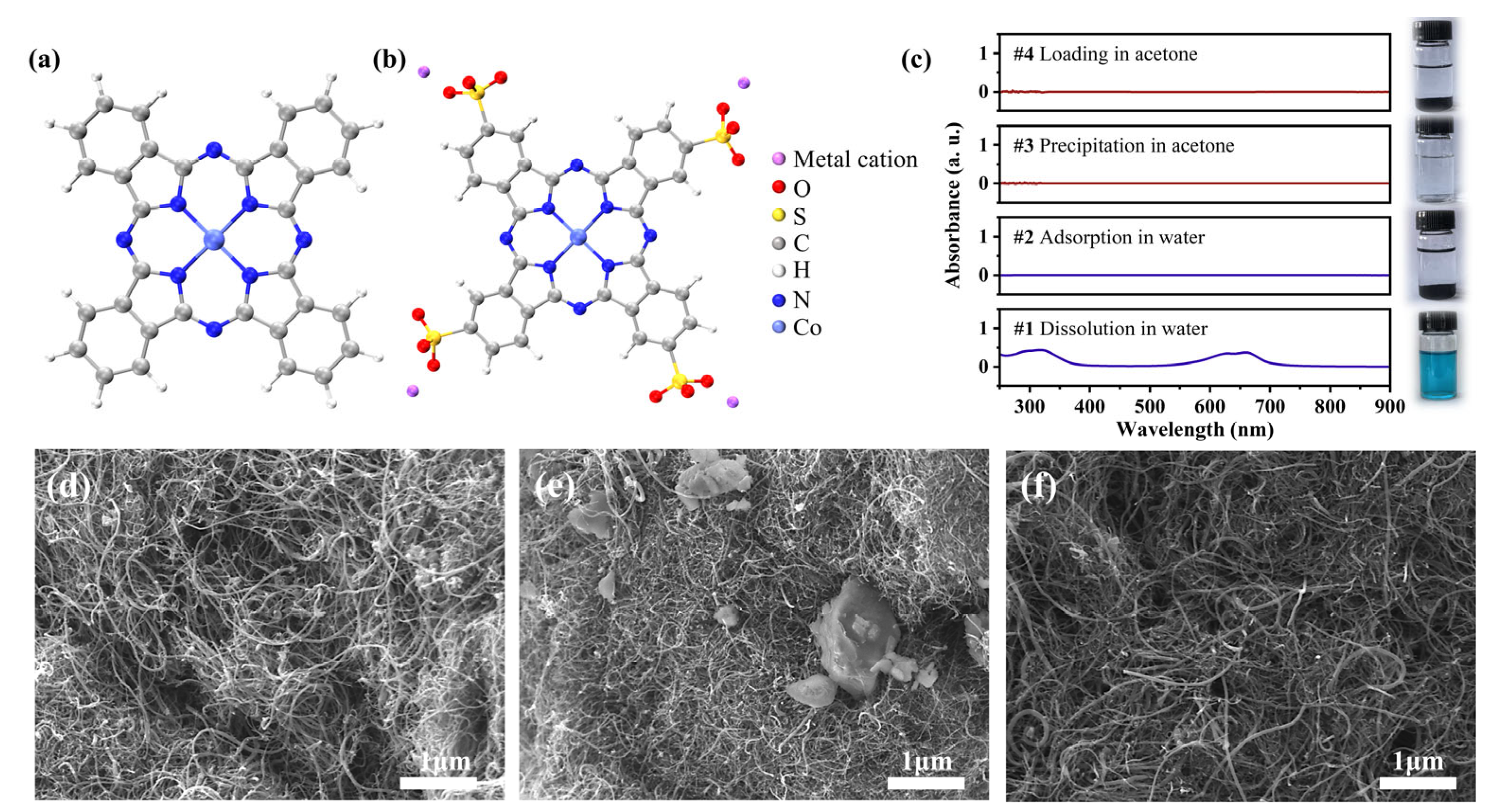
CoPcS typically exists in the form of a sodium salt, in which the S O 3 groups interact with Na+ through ionic bonding (Figure 1a,b). Consequently, its solubility behavior is highly dependent on the solvent polarity, dielectric constant, and solvation capability. Water, as a highly polar protic solvent with a large dielectric constant, can effectively stabilize the S O 3 groups through strong electrostatic screening and hydrogen-bonding interactions. Therefore, CoPcS molecules can be fully dissociated and stably dispersed at the molecular level in aqueous solution, forming a homogeneous blue solution (#1 in Figure 1c). The corresponding Ultraviolet–visible (UV–vis) spectra exhibits characteristic absorption peaks at 320 nm and 663 nm, which can be assigned to the B band and Q band of CoPcS molecules, respectively [36]. In contrast, acetone is a polar aprotic solvent with a much lower dielectric constant and lacks hydrogen-bond donor capability, rendering it ineffective in weakening the electrostatic interaction between sulfonate anions and counter cations. Therefore, CoPcS exhibits poor molecular solubility in acetone and preferentially exists as aggregated particles. The pronounced sediment observed at the bottom of the vial, together with the nearly featureless and flat UV–vis spectra of the supernatant, confirms the extremely low solubility of CoPcS in acetone (#3 in Figure 1c).
Upon introducing MWCNTs into the two solvent systems, the solvent-induced solubility difference is translated into distinctly different loading states on the carbon host. In the aqueous system, the supernatant becomes completely colorless after mixing, and all characteristic absorption peaks of CoPcS disappear from the UV–vis spectrum, indicating that CoPcS molecules in solution are completely adsorbed onto the carbon host, with an adsorption amount of 5 wt.%. (#2 in Figure 1c). By contrast, in the acetone system, the solvent remains colorless both before and after the addition of MWCNTs, and the UV–vis spectra remain flat without detectable absorption features, suggesting that 5 wt.% CoPcS particles co-precipitate with the carbon host rather than undergoing molecular adsorption (#4 in Figure 1c).
The morphological differences between MWCNTs and CoPcS supported on MWCNTs in either a molecularly adsorbed state or a particle-loaded state are directly visualized by SEM (Figure 1d–f). Pristine MWCNTs exhibit an entangled, porous network (Figure 1d), which favors electrolyte infiltration and LiPSs accommodation. Upon introducing CoPcS as aggregated particles (Figure 1e, corresponding to the CoPcS particles and MWCNTs at the bottom of #4 in Figure 1c), distinct micron-sized agglomerates attach to the tube surface. Such accumulation partially blocks conductive pathways and reduces the accessible surface area, while the intrinsic non-conductive nature of CoPcS is amplified by agglomeration. In contrast, MWCNTs adsorbing CoPcS molecules obtained from aqueous solution (Figure 1f, corresponding to the CoPcS-molecule-adsorbed MWCNTs at the bottom of #2 in Figure 1c) display a uniform, conformal distribution without observable phthalocyanine particle aggregation. This morphology indicates successful molecular-level adsorption of CoPcS onto the carbon host surface, thereby ensuring uniform spatial distribution of CoPcS molecules and maximizing the accessibility of the intrinsic Co catalytic centers. The homogeneous dispersion is expected to enhance the adsorption and catalytic kinetics of LiPSs.

3.2. Catalytic Mechanism of CoPcS

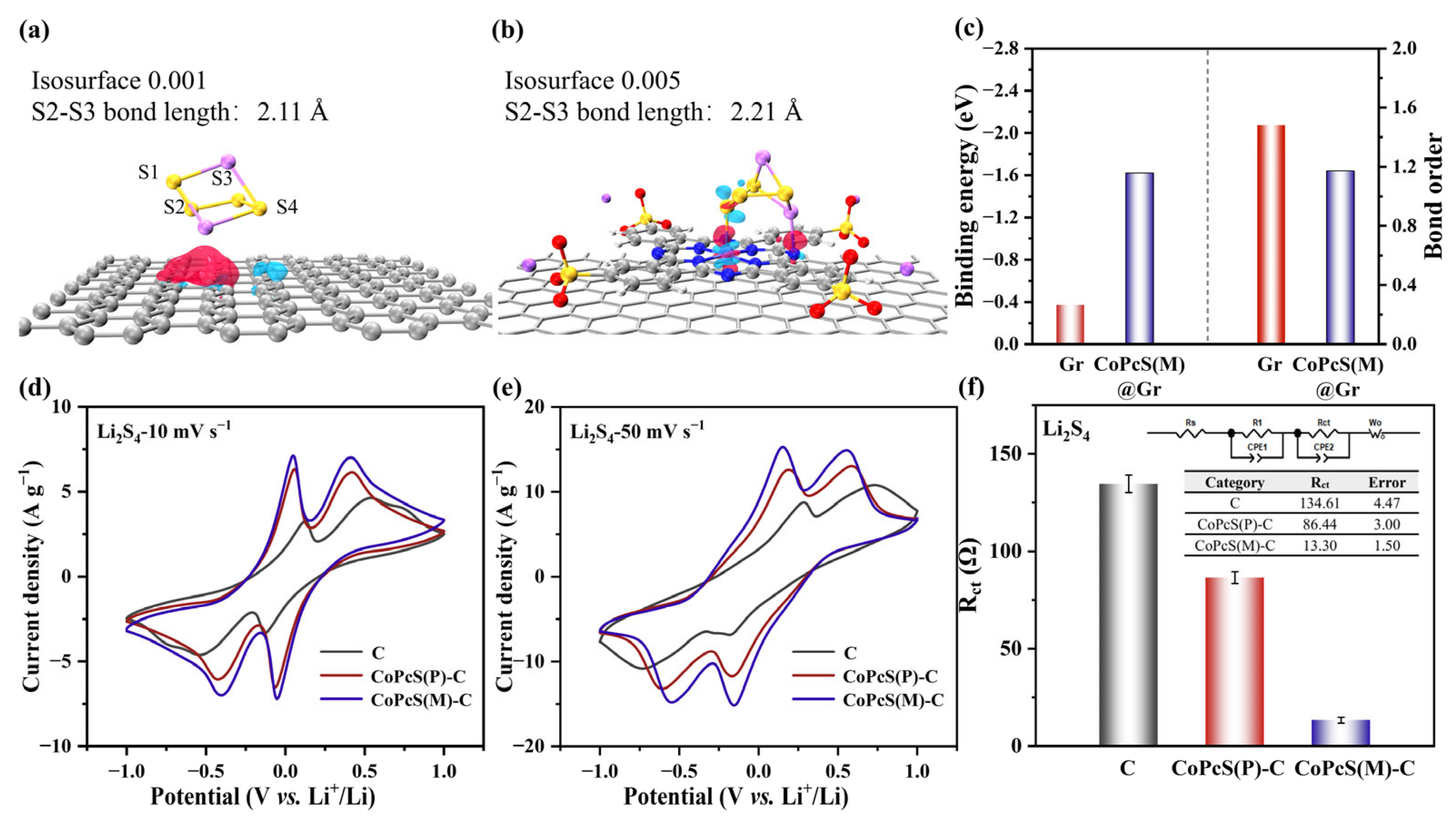
To further elucidate the intrinsic catalytic role of the molecularly adsorbed state in LiPSs conversion, density functional theory (DFT) calculations were conducted to analyze the electronic structure evolution of Li2S4 on the carbon host and on the CoPcS catalytic surface. Figure 2a,b presents the electron density difference isosurface plots for Li2S4 adsorbed on a graphene (Gr) slab representing a carbonaceous surface and on an CoPcS molecule adsorbed on Gr (CoPcS(M)@Gr). It is evident that there is negligible orbital overlap or significant charge transfer between Li2S4 and the Gr surface, and that their interaction primarily arises from localized polarization effects induced by the ionic Li-S bond. Such weak interactions result in only limited charge redistribution within a confined spatial region and are insufficient to effectively activate the S-S bonds, leading to the inherently limited catalytic capability of pristine carbon host toward Li2S4 conversion. In sharp contrast, when Li2S4 is adsorbed on a CoPcS molecule, the system exhibits markedly enhanced electronic coupling. Figure 2b clearly shows pronounced charge redistribution in the Co-S interfacial region, characterized by substantial electron depletion (blue regions) around the bridging sulfur atom (S2) and pronounced electron accumulation (red regions) near the Co-N4 center. This behavior indicates strong orbital hybridization and charge transfer between the S 3p orbital of Li2S4 and the Co 3d orbital. Such covalent-like Co-S interactions substantially weaken the stability of the bridging S-S bond in the Li2S4 molecule.
This effect is further evident in the structural parameter analysis. On the Gr slab, the S2-S3 bond length in Li2S4 is calculated to be 2.11 Å, whereas it is significantly elongated to 2.21 Å at the CoPcS molecular surface. Correspondingly, the bond order decreases markedly from 1.48 to 1.17 (Figure 2c). This weakening of the S-S bond directly reflects the effective catalysis of LiPSs by CoPcS, which facilitates S-S bond breakage and the subsequent liquid–solid conversion process. Binding energy calculations further reveal that Li2S4 exhibits a much stronger adsorption energy on CoPcS (−1.62 eV) than on the Gr (−0.37 eV), providing additional evidence that CoPcS significantly enhances interfacial stability and reaction activity through strong electronic interactions. Notably, an adsorption energy of −1.62 eV is also highly competitive compared with previously reported MPc derivatives interacting with Li2S4 (CoPc: −1.36 eV, CoPc(OMe)8: −1.5 eV, CoTaPc: −1.09 eV, CoTnPc: −1.41 eV) [20,37], exhibiting correspondingly elongated S-S bond lengths and small bond orders, which further highlights the superior affinity of CoPcS for LiPSs. Based on these calculations, CoPcS in the molecularly adsorbed state is expected to deliver superior LiPS conversion kinetics and reaction reversibility under practical electrochemical conditions.

3.3. SRR Catalytic Activity

To evaluate the catalytic activity of different loading states toward LiPSs, symmetric cells were assembled using sulfur-free electrodes (CoPcS(M)-C, CoPcS(P)-C, or C) and filled with electrolyte containing 0.2 M Li2S4. As shown in Figure 2d, all CV profiles exhibit two pairs of reversible redox peaks within −1 to +1 V (vs. Li+/Li) at 10 mV s−1, corresponding to the interconversion between soluble LiPSs and solid sulfur/Li2S species [38]. Compared with the pristine carbon electrode, both CoPcS-modified electrodes exhibit higher peak currents and lower polarization, confirming the catalytic role of CoPcS in accelerating the transformation of LiPSs. Notably, the CoPcS(M)-C electrode exhibits the greatest performance enhancement, with the sharpest redox peaks. Specifically, two oxidation peaks are observed at 49 mV and 404 mV, exhibiting the largest negative shift in oxidation potential, while the corresponding reduction peaks occur at −400 mV and −49 mV, showing the largest positive shift in reduction potential. This behavior indicates that the CoPc-C electrode presents the fastest surface reaction kinetics and the best reversibility, directly attributable to the maximally exposed Co-N4 sites originating from molecular-level dispersion. In contrast, the CoPcS(P)-C electrode exhibits limited catalytic enhancement due to masked active sites, leading to a delayed redox potential response and lower peak current. On the other hand, the pristine C electrode without catalyst loading exhibits broadened redox peaks and sluggish kinetics due to severe polarization [39]. This remains true at 50 mV s−1 (Figure 2e), indicating that the CoPcS(M)-C electrode effectively enhances redox kinetics and maintains superior electrochemical performance even at higher scan rates.
Electrochemical impedance spectroscopy (EIS, Figure 2f) was further employed to probe the influence of the loading state on charge-transfer behavior in symmetric cells. All Nyquist plots consist of two semicircles at high frequencies and a Warburg-type inclined line at low frequencies, corresponding to interfacial contact resistance (R1), charge-transfer resistance (Rct), and Li+ diffusion impedance (Wo), respectively [40]. Equivalent circuit fitting based on multiple cell measurements reveals that the CoPcS(M)-C electrode exhibits the lowest average Rct value of 20.94 Ω, which is far lower than those of the CoPcS(P)-C electrode (94.63 Ω) and the C electrode (140.8 Ω). Notably, this trend remains valid within the experimental error range. These results are consistent with the CV profiles and demonstrate that molecular dispersion not only yields more accessible active sites but also enhances electronic charge transfer between CoPcS and the conductive carbon host, thereby facilitating the SRR conversion process [41].
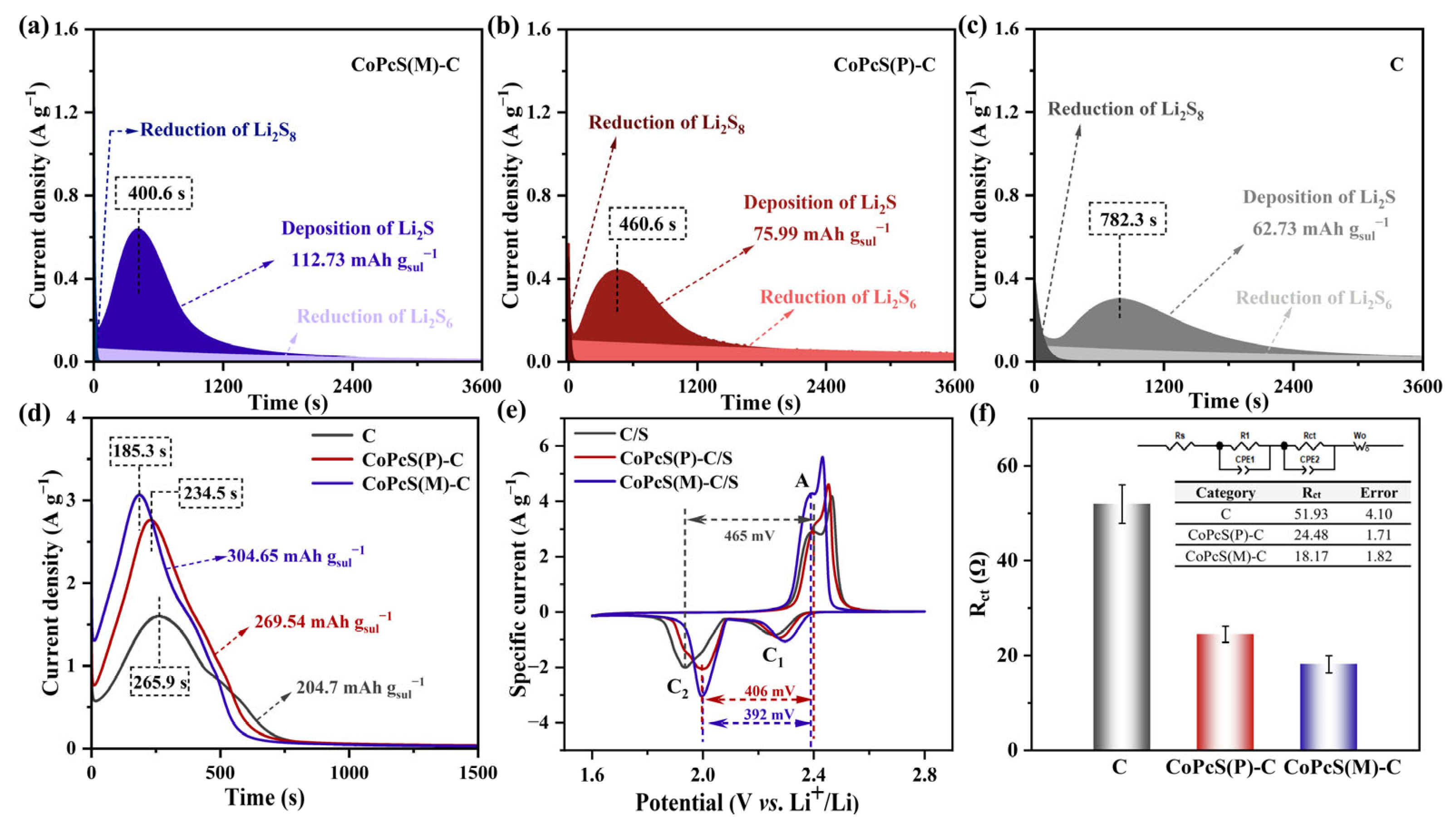
Considering that the liquid–solid conversion from LiPSs to Li2S is the rate-determining step in the SRR [42], potentiostatic Li2S deposition experiments were conducted at 2.07 V using CoPcS(M)-C, CoPcS(P)-C, or C as cathodes, Li metal as the anode, and a base electrolyte containing 0.2 M Li2S8 as the electrolyte [43]. Based on the Scharifker–Hills nucleation-and-growth transient theory [44], this experiment enables the separation of distinct kinetic processes and allows a quantitative analysis of the effect of different catalyst loading states on Li2S nucleation kinetics. As shown in Figure 3a–c, the CoPcS(M)-C electrode achieves the highest Li2S deposition capacity (112.73 mAh g s u l 1 ) and the shortest nucleation induction time (~400.6 s), indicating a strong catalytic capability toward heterogeneous nucleation and growth of Li2S. Compared with the sluggish conversion on the C electrode (induction time 782.3 s with a deposition capacity 62.73 mAh g s u l 1 ), the CoPcS(P)-C electrode shows moderate enhancement (induction time 460.6 s with a deposition capacity 75.99 mAh g s u l 1 ) but is still far inferior compared with the CoPcS(M)-C electrode. The time for the current maximum (tm) to appear is inversely related to the nucleation density (N0) and growth rate constant (k2) [45]:
t m = ( 2 π N 0 k 2 ) 1 2
The markedly shorter tm of CoPcS(M)-C electrode thus suggests rapid formation of high-density Li2S nucleation centers, enabled by the uniformly distributed catalytic sites of molecularly dispersed CoPcS.
Figure 3d shows the catalytic behavior toward Li2S decomposition, which is crucial for the sulfur oxidation reaction (SOR) [46].The CoPcS(M)-C electrode again exhibits the largest oxidation capacity (304.65 mAh g s u l 1 ) and the shortest oxidation time window (185.3 s), demonstrating a much faster Li2S oxidation kinetics than both the CoPcS(P)-C (269.54 mAh g s u l 1 , 234.5 s) and C (204.7 mAh g s u l 1 , 265.9 s) electrodes. The significantly accelerated Li2S decomposition further confirms the bidirectional catalytic advantage of CoPcS(M)-C, highlighting that the molecular adsorption state not only promotes high-density Li2S nucleation during reduction but also facilitates efficient Li2S oxidation during the reverse charging process.
The catalytic performance was further evaluated in Li-S full cells using CoPcS(M)-C/S, CoPcS(P)-C/S, and C/S cathodes with a sulfur loading of 1.2 mg cm−2. The CV profiles obtained at 0.1 mV s−1 (Figure 3e) exhibit two typical reduction peaks (C1, C2) and one oxidation peak (A), corresponding to the stepwise reduction of S8 and the reverse oxidation of Li2S [47]. Compared with the control C/S electrode, both CoPcS-modified electrodes show increased peak currents and decreased voltage hysteresis, indicating improved reaction kinetics [48]. Remarkably, CoPcS(M)-C/S displays the smallest potential gap (ΔE = 392 mV), significantly lower than that of CoPcS(P)-C/S (406 mV) and C/S (465 mV), reflecting superior reversibility and lower kinetic barriers. The sharply enhanced C2 peak at ~2.02 V, together with the negative shift and increased intensity of the A peak, further confirms that molecularly dispersed CoPcS substantially accelerates Li2S deposition and decomposition, thereby improving sulfur utilization efficiency. Consistently, the average fitted Rct values derived from EIS of full cells (Figure 3f) reveal that CoPcS(M)-C/S exhibits the lowest charge-transfer resistance (18.96 Ω) within the experimental error range, followed by CoPcS(P)-C/S (28.6 Ω) and C/S (58.12 Ω), demonstrating progressively improved charge-transfer capability with increasing accessibility of catalytic centers.

3.4. Electrochemical Performance of Li-S Full Cells

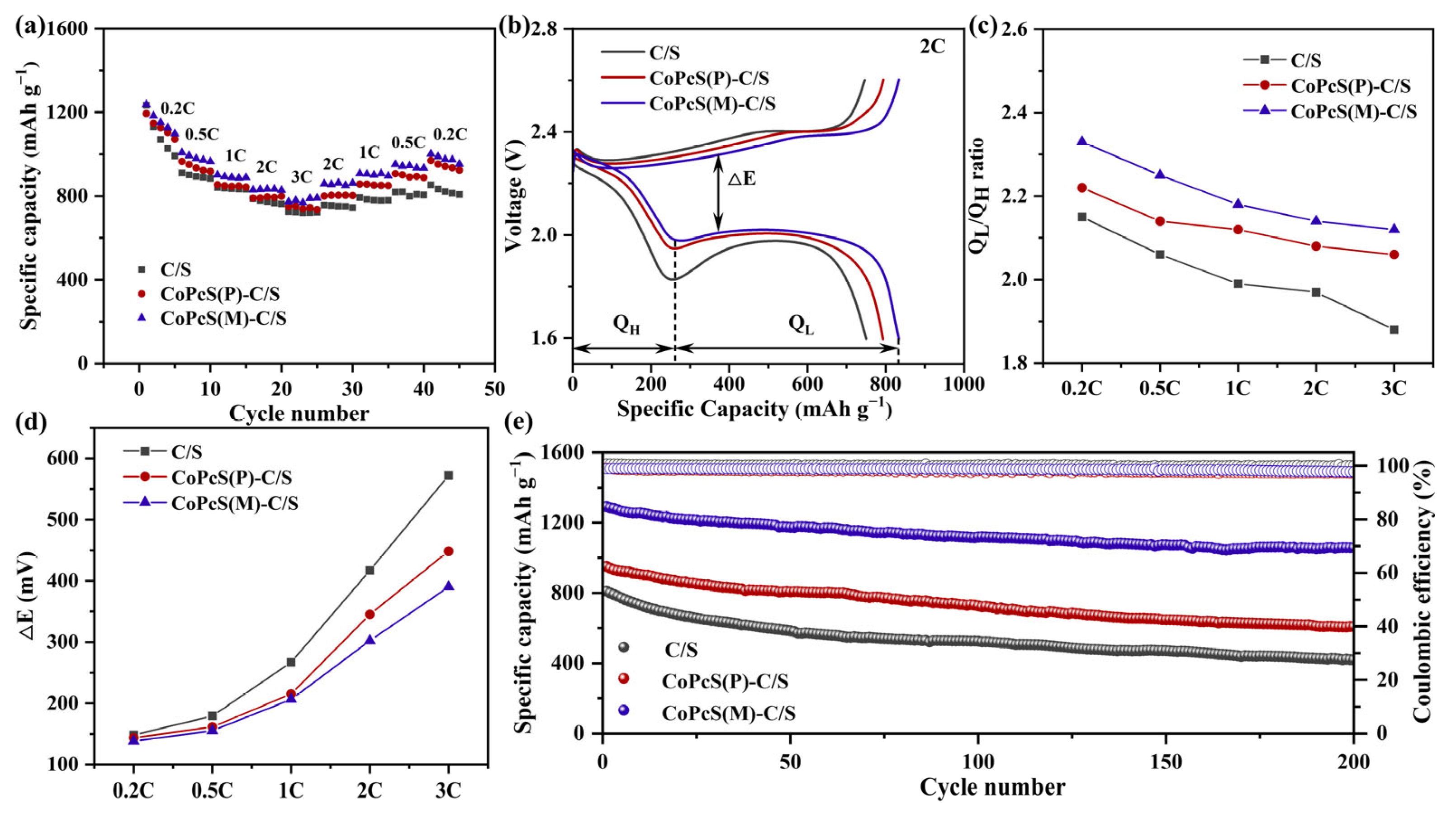
Rate-capability measurements of Li-S full cells (Figure 4a) highlight the influence of loading state on practical capacity. The CoPcS(M)-C/S electrode delivers high reversible capacities of 1236.58, 1007.40, 901.16, 833.54, and 790.79 mAh g−1 at 0.2, 0.5, 1, 2, and 3 C, respectively, consistently outperforming the CoPcS(P)-C/S and C/S electrodes across all tested rates. After high-rate cycling, the capacity of CoPcS(M)-C/S can recover to greater than 1000 mAh g−1 upon returning the rate to 0.2 C. The charge and discharge profiles at 2 C (Figure 4b) further show that the CoPcS(M)-C/S cathode exhibits the highest discharge plateau and the lowest charge plateau, with minimal polarization (ΔE = 302.1 mV), indicating highly efficient redox kinetics. Detailed discharge analysis reveals that CoPcS(M)-C/S and CoPcS(P)-C/S exhibit similar QH values, suggesting comparable capability to promote solid–liquid conversion, consistent with their CV profiles. Figure 4c compares the QL/QH ratios at different rates, where CoPcS(M)-C/S consistently shows the highest QL contribution, highlighting its superior catalytic effect in promoting the critical liquid–solid conversion from Li2S4 to Li2S2/Li2S. As the current rate increases from 0.5 C to 3 C (Figure 4d), the polarization differences between electrodes become more pronounced. Owing to its capability to accelerate the liquid–solid conversion, CoPcS(M)-C/S maintains the lowest ΔE even at high rates, whereas CoPcS(P)-C/S exhibits increasingly severe polarization due to kinetic limitations caused by catalyst aggregation.
Long-term cycling at 0.5 C (Figure 4e) further demonstrates the decisive advantage of molecular dispersion. The CoPcS(M)-C/S electrode and the CoPcS(M)-SP@PP2325 separator together deliver an initial capacity of 1292.95 mAh g−1 and retain 1057.99 mAh g−1, corresponding to an extremely low decay rate of 0.09% per cycle and nearly 100% coulombic efficiency. These results indicate that the molecularly dispersed CoPcS not only provides high initial activity but also maintains structural integrity during cycling, enabling persistent anchoring and catalytic conversion of LiPSs and effectively suppressing the shuttle effect. In contrast, the CoPcS(P)-C/S electrode delivers a lower initial capacity of 950.82 mAh g−1 and exhibits a faster capacity decay, with an average decay rate of 0.18% per cycle and a capacity retention of only 64%. This deterioration can be attributed to the further agglomeration of CoPcS particles or their detachment from the carbon host during cycling. The C/S electrode deteriorates the fastest because severe LiPS shuttling and electrode passivation accumulate rapidly over repeated cycles, leading to a drastic loss of active sulfur.

4. Conclusions

This study systematically demonstrates that the catalytic performance of CoPcS in Li-S cells is strongly governed by its loading state, revealing a clear structure–activity relationship. The molecularly adsorbed state, characterized by a homogeneous distribution and maximized exposure of Co-N4 active sites, offers significant advantages in anchoring LiPSs, accelerating liquid–solid conversion kinetics, and reducing interfacial charge-transfer resistance. As a result, this state achieves an initial discharge capacity of 1292.95 mAh g−1 at 0.5 C, along with excellent cycling stability, with 82% capacity retention over 200 cycles. In contrast, the particle-loaded counterpart suffers from masked active sites and inferior interfacial contact, which significantly suppress its catalytic activity. Overall, this work provides experimental evidence that molecular dispersion is essential for fully exploiting the intrinsic activity of catalysts, offering valuable insights for the rational design of high-performance sulfur host materials.

Author Contributions

Conceptualization, C.H. and S.X.; validation, S.X.; formal analysis, S.X.; investigation, S.X., Z.G. Z.F. and C.C.; data curation, S.X.; writing—original draft preparation, S.X.; writing—review and editing, C.H.; visualization, C.H.; supervision, C.H.; resources, C.H.; project administration, C.H.; funding acquisition, C.H. All authors have read and agreed to the published version of the manuscript.

Funding

This research was funded by the Shenzhen Science and Technology Program (JCYJ20220530141012028) and the Shandong Youth Innovation and Technology Support Program for Higher Education Institutions (Grant No. 2022KJ033).

Institutional Review Board Statement

Not applicable.

Informed Consent Statement

Not applicable.

Data Availability Statement

The data is available upon request from the corresponding author.

Conflicts of Interest

The authors declare no conflicts of interest.

References

  1. Shao, Q.J.; Zhu, S.D.; Chen, J. A review on lithium-sulfur batteries: Challenge, development, and perspective. Nano Res. 2023, 16, 8097–8138. [Google Scholar] [CrossRef]
  2. Lokhande, P.E.; Misal, P.; Kalubarme, R.S.; Kulkarni, M.V.; Rednam, U.; Padlkar, S.; Al-Asbahi, B.A. Scalable microwave-assisted production of Ti3C2Tx MXene for next-generation Li-ion and Na-ion batteries. Diam. Relat. Mater. 2025, 157, 112503. [Google Scholar] [CrossRef]
  3. Bhaskararao, B.V.; Pabba, D.P.; Aepuru, R.; Akbari-Fakhrabadi, A.; Lokhande, P.; Udayabhaskar, R.; Rosales-Vera, M.; Espinoza-González, R. Fe3O4 nanoparticles intercalated reduced graphene oxide nanosheets for supercapacitor and lithium-ion battery anode performance. J. Mater. Sci. Mater. Electron. 2023, 34, 1910. [Google Scholar] [CrossRef]
  4. Bruce, P.G.; Freunberger, S.A.; Hardwick, L.J.; Tarascon, J.-M. Li–O2 and Li–S batteries with high energy storage. Nat. Mater. 2012, 11, 19–29. [Google Scholar] [CrossRef]
  5. Xu, R.; Lu, J.; Amine, K. Progress in mechanistic understanding and characterization techniques of Li-S batteries. Adv. Energy Mater. 2015, 5, 1500408. [Google Scholar] [CrossRef]
  6. Wang, J.; Li, G.; Zhang, X.; Zong, K.; Yang, Y.; Zhang, X.; Wang, X.; Chen, Z. Undercoordination chemistry of sulfur electrocatalyst in lithium–sulfur batteries. Adv. Mater. 2024, 36, 2311019. [Google Scholar] [CrossRef]
  7. Liu, B.; Wang, J.; Li, Z.; Sun, Z.; Li, C.; Seo, J.-M.; Li, J.; Guo, Y.; Yao, H.; Guan, S. Multiwall carbon nanotube-hyperbranched polymaleimide core–shell nanowires with hierarchical porous and polar structure as sulfur host for sustainable lithium-sulfur batteries. Nano Energy 2024, 126, 109611. [Google Scholar] [CrossRef]
  8. Jayaprakash, N.; Shen, J.; Moganty, S.S.; Corona, A.; Archer, L.A. Porous hollow carbon@ sulfur composites for high-power lithium–sulfur batteries. Angew. Chem. Int. Ed. 2011, 50, 5904. [Google Scholar] [CrossRef]
  9. Zhang, M.; Chen, W.; Xue, L.; Jiao, Y.; Lei, T.; Chu, J.; Huang, J.; Gong, C.; Yan, C.; Yan, Y. Adsorption-catalysis design in the lithium-sulfur battery. Adv. Energy Mater. 2020, 10, 1903008. [Google Scholar] [CrossRef]
  10. Wang, P.; Xi, B.; Xiong, S. Insights into the optimization of catalytic active sites in lithium–sulfur batteries. Acc. Chem. Res. 2024, 57, 2093–2104. [Google Scholar] [CrossRef]
  11. Liang, Z.; Shen, J.; Xu, X.; Li, F.; Liu, J.; Yuan, B.; Yu, Y.; Zhu, M. Advances in the development of single-atom catalysts for high-energy-density lithium–sulfur batteries. Adv. Mater. 2022, 34, 2200102. [Google Scholar] [CrossRef]
  12. Maiti, S.; Curnan, M.T.; Kim, K.; Maiti, K.; Kim, J.K. Unlocking Performance: The Transformative Influence of Single Atom Catalysts on Advanced Lithium-Sulfur Battery Design. Adv. Energy Mater. 2024, 14, 2401911. [Google Scholar] [CrossRef]
  13. Sun, X.; Qiu, Y.; Jiang, B.; Chen, Z.; Zhao, C.; Zhou, H.; Yang, L.; Fan, L.; Zhang, Y.; Zhang, N. Isolated Fe-Co heteronuclear diatomic sites as efficient bifunctional catalysts for high-performance lithium-sulfur batteries. Nat. Commun. 2023, 14, 291. [Google Scholar] [CrossRef] [PubMed]
  14. Meeladi, G.; Zhu, H.; Wu, C.; Jia, S.; Hao, D.; Chen, S.; Ren, Z.; Shang, J.; Li, T.; Shah, M.H. Theoretical Investigation of Two-Dimensional Metal-Free Diatomic Catalysts as Promising Anchoring Materials for Lithium-Sulfur Batteries. Surf. Interfaces 2025, 69, 106706. [Google Scholar] [CrossRef]
  15. Mosavati, N.; Salley, S.O.; Ng, K.S. Characterization and electrochemical activities of nanostructured transition metal nitrides as cathode materials for lithium sulfur batteries. J. Power Sources 2017, 340, 210–216. [Google Scholar] [CrossRef]
  16. Liu, L.; Yin, X.; Li, W.; Wang, D.; Duan, J.; Wang, X.; Zhang, Y.; Peng, D.; Zhang, Y. Transition metal phosphides: The rising star of lithium–sulfur battery cathode host. Small 2024, 20, 2308564. [Google Scholar] [CrossRef]
  17. Zhu, X.; Iqbal, S.; Kumar, N.; Liu, H.; Dou, S.; Wang, N.; Bai, Z. The Catalytic Chemistry for High-Performance Lithium-Sulfur Batteries: A Review and Prospects. Adv. Funct. Mater. 2025, 80, e11659. [Google Scholar] [CrossRef]
  18. Yang, X.; Li, X.; Zhao, C.; Fu, Z.; Zhang, Q.; Hu, C. Promoted Deposition of Three-Dimensional Li2S on Catalytic Co Phthalocyanine Nanorods for Stable High-Loading Lithium–Sulfur Batteries. ACS Appl. Mater. Interfaces 2020, 12, 32752–32763. [Google Scholar] [CrossRef]
  19. Zhang, W.; Zhu, J.; Ye, Y.; She, J.; Kong, X.; Jin, S.; Peng, Z.; Ji, H. Suppressing Shuttle Effect via Cobalt Phthalocyanine Mediated Dissociation of Lithium Polysulfides for Enhanced Li-S Battery Performance. Adv. Funct. Mater. 2024, 34, 2403888. [Google Scholar] [CrossRef]
  20. Zhao, X.; Zhang, Y.; Liu, W.; Zheng, Z.; Fu, Z.; Chen, C.; Hu, C. Understanding the Impact of Peripheral Substitution on the Activity of Co Phthalocyanine in Sulfur Reduction Catalysis. Adv. Funct. Mater. 2024, 34, 2313107. [Google Scholar] [CrossRef]
  21. Kim, J.; Shin, H.; Yoo, D.J.; Kang, S.; Chung, S.Y.; Char, K.; Choi, J.W. Cobalt (II)-Centered fluorinated phthalocyanine-sulfur SNAr chemistry for robust lithium–sulfur batteries with superior conversion kinetics. Adv. Funct. Mater. 2021, 31, 2106679. [Google Scholar] [CrossRef]
  22. Song, X.; Zhou, F.; Yao, M.; Hao, C.; Qiu, J. Insights into the anchoring of polysulfides and catalytic performance by metal phthalocyanine covalent organic frameworks as the cathode in lithium–sulfur batteries. ACS Sustain. Chem. Eng. 2020, 8, 10185–10192. [Google Scholar] [CrossRef]
  23. Hamad, O.A.; Kareem, R.O.; Omer, P.K. Properties, characterization, and application of phthalocyanine and metal phthalocyanine. J. Chem. Rev. 2024, 6, 39–75. [Google Scholar]
  24. Ghani, F.; Kristen, J.; Riegler, H. Solubility properties of unsubstituted metal phthalocyanines in different types of solvents. J. Chem. Eng. Data 2012, 57, 439–449. [Google Scholar] [CrossRef]
  25. Li, J.; Huang, W.; Wang, Z.; Xu, X.; Sun, M.; Kang, L. Controllable dispersion of cobalt phthalocyanine molecules on graphene oxide for enhanced photocatalytic CO2 reduction. Mol. Catal. 2023, 546, 113253. [Google Scholar] [CrossRef]
  26. Wu, Y.; Liang, Y.; Wang, H. Heterogeneous molecular catalysts of metal phthalocyanines for electrochemical CO2 reduction reactions. Acc. Chem. Res. 2021, 54, 3149–3159. [Google Scholar] [CrossRef]
  27. Snow, A.W.; Jarvis, N.L. Molecular association and monolayer formation of soluble phthalocyanine compounds. J. Am. Chem. Soc. 1984, 106, 4706–4711. [Google Scholar] [CrossRef]
  28. Chen, Z.; Gan, K.; Peng, Y.; Yang, Z.; Yang, Y. Bifunctional Additive for Lithium–Sulfur Batteries Based on the Metal–Phthalocyanine Complex. ACS Appl. Mater. Interfaces 2023, 15, 55703–55712. [Google Scholar] [CrossRef]
  29. Zheng, J.; Chen, F.; Ding, J.; Zhang, G.; Peng, R.; Zhu, L.; Ding, J.C.; Zhou, X.; Zhan, L.; Fan, X. Sulfonic group modifying cobalt (II) phthalocyanine molecule to boost the polysulfide reaction kinetic for high-performance lithium sulfur battery. Colloids Surf. A Physicochem. Eng. Asp. 2024, 702, 135074. [Google Scholar] [CrossRef]
  30. Chen, J.; Zhang, Q.; Zeng, M.; Ding, N.; Li, Z.; Zhong, S.; Zhang, T.; Wang, S.; Yang, G. Carboxyl-conjugated phthalocyanines used as novel electrode materials with high specific capacity for lithium-ion batteries. J. Solid State Electrochem. 2016, 20, 1285–1294. [Google Scholar] [CrossRef]
  31. Kühne, T.D.; Iannuzzi, M.; Del Ben, M.; Rybkin, V.V.; Seewald, P.; Stein, F.; Laino, T.; Khaliullin, R.Z.; Schütt, O.; Schiffmann, F. CP2K: An electronic structure and molecular dynamics software package-Quickstep: Efficient and accurate electronic structure calculations. J. Chem. Phys. 2020, 152, 194103. [Google Scholar] [CrossRef] [PubMed]
  32. Grimme, S.; Ehrlich, S.; Goerigk, L. Effect of the damping function in dispersion corrected density functional theory. J. Comput. Chem. 2011, 32, 1456–1465. [Google Scholar] [CrossRef] [PubMed]
  33. Perdew, J.P.; Burke, K.; Ernzerhof, M. Perdew, burke, and ernzerhof reply. Phys. Rev. Lett. 1998, 80, 891. [Google Scholar] [CrossRef]
  34. Vandevondele, J.; Hutter, J. Gaussian basis sets for accurate calculations on molecular systems in gas and condensed phases. J. Chem. Phys. 2007, 127, 114105. [Google Scholar] [CrossRef]
  35. Andreussi, O.; Dabo, I.; Marzari, N. Revised self-consistent continuum solvation in electronic-structure calculations. J. Chem. Phys. 2012, 136, 064102. [Google Scholar] [CrossRef]
  36. Escayola, S.; Labella, J.; Szczepanik, D.W.; Poater, A.; Torres, T.; Solà, M.; Matito, E. From (Sub)Porphyrins to (Sub)Phthalocyanines: Aromaticity Signatures in the UV-Vis Absorption Spectra. Inorg. Chem. 2024, 63, 18251–18262. [Google Scholar] [CrossRef]
  37. Zhao, X.; Xu, Y.; Qiu, T.; Zhang, Y.; Liu, W.; Chen, C.; Biggs, M.J.; Hu, C. Enhanced Li bonds enable bidirectional sulfur catalysis by a molecular Co-N4 catalyst for lithium-sulfur batteries. Energy Storage Mater. 2024, 72, 103728. [Google Scholar] [CrossRef]
  38. He, Q.; Gorlin, Y.; Patel, M.U.; Gasteiger, H.A.; Lu, Y.-C. Unraveling the correlation between solvent properties and sulfur redox behavior in lithium-sulfur batteries. J. Electrochem. Soc. 2018, 165, A4027–A4033. [Google Scholar] [CrossRef]
  39. Lin, H.; Zhang, S.; Zhang, T.; Ye, H.; Yao, Q.; Zheng, G.W.; Lee, J.Y. Elucidating the catalytic activity of oxygen deficiency in the polysulfide conversion reactions of lithium–sulfur batteries. Adv. Energy Mater. 2018, 8, 1801868. [Google Scholar] [CrossRef]
  40. Chen, B.-R.; Police, Y.R.; Li, M.; Chinnam, P.R.; Tanim, T.R.; Dufek, E.J. A mathematical approach to survey electrochemical impedance spectroscopy for aging in lithium-ion batteries. Front. Energy Res. 2023, 11, 1132876. [Google Scholar] [CrossRef]
  41. Li, B.Q.; Kong, L.; Zhao, C.X.; Jin, Q.; Chen, X.; Peng, H.J.; Qin, J.L.; Chen, J.X.; Yuan, H.; Zhang, Q. Expediting redox kinetics of sulfur species by atomic-scale electrocatalysts in lithium–sulfur batteries. InfoMat 2019, 1, 533–541. [Google Scholar] [CrossRef]
  42. Zhong, Y.; Wang, Q.; Bak, S.-M.; Hwang, S.; Du, Y.; Wang, H. Identification and Catalysis of the Potential-Limiting Step in Lithium-Sulfur Batteries. J. Am. Chem. Soc. 2023, 145, 7390–7396. [Google Scholar] [CrossRef] [PubMed]
  43. Fan, F.Y.; Carter, W.C.; Chiang, Y.-M. Mechanism and Kinetics of Li2S Precipitation in Lithium-Sulfur Batteries. Adv. Mater. 2015, 27, 5203–5209. [Google Scholar] [CrossRef]
  44. Scharifker, B.; Hills, G. Theoretical and experimental studies of multiple nucleation. Electrochim. Acta 1983, 28, 879–889. [Google Scholar] [CrossRef]
  45. Fan, F.Y.; Chiang, Y.-M. Electrodeposition kinetics in Li-S batteries: Effects of low electrolyte/sulfur ratios and deposition surface composition. J. Electrochem. Soc. 2017, 164, A917. [Google Scholar] [CrossRef]
  46. Luo, Y.; Fang, Z.; Duan, S.; Wu, H.; Liu, H.; Zhao, Y.; Wang, K.; Li, Q.; Fan, S.; Zheng, Z. Direct monitoring of Li2S2 evolution and its influence on the reversible capacities of lithium-sulfur batteries. Angew. Chem. Int. Ed. 2023, 62, e202215802. [Google Scholar] [CrossRef]
  47. Zheng, D.; Zhang, X.; Wang, J.; Qu, D.; Yang, X.; Qu, D. Reduction mechanism of sulfur in lithium–sulfur battery: From elemental sulfur to polysulfide. J. Power Sources 2016, 301, 312–316. [Google Scholar] [CrossRef]
  48. Zhou, C.; Hong, M.; Hu, N.; Yang, J.; Zhu, W.; Kong, L.; Li, M. Bi-Metallic coupling-induced electronic-state modulation of metal phosphides for kinetics-enhanced and dendrite-free Li–S batteries. Adv. Funct. Mater. 2023, 33, 2213310. [Google Scholar] [CrossRef]
Figure 1. The molecular structure of (a) CoPc, (b) CoPcS; (c) UV–vis spectra of the supernatants before and after CoPcS in water and acetone; SEM images of (d) C (MWCNT), (e) CoPcS(P)-C, and (f) CoPcS(M)-C composites.
Surfaces 09 00016 g001
Figure 2. The electron density difference isosurface plots after Li2S4 adsorption on (a) Gr and (b) CoPcS(M)@Gr; (c) The binding energy and bond order of Li2S4 adsorbed on Gr and CoPcS(M)@Gr; CV profiles of symmetric cells with 0.2 M Li2S4 at (d) 10 mV s−1 and (e) 50 mV s−1; (f) The Rct derived from EIS spectra of symmetric cells measured in the Li2S4-containing electrolyte.
Surfaces 09 00016 g002
Figure 3. (ac) Current profiles of potentiostatic Li2S deposition from Li2S8 at 2.07 V; (d) Current profiles of potentiostatic Li2S decomposition at 2.40 V; (e) CV profiles of Li-S full cells recorded at a scan rate of 0.1 mV s−1; (f) the corresponding Rct derived from EIS spectra of Li-S full cells.
Surfaces 09 00016 g003
Figure 4. Electrochemical performance of Li-S full cells: (a) Rate capability from 0.2 to 5 C; (b) Galvanostatic charge and discharge profiles at 2 C; (c) Evolution of the QL/QH ratio with increasing C-rates; (d) Change in cell polarization at increasing C rates; (e) Cycling stability at 0.5 C.
Surfaces 09 00016 g004
Disclaimer/Publisher’s Note: The statements, opinions and data contained in all publications are solely those of the individual author(s) and contributor(s) and not of MDPI and/or the editor(s). MDPI and/or the editor(s) disclaim responsibility for any injury to people or property resulting from any ideas, methods, instructions or products referred to in the content.