Article

Chaos and Predictability in Cryptocurrencies

1
Department of Supply Chain and Business Technology Management, John Molson School of Business, Concordia University, Montreal, QC H3H 0A1, Canada
2
Chaire Innovation et Économie Numérique, ESCA École de Management, Casablanca 20250, Morocco
3
Department of Management ‘Valter Cantino’, University of Turin, 10124 Turin, Italy
*
Author to whom correspondence should be addressed.
Forecasting 2026, 8(3), 48; https://doi.org/10.3390/forecast8030048 (registering DOI)
Submission received: 24 March 2026 / Revised: 6 June 2026 / Accepted: 7 June 2026 / Published: 12 June 2026

Highlights

What are the main findings?
  • Chaos is present in prices, returns, and trading volume changes in cryptocurrencies.
  • Prices, returns, and trading volume changes are nonlinear and deterministic.
  • Prices, returns, and trading volume changes are predictable on daily basis.
What are the implications of the main findings?
  • Prior information on nonlinear dynamics and chaos in cryptocurrency data can be considered to implement intelligent forecasting systems.
  • Profits can be generated as cryptocurrency markets are not efficient.

Abstract

Background: Lyapunov exponent has been used in many science and engineering problems to quantify chaos in systems and understand their nonlinear dynamics. In financial engineering and forecasting, evaluation of chaos in financial data helps determine whether the data are predictable and if profits can be generated. The purpose of this study is to examine presence of chaos in cryptocurrency markets. Methods: To examine chaos, Lyapunov exponent is computed from a set of 50 cryptocurrencies and statistical one-sided and two-sided Student-t tests are performed to check if on average the computed Lyapunov exponents are equal, less, or larger than zero. Results: The statistical results reveal strong evidence that prices, returns, and trading volume changes are all chaotic; hence, they show nonlinear and deterministic characteristics. Conclusions: Prices, returns, and trading volume changes in cryptocurrencies could be predicted in the short run; for instance, on a daily basis. In this regard, active traders and investors may implement predictive systems to generate daily profits.

1. Introduction

Chaos theory [1,2] is used to study the patterns of dynamic and chaotic systems. For instance, it involves the study of unstable and aperiodic performance exhibited by nonlinear dynamical systems. In recent years, there has been large scholarly attention on discovering chaotic motion and oscillations in nonlinear dynamical systems spanning across various problems, including image encryption [3,4], market of raw material shipping [5], information processing in the brain [6,7,8], strawberry production [9], authorship attribution [10], analysis of analog circuits and lumped electronic networks [11], assessment of the impact of media coverage on disease outbreak models [12], structural-acoustic systems evaluation [13], secure communications [14], susceptible-infected-recovered epidemic modeling with vaccination [15], image segmentation [16], high dimensionality of transferred data over the Social Internet of Things (SIoT) system [17], and design of data security systems [18].
In addition, chaos theory is receiving growing attention in the evaluation of predictability of financial markets. For instance, in an early study, Serletis and Shintani [19] tested for the presence of random walk and chaos in the US stock market. The empirical findings suggest absence of random walk and chaotic behavior. Tsionas and Michaelides [20] found the presence of noisy chaos both before and after the 2008 worldwide financial crisis in stock return in the USA, UK, Switzerland, Netherlands, Germany, and France. Kumar and Gupta [21] found solid evidence in favor of chaos in daily and monthly returns in capital markets including Canada, France, Germany, Italy, Japan, the UK, and the USA. The study conducted by Lahmiri [22] examined chaos in returns and volatility in family business stock and in aggregate stock market in Morocco. The empirical results indicated that business family stock returns are not chaotic whereas the aggregate market returns display sign of chaotic behavior. Further, it was found that volatility in family business stock returns is not chaotic, whereas chaos is present in volatility of the aggregate market. Vogl et al. [23] studied presence of chaos in green and conventional bond indices namely the S&P Green Bond Index and the S&P500 Bond Index. They found evidence that both market indices display a mixture of quasi-periodic cycles and deterministic/chaotic behavior. Lahmiri et al. [24] examined chaos in prices of family business, green, Islamic, and common stock indices in Europe. The empirical mode decomposition algorithm was used to extract short and long fluctuations in each market. The empirical results showed that short fluctuations are chaotic, whereas long fluctuations are not. The presence of chaos in crude oil markets (Brent and WTI) before and after 2008 international financial crisis was scrutinized by Lahmiri [25]. The observed findings indicated strong evidence that chaos is absent in prices and returns in both crude oil markets before and after international crisis. Nevertheless, volatility in Brent and WTI was found to be chaotic after 2008 international financial crisis. Chaos was examined in different Moroccan exchange rate markets in short and long movements obtained by stationary wavelet transform by Lahmiri [26]. It was found that chaos is present in both long and short movements in prices of Moroccan exchange rates. However, chaos is absent in their short and long returns. In addition, it was concluded that some exchange rate markets displayed different chaotic forms in short and long movements.
Recently, Albulescu et al. [27] studied chaos in Central and Eastern European stock markets and found evidence of chaotic patterns in their returns. Also, evidence of the presence of chaos was found in the Baltic dry index, investor sentiment index, and the global stock market indicator [28]. Escot et al. [29] studied the impact of the COVID-19 pandemic on structural change in stock returns across international markets including the United States (S&P, Dow Jones, NASDAQ, NYSE), United Kingdom, Europe 50, Europe 100, Germany, France, Belgium, Spain, Italy, Switzerland, Norway, Russia, Japan, China, South Korea, Brazil, and Mexico. The empirical results indicated evidence that the COVID-19 pandemic was followed by at least two structural changes in international financial markets. Alves [30] studied chaos patterns in international stock market indices including S&P 500, NASDAQ, IBEX 35, EURONEXT 100, Nikkei 225, and SSE Composite before and during the pandemic. They found that the North American stock markets (S&P 500 and NASDAQ) exhibited a growing level of chaos during the pandemic. Also, no significant change in chaos was observed after the first week of January 2020 in the European index IBEX and the Asian index N225. Furthermore, as the level of chaos in S&P 500, NASDAQ Composite, and EURONEXT 100 increased due to the pandemic, these markets were the riskiest investment. Inversely, the level of chaos decreased in the SSE Composite Index; the latter was the safest investment. Finally, the dynamics in the IBEX 35 and Nikkei 225 stock markets remained basically the same before and during the crisis. Sandubete et al. [31] examined chaos in main currency markets in the United States, Europe, and the United Kingdom. They concluded the presence of a random irregular evolution; however, there is possibly a generating system which could be deterministically (and nonlinear) used to allow for predicting opportunities.
Previous research has shown evidence of presence of chaos in the US stock market [19], Western stock markets [20,21], family business companies listed on the Moroccan stock market [22], green and conventional bond markets [23,24], Islamic financial markets [24], major Western crude oil markets (Brent and WTI) [25], Central and Eastern European stock markets [27], and exchange markets [26,31]. However, little is known about chaos in cryptocurrencies. For instance, Gunay et al. [32] found evidence of the presence of chaos in returns of Bitcoin, Litecoin, Ethereum, and Ripple. Omane-Adjepong and Alagidede [33] found evidence of high-level chaos in weekly scale in returns of eight cryptocurrency markets. Also, Partida et al. found evidence of chaos in Bitcoin and Ethereum price series [34]. Finally, it was concluded that the COVID-19 pandemic has not affected the mean of estimated chaos in prices of cryptocurrencies, but it increased its variability [35]. Also, the pandemic has not affected chaos estimated from the level of trading volume.
Most of the works in the literature focused on conventional equity markets and showed evidence of chaos in return series. In addition, limited studies were devoted to cryptocurrencies and demonstrated the presence of chaos in returns [32,33] or in prices [34,35]. In addition, previous studies used a limited number of cryptocurrencies to study chaos; except for the study in [35] where 41 were considered. As a result, it is hard to draw general conclusions about chaos from a limited number of cryptocurrencies studied. Furthermore, no study has examined chaos on major cryptocurrency data including price, return, volatility, and trading volume. Therefore, knowledge of chaos characteristics across data records is missing.
The main purpose of this paper is to examine chaos in cryptocurrencies. To this end, we consider computing Lyapunov exponent [36,37,38,39] in a large set and evaluate its positivity, for instance, the presence of chaos in the underlying population of cryptocurrencies under study. Indeed, the presence of chaos in the underlying time series implies that the data process could be predicted in short periods of time [40]. Thus, if cryptocurrency time series are random process, then they are not predictable. In contrast, if cryptocurrency time series are chaotic, then its process could be predicted in the short run. In this regard, examining chaos (short run predictability) in cryptocurrencies allows testing the efficient market hypothesis [41] in these markets. Indeed, the efficient market hypothesis (EMH) [41] states that asset prices reflect all available information; hence, they are not predictable.
Specifically, following the EMH, asset price efficiency is represented by the adjustment of the market to all accessible information for accurate price evaluation. Based on the random walk model, the EMH assumes independent random movements used to follow a Gaussian distribution. Therefore, the more efficient the market is, the more random the price variations are. However, in real-world equity markets, the informational weaknesses may lead to a delay in price adjustment with respect to new information. In this regard, Lo [42] introduced the adaptive markets hypothesis (AMH) used to assume that market efficiency evolves due to the dynamics of market participants, the readiness of profit opportunities, and the ability of investors to learn and adapt. In this framework, AMH predicts that if market efficiency is not permanent, then it varies with the market environment over time.
In addition, the fractal market hypothesis (FMH) [43] adopts a non-Gaussian perspective and allows dependence and serial correlations within the underlying time series. In other words, in FMH framework, across all time intervals, market prices exhibit self-similar and fractal patterns. Hence, trends in non-stationary data can be analyzed and profits can be generated. In chaos theory [43,44], an apparently complex, random or unpredictable system can be governed by deterministic laws. In this framework, if the underlying series is globally chaotic, then it is predictable in the short term. Therefore, we seek to measure and test chaos in cryptocurrencies to check if they are chaotic; hence, they are predictable in the short time which violates the EMH.
The contributions of the current study are as follows. First, we test predictability (efficiency) in cryptocurrencies by means of chaos theory based on the estimation of Lyapunov exponent (characteristic) on a large data set of 50 cryptocurrencies to cover the most traded digital assets in the market to generalize the statistical results. In this regard, we enrich the literature on chaos in cryptocurrency markets as limited studies were conducted on this topic. Second, for each individual cryptocurrency, the chaos exponent is estimated from the price, return, volatility, and trading volume data. Indeed, such global investigation of chaos across different types of records related to cryptocurrencies would increase our understanding of predictability in cryptocurrency markets and of the sources of predictability. Third, statistical tests (one-sided and two-sided Student-t tests) are applied to scrutinize the value, sign, and statistical significance of the population of computed Lyapunov exponents from each type of data record. In this regard, robust and general conclusions can be drawn.
The remainder of the paper is organized as follows. Section 2 presents the method used to compute Lyapunov exponent. Section 3 describes data and provides statistical results. Finally, discussion and conclusion are in Section 4.

2. Methods

To compute the Lyapunov exponent (denoted λ) for each individual cryptocurrency, we adopt the method in [45,46,47]. Then, we perform the following Student-t tests to check the following null hypotheses: (1) H0: λ = 0, (2) H0: λ > 0, and (3) H0: λ < 0. A positive Lyapunov exponent λ indicates that the original time series is chaotic; hence, it could be predictable in the short run; for instance, on a daily basis.
The noisy chaotic system of signal x t t = 1 T can be represented by:
x t = f x t L , x t 2 L , , x t m L + ε t
where L is the time delay, m is the embedding dimension, ε noise term, f is an unknown function used to approximate a chaotic map, and t is time script. A noise-free system has zero variance: V a r ε t = 0 . The Lyapunov exponent λ of noisy chaotic system is computed as [38,39]:
λ = lim M 1 2 M log v 1
where v1 is the largest eigenvalue of the matrix T M T M and T M is expressed as [45,46]:
T M = t = 1 M 1 J M 1
where MT is the block-length of equally spaced evaluation points, and J is the Jacobian matrix of the chaotic map f. The Jacobian matrix J at a starting point x0 is expressed as follows:
J t x 0 = d f t x d x | x 0
The unknown chaotic map f can be estimated by using a multilayer feed-forward neural network trained with gradient descent algorithm [45,46,47] and given by:
x t α 0 + j = 1 q α j A   β 0 , j + i = 1 m β i , j x t i L + ε t
where q is the number of hidden layers, αj are the layers connection weights, α0 is the network bias, and A is a sigmoid function that processes the original signal. In our work, (L, m, q) is determined according to methodology in [46], and the largest Lyapunov exponent variance denoted by Σ ^ is computed as follows [45]:
Σ ^ = 1 M j = M + 1 M 1 ξ   j 1.3221 × M 1 / 5   t = j + 1 M η ^ t η ^ t j
The parameter η ^ t and the quadratic spectral kernel function ξ z are expressed as follows [45]:
η ^ t = 1 2 log max   e i g e n v a l u e   T t T t max   e i g e n v a l u e   T t 1 T t 1 λ ^
ξ z = 25 12 π 2 z 2   sin 6 π   z 5 6 π   z 5 cos   6 π   z 5
Finally, the original signal has chaotic dynamics when λ ≥ 0 (Equation (2)) and its short run oscillations can be predicted.

3. Data and Results

The dataset includes daily observations from 50 cryptocurrencies all collected from the Yahoo Finance website [48] and the sample period ranges from 14 March 2019 to 14 March 2024. This sample period includes major international economic events and the COVID-19 pandemic that have altered the world economy and investments. The major economic events include, for instance, US treasury yield curve inversions, VIX futures in backwardation, duress in the cash markets for US treasuries, the first stock market crash in 33 years (16 March 2020), corporate bond ETF (exchange traded funds) prices below net asset value (17 March 2020), breakdown in the historical gold-silver ratio (18 March 2020), largest historical gold spot-future spreads (24 March 2020), and Bitcoin’s historic moonshot (30 November 2020) leading to rise of over 250% that year [49]. The list of their symbols includes AAVE, ADA, ALGO, AR, ATOM, AVAX, AXS, BCH, BNB, BSV, BTC, CHZ, CRO, DAI, DODGE, DOT, EGLD, ETC, ETH, FET, FIL, FLOW, FTM, GRT, HBR, HNT, ICT, LINK, LTC, MANA, MATIC, MKR, QNT, RUNE, SAND, SHIB, SNX, SOL, STX, THETA, TRX, TUSD, UNI, USDC, USDT, VET, XLM, XMR, XRP, and XTZ.
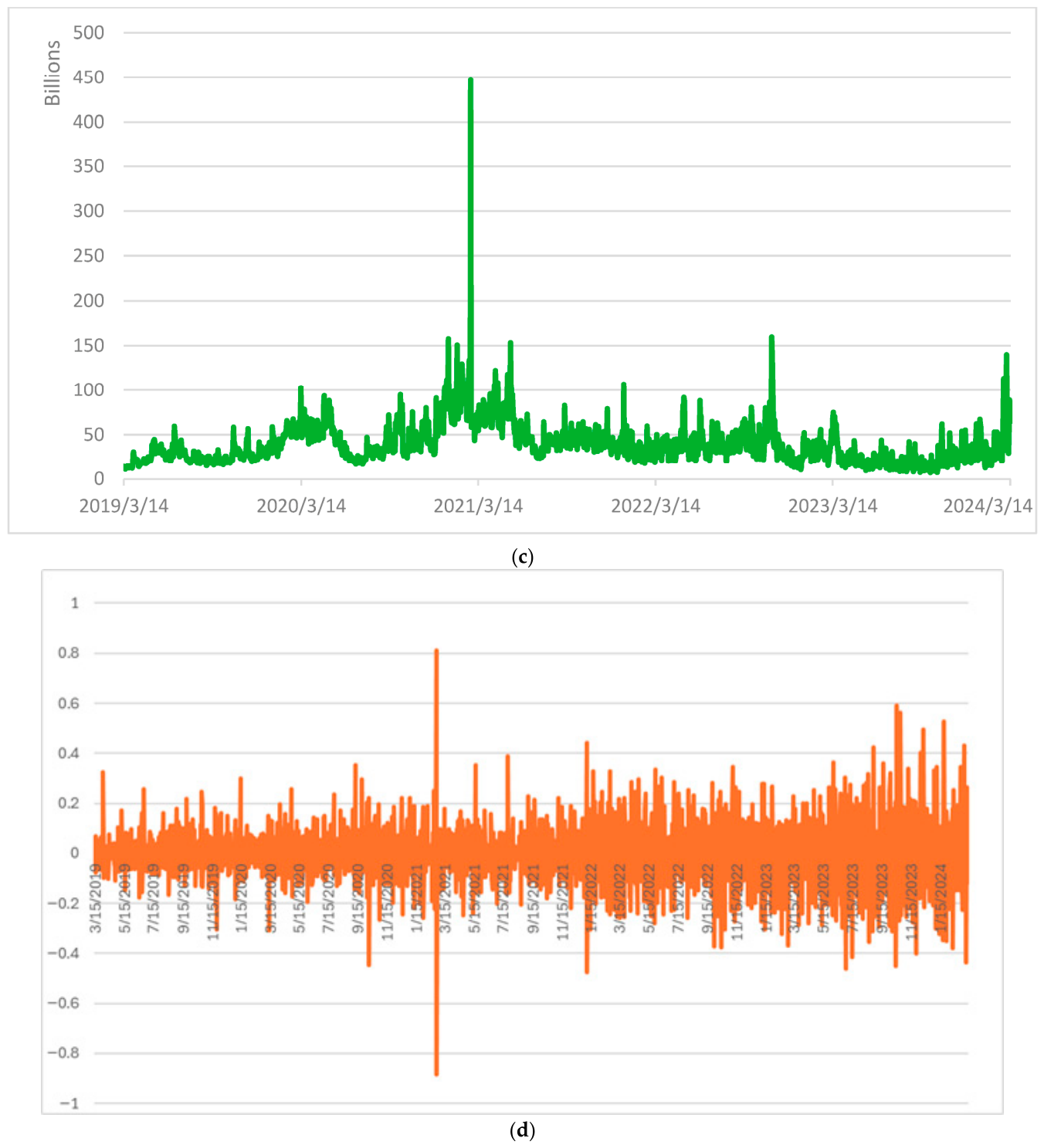
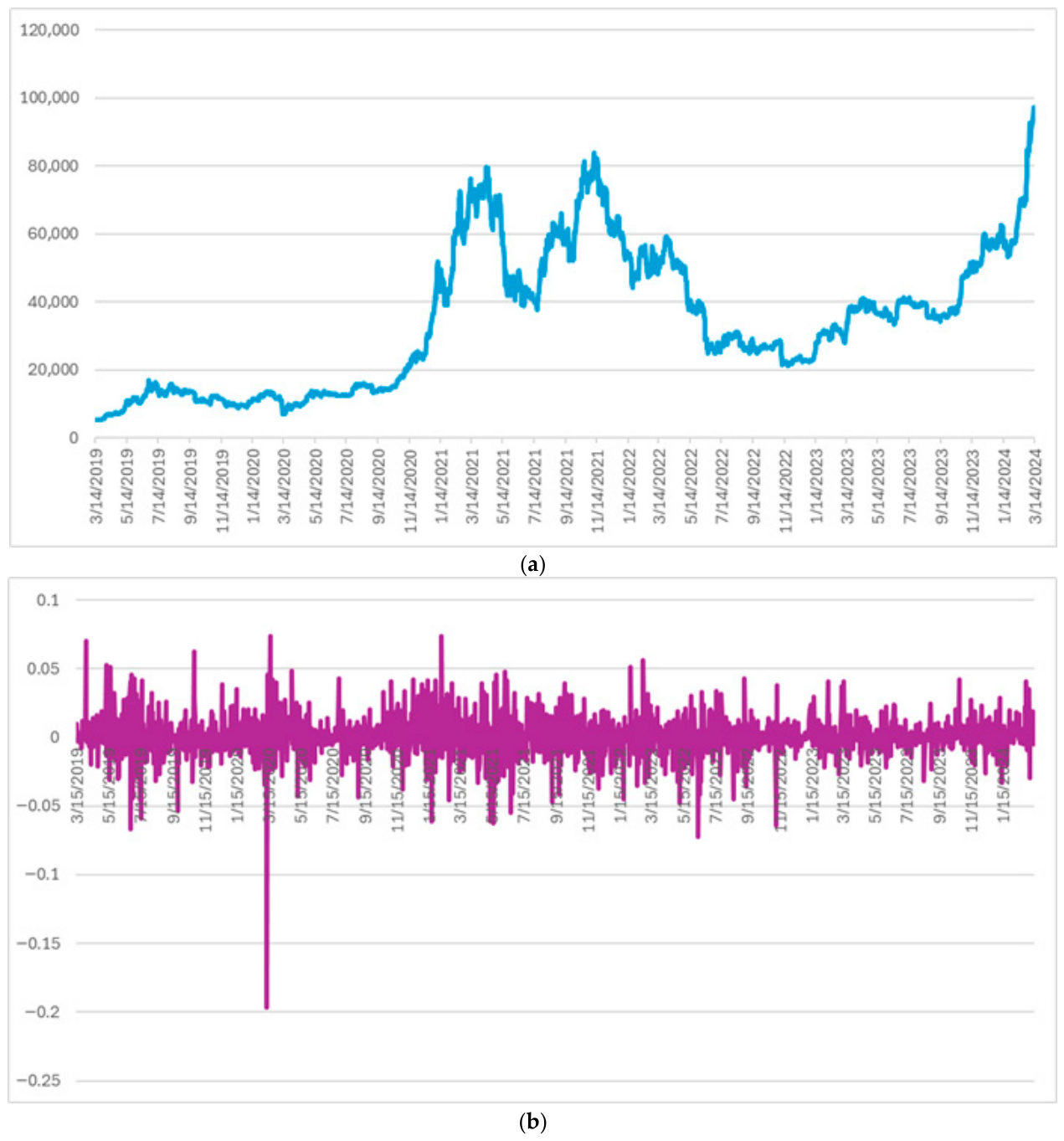
For each cryptocurrency, the Lyapunov exponent λ is computed from the closing price (P(t)), return (R(t)), and trading volume change (VC(t)) time series, where t is time script. Prices and trading volume (V(t)) are expressed in US dollars. Return series are calculated as R(t) = log(P(t)) − log(P(t − 1)) and (VC(t)) as rate of change in trading volume (V(t)). Figure 1a–d display respectively (P(t)), (R(t)), (V(t)), and (VC(t)) of Bitcoin (BTC).
Table 1 provides a summary of descriptive statistics of the price and return of each cryptocurrency. Table 2 provides the computed p-values from statistical tests used to check if the price and return of each cryptocurrency are stationary. The list includes standard tests including augmented Dickey–Fuller (ADF) [50] and Kwiatkowski–Phillips–Schmidt–Shin (KPSS) [51]. The ADF test is used to test the null hypothesis of the presence of a unit root, that is the time series is not stationary, whilst KPSS tests the null hypothesis of stationarity (absence of unit root). Both tests are performed at the 5% statistical significance level. Accordingly, in most cases, the ADF test accepts the null hypothesis of non-stationarity in prices. However, for all cryptocurrencies, the ADF test strongly rejects the null hypothesis of no stationarity in returns and trading volume changes. In addition, the KPSS test strongly rejects the null hypothesis of stationarity in prices and accepts the null hypothesis of stationarity in returns and trading volume changes.
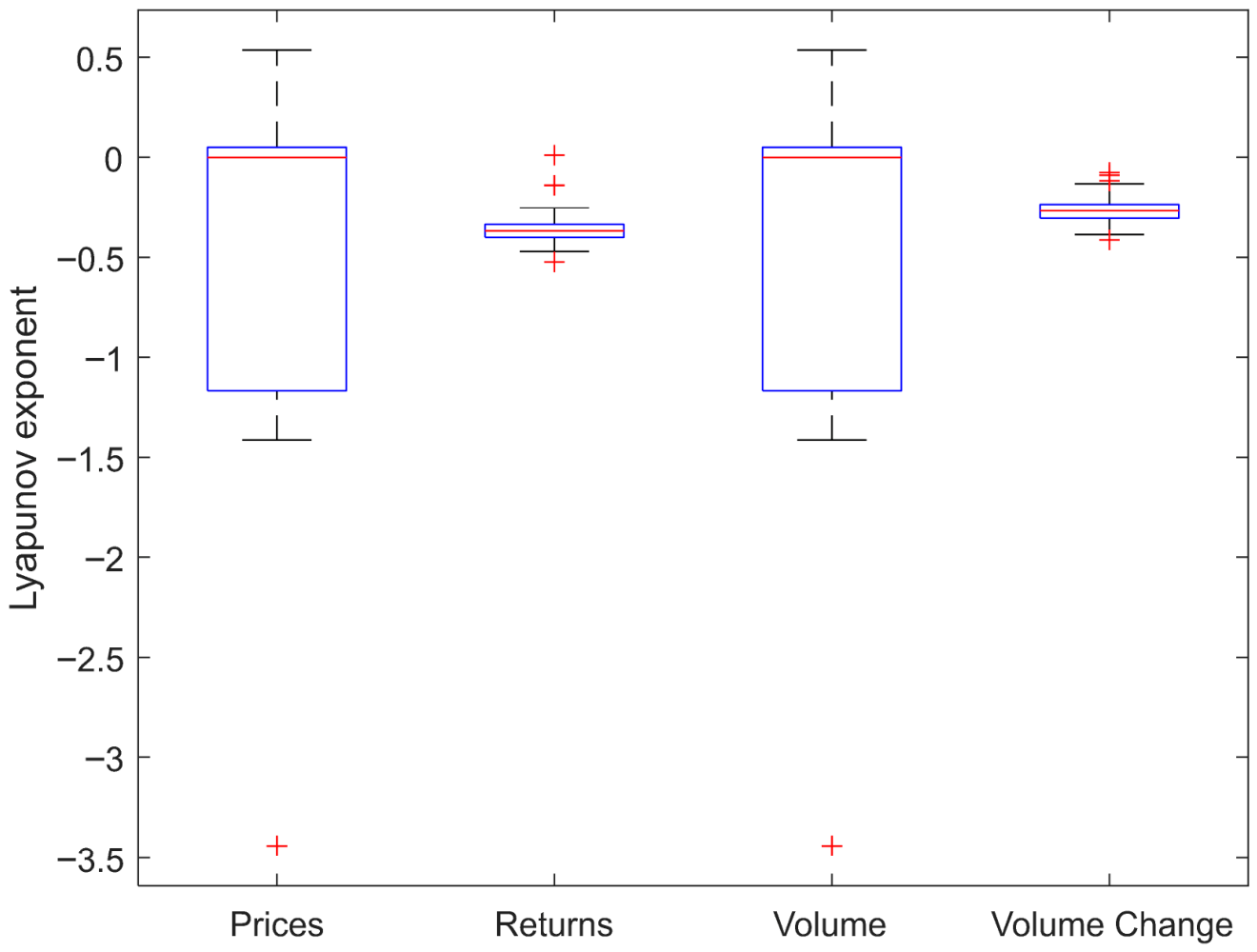
The boxplots of the computed Lyapunov exponent λ from price (P(t)), return (R(t)), and trading volume change (VC(t)) time series are exhibited in Figure 2. With respect to Figure 2, we performed Student-t test to check if (1) H0: λ = 0 (two-sided), (2) H0: λ ≥ 0 (one-sided, right), and (3) H0: λ ≤ 0 (one-sided, left). The results are provided in Table 3. Accordingly, the computed Lyapunov exponent λ from price (P(t)) time series of all 50 cryptocurrencies is statistically larger than zero since the null hypothesis λ = 0 is rejected (p-values = 2.5955 × 10⁻⁴), the null hypothesis λ ≥ 0 is accepted (p-values = 0.9999), and the null hypothesis λ ≤ 0 is rejected (p-values = 1.2978 × 10⁻⁴). Therefore, prices of cryptocurrencies are chaotic and could be predicted in the short run. Also, the computed Lyapunov exponent λ from return (R(t)) time series of all 50 cryptocurrencies is statistically larger than zero since the null hypothesis λ = 0 is rejected (p-values = 2.9818 × 10⁻³¹), the null hypothesis λ ≥ 0 is accepted (p-values = 1), and the null hypothesis λ ≤ 0 is rejected (p-values = 1.4909 × 10⁻³¹). Hence, returns of cryptocurrencies are chaotic and could be forecasted in the short run. Finally, the computed Lyapunov exponent λ from trading volume change (VC(t)) time series of all 50 cryptocurrencies is statistically larger than zero since the null hypothesis λ = 0 is rejected (p-values = 2.6353 × 10⁻³⁰), the null hypothesis λ ≥ 0 is accepted (p-values = 1), and the null hypothesis λ ≤ 0 is rejected (p-values = 1.3176 × 10⁻³⁰). Thus, trading volume changes in cryptocurrencies are chaotic and could be predicted in the short run.

4. Discussion and Conclusions

The presence of chaos has been the subject of a great number of studies in science and engineering [3,4,5,6,7,8,9,10,11,12,13,14,15,16,17,18]. In recent years, growing attention has been given to examining predictability in equity markets based on the chaos theory [19,20,21,22,23,24,25,26,27,28,29,30,31] where the evidence of chaos was found. In this study, we evaluated and tested the presence of chaotic dynamics in cryptocurrency markets to check if such markets are unpredictable; if so, they are efficient following the efficient market hypothesis (EMH) [41]. Indeed, we tested the efficiency in cryptocurrency markets to enrich the literature as recent studies focused on the application of machine learning to predict cryptocurrency [52,53,54,55,56,57]. In this regard the Lyapunov exponent (λ) was computed from a large set composed of 50 cryptocurrencies, and one-sided and two-sided Student-t tests were performed to verify if on average the value of computed λ is equal, larger, or less than zero. We used a very recent data period based on daily observations.
It is worth mentioning that there are various approaches to calculate the largest Lyapunov exponent including the Wolf’s algorithm [58] and Rosenstein’s method [59]. However, in this study, we adopted the method proposed in [45,46,47] to estimate the largest Lyapunov exponent and test for the presence of chaos. Indeed, tests for chaos are scarce in the literature, and practical implementation is unclear [60]. In this regard, the main advantage of the method we adopted [45,46,47] is that it can be conducted directly on experimental data without the need to define the generating equations [47].
The findings show clear evidence of chaos, suggesting that the behavior of cryptocurrency markets is nonlinear and deterministic. In particular, strong evidence indicates that the prices, returns, and trading volume changes were all chaotic. As a result, they could be predicted at a daily frequency. This finding is interesting as the sample period covers major US and world economic events, and the COVID-19 pandemic. In this regard, arbitrage opportunities can be implemented to predict cryptocurrencies and generate profits during difficult economic and financial downturns. Our work enriches the literature by showing the presence of chaos in cryptocurrency markets and that these markets are predictable at a daily frequency; hence, they are not efficient in the sense of EMH. For instance, traders and portfolio managers may use prior information on chaos in the dynamics of prices, returns, and trading volume variations to implement predictive systems used to improve forecasting accuracy and generate profits.
Our empirical analysis of fifty cryptocurrency markets based on the chaos theory demonstrates that these markets are not efficient from the perspective of EMH. This could be explained by the theory of behavioral finance [61] used to explain irrational financial and investment decisions made by individuals based on common behavioral biases including loss aversion, herd behavior, overconfidence bias, and confirmation bias.
In addition, we computed the Kolmogorov–Sinai entropy by means of approximate entropy [62,63] across prices, returns, and volume changes. Also, for each series of computed approximate entropy, we calculated the average and standard deviation. For each time series, we used the one-sided Student-t test to check if the estimated population of approximate entropy is equal (null hypothesis) or greater than zero (alternative hypothesis). The results indicate that the null hypothesis is rejected for prices (p-value = 3.6447 × 10⁻⁵, t-statistic = 4.3325), accepted for returns (p-value = 0.1611, t-statistic = 1.0000), and rejected for volume changes (p-value = 5.9705 × 10⁻¹⁵, t-statistic = 10.8648). Therefore, prices and volume changes exhibit chaotic motion, whilst returns exhibit a nonchaotic motion. Hence, approximate entropy and chaos yield the same results with respect to evidence of chaos in prices and volume changes. However, they yield divergent conclusions with respect to returns. The latter can be explained by the choice of parameters used to compute approximate entropy from the returns series.
Several directions for future research emerge from this study. First, the analysis could be extended to the implementation and comparison of different methods used to compute Lyapunov exponent to examine differences between the estimates across the methods. Second, future studies would examine chaos in the post-pandemic period. Third, we will estimate and compare entropy by using different methods to evaluate how information is carried across price, return, volatility, and change in trading volume. Fourth, another interesting future research direction would be the estimation of fractals to assess long memory in the dynamics of prices, returns, volatility, and trading volume variations. Finally, it would be interesting to investigate in future work the effect of regime shifts on chaos and fractal behavior since some cryptocurrencies can undergo fundamental technological and regime shifts that have the potential to change modeling dynamics [64].

Author Contributions

Conceptualization, S.L.; methodology, S.L. and S.B.; validation, S.L. and S.B.; formal analysis, S.L.; investigation, S.L.; data curation, S.L.; writing—original draft preparation, S.L. and S.B.; writing—review and editing, S.L. and S.B.; visualization, S.L. and S.B. All authors have read and agreed to the published version of the manuscript.

Funding

This research received no external funding.

Data Availability Statement

Data was obtained from Yahoo Finance [48].

Conflicts of Interest

The authors declare no conflicts of interest.

References

  1. Lorenz, E.N. Deterministic non-periodic flow. J. Atmos. Sci. 1963, 20, 130–141. [Google Scholar] [CrossRef]
  2. Lorenz, E.N. The Essence of Chaos; University of Washington Press: Seattle, WA, USA, 1993. [Google Scholar]
  3. Zhang, B.; Liu, L. Chaos-Based Image Encryption: Review, Application, and Challenges. Mathematics 2023, 11, 2585. [Google Scholar] [CrossRef]
  4. Shi, L.; Li, X.; Jin, B.; Li, Y. A Chaos-Based Encryption Algorithm to Protect the Security of Digital Artwork Images. Mathematics 2024, 12, 3162. [Google Scholar] [CrossRef]
  5. Inglada-Pérez, L.; Coto-Millán, P. A Chaos Analysis of the Dry Bulk Shipping Market. Mathematics 2021, 9, 2065. [Google Scholar] [CrossRef]
  6. Slavova, A.; Ignatov, V. Edge of Chaos in Memristor Cellular Nonlinear Networks. Mathematics 2022, 10, 1288. [Google Scholar] [CrossRef]
  7. Agarwal, R.; Domoshnitsky, A.; Slavova, A.; Ignatov, V. Edge of Chaos in Integro-Differential Model of Nerve Conduction. Mathematics 2024, 12, 2046. [Google Scholar] [CrossRef]
  8. Pankratova, E.V.; Sinitsina, M.S.; Gordleeva, S.; Kazantsev, V.B. Bistability and Chaos Emergence in Spontaneous Dynamics of Astrocytic Calcium Concentration. Mathematics 2022, 10, 1337. [Google Scholar] [CrossRef]
  9. Borrero, J.D.; Mariscal, J. Deterministic Chaos Detection and Simplicial Local Predictions Applied to Strawberry Production Time Series. Mathematics 2021, 9, 3034. [Google Scholar] [CrossRef]
  10. Stoean, C.; Lichtblau, D. Author Identification Using Chaos Game Representation and Deep Learning. Mathematics 2020, 8, 1933. [Google Scholar] [CrossRef]
  11. Petrzela, J. Chaos in Analog Electronic Circuits: Comprehensive Review, Solved Problems, Open Topics and Small Example. Mathematics 2022, 10, 4108. [Google Scholar] [CrossRef]
  12. Liang, Y.; Wang, W. Dynamic Properties and Chaos Control Analysis of Discrete Epidemic Models Affected by Media Coverage. Mathematics 2025, 13, 2873. [Google Scholar] [CrossRef]
  13. Yin, S.; Gao, Y.; Zhu, X.; Wang, Z. Anisotropy-Based Adaptive Polynomial Chaos Method for Hybrid Uncertainty Quantification and Reliability-Based Design Optimization of Structural-Acoustic System. Mathematics 2023, 11, 836. [Google Scholar] [CrossRef]
  14. Almatroud, O.A.; Shukur, A.A.; Pham, V.-T.; Grassi, G. Oscillator with Line of Equilibiria and Nonlinear Function Terms: Stability Analysis, Chaos, and Application for Secure Communications. Mathematics 2024, 12, 1874. [Google Scholar] [CrossRef]
  15. He, Z.-Y.; Abbes, A.; Jahanshahi, H.; Alotaibi, N.D.; Wang, Y. Fractional-Order Discrete-Time SIR Epidemic Model with Vaccination: Chaos and Complexity. Mathematics 2022, 10, 165. [Google Scholar] [CrossRef]
  16. Rather, S.A.; Das, S. Levy Flight and Chaos Theory-Based Gravitational Search Algorithm for Image Segmentation. Mathematics 2023, 11, 3913. [Google Scholar] [CrossRef]
  17. Dahou, A.; Chelloug, S.A.; Alduailij, M.; Elaziz, M.A. Improved Feature Selection Based on Chaos Game Optimization for Social Internet of Things with a Novel Deep Learning Model. Mathematics 2023, 11, 1032. [Google Scholar] [CrossRef]
  18. El-Latif, A.A.A.; Ramadoss, J.; Abd-El-Atty, B.; Khalifa, H.S.; Nazarimehr, F. A Novel Chaos-Based Cryptography Algorithm and Its Performance Analysis. Mathematics 2022, 10, 2434. [Google Scholar] [CrossRef]
  19. Serletis, A.; Shintani, M. No evidence of chaos but some evidence of dependence in the US stock market. Chaos Solitons Fractals 2003, 17, 449–454. [Google Scholar]
  20. Tsionas, M.G.; Michaelides, P.G. Neglected chaos in international stock markets: Bayesian analysis of the joint return–volatility dynamical system. Phys. A Stat. Mech. Its Appl. 2017, 482, 95–107. [Google Scholar]
  21. Tiwari, A.K.; Gupta, R. Chaos in G7 stock markets using over one century of data: A note. Res. Int. Bus. Financ. 2019, 47, 304–310. [Google Scholar] [CrossRef]
  22. Lahmiri, S. On fractality and chaos in Moroccan family business stock returns and volatility. Phys. A Stat. Mech. Its Appl. 2017, 473, 29–39. [Google Scholar] [CrossRef]
  23. Vogl, M.V.; Kojić, M.; Mitić, P. Dynamics of green and conventional bond markets: Evidence from the generalized chaos analysis. Phys. A Stat. Mech. Its Appl. 2024, 633, 129397. [Google Scholar] [CrossRef]
  24. Lahmiri, S.; Bekiros, S.; Bezzina, F. Multi-fluctuation nonlinear patterns of European financial markets based on adaptive filtering with application to family business, green, Islamic, common stocks, and comparison with Bitcoin, NASDAQ, and VIX. Phys. A Stat. Mech. Its Appl. 2020, 538, 122858. [Google Scholar] [CrossRef]
  25. Lahmiri, S. A study on chaos in crude oil markets before and after 2008 international financial crisis. Phys. A Stat. Mech. Its Appl. 2017, 466, 389–395. [Google Scholar] [CrossRef]
  26. Lahmiri, S. Investigating existence of chaos in short and long term dynamics of Moroccan exchange rates. Phys. A Stat. Mech. Its Appl. 2017, 465, 655–661. [Google Scholar] [CrossRef]
  27. Albulescu, C.T.; Tiwari, A.K.; Kyophilavong, P. Nonlinearities and Chaos: A New Analysis of CEE Stock Markets. Mathematics 2021, 9, 707. [Google Scholar] [CrossRef]
  28. Bildirici, M.; Şahin Onat, I.; Ersin, Ö.Ö. Forecasting BDI Sea Freight Shipment Cost, VIX Investor Sentiment and MSCI Global Stock Market Indicator Indices: LSTAR-GARCH and LSTAR-APGARCH Models. Mathematics 2023, 11, 1242. [Google Scholar] [CrossRef]
  29. Escot, L.; Sandubete, J.E.; Pietrych, Ł. Detecting Structural Changes in Time Series by Using the BDS Test Recursively: An Application to COVID-19 Effects on International Stock Markets. Mathematics 2023, 11, 4843. [Google Scholar] [CrossRef]
  30. Alves, P.R.L. Quantifying chaos in stock markets before and during COVID-19 pandemic from the phase space reconstruction. Math. Comput. Simul. 2022, 202, 480–499. [Google Scholar] [CrossRef] [PubMed]
  31. Sandubete, J.E.; Beleña, L.; García-Villalobos, J.C. Testing the Efficient Market Hypothesis and the Model-Data Paradox of Chaos on Top Currencies from the Foreign Exchange Market (FOREX). Mathematics 2023, 11, 286. [Google Scholar] [CrossRef]
  32. Gunay, S.; Kaşkaloğlu, K. Seeking a Chaotic Order in the Cryptocurrency Market. Math. Comput. Appl. 2019, 24, 36. [Google Scholar] [CrossRef]
  33. Omane-Adjepong, M.; Alagidede, I.P. High- and low-level chaos in the time and frequency market returns of leading cryptocurrencies and emerging assets. Chaos Solitons Fractals 2020, 132, 109563. [Google Scholar] [CrossRef]
  34. Partida, A.; Gerassis, S.; Criado, R.; Romance, M.; Giráldez, E.; Taboada, J. The chaotic, self-similar and hierarchical patterns in Bitcoin and Ethereum price series. Chaos Solitons Fractals 2022, 165, 112806. [Google Scholar]
  35. Lahmiri, S. Assessing efficiency in prices and trading volumes of cryptocurrencies before and during the COVID-19 pandemic with fractal, chaos, and randomness: Evidence from a large dataset. Financ. Innov. 2024, 10, 82. [Google Scholar]
  36. Bryant, P.H. Extensional singularity dimensions for strange attractors. Phys. Lett. A 1993, 179, 186–190. [Google Scholar] [CrossRef]
  37. Bryant, P.; Brown, R.; Abarbanel, H. Lyapunov exponents from observed time series. Phys. Rev. Lett. 1990, 65, 1523–1526. [Google Scholar] [CrossRef]
  38. Brown, R.; Bryant, P.; Abarbanel, H. Computing the Lyapunov spectrum of a dynamical system from an observed time series. Phys. Rev. A 1991, 43, 2787–2806. [Google Scholar] [CrossRef]
  39. Abarbanel, H.D.I.; Brown, R.; Kennel, M.B. Local Lyapunov exponents computed from observed data. J. Nonlinear Sci. 1992, 2, 343–365. [Google Scholar] [CrossRef]
  40. Yousefpoor, P.; Esfahani, M.S.; Nojumi, H. Looking for systematic approach to select chaos tests. Appl. Math. Comput. 2008, 198, 73–91. [Google Scholar] [CrossRef]
  41. Fama, E. Efficient Capital Markets: A Review of Theory and Empirical Work. J. Financ. 1970, 25, 383–417. [Google Scholar] [CrossRef]
  42. Lo, A.W. The adaptive markets hypothesis: Market efficiency from an evolutionary perspective. J. Portf. Manag. 2004, 30, 15–29. [Google Scholar] [CrossRef]
  43. Peters, E. Fractal Market Analysis—Applying Chaos Theory to Investment and Analysis; John Wiley & Sons, Inc.: New York, NY, USA, 1994. [Google Scholar]
  44. Kellert, S.H. In the Wake of Chaos: Unpredictable Order in Dynamical Systems; University of Chicago Press: Chicago, IL, USA, 1993. [Google Scholar]
  45. BenSaïda, A.; Litimi, H. High level chaos in the exchange and index markets. Chaos Solitons Fractals 2013, 54, 90–95. [Google Scholar] [CrossRef]
  46. BenSaïda, A. Noisy chaos in intraday financial data: Evidence from the American index. Appl. Math. Comput. 2014, 226, 258–265. [Google Scholar] [CrossRef]
  47. BenSaida, A. A practical test for noisy chaotic dynamics. SoftwareX 2015, 3–4, 1–5. [Google Scholar] [CrossRef]
  48. Yahoo Finance. Available online: https://ca.finance.yahoo.com/markets/crypto/all/ (accessed on 10 January 2026).
  49. The Daily Economy. Available online: https://thedailyeconomy.org/article/ten-remarkable-financial-events-of-2020/ (accessed on 10 January 2026).
  50. Dickey, D.A.; Fuller, W.A. Distribution of the estimators for autoregressive time series with a unit root. J. Am. Stat. Assoc. 1979, 74, 427–431. [Google Scholar]
  51. Kwiatkowski, D.; Phillips, P.C.B.; Schmidt, P.; Shin, Y. Testing the null hypothesis of stationarity against the alternative of a unit root. J. Econom. 1992, 54, 159–178. [Google Scholar] [CrossRef]
  52. John, D.L.; Binnewies, S.; Stantic, B. Cryptocurrency Price Prediction Algorithms: A Survey and Future Directions. Forecasting 2024, 6, 637–671. [Google Scholar] [CrossRef]
  53. Wang, M.; Braslavski, P.; Ignatov, D.I. TimeGPT’s Potential in Cryptocurrency Forecasting: Efficiency, Accuracy, and Economic Value. Forecasting 2025, 7, 48. [Google Scholar] [CrossRef]
  54. Murray, K.; Rossi, A.; Carraro, D.; Visentin, A. On Forecasting Cryptocurrency Prices: A Comparison of Machine Learning, Deep Learning, and Ensembles. Forecasting 2023, 5, 196–209. [Google Scholar] [CrossRef]
  55. Chevallier, J.; Guégan, D.; Goutte, S. Is It Possible to Forecast the Price of Bitcoin? Forecasting 2021, 3, 377–420. [Google Scholar] [CrossRef]
  56. Seabe, P.L.; Pindza, E.; Moutsinga, C.R.B.; Aphane, M. Temporal Attention-Enhanced Stacking Networks: Revolutionizing Multi-Step Bitcoin Forecasting. Forecasting 2025, 7, 2. [Google Scholar] [CrossRef]
  57. Ladhari, A.; Boubaker, H. Deep Learning Models for Bitcoin Prediction Using Hybrid Approaches with Gradient-Specific Optimization. Forecasting 2024, 6, 279–295. [Google Scholar] [CrossRef]
  58. Wolf, A.; Swift, J.B.; Swinney, H.L.; Vastano, J.A. Determining Lyapunov exponents from a time series. Phys. D Nonlinear Phenom. 1985, 16, 285–317. [Google Scholar] [CrossRef]
  59. Rosenstein, M.T.; Collins, J.J.; De Luca, C.J. A practical method for calculating largest Lyapunov exponents from small data sets. Phys. D Nonlinear Phenom. 1993, 65, 117–134. [Google Scholar] [CrossRef]
  60. Gottwald, G.A.; Melbourne, I. Testing for chaos in deterministic systems with noise. Phys. D Nonlinear Phenom. 2005, 212, 100–110. [Google Scholar] [CrossRef]
  61. Subrahmanyam, A. Behavioral Finance: A Review and Synthesis. Eur. Financ. Manag. 2008, 14, 12–29. [Google Scholar] [CrossRef]
  62. Pincus, S.M. Approximate entropy as a measure of system complexity. Proc. Natl. Acad. Sci. USA 1991, 88, 2297–2301. [Google Scholar] [CrossRef]
  63. Karmakar, C.; Udhayakumar, R.; Palaniswami, M. Entropy Profiling: A Reduced—Parametric Measure of Kolmogorov—Sinai Entropy from Short-Term HRV Signal. Entropy 2020, 22, 1396. [Google Scholar] [CrossRef]
  64. Koutmos, D. Network Activity and Ethereum Gas Prices. J. Risk Financ. Manag. 2023, 16, 431. [Google Scholar] [CrossRef]
Figure 1. (a) Plots of Bitcoin (BTC) price P(t). (b) Plots of Bitcoin (BTC) return R(t). (c) Plots of Bitcoin (BTC) trading volume V(t). (d) Plots of Bitcoin (BTC) trading volume change VC(t).
Forecasting 08 00048 g001aForecasting 08 00048 g001b
Figure 2. Boxplots of computed Lyapunov exponent λ from all 50 cryptocurrencies.
Forecasting 08 00048 g002
Table 1. Summary of descriptives statistics from price and return series of cryptocurrencies (cryptos).
PricesReturns
CryptosAverageStandard DeviationSkewnessKurtosisAverageStandard DeviationSkewnessKurtosis
AAVE183.1688127.03041.43071.2414−0.00040.0243−0.38445.2749
ADA1.02240.78181.42551.2029−0.00030.0199−0.00434.5221
ALGO0.72330.67901.32020.6529−0.00060.0229−0.17637.9866
AR24.080221.43721.50521.20320.00020.03040.71425.2234
ATOM20.117111.14131.31230.4970−0.00020.0249−0.51257.9070
AVAX44.184736.07731.33260.72610.00020.0260−0.49336.0172
AXS36.442145.30321.78722.24630.00030.02910.943111.7503
BCH370.1821241.73531.50283.3347−0.00040.02100.477218.4089
BNB432.6202117.68901.17191.05250.00000.0170−1.345115.8031
BSV101.356162.21461.48592.9540−0.00050.02190.364118.6192
BTC44,449.603315,364.18930.67320.01900.00010.0134−0.40043.8798
CHZ0.23080.12681.03550.7292−0.00040.0256−0.47858.8330
CRO0.21460.19281.89322.95870.00000.02070.02995.8479
DAI1.31040.0472−0.3046−1.14450.00000.0018−0.11464.4761
DODGE0.16180.09921.69462.8980−0.00030.0229−0.357612.8375
DOT16.735413.49561.52001.5754−0.00040.0222−0.90029.8650
EGLD120.5333101.89541.79733.1481−0.00030.0223−0.22616.2431
ETC39.297118.92981.38291.8359−0.00040.02270.16619.2628
ETH2948.45471067.46210.8880−0.02870.00000.0174−0.64756.7705
FET0.49120.43163.744723.06450.00080.0297−0.01845.1147
FIL26.112531.85981.58271.5796−0.00100.0251−0.21448.3213
FLOW6.45498.20261.57241.4218−0.00110.02480.10246.0425
FTM0.87510.88641.73531.90960.00010.0311−0.74647.6666
GRT0.40030.36641.25370.4977−0.00040.0273−0.348810.6039
HBR0.17250.13151.19230.3143−0.00030.0221−0.14247.7010
HNT13.771613.67321.37031.3464−0.00020.02840.92697.8023
ICT25.815441.09415.469244.7201−0.00140.02670.03946.2405
LINK17.433010.05491.00950.2917−0.00030.0230−0.75267.4417
LTC131.891858.67981.54592.9885−0.00050.0197−1.060711.9289
MANA1.31691.18711.93212.9803−0.00020.02882.837442.7627
MATIC1.40570.55161.10431.22640.00020.02600.55819.1067
MKR2064.34241109.00660.85080.1669−0.00020.02150.59608.6308
QNT166.259173.93471.73963.75840.00050.02370.72707.6964
RUNE5.69184.42781.14350.9292−0.00020.0307−0.43526.0352
SAND1.59241.77372.20354.38280.00020.02930.46349.2470
SHIB0.00000.00002.37526.55530.00000.03130.590213.6869
SNX5.93794.17131.69522.6917−0.00050.02820.02926.0991
SOL82.947370.79541.28630.72970.00060.0270−0.876010.1840
STX1.27730.84741.09140.70370.00030.02710.63209.3047
THETA3.26022.95371.22590.1822−0.00040.0244−0.96938.3548
TRX0.10250.02651.20461.10960.00010.0161−1.436716.8382
TUSD1.30930.0468−0.2801−1.08050.00000.00180.88439.2951
UNI13.50079.24541.38880.7510−0.00040.02360.254110.3079
USDC1.31040.0475−0.3099−1.14020.00000.0017−0.28464.0116
USDT1.31060.0476−0.2923−1.13980.00000.0017−0.00211.8979
VET0.06150.04801.38260.9659−0.00060.0223−0.71317.1781
XLM0.22250.12461.64073.1886−0.00060.01910.230219.0493
XMR234.975055.95091.51223.0481−0.00040.0201−2.243730.7300
XRP0.80360.29730.99300.4908−0.00030.02060.889823.9784
XTZ2.83492.14451.33480.9159−0.00060.0229−0.62978.5986
Table 2. Obtained p-values from ADF, Phillips–Perron (P-P), and KPSS tests applied to price, return, and volume change.
PricesReturnsVolume Change
ADFKPSSADFKPSSADFKPSS
AAVE0.02670.01000.00100.10000.00100.1000
ADA0.15240.01000.00100.10000.00100.1000
ALGO0.08350.01000.00100.10000.00100.1000
AR0.26320.01000.00100.03270.00100.1000
ATOM0.15830.01000.00100.10000.00100.1000
AVAX0.36290.01000.00100.02500.00100.1000
AXS0.28210.01000.00100.01000.00100.1000
BCH0.00100.01000.00100.10000.00100.1000
BNB0.44580.01000.00100.10000.00100.1000
BSV0.00100.01000.00100.10000.00100.1000
BTC0.81880.01000.00100.10000.00100.1000
CHZ0.05640.01000.00100.10000.00100.1000
CRO0.27550.01000.00100.01000.00100.1000
DAI0.87070.01000.00100.10000.00100.1000
DODGE0.00940.01000.00100.10000.00100.1000
DOT0.04960.01000.00100.10000.00100.1000
EGLD0.16470.01000.00100.10000.00100.1000
ETC0.00560.01000.00100.10000.00100.1000
ETH0.47670.01000.00100.10000.00100.1000
FET0.99900.01000.00100.08860.00100.1000
FIL0.00100.01000.00100.10000.00100.1000
FLOW0.00240.01000.00100.10000.00100.1000
FTM0.21040.01000.00100.07370.00100.1000
GRT0.00390.01000.00100.10000.00100.1000
HBR0.14700.01000.00100.10000.00100.1000
HNT0.20670.01000.00100.01830.00100.1000
ICT0.00100.01000.00100.10000.00100.1000
LINK0.01440.01000.00100.10000.00100.1000
LTC0.00220.01000.00100.10000.00100.1000
MANA0.13420.01000.00100.10000.00100.1000
MATIC0.31240.01000.00100.10000.00100.1000
MKR0.04450.01000.00100.10000.00100.1000
QNT0.40120.01000.00100.10000.00100.1000
RUNE0.02870.01000.00100.10000.00100.1000
SAND0.18590.01000.00100.04260.00100.1000
SHIB0.10350.01000.00100.10000.00100.1000
SNX0.00980.01000.00100.10000.00100.1000
SOL0.72310.01000.00100.01000.00100.1000
STX0.67150.01000.00100.10000.00100.1000
THETA0.00660.01000.00100.10000.00100.1000
TRX0.52810.01000.00100.10000.00100.1000
TUSD0.87340.01000.00100.10000.00100.1000
UNI0.01360.01000.00100.10000.00100.1000
USDC0.87760.01000.00100.10000.00100.1000
USDT0.88200.01000.00100.10000.00100.1000
VET0.00210.01000.00100.10000.00100.1000
XLM0.00100.01000.00100.10000.00100.1000
XMR0.03300.01000.00100.10000.00100.1000
XRP0.09200.01000.00100.10000.00100.1000
XTZ0.03950.01000.00100.10000.00100.1000
ADF and Phillips–Perron tests are used to test the null hypothesis of the presence of a unit root, meaning the time series is non-stationary. KPSS tests the null hypothesis of stationarity. All tests are performed at the 5% significance level.
Table 3. Results from Student-t test applied to Lyapunov exponent λ under the null hypothesis H0.
p-Valuet-Statistic
Prices P(t)
H0: λ = 02.5955 × 10⁻⁴−3.9384
H0: λ ≥ 00.9999−3.9384
H0: λ ≤ 01.2978 × 10⁻⁴−3.9384
Returns R(t)
H0: λ = 02.9818 × 10⁻³¹−27.2369
H0: λ ≥ 01−27.2369
H0: λ ≤ 01.4909 × 10⁻³¹−27.2369
Volume change VC(t)
H0: λ = 02.6353 × 10⁻³⁰−25.9737
H0: λ ≥ 01−25.9737
H0: λ ≤ 01.3176 × 10⁻³⁰−25.9737
The Student-t test is applied to the population of computed Lyapunov exponent; for instance, λ in Equation (2). The degree of freedom is 49 and statistical significance level is set to 5%.
Disclaimer/Publisher’s Note: The statements, opinions and data contained in all publications are solely those of the individual author(s) and contributor(s) and not of MDPI and/or the editor(s). MDPI and/or the editor(s) disclaim responsibility for any injury to people or property resulting from any ideas, methods, instructions or products referred to in the content.