Article

Longitudinal Growth Dynamics and Future Potential for the Supply–Demand Trend of Mango and Avocado Exports in Australia


1
School of Business and Law, Central Queensland University, Rockhampton, QLD 4701, Australia
2
Melbourne School of Population and Global Health, The University of Melbourne, Melbourne, VIC 3010, Australia
3
School of Graduate Research, Central Queensland University, Rockhampton, QLD 4701, Australia
4
School of Engineering & Technology, Central Queensland University, Rockhampton, QLD 4701, Australia
*
Author to whom correspondence should be addressed.
Forecasting 2026, 8(3), 45; https://doi.org/10.3390/forecast8030045

Submission received: 13 March 2026 / Revised: 26 May 2026 / Accepted: 27 May 2026 / Published: 5 June 2026
(This article belongs to the Section Forecasting in Economics and Management)

Highlights

What are the main findings?
  • Avocado exports show strong long-term growth, while mango exports are volatile due to supply-chain and trade disruptions.
  • Inclusion of production and consumption data in ARIMAX models improves the accuracy of mango export forecasts.
What are the implications of the main findings?
  • Australia’s export potential is supported by favourable macroeconomic conditions, including rising GDP and stable exchange rates in key markets.
  • To maintain stable export growth, industry planning must balance production increases with export demand, especially for commodities with higher volatility.

Abstract

Export supply chains (ESCs) for perishable fruits, such as mangoes and avocados, are shaped by complex supply–demand dynamics and macroeconomic conditions. However, limited forecasting of these dynamics constrains strategic planning and investment in Australia’s horticultural sector. This study assesses the longitudinal growth and future potential of mango and avocado exports. To achieve this, the study identifies influential supply–demand dynamics and applies time-series forecasting to understand the export trends. Historical export–import data were analysed for mango and avocado from 1992 to 2024, including volume, value, per capita GDP (Australia and key importing nations), real exchange rate, and real interest rate. Holt’s exponential smoothing was used to forecast export trends, supported by unit root testing in RStudio 4.2.3 and model execution in SPSS version 30. ARIMA and ARIMAX models were applied to stationary variables to improve mango export forecasts. The results show that avocado exports follow a strong upward trajectory, while mango exports remain volatile due to logistical inefficiencies and informal trade disruptions. ARIMAX modelling confirmed that production and consumption volumes significantly enhance forecast accuracy. Macroeconomic trends, rising GDP, declining real interest rates, and stable real exchange rates further reinforce Australia’s competitive position in the destination markets. The long-run trends in export volume and value suggest that both the mango and avocado sectors hold potential for further export growth, although the higher volatility observed in the avocado series indicates that expansion should be approached cautiously. To sustain this growth, maintaining a balanced relationship between production capacity and export demand, particularly for commodities exhibiting higher volatility, will be essential for ensuring stable and efficient export performance over time.

1. Introduction

Australia’s horticultural export sector has expanded significantly over the past three decades, while export volumes have increased more slowly than production. This imbalance raises concerns about domestic market saturation, inefficient trade performance, and missed opportunities in high-value international markets [1] (HIAL, 2024b). A major contributor to these inefficiencies is the limited use of long-term, data-driven forecasting tools that integrate both supply- and demand-side variables. Most of the exporters often lack awareness of critical demand indicators such as population growth and per capita GDP in importing nations, which are essential for aligning production with overseas market expectations [2].
Industry forecasting typically relies on short-term trade data from the previous five years, which fails to capture structural shifts caused by free trade agreements, global financial disruptions, or pandemics. For example, the COVID-19 outbreak in 2020 led to a sharp decline in fresh produce demand and a surge in canned fruit consumption, while airfreight costs for perishables rose dramatically [3]. These events exposed the vulnerability of horticultural export supply chains (ESCs) and the inadequacy of reactive forecasting methods. Addressing these challenges requires robust, data-driven forecasting that accounts for both macroeconomic trends and supply–demand dynamics. Quantitative time-series models offer a practical solution for modelling export trajectories, supporting strategic planning, and improving the resilience of Australia’s horticultural export sector [1].

1.1. Perishable Horticulture and Case Study Commodities

Perishable horticultural products vary widely in climatic requirements, storage compatibility, and shelf-life, all of which influence their exportability [4,5]. Tropical fruits such as mango and avocado require warm growing conditions, with temperatures around 22–36 °C (night/day), and have relatively short storage windows, placing them in the high-perishability category [6,7]. These characteristics make them logistically demanding but also position them as high-value commodities in premium Asian markets.
Table 1 summarizes the perishability and export performance of major Australian fruits and vegetables. Fruits contribute more significantly to export value than vegetables, and several highly perishable fruits, particularly mango and avocado, have demonstrated strong market potential.
The above classifications informed the selection of products for this study. In Australia, not all perishable horticulture products are currently well-established in the export market. This review will help identify the highly perishable fruits recognized as being relatively vulnerable (in terms of ESC) as well as valuable, thus making them good prospects for this study.

1.2. Rationale for Case Study Fruit Selection

This study focuses on mango and avocado because they are highly perishable (lifetimes of < 2 and 2–4 weeks), high-value tropical fruits with established or rapidly expanding export markets. According to HIAL, fruits are grown in large volumes (351,660 tons/$980.7 million) in Australia and contribute more significantly to the export market, compared to vegetables (150,499 tons/$199 million) [1,8]. Other perishable horticultural commodities also face export challenges [9], but mango and avocado offer clearer evidence of both current export significance and future growth potential [10].
The Australian mango industry has already achieved an established position in the export market by exporting to 25 different countries since 1991 [11,12]. Australia exports mango to 24 countries, generating $19.0 million (AUD) in the 2023–24 financial year [8]. Australia can export mangoes for around six months (October to March) each year. Although exports represent around 9% of national production, the industry aims to increase this share to 20% by 2027 [13]. Achieving this target requires improved market access, reduced logistical disruptions, and a better understanding of demand conditions in key Asian markets (e.g., Hong Kong, Singapore and South Korea) and their consumers [13].
Australia’s avocado export sector is experiencing rapid expansion and remains in an emerging development stage characterized by substantial year-on-year growth and efforts to open new protocol markets [14]. Exports have expanded substantially since 2000, with export values reaching AUD 96.1 million in 2023–24 [8,15]. The avocado season in Australia typically spans eight months (March–September), although limited production occurs year-round across different states. However, major markets such as Japan, China, and South Korea remain inaccessible due to biosecurity and trade barriers [16]. As production continues to rise, identifying new markets and forecasting long-term demand will be critical for avoiding domestic oversupply and stabilizing grower returns [17].
This study focuses on mango and avocado to examine contrasting export dynamics between a mature and an emerging horticultural commodity.
Mango represents a mature export commodity with long-standing market access, established protocols, and relatively stable export pathways, while avocado reflects a rapidly growing but still developing export market facing protocol constraints and market access challenges. Both fruits are highly perishable and temperature-sensitive, yet differ in season length, post-harvest treatments, and export maturity, providing a robust basis for comparison. Examining these two commodities strengthens the generalizability of findings and provides an opportunity to understand whether ESC maturity affects the export trend.
Beyond their individual market significance, mango and avocado serve as representative case studies of high-value perishable commodity ESCs. Their characteristics, including high perishability, high value, seasonal production, dependence on cold-chain logistics, and sensitivity to international demand conditions, reflect broader challenges faced by high-value perishable horticultural exports. Therefore, insights derived from these commodities extend beyond product-specific analysis and contribute to a broader understanding of forecasting, planning, and risk management in perishable ESC systems. This enhances the generalisability of the findings to other high-value horticultural export sectors.

1.3. Problem Statements

Australia’s horticultural export sector has experienced a significant transformation over the past three decades, particularly in the avocado and mango industries. Avocado producers have expanded their production, with forecasts projecting a rebound to 170,000 metric tonnes by 2025–26 following a temporary decline due to alternate bearing cycles (where heavy fruit load occurs in one year and a lighter crop in the off-year), as well as oversupply pressures [18]. Despite this growth, export volumes have not kept pace with supply, raising concerns about domestic market saturation and trade inefficiencies [19]. Also, many existing export destinations are approaching saturation, while demand is emerging in additional international markets. Despite this growing interest, Australia’s ability to capitalize on new opportunities is constrained by limited market access [16]. The sector requires proper guidance on strategic export planning and enabling industry stakeholders to capitalize on emerging market opportunities.
Given these structural constraints and the widening gap between production growth and export performance, there is a clear need to understand the broader macroeconomic and demand-side forces shaping Australia’s horticultural export dynamics. Yet only a limited number of studies have examined Australia’s horticultural export sector. For example, [20] found that suppliers’ understanding of export demand is crucial for consistent supply and achieving overall ESC efficiency. These authors demonstrated that most small-scale fruit exporters (farmers) in Australia are unaware of the demand-side factors influencing importing nations (e.g., population size and per capita GDP) and how these factors influence the overseas demand for fruit. The study, however, only focused on micro-level supply-chain behaviour, and overlooked the macroeconomic determinants, forecasting accuracy, and future growth prospects central to current policy and industry decisions.
Ref. [21] examine Queensland (Australia) horticulture producers’ willingness to participate in export-oriented contract-based supply-chain coordination, using a discrete-choice experiment to identify heterogeneous producer preferences for contract attributes. The study offers valuable behavioural insights, showing that only a subset of producers are strongly export-interested and that price premiums and production costs shape participation decisions; however, it relies on cross-sectional survey data and hypothetical choice scenarios, limiting its generalizability and its relevance to macro-level export analysis. Crucially, the study does not incorporate time-series export data, macroeconomic indicators, or commodity-specific supply–demand dynamics and therefore is unable to indicate the future export potential for mango and avocado. Its contribution lies instead in contextualizing producer-level behaviour, which complements but does not substitute for econometric modelling of export dynamics.
Horticultural export industries commonly rely on short-run industry forecasts based on recent trade data, often limited to the preceding five years, to guide supply and demand expectations. While useful for operational planning, such short-term approaches are insufficient for long-term export-oriented commodity development and economic sustainability, as they fail to capture structural shifts arising from trade policy changes, macroeconomic shocks, and global disruptions. For example, Australia’s free trade agreements can rapidly reshape market access and trade flows, while the COVID-19 pandemic triggered abrupt changes in consumption patterns, including a sharp decline in fresh fruit demand, alongside a 73.9% increase in demand for canned fruit. These dynamics highlight the limitations of relying solely on short-term forecasting for strategic decision-making.
While the existing studies provide valuable insights into horticultural forecasting, several limitations remain. Many studies focus on single-method approaches such as ARIMA or cointegration models, often relying on short-term datasets and a limited range of variables [22,23]. These approaches tend to emphasise either supply-side or demand-side dynamics, without integrating both dimensions into a unified framework. Additionally, the prior studies rarely evaluate forecasting model performance comparatively across multiple techniques. These gaps highlight the need for a more comprehensive modelling approach that combines multiple forecasting techniques and incorporates both macroeconomic factors and supply–demand proxies. This study addresses this gap by applying a multiple-modelling framework (Holt’s exponential smoothing, ARIMA, and ARIMAX) to capture both structural trends and external influences.
Addressing this gap requires robust, data-driven forecasting frameworks that incorporate both supply-side conditions and demand-side determinants over longer horizons. However, the application of quantitative time-series models to medium- and long-term horticultural export data remains limited, particularly in studies integrating production capacity and importer demand proxies. To address this gap, this article aims to forecast the medium- to long-term export potential of Australia’s mango and avocado by modelling supply–demand trends using time-series techniques. It seeks to support strategic planning by improving stakeholders’ understanding of future demand conditions in key international markets. To address the identified research gap, this study is guided by the following research questions:
RQ1: What macroeconomic factors and supply–demand proxies influence export dynamics?
RQ2: Which forecasting model (Holt’s exponential smoothing, ARIMA, or ARIMAX) provides the most accurate prediction of export performance?
RQ3: What are the future export potentials for mango and avocado under current economic conditions?
These research questions support the objective of developing a robust forecasting framework for export supply-chain (ESC) analysis. This study contributes to the literature by developing a comprehensive and policy-relevant framework for forecasting export dynamics in perishable horticultural supply chains. Specifically, it makes three key contributions. First, it integrates both supply-side and demand-side determinants within a unified time-series forecasting framework, enabling a more holistic representation of export behaviour. Second, it adopts a comparative modelling approach by employing Holt’s exponential smoothing, ARIMA, and ARIMAX models to assess and benchmark forecasting performance across alternative specifications. Third, it provides empirical evidence from the Australian horticultural sector, generating practical insights for policymakers and stakeholders to support export planning and decision-making in perishable commodity supply chains.
The rest of the paper proceeds as follows. Section 2 outlines the study context and analytical domain, including the ESC structure, supply–demand principles, and the theoretical basis for selecting the forecasting variables. Moving forward to Section 3, research material and methods, including the data collection procedures and the structure of the time-series dataset used in the analysis and pre-analyses are presented. The data analysis and results, encompassing exponential smoothing forecasting, ARIMA, and ARIMAX forecasting, are presented in Section 4. Section 5 presents a comprehensive discussion of the analytical results, interpreting model outputs, evaluating forecasting performance and the implications and limitations of the study and presenting future research scopes. Finally, Section 6 concludes with a summary of the key findings of this study.

2. Study Context and Analytical Domain

In the context of perishable horticulture, ESC refers to the coordinated set of activities, actors, and enabling conditions that move a product from farm to international markets, encompassing production, post-harvest handling, cold-chain logistics, quality assurance, traceability, regulatory compliance, and market-access mechanisms. Each of these elements plays a critical role in shaping export performance [24]. The performance of ESCs is highly sensitive to both supply-side factors (e.g., production capacity, input costs) and demand-side factors (e.g., income levels, population growth in importing countries). Forecasting plays a central role in ESC management by enabling stakeholders to anticipate demand fluctuations, optimise supply allocation, and reduce inefficiencies such as overproduction or supply shortages.
Fruit ESCs involve complex supply–demand structures due to the perishable nature of the products. Various economic and social elements influence the efficiency of fruit ESCs. Understanding the key drivers of this complexity and how these factors interact can support the development of targeted industry production systems. Analysing supply–demand trends is also essential for forecasting future export capacity. Such insights can inform policymakers about designing effective trade regulations and improving the resilience of the fruit export sector.

2.1. Supply–Demand Principles in ESC

Supply and demand are two fundamental concepts of classical economics and market management [25]. The process of economic growth within a country heavily depends on export growth, which in turn depends on various parameters of the ESC. According to the conventional laws of market supply and demand, an efficient market SC forms where producers’ supply volume and consumers’ demand volume meet at the same point, known as the equilibrium point [25]. Conversely, if these factors operate without a meeting or equilibrium point, the market will experience a surplus or a demand shortage. However, traditional supply–demand models are inherently static and do not fully capture the dynamic adjustment processes observed in real-world markets. To address this limitation, this study adopts a systems theory perspective, which conceptualises the ESC as a complex, interconnected system characterised by feedback loops and temporal dynamics [26].
Within this system, supply- and demand-side determinants function as external and internal drivers that influence ESC behaviour over time. Time-series models such as Holt’s exponential smoothing, ARIMA, and ARIMAX operationalise these determinants by quantifying how shocks, trends, and cyclical patterns propagate through the ESC system, enabling the forecasting of export dynamics under varying economic conditions [27].
Therefore, this traditional supply–demand law has considerable influence on the estimation of the export–import trends of Australian mango and avocado. In terms of exporting Australian fruits, the different supply-side factors (including export volume, value, domestic consumption, per capita GDP, etc.) and demand-side variables/factors (including destination country’s population size, per capita GDP, etc.) are used to estimate the export–import trends and future potential of Australia’s fruit export sector.

2.2. Variables That Affect the Supply and Demand in the Export Market

Researchers and policymakers have been interested in studying the performance of the horticultural export sector, with an emphasis on the supply–demand dynamics of horticultural exports [22,23,25,28]. The performance of an ESC is mostly determined by the product supplied by the exporting country and the demand within the importing country. An analysis of the extant literature demonstrates that a range of different factors (variables) are considered as proxies for supply and demand in the export market (Table 2).
Ref. [22] found that all variables in Table 2 significantly affect the supply–demand relationship in Ethiopia’s horticultural export industry. Studies have applied various methodological approaches to examine these dynamics (Table 3). For example, ref. [22] performed a secondary data-based time-series econometric analysis using the autoregressive–distributed lag–bound test and cointegration test for the period from 1985–2016 in the Ethiopian horticultural export context. Ref. [23] reported similar findings using cointegration analysis on Tanzanian horticultural export data from 1988–2018. Ref. [30] employed exponential smoothing to forecast pineapple supply data using historical pineapple supply data.
Holt’s exponential smoothing is widely used in agricultural forecasting because it captures level and trend components in non-seasonal, non-stationary time series. Ref. [31] applied Holt’s linear trend model to forecast crop yields in India, showing its usefulness for short- to medium-term planning in volatile settings. Ref. [32] proposed a Revised Simple Exponential Smoothing (RSES) model to better handle structural shifts such as level changes and impulses. Ref. [27] recommend Holt’s method for datasets with gradual transitions, noting its interpretability and responsiveness in the absence of strong seasonality. These findings support the use of Holt’s method in modelling mango and avocado export dynamics, in which trends evolve gradually but are sensitive to external shocks.
Holt’s exponential smoothing provides a practical and interpretable approach for modelling export dynamics over time [27]. This study applies Holt’s method to 32 years (1992–2024) of Australian avocado and mango export data to model historical supply–demand patterns and forecast future export volumes. The resulting projections offer insights into the evolving supply–demand dynamics of these export sectors.
Several studies have employed ARIMA and ARIMAX models to improve forecasting accuracy by capturing autocorrelation and incorporating exogenous variables. Ref. [33] used ARIMA to forecast Vietnam’s cashew nut export volumes. Their analysis showed that ARIMA effectively captured both trend and seasonality in the data, producing accurate short-term forecasts. The model’s strength lay in its ability to handle autocorrelation and generate stable projections in the absence of external shocks. Ref. [34] applied ARIMA and VAR (Vector Autoregression) models to predict vegetable prices in India, showing ARIMA’s reliability for short-term price-sensitive commodities. Ref. [35] combined ARIMA with neural networks to forecast horticultural prices using web-crawled data, highlighting ARIMA’s role in baseline trend modelling.
ARIMAX models are particularly effective in agricultural settings where external drivers shape production. Ref. [36] used ARIMAX to forecast wheat area, production, and productivity with rainfall and input costs as exogenous variables, showing that this approach outperformed univariate models in capturing climatic and economic variability. Ref. [37] used ARIMAX to model grain production under rainfall instability in Brazil’s semi-arid region. These studies confirm that ARIMAX enhances predictive accuracy when supply–demand proxies are available, an approach highly relevant to mango exports, for which production and consumption volumes are key drivers.
Other forecasting approaches have also been explored. Ref. [38] compared linear regression and single exponential smoothing to predict crop production at a plantation, concluding that regression models offered stronger interpretability for policy planning. Ref. [39] used descriptive and causal–comparative designs to assess demand forecasting in Kenyan horticulture firms, emphasizing the role of managerial insight and market intelligence.
Together, these studies demonstrate a growing recognition of the need for robust, context-specific forecasting tools in horticulture. For perishable commodities like mango and avocado, for which export performance is shaped by both internal production cycles and external market dynamics, combining statistical models with macroeconomic indicators offers a more comprehensive and policy-relevant forecasting framework.
This study examines mango and avocado as case study fruits due to their export significance and physiological characteristics. Given the need for improved forecasting in order to understand supply–demand dynamics, and the limitations of existing short-term industry projections, a more rigorous modelling approach is warranted. A literature review was undertaken to identify key variables influencing horticultural export supply–demand relationships (Table 2), with the results forming the basis for applying time-series methods to medium-term export data. Although prior studies have used various analytical techniques, few have jointly incorporated proxy supply- and demand-side factors over extended periods. Drawing on these insights, this study applies Holt’s exponential smoothing to historical export data to model trends and forecast future export growth for mango and avocado. Holt’s method is selected because several export series exhibit strong trends, volatility, and non-stationarity, conditions under which ARIMA requires prior differencing and transformation, whereas Holt’s exponential smoothing flexibly accommodates deterministic trends without strict distributional assumptions (Section 3.2 and Section 3.3). The following section presents the data collection procedures, analytical methods, and results derived from this modelling approach.

3. Material and Methods

3.1. Data Collection and Handling

Annual data on mango and avocado production, consumption, export volume, and export value in Australia were compiled for the period 1992–2024. These fruit-related statistics were sourced from the Australian Bureau of Statistics (ABS) and the Australian Horticulture Statistics Handbook. To support demand and supply forecasting, macroeconomic indicators, including population size (of key destination countries), per capita GDP, real exchange rate and real interest rate, were also projected for the period 2025–2029 (Table 2). Historical data for the following variables were retrieved from online databases for the period 1992–2024: the per capita GDP [40], real exchange rate [41] and real interest rate [42].
The dataset contained missing values for mango and avocado export volumes and value, particularly before 2008. These gaps were addressed, using multiple imputations, in SPSS version 30, which estimates missing entries based on observed data patterns [43,44]. To improve accuracy, relevant background variables were included as predictors: production, consumption, and export measures for mango, and corresponding trade and production variables for avocado. This ensured that theoretically consistent imputations aligned with cross-variable relationships. Five imputed datasets were generated, and one was selected for final analysis following consistency checks.
Although standard multiple imputation practice involves analysing each dataset separately and pooling the results using Rubin’s Rules, the five imputations in this study produced highly consistent parameter estimates across diagnostic checks, indicating negligible between-imputation variability. In such cases, selecting a single imputed dataset for final analysis is acceptable because the pooled estimates would be virtually identical to those obtained from any one dataset, and the combined standard errors are indistinguishable from those produced by [45,46]. Therefore, using one representative imputed dataset does not affect the validity, precision, or interpretability of the results, and ensures that the imputation process adequately reflects the underlying data structure.

3.2. Pre-Analysis of the Dataset by the Coefficient of Variance

Assessing the relative variability of the time-series data is important when selecting an appropriate forecasting model. The coefficient of variation (CV), calculated as the standard deviation divided by the mean (Equation (1)), provides a standardized measure of dispersion and is useful for evaluating the stability of annual export volumes. A low and consistent CV indicates a more stationary pattern, supporting the use of simple exponential smoothing techniques [29]. In this study, CV was calculated for each commodity to guide model selection and ensure methodological rigor (Table 4).
C V = σ µ
where σ = standard deviation of the data series; μ = mean of the data series.
The CV results indicate that variables such as Real Exchange Rate (0.12) and Mango Consumption (0.31) exhibit relatively low variability, suggesting stable patterns over time. In contrast, the Avocado Export Value (2.07) and Avocado Export Volume (1.40) exhibit high dispersion, indicating significant fluctuations and potential volatility in trade performance. These differences in CV support the need for adaptive forecasting models like Holt’s exponential smoothing for the more volatile series [30].

3.3. Pre-Analysis for the Stationarity Test by the Unit Root Test

It is important to assess the stationarity of time series data before model selection, as non-stationary series may lead to spurious regression results and unreliable forecasts [27]. To evaluate this, the Augmented Dickey–Fuller (ADF) test was applied, using R 4.2.3 software, across all variables. Table 5 integrates both the original ADF test results and the outcomes after first differencing. The ADF test results for the population sizes and per capita GDPs of importing nations (Hong Kong, Singapore, Malaysia and South Korea) are presented in Appendix C.
The results revealed that only Mango Production was stationary at the level (p = 0.01), while all other variables in the series were non-stationary (p > 0.05). These findings indicate the need for differencing or transformation before applying models that assume stationarity, such as ARIMA or ARIMAX [30]. Holt’s exponential smoothing is well-suited for non-seasonal time series with a deterministic trend and does not require data to be stationary [27].
Most variables remained non-stationary even after first differencing, suggesting persistent stochastic trends or structural shifts. However, Mango Consumption, Avocado Production, and two borderline cases—Mango Export Volume and Avocado Consumption—achieved stationarity after first differencing, indicating they are integrated at an order of one, I(1), and suitable for ARIMA and ARIMAX modelling [27].
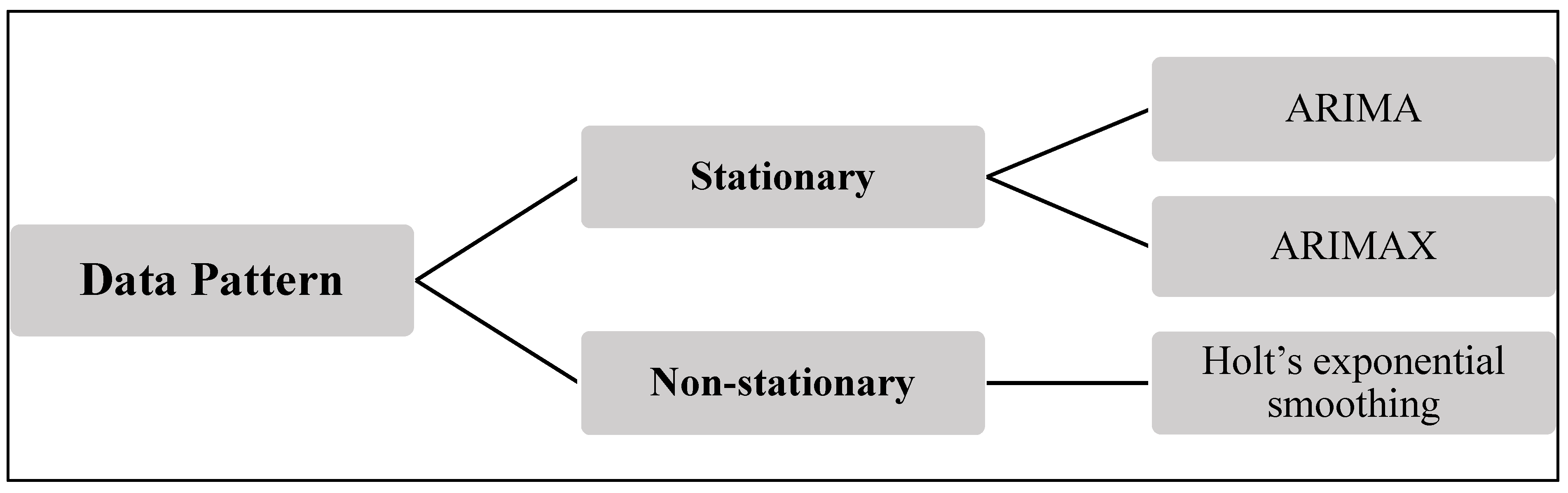
Accordingly, Holt’s exponential smoothing was applied across all variables (including population size and per capita GDP for the four importing countries) to capture level and trend dynamics without requiring strict stationarity. ARIMA and ARIMAX models were applied to time series that achieved stationarity after differencing, utilizing the autoregressive and moving average components of these models to generate statistically robust forecasts. Following model fit diagnostics, the better-performing model, either ARIMA or ARIMAX, was selected to forecast export growth. This multiple-modelling strategy aligns with best practices in agricultural economics, in which hybrid approaches improve forecast accuracy and accommodate diverse data behaviours [29,49]. However, since Avocado Export Volume remains non-stationary even after first differencing, it cannot be forecast using ARIMA or ARIMAX. Therefore, only the Mango Export Volume was modelled using these techniques.
The selection of forecasting models was guided by the statistical properties of the data. Holt’s exponential smoothing was applied to non-stationary series with deterministic trends, while ARIMA and ARIMAX models were used for stationary or differenced series with stochastic behaviours. In addition to standard performance metrics, the modelling process incorporated a structured set of diagnostic checks, including unit-root testing to confirm stationarity requirements, and coefficient of variation (CV) analysis to assess relative volatility.
Model performance was evaluated using multiple criteria, including MAPE, RMSE, AIC/BIC, and residual diagnostics, ensuring a robust comparison across alternative specifications [29]. The persistence of non-stationarity in several variables highlights structural trends and potential external shocks affecting the data. While Holt’s exponential smoothing can accommodate such behaviour, the results should be interpreted with caution, as forecasts may be sensitive to underlying non-linear dynamics and structural changes.
Figure 1 presents the forecasting model derived from the observed data structure. It summarises the overall modelling framework. The analysis proceeds in three stages: (i) preliminary data analysis using the coefficient of variation and stationarity tests to assess data characteristics; (ii) selection of appropriate forecasting models based on these properties, including Holt’s exponential smoothing for non-stationary trend data and ARIMA/ARIMAX for stationary series; and (iii) model evaluation using multiple diagnostic metrics (MAPE, RMSE, R2, and residual tests) to ensure robustness and reliability of forecasts.
To minimise the risk of spurious regression in the ARIMAX model, all variables included were tested for stationarity and transformed where necessary. Only variables that achieved stationarity after differencing were considered suitable for inclusion. Additionally, the selection of exogenous variables (production and consumption) was guided by theoretical relevance to supply–demand dynamics.
Although multicollinearity between production and consumption variables cannot be entirely ruled out, their inclusion reflects distinct economic roles, representing supply capacity and domestic demand, respectively. Residual diagnostics, including autocorrelation tests, indicate that the final model adequately captures the underlying dynamics without significant bias. Nevertheless, potential multicollinearity remains a limitation of the modelling approach.

4. Data Analysis and Results

This section presents the forecasting results in three parts: (i) Holt’s exponential smoothing, for trend analysis; (ii) ARIMA modelling, for baseline time-series forecasting; and (iii) ARIMAX modelling, incorporating exogenous variables for improved predictive performance.

4.1. Holt’s Exponential Smoothing

Holt’s exponential smoothing is a time series forecasting method designed to capture both level (Equation (2)) and trend (Equation (3)) components in non-seasonal data. Unlike models that require strict stationarity, it updates forecasts recursively using weighted averages of past observations [27]. To formally represent the forecasting mechanism, Holt’s exponential smoothing is defined by two recursive equations that update the level and trend components over time (Equation (4)):
L t = α Y t + 1 α ( L t 1 + T t 1 )
T t = ( L t L t 1 ) + 1 γ T t 1
Y ^ t + h   = L t   + h T t
where Y t is the observed value at time t; L t   is the estimated level; T t is the estimated trend; α and γ are smoothing parameters for level and trend, respectively; and Y ^ t + h is the forecast for h periods ahead.
This study forecasted the selected variables for 5 years ahead (2025–2029). The empirical evidence suggests that Holt’s exponential smoothing method performs best for short- to medium-term forecasts (such as 1–5 years), becoming less reliable as the horizon lengthens [50,51].
The performance of Holt’s exponential smoothing was evaluated using key diagnostic metrics across all variables. Most series demonstrated satisfactory forecast accuracy (Table 6), with MAPE values below the 20% threshold considered acceptable for economic data. For instance, Real Exchange Rate (MAPE = 4.49%) and GDP Per Capita (MAPE = 8.54%) exhibited strong predictive performance, supported by high R-squared values (0.802 and 0.939, respectively) and non-significant Ljung–Box statistics, indicating uncorrelated residuals. Similarly, Mango Production and Avocado Production showed robust fits, with R-squared values above 0.84 and MAPE below 20%.
In contrast, Avocado Export Volume and Avocado Export Value recorded higher MAPE values (45.71% and 27.21%), suggesting greater volatility and reduced reliability, although their residuals remained uncorrelated. While these results capture the overall direction of avocado export trends, the comparatively higher MAPE values indicate reduced point-forecast precision for this commodity due to its inherent volatility. Moderate fits were observed for variables such as Mango Export Volume and Mango Export Value, with R-squared values below 0.65 and forecast errors slightly exceeding the preferred range. Overall, the absence of autocorrelation in residuals across all models and the presence of strong or moderate explanatory power in most cases support the adequacy of Holt’s method for short- to medium-term forecasting for the agricultural export trend.
The Holt’s exponential smoothing models demonstrated a generally strong performance across both the population and GDP per capita series for the destination countries. The corresponding Ljung–Box significance values (except for South Korea) suggest that the residuals are largely random, supporting model adequacy. In contrast, GDP per capita models produced lower accuracy, with higher MAPE values (Table 6). Notably, the South Korean GDP per capita model exhibited significant autocorrelation in residuals, suggesting model misspecification.
Table 7 summarizes the key smoothing parameters used in Holt’s exponential smoothing models. The Alpha (level) parameter, which determines the weight assigned to recent observations, was statistically significant (p < 0.05) for most variables, including Real Exchange Rate, GDP Per Capita, Mango Export Volume, and Avocado Export Value. This indicates that the model effectively captured short-term level changes in these series. In contrast, Mango Production Volume and Mango Consumption Volume exhibited very low and non-significant Alpha values, suggesting limited influence on recent data.
The Gamma (Trend) parameter, which adjusts for trend smoothing, was statistically insignificant across all variables (p > 0.05), with extremely low estimates in most cases. This implies that the trend component contributed little to the forecasts, and level dynamics primarily drove the series. Exceptions like Avocado Production Volume and Avocado Export Value had higher Gamma estimates, but their p-values remained above the significance threshold, indicating a weak trend influence on the forecast.
For the destination countries’ population and GDP variables, Holt’s exponential smoothing model yielded statistically significant Alpha values close to 1 for most GDP per capita series and South Korea’s population, indicating strong reliance on recent observations. In contrast, Alpha values for Singaporean and Malaysian populations were low and statistically insignificant, suggesting limited responsiveness to short-term changes. The Gamma (trend) parameter was generally insignificant across all variables, except for South Korea’s population, where a significant trend effect was observed.
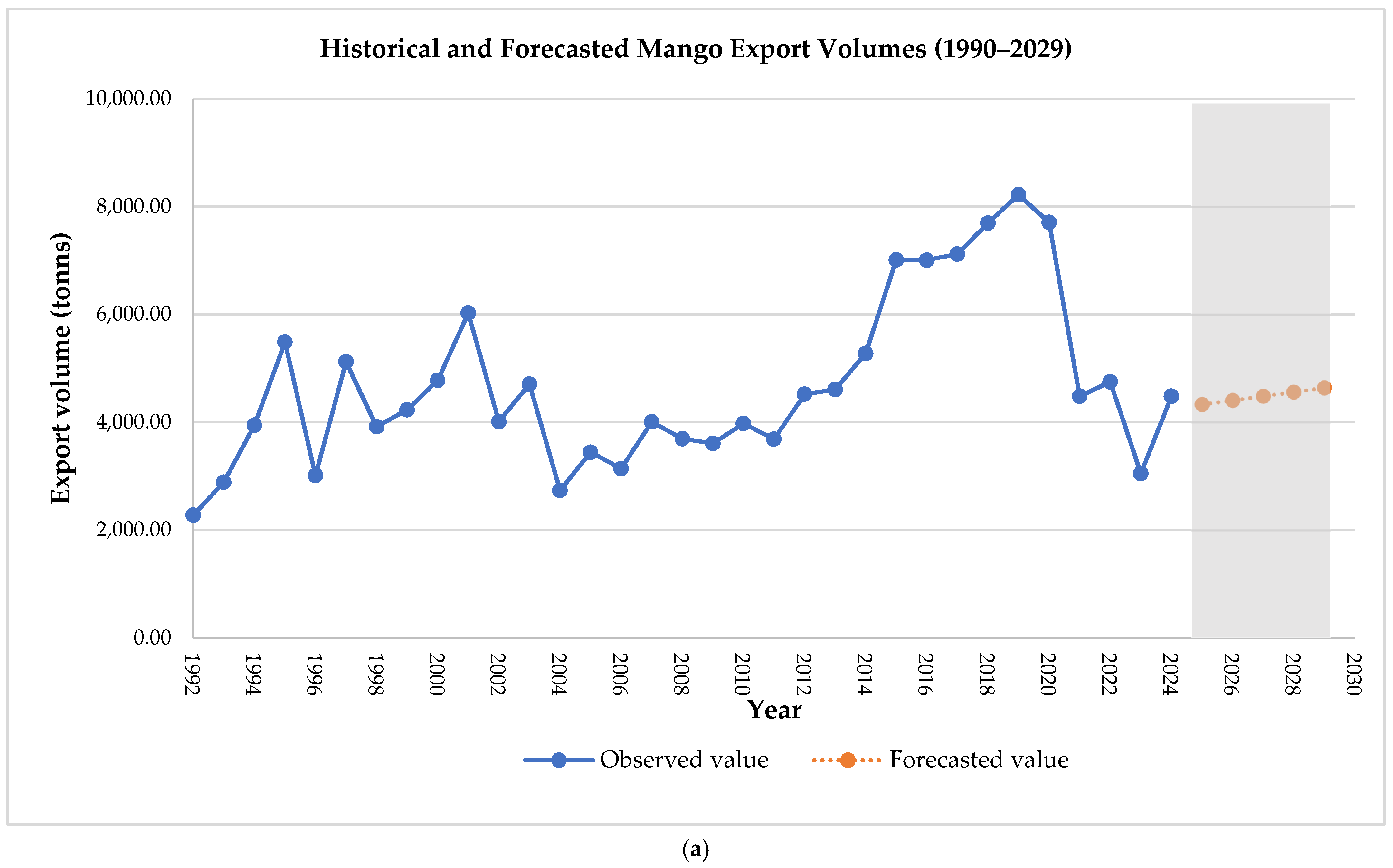
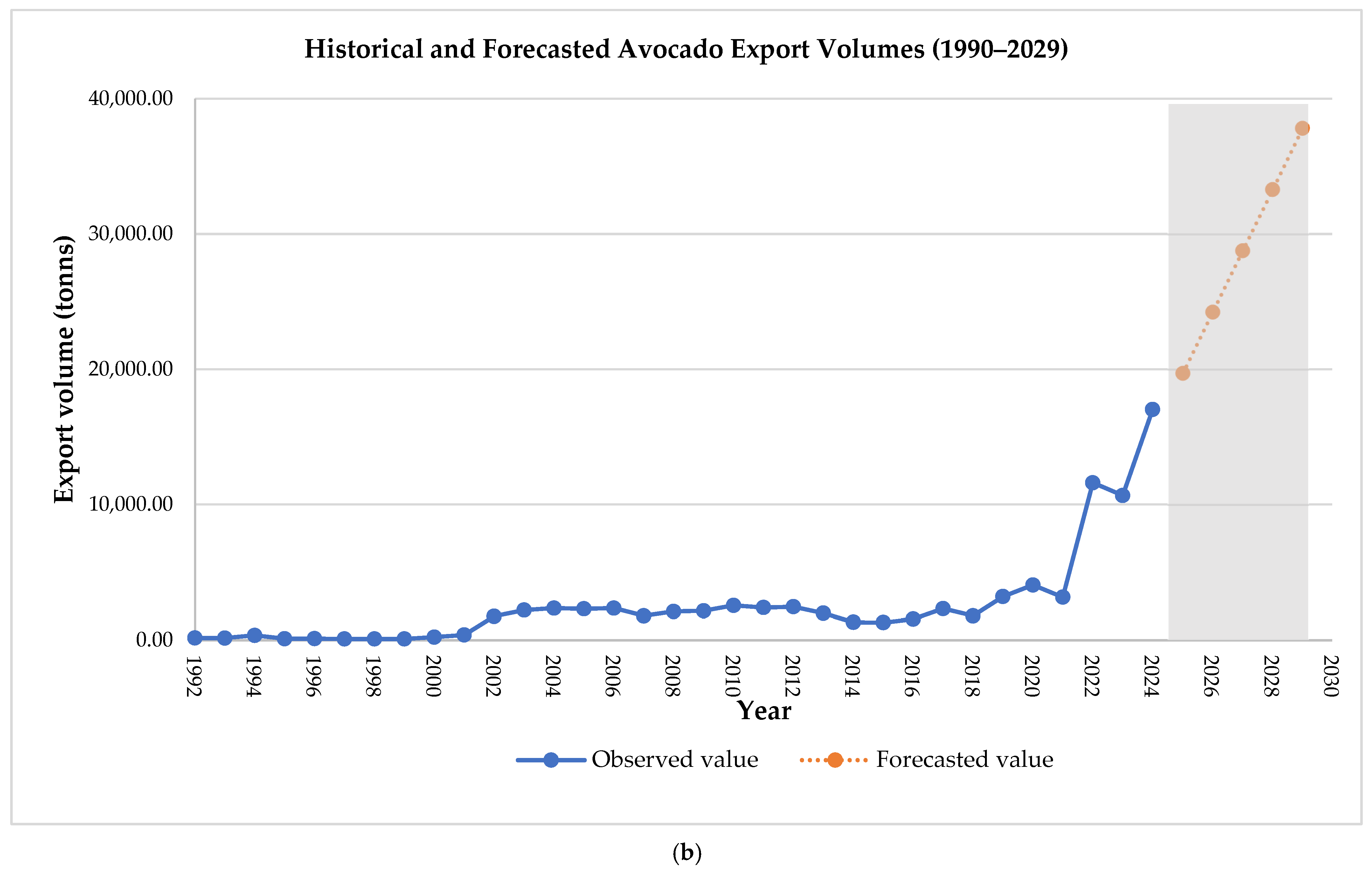
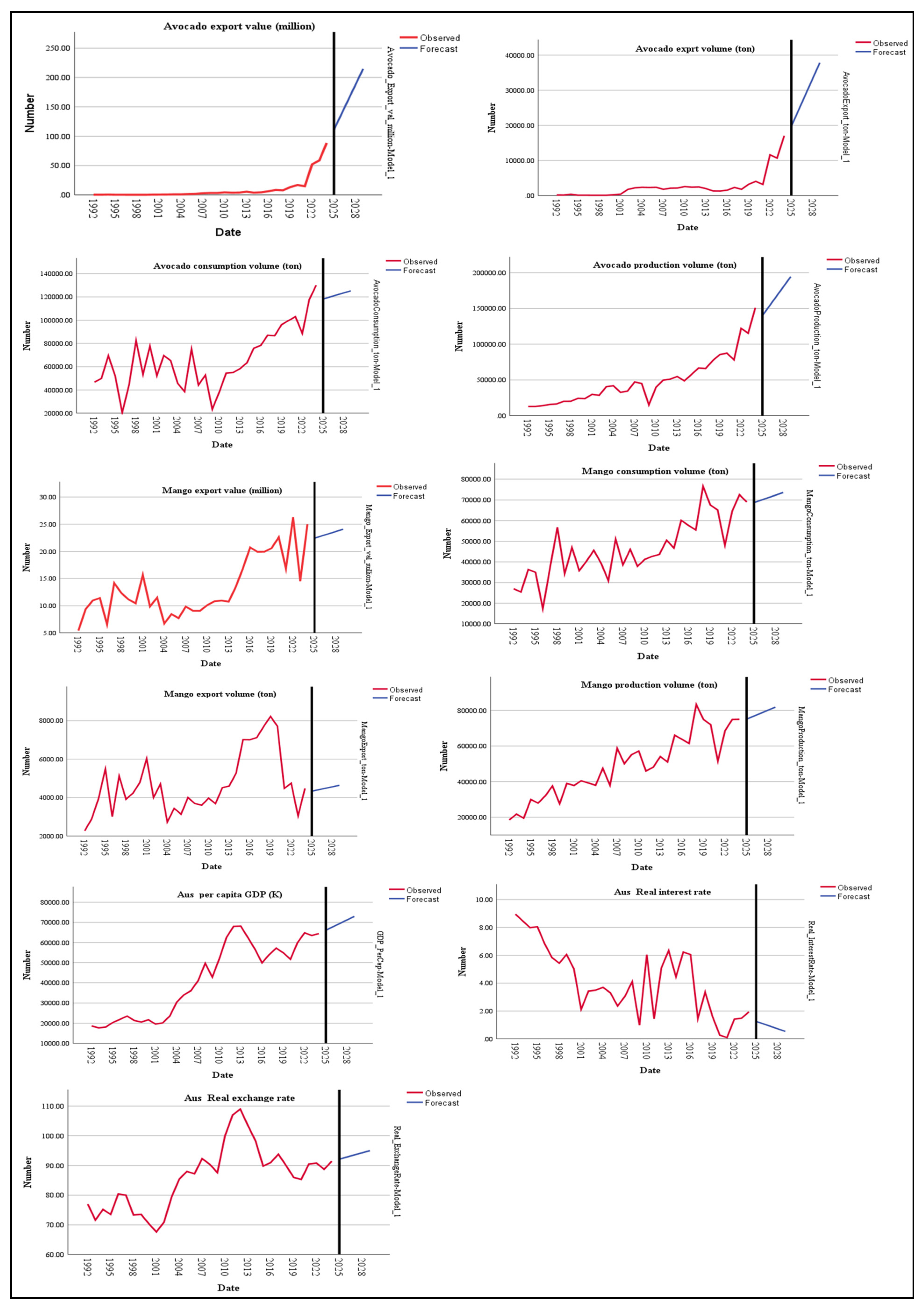
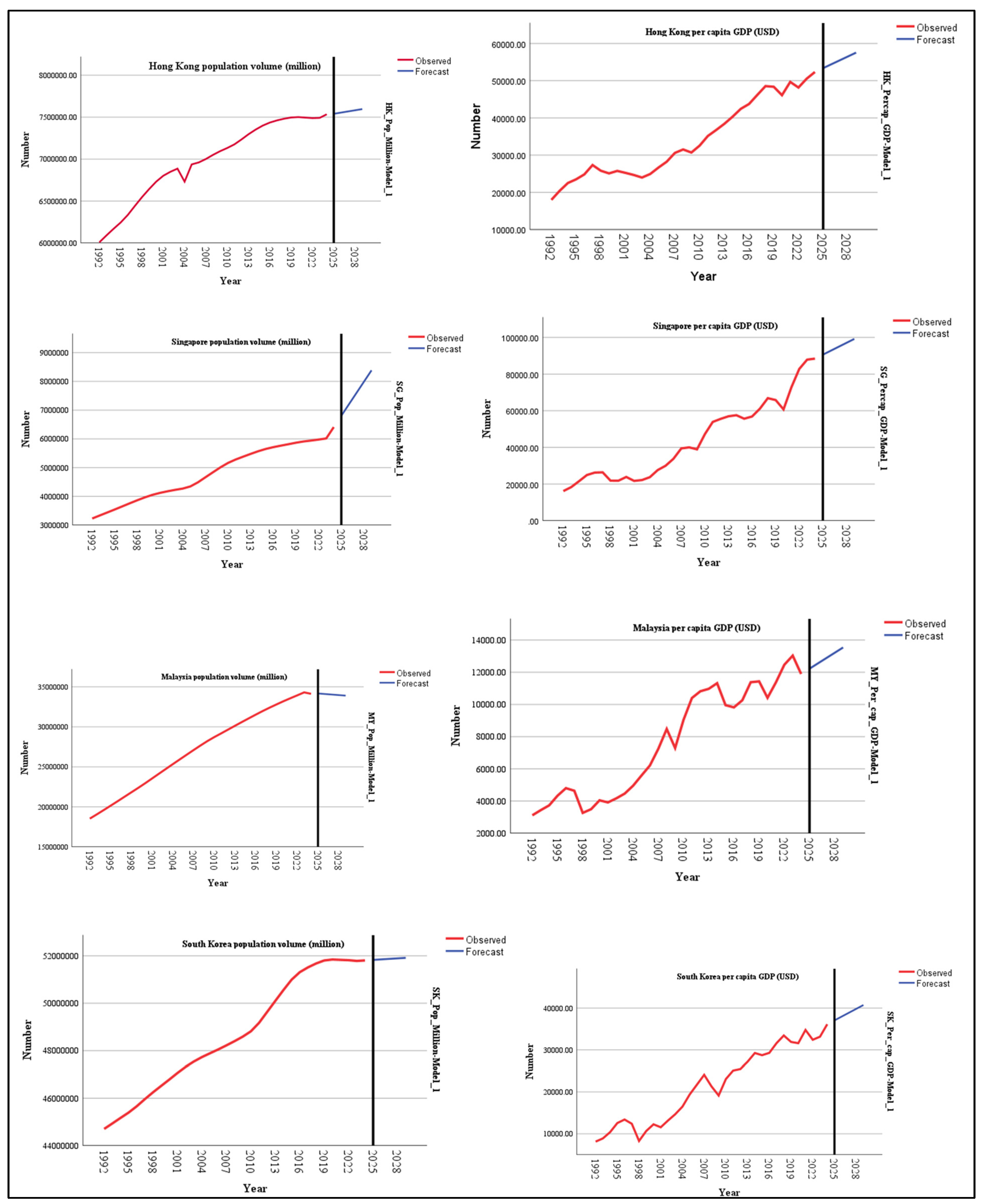
The Holt’s exponential smoothing is plotted in SPSS, and the export volumes for mango and avocado are presented in Figure 2. Plotting of the rest of the variables and the forecasted values is shown in Appendix A.
Figure 2 illustrates both observed and forecast export volumes for mango and avocado. The avocado series demonstrates a clear upward trajectory with increasing slope in the forecast period, indicating strong growth momentum. In contrast, mango exports exhibit greater fluctuations, with noticeable short-term variability and a more gradual trend. The smoothing forecasts captured these differences effectively, highlighting the relative stability of avocado exports compared to mango.

4.2. Auto-Regressive Integrated Moving Average (ARIMA)

Since the Mango Export Volume passed the stationary test (Table 5), there was an opportunity to run an ARIMA model to forecast the Mango Export Volume and compare the result with the Exponential Smoothing forecast. To forecast Mango Export Volume, an Autoregressive Integrated Moving Average (ARIMA) model was employed, given that the series exhibited weak stationarity after first differencing. ARIMA is a widely used time series forecasting technique that combines autoregressive (AR), differencing (I), and moving average (MA) components to model temporal dependencies and stochastic trends [27]. The general form of the ARIMA model is expressed as (Equation (5)):
Y t = c + φ 1 Y t 1 +   φ 2 Y t 2 + + φ p Y t p + θ 1 ε t 1 + θ 2 ε t 2 +   + θ q ε t q +   ε t  
where:
Y t = The differenced in value of the original time series at time t;
c = A constant term (intercept);
φ 1 ,   φ 2 ,   ,   φ p = The autoregressive (AR) coefficients, representing the influence of past values Y t 1 ,   Y t 2 ,   ,   Y t p ;
θ 1 ,   θ 2 ,   ,   θ q = The moving average (MA) coefficients, capturing the effect of past forecast errors ε t 1 ,   ε t 2 ,   ,   ε t q ;
ε t   = The white noise error term at time t, assumed to be independently and identically distributed with zero mean and constant variance.
This equation enables the model to capture both autoregressive structure and shock-driven adjustments, making it suitable for economic and agricultural time series with temporal dependence and stochastic trends [52]. Using this framework, the study forecasted mango export volumes five years ahead (2025–2029), with an ARIMA model, in RStudio 4.2.3.
The ARIMA (1,1,0) model indicated a modest autoregressive pattern with one differencing step, appropriate for a weakly stationary series. The negative AR(1) coefficient (−0.3650) suggests that increases in export volume are typically followed by declines, indicating a dampening effect (Table 8). The model’s MAPE of 19.76% falls within acceptable limits for agricultural forecasting, demonstrating reasonable predictive accuracy. Low residual autocorrelation (ACF1 = 0.081) further supports model adequacy, indicating residuals approximate white noise.
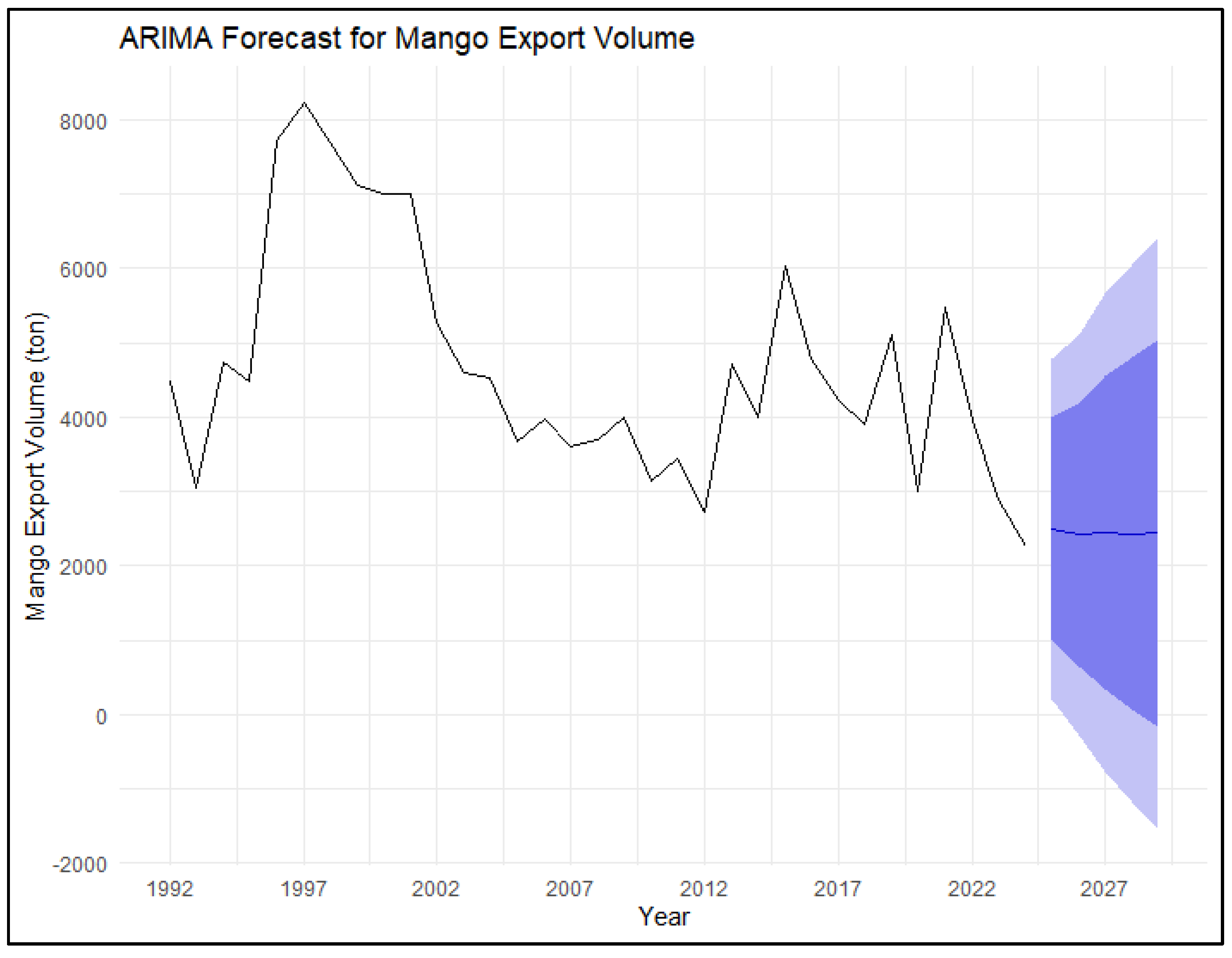
The relatively high RMSE and MAE values, along with moderate uncertainty in the AR (1) estimate, imply that the model may not fully capture external influences or structural shifts in export dynamics. However, the moderate MAPE indicates that forecast accuracy may be improved by exploring alternative model specifications (e.g., ARIMAX) or incorporating relevant exogenous variables. The ARIMA model forecast is plotted in R in Figure 3, and the forecasted values are shown in Appendix B.
Figure 3 presents the ARIMA (1,1,0) forecast for Mango Export Volume. The model captures short-term fluctuations and indicates a stabilizing trend over the forecast horizon. However, the relatively flat trajectory suggests limited growth potential under the univariate framework, highlighting the importance of incorporating external factors, as explored in the ARIMAX model.

4.3. Autoregressive Integrated Moving Average with Exogenous Variables (ARIMAX)

An Autoregressive Integrated Moving Average with Exogenous Variables (ARIMAX) model was applied to improve the explanatory power and forecast reliability for Mango Export Volume. This model extends the ARIMA framework by incorporating external predictors, specifically, Mango Production Volume and Mango Consumption Volume, which are expected to influence export behaviour. The simplified form of the ARIMAX model is (Equation (6)):
Y t = c + φ   Y t 1 + θ   ε t 1 + β 1 X 1 , t + β 2 X 2 , t +   ε t  
where Y t is the mango export volume at time t, Y t 1 is its lagged value, ε t 1 is the previous period’s error term, X 1 , t and X 2 , t represent mango production and consumption volumes, respectively, and β 1 , β 2   are their coefficients.
This structure allows the model to capture both internal time series dynamics and external influences, making it particularly suitable for agricultural forecasting, in which export volumes are shaped by supply and domestic demand factors [53,54]. This study forecasted the Mango Export Volume for 5 years (2025–2029), using the ARIMAX model, in R 4.2.3 software.
The ARIMAX (3,0,0) model demonstrates improved performance over the baseline ARIMA model by incorporating Mango Production and Consumption Volumes as exogenous predictors. The positive coefficients for both variables (Table 9) suggest that increases in supply and domestic demand are associated with higher export volumes, consistent with agricultural trade dynamics. The autoregressive terms capture short-term momentum and cyclical adjustments, with AR (3) indicating a corrective effect.
Forecast accuracy is supported by a MAPE of 14.52%, which falls within the acceptable range for economic and agricultural forecasting [53,55]. The low residual autocorrelation (ACF1 = 0.029) confirms that the model residuals behave like white noise, satisfying a key assumption of time series modelling.
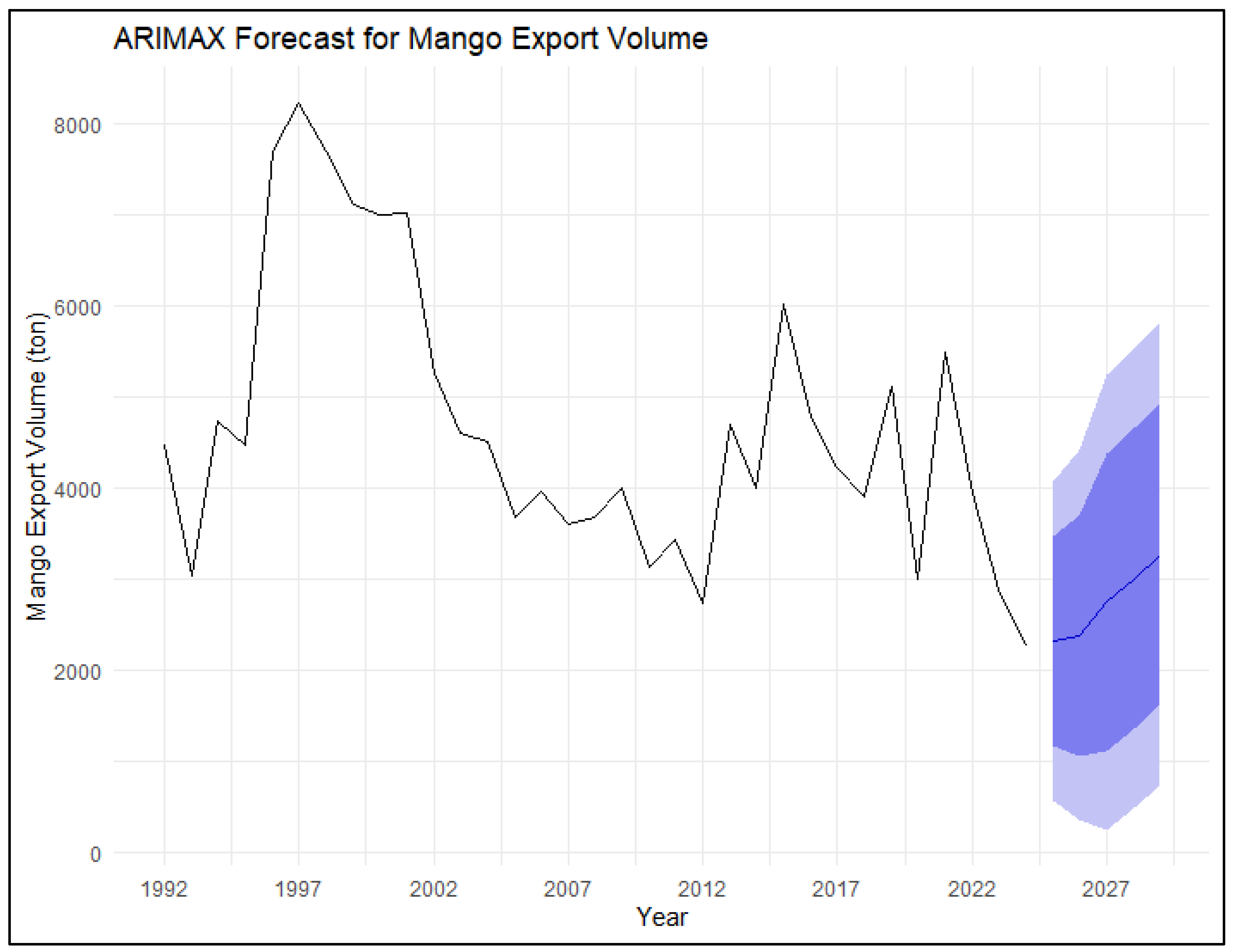
Additionally, reduced RMSE and MAE values compared to the ARIMA model indicate an improved fit, while AIC and BIC values support the model’s parsimony. The ARIMAX model forecast is plotted in R in Figure 4, and the forecast values are shown in Appendix B. The forecast trend line indicates a gradual upward movement from 2023 to 2029, suggesting a steady recovery and moderate growth in mango export volumes following earlier fluctuations in the historical series.
Although the performance metrics indicate that several models produced acceptable forecast accuracy, the higher MAPE and RMSE values observed in some specifications, particularly for mango exports, suggest underlying volatility and structural instability in the series. This aligns with prior research showing that perishable horticultural commodities often exhibit irregular fluctuations due to production cycles, weather variability, and market disruptions [22,23]. These elevated errors indicate that the models may not fully capture short-term shocks or non-linear dynamics, and therefore the results should be interpreted with appropriate caution.

5. Discussion

5.1. Comparative Insights from Forecasting Models

Holt’s exponential smoothing demonstrated strong performance in forecasting population trends for Hong Kong, Singapore, Malaysia, and South Korea, with exceptionally high explanatory power and very low MAPE values (Table 6). These results affirm the model’s suitability for stable, long-term demographic series, for which level changes dominate and volatility is minimal. In contrast, the South Korean GDP per capita model exhibited significant autocorrelation in residuals, indicating potential misspecification. This discrepancy is likely due to abrupt fluctuations in South Korea’s GDP data between 2021 and 2024, reflecting economic disruptions associated with the COVID-19 pandemic. Such volatility underscores the limitations of exponential smoothing for economic indicators with irregular structural shifts, which may be better captured by more flexible approaches such as ARIMA or state–space models [27,56].
The observed significance of Alpha values in non-stationary series, including GDP per capita and South Korea’s population, further supports Holt’s model effectiveness in capturing short-term level dynamics. These indicators typically reflect evolving economic and demographic conditions, making them responsive to recent data. Conversely, the lack of significance in the Alpha test for the Singaporean and Malaysian populations suggests structural stability or stationarity, limiting the model’s adaptability. Similar limitations were observed in agricultural series such as Mango Production and Consumption volumes, which also exhibited low and non-significant Alpha values. This aligns with [30], who noted that Holt’s method performs poorly on stationary data. Moreover, the consistently low and insignificant Gamma estimates across most variables, one exception being South Korea’s population, indicate that trend smoothing contributed minimally to the forecasts. This reinforces the view that exponential smoothing is predominantly level-driven and best suited to non-seasonal time series with gradual transitions [27].
Finally, the longitudinal forecasts generated using Holt’s exponential smoothing reveal consistent upward trends in mango and avocado export volumes, supported by parallel growth in production, domestic consumption, and export value. These patterns suggest a structurally expanding horticultural sector in Australia, consistent with [57], who identified export-oriented growth in the tropical fruit sector in Kenya, driven by improved agronomic practices and market access. However, given the potential influence of structural breaks such as pandemic-related disruptions and trade-related shocks, the export forecasts should be interpreted as indicative long-run trajectories rather than precise point estimates, particularly for commodities exhibiting higher volatility.

5.1.1. Comparative Interpretation of Mango and Avocado Export Models

The exponential smoothing results show distinct forecasting dynamics between mango and avocado exports. For mango exports, the level parameter was statistically significant, indicating that the model places a stronger emphasis on recent observations, as compared with historical data. This suggests that mango exports are more responsive to short-term changes, making the forecast highly sensitive to recent fluctuations in export volumes. The trend parameter was not significant, implying that the mango export series does not display a stable long-term trend, but rather short-term variability.
While the forecasts provide useful insights into long-term export trajectories, the presence of higher error values in some models highlights important limitations. In particular, the volatility in mango exports reduces the stability of univariate models, consistent with evidence that commodities with short shelf-life and fragmented supply chains are more difficult to predict reliably [33]. These results underscore that model outputs should not be interpreted as precise point estimates but rather as indicative trends subject to uncertainty arising from production variability, market access constraints, and external shocks.
The volatility observed in the mango series is consistent with the model diagnostics, which showed higher forecast errors and weaker parameter stability, indicating that external disruptions such as freight delays and informal trade pathways, likely contribute to the instability rather than being directly captured by the models [33].
Mango exports, while increasing, show a more gradual pace. This may be due to the business disruptions caused by the COVID-19 pandemic. According to the Australian Mango Industry Association, mango export volumes dropped significantly during the 2020–2022 seasons, falling from around 6000 tonnes to under 4500 tonnes [58]. This decline was directly linked to reduced airfreight capacity and increased costs, as well as the closure of informal trade channels such as the ‘grey channel’ to Hong Kong, which reduced export volumes to that region [59]. The ‘grey channel’ refers to the trade of goods through distribution channels that are unofficial but not illegal. These channels bypass authorized routes, often to avoid tariffs or regulatory scrutiny. In Hong Kong, this has historically included re-routing goods through intermediaries to avoid formal customs procedures [60].
These disruptions created short-term volatility in export volumes, undermining the continuity of long-term growth trends. While demand remained strong in some markets (e.g., New Zealand and South Korea), the overall export performance was constrained by logistical and operational inefficiencies [58].
In contrast, the avocado export model exhibited a lower-level parameter (Table 7) that was also statistically significant. This result suggests that avocado exports adapt more slowly to changes, with the model balancing recent data and past data in shaping forecasts. The trend component, however, was not statistically significant, indicating that while the model attempted to account for a trend, the evidence for a consistent directional movement in avocado exports is weak. However, these macroeconomic patterns should be interpreted as contextual drivers rather than direct empirical outputs, as the time-series models used in this study do not explicitly estimate causal effects of GDP, exchange rates, or interest rates on export volumes. Instead, the observed upward trajectory aligns with broader economic conditions that have historically supported avocado export growth [8].
Avocado exports exhibit a notably sudden growth trajectory, as compared to mango, reflecting stronger global demand. Australia’s avocado exports have grown significantly in recent years, with the industry now holding a strong position in key Asian markets such as Singapore, Malaysia, and Hong Kong [61]. This growth has been supported by Austrade’s trade facilitation efforts, which have helped open access to new international markets and strengthen export opportunities [62].
In addition to this, this growth may be reinforced by rising export values and production volumes (more than 1500 hectares of avocado orchards reaching maturity), which together signal robust market positioning. For example, [63] attribute avocado’s export success to its year-round demand, health-driven consumer preferences, and efficient postharvest handling, factors that are less well-developed in mango supply chains. While the models in this study successfully captured the long-run upward trajectory of avocado exports, the relatively higher MAPE values indicate that forecast precision is somewhat reduced for this commodity due to its inherent volatility. Accordingly, the results provide reliable directional insights into future growth, although the magnitude of year-to-year changes should be interpreted with measured confidence.
In summary, the comparative modelling approach confirms that avocado is positioned for accelerated export growth, while mango’s potential remains constrained by supply-chain inefficiencies. These insights underscore the importance of targeted investment in postharvest technologies and market development strategies to unlock mango’s export potential.

5.1.2. Comparative Interpretation of Mango Export Volume Forecasts Using the ARIMA and ARIMAX Models

The comparative analysis of ARIMA and ARIMAX models highlights the added value of incorporating exogenous variables in forecasting mango export volumes. Specifically, the inclusion of Mango Production Volume and Mango Consumption Volume as explanatory variables in the ARIMAX framework enhances the model’s ability to capture underlying macroeconomic drivers of export performance [29,54]. This multivariate approach improves explanatory power and reduces forecast error, making ARIMAX a more suitable choice for complex agricultural systems, in which supply and demand dynamics are interlinked [53].
The integration of these supply–demand proxies not only strengthens the ARIMAX model but also reinforces the validity of patterns observed in the Holt-based forecasts. The statistical significance of production and consumption volumes as predictors aligns with findings by [55], who advocate for multi-variable modelling to enhance responsiveness to real-world agricultural conditions.
The findings align with recent works in the literature emphasizing the advantage of ARIMAX models in agricultural forecasting, particularly when export volumes are influenced by supply-side and demand-side factors [29,54]. Moreover, [55] highlight that integrating Production Volume and Consumption trends enhances model responsiveness to real-world agricultural conditions, making ARIMAX a more robust choice for policy-relevant forecasting.

5.1.3. Macroeconomic Drivers of Export Growth

The interpretation below is based on both model outputs and supporting macroeconomic trends. Although these macroeconomic indicators were included in the descriptive analysis, they were not statistically estimated within the final ARIMA or ARIMAX specifications, due to stationarity constraints. Therefore, macroeconomic indicators play a pivotal role in shaping the export potential of high-value horticultural commodities such as mango and avocado. The findings’ forecasted rise in per capita GDP among key importing nations such as Singapore, Malaysia, South Korea, and Hong Kong reflects a broader trend of increasing consumer affluence. This is strongly associated with increased demand for premium, health-oriented fruits. [64] emphasize that as income grows, consumers in emerging and developed markets tend to diversify their diets, favouring nutrient-rich and exotic produce, particularly fruits like avocado and mango that carry strong health and lifestyle associations.
The population growth in the four importing nations further reinforces this demand outlook. Expanding urban populations in these regions are linked to rising consumption of imported fresh produce, especially where domestic production is constrained by land or climate. As [65] note, demographic expansion in urban centres drives demand for high-quality horticultural imports, particularly in middle-income economies transitioning toward health-conscious food systems.
Additionally, the projected decline in real interest rates in Australia suggests favourable investment conditions. Lower borrowing costs can stimulate capital inflows into areas critical for orchard expansion, postharvest infrastructure, and export logistics, improvements which are essential for scaling up production and improving export readiness. According to the Australian Bureau of Agricultural and Resource Economics and Sciences (ABARES), such macroeconomic conditions have historically supported growth in fruit exports by enabling producers to adopt advanced technologies and meet international quality standards [66].
A stronger real exchange rate makes exports less competitive, although the gradual appreciation of the real exchange rate also strengthens Australia’s trade competitiveness. A stable or strengthening currency reduces volatility in export pricing and signals macroeconomic stability to trading partners, enhancing long-term contract viability and buyer confidence. This is particularly relevant for perishable commodities, where consistency in trade terms is crucial for maintaining cold chain logistics and minimizing spoilage [23].
Together, these macroeconomic trends, such as rising GDP, increasing population size, stable exchange rates, and declining interest rates, create a structurally supportive environment for sustained export growth. They not only validate the upward trajectories observed in Holt’s exponential smoothing forecasts but also align with the structural improvements captured in ARIMAX modelling, in which production and consumption variables significantly enhance predictive accuracy. The convergence of demographic and economic indicators across importing nations reinforces Australia’s strategic position as a reliable supplier of premium horticultural products.
Taken together, these interpretations complement empirical results rather than extending beyond them, ensuring that the discussion remains grounded in the model outputs, while acknowledging broader ESC dynamics that influence export behaviours.

5.2. Implication of This Study

The study successfully meets its objective of modelling historical trends and generating reliable forecasts for Australian mango and avocado exports. Holt’s exponential smoothing provided interpretable trend-based projections, while ARIMA and ARIMAX models offered deeper insights into structural patterns and external influences. The integration of supply–demand proxies enabled a multidimensional understanding of export behaviour, supporting evidence-based recommendations for future trade planning.
Unlike prior studies such as [30,55] that focused primarily on either supply-side or demand-side indicators; this research integrates both dimensions, using a multiple-model strategy. By treating export volume as both a supply and demand proxy, and incorporating real exchange rate, interest rate, and GDP per capita for both exporting and destination countries, the study offers a more holistic view of export dynamics. Moreover, the use of ARIMAX to model mango exports with production and consumption as exogenous variables represents a methodological advancement. While previous studies have applied ARIMAX to staple crops [54] and the Indian horticulture sector [30], its application to high-value horticultural exports in the Australian context remains limited. This study thus fills a critical gap by adapting time series techniques to a sector characterized by seasonality, perishability, and global competitiveness.

5.3. Limitations and Future Research

This study is subject to several limitations. The relatively small sample size is an inherent constraint of annual export data, and one which may reduce the statistical power of the models and limit the generalizability of the findings. Also, despite applying differencing procedures, several variables exhibited persistent non-stationarity, which may introduce residual trend effects that influence long-term forecasts. These limitations should be considered when interpreting the results, particularly for commodities with higher volatility.
The ARIMAX model was constrained to a limited set of exogenous variables due to limitations on data availability (e.g., non-stationarity of data). Variables such as trade policy shifts, climatic anomalies, and global supply-chain disruptions were not included, but may significantly affect export performance [67]. Secondly, the models assume linear relationships, which may oversimplify complex market dynamics [68]. Additionally, the use of annual data may mask intra-year volatility, especially for crops with alternating seasonal patterns such as those that yield high volumes in one year followed by lower volumes the next, which would create volatility between years [30].
Future research should consider integrating higher-frequency data (e.g., quarterly or monthly export records) to better capture seasonal fluctuations and short-term shocks in horticultural trade. As ref. [69] emphasized, high-frequency time series improve the responsiveness of forecasting models, especially in seasonal crops. Additionally, the use of nonlinear modelling techniques such as machine learning algorithms, regime-switching models, and deep learning architectures can enhance predictive accuracy by capturing complex interactions and structural breaks.
One limitation of this study is that only one of the five imputed datasets was used for final analysis, even though best-practice multiple imputation recommends pooling estimates across all datasets to fully account for imputation uncertainty [45,46,69]. Although diagnostic checks showed minimal variation across imputations, future research should apply pooled MI procedures to strengthen statistical robustness.
A further limitation is that the models assume structural continuity in the underlying data-generating process. Horticultural ESCs are highly sensitive to disruptions such as biosecurity incidents, freight delays, climatic shocks, and policy changes, and these may not be fully reflected in historical data [8]. These unobserved structural shifts can lead to understated forecast uncertainty, particularly for commodities with rapidly evolving export pathways. Future work could incorporate structural-break or regime-switching models to better capture such dynamics.
Expanding the ARIMAX framework to include interaction terms and lagged effects of macroeconomic indicators (e.g., interest rates, exchange rates, GDP per capita) may reveal deeper causal relationships and improve long-term forecast stability [22]. Finally, comparative studies across countries or regions would help contextualize Australia’s export performance within the global horticultural landscape. Such cross-national analyses can identify best practices, policy gaps, and competitive advantages, offering valuable insights for trade strategy and sectoral development.
Although the study employs multiple forecasting models and diagnostic metrics to ensure robustness, formal out-of-sample validation and cross-validation techniques were not implemented due to data limitations. Future research should incorporate rolling-window forecasts or split-sample validation to further assess model stability and predictive reliability.

6. Conclusions

This study critically examined the macroeconomic and methodological factors shaping the export performance of high-value horticultural commodities, with a focus on mango and avocado. Using time-series modelling techniques, namely, Holt’s exponential smoothing, ARIMA, and ARIMAX, the research generated five-year export forecasts (2025–2029) and contextualized them within broader economic trends. Forecast accuracy was evaluated using RMSE, MAPE, and R2 diagnostics, with comparative results indicating that ARIMAX outperformed other models when exogenous variables such as production and consumption volumes were included. The analysis revealed that macroeconomic indicators, particularly rising GDP and declining interest rates, enhance Australia’s export competitiveness, while an appreciation in the real exchange rate poses a constraint. These findings align with evolving consumer preferences in key importing countries, places where increasing affluence and urbanization is driving demand for premium, health-oriented fruits such as mangoes and avocados.
This study extends existing forecasting research by demonstrating how supply- and demand-side proxies can be operationalized within Holt, ARIMA, and ARIMAX models to generate policy-relevant insights for perishable export supply chains. Unlike prior studies that focus solely on econometric determinants or univariate forecasting, the present analysis shows how integrating production, consumption, and macroeconomic indicators enhances the interpretability and strategic relevance of export forecasts. This integrated approach represents a methodological advancement for forecasting in horticultural trade contexts.
The study acknowledges key limitations. The assumption of linear relationships may oversimplify the complex, often nonlinear dynamics of international trade. Additionally, reliance on annual data may obscure important intra-year variations, particularly for perishable commodities with strong seasonal cycles. Overall, the study demonstrates methodological rigor in model selection and diagnostic interpretation, offering a robust foundation for future research in strategic export planning. It reinforces the value of evidence-based forecasting in agricultural economics and highlights the importance of integrating macroeconomic and commodity-specific variables to improve export performance in the horticultural sector.

Author Contributions

S.H.: Writing—original draft, Validation, Resources, Methodology, Investigation, Formal analysis, Data curation, Conceptualisation. N.K.: Validation, Methodology, Formal analysis, Writing—review and editing, Conceptualisation. D.A.: Supervision, Project administration, Conceptualisation. S.K.: Writing—review and editing, Supervision. A.R.: Writing—review and editing. All authors have read and agreed to the published version of the manuscript.

Funding

This research received no external funding.

Data Availability Statement

The data presented in this study are available on request from the corresponding author.

Acknowledgments

The research team is grateful to the Cooperative Research Centre for Developing Northern Australia (CRCNA) and CQUniversity for financial support and contributions to the CQUniversity Elevate Scholarship Scheme.

Conflicts of Interest

The authors declare that they have no known competing financial interests or personal relationships that could have appeared to influence the work reported in this paper.

Appendix A

Table A1. Holt’s exponential smoothing: forecast values (ton) for the period 2025–2029.
Year20252026202720282029
Real_ExchangeRate-Model_192.1492.8693.5794.2895.00
Real_InterestRate-Model_11.261.080.900.720.54
GDP_PerCap-Model_166,121.3267,835.1469,548.9771,262.8072,976.62
MangoProduction_ton-Model_175,107.2676,788.0378,468.8080,149.5781,830.33
MangoExport_ton-Model_14332.184409.444486.704563.964641.21
MangoConsumption_ton-Model_168,750.0669,950.9071,151.7572,352.5973,553.44
Mango_Export_val_million-Model_122.4322.8423.2623.6724.08
AvocadoProduction_ton-Model_1139,991.01153,645.82167,300.62180,955.42194,610.22
AvocadoConsumption_ton-Model_1118,187.26119,938.13121,688.99123,439.85125,190.71
AvocadoExport_ton-Model_119,719.0624,247.4628,775.8733,304.2837,832.68
Avocado_Export_val_million-Model_1111.00136.93162.86188.78214.71
HK_Pop_Million7,540,5617,554,4887,568,4167,582,3437,596,270
HK_Percap_GDP53,368.8654,410.3955,451.9256,493.4657,534.99
SG_Pop_Million6,804,9797,200,0897,595,1997,990,3098,385,419
SG_Percap_GDP90,599.8992,749.7794,899.6597,049.5399,199.40
MY_Pop_Million34,173,66334,106,65634,039,64833,972,64133,905,633
MY_Per_cap_GDP12,221.6112,551.1112,880.6113,210.1213,539.62
SK_Pop_Million51,827,89351,849,80551,871,71851,893,63051,915,542
SK_Per_cap_GDP37,045.2737,963.5538,881.8439,800.1240,718.40
Figure A1. Plotted observed values and Holt’s exponential smoothing forecast values for the period 1992–2029. Note: The black line in the figure is just to separate the observed value and forecasted value.
Forecasting 08 00045 g0a1aForecasting 08 00045 g0a1b

Appendix B

Table A2. ARIMA and ARIMAX: Forecast Mango Export Volume data points (ton) for the period 2025–2029.
Forecasted YearBy ARIMABY ARIMAX
20252497.6262322.441
20262416.3762383.575
20272446.0302752.421
20282435.2073009.927
20292439.1573277.227

Appendix C

Table A3. ADF test results and stationarity status (level and first difference).
VariableADF p-Value (Level)Stationarity at LevelADF p-Value (1st Diff.)Stationarity After Differencing
Real_ExchangeRate0.5923372Non-Stationary0.18701318Non-Stationary
Real_InterestRate0.6199018Non-Stationary0.40094114Non-Stationary
GDP_PerCap0.5419401Non-Stationary0.41956125Non-Stationary
MangoProduction_(ton)0.0100000Stationary--
MangoConsumption_(ton)0.5621290Non-Stationary0.0198Stationary (p ≤ 0.05)
MangoExport_(ton)0.1674414Non-Stationary0.0678Weakly Stationary (p ≈ 0.05)
Mango_Export_val_(million)0.8118774Non-Stationary0.48439437Non-Stationary
AvocadoProduction_(ton)0.3190261Non-Stationary0.0420Stationary (p ≤ 0.05)
AvocadoConsumption_(ton)0.7392891Non-Stationary0.0665Weakly Stationary (p ≈ 0.05)
Avocado_Export_val (million)0.5076581Non-Stationary0.01Stationary (p ≤ 0.05)
Avocado_Export_vol_(ton) 0.5968404Non-Stationary0.3187443Non-Stationary
HK_Pop_Million 0.9056061 Non-Stationary0.3199867 Non-Stationary
HK_Percap_GDP 0.4362759 Non-Stationary0.6065911 Non-Stationary
SG_Pop_Million 0.3532653 Non-Stationary0.5699337 Non-Stationary
SG_Percap_GDP 0.6957056 Non-Stationary0.07767789 Weakly Stationary (p ≈ 0.05)
MY_Pop_Million 0.6079757 Non-Stationary0.99 Non-Stationary
MY_Per_cap_GDP 0.7081286 Non-Stationary0.4474375 Non-Stationary
SK_Pop_Million 0.01 Stationary--
SK_Per_cap_GDP0.3316086 Non-Stationary0.1185042 Non-Stationary
Note: Stationarity is assessed using the Augmented Dickey–Fuller (ADF) test at the 5% significance level. Variables with p-values ≤ 0.05 reject the null hypothesis of a unit root and are considered stationary. Variables with p-values slightly above 0.05 are interpreted as weakly stationary for practical modelling purposes [48,49] (Dickey & Fuller, 1979; Hyndman & Athanasopoulos, 2018).

References

  1. Horticulture Innovation Australian Limited (HIAL). Australian Horticulture Statistics Handbook 2023–24: Vegetable; Horticulture Innovation Australian Limited: Sydney, Australia, 2024; pp. 1–11. Available online: https://www.horticulture.com.au/globalassets/hort-innovation/australian-horticulture-statistics-handbook/hort-innovation-ahsh-2023-24-vegetables-r.pdf (accessed on 2 June 2025).
  2. Jones, L. Report Shows Australian Horticulture’s Mixed Fortunes; Hort Innovation: North Sydney, Australia, 2025; Available online: https://www.horticulture.com.au/hort-innovation/news-events/media-releases/2024/report-shows-australian-horticultures-mixed-fortunes/ (accessed on 20 November 2025).
  3. Department of Agriculture and Fisheries (DAF). Market Trends Bulletin; Queensland Government: Brisbane, Australia, 2020. Available online: https://www.publications.qld.gov.au/ckan-publications-attachments-prod/resources/d13c81c9-ba40-45ff-a05f-b69d885396be/market-trends-bulletin-covid19-issue-01.pdf?ETag=ed76f72af56deca48f64d65fe84330ec (accessed on 2 February 2023).
  4. McGregor, B.M. Tropical Products Transport Handbook; US Department of Agriculture, Office of Transportation: Washington, DC, USA, 1989. [Google Scholar]
  5. Yahia, E.M. Chapter 3—Classification of Horticultural Commodities. In Postharvest Technology of Perishable Horticultural Commodities; Yahia, E.M., Ed.; Woodhead Publishing: Cambridge, UK, 2019; pp. 71–97. [Google Scholar] [CrossRef]
  6. Rajan, S. Phenological responses to temperature and rainfall: A case study of mango. In Tropical Fruit Tree Species and Climate Change; Sthapit, B., Rao, V.R., Sthapit, S., Eds.; Biodiversity International: New Delhi, India, 2016; pp. 71–96. Available online: https://www.researchgate.net/publication/305462922 (accessed on 19 July 2017).
  7. Tandel, Y.N.; Zala, V.R.; Koti, S. Impact of High-Temperature on Growth and Development of Fruit Crops. In Growth and Development in Plants and Their Medicinal and Environmental Impact; IntechOpen: London, UK, 2025. [Google Scholar]
  8. Horticulture Innovation Australia Limited (HIAL). Australian Horticulture Statistics Handbook 2023–24: Fruit; Horticulture Innovation Australian Limited: Sydney, Australia, 2024; pp. 1–153. Available online: https://www.horticulture.com.au/contentassets/a36fdfa2427d4ad284c426663b06f15c/hort-innovation-ahsh-2023-24-fruit-r2.pdf (accessed on 2 June 2025).
  9. AUSVEG. International Trade Update: Australian Vegetable Exports 2024 Overview; AUSVEG: Glen Iris, Australia, 2025; Available online: https://ausveg.com.au/knowledge-hub/international-trade-update-australian-vegetable-exports-2024-overview/ (accessed on 10 September 2025).
  10. Freshlogic. Top Fresh Produce Exports to China 2025; Freshlogic: Richmond, Australia, 2025; Available online: https://freshlogic.com.au/articles/top-fresh-produce-exports-to-china-2025/ (accessed on 19 August 2025).
  11. Hort Innovation (HI). Guide for Australian Mango Growers and Exporters: Export Market Requirements; Hort Innovation: Sydney, Australia, 2019; pp. 1–8. Available online: https://www.horticulture.com.au/globalassets/hort-innovation/resource-assets/mg15006-export-market-requirements-mango-growers.pdf (accessed on 23 May 2022).
  12. McVeigh, J. 30 Years of Mango Magnificence; Gillis, L., Ed.; Queensland Government: Brisbane, Australia, 2012. Available online: https://statements.qld.gov.au/statements/71245 (accessed on 28 July 2022).
  13. Hort Innovation (HI). MG21000 Mango Export Strategy; Hort Innovation: North Sydney, Australia, 2022; pp. 1–37. Available online: https://www.industry.mangoes.net.au/cmsb/media/mg21000-mangoes-final-export-strategy_080422.pdf (accessed on 23 May 2022).
  14. Avocados Australia Limited (AAL). Export Development; Avocados Australia Limited: Rocklea, Australia, 2025; Available online: https://avocado.org.au/our-programs/export-development/ (accessed on 19 August 2025).
  15. Australasian Farmers’ & Dealers’ Journal (AFDJ). Avocados proving to be a money spinner with an annual $649 million GVP value. In Australasian Farmers’ & Dealers’ Journal; Australasian Farmers’ & Dealers’ Journal: Surrey Hills, Australia, 2024; Available online: https://afdj.com.au/avocados-proving-to-be-a-money-spinner-with-a-649-million-farmgate-value/ (accessed on 11 April 2025).
  16. Haupt, P. Avocado over-supply pushes need for export. In Food & Drink Business; Yaffa Media: Sydney, Australia, 2022; Available online: https://www.foodanddrinkbusiness.com.au/news/avocado-over-supply-pushes-need-for-export#:~:text=Notably%2C%20competition%20is%20on%20the,Japan%2C%20China%20and%20South%20Korea (accessed on 11 May 2025).
  17. Hort Innovation (HI). Talking Avocados; Tyas, J., Ed.; Avocado Australia Limited: Brisbane, Australia, 2021; pp. 1–80. Available online: https://avocado.org.au/wp-content/uploads/2021/12/TalkingAvocados_Autumn_2021.pdf (accessed on 29 July 2022).
  18. Horticulture Innovation Australia Limited (HIAL). The Hort Innovation Strategy 2024–2026; Horticulture Innovation Australia Limited: North Sydney, Australia, 2024; Available online: https://www.horticulture.com.au/hort-innovation/the-company/corporate-governance/strategy-2024-2026/ (accessed on 22 August 2025).
  19. Horticulture Innovation Australia Limited (HIAL). Avocado Industry Market Data Capture and Analysis; Avocados Australia: Sydney, Australia, 2024; pp. 1–70. [Google Scholar]
  20. Cao, S.; Hine, D.; Henry, R.; Mitter, N. Evaluation of the potential to expand horticultural industries in Northern Australia. In CRCNA Project Upstream Supply Chain Intelligence Report; Cooperative Research Centre for Developing Northern Australia: Aitkenvale, Australia, 2019; Available online: https://crcna.com.au/resources/publications/evaluation-potential-expand-horticultural-industries-northern-australia/ (accessed on 3 August 2022).
  21. Schrobback, P.; Rolfe, J.; Akbar, D.; Rahman, A.; Kinnear, S.; Bhattarai, S. Horticulture producer’s willingness to participate in contract-based supply chain coordination: A case study from Queensland (Australia). PLoS ONE 2023, 18, e0285604. [Google Scholar] [CrossRef]
  22. Dube, A.K.; Ozkan, B.; Govindasamy, R. Analyzing the export performance of the horticultural sub-sector in Ethiopia: ARDL bound test cointegration analysis. Horticulturae 2018, 4, 34. [Google Scholar] [CrossRef]
  23. George, W. Export performance of the horticultural sub-sector in Tanzania. In Trade and Investment in East Africa: Prospects, Challenges and Pathways to Sustainability; Springer: Berlin/Heidelberg, Germany, 2022; pp. 293–313. [Google Scholar]
  24. Meme, S.M. Export Performance of the Horticultural Sub-Sector in Kenya: An Empirical Analysis. Master’s Thesis, University of Nairobi, Nairobi, Kenya, 2015. [Google Scholar]
  25. Haque, S.; Akbar, D.; Kinnear, S.; Rahman, A. A Scoping Review of Export Supply Chain Efficiency Frameworks for Perishable Horticultural Products. Supply Chain. Anal. 2025, 10, 100112. [Google Scholar] [CrossRef]
  26. Atwater, J.B.; Pittman, P.H.; Christiansen, L. Toward understanding today’s supply chain problems: A system thinking approach. Int. J. Logist. Econ. Glob. 2023, 10, 124–144. [Google Scholar] [CrossRef]
  27. Hyndman, R.J.; Athanasopoulos, G. Forecasting: Principles and Practice; OTexts: Melbourne, Australia, 2018. [Google Scholar]
  28. Mabeta, J. Determinants of Non-Traditional Agricultural Exports Growth in Zambia. A Case of Cotton and Tobacco. Master’s Thesis, Egerton University, Njoro, Kenya, 2015. [Google Scholar]
  29. Baruah, D.; Borah, N.; Deka, N. Supply-Demand Projection and Gap Analysis for Fruits in Assam. Econ. Aff. 2022, 67, 393–399. [Google Scholar] [CrossRef]
  30. Patipanpanya, J. Pineapple Supply Forecast Enhancement Case Study: A Thai Canned Pineapple Company; ABAC School of Management Assumption University: Bangkok, Thailand, 2008. [Google Scholar]
  31. Saha, A.; Sinha, K. Usage of Holt’s linear trend exponential smoothing for time series forecasting in agricultural research. Food Sci. Rep. 2020, 1, 9–11. [Google Scholar]
  32. Monfared, M.A.S.; Ghandali, R.; Esmaeili, M. A new adaptive exponential smoothing method for non-stationary time series with level shifts. J. Ind. Eng. Int. 2014, 10, 209–216. [Google Scholar] [CrossRef]
  33. Quang, P.D.; Le Phong, T.; Phuong, N.D.; Chi, D.M.; Uyen, T.H.; Duong, B.D. Application of ARIMA Model in Forecasting Vietnam’s Cashew Nut Export Volume. Pak. J. Life Soc. Sci. 2024, 22, 5914–5923. [Google Scholar] [CrossRef]
  34. Banerjee, T.; Gurung, D. Vegetable price forecasting using ARIMA and VAR modeling. In International Conference on Data Science and Communication; Springer: Singapore, 2023. [Google Scholar]
  35. Weng, Y.; Wang, X.; Hua, J.; Wang, H.; Kang, M.; Wang, F.-Y. Forecasting horticultural products price using ARIMA model and neural network based on a large-scale data set collected by web crawler. IEEE Trans. Comput. Soc. Syst. 2019, 6, 547–553. [Google Scholar] [CrossRef]
  36. Priya, S.K.; Kausalya, N. Forecasting Wheat Crop Area, Production & Productivity in India Using Arimax Model. J. Agric. Biol. Appl. Stat. 2024, 3, 57–68. [Google Scholar]
  37. Lemos, J.d.J.S.; Bezerra, F.N.R. ARIMAX Model to Forecast Grain Production under Rainfall Instabilities in Brazilian Semi-Arid Region. Glob. J. Hum.-Soc. Sci. Econ. 2024, 24, 1–15. [Google Scholar]
  38. Sari, I.; Solahudin, M. Comparative study of oil palm productivity estimation models: Multilinear regression and holt-winters approach. In IOP Conference Series: Earth and Environmental Science; IOP Publishing: Bristol, UK, 2024. [Google Scholar]
  39. Osoro, J.; Noor, I.; Nyanga’u, S. Demand forecasting and performance of horticulture exporting firms in Kenya. Int. J. Soc. Sci. Manag. Entrep. (IJSSME) 2024, 8, 208–225. [Google Scholar]
  40. Macrotrends. Australia GDP | Historical Chart | Data | 1960–2023; Macrotrends: Sydney, Australia, 2025; Available online: https://www.macrotrends.net/datasets/global-metrics/countries/aus/australia/gdp-gross-domestic-product (accessed on 27 August 2025).
  41. Reserve Bank of Australia (RBA). Historical Data: Exchange Rate; Reserve Bank of Australia: Sydney, Australia, 2024. Available online: https://www.rba.gov.au/statistics/historical-data.html#exchange-rates (accessed on 27 August 2025).
  42. YCHARTS. Australia Real Interest Rate; YCHARTS: Chicago, IL, USA, 2025; Available online: https://ycharts.com/indicators/australia_real_interest_rate (accessed on 27 August 2025).
  43. de Goeij, M.C.; Van Diepen, M.; Jager, K.J.; Tripepi, G.; Zoccali, C.; Dekker, F.W. Multiple imputation: Dealing with missing data. Nephrol. Dial. Transplant. 2013, 28, 2415–2420. [Google Scholar] [CrossRef]
  44. Rubin, D.B. Multiple imputations in sample surveys—A phenomenological Bayesian approach to nonresponse. In Proceedings of the Survey Research Methods Section of the American Statistical Association; American Statistical Association: Alexandria, VA, USA, 1978. [Google Scholar]
  45. Enders, C.K. Applied Missing Data Analysis; Guilford Publications: New York, NY, USA, 2022. [Google Scholar]
  46. Demirtas, H. Flexible imputation of missing data. J. Stat. Softw. 2018, 85, 1–5. [Google Scholar] [CrossRef]
  47. Ma, X.Y.; Tong, J.; Jiang, F.; Xu, M.; Sun, L.M.; Chen, Q.Y. Application of Deep Learning to Production Forecasting in Intelligent Agricultural Product Supply Chain. Comput. Mater. Contin. 2023, 74, 6145–6159. [Google Scholar] [CrossRef]
  48. Dickey, D.A.; Fuller, W.A. Distribution of the estimators for autoregressive time series with a unit root. J. Am. Stat. Assoc. 1979, 74, 427–431. [Google Scholar]
  49. Hyndman, R.J.; Koehler, A.B. Another look at measures of forecast accuracy. Int. J. Forecast. 2006, 22, 679–688. [Google Scholar] [CrossRef]
  50. McKenzie, E.; Gardner, E.S. Damped trend exponential smoothing: A modelling viewpoint. Int. J. Forecast. 2010, 26, 661–665. [Google Scholar] [CrossRef]
  51. Chatfield, C.; Yar, M. Holt-Winters Forecasting: Some Practical Issues. J. R. Stat. Soc. Ser. D Stat. 2018, 37, 129–140. [Google Scholar] [CrossRef]
  52. Priya, K.; Narayanasamy, N. Forecast of Milk and Eggs Production of India Using ARIMA Model. In Proceedings of the 3rd Journal of Agricultural and Biological Sciences Conference; Springer: Berlin/Heidelberg, Germany, 2024. [Google Scholar]
  53. Ray, S.; Bhattacharyya, B. Statistical modeling and forecasting of ARIMA and ARIMAX models for food grains production and net availability of India. J. Exp. Biol. Agric. Sci. 2020, 8, 296–309. [Google Scholar] [CrossRef]
  54. Yogarajah, B.; Elankumaran, C.; Vigneswaran, R. Application of ARIMAX Model for Forecasting Paddy Production in Trincomalee District in Sri Lanka; South Eastern University of Sri lanka: Oluvil, Sri Lanka, 2013. [Google Scholar]
  55. Kumari, M.; Panda, C.K. Analysis of demand supply and production constraints in major fruits & vegetables in Bihar. Econ. Aff. 2020, 65, 225–232. [Google Scholar] [CrossRef]
  56. Makridakis, S.; Fry, C.; Petropoulos, F.; Spiliotis, E. The future of forecasting competitions: Design attributes and principles. Inf. J. Data Sci. 2022, 1, 96–113. [Google Scholar] [CrossRef]
  57. Parker, A.; Eichhorn, M.; Courbois, L.; Isiaho, L.; Byamaro, P. Market System Review of Avocado, Mango and Horticulture: Identifying Additionality in an Established Market System; AgriFI Kenya Challenge Fund: Nairobi, Kenya, 2019; pp. 1–34. Available online: https://agrifichallengefund.org/wp-content/uploads/2020/07/MSA-AVO-MANGO-HORT_Final.pdf (accessed on 27 April 2025).
  58. Australian Mango Industry Association (AMIA). Australian Mangoes Export Report; Australian Mango Industry Association: Brisbane, Australia, 2023; pp. 1–2. Available online: https://www.industry.mangoes.net.au/cmsb/media/export-report-2021-2022.pdf (accessed on 3 February 2024).
  59. Richards, T.J.; Rickard, B. COVID-19 impact on fruit and vegetable markets. Can. J. Agric. Econ. /Rev. Can. D’agroecon. 2020, 68, 189–194. [Google Scholar] [CrossRef]
  60. Hort Innovation (HI). Australia’s Top 10 Export Destinations—Hong Kong; Hort Innovation: Sydney, Australia, 2025; Available online: https://www.horticulture.com.au/hort-innovation/our-work/trade-and-export/top-10-export-destinations/hong-kong/ (accessed on 12 November 2025).
  61. McGregor, N. Australian avocado exports have increased seven-fold over the last few years. In FreshPlaza; Fresh Publisher: Tholen, The Netherlands, 2025. [Google Scholar]
  62. Australian Trade and Investment Commission (Austrade). Avocados Australia Is Growing Exports in the Ripe Direction. 2023. Available online: https://www.austrade.gov.au/en/news-and-analysis/news/avocados-australia-is-growing-exports-in-the-ripe-direction (accessed on 8 September 2025).
  63. Le, T.D.; Viet Nguyen, T.; Muoi, N.V.; Toan, H.T.; Lan, N.M.; Pham, T.N. Supply chain management of Mango (Mangifera indica L.) fruit: A review with a focus on product quality during postharvest. Front. Sustain. Food Syst. 2022, 5, 799431. [Google Scholar] [CrossRef]
  64. Mengesha, S.; Abate, D.; Adamu, C.; Zewde, A.; Addis, Y. Value chain analysis of fruits: The case of mango and avocado producing smallholder farmers in Gurage zone, Ethiopia. J. Dev. Agric. Econ. 2019, 11, 102–109. [Google Scholar] [CrossRef]
  65. de Bruin, S.; Dengerink, J.; van Vliet, J. Urbanisation as driver of food system transformation and opportunities for rural livelihoods. Food Secur. 2021, 13, 781–798. [Google Scholar] [CrossRef]
  66. Australian Bureau of Agricultural and Resource Economics and Sciences (ABARES). Agricultural Commodities Report: September Quarter 2025; Australian Bureau of Agricultural and Resource Economics and Sciences: Canberra, Australia, 2025; pp. 1–105. Available online: https://daff.ent.sirsidynix.net.au/client/en_AU/search/asset/1037261/0/00_AgCommodities202509_v1.2.0.pdf (accessed on 24 March 2022).
  67. Zhang, Z.; Li, C.; Yuan, J.; Wang, X. The impact of climate disaster risk on agricultural trade welfare and coping strategies from a global perspective. Front. Sustain. Food Syst. 2025, 9, 1547969. [Google Scholar] [CrossRef]
  68. Hewamalage, H.; Ackermann, K.; Bergmeir, C. Forecast evaluation for data scientists: Common pitfalls and best practices. Data Min. Knowl. Discov. 2023, 37, 788–832. [Google Scholar] [CrossRef] [PubMed]
  69. Suradhaniwar, S.; Kar, S.; Durbha, S.S.; Jagarlapudi, A. Time series forecasting of univariate agrometeorological data: A comparative performance evaluation via one-step and multi-step ahead forecasting strategies. Sensors 2021, 21, 2430. [Google Scholar] [CrossRef] [PubMed]
Figure 1. Forecasting model selection process for this study. Source: Adapted from [30].
Forecasting 08 00045 g001
Figure 2. Historical and smoothing forecast: (a) mango and (b) avocado export volume.
Forecasting 08 00045 g002aForecasting 08 00045 g002b
Figure 3. Observed value and ARIMA (1, 1, 0) forecast for the Mango Export Volume (ton). Note: The coloured part is showing the forecasted values and the white part is showing the observed values.
Forecasting 08 00045 g003
Figure 4. Observed value and ARIMAX (3,0,0) forecast for Mango Export Volume (ton). Note: The coloured part is showing the forecasted values and the white part is showing the observed values.
Forecasting 08 00045 g004
Table 1. Perishability categories and export volumes/values of major Australian fruits and vegetables (2023–24).
Degree of Perishability: Potential Storage Lifetime (Weeks)Examples of Exportable Australian FruitsEstimated Export Volume (Tons) and Value ($M) *Examples of Exportable Australian VegetablesEstimated Export Volumes (Tons) and Value ($M) *
Very high (<2)Strawberry3082 (t)
$34.4 (m)
Broccoli and Cauliflower2900 (t)
$14.5 (m)
Mushroom60 (t)
$8.8 (m)
Lychee179 (t)
$4.0 (m)
English Spinach299 (t)
$2.8 (m)
Blueberries1085 (t)
26.4 (m)
Leafy Salad Vegetables553 (t)
$4.6 (m)
Apricot236 (t)
$1.7 (m)
Asparagus1115 (t)
$10.2 (m)
Cherry4031 (t)
$86.0 (m)
--
High (2–4)Avocado21,979 (t)
$96.1 (m)
Green Beans1382 (t)
$6.5 (m)
Grape107,315 (t)
$478.4 (m)
Cabbage419 (t)
$1.5 (m)
Muskmelon10,998 (t)
$23.0 (m)
Capsicum and Chilli356 (t)
$1.7 (m)
Watermelon5200 (t)
$16.5 (m)
Celery4100 (t)
$7.5 (m)
Mandarin95,771 (t)
$234.4 (m)
Cucumber48 (t)
$0.5 (m)
Mango3075 (t)
$18.9 (m)
Eggplant4 (t)
<$0.0 (m)
--Head Lettuce310 (t)
$0.6 (m)
Plum7172 (t)
$31.2 (m)
Tomato1007 (t)
$4.9 (m)
Moderate (4–8)Grapefruit2406 (t)
$4.4 (m)
Carrot81,280 (t)
$71.5 (m)
Lemon/Lime6545 (t)
$14.2 (m)
Beetroot448 (t)
$2.6 (m)
Persimmon192 (t)
$1.6 (m)
Potato45,954 (t)
$46.4 (m)
Apple2562 (t)
$8.7 (m)
Cauliflower383 (t)
$1.8 (m)
Orange164.527 (t)
$289.2 (m)
--
Kiwifruit167 (t)
$1.1 (m)
--
Pear5138 (t)
$10.5 (m)
--
Low (8–16)--Onions45,872 (t)
$45.7 (m)
Pumpkins2857 (t)
$4.7 (m)
Sweet Potatoes1152 (t)
$2.2 (m)
TotalFruits351,660(t)
$980.7(m)
Vegetables150,499 (t)
$199 (m)
‘*’ Million dollars AUD. Source: Modified from [1,8].
Table 2. Key variables influencing supply–demand dynamics in horticultural exports.
VariablesSources
Real exchange rate (proxy of demand)[22,23,25]
Real interest rate (proxy of supply)[22,23,25]
Per capita GDPs of the exporting and key destination countries (proxy of supply and demand, respectively)[22,23,25]
Export value (proxy of demand)[22]
Production volume (proxy of supply)[22]
Export volume (proxy of supply and demand)[22,28]
Domestic consumption (proxy of demand)Baruah, Borah [29]
Source: The Authors.
Table 3. Forecasting approaches used in different horticultural export studies.
Key Focus of StudyData TypeForecasting MethodReference
Ethiopian horticultural export forecastingEconometric data 1985–2016Autoregressive–Distributed Lag–Bound Test + Cointegration Test[22]
Tanzanian horticultural export sectorPeriod 1988–2018Cointegration Test[23]
Agricultural yield forecasting under trend conditionsCrop yield time series (2000–2018)Holt’s Linear Trend Exponential Smoothing[31]
Adaptive smoothing for structural shiftsSimulated and real-world economic time seriesRevised Exponential Smoothing (RSES)[32]
Forecasting best practices for non-seasonal dataGeneral time series with trendHolt’s Exponential Smoothing[27]
Cashew nut export volume forecasting (Vietnam)Export volume data (2000–2022)ARIMA[33]
Vegetable price forecasting (India)Market price time seriesARIMA + VAR[34]
Horticultural price prediction using web dataWeb-crawled price and trade dataARIMA + Neural Network[35]
Wheat production forecasting (India)Area, production, productivity + rainfallARIMAX[36]
Grain production under rainfall instability (Brazil)Rainfall + production dataARIMAX[37]
Plantation crop forecasting using environmental variablesEnvironmental + production dataLinear Regression + Exponential Smoothing[38]
Demand forecasting in horticulture firmsSurvey + performance metricsDescriptive + Causal–Comparative Design[39]
Table 4. CV values of the variables.
VariablesNMean (μ)Std. Deviation (σ)CV
Real Exchange Rate3386.02610.7350.12
Real Interest Rate334.1362.4840.60
Australian GDP Per Capita3341,553.71218,420.1830.44
Mango Production Volume3348,698.69717,565.5000.36
Mango Export Volume334683.1821568.9550.34
Mango Consumption Volume3346,749.84914,284.4770.31
Mango Export Value3313.3025.4740.41
Avocado Production Volume3349,285.27333,948.4450.69
Avocado Consumption Volume3366,505.78825,470.1210.38
Avocado Export Volume332607.5153641.3241.40
Avocado Export Value339.38319.4282.07
Note: CV < 0.20 indicates low variability; 0.20–0.50 is moderate; 0.50–1.00 is high; CV ≥ 1.00 suggests very high variability and potential instability [47]. (Volume in tonnes, Population Size in millions and Values in Australian Dollar (million)).
Table 5. ADF test results and stationarity status (level and first difference).
VariableADF p-Value (Level)Stationarity at LevelADF p-Value (1st Diff.)Stationarity After Differencing
Real Exchange Rate0.5923372Non-Stationary0.18701318Non-Stationary
Real Interest Rate0.6199018Non-Stationary0.40094114Non-Stationary
Australian GDP Per Capita0.5419401Non-Stationary0.41956125Non-Stationary
Mango Production Volume0.0100000Stationary--
Mango Export Volume0.5621290Non-Stationary0.0198Stationary (p ≤ 0.05)
Mango Consumption Volume0.1674414Non-Stationary0.0678Weakly Stationary (p ≈ 0.05)
Mango Export Value0.8118774Non-Stationary0.48439437Non-Stationary
Avocado Production Volume0.3190261Non-Stationary0.0420Stationary (p ≤ 0.05)
Avocado Consumption Volume0.7392891Non-Stationary0.0665Weakly Stationary (p ≈ 0.05)
Avocado Export Volume0.5968404Non-Stationary0.3187443Non-Stationary
Avocado Export Value0.5076581Non-Stationary0.01Stationary (p ≤ 0.05)
Note: Stationarity is assessed using the Augmented Dickey–Fuller (ADF) test at the 5% significance level. Variables with p-values ≤ 0.05 reject the null hypothesis of a unit root and are considered stationary. Variables with p-values slightly above 0.05 are interpreted as weakly stationary for practical modelling purposes [27,48]. (Volume in tonnes, Pop Vol in millions and Values in Australian Dollar (million)).
Table 6. Summary of Holt’s exponential smoothing model performance.
VariableMAPE (%)RMSER-SquaredLjung–Box Sig. (p-Value)
Real Exchange Rate4.494.8560.8020.416
Real Interest Rate94.961.6900.5510.383
Australian GDP Per Capita8.544612.560.9390.675
Mango Production Volume10.847026.520.8450.310
Mango Export Volume20.471190.240.4420.578
Mango Consumption Volume16.508632.390.6460.867
Mango Export Value21.833.4640.6120.356
Avocado Production Volume19.6511,259.070.8930.646
Avocado Export Volume45.711553.070.8240.880
Avocado Consumption Volume27.0617,011.240.5680.365
Avocado Export Value27.216.4810.8920.996
Hong Kong Population Size0.39453,257.1930.9870.995
Hong Kong GDP Per Capita3.5561459.8350.9810.556
Singapore Population Size0.39766,537.3210.9950.997
Singaporean GDP Per Capita6.4773767.5070.9710.094
Malaysia Population Size0.09799,217.0341.0001.000
Malaysian GDP Per Capita7.566788.2600.9470.183
South Korea Population Size0.06751,425.6181.000<0.001
South Korean GDP Per Capita8.2601917.8220.9570.002
Note: MAPE: values below 20% are generally considered acceptable for economic forecasting. RMSE: lower values indicate a better fit, but they should be interpreted relative to the magnitude of the data series. R-squared: values above 0.70 suggest strong explanatory power; 0.50–0.70 indicates moderate fit; and values below 0.50 may reflect limited model performance. Ljung–Box significance: values above 0.05 indicate no autocorrelation in residuals, supporting model adequacy. Source: [29,30]. (HK—Hong Kong, SG—Singapore, MY—Malaysia, SK—South Korea; Volume in tonnes, Pop Vol in millions and Values in Australian Dollar (million)).
Table 7. Key smoothing parameters for Holt’s exponential smoothing models.
VariableAlpha (Level)Sig. (Alpha)Gamma (Trend)Sig. (Gamma)
Real Exchange Rate1.0000.0000.0010.990
Real Interest Rate0.4990.0050.0000061.000
Australian GDP Per Capita1.000<0.0010.0010.985
Mango Production Volume0.0010.9521.0000.957
Mango Export Volume0.700<0.0010.0000051.000
Mango Consumption Volume0.0020.9000.0000031.000
Mango Export Value0.4000.0110.0000191.000
Avocado Production Volume0.1440.0850.9680.113
Avocado Export Volume0.4000.0441.0000.163
Avocado Consumption Volume0.4000.0120.0000780.999
Avocado Export Value0.5990.0221.0000.1
Hong Kong Population Size0.744<0.0010.2490.249
Hong Kong GDP Per Capita0.999<0.0010.00000041.000
Singapore Population Size1.0000.2611.0000.461
Singaporean GDP Per Capita 1.000<0.0010.0010.994
Malaysia Population Size0.8000.4451.0000.594
Malaysian GDP Per Capita 1.000<0.0010.0000.994
South Korea Population Size1.000<0.0011.0000.012
South Korean GDP Per Capita 0.999<0.0010.0000050.999
Note: Alpha (Level): Values near 1 indicate high responsiveness to recent data; values near 0 imply heavy smoothing. A significant p-value (≤0.05) confirms a meaningful contribution to the level component. Gamma (Trend): Values close to 1 suggest strong trend adaptation, while near-zero values indicate minimal trend influence. Non-significant p-values (>0.05) imply the trend component does not improve forecast accuracy. Source: [27,29]. (HK—Hong Kong, SG—Singapore, MY—Malaysia, SK—South Korea; Volume in tonnes, Population Size in millions and Values in Australian Dollar (millions)).
Table 8. Key performance metrics of the ARIMA (1,1,0) model for Mango Export Volume.
ParameterValue
Model SpecificationARIMA (1,1,0)
AR (1) Coefficient−0.3650
Standard Error (AR1)0.1653
MAPE (%)19.76
RMSE1127.42
MAE869.10
AIC/BIC545.71/548.64
Note: MAPE < 20% indicates acceptable forecast accuracy; lower RMSE and MAE suggest a better fit. AIC/BIC helps compare models; lower values are preferred. Residual ACF near ‘0’ supports model adequacy [52,53].
Table 9. Key performance metrics of the ARIMAX (3,0,0) model for Mango Export Volume.
ParameterValue
Model SpecificationARIMAX (3,0,0)
AR Coefficients (AR1-AR3)0.5770, 0.4976, 0.5981
Exogenous CoefficientsProduction: 0.0250, Consumption: 0.0380
MAPE (%)14.52
RMSE/MAE810.16/641.45
Residual ACF (Lag 1)0.029
AIC/BIC551.51/561.98
Note: MAPE < 20% indicates acceptable forecast accuracy for agricultural data; RMSE and MAE should be interpreted relative to data scale. Residual ACF near ‘0’ confirms model adequacy. Lower AIC/BIC values suggest better model fit [55].
Disclaimer/Publisher’s Note: The statements, opinions and data contained in all publications are solely those of the individual author(s) and contributor(s) and not of MDPI and/or the editor(s). MDPI and/or the editor(s) disclaim responsibility for any injury to people or property resulting from any ideas, methods, instructions or products referred to in the content.