Article

Role of High-Resolution Land Surface Representation in WRF Model for Forecasting Extreme Heatwave Conditions over Cyprus


by
Avinash N. Parde
1,*,
Kartik Koundal
2,
Utkarsh Bhautmage
3,
Michael Mau Fung Wong
4,
Christina Oikonomou
1 and
Haris Haralambous
1,5
1
Frederick Research Center, Nicosia 1036, Cyprus
2
Indian Institute of Tropical Meteorology, Pune 411008, India
3
Department of Geography, National University of Singapore, Singapore 117570, Singapore
4
Division of Environment & Sustainability, Hong Kong University of Science and Technology, Hong Kong 999077, China
5
Department of Electrical and Computer Engineering and Informatics, Frederick University, Nicosia 1036, Cyprus
*
Author to whom correspondence should be addressed.
Forecasting 2026, 8(3), 42; https://doi.org/10.3390/forecast8030042
Submission received: 16 March 2026 / Revised: 2 May 2026 / Accepted: 12 May 2026 / Published: 19 May 2026
(This article belongs to the Section Weather and Forecasting)

Highlights

What are the main findings?
  • Updating the WRF model with the high-resolution ESA WorldCover 2021 LULC dataset significantly improved predictions for 2 m temperature, relative humidity, and 10 m wind speed across 85% of the evaluated sites during the July 2023 Cyprus heatwave.
  • The modernized spatial boundaries effectively restored the urban “thermal memory”, allowing the model to successfully capture the deep daytime Urban Cool Island (UCI) effect, nocturnal heat release, and correct systematic underestimations of the nocturnal Planetary Boundary Layer Height (PBLH).
What are the implications of the main findings?
  • Integrating highly accurate, static land cover maps intrinsically recalibrates surface energy partitioning, which can partially mitigate the immediate operational need for computationally expensive urban modeling during extreme thermal events.
  • Static boundary updates alone are insufficient to resolve the model’s damped thermal inertia or deep-rooted kinetic errors, highlighting the need for future simulations to incorporate dynamic “Green Resilience” parameters such as increased urban vegetation coupled with soil moisture in urban model.

Abstract

The Eastern Mediterranean, notably Cyprus, is a climate change hotspot facing severe heatwaves. Accurate numerical weather prediction of these extremes requires precise land–atmosphere modeling and initial and boundary conditions. This study assesses replacing the default USGS Land-Use and Land-Cover (LULC) dataset with the 10 m ESA WorldCover 2021 dataset in the Weather Research and Forecasting (WRF) model to simulate the 15–29 July 2023 Cyprus heatwave. The updated LULC increased urban representation six-fold. Statistical validations showed significant improvements in 2 m temperature, relative humidity, and 10 m wind speed predictions across 85% of observational sites. Dynamically, it restored urban thermal memory, effectively capturing the daytime Urban Cool Island effect and nocturnal heat release. Furthermore, radiosonde validations showed that the update corrected nocturnal Planetary Boundary Layer Height (PBLH) underestimations and dampened exaggerated daytime convective mixing. However, crucial limitations remain. High-frequency diagnostics indicated the model still suffers from damped thermal inertia, missing the abrupt temperature spikes and rapid nocturnal cooling typical of semi-arid microclimates. Additionally, the updated configuration failed to capture severe atmospheric stagnation during peak heatwave conditions, highlighting that deep-rooted kinetic errors persist within default boundary layer parameterizations despite static surface improvements.

1. Introduction

The Eastern Mediterranean, particularly Cyprus, is a prominent climate change hotspot experiencing a marked escalation in extreme heatwaves [1,2,3]. Historically lasting 4–12 days [4,5], these events are intensifying into compound daytime and nighttime heatwaves, with unprecedented “super” and “ultra-extreme” conditions projected by this century’s end [5,6]. These extremes severely stress regional infrastructure, ecosystems, and resources [7,8]. In Cyprus, warming at 0.4–0.6 °C per decade, compound heatwaves limit nocturnal recovery and drastically amplify cardiovascular mortality, especially during the season’s first event [9,10]. Furthermore, prolonged temperatures exceeding 39 °C create stagnant atmospheric conditions that elevate hazardous near-surface ozone [4,11]. Mitigating these devastating impacts requires precise forecasting to inform health policies and early warning systems [4,8,10]. However, accurately simulating these dynamics in Cyprus demands advanced, high-resolution modeling to rigorously represent the land–atmosphere interface, which strictly governs thermal gradients across the island’s highly heterogeneous terrain and rapid coastal urbanization [12].
In numerical weather prediction (NWP) systems such as the Weather Research and Forecasting (WRF) model, the fidelity of land use and land cover (LULC) datasets is paramount. LULC classifications dictate the critical partitioning of net radiation into sensible and latent heat fluxes [13]. This energy allocation, driven by specific moisture availability and thermal capacity parameters, directly controls near-surface temperature evolution [14]. Furthermore, the physical topology of the land surface establishes the aerodynamic roughness length (z0), which modulates momentum fluxes, alters near-surface wind kinematics, and drives mechanical turbulence within the boundary layer [15]. While a recent sensitivity study by Giannaros et al. [16] explored how various surface layer, radiation, and planetary boundary layer (PBL) schemes in WRF impact the short-term simulation of heatwaves in the southeast Mediterranean and Balkan Peninsula and identified the controlling physical factors, it did not investigate the role of LULC in improving these heatwave simulations. Consequently, reliance on obsolete LULC data systematically limits the model’s ability to resolve the high-resolution footprint of contemporary urban sprawl, omitting the Urban Heat Island (UHI) effect and leading to a systemic underestimation of peak temperatures during severe heatwaves [17]. The profound impact of modernizing surface boundary conditions is increasingly recognized in recent research; contemporary studies demonstrate that highly accurate, modernized LULC datasets are indispensable for correcting hydro-meteorological biases, refining surface–atmosphere interactions, and capturing localized meteorological extremes [18,19,20]. Demonstrating this value operationally, recent applications of European Space Agency (ESA)-derived LULC data within the urban-based WRF framework over New Delhi have yielded substantial improvements in real-time forecasting accuracy [21].
While the integration of modernized LULC datasets in WRF is a recognized practice globally, its specific application to the severe, compound heatwaves of the Eastern Mediterranean remains critically underexplored. For example, while recent regional sensitivity studies [16] have investigated various physics schemes during heatwaves, the role of high-resolution LULC in capturing the unique thermal gradients of Cyprus’s rapid coastal urbanization and semi-arid terrain has not been quantified. Therefore, the primary novelty of this research lies in its precise isolation of the meteorological impacts resulting purely from static LULC updates during an extreme thermal event. Specifically, this investigation addresses a critical operational question: Can the sole integration of the 10-m ESA WorldCover 2021 dataset—without the immediate application of computationally expensive Urban Canopy Models (UCMs) or manual parameter tuning—independently yield significant improvements in near-surface predictions? By isolating these static boundaries, this study uniquely identifies both the intrinsic benefits to surface energy partitioning and the persistent kinetic limitations of default boundary layer schemes in semi-arid microclimates. Furthermore, this research provides vital operational novelty by directly contributing to the Cyprus Government Meteorological Network initiative. It serves as the foundational high-resolution modeling framework for the deployment of the CyMETEO forecasting system under the CYGMEN infrastructure project, directly enhancing the island’s early-warning capacity and climate resilience. The manuscript is structured to answer this question. Section 2 provides the methodological details, including the datasets, the WRF configuration, the LULC integration procedure, and the observational network. Section 3 presents the results and discussion, which encompasses a comprehensive evaluation of spatial distributions, statistical validations, diurnal UHI hysteresis dynamics, and kinematic sea-breeze verification. Finally, Section 4 offers a summary of the study’s core findings and conclusions.

2. Materials and Methods

2.1. Model Framework

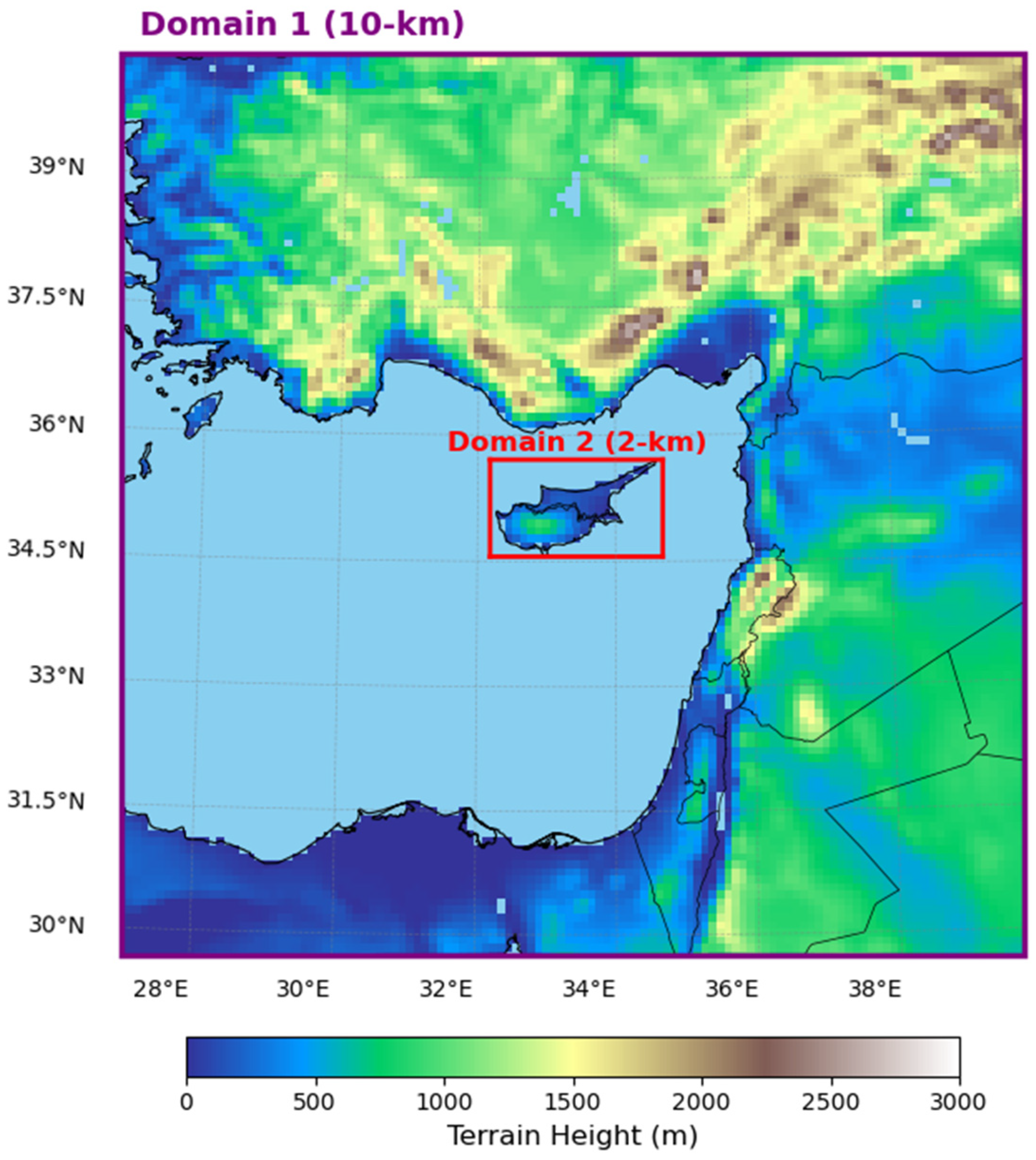
The heatwave event was simulated using the Advanced Research WRF (ARW) model version 4.7 [22], configured with two one-way nested domains to adequately resolve both synoptic-scale forcing and mesoscale urban–terrain interactions over Cyprus, as shown in Figure 1. The model was configured on a Lambert Conformal Conic projection. The parent domain (d01) was set at 10 km horizontal resolution to capture meso-alpha circulation patterns associated with the heatwave, while a high-resolution nested domain (d02) at 2 km grid spacing was employed to explicitly resolve mesoscale features, land–atmosphere interactions, and local thermal gradients. The model physics configuration included the Noah-MP land surface scheme [23] to represent detailed soil–vegetation–atmosphere exchange processes, the MYNN 2.5 PBL scheme coupled with the MYNN surface layer parameterization [24,25] to realistically simulate turbulent mixing and near-surface fluxes under strongly unstable heatwave conditions, and the RRTMG radiation scheme for both shortwave and longwave components [26] to account for detailed radiative transfer processes. Cloud microphysical processes were represented using the WSM6 scheme [27], while deep convection in the 10 km parent domain was parameterized using the scale-aware Grell–Freitas cumulus scheme [28]; convection was explicitly resolved in the 2 km domain without cumulus parameterization. WSM6 was used as a standard baseline because the heatwave was a clear-sky, radiation-driven event. This configuration was selected to ensure robust representation of boundary layer evolution, land–surface feedbacks, and radiative processes critical for accurately simulating extreme temperature events. To distribute the 60 η-levels vertically, a hyperbolic tangent stretching approach is applied [29,30]. This method does not use uniform spacing; instead, the grid is strongly compressed near the surface and moderately compressed toward the upper boundary, with more gradual spacing in the mid-troposphere. The lowest model level (η = 0.9985) corresponds to a height of approximately 12 m above ground. The 60 η-levels are allocated across the atmospheric column in four regimes: the surface layer spanning 0–100 m containing 5 levels, the planetary boundary layer extending from 100 m to 2 km containing 15 levels, the free troposphere spanning 2–12 km containing 25 levels, and the upper-troposphere and tropopause region extending from 12 to 20 km containing 15 levels. No grid nudging or data assimilation was applied during the integration period.
The initial and lateral boundary conditions (IC/LBCs) for the WRF simulations were obtained from the ERA5 reanalysis produced by the European Centre for Medium-Range Weather Forecasts (ECMWF). ERA5, the fifth-generation global atmospheric reanalysis, employs an advanced 4D-Var assimilation system to combine a wide range of historical observations into consistent global fields [31]. It provides atmospheric variables at a horizontal resolution of 0.25° (~31 km) with hourly time frequency. In this study, 6-hourly IC/LBCs were used to initialize the model domain and to supply the time-evolving lateral boundary forcing throughout the simulation period. To better represent the lower boundary conditions during the heatwave event (13–29 July 2023), the model’s sea surface temperature (SST) fields were updated daily with data from the Operational Sea Surface Temperature and Ice Analysis (OSTIA) product developed by the UK Met Office [32]. OSTIA delivers a high-resolution (0.05°, ~6 km), gap-free daily SST analysis, enabling the WRF configuration to resolve fine-scale air–sea thermal gradients and fluxes that are important for capturing the development and evolution of the heatwave.

2.2. Land Use and Land Cover Data

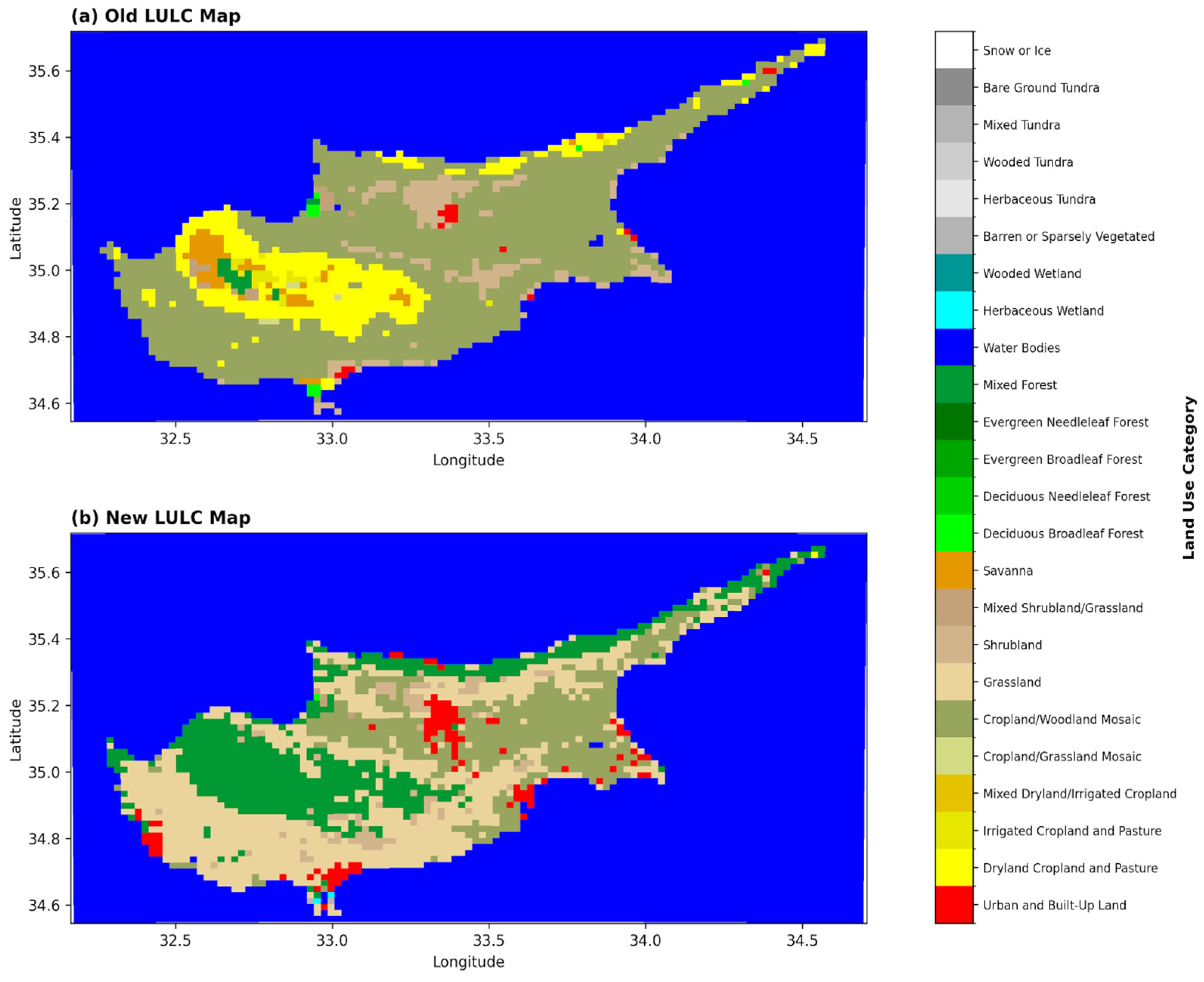
The default United States Geological Survey-24 (USGS-24) LULC dataset, originally developed for the WRF model using the 1992–1993 Global Land Cover Characterization (GLCC) data at a 30 arc-second resolution, is now outdated and insufficient for accurately capturing urban areas in Cypriot cities such as Nicosia, Paphos, Limassol, and Larnaca. To address this limitation, the present study updated LULC data for the Eastern Mediterranean region using the ESA WorldCover 2021 dataset [33], which was released on 28 October 2022. This new dataset offers a much higher resolution of 10 m and is based on observations from the Sentinel-1 Synthetic Aperture Radar and Sentinel-2 high-resolution optical satellites. The global accuracy of this updated dataset is reported to be 76.7%. Because the WRF model’s default physical lookup tables rely on the USGS 24-category classification, the 11 native classes of the ESA WorldCover 2021 dataset were explicitly cross-mapped to their closest USGS equivalents prior to integration. For example, the ESA ‘Built-up’ class was mapped to the USGS ‘Urban and Built-Up Land’ (Class 1), while ESA ‘Tree cover’ was mapped to USGS ‘Mixed Forest’ (Class 15). During the WRF Preprocessing System (WPS) phase, the native 10 m ESA data were upscaled to the 30 arc-second (~1 km) model grid using a nearest-neighbor resampling algorithm. After resampling the ESA data to a 30 arc-second grid (≈1 km), the updated LULC dataset shows a strong correspondence with the actual urban distribution visible in satellite imagery, and this improved agreement is also reflected across other land cover categories within domain d02 (Figure 2).
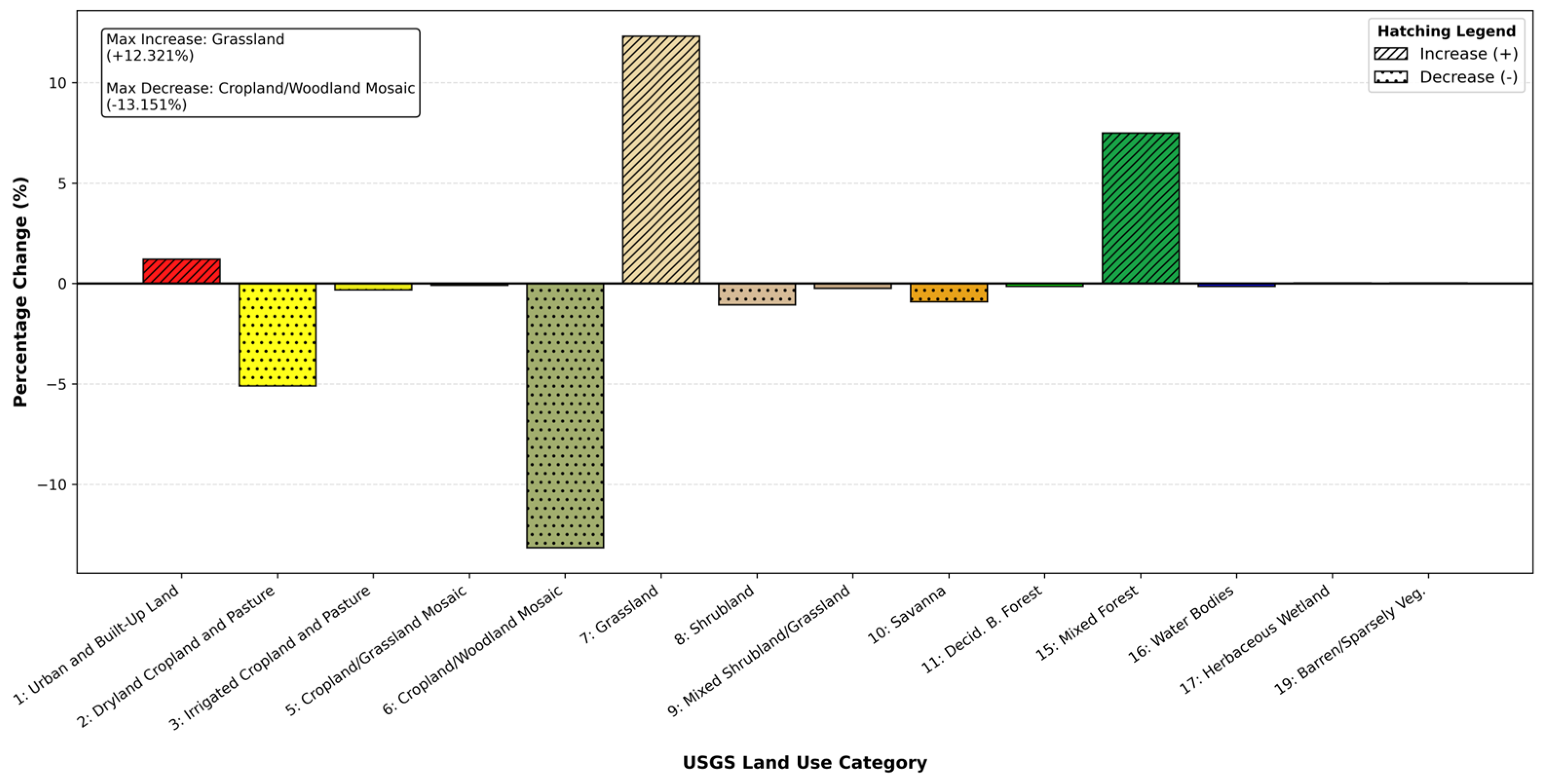
The comparative analysis between the default USGS LULC dataset and the updated dataset reveals a significant enhancement in both thematic resolution and the spatial delineation of anthropogenic features, as shown in Figure 3. The most critical observation is the substantial expansion of Urban and Built-Up Land, which increased from 0.24% to 1.46% (a net increase of +1.22%). This six-fold relative increase indicates that the updated model is far more sensitive to identifying human settlements, likely capturing peri-urban sprawl and smaller built-up areas that were previously omitted or aggregated into broader vegetative classes in the default dataset. Simultaneously, the results demonstrate a major shift from heterogeneous, generalized categories to more specific homogeneous land cover types. The default dataset relied heavily on the Cropland/Woodland Mosaic category (Class 6), which covered 20.35% of the domain, and Dryland Cropland and Pasture (Class 2), which covered 5.11%. In the updated classification, these categories exhibited substantial reductions of −13.15% and −5.10%, respectively. This reduction is inversely correlated with a marked surge in Grassland (Class 7), which rose from 0.00% to 12.32%, and Mixed Forest (Class 15), which increased by 7.49%. This transition suggests that the updated dataset effectively resolves the ambiguity of “mosaic” pixels which represent a mix of vegetation types by correctly reclassifying them into their dominant constituent components (grasslands and forests). Consequently, the updated LULC profile offers a more spatially explicit and ecologically precise representation of the landscape, reducing the uncertainty associated with mixed-use categories while providing a more realistic assessment of urbanization.
It is important to acknowledge the inherent scale matching limitations associated with integrating high-resolution satellite products into mesoscale models. The ESA WorldCover dataset provides a native resolution of 10 m; however, resampling these data to a 30 arc-second (1 km) grid for use within the 2 km nested domain (d02) results in the inevitable smoothing of microscale urban details. At this grid spacing, localized features such as individual street canyons, small parks, or isolated building geometries are aggregated and lost. Despite this loss of microscale heterogeneity, the upscaling process successfully preserves the broader mesoscale footprint of human settlements. This is evidenced by the six-fold increase in the representation of Urban and Built-Up Land (from 0.24% to 1.46%), indicating that the model successfully captured previously omitted peri-urban sprawl and smaller built-up areas. Consequently, while the 2 km resolution cannot resolve building-level thermal dynamics, the aggregate recalibration of the urban spatial boundaries remains sufficient to significantly improve the broader surface energy partitioning and subsequent mesoscale meteorological predictions.

2.3. Observational Sites and Data

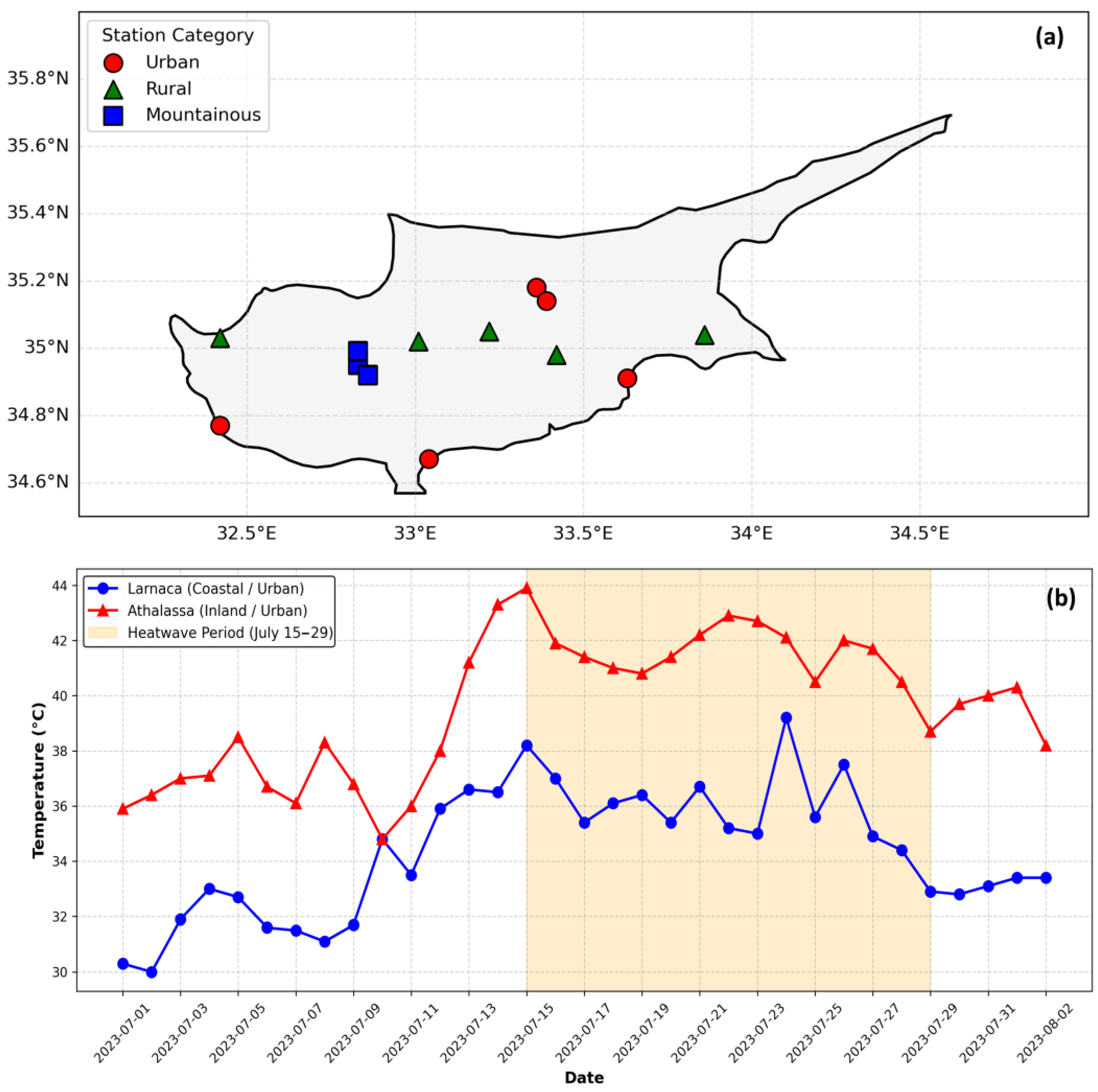
To evaluate the model’s performance at a localized scale, site-specific analyses were conducted using near-surface meteorological observations from 13 Automatic Weather Stations (AWS) distributed across Cyprus, as shown in Figure 4a. These stations are categorized based on land use characteristics and elevation into urban (Larnaca, Limassol, Paphos, Nicosia–Lefkosia, and Athalassa), rural (Frenaros, Mathiatis, Polis, Tamasos, and Xyliatos), and mountainous stations (Prodromos, Troodos Mountains, Kalopanagiotis). The dataset includes 2 m air temperature (T2m) and wind speed and direction. The Department of Meteorology, Cyprus, provided the data at a 10 min temporal frequency. Quality control was ensured through procedures that included range checks and temporal consistency tests to eliminate missing values and outliers.
To contextually define and justify the severity of the simulated event, official observational records from the Cyprus Department of Meteorology and the Cyprus Institute confirm that the July 2023 heatwave was of historic magnitude [34,35]. During this period, the EM was dominated by an extensive Azores high-pressure system accompanied by a very warm and dry air mass, regionally named ‘Cleon’ [34]. Official station data indicate that the inland Athalassa Radiosonde Station recorded an unprecedented 16 consecutive days (spanning 13 to 29 July) with maximum daily temperatures (Tmax) exceeding 40.0 °C, surpassing previous multi-decade records [34,35]. During this extreme window, the absolute maximum temperature reached a hazardous 44.6 °C [34]. To visually establish the meteorological severity of this event prior to model evaluation, Figure 4b presents the time-series of the observed daily maximum temperatures at key coastal (Larnaca) and inland (Athalassa) reference stations. As illustrated, the inland station experienced a prolonged, extreme thermal regime perfectly consistent with these official reports. The shaded region in Figure 4b denotes the 15–29 July period, clearly demonstrating the continuous exceedance of extreme thermal thresholds validating the selection of this specific timeframe for our high-resolution mesoscale simulations. By establishing this observational baseline, we can successfully discriminate the overarching regional heatwave forcing from the localized, high-resolution thermal and kinematic contributions driven by the updated land surface representation.
In addition to the surface AWS network, upper-air meteorological observations were utilized to validate the model’s vertical structure. Radiosonde soundings were obtained from the inland Athalassa station (WMO ID: 17606). These soundings, launched at standard synoptic times, provided high-resolution vertical profiles of temperature, humidity, and wind, which were subsequently used to derive the observed PBLH using the Bulk Richardson Number method. For strict spatial evaluation against all observational point data, the simulated WRF variables were extracted using the nearest grid-point approach from the four surrounding grid cells.
To quantitatively evaluate model fidelity, statistical metrics—including standard deviation, root-mean-square error (RMSE), and the Pearson correlation coefficient—were calculated and visualized using Taylor diagrams. These statistics are based on a temporal correlation analysis. Both the observational datasets and the WRF model outputs (for the default and new LULC configurations) were processed at a strict hourly temporal scale. The observational data were filtered to extract top-of-the-hour measurements to perfectly align with the hourly WRF output intervals. This temporal correlation was calculated continuously over the 15-day heatwave period spanning from 13 July to 29 July 2023. To clearly illustrate the differential impacts of the LULC update across various landscapes, the resulting Taylor diagrams are grouped and analyzed by the specific environmental categories of the stations: urban, rural, and mountain.

3. Results

3.1. Spatial Distribution Analysis and Statistical Evaluation

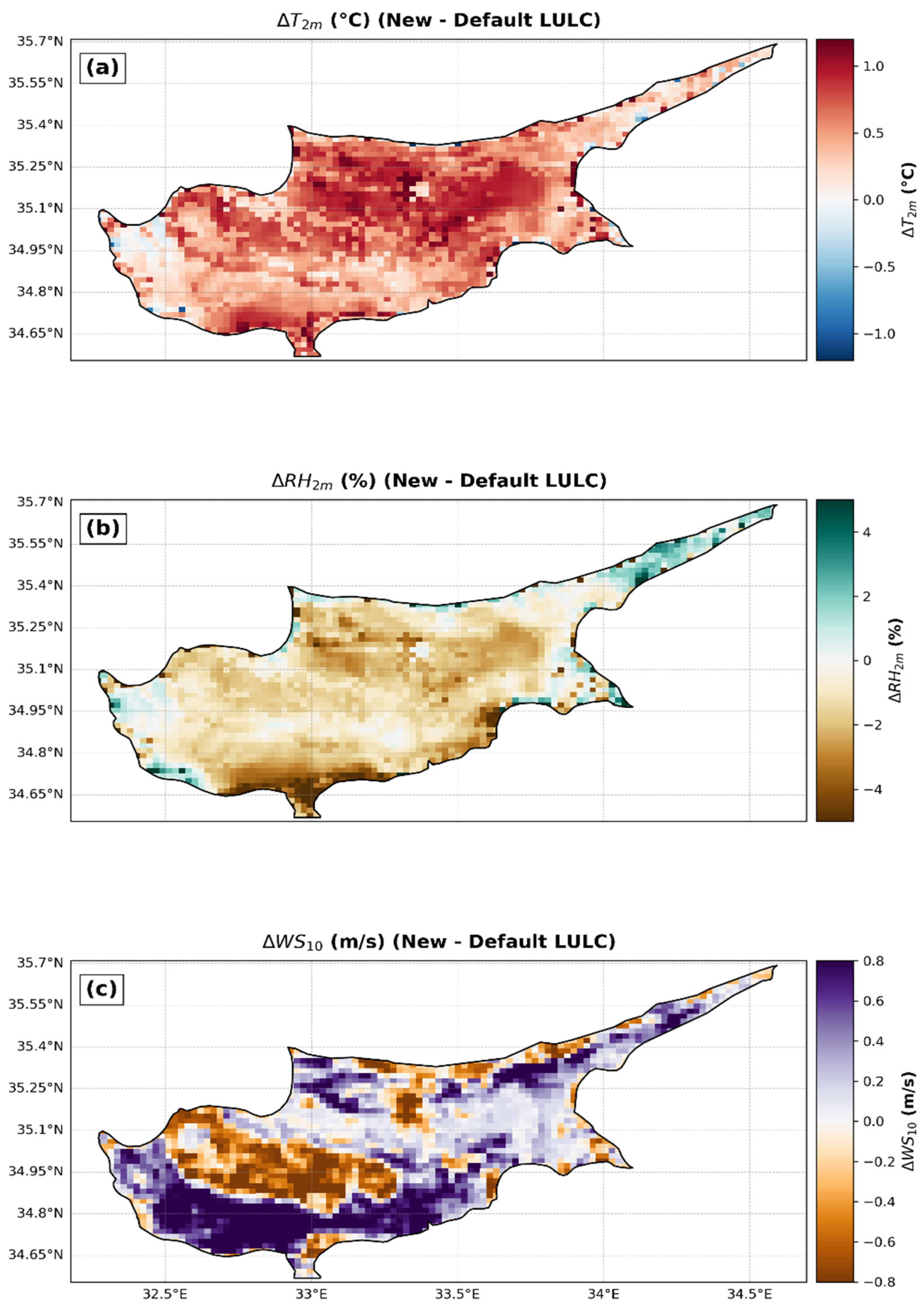
To assess the broader meteorological impact of updating the static LULC dataset, a spatial analysis was conducted to compare the simulated changes between the new ESA configuration and the default USGS setup. This assessment was performed prior to localized station evaluation to understand the overarching thermodynamic and kinematic responses across the Cyprus domain. Figure 5 illustrates the spatial distribution of simulated changes in mean ΔT2m, mean ΔRH2m, and ΔWS10. The transition to the updated LULC induced widespread daytime warming across the inland and central portions of the island. This regional warming is directly linked to the enhanced thematic resolution of the updated dataset, which properly reclassified extensive areas of generic ‘Cropland/Woodland Mosaic’ into specific homogeneous types such as ‘Grassland’ and ‘Mixed Forest,’ while also increasing the representation of ‘Urban and Built-Up Land’ six-fold. Consequently, the Noah-MP land surface scheme applies different table-based physical properties—such as altered albedo, thermal capacity, and soil moisture availability—to these redefined grid cells. This fundamentally modifies the surface energy balance by altering how incoming net radiation is partitioned into sensible, latent, and ground heat fluxes. For example, reclassifying a cell to an urban category restricts its moisture availability (thereby limiting latent heat cooling) while increasing its thermal mass for ground heat storage. This explicit re-partitioning of energy fluxes is the direct physical driver behind the localized regional shifts in the simulated T2m and humidity fields.
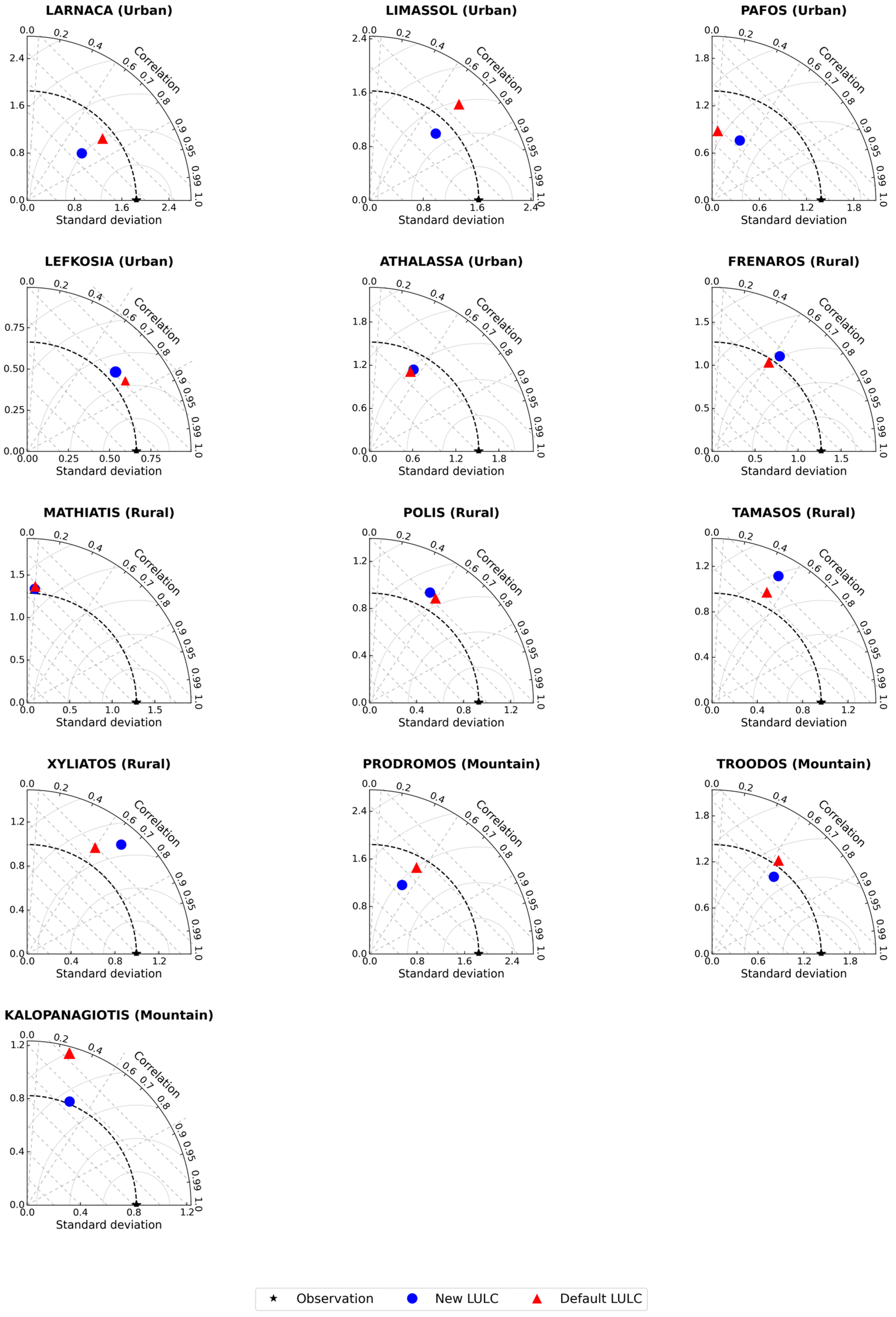
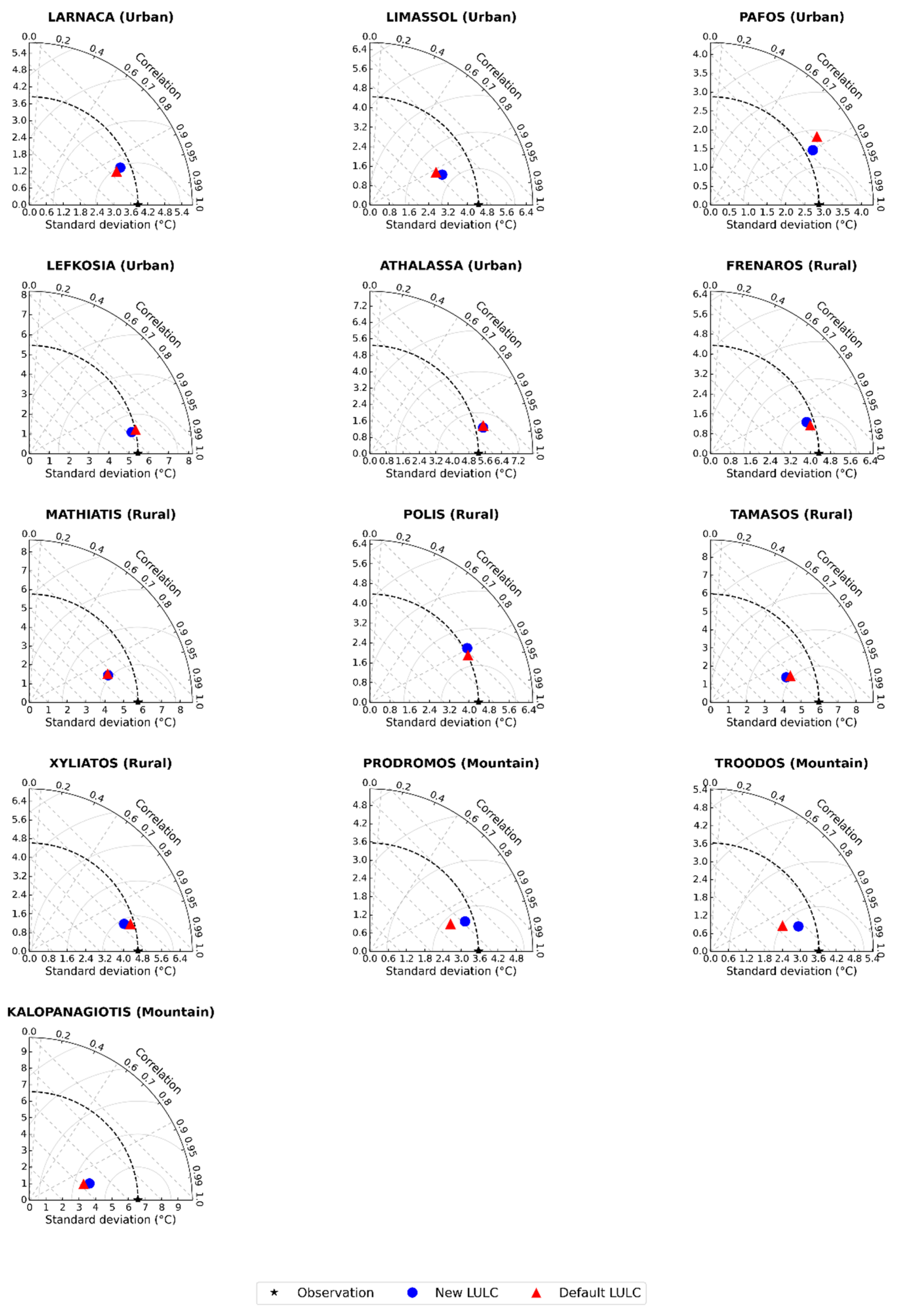
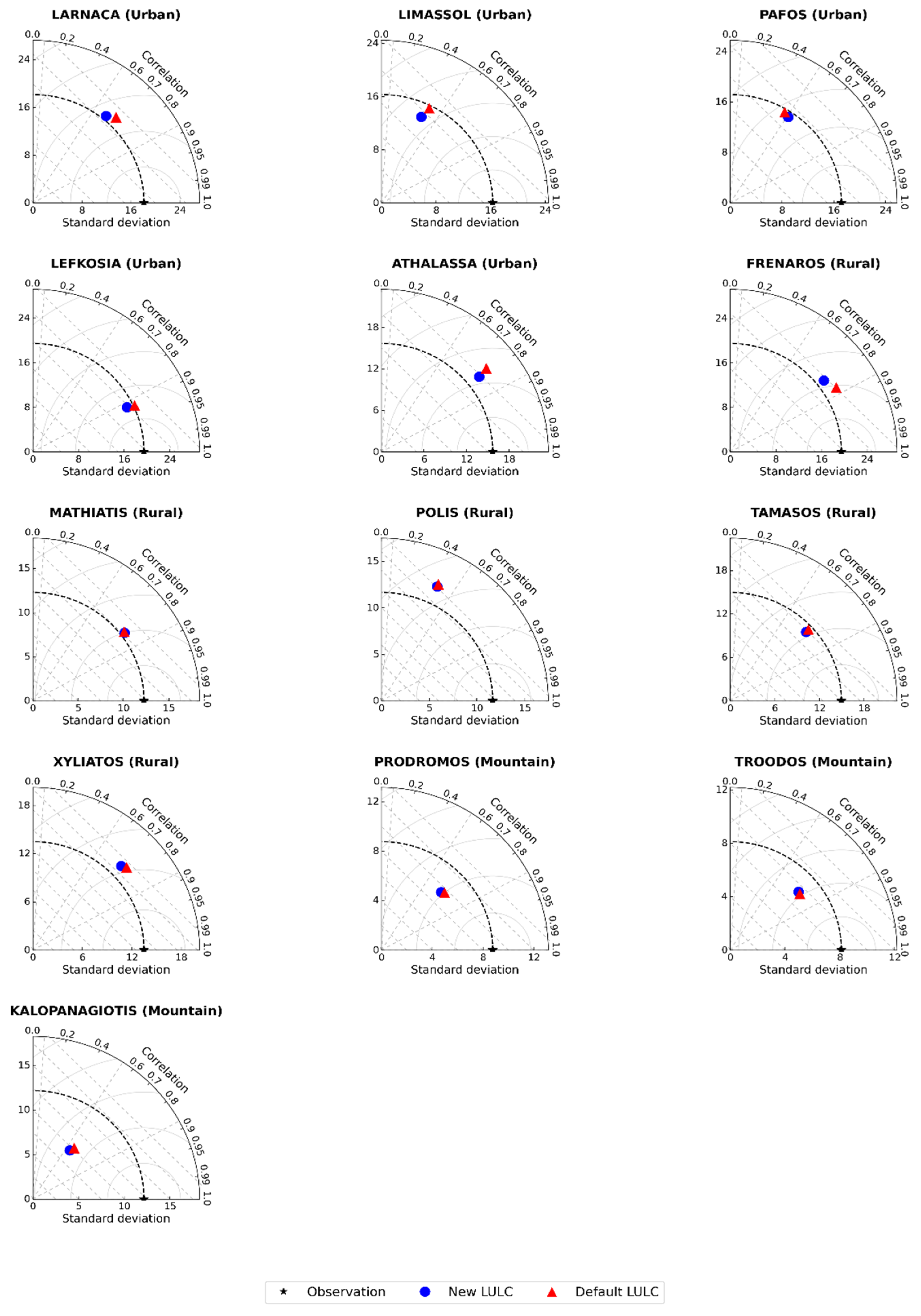
To visually and statistically evaluate how these static surface modifications translate to model accuracy against local observations across diverse environmental regimes, Taylor diagrams were utilized (Figure 6, Figure 7 and Figure 8). These diagrams provide a robust synthesis of model fidelity by simultaneously plotting the Pearson correlation coefficient, the RMSE, and the standard deviation. Figure 6 shows the statistical correspondence between the observed and simulated 2 m air temperatures for both LULC classifications. Notably, for rural sites (e.g., Polis, Xyliatos) and complex mountainous terrain (e.g., Prodromos, Kalopanagiotis), the new LULC configuration shows a clear shift towards the reference point. It is important to note that while the DM test confirms relative statistical improvements, absolute RMSE values remain high at specific complex terrain sites (e.g., Kalopanagiotis, RMSE = 3.104 °C). This indicates that while the LULC update corrects surface boundaries, the 2 km horizontal grid spacing remains too coarse to fully resolve the deep valley microclimates of the Troodos mountains.
This geometric shift signifies a concurrent reduction in centered RMSE and an improvement in correlation, emphasizing that simply updating the static land surface categories allows the model to better capture mesoscale thermal gradients across varied topographical and vegetative regimes. This improvement is fundamentally driven by the de-homogenization of the surface parameters. The default dataset heavily relied on smoothed ‘mosaic’ categories, which artificially homogenized physical properties (such as albedo, soil moisture availability, and thermal capacity) across massive spatial extents, subsequently smoothing out localized temperature differences. By providing sharp, high-resolution boundaries that explicitly separate distinct vegetative and urban regimes, the updated dataset allows the land surface model to apply heterogeneous thermodynamic properties to adjacent grid cells. This produces distinct, highly localized sensible and latent heat fluxes, thereby successfully reproducing the sharp temperature gradients that naturally exist across Cyprus’s complex terrain.
To robustly quantify the improvements visualized in the Taylor diagrams, the Diebold–Mariano (DM) test was applied to the RMSE of T2m and WS10 across all 13 AWS locations. Table 1 details these results, confirming that the updated LULC configuration yields statistically significant enhancements in model accuracy across the different station categories. The updated configuration shows statistically significant improvement at approximately 85% of the stations, while roughly 15% of the stations exhibit no significant difference. For T2m, the updated model significantly outperformed the default configuration (Reject H0, p < 0.05) at all urban stations (Larnaca, Limassol, Pafos, Lefkosia, and Athalassa) and most mountainous stations (Prodromos and Kalopanagiotis). Significant improvements were also observed in rural stations like Frenaros, Mathiatis, Polis, and Xyliatos. The updated model similarly showed statistically significant improvements for wind speed at 11 out of 13 stations, spanning all three classifications. Only a few isolated instances failed to show a statistically significant difference (Fail to Reject H0). These included T2m at the rural Tamasos station (p = 0.0751) and the mountainous Troodos station (p = 0.0739), as well as WS10 at Lefkosia (urban, p = 0.7979) and Frenaros (rural, p = 0.1960). While the updated configuration yielded statistically significant improvements across the majority of the domain, notable exceptions occurred for WS10 at specific inland stations, such as Lefkosia (p = 0.7979) and Frenaros (p = 0.1960). In contrast to the coastal stations (Larnaca, Limassol, and Pafos), which all demonstrated highly significant wind speed improvements (p < 0.05), these inland locations remained resistant to enhancement. This lack of statistical improvement at inland sites is intrinsically linked to deep-rooted kinematic errors within the model’s boundary layer parameterizations. As will be explored in Section 3.4, the WRF model consistently fails to simulate the severe atmospheric stagnation typical of inland heatwaves, instead artificially ventilating these grid cells regardless of the static LULC mapping.

3.2. Diurnal Urban Heat Island (UHI) Hysteresis Dynamics

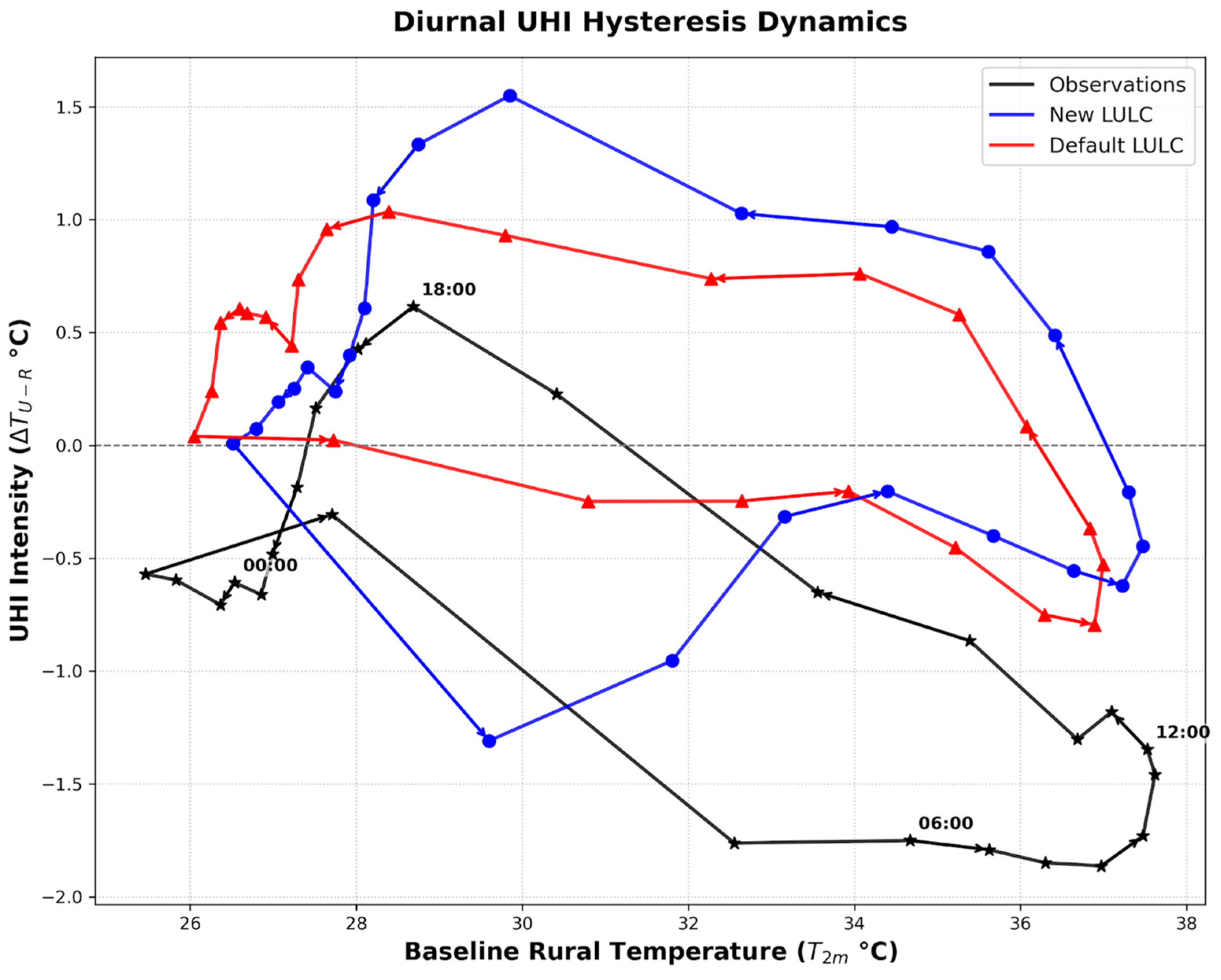
The observational data (black line in Figure 9) trace a distinct, wide hysteresis loop that reveals how real-world microclimates behave in Cyprus’s semi-arid geography. A strong daytime Urban Cool Island (UCI) is evident during the morning heating phase. As the baseline rural temperature rises rapidly toward a maximum of approximately 38 °C at 12:00, the observed UHI intensity decreases sharply, reaching a minimum of roughly −1.9 °C. In semi-arid environments, dry rural soil heats up very quickly under strong solar radiation, whereas urban areas warm more slowly due to higher thermal mass and shading from buildings (street canyon shading). Conversely, as rural temperatures begin to drop in the evening, a positive UHI emerges, peaking at about +0.6 °C around 18:00. This occurs because rural areas cool efficiently through outgoing longwave radiation, while the urban infrastructure gradually releases the sensible heat stored during the daytime. By 00:00, the observed UHI drops back below 0 °C (to roughly −0.6 °C), indicating complex nocturnal cooling dynamics, before reaching the lowest baseline temperatures around 25.5 °C. Model evaluation clearly demonstrates the importance of the updated LULC dataset. The default WRF configuration (red line) produces a significantly flattened and restricted hysteresis loop, with UHI values confined between −0.8 °C and +1.0 °C. It completely misses the deep daytime cooling effect and fails to capture the correct shape of the thermal cycle. This indicates that the default model treats urban and rural grid cells with very similar surface properties, effectively lacking the “thermal memory” required to simulate the urban canopy acting as a massive heat sink during the day.
Implementing the new LULC dataset (blue line) fundamentally corrects the diurnal energy storage and release cycle, significantly improving the physical realism of the simulation. The loop expands considerably, reflecting the restored thermal memory of the urban environment. The model successfully captures a deep daytime UCI, dropping to −1.3 °C, which correctly follows the thermodynamic evolution (even if it slightly underestimates the observed −1.9 °C extreme). Furthermore, the new LULC dataset correctly simulates the urban infrastructure transitioning into a heat source during the evening. However, a notable discrepancy remains: while the updated static LULC map established the foundational daytime urban heat sink, the results demonstrate an overestimation of evening heat retention (peaking above +1.5 °C). This directly indicates that static boundaries alone cannot fully replace Urban Canopy Models (UCMs); rather, UCMs remain essential for fine-tuning anthropogenic heat fluxes and structural thermal conductivities to prevent excessive nocturnal warming.

3.3. High-Frequency Heating and Cooling Rates

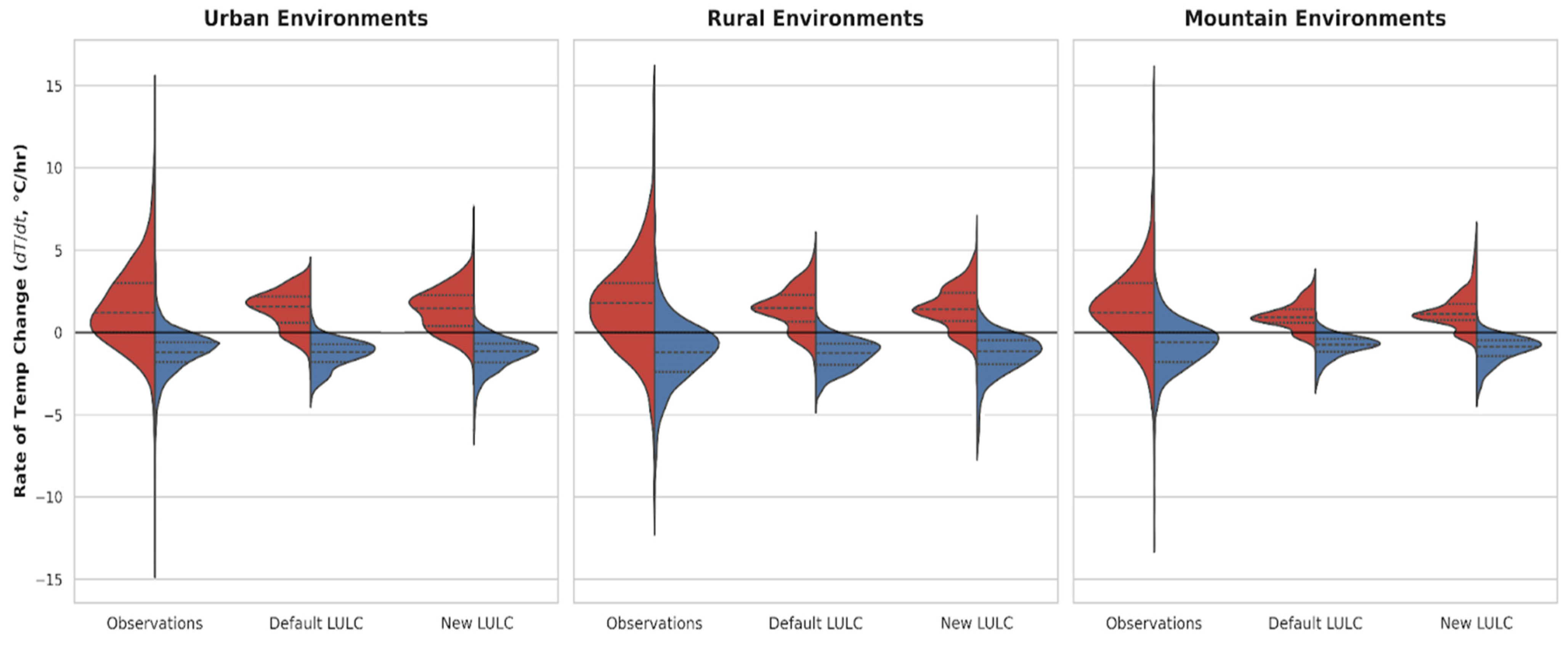
Figure 10 evaluates the high-frequency thermodynamic response of the surface by analyzing the instantaneous rate of temperature change (dT/dt, in °C h−1) across urban, rural, and mountain environments. The split violin plots separate the diurnal cycle into warming periods (positive dT/dt, red) driven by incoming solar radiation, and cooling periods (negative dT/dt, blue) driven by outgoing terrestrial longwave radiation. The observational data reveal a highly volatile thermal environment across all three domains. The distributions (leftmost violins in each panel) exhibit extremely elongated tails, indicating that these environments frequently experience abrupt, high-magnitude heating and cooling events. In the urban, rural, and mountain stations alike, the maximum heating rates routinely exceed +10 °C h−1 (approaching +15 °C h−1 in rural areas), while nocturnal cooling rates similarly plunge well beyond −10 °C h−1. This demonstrates that the physical surfaces in these semi-arid Mediterranean environments possess localized characteristics—such as dry top soils or specific urban geometries—that allow for swift sensible heat fluxes and rapid temperature shifts.
In stark contrast to the observations, both model simulations exhibit a highly damped thermal response. The default model distributions are heavily vertically compressed, with the majority of simulated temperature changes artificially restricted to a narrow band between −5 °C h−1 and +5 °C h−1. While the new LULC dataset introduces a marginal improvement—evident in slightly extended distribution tails—it still fails entirely to simulate the long tails of extreme dT/dt values observed in reality. This diagnostic highlights a fundamental limitation: while high-resolution land cover updates successfully correct broader spatial patterns and diurnal hysteresis amplitudes, they are insufficient to resolve high-frequency kinetic smoothing. We hypothesize that the model’s inability to capture rapid temperature spikes or drops is primarily driven by overly aggressive vertical turbulent mixing within the MYNN PBL scheme, rather than the static LULC parameters. If the PBL scheme over-mixes the lower atmosphere, it will artificially dilute near-surface thermal energy through the deeper atmospheric column. During the day, this over-mixing transports sensible heat away from the surface too rapidly, preventing the observed abrupt positive dT/dt spikes. Conversely, at night, excessive turbulent mixing hinders the formation of a sharp, shallow surface inversion, pulling warmer air down from the residual layer and preventing the extreme negative dT/dt drops routinely observed in these semi-arid microclimates. The inability to capture rapid temperature spikes or drops is likely rooted deeper within the complex interactions between the radiation scheme, the land surface model, and the PBL parameterizations. While the RRTMG radiation scheme drives the overarching diurnal forcing, the model’s inability to translate this dynamic radiative input into rapid, high-frequency temperature changes suggests a bottleneck in energy partitioning or transport. Specifically, the damping of these extremes indicates that the LSM’s default soil thermal conductivities may be too high, or the PBL’s turbulent mixing may be overly aggressive, ultimately smoothing out the localized near-surface temperature extremes despite robust clear-sky radiative forcing.

3.4. Kinematic Verification and Atmospheric Stagnation

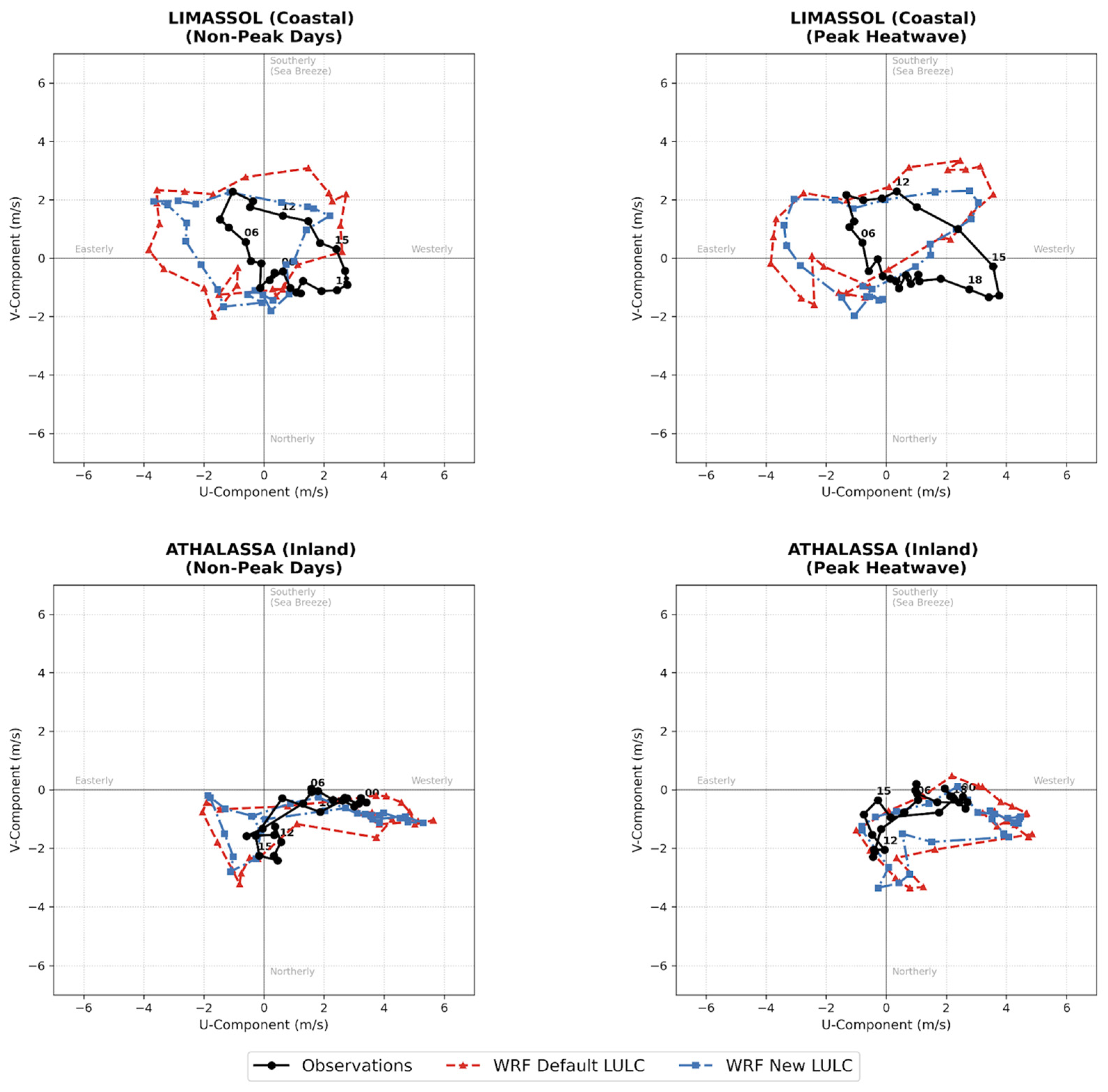
Limassol’s wind regime is strongly governed by the coastal sea-breeze circulation, as shown in Figure 11. During both non-peak and peak heatwave days, the observational data (black line) show a moderately sized, distinct diurnal loop. The sea-breeze component (positive V, Southerly flow) gradually develops through the morning, peaking in the afternoon alongside a westerly component (positive U). The wind speeds are relatively contained, rarely exceeding 3 to 4 m s−1 in the U-component and 2 m s−1 in the V-component. Both WRF configurations significantly overestimate the diurnal wind variance. The default LULC configuration exhibits significant deviations, generating high-variance wind patterns that introduce erroneously strong easterly (negative U) and northerly (negative V) quadrants during the morning transition, before overcompensating in the afternoon. The new LULC dataset provides a marginal structural improvement over the default setup by slightly tightening the extreme spread of the loops. However, it still fundamentally fails to capture the restricted, compact nature of the observed coastal winds, continuing to inject excessive kinetic energy into the simulated coastal boundary layer.
Athalassa represents the inland dynamics of the Mesaoria plain, where wind patterns are modulated by terrain and the delayed arrival of marine air. Observations indicate a highly constrained wind field dominated by westerly flow (positive U), with very little variation in the meridional (V) axis. Both the default and new LULC models fail to reproduce this tight grouping, instead simulating a broader directional variance that introduces an erroneously strong northerly component (negative V) components dropping below −3 m s−1. The observations reveal a critical feature of inland heatwaves: severe atmospheric stagnation. The observational hodograph collapses into a very tight cluster near the origin, indicating calm, stagnant air that prevents ventilation and exacerbates thermal stress. Crucially, both the default LULC and new LULC simulations completely fail to capture this stagnation. Instead of collapsing near the origin, both models generate large, sweeping wind loops, introducing artificial breezes that exceed 4 m s−1. The high-frequency wind diagnostics reveal that while the updated high-resolution land use dataset may address certain surface parameters, it is insufficient to correct the overarching kinematic errors in the WRF setup. Across both coastal and inland domains, the models consistently overestimate wind speeds and diurnal variance. Most notably, the failure of both models to simulate the severe atmospheric stagnation at Athalassa during the peak heatwave suggests that the models are artificially ventilating the inland grid cells, which would likely lead to an underestimation of the true heatwave severity in the thermal outputs.
The persistence of these artificial winds presents an important kinematic paradox: while updating the LULC introduces higher aerodynamic roughness—which generally decelerates near-surface wind through increased friction—this mechanical drag alone is insufficient to produce the complete atmospheric stagnation observed at Athalassa. In reality, severe inland stagnation during a heatwave is not merely a high-friction state, but a structurally decoupled boundary layer. In the topographically sheltered Mesaoria plain, strong localized stability effectively isolates the surface layer from the momentum of the free troposphere above. The failure of both model configurations to reproduce this calm state indicates that the default boundary layer parameterizations are likely over-mixing the vertical profile. By continually entraining downward momentum into the surface layer, the model prevents the necessary structural decoupling, instead generating sweeping artificial breezes that exceed 4 m s−1. Consequently, the models artificially ventilate the inland grid cells, demonstrating that accurate, static surface boundaries cannot override deep-rooted kinetic errors within the model’s vertical mixing schemes.

3.5. Planetary Boundary Layer Height (PBLH) Validation

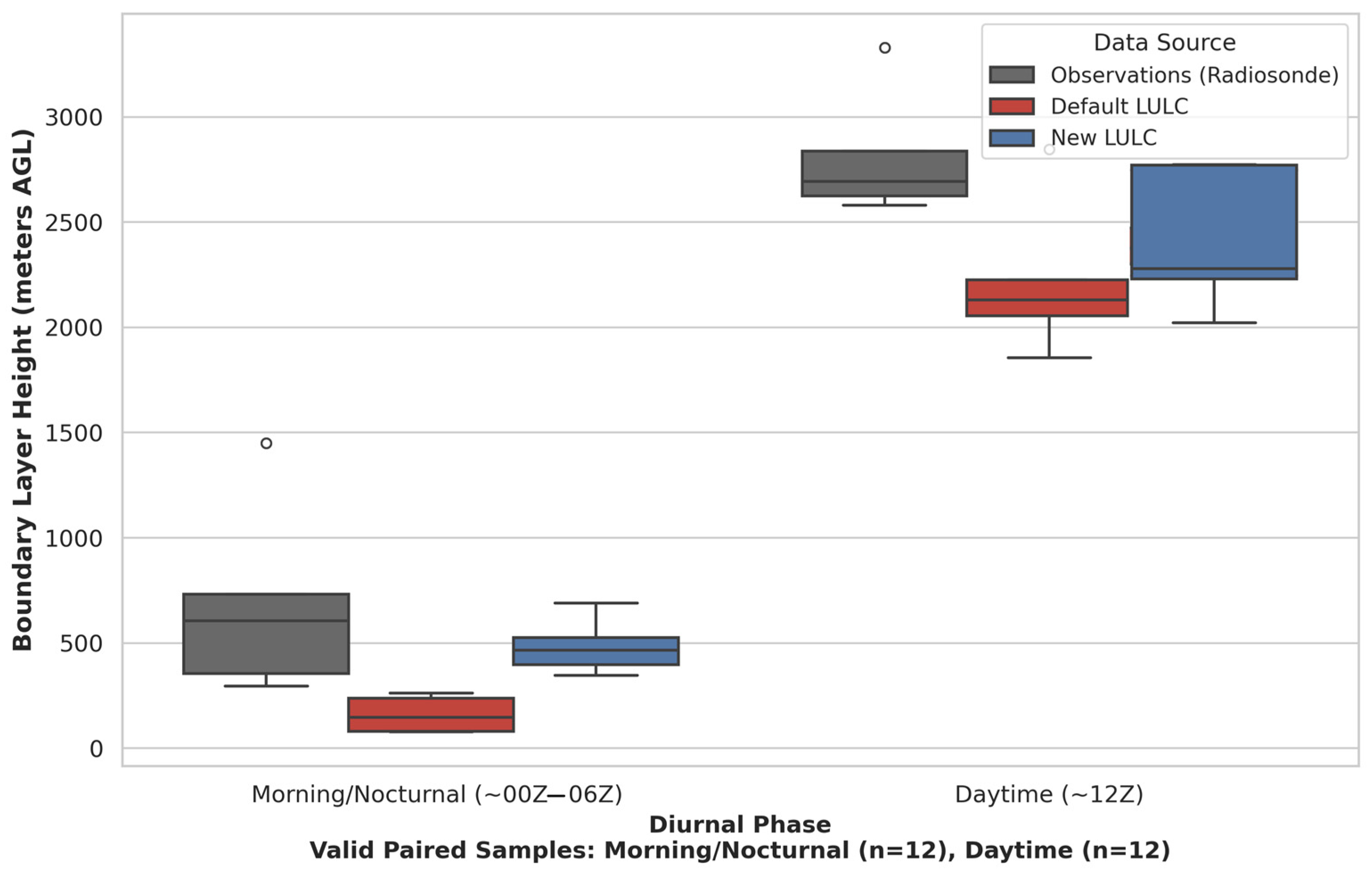
To further diagnose the thermodynamic impact of the updated land use representation, the Planetary Boundary Layer Height (PBLH) was analyzed at the inland Athalassa station. Figure 12 illustrates the distribution of PBLH segregated by diurnal phase: The morning/nocturnal phase (~00Z–06Z) and the daytime convective phase (~12Z). To ensure strict statistical validity, the WRF model outputs were temporally aligned with the exact launch times of the available radiosonde observations throughout the 13–29 July 2023 simulation period. Accounting for missing operational data and applying strict quality control to the soundings, this alignment yielded 12 valid paired samples for the nocturnal/morning phase (~00Z–06Z) and 12 paired samples for the daytime convective phase (~12Z). Because these samples span the duration of the event, they provide a representative cross-section of the boundary layer dynamics during both peak heatwave and non-peak days. The observational PBLH was derived using the Bulk Richardson Number (Rib) method with a critical threshold of 0.25 [36].
The most striking discrepancy between the model configurations occurs during the morning and nocturnal phase. The radiosonde observations (gray) reveal a sustained boundary layer with a median depth of approximately 200–250 m. The default LULC configuration (red) systematically and severely underestimates this depth, simulating an excessively shallow and highly stable boundary layer (median < 100 m) with minimal variance. This underestimation occurs because the default land use classification fails to capture the high thermal inertia of the urban fabric. Consequently, the model incorrectly simulates a rapid “rural-like” surface cooling, leading to an artificially strong surface inversion and the premature collapse of the boundary layer. Conversely, the implementation of the new LULC classification (blue) successfully corrects this structural bias. By accurately representing the urban canopy and its associated thermal storage, the modified model simulates a slow release of sensible heat throughout the night. This sustained urban heat emission maintains low-level thermal instability and mechanical turbulence, preventing the complete collapse of the boundary layer. As a result, the new LULC dataset correctly simulates a deeper, well-mixed nocturnal PBLH that aligns closely with the observed radiosonde distributions.
During the daytime phase (~12Z), intense solar insolation drives robust sensible heat fluxes, resulting in a deep convective boundary layer ranging from 1000 m to over 2500 m. While both model configurations successfully capture this massive diurnal expansion, the default LULC dataset tends to produce a wider interquartile range and slightly overestimates the median boundary layer depth. The new LULC dataset dampens this exaggerated daytime convective mixing, bringing both the median and the spread of the daytime PBLH into tighter agreement with the observational data.

4. Summary and Conclusions

This study comprehensively evaluated the impact of integrating the high-resolution (10 m) ESA World Cover 2021 dataset into the WRF model to simulate the severe July 2023 heatwave over Cyprus. By explicitly avoiding the implementation of complex urban models or manual parameter tuning, the research isolated the fundamental thermodynamic and kinematic sensitivities of the model to modernized static surface boundaries alone. The updated LULC configuration successfully eliminated the ambiguity of legacy mosaic categories and resolved a six-fold increase in urban representation. Consequently, statistical evaluations utilizing Taylor diagrams and Diebold–Mariano tests confirmed significant improvements in near-surface temperature (T2m), relative humidity (RH2m), and wind speed (WS10) predictions across approximately 85% of the diverse urban, rural, and mountainous observational sites.
Dynamically, the updated spatial boundaries fundamentally corrected the diurnal energy storage and release cycles. The transition from default classifications restored the “thermal memory” of the urban environment, allowing the model to more accurately capture deep daytime Urban Cool Island (UCI) effects and the subsequent nocturnal heat release. Radiosonde validations further demonstrated that restoring this urban thermal inertia successfully corrected a severe underestimation of the nocturnal Planetary Boundary Layer Height (PBLH). By simulating a slow release of sensible heat, the updated model maintained low-level instability, preventing the premature boundary layer collapse seen in the default configuration. Additionally, the new boundaries brought the exaggerated daytime convective mixing into tighter agreement with observations. This demonstrates that integrating highly accurate static land cover maps can intrinsically recalibrate surface energy partitioning, partially mitigating the immediate operational need for computationally expensive urban modeling during extreme thermal events.
However, rigorous high-frequency diagnostics exposed critical limitations in relying solely on static boundary updates. While the implementation of the new LULC dataset introduces a marginal improvement—evident in the slightly extended tails of its thermal distributions across urban, rural, and mountain environments—it did not resolve the model’s highly damped thermal inertia. Both configurations artificially restricted instantaneous temperature change rates, failing to fully simulate the abrupt heating and rapid nocturnal cooling routinely observed in real-world semi-arid microclimates. Furthermore, kinematic verifications revealed persistent overestimations of diurnal wind variance, notably failing to capture tight coastal sea-breeze loops at Limassol and severe atmospheric stagnation at inland sites like Athalassa. This artificial ventilation during peak heatwave conditions indicates that while LULC updates correct foundational spatial mapping, deep-rooted kinetic errors likely persist within default land surface model (LSM) conductivities and boundary layer turbulent mixing parameterizations.
Given that static spatial boundary updates were insufficient to resolve the model’s damped thermal inertia or deep-rooted kinetic errors, future modeling efforts must transition toward dynamic urban frameworks. Because the model artificially restricted instantaneous heating and cooling rates, subsequent studies should explicitly couple dynamic urban vegetation fractions with upper-layer soil moisture to properly simulate the rapid sensible and latent heat fluxes observed in these semi-arid microclimates. Exploring these dynamic modifications will be essential for accurately representing the cooling potential of green infrastructure in combating escalating Mediterranean heatwaves.

Author Contributions

Conceptualization, A.N.P., C.O. and H.H.; methodology, A.N.P., K.K., U.B. and M.M.F.W.; validation, A.N.P., K.K., U.B., M.M.F.W. and C.O.; formal analysis, A.N.P., U.B., C.O. and H.H.; investigation, A.N.P., U.B., C.O. and H.H.; resources, C.O. and H.H.; data curation, C.O. and H.H.; writing—original draft preparation, A.N.P., C.O. and H.H.; writing—review and editing, A.N.P., C.O. and H.H.; visualization, A.N.P.; supervision, H.H.; project administration, C.O. and H.H.; funding acquisition, C.O. and H.H. All authors have read and agreed to the published version of the manuscript.

Funding

This study is conducted in the framework of the Strategic Infrastructure project CYPRUS GNSS METEOROLOGY ENHANCEMENT (CYGMEN, Proposal No. STRATEGIC INFRASTRUCTURES/1222/0198), which is implemented in the framework of the Cohesion Policy Programme “THALIA 2021–2027” and is co-funded by the European Union.

Data Availability Statement

The urban land use data have been updated over Cyprus from the European Space Agency (ESA) World Cover 2021 data (released on 28 October 2022) based on Sentinel-1 and Sentinel-2 satellite data, available in [33].

Conflicts of Interest

The authors declare no conflicts of interest.

References

  1. Lelieveld, J.; Proestos, Y.; Hadjinicolaou, P.; Tanarhte, M.; Tyrlis, E.; Zittis, G. Strongly increasing heat extremes in the Middle East and North Africa (MENA) in the 21st century. Clim. Change 2016, 137, 245–260. [Google Scholar] [CrossRef]
  2. Zittis, G.; Almazroui, M.; Alpert, P.; Ciais, P.; Cramer, W.; Dahdal, Y.; Fnais, M.; Francis, D.; Hadjinicolaou, P.; Jamous, F.; et al. Climate Change and Weather Extremes in the Eastern Mediterranean and Middle East. Rev. Geophys. 2022, 60, e2021RG000762. [Google Scholar] [CrossRef]
  3. Lazoglou, G.; Hadjinicolaou, P.; Sofokleous, I.; Bruggeman, A.; Zittis, G. Climate change and extremes in the Mediterranean island of Cyprus: From historical trends to future projections. Environ. Res. Commun. 2024, 6, 095020. [Google Scholar] [CrossRef]
  4. Zittis, G.; Hadjinicolaou, P.; Fnais, M.; Lelieveld, J. Projected changes in heat wave characteristics in the eastern Mediterranean and the Middle East. Reg. Environ. Change 2016, 16, 1863–1876. [Google Scholar] [CrossRef]
  5. Zittis, G.; Hadjinicolaou, P.; Almazroui, M.; Bucchignani, E.; Driouech, F.; El Rhaz, K.; Kurnaz, L.; Nikulin, G.; Ntoumos, A.; Ozturk, T.; et al. Business-as-usual will lead to super and ultra-extreme heatwaves in the Middle East and North Africa. npj Clim. Atmos. Sci. 2021, 4, 20. [Google Scholar] [CrossRef]
  6. Petrou, I.; Kassomenos, P. Local factors contributing to daytime, nighttime, and compound heatwaves in the Eastern mediterranean. Theor. Appl. Climatol. 2025, 156, 194. [Google Scholar] [CrossRef]
  7. Tanarhte, M.; Hadjinicolaou, P.; Lelieveld, J. Heat wave characteristics in the eastern Mediterranean and Middle East using extreme value theory. Clim. Res. 2015, 63, 99–113. [Google Scholar] [CrossRef]
  8. Founda, D.; Santamouris, M. Synergies between Urban Heat Island and Heat Waves in Athens (Greece), during an extremely hot summer (2012). Sci. Rep. 2017, 7, 10973. [Google Scholar] [CrossRef]
  9. Ma, M.; Kouis, P.; Rudke, A.P.; Athanasiadou, M.; Scoutellas, V.; Tymvios, F.; Nikolaidis, K.; Koutrakis, P.; Yiallouros, P.K.; Alahmad, B. Projections of mortality attributable to hot ambient temperatures in Cyprus under moderate and extreme climate change scenarios. Int. J. Hyg. Environ. Health 2024, 262, 114439. [Google Scholar] [CrossRef]
  10. Kouis, P.; Psistaki, K.; Yiallouros, P.K.; Paschalidou, A.K. The role of heatwave characteristics in cardiovascular mortality in the Eastern Mediterranean region. Environ. Int. 2025, 201, 109563. [Google Scholar] [CrossRef] [PubMed]
  11. Pyrgou, A.; Hadjinicolaou, P.; Santamouris, M. Enhanced near-surface ozone under heatwave conditions in a Mediterranean island. Sci. Rep. 2018, 8, 9191. [Google Scholar] [CrossRef]
  12. Giannakopoulos, C.; Hadjinicolaou, P.; Kostopoulou, E.; Varotsos, K.V.; Zerefos, C. Precipitation and temperature regime over Cyprus as a result of global climate change. Adv. Geosci. 2010, 23, 17–24. [Google Scholar] [CrossRef]
  13. Chen, F.; Kusaka, H.; Bornstein, R.; Ching, J.; Grimmond, C.S.B.; Grossman-Clarke, S.; Loridan, T.; Manning, K.W.; Martilli, A.; Miao, S.; et al. The integrated WRF/urban modelling system: Development, evaluation, and applications to urban environmental problems. Int. J. Climatol. 2011, 31, 273–288. [Google Scholar] [CrossRef]
  14. Bounoua, L.; Zhang, P.; Mostovoy, G.; Thome, K.; Masek, J.; Imhoff, M.; Shepherd, M.; Quattrochi, D.; Santanello, J.; Silva, J. Impact of urbanization on US surface climate. Environ. Res. Lett. 2015, 10, 084010. [Google Scholar] [CrossRef]
  15. Martilli, A.; Clappier, A.; Rotach, M.W. An urban surface exchange parameterisation for mesoscale models. Bound.-Layer Meteorol. 2002, 104, 261–304. [Google Scholar] [CrossRef]
  16. Giannaros, C.; Melas, D.; Giannaros, T.M. On the short-term simulation of heat waves in the Southeast Mediterranean: Sensitivity of the WRF model to various physics schemes. Atmos. Res. 2019, 218, 99–116. [Google Scholar] [CrossRef]
  17. Li, D.; Bou-Zeid, E. Synergistic Interactions between Urban Heat Islands and Heat Waves: The Impact in Cities Is Larger than the Sum of Its Parts. J. Appl. Meteorol. Climatol. 2013, 52, 2051–2064. [Google Scholar] [CrossRef]
  18. Li, X.; Mitra, C.; Dong, L.; Yang, Q. Understanding land use change impacts on microclimate using Weather Research and Forecasting (WRF) model. Phys. Chem. Earth Parts A/B/C 2018, 103, 115–126. [Google Scholar] [CrossRef]
  19. Temimi, M.; Fonseca, R.; Nelli, N.; Weston, M.; Thota, M.; Valappil, V.; Branch, O.; Wizemann, H.-D.; Kondapalli, N.K.; Wehbe, Y.; et al. Assessing the Impact of Changes in Land Surface Conditions on WRF Predictions in Arid Regions. J. Hydrometeorol. 2020, 21, 2829–2853. [Google Scholar] [CrossRef]
  20. Lal, P.; Shekhar, A.; Kumar, A. Quantifying Temperature and Precipitation Change Caused by Land Cover Change: A Case Study of India Using the WRF Model. Front. Environ. Sci. 2021, 9, 766328. [Google Scholar] [CrossRef]
  21. Bhautmage, U.P.; Ghude, S.D.; Parde, A.N.; Kamath, H.G.; Dhangar, N.G.; Pleim, J.; Wong, M.M.F.; Wagh, S.; Kumar, R.; Niyogi, D.; et al. Implementation of WRF-urban asymmetric convective model (UACM) for simulating urban fog over Delhi, India. J. Geophys. Res. Atmos. 2024, 129, e2024JD040760. [Google Scholar] [CrossRef]
  22. Skamarock, W.C.; Klemp, J.B.; Dudhia, J.; Gill, D.O.; Liu, Z.; Berner, J.; Wang, W.; Powers, J.G.; Duda, M.G.; Barker, D.M.; et al. A description of the advanced research WRF version 4. In NCAR Technical Notes NCAR/TN-556+STR; National Center for Atmospheric Research: Boulder, CO, USA, 2019; Volume 145. [Google Scholar] [CrossRef]
  23. Niu, G.Y.; Yang, Z.L.; Mitchell, K.E.; Chen, F.; Ek, M.B.; Barlage, M.; Kumar, A.; Manning, K.; Niyogi, D.; Rosero, E.; et al. The community Noah land surface model with multiparameterization options (Noah-MP): 1. Model description and evaluation with local-scale measurements. J. Geophys. Res. Atmos. 2011, 116, D12109. [Google Scholar] [CrossRef]
  24. Nakanishi, M.; Niino, H. An improved Mellor–Yamada level-3 model: Its characteristics and application to a regional oceanic boundary-layer observation. Bound.-Layer Meteorol. 2006, 119, 397–407. [Google Scholar] [CrossRef]
  25. Nakanishi, M.; Niino, H. Development of an improved turbulence closure model for the atmospheric boundary layer. J. Meteorol. Soc. Jpn. Ser. II 2009, 87, 895–912. [Google Scholar] [CrossRef]
  26. Iacono, M.J.; Delamere, J.S.; Mlawer, E.J.; Shephard, M.W.; Clough, S.A.; Collins, W.D. Radiative forcing by long-lived greenhouse gases: Calculations with the AER radiative transfer models. J. Geophys. Res. Atmos. 2008, 113, D13103. [Google Scholar] [CrossRef]
  27. Hong, S.Y.; Lim, J.O.J. The WRF single-moment 6-class microphysics scheme (WSM6). Asia-Pac. J. Atmos. Sci. 2006, 42, 129–151. [Google Scholar]
  28. Grell, G.A.; Freitas, S.R. A scale and aerosol aware stochastic convective parameterization for weather and air quality modeling. Atmos. Chem. Phys. 2014, 14, 5233–5250. [Google Scholar] [CrossRef]
  29. Godfrey, E.S.; Droegemeier, K.; Xue, M.; Tong, M. Assimilation of simulated CASA radar data of varied storm types using EnSRF for convective storm analyses and forecasts. In Preprints, The 22nd Conference on Weather Analysis and Forecasting (WAF) and the 18th Conference on Numerical Weather Prediction; American Meteorological Society: Park City, UT, USA, 2007. [Google Scholar]
  30. Burns, P.; Chemel, C. Evolution of cold-air-pooling processes in complex terrain. Bound.-Layer Meteorol. 2014, 150, 423–447. [Google Scholar] [CrossRef]
  31. Hersbach, H.; Bell, B.; Berrisford, P.; Hirahara, S.; Horányi, A.; Muñoz-Sabater, J.; Nicolas, J.; Peubey, C.; Radu, R.; Schepers, D.; et al. The ERA5 global reanalysis. Q. J. R. Meteorol. Soc. 2020, 146, 1999–2049. [Google Scholar] [CrossRef]
  32. Good, S.; Fiedler, E.; Mao, C.; Martin, M.J.; Maycock, A.; Reid, R.; Roberts-Jones, J.; Searle, T.; Waters, J.; While, J.; et al. The current configuration of the OSTIA system for operational production of foundation sea surface temperature and ice concentration analyses. Remote Sens. 2020, 12, 720. [Google Scholar] [CrossRef]
  33. Zanaga, D.; Van De Kerchove, R.; Daems, D.; De Keersmaecker, W.; Brockmann, C.; Kirches, G. ESA WorldCover 10 m 2021 v200 (Version v200). Zenodo. 2022. Available online: https://zenodo.org/records/7254221 (accessed on 15 March 2026).
  34. Department of Meteorology, Republic of Cyprus. Temperature and Its Distribution During July 2023. 2023. Available online: https://www.gov.cy/en/agriculture-rural-development-and-environment/temperature-and-its-distribution-during-july-2023/ (accessed on 3 April 2026).
  35. The Cyprus Institute. July Was the Warmest Month in the Last 41 Years; Climate and Atmosphere Research Centre of Excellence (EMME-CARE): Nicosia, Cyprus, 2023; Available online: https://emme-care.cyi.ac.cy/cyprus-institute-july-was-the-warmest-month-in-the-last-41-years/ (accessed on 3 April 2026).
  36. Seidel, D.J.; Zhang, Y.; Beljaars, A.; Golaz, J.C.; Jacobson, A.R.; Medeiros, B. Climatology of the planetary boundary layer over the continental United States and Europe. J. Geophys. Res. Atmos. 2012, 117, D17106. [Google Scholar] [CrossRef]
Figure 1. WRF forecast domain centered over Cyprus.
Forecasting 08 00042 g001
Figure 2. Comparison of land use and land cover (LULC) datasets for the study domain (d02). (a) Default WRF USGS 24-category map; (b) updated ESA-based LULC map.
Forecasting 08 00042 g002
Figure 3. Net change in land use domain coverage between the updated and default USGS datasets. Positive values (solid/forward hatched bars) indicate an increase in area, while negative values (cross-hatched bars) indicate a reduction.
Forecasting 08 00042 g003
Figure 4. (a) A location map of the 13 study stations in Cyprus, classified by environmental type: urban, rural, and mountainous; (b) the time-series of the observed daily maximum T2m at key coastal (Larnaca) and inland (Athalassa) reference stations during the heatwave period (shaded in) of 13–29 July 2023.
Forecasting 08 00042 g004
Figure 5. Spatial distribution of simulated changes in (a) mean 2 m temperature (ΔT2m), (b) mean 2 m relative humidity (ΔRH2m), and (c) 10 m wind speed (ΔWS10) resulting from the transition from default to new LULC classifications over Cyprus.
Forecasting 08 00042 g005
Figure 6. A Taylor diagram to show the performance of the new LULC over the default LULC classification for T2m over the different stations during 13–29 July 2023.
Forecasting 08 00042 g006
Figure 7. A Taylor diagram to show the performance of the new LULC over the default LULC classification for RH2m over the different stations during 13–29 July 2023.
Forecasting 08 00042 g007
Figure 8. A Taylor diagram to show the performance of the new LULC over the default LULC classification for WS10 over the different stations during 13–29 July 2023.
Forecasting 08 00042 g008
Figure 9. Diurnal hysteresis loops of the Urban Heat Island (UHI) intensity (ΔTU−R) plotted against the baseline rural 2 m temperature (TRural) during the simulated heatwave period (July 2023).
Forecasting 08 00042 g009
Figure 10. Statistical distribution of high-frequency instantaneous temperature change rates (dT/dt, in °C h−1) across different environmental categories (urban, rural, and mountain). The split violin plots contrast the morning heating phase shown in red shade (06:00–12:00 UTC/09:00–15:00 Local Time) driven by shortwave solar loading, against the evening cooling phase shown in blue shade (18:00–00:00 UTC/21:00–03:00 local time) driven by longwave radiational cooling. Horizontal dashed lines within the violins denote the 25th, 50th (median), and 75th percentiles.
Forecasting 08 00042 g010
Figure 11. Diurnal wind hodographs illustrating the evolution of mesoscale kinematics (U and V wind components, in m s−1) at coastal (Limassol) and inland (Athalassa) stations during non-peak summer days and peak heatwave conditions (July 2023).
Forecasting 08 00042 g011
Figure 12. Box-and-whisker plots illustrate the distribution of Planetary Boundary Layer Height (PBLH, in meters AGL) at the inland Athalassa station during the July 2023 heatwave period. Diurnal phases correspond to standard radiosonde launches at 00Z/06Z (03:00/09:00 local time) for the nocturnal/morning phase and 12Z (15:00 local time) for the daytime peak.
Forecasting 08 00042 g012
Table 1. Diebold–Mariano (DM) test for the 2 m temperature (T2m), 2 m relative humidity (RH2m) and 10 m wind speed (WS10) for the 13 stations over Cyprus.
StationVariablesRMSE (Def)RMSE (Upd)DM Statp-ValueConclusion
LarnacaT2m1.5481.4292.6570.0041Updated better (Reject H0)
RH2m15.83415.2001.1220.0312Updated better (Reject H0)
WS101.3391.1852.9460.0017Updated better (Reject H0)
LimassolT2m2.4442.3032.8460.0023Updated better (Reject H0)
RH2m19.08417.1123.9770.0000Updated better (Reject H0)
WS101.8651.2507.7630.0000Updated better (Reject H0)
PafosT2m1.8221.5096.2710.0000Updated better (Reject H0)
RH2m16.83615.9771.8710.0311Updated better (Reject H0)
WS101.6451.4605.2770.0000Updated better (Reject H0)
LefkosiaT2m2.4782.22910.7990.0000Updated better (Reject H0)
RH2m9.0738.9050.6330.2635No significant difference (Fail to Reject H0)
WS101.8731.897−0.8350.7979No significant difference (Fail to Reject H0)
AthalassaT2m1.2830.9835.4260.0000Updated better (Reject H0)
RH2m12.05411.0363.2600.0006Updated better (Reject H0)
WS101.8251.5577.6700.0000Updated better (Reject H0)
FrenarosT2m2.4142.0679.4840.0000Updated better (Reject H0)
RH2m15.22614.1272.0450.0207Updated better (Reject H0)
WS101.2261.1940.8570.1960No significant difference (Fail to Reject H0)
MathiatisT2m2.2642.1352.3880.0087Updated better (Reject H0)
RH2m8.1057.8190.7170.2368No significant difference (Fail to Reject H0)
WS102.4262.3502.1050.0180Updated better (Reject H0)
PolisT2m2.5372.0567.6550.0000Updated better (Reject H0)
RH2m14.10314.0460.1680.4335No significant difference (Fail to Reject H0)
WS101.0880.9703.1730.0008Updated better (Reject H0)
TamasosT2m2.2502.1841.4420.0751No significant difference (Fail to Reject H0)
RH2m10.4169.3121.5210.0301Updated better (Reject H0)
WS101.9271.51211.5470.0000Updated better (Reject H0)
XyliatosT2m1.6481.4295.7580.0000Updated better (Reject H0)
RH2m11.41910.2141.0110.0289Updated better (Reject H0)
WS101.9491.7655.0080.0000Updated better (Reject H0)
ProdromosT2m1.3611.0815.5330.0000Updated better (Reject H0)
RH2m5.5135.2621.7170.0434Updated better (Reject H0)
WS101.9901.7026.2240.0000Updated better (Reject H0)
TroodosT2m1.5271.4801.4500.0739No significant difference (Fail to Reject H0)
RH2m5.2334.7253.8960.0001Updated better (Reject H0)
WS102.1071.54112.6980.0000Updated better (Reject H0)
KalopanagiotisT2m3.5333.1048.0560.0000Updated better (Reject H0)
RH2m8.7128.4951.2940.0981No significant difference (Fail to Reject H0)
WS101.4270.92110.1720.0000Updated better (Reject H0)
Disclaimer/Publisher’s Note: The statements, opinions and data contained in all publications are solely those of the individual author(s) and contributor(s) and not of MDPI and/or the editor(s). MDPI and/or the editor(s) disclaim responsibility for any injury to people or property resulting from any ideas, methods, instructions or products referred to in the content.