
A Highly Accurate and Efficient Statistical Framework for Short-Term Load Forecasting: A Case Study for Mexico



Highlights
- This proposed short-term load forecast method is simple, effective, and highly accurate. It performs statistical-based hourly fine-tuning of day-ahead load forecasts presently carried out at Mexico’s National Energy Control Center (CENACE).
- It has been efficiently implemented at the regional and zone levels and has been tested in several power system operating conditions, including extreme ones, showing consistently better results than those currently obtained in CENACE, with better error metric values in all cases.
- The proposed approach introduces a structured and systematic framework to transform an existing market-oriented load forecast, known in Mexico as Generating Unit Commitment for Reliability (GUCR), into an operationally meaningful hourly peak load forecast. This integration bridges two traditionally disconnected domains—market forecasting and real-time system operation—without requiring additional forecasting models, data sources, or computational infrastructure. This system-level integration constitutes an original contribution beyond simple statistical correction.
- Presently in CENACE, as with some control centers worldwide, there is no instant load demand forecast (MW) available for off-real-time operating strategies and for real-time operating processes. This proposed method meets this need without implementing a formal process, saving time, human, material, and financial resources. Indeed, it is much cheaper in terms of financial and time resources to implement than artificial intelligence-based load forecast methods, since load data preparation is not required. The framework was designed in one of CENACE’s control centers and is now used in seven of them. It could be used in any other power system control center. The forecasts obtained with this framework could be a valuable tool for better decision-making regarding power system real-time operation in emergency or critical conditions, which could lead to applying load shedding or not.
Abstract
1. Introduction
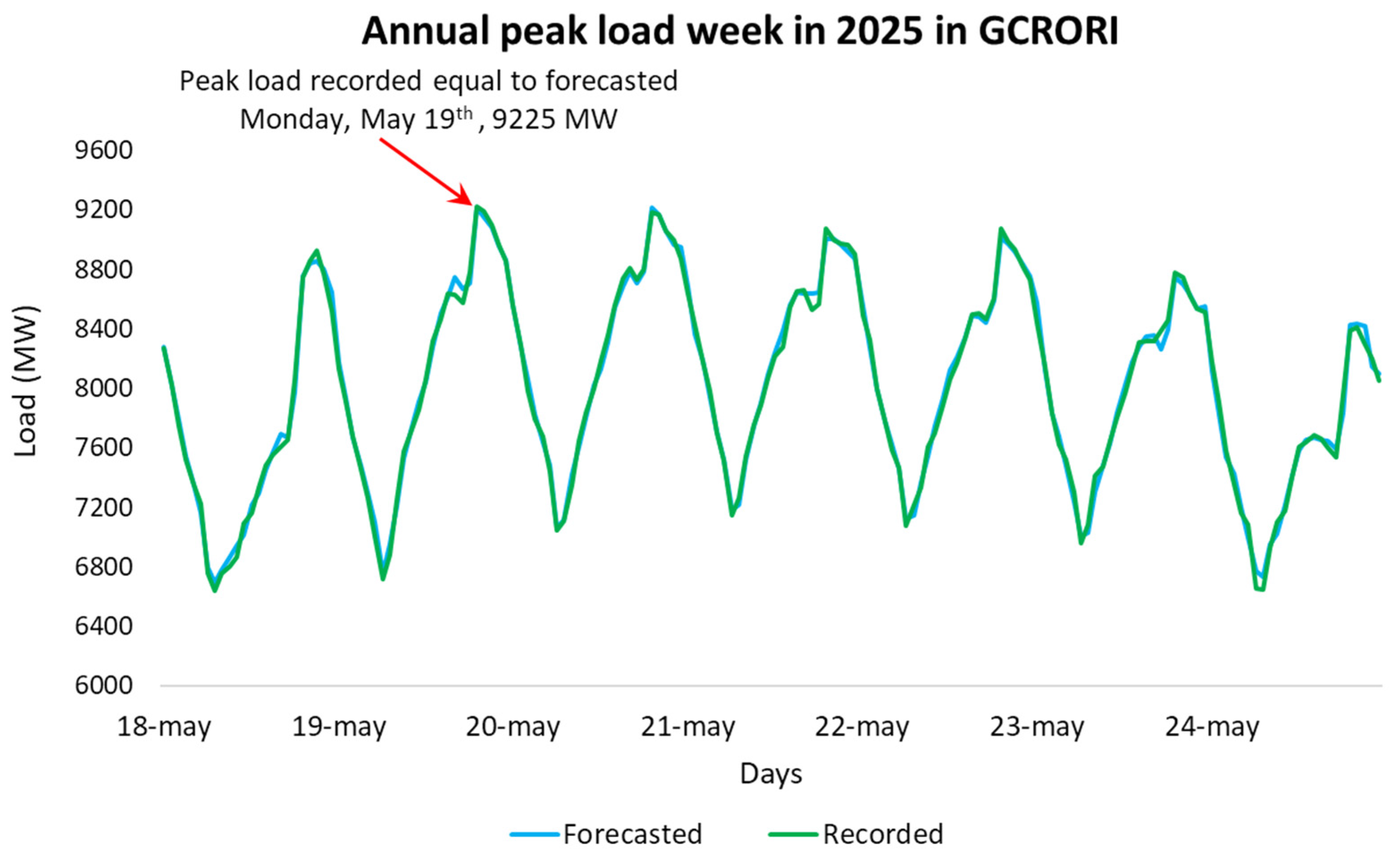
- First, this method was developed to address the urgent requirement for hourly peak load forecasts (in megawatts, MW) in the Eastern Region (GCRORI). The extreme heat waves of 2023 and 2024 led to a significant rise in load demand, particularly during the annual peak load season, which occurs in the spring and summer months in this region. During this period, the hourly peak load forecasts generated by this method can serve as valuable support for defining off-real-time operating strategies as well as real-time operational processes. The accuracy of these hourly peak load forecasts directly influences the effectiveness of both off-real-time strategies and real-time decision-making capabilities. At this stage, the application of the proposed load forecasting method was focused on the Eastern Region (GCRORI).
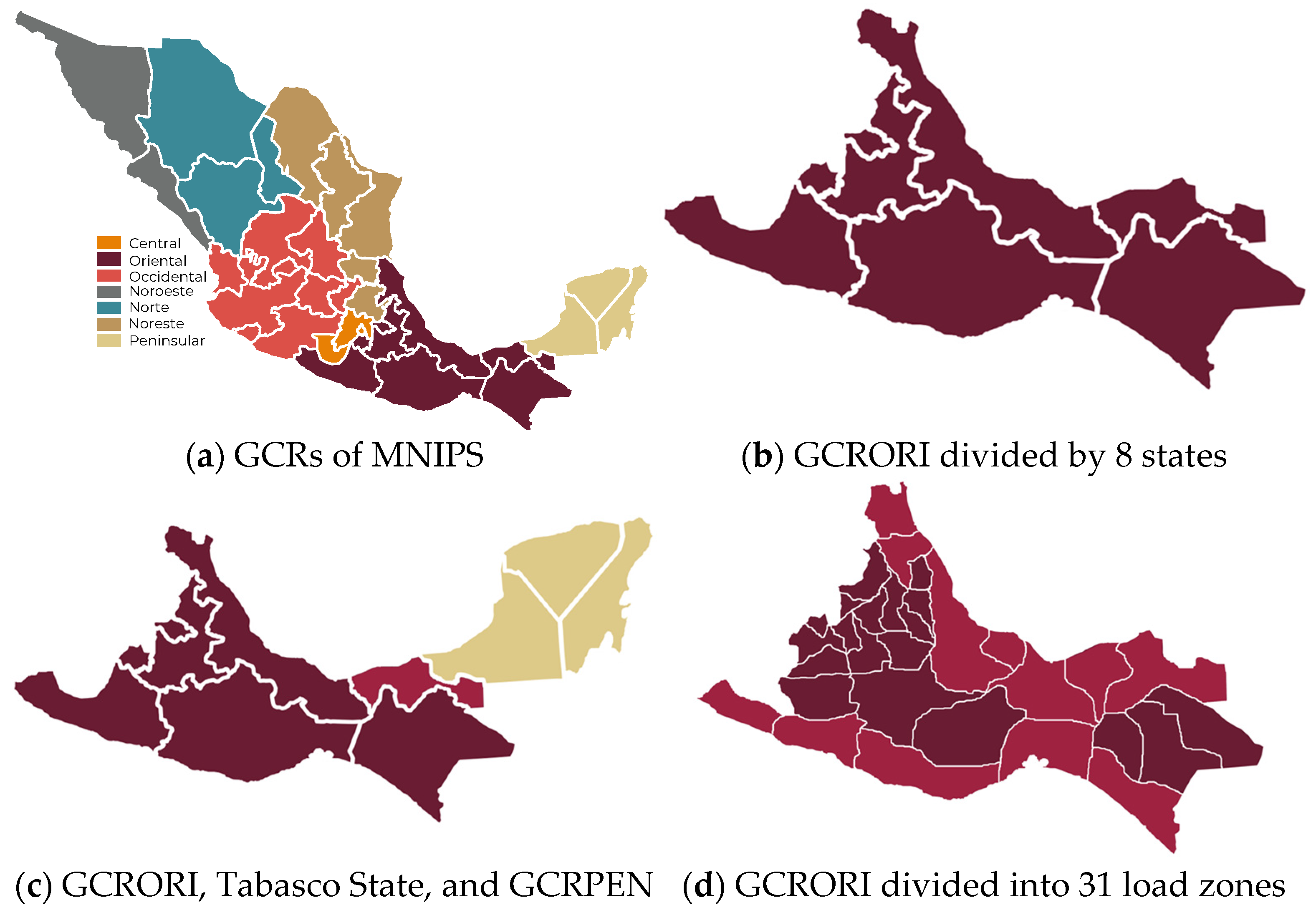
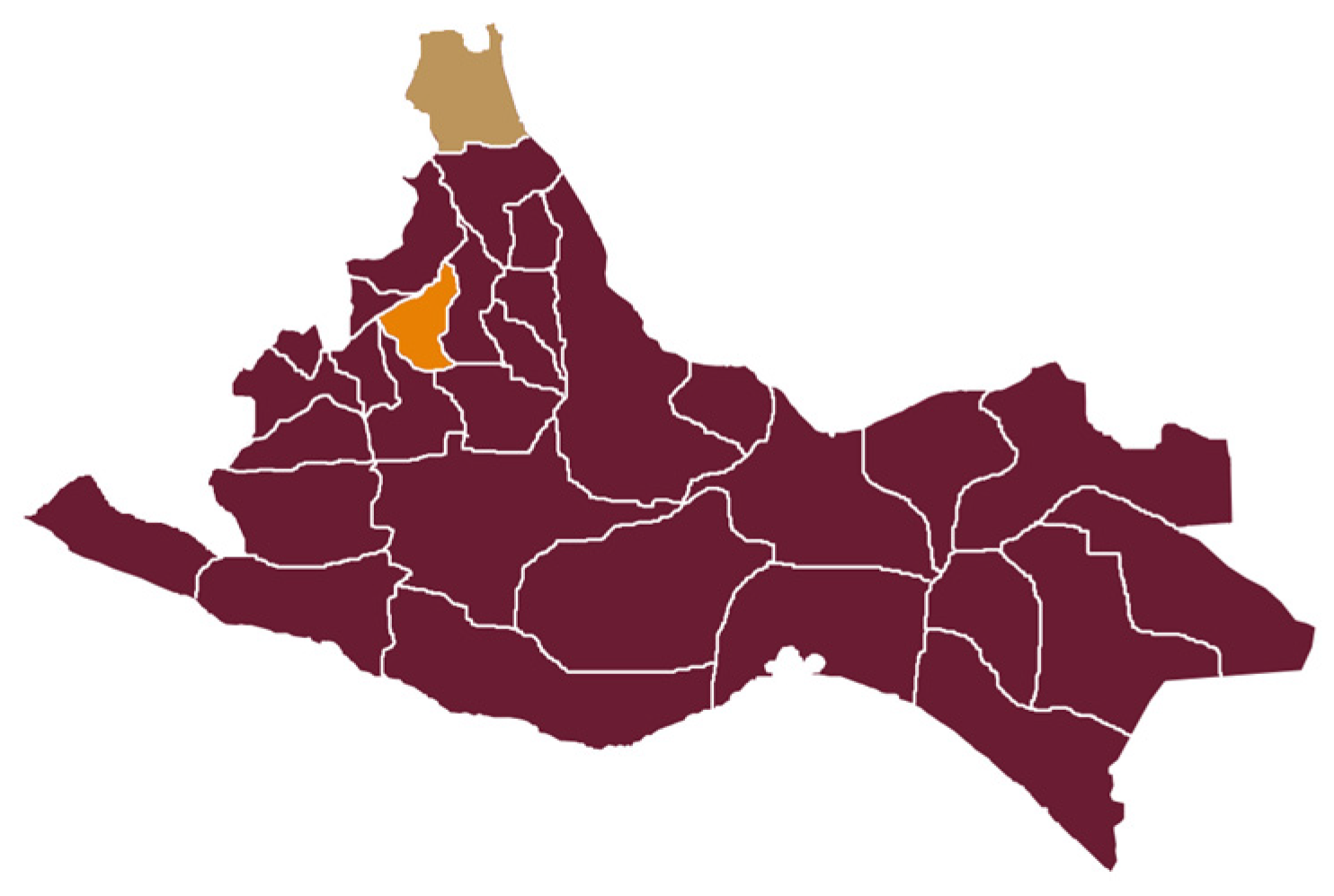
- Second, due to the increasingly earlier peak load season, which occurred by the end of March 2025, it was essential to estimate the hourly instantaneous peak load for the state of Tabasco, highlighted in the red area in Figure 1c. This location is part of the GCRORI and borders the Gerencia de Control Regional Peninsular (GCRPEN), shown in the beige area of Figure 1c. Additionally, it was important to compute the peak load for the GCRPEN, considering the operating gate defined in this MNIPS zone (the Malpaso–Tabasco gate). Consequently, the methodology has been extended to include the GCRPEN [5], which corresponds to the region illustrated in Figure 1c.
- Third, due to the excellent results, the approach was extended to the remaining GCRs of MNIPS. It is important to note that the Baja California Peninsula power system is part of Mexico’s National Electric System (MNES), and thus, it is not included in MNIPS, as shown in Figure 1a.
- Fourth, GCRORI’s coastal load zones, highlighted in lighter red in Figure 1d, were incorporated into the forecasting algorithm, such that the scope of the framework was expanded to the load zone level. This decision was made because these areas have a high likelihood of being impacted by meteorological events such as tropical storms, hurricanes, and floods.
1.1. Current Problems
- There are currently no processes for real-time or intraday load forecasting of instantaneous load values.
- Thus, there is currently neither an instant load forecast (MW) obtainable for real-time operational processes nor a definition process for off-real-time strategies. This type of load forecast has become increasingly essential due to the rising frequency of risky scenarios, high demand levels during the spring and summer seasons, the high temperatures recorded in Mexico in 2023 and 2024, and the threat that several tropical storms would evolve into hurricanes in 2025.
- Nowadays, short-term GUCR load forecasts calculated in CENACE are for wholesale electricity market (WEM) purposes, not for power system operation nor for defining off-real-time operating strategies.
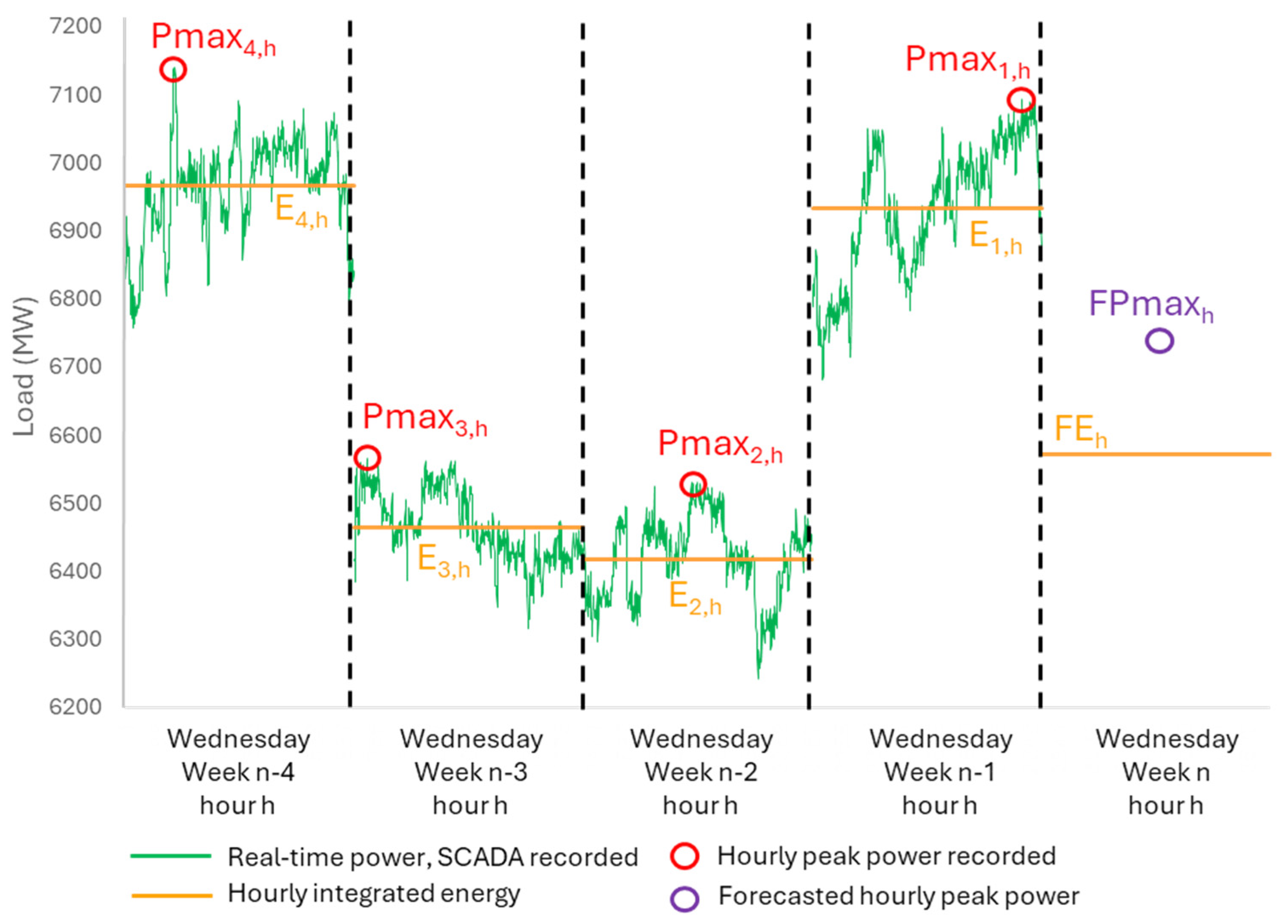
- There is only a slight variation between hourly integrated load (MWh/h) and instant load (MW) values, but that small variation can be crucial in determining whether or not to implement load shedding during specific risk-operating conditions in real-time operations.
1.2. State of the Art
- (A)
- Statistical-based day-ahead load forecasting methods
- (B)
- Artificial-intelligence-based day-ahead load forecasting methods
- (C)
- Hybrid-based day-ahead load forecasting methods
2. Materials and Methods
2.1. Difference Between Hourly Load Integrated Values and Instantaneous Load Values
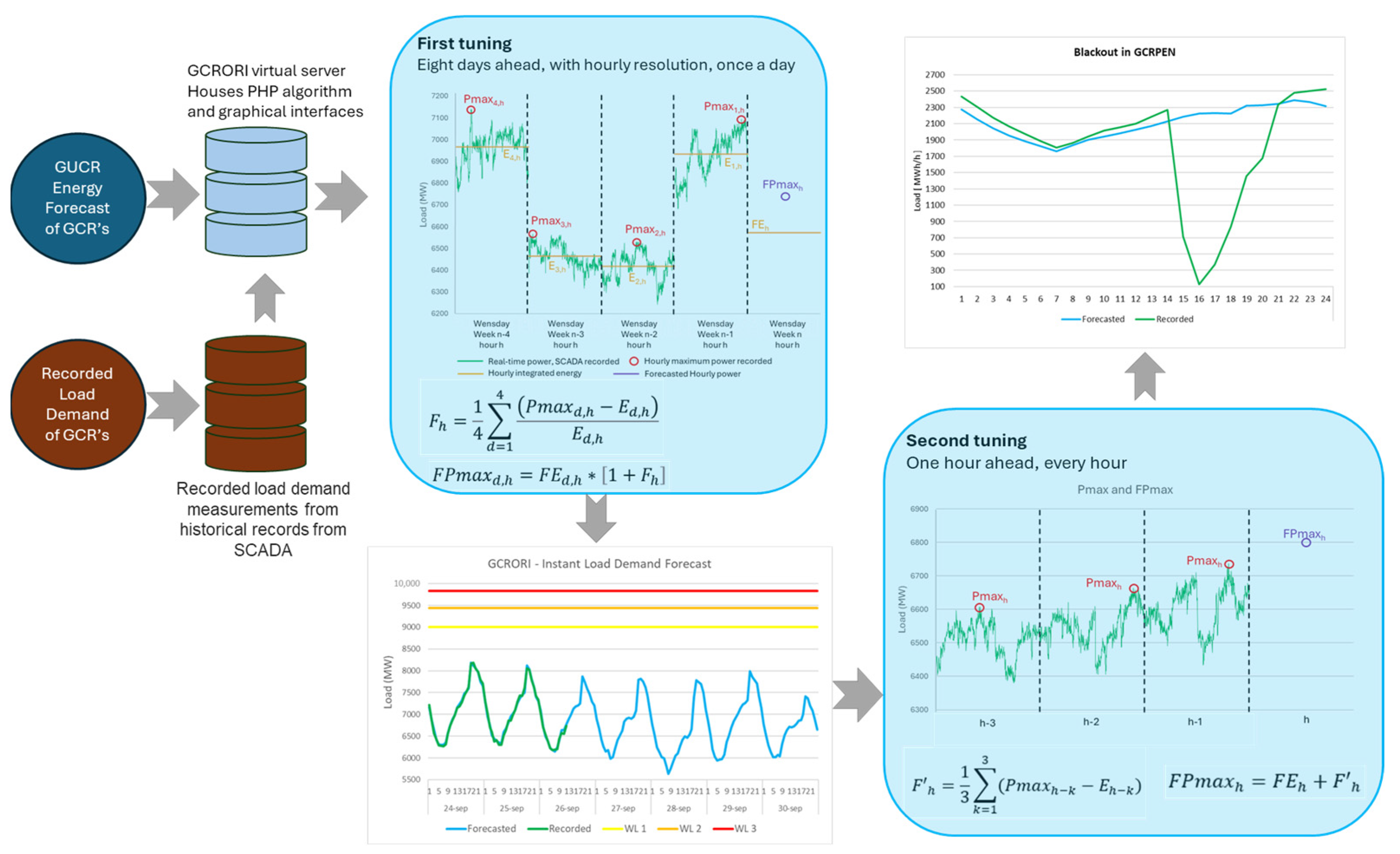
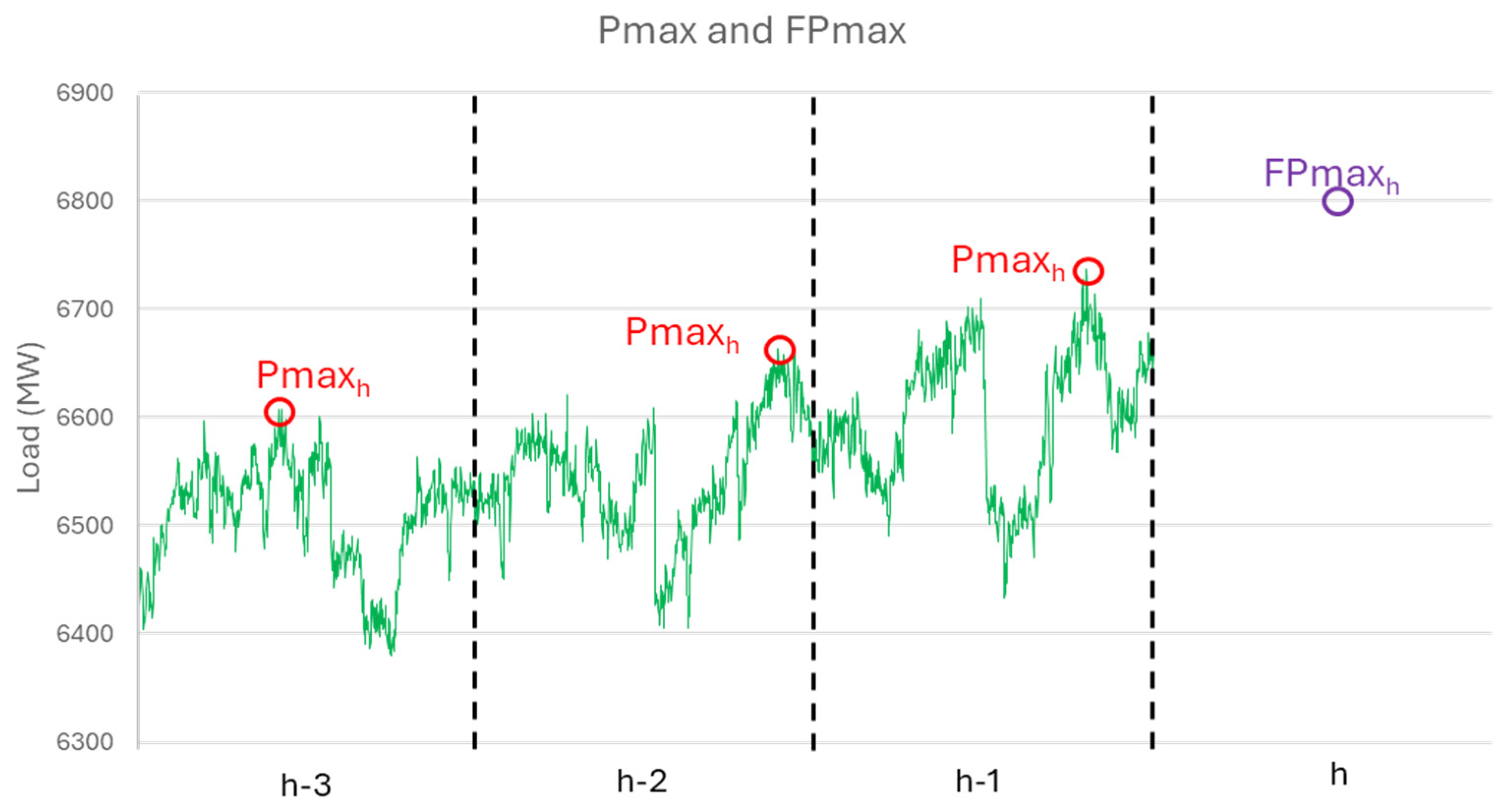
2.2. Forecasting Framework
- Eight-day-ahead period;
- One hour ahead.
2.3. The Tool (Web Interface)
- GUCR load forecast of each GCR: Each GCR transfers its GUCR forecast to the GCRORI virtual server. GUCR load forecasts are updated daily, every day of the year, by each GCR.
- GUCR load forecast for each load zone of the GCRORI.
- Real-time load data from SCADA for each GCR.
3. Results
3.1. Results at GCR Level in Steady-State Conditions
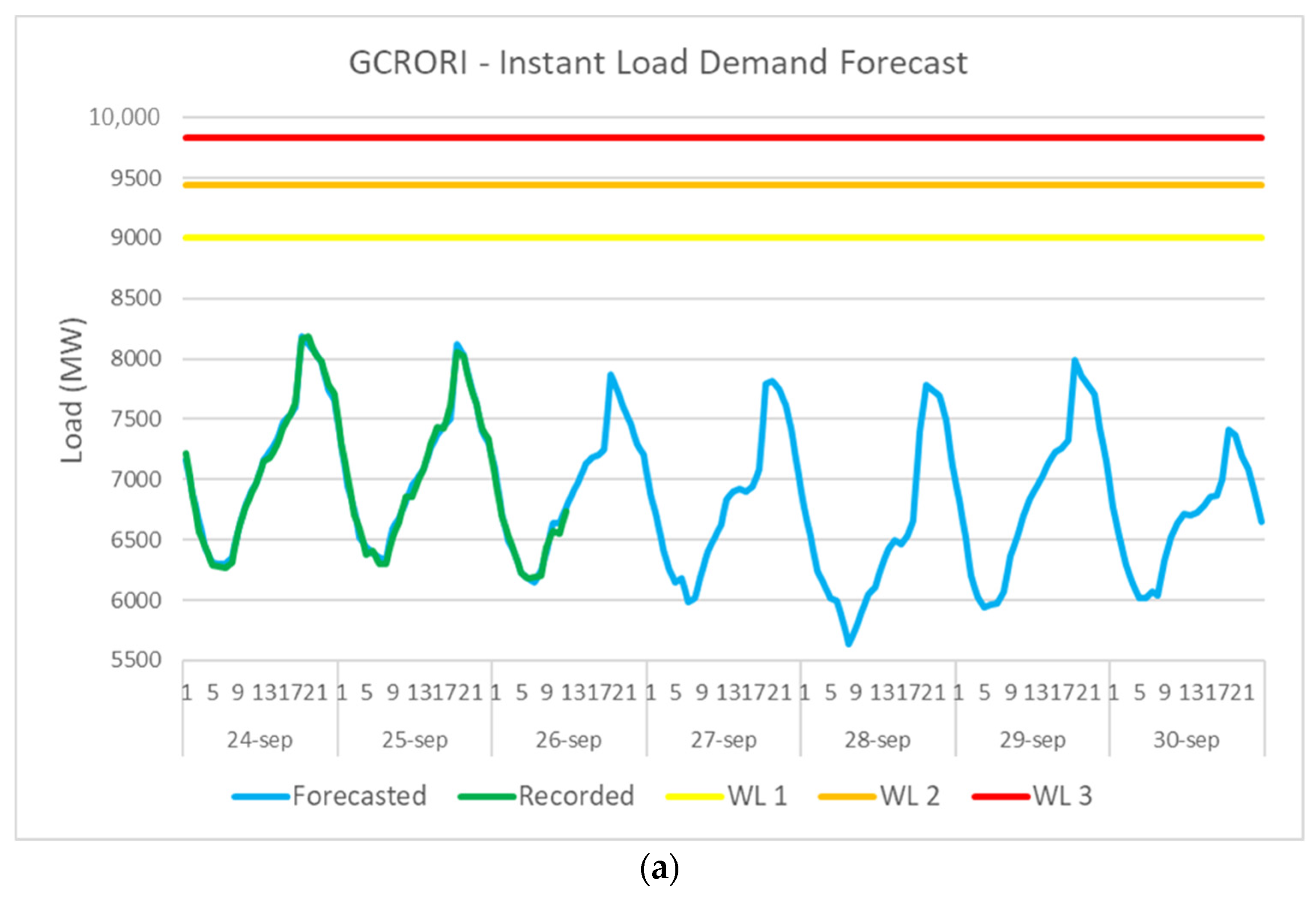
3.1.1. The Eastern Region (GCRORI)
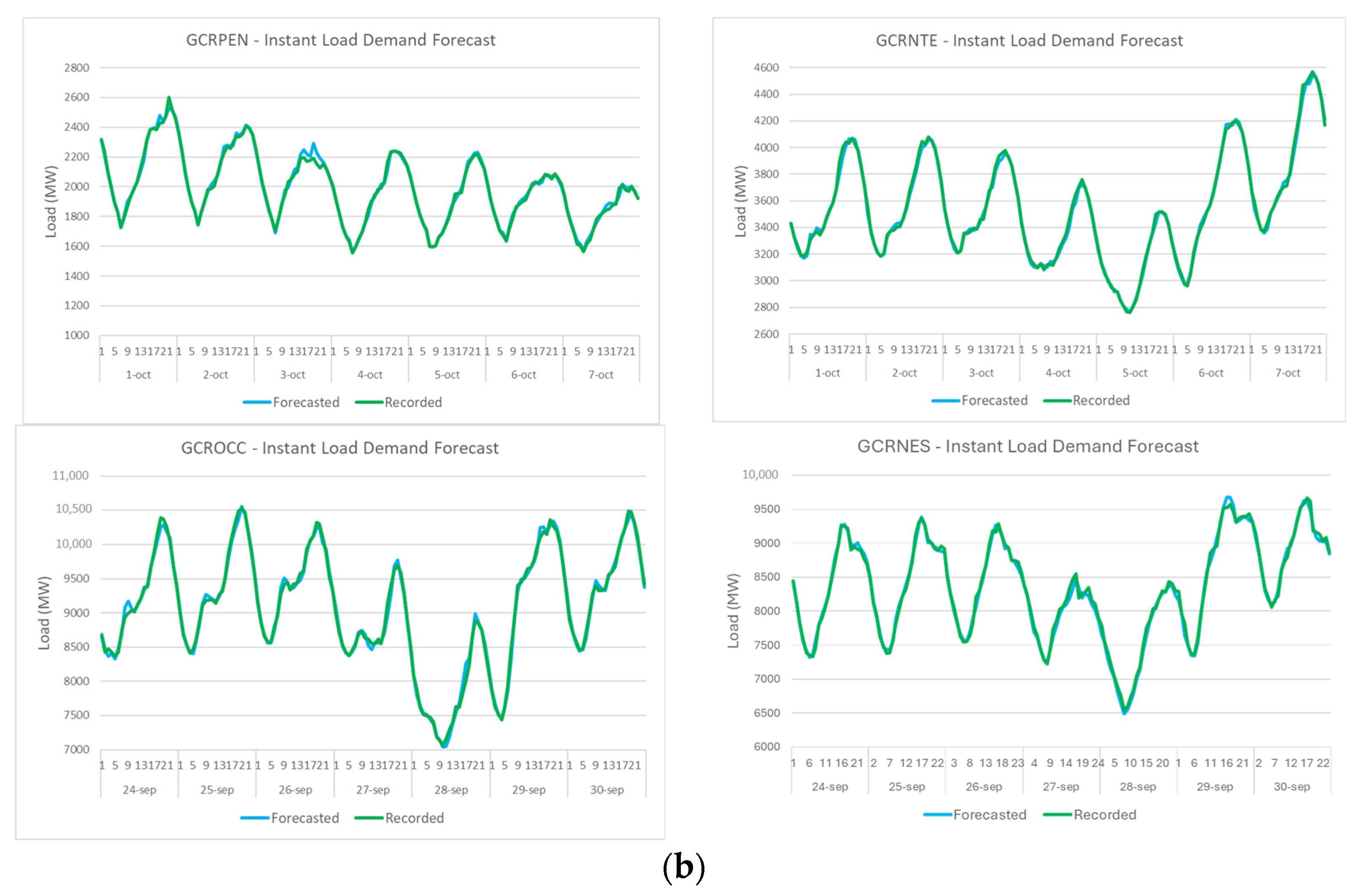
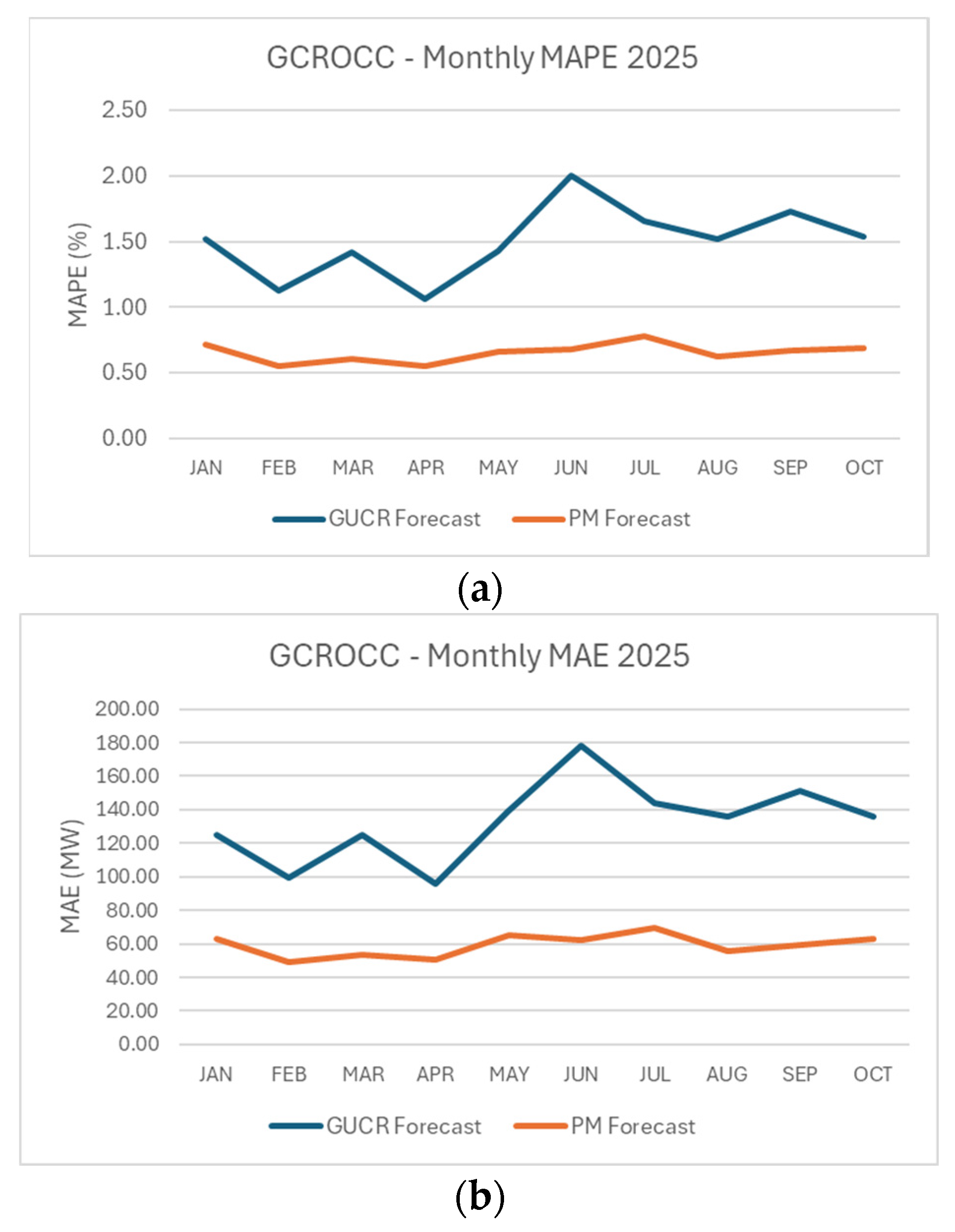
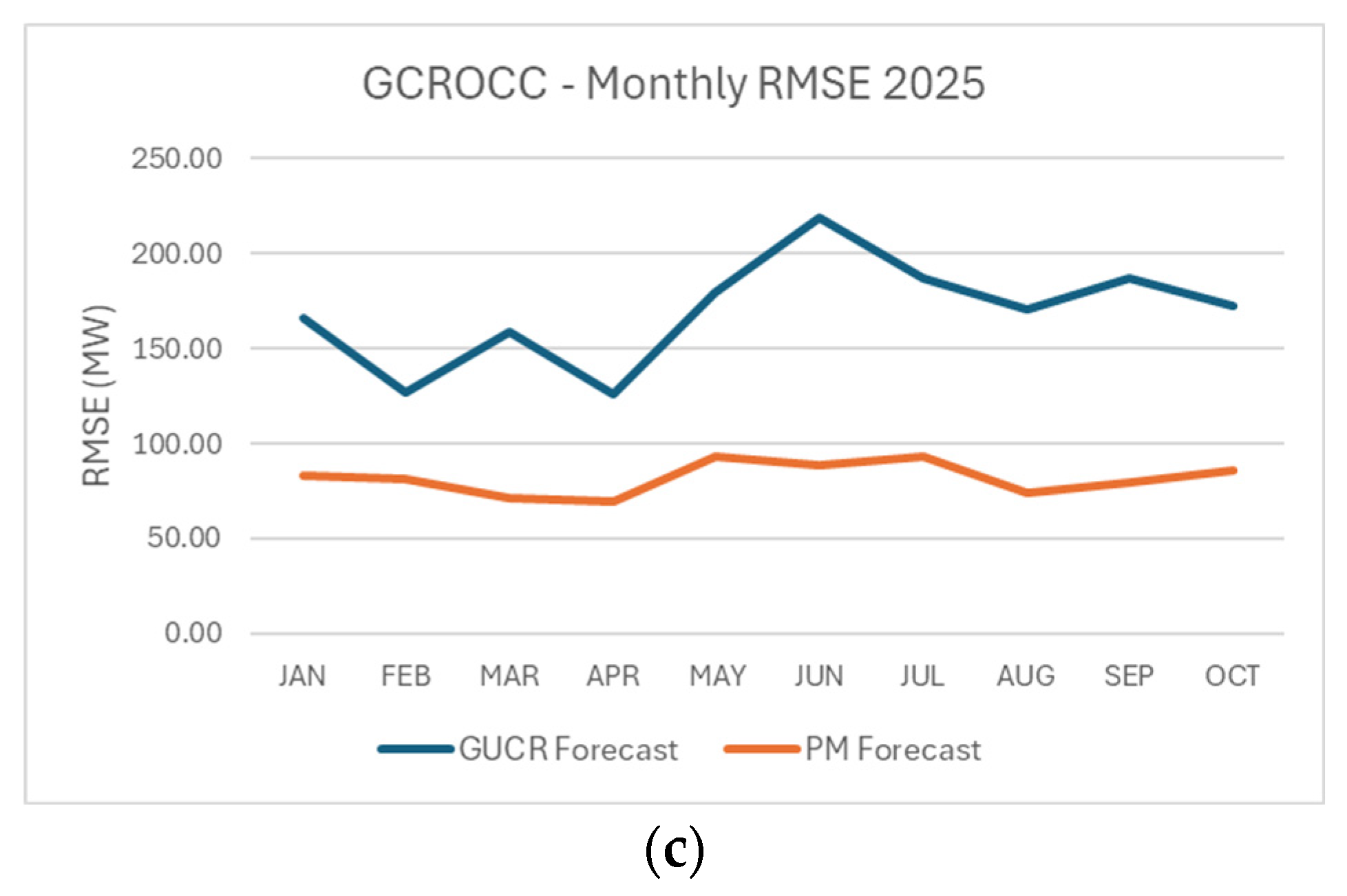
3.1.2. The Western Region (GCROCC)
3.1.3. Other GCRs That Compose MNIPS
3.2. Results at GCR Level in Atypical Conditions
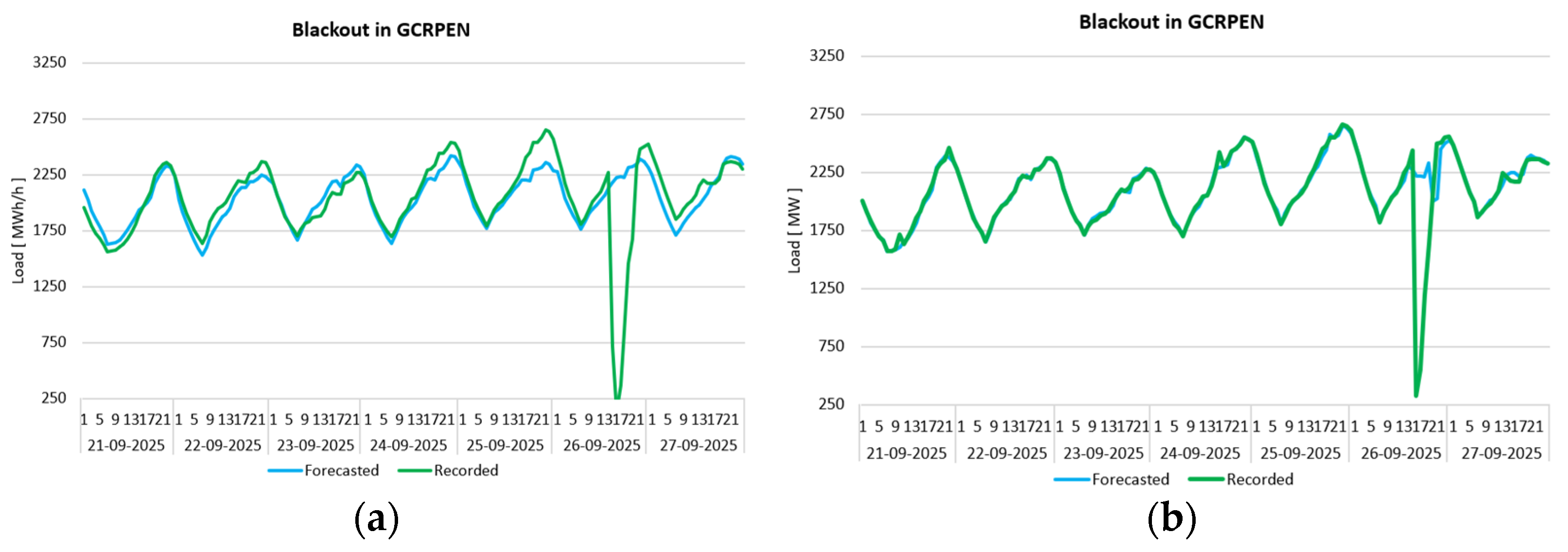
3.2.1. Peninsular Region: Blackout in Yucatan Peninsula (GCRPEN)
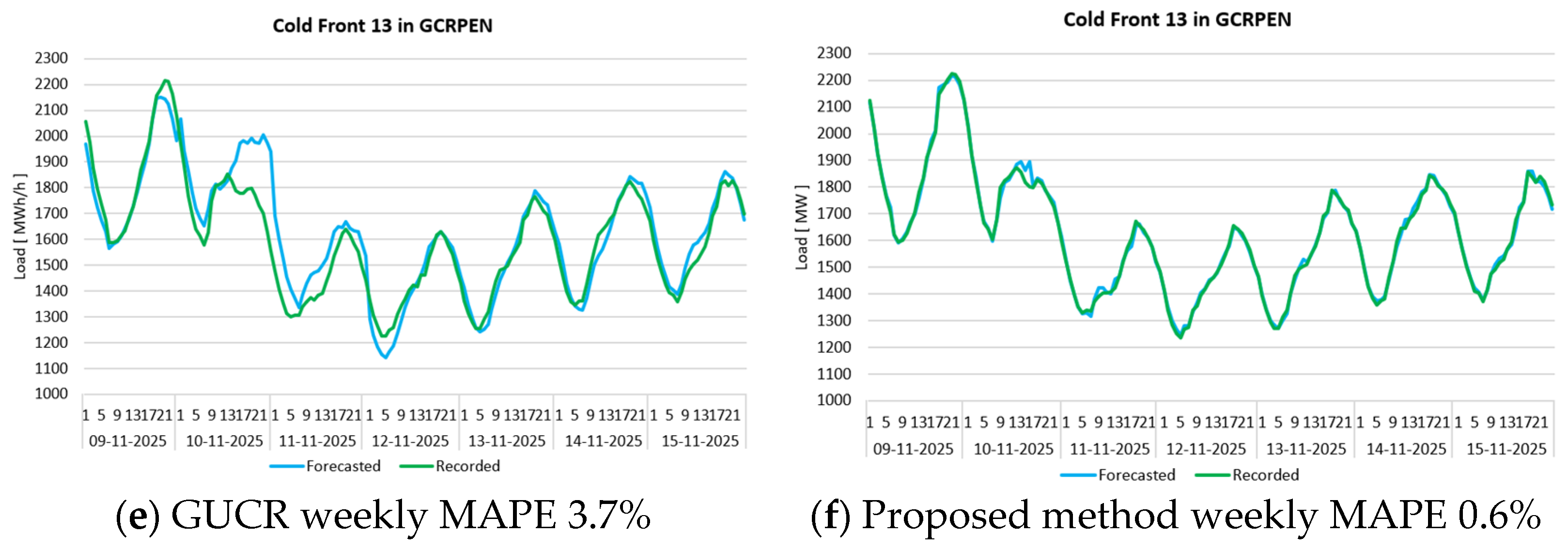
3.2.2. Impact of Cold Front Number 13 on Some GCRs
3.3. Results at Load Zone Level in Atypical Conditions
3.3.1. Poza Rica Load Zone
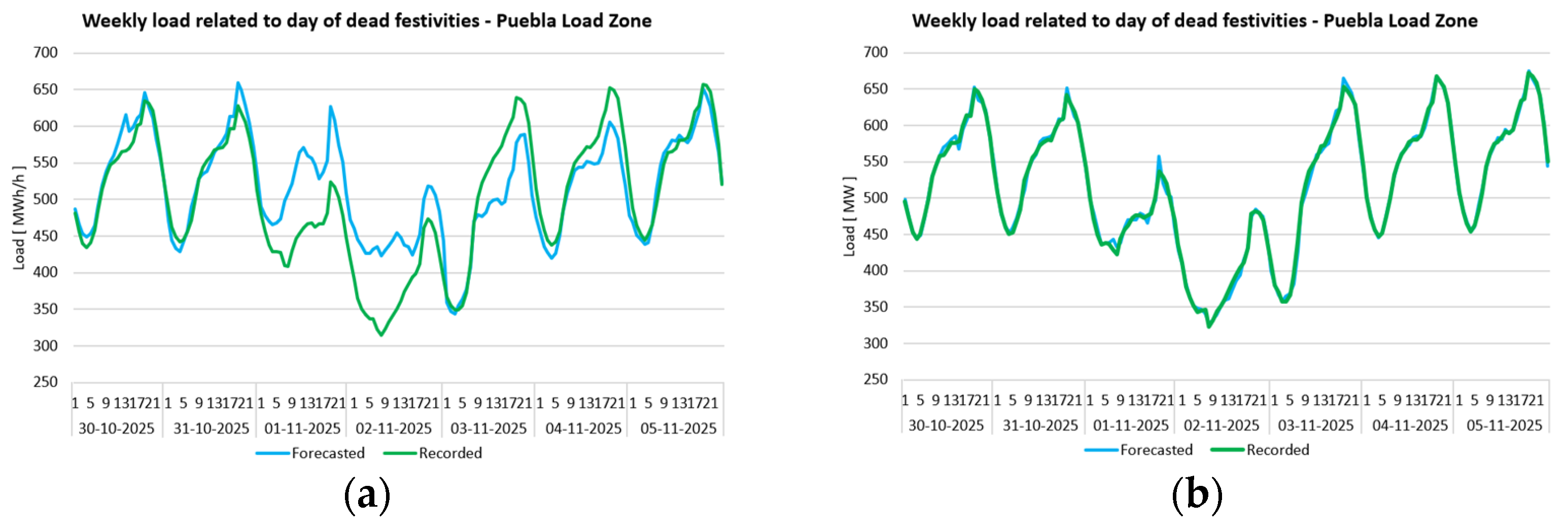
3.3.2. Puebla Load Zone
4. Discussion
- Although this method successfully forecasts hourly instantaneous peak load, it can be adjusted to predict hourly instantaneous minimum load, which would be beneficial during low-demand periods like holidays or the winter season.
- The current proposed method includes only the coastal load zones and the main load zones in the GCRORI. However, in the future, we may incorporate all 101 load zones of MNIPS into this method. As an intermediate step, adding all coastal load zones of MNIPS would enhance the forecasting accuracy for load zones during severe meteorological events.
- This method has been applied to all GCRs that compose MNIPS; it could also be applied to the Baja California peninsula power system to reach nationwide use, that is, Mexico’s National Electric System (MNES).
- This method can also be applied in any other power system control center. As mentioned earlier in Section 2.2, the only requirements are a prior load forecast, recorded real-time load data stored in SCADA, and this algorithm.
5. Conclusions
Author Contributions
Funding
Data Availability Statement
Acknowledgments
Conflicts of Interest
Abbreviations
| AI | Artificial Intelligence |
| ANN | Artificial Neural Network |
| CENACE | Centro Nacional de Control de Energía |
| CGAN | Conditional Generative Adversarial Network |
| CONAGUA | Comisión Nacional del Agua |
| Conv1D | One-dimensional Convolutional Neural Network |
| DAM | Day-Ahead Market |
| DEE | Departamento de Evaluación y Estadística |
| EH | Extended Horizon |
| EMD | Empirical Mode Decomposition |
| FL | Fuzzy Logic |
| GAs | Genetic Algorithms |
| GCR | Gerencias de Control Regional |
| GCRCEL | Gerencia de Control Regional Central |
| GCRORI | Gerencia de Control Regional Oriental |
| GCROCC | Gerencia de Control Regional Occidental |
| GCRNOR | Gerencia de Control Regional Noroeste |
| GCRNTE | Gerencia de Control Regional Norte |
| GCRNES | Gerencia de Control Regional Noreste |
| GCRPEN | Gerencia de Control Regional Peninsular |
| GUCR | Generating Unit Commitment for Reliability |
| KPCA | Kernel Principal Component Analysis |
| LCC | Limited Liability Company |
| LSTM NN | Long Short-Term Memory Neural Network |
| MAE | Mean Absolute Error |
| MAPE | Mean Absolute Percentage Error |
| MNIPS | Mexico’s National Interconnected Power System |
| MNES | Mexico’s National Electric System |
| MSCSO | Multi-Strategy Improved Sand Cat Swarm Optimization |
| MW | Instant value units for active power load |
| MWh/h | Energy value units for active power load, obtained by integrating instant values in a one-hour period |
| NTN | National Transmission Network |
| PHP | Hypertext Preprocessor |
| PJM | Pennsylvania–New Jersey–Maryland |
| PSO | Particle Swarm Optimization |
| PM | Proposed Method |
| RMSE | Root Mean Squared Error |
| SARIMA | Seasonal Autoregressive Integrated Moving Average |
| SA TCN | Self-Attention Temporal Convolutional Network |
| SCADA | System Control Acquisition Data |
| SVM | Support Vector Machine |
| SVR | Support Vector Regression |
| VMD | Variational-Mode Decomposition |
| WEM | Wholesale Electricity Market |
| WL | Warning Levels |
| XGBoost | Extreme Gradient Boosting |
References
- Ahmad, N.; Ghadi, Y.; Adnan, M.; Ali, M. Load forecasting techniques for power system: Research challenges and survey. IEEE Access 2022, 10, 71054–71090. [Google Scholar] [CrossRef]
- Borunda, M.; Vega, A.O.; Garduno, R.; Conde, L.; Medina, M.A.; Aparicio, J.R.; Cacho, L.M.; Jaramillo, O.A. An intelligent method for day-ahead regional load demand forecasting by machine learning analysis of energy consumption patterns across daily, weekly, and annual scales. Appl. Sci. 2025, 15, 4717. [Google Scholar] [CrossRef]
- Ortega, A.; Borunda, M.; Conde, L.; García-Beltran, C.D. Load demand forecasting using a Long-Short Term Memory Neural Network. In Advances in Computational Intelligence; MICAI 2023, Lecture Notes in Computer Science; Springer: Cham, Switzerland, 2023; p. 14391. [Google Scholar]
- Borra, P. Advancing data science and AI with Azure Machine Learning: A comprehensive review. Int. J. Res. Publ. Rev. 2024, 5, 1825–1831. [Google Scholar]
- Conde, L.; Aparicio Cárdenas, T. An alternative, Effective and Easy Hourly Instantaneous Maximum Load Short-Term Forecast Method. In Proceedings of the IEEE International Summer Meeting on Power and Industrial Applications, Acapulco, Mexico, 27–31 July 2025; ISBN 978-607-59867. [Google Scholar]
- Wang, X.; Papaefthymiou, M. A dual-mode real-time electrical load framework. In Proceedings of the 2022 IEEE Power & Energy Society Innovative Smart Grid Technologies Conference (ISGT), New Orleans, LA, USA, 24–28 April 2022; pp. 1–5. [Google Scholar]
- Majeed, M.A.; Mudgal, S.; Tak, L.; Popat, J.; Kakadiya, H.; Singh, N.K.; Mahajan, V. Artificial neural network modelling for short term load forecasting. In Proceedings of the International Conference on Technology and Policy in Energy and Electric Power (ICT-PEP), Jakarta, Indonesia, 29–30 September 2021; pp. 302–306. [Google Scholar]
- Sahay, K.B.; Rana, V. One hour ahead load forecast of PJM electricity market & UPPCL. In Proceedings of the 2015 International Conference on Energy Economics and Environment (ICEEE), Greater Noida, India, 26–28 March 2015; pp. 1–6. [Google Scholar]
- Sahay, K.B.; Tripathi, M.M. Day ahead hourly load forecast of PJM electricity market and ISO New England market by using artificial neural network. In Proceedings of the 2014 IEEE Innovative Smart Grid Technologies, Washington, DC, USA, 20–23 May 2014; pp. 1–5. [Google Scholar]
- Salman, D.; Kusaf, M.; Elmi, Y.K. Using recurrent neural network to forecast day and year ahead performance of load demand: A case study of France. In Proceedings of the 10th International Conference on Power Science and Engineering (ICPSE), Istanbul, Turkey, 21–23 October 2021; pp. 23–30. [Google Scholar]
- Bareth, R.; Yadav, A. Day ahead load demand forecasting based on LSTM machine learning model. In Proceedings of the Third International Conference on Power, Control and Computing Technologies (ICPC2T), Raipur, India, 18–20 January 2024; pp. 404–408. [Google Scholar]
- Krüger, N.; Eger, K.; Renz, W. SMARDcast: Day-ahead forecasting of german electricity consumption with deep learning. In Proceedings of the 2024 International Conference on Smart Energy Systems and Technologies (SEST), Torino, Italy, 10–12 September 2024. [Google Scholar]
- Ma, W. Power system short -term load forecasting based on improved support vector machines. In Proceedings of the 2008 International Symposium on Knowledge Acquisition and Modeling, Wuhan, China, 21–22 December 2008; pp. 658–662. [Google Scholar]
- Niu, D.X.; Wang, Q.; Li, J.C. Short term load forecasting model using support vector machine based on artificial neural network. In Proceedings of the 2005 International Conference on Machine Learning and Cybernetics, Guangzhou, China, 18–21 August 2005; Volume 7, pp. 4260–4265. [Google Scholar]
- Xinhui, D.; Liang, W.; Jiancheng, S.; Yan, Z. Application of neural network and support vector machines to power system short-term load forecasting. In Proceedings of the 2010 International Conference on Computational Aspects of Social Networks, Taiyun, China, 26–28 September 2010; pp. 729–732. [Google Scholar]
- Ceciliano Meza, J.L.; de la Torre Sánchez, A.; Álvarez López, J.; Nieva Gómez, R. Formulación Matemática del Modelo de Asignación de Unidades con Restricciones de Seguridad y Cálculo de Precios Marginales Locales y de Servicios Conexos en el Mercado de un Día en Adelanto, CENACE. January 2016. Available online: https://www.cenace.gob.mx/Docs/MercadoOperacion/Formulaci%C3%B3n%20Matem%C3%A1tica%20Modelo%20AU-MDA%20y%20PML%20v2016%20Enero.pdf (accessed on 31 December 2025).
- Mamun, A.A.; Sohel, M.D.; Mohammad, N.; Haque Sunny, M.S.; Dipta, D.R.; Hossain, E. A comprehensive review of the load forecasting techniques using single and hybrid predictive models. IEEE Access 2020, 8, 134911–134939. [Google Scholar] [CrossRef]
- Antoniadis, A.; Cugliari, J.; Fasiolo, M.; Goude, Y.; Poggi, J.M. Statistical Learning Tools for Electricity Load Forecasting; Birkhaüser: Cham, Switzerland, 2024. [Google Scholar]
- Mroueh, M.; Doumiati, M.; Francis, C.; Machmoum, M. Residential electrical load forecasting based on a real-time evidential time series prediction method. IEEE Access 2025, 13, 7448–7461. [Google Scholar] [CrossRef]
- Rusina, A.G.; Osgonbaatar, T.; Matrenin, P.V. Short-term load forecasting using statistical methods for the Central Power System of Mongolia. In Proceedings of the 2022 IEEE International multi-conference on Engineering, Computer and Information Sciences (SIBIRCON), Yekaterinburg, Russia, 11–13 November 2022; pp. 2030–2035. [Google Scholar]
- Gurivisetty, N.S.L.S.; Satheesh, R. Statistical load forecasting in power systems: A comparative study of SARIMA and Prophet Models. In Proceedings of the 2025 First International Conference on Advances in Computer Science, Electrical, Electronics and Communication Technologies (CE2CT), Uttarakhand, India, 21 February 2025; pp. 78–83. [Google Scholar]
- Iftikhar, H.; Turpo-Chaparro, J.E.; Canas Rodrigues, P.; López-Gonzales, J.L. Day-ahead electricity demand forecasting using a novel decomposition combination method. Energies 2023, 16, 6675. [Google Scholar] [CrossRef]
- Khayat, A.; Kissaoui, M.; Bahatti, L.; Raihani, A.; Errakkas, K.; Atifi, Y. Efficient day-ahead energy forecasting for microgrids usint LSTM optimized by grey wolf algorithm. E-Prime-Adv. Electr. Eng. Electron. Energy 2025, 13, 101054. [Google Scholar] [CrossRef]
- Han, H.; Peng, J.; Ma, J.; Liu, H.; Liu, S. Research on load forecasting prediction model based on modified sand cat swarm optimization and selfattention TCN. Symmetry 2025, 17, 1270. [Google Scholar] [CrossRef]
- Han, D.; Bai, H.; Wang, Y.; Bu, F.; Zhang, J. Day-ahead aggregated load forecasting based on household smart meter data. Energy Rep. 2023, 9, 149–158. [Google Scholar] [CrossRef]
- Liu, J.; Wu, Y. A hybrid time series forecasting CGAN model based on LSTM and Conv1D and its application for load forecasting. Electr. Eng. 2025, 107, 14881–14898. [Google Scholar] [CrossRef]
- Zhao, W.; Xu, H.; Chen, P.; Zhang, J.; Li, J.; Cai, T. Elastic momentum-enhanced adaptive hybrid method for short-term load forecasting. Energies 2025, 18, 3263. [Google Scholar] [CrossRef]
- Vasenin, D.; Pasetti, M.; Astolfi, D.; Savvin, N.; Vasile, A.; Zizzo, G. LSTM-Based models for day-ahead electrical load forecast: A novel feature selection method including weather data. Smart Grids Sustain. Energy 2025, 10, 51. [Google Scholar] [CrossRef]
- You, J.; Cai, H.; Shi, D.; Guo, L. An improved short-term electricity load forecasting method: The VMD-KPCA-xLSTM-Informer Model. Energies 2025, 18, 2240. [Google Scholar] [CrossRef]
- Bae, H.J.; Park, J.S.; Choi, J.H.; Kwon, H.Y. Learning model combined with data clustering and dimensionality reduction for short-term electricity load forecasting. Sci. Rep. 2025, 15, 3575. [Google Scholar] [CrossRef] [PubMed]
- Ajder, A.; Hamza, H.A.A.; Ayaz, R. Wavelet-enhanced hybrid LSTM-XGBoost model for predicting time series containing unpredictable events. IEEE Access 2025, 13, 58671–58679. [Google Scholar] [CrossRef]
- Hasan, M.; Mifta, Z.; Papiya, S.J.; Roy, P.; Dey, P.; Salsabil, N.A.; Chowdhury, N.U.R.; Farrok, O. A state-of-the-art comparative review of load forecasting methods: Characteristics, perspectives, and applications. Energy Convers. Manag. X 2025, 26, 100922. [Google Scholar] [CrossRef]
- Misiure, K.; Olkuski, T.; Zysk, J. Review of methods and models for forecasting electricity consumption. Energies 2025, 18, 4032. [Google Scholar] [CrossRef]
- Fida, K.; Abbasi, U.; Adnan, M.; Iqbal, S.; Eldeen, S.; Mohamed, G. A comprehensive survey on load forecasting hybrid models: Navigating the futuristic demand response patterns through experts and intelligent systems. Results Eng. 2024, 23, 102773. [Google Scholar] [CrossRef]
- Centro Nacional de Control de Energía. “Manual de Pronósticos”, Diario Oficial de la Federación. 23 November 2017. Available online: https://www.cenace.gob.mx/Docs/14_REGLAS/Manuales/Manual%20de%20Pron%C3%B3sticos%20%5BDOF%2023-11-17%5D.pdf (accessed on 17 July 2025).
- Acuerdo por el que se emite el Manual de Mercado de Energía de Corto Plazo. Available online: https://www.dof.gob.mx/nota_detalle_popup.php?codigo=5441705 (accessed on 31 December 2025).
- Reporte Anual del Mercado Eléctrico Mayorista 2017, Comisión Reguladora de Energía. Available online: https://www.gob.mx/cms/uploads/attachment/file/414648/Reporte_Anual_VF_public.pdf (accessed on 31 December 2025).
- Klyuev, R.V.; Morgoev, I.D.; Morgoeva, A.D.; Gavrina, O.A.; Martyushev, N.V.; Efremenkov, E.A.; Mengxu, A. Methods of forecasting electric energy consumption: A literature review. Energies 2022, 15, 8919. [Google Scholar] [CrossRef]







| GCR | Acronym | Geographical Extent (States) |
|---|---|---|
| Gerencia de Control Regional Central | GCRCEL | Hidalgo, Mexico City, and a portion of Morelos |
| Gerencia de Control Regional Oriental | GCRORI | Chiapas, Tabasco, Veracruz, Oaxaca, Puebla, Tlaxcala, Guerrero, and a portion of Morelos |
| Gerencia de Control Regional Occidental | GCROCC | Nayarit, Zacatecas, Jalisco, Colima, Michoacán, Guanajuato, Querétaro, Aguascalientes, and San Luis Potosí |
| Gerencia de Control Regional Noroeste | GCRNOR | Sonora and Sinaloa |
| Gerencia de Control Regional Norte | GCRNTE | Chihuahua, Durango, and a portion of Coahuila |
| Gerencia de Control Regional Noreste | GCRNES | Tamaulipas, Nuevo León, and a portion of Coahuila |
| Gerencia de Control Regional Peninsular | GCRPEN | Campeche, Yucatán, and Quintana Roo |
| GUCR Load Forecast | Proposed Method | |
|---|---|---|
| Same feature | Short-term load forecast | Short-term load forecast |
| Same feature | Hourly resolution | Hourly resolution |
| Different feature | MWh/h Units (hourly integrated values) | MW Units (maximum instantaneous value in each hour) |
| Different feature | It is updated only once a day at 17:00 h for the following 8-day period ahead. |
|
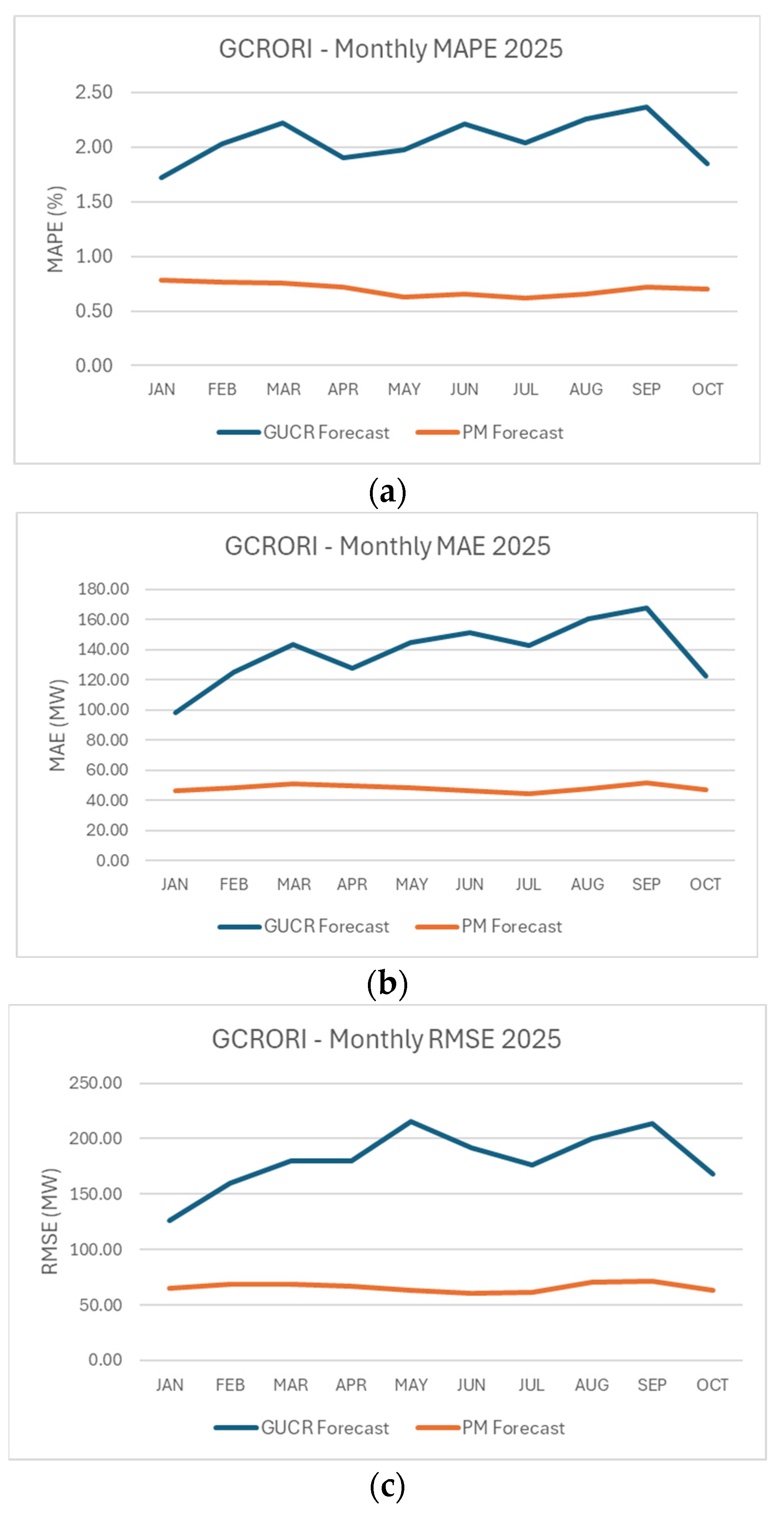
| MAPE (%) | GCRCEL | GCRNTE | GCRNES | GCRPEN | ||||
|---|---|---|---|---|---|---|---|---|
| GUCR Forecast | PM Forecast | GUCR Forecast | PM Forecast | GUCR Forecast | PM Forecast | GUCR Forecast | PM Forecast | |
| MAY | 2.10 | 0.99 | 2.21 | 0.69 | 3.20 | 0.95 | 1.93 | 0.81 |
| JUNE | 1.62 | 0.95 | 2.40 | 0.50 | 2.33 | 0.66 | 3.28 | 0.72 |
| JULY | 1.76 | 0.97 | 2.82 | 0.54 | 2.07 | 0.67 | 2.73 | 0.66 |
| AUGUST | 1.59 | 0.87 | 2.12 | 0.50 | 1.78 | 0.65 | 2.55 | 0.57 |
| SEPTEMBER | 1.68 | 1.14 | 2.81 | 0.57 | 2.62 | 0.70 | 3.32 | 2.14 |
| OCTOBER | 1.60 | 1.03 | 2.26 | 0.66 | 2.44 | 0.83 | 2.92 | 0.76 |
| MAE (MW) | GCRCEL | GCRNTE | GCRNES | GCRPEN | ||||
|---|---|---|---|---|---|---|---|---|
| GUCR Forecast | PM Forecast | GUCR Forecast | PM Forecast | GUCR Forecast | PM Forecast | GUCR Forecast | PM Forecast | |
| MAY | 140.42 | 72.08 | 89.41 | 31.22 | 249.98 | 89.27 | 43.30 | 19.39 |
| JUNE | 108.95 | 67.44 | 103.14 | 23.13 | 196.49 | 60.31 | 70.84 | 16.05 |
| JULY | 112.60 | 67.92 | 110.64 | 22.49 | 172.26 | 60.53 | 60.55 | 15.01 |
| AUGUST | 98.87 | 59.61 | 92.63 | 23.05 | 158.91 | 61.96 | 56.78 | 12.78 |
| SEPTEMBER | 109.20 | 80.41 | 103.95 | 21.93 | 203.85 | 58.88 | 80.54 | 22.96 |
| OCTOBER | 106.23 | 73.75 | 71.29 | 21.94 | 177.87 | 65.61 | 56.78 | 15.27 |
| RMSE (MW) | GCRCEL | GCRNTE | GCRNES | GCRPEN | ||||
|---|---|---|---|---|---|---|---|---|
| GUCR Forecast | PM Forecast | GUCR Forecast | PM Forecast | GUCR Forecast | PM Forecast | GUCR Forecast | PM Forecast | |
| MAY | 182.58 | 92.59 | 125.58 | 42.91 | 331.25 | 179.97 | 54.71 | 47.14 |
| JUNE | 138.30 | 86.34 | 131.59 | 47.64 | 273.88 | 77.19 | 96.55 | 30.96 |
| JULY | 139.22 | 86.21 | 135.47 | 30.95 | 223.75 | 77.14 | 82.21 | 26.40 |
| AUGUST | 126.46 | 78.37 | 124.16 | 33.07 | 206.64 | 110.90 | 75.99 | 20.67 |
| SEPTEMBER | 139.45 | 108.53 | 135.37 | 30.29 | 302.13 | 73.94 | 161.12 | 109.05 |
| OCTOBER | 136.61 | 96.72 | 89.74 | 29.64 | 261.42 | 83.60 | 72.49 | 27.05 |
| GURC Forecast | PM Forecast | |||||
|---|---|---|---|---|---|---|
| MAPE (%) | MAE (MW) | RMSE (MW) | MAPE (%) | MAE (MW) | RMSE (MW) | |
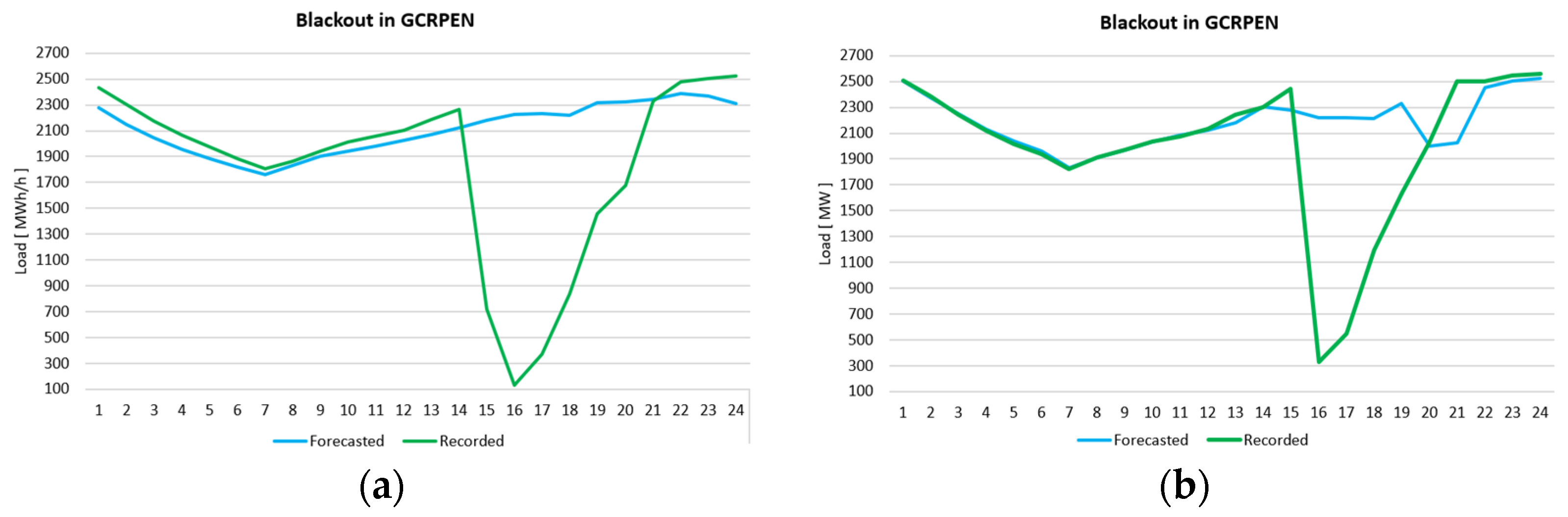
| GCRPEN | 19.40 | 134.04 | 298.46 | 7.00 | 51.42 | 221.85 |
| GURC Forecast | PM Forecast | |||||
|---|---|---|---|---|---|---|
| MAPE (%) | MAE (MW) | RMSE (MW) | MAPE (%) | MAE (MW) | RMSE (MW) | |
| GCRPEN | 111.07 | 420.00 | 745.22 | 44.00 | 261.07 | 583.27 |
| GURC Forecast | PM Forecast | |||||
|---|---|---|---|---|---|---|
| MAPE (%) | MAE (MW) | RMSE (MW) | MAPE (%) | MAE (MW) | RMSE (MW) | |
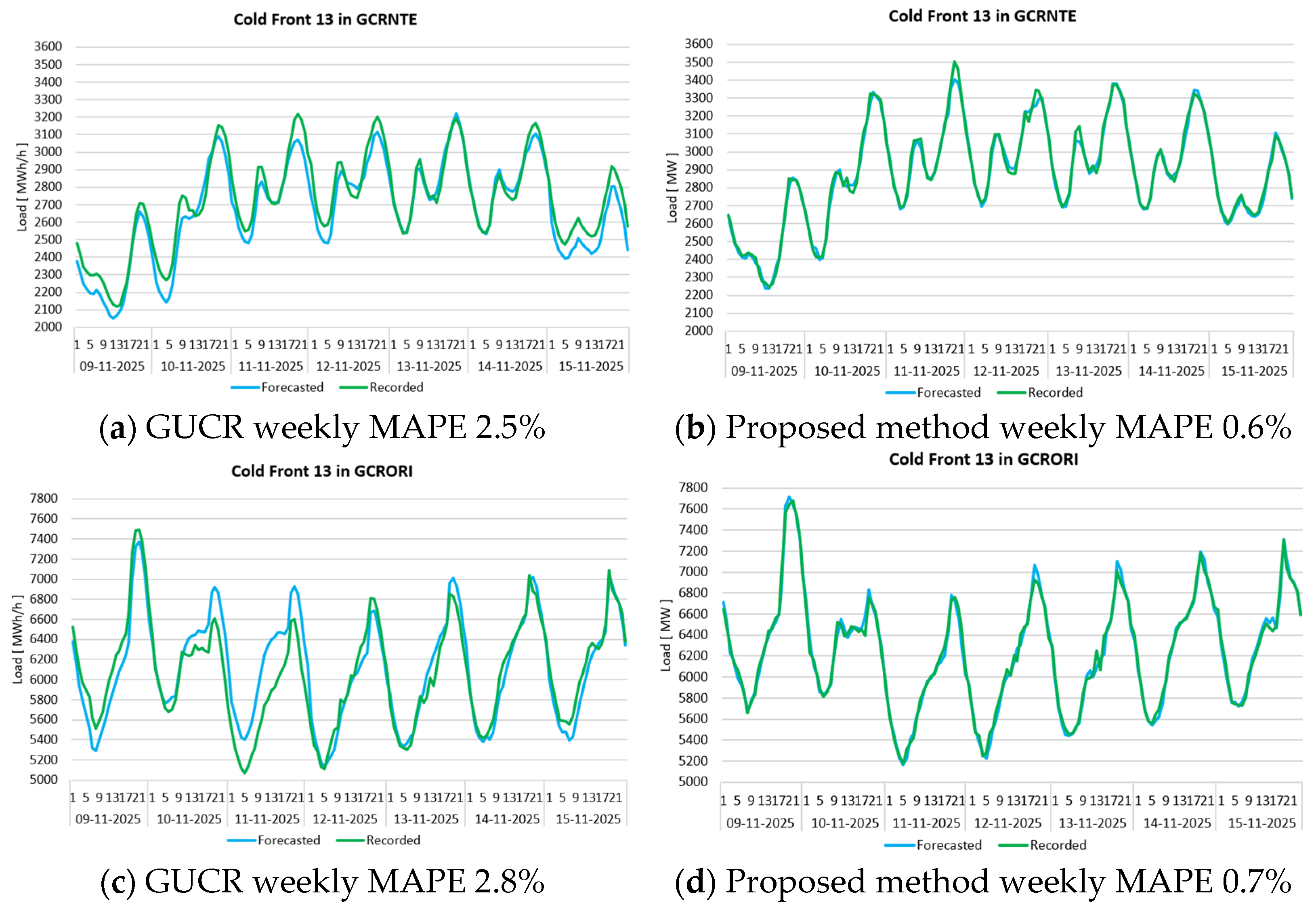
| GCRORI | 2.80 | 164.85 | 211.24 | 0.70 | 43.99 | 57.53 |
| GCRPEN | 3.7 | 58.39 | 83.97 | 0.6 | 9.93 | 14.48 |
| GCRNTE | 2.5 | 67.76 | 80.61 | 0.6 | 18.9 | 25.75 |
| GURC Forecast | PM Forecast | |||||
|---|---|---|---|---|---|---|
| MAPE (%) | MAE (MW) | RMSE (MW) | MAPE (%) | MAE (MW) | RMSE (MW) | |
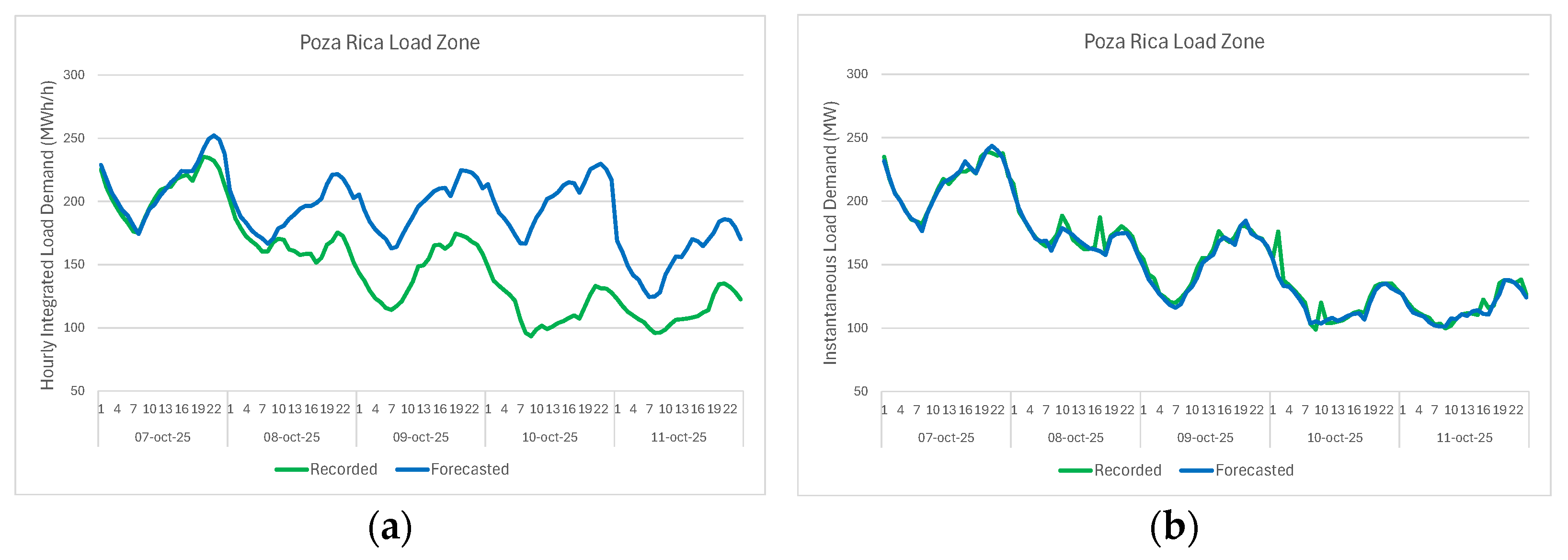
| POZA RICA | 34.00 | 42.84 | 51.89 | 2.19 | 3.30 | 5.60 |
| GURC Forecast | PM Forecast | |||||
|---|---|---|---|---|---|---|
| MAPE (%) | MAE (MW) | RMSE (MW) | MAPE (%) | MAE (MW) | RMSE (MW) | |
| PUEBLA | 7.80 | 35.59 | 47.65 | 0.90 | 4.53 | 5.85 |
Disclaimer/Publisher’s Note: The statements, opinions and data contained in all publications are solely those of the individual author(s) and contributor(s) and not of MDPI and/or the editor(s). MDPI and/or the editor(s) disclaim responsibility for any injury to people or property resulting from any ideas, methods, instructions or products referred to in the content. |
© 2026 by the authors. Licensee MDPI, Basel, Switzerland. This article is an open access article distributed under the terms and conditions of the Creative Commons Attribution (CC BY) license.
Share and Cite
Conde-López, L.; Borunda, M.; Ruiz-Chavarría, G.; Aparicio-Cárdenas, T. A Highly Accurate and Efficient Statistical Framework for Short-Term Load Forecasting: A Case Study for Mexico. Forecasting 2026, 8, 3. https://doi.org/10.3390/forecast8010003
Conde-López L, Borunda M, Ruiz-Chavarría G, Aparicio-Cárdenas T. A Highly Accurate and Efficient Statistical Framework for Short-Term Load Forecasting: A Case Study for Mexico. Forecasting. 2026; 8(1):3. https://doi.org/10.3390/forecast8010003
Chicago/Turabian StyleConde-López, Luis, Monica Borunda, Gerardo Ruiz-Chavarría, and Tomás Aparicio-Cárdenas. 2026. "A Highly Accurate and Efficient Statistical Framework for Short-Term Load Forecasting: A Case Study for Mexico" Forecasting 8, no. 1: 3. https://doi.org/10.3390/forecast8010003
APA StyleConde-López, L., Borunda, M., Ruiz-Chavarría, G., & Aparicio-Cárdenas, T. (2026). A Highly Accurate and Efficient Statistical Framework for Short-Term Load Forecasting: A Case Study for Mexico. Forecasting, 8(1), 3. https://doi.org/10.3390/forecast8010003