Article

Projection of Changes in Coastal Water Temperature of the Baltic Sea up to 2100

by
Mariusz Ptak
1,*,
Mariusz Sojka
2,
Soufiane Haddout
3 and
Teerachai Amnuaylojaroen
4,*
1
Department of Hydrology and Water Management, Adam Mickiewicz University, Krygowskiego 10, 61-680 Poznań, Poland
2
Department of Land Improvement, Environmental Development and Spatial Management, Poznań University of Life Sciences, Piątkowska 94E, 60-649 Poznań, Poland
3
Department of Physics, Faculty of Science, Ibn Tofail University, Kenitra 14000, Morocco
4
Atmospheric Pollution and Climate Research Unit, School of Energy and Environment, University of Phayao, Phayao 56000, Thailand
*
Authors to whom correspondence should be addressed.
Forecasting 2026, 8(1), 12; https://doi.org/10.3390/forecast8010012
Submission received: 7 January 2026 / Revised: 1 February 2026 / Accepted: 3 February 2026 / Published: 4 February 2026
(This article belongs to the Section Environmental Forecasting)

Highlights

What are the main findings?
  • The air2water hybrid model correctly reproduces the relationship between air temperature and sea surface temperature in the coastal zone of the sea.
  • Climate change causes an increase in sea surface temperature.
What are the implications of the main findings?
  • Depending on the adopted climate change scenarios, the average rate of sea surface temperature increase by the end of the 21st century is projected to be 0.15 °C per decade (SSP2-4.5) and 0.33 °C per decade (SSP5-8.5).
  • Changes in the thermal regime will have multifaceted consequences for the functioning of this ecosystem.

Abstract

Temperature is a fundamental property of water that determines its quality and the course of both biotic and physical processes. Therefore, the distribution and future changes in thermal conditions are crucial for the functioning of the hydrosphere. In this study, a hybrid air2water model was used to determine the course of the sea surface temperature, which allows for its prediction using a minimal set of input data based on the air temperature. The widespread availability of air temperature measurements worldwide offers broad potential for the model’s application, which is especially important in coastal zones—the most dynamic and diverse areas of marine ecosystems, and simultaneously the most exposed to anthropogenic pressure. The study analyzes four hydrological stations in the southern part of the Baltic Sea, where the results confirm the high predictive capabilities of the air2water model for sea surface temperature. Depending on the adopted climate change scenarios, the average rate of sea surface temperature increase by the end of the 21st century is projected to be 0.15 °C per decade (SSP2-4.5) and 0.33 °C per decade (in the case of the SSP5-8.5 scenario). If these projections come true, they should be considered unfavorable, and such a situation will require taking into account changes in the thermal regime in the functioning of the Baltic Sea. More broadly, this simple yet effective method for predicting thermal conditions may be applied in interdisciplinary research as well as in the management of coastal marine zones.

1. Introduction

Environmental threats in coastal regions have increased due to growing human pressure in recent decades. The coastal zone is where most human activity related to the extraction of natural resources, recreation and technical development is concentrated. As noted by [1], coastal areas are the most sensitive to external environmental changes and are vulnerable to climate change. Water quality assessment is one of the fundamental actions for effective coastal management and serves as a basis for environmental decision-making [2]. Interactions between stressors that fluctuate within threshold limits are particularly important for coastal ecosystems [3]. Given the complexity of the processes occurring in seawater, their proper interpretation must take into account many components with varying scales of impact. One of the fundamental properties of seawater is its temperature, the course and distribution of which are key to the processes occurring within these ecosystems. The sea surface temperature results from thermal and dynamic processes and interactions between the ocean and the atmosphere. It is essential for monitoring other environmental parameters [4]. For example, seasonal fluctuations in dissolved oxygen and temperature are in antiphase, as shown by studies conducted between 1923 and 2013 in the Black Sea [5]. Studies conducted in the Greenland Sea on ocean temperature and mixed-layer depth in the mid-climatic zone of the winter marginal sea-ice region revealed a doubling of the amount of upper-ocean heat available for sea-ice melting [6]. Mehra et al. [7] indicate that routine high-temporal-resolution monitoring of seawater temperature in tropical estuaries can provide early information on impending coastal earthquakes. The best-fit relationship between temperature and nitrates and phosphates (Gulf of Aqaba, Red Sea) was an inverse linear one [8]. The content of heavy metals and petroleum hydrocarbons in seawater (Pearl River Estuary) was found to be correlated with the physicochemical properties of seawater (mainly temperature, inorganic nitrogen, chemical oxygen demand, etc.) [9]. An additional increase in temperature leads to rapid coral mortality, although corals can tolerate short-term exposure to stressors such as low salinity and high nitrate concentrations [10]. Research in the Northern-Central Adriatic Sea on habitat suitability indicates that for most of the considered species, temperature was the most important variable explaining the probability of their relative presence [11]. Changes in sea surface temperature play a critical role in the development and maintenance of meteorological and oceanographic processes [12]. Therefore, understanding the thermal conditions in a specific region is fundamental in oceanographic studies. In the era of widely observed climate warming, it is important to capture both the scale and direction of changes in the thermal regime of the seas, as expressed by the sea surface temperature. Such studies are being conducted in various parts of the global ocean. Against this background, there is growing interest in researching warming in coastal regions [13]. For example, research in the South China Sea (Gulf of Tonkin) between 1995 and 2020 shows a sea surface warming trend of 0.02 °C/year for the period 1995–2020 and 0.093 °C/year for 2008–2020 [14]. Analysis of over a century’s worth of coastal sea surface temperature records in North America (Great Harbon, Woods Hole) shows no significant trend for the first 60 years of observation, followed by a warming rate of 0.04 °C per year between 1970 and 2002 [15]. Therefore, the general trend indicates an increase in sea surface temperature, with its rate—besides global patterns—being influenced by local factors. Based on knowledge from historical data, there is a growing need to understand the future transformation of the thermal regime of the seas. This is becoming an increasingly common approach, with studies in this field being conducted across various world regions [16,17,18]. The scale of these studies is determined by many factors, including the use of computational methods and the scope and availability of data. Considering the strong dependence of sea surface temperature on air temperature, knowledge of the latter allows us to track sea surface temperature changes—especially in shallow coastal waters. Furthermore, the widespread observation of air temperature makes it a good predictor of the sea surface temperature. This is confirmed, for example, by studies in northern Norway, where air and sea surface temperatures were found to be well correlated, indicating that sea temperatures are controlled by local climatic processes [19]. It is important to estimate future changes in sea surface temperatures near the coast, as these can negatively affect various ecosystems [20].
The research presented in this article focuses on the Baltic Sea, which, as noted by Olin et al. [21], is undergoing intense environmental changes. Due to its semi-enclosed nature and the economic development of the countries surrounding it, the Baltic Sea is subject to strong anthropogenic pressure, which has both economic and ecological implications. One of the major environmental issues affecting this ecosystem is eutrophication. A key challenge in assessing nutrient removal in the Baltic Sea is the high spatiotemporal variability of processes, both within and between coastal ecosystems [22]. In the context of climate change, the Baltic Sea is one of the fastest-warming seas in the world in recent decades [23]. Although the analysis of water temperature along the southern coast of the Baltic Sea has been the subject of numerous studies [24,25,26,27], long-term forecasting has not yet been undertaken—this represents the main objective of the present article. Determining the scale and rate of changes in the thermal regime is crucial not only for assessing the water quality but also for evaluating biotic conditions in coastal zones. Climate-related research is gaining increasing importance, and in this context, data on the marine environment—particularly in coastal regions—are essential [28]. This article implements an approach based on the air2water hybrid model, which uses a minimal set of input data (air temperature), enabling broad applicability in coastal zones worldwide. At the same time, it is important to highlight the high computational efficiency of this model, as confirmed by studies using historical water temperature data in the Baltic Sea [29] and in the reconstruction of sea surface temperature in China’s coastal zones [30].

2. Materials and Methods

2.1. Study Area

The Baltic Sea is the youngest sea in the world, formed after the retreat of the Scandinavian ice sheet. It is a brackish water body, where water exchange with the Atlantic Ocean exhibits estuarine characteristics (precipitation and river inflow exceed evaporation). In this study, sea surface temperature was predicted for a coastal zone located in the southern region of the sea, based on data from four coastal stations (Figure 1). The dataset includes daily, homogeneous records (taken at 6:00 UTC) of water temperature measurements collected between 2004 and 2020 (depending on the station). Measurements were taken at the same location in the surface water layer (at a depth of 0.5 m) and were carried out by the Institute of Meteorology and Water Management—National Research Institute. Due to the measurement depth of the sea surface temperature, the analysis refers to the temperature of the near-surface layer (bulk SST), rather than the sea surface skin temperature (skin SST). The same institute also conducted air temperature measurements at three land-based stations located in the coastal zone of the sea. The measurement methodology followed the standards set by the World Meteorological Organization (WMO).

2.2. Air Temperature Projection Using Bayesian Model Averaging (BMA)

This study utilizes Bayesian model averaging (BMA) to integrate air temperature projections generated by multiple global climate models (GCMs). The ensemble comprises nine GCMs from Coupled Model Intercomparison Project Phase 6 (CMIP6), selected following the criteria established by Carvalho et al. [31] for European temperature projections: (1) horizontal resolution finer than 1.25° in both latitude and longitude and (2) availability of simulations for historical period and future scenarios under SSP2-4.5 and SSP5-8.5. The selected models are listed in Table 1. For each model, only the first ensemble member (r1i1p1f1) was used to ensure consistency across the multi-model ensemble and to prevent the overweighting of any single modeling system.
Table 1. BMA weights for CMIP6 models calculated.
ModelBMA Weight
NorESM2-MM [31]0.14
MPI-ESM1-2-LR [32]0.07
EC-Earth3-CC [33]0.08
AWI-CM-1-1-MR [34]0.05
BCC-CSM2-MR [35]0.11
MRI-ESM2-0 [36]0.09
GFDL-ESM4 [37]0.12
CESM2-WACCM [38]0.16
CMCC-CM2-SR5 [39]0.18
All nine models enter the Bayesian model averaging (BMA) weighting scheme. Weights were determined using maximum likelihood estimation during the calibration period (2004–2014) by comparing model outputs against the observed air temperature. These calibrated weights (Table 1) were then applied consistently to both historical simulations and future projections under SSP2-4.5 and SSP5-8.5 scenarios. This approach allows for better-performing models to contribute more to the final ensemble prediction while accounting for model uncertainty, following a standard BMA methodology [32].
Since these models differ in structure and tend to produce systematic biases and uncertainty in their outputs, BMA addresses this by assigning each model a weight that is proportional to its historical performance. These weights are then used to compute a probabilistically informed ensemble estimate. To ensure consistency across models and improve reliability, all temperature data were first corrected for bias, relative to observed historical records. This preprocessing step ensures that future temperature projections are more closely aligned with observed climatology and facilitates inter-model comparability.
Each of the selected climate models generates surface temperature projections for the period spanning 2009 to 2100. To ensure spatial consistency across the ensemble, these outputs are interpolated to a common grid using linear regridding techniques, aligning all datasets to the same geographic resolution. This step standardizes the data and enables meaningful inter-model comparisons.
In this study, projections from nine GCMs are integrated using Bayesian model averaging (BMA), a probabilistic framework grounded in Bayesian inference. BMA combines outputs from multiple models by assigning weights that reflect each model’s likelihood of accuracy based on past performance. This method is rooted in Bayes’ theorem, which provides a mathematical structure for updating model probabilities in light of new data, and is used here to generate a weighted ensemble prediction that accounts for both model uncertainty and bias.
p ( M i | y ) = p ( y | M i ) · p ( M i ) p ( y )
In this context, the term p ( M i | y ) denotes the posterior probability of model MiM_iMi after considering the observed data y. The expression p ( y | M i ) refers to the likelihood, or the probability, of observing the data yyy, assuming that model MiM_iMi is correct. The component p ( M i ) is the prior probability assigned to model MiM_iMi before any data are considered.
The climate model ensemble produces a unified surface temperature estimate, derived through BMA, for each geographic location (x, y) and time step t.
T B M A ( x , y , t ) = i = 1 M w i ( x , y , t ) · T i ( x , y , t )
In this formulation, Ti (x, y, t) denotes the temperature predicted by i, model at a specific grid cell (x, y) and time t, while wi (x, y, t) represents the corresponding BMA weight. This weight reflects the model’s posterior probability p(Miy), which is location- and time-specific and quantifies the model’s relative credibility, given the observed data.

2.3. Statistical Downscaling of Air Temperature

Because general circulation models (GCMs) are designed for large-scale simulations, their coarse spatial resolution limits their usefulness for localized temperature analysis. To address this limitation, a statistical downscaling method is applied to transform the coarse-resolution BMA air temperature outputs into fine-scale, site-specific projections. This approach maintains both the broader climatic signal and local variability by incorporating quantile mapping, robust regression, and methods for handling extremes [33].
The downscaling process begins with a quantile mapping transformation, where each temperature value from the BMA output is rescaled based on the statistical properties (mean and standard deviation) of a reference dataset from a calibration period (2009–2014) [34]. This normalization step ensures that the modeled temperature distribution aligns more closely with the observed climatology.
T B M A _ s c a l e d = ( T B M A μ B M A ) ( σ B M A + ε )
where T B M A _ s c a l e d represents the normalized version of the raw BMA temperature projection, T B M A , prior to any adjustment or correction. The transformation relies on the mean ( μ B M A ) and standard deviation ( σ B M A ) calculated from the calibration period to standardize the temperature values. A small constant ε is included to avoid division by zero and ensure numerical stability. This normalization step places the BMA outputs onto a consistent statistical scale. Following this, the normalized temperatures are further transformed using an adaptive quantile mapping technique, which reshapes the distribution to match that of the observed record. The quantile mapping transformation was implemented using scikit-learn’s QuantileTransformer, with an adaptive number of quantiles ranging from 50 to 500, based on sample size, Gaussian output distribution, and a random state of 42 for reproducibility. This ensures that the final downscaled temperatures are statistically coherent with historical observations [35].
After completing the quantile mapping step, RANSAC regression is employed to construct a statistically robust relationship between the transformed BMA-derived temperatures and the observed air temperature data. This method is particularly effective for datasets with outliers, which are frequently encountered in climate records due to the presence of extreme weather events [36]. By selectively fitting the model to the most representative subset of the data, RANSAC ensures that the resulting regression is not unduly influenced by anomalous values. The final downscaled temperature estimates are then derived using the fitted regression model, as expressed in the following equation:
T d o w n s c a l e d = α × T B M A _ m a p p e d + β
T d o w n s c a l e d denotes the final temperature estimate at the local scale, derived by applying RANSAC regression to the quantile-mapped BMA temperature series. The terms α and β are the regression coefficients determined during model fitting, and T B M A _ m a p p e d refers to the temperature values that have been statistically adjusted through quantile mapping from the normalized BMA output ( T B M A _ s c a l e d ). For model calibration, the RANSAC algorithm was configured with a minimum sample fraction of 20%, a maximum of 300 iterations, a residual threshold of 1.5 for inlier/outlier classification, and a random state of 42 for reproducibility.
To better represent extreme temperature events—such as heatwaves and cold anomalies—a scaling adjustment is applied when temperature deviations exceed two standard deviations from the mean. This approach ensures that the model accurately captures the statistical characteristics of rare but impactful climatic extremes [37]. In addition to this adjustment, a Gradient Boosting Regressor (GBR) is incorporated to refine the model’s performance by addressing non-linear relationships that traditional linear regression methods may overlook [38].
GBR is a powerful ensemble machine learning technique that constructs a sequence of weak predictive models—typically shallow decision trees—where each successive model is trained to correct the residual errors of the preceding one. This process enables the model to iteratively reduce bias and improve accuracy. The underlying function F(x), representing the predictive model, is optimized through gradient descent in function space, a method that incrementally adjusts predictions to minimize the overall loss [39]. At each iteration mmm, the predictive function is updated as follows:
F m ( x ) = F m 1 ( x ) +   η h m ( x ) ,
F m ( x ) represents the updated prediction function after mmm iterations, while F m 1 ( x ) corresponds to the model output from the previous step. The parameter η denotes the learning rate, which regulates the influence of each newly added tree in the ensemble. The term h m ( x ) refers to the weak learner, typically a decision tree, which is trained on the residual errors remaining from the previous iteration’s predictions.
In this study, the gradient boosting regressor (GBR) is configured with 100 trees (estimators), a maximum tree depth of 4, and a learning rate of 0.1 and a subsample ratio of 0.8. To prevent overfitting, early stopping was implemented with a validation fraction of 20% and patience of 15 iterations (n_iter_no_change). A random state of 42 was used throughout for reproducibility. These parameters were selected to strike an effective balance between computational efficiency and predictive performance. The integration of GBR enables the model to capture complex, non-linear temperature dynamics that are often missed by simpler, linear approaches. This residual correction mechanism plays a critical role in refining the downscaled air temperature outputs by reducing systematic errors and enhancing the model’s ability to represent extreme climate events more accurately [40]. The calibration period was used to train the downscaling models, with 20% of the data randomly held out for validation. All random seeds were fixed at 42 to ensure reproducibility. Models were trained separately for each calendar month to capture seasonal temperature dynamics.

2.4. The Air2water Model

The air2water model was used to predict water temperatures in the Baltic Sea between 2021 and 2100. The air2water model is a hybrid model combining a physically based equation (energy balance of the surface layer) and a stochastic calibration of model parameters [41].
The heat budget of the surface layer is calculated as follows:
ρ C p V d L S W T d t = A H n e t
where
ρ—Water density (1000 kg m−3);
Cp—Specific heat capacity at a constant pressure (4186 J kg−1 °C−1);
V—Surface volume (m3);
LSWT—Lake surface water temperature (°C);
t—Time in days;
A—Surface area (m2);
Hnet—Heat flux into the surface layer (W m−2).
Various versions of the air2water model with 4, 6, 8 and 9 parameters have been used in studies on the reconstruction or prediction of water temperatures. In this study, the 6-parameter version of the air2water model was used.
d L S W T d t = 1 δ [ a 1 + a 2 T a i r a 3 L S W T + a c c o s ( 2 π ( t t y a 6 ) ) ]
δ = { e x p ( L S W T T h a 4 ) L S W T T h 1 L S W T < T h
where:
Tair—Air temperature (°C);
a1, a2, a3, a4, a5 and a6Model parameters determined during the process of model calibration and validation;
ty—Duration of a year (365 days);
Th—Reference value of the deep-water temperature (°C);
δ—Dimensionless term representing the ratio between the volume of the surface lake layer and a reference volume.
To assess the suitability of the air2water model for predicting water temperatures in the Baltic Sea, the model was calibrated and validated using historical data from available meteorological and hydrological stations. A cross-validation approach was applied, in which the historical dataset was divided into four parts: three parts were used to calibrate the air2water model, and one part was used for its validation. Due to the varying time ranges of the historical data, the procedure is outlined in Table 2.
The calibrated model was then used to predict water temperatures in the Baltic Sea up to the year 2100.
To assess the performance of the model, three commonly used metrics were used, including the coefficient of determination (R2), root mean square error (RMSE), and mean absolute error (MAE). In addition, model sensitivity was evaluated by comparing the values of a1, a2, a3, a4, a5, and a6 obtained during model calibration on data subsets and on the entire series of available historical data.
To assess the trends in annual mean air and water temperatures, the Mann–Kendall test and Sen’s slope estimator were used. The Mann–Kendall test is a non-parametric test that assumes two hypotheses: the null hypothesis (H0) states that the temperature time series has no trend, while the alternative hypothesis (H1) assumes the presence of a trend (either increasing or decreasing). The magnitude of changes in the annual mean monthly water temperature was determined using the non-parametric Sen’s slope estimator. The Mann–Kendall and Sen’s tests were performed using the modified mk package developed by Patakamuri and O’Brien [42]. To detect change points, the trend package developed by Pohlert [43] was applied. The expected long-term changes in air and sea water temperature in the Baltic Sea were analyzed in terms of anomalies. Anomalies were calculated by comparing air2water model projections for the years 2021–2100 with historical observational data. Due to the limited and varying availability of historical data, the years 2008–2020 were adopted as the reference period to ensure consistency.

3. Results

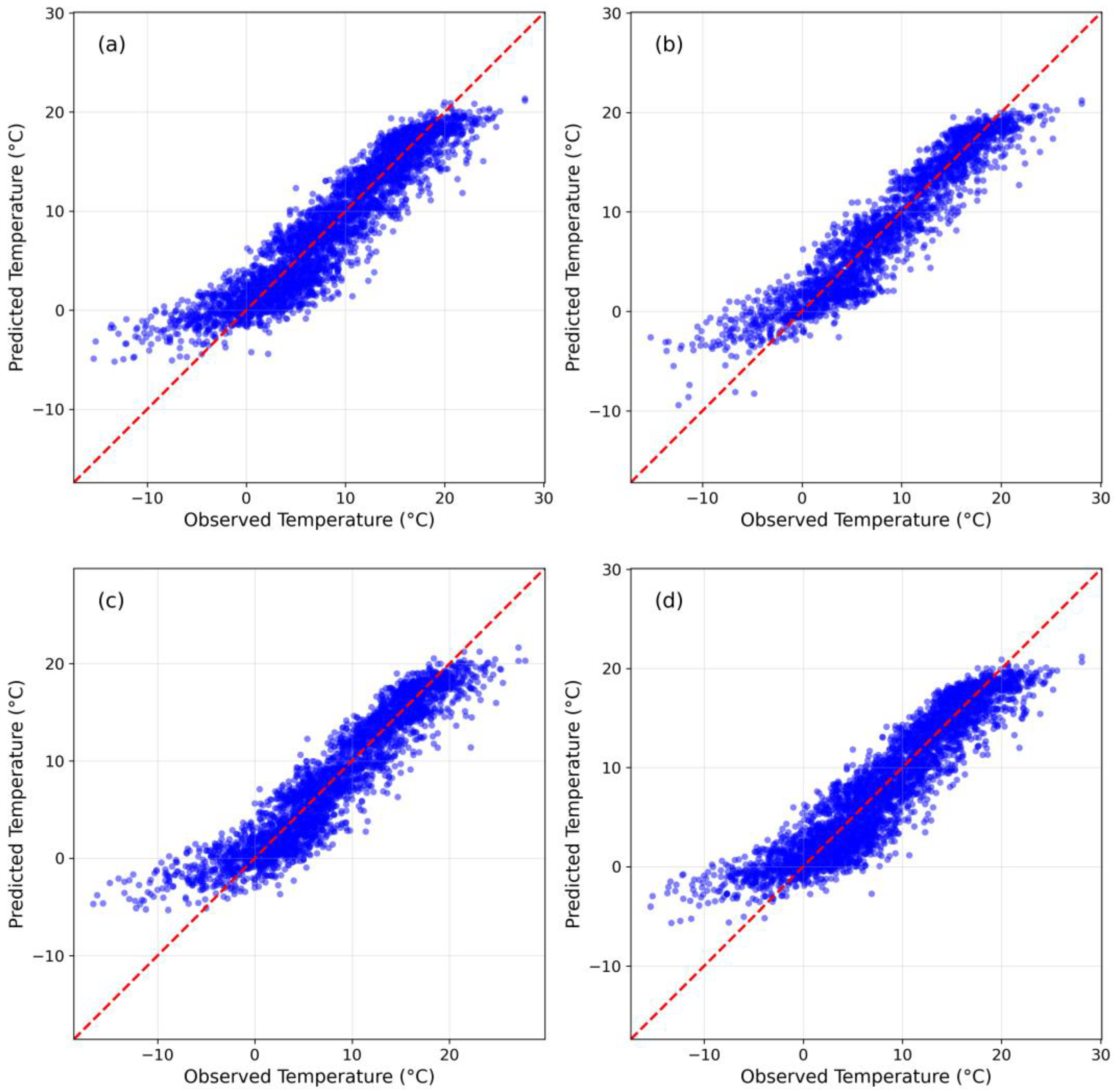
Figure 2 presents scatter plots that compare observed and predicted air temperatures (°C) for four coastal locations in Poland: Hel (a), Kołobrzeg (b), Łeba (c), and Władysławowo (d). Across all four locations, a strong positive correlation is evident, suggesting that the prediction model performs well in replicating observed air temperatures. However, some dispersion is noticeable at the temperature extremes. Specifically, at lower temperatures (below 0 °C), the predicted values tend to slightly underestimate the observations, while at higher temperatures (above 20 °C), a slight overestimation is observed, particularly in Kołobrzeg and Władysławowo. This systematic deviation at the tails suggests potential non-linearity or bias in the model’s response under extreme conditions.
Hel (Figure 2a) shows the tightest clustering, implying relatively higher predictive precision compared to the other sites. In contrast, Kołobrzeg (Figure 2b) displays a broader scatter, particularly for colder temperatures, which may reflect localized variability or differences in microclimatic influences that are not fully captured by the model. Łeba (Figure 2c) also shows strong agreement but with slightly more dispersion in the mid-to-upper temperature range. Władysławowo (Figure 2d) follows a similar trend, though with a marginally higher spread, indicating slightly less accurate predictions, potentially due to site-specific factors such as coastal influences or land–sea interactions.
During the calibration phase, the air2water model achieved RMSE values ranging from 0.99 to 1.56 °C, MAE values from 0.74 to 1.17 °C, and R2 values from 0.936 to 0.975. During the validation phase, RMSE ranged from 0.92 to 1.80 °C, MAE from 0.69 to 1.35 °C, and R2 from 0.913 to 0.987. Considering individual hydrological stations, the lowest average RMSE and MAE during both calibration and validation were obtained for the Hel station: RMSE of 1.01 °C and MAE of 0.75 °C during calibration, and RMSE of 1.29 °C and MAE of 0.79 °C during validation. The highest errors were observed for the Łeba station, with RMSE of 1.51 °C and 1.54 °C, and MAE of 1.13 °C and 1.18 °C for calibration and validation, respectively. The highest R2 values were recorded for the Hel hydrological station, 0.974 during calibration and 0.973 during validation, while the lowest were for the Kołobrzeg station, with 0.942 during calibration and 0.945 during validation. The average RMSE, MAE, and R2 values obtained during calibration using data subsets were close to those obtained when using the entire available historical datasets. For individual hydrological stations, these values ranged from RMSE 1.02 to 1.51 °C, MAE 0.75 to 1.14 °C, and R2 0.974 to 0.941 (Table 3).
Next, the parameter values obtained during calibration were compared across all hydrological stations. The smallest variability in parameters was observed for the Hel and Łeba stations, ranging from approximately 1% to 14%, while the highest variability was found for the Kołobrzeg and Władysławowo stations, ranging from 0% to 61%. The parameter values a1, a2, a3, a4, a5, and a6 obtained during calibration using the entire historical dataset differed by a maximum of 2% from the average values for partial periods at the Hel and Łeba stations and did not exceed 11% at the Władysławowo station. These results confirm the suitability of the air2water model for predicting water temperatures in the Baltic Sea (Table 4).
Finally, during the prediction of water temperatures in the Baltic Sea for the years 2021–2100, the parameters a1, a2, a3, a4, a5, and a6 obtained during the model calibration using the entire available historical data series were used. Daily water temperature data were generated based on these parameters, from which the annual mean values were calculated. Then, the Mann–Kendall and Sen’s tests were applied to determine the significance and magnitude of the trends. The obtained results are presented in Table 5.
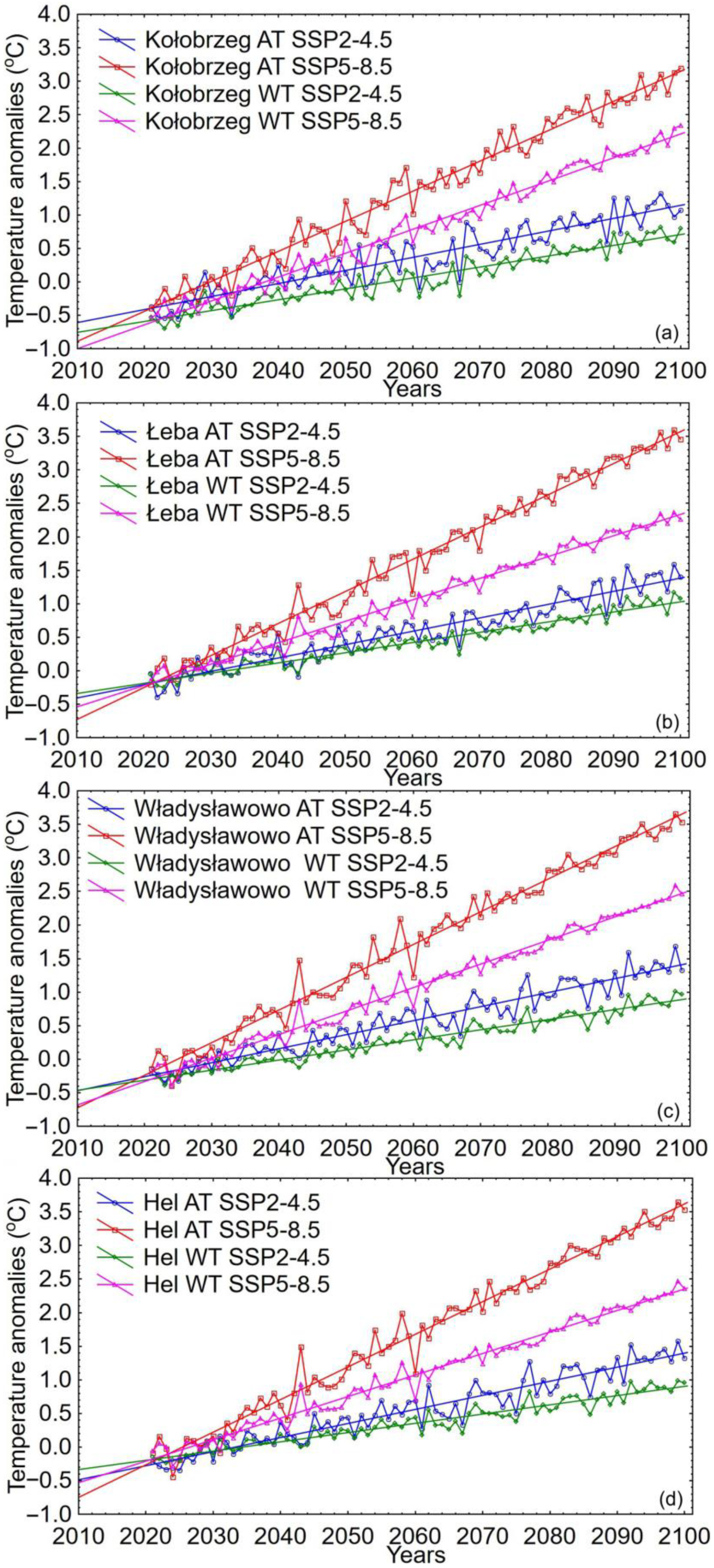
The trend analysis results show that between 2021 and 2100, there will be a significant increase in air temperatures (Figure 3), ranging from 0.20 to 0.21 °C per decade (an average of 0.20 °C per decade) for the SSP2-4.5 scenario, and from 0.45 to 0.49 °C per decade (an average of 0.47 °C per decade) for the SSP5-8.5 scenario. As a consequence of the rising air temperatures, the temperature of the Baltic Sea water will also increase. For the SSP2-4.5 scenario, Sen’s slope values for water temperature increase will range from 0.14 to 0.17 °C per decade (an average of 0.15 °C per decade). A higher increase in water temperature is expected under the SSP5-8.5 scenario, ranging from 0.32 to 0.36 °C per decade (an average of 0.33 °C per decade).

4. Discussion

Environmental elements in the coastal zone are subject to the influence of many factors [44], which clearly respond to global warming [45,46]. Future risks to coastal ecosystems from climate change will mirror those already observed and will increase with cumulative emissions [47]. The results obtained in this study provide an effective assessment of coastal zone SST projections based on a model requiring minimal input data. The adopted methodology successfully leverages the strengths of multi-model ensembles and hybrid downscaling techniques to create high-resolution, locally calibrated climate projections, as demonstrated for the southern Baltic Sea. The results are consistent with previous research showing that the ocean surface temperature is less variable and more predictable than the atmospheric temperature, due to thermal inertia [48]. The sea water temperature exhibits greater spatial and temporal coherence, owing to the ocean’s high heat capacity, which enables it to absorb and retain heat over extended periods. As a result, sea water responds more slowly and smoothly to short-term atmospheric fluctuations, resulting in a lower signal-to-noise ratio in observational and modeled datasets [49]. In contrast, air temperature is more sensitive to rapid changes in synoptic weather conditions, boundary layer dynamics, and surface heterogeneity, such as land cover and topography. These influences introduce high-frequency variability and local extremes that are difficult for models to capture accurately, especially at small spatial scales and during extreme events [50]. Additionally, the vertical structure of the atmosphere and interactions with surface processes—including evaporation, transpiration, and turbulent fluxes—further complicate near-surface air temperature modeling. Another important factor is that the sea water temperature is often derived from satellite-based SST products, which are spatially consistent and relatively free from terrestrial microclimate distortions. In contrast, air temperature measurements from weather stations may be more affected by local factors that are not represented in the model (e.g., proximity to vegetation, elevation differences, coastal breezes), leading to greater deviations and variability in the observed values used for calibration and validation [51].
The projected trends under future emission scenarios reveal a consistent warming trajectory across all locations. The divergence between emission scenarios becomes increasingly apparent from the 2040s, illustrating the cumulative impact of sustained high greenhouse gas emissions. This temporal divergence aligns with global studies showing significant differences in late-century climate conditions between high- and low-emission pathways [52,53]. The fact that all four sites exhibit similar trends in both air and sea temperatures further confirms the robustness of the model ensemble and underscores the consistency of regional climate dynamics in the southern coastal zone of the Baltic Sea.
The climate is changing at local and regional scales, with SST increasing in all ocean basins, though the rate varies [54]. The results obtained in the article align with previous regional projections for the Baltic Sea [55,56], which indicate intensified coastal warming due to shallow bathymetry and limited water exchange with the North Sea. On a broader spatial scale, the conducted studies confirm findings from other regions, where SST simulations indicate a several-degree increase [57,58,59,60,61,62]. It should be noted that SST projections depend on several assumptions, including resolution and the chosen reference period. Regarding the four analyzed stations, these assumptions are essentially uniform, and the observed differences in trend changes amount to 0.03 °C per decade (SSP2-4.5) and 0.04 °C per decade, respectively (SSP5-8.5).
Although the ocean mitigates anthropogenic climate change, it affects its fundamental physics and chemistry, which has significant consequences for ecosystems and humans [63]. Over the course of seven decades, the global sea surface temperature has increased by 0.11 °C, altering ocean stratification and circulation, reducing oxygen availability, raising sea levels, and intensifying hurricanes and storms [64]. Studies on coastal seas (Sweden) have shown that projected climate change by the end of the 21st century poses a threat equal to the combined current pressures on the marine environment [65]. Based on research on the same sea, Lehtonen et al. [66] state that due to climate change, changes in the bioavailability and toxicity of chemical substances are expected. In the case of the Baltic Sea, the effects of climate change may amplify anthropogenic impacts such as eutrophication and biodiversity stress [67]. Rising SST can stimulate the occurrence of algal blooms, as confirmed by significant positive correlations in the Baltic Sea [68]. Increasing anthropogenic influence and climate change create environmental stressors that cause changes in the biogeography and intensity of harmful algal blooms, with cyanobacteria and cyanotoxins being a major problem in brackish waters, especially in the Baltic Sea [69]. The southern coastal zone of the Baltic Sea is exposed to high biogen input from the Vistula and Oder river systems, as well as direct coastal catchments. Both river basins cover approximately 90% of Poland’s territory [70]. Based on regional analyses, Hong et al. [71] state that compliance with the Baltic Sea Action Plan (restoring good ecological status) would require major changes in the agricultural sector in selected countries. In Poland, many efforts have been made to reduce pollution linked, among others, to EU accession and the adoption of relevant regulations (e.g., the Nitrates Directive). In the longer term, efforts to improve water quality may be disrupted by rising SST, which by the end of the 21st century could be warmer by about 2.5 °C in the analyzed area. Such a situation will affect cyanobacterial blooms and limited oxygen dissolution, consequently reducing the water’s self-purification capacity [72,73,74,75,76]. Therefore, the projected increase in water temperature by the end of the 21st century, given its close and broad relationships with many components determining water quality, will impact many aspects of the functioning of the southern Baltic coastal zone. Areas along the Baltic Sea are among the most attractive regions in Poland [77]. This fact makes them places of dynamic recreational and tourism infrastructure development. Maintaining tourist interest in this region in the future will depend on appropriate water quality, which will transform with warming. Beyond the economic aspect, the influence of rising SST on biotic conditions, altering the basic life functions of organisms, is important. The coastal zone, due to favorable environmental conditions, is characterized by the high habitat diversity and species richness of animals and plants living there [78]. Studies by Rutterford et al. [79] in the northeastern Atlantic indicate that temperature was a key factor influencing fish community structure throughout the region. These authors also note that the projected climate change will lead to changes in species’ communities, with the largest changes expected in areas experiencing greater warming. Jensen et al. [80], based on studies of two species—Salvelinus alpinus and Salmo trutta—indicate that water temperature can strongly influence marine spatial use. In the Baltic Sea, the greatest wealth lies in living natural resources, primarily fish, with key species including cod, herring, sprat, flatfish, and migratory fish such as salmon, eel, and sea trout [81]. According to the conducted research, the projected increase in water temperature will cause increased interspecies competition, thereby destabilizing the Baltic Sea’s trophic pyramid. As noted by Makwana and Patnaik [82], climate change poses persistent challenges, clearly affecting small-scale fishing communities that depend on ocean resources.
Another issue is the physical and chemical properties of water. An analysis of the salinity dynamics of the Baltic Sea [83] shows that in recent decades, there have been negative trends in this parameter on the surface, with a simultaneous increase in SST, roughly corresponding to air temperature trends. The simultaneous increase in water temperature and decrease in salinity has led to a reduction in surface water density along the Polish coast of the Baltic Sea [84]. In the case of the analyzed area, the progressive increase in water temperature will continue to change the existing salinity conditions in the long term. Similarly, water density, which is strongly dependent on its temperature, will also undergo a transformation. This, in turn, will affect its mixing, both vertically and horizontally, including its interaction with river inflows.
The above multifaceted issues concerning the role and impact of SST on the functioning of marine ecosystems are important in the context of ongoing climate change. The projected increase in water temperature in the coastal zone of the Baltic Sea should be taken into account both by the institutions that are responsible for environmental management and by those operating in the economic sector.
Moreover, it should be noted that during the application of the air2water model, a reference value of the deep-water temperature was assumed (Equation (8)). This assumption is justified under equilibrium climatic conditions. However, when the air2water model is used to predict changes in water temperature under a changing climate, the deep-water temperature may also evolve over time. Therefore, assuming a constant reference value of the deep-water temperature may represent one of the limitations of the air2water model and a source of uncertainty in long-term climate change projections. In addition, other limitations may be related to changes in river discharge intensity. Given that the analysis concerns the coastal zone, such changes may influence the thermal conditions.

5. Conclusions

Water temperature is one of the fundamental characteristics of marine ecosystems, where its distribution affects a range of parameters related to water quality, biotic conditions, and economic benefits. This study used the hybrid air2water model to forecast SST in the coastal zone of the sea. The methodology was designed to utilize a minimal range of input data while maintaining high-quality modeling results. Research conducted at four hydrological stations in the southern Baltic Sea zone demonstrates that these assumptions were met. This is confirmed, among others, by selected statistics, where RMSE values were 1.2 and 1.4 °C at the calibration and validation stages of the model, respectively. The air2water model was subsequently used to predict SST until the end of the 21st century, indicating a possible increase in water temperature at an average rate of 0.15 °C per decade (SSP2-4.5) and 0.33 °C per decade (under the SSP5-8.5 scenario). The fulfillment of these projected trends should be considered unfavorable, and this situation will require accounting for changes in the thermal regime that are affecting the functioning of the Baltic Sea. More broadly, this simple and effective method of predicting thermal characteristics could be applied in managing the coastal zones of seas, which are among the most diverse and dynamic ecosystems in marine environments.

Author Contributions

Conceptualization, M.P. and T.A.; methodology, T.A. and M.S.; software, T.A. and M.S.; validation, T.A. and M.S.; formal analysis, M.P., T.A. and M.S.; investigation, M.P., T.A. and M.S.; resources, M.P., T.A. and M.S.; data curation, M.P., T.A. and M.S.; writing—original draft preparation, M.P., T.A. and M.S.; writing—review and editing, M.P., T.A., M.S. and S.H.; visualization, T.A. and M.S.; supervision, M.P.; project administration, M.P.; funding acquisition, M.P. All authors have read and agreed to the published version of the manuscript.

Funding

This research received no external funding.

Institutional Review Board Statement

Not applicable.

Informed Consent Statement

Not applicable.

Data Availability Statement

Dataset available upon request from the authors.

Conflicts of Interest

The authors declare no conflicts of interest.

References

  1. Widjonarko, W.; Purnaweni, H.; Maryono, M. Spatio-Temporal pattern of coastal flooding due to microclimate change and mangrove deforestation in Semarang and Demak Coastal Area. In E3S Web of Conferences; EDP Sciences: Paris, France, 2025; Volume 605, p. 03012. [Google Scholar]
  2. Kim, Y.H.; Im, J.; Ha, H.K.; Choi, J.K.; Ha, S. Machine learning approaches to coastal water quality monitoring using GOCI satellite data. GISci. Remote Sens. 2014, 51, 158–174. [Google Scholar] [CrossRef]
  3. Thrush, S.F.; Hewitt, J.E.; Gladstone-Gallagher, R.V.; Savage, C.; Lundquist, C.; O’Meara, T.; Vieillard, A.; Hillman, J.R.; Mangan, S.; Douglas, E.J.; et al. Cumulative Stressors Reduce the Self-regulating Capacity of Coastal Ecosystems. Ecol. Appl. 2021, 31, e02223. [Google Scholar] [CrossRef] [PubMed]
  4. Cheng, Y.; Yan, H.; Yu, C.W.; Wang, J. The high-temporal and spatial resolution sea surface temperature brings new opportunities for sustainable development of the built environment in coastal cities. Indoor Built Environ. 2024, 33, 1165–1169. [Google Scholar] [CrossRef]
  5. Polonsky, A.B.; Kotolupova, A.A. Long-Term Variability of the Dissolved Oxygen Content and Water Temperatures in the Upper Layer of the Black Sea. Oceanology 2019, 59, 17–26. [Google Scholar] [CrossRef]
  6. Selyuzhenok, V.; Bashmachnikov, I.; Ricker, R.; Vesman, A.; Bobylev, L. Sea ice volume variability and water temperature in the Greenland Sea. Cryosphere 2020, 14, 477–495. [Google Scholar] [CrossRef]
  7. Mehra, P.; Prabhudesai, R.G.; Joseph, A.; Kumar, V.; Agarvadekar, Y.; Luis, R.; Viegas, B. A study of meteorologically and seismically induced water level and water temperature oscillations in an estuary located on the west coast of India (Arabian Sea). Nat. Hazards Earth Syst. Sci. 2012, 12, 1607–1620. [Google Scholar] [CrossRef]
  8. Manasrah, R.; Raheed, M.; Badran, M.I. Relationships between water temperature, nutrients and dissolved oxygen in the northern Gulf of Aqaba, Red Sea. Oceanologia 2006, 48, 237–253. [Google Scholar]
  9. Chen, Q.; Chen, P. Changes in the heavy metals and petroleum hydrocarbon contents in seawater and surface sediment in the year following artificial reef construction in the Pearl River Estuary, China. Environ. Sci. Pollut. Res. 2020, 27, 6009–6021. [Google Scholar] [CrossRef]
  10. Faxneld, S.; Jorgensen, T.L.; Tedengren, M. Effects of elevated water temperature, reduced salinity and nutrient enrichment on the metabolism of the coral Turbinaria mesenterina. Estuar. Coast. Shelf Sci. 2010, 88, 482–487. [Google Scholar] [CrossRef]
  11. Cavraro, F.; Anelli Monti, M.; Matić-Skoko, S.; Caccin, A.; Pranovi, F. Vulnerability of the Small-Scale Fishery to Climate Changes in the Northern-Central Adriatic Sea (Mediterranean Sea). Fishes 2023, 8, 9. [Google Scholar] [CrossRef]
  12. Khan, T.M.; Quadir, D.A.; Murty, T.S.; Sarker, M.A. Seasonal and interannual sea surface temperature variability in the coastal cities of Arabian Sea and Bay of Bengal. Nat. Hazards 2004, 31, 549–560. [Google Scholar] [CrossRef]
  13. Silion, A.; Rusu, L. A Review Concerning the Offshore Wind and Wave Energy Potential in the Black Sea. J. Mar. Sci. Eng. 2025, 13, 1643. [Google Scholar] [CrossRef]
  14. Duy, V.V.; Ouillon, S.; Minh, H.N. Sea surface temperature trend analysis by Mann-Kendall test and sen’s slope estimator: A study of the Hai Phong coastal area (Vietnam) for the period 1995–2020. Vietnam J. Earth Sci. 2022, 44, 73–91. [Google Scholar]
  15. Nixon, S.W.; Granger, S.; Buckley, B.; Lamont, M.; Rowell, B. A one hundred and seventeen year coastal water temperature record from Woods Hole, Massachusetts. Estuaries 2004, 27, 397–404. [Google Scholar] [CrossRef]
  16. Khalil, I.; Atkinson, P.M.; Challenor, P. Looking back and looking forwards: Historical and future trends in sea surface temperature (SST) in the Indo-Pacific region from 1982 to 2100. Int. J. Appl. Earth Obs. Geoinf. 2016, 45, 14–26. [Google Scholar] [CrossRef]
  17. Palmer, S.C.; Barillé, L.; Kay, S.; Ciavatta, S.; Buck, B.; Gernez, P. Pacifc oyster (Crassostrea gigas) growth modelling and indicators for ofshore aquaculture in Europe under climate change uncertainty. Aquaculture 2021, 532, 736116. [Google Scholar] [CrossRef]
  18. Farkhani, S.; Zaker, N.H. The effects of climate change on the thermal stratification of the Gulf of Oman. Dyn. Atmos. Ocean. 2025, 110, 101560. [Google Scholar] [CrossRef]
  19. Eilertsen, H.C.; Skarðhamar, J. Temperatures of north Norwegian fords and coastal waters: Variability, signifcance of local processes and air–sea heat exchange. Estuar. Coast. Shelf Sci. 2006, 67, 530–538. [Google Scholar] [CrossRef]
  20. Varela, R.; De Castro, M.; Dias, J.M.; Gómez-Gesteira, M. Coastal warming under climate change: Global, faster and heterogeneous. Sci. Total Environ. 2023, 886, 164029. [Google Scholar] [CrossRef]
  21. Olin, M.; Heikinheimo, O.; Lehtonen, T.K.; Raitaniemi, J. Longterm monitoring of pikeperch (Sander lucioperca) populations under increasing temperatures. Ecol. Freshw. Fish 2023, 32, 750–764. [Google Scholar] [CrossRef]
  22. Asmala, E.; Carstensen, J.; Conley, D.J.; Slomp, C.P.; Stadmark, J.; Voss, M. Efficiency of the coastal filter; Nitrogen and phosphorus removal in the Baltic Sea. Limnol. Oceanogr. 2017, 62, 222–238. [Google Scholar] [CrossRef]
  23. Dutheil, C.; Meier, H.E.M.; Gröger, M.; Börgel, F. Warming of Baltic Sea Water Masses since 1850. Clim. Dyn. 2023, 61, 1311–1331. [Google Scholar] [CrossRef]
  24. Kowalewska-Kalkowska, H. Wpływ warunków cyrkulacyjnych na zmienność temperatury wody u południowych wybrzeży Zatoki Pomorskiej. Czas. Zesz. Naukowe Mar. Sci./Uniw. Szczeciński 2000, 6, 19–38. [Google Scholar]
  25. Girjatowicz, J.P. Wpływ Oscylacji Północnoatlantyckiej na temperaturę wody polskiego wybrzeża Bałtyku. Przegląd Geofiz. 2003, 1–2, 45–60. [Google Scholar]
  26. Świątek, M. Changes of the water temperature in polish seaside resorts. Balt. Coast. Zone 2016, 20, 85–99. [Google Scholar]
  27. Czuchaj, A.; Krawiec, A.; Wolny, F.; Wrzesiński, D.; Karpińska, S.; Świątek, S. Cyrkulacyjne Uwarunkowania Nagłych Spadków Temperatury Wody Morskiej Napolskim Wybrzeżu Bałtyku; Bogucki Wydawnictwo Naukowe: Posen, Poland, 2020. [Google Scholar]
  28. Neumann, T.; Friedland, R. Climate Change Impacts on the Baltic Sea. In Global Change and Baltic Coastal Zones; Schernewski, G., Hofstede, J., Neumann, T., Eds.; Springer: Dordrecht, The Netherlands; New York, NY, USA, 2011. [Google Scholar]
  29. Zhu, S.; Luo, Y.; Ptak, M.; Sojka, M.; Ji, Q.; Choiński, A.; Kuang, M. A hybrid model for the forecasting of sea surface water temperature using the information of air temperature: A case study of the Baltic Sea. All Earth 2022, 34, 27–38. [Google Scholar] [CrossRef]
  30. Wang, Y.; Cai, H.; Yan, Y.; Wang, B.; Pan, H.; Zhang, P.; Li, B.; Zhao, T. Regime shifts in the thermal dynamics of offshore China due to accelerated global Warming. Sci. Total Environ. 2024, 949, 174882. [Google Scholar] [CrossRef]
  31. Carvalho, D.; Cardoso Pereira, S.; Rocha, A. Future Surface Temperatures over Europe According to CMIP6 Climate Projections: An Analysis with Original and Bias-Corrected Data. Clim. Chang. 2021, 167, 10. [Google Scholar] [CrossRef]
  32. Raftery, A.E.; Gneiting, T.; Balabdaoui, F.; Polakowski, M. Using Bayesian Model Averaging to Calibrate Forecast Ensembles. Mon. Weather Rev. 2005, 133, 1155–1174. [Google Scholar] [CrossRef]
  33. Amnuaylojaroen, T. Advancements in Downscaling Global Climate Model Temperature Data in Southeast Asia: A Machine Learning Approach. Forecasting 2023, 6, 1–17. [Google Scholar] [CrossRef]
  34. Gudmundsson, L.; Bremnes, J.B.; Haugen, J.E.; Engen-Skaugen, T. Downscaling RCM precipitation to the station scale using statistical transformations—A comparison of methods. Hydrol. Earth Syst. Sci. 2012, 16, 3383–3390. [Google Scholar] [CrossRef]
  35. Maraun, D.; Wetterhall, F.; Ireson, A.M.; Chandler, R.E.; Kendon, E.J.; Widmann, M.; Brienen, S.; Rust, H.W.; Sauter, T.; Themeßl, M.; et al. Precipitation downscaling under climate change: Recent developments to bridge the gap between dynamical models and the end user. Rev. Geophys. 2010, 48, 3. [Google Scholar] [CrossRef]
  36. Rousseeuw, P.J.; Leroy, A.M. Robust Regression and Outlier Detection; John Wiley & Sons, Inc.: New York, NY, USA, 1987. [Google Scholar]
  37. Schär, C.; Vidale, P.L.; Lüthi, D.; Frei, C.; Häberli, C.; Liniger, M.A.; Appenzeller, C. The role of increasing temperature variability in European summer heatwaves. Nature 2004, 427, 332–336. [Google Scholar] [CrossRef] [PubMed]
  38. Friedman, J.H. Greedy function approximation: A gradient boosting machine. Ann. Stat. 2001, 29, 1189–1232. [Google Scholar] [CrossRef]
  39. Hastie, T. The Elements of Statistical Learning: Data Mining, Inference, and Prediction; Taylor and Francis: New York, NY, USA, 2009. [Google Scholar]
  40. Chen, T.; Guestrin, C. Xgboost: A scalable tree boosting system. In Proceedings of the 22nd ACM SIGKDD International Conference on Knowledge Discovery and Data Mining, San Francisco, CA, USA, 13–17 August 2016; pp. 785–794. [Google Scholar]
  41. Piccolroaz, S. Prediction of lake surface temperature using the air2water model: Guidelines, challenges, and future perspectives. Adv. Oceanogr. Limnol. 2016, 7, 36–50. [Google Scholar] [CrossRef]
  42. Patakamuri, S.K.; O’Brien, N. Modified Versions of Mann Kendall and Spearman’s Rho Trend Tests, version 1.6; R Foundation for Statistical Computing: Vienna, Austria, 2021. [Google Scholar]
  43. Pohlert, T. Trend: Non-Parametric Trend Tests and Change-Point Detection, R Package version 1.1.6; R Foundation for Statistical Computing: Vienna, Austria, 2023. [Google Scholar]
  44. Choiński, A.; Ptak, M.; Strzelczak, A. Present-day evolution of coastal lakes based on the example of Jamno and Bukowo (the Southern Baltic coast). Oceanol. Hydrobiol. Stud. 2014, 43, 178–184. [Google Scholar] [CrossRef]
  45. Ptak, M.; Choiński, A.; Kirviel, J. Long-term water temperature fluctuations in coastal rivers (Southern Baltic) in Poland. Bull. Geogr. Phys. Geogr. Ser. 2016, 11, 35–42. [Google Scholar] [CrossRef]
  46. Ptak, M.; Choiński, A. Ice phenomena in rivers of the coastal zone (Southern Baltic) in the years 1956–2015. Balt. Coast. Zone 2016, 20, 73–83. [Google Scholar]
  47. Schoeman, D.S.; Bolin, J.A.; Cooley, S.R. Quantifying the ecological consequences of climate change in coastal ecosystems. Camb. Prism. Coast. Futures 2023, 1, e39. [Google Scholar] [CrossRef]
  48. Giorgi, F. Regional Dynamical Downscaling. In Oxford Research Encyclopedia of Climate Science; Oxford University Press: Oxford, UK, 2020. [Google Scholar]
  49. Alexander, M.A.; Scott, J.D.; Friedland, K.D.; Mills, K.E.; Nye, J.A.; Pershing, A.J.; Thomas, A.C. Projected sea surface temperatures over the 21st century: Changes in the mean, variability and extremes for large marine ecosystem regions of Northern Oceans. Elem. Sci. Anthr. 2018, 6, 9. [Google Scholar] [CrossRef]
  50. Iyakaremye, V.; Zeng, G.; Siebert, A.; Yang, X. Contribution of external forcings to the observed trend in surface temperature over Africa during 1901–2014 and its future projection from CMIP6 simulations. Atmos. Res. 2021, 254, 105512. [Google Scholar] [CrossRef]
  51. Wilby, R.L.; Dawson, C.W.; Barrow, E.M. SDSM—A decision support tool for the assessment of regional climate change impacts. Environ. Model. Softw. 2002, 17, 145–157. [Google Scholar] [CrossRef]
  52. Hausfather, Z.; Peters, G.P. Emissions—The ‘business as usual’ story is misleading. Nature 2020, 577, 618–620. [Google Scholar] [CrossRef] [PubMed]
  53. Meinshausen, M.; Nicholls, Z.; Lewis, J.; Gidden, M.J.; Vogel, E.; Freund, M.; Beyerle, U.; Gessner, C.; Nauels, A.; Bauer, N.; et al. The SSP greenhouse gas concentrations and their extensions to 2500. Geosci. Model Dev. 2020, 13, 3571–3605. [Google Scholar] [CrossRef]
  54. Ratnarajah, L.; Abu-Alhaija, R.; Atkinson, A.; Batten, S.; Bax, N.J.; Bernard, K.S.; Canonico, G.; Cornils, A.; Everett, J.D.; Grigoratou, M.; et al. Monitoring and Modelling Marine Zooplankton in a Changing Climate. Nat. Commun. 2023, 14, 564. [Google Scholar] [CrossRef]
  55. Allin, A.; Schernewski, G.; Friedland, R.; Neumann, T.; Radtke, H. Climate change effects on denitrification and associated avoidance costs in three Baltic river basin-coastal sea systems. J. Coast. Conserv. 2017, 21, 561–569. [Google Scholar] [CrossRef]
  56. Meier, H.M. Baltic Sea climate in the late twenty-first century: A dynamical downscaling approach using two global models and two emission scenarios. Clim. Dyn. 2006, 27, 39–68. [Google Scholar] [CrossRef]
  57. Ruela, R.; Sousa, M.C.; de Castro, M.; Dias, J.M. Global and regional evolution of sea surface temperature under climate change. Glob. Planet. Chang. 2020, 190, 103190. [Google Scholar] [CrossRef]
  58. Jakimavičius, D.; Kriaučiūnienė, J.; Šarauskienė, D. Impact of climate change on the Curonian Lagoon water balance components, salinity and water temperature in the 21st century. Oceanologia 2018, 60, 378–389. [Google Scholar] [CrossRef]
  59. Yoshida, G.; Shimabukuro, H.; Kiyomoto, S.; Kadota, T.; Yoshimura, T.; Murase, N.; Noda, M.; Takenaka, S.; Kono, Y.; Tamura, T.; et al. Assessment and future prediction of climate change impacts on the macroalgal bed ecosystem and cultivation in the Seto Inland Sea. Bull. Jpn. Fish. Res. Educ. Agency 2019, 49, 27–34. [Google Scholar]
  60. Lewandowska, A.M.; Boyce, D.G.; Hofmann, M.; Matthiessen, B.; Sommer, U.; Worm, B. Effects of sea surface warming on marine plankton. Ecol. Lett. 2014, 17, 614–623. [Google Scholar] [CrossRef]
  61. Sakalli, A.; Başusta, N. Sea Surface Temperature Change in the Black Sea under Climate Change: A Simulation of the Sea Surface Temperature up to 2100. Int. J. Climatol. 2018, 38, 4687–4698. [Google Scholar] [CrossRef]
  62. Kim, B.-T.; Han, I.-S.; Lee, J.-S.; Kim, D.-H. Impact of seawater temperature on Korean aquaculture under representative concentration pathways (RCPs) scenarios. Aquaculture 2021, 542, 736893. [Google Scholar] [CrossRef]
  63. Gattuso, J.-P.; Magnan, A.K.; Billé, R.; Cheung, W.W.L.; Howes, E.L.; Joos, F.; Allemand, D.; Bopp, L.; Cooley, S.R.; Eakin, C.M.; et al. Contrasting futures for ocean and society from diferent anthropogenic CO2 emissions scenarios. Science 2015, 349, 4722. [Google Scholar] [CrossRef] [PubMed]
  64. Venegas, R.M.; Acevedo, J.; Treml, E.A. Three decades of ocean warming impacts on marine ecosystems: A review and perspective. Deep Sea Res. Part II Top. Stud. Oceanogr. 2023, 212, 105318. [Google Scholar] [CrossRef]
  65. Wåhlström, I.; Hammar, L.; Hume, D.; Pålsson, J.; Almroth-Rosell, E.; Dieterich, C.; Arneborg, L.; Gröger, M.; Mattsson, M.; Snowball, L.Z.; et al. Projected climate change impact on a coastal sea—As signifcant as all current pressures combined. Glob. Chang. Biol. 2022, 28, 5310–5319. [Google Scholar] [CrossRef]
  66. Lehtonen, K.K.; Bignert, A.; Bradshaw, C.; Broeg, K.; Schiedek, D. Chemical pollution and ecotoxicology. In Biological Oceanography of the Baltic Sea; Springer: Dordrecht, The Netherlands, 2017; pp. 547–587. [Google Scholar]
  67. Christensen, O.B.; Kjellström, E.; Dieterich, C.; Gröger, M.; Meier, H.E.M. Atmospheric regional climate projections for the Baltic Sea region until 2100. Earth Syst. Dyn. 2022, 13, 133–157. [Google Scholar] [CrossRef]
  68. Dai, Y.; Yang, S.; Zhao, D.; Hu, C.; Xu, W.; Anderson, D.M.; Li, Y.; Song, X.-P.; Boyce, D.G.; Gibson, L.; et al. Coastal Phytoplankton Blooms Expand and Intensify in the 21st Century. Nature 2023, 615, 280–284. [Google Scholar] [CrossRef]
  69. Karlson, B.; Andersen, P.; Arneborg, L.; Cembella, A.; Eikrem, W.; John, U.; West, J.J.; Klemm, K.; Kobos, J.; Lehtinen, S.; et al. Harmful Algal Blooms and Their Effects in Coastal Seas of Northern Europe. Harmful Algae 2021, 102, 101989. [Google Scholar] [CrossRef]
  70. Ptak, M.; Amnuaylojaroen, T.; Sojka, M. Rivers increasingly warmer—Prediction of changes in the thermal regime of rivers in Poland. J. Geogr. Sci. 2025, 35, 139–172. [Google Scholar] [CrossRef]
  71. Hong, B.; Swaney, D.P.; Mörth, C.M.; Smedberg, E.; Eriksson Hägg, H.; Humborg, C.; Howarth, R.W.; Bouraoui, F. Evaluating regional variation of net anthropogenic nitrogen and phosphorus inputs (NANI/NAPI), major drivers, nutrient retention pattern and management implications in the multinational areas of Baltic Sea basin. Ecol. Model. 2012, 227, 117–135. [Google Scholar] [CrossRef]
  72. Ptak, M.; Nowak, B. Warunki termiczno-tlenowe Jeziora Lucieńskiego (Centralna Polska). Acta Geogr. Silesiana 2016, 22, 59–64. [Google Scholar]
  73. Ptak, M.; Nowak, B. Warunki termiczno-tlenowe jeziora Białego Włodawskiego w półroczu letnim (2012–2015). Ann. Univ. Mariae Curie-Skłodowska Sect. B Geogr. Geol. Mineral. Petrogr. 2016, 71, 61–71. [Google Scholar] [CrossRef]
  74. Ptak, M.; Nowak, B. Thermal-oxygen conditions in lakes Roś and Rospuda Filipowska (North-Eastern Poland) in the summer half-year 2005–2014. Pol. J. Nat. Sci. 2017, 32, 351–363. [Google Scholar]
  75. Haddout, S.; Ptak, M.; Ljubenkov, I. Predicting dissolved oxygen dynamics in the Bouregreg Estuary (Morocco) using ANN and ANFIS: Role of estuarine mixing and environmental parameters. Mar. Geores. Geotechnol. 2026, 1–18. [Google Scholar] [CrossRef]
  76. Ptak, M.; Nowak, B. Variability of oxygen-thermal conditions in selected lakes in Poland. Ecol. Chem. Eng. S 2016, 23, 639–650. [Google Scholar] [CrossRef]
  77. Nędza, A.; Matlingiewicz, S. Ocena atrakcyjności turystycznej wybranych miejscowości nadmorskich w Polsce. Ann. Univ. Paedagog. Cracoviensis Stud. Geogr. 2022, 18, 155–170. [Google Scholar] [CrossRef]
  78. Brzana, R.; Tykarska, M.; Borecka, A.; Janas, U. Strefa przybrzeżna Morza Bałtyckiego jako filtr. Tutoring Gedanensis 2018, 3, 45–52. [Google Scholar]
  79. Rutterford, L.A.; Simpson, S.D.; Bogstad, B.; Devine, J.A.; Genner, M.J. Sea temperature is the primary driver of recent and predicted fish community structure across Northeast Atlantic shelf seas. Glob. Chang. Biol. 2023, 29, 2510–2521. [Google Scholar] [CrossRef]
  80. Jensen, J.L.A.; Rikardsen, A.H.; Thorstad, E.B.; Suhr, A.H.; Davidsen, J.G.; Primicerio, R. Water temperatures infuence the marine area use of Salvelinus alpinus and Salmo trutta. J. Fish Biol. 2014, 84, 1640–1653. [Google Scholar] [CrossRef]
  81. Grawiński, E.; Kozińska, A. Badania nad patologią ryb południowego Bałtyku–przegląd. Życie Weter. 2013, 88, 851–860. [Google Scholar]
  82. Makwana, M.; Patnaik, U. Vulnerability and adaptation to climate change: Experiences of Vagher communities in the Gulf of Kkutch, India. Marit. Stud. 2025, 24, 60. [Google Scholar] [CrossRef]
  83. Lehmann, A.; Myrberg, K.; Post, P.; Chubarenko, I.; Dailidiene, I.; Hinrichsen, H.-H.; Hüssy, K.; Liblik, T.; Meier, H.E.M.; Lips, U.; et al. Salinity dynamics of the Baltic Sea. Earth Syst. Dyn. 2022, 13, 373–392. [Google Scholar] [CrossRef]
  84. Świątek, M. Long-term variability of water temperature and salinity at the Polish coast. Bull. Geogr. Phys. Geogr. Ser. 2019, 16, 115–130. [Google Scholar] [CrossRef]
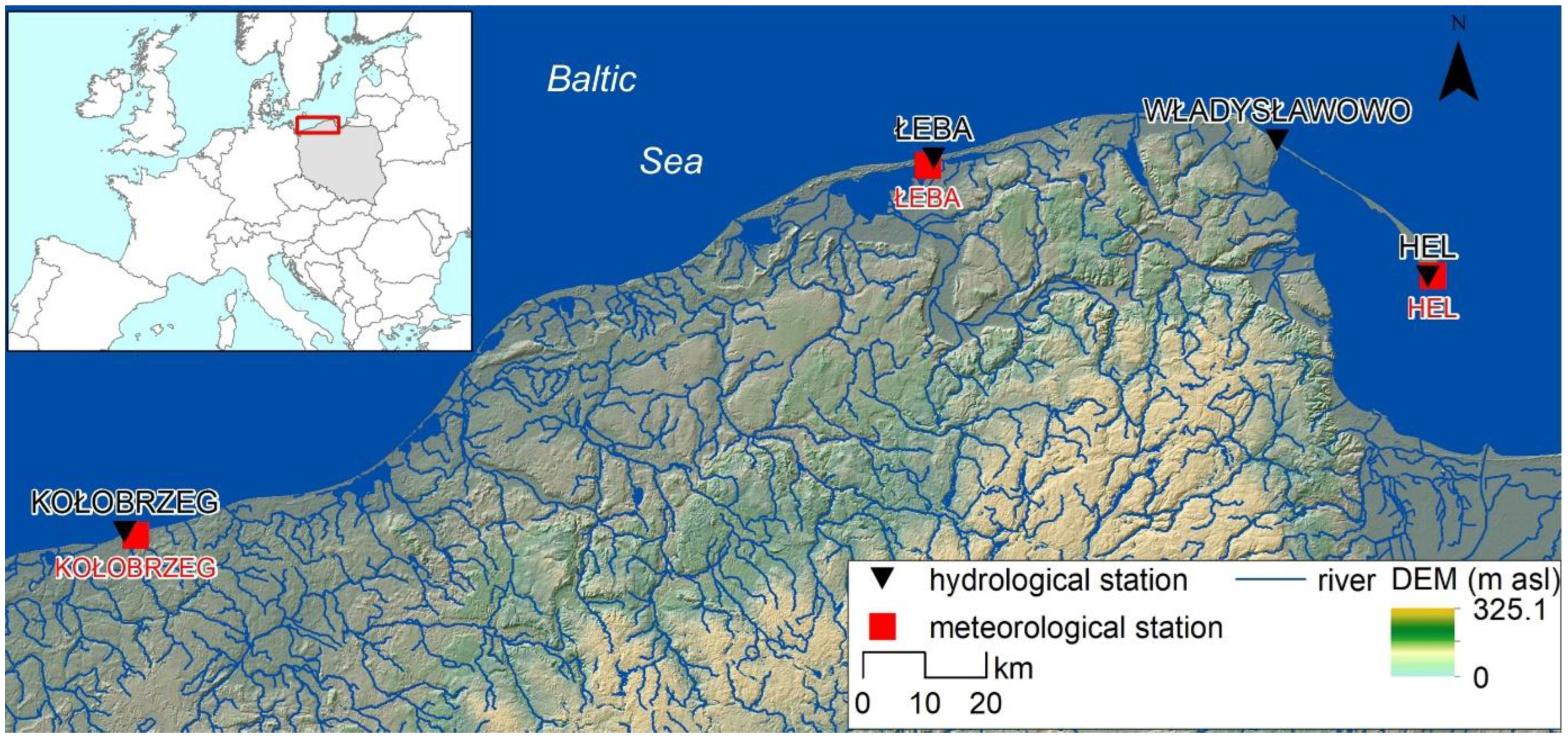
Figure 1. Location of study area.
Forecasting 08 00012 g001
Figure 2. Scatter plots comparing observed and predicted air temperatures (°C) for four locations in Poland: (a) Hel, (b) Kołobrzeg, (c) Łeba, and (d) Władysławowo.
Forecasting 08 00012 g002
Figure 3. Time series of air temperature (AT) and sea water temperature (WT) mean annual anomalies during the 21st century in stations (a) Kołobrzeg, (b) Łeba, (c) Władysławowo and (d) Hel for scenario SSP2-4.5 and scenario SSP5-8.5. Anomalies are relative to the reference period 2008–2020.
Forecasting 08 00012 g003
Table 2. Division of historical data series into calibration and validation series.
HelKołobrzegŁebaWładysławowo
CalibrationValidationCalibrationValidationCalibrationValidationCalibrationValidation
2004–2015
2020
2016–20192008–20172018–20202006–20162017–20202003–20162017–2020
2004–2011
2016–2020
2012–20152008–2014
2018–2020
2015–20172006–2012
2017–2020
2013–20162003–2011
2017–2020
2012–2016
2004–2007
2012–2020
2008–20112008–2011
2015–2020
2012–20142006–2008
2013–2020
2009–20122003–2006
2012–2020
2007–2011
2008–20202004–20072012–20202008–20112009–20202006–20082007–20202003–2006
2004–2020-2008–2020-2006–2020-2003–2020-
Table 3. RMSE, MAE, and R2 results obtained during air2water model calibration and validation.
PeriodCalibrationPeriodValidation
RMSEMAER2RMSEMAER2
Hel
2008–20201.030.760.9722004–20070.920.750.977
2004–20070.990.740.9752008–20111.490.820.97
2012–2020
2004–20111.010.740.9742012–20151.240.800.972
2004–201510.750.9752016–20191.50.800.971
2020
2004–20201.020.750.974-
Kołobrzeg
2008–20171.420.970.9432018–20201.621.300.931
2008–20141.380.970.9492015–20171.741.190.913
2018–2020
2008–20111.481.060.9382012–20141.370.940.949
2015–2020
2012–20201.481.070.9362008–20111.431.010.987
2008–20201.451.020.941-
Łeba
2006–20161.521.140.9512017–20201.541.220.959
2006–20121.411.060.9582013–20161.81.350.94
2017–2020
2006–20081.561.170.9482009–20121.391.050.96
2013–2020
2009–20201.531.160.9512006–20081.431.090.955
2006–20201.511.140.952-
Władysławowo
2003–20161.320.880.9542017–20201.180.930.971
2003–20111.200.810.9632012–20161.480.950.941
2017–2020
2003–20061.370.920.952007–20111.000.690.973
2012–2020
2007–20201.210.820.9612003–20061.530.950.944
2003–20201.280.850.957-
Table 4. Estimated air2water model parameters a1, a2, a3, a4, a5 and a6 obtained during model calibration.
Perioda1a2a3a4a5a6
(°C d-1)(d-1)(d-1)(°C)(°C d-1)(-)
Hel
2008–20200.3130.0430.0719.0190.2450.615
2004–20070.3000.0460.0729.5340.2360.618
2012–2020
2004–20110.2170.0410.05910.1490.1630.612
2004–20150.3220.0470.07710.4210.2620.622
2020
2004–20200.2920.0450.0719.8350.2310.618
Kołobrzeg
2008–20170.1390.0250.03917.4360.1150.524
2008–20140.0840.0270.03517.4360.0670.488
2018–2020
2008–20110.1000.0240.03417.4360.0810.512
2015–2020
2012–20200.0990.0220.03217.4360.0810.517
2008–20200.0980.0250.03517.4360.0800.508
Łeba
2006–20160.3770.0510.0866.2630.3680.533
2006–20120.3690.0510.0825.8410.3250.532
2017–2020
2006–20080.3530.0510.0826.6250.3320.532
2013–2020
2009–20200.3450.0510.0826.7170.3240.529
2006–20200.3570.0510.0836.3970.3330.531
Władysławowo
2003–20160.2880.0410.07117.4360.2400.566
2003–20110.1730.0400.05617.4360.1410.544
2017–2020
2003–20060.1780.0340.05217.4350.1460.535
2012–2020
2007–20200.1790.0400.05717.4360.1390.537
2003–20200.1860.0370.05617.4360.1500.542
Table 5. Results of the trend analysis of air temperature and sea water temperature in the Baltic Sea for the years 2021–2100 under the SSP2-4.5 and SSP5-8.5 scenarios.
StationSTauz-Valuep-ValueSen’s Slope
Air temperature
Hel SSP2-4.524910.80910.540.0000.21
Hel SSP5-8.528410.92212.020.0000.49
Kołobrzeg SSP2-4.523210.7539.820.0000.20
Kołobrzeg SSP5-8.527430.89011.610.0000.45
Łeba SSP2-4.524800.80510.490.0000.20
Łeba SSP5-8.528510.92512.060.0000.48
Władysławowo SSP2-4.525310.82110.710.0000.21
Władysławowo SSP5-8.528410.92212.020.0000.49
Water temperature
Hel SSP2-4.525690.83410.870.0000.14
Hel SSP5-8.528630.92912.120.0000.32
Kołobrzeg SSP2-4.524870.80710.520.0000.17
Kołobrzeg SSP5-8.528010.90911.850.0000.36
Łeba SSP2-4.526390.85711.170.0000.15
Łeba SSP5-8.528650.93012.120.0000.32
Władysławowo SSP2-4.526190.85011.080.0000.15
Władysławowo SSP5-8.528720.93212.150.0000.35
Disclaimer/Publisher’s Note: The statements, opinions and data contained in all publications are solely those of the individual author(s) and contributor(s) and not of MDPI and/or the editor(s). MDPI and/or the editor(s) disclaim responsibility for any injury to people or property resulting from any ideas, methods, instructions or products referred to in the content.