Article

Non-Negative Forecast Reconciliation: Optimal Methods and Operational Solutions

by
Daniele Girolimetto
Department of Statistical Sciences, University of Padova, 35121 Padova, Italy
Forecasting 2025, 7(4), 64; https://doi.org/10.3390/forecast7040064
Submission received: 10 October 2025 / Revised: 22 October 2025 / Accepted: 24 October 2025 / Published: 26 October 2025
(This article belongs to the Special Issue Feature Papers of Forecasting 2025)

Abstract

In many different applications such as retail, energy, and tourism, forecasts for a set of related time series must satisfy both linear and non-negativity constraints, as negative values are meaningless in practice. Standard regression-based reconciliation approaches achieve coherence with linear constraints, but may generate negative forecasts, reducing interpretability and usability. This paper develops and evaluates three alternative strategies for non-negative forecast reconciliation. First, reconciliation is formulated as a non-negative least squares problem and solved with the operator splitting quadratic program, allowing flexible inclusion of additional constraints. Second, we propose an iterative non-negative reconciliation with immutable forecasts, offering a practical optimization-based alternative. Third, we investigate a family of set-negative-to-zero heuristics that achieve efficiency and interpretability at minimal computational cost. Using the Australian Tourism Demand dataset, we compare these approaches in terms of forecast accuracy and computation time. The results show that non-negativity constraints consistently improve accuracy compared to base forecasts. Overall, set-negative-to-zero achieve near-optimal performance with negligible computation time, the block principal pivoting algorithm provides a good accuracy–efficiency compromise, and the operator splitting quadratic program offers flexibility for incorporating additional constraints in large-scale applications.

1. Introduction

Forecasting plays a central role in supporting decision-making across business, policy, healthcare and scientific domains [1]. In many applications, forecasts are required not only for individual time series but also for collections of related series that are connected through linear relationships. For example, forecasts of product demand must sum consistently across categories, forecasts of regional electricity consumption must aggregate to the national total, and forecasts of monthly tourism flows should align with quarterly or annual aggregates. In these contexts, base forecasts are typically produced, either independently for each series or through multivariate models, that focus only on improving forecast accuracy, without considering the underlying linear constraints among the series [2]. As a consequence, the base forecasts are generally incoherent, meaning that they do not satisfy the required linear constraints that link the different levels or components [3]. For this reason, a post-forecasting process—called forecast reconciliation [4]—aimed to adjust a set of incoherent “base” forecasts of a multivariate time series so that they satisfy the constraints, should be applied.
In hierarchical and grouped time series, two well-known and commonly used approaches [5] are bottom-up and top-down. In the bottom-up approach, forecasts are first generated for the most disaggregated series and then aggregated to produce predictions for higher-level series [6,7]. The top-down approach begins with forecasts at the fully aggregated level, which are subsequently allocated to the lower-level series using predetermined proportions [8,9,10]. It is worth noting that traditional reconciliation strategies fail to exploit all available information. Hyndman et al. [3] introduced an optimal reconciliation approach, using a regression model to optimally combine the base forecasts for all series so that the resulting forecasts are coherent.
Since its introduction, the linear regression reconciliation framework has been applied and developed in different contexts. Methodological contributions include the cross-sectional framework, where forecasts are linked through contemporaneous structures [11,12,13,14,15], the temporal framework, where the same variable is available for different frequencies [16,17], and the cross-temporal framework, which integrates both dimensions within a unified setting [18,19,20,21,22]. In addition, forecast reconciliation is applied in various disciplines: retail [23,24,25], energy [24,26,27,28,29,30,31], tourism [10,21,32,33] and economics [19,34], among others. Athanasopoulos et al. [4] provide a comprehensive review that synthesizes and organizes the expanding literature on forecast reconciliation.
Many forecasting applications involve variables that can only take non-negative values, such as sales revenues, product demand, or counts of individuals. In these contexts, it is essential that the reconciliation process preserves non-negativity, since negative forecasts lack practical meaning and may lead to wrong managerial decisions. To address this issue, Wickramasuriya et al. [13] reformulated reconciliation as a non-negative least squares (NNLS) problem [35], including non-negativity directly within the optimal reconciliation framework using the Block Principal Pivoting algorithm [36] and establishing formal properties, such as conditions for existence, uniqueness, and optimality of NNLS reconciliation. Although theoretically rigorous, this approach can be computationally demanding in large-scale applications [4,21].
Building on this theoretical foundation, we focus on a more applied perspective. Our objective is to examine and compare alternative procedures, both optimization-based and heuristic, for enforcing non-negativity in reconciled forecasts, with particular attention to computational feasibility and suitability for different frameworks (cross-sectional, temporal and cross-temporal). In addition, we focus on assessing the empirical performance of different approaches, highlighting the trade-offs between forecast accuracy, robustness, and computational efficiency.
Beyond optimization-based reconciliation, alternative heuristic procedures have also been proposed, designed to achieve non-negativity with reduced computational burden. Kourentzes and Athanasopoulos [37] proposed an iterative correction algorithm to eliminate negative reconciled forecasts in the context of intermittent demand series. Another heuristic, proposed by Di Fonzo and Girolimetto [20], is the set-negative-to-zero procedure, which replaces negative reconciled forecasts with zeros while preserving coherence through bottom-up. This strategy provides a useful baseline against which more elaborate procedures can be compared.
In this paper, we contribute to the development of non-negative forecast reconciliation methods by proposing and evaluating three distinct approaches. First, we formulate the reconciliation problem as a NNLS program, and solve it using the operator splitting quadratic program introduced by Stellato et al. [38]. This approach is flexible and allows the incorporation of additional types of constraints, such as immutable forecasts [39]. Second, we propose an iterative non-negative reconciliation procedure with immutable forecasts, offering an alternative optimization-based strategy inspired by the procedure of Kourentzes and Athanasopoulos [37]. Third, we investigate a family of heuristics, known as set-negative-to-zero, originally introduced by Di Fonzo and Girolimetto [20], which provide accurate reconciled forecasts at minimal computational cost. Finally, we evaluate these approaches in a large-scale empirical study using the Australian Tourism Demand dataset [12,13]. Our analysis highlights both forecasting accuracy and computational efficiency to achieve a balance between theoretical property and practical feasibility. In doing so, we provide methodological insights for researchers and practitioners facing the dual requirements of coherence and non-negativity in forecasting. All procedures examined in this study have been implemented in the R package FoReco [40].
The remainder of the paper is structured as follows. Section 2.1 reviews the general framework for forecast reconciliation. Section 3 introduces and develops the non-negative reconciliation procedures. Section 4 presents the empirical application and reports the results, focusing on accuracy and computational performance across methods. Finally, Section 5 provides the conclusion. The code and data for reproducing the results are available at https://github.com/danigiro/vn525nn, accessed on 23 October 2025.

2. Forecast Reconciliation

2.1. Zero-Constrained and Structural Representation

Let y t = [ y 1 , t , , y i , t , , y n , t ] be an n-variate linearly constrained time series observed at the most temporally disaggregated level, with a seasonality of period m (e.g., m = 12 for monthly data, m = 4 for quarterly data). The cross-sectional constraints [12,19] can be expressed as
C c s y t = 0 ( n a × 1 ) , t = 1 , , T
where C c s is an ( n a × n ) zero-constraints cross-sectional matrix. Following Girolimetto and Di Fonzo [41], y t can be organized into two sets of variables such that y t = [ u t b t ] , where the n a “constrained” series u t are linked to the n b “free” series b t through the cross-sectional linear combination matrix A c s via u t = A c s b t . In general, Girolimetto and Di Fonzo [41] show that C c s = I n a A c s . A different, equivalent way of expressing the constraints (1) is the structural representation
y t = S c s b t ,
where the cross-sectional structural matrix
S c s = A c s I n b ,
characterizes the entire system by representing y t as a linear combination of the free components b t .
When we are dealing with a genuine hierachical/grouped time series [3], this two sets are naturally formed by the upper- and the bottom-level time series, respectively. For example, in a simple two-level hierarchy where y T , t = y X , t + y Y , t , we have A c s = 1 1 , S c s = 1 1 1 0 0 1 , and C c s = 1 1 1 .
Looking to the temporal framework [16], let K = { k p , k p 1 , , k 2 , k 1 } be the set of p factors of m, in descending order, with k 1 = 1 and k p = m (e.g., for quarterly series, m = 4 , p = 3 , and K = { 4 , 2 , 1 } ). Then, x i , j [ k ] = t = ( j 1 ) k + 1 j k y i , t is the temporally aggregated value of the series i = 1 , . . . , n for a factor k at time j = 1 , . . . , T k . For a fixed temporal aggregation order k K , we stack the observations into a column vector x i , τ [ k ] and the complete vector for all temporal aggregation orders for a single series i is x i , τ = x i , τ [ k p ] x i , τ [ k p 1 ] x i , τ [ 1 ] . Given
A t e = 1 k p I m k p 1 1 k p 1 I m k 2 1 k 2 ,
we can construct the temporal structural matrix S t e = A t e I m , which relates x i , τ to the most disaggregated series x i , τ [ 1 ] through x i , τ = S t e x i , τ [ 1 ] , and the zero-constraints temporal matrix is C t e = I k * A t e , such that C t e x i , τ = 0 [ k * × ( m + k * ) ] , where k * = k K { 1 } m k is the number of upper time series in the temporal hierarchy [21].
To unify both frameworks, the series are stacked into an [ n × ( m + k * ) ] matrix X τ = x 1 , τ x n , τ for τ = 1 , , N where the rows represent cross-sectional, and columns temporal, dimensions. The cross-temporal zero-constrained representation for the complete set of observations x τ = vec ( X τ ) is given by C c t x τ = 0 [ ( n a m + n k * ) × 1 ] , where C c t = C * I n C t e is the full rank zero-constraints cross-temporal matrix with C * = 0 ( n a m × n k * ) I m C c s P [19], P is the commutation matrix [42] such that P vec ( X τ ) = vec ( X τ ) , and the operator vec ( · ) converts a matrix into a vector. Alternatively, the structural representation is x τ = S c t b τ [ 1 ] , where S c t = S c s S t e is the cross-temporal summation matrix, and b τ [ 1 ] = x 1 , τ [ 1 ] x n , τ [ 1 ] contains the most disaggregated ( k 1 = 1 ) constrained time series.
For the most aggregated forecast horizon h = 1 , , H , let X ^ h be the h-step-ahead base forecasts matrix where the rows represent cross-sectional, and columns temporal, dimensions. These base forecasts are generally incoherent, meaning C c t x ^ h 0 with x ^ h = vec ( X ^ h ) . Forecast reconciliation adjusts these base forecasts to obtain reconciled forecasts x ˜ h , which satisfy the linear constraints C c t x ˜ h = 0 . To summarise, X h represents the matrix of true coherent values, X ^ h are the matrix of incoherent base forecasts, and X ˜ h are the matrix of reconciled forecasts.

2.2. Regression-Based Reconciliation

In this section, we address regression-based reconciliation in a general setting, without reference to a specific cross-sectional, temporal, or cross-temporal framework. In addition, Table 1 summarizes the main symbols used throughout this section, along with their descriptions and the corresponding notation in the different forecasting frameworks: cross-sectional (cs), temporal (te), and cross-temporal (ct). The table provides a unified reference for the vectors of true values, base forecasts, reconciled forecasts, as well as the structural and constraint matrices. Dimensions and indexing conventions are also specified to clarify how the general notation maps to each specific framework.
Starting from a zero-constrained representation, the regression-based approach assumes that the base forecasts y ^ are related to the true (but unobserved) coherent forecasts y by a linear model [12,19,43]
x ^ = x + ε ,
where x ^ is an ( n * × 1 ) vector of base forecasts, x is an ( n * × 1 ) vector of target (true) forecasts, and ε is an ( n * × 1 ) vector of zero-mean errors with a known positive definite covariance matrix Ω = E [ ε ε ] . The target forecasts x must satisfy a system of linearly independent constraints:
C x = 0 ( n a * × 1 ) .
The reconciliation process involves finding reconciled forecasts x ˜ that are “as close as possible” to the base forecasts x ^ according to a pre-specified metric, while simultaneously satisfying the constraints. This is achieved by minimizing a linearly constrained generalized least squares (GLS) objective function:
x ˜ = arg min x x x ^ Ω 1 x x ^ s . t . C x = 0 ( n a * × 1 ) .
The closed-form solution [43,44] for the reconciled forecasts x ˜ is given by
x ˜ = x ^ Ω C C Ω C 1 C x ^ = M x ^ ,
where the reconciliation matrix M = I n * Ω C C Ω C 1 C is a projection matrix. This formula essentially adjusts the base forecasts x ^ by a linear combination of their coherency errors, C x ^ .
Equivalently, using the structural representation of a linear constrained time series [3,10,41], the reconciled forecasts can be derived through the linear model
x ^ = S β + ε ,
where x ^ is an ( n * × 1 ) vector of base forecasts, β is an ( n b * × 1 ) vector of free components’ target forecasts, and ε is an ( n * × 1 ) vector of zero-mean errors with a known positive definite covariance matrix Ω = E [ ε ε ] . Minimizing the GLS objective function
x ^ S β Ω 1 x ^ S β
results in β ˜ = S Ω 1 S 1 S Ω 1 x ^ , from which the whole reconciled vector can be computed as [3,19]
x ˜ = S β ˜ = S S Ω 1 S 1 S Ω 1 x ^ = S G ˜ x ^ ,
where G ˜ = S Ω 1 S 1 S Ω 1 and M = S G ˜ . If the base forecasts x ^ are unbiased, the reconciled forecasts x ˜ are also unbiased and achieve minimum variance, since the weight matrix  G ˜ minimizes the trace of the reconciled forecasts’ covariance matrix (MinT, [12]):
G ˜ = arg min G tr S G Ω G S s . t . G S = I n b * ,
where tr ( · ) denotes the trace of a square matrix.
In practice, the covariance matrix Ω is generally unknown and its accurate estimation is crucial for effective reconciliation. For the cross-sectional case, several approximations are commonly used. Simple choices include the identity matrix [3], assuming uncorrelated errors with equal variance, and the variance scaling [11], which accounts for heterogeneous error variances but still overlooks correlations. Moreover a shrinkage covariance [12] combining a structured target with the sample covariance can capture the full error dependence and obtain a robust, non-singular estimator. For the temporal case,
For the temporal case, modelling error dependencies across forecast horizons is still an important issue [21]. Simple approaches assume independence or constant variance over time [16], while others methods estimate autocovariances from forecast residuals and impose some struture for different forecast horizons [17,45].
For the cross-temporal case, both cross-sectional and temporal dependencies must be captured at once, which greatly increases dimensionality. As the number of series and forecast horizons grows, the resulting covariance matrix can become extremely large, making direct estimation from limited data unstable or even infeasible. To overcome this, reconciliation methods [19,21] typically use structured forms, shrinkage, or dimension-reduction techniques that exploit the underlying hierarchy and temporal dependence to obtain tractable and reliable covariance estimates.

2.3. Iterative Cross-Temporal Reconciliation

The iterative cross-temporal reconciliation proposed by Di Fonzo and Girolimetto [19] provides a heuristic alternative to the cross-temporal optimal combination method. This method produces reconciled forecasts by alternating reconciliation steps along one dimension (either cross-sectional or temporal) in a cyclic fashion until convergence. In details, the iteration j 1 can be described as follows:
Step 1 
compute the temporally reconciled forecasts ( X ˜ te ( j ) ) for each variable i { 1 , , n } of X ˜ cs ( j 1 ) ;
Step 2 
compute the time-by-time cross-sectional reconciled forecasts ( X ˜ cs ( j ) ) for all the temporal aggregation levels of X ˜ te ( j ) .
These two steps are performed iteratively until a convergence criterion is met. Typically, convergence is achieved when the remaining discrepancies ( D te = C t e X ˜ cs ( j ) ) fall below a predefined positive tolerance value δ (e.g., δ = 10 6 ). The matrix X ˜ cs ( j ) from the final iteration contains the cross-temporal reconciled forecasts X ˜ . At j = 0 , the starting values are given by X ˜ cs ( 0 ) = X ^ (see Section 2.1).
Note that the temporal-then-cross-sectional sequence is presented here, but one may also begin with the cross-sectional step by inverting the order of Step 1 and Step 2. Note, however, that the final reconciled values may depend on the chosen order.
Other heuristic procedures have also been proposed, such as Kourentzes and Athanasopoulos [18] and Yagli et al. [46]. However, these are not discussed in detail here, as they fall outside the scope of this work. In particular, the KA heuristic relies on projection matrices, which are not available for most of the solutions presented in Section 3, while [46], whenever it achieves cross-temporally coherent results, can be considered as a special case of the iterative procedure described above [20].

3. Non-Negative Reconciliation

When applying a “free” reconciliation procedure (i.e., without imposing non-negativity), the resulting forecasts are not guaranteed to remain non-negative. Sometimes, this can be problematic in practice, since negative values are meaningless for variables such as demand, revenue, or counts, and can undermine both interpretability and credibility of the forecasts. A simple remedy is to replace negative reconciled values with zero [47,48]. However, this naive adjustment generally breaks the aggregation constraints, producing forecasts that are no longer coherent with the underlying hierarchical or temporal structure.
To overcome this issue, non-negativity constraints can be explicitly incorporated into the optimization formulations presented in Section 2.2. In particular, the projection (4) and the structural (7) problem can be re-formulated, respectively, as
x ˜ 0 = arg min x x x ^ Ω 1 x x ^ s . t . C x = 0 ( n a * × 1 ) , x 0 ,
and
β ˜ 0 = arg min β x ^ S β Ω 1 x ^ S β s . t . β 0 .
Both formulations refer to non-negative least squares (NNLS) problems [35,49], firstly studied in the context of forecast reconciliation by Wickramasuriya et al. [13].
Several algorithms have been proposed for solving NNLS problems. Wickramasuriya et al. [13] show that the Block Principal Pivoting ( b p v ) algorithm [36] achieves strong performance in terms of both solution accuracy and computational efficiency. This solver is available in the FoReco package [40], which also provides an alternative implementation based on the Operator Splitting Quadratic Program ( o s q p ) [38,50], a flexible framework that can incorporate additional types of constraints, such as immutable forecasts [39].
In addition to optimization-based solvers, we consider three heuristic approaches that combine ease of use, interpretability, and accuracy:
  • The Negative Forecasts Correction Algorithm (nfca), an iterative correction procedure proposed by Kourentzes and Athanasopoulos [37].
  • The iterative Non-Negative reconciliation with Immutable Constraints (nnic), where non-negativity is progressively enforced by treating corrected values as immutable in successive reconciliations [39,40].
  • The bottom-up and top-down variants of the Set-Negative-To-Zero (sntz) procedure [20], which are very simple, competitive in accuracy, and computationally faster compared to the more intensive nonlinear optimization methods.

3.1. Block Principal Pivoting (bpv)

Since Lawson and Hanson [35], a wide range of approaches for addressing non-negative least squares problems have been proposed. The idea behind the Block Principal Pivoting [36] is to transform an inequality-constrained least squares problem into a sequence of equality-constrained sub-problems. b p v incorporates a subset selection of variables to exchange and a backup rule to guarantee convergence in a finite number of iterations. Further details may be found in Wickramasuriya et al. [13].

3.2. Operator Splitting Quadratic Program (osqp)

The Operator Splitting Quadratic Program [38,50] solver is based on the Alternating Direction Method of Multipliers (ADMM) [51,52] and provides high-accuracy solutions by solving a quasi-definite linear system with a largely constant coefficient matrix across iterations. o s q p is highly robust, requiring neither positive definiteness of the objective function nor linear independence of the constraints. Further details may be found in Stellato et al. [38].

3.3. Negative Forecasts Correction Algorithm (nfca)

An alternative approach for ensuring non-negative reconciled forecasts is the Negative Forecasts Correction Algorithm [37]. Unlike optimization-based algorithms, that impose non-negativity constraints directly within the reconciliation problem, this method applies an iterative correction procedure. The central idea of the algorithm is straightforward: rather than discarding coherence by simply truncating negatives to zero, it progressively eliminates them while redistributing the necessary adjustments throughout the hierarchy. Formally, let x ˜ ( 0 ) denote the f r e e reconciled forecasts. At each iteration r 1 , a correction vector is constructed as follows. First, consider the ( n * × 1 ) vector δ ( r ) , with components
δ i ( r ) = x ˜ i ( r 1 ) if x ˜ i ( r 1 ) < 0 0 otherwise , i = 1 , , n * .
This auxiliary vector is linearly transformed into a coherent correction vector using the reconciliation matrix M : δ ˜ ( r ) = M δ ( r ) , and the reconciled forecasts are updated as x ˜ ( r ) = x ˜ ( r 1 ) + δ ˜ ( r ) . The procedure is repeated until all components of x ˜ ( r ) are non-negative, or until changes fall below a predefined tolerance.
It is worth noting that the nfca algorithm is not an exact solution to the non-negative least squares problem. Rather, it should be considered as a heuristic: it enforces non-negativity by repeated coherent corrections rather than by solving a constrained optimization problem. As a result, while it is simple to code and often works well in small systems where negatives are rare, it may encounter difficulties when applied to larger or more complex hierarchies. In such settings, the number of required iterations may increase substantially, and convergence is not guaranteed. Furthermore, when many forecasts turn negative at once, numerical stability may be an issue.

3.4. Iterative Non-Negative Reconciliation with Immutable Constraints (NNIC)

Building on [53], and inspired by the nfca heuristic [37], the iterative Non-Negative reconciliation with Immutable Constraints provides an effective procedure to enforce non-negativity in reconciled forecasts. This heuristic can be viewed as an analogue of the Block Principal Pivoting algorithm for non-negative least squares. Rather than solving the constrained optimization problem in a single step, n n i c adopts an iterative pivoting strategy: whenever a forecast is found to be negative, it is fixed at zero and incorporated into the set of immutable constraints, while the remaining elements are left free to adjust.
Formally, assume that the f r e e reconciled forecasts’ vector, x ˜ , has l ( 0 ) 1 negative entries. Denote x ˜ ( 0 ) = x ˜ , and let C ( 0 ) = C be the constraints matrix in expression (3). At each iteration r 1 , the constraint set is updated as
C ( r ) = C ( r 1 ) E ( r ) ,
where E ( r ) is an [ l ( r 1 ) × n * ] matrix whose rows are zero everywhere except for a single unit entry in the columns corresponding to the negative elements of x ˜ ( r 1 ) . The next iterate reconciled forecasts, x ˜ ( r ) , is obtained by applying the projection approach reconciliation formula (5) (or the structural formulation (8) following the immutable reconciliation framework of [39]) with the updated constraints matrix C ( r ) . The procedure terminates once all components are non-negative or a pre-specified iteration limit is reached.
Although effective in many applications, nnic has some limitations. Its iterative nature can become computationally demanding when a large number of negatives are present, and convergence is not theoretically guaranteed in all settings. Nonetheless, empirical evidence indicates that n n i c frequently coincides with the solutions obtained by exact NNLS solvers, while being considerably simpler to implement.

3.5. Set-Negative-to-Zero (sntz): Bottom-Up and Top-Down Variants

In this section, we consider a simple heuristic strategy without any computationally intensive numerical optimization. For simplicity, we focus on a cross-sectional hierarchy with upper- and bottom-level series, assuming that at least one bottom-level free-reconciled forecast is negative.
The original s n t z procedure ( s n t z b u ), as described by Di Fonzo and Girolimetto [20], operates by first setting any negative bottom-level (corresponding, in temporal and cross-temporal frameworks, to the high-frequency and high-frequency bottom-level series, respectively) free-reconciled forecasts to zero, and then reconstructing the full set of reconciled forecasts using a bottom-up aggregation. Then, the non-negative bottom-level forecasts are left unchanged, and the upper-level forecasts are adjusted to restore coherence. Consequently, the reconciled top-level forecast may differ from its free-reconciled counterpart. This bottom-focused approach seems appropriate when the forecaster has greater confidence in the bottom-level base forecasts, and prefers minimal adjustments at this level, accepting potential changes at the upper levels.
However, in several practical settings (i.e., intermittent time series), bottom-level forecasts are more difficult to forecast, while upper-level aggregates may be more stable and accurate. In such cases, it may be more appropriate to preserve the upper-level forecasts. Motivated by this consideration, we propose a top-down variant, denoted s n t z t d , to preserve the upper-level forecasts. In this approach, negative bottom-level forecasts are first replaced with zero, which typically creates a discrepancy between the adjusted bottom-level forecasts and the upper-level totals. So, this discrepancy is redistributed across the bottom-level series according to a set of distributional weights. Finally, the adjusted bottom-level forecasts are aggregated upward, ensuring that the hierarchy remains coherent and all series are non-negative, while the upper-level forecasts are left unchanged.
In summary, using s n t z b u means that the forecaster is confident on the bottom-level free-reconciled forecasts, that are touched as little as possible, and is willing to accept (hopefully small) changes in the forecasts at the upper levels of the hierarchy. On the other hand, s n t z t d should be preferred when the upper level (aggregated) series’ free-reconciled forecasts are deemed to be relatively more accurate than those (disaggregated) of the bottom level variables, and the practitioner would prefer to retain coherency and non-negativity without no further adjustment of the free-reconciled forecasts of the upper level variables in the hierarchy.
  • A numerical illustration
To illustrate the two variants, consider a simple hierarchy with one top-level variable a and three bottom-level components b 1 , b 2 , and b 3 , such that
a = b 1 + b 2 + b 3 .
Suppose the free-reconciled forecasts are a ˜ = 40 , b ˜ 1 = 35 , b ˜ 2 = 5 , and b ˜ 3 = 10 , which are coherent by construction. Under s n t z b u , the negative bottom-level forecast is set to zero, i.e., b ˜ 2 , 0 = 0 . The adjusted top-level forecast is then computed as a ˜ 0 = b ˜ 1 + b ˜ 3 = 45 , that is b ˜ 1 , 0 = b ˜ 1 = 35 and b ˜ 3 , 0 = b ˜ 3 = 10 .
  • General formulation of  sntz td
Let a ˜ > 0 denote the f r e e reconciled forecast of the top-level variable, and { b ˜ i } i = 1 , , n b the corresponding reconciled forecasts of n b bottom-level (in our example, n b = 3 ) series, such that a ˜ = i = 1 n b b ˜ i . Suppose that at least one b ˜ i is negative. Define the index sets
I + = { i : b ˜ i > 0 } , I = { i : b ˜ i 0 } ,
and compute the discrepancy
d = a ˜ i I + b ˜ i = i I b ˜ i .
As the set I is not empty, the discrepancy d is negative since a ˜ = i = 1 n b b ˜ i = i I + b ˜ i > 0 + i I b ˜ i < 0 . Let { w i } i = 1 n b be non-negative distribution coefficients satisfying w i = 0 for i I , w i > 0 for i I + , and i I + w i = 1 . We consider three alternative specifications of w i , i I + :
  • Proportional distribution, s n t z t d p : w i = b ˜ i j I + b ˜ j , i I +
  • Squared proportional distribution, s n t z t d s p : w i = b ˜ i 2 j I + b ˜ j 2 , i I + .
  • Variance-weighted distribution, s n t z t d v w : w i = σ ^ i 2 j I + σ ^ j 2 , i I + .
The choice of weights depends on the structure of the series and the desired trade-off between simplicity and robustness. When the series have comparable scale and uncertainty, the proportional variant ( s n t z t d p ) provides a transparent and balanced allocation of the discrepancy. Under sparsity, when many small or zero components are present, or when it is desirable to protect small positive forecasts from being reduced below zero, the squared-proportional variant ( s n t z t d s p ) is preferable, as it concentrates the adjustment on larger components. In the presence of heteroskedasticity or markedly unequal forecast uncertainty, the variance-weighted scheme ( s n t z t d v w ) is recommended, since it allocates larger reductions to noisier series while preserving more reliable ones.
Finally, according to the top-down set-negative-to-zero heuristic, we derive the non-negative reconciled forecasts as
a ˜ 0 = a ˜ , b ˜ i , 0 = 0 if i I b ˜ i + w i d if i I +
and, more generally, x ˜ 0 = S b ˜ 0 with, in this case, x ˜ 0 = a ˜ 0 b 0 and b ˜ 0 = b ˜ 1 , 0 b ˜ n b , 0 . By construction, the adjusted bottom-level forecasts are non-negative and coherent:
i = 1 n b b ˜ i , 0 = i I + b ˜ i , 0 + i I b ˜ i , 0 = i I + b ˜ i + i I + w i a ˜ i I + b ˜ i = a ˜ = a ˜ 0 .
where, by definition, i = 1 n b w i = i I + w i = 1 .
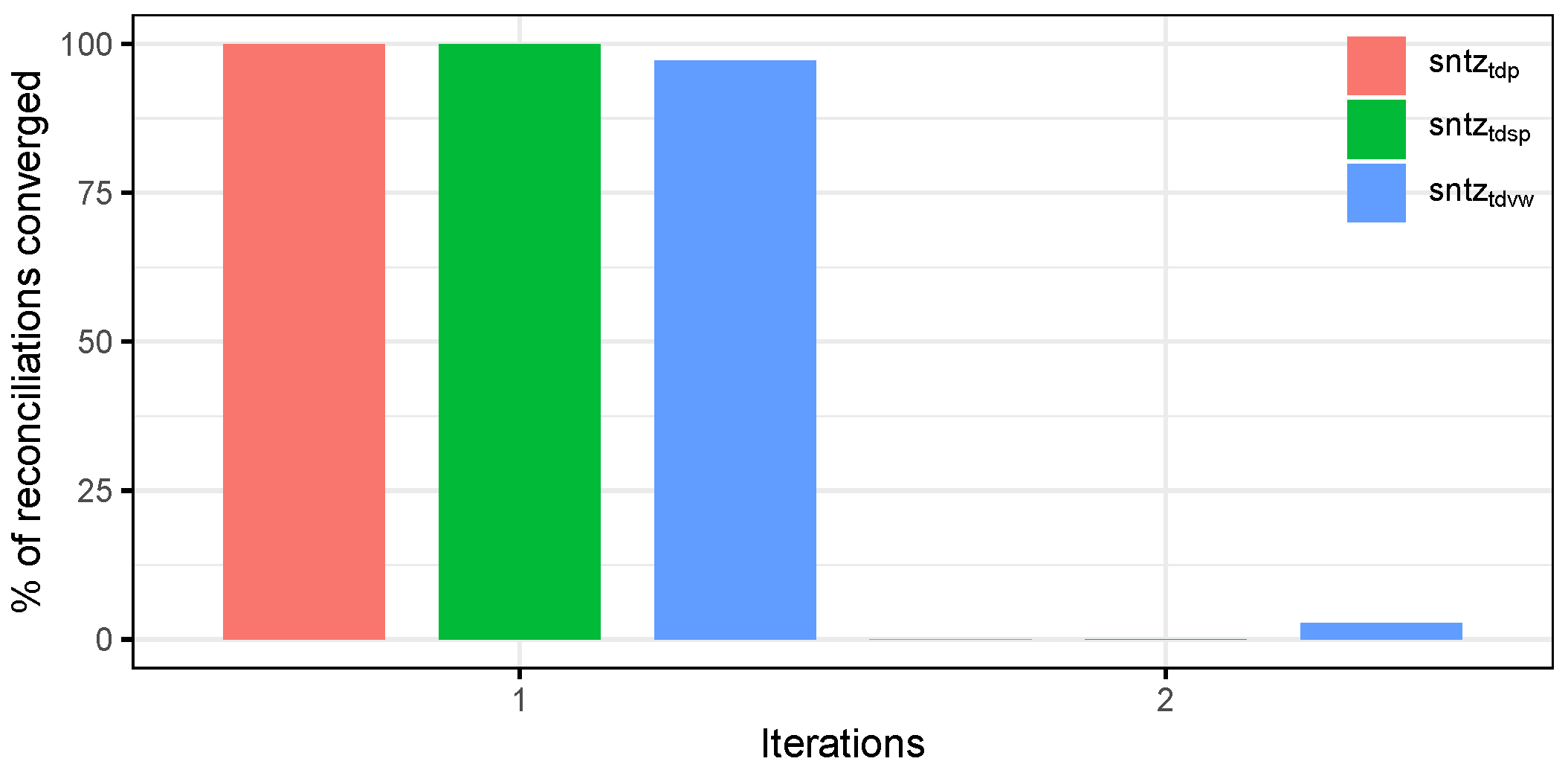
The proposed procedure always decreases the value of the positive freely reconciled forecasts b ˜ i , i I + . For some i it may happen that b ˜ i < | w i d | , which would result in a negative reconciled forecast b ˜ i , 0 . This issue may be easily overcome by iterating the procedure, setting to zero the negative forecasts generated in the previous step, and distributing the new discrepancy as shown before. In practice, this simple iteration converges in finitely many steps and guarantees non-negativity for all components. A negative value can reappear only when w i > b ˜ i / | d | , a situation that was empirically rare in our experiments, no case required more than two passes (see Figure 1).
In conclusion, Table 2 illustrates the application of these variants to the toy example above, assuming σ ^ 1 2 = 64 and σ ^ 3 2 = 16 . The table reports the f r e e reconciled forecasts and the corresponding non-negative reconciled values under s n t z b u , s n t z t d p , s n t z t d s p , and s n t z t d v w , respectively.

4. Australian Tourism Demand Dataset

The empirical analysis builds on the Australian tourism demand dataset originally studied in Wickramasuriya et al. [12,13], extending it to the context of cross-temporal forecast reconciliation under non-negativity constraints [21]. The dataset consists of monthly measures of tourist flows, expressed in visitor nights (VN), collected through the Australian Government’s National Visitor Survey. The data cover 228 monthly observations, from January 1998 to December 2016, capturing both arrivals and the number of nights spent in tourist facilities.
The dataset has a cross-sectional grouped structure, which arises from combining a geographic hierarchy with a classification by purpose of travel. The geographic hierarchy disaggregates the country into seven states, further subdivided into 27 zones and 76 regions, with 111 geographic divisions in total. However, six zones consist of only a single region (South Coast NSW, ACT NSW, West Coast VIC, North WA, South WA, South TAS), which leads to 105 non-redundant nodes rather than the theoretical 111. In this sense, the geographic hierarchy can be considered “unbalanced” [33] (see Figure 2, Table A1 in Appendix B and [21]).
In addition, tourism demand is disaggregated by purpose of travel (PoT) into four categories: holiday (Hol), visiting friends and relatives (Vis), business (Bus), and other (Oth). This classification generates 24 additional nodes (six single-region zones, each crossed with four PoT categories) that are duplications and therefore excluded. Accounting for these adjustments, we have a total of 525 non-redundant nodes [21,33], rather than the theoretical 555 [12,13]. Within this structure, the most disaggregated level (the “bottom” series) comprises 304 variables. These combine to produce 221 additional aggregate series, yielding 525 distinct time series overall (see Table 3). This update refines the structure originally presented in Table 7 of Wickramasuriya et al. [12].
From a temporal perspective, the dataset consists of monthly observations ( m = 12 ), which can be aggregated into 2-, 3-, 4-, 6-, and 12-monthly series, giving K = 1 , 2 , 3 , 4 , 6 , 12 .
An important feature of this dataset is that for a large number of time series at least one of the values observed is zero, as shown in Table 4. Approximately 46% (239 out of 525) of the monthly series contain at least one zero. This proportion decreases as the temporal aggregation order increases, but even among the annual series, 16 (around 3% of the total) contain at least one zero. At the regional level, 13 of the 76 monthly series also display at least one zero. In summary, Table 4 provides an overview of the sparsity pattern within the Australian Tourism Demand dataset, revealing the extent of zero-inflation across both temporal and hierarchical dimensions. Such information is crucial for interpreting the empirical results, as the presence of structural zeros introduces additional challenges for both model estimation and reconciliation. In particular, it highlights the practical relevance of enforcing non-negativity: when many series contain zeros or near-zero values, unconstrained reconciliation may easily generate negative forecasts, undermining interpretability and coherence. Consequently, this feature of the dataset further motivates the use of non-negative reconciliation procedures capable of handling sparse (or intermittent) time series effectively.

4.1. Forecasting Experiment

The forecasting experiment adopts a recursive evaluation design with an expanding training window. The initial training sample spans January 1998 to December 2008 (10 years, 120 months), and forecasts are generated for the subsequent year (2009). The training window is then progressively expanded by one month (e.g., January 1998–January 2009 to forecast February 2009–January 2010), continuing until the final training sample, January 1998–December 2015. This results in 85 distinct forecast origins and, correspondingly, 85 replications of the forecasting experiment.
Forecast horizons vary depending on the temporal aggregation level: up to six steps ahead for bimonthly series, four steps for quarterly, three for four-monthly, two for semiannual, and one for annual aggregates. Base forecasts are generated using ARIMA and ETS [54] models, estimated by minimizing the corrected Akaike Information Criterion (AICc). Both modeling approaches employ the default implementations of the R package forecast [55], following the procedures described in Hyndman and Khandakar [56]. In addition, models are fitted to log-transformed series, with forecasts back-transformed as in Wickramasuriya et al. [13].
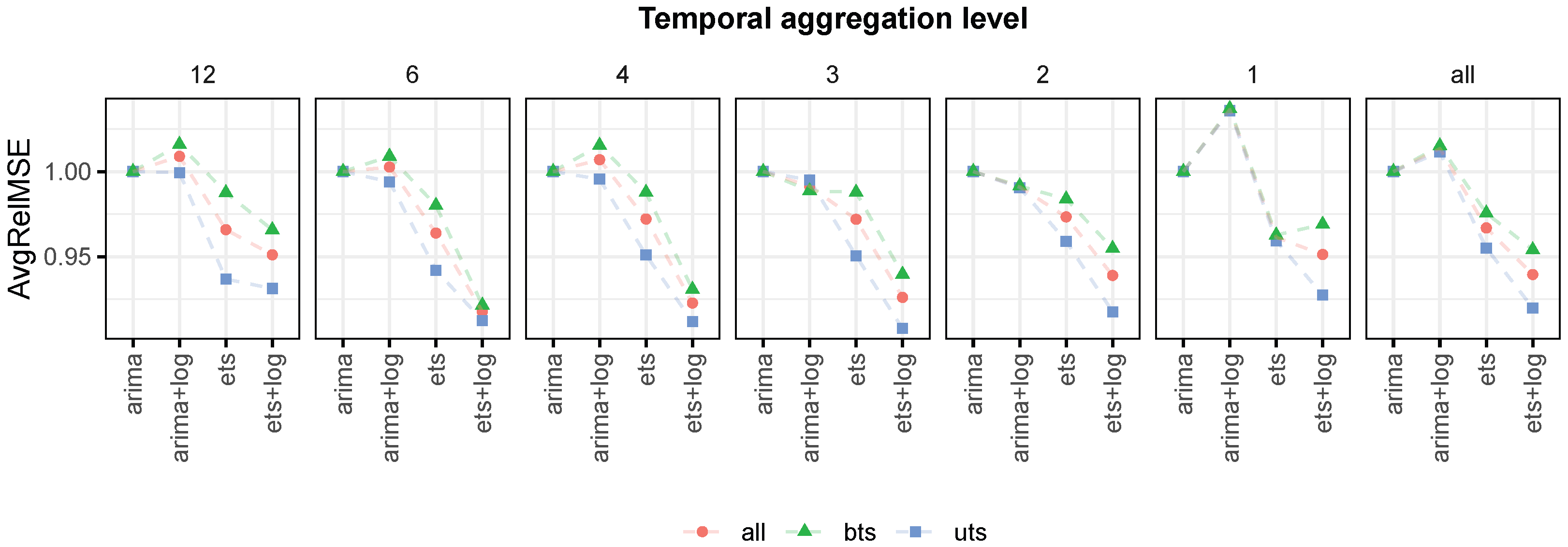
Among the four sets of base forecasts ( a r i m a , a r i m a + l o g , e t s , e t s + l o g ), only e t s + l o g forecasts were carried forward to reconciliation. This choice is justified by two considerations: first, e t s + l o g forecasts are guaranteed to be nonnegative; and second, they consistently achieve the lowest average relative mean squared error (AvgRelMSE; see Section 4.2) across most cases (see Figure A1 in Appendix B). Base forecasts were subsequently reconciled using the R package FoReco [40] with six different reconciliation procedures:
c s ( s h r )
   Optimal cross-sectional approach with shrinkage covariance matrix [12];
t e ( s t r )
    Optimal temporal approach with diagonal covariance matrix based on the temporal structural matrix S t e [16];
t e ( w l s v )
    Optimal temporal approach with diagonal covariance matrix based on in-sample residuals [16];
i t e ( w l s v , s h r )
  Iterative approach with temporal diagonal covariance matrix [16] and cross-sectional shrinkage covariance matrix [12];
c t ( s t r )
    Optimal cross-temporal approach with diagonal covariance matrix based on the temporal structural matrix S c t [16];
c t ( w l s v )
    Optimal cross-temporal approach with diagonal covariance matrix based on in-sample residuals [19];
c t ( b d s h r )
     Optimal cross-temporal approach with block-diagonal covariance matrix based on in-sample residuals [19].
The first three procedures generate reconciled forecasts that are coherent along only one dimension (either cross-sectional or temporal).

4.2. Performance Measures for Multiple Comparisons

Forecast accuracy is evaluated using mean squared error (MSE) and its relative counterpart. Let e ^ i , j , t [ k ] , h denote the forecast error for series i = 1 , , n , method j = 0 , , J , temporal aggregation level k K , forecast origin t = 1 , , q , and forecast horizon h = 1 , , h k :
e ^ i , j , t [ k ] , h = y i , t + h [ k ] y ^ i , j , t [ k ] , h .
The MSE is defined as the average of squared errors across forecast origins:
MSE i , j [ k ] , h = 1 q t = 1 q e ^ i , j , t [ k ] , h 2 .
Relative mean squared error (rMSE) compares each method j against a benchmark (method 0):
rMSE i , j [ k ] , h = MSE i , j [ k ] , h MSE i , 0 [ k ] , h .
The average relative MSE (AvgRelMSE) is then defined as the geometric mean of rMSE values across series, temporal aggregation levels, and horizons:
AvgRelMSE j = i = 1 n k K h = 1 h k rMSE i , j [ k ] , h 1 n | K | m .
This index can be reported for specific groups of variables, across multiple forecast horizons, and at different levels of temporal aggregation. To assess whether performance differences are statistically significant, we employ the non-parametric Friedman test and the post hoc Multiple Comparison with the Best (MCB) Nemenyi procedure [18,57,58,59].

4.3. Non-Negative Reconciled Forecasts

Although the e t s + l o g forecasts are nonnegative by construction, reconciliation does not guarantee that this property is preserved. Indeed, negative reconciled forecasts occur under all reconciliation techniques considered (see Table 5). To address this, we evaluate seven alternative strategies for producing nonnegative reconciled forecasts (Section 3): block principal pivoting ( b p v ) [13], operator splitting quadratic programming ( o s q p ) [38], the negative forecasts correction algorithm (nfca) [60], iterative nonnegative reconciliation with immutable constraints ( n n i c ), and four variants of the set-negative-to-zero heuristic, original bottom-up ( s n t z b u ) [20], top-down proportional ( s n t z t d p ), top-down squared proportional ( s n t z t d s p ), and top-down variance-weighted ( s n t z t d v w ).
In Section 4, we evaluate the performance of alternative procedures for reconciling forecasts that may produce negative values, focusing on two key dimensions of assessment: forecasting accuracy and computational efficiency. By comparing both optimization-based and heuristic approaches, we want to show that computationally lighter procedures can achieve performance comparable to, or even superior to, that of more demanding optimal procedures. In doing so, we provide implementation insights on how non-negativity constraints can be applied in a large-scale setting without compromising either coherence or accuracy.

4.4. Results

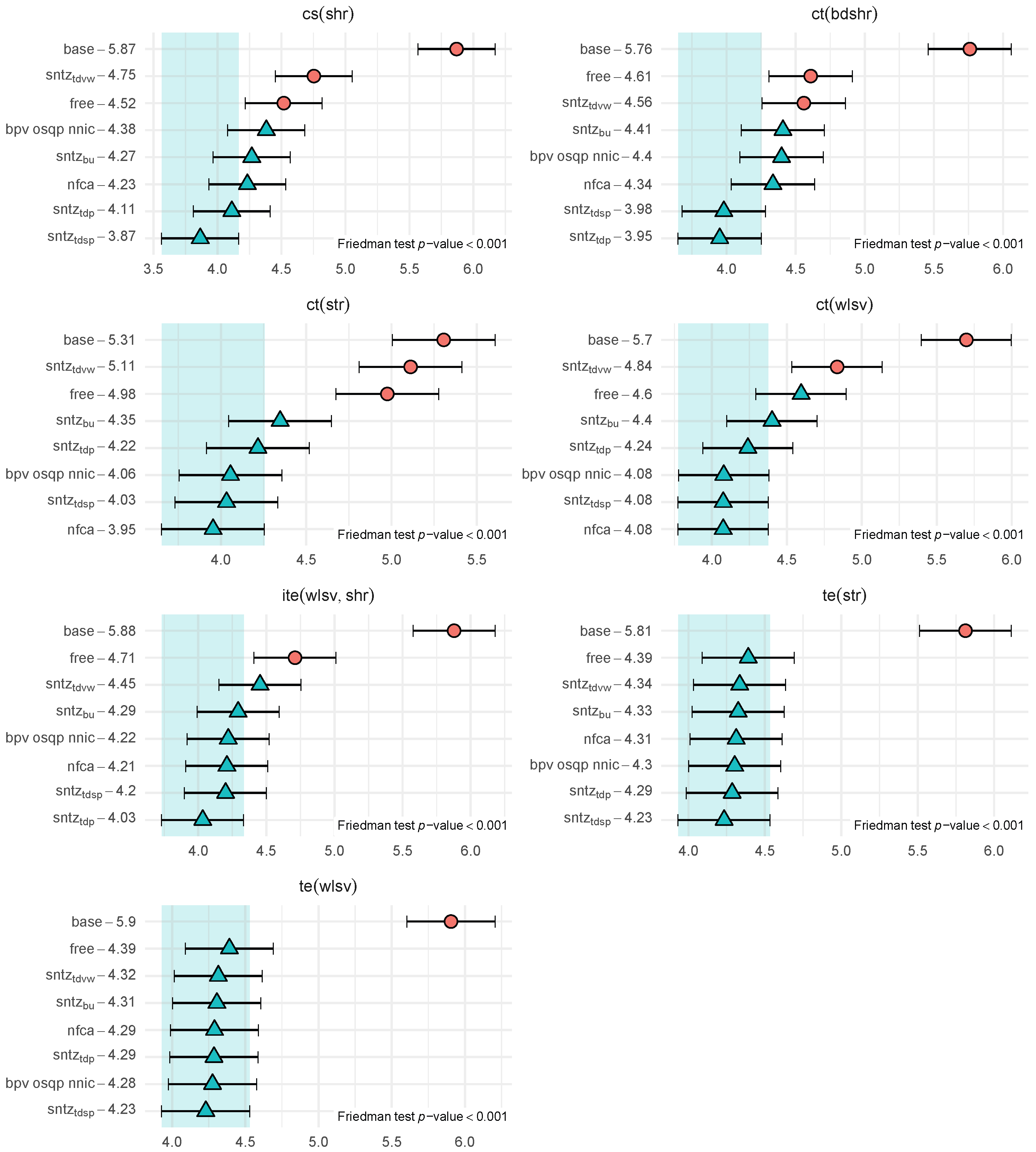
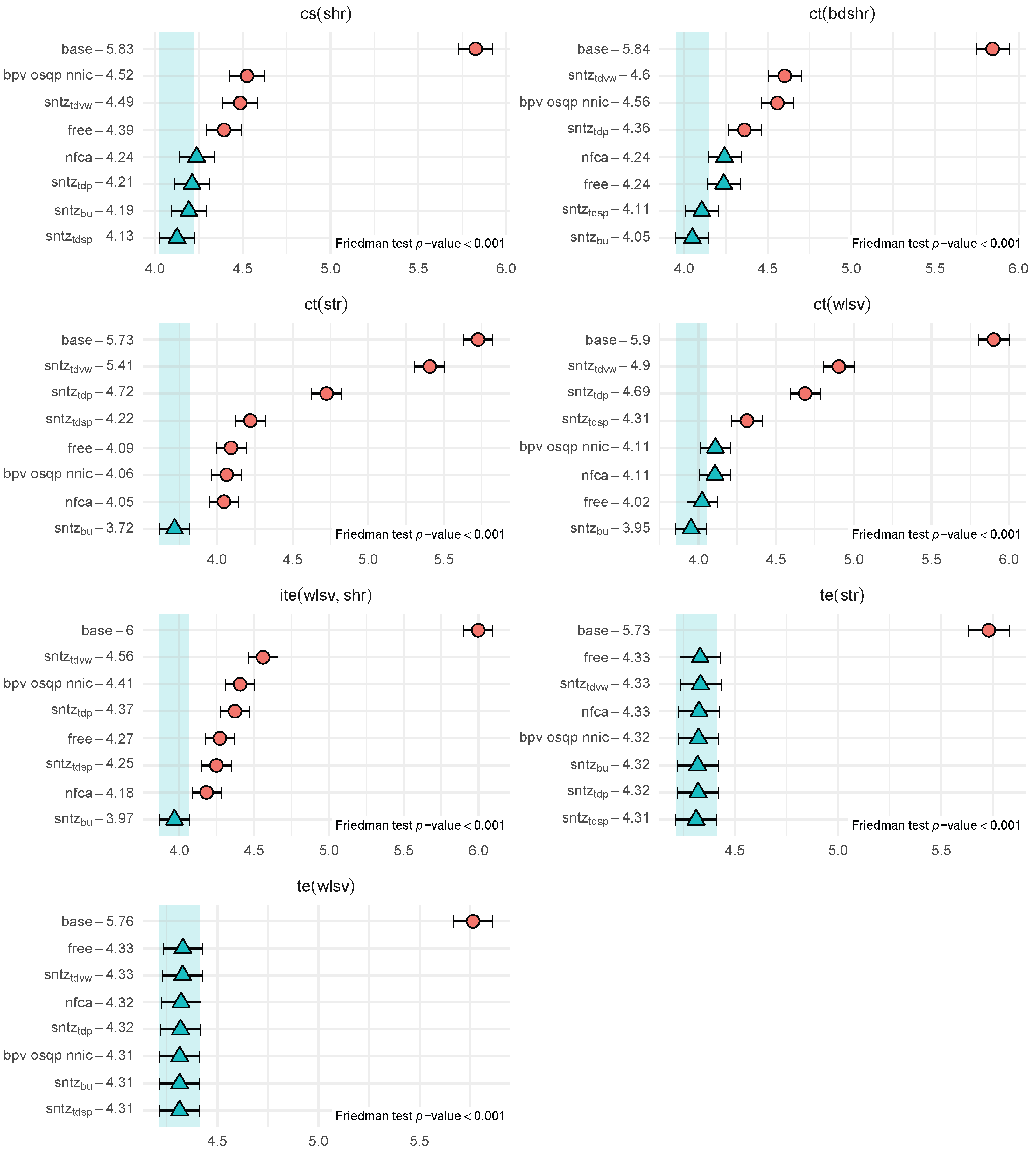
Table 6 summarizes the Average Relative MSE (AvgRelMSE) across temporal aggregation levels, reconciliation approaches, and non-negative procedure. Overall, the results indicate improvements in forecast performance for all series and temporal aggregation levels when using non-negative reconciliation strategies, compared to both the b a s e forecasts (all the AvgRelMSE values < 1 ) and the f r e e reconciliations. The Multiple Comparison with the Best (MCB) tests (Figure A2 and Figure A3 in Appendix B) show that all non-negative approaches consistently outperform the base forecasts, while improvements over f r e e reconciliation are not always statistically significant.
When considering only the non-negative procedures, forecast accuracy does not provide a conclusive ranking. In this application, o s q p and b p v converge to the same results, as expected. It’s worth noting that the iterative non-negative reconciliation approach n n i c converges at the same outcomes, although this consistency may not be generalized (see Appendix A). Relative to the optimal results guaranteed by o s q p and b p v , heuristic approaches perform competitively and, in some cases, outperform the optimal methods. Notably, the s n t z b u and s n t z t d s p heuristics show particularly strong performance across different temporal levels.
Analyzing the results separately for high-frequency bottom-level series and the remaining time series provides additional insights (Figure A2 and Figure A3 in Appendix B). For high-frequency bottom-level series, imposing non-negativity constraints significantly improve over both f r e e and b a s e reconciliations, as indicated by MCB tests in Figure A2. However, for the temporal approaches ( t e ( s t r ) and t e ( w l s v ) ), the differences are not statistically significant, because the f r e e reconciliation produces few negative values (see Table 5). While improvements for s n t z b u are expected, almost all the top-down s n t z heuristics also provide statistically significant improvements for bottom-level series. Considering all the remaining time series including both bottom-level series at temporal aggregation levels k > 1 and upper-level series at any temporal aggregation level (Figure A2), the f r e e reconciliation often is competitive with several reconciliation approaches, such as c t ( b d s h r ) . However, heuristics like s n t z b u , and s n t z t d s p are consistently statistically superior or at least not worse than the f r e e reconciliation approach.
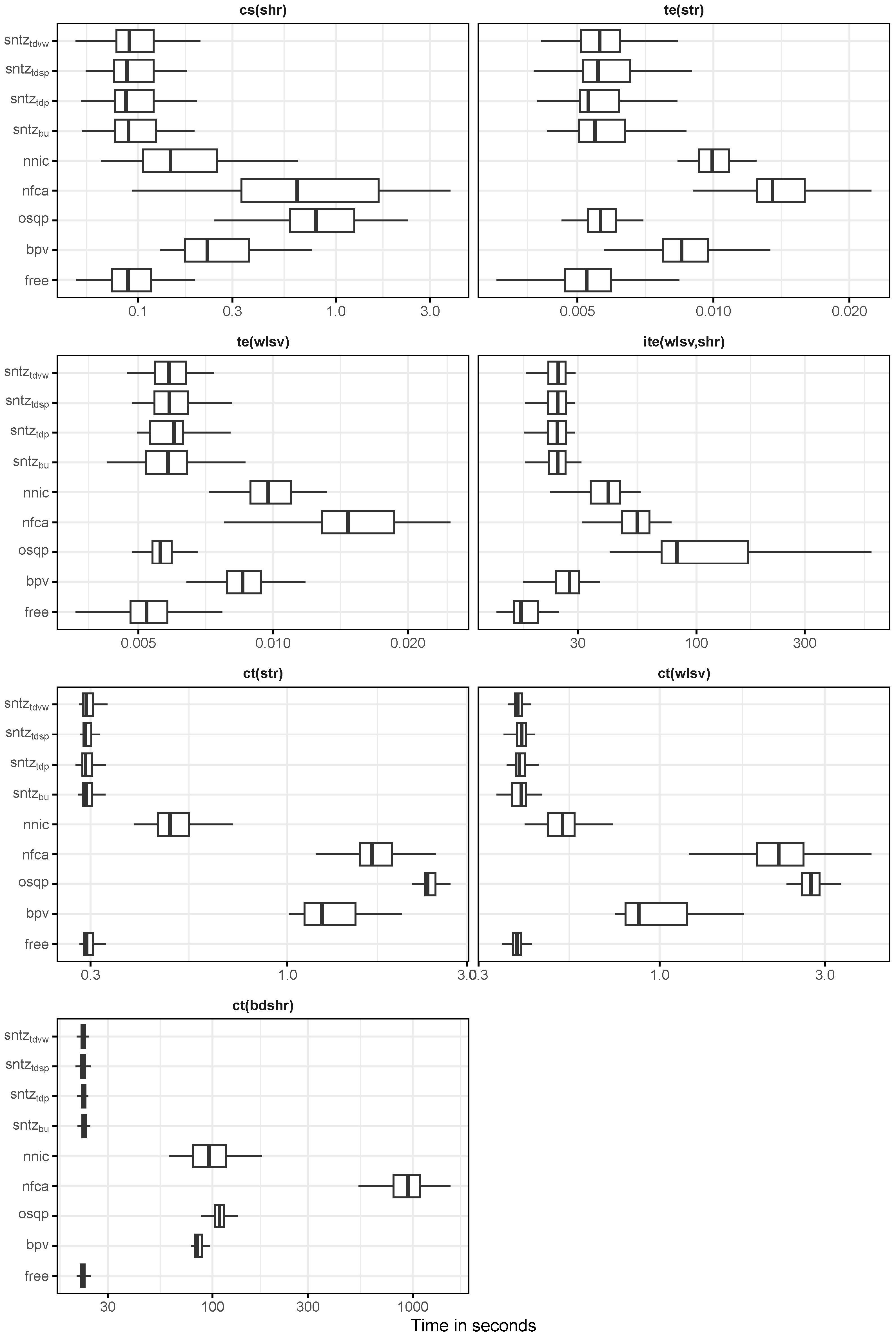
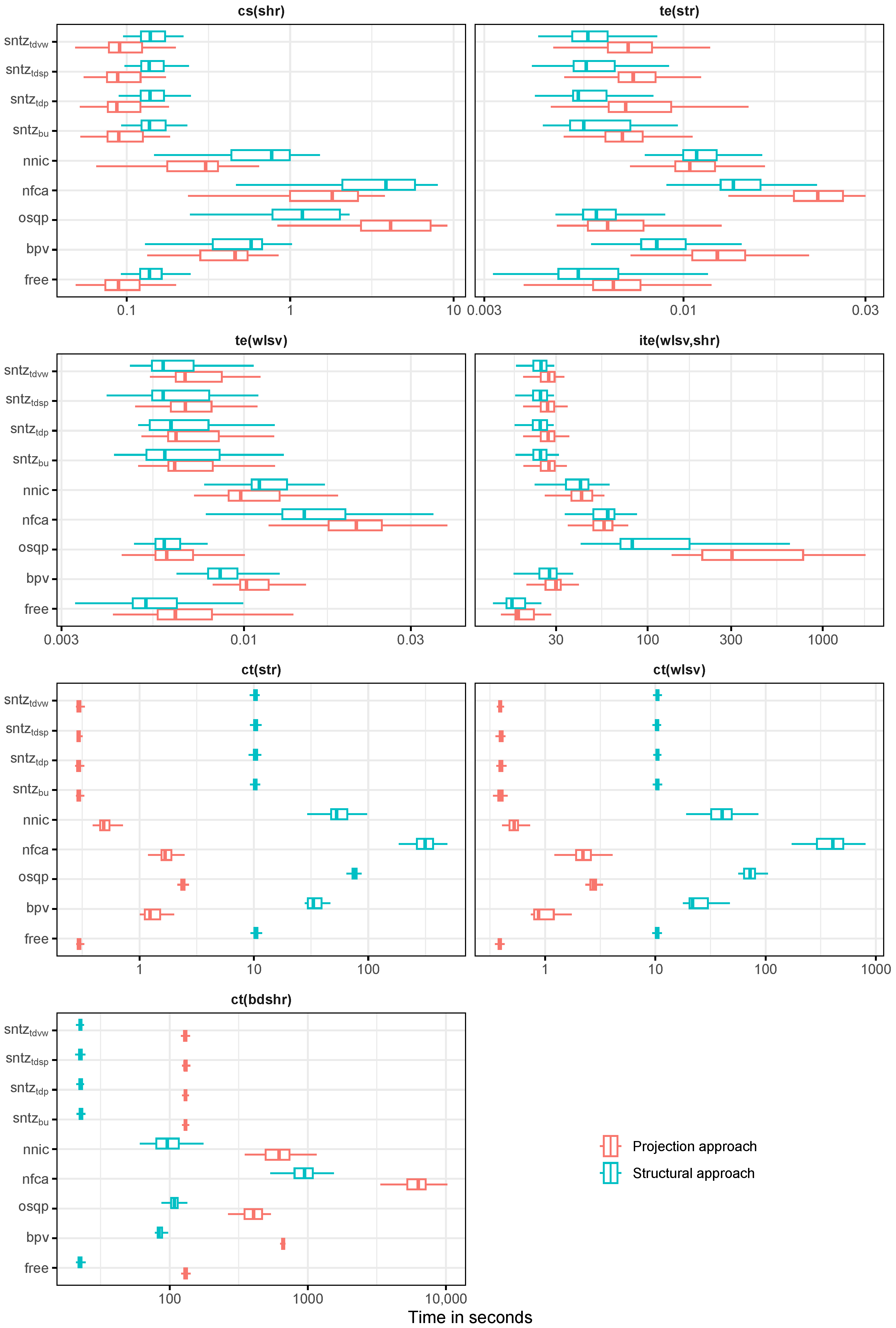
In addition to forecast accuracy, we evaluate the computational performance of the different non-negative procedures. Figure 3 presents boxplots of the reconciliation times across replications of the forecasting experiment, while a more detailed analysis, including comparisons between structural and projection formulations, is provided in Figure A4 of Appendix B. The boxplots of Figure 3 show that the numerical optimization procedures (nfca, n n i c , b p v , and o s q p ) generally require considerably more computation time than set-negative-to-zero. In particular, o s q p is highly sensitive to user-defined convergence parameters, resulting in longer computation times for larger structure, such as cross-temporal cases ( c t ( s t r ) and c t ( w l s v ) ), while for smaller hierarchies (e.g., temporal t e ( s t r ) and t e ( w l s v ) ) the time is similar to s n t z . Further information on the solver hyperparameter settings and computational environment used in the experiments is provided in Appendix C.
Among the optimization-based approaches, b p v offers a good balance between efficiency and accuracy, while n n i c performs well with diagonal covariance structures but loses efficiency when f r e e reconciliation times increase, as observed in c t ( b d s h r ) . A further consideration concerns nfca, which is the most computationally demanding procedure, typically requiring more resources than both optimization-based and heuristic alternatives. Achieving convergence was also more challenging: whereas b p v and o s q p converged with tolerances of 10 6 (and n n i c with 10 5 ), for nfca we had to relax the tolerance to 10 3 . These factors substantially limit the practicality of this procedure in large-scale or time-sensitive settings. At the same time, all set-negative-to-zero heuristics showed computation times very close to f r e e , confirming them as the fastest non-negative options.
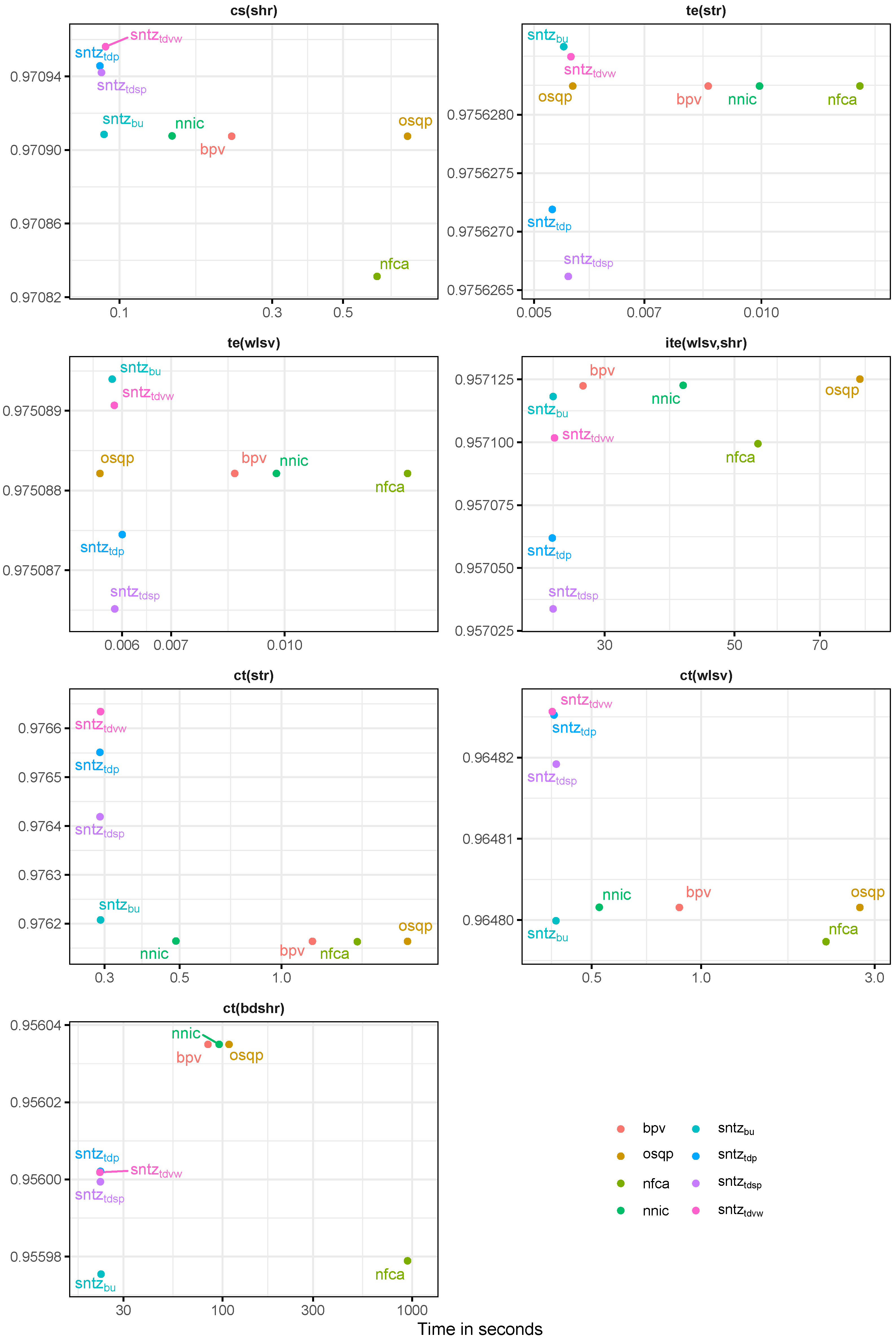
In summary, the results show that non-negative reconciliation strategies consistently improve forecast accuracy while preserving coherence. Among these, the set-negative-to-zero heuristics, particularly s n t z b u and s n t z t d s p , stand out for achieving near-optimal accuracy with computational costs comparable to the f r e e reconciliation. Figure 4, which plots median computation time against AvgRelMSE, confirms that these heuristics lie close to the efficiency frontier, whereas optimization-based methods deliver limited or no additional accuracy gains at substantially higher costs.Given that accuracy differences among methods are relatively small on average, computational efficiency becomes the decisive criterion for practical deployment. In this regard, s n t z b u and s n t z t d s p offer the best balance between accuracy and scalability, making them particularly well suited for large-scale, online, or real-time forecasting applications where faster reconciliation is essential.
The online appendix, provided as Supplementary Material, reports results using the mean absolute error as the accuracy metric, as well as the complete set of results for all alternative base forecasts ( a r i m a , e t s , and a r i m a + l o g ). These additional analyses are consistent with the findings reported for e t s + l o g .

5. Conclusions

In this paper, we examined non-negative reconciliation methods for multiple time series subject to linear aggregation constraints. Our results show that imposing non-negativity consistently improves the accuracy and interpretability of forecasts compared to both base forecasts and f r e e reconciliations, while preserving coherence across all levels of aggregation. These gains are particularly evident for disaggregated series, where negative forecasts are most likely to arise, but we also observed improvements at more aggregated levels, indicating that the benefits propagate throughout the system.
A key contribution of our study is the systematic comparison of optimization-based and heuristic reconciliation procedures. While algorithms such as block principal pivoting and operator splitting quadratic programming deliver optimal reconciled solutions, they require substantial computation time and can be sensitive to parameter settings. Moreover, the iterative method n n i c shows competitive results but with reduced efficiency in some settings, while the heuristic nfca is even more computationally demanding and particularly sensitive to convergence settings compared to the other procedures. Instead, we found that simple set-negative-to-zero heuristics, and especially the bottom-up and squared-proportional top-down variants, achieve near-optimal forecast at almost no additional computational cost. In several cases, these heuristics even outperformed the optimization-based methods, demonstrating their robustness, scalability, and suitability for large-scale forecasting problems.
In conclusion, we show that addressing non-negativity in reconciled forecasts is not only a methodological refinement, but a practical necessity for high-dimensional, real-time, and resource-constrained forecasting environments. Our results suggest that practitioners can confidently adopt heuristic reconciliation procedures to obtain accurate and coherent forecasts while avoiding the computational burden of more complex optimization methods. The empirical evidence presented in this study further indicates that the choice among non-negative reconciliation approaches should be guided by the intended application and computational constraints. The set-negative-to-zero ( s n t z ) heuristics deliver near-optimal accuracy at negligible computational cost, making them particularly suitable for large-scale, online, or real-time forecasting settings. The block principal pivoting ( b p v ) algorithm provides a balanced trade-off between accuracy and computational efficiency, representing a robust default among optimization-based methods. Finally, the operator splitting quadratic program ( o s q p ) offers the highest degree of flexibility, allowing for the inclusion of additional constraints, with acceptable tuning time but some sensitivity to tolerance settings in large cross–temporal hierarchies. Future research could extend this analysis by considering alternative loss functions or accuracy metrics that explicitly account for non-negativity constraints, thereby better reflecting the practical implications of sign violations in strictly non-negative forecasting applications.

Supplementary Materials

The following supporting information can be downloaded at: https://www.mdpi.com/article/10.3390/forecast7040064/s1, including extended tables and figures related to the Australian Tourism Demand case study for different base forecasts and loss functions.

Funding

This research received no external funding.

Data Availability Statement

Code and data for reproducing the results are available at https://github.com/danigiro/vn525nn, accessed on 23 October 2025.

Conflicts of Interest

The author declares no conflicts of interest.

Appendix A. NNIC vs. NNLS Algorithms

While NNLS algorithms (e.g., block principal pivoting) are active-set methods that may both add and release constraints until the optimal active set is identified, the proposed n n i c is a monotone fix-at-zero scheme: once a component is found negative, it is treated as immutable in subsequent reconciliations. Hence, n n i c coincides with NNLS whenever the NNLS-optimal active set can be obtained by a monotone expansion from the negatives of the f r e e reconciliation. Conversely, if optimality requires releasing some index, n n i c may converge to a different feasible non-negative solution.
Consider a cross-sectional system with two aggregates and three bottom series,
a 1 = b 1 + b 2 , a 2 = b 2 + b 3
and let y = a 1 a 2 b 1 b 2 b 3 . The cross-sectional zero-constraints matrix and a diagonal weight matrix are, respectively,
C c s = 1 0 1 1 0 0 1 0 1 1 , Ω = diag ( 1 , 1 , 0.5 , 1 , 0.5 ) .
with base forecasts
y ^ = 1.5330 0.7408 0.8774 1.5604 0.1223
The reconciled vectors obtained with the unconstrained projection (free), the exact non-negative least squares (NNLS, solved via o s q p / b p v ), and the proposed n n i c procedure are
y ˜ f r e e = [ 0.6106 , 0.6508 , 1.3386 , 0.7280 , 0.0773 ] , y ˜ b p v / o s q p = [ 0.2261 , 0.3161 , 0 , 0.2261 , 0.0901 ] , y ˜ n n i c = [ 0.2561 , 0.2561 , 0 , 0.2561 , 0 ] .
All reconciled vectors satisfy the aggregation constraints. Both y ˜ bpv / osqp and y ˜ nnic are non-negative, but they differ because the immutable zero set imposed by n n i c does not coincide with the optimal active set of the NNLS solution. In this example, the NNLS optimum requires releasing one previously fixed component, which n n i c , by construction, cannot do.

Appendix B. Australian Tourism Demand: Tables and Figures

In this Appendix, we provide Supplementary Material to the empirical analysis presented in Section 4. It includes detailed descriptions of the dataset, additional tables and figures illustrating forecast performance. Specifically, we present:
  • geographic division of the Australian Tourism Demand dataset (Table A1);
  • average relative MSE (AvgRelMSE) for the automatic ARIMA and ETS base forecasts on both levels and log-transformed data;

  • additional results from the Multiple Comparison with the Best (MCB) tests, highlighting statistically significant differences among reconciliation strategies for both bottom-level (Figure A2) and upper-level (Figure A3) series;
  • Boxplots of computational times for different reconciliation methods across replications and comparisons between structural and projection approaches (Figure A4 and Figure A5).
Table A1. Geographical divisions of Australia in States, Zones e Regions. Zones formed by a single region have been highlighted in italics.
SerieNameLabelSerieNameLabel
Total Continue: Regions
1AustraliaTotal49GippslandBCB
States 50Phillip IslandBCC
2New South Wales (NSW)A51Central MurrayBDA
3Victoria (VIC)B52GoulburnBDB
4Queensland (QLD)C53High CountryBDC
5South Australia (SA)D54Melbourne EastBDD
6Western Australia (WA)E55Upper YarraBDE
7Tasmania (TAS)F56MurrayEastBDF
8Northern Territory (NT)G57MalleeBEA
Zones 58WimmeraBEB
9Metro NSWAA59Western GrampiansBEC
10Nth Coast NSWAB60Bendigo LoddonBED
Sth Coast NSWAC61MacedonBEE
11Sth NSWAD62Spa CountryBEF
12Nth NSWAE63BallaratBEG
ACTAF64Central HighlandsBEG
13Metro VICBA65Gold CoastCAA
West Coast VICBB66BrisbaneCAB
14East Coast VICBC67Sunshine CoastCAC
15Nth East VICBD68Central QueenslandCBA
16Nth West VICBE69BundabergCBB
17Metro QLDCA70Fraser CoastCBC
18Central Coast QLDCB71MackayCBD
19Nth Coast QLDCC72WhitsundaysCCA
20Inland QLDCD73NorthernCCB
21Metro SADA74Tropical North QueenslandCCC
22Sth Coast SADB75Darling DownsCDA
23Inland SADC76OutbackCDB
24West Coast SADD77AdelaideDAA
25West Coast WAEA78BarossaDAB
Nth WAEB79Adelaide HillsDAC
Sth WAEC80Limestone CoastDBA
Sth TASFA81Fleurieu PeninsulaDBB
26Nth East TASFB82Kangaroo IslandDBC
27Nth West TASFC83MurraylandsDCA
28Nth Coast NTGA84RiverlandDCB
29Central NTGB85Clare ValleyDCC
Regions 86Flinders Range and OutbackDCD
30SydneyAAA87Eyre PeninsulaDDA
31Central CoastAAB88Yorke PeninsulaDDB
32HunterABA89Australia’s Coral CoastEAA
33North Coast NSWABB90Experience PerthEAB
34South CoastACA91Australia’s SouthWestEAC
35Snowy MountainsADA92Australia’s North WestEBA
36Capital CountryADB93Australia’s Golden OutbackECA
37The MurrayADC94Hobart and the SouthFAA
38RiverinaADD95East CoastFBA
39Central NSWAEA96Launceston, Tamar and the NorthFBB
40New England North WestAEB97North WestFCA
41Outback NSWAEC98WildernessWestFCB
42Blue MountainsAED99DarwinGAA
43CanberraAFA100Kakadu ArnhemGAB
44MelbourneBAA101Katherine DalyGAC
45PeninsulaBAB102BarklyGBA
46GeelongBAC103LasseterGBB
47WesternBBA104Alice SpringsGBC
48LakesBCA105MacDonnellGBD
Source: [12,21].
Figure A1. Average relative MSE (AvgRelMSE) across different temporal aggregation levels (monthly 1, two-monthly 2, quarterly 3, four-monthly 4, semi-annual 6, annual 12 and all) for the automatic ARIMA and ETS base forecasts on both levels and log-transformed data: a r i m a / e t s stand for Automatic ARIMA/ETS on the original data; a r i m a + l o g / e t s + l o g stand for Automatic ARIMA/ETS on the log-transformed data.
Forecasting 07 00064 g0a1
Figure A2. Results of the MCB Nemenyi test across the high frequency bottom time series evaluated over all forecast horizons ( h = 1 , , 12 ) grouped by reconciliation approach ( c s ( s h r ) , t e ( s t r ) , t e ( w l s v ) , i t e ( w l s v , s h r ) , c t ( s t r ) , c t ( w l s v ) , c t ( b d s h r ) ). In each panel, the p-value of the Friedman test is reported in the lower-right corner, while the mean rank of each method is displayed to the right of its label. Statistically significant differences in forecasting performance are identified based on the overlap of confidence intervals (inditaced in blue): approaches whose intervals do not intersect (indicated by red circles; blue triangles otherwise) are considered significantly different. In particular, any approach whose interval does not overlap with that of the best-performing (green-highlighted) method is considered significantly worse.
Forecasting 07 00064 g0a2
Figure A3. MCB Nemenyi test across the bottom-level series at temporal aggregation levels k > 1 and upper-level series at any temporal aggregation level, evaluated over all forecast horizons ( h = 1 , , H k ) grouped by reconciliation approach ( c s ( s h r ) , t e ( s t r ) , t e ( w l s v ) , i t e ( w l s v , s h r ) , c t ( s t r ) , c t ( w l s v ) , c t ( b d s h r ) ). In each panel, the p-value of the Friedman test is reported in the lower-right corner, while the mean rank of each method is displayed to the right of its label. Statistically significant differences in forecasting performance are identified based on the overlap of confidence intervals (inditaced in blue): approaches whose intervals do not intersect (indicated by red circles; blue triangles otherwise) are considered significantly different. In particular, any approach whose interval does not overlap with that of the best-performing (green-highlighted) method is considered significantly worse.
Forecasting 07 00064 g0a3
Figure A4. Boxplot of computational times, computed over the replications of the forecast experiments, for the different reconciliation approaches ( c s ( s h r ) , t e ( s t r ) , t e ( w l s v ) , i t e ( w l s v , s h r ) , c t ( s t r ) , c t ( w l s v ) , c t ( b d s h r ) ) and non-negativity procedures ( b p v , o s q p , nfca, n n i c , s n t z b u , s n t z t d p , s n t z t d s p , s n t z t d v w ); f r e e indicates the unrestricted reconciled forecasts, which may include negative values. Results are reported using both the projection (5) and the structural (8) equations.
Forecasting 07 00064 g0a4
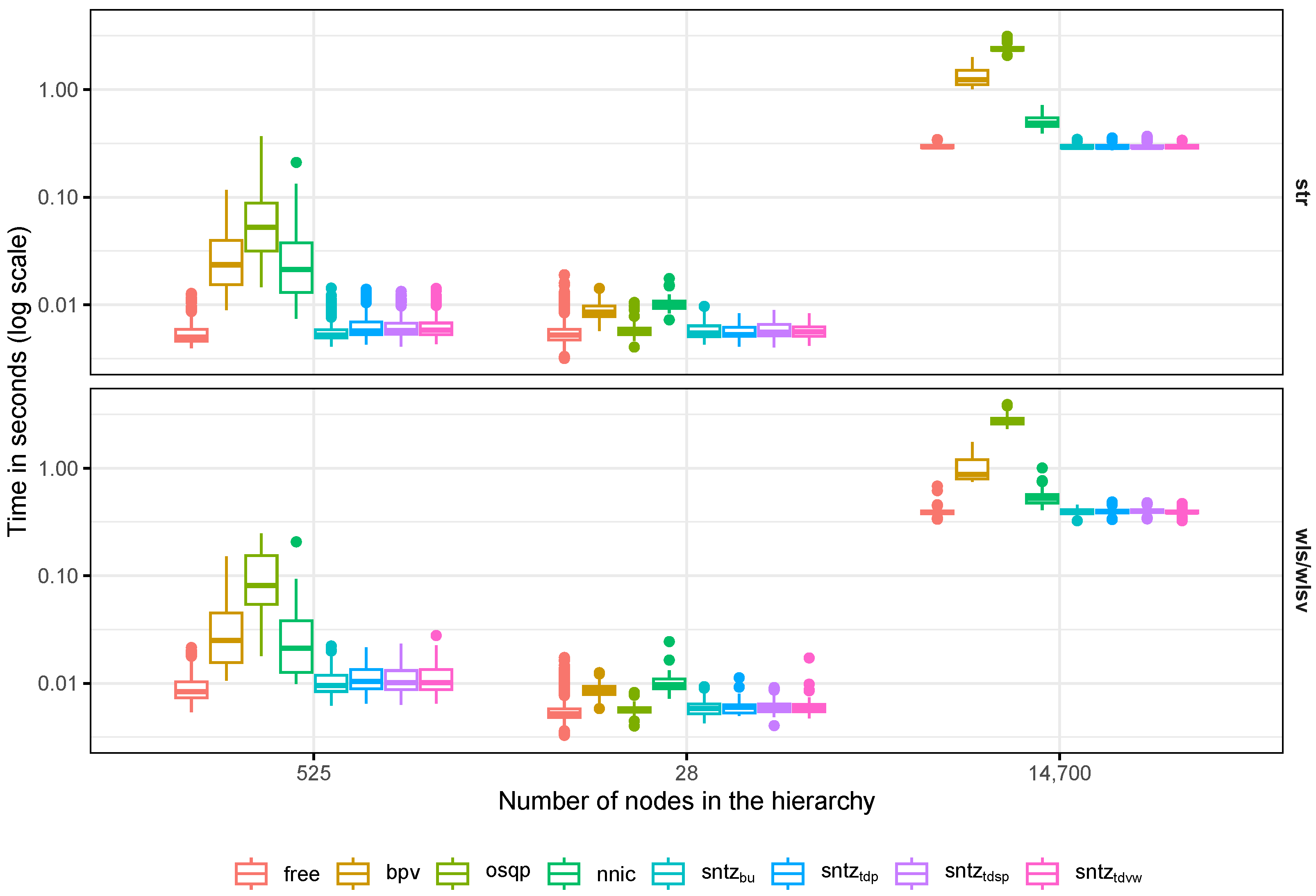
Figure A5. Computational scaling of reconciliation algorithms. Boxplots report the distribution of computation times (in seconds, log scale) for different hierarchical structures and reconciliation schemes. The horizontal axis represents the number of nodes in the hierarchy (temporal, cross-sectional, and cross-temporal systems with 28, 525, and 525 × 28 series, respectively).
Forecasting 07 00064 g0a5

Appendix C. Solver Hyperparameters and Computational Environment

All non-negativity algorithms were executed using consistent numerical tolerances and iteration settings across reconciliation structures. For clarity, we summarize the configurations by reconciliation dimension and indicate the default settings provided by the FoReco package [40].
  o s q p
max_iter = 10000, check_termination = 25, eps_abs = 1e–5, eps_rel = 0,
eps_dual_inf = 1e–7, polish = TRUE, polish_refine_iter = 500
(Cross-sectional reconciliation); max_iter = 10000, check_termination = 20,
eps_abs = 1e–5, eps_rel = 1e–6, eps_dual_inf = 1e–7, polish = TRUE,
polish_refine_iter = 100 (Temporal reconciliation); max_iter = 1000000,
check_termination = 20, eps_abs = 1e–6, eps_rel = 0, polish = TRUE,
polish_refine_iter = 500 (Cross-temporal reconciliation);
  n n i c
tol = 1e–5, itmax = 100.
  n f c a
tol = 1e–3, itmax = 100.
  b p v
ptype = "fixed", par = 10, tol = gtol = sqrt(.Machine$double.eps),
itmax = 100.
All experiments were performed on a Windows 10 (build 19045) workstation equipped with an Intel® Core™ i7–10700 CPU (8 cores, 16 threads, 2.90 GHz) and 64 GB RAM. Analyses were conducted in R 4.4.0 (2024–04–24, ucrt).

References

  1. Petropoulos, F.; Apiletti, D.; Assimakopoulos, V.; Babai, M.; Barrow, D.; Bergmeir, C.; Bessa, R.; Boylan, J.; Browell, J.; Carnevale, C.; et al. Forecasting: Theory and practice. Int. J. Forecast. 2022, 38, 705–871. [Google Scholar] [CrossRef]
  2. Kourentzes, N. Toward a one-number forecast: Cross-temporal hierarchies. Foresight Int. J. Appl. Forecast. 2022, 67, 32–40. [Google Scholar]
  3. Hyndman, R.J.; Ahmed, R.A.; Athanasopoulos, G.; Shang, H.L. Optimal combination forecasts for hierarchical time series. Comput. Stat. Data Anal. 2011, 55, 2579–2589. [Google Scholar] [CrossRef]
  4. Athanasopoulos, G.; Hyndman, R.J.; Kourentzes, N.; Panagiotelis, A. Forecast reconciliation: A review. Int. J. Forecast. 2024, 40, 430–456. [Google Scholar] [CrossRef]
  5. Dangerfield, B.; Morris, J. Top-down or bottom-up: Aggregate versus disaggregate extrapolations. Int. J. Forecast. 1992, 6, 233–241. [Google Scholar] [CrossRef]
  6. Orcutt, G.H.; Watts, H.W.; Edwards, J.B. Data aggregation and information loss. Am. Econ. Rev. 1968, 58, 773–787. Available online: https://www.jstor.org/stable/1815532 (accessed on 23 October 2025).
  7. Dunn, D.M.; Williams, W.H.; Dechaine, T.L. Aggregate versus subaggregate models in local area forecasting. J. Am. Stat. Assoc. 1976, 71, 68–71. [Google Scholar] [CrossRef]
  8. Gross, C.W.; Sohl, J.E. Disaggregation methods to expedite product line forecasting. J. Forecast. 1990, 9, 233–254. [Google Scholar] [CrossRef]
  9. Fliedner, G. Hierarchical forecasting: Issues and use guidelines. Ind. Manag. Data Syst. 2001, 101, 5–12. [Google Scholar] [CrossRef]
  10. Athanasopoulos, G.; Ahmed, R.A.; Hyndman, R.J. Hierarchical forecasts for Australian domestic tourism. Int. J. Forecast. 2009, 25, 146–166. [Google Scholar] [CrossRef]
  11. Hyndman, R.J.; Lee, A.J.; Wang, E. Fast computation of reconciled forecasts for hierarchical and grouped time series. Comput. Stat. Data Anal. 2016, 97, 16–32. [Google Scholar] [CrossRef]
  12. Wickramasuriya, S.L.; Athanasopoulos, G.; Hyndman, R.J. Optimal Forecast Reconciliation for Hierarchical and Grouped Time Series Through Trace Minimization. J. Am. Stat. Assoc. 2019, 114, 804–819. [Google Scholar] [CrossRef]
  13. Wickramasuriya, S.L.; Turlach, B.A.; Hyndman, R.J. Optimal non-negative forecast reconciliation. Stat. Comput. 2020, 30, 1167–1182. [Google Scholar] [CrossRef]
  14. Panagiotelis, A.; Gamakumara, P.; Athanasopoulos, G.; Hyndman, R.J. Probabilistic forecast reconciliation: Properties, evaluation and score optimisation. Eur. J. Oper. Res. 2023, 306, 693–706. [Google Scholar] [CrossRef]
  15. Panagiotelis, A.; Athanasopoulos, G.; Gamakumara, P.; Hyndman, R.J. Forecast reconciliation: A geometric view with new insights on bias correction. Int. J. Forecast. 2021, 37, 343–359. [Google Scholar] [CrossRef]
  16. Athanasopoulos, G.; Hyndman, R.J.; Kourentzes, N.; Petropoulos, F. Forecasting with temporal hierarchies. Eur. J. Oper. Res. 2017, 262, 60–74. [Google Scholar] [CrossRef]
  17. Nystrup, P.; Lindström, E.; Pinson, P.; Madsen, H. Temporal hierarchies with autocorrelation for load forecasting. Eur. J. Oper. Res. 2020, 280, 876–888. [Google Scholar] [CrossRef]
  18. Kourentzes, N.; Athanasopoulos, G. Cross-temporal coherent forecasts for Australian tourism. Ann. Tour. Res. 2019, 75, 393–409. [Google Scholar] [CrossRef]
  19. Di Fonzo, T.; Girolimetto, D. Cross-temporal forecast reconciliation: Optimal combination method and heuristic alternatives. Int. J. Forecast. 2023, 39, 39–57. [Google Scholar] [CrossRef]
  20. Di Fonzo, T.; Girolimetto, D. Spatio-temporal reconciliation of solar forecasts. Sol. Energy 2023, 251, 13–29. [Google Scholar] [CrossRef]
  21. Girolimetto, D.; Athanasopoulos, G.; Di Fonzo, T.; Hyndman, R.J. Cross-temporal probabilistic forecast reconciliation: Methodological and practical issues. Int. J. Forecast. 2024, 40, 1134–1151. [Google Scholar] [CrossRef]
  22. Rombouts, J.; Ternes, M.; Wilms, I. Cross-temporal forecast reconciliation at digital platforms with machine learning. Int. J. Forecast. 2025, 41, 321–344. [Google Scholar] [CrossRef]
  23. Pennings, C.L.P.; van Dalen, J. Integrated hierarchical forecasting. Eur. J. Oper. Res. 2017, 263, 412–418. [Google Scholar] [CrossRef]
  24. Karmy, J.P.; Maldonado, S. Hierarchical time series forecasting via support vector regression in the European travel retail industry. Expert Syst. Appl. 2019, 137, 59–73. [Google Scholar] [CrossRef]
  25. Punia, S.; Singh, S.P.; Madaan, J.K. A cross-temporal hierarchical framework and deep learning for supply chain forecasting. Comput. Ind. Eng. 2020, 149, 106796. [Google Scholar] [CrossRef]
  26. Yang, D.; Quan, H.; Disfani, V.R.; Liu, L. Reconciling solar forecasts: Geographical hierarchy. Sol. Energy 2017, 146, 276–286. [Google Scholar] [CrossRef]
  27. Yang, D.; Quan, H.; Disfani, V.R.; Rodríguez-Gallegos, C.D. Reconciling solar forecasts: Temporal hierarchy. Sol. Energy 2017, 158, 332–346. [Google Scholar] [CrossRef]
  28. Yang, D. A guideline to solar forecasting research practice: Reproducible, operational, probabilistic or physically-based, ensemble, and skill (ROPES). J. Renew. Sustain. Energy 2019, 11, 022701. [Google Scholar] [CrossRef]
  29. Ben Taieb, S.; Taylor, J.W.; Hyndman, R.J. Hierarchical probabilistic forecasting of electricity demand with smart meter data. J. Am. Stat. Assoc. 2021, 116, 27–43. [Google Scholar] [CrossRef]
  30. Hansen, M.E.; Peter, N.; Møller, J.K.; Henrik, M. Reconciliation of wind power forecasts in spatial hierarchies. Wind Energy 2023, 26, 615–632. [Google Scholar] [CrossRef]
  31. Abolghasemi, M.; Girolimetto, D.; Di Fonzo, T. Improving cross-temporal forecasts reconciliation accuracy and utility in energy market. Appl. Energy 2025, 394, 126053. [Google Scholar] [CrossRef]
  32. Hollyman, R.; Petropoulos, F.; Tipping, M.E. Understanding forecast reconciliation. Eur. J. Oper. Res. 2021, 294, 149–160. [Google Scholar] [CrossRef]
  33. Di Fonzo, T.; Girolimetto, D. Forecast combination-based forecast reconciliation: Insights and extensions. Int. J. Forecast. 2024, 40, 490–514. [Google Scholar] [CrossRef]
  34. Athanasopoulos, G.; Gamakumara, P.; Panagiotelis, A.; Hyndman, R.J.; Affan, M. Hierarchical Forecasting. In Macroeconomic Forecasting in the Era of Big Data; Fuleky, P., Ed.; Springer International Publishing: Cham, Switzerland, 2020; Volume 52, pp. 689–719. [Google Scholar]
  35. Lawson, C.L.; Hanson, R.J. Solving Least Squares Problems; Prentice Hall: Hoboken, NJ, USA, 1974. [Google Scholar]
  36. Júdice, J.J.; Pires, F.M. A Block Principal Pivoting Algorithm for Large-Scale Strictly Monotone Linear Complementarity Problems. Comput. Oper. Res. 1994, 21, 587–596. [Google Scholar] [CrossRef]
  37. Kourentzes, N.; Athanasopoulos, G. Elucidate structure in intermittent demand series. Eur. J. Oper. Res. 2021, 288, 141–152. [Google Scholar] [CrossRef]
  38. Stellato, B.; Banjac, G.; Goulart, P.; Bemporad, A.; Boyd, S. OSQP: An operator splitting solver for quadratic programs. Math. Program. Comput. 2020, 12, 637–672. [Google Scholar] [CrossRef]
  39. Zhang, B.; Kang, Y.; Panagiotelis, A.; Li, F. Optimal reconciliation with immutable forecasts. Eur. J. Oper. Res. 2023, 308, 650–660. [Google Scholar] [CrossRef]
  40. Girolimetto, D.; Di Fonzo, T. FoReco: Forecast Reconciliation, Version 1.1.0; CRAN: Vienna, Austria, 2025. [CrossRef]
  41. Girolimetto, D.; Di Fonzo, T. Point and probabilistic forecast reconciliation for general linearly constrained multiple time series. Stat. Methods Appl. 2024, 33, 581–607. [Google Scholar] [CrossRef]
  42. Magnus, J.R.; Neudecker, H. Matrix Differential Calculus with Applications in Statistics and Econometrics; Wiley: Hoboken, NJ, USA, 2019. [Google Scholar]
  43. Stone, R.; Champernowne, D.G.; Meade, J.E. The precision of national income estimates. Rev. Econ. Stud. 1942, 9, 111–125. [Google Scholar] [CrossRef]
  44. Byron, R.P. The Estimation of Large Social Account Matrices. J. R. Stat. Soc. Ser. A 1978, 141, 359–367, Erratum in J. R. Stat. Soc. Ser. A 1979, 142, 405. https://doi.org/10.2307/2982515. [Google Scholar] [CrossRef]
  45. Nystrup, P.; Lindström, E.; Møller, J.K.; Madsen, H. Dimensionality reduction in forecasting with temporal hierarchies. Int. J. Forecast. 2021, 37, 1127–1146. [Google Scholar] [CrossRef]
  46. Yagli, G.M.; Yang, D.; Srinivasan, D. Reconciling solar forecasts: Sequential reconciliation. Sol. Energy 2019, 179, 391–397. [Google Scholar] [CrossRef]
  47. Karjalainen, E.J.; Karjalainen, U.P. Component reconstruction in the primary space of spectra and concentrations. Alternating regression and related direct methods. Anal. Chim. Acta 1991, 250, 169–179. [Google Scholar] [CrossRef]
  48. Berry, M.W.; Browne, M.; Langville, A.N.; Pauca, V.P.; Plemmons, R.J. Algorithms and applications for approximate nonnegative matrix factorization. Comput. Stat. Data Anal. 2007, 52, 155–173. [Google Scholar] [CrossRef]
  49. Chen, D.; Plemmons, R.J. Nonnegativity constraints in numerical analysis. In The Birth of Numerical Analysis; World Scientific: Singapore, 2009; pp. 109–139. [Google Scholar] [CrossRef]
  50. Stellato, B.; Banjac, G.; Goulart, P.; Boyd, S.; Anderson, E. Package OSQP: Quadratic Programming Solver Using the ‘OSQP’ Library, Version 0.6.3.3; CRAN: Vienna, Austria, 2014. [CrossRef]
  51. Boyd, S.; Parikh, N.; Chu, E.; Peleato, B.; Eckstein, J. Distributed optimization and statistical learning via the alternating direction method of multipliers. Found. Trends® Mach. Learn. 2011, 3, 1–122. [Google Scholar] [CrossRef]
  52. Gabay, D.; Mercier, B. A dual algorithm for the solution of nonlinear variational problems via finite element approximation. Comput. Math. Appl. 1976, 2, 17–40. [Google Scholar] [CrossRef]
  53. Van Benthem, M.H.; Keenan, M.R. Fast algorithm for the solution of large-scale non-negativity-constrained least squares problems. J. Chemom. 2004, 18, 441–450. [Google Scholar] [CrossRef]
  54. Hyndman, R.J.; Koehler, A.B.; Ord, J.K.; Snyder, R.D. Forecasting with Exponential Smoothing. The State Space Approach; Cambridge University Press: Cambridge, UK, 2008. [Google Scholar]
  55. Hyndman, R.; Athanasopoulos, G.; Bergmeir, C.; Caceres, G.; Chhay, L.; O’Hara-Wild, M.; Petropoulos, F.; Razbash, S.; Wang, E.; Yasmeen, F. Forecast: Forecasting Functions for Time Series and Linear Models, Version 8.24.0; CRAN: Vienna, Austria, 2025. [CrossRef]
  56. Hyndman, R.J.; Khandakar, Y. Automatic time series forecasting: The forecast package for R. J. Stat. Softw. 2008, 26, 1–22. [Google Scholar] [CrossRef]
  57. Koning, A.J.; Franses, P.H.; Hibon, M.; Stekler, H.O. The M3 competition: Statistical tests of the results. Int. J. Forecast. 2005, 21, 397–409. [Google Scholar] [CrossRef]
  58. Makridakis, S.; Spiliotis, E.; Assimakopoulos, V. The M5 Accuracy competition: Results, findings and conclusions. Int. J. Forecast. 2022, 38, 1346–1364. [Google Scholar] [CrossRef]
  59. Kourentzes, N.; Svetunkov, I.; Schaer, O. Tsutils: Time Series Exploration, Modelling and Forecasting, Version 0.9.4; CRAN: Vienna, Austria, 2023. [CrossRef]
  60. Athanasopoulos, G.; Kourentzes, N. On the evaluation of hierarchical forecasts. Int. J. Forecast. 2022, 39, 1502–1511. [Google Scholar] [CrossRef]
Figure 1. Empirical convergence stability of the top-down sntz procedure. The horizontal axis reports the number of iterations, and the vertical axis shows the percentage of reconciled vectors that achieved convergence after the corresponding number of iterations. Most cases converged after the first iteration, a small fraction required a second pass, and no instance required more than two iterations.
Forecasting 07 00064 g001
Figure 2. Geographical divisions of Australia in States, Zones e Regions. Look at Table A1 for the meaning of labels.
Forecasting 07 00064 g002
Figure 3. Boxplot of computational times, computed over the replications of the forecast experiments, for the different reconciliation approaches ( c s ( s h r ) , t e ( s t r ) , t e ( w l s v ) , i t e ( w l s v , s h r ) , c t ( s t r ) , c t ( w l s v ) , c t ( b d s h r ) ) and non-negativity procedures ( b p v , o s q p , nfca, n n i c , s n t z b u , s n t z t d p , s n t z t d s p , s n t z t d v w ); f r e e indicates the unrestricted reconciled forecasts, which may include negative values.
Forecasting 07 00064 g003
Figure 4. Median computational time versus A v g R e l M S E for all the variables at any temporal aggregation order, for the different reconciliation approaches ( c s ( s h r ) , t e ( s t r ) , t e ( w l s v ) , i t e ( w l s v , s h r ) , c t ( s t r ) , c t ( w l s v ) , c t ( b d s h r ) ) and non-negativity procedures ( b p v , o s q p , nfca, n n i c , s n t z b u , s n t z t d p , s n t z t d s p , s n t z t d v w ).
Forecasting 07 00064 g004
Table 1. Summary of the main symbols used in Section 2.2, including their descriptions and equivalent notation in the cross-sectional (cs), temporal (te), and cross-temporal (ct) forecasting frameworks. Dimensions and indexing conventions are provided to clarify how the general notation maps to each specific framework. Note that starting from matrices X , X ^ and X ˜ described in Section 2.1, the cross-sectional framework corresponds to working on a single column j ( X { · , j } , X ^ { · , j } , X ˜ { · , j } ), the temporal framework on a single row i ( X { i , · } , X ^ { i , · } , X ˜ { i , · } ) and the cross-temporal framework on the vectorised form ( vec ( X ) , vec ( X ^ ) , vec ( X ˜ ) ). In addition, we omit the subscript h to simplify notation.
Framework
SymbolDescriptioncstect
x ( n * × 1 ) vector of true (unknown) coherent vector X { · , j } X { i , · } vec ( X )
x ^ ( n * × 1 ) vector of incoherent base forecasts X ^ { · , j } X ^ { i , · } vec ( X ^ )
x ˜ ( n * × 1 ) vector of reconciled forecasts X ˜ { · , j } X ˜ { i , · } vec ( X ˜ )
C ( n a * × n * ) zero-constraints matrix such that C x = 0 C c s C t e C c t
S ( n * × n b * ) structural matrix S c s S t e S c t
n * Total number of elements in the vectorsn m + k * n ( m + k * )
n a * , n b * Numbers of row and colum in the zero-constraints matrix C and the structural matrix S , respectively n a , n b k * , m n m + n b k * , n b m
β ( n b * × 1 ) vector of target forecasts corrisponding to the free components (cross-sectional)/high-frequency univariate series (temporal)/high-frequency free series (cross-temporal)
Table 2. Reconciled forecasts for the toy example introduced in Section 2. The column f r e e reports the unrestricted reconciled forecasts, which may include negative values, while the columns s n t z b u , s n t z t d p , s n t z t d s p , and s n t z t d v w show the results obtained with alternative non-negative reconciliation schemes, which enforce coherence and eliminate negative components.
Type of Forecast
Variable free sntz bu sntz tdp sntz tdsp sntz tdvw
a ˜ 1 4045404040
b ˜ 1 353531.130.431
b ˜ 2 −50000
b ˜ 3 10108.99.69
Table 3. Grouped time series for Australian tourism flows.
Number of Series
Geographical
Division (GD)
Purpose of
Travel (PoT)
Total
Australia145
States72835
Zones *2184105
Regions76304380
Total105420525
* 6 Zones with only one Region are included in the Regions.
Table 4. Number (#) and percentage of time series with values equal to 0, divided by temporal aggregation order (k) and cross-sectional level ( L 0 Australia, L 1 States, L 2 Zones, L 3 Regions, L 4 PoT, L 5 = L 1 × L 4 , L 6 = L 2 × L 4 , L 7 = L 3 × L 4 ).
k L 0 L 1 L 2 L 3 L 4 L 5 L 6 L 7 Tot
# Series17217642884304525
1 13 125200239
(17%) (4%)(30%)(66%)(46%)
2 1 113131146
(1%) (4%)(15%)(43%)(28%)
3 698104
(7%)(32%)(20%)
4 37679
(4%)(25%)(15%)
6 5454
(18%)(10%)
12 1616
(5%)(3%)
Table 5. Summary statistics of the negative reconciled forecasts using ETS base forecasts (with the log-transformation): replication’s number with at least one negative value (# rep); series’ number (# series) with at least one negative value in one replication (min and max); min and max of negative values in all the replications (values).
Label# rep# seriesValues# rep# seriesValues
minmaxminmax minmaxminmax
Monthly forecasts ( k = 1 ) Two-monthly forecasts ( k = 2 )
c s ( s h r ) 85212−58.35−0.000318518−83.01−0.00064
t e ( s t r ) 4114−4.81−0.01459711−1.27−0.06806
t e ( w l s v ) 4315−5.29−0.00514511−1.13−0.18561
i t e ( w l s v , s h r ) 8528−18.89−0.001257314−21.21−0.00102
c t ( s t r ) 851032−45.33−0.0000485117−71.76−0.00510
c t ( w l s v ) 8516−29.97−0.005586014−30.81−0.01798
c t ( b d s h r ) 85213−21.12−0.000648418−20.15−0.00558
Quarterly forecasts ( k = 3 ) Four-monthly forecasts ( k = 4 )
c s ( s h r ) 7916−71.64−0.000516914−53.33−0.00108
t e ( s t r ) 1 –
t e ( w l s v ) 1 –
i t e ( w l s v , s h r ) 4913−20.60−0.000644213−23.73−0.00851
c t ( s t r ) 84110−84.84−0.007657918−100.25−0.00223
c t ( w l s v ) 3112−19.00−0.012252513−21.76−0.06677
c t ( b d s h r ) 8216−26.81−0.002317115−30.29−0.00017
Semi-annual forecasts ( k = 6 ) Annual forecasts ( k = 12 )
c s ( s h r ) 4212−26.78−0.00734511−23.60−0.60212
t e ( s t r )
t e ( w l s v )
i t e ( w l s v , s h r ) 2113−23.07−0.01458511−16.51−1.89363
c t ( s t r ) 6917−130.78−0.050214312−131.82−0.19975
c t ( w l s v ) 1112−19.76−0.39761411−12.83−1.74552
c t ( b d s h r ) 5613−35.96−0.01885911−33.97−1.08399
Table 6. Average relative MSE (AvgRelMSE) across different temporal aggregation levels (monthly 1, two-monthly 2, quarterly 3, four-monthly 4, semi-annual 6, annual 12 and all), reconciliation approaches ( c s ( s h r ) , t e ( s t r ) , t e ( w l s v ) , i t e ( w l s v , s h r ) , c t ( s t r ) , c t ( w l s v ) , c t ( b d s h r ) ) and non-negative ( b p v , o s q p , nfca, n n i c , s n t z b u , s n t z t d p , s n t z t d s p , s n t z t d v w ); f r e e indicates the unrestricted reconciled forecasts, which may include negative values. Bold values indicate the best performing approach within each block (reconciliation approach) and, blue underlined and green italics values denote the overall best and the second-best performance, respectively.
Temporal Aggregation Level
Label1234612all1234612all
c s ( s h r ) t e ( s t r )
f r e e 0.9792790.9771490.9685160.9596790.9501900.9424280.9717330.9781970.9818070.9792750.9706180.9558390.9488150.975631
b p v o s q p n n i c 0.9779900.9762760.9681870.9593920.9500290.9423960.9709070.9781930.9818050.9792760.9706170.9558410.9488140.975628
n f c a 0.9779530.9760120.9681630.9594010.9500000.9423980.9708310.9781930.9818050.9792760.9706170.9558410.9488140.975628
s n t z b u 0.9780090.9762930.9681470.9593790.9499810.9423950.9709080.9781940.9818040.9792760.9706160.9558430.9488130.975629
s n t z t d p 0.9780540.9763610.9681550.9593990.9499890.9423870.9709460.9781920.9818030.9792740.9706150.9558410.9488150.975627
s n t z t d s p 0.9780350.9763780.9681590.9593980.9499880.9423870.9709420.9781920.9818030.9792740.9706150.9558400.9488150.975627
s n t z t d v w 0.9780670.9763830.9681550.9594010.9499880.9423850.9709560.9781940.9818040.9792760.9706170.9558430.9488150.975628
t e ( w l s v ) i t e ( w l s v , s h r )
f r e e 0.9777970.9812150.9786360.9698980.9550400.9483970.9750910.9657800.9653290.9584960.9463060.9255420.9061150.957432
b p v o s q p n n i c 0.9777910.9812130.9786370.9698970.9550410.9483960.9750880.9653240.9651320.9582740.9461060.9253530.9059470.957122
n f c a 0.9777910.9812130.9786370.9698970.9550410.9483960.9750880.9653040.9651040.9582490.9460840.9253300.9059200.957099
s n t z b u 0.9777930.9812130.9786380.9698960.9550440.9483960.9750890.9653390.9651130.9582520.9460790.9253400.9059600.957118
s n t z t d p 0.9777910.9812110.9786360.9698950.9550410.9483970.9750870.9652580.9650620.9582060.9460440.9253140.9059830.957062
s n t z t d s p 0.9777890.9812110.9786350.9698950.9550400.9483970.9750870.9652270.9650330.9581780.9460180.9252910.9059810.957034
s n t z t d v w 0.9777930.9812130.9786380.9698960.9550440.9483970.9750890.9653050.9651050.9582460.9460750.9253410.9059800.957102
c t ( s t r ) c t ( w l s v )
f r e e 0.9840830.9868680.9812040.9704370.9499940.9334180.9784750.9710160.9722620.9671950.9566130.9381780.9223650.965031
b p v o s q p n n i c 0.9815780.9845600.9789400.9681850.9482450.9318370.9761640.9706600.9721150.9670510.9564870.9380740.9222390.964802
n f c a 0.9815780.9845700.9789370.9681780.9482430.9318100.9761630.9706590.9721090.9670430.9564800.9380670.9222320.964797
s n t z b u 0.9819140.9846350.9788710.9680040.9478650.9302930.9762080.9707230.9720690.9669980.9564210.9380290.9222140.964800
s n t z t d p 0.9820560.9849440.9793220.9685530.9485860.9313860.9765510.9707350.9720920.9670310.9564610.9380810.9222920.964825
s n t z t d s p 0.9819600.9848160.9791920.9683940.9483710.9310520.9764190.9707310.9720860.9670250.9564540.9380690.9222740.964819
s n t z t d v w 0.9820740.9849860.9793960.9686880.9488340.9319900.9766340.9707380.9720930.9670300.9564580.9380760.9222800.964826
c t ( b d s h r )
f r e e 0.9649320.9643320.9576610.9450620.9243280.9063730.956526
b p v o s q p n n i c 0.9643200.9639730.9572600.9446420.9238710.9058960.956035
n f c a 0.9642840.9638980.9571850.9445660.9238090.9058580.955979
s n t z b u 0.9643770.9638540.9570900.9444480.9236930.9058910.955975
s n t z t d p 0.9643890.9638770.9571240.9444900.9237490.9059770.956002
s n t z t d s p 0.9643870.9638740.9571230.9444890.9237420.9059640.955999
s n t z t d v w 0.9643920.9638800.9571230.9444860.9237390.9059520.956002
Disclaimer/Publisher’s Note: The statements, opinions and data contained in all publications are solely those of the individual author(s) and contributor(s) and not of MDPI and/or the editor(s). MDPI and/or the editor(s) disclaim responsibility for any injury to people or property resulting from any ideas, methods, instructions or products referred to in the content.