Article

Development of Biodegradable Bioplastic from Banana Pseudostem Cellulose

by
David A. Servellón
1,
Fabrizzio R. Pérez
2,
Enrique Posada-Granados
3,
Marlon Enrique López
4 and
Marvin J. Núñez
5,*
1
Centro de Educación e Investigación en Ciencias Aplicadas (CEICA), Departamento de Desarrollo Científico, Dirección de Educación Técnica y Tecnológica, Ministerio de Educación, Ciencia y Tecnología, San Salvador 01101, El Salvador
2
Facultad de Ciencias Agronómicas, Universidad de El Salvador, San Salvador, El Salvador
3
Laboratorio de Farmacotecnia, Departamento de Farmacia y Tecnología Farmacéutica, Facultad de Química y Farmacia, Universidad de El Salvador, San Salvador, El Salvador
4
Programa de Mejoramiento Genético de Banano y Plátano, Fundación Hondureña de Investigación Agrícola (FHIA), San Pedro Sula 2067, Honduras
5
Laboratorio de Investigación en Productos Naturales (LIPN), Facultad de Química y Farmacia, Universidad de El Salvador, San Salvador 01101, El Salvador
*
Author to whom correspondence should be addressed.
J 2025, 8(4), 46; https://doi.org/10.3390/j8040046 (registering DOI)
Submission received: 11 July 2025 / Revised: 20 November 2025 / Accepted: 28 November 2025 / Published: 2 December 2025

Abstract

Banana pseudostem is an abundant lignocellulosic residue with potential for value-added applications. This study evaluated five banana varieties to determine their suitability for bioplastic production, with Williams showing the highest cellulose yield (26.99% ± 0.23). Cellulose extracted from this variety was combined with corn-starch (1:1 w/w) to synthesize a bioplastic through gelatinization and lyophilization. FTIR confirmed effective removal of lignin and hemicellulose from the pseudostem and evidenced new hydrogen-bond interactions between cellulose and starch through O–H band shifts (3335 → 3282 cm−1). SEM revealed a porous laminar morphology with cellulose particles (40–52 µm) embedded within the starch matrix. DSC analysis showed that the bioplastic exhibits an intermediate thermal profile between its components, while mechanical compression increased the endothermic transition temperature (from 69 °C to 85 °C) and reduced molecular mobility. Tensile testing demonstrated that compression markedly improved mechanical performance, increasing tensile strength from 0.094 MPa to 0.69 MPa and density from 110 to 638.7 kg/m3. These findings indicate that cellulose–starch bioplastics derived from banana pseudostem possess favorable structural, thermal, and mechanical characteristics for short-use applications. The approach also contributes to the valorization of agricultural waste through biodegradable material development.

1. Introduction

Plastic pollution, driven by the widespread use of non-degradable plastics, poses significant environmental and economic challenges worldwide [1]. The accumulation of single-use plastics, particularly in packaging, has spurred interest in bioplastics—biodegradable polymers derived from renewable sources [2]. Banana pseudostem, a lignocellulosic byproduct of the banana industry, represents an abundant yet underutilized resource in Honduras, where only the fruit and leaves are commercially exploited [3]. Composed primarily of cellulose, hemicellulose, and lignin, pseudostems offer potential as a raw material for bioplastic production [4,5]. Some of the most significant applications of cellulose derived from the banana pseudostem are in the biomedical field and the packaging industry. In the packaging sector, considerable progress has been made in developing polyvinyl alcohol (PVOH)-based materials reinforced with banana pseudostem cellulose, which substantially improves tensile strength [6]. As highlighted in a comprehensive review of the different parts of the banana plant, the pseudostem is particularly suitable for cellulose extraction due to its applications and inherent advantages [4]. This suitability stems from the fact that the pseudostem represents the largest source of biomass in the plant and accounts for most of the agricultural waste generated in banana cultivation.
Starch-based bioplastics reinforced with cellulose and other polymers is an example of a biodegradable material, starch-based polymer that has received considerable attention due to several advantages, including low production costs, its renewable nature, and easy availability [7,8]. These composites made from starch-cellulose show material mechanical characteristics due to the reinforcement of the starch polymer with cellulose particles, which decreases the molecular mobility in the monomers along with the starch chain, produced by low density, abundance of hydroxyl groups, high crystallinity, high mechanical strength, and high surface area of the cellulose [9]. Due to the properties conferred by the starch–cellulose, numerous studies have reported a substantial improvement in key mechanical properties, particularly tensile strength, along with enhanced barrier and thermal characteristics [4]. These improvements position starch–cellulose-based composites as highly attractive materials for the packaging industry, offering a competitive combination of mechanical performance, biodegradability, and sustainability that makes them viable alternatives to conventional petroleum-derived polymers.
Other authors have produced biodegradable films using banana pseudostem fibers as glycerol-plasticized banana pseudostem starch [10], or banana pseudostem nanocellulose in starch or polyvinyl alcohol (PVA) [11]. These works generally rely on alcohols as plasticizers and conventional casting or hot-pressing techniques. This study has reported detailed differential scanning calorimetry (DSC) and Tensile strength profiles of banana pseudostem cellulose–starch bioplastics compared compressed versus uncompressed forms obtained by lyophilization.
Our work addresses the dual challenge of agricultural waste management and plastic pollution mitigation by developing a biodegradable bioplastic derived from cellulose extracted from banana pseudostem. The study assesses cellulose yield across five banana varieties—Cavendish, Moroca, FHIA-25, Dátil, and Williams—to identify the most suitable source for bioplastic production. Cellulose was extracted from the variety with the highest yield and incorporated into a corn-starch-based matrix to synthesize the bioplastic, which was subsequently characterized through chemical and mechanical (tensile) analyses.
The overarching goal is to provide the Honduran banana industry with a value-added strategy for converting pseudostem biomass into biodegradable materials. From a technical perspective, this exploratory study examines the variation in cellulose content among banana varieties; the feasibility of producing a functional starch–cellulose bioplastic using cellulose from the highest-yielding variety; and how mechanical compression of the lyophilized material (compressed to a 2 mm thickness with a hydraulic press) influences density, tensile strength, and thermal stability, while maintaining biodegradability.

2. Materials and Methods

2.1. Materials and Reagents

Fibrebags (Gerhardt, Königswinter, Germany), H2SO4 95–98% (w/w) (Fisher Chemical, ACS, CAS 7664-93-9, Fair Lawn, NJ, USA), NaOH 99–100% (w/w) (Supelco, pellets for analysis, CAS 1310-73-2, Bellefonte, PA, USA), Antifoam B Emulsion aqueous-silicone emulsion (Sigma-Aldrich, 10% active silicone, St. Louis, MO, USA), Ethanol absolute min. 99.9% (v/v) (J.T.Baker, ACS, CAS 64-17-5, Phillipsburg, NJ, USA), and high-purity water were obtained from Milli-Q System (Thermo Scientific, Barnstead Nanopure, Model 7144, Waltham, MA, USA), Corn-starch (Sigma-Adrich, CAS-9005-25-8, St. Louis, MO, USA).

2.2. Equipment

Sample pulverizing mill (IKA, Model MF 10, Wilmington, NC, USA), Fiber digestor (FIBRETHERM FT 12, Gerhardt, Germany), Muffle furnace (Vulcan A-550, Dentsply, Woodbridge, CA, USA), Analytical balance (AP225WD, Shimadzu, Cavite, Philippines), Lyophilizer-1 (Scientific Pro Freeze Dyer, HarvestRight, Salt Lake City, UT, USA) and Lyophilizer-2 (HRFDXL, HarvestRight, Salt Lake City, UT, USA), Autoclave (75X, All American, Elkwood, VA, USA), Mill (Model 4, Thomas Scientific Wiley, Swedesboro, NJ, USA), Infrared Spectrometer FTIR (Nicolet iS5, Thermo Scientific, Waltham, MA, USA), Attenuated Total Reflectance ATR (ATR iD7, Thermo Scientific, Waltham, MA, USA), Scanning Electron Microscopy SEM (Tescan Vega 3, Tescan, Brno, Czech Republic), laser cutter (CMA1612-A, Shangai Sun-Up, Shangai, China), Traction test (J. Bot Instruments tester, Barcelona, Spain), Differential Scanning Calorimeter (DSC 3+, Mettler Toledo, Columbus, OH, USA).

2.3. Sample Selection

Five banana pseudostems (Cavendish, Moroca, FHIA-25, Dátil, and Williams) were selected because they represent the commercial varieties most commonly used by producers. The pseudostems were collected from experimental fields at the Fundación Hondureña de Investigación Agrícola (FHIA), San Pedro Sula, Honduras. The samples were harvested after bunch removal (approximately 11–13 months after planting), when the pseudostem becomes an agricultural residue. Approximately 10 pounds of wet pseudostem per variety, with an initial moisture content of 85% (w/w), were dried by lyophilization using a Lyophilizer-1 for 48 h until reaching an approximate final moisture content of 1.5% (w/w).

2.4. Cellulose Quantification

The cellulose content was determined using FIBRETHERM digestor applying the adapted method AOAC 962.09 [12]. Approximately 1 g of ground sample (particle size ≤ 1 mm) was weighed into pre-tared FibreBags containing glass spacers. The empty FibreBag weight was recorded as M1, and the FibreBag + sample weight as M2. Moisture content was determined separately on a duplicate sample. The loaded FibreBags were then processed in the FIBRETHERM unit according to the manufacturer’s standardized program, which includes rinsing, preheating, acid digestion with 1.25% (w/v) H2SO4, alkaline digestion with 1.25% (w/v) NaOH, final rinsing, and the addition of Antifoam B emulsion as required. After digestion, the FibreBags were dried overnight at 105 °C in a convection oven and weighed (FibreBag + residue) as M3. The bags were subsequently incinerated at 500 °C for 4 h in a muffle furnace and weighed again as M4. The crude fiber percentage is calculated using the formula:
% F C = M 3 M 1 M 4 B v M 2 100
where Bv = B3 − B1 − B4 is the blank value was obtained by processing an empty FibreBag (B1) in parallel under the same digestion, B3 is the crucible and dried FibreBag value after digestion (g), and incineration crucible and ash Blank value (g).

2.5. Cellulose Extraction

A total of 23 kg of fresh pseudostem from the Williams banana variety, the material with the highest cellulose content (26.99% detail in Table 1), was air-dried to constant mass. From the dried biomass, 2 kg were processed by sequential acid–alkali digestion using an autoclave operated as a closed-vessel fiber digester. The acid hydrolysis step consisted of treating the material with 8 L of 1.25% (w/v) H2SO4 at 120 °C and 15 psi for 1 h, followed by filtration and extensive washing with distilled water until pH neutral. Subsequently, alkaline hydrolysis was performed with 8 L of 1.25% (w/v) NaOH under identical temperature and pressure conditions for 1 h, after which the digested material was filtered and washed to pH neutral. All treatments were conducted at an initial solid-to-liquid ratio of 250 g of dried pseudostem per L of reagent for both the acid and alkaline steps. To remove residual lignin and obtain purified cellulose, the partially delignified material was bleached with approximately 6 L of commercial sodium hypochlorite solution (available chlorine 3.0–4.72%) in the autoclave at 115 °C and 15 psi for 15 min. The bleached cellulose was then repeatedly washed with distilled water, oven-dried at 70 °C overnight, and milled to a uniform particle size (<250 µm). The recovered dried cellulose weighed 440 g, corresponding to a yield of 22% relative to the initial dry biomass.

2.6. Bioplastic Synthesis

For the preparation of the bioplastic, 400 g of the cellulose obtained in step 2.5 was mixed with an equal mass of corn-starch (1:1 w/w). The cellulose–starch blend was dispersed in 2 L of distilled water and heated under vigorous stirring to the starch gelatinization temperature (approx. 82 °C) until a homogeneous gel was formed. After cooling to approximately 50 °C, the gel was poured into aluminum trays, frozen, and lyophilized at −29 °C and 44 Pa for approximately 72 h to obtain the bioplastic material. The resulting product exhibited a moisture content of 2.4% and was stored at room temperature.

2.7. Characterization

2.7.1. Fourier Transform Infrared Spectroscopy (FTIR)

FTIR analysis was conducted with an ATR diamond crystal accessory, spectral range at 4000–500 cm−1 with a spectral resolution of 4 cm−1 and averaging 16 scans for sample.

2.7.2. Scanning Electron Microscopy (SEM)

Structural analysis was performed using a SEM at 30 kV of accelerating voltage, with samples coated in gold/palladium for 120 s to 19 mA and 10.8 nm thickness, using Sputter Coater (Quorum, SC7620, London, UK).

2.7.3. Differential Scanning Calorimetric (DSC)

Thermal analysis of the samples, both compressed and uncompressed, was performed using a DSC calibrated with In/Zn standard material (99.999%/99.995% purity, Mimeta, Lausanne, Switzerland). The temperature was −50 to 250 °C at a heating rate of 10 °C/min and air as the method gas with a flow of 50 mL/min for each sample. The samples (2–6 mg) were measured using a 40 µL Aluminum crucible (pierced).

2.7.4. Tensile Strength Testing

Bioplastic specimens (3 × 15 cm), in both compressed (2 mm thickness) and uncompressed forms, were cut using a laser cutter. Tensile properties were evaluated using a universal testing machine (Jinan Jianke testing Instrument, Jinan, China) at a crosshead speed of 5 mm/min in accordance with ASTM D638 [13]. For each condition, three replicates were tested.

3. Results and Discussion

3.1. Cellulose Content

Cellulose yields from pseudostem samples are presented in Table 1. The Williams variety exhibited the highest cellulose content, followed by Cavendish, Moroca, FHIA-25, and Dátil, respectively.

3.2. FTIR

The cellulose extracted from the Williams banana pseudostem was characterized using Fourier Transform Infrared (FTIR) spectroscopy, Figure 1. The FTIR spectra of the dried pseudostem, Figure 1a and the extracted cellulose, Figure 1b show clear differences in both the functional group and fingerprint regions. Both spectra display broad absorption bands at 3700–3100 cm−1 (O–H stretching) and 3000–2800 cm−1 (C–H stretching), typical of lignocellulosic materials. However, the pseudostem spectrum presents a weak band at 1728 cm−1, corresponding to C=O stretching in carbonyl and carboxyl groups of lignin and hemicelluloses, and a strong band at 1592 cm−1, associated with aromatic C–C vibrations and asymmetric carboxylate stretching. These signals are absent in the cellulose spectrum, confirming the effective removal of lignin and hemicelluloses during acid–alkaline digestion and NaClO treatment. Additionally, the absorption band at 1372 cm−1 in the pseudostem assigned to C–H bending of methyl (–CH3) groups together with in-plane O–H bending of hydroxyl groups in polysaccharides—shifts slightly to 1368 cm−1 in the cellulose spectrum, providing further evidence of successful purification. Table 2 presents a comparison of the characteristic absorption bands associated with lignin, hemicellulose, and cellulose.
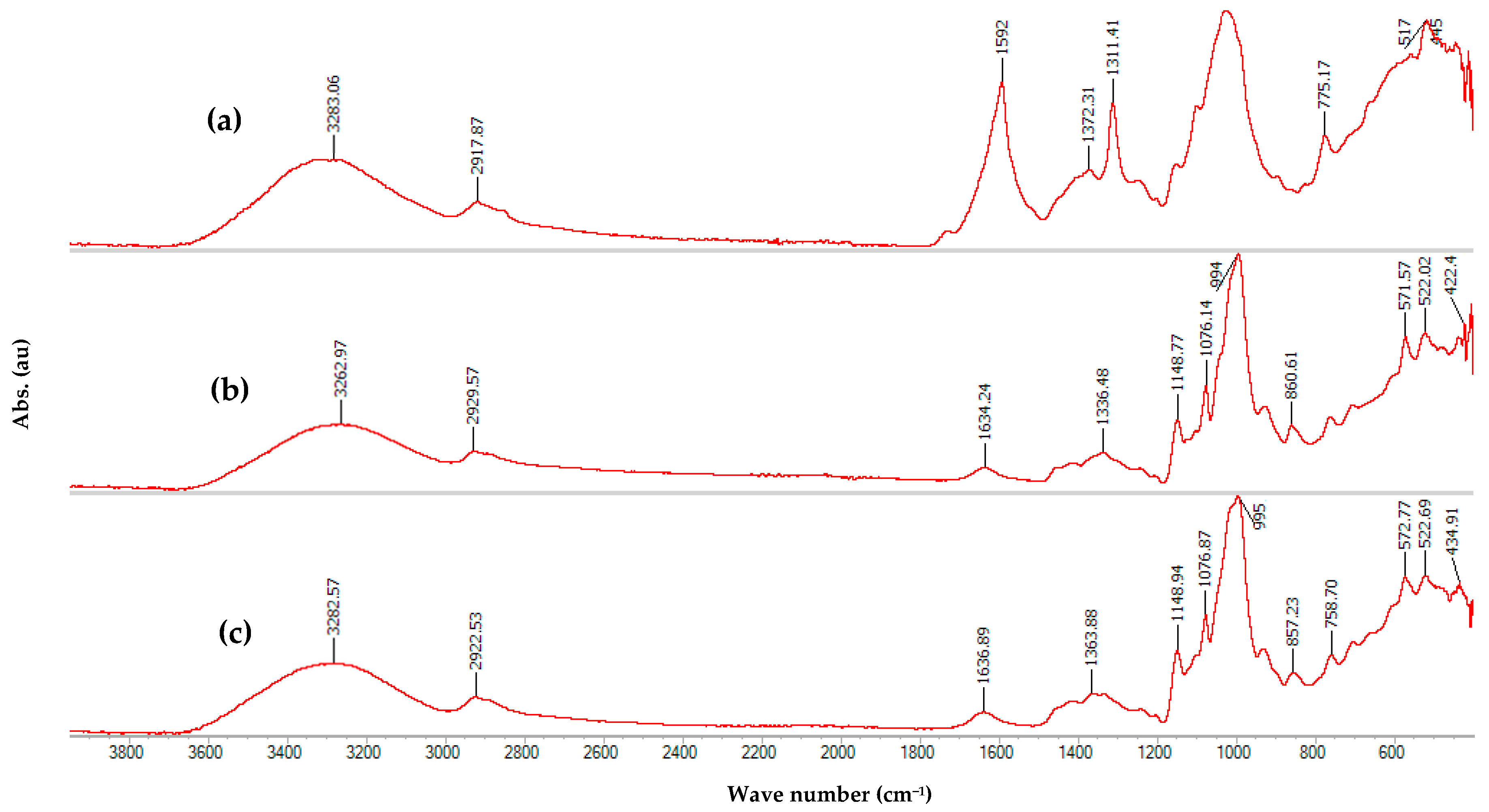
The bioplastic synthesized from the extracted cellulose and corn-starch was also analyzed by FTIR to evaluate intermolecular interactions within the composite. As shown in Figure 2a,b, both cellulose and starch exhibit characteristic O–H stretching bands. In the bioplastic, Figure 2c, the O–H band of cellulose shifts from 3335 cm−1 to 3282 cm−1, while the O–H band of starch (3262 cm−1) also shifts toward this region.
These shifts to lower wavenumbers indicate strengthened hydrogen bonding between cellulose and starch, reflecting a decrease in vibrational energy of O–H groups due to intermolecular interactions. Taken together, the FTIR results confirm the successful integration of cellulose into the starch matrix and the formation of a hydrogen-bonded biopolymeric structure [14].
Table 2. Principal characteristic absorption bands of lignins, cellulose, and hemicelluloses in the samples [15].
Absorption Band (cm−1)LigninCelluloseHemicellulose
3700–3100O-H group stretching vibration
3000–2750Symmetric and asymmetric stretching vibrations of C-H bonds in CH, CH2, and CH3 groups
1770–1700C=O stretching vibration in carbonyl and carboxyl groupsNo bandsC=O stretching vibrations in acetyl fragments
1605–1490Skeletal stretching vibrations of aromatic rings; C=O stretching vibrationNo bandsAsymmetric stretching vibrations of carboxylate anions
1380–1370No bandsBending vibrations of C-H and O-HBending vibrations of C-H in CH3 groups of acyl fragments
1335–1200Skeletal vibrations of rings in syringyl and guaiacyl units; asymmetric stretching vibrations between Ar-O-C; stretching vibrations of phenolic C-O.Bending vibrations of C-H; axial deformation vibrations in C-H of CH2 groups; in-plane bending vibrations of O-H groups.
Conversely, the O-H absorption band of starch, which appears at 3262 cm−1, shifts to 3282 cm−1 in the bioplastic, indicating an increase in vibrational energy. Both shift phenomena are due to hydrogen bonding interactions between the O-H groups of cellulose and starch [15].

3.3. SEM

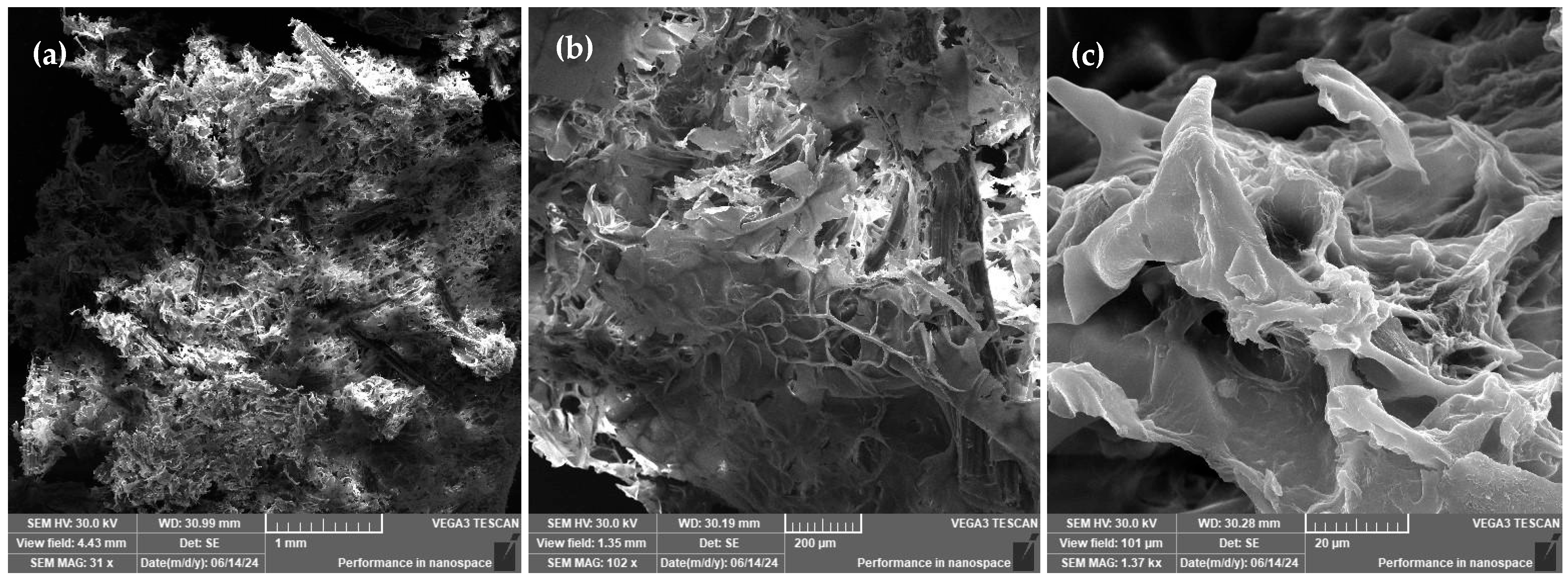
The images obtained by SEM show a porous structure with sizes ranging between 100 and 200 µm, as observed in Figure 3a,b, which is formed by the sublimation of water during lyophilization, resulting in an expanded structure [16]. Additionally, the embedding between cellulose and starch presents a film-like morphology that overlaps in a laminar fashion, as observed in Figure 3c.
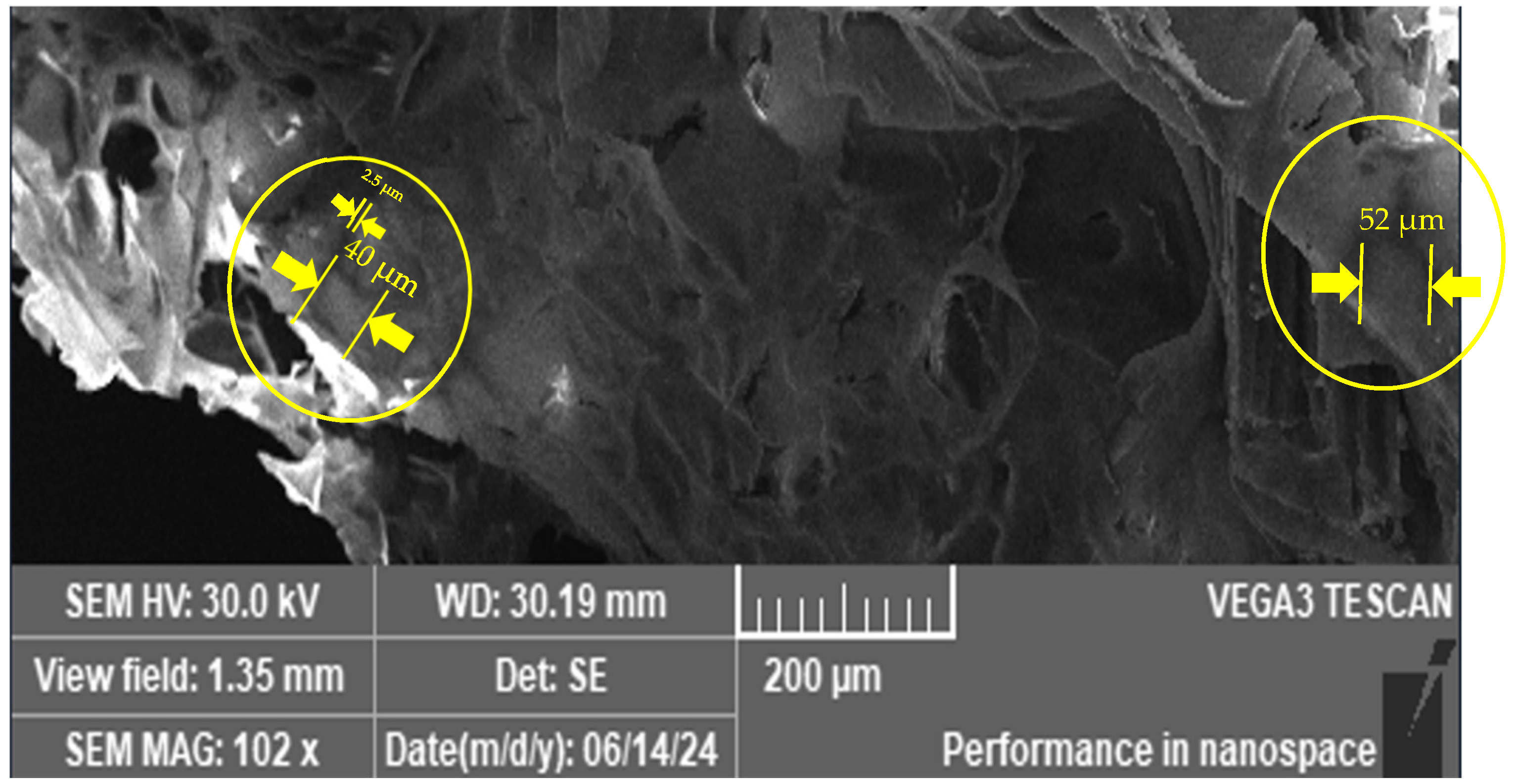
The bioplastic showed particles approximately 40–52 µm in size, with an average inter-particle spacing of about 2.5 µm, revealing an internal distribution of both particles and fibers (Figure 4). These features indicate cellulose agglomerates embedded within the starch films, particularly in areas where cellulose fibers are more abundant.
The distribution of cellulose particles in the binder (starch) is homogeneous dispersion of cellulose in the starch matrix enhance interfacial bonding (Figure 4). This embedded form between cellulose and starch confers greater structural strength to the bioplastic [17].

3.4. DSC

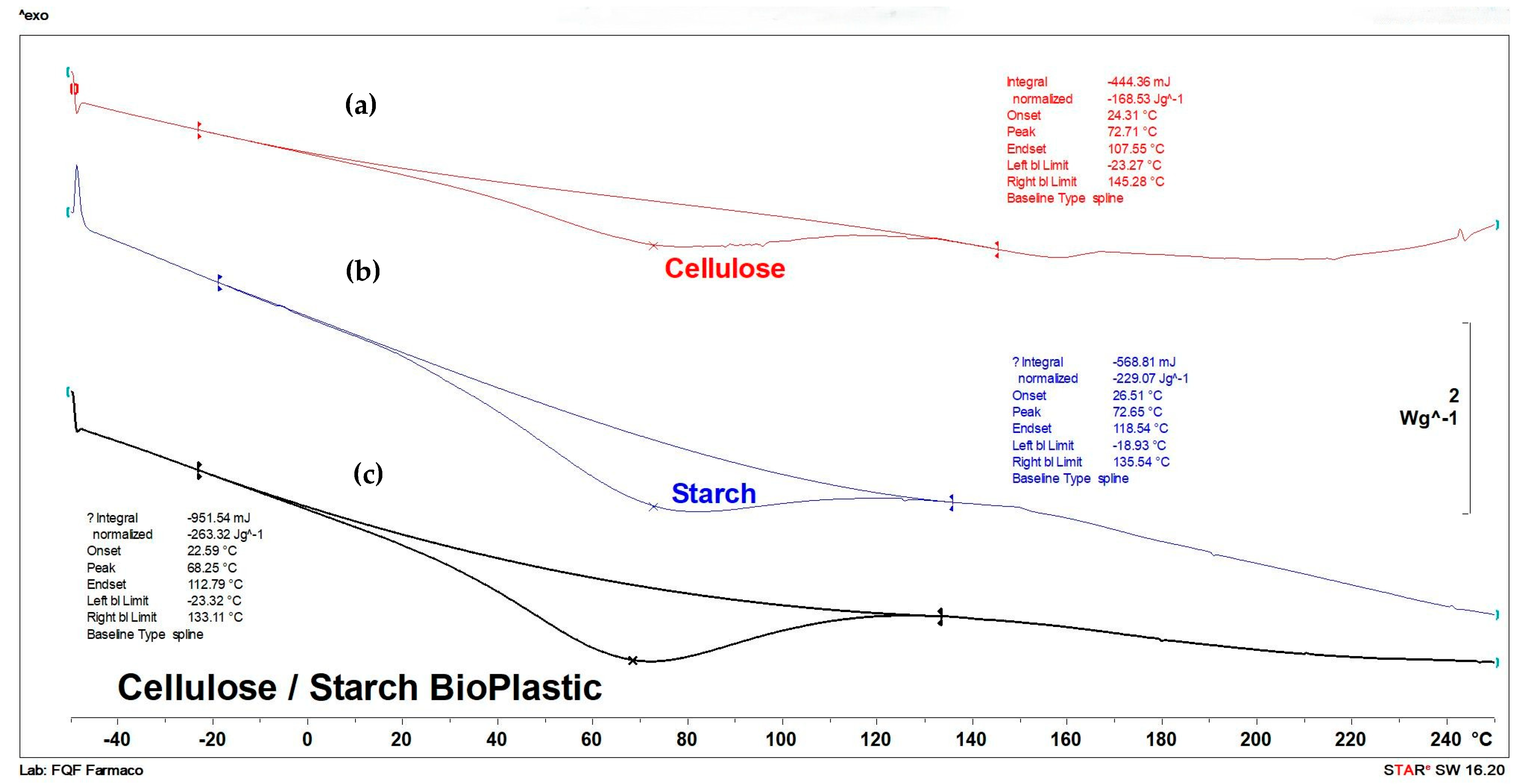
Figure 5 showed the thermograms of starch, cellulose, and the embedded cellulose/starch bioplastic. Cellulose (Figure 5a) exhibits a nearly flat curve with minimal deviations, showing only a slight endothermic transition from an initial temperature (Onset) of ~25 °C to a final temperature (Endset) of ~108 °C. No additional thermal events are detected up to 250 °C, which reflects its high thermostability and structural integrity, making it suitable for applications requiring resistance to thermal degradation. Starch (Figure 5b) displays a prominent broad endothermic transition from ~25 °C to ~120 °C, associated with the loss of absorbed water, a behavior also reported for polysaccharides such as cellulose [18].
Starch also showed a large endothermic transition, which is likewise associated with the loss of absorbed water during heating, occurring from ~26 °C to ~118 °C [19,20]. As with other polysaccharides, all types of starches are hygroscopic and absorb moisture from the surrounding air until they reach an equilibrium water content by weight. Moreover, the amount of water absorbed varies depending on the botanical origin of the starch—such as corn, potato, or wheat—each of which exhibits characteristic moisture levels [21,22].
Bioplastic synthesized in Figure 5c showed a mixed thermal profile, with an endothermic transition from ~24 °C to ~116 °C, representing an intermediate behavior between cellulose and starch. This thermal response arises from the interactions between both components within the composite matrix. No sharp melting or degradation events are detected within the scanned range, indicating an amorphous nature without distinct phase transitions below 250 °C. The endothermic transition observed for cellulose is mainly associated with the loss of absorbed water during heating, as reported in previous studies [18,19,20]. The broadening of this transition is related to variations in moisture content, typically ranging from ~0% to ~8% by weight, depending on processing parameters and storage conditions, due to the hygroscopic properties of bioplastic synthetized [23].
Due to the vaporization of absorbed water in biopolymers, both cellulose and starch exhibit broad endothermic phenomena, which are reflected in their normalized enthalpy values [18]: 168.53 J/g for cellulose and 229.07 J/g for starch. Theoretically, the normalized enthalpy of the cellulose/starch bioplastic would correspond to the sum of the contributions from each raw material; however, the measured value of ~287 J/g differs from this expectation. This difference arises from the bioplastic synthesis process, which involves water addition, freezing, and lyophilization steps, as well as rearrangements within the polymer network that modify the hydrophilic domains and their interaction with water [23]. The pressed bioplastic showed no significant difference in normalized enthalpy compared to the unpressed material.
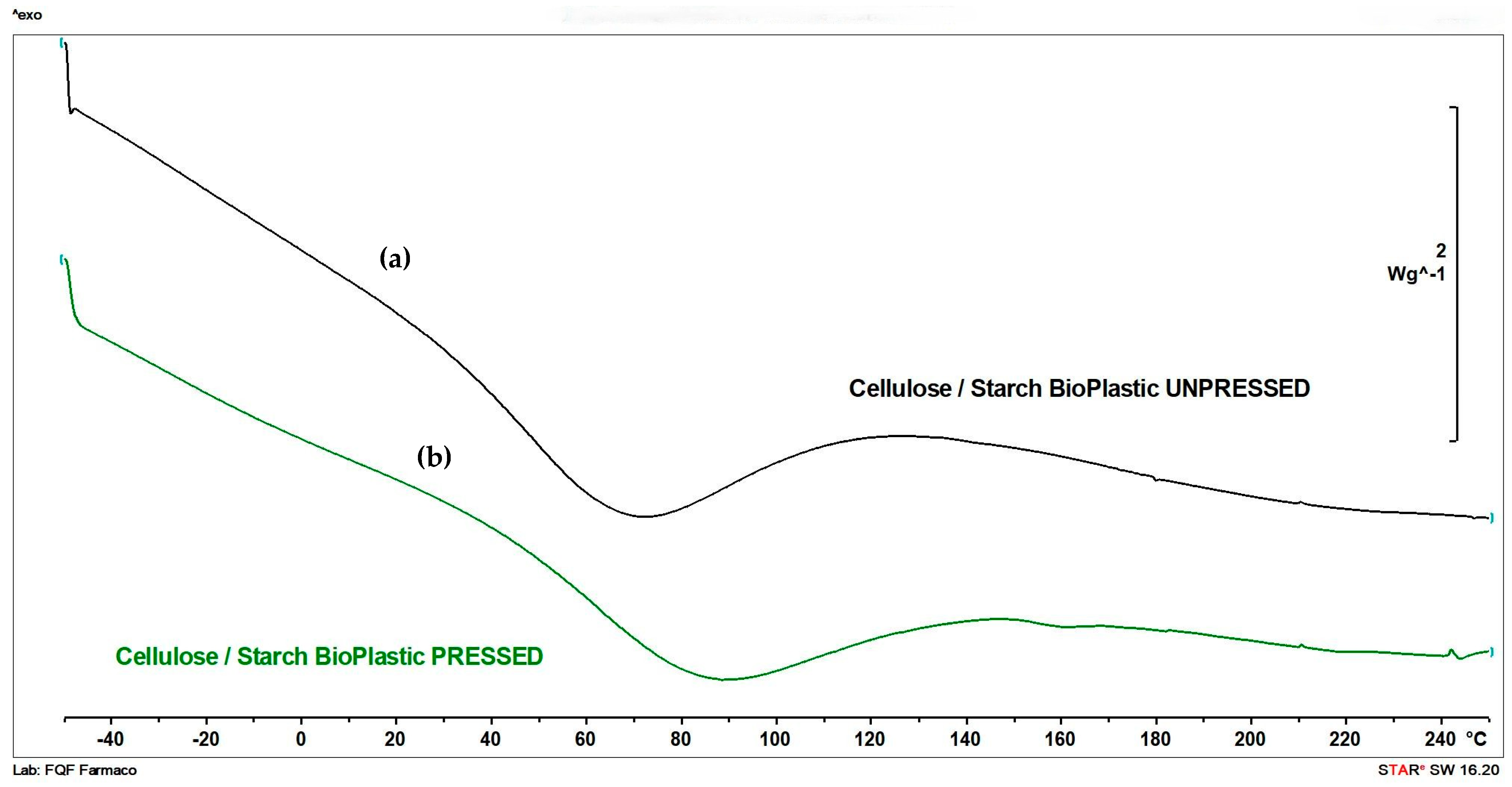
The pressed bioplastic sample, obtained through mechanical compression, is compared with the unpressed material in Figure 6, which illustrates the DSC thermograms showing the thermal changes induced by this treatment. The unpressed bioplastic, as shown in Figure 6a, exhibits a prominent broad endothermic transition from ~23 °C to ~116 °C, with a maximum near ~69 °C. In contrast, the pressed bioplastic, shown in Figure 6b, displays an endothermic transition from ~40 °C to ~137 °C, with a maximum around ~85 °C. These shifts indicate that mechanical pressing densifies the material, reduces free volume, and decreases molecular mobility within the biopolymer matrix, as reflected in the enthalpy relaxation behavior. This enhancement of thermal stability and structural integrity [23] makes the pressed material better suited for processing or end-use scenarios that require resistance to thermal degradation [24]. The DSC thermal characteristics are summarized in Table 3.
In summary, the DSC evaluation of cellulose, starch, and the synthesized bioplastic revealed consistent thermal patterns across all analyses. Cellulose displayed the greatest intrinsic thermal stability, while starch exhibited broader endothermic transitions associated with moisture loss. The bioplastic showed an intermediate but distinct thermal profile influenced by the interactions between both components and the processing steps involved in its synthesis. Mechanical compression further shifted the thermal transitions to higher temperatures, indicating densification and reduced molecular mobility. Altogether, these findings synthesize the observations from the previous paragraphs and provide a cohesive understanding of the thermal behavior of the materials, forming a solid basis for the mechanical analysis presented in the following section.

3.5. Tensile Strength Analysis

Building upon the thermal stability results, it was necessary to evaluate how the structural features of the bioplastic translate into its mechanical performance. While DSC analysis highlighted the influence of cellulose incorporation and compression on thermal behavior and tensile tests provide a complementary perspective on the material’s integrity under stress. These properties are critical for assessing the potential of bioplastic in real-world applications, particularly where resistance to rupture, flexibility, and density are decisive factors. Table 4 summarizes the physical characteristics of pressed and unpressed samples.
The mechanical evaluation revealed clear differences between the uncompressed and compressed bioplastic samples, showing how structural densification directly affects performance under tensile stress. Compression notably increased the density of the material (from 110 to 638.7 kg/m3), which is consistent with the mechanical elimination of internal pores generated during lyophilization. This densification translated into a substantial improvement in tensile strength [25], rising from 0.094 MPa in the uncompressed bioplastic to 0.69 MPa after compression. Importantly, despite this compaction, the material did not exhibit brittleness; instead, it maintained cohesion and flexibility, indicating that the cellulose–starch network remained structurally stable.
To contextualize these values, the tensile strength of the compressed bioplastic was compared with that reported for expanded polystyrene foam (EPS), a widely used lightweight polymer. Literature data indicate that EPS exhibits tensile strengths ranging from 0.120 MPa (12 kg/m3) to 0.325 MPa (25 kg/m3), depending on its density [26]. The fact that the compressed bioplastic reaches ~0.69 MPa—significantly higher than all reported EPS density grades—highlights its mechanical competitiveness despite its biodegradable nature and its higher density. In contrast, the uncompressed bioplastic, although less resistant, is mechanically comparable to low-density EPS, suggesting potential applicability in cushioning or low-load packaging.
Overall, these results demonstrate that the cellulose–starch bioplastic presents a tunable mechanical profile strongly influenced by processing conditions. Mechanical compression enhances structural integrity and rupture resistance, while the uncompressed form remains suitable for applications requiring lighter, more flexible materials. The ability to achieve mechanical properties similar to or surpassing those of EPS, combined with complete biodegradability, underscores the potential of this bioplastic as an environmentally responsible alternative for short-use packaging and protective materials.

4. Conclusions

This work demonstrated that banana pseudostem is a suitable source of cellulose for bioplastic production, with the Williams variety yielding the highest recovery. FTIR and SEM analyses confirm effective cellulose isolation and its successful integration into the starch matrix. The resulting bioplastic exhibited intermediate thermal behavior between its components, and mechanical compression significantly improved both thermal stability and tensile strength. These characteristics support its potential use in short-life applications based on biodegradable materials. Future studies should address biodegradation performance, moisture sensitivity, and optimization of cellulose–starch ratios.

Author Contributions

Writing—review and editing, Conceptualization, Investigation and Methodology, D.A.S., M.E.L., and M.J.N.; field and experimental research, F.R.P., D.A.S. and E.P.-G.; project administration and funding acquisition, M.E.L.; Data analysis and review, D.A.S. and M.J.N. All authors have read and agreed to the published version of the manuscript.

Funding

This research was funded by Secretaría Nacional de Ciencia, Tecnología e Innovación (SENACIT) del Gobierno de la República de Honduras, Contrato No. CPN-006-2023, Ministerio de Educación, Ciencia y Tecnología de El Salvador (MINEDUCYT) y Fundación Hondureña de Investigación Agrícola (FHIA).

Institutional Review Board Statement

Not applicable.

Data Availability Statement

The original contributions presented in the study are included in the Article: further inquiries can be directed to the corresponding author.

Acknowledgments

We are grateful for the support of the Laboratorio de Nanotecnología, Facultad de Ingeniería y Sistemas, Universidad Francisco Gavidia, San Salvador, El Salvador, for the SEM análisis; Laboratorio del Centro de Desarrollo de la Industria del Empaque y Embalaje en Centroamérica y Panamá (CDIECAP) de la Facultad de Ingeniería y Arquitectura de la Universidad de El Salvador for the Rheological analysis and of the Laboratorio de Química Analítica y Seguridad Ocupacional and SALTRA proyect coordinated by Oscar Avilés and Chicos S.A. de C.V. to provide support for the cutting and technical processing of the bioplastic samples by Gabriela Martínez.

Conflicts of Interest

The authors declare no conflicts of interest.

References

  1. Babaremu, K.O.; Okoya, S.A.; Hughes, E.; Tajani, B.; Teidi, D.; Akpan, A.; Idwe, J. Sustainable plastic waste management in a circular economy. Heliyon 2022, 8, e09984. [Google Scholar] [CrossRef] [PubMed]
  2. Zhao, X.; Wang, Y.; Chen, X.; Yu, X.; Li, W.; Zhang, S.; Meng, X.; Zhao, Z.M.; Dong, T.; Anderson, A.; et al. Sustainable bioplastics derived from renewable natural resources for food packaging. Matter 2023, 6, 97–127. [Google Scholar] [CrossRef]
  3. Redondo-Gómez, C.; Rodríguez, Q.M.; Vallejo, S.; Murillo, J.P.; Lopretti, M.; Vega-Baudrit, J.R. Biorefinery of biomass of agro-industrial banana waste to obtain high-value biopolymers. Molecules 2020, 25, 3829. [Google Scholar] [CrossRef] [PubMed]
  4. Kumar, V.; Chakraborty, P.; Janghu, P.; Umesh, M.; Sarojini, S.; Pasrija, R.; Kaur, K.; Lakkaboyana, S.K.; Sagumar, V.; Nandhagopal, M.; et al. Potential of banana based cellulose materials for advanced applications: A review on propierties and technical challenges. Carbohydr. Polym. Technol. Appl. 2023, 6, 100366. [Google Scholar] [CrossRef]
  5. Vinay, G.M.; Modi, R.B.; Prakasha, R. Banana Pseudostem: An Innovative and Sustainable Packaging Material: A Review. J. Package Technol. Res. 2024, 8, 95–107. [Google Scholar] [CrossRef]
  6. Patel, B.H.; Joshi, P.V. Banana Nanocellulose Fiber/PVOH Composite Film as Soluble Packinging Material: Preparation and Characterization. J. Package Technol. Res. 2020, 4, 95–101. [Google Scholar] [CrossRef]
  7. Gadhave, R.V.; Das, A.; Mahawar, P.A.; Gadekar, P.T. Starch Based Bio-Plastics: The Future of Sustainable Packaging. Open J. Polym. Chem. 2018, 8, 21–33. [Google Scholar] [CrossRef]
  8. Ilyas, R.; Sapuan, S.; Norrrahim, M.N.F.; Yasim-Anuar, T.A.T.; Kadier, A.; Kalil, M.S.; Atikah, M.; Ibrahim, R.; Asrofi, M.; Abral, H.; et al. Nanocellulose/Starch Biopolymer Nanocomposites: Processing, Manufacturing, and Applications. In Advanced Processing, Properties and Applications of Starch and Other Bio-Based Polymers, 1st ed.; Al-Oqla, F.M., Sapuan, S.M., Eds.; Elsevier: New York, NY, USA, 2020; pp. 65–87. [Google Scholar] [CrossRef]
  9. Ilyas, R.A.; Sapuan, S.M.; Ishak, M.R.; Zainudin, E.S. Development and characterization of sugar palm nanocrystalline cellulose reinforced sugar palm starch bionanocomposites. Carbohydr. Polym. 2018, 202, 186–202. [Google Scholar] [CrossRef] [PubMed]
  10. Abera, W.G.; Kasirajan, R.; Majamo, S.L. Synthesis and characterization of bioplastic film from banana (Musa cavendish species) peel starch blending with banana pseudo-stem cellulosic fiber. Biomass Conv. Bioref. 2024, 14, 20419–20440. [Google Scholar] [CrossRef]
  11. Sachcha, I.H.; Paddar, K.; Minar, M.M.; Rahman, L.; Kamrul Hassan, S.M.; Akhtaruzzaman, M.; Billah, M.T.; Yasmin, S. Development of eco-friendly biofilms by utilizing microcrystalline cellulose extract from banana pseudo-stem. Heliyon 2024, 10, e29070. [Google Scholar] [CrossRef] [PubMed]
  12. AOAC International. AOAC International. AOAC Offial Method 962.09. Animal Feed. Fiber (Crude) in Animal Feed and Pet Food. Ceramic Fiber Filter Method. In Official Methods of Analysis of AOAC International, 21st ed.; Latimer, G., Jr., George, W., Wend, T., Nancy, J., Eds.; Aoac International: Rockville, MD, USA, 2019; pp. 45–46. [Google Scholar]
  13. ASTM D638-22; Standard Test Method for Tensile Properties of Plastics. ASTM International: West Conshohocken, PA, USA, 2022.
  14. Zhang, C.-W.; Li, F.-Y.; Li, J.-F.; Li, Y.-L.; Xu, J.; Xie, Q.; Chen, S.; Guo, A.-F. Novel treatments for compatibility of plant fiber and starch by forming new hydrogen bonds. J. Clean. Prod. 2018, 185, 357–365. [Google Scholar] [CrossRef]
  15. Kostryukov, S.G.; Matyakubov, H.B.; Masterova, Y.Y.; Kozlov, A.S.; Pryanichmikova, M.K.; Pynenkov, A.A.; Khluchina, N.A. Determination of Lignin, Cellulose, and Hemicellulose in Plant Materials by FTIR Spectroscopy. J. Anal. Chem. 2023, 78, 718–727. [Google Scholar] [CrossRef]
  16. Huang, J.; Gao, J.; Qi, L.; Gao, Q.; Fan, L. Preparation and Properties of Starch-Cellulose Composite Aerogel. Polymers 2023, 15, 4294. [Google Scholar] [CrossRef] [PubMed]
  17. Nasri-Nasrabadi, B.; Behzad, T.; Bagheri, R. Preparation and Characterization of Cellulose Nanofiber Reinforced Thermoplastic Starch Composite. Fibers Polym. 2014, 15, 347–354. [Google Scholar] [CrossRef]
  18. Yu, L.; Christie, G. Measurement of starch thermal transition using differential scanning calorimetry. Carbohydr. Polym. 2001, 46, 179–184. [Google Scholar] [CrossRef]
  19. Roig, F.; Dantras, E.; Dandurand, J.; Lacabanne, C. Influence of hydrogen bonds of glass transition and dielectric relaxations of cellulose. J. Phys. Appl. Phys. 2011, 44, 045403. [Google Scholar] [CrossRef]
  20. Hatakeyama, H.; Hatakeyama, T. Interaction between water and hydrophilic polymers. Thermochim. Acta 1998, 308, 3–22. [Google Scholar] [CrossRef]
  21. Hatakeyama, T.; Hatakeyama, H. Thermal Properties of Cellulose and its Derivatives. In Thermal Propierties of Green Polymers and Biocomposites, 1st ed.; Springer: Utrecht, Netherlands, 2005; pp. 39–130. [Google Scholar]
  22. Rowe, R.C. Handbook of Pharmaceutical Excipients, 6th ed.; Pharmaceutical Press (PhP): London, UK, 2009; p. 888. [Google Scholar]
  23. Keshk, S.M.A.S.; Al-Sehemi, A.G. New Composite Based on Starch and Mercerized Cellulose. Am. J. Poly. Sci. 2013, 3, 46–51. [Google Scholar] [CrossRef]
  24. Narrazzi, N.M.; Abdullah, N.; Norrahim, M.N.F.; Kamarudin, S.H.; Ahmad, S.; Shazleen, S.S.; Rayung, M.; Asyraf, M.R.M.; Ilyas, R.A.; Kuzmin, M. Thermogravimetric Analysis (TGA) and Differential Scanning Calorimetric (DSC) of PLA/Cellulose Composite. In Polylactic Acid-Based Nanocellulose and Cellulose Composite, 1st ed.; CRC Press: Boca Raton, FL, USA, 2022; pp. 149–159. [Google Scholar]
  25. Paulauskiene, T.; Sirtaute, E.; Tadzijevas, A.; Uebe, J. Mechanical Properties of Cellulose Aerogel Composites with and without Crude Oil Filling. Gels 2024, 10, 135. [Google Scholar] [CrossRef] [PubMed]
  26. Kang, Y.; Li, X.; Tan, J. Uniaxial tension and tensile creep behavior of EPS. J. Cent. South Univ. Technol. 2008, 15 (Suppl. 1), 202–205. [Google Scholar] [CrossRef]
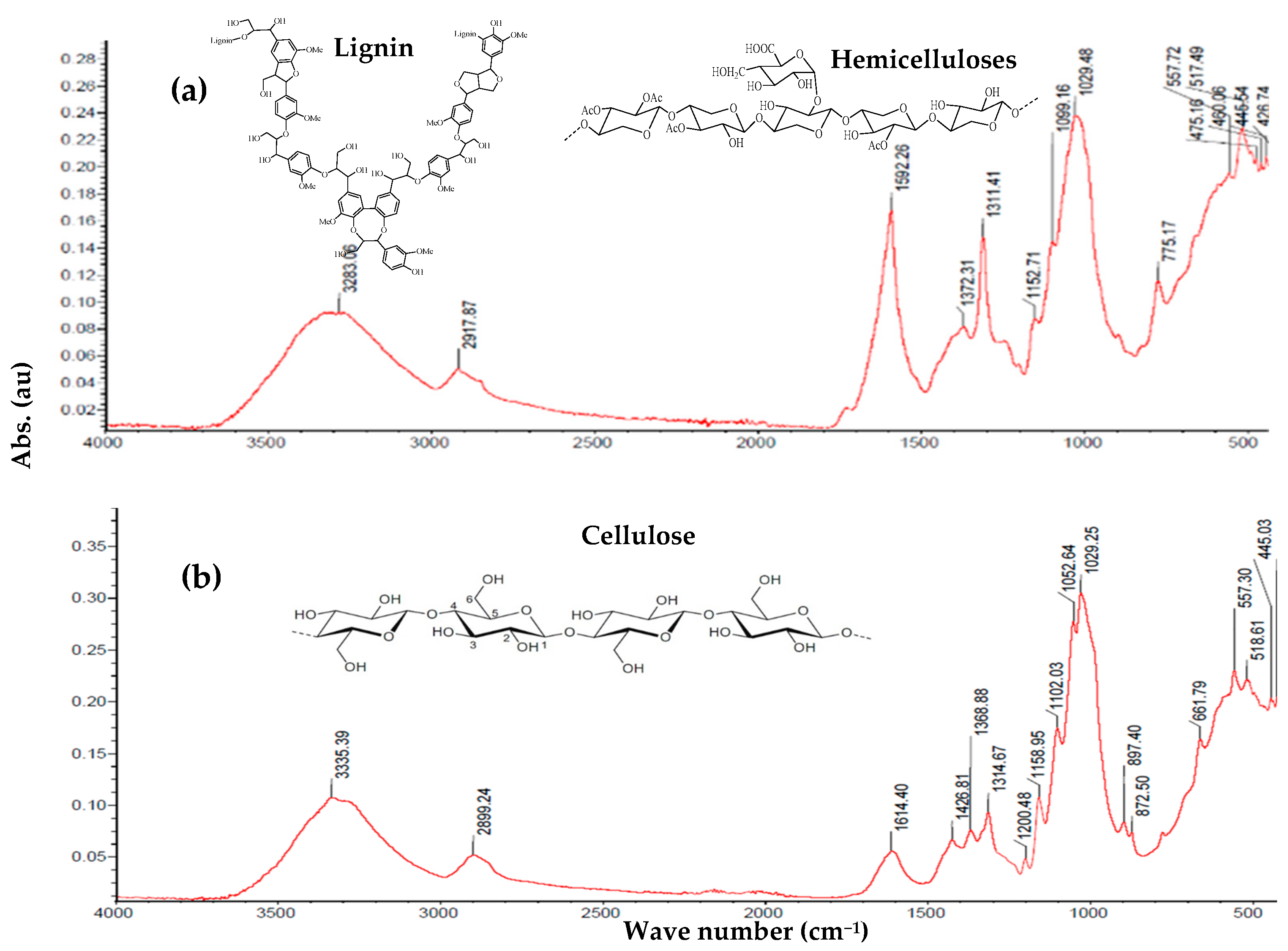
Figure 1. FTIR spectra: (a) Williams pseudostem, show signals characteristic of hemicelluloses and lignin, respectively; (b) extracted cellulose by Williams pseudostem, showed the characteristic signals of cellulose structure, showed the signals absent due to removal of the lignin and hemicelluloses.
J 08 00046 g001
Figure 2. FTIR spectra: (a) extracted cellulose of Williams pseudostem; (b) corn-starch used in the synthesis bioplastic; (c) cellulose/starch bioplastic.
J 08 00046 g002
Figure 3. SEM images of the synthesized bioplastic material: (a) Panoramic view of the cross-section of the synthesized bioplastic, magnified at 31×; (b) Image magnified at 102× showing the pore size in the cross-section of the biopolymer; (c) Magnification at 1370× showing the laminar morphology of the biopolymer.
J 08 00046 g003
Figure 4. Cross-section image of the bioplastic magnified at 102×, showing the distribution and agglomeration of cellulose particles within the starch matrix (highlighted in yellow circles).
J 08 00046 g004
Figure 5. DSC thermogram of: (a) extracted cellulose; (b) starch; (c) cellulose/starch bioplastic synthetized.
J 08 00046 g005
Figure 6. DSC thermogram of: (a) bioplastic unpressed; (b) bioplastic pressed.
J 08 00046 g006
Table 1. Cellulose content of banana pseudostem varieties.
VarietyCellulose Content (%)
Williams26.99 ± 0.23
Cavendish26.66 ± 0.32
Dátil25.78 ± 0.18
FHIA-2521.13 ± 0.57
Moroca17.07 ± 0.48
The cellulose content of each variety is represented by means of three replicates (n =3) ± standard deviations (SD).
Table 3. SC thermal results of the materials and bioplastic synthetized.
SampleOnset [°C]Endothermic Transition [°C]Normalized Enthalpy [ΔH/g]
(at Endothermic Transition)
Endset [°C]
Cellulose24.3172.71168.53107.55
Starch26.5172.65229.07118.54
Cellulose/starch bioplastic unpressed23.7768.91287.31116.45
Cellulose/starch bioplastic pressed40.2384.88261.01136.39
Table 4. Results of physics test of bioplastic synthesized samples.
AnalysisUnitsSample Pressed MaterialSample Unpressed Material
Weightg5.384.42
Thicknessmm1.878.92
Humidity%10.1211.58
Densitykg/m3638.70110.00
TensionN38.8325.33
Tensile strengthMPa0.690.094
Disclaimer/Publisher’s Note: The statements, opinions and data contained in all publications are solely those of the individual author(s) and contributor(s) and not of MDPI and/or the editor(s). MDPI and/or the editor(s) disclaim responsibility for any injury to people or property resulting from any ideas, methods, instructions or products referred to in the content.