Article

Treatment of Industrial Wastewater from the Baleysky Gold Deposit Using Artificial Geochemical Barriers


by
Konstantin R. Frolov
1,* and
Valentina P. Zvereva
2
1
Department of Oil, Gas and Petrochemical Industry, Far Eastern Federal University, FEFU Campus, 10, Ajax Bay, Russky Island, Vladivostok 690922, Russia
2
Far East Geological Institute, Far Eastern Branch, Russian Academy of Sciences, 159, Prospekt 100-Letiya, Vladivostok 690022, Russia
*
Author to whom correspondence should be addressed.
Clean Technol. 2026, 8(4), 96; https://doi.org/10.3390/cleantechnol8040096 (registering DOI)
Submission received: 20 April 2026 / Revised: 3 June 2026 / Accepted: 17 June 2026 / Published: 23 June 2026

Abstract

The Baleysky gold deposit in Eastern Transbaikalia is a classic example of the long-term environmental legacy of gold mining. The cessation of industrial wastewater discharge in 1995 led to the accumulation of more than 3 million m3 of acidic water with high concentrations of heavy metals and metalloids. These waters contain concentrations many times higher than the maximum permissible levels for fishery waters (Mn up to 6594, Al—1473, Zn—486, and Cu—414), posing a significant threat to the ecosystem of the Unda River and the health of the local population. The aim of this study was to evaluate the effectiveness of the artificial geochemical barrier method for treating such waters under laboratory conditions. Column experiments were conducted using local soil and the commercial carbonate sorbent taurite at a sorbent-to-filtrate ratio of 1:5. Taurite demonstrated a significantly higher sorption capacity than soil, substantially reducing the concentrations of As, Cd, Pb, Al, Mn, Fe, Zn, and Cu and raising the pH from 2.90 to 7.96–8.03. Although health risks associated with both carcinogenic (CR) and non-carcinogenic effects (HI) decreased significantly after treatment with taurite, residual risk levels remained unacceptably high (CR ≈ 10−3, HI > 1). The results show that engineered geochemical barriers have great potential for reducing anthropogenic contamination at abandoned mining sites, although further optimization of this technology is necessary to achieve compliance with regulatory requirements.

1. Introduction

1.1. Study Area

Eastern Transbaikalia is one of the oldest raw material provinces of the Russian Federation. The ore bodies of the Baley gold deposit are represented by gold–sulfide–quartz veins. The ore contains native gold in association with such sulfides as pyrite, arsenopyrite, chalcopyrite, galena, sphalerite, tetrahedrite, pyrrhotite, and marcasite. The sulfides include silver and other metals such as copper, lead, and zinc [1].
The total volume of accumulated gold ore waste in the Transbaikal Territory amounts to 2.85 billion tons. This includes (in billion tons): overburden rocks—2.5, balance and off-balance ores—0.17, beneficiation tailings—0.13, slags and products of chemical processing—0.07 [1]. The majority of tailings storage facilities in Eastern Transbaikalia were constructed in the 1930s–1950s. Their design and construction did not provide for hydroisolation of the bases or protective dams. Following the cessation of mineral extraction, none of these facilities has been reclaimed to date. Mass transfer of wastes under the influence of surface and groundwater, as well as wind erosion, leads to the pollution of ecosystems and the accumulation of mineral matter at geochemical barriers [2]. It should also be noted that the tailings storage facilities are located in immediate proximity to residential settlements [3].
Mining production in the town of Baley and the Baleysky District of Chita Oblast has been developing for over a century. The Baleyzoloto Combine operated from 1929 to 1993 and exploited three deposits [4]. In the enterprise’s tailings storage facilities, 34.27 million tons of beneficiation tailings and 70.53 million tons of overburden dumps have accumulated [5].
In the technological process of ore and sand processing, mercury was used (amalgamation technology). Its consumption ranged from 6 to 10 g/t and, with increased pumicing, up to 160 g/t. After the ban on mercury use, the ore was enriched by flotation followed by cyanidation of the concentrates [6]. Deposit development was carried out using both open-pit and underground methods. The ores were initially processed at one gold extraction plant and later at two plants, each with its own tailings storage facility [7]. In 1995, gold mining was discontinued despite the presence of industrial reserves of ore in the district [8].
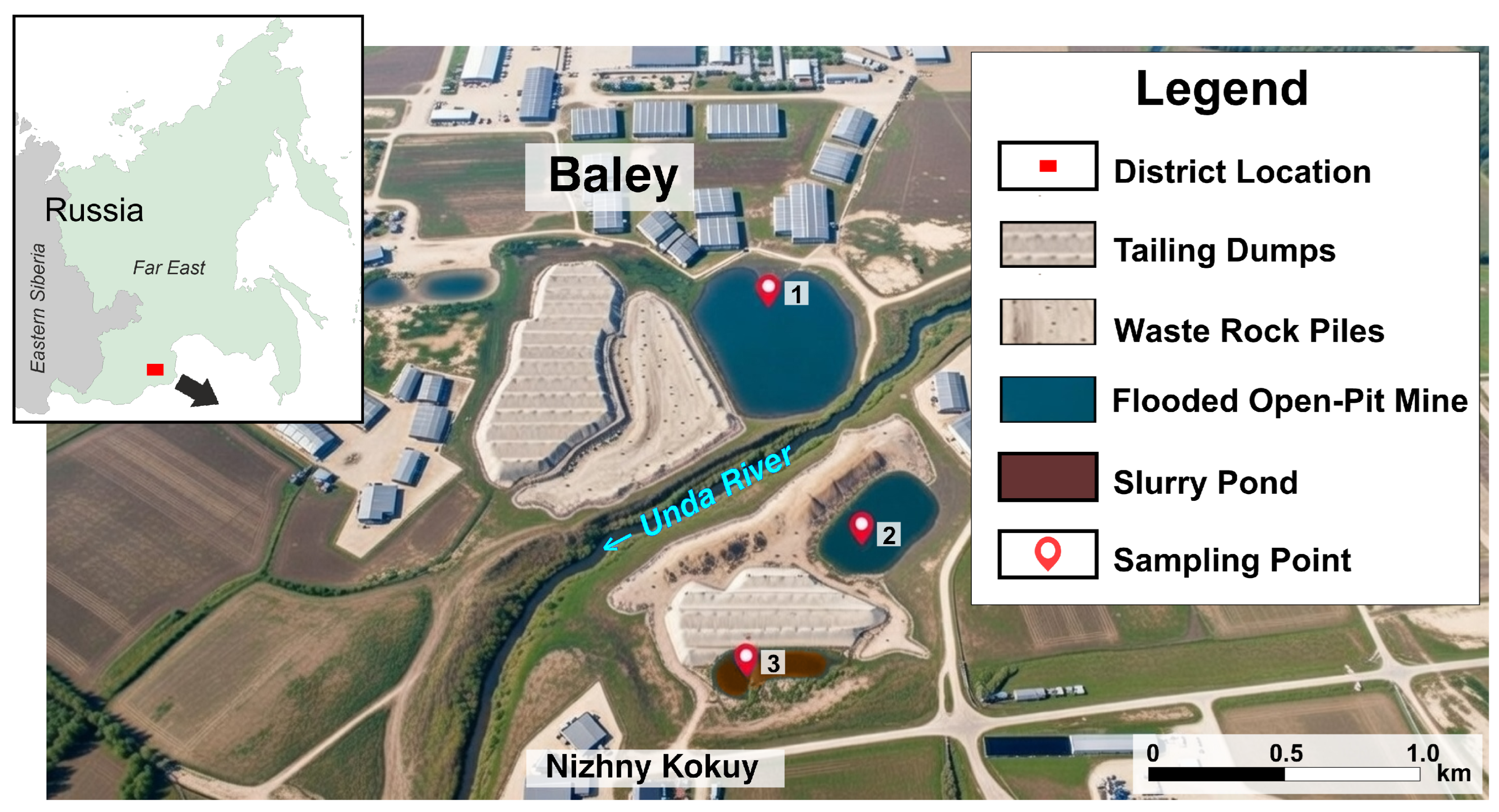
The total area of lands disturbed as a result of gold mining in the Baleysky District exceeds 30 km2. Figure 1 presents a schematic map of the Baley ore field. Technogenic transformations of natural landscapes that affect the input of pollutants into surface waters are represented by two ore open pits, two tailings storage facilities, dumps of overburden and host rocks, as well as excavations of gold-bearing sands and sludge settlers [9].
Water drainage from adits and open pits was carried out using a unified drainage complex of the system of underground workings located at various horizons. The average annual volume of water pumping amounted to 300–320 m3/h. At the end of 1995, water pumping was discontinued. Flooding of the underground mine workings occurred, and from the end of 1996, the filling of the basins of both open pits with water began. This process continues to the present day [10].
At present, the accumulated volume of water in the open pits has no outflow and actively receives underground and surface waters. According to preliminary estimates, approximately 15–20 million m3 of mine waters have accumulated in them, which represents a colossal volume for the Unda River valley and a climate with low precipitation. Such significant volumes of technogenic waters and the substances dissolved in them may have a substantial impact on the ecological, climatic, and hydrological conditions of the surrounding landscape [11,12,13,14].
The town of Baley in the Transbaikal Territory is a typical example of a territory with catastrophic industrial pollution of the environment. Intensive mining activities, uncontrolled use of wastes in construction, negligence in their storage, and the absence of reclamation or conservation works at production sites have led to the formation of a powerful technogenic source of chemical pollution of the soils, vegetation, waters, and air of the town. The negative situation in the town has affected the health of the population, as confirmed by the results of medical and social studies [15,16,17,18,19,20].
One of the key environmental problems of gold mining developments in the Baley–Taseevsky ore field is the acid metal-bearing waters that have accumulated due to the cessation of water pumping [21]. Pollutants are leached from the dumps into the surrounding grounds, soils and surface water bodies, and enter the household plots of the population, exerting an ecologically hazardous impact on flora and fauna [22].
A detailed study of waters from the flooded open pits of the Baley and Taseevsky deposits is presented in the work by L.V. Zaman and M.T. Usmanov [21]. The results of sampling and analysis of hydrochemical samples showed that the exceedance of background values for the main elements of sulfide ores reaches high values (times): Cu—n0000–n000000, Zn—n000–n00000, Pb—n0–n0000, Cd—n0–n0000, Ni and Co—n00–n0000. In addition, Hg is detected in the tailings sludges in amounts of 0.19–0.33 mg/kg. It has been established that, compared with the parent rocks, the sludges are enriched in mercury by a factor of 2–20 [4].
The water bodies are characterized by acidic waters with high contents of heavy metals Sr, Al, Mn, Fe, Cr, As, Cu, Zn, Pb, Cd, Ni, Co, Ag, which many times exceed the permissible standards for fishery water bodies [21]. The samples characterize the composition of waters formed as a result of their interaction with ores and host rocks or with gold ore processing wastes—tailings sands and dumps. The oxidation of sulfides and sulfuric acid leaching of rocks are among the main geochemical processes determining their physicochemical parameters [21]. Thus, technogenic waters exert a negative impact on the ecological and hydrological situation of the Unda River, which indicates the need for their treatment.

1.2. Artificial Geochemical Barriers

One of the promising and economically advantageous methods for treating wastewater from mining systems is the method of artificial geochemical barriers. These barriers represent artificial structures created during ecological engineering works to protect the environment from anthropogenic pollution—primarily wastewater from the mining industry. According to A.I. Perelman, geochemical barriers in general are areas of the Earth’s crust where, over a short distance, the intensity of migration of chemical elements sharply decreases, followed by their concentration due to the conversion of pollutants into poorly soluble forms [23]. Unlike natural barriers that arise due to the natural features of the biosphere, artificial (technogenic) barriers are formed deliberately by humans and often utilize available natural minerals (carbonates—calcite, dolomite, magnesite) or production wastes, which simultaneously solves the problem of their disposal; barriers based on biological objects (plants, microorganisms) are also possible [24]. Such barriers are used not only for water treatment but also for the additional recovery of valuable components, hydroisolation of waste storage facilities, and soil stabilization [25].
Similar approaches using permeable reactive barriers (PRBs) and artificial geochemical barriers have been successfully applied in many countries with a long history of mining. One of the earliest and most frequently cited studies on this topic presents the results of using porous, permeable, and geochemically reactive barriers installed in situ along the path of migrating groundwater; it proposed a promising alternative to passive treatment for the remediation of groundwater contaminated with metals originating from oxidized mining waste [26]. In similar work, in Canada, one of the pioneering full-scale PRBs for acid mine drainage (AMD) treatment was installed in 1995 at the Nickel Rim mine site (Sudbury, Ontario). This organic-carbon reactive barrier effectively removed heavy metals and sulfate through sulfate reduction and metal sulfide precipitation [27]. In the USA, zero-valent iron (ZVI) and limestone-based PRBs have been widely implemented. A notable example is the Monticello permeable reactive barrier (Utah), installed in 1999 for the treatment of uranium, arsenic, and other metals from mill tailings [28]. In Australia, carbonate-rich and organic substrates have also demonstrated high efficiency for passive long-term treatment of metalliferous mine drainage [29]. These international experiences confirm the technical feasibility and economic advantages of PRB technology for remediating contaminated mine waters [30].
The classification of artificial geochemical barriers corresponds to the general taxonomy: mechanical, physicochemical, and biogeochemical classes are distinguished, arising from changes in migration factors [24]. Physicochemical barriers are differentiated by the acidity of the environment (strongly acidic pH < 3.0; acidic and weakly acidic pH 3.0–6.5; neutral and weakly alkaline pH 6.5–8.5; strongly alkaline pH > 8.5) and by precipitation mechanisms: oxygen, hydrogen sulfide, gley, alkaline, acid, evaporative, sorption, and thermodynamic [24]. To create artificial barriers, carbonates, soda production wastes, silicified calcite, thermally activated ore beneficiation tailings, clay mats, geomembranes, or natural sorbents (zeolites, volcanic slag) are most commonly used, which ensures high selectivity toward pollutants without secondary contamination [31,32]. Mine waters are in turn classified into saline formation waters, acidic (with heavy metals), and alkaline [33].
The creation of artificial geochemical barriers follows a strict sequence of stages: from the study of natural-technogenic systems and assessment of feasibility to design, construction, efficiency monitoring, and adjustment. The advantages include the large-scale nature of the processes, the absence of energy-intensive equipment, low cost, and universality with respect to a wide range of pollutants. The disadvantages are the one-directional nature toward the barrier, the need for precise hydrogeological assessment, and prediction of service life [34]. The mechanism of action is based on precipitation, sorption, complexation, and biological reactions; the barrier passes through four stages (full concentration, partial saturation, loss of capacity, and depletion), and its capacity is determined by the composition and thickness of the material [31,34]. The main condition for success is the availability of cheap, highly selective, and environmentally safe sorbents [35].
The objective of this study is to assess the possibility of reducing environmental risks and risks to public health through the treatment of technogenic waters from the Baley gold ore deposit using the method of artificial geochemical barriers. In order to achieve this objective, the following tasks were completed: 1. collecting hydrochemical samples of technogenic waters from the Baley–Taseevsky gold ore field and determining their chemical composition; 2. conducting a laboratory experiment on the treatment of technogenic waters using the method of artificial geochemical barriers; 3. characterizing the impact of technogenic waters on the hydrosphere and assessing the risks to public health resulting from exposure to pollutants via water.

2. Materials and Methods

2.1. Technogenic Water Hydrochemical Samples

In September 2022, three series of hydrochemical samples of technogenic waters were collected in the Baley gold ore district. A schematic map of the technogenic system and the locations of the hydrochemical sampling points is presented in Figure 1; the following are marked on the map: the Baley open pit (point 1), the Taseevsky open pit (point 2), and the Kokuy tailings storage facility (point 3). The samples were collected into clean polypropylene (PP) test tubes with a capacity of 50 mL and into clean plastic bottles (HDPE) with a capacity of 1000 mL.

2.2. Artificial Geochemical Barrier Laboratory Model Preparation

Laboratory modeling of the technogenic water treatment process using the method of artificial geochemical barriers was performed by the column method. The methodology of the experiment is described by the authors of this work in publication [36]. Glass cylinders 30 cm in length and 3.5 cm in diameter were used; a graduated scale with 2.5 cm intervals was applied to each cylinder. A sieve with a fixed bamboo napkin was installed at the bottom of each column to prevent the barrier material from entering the filtrate. The tubes were filled with sorbent [37].
As sorbents, soil samples (brown earth) characteristic of the study area and a commercial sample of the carbonate sorbent taurite of grade TK (produced by GRK “Koksy”, Republic of Kazakhstan) were used.
Sample preparation of the barrier materials consisted in selecting a homogeneous size fraction predominant in the soil samples. The particle-size distribution of the soil was determined by sieve analysis using a Fritsch Milling Analysette 3 Pro vibratory sieve shaker. The analysis showed that the main volume of the soil was represented by the 1–5 mm fraction: 40.47%. Therefore, the taurite sorbent was crushed by direct mechanical action, classified to the 1–5 mm fraction, and used in all models of the artificial geochemical barrier.
Using graduated cylinders of the selected size, the bulk density of the barrier materials was determined by Equation (1) for the chosen size fraction; the determination was performed in a series of three measurements, and the obtained data were averaged:
ρ   =   m 1 m 2 V
where
  • ρ —bulk density, g/mL;
  • m 1 —mass of the material in the cylinder, g;
  • m 2 —mass of the empty cylinder, g;
  • V—volume of the cylinder, mL.
To determine the filtration rate, the volumetric flow rate of the filtrate was calculated for each material used in the column, Equation (2):
Q v   =   V a t
where
  • Qv—volumetric flow rate of the filtrate, m3/s;
  • Va—actual volume of filtrate passing through the cross-section of the flow, m3;
  • t—actual time, s.

2.3. Treatment of Technogenic Waters

The treatment of technogenic waters was carried out under laboratory conditions at a temperature of 20 °C and natural atmospheric pressure. The experiment was conducted in dynamic mode: five filtrate samples (mL) were collected sequentially from each column: 120, 240, 360, 480, and 600 mL, respectively. The height of the water column was maintained at a level of no less than 25.0 cm. The ratio of “filtering material–filtrate” was taken as 1:5, with volumes of 24 cm3 and 120 cm3, respectively. Five samples of 120, 240, 360, 480, and 600 mL were collected sequentially from each column into conical flasks.

2.4. Analysis of Hydrochemical Samples

Prior to chemical analysis, all samples were filtered through a membrane filter with a pore size of 0.45 μm. The pH of the samples was measured using a Mettler Toledo Seven Compact S220 instrument. The concentrations of pollutants in the initial samples and in the column filtrates were determined by ICP-AES (on an iCAP 6500 Duo spectrometer) and ICP-MS (on an Agilent 7700 spectrometer).

2.5. Impact on the Hydrosphere—Assessment of Risks to Public Health

The content of pollutants in the samples was compared with the maximum permissible concentrations (MPCs) for fishery water bodies of the Russian Federation [38]. In addition, in accordance with the U.S. EPA Framework, carcinogenic and non-carcinogenic risks were assessed [39,40,41].
The chronic daily intake (CDI) was calculated as follows, Equation (3):
CDI = C   ×   I R   ×   E F   ×   E D B W   ×   A T
where
  • C—concentration of the pollutant in water, mg/L;
  • IR—water ingestion rate, L/day (accepted value: 2 L/day for adults);
  • EF—exposure frequency, days/year (accepted value: 350 days/year);
  • ED—exposure duration, years (accepted value: 70 years—average life expectancy);
  • BW—body weight, kg (accepted value: 70 kg for adults);
  • AT—averaging time, days: for carcinogenic risk—25,550 days (70 years × 365), for non-carcinogenic risk—ED × 365 days.
Carcinogenic risk (CR) was assessed using Equation (4):
CR = CDI   ×   SF
where
  • CDI—chronic daily intake, mg/kg·day;
  • SF—cancer slope factor for oral exposure, (mg/kg·day)−1 (toxicity value from the U.S. EPA IRIS database [40]).
Non-carcinogenic risk was assessed using the hazard quotient (HQ, Equation (5)) and the hazard index (HI, Equation (6)):
HQ   =   CDI RfD
HI   =   HQ
where
  • RfD—reference dose for oral exposure, mg/kg·day [41].
An HI value < 1 indicates an acceptable risk; an HI value > 1 indicates potential adverse health effects.

3. Results and Discussion

3.1. Results of Hydrochemical Analysis of Technogenic Water Samples

The results of the hydrochemical analysis of samples from the Baley and Taseevsky open pits and the Kokuy tailings storage facility are presented in Table 1.
For the group of carcinogenic elements (Cr, As, Cd, Pb), only one object—the Kokuy tailings storage facility—shows exceedance of fishery standards: the concentration of As is 0.0591 mg/L compared with the MPC of 0.05 mg/L (exceedance by a factor of 1.18), while the Cd content (0.0051 mg/L) is at the limit of the standard (1.02 MPC). In the Baley and Taseevsky open pits, all carcinogenic elements are present at concentrations below the MPCs.
For non-carcinogenic elements (Al, Mn, Fe, Co, Ni, Cu, Zn), all three objects demonstrate systematic and multiple exceedances of the MPCs. The Kokuy tailings storage facility is the leader in the multiplicity of exceedance (times): Mn—65.9355 mg/L (6594), Al—58.9355 mg/L (1473), Zn—4.86 mg/L (486), Cu—0.4135 mg/L (414), Ni—2.9495 mg/L (295). The Taseevsky open pit is also heavily contaminated: Mn—26.3460 mg/L (2635 MPC), Al—19.2890 mg/L (482 MPC), Fe—23.1901 mg/L (232 MPC), Cu—0.2140 mg/L (214 MPC), Ni—1.7163 mg/L (172 MPC). The Baley open pit is the least contaminated; however, significant exceedances of the MPCs are also recorded here (times): Cu—0.3652 mg/L (365), Mn—0.9155 mg/L (91.6), Ni—0.7453 mg/L (74.5), Co—0.3561 mg/L (35.6).
Thus, the most contaminated object is the Kokuy tailings storage facility, which combines exceedance of the MPCs for the carcinogenic element As and the non-carcinogenic elements Mn, Al, Zn, and Cu. In view of this, the waters from the Kokuy tailings storage facility were selected for further studies on the model of an artificial geochemical barrier.

3.2. Bulk Density and Volumetric Flow Rate of the Filtrate

The bulk density of the materials of the artificial geochemical barrier, calculated using Equation (1), was (g/mL) 0.837 for the soil and 1.408 for the taurite sorbent. Based on the data on the volume of filtrate that passed through the cross-section of the flow per unit time, the volumetric flow rate of the filtrate was calculated using Equation (2) (L/min): 2.896 for the soil and 0.281 for taurite.

3.3. Treatment of Sludge Waters from the Kokuy Tailings Storage Facility

3.3.1. Hydrogen Ion Concentration (pH)

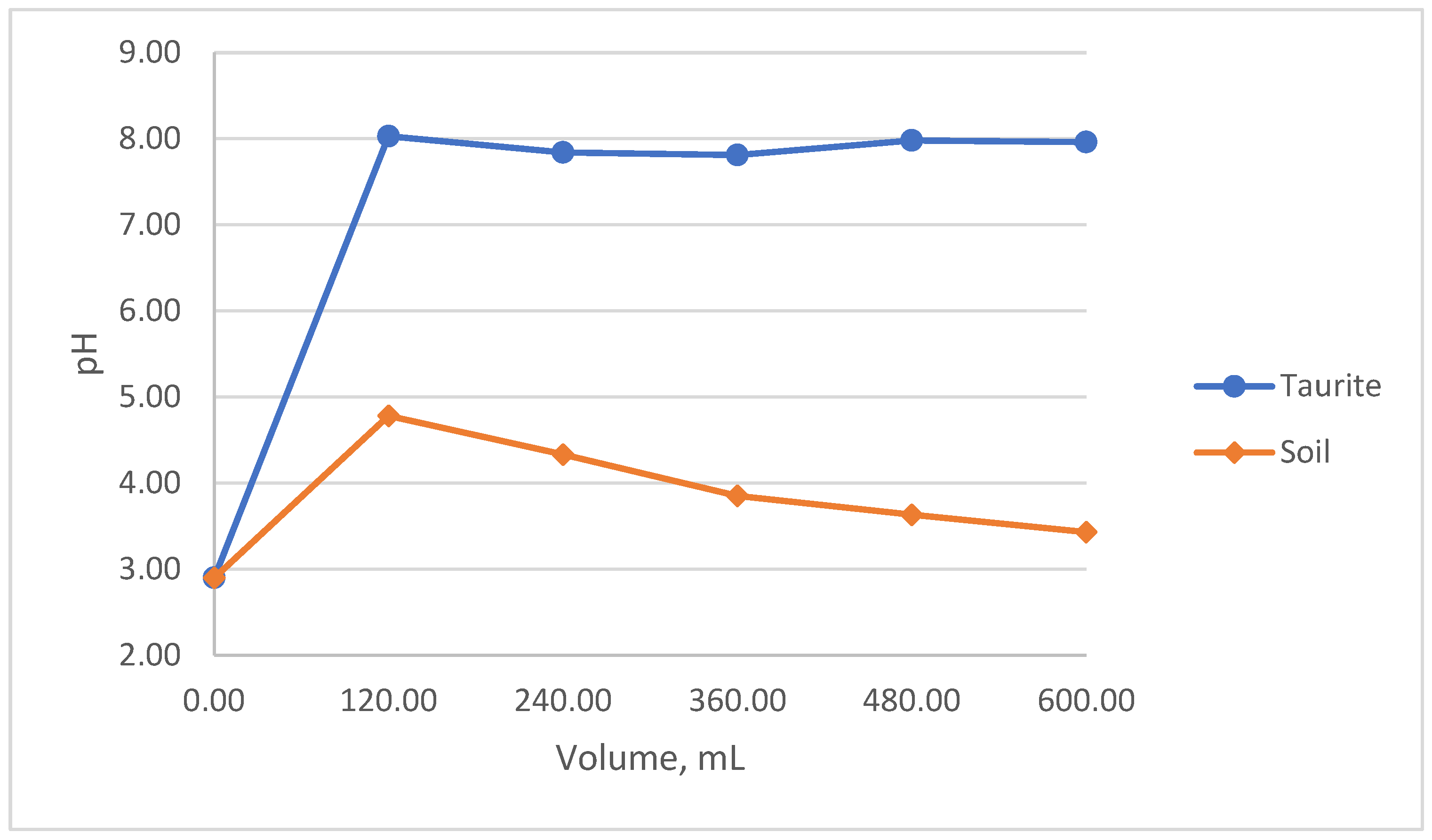
Based on the obtained experimental data, Figure 2 shows the plot of pH values versus the volume of filtrate that passed through the columns. The graph indicates that the pH of the filtrate becomes higher than its initial value. Thus, in the first filtrate sample (120 mL), the pH increases from 2.90 to 4.78 for soil and to 8.03 for taurite. In subsequent filtrate samples, the pH gradually decreases and reaches values of 3.43 and 7.96 for soil and taurite, respectively, at 600 mL.
This pattern is attributed to the rapid initial neutralization and dissolution of readily available alkaline components (mainly carbonates in taurite) and the subsequent depletion of active surface sites. As the sorption front moves through the column, less reactive fractions of the material meet the acidic influent, leading to a gradual decline in buffering capacity. Similar behavior has been reported for carbonate-based permeable reactive barriers [30].
Thus, the use of the taurite sorbent during treatment brings the hydrogen ion concentration closer to the natural values typical of surface waters (6.5–8.5).

3.3.2. Content of Pollutants

Table 2 presents the concentrations of chemical substances in the filtrate from the Kokuy tailings storage facility after treatment using the model of an artificial geochemical barrier.
When both sorbents were used, the concentrations of carcinogenic (Cr, As, Cd, Pb) and non-carcinogenic elements (Al, Mn, Fe, Co, Ni, Cu, Zn, Ag) decreased as a result of treatment; however, the degree of purification differed substantially depending on the material applied.
The efficiency of treatment depended on the volume of the filtrate sample and, as a rule, already manifested in the 120–240 mL samples, remaining stable in subsequent samples (360–600 mL).
For carcinogenic elements, the highest treatment efficiency was observed with taurite. Thus, in the 120–600 mL samples, the concentration of As decreased from 0.0591 to 0.0169–0.0285 mg/L, Cd from 0.0051 to 0.0002–0.0011 mg/L, Pb from 0.004 to 0.0003–0.0011 mg/L, and Cr from 0.0237 to 0.0178–0.0234 mg/L. When soil was used, a decrease also occurred, but, in most cases, it was less pronounced (especially for As). After treatment with taurite, the concentrations of As, Cd, and Pb in all samples were substantially below the corresponding MPC values.
For non-carcinogenic elements, the taurite sorbent demonstrated high efficiency for Al (reduction from 58.9355 mg/L in the initial sample to 1.4087–6.7133 mg/L), Mn (from 65.9355 to 0.5808–4.5828 mg/L), Fe (from 15.392 to 0.655–1.3582 mg/L), Zn (from 4.86 to 0.3284–2.3423 mg/L), as well as for Ni and Cu. Soil effectively reduced the concentrations of Mn, Zn, and partially Cu; however, for Al, Fe, Ni, and Co, the effect was weak or virtually absent (concentrations of these elements remained high and significantly exceeded the MPCs).
Overall, taurite proved to be a more universal and effective sorbent, providing a substantial reduction in the concentrations of most heavy metals and better compliance with MPC regulatory requirements than soil. Soil showed good results primarily for Mn, Zn, and Cd.
The experimental data indicate that the concentrations of pollutants follow the following order:
  • Mn > Al > Fe > Zn > Ni > Co > Cu > As > Cr > Cd > Pb—initial sample before treatment;
  • Mn > Al > Fe > Ni > Co > Zn > Cu > As ≈ Cr > Cd > Pb—after taurite treatment;
  • Al > Fe > Ni > Co > Mn > Zn > Cu > As > Cr > Pb > Cd—after soil treatment.

3.4. Assessment of Risks to Public Health

The results of the assessment of carcinogenic and non-carcinogenic risks for the waters of the Kokuy tailings storage facility to public health, conducted in accordance with the U.S. EPA guidelines before and after treatment, are presented in Table 3 and Table 4.
The calculations show that the total carcinogenic risk for the hydrochemical samples from the Kokuy tailings storage facility without treatment is 4.85 × 10⁻³, which corresponds to a very high–extremely dangerous level. After treatment with the taurite sorbent, it decreases by a factor of 3–6 (8.12 × 10⁻⁴–1.47 × 10⁻³), while treatment with soil demonstrates lower efficiency: the value decreases by a factor of 2.5–3 and ranges from 1.47 × 10⁻³ to 1.86 × 10⁻³. Nevertheless, the risk level after the experiment remains within the extremely dangerous range, and the contribution of elements to the total carcinogenic risk follows the order As > Cd > Cr > Pb.
The value for non-carcinogenic risks (Table 4) after taurite treatment decreases from 56.08 to 37.56–39.52 (approximately 1.5 times), which is slightly better than that for soil treatment (36.63–40.76). In all cases considered, the level remains extremely high (HI > 1000). This level indicates a high danger of chronic toxic effects on public health (neurological, hematological, renal, and hepatic toxicity).
The contribution of individual elements to the total non-carcinogenic risk follows the order:
  • Co > Mn > Ni > Al > Fe > Zn > Cu—initial sample before treatment;
  • Co > Ni > Mn > Al > Fe > Zn > Cu—after taurite treatment;
  • Co > Ni > Al > Fe > Mn > Cu > Zn—after soil treatment.
The main contribution to the risks comes from an insufficient reduction in As concentrations and the weak removal of Co and Ni. Thus, the initial hydrochemical samples from the Kokuy tailings storage facility are extremely hazardous (very high CR and extremely high HI), and the water is unsuitable for any type of water use. Treatment using the taurite sorbent significantly reduces the risk values.
In comparison with international studies on permeable reactive barriers for acid mine drainage [26,27,28,29,30,31], the concentrations and risk reduction observed here are typical for single-material carbonate systems in short-term laboratory tests. However, they also highlight the current limitations of the tested configuration for direct practical application. The treated water cannot be considered suitable for environmental discharge or any human use without further optimization. To achieve acceptable risk levels (CR ≤ 10−4 and HI < 1), increasing the sorbent-to-filtrate ratio and combining materials is recommended. In practical applications, a layered configuration appears most promising: an upstream layer of local soil (effective for Mn, Zn, and partial Cd removal and providing mechanical filtration) followed by a downstream taurite layer (superior for As, Al, Fe, Cu, and pH neutralization). Alternatively, a mixed bed could combine the cost effectiveness of soil with the high selectivity of taurite. Such hybrid barriers would allow sequential treatment mechanisms—precipitation/neutralization in the first layer and enhanced sorption/complexation in the second—and are expected to improve removal of the critical residual contaminants As, Co, and Ni. Pilot-scale testing of these configurations is currently under preparation.

4. Conclusions

The Baley gold ore district was developed from 1929 to 1995. The ores were enriched by amalgamation and flotation methods followed by cyanidation of the concentrates. More than 3 million m3 of acidic drainage waters have accumulated in the Baley and Taseevsky open pits as well as in the Kokuy tailings storage facility.
This study provides the first laboratory-scale demonstration for metal-laden waters from the Baley gold deposit using artificial geochemical barriers with local soil and taurite sorbent. The scientific contribution lies in quantifying the superior performance of taurite over local soil and linking geochemical treatment efficiency directly to human health risk reduction using U.S. EPA methodology.
In the technogenic water samples collected in the study area in 2022, multiple exceedances of the maximum permissible concentrations (MPCs) for fishery water bodies were observed (times): Mn (92–6594), Al (16–1473), Zn (4–486), Cu (214–414), Ni (75–295), and Fe (7–232). The most contaminated object is the Kokuy tailings storage facility; therefore, hydrochemical samples from this site were treated using a model of an artificial geochemical barrier.
Laboratory experiments showed that, during the treatment of technogenic waters, the taurite sorbent demonstrated higher and more-stable sorption efficiency than soil for most elements, especially As, Cd, Al, Mn, Fe, and Cu. Soil showed good results only for Mn and Zn.
The distribution of element concentrations before treatment on the barriers follows the order Mn > Al > Fe > Zn > Ni > Co > Cu > As > Cr > Cd > Pb. After treatment with the taurite sorbent, it changes to Mn > Al > Fe > Ni > Co > Zn > Cu > As ≈ Cr > Cd > Pb, while, after soil treatment, it becomes Al > Fe > Ni > Co > Mn > Zn > Cu > As > Cr > Pb > Cd.
Both sorbents reduce risk values compared with the initial samples; however, the treated aqueous solutions retain an unacceptably high risk level. The main contribution to the residual risk after treatment on the model of an artificial geochemical barrier is made by As, Co, and Ni, which are poorly removed by both sorbents.
To reduce the technogenic load on the hydrosphere and achieve acceptable risk values (CR ≤ 10−4 and HI < 1), it is necessary to increase the “filtering material–filtrate” ratio and to combine these sorbents.

Author Contributions

Conceptualization, K.R.F.; methodology, V.P.Z.; validation, K.R.F.; formal analysis, K.R.F. and V.P.Z.; investigation, K.R.F.; resources, K.R.F.; data curation, K.R.F.; writing—original draft preparation, V.P.Z. and K.R.F.; writing—review and editing, K.R.F.; visualization, K.R.F.; supervision, K.R.F. All authors have read and agreed to the published version of the manuscript.

Funding

This research received no external funding.

Data Availability Statement

The original contributions presented in this study are included in the article. Further inquiries can be directed to the corresponding author.

Conflicts of Interest

The authors declare no conflicts of interest.

Abbreviations

The following abbreviations are used in this manuscript:
HDPEHigh-density polyethylene
ICP-AESInductively coupled plasma—atomic emission spectroscopy
ICP-MSInductively coupled plasma—mass spectrometry
MPCMaximum permissible concentration
PPPolypropylene

References

  1. Verkhoturov, A. The Formation of the Mining and Geological Environment in Transbaikalia and Its Impact on the Region’s Ecology; Peoples’ Friendship University of Russia: Moscow, Russia, 2014. (In Russian) [Google Scholar]
  2. Mikhailenko, V.N. The Problem of Industrial Waste from Mining Operations in Transbaikalia. Min. Inf. Anal. Bull. (Sci. Tech. J.) 2006, 2, 121–123. (In Russian) [Google Scholar]
  3. Mikhailenko, N.N.; Torgayev, V.V. Ecological and Economic Assessment of the Feasibility of Commencing Industrial Exploitation of Man-Made Fluorspar Deposits in the Chita Region. Min. Inf. Anal. Bull. (Sci. Tech. J.) 2005, 12, 540–543. (In Russian) [Google Scholar]
  4. Zamana, L.V. Mercury in the Surface Waters of the Balei-Taseevsky Gold Mining District. Bull. Transbaikal Branch Russ. Geogr. Soc. 2012, 131, 83–89. (In Russian) [Google Scholar]
  5. Markin, N.S.; Korolkov, A.T. Geochemical Characteristics of the Soils of the Most Polluted Part of Baley (Zabaykalsky Krai). Bull. ISU. Ser. Earth Sci. 2021, 35, 71–83. (In Russian) [Google Scholar] [CrossRef]
  6. Korotchenko, I. The Baleyskoe Ore Field (Geology, Mineralogy, and Genesis); Central Scientific Research Institute for Exploration of Non-Ferrous and Precious Metals, Ministry of Geology of the USSR: Moscow, Russia, 1984. (In Russian)
  7. Yurgenson, G.A.; Chechetkin, B.M.; Asoskov, V.M.; Chaban, N.N.; Grigoriev, N.G.; Konstantinova, T.A.; Myazin, V.P.; Tcyganok, V.I.; Trubachev, A.I.; Ovseychuk, V.A.; et al. Geological Studies and the Mining and Industrial Complex of Transbaikalia: History, Current Status, Problems, and Prospects for Development; Nauka: Novosibirsk, Russia, 1999; ISBN 5020316660. (In Russian) [Google Scholar]
  8. Zorin, Y.A.; Zorina, L.D.; Spiridonov, A.M.; Rutshtein, I.G. Geodynamic Setting of Gold Deposits in Eastern and Central Trans-Baikal (Chita Region, Russia). Ore Geol. Rev. 2001, 17, 215–232. [Google Scholar] [CrossRef]
  9. Institute of Natural Resources, Ecology and Cryology SB RAS; Yurgenson, G.; Shumilova, L.; Transbaikal State University; Khatkova, A. Transbaikal State University stale gold-bearing tailings of the Baleizoloto plant and the problem of their disposal. Bull. ZabGU 2021, 27, 45–54. (In Russian) [Google Scholar] [CrossRef]
  10. Completed Projects: Taseevskoye Field. Available online: https://www.geolink-consulting.ru/#projects (accessed on 10 April 2026). (In Russian)
  11. Baryshnikov, V.I.; Zabrodin, V.M.; Voita, L.N. The Impact of Mining Operations on the Environmental Conditions in the City of Baley and the Baley District. Occup. Saf. Ind. 2004, 1, 19–20. (In Russian) [Google Scholar]
  12. Serezhnikov, A.I. Geological-Hydrogeological Characteristics and Paleohydrogeological Reconstructions of the Balei Gold Field, Transbaikalia. Russ. J. Pac. Geol. 2011, 5, 250–261. (In Russian) [Google Scholar] [CrossRef]
  13. Shumilova, L.V. Man-made deposits as sources of significant environmental impact. Sci. Time 2014, 8, 325–356. (In Russian) [Google Scholar]
  14. Bukin, A.G. On a New Technogenic Water Body at the Site of the Balei Quarry. Zap. Zabaykal. Otd. Russ. Geogr. O-Va 2013, 132, 122–127. (In Russian) [Google Scholar]
  15. Govorin, N.V.; Zlova, T.P.; Akhmetova, V.V. Features of the Content of Pro-Inflammatory Cytokines in the Peripheral Blood of Children with Ecologically Conditioned Intellectual Disability. Dal’nevost. Med. Zh. 2005, 4, 76–80. (In Russian) [Google Scholar]
  16. Govorin, N.V.; Zlova, T.P.; Akhmetova, V.V. Diagnostic Value of Some Neuroimmune Parameters in Children with Organic Mental Retardation. Dal’nevost. Med. Zh. 2006, 1, 42–44. (In Russian) [Google Scholar]
  17. Govorin, N.V.; Zlova, T.P.; Akhmetova, V.V. Neuroendocrine Mechanisms of the Formation of Intellectual Disability in Children under Conditions of Ecological Disadvantage. Ross. Psikhiatr. Zh. 2008, 1, 75–78. (In Russian) [Google Scholar]
  18. Govorin, N.V.; Zlova, T.P.; Akhmetova, V.V. The Incidence of Mental Disorders in Children of Transbaikalia and Prospects for Improving Psychiatric Care for the Child Population. Ross. Psikhiatr. Zh. 2009, 4, 26–29. (In Russian) [Google Scholar]
  19. Mozhaeva, M.V. Comparative Analysis of Some Emotional and Personal Characteristics of Children Living in Conditions of an Ecologically Unfavorable Living Environment. Uch. Zap. Zabaykal. Gos. Gumanit.-Ped. Univ. Im. N. G. Chernyshevskogo 2009, 5, 132–137. (In Russian) [Google Scholar]
  20. Pavlenko, Y.V. The State Geological Map of the Russian Federation of a New Generation as a Basis for Further Studies of Eastern Transbaikalia. Vestn. Chit. Gos. Univ. 2011, 1, 96–102. (In Russian) [Google Scholar]
  21. Zamana, L.V.; Usmanov, M.T. Ecological and Hydrogeochemical Characteristics of Water Bodies of Gold Mining Developments in the Balei-Taseevsky Ore Field (Eastern Transbaikalia). Izv. Sib. Otd. Sekts. Nauk. O Zemle RAEN 2009, 1, 106–111. (In Russian) [Google Scholar]
  22. Venevskaya, N.N. On the Issue of the Ecological Situation of the City of Balei (Zabaykalsky Krai). In Problems of Geology and Mineral Resource Development: Proceedings of the XX International Symposium Named After Academician M. A. Usov for Students and Young Scientists, Dedicated to the 120th Anniversary of the Founding of Tomsk Polytechnic University; Dmitriev, A.Y., Ed.; National Research Tomsk Polytechnic University: Tomsk, Russia, 2016; pp. 109–110. (In Russian) [Google Scholar]
  23. Perel’man, A.I. Geochemical Barriers: Theory and Practical Applications. Appl. Geochem. 1986, 1, 669–680. [Google Scholar] [CrossRef]
  24. Alekseenko, V.A.; Alekseenko, L.P. Geochemical Barriers. In Ucheb. Posobie; Logos: Moscow, Russia, 2003; p. 144. ISBN 5-94010-220-4. (In Russian) [Google Scholar]
  25. Chanturiya, V.; Masloboev, V.; Makarov, D.; Nesterov, D.; Bajurova, J.; Svetlov, A.; Men’shikov, Y. Geochemical Barriers for Environment Protection and Recovery of Nonferrous Metals. J. Environ. Sci. Health Part A 2014, 49, 1409–1415. [Google Scholar] [CrossRef] [PubMed]
  26. Waybrant, K.R.; Blowes, D.W.; Ptacek, C.J. Selection of Reactive Mixtures for Use in Permeable Reactive Walls for Treatment of Mine Drainage. Environ. Sci. Technol. 1998, 32, 1972–1979. [Google Scholar] [CrossRef]
  27. Benner, S.G.; Blowes, D.W.; Ptacek, C.J. A Full-Scale Porous Reactive Wall for Prevention of Acid Mine Drainage. Ground Water Monit. Remediat 1997, 17, 99–107. [Google Scholar] [CrossRef]
  28. Wilkin, R.T.; Puls, R.W.; Sewell, G.W. Long-term Performance of Permeable Reactive Barriers Using Zero-Valent Iron: Geochemical and Microbiological Effects. Ground Water 2003, 41, 493–503. [Google Scholar] [CrossRef] [PubMed]
  29. Indraratna, B.; Regmi, G.; Nghiem, L.D.; Golab, A. Performance of a PRB for the Remediation of Acidic Groundwater in Acid Sulfate Soil Terrain. J. Geotech. Geoenviron. Eng. 2010, 136, 897–906. [Google Scholar] [CrossRef]
  30. Wang, Y.; Wang, C.; Feng, R.; Li, Y.; Zhang, Z.; Guo, S. A Review of Passive Acid Mine Drainage Treatment by PRB and LPB: From Design, Testing, to Construction. Environ. Res. 2024, 251, 118545. [Google Scholar] [CrossRef] [PubMed]
  31. Dzhigola, L.A.; Rubleva, A.V. Study of Sorption and Diffusion Equilibria and Modeling of an Engineering Geochemical Barrier for the Concentration of Iron(III) Ions. Geol. Geogr. Glob. Energ. 2009, 3, 138–145. (In Russian) [Google Scholar]
  32. Nikashina, V.A.; Serova, I.B.; Kats, E.M.; Tokmachev, M.G.; Toropchenova, E.S.; Zhilkina, A.V.; Kuz’mina, T.G.; Bulenova, K. Permeable Reactive Barriers Based on Natural Zeolites from Kazakhstan in Solving Ecological Problems: Mathematical Model and Simulation. Geochem. Int. 2017, 55, 38–46. (In Russian) [Google Scholar] [CrossRef]
  33. Banks, D.; Younger, P.L.; Arnesen, R.-T.; Iversen, E.R.; Banks, S.B. Mine-Water Chemistry: The Good, the Bad and the Ugly. Environ. Geol. 1997, 32, 157–174. [Google Scholar] [CrossRef]
  34. Nikashina, V.A. Permeable Geochemical Barriers as a Method of Environmental Protection from Pollution. Natural Sorbents for Solving Environmental Problems. Mathematical Modeling and Calculation of Processes. Rev. Sorbtsionnye Khromatogr. Protsessy 2019, 19, 289–304. (In Russian) [Google Scholar] [CrossRef]
  35. Maximovich, N.; Khayrulina, E. Artificial Geochemical Barriers for Environmental Improvement in a Coal Basin Region. Env. Earth Sci. 2014, 72, 1915–1924. [Google Scholar] [CrossRef]
  36. Frolov, K.R.; Orinicheva, P.D.; Artemov, P.M.; Tcyganok, V.S.; Kharchenko, V.G. Treatment of Polymetallic Ore Tailing Dump Technogenic Waters Using Artificial Geochemical Barriers. Environ. Sci. 2025, 336, 35–45. [Google Scholar] [CrossRef]
  37. Frolov, K.R.; Zvereva, V.P.; Artemov, P.M. Treatment of Mining and Chemical Enterprise Technogenic Waters Using Artificial Geochemical Barriers on the Example of Dalnegorsk Mining and Processing Plant. Russ. J. Gen. Chem. 2025, 95, 4011–4017. [Google Scholar] [CrossRef]
  38. Ministry of Agriculture of the Russian Federation. Order on Approval of Water Quality Standards for Fishery Water Bodies, Including Maximum Permissible Concentrations of Harmful Substances in Waters of Fishery Water Bodies; Minsel’khoz Rossii: Moscow, Russia, 2016; p. 78. (In Russian)
  39. U.S. Environmental Protection Agency. Human Health Risk Assessment. Available online: https://www.epa.gov/risk/human-health-risk-assessment (accessed on 10 April 2026).
  40. U.S. Environmental Protection Agency. Integrated Risk Information System. Available online: https://www.epa.gov/iris (accessed on 10 April 2026).
  41. U.S. Environmental Protection Agency. Guidelines for Carcinogen Risk Assessment; EPA/630/P-03/001F; U.S. Environmental Protection Agency: Washington, DC, USA, 2005; p. 211.
Figure 1. Schematic map of the Baley gold ore district and locations of hydrochemical sampling points: 1—Baley open pit; 2—Taseevsky open pit; 3—Kokuy tailings storage facility.
Cleantechnol 08 00096 g001
Figure 2. pH of the filtrate.
Cleantechnol 08 00096 g002
Table 1. Content of pollutants in technogenic water samples, mg/L.
ElementMPCBaley Open PitTaseevsky Open PitKokuy Tailings Storage Facility
Carcinogenic elements
Cr0.050.00540.02180.0237
As0.050.00150.01240.0591
Cd0.0050.00320.00280.0051
Pb0.0060.00060.00240.0040
Non-carcinogenic elements
Al0.040.631019.289058.9355
Mn0.010.915526.346065.9355
Fe0.10.659423.190115.3920
Co0.010.35610.50210.4135
Ni0.010.74531.71632.9495
Cu0.0010.36520.21400.4135
Zn0.01-0.03814.8600
Table 2. Experimental results.
Element.
mg/L
MPC, mg/LSample,
mg/L
MaterialFiltrate, mg/L
120.00240.00360.00480.00600.00Average
Carcinogenic Elements
Cr0.050.0237Taurite0.02370.02340.02020.01960.01780.0209
Soil0.02610.02380.02280.02810.02710.0256
As0.050.0591Taurite0.01920.01690.01840.02420.02850.0214
Soil0.03830.03710.03630.0350.03460.0363
Cd0.0050.051Taurite0.00110.00080.00050.00050.00020.0006
Soil0.00020.00020.00010.00010.00010.0001
Pb0.0060.004Taurite0.00110.00090.00050.00050.00030.0007
Soil0.00140.00120.00110.00110.00120.0012
Non-Carcinogenic Elements
Al0.0458.936Taurite3.29971.40876.71331.42481.57732.8848
Soil47.410859.008758.937455.97259.114756.0887
Mn0.0165.936Taurite0.58082.90614.25034.58282.77643.0193
Soil0.06630.05030.05560.04490.04220.0519
Fe0.115.392Taurite1.24021.35820.72690.6550.76640.9493
Soil3.19213.35294.23083.74664.68633.8417
Co0.010.414Taurite0.37160.40140.39670.37670.38850.3870
Soil0.39930.35550.40090.36990.39580.3843
Ni0.012.950Taurite2.52511.34831.72551.40331.04941.6103
Soil2.94962.86452.67572.83642.89922.8451
Cu0.0010.402Taurite0.10520.04650.04550.05020.05750.0610
Soil0.13720.10610.06570.07010.05450.0867
Zn0.014.860Taurite2.34231.1960.4570.39270.32840.9433
Soil0.33180.29320.36370.36620.39550.3501
Table 3. Carcinogenic risk values.
ElementSF (mg/kg·day)−1Sample
Riski
Barrier
Material
Filtrate, Riski
120.00240.00360.00480.00600.00Average
As1.502.43 × 10−3Taurite5.79 × 10−45.10 × 10−45.52 × 10−49.95 × 10−48.55 × 10−46.98 × 10⁻⁴
Soil1.15 × 10−31.11 × 10−31.09 × 10−31.44 × 10−31.39 × 10−31.24 × 10⁻³
Cr0.53.25 × 10−4Taurite3.20 × 10−43.23 × 10−42.77 × 10−42.68 × 10−42.45 × 10−42.87 × 10⁻⁴
Soil3.58 × 10−43.14 × 10−43.96 × 10−43.85 × 10−43.74 × 10−43.65 × 10⁻⁴
Cd15.002.10 × 10−3Taurite4.52 × 10−43.29 × 10−42.05 × 10−42.05 × 10−48.22 × 10−52.55 × 10⁻⁴
Soil8.22 × 10−58.22 × 10−54.11 × 10−54.11 × 10−54.11 × 10−55.75 × 10⁻⁵
Pb0.00859.32 × 10−7Taurite2.56 × 10−72.09 × 10−71.16 × 10−71.16 × 10−76.98 × 10−81.51 × 10⁻⁷
Soil3.26 × 10−72.79 × 10−72.56 × 10−72.56 × 10−72.79 × 10−72.79 × 10⁻⁷
Total CR4.85 × 10−3Taurite1.02 × 10−38.12 × 10−49.05 × 10−41.47 × 10−31.35 × 10−31.11 × 10⁻³
Soil1.52 × 10−31.47 × 10−31.44 × 10−31.86 × 10−31.85 × 10−31.63 × 10⁻³
Table 4. Non-carcinogenic risk values.
ElementRfD
(mg/kg·day)
Sample
HQ
Barrier
Material
Filtrate, HQ
120.00240.00360.00480.00600.00Average
Al1.01.615Taurite0.09040.03860.1840.03900.04320.0790
Soil1.2991.6171.6151.5341.6201.537
Mn0.1412.91Taurite0.1140.5690.8320.8970.5440.591
Soil0.0130.009850.01090.00880.00830.0102
Fe0.70.602Taurite0.04850.05320.02850.02560.030.0372
Soil0.1250.1310.1660.1470.1830.15
Co0.000337.81Taurite33.9536.6636.2334.4135.4835.35
Soil36.4632.4736.6133.7836.1435.1
Ni0.024.04Taurite3.461.852.361.921.442.21
Soil4.043.923.663.883.973.9
Cu0.040.275Taurite0.07210.03190.03120.03440.03940.0418
Soil0.0940.07270.0450.0480.03730.0594
Zn0.30.444Taurite0.2140.1090.04170.03590.030.0862
Soil0.03030.02680.03320.03340.03610.032
HItotal56.08Taurite37.8639.2739.5237.3237.5638.32
Soil40.7636.6340.5337.9040.3739.25
Disclaimer/Publisher’s Note: The statements, opinions and data contained in all publications are solely those of the individual author(s) and contributor(s) and not of MDPI and/or the editor(s). MDPI and/or the editor(s) disclaim responsibility for any injury to people or property resulting from any ideas, methods, instructions or products referred to in the content.