Perspective

Next-Generation Thermal Management in EVs: Combining Dielectric Insulation with Latent Heat Storage

Vehicle Maintenance and Diagnostics Department—Zalaegerszeg, Széchenyi István University, 9026 Győr, Hungary
*
Author to whom correspondence should be addressed.
Clean Technol. 2026, 8(4), 100; https://doi.org/10.3390/cleantechnol8040100 (registering DOI)
Submission received: 13 April 2026 / Revised: 1 June 2026 / Accepted: 8 June 2026 / Published: 7 July 2026

Abstract

Efficient thermal management is a critical constraint for the performance, safety, and lifetime of electric vehicle (EV) batteries, particularly under transient high-power operation, where conventional dielectric coolants remain limited by the absence of thermal buffering. This Perspective examines PCM–dielectric hybrid coolants as a multiphase electro-thermal-fluid system, in which microencapsulated phase-change materials provide localized latent heat storage within a circulating insulating medium. Rather than proposing a new material concept, the work establishes a system-level engineering framework that links material properties, transport behavior, and electrical constraints to practical implementation. Key challenges, including dispersion stability, capsule durability under coupled stresses, dielectric reliability in heterogeneous media, and rheological limitations, are analyzed alongside quantitative design envelopes and validation pathways. A structured roadmap is presented, spanning multiphysics modeling, accelerated material qualification, system-level testing, and industrial integration, supported by techno-economic and lifecycle considerations.

1. Introduction

Thermal management is inseparable from the evolution of electric-vehicle (EV) batteries. As cell-level energy density increasingly exceeds 250 Wh kg−1, pack-level thermal management becomes more challenging. Conventional air and liquid cooling systems rely on convective heat transfer and sensible-heat absorption. While effective in removing heat, they cannot buffer rapid thermal transients. Dielectric coolant liquids (DCLs), including silicone oils, synthetic esters, and fluorinated compounds, have emerged as promising candidates for immersion-based battery cooling because they enable direct contact with electrically active components while maintaining insulation performance. However, the practical implementation of dielectric immersion cooling is governed by multiple coupled constraints extending beyond heat-transfer capability alone. Long-term dielectric reliability, fluid compatibility with polymers and sealing materials, oxidation stability, moisture sensitivity, and electrical aging under sustained electro-thermal stress all critically influence system durability and safety in high-voltage EV environments. In addition to these factors, conventional dielectric liquids possess relatively low specific heat capacities (≈1.5–2.0 kJ kg−1 K−1), which limits their ability to buffer rapid transient heat generation during fast charging, regenerative braking, and other high-power operating conditions. Although immersion cooling substantially improves thermal uniformity and interfacial heat transfer, single-phase dielectric fluids remain fundamentally dependent on sensible heat absorption, making short-duration thermal excursions increasingly difficult to suppress as battery power density increases.
Phase-change materials (PCMs), in contrast, absorb large amounts of heat at nearly constant temperature during melting, providing intrinsic thermal buffering. Materials such as paraffins, fatty-acid eutectics, and polyethylene-glycol derivatives exhibit latent heat capacities exceeding 150 J g−1, significantly higher than the sensible heat storage of conventional coolants [1,2,3,4,5,6]. When applied around battery cells, PCMs can reduce temperature gradients and improve thermal stability. However, their inherently static nature, low thermal conductivity, and leakage during phase transitions make them unsuitable for direct integration into circulating cooling systems [7,8,9,10,11,12,13,14]. Attempts to combine the convective transport capability of dielectric fluids with the latent heat storage of PCMs have therefore remained largely conceptual.
However, two fundamental and insufficiently resolved challenges limit the transition of such hybrid concepts from laboratory demonstrations to practical EV systems. First, the dispersion stability of PCM microcapsules in dielectric liquids remains highly uncertain under realistic operating conditions. Even in established nanofluid systems, long-term sedimentation, agglomeration, and viscosity drift are frequently observed. In PCM-based systems, this issue is further complicated by density variations during phase transitions, which may induce cyclic buoyancy-driven separation and lead to spatially non-uniform thermal buffering during repeated operation.
Second, maintaining encapsulation integrity under coupled thermal, mechanical, and electrical stresses represents a major materials challenge. PCM capsules must withstand repeated volumetric expansion during melting, hydrodynamic shear from continuous circulation, and exposure to strong electric fields without rupture or degradation. While microencapsulation technologies have demonstrated stability in controlled or static environments, their durability in electrically stressed, flowing dielectric media representative of EV battery systems remains largely unverified.
The growing emphasis on sustainable materials further expands the design space. Petroleum-derived paraffins raise concerns regarding recyclability and environmental impact, motivating increasing interest in bio-based PCM systems derived from lignin, cellulose, plant oils, and biomass-derived carbon materials [15,16,17,18]. However, improved thermal conductivity and cycling stability are not intrinsic properties of biomass-derived PCMs themselves and depend strongly on composite architecture and support structure. Reported conductivity enhancements are typically achieved through porous biochar scaffolds, carbonized lignocellulosic frameworks, or biomass-derived conductive networks that facilitate heat transport within the composite phase [15,16,17,18,19]. For example, biochar-supported PCM composites and lignocellulosic carbon matrices have been reported to improve effective thermal conductivity while simultaneously reducing leakage and improving structural stability during repeated melting–solidification cycling [16,18,19]. Several biomass-derived composite PCM systems also exhibit phase-transition temperatures within the approximately 30–60 °C range relevant to EV battery thermal management [15,16,17,18]. Nevertheless, these studies are primarily based on shape-stabilized or stationary composite configurations rather than dispersed microencapsulated suspensions. Consequently, direct translation to PCM–DCL immersion systems cannot be assumed, since practical implementation additionally requires stable microencapsulation, long-term colloidal stability under recirculation, compatibility with dielectric carrier fluids, and retention of dielectric performance during prolonged electro-thermal cycling. At the same time, automotive manufacturers are actively developing immersion-cooling architectures for high-voltage (≈800 V) battery packs, creating a practical opportunity for hybrid coolant systems that must simultaneously satisfy dielectric, rheological, and thermal requirements.
Commercial immersion cooling is no longer purely conceptual and is progressing toward industrial validation. For example, XING Mobility has demonstrated fully immersed lithium-ion battery modules using proprietary dielectric fluids, showing improved thermal uniformity and safety under high discharge rates. Major manufacturers such as General Motors and BYD are also exploring immersion-based designs for next-generation battery systems. Recent experimental studies [20,21,22,23,24] further confirm that direct contact between cells and dielectric fluids can significantly reduce temperature gradients compared with conventional cold-plate configurations.
From an electrochemical perspective, this transition is closely linked to the increasing thermal sensitivity of advanced battery chemistries. High-nickel cathodes and silicon-containing anodes operate closer to their stability limits, particularly under fast charging conditions. Localized temperature rises can accelerate degradation mechanisms such as solid–electrolyte interphase (SEI) growth, lithium plating, electrolyte oxidation, and transition-metal dissolution [12,13,14]. Improving thermal uniformity through immersion cooling can mitigate these effects; however, current systems remain limited in their ability to buffer short-duration thermal peaks.
Recent academic efforts have begun exploring latent-heat-assisted liquid cooling concepts approaching PCM–dielectric hybrids [25,26,27,28,29,30]. Studies on microencapsulated PCM [31,32,33,34,35,36,37,38] slurries demonstrate reductions in peak temperature and improved transient thermal response under high C-rate conditions. These findings suggest that dispersing encapsulated PCM within a flowing dielectric medium can enhance effective heat capacity beyond that of single-phase fluids. However, most of these studies are limited to simplified environments and do not fully address the constraints of high-voltage, continuously circulating systems.
At present, fully commercial PCM–DCL hybrid coolants have not yet been realized. This reflects not a lack of conceptual promise, but the complexity of coupled electro-thermal-fluid interactions in heterogeneous insulating systems. The introduction of dispersed microcapsules can influence electric-field distribution, interfacial polarization, rheology, and long-term dispersion stability, all of which must be systematically evaluated to ensure reliability under AC and DC conditions [39,40].
Furthermore, the presence of phase-change inclusions transforms the coolant into a heterogeneous two-phase system in which heat transfer is governed by coupled convective and latent mechanisms. Localized melting within PCM capsules creates transient thermal sinks that interact with bulk flow, introducing multi-scale coupling between particle-level phase transitions and system-level heat transport. This complexity poses significant challenges for both predictive modeling and experimental validation, and remains insufficiently addressed in the current literature.
Against this backdrop, the present Perspective argues that the next step in battery thermal management is not merely the optimization of existing fluids, but their reconceptualization as multifunctional materials. PCM–DCL hybrid coolants integrate electrical insulation, convective heat transport, and latent heat storage within a single medium. This article does not claim that the general concept of combining PCMs with liquids is new. Rather, its contribution lies in addressing the gap between conceptual demonstrations and engineering implementation. Specifically, it establishes a system-level framework for immersion-cooled battery systems in which the coolant is explicitly designed to fulfill multiple coupled functions. By defining material constraints, identifying key electro-thermal-fluid interactions, and outlining validation pathways, this work reframes PCM–DCL systems as a constrained, testable, and scalable engineering problem rather than a purely conceptual proposal.
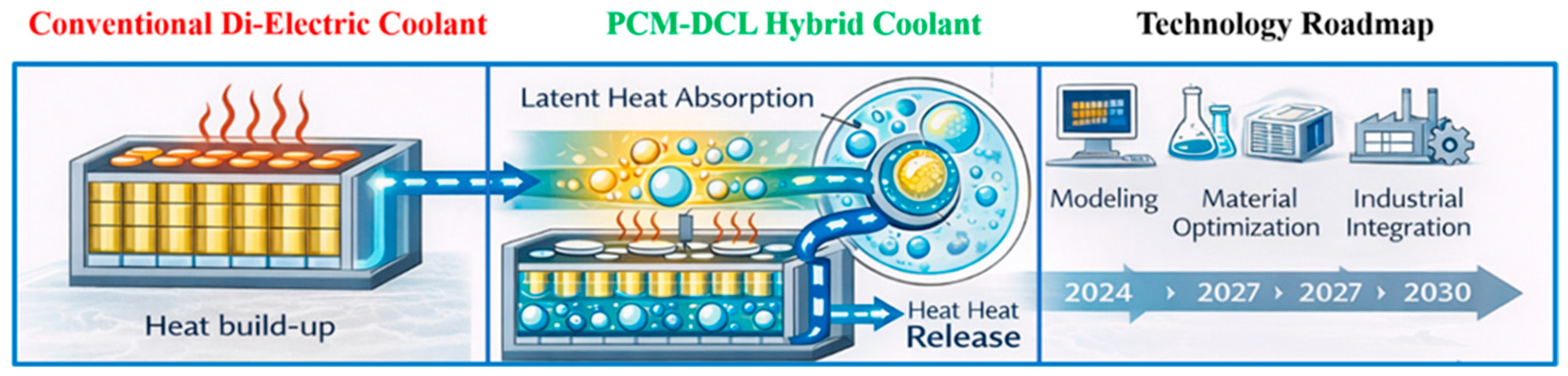
To illustrate the conceptual distinction between conventional dielectric cooling and the proposed hybrid approach, Figure 1 presents a schematic comparison. In conventional systems, heat removal is governed solely by convective transport, leading to rapid temperature rise under transient loads. In contrast, the PCM–DCL hybrid coolant incorporates dispersed phase-change particles that enable localized latent heat absorption during temperature excursions, followed by delayed thermal release during subsequent cooling. This dual mechanism combines convective transport with localized latent heat absorption while preserving dielectric insulation.
The hybrid system integrates dispersed microencapsulated phase-change materials that absorb heat during melting and release it during solidification, enabling combined convective and latent heat management. The right panel also illustrates the development pathway from modeling and material optimization to industrial integration.

2. Results and Discussion

2.1. Current Advances and Emerging Trends in Battery Thermal Management

The last decade has marked a shift in battery thermal management from component-level optimization toward system-level integration. Rather than focusing solely on heat removal capacity, recent research increasingly targets the coupled control of thermal uniformity, electrochemical stability, and system efficiency under transient operating conditions. This evolution reflects the growing understanding that spatial and temporal temperature gradients, rather than average temperature alone, govern degradation pathways and safety risks in high-energy-density battery systems.
One of the most significant advances has been the development of immersion-based cooling architectures, which reduce interfacial thermal resistance by eliminating intermediate solid layers between cells and coolant. This enables more uniform heat extraction at the cell level, particularly under high C-rate operation. However, despite improved heat transfer coefficients, such systems remain fundamentally limited by the thermal capacity of the working fluid. From a transport perspective, heat removal in single-phase systems is governed by advection and sensible heat storage, both of which scale with temperature difference. During high-power transients, the rate of heat generation can exceed the rate of heat removal, leading to localized thermal accumulation. This limitation becomes more pronounced as battery architectures evolve toward higher power densities and increasingly heterogeneous heat generation at the electrode scale.
To address this constraint, recent research has explored the incorporation of latent heat storage within the fluid domain to enhance effective thermal capacity. Experimental studies on microencapsulated phase-change suspensions report measurable reductions in peak temperature and delayed thermal response under transient loading. However, these results are typically obtained under simplified or low-voltage conditions and do not fully capture the coupled electro-thermal constraints present in practical battery systems.
A key emerging direction is the treatment of the coolant as a heterogeneous, multiphase medium rather than a single-phase fluid. In such systems, heat transfer is governed by the interaction between bulk convection and localized phase transitions within dispersed inclusions. This introduces multi-scale coupling, where particle-level thermal events influence system-level temperature fields. The resulting thermal response depends on factors such as particle residence time, local shear conditions, and the extent of phase-change completion within individual inclusions. Although recent computational studies attempt to capture these effects using coupled fluid dynamics and phase-change models, predictive capability remains limited due to insufficient experimental validation and uncertainties in particle-scale transport behavior.
In parallel, increasing attention is being directed toward the rheological and multifunctional behavior of complex coolant systems containing dispersed micro- or nanoparticles. The incorporation of solid inclusions modifies not only viscosity but also mechanical, thermal, and interfacial properties under operating conditions. Recent studies on nanoparticle-reinforced polymeric systems have demonstrated that homogeneous particle dispersion and controlled aggregation can significantly influence thermal conductivity, stiffness, and heat-transfer-related functionality, while excessive particle loading may restrict molecular mobility and negatively affect system performance. Similarly, in PCM–DCL suspensions, particle concentration and dispersion quality are expected to strongly affect flow behavior, thermal transport, and long-term operational stability. At higher particle concentrations, non-Newtonian effects such as shear thinning, shear-induced migration, and particle clustering may arise, leading to non-uniform velocity distributions and preferential flow pathways within battery modules. These effects may ultimately produce localized cooling inefficiencies and uneven thermal buffering. Furthermore, the interaction between dispersed particles and external fields may introduce additional coupled thermo-mechanical phenomena that are not captured by conventional coolant models. Despite their practical importance, such rheological and particle-interaction complexities are rarely incorporated into current battery thermal-management simulations, which typically assume homogeneous and Newtonian fluid behavior [41].
Another critical but insufficiently explored aspect is the interaction between dispersed inclusions and electric fields. In high-voltage systems, the introduction of dielectric heterogeneity, arising from contrasts in permittivity and finite (albeit low) electrical conductivity between the dielectric cooling liquid (DCL), capsule shell, and PCM core, can lead to local electric-field distortion through Maxwell–Wagner–Sillars type interfacial polarization mechanisms under both AC and DC conditions. These effects may result in local field enhancement, increased dielectric losses, and reduced breakdown strength. Furthermore, repeated thermal cycling can modify interfacial conductivity and permittivity, introducing time-dependent evolution of polarization behavior and electrical properties. While dielectric fluids are typically characterized under macroscopically homogeneous conditions, their behavior in heterogeneous, particle or capsule-laden systems involves coupled electro-thermal–interfacial phenomena that remain only partially understood.
From a modeling standpoint, the field is transitioning toward multiphysics frameworks that integrate thermal, fluid dynamic, and electrical phenomena. Data-driven approaches, including machine learning and digital twins, are increasingly used to explore complex design spaces and optimize system performance. However, their predictive reliability is strongly dependent on the availability of validated experimental data. A key limitation of current approaches is the lack of robust constitutive relationships linking particle-scale phase-change dynamics to macroscopic transport properties such as effective heat capacity, thermal conductivity, and viscosity.
Sustainability considerations are also becoming integral to thermal management design. The development of environmentally benign materials introduces additional constraints related to chemical stability, moisture sensitivity, and long-term compatibility with system components. As a result, material selection must balance performance, reliability, and environmental impact within a unified design framework.
Overall, the field is transitioning from isolated optimization of individual physical processes toward integrated, system-level design. However, despite advances in heat transfer enhancement, material engineering, and computational modeling, these efforts remain largely fragmented. The absence of a unified framework that simultaneously accounts for thermal transport, rheological behavior, dielectric reliability, and long-term stability represents a critical gap. Addressing this gap requires coordinated approaches that explicitly consider the interdependence of these phenomena under realistic operating conditions. This need directly motivates the system-level framework developed in the following section.

2.2. Author’s Perspective

The integration of phase-change materials (PCMs) with dielectric coolants (DCLs) should be treated not as a simple material combination, but as a constrained multiphysics system design problem. The central proposition of this work is that the coolant can be engineered as a multifunctional medium that simultaneously governs heat transport, transient energy storage, electrical insulation, and flow behavior under dynamic operating conditions.
In this context, the coolant transitions from a passive heat-transfer medium to a distributed thermal-energy carrier, where heat is both transported and temporarily stored through localized phase transitions. During short high-power events, PCM capsules absorb excess heat near the phase-transition temperature, thereby moderating transient temperature excursions and improving thermal uniformity within the battery module. Such thermal buffering may help mitigate conditions associated with localized current-density heterogeneity, lithium plating propensity, electrolyte degradation, and thermally accelerated aging during aggressive charging and discharging conditions [12,13,14,30]. Under fast-charge operation, localized thermal gradients and transient hotspots can influence reaction-rate distribution, local overpotential development, and side-reaction kinetics, contributing to electrochemical non-uniformity and degradation behavior [12,13,14]. In this context, latent heat absorption within dispersed PCM inclusions provides an additional transient energy-storage pathway that delays bulk temperature rise during short-duration thermal events. The effectiveness of this mechanism depends on achieving sufficient capsule residence time and partial-to-complete phase transition during operation, thereby linking transient thermal response directly to particle-scale melting dynamics and flow behavior. Consequently, improved suppression of transient thermal peaks and spatial temperature gradients may indirectly reduce conditions favorable for lithium plating and accelerated parasitic reactions, although the magnitude of this effect remains strongly dependent on battery chemistry, charging protocol, state of charge, and system-level thermal-management strategy.

2.3. Governing Transport Hypothesis for PCM–DCL Hybrid Cooling

A central hypothesis underlying PCM–DCL hybrid cooling is that transient thermal regulation in immersion-cooled battery systems is governed not solely by bulk coolant heat capacity, but by the dynamic competition among convective transport, particle-scale phase-transition kinetics, and recirculating residence-time distributions. In contrast to conventional single-phase dielectric cooling, the thermal response of PCM–DCL systems emerge from coupled interactions between macroscopic flow transport and localized latent heat activation within dispersed PCM inclusions.
From a transport perspective, the effectiveness of latent heat buffering depends on whether characteristic melting timescales remain sufficiently short relative to particle residence time within thermally elevated regions. If convective residence time is shorter than the characteristic phase-transition response time, only partial latent heat activation may occur, thereby reducing effective thermal buffering despite high nominal PCM latent heat capacity. Conversely, excessively slow flow may improve latent heat utilization while simultaneously increasing local thermal accumulation and hydraulic penalties.
Accordingly, the governing behavior of PCM–DCL systems may be interpreted as a coupled thermo-fluid optimization problem involving three competing processes: (i) heat generation within the battery module, (ii) convective thermal transport through recirculating dielectric flow, and (iii) transient latent heat absorption within dispersed PCM capsules. The balance among these processes determines whether the suspension behaves primarily as a sensible-heat coolant, a partially activated latent heat buffer, or an effectively distributed thermal-energy storage medium.
Within this framework, several governing process relationships become particularly important for future predictive modeling. These include the relationship between capsule melting timescale and local convective residence time, the balance between latent heat absorption rate and transient battery heat-generation rate, and the trade-off between hydraulic power consumption and incremental thermal-buffering benefit. Together, these coupled interactions may define operational regimes governing latent heat utilization efficiency, thermal-uniformity enhancement, and overall system-level effectiveness.
Based on this framework, a key research hypothesis emerges: PCM–DCL systems may exhibit an optimal intermediate operating regime in which latent heat activation, flow distribution, and hydraulic efficiency are simultaneously balanced. Outside this regime, either an incomplete phase transition or excessive hydraulic/rheological penalties may dominate system behavior, thereby limiting net thermal-management benefit despite increased PCM loading.
From a materials-engineering standpoint, candidate PCM–DCL hybrid fluids must satisfy multiple coupled thermo-fluid, dielectric, and electrochemical constraints. The melting temperature of the PCM should generally lie within approximately 30–60 °C to remain compatible with the broader thermal and electrochemical operating envelope of lithium-ion battery systems. However, the optimal phase-transition interval depends strongly on the intended thermal-management strategy, battery chemistry, and transient operating regime. For fast-charging-oriented applications, narrower melting ranges centered approximately within 35–50 °C may be more appropriate because they align more closely with the temperature range in which lithium plating propensity, electrolyte degradation kinetics, localized overpotential development, and thermally induced electrochemical non-uniformities become increasingly significant [12,13,14,30].
Narrow transition intervals may additionally improve latent heat utilization by concentrating phase transition within the most thermally sensitive operating region during transient high-power events. In contrast, broader melting intervals may provide more distributed thermal buffering under variable duty cycles, heterogeneous thermal loading, and fluctuating ambient conditions, although with lower peak thermal-buffering intensity. Consequently, PCM transition-temperature selection should ultimately be coupled to allowable cell-temperature limits, charging protocols, thermal-control objectives, battery chemistry, and acceptable electrochemical aging behavior rather than treated as an isolated materials-selection parameter. Excessively broad melting intervals may also reduce effective latent heat activation during short-duration thermal events because only a fraction of the PCM population may undergo complete phase transition within the available thermal residence time.
The latent heat of the PCM core should preferably exceed 150 J g−1 to provide sufficient transient thermal-buffering capacity [1,2,3,4]. Capsule diameters should typically remain below approximately 10 µm to minimize sedimentation, maintain recirculation stability, and reduce filtration-related constraints. Similarly, PCM loading fraction should generally remain below approximately 20 wt% to limit viscosity growth, hydraulic resistance, and pumping-power penalties during continuous circulation. Finally, the dielectric breakdown strength, dielectric loss factor, and electrical conductivity of the hybrid suspension must remain comparable to those of the base dielectric liquid to avoid degradation of electrical insulation performance. Collectively, these constraints define a quantitative screening envelope for candidate PCM–DCL formulations [20,21,22,38,39].
Crucially, these parameters are interdependent and introduce competing trade-offs. Increasing PCM loading improves effective heat capacity but simultaneously increases viscosity and pressure drop. Reducing capsule size enhances dispersion stability but increases interfacial area, which may influence dielectric loss and chemical reactivity. As a result, formulation design must be approached as a multi-objective optimization problem, rather than a single-parameter enhancement. Within this framework, certain parameters may be directly controlled during formulation design, whereas others emerge as constrained system-level responses. Directly controllable variables include PCM chemistry, melting-temperature interval, latent heat capacity, capsule shell material, shell thickness, surfactant/stabilizer chemistry, dielectric base-fluid selection, and nominal PCM loading fraction. Capsule diameter distribution may also be partially controlled during encapsulation processing through emulsification and shell-formation conditions.
In contrast, operational properties such as suspension viscosity, pressure drop, sedimentation tendency, dielectric heterogeneity, interfacial polarization intensity, capsule residence time, and long-term rheological stability are not independently selectable parameters but coupled responses arising from interactions among formulation variables, flow conditions, and system geometry. For example, increasing PCM loading fraction directly increases latent heat storage capacity but simultaneously elevates viscosity and hydraulic resistance. Similarly, reducing capsule diameter suppresses gravitational settling yet increases interfacial surface area and particle number density, which may intensify interfacial electrostatic interactions and shell-surface collision frequency during recirculation.
Several practical constraints further restrict the feasible design space, including allowable pumping power, filtration compatibility, erosion resistance, manufacturable capsule-size limits, and stability under prolonged thermal cycling and hydrodynamic shear. Consequently, PCM–DCL formulation development should be viewed as a constrained coupled thermo-fluid–dielectric design problem in which many performance-relevant properties emerge indirectly from strongly interacting variables rather than being independently optimized in isolation.
The indicative performance ranges cited here are not speculative. They are derived from published experimental and numerical studies on latent-heat-assisted thermal management systems and PCM-enhanced cooling concepts, which consistently report substantial increases in effective heat capacity and measurable reductions in peak temperature under transient loading conditions. In the present context, these values are used strictly as design targets and benchmarking references for future PCM–DCL hybrid systems, not as claimed results of the present work.
An additional engineering consideration is the potential reduction in system-level thermal-management complexity through integration of convective heat transport, dielectric insulation, and transient thermal buffering within a single circulating medium. A single multifunctional coolant could replace some of these layers and potentially reduce both system mass and integration complexity. Because circulation architectures for dielectric cooling systems already exist, the incorporation of PCM capsules may be achievable with partial adaptation of pumps, filters, and heat-exchanger components rather than complete redesign of the cooling infrastructure. However, this apparent simplification shifts complexity toward the fluid itself, where stability and reliability become dominant concerns.
Dispersion stability represents one of the most critical challenges. Under realistic operating conditions involving continuous flow, vibration, and thermal cycling, microcapsules may experience sedimentation, agglomeration, or phase separation. Density differences between solid and liquid PCM phases can induce cyclic instability, leading to spatially non-uniform thermal buffering. These effects must be evaluated over long durations under representative flow conditions rather than inferred from short-term laboratory observations.
Encapsulation durability is equally critical. Encapsulation integrity is fundamentally governed by the ability of the shell structure to preserve confinement of the PCM core during repeated thermo-mechanical loading. In PCM–DCL systems, degradation may originate from cyclic volumetric expansion during melting, hydrodynamic shear during recirculation, inter-particle collisions, shell permeability evolution, and electro-thermal aging at liquid–solid interfaces. These mechanisms can progressively induce microcracking, shell fatigue, interfacial delamination, and PCM leakage, resulting in loss of latent heat capacity and modification of dielectric and rheological properties. Accordingly, encapsulation integrity should be evaluated through measurable metrics, including rupture fraction after thermal cycling, free PCM concentration in the carrier fluid, latent heat retention, and evolution of particle-size distribution during recirculation. Experimental verification should combine DSC analysis, microscopy-based shell characterization, particle-size measurements, FTIR analysis, rheological characterization, and dielectric breakdown testing following coupled aging exposure [31,32,33,34,35,42,43,44].
As a concrete and technically realistic reference point, one may consider a synthetic ester dielectric base fluid containing approximately 8–12 wt% microencapsulated PCM with a melting temperature close to 45 °C, a latent heat above 150 J g−1 [1,2,3,4], and capsule diameters in the range of 2–5 µm. In such a system, the continuous liquid phase provides electrical insulation and convective heat transport. At the same time, the dispersed microcapsules act as distributed, local latent-heat buffers that melt during transient thermal loads and solidify during subsequent cooling. This example is not presented as an optimized solution, but as a well-defined baseline configuration that can be used to structure experimental and numerical validation studies. From a materials-selection perspective, several candidate combinations emerge as near-term feasible systems. Suitable base fluids include synthetic esters and silicone-based dielectric liquids due to their established electrical insulation and thermal stability. PCM cores may consist of paraffin waxes, fatty-acid eutectics, or polyethylene-glycol derivatives, selected based on target phase-transition temperature and latent heat capacity. For encapsulation, polymer-based shells such as melamine–formaldehyde, silane-modified polymers, or polymer–ceramic hybrid structures provide a balance between mechanical flexibility and structural reinforcement. The compatibility between these components must be evaluated holistically to ensure long-term stability under coupled electro-thermal-fluid conditions.
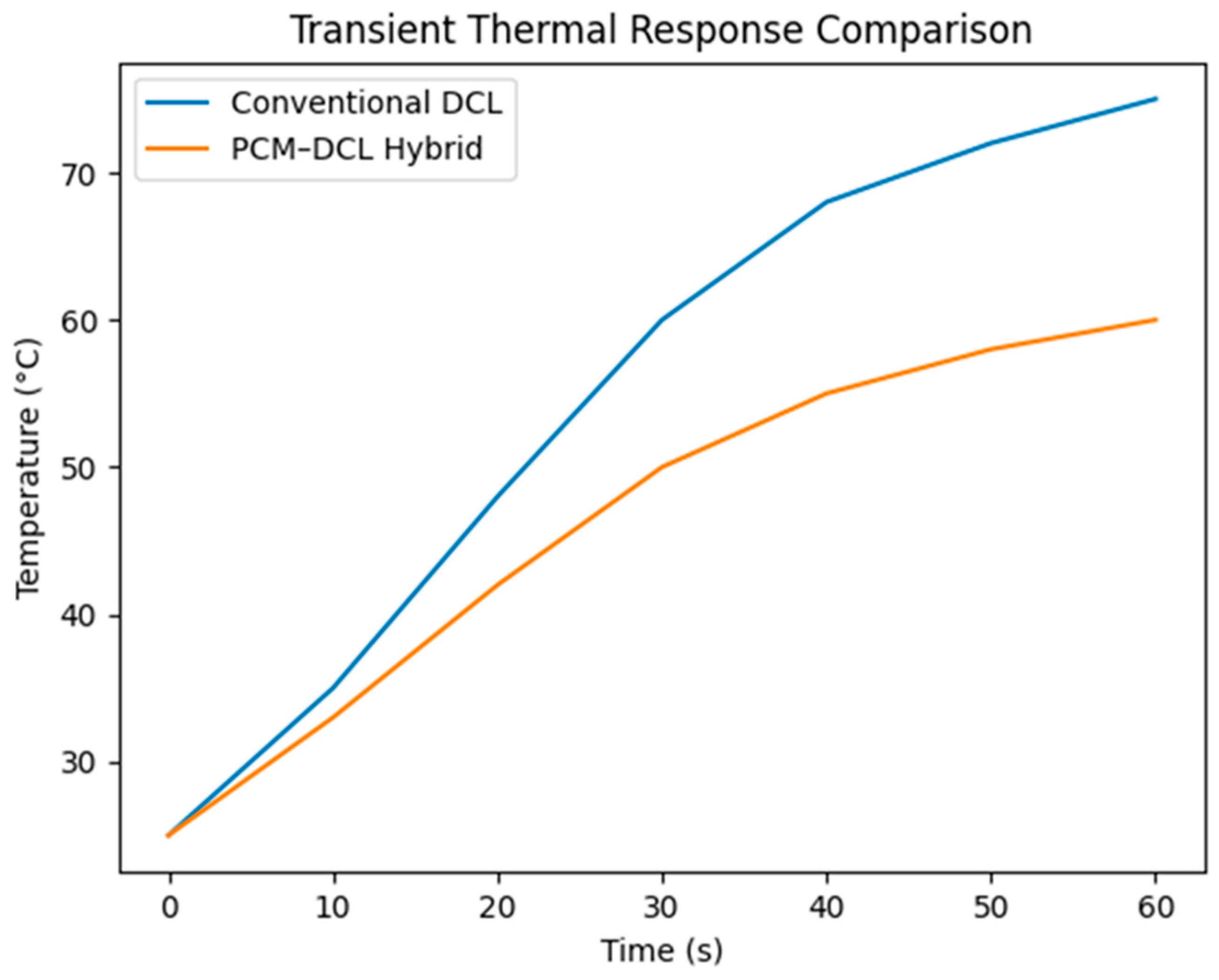
To provide a first-order quantitative illustration of the thermal buffering effect, a simplified transient comparison between conventional dielectric cooling and PCM–DCL hybrid cooling is shown in Figure 2.
Under an equivalent heat input, the hybrid system exhibits a reduced temperature rise and a lower peak temperature due to latent heat absorption within the dispersed PCM microcapsules. This behavior reflects the increased apparent heat capacity of the coolant during the phase transition interval, which moderates rapid thermal excursions. Although simplified, the presented comparison illustrates the order-of-magnitude impact of latent heat buffering through an increase in apparent heat capacity during the phase-transition interval, highlighting the potential for enhanced transient thermal management under high-power operating conditions without representing a fully validated predictive model.
Within the proposed PCM–DCL framework, the effectiveness of the ‘distributed thermal-energy carrier’ concept should be evaluated using quantitative transient thermo-fluid and electro-thermal performance metrics directly linked to latent heat utilization during dynamic battery operation. Relevant thermal metrics include: (i) apparent effective heat capacity of the circulating coolant within the PCM phase-transition interval, (ii) absorbed thermal energy per unit coolant mass during a defined transient load event, (iii) peak cell-temperature suppression relative to baseline dielectric cooling, (iv) temporal delay in temperature rise under equivalent heat generation, (v) maximum temperature-gradient reduction across the battery module, and (vi) spatial temperature-uniformity improvement during transient operation.
In addition, latent heat utilization should be quantified through parameters including PCM melt fraction, latent heat utilization efficiency, phase-transition activation ratio, and transient thermal-buffering duration under representative load cycles. Since latent heat activation depends strongly on capsule residence time, local thermal gradients, particle concentration distribution, and flow recirculation dynamics, these quantities provide a direct measure of the effectiveness of particle-scale phase-transition utilization under realistic operating conditions.
Hydraulic and suspension-stability effects should also be evaluated simultaneously because thermal enhancement may occur at the expense of increased flow resistance or rheological instability. Accordingly, additional system-level metrics should include viscosity evolution, pressure-drop increase, pumping-power penalty, sedimentation tendency, particle-size-distribution evolution, and long-term rheological stability under coupled thermal cycling and hydrodynamic shear exposure.
From an electro-thermal reliability perspective, evaluation should further include dielectric breakdown strength, electrical conductivity evolution, interfacial polarization behavior, and charge-accumulation tendencies during prolonged recirculation. Experimentally, these parameters may be validated through synchronized transient heat-load testing under representative charging/discharging profiles combined with distributed temperature sensing, flow characterization, calorimetric energy analysis, rheological measurements, dielectric testing, and pressure-drop monitoring. Direct comparison between baseline dielectric cooling and PCM–DCL systems under identical thermal boundary conditions would provide quantitative validation of latent-heat-assisted thermal buffering effectiveness together with associated thermo-fluid and dielectric tradeoffs. Importantly, the effective thermal-buffering capacity of PCM–DCL suspensions may differ substantially from the nominal latent heat capacity of the PCM material because complete phase transition may not occur during transient recirculating operation. In practical flow systems, latent heat activation is fundamentally governed by the competition between capsule thermal-response time and particle residence time within thermally elevated regions of the cooling loop. Under high flow velocities, short-duration thermal events, or weak local temperature gradients, PCM inclusions may undergo only partial melting before exiting localized hot regions, thereby reducing the fraction of theoretically accessible latent heat that becomes thermally activated during operation.
Consequently, latent heat utilization in PCM–DCL systems should be treated as a transient transport problem rather than as a static materials property. Effective thermal buffering depends not only on intrinsic PCM latent heat, but also on capsule-scale melting kinetics, convective heat-transfer rate, shell thermal resistance, PCM thermal diffusivity, local flow distribution, and residence-time statistics within the recirculating domain. Nonuniform flow pathways and spatially heterogeneous thermal fields may additionally produce broad melt-fraction distributions across the suspended capsule population, resulting in partial or incomplete latent heat activation during transient load cycles.
Accordingly, evaluation of PCM–DCL systems should incorporate transient melt-fraction analysis coupled with local thermal-fluid conditions. Relevant quantities include melt-fraction evolution, thermal penetration depth within the PCM core, capsule residence-time distribution, and latent heat utilization efficiency under representative duty cycles. Experimentally, these effects may be quantified through synchronized transient calorimetric analysis, distributed temperature measurements, flow characterization, and comparison between theoretical and experimentally activated latent heat during controlled thermal events. Repeated incomplete phase transition during cyclic operation may also influence long-term thermal reliability by altering local solidification dynamics and effective thermal-response consistency over extended recirculation periods.
Therefore, reported PCM latent heat values should be interpreted primarily as theoretical upper limits unless effective phase-transition utilization under realistic thermo-fluid operating conditions is experimentally demonstrated.
Future progress will depend heavily on the integration of transient multiphysics modeling, flow-resolved phase-transition analysis, and experimentally validated thermo-fluid transport frameworks capable of capturing coupled interactions among latent heat activation, residence-time distributions, rheological evolution, and dielectric stability during recirculating operation. Particularly important will be the development of predictive models capable of distinguishing operating regimes in which latent heat activation remains transport-limited from those in which hydraulic or rheological penalties dominate overall system performance. Modern computational fluid dynamics (CFD) tools can model both melting and fluid flow at the same time [45,46,47,48]. Machine-learning models trained on these simulations can then predict the viscosity and heat-capacity changes caused by different capsule sizes or concentrations. However, current modeling approaches remain limited by the lack of validated constitutive relationships linking particle-scale phase-change behavior to macroscopic transport and dielectric properties.
A further step will be integration with intelligent control. Modern battery-management systems already collect detailed temperature and voltage data. Integration with model-predictive and data-assisted control strategies may further improve utilization of latent heat buffering under transient operating conditions. Real-time thermal and flow measurements could be used to dynamically adjust coolant flow rate and thermal loading distribution in response to changing battery conditions. However, implementation of such approaches will require experimentally validated reduced-order models capable of capturing the coupled thermo-fluid behavior of PCM–DCL suspensions during dynamic operation.
Sustainability is also a key driver. PCMs made from natural sources such as lignin, plant oils, or biochar can replace petroleum-based waxes while keeping high thermal performance [16,43]. When mixed with biodegradable dielectric esters, these bio-based PCMs offer the potential for reduced environmental impact. However, their higher polarity and moisture sensitivity may affect both dispersion stability and dielectric performance when suspended in dielectric fluids. Consequently, chemical compatibility, oxidation resistance, and long-term aging behavior must be systematically evaluated.
In addition, the feasibility of PCM–DCL systems must be assessed through techno-economic and environmental analysis. While microencapsulation introduces additional material and processing costs, potential benefits such as improved thermal uniformity, reduced system complexity, and extended battery lifetime may offset these costs at the system level. Similarly, lifecycle assessment (LCA) is required to evaluate the overall environmental impact, including material sourcing, manufacturing, operation, and end-of-life considerations.
Overall, PCM–DCL hybrid systems should be understood as an integrated engineering challenge requiring the simultaneous optimization of thermal performance, dielectric reliability, rheological behavior, and long-term stability. The contribution of this work lies in defining this problem through explicit constraints, trade-offs, and validation pathways, thereby transforming a previously conceptual idea into a structured and testable framework for future development.

2.4. Technology Roadmap (2026–2030)

The development of PCM–DCL hybrid coolants requires a structured progression from fundamental feasibility to system-level validation and industrial deployment. Due to the strong coupling between thermal transport, phase-change behavior, rheology, and dielectric properties, this process must be approached as an integrated, multi-scale engineering problem. The following stages define key technical milestones for transitioning from conceptual formulations to practical implementation.
Stage I: Multiphysics Modeling and Feasibility Mapping.
The initial stage focuses on establishing predictive capability through coupled electro-thermal-fluid modeling. In contrast to single-phase systems, PCM–DCL fluids require simultaneous consideration of phase-change kinetics, particle transport, and electric-field behavior.
Numerical models must integrate:
  • fluid flow and heat transfer,
  • enthalpy-based phase-change formulations,
  • particle transport under shear and buoyancy,
  • and electric-field distribution in heterogeneous media.
Particular attention should be given to particle residence time and phase-transition completeness, as incomplete melting or solidification cycles can significantly reduce effective heat capacity under transient conditions.
A primary outcome of this stage is the development of quantitative feasibility maps, defining operational limits as a function of capsule diameter (1–10 µm), PCM concentration (<20 wt%), and transition temperature (30–60 °C). These maps should include not only thermal performance, but also viscosity evolution, pressure drop, and dielectric field distribution.
Machine-learning-assisted optimization can be used to identify optimal trade-offs between thermal buffering, flow stability, and dielectric performance.
Stage II: Material Qualification and Accelerated Aging.
Following computational screening, the second stage focuses on rigorous experimental qualification under coupled electro-thermal and mechanical stress conditions, with particular emphasis on long-term stability, material compatibility, and reliability under realistic operating environments.
Shell designs based on melamine–formaldehyde and silane chemistry have shown resistance to ester and fluoroketone liquids [49,50,51]. However, their suitability for PCM–DCL systems must be evaluated under combined thermal cycling, electrical stress, and hydrodynamic shear.
Material characterization should include:
  • Thermal properties: latent heat stability and repeatability using DSC.
  • Electrical properties: dielectric breakdown strength (ASTM D877, IEC 60156) and frequency-dependent dielectric loss.
  • Rheological behavior: viscosity as a function of temperature and shear rate.
  • Dispersion stability: sedimentation and agglomeration under continuous flow and vibration.
Accelerated aging protocols should combine thermal cycling (>1000 cycles), electrical stress, and mechanical loading to capture coupled degradation mechanisms. Key performance indicators include retention of latent heat capacity, stability of dielectric properties, and preservation of capsule integrity.
Failure mechanisms such as capsule rupture, shell degradation, and chemical interaction between PCM and base fluid must be systematically identified and quantified.
Stage III: Prototype Loop and System-Level Validation.
In this stage, PCM–DCL formulations are evaluated within integrated cooling systems that replicate realistic battery pack conditions.
Experimental platforms should simulate:
  • transient heat generation profiles (e.g., fast charging and high C-rate discharge),
  • flow geometries representative of battery modules,
  • and operating pressures and temperatures relevant to EV systems.
System-level validation should target:
  • ≥30% increase in effective heat capacity,
  • ≥5 °C reduction in peak cell temperature,
  • improved temperature uniformity across cells,
  • and stable dielectric performance over ≥1000 h of operation.
In addition to thermal performance, mechanical and operational reliability must be assessed, including:
  • capsule integrity under continuous circulation,
  • particle size evolution and agglomeration behavior,
  • pump wear and energy consumption,
  • and potential fouling or blockage in flow channels.
Pressure drop and pumping power must be quantified to evaluate the trade-off between enhanced thermal capacity and hydraulic performance. Accordingly, thermal enhancement alone should not be considered sufficient for technological viability, and advancement toward pack-level implementation should require demonstration of net system-level benefit after accounting for hydraulic penalties, rheological evolution, dielectric reliability, and long-duration operational stability.
Integration with model-predictive control strategies enables dynamic optimization of coolant flow and operating conditions, allowing effective utilization of latent heat storage under variable load profiles.
Stage IV: Industrial Integration, Standardization, and Sustainability Assessment.
The final stage focuses on scaling PCM–DCL systems toward industrial deployment and validating performance under real-world conditions.
Large-scale testing in collaboration with automotive manufacturers, such as BYD and General Motors, should evaluate long-term performance under realistic driving cycles, environmental exposure, and mechanical vibration.
Standardization is essential to ensure safe and reproducible implementation. Organizations such as IEC and SAE can define qualification criteria, including:
  • dielectric loss limits (e.g., <0.02 at MHz frequencies),
  • minimum breakdown voltage requirements,
  • acceptable viscosity ranges for pumping systems,
  • and durability thresholds (≥500–1000 thermal cycles without degradation).
Techno-economic analysis should quantify the trade-offs between increased material cost due to encapsulation and potential system-level benefits, including reduced cooling hardware complexity and improved battery lifetime.
Lifecycle assessment (LCA) should evaluate environmental impact across material sourcing, manufacturing, operation, and end-of-life stages, ensuring that performance improvements align with sustainability objectives.
Public–private initiatives, such as programs aligned with the European Battery 2030+ framework, can support large-scale validation, standard development, and supply chain integration.
Integrated Development Cycle.
These stages form an iterative development cycle in which modeling informs material design, experimental results refine simulations, and system-level validation guides further optimization. The integration of shared datasets and standardized testing methodologies will be critical for accelerating development and ensuring reproducibility.
Through coordinated advances across materials science, thermal engineering, and electrical system design, PCM–DCL hybrid coolants can evolve into practical and scalable solutions for next-generation electric vehicle thermal management.

3. Challenges and Research Opportunities

To enable engineering implementation, each identified challenge must be explicitly linked to a corresponding validation methodology under realistic operating conditions. Dispersion stability should be assessed under continuous flow and vibration representative of vehicle operation, where coupled effects of shear, buoyancy, and thermal cycling influence particle distribution over time [48,49,50]. Dielectric integrity must be verified using standardized breakdown and dielectric loss measurements (e.g., ASTM D877 or IEC 60156), including evaluation under both DC fields representative of the steady pack voltage and AC fields associated with ripple currents and high-frequency switching in power electronic systems, in order to capture frequency-dependent polarization effects [52].
Rheological behavior must be characterized over the full operating temperature and shear-rate range to ensure that viscosity remains within pumpable limits while avoiding non-uniform flow distribution. Framing each challenge together with its test method is essential for transforming the concept into an engineering-qualified technology rather than a purely academic idea.
Although the potential of hybrid phase-change material and dielectric coolant (PCM–DCL) systems is promising, several interrelated challenges remain between conceptual progress and commercial realization. These challenges span material chemistry, dielectric reliability, mechanical endurance, and system-level integration. Their resolution will determine whether PCM–DCL hybrids can transition from laboratory-scale demonstrations to viable solutions for electric-vehicle (EV) battery cooling. For clarity, Table 1 provides a conceptual comparison between existing battery thermal management approaches and the proposed PCM–DCL hybrid concept in terms of functionality and technological maturity.
The comparison highlights that PCM–DCL systems uniquely combine convective heat transport with distributed latent heat storage, enabling transient thermal buffering not achievable with existing single-phase or static PCM-based approaches.
One of the first and most fundamental challenges is maintaining stable dispersion of PCM microcapsules in a circulating dielectric fluid. Within the context of an EV immersion-cooling loop, dispersion stability should be interpreted operationally rather than qualitatively. In practical terms, a stable PCM–DCL suspension should maintain approximately uniform capsule concentration, particle-size distribution, and rheological behavior during prolonged recirculation under representative operating conditions. Previous studies on nanofluids, PCM slurries, and vibration-exposed battery thermal systems have shown that thermal cycling, hydrodynamic shear, particle interactions, and mechanical vibration can progressively induce sedimentation, agglomeration, viscosity variation, and non-uniform particle transport [10,32,48,49]. Accordingly, stability assessment for EV applications should include continuous recirculation during extended operation, repeated cycling across the PCM phase-transition range, coolant temperatures representative of battery operation (typically 20–60 °C), and shear conditions associated with pumps, bends, narrow channels, and flow restrictions within battery cooling circuits. From an engineering perspective, dispersion stability may be evaluated through quantitative metrics such as spatial variation in PCM concentration, evolution of median capsule diameter, irreversible sedimentation behavior, and viscosity variation during long-duration operation. Establishing such criteria under coupled thermal, mechanical, and hydraulic loading conditions is essential for distinguishing short-term laboratory dispersions from practically deployable EV coolant formulations. In an EV environment, the coolant is subjected to continuous vibration, thermal cycling, and hydrodynamic shear, all of which influence particle transport behavior. Density differences between solid and liquid PCM phases can induce cyclic sedimentation and re-dispersion, leading to spatial variations in particle concentration and, consequently, non-uniform thermal buffering. Agglomeration and clustering may further alter local rheology and heat transfer characteristics. To mitigate these effects, capsule surface chemistry must be carefully engineered to ensure compatibility with the dielectric medium. Approaches such as polymer-grafted shells, surfactant stabilization, and nano-filler coatings can provide steric or electrostatic stabilization; however, their effectiveness must be validated under long-duration flow conditions, as stabilization mechanisms observed in static systems may degrade under continuous operation.
A closely related issue is the preservation of dielectric integrity. The introduction of solid inclusions into an insulating fluid creates a heterogeneous dielectric system in which local electric-field distribution may be altered. Differences in permittivity and conductivity between the PCM core, shell material, and base fluid can lead to interfacial polarization, charge accumulation, and localized field amplification. In addition, contact electrification (triboelectric effects) may arise from repeated interactions between PCM capsules, the base fluid, and internal surfaces under flow conditions. Such charge generation and accumulation can further modify local electric-field distributions, particularly in heterogeneous dielectric systems, potentially contributing to partial discharge initiation and long-term degradation of dielectric strength. Despite its relevance, this phenomenon remains largely unexplored in the context of particle-laden dielectric coolants and PCM–DCL systems, and therefore warrants systematic investigation under realistic flow, vibration, and high-voltage conditions. Under high-voltage operation (up to ~800 V), these effects may reduce breakdown strength and increase dielectric losses over time. Therefore, PCM–DCL formulations must be evaluated not only for thermal performance but also for electrical reliability under realistic operating conditions. In addition to standardized tests such as ASTM D877 or IEC 60156, further investigation of interfacial charge transport and polarization mechanisms is necessary to understand long-term dielectric behavior.
The mechanical endurance of PCM capsules represents another major challenge. Each capsule undergoes repeated volumetric expansion and contraction during phase transitions, generating internal stresses that can lead to shell fatigue, microcracking, or eventual rupture. These effects are exacerbated by hydrodynamic shear forces within the circulating fluid and potential chemical interactions with the base liquid. Capsule failure may result in leakage of PCM into the dielectric medium, altering both thermal and electrical properties of the system. Reinforced shell structures, particularly polymer–ceramic hybrid materials, offer improved resistance to mechanical and thermal stress; however, their long-term performance under combined electro-thermal and mechanical loading remains insufficiently characterized.
Viscosity and rheological behavior must also be carefully controlled to ensure efficient system operation. Increasing PCM concentration enhances effective heat capacity but also increases viscosity, which affects pumping power, flow distribution, and overall system efficiency. In addition, particle-laden fluids may exhibit non-Newtonian behavior, including shear thinning and particle migration, which can lead to non-uniform flow profiles within battery modules. Maintaining viscosity within practical limits (e.g., below ~10 mPa·s at operating temperature) while achieving sufficient thermal buffering requires careful optimization of capsule size, concentration, and base fluid properties. Cooling system components, including pumps and filters, must also be designed to accommodate particulate flow without inducing capsule damage or clogging. Consequently, practical PCM–DCL formulation development should focus on identifying stable operational design windows in which latent heat utilization, rheological behavior, dielectric reliability, and hydraulic performance remain simultaneously acceptable rather than maximizing any single thermophysical property independently.
Another key challenge is the lack of standardized measurement protocols. Current studies often employ different operating conditions, making direct comparison difficult. To enable meaningful benchmarking, consistent methodologies are required for evaluating effective heat capacity under transient conditions, dielectric strength in heterogeneous fluids, dispersion stability, and long-term aging behavior. Existing efforts in related fields, such as dielectric nanofluids and advanced battery research initiatives (e.g., EU Battery 2030+), highlight the importance of harmonized testing frameworks and shared data infrastructures for accelerating technological development and reproducibility [53]. The development of shared databases and standardized testing frameworks, similar to initiatives under the EU Battery 2030+ program, would significantly accelerate progress and improve reproducibility across research efforts.
In parallel with material and validation challenges, the integration of intelligent monitoring and control systems represents an important research opportunity. Advanced battery systems increasingly incorporate sensors capable of measuring temperature, flow rate, and electrical parameters in real time. By integrating these data streams with predictive models and machine-learning algorithms, it becomes possible to dynamically adjust cooling performance based on operating conditions. Such approaches enable more efficient utilization of latent heat storage and improved thermal uniformity, particularly under highly transient load profiles.
Sustainability remains an essential consideration in the development of PCM–DCL systems. The use of bio-based PCMs and biodegradable dielectric fluids offers potential reductions in environmental impact; however, these materials introduce additional constraints related to chemical stability, moisture sensitivity, and compatibility with encapsulation materials. A comprehensive evaluation of sustainability must therefore consider the full lifecycle of the system, including material sourcing, manufacturing processes, operational efficiency, and end-of-life management.
Life-cycle assessment (LCA) provides a framework for quantifying these factors by evaluating energy consumption, greenhouse gas emissions, and resource utilization across different design options. While bio-based materials may reduce dependence on fossil-derived inputs, their long-term stability and performance must be carefully assessed to ensure that environmental benefits are not offset by reduced durability or increased maintenance requirements. Future research should therefore integrate sustainability metrics alongside thermal and electrical performance criteria from the earliest stages of material and system design.
In summary, advancing PCM–DCL coolant systems requires addressing challenges related to dispersion stability, dielectric reliability, capsule durability, rheological behavior, and standardization, while also incorporating intelligent control and sustainability considerations. These challenges are strongly interconnected and must be addressed through coordinated, multi-disciplinary research efforts to enable reliable and scalable implementation in next-generation EV battery systems.

4. Conclusions

PCM–DCL hybrid coolants represent a shift from conventional heat removal toward integrated thermal management, where heat transport and transient storage are addressed within a single medium. This approach is particularly relevant for high-power battery systems, where short-duration thermal excursions increasingly govern performance, degradation, and safety.
The contribution of this Perspective is to define PCM–DCL systems as a constrained, multiphysics engineering problem, rather than a conceptual material combination. By establishing explicit relationships between material properties, system behavior, and validation requirements, this work provides a structured framework for translating laboratory concepts into deployable technologies.
A central challenge lies in achieving simultaneous compliance with thermal, electrical, and rheological constraints under realistic operating conditions. Progress, therefore, depends on integrated approaches that combine material design, multiphysics modeling, and system-level validation, supported by standardized testing and long-term reliability assessment.
Looking forward, the coupling of such multifunctional fluids with data-driven control strategies offers a pathway toward adaptive thermal management systems capable of responding dynamically to operating conditions. However, practical implementation will require demonstrated stability, durability, and dielectric reliability, alongside clear techno-economic and environmental justification. If these requirements are met, PCM–DCL hybrid coolants can evolve into a new class of engineered thermal management media, enabling more efficient, reliable, and scalable battery systems for next-generation electric vehicles.

Author Contributions

L.S.S.: Literature review, validation, writing—original draft; T.C.: Literature review, Z.W.: Funding acquisition, review, editing, supervision. All authors have read and agreed to the published version of the manuscript.

Funding

This work was funded by the POC2025_UNIINNO_034 project provided by the National Research, Development and Innovation Fund of Hungary.

Data Availability Statement

The data that support the findings of this study are available from the corresponding author upon reasonable request.

Conflicts of Interest

The authors declare that they have no known competing financial interests or personal relationships that could have appeared to influence the work reported in this paper.

References

  1. Sivanathan, A.; Guo, X.; Fu, Z.; Fan, M. Advances in phase change building materials: An overview. Nanotechnol. Rev. 2023, 12, 20220554. [Google Scholar] [CrossRef]
  2. Rafique, N.; Koel, M.; Abranches, D.O.; Järvik, O. Deep eutectic solvents: Physicochemical properties and challenges in applications as phase change materials in thermal energy storage. ACS Appl. Energy Mater. 2025, 9, 1287–1302. [Google Scholar] [CrossRef]
  3. Yu, K.; Jia, M.; Liu, Y.; Yang, Y. Binary decanoic acid/polyethylene glycol as a novel phase change material for thermal energy storage: Eutectic behaviors and energy conservation evaluation. J. Energy Storage 2023, 68, 107663. [Google Scholar] [CrossRef]
  4. Fan, Z.; Zhao, Y.; Liu, X.; Shi, Y.; Jiang, D. Development of a new composite material for building energy storage based on lauric acid-palmitic acid-paraffin ternary eutectic and expanded perlite. J. Energy Storage 2022, 53, 105136. [Google Scholar] [CrossRef]
  5. Przybek, A.; Hebdowska-Krupa, M.; Łach, M. Paraffin coated with diatomite as a phase change material (PCM) in heat storage systems—A review of research, properties, and applications. Materials 2025, 18, 5166. [Google Scholar] [CrossRef] [PubMed]
  6. Podara, C.V.; Kartsonakis, I.A.; Charitidis, C.A. Towards phase change materials for thermal energy storage: Classification, improvements and applications in the building sector. Appl. Sci. 2021, 11, 1490. [Google Scholar] [CrossRef]
  7. Wu, W.; Ye, G.; Zhang, G.; Yang, X. Composite phase change material with room-temperature flexibility for battery thermal management. Chem. Eng. J. 2022, 428, 131116. [Google Scholar] [CrossRef]
  8. Wu, Z.; Sun, X.; Luo, D.; Zhang, P.; Gao, N.; Chen, H. Optimizing the thermal and energy efficiency of a thermoelectric-based battery thermal management system via adaptive control strategies and phase change materials. Energy 2026, 344, 139845. [Google Scholar] [CrossRef]
  9. Zhang, X.; Halbig, M.C.; Almansour, A.; Singh, M.; Ranaiefar, M.; Zheng, Y. Innovative 3D-printed hybrid cooling systems for thermal management of lithium-ion pouch cells. J. Energy Storage 2026, 142, 119469. [Google Scholar] [CrossRef]
  10. Shen, J.; Mohammed, H.I.; Chen, S.; Alkali, B.; Luo, M.; Yang, J. Mechanical vibration’s effect on thermal management module of lithium-ion battery module based on phase change material in a high-temperature environment. Case Stud. Therm. Eng. 2024, 60, 104752. [Google Scholar] [CrossRef]
  11. Huang, Q.; Li, X.; Zhang, G.; Kan, Y.; Li, C.; Deng, J.; Wang, C. Flexible composite phase change material with anti-leakage and anti-vibration properties for battery thermal management. Appl. Energy 2022, 309, 118434. [Google Scholar] [CrossRef]
  12. Madani, S.S.; Ziebert, C.; Marzband, M. Thermal characteristics and safety aspects of lithium-ion batteries: An in-depth review. Symmetry 2023, 15, 1925. [Google Scholar]
  13. Luo, W.; Zhao, L.; Chen, M. The effect of PCM on mitigating thermal runaway propagation in lithium-ion battery modules. Appl. Therm. Eng. 2024, 236, 121608. [Google Scholar] [CrossRef]
  14. Khalaf, F.A.; Tarish, A.L. Recent update progress for the battery thermal management of electric vehicles: Challenges and solutions. J. Therm. Anal. Calorim. 2025, 150, 12135–12156. [Google Scholar] [CrossRef]
  15. Liu, X.; Lin, J.; Zhao, Z.; Min, Y.; Song, J.; Li, B.; Huang, J. Advances in functional applications of biomass-derived carbon composites for phase change materials. Microstructures 2025, 5, 2025039. [Google Scholar] [CrossRef]
  16. Atinafu, D.G.; Choi, J.Y.; Nam, J.; Kang, Y.; Kim, S. Insights into the effects of biomass feedstock and pyrolysis conditions on the energy storage capacity and durability of standard biochar-based phase-change composites. Biochar 2025, 7, 18. [Google Scholar] [CrossRef]
  17. Khandaker, T.; Islam, T.; Nandi, A.; Al Amin Mia Anik, M.; Shihab Hossain, M.; Kamrul Hasan, M.; Sarwar Hossain, M. Biomass-derived carbon materials for sustainable energy applications: A comprehensive review. Sustain. Energy Fuels 2024, 9, 693–723. [Google Scholar] [CrossRef]
  18. Brzęczek-Szafran, A.; Gwóźdź, M.; Brun, N.; Wysokowski, M.; Matuszek, K. A roadmap for biomass-driven development of sustainable phase change materials. ChemSusChem 2025, 18, e202500288. [Google Scholar]
  19. Sun, M.; Feng, D.; Sun, F.; Di, H.; Wang, Q.; Lin, L. Insights into effect of lignocellulosic biomass framework types on bio-based shape stable composite phase change materials. J. Energy Storage 2024, 91, 112103. [Google Scholar] [CrossRef]
  20. Vikram, S.; Sadar, A.; Rakshit, D. Experimental study of dielectric coolant-based immersion cooling technique for lithium-ion battery packs. J. Energy Storage 2026, 144, 119741. [Google Scholar] [CrossRef]
  21. Shah, R.; Huang, C.; Karmakar, G.; Erhan, S.Z.; Sarker, M.I.; Sharma, B.K. Potential of natural esters as immersion coolant in electric vehicles. Energies 2025, 18, 4145. [Google Scholar] [CrossRef]
  22. Zhao, L.; Wang, J.; Zheng, M.; Chen, M. Design and performance optimization of liquid immersion cooling system for prismatic lithium-ion battery modules. Int. J. Heat Fluid Flow 2026, 118, 110181. [Google Scholar] [CrossRef]
  23. Liu, J.; Tao, L.; Yang, Q.; Wang, J. Recent advances in immersion cooling for thermal management of lithium-ion batteries. Renew. Sustain. Energy Rev. 2026, 226, 116492. [Google Scholar]
  24. Garud, K.S.; Tai, L.D.; Hwang, S.G.; Nguyen, N.H.; Lee, M.Y. A review of advanced cooling strategies for battery thermal management systems in electric vehicles. Symmetry 2023, 15, 1322. [Google Scholar] [CrossRef]
  25. Isfahani, M.S.; Gharehghani, A.; Saeedipour, S.; Rabiei, M. PCM/metal foam and microchannels hybrid thermal management system for cooling of lithium-ion battery. J. Energy Storage 2023, 72, 108789. [Google Scholar] [CrossRef]
  26. Tousi, M.; Najafi, M. Innovative hybrid nano/dielectric fluid cooling system for the new cylindrical shaped lithium-ion batteries. Int. J. Therm. Sci. 2024, 195, 108634. [Google Scholar] [CrossRef]
  27. Sohail, A. Phase change materials for thermal management of lithium-ion batteries in electric vehicles: A comprehensive review. Next Energy 2026, 11, 100527. [Google Scholar]
  28. Togun, H.; Basem, A.; Jweeg, M.J.; Anqi, A.E.; Alshamkhani, M.T.; Chattopadhyay, A.; Sharma, B.K.; Niyas, H.; Biswas, N.; Sadeq, A.M.; et al. Revolutionizing battery thermal management: Hybrid nanofluids and PCM in cylindrical pack cooling. Mater. Renew. Sustain. Energy 2025, 14, 42. [Google Scholar] [CrossRef]
  29. Liu, J.; Zhang, X.; Xi, Y.; Xu, S.; Zhang, Z. A comprehensive review of hybrid liquid and PCM cooling BTMS. J. Therm. Anal. Calorim. 2025, 150, 20539–20572. [Google Scholar] [CrossRef]
  30. Amalesh, T.; Lakshmi Narasimhan, N. Liquid cooling vs hybrid cooling for fast charging lithium-ion batteries: A comparative numerical study. Appl. Therm. Eng. 2022, 208, 118226. [Google Scholar] [CrossRef]
  31. Quarrell, M.J.; Batty, R.; Neale, A.R.; Harvey, D.H.S.; Daniels, L.M.; Shchukin, D.; Hardwick, L.J. Integration of microencapsulated phase change materials into thin coatings for a passive battery thermal management system. J. Electrochem. Soc. 2025, 172, 110522. [Google Scholar] [CrossRef]
  32. Kursuncu, B.; Ustaoglu, A.; Yildiz, F.; Okajima, J.; Sarı, A.; Gencel, O.; Uzun, O. Experimental and numerical investigation of 3D-printed macro-encapsulated PCM variants for battery thermal management systems. Therm. Sci. Eng. Prog. 2025, 67, 104151. [Google Scholar] [CrossRef]
  33. Zhang, Z.; Qiu, R.; Mai, Z.; Wu, T.; Wang, C.; Liang, Z. Development and performance evaluation of MPCM slurry for battery thermal management via immersion cooling. Appl. Therm. Eng. 2026, 289, 129779. [Google Scholar] [CrossRef]
  34. Zhao, G.; Liang, B.; Li, Y.; He, R.; Wang, T.; Guo, Z.; Liu, J.; Li, X. Investigation on flame retardant microcapsules based composite phase change material for battery thermal safety. J. Energy Storage 2025, 132, 118010. [Google Scholar] [CrossRef]
  35. Chen, Y.; Guo, X.; Shi, C.; Zhou, X.; Zou, D. Preparation of metal-based microencapsulated phase change material and its application in a battery for thermal management and thermal runaway protection. Compos. B Eng. 2025, 298, 112376. [Google Scholar] [CrossRef]
  36. Hussien, S.A.; Ali, A.B.M.; Alkhatib, O.J.; Hamedian, A.; Mahariq, I. Enhancing battery thermal management system using the emulsion of encapsulated phase change material and water in a mini helical tube. Sci. Rep. 2026, 16, 573. [Google Scholar] [CrossRef] [PubMed]
  37. Piao, J.; Zhang, Z.; Li, T.; Han, X.; Bi, S. MXene-bridged phase change composites with enhanced thermal conductivity for lithium-ion battery thermal management. Appl. Therm. Eng. 2025, 279, 127760. [Google Scholar] [CrossRef]
  38. Sutheesh, P.M.; Thomas, R.; Bandaru, R. Battery thermal management systems by using DI water and PCF with nano-encapsulated tetradecan-1-ol for lithium-ion batteries. Int. Commun. Heat Mass Transf. 2025, 165, 108992. [Google Scholar] [CrossRef]
  39. Collado, I.; Vázquez-López, A.; Jiménez-Suárez, A.; Prolongo, S.G. Dual-curing MWCNT nanocomposites for energy-efficient electroactive shape memory and in-situ processing. Chem. Eng. J. 2025, 515, 163471. [Google Scholar] [CrossRef]
  40. Liu, S.; Zhang, H.; Zhang, X.; Li, W. Reversible thermochromic microencapsulated phase change materials with silane-terminated polyurethane shell. J. Energy Storage 2025, 119, 116329. [Google Scholar] [CrossRef]
  41. Ihlbrock, L.; Sehnal, A.; Gutsch, M.; Lux, S. Future energy demand for automotive and stationary lithium- and sodium-ion battery production towards a European circular economy. Energy Environ. Sci. 2025, 18, 8724–8743. [Google Scholar] [CrossRef]
  42. Hu, Y. Numerical investigation of the battery thermal management system using a bionic sapling-shaped channel liquid-cooled plate. Int. Commun. Heat Mass Transf. 2026, 171, 110101. [Google Scholar] [CrossRef]
  43. Zuo, X.; Li, W.; Wang, Y.; Wu, W.; Qiu, Y.; Jiang, F. Thermal management of a lithium-ion battery energy storage system by near full depth partial water-immersion. J. Energy Storage 2026, 149, 120275. [Google Scholar] [CrossRef]
  44. Li, J.; Yang, J.; Sun, Y.; Ren, X. Performance analysis of battery thermal management system composed of copper foam/paraffin and wavy liquid cooling microchannels. Renew. Energy 2026, 256, 123928. [Google Scholar] [CrossRef]
  45. Wu, D.; Li, G. Simulation study on battery thermal management system with dendrite-type spoiler structure. Int. J. Heat Mass Transf. 2026, 256, 128107. [Google Scholar] [CrossRef]
  46. Yardımcı, U.; Tuğan, V. Computational fluid dynamics analysis of battery pack with cooling channel integrated with innovative thermoelectric cooling stations. Int. J. Therm. Sci. 2026, 220, 110380. [Google Scholar] [CrossRef]
  47. Abubakar, A.M.; Yan, K.; Huang, J.; Demirelli, K. A review on shell materials based on synthetic polymers for microencapsulated phase change materials (MEPCMs). J. Polym. Res. 2025, 32, 416. [Google Scholar] [CrossRef]
  48. Lai, Q.; Li, D.; Bian, J.; Wu, J.J.; Yang, K.C.; Lin, H.L.; Chen, D.Q. Review of progress in polymer-based interfacial thermal management composites. J. Appl. Polym. Sci. 2026, 143, e70324. [Google Scholar] [CrossRef]
  49. Kole, M.; Dey, T.K. Thermal conductivity and viscosity of Al2O3 nanofluid based on car engine coolant. J. Phys. D. Appl. Phys. 2010, 43, 315501. [Google Scholar] [CrossRef]
  50. Keblinski, P.; Eastman, J.A.; Cahill, D.G. Nanofluids for thermal transport. Mater. Today 2005, 8, 36–44. [Google Scholar] [CrossRef]
  51. Zhang, J.; Zhu, X.; Mondejar, M.E.; Haglind, F. A review of heat transfer enhancement techniques in plate heat exchangers. Renew. Sustain. Energy Rev. 2019, 101, 305–328. [Google Scholar] [CrossRef]
  52. Su, W.; Darkwa, J.; Kokogiannakis, G. Review of solid-liquid phase change materials and their encapsulation technologies. Renew. Sustain. Energy Rev. 2015, 48, 373–391. [Google Scholar] [CrossRef]
  53. Collado, I.; Vázquez-López, A.; Jiménez-Suárez, A.; Prolongo, S.G. Dual-curing vitrimeric composite with magnetically triggered remote shape memory and de-icing: Functional performance and analytical modeling of ice detachment. Adv. Compos. Hybrid. Mater. 2026, 9, 188. [Google Scholar] [CrossRef]
Figure 1. Schematic comparison of conventional single-phase dielectric cooling and PCM–DCL hybrid cooling.
Cleantechnol 08 00100 g001
Figure 2. Comparison of transient temperature response for conventional dielectric cooling and PCM–DCL hybrid cooling. The hybrid system exhibits reduced peak temperature and moderated temperature rise due to latent heat absorption, indicating enhanced effective thermal capacity under transient conditions.
Cleantechnol 08 00100 g002
Table 1. Functional comparison of conventional battery cooling strategies and PCM–DCL hybrid systems, highlighting thermal buffering capability and system-level trade-offs.
Cooling
Concept
Heat Removal MechanismAbility to Buffer Transient Heat PeaksElectrical
Insulation
Capability
System
Complexity
Typical
Limitations
Technology
Maturity
Water–glycol cooling
(indirect)
Purely
convective
sensible heat removal through cold plates or
channels
None:
temperature rises
immediately with load since no latent heat storage is
available
No: requires strict
separation from electrical components
Medium:
requires cold plates,
channels, seals, and isolation layers
Electrically
unsafe for direct contact; limited ability to
suppress fast temperature spikes; complex pack integration
High (widely used in current EVs)
Pure
dielectric
liquid
immersion cooling
Convective sensible heat removal
directly from cell surfaces
Very limited: relies only on fluid heat
capacity.
cannot store heat
Yes: allows
direct
immersion of cells and
busbars
Medium:
simpler pack architecture but still requires pumps and heat exchangers
Cannot buffer short
high-power thermal peaks; temperature still rises rapidly during fast charging or abuse conditions
Medium-
High (industrial deployment emerging)
Solid PCM-based thermal managementLatent heat storage in solid PCM blocks or sheets; mostly passiveHigh:
very effective at absorbing
transient heat loads
Not applicable (usually not in contact with live parts)High: requires mechanical
integration,
encapsulation, and thermal
interfaces
Poor heat
rejection to the environment; adds mass and volume; limited continuous
operation
capability
Medium (demonstrated in many
prototypes and niche systems)
Proposed PCM–DCL hybrid
coolant
Combined convective heat
removal along with
localized
latent heat
buffering in a flowing fluid
High: PCM microcapsules
absorb
transient heat while liquid transports it away
Yes: retains
dielectric
insulation of base fluid
Medium:
similar to immersion cooling, but with added material engineering
Requires control of dispersion stability,
viscosity,
capsule
durability, and dielectric
reliability
Low (emerging):
concept and early research stage
Disclaimer/Publisher’s Note: The statements, opinions and data contained in all publications are solely those of the individual author(s) and contributor(s) and not of MDPI and/or the editor(s). MDPI and/or the editor(s) disclaim responsibility for any injury to people or property resulting from any ideas, methods, instructions or products referred to in the content.