
Predictive Gate-to-Gate Life Cycle Assessment of an Early-Stage Plasma-Based Ammonia Synthesis Technology

 , ,
, ,
Abstract
1. Introduction
2. Plasma Technologies for Ammonia Synthesis
2.1. State of the Art of Plasma-Based Ammonia Synthesis
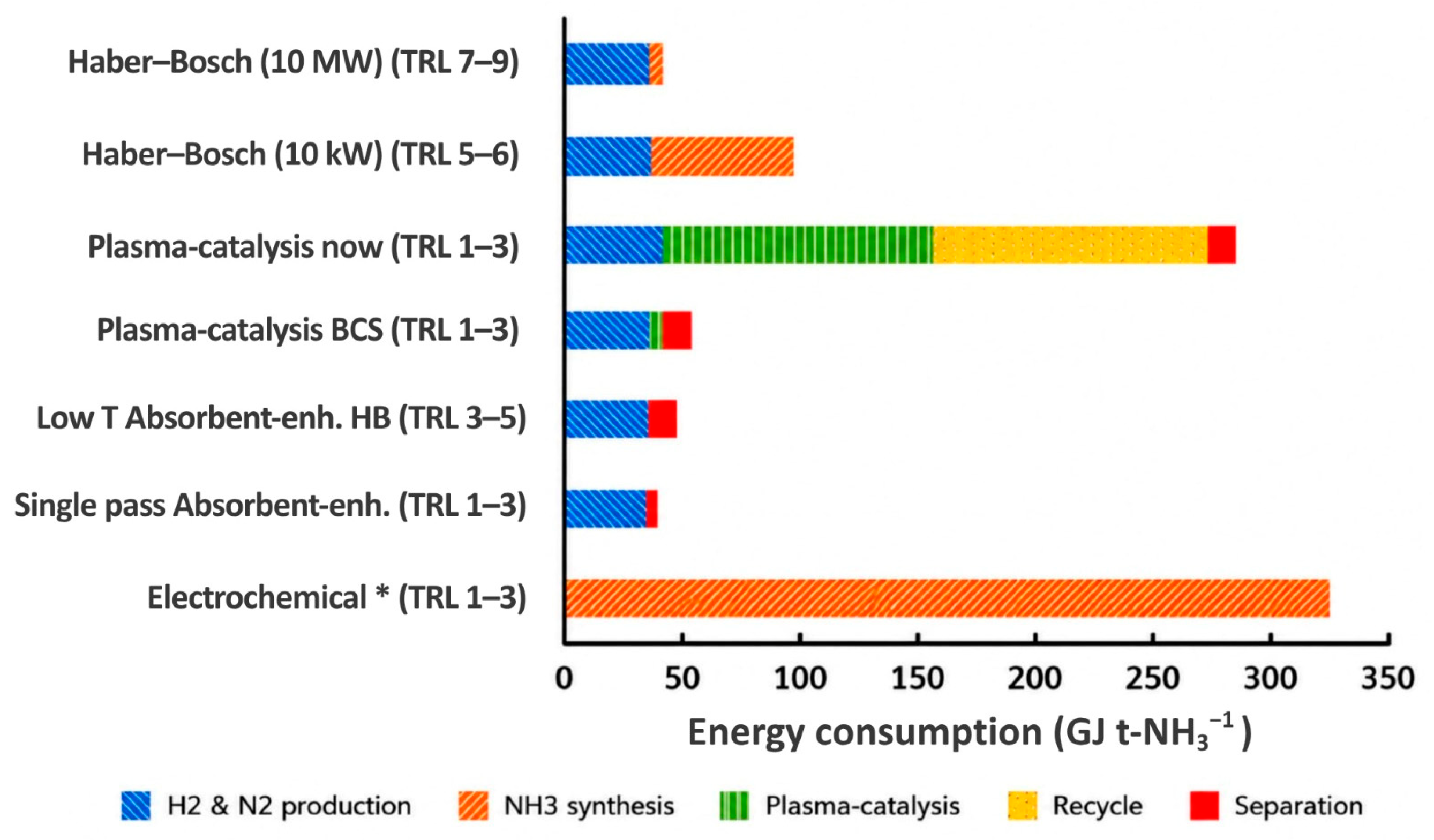
2.2. Comparative Analysis of Small-Scale Haber–Bosch and Plasma-Assisted Technologies
2.3. Pathways Toward Energy-Efficient Plasma-Assisted Ammonia Synthesis
2.3.1. Best-Case Scenario (BCS) for Plasma Assisted Ammonia Synthesis
2.3.2. Conceptual Process Design and Ammonia Separation–Separation and Storage
2.3.3. Synergy Between Plasma Reactor and Ammonia Separation and Storage
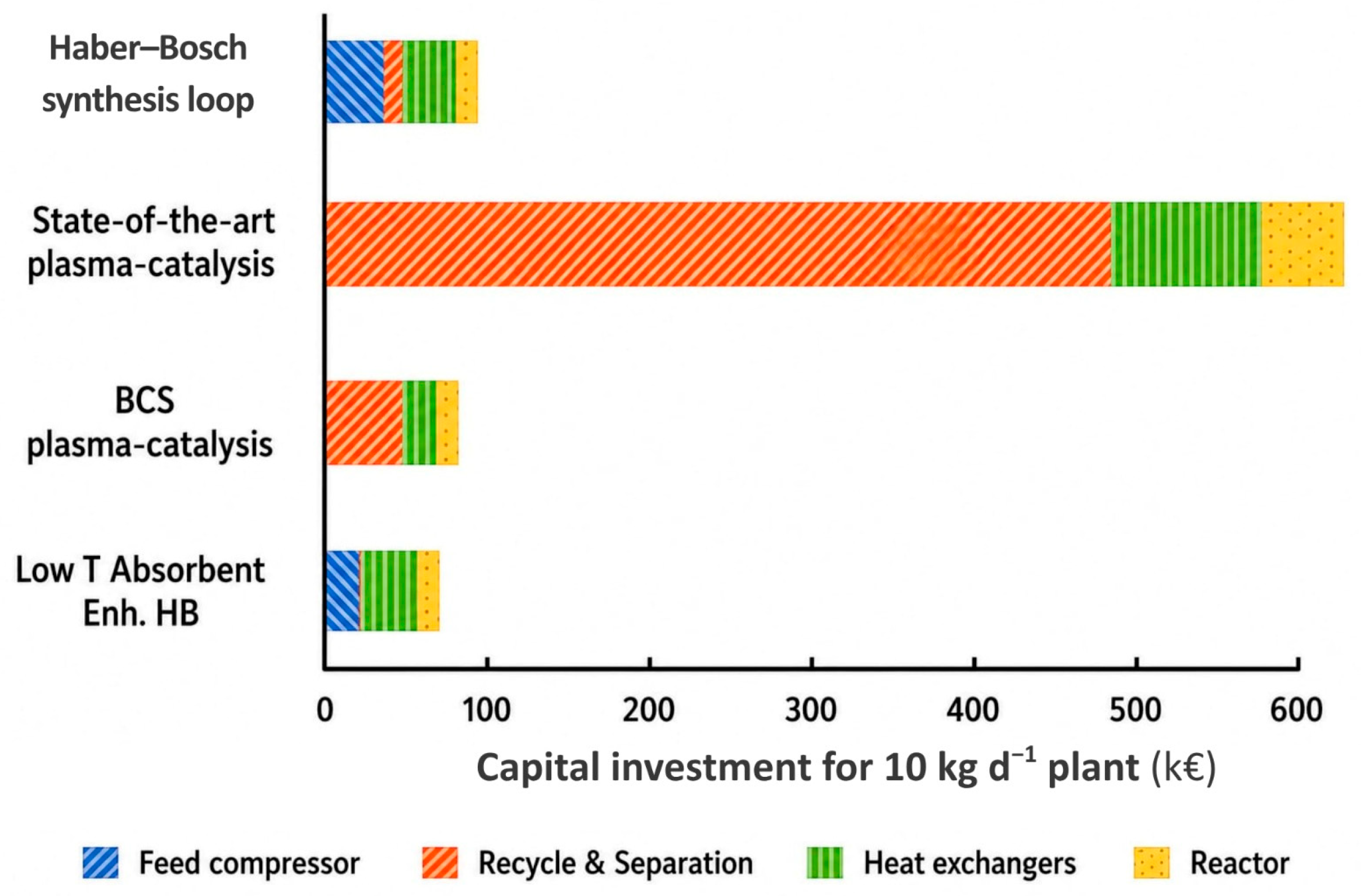
2.4. Investment Cost Comparison
2.5. Outlook for Plasma-Assisted Ammonia Synthesis


3. Sensitivity Analysis Results
4. Methodology
4.1. Goal and Scope
4.2. Functional Unit
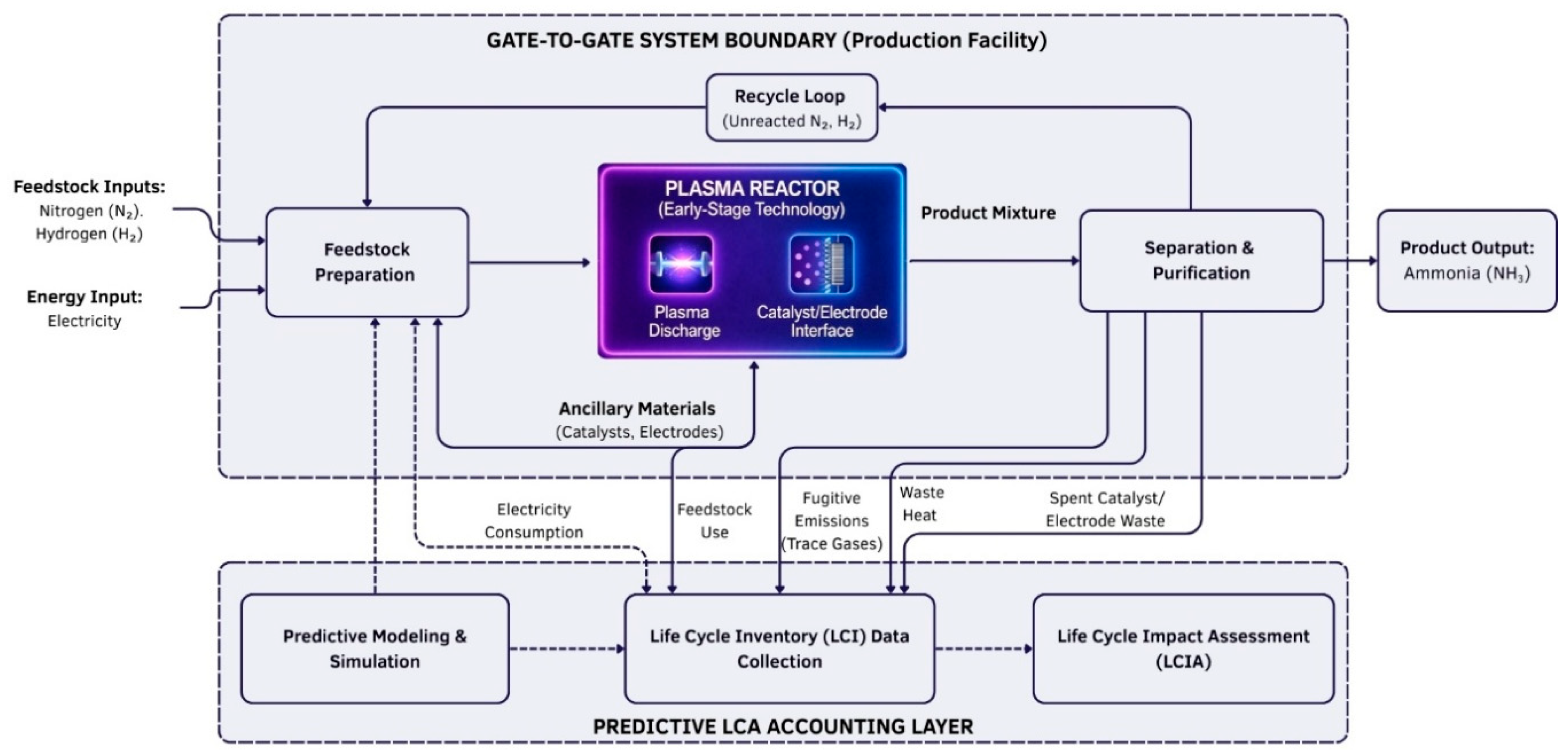
4.3. System Boundary
4.4. Life Cycle Inventory
4.5. Life Cycle Impact Assessment (LCIA) and Sensitivity Analysis
4.6. Limitations
5. Results
5.1. Life Cycle Inventory Results and Discussion
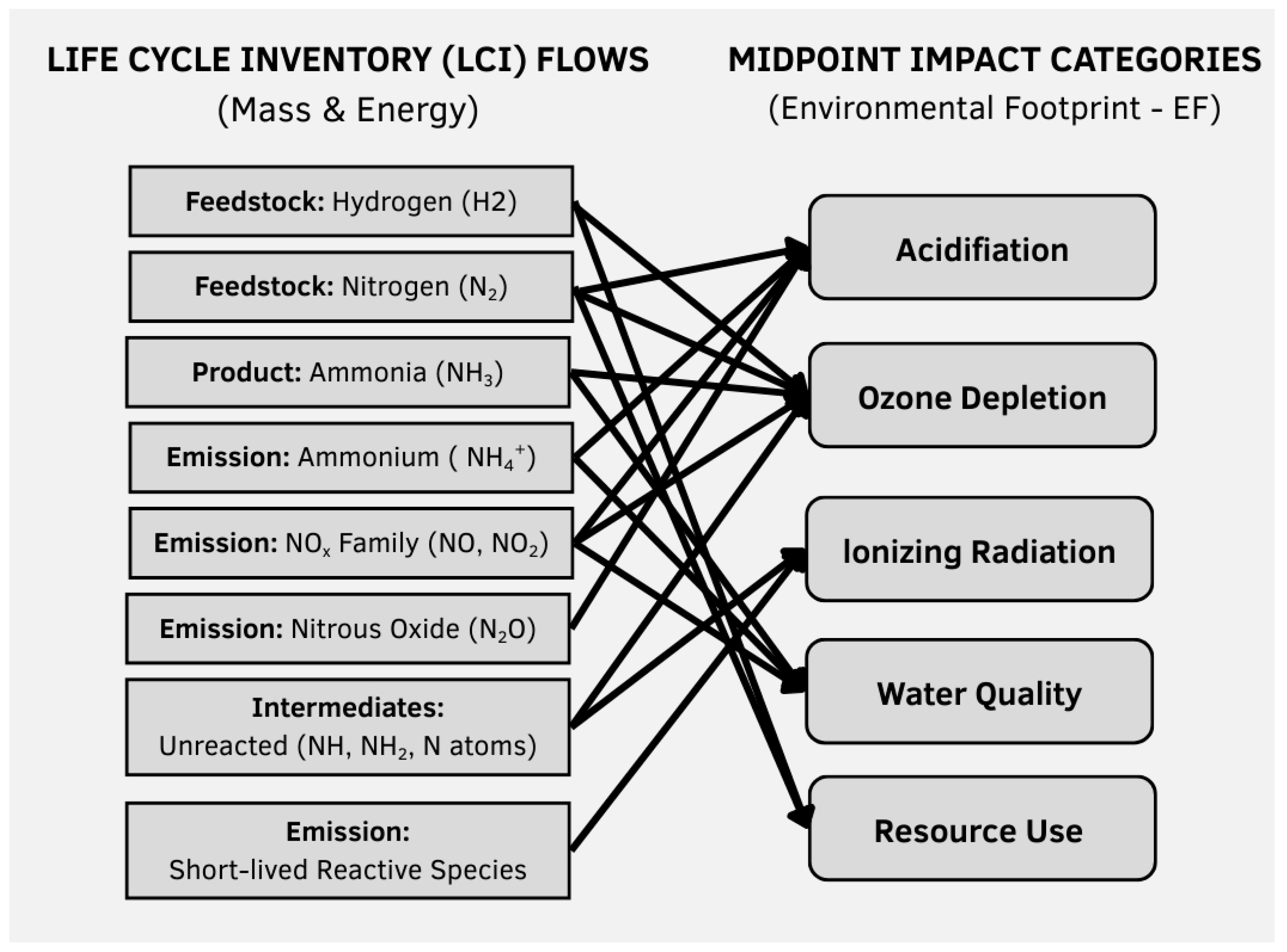
5.2. LCIA Results and Discussion
5.2.1. Atmospheric Chemistry Interactions
5.2.2. Acidification and Water Quality Degradation
5.2.3. Particulate Matter Formation
5.3. Implications of Cradle-to-Gate Boundary Expansion
6. Case Study: Experimental System Characterization and Inventory Data
6.1. Experimental System and Performance
6.2. LCI and Impact Assessment
6.3. Sensitivity Analysis and Performance Targets
6.4. Case Study GWP Assessment: EF 3.0 vs. ReCiPe 2016
6.5. Implications
7. Discussion
7.1. Current Performance Assessment
7.2. Future Potential and Development Pathways
8. Conclusions
Author Contributions
Funding
Data Availability Statement
Acknowledgments
Conflicts of Interest
Abbreviations
| BCS | Best-case scenario |
| DBD | Dielectric barrier discharge |
| EF | Environmental footprint |
| GWP | Global warming potential |
| LCA | Life cycle assessment |
| LCI | Life cycle inventory |
| LCIA | Life cycle impact assessment |
| TRL | Technology readiness level |
| SIAs | Secondary inorganic aerosols |
| SDGs | Sustainable Development Goals |
| VOC | Volatile organic compound |
References
- Christensen, C.H.; Johannessen, T.; Sørensen, R.Z.; Nørskov, J.K. Towards an ammonia-mediated hydrogen economy? Catal. Today 2006, 111, 140–144. [Google Scholar] [CrossRef]
- Nayak-Luke, R.; Bañares-Alcántara, R.; Wilkinson, I. “green” Ammonia: Impact of Renewable Energy Intermittency on Plant Sizing and Levelized Cost of Ammonia. Ind. Eng. Chem. Res. 2018, 57, 14607–14616. [Google Scholar] [CrossRef]
- Rouwenhorst, K.H.R.; Krzywda, P.M.; Benes, N.E.; Mul, G.; Lefferts, L. Ammonia Production Technologies. In Techno-Economic Challenges of Green Ammonia as an Energy Vector; Elsevier: Amsterdam, The Netherlands, 2020; pp. 41–83. [Google Scholar] [CrossRef]
- Smith, C.; Hill, A.K.; Torrente-Murciano, L. Current and future role of Haber-Bosch ammonia in a carbon-free energy landscape. Energy Environ. Sci. 2020, 13, 331–344. [Google Scholar] [CrossRef]
- Chehade, G.; Dincer, I. Progress in green ammonia production as potential carbon-free fuel. Fuel 2021, 299, 120845. [Google Scholar] [CrossRef]
- Rouwenhorst, K.H.R.; Engelmann, Y.; Van ’T Veer, K.; Postma, R.S.; Bogaerts, A.; Lefferts, L. Plasma-driven catalysis: Green ammonia synthesis with intermittent electricity. Green Chem. 2020, 22, 6258–6287. [Google Scholar] [CrossRef]
- Rouwenhorst, K.H.R.; Lefferts, L. Feasibility Study of Plasma-Catalytic Ammonia Synthesis for Energy Storage Applications. Catalysts 2020, 10, 999. [Google Scholar] [CrossRef]
- Peng, P.; Chen, P.; Schiappacasse, C.; Zhou, N.; Anderson, E.; Chen, D.; Liu, J.; Cheng, Y.; Hatzenbeller, R.; Addy, M.; et al. A review on the non-thermal plasma-assisted ammonia synthesis technologies. J. Clean. Prod. 2018, 177, 597–609. [Google Scholar] [CrossRef]
- Peng, P.; Chen, P.; Addy, M.; Cheng, Y.; Anderson, E.; Zhou, N.; Schiappacasse, C.; Zhang, Y.; Chen, D.; Hatzenbeller, R.; et al. Atmospheric Plasma-Assisted Ammonia Synthesis Enhanced via Synergistic Catalytic Absorption. ACS Sustain. Chem. Eng. 2019, 7, 100–104. [Google Scholar] [CrossRef]
- Carreon, M.L. Plasma catalytic ammonia synthesis: State of the art and future directions. J. Phys. D Appl. Phys. 2019, 52, 483001. [Google Scholar] [CrossRef]
- Yu, L.; Keilani, A.; Tran, N.N.; Escribà-Gelonch, M.; Goodsite, M.; Sandhu, S.; Sandhu, H.; Hessel, V. ESG assessment methodology for emerging technologies: Plasma versus conventional technology for ammonia production. RSC Sustain. 2024, 3, 1102–1113. [Google Scholar] [CrossRef]
- Jacquemin, L.; Pontalier, P.Y.; Sablayrolles, C. Life cycle assessment (LCA) applied to the process industry: A review. Int. J. Life Cycle Assess. 2012, 17, 1028–1041. [Google Scholar] [CrossRef]
- Buyle, M.; Audenaert, A.; Billen, P.; Boonen, K.; Van Passel, S. The future of ex-ante LCA? Lessons learned and practical recommendations. Sustainability 2019, 11, 5456. [Google Scholar] [CrossRef]
- Moni, S.M.; Mahmud, R.; High, K.; Carbajales-Dale, M. Life cycle assessment of emerging technologies: A review. J. Ind. Ecol. 2020, 24, 52–63. [Google Scholar] [CrossRef]
- Thonemann, N.; Schulte, A.; Maga, D. How to conduct prospective life cycle assessment for emerging technologies? A systematic review and methodological guidance. Sustainability 2020, 12, 1192. [Google Scholar] [CrossRef]
- Wiwoho, N.; Wongsawaeng, D.; Kongprawes, G.; Saengkaew, P.; Swantomo, D. Ammonia production from water and nitrogen gas using simple dielectric barrier discharge plasma reactor. Sci. Rep. 2025, 15, 23401. [Google Scholar] [CrossRef]
- ISO 14040:2006; Environmental Management—Life Cycle Assessment—Principles and Framework. International Organization for Standardization (ISO): Geneva, Switzerland, 2006.
- ISO 14044:2006; Environmental Management—Life Cycle Assessment—Requirements and guidelines. International Organization for Standardization (ISO): Geneva, Switzerland, 2006.
- Hong, J.; Prawer, S.; Murphy, A.B. Plasma Catalysis as an Alternative Route for Ammonia Production: Status, Mechanisms, and Prospects for Progress. ACS Sustain. Chem. Eng. 2018, 6, 15–31. [Google Scholar] [CrossRef]
- Bogaerts, A.; Neyts, E.C. Plasma Technology: An Emerging Technology for Energy Storage. ACS Energy Lett. 2018, 3, 1013–1027. [Google Scholar] [CrossRef]
- Neyts, E.C. Plasma-Surface Interactions in Plasma Catalysis. Plasma Chem. Plasma Process. 2016, 36, 185–212. [Google Scholar] [CrossRef]
- Rouwenhorst, K.H.R.; Kim, H.H.; Lefferts, L. Vibrationally Excited Activation of N2 in Plasma-Enhanced Catalytic Ammonia Synthesis: A Kinetic Analysis. ACS Sustain. Chem. Eng. 2019, 7, 17515–17522. [Google Scholar] [CrossRef]
- Barboun, P.; Mehta, P.; Herrera, F.A.; Go, D.B.; Schneider, W.F.; Hicks, J.C. Distinguishing Plasma Contributions to Catalyst Performance in Plasma-Assisted Ammonia Synthesis. ACS Sustain. Chem. Eng. 2019, 7, 8621–8630. [Google Scholar] [CrossRef]
- Akay, G.; Zhang, K. Process intensification in ammonia synthesis using novel coassembled supported microporous catalysts promoted by nonthermal plasma. Ind. Eng. Chem. Res. 2017, 56, 457–468. [Google Scholar] [CrossRef]
- Peng, P.; Cheng, Y.; Hatzenbeller, R.; Addy, M.; Zhou, N.; Schiappacasse, C.; Chen, D.; Zhang, Y.; Anderson, E.; Liu, Y.; et al. Ru-based multifunctional mesoporous catalyst for low-pressure and non-thermal plasma synthesis of ammonia. Int. J. Hydrogen Energy 2017, 42, 19056–19066. [Google Scholar] [CrossRef]
- Gómez-Ramírez, A.; Cotrino, J.; Lambert, R.M.; González-Elipe, A.R. Efficient synthesis of ammonia from N2 and H2 alone in a ferroelectric packed-bed DBD reactor. Pasma Sources Sci. Technol. 2015, 24, 065011. [Google Scholar] [CrossRef]
- Gómez-Ramírez, A.; Montoro-Damas, A.M.; Cotrino, J.; Lambert, R.M.; González-Elipe, A.R. About the enhancement of chemical yield during the atmospheric plasma synthesis of ammonia in a ferroelectric packed bed reactor. Pasma Process. Polym. 2017, 14, 1600081. [Google Scholar] [CrossRef]
- Li, S.; van Raak, T.; Gallucci, F. Investigating the operation parameters for ammonia synthesis in dielectric barrier discharge reactors. J. Phys. D Appl. Phys. 2020, 53, 014008. [Google Scholar] [CrossRef]
- Kim, H.H.; Teramoto, Y.; Ogata, A.; Takagi, H.; Nanba, T. Atmospheric-pressure nonthermal plasma synthesis of ammonia over ruthenium catalysts. Pasma Process. Polym. 2017, 14, 1600157. [Google Scholar] [CrossRef]
- Shah, J.R.; Gorky, F.; Lucero, J.; Carreon, M.A.; Carreon, M.L. Ammonia Synthesis via Atmospheric Plasma Catalysis: Zeolite 5A, a Case of Study. Ind. Eng. Chem. Res. 2020, 59, 5167–5176. [Google Scholar] [CrossRef]
- Iwamoto, M.; Akiyama, M.; Aihara, K.; Deguchi, T. Ammonia synthesis on wool-like Au, Pt, Pd, Ag, or Cu electrode catalysts in nonthermal atmospheric-pressure plasma of N2 and H2. ACS Catal. 2017, 7, 6924–6929. [Google Scholar] [CrossRef]
- Hong, J.; Prawer, S.; Murphy, A.B. Production of ammonia by heterogeneous catalysis in a packed-bed dielectric-barrier discharge: Influence of argon addition and voltage. IEEE Trans. Plasma Sci. 2014, 42, 2338–2339. [Google Scholar] [CrossRef]
- Patil, B.S. Plasma (Catalyst)-Assisted Nitrogen Fixation: Reactor Development for Nitric Oxide and Ammonia Production. Ph.D. Thesis, Technische Universiteit Eindhoven, Eindhoven, The Netherlands, 2017. Available online: https://pure.tue.nl/ws/files/64000562/20170510_Patil.pdf (accessed on 11 May 2026).
- Mizushima, T.; Matsumoto, K.; Sugoh, J.; Ohkita, H.; Kakuta, N. Tubular membrane-like catalyst for reactor with dielectric-barrier-discharge plasma and its performance in ammonia synthesis. Appl. Catal. A Gen. 2004, 265, 53–59. [Google Scholar] [CrossRef]
- Srinath, N.V. Plasma Catalytic Ammonia Synthesis at Atmospheric Pressure in a Dielectric Barrier Discharge Reactor. Master’s Thesis, Eindhoven University of Technology, Eindhoven, The Netherlands, 2017. Available online: https://research.tue.nl/en/studentTheses/plasma-catalytic-ammonia-synthesis-at-atmospheric-pressure-in-a-d/ (accessed on 11 May 2026).
- Peng, P.; Cheng, Y.; Zhou, N.; Hatzenbeller, R.; Chen, P.; Ruan, R.R. Atmospheric-Pressure Synthesis of Ammonia Using Non-Thermal Plasma with the Assistance of Ru-Based Multifunctional Catalyst. Available online: https://ammoniaenergy.org/presentations/atmospheric-pressure-synthesis-of-ammonia-using-non-thermal-plasma-with-the-assistance-of-ru-based-multifunctional-catalyst/ (accessed on 9 March 2026).
- Yin, K.I.S.; Venugopalan, M. Plasma Chemical Synthesis. I. Effect of Electrode Material on the Synthesis of Ammonia. Pasma Chem. Plasma Process. 1983, 3, 343–350. [Google Scholar] [CrossRef]
- Wildfire, C.; Abdelsayed, V.; Shekhawat, D.; Spencer, M.J. Ambient pressure synthesis of ammonia using a microwave reactor. Catal. Commun. 2018, 115, 64–67. [Google Scholar] [CrossRef]
- Nakajima, J.; Sekiguchi, H. Synthesis of ammonia using microwave discharge at atmospheric pressure. Thin Solid Film. 2008, 516, 4446–4451. [Google Scholar] [CrossRef]
- Bai, X.; Tiwari, S.; Robinson, B.; Killmer, C.; Li, L.; Hu, J. Microwave catalytic synthesis of ammonia from methane and nitrogen. Catal. Sci. Technol. 2018, 8, 6302–6305. [Google Scholar] [CrossRef]
- Uyama, H.; Nakamura, T.; Tanaka, S.; Matsumoto, O. Catalytic Effect of Iron Wires on the Syntheses of Ammonia and Hydrazine in a Radio-Frequency Discharge. Plasma Chem. Plasma Process. 1993, 13, 117–131. [Google Scholar] [CrossRef]
- Siemsen, L.G. The Synthesis of Ammonia from Hydrogen and Atomic Nitrogen on the Rh(110) Surface. Ph.D. Thesis, Iowa State University, Ames, IA, USA, 1990. [Google Scholar] [CrossRef]
- Shah, J.; Wu, T.; Lucero, J.; Carreon, M.A.; Carreon, M.L. Nonthermal Plasma Synthesis of Ammonia over Ni-MOF-74, ACS Sustain. Chem. Eng. 2019, 7, 377–383. [Google Scholar] [CrossRef]
- Shah, J.; Gorky, F.; Psarras, P.; Seong, B.; Gómez-Gualdrón, D.A.; Carreon, M.L. Enhancement of the Yield of Ammonia by Hydrogen-Sink Effect during Plasma Catalysis. ChemCatChem 2020, 12, 1200–1211. [Google Scholar] [CrossRef]
- Shah, J.; Wang, W.; Bogaerts, A.; Carreon, M.L. Ammonia Synthesis by Radio Frequency Plasma Catalysis: Revealing the Underlying Mechanisms. ACS Appl. Energy Mater. 2018, 1, 4824–4839. [Google Scholar] [CrossRef]
- Shah, J.R.; Harrison, J.M.; Carreon, M.L. Ammonia plasma-catalytic synthesis using low melting point alloys. Catalysts 2018, 8, 437. [Google Scholar] [CrossRef]
- Uyama, H.; Uchikura, T.; Niijima, H.; Matsumoto, O. Synthesis of Ammonia with RF Discharge. Adsorption of Products on Zeolite. Chem. Lett. 1987, 16, 555–558. [Google Scholar] [CrossRef]
- Cesaro, Z.; Thatcher, J.; Bãnares-Alcántara, R. Techno-Economic Aspects of the Use of Ammonia as Energy Vector. Techno-Economic Challenges of Green Ammonia as an Energy Vector; Elsevier: Amsterdam, The Netherlands, 2020; pp. 209–219. [Google Scholar] [CrossRef]
- Rouwenhorst, K.H.R.; Van der Ham, A.G.J.; Mul, G.; Kersten, S.R.A. Islanded ammonia power systems: Technology review & conceptual process design. Renew. Sustain. Energy Rev. 2019, 114, 109339. [Google Scholar] [CrossRef]
- Buchner, G.A.; Stepputat, K.J.; Zimmermann, A.W.; Schomäcker, R. Specifying Technology Readiness Levels (TRL) for the Chemical Industry. Ind. Eng. Chem. Res. 2019, 17, 6957–6969. [Google Scholar] [CrossRef]
- Beach, J.D.; Kintner, J.D.; Welch, A.W. Removal of Gaseous NH3 from an NH3 Reactor Product Stream. U.S. Patent Application 15/989,946, 29 November 2018. [Google Scholar]
- Liu, C.Y.; Aika, K.I. Effect of the Cl/Br molar ratio of a CaCl2-CaBr2 mixture used as an ammonia storage material. Ind. Eng. Chem. Res. 2004, 43, 6994–7000. [Google Scholar] [CrossRef]
- Zhang, T.; Miyaoka, H.; Miyaoka, H.; Ichikawa, T.; Kojima, Y. Review on Ammonia Absorption Materials: Metal Hydrides, Halides, and Borohydrides. ACS Appl. Energy Mater. 2018, 1, 232–242. [Google Scholar] [CrossRef]
- Kitano, M.; Inoue, Y.; Sasase, M.; Kishida, K.; Kobayashi, Y.; Nishiyama, K.; Tada, T.; Kawamura, S.; Yokoyama, T.; Hara, M.; et al. Self-organized Ruthenium–Barium Core–Shell Nanoparticles on a Mesoporous Calcium Amide Matrix for Efficient Low-Temperature Ammonia Synthesis. Angew. Chem. 2018, 130, 2678–2682. [Google Scholar] [CrossRef]
- Shi, R.; Zhang, X.; Waterhouse, G.I.N.; Zhao, Y.; Zhang, T. The Journey toward Low Temperature, Low Pressure Catalytic Nitrogen Fixation. Adv. Energy Mater. 2020, 10, 2000659. [Google Scholar] [CrossRef]
- Kitano, M.; Kanbara, S.; Inoue, Y.; Kuganathan, N.; Sushko, P.V.; Yokoyama, T.; Hara, M.; Hosono, H. Electride support boosts nitrogen dissociation over ruthenium catalyst and shifts the bottleneck in ammonia synthesis. Nat. Commun. 2015, 6, 6731. [Google Scholar] [CrossRef]
- Kitano, M.; Inoue, Y.; Yamazaki, Y.; Hayashi, F.; Kanbara, S.; Matsuishi, S.; Yokoyama, T.; Kim, S.-W.; Hara, M.; Hosono, H. Ammonia synthesis using a stable electride as an electron donor and reversible hydrogen store. Nat. Chem. 2012, 4, 934–940. [Google Scholar] [CrossRef]
- Smith, C.; Malmali, M.; Liu, C.Y.; McCormick, A.V.; Cussler, E.L. Rates of Ammonia Absorption and Release in Calcium Chloride. ACS Sustain. Chem. Eng. 2018, 6, 11827–11835. [Google Scholar] [CrossRef]
- Malmali, M.; Le, G.; Hendrickson, J.; Prince, J.; McCormick, A.V.; Cussler, E.L. Better Absorbents for Ammonia Separation. ACS Sustain. Chem. Eng. 2018, 6, 6536–6546. [Google Scholar] [CrossRef]
- Armijo, J.; Philibert, C. Flexible production of green hydrogen and ammonia from variable solar and wind energy: Case study of Chile and Argentina. Int. J. Hydrogen Energy 2020, 45, 1541–1558. [Google Scholar] [CrossRef]
- Rouwenhorst, K.H.R.; Krzywda, P.M.; Benes, N.E.; Mul, G.; Lefferts, L. Ammonia, 4. Green Ammonia Production. In Ullmann’s Encyclopedia of Industrial Chemistry; Wiley: Hoboken, NJ, USA, 2020; pp. 1–20. [Google Scholar] [CrossRef]
- van Rooij, G.J.; Akse, H.N.; Bongers, W.A.; van de Sanden, M.C.M. Plasma for electrification of chemical industry: A case study on CO2 reduction. Pasma Phys. Control. Fusion 2018, 60, 014019. [Google Scholar] [CrossRef]
- Singh, A.R.; Rohr, B.A.; Statt, M.J.; Schwalbe, J.A.; Cargnello, M.; Nørskov, J.K. Strategies toward Selective Electrochemical Ammonia Synthesis. ACS Catal. 2019, 9, 8316–8324. [Google Scholar] [CrossRef]
- Kibsgaard, J.; Nørskov, J.K.; Chorkendorff, I. The Difficulty of Proving Electrochemical Ammonia Synthesis. ACS Energy Lett. 2019, 4, 2986–2988. [Google Scholar] [CrossRef]
- Hollevoet, L.; De Ras, M.; Roeffaers, M.; Hofkens, J.; Martens, J.A. Energy-Efficient Ammonia Production from Air and Water Using Electrocatalysts with Limited Faradaic Efficiency. ACS Energy Lett. 2020, 5, 1124–1127. [Google Scholar] [CrossRef]
- Liu, H.; Han, W.; Huo, C.; Cen, Y. Development and application of wüstite-based ammonia synthesis catalysts. Ctal. Today 2020, 355, 110–127. [Google Scholar] [CrossRef]
- Huazhang, L. Ruthenium Based Ammonia Synthesis Catalysts; World Scientific Publishing Co. Pte. Ltd.: Singapore, 2013; Available online: https://toc.library.ethz.ch/objects/pdf03/e01_978-981-4355-77-3_01.pdf (accessed on 11 May 2026).
- Aika, K.I. Role of alkali promoter in ammonia synthesis over ruthenium catalysts—Effect on reaction mechanism. Catal. Today 2017, 286, 14–20. [Google Scholar] [CrossRef]
- Inoue, Y.; Kitano, M.; Tokunari, M.; Taniguchi, T.; Ooya, K.; Abe, H.; Niwa, Y.; Sasase, M.; Hara, M.; Hosono, H. Direct Activation of Cobalt Catalyst by 12CaO·7Al 2 O 3 Electride for Ammonia Synthesis. ACS Catal. 2019, 9, 1670–1679. [Google Scholar] [CrossRef]
- Hattori, M.; Iijima, S.; Nakao, T.; Hosono, H.; Hara, M. Solid solution for catalytic ammonia synthesis from nitrogen and hydrogen gases at 50 °C. Nat. Commun. 2020, 11, 2001. [Google Scholar] [CrossRef]
- Kammert, J.; Moon, J.; Cheng, Y.; Daemen, L.; Irle, S.; Fung, V.; Liu, J.; Page, K.; Ma, X.; Phaneuf, V.; et al. Nature of Reactive Hydrogen for Ammonia Synthesis over a Ru/C12A7 Electride Catalyst. J. Am. Chem. Soc. 2020, 142, 7655–7667. [Google Scholar] [CrossRef]
- Hara, M.; Kitano, M.; Hosono, H. Ru-Loaded C12A7:e- Electride as a Catalyst for Ammonia Synthesis. ACS Catal. 2017, 7, 2313–2324. [Google Scholar] [CrossRef]
- Kobayashi, Y.; Kitano, M.; Kawamura, S.; Yokoyama, T.; Hosono, H. Kinetic evidence: The rate-determining step for ammonia synthesis over electride-supported Ru catalysts is no longer the nitrogen dissociation step. Catal. Sci. Technol. 2017, 7, 47–50. [Google Scholar] [CrossRef]
- Gong, Y.; Wu, J.; Kitano, M.; Wang, J.; Ye, T.-N.; Li, J.; Kobayashi, Y.; Kishida, K.; Abe, H.; Niwa, Y.; et al. Ternary intermetallic LaCoSi as a catalyst for N2 activation. Nat. Catal. 2018, 1, 178–185. [Google Scholar] [CrossRef]
- Wu, J.; Li, J.; Gong, Y.; Kitano, M.; Inoshita, T.; Hosono, H. Intermetallic Electride Catalyst as a Platform for Ammonia Synthesis. Angew. Chem. 2019, 131, 835–839. [Google Scholar] [CrossRef]
- Inoue, Y.; Kitano, M.; Kishida, K.; Abe, H.; Niwa, Y.; Sasase, M.; Fujita, Y.; Ishikawa, H.; Yokoyama, T.; Hara, M.; et al. Efficient and Stable Ammonia Synthesis by Self-Organized Flat Ru Nanoparticles on Calcium Amide. ACS Catal. 2016, 6, 7577–7584. [Google Scholar] [CrossRef]
- Gao, W.; Wang, P.; Guo, J.; Chang, F.; He, T.; Wang, Q.; Wu, G.; Chen, P. Barium Hydride-Mediated Nitrogen Transfer and Hydrogenation for Ammonia Synthesis: A Case Study of Cobalt. ACS Catal. 2017, 7, 3654–3661. [Google Scholar] [CrossRef]
- Matsuishi, S.; Toda, Y.; Miyakawa, M.; Hayashi, K.; Kamiya, T.; Hirano, M.; Tanaka, I.; Hosono, H. High-Density Electron Anions in a Nanoporous Single Crystal: [Ca24Al28O64]4+(4e−). Science 2023, 301, 626–629. [Google Scholar] [CrossRef] [PubMed]
- Jiao, F.; Xu, B. Electrochemical Ammonia Synthesis and Ammonia Fuel Cells. Adv. Mater. 2018, 31, e1805173. [Google Scholar] [CrossRef] [PubMed]
- McEnaney, J.M.; Singh, A.R.; Schwalbe, J.A.; Kibsgaard, J.; Lin, J.C.; Cargnello, M.; Jaramillo, T.F.; Nørskov, J.K. Ammonia synthesis from N2 and H2O using a lithium cycling electrification strategy at atmospheric pressure. Energy Environ. Sci. 2017, 10, 1621–1630. [Google Scholar] [CrossRef]
- Nowotny, J.; Veziroglu, T.N. Impact of hydrogen on the environment. Int. J. Hydrogen Energy 2011, 36, 13218–13224. [Google Scholar] [CrossRef]
- Gorbanev, Y.; Vervloessem, E.; Nikiforov, A.; Bogaerts, A. Nitrogen Fixation with Water Vapor by Nonequilibrium Plasma: Toward Sustainable Ammonia Production. ACS Sustain. Chem. Eng. 2020, 8, 2996–3004. [Google Scholar] [CrossRef]
- Lamichhane, P.; Paneru, R.; Nguyen, L.N.; Lim, J.S.; Bhartiya, P.; Adhikari, B.C.; Mumtaz, S.; Choi, E.H. Plasma-assisted nitrogen fixation in water with various metals. React. Chem. Eng. 2020, 5, 2053–2057. [Google Scholar] [CrossRef]
- Erisman, J.W.; Galloway, J.; Seitzinger, S.; Bleeker, A.; Butterbach-Bahl, K. Reactive nitrogen in the environment and its effect on climate change. Curr. Opin. Environ. Sustain. 2011, 3, 281–290. [Google Scholar] [CrossRef]
- Van Ruijven, B.; Lamarque, J.F.; Van Vuuren, D.P.; Kram, T.; Eerens, H. Emission scenarios for a global hydrogen economy and the consequences for global air pollution. Glob. Environ. Change 2011, 21, 983–994. [Google Scholar] [CrossRef]
- Zaehle, S.; Ciais, P.; Friend, A.D.; Prieur, V. Carbon benefits of anthropogenic reactive nitrogen offset by nitrous oxide emissions. Nat. Geosci. 2011, 4, 601–605. [Google Scholar] [CrossRef]
- de Vries, W. Impacts of nitrogen emissions on ecosystems and human health: A mini review. Curr. Opin. Environ. Sci. Health 2021, 21, 100249. [Google Scholar] [CrossRef]
- Nieder, R.; Benbi, D.K. Reactive nitrogen compounds and their influence on human health: An overview. Rev. Environ. Health 2022, 37, 229–246. [Google Scholar] [CrossRef] [PubMed]
- Melillo, J.M. Disruption of the global nitrogen cycle: A grand challenge for the twenty-first century: This article belongs to Ambio’s 50th Anniversary Collection. Theme: Eutrophication. Ambio 2021, 50, 759–763. [Google Scholar] [CrossRef]
- Medhi, K. Integrated assessment of ammonia-nitrogen in water environments and its exposure to ecology and human health. In Contamination of Water: Health Risk Assessment and Treatment Strategies; Elsevier: Amsterdam, The Netherlands, 2021; pp. 199–216. [Google Scholar] [CrossRef]
- Viatte, C.; Abeed, R.; Yamanouchi, S.; Porter, W.C.; Safieddine, S.; Van Damme, M.; Clarisse, L.; Herrera, B.; Grutter, M.; Coheur, P.F.; et al. NH3 spatiotemporal variability over Paris, Mexico City, and Toronto, and its link to PM2.5 during pollution events. Amos. Chem. Phys. 2022, 22, 12907–12922. [Google Scholar] [CrossRef]
- Shim, K.; Kim, M.H.; Lee, H.J.; Nishizawa, T.; Shimizu, A.; Kobayashi, H.; Kim, C.H.; Kim, S.W. Exacerbation of PM2.5 concentration due to unpredictable weak Asian dust storm: A case study of an extraordinarily long-lasting spring haze episode in Seoul. Krea. Atmos. Environ. 2022, 287, 119261. [Google Scholar] [CrossRef]
- Liu, Y.; Zhan, J.; Zheng, F.; Song, B.; Zhang, Y.; Ma, W.; Hua, C.; Xie, J.; Bao, X.; Yan, C.; et al. Dust emission reduction enhanced gas-to-particle conversion of ammonia in the North China Plain. Nat. Commun. 2022, 13, 6887. [Google Scholar] [CrossRef]
- Wernet, G.; Bauer, C.; Steubing, B.; Reinhard, J.; Moreno-Ruiz, E.; Weidema, B. The ecoinvent database version 3 (part I): Overview and methodology. Int. J. Life Cycle Assess. 2016, 21, 1218–1230. [Google Scholar] [CrossRef]
- IEA. Global Energy Review 2020; IEA: Paris, France, 2020; Available online: https://www.iea.org/reports/global-energy-review-2020 (accessed on 11 May 2026).
- Osorio-Tejada, J.; Tran, N.N.; Hessel, V. Techno-environmental assessment of small-scale Haber-Bosch and plasma-assisted ammonia supply chains. Sci. Total. Environ. 2022, 826, 154162. [Google Scholar] [CrossRef] [PubMed]
- Ghavam, S.; Taylor, C.M.; Styring, P. The life cycle environmental impacts of a novel sustainable ammonia production process from food waste and brown water. J. Clean. Prod. 2021, 320, 128776. [Google Scholar] [CrossRef]
- Lim, K.H.; Yue, Y.; Bella, N.; Gao, X.; Zhang, T.; Hu, F.; Das, S.; Kawi, S. Sustainable Hydrogen and Ammonia Technologies with Nonthermal Plasma Catalysis: Mechanistic Insights and Technoeconomic Analysis. ACS Sustain. Chem. Eng. 2023, 11, 4903–4933. [Google Scholar] [CrossRef]
- Zheng, J.; Zhang, H.; Lv, J.; Zhang, M.; Wan, J.; Gerrits, N.; Wu, A.; Lan, B.; Wang, W.; Wang, S.; et al. Enhanced NH3Synthesis from Air in a Plasma Tandem-Electrocatalysis System Using Plasma-Engraved N-Doped Defective MoS2. JACS Au 2023, 3, 1328–1336. [Google Scholar] [CrossRef]
- Li, Z.; Liu, S.; Zhan, Q.; Li, J.; Zhang, Z.; Qian, Y.; Cai, Y.; Mu, X.; Li, L. Synergistic Enhancement of Plasma-Driven Ammonia Synthesis Using a AuCu3/Cu Composite Catalyst. Angew. Chem. Int. Ed. 2025, 64, e202424165. [Google Scholar] [CrossRef] [PubMed]
- Collingridge, D. The Social Control of Technology/David Collingridge; St. Martin’s Press: New York, NY, USA, 1980. [Google Scholar]
- Genus, A.; Stirling, A. Collingridge and the dilemma of control: Towards responsible and accountable innovation. Res. Policy 2018, 47, 61–69. [Google Scholar] [CrossRef]
 [23,24,25,26,27,28,29,30,31,32,33,34,35,36], DBD (pulse)
  [9,29], glow discharge
  [37], MW
  [38,39,40,41,42], and radiofrequency (RF)
  [43,44,45,46,47].
[23,24,25,26,27,28,29,30,31,32,33,34,35,36], DBD (pulse) [9,29], glow discharge [37], MW [38,39,40,41,42], and radiofrequency (RF) [43,44,45,46,47].
[43,44,45,46,47].
[23,24,25,26,27,28,29,30,31,32,33,34,35,36], DBD (pulse) [9,29], glow discharge [37], MW [38,39,40,41,42], and radiofrequency (RF) [43,44,45,46,47].



| Condensation | Metal Halide | Zeolite | |
|---|---|---|---|
| Separation temperature (°C) | −20–30 | 150–250 | 20–100 |
| Desorption temperature (°C) | - | 350–400 | 200–250 |
| Pressure (bar) | 100–450 | 10–30 | 10–30 |
| Energy consumption (GJ t−1 NH3) | 3–5 * | 6–11 | 8 |
| Ammonia at outlet (mol%) | 2–5 | 0.1–0.3 | 0.1–0.3 |
| Ammonia capacity (wt%) | 100 | 5–30 | 5–15 |
| Ammonia density (kg m−3) | 680 | 100–600 | 30–90 |
| Chemical stability | - | Low/Medium | High |
| Technology readiness level (TRL) | 9 | 4–5 | 4–5 |
| State-of-the-Art Plasma Reactor | BCS Plasma Reactor | Separation | |
|---|---|---|---|
| Type | DBD reactor (pulse) | DBD reactor (pulse) | Solid absorbent |
| Material | Promoted Ru/Al2O3 catalyst | More active catalyst | MgCl2/SiO2 |
| Reaction temperature (°C) | 300 | 200 | 200 |
| Desorption temperature (°C) | - | - | 300 |
| Operating pressure (bar) | 1.5 | 1.5 | 1.0 |
| Outlet NH3 concentration (mol%) | 0.16 | 1.0 | 0.1 |
| Outlet ammonia pressure (kPa) | 1.6 | 10 | 0.3 |
| Energy consumption (GJ t−1 NH3) * | 197 (PC:95, Rec:102) | 5 (PC:4, Rec:1) | 10 |
| Syngas ratio (H2:N2) | 1:4 | 1:4 | 1:4 |
| Parameter Category | Variable | Baseline Value | Sensitivity Range | Unit | LCI Application | Impact Assessment Relevance |
|---|---|---|---|---|---|---|
| Plasma Reactor Performance | Energy consumption | 1919 | 103–106 | GJ t−1 NH3 | Direct energy input to system | Climate change, resource use |
| Energy consumption (BCS) | 5 | 4–6 | GJ t−1 NH3 | Optimized energy input | Climate change, resource use | |
| Ammonia conversion efficiency | 0.16 | 0.1–1.0 | mol% NH3 | Determines recycling flow rates | All impact categories via system scaling | |
| Outlet NH3 concentration | 1.6 | 0.5–10 | kPa (partial pressure) | Separation energy calculation | Climate change, acidification | |
| Operating temperature | 300 | 200–400 | °C | Heat integration requirements | Climate change (auxiliary energy) | |
| Operating pressure | 1.5 | 1.0–5.0 | Bar | Compression energy | Climate change, resource use | |
| Ammonia Separation | Separation technology | Metal halide (MgCl2/SiO2) | Metal halide/Zeolite/Condensation | — | Material and energy inputs | All categories via energy/material flows |
| Separation energy consumption | 10 | 6–11 | GJ t−1 NH3 | Direct energy input | Climate change, resource use | |
| Absorption temperature | 200 | 150–250 | °C | Heat exchange requirements | Climate change (thermal integration) | |
| Desorption temperature | 300 | 250–400 | °C | Regeneration energy | Climate change | |
| Ammonia capacity (sorbent) | 5 | 5–30 | wt% NH3 | Sorbent mass flow | Resource use, ecotoxicity | |
| Gas Recycling | Recycling energy (state-of-the-art) | 102 | 50–150 | GJ t−1 NH3 | Compression energy | Climate change, resource use |
| Recycling energy (BCS) | 1 | 0.5–2 | GJ t−1 NH3 | Compression energy | Climate change, resource use | |
| Syngas ratio (H2:N2) | 01:04 | 1:3 to 1:5 | Molar | Feedstock input flows | Resource use | |
| Electricity Supply | Global grid electricity mix | 0.96 | 0.8–1.1 | kg CO2-eq kWh−1 | Emission factors | Climate change (dominant) |
| Renewable electricity EF factor | 0.05 | 0.01–0.05 | kg CO2-eq kWh−1 | Climate change characterization | Climate change | |
| Coal-heavy grid EF factor | 1.2 | 0.8–1.2 | kg CO2-eq kWh−1 | Climate change characterization | Climate change | |
| Direct Emissions | N2O emission factor | Variable | 0.001–0.1 | kg N2O kg-NH3−1 | Uncontrolled emission | Climate change, ozone depletion |
| NOx emission factor | Variable | 0.01–0.5 | kg NOx kg-NH3−1 | Uncontrolled emission | Acidification, PM formation, ozone | |
| NH3 slip/emission | Variable | 0.001–0.05 | kg NH3 kg-NH3−1 | Uncontrolled emission | Acidification, eutrophication, PM | |
| Hydrogen leakage rate | 2 | 0.2–10 | % of H2 throughput | Indirect GHG emission | Climate change (indirect) | |
| Material Inputs | Catalyst type | Ru/Al2O3 | Ru/MgO/Al2O3, electride-supported Ru | — | Catalyst production and use | Resource use, ecotoxicity |
| Catalyst lifetime | 1 | 0.5–5 | years | Replacement frequency | Resource use, ecotoxicity | |
| Sorbent (MgCl2) requirement | 20 | 10–50 | kg t−1 NH3 | Sorbent production | Resource use, ecotoxicity |
| Datapoint | Value | EF | EF Source | Kg CO2eq | Assumption/Note |
|---|---|---|---|---|---|
| Nitrogen gas (N2) feedstock | 0.824 kg N2 per 1 kg NH3 (stoichiometric: MW N2 = 28, NH3 = 17; 0.5 mol N2 per mol NH3 → 14/17 = 0.824 kg/kg) | - | Ecoinvent 3.9.1 | 0.32 | Nitrogen gas is listed as a feedstock for plasma-assisted NH3 synthesis. Stoichiometric requirement: 0.824 kg N2 per kg NH3. The Ecoinvent activity “market for venting of nitrogen, liquid” represents cryogenic air separation production of nitrogen. EF of 0.39 kg CO2eq/kg includes upstream transport and cryogenic energy. |
| Water (H2O)—feedstock for hydrogen production via electrolysis | 1.588 kg H2O per 1 kg NH3 | - | Ecoinvent 3.9.1 | 0.00 | Stoichiometric derivation: Ammonia synthesis requires 1.5 mol H2 per mol NH3 (from N2 + 3H2 → 2NH3). Water electrolysis (H2O → H2 + ½O2) requires 1 mol H2O per mol H2. Therefore, 1.5 mol H2O per mol NH3 × 18 g/mol H2O ÷ 17 g/mol NH3 = 1.588 kg H2O per kg NH3 (theoretical minimum). With practical purification losses (~15% for RO/ion exchange treatment), real systems require approximately 1.8 kg H2O per kg NH3. The conservative stoichiometric value of 1.588 kg/kg is used in this LCA. Water is delivered via municipal pipeline; EF includes delivery. |
| Anhydrous ammonia (NH3)–output reference (benchmark comparison) | 1.0 kg NH3 output—conventional Haber–Bosch benchmark EF for comparison only | - | Ecoinvent 3.9.1 | 0.00 | This value is not included in the total; rather, it serves as a benchmark. The ecoinvent dataset “market for ammonia, anhydrous, liquid” (RER) has a GWP of 2.833 kg CO2eq/kg NH3 and represents conventional fossil-based Haber–Bosch ammonia production, including steam methane reforming. The sensitivity analysis uses 2.5 kg CO2eq/kg NH3 as the conventional benchmark for break-even analysis. The ecoinvent value of 2.833 kg CO2eq/kg NH3 is slightly higher because it includes the European market mix and upstream transportation processes. |
| Plasma reactor electricity consumption (Base line—Ecoinvent GLO grid) | 533 kWh/kg NH3 × 1 kg = 533 kWh | - | Ecoinvent 3.9.1 | 21.36 | Plasma reactor electricity consumption = 533 kWh/kg NH3. Baseline uses Ecoinvent GLO medium voltage grid EF (0.040073 kg CO2eq/kWh). |
| SCENARIO A: Global average grid (0.96 kg CO2eq/kWh—IEA) | 533 kWh × 0.96 kg CO2eq/kWh = 511.68 kg CO2eq/kg NH3 | 0.96 | Ecoinvent 3.9.1 | 0.00 | Scenario A = 533 kWh/kg × 0.96 kg CO2eq/kWh (IEA global average grid carbon intensity) = 511.68 kg CO2eq/kg NH3. This is ~205× the conventional Haber–Bosch benchmark (2.5 kg CO2eq/kg). NOT included in baseline total—scenario comparison only. |
| SCENARIO B: Renewable—dominated grid (0.05 kg CO2eq/kWh—IEA) | 533 kWh × 0.05 kg CO2e/kWh = 26.65 kg CO2eq/kg NH3 | 0.05 | Ecoinvent 3.9.1 | 0.00 | Scenario B = 533 kWh/kg × 0.05 kg CO2eq/kWh = 26.65 kg CO2eq/kg NH3. This is ~10.7× the conventional benchmark. NOT included in baseline total. |
| SCENARIO C: Coal heavy grid (1.20 kg CO2eq/kWh—IEA) | 533 kWh × 1.20 kg CO2eq/kWh = 639.60 kg CO2eq/kg NH3 | 1.20 | Ecoinvent 3.9.1 | 0.00 | Scenario C = 533 kWh/kg × 1.20 kg CO2eq/kWh = 639.60 kg CO2eq/kg NH3. Worst-case scenario. NOT included in baseline total. |
| SENSITIVITY: 10× efficiency improvement (53.3 kWh/kg)—Scenario A grid | 53.3 kWh × 0.96 kg CO2eq/kWh = 51.16 kg CO2eq/kg NH3 | 0.96 | Ecoinvent 3.9.1 | 0.00 | The 10× efficiency improvement reduces consumption to 53.3 kWh/kg. Scenario A: 53.3 × 0.96 = 51.16 kg CO2eq. Still ~20.48× conventional benchmark. NOT included in baseline total. |
| SENSITIVITY: 100× efficiency improvement (5.33 kWh/kg)—Scenario A grid | 5.33 kWh × 0.96 kg CO2eq/kWh = 5.12 kg CO2eq/kg NH3 | 0.96 | Ecoinvent 3.9.1 | 0.00 | The 100× efficiency improvement reduces consumption to 5.33 kWh/kg. Scenario A: 5.33 × 0.96 = 5.12 kg CO2eq. Still ~2.05× conventional benchmark. NOT included in baseline total. |
| BREAK-EVEN: kWh/kg required to match fossil ammonia (2.5 kg CO2eq)—all scenarios | ScenarioA: ≤2.60 kWh/kg|ScenarioB: ≤50.0 kWh/kg|ScenarioC: ≤2.08 kWh/kg | - | Ecoinvent 3.9.1 | 0.00 | Break-even vs. conventional fossil ammonia (2.5 kg CO2eq/kg NH3): Scenario A (0.96): 2.5/0.96 = 2.60 kWh/kg (current = 533 → need 205× improvement). Scenario B (0.05): 2.5/0.05 = 50.0 kWh/kg (current → need 10.7× improvement). Scenario C (1.20): 2.5/1.20 = 2.08 kWh/kg (current → need 256× improvement). |
| BREAK-EVEN: kWh/kg required to match renewable H2 ammonia (0.6 kg CO2eq)—all scenarios | ScenarioA: ≤0.625 kWh/kg|ScenarioB: ≤12.0 kWh/kg|ScenarioC: ≤0.50 kWh/kg | - | Ecoinvent 3.9.1 | 0.00 | Break-even vs. renewable hydrogen-based ammonia (0.6 kg CO2eq/kg NH3): Scenario A (0.96): 0.6/0.96 = 0.625 kWh/kg. Scenario B(0.05): 0.6/0.05 = 12.0 kWh/kg. Scenario C (1.20): 0.6/1.20 = 0.50 kWh/kg. These are even more stringent thresholds. For reference, conventional Haber–Bosch uses ~8–12 kWh/kg (including all energy). |
| Scenario | Grid Carbon Intensity (kg CO2eq/kg NH3) | Result (kg CO2eq/kg NH3) | Relative to Conventional NH3 Production 1 |
|---|---|---|---|
| A: Global average | 0.96 | 511.68 | ~205× |
| B: Renewable-dominated | 0.05 | 26.65 | ~10.7× |
| C: Coal-heavy | 1.2 | 639.60 | ~256× |
| Benchmark | Scenario A: Current Grid Mix | Scenario B: Renewable Dominated | Scenario C: Coal Heavy |
|---|---|---|---|
| Conventional (2.5 kg CO2eq/kg NH3) | ≤2.60 | ≤50.0 | ≤2.08 |
| Renewable H2-based (0.6 kg CO2eq/kg) | ≤0.625 | ≤12.0 | ≤0.50 |
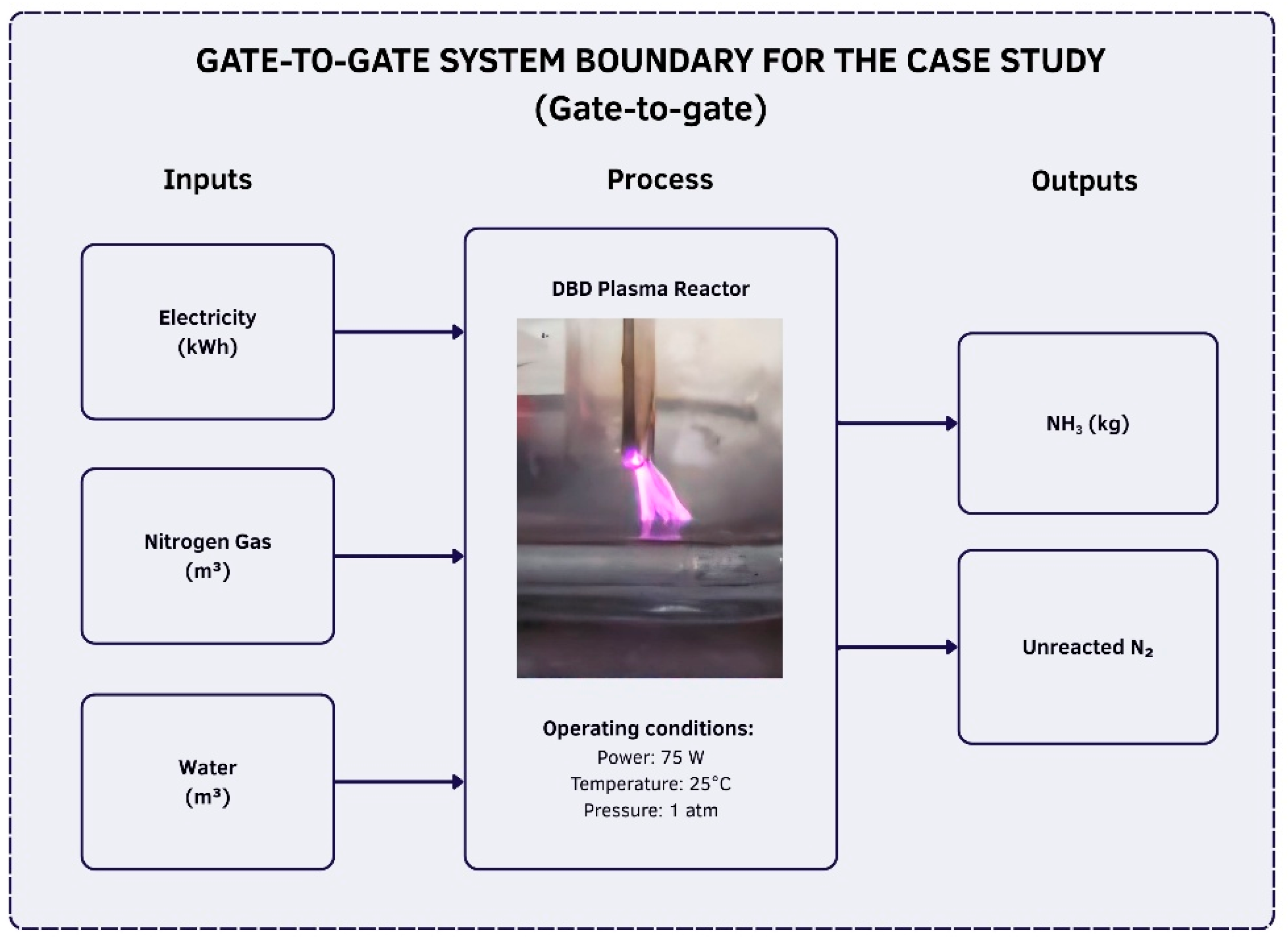
| Input Parameter | Value per kg NH3 | Unit |
|---|---|---|
| Electricity | 63,450 | kWh |
| DI water | 50,841 | L |
| Nitrogen Gas | 68,702 | m3 |
| Impact Category | Unit | Electricity | DI Water | Nitrogen Gas | Total Impact |
|---|---|---|---|---|---|
| Global Warming Potential (GWP) | kg CO2-eq | 31,725.00 | 254.21 | 13,740.40 | 45,719.61 |
| Acidification (AP) | kg SO2-eq | 95.17 | 1.02 | 34.35 | 130.54 |
| Eutrophication (EP) | kg P-eq | 6.35 | 0.25 | 0.69 | 7.29 |
| Fossil Depletion (FDP) | kg oil-eq | 9517.50 | 50.84 | 4122.12 | 13,690.46 |
| Input | EF 3.0 (kg CO2-eq/kg NH3) | EF 3.0 (%) | ReCiPe 2016 (kg CO2-eq/kg NH3) | ReCiPe 2016 (%) |
|---|---|---|---|---|
| Electricity | 32,041.2 | 64.8 | 31,725.0 | ~69.0 |
| Nitrogen Gas (N2) | 17,363.2 | 35.1 | 13,740.4 | ~30.0 |
| DI Water | 15.7 | 0.03 | 254.2 | ~0.6 |
| Total | 49,420.1 | 100 | 45,719.6 | 100 |
Disclaimer/Publisher’s Note: The statements, opinions and data contained in all publications are solely those of the individual author(s) and contributor(s) and not of MDPI and/or the editor(s). MDPI and/or the editor(s) disclaim responsibility for any injury to people or property resulting from any ideas, methods, instructions or products referred to in the content. |
© 2026 by the authors. Licensee MDPI, Basel, Switzerland. This article is an open access article distributed under the terms and conditions of the Creative Commons Attribution (CC BY) license.
Share and Cite
Wiwoho, N.; Wongsawaeng, D.; Saengkaew, P.; Sola, P.; Swantomo, D. Predictive Gate-to-Gate Life Cycle Assessment of an Early-Stage Plasma-Based Ammonia Synthesis Technology. Clean Technol. 2026, 8, 92. https://doi.org/10.3390/cleantechnol8030092
Wiwoho N, Wongsawaeng D, Saengkaew P, Sola P, Swantomo D. Predictive Gate-to-Gate Life Cycle Assessment of an Early-Stage Plasma-Based Ammonia Synthesis Technology. Clean Technologies. 2026; 8(3):92. https://doi.org/10.3390/cleantechnol8030092
Chicago/Turabian StyleWiwoho, Novita, Doonyapong Wongsawaeng, Phannee Saengkaew, Phachirarat Sola, and Deni Swantomo. 2026. "Predictive Gate-to-Gate Life Cycle Assessment of an Early-Stage Plasma-Based Ammonia Synthesis Technology" Clean Technologies 8, no. 3: 92. https://doi.org/10.3390/cleantechnol8030092
APA StyleWiwoho, N., Wongsawaeng, D., Saengkaew, P., Sola, P., & Swantomo, D. (2026). Predictive Gate-to-Gate Life Cycle Assessment of an Early-Stage Plasma-Based Ammonia Synthesis Technology. Clean Technologies, 8(3), 92. https://doi.org/10.3390/cleantechnol8030092