Article

Impact of Solvent Extraction on Compound Recovery and Biomethane Production Kinetics from Foodwaste Leachates


by
Ioannis Kontodimos
1,2,*,
Christos Evaggelou
1,
Nikolaos Margaritis
1,
Panagiotis Grammelis
1,* and
Maria A. Goula
2
1
Center for Research and Technology Hellas, Chemical Process and Energy Resources Institute (CERTH/CPERI), 4 km N.R Ptolemaidas-Mpodosakeiou Hospital Area, 50200 Ptolemaida, Greece
2
Laboratory of Alternative Fuels and Environmental Catalysis (LAFEC), Chemical Chemical Engineering Department, University of Western Macedonia UOWM, ZEP, 50150 Kozani, Greece
*
Authors to whom correspondence should be addressed.
Clean Technol. 2026, 8(3), 80; https://doi.org/10.3390/cleantechnol8030080
Submission received: 31 March 2026 / Revised: 6 May 2026 / Accepted: 8 May 2026 / Published: 1 June 2026

Abstract

This study proposes an integrated and more circular management approach, grounded in the principles of sustainable and green chemical processes, for the food waste leachates management, combining the assessment of biomethane production potential via anaerobic digestion with the evaluation of value-added compound recovery through extraction processes. The food waste leachates were characterized, while total carotenoid profile and total phenolic content were quantified using liquid–liquid extraction with mixed organic solvents. An HS-SPME coupled with GC–MS was employed to identify volatile organic compounds present in the leachates. Prior to the extraction procedure, D-limonene exhibited the highest abundance among identified volatiles. Crucially, the subsequent solvent extraction is highly likely to have effectively removed this inhibitory terpene from the liquid matrix. Extracted leachates exhibited a total carotenoid content of 0.64 mg/100 g and a total phenolic content of 127.0 μg/g, acting as preliminary indicators of significant potential for recovery and utilization in pharmaceutical and cosmetic applications. Biomethane potential tests were conducted in laboratory-scale anaerobic bioreactors using both raw food waste leachate and extracted food waste leachate. Comparable biomethane yields were obtained for both substrates, with FWL yielding 442.5 NmL/g VSadded and FWLextr yielding 452.2 NmL/g VSadded. These results demonstrate that the liquid–liquid extraction of value-added compounds does not adversely affect biomethane production from food waste leachates enabling the recovery of valuable by-products.

1. Introduction

Food waste is a worldwide issue with significant environmental and socioeconomic consequences. Improper food waste disposal results in an environmental impact, which, while it may seem like minor damage to the environment compared to other issues, has consequences that are undetermined. A major concern, at European and global level, in contemporary society is the high quantity of food waste. In 2025, it is estimated that over 58 million tonnes of foodwaste (FW) were generated. These tonnes correspond to 129 kg/inhabitant per year [1]. Approximately 53% of this quantity per capita originated from households [2]. As reported by the European Commission [3], the estimated value of discarded food amounts to 132 billion euros.
According to the Bio-waste in Europe report [4], 60% of bio-waste in the EU-28 for the year 2017 consisted of FW. At the same time, in Greece, FW comprises over 90% of bio-waste.
Beyond the depletion of resources, FW also contributes to the release of greenhouse gas (GHG). Ziyao et al. [5] report that 8% of the anthropogenic greenhouse gas emissions released into the environment annually are derived from ineffective FW management and food loss. In addition to gas emissions, FW disposal affects the water and soil quality. Specifically, environmental impacts associated with food waste disposal include reduced land availability, groundwater contamination, and waterway eutrophication. Indirect consequences further encompass increased demand for agricultural land, terrestrial acidification, higher freshwater consumption for irrigation, global desertification, and decreased carbon sequestration in soils [6].
FW contains compounds with beneficial properties for living organisms, such as carotenoids, polyphenols, antioxidants, terpenes and terpenoids. Bioactive compounds constitute an excellent source of ingredients for the production of cosmetics, functional foods, and food additives. Fruits and vegetables are considered among the simplest forms of functional foods due to their abundance of the aforementioned compounds. Kannah et al. [7] note that diverse functional compounds extracted from FW, including phenolic compounds, bioactive peptides, carotenoids, vitamins, minerals and dietary fibers, could be utilized as nutraceuticals to enhance human health. A considerable number of hydroxyl groups in aromatic rings are found in phenolic substances, which form a larger class of bioactive compounds. Polyphenols, in particular, possess the potential to act as antioxidants due to their ability to neutralize free radicals. They are further classified into flavonoids, phenolic acids, tannins, stilbenes and lignans. Moreover, a study [8] has shown that fruits and vegetables rich in polyphenols and carotenoids possess antioxidant properties and reduce the likelihood of developing severe diseases such as cancer.
The bioactive components could be isolated from FW and could provide functional benefits. Several extraction techniques have been reported for isolating these molecules and identifying them using high-precision analytical equipment. Among the extraction techniques the following are listed: solvent extraction method, supercritical fluid extraction, ultrasound and enzyme-assistant extraction, high-pressure processing and microwave extraction [5]. The selected extraction method depends on the recovery of the specific bioactive component. Among these, the solvent extraction method is the most widely used, employing solvents such as methanol, acetonitrile, hexane, ethanol, acetone or organic solvent mixtures [9]. However, the extraction process leaves behind a considerable quantity of solids, which require further handling. Headspace solid-phase microextraction (HS-SPME) combined with gas chromatography-mass spectrometry (GC-MS) has proven to be a robust tool for the determination of volatile and semi-volatile compounds, due to its simplicity, sensitivity and ability to capture the complex flavor profiles derived from food samples [10].
Composting, fermentation/anaerobic digestion and animal feeding are the primary methods currently used for managing FW [11]. Among the above FW management methods, anaerobic digestion is an environmentally friendly technique that combines waste treatment and generation of renewable energy. Furthermore, the solid remaining product of the anaerobic process could be utilized as fertilizer and soil improver.
In terms of reducing energy demands from fossil fuels, FW can serve as an alternative source of energy production through anaerobic digestion. FW originated from fruits and vegetables is rich in carbohydrates and lignin [12], whose decomposition results in high yield of Volatile Fatty Acids (VFAs), supporting efficient biogas production. The latter are considered as precursor compounds for biomethane generation [13]. Also, FW derived by fruits and vegetables includes protein and lipids [12].
Food waste leachates (FWLs) are liquid byproducts generated during the decomposition of FW. These leachates as the liquid fraction are characterized by high organic content and contain a variety of nutrients, bioactive compounds, carbohydrates, protein and lipids, making them, like FW itself, valuable for further processing and valorization.
In order to assess whether an organic residue is adequate for valorization through anaerobic process and to understand its chemical performance under anaerobic conditions, the Biochemical Methane potential (BMP) test is an appropriate technique [14].
The simultaneous recovery of bioactive compounds and generation of renewable fuel from FWL represents an innovative approach to waste valorization, reducing waste while uncovering new financial opportunities.
The main objective of this study is to propose a comprehensive, circularity-oriented approach for the management of food waste leachates, addressing their dual nature by evaluating both the biomethane production potential and the effectiveness of extraction processes for the recovery of value-added by-products.
In this context, the present study is intended as a proof-of-concept investigation to establish the fundamental feasibility of the proposed pathway, acknowledging that full industrial-scale validation would require further research.

2. Materials and Methods

2.1. Analytical Methods

The measurements of TS, VS, COD, NH4+, TOC and Alkalinity were carried out according to APHA Standard Methods [15]. TN content based on ASTM D8083 and the pH was estimated using a digital pH-meter (Hanna, HI2260, Woonsocket, RI, USA). For the quantifications of TOC and TN of inoculum and digestate, a TOC analyser (Shimadzu, TOC-L, Nishinokyo Kuwabaracho, Nakagyoku, Kyoto 604-8511, Japan) was used. The concentration of VFAs was calculated as described by Mota et al. [16] and expressed as Acetic Acid equivalents (HACeq). COD, NH4+, total phenolic content (TPC) and total carotenoid content (TCC) were quantified with a HACH DR2800 (Hach Lange, Loveland, CO, USA) spectrometer.
The included volatile compounds of FWL were identified with Head Space Solid Phase Microextraction/Gas Chromatography Mass Spectrometry (HS-SPME/GCMS). The biomethane potential assays were carried out using the Automated Methane Potential Test System II (AMPTS II, BPC Instruments AB Mobilvägen 10 SE-223 62 Lund, Sweden).

2.2. Inoculum

Anaerobic sludge (AS) was obtained from a commercial mesophilic anaerobic digester plant established in the area of Eordaia (Western Macedonia, Greece) which primarily treats agricultural residues along with cow and pig manure. The AS was stored and maintained in a 30 L vessel at 25 °C for 10 days [17] to preserve microbial viability [18]. The AS chemical characteristics are illustrated in Table 1. Prior to the BMP tests, the AS underwent a pre-incubation period of 5 days at 35 °C (degassing phase) to deplete the endogenous organic matter and minimize background methane production [18,19].

2.3. Substrate

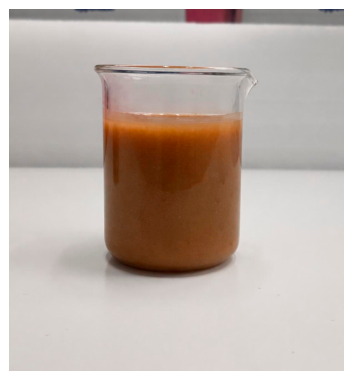
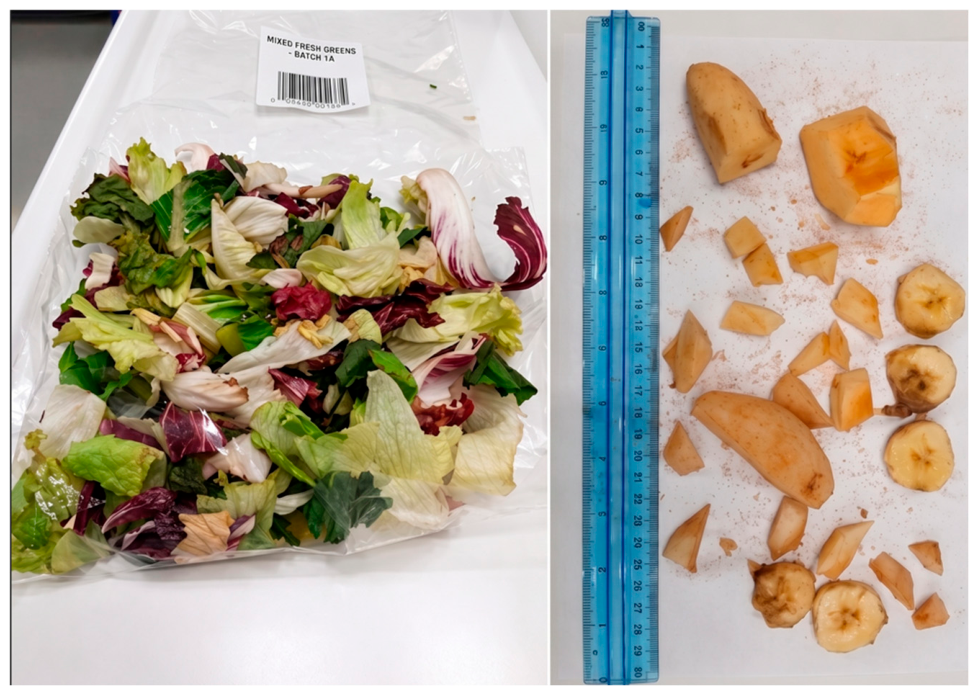
The FWL originated from a food waste (FW) mixture consisting of vegetables and fruits, which were collected from the canteen of the research organization. Prior to the storage, the FW was sorted and chopped in 5–10 cm pieces. The processed biomass was then transferred into a closed 10 L container and stored at 4 °C to undergo leaching (Figure 1), until a sufficient volume of liquid fraction was generated for the subsequent BMP assays. The FW was composed of 1:1 (w/w) ratio of fruits and vegetables (Figure 2). The fruit fraction consisted of bananas, apples and pears in equal proportions (1:1:1, w/w). Similarly, the vegetable fraction comprised equal parts of cabbage, lettuce and spinach. Table 1 demonstrates the chemical characterization of the FWL.

2.4. Biomethane Potential Test

The bench-scale experiments were conducted in 500 mL glass bottles with 400 mL working volume, each equipped with an individual stirrer for agitation. To determine the biomethane production, the generated biogas from each glass reactor passed through a 3 M NaOH aquatic solution containing thymolphthalein indicator to scrub CO2 and H2S. Anaerobic conditions were established by flushing the reactors with nitrogen before the batch assays. The tests were carried out under mesophilic conditions (35 ± 2 °C). The purified biogas passed through a flow cell unit (each bottle is equipped with an individual flow cell) and the gas productivity was evaluated by water displacement. A computer recorded the digital signal. The results of BMP assays are expressed as normalized mL CH4 per gram VS added. The experimental procedure of the anaerobic process was carried out in the laboratories of CERTH/CPERI in Ptolemaida, Greece. All assays were performed in triplicate and lasted for 30 days. The experimental protocol and operational parameters of the BMP assays are presented in Table 2.
The following two types of substrates were evaluated: the raw FWL (as received) and FWL following liquid–liquid extraction (FWLextr). To generate the bulk volume of FWLextr required for the digestion assays, a preparative-scale extraction was performed based on the carotenoid extraction protocol as described in Section 2.5. This method was selected as it effectively targets the lipophilic fraction, thereby aiming at the potential removal of the D-limonene [20].
Prior to the BMP process, the recovered aqueous phases of the FWLextr were pooled and pre-treated in a drying oven at 65 °C for 2 h. This step was performed to evaporate residual organic solvents, thus preventing any chemical inhibition of the anaerobic process.
The BMP assays were conducted based on the Substrate-to-Inoculum Ratio (SIR), adopting the ratio of substrate VS to inoculum VS (gVSsub/gVSinoc), according to the recommendations of VDI 4630 [21] and Filer et al. (2019) [19]. In the present study, the batch tests were designed with SIR of 0.5.

2.5. TCC Extraction and Determination

The determination of total TCC was based on previous studies of carotene extraction and analysis [22,23]. Briefly, a calibration curve of the b-carotene standard was established in a range from 0.0 to 5.0 mg/L. For the extraction, one part of the FWL sample was mixed with three parts of a hexane:acetone (1:1 v/v) mixture. This organic fraction was utilized due to the lipophilic behavior of the carotenoid content. The extraction vials were placed in an ultrasonic bath (40 kHz) for 10 min, followed by centrifugation at 6500 rpm for 30 min. The organic phase was pooled and dewatered with anhydrous Na2SO4. The extract was evaporated under N2 stream and redissolved in hexane. The determination was performed at 450 nm. The results are expressed as b-carotene mg/100 g.

2.6. TPC Determination

TPC determination was carried out using Folin–Ciocalteu method, as described by Hernandez-Fernandez et al. [24]. A total of 5 g of sample was mixed with 15 mL of MeOH:H2O (80/20 v/v) solvent solution following by ultrasonic bath extraction for 15 min. After extraction procedure the sample was placed for centrifuging to separate the two phases at 3000 rpm for 25 min. The extracted phases were separated by paper filter.
The analysis process is based on Lawag et al. [25]. Briefly, the extracted sample was placed to tube and was diluted by 15 mL of pure water. Afterward, 1 mL of FC reagent and 0.8 mL of 20% Na2CO3 solution were added to the tube. Finally, the samples were incubated for 2 h without light exposure. The absorbance was measured at 760 nm, and the results were expressed as mg/g gallic acid equivalents (GAEs). To evaluate the TPC procedure, the samples were spiked with standard solution of gallic acid-known concentration.

2.7. Volatile Compound Identification

The separation of bioactive volatile organic compounds was performed by SPME/GC-MS analysis using an Agilent 8890 Gas Chromatograph (Agilent Technologies, Santa Clara, CA, USA) coupled with an Agilent 5977B Mass Spectrometer (Agilent Technologies, Santa Clara, CA, USA) with a HP-5MS column (Agilent Technologies, Santa Clara, CA, USA, 0.25 mm × 30 m, 0.25 μm); helium was used as carrier gas with flow 1 mL/min. For the identification of VOCs 5 mL of FWL was mixed with 10 μL of 4-methyl-2-pentanone (internal standard) and was placed in a 20 mL glass vial.
The vials were sealed and equilibrated at 50 °C temperature for 30 min to allow headspace equilibration. After equilibration, the SPME fiber (Sigma Aldrich, St. Louis, MO, USA, 30/50 DVB/CAR/PDMS) was exposed to the headspace of the vial for a predetermined extraction time, typically for 40 min. After extraction, the fiber was retracted into the needle and immediately inserted into the GC injection valve for desorption and analysis. The GC column and GC/MS conditions were isothermal holds at 50 °C for 5 min, followed by a temperature ramp of 10 °C/min to 270 °C and held at 270 °C for 5 min. The obtained compounds were identified according to those registered in the NIST 2020 library mass spectral library (National Institute of Standards and Technology, Gaithersburg, MD, USA). All assays were performed in triplicate.

2.8. Kinetic Analysis

Τo elucidate the methanogenic dynamics, a kinetic study of two BMP tests was conducted applying the modified Gompertz model [26,27].
B M P t = A   ×   e x p e x p μ m   ×   e A λ t + 1
where
  • BMP(t) = cumulative biomethane production at time t;
  • A = maximum biomethane potential (NmL/g VSadded);
  • μm = maximum biomethane production rate (NmL/g VSadded/d);
  • λ = lag phase duration (d);
  • t = time (d);
  • e = exp (1).
The kinetic parameters were estimated by non-linear least-squares regression analysis. These parameters correspond to the lag, exponential, and stationary phases of the anaerobic digestion process, reflecting the typical sigmoidal shape of the growth curve [28]. The quality of the model fit was evaluated using the coefficient of determination (R2). Furthermore, to statistically assess the impact of the liquid–liquid extraction pretreatment on the overall energy recovery, the experimental biomethane yields of the raw and extracted FWL were compared using a two-tailed Student’s t-test. Differences were considered statistically significant at a confidence level of 95% (p < 0.05).

3. Results

A thorough analysis of the obtained outcomes of this study is presented, addressing all parameters and processes affecting biomethane production from FWL treatment. Additionally, a comparison of the results with corresponding findings from the literature is provided.

3.1. Characterization of FWL and Inoculum

Table 1 (Section 2.2) presents the chemical properties of the inoculum and FWL. Most chemical characteristics of the inoculum fall within the recommended ranges reported in the literature [18], with the exceptions of the VS values and the VFA content. Specifically, the VS concentration (39.0 g/L) is almost twice the recommended threshold, while the VFA content (2.2 gHACeq/L) exceeds the typical 1.0 gHACeq/L suggestion. Additionally, the nitrogen content of the inoculum, expressed as either Ammonium (NH4+) and Total Nitrogen (TN), is considered relatively high compared to the recommended ranges [18,19,23].
Similarly, the nitrogen content of FWL is considered moderate to high in the literature [18,19]. The presence of Ammonium (NH4+) could exhibit inhibitory effects on the anaerobic process [29,30]. Substrates rich in protein, such as FW [7,31], lead to the release of NH4+ during anaerobic procedure [32], which can subsequently reduce biogas production.
Regarding organic compositions, the FWL exhibits a high COD content of 55.0 g/L and a TOC concentration of 17.3 g/L, indicating a rich organic load suitable for valorization [33]. Furthermore, the VS/TS ratio is approximately 84%, indicating high biodegradable organic waste. However, the VFA value of FWL reaches 14.0 gHAceq/L, which is notably higher than the one typically reported in the literature [34], reflecting that the natural decomposition process has already initiated. This is also evidenced by the acidic pH of the FWL (5.42). Although VFAs are essential intermediate products in the methanogenesis step, the high content poses a potential risk of acidification, which could lead to decreased pH values and inhibit the anaerobic digestion process [12]. Nevertheless, this potential acidification is counterbalanced by the buffering capacity of the inoculum, demonstrating high alkalinity (10.2 g CaCO3/L) and a slightly alkaline pH (8.3), thus providing the necessary neutralization to ensure the stability of the anaerobic process.

3.2. Characterization of the Extracts (TCC and TPC)

As previously detailed, the FWL formulation in this study originated from a specific mixture of fruits and vegetables. As presented in Table 1, the TCC recovered in the FWL extract was 0.64 mg/100 g. Similarly, the TPC obtained from the FWL extract was quantified at 0.127 mg/g GAE.

3.3. VOC Profile

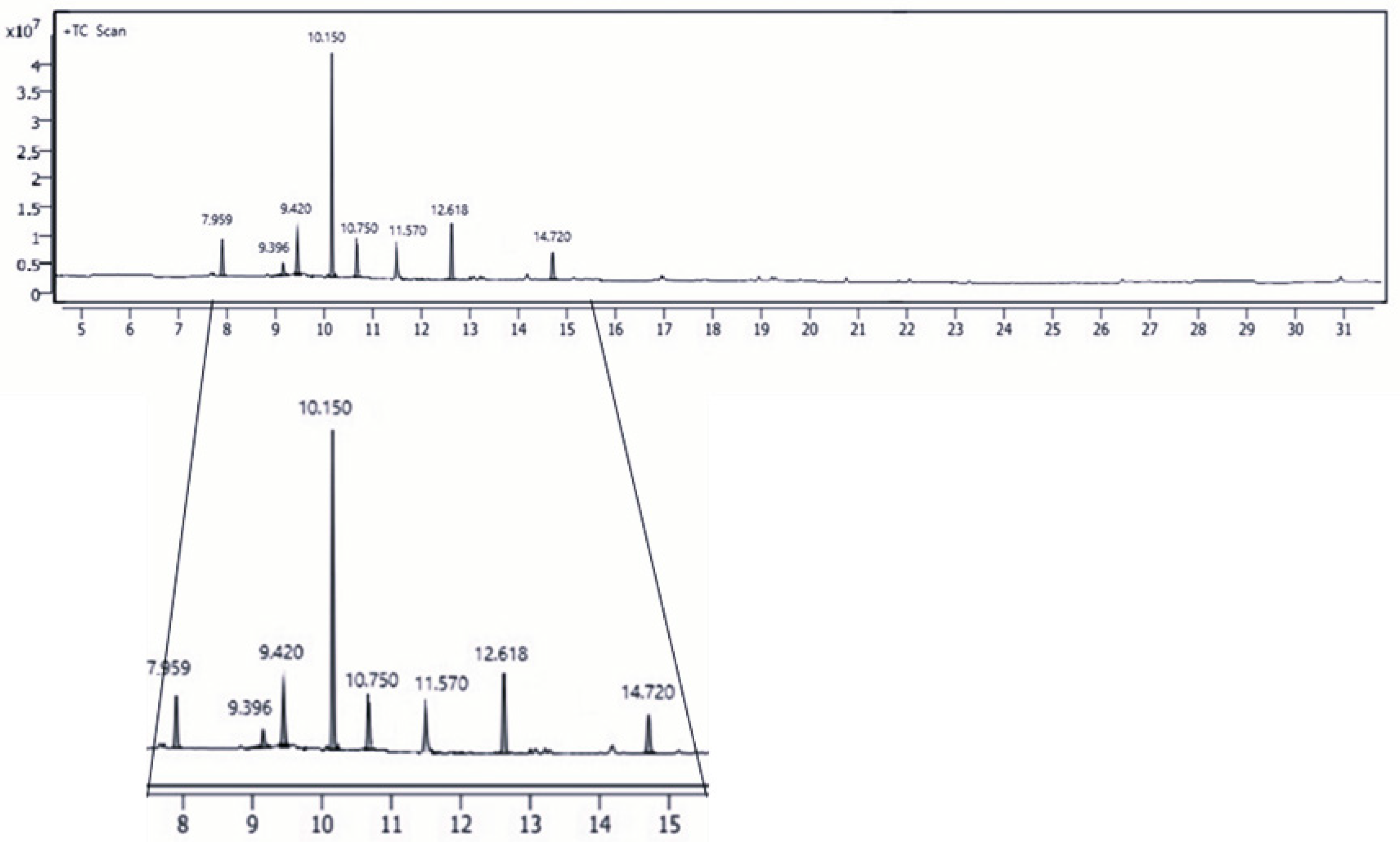
In the present study, seven distinct volatile compounds were retrieved from FWL using the HS-SPME/GC-MS technique and identified according to NIST 2020 library. Table 3 demonstrates the emitted VOCs of the FWL, alongside 4-methyl-2-pentanone, which was utilized as an internal standard (spike) for the analytical procedure.
Figure 3 illustrates the obtained chromatogram. D-limonene exhibited the highest peak.

3.4. Anaerobic Digestion Assays

The initial and final physicochemical characteristic of the BMP assays for both FWL and FWLextr are summarized in Table 4 and Table 5. Initially, both mixtures presented an optimal pH (7.28 for FWL and 7.31 for FWLextr). By the end of the 30-day period, pH values increased to 8.25 and 8.28, respectively. Alkalinity levels exhibited a slight decrease from 11.0 to 9.0 g CaCO3/L in both assays, while the VFAs decreased from 2.0 to 1.5 g HACeq/L for FWL and from 2.1 to 1.3 g HACeq/L for FWLextr. Total Solids (TSs) decreased from 47.1 to 30.9 g/L for FWL and from 49.8 to 29.1 g/L for FWLextr. Correspondingly, VS content was reduced by 45.9% for FWL and 47.8% for FWLextr. TOC content dropped to 2.0 g/L for both substrates and COD concentration decreased significantly from 17.0 to 7.9 g/L (FWL) and from 19.0 to 11.4 g/L (FWLextr). Regarding the nitrogen compounds, TN content decreased slightly from 3.9 to 2.8 g/L for FWL and from 2.4 to 2.0 g/L for FWLextr, while Ammonium concentrations remained at stable levels of 1.8 and 1.4 g/L, respectively.
Table 4. Initial values of physicochemical parameters of BMP tests.
Parameter
(Unit) [*]
FWLFWLextr
pH (-)7.287.31
TS (g/L)47.149.8
VS (g/L)36.632.2
TOC (g/L)12.011.8
Alkalinity (g CaCO3/L)11.011.0
VFAs (g HACeq/L)2.02.1
COD (g/L)17.019.0
NH4+ (g/L)1.81.6
TN (g/L)3.92.4
[*] TS: total solids, VS: volatile solids, TOC: total organic carbon, VFA: volatile fatty acids, COD: chemical oxygen demand, TN: total nitrogen.
Table 5. Final values of physicochemical parameters of BMP tests.
Parameter
(Unit) [*]
FWLFWLextr
pH (-)8.258.28
TS (g/L)30.929.1
VS (g/L)19.816.8
TOC (g/L)1.92.2
Alkalinity (g CaCO3/L)9.09.0
VFAs (g HACeq/L)1.51.3
COD (g/L)7.911.4
NH4+ (g/L)1.81.4
TN (g/L)2.82.0
[*] TS: total solids, VS: volatile solids, TOC: total organic carbon, VFA: volatile fatty acids, COD: chemical oxygen demand, TN: total nitrogen.

3.5. Biomethane Production and Kinetic Parameters

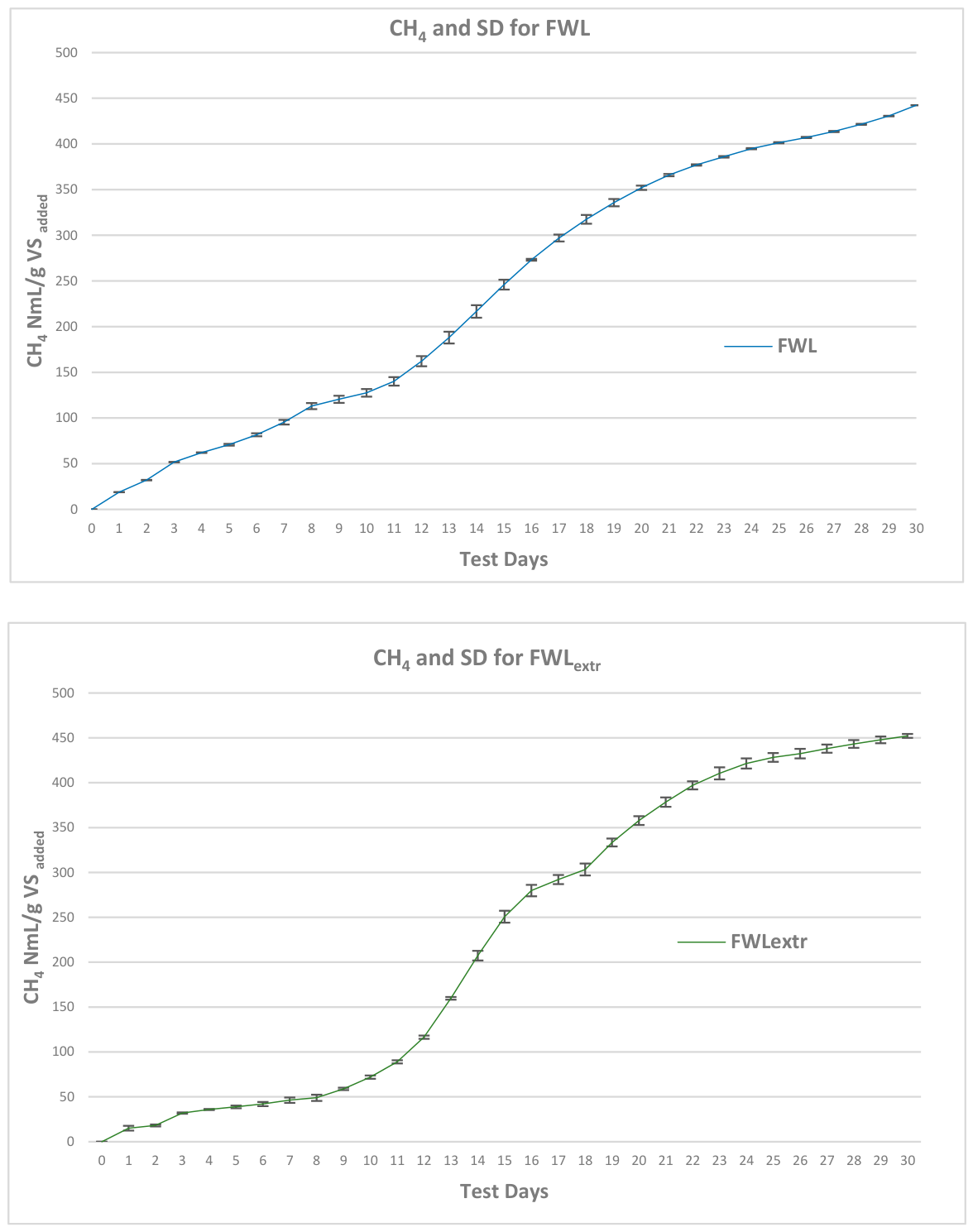
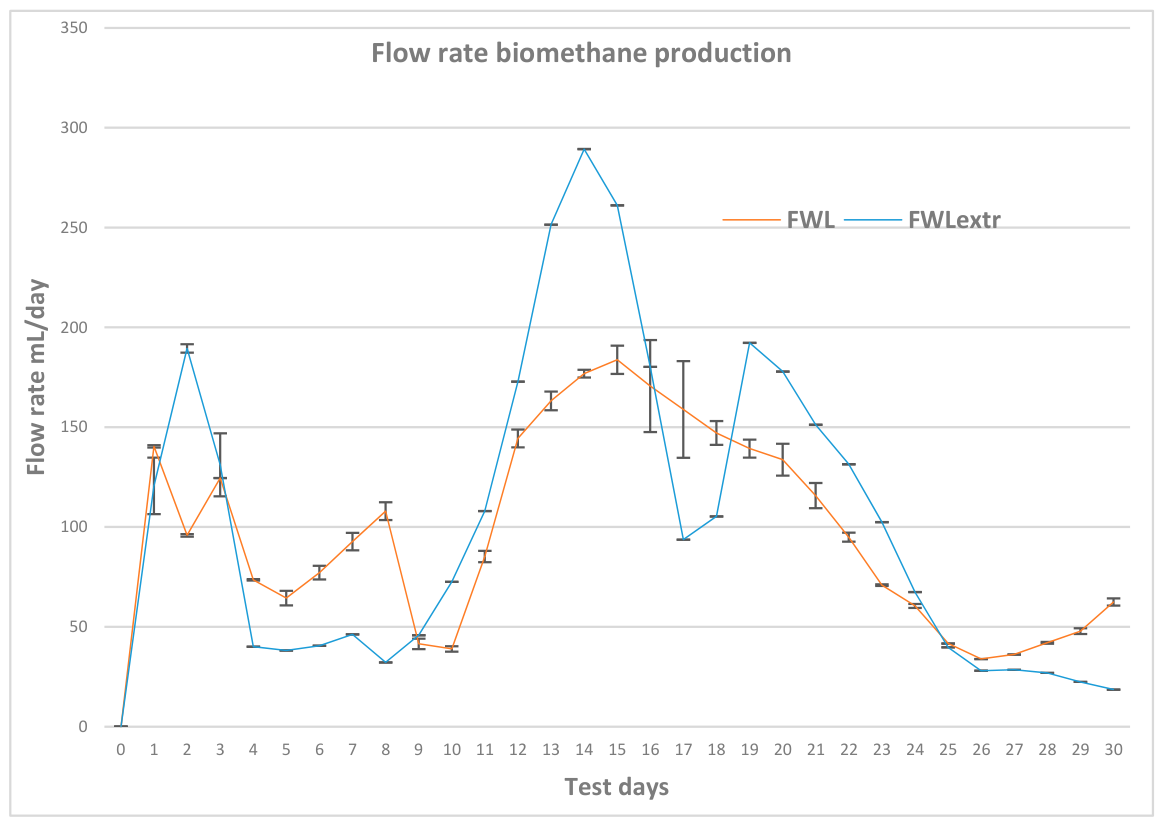
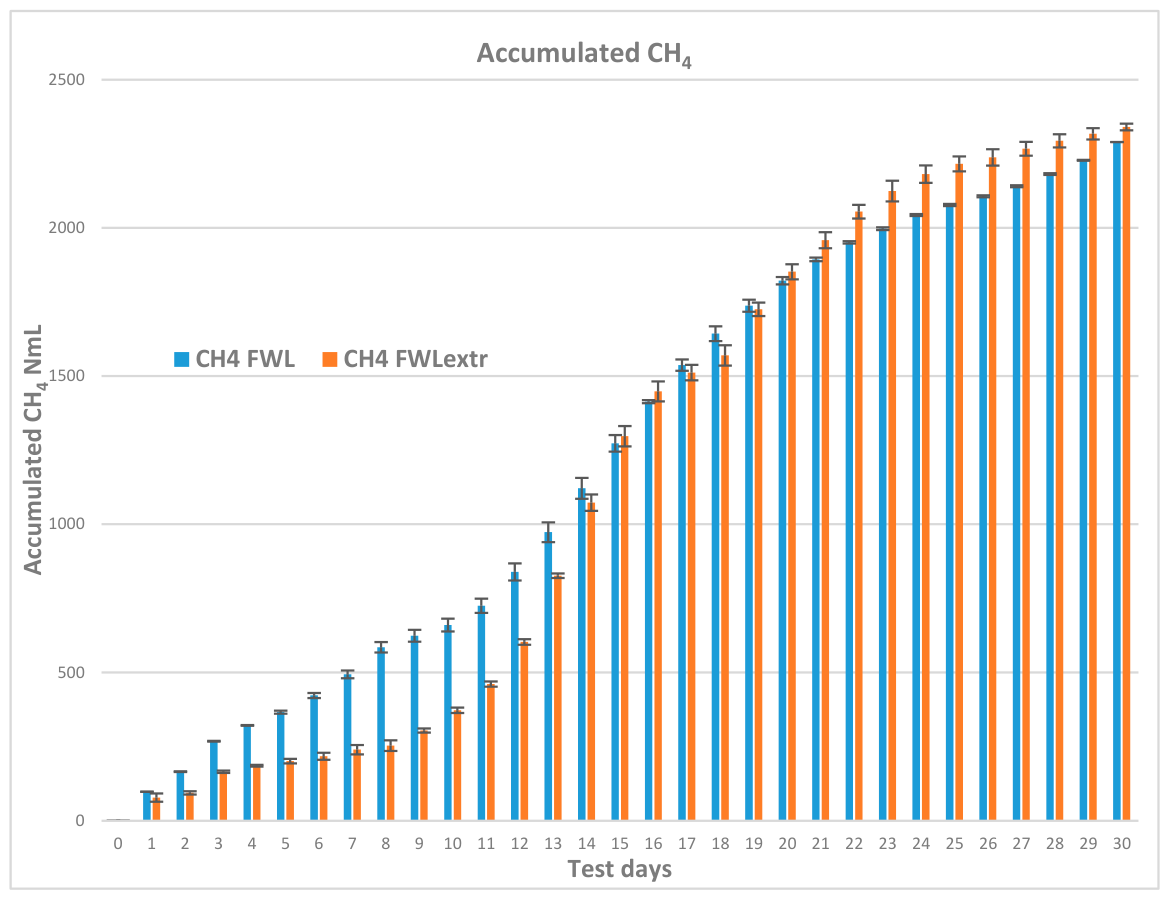
The biomethane yields at the end of the test duration, along with the daily flow rates and accumulated production curves, are illustrated in Figure 4, Figure 5 and Figure 6. The remarkably narrow standard deviation (SD) error bars, as depicted in the cumulative production graphs (Figure 4), indicate the high reproducibility and statistical reliability of the biological replicates. The raw FWL produced a cumulative experimental yield of 442.5 ± 0.04 NmL CH4/g VSadded (Table 6). Conversely, the FWLextr substrate yielded a slightly higher cumulative volume, reaching 452.2 ± 2.17 NmL CH4/g VSadded. A two-tailed Student’s t-test confirmed that this small difference is statistically significant (p = 0.024). However, from a practical and engineering perspective, approx. 2.2% difference in total yield is marginal. Therefore, the true value of the extraction pretreatment does not lie in the final biomethane volume, which remained practically equivalent, but rather in the profound acceleration of the production kinetics. Regarding the daily flow rates, the FWL exhibited a gradual daily production, peaking at approximately 180 mL/day around day 15. In contrast, FWLextr demonstrated an initial low production followed by a sharp peak reaching nearly 290 mL/day on day 14 (Figure 5).
In order to evaluate these biomethane production profiles from a statistical/mathematical point of view, the modified Gompertz model was applied to experimental data, with the estimated kinetic parameters summarized in Table 7. The applied model exhibited a high degree of correlation for both substrates (R2 > 0.99) and the model fitting estimations were statistically significant (p < 0.05). According to the kinetic data, FWL presented a shorter lag phase (λ = 3 days), a maximum daily methane production rate of μm = 20.8 NmL/g VSadded/d and a theoretical maximum of A = 513.4 NmL/g VSadded. Conversely, FWLextr exhibited a longer acclimation period (λ = 7.4 days), but achieved a substantially higher maximum production rate μm = 30.7 NmL/g VSadded/d. This accelerated exponential phase allowed the FWLextr to reach its final yield at a significantly faster rate. However, it should be noted that both assays ultimately remained below their estimated asymptotic potentials (A). Specifically, the experimental yield for FWL (442.5 NmL/g VSadded) reached approximately 86.2% of its theoretical potential (A = 513.4 NmL/g VSadded) while FWLextr (452.2 NmL/g VSadded) reached 93.2% of its respective potential (A = 485.0 NmL/g VSadded).

4. Discussion

4.1. TCC and TPC Recovery

The TCC value falls within the lower to moderate range of the carotenoid contents observed in previous studies [35,36]. The variations in TCC are highly dependent on the specific fruit and vegetable varieties present in the feedstock. Behier et al. [35] reported that the naturally occurring carotenoid percentage in bananas is relatively low, ranging from 0.01 to 0.11 mg/100 g. Conversely, another study [37] reported higher carotenoid values by utilizing different vegetable varieties which are inherently richer in these compounds. Since such highly pigmented feedstocks are absent from the present mixture of our study, the moderate overall yield obtained is thoroughly justified. Furthermore, carotenoids possess a distinctive system of conjugated double bonds, which dictates their stability and handling. This conjugated system makes them highly susceptible to degradation or transformation when exposed to environmental factors such as light, heat and oxygen [37]. These factors can lead to significant variations in the final measurable TCC of the sample [38]. The efficiency of the extraction procedure also heavily depends on the solvent composition. While a mixture of methanol:hexane is commonly employed [39], recent optimization study [40] achieved a substantially higher yield (173.1 ± 5.4 mg/100 g) from apricot pulp waste by utilizing a specific hexane:acetone:ethanol (2:1:1, v/v/v) mixture at 47 °C for 60 min.
Similarly, the obtained TPC from the FWL extract was 0.127 mg/g GAE (Table 1), which is relatively lower than the values reported in previous studies examining different types of agricultural and vegetable wastes [40]. Studies [41,42] examining other specific fruit residues reported significantly higher TPC concentrations, exceeding 30 mg/g GAE. Several factors contribute to these variations. Crucially, the freshness of the sample plays a significant role, as fresh biomass exhibits a different TPC profile compared to dry extracts [43]. Moreover, the overall phenolic baseline is heavily influenced by the specific pigmentation of the residues [42]. Saini et al. [44] noted that phenolic levels generally decrease as fruits mature, a trend that contrasts with the carotenoid accumulation.
Finally, the operational parameters of the extraction protocol (solvent polarity, temperature and duration of the procedure) are critical determinants that govern the overall recovery efficiency of both TCC and TPC [41].
It is important to emphasize that the reported yields reflect the specific parameters investigated in this work and should be viewed as a baseline rather than an optimized extraction performance.
Although the absolute recovered concentrations of TCC and TPC are modest, this extraction stage is practically justified within the integrated biorefinery concept by its dual functionality: yielding value-added co-products while simultaneously detoxifying the substrate for enhanced downstream biomethane generation.

4.2. Volatile Organic Profile and Terpene Dominance

The volatile organic profile reported in this study aligns with the finding in the literature regarding agricultural residues [45,46]. Terpenoid content differs significantly across plant varieties, influencing both their sensory qualities and natural defense mechanisms [47]. As indicated by He et al. [48], terpenes constitute the major odor family in fruit and vegetable waste, with limonene fractions often dominating the profile.
The specific composition of the identified VOCs directly reflects the specific raw materials (bananas, apples, pears, cabbage, spinach and lettuce) utilizing for the FWL formulation. For instance, hexanoic acid (Table 4) is a well-documented aromatic component typically released during ripening process of fruits such as apples [49,50]. Furthermore, leafy green vegetables like spinach are well-known to contain a-Pinene [51]. Consistent with this, the evaluation of the current FWL sample confirms the presence of a-Pinene, b-Pinene and Gamma-Terpinene, alongside the dominant D-limonene (Figure 3).

4.3. Kinetic Study and the Potential Detoxification Role of D-Limonene

Compared to the extensive range of biomethane yields from FW, which spans from 268 to 659 mL/g VSadded [52], the observed yields in the present study are considered highly satisfactory. The distinct shapes of the biomethane cumulative curves and the kinetic parameters estimated by the modified Gompertz model (Table 7) reveal critical information regarding the impact of the prior extraction step. FWL exhibited a shorter lag phase (λ = 3.0 days) due to the immediate availability of readily biodegradable soluble organics. However, its overall production curve flattened quickly, and its maximum daily production rate was suppressed (μm = 20.8 NmL/g VSadded/d), falling short of its theoretical potential (A = 513.4 NmL/g VSadded).
On the other hand, FWLextr displayed a pronounced lag phase of 7.4 days. This extended initial acclimation period is a direct consequence of the liquid–liquid extraction process and is attributed to two synergistic factors. Firstly, the solvent extraction likely washed out easily accessible organics. Secondly, trace amounts of the organic solvents inevitably remain in the aqueous phase. As reported by Yun et al. (2016) [53], residual extraction solvents in pre-treated biomass act as temporary chemical stressors to the anaerobic microbial consortium, resulting in an extended adaptation period. While this initial delay represents an operational trade-off, following this acclimation, FWLextr achieved a maximum production rate of 30.7 NmL/g VSadded/d, which is approximately 48% higher than that of raw FWL. This highly accelerated methanogenic kinetic response strongly correlates with the anticipated removal of inhibitory compounds. D-limonene, which was abundantly identified in the raw FWL, possesses potent antimicrobial properties. Although direct chromatographic quantification of D-limonene before and after extraction was not performed in the present study, its removal during the pretreatment stage is a highly plausible mechanism supported by the existing literature. Two studies confirm that conventional liquid–liquid extraction, particularly using highly hydrophobic solvents like hexane, is one of the most effective methods for extracting D-limonene and mitigating its toxicity in biogas production systems [20,54]. As reported by Ruiz and Flotats [55], D-limonene actively accumulates in the microbial cell membrane, causing cellular lysis and severe process instability. Furthermore, Gutierez et al. [56] reported that the presence of D-limonene severely reduces the apparent kinetic constant of the methanogenic process, while its prior extraction successfully mitigates inhibition and increases the methane yield by 27%. Another study [57] employed the dilution of the D-limonene content by co-digesting with organic fraction of municipal solid waste, keeping the toxic terpene levels within tolerable limits.
Aligning with these findings, the extraction step in our study likely detoxified the FWLextr substrate, allowing the microbial consortium to perform unhindered. Additionally, the slight resurgence in the daily flow rate of the raw FWL (untreated) during the final days (28 to 30) indicates a delayed degradation of remaining organics, occurring only after the surviving microbial consortium gradually acclimated to the characteristic D-limonene toxicity threshold.

4.4. Process Stability and Organic Matter Degradation

The kinetic performance was fully supported by the stability of the physicochemical parameters. The strong buffering capacity of the inoculum successfully prevented acidification, as evidenced by the stable alkalinity and the pH increase to optimal methanogenic levels. The effective consumption of VFAs underscores balanced microbial activity without system souring. Furthermore, the minimal SD observed throughout the 30-day period highlights the consistent performance and overall robustness of the methanogenic consortium under the applied operational conditions. The substantial reduction in VS content (46–48%) and COD concentration (>50%) illustrates the high efficiency of the anaerobic microbial community in converting the complex organic load into renewable biogas. Moreover, the stable levels of TN and Ammonium strictly avoided any potential ammonia-induced inhibition.

4.5. Significance for Waste Valorization, Circular Economy Implications and Future Outlook

Adopting a circular economy approach, the integration of these processes highlights a holistic valorization pathway. Extracting valuable bio-based chemicals (phenolics, carotenoids and terpenes) upfront aligns perfectly with the modern biorefinery concept. These natural compounds offer profound antioxidant and antimicrobial properties, making them highly sought-after for enhancing the nutritional, cosmetic and pharmaceutical value of industrial products [58,59].
Crucially, as demonstrated by the kinetic evaluations, this prior solvent extraction appears to detoxify the substrate, improving the biological conversion efficiency and accelerating the methanogenic rate. Generating a slightly superior amount of biomethane from the remaining liquid organic fraction (FWLextr) embodies the ultimate closed-loop system. Furthermore, the digestate remaining after the anaerobic process can serve as a nutrient-rich biofertilizer, fully closing the loop of agricultural nutrient recycling [60].
This approach maximizes complete resource utilization, minimizes secondary waste generation and significantly enhances the overall economic and environmental feasibility of sustainable FW management.
Moreover, within this circular economy and biorefinery framework, further studies are needed to assess the technical and economic impacts of industrial-scale implementation. Future research should also focus on the integration of advanced analytical techniques to further improve the selectivity, isolation and identification of specific bioactive compounds from such complex waste matrices [61].
Furthermore, future research must prioritize the optimization of the extraction unit operation, including rigorous mass balances and extraction efficiency analyses, to determine the recovery percentages of these bioactive compounds and fully assess the technological readiness of the integrated system. Additionally, it is important to acknowledge that the reported bulk of TPC and TCC values, along with the qualitative identification of volatile compounds, serves strictly as initial indicators. While the current spectrophotometric assays provided an adequate quantification of TPC and TCC to evaluate the overall extraction efficiency, future studies should employ HPLC analysis to characterize and quantify specific individual phenolic and carotenoid compounds for targeted commercial applications. Realizing any direct industrial applications will mandate future in-depth chromatographic profiling to pinpoint and quantify individual phenolic and carotenoid molecules, alongside comprehensive assessments of extract selectivity.
Alongside these process optimizations, upcoming studies should delve deeper into the biological aspects, specifically investigating the inhibitory mechanisms of D-limonene at a cellular level. Understanding how this lipophilic compound interacts with and disrupts the cell membranes of methanogenic archaea will be vital for further optimizing the anaerobic digestion process and exploring potential microbial adaptation strategies.
From an economical perspective, the efficiency of the proposed concept is highlighted by evaluating the recovery of value-added compounds and the final biomethane generation. The preliminary liquid–liquid extraction recovered valuable bioactive compounds, indicating the underlying potential of FWL. However, claiming specific downstream application in cosmetics, pharmaceutical and food sectors represent a long-term prospect that necessitates further targeted quantification and purification. While these initial TPC and TCC results are promising, they remain preliminary. The transition to full industrial-scale applications is contingent upon addressing challenges related to extract purity and concentration through further processing, supported by a detailed techno-economic assessment. Crucially, the extraction process is expected to have reduced the inhibitory D-limonene, without compromising the biomethane potential of the remaining liquid. Although the final biomethane yields are almost identical for both assays, there is a major difference in their anaerobic digestion process kinetics. Through this apparent detoxification of the substrate, the speed of the procedure significantly improved, leading to an approximate 48% increase in the maximum daily methane production rate.
In parallel, while the study employed traditional organic solvents to establish a proof-of-concept for the recovery of the bioactive compounds from FWL, future studies should focus on industrial-scale implementation using greener and more sustainable extraction processes. Advanced techniques, such as supercritical fluid extraction, subcritical water extraction, enzymes, ultrasounds and microwave-assisted extraction [9], should be investigated as eco-friendly alternatives. As reported by Kumar et al. (2017) [8], these advanced extraction techniques are pivotal for scaling up the recovery of bioactive compounds. Additionally, the substitution of petrochemical-based solvents with bio-based alternatives, such as bio-ethanol, water and ethyl lactate [62], could significantly contribute to aligning industrial valorization strategies with green chemistry principles and sustainable development goals.
Nevertheless, it is important to explicitly acknowledge that the preliminary extraction stage introduces an additional energetic and operational burden to the integrated process. While the present study successfully establishes a biological and chemical proof-of-concept, the net environmental and economic superiority of this route cannot be concluded solely from the improved kinetics. Consequently, comprehensive techno-economic and life-cycle assessments are mandatory in future research to ensure that the energetic demands of the pretreatment are sustainably offset by the value of the recovered products.

5. Conclusions

The present study demonstrated the technical feasibility of a biorefinery approach for FWL valorization. Preliminary solvent extraction enabled the recovery of valuable bioactive compounds and revealed a terpene volatile profile dominated by D-limonene. Furthermore, this extraction step appears to have effectively detoxified the remaining organic matrix. While the raw FWL (untreated) produced a satisfactory biomethane yield (442.5 NmL CH4/g VSadded), its methanogenic activity appeared to be chronically suppressed, likely due to the presence of D-limonene. In contrast, the extracted residue yielded a slightly higher volume (452.2 NmL CH4/g VSadded) and exhibited an improved kinetic performance. As confirmed by the modified Gompertz model, the anticipated reduction in the inhibitory compound accelerated the maximum daily methane production rate by approximately 48% (reaching 30.7 NmL/g VSadded/d). Ultimately, extracting added-value bio-based compounds upfront and converting the detoxified effluent into renewable energy provides a highly efficient, closed loop solution that significantly enhances the economic and environmental sustainability of an FW management. However, its net environmental and economic superiority remains to be formally demonstrated through future rigorous techno-economic and life-cycle assessments, ensuring that the energetic and operational demands of the pretreatment steps are sustainably offset, as the energy impact of the extraction step can significantly influence the overall viability of the proposed process.

Author Contributions

Conceptualization, I.K.; methodology, I.K.; validation, I.K.; investigation, I.K.; data curation, I.K.; writing—original draft preparation, I.K.; writing—review and editing, I.K., C.E., N.M., P.G. and M.A.G.; visualization, I.K.; supervision, P.G. and M.A.G. All authors have read and agreed to the published version of the manuscript.

Funding

This research received no external funding.

Institutional Review Board Statement

Not applicable.

Informed Consent Statement

Not applicable.

Data Availability Statement

The original contributions presented in this study are included in the article. Further inquiries can be directed to the corresponding authors.

Conflicts of Interest

The authors declare no conflicts of interest.

References

  1. European Commission. Food Waste. 2025. Available online: https://food.ec.europa.eu/food-safety/food-waste_en (accessed on 4 March 2026).
  2. Eurostat, Food Waste and Food Waste Prevention—Estimates. 2023. Available online: https://ec.europa.eu/eurostat/statistics-explained/index.php?title=Food_waste_and_food_waste_prevention_-_estimates (accessed on 4 March 2026).
  3. European Commission, Directive of the European Parliament and of the Council Amending Directive 2008/98/EC on Waste. Available online: https://eur-lex.europa.eu/resource.html?uri=cellar:1fefebb0-1b4e-11ee-806b-01aa75ed71a1.0001.02/DOC_5&format=PDF (accessed on 5 March 2026).
  4. European Environment Agency. Bio-Waste in Europe—Turning Challenges into Opportunities. Available online: https://www.eea.europa.eu/publications/bio-waste-in-europe (accessed on 4 March 2026).
  5. Liu, Z.; De Souza, T.S.; Holland, B.; Dunshea, F.; Barrow, C.; Suleria, H.A. Valorization of Food Waste to Produce Value-Added Products Based on Its Bioactive Compounds. Processes 2023, 11, 840. [Google Scholar] [CrossRef] [Scilit]
  6. O’Connor, J.; Mickan, B.S.; Siddique, K.H.; Rinklebe, J.; Kirkham, M.; Bolan, N.S. Physical, chemical, and microbial contaminants in food waste management for soil application: A review. Environ. Pollut. 2022, 300, 118860. [Google Scholar] [CrossRef] [Scilit]
  7. Yukesh Kannah, R.; Merrylin, J.; Poornima Devi, T.; Kavitha, S.; Sivashanmugam, P.; Kumar, G.; Rajesh Banu, J. Food waste valorization: Biofuels and value added product recovery. Bioresour. Technol. Rep. 2020, 11, 100524. [Google Scholar] [CrossRef] [Scilit]
  8. Kumar, K.; Yadav, A.N.; Kumar, V.; Vyas, P.; Dhaliwal, H.S. Food waste: A potential bioresource for extraction of nutraceuticals and bioactive compounds. Bioresour. Bioprocess. 2017, 4, 18. [Google Scholar] [CrossRef] [Scilit]
  9. Almeida, P.; Rodrigues, R.; Gaspar, M.; Braga, M.; Quina, M. Integrated management of residues from tomato production: Recovery of value-added compounds and biogas production in the biorefinery context. J. Environ. Manag. 2021, 299, 113505. [Google Scholar] [CrossRef] [Scilit] [PubMed]
  10. Kontodimos, I.; Chatzimanoli, E.; Kasapidou, E.; Basdagianni, Z.; Karatzia, M.; Amanatidis, M.; Margaritis, N. Characterization of Bioactive Compounds and Element Content in Goat Milk and Cheese Products. Biol. Life Sci. Forum 2023, 26, 98. [Google Scholar] [CrossRef] [Scilit]
  11. Gupta, Y.; Bhattacharyya, S.; Vlachos, D.G. Extraction of valuable chemicals from food waste via computational solvent screening and experiments. Sep. Purif. Technol. 2023, 316, 123719. [Google Scholar] [CrossRef] [Scilit]
  12. Ferdes, M.; Zăbavă, B.Ș.; Paraschiv, G.; Ionescu, M.; Dincă, M.N.; Moiceanu, G. Food Waste Management for Biogas Production in the Context of Sustainable Development. Energies 2021, 15, 6268. [Google Scholar] [CrossRef] [Scilit]
  13. Meegoda, J.N.; Li, B.; Patel, K.; Wang, L.B. A Review of the Processes, Parameters, and Optimization of Anaerobic Digestion. Int. J. Environ. Res. Public Health 2018, 15, 2224. [Google Scholar] [CrossRef] [Scilit]
  14. Lallement, A.; Peyrelasse, C.; Lagnet, C.; Barakat, A.; Schraauwers, B.; Maunas, S.; Monlau, F. A Detailed Database of the Chemical Properties and Methane Potential of Biomasses Covering a Large Range of Common Agricultural Biogas Plant Feedstocks. Waste 2023, 1, 195–227. [Google Scholar] [CrossRef] [Scilit]
  15. APHA. Standard Methods for the Examination of Water and Wastewater, 20th ed.; APHA American Public Health Association: Washington, DC, USA, 2012. [Google Scholar]
  16. Mota, V.T.; Santos, F.S.; Araujo, T.A.; Amaral, M.C.S. Evaluation of titrations methods for volatile fatty acids measurement: Effect of the bicarbonate interference and feasibility for the monitoring of anaerobic reactors. Water Pract. Technol. 2015, 10, 486–495. [Google Scholar] [CrossRef] [Scilit]
  17. Astals, S.; Koch, K.; Weinrich, S.; Hafner, S.D.; Tait, S.; Peces, M. Impact of Storage Conditions on the Methanogenic Activity of Anaerobic Digestion Inocula. Water 2020, 12, 1321. [Google Scholar] [CrossRef] [Scilit]
  18. Holliger, C.; Avles, M.; Andrade, D.; Angelidaki, I.; Atlas, S.; Baier, U.; Bougrier, C.; Buffière, P.; Carballa, M.; de Wilde, V.; et al. Towards a standardization of biomethane potential tests. Water Sci. Technol. 2016, 74, 2515–2522. [Google Scholar] [CrossRef] [Scilit] [PubMed]
  19. Filer, J.; Ding, H.H.; Chang, S. Biochemical Methane Potential (BMP) Assay Method for Anaerobic Digestion Research. Water 2019, 11, 921. [Google Scholar] [CrossRef] [Scilit]
  20. Nguyen, H. Biogas Production from Solvent Pretreated Orange Peel. Master’s Thesis, Chalmers University of Technology, Göteborg, Sweden, 2012. [Google Scholar]
  21. VDI 4630; Fermentation of Organic Materials—Characterization of the Substrate, Sampling, Collection of Material Data, Fermentation Tests. VDI: Düsseldorf, Germany, 2016.
  22. Scott, K.J. Detection and Measurement of Carotenoids by UV/VIS Spectrophotometry. Curr. Protoc. Food Anal. Chem. 2001, 00, F2.2.1–F2.2.10. [Google Scholar] [CrossRef] [Scilit]
  23. Machmudah, S.; Goto, M. Methods for Extraction and Analysis of Carotenoids. In Natural Products; Ramawat, K., Mérillon, J.M., Eds.; Springer: Berlin/Heidelberg, Germany, 2013. [Google Scholar] [CrossRef] [Scilit]
  24. Hernández-Fernández, A.; Garrido, Y.; Iniesta-López, E.; Pérez de los Ríos, A.; Quesada-Medina, J.; Hernández-Fernández, F.J. Recovering Polyphenols in Aqueous Solutions from Olive Mill Wastewater and Olive Leaf for Biological Applications. Processes 2023, 11, 2668. [Google Scholar] [CrossRef] [Scilit]
  25. Lawag, I.L.; Nolden, E.S.; Schaper, A.A.; Lim, L.Y.; Locher, C. A Modified Folin-Ciocalteu Assay for the Determination of Total Phenolics Content in Honey. Appl. Sci. 2022, 13, 2135. [Google Scholar] [CrossRef] [Scilit]
  26. Kontodimos, I.; Evaggelou, C.; Rontogianni, A.; Margaritis, N.; Grammelis, P.; Goula, M.A. Evaluation of Anaerobic Co-Digestion of Food Waste Leachates and Dairy Wastes Towards Organic-Load Reduction and Optimization of Biomethane Production. Waste 2026, 4, 4. [Google Scholar] [CrossRef] [Scilit]
  27. Pasciucco, F.; Pasciucco, E.; Castagnoli, A.; Iannelli, R.; Pecorini, I. Comparing the effects of Al-based coagulants in waste activated sludge anaerobic digestion: Methane yield, kinetics and sludge implications. Heliyon 2024, 10, e29282. [Google Scholar] [CrossRef] [Scilit] [PubMed]
  28. Zhang, H.; An, D.; Cao, Y.; Tian, Y.; He, J. Modelling the Methane Production Kinetics of Anaerobic Co-Digestion of Agricultural Wastes Using Sigmoidal Functions. Energies 2020, 14, 258. [Google Scholar] [CrossRef] [Scilit]
  29. He, K.; Liu, Y.; Tian, L.; He, W.; Cheng, Q. Review in anaerobic digestion of food waste. Heliyon 2024, 10, e28200. [Google Scholar] [CrossRef] [Scilit]
  30. Yenigün, O.; Demirel, B. Ammonia inhibition in anaerobic digestion: A review. Process Biochem. 2013, 48, 901–911. [Google Scholar] [CrossRef] [Scilit]
  31. Kontodimos, I.; Evaggelou, C.; Margaritis, N.; Grammelis, P.; Goula, M. Dark Fermentation and Anaerobic Digestion for H2 and CH4 Production, from Food Waste Leachates. Methane 2025, 4, 11. [Google Scholar] [CrossRef] [Scilit]
  32. Akindele, A.A.; Sartaj, M. The toxicity effects of ammonia on anaerobic digestion of organic fraction of municipal solid waste. Waste Manag. 2017, 71, 757–766. [Google Scholar] [CrossRef] [Scilit]
  33. Zhang, L.; Loh, K.C.; Zhang, J. Enhanced biogas production from anaerobic digestion of solid organic wastes: Current status and prospects. Bioresour. Technol. Rep. 2018, 5, 280–296. [Google Scholar] [CrossRef] [Scilit]
  34. Wang, Y.; Zhang, Y.; Wang, J.; Meng, L. Effects of volatile fatty acid concentrations on methane yield and methanogenic bacteria. Biomass Bioenergy 2009, 33, 848–853. [Google Scholar] [CrossRef] [Scilit]
  35. Biehler, E.; Mayer, F.; Hoffmann, L.; Krause, E.; Bohn, T. Comparison of 3 Spectrophotometric Methods for Carotenoid Determination in Frequently Consumed Fruits and Vegetables. J. Food Sci. 2010, 75, C55–C61. [Google Scholar] [CrossRef] [Scilit] [PubMed]
  36. Biswas, A.K.; Sahoo, J.; Chatli, M.K. A simple UV-Vis spectrophotometric method for determination of β-carotene content in raw carrot, sweet potato and supplemented chicken meat nuggets. LWT—Food Sci. Technol. 2011, 44, 1809–1813. [Google Scholar] [CrossRef] [Scilit]
  37. Oliver, J.; Palou, A. Chromatographic determination of carotenoids in foods. J. Chromatogr. A 2000, 881, 543–555. [Google Scholar] [CrossRef] [Scilit]
  38. Morón-Ortiz, A.; Mapelli-Brahm, P.; Meléndez-Martínez, A.J. Sustainable Green Extraction of Carotenoid Pigments: Innovative Technologies and Bio-Based Solvents. Antioxidants 2024, 13, 239. [Google Scholar] [CrossRef] [Scilit]
  39. Makrygiannis, I.; Athanasiadis, V.; Bozinou, E.; Chatzimitakos, T.; Makris, P.D.; Lalas, I.S. An Investigation into Apricot Pulp Waste as a Source of Antioxidant Polyphenols and Carotenoid Pigments. Biomass 2022, 2, 334–347. [Google Scholar] [CrossRef] [Scilit]
  40. De Lima, D.P.; Dos Santos Pinto Júnior, E.; De Menezes, A.V.; De Souza, D.A.; De São José, V.P.B.; Da Silva, B.P.; De Almeida, A.Q.; De Carvalho, I.M.M. Chemical composition, minerals concentration, total phenolic compounds, flavonoids content and antioxidant capacity in organic and conventional vegetables. Food Res. Int. 2023, 175, 113684. [Google Scholar] [CrossRef] [Scilit]
  41. Anagnostopoulou, M.A.; Kefalas, P.; Papageorgiou, V.P.; Assimopoulou, A.N.; Boskou, D. Radical scavenging activity of various extracts and fractions of sweet orange peel (Citrus sinensis). Food Chem. 2006, 94, 19–25. [Google Scholar] [CrossRef] [Scilit]
  42. Babbar, N.; Oberoi, H.S.; Uppal, D.S.; Patil, R.T. Total phenolic content and antioxidant capacity of extracts obtained from six important fruit residues. Food Res. Int. 2010, 44, 391–396. [Google Scholar] [CrossRef] [Scilit]
  43. Kan, T.; Bostan, S.Z. Changes of Contents of Polyphenols and Vitamin a of Organic and Conventional Fresh and Dried Apricot Cultivars (Prunus armeniaca L.). World J. Agric. Sci. 2010, 6, 120–126. [Google Scholar]
  44. Saini, R.K.; Ranjit, A.; Sharma, K.; Prasad, P.; Shang, X.; Gowda, K.G.M.; Keum, Y.S. Bioactive Compounds of Citrus Fruits: A Review of Composition and Health Benefits of Carotenoids, Flavonoids, Limonoids, and Terpenes. Antioxidants 2022, 11, 239. [Google Scholar] [CrossRef] [Scilit]
  45. Zhang, R.; Tang, C.; Jiang, B.; Mo, X.; Wang, X. Optimization of HS-SPME for GC-MS Analysis and Its Application in Characterization of Volatile Compounds in Sweet Potato. Molecules 2021, 26, 5808. [Google Scholar] [CrossRef] [Scilit]
  46. Pizzo, S.J.; Rutz, T.; Ojeda, A.S.; Kartowikromo, K.Y.; Hamid, A.M.; Simmons, A.; Da Silva, A.L.B.R.; Rodrigues, C. Quantifying terpenes in tomato leaf extracts from different species using gas chromatography-mass spectrometry (GC-MS). Anal. Biochem. 2024, 689, 115503. [Google Scholar] [CrossRef] [Scilit] [PubMed]
  47. Shang, C.; Deng, C.; Zhang, X.; Chen, Z.; Hu, Y. Headspace Solid-Phase Microextraction and Gas Chromatography-Mass Spectrometry Analysis of Free Volatile Compounds in Mango. Chromatographia 2002, 55, 737–741. [Google Scholar] [CrossRef] [Scilit]
  48. He, P.; Du, W.; Xu, X.; Zhang, H.; Shao, L.; Lü, F. Effect of biochemical composition on odor emission potential of biowaste during aerobic biodegradation. Sci. Total Environ. 2020, 727, 138285. [Google Scholar] [CrossRef] [Scilit]
  49. El Hadi, M.A.M.; Zhang, F.-J.; Wu, F.-F.; Zhou, C.-H.; Tao, J. Advances in Fruit Aroma Volatile Research. Molecules 2013, 18, 8200–8229. [Google Scholar] [CrossRef] [Scilit]
  50. Roberts, G.; Spadafora, N.D. Analysis of Apple Flavours: The Use of Volatile Organic Compounds to Address Cultivar Differences and the Correlation between Consumer Appreciation and Aroma Profiling. J. Food Qual. 2019, 2020, 8497259. [Google Scholar] [CrossRef] [Scilit]
  51. Aguiar, J.; Gonçalves, J.L.; Alves, V.L.; Câmara, J.S. Relationship between Volatile Composition and Bioactive Potential of Vegetables and Fruits of Regular Consumption-An Integrative Approach. Molecules 2021, 26, 3653. [Google Scholar] [CrossRef] [Scilit]
  52. Sahota, S.; Kumar, S.; Lombardi, L. Biohythane, Biogas, and Biohydrogen Production from Food Waste: Recent Advancements, Technical Bottlenecks, and Prospects. Energies 2023, 17, 666. [Google Scholar] [CrossRef] [Scilit]
  53. Yun, Y.M.; Shin, H.S.; Lee, C.K.; Oh, Y.K.; Kim, H.W. Inhibition of residual n-hexane in anaerobic digestion of lipid-extracted microalgal wastes and microbial community shift. Environ. Sci. Pollut. Res. Int. 2016, 23, 7138–7145. [Google Scholar] [CrossRef] [Scilit] [PubMed]
  54. Siddiqui, S.A.; Pahmeyer, M.J.; Assadpour, E.; Jafari, S.M. Extraction and purification of d-limonene from orange peel wastes: Recent advances. Ind. Crops Prod. 2022, 177, 114484. [Google Scholar] [CrossRef] [Scilit]
  55. Ruiz, B.; Flotats, X. Effect of limonene on batch anaerobic digestion of citrus peel waste. Biochem. Eng. J. 2016, 109, 9–18. [Google Scholar] [CrossRef] [Scilit]
  56. Gutiérrez, M.C.; Serrano, A.; Alonso-Fariñas, B.; Martín, M.A. Impact of D-Limonene in the technical and economic feasibility of the anaerobic digestion applied in biorefineries. Biomass Convers. Biorefinery 2024, 14, 14877–14888. [Google Scholar] [CrossRef] [Scilit]
  57. Bouaita, R.; Derbal, K.; Panico, A.; Iasimone, F.; Pontoni, L.; Fabbricino, M.; Pirozzi, F. Methane production from anaerobic co-digestion of orange peel waste and organic fraction of municipal solid waste in batch and semi-continuous reactors. Biomass Bioenergy 2022, 160, 106421. [Google Scholar] [CrossRef] [Scilit]
  58. Martins, N.; Ferreira, I.C.F.R. Wastes and by-products: Upcoming sources of carotenoids for biotechnological purposes and health-related applications. Trends Food Sci. Technol. 2017, 62, 33–48. [Google Scholar] [CrossRef] [Scilit]
  59. Jiang, Z.; Kempinski, C.; Chappell, J. Extraction and Analysis of Terpenes/Terpenoids. Curr. Protoc. Plant Biol. 2016, 1, 345–358. [Google Scholar] [CrossRef] [Scilit]
  60. DelaVega-Quintero, J.C.; Nuñez-Pérez, J.; Lara-Fiallos, M.; Barba, P.; Burbano-García, J.L.; Espín-Valladares, R. Advances and Challenges in Anaerobic Digestion for Biogas Production: Policy, Technological, and Microbial Perspectives. Processes 2025, 13, 3648. [Google Scholar] [CrossRef] [Scilit]
  61. Sultana, H.; Chetia, A.; Saikia, A.; Khan, N.J. An Updated Review on Extraction, Isolation, and Identification of Bioactive Compounds from Plant Extracts. Sch. Acad. J. Pharm. 2023, 12, 2320–4206. [Google Scholar] [CrossRef] [Scilit]
  62. Esparza, I.; Jiménez-Moreno, N.; Bimbela, F.; Ancín-Azpilicueta, C.; Gandía, L.M. Fruit and vegetable waste management: Conventional and emerging approaches. J. Environ. Manag. 2020, 265, 110510. [Google Scholar] [CrossRef] [Scilit]
Figure 1. Sample of the generated FWL, prior to any pretreatment.
Cleantechnol 08 00080 g001
Figure 2. Visual representation of organic fractions composing the FW.
Cleantechnol 08 00080 g002
Figure 3. Main volatile compounds obtained by FWL. Peak identification according to retention time (Rt) of Table 4. Methyl-isobutyl ketone determined in spiked samples of FWL.
Cleantechnol 08 00080 g003
Figure 4. CH4 yield and standard deviation for FWL and FWLextr (top figure: FWL/bottom figure: FWLextr).
Cleantechnol 08 00080 g004
Figure 5. Flow rate of biomethane production.
Cleantechnol 08 00080 g005
Figure 6. Accumulated CH4 NmL.
Cleantechnol 08 00080 g006
Table 1. Chemical characterization of inoculum and FWL.
Parameter
(Unit) [*]
InoculumFWL
pH (-)8.35.42
TS (g/L)56.041.2
VS (g/L)39.034.5
TOC (g/L)3.6517.3
Alkalinity (g CaCO3/L)10.29.2
VFAs (g HACeq/L)2.214.0
COD (g/L)4.055.0
NH4+ (g/L)1.90.9
TN (g/L)3.91.6
TPC (mg/g GAE)-0.127
TCC (mg/100 g b-Carotene)-0.64
[*] TS: total solids, VS: volatile solids, TOC: total organic carbon, VFA: volatile fatty acids, COD: chemical oxygen demand, TN: total nitrogen, TPC: total phenolic content, TCC: total carotenoid content.
Table 2. Experimental protocol and operational parameters of the BMP assays.
BMPFWLFWLextr
SIR [*] (g VS/g VS)0.5
g VS Substrate5.17
g VS Inoculum9.75
Total Volume (mL)500500
Working Volume (mL)400400
HeadSpaceFlushed with N2
Temperature (°C)3535
Test Days3030
[*] SIR: Substrate-to-Inoculum Ratio, VS: Volatile Solids.
Table 3. Identification of volatile compounds emitted by FWL.
NoRt (min)Identified Compound
17.959a-Pinene
29.396b-Pinene
39.420Hexanoic Acid
410.150D-limonene
510.750Gamma-Terpinene
612.618Terpin-4-ol
714.720Thymol
811.570Methyl-Isobutyl Ketone
(4-Methyl-2-pentanone) [*]
[*] internal standard.
Table 6. Biomethane yield (NmL) per g VS added.
Parameter
(Unit)
FWLFWLextr
CH4 (NmL/g VSadded)442.5 ± 0.04452.2 ± 2.17
Test duration (days)30
Table 7. Experimental biomethane yields and kinetic parameters estimated by the modified Gompertz model for the FWL and FWLextr.
AssayBMPexp [*]
(NmL/g VSadded)
A
(NmL/g VSadded)
μm
(NmL/g VSadded/d)
λ (Days)R2
FWL442.5 ± 0.04513.420.83.00.993
FWLextr452.2 ± 2.17485.030.77.40.992
[*] a two-tailed Student’s t-test indicated a statistically significant difference between the experimental yields (p = 0.024). The Gompertz model estimations for both substrates were also statistically significant (p < 0.05).
Disclaimer/Publisher’s Note: The statements, opinions and data contained in all publications are solely those of the individual author(s) and contributor(s) and not of MDPI and/or the editor(s). MDPI and/or the editor(s) disclaim responsibility for any injury to people or property resulting from any ideas, methods, instructions or products referred to in the content.