Article

Multivariate Techno-Economic Feasibility of Refuse-Derived Fuel Production in Ghana Using Response Surface Methodology: Insights from a Pilot-Scale System


by
Khadija Sarquah
1,2,*,
Satyanarayana Narra
1,
Gesa Beck
2 and
Nana Sarfo Agyemang Derkyi
3
1
Professorship Waste and Resource Management, University of Rostock, 18059 Rostock, Germany
2
School of Technology and Architecture, Campus Berlin, SRH University of Applied Sciences, 12059 Berlin, Germany
3
School of Energy, University of Energy and Natural Resources, Sunyani P.O. Box 214, Ghana
*
Author to whom correspondence should be addressed.
Clean Technol. 2026, 8(1), 17; https://doi.org/10.3390/cleantechnol8010017
Submission received: 23 November 2025 / Revised: 14 January 2026 / Accepted: 19 January 2026 / Published: 26 January 2026

Abstract

Municipal solid waste challenges (MSW) and concerns about fossil fuel dependence motivate efforts to recover energy from waste, including refuse-derived fuel (RDF). Techno-economic assessment (TEA) evaluates the feasibility of systems by quantifying investment performance. However, most RDF-TEA studies typically rely on isolated sensitivity analyses. That provides limited insight into interaction effects in emerging markets. This study maps the multivariable feasibility of RDF production from MSW in Ghana under realistic economic conditions. Using a pilot-calibrated case study, the assessment integrates discounted cash flow analysis with response surface methodology–design of experiment (RSM-DoE). A central composite design evaluates interaction effects among operational and economic variables for a system capacity of 2875 tonnes RDF/year. The results indicate economic viability with a net present value (NPV) of USD 892,556.44, a payback period (PBP) of 6.61 years and a levelised production cost (LPC) of USD 18.96/tonne. The RSM models show high explanatory power (R2, R2adj, R2pred > 90%). Sensitivity results demonstrate that support mechanisms can significantly reduce LPC and PBP while preserving investment viability. The study quantifies the feasibility thresholds and the support instruments within the RDF design levers. It further provides a transferable framework for assessing deployment and upscaling in emerging markets. The findings highlight the need for structured pricing mechanisms and regulatory support for the long-term sustainability of RDF as an AF.

1. Introduction

Effective management of solid waste involves applying appropriate treatment technologies and concepts. This includes energy recovery, which is preferred over disposal under the waste management hierarchy. Energy recovery from waste contributes to circular economy targets through value from waste that would otherwise be landfilled [1]. For example, refuse-derived fuel (RDF) production provides a use for waste streams that are unsuitable for material recovery and recycling, thereby contributing to circular resource use. RDF from municipal solid waste (MSW) is produced from non-hazardous combustible fractions, including non-recyclable plastics, paper, cardboard, etc. RDF is widely produced and utilised as a substitute fuel in energy-intensive sectors such as the cement industry. Also, in dedicated waste-to-energy (WtE) plants for electricity and heat generation in the EU, the UK, Brazil, etc. [2].
RDF utilisation offers several advantages, including reduced fossil fuel consumption, improved sanitation, and minimised landfill waste. The CEMBUREAU reported that the EU cement industry met about 52% of its thermal energy demand with alternative fuels. This comprises 45% RDF out of the estimated 12.1 million tonnes of alternative fuel (AF) in 2020 [3]. A projection of 15 million tonnes of potential RDF uptake (mini class II and III) is envisaged to be consumed by the EU-27 (74% fuel share) [4]. RDF production and utilisation are progressing in Asia [5] and Africa [6,7]. In advanced economies, there is still room for improvement (quality and cost) in motivating current and future users [8].
Waste generation is increasing rapidly in many Sub-Saharan African countries, including Ghana [9]. However, the management is dominated by uncontrolled disposal, posing a significant challenge to the environment [10]. Ghana generates approximately 12,000 to 14,000 tonnes of MSW per day. The prevailing practice remains mixed waste collection, with subsequent disposal at designated sites or landfills. Collection rates of about 33% are recorded via door-to-door services [11]. As of 2021, 6 sanitary landfills, about 20 improved dumpsites, and over 205 disposal and uncontrolled dumpsites exist [11]. Also, there is minimal data on recycling rates, primarily involving the informal sector [12]. Waste-to-energy applications are still in the early stages of development. The existing waste management infrastructure remains insufficient to handle the growing quantity of waste in the country.
In recent years, material recovery and recycling systems have been implemented, gradually improving the sector. In contrast, mixed waste practices lead to considerable contamination and reduce material recovery and recycling. Large portions of waste still end up in landfills [13]. Other studies have recommended integrated MSW treatment (including RDF) [14] and alternative fuel use from waste [15]. The production of RDF from MSW therefore represents a potential pathway both to divert mixed waste from landfill and to substitute domestic industry fuel. RDF is less well-known and relatively new locally as an alternative industrial fuel. Until recent developments for WtE from MSW on a pilot basis, including RDF, there have been no reported RDF systems operating [16]. A survey of local industry indicates that fossil fuels continue to dominate, with essentially no reported RDF substitution [15]. However, there is an integrated cement plant (including a kiln) that utilises coal as its fuel, which could be a potential user. Other potential users include textile, brick, steel, and other industrial boiler operators. Recent characterisation studies [13,17] report that RDF produced from MSW locally meets the EU quality standards [18]. This indicates technical viability.
Aside from energy yield and quality, economic feasibility is a decisive lever for AF market uptake. Lessons from the EU show that, among other factors, the choice of alternative fuels is typically driven by cost. Studies show that WtE-RDF in emerging economies often face relatively high specific costs compared to prevailing tariffs of fossil fuels [19,20,21,22]. For example, a study in Pakistan reports a production cost of USD 24/tonne for RDF [23]. As well, there is limited public capacity to absorb long-term operational risks [24]. Furthermore, early techno-economic studies of WtE conclude that fiscal measures are required for economic feasibility [21,25,26]. Thus, only qualitative statements of need are made, and no quantification is provided.
A further limitation is the use of a one-factor sensitivity analysis in TEA. Most previous works do not capture interaction effects among variables, particularly in volatile markets. The variations in economies of scale across most developing and emerging economies are also important to consider. For instance, the market for AF for industrial fuel substitution (thermal energy) in Ghana is limited. The discontinuity of most MSW waste-to-energy units in Ghana is a concern. For RDF co-processing, assessing feasibility and investment viability while considering local factors is essential.
Statistical design of experiment (DoE) and response surface methodology (RSM) offer a route to address these gaps. DoE structures parameter variation systematically. This enables efficient sampling of the multidimensional design space. Again, it supports the generation of statistically meaningful regression models [27]. RSM then fits models that capture linear effects, curvature, and interactions between factors [28]. Thus, it is applicable to both mapping response surfaces and identifying operating regions associated with desired outcomes. Applications of economic analysis in a multivariable approach are lacking. RSM-DoE provides a basis for feasibility by determining the interaction between the independent variables.
Investment decisions in economies such as Ghana remain constrained by high costs and financing risk in the absence of a structured RDF market. There is limited quantitative guidance on how these interacting factors jointly determine economic feasibility despite technical gains. Technical and financial assessments are necessary to propose realistic solutions to improve the waste-to-energy situation. This study, using a scenario-based design-of-experiments modelling approach, evaluates cost parameters for RDF as an AF.
The objective of the study is not only to determine whether RDF-WtE treatment is economically feasible but to identify which combinations of operating factors are viable for a system under realistic local constraints. The study contributes to the construction of multivariate response surfaces that link economic thresholds and technical levers. Unlike conventional techno-economic assessments that test the sensitivity of isolated parameters, the outcomes apply to the waste-to-energy sector and provide transferable methodological models. Furthermore, the study offers stakeholders robust insights into the AF consideration and implementation.

2. Materials and Methods

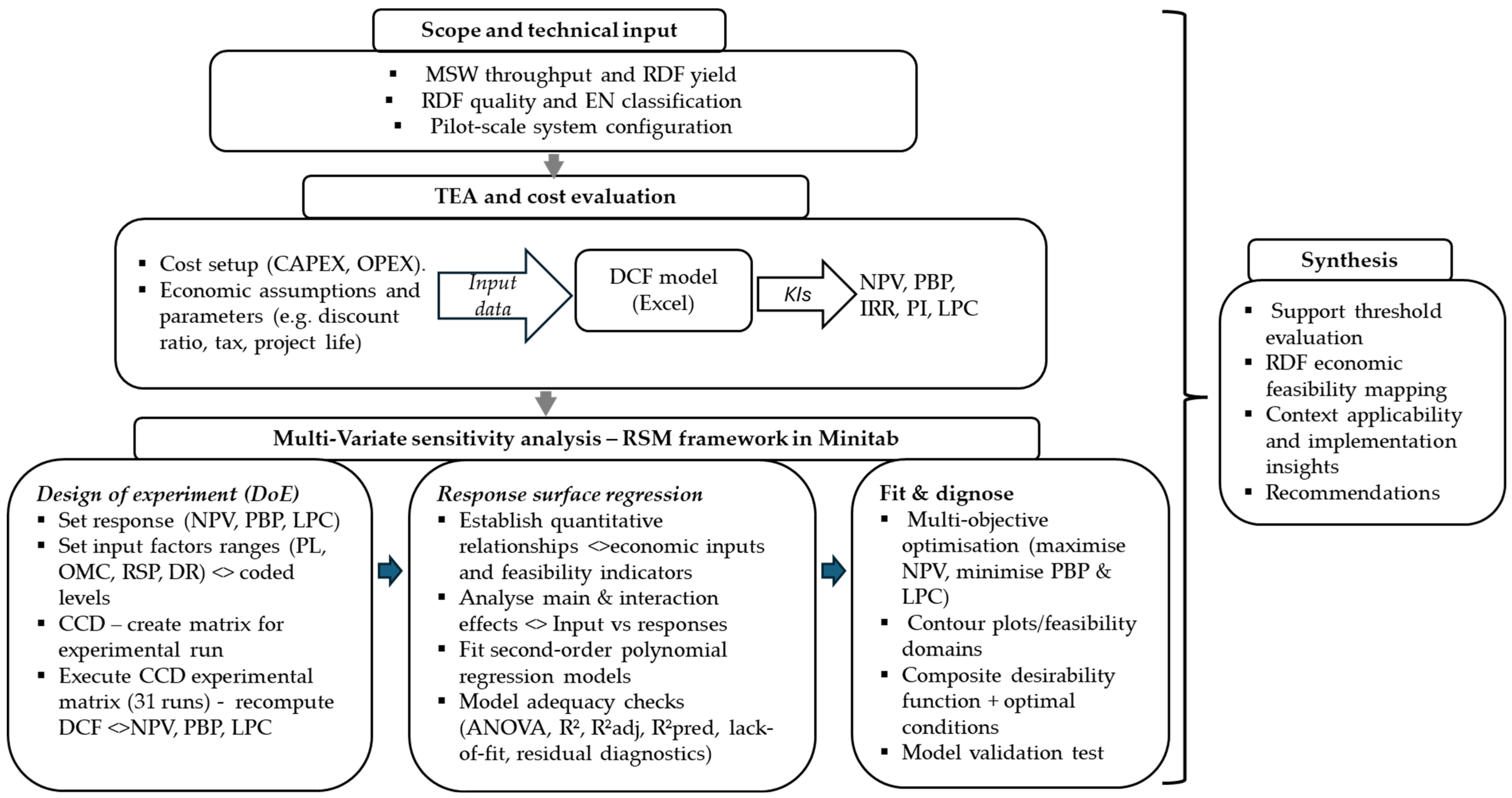
This section outlines the study design, data and approach of the assessment towards the objective. Figure 1 summarises the assessment and modelling workflow. Details of the combined discounted cash flow (DCF) analysis, key indicators (KIs) and RSM-DoE sensitivity analysis are presented. Section 2.2 describes the case study concept and economic parameters considered for this study. The DCF steps and indicators are described in Section 2.2. The sensitivity analysis by the RSM-DoE framework is presented in Section 2.3.

2.1. Case Study, Assumptions and Economic Parameters

This study is a techno-economic feasibility assessment of producing RDF from MSW. It forms part of an ongoing pilot waste-to-energy system in Ghana, testing MSW to energy and fuel streams [16]. The pilot system is located in the small rural community Gyankobaa in the Atwima Nwabiagya Municipality of the Ashanti Region of Ghana. Farming is the main economic activity in the area [29]. In Ghana, MSW comprises waste from households, offices, and commercial areas such as market centres, restaurants, and offices. This excludes hazardous, medical, agricultural, or industrial waste [21]. A typical composition of MSW is biodegradable fractions (food/organic waste), plastics, paper, textile waste, metal cans, wood, leather, etc. [30]. The system has the capacity to treat 50 tonnes of MSW per day and to receive waste from nearby communities within a 30 km radius. The treatment involves mechanical and manual processes. MSW received is separated and sorted into compostable (e.g., organic fractions) and recyclable materials (e.g., plastics, cans). The RDF input feedstock is the combustible portions of the residual waste (19–25%) from early characterisation [20]. The residual fractions are waste components from the material recovery that do not meet recycling requirements. They are directed toward producing RDF, while the inert fractions are sent to landfill or disposal. The combustible residual fractions are further shredded and densified into RDF. The RDF characteristics and yields are taken from an earlier characterisation and experimental study [17].
For the economic assessment, an annual cash flow model (expenditures and revenues) is developed. Total capital expenditure (CAPEX) includes fixed direct and indirect costs for the RDF unit. Other cost areas, such as land, are considered community support and are not included as a cost component. Operating and maintenance expenses (OPEXs) comprise annual costs for energy, labour, and maintenance. Revenues of the RDF unit are calculated from the RDF produced. A MSW tipping fee is not charged in this location. However, an adopted level of government support, based on existing public–private partnership (PPP) arrangements for MRFs, is estimated for the sensitivity analysis in Section 2.3. All other output market values are included in the revenue stream as applicable. The economic assessment is limited to the RDF production stage and does not include downstream or end-user technology economics.
The study area (Ghana) is exposed to inflationary pressures and economic risk. Hence, variables such as the discount rate, inflation, project life, and taxes that affect economic indicators are taken into consideration. These are economic variables that significantly affect cash flows. A calculated inflation rate (price escalation) of 17.23% is set, based on the 20-year average from World Bank data, as of June 2025 [31] and the GSS consumer price index in Ghana [32]. This allows operating costs and market prices to be projected under domestic cost escalation. This is important because RDF production in Ghana will be exposed to local market volatility and material prices.
The tax category is essential for estimating and reflecting policy or location-based burdens that may accrue during operations. Corporate income tax (CIT) for waste processing entities is 1% p.a. for the first 7 years and 25% thereafter, according to the Ghana Revenue Authority [33,34]. Since there is currently no established RDF market, revenue projections used regional/West African values reported for RDF and AFs [35,36], as well as prices of potential substitute competitive fuels [37]. To test income growth, a 10% growth rate is adopted. This aligns with observed trends but is lower than the growth rate (22.49%) projected for bulk energy/fuel tariffs published for Ghana [38]. However, a higher rate of 25% has been considered in an earlier WtE study in Ghana [35]. Early-stage market dynamics constrain RDF, and there is a need for lower competitive pricing to drive adoption. A 10% discount rate (DR) is used, based on the geographic economic conditions, to reflect the time value of money and investment risk. In terms of cash flow, expenses and revenues identified are calculated over 20 years, corresponding to the unit’s economic life. All assumptions and parameters reflect operational and financing conditions commonly observed in Ghana’s utility management and RDF emerging markets.

2.2. Economic Performance Analysis

The techno-economic viability assesses both investor- and system-facing indicators: net present value (NPV), payback period (PBP), internal rate of return (IRR), profitability index (PI), and levelised production cost of RDF (LPC). The investor-facing indicators (NPV, PBP, IRR, PI) indicate whether the project is attractive to private or PPP investors. In contrast, the system-facing indicator (LPC) shows the intrinsic cost per unit of RDF and enables comparison with potential market prices.
A positive NPV indicates a profitable outcome, whereas a negative NPV signifies a loss. A given scenario is considered economically attractive if the NPV is greater than zero. NPV serves as a crucial tool for assessing whether a project or investment yields a net profit or incurs a loss. It is computed by summing up all the discounted future cash flows, as illustrated in Equation (1), where Cnet is the net cash flow in year t; Co is the initial investment; r is the discount rate; t is the project time index in years, with t = 0 representing the initial investment year; and n is the project lifetime in years.
N P V = t = 0 n C n e t , t ( 1 + r ) t C o
The profitability index (PI) expresses the correlation between the benefits and costs. It depends on cash flow because it reflects the time value of money. A higher or a PI greater than zero value indicates a more feasible investment for consideration [39]. It is determined by the ratio of NPV to the initial capital cost in Equation (2):
P I = N P V I n i t i a l   c a p i t a l   c o s t
The levelised production cost of RDF (LPC) is a unit cost measure that aggregates the investment and subsequent periodic operating expenditures [40]. It provides the per-unit cost of producing RDF over its lifetime, shown in Equation (3), where It is the investment cost; Ot is the operating cost; Qt is the quantity of RDF produced; r is the discount rate; t is a project year, with t = 1 representing year one; and n is the project life in years.
L P C = t = 0 n I t + O t ( 1 + r ) t t = 1 n Q t ( 1 + r ) t
The payback period (PBP) is the discounted payback period: the time required for the cash flows to recover the initial investment. This calculates the time required for cash flows to equal the initial investment in Equation (4), where CFt is the total cash flow in year t; r is the discount rate; t is a project year, with t = 1 representing year one; n is the project life in years; and Co is the initial capital cost. The internal rate of return (IRR) represents the potential return on an investment. It is the discount rate at which NPV equals zero.
P B P = t = 1 n C F t ( 1 + r ) t C o
To determine these economic parameters, a cash flow model is set up in Microsoft Excel under two scenarios: the base case and the nominal case. Cost escalation is applied to the nominal case, incorporating inflation-adjusted cost and revenue trajectories. It reflects real-world business cases of cost growth dynamics, especially in the economically volatile region of the case study. The base case assumes constant cash flow, reflecting conventional feasibility screening applied in most studies. Both base and nominal cash flow scenarios are evaluated to distinguish structural economic feasibility from the effects of inflation-driven cost and specific economic conditions. The numerical values for Equations (1)–(4) are in Appendix A Table A1. Cost assumptions and parameters considered are described in Section 2.1. The DCF model described in Section 2.2 serves as the deterministic economic core of the analysis. These outputs are then used to construct response surfaces and interaction effects within the RSM-DoE modelling described in Section 2.3, thus providing the basis for multivariable sensitivity analysis.

2.3. Sensitivity Analysis

2.3.1. Experimental Design

The section evaluates the performance of variables susceptible to variation and how their outcomes influence feasibility using the RSM framework. As many non-linear, interacting factors drive economic feasibility, it is essential to explore these interactions. The method of DoE prepares experiments according to a statistical model to achieve the objectives of the experiments [41]. RSM also optimises output responses affected by multiple input factors [42,43,44,45]. The assessment specifies the effects of the chosen factors on RDF production, and the variables are optimised using the composite desirability function.
The sensitivity test determines whether cost control measures can make the system viable. Four input economic factors (independent variables) are considered: annual operating cost (OMC), RDF sale price (RSP), discount rate (DR), and project life (PL). The PL represents the economic years and determines the revenue years required to recover costs. Again, economic performance improves as plant lifetime and stable utilisation increase. However, in Ghana, the actual operating life can be shorter than the technical life due to maintenance and feedstock challenges. PL is therefore included to capture this risk. The RSP is a negotiated or regulated guaranteed offtake price for RDF. Studies show that pricing is a dominant driver of IRR, payback, and NPV [2,46]. Testing this RSP in the design captures the effect of contract/market revenue on investment indicators.
The DR evaluates a project’s NPV, IRR, and payback period. This tests how market changes affect feasibility, given the high cost of capital for WtE and the high fiscal risk. OMC is always one of the main cash outflows to consider. The studies [20,47] show that operating costs are a significant burden for WtE, especially in emerging economies. These four factors assess economic sensitivity levers that decision makers can realistically influence (tariff/price, OMC discipline, financing conditions, and project life). Other potential drivers are not considered, e.g., CAPEX is fixed by design, while feedstock (MSW) is assumed to have zero purchase price at source. The factor levels and ranges are based on ±25% variation. The range captures the plausible fluctuations observed under Ghana’s volatile macroeconomic environment over the years. Again, this represents realistic short-to-medium-term uncertainty in key economic drivers for WtE systems [19]. These ±25% ranges are indicative and context-specific to Ghana’s economic conditions. Table 1 shows the four independent variables and their coded levels. The output responses (dependent variables) are scaled to three (NPV, LPC, and PBP) for the sensitivity analysis. The selected DoE variables represent the dominant sources of economic uncertainty in RDF markets.

2.3.2. Response Surface Regression Analysis

To investigate interaction effects, a central composite design (CCD) generates and fits a second-order polynomial model for the factors. The model is developed and analysed using Minitab software version 21.2. The design uses coded levels −1 and +1 and axial points at ±α, with α = 1. The CCD computes 31 runs (Table A2), including seven centre points, to estimate the regression coefficients and pure error. Runs are randomised to minimise systematic bias. Quadratic regression models are fitted to relate each response (NPV, PBP, LPC) to the four predictors (PL, DR, OMC, RSP) in regression equations. All regression coefficients are estimated using least squares fitting in Minitab, following CCD-based RSM. ANOVA, p-values, R2, adjusted R2, predicted R2, lack-of-fit tests, and residual analysis assess the adequacy and predictive ability of the fitted RSM model. Only statistically significant terms are retained. RSM-optimised output variables are validated against the economic analysis model using a specified error tolerance of 95%. The Fisher’s test checks the significance of the regression coefficient. The lack-of-fit test and residual analysis (probability plots and residual-versus-fitted plots) confirm or refute the model’s assumptions. The predictive performance is validated through cross-validation and confirmation runs. The predicted and observed outcomes are then compared. The statistics and the adequate precision ratio further confirm the model’s robustness. Response surface generates two-dimensional contour plots to visualise main interactions between variables and their individual responses. Overlaid contour plots are plotted to further illustrate the identified feasible operating regions. This combines individual response contours derived from the fitted second-order regression models. It shows the feasible regions, indicating the operating domains that simultaneously satisfy predefined economic thresholds for NPV, PBP, and LPC.
A final sensitivity analysis is conducted to quantify the level of contractual measures to render the RDF cost competitive. This term refers to standard instruments in RDF-WtE financing, such as municipal tipping fees or equivalent subsidy transfers. Currently, the negotiated government payment for solid waste management in Ghana is made through PPP negotiations. These are applied to existing material recovery facilities’ (MRFs’) recycling and compost systems (GHS 291.67, ~USD 23.85) per metric tonne of MSW processed per day [48]. Waste-to-energy support values are not reported. Government support paid for collection and landfill differs. The study [49] reported a USD 6 tipping fee charge at a landfill in Accra, with a 50% subsidy on operating costs. Thus, government fees are based on negotiations of different system categories.
To determine the minimum support/incentive required for RDF-WtE viability, a representative PPP from the 2024 fiscal year support term is applied. In this step, an explicit per-tonne (tipping fee) amount is considered on a mass-share allocation basis, as RDF is obtained from a portion of the total MSW processed. This assumes that the same premium is offered to support waste-to-energy recovery. For each fee level, NPV, PBP, and LPC are evaluated using the nominal cash flow model in Section 2.2. The analysis holds the financial parameters and then increments the support term in discrete steps. The minimum support level that simultaneously yields a positive NPV, a PBP, and an LPC within a competitive range is reported. Further, results from the economic indicators, especially on a cost basis, are compared with the existing fuel mix of potential RDF users.

3. Results and Discussion

This section presents the study’s outcomes, with interpretation and discussion linking them to the literature and existing practices. Section 3.1 contains the technical basis for the RDF and assessment. Section 3.2 reports the economic performance indicators based on the DCF outcomes. Section 3.3 presents the RSM framework, focusing on interaction effects and feasibility domains. Results’ implications and applicability are discussed based on the quantified economic outcomes (Section 3.4)

3.1. RDF Characteristics and Quantification

Table 2 summarises the characteristics of the RDF in this study. The net caloric value (NCV), chlorine (Cl), and heavy metal composition, e.g., mercury (Hg), are essential for thermal applications. The RDF is classified under the EN 15359 criteria as class II to IV. The NCV reported (~13 MJ/kg to ~21 MJ/kg) is within the acceptable range prescribed for RDF applications. For fuel substitution, the higher the class, the better. Substitution is enhanced with an RDF of NCV ≥ 20 MJ/kg [50]. The RDF under study has a moderate calorific value, low moisture content, and satisfactory chlorine content. The characteristics are in accordance with the EU classification standards. This also meets quality criteria for co-processing and thermal application. Characteristics are comparable to those of RDFs from other locations [51,52,53].
The heterogeneous composition of RDF also explains variations in its proximate and ultimate properties. This is consistent with the literature, which states that RDF quality depends on composition and origin [4]. The average per unit composition of RDF in the study area has paper as the largest component (>40%), followed by textiles (~14%), plastics (~6%), wood (<1%), and ‘other combustibles’ (~15%). Others represent combustibles that did not fall into the listed categories. Based on overall segregation results, 19–25% of MSW can be processed to RDF, thus diverting about 13 tonnes per day from disposal. Table 3 shows the estimated and potential benefits of RDF production and substitution. This is computed from the substitution ratio of 1.4:1 and the MSW data. That is 1.4 tonnes for RDF class II-III to 1 tonne of coal of average NCV 25 MJ/kg [50]. The fossil fuel savings represent the coal equivalent (as a primary fuel) avoided by utilising RDF. Considering a class III RDF, a total of ~2800 tonnes of waste is useful for energy (43,125 GJ/year) from RDF. Ranges reflect possible variations in availability. A 50% increase in capacity contributes to ~4300 tonnes of avoided waste to landfill. This demonstrates that diverting waste for RDF as a substitute fuel can improve waste management in Ghana.

3.2. Economic Performance Analysis

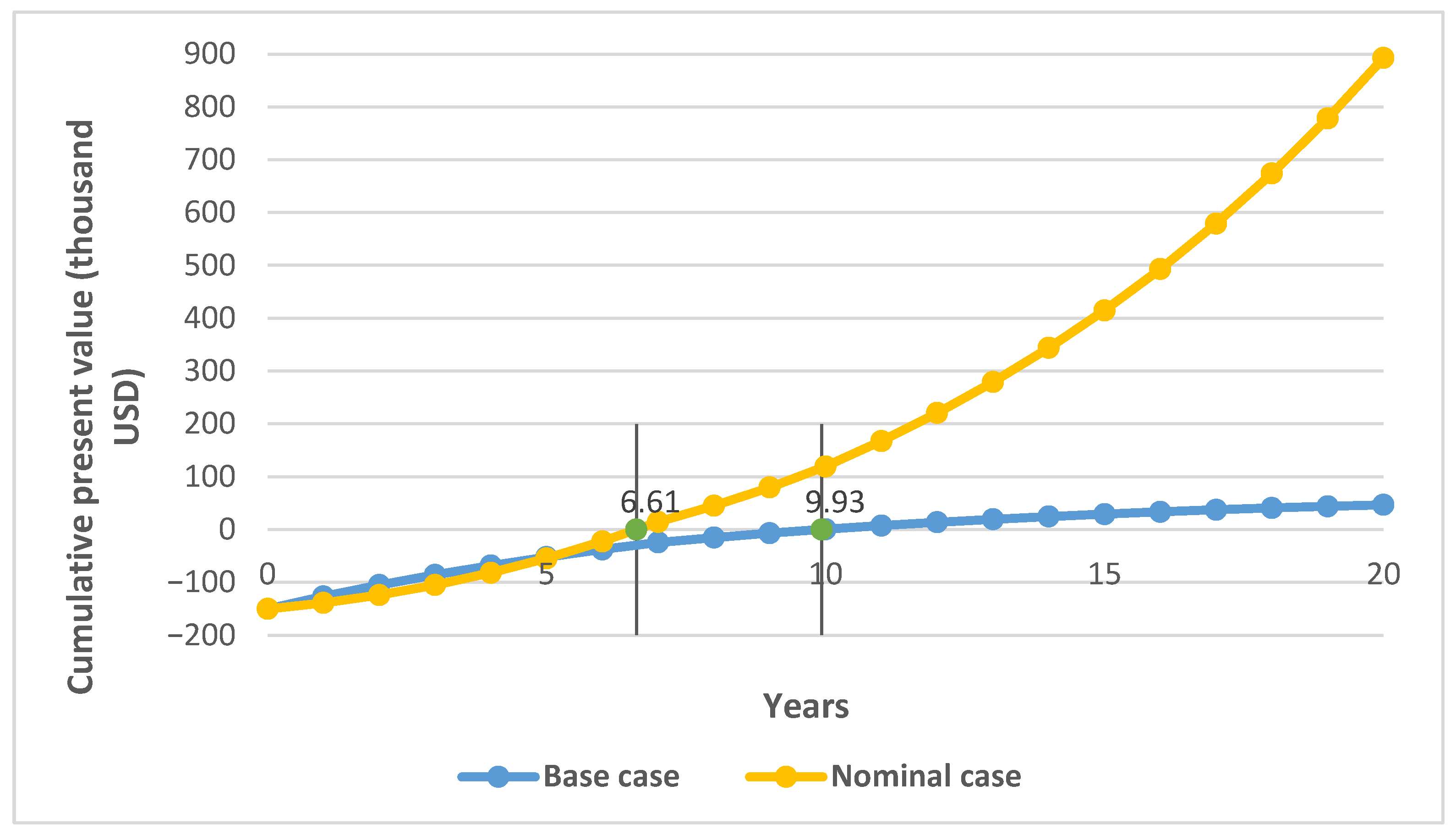
Table 4 presents the outcomes from the economic evaluation. Positive NPV of USD 46,816.99 and USD 892,556.44 are obtained under the base and nominal cases, respectively. This indicates that the system is expected to generate a net positive return. However, the nominal case demonstrates a significantly higher NPV. Thus, a higher revenue margin is achieved while accounting for price dynamics. The profitability index improves from 1.31 (base) to 6.95 (nominal). This indicates a positive return on investment (p > 1) in both scenarios, meaning that for every unit of money invested, the project generates 1.31 and 6.95 units in present value, respectively. Breakeven occurs earlier in the nominal case (6.61 years) than in the base case (9.93 years). Thus, it takes about 6.61 years to recover the initial investment compared to the base case, indicating that the nominal case is more liquid and recovers investment faster. The variation in payback periods is attributed to differences in cash flow profiles over time. Price dynamics and cost escalation also influence PBP in the nominal case relative to the base case.
The IRR rises from 14.78% (base) to 30.85% (nominal), exceeding the 10% DR in both cases. An IRR more than twice the DR in the nominal case indicates high feasibility. This is also attractive to project risk and equity investor models. An LPC of USD 12.07/tonne and USD 30.09/tonne represents the overall RDF per-unit cost. The moderate LPC achieved in the base case does not account for inflation. Operating costs escalate faster than cost-saving effects in the nominal case. Economic performance is also affected by the WtE system’s capacity. As demonstrated in this study and earlier studies [54], bigger capacities favour cost outcomes.
Comparatively, another study, [55], obtained an NPV of USD 576,726.00 for RDF production (50,187.00 tonnes/year). Thirteen months of PBP are recorded over a 15-year lifespan in Qazvin city. Although a 13-month cost recovery period seems overly ambitious, the study assumed constant cash flow over the period. An early study reported 1.98 PI and nearly 6 years as PBP [45]. A 6-year PBP and 24% IRR are reported in [23]. Similar conclusions regarding NPV and price variation are identical to those of other authors [43,45]. The NPV and cash flow benefits increase over time as revenue inflows exceed expenditure. The results of the economic analysis are consistent with previous studies.
Figure 2 shows the cumulative present value (CPV) by year for the base and nominal scenarios. The CPV is the running sum of discounted net cash flows, tracking progress in value generation. The breakeven (discounted payback) point is the year in which CPV ≥ 0. The base case shows a slower upward trend due to more conservative revenue and cost assumptions. This results in a more extended payback period and slower profitability. There is a sharp rise in the nominal case, reflecting faster investment returns and a shorter PBP.
On returns, the nominal case outperforms the base case, with higher NPV, PI, and IRR and a shorter PBP. This indicates robust economic performance. The nominal case is more cost-efficient, but it comes with a relatively higher LPC. This shows a higher production cost and an opportunity to address risk and recovery factors. However, the parameters collectively demonstrate investor viability. The nominal case serves as a baseline for evaluating more dynamic scenarios such as those incorporating inflation, operational escalation, or revenue growth. The latter provides a conservative estimate of the system’s feasibility under stable market conditions.

3.3. Sensitivity Analysis

This section presents the outcomes from the sensitivity analysis within the RSM-DoE framework. It further interprets the cost factors and their impact on the feasibility.

3.3.1. Model Fit and Adequacy (RSM)

The t-test shows that all linear blocks and most quadratic and interaction terms are significant (p < 0.001). The variables predicting the outcomes NPV, PBP, and LPC are highly significant, except for PL (p~0.13) in PBP and RSP (p~0.289) in LPC. The variance inflation factors (VIFs < 3) indicate no multicollinearity among the variables. There is a high overall model adequacy in terms of R2, R2(pred), and R2(adj) (Table 5). The quadratic models indicate good correlation between independent and dependent variables (NPV: R2/R2adj/R2pred = 97.7%/96.6%/90.1%; PBP: R2/R2adj/R2pred = 99.3%/98.6%/91.3%; LPC: R2/R2adj/R2pred = 99.7%/99.3%/97.1%). This coefficient of determination (R2) represents the proportion of the variability in the dependent variable that is explained by the independent variable(s). It shows how well the regression model fits the data. A higher R2 value indicates a better model fit to the data and lower error. Analysis of variance (ANOVA) assesses the fitness of the regression (Table A3, Table A4 and Table A5 in Appendix A). The results indicate that all models are significant (p < 0.001) for the linear, square, and two-way interaction blocks.

3.3.2. Response Surface Outcomes and Interactions

The RSM analysis indicates that NPV is dominated by PL and RSP (positive) and opposed by DR and OMC (negative). The interactions show that costs modulate the gains from long life and price (Table A6). NPV increases with longer PL and higher RSP and decreases with higher DR and OMC. Economically, this reflects the role of longer PL in spreading fixed capital costs and as a direct influence of the RSP on revenue generation. On the other hand, higher DR and OMC reduce the value of cash flow. Key interactions show that higher DR minimises the benefit of long PL. On the other hand, high RSP and long PL reinforce each other. Thus, revenue stability over a longer contractual period amplifies the benefits of higher RDF prices. This improves investment viability. The main effects (all p < 0.01) and curvature and interactions (all retained terms, p ≤ 0.006) indicate overall good adequacy: high R2(pred) of 90.05%.
A decrease in RSP and OMC drives PBP (Table A7). However, PL is statistically insignificant to PBP (p~0.127) over 10 to 20 years. This reflects the sensitivity of capital recovery to early-period cash flows. Thus, higher operating costs or weaker pricing hinder payback despite long-term profitability. OMC and PL drive an increase in LPC with statistical significance (p < 0.001). DR shows a minimal negative effect on LPC, and RSP is not significant (p~0.28) (Table A8). This indicates that LPC is structurally governed by operating cost intensity and system utilisation rather than financing conditions. This results in cost control being a dominant lever for price competitiveness. The model fits and predicts accurately (R2(pred)~97%), with meaningful curvature in PL. Interactions indicate that longer PL amplifies OMC’s effect, whereas higher discounting softens it. This interaction demonstrates that cost inefficiencies compound over a longer operational period. It aligns with the importance of operational discipline for long-term viability.
The regression models further show the relationship between the variables. The fitted polynomial regression equations are in Equations (5)–(7). These represent the response surfaces linking the economic input variables (PL, DR, RSP, OMC) to each performance indicator (NPV, PBP and LPC). The equations are useful for prediction and for mapping the feasibility domain across different scenarios. This followed the standard least squares fitting procedures [44]. Model terms are selected based on statistical significance and hierarchical principles [46].
N P V = 2266945 10680   P L + 25060819   D R + 95347   R S P + 23.6   O M C + 5263   P L · P L 902935   P L · D R + 5727   P L · R S P 3.37   P L · O M C 1167310   D R · R S P
P B P = 17.99   0.055   P L + 37.3   D R 2.113   R S P + 0.000625   O M C 0.00137   P L · P L 27   D R · D R + 0.0796   R S P · R S P + 0.000000   O M C · O M C 0.694   P L · D R + 0.00728   P L · R S P + 0.000002   P L · O M C 2.067   D R · R S P + 0.001598   D R · O M C 0.000053   R S P · O M C
L P C = 5.25   1.051     P L + 183     D R 0.060     R S P + 0.000248     O M C + 0.0636     P L · P L + 243     D R · D R + 0.0049   R S P · R S P + 0.000000   O M C · O M C 8.24   P L · D R 0.00824   P L · R S P + 0.000069   P L · O M C 2.06   D R · R S P 0.00556   D R · O M C + 0.000012   R S P · O M C
where NPV, PBP and LPC are the responses for the net present value, payback period, and the levelised production cost, respectively. PL is the project life, DR is the discount rate, RSP is the RDF sale price and OMC is the operation and maintenance cost.
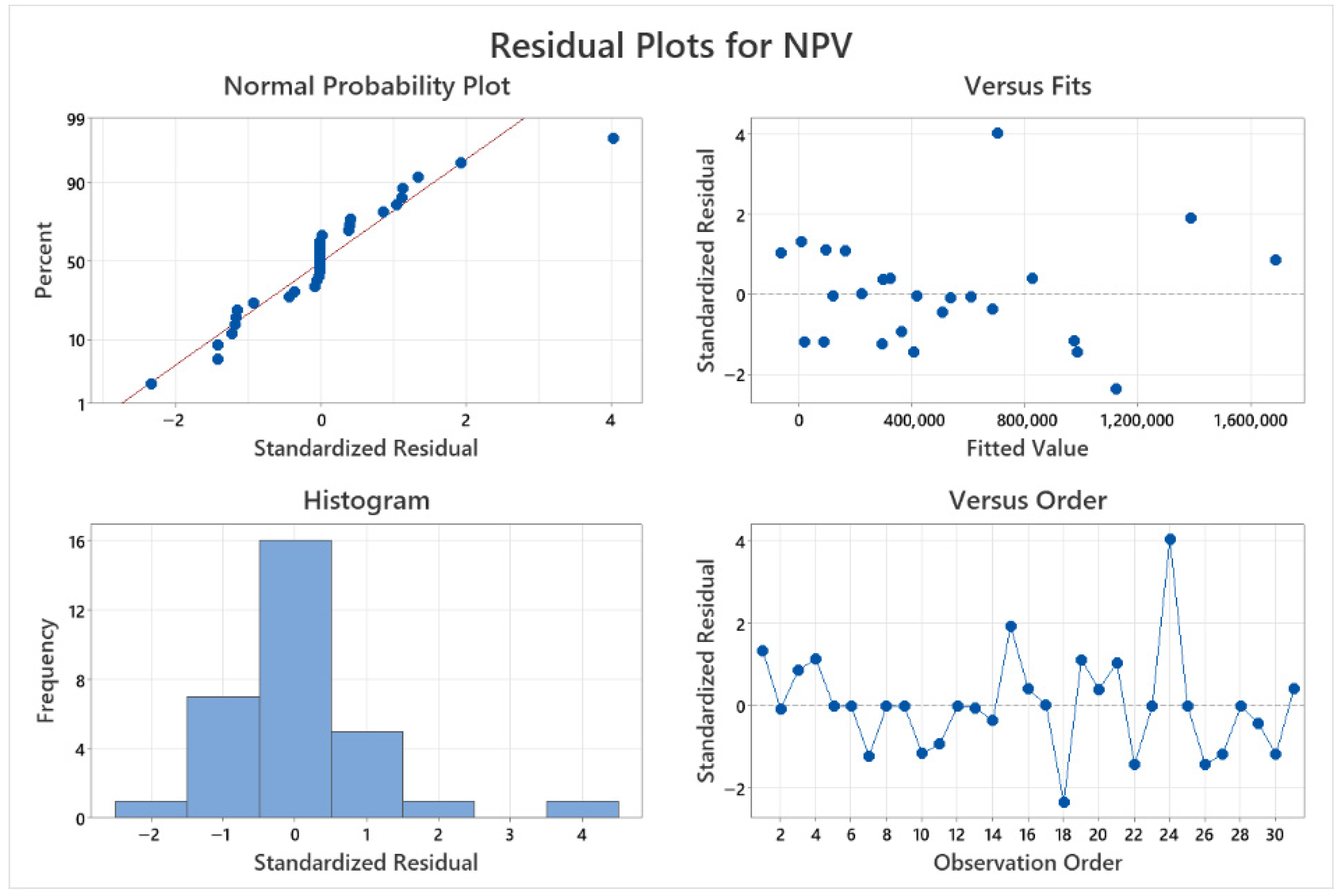
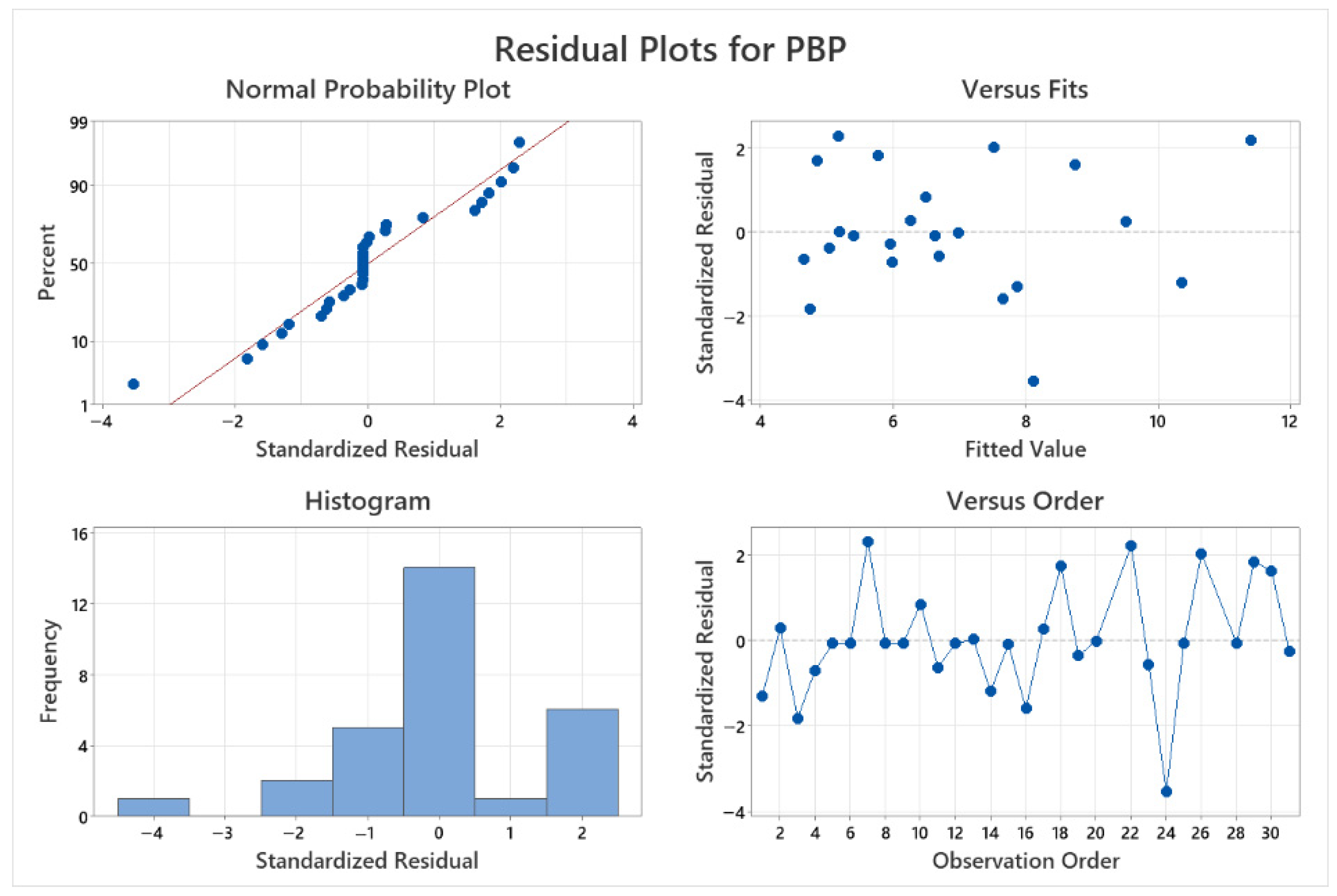
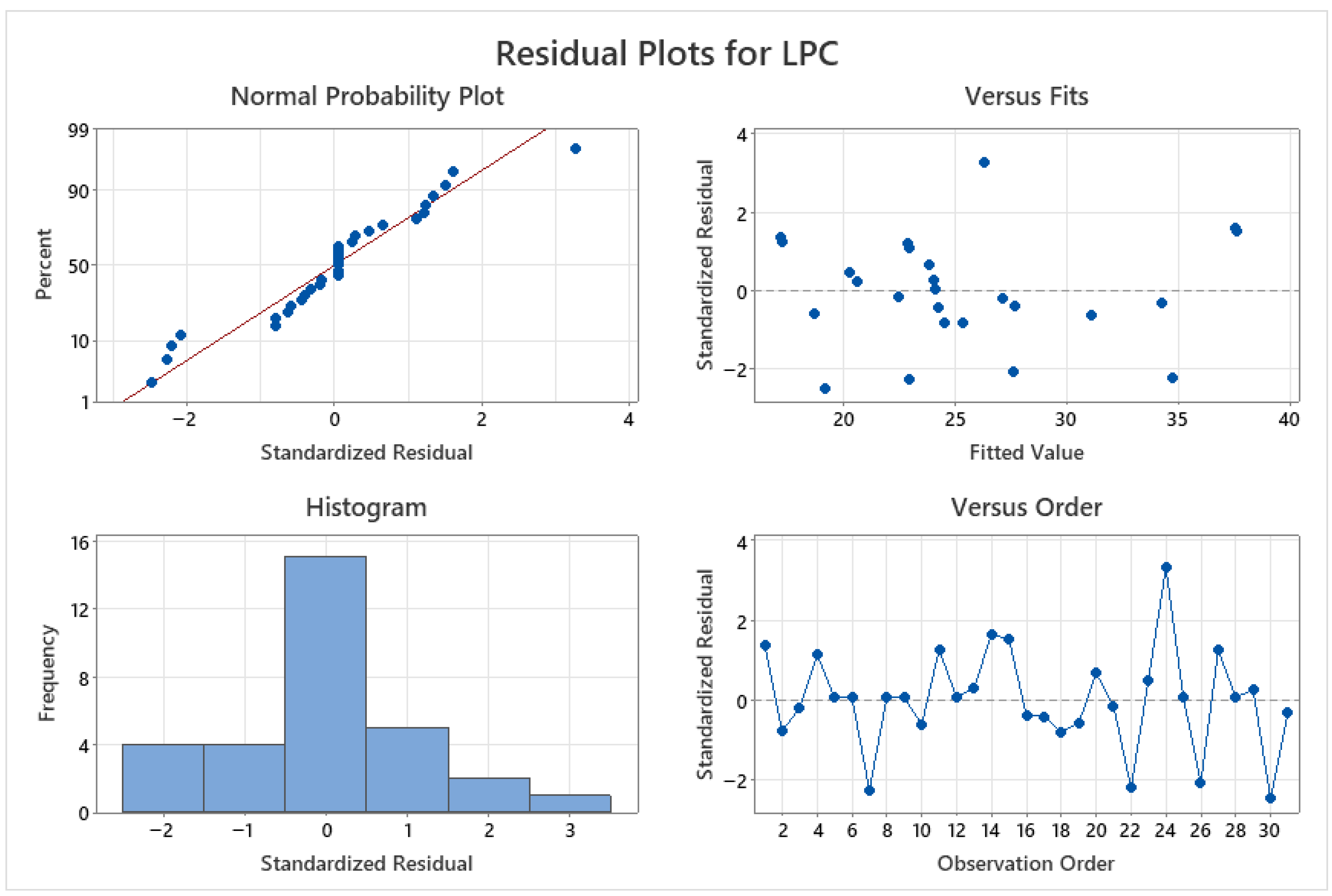
Furthermore, Figure A1, Figure A2 and Figure A3 present graphical illustrations of how the data are distributed in the regression analysis (probability, histograms, fits, and residual plots). Figure A1 indicates that the data points align, suggesting a normal distribution for the NPV. The residuals are spread around zero, indicating constant variance in the error distribution. Figure A2 illustrates the residual plots for the PBP, showing an even distribution. The data points are approximately linear and align on the probability plot. The histogram points are roughly centred at zero, indicating adequate residuals and a normal distribution. Figure A3 shows that the LPC residuals are randomly distributed around zero. Similarly, the histogram is centred near zero, with overall diagnostics for the model adequacy. These results suggest that the data for NPV, PBP, and LPC are normally distributed and relate to the model’s adequacy recorded among the variables.

3.3.3. Multi-Objective Response

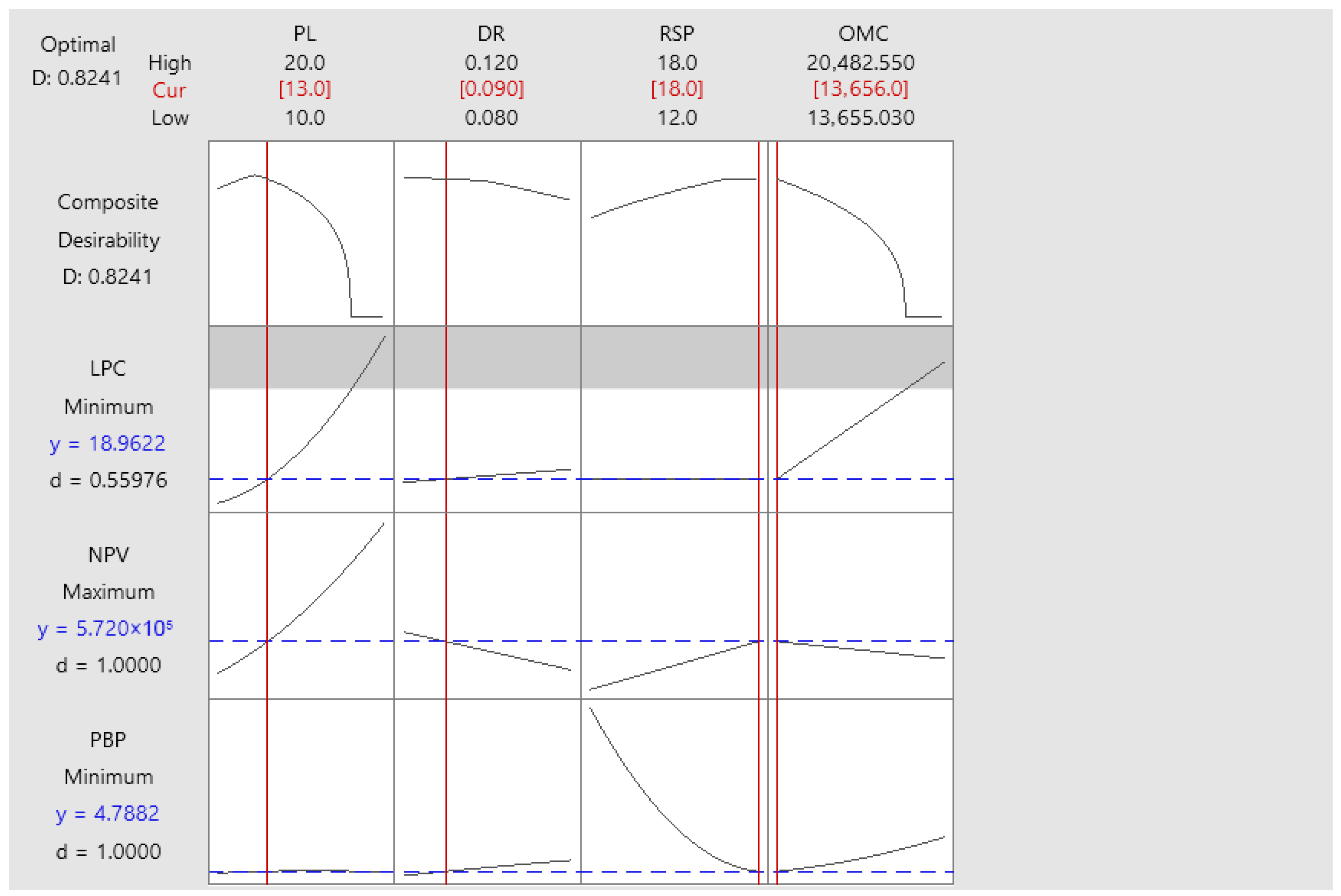
Figure 3 shows the response for max NPV, min PBP, and LPC at a desirability value of 0.82.The RSM model predicts optimum outcomes of USD 571,997, 4.78 years, and USD 18.96/tonne for NPV, PBP, and LPC, respectively, at 13 PL, 9% DR, and USD 13,656.00/year OMC. To test and validate the accuracy, a final experiment is conducted using the proposed optimum values. The model predictions are validated against the equations for the output response (in Table 6). Differences are within the models’ 95% prediction intervals. This confirms the model’s adequacy for optimisation and scenario analysis. The agreement between predicted and experimental values confirms the model’s adequacy.
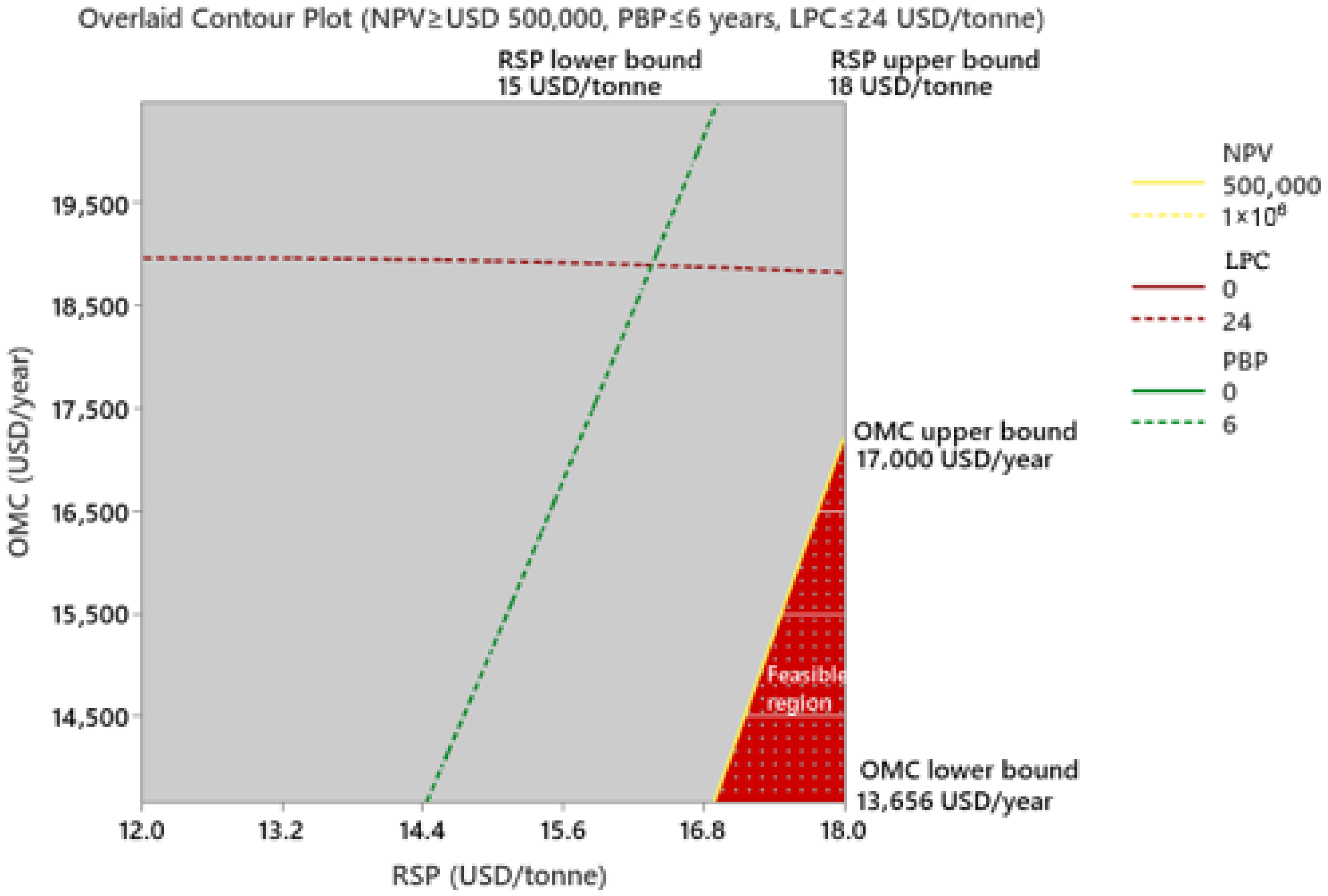
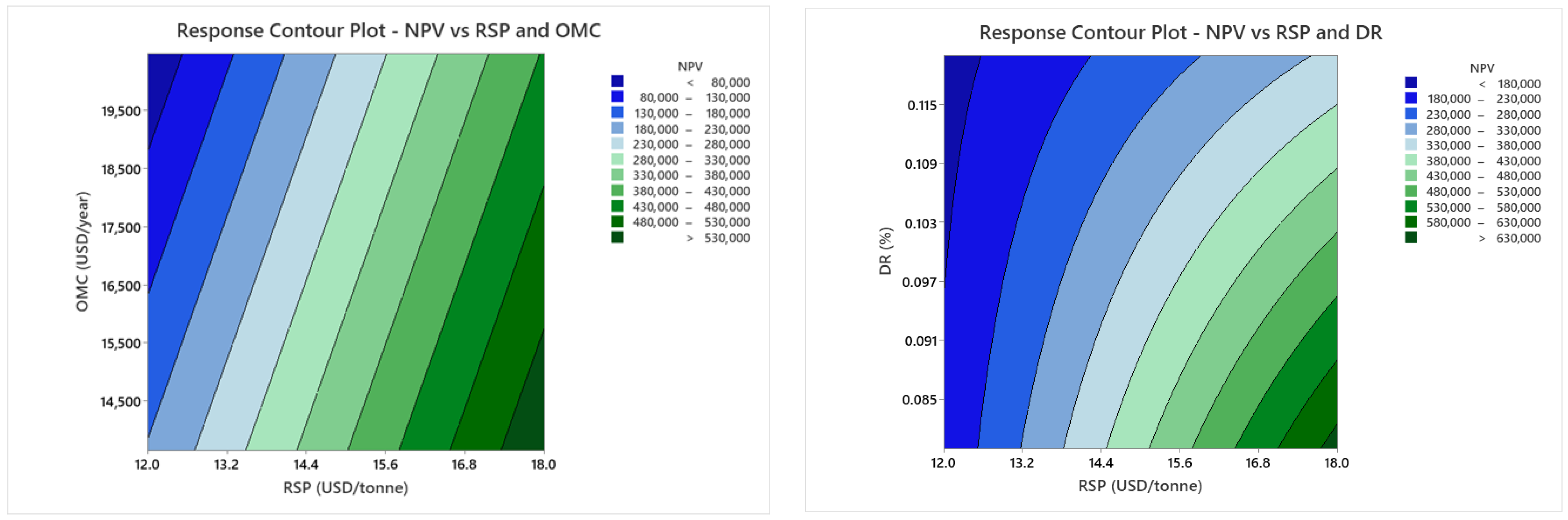
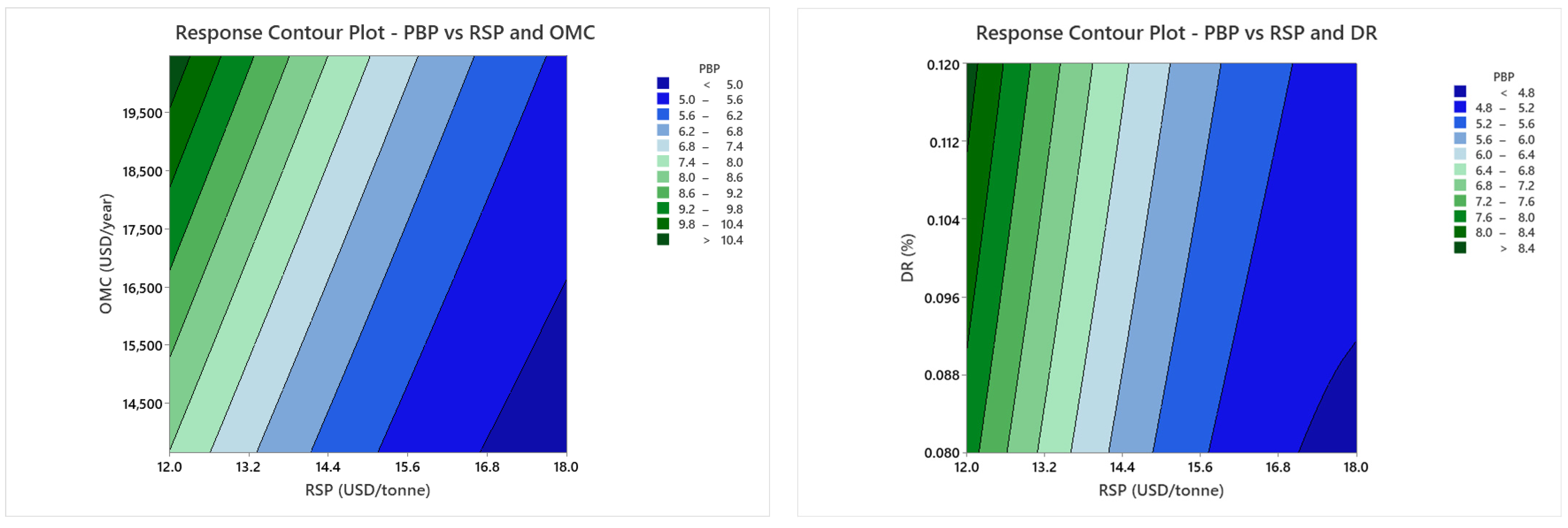
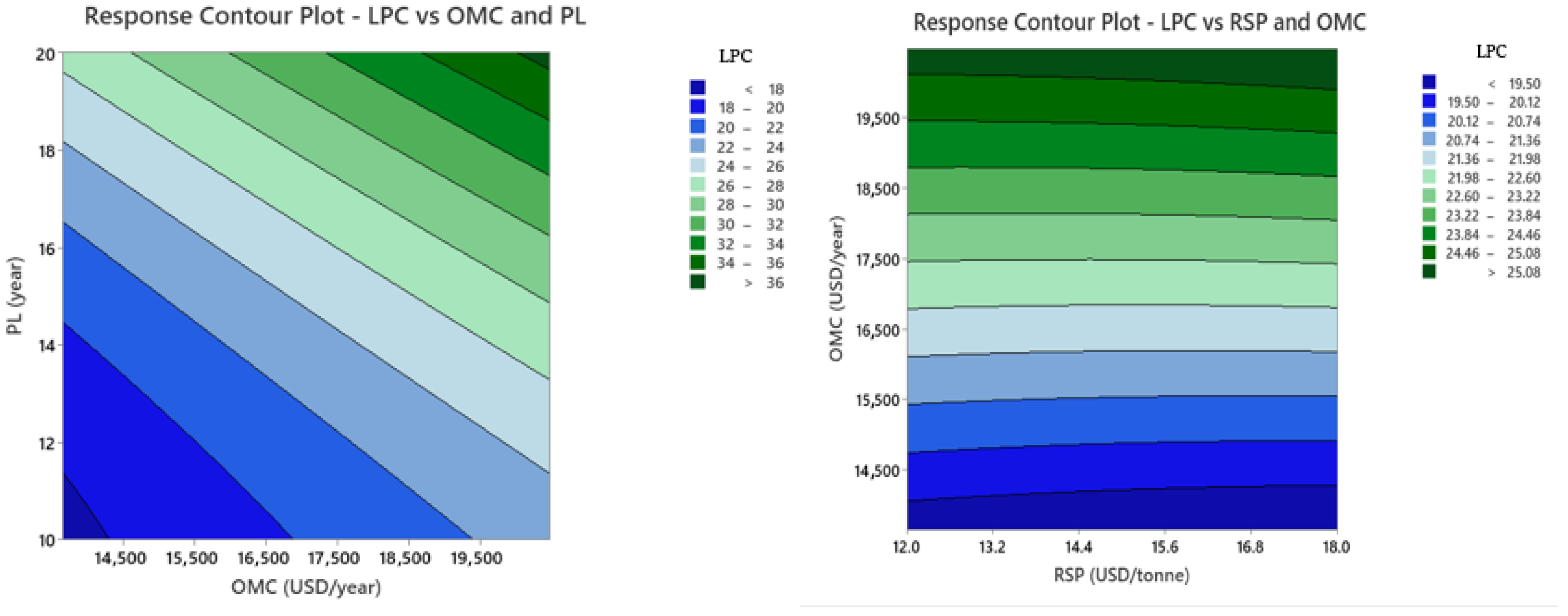
The polynomial regression Equations (5)–(7) are used to generate response surface contour plots for NPV, PBP, and LPC. These are subsequently combined in an overlaid contour plot to identify operating regions that simultaneously satisfy predefined economic feasibility thresholds. Figure A4, Figure A5 and Figure A6 presents contour plots depicting the interaction between two independent variables and the response variable. An overlaid contour plot of the three outcome variables is in Figure 4. It illustrates interaction effects between the RSP and the OMC, with PL (13 years) and DR (9%) held constant. The shaded (red wedge) denotes operating conditions (RSP and OMC) that simultaneously achieve NPV ≥ USD 500,000, PBP ≤ 6 years, and LPC ≤ USD 24.00/tonne. Feasibility is observed at higher RSP (~≥ USD 17/tonne) and lower OMC (~≤ USD 14,000/year). The optimal region occurs at longer PL, lower DR, lower OMC, and higher RSP within the tested bounds. The current study achieved a positive NPV and an applicable PBP of ~4.79 years. The LPC (~18 USD) is relative to regional prices for AF and fossil fuels, motivating sustainability measures.
Results show that raising RSP favours investors’ levers (higher NPV, lower PBP) but does not yield appreciable LPC. In Ghana, exchange rates, interest rates, and inflation affect daily costs, and WtE systems will not be exceptions. The country’s general economic conditions determine such. In support, the chamber of cement producers reports that about 80% of the operational costs rise due to the local currency exchange rate, which affects material imports [56]. The feasibility of the RDF is sensitive to cost, consistent with other studies. For example, the study [19] reports a 10% decrease in sale prices as problematic. The study [57] also presents a market price of 283,000 IDR/tonne of RDF (~USD 16), competitive with rice husk as an alternative fuel. These outcomes reflect different local pricing conditions.

3.4. Measures and Implications for Implementation

The statistically optimal configuration yields an acceptable NPV and PBP but a relatively high LPC. Additional sensitivity analysis shows improved NPV, PBP, and LPC (Table 7). Applying a municipal support payment per tonne (tipping fee analogue) lowers LPC (30 to 12 USD/tonne) at a ~19% allocation level (USD 4.65). Thus, a moderate increase in support shifts RDF into a competitive price range. A further 25% allocation (~USD 5.96) reduces LPC to ~USD 7.08/t. In parallel, PBP declines from ~6.6 to ~4.31 years, and NPV increases steadily. These results indicate that feasibility is achieved when support levels are comparable to current benchmarks. This outcome is consistent with pricing mechanisms observed in other RDF/WtE markets. On the other hand, a larger RDF system may benefit from economies of scale, e.g., reduced unit capital costs and improved operational efficiency. Such benefits are often offset in emerging markets by higher financing risk, import dependency for equipment and spare parts, and supply chain uncertainty. As a result, pilot-scale systems provide a conservative yet relevant basis for identifying feasibility thresholds prior to large-scale deployment.
For contextual comparison, similar support structures reported in other regions are summarised. In the EU, for example, it is reported that an RDF producer may receive EUR 150/t for waste treatment and eventually pay EUR 50/t of RDF to the consumer for the uptake [4]. The gains lie in the waste treatment margin (RDF producer) from the gate fee, as a buyer of waste, and in the price, it pays for the RDF uptake. The margin covers the RDF producer’s operating costs and profit margin. Similar developing countries, like those in Asia [46], report a comparable tipping fee of Rp. 300k (~USD 17) per tonne of MSW from the municipality to the Piyungan landfill RDF plant in Indonesia. Also, a regulated central government incentive of USD 33.78/tonne (IDR 500,000/tonne of waste) is reported as regulatory support for WtE plants [20]. A MSW tipping fee of 300 THB ~USD 9.33 per tonne is charged in Thailand [58]. In both emerging and developed markets, reported tipping/gate fees exceed those estimated in this study.
The IFC advocates for tipping fees in emerging markets where a significant gate fee is not available to support RDF production [2]. According to the EIB, the uptake of RDF by energy-intensive operators in the EU is mainly influenced by waste disposal taxes (e.g., higher landfill taxes) [4]. These are expected to drive greater RDF production and uptake from a legislative perspective. The need for a sustained economic environment that supports the implementation of the WtE landscape cannot be overemphasised. Moreover, RDF production can be improved by different operating conditions, as implemented in other regions such as the EU [4] and other developing countries [20,59].
To benchmark adoptability, the LPC is also expressed on an energy basis. Table 8 compares, per unit and on an energy basis, the costs of fuels currently utilised by potential RDF users in Ghana [17]. Using a conservative NCV (RDF class III) of 16.95 MJ/kg, the study’s base LPC (USD 12.07/tonne) corresponds to (~USD 0.80/GJ). The nominal optimum LPC of ~USD 18.96/tonne corresponds to ~USD 1.12/GJ. The adjusted levelised production cost ranges from ~USD 0.50 to USD 0.73/GJ (~USD 7.08–12.33/tonne). For instance, firewood remains widely used as a heat source in many thermal applications (brick producers, SME boiler operators, and industrial processing).
Firewood and charcoal are consigned as a primary energy source in Ghana and a cost-competitive option in national diagnostics. Delivered prices vary by region and haulage [60]. However, bulk wood fuels are generally in the lower-cost band per GJ of energy and are comparable to those in this study. Charcoal, on the other hand, is traded in Ghana on a volume basis [61]. Again, the environmental concern of deforestation has become a challenge due to the overexploitation of firewood. It is reported that approximately 15% more wood fuel than the estimated national demand is being harvested, with impacts on tree cover [60]. This calls for finding alternative sources, such as RDF, in meeting growing thermal energy demand. In contrast, the costs reported in this study exceed the electricity bulk charge tariffs in Ghana [38]. Electricity sources in Ghana are predominantly fossil fuels, with thermal power plants. Additionally, the PURC tariff schedules confirm ongoing adjustments for non-residential/industrial users [62]. This reinforces that electricity is not a cost-competitive heat source for boilers/kilns.
Table 8. Energy basis comparison of thermal fuels relevant to potential RDF users in Ghana.
Fuel OptionReferencePrice BasisEnergy Value (NCV) GJ/tonneUSD/GJGHC/GJ
RDF (SA-LPC)Present studyUSD 7.08/tonne16.95 GJ/tonne0.425.11
RDF (nominal LPC)Present studyUSD 18.96/tonne16.95 GJ/tonne1.1213.68
Firewood (bulk)[60,63]GH₵ 113.00/tonne17.00 GJ/tonne0.546.65
Charcoal (bulk)[61,64]GH₵ 2.47/kg24.00 GJ/tonne8.42102.92
Diesel (process heat)[65]GH₵ 13.67/L0.04 GJ/L31.22381.84
LPG (proxy: pump/kg)[65]GH₵ 13.90/kg0.05 GJ/kg24.70302.13
Coal (import ref.)[66]USD 120.00/tonne25.00 GJ/tonne4.8058.70
SA-LPC: support-adjusted LPC. The price sourced and NCV per the unit cost of energy (USD/GJ and GHC/GJ).
In the case of RDF supply, the binding constraints are contract design, logistics, and quality, not intrinsic energy cost. Diesel fuel for process heat is much more expensive on a per-unit-energy basis. Recent updates show very high fossil fuel costs (USD 24.70–USD 31.22/GJ) for baseload fuel relative to RDF. Coal, for instance, according to the international benchmarks, is recorded at ~USD 120/tonne (at ~24 GJ/tonne) [66]. Existing bulk supply agreements currently favour fossil fuel sources based on established markets. This is (~USD 5/GJ) before freight and inland logistics. Thus, regulated pricing mechanisms and quality premiums (~USD 0.5–1.12/GJ) can substitute coal on an energy basis when quality and logistics are assured.
Lessons from advanced economies, combined with this study’s findings, indicate that support mechanisms can enhance the economics of WtE in Ghana. However, the practical implementation is subject to institutional, fiscal, and regulatory measures. Also, a structured market, mandated pricing mechanisms, and user motivation for uptake are key. Empirical assessment of potential RDF user perspectives has been analysed in detail in a complementary earlier study [17]. Consequently, the identified support thresholds are indicative feasibility conditions rather than deterministic guarantees of implementation. Thus, an opportunity to improve the slow progress in adoption towards socio-environmental (waste management) and economic benefits (fuel substitution).

4. Conclusions

The study presents the economic feasibility of RDF and the effects of economic factors on the NPV, PI, and PBP indices as response functions. The prospect of MSW to RDF for fuel substitution presents an opportunity under specific operational conditions. An optimal scenario demonstrates maximising NPV while keeping PBP and LPC within acceptable ranges. Under Ghana’s prevailing WtE market conditions, scenarios indicate economic challenges without support structures in place. As RDF is intended to substitute for other fuels such as fossil fuels, it competes indirectly with the existing fuel mix. It demonstrates that financial measures (e.g., tax waivers, tipping fees, or gate fees) and policy support (e.g., regulations) can enhance feasibility. The effectiveness in Ghana remains contingent on institutional capacity, fiscal measures, and the implementation of regulations. From a scalability perspective, the pilot results serve as a decision-support baseline. Again, off-taker agreements, operational supply certainty, and dependability support the development of the RDF market structure. The quantified thresholds provide a basis for designing RDF mechanisms.
  • The study provides indicative insights into the feasibility of the RDF landscape. It therefore quantifies the individual and combined effects of predictor variables on economic performance.
  • The findings contribute to broader discussions on WtE deployment in emerging economies. This emphasises adaptive financing mechanisms and phased implementation strategies.
  • In addition, the study’s outcomes enhance collaboration among knowledge institutions, government/regulators, and municipalities. Benefits are not only directed at improved sanitation but also contribute to progress towards the SDGs, particularly 7, 8, 11, and 13: Affordable and Clean Energy, Decent Work and Economic Growth, Sustainable Cities and Communities, Climate Action.
Beyond the case study, the methodological framework and feasibility thresholds contribute to broader clean energy transition pathways. This integrates waste-based AF into industrial energy systems. The study supports circular economy strategies and resource efficiency. The approach is transferable to other WtE and AF contexts where market, financing, and policy constraints shape adoption dynamics.
Limitations of the study include the use of adapted costs from a pilot study. This is not intended to represent the full economics of a large-scale commercial RDF system. However, to explore the threshold for early-stage RDF deployment assessment and adaptable replication approaches. Another aspect includes price inflation and the assumption of stable feedstock quality and uptime. Scale-dependent effects, such as equipment depreciation profiles, supply chain logistics optimisation, and capital cost dilution, are not explicitly modelled. Future studies could consider (i) expanding the design space to include scale-dependent effects and uptime explicitly (this will quantify minimum quality premiums/penalties in possible RDF contracts); (ii) modelling the demand-side interactions that depend on end-user technology configurations and regulations; (iii) assessing market readiness for RDF production within waste management entities. Furthermore, gather stakeholder perspectives on WtE-RDF market pricing mechanisms and their implementation.

Author Contributions

Conceptualisation, K.S. and S.N.; methodology, K.S. and S.N.; validation, K.S., S.N., G.B. and N.S.A.D.; formal analysis, K.S.; resources, K.S., S.N., G.B. and N.S.A.D.; data curation, K.S. and S.N.; writing—original draft preparation, K.S.; writing—review and editing, K.S., S.N., G.B. and N.S.A.D.; supervision, S.N., G.B. and N.S.A.D.; funding acquisition, S.N., G.B. and N.S.A.D. All authors have read and agreed to the published version of the manuscript.

Funding

This research work was supported under the project ‘Waste to Energy: Hybrid Energy from Waste as Sustainable Solution for Ghana’, funded by the German Federal Ministry of Research, Technology, and Space (BMFTR), 03SF0591E. The APC was funded by the University of Rostock.

Data Availability Statement

Data supporting the reported results are available within the article.

Acknowledgments

The authors acknowledge the support from the facilities’ management at the project site, as well as from project partners and colleagues at SRH University of Applied Sciences.

Conflicts of Interest

The authors declare no conflicts of interest.

Abbreviations

The following abbreviations/symbols/notations are used in this manuscript:
AbbreviationMeaning
AFAlternative fuel
CAPEXCapital expenditure
CCDCentral composite design
DCFDiscounted cash flow
DoEDesign of experiment
DRDiscount rate
EUEuropean Union
GJGigajoule
GHCGhanaian cedis
IRRInternal rate of return
LPCLevelised production cost
MSWMunicipal solid waste
NCVNet calorific value
NPVNet present value
OMCOperating and maintenance cost
OPEXOperating expenditure
PBPPayback period
PIProfitability index
PLProject lifetime
PPPPublic–private partnership
RSMResponse surface methodology
RSPRDF sale price
SDGsSustainable Development Goals
TEATechno-economic assessment
VIFVariance inflation factor
WtEWaste to energy
Symbol/NotationMeaning
ANOVAAnalysis of variance
CFtTotal cash flow (in year t)
CnetNet cash flow (in year t)
CoInitial capital cost
CtAnnual operating cost (in year t)
ItInvestment cost, (in year t)
nProject lifetime (in years)
OtOperating cost (in year t)
QtQuantity of RDF produced (in year t)
rDiscount rate
tProject time index
R2Coefficient of determination
R2adjAdjusted coefficient of determination
R2predPredicted coefficient of determination
CoefEstimated regression coefficient
SE CoefStandard error of the estimated regression coefficient
S (RMSE)Standard error of the regression
F-valueF-statistic
t-valueStudent’s t-statistic
p-valueProbability value

Appendix A

Table A1, Table A2, Table A3, Table A4, Table A5, Table A6, Table A7 and Table A8 and Figure A1, Figure A2, Figure A3, Figure A4, Figure A5 and Figure A6 represent supplementary records from the study. These include the experimental matrix, regression diagnostics, and validation plots to support model validation and the reproducibility of the RSM analysis. All primary findings and interpretations are derived from the results referenced in the main text. Regression coefficients and associated statistics are reported with full numerical precision, as generated by the RSM model, to preserve reproducibility.
Table A1. Summary of cost and parameter assumptions.
ParametersBase CaseNominal Case
CAPEX (thousand USD)150.00150.00
OPEX Year 1 (thousand USD)17.7917.79
OPEX inflation rate/price escalation (%)0.0017.23
Revenue, year 1 (thousand USD)43.0043.00
Annual utility price growth rate (%)0.0010.00
Discount rate (%)10.0010.00
Project life (years)20.0020.00
Tax 1–7 years (%)1.001.00
Tax 8–20 years (%)25.0025.00
RDF quantity per year (tonne)2875.002875.00
Debt-to-equity ratio70:3070:30
Table A2. Experimental design matrix.
Std OrderRun OrderPt TypeBlocksPLDRRSPOMCNPVPBPLPC
1111100.081213,655.0375,917.287.7417.52
192−11150.081517,068.79529,808.926.3024.29
6311200.081813,655.031,727,669.564.5827.09
15411100.121820,482.55152,250.985.9223.18
26501150.101517,068.79414,692.646.6124.11
25601150.101517,068.79414,692.646.6124.11
13711100.081820,482.55230,688.765.4022.39
31801150.101517,068.79414,692.646.6124.11
28901150.101517,068.79414,692.646.6124.11
1810−11200.101517,068.79892,556.526.6130.93
51111100.081813,655.03314,938.944.5817.52
301201150.101517,068.79414,692.646.6124.11
2213−11150.101817,068.79605,955.125.1824.11
101411200.081220,482.55666,805.4910.2337.98
141511200.081820,482.551,483,410.125.4037.98
2416−11150.101520,482.55351,741.647.4527.56
2117−11150.101217,068.79223,430.169.5424.11
81811200.121813,655.031,002,948.104.9925.11
71911100.121813,655.03220,663.814.9918.53
2020−11150.121517,068.79323,071.996.9724.04
92111100.081220,482.55−8332.89 22.39
122211200.121220,482.55332,053.2611.6034.17
1723−11100.101517,068.79119,236.986.6120.38
42411200.121213,655.03911,064.937.7427.09
272501150.101517,068.79414,692.646.6124.11
22611200.081213,655.03911,064.937.7427.09
112711100.121220,482.55−40,557.40 23.18
292801150.101517,068.79414,692.646.6124.11
2329−11150.101513,655.03477,643.646.0220.66
33011100.121213,655.0327,855.428.9118.53
163111200.121820,482.55845,187.935.9234.17
Table A3. Analysis of variance and fit statistics of NPV.
SourceDFAdj SSAdj MSF-Valuep-Value
Model94.87303 × 10125.41448 × 101196.9500.000
Linear44.36242 × 10121.09061 × 1012195.2700.000
PL13.27688 × 10123.27688 × 1012586.7200.000
DR12.58584 × 10112.58584 × 101146.3000.000
RSP16.74507 × 10116.74507 × 1011120.7700.000
OMC11.52447 × 10111.52447 × 101127.3000.000
Square11.30686 × 10111.30686 × 101123.4000.000
PL × PL11.30686 × 10111.30686 × 101123.4000.000
2-way interaction43.79919 × 101194,979,725,16417.0100.000
PL × DR11.30447 × 10111.30447 × 101123.3600.000
PL × RSP11.18090 × 10111.18090 × 101121.1400.000
PL × OMC152,895,942,56052,895,942,5609.4700.006
DR × RSP178,486,539,78478,486,539,78414.0500.001
Error211.17286 × 10115,585,063,982
Lack of fit151.17286 × 10117,819,089,575
Pure error60.00000.0000
Total304.99031 × 1012
DF: degree of freedom, Adj SS: adjusted sum of squares, Adj MS: adjusted mean square, F-value: the ratio of the variance explained by a model term to the unexplained variance (error), p-value: probability value.
Table A4. Analysis of variance and fit statistics of PBP.
SourceDFAdj SSAdj MSF-Valuep-Value
Model1474.97995.3557137.7000.000
Linear461.462515.3656395.0700.000
PL10.10230.10232.6300.127
DR11.87781.877848.2800.000
RSP150.820350.82031306.6400.000
OMC19.72899.7289250.1400.000
Square43.34070.835221.4700.000
PL × PL10.00300.00300.0800.785
DR × DR10.00030.00030.0100.932
RSP × RSP11.32121.321233.9700.000
OMC × OMC10.01890.01890.4900.498
2-way interaction63.80760.634616.3200.000
PL × DR10.06200.06201.6000.227
PL × RSP10.10970.10972.8200.115
PL × OMC10.01260.01260.3200.579
DR × RSP10.19790.19795.0900.041
DR × OMC10.15330.15333.9400.067
RSP × OMC12.68162.681668.9500.000
Error140.54450.0389
Lack of fit80.54450.0681
Pure error60.00000.0000
Total2875.5244
Table A5. Analysis of variance and fit statistics of LPC.
SourceDFAdj SSAdj MSF-Valuep-Value
Model14821.23658.660325.0000.000
Linear4762.497190.6241056.1300.000
PL1533.543533.5432956.0400.000
DR12.1642.16411.9900.003
RSP10.2170.2171.2000.289
OMC1226.573226.5731255.3000.000
Square422.5575.63931.2400.000
PL × PL16.5556.55536.3200.000
DR × DR10.0250.0250.1400.717
RSP × RSP10.0050.0050.0300.869
OMC × OMC10.0050.0050.0300.869
2-way interaction636.1826.03033.4100.000
PL × DR110.85110.85160.1200.000
PL × RSP10.2450.2451.3600.261
PL × OMC122.29022.290123.4900.000
DR × RSP10.2450.2451.3600.261
DR × OMC12.3072.30712.7800.003
RSP × OMC10.2450.2451.3600.261
Error162.8880.180
Lack of fit102.8880.289
Pure error60.0000.000
Total30824.124
Table A6. Coded coefficient and variable test for NPV.
TermCoefSE Coeft-Valuep-ValueVIF
Constant416,500.0020,727.0020.090.000
PL426,672.0017,615.0024.220.0001.00
DR−119,857.0017,615.00−6.800.0001.00
RSP193,578.0017,615.0010.990.0001.00
OMC−92,029.0017,615.00−5.220.0001.00
PL × PL131,579.0027,201.004.840.0001.00
PL × DR−90,294.0018,683.00−4.830.0001.00
PL × RSP85,910.0018,683.004.600.0001.00
PL × OMC−57,498.0018,683.00−3.080.0061.00
DR × RSP−70,039.0018,683.00−3.750.0011.00
Coef: estimated regression coefficient, SE Coef: standard error of the estimated regression coefficient, t-value: Student’s t-statistic, p-value: indicates the statistical significance of the regression coefficient, VIF: variance inflation factor.
Table A7. Coded coefficient and variable test for PBP.
TermCoefSE Coeft-Valuep-ValueVIF
Constant6.62910.0588112.830.000
PL−0.09710.0598−1.620.1271.46
DR0.35620.05136.950.0001.08
RSP−2.16320.0598−36.150.0001.46
OMC0.94650.059815.820.0001.46
PL × PL−0.03400.1230−0.280.7852.79
DR × DR−0.01100.1230−0.090.9322.79
RSP × RSP0.71700.12305.830.0002.79
OMC × OMC0.08600.12300.700.4982.79
PL × DR−0.06940.0550−1.260.2271.09
PL × RSP0.10920.06501.680.1151.51
PL × OMC0.03700.06500.570.5791.51
DR × RSP−0.12400.0550−2.260.0411.09
DR × OMC0.10910.05501.990.0671.09
RSP × OMC−0.54000.0650−8.300.0001.51
Table A8. Coded coefficients and variable test for LPC.
TermCoefSE Coeft-Valuep-ValueVIF
Constant24.0910.126191.160.000
PL5.4440.10054.370.0001.00
DR−0.3470.100−3.460.0031.00
RSP−0.1100.100−1.100.2891.00
OMC3.5480.10035.430.0001.00
PL × PL1.5890.2646.030.0002.91
DR × DR0.0970.2640.370.7172.91
RSP × RSP0.0440.2640.170.8692.91
OMC × OMC0.0440.2640.170.8692.91
PL × DR−0.8240.106−7.750.0001.00
PL × RSP−0.1240.106−1.160.2611.00
PL × OMC1.1800.10611.110.0001.00
DR × RSP−0.1240.106−1.160.2611.00
DR × OMC−0.3800.106−3.580.0031.00
RSP × OMC0.1240.1061.160.2611.00
Figure A1. Residual plot for NPV response regression.
Cleantechnol 08 00017 g0a1
Figure A2. Residual plot for PBP response regression.
Cleantechnol 08 00017 g0a2
Figure A3. Residual plot for LPC response regression.
Cleantechnol 08 00017 g0a3
Figure A4. Contour plots of NPV showing effects of (left) RSP and OMC and of (right) RSP and DR.
Cleantechnol 08 00017 g0a4
Figure A5. Contour plots of PBP showing effects of (left) RSP and OMC and of (right) RSP and DR.
Cleantechnol 08 00017 g0a5
Figure A6. Contour plots of LPC showing effects of (left) RSP and OMC and of (right) RSP and PL.
Cleantechnol 08 00017 g0a6

References

  1. CEWEP. Waste-to-Energy: Energising Your Waste. In Confederation of European Waste to Energy Plants. Waste to Energy Plants; CEWEP: Brussels, Belgium, 2018. [Google Scholar]
  2. International Finance Corporation. Increasing the Use of Alternative Fuels at Cement Plants: International Best Practice; International Finance Corporation: Washington, DC, USA, 2017. [Google Scholar]
  3. CEMBUREAU. The European Cement Association Key Facts and Figures; CEMBUREAU: Brussels, Belgium, 2023. [Google Scholar]
  4. EIB. Managing Refuse-Derived and Solid Recovered Fuels; European Investment Bank: Luxembourg, 2024. [Google Scholar]
  5. GIZ. Status Paper on Utilisation of Refuse Derived Fuel (RDF) in India; GIZ: Eschborn, Germany, 2013; p. 18. [Google Scholar]
  6. Ohorongo Cement. Ohorongo Cement Invest in Refuse Derived Fuel. Available online: https://ohorongo-cement.com/news/moving-towards-a-zero-waste-to-landfill-namibia/ (accessed on 21 April 2021).
  7. Sarquah, K.; Narra, S.; Beck, G.; Awafo, E.A. Bibliometric Analysis; Characteristics and Trends of Refuse Derived Fuel Research. Sustainability 2022, 14, 1994. [Google Scholar] [CrossRef]
  8. de Beer, J.; Cihlar, J.; Hensing, I.; Zabeti, M. Status and Prospects of Co- Processing of Waste in EU Cement Plants; The European Cement Association: Brussels, Belgium, 2017. [Google Scholar]
  9. UNEP. Beyond an Age—Global Waste Management Outlook 2024; United Nations Environment Programme: Nairobi, Kenya, 2024; ISBN 9789280741292. [Google Scholar]
  10. UNEP. Global Resources Outlook 2024: Bend the Trend—Pathways to a Liveable Planet as Resource Use Spikes; United Nations Environment Programme: Nairobi, Kenya, 2024; ISBN 9789280741285. [Google Scholar]
  11. Boadi, G.F. Presentation on Challenges and Opportunities for Governments in Waste Data Sources Ghana; United Nations Environment Programme: Geneva, Switzerland, 2024. [Google Scholar]
  12. Oduro-Appiah, K.; Scheinberg, A.; Afful, A.; de Vries, N. The Contribution of Participatory Engagement Strategies to Reliable Data Gathering and Inclusive Policies in Developing Countries: Municipal Solid Waste Management Data in the Greater Accra Metropolitan Area of Ghana. African J. Sci. Technol. Innov. Dev. 2021, 13, 735–746. [Google Scholar] [CrossRef]
  13. Sarquah, K.; Narra, S.; Beck, G.; Bassey, U.; Antwi, E.; Hartmann, M.; Derkyi, N.S.A.; Awafo, E.A.; Nelles, M. Characterization of Municipal Solid Waste and Assessment of Its Potential for Refuse-Derived Fuel (RDF) Valorization. Energies 2023, 16, 200. [Google Scholar] [CrossRef]
  14. Bowan, P.A.; Kayaga, S.; Cotton, A.; Fisher, J. Municipal Solid Waste Disposal Operational Performance in Wa Municipality, Ghana. J. Health Pollut. 2019, 9, 190903. [Google Scholar] [CrossRef]
  15. Arthur, E.; Dorfiah, P.; Hilbert, I.; Kyere, V.N.; Ocran, P.K. Waste Tyre Management Baseline Study for Ghana Turning Waste into Resources for Development SRI Builds Capacity for Sustainable Recycling in Developing Countries; Sustainable Recycling Initiative: Accra, Ghana, 2020; ISBN 978-3-906177-27-4. [Google Scholar]
  16. WASCAL. Hybrid Waste-to-Energy (W2E) Pilot Project in the Ashanti Region, Ghana. In West African Science Service Centre on Climate Change and Adapted Land Use; WASCAL: Accra, Ghana, 2023. [Google Scholar]
  17. Sarquah, K.; Narra, S.; Beck, G.; Sarfo, N.; Derkyi, A.; Awafo, E.; Hartmann, M.; Nelles, M. Evaluating Opportunities of Refuse Derived Fuel for Energy-Based Industrial Symbiosis towards a Circular Economy—A Case Study. J. Environ. Manag. 2025, 380, 125126. [Google Scholar] [CrossRef]
  18. EN 15359:2011; Solid Recovered Fuels—Specifications and Classes. European Committee for Standardization: Brussels, Belgium, 2011.
  19. Yahya, S.; Susanti, B.; Fitriani, H. Financial Feasibility Analysis of Urban Waste Processing as Refused Derived Fuel For Cement Company. Eduvest—J. Univers. Stud. 2024, 4, 5352–5366. [Google Scholar] [CrossRef]
  20. Azis, M.M.; Kristanto, J.; Purnomo, C.W. A Techno-economic Evaluation of Municipal Solid Waste (Msw) Conversion to Energy in Indonesia. Sustainability 2021, 13, 7232. [Google Scholar] [CrossRef]
  21. Yakah, N.; Kwarteng, A.A.; Addy, C.; Yirenkyi, M.; Martin, A.; Simons, A. Techno-Economic Assessment of Municipal Solid Waste (MSW) Incineration in Ghana. Processes 2024, 12, 1286. [Google Scholar] [CrossRef]
  22. Farooq, A.; Haputta, P.; Gheewala, S.H. Economic Feasibility Assessment of Waste to Energy Technologies for the Development of a Sustainable Municipal Solid Waste Management System in Thailand. Renew. Energy 2024, 233, 121155. [Google Scholar] [CrossRef]
  23. Ali, M.U. A Techno-Economic Analysis of Alternative Fuels in Cement Industry in Pakistan. Int. J. Eng. Work. 2021, 8, 191–196. [Google Scholar] [CrossRef]
  24. Zhang, X.; Liu, B. Prediction and Feed-In Tariffs of Municipal Solid Waste Generation in Beijing: Based on a GRA-BiLSTM Model. Sustainability 2024, 16, 3579. [Google Scholar] [CrossRef]
  25. Osei-Appiah, N.A.; Dioha, M.O. Techno-Economic Assessment of Waste-To-Energy Technologies in Ghana. J. Sustain. Energy 2019, 10, 112–121. [Google Scholar]
  26. Afrane, S.; Ampah, J.D.; Jin, C.; Liu, H.; Aboagye, E.M. Techno-Economic Feasibility of Waste-to-Energy Technologies for Investment in Ghana: A Multicriteria Assessment Based on Fuzzy TOPSIS Approach. J. Clean. Prod. 2021, 318, 128515. [Google Scholar] [CrossRef]
  27. Mäkelä, M. Experimental Design and Response Surface Methodology in Energy Applications: A Tutorial Review. Energy Convers. Manag. 2017, 151, 630–640. [Google Scholar] [CrossRef]
  28. Djimtoingar, S.S.; Derkyi, N.S.A.; Kuranchie, F.A.; Yankyera, J.K. A Review of Response Surface Methodology for Biogas Process Optimization. Cogent Eng. 2022, 9, 2115283. [Google Scholar] [CrossRef]
  29. Atwima Nwabiagya District Health Directorate Atwima Nwabiagya District. Atwima Nwabiagya Dist. Health Dir. 2016, 1–83.
  30. Mariwah, S. The Sanitation and Waste Management Conundrum in Ghana: The Case for High Level Prioritization and Fiscal Incentives. In Proceedings of the IMANI and ESPA Webinar, CapeCoast, Ghana, 11 June 2020; Available online: https://imaniafrica.org/2020/06/the-waste-management-conundrum-in-ghana-the-case-for-high-level-prioritisation-and-fiscal-incentives-presentation-file/ (accessed on 15 October 2025).
  31. World Bank Group. Inflation, Consumer Prices (Annual %)—Ghana; World Bank Group: Washington, DC, USA.
  32. GSS. March 2025 Inflation. Indus J. Biosci. Res. 2025, 3, 1–11. [Google Scholar] [CrossRef]
  33. GBP. Reduced Corporate Income Tax (CIT) Rates for Waste Processing Businesses (Up to Seven Years); GBP: Accra, Ghana, 2015. [Google Scholar]
  34. GRA. Corporate Income Tax (CIT); Ghana Revenue Authority: Accra, Ghana, 2015. Available online: https://gra.gov.gh/domestic-tax/tax-types/tax-exemptions-for-businesses/ (accessed on 6 July 2025).
  35. Armoo, E.A.; Mohammed, M.; Narra, S.; Beguedou, E.; Agyenim, F.B.; Kemausuor, F. Achieving Techno-Economic Feasibility for Hybrid Renewable Energy Systems through the Production of Energy and Alternative Fuels. Energies 2024, 17, 735. [Google Scholar] [CrossRef]
  36. Beguedou, E.; Narra, S.; Afrakoma Armoo, E.; Agboka, K.; Damgou, M.K. Alternative Fuels Substitution in Cement Industries for Improved Energy Efficiency and Sustainability. Energies 2023, 16, 3533. [Google Scholar] [CrossRef]
  37. Our World in Data Coal Prices. Available online: https://ourworldindata.org/grapher/coal-prices (accessed on 9 July 2025).
  38. PURC. 2023 Second Quarter Natural Gas, Electricity & Water Tariff Decision; PURC: Accra, Ghana, 2023. [Google Scholar]
  39. Rajca, P.; Poskart, A.; Chrubasik, M.; Sajdak, M.; Zajemska, M.; Skibiński, A.; Korombel, A. Technological and Economic Aspect of Refuse Derived Fuel Pyrolysis. Renew. Energy 2020, 161, 482–494. [Google Scholar] [CrossRef]
  40. Friedl, G.; Reichelstein, S.; Bach, A. Applications of the Levelized Cost Concept. J. Bus. Econ. 2023, 93, 1125–1148. [Google Scholar] [CrossRef]
  41. Mohammed, I.Y.; Abakr, Y.A.; Yusup, S.; Kazi, F.K. Valorization of Napier Grass via Intermediate Pyrolysis: Optimization Using Response Surface Methodology and Pyrolysis Products Characterization. J. Clean. Prod. 2017, 142, 1848–1866. [Google Scholar] [CrossRef]
  42. Ozonoh, M.; Oboirien, B.O.; Daramola, M.O. Optimization of Process Variables during Torrefaction of Coal/Biomass/Waste Tyre Blends: Application of Artificial Neural Network & Response Surface Methodology. Biomass Bioenergy 2020, 143, 105808. [Google Scholar] [CrossRef]
  43. Kazemian, M.E.; Gandjalikhan Nassab, S.A.; Jahanshahi Javarana, E. Techno-Economic Optimization of Combined Cooling, Heat and Power System Based on Response Surface Methodology. Iran. J. Energy Environ. 2021, 12, 285–296. [Google Scholar] [CrossRef]
  44. Lee, H.V.; Yunus, R.; Juan, J.C.; Tau, Y.H. Process Optimization Design for Jatropha-Based Biodiesel Production Using Response Surface Methodology. Indus J. Biosci. Res. 2011, 92, 2420–2428. [Google Scholar] [CrossRef]
  45. Raj, R.; Tirkey, J.V. Techno-Economic Assessment of Sugarcane Bagasse Pith-Based Briquette Production and Performance Analysis of Briquette Feed Gasifier-Engine System. J. Environ. Manag. 2023, 345, 118828. [Google Scholar] [CrossRef] [PubMed]
  46. Prihandoko, D.; Purnomo, C.W.; Widyaputra, P.K. Nasirudin Application of Refuse-Derived Fuel (RDF) Plant in Piyungan Landfill Municipal Solid Waste Management. ASEAN J. Chem. Eng. 2022, 22, 296–305. [Google Scholar] [CrossRef]
  47. Vartiainen, T.; Kärri, T.; Afonso, P.; Happonen, A. Modeling and Assessing Economical Feasibilities for Waste to Energy Conversion/Incineration Process in Context of Municipal Solid Waste. Intell. Sustain. Manuf. 2025, 2, 10015. [Google Scholar] [CrossRef]
  48. Ministry of Finance. 2023 Annual Report on Public Private Partnership Projects; Ministry of Finance: Accra, Ghana, 2024.
  49. Oduro-Appiah, K.; Scheinberg, A.; Mensah, A.; Afful, A.; Boadu, H.K.; de Vries, N. Assessment of the Municipal Solid Waste Management System in Accra, Ghana: A ‘Wasteaware’ Benchmark Indicator Approach. Waste Manag. Res. 2017, 35, 1149–1158. [Google Scholar] [CrossRef]
  50. BMH Technology. Waste Refining Solutions; BMH Technology: Rauma, Finland, 2018. [Google Scholar]
  51. Buah, W.K.; Cunliffe, A.M.; Williams, P.T. Characterization of Products from the Pyrolysis of Municipal Solid Waste. Process Saf. Environ. Prot. 2007, 85, 450–457. [Google Scholar] [CrossRef]
  52. Danias, P.; Liodakis, S. Characterization of Refuse Derived Fuel Using Thermogravimetric Analysis and Chemometric Techniques. J. Anal. Chem. 2018, 73, 351–357. [Google Scholar] [CrossRef]
  53. Hemidat, S.; Saidan, M.; Al-Zu’bi, S.; Irshidat, M.; Nassour, A.; Nelles, M. Potential Utilization of RDF as an Alternative Fuel to Be Used in Cement Industry in Jordan. Sustainability 2019, 11, 5819. [Google Scholar] [CrossRef]
  54. Purwanto, H.; Nurhasana, R.; Rohimah, A. Assessing the Feasibility of Small-Scale RDF Technology in Urban Solid Waste Management Using Cost-Benefit. Adv. Sustain. Sci. Eng. Technol. 2025, 7, 02503016. [Google Scholar] [CrossRef]
  55. Aliaghaei, F.; Pazoki, M.; Farsad, F.; Tajfar, I. Evaluating of Refuse Derived Fuel (RDF) Production from Municipal Solid Waste (Case Study: Qazvin Province). Environ. Energy Econ. Res. 2020, 4, 97–109. [Google Scholar] [CrossRef]
  56. COCMAG. Price Controls on Cement in Ghana; COCMAG: Accra, Ghana, 2024. [Google Scholar]
  57. Paramita, W.; Hartono, D.M.; Soesilo, T.E.B. Sustainability of Refuse Derived Fuel Potential from Municipal Solid Waste for Cement’s Alternative Fuel in Indonesia (A Case at Jeruklegi Landfill, in Cilacap). In Proceedings of the IOP Conference Series: Earth and Environmental Science, Yogyakarta, Indonesia, 14 June 2018; Institute of Physics Publishing: Bristol, UK, 2018; Volume 159. [Google Scholar]
  58. Srisaeng, N.; Tippayawong, N.; Tippayawong, K.Y. Energetic and Economic Feasibility of RDF to Energy Plant for a Local Thai Municipality. In Proceedings of the Energy Procedia, Amsterdam, The Netherlands, 21 June 2017; Elsevier: Amsterdam, The Netherlands, 2017; Volume 110, pp. 115–120. [Google Scholar]
  59. Kusuma, M.A.; Nassour, A.; Nelles, M.; Ragossnig, A. Potential Utilization of Commercial Waste in Jakarta as Alternative Fuel by Cement Industry. Waste Manag. Res. 2020, 38, 1367–1378. [Google Scholar] [CrossRef]
  60. Ghana Green Growth. Analysis of the Woodfuels Sector in Ghana- with Options for Demand Reduction, Supply Enhancement, Fuel Switching and Governance Changes; Ghana Green Growth: Accra, Ghana, 2022. [Google Scholar]
  61. Energy Commission. Charcoal Price Tracking Report for 2024; Energy Commission: Accra, Ghana, 2024. [Google Scholar]
  62. Amoah, M.; Cremer, T.; Dadzie, P.K.; Ohene, M. PURC Public Utilities Regulatory Commission of Ghana (PURC) Publication of Electricity Tariffs; PURC: Accra, Ghana, 2025. [Google Scholar]
  63. Firewood Collection and Consumption Practices and Barriers to Uptake of Modern Fuels among Rural Households in Ghana. Int. For. Rev. 2019, 21, 149–166. [CrossRef]
  64. Korang, J.K.; Obiri, B.D.; Appiah, H.; Awuku, S. Calorific Value and Gravimetric Yield of Six Wood Fuel Species in Ghana. Ghana J. For. 2015, 31, 51–61. [Google Scholar]
  65. CBOD. Ghana Crude Oil and Refined Products Market Review and Outlook; CBOD: Accra, Ghana, 2020. [Google Scholar]
  66. International Energy Agency. Coal 2024: Analysis and Forecast to 2027; IEA: Paris, France, 2024. [Google Scholar]
Figure 1. Schematic flow diagram for the methodology—DCF analysis and RSM modelling for feasibility mapping [NPV: net present value, PBP: payback period, IRR: internal rate of return, PI: profitability index, LPC: levelised production cost, CAPEX: capital expenditure, OPEX: operating expenditure, PL: project life, OMC: operating and maintenance cost, RSP: RDF sale price, DR: discount rate, CCD; central composite design, ANOVA: analysis of variance].
Cleantechnol 08 00017 g001
Figure 2. Comparison of cumulative present value over time. Vertical markers meeting the green points indicate the breakeven point (discounted payback, where CPV crosses zero).
Cleantechnol 08 00017 g002
Figure 3. Optimisation plot for response outcome NPV, PBP and LPC.
Cleantechnol 08 00017 g003
Figure 4. Overlaid contour plot of interaction effects. The shaded region represents feasible thresholds derived from the RSM model defined by NPV ≥ 500,000 USD, PBP ≤ 6 years, and LPC ≤ 24 USD/tonne. The binding constraint contours within the plotted design space are shown. Non-binding constraints (NPV ≤ 1 million USD, PBP ≥ 0, LPC ≥ 0) fall outside the plotted domain in this region and are therefore not displayed.
Cleantechnol 08 00017 g004
Table 1. Design and factor levels for the independent variables for the DoE–RSM.
Factor NameFactor IDUnitMin (−1)Max (+1)
Project life (PL)AYears10.0020.00
Discount rate (DR)B%8.0012.00
RDF sale price (RSP)CUSD/tonne12.0018.00
Operating cost (OMC)DThousand USD/year13.6620.48
Table 2. RDF characteristics and classification (EN ISO 21640:2021).
ParameterMeasureRDF Class RDF Applied to This Study
12345
NCV (MJ/kg)Mean≥25.00≥20.00≥15.00≥10.00≥3.0013.30–21.30
Cl (%)Mean≤0.20≤0.60≤1.00≤1.50≤3.000.44–1.00
Hg (mg/MJ)Median≤0.02≤0.03≤0.08≤0.15≤0.500.01–0.02
80th percentile≤0.04≤0.06≤0.16≤0.30≤1.000.02
RDF characteristics from the system under study, from an earlier characterisation source: [17].
Table 3. Potential benefits estimated from RDF production.
Scenario BlockMSW Quantity (tonnes)Avoided Waste Processed to RDF (tonnes)Energy from RDF (GJ)Fossil Fuel Savings (tonnes)
S111,500.002875.0048,731.002054.00
S211,500.002185.0037,036.001561.00
S317,250.004313.0073,097.003080.00
S45750.001438.0024,366.001027.00
S1 and S2 represent current capacity (BAU) with higher (25%) and lower (19.5%) recovery rates, respectively. S3 and S4 are extrapolations of BAU’s increased (50%) and constrained (50%) capacities.
Table 4. Economic evaluation of base case and nominal case for NPV, PI, IRR, PBP, and LPC.
ParameterNPVPIIRRPBPLPC
UnitThousand USD-(%)(years)(USD/tonne)
Base case46.821.3114.789.9312.07
Nominal case892.566.9530.856.6130.09
Table 5. Statistical model summary.
ResponseNPVPBPLPC
S (RMSE)74.73 (thousand USD)0.19 (years)0.42 (USD/tonne)
R2 (%)97.6599.2899.65
R2adj (%)96.6498.5699.34
R2pred (%)90.0591.3397.12
Model p-value<0.001<0.001<0.001
Lack of fitPure error = 0Pure error = 0Pure error = 0
The lack-of-fit F-test is undefined because pure error = 0 (no within-cell variance). Model adequacy is therefore assessed using S (RMSE): standard error of the regression (root mean square error), R2: coefficient of determination, R2(adj): adjusted coefficient of determination, R2(pred): predicted coefficient of determination, residual diagnostics, and low collinearity among variables (VIF < 3), as detailed in the Appendix A.
Table 6. Validation test for optimised prediction and experimental outcomes with error values.
Test VariablePredictedObservedErrorError %
NPV (thousand USD)571.99534.24−37.760.07
PBP (years)4.794.68−0.110.02
LPC (USD/t)18.9619.120.210.01
Table 7. Influence of estimated tipping fee on economic feasibility measured.
Support (USD/tonnes)1 (USD 0)2 (USD 4.65)3 (USD 5.96)
NPV (thousand USD)8.9328.8534.47
PBP (years)6.614.313.44
Adj. LPC-RDF (USD/tonne)30.9312.337.08
Disclaimer/Publisher’s Note: The statements, opinions and data contained in all publications are solely those of the individual author(s) and contributor(s) and not of MDPI and/or the editor(s). MDPI and/or the editor(s) disclaim responsibility for any injury to people or property resulting from any ideas, methods, instructions or products referred to in the content.