
Article

Integrating Rooftop Grid-Connected Photovoltaic and Battery Systems to Reduce Environmental Impacts in Agro-Industrial Activities with a Focus on Extra Virgin Olive Oil Production


by
Grazia Cinardi
,
Provvidenza Rita D'Urso
* and
Claudia Arcidiacono
Department of Agriculture, Food and Environment, University of Catania, Via S. Sofia n.100, 95123 Catania, Italy
*
Author to whom correspondence should be addressed.
Clean Technol. 2025, 7(4), 91; https://doi.org/10.3390/cleantechnol7040091
Submission received: 3 July 2025 / Revised: 29 August 2025 / Accepted: 14 October 2025 / Published: 16 October 2025

Abstract

Agro-industrial activities require adaptations of technological energy systems to align with the European Sustainable Development Goals, and their highly seasonal and intermittent consumption profiles necessitate precise environmental assessment. This study aims at investigating the photovoltaic (PV) energy in various existing olive mills to assess the reduction in olive oil carbon footprint (CF) when it is supplied by either a rooftop PV system or by PV combined with a battery energy storage system (BESS) to promote the self-consumption of the renewable energy produced, compared to the case when electricity is supplied by the national grid (NG). To this end, an algorithm was developed to optimise a decision-making tool for low-carbon energy systems in agro-industrial activities. An economic assessment was performed to complement the decision-making process. The potential energy self-consumed by the mill ranged between 11% and 18.1%. The renewable energy produced covered between 11% and 84.7% of the mill’s energy consumption. CF reduction resulted between 22% and 119%, depending on the system boundaries considered. The proposed methodology allows for replicability to other industrial activities, having different energy consumption profiles, with seasonal and discontinued consumption paths, since it is based on an hourly energy consumption evaluation.

1. Introduction

The agro-industrial sector is undergoing a necessary transition towards reduced environmental impact, driven by technological innovation and the integration of renewable energy sources. This evolution necessitates substantial adaptations in the design, construction, and operational paradigms of agro-industrial facilities. Rooftop photovoltaic (PV) systems could represent a viable and increasingly cost-effective solution for on-site clean energy generation [1]. Indeed, utilising existing agro-industrial building rooftops for PV system integration is generally recognised to optimise land use and facilitate distributed energy generation [2,3]. This integration directly supports several Sustainable Development Goals (SDGs), including #7 (ensure access to affordable, reliable, sustainable, and modern energy for all), #12 (ensure sustainable consumption and production patterns), and #13 (take urgent action to combat climate change and its impacts). Within #SDG 7, the increase in self-consumption of renewable sources is also promoted.
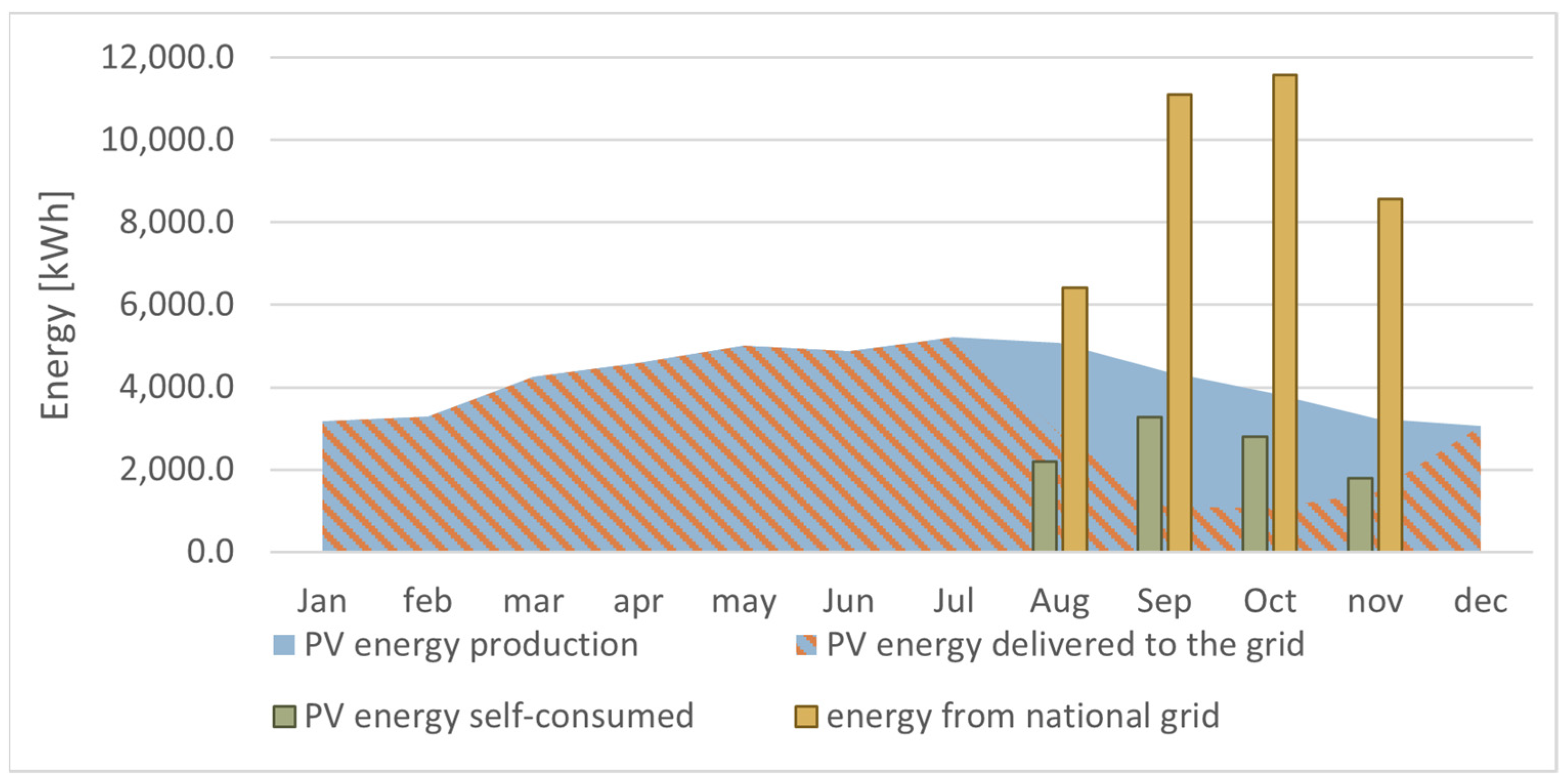
In the agri-food sector, Europe represents about 70% of the world’s olive oil production and about 50% of olive oil consumption. Its consumption is progressively increasing in non-Mediterranean countries, with a contribution of 32% to global demand. In this context, olive oil requires specific sustainable processes and facilities [4]. The relevance of modernisation and energy efficiency for olive oil mills is demonstrated by the existence of government funding programmes (e.g., PNRR—Mission 2 Component 1 (M2C1)—Investment 2.3—Innovation and mechanization in the agri-food sector) to increase sustainability, mechanisation, and efficiency in these buildings. In detail, with 4.475 active olive mills and 273.500 t/y of olive oil production [5], the olive oil industry has a significant role within the Italian agro-industrial sector. Italy has historically occupied a position at the global forefront of olive oil production and export, and 71% of the total olive oil exported is Extra Virgin Olive Oil (EVOO) [6]. Therefore, Italian scientific literature in the field of olive oil production optimisation and olive oil quality is very rich [7,8,9,10]. Recent reports by the ISMEA have indicated a substantial increase in production costs, with a doubling of expenses observed between 2022 and 2023. This cost growth is attributable to multiple factors, one of which is that EVOO production involves a series of energy-intensive processes, including pressing, extraction, and separation. Indeed, energy costs have increased considerably in recent years, with this rise being attributed to a number of factors, including the pandemic and the ongoing conflict between Russia and Ukraine. In this contest, Italian norms define “agrisolar system” as PV installations with power ranging from 6 kWp to 1 MWp, located on the buildings’ roofs for productive use in the agricultural, livestock, and agro-industrial sectors, thus avoiding land consumption for energy production [11]. This energy system can be referred to both stand-alone (energy production plants not connected to the national grid.) and grid-connected (energy production plants connected to the national grid. These systems deliver energy in output to the national grid within the exciding production, and import energy from the grid when the production is lower than the consumption) PV systems integrated with a battery energy storage system (BESS). In detail, PV plant installation on olive oil mill rooftop might have a role in the renewable energy production, reducing dependence on fossil sources. Regarding the profitability of introducing PV systems in agro-industrial activities, D’Adamo et al. [12] presented evidence indicating that incentives offered by the Italian policy can make the agrisolar park a financially viable enterprise and support an agro-industrial activity by providing energy for olive oil milling. However, the environmental assessment of that study did not specialize in simulation and consumption profiles for a specific agro-industrial activity. Analysing energy consumption is crucial for enhancing olive mill competitiveness and mitigating environmental impacts. Despite the increasing popularity of sustainable energy generation methods, mainly based on biomass valorisation, research on the utilisation of PV technology within the olive oil industry remains limited in the scientific literature. This can be attributed to the fact that olive oil production, as many other agro-industrial activities, is strongly seasonal and discontinued. In particular, most of the energy consumed by the olive mills is concentrated within a limited timeframe each year, which coincides with the lowest yield periods for a PV plant (Figure 1). A strategy for covering the energy consumption of a mill equipped with a PV plant may consider an energy mix of PV energy and energy from the national grid (NG). Therefore, environmental impacts of this energy mix would vary depending on the specific energy mix considered. Indeed, it is recognised as being of significant importance to undertake a rigorous evaluation of the sustainability of PV systems design, and it is necessary to investigate it in the context of agro-industrial activities production [13].
From the building perspective, the oil mill exhibits two key advantages for the installation of PV rooftops. Primarily, in this kind of industrial building, the installation of roof vents is not recommended, thereby allowing for full exploitation of the roof area [14]. Indeed, available rooftop area has been identified as a crucial limiting factor in PV technology exploitation [15]. Moreover, mills generally have cantilevering roofs to protect the olives during the delivery phase. These construction elements make a greater surface available for PV panel installation. A preliminary study has demonstrated that in optimal conditions for PV energy production, namely south exposure of rooftop and large available area on olive mill roof, the grid-connected PV system may achieve a Carbon footprint (CF) reduction of 86.8% (in Lombardy, northern Italy) to 91.4% (in Sicily, southern Italy) [16]. Furthermore, since olive mills are usually located near the production area, which is generally outside urban settlements, rooftop PV systems experience substantially less shading, thus resulting in improved performance [17].
Figure 1. Mismatch between photovoltaic (PV) energy production and olive mill energy consumption. This diagram highlights the energy consumption from national grid in the months when the contribution of photovoltaic energy is insufficient (Adapted from: [16]).
Cleantechnol 07 00091 g001
In the scientific literature, Rabaza et al. [18] quantified the amount of renewable energy produced by theoretical grid-connected PV systems suitable to reduce the kgCO2eq related to electrical energy consumption of the mill. In detail, they found that a reduction of up to 16.7% of equivalent CO2 emissions can be achieved in small oil mills (i.e., less than 1000 t of olive oil produced in a year), while 3.6% in medium oil mills (i.e., from 1000 to 5000 t of olive oil yearly production), and up to 9% in large oil mills (i.e., more than 5000 t of olive oil produced). However, the consumption profile proposed in that study is very different from the Italian electric energy consumption one, and the evaluation of energy self-consumption was not replicable in other simulations due to the limited details provided by the authors. In particular, the energy consumption was analysed on a monthly basis, and the PV plant features were not specified (i.e., PV modules exposure). In addition, the methodology applied for the kgCO2 assessment was not straightforward. In detail, the authors multiplied a value of the electrical energy characterisation factor, found in the literature, by the total amount of kWh produced by the PV. Furthermore, they did not consider the implementation of a BESS. Those two simplifications reduced the accuracy of environmental impact evaluation.
As evident in the literature, hourly-based simulation details are typically required in renewable energy management evaluation [19,20,21]. Indeed, this kind of granularity is deemed adequate for the purpose of considering the imbalance between energy demand and supply. It is well known that overall issues related to the sustainability of renewable energy encompass the stability of the NG. In recent years, efforts have been oriented to optimisation of energy system management, particularly to improve grid robustness [22,23,24]. Zhang et al. [25] proposed a decision-making tool to plan the construction and connection of new large rooftop PV systems, accounting for indicators of grid robustness and environmental parameters. Although these kinds of optimisation paths are outside the scope of this study, it is essential to understand that storage and self-consumption have been identified as primary solutions to mitigate grid instability and enhance the sustainability of electrical energy consumption from an environmental perspective [26]. Optimal management of the interaction between a PV system, NG, and a BESS represents the main step to overcome the intermittence of renewable energy sources, thus enhancing environmental sustainability [19,21]. In this regard, economic evaluations of storage integration have also been carried out. A recent study assessed the Levelized Cost of Storage of battery energy storage systems deployed for photovoltaic curtailment mitigation, highlighting that batteries are effective in reducing energy losses, but their cost competitiveness strongly depends on technological progress and lifetime performance [21].

1.1. Environmental Analysis and Trade-Off

Based on the literature, CF is the main recognised and widespread methodology applied to analyse GHG emissions. It is derived from the application of the Life Cycle Assessment (LCA), described in the ISO 14040 series standards [27]. In the assessment of agro-industrial production chains, the application of LCA methodologies facilitates the identification of critical points and potential areas for improvement. Moreover, the comparison of different scenarios via LCA is an important decision-making tool for selecting optimised resource management strategies, providing the means for input reduction and the enhancement of their environmental performance.
The fossil fuel consumption and greenhouse gas (GHG) emissions are relevant when considering PV plant and energy production system sustainability. Indeed, PV systems and other renewable energy production systems are primarily designed with the aim of reducing GHG emissions [28]. In this regard, Paini et al. [29] demonstrated that supplying 50% of the energy mix from PV in a highly energy-intensive system is not sufficient to reduce the overall impact of the system. The study examined the electrical energy consumption and the associated environmental impacts of the diced tomato sterilisation and diced peach pasteurisation for representative food processing facilities in Italy and Australia. The scenario including the PV energy consumption resulted more impactful outcome than the scenario when energy is supplied by the NG, in all analysed categories (i.e., global warming, terrestrial acidification, freshwater eutrophication, land use, fossil resource scarcity, and water consumption), due to the environmental impact of the PV system components. In this instance, the study presented aggregate outcomes in terms of energy consumption and CF impacts, thereby diminishing the replicability of the simulation. A recent study by [30] about PV systems sustainability assessed how the major contributors to climate change for each kWh produced are the PV modules (with a total CF ranging from 37 to 66 kgCO2 eq kWh−1), followed by mounting systems, inverters, and electrical installation. If we look at mineral resource depletion, modules are the major contributors. Still, inverters are the second contributors, showing a lower value of resource consumption compared to that of modules. Nevertheless, although a BESS storage system may favour the increase of self-consumption of renewable energy, it adds several non-negligible environmental impacts to the overall system due to the production and marketing of the batteries. In the literature [31,32], the environmental impacts due to the production, transport, and disposal phases of storage batteries are generally related to the GWP analysed by the CF computation; less frequently, environmental impacts related to resource depletion and respiratory inorganics have been estimated, such as in a multi-impact LCA performed by Paul et al. [33]. Therefore, a careful analysis of environmental impact assessment is required for PV systems, especially when integrated into production buildings.
The scientific literature, based on LCA studies, widely demonstrates the key role of PV and BESS systems in the energy transition. Da Silva Lima et al. [34] used the ReCiPe 2016 Midpoint (H) calculation method to demonstrate the sustainability of these kinds of systems. Notably, 1 MWh of electricity (AC) delivered by battery fulfilled by renewable energy (PV or wind) over 20 years is less impactful than the energy delivered from the national grid in at least seven impact categories: global warming (GW), fine particulate matter formation (FPMF), terrestrial acidification (TA), mineral resource scarcity (MRS), fossil resource scarcity (FRS) and human toxicity (HT), the latter considering both carcinogenic and non-carcinogenic. Cumulative energy demand (CED) is also considered as an impact category and covers the energy demand for renewables (biomass, water, wind, solar, and geothermal) and non-renewables (fossil, biomass, and nuclear). Yudhistira et al. [35] conducted an insightful analysis through Ecoinvent database by assessing the environmental impacts of different types of batteries. The results showed that, considering a delivered energy of 4800 Kwh during the battery lifetime, the environmental impacts of all the batteries analysed (namely nickel cobalt aluminium, lithium iron phosphate, nickel manganese cobalt, and lead-acid battery) are considerably lower than energy delivered from the national grid. In particular, the nickel cobalt aluminium battery had the lowest environmental impact for GW (2.29 × 10⁻⁴ kgCO2 eq) and FRS (3.79 × 10⁻³ MJ), while the lithium iron phosphate had the best performance for mineral resource depletion (1 × 10⁻⁸).
Another important trend to consider in the field of battery environmental sustainability is the possibility of giving batteries a second life. A study from Roslan et al. [36] presented a comprehensive review of second-life lithium-ion batteries, focusing on the dominant degradation processes and the range of state-of-capacity estimation techniques, with a critical evaluation of each method in terms of implementation requirements, accuracy, strengths, and limitations. However, they also emphasized persistent challenges that hinder large-scale deployment, particularly the lack of reliable and standardized capacity assessment methods. These insights clarify both the opportunities and limitations of second-life batteries, offering valuable context for their technological and commercial maturation. In parallel, attention to the recycling of PV systems and the integration of circular economy principles in the energy production field is increasing, as demonstrated by several European-funded projects specifically dedicated to innovation in PV module recycling [37,38,39].
The LCA approach, applied in all those studies, requires deconstructing the life cycle of a product into different phases. In a “cradle-to-grave” approach, the agro-industrial product life cycle is composed of agricultural phase, primary transport to transformation plant, transformation process and packaging, distribution, and consumption. When looking at an agro-industrial product, it is therefore common to look at a subset of the entire “cradle-to-grave” cycle by using a “gate-to-gate” approach”, i.e., analyse only the transformation process and packaging [40,41]. In the context of olive oil mills, LCA and CF have been previously applied to find environmental hotspots in the supply chain [42], investigate the EVOO by-products valorisation strategies [43], and the associated sustainability issues [44].

1.2. Novelties and Specific Objectives

Based on the literature background presented, the following research gaps have been identified:
  • Limited investigation of agrisolar systems involving PV applications in olive oil production and a limited understanding of their potential in the agro-industrial sector;
  • Lack of an in-depth analysis of agro-industrial energy consumption based on hourly evaluation and for the related under-explored use of intermittent renewable sources;
  • Lack of an accurate methodology to assess the environmental impact of the agro-industrial energy system;
  • The utilisation of BESS and PV systems within olive mills represents a strategy for the integration of renewable energy in agro-industrial activities that has not yet been explored.
On these premises, the primary aim of this study was to investigate the interaction between PV system, NG, and BESS through the evaluation of the CF of EVOO production processes, related to agrisolar systems, where rooftop grid-connected PV plants supply part of the required electrical energy.
The literature background poses unique challenges in this sector on how the use of renewable energy in different existing olive mills can contribute to the CF reduction.
The main novelties of this research paper, related to these challenges, can be summarised in five points:
  • Firstly, this study applies the CF methodology for evaluating PV energy potential in mitigating carbon emissions for agro-industrial activities.
  • PV and BESS integration in the context of existing olive oil mills is studied by defining a practical and replicable methodology for integrating renewable energy sources into existing agro-industrial activities.
  • Another novel methodological approach is represented by the site-specific evaluation of PV energy production within critical factors assessment, rather than relying solely on pre-formulated PV system data from LCA databases.
  • The development of an hourly energy consumption evaluation algorithm and the application of CF methodology provide a replicable framework for other agro-industrial facilities.
Connected to these novelties and to achieve the main goal of this paper, a study has been developed to assess the environmental performance of three different configurations of an agrisolar system: the first one considers the olive mill energy performance when the electrical consumption is covered only by NG; the second system involves the utilisation of a PV grid-connected plant on the existing mill rooftop; and the third one analyses the PV plant integrated with a BESS, named PV+BESS hereafter.
In detail, the specific objectives of this study encompassed the following steps:
  • defining PV and BESS design parameters, to minimise the CF of EVOO production;
  • implementing an algorithm to simulate PV+BESS system interaction on an hourly basis;
  • performing an overall assessment of optimal conditions for reducing CF in EVOO production, with regard to the PV and PV+BESS system.

2. Materials and Methods

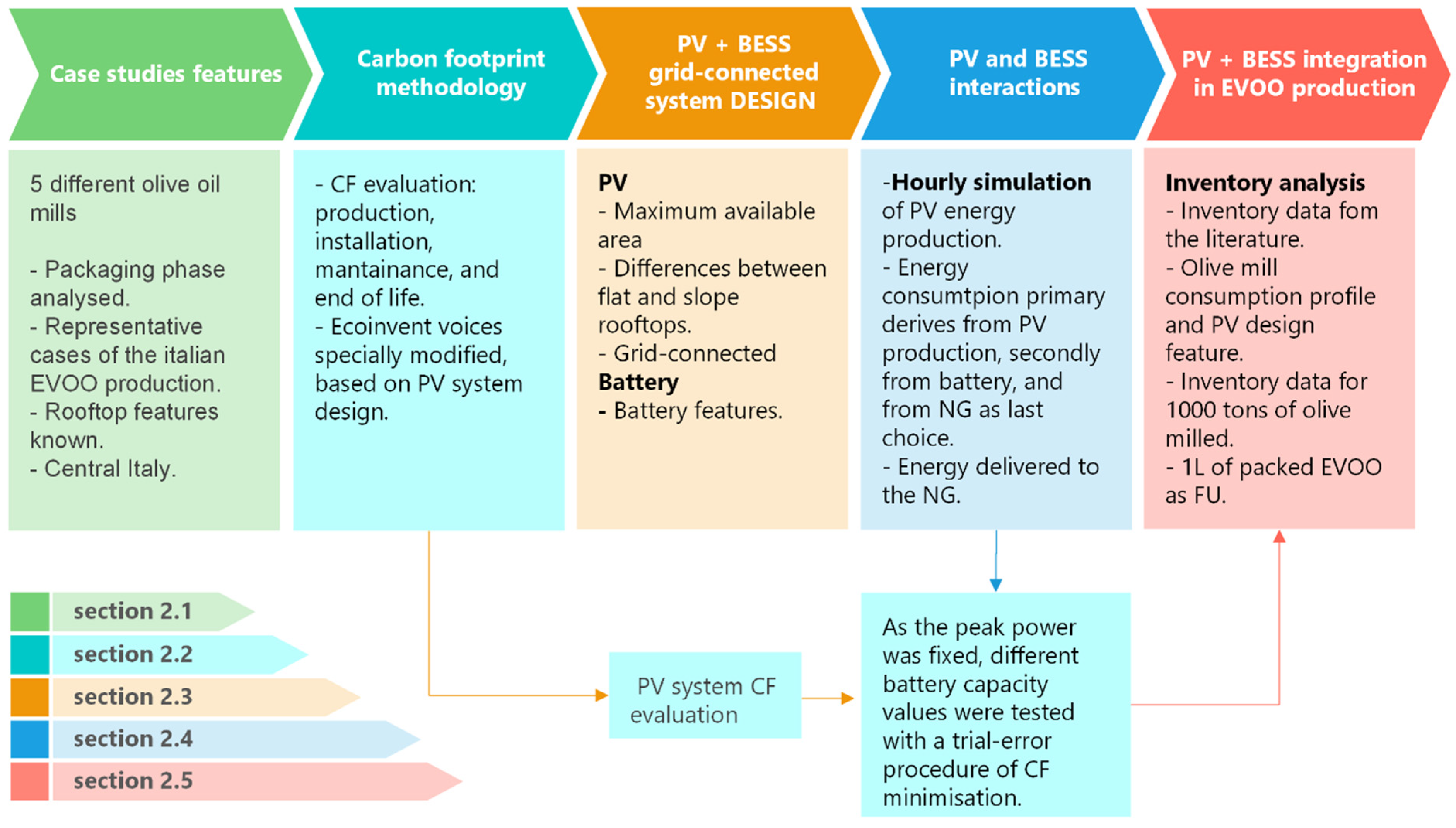
The steps of the methodology for the CF calculation are presented in Figure 2.:
  • The first step started from the definition of the case studies, described in Section 2.1, where data acquisition and software for solar irradiation (PVGIS) were included.
  • The second step encompassed the definition of CF methodology in its main features, namely the functional unit, CF software, system boundaries, and scenarios, described in Section 2.2. This research study developed a comparative approach between 3 different scenarios applied to specific case studies. In the baseline scenario, the mill is not energy-producing and thus relies on the NG for its energy requirements (SNG). The second and third scenarios involved a grid-connected PV system, where part of the energy consumed is taken from the grid and part of the energy produced is fed in. While in the second scenario (SPV), the energy produced and not immediately self-consumed is fed into the grid, in the third scenario (SPV+B), the energy not immediately self-consumed is stored in the battery for later consumption.
  • In the third step, main unitary features of the PV and BESS were defined, as described in Section 2.3. The parameters under consideration included the peak power of the panels, the dimensions, the power of the inverters, the mounting criterion, the lifetime, and the weight.
  • The fourth step in the process was the implementation of an algorithm that simulates the interaction between NG, PV, and BESS, as described in 2.4. This algorithm was designed to compute: the invariant of the self-consumed energy, the total energy produced by PV, the energy stored by the battery, and the energy fed into the grid. The sizing of the battery in the PV+BESS system is therefore determined by assuming the minimisation of CF in the SPV+B.
  • The fifth step was related to the implementation of the inventory, as described in Section 2.5. It consists of literature data from the actual case studies and the energy quantities obtained as a result of the implementation of the algorithm.

2.1. Data Acquisition and Software

The research objectives were developed from case studies in the literature. In detail, the production characteristics of olive oil mills and the related energy consumption were taken from the data presented in the study by Pattara et al. [45], where 5 case studies were related to the production systems of 5 different mills located in Abruzzi (Central Italy). The main features of these mills are shown in Table 1.
The case studies described in the work of Pattara et al. [45] were chosen on the following basis, which are fundamental premises to the research objectives:
  • The industrial phase includes primary and secondary packaging. In this regard, previous studies have shown how this is a particularly energy-intensive phase that contributes significantly to GHG emissions [44,46,47]. In this study, the utilisation of the aforementioned packaging data facilitated the formulation of more in-depth assessments of the reduction in the PV system impact.
  • The mills have been geo-localised; thus, the location of the existing buildings under study provided an opportunity to examine the feasibility of simulating the location of agrisolar systems on their rooftops. However, the irradiation conditions are generally sub-optimal due to the orientation, slope, and size of the roof of the existing agro-industrial buildings.
  • Electricity consumption data were measured in situ by using a multimeter installed at the electrical control. This methodology enabled the analysis of activities related to olive oil processing, while excluding those related to air conditioning and lighting. This approach also ensured the reduction of errors due to estimation of energy consumption.
  • The case studies include different technological and structural peculiarities, quite representative of a variety that can be found in Italy and all over the world. They differ among themselves, for instance, in the extension of the cultivated fields, harvesting methods, oil extraction techniques, size of the mill, and packaging adopted. All these characteristics have an impact on the farm’s consumption profile, to the extent that a higher production volume leads to lower energy expenditure per unit of production, but equally, different techniques have different consumption characteristics. For example, 2-phase extraction requires less energy consumption than 3-phase but only for high production volumes [41,48].
  • The oil mills are located in central Italy, so they represent a good trade-off of the average conditions in terms of energy performance between the North of Italy, where energy production would be lower, and the South of Italy, where increased energy production would increase the total performance of the energy system, thus reducing CF.
In the context of the present study, the “sub-optimal conditions” that contribute to the less favourable environmental implications of installing a PV system were examined, considering real conditions in the analyses. These conditions include:
-
Orientation, slope, latitude, and roof area available. These are all conditions related to the structure of the agro-industrial building and the geographical location. Optimal conditions at the latitude of approximately 42°N (Abruzzi), as earlier mentioned, would require a southern exposure with a slope of approximately 35°;
-
Installation and maintenance constitute another type of dimensional problem. In fact, the plant layout must provide the necessary space for professional installation and maintenance activities, thus producing a reduction in the usable surface area of the PV system;
-
The percentage of self-consumed renewable energy compared to that supplied by the NG. It depends on the typical consumption profile of the mill, the production method used, and the presence of a BESS.
After having defined the case studies, data for each mill have been acquired. In detail, the hourly solar irradiation data, air temperature, and sun height were obtained by the open-access software PVGIS web application version 5.3 [49]. This software was chosen since it makes available historical data from 2005 to 2023, and it is a tool recognised by Italian legislation and the scientific literature [50,51,52]. Based on these data, the energy production of the PV system was obtained by using a multi-parameter model, refined and validated by several authors [53,54,55]. This model considers the interaction among parameters deriving from the PV modules, the solar irradiation, the external air temperature, and the module temperature.
When radiant energy interacts with the surface of a PV module, a portion of it is reflected away from the module without entering it. For the majority of module types, the amount of radiant energy reflected away increases when the incident angle of the light to the panel surface is acute. For instance, when the incident ray is nearly parallel to the surface of the module, almost all the radiant energy is reflected away. This phenomenon is quantified by using a mathematical model described in the study of Martin and Ruiz [56]. In Italy, the resulting annual losses are approximately equal to −2.5%.

2.2. Scenarios and CF Computation Methodology

SimaPro v9.6 software, coupled with EcoInvent v3.10 database, was used for the CF computation. The functional unit (FU), selected in this study, was 1 L of EVOO with primary and secondary packaging (LEVOOp hereafter). The IPCC 2021 GWP 100a V1.03 method for the CF computation was chosen as it is the last updated version.
  • Three different scenarios were analysed for each case study:
  • SNG: Ec only supplied by ENG,
  • SPV: Ec supplied by ENG and EPV mix,
  • SPV+B: Ec supplied by ENG, EPV, and EB.
In these scenarios, the Environmental impact of PV systems and BESS was considered to depend on the production, installation, maintenance, and end-of-life of PV plant components, the fossil energy avoided in the production activity, and battery production and transportation.
Since the environmental impact of ENG depends on the national energy mix, the CF of the energy mix utilised by the olive mill in the SNG scenario is a function of the low-voltage energy supplied by the NG (ENG). Conversely, in the SPV scenario, CF is a linear combination of the GHG emissions due to the energy produced by PV (EPV) and withdrawn from NG. The CF of the SPV+B scenario accounted for GHG emissions due to EPV, the BESS dimensions, and the national energy mix. In detail, in scenarios SPV and SPV+B, the Environmental impact of PV systems and BESS was considered to depend on the production, installation, maintenance, and end-of-life of PV plant components, the fossil energy avoided in the production activity, and battery production and transportation. In the simulations described in this study for the SPV and SPV+B scenarios, the renewable energy ER included only the energy produced and self-consumed by the mill, considering the energy fed into the grid separately. The energy delivered to the NG (EOut) can be considered a co-product of the olive mill that would prevent other consumers from consuming fossil fuel due to the energy coming from NG.
EcoInvent records utilised for PV system and battery impacts computation were specially modified to take into account the energy produced by the PV system, considering the location of the mills in Abruzzi. In detail, the EcoInvent record named “electricity production, photovoltaic, 3 kWp slanted-roof installation, single-Si, panel, mounted” (CFPV), which takes into account the activity “photovoltaic slanted-roof installation, 3 kWp, single-Si, panel, mounted, on roof” (IPV) measured in units [p] was modified. The amount of “p” for this last activity reported in the PV electricity production, named pPV hereafter, was calculated as the unit/kWh from Equation (1):
I P V = L i f e t i m e c a p a c i t y a n n u a l   y i e l d
deriving from the unit analysis shown in Equation (2) (EcoInvent 3.10):
y k W p u n i t k W h k W p y = k W h u n i t = 1 p P V
Moreover, to calculate the environmental impact share associated with the battery (IBESS), it is necessary to follow Equation (3):
I B E S S = W B 10 Q o l i v e s
where WB is the battery total weight, 10 is the battery lifecycle expressed in years, and Qolives is the number of olives milled in a year expressed in ton y−1. This method is applied to determine the battery weight, expressed in kilograms, which is then used to relate the weight to each ton of olive milled over a 10-year period. A factor Cb [kgCO2eq] is considered to represent the amount of equivalent CO2 produced for battery production, transportation, and dismission. Thus, the CF associated with BESS usage was determined as:
C F B = I B E S S C b
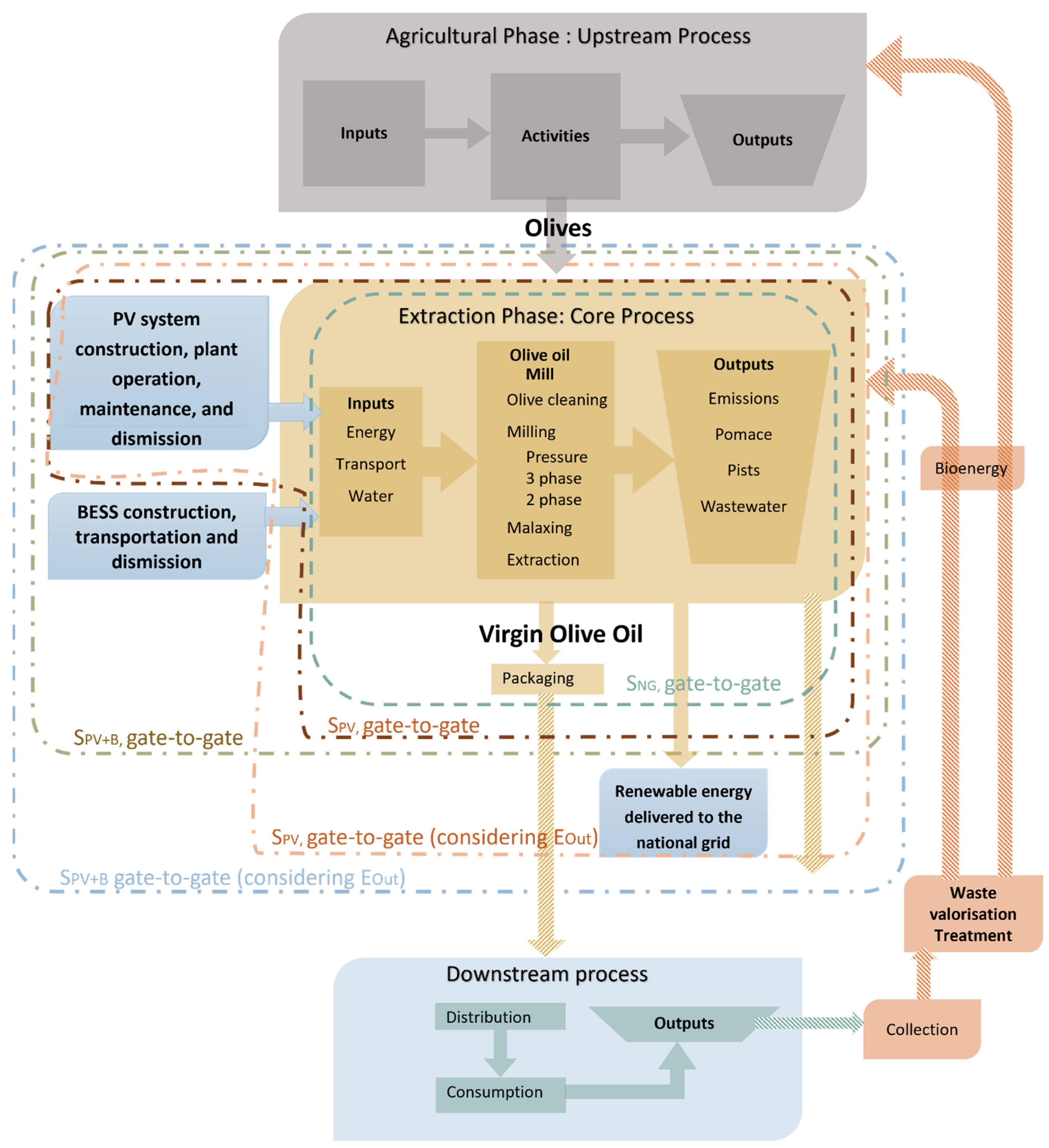
In this study, the CF system boundaries were set as gate-to-gate in an attributional approach [57], by considering the olive oil extraction and the packaging at the olive oil mill. Indeed, the energy produced by the PV plant on the mill roof affects only the environmental impacts of the industrial phase (Figure 3). As can be seen in Figure 3, everything outside the dotted line is left outside the boundaries. For the PV system and BESS, all life cycle phases were taken into account from the modules, inverter, and mounting structures production, and the installation and dismission.
The contribution in CF of the renewable energy delivered to the NG (EOut) was calculated taking into account the climate change impact of grid electricity at the demand side (CFNG) as recommended in Frischknecht et al. [58]. Thus, in detail, the amount of CO2eq is described by Equation (5). In the case of olive oil mill here analysed, C F E O u t assumed a negative value which was considered as an avoided GHG emission:
C F E O u t = E O u t C F P V + C F B C F N G
The energy supplied to the NG avoids the consumption of the national low voltage energy mix by users. Consequently, EOut can be regarded as an additional by-product derived from the oil mill, thereby facilitating a reduction in the environmental impact of each litre of oil. However, the reduction in environmental impact due to EOut is much greater than the reduction due to self-consumption of energy from PV+BESS. The primary reason for this occurrence is that the majority of the energy produced by PV during the year is fed into the grid. Moreover, the evaluation of CF reduction is dependent upon the consideration of avoided national mix energy consumption. Conversely, the energy self-consumed by the battery also considers the impact of the battery itself. Consequently, the installation of a battery in a mill frequently results in an unfavourable environmental outcome. In real terms, the battery reduces the feed-in by facilitating self-consumption when the PV is no longer producing. The utilisation of the battery is the only means of ascertaining the location and timing of electrical energy consumption. Indeed, there is a lack of data regarding the amount of EOut consumed in the proximity of the same electrical substation, and the amount of energy that needs to be transformed from low to medium voltage and from medium to high voltage. Moreover, it is imperative to acknowledge that most of the energy fed into the grid must be stored in ancillary storage systems that support the grid [59]. Indeed, this energy might not be consumed immediately. These systems introduce numerous environmental impacts, including energy transportation, transformation, and transformation losses, as well as battery operation and production. It is important to note that this is not considered within a simple characterisation factor according to which energy fed into the grid always reduces the CF by the value of CFNG. Consequently, the evaluation of the CF of oil production in a PV+BESS system must consider this complexity when estimating the environmental impact of the energy. To address these challenges, in the scenario SPV+B, this study proposes a range of results, spanning from the value of kgCO2eq that does not consider energy in Output in a consequential approach [57], to the amount of kgCO2eq that includes energy in EOut as a factor that mitigates olive oil CF. The first value indicates the CF of a system where all non-self-consumed energy is lost (maximum possible CF), while the second value corresponds to a system where non-self-consumed energy is fed into the grid and consumed in the vicinity of the mill (minimum possible CF value).

2.3. Photovoltaic System and Battery Specifications

This section provides PV and BESS features utilised as input data for the PV and PV+BESS system. Specifications of the PV system in scenarios SPV and SPV+B for each case study are the following:
  • Grid-connected PV system;
  • Single-Si modules of 1 × 1.9 (m × m);
  • PV panels feature: 30-year lifetime 0.43 kWp Solar panels, and 15-year lifetime inverters (from 2.5 to 50 kW) with yearly maintenance;
  • Total energy losses of the system, caused by losses in cables, power inverters, dirt (e.g., particulate matter, snow, and sand) on the modules, and loss of module power over the years, are set at 14%;
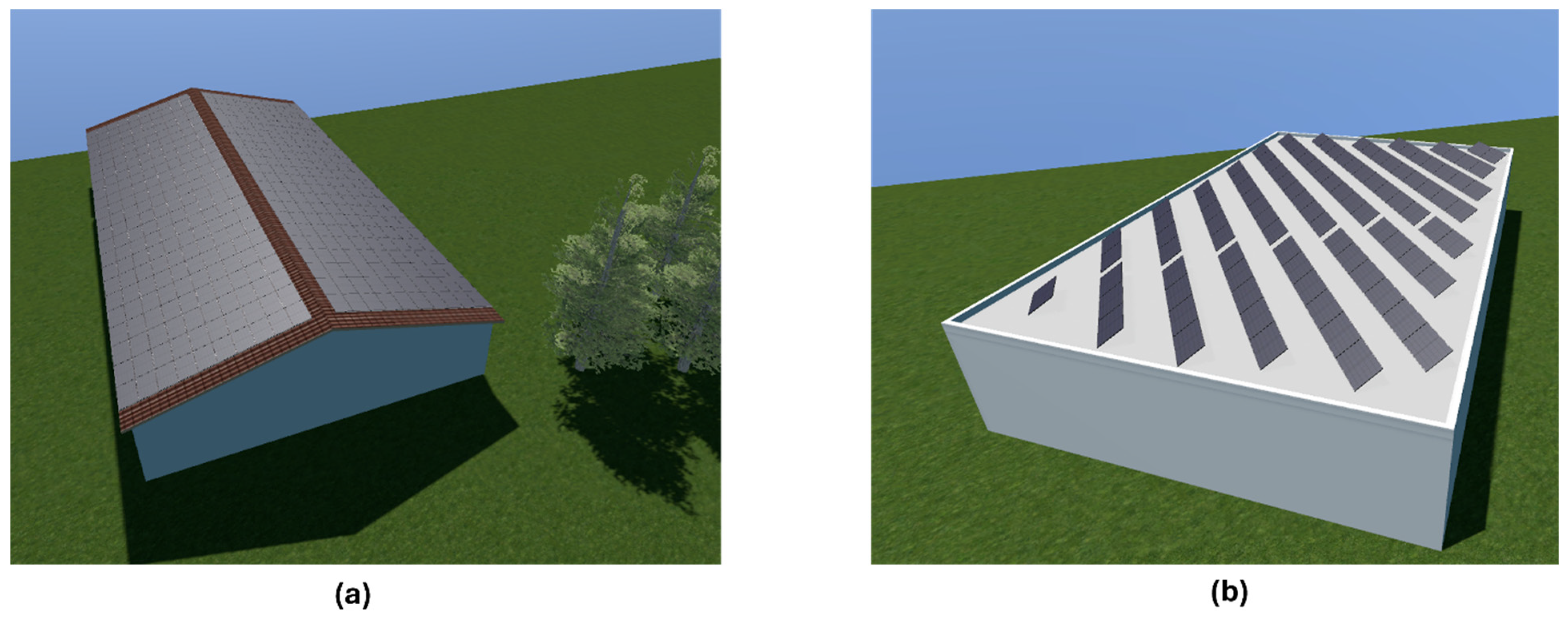
  • In the case of slope roofs, the modules are installed to occupy the maximum available area [22], leaving logistical space for electrical connection and maintenance (Figure 4a), as required by best engineering practice;
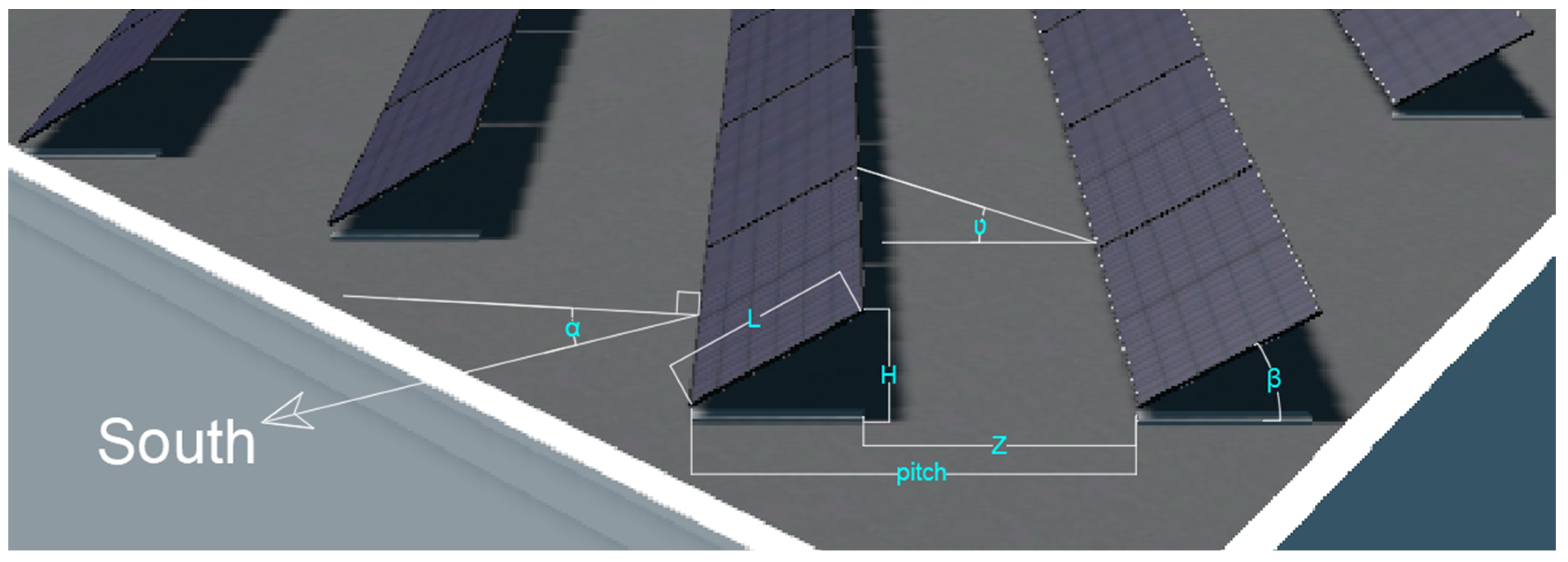
  • For the flat rooftop system (Figure 4b), the modules are installed with a 2 m pitch, defined by the distance between the centres of the modules, in such a way that the entire available area is occupied. The place between modules (Z) comes from the minimisation of the losses caused by module shadowing based on the solar height (υ) at the mean latitude of Abruzzi (φ = 42.102718), according to Equations (6) and (7):
υ = 90 φ + 23.27
Z = L S E N β S E N υ   
where Z is the distance between modules, L is module length, b is the module slope (Figure 5).
Optimum azimuth (α) and slope ( β ) were determined according to the relations by Mukisa and Zamora [20] reported in Equation (8):
β = 0.764   φ + 2.14 ° ,    φ < 65 °      0.224   φ + 33.65 ° ,   o t h e r w i s e
In Abruzzi, β is equal to 35° based on a mean latitude value of 42° 20′.
With regard to BESS in scenario SPV+B, the battery density was 0.114 kWh kg−1, and the life cycle was 10 years.
The criterion adopted for battery design was the lowest possible environmental impact. The lowest environmental impact value was determined by trial and error, based on the results of the interaction process simulations described in Section 2.3. The overall environmental impact of each scenario is determined by the energy required for the NG (ENG), the self-consumed ER, and the environmental impact associated with the battery. Consequently, a specific BESS capacity value in kWh was calculated for each case study.

2.4. Grid-Connected PV System, National Grid and Battery Interactions

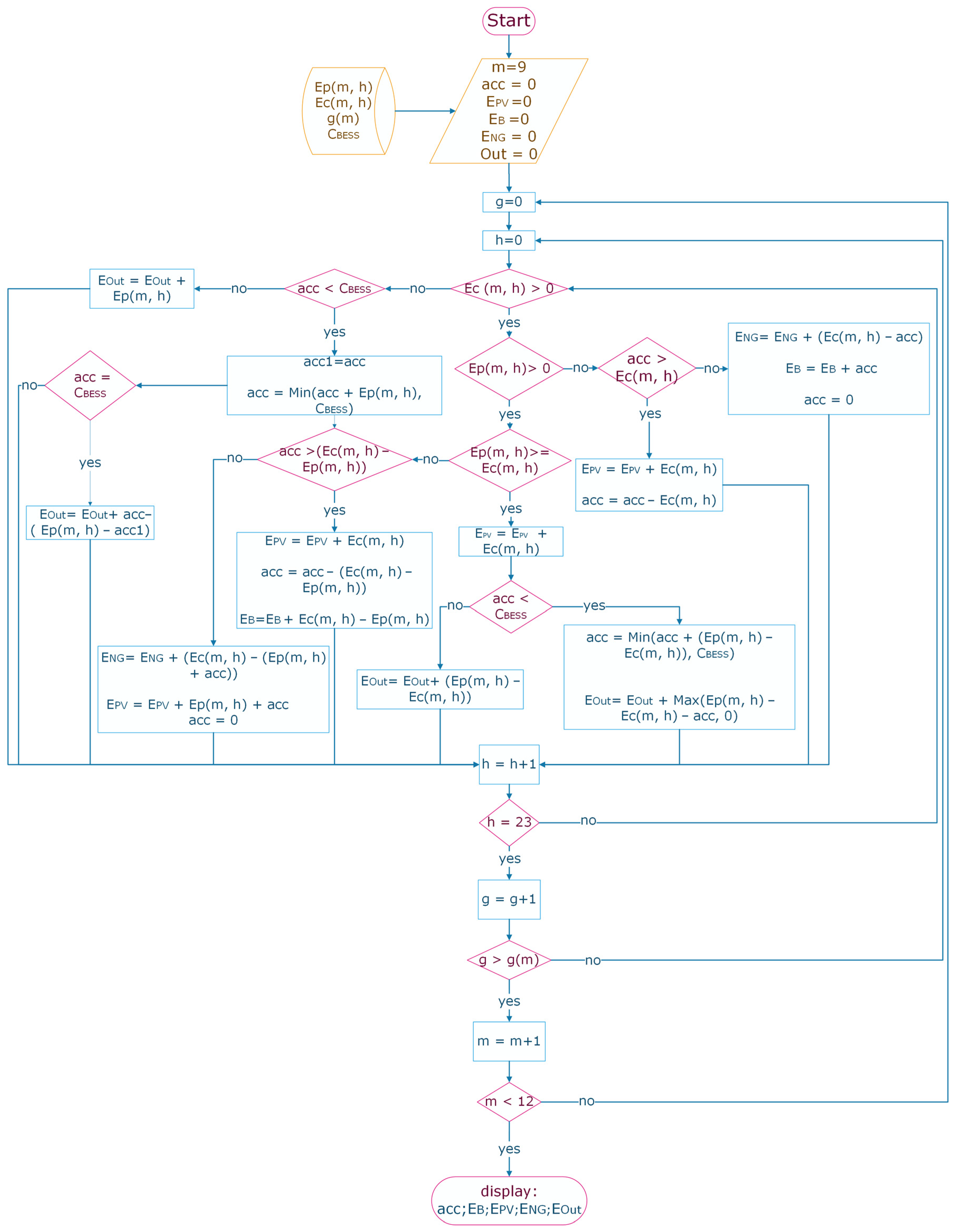
To perform simulations of PV+BESS interactions, an automatic routine was specifically developed in VBA language for Excel®. A flowchart of the energy management system is shown in Figure 6. The energy management system was simulated through the variables reported in Table 2.
The variables were initialised according to the following conditions or ranges of variation:
  • CBESS = Maximum battery state of charge in kWh. In the different simulations carried out, the CBESS value varied from 5 to 200 kWh in order to find the lowest environmental impact of the system.
  • acc = 0 indicates the initial state of charge of the battery.
  • ENG = 0 indicates the initial energy required from the NG.
  • EOut = 0 indicates the initial energy fed into the NG.
In relation to the simulation of working days, the model takes into account the olive harvesting and milling period in the Abruzzi region, wherein mill activity starts in mid-September and ends in December. Consequently, the energy simulation presented in Figure 6 refers to the months of activity considered, having the following number of working days for each month: as m increases from 9 to 12, the variable g_m(m) takes the values 15, 25, and 20, respectively.
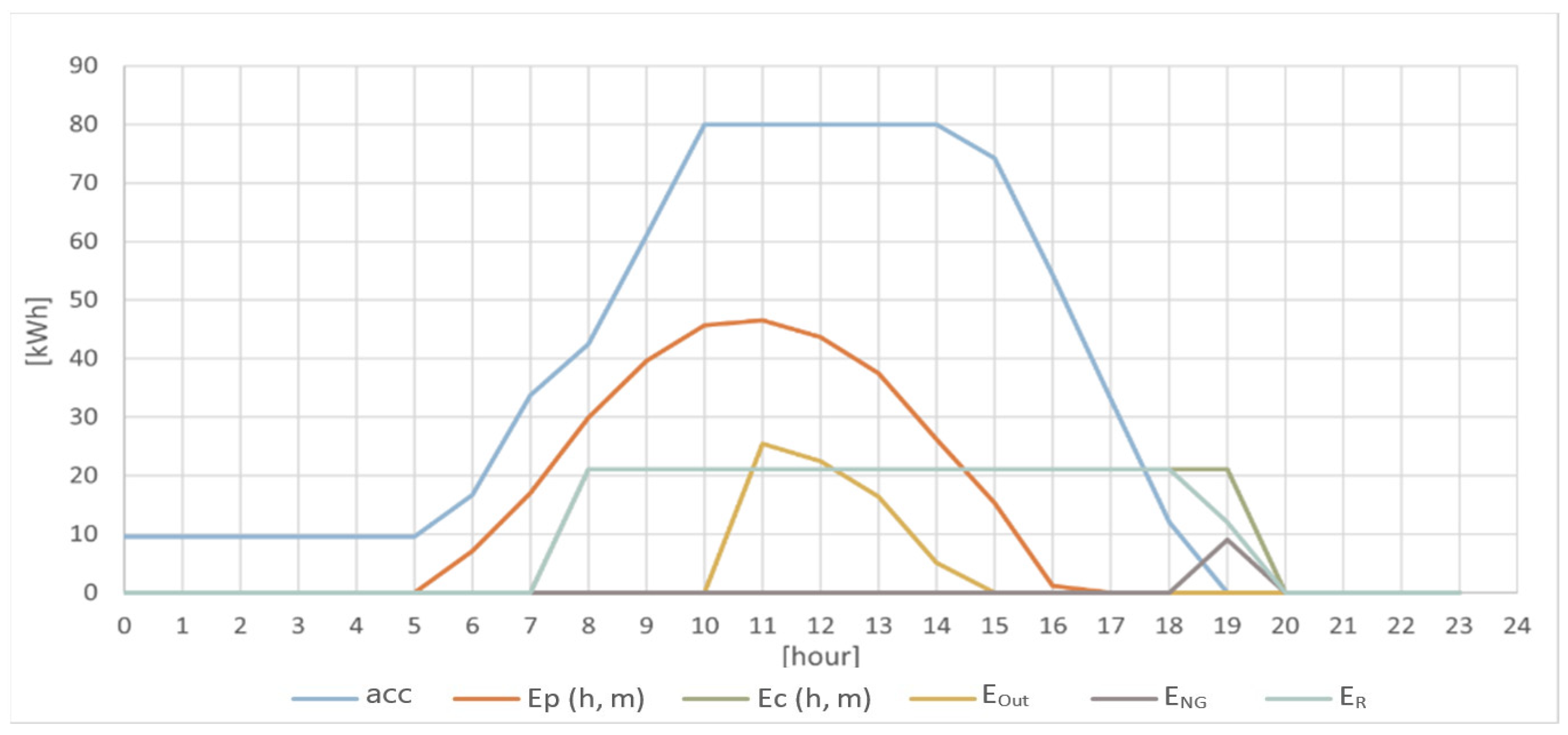
As soon as PV production data Ep(m, h), electric consumption Ec(m, h), and battery maximum capacity CBESS value were updated, the routine simulated the hourly energy pattern. An example of this management system is shown in Figure 7. Early in the morning, before the start of mill activity, when the PV is producing energy, this is stocked in BESS. The PV energy is given to the NG when the battery is charged to its maximum capacity. When the mill is in operation, priority is given to utilisation of the energy produced at the time, but if this is not sufficient, then energy is requested from the battery; if the sum of Ep(m, h) + acc is also not enough to meet the energy requirement Ec(m, h) then energy is requested from the grid (ENG). If, on the other hand, the energy production exceeds the energy demand and the battery is discharged, then the battery is charged; if the battery is charged, then the energy is transferred to the grid.
In the simulations described in this study, the ER includes only the energy produced and self-consumed by the mill, with energy fed into the grid being considered separately. The energy delivered to the NG (EOut) can be considered a co-product of the olive mill that would prevent other consumers from consuming fossil fuel due to the energy coming from NG.
The most important value to describe the CF reduction compared to the SNG scenario is the “covered energy needs” (CEN). This value is obtained by dividing renewable energy by the total energy consumed in a year, thus obtaining the percentage of renewable energy used to reduce the yearly energy needs (Equation (9)).
CEN = E R E C
The key assumptions and limitations in the simulation are as follows:
  • PV production and mill consumption were calculated and matched on an hourly basis, assuming that the typical daily load pattern repeats throughout the milling season (September–December).
  • The algorithm assumes that the hourly consumption profile is fixed within the milling season and does not account for daily variability due to processing delays or operational changes.
  • PV energy exceeding the battery storage capacity or instantaneous consumption is considered fed into the grid (EOut), with no curtailment.
  • Energy is first used to meet current consumption, then to charge the battery, and finally, any surplus is exported to the grid.
  • An overall 14% system loss was applied to annual PV output.
  • It is assumed that the objective is not to maximise the economic and financial indicators but to minimise the CF.
The seasonal variability in this study pertains to both the energy production side (PV generation, which varies significantly with solar irradiation throughout the year) and the consumption side (olive mill operations). Olive oil production is inherently seasonal, resulting in significant fluctuations in daily electricity consumption. Our simulation algorithm uses hourly profiles derived from actual consumption data measured during this operational period, but it assumes consistent repetition of these profiles throughout the milling season. Thus, the simulation captures average seasonal conditions and representative operational patterns but does not explicitly model day-to-day variability caused by external factors (e.g., harvest timing, weather disruptions, mechanical breakdowns). These limitations underline the importance of interpreting results as indicative of general performance rather than precise predictions of individual daily or annual scenarios.
More data about the mismatch between seasonal production and consumption are presented in the graphs reported in the Supplementary Materials (Figures S1–S5).

2.5. Inventory Analysis

In this section, data from the literature for the baseline scenario (SNG) were reported, and further elaboration on literature data is shown in Table 3, as they represent fundamental data on which CF results were calculated and reported in the Section 3. In detail, Table 3 shows the main olive mill structure features, energy consumption, and design data for PV system production. All this information was useful in designing different PV plants in relation to the different case studies, following the methodology described in Section 2.2 and Section 2.3. Moreover, these data were essential for comparing systems and assessing which conditions were favourable to reduce CF and which were not. Moreover, since Pattara et al. [45] referred all the inventory data to 1 ton of olives milled. Table 3 was completed by computing the amount of EVOO, expressed in litres, obtained by milling 1 ton of olives.
To obtain the geometric data needed to design the PV plants, the rooftop characteristics, namely rooftop available area, azimuth, and slope, were estimated from Google Earth, with a resolution of 0.3 m (ArcGIS [60]), thus resulting in a measurement error of 0.15 per dimension. Therefore, the rooftop available area shown in Table 3 has an error of 0.36 m2. The design of PV panels layout, the number of panels, plant power peak, and occupied area are reported in Section 2.2. The method for obtaining yearly energy production was explained in Section 2.1.
In Table 4, inventory data for the baseline scenario without PV plants (SNG) are reported. Inventory data for the other scenarios with renewable energy production (SPV and SPV+B) will be shown in the results session based on the results obtained from the simulation of Grid-connected PV system and battery interaction. Indeed, data from Section 3.1 provides inventory data for the electrical energy required in all case scenarios.

2.6. Economic Assessments

Although it is outside the main scope of the study, a supplementary economic analysis has been performed to provide a more comprehensive overview of the sustainability of the proposed solution. The key assumptions are an overall PV cost of 1200 k W h 1 and BESS cost of 600 k W h 1 (purchasing and installation), 0.08 k W h 1 of energy delivered revenue, and 0.20 k W h 1 for energy purchased from NG. Moreover, Operation and Maintenance (O&M) costs are considered to be 1% and 2% of the total initial costs for the SPV scenario and the SPV+B, respectively [12]. For each case and scenario, the payback time (PBT) is estimated for the case in which there are no incentives used, the case with 80% [61] incentives as provided by agrisolar law, and the case of 50% incentives, which is the current incentive active in Italy. Considering a battery lifetime of 10 years, the PBT should be less than this threshold to be considered economically sustainable

3. Results

In this section, results are presented in two phases related to simulations and CF computation. Firstly, the results from the simulation of the interaction between PV and battery systems are shown in tabular form in Section 3.1. Then the CFs of the different scenarios are presented for each case study in Section 3.2.

3.1. Simulation Results of Grid-Connected PV System and Battery Interaction

Table 5 shows the results of the PV and PV+ BESS system simulations for each case study. In Table 5, there are two different values of EOut produced by the system and delivered to the NG: EOut,tot represents the total amount of energy delivered to the NG; and EOut,act is the energy delivered to the NG in the days of olive oil extraction activity. The other variables are those described in Table 2. In Table 5, it is highlighted how the PV plants in cases 2 and 5, which produce more energy than the others (Table 3), supply much more energy to the NG (up to 9700 kWh) than in the other cases. Therefore, EOut,act is the highest in those two cases. In cases 1 and 3, EOut,tot is close to zero; in fact, a few kWh of renewable energy is delivered to the NG in days of mill activity. As it has been previously specified, the most significant data in determining the overall CF performance of the scenarios under investigation is the CEN value. Indeed, this can be utilised as an indicator of the effectiveness of the PV or PV+BESS system in an energy-intensive system. The highest value, equivalent to 84.7% of renewable energy used for olive oil production, is attained by case 2 in the scenario SPV+BESS. This is the result of a good trade-off between the battery capacity and the production trend of the PV system in relation to the consumption trend. Furthermore, in case 2, the energy consumed is lower than in the other cases due to the 2-phase processing method.
In the Supplementary Materials, the sensitivity analysis outcomes obtained from the energy simulations are illustrated (Figures S6–S10). This analysis explored how variations in BESS capacity influenced key performance indicators, including self-consumption rate, energy required from the battery, and energy consumed from the grid. Based on these results, the CBESS that provided the most balanced trade-off between enhanced renewable energy utilisation and system efficiency was selected. This selected capacity was then applied in the subsequent CF assessment (Table 5) to ensure that the environmental evaluation reflected an optimally configured PV+BESS system. This choice also considers potential environmental trade-offs, since increasing BESS capacity may reduce dependence on the national grid but can also raise the embodied impacts associated with battery manufacturing and disposal.
In Table 6, inventory data for the electrical energy are presented. Based on the number of olives milled in a year (Table 3), the inventory data per tonnes of olive milled (Table 6) were computed. In the baseline scenario SNG, the only energy accounted for was that provided by the NG, based on the Italian energy mix. In the PV scenario SPV, the computed electrical energy consumed in the olive mill activity is ENG and ER. For the PV+BESS scenario SPV+B, the CF of energy is related to a linear combination of ENG, ER, and the WB.

3.2. CF Results

In this section, CF results from each case study are shown and commented on. Moreover, in each case study, the worst condition for the PV plant has been highlighted.
When interpreting the results, it is important to distinguish between the two approaches applied to account for energy exported to the NG. In the Overall CF results, the energy exported during the olive mill activity period (EOut,act) is not considered as an avoided impact. Consequently, the CF remains positive in most case studies, as the exported energy is limited to the milling season. Moreover, the amount of kgCO2 by kWh of ENG is of comparable value to the total Energy CF, and it shows only positive values. In contrast, in the Overall CF considering EOut, the energy exported throughout the entire year (EOut,tot) is included as an avoided impact, even during the months when the mill is not active.

3.2.1. Case Study 1

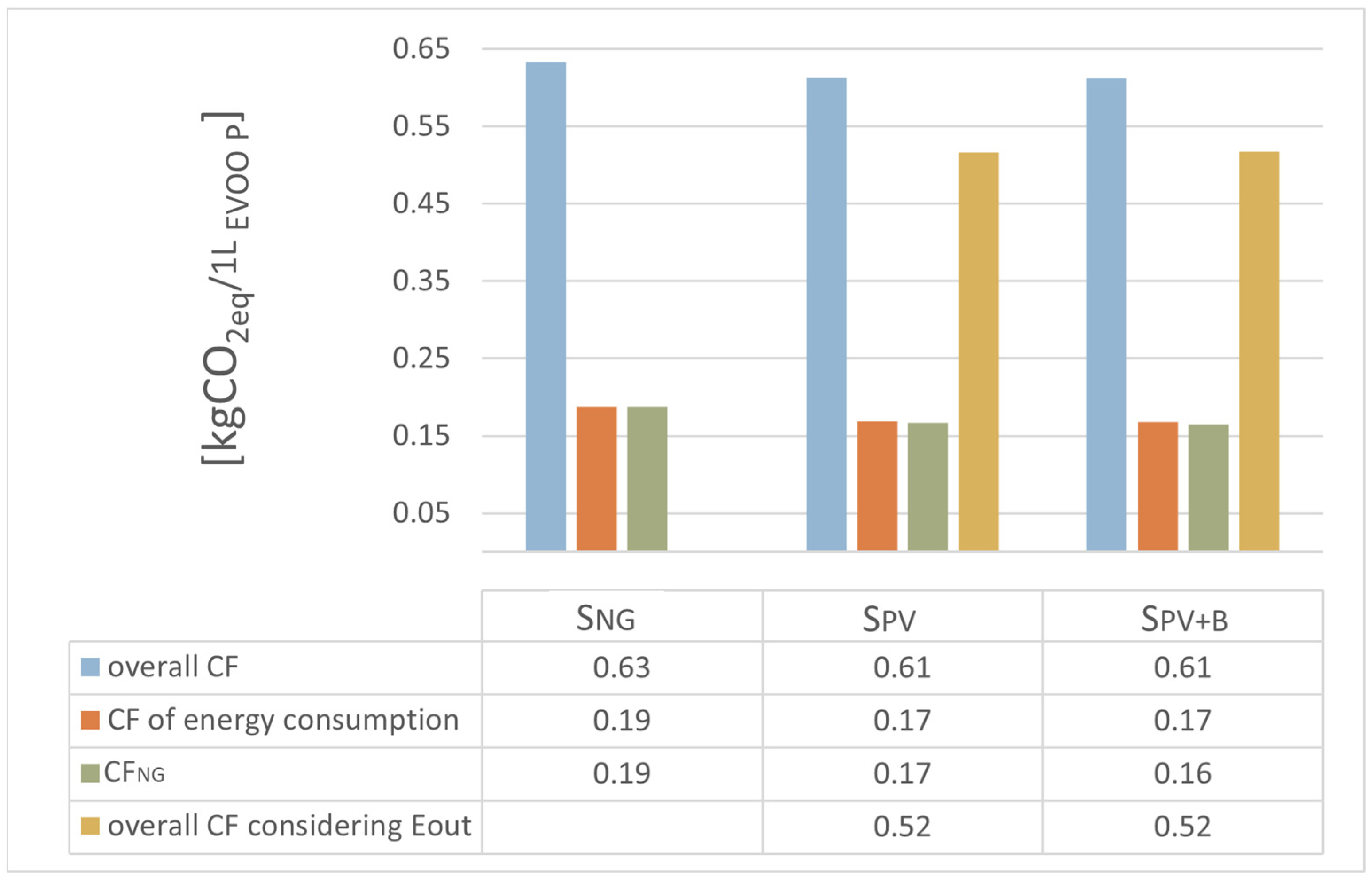
In this case study, the available area was insufficient to meet the requirements for covering a substantial portion of the energy consumption. Moreover, electrical energy consumption was very high because of the use of traditional press olive oil extraction. Those characteristics were used to design and simulate an undersized PV plant (15.48 kWp), which produced a low amount of ER and allowed for a small battery (5 kWh). Consequently, when the EOut,tot mitigation effect is not considered, the PV plant installation reduced the CF only by 3% both in the SPV and SPV+B scenarios compared to SNG, as shown in Figure 8. SPV and SPV+B had similar CFs because the battery capacity was very low. Indeed, as shown in Table 5, the value of covered energy needs remains very close in both SPV and SPV+B scenarios (11% and 11.9%, respectively). Better results were obtained when considering EOut contribution to the overall CF (−18% both in SPV and SPV+B).

3.2.2. Case Study 2

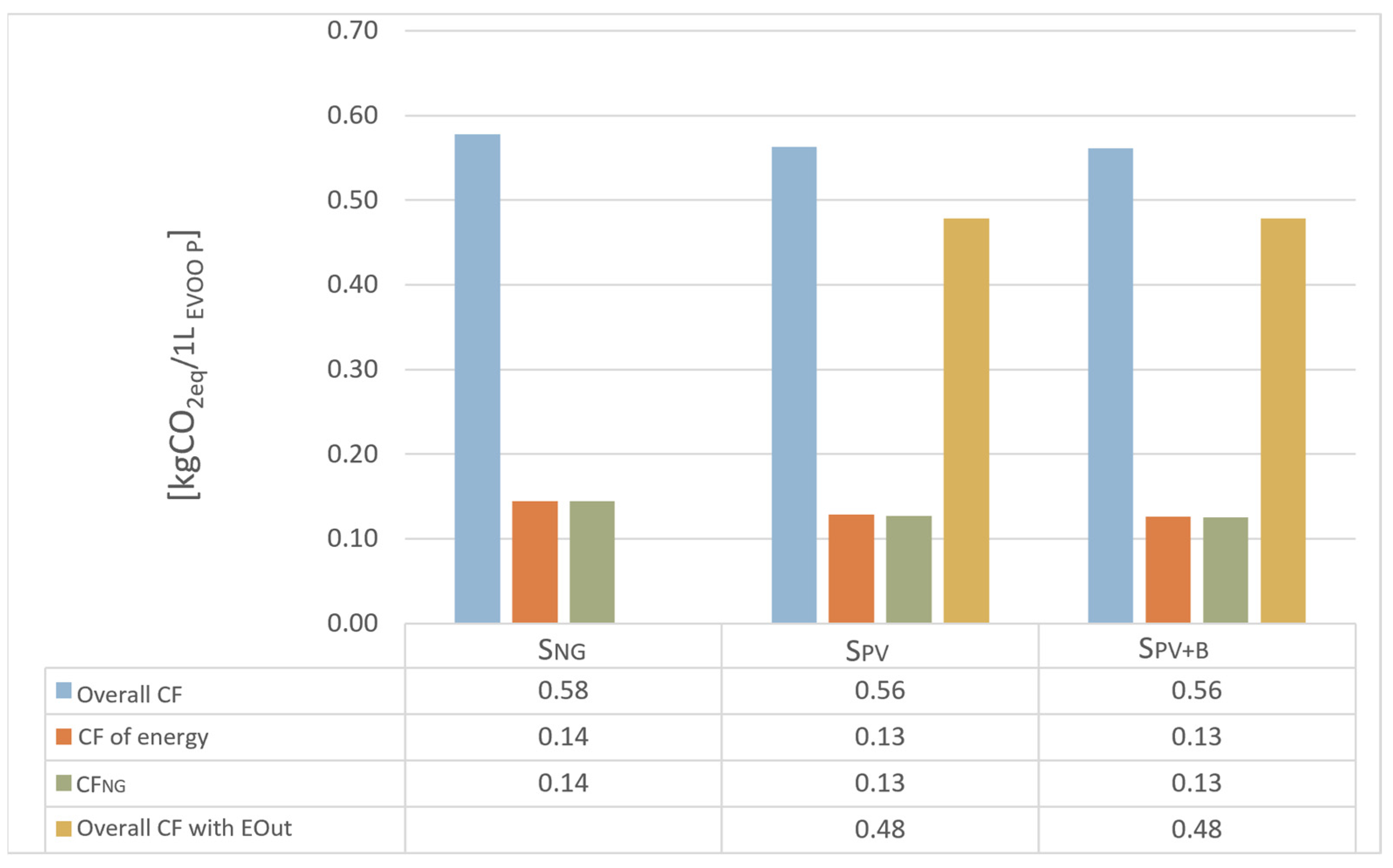
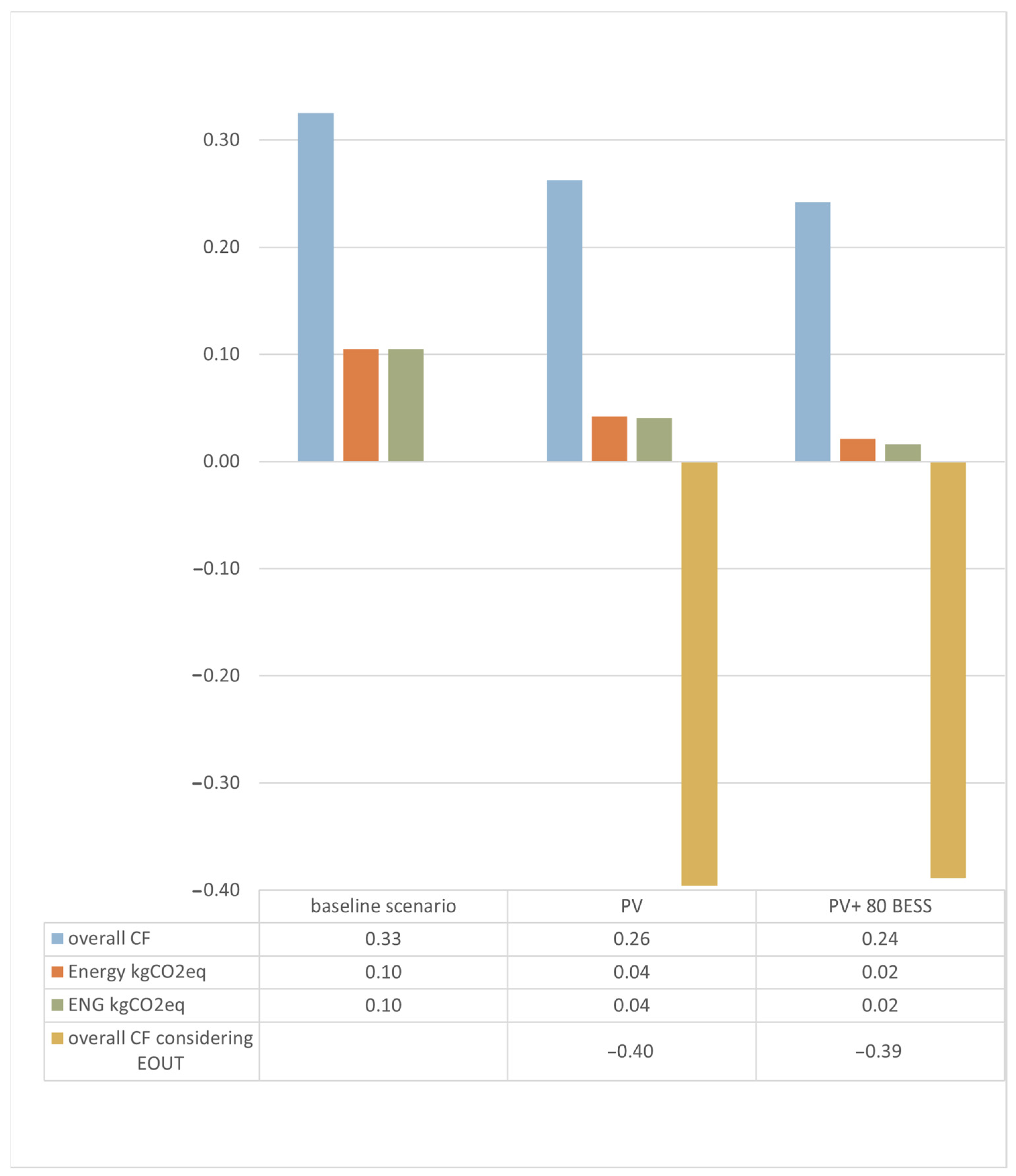
The two roof pitches of the building in case 2 were East-West oriented, and there was a large available area for the PV system. This made it possible to design a highly productive PV plant: a power peak of about 134 kWp and a BESS capacity of 80 kWh producing 152,620.83 kWh/y (Table 3). Therefore, the presence of the PV system in case 2 led to a CF reduction of 17% and the integration of BESS increased the reduction to 22% in the overall CF (Figure 9). Moreover, since the rooftop was divided into two pitches, one facing East and the other West, the East-facing section allowed for energy production early in the morning to recharge the battery, while the West-facing section supported mill activities in the evening. In addition, the two-phase extraction method of this case was a fundamental processing plant characteristic that required a lower consumption of electrical energy. Indeed, the PV+BESS system provided 84.7% of the energy required by the mill. When considering EOut,tot the value of CF showed a negative value. This means that the grid-connected PV+BESS plant generated a surplus of energy, exceeding the amount required to balance the overall CF of SNG. Consequently, it was hypothesised that a consistent quantity of GHG emissions could be avoided by supplying energy to the NG. The BESS capacity is higher than in case 1, and it is more evident that CF, when EOut,tot is not considered, is higher in SPV than in SPV+BESS. Conversely, when including EOut,tot the SPV+BESS GHG emissions were higher. This can be explained by the fact that batteries enhance the self-consuming level (from 8.6% to 12.0%), but on the other hand, enhance GHG emissions due to their production, transportation, and maintenance.

3.2.3. Case Study 3

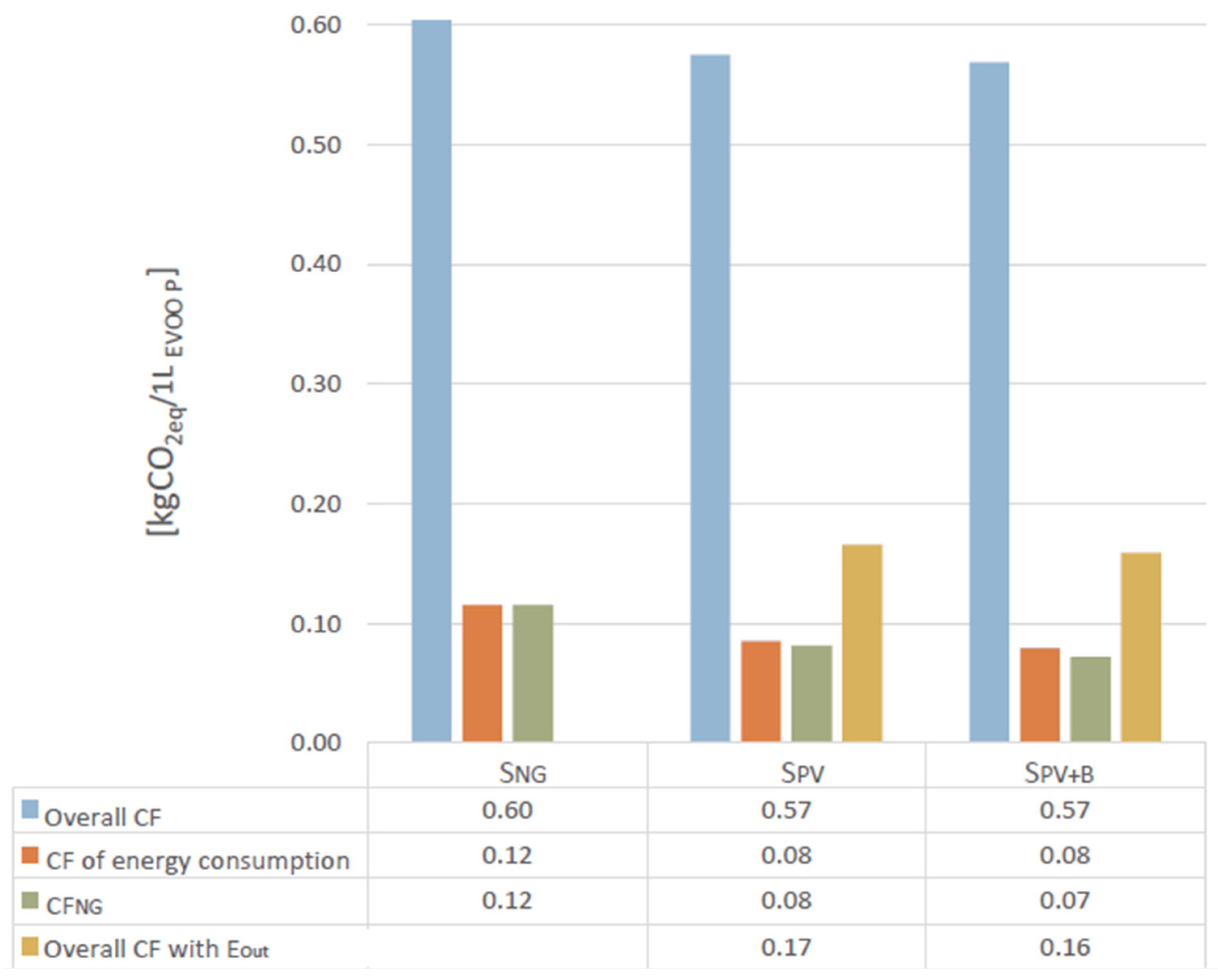
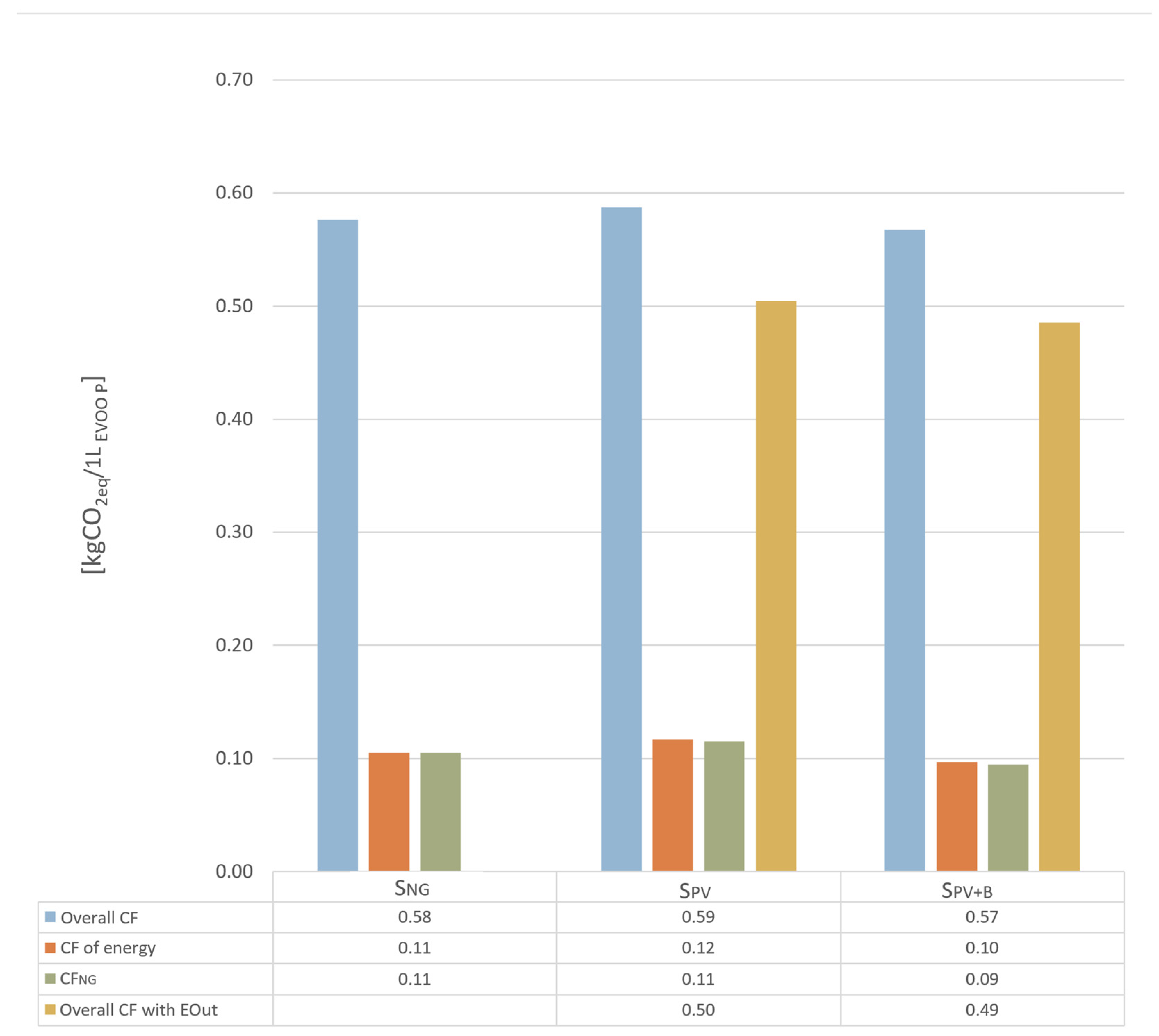
In case study 3, compared to the baseline scenario, the results show an increase in the CF of the PV scenario and a slight decrease (3%) in the PV+B scenario, where self-consumption is increased (18.4%) compared to the PV scenario (17.4%) (Figure 10). These results were achieved for a PV plant power peak of about 35.69 kWp and a BESS capacity of 10 kWh. The poor performance in this case study could be attributed to:
  • The 3-phase extraction technology that was found to be more impactful than 2-phase extraction [41,44];
  • The limited rooftop available area that leads to design an undersized PV plant producing 46,602.53 kWh y−1 (Table 3), and providing a maximum of 17.5% of energy required by the mill (Table 5);
  • The higher environmental impact of flat rooftop PV plants which requires a higher amount of metal and energy for the PV system installation.
However, when considering EOut,tot the overall CF decreased by 12% in SPV and by 16% in SPV+B.

3.2.4. Case Study 4

The results obtained from case study 4 (Figure 11) are very similar to case 1: the energy produced by PV reduced the CF only by 3% both in the SPV and SPV+B scenarios compared to SNG, and by 17% both in SPV and SPV+B when considering EOut,tot contribution to the overall CF (Table 5). These results were achieved for a PV plant power peak of about 26.23 kWp and a BESS capacity of 12.5 kWh. The poor performance in this case study could be attributed to the high energy consumption of 3-phase extraction (35,831.34 kWh y−1 as shown in Table 3), and the limited available area for PV plants, thus a very similar condition to case 1.

3.2.5. Case Study 5

In Case Study 5, the consumption profile is similar to cases 1 and 4, and the results indicated a 5% reduction from the baseline scenario to the PV scenario and a 6% reduction to the PV+BESS scenario (Figure 12). These results were achieved for a PV plant power peak of about 108 kWp and a BESS capacity of 90 kWh. Therefore, in this case, it is essential to consider the significant battery capacity in relation to the relatively marginal reduction in the CF. The poor environmental performance in this case study could be attributed to the electrical consumption of the 3-phase extraction technology and the low olive oil production yield of 172.11 ton/y (Table 3). Nevertheless, in this case study, the building showed better features, such as rooftop exposure and slope, making it possible to produce 117,034.38 kWh y−1 (Table 3). Indeed, results considering the mitigation potential EOut,tot revealed a CF reduction of more than 90%. As reported in Table 5, the PV+BESS plant provided 53.2% of the energy required and thus distinguishing this case study from the other high-energy-consuming mills.

3.3. Economical Assessments

The payback values in Table 7 are related to three cases: the standard case, in which no incentives are provided, and in the cases of 80% of incentives and 50% of incentives. With no incentives, the SPV+B and SPV resulted in a PBT higher than 10 years in most cases, except for case 4, for which the PBT (9.8) is still high. Conversely, in the case of an 80% incentive, all the cases and scenarios are economically sustainable, and in the 50% incentive case, just the scenario SPV+B of case 2 and case 5 had a payback time of more than 10 years.

4. Discussion

The outcomes described in Table 5 show how the self-consuming percentage in the majority of systems was very low, leading to a relatively low reduction in environmental impacts. The most interesting case from the point of view of GHG emission reduction is Case study 2, for which a larger PV plant than in the other cases, the consequent larger battery, and a lower energy consumption due to the specific building features and plant processing characteristics (2-phase system), led to a quite good CF reduction from 17% to 22% in SPV and SPV+BESS, respectively. These reductions correspond to −6.27 × 10⁻² and −8.36 × 10⁻² kgCO2eq/1LEVOOp, thus producing an overall reduction of 6696.06 and 8928.08 kgCO2eq y−1. When considering EOut, the contribution to the overall CF becomes negative, thus compensating for GHG emissions of the whole system, and providing renewable energy available for the NG. This is in accordance with the most widely recognised principle of energy management, which states that the first mitigation strategy to attain energy efficiency should be energy consumption and loss reduction [62].
Nevertheless, it is important to highlight that a negative value of the CF does not indicate an absorption of CO2, but it is due to the consequential model applied in the LCA methodology, which accounts for the CO2eq emission compensation in a production process [63].
As highlighted before, the most important value to consider when aiming at CF reduction is the percentage of covered energy needs (CEN). In fact, this index can give an outlook about the influence that the PV system has on the energy consumption of the whole production process. Therefore, in case studies 2 and 5, better performances were observed since the value of CEN was higher than in other cases (more than 50%). This particular condition can be attributed to the characteristics of the rooftops, which allowed for a substantial available area (more than 300 m2) and optimal exposure, with an East-West orientation in case 2 and a South or near-flat orientation in case 5. These roof characteristics resulted in a higher power PV peak and battery capacity. Anyway, all the scenarios proposed would be economically sustainable only with nationally provided incentives of 80%, whereas a 50% contribution would be sufficient for most of the cases to achieve a PBT lower than 10 years. These results are in accordance with what has been found in the literature [12]. From the perspective of CF reduction, case 3 is particularly problematic, especially for the SPV, due to the reduced rooftop available area. This result is consistent with the conclusions of the study by Rabaza et al. [18], which determined that optimal conditions for the integration of PV energy in an olive mill are characterised by a production level below 1000 t y−1. Conversely, a production exceeding this threshold, as observed in Case 3, indicates less favourable conditions. Specific experimental trials could provide added value to the simulations by improving the adherence to real conditions of the energy consumption profile for the considered agricultural buildings and allow a special modification of the inventory database records when needed. Furthermore, a major refinement in the evaluation of the available rooftop area might be obtained by specific surveys of olive mill rooftops.
In this study, a specific consumption profile was considered, in which the peak of energy production coincides with the months where there is no self-consumption. This makes the issue of energy production from some agrisolar systems particularly relevant. The same methodology developed for scenario calculation and simulation can be applied to any industrial or agro-industrial facilities to calculate the total CF of processing an agricultural product. In the olive supply chain, for example, it could be applied to the electricity consumption of olive pomace factories, facilities that are now considered central to the environmental and economic sustainability of the olive oil sector. However, from the point of view of accuracy in calculating the CF due to the electricity consumed and especially in that fed into the grid (EOut,tot), a methodological problem arises: the quality of the energy fed into the grid, in terms of its potential utilisation, is not the same in every location and at every time of year and day. During the hours and months when peak production occurs (it depends on location, but generally between June and August in the northern hemisphere), energy needs to be transported, stored, and transformed, and, in some cases, dissipated and lost. Thus, further studies on grid stability should be carried out, based on the available literature [22,64,65].
The development of a decision-making tool involving CF assessment on an hourly-based algorithm for optimised PV+BESS interaction in an agro-industrial building, representing the novelty of this study, facilitated the improvement of the agrisolar system sustainability and the consequent CF reduction for the agricultural product. The use of an energy management algorithm distinguishes the proposed methodology from conventional agro-industrial environmental assessments, and, by taking into account the strong seasonality and discontinuity of agro-industrial activities, it represents a novel form of conventional energy analysis. This approach was useful to underline some benefits and limitations of the agrisolar system for agro-industrial activities. While it is demonstrated that PV+BESS systems can reduce environmental impacts for the energy consumption [21,34,35], this kind of result is not for granted in seasonal agro-industrial activities in which the peak of energy consumption is in a few months of the year.
The Section 3 presented not only the CF of mill energy consumption but also the CF associated with electricity supplied by the NG. Our findings show that the overall CF of olive mill operations is strongly dependent on the share of NG consumption. Therefore, while ongoing decarbonization of the NG will progressively reduce the CF of grid-supplied electricity, it remains important to emphasize that PV self-consumption continues to deliver direct benefits by further reducing dependence on fossil-based energy. Moreover, surplus PV energy exported to the NG contributes to accelerating the energy transition of the grid itself, amplifying the environmental benefits across the system. In this direction, the integration of PV and BESS provides a dual advantage: it reduces the CF of the individual industrial activity while simultaneously supporting the broader decarbonization of the national electricity mix.
To mention some future research perspectives, a more comprehensive LCA study, incorporating a greater number of environmental impacts, will facilitate the assessment of whether, in scenarios aimed at achieving substantial reductions in CF, the utilisation of batteries can be considered a sustainable solution in the context of the supplementary environmental impacts produced [66]. Indeed, the study demonstrates the importance of evaluating the environmental performance of a PV or PV+BESS system through accurate plant design and energy management simulation in relation to the existing building. Moreover, the simulations described in this study were carried out on existing agricultural buildings where the sustainability of adding the PV-based system was assessed. A different perspective would be considered when the design of a new building could provide optimum conditions for PV+BESS exploitation.
Furthermore, more complete models could be developed through BIM (Building Information Models) software capable of combining energy consumption historical information with a conceptual building mass model and surrounding environment [13]. Future modelling could benefit from incorporating detailed daily operational fluctuations to achieve greater accuracy.
A further level of complexity for this type of sustainability assessment would be the assessment of the degradation state of the battery used [67], thus taking into account its life cycle and ageing diagnostics [36].
Finally, it would be useful to assess the sustainability of PV+BESS systems in comparison to other bio-based energy production technologies, such as anaerobic digestion and incineration in a sustainable circular bioeconomy perspective [44,59,68]. Such environmental analyses would highlight the environmental trade-off supporting the choice of solutions to be implemented for the energy transition in agro-industrial activities.

5. Conclusions

The result of this study proposes solutions for the integration of rooftop grid-connected photovoltaic and battery systems to reduce the environmental impacts of EVOO production, by considering the existing building features of various case studies. The methodology delineated in this study is an effective tool for evaluating the potential for CF reduction through the implementation of a PV+BESS system in agro-industrial activities characterised by inherently discontinuous processes, such as an oil mill.
The main methodological novelty of this study is the hourly energy consumption evaluation to assess CF reduction in the PV+BESS system integrated with the olive mill. The approach developed allows for the replicability of the proposed methodology to other production buildings. Indeed, the methodology for calculating and simulating the total CF of processing an agricultural product may be applied consistently to any industrial or agro-industrial facility, being a valuable data-driven decision-making tool for the energy transition. Energy simulation results demonstrated that the potential energy, self-consumed by the mill, varied in the range of 11% and 18.1%. In addition, the renewable energy produced was found to cover from 11% to 84.7% of the mill energy consumption needs. Results from CF computations demonstrated that integrating grid-connected PV systems and BESS into olive oil mills would reduce the CF between 22% and 119%, depending on the CF system boundaries considered, yet above all, the olive mill energy efficiency. Indeed, the PV energy produced and delivered to the NG can reduce the CF of the NG energy, thus mitigating the overall oil mill CF. However, based on the energy efficiency investigation, the suggested approach would consider consumption reduction as a first step, followed by the design of a renewable energy solution.
From the sustainability perspective, this work also highlights a positive environmental trade-off: although PV+BESS systems carry embodied impacts from manufacturing and disposal, their integration enables significant reductions in operational GHG emissions, supports decarbonisation of the NG through surplus energy export, and contributes to long-term circularity opportunities via recycling of PV modules and batteries [35,37]. Thus, the adoption of PV+BESS can provide net environmental benefits even when trade-offs are considered, particularly in seasonal agro-industrial contexts where aligning energy demand with renewable energy supply remains challenging.
From an economic perspective, conversely, the results show that no energy transition can be made in agro-industrial activities without the support of national incentives.
Specific experimental trials could provide added value to the simulations by improving the adherence to the real conditions of the energy consumption profile for the considered agro-industrial firm. Furthermore, it is suggested that such trials would allow for special modification of the inventory database records when needed. It was also assessed that high energy consumption can lead to worse performance both in PV and PV+BESS systems. Finally, the use of BESS could enhance the total CF when PV yearly production is too low to fulfil energy consumption needs.

Supplementary Materials

The following supporting information can be downloaded at: https://www.mdpi.com/article/10.3390/cleantechnol7040091/s1, Figure S1: Seasonal variation from consumption and production sides. In light blue the energy produced in a month. In orange the energy consumed in a month considering the days of activity (a). Daily pattern of energy production (Ep) and consumption (Ec) for each hour of a typical activity day (b). Figure S2: Seasonal variation from consumption and production side. In light blue the energy produced in a month. In orange the energy consumed in a month considering the days of activity (a). Daily pattern of energy production (Ep) and consumption (Ec) for each hour of a typical activity day (b). Figure S3: Seasonal variation from consumption and production side. In light blue the energy produced in a month. In orange the energy consumed in a month considering the days of activity (a). Daily pattern of energy production (Ep) and consumption (Ec) for each hour of a typical activity day (b). Figure S4: Seasonal variation from consumption and production sides. In light blue the energy produced in a month. In orange the energy consumed in a month considering the days of activity (a). Daily pattern of energy production (Ep) and consumption (Ec) for each hour of a typical activity day (b). Figure S5: Seasonal variation from consumption and production sides. In light blue the energy produced in a month. In orange the energy consumed in a month considering the days of activity (a). Daily pattern of energy production (Ep) and consumption (Ec) for each hour of a typical activity day (b). Figure S6: Sensitivity analysis of BESS capacity of case study 1. Key performance indicators for the PV+BESS system, including energy delivered to the NG, renewable energy self-consumed and energy required from the NG are showed (a). The analysis identifies the optimal BESS (b). Figure S7: Sensitivity analysis of BESS capacity of case study 2. Key performance indicators for the PV+BESS system, including energy delivered to the NG, renewable energy self-consumed and energy required from the NG are showed (a). The analysis identifies the optimal BESS (b). Figure S8: Sensitivity analysis of BESS capacity of case study 3. Key performance indicators for the PV+BESS system, including energy delivered to the NG, renewable energy self-consumed and energy required from the NG are showed (a). The analysis identifies the optimal BESS (b). Figure S9: Sensitivity analysis of BESS capacity of case study 4. Key performance indicators for the PV+BESS system, including energy delivered to the NG, renewable energy self-consumed and energy required from the NG are showed (a). The analysis identifies the optimal BESS (b). Figure S10: Sensitivity analysis of BESS capacity of case study 5. Key performance indicators for the PV+BESS system, including energy delivered to the NG, renewable energy self-consumed and energy required from the NG are showed (a). The analysis identifies the optimal BESS (b).

Author Contributions

Conceptualization, G.C. and C.A.; methodology, G.C. and C.A.; software, G.C.; validation, P.R.D.; formal analysis, G.C.; resources, C.A.; data curation, G.C.; writing—original draft preparation, G.C. and C.A.; writing—review and editing, P.R.D.; investigation, G.C. and P.R.D.; visualization, G.C. and P.R.D.; supervision, C.A.; funding acquisition, C.A.; project administration, C.A. All authors have read and agreed to the published version of the manuscript.

Funding

This research is part of the PhD research activity grant Inv. 4.1 Research NRRP—Ministerial Decree n. 118/2023 at the University of Catania. PhD student: Grazia Cinardi; tutor: Claudia Arcidiacono; co-tutor: Provvidenza Rita D’Urso; supervisors: Carlo Ingrao, and Silvia Guillén-Lambea. Furthermore, this research was carried out within the research project by the University of Catania: (PIAno di inCEntivi per la RIcerca di Ateneo 2024/2026 (DR 2306 del 03/06/2024).

Institutional Review Board Statement

Not applicable.

Data Availability Statement

The original data presented in the study, used for energy management calculation are openly available from PVgis software at https://re.jrc.ec.europa.eu/pvg_tools/en/, accessed on 18 December 2024 and from the literature at doi:10.1016/j.jclepro.2016.03.152. The original contributions presented in this study are included in the article/Supplementary Materials. Further inquiries can be directed to the corresponding authors.

Acknowledgments

The authors have reviewed and edited the output and take full responsibility for the content of this publication.

Conflicts of Interest

The authors declare no conflicts of interest.

Abbreviations

The following abbreviations are used in this manuscript:
acc Battery state of charge counter
BESSBattery energy storage system
CBESS Battery energy maximum capacity
CENCovered energy needs
CFCarbon Footprint
CFPVCF associated with PV system on Function unit base
CNGCF associated with NG energy consumption on Function unit base
CFBCF associated with BESS usage on Function unit base
CF_EOutCF associated with PV system on Function unit base
Cbthe amount of equivalent CO2 produced for battery production, transportation and dismission
IBESS (WB *1-1) * Qolives−1
IPV Lifetime*capacity*annual yield
EBPV Energy stored by BESS and self-consumed by olive mill
Ec (h, m)Ec (0 To 23, 1 To 12) Hourly energy requested by olive mill.
ENGElectric energy requested by NG
EOut Energy delivered to the NG
EOut,actEnergy delivered to the NG in the days of activity
Ep (h, m)Ep (0 To 23, 1 To 12) Hourly energy produced by PV
EPVPV Energy produced and self-consumed by olive mill
ER Renewable energy. EPV + EB
EVOO Extra Virgin Olive Oil
FUFunctional unit
g Current day
g_m (m)g_m (1 To 12) days in a month
GHGGreenhouse Gas
HCurrent hour
LCA Life Cycle Assessment
m Current month
NGNational grid
PBTPayback time
PVPhotovoltaic
PV+BESSIntegration of PV and BESS system
QolivesOlives milled in a year
SDGSustainable Development goal
SNGThe scenario in which Ec is only supplied by NG
SPVThe scenario in which Ec is supplied by NG and PV mix,
SPV+BThe scenario in which Ec is supplied by NG, PV, and battery
WBBattery total weight

References

  1. Chen, B.; Xiong, R.; Li, H.; Sun, Q.; Yang, J. Pathways for Sustainable Energy Transition. J. Clean. Prod. 2019, 228, 1564–1571. [Google Scholar] [CrossRef]
  2. Gassar, A.A.A.; Cha, S.H. Review of Geographic Information Systems-Based Rooftop Solar Photovoltaic Potential Estimation Approaches at Urban Scales. Appl. Energy 2021, 291, 116817. [Google Scholar] [CrossRef]
  3. Zhao, J.; Liu, Y.; Tu, Z.; Chan, S.H. A Novel Flexible Load Regulation and 4E-F Multi-Objective Optimization for Distributed Renewable Energy Power Generation System. Appl. Energy 2025, 383, 125410. [Google Scholar] [CrossRef]
  4. Modica, G.; Pulvirenti, A.; Spina, D.; Bracco, S.; D’Amico, M.; Di Vita, G. Clustering Olive Oil Mills through a Spatial and Economic GIS-Based Approach. Clean. Environ. Syst. 2024, 14, 100207. [Google Scholar] [CrossRef]
  5. ISMEA. Available online: https://www.Ismeamercati.It/Flex/Cm/Pages/ServeBLOB.Php/L/IT/IDPagina/4040 (accessed on 2 March 2025).
  6. Lanfranchi, M.; Giannetto, C.; De Pascale, A. Economic Analysis and Energy Valorization of By-Products of the Olive Oil Process: “Valdemone DOP” Extra Virgin Olive Oil. Renew. Sustain. Energy Rev. 2016, 57, 1227–1236. [Google Scholar] [CrossRef]
  7. Lonetti, F.; Martelli, F.; Resta, G. Artificial Neural Networks Applied to Olive Oil Production and Characterization: A Systematic Review. Intell. Syst. Appl. 2025, 26, 200525. [Google Scholar] [CrossRef]
  8. Giovenzana, V.; Beghi, R.; Romaniello, R.; Tamborrino, A.; Guidetti, R.; Leone, A. Use of Visible and near Infrared Spectroscopy with a View to On-Line Evaluation of Oil Content during Olive Processing. Biosyst. Eng. 2018, 172, 102–109. [Google Scholar] [CrossRef]
  9. Leone, A.; Tamborrino, A.; Romaniello, R.; Zagaria, R.; Sabella, E. Specification and Implementation of a Continuous Microwave-Assisted System for Paste Malaxation in an Olive Oil Extraction Plant. Biosyst. Eng. 2014, 125, 24–35. [Google Scholar] [CrossRef]
  10. Tamborrino, A.; Leone, A.; Romaniello, R.; Catalano, P.; Bianchi, B. Comparative Experiments to Assess the Performance of an Innovative Horizontal Centrifuge Working in a Continuous Olive Oil Plant. Biosyst. Eng. 2015, 129, 160–168. [Google Scholar] [CrossRef]
  11. GSE—Gestore dei Servizi Energetici. Bando 1/2022 del Parco Agrisolare. Available online: https://www.gse.it/servizi-per-te/attuazione-misure-pnrr/parco-agrisolare/bando-1-2022 (accessed on 13 October 2025).
  12. D’Adamo, I.; Gastaldi, M.; Luthra, S.; Rimoldi, L. Agrisolar, Incentives and Sustainability: Profitability Analysis of a Photovoltaic System Integrated with a Storage System. Energy Rep. 2024, 12, 251–258. [Google Scholar] [CrossRef]
  13. Yang, R.J.; Imalka, S.T.; Wijeratne, W.M.P.; Amarasinghe, G.; Weerasinghe, N.; Jayakumari, S.D.S.; Zhao, H.; Wang, Z.; Gunarathna, C.; Perrie, J.; et al. Digitalizing Building Integrated Photovoltaic (BIPV) Conceptual Design: A Framework and an Example Platform. Build. Environ. 2023, 243, 110675. [Google Scholar] [CrossRef]
  14. Cao, Z.; Liu, Y.; Bai, Y.; Wang, Y.; Ye, S.; Cao, H. Study on the Optimal Layout of Roof Vents and Rooftop Photovoltaic of the Industrial Workshop. Build. Environ. 2024, 260, 111624. [Google Scholar] [CrossRef]
  15. Griffith, B.; Torcellini, P.; Long, N.; Crawley, D.; Ryan, J. Assessment of the Technical Potential for Achieving Zero-Energy Commercial Buildings. In Proceedings of the ACEEE Summer Study, Pacific Grove, CA, USA, 13–18 August 2006. [Google Scholar]
  16. Cinardi, G.; D’Urso, P.R.; Arcidiacono, C.; Cascone, G. Integrating Photovoltaic Systems to Reduce Carbon Footprint in Extra Virgin Olive Oil Production: A Territorial Perspective in the Mediterranean Area. In Biosystems Engineering Promoting Resilience to Climate Change—AIIA 2024—Mid-Term Conference; Sartori, L., Tarolli, P., Guerrini, L., Zuecco, G., Pezzuolo, A., Eds.; Lecture Notes in Civil Engineering; Springer Nature: Cham, Switzerland, 2025; Volume 586, pp. 999–1007. ISBN 978-3-031-84211-5. [Google Scholar]
  17. Ranjan Satpathy, P.; Ramachandaramurthy, V.K.; Roslan, M.F.; Motahhir, S. An Adaptive Architecture for Strategic Enhancement of Energy Yield in Shading Sensitive Building-Applied Photovoltaic Systems under Real-Time Environments. Energy Build. 2024, 324, 114877. [Google Scholar] [CrossRef]
  18. Rabaza, O.; Contreras-Montes, J.; García-Ruiz, M.J.; Delgado-Ramos, F.; Gómez-Lorente, D. Techno-Economic Performance Evaluation for Olive Mills Powered by Grid-Connected Photovoltaic Systems. Energies 2015, 8, 11939–11954. [Google Scholar] [CrossRef]
  19. Chakir, A.; Tabaa, M.; Moutaouakkil, F.; Medromi, H.; Julien-Salame, M.; Dandache, A.; Alami, K. Optimal Energy Management for a Grid Connected PV-Battery System. Energy Rep. 2020, 6, 218–231. [Google Scholar] [CrossRef]
  20. Mukisa, N.; Zamora, R. Optimal Tilt Angle for Solar Photovoltaic Modules on Pitched Rooftops: A Case of Low Latitude Equatorial Region. Sustain. Energy Technol. Assess. 2022, 50, 101821. [Google Scholar] [CrossRef]
  21. Migliari, L.; Cocco, D.; Petrollese, M. Levelized Cost of Storage (LCOS) of Battery Energy Storage Systems (BESS) Deployed for Photovoltaic Curtailment Mitigation. Energies 2025, 18, 3602. [Google Scholar] [CrossRef]
  22. Liu, J.; Pan, Z.; Huang, H.; Wu, H. Energy Optimization of Building-Integrated Photovoltaic for Load Shifting and Grid Robustness in High-Rise Buildings Based on Optimum Planned Grid Output. Energy Convers. Manag. 2025, 324, 119320. [Google Scholar] [CrossRef]
  23. Guo, X.; Sun, Q.; Zhong, M.; Zhang, Q.; Li, S.; Lin, W. Operation Optimization Strategy of a BIPV-Battery Storage Hybrid System. Results Eng. 2023, 18, 101066. [Google Scholar] [CrossRef]
  24. Zhou, Y.; Cao, S.; Kosonen, R.; Hamdy, M. Multi-Objective Optimisation of an Interactive Buildings-Vehicles Energy Sharing Network with High Energy Flexibility Using the Pareto Archive NSGA-II Algorithm. Energy Convers. Manag. 2020, 218, 113017. [Google Scholar] [CrossRef]
  25. Zhang, J.; Ouyang, S.; Sang, H. Decision on Annual Development and Construction Plan for Large-Scale Roof Top Photovoltaic Access to Distribution Network. Electr. Power Syst. Res. 2025, 245, 111597. [Google Scholar] [CrossRef]
  26. Williams, L.; Wang, Y. A Distributed Renewable Power System with Hydrogen Generation and Storage for an Island. Appl. Energy 2024, 358, 122500. [Google Scholar] [CrossRef]
  27. ISO 14040; Environmental Management—Life Cycle Assessment—Principles and Framework. ISO—International Organization for Standardization: Geneva, Switzerland, 2006.
  28. Keubeng, I.G.; Kemezang, V.C. Climate Mitigation Technology for Holistic Resource Management in Sub-Saharan Africa: Impact on Greenhouse Gas Emissions. Energy Clim. Change 2024, 5, 100135. [Google Scholar] [CrossRef]
  29. Paini, A.; Romei, S.; Stefanini, R.; Vignali, G. Comparative Life Cycle Assessment of Ohmic and Conventional Heating for Fruit and Vegetable Products: The Role of the Mix of Energy Sources. J. Food Eng. 2023, 350, 111489. [Google Scholar] [CrossRef]
  30. Ferrara, C.; Marmiroli, B.; Carvalho, M.L.; Girardi, P. Life Cycle Assessment of Photovoltaic Electricity Production in Italy: Current Scenario and Future Developments. Sci. Total Environ. 2024, 948, 174846. [Google Scholar] [CrossRef] [PubMed]
  31. Troy, S.; Schreiber, A.; Reppert, T.; Gehrke, H.-G.; Finsterbusch, M.; Uhlenbruck, S.; Stenzel, P. Life Cycle Assessment and Resource Analysis of All-Solid-State Batteries. Appl. Energy 2016, 169, 757–767. [Google Scholar] [CrossRef]
  32. Wohlschlager, D.; Kigle, S.; Schindler, V.; Neitz-Regett, A.; Fröhling, M. Environmental Effects of Vehicle-to-Grid Charging in Future Energy Systems—A Prospective Life Cycle Assessment. Appl. Energy 2024, 370, 123618. [Google Scholar] [CrossRef]
  33. Paul, D.; Pechancová, V.; Saha, N.; Pavelková, D.; Saha, N.; Motiei, M.; Jamatia, T.; Chaudhuri, M.; Ivanichenko, A.; Venher, M.; et al. Life Cycle Assessment of Lithium-Based Batteries: Review of Sustainability Dimensions. Renew. Sustain. Energy Rev. 2024, 206, 114860. [Google Scholar] [CrossRef]
  34. Da Silva Lima, L.; Quartier, M.; Buchmayr, A.; Sanjuan-Delmás, D.; Laget, H.; Corbisier, D.; Mertens, J.; Dewulf, J. Life Cycle Assessment of Lithium-Ion Batteries and Vanadium Redox Flow Batteries-Based Renewable Energy Storage Systems. Sustain. Energy Technol. Assess. 2021, 46, 101286. [Google Scholar] [CrossRef]
  35. Yudhistira, R.; Khatiwada, D.; Sanchez, F. A Comparative Life Cycle Assessment of Lithium-Ion and Lead-Acid Batteries for Grid Energy Storage. J. Clean. Prod. 2022, 358, 131999. [Google Scholar] [CrossRef]
  36. Roslan, M.F.; Satpathy, P.R.; Prasankumar, T.; Ramachandaramurthy, V.K.; Mansor, M.; Walker, S.L. Second-Life Battery Energy Storage System for Energy Sustainability: Recent Advancements, Key Takeaways and Future Perspectives. J. Energy Storage 2025, 123, 116808. [Google Scholar] [CrossRef]
  37. Briand, A.; Leybros, A.; Doucet, O.; Ruiz, J.-C.; Fontaine-Giraud, P.; Liotaud, L.; Grandjean, A. Versatility Assessment of Supercritical CO2 Delamination for Photovoltaic Modules with Ethylene-Vinyl Acetate, Polyolefin or Ethylene Methacrylic Acid Ionomer as Encapsulating Polymer. J. Clean. Prod. 2023, 410, 137292. [Google Scholar] [CrossRef]
  38. Lemoine, C.; Petit, Y.; Karaman, T.; Jahrsengene, G.; Martinez, A.M.; Benayad, A.; Billy, E. Circular Recycling Concept for Silver Recovery from Photovoltaic Cells in Ethaline Deep Eutectic Solvent. RSC Adv. 2024, 14, 29174–29183. [Google Scholar] [CrossRef]
  39. Fiandra, V.; Sannino, L.; Andreozzi, C.; Flaminio, G.; Pellegrino, M. New PV Encapsulants: Assessment of Change in Optical and Thermal Properties and Chemical Degradation after UV Aging. Polym. Degrad. Stab. 2024, 220, 110643. [Google Scholar] [CrossRef]
  40. Galvagno, A.; Prestipino, M.; Maisano, S.; Urbani, F.; Chiodo, V. Integration into a Citrus Juice Factory of Air-Steam Gasification and CHP System: Energy Sustainability Assessment. Energy Convers. Manag. 2019, 193, 74–85. [Google Scholar] [CrossRef]
  41. Restuccia, D.; Prencipe, S.; Ruggeri, M.; Spizzirri, U. Sustainability Assessment of Different Extra Virgin Olive Oil Extraction Methods through a Life Cycle Thinking Approach: Challenges and Opportunities in the Elaio-Technical Sector. Sustainability 2022, 14, 15674. [Google Scholar] [CrossRef]
  42. El Joumri, L.; Labjar, N.; Dalimi, M.; Harti, S.; Dhiba, D.; El Messaoudi, N.; Bonnefille, S.; El Hajjaji, S. Life Cycle Assessment (LCA) in the Olive Oil Value Chain: A Descriptive Review. Environ. Dev. 2023, 45, 100800. [Google Scholar] [CrossRef]
  43. Rapa, M.; Ciano, S. A Review on Life Cycle Assessment of the Olive Oil Production. Sustainability 2022, 14, 654. [Google Scholar] [CrossRef]
  44. Cinardi, G.; D’Urso, P.R.; Arcidiacono, C.; Ingrao, C. Accounting for Circular Economy Principles in Life Cycle Assessments of Extra-Virgin Olive Oil Supply Chains—Findings from a Systematic Literature Review. Sci. Total Environ. 2024, 945, 173977. [Google Scholar] [CrossRef]
  45. Pattara, C.; Salomone, R.; Cichelli, A. Carbon Footprint of Extra Virgin Olive Oil: A Comparative and Driver Analysis of Different Production Processes in Centre Italy. J. Clean. Prod. 2016, 127, 533–547. [Google Scholar] [CrossRef]
  46. Navarro, A.; Puig, R.; Martí, E.; Bala, A.; Fullana-i-Palmer, P. Tackling the Relevance of Packaging in Life Cycle Assessment of Virgin Olive Oil and the Environmental Consequences of Regulation. Environ. Manag. 2018, 62, 277–294. [Google Scholar] [CrossRef]
  47. Rinaldi, S.; Barbanera, M.; Lascaro, E. Assessment of Carbon Footprint and Energy Performance of the Extra Virgin Olive Oil Chain in Umbria, Italy. Sci. Total Environ. 2014, 482–483, 71–79. [Google Scholar] [CrossRef] [PubMed]
  48. Maffia, A.; Palese, A.M.; Pergola, M.; Altieri, G.; Celano, G. The Olive-Oil Chain of Salerno Province (Southern Italy): A Life Cycle Sustainability Framework. Horticulturae 2022, 8, 1054. [Google Scholar] [CrossRef]
  49. PVGIS Web Application, 2019, Version 5.3 Released. European Commission, Joint Research Centre. 2019. Available online: https://re.jrc.ec.europa.eu/pvg_tools/en/ (accessed on 18 December 2024).
  50. Guillén-Lambea, S.; Sierra-Pérez, J.; García-Pérez, S.; Montealegre, A.L.; Monzón-Chavarrías, M. Energy Self-Sufficiency Urban Module (ESSUM): GIS-LCA-Based Multi-Criteria Methodology to Analyze the Urban Potential of Solar Energy Generation and Its Environmental Implications. Sci. Total Environ. 2023, 879, 163077. [Google Scholar] [CrossRef] [PubMed]
  51. AlFaraj, J.; Popovici, E.; Leahy, P. Solar Irradiance Database Comparison for PV System Design: A Case Study. Sustainability 2024, 16, 6436. [Google Scholar] [CrossRef]
  52. Ukoima, K.N.; Efughu, D.; Azubuike, O.C.; Akpiri, B.F. Investigating the Optimal Photovoltaic (PV) Tilt Angle Using the Photovoltaic Geographic Information System (PVGIS). Niger. J. Technol. 2024, 43, 101–114. [Google Scholar] [CrossRef]
  53. Faiman, D. Assessing the Outdoor Operating Temperature of Photovoltaic Modules. Prog. Photovolt. 2008, 16, 307–315. [Google Scholar] [CrossRef]
  54. Huld, T.; Friesen, G.; Skoczek, A.; Kenny, R.P.; Sample, T.; Field, M.; Dunlop, E.D. A Power-Rating Model for Crystalline Silicon PV Modules. Sol. Energy Mater. Sol. Cells 2011, 95, 3359–3369. [Google Scholar] [CrossRef]
  55. Koehl, M.; Heck, M.; Wiesmeier, S.; Wirth, J. Modeling of the Nominal Operating Cell Temperature Based on Outdoor Weathering. Sol. Energy Mater. Sol. Cells 2011, 95, 1638–1646. [Google Scholar] [CrossRef]
  56. Martin, N.; Ruiz, J.M. Calculation of the PV Modules Angular Losses under Field Conditions by Means of an Analytical Model. Sol. Energy Mater. Sol. Cells 2001, 70, 25–38. [Google Scholar] [CrossRef]
  57. Roux, C.; Schalbart, P.; Assoumou, E.; Peuportier, B. Integrating Climate Change and Energy Mix Scenarios in LCA of Buildings and Districts. Appl. Energy 2016, 184, 619–629. [Google Scholar] [CrossRef]
  58. Frischknecht, R.; Heath, G.; Raugei, M.; Sinha, P.; de Wild-Scholten, M. Methodology Guidelines on Life Cycle Assessment of Photovoltaic Electricity, 2nd ed.; IEA PVPS Task 12, Report IEA-PVPS T12-06:2016; International Energy Agency Photovoltaic Power Systems Programme: Paris, France, 2011; ISBN 978-3-906042-38-1. [Google Scholar]
  59. Yasmin, R.; Nabi, M.N.; Rashid, F.; Hossain, M.A. Solar, Wind, Hydrogen, and Bioenergy-Based Hybrid System for Off-Grid Remote Locations: Techno-Economic and Environmental Analysis. Clean Technol. 2025, 7, 36. [Google Scholar] [CrossRef]
  60. World Imagery. ArcGIS Website. 2025. Available online: https://www.arcgis.com/home/item.html?id=6299481745644df6a7b2808bfcce7f96 (accessed on 1 February 2025).
  61. D’Adamo, I.; Gastaldi, M.; Koh, S.C.L.; Vigiano, A. Lighting the Future of Sustainable Cities with Energy Communities: An Economic Analysis for Incentive Policy. Cities 2024, 147, 104828. [Google Scholar] [CrossRef]
  62. García-Monge, M.; Zalba, B.; Casas, R.; Cano, E.; Guillén-Lambea, S.; López-Mesa, B.; Martínez, I. Is IoT Monitoring Key to Improve Building Energy Efficiency? Case Study of a Smart Campus in Spain. Energy Build. 2023, 285, 112882. [Google Scholar] [CrossRef]
  63. Cinardi, G.; D’Urso, P.R.; Arcidiacono, C.; Muradin, M.; Ingrao, C. A Systematic Literature Review of Environmental Assessments of Citrus Processing Systems, with a Focus on the Drying Phase. Sci. Total Environ. 2025, 974, 179219. [Google Scholar] [CrossRef]
  64. Abdelaziz, M.A.; Ali, A.A.; Swief, R.A.; Elazab, R. Optimizing Energy-Efficient Grid Performance: Integrating Electric Vehicles, DSTATCOM, and Renewable Sources Using the Hippopotamus Optimization Algorithm. Sci. Rep. 2024, 14, 28974. [Google Scholar] [CrossRef]
  65. Shaier, A.A.; Elymany, M.M.; Enany, M.A.; Elsonbaty, N.A. Multi-Objective Optimization and Algorithmic Evaluation for EMS in a HRES Integrating PV, Wind, and Backup Storage. Sci. Rep. 2025, 15, 1147. [Google Scholar] [CrossRef]
  66. Malode, S.; Prakash, R.; Mohanta, J.C. Sustainability Assessment of Rooftop Solar Photovoltaic Systems: A Case Study. Environ. Impact Assess. Rev. 2024, 108, 107609. [Google Scholar] [CrossRef]
  67. Sun, Y.; Xiong, R.; Meng, X.; Deng, X.; Li, H.; Sun, F. Battery Degradation Evaluation Based on Impedance Spectra Using a Limited Number of Voltage-Capacity Curves. eTransportation 2024, 22, 100347. [Google Scholar] [CrossRef]
  68. Spina, D.; Carbone, R.; Pulvirenti, A.; Rizzo, M.; D’Amico, M.; Di Vita, G. What Gets Measured Gets Managed-Circular Economy Indicators for the Valorization of By-Products in the Olive Oil Supply Chain: A Systematic Review. Agronomy 2024, 14, 2879. [Google Scholar] [CrossRef]
Figure 2. Methodology diagram for calculating the CF of the EVOO production in the different scenarios.
Cleantechnol 07 00091 g002
Figure 3. EVOO supply chain and PV system flow chart.
Cleantechnol 07 00091 g003
Figure 4. Rooftop typology and related PV layout: (a) slope roof; (b) flat roof.
Cleantechnol 07 00091 g004
Figure 5. PV plant design for flat rooftop.
Cleantechnol 07 00091 g005
Figure 6. Flow-chart of the energy management system.
Cleantechnol 07 00091 g006
Figure 7. Example of hourly energy simulation.
Cleantechnol 07 00091 g007
Figure 8. Case study 1 Scenarios of CF and greenhouse gas emissions from energy systems and the national grid. Overall CF excludes EOut in non-activity months, while Overall CF considering EOut includes them.
Cleantechnol 07 00091 g008
Figure 9. Case study 2 scenarios of CF and greenhouse gas emissions from energy systems and National Grid. Overall CF excludes EOut in non-activity months, while Overall CF considering EOut includes them.
Cleantechnol 07 00091 g009
Figure 10. Case study 3 scenarios of CF and greenhouse gas emissions from energy systems and National Grid. Overall CF excludes EOut in non-activity months, while Overall CF considering EOut includes them.
Cleantechnol 07 00091 g010
Figure 11. Case study 4 scenarios of CF and greenhouse gas emissions from energy systems and National Grid. Overall CF excludes EOut in non-activity months, while Overall CF considering EOut includes them.
Cleantechnol 07 00091 g011
Figure 12. Case study 5 scenarios of CF and greenhouse gas emissions from energy systems and National Grid. Overall CF excludes EOut in non-activity months, while Overall CF considering EOut includes them.
Cleantechnol 07 00091 g012
Table 1. Olive oil mill features from Pattara et al. [45].
CharacteristicsCase1Case2Case3Case4Case5
Extraction TechnologyPressureDecanter (2 phases)Decanter (3 phases)Decanter (3 phases)Decanter (3 phases)
Olive milled (q/y)4500570012,00090007000
Olive yield (kg/ha)61257180709268715956
Oil yield (L/ha)1120.911345.271282.431264.921025.10
Cultivation surface (ha)120150270240190
LocalisationOrtona (CH) *Moscufo (PE) **Pianella (PE) **Pianella (PE) **Casoli (CH) *
Primary PackagingGlass bottleSteel canGlass bottleGlass bottleGlass bottle
Secondary PackagingCardboardCardboardCardboardCardboardCardboard
* CH: Chieti, ** PE: Pescara.
Table 2. Variables of the energy management system.
VariableTypeDescription UnitRange
m IntegerCurrent month-1 to 12
g IntegerCurrent day-1 to 31
hIntegerCurrent hour-0 to 23
EPVDouble PV Energy produced and self-consumed by olive millkWhobtained by energy simulations
EBDouble PV Energy stored by BESS and self-consumed by olive millkWhobtained by energy simulations
ER Double Sum of EPV and EBkWhobtained by energy simulations
ENGDouble Electric energy requested by NGkWhobtained by energy simulations
EOut DoubleEnergy delivered to the NGkWhobtained by energy simulations
acc DoubleCounter state of chargekWh0 to CBESS
CBESS Double Maximum battery capacitykWhobtained by energy simulations
Ep(m, h)DoubleHourly energy produced by PVkWh(1 To 12, 0 To 23)
Ec(m, h)DoubleHourly energy requested by the olive millkWh(1 To 12, 0 To 23)
g_m(m)Integerg_m days in a monthdays(1 To 12)
Table 3. Olive mill consumption profile and building feature for PV plant design data.
Case
Unit12345
EckWh y−129,651.421,537.4548,099.646,033.234,729.8
Milled olivest y−14505701200900700
oil yield L ton−1183.01187.36180.83184.10172.11
Ec/hourlykWh h−164.621.147.245.134.0
Activity hours 8 a.m–8 p.m
Rooftop available area (azimuth)m282
(0)
196
(−95)
457 (85)550
(opt)
155
(−22)
124 (18)202 (18)202 (162)
Rooftop: flat (pitch)/slope (tilt angle)-Slope
(30°)
Slope (20°)Slope (15°)Flat
(2.7 m)
Slope
(20°)
Slope (30°)Slope (5°)Slope (5°)
N° panelsn36962168361569898
PV peak powerkWp15.4841.2892.8835.6926.2324.0842.1442.14
Occupied aream272192432166122112196196
Yearly PV prod.kWh y−120,600.17152,620.8346,602.5335,831.34117,034.38
Table 4. Inventory data for the baseline scenario (SNG) for 1 ton of olive milled.
ProcessInputUnitCase 1Case 2Case 3Case 4Case 5
olive oil extractionWaterL1517119127100
Synthetic rubberkg1.2121.8612.5330.5871.921
Stainless steelkg3.6672.7320.9430.4821.543
packagingGreenglasskg0.1080.0000.1080.1080.108
Aluminium capkg0.7700.0000.7700.7700.770
Non-drip spoutkg0.1570.0000.1570.1570.157
Front Cardboard labelkg0.2180.0000.2180.2180.218
Rear Cardboard labelkg0.1620.0000.1260.1440.144
Shrink capkg1.2640.0000.1260.1260.126
Steel cankg0.00018.7220.0000.0000.000
Cardboard Can labelkg0.0000.3960.0000.0000.000
Can plastic cap (LDPE)kg0.0000.0920.0000.0000.000
Corrugated cardboard boxkg11.37624.12710.95111.46211.738
Adhesive tape (LDPE Glue)kg0.0450.6480.0450.0450.045
LLDPE filmkg0.3240.1850.3560.3320.345
Palletkg5.9873.3186.1346.2116.067
transport of materialsInput transport to the milltkm1.4562.0271.3231.8942.234
electricity in the baseline scenariokWh65.89237.78540.08351.14849.614
Table 5. Yearly energy production and consumption of PV and BESS grid-connected systems in SPV and SPV+BESS scenarios for each case study.
Case 12345
SPVSPV+BESSSPVSPV+BESSSPVSPV+BESSSPVSPV+BESSSPVSPV+BESS
CBESSkWh0.05.00.080010.0012.5090
EPVkWh3249.83249.813,160.413,160.48124.58124.55509.45509.415,295.1515,917.14
ENGkWh26,401.626,139.28377.13293.939,975.139,686.440,523.839,955.919,434.6516,257.79
EOut,tot kWh17,319.817,034.8139,294.9133,334.038,402.138,095.930,268.929,701.193,729.5998,433.59
EOut,actkWh285.10.09642.73681.8306.20.0586.018.22038.930
EBkWh0.0262.40.05083.30.0288.80.0567.902554.87
ERkWh3249.843512.2313,160.3518,243.608124.58413.25509.46077.315,295.1518,472.01
Self-consuming15.8%17.1%8.6%12.0%17.4%18.1%15.4%17.0%12.5%13.1%
CEN%11%11.9%61.1%84.7%16.9%17.5%12.0%13.2%44.0%53.2%
Table 6. Inventory data per tons of olive milled, for different energy consumption scenarios.
ScenariosInputUnitCase1Case2Case3Case4Case5
SNGENGkWh/ton65.89237.78540.08351.14849.614
SPVENGkWh/ton58.67014.69733.3145.0326.86
ERkWh/ton7.22223.0886.776.1222.74
EOut,tot kWh/ton38.49244.37732.00233.63144.27
SPV+BENGkWh/ton58.0325.77933.0744.4015.57
ERkWh/ton7.85532.0067.016.7534.04
EOut,tot kWh/ton37.86233.91931.76133.00170.87
WBkgB/ton0.01900.1200.00730.01200.113
Table 7. Economic analysis and payback time for each case study, both for SPV and SPV+B.
Case 12345
SPVSPV+BSPVSPV+BSPVSPV+BSPVSPV+BSPVSPV+B
Initial cost€/y18,576.021,576.0160,992.0208,992.042,828.048,828.031,476.038,976.0130,032.0184,032.0
Avoided costs€/y650.0702.42632.13648.71624.91682.61101.91215.53059.03694.4
Annual gain€/y1385.61362.811,143.610,666.73072.23047.72421.52376.17498.47874.7
O&M€/y185.8431.51609.94179.8428.3976.6314.8779.51300.33680.6
Annual benefit€/y1849.81633.712,165.710,135.64268.83753.83208.62812.09257.17888.4
PBTy10.013.213.220.610.013.09.813.914.023.3
PBT
(−80%)
y2.02.62.64.12.02.62.02.82.84.7
PBT
(−50%)
y5.06.66.610.35.06.54.96.97.011.7
Disclaimer/Publisher’s Note: The statements, opinions and data contained in all publications are solely those of the individual author(s) and contributor(s) and not of MDPI and/or the editor(s). MDPI and/or the editor(s) disclaim responsibility for any injury to people or property resulting from any ideas, methods, instructions or products referred to in the content.