

Volatile Organic Compounds from Candelilla-Associated PGPR Enhance Arabidopsis thaliana Seedling Growth Under Salinity Stress
 , , ,
, , , 
Abstract
1. Introduction
2. Materials and Methods
2.1. Rhizobacterial Strains and Growth Conditions
2.2. Plant Material and In Vitro Evaluation of PGPR-Emitted VOCs Under Salinity Stress
2.3. Biochemical Analysis of A. thaliana
2.3.1. Proline Quantification
2.3.2. Sodium (Na+) Content Determination
2.3.3. Chlorophyll Content Determination
2.4. Identification of VOCs from Rhizobacteria
2.5. Statistical Analysis
3. Results
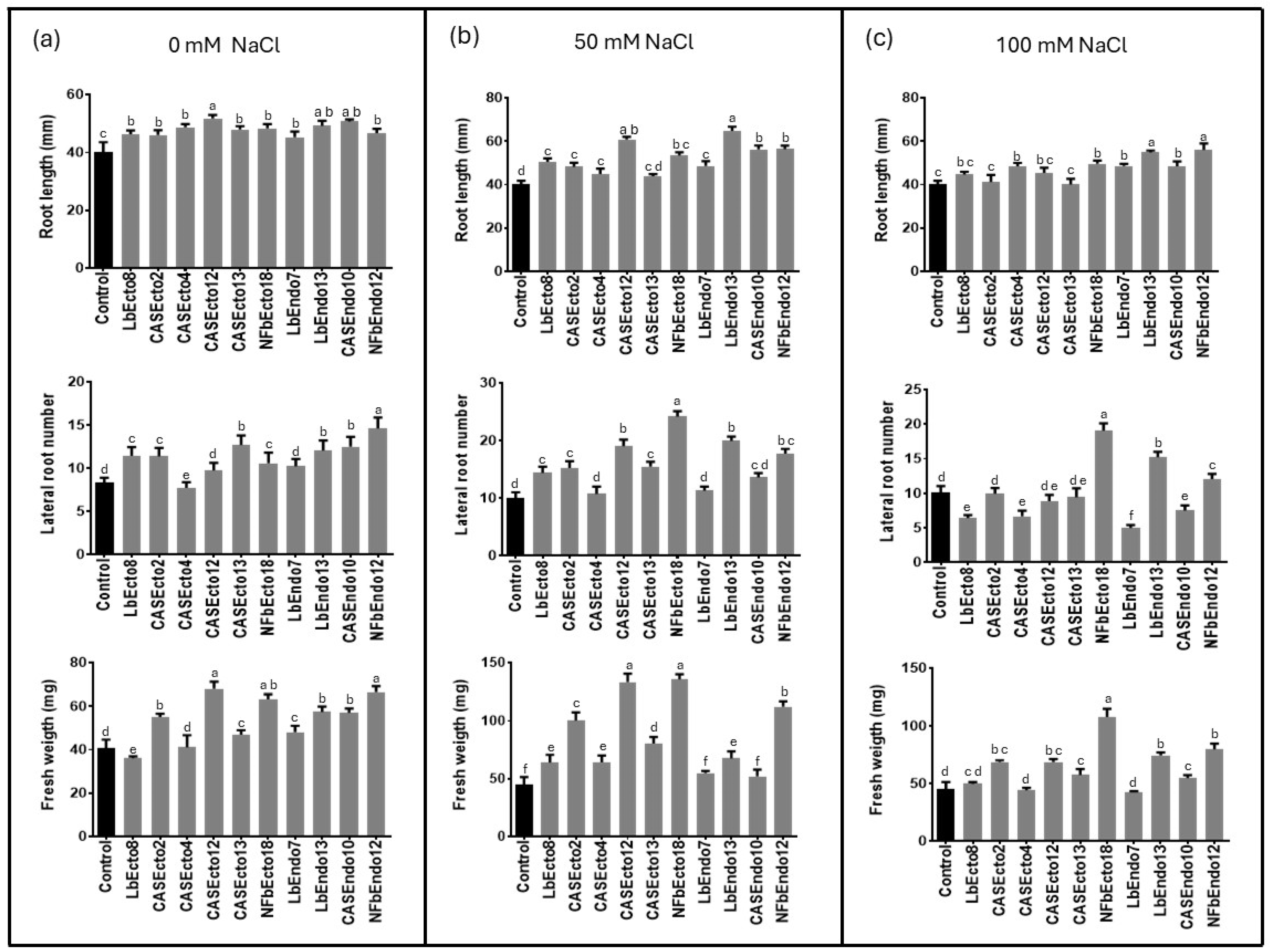
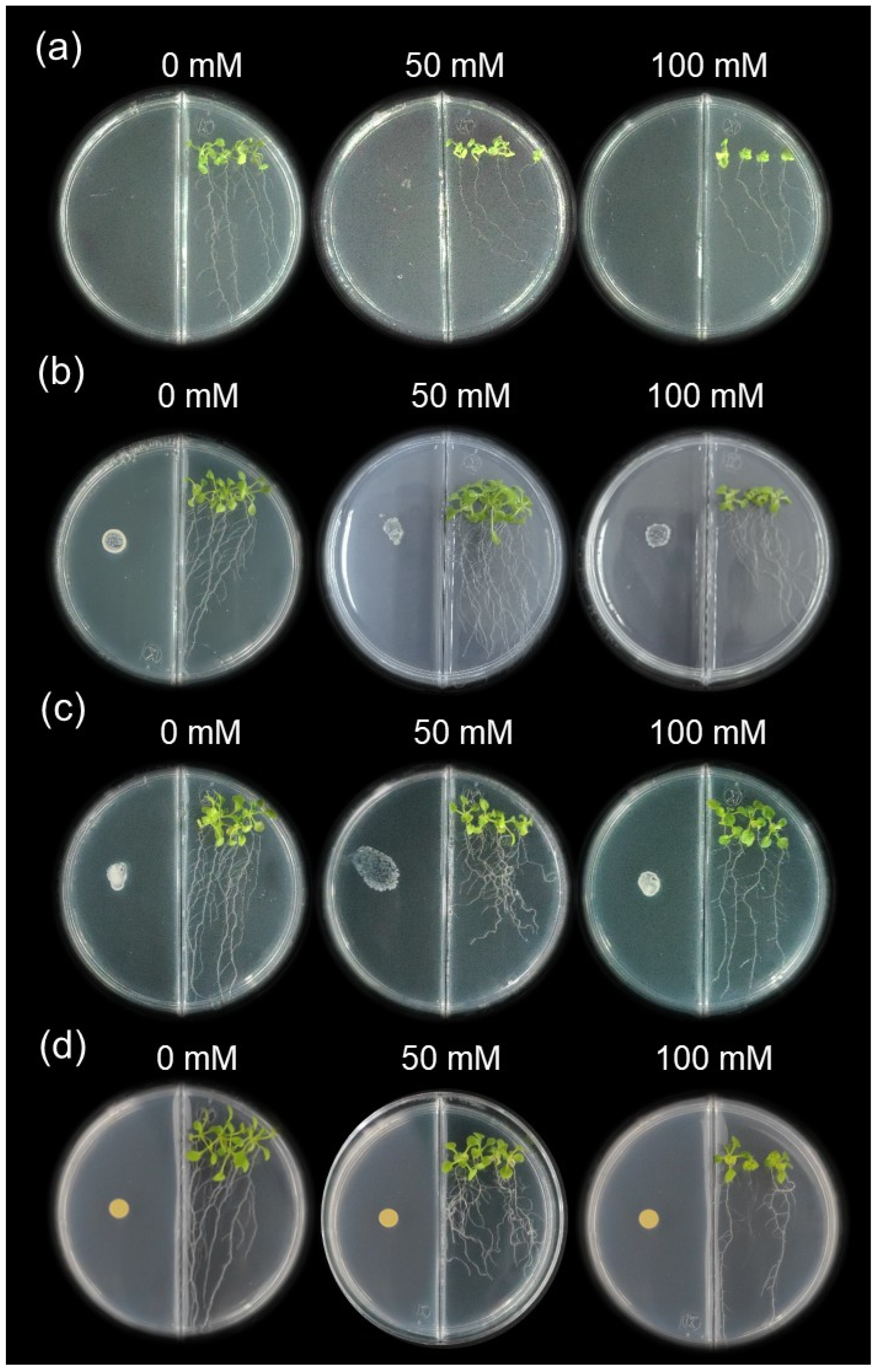
3.1. Rhizobacteria Promote A. thaliana Seedling Growth via VOCs
3.2. Effect of Rhizobacterial VOCs on A. thaliana Under Salinity Stress
3.3. Extraction and Measurement of Proline in A. thaliana Plants Under Salinity Stress in Interaction with VOCs
3.4. Na+ Concentration in A. thaliana Leaves Under Salinity Stress with VOC Exposure
3.5. Chlorophyll Concentration in A. thaliana Leaves Under Salinity Stress with VOC Exposure
3.6. Identification of VOCs
3.6.1. Enterobacter quasihormaechei NFbEcto18
3.6.2. Siccibacter colletis CASEcto12
4. Discussion
5. Conclusions
Author Contributions
Funding
Institutional Review Board Statement
Informed Consent Statement
Data Availability Statement
Acknowledgments
Conflicts of Interest
References
- Zaman, M.; Shahid, S.A.; Heng, L. Guideline for Salinity Assessment, Mitigation and Adaptation Using Nuclear and Related Techniques; Springer International Publishing: Cham, Switzerland, 2018. [Google Scholar] [CrossRef]
- Vargas, R. Mapping of Salt-Affected Soils—Technical Manual; FAO: Rome, Italy, 2020. [Google Scholar] [CrossRef]
- Nawaz, A.; Shahbaz, M.; Asadullah; Imran, A.; Marghoob, M.U.; Imtiaz, M.; Mubeen, F. Potential of Salt Tolerant PGPR in Growth and Yield Augmentation of Wheat (Triticum aestivum L.) Under Saline Conditions. Front. Microbiol. 2020, 11, 2019. [Google Scholar] [CrossRef]
- Ali, B.; Wang, X.; Saleem, M.H.; Sumaira; Hafeez, A.; Afridi, M.S.; Khan, S.; Zaib-Un-Nisa; Ullah, I.; Amaral Júnior, A.T.d.; et al. PGPR-Mediated Salt Tolerance in Maize by Modulating Plant Physiology, Antioxidant Defense, Compatible Solutes Accumulation and Bio-Surfactant Producing Genes. Plants 2022, 11, 345. [Google Scholar] [CrossRef]
- Cappellari, L.d.R.; Chiappero, J.; Palermo, T.B.; Giordano, W.; Banchio, E. Volatile Organic Compounds from Rhizobacteria Increase the Biosynthesis of Secondary Metabolites and Improve the Antioxidant Status in Mentha piperita L. Grown under Salt Stress. Agronomy 2020, 10, 1094. [Google Scholar] [CrossRef]
- Ha-Tran, D.M.; Nguyen, T.T.M.; Hung, S.-H.; Huang, E.; Huang, C.-C. Roles of Plant Growth-promoting Rhizobacteria (PGPR) in Stimulating Salinity Stress Defense in Plants: A Review. Int. J. Mol. Sci. 2021, 22, 3154. [Google Scholar] [CrossRef]
- Basu, A.; Prasad, P.; Das, S.N.; Kalam, S.; Sayyed, R.Z.; Reddy, M.S.; El Enshasy, H. Plant Growth Promoting Rhizobacteria (PGPR) as Green Bioinoculants: Recent Developments, Constraints, and Prospects. Sustainability 2021, 13, 1140. [Google Scholar] [CrossRef]
- Kottb, M.; Gigolashvili, T.; Großkinsky, D.K.; Piechulla, B. Trichoderma Volatiles Effecting Arabidopsis: From Inhibition to Protection against Phytopathogenic Fungi. Front. Microbiol. 2015, 6, 995. [Google Scholar] [CrossRef]
- Lemfack, M.C.; Gohlke, B.-O.; Toguem, S.M.T.; Preissner, S.; Piechulla, B.; Preissner, R. MVOC 2.0: A Database of Microbial Volatiles. Nucleic Acids Res. 2018, 46, D1261–D1265. [Google Scholar] [CrossRef]
- Almeida, O.A.C.; de Araujo, N.O.; Dias, B.H.S.; de Sant’Anna Freitas, C.; Coerini, L.F.; Ryu, C.-M.; de Castro Oliveira, J.V. The Power of the Smallest: The Inhibitory Activity of Microbial Volatile Organic Compounds against Phytopathogens. Front. Microbiol. 2023, 13, 951130. [Google Scholar] [CrossRef]
- Macías-Rubalcava, M.L.; Sánchez-Fernández, R.E.; Roque-Flores, G.; Lappe-Oliveras, P.; Medina-Romero, Y.M. Volatile Organic Compounds from Hypoxylon anthochroum Endophytic Strains as Postharvest Mycofumigation Alternative for Cherry Tomatoes. Food Microbiol. 2018, 76, 363–373. [Google Scholar] [CrossRef]
- Morath, S.U.; Hung, R.; Bennett, J.W. Fungal Volatile Organic Compounds: A Review with Emphasis on Their Biotechnological Potential. Fungal Biol. Rev. 2012, 26, 73–83. [Google Scholar] [CrossRef]
- Zhao, X.; Zhou, J.; Tian, R.; Liu, Y. Microbial Volatile Organic Compounds: Antifungal Mechanisms, Applications, and Challenges. Front. Microbiol. 2022, 13, 922450. [Google Scholar] [CrossRef]
- Garbeva, P.; Weisskopf, L. Airborne medicine—Bacterial volatiles and their influence on plant health: Transley review. New Phytol. 2020, 226, 32–43. [Google Scholar] [CrossRef]
- Montejano-Ramírez, V.; Ávila-Oviedo, J.L.; Campos-Mendoza, F.J.; Valencia-Cantero, E. Microbial volatile organic compounds: Insights into plant defense. Plants 2024, 13, 2013. [Google Scholar] [CrossRef]
- Liu, X.-M.; Zhang, H. The effects of bacterial volatile emissions on plant abiotic stress tolerance. Front. Plant Sci. 2015, 6, 774. [Google Scholar] [CrossRef]
- Li, P.-S.; Kong, W.-L.; Wu, X.-Q.; Zhang, Y. Volatile organic compounds of the plant growth-promoting rhizobacteria JZ-GX1 enhanced the tolerance of Robinia pseudoacacia to salt stress. Front. Plant Sci. 2021, 12, 753332. [Google Scholar] [CrossRef]
- Luo, H.; Riu, M.; Ryu, C.-M.; Yu, J.M. Volatile organic compounds emitted by Burkholderia pyrrocinia CNUC9 trigger induced systemic salt tolerance in Arabidopsis thaliana. Front. Microbiol. 2022, 13, 1050901. [Google Scholar] [CrossRef]
- Salazar-Ramírez, M.T.; Sáenz-Mata, J.; Preciado-Rangel, P.; Fortis-Hernández, M.; Rueda-Puente, E.O.; Yescas-Coronado, P.; Orozco-Vidal, J.A. Plant Growth-Promoting Rhizobacteria associated to candelilla rhizosphere (Euphorbia antisyphilitica) and its effects on Arabidopsis thaliana seedlings. Not. Bot. Horti Agrobot. Cluj-Napoca 2021, 49, 12294. [Google Scholar] [CrossRef]
- Yang, Y.; Meier, F.; Ann Lo, J.; Yuan, W.; Lee Pei Sze, V.; Chung, H.J.; Yuk, H.-G. Overview of recent events in the microbiological safety of sprouts and new intervention technologies: Sprout safety and control. Compr. Rev. Food Sci. Food Saf. 2013, 12, 265–280. [Google Scholar] [CrossRef]
- López-Bucio, J.; Campos-Cuevas, J.C.; Hernández-Calderón, E.; Velásquez-Becerra, C.; Farías-Rodríguez, R.; Macías-Rodríguez, L.I.; Valencia-Cantero, E. Bacillus megaterium rhizobacteria promote growth and alter root-system architecture through an auxin-and ethylene-independent signaling mechanism in Arabidopsis thaliana. Mol. Plant-Microbe Interact. 2007, 20, 207–217. [Google Scholar] [CrossRef]
- Bates, L.; Waldren, R.P.; Teare, I.D. Rapid determination of free proline for water stress studies. Plant Soil. 1973, 39, 205–207. [Google Scholar] [CrossRef]
- Ievinsh, G.; Meža, S.; Karlsons, A.; Osvalde, A. Validation of ion-selective electrodes for measurement of Na+ and K+ concentration in halophyte tissues. In Proceedings of the 76th Scientific Conference of the University of Latvia, Riga, Latvia, January–April 2018; p. 75. [Google Scholar]
- Zhang, Z.; Huang, R. Analysis of Malondialdehyde, Chlorophyll Proline, Soluble Sugar, and Glutathione Content in Arabidopsis seedling. Bio-Protocol 2013, 3, e817. [Google Scholar] [CrossRef]
- Chamkhi, I.; Zwanzig, J.; Ibnyasser, A.; Cheto, S.; Geistlinger, J.; Saidi, R.; Ghoulam, C. Siccibacter colletis as a member of the plant growth-promoting rhizobacteria consortium to improve faba-bean growth and alleviate phosphorus deficiency stress. Front. Sustain. Food Syst. 2023, 7, 1134809. [Google Scholar] [CrossRef]
- Goulart, J.T.d.S.S.; Quintanilha-Peixoto, G.; Esteves, B.d.S.; de Souza, S.A.; Lopes, P.S.; da Silva, N.D.; Soares, J.R.; Barroso, L.M.; Suzuki, M.S.; Intorne, A.C. Isolation and Characterization of Plant-Growth-Promoting Bacteria Associated with Salvinia auriculata Aublet. Microorganisms 2024, 12, 1842. [Google Scholar] [CrossRef]
- Misra, S.; Semwal, P.; Pandey, D.D.; Mishra, S.K.; Chauhan, P.S. Siderophore-producing Spinacia oleracea bacterial endophytes enhance nutrient status and vegetative growth under iron-deficit conditions. J. Plant Growth Regul. 2024, 43, 1317–1330. [Google Scholar] [CrossRef]
- Ryu, C.M.; Farag, M.A.; Hu, C.H.; Reddy, M.S.; Wei, H.X.; Paré, P.W.; Kloepper, J.W. Bacterial volatiles promote growth in Arabidopsis. Proc. Natl. Acad. Sci. USA 2003, 100, 4927–4932. [Google Scholar] [CrossRef]
- Park, Y.S.; Dutta, S.; Ann, M.; Raaijmakers, J.M.; Park, K. Promotion of plant growth by Pseudomonas fluorescens strain SS101 via novel volatile organic compounds. Biochem. Biophys. Res. Commun. 2015, 461, 361–365. [Google Scholar] [CrossRef]
- Ryu, C.-M.; Farag, M.A.; Hu, C.-H.; Reddy, M.S.; Kloepper, J.W.; Paré, P.W. Bacterial Volatiles Induce Systemic Resistance in Arabidopsis. Plant Physiol. 2004, 134, 1017–1026. [Google Scholar] [CrossRef]
- Lee, B.; Farag, M.A.; Park, H.B.; Kloepper, J.W.; Lee, S.H.; Ryu, C.M. Induced Resistance by a Long-Chain Bacterial Volatile: Elicitation of Plant Systemic Defense by a C13 Volatile Produced by Paenibacillus polymyxa. PLoS ONE 2012, 7, e48744. [Google Scholar] [CrossRef]
- Orozco-Mosqueda, M.C.; Velázquez-Becerra, C.; Macías-Rodríguez, L.I.; Santoyo, G.; Flores-Cortez, I.; Alfaro-Cuevas, R.; Valencia-Cantero, E. Arthrobacter agilis UMCV2 Induces Iron Acquisition in Medicago truncatula (Strategy I Plant) in Vitro via Dimethylhexadecylamine Emission. Plant Soil. 2013, 362, 51–66. [Google Scholar] [CrossRef]
- Bhattacharyya, D.; Yu, S.-M.; Lee, Y.H. Volatile Compounds from Alcaligenes faecalis JBCS1294 Confer Salt Tolerance in Arabidopsis thaliana through the Auxin and Gibberellin Pathways and Differential Modulation of Gene Expression in Root and Shoot Tissues. Plant Growth Regul. 2015, 75, 297–306. [Google Scholar] [CrossRef]
- Wang, S.; Na, X.; Yang, L.; Liang, C.; He, L.; Jin, J.; Liu, Z.; Qin, J.; Li, J.; Wang, X.; et al. Bacillus megaterium strain WW1211 promotes plant growth and lateral root initiation via regulation of auxin biosynthesis and redistribution. Plant Soil. 2021, 466, 491–504. [Google Scholar] [CrossRef]
- Li, Y.; Shao, J.; Xie, Y.; Jia, L.; Fu, Y.; Xu, Z.; Zhang, N.; Feng, H.; Xun, W.; Liu, Y.; et al. Volatile compounds from beneficial rhizobacteria Bacillus spp. promote periodic lateral root development in Arabidopsis. Plant Cell Environ. 2021, 44, 1663–1678. [Google Scholar] [CrossRef]
- Cho, S.M.; Kim, H.S.; Kim, Y.H.; Ryu, C.M.; Kim, M.K. Bacterial volatile compound 2,3-butanediol enhances salt stress tolerance by regulating auxin and cytokinin balance in Arabidopsis thaliana. Front. Plant Sci. 2017, 8, 1056. [Google Scholar] [CrossRef]
- Verslues, P.E.; Sharma, S. Proline Metabolism and Its Implications for Plant- Environment Interaction. Arab. Book/Am. Soc. Plant Biol. 2010, 8, e0140. [Google Scholar] [CrossRef]
- Ashraf, M.; Harris, P.J. Potential biochemical indicators of salinity tolerance in plants. Plant Sci. 2004, 166, 3–16. [Google Scholar] [CrossRef]
- Liu, S.; Tian, Y.; Jia, M.; Lu, X.; Yue, L.; Zhao, X.; Jin, W.; Wang, Y.; Zhang, Y.; Xie, Z.; et al. Induction of Salt Tolerance in Arabidopsis thaliana by Volatiles From Bacillus amyloliquefaciens FZB42 via the Jasmonic Acid Signaling Pathway. Front. Microbiol. 2020, 11, 562934. [Google Scholar] [CrossRef]
- Abbas, R.; Rasul, S.; Aslam, K.; Baber, M.; Shahid, M.; Mubeen, F.; Naqqash, T. Halotolerant PGPR: A hope for cultivation of saline soils. J. King Saud Univ. Sci. 2019, 31, 1195–1201. [Google Scholar] [CrossRef]
- Li, X.; Sun, P.; Zhang, Y.; Jin, C.; Guan, C. A novel PGPR strain Kocuria rhizophila Y1 enhances salt stress tolerance in maize by regulating phytohormone levels, nutrient acquisition, redox potential, ion homeostasis, photosynthetic capacity and stress-responsive genes expression. Environ. Exp. Bot. 2020, 174, 104023. [Google Scholar] [CrossRef]
- Saghafi, K.; Ahmadi, J.; Asgharzadeh, A.; Bakhtiari, S. The effect of microbial inoculants on physiological responses of two wheat cultivars under salt stress. Int. J. Adv. Biol. Biomed. Res. 2013, 1, 421–431. [Google Scholar]
- Ledger, T.; Rojas, S.; Timmermann, T.; Pinedo, I.; Poupin, M.J.; Garrido, T.; Richter, P.; Tamayo, J.; Donoso, R. Volatile-Mediated Effects Predominate in Paraburkholderia phytofirmans Growth Promotion and Salt Stress Tolerance of Arabidopsis thaliana. Front. Microbiol. 2016, 7, 1838. [Google Scholar] [CrossRef]
- Taïbi, K.; Ait Abderrahim, L.; Boussaid, M.; Bissoli, G.; Taïbi, F.; Achir, M.; Souana, K.; Mulet, J.M. Salt-Tolerance of Phaseolus vulgaris L. Is a Function of the Potentiation Extent of Antioxidant Enzymes and the Expression Profiles of Polyamine Encoding Genes. S. Afr. J. Bot. 2021, 140, 114–122. [Google Scholar] [CrossRef]
- Chen, X.; Zhang, X.; Jia, A.; Xu, G.; Hu, H.; Hu, X.; Hu, L. Jasmonate mediates salt-induced nicotine biosynthesis in tobacco (Nicotiana tabacum L.). Plant Diver. 2016, 38, 118–123. [Google Scholar] [CrossRef]
- Upadhyay, S.K.; Singh, J.S.; Singh, D.P. Exopolysaccharide-producing plant growth-promoting rhizobacteria under salinity condition. Pedosphere 2011, 21, 214–222. [Google Scholar] [CrossRef]
- Chen, L.; Liu, Y.; Wu, G.; Veronican Njeri, K.; Shen, Q.; Zhang, N.; Zhang, R. Induced maize salt tolerance by rhizosphere inoculation of Bacillus amyloliquefaciens SQR9. Physiol. Plant. 2016, 158, 34–44. [Google Scholar] [CrossRef]
- Sánchez Aguilar, M.C.; Espuny Gómez, M.d.R. Compuestos Orgánicos Volátiles (COV) En Las Interacciones Planta-Microorganismo. Bachelor’s Thesis, Universidad de Sevilla, Seville, Spain, 2021. [Google Scholar]
- Shestivska, V.; Španěl, P.; Dryahina, K.; Sovová, K.; Smith, D.; Musílek, M.; Nemec, A. Variability in the Concentrations of Volatile Metabolites Emitted by Genotypically Different Strains of Pseudomonas aeruginosa. J. Appl. Microbiol. 2012, 113, 701–713. [Google Scholar] [CrossRef] [PubMed]
- Ayuso-Calles, M.; Flores-Félix, J.D.; Amaro, F.; García-Estévez, I.; Jiménez-Gómez, A.; de Pinho, P.G.; Escribano-Bailón, M.T.; Rivas, R. Effect of Rhizobium Mechanisms in Improving Tolerance to Saline Stress in Lettuce Plants. Chem. Biol. Technol. Agric. 2023, 10, 89. [Google Scholar] [CrossRef]
- Sunita, K.; Mishra, I.; Mishra, J.; Prakash, J.; Arora, N.K. Secondary Metabolites From Halotolerant Plant Growth Promoting Rhizobacteria for Ameliorating Salinity Stress in Plants. Front. Microbiol. 2020, 11, 567768. [Google Scholar] [CrossRef]



| ID | Taxon | bp | Identity (%) | Access Number NCBI |
|---|---|---|---|---|
| LbEcto8 | Mixta theicola | 1373 | 98 | NR_137415.1 |
| CASEcto2 | Siccibacter colletis | 1371 | 99 | NR_134807.1 |
| CASEcto4 | Staphylococcus epidermidis | 1402 | 99 | NR_036904.1 |
| CASEcto12 | Siccibacter colletis | 1411 | 99 | NR_134807.1 |
| CASEcto13 | Staphylococcus epidermidis | 1377 | 95 | NR_113957.1 |
| NFbEcto18 | Enterobacter quasihormaechei | 1369 | 99 | NR_180451.1 |
| LbEndo7 | Staphylococcus epidermidis | 1396 | 99 | NR_113957.1 |
| LbEndo13 | Bacillus subtilis | 1366 | 95 | NR_104873.1 |
| CASEndo10 | Bacillus cereus | 1398 | 99 | NR_074540.1 |
| NFbEndo12 | Bacillus wiedmannii | 1398 | 99 | NR_152692.1 |
| Rhizobacteria | Proline Concentration (mmol g−1 FW) Under Salinity Stress Conditions | ||
|---|---|---|---|
| 0 mM | 50 mM | 100 mM | |
| Control | 0.166 a | 0.334 e | 0.564 f |
| Mixta theicola LBEcto8 | 0.166 a | 0.464 d | 1.150 ef |
| Siccibacter colletis CASEcto2 | 0.175 a | 0.642 a | 1.088 e |
| Staphylococcus epidermidis CASEcto4 | 0.155 a | 0.644 a | 1.179 d |
| Siccibacter colletis CASEcto12 | 0.168 a | 0.566 b | 1.296 abc |
| Staphylococcus epidermidis CASEcto13 | 0.158 a | 0.479 cd | 1.168 ef |
| Enterobacter quasihormaechei NFbEcto18 | 0.169 a | 0.657 a | 1.378 a |
| Staphylococcus epidermidis LbEndo7 | 0.153 a | 0.644 a | 1.209 cd |
| Bacillus subtilis LBEndo13 | 0.175 a | 0.544 b | 1.292 abc |
| Bacillus cereus CASEndo10 | 0.171 a | 0.520 bcd | 1.304 ab |
| Bacillus wiedmannii NFbEndo12 | 0.173 a | 0.535 bc | 1.227 bcd |
| Rhizobacteria | Na+ Concentration (mmol g−1 FW) Under Salinity Stress Conditions | ||
|---|---|---|---|
| 0 mM | 50 mM | 100 mM | |
| Control | 0.062 a | 0.102 c | 0.146 f |
| Mixta theicola LBEcto8 | 0.067 a | 0.078 a | 0.110 def |
| Siccibacter colletis CASEcto2 | 0.061 a | 0.110 d | 0.091 b |
| Staphylococcus epidermidis CASEcto4 | 0.064 a | 0.091 ab | 0.086 b |
| Siccibacter colletis CASEcto12 | 0.076 a | 0.076 a | 0.106 ef |
| Staphylococcus epidermidis CASEcto13 | 0.062 a | 0.091 ab | 0.095 c |
| Enterobacter quasihormaechei NFbEcto18 | 0.059 a | 0.074 a | 0.084 a |
| Staphylococcus epidermidis LbEndo7 | 0.056 a | 0.091 ab | 0.096 cd |
| Bacillus subtilis LBEndo13 | 0.061 a | 0.093 ab | 0.111 def |
| Bacillus cereus CASEndo10 | 0.057 a | 0.075 a | 0.097 cd |
| Bacillus wiedmannii NFbEndo12 | 0.060 a | 0.094 bc | 0.125 ef |
| Rhizobacteria | Chlorophyll A | Chlorophyll B | Total Chlorophyll A + B | ||||||
|---|---|---|---|---|---|---|---|---|---|
| 0 mM | 50 Mm | 100 mM | 0 mM | 50 mM | 100 mM | 0 mM | 50 mM | 100 mM | |
| Control | 30.214 ab | 31.495 a | 53.313 b | 23.117 b | 20.574 b | 21.215 bc | 53.313 b | 51.069 b | 52.293 bc |
| Mixta theicola LBEcto8 | 22.564 d | 23.772 e | 26.653 e | 4.095 ef | 9.507 e | 3.298 e | 26.653 e | 32.714 g | 22.925 f |
| Siccibacter colletis CASEcto2 | 22.979 d | 27.434 cd | 41.332 d | 18.366 bc | 11.235 ef | 18.579 cd | 41.332 d | 38.007 ef | 50.411 cd |
| Staphylococcus epidermidis CASEcto4 | 27.987 bc | 27.230 d | 29.211 e | 1.230 e | 15.761 bcd | 23.862 b | 29.211 e | 42.191 ef | 56.481 b |
| Siccibacter colletis CASEcto12 | 32.429 a | 28.999 abcd | 52.506 b | 20.093 bc | 12.689 cde | 17.445 cd | 52.506 b | 40.963 def | 47.740 cd |
| Staphylococcus epidermidis CASEcto13 | 24.835 cd | 31.661 a | 32.446 e | 7.619 d | 29.982 a | 17.526 cd | 32.446 e | 60.349 a | 47.167 d |
| Enterobacter quasihormaechei NFbEcto18 | 27.329 bc | 31.088 ab | 60.594 a | 33.287 a | 21.578 b | 33.112 a | 60.594 a | 51.640 b | 62.612 a |
| Staphylococcus epidermidis LbEndo7 | 31.827 a | 30.460 abc | 51.021 b | 19.209 bc | 20.473 b | 20.984 bc | 51.021 b | 49.947 bc | 51.147 cd |
| Bacillus subtilis LBEndo13 | 27.172 bc | 28.297 bcd | 43.573 cd | 16.415 c | 8.140 e | 14.316 d | 43.573 cd | 35.862 fg | 33.358 e |
| Bacillus cereus CASEndo10 | 29.517 ab | 30.157 abcd | 63.428 a | 33.934 a | 18.219 bc | 19.286 bc | 63.428 a | 48.064 bc | 49.408 cd |
| Bacillus wiedmannii NFbEndo12 | 30.008 ab | 28.721 abcd | 49.260 bc | 19.264 bc | 18.025 bc | 20.241 bc | 49.260 bc | 44.833 cd | 48.946 cd |
| Average (% Area) | ||||
|---|---|---|---|---|
| Compound | RT (min) | 0 mM | 50 mM | 100 mM |
| Methanethiol | 2.582 | 0 | 0.94 | 0.68 |
| 3-tetradecanone | 5.263 | 7.73 | 2.30 | 0.39 |
| 2-pentanamine | 6.260 | 0.00 | 1.23 | 0.91 |
| 2-pentadecanol | 12.998 | 9.23 | 1.79 | 0.24 |
| 2,3-Butanedione | 15.330 | 0.00 | 0.30 | 0.26 |
| 1-hexanol | 17.213 | 29.66 | 5.09 | 1.26 |
| Dimethyl disulfide | 21.885 | 7.30 | 1.75 | 0.23 |
| 1-octanol | 24.836 | 0.00 | 1.05 | 0.81 |
| 3-Methyl-2-butanol | 25.209 | 0.00 | 0.91 | 0.40 |
| Acetophenone | 26.861 | 6.94 | 2.23 | 0.90 |
| 6-methyl-2-heptanol | 29.316 | 3.52 | 1.15 | 0.94 |
| 2,3-Butanediol | 32.261 | 0.00 | 0.92 | 0.42 |
| Average (% Area) | ||||
|---|---|---|---|---|
| Compound | RT (min) | 0 mM | 50 mM | 100 mM |
| Dimethyl disulfide | 5.263 | 0.00 | 0.76 | 0.21 |
| 3-tetradecanone | 6.260 | 11.32 | 5.30 | 1.30 |
| 9-octadecanona | 12.998 | 13.08 | 8.05 | 2.17 |
| 3-Methyl-2-butanol | 15.330 | 0.00 | 1.35 | 0.36 |
| 1-hexanol | 18.213 | 10.31 | 6.68 | 1.75 |
| 1-tridecanol | 23.850 | 2.74 | 0.82 | 0.30 |
| Acetophenone | 25.630 | 53.47 | 29.36 | 8.35 |
| 2,3-Butanedione | 26.861 | 0.00 | 2.04 | 1.79 |
| 6-methyl-2-heptanol | 28.210 | 6.25 | 1.05 | 0.84 |
| 2,3-Butanediol | 32.261 | 0.00 | 0.94 | 0.21 |
| 1-butanol | 34.261 | 1.14 | 0.74 | 0.22 |
Disclaimer/Publisher’s Note: The statements, opinions and data contained in all publications are solely those of the individual author(s) and contributor(s) and not of MDPI and/or the editor(s). MDPI and/or the editor(s) disclaim responsibility for any injury to people or property resulting from any ideas, methods, instructions or products referred to in the content. |
© 2025 by the authors. Licensee MDPI, Basel, Switzerland. This article is an open access article distributed under the terms and conditions of the Creative Commons Attribution (CC BY) license (https://creativecommons.org/licenses/by/4.0/).
Share and Cite
Salazar-Ramírez, M.T.; Palacio-Rodríguez, R.; Quezada-Rivera, J.J.; Velásquez-Chávez, T.E.; Muro-Pérez, G.; Ortega-Reyes, H.I.; Orozco-Vidal, J.A.; Yescas-Coronado, A.G.; Verástegui-Hernández, G.A.; Sáenz-Mata, J. Volatile Organic Compounds from Candelilla-Associated PGPR Enhance Arabidopsis thaliana Seedling Growth Under Salinity Stress. Soil Syst. 2025, 9, 135. https://doi.org/10.3390/soilsystems9040135
Salazar-Ramírez MT, Palacio-Rodríguez R, Quezada-Rivera JJ, Velásquez-Chávez TE, Muro-Pérez G, Ortega-Reyes HI, Orozco-Vidal JA, Yescas-Coronado AG, Verástegui-Hernández GA, Sáenz-Mata J. Volatile Organic Compounds from Candelilla-Associated PGPR Enhance Arabidopsis thaliana Seedling Growth Under Salinity Stress. Soil Systems. 2025; 9(4):135. https://doi.org/10.3390/soilsystems9040135
Chicago/Turabian StyleSalazar-Ramírez, María Teresa, Rubén Palacio-Rodríguez, Jesús Josafath Quezada-Rivera, Tania Elizabeth Velásquez-Chávez, Gisela Muro-Pérez, Hortencia Ivone Ortega-Reyes, Jorge Arnaldo Orozco-Vidal, Antonio Gerardo Yescas-Coronado, Gerardo Antonio Verástegui-Hernández, and Jorge Sáenz-Mata. 2025. "Volatile Organic Compounds from Candelilla-Associated PGPR Enhance Arabidopsis thaliana Seedling Growth Under Salinity Stress" Soil Systems 9, no. 4: 135. https://doi.org/10.3390/soilsystems9040135
APA StyleSalazar-Ramírez, M. T., Palacio-Rodríguez, R., Quezada-Rivera, J. J., Velásquez-Chávez, T. E., Muro-Pérez, G., Ortega-Reyes, H. I., Orozco-Vidal, J. A., Yescas-Coronado, A. G., Verástegui-Hernández, G. A., & Sáenz-Mata, J. (2025). Volatile Organic Compounds from Candelilla-Associated PGPR Enhance Arabidopsis thaliana Seedling Growth Under Salinity Stress. Soil Systems, 9(4), 135. https://doi.org/10.3390/soilsystems9040135