Article

An Innovative Framework Integrating PCA–MDS Soil Quality Index (SQI), AI and Machine Learning Prediction with Multi-Criteria Decision Analysis (MCDA) for Site-Specific Soil Management Toward Sustainability in Coastal Agroecosystems


1
Laboratory of Process Engineering and Environment, Faculty of Science and Technology Mohammedia, University Hassan II of Casablanca, Mohammedia 28806, Morocco
2
Research Unit on Environment and Conservation of Natural Resources, Regional Center of Rabat, National Institute of Agricultural Research, AV. Ennasr, Rabat 10101, Morocco
3
Department of Agriculture, University of Napoli Federico II, Piazza Carlo di Borbone 1, 80055 Portici, Italy
4
International Center for Agricultural Research in the Dry Areas (ICARDA), Rabat 10100, Morocco
5
Laboratory of Materials, Nanotechnologies, and Environment, Department of Chemistry, Faculty of Sciences, Mohammed V University in Rabat, Rabat 10101, Morocco
6
Laboratory of Natural Resources and Sustainable Development, Department of Biology, Faculty of Sciences, Ibn Tofail University, Kenitra 14000, Morocco
*
Author to whom correspondence should be addressed.
Soil Syst. 2026, 10(7), 70; https://doi.org/10.3390/soilsystems10070070 (registering DOI)
Submission received: 4 January 2026 / Revised: 5 March 2026 / Accepted: 9 March 2026 / Published: 25 June 2026
(This article belongs to the Special Issue Research on Soil Management and Conservation: 2nd Edition)

Abstract

Soil quality is central to agricultural sustainability and food security, yet coastal agroecosystems are increasingly threatened by degradation from intensive practices and seawater intrusion. This study aimed to integrate soil quality index (SQI), statistical modeling, machine learning (ML), and decision analysis to assess and manage soil health in the Skhirat coastal plain of Morocco. A total of 30 topsoil samples were collected and analyzed for chemical and nutrient properties. Spatial interpolation revealed strong coast–inland gradients where EC ranged from 0.47 to 6.3 dS/m with the highest salinity in the south-western fringe, while CEC (8.4–39.7 cmol/kg) and OM (0.54–2.81%) peaked inland. Principal component analysis (PCA) explained 65.9% of total variance, with salinity drivers loading negatively against fertility indicators. Redundancy analysis (RDA) biplots highlighted antagonism between salinity and fertility axes. The PCA-minimum data set (MDS)-SQI integrated key indicators and ranged from 0.084 to 0.897 (mean 0.614), classifying 33% of sites as low quality. The ML model linear regression achieved the best performance (R2 = 0.907). Multi-criteria decision analysis (MCDA) using TOPSIS and PROMETHEE II prioritized coastal sites with indices up to 0.882, and robust underweight sensitivity (Spearman ρ = 0.992). This integrated framework demonstrates that soil chemical monitoring, AI prediction, and MCDA can jointly deliver robust, site-specific management strategies for vulnerable coastal agroecosystems.

1. Introduction

Soils represent one of the most fundamental natural resources, providing the physical and biochemical foundation upon which terrestrial food systems depend [1]. Beyond serving as a growth medium, soils regulate the cycling of carbon, nitrogen, and phosphorus, buffer hydrological extremes, and sustain biodiversity at multiple trophic levels [2]. Recent global estimates place the economic value of soil ecosystem services, including nutrient supply, water purification, and climate regulation, at over $30 trillion annually, reflecting their indispensable role in human well-being and economic stability [3,4]. Despite this immense importance, only about 12% of the Earth’s land surface is currently cultivated, yet these soils provide more than half of the caloric intake for humanity [5]. The situation is especially critical in regions dominated by smallholder agriculture, where soil fertility directly determines livelihoods, nutrition, and resilience to market and climate shocks [6,7]. Population growth, projected to reach nearly 9.7 billion by 2050, is expected to increase global food demand by 60–70%, thereby amplifying the pressure on soils to produce more with fewer inputs [8,9]. At the same time, soils face escalating degradation from erosion, nutrient mining, compaction, and contamination, which threaten their long-term productivity [10]. The FAO estimates that nearly one-third of the world’s soils are already moderately to highly degraded, with direct consequences for food security, climate mitigation, and ecosystem stability [11]. In this context, sustaining soil quality is not merely a technical challenge but a global imperative for safeguarding the capacity of agriculture to feed current and future populations.
Coastal agricultural zones, while benefiting from flat topography and moderate climates, often face unique threats. Saltwater intrusion, intensified by sea-level rise and overexploitation of freshwater resources, undermines soil structure and fertility [12]. Coastal soils are frequently subject to salinization and sodicity, which compromise water infiltration, diminish nutrient availability, and disrupt plant physiology [13,14,15,16]. Coastal agroecosystems thus occupy a precarious nexus where high agricultural potential meets with mounting environmental stress. Intensive cultivation often exacerbates soil degradation through the overuse of chemical fertilizers, tillage, and inadequate water management [17]. Such practices accelerate the decline of organic matter, impair cation exchange capacity (CEC), destabilize soil structure, and increase runoff and erosion. In coastal contexts, irrigation with brackish or saline water compounds these effects by increasing electrical conductivity (EC) and sodium accumulation, leading to dispersion of soil colloids and reduction in porosity [18]. The combined stress of poor agronomic practices and salt intrusion thus accelerates fertility loss, suppresses crop yield, and impairs resilience, particularly in vegetable systems [19].
To monitor soil health efficiently, the soil quality index (SQI) has emerged as a powerful integrative metric [20]. The SQI synthesizes multiple soil indicators into a single composite score, enabling more coherent assessment and comparison across fields [21]. With recent advances, SQI computation often uses minimum datasets (MDS) derived from PCA to reduce redundancy and focus on key variables [22,23]. Simultaneously, artificial intelligence (AI) and machine learning (ML) methods are transforming environmental sciences, enabling rapid prediction of soil properties and ecosystem function from large datasets, remote sensing, and proximal sensing data [24]. ML models such as random forest have shown high predictive performance and offer capabilities to forecast soil quality, tailor interventions, and scale precision agriculture [25,26,27,28]. Despite the promise of SQI and AI/ML, coastal agroecosystems remain underrepresented in integrated soil quality research. Studies often treat salinity and fertility separately, without capturing their interaction or translating results into management guidance. Furthermore, few have combined PCA-derived SQI, cross-validated prediction modeling, and a transparent multi-criteria decision analysis (MCDA) to prioritize site-specific interventions. This study addresses that gap by integrating multivariate soil chemistry analysis, an optimized SQI with pH scoring, robust ML prediction, and a hybrid-weighted MCDA framework geared toward coastal soil management. The combination of statistical rigor, predictive modeling, and operational decision support constitutes a novel contribution to soil sustainability in challenging coastal landscapes.
The principal aim of this research is to develop an integrated, data-driven decision-support framework for assessing and managing soil quality in the Skhirat coastal agroecosystem. Specific objectives, aligned with the methodological sequence, are to first collect representative soil samples, analyze their chemical properties, and generate spatial distribution maps using GIS interpolation. Second, we intend to apply multivariate statistical analyses (correlation, PCA, DA, and RDA) in order to identify key gradients and explain the relationships between salinity drivers and fertility indicators. Third, we intend to compute a soil quality index (SQI) using the PCA–MDS approach with pH-optimized scoring, thereby integrating the most informative variables into a single composite measure. Fourth, to employ AI and ML algorithms for predicting SQI from routine soil chemistry, ensuring reliable site-specific management through validated models. Finally, we intend to apply a multi-criteria decision analysis (MCDA) using TOPSIS and PROMETHEE II, supported by sensitivity testing, to prioritize interventions and ensure robustness of the recommendations.

2. Materials and Methods

2.1. Field Setting, Sampling, Laboratory Protocols, and GIS Approach

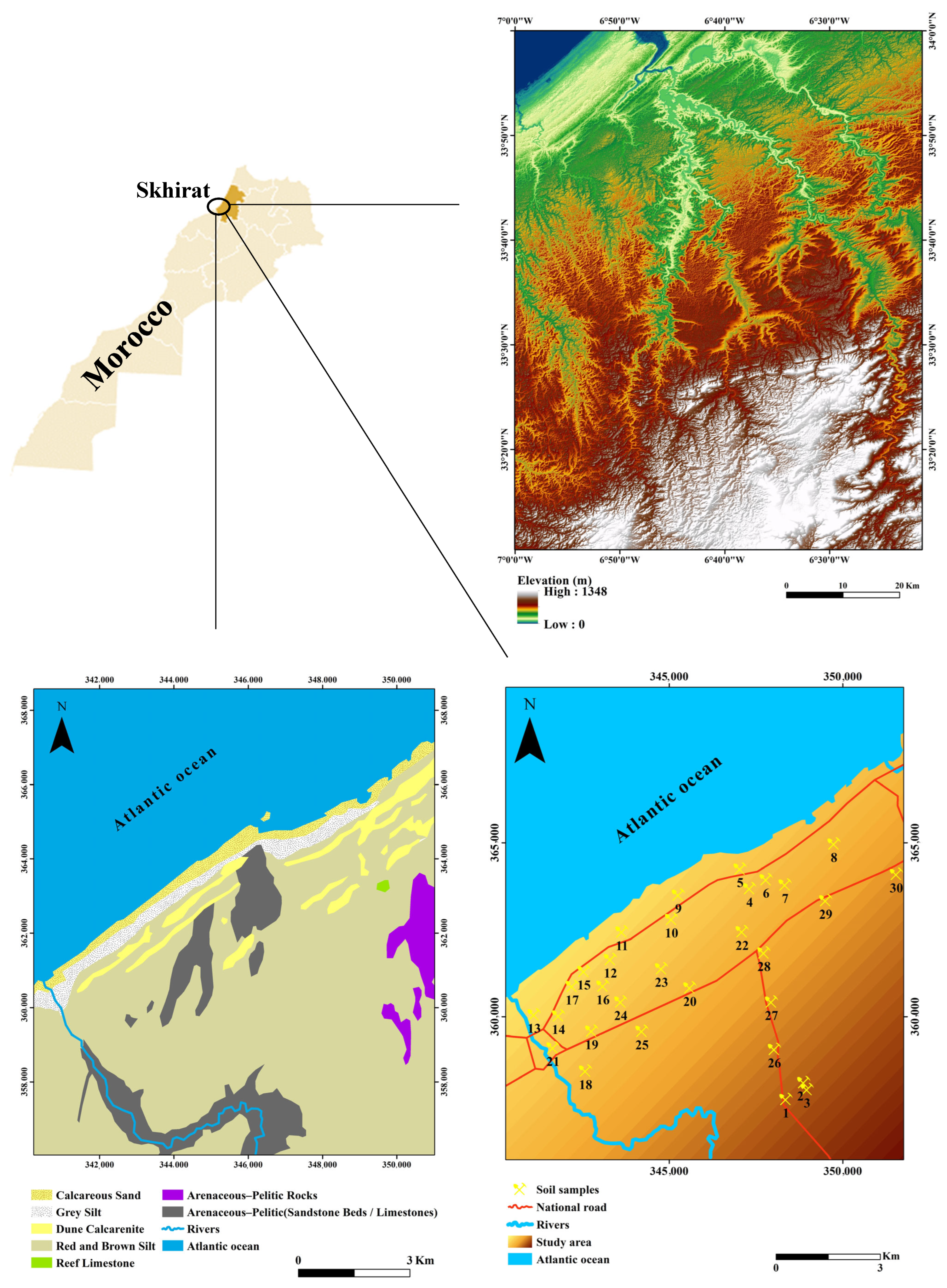
The study focuses on the Skhirat coastal sector of the Moroccan Meseta, bounded by Oued Ykem to the northeast, Oued Cherrat to the south, and the Atlantic Ocean to the west (Figure 1). The area lies within the Skhirat–Temara prefecture (Rabat–Sale–Kenitra region), roughly 25 km south of Rabat and 65 km north of Casablanca (33°51′13″ N; 7°02′08″ W). The climate is ocean-influenced, with mild temperatures and variable rainfall, and the agriculture is dominated by irrigated vegetable production sustained by shallow coastal alluvial groundwater. Geologically, Paleozoic shales/sandstones underlie Miocene to Plio-Quaternary carbonate and sandy formations that control storage and flow; hydrogeologically, the primary units are generally low-permeability, while the Neogene cover provides more permeable aquifers. Two adjacent coastal watersheds (Ykem, Cherrat) drain the area and contribute to recharge.
Sampling locations were selected to capture spatial variability across morphology and land use while maintaining adequate spacing. At each site, coordinates, elevation, and basic topographic and land-use notes were recorded, including proximity to the shoreline. The dominant crops were assigned by field observation at the time of sampling and are presented in Table 1.
Composite topsoil (0–20 cm) was collected in May 2025 using an auger. Samples were bagged, transported, and pre-processed by removing coarse fragments and residues, air-drying at room temperature, crushing, and sieving to <2 mm prior to chemical analysis.
Key chemical and nutrient attributes were determined using standard agronomic protocols and calibrated instruments (Table 2).
Spatial patterns of soil chemistry were mapped using Inverse Distance Weighting (IDW) interpolation in ArcGIS 10.8, producing continuous surfaces from point measurements for interpretation and comparison across indicators [37,38].

2.2. Statistical Analyses

To unravel the underlying structure of soil chemical variability and identify the dominant processes shaping soil quality in the Skhirat coastal agroecosystem, several complementary multivariate statistical approaches were applied. All analyses were performed using IBM SPSS Statistics 25. Pairwise relationships among soil properties were first evaluated using Pearson’s correlation coefficients, allowing the identification of direct linear associations and potential multicollinearity among variables [39]. Correlation matrices were visualized with significance levels to highlight strongly coupled indicators, especially those reflecting salinity stressors (EC, Na, and Cl) versus fertility-related attributes (OM, CEC, and nutrients). Principal component analysis (PCA) was applied to reduce dimensionality and identify the dominant axes of variation across the dataset [40]. Standardized variables were subjected to PCA with varimax rotation, and components with eigenvalues > 1 were retained following the Kaiser criterion. The Kaiser–Meyer–Olkin (KMO) measure of sampling adequacy was 0.696, indicating moderate suitability for PCA. Bartlett’s test of sphericity was highly significant (χ2 = 330.16, df = 105, and p < 0.001), confirming sufficient intercorrelation among variables for reliable dimensionality reduction. Loading matrices were used to select the MDS for SQI computation by prioritizing variables with the highest absolute loadings on the most informative components [23]. To evaluate the separability of soil groups along identified gradients, linear discriminant analysis (DA) was conducted using prior groupings based on SQI classes and spatial position (coastal vs. inland) [41,42]. The analysis quantified classification accuracy and highlighted which variables contributed most strongly to group discrimination. To assess causal linkages between fertility indicators and salinity drivers, RDA was employed as a constrained ordination technique [43]. Salinity-related variables (EC, Na, Cl, Ca, Mg, and pH) were used as explanatory predictors, while nutrient and fertility-related attributes (OM, CEC, macronutrients, and micronutrients) were set as response variables. The RDA biplot provided a direct visualization of the antagonistic relationship between salinity stressors and fertility indicators, clarifying which samples were dominated by either process [44].

2.3. Computation of Soil Quality Index (SQI) Using PCA–MDS with pH-Optimized Scoring

SQI was developed following an MDS approach derived from PCA, as recommended and widely applied in soil quality assessments [20,21,23,45]. The full set of soil chemical indicators was subjected to PCA. Variables with the highest loadings on principal components with eigenvalues > 1 were retained as MDS indicators [46]. To avoid redundancy, if two variables within the same PC were strongly correlated (r > 0.70), the one with the higher loading was chosen [22]. This procedure identified a parsimonious MDS representing the dominant soil processes. To enable direct comparison across variables measured in different units and ranges, each selected MDS indicator was converted into a unitless score (0–1) [47]. Indicators associated with fertility potential, such as CEC, Av. P, and micronutrients, were scored so that higher values received higher scores. Conversely, stress-related variables such as EC, Na, and Cl were scored in the opposite direction, assigning higher scores to lower concentrations. For soil pH, an optimum-based triangular function was applied, assigning the highest scores to values near neutrality (6.5–7.5) and gradually reducing the score for both acidic and alkaline deviations. This approach ensured that each indicator contributed meaningfully to the final index while respecting agronomic thresholds. This weighting strategy balances both the statistical importance of each indicator and its ecological relevance, producing a data-driven yet agronomically meaningful composite index.
The final SQI value for each site was calculated as a weighted additive function of the scored indicators using the following Equation (1) [20,21,23,45]:
S Q I = i = n n W i × S i
where “Si” is the standardized score of indicator “i”, and “Wi” is its weight. The SQI thus ranges between 0 and 1, with higher values representing better soil functioning and resilience [48].

2.4. AI and ML Algorithms for Predicting SQI and Site-Specific Soil Management

2.4.1. Input Dataset and Pre-Processing

The machine learning framework was developed using the same dataset employed for the soil quality index (SQI) computation, ensuring methodological consistency between diagnostic and predictive analyses. The dataset comprised 30 geo-referenced soil samples, each representing a distinct management and salinity condition within the Skhirat coastal agroecosystem.
The input feature matrix consisted of routinely measured soil chemical properties, including pH, electrical conductivity (EC), organic matter (OM), cation exchange capacity (CEC), available macronutrients (N, P, and K), exchangeable cations (Na, Ca, and Mg), chloride (Cl), and micronutrients (Av. Fe, Av. Zn, Av. Cu, and Av. Mn). These variables were selected because they are widely available in agronomic monitoring programs and directly reflect soil salinity stress, nutrient availability, and buffering capacity.
The response variable was the soil quality index (SQI) computed using the PCA–MDS approach with pH-optimized scoring. Using SQI as the target variable allows the machine learning models to learn complex relationships between raw soil chemistry and an integrated soil functioning metric.
Prior to model training, all predictors were examined for missing values and analytical inconsistencies; none were detected [49,50]. Continuous variables were standardized (z-score normalization) within model pipelines where required to ensure numerical stability and comparable feature scales, particularly for distance-based and kernel-based algorithms. Outliers were initially identified using the 1.5× interquartile range (IQR) criterion to detect statistically extreme observations. Values exceeding this threshold were subsequently verified against laboratory quality control records, including instrument calibration logs, standard reference materials, and duplicate analyses, to exclude potential analytical or transcription errors. No inconsistencies were detected during this verification process. Furthermore, extreme values were spatially coherent and predominantly located within the coastal fringe, where elevated salinity and nutrient accumulation are environmentally expected due to seawater intrusion and intensive agricultural practices. Removing these observations artificially reduced variance and weakened the salinity–fertility gradient observed in multivariate analyses. Therefore, extreme values were retained to preserve environmentally meaningful variability and ensure robust statistical and machine learning modeling [51]. This decision preserves the natural variability essential for learning realistic soil-quality gradients.

2.4.2. Machine Learning Algorithms and Experimental Design

Four supervised regression algorithms were implemented to represent complementary learning paradigms, including linear regression (LR) as a transparent baseline model, random forest (RF) as a non-parametric ensemble learner, Gradient Boosting Regression (GB) as a sequential tree-based model, and Support Vector Regression (SVR) with a radial basis function (RBF) kernel. Linear regression was included to evaluate whether SQI behaves as an approximately linear functional of soil chemical properties. Random forest and Gradient Boosting were selected for their ability to capture nonlinear interactions and handle multicollinearity, which are common in soil datasets. SVR was included to test kernel-based nonlinear learning under limited sample conditions.
Given the modest sample size (n = 30), model training and validation were conducted using 5-fold cross-validation with out-of-fold (OOF) predictions. Although Leave-One-Out Cross-Validation (LOO-CV) is frequently recommended for small datasets, 5-fold cross-validation was selected in this study to achieve a more favorable bias–variance balance and improved stability of performance estimates. LOO-CV can produce high-variance error estimates due to strong correlation between training folds, particularly for nonlinear and ensemble models [52]. In contrast, 5-fold cross-validation reduces variance while maintaining sufficient training data per fold, thereby providing more reliable generalization estimates for environmental datasets with a moderate sample size. In this design, each observation contributes to both training and validation without overlap, providing an unbiased estimate of model generalization to unseen sites [53]. This approach is widely recommended for environmental datasets where independent test sets are impractical.
Hyperparameter tuning was performed using grid-based optimization nested within the cross-validation framework to prevent information leakage and overly optimistic performance estimates. The optimized hyperparameters retained for each model are summarized in Table 3.

2.4.3. Model Evaluation Metrics and Validation

Model performance was assessed using three complementary metrics: the coefficient of determination (R2), root mean square error (RMSE), and mean absolute error (MAE) [53]. R2 quantifies the proportion of SQI variance explained by the model, while RMSE and MAE measure prediction accuracy in the original SQI scale, with RMSE emphasizing larger deviations.
Model accuracy was quantified using three standard regression metrics using Equations (2)–(4) [54]:
R 2 = 1 ( y i y ^ i ) 2 ( y i y ¯ i ) 2
R M S E = 1 n ( y i y ^ i ) 2
M A E = 1 n y i y ^ i
where “ y ” and “ y ^ ” are observed and predicted SQI values, and “ y ¯ ” is the mean observed SQI.
All metrics were computed exclusively from out-of-fold predictions, ensuring that reported values reflect true predictive performance rather than in-sample fitting. This validation strategy strengthens the credibility of the ML framework for operational soil quality prediction.

2.4.4. Application to Site-Specific Soil Management

For each model, scatterplots of observed vs. predicted SQI were produced, with a 1:1 reference line and sample (S1–S30). Using the best-performing model, predicted SQI values were generated for all sites and classified into Low, Moderate, and High soil quality classes using tertile thresholds. This classification translates ML outputs into operational management zones, enabling rapid identification of degraded soils requiring intervention and high-functioning soils requiring maintenance. By linking routine soil chemistry to SQI prediction, the ML framework provides a scalable and cost-effective tool for precision soil management, particularly in data-limited coastal agroecosystems where repeated laboratory analyses may be constrained.

2.5. Multi-Criteria Decision Analysis (MCDA) of Intervention Priority

To translate soil quality diagnostics into actionable management priorities, a multi-criteria decision analysis (MCDA) framework was applied [55]. Four criteria were selected to capture the principal processes constraining soil function in the Skhirat coastal agroecosystem, including salinity pressure “EC”: higher values that reflect greater salinity stress and intervention need; “CEC headroom”: the gap between observed CEC and the 75th percentile benchmark, indicating potential to improve buffering and nutrient retention; “pH deviation”: the absolute difference from neutrality (pH 7.0), highlighting soils where acidity or alkalinity correction is necessary; and “SQI deficit”: computed as1-SQIpredicted, representing the shortfall from optimal functioning.
Each criterion was normalized to a 0–1 dimensionless scale to ensure comparability [56]. A hybrid weighting scheme was applied, combining expert judgment with statistical information, resulting in weights of EC = 0.34, CEC headroom = 0.29, pH deviation = 0.18, and SQI deficit = 0.19. This configuration emphasized salinity mitigation and fertility capacity building as the primary levers for intervention.
The Technique for Order Preference by Similarity to Ideal Solution (TOPSIS) was employed to rank soils by intervention need [57]. In this method, normalized weighted criteria are compared against an ideal best (IB) and ideal worst (IW) solution [58]. As a complementary approach, the Preference Ranking Organization Method for Enrichment Evaluation (PROMETHEE II) was applied [59]. This method compares sites pairwise using preference functions for each criterion, producing a net flow index for each site.
To ensure reliability, Spearman’s rank correlation was calculated between the TOPSIS and PROMETHEE II rankings, confirming strong cross-method agreement. In addition, a weight-sensitivity analysis was performed by perturbing the criterion weights using a Dirichlet distribution. The stability of rankings was evaluated through Spearman correlation with the baseline and through rank-acceptability analysis, estimating the probability of each site appearing in the top-5 priority group under alternative weighting schemes. This robustness test ensured that management decisions are not artifacts of specific weight choices but reflect genuine biophysical constraints. The combined MCDA outputs (TOPSIS index, PROMETHEE net flow, and robustness metrics) were used to classify sites into High-, Moderate-, and Low-priority groups for intervention [60]. This classification provides a clear operational framework for designing phased management strategies, targeting coastal high-priority fields for immediate remediation, transitional mid-belt sites for coordinated improvements, and interior soils for maintenance and monitoring.

3. Results and Discussion

3.1. Soil Chemical and Nutrient Properties and Spatial Variability

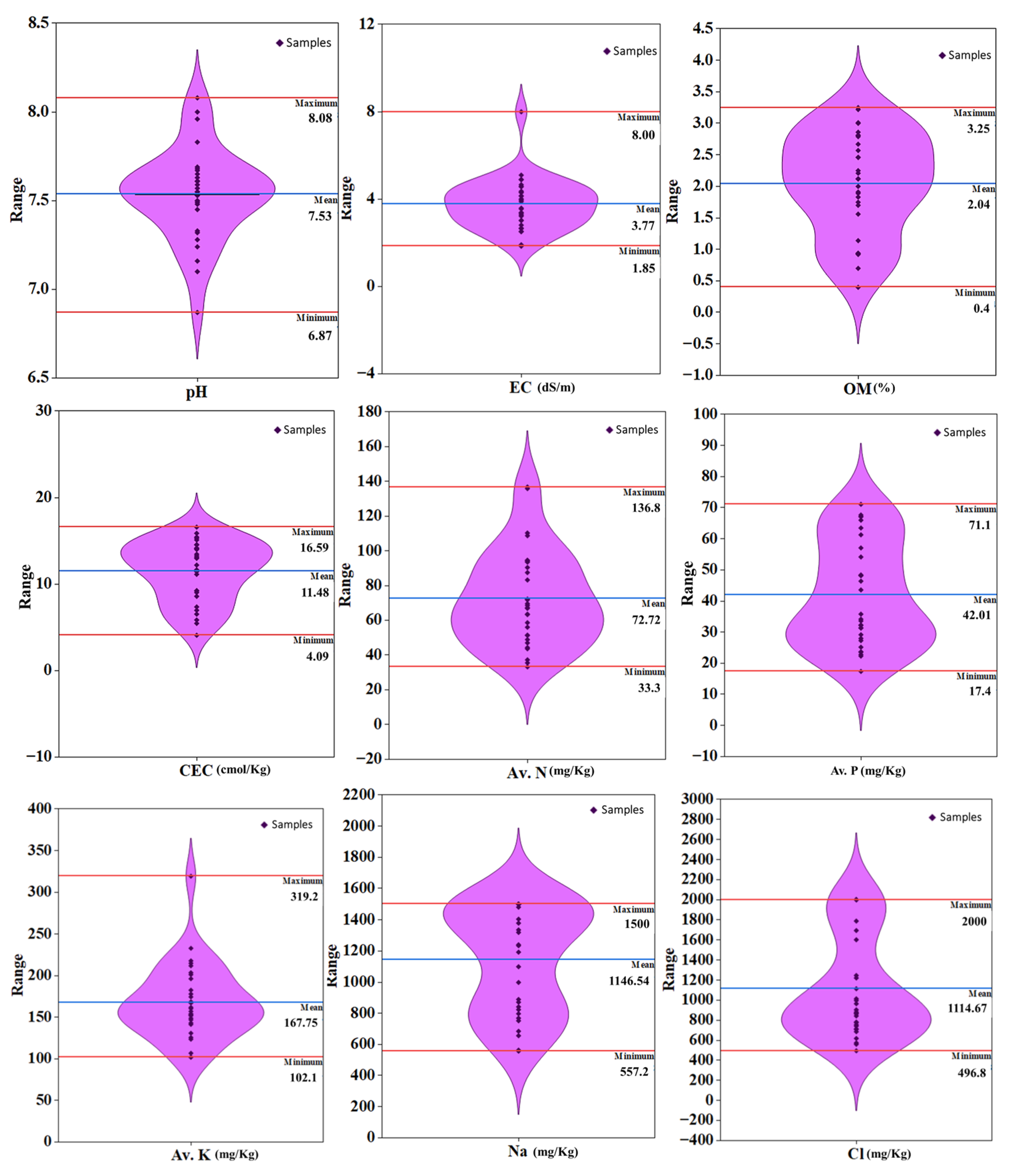
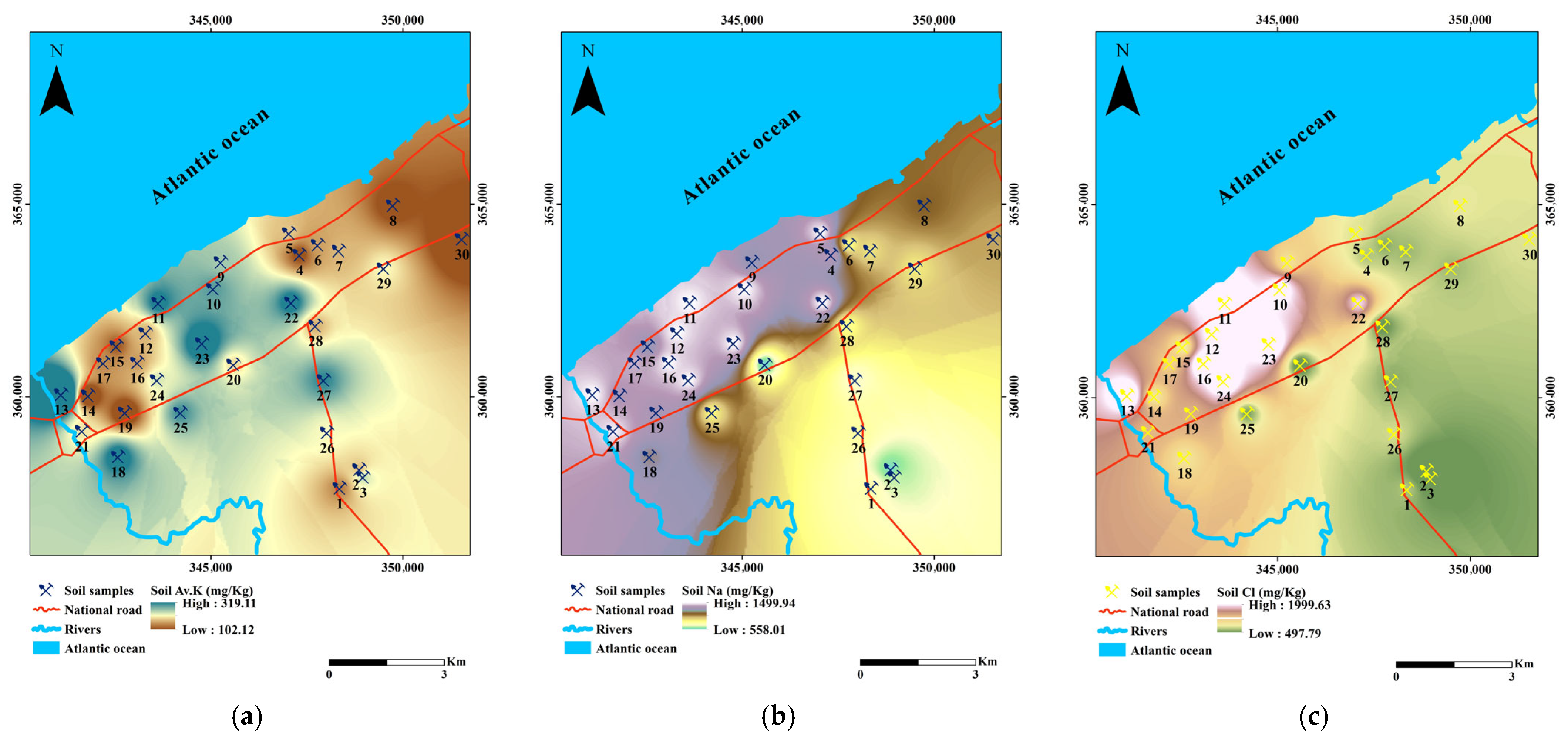
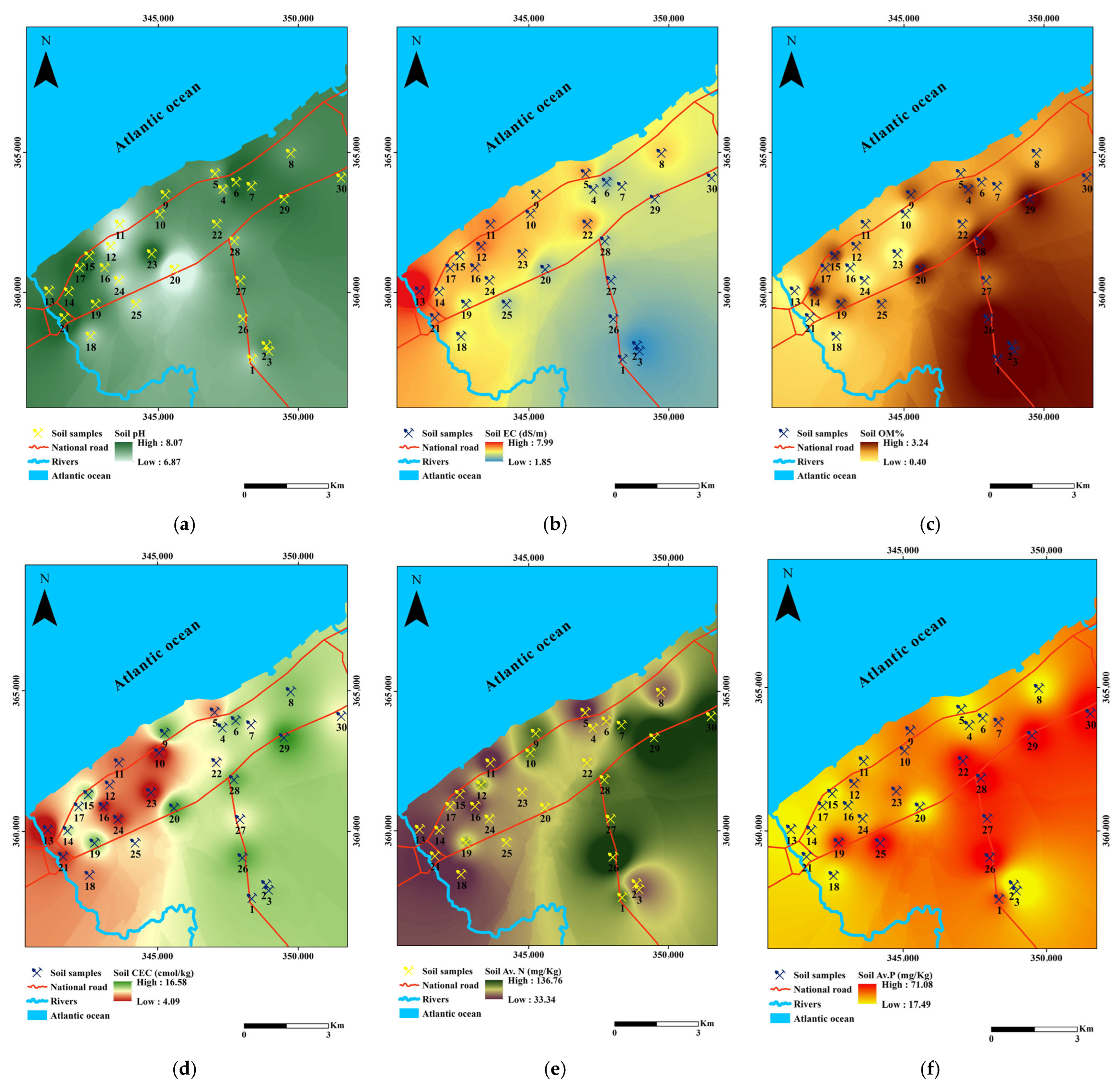
The soils of the Skhirat coastal zone exhibited a moderately alkaline reaction, with pH values ranging from 6.87 in the southern inland sites to 8.08 in the northern coastal margin, reflecting the combined effects of carbonate-rich parent material and intensive fertilization (Figure 2 and Figure 3a). The highest pH zones were clustered closer to the coast, likely due to seawater intrusion introducing bicarbonates and salts, while inland fields under intensive cropping showed relatively lower pH values. EC varied strongly, from 1.85 to 8.00 dS/m, with hotspots of salinity detected in coastal fields irrigated with brackish water.
The most saline soils were concentrated along the northwestern shoreline, where seawater intrusion is most severe, while inland zones showed moderate EC (Figure 3b). The spatial variability of EC highlights the dual influence of fertilizer accumulation and saltwater encroachment, which exacerbate secondary salinization risks [29,61]. OM was generally low, ranging between 0.40% and 3.25%, with the highest contents observed in central inland zones where organic amendments and crop residues are incorporated (Figure 3c). In contrast, coastal sites under intensive horticulture displayed depleted OM, reflecting the rapid mineralization driven by high fertilizer inputs and salinity stress. Similarly, CEC values fluctuated widely (4.09–16.59 cmol/kg), with higher values in the eastern agricultural plots rich in clay and organic inputs, and lower values in sandy coastal soils exposed to leaching (Figure 3d).
Av. N exhibited strong variability (33.3–136.8 mg/kg), with maxima in intensively fertilized inland plots and minima along the western degraded coastal soils (Figure 3e). Av. P concentrations ranged from 17.4 to 71.1 mg/kg, with high accumulation zones, consistent with the overuse of phosphate fertilizers, while marginal coastal plots showed lower availability (Figure 3f). Av. K followed a similar pattern (102–319 mg/kg), peaking in sites affected by excessive fertilizer additions but depleted in saline soils due to cationic competition with Na+ [62].
Na+ and Cl were markedly elevated in coastal areas, with Na+ exceeding 1500 mg/kg and Cl approaching 2000 mg/kg, clearly indicating marine intrusion into groundwater used for irrigation [61]. These salts accumulate preferentially in the northwestern coastal belt, creating critical salinity stress zones, while inland zones recorded relatively moderate values (Figure 4b,c).
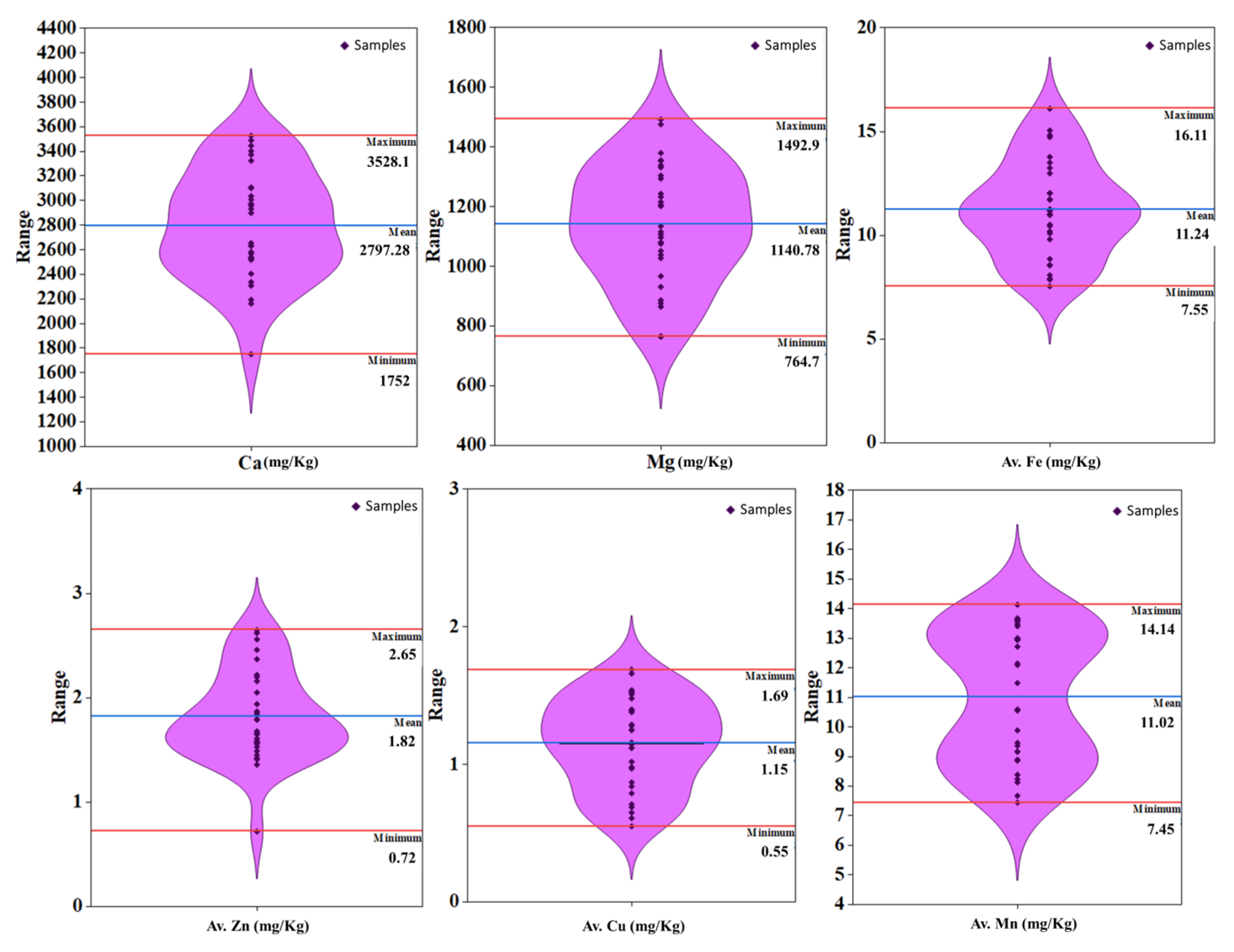
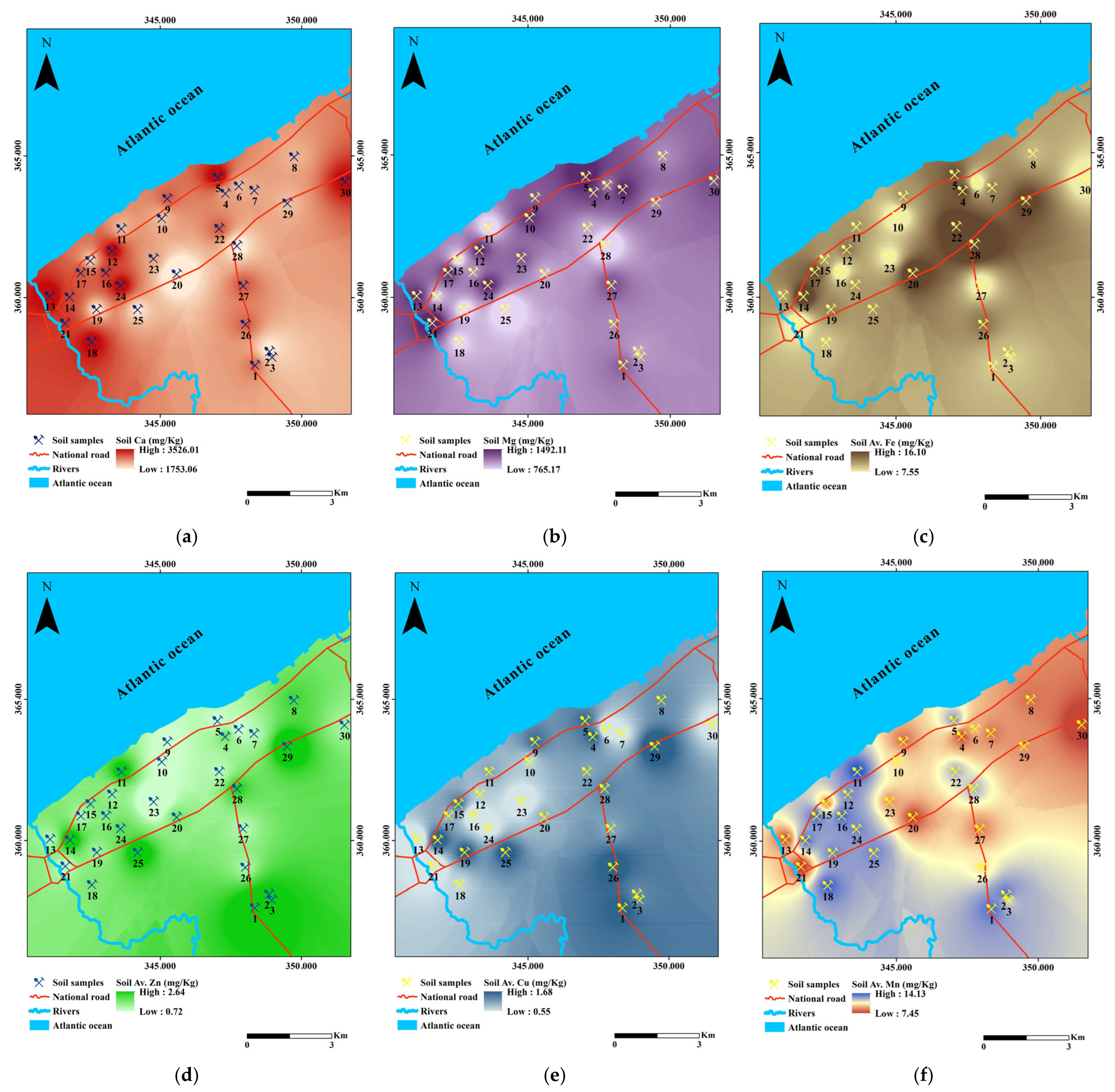
Ca2+ and Mg2+ contents were high across most soils, ranging from 1752 to 3490 mg/kg for Ca2+ and 764 to 1493 mg/kg for Mg2+, but showed pronounced enrichment in central and northern irrigated lands, reflecting both fertilizer application (lime, dolomite) and saltwater inputs (Figure 5a,b).
Among micronutrients, Av. Fe concentrations varied between 7.55 and 16.11 mg/kg, with localized enrichments in eastern fields where organic inputs improved micronutrient retention (Figure 5c).
Av. Zn, Av. Cu, and Av. Mn showed more scattered distributions. Av. Zn ranged from 0.72 to 2.65 mg/kg, Av. Cu from 0.55 to 1.69 mg/kg, and Av. Mn from 7.45 to 14.14 mg/kg. The lowest levels of micronutrients were found in saline-affected soils, where ionic antagonism with Na+ and Cl reduces bioavailability, whereas the highest levels clustered in inland cultivated soils subjected to long-term fertilizer and pesticide applications, which are known to carry trace metal residues (Figure 5d–f) [17,63].
Overall, the spatial patterns clearly differentiate inland zones with high nutrient accumulation due to fertilizer overuse from coastal saline-affected soils, where seawater intrusion depletes nutrient availability and aggravates soil degradation [64]. These findings emphasize that soil fertility in Skhirat is increasingly constrained by the dual pressures of intensive agricultural practices and marine-driven salinization, which together threaten the long-term sustainability of crop production.

3.2. Multivariate Statistical Insights into Soil Processes

3.2.1. Correlation Matrix to Analyze the Nexus Between Soil Fertility and Salinity

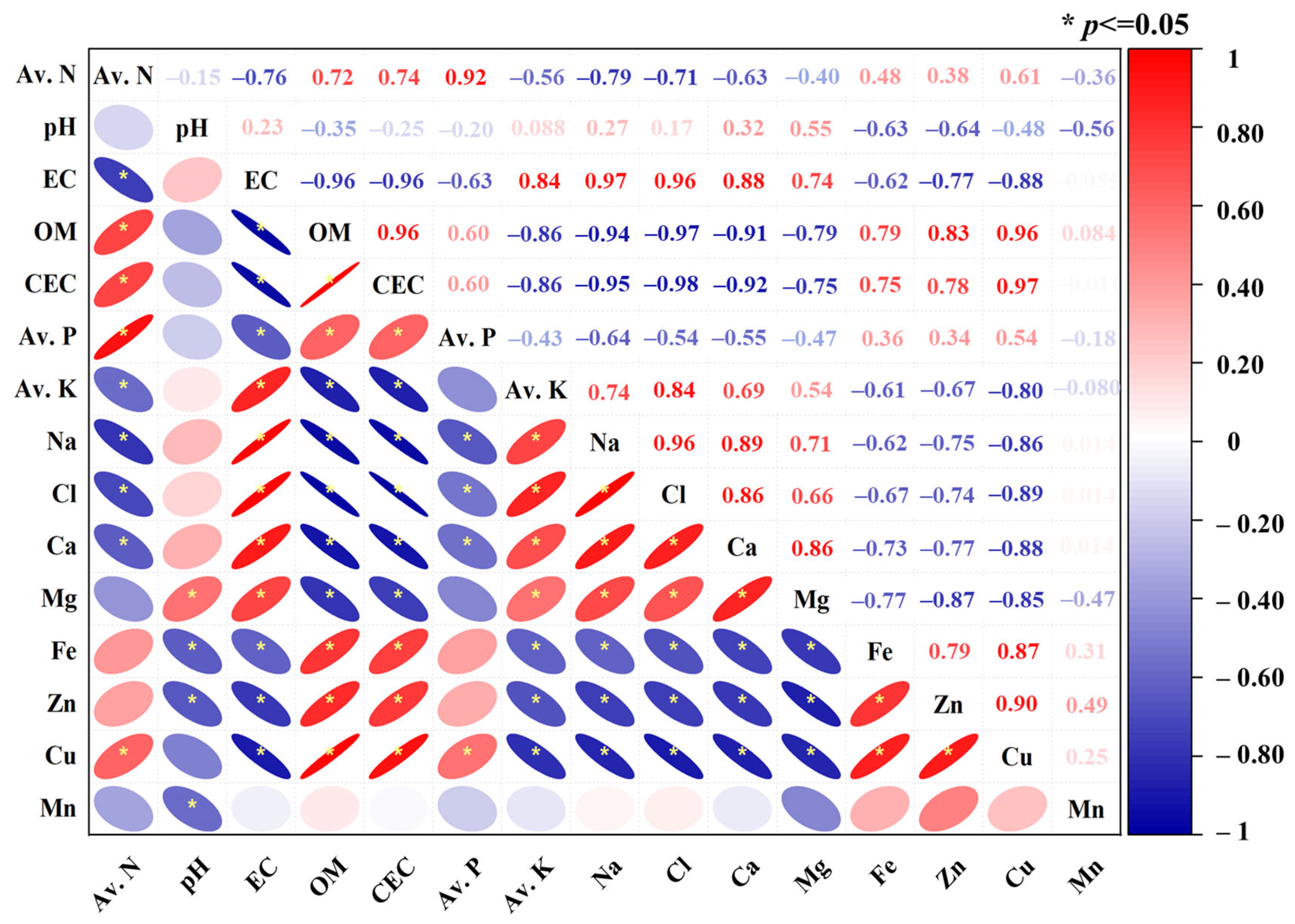
The Pearson correlation matrix revealed distinct relationships among soil chemical properties, highlighting the interaction between soil fertility parameters and salinity indicators (Figure 6). Strong negative correlations were observed between EC and both OM (r = −0.96) and CEC (r = −0.96). This suggests that salinization processes in the Skhirat coastal soils lead to the degradation of organic matter and reduced cation retention capacity, consistent with salt-induced soil structural decline [65]. Similarly, Cl and sodium Na+ were strongly and negatively correlated with OM (−0.97 and −0.94, respectively) and CEC (−0.98 and −0.95, respectively), further emphasizing the role of seawater intrusion and saline irrigation in nutrient depletion.
On the other hand, OM showed strong positive correlations with CEC (r = 0.99), Av. Fe (r = 0.79), Av. Zn (r = 0.83), and particularly Av. Cu (r = 0.96). These relationships underline the role of organic matter in enhancing cation exchange sites and in binding and retaining micronutrients [66]. Av. N was highly correlated with Av. P (r = 0.92), reflecting their common origin in fertilizer inputs. Av. K displayed moderate positive correlation with Cl (r = 0.84), suggesting cation competition in saline conditions. The micronutrients Av. Fe, Av. Zn, and Av. Cu were strongly correlated among themselves (e.g., Av. Zn–Av. Cu: r = 0.90), pointing to a shared enrichment from agricultural inputs such as pesticides and micronutrient fertilizers [67]. Overall, the correlation analysis illustrates that salinity-driven parameters (EC, Na+, and Cl) are inversely linked with soil fertility properties, whereas OM acts as a central driver for nutrient retention and micronutrient availability [68].

3.2.2. PCA for Unveiling the Drivers of Soil Variability

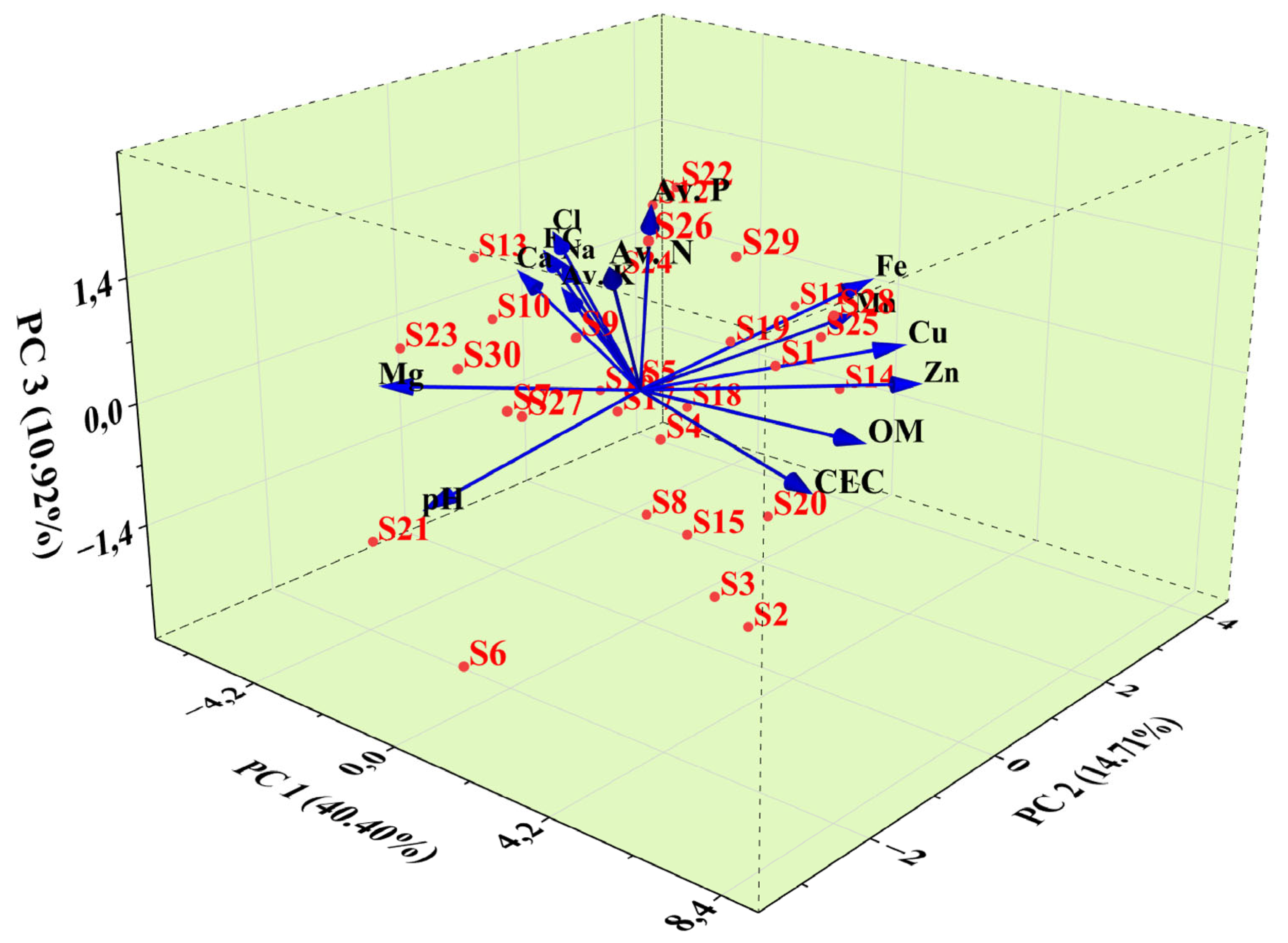
The PCA reduced the multidimensional soil dataset into three significant components, explaining 66.03% of the total variance (Figure 7). The first principal component (PC1), accounting for 40.4% of the variance, was dominated by strong positive loadings of OM (0.383) and CEC (0.372), and moderate contributions from micronutrients such as Av. Cu (0.306) and Av. Zn (0.237). Conversely, PC1 exhibited strong negative loadings from EC (−0.322), Cl (−0.330), and Na (−0.315), indicating a clear contrast between soil fertility-related attributes and salinity stressors.
This axis represents the fundamental trade-off in the Skhirat soils between nutrient-rich, organic matter-enhanced fertility and salinity-induced degradation.
The second principal component (PC2) explained 14.71% of the variance and was characterized by high positive loadings of Av. Mn (0.503), Av. Zn (0.367), and Av. Fe (0.312), opposed to negative contributions from pH (−0.380), Av. N (−0.298), and Mg (−0.307). This component differentiates soils with micronutrient enrichment (often linked to agricultural inputs) from soils with slightly acidic tendencies and macronutrient depletion. The third principal component (PC3) contributed 10.92% of the variance, with strong positive loadings for Av. N (0.550) and Av. P (0.623), representing fertilizer-derived macronutrient accumulation, while negative or weak contributions were observed from Av. Zn and Av. Mn.
Overall, PCA reveals two dominant processes shaping soil quality in the region. First, the antagonistic relationship between fertility and salinity, and second, the distinction between micronutrient-enriched soils and macronutrient-driven fertility from chemical inputs. This dimensional reduction not only highlights the primary drivers of soil variability but also provides a scientific basis for selecting key indicators in developing the soil quality index (SQI).

3.2.3. Discriminant Analysis for Classifying Soils Along the Salinity–Fertility Gradient

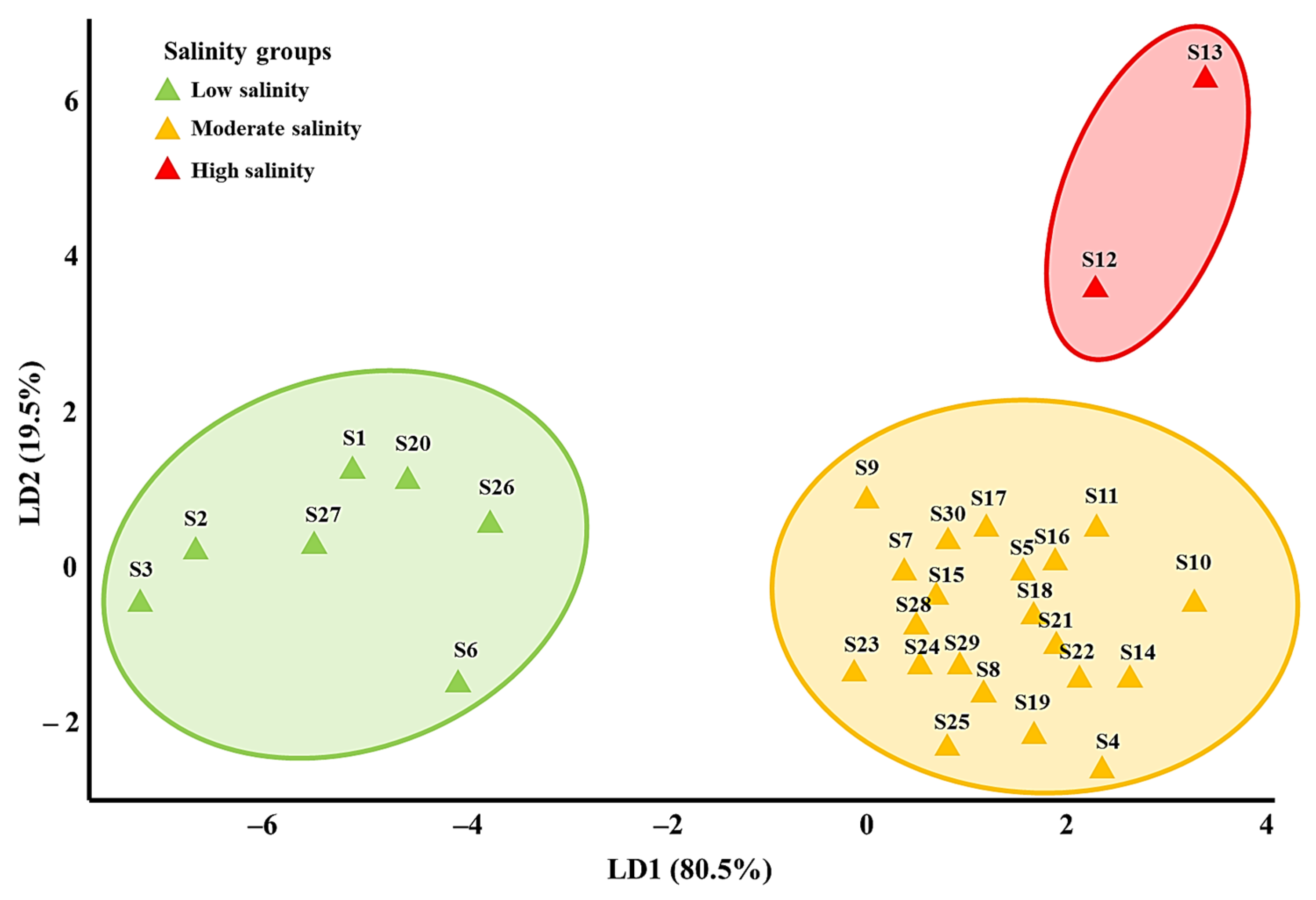
The DA clearly separated soil samples into three distinct groups based on salinity levels, including Low, Moderate, and High salinity (Figure 8). The first discriminant function (LD1), which explained 80.5% of the variance, effectively distinguished fertile, low-salinity soils (green cluster) from salinity-stressed soils (red cluster). This axis was mainly driven by EC, Na, and Cl, which loaded strongly on the high-salinity group, reflecting the dominant impact of seawater intrusion and saline irrigation water on soil quality.
Conversely, OM and CEC were positively associated with the low-salinity group, reinforcing their role in maintaining soil fertility under less saline conditions.
The second discriminant function (LD2), explaining 19.5% of the variance, provided further separation of moderate salinity soils (orange cluster). These soils are transitional, where fertilizer-derived macronutrients (N and P) contribute to fertility but remain partially constrained by salinity buildup [69]. Overall, the DA confirms the antagonistic relationship between soil fertility and salinity, where soils with high OM and CEC cluster in the low-salinity group, while those enriched in Na and Cl form the high-salinity group. This highlights the dual pressure of agricultural intensification and seawater intrusion shaping soil quality in Skhirat’s coastal zone.

3.2.4. Redundancy Analysis for Linking Nutrient Variability to Salinity Drivers

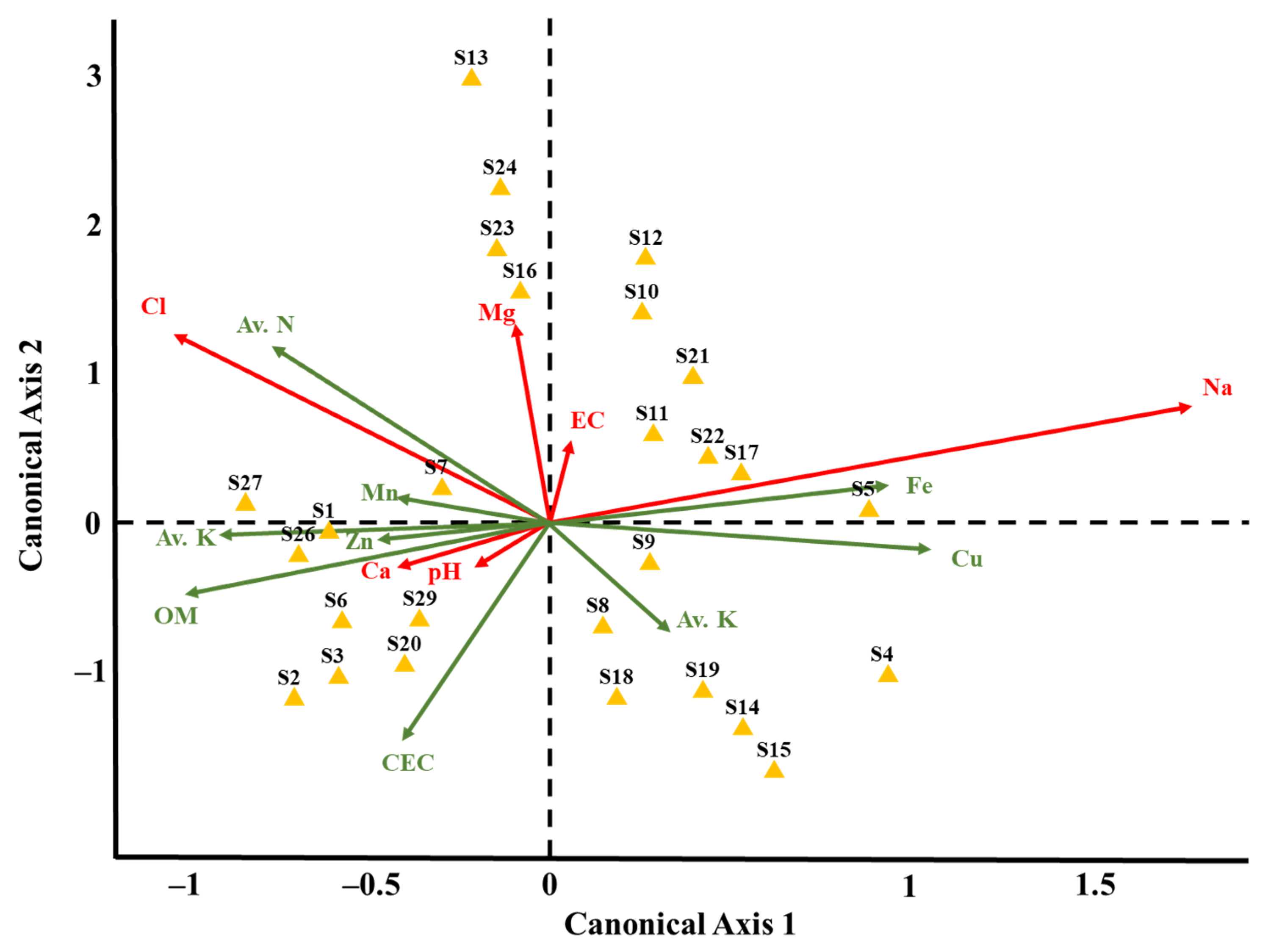
The RDA biplot provides a clearer representation of the relationships between salinity drivers and soil fertility indicators, with individual soil samples (S1–S30) plotted alongside explanatory and response variables (Figure 9). The distribution of arrows highlights that fertility parameters such as OM, CEC, and micronutrients (Av. Fe, Av. Zn, Av. Cu, and Av. Mn) align closely together, indicating their strong interdependence in supporting soil quality. These fertility-related variables are oriented in direct opposition to the salinity drivers, particularly Na, Cl, and EC, confirming the antagonistic relationship whereby increasing salinity undermines soil fertility and nutrient retention. The positioning of samples along the first canonical axis reveals a clear separation between salinity-dominated soils, characterized by high Na and Cl concentrations, and fertility-dominated soils, enriched in OM and nutrient availability.
Meanwhile, the second canonical axis reflects a secondary gradient that differentiates macronutrient enrichment (N, P, and K) from the influence of base cations (Ca and Mg). Together, these patterns demonstrate that the variability in soil nutrients across the Skhirat coastal zone is primarily structured by salinity stress, with some soils maintaining resilience through organic matter and nutrient retention, while others fall within zones of degradation linked to seawater intrusion and fertilizer imbalance [70].

3.3. Computation of SQI Using PCA–MDS with pH-Optimized Scoring

From the PCA results, we selected a minimum dataset (MDS) consisting of EC (salinity driver), CEC (retention capacity), Av. Mn (micronutrient driver), and available P (macronutrient enrichment), and added pH with an optimum-based scoring around neutrality to reflect agronomic suitability (Table 4).
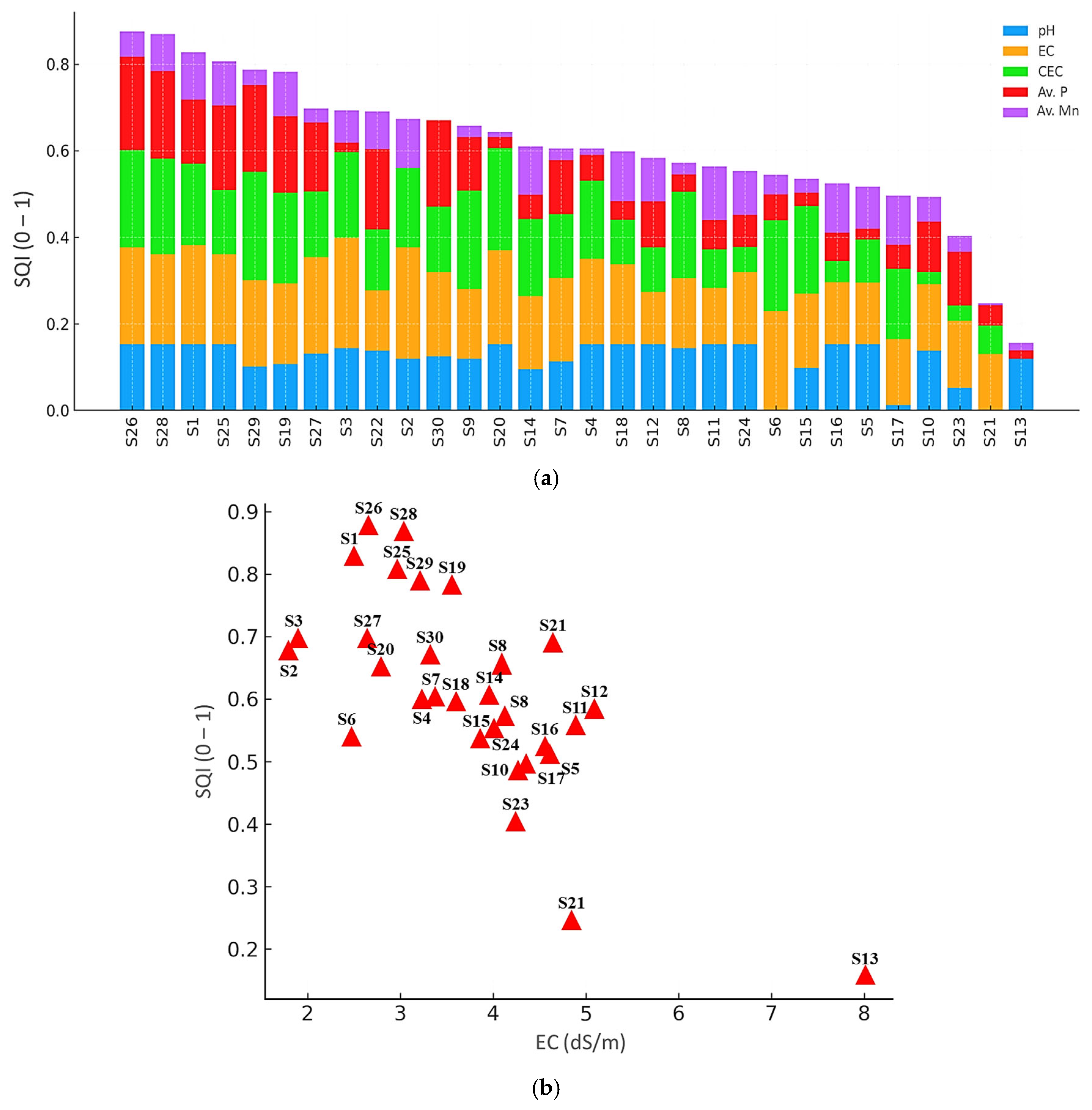
Indicators were transformed into unitless scores (0–1) using direction-aware functions, and objective weights were derived from absolute PCA loadings scaled by explained variance across PC1–PC3. The final SQI for each sample is the weighted sum of indicator scores. The computed SQI spans a minimum of 0.16 (S13) and a maximum of 0.88 (S26), with a mean of 0.61 across the 30 sites indicating a right-skewed distribution driven by a handful of very strong performers (e.g., S28 = 0.87; S25 = 0.81; S1 = 0.83) and a small set of clearly degraded soils at the lower tail (e.g., S21 = 0.25; S23 = 0.40) (Table 5).
Using tertile breaks, the sample set partitions evenly into Low (10/30; 33.3%), Moderate (10/30; 33.3%), and High (10/30; 33.3%) SQI classes, reflecting distinct quality tiers suitable for zone-specific recommendations. High-SQI sites (e.g., S26, S28, S25, S1, and S29) combine strong positive contributions from CEC and available P, supported by near-optimal pH and limited salinity penalty (EC). For instance, S26 (SQI = 0.88) shows a balanced profile where CEC, Av. P, EC (as “less-is-better”), and pH all contribute substantially, leaving only a minor gap on Av. Mn, an architecture typical of structurally robust, nutrient-supported soils. In contrast, the lowest SQI (S13 = 0.16) is characterized by zero/near-zero contributions from EC and CEC (reflecting severe salinity and poor exchange capacity) and only marginal gains from Av. P and Av. Mn, and pH contributes positively but cannot compensate for salinity-structure constraints. Other low-class examples (S21, S23, S10, and S16) share the same fingerprint: high EC (low EC score) and weak CEC curtail the composite index despite occasionally acceptable pH or P status.
The stacked bars make clear which levers are doing the work at each site (Figure 10a).
In the top performers (e.g., S26, S28, S25, and S1), CEC and Av. P are consistently large slices, pH contributes steadily (near the optimum), and EC adds a non-trivial positive share because salinity is sufficiently low to allow a good “less-is-better” score. By contrast, in low-SQI bars (e.g., S13, S21, and S23), the total height is small and is often dominated by pH (and sometimes Av. P), while CEC is thin and EC contributes little or nothing, visually underscoring how salinity pressure and weak exchange capacity suppress the composite score. This Figure thus operationalizes the salinity–fertility trade-off: when EC dominates, the stack collapses, and where CEC and P are strong, and pH is balanced, the stack rises.
The scatter of SQI against EC shows a clear inverse pattern, as EC increases, SQI declines (Figure 10b). The lowest SQI point (S13) sits at the high-EC end, illustrating the drag salinity imposes on the index, whereas high-SQI points (e.g., S26, S28) cluster at lower EC values, where the “less-is-better” salinity score is high and CEC, Av. P, and pH can express their positive effects. A few moderate-class soils (e.g., S20, S9, and S30) occupy intermediate EC with intermediate SQI, echoing a transitional state in which fertility inputs (P, Av. Mn) and exchange capacity partially offset, but do not fully overcome, the salinity constraint. This diagnostic confirms that salinity is the primary brake on overall soil quality in the dataset, while CEC, Av. P, and agronomically balanced pH act as the main boosters [71].

3.4. Predicting SQI with AI and ML Algorithms for Site-Specific Soil Management

To estimate SQI directly from routinely measured soil chemistry, the study evaluated four supervised learners, including linear regression, random forest, Support Vector Regression (RBF kernel), and Gradient Boosting, using five-fold out-of-fold (OOF) validation across 30 geo-referenced sites. The predictor set comprised pH, EC, OM, CEC, Av. N, Av. P, Av. K, Na, Cl, Ca, Mg, Av. Fe, Av. Zn, Av. Cu, and Av. Mn. Performance was assessed with R2, RMSE, and MAE computed on OOF predictions to approximate generalization to unseen locations from the same population. Inputs were standardized within pipelines where appropriate to ensure comparable scales and stable optimization.

3.4.1. Model Performance

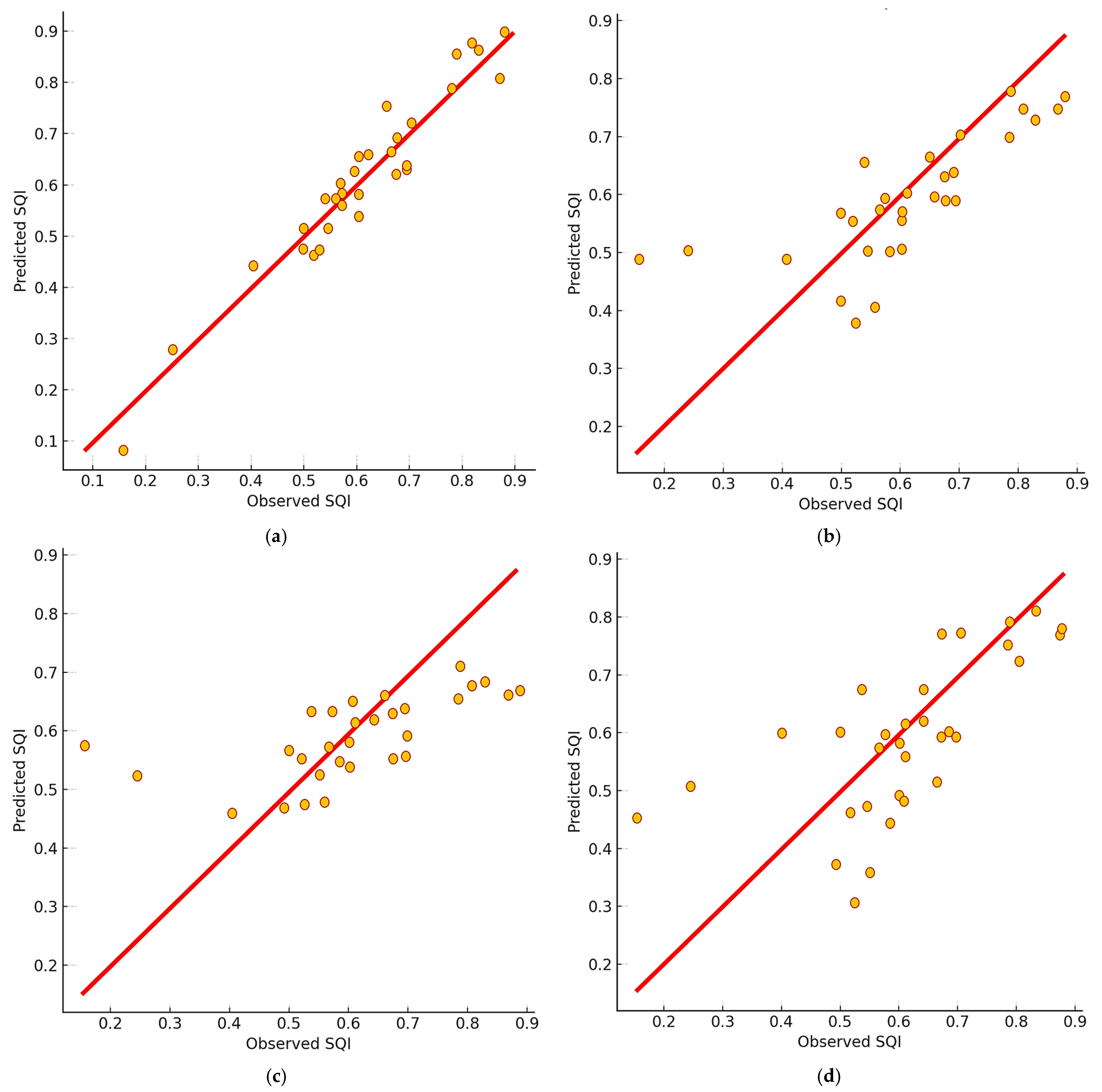
Linear regression achieved the strongest generalization, with R2 = 0.907, RMSE = 0.048, and MAE = 0.042 on 5-OOF predictions, indicating that the PCA–MDS SQI behaves as an approximately linear functional of the measured soil chemistry in this landscape (Table 6).
RF delivered competitive but inferior accuracy (R2 = 0.536, RMSE = 0.108, and MAE = 0.082), and Gradient Boosting showed a similar pattern (R2 = 0.379, RMSE = 0.125, and MAE = 0.102), which is consistent with the small sample size (n = 30) and the tendency of ensemble averaging to shrink extreme predictions, thereby compressing the SQI range under data scarcity. SVR with an RBF kernel performed slightly worse (R2 = 0.361, RMSE = 0.127, and MAE = 0.091), which is typical when kernel width and regularization cannot be robustly tuned with limited observations. Taken together, these results support the parsimony and interpretability of the linear model as the preferred predictor for operational mapping and scenario analysis (e.g., prospective reductions in EC), while tree-based methods remain useful candidates should the expanded datasets reveal nonlinear response surfaces.

3.4.2. Observed–Predicted Relationships

Scatterplots of observed vs. predicted SQI for each algorithm demonstrate tight clustering around the 1:1 line, with LR showing the narrowest dispersion, especially for the mid-range SQI (≈0.50–0.75) (Figure 11a).
The largest residuals occur at the distribution tails, the lowest-quality site (e.g., S13), and a few high-quality sites exhibit modest under- or over-estimation in nonlinear models, a pattern attributable to data sparsity near extremes, potential heteroscedasticity, and mild nonlinearities that cannot be reliably learned with n = 30.
Models reduce some local errors but display a slight range compression, visible as predicted values pulling toward the mean, reflecting their variance-reduction bias. Overall, the concordance between observations and predictions confirms that the dominant controls identified earlier, salinity (EC, Na, and Cl), exchange capacity (CEC), and nutrient status, explain most of the SQI variance in Skhirat [20,72].

3.4.3. Predicted SQI Range, Central Tendency, and Spatial Pattern

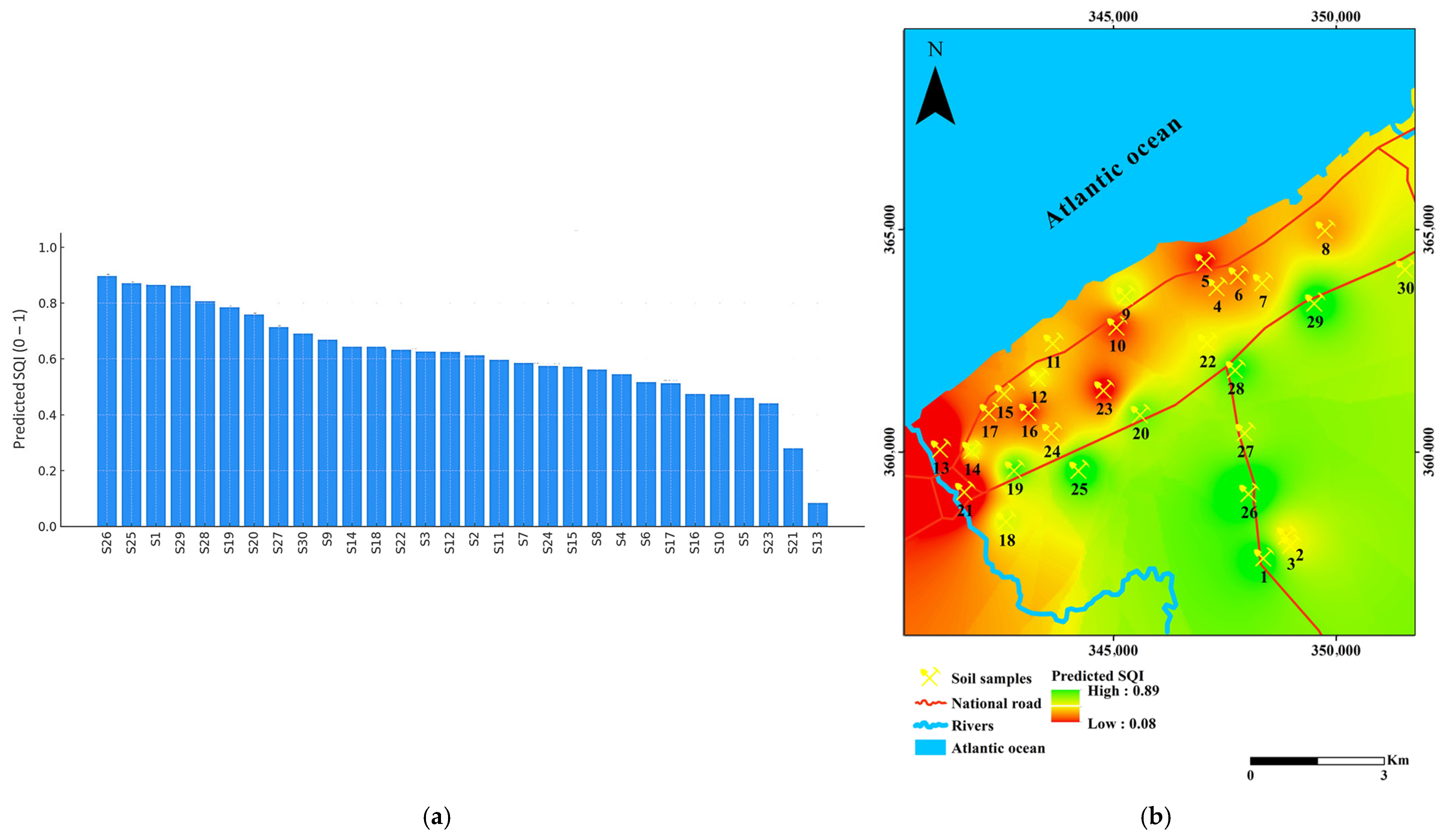
Using the best-performing model (linear regression) with 5-OOF predictions, the predicted SQI spans 0.084 (S13) to 0.897 (S26) with a mean of 0.614 across the 30 sites (Figure 12a). The distribution is right-skewed, with a small group of sites attaining very high predicted quality (e.g., S26, S25, and S1) and a lower tail concentrated in saline-affected locations (e.g., S13, S21, and S23). The predicted SQI surface delineates a clear coast–inland gradient consistent with salinity pressure (Figure 12b).
Lowest values cluster along the south-western coastal fringe (around S13–S14–S19), where seawater intrusion and brackish irrigation elevate EC and depress exchange capacity, driving the index down toward its minimum S13. Moving inland, SQI increases progressively, with local maxima centered in the central–eastern interior near S26 and adjacent fields S25, S27, and S28, where lower EC, higher CEC, and near-neutral pH support stronger composite scores. Transitional moderate zones occupy the mid-belt intersected by the road corridors (e.g., around S20, S22, S24, S29, and S30), reflecting sites where fertility inputs (P, OM) and exchange capacity partly offset, but do not fully overcome, residual salinity constraints. Overall, the map confirms that salinity dominance along the shoreline is the principal brake on soil functioning, while CEC building and pH balancing inland underpin the highest predicted SQI.

3.5. Multi-Criteria Decision Analysis (MCDA) of Intervention Priority

3.5.1. Criteria Design and Weighting

Intervention need was formalized as a composite of four dimensionless criteria scaled to [0, 1], where larger values denote greater priority for action. Salinity pressure was derived from EC, and CEC headroom quantifies the potential to raise exchange capacity toward the upper-quartile benchmark, pH deviation captures acidity/alkalinity correction needs, and SQI deficit reflects the gap to desirable soil functioning predicted by the ML model. A hybrid weighting scheme emphasized both expert knowledge and information content (EC = 0.34, CEC headroom = 0.29, pH deviation = 0.18, and SQI deficit = 0.19), privileging salinity control and capacity building as the principal levers in this coastal system.

3.5.2. TOPSIS Priority Index and PROMETHEE II Net Flow

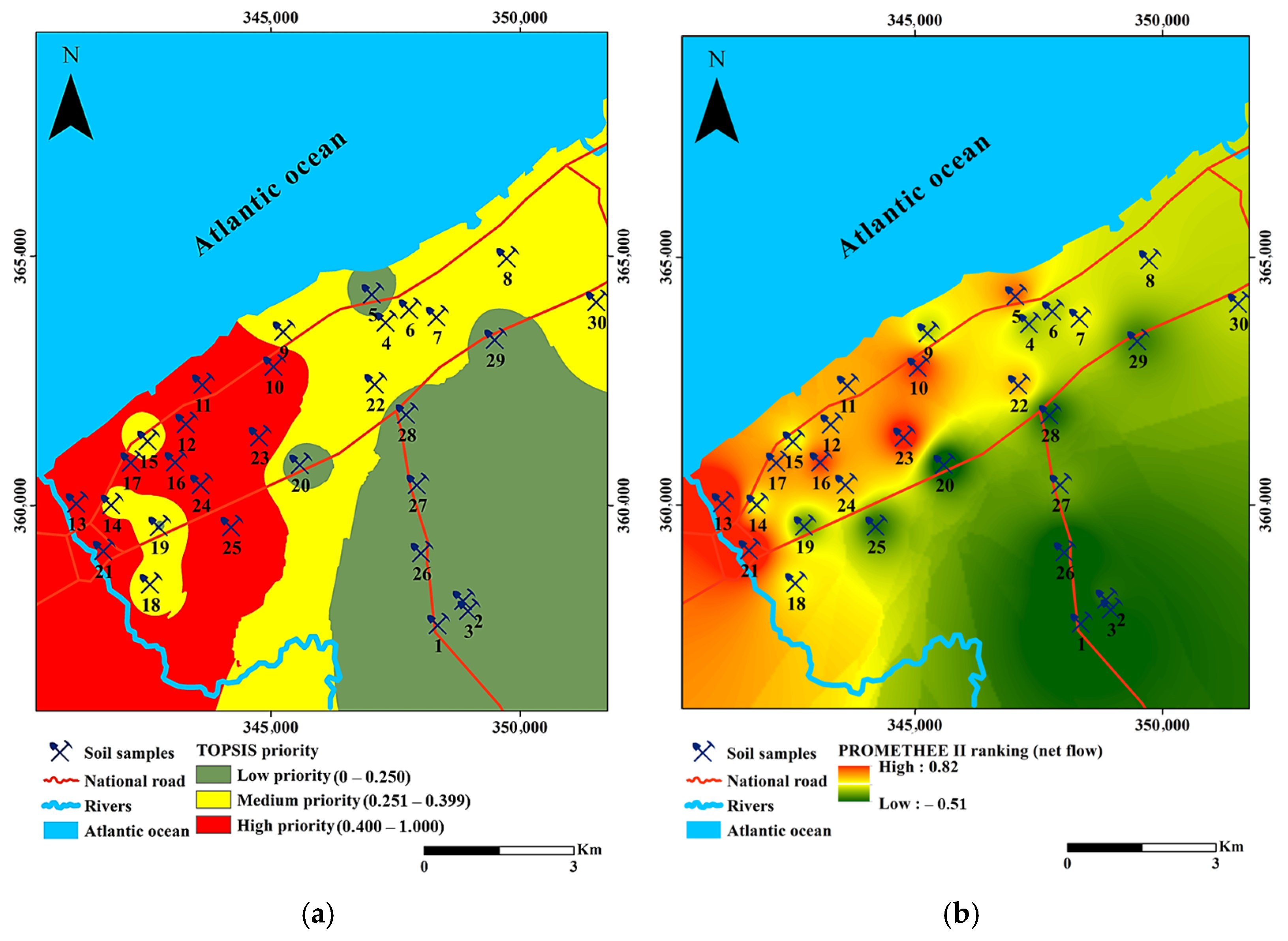
The TOPSIS produced a priority index (0–1) for each site, where higher values indicate greater need for intervention. Priority concentrates in the south-western coastal belt, with S13, S14, and S19 among the highest-ranking sites (Figure 13a).
These locations combine high salinity scores, large CEC headroom, and pronounced pH deviation with a large SQI deficit, which jointly pull the TOPSIS index toward its upper bound. Conversely, the lowest-priority sites occur in the central–eastern interior, notably around S25, S26, and S28, where salinity pressure is low, CEC is already comparatively high, pH lies near neutrality, and the SQI deficit is small. Classification by tertiles yielded an approximately even split of High-, Moderate-, and Low-priority groups, forming a coherent spatial pattern and a coast-to-inland improvement gradient, with pockets of moderate priority along transport corridors (e.g., S20, S22, S24, S29, and S30) where mixed signals (moderate EC but non-trivial CEC headroom or pH deviation) still justify targeted action. The PROMETHEE II, using a linear preference (V-shape) with small indifference and moderate preference thresholds, generated net flows that likewise rank intervention need [73]. PROMETHEE II reproduced the TOPSIS pattern, elevating the same coastal sites (S13, S14, and S19) and suppressing the central–eastern inland cluster (S25, S26, and S28) (Figure 13b). Because PROMETHEE II models pairwise outranking and is sensitive to small but consistent advantages across criteria, its agreement with TOPSIS indicates that the priority signal is robust across both distance-to-ideal and outranking logics.

3.5.3. Cross-Method Agreement, Robustness, and Transparency of the MCDA Outputs

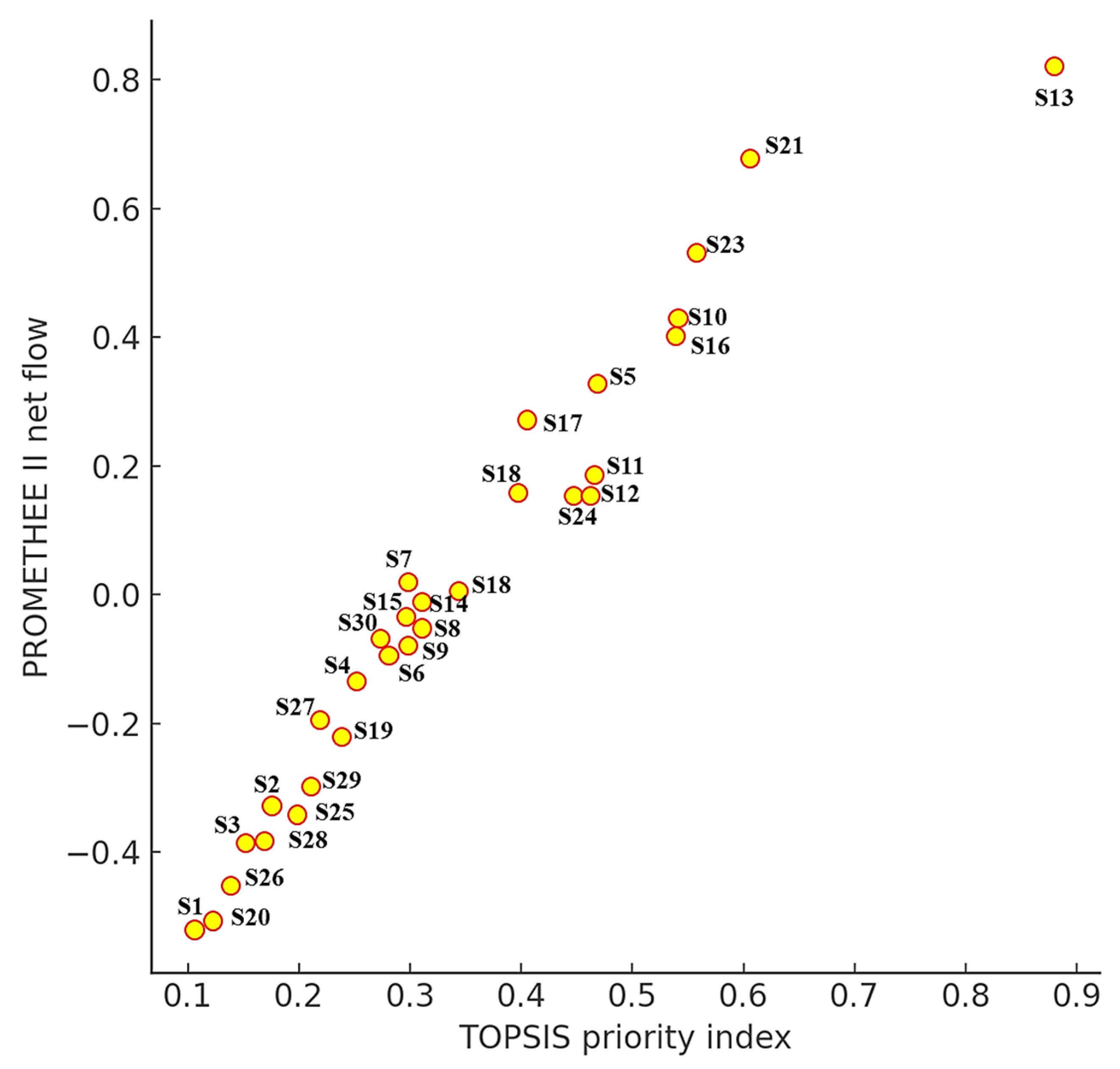
A strong monotonic agreement was found between TOPSIS and PROMETHEE II rankings (Spearman’s ρ = 0.99; p < 1 × 10⁻²⁵), confirming that the ordering of sites is method-independent under the current criteria and weights (Figure 14).
This concordance suggests that the biophysical drivers of intervention need, salinity pressure, and exchange-capacity deficits, moderated by pH and overall SQI gap, are dominant enough to overcome methodological idiosyncrasies. In practice, this means that priority classes are stable and can be used with confidence for planning.
The consolidated decision matrix and TOPSIS ranking quantify intervention need on a 0–1 scale, where higher values indicate greater priority. Across the 30 sites, the TOPSIS priority index ranges from 0.106 (S1) to 0.882 (S13) with a mean of 0.339. The top five priority sites are S13 (0.882), S21 (0.603), S23 (0.556), S10 (0.542), and S16 (0.535), and the bottom five are S28 (0.166), S3 (0.155), S26 (0.138), S20 (0.125), and S1 (0.106) (Table 7).
These extremes are consistent with the biophysical signal mapped previously; low-lying coastal soils exhibit compound constraints, while interior fields show near-optimal conditions with limited headroom for improvement.
The criterion (C) profiles explain why the coastal subset dominates the top ranks. For example, S13, the highest-priority site, registers maximal salinity pressure and capacity headroom (C-EC = 1.00 and C-CEC headroom = 1.00), off-target pH (C-pH deviation = 0.52), and the largest SQI gap (C-SQI deficit = 1.00), jointly pushing its index toward unity. S21 shows the same concurrence but slightly attenuated (C-EC = 0.494, C-CEC headroom = 0.674, C-pH deviation = 0.918, and C-SQI deficit = 0.759), consistent with its TOPSIS value of 0.603. S23 and S10 also combine high CEC headroom (0.824 and 0.863, respectively) with elevated EC and non-trivial SQI deficits (0.562 and 0.522), explaining their placement in the top tier (0.556 and 0.542). By contrast, the low-priority interior sites pair low salinity with little capacity headroom and small SQI gaps, including S26, which has C-EC = 0.130, C-CEC headroom = 0.000, and C-SQI deficit = 0.000 (TOPSIS 0.138), and S1 shows C-EC = 0.109, C-CEC headroom = 0.070, and C-SQI deficit = 0.039 (TOPSIS 0.106). Even where pH deviation is moderate (e.g., S28 C-pH deviation = 0.357), the absence of salinity pressure and capacity headroom keeps the index low (0.166). These contrasts show that intervention need is driven by the concurrence of multiple stresses rather than any single factor alone.
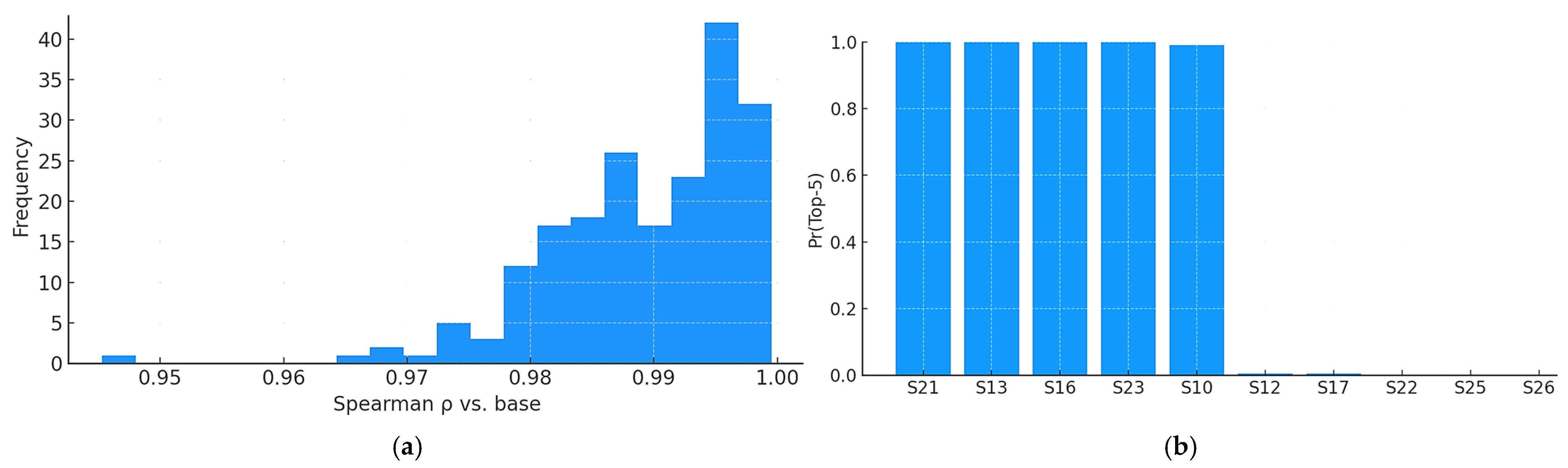
Methodological robustness is high. Perturbing the four weights around the hybrid vector (EC 0.34, CEC headroom 0.29, pH deviation 0.18, and SQI deficit 0.19) produced Spearman ρ between 0.961 and 1.000 relative to the baseline ranking (median ρ = 0.992), indicating very stable ordering under plausible preference uncertainty (Figure 15a).
Rank-acceptability analysis confirms that the top-5 set is essentially invariant, and S13, S21, S23, and S16 appear in the Top-5 with 100% probability and S10 with 99%, even as weights shift (Figure 15b). Practically, this means Phase-I resources can be directed confidently to S13, S21, S23, S16, and S10 without fear that reasonable reweighting would reshuffle priorities, while S1, S20, S26, S3, and S28 can be scheduled for maintenance monitoring.
Taken together, these results provide an audit trail from indicator values to decision scores and a robust basis for action. High-priority sites combine high EC, large CEC headroom, pH departures, and large SQI deficits, while low-priority sites show the inverse pattern. The numbers above make the trade-offs explicit and reproducible for peer review, while the stability diagnostics justify site-specific intervention plans that begin along the south-western coastal fringe and progress inland as resources permit.

3.6. Integrated Process–Model Synthesis of Soil Quality Dynamics in Coastal Agroecosystems

The results of this study reveal a coherent and mechanistically consistent soil functioning pattern governed by a coast–inland salinity–fertility gradient. Spatial chemistry demonstrated elevated EC, Na+, and Cl concentrations along the shoreline, with progressively stronger CEC and organic matter inland. This pattern aligns with classical salinization processes described for arid and semi-arid coastal landscapes, where evaporation exceeds precipitation and seawater intrusion contributes to salt accumulation in surface layers [74]. Similar gradients have been reported in saline–alkaline agricultural systems, where EC exhibits the highest spatial variability among soil properties [75]. In our dataset, EC behaved as the dominant stressor variable, structurally opposing fertility indicators across PCA, DA, and RDA ordinations, confirming salinity as the principal driver of soil functional differentiation.
The multivariate framework reinforced this mechanistic signal. PCA identified orthogonal axes separating salinity stress from nutrient buffering capacity, while RDA explicitly linked fertility indicators to reduced salinity pressure. This structural separation mirrors findings from Poma-Chamana et al. [76], where PCA-derived fertility gradients were strongly driven by phosphorus availability and alkalinity. However, unlike their regression kriging framework applied to 491 samples, the present study demonstrates that even with a moderate sample size, multivariate consistency can be achieved when gradients are strong and environmentally coherent. The convergence of independent statistical techniques in this study suggests that the identified soil quality pattern is not a statistical artifact but reflects a stable biophysical gradient.
The integrative SQI derived from PCA–MDS condensed these interactions into a tractable metric while preserving variance structure. The wide dynamic range of SQI values and clean partitioning into Low, Moderate, and High tiers confirm that the selected minimum dataset captures dominant soil functional contrasts. Comparable SQI classification approaches using PCA weighting have been implemented in arid fertility assessments by Lu et al. [77], where simplified linear structures provided stable predictive performance. In our case, the SQI construction process inherently embeds linear variance extraction (PCA) followed by weighted aggregation. Consequently, the target variable exhibits a strong underlying linear dependence on the selected predictors.
This structural property explains why LR outperformed more complex models (R2 = 0.907). The SQI, being largely a weighted linear transformation of soil chemistry, does not require nonlinear partitioning to be accurately reconstructed. Ensemble models such as RF and GB are designed to capture nonlinear interactions and high-order splits. However, when the underlying functional relationship is predominantly linear, and the signal-to-noise ratio is strong, simpler parametric models often generalize better. Similar observations were reported by Acir [78], where regularized LR models provided higher interpretability and stable performance in fertility prediction compared to more complex learners. In contrast, remote sensing-based salinity prediction studies such as Thangarasu et al. [79] demonstrated superior RF performance (92.1% accuracy), likely because spectral–salinity relationships are inherently nonlinear and spatially heterogeneous at larger scales. The difference highlights that model superiority depends on system structure: in chemically constrained agroecosystems with strong linear gradients, parsimony can outperform complexity.
Furthermore, the limited incremental gain of nonlinear models under n = 30 is statistically coherent. Ensemble averaging can shrink extreme predictions, particularly when extreme observations are few but environmentally meaningful. Given that the SQI extremes correspond to localized coastal salinity hotspots, ensemble smoothing reduces variance at distribution tails, explaining slight underperformance relative to linear regression. This behavior does not indicate model weakness but reflects bias–variance trade-offs inherent to ensemble learning in moderate datasets.
The MCDA component translated diagnostic and predictive outputs into operational prioritization. The exceptional cross-method agreement between TOPSIS and PROMETHEE II (ρ ≈ 0.99) demonstrates that intervention ranking is structurally stable and not sensitive to algorithmic choice. Weight-sensitivity analysis further confirmed ranking robustness across perturbations, indicating that priority zones reflect genuine co-occurrence of salinity stress, exchange capacity deficit, pH deviation, and SQI gap. Comparable spatial prioritization frameworks integrating multivariate fertility indicators have been reported by Poma-Chamana et al. [76], though the present study extends this by coupling predictive modeling with decision robustness diagnostics.
From an agroecological perspective, the findings align with crop-response literature in saline systems. Yousfi et al. [80] demonstrated that salinity reduces biomass and yield by up to 30% in sandy arid soils, yet genotype resilience moderates these effects. The soil-level evidence presented here complements such crop-level findings by identifying where salinity mitigation and CEC enhancement should precede varietal adaptation strategies. The integrated approach, therefore, bridges soil process diagnosis, predictive modeling, and management prioritization within a unified analytical framework.
Finally, the comparison with international studies highlights methodological positioning. While large-scale geostatistical frameworks provide extensive spatial coverage, and remote sensing–ML hybrids enable regional salinity mapping, the present framework emphasizes interpretability, structural coherence, and decision transparency at the farm-to-landscape interface [74,76,79]. The combination of PCA–MDS SQI, validated ML prediction, and cross-verified MCDA establishes a process-aware and operationally robust soil management model tailored to coastal agroecosystems.
Collectively, the discussion demonstrates that the observed coast–inland salinity–fertility gradient is consistently expressed across chemical measurements, multivariate ordination, integrative indexing, predictive modeling, and decision prioritization. The superiority of the linear model is not incidental but reflects the intrinsic linear structure embedded within the SQI formulation and the dominant environmental controls governing soil functioning in this system. The integration of statistical coherence, predictive accuracy, and decision robustness positions the framework as a scalable model for sustainable soil management in environmentally vulnerable coastal regions.

3.7. Limitations and Future Perspectives

While the present study provides an integrated and robust framework for soil quality assessment and decision support in a coastal agroecosystem, certain limitations must be acknowledged. The dataset consists of 30 geo-referenced soil samples, which may appear limited when considering large-scale regional mapping. However, the sampling design was strategically structured to capture the dominant coastal–inland gradient, land-use variability, and salinity influence within the defined study boundary. As highlighted by Minasny and McBratney [81], representativeness in soil surveys depends more on sampling strategy and environmental heterogeneity than on absolute sample size alone. Similar sample ranges (20–40 observations) have been successfully employed in soil quality index studies and localized agroecosystem assessments [82,83,84], particularly when the objective is site-specific management rather than regional-scale generalization.
From a multivariate statistical perspective, the adequacy of PCA is determined not solely by sample size but by the strength of variable intercorrelations and communalities [85,86]. In this study, the first three principal components explained approximately two-thirds of total variance, indicating strong structural patterns rather than noise-driven dimensionality reduction. The convergence of independent statistical approaches, including correlation analysis, PCA, discriminant analysis, and redundancy analysis, further reinforces the internal consistency of the identified soil-quality gradients.
Regarding ML robustness, small environmental datasets can increase overfitting risk if not properly validated. To address this concern, cross-validation strategies were implemented to ensure that all reported metrics reflect out-of-sample predictive performance. Cross-validation is widely recommended for environmental modeling under data-limited conditions [52,87,88]. Moreover, the agreement between independent analytical components, such as statistical modeling, SQI construction, and multi-criteria decision analysis, suggests that the findings are driven by strong environmental signals rather than statistical artifacts. The high cross-method stability observed in MCDA ranking further supports the reliability of the conclusions.
Another potential limitation relates to the use of deterministic spatial interpolation (IDW), which can produce localized “bullseye” patterns when strong gradients are present. As discussed by Li and Heap [89], such patterns are inherent to distance-weighted interpolators and do not necessarily imply inadequate sampling density. In this study, interpolation outputs are interpreted qualitatively to visualize gradients, while quantitative conclusions are derived from statistical and decision-support frameworks.
Despite these methodological safeguards, future research would benefit from increasing sampling density and incorporating temporal monitoring to capture seasonal salinity fluctuations and long-term management impacts. Expanding the dataset would also allow testing more complex nonlinear algorithms and geostatistical kriging approaches for enhanced spatial precision. Nonetheless, within the defined scope of site-specific soil management in a coastal agroecosystem, the current dataset provides sufficient structural information to support robust multivariate analysis, predictive modeling, and decision prioritization.

4. Conclusions

This study aimed to diagnose soil functioning in the Skhirat coastal agroecosystem and convert that diagnosis into site-specific, decision-ready guidance. An integrated workflow, including spatial analysis of soil chemistry, multivariate statistics, a soil quality index (SQI) derived from a minimum dataset (MDS), and principal component analysis (PCA) with optimum pH scoring, cross-validated machine learning (ML) prediction from routine variables, and a transparent multi-criteria decision analysis with hybrid weights and dual ranking methods, was used to link processes to prescriptions while testing robustness through agreement and sensitivity checks. Findings show a clear coastal salinity constraint contrasted with inland resilience supported by higher exchange capacity, organic enrichment, and near-neutral pH. The soil quality index (SQI) coherently captures this trade-off, machine learning (ML) models reliably anticipate it from routine chemistry, and multi-criteria decision analysis (MCDA) yields stable, method-independent priorities. Management should proceed in phases, with coastal fields first (salinity mitigation, then capacity building and pH correction), transitional belts with coordinated moderate interventions, and interior areas with maintenance and surveillance. Future work should incorporate operational costs and access constraints, extend monitoring across seasons, integrate hydrogeologic and remote-sensing data, and validate gains through field trials to strengthen feasibility-weighted prioritization and long-term impact.

Author Contributions

Conceptualization, H.S.; methodology, H.S.; software, H.S.; resources, H.S., A.G., and K.M.; validation, H.S., A.Z., L.M., and H.D.; formal analysis, H.S.; writing—original draft preparation, H.S., A.Z., L.M., M.O.L., and H.D.; writing—review and editing, H.S., R.M., A.Z., L.M., M.O.L., H.D., A.G., and K.M.; visualization, H.S.; supervision, A.Z., L.M., and H.D.; funding acquisition, R.M. All authors have read and agreed to the published version of the manuscript.

Funding

This research received no external funding.

Data Availability Statement

The data is available on request from the corresponding author.

Acknowledgments

The authors extend their gratitude to all collaborators involved in field sampling, laboratory analysis, and manuscript preparation. The authors also acknowledge the financial support provided by the “MCGP INRA-ICARDA” and “EiA” projects.

Conflicts of Interest

The authors state they have no known conflicting financial interests or personal relationships that would appear to affect the work reported in this manuscript.

References

  1. Bradley, O.; Keßler, D.; Gadermaier, J.; Mayer, M.; Leitgeb, E. Soil: The Foundation for Ecological Connectivity of Forest Ecosystems. In Ecological Connectivity of Forest Ecosystems; Springer: Berlin/Heidelberg, Germany, 2025; pp. 123–139. [Google Scholar]
  2. Khan, M.T.; Aleinikovienė, J.; Butkevičienė, L.-M. Innovative Organic Fertilizers and Cover Crops: Perspectives for Sustainable Agriculture in the Era of Climate Change and Organic Agriculture. Agronomy 2024, 14, 2871. [Google Scholar] [CrossRef]
  3. Ayesu, S.; Agbyenyaga, O.; Barnes, V.R.; Gyamfi, A.; Asante, R.K. Advancing Multiple Ecosystem Service Assessment in the Tropics: Evidence from Barekese and Owabi Watersheds in Ghana. Heliyon 2024, 10, e37499. [Google Scholar] [CrossRef] [PubMed]
  4. Chavan, S.; Uthappa, A.; Chichaghare, A.; Kumar, D.; Sirohi, C.; Kakade, V.D. Agroforestry Systems for Ecosystem Services in India. In Sustainable Management and Conservation of Environmental Resources in India; Apple Academic Press: Palm Bay, FL, USA, 2024; pp. 105–147. [Google Scholar]
  5. FAO. Land Use Statistics and Indicators 2000–2021. Global, Regional and Country Trends; FAOSTAT Analytical Briefs Series No. 71; FAO: Rome, Italy, 2023. [Google Scholar] [CrossRef]
  6. Oueld Lhaj, M.; Moussadek, R.; Mouhir, L.; Sanad, H.; Manhou, K.; Iben Halima, O.; Yachou, H.; Zouahri, A.; Mdarhri Alaoui, M. Application of Compost as an Organic Amendment for Enhancing Soil Quality and Sweet Basil (Ocimum basilicum L.) Growth: Agronomic and Ecotoxicological Evaluation. Agronomy 2025, 15, 1045. [Google Scholar] [CrossRef]
  7. Manhou, K.; Taghouti, M.; Moussadek, R.; Elyacoubi, H.; Bennani, S.; Zouahri, A.; Ghanimi, A.; Sanad, H.; Oueld Lhaj, M.; Hmouni, D.; et al. Performance, Agro-Morphological, and Quality Traits of Durum Wheat (Triticum turgidum L. Ssp. Durum Desf.) Germplasm: A Case Study in Jemâa Shaïm, Morocco. Plants 2025, 14, 1508. [Google Scholar] [CrossRef]
  8. Chen, C.; Xia, P.; Gan, Y.; Zheng, X.; Yang, P.; Shi, A.; Liu, X.; Zhang, J.; Yu, P.; Zhang, D. Food-Derived Bioactive Peptides as Emerging Therapeutic Agents: Unlocking Novel Strategies for Colorectal Cancer Treatment. Pharmacol. Res. 2025, 217, 107819. [Google Scholar] [CrossRef]
  9. Qin, A.; Ning, D. Developments, Applications, and Innovations in Agricultural Sciences and Biotechnologies. Appl. Sci. 2025, 15, 4381. [Google Scholar] [CrossRef]
  10. Teku, D.; Derbib, T. Uncovering the Drivers, Impacts, and Urgent Solutions to Soil Erosion in the Ethiopian Highlands: A Global Perspective on Local Challenges. Front. Environ. Sci. 2025, 12, 1521611. [Google Scholar] [CrossRef]
  11. Ziadat, F.; Conchedda, G.; Haddad, F.; Njeru, J.; Brès, A.; Dawelbait, M.; Li, L. Desertification and Agrifood Systems: Restoration of Degraded Agricultural Lands in the Arab Region. Agriculture 2025, 15, 1249. [Google Scholar] [CrossRef]
  12. Becker, M.; Seeger, K.; Paszkowski, A.; Marcos, M.; Papa, F.; Almar, R.; Bates, P.; France-Lanord, C.; Hossain, M.S.; Khan, M.J. Coastal Flooding in Asian Megadeltas: Recent Advances, Persistent Challenges, and Call for Actions amidst Local and Global Changes. Rev. Geophys. 2024, 62, e2024RG000846. [Google Scholar] [CrossRef]
  13. Schubert, S.; Qadir, M. Soil Salinity and Salt Resistance of Crop Plants; Springer: Berlin/Heidelberg, Germany, 2024. [Google Scholar]
  14. Sackey, O.K.; Feng, N.; Mohammed, Y.Z.; Dzou, C.F.; Zheng, D.; Zhao, L.; Shen, X. A Comprehensive Review on Rice Responses and Tolerance to Salt Stress. Front. Plant Sci. 2025, 16, 1561280. [Google Scholar] [CrossRef]
  15. Sanad, H.; Moussadek, R.; Zouahri, A.; Lhaj, M.O.; Mouhir, L.; Dakak, H. Machine Learning-Integrated Hydrogeochemical and Spatial Modeling of Groundwater Quality Indices for Seawater Intrusion and Irrigation Sustainability in Coastal Agroecosystems of Skhirat Region, Morocco. J. Hydrol. Reg. Stud. 2025, 62, 102848. [Google Scholar] [CrossRef]
  16. Manhou, K.; Moussadek, R.; Dakak, H.; Zouahri, A.; Ghanimi, A.; Sanad, H.; Oueld Lhaj, M.; Hmouni, D. Effect of Irrigation with Saline Water on Germination, Physiology, Growth, and Yield of Durum Wheat Varieties on Silty Clay Soil. Agriculture 2025, 15, 2364. [Google Scholar] [CrossRef]
  17. Sanad, H.; Moussadek, R.; Mouhir, L.; Lhaj, M.O.; Zahidi, K.; Dakak, H.; Manhou, K.; Zouahri, A. Ecological and Human Health Hazards Evaluation of Toxic Metal Contamination in Agricultural Lands Using Multi-Index and Geostatistical Techniques across the Mnasra Area of Morocco’s Gharb Plain Region. J. Hazard. Mater. Adv. 2025, 18, 100724. [Google Scholar] [CrossRef]
  18. Yuan, H.; Zhang, A.; Zhu, C.; Dang, H.; Zheng, C.; Zhang, J.; Cao, C. Saline Water Irrigation Changed the Stability of Soil Aggregates and Crop Yields in a Winter Wheat–Summer Maize Rotation System. Agronomy 2024, 14, 2564. [Google Scholar] [CrossRef]
  19. Tarolli, P.; Luo, J.; Park, E.; Barcaccia, G.; Masin, R. Soil Salinization in Agriculture: Mitigation and Adaptation Strategies Combining Nature-Based Solutions and Bioengineering. Iscience 2024, 27, 108830. [Google Scholar] [CrossRef] [PubMed]
  20. Sanad, H.; Moussadek, R.; Mouhir, L.; Oueld Lhaj, M.; Dakak, H.; El Azhari, H.; Yachou, H.; Ghanimi, A.; Zouahri, A. Assessment of Soil Spatial Variability in Agricultural Ecosystems Using Multivariate Analysis, Soil Quality Index (SQI), and Geostatistical Approach: A Case Study of the Mnasra Region, Gharb Plain, Morocco. Agronomy 2024, 14, 1112. [Google Scholar] [CrossRef]
  21. Emami, N.S.; Chavoshi, E.; Ayoubi, S.; Honarjoo, N.; Zeraatpisheh, M. Comprehensive Assessment of Soil Quality in Various Land Uses: A Comparative Analysis of Soil Quality Index Models. Environ. Earth Sci. 2024, 83, 498. [Google Scholar] [CrossRef]
  22. Bhuyan, S.; Patgiri, D.; Medhi, B.; Deka, B.; Kandali, G.; Medhi, S.; Kalidas-Singh, S.; Debnath, A.; Zhiipao, R.; Tsomu, T. Prediction of Soil Quality Index (SQI) and Its Minimum Dataset Indicators for Rice-Based Cropping Systems in the North Bank Plain Zone of Assam. Eurasian Soil Sci. 2024, 57, 1718–1729. [Google Scholar] [CrossRef]
  23. Cao, Y.; Zhang, W.; Pan, B.; Dai, L.; Tian, A. Selection of the Minimum Data Set and Quantitative Soil Quality Indices for Different Azalea Forest Communities in Southwestern China. Plant Soil 2025, 511, 463–481. [Google Scholar] [CrossRef]
  24. Alotaibi, E.; Nassif, N. Artificial Intelligence in Environmental Monitoring: In-Depth Analysis. Discov. Artif. Intell. 2024, 4, 84. [Google Scholar] [CrossRef]
  25. Barikloo, A.; Alamdari, P.; Rezapour, S.; Taghizadeh-Mehrjardi, R. Digital Mapping of Soil Quality Index to Evaluate Orchard Fields Using Random Forest Models. Model. Earth Syst. Environ. 2024, 10, 6787–6803. [Google Scholar] [CrossRef]
  26. Zema, D.A.; Parhizkar, M.; Plaza-Alvarez, P.A.; Xu, X.; Lucas-Borja, M.E. Using Random Forest and Multiple-Regression Models to Predict Changes in Surface Runoff and Soil Erosion after Prescribed Fire. Model. Earth Syst. Environ. 2024, 10, 1215–1228. [Google Scholar] [CrossRef]
  27. Gharnate, A.; Cox, R.; Sanad, H.; Taouali, O.; Oueld Lhaj, M.; Mhammdi, N. Hydrodynamic Modelling and Morphometric Assessment of Supratidal Boulder Transport on the Moroccan Atlantic Coast: A Dual-Site Analysis. Earth 2025, 6, 124. [Google Scholar] [CrossRef]
  28. Gharnate, A.; Sanad, H.; Oueld Lhaj, M.; Mhammdi, N. A Comprehensive Review of Polygenetic Signatures, Methodological Advances, and Implications for Coastal Boulder Deposits (CBDs) Assessment. GeoHazards 2025, 6, 69. [Google Scholar] [CrossRef]
  29. Sanad, H.; Mouhir, L.; Zouahri, A.; Moussadek, R.; El Azhari, H.; Yachou, H.; Ghanimi, A.; Oueld Lhaj, M.; Dakak, H. Assessment of Groundwater Quality Using the Pollution Index of Groundwater (PIG), Nitrate Pollution Index (NPI), Water Quality Index (WQI), Multivariate Statistical Analysis (MSA), and GIS Approaches: A Case Study of the Mnasra Region, Gharb Plain, Morocco. Water 2024, 16, 1263. [Google Scholar] [CrossRef]
  30. Methods of Soil Analysis: Part 2 Chemical and Microbiological Properties; Page, A.L., Ed.; American Society of Agronomy, Soil Science Society of America: Madison, WI, USA, 1983. [Google Scholar]
  31. Rowell, D.L. Soil Science: Methods & Applications; Routledge: London, UK, 2014. [Google Scholar]
  32. Van Reeuwijk, L.P. Procedures for Soil Analysis. Tech. Pap. Int. Soil Ref. Inf. Cent 1986, 120. Available online: https://files.isric.org/public/documents/ISRIC_TechPap09.pdf (accessed on 3 January 2026).
  33. Baruah, T.C.; Barthakur, H.P. A Textbook of Soil Analysis; Vikas Publishing House PVT Ltd.: New Delhi, India, 1997. [Google Scholar]
  34. Jackson, M.L. Soil Chemical Analysis; Prentice Hall Inc.: Hoboken, NJ, USA, 1958. [Google Scholar]
  35. Olsen, S.R.; Cole, C.V.; Watanabe, F.S.; Dean, L.A.; United States Department of Agriculture. Estimation of Available Phosphorus in Soils by Extraction with Sodium Bicarbonate; U.S. Dept. of Agriculture: Washington, DC, USA, 1954. [Google Scholar]
  36. Lindsay, W.L.; Norvell, W.A. Development of a DTPA Soil Test for Zinc, Iron, Manganese, and Copper. Soil Sci. Soc. Am. J. 1978, 42, 421–428. [Google Scholar] [CrossRef]
  37. Sanad, H.; Moussadek, R.; Mouhir, L.; Lhaj, M.O.; Dakak, H.; Zouahri, A. Geospatial Analysis of Trace Metal Pollution and Ecological Risks in River Sediments from Agrochemical Sources in Morocco’s Sebou Basin. Sci. Rep. 2025, 15, 16701. [Google Scholar] [CrossRef]
  38. Sanad, H.; Moussadek, R.; Mouhir, L.; Lhaj, M.O.; Dakak, H.; Manhou, K.; Zouahri, A. Monte Carlo Simulation for Evaluating Spatial Dynamics of Toxic Metals and Potential Health Hazards in Sebou Basin Surface Water. Sci. Rep. 2025, 15, 29471. [Google Scholar] [CrossRef] [PubMed]
  39. Selamat, S.N.; Majid, N.A.; Taha, M.R. Multicollinearity and Spatial Correlation Analysis of Landslide Conditioning Factors in Langat River Basin, Selangor. Nat. Hazards 2025, 121, 2665–2684. [Google Scholar] [CrossRef]
  40. Greenacre, M.; Groenen, P.; Hastie, T.; Iodice D’Enza, A.; Markos, A.; Tuzhilina, E. Principal Component Analysis. Nat. Rev. Methods Primers 2022, 2, 100. [Google Scholar] [CrossRef]
  41. Zhao, S.; Zhang, B.; Yang, J.; Zhou, J.; Xu, Y. Linear Discriminant Analysis. Nat. Rev. Methods Primers 2024, 4, 70. [Google Scholar] [CrossRef]
  42. Karray, E.; Bouricha, B. Discriminant Analysis Using Feature Extraction from Spectral Domain Responses to Achieve Accurate Delineation for Robust Evaluation or Classification of Soil Properties. Int. J. Remote Sens. 2025, 46, 410–428. [Google Scholar] [CrossRef]
  43. Yuan, L.; Wang, J.; Liu, R.; Tang, Y.; Wu, D.; Jin, R.; Zhu, W. Soil Properties, Climate, and Topography Jointly Determine Plant Community Characteristics in Marsh Wetlands. J. Plant Res. 2025, 138, 37–50. [Google Scholar] [CrossRef] [PubMed]
  44. Souza, T. Redundancy Analysis (RDA). In Advanced Statistical Analysis for Soil Scientists; Springer: Berlin/Heidelberg, Germany, 2025; pp. 57–77. [Google Scholar]
  45. Reza, S.; Sharma, G.; Alam, N.; Mourya, K.; Hota, S.; Mukhopadhyay, S.; Bandyopadhyay, S.; Mukhopadhyay, J.; Ray, S. Assessing Soil Quality under Different Land-Uses through Constructing Minimum Datasets from Soil Profiles in a Fragile Ecosystem of Northeastern Region of India. Commun. Soil Sci. Plant Anal. 2024, 55, 1629–1643. [Google Scholar] [CrossRef]
  46. Chaudhry, H.; Vasava, H.B.; Chen, S.; Saurette, D.; Beri, A.; Gillespie, A.; Biswas, A. Evaluating the Soil Quality Index Using Three Methods to Assess Soil Fertility. Sensors 2024, 24, 864. [Google Scholar] [CrossRef] [PubMed]
  47. Shoumik, B.A.A.; Błońska, E.; Lasota, J. Soil Quality Index According to Diverse Land Use Systems across the Europe. Land Degrad. Dev. 2025, 36, 1467–1482. [Google Scholar] [CrossRef]
  48. Damiba, W.A.F.; Gathenya, J.M.; Raude, J.M.; Home, P.G. Soil Quality Index (SQI) for Evaluating the Sustainability Status of Kakia-Esamburmbur Catchment under Three Different Land Use Types in Narok County, Kenya. Heliyon 2024, 10, e25611. [Google Scholar] [CrossRef] [PubMed]
  49. Barathkumar, S.; Sellamuthu, K.; Sathyabama, K.; Malathi, P.; Kumaraperumal, R.; Devagi, P. Advancements in Soil Quality Assessment: A Comprehensive Review of Machine Learning and AI-Driven Approaches for Nutrient Deficiency Analysis. Commun. Soil Sci. Plant Anal. 2025, 56, 251–276. [Google Scholar] [CrossRef]
  50. Minasny, B.; McBratney, A.B. Machine Learning and Artificial Intelligence Applications in Soil Science. Eur. J. Soil Sci. 2025, 76, e70093. [Google Scholar] [CrossRef]
  51. Tilahun, Y.; Qinghua, X.; Ashango, A.A.; Dame, S. Predicting Resilient Modulus of Fine-Grained Soils Using Support Vector Machine-RBF and Random Forest. Adv. Mater. Sci. Eng. 2025, 2025, 6503045. [Google Scholar] [CrossRef]
  52. Arlot, S.; Celisse, A. A Survey of Cross-Validation Procedures for Model Selection. Stat. Surv. 2010, 4, 40–79. [Google Scholar] [CrossRef]
  53. Arévalo-Cordovilla, F.E.; Peña, M. Evaluating Ensemble Models for Fair and Interpretable Prediction in Higher Education Using Multimodal Data. Sci. Rep. 2025, 15, 29420. [Google Scholar] [CrossRef] [PubMed]
  54. Jiang, Y.; Li, F.; Gong, Y.; Yang, X.; Zhang, Z. Multiple Environmental Variables as Covariates to Improve the Accuracy of Spatial Prediction Models for SOM on Karst Aera. Land Degrad. Dev. 2025, 36, 1656–1666. [Google Scholar] [CrossRef]
  55. Alebachew, E.D.; Dengiz, O. Multi Criteria Decision Analysis and Artificial Neural Network for Assessing Soil Quality Variation under Different Land Use and Land Cover in Samsun, Türkiye. Environ. Sustain. Indic. 2025, 27, 100737. [Google Scholar] [CrossRef]
  56. Zaman, M.M.K.; Rodzi, Z.M.; Andu, Y.; Shafie, N.A.; Sanusi, Z.M.; Ghazali, A.W.; Mahyideen, J.M. Adaptive Utility Ranking Algorithm for Evaluating Blockchain-Enabled Microfinance in Emerging-A New MCDM Perspective. Int. J. Econ. Sci. 2025, 14, 123–146. [Google Scholar] [CrossRef]
  57. Güngör, E. Fuzzy Analytic Hierarchy Process–Technique for Order Preference by Similarity to Ideal Solution: A Hybrid Method for Assessing Vegetation Management Strategies under Electricity Distribution Lines to Prevent Deforestation Based on Ecosystem Service Criteria. Forests 2024, 15, 1503. [Google Scholar] [CrossRef]
  58. Thaqi, P.; Ahmedi, F. Planning Decentralized Wastewater Treatment Systems by Comparing through TOPSIS. Water Pract. Technol. 2024, 19, 3929–3940. [Google Scholar] [CrossRef]
  59. de Matos Lessa, M.S.C.; Amaral, T.M.; Leão, P.C.S.; Oliva, J.T. Multi-Criteria Decision Analysis Applied to Brazilian Grapevine Genotype Selection. J. Food Compos. Anal. 2024, 130, 106126. [Google Scholar] [CrossRef]
  60. Keisler, J.M.; Wells, E.M.; Linkov, I. A Multicriteria Decision Analytic Approach to Systems Resilience. Int. J. Disaster Risk Sci. 2024, 15, 657–672. [Google Scholar] [CrossRef]
  61. Sanad, H.; Lhaj, M.O.; Zouahri, A.; Saafadi, L.; Dakak, H.; Mouhir, L. Groundwater Pollution by Nitrate and Salinization in Morocco: A Comprehensive Review. J. Water Health 2024, 22, 1756–1773. [Google Scholar] [CrossRef]
  62. Mansab, S.; Parveen, K.; Nasreen, S. Understanding Soil Composition: Its Effect on Plant Development. In Soils and Sustainable Agriculture: Interplay of Soil, Plant, Water and Environmental Systems for Sustainable Agriculture; Springer Nature: Cham, Switzerland, 2025; pp. 27–55. [Google Scholar]
  63. Hawrylak-Nowak, B. Selenium-and Se-Nanoparticle-Induced Improvements of Salt Stress Tolerance in Plants. In Selenium and Nano-SELENIUM in Environmental Stress Management and Crop Quality Improvement; Springer: Berlin/Heidelberg, Germany, 2022; pp. 91–120. [Google Scholar]
  64. Leyden, E.; Farkaš, J.; Hutson, J.; Mosley, L.M. Controls on Sulfide Accumulation in Coastal Soils during Simulated Sea Level Rise. Geochim. Cosmochim. Acta 2023, 347, 88–101. [Google Scholar] [CrossRef]
  65. Murtaza, G.; Ahmed, Z.; Iqbal, R.; Deng, G. Biochar from Agricultural Waste as a Strategic Resource for Promotion of Crop Growth and Nutrient Cycling of Soil under Drought and Salinity Stress Conditions: A Comprehensive Review with Context of Climate Change. J. Plant Nutr. 2025, 48, 1832–1883. [Google Scholar] [CrossRef]
  66. Regasa, A.; Haile, W.; Abera, G. Effects of Lime and Vermicompost Application on Soil Physicochemical Properties and Phosphorus Availability in Acidic Soils. Sci. Rep. 2025, 15, 25544. [Google Scholar] [CrossRef] [PubMed]
  67. Mir, I.A. Micronutrients and Contaminants in the Grazing and Agricultural Soils of Kashmir Valley, India. Sci. Rep. 2025, 15, 10949. [Google Scholar] [CrossRef] [PubMed]
  68. Mondal, I.; Hossain, S.A.; Das, A.; Jose, F.; Altuwaijri, H.A.; Juliev, M. Exploring ML-Driven Insights on the Impact of Rising Soil Salinity on Sundarbans Mangrove Ecosystems and Ecological Sustainability Through Nature-Based Solutions. Land Degrad. Dev. 2025, 37, 215–237. [Google Scholar] [CrossRef]
  69. Yan, B.; Deng, T.; Shi, L. Towards Sustainable Productivity of Greenhouse Vegetable Soils: Limiting Factors and Mitigation Strategies. Plants 2024, 13, 2885. [Google Scholar] [CrossRef]
  70. Akkacha, A.; Douaoui, A.; Younes, K.; El Sawda, C.; Alsyouri, H.; El-Zahab, S.; Grasset, L. Investigating the Impact of Salinity on Soil Organic Matter Dynamics Using Molecular Biomarkers and Principal Component Analysis. Sustainability 2025, 17, 2940. [Google Scholar] [CrossRef]
  71. Zhang, H.; Wang, Y.; Liu, L.; Zhou, J.; Wan, Q.; Chen, J.; Cao, Y.; Zhang, L.; Feng, F.; Ning, Q. Bibliometric Analysis of Contemporary Research on the Amelioration of Saline Soils. Agronomy 2024, 14, 2935. [Google Scholar] [CrossRef]
  72. Ellur, R.; Ankappa, A.M.; Dharumarajan, S.; Puttavenkategowda, T.; Nanjundegowda, T.M.; Sannegowda, P.S.; Pratap Mishra, A.; Đurin, B.; Dogančić, D. Soil Quality Assessment and Its Spatial Variability in an Intensively Cultivated Area in India. Land 2024, 13, 970. [Google Scholar] [CrossRef]
  73. Bakas, T.; Papadopoulos, C.; Latinopoulos, D.; Kagalou, I.; Spiliotis, M. Extended Intuitionistic Fuzzy PROMETHEE II Group Decision Making for Mediterranean Basin Management. Water Resour. Manag. 2024, 39, 4243–4260. [Google Scholar] [CrossRef]
  74. Lalitha, M.; Ganachari, L.L.; Kaliraj, S.; Hegde, R.; Jadi, R.; Kalaiselvi, B.; Srinivasan, R. Assessment of Salt-Affected Soil Using Remote Sensing-Based Salinity Indices: A Case Study of Belagunda Sub-Watershed, Karnataka, India. In Application of Geospatial Technology and Modelling on Natural Resources Management: Current State, Challenges and Sustainability; Das, S., Pandey, P.C., Mutanga, O., Tikle, S., Jiang, M., Chatterjee, U., Anand, A., Eds.; Springer Nature: Cham, Switzerland, 2025; pp. 345–360. [Google Scholar]
  75. Aadiwal, V.; Meher, K.; Kalidhas, A.M.; Mishra, A.K. Spatial Modeling of Soil Salinity and Its Impact on Nutrient Availability and Agricultural Productivity. NESciences 2025, 10, 312–324. [Google Scholar] [CrossRef]
  76. Poma-Chamana, R.; Vilca-Gamarra, C.; Hermoza, N.; Mercado, R.; Mejía, S.; Rengifo, R.; Quispe, K. Estimation and Mapping of Soil Fertility Index in Arid Agricultural Environments of the Tambo Valley Using Regression Kriging. Front. Soil Sci. 2025, 5, 1706974. [Google Scholar] [CrossRef]
  77. Lu, H.; Ma, K.; Chen, X.; Zhou, S.; Li, Y.; Zhang, Z.; Wang, C.; Chen, F.; Wen, X. Multiple Soil Health Assessment Methods for Evaluating Effects of Organic Fertilization in Farmland Soil of Agro-Pastoral Ecotone. Agriculture 2024, 14, 572. [Google Scholar] [CrossRef]
  78. Acir, N. Predicting Soil Fertility in Semi-Arid Agroecosystems Using Interpretable Machine Learning Models: A Sustainable Approach for Data-Sparse Regions. Sustainability 2025, 17, 7547. [Google Scholar] [CrossRef]
  79. Thangarasu, T.; Mengash, H.A.; Allafi, R.; Mahgoub, H. Spatial Prediction of Soil Salinity: Remote Sensing and Machine Learning Approach. J. S. Am. Earth Sci. 2025, 156, 105440. [Google Scholar] [CrossRef]
  80. Yousfi, S.; Shahid, M.; Thushar, S.; Ferreira, J.P.; Serret, M.D.; Araus, J.L. Effect of Irrigation Salinity on Yield and Quality of Seeds in Different Quinoa Genotypes. Agric. Water Manag. 2025, 312, 109413. [Google Scholar] [CrossRef]
  81. Minasny, B.; McBratney, A.B. A Conditioned Latin Hypercube Method for Sampling in the Presence of Ancillary Information. Comput. Geosci. 2006, 32, 1378–1388. [Google Scholar] [CrossRef]
  82. Andrews, S.S.; Karlen, D.L.; Cambardella, C.A. The Soil Management Assessment Framework. Soil Sci. Soc. Am. J. 2004, 68, 1945–1962. [Google Scholar] [CrossRef]
  83. Rahmanipour, F.; Marzaioli, R.; Bahrami, H.A.; Fereidouni, Z.; Bandarabadi, S.R. Assessment of Soil Quality Indices in Agricultural Lands of Qazvin Province, Iran. Ecol. Indic. 2014, 40, 19–26. [Google Scholar] [CrossRef]
  84. Mukherjee, A.; Lal, R. Comparison of Soil Quality Index Using Three Methods. PLoS ONE 2014, 9, e105981. [Google Scholar] [CrossRef] [PubMed]
  85. Jolliffe, I.T. Principal Component Analysis; Springer Series in Statistics; Springer-Verlag: New York, NY, USA, 2002. [Google Scholar]
  86. Hair, J.F., Jr.; Black, W.C.; Babin, B.J.; Anderson, R.E. Multivariate Data Analysis. In Multivariate Data Analysis; Pearson Education: New York, NY, USA, 2010; p. 785. [Google Scholar]
  87. Sanad, H.; Moussadek, R.; Zouahri, A.; Oueld Lhaj, M.; Dakak, H.; Manhou, K.; Mouhir, L. Heavy Metal-Induced Variability in Leaf Nutrient Uptake and Photosynthetic Traits of Avocado (Persea americana) in Mediterranean Soils: A Multivariate and Probabilistic Modeling of Soil-to-Plant Transfer Risks. Plants 2026, 15, 205. [Google Scholar] [CrossRef] [PubMed]
  88. Sanad, H.; Moussadek, R.; Mouhir, L.; Zouahri, A.; Oueld Lhaj, M.; Monsif, Y.; Manhou, K.; Dakak, H. Artificial Intelligence (AI) and Monte Carlo Simulation-Based Modeling for Predicting Groundwater Pollution Indices and Nitrate-Linked Health Risks in Coastal Areas Facing Agricultural Intensification. Hydrology 2026, 13, 59. [Google Scholar] [CrossRef]
  89. Li, J.; Heap, A.D. A Review of Comparative Studies of Spatial Interpolation Methods in Environmental Sciences: Performance and Impact Factors. Ecol. Inform. 2011, 6, 228–241. [Google Scholar] [CrossRef]
Figure 1. Sampled soil location within the Skhirat survey site.
Soilsystems 10 00070 g001
Figure 2. Soil chemical and nutrient properties variation.
Soilsystems 10 00070 g002aSoilsystems 10 00070 g002b
Figure 3. Soil nutrient distribution of (a) pH, (b) EC, (c) OM, (d) CEC, (e) Av. N and (f) Av. P within the sampled sites.
Soilsystems 10 00070 g003
Figure 4. Soil nutrient distribution (a) Av. K, (b) Na and (c) Cl within the sampled sites.
Soilsystems 10 00070 g004
Figure 5. Soil nutrient distribution (a) Ca, (b) Mg, (c) Av. Fe, (d) Av. Zn, (e) Av. Cu and (f) Av. Mn within the sampled sites.
Soilsystems 10 00070 g005
Figure 6. Correlation heatmap of soil chemical and nutrient properties in the Skhirat coastal agroecosystem.
Soilsystems 10 00070 g006
Figure 7. PCA ordination of soil chemical and nutrient properties.
Soilsystems 10 00070 g007
Figure 8. Discriminant analysis (DA) of soil samples grouped by salinity levels.
Soilsystems 10 00070 g008
Figure 9. Redundancy analysis (RDA) biplot showing the relationship between salinity drivers and soil fertility indicators.
Soilsystems 10 00070 g009
Figure 10. Graphs illustrate (a) stacked indicator contributions to SQI across samples (sorted in descending order) and (b) relationship between EC and SQI.
Soilsystems 10 00070 g010
Figure 11. Predicted vs. observed values of SQI using (a) linear regression (LR), (b) random forest (RF), (c) SVR-RBF, and (d) gradient boosting (GB) models.
Soilsystems 10 00070 g011
Figure 12. Graph of (a) Predicted SQI values and (b) spatial analysis.
Soilsystems 10 00070 g012
Figure 13. Spatial analysis of intervention priority by (a) TOPSIS and (b) PROMETHEE.
Soilsystems 10 00070 g013
Figure 14. Agreement between TOPSIS and PROMETHEE II.
Soilsystems 10 00070 g014
Figure 15. Graphs illustrate (a) ranking stability underweight uncertainty and (b) rank-acceptability (TOP-5) across weight draws.
Soilsystems 10 00070 g015
Table 1. Dominant agricultural production system at the 30 soil sampling sites within the Skhirat coastal agroecosystem.
SampleDominant Production System
S1Wheat
S2Zucchini
S3Green alfalfa
S4Corn
S5Corn
S6Wheat
S7Potato
S8Potato
S9Beetroot
S10Green alfalfa
S11Green alfalfa
S12Cereals
S13Wheat
S14Wheat
S15Potato
S16Potato
S17Cereals
S18Beetroot
S19Beetroot
S20Cereals
S21Wheat
S22Wheat
S23Cereals
S24Green alfalfa
S25Beetroot
S26Potato
S27Potato
S28Cereals
S29Cereals
S30Green alfalfa
Table 2. Analytical methods and instruments used for determining soil chemical properties.
ParameterMethod/ExtractantInstrument/References
pHPotentiometric measurementpH meter (Mettler Toledo Seven Easy-728 Metrohm) [20,29]
Electrical conductivity (EC)Saturated paste extractConductivity meter (Orion 162) [20,30,31]
Organic matter (OM)Walkley–Black[20,32]
Cation exchange capacity (CEC)1 N NH4OAc extraction[20,33]
Available nitrogen (Av. N)Kjeldahl[20,34,35]
Available phosphorus (Av. P)Olsen extraction + spectrophotometry[20,31,34]
Available potassium (K+)
Sodium (Na+)
Flame photometryJenway PFP7 [20,31]
Chloride (Cl)Argentometric titration (Mohr method, AgNO3 with K2CrO4 indicator)[20,31]
Calcium (Ca2+)
Magnesium (Mg2+)
Atomic absorption spectrophotometry (AAS)[20,31]
Available iron (Av. Fe)
Available zinc (Av. Zn)
Available copper (Av. Cu)
Available manganese (Av. Mn)
DTPA extraction + AAS[20,36]
Table 3. Hyperparameters used for SQI prediction models.
ModelHyperparameterValue
Linear Regression (LR)RegularizationNone
Random Forest (RF)Number of trees (n_estimators)500
Maximum depthNone
Minimum samples per leaf2
Maximum features√p
Gradient Boosting (GB)Number of estimators300
Learning rate0.05
Maximum depth3
Support Vector Regression (SVR)KernelRBF
C (regularization)10
γ (kernel width)0.1
Table 4. PCA-derived weights, scoring direction, and loadings for the selected indicators.
IndicatorDirectionPC1 LoadingPC2 LoadingPC3 LoadingWeight
pHOptimum (6.5–7.5)−0.073−0.379−0.1660.152
ECLess is better−0.3210.1630.1890.257
CECMore is better0.372−0.100−0.0420.250
Av. PMore is better0.140−0.1480.6220.216
Av. MnMore is better0.0210.502−0.0110.123
Table 5. Per-sample SQI with indicator scores.
SamplepH ScoreEC ScoreCEC ScoreAv. P ScoreAv. Mn ScoreSQISQI Class
S11.00.8910.750.6850.8910.83High
S20.781.00.7340.00.9150.67High
S30.940.990.7940.1010.6040.69High
S41.00.7670.7210.2760.1180.61Moderate
S51.00.5560.3950.1150.7880.52Low
S60.00.8930.8370.2770.3650.54Low
S70.740.750.590.5770.2170.61Moderate
S80.940.6280.8010.1840.2140.57Moderate
S90.780.6260.9080.5740.2120.66Moderate
S100.90.60.110.540.4650.49Low
S111.00.5040.360.3131.00.56Moderate
S121.00.4720.4110.4880.8210.58Moderate
S130.780.00.00.0910.1410.16Low
S140.620.6570.7110.2610.9010.61Moderate
S150.640.6680.8070.1450.2570.54Low
S161.00.5580.1950.3020.9250.53Low
S170.080.5920.6490.2590.9210.50Low
S181.00.7170.4130.1970.9310.60Moderate
S190.70.7240.8380.8180.8310.78High
S201.00.8440.9420.1170.1020.64Moderate
S210.00.5060.2620.220.0340.25Low
S220.90.5430.5640.8580.7030.69High
S230.340.6020.1420.5740.3020.40Low
S241.00.6490.2310.3430.8250.55Low
S251.00.8080.5920.9050.8270.81High
S261.00.870.8981.00.4710.88High
S270.860.8670.6050.7390.2570.70High
S281.00.810.8810.9370.6950.87High
S290.660.7771.00.9270.2870.79High
S300.820.7560.6020.9260.00.67Moderate
Table 6. ML performance comparison (5-fold OOF).
ModelR2RMSEMAE
Linear Regression0.9070.0480.042
Random Forest0.5360.1080.082
Gradient Boosting0.3790.1250.102
SVR-RBF0.3610.1270.091
Table 7. MCDA results consolidated.
SampleC-ECC-CEC HeadroomC-pH DeviationC-SQI DeficitTOPSIS IndexPriority Class
S13110.5210.882High priority
S210.4940.6740.9180.7590.603High priority
S230.3980.8240.7450.5620.556High priority
S100.40.8630.4590.5220.542High priority
S160.4420.7580.4080.5210.535High priority
S50.4440.5090.3880.5380.47High priority
S110.4960.5530.0610.3630.465High priority
S120.5280.4900.3340.457High priority
S240.3510.7130.1430.3970.449High priority
S170.4080.1950.8780.4730.404High priority
S220.4570.30.4590.3250.399Moderate priority
S180.2830.4880.2350.2920.344Moderate priority
S80.3720.0060.4390.4120.308Moderate priority
S140.3430.1170.6020.2920.308Moderate priority
S70.250.2680.5410.3830.301Moderate priority
S150.33200.5920.40.299Moderate priority
S90.37400.520.280.299Moderate priority
S60.107010.4680.279Moderate priority
S300.2440.2530.50.2550.272Moderate priority
S40.2330.1050.3980.4340.251Moderate priority
S190.27600.5610.1380.239Low priority
S270.1330.2490.480.2260.218Low priority
S290.22300.5820.0450.21Low priority
S250.1920.2650.1840.0340.2Low priority
S200.0880.520.3440.176Low priority
S280.1900.3570.1130.166Low priority
S30.010.0150.4390.3340.155Low priority
S260.1300.40800.138Low priority
S200.15600.0310.1720.125Low priority
S101090.070.2240.0390.106Low priority
“C”: criterion-normalized score for MCDA.
Disclaimer/Publisher’s Note: The statements, opinions and data contained in all publications are solely those of the individual author(s) and contributor(s) and not of MDPI and/or the editor(s). MDPI and/or the editor(s) disclaim responsibility for any injury to people or property resulting from any ideas, methods, instructions or products referred to in the content.