Article

Morphological and Mineralogical Evidence to Understand Plinthite in Kamuli District, Uganda


by
Francis Akitwine
1,*,
Rebecca A. Wokibula
1,
Johnson G. Mtama
2,
Amber D. Anderson
1,
Shillah Kwikiiriza
3 and
C. Lee Burras
1,*
1
Department of Agronomy, Iowa State University, Ames, IA 50011, USA
2
Tanzania Agricultural Research Institute, Uyole, Mbeya 53126, Tanzania
3
Department of Horticulture, Iowa State University, Ames, IA 50011, USA
*
Authors to whom correspondence should be addressed.
Soil Syst. 2026, 10(7), 69; https://doi.org/10.3390/soilsystems10070069 (registering DOI)
Submission received: 16 March 2026 / Revised: 5 June 2026 / Accepted: 16 June 2026 / Published: 24 June 2026

Abstract

Plinthite is a major pedogenic feature in the Kamuli catena, posing significant challenges for agricultural land use. This study investigates the morphological expression and mineralogical insights into plinthite within the soil-landscape of Kamuli District. Soil characterization involved detailed field morphological descriptions along the Kamuli catena followed by laboratory characterization of major soil properties. Plinthite mineralogy was determined using X-ray diffraction (XRD) and scanning electron microscopy (SEM). Morphology of plinthic soils varied along the catena with summit pedons exhibiting shallow plinthic horizons and backslope pedons showing comparatively deeper occurrences. The lowlands underlain by alluvium of the Holocene lacked plinthite. Mineralogical analysis of ten plinthite samples identified two distinct assemblages. Group 1 (quartz, kaolinite, hematite, goethite, manganite) represents a highly weathered endmember associated with stable summits. Group 2 (muscovite, kaolinite, hematite, goethite, manganite), with elevated K, Mg, Na, and Ca in SEM-EDS, indicating they are recent compared to Group 1. This elemental composition directly reflects the signature of the parent material preserved within Group 2 samples. Plinthite in the Kamuli catena is a relict feature, whose formation is tied to past drainage regimes. Its multi-stage history is recorded in the two mineralogical groups separated by hundreds of thousands of years of landscape evolution. Group 1 represents plinthite from the deeply weathered African Surface. Group 2 is later formed on the substrate exposed by stripping along the Victoria Nile.

1. Introduction

Plinthite is an iron-rich, humus-poor mixture of clay with quartz and other minerals [1]. Plinthite and related materials exhibit unique properties and formation mechanisms that have long been debated, especially since their initial classification as laterite. Most studies associate the development of plinthite with the region between 30° N and 30° S latitude [2,3]. Within this belt, plinthite has been documented in Brazil [4,5,6,7,8,9,10,11,12,13], the southeastern United States [14,15,16,17], Asia [18,19,20,21,22,23], and Africa [24,25,26,27,28,29,30,31,32]. However, there is still contention over whether the tropical climate associated with these areas alone can adequately account for the formation and distribution of plinthite [33]. Indeed, plinthite has been noted beyond this region with studies in Italy [34,35,36] and Spain [37].
Beyond plinthite distribution, plinthite genesis literature reveals two contrasting conceptual frameworks. One school of thought proposes that plinthite is predominantly the result of intense weathering that promotes leaching and iron accumulation [3,27,38]. The second school of thought counters that leaching and iron build-up is more the product of silica and base mineral loss [39,40]. Others argue for absolute accumulation [26]. The presence of pallid zones (bleached horizons underlying plinthic horizons) has also been discussed as essential in reconstructing the pedogenic history underlying plinthite development [18,19,41]. Hydrological dynamics, particularly groundwater fluctuation has been identified in many studies as the cause of the mobilization, translocation and precipitation of iron into hardened plinthic forms [22,23,42,43]. The role of biota, acknowledged in McFarlane and Heydman [44], Beauvais [29], and Zhao et al. [20], adds another dimension to the process governing plinthite formation. These insights suggest that plinthite formation and preservation are embedded within a classical pedology school of thought. The relative importance of these controls likely differs depending on the landscape and time period.
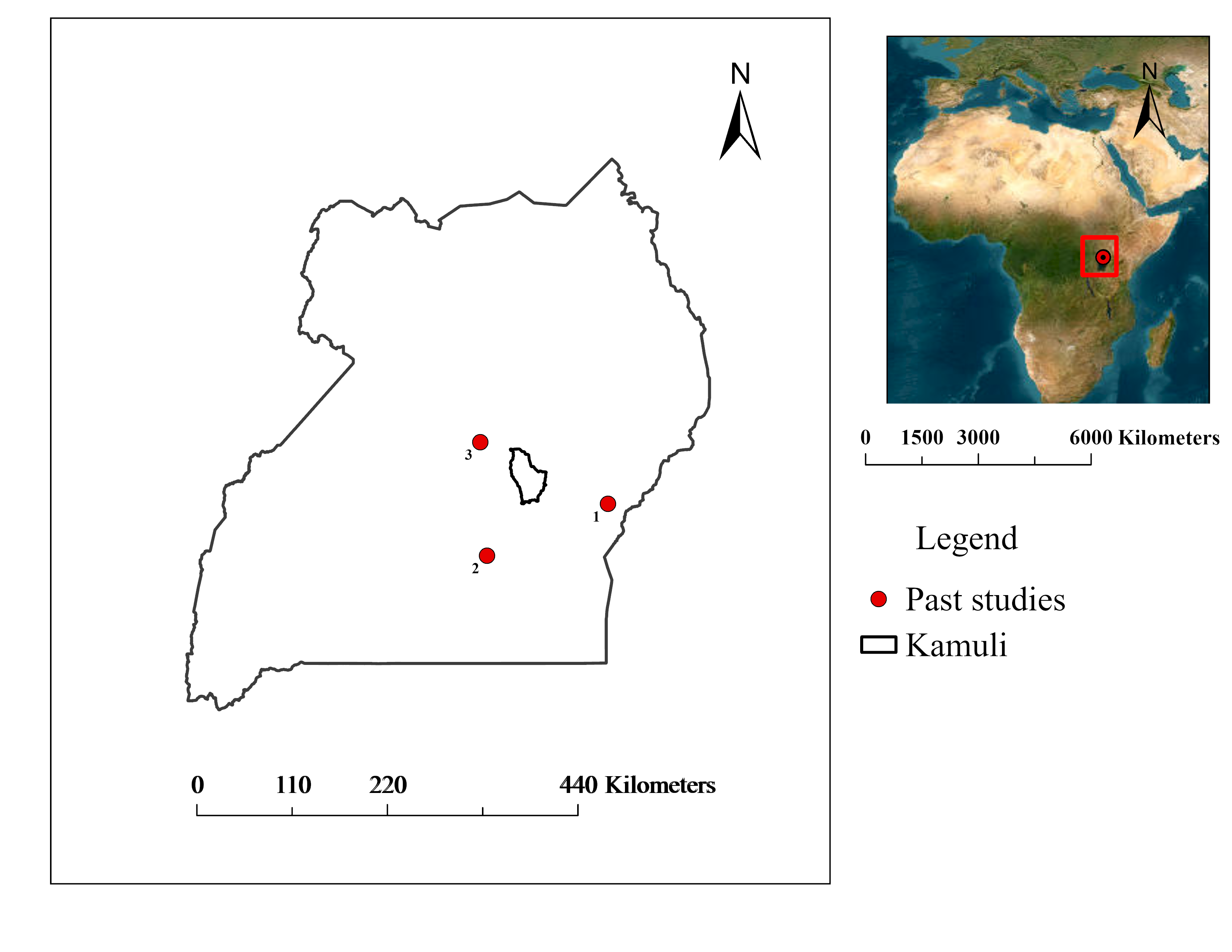
Figure 1 shows studies that have documented plinthite and/or laterite in Uganda. The Buganda catena is essential to Uganda’s geomorphic and pedological understanding, which is where the majority of the studies were conducted. The plinthic landscapes are shaped by prolonged weathering and complex drainage histories. McFarlane’s findings in Uganda [24,25,44] put forward influential concepts suggesting that plinthite is not formed in situ, but rather undergoes a multi-phase process of formation. Later, Brown et al. [26] developed indices related to landscape evolution in lateritic and granitic settings. Together these studies advanced the understanding of how plinthic terrains in Uganda and beyond are interpreted. This study takes an approach of combining soil morphology and bulk plinthite mineralogical insight in an area where plinthite genesis has not been systematically characterized. Consequently, we show how the plinthite formed in Kamuli’s landscape by identifying the morphological and mineralogical features diagnostic of its development.
The earliest soil mapping in Kamuli District identified the Buruli catena, which requires the presence of plinthite [45,46], as have recent studies [47,48,49,50,51]. Plinthite in the area is often encountered in cultivated areas, where farmers directly experience its physical limitations [49,52]. These limitations are further intensified by continuous cultivation which accelerates the erosion and reduces the thickness of the overlying soil. Upon exposure, the plinthite irreversibly hardens into petroplinthite, with prolonged stabilization leading to ironstone. This irreversible hardening of plinthite into petroplinthite and ironstone constitutes a major form of land degradation [3,7,31]. In the Kamuli District, where agriculture is a major source of livelihood, this process carries significant implications for land productivity, creating urgency to better understand plinthite expression and formation.
This paper embarks on understanding plinthite in the Kamuli District with three objectives: (i) to describe the morphological characteristics of plinthic soils in the area; (ii) to determine the mineralogical composition of plinthite; (iii) to use the morphological and mineralogical insights to interpret the processes that led to the formation of plinthite.

2. Materials and Methods

2.1. The Study Area

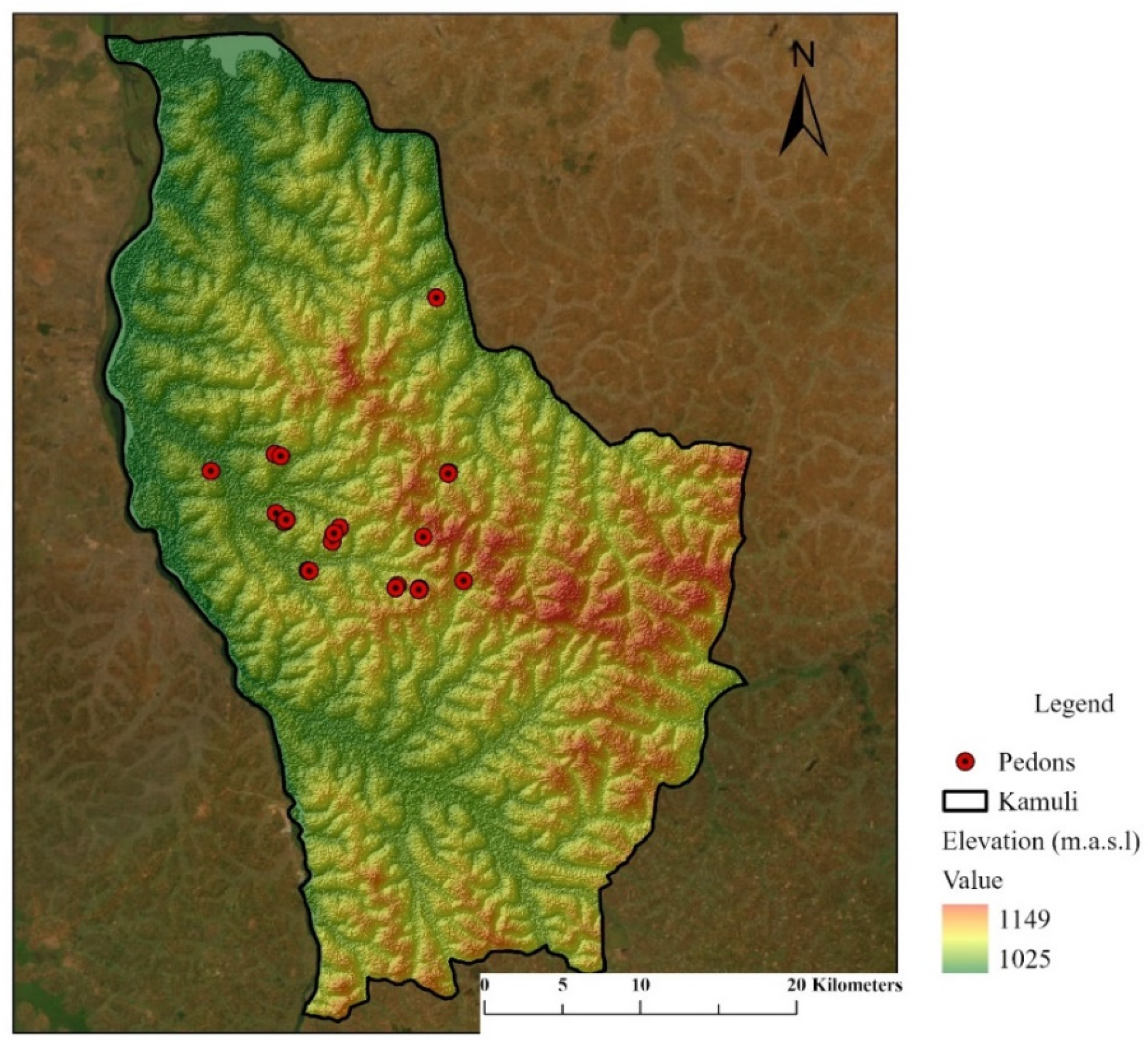
The Kamuli District lies in the Lake Kyoga basin with its western boundary defined by the Nile River. This region lies on a typical erosion surface known as the End-Tertiary erosion surface [53,54] that has been extensively dissected by stream evolution over geological time. As a result, the current landscape consists of remnant upland summits, linear backslopes leading to incised valleys and drainage lines. The Victoria Nile plays a central role in Kamuli’s landscape evolution as a base level to which many local streams drain. The valleys linked to stream evolution dissect the landscape and are infilled with sediment likely of Holocene age (Figure 2). The highest elevations in Figure 2 are characterized by exposed bedrock outcrops and surface-strewn boulders.
The Kamuli District lies within the Precambrian basement complex of Uganda. The basement rock for the landscape is a Precambrian granitic gneiss [26]. However, Uganda’s geological and mineral information system (https://gmis.beak.de/uganda/ (accessed on 23 May 2026) provides a more complex lithological picture of the Kamuli District. It delineates TTG (tonalite-trondhjemite-granodiorite) gneiss, porphyritic granite, metagabbro and laterite as dominant geological units mapped within this area. The expected mineralogy from these geological units compiled from published petrological studies in Uganda [55,56,57] are shown in Supplemental Table S1.
With consistently warm temperatures and a bimodal rainfall pattern, the Kamuli District’s climate is classified as a tropical savanna (Kӧppen Aw). The temperature ranges between 19 °C and 25 °C with an average annual rainfall of 1100 mm [58]. The Kamuli District has two distinct rainy seasons, from March to May and from August to November. These represent first (short rains) and second (long rains) respectively [59]. The rains are tied to the movement of air masses associated with the equatorial trough or Intertropical Convergence Zone (ITCZ). December to March and June to July receive minimal to no rain and functionally constitute the area’s two dry seasons.

2.2. Morphological Description of Soil Pedons

A landscape-based pedon sampling strategy was used. Depending on landscape variability, pedon locations were selected across distinct topographic positions, including summits, backslopes, and valley bottoms. Soil profiles were described in situ according to Schoeneberger et al. [60] and georeferenced. The depths of the pedons varied depending on the degree of plinthite cementation. Excavation depths ranged from very shallow (<100 cm) to deep in highly cemented and less cemented plinthic pedons, respectively. During field descriptions, morphological characteristics, including horizonation, structure, root abundance, texture (using the feel method), color, coatings, and presence or absence of plinthite were recorded.
From each described horizon, a 500 g sample was collected and prepared for laboratory analysis at the Tanzania Agricultural Research Institute, Uyole Center. Using both the morphological and laboratory data, the pedons were classified to a subgroup level using Soil Taxonomy [1] and World Reference Base reference soil group [61]. Bulk density was determined using the core method on undisturbed horizons in only a subset of pedons. In these selected cases, undisturbed soil cores were collected under field-moist conditions, and bulk density was computed based on the moist mass and known core volume without oven drying. Ten randomly indurated (UG01–UG10) plinthic fragments were collected from the pedons. These fragments were brought to the United States and subsequently characterized for mineralogy using XRD and SEM.

2.3. Laboratory Analysis

In Tanzania, gently crushed air-dried samples were sieved to pass through a 2 mm sieve. Particle size distribution was determined using the hydrometer method [62] after dispersion in 5% sodium hexametaphosphate. Soil pH was potentiometrically measured in a supernatant solution on a 1:2.5 soil-to-water ratio [63]. Soil organic carbon (SOC) was determined by Walkley and Black’s wet oxidation method [64]. Iron (Fe) and manganese (Mn) were estimated by extraction with 0.05 M diethylene triamine pentaacetic acid (DTPA) and atomic absorption spectrophotometer [65].
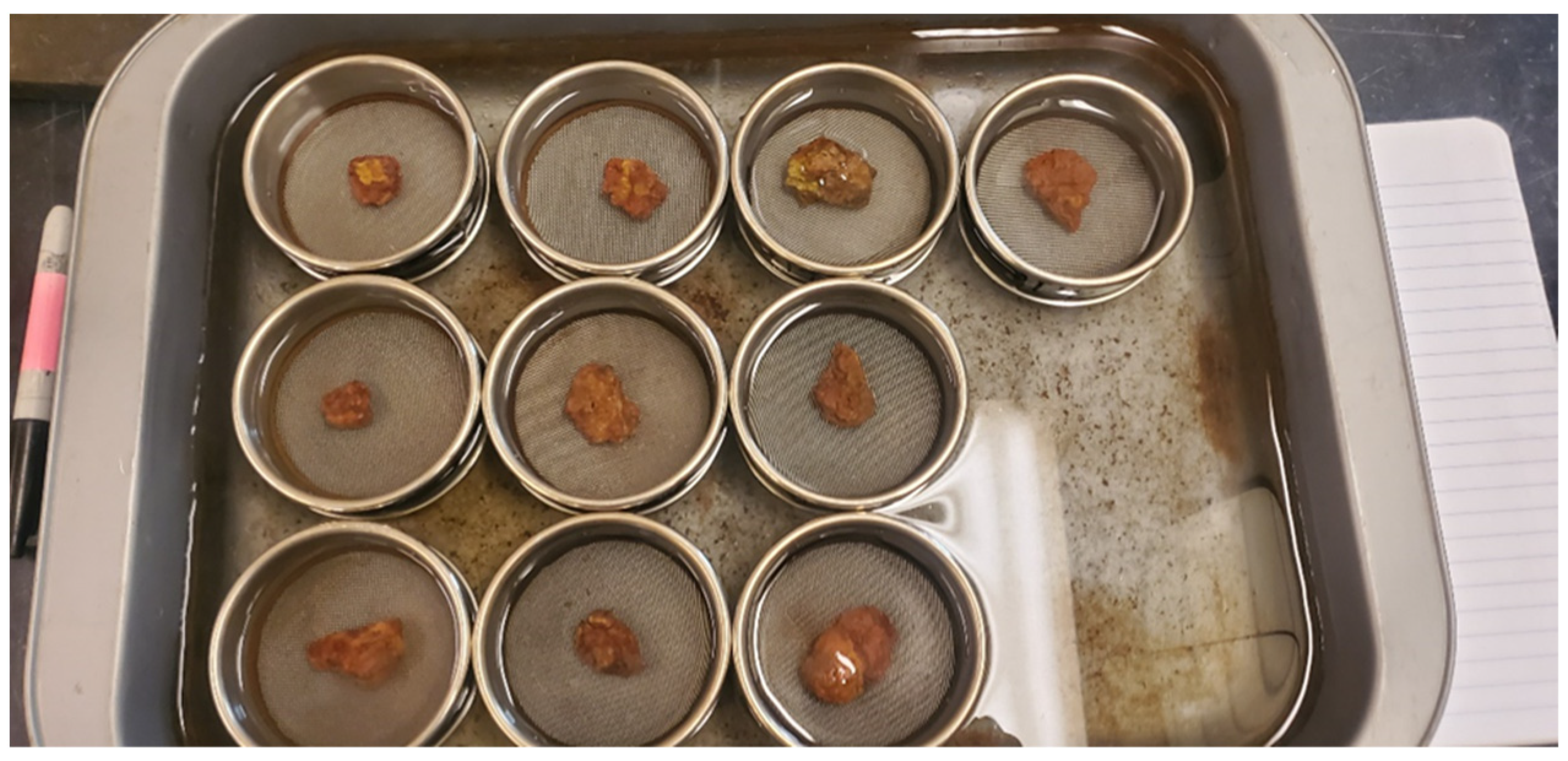
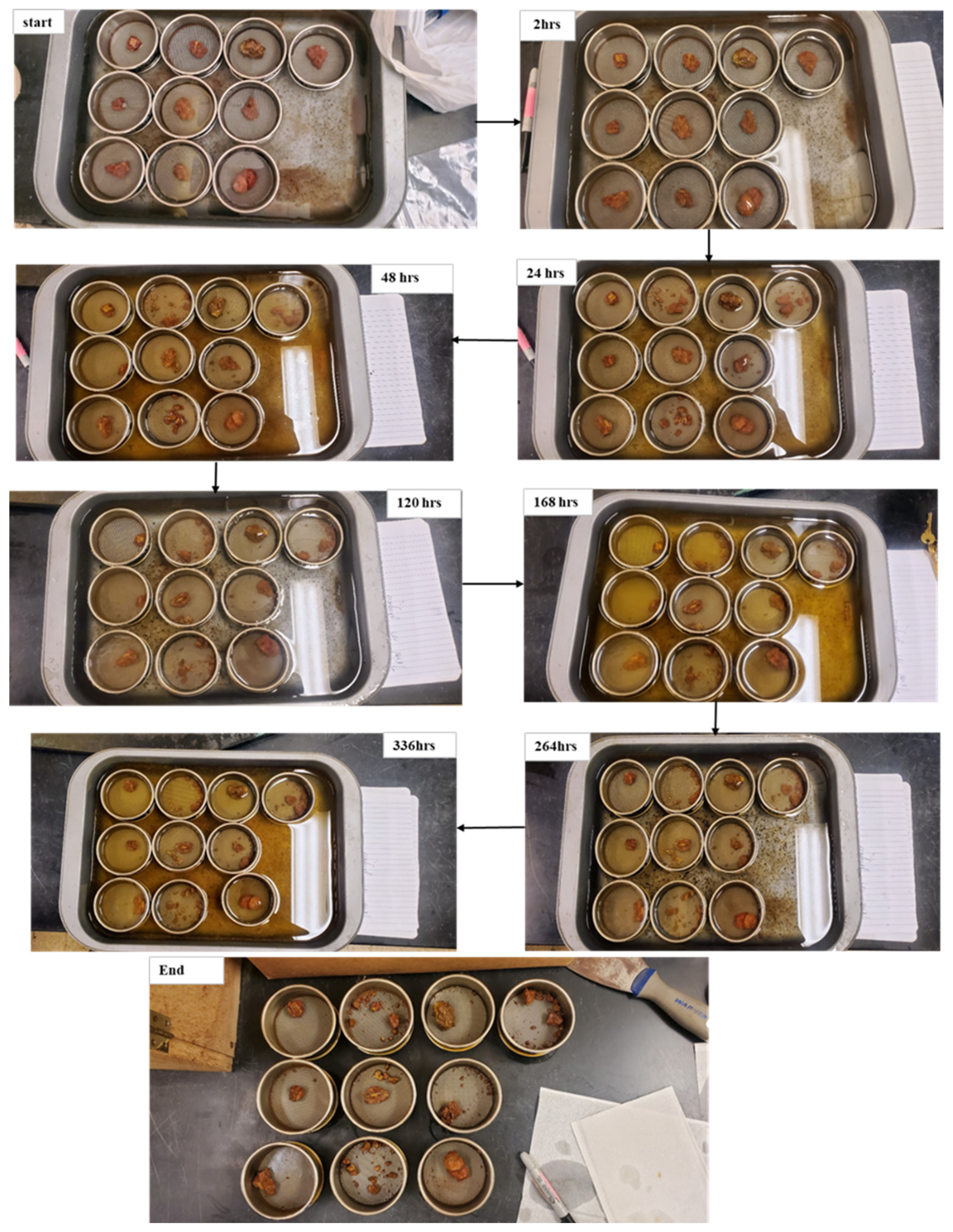
In the United States, prior to XRD and SEM analysis, the ten plinthite samples, i.e., UG01–UG10, were submerged in water for two hours [14,15] as shown in Figure 3. The two-hour immersion test was conducted to confirm plinthite. Resistance to softening or slaking after 2 h soaking is a key diagnostic criterion that distinguishes plinthite from other iron-rich horizons. However, this immersion test was extended for two weeks to evaluate differences in the plinthite samples’ aggregation behavior. During the two weeks, the samples were gently shaken manually at least once daily to evaluate the possibility of disintegration or persistent hardening.

2.3.1. X-Ray Diffraction (XRD)

The 10 plinthite samples (coarse) were ground in a shatter box to a particle size less than 150 µm. The resulting powder was loaded into a flat and slotted holder for random orientation. Powder diffraction patterns were obtained using a Siemens D500 diffractometer (Siemens Analytical X-ray division, Texas, USA) with a Cu X-ray tube operated at 45 kV and 30 mA. The system was equipped with a graphite diffracted-beam monochromator, and measurements were made using medium resolution (0.15°). Samples were scanned from 3° to 70° 2θ using a step size of 0.02° 2θ and a dwell time of 2 s per step. All data from the powder was analyzed using Jade software version 6.5 (Materials Data Incorporated, Livermore, CA, USA). To identify the crystalline phases, the International Center for Diffraction Data (ICDD) Powder diffraction files (PDF-4) database was used. Identified minerals were semi-quantified using the normalized Reference Intensity Ratio (RIR) method [66]. In this approach the relative weight of each mineral phase, ωi, was determined using the following equation.
ω i = I i R I R i I i R I R i
where:
  • I i is the intensity of the principal diffraction peak for phase I (peak height times peak width at half height).
  • R I R i is the reference intensity ratio of phase i.
  • The denominator represents the sum of the intensity-to-RIRs for all the detected mineral phases in the sample.
The RIR values for the identified minerals were obtained from the ICDD patterns, and the principal diffraction for each mineral, according to the pattern, was used for semi-quantification.

2.3.2. Scanning Electron Microscopy (SEM)

Due to cost constraints, SEM energy dispersive X-ray (EDX) was conducted on only two representative samples (UG01 and UG07). Because the samples were analyzed in powdered form, the analysis was focused on confirming the elemental composition of the mineral phases rather than examining microstructural features. The SEM-EDS results were used to complement XRD and support the identification of mineralogical differences between samples. The powder (from shatter box grounding) was affixed to a double-stick carbon stub for examination in the SEM, and loose particles were removed. Samples were not coated and were analyzed with a FEI Quanta-FEG 250 field-emission SEM from FEI Company, Oregon, USA. The SEM had an accelerating voltage of 10 kV with a 0.5 nm aperture and a controlled atmospheric pressure of 10 Pa to minimize sample charging. The SEM was equipped with an Oxford AztecTM energy-dispersive spectrometer (EDS) manufactured by Oxford instruments in the United Kingdom, which enabled identification of elements. Based on observable textural variations, targets spot analysis was conducted. This spot analysis enabled evaluation of differences in elemental composition, as described by Welton [67].

3. Results

3.1. Distribution Across the Landscape and Morphology of Plinthic Soils

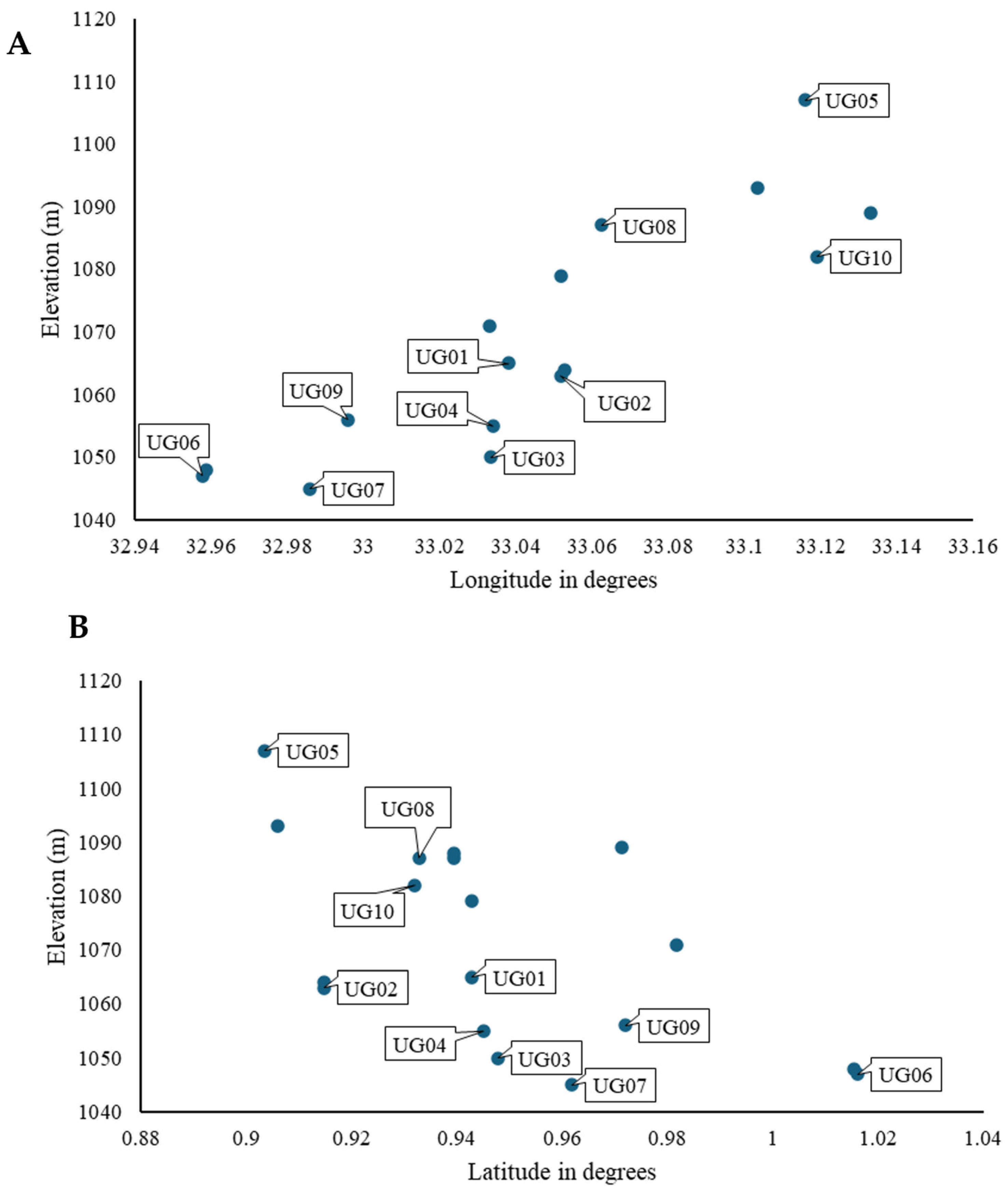
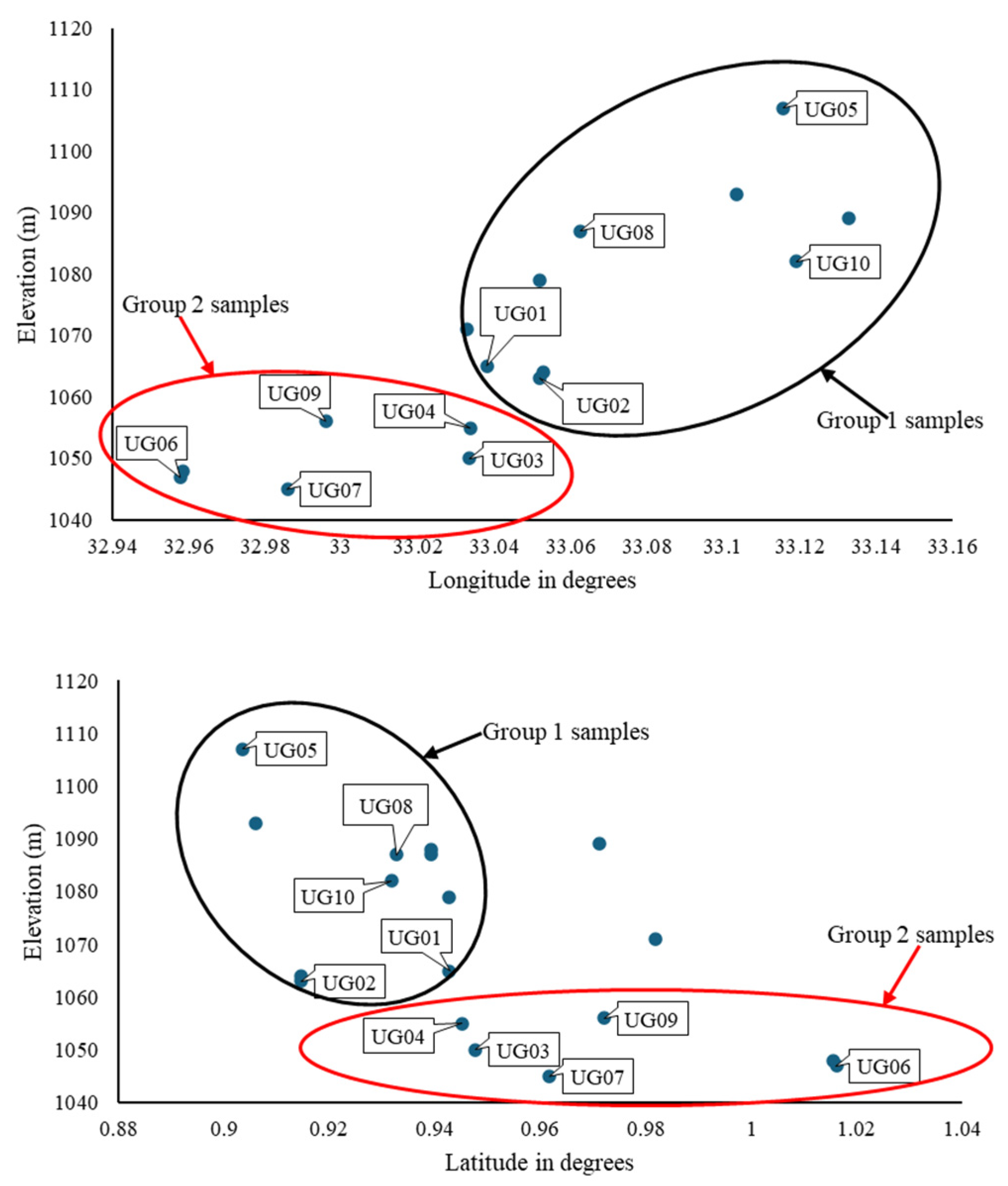
The pedology of the Kamuli District is interpretable using a geology-landscape relation that links the major parent materials to topography. The broad, flat summits and narrow shoulders are underlain by residuum (basement rock weathered in place). The backslopes are majorly residuum-derived colluvium. The concave footslopes are on a mix of colluvium and alluvium leading to the broad flat valleys (toeslopes) which are underlain by alluvium of modern age or Holocene. Plinthite was predominantly observed in soils located on the residual summits and colluvial backslope. The locations from which the plinthite samples were picked are shown in Supplemental Table S2. The elevation-longitude and elevation-latitude plots shown in Figure 4 show that the Plinthic pedons occur within a narrow elevation range (1045 m–1107 m). The elevation–longitude relationship indicates a gradual increase in elevation toward the eastern portion of the study area. As a result, the likelihood of encountering plinthite increases toward the east where higher and more stable interfluves are common, whereas lower elevations toward the west are more likely to transition into drainage-influenced positions. This relationship finds support in McFarlane’s [24] findings in Kyagwe, Uganda, where she noted that higher elevations host mature vermiform laterite, while the lower elevations have immature pisolithic varieties.
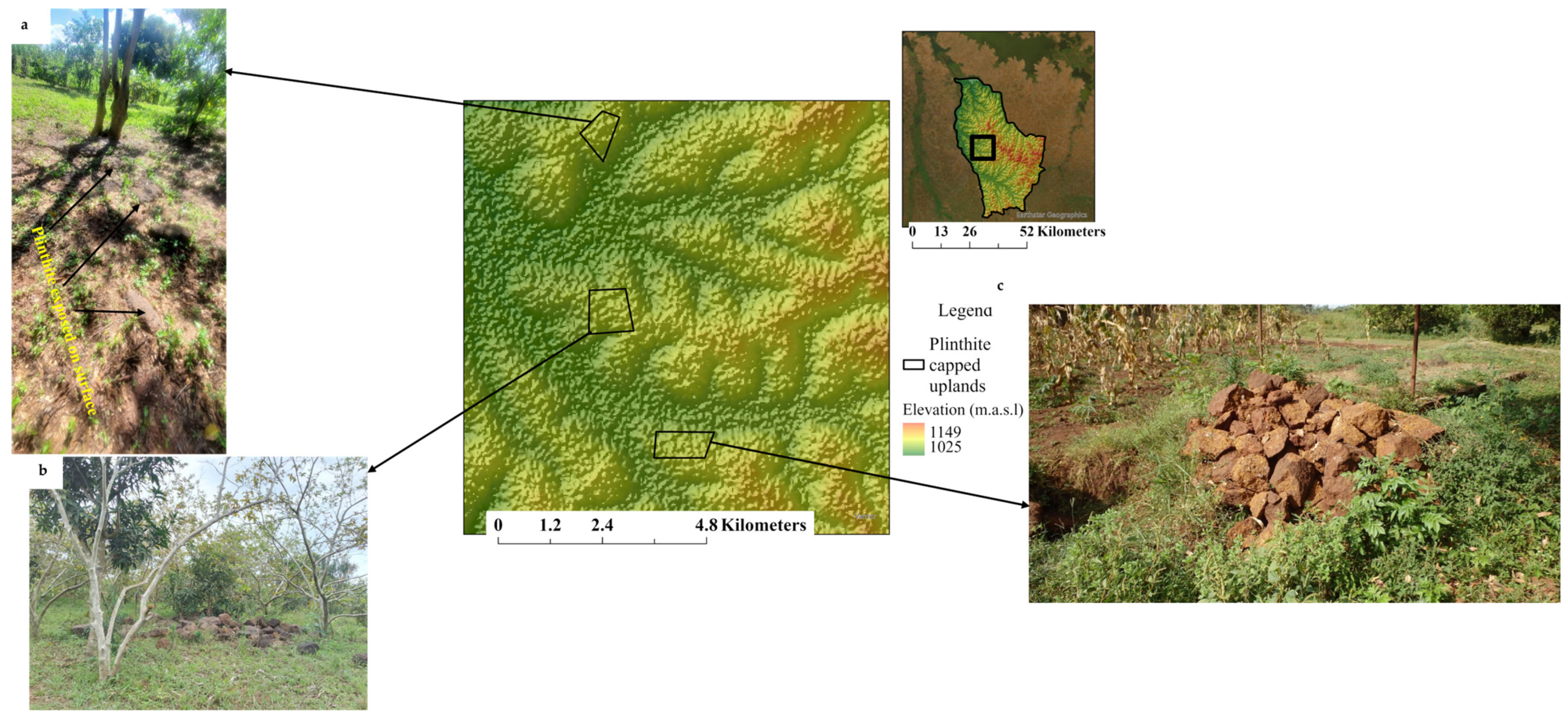
At three sites, extensive plinthite outcrops were evident, with some landowners attempting to excavate the plinthite to use the land for crop cultivation (Figure 5). These three sites are typical plinthite-capped uplands characteristic of the Kamuli District. The surface outcrops were strongly indurated and hardened meeting the criteria for petroplinthite. McFarlane [24] described lateritic mesas on the Buganda surface. These plinthite capped uplands bear resemblance to mesas; however, Kamuli’s landscape lacks the distinct geomorphic separation commonly associated with true mesas. Consequently, the plinthite-capped uplands are not interpreted as mesas but as relict plinthic surfaces. McFarlane [24] also acknowledges that the plinthite on the Kyoga surface is geologically younger compared to the Buganda area.
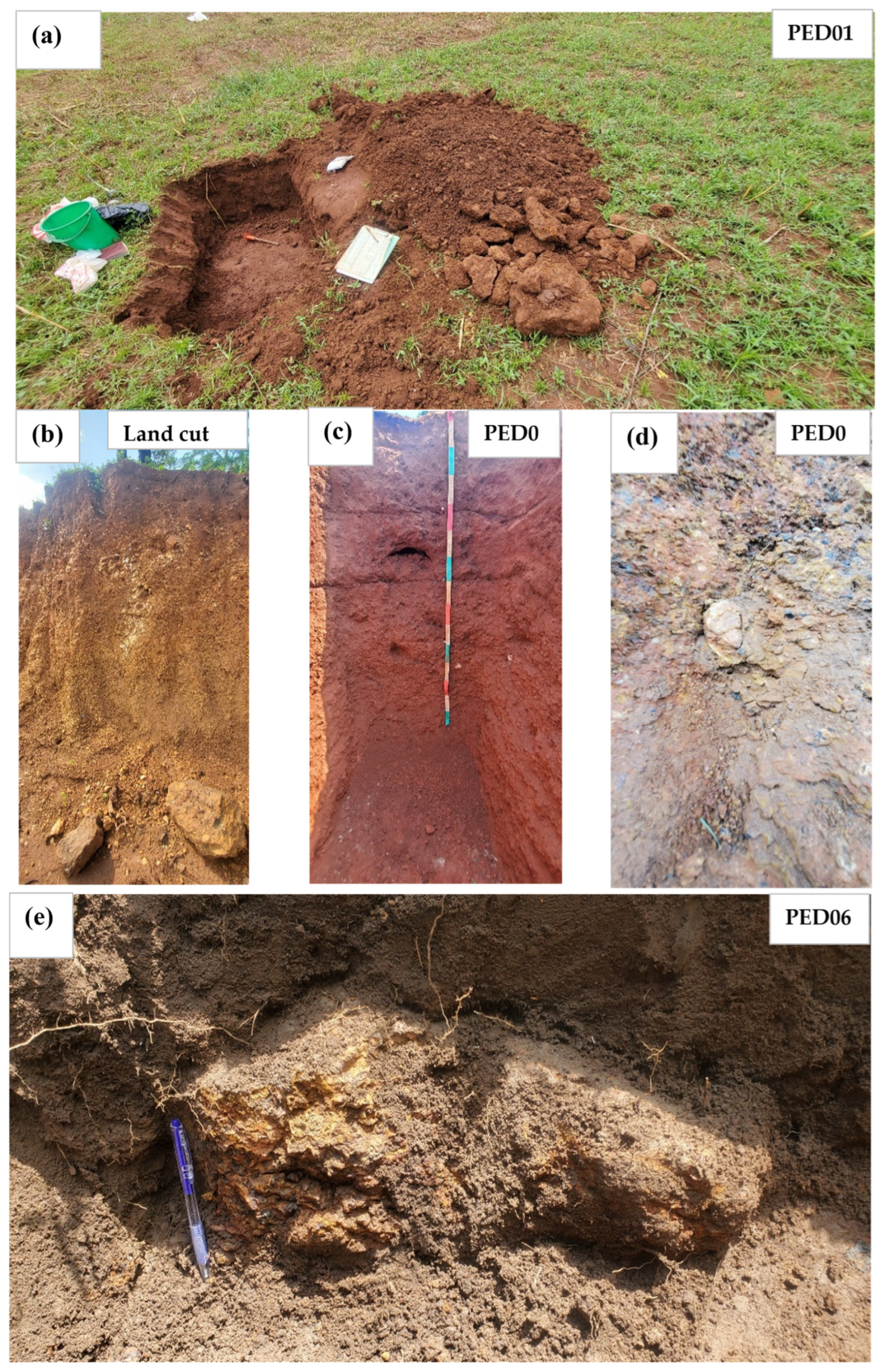
Table 1 shows the morphology of some plinthic soils. Additional soil morphology can be found in [48,49,50,51]. Generally, the soil morphology varied with landscape position. In pedons located at the summit (Figure 6a), plinthite occurred at a shallow depth, forming a near-surface cemented horizon restricting pedon excavation and often outcropped. Along the backslopes, soils displayed concretionary horizons that gradually coalesced with depth into a cemented plinthic horizon. Notably, this concretionary layer was thicker in the backslope compared to the pedons at the summit, pointing to possible downslope accumulation of sediment (Figure 6b). Notably, the concretions exhibited well-rounded morphologies, consistent with abrasion during downslope sediment transport. As shown in Supplementary Figure S1, the concretions were embedded within the soil matrix. In the deeper horizons, adjacent concretions coalesce into larger masses. This soil with concretions is most often preferred in construction due to its gravelly nature and is often used as base material for roads and foundation support (Figure 6b). It is often referred to as “murram.” In the deeper horizons, mottling is evident (Figure 6d), and there is notable manganese enrichment as shown by continuous black stains when plinthite was cracked open. In the lowland positions, plinthite was absent in alluvium. However, one site located on the footslope showed a distinctive morphology (Figure 6e). The plinthite was discrete and appeared as an abrupt, indurated layer that lacked the concretionary nature of the upland counterparts. Clay films (argillans) were very common among the plinthic pedons along the ped faces. Clay illuviation (lessivage) is a significant pedogenic process in the soils of the area [51], explaining how common Bt horizons are in the pedons. The co-occurrence of argillans and concretions in the majority of the plinthic pedons points to the idea that plinthization and clay illuviation are perhaps complementary with Eze et al. [3] suggesting that clay illuviation post-dates plinthite formation.
The soil bulk density ranged from as high as 2.09 g/cm3 to as low as 0.75 g/cm3 (Table 1). However, it is essential to note that the bulk density measurements were made under moist field conditions; hence the values are inherently variable and would not be ideal for comparison across sites. Plinthic horizons typically had high bulk densities due to their degree of cementation. However, anomalously low bulk densities were also obtained within plinthic layers as shown in Table 1. The low values are related to coring challenges associated with sampling indurated horizons. The high degree of cementation caused core disturbance or incomplete core filling, leading to underestimation of bulk density values.
Table 2 shows the variation in chemical properties with depth in the different pedons. Soil organic carbon (SOC) range in the soils was medium to very low and generally decreased with depth [68]. A weak positive relationship was observed between organic carbon and cation exchange capacity in the plinthic soils (CEC = 1.79SOC + 14.59; R2 = 0.10). The low coefficient of determination indicates that organic carbon accounts for a small proportion of the variation in cation exchange capacity (CEC). The mineral fractions present in the soils also play a role. As demonstrated later (plinthite mineralogy) these minerals include kaolinite, muscovite (present in some samples), and iron oxides. Kaolinite has a low to moderate CEC, muscovite can retain interlayer cations (primarily K+) and contribute to CEC. Iron oxides (hematite and goethite) contribute to CEC through pH-dependent variable charge.
Across the pedons, DTPA Fe and Mn showed consistent depth-related trends. The labile iron and Mn tended to decline with depth towards the plinthic horizon. Yaro et al. [69] reported a similar trend in which DTPA-extractable micronutrient contents were generally lower in plinthic horizons compared to the non-plinthic horizons in Nigeria. Based on pedogenesis, it is expected that Fe and Mn are abundant in deeper plinthic horizons since plinthite is enriched in Fe and often associated with Mn. In plinthite, much of Fe and Mn are in crystalline forms which are not effectively captured by the DTPA method [70]. Thus, the lower values observed in deeper horizons may not necessarily indicate a true depletion of total Fe and Mn, but rather a reduction in the labile pool as they become progressively crystallized and stabilized in the plinthic subsoil. Yaro et al. [69] showed a significant negative correlation between DTPA-extractable Fe and total free iron measured using dithionite-citrate-bicarbonate extractable iron (Fed) in Nigerian soils. The relationship between the two forms of iron demonstrates that as crystalline iron oxides accumulate, the labile iron pool diminishes which supports our interpretation of lower DTPA Fe and Mn in the deeper plinthic horizons.
Based on the morphology and chemical characteristics in this study, the soils were classified as Ultisols and Oxisols (Table 2). In WRB [61], the soils classify as Plinthosols (Table 2). Additional properties (exchangeable bases and available phosphorus) are shown in Supplemental Table S3. Akitwine et al. [51] reported the occurrence of Alfisols in similar landscape positions.

3.2. Plinthite Characterization

The plinthite characterized in this study was picked from the indurated plinthite at depth as opposed to the petroplinthite that was often outcropping especially at the summit and shoulders. After soaking in water, all the samples remained intact after 2 h (Figure 7). This test confirmed their identification as plinthite in accordance with the criteria by Wood and Perkins [14]. Forty percent of the plinthite samples showed signs of disintegration as early as 24 h. Between 120 h and 168 h, 50% of the samples had disintegrated. At two weeks, 50% (UG01, UG02, UG06, UG08, and UG10) largely retained their original shape and integrity. The other 50% (UG04, UG03, UG05, UG07, and UG09) showed noticeable disintegration into smaller aggregates. Notably, 80% of the disintegrated plinthic samples were from pedons at lower elevations. McFarlane [24] in Kyagwe, Uganda, demonstrated that higher elevations host mature vermiform laterite, whereas lower slopes produce immature pisolithic varieties. By analogy, the greater disintegration observed at low elevation in the present study likely reflects less mature plinthite forming under more dynamic drainage conditions.

3.2.1. Plinthite Mineralogy

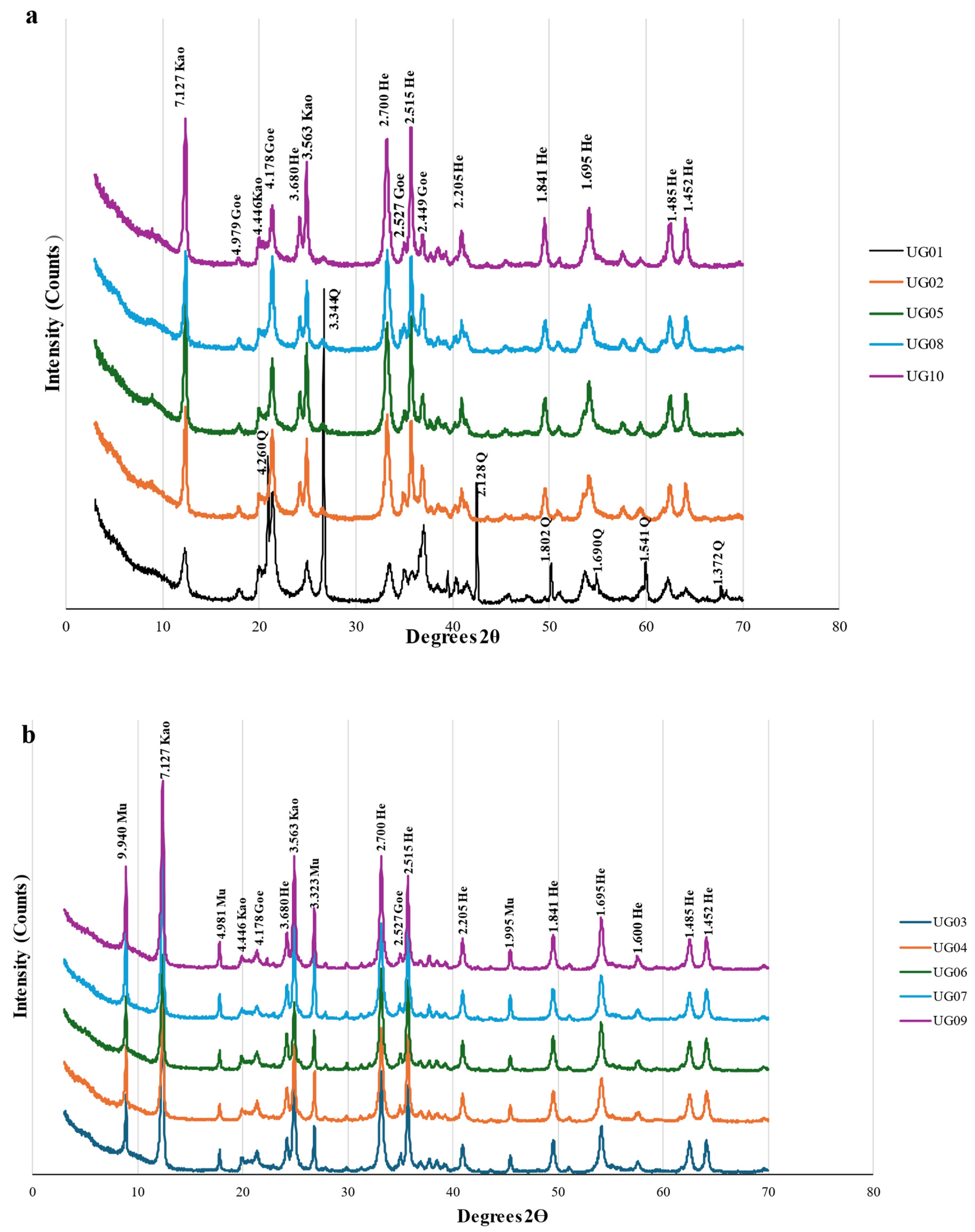
The ten plinthite samples exhibited two distinct groupings based on the dominant mineral phases. Group 1 (UG01, UG02, UG05, UG08, and UG10) exhibited X-ray diffractograms with well-defined peaks for kaolinite, hematite, goethite, and quartz (Figure 8a). Kaolinite showed distinctive peaks at 7.12 Å, 3.563 Å, 4.446 Å. Hematite showed distinctive peaks at 3.680 Å, 2.700 Å, 2.515 Å, 2.205 Å, 1.841 Å, 1.695 Å, 1.600 Å, 1.485 Å, and 1.452 Å. Goethite was identified by peaks at 4.178 Å, 2.527 Å, and 2.449 Å. The presence of the 2.700 Å peak, which is hematite’s strongest reflection alongside goethite’s 2.449 Å, confirms the coexistence of both iron oxides. Kaolinite, hematite, quartz, and goethite are common minerals associated with plinthite [8,14,22,31,71,72]. Quartz peaks at 2.128 Å, 1.802 Å, 1.690 Å, 1.541 Å, and 1.372 Å were distinctly visible. The presence of high-angle quartz peaks in UG01 suggests well-ordered quartz phase in this sample.
Group 2 (UG03, UG04, UG06, UG07, and UG09) showed distinct peaks for muscovite at 9.940 Å, 4.981 Å, 3.323 Å, and 1.995 Å (Figure 8b). In contrast, the peaks in Group 1 at the same d-spacings were not as distinct showing the presence of trace amounts of muscovite. This is in addition to hematite, goethite, and kaolinite. The samples in Group 2 lacked distinct quartz peaks. The presence of muscovite especially in Group 2 samples, is notable given that highly weathered tropical soils are typically characterized by the extensive transformation of primary minerals. The encapsulation of muscovite within the plinthic framework limited its exposure to continued chemical alteration, allowing it to persist within the otherwise strongly weathered material.
Additional phases identified from the XRD patterns despite being represented by weaker peaks that were partially overlapped by the dominant minerals were also identified. In Group 1, these include aluminum-iron oxide hydroxide (Fe0.92Al0.08O(OH)), which is an aluminum-substituted goethite. The peaks associated with this mineral are goethite’s 4.178 Å and 2.449 Å, which broaden or split. Schulze and Schwertmann [73] noted how aluminum substitution distorts goethite’s lattice hence peak broadening or splitting. Peak splitting (2.449 Å peak) was particularly evident in sample UG01 (Figure 8a).
Manganese oxide (MnO) was also identified as an additional phase. The dark gray to black mottling visible in plinthite was an initial suggestion of MnO enrichment. In the X-ray diffractograms, MnO’s diagnostic peak at 4.430 Å was obscured by kaolinite’s 4.446 Å peak. The presence of iron oxides, hematite (2.515 Å) and goethite (2.527 Å) also overshadow MnO’s peak around the 2.5 Å [74]. Despite the XRD pattern matching manganosite (MnO), the conditions under which it forms are not possible in a pedogenic setting. Due to this and evidence from petroplinthite reported by Eswaran and Mohan [18], the Mn in this study is likely manganite.
In Group 2, additional minerals identified included albite and illite. Albite showed weak diagnostic reflections at 3.748 Å, 3.207 Å, 2.995 Å, 2.525 Å and 2.134 Å. The low intensity of these peaks suggests minor to trace occurrence. Illite may also be present; however, its characteristic reflections overlap with those of muscovite, and therefore its occurrence cannot be confirmed unequivocally from the XRD data. In plinthic systems, phyllosilicates such as illite, vermiculite, and smectite have also been noted [22].
A semi-quantitative assessment of the relative abundances of the major crystalline phases is presented in Table 3. For goethite and hematite, the 4.178 Å peak and 2.700 Å peak were used, respectively. The 7.127 Å peak was used for the quantification of kaolinite, whereas the 3.323 Å peak was used for quantification of muscovite. Quartz was quantified using the 3.344 Å peak, whereas the 4.430 Å peak was used to quantify manganite. Albite was quantified using the 3.207 Å, but it showed trace amounts compared to the other minerals.

3.2.2. Scanning Electron Microscopy (SEM) Insights

Scanning electron microscopy analysis was performed on samples UG01 and UG07, which represent the earlier Group 1 and Group 2, respectively. The results are illustrative and meant to provide insights to complement the mineralogy across the groups. Sample UG01 was selected due to the presence of well-expressed quartz. SampleUG07 was selected because it had the highest muscovite (Table 3). Mineralogical differences between the two plinthite samples are evident from backscattered electron (BSE) imaging, EDS spectra, and elemental maps, consistent with XRD results.
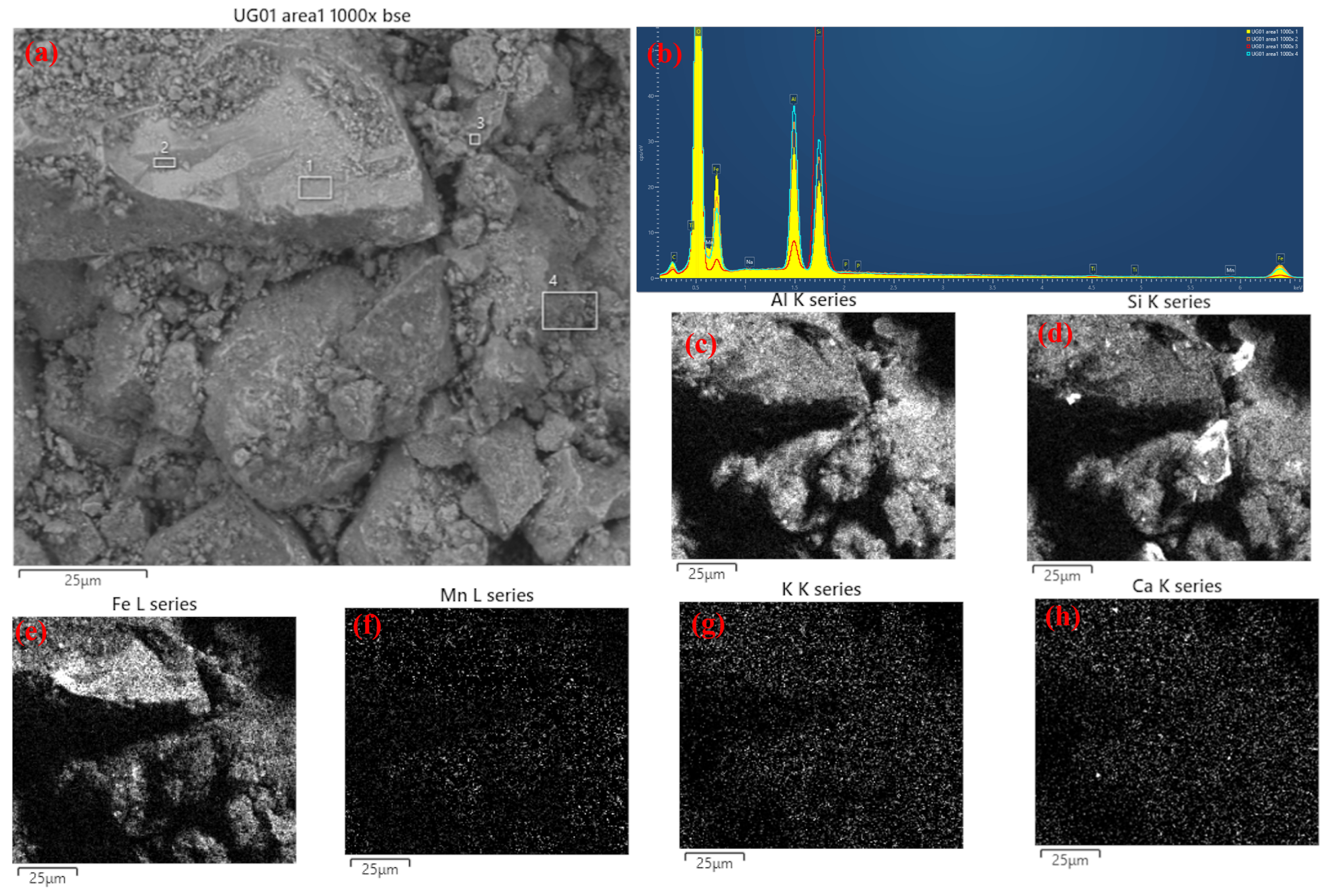
In sample UG01, EDS analysis reveals a composition dominated by Al, Si, and O, consistent with an aluminosilicate matrix (Figure 9). The quartz content in this sample is evident (Si-rich, Al-poor areas) especially in the elemental maps. Iron (Fe) is a major constituent, with characteristic peaks at ~0.7 keV (Fe L-line) and ~6.4 keV (Fe Kα). The presence of both L and K lines confirms iron as a dominant phase, consistent with iron oxides (hematite, goethite). Areas rich in Fe are also equally rich in Al and Si. This Fe-Al-Si association is characteristic of plinthite, where iron oxides are intimately mixed with kaolinitic clay.
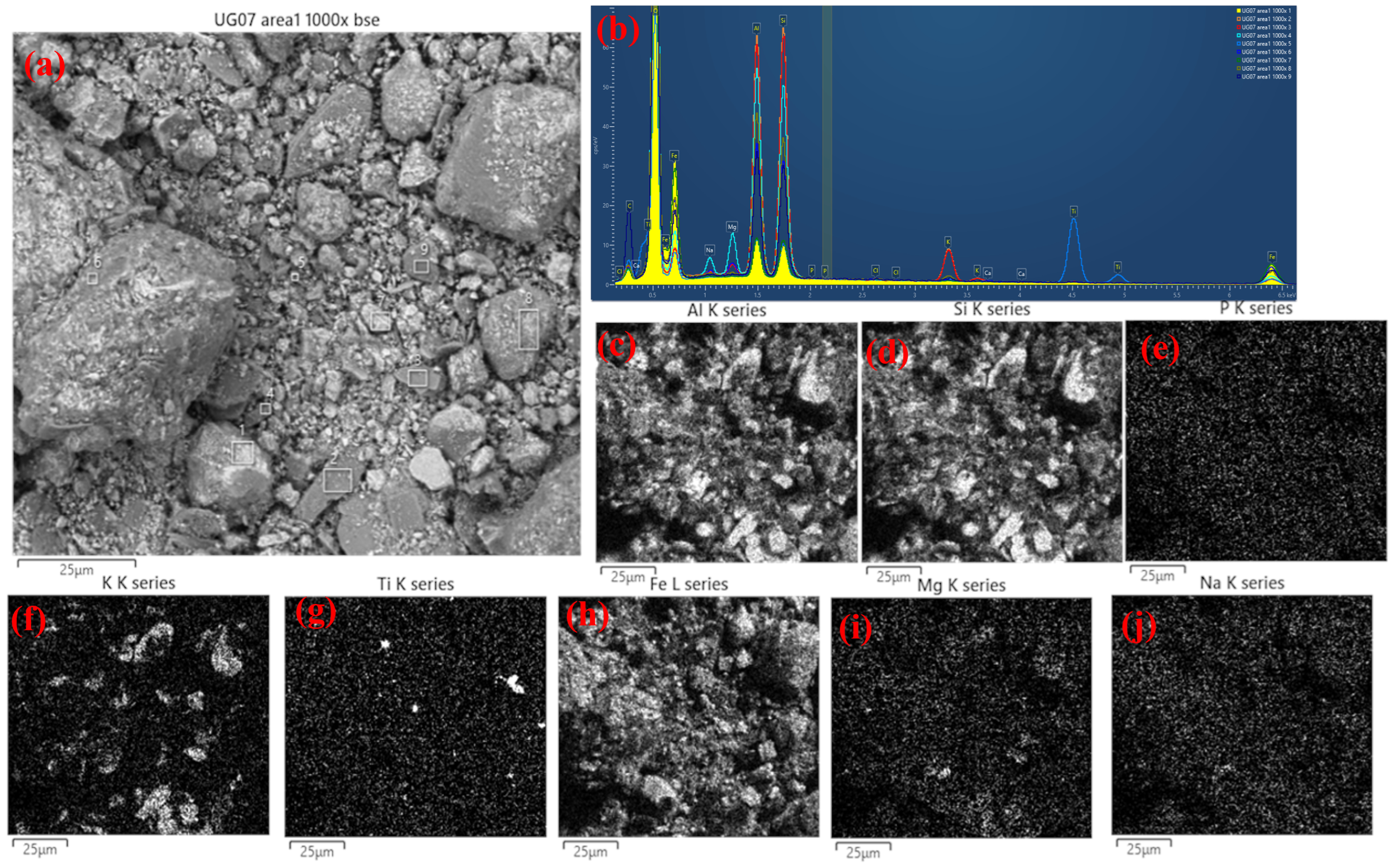
EDS analysis of Sample UG07 reveals an aluminosilicate-dominated composition (Al, Si, O) with notably elevated alkali elements (K, Mg, and Na) distinguishing it from UG01 (Figure 10). Elemental maps show strong spatial correlation between K and Al-Si, and between Na and Al-Si, supporting XRD identification of muscovite and albite. Iron remains a major component (Fe L at ~0.7 keV, Fe Kα at ~6.4 keV), with accessory Ti and Mn indicating Fe-Ti-Mn oxides. Phosphorus (P) is detected in both UG01 and UG07, appearing as a minor peak at 2.0 keV (P Kα). In both samples, P counts are low (EDS spectrum). Its presence in these iron-rich plinthite samples is attributed to phosphorus fixation. This phenomenon has important implications for soil fertility, as fixed phosphorus is largely unavailable for plant uptake, which explains the low to moderate available phosphorus (Bray 1) [68] in Supplemental Table S3.

4. Discussion

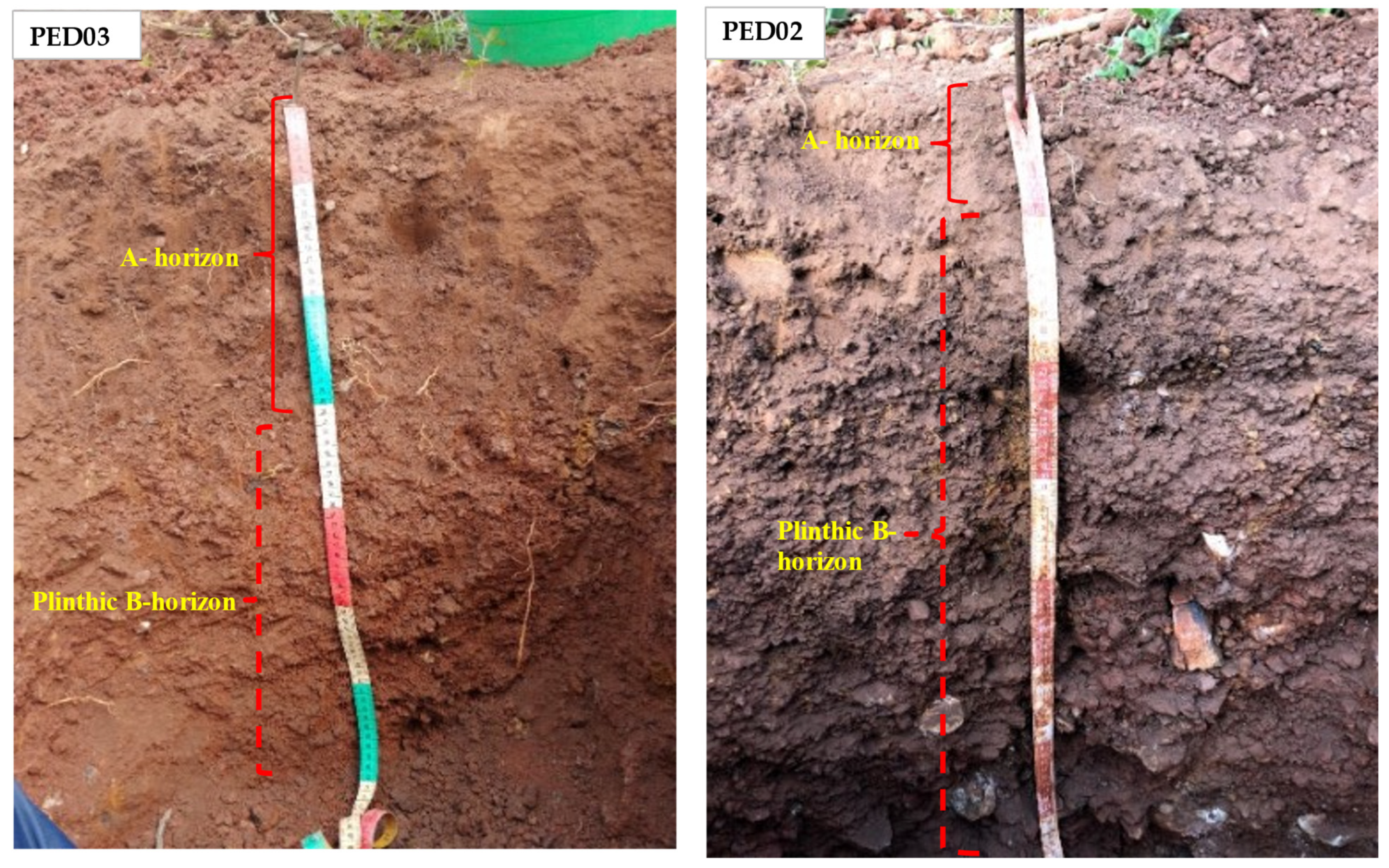
The morphological and taxonomic variation observed among plinthic soils in Kamuli District indicates a dynamic relationship with landscape position. On the erosional summits and shoulders, the occurrence of Oxisols and Ultisols (Plinthic Kandiustox and Plinthic Haplustults) with shallow plinthite and frequent petroplinthite outcrops suggests a landscape at a mature stage of geomorphic evolution. Prolonged weathering and cumulative landscape denudation have resulted in the exposure or near-surface occurrence of an indurated plinthic layer. In contrast, the backslopes dominated by Plinthic Haplustults exhibit a greater depth to plinthite. Due to this and better available water holding capacity, these soils are preferred for agriculture compared to the summit. Hence, their intensive cultivation brings about erosion progressively stripping the surface horizon, exposing the plinthic surface (Figure 11) increasing the long-term risk of land degradation.
The ubiquitous upland plinthite and a single unusual occurrence in the footslope show distinct morphologies pointing to fundamentally different formation pathways. In the uplands (summits and backslopes), the pervasive nature of plinthite shows it is likely a regional pedogenic feature. Its formation is linked to a gradual, multi-stage process, evidenced by the presence of discrete concretions that eventually coalesce into a continuous layer. This morphology is diagnostic of repeated redox cycling and slow, progressive iron segregation over an extended period. Such processes are inherently linked to groundwater dynamics, as demonstrated in other studies [74,75,76]. The isolated discovery of a Plinthaquult in the footslope is particularly significant. The pedon’s morphology, with an abrupt, massive plinthic layer lacking any transitional concretionary horizon suggests its formation was distinct and not part of the regional upland pattern (Figure 6e). Its formation points to a distinct and highly localized mechanism of formation that can be linked to the influx of iron-rich solution from upslope. The most plausible explanation is a sharp, modern redox gradient caused by a fluctuating water table at the discharge zone of the landscape. In this setting, dissolved iron transported in groundwater precipitates abruptly upon encountering oxidizing conditions, forming a plinthic layer without the intermediate stage of concretion formation.
In relation to existing soil information, the Kamuli District lies in an area that is mapped largely as Plinthosols (WRB) [77]. However, our observations reveal a more nuanced pattern with distinct landscape control. Plinthite is most prevalent and morphologically expressed in the upland summits and backslopes. The soils in the lowlands underlain by sediment of the Holocene or modern age were devoid of plinthite. The higher elevation in the east increases the likelihood of encountering plinthite compared to the western lowlands which are highly influenced by the Nile River and local stream activity. The current cartographic representation oversimplifies a heterogeneous soil landscape. Therefore, there is a need to revise the soil maps to better reflect plinthite distribution. Updating these maps to delineate zones with high probability of encountering plinthite at shallow depth, and areas where plinthite is deeper or absent. These would be key. These improved maps would provide the stakeholders including both farmers and extension initiatives with precise knowledge to inform sustainable land use.
Mineralogically the plinthite samples were divided into two distinct groups, one with predominantly kaolinite, hematite, goethite, manganite and quartz. Group 2 samples were composed predominantly of kaolinite, hematite, goethite, muscovite, manganite, and albite. In comparison to McFarlane’s findings in Uganda [24,25], she noted that laterite was predominantly kaolinite, goethite, quartz and some hematite. The samples in the Kamuli District showed higher hematite content compared to goethite. This aligns with the predominance of plinthite in the uplands with well drainage, which favors hematite. The identification of albite and muscovite in Group 2 plinthite samples, was an unexpected and significant finding. Under the humid tropical conditions prevalent in the area, together with intense chemical weathering and deep leaching over geological time, primary silicates such as feldspars and micas are typically expected to weather. This expectation, however, assumes that all primary silicates remain exposed to active weathering. In plinthite, iron oxides and kaolinite matrix create a ‘physical barrier’ that slows further alteration of minerals. As a result, muscovite and albite are signatures of the original geology (Supplemental Table S1) that have been shielded within the plinthic matrix.
The mineralogical duality was to an extent embedded in elevational differences as shown in Figure 12. McFarlane [24] emphasized that the clearest expressions of topographical control was on the laterite development on the Kyoga basin. Our findings are embedded in this with samples in Group 1 generally being located at higher elevation compared to Group 2 samples. This elevational distinction may reflect differences in parent material embedded in Kamuli’s geology and challenged by the influence of colluvial activity where plinthite found in soils at lower elevations may be influenced by material transported from the upslope positions. Furthermore, the physical significance of this mineralogical divide showed up in the water-soaking experiment. When samples were left to soak for two weeks, 80% of the samples that disintegrated belonged to Group 2 samples, whereas most of the samples in Group 1 stayed intact. Group 1 samples contained higher total iron oxides (hematite + goethite) compared to samples in Group 2. The relationship between higher total iron oxide content and enhanced physical coherence observed in Group 1 samples is consistent with other studies [78,79,80]. The higher total iron oxide could be an indication that plinthite samples in Group 1 are at a more advanced stage of maturation. The lesser iron oxide enrichment, coupled with persistence of weatherable muscovite and albite indicates a less mature form of plinthite, hence the vulnerability to disintegration when soaked in water for two weeks.
The formation and distribution of plinthite in Kamuli District are linked to the region’s drainage history, the progressive segregation of iron within weathered saprolite, subsequent cementation under improved drainage conditions, and long-term landscape downwasting. This sequence of processes, operating over geological time, has led to the plinthite observed across the Kamuli catena. The linkage between poor drainage and plinthite formation comes from McFarlane [24], referring to the plinthite in the area as groundwater laterite, affirming the role of the fluctuating water table in its formation. Our observations of well-formed concretions associated with plinthic pedons provide direct morphological evidence of the influence of groundwater. Furthermore, evidence of mottling associated with a poor drainage regime was evident within the indurated plinthite (Figure 13). Regionally, this drainage history stems from the Western Rift Valley rifting ~25 million years ago [81], which reversed major river flows, ponded water in the interior basin, and created low-gradient, poorly drained landscapes with extensive swamps [54]. Over geological time, this enabled iron segregation within weathered saprolite and cementation under improved drainage, producing the plinthite observed across the Kamuli catena.
The poor drainage conditions set the stage for iron segregation. The efficiency and character of iron segregation were enhanced by operating on a landscape already deeply weathered. Evidence for this inherited weathering mantle is preserved in the inselberg-like features that punctuate the Kamuli landscape, including the Balawooli and the Kaguru rock inselbergs, which rise abruptly from the surrounding plains (Supplemental Figure S2). These isolated rock hills are widely recognized as resistant remnants of the stripped African Surface, representing exposures of the basal weathering front that survived long-term erosion and downwasting during the Late Cretaceous to Paleogene [45,82]. It was on this pre-weathered substrate that the hydrologic changes in the Oligocene-Miocene were imposed. Critically, the pre-weathering of the African surface had accomplished the first stage of iron enrichment through residual accumulation. What remained was for the newly established hydrologic regime to mobilize, redistribute, and concentrate this iron into plinthic layers through redox-driven segregation under a climatic regime of sustained warmth and humidity [3,83]. This sequence explains the characteristic mineral assemblage observed in our plinthic pedons. The highly kaolinitic matrix holds an imprint of African surface weathering.
The post-Miocene stripping history documented by Taylor and Howard [82] together with backwearing provides an explanation for the observed distribution of plinthite in the Kamuli catena. As the landscape evolved through tectonic adjustment, the incision of drainage networks, or the progressive lowering of the water table accompanying downwasting, conditions shifted from prolonged saturation to seasonal or intermittent drainage. This improved aeration allowed for more complete oxidation of iron and its precipitation as discrete concretions and plinthite. Stripping progressively removed the overlying weathered mantle, exhuming the plinthic horizons that had formed at depth. Brown’s findings [26] that ferricrete-mantled hilltops were formerly located on a lower, poorly drained part of the landscape directly corroborate our interpretation. Furthermore, our analysis showed Mn as a major mineral component in the plinthic matrix, consistent with poor drainage conditions. This adds to other studies that have demonstrated that Mn is preferentially mobilized under reduced conditions with a fluctuating water table [74,84]. As a result, the well-drained have plinthic soils likely formed within a formerly poorly drained paleolandscape. Stripping the exhumed and inverted landscape, left plinthite at higher elevations compared to the current poorly drained lowland valleys.
The formation of Lake Victoria by downwarping 400,000 years BP during the middle Pleistocene [82,85] is another geomorphic event that lowered base levels and rejuvenated drainage across Kamuli’s landscape. Superimposed on this mid-Pleistocene base level lowering were repeated desiccation events between 18,000 and 17,000 years BP [85] that further modulated the hydrological regime north of the lake. This is significant for Kamuli because the Victoria Nile is Lake Victoria’s outlet through the area. Lowering of the base level created an incision along the Victoria Nile that exposed fresher substrate from deeper within the weathering profile. Following desiccation, rapid lake refilling elevated groundwater tables and created new redox conditions within these freshly exposed materials. Iron is mobilized under renewed saturation and precipitated as the hydrologic regime fluctuated, creating plinthite. Additionally, the contribution of pre-weathered material transported from upslope soil needs to be considered, especially in the backslopes and footslopes. Plinthite in these positions may form not only from in situ bedrock weathering but also from the deposition and subsequent iron segregation within transported, already-weathered sediments. Sedimentary accumulation of iron-rich pedorelicts and their role in shaping plinthic landscapes has been documented in other studies [2,3,35].
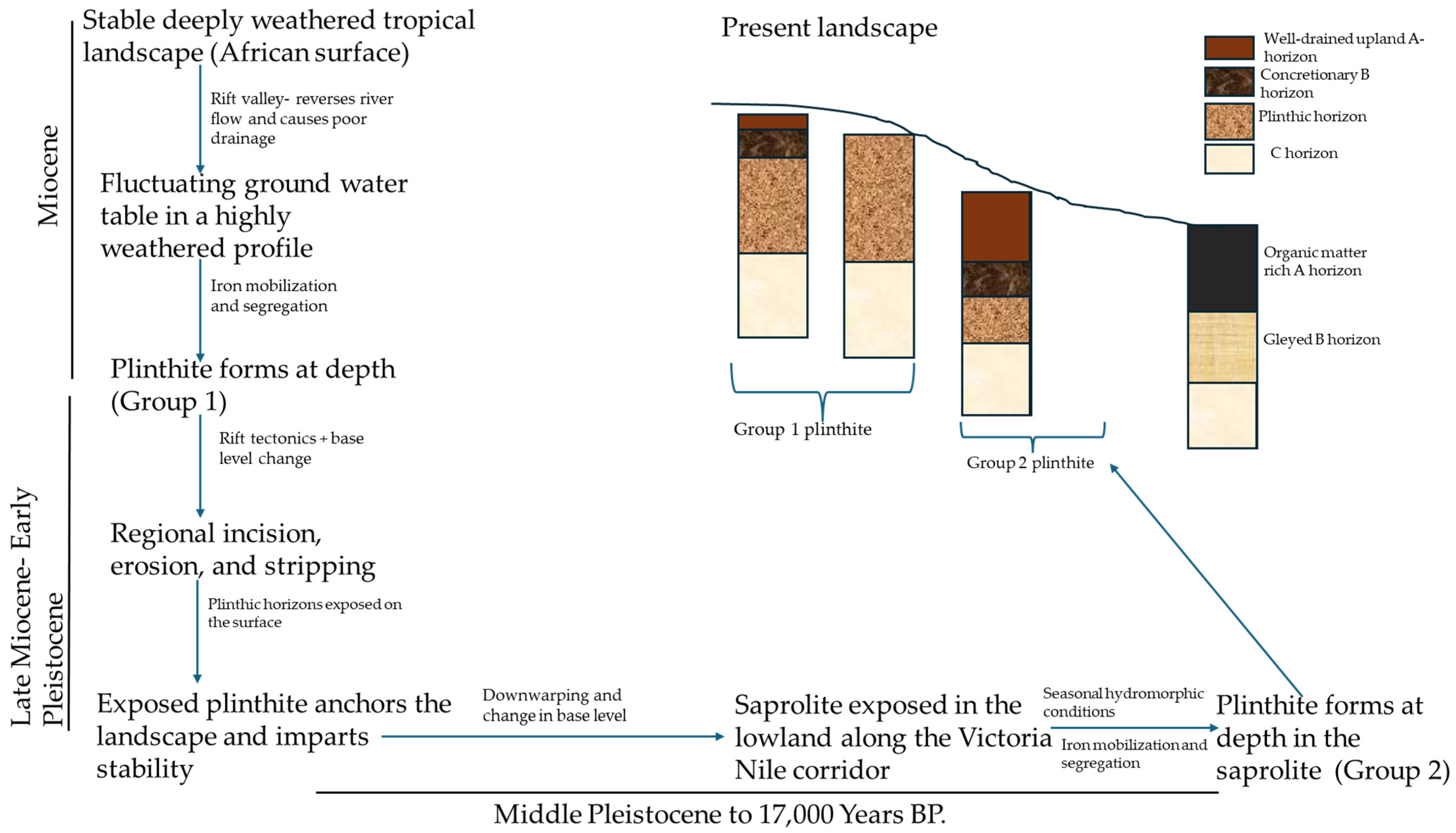
Consequently, the two plinthite mineralogy groups are products of distinct geomorphic episodes that shaped the landscape evolution of the Kyoga basin. Group 1 represents an ancient, pre-Lake Victoria weathering mantle. Located at higher elevations and further from the Victoria Nile, the plinthite samples are remnants of ancient landscape preserved at the summits and shoulders. Group 2 samples located at slightly lower elevations and in closer proximity to the Victoria Nile were influenced by Lake Victoria’s dynamic history. Their mineralogy embodies a signature of being less altered compared to the samples of Group 1 and are younger, formed on substrate exhumed by stripping associated with Lake Victoria’s fluctuations. The summary of the proposed formation pathway embedded within a framework suggested by Eze et al. [3] is shown in Figure 14.

Limitations and Analytical Constraints

The analytical approach employed in this study was shaped by both the methodological considerations and the intrinsic physical properties of the plinthite samples. The cemented, indurated nature of the plinthite made the conventional sample preparation techniques impractical. Mechanical comminution using a shatter box was therefore the only feasible approach to obtain a representative powder for analysis. This choice, however, precluded the standard dispersion and separation of the <2 µm clay fraction without prior chemical removal of iron oxides. Such chemical treatments would have fundamentally altered the mineralogical integrity of the samples by dissolving the very iron oxides that are central to our investigation of plinthite mineralogy. Consequently, XRD analysis was performed on bulk plinthite powder rather than on oriented clay separates. This approach carries inherent limitations [86], which become relevant when considering that the studies in other plinthic landscapes have reported the presence of 2:1 clay mineralogy such as smectite, vermiculite, and illite. Future studies can employ oriented clay mounts after selective iron removal, or advanced techniques such as transmission electron microscopy (TEM), or differential X-ray diffraction (DXRD) to provide more and better insight into clay mineralogy.
Selective iron extractions, which were not performed in this study, would have greatly improved the depth of our investigation regarding iron oxide dynamics between the two plinthite groups. The incorporation of citrate-bicarbonate-dithionite (CBD) and ammonium oxalate extraction insights would have enhanced the comparison of iron oxide mineralogy and crystallinity between Group 1 and Group 2 samples. Thus, these insights can be considered together with dating techniques at different elevations to unravel the complex history in the plinthic soils of Kamuli.
Parent material mineralogy would have greatly informed key aspects of this study, especially the finding of muscovite and albite in some plinthic samples and not others. The mineral assemblages of Kamuli’s lithology presented in Supplemental Table S1 were compiled from studies conducted elsewhere in Uganda on similar granitic landscapes since no published data specific to Kamuli District were available. This limitation is acknowledged and future studies would greatly benefit from incorporating bedrock sampling and mineralogical analysis to validate the inferred assemblages.

5. Conclusions

This study demonstrates that the distribution and characteristics of plinthite in the Kamuli District are fundamentally governed by soil-landscape relationships embedded in the region’s long-term geomorphic history. The likelihood of encountering plinthite is highest on the residual summits and colluvial backslopes, which have undergone prolonged weathering. The lowlands underlain by Holocene to modern sediments lack the pedogenic duration necessary for plinthite formation. Within the uplands, summit plinthite is generally shallower than on backslopes, with some summits exhibiting petroplinthite outcrops. The spatial pattern creates a land use dilemma for local farmers, who must choose between well-drained but plinthite-prone uplands and poorly drained lowlands. Continued cultivation, coupled with erosion, progressively exposes subsurface plinthite, which under the region’s seasonal climate undergoes irreversible hardening to petroplinthite and ultimately ironstone, further degrading agricultural potential.
Mineralogical analysis of ten indurated plinthite samples revealed two distinct assemblages that record different stages of Kamuli District’s landscape evolution history. Group 1, characterized by quartz, kaolinite, hematite, goethite, and manganite, represents a highly weathered endmember. Group 2, which retains muscovite alongside kaolinite and iron oxides, together with elevated K, Mg, Na, and Ca signatures in SEM-EDS spectra, inherited from the parent material reflects a comparatively lower degree of weathering. The formation of plinthite was linked to a multi-stage process that ties together drainage history, iron segregation, cementation, and landscape evolution. Group 1 represents an ancient, highly matured plinthite that developed within the African Surface mantle and survived subsequent stripping at higher elevations. Group 2, which was formed later at a lower elevation, on fresh substrate exposed by the Pleistocene incision along the Victoria Nile corridor and has experienced significantly less weathering time. Furthermore, the influence of the accumulation of the pre-weathered material from the upslope in the Group 2 samples is also acknowledged. Hence, the two groups are products of different geomorphic episodes, separated by hundreds of thousands of years of landscape evolution.
This proposed model of plinthite formation has implications beyond Kamuli District. The landscapes of adjacent areas including Buyende, Iganga, Kayunga, Nakasongola, and Palisa that can be traced back to the same Kyoga surface have likely experienced similar tectonic, climatic, and geomorphic histories. The soil-landscape relationships documented here can be extended to these areas, providing a framework for understanding plinthite distribution and variability across a broader swath of central and eastern Uganda.

Supplementary Materials

The following supporting information can be downloaded at: https://www.mdpi.com/article/10.3390/soilsystems10070069/s1, Figure S1: The concretionary nature of plinthic soils in Kamuli. The picture in the middle shows a profile showing concretions gradually becoming cemented with depth. To the left, is loose soil from the B horizon with distinct concretions. To the right shows the surface of an excavated plinthite showing the distinct concretionary morphology; Figure S2: The location of the Balawooli rock outcrops and Kagulu rocks which are signatures of the African surface imprinted on the landscape of Kamuli; Table S1: The expected mineralogy, iron richness and plinthite formation potential of lithologies mapped in Kamuli District; Table S2: The location, elevation, and topographic position of the different plinthite samples analyzed in the study; Table S3: Additional chemical properties of typical plinthic pedons described in Kamuli District.

Author Contributions

Conceptualization, F.A. and C.L.B.; Methodology, F.A., R.A.W., J.G.M., A.D.A. and S.K.; Software, R.A.W., J.G.M. and S.K.; Validation, F.A., R.A.W. and C.L.B.; Formal analysis, F.A., R.A.W. and J.G.M.; Investigation, F.A., R.A.W., A.D.A., S.K. and C.L.B.; Resources, C.L.B.; Data curation, F.A.; Writing-original draft, F.A. and C.L.B.; Writing-review & editing, F.A., R.A.W., J.G.M., A.D.A., S.K. and C.L.B.; Visualization, F.A.; Supervision, C.L.B.; Project administration, C.L.B.; Funding acquisition, C.L.B. All authors have read and agreed to the published version of the manuscript.

Funding

This research received no external funding.

Data Availability Statement

The data presented in this study are available upon request from the corresponding authors.

Acknowledgments

Borel Global and Doc Wayne Scholtes Fellowships which funded the authors during their graduate work are acknowledged. A special thank you to the people of Kamuli District who allowed us to visit their fields. Special thanks go to the Center for Sustainable Rural Livelihoods, the Iowa State University- Uganda Program and the Department of Agronomy for providing accommodation and office space during fieldwork and writing of this manuscript.

Conflicts of Interest

The authors declare no conflicts of interest.

Abbreviations

The following abbreviations are used in this manuscript:
AlAluminum
BSEBackscattered electron
BPBefore Present
CaCalcium
CECCation exchange capacity
DTPADiethylene triamine pentaacetic acid
EDSEnergy dispersive spectrometer
EDXEnergy dispersive x-ray
FeIron
ggrams
ICDDInternational Center for Diffraction Data
KPotassium
MnManganese
MnOManganese oxide
MgMagnesium
NaSodium
PDFPowder Diffraction Files
RIRReference Intensity Ratio
SEMScanning electron Microscopy
SiSilicon
SOCSoil organic carbon
TiTitanium
WRBWorld Reference Base
XRDX-ray diffraction

References

  1. Soil Survey Staff. Keys to Soil Taxonomy, 13th ed.; USDA Natural Resources Conservation Service: Washington, DC, USA, 2022.
  2. McFarlane, M.J. Some sedimentary aspects of lateritic weathering profile development in the major bioclimatic zones of tropical Africa. J. Afr. Earth Sci. (Middle East) 1991, 12, 267–282. [Google Scholar]
  3. Eze, P.N.; Udeigwe, T.K.; Meadows, M.E. Plinthite and its associated evolutionary froms in soils and landscapes: A review. Pedosphere 2014, 24, 153–166. [Google Scholar] [CrossRef]
  4. Carvalho, I.G.; Mestrinho, S.S.; Fontes, V.M.; Goel, O.P.; Souza, F.D. Geochemical evolution of laterites from two areas of the semiarid region in Bahia State, Brazil. J. Geochem. Explor. 1991, 40, 391–411. [Google Scholar] [CrossRef][Green Version]
  5. Dos Anjos, L.H.; Franzmeier, D.P.; Schulze, D.G. Formation of soils with plinthite on a toposequence in Maranhao State, Brazil. Geoderma 1995, 64, 257–279. [Google Scholar] [CrossRef]
  6. Garcia, C.H.; Lima, H.N.; Rocha Silva, F.W.; Neves Junior, A.F.; Teixeira, W.G.; Macedo, R.S.; Tavares, S.G. Chemical properties and mineralogy of soils with plinthite and petroplinthite in Iranduba (AM) Brazil. Soil Process. Prop. 2013, 37, 936–946. [Google Scholar]
  7. Martins, A.P.; Santos, G.G.; de Oliveira, V.A.; Maranhao, D.D.; Collier, L.S. Reversibility of the Hardening Process of Plinthite and Petroplinthite in Soils of the Araguaia River Floodplain. Rev. Bras. Cienc. Solo 2018, 42, e20170191. [Google Scholar] [CrossRef]
  8. Pereira, M.R.; Pedron, F.D.; Dalmolin, R.S.; Schenato, R.B.; Alves, R.E. Identification of plinthite of saprolite residue in soils with high textural contrast in the southern Brazil. Soil Space Time Genes Soil Morphol. 2022, 46, e0220079. [Google Scholar] [CrossRef]
  9. Pereira, M.G.; da Silva, R.S.; Junior, C.P.; de Oliveira, F.S.; Neto, E.C.; Fontana, A.; Pedron, F.D. Soil genesis on the soft slopes of ancient coastal plains, southeastern Brazil. Catena 2022, 210, 105894. [Google Scholar] [CrossRef]
  10. Santos, D.P.; Santos, G.G.; de Oliveira, V.A.; da Silva, G.S.; Flores, R.A.; Azevedo, A.C.; Pereira, M.G. Chemical and mineralogical constitution of redoximorphic features and mechanism of formation of Plinthosols from the Araguaia River plain, Brazil. Rev. Bras. Cienc. Solo 2024, 48, e0230115. [Google Scholar] [CrossRef]
  11. Santos, D.P.; Santos, G.G.; de Oliveira, V.A.; da Silva, G.S.; Flores, R.A.; Azevedo, A.C.; Pereira, M.G. Probable causes of hardening of redoximorphic features in Plinthosols of the Araguaia River floodplain, Central region of Brazil. Geoderma Reg. 2022, 31, e00583. [Google Scholar] [CrossRef]
  12. Leite, O.D.; Lima, S.D.; da Luz, J.H.; da Silva, R.R.; Fidelis, R.R.; Tavares, R.D.; Machado, A.F. Liming in soils with plinthic materials of the Brazilian Savanna: Potentials and limitations. Aust. J. Crop Sci. 2022, 16, 488–494. [Google Scholar] [CrossRef]
  13. Leite, O.D.; da Luz, J.H.; Lima, S.D.; da Silva, R.R. Effect of liming in plinthic and petroplinthic soils for soybean cultivation in the Brazilian savanna. Aust. J. Crop Sci. 2024, 18, 64–71. [Google Scholar] [CrossRef]
  14. Wood, B.W.; Perkins, H.F. Plinthite characterization in selected Southern Coastal Plain soils. Soil Sci. Soc. Am. J. 1976, 40, 143–146. [Google Scholar] [CrossRef]
  15. Daniels, R.B.; Perkins, H.F.; Hajek, B.F.; Gamble, E.E. Morphology of Discontinuous Phase Plinthite and Criteria for its Field Identification in the Southeastern United States. Soil Sci. Soc. Am. J. 1978, 42, 944–949. [Google Scholar] [CrossRef]
  16. Jacobs, P.M.; West, L.T.; Shaw, J.N. Redoximorphic Features as Indicators of Seasonal Saturation, Lowndes County, Georgia. Soil Sci. Soc. Am. J. 2002, 66, 315–323. [Google Scholar] [CrossRef]
  17. Pisani, O.; Klick, S.A.; Strickland, T.C. Organic matter characterization and mineralization in ironstone gravel from two Plinthic soils in the Coastal Plain of Georgia. Soil Sci. Soc. Am. J. 2025, 89, e70047. [Google Scholar]
  18. Eswaran, H.; Mohan, G.R. The Microfabric of Petroplinthite. Soil Sci. Soc. Am. J. 1973, 37, 79–82. [Google Scholar] [CrossRef]
  19. Ghosh, S.; Guchhait, S.K. Characterization and evolution of primary and secondary 684 laterites in northwestern Bengal Basin, West Bengal, India. J. Palaeogeogr. 2015, 4, 203–230. [Google Scholar]
  20. Zhao, X.; Wu, H.; Yang, S.; Dong, Y.; Yang, J.; Zhang, G. Intra-horizon differentiation of the bacterial community and its co-occurrence network in a typical Plinthic horizon. Sci. Total Environ. 2019, 678, 692–701. [Google Scholar] [PubMed]
  21. Liu, X.; Hseu, Z.; Chen, Z. Correcting the classification of plinthic Ultisols on aged alluvial terraces in Taiwan. Soil Sci. Plant Nutr. 2020, 66, 458–468. [Google Scholar] [CrossRef]
  22. Zhao, L.; Fang, Q.; Algeo, T.J.; Lu, A.; Yin, K.; Duan, Z.; Hong, H. Formation of plinthite mediated by redox fluctuations and chemical weathering intensity in a Quaternary red soil, southern China. Geoderma 2021, 386, 114924. [Google Scholar] [CrossRef]
  23. Zhao, L.; Hanlie, H.; Fang, Q.; Hei, H.; Algeo, T.J. Hydrologic regulation of clay-mineral transformations in a redoximorphic soil of subtropical monsoonal China. Am. Miner. 2023, 108, 1881–1896. [Google Scholar] [CrossRef]
  24. MacFarlane, M.J. Lateritization and landscape development in Kyagwe, Uganda. J. Geol. Soc. 1970, 229, 501–539. [Google Scholar] [CrossRef]
  25. MacFarlane, M.J. A low level laterite profile from Uganda and its relevance to the question of parent material influence on the chemical composition of laterites. Geol. Soc. Publ. 1983, 11, 69–76. [Google Scholar] [CrossRef]
  26. Brown, D.J.; Helmke, P.A.; Clayton, M.K. Robust geochemical indices for redox and weathering on a granitic laterite landscape in Central Uganda. Geochim. Cosmochim. Acta 2003, 67, 2711–2723. [Google Scholar] [CrossRef]
  27. Asiamah, R.D.; Dwomo, O. Ethno-management of plinthic and iron pan soils in the savanna regions of West Africa. Ghana J. Agric. Sci. 2009, 42, 25–29. [Google Scholar]
  28. Idowu, O.J.; Oluwatosin, G.A. Hydraulic properties in relation to morphology of a typical soil with hardened plinthite under three land use types. Trop. Subtrop. Agroecosyst. 2008, 8, 145–155. [Google Scholar]
  29. Beauvais, A. Ferricrete biochemical degradation on the rainforest–savannas boundary of Central African Republic. Geoderma 2009, 150, 379–388. [Google Scholar] [CrossRef]
  30. Oluwatosin, G.A.; Are, K.S.; Adeyolanu, O.D.; Idowu, O.J. Characteristics and agricultural potential of soils with plinthic materials in the savanna ecology of south western Nigeria. Arch. Agron. Soil Sci. 2020, 66, 1794–1811. [Google Scholar]
  31. Santos, T.E.; Gomes, F.H.; Mancini, M.; Nobrega, G.N.; Avanzi, J.C.; Marques, J.J.; Curi, N. Detailed characterization of plinthic soils in Southern Mali, Sub-Saharan Africa, as a secure basis for specific soil management and food security. Catena 2023, 226, 107088. [Google Scholar] [CrossRef]
  32. Zongo, K.F.; Nandkangre, H.; Sanon, A.; Gouba, M.; Guebre, D.; Kambou, D.J.; Ouedraogo, M. Improvement of Bambara Groundnut Productivity using Organic Manure Fertilization Doses on Plinthite Soil in sub-Saharan Agrosystem of Burkina Faso. Niger. Agric. J. 2023, 54, 451–458. [Google Scholar]
  33. MacFarlane, M.J. Laterite and Landscape; Academic Press Inc.: London, UK, 1976. [Google Scholar]
  34. Constantini, E.A.; Priori, S. Pedogenesis of plinthite during early Pliocene in the Mediterranean environment. Catena 2007, 71, 425–443. [Google Scholar] [CrossRef]
  35. Rellini, I.; Trombino, L.; Carbone, C.; Firpo, M. Petroplinthite formation in a pedosedimentary sequence along a northern Mediterranean coast: From micromorphology to landscape evolution. J. Soils Sediments 2014, 15, 1311–1328. [Google Scholar] [CrossRef]
  36. Scarciglia, F.; Sauer, D.; Zerboni, A. Pleistocene paleosols of Italy: Pedostratigraphy, genesis, paleoclimate and geoarchaeology. Alp. Mediterr. Quat. 2023, 36, 149–183. [Google Scholar]
  37. Fernandez-Caliani, J.C.; Cantano, M. Intensive kaolinization during a lateritic weathering event in South-West Spain: Mineralogical and geochemical inferences from a relict paleosol. Catena 2010, 80, 23–33. [Google Scholar]
  38. Camacho-Umana, M.E.; Villatoro-Sanchez, M.; Aleman-Montes, B.; Mata, R.; Henriques, C.; Céspedes-Rivera, J.; Alvarado, A. Highly Weathered Soil Landscapes of Costa Rica. In Landscapes and Landforms of Costa Rica; Quesada-Roman, A., Ed.; Springer: Cham, Switzerland, 2024; pp. 431–451. [Google Scholar]
  39. Schellmann, W. The formation of lateritic silicate beauxites and criteria for their exploration and assessment of deposits. Nat. Resourc. Dev. 1977, 5, 119–134. [Google Scholar]
  40. Le Roux, P.A.; du Preez, C.C.; Buhman, C. Indications of ferrolysis and structure degradtion in an Estcourt soil and possible relationships with plinthite formation. S. Afr. J. Plant Soil. 2005, 22, 199–206. [Google Scholar]
  41. Retallack, G.J. Laterization and Beauxitization events. Econ. Geol. 2010, 105, 655–667. [Google Scholar]
  42. Michael, A.; Zach, P.; Michael, L.E.; Ralph, T.; William, K. Plinthite formation in the coastal plain region of Mississippi. Soil Sci. 2004, 169, 613–623. [Google Scholar] [CrossRef]
  43. Smith, R.; Shaw, J.; Martin, P.; Love, C. Relationships between seasonal high-water tables and hydromorphology of some Alabama Coastal Plain soils. In Proceedings of the ASA-CSSA-SSSA International Annual Meetings, New Orleans, LA, USA, 12–16 November 2006. [Google Scholar]
  44. McFarlane, M.J.; Heydeman, M.T. Some aspects of kaolinite dissolution by a laterite indigenous micro-organism. Geo-Eco-Trop 1984, 8, 73–91. [Google Scholar]
  45. Ollier, C.D. A two-cycle theory of tropical pedology. J. Soil Sci. 1959, 10, 139–148. [Google Scholar]
  46. Brown, D.J.; Clayton, M.K.; McSweeney, K. Potential terrain controls on soil color, texture contrast and grain-size deposition for the original catena landscape in Uganda. Geoderma 2004, 122, 51–72. [Google Scholar] [CrossRef]
  47. Veenstra, J.; Dembe, D.; Nsamba, J.; Wasko, L.; Burras, C.L.; Nonnecke, G.R.; Cox, R. Mapping soils in Central Uganda. Soil Surv. Horiz. 2015, 10, 31–34. [Google Scholar]
  48. Akitwine, F. Pedology of Typical Soils of Kamuli District and Pedotransfer Functions to Predict Cation Exchange Capacity in Limited-Resource Settings. Master’s Thesis, Iowa State University, Ames, IA, USA, 2021. [Google Scholar]
  49. Anderson, A.D. Pedology as a Scientific, Teachable, and Artistic Discipline in the 21st Century. Ph.D. Dissertation, Iowa State University, Ames, IA, USA, 2023. [Google Scholar]
  50. Wokibula, R.A.; Akitwine, F.; Mtama, J.G.; Burras, C.L. Cation exchange capacity within and between pedons of the Kamuli catena, Busoga sub-region, Uganda. In Proceedings of the CANVAS, San Antonio, TX, USA, 10–13 November 2024. [Google Scholar]
  51. Akitwine, F.; Wokibula, R.A.; Mtama, J.G.; Anderson, A.D.; Kwikiiriza, S.; Timbas, N.L.; Streeter, M.T.; Mbeiza, M.; Burras, C.L. Cropping Patterns and Pedology in Kamuli District, Eastern Uganda. In Proceedings of the CANVAS, Salt Lake City, UT, USA, 9–12 November 2025. [Google Scholar]
  52. Kwikiiriza, S.; Nonnecke, G.R.; Nair, A.; Akitwine, F.; Burras, C.L. Hybrid Cultivars and Straw Mulch Improve Yield and Gross Margin of Squash in Eastern Uganda. HortTechnology 2026, 36, 114–123. [Google Scholar] [CrossRef]
  53. Ruhe, R.V. Erosion surfaces of Central African interior High Plateaus; L’Institut National pour l’Étude Agronomique du Congo (I.N.É.A.C.): Brussels, Belgium, 1954. [Google Scholar]
  54. Bishop, W.W.; Trendall, A.F. Erosion-surfaces, tectonics and volcanic activity in Uganda. J. Geol. Soc. 1966, 122, 385–420. [Google Scholar] [CrossRef]
  55. Nagudi, B.; Koeberl, C.; Kurat, G. Petrography and geochemistry of the Singo granite, Uganda, and implications for its origin. J. Afri. Earth Sci. 2003, 36, 73–87. [Google Scholar] [CrossRef]
  56. Olupot, P.W.; Jonsson, S.; Byaruhanga, J.K. Characterization of Feldspar and Quartz Raw Materials in Uganda for Manufacture of Electrical Porcelains. J. Aust. Ceram. Soc. 2006, 42, 29–35. [Google Scholar]
  57. Opiyo-Akech, N.; Tarney, J.; Hoshino, M. Petrology and geochemistry of granites from the Archæan terrain north of Lake Victoria, western Kenya. J. Afri. Earth Sci. 1999, 29, 283–300. [Google Scholar] [CrossRef]
  58. Babaousmail, H.; Ojara, M.A. Evaluation of Historical Dry and Wet Periods over Lake Kyoga Basin in Uganda. Water 2025, 17, 1044. [Google Scholar] [CrossRef]
  59. Kamuli District Local Government. District Development Plan (DDPIII) 2021/21-2024/25. Available online: https://mail.kamuli.go.ug/sites/files/KAMULI%20District%20DDP%20III%202020%20-%202025_0.pdf (accessed on 10 October 2025).
  60. Schoeneberger, P.J.; Wysocki, D.A.; Benham, E.C.; Soil Survey Staff. Field Book for Describing and Sampling Soils, version 3.0; USDA Natural Resource Conservation Service: Lincoln, NE, USA, 2012. [Google Scholar]
  61. IUSS Working Group. World Reference Base for Soil Resources. International Soil Classification System for Naming Soils and Creating Legends for Soil Maps, 4th ed.; Food and Agricultural Organization: Rome, Italy, 2022. [Google Scholar]
  62. Bouycous, G.J. A recalibration of the hydrometer method for making mechanical analysis of soils. Agron. J. 1951, 43, 434–438. [Google Scholar] [CrossRef]
  63. Mclean, E.O. Soil pH and lime requirement. In Methods of Soil Analysis: Part 2 Chemical and Microbiological Properties; Page, A.L., Ed.; American Society of Agronomy: Madison, WI, USA, 1982; pp. 199–224. [Google Scholar]
  64. Nelson, D.W.; Sommers, L.E. Total carbon, organic carbon, and organic matter. In Methods of Soil Analysis: Part 3 Chemical Methods; Sparks, D.L., Page, A.L., Helmke, P.A., Loeppert, R.H., Soltanpour, P.N., Tabatabai, M.A., Summer, M.E., Eds.; American Society of Agronomy: Madison, WI, USA, 1996; pp. 961–1010. [Google Scholar]
  65. Quevauviller, P.; Lachica, M.; Barahona, E.; Rauret, G.; Ure, A.; Gomez, A.; Muntau, H. Interlaboratory comparison of EDTA and DTPA procedures prior to certification of extractable trace elements in calcareous soil. Sci. Total Environ. 1996, 178, 127–132. [Google Scholar] [CrossRef]
  66. Hillier, S. Accurate quantitative analysis of clay and other minerals in sandstones by XRD: Comparison of a Rietveld and a reference intensity ratio (RIR) method and the importance of sample preparation. Clay Miner. 2000, 35, 291–302. [Google Scholar] [CrossRef]
  67. Welton, J.E. SEM petrology Atlas; The American Association of Petroleum Geologists: Tulsa, OK, USA, 1984. [Google Scholar]
  68. Hazelton, P.; Murphy, B. Interpreting Soil Test Results: What Do All the Numbers Mean? 3rd ed.; CSIRO Publishing: Melbourne, Australia, 2016. [Google Scholar]
  69. Yaro, D.T.; Kparmwang, T.; Raji, B.A.; Chude, V.O. Extractable micronutrients status of soils in a plinthic landscape at Zaria, Nigeria. Commun. Soil Sci. Plant Anal. 2008, 39, 2484–2499. [Google Scholar]
  70. Ojetade, J.O.; Adesemuyi, E.A.; Amusan, A.A.; Adegbenro, R.O.; Muda, S.A. Assessment of sesquioxides status of some uplands soils in humid southwest Nigeria. Ann. Trop. Res. 2022, 44, 1–16. [Google Scholar] [CrossRef]
  71. Widdowson, M. Laterite and Ferricrete. In Goechemical Sediments and Landscapes; Nash, D.J., McLaren, S.J., Eds.; Blackwell Publishing Ltd.: Hoboken, NJ, USA, 2007; pp. 46–95. [Google Scholar]
  72. Shobayo, A.B.; Ya’u, S.L.; Odunze, A.C. Soil mineralogical characterization of selected carmine Alfisols and plinthic Inceptisols of Funtua, Nigeria. Niger. J. Soil Sci. 2019, 29, 127–135. [Google Scholar]
  73. Schulze, D.G.; Schwertmann, U. The influence of aluminum on iron oxides: X. properties of Al-substituted goethites. Clay Miner. 1984, 19, 521–539. [Google Scholar]
  74. Jien, S.H. Characterization and formation of iron-manganese nodules of Ultisol with Plinthite in Taiwan. In Proceedings of the International Union of Soil Sciences, Philadelphia, PA, USA, 9–15 July 2006. [Google Scholar]
  75. Ramos, M.R.; Figueiredo, M.S.; Loureiro, R.M.; Alves, G.B. Overview of the research on Plinthosols, Petroplinthites, and Plinthites. Rev. Bras. Geogr. Física 2025, 18, 2882–2898. [Google Scholar]
  76. Fritsch, E.; Herbillon, A.J.; Do Nascimento, N.R.; Grimaldi, M.; Melfi, A.J. From Plinthic Acrisols to Plinthosols and Gleysols: Iron and groundwater dynamics in the tertiary sediments of the upper Amazon basin. Eur. J. Soil Sci. 2006, 58, 989–1006. [Google Scholar] [CrossRef]
  77. Ssemalulu, O.; Kaizzi, K. Overview of the Status of Soil Resource in Uganda, and the Needs and Priorities for Its Sustainable Management; Food and Agricultural Organization: Rome, Italy, 2014. [Google Scholar]
  78. Yan, H.; Cen, N.; Zheng, Q.; Lin, J.; Jiang, F.; Huang, Y.; Zhang, Y. Analysis of the Shear Strength of Iron Oxide-Kaolinite Cementing Materials in Granite Red Soil. Minerals 2024, 15, 16. [Google Scholar] [CrossRef]
  79. Tang, N.; Siebers, N.; Dultz, S.; Klumpp, E. Elucidating the role of ferrihydrite and goethite in the aggregation and stability of small soil microaggregates: An experimental study on arable Luvisols under different management. Geoderma 2025, 459, 117351. [Google Scholar] [CrossRef]
  80. Igwe, C.A.; Zarei, M.; Stahr, K. Stability of aggregates of some weathered soils in south-eastern Nigeria in relation to their geochemical properties. J. Earth Syst. Sci. 2013, 122, 1283–1294. [Google Scholar] [CrossRef]
  81. Roberts, E.M.; Stevens, N.J.; O’Connor, P.M.; Dirks, P.H.G.M.; Gottfried, M.D.; Clyde, W.C.; Armstrong, R.A.; Kemp, A.I.S.; Hemming, S. Initiation of the western branch of the East African Rift coeval with the eastern branch. Nat. Geosci. 2012, 5, 289–294. [Google Scholar] [CrossRef]
  82. Taylor, R.G.; Howard, K.W.F. Post-Paleozoic evolution of weathered land surfaces in Uganda by tectonically controlled deep weathering and stripping. Geomorphology 1998, 25, 173–192. [Google Scholar]
  83. Currano, E.D.; Jacobs, B.F.; Bush, R.T.; Novello, A.; Feseha, M.; Grimsson, F.; McInerney, F.A.; Michel, L.A.; Pan, A.D.; Phelps, S.R.; et al. Ecological dynamic equilibrium in an early Miocene (21.73 Ma) forest, Ethiopia. Palaeogeogr. Palaeoclimatol. Palaeoecol. 2020, 539, 109425. [Google Scholar] [CrossRef]
  84. Jien, S.H.; Hseu, Z.Y.; Chen, Z.S. Hydropedological Implications of Ferromanganiferous Nodules in Rice-Growing Plinthitic Ultisols under Different Moisture Regimes. Soil Sci. Soc. Am. J. 2010, 74, 880–891. [Google Scholar]
  85. Johnson, T.C.; Kelts, K.; Odada, E. The Holocene History of Lake Victoria. Ambio 2000, 29, 2–11. [Google Scholar] [CrossRef]
  86. Leon-Reina, L.; Garcia-Mate, M.; Alvarez-Pinazo, G.; Santacruz, I.; Vallcorba, O.; De la Torre, A.G.; Aranda, M.A. Accuracy in Rietveld quantitative phase analysis: A comparative study of strictly monochromatic Mo and Cu radiations. J. Appl. Crystallogr. 2016, 49, 722–735. [Google Scholar] [CrossRef] [PubMed]
Figure 1. A map of Uganda showing the location of landscapes examined in earlier studies by McFarlane and Brown in relation to Kamuli District. The studies shown in the figure are McFarlane [24,25] and Brown [26] represented by 2, 1, and 3 respectively.
Soilsystems 10 00069 g001
Figure 2. Elevation dynamics showing the dissected terrain of Kamuli District. The network of valleys is shaped by stream evolution. The sediment in the valleys is likely of modern or Holocene age. The points show examined pedons in which plinthite was encountered.
Soilsystems 10 00069 g002
Figure 3. Set up for the soaking test performed to confirm plinthite. The samples were soaked in distilled water. The confirmatory test was done for two hours but the test was continued for two weeks and monitored for disintegration daily.
Soilsystems 10 00069 g003
Figure 4. Relationship between elevation and location of plinthic soils in Kamuli District. The labeled points show the pedons from which plinthite samples were collected for further mineralogical and laboratory analysis. (A) Shows a clear elevation gradient as you cross Kamuli from low to high longitudes (west to east) (B) Though not as clear, there is an elevation gradient from low latitudes to high latitudes from (south–north direction).
Soilsystems 10 00069 g004
Figure 5. Distinct plinthite capping encountered during the study at three sites on the summit in Kamuli District. Often these areas with shallow to no depth to cemented plinthite were left uncultivated. (a,b) shows petroplinthite outcrops encountered in a fruit orchard (c) shows massive plinthite excavated from a maize garden and stacked. The central elevation map shows the terrain gradient across the study area, with colors representing elevation (meters above sea level). Arrows indicate the positions where the respective observations were made.
Soilsystems 10 00069 g005
Figure 6. Plinthite expression in the different landscape positions in Kamuli District. (a) A typical shallow pedon with cemented plinthite excavated (PED01). (b,c) Deeper profiles with distinct concretions (land cut and PED03). (d) A cemented and mottled plinthic horizon (Bv horizons in PED05). (e) A plinthite encountered in a soil located at the footslope (PED06).
Soilsystems 10 00069 g006
Figure 7. Disintegration of the plinthite samples after being soaked in water for two weeks, observed at multiple time intervals (hours). The samples initially remained intact after 2 h confirming plinthite identity. With time, the plinthite samples exhibited varying degrees of aggregate breakdown with 50% showing complete disaggregation by the end of the two weeks.
Soilsystems 10 00069 g007
Figure 8. X-ray diffractograms of the 10 plinthite samples with the dominant peaks labeled. (a) Shows X-ray diffractograms of samples in Group 1 with sample UG01 showing well-defined peaks for quartz. (b) Shows X-ray diffractograms for samples in Group 2 with well-defined peaks for muscovite. Goe = goethite, He = hematite, Kao = kaolinite, Mu = muscovite, Q = quartz.
Soilsystems 10 00069 g008
Figure 9. Backscattered electron image and EDS elemental analysis of sample UG01 showing heterogeneity in the plinthite matrix. (a) SEM micrograph showing the grounded plinthic matrix, with selected analysis points 1, 2, 3, 4 indicated. (b) The EDS spectra revealed distinct variation in regions 1, 2, 3, and 4 as indicated by the different colored spectra outlines. (ch) Elemental distribution maps showing the spatial variability of major elements within the analyzed area. Bright areas in the elemental maps indicate greater abundance of the respective elements.
Soilsystems 10 00069 g009
Figure 10. Backscattered electron image and EDS elemental analysis of sample UG07 showing heterogeneity in the plinthite matrix. (a) SEM micrograph showing the ground plinthic matrix, with analysis points 1, 2, 3, 4, 5, 6, 7, 8, 9 indicated. (b) The EDS spectra revealed distinct variation in regions 1, 2, 3, 4, 5, 6, 7, 8, and 9 as indicated by the different colored spectra outlines. (cj) Elemental distribution maps showing the spatial variability of major elements within the analyzed area Bright areas in the elemental maps indicate greater abundance of the respective elements.
Soilsystems 10 00069 g010
Figure 11. Differences in morphological expression of plinthite in the backslope. PED03, exhibits a well-expressed A-horizon and plinthic B-horizon, whereas the A-horizon in PED02 is shallow. Also note the differences in root abundance between the A-horizon and the plinthic B-horizon in PED02.
Soilsystems 10 00069 g011
Figure 12. Elevational partitioning between pedons from which plinthite samples in Group 1 and 2 were picked. Group 1 samples were picked from pedons at higher elevation compared to those in Group 2.
Soilsystems 10 00069 g012
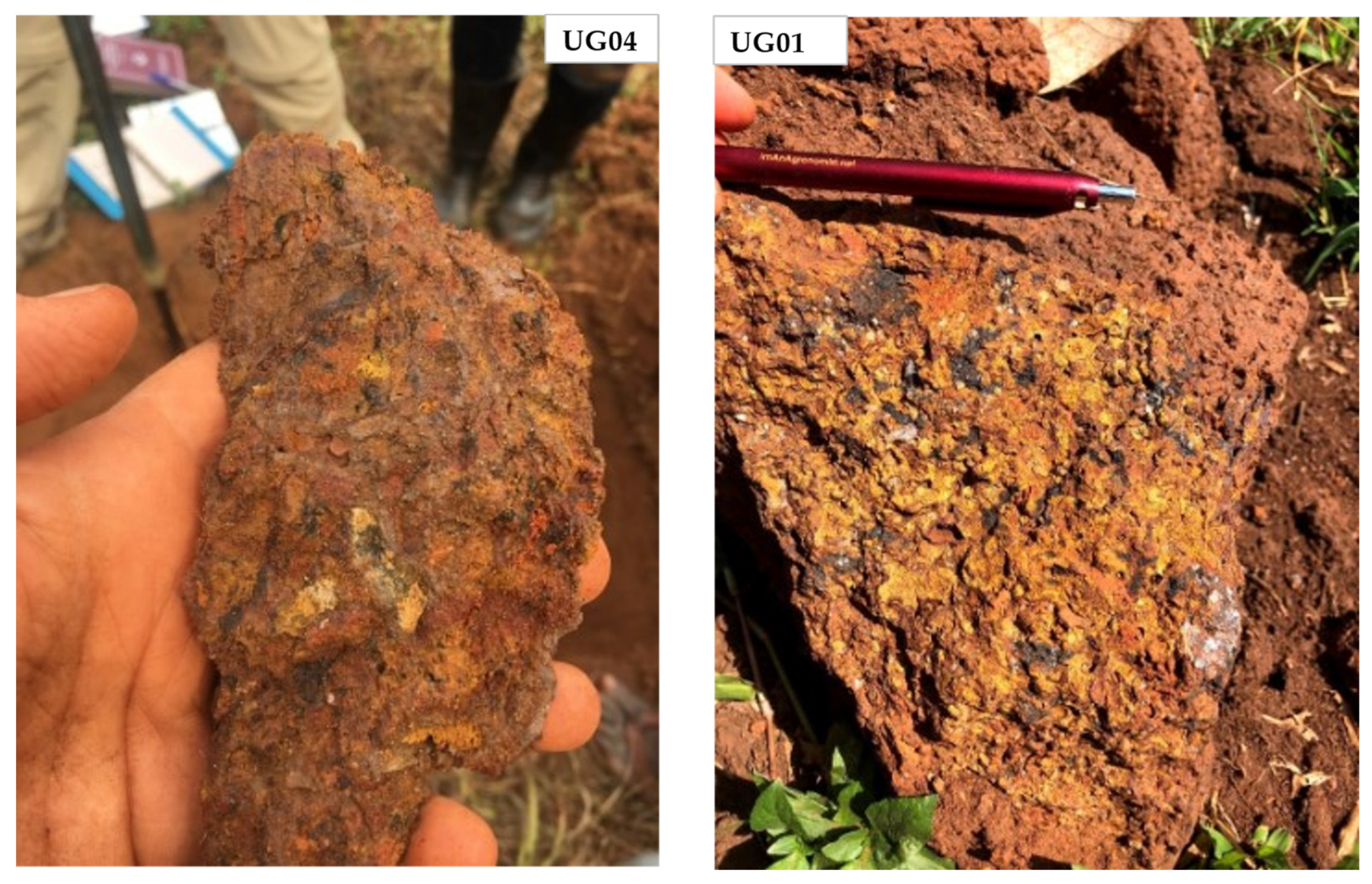
Figure 13. Mottling observed in the indurated plinthite as evidence of poor drainage at some point in its formation. Note the Mn enrichment, especially in UG01.
Soilsystems 10 00069 g013
Figure 14. A conceptual summary of the proposed model of how plinthite formed in the Kamuli catena.
Soilsystems 10 00069 g014
Table 1. Morphological and physical properties of typical plinthite pedons in Kamuli District, grouped by landscape position.
Pedon IDHorizonDepth (cm)Moist ColorStructureConsistencyParticle Size DistributionBulk Density
Munsell Color Sand (%)Silt (%)Clay (%)g/cm3
Located on a flat summit with a 2% slope
PED01Ap0–147.5YR2.5/33, co-m, sbkvfr508421.52
A14–247.5YR2.5/32, co-m, sbkfr4713401.62
AB24–377.5YR2.5/3m-f, sgrr4613411.98
Bv37–57Plinthic massiver5010401.37
Located on a shoulder with a 4% slope
PED02Ap0–125YR2.5/21, co, sbk fr761411n.d
AB12–21.05YR2.5/21, co, sbk fi681728n.d
Btv21–425YR3/2massiver481042n.d
Bv42–80Plinthic massive rn.dn.dn.dn.d
Located on a long linear backslope with a 4% slope
PED03Ap0–207.5YR2.5/23, co-m, abkfr4517381.29
AB20–377.5YR2.5/22, m-f, sbkfr5217311.15
Bt137–527.5YR3/42, m-f, sbkfi6012281.15
Bt252–755YR3/4 (Mottled)2, m-f, sbkfi5910311.19
Btv75–111Plinthicsgrr478451.05
Bv111–150Plinthic sgr/massive rn.dn.dn.d1.21
Located on a long linear backslope with a 4% slope.
PED04Ap0–147.5YR2.5/22, m, sbkfr5510351.52
A14–307.5YR2.5/32, co-m, sbkvfr5212361.29
AB30–577.5YR2.5/32, m-f, sbk-prfr5614301.17
Bo57–1007.5YR4/6 (Plinthic)sgrr657281.65
Bv100–1507.5YR4/6 (Plinthic)sgr/massiver677260.75
Located on a long linear backslope with a 7% slope
PED05Ap0–167.5YR2.5/23, co, sbk/grr494470.94
A16–417.5YR2.5/32, co, sbkr555401.04
AB41–597.5YR2.5/32, m-f, sbkfr528401.12
Bw59–817.5YR3/42, m-f, sbkfr6210281.1
Bt181–1215YR3/42, co-m, sbkvfr588340.98
Bt2121–1525YR4/62, co, prfr543431.24
Bv1152–1795YR4/6 (Plinthic)sgrrn.dn.dn.d1.31
Bv2179–2545YR4/6 (Plinthic)sgrrn.dn.dn.d1.34
Located in a footslope leading to an alluvial valley with a 3% slope
PED06Ap0–1510YR2/12, m-f, sbk-grfr23.21660.81.13
A15–3210YR2/11, m-f, sbkfr30.21356.81.1
AB32–5310YR2/21, co-m, prfi33.23234.81.47
Bw53–8210YR3/41, m-f, prfi51.21137.81.46
Bt182–12110YR3/4/Mottled1, co-m, prfi47.2943.81.53
Btv121–140Plinthicmassivern.dn.dn.d2.09
Structure; 1—weak, 2—moderate, 3—strong. co—coarse, m—medium, f—fine. sbk—subangular blocky, abk—angular blocky, gr—granular, pr—prismatic, sgr—single grain. Consistence; fr—friable, fi—firm, r—rigid. n.d—not determined.
Table 2. Chemical properties and classification of typical plinthic pedons described in Kamuli District.
Pedon IDHorizonpHOrganic
Carbon
FeMnCECBase
Saturation
Classification
%ppmppmCmolc/kg%Subgroup/Reference Soil Group
PED01Ap 5.451.6447.0215.712.519.44Plinthic Kandiustult/Haplic Petric Plinthosol
A5.471.1516.5290.517.39.4
AB5.470.5102.0231.616.715.5
Bv 5.820.357.012116.115.4
PED02Ap6.81.1n.dn.d15.5349.26Plinthic Haplustult/Haplic Petric Plinthosol
AB6.51.2n.dn.d23.7334.21
Btv6.2n.dn.dn.dn.dn.d
Bvn.dn.dn.dn.dn.dn.d
PED03Ap 6.771.8337.0254.119.950.2Plinthic Haplustult/Umbric Petric Plinthosol
AB6.891.4347.0246.719.738.9
Bt16.870.7458.5288.616.811.6
Bt26.680.6357.5266.916.829.8
Btv6.680.6301.0179.416.225.6
Bv6.530.4232.0168.612.623.3
PED04Ap6.981.9508.0226.013.871.8Plinthic Kandiustox/Umbric Petric Plinthosol
A6.431.4357.0246.11839.8
AB6.031.1345.0232.018.424.2
Bo6.260.285.064.515.118.9
Bv 6.640.152.547.015.118.2
PED05Ap6.701.5357.0241.314.973.9Plinthic Haplustox/Mollic Plinthosol
A5.600.9388.0241.313.253.4
AB4.800.9380.0225.513.132.8
Bw5.900.5306.0220.512.825.7
Bt15.700.5293.0208.612.640.9
Bt25.200.3283.0182.513.412.9
Bv15.700.387.044.412.210.09
Bv26.300.285.033.512.212.6
PED06Ap 7.552.5249.5221.719.149.1Kandic Plinthaquult/Umbric Plinthosol
A7.851.0122.5209.417.947.8
AB7.680.7410.5200.825.330.9
Bw7.720.5269.517716.336.4
Bt17.520.4216.518317.541.8
Btv5.4n.dn.dn.dn.dn.d
n.d—Not determined.
Table 3. Semi-quantitative assessment of mineral phases detected from X-ray diffractograms among the two distinct plinthite sample groups.
Group 1
Mineral (%)UG01UG02UG05UG08UG10
Manganite43443
Goethite2416141612
Hematite1121222320
Kaolinite4545534958
Muscovite0********
Quartz164554
Group 2
Mineral (%)UG03UG04UG06UG07UG09
Manganite12212
Goethite67645
Hematite1216161312
Kaolinite6049505356
Muscovite 2026262925
Albite**********
** stands for trace amounts.
Disclaimer/Publisher’s Note: The statements, opinions and data contained in all publications are solely those of the individual author(s) and contributor(s) and not of MDPI and/or the editor(s). MDPI and/or the editor(s) disclaim responsibility for any injury to people or property resulting from any ideas, methods, instructions or products referred to in the content.