1. Introduction
Soil salinization poses a significant threat to sustainable global agriculture. By 2050, salt stress is expected to impact up to 50% of the world’s arable land, endangering global food security [
1]. In arid and semi-arid regions, irrigation practices have worsened this problem, creating a complex stress environment. This environment not only directly impedes plant growth through osmotic stress and ionic toxicity but also leads to the degradation of belowground biotic communities [
2].
Traditionally, assessments of soil salinization’s ecological effects have focused on soil physicochemical properties and microbial community indicators. Previous research has shown that salinity significantly influences microbial diversity, community composition, and specific functional genes, such as the crucial carbon-fixation gene
cbbL [
3,
4]. However, most existing research focuses on single microbial groups, often overlooking multi-trophic interactions among bacteria, fungi, protists, and nematodes [
5,
6]. It remains unclear how salinity-associated restructuring of multi-trophic networks regulates microbial carbon-fixation potential and whether salinity gradients shift the dominant drivers from biotic to abiotic factors, thereby decoupling biotic regulation from functional gene performance. Agricultural soil is a complex network of multi-trophic organisms, including bacteria, fungi, protists, and nematodes. These organisms interact through predation and competition, collectively regulating nutrient cycling and energy flow, which are essential for soil health and ecosystem function [
7]. To address these knowledge gaps, we systematically investigated how natural salinity gradients reshape soil multi-trophic biotic co-occurrence networks and further regulate the carbon-fixation gene
cbbL, focusing on salinity-mediated shifts in biotic-abiotic regulatory pathways.
Protists and nematodes serve as crucial connectors between microorganisms and higher trophic levels, making them highly effective bioindicators for evaluating the health of soil ecosystems [
8,
9]. Along salinity gradients, nematode abundance and trophic group structure change significantly. High salinity often leads to the loss of omnivorous and predatory taxa, which are vital for ecological stability, indicating a simplified soil food web and reduced ecosystem stability [
9,
10]. Similarly, protist communities are significantly affected by salinity stress [
11]. However, the impact of soil salinization on belowground communities in agricultural ecosystems extends beyond mere diversity loss. Salinization influences multi-trophic community responses and ecological network restructuring through three primary mechanisms that we directly test using our measured salinity gradient, soil physicochemical properties, multi-trophic network indices, and taxon-specific diversity data: (1) Different taxa exhibit varying levels of salinity tolerance and resilience. While microorganisms may rapidly adapt, the decline of microfauna with longer generation times and narrower ecological niches, such as predatory nematodes, can be delayed and irreversible, causing asynchronous responses across trophic levels, which we examine by comparing diversity shifts in bacteria, protists and nematodes along natural salinity gradients. (2) Salinity alters soil organic matter, resource availability, and microbial community structure (e.g., bacteria/fungi ratio), reshaping the feeding environments and resource bases for bacterivorous and fungivorous protists and nematodes through bottom-up effects [
12], which we evaluate through soil organic matter measurements and cross-kingdom co-occurrence network analyses. (3) Salinization-induced inhibition of plant growth, changes in vegetation cover [
13], and shifts in root exudates act as independent biological filters, further modifying the microhabitats of soil fauna [
14]. These processes collectively show that agricultural soil salinization not only results in the loss of individual taxa but also disrupts co-occurrence networks and functional connectivity, which are essential for soil fertility and ecosystem functioning.
The collapse of the agricultural soil biological network can significantly impact ecosystem functions [
15]. Microbially driven functions, such as soil carbon fixation via the Calvin–Benson–Bassham cycle marked by the
cbbL gene, depend on microbial taxa carrying this gene and regulation by higher trophic organisms [
16]. In a healthy agricultural soil food web, microfaunal groups (e.g., protists and microbivorous nematodes) act as key primary consumers that modulate microbial community structure and activity via the soil microbial loop, thereby supporting the functional redundancy and stability of soil ecosystems [
17]. We hypothesized that increasing soil salinity simplifies networks and disrupts key connections, leading to a functional decoupling—defined as a salinity-associated shift in the dominant regulatory controls on the carbon-fixation gene
cbbL, shifting from primarily multi-trophic biotic regulation under low-salinity conditions to predominantly abiotic stress constraints under high-salinity conditions between the “functional gene pool” and “biological regulatory pathways” [
18]. This suggests that carbon-fixation genes may increasingly depend on the physiological tolerance of a few salt-tolerant microorganisms, moving away from the original balance and optimization regulated by consumers. As a result, this ecosystem service becomes fragile and unpredictable, potentially impairing the long-term productivity and carbon sink capacity of agricultural soils. By quantifying functional decoupling via Gradient Boosting Machine (GBM) analyses, this study provides a critical foundation for assessing the ecological risks of salinization and informing sustainable management strategies focused on restoring biotic interactions in agricultural ecosystems.
In this study, we utilized a natural salinity gradient spanning four distinct levels (non-saline, lightly saline, moderately saline, and severely saline farmland soils) in arid Xinjiang, China, to disentangle the cascading mechanisms by which soil salinization disrupts multi-trophic biotic networks and triggers functional decoupling of microbial carbon-fixation capacity. We quantified protist diversity, nematode trophic guild composition, cross-kingdom co-occurrence networks, and integrated these with soil physicochemical properties and cbbL gene data. We propose the following testable hypotheses: (1) Salinity stress induces trophic-level-dependent divergent responses in soil biota, where higher-trophic microfauna exhibit greater salinity sensitivity than basal-level microorganisms, and such differential vulnerability drives asynchronous community assembly along the salinity gradient. (2) Salinity-driven degradation of multi-trophic interaction networks acts as a key mediator triggering functional decoupling between microbial carbon-fixation potential and biotic regulatory pathways, rather than salinity directly imposing abiotic control over carbon-fixation function under high-salinity conditions.
2. Materials and Methods
2.1. Study Area and Soil Sampling
This study was conducted in the Karamay Agricultural Development Zone (45°14′–45°35′ N, 85°7′–85°26′ E) in northern Xinjiang, a representative arid zone of China. The local temperate continental arid climate is characterized by a mean annual temperature of 8.1 °C, annual precipitation of 108.9 mm, annual evaporation of 2692.1 mm and effective accumulated temperature of 3968.1 °C. The period from June to August receives the longest sunshine duration throughout the year, up to 302.5 h in July. The experimental soils are sandy loam. All sampling sites are drip-irrigated cotton fields under identical land-use and field management regimes, reducing the impacts of confounding variables. Sampling sites were chosen using a regional salinization distribution map of the Karamay area [
19]. The sites represented four distinct salinity gradients: non-saline soil (NS, EC < 2 mS cm
−1), lightly saline soil (LS, 2 mS cm
−1 ≤ EC < 4 mS cm
−1), moderately saline soil (MS, 4 mS cm
−1 ≤ EC < 8 mS cm
−1), and severely saline soil (SS, EC ≥ 8 mS cm
−1) [
20].
Soil sampling was performed on 20 July 2024, during the peak growing season of this arid region. This timing was selected to ensure representative soil biotic data, as vigorous plant growth and intensive rhizosphere activity occurred in this period. Additionally, post-irrigation soil moisture and salinity remained stable, minimizing short-term environmental fluctuations and impacts on soil biota. Three plots were sampled for each of the four salinity treatments (n = 3). In each plot, five soil cores (0–15 cm) were randomly collected and combined to create one composite sample. This process resulted in a total of 12 composite samples (4 treatments × 3 replicates). Each composite sample was divided into subsamples for different analyses: (i) molecular analyses of bacteria, fungi, protists, and
cbbL functional genes (detailed in
Section 2.5); (ii) nematode extraction (detailed in
Section 2.3); and (iii) physicochemical analyses (detailed in
Section 2.2). Subsamples were stored at −20 °C for DNA extraction, at 4 °C for nematode extraction, and were air-dried for soil chemical analyses.
2.2. Soil Physicochemical Properties
The soil’s physicochemical properties were assessed according to the methods outlined in [
21,
22]. Soil organic matter (SOM) was determined using the dichromate oxidation method; total nitrogen (TN) was measured via sulfuric acid digestion using a FOSS 1035 automatic nitrogen analyzer (FOSS, Hillerød, Denmark); nitrate nitrogen (NO
3−-N) and ammonium nitrogen (NH
4+-N) were analyzed using a BRAN+LUEBBE AA3 flow analyzer (SEAL Analytical GmbH, Norderstedt, Germany); available phosphorus (AP) was quantified using an Agilent CARY60 UV spectrophotometer (Agilent Technologies, Santa Clara, CA, USA); soil pH was measured using a Mettler-Toledo FE38 pH meter (Mettler-Toledo, Greifensee, Switzerland), and electrical conductivity (EC) was determined with a HANNA HI 2315 conductivity meter (Hanna Instruments, Woonsocket, RI, USA). Total salt (TS) was determined by the gravimetric method (oven-drying at 105 °C to constant weight after water extraction), BD was measured via the core method, and WC was quantified by the oven-drying method (105 °C for 24 h to constant weight). The soil base ions, including Na
+, Cl
− and Ca
2+, underwent deionized water oscillatory extraction and filtration before testing. Na
+ and Ca
2+ were determined by inductively coupled plasma optical emission spectrometry (ICP-OES) using an Agilent 735 spectrometer (Agilent Technologies, Santa Clara, CA, USA), and Cl
− measured via standard silver nitrate volumetric titration [
23].
In each plot, five cotton plants were randomly selected. The aboveground and belowground parts were separated, and the fresh aboveground biomass was recorded. Samples were dried at 105 °C for 30 min, followed by 65 °C for 48 h, to determine the dry biomass.
2.3. Nematode Identification and Ecological Indices
Soil nematodes were extracted from 100 g fresh soil of each composite samples using a modified sucrose centrifugation–flotation method [
24]. A total of 12 valid samples were used for nematode analysis. The total number of nematodes was counted under a stereomicroscope at 50× magnification and expressed as individuals per 100 g of dry soil. For each sample, up to 200 individuals were randomly selected and identified to the genus level using a compound microscope at 400–1000× magnification. If fewer than 200 individuals were present, all were identified.
Nematodes were categorized into trophic groups—bacterivores, fungivores, plant feeders, and omnivore–predators—based on their stoma and esophagus morphology [
25,
26,
27]. The Maturity Index (MI), Enrichment Index (EI), and Structure Index (SI) were calculated as described in [
27].
2.4. Energy (Carbon) Flux in Soil Nematodes
The energy (carbon) flux of soil nematodes was calculated using the following formula [
28]:
where
represents the total metabolic rate (μC 100 g
−1 dry soil day
−1),
represents the number of individuals in the
i-th taxon, and
and
represent the fresh body weight and c-p ratio of the
i-th taxon, respectively.
2.5. DNA Extraction, PCR Amplification and Sequencing
Total genomic DNA was extracted from 0.5 g soil subsamples using the FastDNA Spin Kit (MP Biomedicals, Irvine, CA, USA). DNA concentration and purity were assessed using a NanoDrop 2000 spectrophotometer (Thermo Scientific, Waltham, MA, USA). Target regions were amplified by PCR: the V3–V4 region of bacterial 16S rRNA using primers 338F/806R [
29], the fungal ITS1 region using ITS1F/ITS2R [
30], and the protist 18S rRNA fragment using TAReuk454FWD1/TAReukREV3 primers [
31]. The
cbbL gene encodes the large subunit of RubisCO, a key enzyme of the Calvin–Benson–Bassham cycle. It was quantified by qPCR with Form IC cbbL primers: forward 5′-AAYGGNCARGTNGTNGARGG-3′ and reverse 5′-TCNGCRATRTTRTCRAA-3′ [
32]. This gene was used as a biomarker to evaluate autotrophic carbon fixation potential via the CBB cycle. Quantitative polymerase chain reaction (qPCR) assay was employed to quantitatively analyze the
cbbL gene abundances in soils. Primer amplification efficiencies were calculated based on the slope of standard curves derived from tenfold serial dilutions of template DNA [
30].
PCRs were performed in triplicate for each sample and pooled for library construction. Amplicons were sequenced on an Illumina NovaSeq platform (Shanghai, China; Majorbio Biopharm Technology Co., Ltd.) using paired-end reads. Raw sequence data were deposited in the NCBI under the accession number PRJNA1444089.
2.6. Statistical Analysis
Differences in α-diversity, nematode indices, and trophic composition across different salinity levels were assessed using one-way ANOVA performed with IBM SPSS Statistics 26. Tukey’s HSD post hoc test was used to control family-wise error rate in multiple pairwise comparisons. For the analysis of community composition (β-diversity), PERMANOVA was employed based on the Bray–Curtis distance metrics using the vegan package (v2.6-4) in R 4.5.2. Gradient Boosting Machine (GBM) analyses were performed using the gbm package in R to quantify the relative influence of biotic and abiotic factors on cbbL gene abundance. To investigate the restructuring of multitrophic networks, co-occurrence networks corresponding to low- and high-salinity groups were built using robust Spearman correlation analysis, with the thresholds set at |ρ| > 0.6 and p < 0.01. To evaluate whether the observed decreases in network size and connectivity were affected by threshold selection, this study further reconstructed the networks using alternative Spearman correlation thresholds (|ρ| > 0.60, 0.65, 0.70, and 0.75) while retaining the criterion of adjusted p < 0.05; subsequently, network size and connectivity under different thresholds were compared to assess the robustness of salinity-driven changes in network structure. The networks were visualized using Gephi 0.10.1 software. Linear regression was used to examine bivariate relationships with cbbL. A partial least squares path model (PLS-PM) was independently established for each salinity group to compare the relative importance of biotic and abiotic pathways, and the analysis was performed using the plspm package in R. Latent variables for PLS-PM were defined with corresponding observed indicators: soil salinity (total salt, TS; electrical conductivity, EC), soil nutrients (soil organic matter, SOM; ammonium nitrogen, NH4+-N; nitrate nitrogen, NO3−-N), microbial diversity (bacterial and fungal shannon diversity), microfaunal diversity (nematode and protist shannon diversity), network complexity (node number, edge number, average degree), and cbbL gene abundance. Model validity was assessed using goodness-of-fit (GOF) and coefficient of determination (R2). Standardized total effects were calculated to quantify the overall direct and indirect influences of individual observed variables on cbbL gene abundance. All experimental figures were plotted using the ggplot2 package in R.
4. Discussion
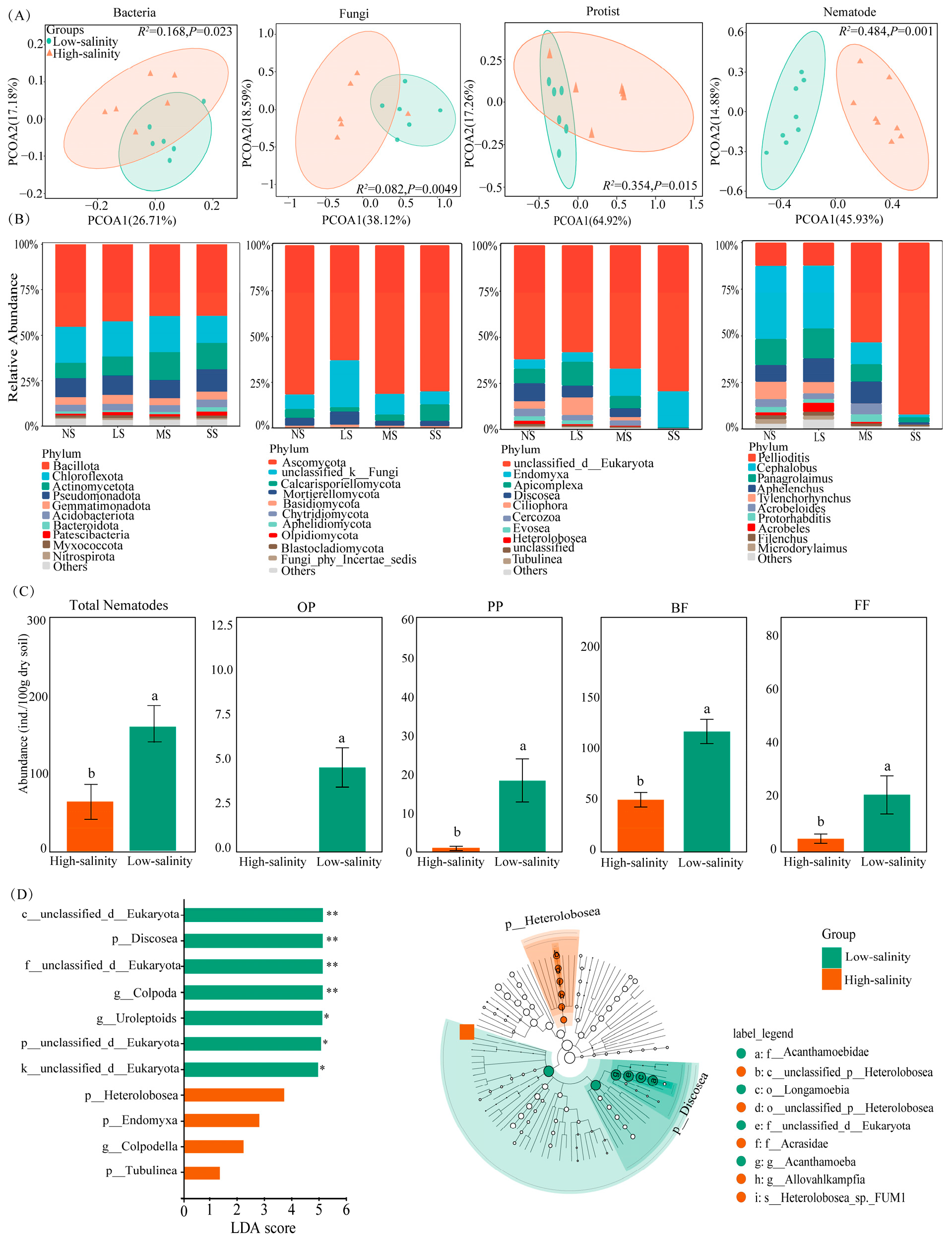
Microfauna are crucial for nutrient cycling, energy transfer, and maintaining ecosystem functions. This study identified significant structural differences in bacterial, fungal, protist, and nematode communities between low- and high-salinity treatments (
Figure 1A), highlighting salinity as a key environmental filter shaping soil biotic communities [
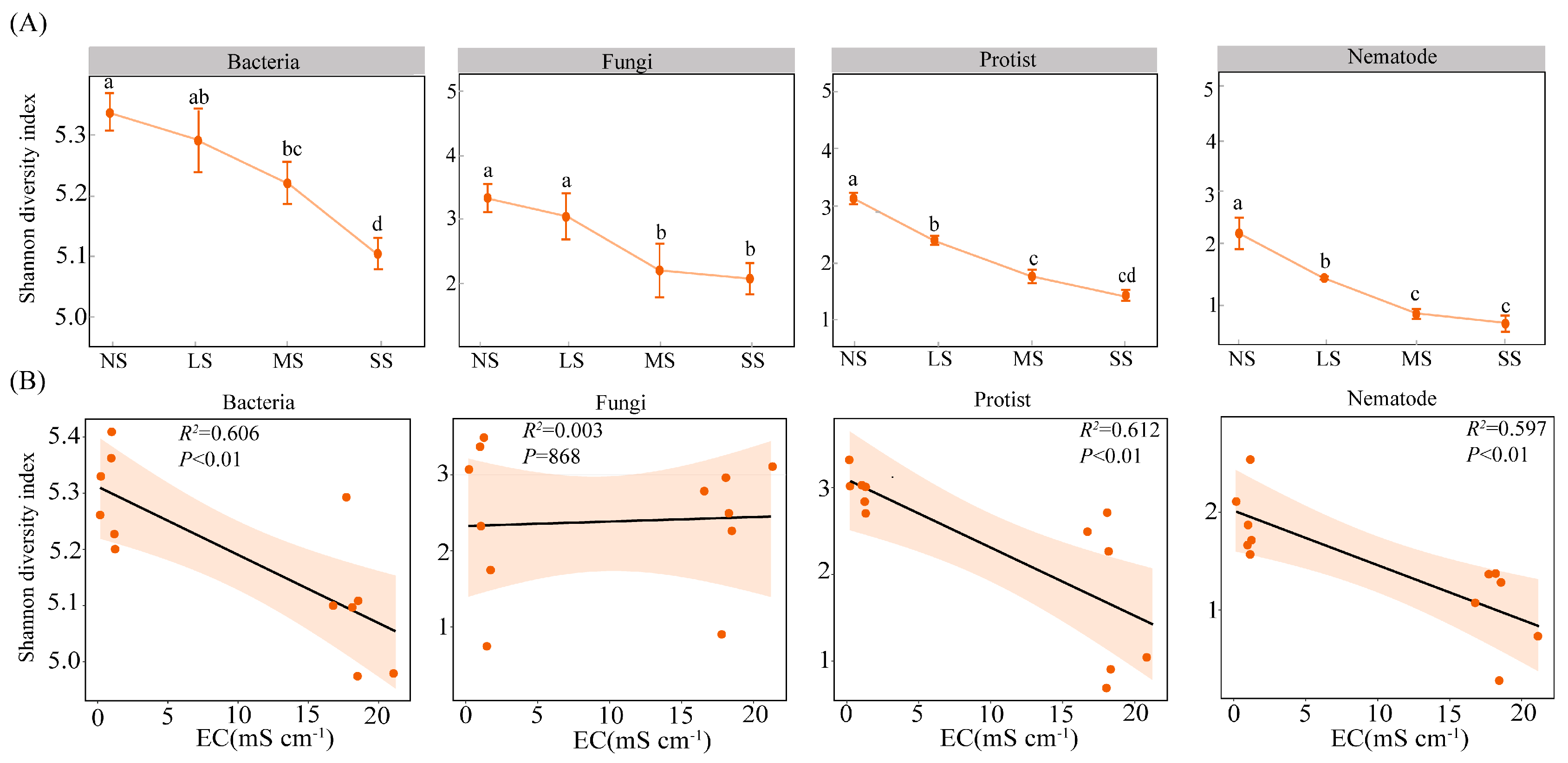
33]. Notably, protists and nematodes showed greater sensitivity to salinity stress in low-salinity habitats compared to bacteria and fungi, which reflects distinct physiological tolerance across trophic levels. Linear regression further detected significant monotonic correlations between soil electrical conductivity and the diversity of these groups (
Figure 2B; linear fitting does not rule out non-linear relationships).
This tiered sensitivity across trophic levels highlights that higher-trophic microfauna can serve as early bio-indicators of salinization disturbance. Their community structures diverged significantly, and diversity sharply declined with even slight salinity increases. This pattern aligns with the ecological principle that higher trophic levels are more vulnerable to environmental stress. Salinity triggers both osmotic pressure disturbance and ionic toxicity in soil organisms, and biological tolerance thresholds to the two stresses differ substantially among species across trophic levels. Higher-trophic microfauna tend to be more sensitive and possess lower stress endurance thresholds compared with lower-trophic microbial communities. Salinity effects cascade through the food web, subjecting higher trophic taxa to compounded stress from direct osmotic pressure and resource fluctuations due to changes at lower microbial levels [
34,
35]. Specifically, under high-salinity conditions, the abundance of bacterivorous and omnivorous/predatory nematodes decreased significantly, simplifying the soil food web’s trophic structure and weakening the bacterial energy channel. Collectively, these trophic-level shifts not only restructure soil biotic communities but also disrupt multitrophic interactions and energy flow pathways, providing a mechanistic basis for the subsequent uncoupling of microbial carbon-fixing functions from biotic regulation under severe salinization.
The differential response among taxa stems from their inherent physiological and ecological niche differences. Consistent with previous reports [
6], microorganisms, especially bacteria, demonstrate strong resilience to mild salinity changes due to their robust osmoregulatory plasticity, rapid evolutionary potential, and high functional redundancy. This pattern is supported by our finding that bacterial diversity showed no significant decline along the low-salinity gradient. In contrast, multicellular eukaryotic microfauna, with their complex physiological structures, are more susceptible to osmotic stress [
36]. Ecologically, their survival depends directly on microbial prey [
37], making them vulnerable to resource availability fluctuations. In this study, Discosea protists, adapted to low-salinity environments [
38], thrived under low-salinity conditions, while salt-tolerant Heterolobosea taxa dominated high-salinity habitats [
39]. Bacterivorous nematodes, such as
Pellioditis and
Cephalobus, showed a preference for high-salinity conditions (
Figure S2A). This finding supports the conclusion that salinity serves as a strong filtering force shaping the structure of microfaunal communities [
5].
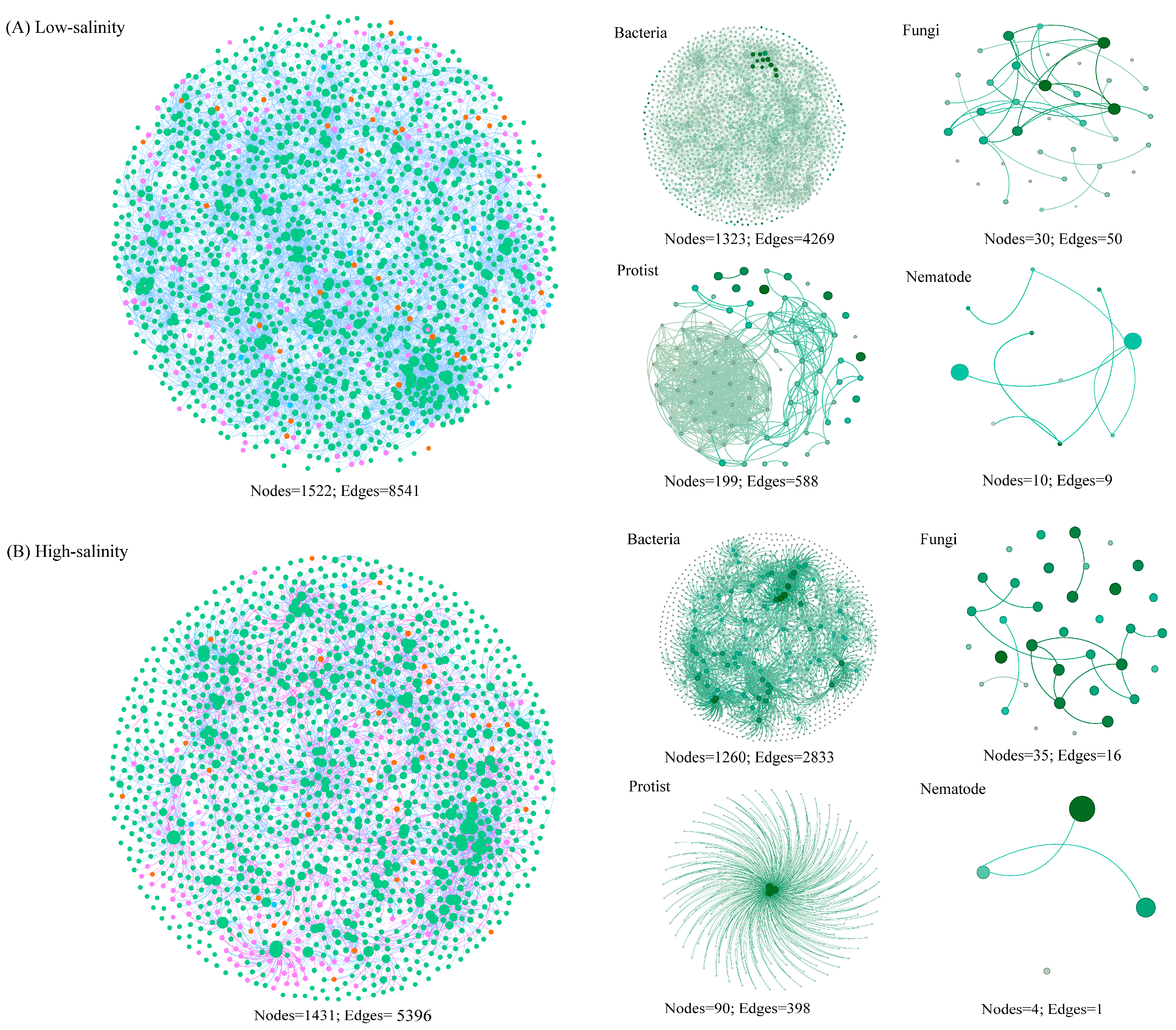
Co-occurrence networks demonstrated clear differences between low- and high-salinity treatments. In high-salinity habitats, both the overall network and the subnetworks of specific biotic groups exhibited significant reductions in connectivity, modularity, and robustness compared to low-salinity habitats, which reveals that elevated salinity simplifies the co-occurrence network topology alongside lower network complexity and fewer significant inter-taxa associations. Crucially, threshold-sensitivity analysis further confirmed that such salinity-driven declines in network size and connectivity were consistent across multiple Spearman correlation cutoffs (|ρ| > 0.60–0.75), minimizing the risk of potential statistical artifacts caused by arbitrary threshold selection and verifying the ecological robustness of observed network simplification. In particular, the subnetwork changes in higher trophic level nematodes were more pronounced (
Figure 3). While intensified salinization may indirectly suppress basal resources such as plant-derived substrates and alter microbial communities (these plant-related variables were not directly measured in this study), such shifts could potentially contribute to the simplification of high-trophic-level nematode subnetworks and weakened food-web associations [
40]. Intriguingly, fungal subnetworks exhibited a unique topological restructuring pattern under high salinity, with increased node number accompanied by declined edges and modularity. Such taxon-specific responses are likely shaped by salinity-mediated environmental filtering: salt-sensitive generalist fungal taxa are suppressed, while halotolerant specialist fungi are selectively enriched, leading to higher node counts [
41]. However, prolonged osmotic stress may disrupt synergistic interactions and resource exchange among fungal taxa, resulting in severe fragmentation of intraspecific associations despite elevated species occurrence [
11].
The simplification of co-occurrence network structures and reduced resource inputs significantly affect ecological functions [
42]. Salinization stress leads to biodiversity loss, notably a sharp decline in higher trophic level organisms like bacterivorous and omnivorous nematodes. This decline indicates a disruption in the bacterial energy channel and a loss of top-down regulatory functions [
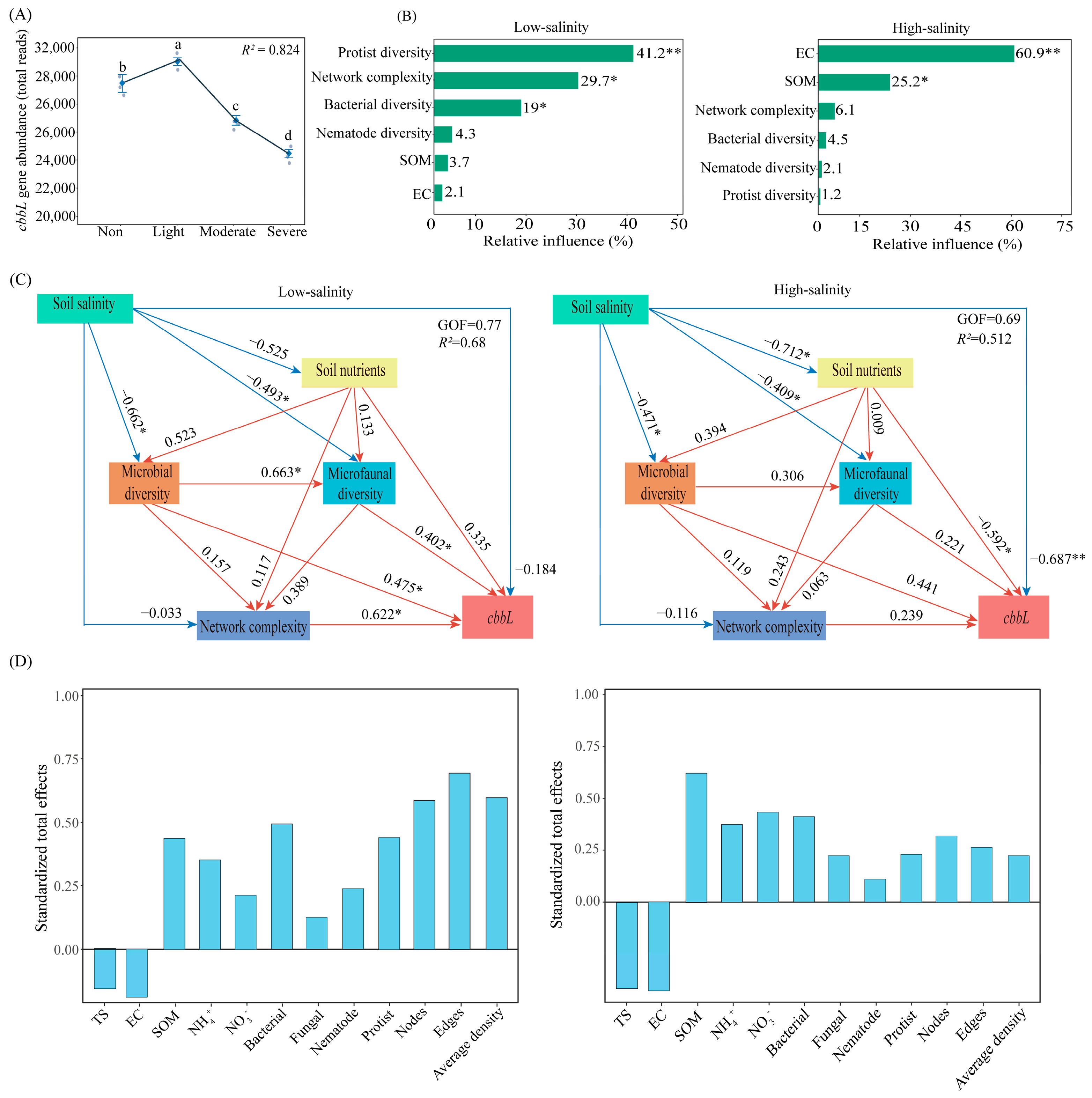
43]. The simplification of these networks further demonstrates the weakening of inter-taxa interaction strengths, network connectivity, and robustness. Based on correlation and PLS-PM results, these structural changes were associated with the uncoupling of functional genes from biotically regulated pathways. The abundance of the carbon fixation gene
cbbL further indicates a probable association between network simplification and altered functional regulation under salinization.
In low-salinity habitats, the abundance of the
cbbL gene was significantly positively correlated with soil biotic diversity, especially faunal diversity, and the complexity of co-occurrence networks (
Figure S2). Partial Least Squares Path Modeling (PLS-PM) revealed correlational relationships showing that under low-salinity conditions, soil biota, particularly soil microfauna, were the main pathway explaining the variation in the
cbbL gene, indicated by high path coefficients (
Figure 4). This finding supports the “biota-driven functionality” paradigm, suggesting that a complete and complex biotic network provides a stable regulatory basis for functional processes, such as microbial carbon fixation, by facilitating nutrient cycling and energy flow [
44].
As salinity increased to stress levels, the regulatory paradigm was disrupted. In high-salinity environments, the positive correlations between
cbbL gene abundance, biotic diversity, and network attributes vanished. Instead, stronger direct associations emerged with abiotic factors like soil salinity and nutrients (
Figure 4 and
Figure S1). This key shift implies a plausible inferred trend that ecosystem functional maintenance may transition from a “community-regulated” pattern sustained by multi-trophic interactions to a state potentially dominated by physiological tolerance of salt-tolerant microbial taxa. This conceptual deduction lacks direct physiological measurement evidence in our study. Although this transition may enable the persistence of specific functions locally, the system possesses weaker sustaining ability and anti-disturbance resilience, owing to the loss of functional redundancy, compensatory effects and stability buffering derived from biotic networks [
11].
5. Conclusions and Future Perspectives
Our study reveals that soil salinization serves as a stringent environmental filter affecting plant growth. Under low-salinity conditions, microfauna such as protists and nematodes showed greater sensitivity than microbes, leading to a degradation cascade in belowground multi-trophic communities. With increasing salinity, soil biotic co-occurrence networks became simplified and less robust. Based on correlation and PLS-PM analyses, this structural disruption was associated with a shift in microbial carbon sequestration regulation: from biotically controlled pathways dominated by faunal interactions and network complexity under low salinity, to abiotic-dominated constraints under high salinity. This “biota–function decoupling” indicates that salinization poses a threat to agricultural sustainability by not only reducing biodiversity but also dismantling the interactive networks crucial for functional resilience. Our findings emphasize that protists and nematodes serve as effective early warning bioindicators. Therefore, preserving or restoring the complexity of soil biotic networks should be a primary objective in the remediation and sustainable management of saline agroecosystems.
This study has several limitations. First, although we used a space-for-time substitution approach to reflect biotic community changes along the salinity gradient, this design cannot capture the dynamic temporal succession of biota during continuous salinization, which restricts the temporal representativeness of our findings. Second, despite strict site selection in a unified agricultural zone with consistent management, the limited sample size (n = 12) may reduce the statistical robustness of co-occurrence network and PLS-PM analyses, and composite sampling may overlook fine-scale spatial heterogeneity in patchy saline soils, masking microscale variations in soil biota and salinity. Third, even with uniform background conditions, we cannot fully exclude residual covariation between salinity and unmeasured environmental covariates, so our results represent salinity-associated ecological patterns rather than strictly salinity-driven causal effects. Fourth, co-occurrence networks only reflect statistical covariation among biotic groups and cannot directly verify real trophic interactions or functional linkages among organisms. Fifth, our analysis of salinity–diversity relationships relied on simple linear regression without formal non-linearity testing, which may have obscured nuanced responses (e.g., threshold effects, unimodal patterns) particularly for bacteria and fungi, whose diversity only changed significantly at higher salinity levels. sixth, this study did not characterize the specific community composition of carbon-fixing microbes or clarify the molecular mechanisms underlying the observed biota–function decoupling under salinity stress. We acknowledge that this focus on the CBB cycle does not capture all autotrophic carbon fixation pathways in soil, and future work incorporating markers for alternative pathways (e.g., rTCA, 3-HP) would provide a more comprehensive assessment of soil carbon fixation potential.
Future studies should combine multi-temporal monitoring with expanded spatial replication to improve generalizability. Methodological improvements including standardized spike-in controls, replicate-based efficiency assessments, and transparent quality-control reporting are also needed to enhance the comparability and reproducibility of soil biota measurements [
45]. Further multi-omics investigations are recommended to disentangle the causal mechanisms and functional traits driving the shifts in carbon sequestration functional regulation under salinization.