

Late Glacial Fluvial Transitions and Holocene Peat Accumulation: A High-Resolution Stratigraphic Study from the Eastern Great Hungarian Plain



Abstract
1. Introduction
- To integrate sedimentological, geochemical, palynological, and malacological proxies into a single palaeoenvironmental framework.
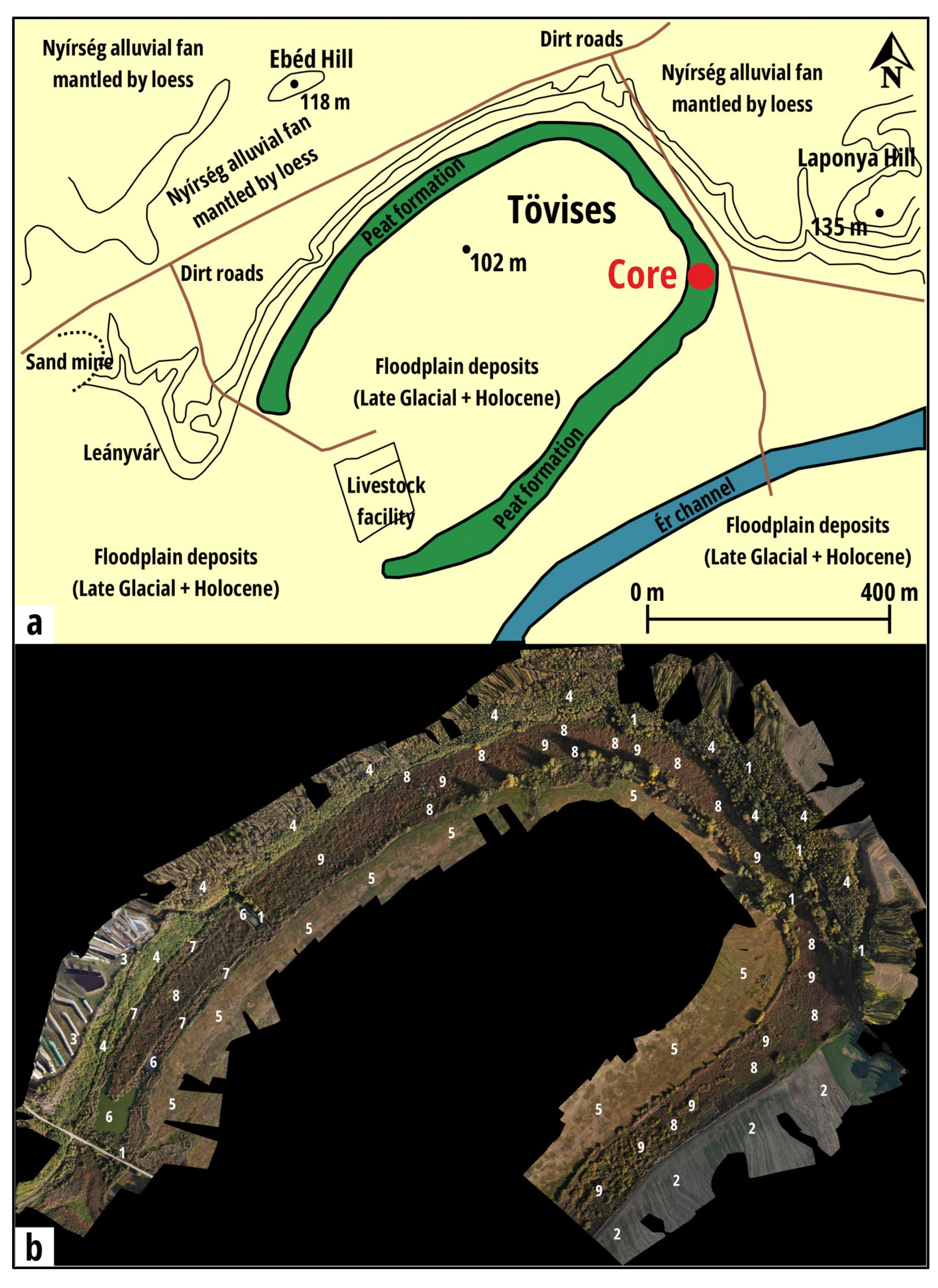
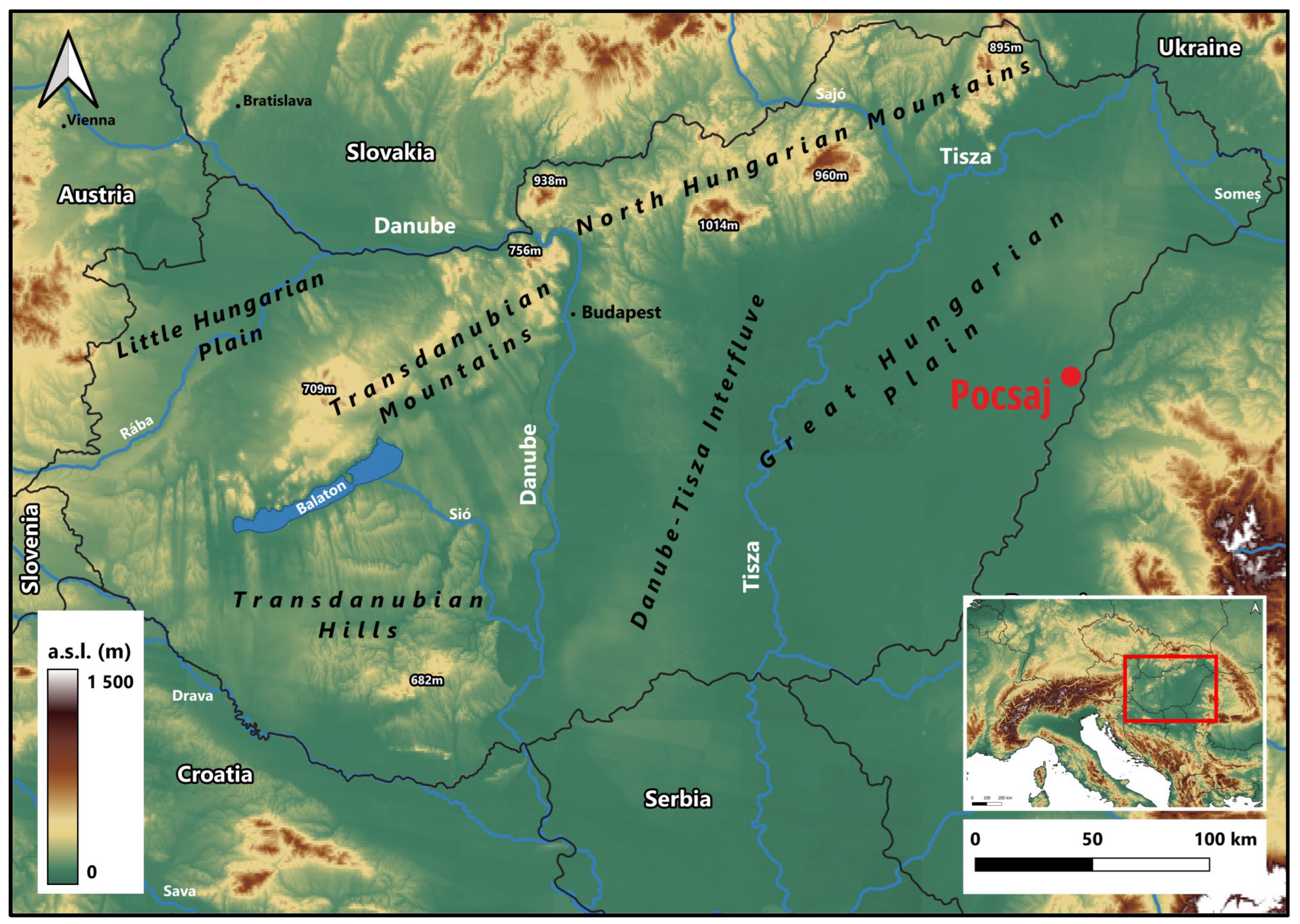
- To reconstruct the origin and long-term environmental development of the Tövises fen/Pocsaj oxbow lake using a multiproxy sediment-core record.
- To explore the relative roles of climatic change, autogenic succession, fluvial processes, and human activity in shaping the development and long-term persistence of this ecologically important wetland system.
2. Materials and Methods
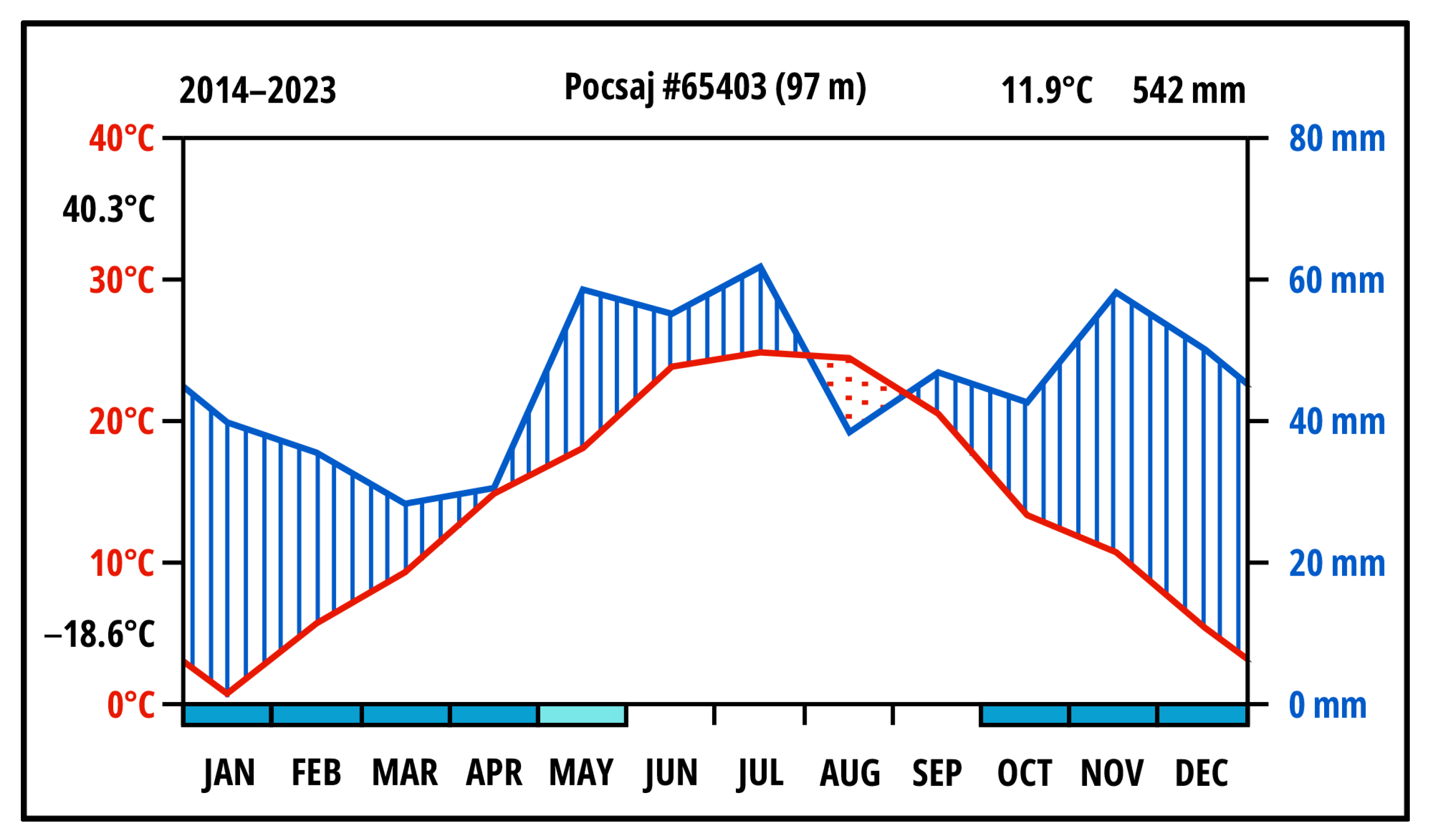
2.1. Walter–Lieth Climate Diagram
2.2. Sampling
2.3. Loss on Ignition
2.4. Grain Size Analysis
2.5. Magnetic Susceptibility
2.6. Geochemical Analysis
2.7. Palynological Analysis
2.8. Malacological Analysis
2.9. Radiocarbon Analysis
3. Results
3.1. Local Climate
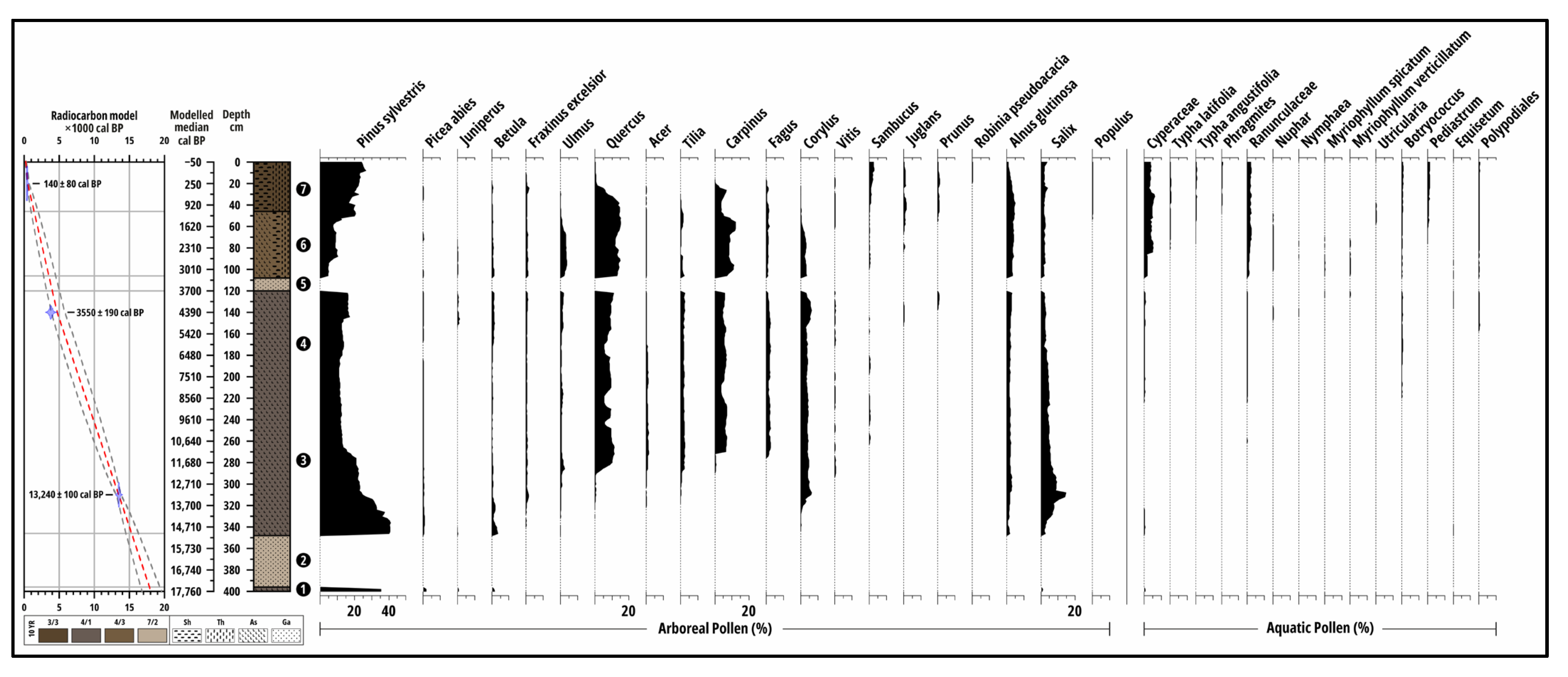
3.2. Radiocarbon Model
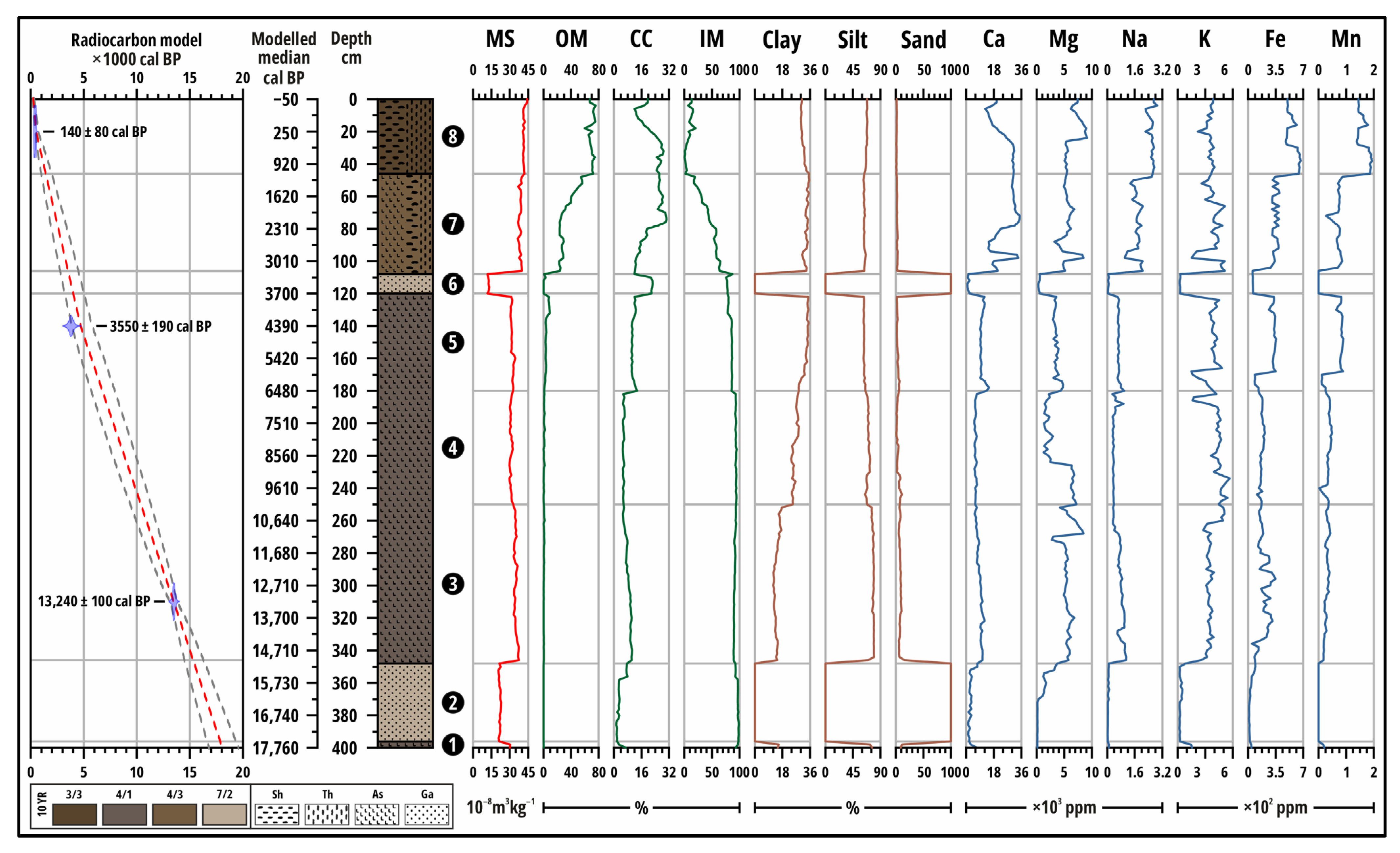
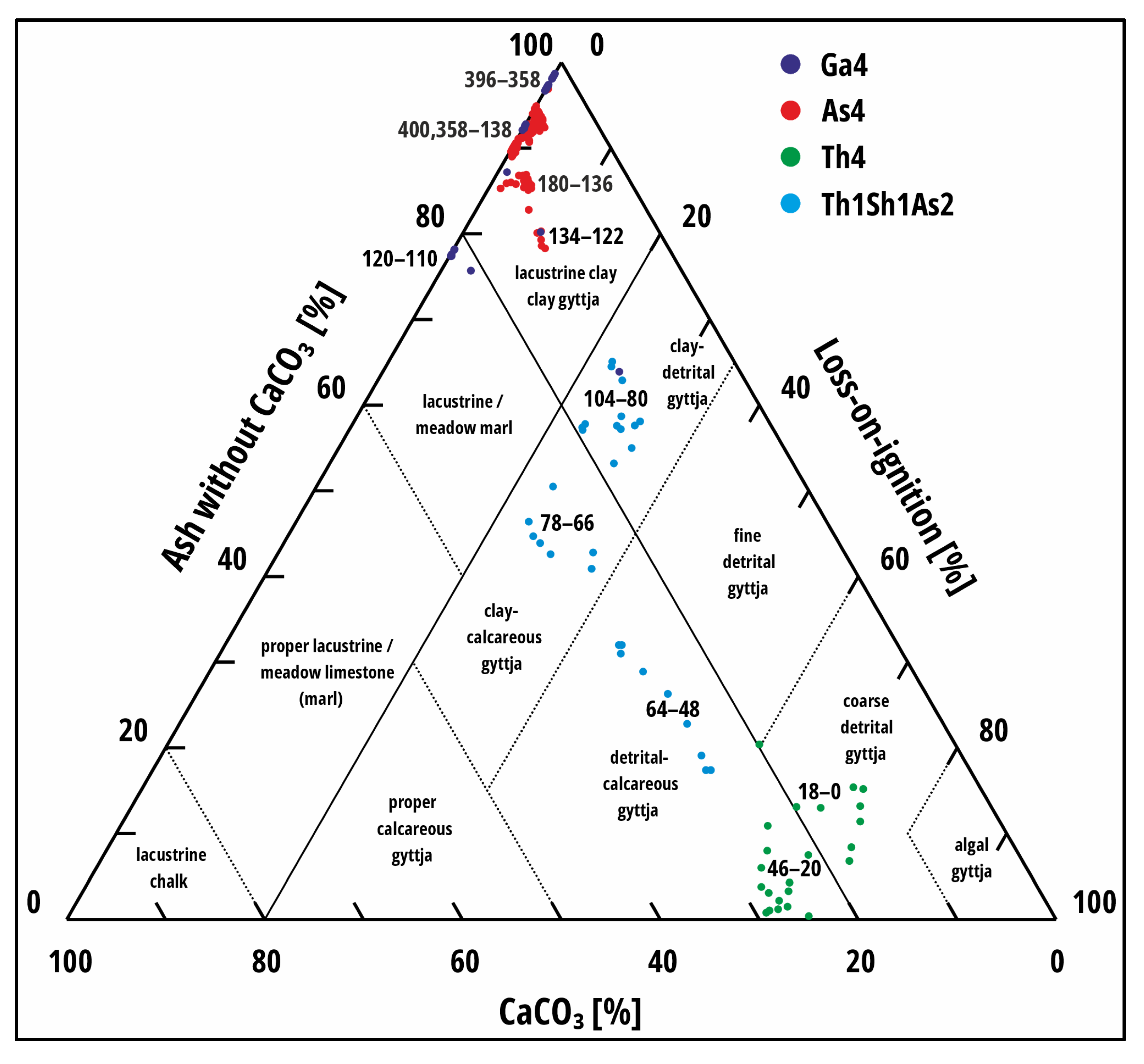
3.3. Sedimentological and Geochemical Results
3.4. Malacological Results
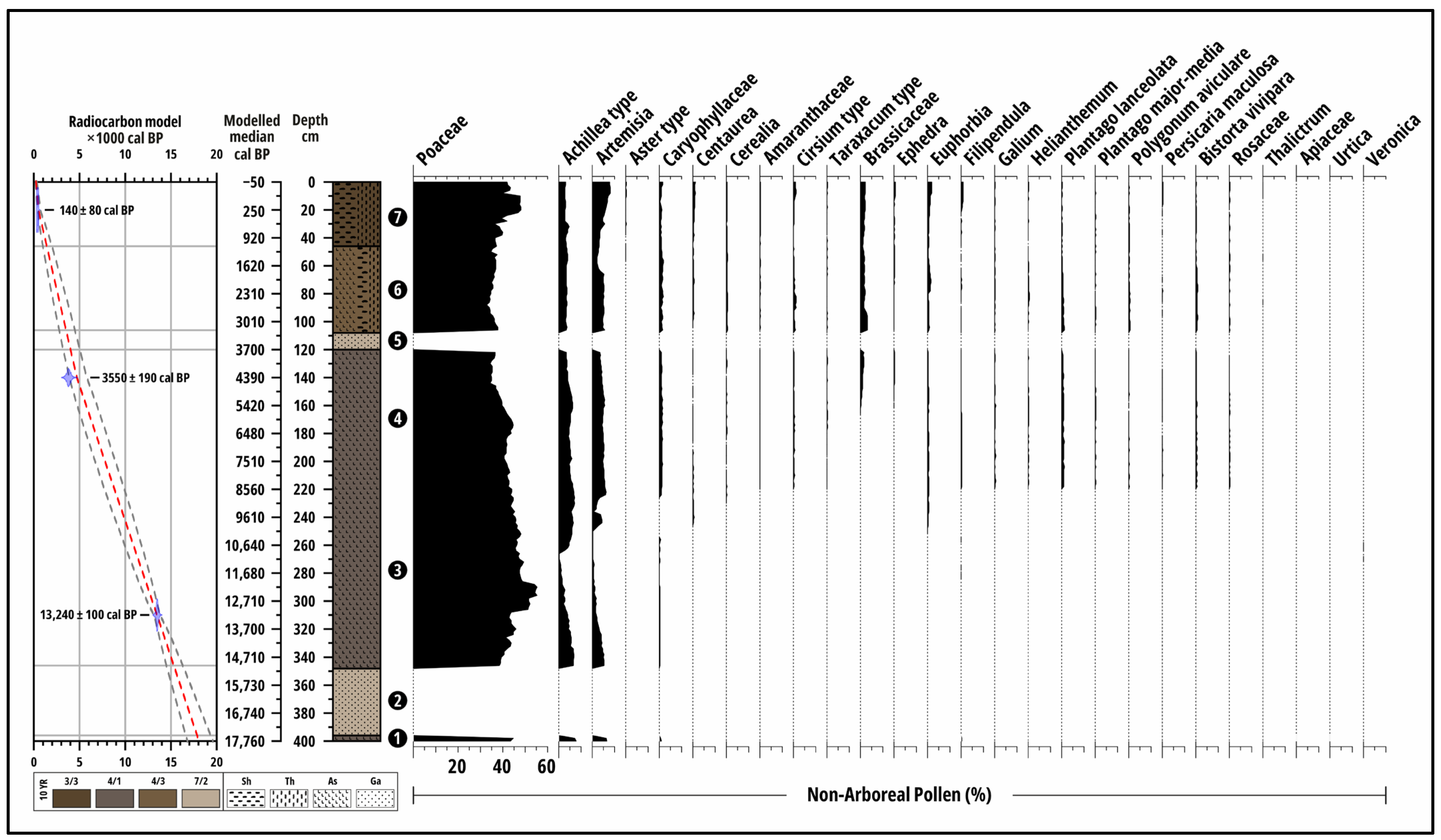
3.5. Pollen Results
4. Discussion
4.1. Geomorphological Evolution and Channel Formation
4.2. Late Glacial and Early Holocene Palaeoecology and Refugial Dynamics
4.3. Early Holocene Biogeography and Vegetation Mosaic Patterns
4.4. Mesolithic and Neolithic Anthropogenic Impacts
4.5. Late Holocene Hydrology, Geochemical Cycles, and Peat Formation
4.6. Historical Land Use and Archaeological Stratigraphy
4.7. Modern Ecological Transformations and Conservation Status
5. Conclusions
Supplementary Materials
Author Contributions
Funding
Data Availability Statement
Acknowledgments
Conflicts of Interest
References
- Sümegi, P.; Gulyás, S. (Eds.) The Geohistory of Bátorliget Marshland; Archaeolingua Press: Budapest, Hungary, 2004. [Google Scholar]
- Rónai, A. Az Alföld földtana. Acta Geol. Hung. 1985, 21, 445. (In Hungarian) [Google Scholar]
- Timár, G.; Sümegi, P.; Horváth, F. Late Quaternary dynamics of Tisza River: Evidence of climatic and tectonic controls. Tectonophysics 2005, 410, 97–110. [Google Scholar] [CrossRef]
- Borsy, Z. A Nyírség Természeti Földrajza; Akadémiai Kiadó: Budapest, Hungary, 1961. (In Hungarian) [Google Scholar]
- Borsy, Z. Az Alföld hordalékkúpjainak negyedidőszaki fejlődéstörténete. Földrajzi Értesítő 1989, 38, 211–224. (In Hungarian) [Google Scholar]
- Borsy, Z. Evoution of the North-eastern part of the Great Hungarian Plain in the past 50 000 years. Quationes Geogr. Spec. Issue 1990, 4, 65–71. [Google Scholar]
- Moldvay, L. A Berettyó-völgy és a déli Nyírség perem felszíni kifejlődése és kora. Földtani Közlöny 1961, 91, 292–299. (In Hungarian) [Google Scholar]
- Molnár, B. Changes in Area and Directions of Stream Erosion in the Eastern Part of the Hungarian Basin (Great Plain) during the Pliocene and Pleistocene. Acta Minerol. Petrogr. 1965, 17, 39–52. [Google Scholar]
- Molnár, B. A Hajdúság pleisztocén eolikus üledéksora. Földtani Közlöny 1966, 96, 305–316. (In Hungarian) [Google Scholar]
- Sümegi, P.; Krolopp, E. Quartermalacological analyses for modeling of the Upper Weichselian palaeoenvironmental changes in the Carpathian Basin. Quat. Int. 2002, 91, 53–63. [Google Scholar]
- Urbancsek, J. A Nyírság. a Bodrogköz és a Rétköz, valamint a Bereg-Szatmári síkság vízföldtani kutatásban. Földrajzi Értesítő 1965, 14, 421–443. (In Hungarian) [Google Scholar]
- Borsy, Z. Blown sand territories in Hungary. Z. Für Geomorphol. 1991, 90, 1–14. [Google Scholar]
- Andrásfalvy, B. A Duna Mente Népének Ártéri Gazdálkodása Tolna és Baranya Megyében az Ármentesítés Befejezéséig; Tolna megye Tanács Levéltára: Szekszárd, Hungary, 1975. (In Hungarian) [Google Scholar]
- Ekéné Zamárdi, I. Érmelléki Kalauz 2; Debreceni Egyetem Hatvani István Kollégiumának Kiadványa: Debrecen, Hungary, 2008. (In Hungarian) [Google Scholar]
- Veliky, J. Érmelléki Kalauz. Egy Kistérség Rekonstrukciója—Érmellék; Egyetemi Kiadó: Debrecen, Hungary, 2005. (In Hungarian) [Google Scholar]
- Eltijani, A.; Molnár, D.; Makó, L.; Geiger, J.; Sümegi, P. Application of parameterized grain-size endmember modelling in the study of quaternary oxbow lake sedimentation: A case study of Tövises Bed sediments in the Eastern Great Hungarian Plain. Quaternary 2022, 5, 44. [Google Scholar] [CrossRef]
- Eltijani, A.; Molnár, D.; Makó, L.; Geiger, J.; Sümegi, P. Applying grain-size and compositional cata analysis for interpretation of the quaternary oxbow lake sedimentation processes: Eastern great Hungarian plain. Stud. Quat. 2022, 39, 83–93. [Google Scholar]
- Eltijani, A.; Molnár, D.; Geiger, J. Characterizing sedimentary processes in abandoned channel using compositional data analysis and wavelet transform. GEM-Int. J. Geomath. 2023, 14, 11. [Google Scholar] [CrossRef]
- Eltijani, A.; Molnár, D.; Geiger, J. Paleoenvironment multiproxy dataset of the Quaternary abandoned channel in Tövises bed, Great Hungarian Plain. Data Brief 2023, 49, 109344. [Google Scholar] [CrossRef]
- Eltijani, A.; Molnár, D.; Geiger, J. Deciphering quaternary sediment dynamics: A synthesis of X-ray CT imaging and grain size endmember modelling. J. Sediment. Environ. 2024, 9, 615–624. [Google Scholar] [CrossRef]
- Walter, H.; Lieth, H. Klimadiagramm Weltatlas; G. Fischer: Jena, Germany, 1960. [Google Scholar]
- Országos Meteorológiai Szolgálat. Available online: https://www.met.hu (accessed on 10 August 2025).
- Országos Meteorológiai Szolgálat—Meteorológiai Adattár. Available online: https://odp.met.hu (accessed on 10 August 2025).
- RStudio Desktop—Posit. Available online: https://posit.co/download/rstudio-desktop/ (accessed on 10 August 2025).
- The Climatol R Package. Available online: http://www.climatol.eu (accessed on 10 August 2025).
- Aaby, B.; Digerfeldt, G. Sampling techniques for lakes and mires. In Handbook of Holocene Palaeoecology and Palaeohydrology; Berglund, B.E., Ed.; John Wiley & Sons: Chichester, UK, 1986; pp. 181–194. [Google Scholar]
- Vleeschouwer, F.; Chambers, F.; Swindles, G. Coring and sub-sampling of peatlands for palaeoenvironmental research. Mires Peat 2010, 7, 10. [Google Scholar] [CrossRef]
- Munsell Color. Munsell Soil Color Charts; Munsell Color Company Inc.: Baltimore, MD, USA, 1954. [Google Scholar]
- Troels-Smith, J. Characterization of unconsolidated sediments. Dan. Geol. Unders. 1955, 4, 10. (In Danish) [Google Scholar]
- Dean, W.E. Determination of carbonate and organic matter in calcareous sediments and sedimentary rocks by loss on ignition; comparison with other methods. J. Sediment. Petrol. 1974, 44, 242–248. [Google Scholar]
- Heiri, O.; Lotter, A.F.; Lemcke, G. Loss on ignition as a method for estimating organic and carbonate content in sediments: Reproducibility and comparability of results. J. Paleolim. 2001, 25, 101–110. [Google Scholar] [CrossRef]
- Oldfield, F.; Thompson, R.; Barber, K.E. Changing atmospheric fallout of magnetic particles recorded in recent ombrotrophic peat sections. Science 1978, 199, 679–680. [Google Scholar] [CrossRef] [PubMed]
- Dearing, J.A. Environmental Magnetic Susceptibility: Using the Bartington MS2 System; Chi Publishing: Kenilworth, UK, 1994. [Google Scholar]
- Dániel, P. Results of the geochemical analysis of the samples from Bátoliget II profile. In The Geohistory of Bátorliget Marshland; Sümegi, P., Gulyás, S., Eds.; Archaeolingua Press: Budapest, Hungary, 2004; pp. 95–128. [Google Scholar]
- Berglund, B.E.; Ralska-Jasiewiczowa, M. Pollen analysis and pollen diagrams. In Handbook of Holocene Palaeoecology and Palaeohydrology; Berglund, B.E., Ed.; John Wiley & Sons Ltd.: Chichester, UK, 1986. [Google Scholar]
- Stockmarr, J. Tablets with spores used in absolute pollen analysis. Pollen Spores 1971, 13, 614–621. [Google Scholar]
- Clark, R.L. Point count estimation of charcoal in pollen preparations and thin sections of sediments. Pollen Spores 1982, 24, 523–535. [Google Scholar]
- Fægri, K.; Kaland, P.E.; Krzywinski, K. Textbook of Pollen Analysis; John Wiley & Sons Ltd.: Chichester, UK, 1989. [Google Scholar]
- Moore, P.D.; Webb, J.A.; Collinson, M.E. Pollen Analysis, 2nd ed.; Blackwell Scientific Publications: Oxford, UK, 1992. [Google Scholar]
- Beug, H.J. Leitfaden der Pollenbestimmung fur Mitteleuropa und Angrenzende Gebiete; Pfeil: Munchen, Germany, 2004. [Google Scholar]
- Reille, M. Pollen et Spores D’europe et D’afrique du Nord; Laboratoire de Botanique Historique et Palynologie: Marseille, France, 1992; p. 543. [Google Scholar]
- Reille, M. Pollen et Spores d’Europe et d’Afrique du Nord, Supplément 1; Laboratoire de Botanique Historique et Palynologie: Marseille, France, 1995; p. 331. [Google Scholar]
- Reille, M. Pollen et Spores d’Europe et d’Afrique du Nord: Supplément 2; Laboratoire de Botanique Historique et Palynologie: Marseille, France, 1998; p. 521. [Google Scholar]
- Ložek, V. Quartarmollusken der Tschechoslowakei. Rozpr. Ústredniho. Ust. Geol. 1964, 31, 1–374. [Google Scholar]
- Krolopp, E.; Sümegi, P. Palaeoecological reconstruction of the late Pleistocene, based on loess malacofauna in Hungary. GeoJournal 1995, 36, 213–222. [Google Scholar] [CrossRef]
- Sümegi, P. Loess and Upper Paleolithic Environment in Hungary; Aurea Kiadó: Nagykovácsi, Hungary, 2005; pp. 1–312. [Google Scholar]
- Alexandrowicz, W.P. Molluscan assemblages of Late Glacial and Holocene calcareous tufa in Southern Poland. Folia Quat. 2004, 75, 3–309. [Google Scholar]
- Krolopp, E. Biostratigraphic division of Hungarian Pleistocene Formations according to their Mollusc fauna. Acta Geol. Hung. 1983, 26, 62–89. [Google Scholar]
- Soós, L. A Kárpát-Medence Mollusca-Faunája; Akadémiai Kiadó: Budapest, Hungary, 1943. [Google Scholar]
- Evans, J.G. Land Snails in Archeology; Seminar Press: London, UK, 1972; pp. 1–436. [Google Scholar]
- Welter-Schultes, F.W. European Non-Marine Molluscs, a Guide for Species Identification; Planet Poster Edition: Göttingen, Germany, 2012. [Google Scholar]
- Kerney, M.P.; Cameron, R.A.; Jungbluth, J.H. Die Landschnecken Nord-Und Mitteleuropas; Parey Press: Berlin, Germany, 1983; pp. 1–384. [Google Scholar]
- Horsák, M.; Chytrý, M.; Danihelka, J.; Kočí, M.; Kubešová, S.; Lososová, Z.; Otýpková, Z.; Tichý, L. Snail faunas in the Southern Ural forests and their relations to vegetation: An analogue of the Early Holocene assemblages of Central Europe? J. Molluscan Stud. 2009, 76, 1–10. [Google Scholar] [CrossRef]
- Horsák, M.; Chytrý, M.; Pokryszko, B.M.; Danihelka, J.; Ermakov, N.; Hájek, M.; Hájková, P.; Kintrová, K.; Kočí, M.; Kunešová, S.; et al. Habitats of relict terrestrial snails in southern Siberia: Lessons for the reconstruction of palaeoenvironments of full-glacial Europe. J. Biogeogr. 2010, 37, 1450–1462. [Google Scholar] [CrossRef]
- Horsák, M.; Chytrý, M.; Hájková, P.; Hájek, M.; Danihelka, J.; Horsáková, V.; Ermakov, N.; German, D.A.; Kočí, M.; Lustyk, P.; et al. European glacial relict snails and plants: Environmental context of their modern refugial occurrence in southern Siberia. Boreas 2015, 44, 638–657. [Google Scholar] [CrossRef]
- Sümegi, P. Refuting ideas based on a small batch of data: Malacothermometry aid in the reconstruction of mean July paleotemperatures in the Carpathian Basin for the last glacial of the Pleistocene. Archeometriai Műhely 2019, 16, 143–166. [Google Scholar]
- Hertelendi, E.; Csongor, É.; Záborszky, L.; Molnár, I.; Gál, I.; Győrffy, M.; Nagy, S. Counting system for high precision C-14 dating. Radiocarbon 1989, 31, 399–406. [Google Scholar] [CrossRef]
- Hertelendi, E.; Kalicz, N.; Raczky, P.; Horváth, F.; Veres, M.; Svingor, É.; Futó, I.; Bartosiewicz, L. Re-evaluation of the Neolithic in eastern Hungary based on calibrated radiocarbon dates. Radiocarbon 1995, 37, 239–244. [Google Scholar] [CrossRef]
- Molnár, M.; Janovics, R.; Major, I.; Orsovszki, J.; Gönczi, R.; Veres, M.; Leonard, A.G.; Castle, S.M.; Lange, T.E.; Wacker, L.; et al. Status report of the new AMS 14C sample preparation lab of the Hertelendi laboratory of environmental studies (Debrecen, Hungary). Radiocarbon 2013, 55, 665–676. [Google Scholar] [CrossRef]
- Molnár, M.; Rinyu, L.; Veres, M.; Seiler, M.; Wacker, L.; Synal, H.-A. EnvironMICADAS: A mini 14C AMS with enhanced gas ion source interface in the Hertelendi Laboratory of Environmental Studies (HEKAL), Hungary. Radiocarbon 2013, 55, 338–344. [Google Scholar] [CrossRef]
- Rinyu, L.; Orsovszki, G.; Futó, I.; Veres, M.; Molnár, M. Application of zinc sealed tube graphitization on sub-milligram samples using EnvironMICADAS. Nucl. Instrum. Methods Phys. Res. Sect. B 2015, 361, 406–413. [Google Scholar] [CrossRef]
- Janovics, R.; Futó, I.; Molnár, M. Sealed tube combustion method with MnO2 for AMS 14C measurement. Radiocarbon 2018, 60, 1347–1355. [Google Scholar] [CrossRef]
- Bronk Ramsey, C. Bayesian analysis of radiocarbon dates. Radiocarbon 2009, 51, 337–360. [Google Scholar] [CrossRef]
- Reimer, P.J.; Austin, W.E.N.; Bard, E.; Bayliss, A.; Blackwell, P.G.; Bronk Ramsey, C.; Butzin, M.; Cheng, H.; Lawrence Edwards, R.; Friedrich, M.; et al. The IntCal20 northern hemisphere radiocarbon age calibration curve (0–55 cal kBP). Radiocarbon 2020, 62, 725–757. [Google Scholar] [CrossRef]
- Blaauw, M.; Christen, J.A. Flexible paleoclimate age-depth models using an autoregressive gamma process. Bayesian Anal. 2011, 6, 457–474. [Google Scholar] [CrossRef]
- Birks, H.H.; Birks, H.J.B. Multi-proxy studies in palaeolimnology. Veg. Hist. Archaeobotany 2006, 15, 235–251. [Google Scholar] [CrossRef]
- Walker, M. Quaternary Dating Methods; John Wiley & Sons Ltd.: Chichester, UK, 2005. [Google Scholar]
- Kabała, C.; Charzyski, P.; Chodorowski, J.; Drewnik, M.; Glina, B.; Greinert, A.; Hulisz, P.; Jankowski, M.; Jonczak, J.; Łabaz, B.; et al. Polish Soil Classification, 6th edition—Principles, classification scheme and correlations. Soil Sci. Annu. 2019, 70, 71–97. [Google Scholar] [CrossRef]
- Łachacz, A.; Nitkiewicz, S. Classification of soils developed from bottom lake deposits in north-eastern Poland. Soil Sci. Annu. 2021, 72, 140643. [Google Scholar] [CrossRef]
- Somogyi, S. Hazán folyóhálózatának fejlődéstörténeti vázlata. Földrajzi Közlemények 1961, 9, 25–50. [Google Scholar]
- Papp, A. Fiatalkori vízrajzi változások a Tiszántúl középső részén történelmi adatok alapján. Földrajzi Közlemények 1960, 8, 77–83. [Google Scholar]
- Félegyházi, E. Adatok a Tisza és a Szamos folyóhálózatának alakulásához a felső-plenigalciális időszakában. Acta Geogr. Debrecina 1998, 34, 203–218. [Google Scholar]
- Magyari, E.K. Climatic Versus Human Modification of the Late Quaternary Vegetation in Eastern Hungary; Debrecen University: Debrecen, Hungary, 2002. [Google Scholar]
- Magyari, E.K.; Chapman, J.C.; Passmore, D.G.; Allen, J.R.M.; Huntley, J.P.; Huntley, B. Holocene persistence of wooded steppe in the Great Hungarian Plain. J. Biogeogr. 2010, 37, 915–935. [Google Scholar] [CrossRef]
- Magyari, E.; Sümegi, P.; Braun, M.; Jakab, G. Retarded hydrosere: Anthropogenic and climatic signals in a Holocene raised bog profile from the NE Carpathian Basin. J. Ecol. 2001, 89, 1019–1032. [Google Scholar] [CrossRef]
- Magyari, E.; Shiel, R.; Passmore, D. Introduction: The paleo-environment and settlement context of Polgár-10. In The Upper Tisza Project, Studies in Hungarian Landscape Archaeology, Book 4: Lowland Settlement in North East Hungary: Excavations at the Neolithic Settlement Site Polgár-10; Chapman, J., Gillings, M., Shiel, R., Gaydarska, B., Bond, C., Passmore, D., Félegyházi, E., Lumley, I., Jones, R., Edwards, J., et al., Eds.; Archaeopress: Oxford, UK, 2010. [Google Scholar]
- Magyari, E.K.; Jakab, G.; Sümegi, P. Holocene vegetation dynamics in the Bereg Plain, NE Hungary—The Báb-tava pollen and plant macrofossil record. Acta Geog. Geol. Meteo. Debrecina 2009, 42, 39–56. [Google Scholar]
- Magyari, E.K. Late Quaternary vegetation history in the Hortobágy steppe and Middle Tisza floodplain, NE Hungary. Stud. Bot. Hung. 2011, 42, 185–203. [Google Scholar]
- Magyari, E.K.; Chapman, J.; Fairbairn, A.S.; Francis, M.; de Guzman, M. Neolithic human impact on the landscapes of North-East Hungary inferred from pollen and settlement records. Veg. Hist. Archaeobotany 2012, 21, 279–302. [Google Scholar] [CrossRef]
- Prentice, I.C. Pollen representation, source area, and basin size: Toward an unified theory of pollen analysis. Quat. Res. 1985, 23, 76–86. [Google Scholar] [CrossRef]
- Prentice, I.C.; Guiot, J.; Huntley, B.; Jolly, D.; Cheddadi, R. Reconstructing biomes from palaeoecological data: A general method and its application to European pollen data at 0 and 6 ka. Clim. Dyn. 1996, 12, 185–194. [Google Scholar] [CrossRef]
- Prentice, I.C.; Webb, T., III. BIOME 6000: Reconstructing global mid-Holocene vegetation patterns from palaeoecological records. J. Biogeogr. 1998, 25, 997–1005. [Google Scholar] [CrossRef]
- Soepboer, W.; Sugita, S.; Lotter, A.F.; van Leeuwen, J.F.N.; van der Knaap, W.O. Pollen productivity estimates for quantitative reconstruction of vegetation cover on the Swiss Plateau. Holocene 2007, 17, 65–77. [Google Scholar] [CrossRef]
- Sugita, S. Pollen representation of vegetation in Quaternary sediments: Theory and method in patchy vegetation. J. Ecol. 1994, 82, 881–897. [Google Scholar] [CrossRef]
- Jacobson, G.L.; Bradshaw, R.H.W. The selection of sites for palaeovegetational studies. Quat. Res. 1981, 16, 80–96. [Google Scholar] [CrossRef]
- Sümegi, P.; Magyari, E.; Daniel, P.; Hertelendi, E.; Rudner, E. A kardoskúti Fehér-tó negyedidőszaki fejlődéstörténetének rekonstrukciója. Földtani Közlöny 1999, 129, 479–519. [Google Scholar]
- Sümegi, P.; Szilágyi, G.; Gulyás, S.; Jakab, G.; Molnár, A. The Late Quaternary Paleoecology and Environmental History of the Hortobágy, an unique Mosaic Alkaline Steppe from the Heart of the Carpathian Basin, Central Europe. In Steppe Ecosystems Biological Diversity, Management and Restoration; Prieto, M.B.M., Diaz, T.B., Eds.; Nova Publishers: New York, NY, USA, 2013; pp. 165–194. [Google Scholar]
- Holdridge, L.R. Determination of world plant formations from simple climatic data. Science 1947, 105, 367–368. [Google Scholar] [CrossRef] [PubMed]
- Holdridge, L.R. Life Zone Ecology; Tropical Science Center: San Jose, Costa Rica, 1967. [Google Scholar]
- Szelepcsényi, Z.; Breuer, H.; Sümegi, P. The climate of Carpathian Region in the 20th century based on the original and modified Holdridge life zone system. Cent. Eur. J. Geosci. 2014, 6, 293–307. [Google Scholar] [CrossRef]
- Szelepcsényi, Z.; Breuer, H.; Kis, A.; Pongrácz, R.; Sümegi, P. Assessment of projected climate change in the Carpathian Region using the Holdridge life zone system. Theor. Appl. Climatol. 2016, 131, 593–610. [Google Scholar] [CrossRef]
- Willis, K.J.; Sümegi, P.; Braun, M.; Tóth, A. The Late Quaternary environmental history of Bátorliget, N.E. Hungary. Palaeogeogr. Palaeoclimatol. Palaeoecol. 1995, 118, 25–47. [Google Scholar] [CrossRef]
- Luca, S.A.; Suciu, C.I.; Dumitrescu-Chioar, F. Starčevo-Criş Culture in western part of Romania–Transylvania, Banat, Crişana, Maramureş, Oltenia and western Muntenia: Repository, distribution map, state of research and chronology. In Neolithization of the Carpathian Basin: Northernmost Distribution of the Starčevo/Körös Culture; Polish Academy of Arts and Sciences: Kraków, Budapest, 2010; p. 103. [Google Scholar]
- Biagi, P.; Spataro, M. New observations on the radiocarbon chronology of the Starčevo-Criş and Körös cultures. Rep. Prehist. Res. Proj. 2005, 6–7, 35–40. [Google Scholar]
- Biagi, P.; Grutze, B.; Boucetta, S. New data on the archaeological obsidians from the Banat and Transylvania (Romania). In A Short Walk Through the Balkans: The First Farmers of the Carpathian Basin and Adjacent Regions; Oxbow Books: Trieste, Italy, 2007; pp. 129–148. [Google Scholar]
- Küster, H. Herkunft und Ausbreitungsgeschichte einiger Secalietea-Arten. In Tuexenia: Mitteilungen der Floristisch-Soziologischen Arbeitsgemeinschaft; Floristisch-soziologischen Arbeitsgemeinschaft e.V.: Osnabrück, Germany, 1985; Volume 5, pp. 589–597. [Google Scholar]
- Pál, I.; Magyari, E.K.; Korponai, J.; Mesterházy, G.; Bede-Fazekas, Á.; Covătaru, C.; Darabos, G.; Jakab, G.; Füzesi, A.; Raczky, P. Holocene land cover change in the Pannonian (East-Central Europe) forest steppe: The role of prehistoric land exploitation phases. Quat. Environ. Hum. 2025, 3, 100077. [Google Scholar] [CrossRef]
- Clark, J.G.D. A Late Mesolithic Settlement Site at Selmeston, Sussex. Antiqu. J. 1934, 14, 134–158. [Google Scholar] [CrossRef]
- Simmons, I.G.; Innes, J.B. Late Mesolithic land-use and its impacts in the English uplands. Biogeogr. Monogr. 1985, 2, 7–17. [Google Scholar]
- Smith, A.G. The influence of Mesolithic and Neolithic man on British vegetation: A discussion. In Studies in the Vegetational History of the British Isles; Smith, A.G., Walker, D., West, R.G., Eds.; Cambridge University Press: Cambridge, UK, 1970; pp. 81–96. [Google Scholar]
- Smith, A.G.; Whittle, A.; Cloutman, E.W.; Morgan, L.A. Mesolithic and Neolithic Activity and Environmental Impact on the South-east Fen-edge in Cambridgeshire. Proc. Prehist. Soc. 1989, 55, 207–249. [Google Scholar] [CrossRef]
- McComb, A.M.G. The ecology of hazel (Corylus avellana) nuts in Mesolithic Ireland. In Mesolithic Horizons: Papers Presented at the Seventh International Conference on the Mesolithic in Europe; McCartan, S., Schulting, R., Warren, G., Woodman, P.C., Eds.; Oxbow: Oxford, UK, 2009; pp. 225–231. [Google Scholar]
- Zvelebil, M. Plant use in the Mesolithic and its role in the transition to farming. Proc. Prehist. Soc. 1994, 60, 35–74. [Google Scholar] [CrossRef]
- McQuade, M.; O’Donnell, L. Late Mesolithic fish traps from the Liffey estuary, Dublin, Ireland. Antiquity 2007, 81, 569–584. [Google Scholar] [CrossRef]
- Holst, D. Hazelnut economy of early Holocene hunter–gatherers: A case study from Mesolithic Duvensee, northern Germany. J. Archaeol. Sci. 2010, 37, 2871–2880. [Google Scholar] [CrossRef]
- Sümegi, P. Reconstruction of flora, soil and landscape evolution, and human impact on the Bereg Plain from late-glacial up to the present, based on palaeoecological analysis. In The Upper Tisa Valley; Hamar, J., Sárkány-Kiss, A., Eds.; Tiscia Monograph Series: Szeged, Hungary, 1999; pp. 173–204. [Google Scholar]
- Zólyomi, B. Budapest és környékének természetes növénytakarója. In Budapest Természeti Képe; Pécsi, M., Maros, S., Szilárd, J., Eds.; Akadémiai Kiadó: Budapest, Hungary, 1958; pp. 511–642. [Google Scholar]
- Zólyomi, B. Degree and rate of sedimentation in Lake Balaton. In Pleistocene Environment in Hungary; Pécsi, M., Ed.; MTA Földrajzkutató Intézet Kiadványa: Budapest, Hungary, 1987; pp. 57–79. [Google Scholar]
- Járainé Komlódi, M. Adatok az Alföld negyedkori klíma- és vegetációtörténetéhez. I. A vegetáció változása a Würm glaciális és a holocén folyamán, palinológiai vizsgálatok alapján. Bot. Közlemények 1966, 53, 191–201. [Google Scholar]
- Járainé Komlódi, M. Adatok az Alföld negyedkori klíma- és vegetációtörténetéhez II. Bot. Közlemények 1969, 56, 43–55. [Google Scholar]
- Zohary, D.; Hopf, M.; Weiss, E. Domestication of Plants in the Old World: The Origin and Spread of Domesticated Plants in Southwest Asia, Europe, and the Mediterranean Basin; Oxford University Press: Oxford, UK, 2012. [Google Scholar]
- Mesterházy, K. Agyag kocsimodell Pocsajról. Archaeológiai Értesítő 1976, 103, 223–230. [Google Scholar]
- Németi, J.; Molnár, Z. A Tell Telepek Elterjedése a Nagykárolyi-Síkságon és az Ér Völgyében; Sapientia Könyvek 14: Kolozsvár, Romania, 2002. [Google Scholar]
- Bondár, M. Agyag Kocsimodellek a Kárpát-Medencéből (3500–1500 BC); Archeolingua Series Minor 32; Archeolingua: Budapest, Hungary, 2011. [Google Scholar]
- Máthé, M.S. Preliminary report on the 1977–1982 excavations at the Neolithic and Bronze Age settlement of Berettyóújfalu-Herpály. Part II. Bronze Age. Acta Archaeol. Acad. Sci. Hung. 1984, 36, 137–159. [Google Scholar]
- Máthé, M.S. Ásatások Berettyóújfalu-Herpály neolitikus és bronzkori tell-településen 1977–1982 között II. Bronzkor. A Bihari Múzeum Évkönyve 1986, IV–V, 129–149. [Google Scholar]
- Máthé, M.S. Bronze Age Tells in the Berettyó-Valley; Inventraria Praehistoria Hungariae I: Budapest, Hungary, 1988; pp. 27–122. [Google Scholar]
- Demény, A.; Kern, Z.; Czuppon, G.; Németh, A.; Schöll-Barna, G.; Siklósy, Z.; Leél-Őssy, S.; Cook, G.; Serlegi, G.; Bajnóczi, B.; et al. Middle Bronze Age humidity and temperature variations, and societal changes in East-Central Europe. Quat. Int. 2019, 504, 80–95. [Google Scholar] [CrossRef]
- Sümegi, P.; Gulyás, S.; Kertész, R.; Timár, G. Mesolithic-Neolithic Transition in the Carpathian Basin: Was there an Ecological Trap during the Neolithic? In Comparative Archaeology and Paleoclimatology; Baldia, M.O., Perttula, T.K., Frink, D.S., Eds.; Archeopress: Oxford, UK, 2013; pp. 119–126. [Google Scholar]
- Istvanovits, E.; Kulcsár, V. „Aligha Állhat Nekik Bármely Csatarend Ellent”…Egy Elfelejtett Nép, a Szarmaták; Jósa András Múzeum Kiadványa, 74: Nyíregyháza, Hungary, 2018. [Google Scholar]
- Bernát, P. Legendától a Valóságig: A Csőrsz Árkának Története. Múlt-kor Történelmi Online Magazin. Available online: https://mult-kor.hu/cikk.php?id=18364&pIdx=2 (accessed on 10 August 2025).
- Sümegi, P.; Molnár, D.; Náfrádi, K.; Páll, D.G.; Persaits, G.; Sávai, S.; Törőcsik, T. The environmental history of Southern Transdanubia during the Medieval and the Ottoman Period in the light of palaeoecological and geoarcheological research. In Per Sylvam et per Lacus Nimios; Kovács, G., Zatykó, C., Eds.; MTA BTK Archaeological Institute: Budapest, Hungary, 2016; pp. 15–73. [Google Scholar]




| Depth (cm) | Material | uncal BP | σ | μ (cal BP) | 2σ |
|---|---|---|---|---|---|
| 20 | bulk peat | 120 | 40 | 140 | 80 |
| 140 | charcoal | 3300 | 150 | 3550 | 190 |
| 310 | charcoal | 11,338 | 113 | 13,240 | 100 |
Disclaimer/Publisher’s Note: The statements, opinions and data contained in all publications are solely those of the individual author(s) and contributor(s) and not of MDPI and/or the editor(s). MDPI and/or the editor(s) disclaim responsibility for any injury to people or property resulting from any ideas, methods, instructions or products referred to in the content. |
© 2026 by the authors. Licensee MDPI, Basel, Switzerland. This article is an open access article distributed under the terms and conditions of the Creative Commons Attribution (CC BY) license.
Share and Cite
Vári, T.Z.; Sümegi, P.; Pál-Molnár, E. Late Glacial Fluvial Transitions and Holocene Peat Accumulation: A High-Resolution Stratigraphic Study from the Eastern Great Hungarian Plain. Soil Syst. 2026, 10, 60. https://doi.org/10.3390/soilsystems10050060
Vári TZ, Sümegi P, Pál-Molnár E. Late Glacial Fluvial Transitions and Holocene Peat Accumulation: A High-Resolution Stratigraphic Study from the Eastern Great Hungarian Plain. Soil Systems. 2026; 10(5):60. https://doi.org/10.3390/soilsystems10050060
Chicago/Turabian StyleVári, Tamás Zsolt, Pál Sümegi, and Elemér Pál-Molnár. 2026. "Late Glacial Fluvial Transitions and Holocene Peat Accumulation: A High-Resolution Stratigraphic Study from the Eastern Great Hungarian Plain" Soil Systems 10, no. 5: 60. https://doi.org/10.3390/soilsystems10050060
APA StyleVári, T. Z., Sümegi, P., & Pál-Molnár, E. (2026). Late Glacial Fluvial Transitions and Holocene Peat Accumulation: A High-Resolution Stratigraphic Study from the Eastern Great Hungarian Plain. Soil Systems, 10(5), 60. https://doi.org/10.3390/soilsystems10050060