


Abstract
Wheat straw is a plant-derived substrate rich in cellulose, hemicellulose, and lignin and represents a major carbon input to agricultural soils. Mineral-associated organic carbon (MAOC) is the most stable soil carbon pool, yet how mineral structure regulates the stability of straw-derived MAOC through microbial processing remains unclear. Here, straw-derived MAOC was formed in artificial soils containing five clay minerals (halloysite, kaolinite, illite, vermiculite, and montmorillonite) during a two-year incubation, followed by a 45-day incubation with a standardized microbial community to quantify CO2 emission and net carbon balance. Mineral type regulated MAOC mineralization (38.54–54.48 mg C g−1 MAOC). Vermiculite produced the highest CO2 emission but maintained a positive net carbon balance, whereas illite showed net carbon loss (−0.53 g kg−1). Kaolinite, halloysite, and montmorillonite exhibited lower mineralization and retained net carbon. The 2:1 clay minerals enhanced interlayer interactions and favored accumulation of C=O and aromatic compounds, reflecting stronger microbial transformation and residue retention. In contrast, 1:1 minerals stabilized carbon via edge hydroxyl bonding, which restricted substrate accessibility and slowed decomposition. Cumulative mineralization decreased with initial MAOC carbon but increased with dissolved organic carbon and bacterial abundance. Net carbon retention increased with N-acetylglucosaminidase activity and fungal abundance, indicating joint microbial control via nutrient acquisition and fungal processing. Two contrasting stabilization regimes were observed: high turnover driven by vermiculite and halloysite, and strong protection dominated by montmorillonite and kaolinite. These differences indicate that MAOC stability is jointly constrained by mineral-regulated accessibility and microbial transformation processes.
1. Introduction
Mineral-associated organic carbon (MAOC) represents the largest and most persistent carbon reservoir in mineral soils, exerting dominant control over soil organic carbon (SOC) persistence and the global carbon cycle [1,2,3]. Increasing evidence indicates that MAOC persistence is not an intrinsic property, but rather an emergent outcome of interactions among mineral surfaces, organic substrates, and microbial processes [4,5]. Understanding how these interacting controls regulate MAOC stability remains a central challenge in soil biogeochemistry.
The mineral protection paradigm suggests that organo-mineral associations reduce enzymatic accessibility and constrain substrate diffusion, thereby limiting microbial decomposition [6,7,8]. Clay minerals differ in key structural properties that influence these processes [9,10]. 1:1 minerals (e.g., kaolinite and halloysite) mainly associate with organic carbon via surface hydroxyl groups, whereas 2:1 minerals (e.g., illite, vermiculite, and montmorillonite) possess higher charge density and interlayer domains that enable stronger sorption and potential interlayer incorporation of organic compounds [11,12]. Beyond sorption capacity, these structural differences regulate the spatial accessibility of MAOC by controlling molecular organization and substrate diffusion [13,14,15]. However, most existing evidence derives from short-term adsorption studies using simple compounds, and the extent to which mineral structural properties influence the long-term biological stability of MAOC derived from complex substrates remains unclear.
Microbial processing is another fundamental control on MAOC dynamics. Persistent MAOC derives largely from microbially transformed products rather than directly from plant residues [16,17,18]. Microbial metabolites and necromass exhibit strong mineral affinity and contribute substantially to MAOC formation, while extracellular enzymes regulate substrate depolymerization and carbon–nutrient allocation [19]. Recent studies further suggest that high microbial activity does not necessarily reduce long-term carbon persistence, indicating that mineral–microbial interactions, rather than decomposition intensity alone, determine MAOC stability [20]. However, how microbial activity interacts with mineral structural constraints to regulate MAOC persistence across mineral types remains poorly resolved.
A key unresolved question is whether mineral structural properties established during MAOC formation continue to constrain biological accessibility under uniform microbial conditions. During formation, mineral surfaces influence the spatial distribution and chemical composition of associated organic compounds, potentially creating legacy effects that persist during subsequent mineralization [12]. Experimental systems that isolate mineral structural effects from microbial variability remain limited. Straw-derived carbon provides an effective model substrate because it undergoes extensive microbial transformation prior to mineral association, generating chemically diverse compounds that interact with mineral surfaces.
To address these gaps, an artificial soil system containing five representative clay minerals (halloysite, kaolinite, illite, vermiculite, and montmorillonite) was established to form straw-derived MAOC, and its subsequent mineralization was examined under a standardized microbial community. We hypothesize that mineral structure regulates MAOC stability not only through sorption capacity but by imprinting substrate accessibility during formation, thereby controlling microbial processing and net carbon balance.
2. Materials and Methods
2.1. Soil Preparation
Five clay minerals commonly occurring in natural soils were selected, including 1:1 type minerals (halloysite and kaolinite) and 2:1 type minerals (illite, vermiculite, and montmorillonite). Montmorillonite was purchased from Macklin (Shanghai, China), halloysite and kaolinite from Sigma–Aldrich (St. Louis, MO, USA), vermiculite from Zhejiang Ailv Chemical Technology Co., Ltd. (Hangzhou, China), and illite from Shanlin Shiyu Mineral Products Co., Ltd. (Xiangxi Prefecture, Hunan, China). Mineral purity was verified by X-ray diffraction (XRD). The purity of halloysite, kaolinite, illite, and montmorillonite exceeded 90%, whereas vermiculite exceeded 70%. Minerals were acid-washed three times with 0.1 mol L−1 HCl (solid:solution = 1:5, w:v) to remove inorganic carbon (HCl, Sinopharm Chemical Reagent Co., Ltd., Shanghai, China). Samples were rinsed with deionized water until pH stabilized, then oven-dried, sieved, and sterilized.
Clay-sized fractions (<2 μm) were mixed with acid-washed quartz sand (80–120 μm) and silt (250–500 μm) at a clay: silt: sand ratio of 4:3:3 to construct artificial soil mineral matrices [16,21]. Mixtures were transferred into 1000 mL plastic containers. Wheat straw was collected from the Wuqiao Experimental Station of China Agricultural University. The straw was oven-dried, cut into 0.5–5 mm fragments using a shredder from Deli Group Co., Ltd. (Deli S220LPS3–8, Ningbo, China), sterilized at 121 °C for 30 min, and dried at low temperature. Straw passing a 100-mesh sieve contained 368.3 ± 9.1 g kg−1 organic carbon and 5.4 ± 0.3 g kg−1 nitrogen. Straw was added to each mineral matrix at a rate of 15 g C kg−1 soil and thoroughly homogenized.
A microbial inoculum was extracted from mixed soils collected from subtropical (Ultisol) and temperate (Mollisol) regions to ensure functional diversity [5]. Fresh soil (<2 mm) was mixed with deionized water (1:15, w:v), shaking with glass beads for 2 h, centrifuging at 1000× g for 12 min to remove coarse particles, and then centrifuging at 3470× g for 30 min. The supernatant was used as inoculum [22]. Bacterial 16S rRNA gene abundance was (1058.4 ± 88.9) × 108 copies mL−1 with a richness of 3535 ± 14. Fungal ITS gene abundance was (62.0 ± 15.2) × 108 copies mL−1 with a richness of 863 ± 175. Urea solution (0.5 g N kg−1 soil), inoculum (60 mL kg−1 soil), and sterile water were added to adjust moisture to 60% water-holding capacity (WHC). A relatively high inoculum rate ensured microbial activity under nutrient-depleted conditions [5,22,23]. Soils were incubated at 25 °C in the dark for two years, and moisture was maintained by adding sterile water every six days. Five treatments were established with three replicates each in a randomized complete block design. Three replicates were used because controlled incubation systems have low environmental variability, allowing reliable detection of treatment effects.
2.2. MAOC Isolation
After the two-year incubation, artificial soils were wet-sieved through a 53 μm mesh using an ethanol-containing solution to isolate the mineral-associated organic carbon (MAOC) fraction. Ethanol reduced surface tension, minimized aggregate dispersion, and inhibited microbial activity [24]. The isolated MAOC fraction was sterilized by γ-irradiation (54 kGy) to avoid altering mineral-organic associations [25]. Sterilization was confirmed by the absence of colony formation on agar plates after one week at 25 °C. The resulting material was defined as straw-derived MAOC.
2.3. Incubation Experiment
The sterilized MAOC fraction was remixed with quartz sand and silt (4:3:3) to reconstruct artificial soils. Twenty grams of soil were placed into 50 mL glass jars. Microbial inoculum was added at 60 mL kg−1 soil. Moisture was adjusted to 60% WHC. Jars were sealed with gas-permeable film to allow gas exchange while preventing contamination and were incubated at 25 °C in the dark for 45 days. The 45-day period was selected based on previous studies showing that MAOC mineralization stabilizes after approximately 30 days [5,26]. This duration captures both the initial rapid mineralization phase and the subsequent stabilized phase.
Gas samples were collected on days 1, 2, 3, 5, 7, 15, 20, 25, 30, 35, 40, and 45. Jars were flushed with CO2-free synthetic air (79% N2, 21% O2) for one minute before each sampling. Blank controls (jars without soil) and mineral-only controls (artificial soil without microbial inoculum) were included to correct for background CO2. Destructive sampling was conducted on days 0, 3, 15, 30, and 45 using independent replicate jars. These timepoints represent key stages of carbon mineralization. Gas sampling was performed at higher temporal resolution and independently of destructive sampling [27]. The use of sterilized substrates minimized microbial respiration unrelated to MAOC, allowing CO2 emissions to be primarily attributed to MAOC mineralization.
Fresh soil was divided into three portions: 5 g stored at −80 °C for microbial analysis, 5 g at −20 °C for enzyme assays, and 10 g air-dried for physicochemical analysis.
2.4. Analytical Methods
Gas analysis. CO2 concentrations were measured using a gas chromatograph (7890A; GC System, Agilent Technologies, Santa Clara, CA, USA). Calibration curves were generated using six standard concentrations (0, 6000, 12,000, 18,000, 24,000, 30,000 ppm CO2) and showed strong linearity (R2 > 0.99). Standards were measured periodically to ensure analytical stability. CO2 fluxes were calculated based on headspace concentration changes.
Physicochemical properties. Soil pH was measured in a 1:5 soil-to-water suspension. Soil organic carbon (SOC), total nitrogen (TN), δ13C, and δ15N were determined by dry combustion using an elemental analyzer coupled to an isotope ratio mass spectrometer (Isoprime Elementar Macro, Langenselbold, Germany). Specific surface area (SSA) was measured using a surface area analyzer (BSD PM1/2). Cation exchange capacity (CEC) was determined using the Kjeldahl method.
Mineral characterization. Mineral structure was analyzed using X-ray diffraction (Malvern Panalytical, Almelo, The Netherlands) with Cu Kα radiation (40 kV, 15 mA). Scans ranged from 3.5° to 40° (2θ) at 1.5° min−1. Interlayer spacing (d001) and full width at half maximum (FWHM) were quantified using Jade 6.
FTIR spectroscopy. Spectra were obtained using a Bruker Vertex70 spectrometer at 4 cm−1 resolution over 400 cm−1 to 4000 cm−1. Absorbance was normalized to total spectral area [28]. The recalcitrance index (rA1630/rA2930 ratio) was calculated to indicate aromatic to aliphatic ratios [29].
Dissolved and microbial carbon. Dissolved organic carbon (DOC) was extracted with 0.05 M K2SO4 (1:5, w:v) shaken for 1 h (K2SO4, Sinopharm Chemical Reagent Co., Ltd., Shanghai, China), filtered through 0.45 μm filters, and analyzed using a TOC analyzer (Shimadzu TOC-VCPH, Kyoto, Japan). Microbial biomass carbon (MBC) was measured using the chloroform fumigation–extraction method [30,31]. Briefly, soil (1.5 g fresh weight) was fumigated with 0.15 mL chloroform for 24 h or left unfumigated, extracted with 0.05 M K2SO4 (1:5, w:v), filtered, and analyzed for organic carbon. MBC was calculated as the difference in organic carbon between fumigated and non-fumigated extracts divided by 0.45.
Enzyme activities. Activities of β-glucosidase (BG), cellobiohydrolase (CB), N-acetylglucosaminidase (NAG), leucine aminopeptidase (LAP), and acid phosphatase (AP) were determined using a fluorometric microplate assay with 4-methylumbelliferone (MUF, Sigma-Aldrich, St. Louis, MO, USA) and 7-amino-4-methylcoumarin (AMC, Sigma-Aldrich, St. Louis, MO, USA) substrates [32]. Briefly, 1.5 g fresh soil was homogenized in 150 mL of 50 mM Tris buffer and incubated in the dark at 25 °C for 4 h. Fluorescence was measured using a microplate reader (Thermo Scientific Fluoroskan Ascent FL; excitation 365 nm, emission 450 nm), and enzyme activities were expressed as nmol g−1 dry soil h−1 [33].
Microbial community analysis. DNA was extracted from 0.5 g freeze-dried soil using a FastDNA Spin Kit (MP Biomedicals, Irvine, CA, USA). DNA integrity was verified by 1% agarose gel electrophoresis and quantified using a NanoDrop 2000 spectrophotometer (Thermo Fisher Scientific, Waltham, MA, USA). Quantitative PCR was performed to determine bacterial 16S rRNA and fungal ITS gene copy numbers using primer pairs 338F/806R and ITS1F/ITS2R. Reactions were conducted on a LightCycler® 480 system in 10 μL volumes containing SYBR Green, primers, diluted DNA template, and nuclease-free water. Amplification conditions included 95 °C pre-denaturation for 3 min, followed by 40 cycles (95 °C 30 s, 55 °C 30 s, 72 °C 1 min). Standard curves were generated using serially diluted plasmids (10−8–10−2). Gene copy numbers were calculated from the standard curves. Values used for comparisons were averaged across the 45-day incubation.
2.5. Statistical Analysis
Data were tested for normal distribution using the Shapiro-Wilk test and for homogeneity of variance using Levene’s test. When necessary, data were log- or square-root-transformed to meet these assumptions, variables that violated normality (p < 0.05) were transformed prior to ANOVA. One-way ANOVA was used to evaluate the effects of clay mineral type on MAOC content and mineralization. Significant differences were identified at p < 0.05 using Tukey’s test. Pearson correlation analysis was applied to normally distributed variables. Principal component analysis (PCA) was used to evaluate multivariate patterns. Random forest modelling was conducted in R v.4.3.2 (R Core Team, Vienna, Austria) using the randomForest package with 1000 trees and mtry = 3. Variable importance was evaluated using the percentage increase in mean squared error (%IncMSE), and model performance was assessed by R2. All statistical analyses were performed using SPSS 20.0 (IBM Corp., Armonk, NY, USA), Origin 2025 (OriginLab Corporation, Northampton, MA, USA), and R.
3. Results
3.1. Mineralization and Net Carbon Balance of MAOC
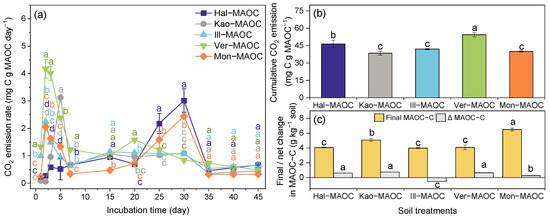
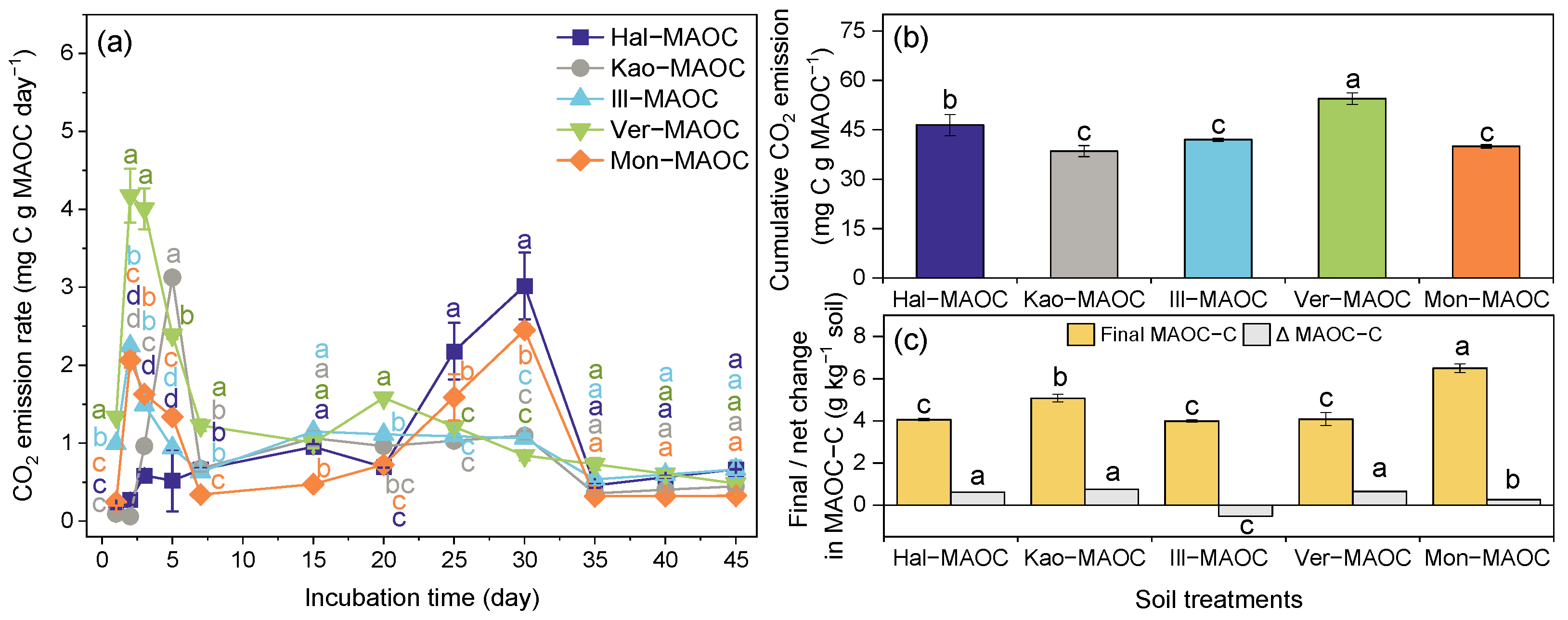
The CO2 emission rates showed two peaks during days 1–5 and 20–35 (Figure 1a, p < 0.05). Kaolinite-, illite-, vermiculite-, and montmorillonite-associated MAOC reached their first mineralization peaks within days 1–5 (2.06–4.18 mg C g−1 MAOC day−1). Vermiculite had a significantly higher peak than the other minerals, following the order: vermiculite > kaolinite > illite > montmorillonite. In contrast, halloysite-associated MAOC maintained relatively low and stable CO2 emission rates during the first 20 days, followed by a marked increase, reaching the highest value of the entire incubation at day 30. Montmorillonite-associated MAOC exhibited a comparable pattern, with a second mineralization peak occurring at day 30. After day 30, CO2 emission rates of all treatments declined and stabilized at low levels, with no significant differences among mineral types (p > 0.05).
Figure 1.
Temporal dynamics of CO2 emission rate (a), cumulative CO2 emission (b), final MAOC-C content, and net carbon change at the end of incubation (c) in straw-derived MAOC. Lowercase letters indicate significant differences among clay minerals at each sampling time, at p < 0.05.
Cumulative CO2 emissions over the incubation period followed the order: vermiculite > halloysite > illite > montmorillonite > kaolinite, with vermiculite-associated MAOC being 1.17–1.41 times higher than that of the other treatments (Figure 1b). Halloysite- and vermiculite-associated MAOC maintained a positive net carbon balance despite relatively high cumulative CO2 emissions. In contrast, illite-associated MAOC was the only treatment that exhibited a net carbon loss (Figure 1c).
3.2. Physicochemical Properties of Clay Minerals and MAOC
The 2:1 clay minerals (illite, vermiculite, and montmorillonite) exhibited significantly higher pH, specific surface area (SSA), and cation exchange capacity (CEC) than 1:1 minerals (halloysite and kaolinite) (Table 1). Vermiculite showed the highest pH and CEC, whereas montmorillonite had the largest SSA. XRD analysis indicated that vermiculite and montmorillonite had greater interlayer spacing (d001) and full width at half maximum (FWHM) than other minerals, indicating lower mineral crystallinity (p < 0.05). After two years of incubation, the SSA of MAOC decreased by 64.30–85.42%, following the order: vermiculite > illite > montmorillonite > kaolinite > halloysite, with larger reductions observed in 2:1 minerals. XRD analysis showed that d001 increased in halloysite-, kaolinite-, and illite-associated MAOC but decreased in vermiculite- and montmorillonite-associated MAOC. FWHM increased in all treatments except montmorillonite.
Table 1.
The pH, specific surface area (SSA), cation exchange capacity (CEC), and mineralogical interlayer space (d001-value), full width at half maximum (FWHM) measured using X-ray diffractometry of clay minerals and MAOC before and after incubation.
After the 45-day mineralization incubation, MAOC SSA increased in all treatments, with the largest increase in vermiculite (p < 0.05). CEC and FWHM increased in all minerals except montmorillonite, whereas changes in d001 were not significant across treatments.
3.3. Carbon and Nitrogen Characteristics and Chemical Composition of MAOC
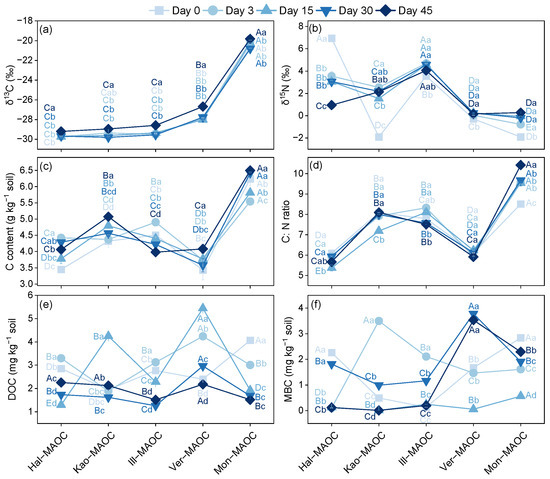
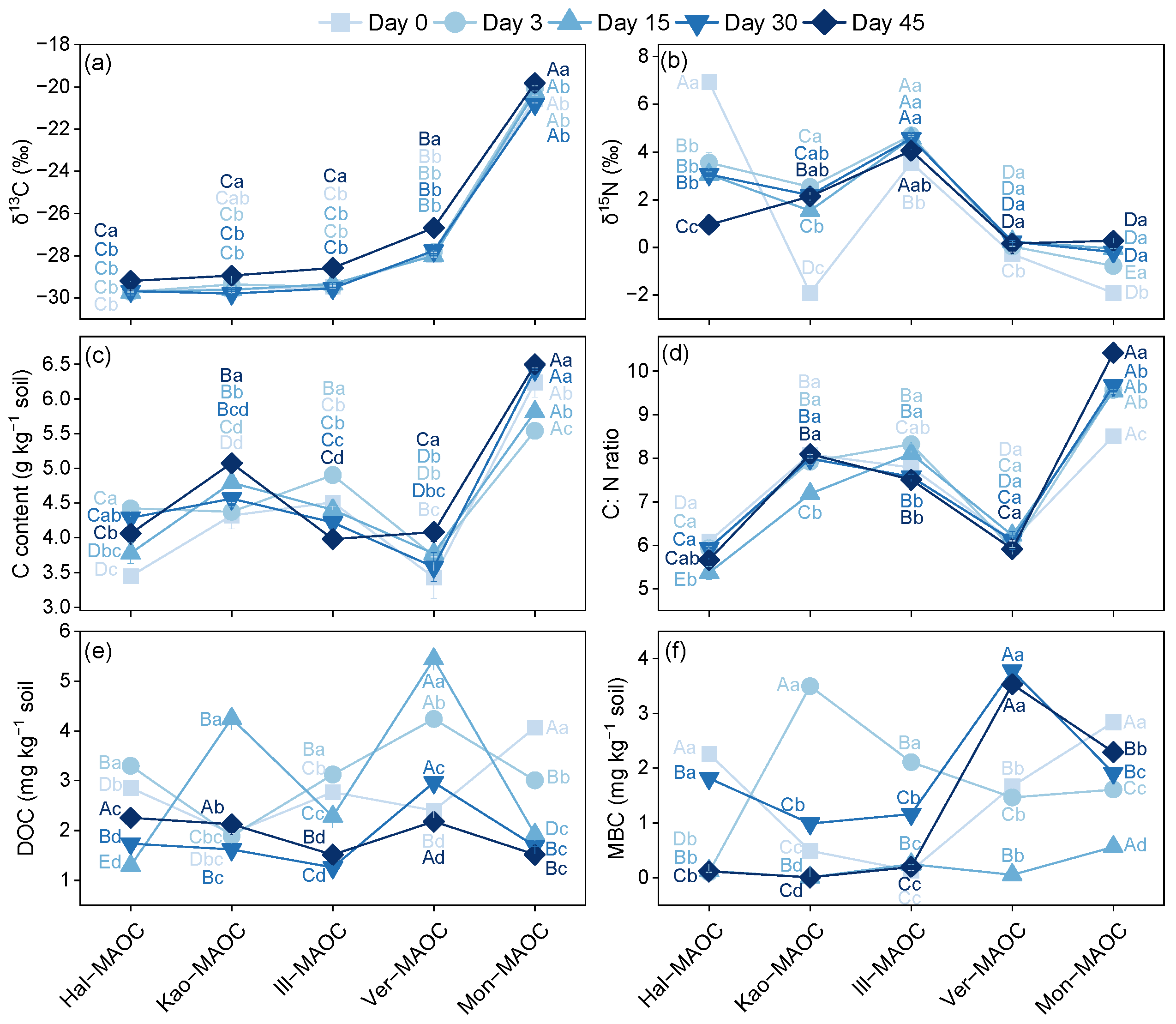
At day 0, montmorillonite-associated MAOC exhibited the highest δ13C, organic carbon (OC) content, C:N ratio, and dissolved organic carbon (DOC) content, while halloysite-associated MAOC showed the largest δ15N values (Figure 2). After 45 days of incubation, δ13C values decreased by 1.58–4.74% across treatments. Except for halloysite-associated MAOC, δ15N values increased over time in all other treatments. Organic carbon content increased significantly in all treatments except illite, with the largest increase observed in vermiculite (15.93%). DOC contents declined and converged among treatments by the end of incubation. Microbial biomass carbon (MBC) increased significantly in vermiculite-associated MAOC and exceeded that of other treatments (p < 0.05).
Figure 2.
Temporal dynamics of δ13C (a), δ15N (b), OC content (c), C:N ratio (d), DOC (e), and MBC (f) of straw-derived MAOC during incubation. Uppercase letters indicate significant differences among clay mineral treatments at each incubation time, whereas lowercase letters indicate significant differences among incubation times within each clay mineral (p < 0.05).
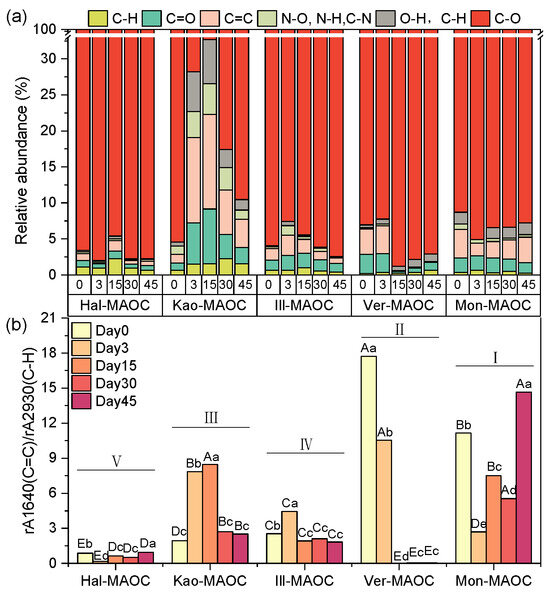
FTIR spectra revealed transformations in both mineral-related and organic functional groups following straw incorporation and MAOC formation (Table 2, Figure 3). The stretching and bending vibrations of H2O decreased markedly across all treatments. Mineral-associated bands showed consistent shifts, with increases in OH–Si–O–Al and decreases in Si–O and Si–O–Si(Al). New organic functional groups emerged after MAOC formation, including C–H, C=O, C=C, N-containing groups (N–O, N–H, C–N), and C–O (Table 2; Figure 3). Semi-quantitative analysis indicated that C–O groups dominated the initial MAOC organic pool (91.30–96.90%). Vermiculite- and montmorillonite-associated MAOC exhibited relatively higher proportions of C=O, C=C, and recalcitrance index (rA1630/rA2930) than other minerals.
Table 2.
Relative peak intensity (%) of functional groups of clay minerals and MAOC, characterized by Fourier transformation mid-infrared spectroscopy before and after incubation.
Figure 3.
Temporal changes in the relative abundance of different organic functional groups (a) and the rA1640/rA2930 ratio (b) of straw-derived MAOC during incubation. Roman numbers, uppercase and lowercase letters indicate significant differences among clay minerals irrespective of incubation time, among clay minerals for each incubation time and among incubation time for each clay minerals treatment (p < 0.05).
After incubation, the relative abundance of C–O increased by 1.16–4.16% in all treatments except kaolinite. The recalcitrance index increased in montmorillonite and kaolinite, whereas illite and vermiculite showed significant declines (Figure 3, p < 0.05).
3.4. Bacterial and Fungal Abundances and Enzyme Activities in MAOC
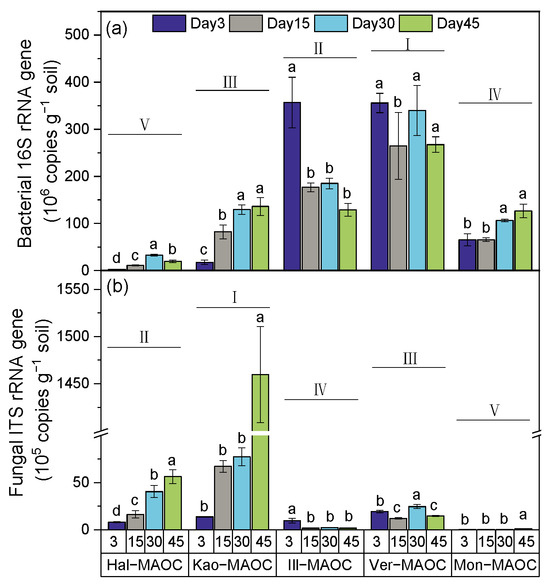
During the incubation, the mean bacterial 16S rRNA gene copy numbers of MAOC followed the order: illite > vermiculite > montmorillonite > kaolinite > halloysite, whereas mean fungal ITS gene copy numbers were higher in halloysite and kaolinite (Figure 4; p < 0.05). Over time, bacterial and fungal abundances declined significantly in illite and vermiculite treatments but increased in halloysite, kaolinite, and montmorillonite.
Figure 4.
Temporal changes in bacterial (a) and fungal (b) gene copy numbers of straw-derived MAOC during incubation. Roman numbers and lowercase letters represent significant differences among clay minerals, among incubation time for each clay minerals, at p < 0.05.
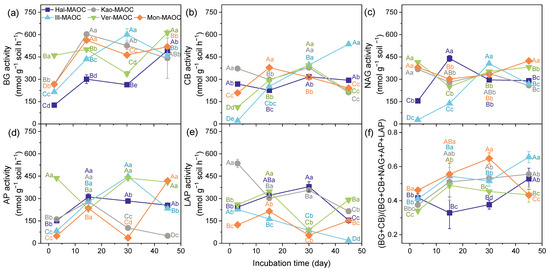
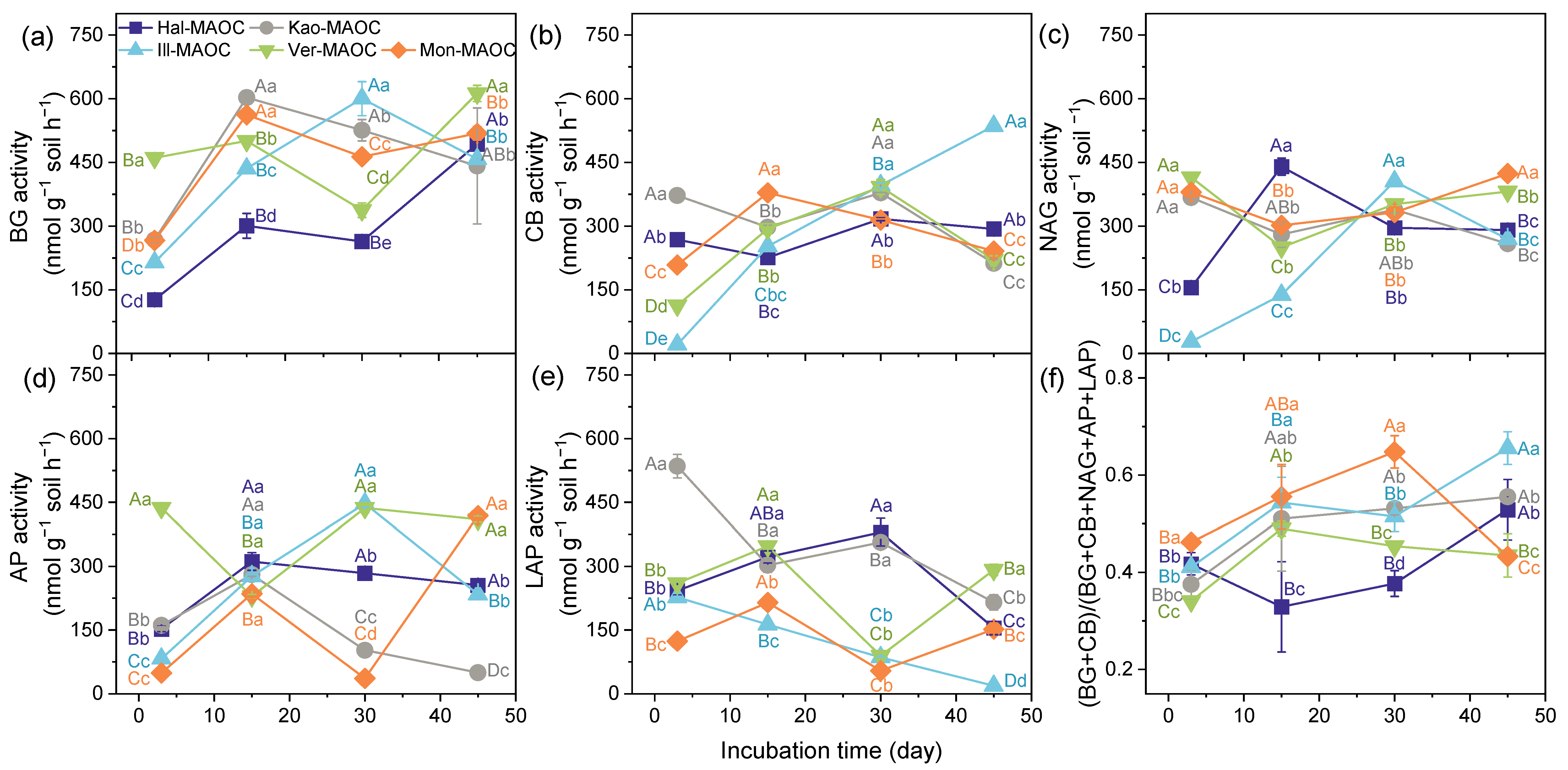
Vermiculite-associated MAOC showed the highest β-glucosidase (BG) and acid phosphatase (AP) activities (Figure 5; p < 0.05). Kaolinite exhibited the highest cellobiohydrolase (CB) and leucine aminopeptidase (LAP) activities. Montmorillonite showed the highest N-acetylglucosaminidase (NAG) activity. The proportion of carbon-acquiring enzymes was higher in illite (0.51) and montmorillonite (0.53) than in other treatments. By day 45, this proportion increased significantly (21–37.33%) in all treatments except montmorillonite.
Figure 5.
Temporal changes in the activities of β-1,4-glucosidase (BG, a), cellobiohydrolase (CB, b), β-1,4-N-acetylglucosaminidase (NAG, c), acid phosphatase (AP, d), leucine aminopeptidase (LAP, e), and the proportion of C-acquiring enzyme activities (f) in straw-derived MAOC during incubation. Uppercase letters indicate significant differences among incubation times within the same mineral-associated organic carbon treatment, whereas lowercase letters indicate significant differences among different mineral-associated organic carbon treatments at the same incubation time (p < 0.05).
3.5. Factors Controlling MAOC Mineralization and Net Carbon Balance
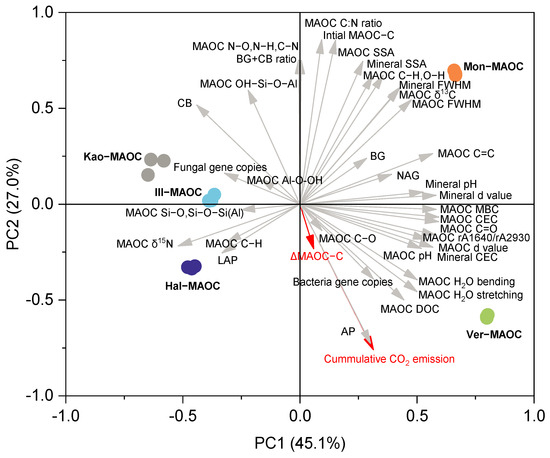
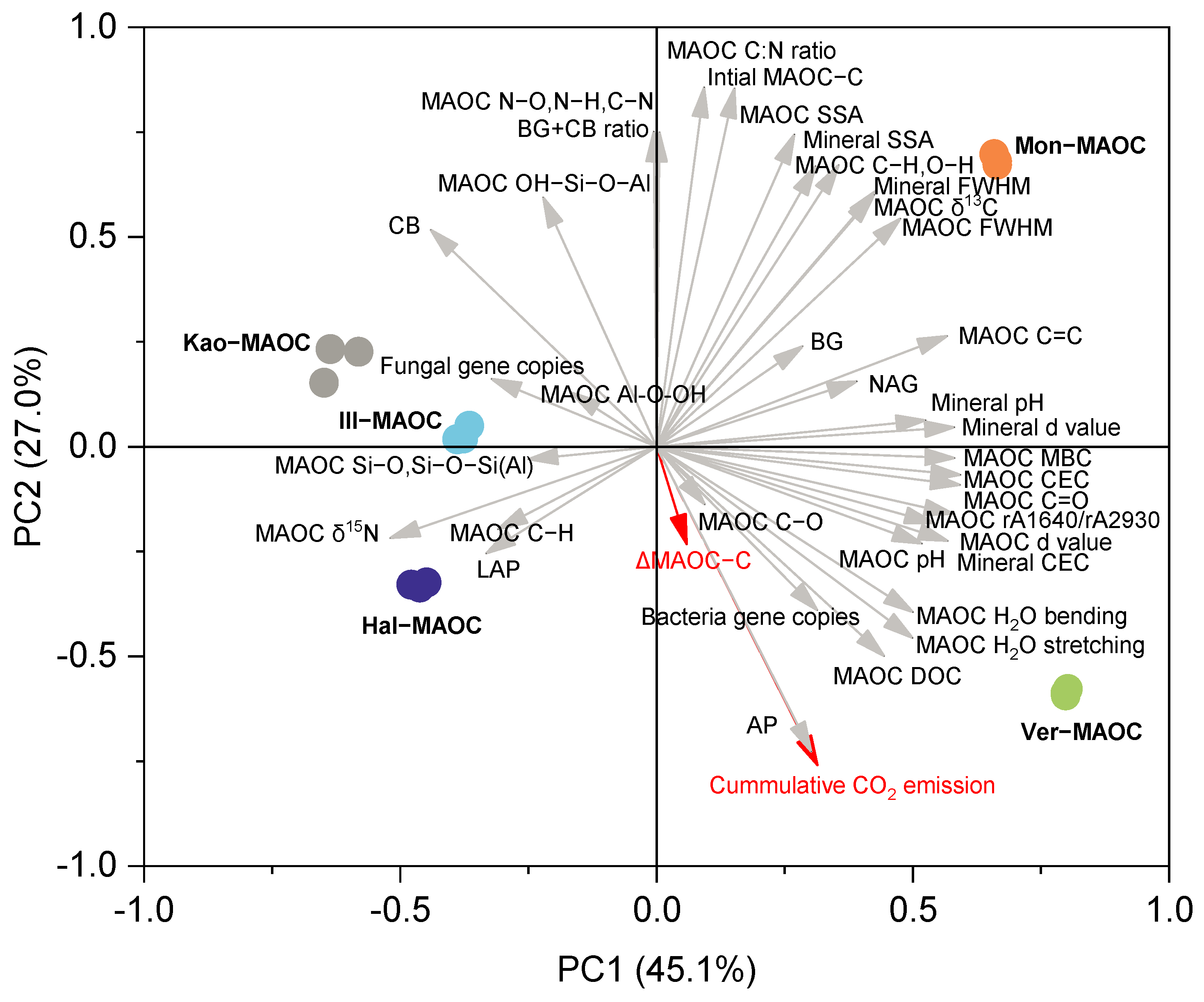
Principal component analysis (PCA) showed that the first two principal components explained 72.1% of the total variance, with clear separation among mineral types (Figure 6). Along PC2, cumulative CO2 emission was positively associated with DOC, bacterial abundance, and MAOC pH, whereas initial MAOC carbon content and C:N ratio were distributed in the opposite direction. Vermiculite-associated MAOC clustered in the same quadrant as cumulative CO2 emission, DOC, and the stretching and bending vibrations of H2O, showing strong positive correlations among these variables.
Figure 6.
Principal component analysis (PCA) of all measured properties of clay minerals, MAOC (Table 1 and Table 2), microbial gene copies and enzyme activities, showing the associated factors with MAOC-C net change (ΔMAOC-C) and cumulative CO2 emission (Red arrows in the PCA loading plot). The abbreviations of the clay minerals were halloysite (Hal), kaolinite (Kao), illite (Ill), vermiculite (Ver), and montmorillonite (Mon).
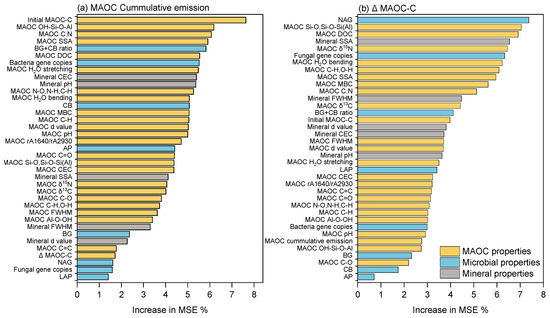
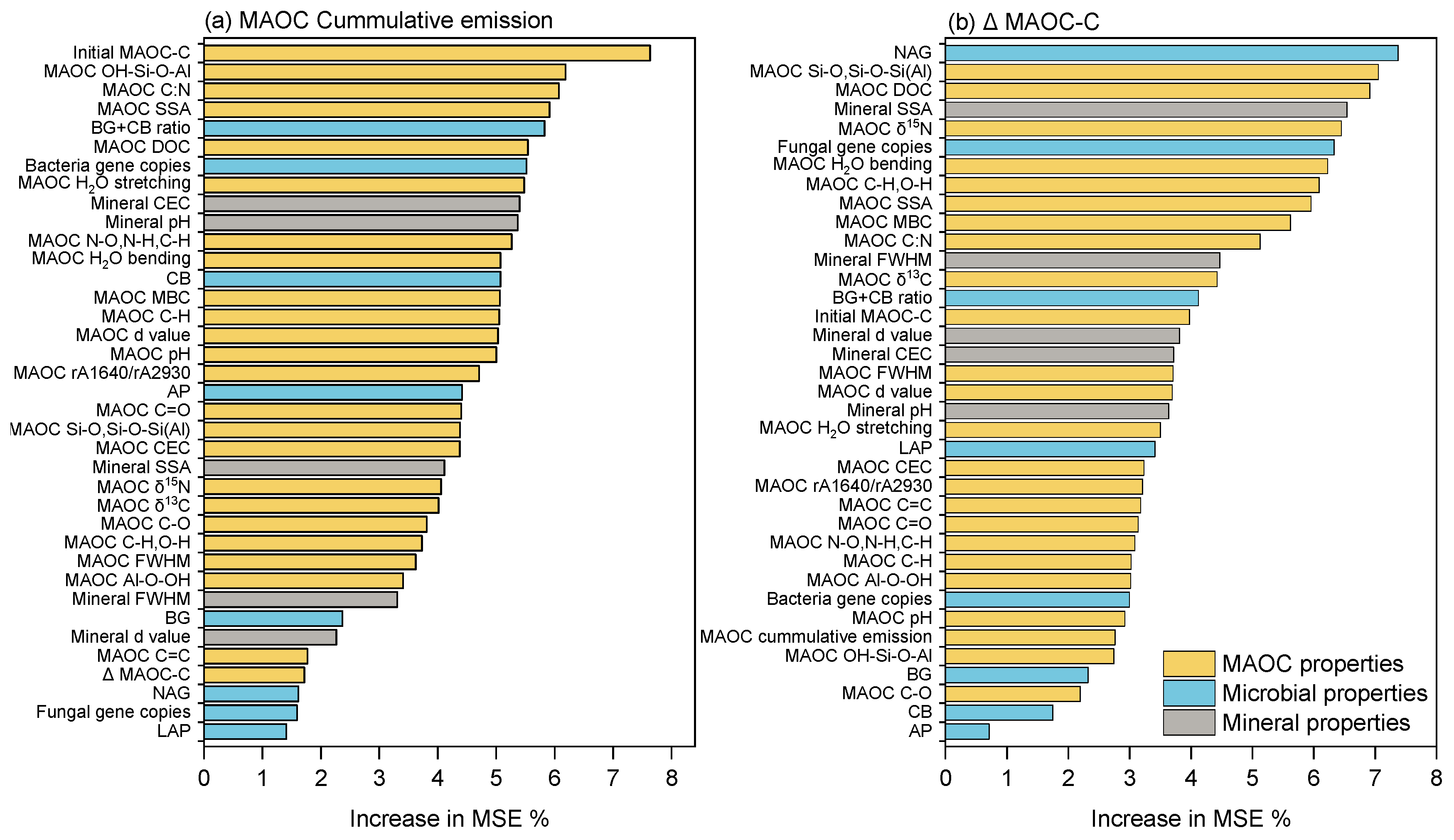
Random forest analysis identified the key drivers of mineralization and carbon balance (Figure 7 and Figure 8). For cumulative CO2 mineralization, initial MAOC carbon content showed a negative relationship with cumulative CO2 emission, whereas DOC and bacterial abundance were positive relationships. For net MAOC carbon balance, N-acetylglucosaminidase activity (NAG) activity, DOC, and fungal abundance all showed positive relationships with carbon retention. Mineral structural characteristics, particularly Si–O/Si–O–Si(Al), showed negative relationships with net carbon balance.
Figure 7.
Increase in Mean Squared Error (MSE, %) estimated by random forest modelling, showing relative importance of variables controlling MAOC cumulative emission (a) and MAOC-C net change (ΔMAOC-C) (b).
Figure 8.
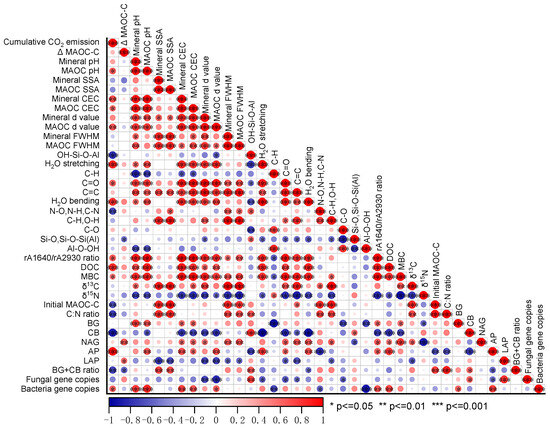
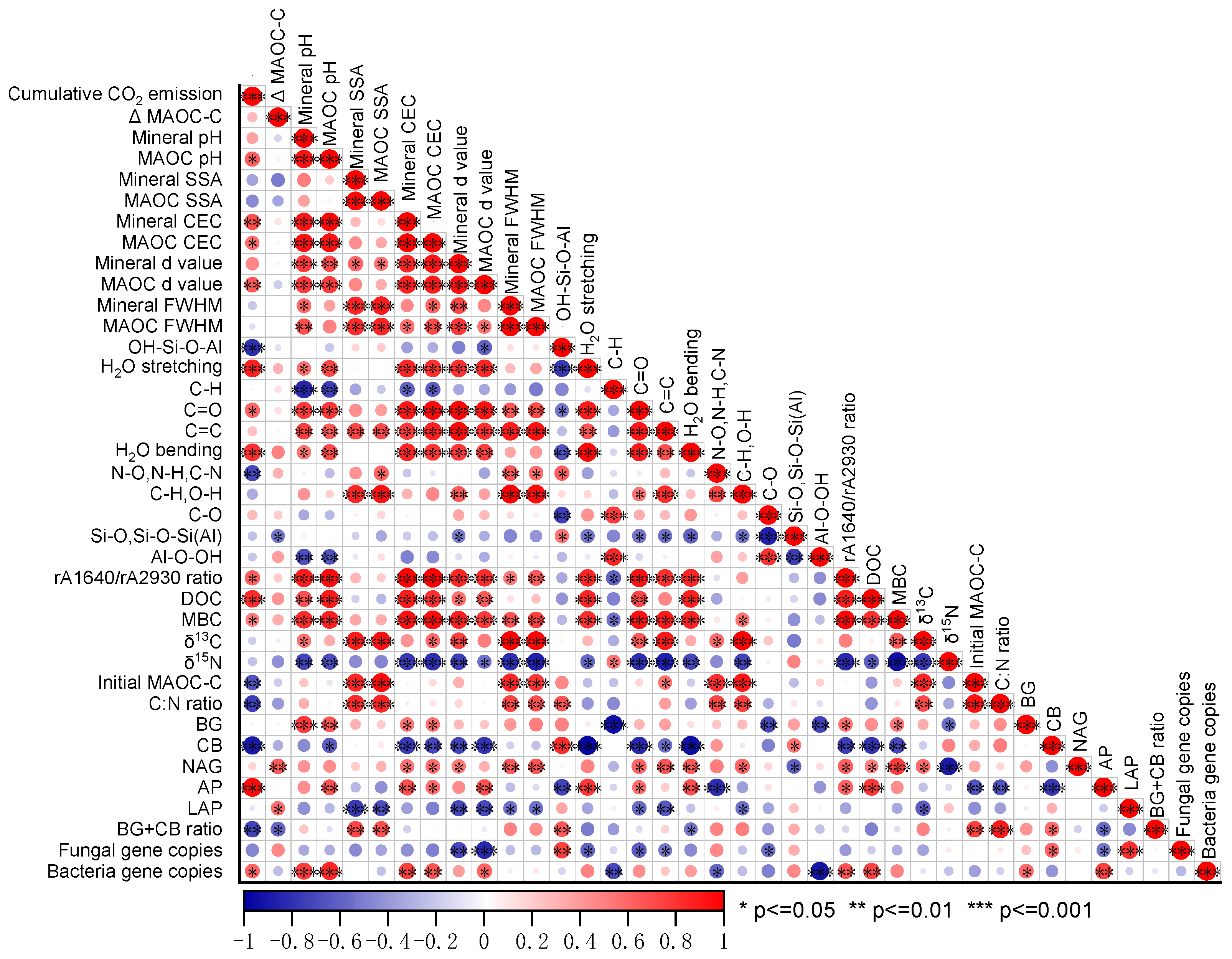
Pearson correlations among all clay minerals, MAOC physicochemical properties, microbial abundance, and enzyme activities.
4. Discussion
4.1. Association Mechanisms Controlling Microbial Processing of MAOC
Mineral-association organic carbon (MAOC) formation is primarily governed by surface saturation and pore occupation [4,13,17]. Our incubation study yielded similar results (Table 1). The pronounced decrease in specific surface area (SSA), together with the emergence of organic functional groups in FTIR spectra, indicates progressive coverage of reactive mineral surfaces by straw-derived organic matter (Table 1 and Table 2). The greater SSA reduction observed in 2:1 minerals compared with 1:1 minerals reflects their higher surface reactivity and interlayer domains (Table 1), which facilitate both surface adsorption and interlayer organic retention [34].
Despite this higher sorption capacity, mineral structure did not directly translate into biological stability [13]. Vermiculite exhibits the highest mineralization among 2:1 minerals, mainly due to its highly hydrated interlayer structure, which enhances substrate mobility and microbial accessibility (Figure 1, Table 2). Strong water vibrational features and elevated DOC indicate high mineral hydration and the presence of a labile organic carbon fraction with weak mineral association and high potential bioavailability [35]. It should be noted that the wet sieving method used to isolate MAOC likely removes loosely associated fractions, leading to underestimation of total MAOC while enriching a more accessible carbon pool [36]. The sorption mechanism in vermiculite is dominated by electrostatic adsorption and cation bridging, both of which are reversible interactions [5]. This combination explains the high early-stage mineralization observed in vermiculite despite its relatively high aromatic index (Table 1, Figure 2). Therefore, carbon stability (intrinsic chemical resistance) does not necessarily determine carbon persistence in soil, which emerges from the coupled interactions among mineral protection, microbial accessibility, and ecosystem-scale carbon input and output [13,37].
In contrast, montmorillonite exhibited lower mineralization due to physical confinement within interlayers and strong adsorption on high-SSA surfaces [38,39]. Ligand exchange and hydrogen bonding immobilized organic functional groups, forming spatially restricted microenvironments that limit microbial access [38]. Compared with vermiculite, montmorillonite retains more structurally complex and microbially processed carbon, as reflected by higher C:N ratios and δ13C enrichment (Table 2). Non-expanding illite imposed constraints mainly through structural rigidity rather than strong sorption [38]. In illite, interlayers are fixed by non-exchangeable K+, preventing expansion and limiting organic entry into interlayer spaces, which restricts both water penetration and substrate diffusion, resulting in low microbial accessibility despite surface association [40]. Weak H2O vibrational signals further support limited hydration, which constrains substrate transport and enzymatic activity [39].
In 1:1 minerals, organic carbon is mainly associated with mineral surfaces through hydrogen bonding and surface complexation at hydroxyl groups [9]. However, MAOC mineralization in this study did not follow the commonly assumed higher accessibility of 1:1 mineral-associated carbon [10]. In kaolinite, strong OH–Si–O–Al interactions promote dense hydrogen-bond networks, stabilizing organic carbon through multipoint surface complexation [5]. Its platy, non-expanding structure further restricts water penetration and substrate diffusion, consistent with the low H2O vibrational intensity observed (Table 2). Together with low DOC availability, these constraints limit microbial accessibility and result in the lowest mineralization among all treatments. In contrast, halloysite-associated MAOC exhibits the relatively high cumulative mineralization (Figure 1), which is attributed to its tubular structure that enhances internal water retention and substrate diffusion [41,42]. This improved hydration facilitates microbial access to mineral-associated substrates (Table 2), while preferential association with low-molecular-weight, oxygen-rich compounds further increases bioavailability [2,43].
4.2. Microbial Processing of MAOC and Net Carbon Balance
Under a unified microbial inoculum, pronounced divergence in MAOC mineralization dynamics and net carbon balance was observed among mineral types (Figure 1, Table 2). Rather than acting as passive sorbents, clay minerals regulate microbial accessibility and substrate utilization through coupled effects of surface chemistry and microstructural confinement [38]. High CEC and interlayer expandability in 2:1 minerals do not necessarily lead to greater carbon persistence when mineral-associated carbon remains bioaccessible [5,44]. Electrostatic adsorption and cation bridging in vermiculite enhance substrate accessibility under moist conditions [13]. Random forest and PCA analyses identified DOC, microbial abundance, and pH as key drivers of CO2 emission, indicating that labile carbon availability and microbial activity jointly regulate carbon turnover (Figure 6). Elevated β-glucosidase (BG) and acid phosphatase (AP) activities further suggest enhanced C and P acquisition stimulated decomposition (Figure 5). Recent work demonstrated that N-rich mineral-associated organic matter exhibits greater degradability, with decomposition rates positively correlated with N-containing compounds [45]. Moreover, organic C bound through organic–organic interactions is more labile than C directly adsorbed onto mineral surfaces [45]. These findings align with the high mineralization, low C:N ratio, and elevated N-acquiring enzyme activities observed in the vermiculite treatment (Figure 1, Figure 2 and Figure 5).
Current microbial-driven models of MAOC formation emphasize that MAOC is primarily derived from microbial processing of plant inputs, and that microbial residues subsequently associate with minerals [2,16]. Despite having the highest mineralization, vermiculite MAOC maintained a positive net C balance (Figure 1). Enhanced microbial activity can increase microbial residue production and promote MAOC accumulation under favorable environmental conditions [2]. A recent meta-analysis reported that elevated atmospheric CO2 increased SOC stocks by 4.2%, with extracellular enzyme activity emerging as the strongest predictor of SOC accumulation, although distinctions between POC and MAOC were not addressed [46].
Our results further indicate that N-acquiring enzymes (NAG and LAP) are key predictors of positive MAOC net balance. The combination of high N-enzyme activity and low C:N ratio in vermiculite suggests a “high-capacity–high-bioaccessibility–high-turnover” dynamic equilibrium [4,17]. In contrast, expanding 2:1 montmorillonite and non-expanding 1:1 halloysite and kaolinite exhibited significantly lower CO2 emission (38.54–47.48 mg C g MAOC−1) while maintaining positive net C accumulation (Figure 1). However, their stabilization pathways differed fundamentally. Montmorillonite’s reduced mineralization is primarily attributable to physical isolation within expandable interlayers and strong adsorption associated with its high SSA [11]. Ligand exchange (e.g., OH–Si–O–Si(Al), Al–OH) and strong hydrogen bonding immobilized abundant organic functional groups (C=O, C=C, C–H, N–H) at surfaces and within interlayers. These interactions formed relatively closed microenvironments that restricted microbial and enzymatic access. Random forest analysis identified initial MAOC content as the strongest negative predictor of CO2 emission (Figure 7 and Figure 8). Montmorillonite MAOC also showed relatively enriched δ13C and higher C:N ratios compared to vermiculite, indicating preferential preservation of straw-derived structural components (e.g., aromatic lignin) and comparatively weaker microbial processing [13]. Thus, despite high CEC, montmorillonite-associated organic C represents a “low-bioaccessibility–high-protection” mode, characterized by strong sorption but constrained microbial turnover [17]. This contrasts with the “high-turnover–high-accessibility” regime in vermiculite and confers more robust long-term C protection. Kaolinite, a 1:1 mineral, also exhibited low mineralization and high positive net C accumulation (Figure 1c). Its stabilization derives primarily from physicochemical constraints: multipoint hydrogen bonding via edge hydroxyl groups and compact microstructural domains that limit substrate diffusion and enzyme–substrate contact efficiency [47]. The significant negative effect of OH–Si–O–Al groups on mineralization in the random forest model supports this interpretation. Although 1:1-dominated soils are often considered less stable in natural systems, the positive C balance observed here may relate to higher fungal abundance (Figure 4) and increased relative C-acquiring enzyme activity during late incubation (Figure 5), suggesting compensatory microbial residue inputs. Recent field evidence also indicates that fungal-derived residues contribute more substantially to MAOC than bacterial residues and are regulated by soil total N, consistent with the positive contribution of fungal abundance to net C balance in this study [48]. For halloysite, its tubular morphology and surface hydroxyls facilitate localized substrate retention. Coupled with low C:N ratios and high DOC and MBC, elevated NAG and LAP activities during mid-incubation likely promoted microbial residue formation and partial compensation for mineralization losses (Figure 2 and Figure 3). Its relatively low recalcitrance index indicates that bound C was readily processed, yet microbial residue accumulation offset decomposition. Illite was the only treatment exhibiting net C loss. With K+-fixed interlayers, organic matter association was largely confined to external surfaces and edge pores mainly through van der Waals forces [40,49,50]. High-resolution microspectroscopic evidence indicates that organic C in illite-dominated systems primarily resides on mineral surfaces, whereas expandable minerals host C within interlayers. The absence of interlayer physical protection and strong chemical bonding rendered illite-associated C more bioaccessible and susceptible to decomposition. Lower NAG and LAP activities (Figure 5) suggested constrained microbial N acquisition, leading to decomposition rates exceeding formation rates and resulting in net C loss. The absence of significant δ15N enrichment further implies extensive decomposition with limited microbial residue retention.
4.3. Implication for Carbon Sequestration and Soil Management
It is necessary to consider the experimental context when applying these results to natural soils. The soil continuum model conceptualizes MAOC as a dynamic pool along a continuum transformation pathway rather than a static reservoir [10]. In this study, MAOC was tracked over 45 days and exhibited clear mineral-dependent differences in cumulative CO2 emission, with higher values in vermiculite- and halloysite-associated MAOC than in kaolinite-, illite-, and montmorillonite-associated systems (Figure 1). Because the background microbial community was sterilized prior to the MAOC mineralization experiment, the long-term retention of microbial residues and the initial selective colonization of microorganisms on different mineral surfaces during the formation phase could not be assessed within this timeframe [51]. Nonetheless, microbial contributions to net MAOC carbon change during the mineralization phase were captured (Figure 1).
Organic matter transformations during incubation reflect progressive microbial and mineral-mediated stabilization processes, historically described as humification but now understood within a microbial-driven framework [2,10,39]. Across all treatments, increases in C=O and C=C functional groups, together with consistent δ13C enrichment during the 45-day incubation, indicate preferential microbial utilization of labile 12C-enriched substrates and the relative accumulation of more oxidized and structurally complex compounds (Table 2, Figure 2). This study was conducted using artificial soil systems with individual clay minerals, whereas natural soils typically contain mixed mineral assemblages, diverse organic inputs, and structural heterogeneity [21,52]. Therefore, extrapolation to field conditions should be made with caution. The observed patterns are most applicable to systems where specific clay minerals are dominant. Under natural conditions, additional factors such as temperature, moisture, and Fe/Al oxides may further regulate MAOC stability and should be considered in future research.
5. Conclusions
MAOC stability is jointly controlled by mineral structure and microbial processing rather than by sorption capacity alone. Clay minerals regulate carbon persistence through interlayer confinement, surface complexation, and hydration-driven accessibility.
2:1 and 1:1 minerals exhibit contrasting stabilization pathways. Vermiculite promotes high turnover but sustains net carbon gain via microbial residue formation. Montmorillonite stabilizes carbon through interlayer protection and strong sorption, resulting in low mineralization. Kaolinite restricts decomposition via dense hydrogen bonding, while halloysite balances protection and accessibility through its tubular structure. Illite shows weak protection and net carbon loss. Microbial enzymes and labile carbon jointly regulate mineralization and retention, indicating that MAOC persistence is governed by the balance between decomposition and microbial residue formation rather than intrinsic chemical recalcitrance.
Although based on artificial soils under controlled conditions, this study clarifies mineral-dependent mechanisms governing carbon stabilization. These results highlight mineralogical context as a key determinant of MAOC fate and provide mechanistic support for improving soil carbon management and climate mitigation strategies.
Author Contributions
Conceptualization, X.C. (Xi Chen 2) and X.C. (Xi Chen 1); methodology, X.C. (Xi Chen 2), B.S.N. and X.C. (Xi Chen 1); software, X.C. (Xi Chen 1); validation, X.C. (Xi Chen 1), X.C. (Xi Chen 2), Y.Z. and S.Y.; formal analysis, X.C. (Xi Chen 1); investigation, X.C. (Xi Chen 1); resources, X.C. (Xi Chen 2), S.Y. and Y.Z.; data curation, X.C. (Xi Chen 1); writing—original draft preparation, X.C. (Xi Chen 1); writing—review and editing, X.C. (Xi Chen 2), B.S.N., Y.Z., S.Y. and X.C. (Xi Chen 1); visualization, X.C. (Xi Chen 1); supervision, S.Y.; funding acquisition, X.C. (Xi Chen 2) and Y.Z. All authors have read and agreed to the published version of the manuscript.
Funding
This research was funded by the National Natural Science Foundation of China (grant numbers 41930761, 42107330, and 42177284). The authors confirm that all funding information has been carefully checked and is accurate.
Data Availability Statement
The original contributions presented in this study are included in the article. Further inquiries can be directed to the corresponding author.
Acknowledgments
The authors would like to acknowledge Zhang Bin for their valuable guidance and support during the early stages of this research.
Conflicts of Interest
The authors declare that they have no known competing financial interest or personal relationships that could have appeared to influence the work reported in this paper.
References
- Six, J.; Conant, R.T.; Paul, E.A.; Paustian, K. Stabilization mechanisms of soil organic matter: Implications for C-saturation of soils. Plant Soil 2002, 241, 155–176. [Google Scholar] [CrossRef] [Scilit]
- Cotrufo, M.F.; Wallenstein, M.D.; Boot, C.M.; Denef, K.; Paul, E. The Microbial Efficiency-Matrix Stabilization (MEMS) framework integrates plant litter decomposition with soil organic matter stabilization: Do labile plant inputs form stable soil organic matter? Glob. Change Biol. 2013, 19, 988–995. [Google Scholar] [CrossRef] [Scilit]
- Angst, G.; Mueller, K.E.; Nierop, K.G.J.; Simpson, M.J. Plant- or microbial-derived? A review on the molecular composition of stabilized soil organic matter. Soil Biol. Biochem. 2021, 156, 16. [Google Scholar] [CrossRef] [Scilit]
- Lavallee, J.M.; Soong, J.L.; Cotrufo, M.F. Conceptualizing soil organic matter into particulate and mineral-associated forms to address global change in the 21st century. Glob. Change Biol. 2020, 26, 261–273. [Google Scholar] [CrossRef] [Scilit] [PubMed]
- Chen, F.X.; Zhang, Y.; Chen, M.X.; Ndzelu, B.S.; Liu, Y.; Ndzana, G.M.; Xiao, D.; Yao, S.; Zhang, B. Microbial stability of mineral-associated root exudates governed by mineral association capacity, exudate nitrogen availability and their pH. Sci. Total Environ. 2025, 1008, 181011. [Google Scholar] [CrossRef] [Scilit]
- Sokol, N.W.; Sanderman, J.; Bradford, M.A. Pathways of mineral-associated soil organic matter formation: Integrating the role of plant carbon source, chemistry, and point of entry. Glob. Change Biol. 2019, 25, 12–24. [Google Scholar] [CrossRef] [Scilit] [PubMed]
- Saidy, A.R.; Smernik, R.J.; Baldock, J.A.; Kaiser, K.; Sanderman, J.; Macdonald, L.M. Effects of clay mineralogy and hydrous iron oxides on labile organic carbon stabilisation. Geoderma 2012, 173–174, 104–110. [Google Scholar] [CrossRef] [Scilit]
- Lehmann, J.; Hansel, C.M.; Kaiser, C.; Kleber, M.; Maher, K.; Manzoni, S.; Nunan, N.; Reichstein, M.; Schimel, J.P.; Torn, M.S.; et al. Persistence of soil organic carbon caused by functional complexity. Nat. Geosci. 2020, 13, 529–534. [Google Scholar] [CrossRef] [Scilit]
- Kaiser, M.; Ellerbrock, R.H.; Wulf, M.; Dultz, S.; Hierath, C.; Sommer, M. The influence of mineral characteristics on organic matter content, composition, and stability of topsoils under long-term arable and forest land use. J. Geophys. Res.-Biogeosci. 2012, 117, 16. [Google Scholar] [CrossRef] [Scilit]
- Lehmann, J.; Kleber, M. The contentious nature of soil organic matter. Nature 2015, 528, 60–68. [Google Scholar] [CrossRef] [Scilit]
- Mikutta, R.; Mikutta, C.; Kalbitz, K.; Scheel, T.; Kaiser, K.; Jahn, R. Biodegradation of forest floor organic matter bound to minerals via different binding mechanisms. Geochim. Cosmochim. Acta 2007, 71, 2569–2590. [Google Scholar] [CrossRef] [Scilit]
- Keiluweit, M.; Bougoure, J.J.; Nico, P.S.; Pett-Ridge, J.; Weber, P.K.; Kleber, M. Mineral protection of soil carbon counteracted by root exudates. Nat. Clim. Change 2015, 5, 588–595. [Google Scholar] [CrossRef] [Scilit]
- Kleber, M.; Bourg, I.C.; Coward, E.K.; Hansel, C.M.; Myneni, S.C.B.; Nunan, N. Dynamic interactions at the mineral-organic matter interface. Nat. Rev. Earth Environ. 2021, 2, 402–421. [Google Scholar] [CrossRef] [Scilit]
- Cotrufo, M.F.; Lavallee, J.M. Soil organic matter formation, persistence, and functioning: A synthesis of current understanding to inform its conservation and regeneration. In Advances in Agronomy; Elsevier: Amsterdam, The Netherlands, 2022; Volume 172, pp. 1–66. [Google Scholar]
- Martial, N.G.; Yao, S.H.; Hamer, U.; Zhang, Y.L.; Zhang, B. Positive and negative priming effects induced by freshly added mineral-associated oxalic acid in a Mollisol. Rhizosphere 2023, 26, 100708. [Google Scholar] [CrossRef] [Scilit]
- Kallenbach, C.M.; Frey, S.D.; Grandy, A.S. Direct evidence for microbial-derived soil organic matter formation and its ecophysiological controls. Nat. Commun. 2016, 7, 13630. [Google Scholar] [CrossRef] [Scilit]
- Sokol, N.W.; Whalen, E.D.; Jilling, A.; Kallenbach, C.; Pett-Ridge, J.; Georgiou, K. Global distribution, formation and fate of mineral-associated soil organic matter under a changing climate: A trait-based perspective. Funct. Ecol. 2022, 36, 1411–1429. [Google Scholar] [CrossRef] [Scilit]
- Liang, C.; Kästner, M.; Joergensen, R.G. Microbial necromass on the rise: The growing focus on its role in soil organic matter development. Soil Biol. Biochem. 2020, 150, 108000. [Google Scholar] [CrossRef] [Scilit]
- Sinsabaugh, R.L.; Manzoni, S.; Moorhead, D.L.; Richter, A. Carbon use efficiency of microbial communities: Stoichiometry, methodology and modelling. Ecol. Lett. 2013, 16, 930–939. [Google Scholar] [CrossRef] [Scilit]
- Cui, J.W.; Yang, B.G.; Xu, X.P.; Ai, C.; Zhou, W. Long-term maize-soybean rotation in Northeast China: Impact on soil organic matter stability and microbial decomposition. Plant Soil 2025, 507, 141–158. [Google Scholar] [CrossRef] [Scilit]
- Xu, Y.; Liu, K.; Yao, S.; Zhang, Y.; Zhang, X.; He, H.; Feng, W.; Ndzana, G.M.; Chenu, C.; Olk, D.C.; et al. Formation efficiency of soil organic matter from plant litter is governed by clay mineral type more than plant litter quality. Geoderma 2022, 412, 115727. [Google Scholar] [CrossRef] [Scilit]
- Ding, G.C.; Pronk, G.J.; Babin, D.; Heuer, H.; Heister, K.; Kögel-Knabner, I.; Smalla, K. Mineral composition and charcoal determine the bacterial community structure in artificial soils. FEMS Microbiol. Ecol. 2013, 86, 15–25. [Google Scholar] [CrossRef] [Scilit]
- Pronk, G.J.; Heister, K.; Kögel-Knabner, I. Is turnover and development of organic matter controlled by mineral composition? Soil Biol. Biochem. 2013, 67, 235–244. [Google Scholar] [CrossRef] [Scilit]
- Kemper, W.D.; Rosenau, R.C. Aggregate stability and size distribution. In Methods of Soil Analysis: Part 1 Physical and Mineralogical Methods; American Society of Agronomy: Fitchburg, WI, USA, 1986. [Google Scholar]
- Józwiak-Niedzwiedzka, D.; Dabrowski, M.; Dziedzic, K.; Jarzabek, D.; Antolik, A.; Denis, P.; Glinicki, M.A. Effect of gamma irradiation on the mechanical properties of carbonation reaction products in mortar. Mater. Struct. 2022, 55, 17. [Google Scholar] [CrossRef] [Scilit]
- Zhang, F.T.; Chen, X.; Wang, Q.Q.; Zhang, Y.L.; Yao, S.H.; Zhang, B. The priming effect dynamics are driven by microbial activation and growth and constrained by the relative availability of input C and soil N. Biol. Fertil. Soils 2022, 58, 745–760. [Google Scholar] [CrossRef] [Scilit]
- Zhang, F.T.; Wang, Q.Q.; Zhang, Y.L.; Yao, S.H.; Wang, Q.H.; Ndzana, G.; Hamer, U.; Kuzyakov, Y.; Zhang, B. Soil organic carbon increase via microbial assimilation or soil protection against the priming effect is mediated by the availability of soil N relative to input C. Geoderma 2024, 444, 10. [Google Scholar] [CrossRef] [Scilit]
- Chen, X.; Jin, M.C.; Zhang, Y.J.; Hu, J.W.; Gao, H.J.; Chu, W.Y.; Mao, J.D.; Thompson, M.L. Nitrogen Application Increases Abundance of Recalcitrant Compounds of Soil Organic Matter: A 6-Year Case Study. Soil Sci. 2018, 183, 169–178. [Google Scholar] [CrossRef] [Scilit]
- Hou, Y.H.; He, K.Y.; Chen, Y.; Zhao, J.X.; Hu, H.F.; Zhu, B. Changes of soil organic matter stability along altitudinal gradients in Tibetan alpine grassland. Plant Soil 2021, 458, 21–40. [Google Scholar] [CrossRef] [Scilit]
- Setia, R.; Verma, S.L.; Marschner, P. Measuring microbial biomass carbon by direct extraction—Comparison with chloroform fumigation-extraction. Eur. J. Soil Biol. 2012, 53, 103–106. [Google Scholar] [CrossRef] [Scilit]
- Domeignoz-Horta, L.A.; Pold, G.; Liu, X.J.A.; Frey, S.D.; Melillo, J.M.; DeAngelis, K.M. Microbial diversity drives carbon use efficiency in a model soil. Nat. Commun. 2020, 11, 3684. [Google Scholar] [CrossRef] [Scilit]
- Saiya-Cork, K.R.; Sinsabaugh, R.L.; Zak, D.R. The effects of long term nitrogen deposition on extracellular enzyme activity in an Acer saccharumforest soil. Soil Biol. Biochem. 2002, 34, 1309–1315. [Google Scholar] [CrossRef] [Scilit]
- DeForest, J.L. The influence of time, storage temperature, and substrate age on potential soil enzyme activity in acidic forest soils using MUB-linked substrates and L-DOPA. Soil Biol. Biochem. 2009, 41, 1180–1186. [Google Scholar] [CrossRef] [Scilit]
- Ndzana, G.M.; Zhang, Y.; Yao, S.; Hamer, U.; Zhang, B. The adsorption capacity of root exudate organic carbon onto clay mineral surface changes depending on clay mineral types and organic carbon composition. Rhizosphere 2022, 23, 100545. [Google Scholar] [CrossRef] [Scilit]
- Kothawala, D.N.; Roehm, C.; Blodau, C.; Moore, T.R. Selective adsorption of dissolved organic matter to mineral soils. Geoderma 2012, 189, 334–342. [Google Scholar] [CrossRef] [Scilit]
- Konrad, A.; Hofmann, D.; Siemens, J.; Stutz, K.P.; Lang, F.; Mulder, I. Microbial carbon use efficiency of mineral-associated organic matter is related to its desorbability. Soil Biol. Biochem. 2025, 203, 12. [Google Scholar] [CrossRef] [Scilit]
- Woolf, D.; Lehmann, J. Microbial models with minimal mineral protection can explain long-term soil organic carbon persistence. Sci. Rep. 2019, 9, 6522. [Google Scholar] [CrossRef] [Scilit] [PubMed]
- Kleber, M.; Eusterhues, K.; Keiluweit, M.; Mikutta, C.; Mikutta, R.; Nico, P.S. Mineral-Organic Associations: Formation, Properties, and Relevance in Soil Environments. In Advances in Agronomy; Sparks, D.L., Ed.; Elsevier: Amsterdam, The Netherlands, 2015; Volume 130, pp. 1–140. [Google Scholar]
- Schmidt, M.W.I.; Torn, M.S.; Abiven, S.; Dittmar, T.; Guggenberger, G.; Janssens, I.A.; Kleber, M.; Kögel-Knabner, I.; Lehmann, J.; Manning, D.A.C.; et al. Persistence of soil organic matter as an ecosystem property. Nature 2011, 478, 49–56. [Google Scholar] [CrossRef] [Scilit]
- Xing, Y.H.; Li, X.; Wu, Z.D.; Feng, H.T.; Xue, X.; Xie, L.C.; Zhang, T.Y.; Zhang, J.G. Retention of organic matter on the surface of illite particle under the influence of different cations: A molecular dynamics simulation study. Appl. Clay Sci. 2023, 232, 12. [Google Scholar] [CrossRef] [Scilit]
- Singh, M.; Sarkar, B.; Biswas, B.; Churchman, J.; Bolan, N.S. Adsorption-desorption behavior of dissolved organic carbon by soil clay fractions of varying mineralogy. Geoderma 2016, 280, 47–56. [Google Scholar] [CrossRef] [Scilit]
- Wang, R.; Yu, J.X.; Chen, Y.C.; Li, X.J.; Zhang, Z.Y.; Xiao, C.Q.; Fang, Z.; Chi, R. The adsorption mechanism of NH4+ on clay mineral surfaces: Experimental and theoretical studies. Sep. Purif. Technol. 2025, 354, 11. [Google Scholar] [CrossRef] [Scilit]
- Liang, C.; Schimel, J.P.; Jastrow, J.D. The importance of anabolism in microbial control over soil carbon storage. Nat. Microbiol. 2017, 2, 17105. [Google Scholar] [CrossRef] [Scilit]
- Elias, D.M.O.; Mason, K.E.; Goodall, T.; Taylor, A.; Zhao, P.Z.; Otero-Fariña, A.; Chen, H.M.; Peacock, C.L.; Ostle, N.J.; Griffiths, R.; et al. Microbial and mineral interactions decouple litter quality from soil organic matter formation. Nat. Commun. 2024, 15, 15. [Google Scholar] [CrossRef] [Scilit]
- Jia, J.; Zhai, G.; Jia, Y.; Feng, X. Fast Decomposition of Nitrogen-Rich Mineral-Associated Organic Matter in Soils. Glob. Change Biol. 2025, 31, e70448. [Google Scholar] [CrossRef] [Scilit] [PubMed]
- Zhang, Y.; Sun, S.; Zhou, J.; van Groenigen, K.J.; Delgado-Baquerizo, M.; Ma, Y.; Moorhead, D.L.; Hungate, B.A.; Smith, P.; Terrer, C.; et al. Soil extracellular enzymes drive soil carbon accumulation under elevated CO2. Funct. Ecol. 2026, 40, 347–359. [Google Scholar] [CrossRef] [Scilit]
- Kleber, M.; Sollins, P.; Sutton, R. A conceptual model of organo-mineral interactions in soils: Self-assembly of organic molecular fragments into zonal structures on mineral surfaces. Biogeochemistry 2007, 85, 9–24. [Google Scholar] [CrossRef] [Scilit]
- Qin, M.S.; Miranda, J.P.; Tang, Y.; Wei, W.R.; Liu, Y.J.; Feng, H.Y. Pathogenic Microbes Increase Plant Dependence on Arbuscular Mycorrhizal Fungi: A Meta-Analysis. Front. Plant Sci. 2021, 12, 8. [Google Scholar] [CrossRef] [Scilit]
- Kaiser, K.; Guggenberger, G.; Haumaier, L.; Zech, W. Dissolved organic matter sorption on subsoils and minerals studied by C-13-NMR and DRIFT spectroscopy. Eur. J. Soil Sci. 1997, 48, 301–310. [Google Scholar] [CrossRef] [Scilit]
- Hong, H.L.; Cheng, F.; Yin, K.; Churchman, G.J.; Wang, C.W. Three-component mixed-layer illite/smectite/kaolinite (I/S/K) minerals in hydromorphic soils, south China. Am. Miner. 2015, 100, 1883–1891. [Google Scholar] [CrossRef] [Scilit]
- Buckeridge, K.M.; La Rosa, A.F.; Mason, K.E.; Whitaker, J.; McNamara, N.P.; Grant, H.K.; Ostle, N.J. Sticky dead microbes: Rapid abiotic retention of microbial necromass in soil. Soil Biol. Biochem. 2020, 149, 107929. [Google Scholar] [CrossRef] [Scilit]
- Liu, Y.D.; Huang, Y.A.; Ndzelu, B.S.; Xiao, D.Y.; Zhang, F.T.; Zhang, Y.L.; Zhang, J.G. The Different Roles of Mineralogy in Soil Organic Carbon Accumulation in Northern and Southern China. Forests 2023, 14, 18. [Google Scholar] [CrossRef] [Scilit]

Disclaimer/Publisher’s Note: The statements, opinions and data contained in all publications are solely those of the individual author(s) and contributor(s) and not of MDPI and/or the editor(s). MDPI and/or the editor(s) disclaim responsibility for any injury to people or property resulting from any ideas, methods, instructions or products referred to in the content. |
© 2026 by the authors. Licensee MDPI, Basel, Switzerland. This article is an open access article distributed under the terms and conditions of the Creative Commons Attribution (CC BY) license.