1. Introduction
According to the International Union of Pure and Applied Chemistry (IUPAC), rare earth elements (REEs) constitute a group of seventeen elements, including scandium (Sc), yttrium (Y), and the lanthanide series [
1]. Rare Earth Element (REE) concentrations in soils can be determined using several analytical techniques, including direct solid analysis methods such as X-ray fluorescence (XRF) and laser-induced breakdown spectroscopy (LIBS), which generally exhibit limited sensitivity for REEs [
2,
3]; instrumental neutron activation analysis (INAA), which provides reliable results but requires access to a nuclear reactor [
2]; and laser ablation inductively coupled plasma mass spectrometry (LA-ICP-MS), which offers high spatial resolution but is less suitable for bulk soil analysis [
4]. However, these techniques are often complemented by solution-based approaches following sample digestion. Among these, inductively coupled plasma mass spectrometry (ICP-MS), rather than ICP-OES, is considered the most suitable and widely adopted bulk analytical technique for accurate REE determination in soils [
2,
5]. REEs in soils are valuable tracers of pedogenesis, reflecting weathering and horizon development. They indicate parent-material origin, provide stable geochemical fingerprints, and support environmental monitoring by distinguishing natural background levels from anthropogenic inputs due to their low mobility [
6,
7,
8]. The REEs have been increasingly used in pedogenetic studies because of their coherent geochemical behavior, relative immobility during primary weathering, and sensitivity to mineral transformations and organic matter dynamics [
9,
10]. The vertical distribution of REEs with depth in soil profiles can provide insights into the intensity and pathways of weathering, leaching, and secondary mineral formation, making them potentially informative tracers in mountain environments, where steep slopes, vegetation variability and climatic gradients strongly influence soil development [
11].
The abundance and fractionation of REEs in soils are primarily governed by parent material, mineralogical composition, grain-size distribution and weathering intensity. In crystalline or highly weathered lithologies, REE patterns reflect the differential dissolution of accessory minerals, such as allanite, apatite and epidote for light REE (LREE), or xenotime for heavy REE (HREE), producing marked vertical variations during early alteration stages [
10]. In contrast, soils formed on siliciclastic arenaceous formations, such as those of the Northern Apennines, inherit fewer REE-bearing minerals and undergo less differentiated weathering pathways; here, REE mobility is more strongly modulated by Fe–Al dynamics and organic–metal interactions.
In this context, several studies have demonstrated that REE concentrations and fractionation patterns in soils often closely reflect those of the underlying bedrock, particularly in siliciclastic systems where mineralogical composition and grain-size distribution exert a dominant control [
12,
13,
14]. During weathering, the differential dissolution of primary minerals and the formation of secondary phases such as clays and Fe–Al oxides further regulate REE redistribution, often preserving a strong lithological imprint [
13,
14]. As a result, REE variability in soils commonly reflects the combined influence of parent-material inheritance and pedogenetic processes, whose relative importance depends on environmental conditions and mineralogical stability.
In particular, recent studies have highlighted that REE signatures in weathering profiles are often dominated by lithological inheritance and mineral stability, rather than by pedogenetic redistribution alone [
13].
Vegetation further modifies REE behavior by influencing soil acidity, organic matter inputs and the stability of organo-metal complexes [
15]. Differences in litter quality, humification rates and surface-reactive organic compounds can alter REE complexation and redistribution, particularly in mountain environments where thick organic horizons often dominate the weathering process. Podzolization, as process driven by organic matter, may induce vertical decoupling between LREE and HREE due to their differing affinities for organic ligands and Fe/Al sesquioxides [
11].
Despite this mechanistic background, the extent to which contrasting vegetation types influence REE fractionation and mobility across mountain treeline ecotones remains poorly constrained. In particular, the relative contribution of organic versus mineral carriers to REE redistribution under different pedogenetic pathways is not yet clear [
16].
Multivariate statistical approaches are increasingly adopted in soil science to interpret complex datasets, reduce dimensionality, and identify dominant gradients associated with soil-forming processes [
17]. Ordination and clustering techniques such as principal component analysis (PCA) and hierarchical cluster analysis (CA) have been widely applied to REE datasets concerning soil and its geochemical properties (e.g., [
18,
19,
20,
21]). Such approaches were used to identify compositional gradients, discriminate their geochemical sources, and support the classification of geological and environmental samples, highlighting their relevance for interpreting complex geochemical systems and determining geo-environmental factors affecting the behavior of REEs [
22,
23]. Therefore such statistical approaches can be considered effective tools to discriminate pedogenetic pathways and to test the diagnostic value of geochemical indicators [
24]. Within this framework, REE distributions can be critically evaluated by comparing REE-based patterns with pedogenetic groupings derived from independent mineralogical and geochemical variables.
The present study investigated how vegetation controls the distribution of REEs in mountain soils across the treeline ecotone of the Northern Apennines by comparing two contrasting plant communities: Vaccinium myrtillus heathlands and Picea abies forests. By integrating bulk geochemistry, selective Fe–Al extractions and multivariate statistical analyses (PCA and CA), the study aims to (i) identify pedogenetic groupings based on established soil indicators, and (ii) assess whether REE-based patterns reproduce the same multivariate structure. This approach enables the disentangling of the controls governing REE mobility, fractionation patterns and elemental anomalies, and the evaluation of the extent to which vegetation-driven differences in soil chemistry and weathering processes are reflected by REEs in high-elevation ecosystems.
2. Materials and Methods
2.1. Study Area and Site Localization
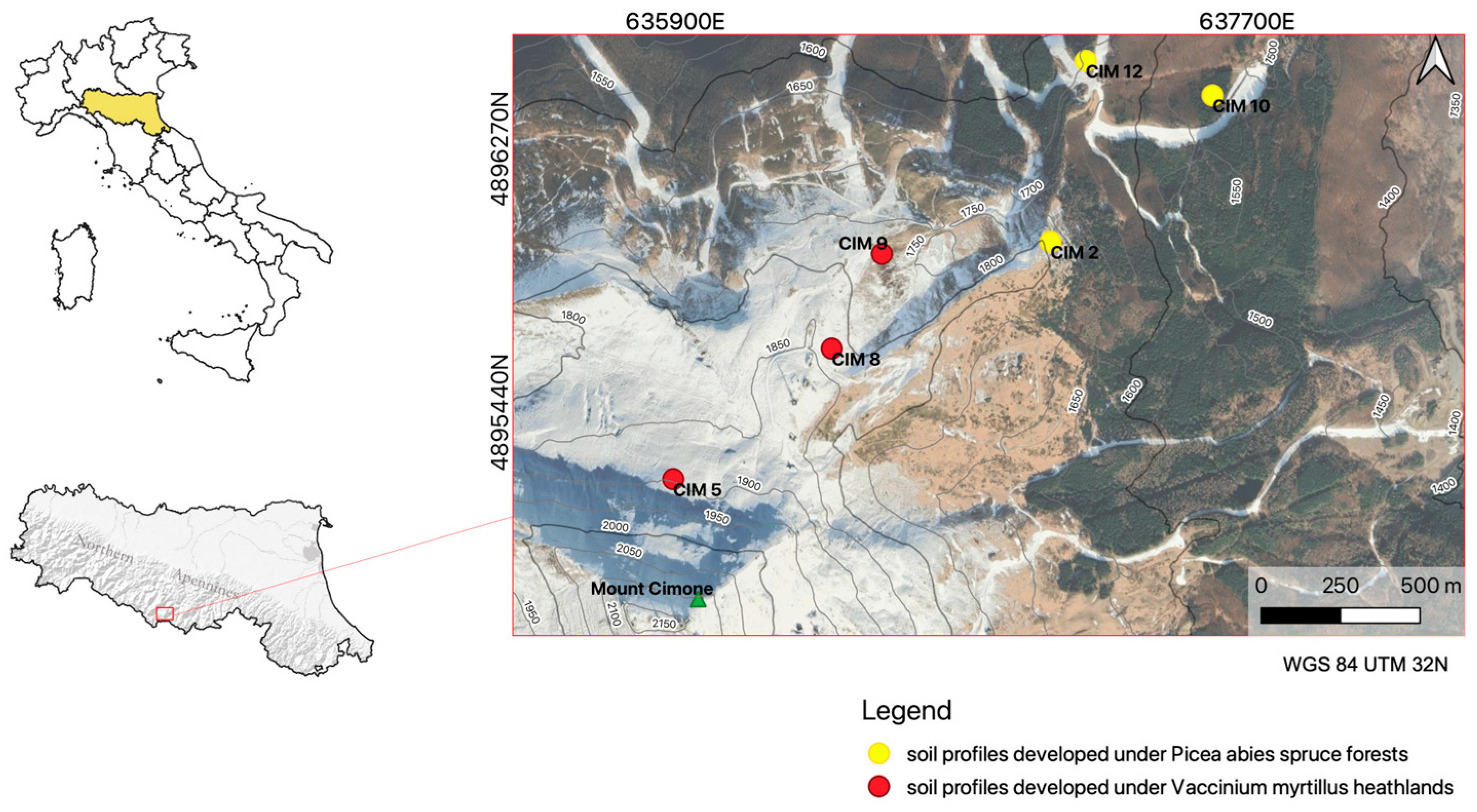
The study was conducted in the Northern Apennines (Italy), near Mount Cimone, the highest peak of the mountain range (2165 m a.s.l.) (
Figure 1). In this area,
Vaccinium myrtillus (VM) heathlands and
Picea abies (PA) forests were selected. The PA stands represent relatively young, human-established forest cover, whereas the VM heathlands developed naturally and have persisted long enough to establish stable soil–vegetation feedbacks [
25].
Six soil profiles were selected along an altitudinal gradient ranging from 1654 to 1939 m a.s.l., encompassing the transition from coniferous forest to high-altitude heathland, which occurs at about 1700 m a.s.l. Above the treeline, the landscape is characterized by VM-dominated heathlands, which play important ecological and socio-economic roles. VM is a widespread dwarf shrub commonly harvested by local communities for both fresh consumption and processing. The location and main characteristics of the six soil profiles are reported in
Table 1.
The sites differ in topographic position and slope steepness, thus representing a range of geomorphological and pedogenetic settings. All investigated soil profiles developed on sandstones Modino (MOD) formation, which is characterized by siliciclastic turbiditic sequences with variable sedimentary facies. Small local variations in facies and composition of MOD unit (e.g., arenaceous-dominant, marly interbedded, or glacially reworked facies), characterized the area, but parent material across the study area remains comparable from lithological viewpoint.
The morphological and physicochemical properties of the soil profiles are presented in
Tables S1 and S2 (Supplementary Materials). According to Soil Taxonomy [
26], CIM2 and CIM12 were classified as Humic Lithic Dystrudepts, CIM10 as a Lithic Dystrudept, and CIM5, CIM8 and CIM9 as Lithic Humudepts. Despite similar parent material, vegetation and topographic setting exerted a clear influence on the development and weathering intensity of mineral horizons. Photographs of the soil profiles are provided in
Figure S1 (Supplementary Materials).
2.2. Soils Sampling and Analyses
The sampling campaign was carried out in 2015. The soil profiles were opened, described and sampled according to the recognition of different horizons. Each soil horizon was sampled and analyzed in the laboratory. Although the dataset is more than 10 years old, REE concentrations are relatively stable features due to their strong adsorption onto mineral surfaces and soil organic matter [
7], and they are not expected to change substantially over this time scale in the absence of major land-use or environmental disturbances. The main inputs into the soil of REEs are typically associated with fertilization practices, other than to the parent material [
7]. In the study sites considered, the absence of anthropogenic activities, combined with no land-use change in the time passed since sampling, suggest negligible variations in REE concentrations over time. In addition, pedogenetic processes occur over long timescales, and significant changes in soil horizons and their properties are generally observable only over centennial periods [
27,
28].
Table S1 reports international description of investigated soil profiles according to “Field book for describing and sampling soils” [
29].
2.3. Laboratory Analyses
All soil horizons were air-dried, gently disaggregated, and sieved to <2 mm prior to chemical and isotopic analyses. For organic horizons, samples were finely ground in an agate mill.
Total organic carbon (TOC) and total nitrogen (TN) contents were determined using an elemental analyzer (Flash EA 1112 Series, Thermo Fisher Scientific, Waltham, MA, USA).
Soil pH was measured potentiometrically in a 1:2.5 soil-to-water suspension (
w/
v) using a combined glass electrode. Particle-size distribution was determined by the pipette method after dispersion with sodium hexametaphosphate [
30]. The cation exchange capacity (CEC) and exchangeable base cations (Ca
2+, Mg
2+, K
+, and Na
+) were determined by extraction with 1 M NH
4OAc at pH 7.0 [
31]. Exchangeable cations were quantified by inductively coupled plasma optical emission spectrometry (ICP-OES; Arcos, Spectro Analytical Instruments, Kleve, Germany). Base saturation (GBS, %) was calculated as the sum of exchangeable base cations divided by CEC × 100.
Pedogenic and poorly crystalline forms of Fe and Al were determined by selective extractions: dithionite–citrate–bicarbonate extraction (Fed, Ald; [
32]) to quantify total pedogenic oxides; the acid–ammonium–oxalate extraction in darkness (Feo, Alo; [
33]) to determine amorphous and organo-complexed forms; and Na-pyrophosphate (Alp and Fep), per [
34]. Extracts were analyzed by ICP-OES (Arcos, Spectro Analytical Instruments). The ratio Feo/Fed was used as an indicator of the degree of weathering and oxide crystallinity.
For mineral horizons, pseudo-total concentrations of major and trace elements were obtained after aqua regia digestion (HCl:HNO
3 = 3:1,
v/
v) at 95 °C, following ISO 11466 (1995) [
35]. For organic horizons, samples were digested using a mixture of concentrated HNO
3 and H
2O
2 (3:1,
v/
v) at 120 °C to ensure complete oxidation of organic matter (USEPA 3050B). The resulting solutions were analyzed by ICP-OES (Arcos, Spectro Analytical Instruments) for major elements (Al, Fe, Ca, Mg, K, Na, P, S). Certified reference materials [
25] were used for quality control, with recovery rates between 90% and 110%.
2.4. Rare Earth Elements Analysis
Sample preparation for REE analysis (La, Ce, Pr, Nd, Sm, Eu, Gd, Tb, Dy, Ho, Er, Tm, Yb and Lu) was carried out in a clean laboratory. Approximately 250 mg of finely ground sample powder (<2 mm fraction, homogenized using an agate mortar and pestle) was first treated with 30% H2O2 to remove organic matter, and then digested in a mixture of concentrated HCl and HNO3. The resulting solutions were analyzed for REE concentrations using inductively coupled plasma–mass spectrometry (ICP-MS iCAP TQ (Thermo Fisher Scientific).
Accuracy and precision, based on repeated analyses of certified reference materials and standards, were better than 10% for all considered elements. Procedural blanks contained negligible REE concentrations relative to the samples.
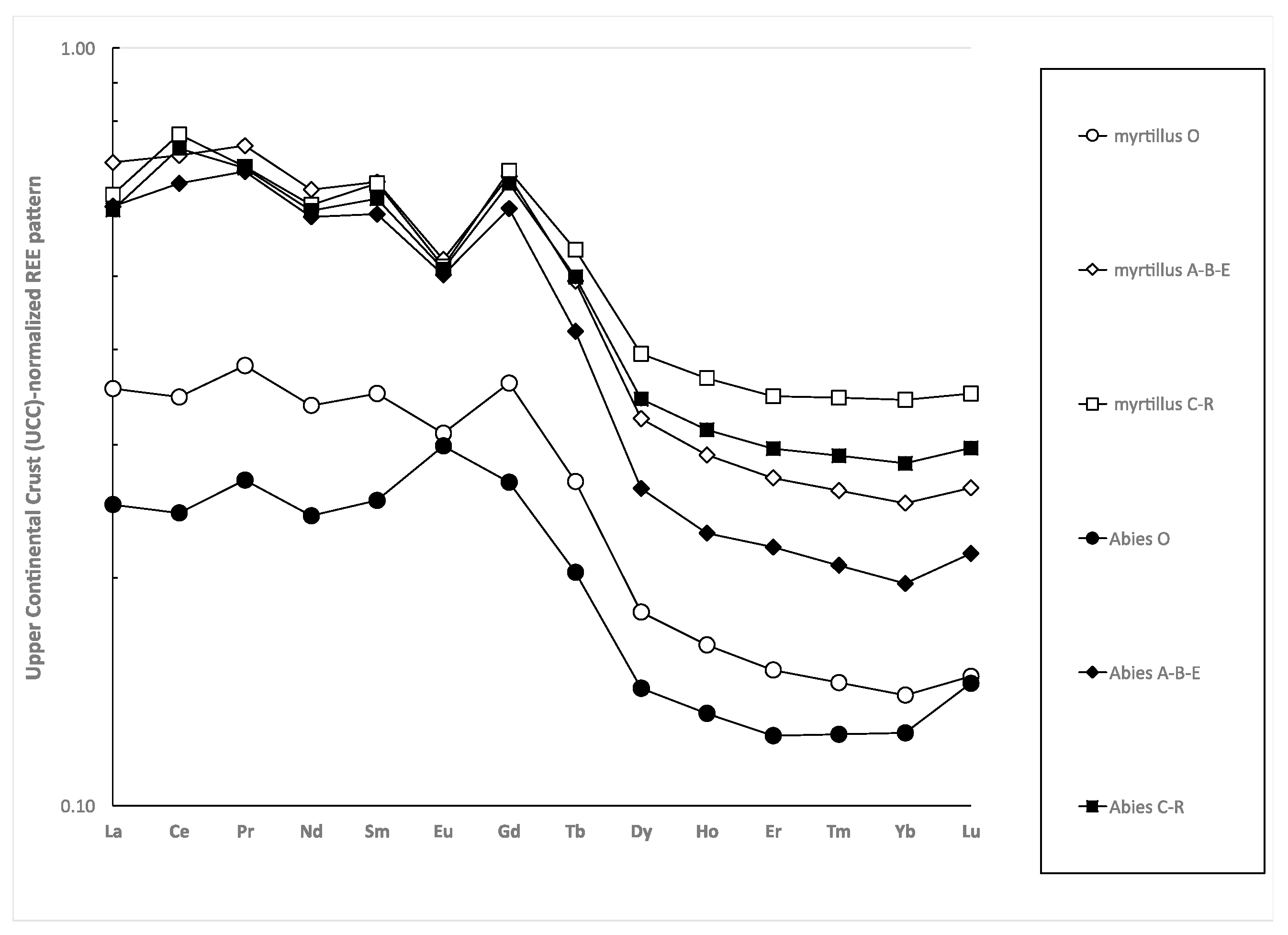
REE concentrations were normalized both to an external reference (Upper Continental Crust, UCC; [
36,
37]) and to the local parent material, according to Braun et al. [
38], Aubert et al. [
39], and Dequincey et al. [
40]. Normalized concentrations were plotted in distribution patterns with REE ordered by increasing atomic number.
2.5. Data Processing
The Spodic Index (SI) was calculated to assess the degree of spodic horizon development. According to Soil Taxonomy [
26] SI was defined as the sum of oxalate-extractable aluminum (Alo) and half of oxalate-extractable iron (½Feo).
REEs were grouped into LREEs (La, Ce, Pr, Nd, Sm and Eu) and HREE (Gd, Tb, Dy, Ho, Er, Tm, Yb and Lu). Fractionation between REE groups was evaluated using LREE/HREE ratios and the total REE concentration (ΣREE). Elemental ratios (La/Gd) and anomalies for europium (Eu/Eu*) (1) and cerium (Ce/Ce*) (2) were calculated according to Mourier et al. [
41], Ndjigui et al. [
42] and Vázquez-Ortega et al. [
43]. The overall analytical workflow is summarized in
Figure S2 (Supplementary Materials).
Europium anomalies (Eu/Eu*) were computed after normalization as:
Cerium anomalies (Ce/Ce*) were calculated as:
where the subscript N denotes normalized concentrations. Positive anomalies, values >1, indicate relative Eu or Ce enrichment, whereas values < 1 indicate Eu or Ce depletion [
44,
45].
2.6. Statistical Analyses
Ordination techniques (PCA and CA), and non-parametric tests were combined to derive data-driven horizon groupings and to formally assess whether REE-based patterns reproduce the same pedogenetic structure identified by established soil indicators [
17].
All statistical analyses were performed in RStudio (version 2025.09.0+387; released 12 September 2025). PCA and CA were applied to all soil horizons using physicochemical properties and nutrient-related variables (organic C, total N, P, Ca, Fe, Al, and C/N, C/P and Al/N ratios;
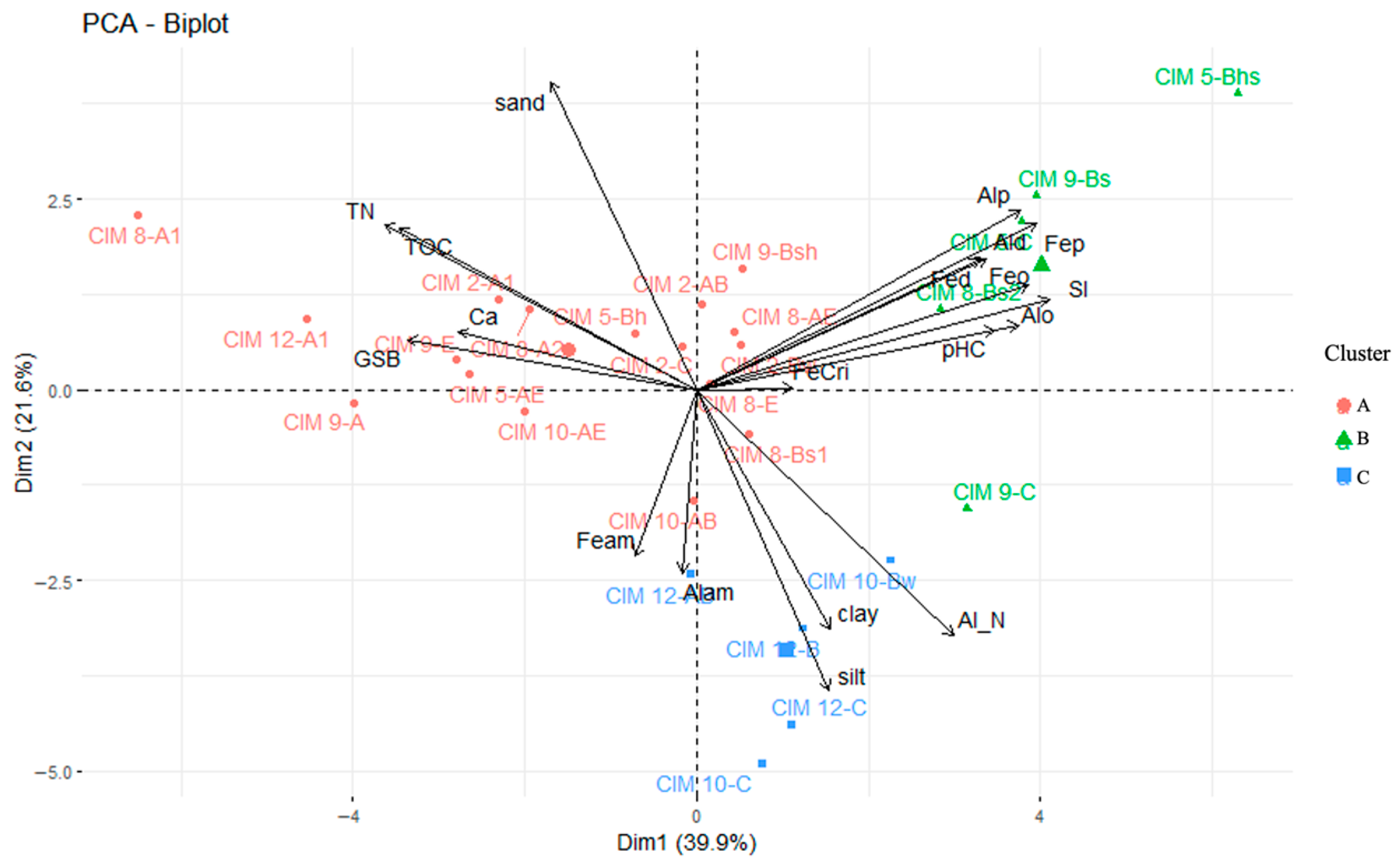
Table S3) as exploratory tools and allowing detection of dominant patterns. A further multivariate analysis was conducted exclusively on organo-mineral (A), mineral (B) and pedogenetic substrate (C) horizons, using selected physicochemical variables (pH, GSB, exchangeable Ca, sand and clay fractions, organic C and total N) together with pedogenic Fe–Al fractions (Alo/Feo, Alp/Fep, Ald/Fed) and the Spodic Index (
Table S4).
Clusters were defined through hierarchical clustering based on Euclidean distances calculated on standardized variables and validated by PCA ordination. Differences among clusters were tested using the non-parametric Kruskal–Wallis test, applied to identify statistically significant contrasts among groups.
3. Results
3.1. Distribution Patterns of Biogenic Nutrients and Weathering-Related Elements
Both VM and PA soils developed thick Oi horizons, although with slightly different mean thicknesses and a high variability (2.9 ± 2.2 cm and 2.0 ± 1.3 cm, respectively). In both vegetation types, the Oe layer was the thickest organic horizon, with greater thickness under VM (5.3 ± 2.3 cm) than under PA (2.6 ± 2.1 cm). All profiles contained the Oi, Oe and Oa horizons, except profile CIM10, in which only an Oe horizon was separated due to indistinct boundaries.
Below organic horizons, in all soil profiles A or transitional AE or AB horizons were identified, overlying Bs or Bw horizons depending on vegetation cover (Bhs or Bs in VM and Bw in PA;
Table S1). C horizons were at the bottom of soil profiles.
The distribution patterns of biogenic nutrients (C, N, P, S) and weathering-related elements (Al, Fe) varied primarily along soil horizons (
Table S3).
Vegetation effects were evaluated by applying the Kruskal–Wallis test to compare elements distribution under VM and PA within corresponding horizon types. Most nutrient variables did not differ significantly between vegetation types. Significant differences were detected only for total N and P in Oi horizons (N: 0.8 vs. 1.6%; P: 0.5 vs. 0.9 g kg
−1, respectively for VM and PA) and for total Fe in A and eluvial horizons (16.7 and 18.3 vs. 23.3 g kg
−1, respectively for VM and PA;
Figure S3).
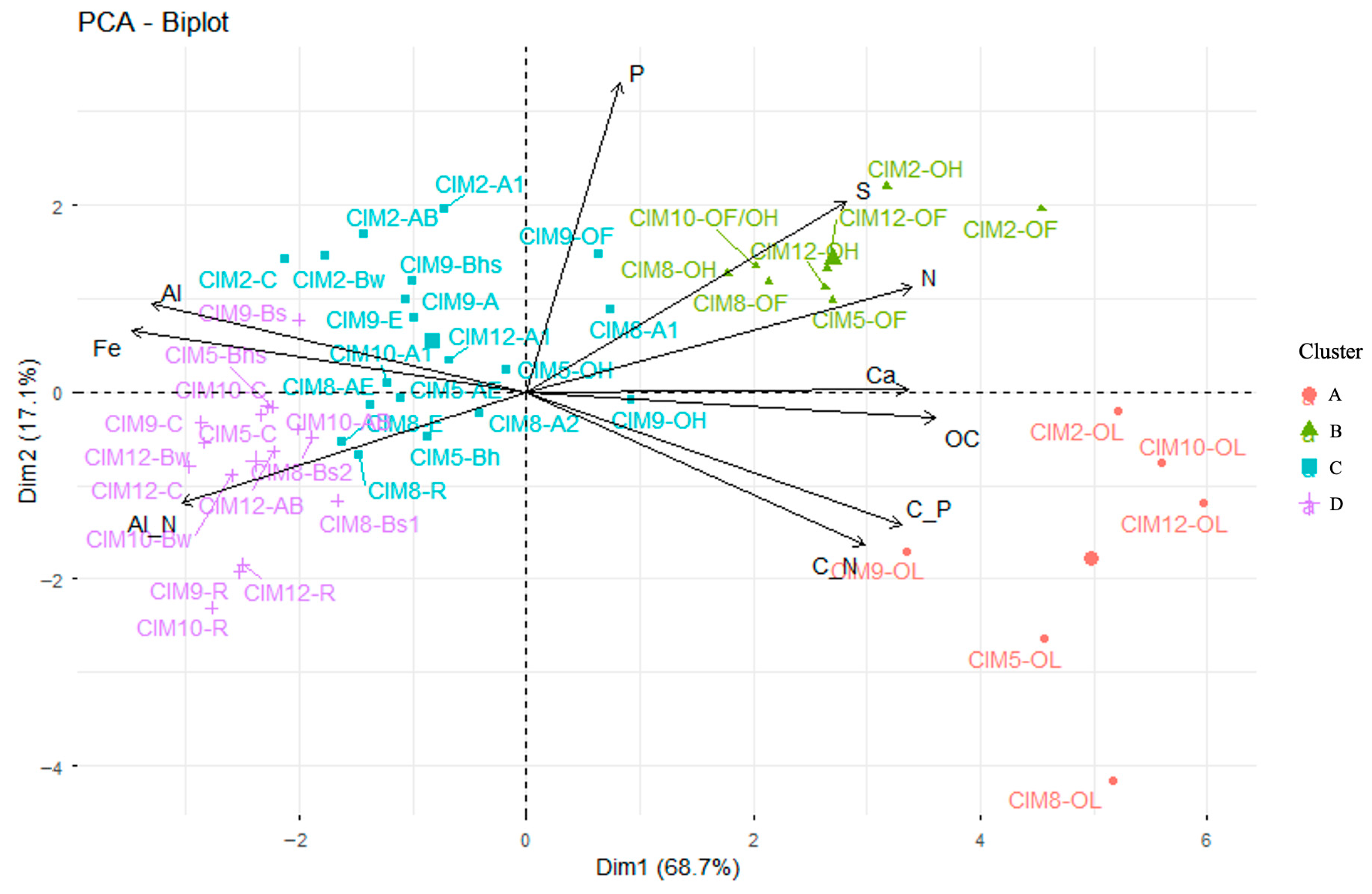
To further explore the joint variation among physicochemical parameters and to identify potential horizon groupings independent of vegetation type, CA and PCA were performed on whole dataset (
Figure 2 and
Figure S4). These multivariate approaches allowed us to identify the dominant gradients structuring soil variability and to assess the relative influence of organic versus mineral components.
The axis 1 of PCA (Dim1, 67.5% of the total variance) described a dominant organic-to-mineral gradient, characterized by decreasing C, N and P contents and increasing Al and Fe concentrations. The axis 2 (Dim2, 18.2%) captured more subtle variations associated with nutrient stoichiometry (P and S) and the Al/N ratio.
The resulting clusters reflected this geochemical structure (
Figure 2). Cluster A comprised litter horizons (Oi), which was clearly identifiable along Dim1 due to their high C, N and P contents and elevated C/N and C/P ratios. Cluster B grouped partially decomposed and humified organic horizons (Oe and Oa), characterized by elevated N and S and intermediate C/N and C/P ratios. Cluster C included organo-mineral horizons and illuvial B horizons of VM soils, representing the transition from organic-dominated layers to horizons with increasing Al and Fe accumulation. Cluster D comprised mineral subsoil horizons, characterized by the highest Al, Fe and Al/N values and the lowest concentrations of biogenic elements.
Cluster composition varied with vegetation type. Soil horizons under VM mostly belonged to cluster C, including their B horizons, whereas the deepest mineral horizons of profiles CIM10 and CIM12 grouped within cluster D. Their overlying organo-mineral horizons clustered instead within cluster C, indicating intermediate chemical characteristics. Profile CIM2 (under PA) also clustered with more organic-rich horizons, reflecting shallow soil development and a strong influence of surface organic inputs.
Overall, these results highlighted a well-defined vertical sequence from organic-rich horizons to mineral horizons dominated by pedogenic Al and Fe, with vegetation modulating horizon thickness, chemical composition and vertical arrangement along this gradient.
To quantify the geochemical differences identified by the multivariate analysis (
Figure 2), the main chemical properties of the four clusters were compared using non-parametric statistics (
Table 2). Cluster A showed the highest organic C contents and the highest C/N and C/P ratios, together with the lowest Al, Fe and Al/N values. Clusters A and B, grouping Oi, Oe and Oa horizons, exhibited significantly higher N, Ca, P and S concentrations than the clusters C and D, grouping mineral horizons. However, cluster B showed intermediate Al and Fe contents and Al/N ratios. It confirmed the higher degradation of organic matter in Oe and Oa horizons (cluster B) than in Oi (cluster A) and the higher interaction with the mineral phase.
Although clusters C and D showed similar Ca and Fe concentrations, cluster D was characterized by significantly lower C, N, P and S contents and higher Al and Al/N values, consistent with a stronger mineral control and reduced organic influence on horizon properties.
The differences among clusters indicate a progressive shift in element distribution from nutrient-rich organic horizons to deeper mineral horizons increasingly shaped by pedogenic processes related to Al–Fe.
3.2. Weathering Indicators and Horizon Differentiation
To further resolve pedogenetic differentiation in the mineral part of the profiles, PCA and CA were applied exclusively to organo-mineral and mineral horizons (
Figure 3).
Three clusters were identified. Cluster A comprised surface mineral horizons (A, E, AB) of both vegetation types and was characterized by higher sand content, greater total organic C and N, higher exchangeable Ca, and higher base saturation. Cluster B included the subsoil horizons of CIM5, CIM8 and CIM9 (VM), which were strongly associated with pedogenic Fe–Al phases and high Spodic Index values. Cluster C grouped the subsoil horizons of CIM10 and CIM12 (PA), which showed elevated silt and clay, and in general the higher content of pedogenic Al and Fe oxides indicating more intense in situ weathering and Bw development.
The variables that significantly differentiated the three mineral clusters are reported in
Table 3. Subsoil horizons under VM (cluster B) displayed higher Alo, Feo and SI values, whereas PA-dominated subsoil horizons (cluster C) showed significantly higher silt and clay. These patterns indicate the coexistence of two contrasting pedogenetic pathways: podzolisation conditions under VM heathlands and mineral-weathering-dominated conditions under PA forests.
3.3. Rare Earth Element Dynamics Along Soil Profiles
To assess how REEs respond to the pedogenetic contrasts identified in
Section 3.1 and
Section 3.2, the vertical distributions of LREE, HREE, ΣREE, the La:Yb ratio, and redox-sensitive anomalies (Eu*, Ce*) were examined along individual profiles (
Figure S5). Differences between soil horizons under vegetation types were evaluated using the Kruskal–Wallis test.
LREE and HREE concentrations were generally higher under VM than under PA, particularly in A–E and C horizons (e.g., LREE: 0.67 ± 0.09 vs. 0.61 ± 0.07 mg kg−1 in upper mineral layers; 0.75 ± 0.02 vs. 0.65 ± 0.04 mg kg−1 in C horizons). Total REE concentrations (ΣREE) were significantly higher in C horizons under VM (6.37 ± 0.7 mg kg−1) compared with PA (5.37 ± 0.4 mg kg−1). In organic horizons, Oe and Oa layers showed higher REE contents than Oi horizons.
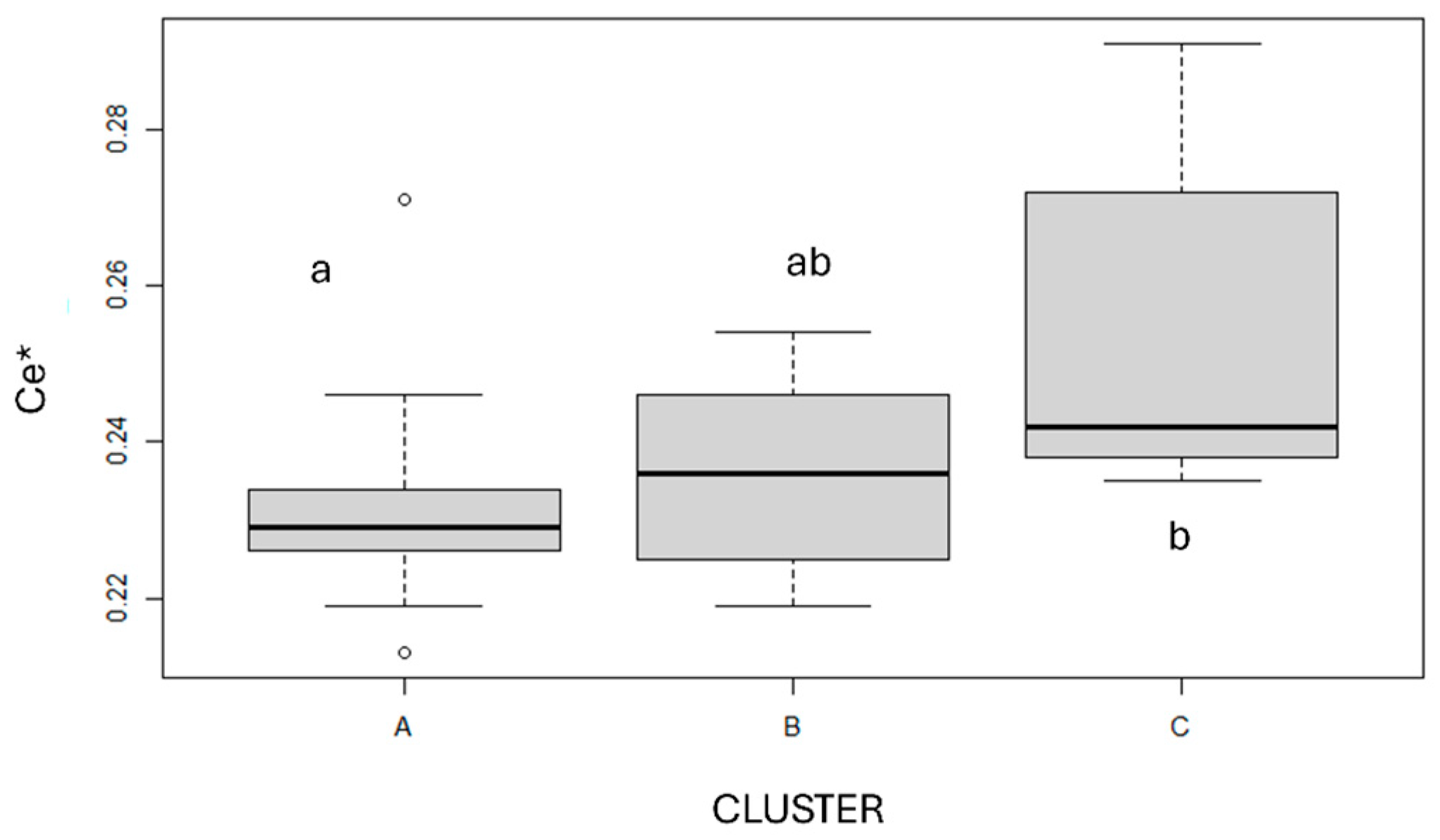
Eu anomalies (Eu*) were positive in Oa horizons under PA (1.07) but negative under VM (0.83). Ce anomalies (Ce*) were always negative and showed marked higher values in B and C horizons under PA. In VM soil profiles, Ce* displayed a slight increase in C horizons relative to the other mineral horizons (0.26 vs. 0.23). Beyond these differences, no additional significant contrasts between vegetation types were detected.
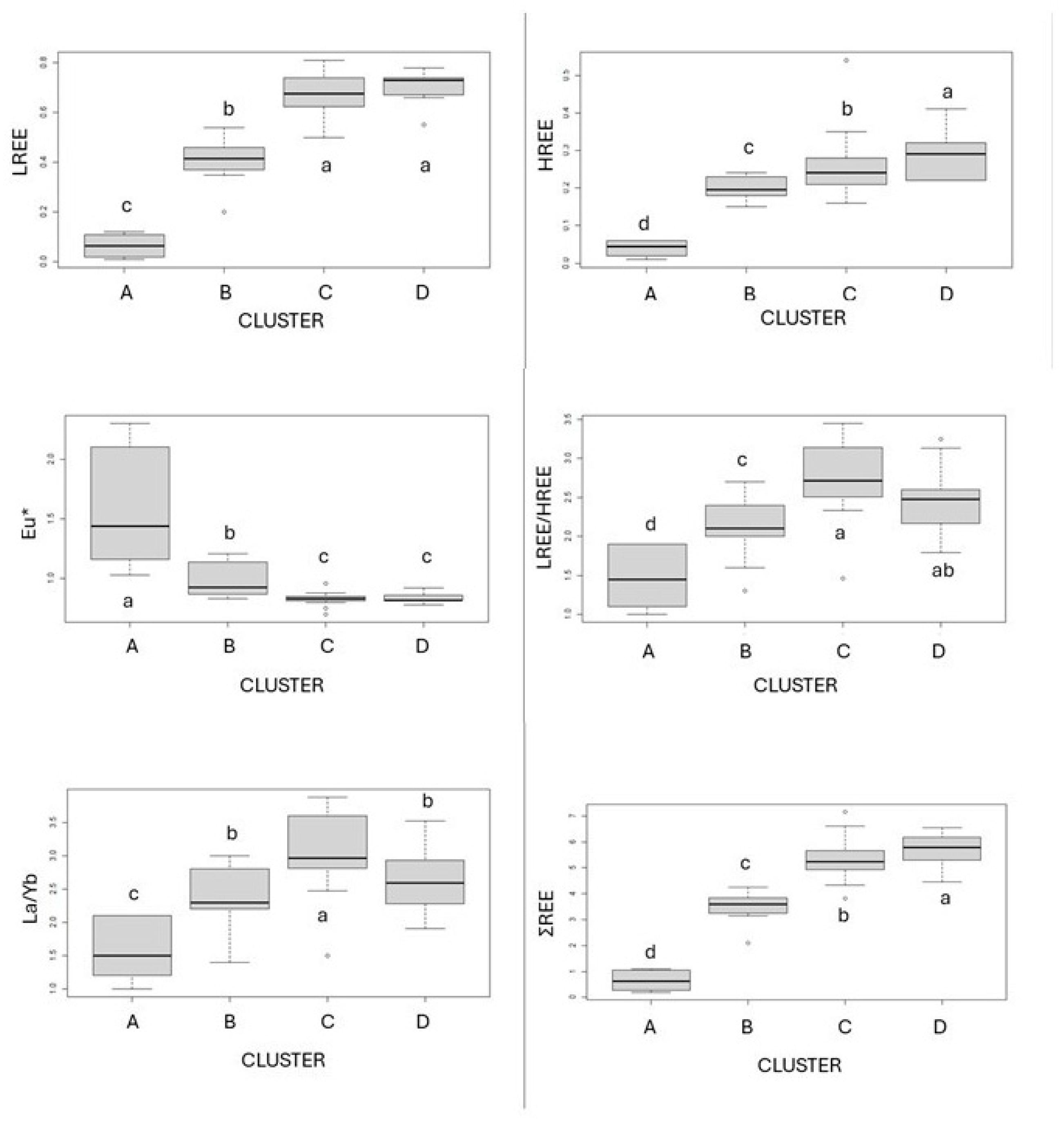
When REE variables were examined across the four clusters derived from the first multivariate analysis (
Figure 4), Oi horizons (cluster A) were characterized by very low REE concentrations and positive Eu anomalies. REE contents increased in organo-mineral and mineral horizons (C and D clusters, respectively), indicating a general enrichment with depth. However, Kruskal–Wallis test applied to the three mineral clusters identified in
Section 3.2, and thus excluding organic horizons, revealed no significant differences for ΣREE and LREE/HREE ratios (
Table S5). Only Ce* differed significantly among mineral clusters, being elevated in subsurface horizons under PA (
Figure 5).
Overall, REE distributions exhibited consistent vertical gradients (
Figure 6), but did not distinguish the pedogenetic groupings identified by Fe–Al indicators and the Spodic Index, suggesting that REE variability is primarily controlled by mineralogical and depth-related factors rather than by horizon differentiation processes.
4. Discussion
4.1. Vegetation Controls on Surface Soils Development and Nutrient Stoichiometry
Soils under
Vaccinium myrtillus exhibited thicker O horizons, especially Oe, than those under
Picea abies, reflecting species-specific differences in litter input and decomposition dynamics [
46]. Oi horizons under
Vaccinium myrtillus were characterized by lower total N and P contents compared with
Picea abies, reflecting limited nutrient availability in the litter.
These patterns agree with [
47], who showed that tree and shrub species strongly influence humus form differentiation in Italian forests through effects on litter quality, soil acidity and faunal activity. The thick, poorly incorporated organic materials under VM align with Moder-like humus type conditions characterized by reduced faunal mixing and stratified organic horizons [
48]. In contrast, the thinner organic horizons and P total content observed under PA would suggest more efficient litter incorporation in mineral soil and a tendency toward Amphimull-like humus type forms.
4.2. Transition from Organic to Mineral Horizons: Contrasting Pathways of Al–Fe Accumulation
The transition from organic to mineral horizons showed two distinct pedogenetic trends associated with vegetation type. Under VM, elevated Alo and Feo contents together with higher Spodic Index values indicate the formation of organo-metal complexes and the onset of podzolization. In these soils, Al and Fe are mobilized from upper horizons and retained as organo-metal associations in subsurface layers, consistent with cheluviation–chilluviation process [
11].
In contrast, subsurface horizons under PA were characterized by higher silt and clay contents, elevated Al/N ratios and the absence of diagnostic spodic features. These characteristics are consistent with enhanced in situ mineral weathering and the development of Bw horizons, rather than with the downward translocation of Al–Fe–organic complexes. Thus, vegetation appears to influence both the intensity and the mechanism of Al–Fe accumulation in subsurface horizons, promoting podzolic differentiation under Vaccinium and mineral alteration under Picea.
4.3. Al/N Ratio as an Indicator of Aluminum Mobility and Early Horizon Differentiation
The Al/N ratio provided an additional indicator to distinguish the pedogenetic pathways under VM and PA. Elevated Al/N values in subsurface horizons under PA corresponded to clay- and silt-enriched Bw horizons identified in the multivariate analysis, reflecting enhanced in situ mineral weathering and increased pools of reactive Al [
49].
By contrast, VM soils exhibited moderate Al/N values in A and E horizons, where Al remains predominantly associated with organo-metal complexes, as indicated by higher Alo, Feo and Spodic Index values. The comparatively limited increase in Al/N with depth under VM reflects the dominance of organic–metal translocation processes. When interpreted together with Fe–Al selective extractions and SI, the Al/N ratio effectively differentiates Al enrichment driven by organic complexation from that resulting from in situ weathering.
4.4. Limited Ability of Rare Earth Elements to Track Pedogenetic Differentiation
In light of the contrasting pedogenetic pathways identified under the two vegetation types, the ability of REEs to trace horizon differentiation was critically assessed. The relatively small number of soil profiles represents a limitation of the study. However, the use of multiple horizons within each profile increases the dataset size and allows the identification of consistent geochemical trends. Therefore, the multivariate results are considered robust for exploratory interpretation of pedogenetic processes.
This limited sensitivity of REEs to pedogenetic differentiation may also reflect the strong control exerted by the parent sandstone lithology. In siliciclastic systems, REE distributions are often largely inherited from the mineralogical composition of the parent material and remain relatively conservative during weathering [
12,
13]. The abundance of REE-bearing minerals and their differential stability, together with grain-size-dependent processes and the role of clays and Fe–Al phases as major REE carriers [
37], can mask the effects of soil-forming processes. Consequently, although pedogenetic mechanisms such as podzolization may influence REE redistribution, their signal can be partially overprinted by lithological inheritance, limiting the ability of REEs to resolve pedogenetic boundaries identified by independent indicators.
Although some vegetation-related contrasts were observed (i.e., soil profiles in VM displayed higher LREE and HREE in the A and E horizons and higher ΣREE in the C horizons), these patterns primarily reflect differences in surface organic inputs and litter chemistry rather than subsurface processes. This is consistent with findings that REE signatures in upper soil layers respond to litter quality and degradation pathways [
10,
50].
Across all profiles, Eu anomalies decreased with depth, indicating progressive feldspar weathering, while Ce anomalies varied markedly under PA and increased slightly in the C horizons under VM. However, multivariate analyses revealed no significant differences among clusters for ΣREE, LREE/HREE, Eu* or La/Yb, and only Ce* distinguished the subsurface spruce horizons. Importantly, these REE trends did not reproduce the pedogenetic groupings identified by the other physico-chemical properties: horizons clustering based on Al, Fe, SI and texture showed no corresponding separation in ΣREE, LREE/HREE or anomaly patterns, confirming that REEs respond to different controls than those driving horizon differentiation. The absence of coherent REE gradients along pedogenic boundaries confirms that REEs reflect broad mineralogical or depth-related controls rather than the specific processes that differentiate podzolic and cambic horizons. By contrast, Fe–Al selective extractions and SI captured clear and consistent pedogenetic signatures.
4.5. Implications for Pedogenesis at the Treeline in the Northern Apennines
The results highlighted the pivotal role of vegetation in driving pedogenesis at the treeline. VM promotes thicker acidic organic horizons and facilitates the formation of organo-metal complexes, leading to incipient podzolization. In contrast, PA favors mineral weathering and Bw development due to thinner organic layers and greater exposure of mineral surfaces. PA stands, being relatively recent reforestation systems, have not yet developed the organic–mineral translocation conditions required for podzolization. These vegetation-driven differences explain why Fe–Al indicators effectively track horizon differentiation, whereas REEs primarily reflect depth-related and mineralogical controls.
The coexistence of podzolic and cambic pathways within a short altitudinal span illustrates the strong spatial heterogeneity of soils at the treeline and underscores how vegetation composition governs the balance between organic–metal translocation and mineral alteration. In this sandstone-dominated landscape, Fe–Al pedogenic phases, rather than REEs, emerge as the most reliable proxies for weathering intensity and soil evolution.
5. Conclusions
This study demonstrates that vegetation exerts a primary control on early soil development at the treeline of the Northern Apennines. VM promotes thick acidic organic horizons and organo-metal complex formation, leading to incipient podzolization, whereas PA favors mineral weathering and Bw development under thinner organic layers. These contrasting pathways occur over short spatial scales, highlighting how vegetation-mediated biogeochemical processes can diverge Al–Fe distributions and pedogenetic trajectories even under the same parent material and climate.
REE patterns show clear vertical trends, with depletion in surface O horizons and enrichment in deep C horizons, reflecting strong parent-material control. Although vegetation influences REE concentrations in upper horizons, REE distributions do not reproduce the pedogenetic groupings identified by Fe–Al selective extractions and the Spodic Index. Only Ce* showed partial sensitivity to subsurface variability. Overall, REEs appear to be weak tracers of pedogenetic differentiation in these sandstone-derived mountain soils, whereas Fe–Al phases provided more reliable indicators of horizon development and weathering intensity.
The coexistence of podzolic and cambic pathways at the treeline highlights the strong spatial heterogeneity of mountain soils and underscores the role of vegetation history in shaping soil evolution. Differences between long-established heathlands and relatively recent spruce reforestation stands further suggest that vegetation legacies matter, and that shifts in vegetation composition can redirect pedogenetic processes, potentially altering nutrient cycling, metal mobility and associated ecosystem functions. Further research integrating soil solution chemistry, microbial dynamics and long-term vegetation monitoring will help clarify how these coupled vegetation–soil systems respond to future environmental change in high-elevation landscapes.





 ,
,