1. Introduction
Soil erosion represents a pervasive form of land degradation globally, and it is particularly severe in arid and semi-arid environments characterized by fragile soils, sparse vegetation cover, and irregular precipitation patterns. The detachment and transport of topsoil not only reduce soil fertility but also lead to declines in agricultural productivity, accelerated reservoir sedimentation, and deterioration of water quality, thereby undermining ecosystem stability and food security. Recent studies emphasize the magnitude of these impacts in drylands and the urgent need for spatially explicit erosion risk assessments [
1].
In North Africa, and particularly in Tunisia, soil erosion constitutes a major environmental and socio-economic challenge. The country’s arid to semi-arid climate, combined with rugged topography and often unsustainable land use practices, accelerates soil degradation and threatens both water and land resources. In southern Tunisia, erosion processes are further exacerbated by episodic torrential rainfall and flash runoff, which mobilize large sediment loads in wadis and irrigated agricultural areas. Accordingly, the quantification and spatial mapping of soil erosion processes in such regions are essential for sustainable land and water resource management.
Among the empirical models developed to estimate soil loss, the RUSLE has been widely adopted due to its relative simplicity, robustness, and compatibility with (GIS). The RUSLE model estimates mean annual soil loss (A) using five major factors: rainfall–runoff erosivity (R), soil erodibility (K), slope length and steepness (LS), cover-management (C), and support practices (P) [
2]. Although RUSLE has been applied at varied spatial scales, from continental to watershed levels [
3], its conventional formulation implicitly assumes equal weighting among factors, which may limit its analytical accuracy in heterogeneous, arid landscapes [
4,
5,
6,
7].
To address the limitations of conventional RUSLE, the integration of a multicriteria decision-making method such as AHP within a RUSLE–GIS framework has gained attention. AHP enables the explicit assignment of weights to different factors based on expert judgment and local conditions through pairwise comparisons, thereby enhancing the spatial discrimination of erosion-susceptible areas [
8,
9]. The combination of AHP with GIS and RUSLE strengthens decision-support capabilities for land use planning, prioritization of conservation measures, and the automation of spatial multi-criteria analyses [
10,
11,
12].
In Tunisia, the Wadi Sidi Aich watershed is a representative example of a landscape strongly impacted by soil erosion. Since 1999, the combined effects of upstream dam regulation and downstream agricultural water management have substantially altered the hydrological regime, increasing runoff intensity and its erosive potential. These modifications have resulted in significant sediment transport, as observed via satellite monitoring following major flood events [
13]. Field and empirical studies also suggest that rainfall erosivity within the basin can increase up to fivefold under such extreme hydrological conditions.
This complex interplay among hydrological modifications, climatic extremes, soil properties, and land use dynamics underscores the need for an integrated methodological approach that combines quantitative soil-loss estimation with spatial hazard assessment.
Therefore, the present study aims to assess and map soil erosion risk across the Sidi Aich catchment by integrating the RUSLE model with the AHP framework within a GIS environment. This approach combines quantitative estimation of annual soil loss with qualitative hazard evaluation to provide a comprehensive understanding of erosion dynamics. Specifically, the study seeks to: (1) quantify potential soil loss using a locally calibrated RUSLE model; (2) determine the relative importance of erosion-driving factors via AHP weighting based on regional expertise; and (3) identify and map areas of highest susceptibility for effective land use planning and conservation interventions in arid and semi-arid landscapes.
2. Materials and Methods
2.1. Study Area
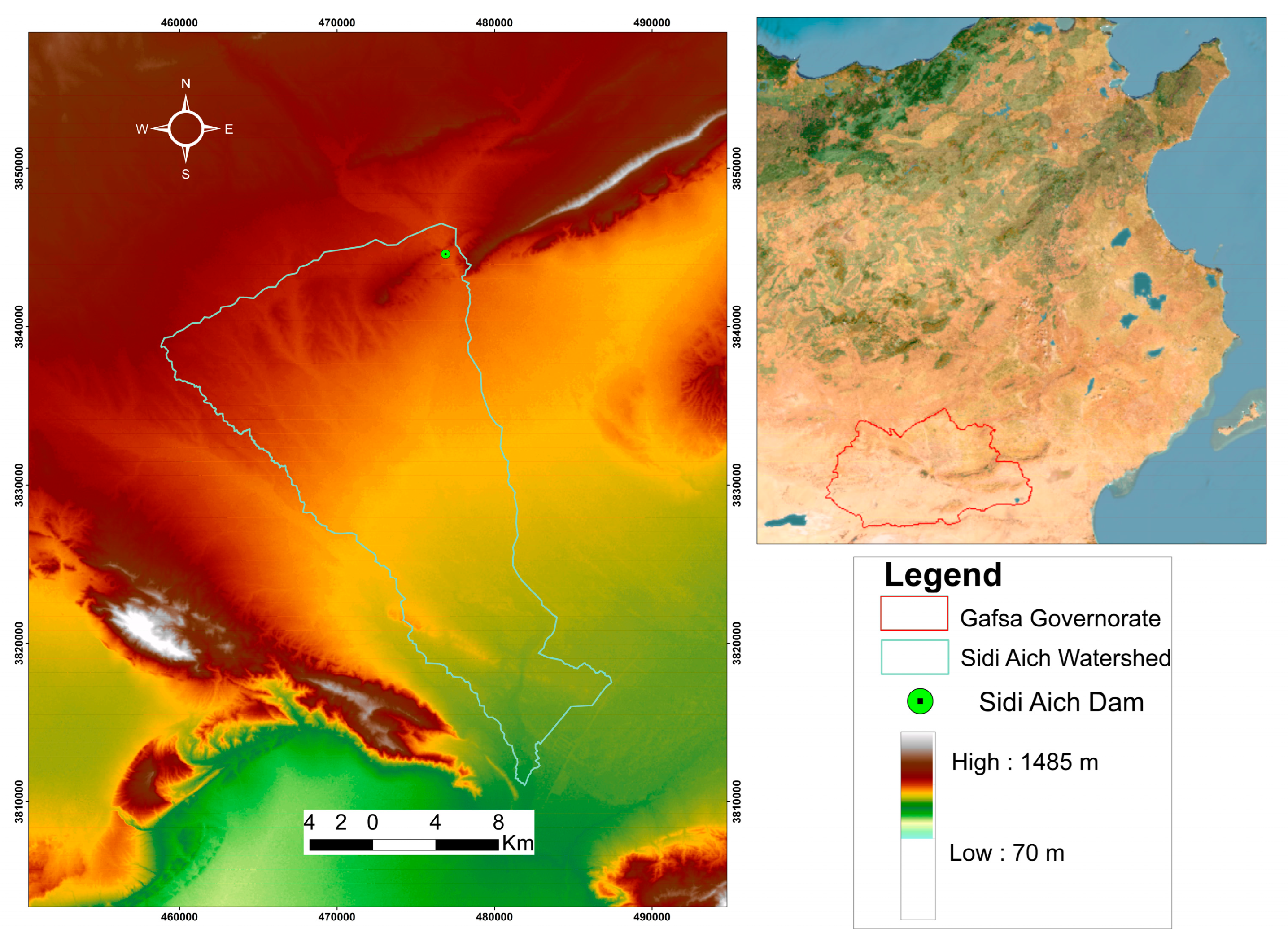
The study area (
Figure 1) was conducted in the northeast of the Gafsa Governorate, situated between the Saharan Atlas Mountains and the Saharan platform. The study area lies in south-western Tunisia, between the northern latitudes 34°13′ and 34°61′ and the eastern longitudes 6°81′ and 7°63′.
The Sidi Aich watershed corresponds to an endorheic plain filled with alluvial geological formations of medium to low permeability. The dominant soil types include alluvial and colluvial soils, vertisols, and deep isohumic soils, which are primarily derived from erosion by ephemeral streams. Consequently, these soils exhibit highly variable properties reflecting the heterogeneity of their parent materials. Land use in the area is predominantly rangeland, with a minor proportion dedicated to cereal crops and olive groves. The Sidi Aich watershed covers an area of 320.6 km
2, located downstream of the Sidi Aich Dam, which collects rainwater, con-tributes to the recharge of the northern Gafsa aquifer, and facilitates irrigation through controlled releases of stored water. The topography is relatively regular, generally sloping southward, with elevations ranging from 1364 m in the Majel Bel Abbes region to 311 m near the city of Gafsa (
Figure 1). Rainfall in the study area is highly irregular, ranging from 50 mm to 330 mm annually. The mean annual temperature is 18.8 °C, with pronounced seasonal variations, reaching 36.9 °C in July and dropping to 4.1 °C in January. The annual average potential evapotranspiration is 1800 mm, indicating that the region is subject to a permanent water deficit. The Sidi Aich Dam receives inflows from the Er Rsaf and Es Sdid wadis and their tributaries, originating from the southern part of Kasserine, with an estimated annual water volume of 27.5 mm
3 for a mean annual precipitation of 164.2 mm.
2.2. Methods
2.2.1. Database Construction of RUSLE-AHP Model
For the erosion analysis, five key factors were incorporated into the RUSLE and AHP models, chosen based on data availability and expert input to accurately delineate areas at risk. These variables include precipitation, topography derived from digital elevation data, land use, and soil characteristics, all recognized as primary controls on erosion processes.
The dataset comprised annual precipitation records along with dam discharge information for the 2000–2001 period, which were used to estimate rainfall intensity, surface runoff, and the rainfall erosivity (R) factor. Slope length (L) and steepness (S) were extracted from a high-resolution digital elevation model. Land cover was mapped using Sentinel-2 satellite imagery [
13], while soil properties and classifications were obtained from existing databases and maps.
All datasets were projected using the Universal Transverse Mercator (UTM) coordinate system (WGS84/UTM zone 32N) and resampled into raster maps. The selection of these factors was intended to account for the specific climatic and hydrological characteristics of the study area, cited in
Table 1.
2.2.2. RUSLE Model
Ref. [
14] developed the RUSLE equation for basin-scale applications. The primary purpose of the RUSLE model is to estimate the average annual soil loss. This analytical framework facilitates the production of spatial maps that help identify and assess areas most vulnerable to soil erosion. The fundamental equation of the RUSLE model is presented as follows:
where, A is the estimated average of annual soil loss (t ha
−1 yr
−1), R is the rainfall-runoff erosivity factor (Mj mm ha
−1 h
−1 yr
−1), K is the soil erodibility factor (ha
−1 Mj
−1 mm
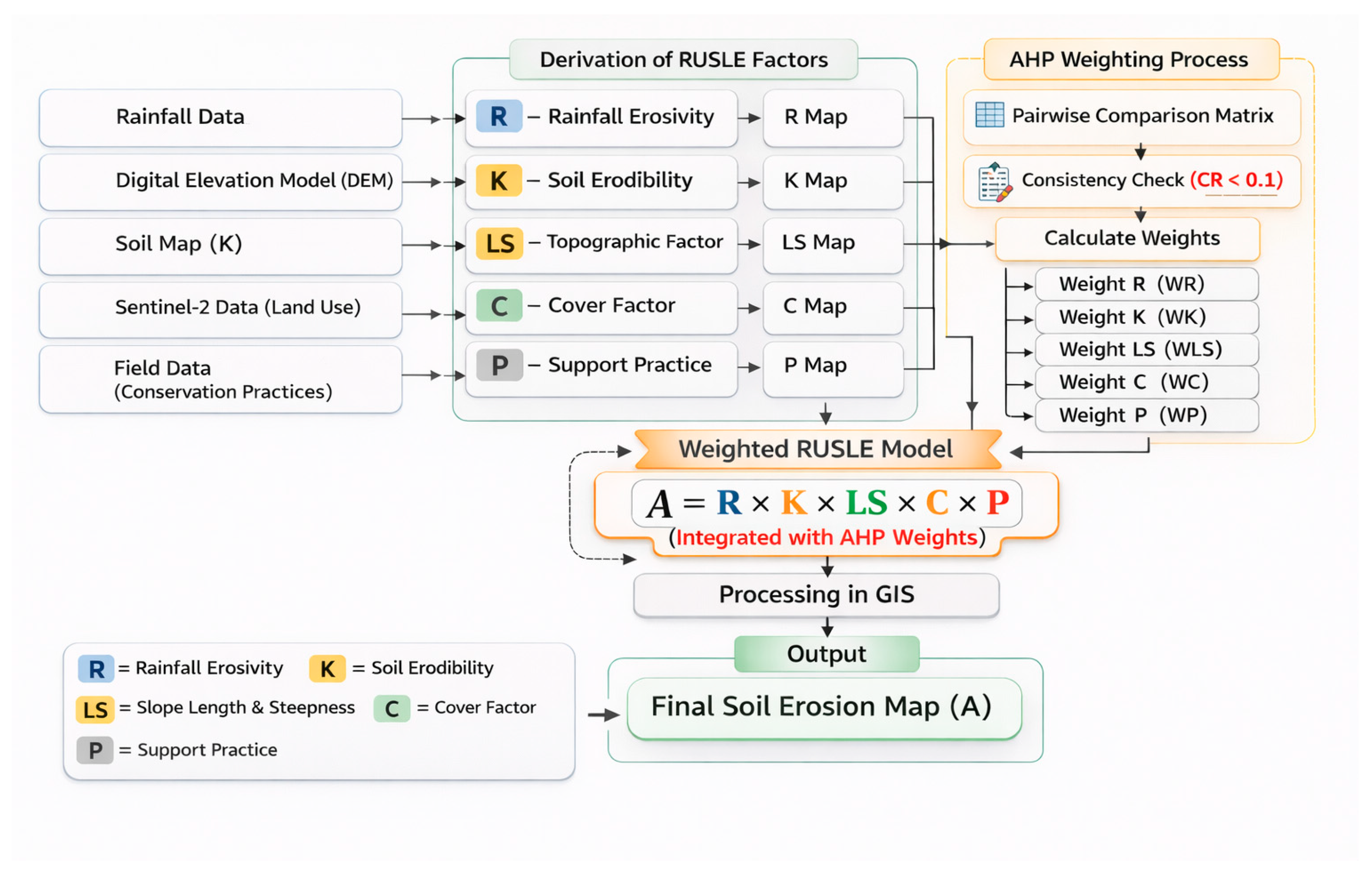
−1), LS is the slope length factor, C is the cover management factor, and P is the conservation support practices factor for the study area. The LS, C, and P factor values are dimension less values. To provide a spatial attribute for various parameters in the RUSLE model. Equation (1) has been incorporated into the mapping algebra tools in the ArcGIS 10.8 (
Figure 2), where all factors have been multiplied to estimate soil erosion rate of the study area. The procedures to generate each of the five parameters are explained below:
Erosivity (R)
Rainfall is a key factor driving soil erosion, mainly through the kinetic energy of raindrop impacts, which can detach and transport soil particles. In this study, the rainfall erosivity (R) factor was calculated by spatially interpolating values obtained from annual precipitation records. Data were collected from five climatological stations across the watershed. At Sidi Aich station, located near the dam outlet, precipitation measurements were adjusted to incorporate the effect of dam releases. This correction was necessary because regulated discharges significantly influence the estimation of rainfall erosivity (R) in the area.
To compensate for the lack of climatic data, Ref. [
15] have proproposed a surrogate method based on a relationship between R and average annual rainfall (P), expressed in mm (Equation (2))
With R: Rain Erosivity (Mj mm ha−1 h−1 yr−1); P: rainfall (mm) + dam releases (mm).
Slope Length (LS)
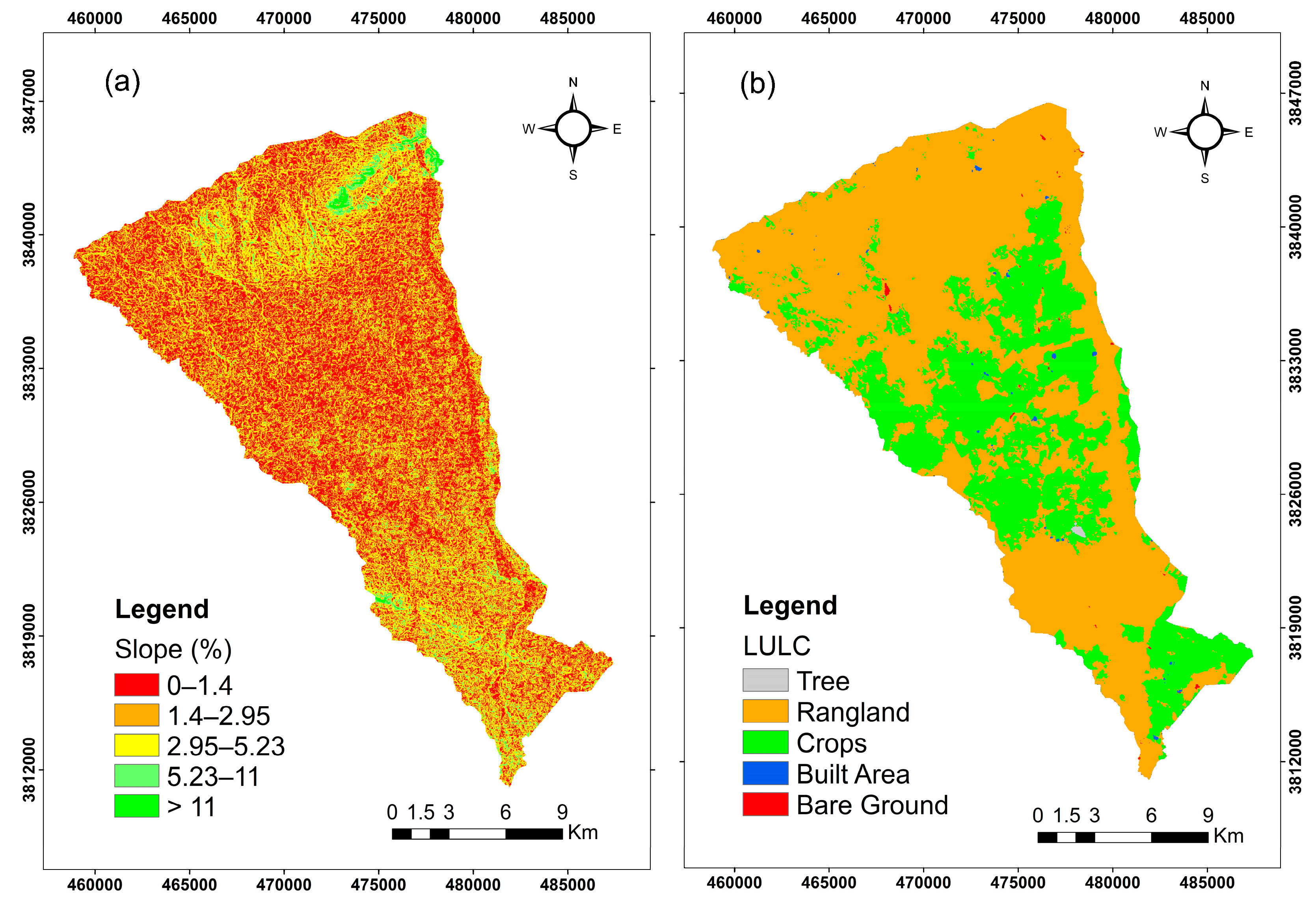
Length, shape, and especially slope gradient (
Figure 3a) are parameters that significantly influence soil erosion [
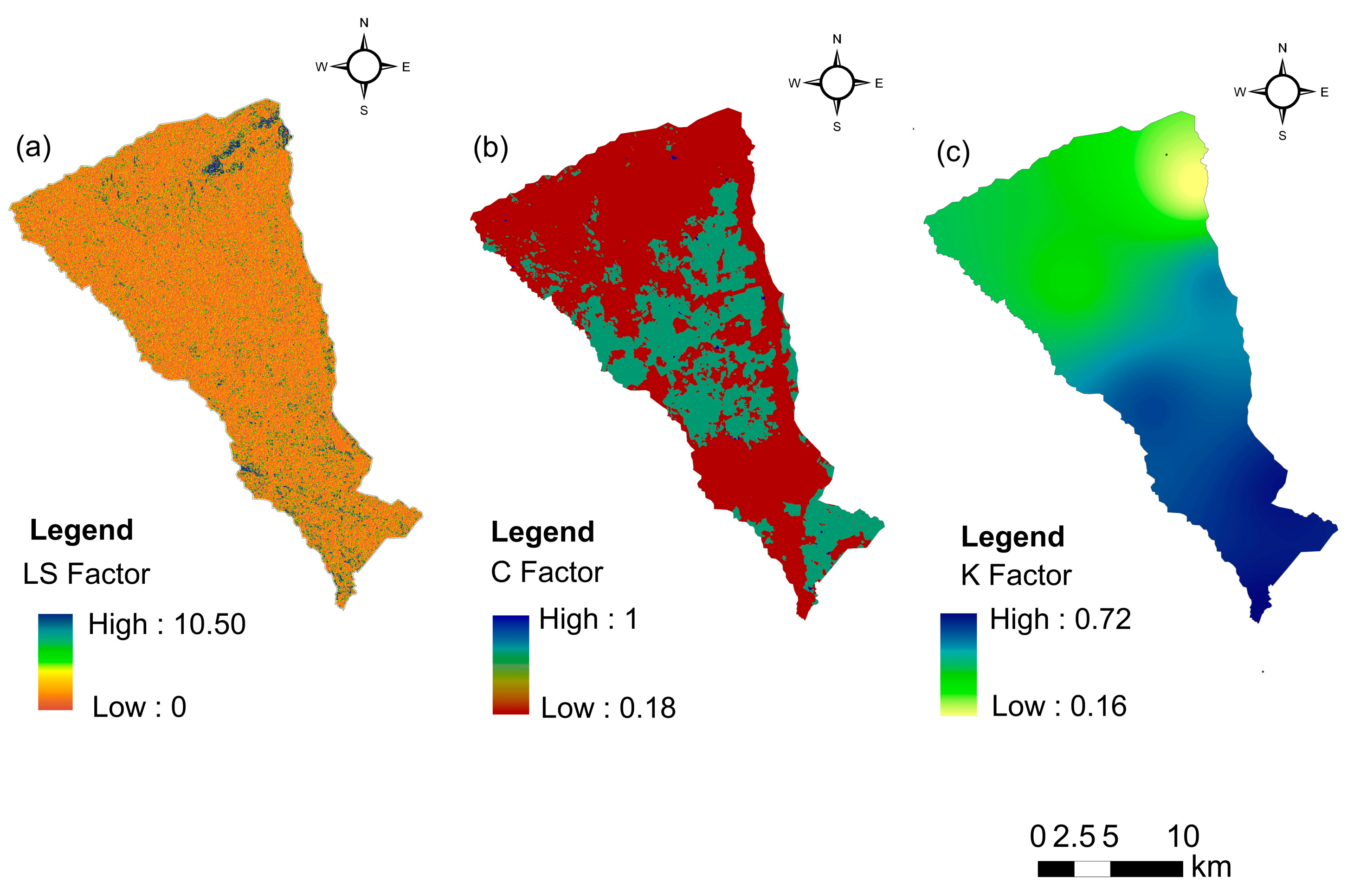
16]. The length of the slope (
Figure 4a) amplifies the slope steepness effect on runoff, although its impact in study area is limited. Based on regression analysis of the erosion plot results, Ref. [
2] established the following relationships for the “L” factor (Equation (3)):
L = slope length factor;
λ = slope length (m);
m = slope index; for S factor (Equation (4)):
S = slope steepness factor; s = slope (%).
Land Use Preparation (LULC)
Changes in land use and vegetation significantly influence the water cycle and their impact largely depends on the density and morphology of plant cover. Land use classification was performed using Sentinel-2 imagery acquired on 22 November 2020 (
https://www.copernicus.eu/en) and verified through google Earth image [
17] as well as field observations. The accuracy assessment, based on the Kappa coefficient, yielded an overall accuracy of 86%, indicating a high reliability of the classification results [
18] (
Figure 3b).
Soil Erodibility (K)
Erodibility is closely related to soil infiltration capacity, structural stability, and per-centage of organic matter present [
16,
19]. The K-factor is based on certain soil characteristics, which are texture because the soil texture (
Appendix A.1) affects the water capacity to enter the soil and infiltration rate, presence of organic matter, permeability and depth [
20].
Some authors, including [
3], have reported a correlation between this factor and parameters related to soil structure. Ref. [
20] proposed a model to calculate the K factor according to the equation (Equation (5)):
K: erosion factor (t ha−1 h−1 Mj−1 mm−1);
M: (% fine sand + % silt) (100 − % clay);
MO: percentage of organic matter;
b: Soil structure index;
c: Soil permeability.
The K-factor map (
Figure 4c) was developed based on the analysis of 25 soil samples grouped into six classes considering the repeated values (
Table 2). Soil erodibility values were spatially estimated by interpolating the measured K values using the Inverse Distance Weighting (IDW) technique. This method is well suited to situations where the sampling density is moderate and spatial variability is mainly controlled by local conditions. The K factor is particularly sensitive to soil properties such as texture (notably clay and silt fractions), structure, and organic matter content, which may exhibit strong heterogeneity over short distances. Such localized variability is especially pronounced in arid regions.
IDW assigns higher influence to nearby data points, thereby capturing short-range spatial variations in soil characteristics. In contrast to geostatistical approaches such as kriging, it avoids extrapolation beyond the range of observed values. Given that RUSLE operates as a multiplicative empirical model, the use of a deterministic interpolation approach like IDW ensures methodological consistency and contributes to a coherent spatial representation of soil erodibility.
The organic matter content was calculated according to Equation (6) and
Table 2:
We thus determined the percentages of sand, silt, clay, and organic matter.
Cover Management Factor (C)
The NDVI was employed to estimate the C factor as it reliably represents vegetation cover density, a crucial determinant of soil protection against erosion, and is widely applied in RUSLE-based studies.
The normalized difference vegetation index (NDVI) highlights the difference between the visible band of red and that of near-infrared. Mathematically defined as follows (Equation (7)):
NDVI: Normalized Vegetation Index;
NIR: Spectral reflectance in the Near-Infrared Region;
Red: Spectral reflectance in the Red region.
The mostly covered area with bare soil, with sparse vegetation, the lack of significant vegetation cover increases erosion susceptibility [
21] (
Figure 4b).
Conservation Practices (P)
Cropping practices such as soil contour plowing, alternating or terraced cropping, etc., are effective soil conservation practices.
p values were estimated as a function of slope [
22]. The
p-index values for the Sidi Aich watershed are based on studies conducted by Food and Agriculture Organization (FAO) in Tunisia (
Table 3) [
23].These values provide guidance for quantifying the influence of local conservation practices on soil erosion risk.
2.2.3. Analytical Hierarchy Process
The AHP is a widely used method for evaluating multiple environmental factors and ranking them according to specific criteria, providing a structured approach for complex decision-making [
24]. It has been commonly applied to delineate areas susceptible to various natural processes [
25,
26,
27].
In this study, the AHP framework was employed to establish the hierarchy of RUSLE parameters by considering their interrelationships and interactions, combining objective data with expert judgment [
28]. The method involves pairwise comparisons of factors affecting soil erosion and watershed hydrology. A comparison matrix was used to assign relative weights to each factor based on their influence on others. These weights were quantified using Saaty’s 1-to-9 scale, and the consistency of the assessments was checked through the consistency ratio [
29]. The resulting weights offer a quantitative means of incorporating expert knowledge into the RUSLE model, improving the spatial prioritization of erosion-prone areas (
Table 4).
Taking into account expert knowledge and the semi-arid conditions of the study area, factor weights were established using an AHP matrix, based on Saaty’s numerical scale [
30], relevant literature [
31,
32,
33,
34,
35], and local expert input (
Table 5). A pairwise comparison approach was applied to evaluate the relative importance of each factor, assigning values from 1 to 9, where 1 indicates equal importance and 9 represents the highest dominance of one factor over another [
36,
37].
The normalized weights obtained through this procedure were integrated into a GIS platform to generate a spatial map of erosion risk. In the AHP, a pairwise comparison matrix (PCM) is constructed for each set of parameters. For a matrix of order n, the PCM can be expressed as described in Equation (8).
PCM is thus a matrix with elements aij. The matrix also has the property of reciprocity:
Saaty suggested that the Consistency Ration (CR) was necessary for consistency check and the accepted limit was for CR to be less than 10% [
38,
39].
Two main steps conduct the calculation of the degree of consistency. The first step is the consistency index (CI) and the second step is the estimation of the CR as shown mathematically in Equations (10) and (11), respectively. The relations used for computing the degree of consistency are shown below:
where:
λmax is the maximum eigenvalue of each factor of the matrix, n = the size of the matrix.
where:
RI: is the random index was given by Saaty in
Table 5, for each n elements compared in the matrix.
2.2.4. Validation
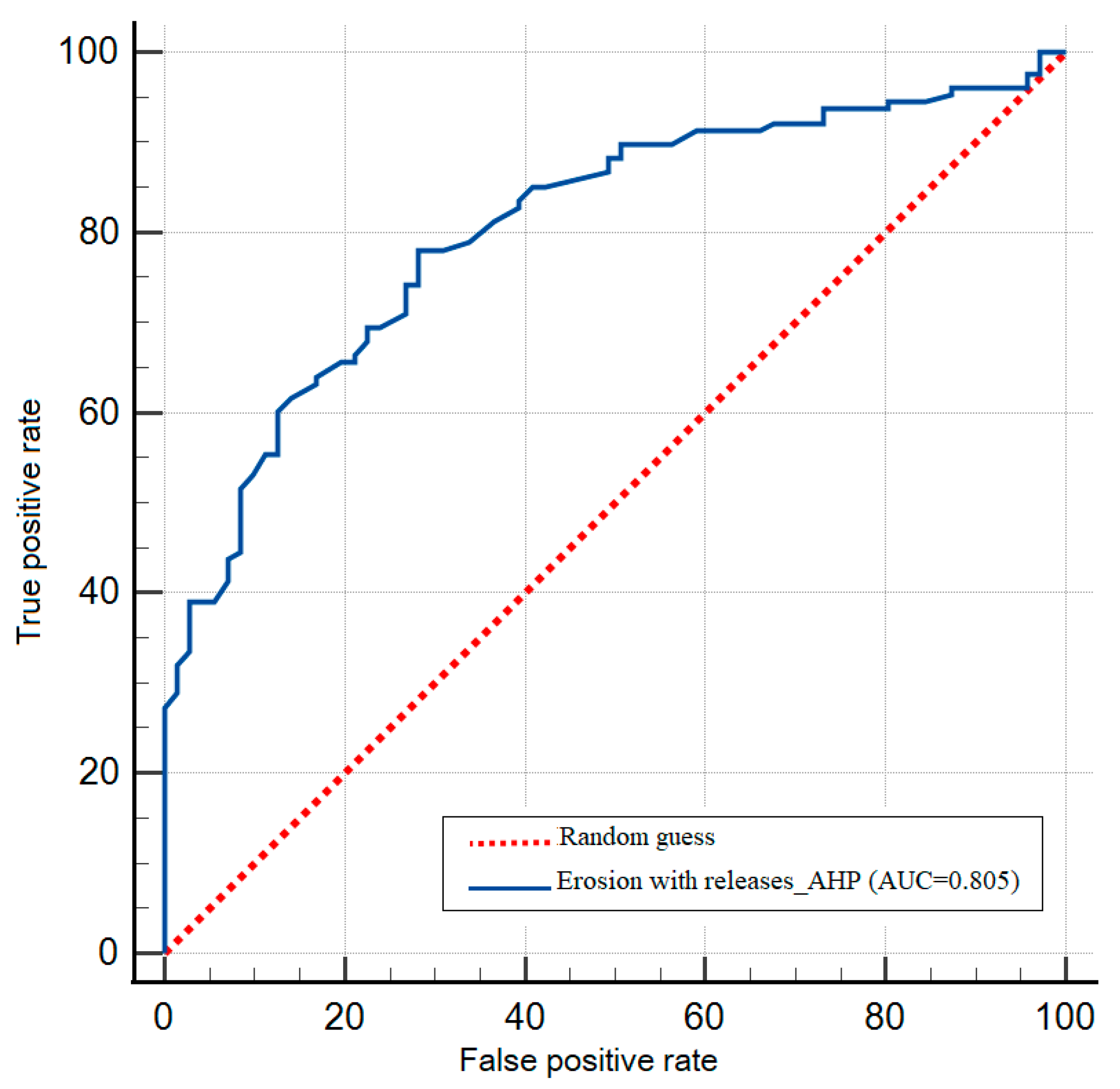
The results of these two proposed models were validated using ROC (Receiver Operating Characteristic) and AUC (Area under the Curve) was utilized to evaluate the validation of the erosion risk map, which uses a graphical technique to interpret the relationship between specificity and sensitivity [
40,
41]. The RC curve method identifies the area under the ROC curve (area under the curve AUC) as a measure of statistical success of prediction capability. The AUC value is interpreted according to five classes: 0.5–0.6 (weak), 0.6–0.7 (medium), 0.7–0.8 (good), 0.8–0.9 (very good), and 0.9–1.0 (excellent) (
Table 6) [
42].
3. Results
3.1. RUSLE Model Parameters
3.1.1. R Factor
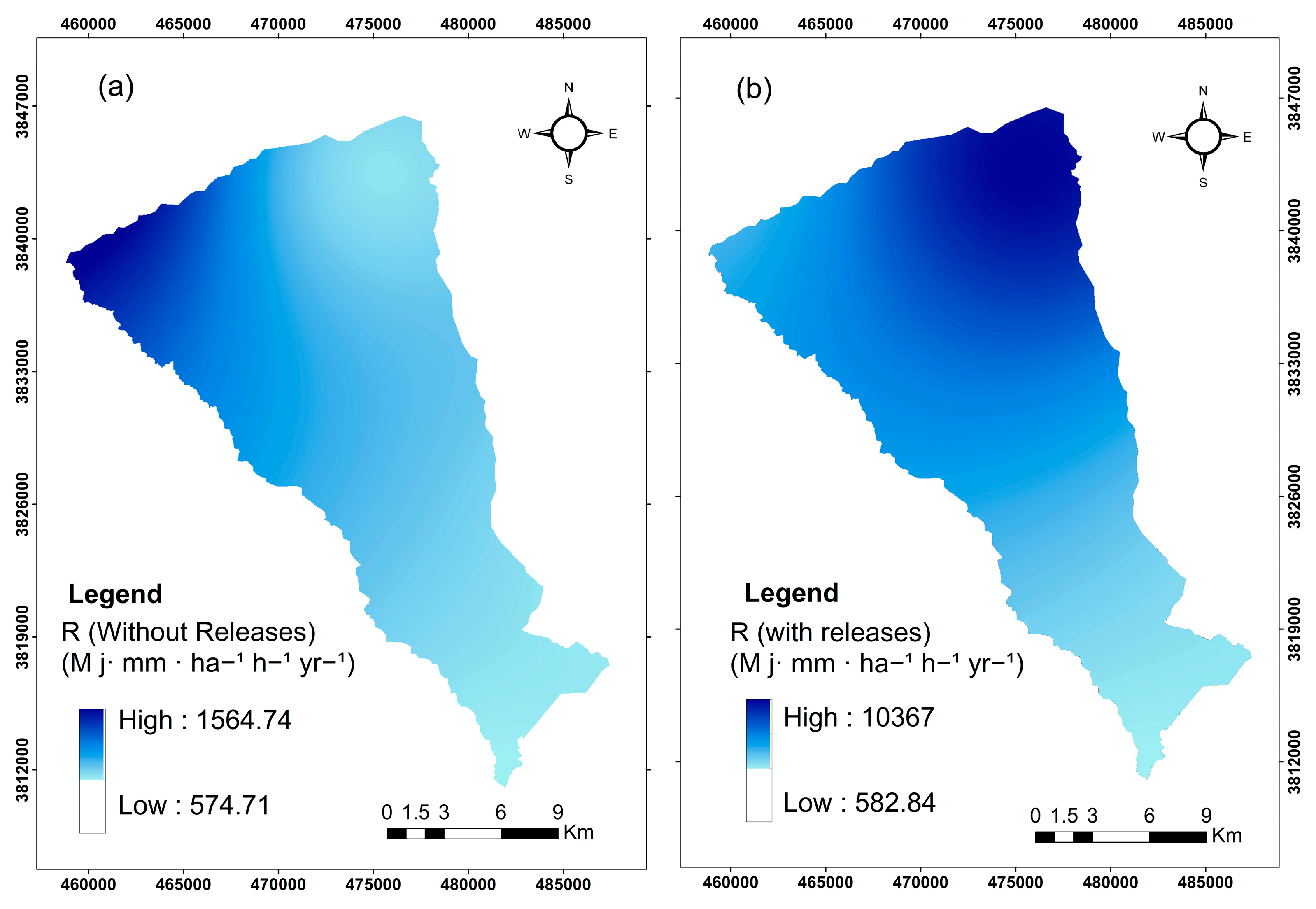
The R-factor map for the watershed was generated using mean annual precipitation data from climatological stations, interpolated via the IDW method (
Figure 5). Rainfall erosivity values ranged from 574.57 to 1653.38 without considering dam releases, and from 590.97 to 10,393 when dam releases were included. The corresponding mean ± standard deviation were 873 ± 210.29 (without dam release) and 4675.84 ± 2683.8 (with dam release). Spatial analysis indicated a general increase in erosivity from the northwest to the southeast of the watershed, with the influence of dam releases being most pronounced along the northeast-to-southeast axis.
3.1.2. K Factor
Based on calculated K values, soil sensitivity to erosion was classified into four categories: weak [0.16–0.30], average [0.30–0.44], high [0.44–0.58], and very high [0.58–0.73]. Results indicate that 94.83 km
2 (29.5%) of the area falls under very low severity, 85.69 km
2 (26.7%) under low severity, and 140.1 km
2 (43.6%) under medium severity. The predominance of smooth soil textures largely explains this distribution (
Figure 4c).
3.1.3. Combining RUSLE-AHP
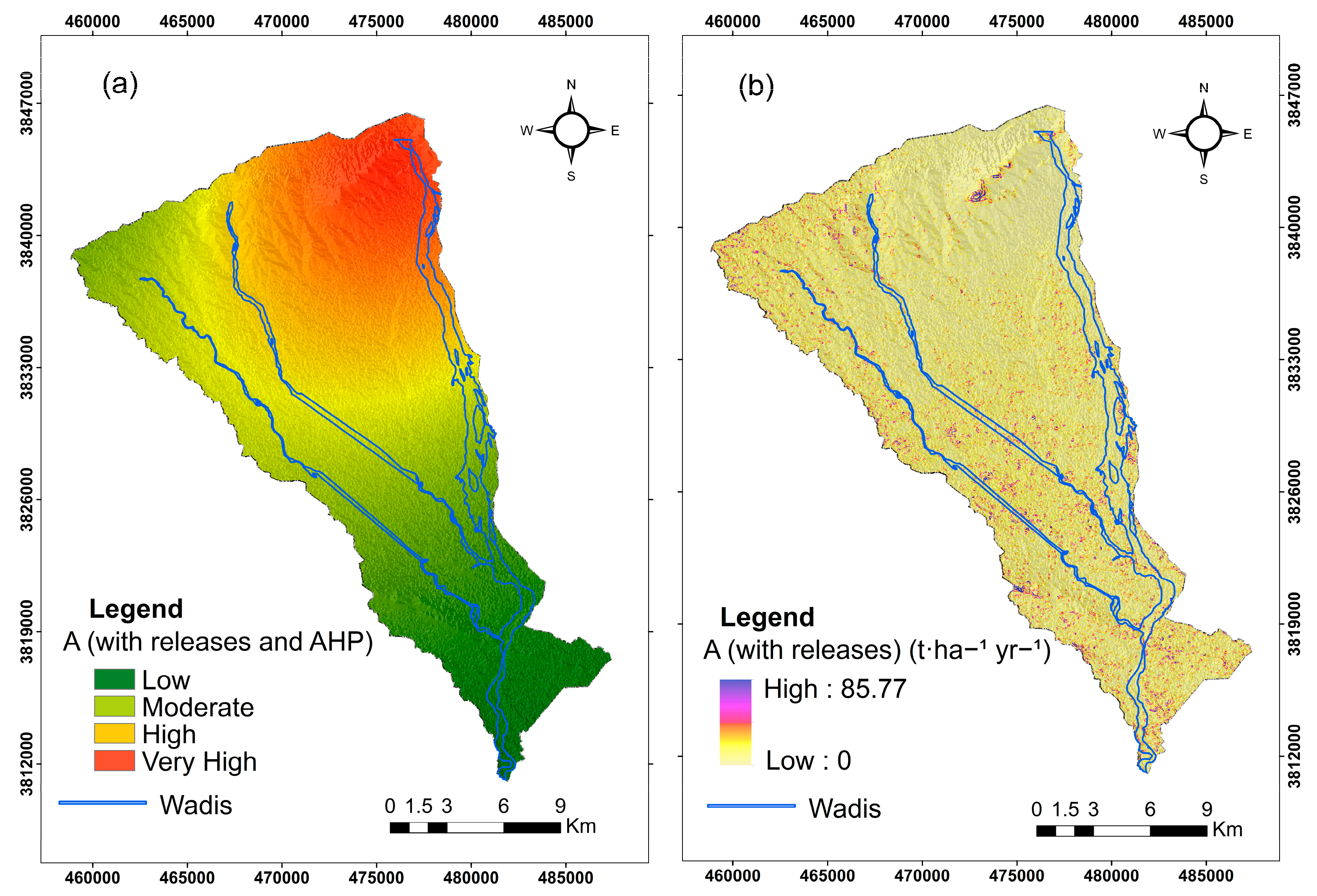
By combining RUSLE factors with weights obtained from the AHP analysis—giving particular emphasis to rainfall erosivity enhanced by dam releases and soil erodibility—areas susceptible to soil erosion within the Sidi Aich watershed were identified. The resulting erosion risk map (
Figure 6) reveals considerable spatial variability in water erosion susceptibility. The classification of erosion risk levels, along with the estimated soil loss corresponding to each class, is summarized in
Table 7 and
Table 8.
The relative influence of factors controlling soil erosion was assessed using a pairwise comparison matrix, which evaluates the effect of each parameter on the erosion process [
24,
43]. Normalized eigenvectors derived from the matrix (
Table 8) ranged between 0.05 and 0.46, representing the proportional contribution of each factor to overall soil erosion. Rainfall erosivity, especially when enhanced by dam releases, was identified as the most dominant factor with a weight of 0.46. Slope (LS) and soil erodibility (K) also played significant roles, with weights of 0.27 and 0.15, respectively, whereas land cover (C) and conservation practices (P) were comparatively less influential, with weights of 0.056 and 0.055.
The consistency ratio (CR) of the pairwise comparison matrix was below 0.1, confirming the reliability of the assessments. In particular, the CR for class weights was 0.018, indicating a high level of agreement among expert judgments. These results are consistent with previous studies, which identify rainfall [
44,
45] and slope [
12,
46,
47] as primary drivers of water erosion, while more spatially variable factors, such as soil characteristics and land cover, contribute to localized differences in erosion susceptibility.
Their uniformity throughout the watershed studied makes it easier to explain the distribution of erosion risks by other factors that exhibit greater spatial variation. To generate a map of water erosion risk (
Figure 6), all factors’ maps are displayed as a degree of erosion risk for each pixel that is derived from different aspects and perspectives, their relative importance is assigned. The corresponding class and factor weights were multiplied; the value of each grid should be the sum of all the factor weight values, and the results were added up using Arc GIS map algebra using the following formula:
The combined RUSLE–AHP analysis indicates that rainfall erosivity is the primary factor driving soil erosion in the Sidi Aïch watershed. The calculated R factor demonstrates a pronounced increase when dam releases are incorporated. Under natural rainfall conditions, erosivity values ranged from 574.57 to 1653.38 (mean = 873 ± 210.29), while the inclusion of dam discharges elevated the range to 590.97–10,393 (mean = 4675.84 ± 2683.8), representing nearly a fivefold increase in average erosivity.
This highlights the substantial influence of hydrological regulation on runoff energy and sediment mobilization. Spatially, erosivity intensifies from northwest to southeast, with the northeast-to-southeast corridor experiencing the most pronounced amplification under release conditions.
The AHP-derived weights reinforce this pattern: rainfall erosivity (R) received the highest weight (0.46), followed by slope length and steepness (LS = 0.27) and soil erodibility (K = 0.15). Land cover (C = 0.05) and conservation practices (p = 0.05) were less influential, reflecting their relative spatial uniformity across the watershed. The low consistency ratio (CR = 0.018) confirms the reliability of the pairwise comparisons and the robustness of the weighting scheme.
Although intrinsic soil erodibility remains largely low to medium, 43.6% of the basin falls within the medium K class. The interaction of moderate erodibility with steep slopes and intensified runoff contributes to the formation of critical erosion hotspots. The LS factor’s significant weight underscores the role of terrain morphology in increasing runoff velocity and erosive capacity, particularly in downstream areas influenced by regulated discharges.
The final erosion hazard map derived from the weighted overlay approach reveals substantial spatial heterogeneity. While the majority of the watershed (97%) exhibits soil loss rates below 20 t ha−1 yr−1, localized hotspots exceed 40–60 t ha−1 yr−1, indicating concentrated high-risk zones that disproportionately contribute to sediment yield. These areas are closely associated with steep topography and enhanced flow regimes.
The predictive capability of the models for identifying erosion-prone areas in the watershed was assessed using ROC curve analysis [
48,
49]. This approach evaluates model accuracy by comparing predicted erosion susceptibility with reference observations. The analysis was performed using the “ROC_ArcSDM” extension in ArcGIS 10.8, with 200 validation points randomly distributed across the study area and independently verified through visual inspection of high-resolution Google Earth imagery.
Results from the ROC analysis (
Figure 7) show that the GIS-based AHP model achieved an Area Under the Curve (AUC) of 0.85, indicating an overall predictive accuracy of 85% and very good performance. In contrast, the conventional RUSLE model reached an AUC of 0.78, reflecting satisfactory but lower predictive capability. The superior performance of the AHP-integrated model is attributed to its ability to incorporate multi-criteria decision analysis, consider interactions among erosion factors, and assign relative weights to parameters based on expert judgment [
42,
50,
51]. This method enhances the spatial identification of erosion-prone areas and provides a more reliable assessment of soil erosion risk within the watershed.
4. Discussion
The RUSLE–AHP analysis reveals that nearly 50% of the Sidi Aïch watershed is subject to high to very high erosion risk, while 34% falls under moderate risk and only 16% corresponds to low-risk or sedimentation zones. The relative contribution of the different factors, derived from AHP weighting, indicates that erosion processes are primarily controlled by rainfall erosivity (R), followed by the topographic factor (LS), soil erodibility (K), land cover (C), and, to a lesser extent, the support practice factor (P). The predominance of the R factor reflects not only the effect of rainfall intensity but also the significant contribution of dam releases, which act as an additional source of erosive energy. In this context, erosivity is driven by both natural and anthropogenic processes, as controlled releases from upstream reservoirs generate artificial peak flows that enhance runoff energy, sediment detachment, and sediment transport. This finding distinguishes the Sidi Aïch watershed from most conventional RUSLE applications in Mediterranean environments, where rainfall is typically considered the primary driver of erosion.
Although the LS factor ranks second in importance, its influence remains moderate due to the relatively gentle to moderate slopes characterizing the watershed. Unlike several previous studies [
52,
53,
54,
55], where slope was identified as a dominant control on erosion intensity, topography in this case mainly acts as a facilitating factor, enhancing flow concentration under conditions of high erosivity rather than serving as a primary trigger. The contributions of the K and C factors further highlight the vulnerability of the watershed: soil erodibility is increased by surface crusting and low organic matter content, while the predominance of bare soils—covering approximately 80% of the basin—amplifies exposure to erosive forces. These results are consistent with findings from other semi-arid Mediterranean and North African environments, where sparse vegetation and fragile soils are recognized as key drivers of soil degradation.
Compared with previous RUSLE-based assessments, the proportion of areas classified as high to very high erosion risk (~50%) lies at the upper range of reported values. For example, studies conducted by Marouf et al. [
48] in eastern Algeria and Chwikhi et al. [
49] in Tunisia generally report values between 30% and 45%, largely attributed to slope gradients and episodic intense rainfall. Similarly, studies by Pantazis et al. [
56] and Erdogan et al. [
57] emphasize the dominant role of climatic and topographic factors in Mediterranean basins.
The higher erosion risk observed in the Sidi Aïch watershed can be explained by several interacting factors. First, the combined effect of rainfall erosivity and dam-induced flows, which significantly increases overall erosive power (R factor) and is not explicitly considered in most previous studies. Second, the high proportion of bare and crusted soils, which promotes runoff generation even under moderate slopes. Third, the application of the AHP method, which may amplify the influence of certain parameters depending on assigned weights. Finally, the very limited implementation of support practices (low P factor), reducing the system’s capacity to mitigate erosion.
From a management perspective, these findings suggest that erosion control strategies should primarily target the dominant R factor through improved dam management. Adjusting the timing, magnitude, and frequency of water releases in accordance with downstream sensitivity and irrigation needs could help limit abrupt peak flows, thereby reducing runoff energy and sediment transport. In parallel, enhancing the P factor represents a major opportunity for mitigation. Although its current contribution is limited due to the near absence of anti-erosive structures, its improvement could significantly reduce soil loss. This requires the strategic implementation of measures such as contour farming, vegetative buffer strips, check dams, and small hydraulic retention structures, with spatial prioritization based on the erosion risk map, particularly in areas combining high R values and extensive bare soils.
While the proposed approach is robust, it has several limitations. The AHP method relies partly on expert judgment, introducing a degree of subjectivity in the weighting process. In addition, the representation of dam releases within the R factor remains simplified and does not fully capture flow variability. Future research should therefore incorporate more detailed hydrological modeling to better represent the dynamics of reservoir releases and their impact on erosion processes. Overall, while the results are broadly consistent with previous studies in semi-arid Mediterranean environments [
58,
59,
60,
61,
62,
63], they also highlight a stronger influence of anthropogenic hydrological regulation. Soil erosion in the Sidi Aïch watershed is thus primarily driven by erosivity enhanced by dam operations, with topography playing a secondary role and limited support practices exacerbating overall risk [
64,
65]. These findings underscore the importance of integrating both hydrological management and targeted anti-erosive measures to effectively reduce soil loss in such contexts.
5. Conclusions
This study confirms that the Sidi Aïch watershed is highly vulnerable to soil erosion, with nearly half of its area classified as high to very high risk. The integration of RUSLE with the AHP approach enabled a comprehensive spatial assessment by combining key factors such as topography, soil properties, land cover, conservation practices, and the influence of regulated dam releases. Factor weights, derived from field observations, remote sensing data, and expert judgment, were incorporated within a GIS framework to produce a detailed erosion risk map. The results indicate an average annual soil loss of approximately 30 t ha−1 yr−1, with 26.12% of the watershed falling into the very high-risk category, 25.45% high, 23.91% moderate, and 24.51% low.
Model validation based on field data and ROC analysis (AUC = 0.85) demonstrates the strong predictive performance of the RUSLE–AHP–GIS approach, exceeding that of the conventional RUSLE model. The findings show that erosion processes are primarily driven by rainfall erosivity, whose impact is further intensified by dam-induced flows, emphasizing the combined role of natural conditions and human interventions. While topography, soil characteristics, and land cover contribute to erosion susceptibility, the limited presence of conservation practices reduces the watershed’s capacity to mitigate soil loss.
These results highlight the need for integrated management strategies that address both hydrological regulation and land-based interventions. Optimizing dam release regimes and implementing targeted soil conservation measures are essential steps to reduce erosion risk. The spatial outputs generated in this study provide valuable guidance for prioritizing actions in the most affected areas.
Overall, this work demonstrates the added value of coupling multi-criteria decision analysis with spatial modeling to better capture erosion dynamics in regulated semi-arid environments. It also underlines the importance of explicitly considering anthropogenic hydrological influences, which can significantly alter natural processes and lead to increased land degradation if not properly managed.
Author Contributions
Conceptualization, F.K.; methodology, F.K., N.K. and Z.A.; software N.K.; validation, F.K. and N.K.; formal analysis, F.K.; investigation, F.K.; resources, F.K.; data curation, F.K.; writing—original draft preparation, F.A., N.K. and Z.A.; writing—review and editing, N.K., Z.A., H.B., M.B.Z., L.D. and F.A.; visualization, N.K., Z.A., F.A. and H.B.; supervision, M.O. and M.B.Z.; project administration, M.O. and M.B.Z. All authors have read and agreed to the published version of the manuscript.
Funding
This study was jointly funded by the Institute of Arid Regions Institute of Medenine, IRA, Tunisia (Laboratory of Eremology and Combating Desertification: LR16IRA01), and the AG-WaMED project, which is part of the PRIMA program supported by the European Union. Grant Agreement Number No. [Italy: 391 del 20/10/2022, Egypt: 45878, Tunisia: 0005874-004-18-2022-3, Greece: ΓΓP21-0474657, Spain: PCI2022-132929, Algeria: N° 04/PRIMA_section 2/2021].
Institutional Review Board Statement
Not applicable.
Informed Consent Statement
Not applicable.
Data Availability Statement
The data that support the findings of this study are available from the corresponding author upon reasonable request.
Acknowledgments
The authors would like to express their gratitude to the CRDA of Gafsa for providing all the data used in this study. Special thanks are also extended to Faculty of Sciences of Gafsa and the Arid Regions Institute of Medenine (IRA) for their support and assistance in the data analysis. The comments of the anonymous three reviewers significantly improved the paper.
Conflicts of Interest
The authors declare no conflicts of interest.
Appendix A
Appendix A.1. Soil Sampling
Field surveys and soil sampling campaigns were carried out in November 2020. A total of 25 samples were collected along a longitudinal profile extending from the upstream to the downstream sections of the Sidi Aich watershed. Laboratory analyses were performed to determine particle size distribution and organic matter content, which served as essential inputs for the estimation of the soil erodibility (K) factor.
Particle size characterization was conducted using two complementary approaches: sieving and sedimentation. Dry sieving was applied to particles larger than 75 μm, while hydrometer analysis was used for finer fractions below 75 μm. To maintain mass consistency between the two methods, hydrometer results were adjusted based on the proportion of material passing the 75 μm sieve. The datasets were subsequently combined at this threshold to generate a continuous particle size distribution (PSD) curve with complete mass balance. The resulting integrated PSD was then employed to determine the soil textural fractions necessary for computing the RUSLE soil erodibility (K) factor.
Appendix A.2. Particle Size Analysis by Sieving
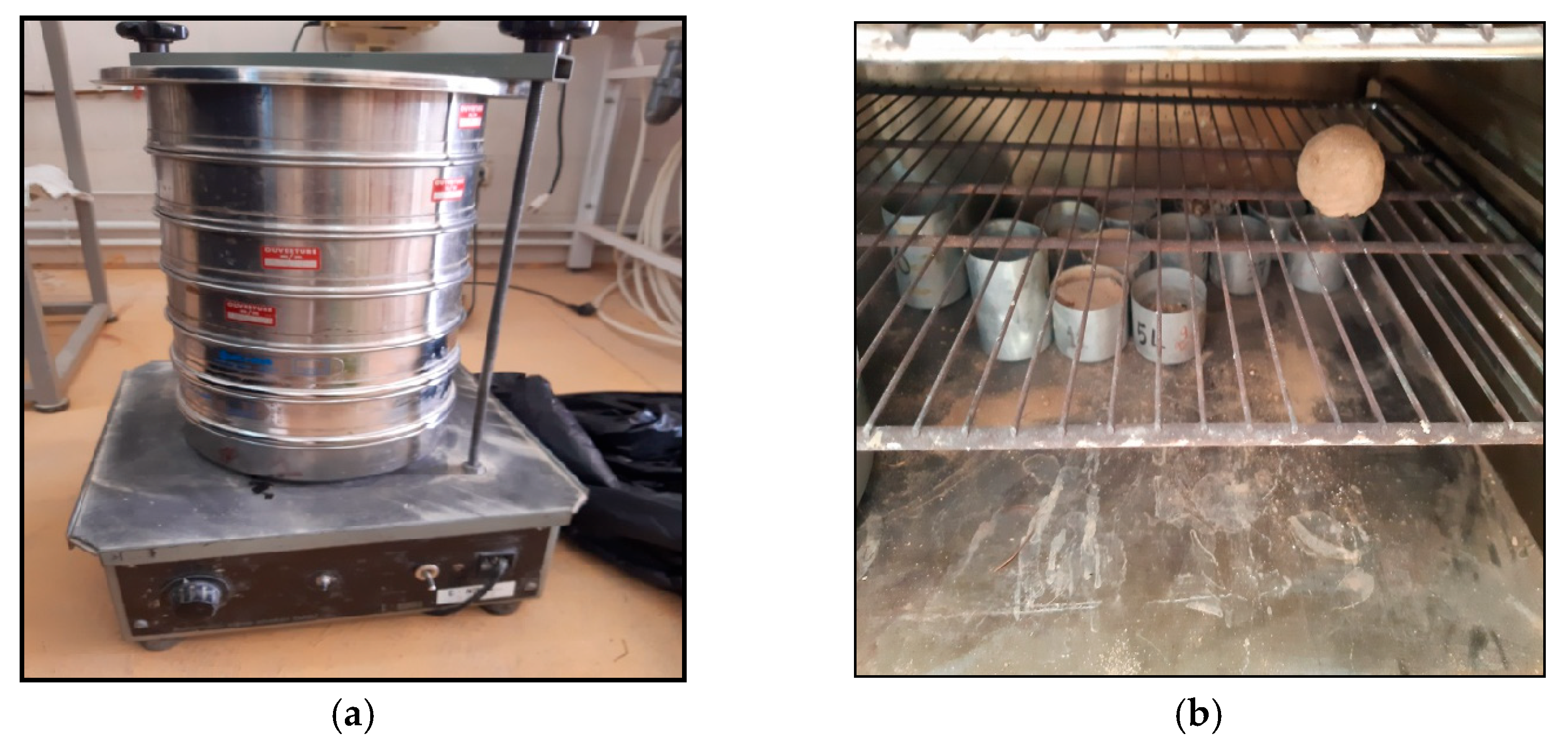
The analysis consists of passing a sample of approximately 500 g of soil through a series of calibrated sieves (5, 2.5, 0.5, 0.25, 0.125, 0.08 mm). The sieves are stacked one on top of the other in ascending order of mesh size. With the bottom of the sieve facing down, the fractions retained by the sieves are collected and weighed separately. The entire stack is then placed on a vibrating table for approximately 3 min (
Figure 4). Next, the washed grains from the top sieve are collected, and the same is done with the other sieves. The entire stack is then placed in an oven for 24 h at a temperature of 105 °C (
Figure A1).
Figure A1.
(a) Vibrating system; (b) Place the defects in oven.
Figure A1.
(a) Vibrating system; (b) Place the defects in oven.
Appendix A.3. Particle Size Analysis by Sedimentation
During sedimentation, particles with a diameter less than 0.08 mm, which are clays and silts, will be quantified relative to the soil fraction. The analysis is performed using the following steps: Soak 80 g of dry soil in the mechanical container using approximately 440 cm
3 of distilled water and 60 cm
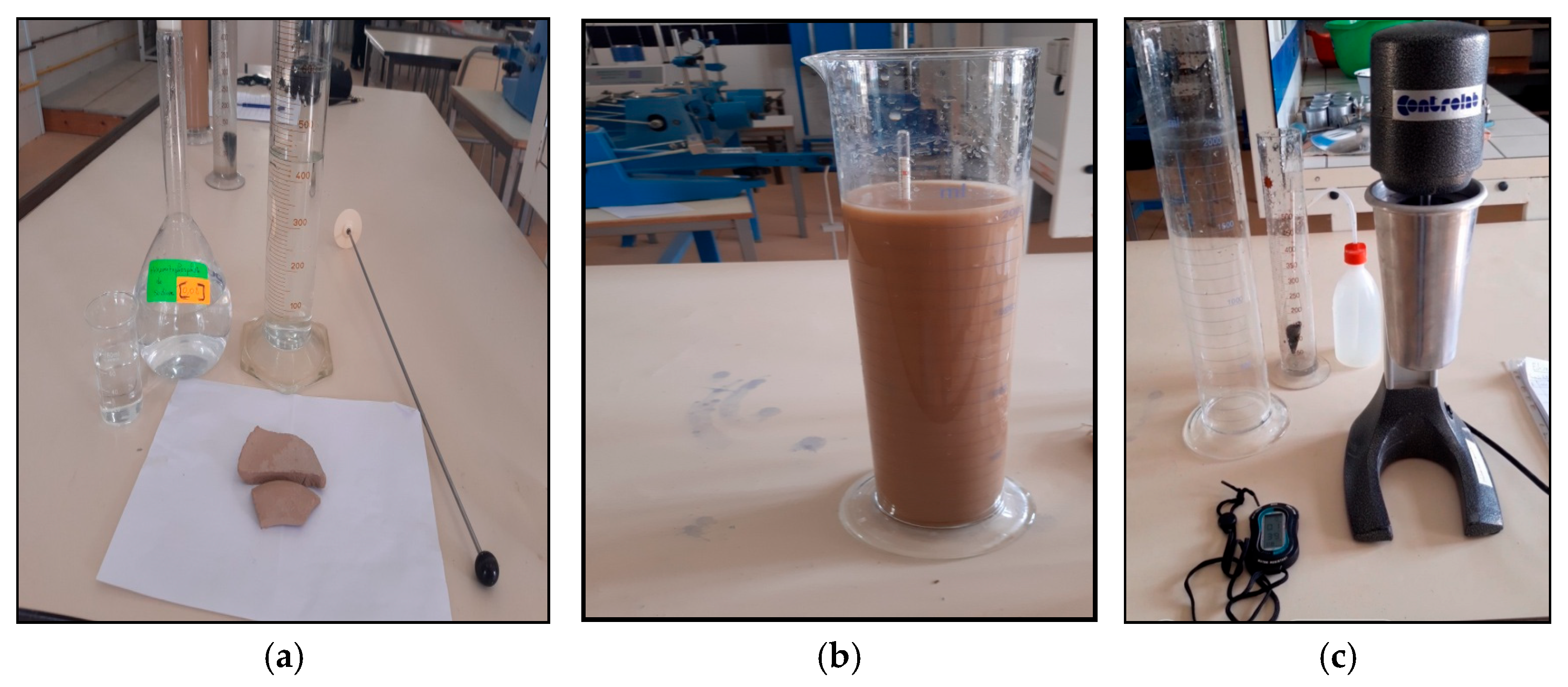
3 of sodium hexametaphosphate solution (leave the solution for at least 15 h). The following day, agitate the sample using the sedimentation apparatus for 3 min) After stirring, pour the solution into a 2 L test tube and fill with distilled water up to 2 L, then extend the hydrometer after the stopwatch starts and take the following readings (30 s, 1 min, 2 min, 5 min, 10 min, 20 min, 40 min, 80 min, 240 min and 1440 min) (
Figure A2).
Figure A2.
(a) Mixture of dry soil and sodium hexametaphosphate solution; (b) Agitation by sedimentation apparatus; (c) Reading on the densitometer at the top of the meniscus.
Figure A2.
(a) Mixture of dry soil and sodium hexametaphosphate solution; (b) Agitation by sedimentation apparatus; (c) Reading on the densitometer at the top of the meniscus.
Appendix A.4. Determination of Organic Matter
Organic matter in the soil is primarily composed of plant debris at various stages of decomposition. It consists of 58% carbon. The reagents used were an 8% solution of potassium dichromate (Cr2O7K2) in distilled water and sulfuric acid with a density of 1.84. The glucose standard solution was 1.25 g/L; 1 mL is equivalent to 0.5 g of carbon. For carbon oxidation, 5 mL of the potassium dichromate solution was added to 0.2 g of soil samples ground to 0.2 mm. 10 mL of pure sulfuric acid was then carefully added over the samples while stirring. The solution was left to settle overnight.
References
- Melki, A.; Abdollahi, K.; Fatahi, R.; Abida, H. Groundwater Recharge Estimation under Semi Arid Climate: Case of Northern Gafsa Watershed, Tunisia. J. Afr. Earth Sci. 2017, 132, 37–46. [Google Scholar] [CrossRef]
- Wischmeier, W.H.; Smith, D.D. Predicting Rainfall Erosion Losses: A Guide to Conservation Planning; Department of Agriculture, Science and Education Administration: Washinton, DC, USA, 1978.
- Van Wart, J.; Grassini, P.; Yang, H.; Claessens, L.; Jarvis, A.; Cassman, K.G. Creating Long-Term Weather Data from Thin Air for Crop Simulation Modeling. Agric. For. Meteorol. 2015, 209–210, 49–58. [Google Scholar] [CrossRef]
- Toubal, A.K.; Achite, M.; Ouillon, S.; Dehni, A. Soil erodibility mapping using the RUSLE model to prioritize erosion control in the Wadi Sahouat basin, North-West of Algeria. Environ. Monit. Assess. 2018, 190, 210. [Google Scholar] [CrossRef]
- Van der Knijff, J.M.; Jones, R.J.A.; Montanarella, L. Soil Erosion Risk Assessment in Europe; EUR 19044 EN; Office for Official Publications of the European Communities: Luxembourg, 2000; 34p.
- Balasubramani, K.; Veena, M.; Kumaraswamy, K.; Saravanabavan, V. Estimation of soil erosion in a semi-arid watershed of Tamil Nadu (India) using revised universal soil loss equation (rusle) model through GIS. Model. Earth Syst. Environ. 2015, 1, 10. [Google Scholar] [CrossRef]
- Ben Zaied, M.; Jomaa, S.; Ouessar, M. Soil Erosion Estimates in Arid Region: A Case Study of the Koutine Catchment, Southeastern Tunisia. Appl. Sci. 2021, 11, 6763. [Google Scholar] [CrossRef]
- Li, L.; Xu, H.; Chen, X.; Simonovic, S.P. Streamflow Forecast and Reservoir Operation Performance Assessment Under Climate Change. Water Resour. Manag. 2010, 24, 83–104. [Google Scholar] [CrossRef]
- Arora, A.; Pandey, M.; Siddiqui, M.A.; Hong, H.; Mishra, V.N. Spatial Flood Susceptibility Prediction in Middle Ganga Plain: Comparison of Frequency Ratio and Shannon’s Entropy Models. Geocarto Int. 2021, 36, 2085–2116. [Google Scholar] [CrossRef]
- Nasiri, M. GIS modelling for locating the risk zone of soil erosion in a deciduous forest. J. For. Sci. 2013, 59, 87–91. [Google Scholar] [CrossRef]
- Abbasi, P.; Ahmadi, H.; Khan, M.; Moeini, A. Evaluation of soil and water conservation projects through estimation of erosion intensity by geomorphological modelling (case study of Safaroud watershed, Mazandaran province, Iran). Appl. Ecol. Environ. Res. 2017, 15, 1739–1751. [Google Scholar] [CrossRef]
- Thomas, J.; Joseph, S.; Thrivikramji, K.P. Assessment of soil erosion in a monsoon-dominated mountain river basin in India using RUSLE-SDR and AHP. Hydrol. Sci. J. 2018, 63, 542–560. [Google Scholar]
- NASA Shuttle Radar Topography Mission (SRTM). Shuttle Radar Topography Mission (SRTM) Global. Distributed by OpenTopography. 2013. Available online: https://portal.opentopography.org/datasetMetadata?otCollectionID=OT.042013.4326.1 (accessed on 20 March 2026).
- Wischmeier, W.H. A rainfall erosion index for a universal soil-loss equation. Soil Sci. Soc. Am. J. 1959, 23, 246–249. [Google Scholar]
- Renard, K.G.; Freimund, J.R. Using monthly precipitation data to estimate the R factor in the revised USLE. J. Hydrol. 1994, 157, 287–306. [Google Scholar] [CrossRef]
- Roose, E. Introduction à la Gestion Conservatoire de l’Eau, de la Biomasse et de la Fertilité des Sols (GCES); Bulletin Pédologique de la FAO 70; FAO: Rome, Italy, 1994; 438p. [Google Scholar]
- Google Earth; Google LLC: Mountain View, CA, USA, 2020; Available online: https://earth.google.com (accessed on 20 March 2026).
- Saaty, T.L. A Scaling Method for Priorities in Hierarchical Structures. J. Math. Psychol. 1977, 15, 234–281. [Google Scholar] [CrossRef]
- El Hafid, D.; Brahim, A. Quantification de l’érosion hydrique en utilisant le modèle RUSLE et déposition intégrée dans un SIG. Cas du Bassin Versant de l’oued Isly (Maroc Oriental). Eur. Sci. J. 2018, 14, 1857–7881. [Google Scholar] [CrossRef]
- Wischmeier, W.H.; Johnson, C.B.; Cross, B.V. A Soil Erodibility Nomograph for Farmland and Construction Sites. J. Soil Water Conserv. 1971, 26, 189–193. [Google Scholar]
- Conforti, M.; Aucelli, P.P.C.; Robustelli, G.; Scarciglia, F. Geomorphology and GIS analysis for mapping gully erosion susceptibility in the Turbolo stream catchment (Northern Calabria, Italy). Nat. Hazards 2011, 56, 881–898. [Google Scholar] [CrossRef]
- Shin, G.J. The Analysis of Soil Erosion Analysis in Watershed Using GIS. Ph.D. Thesis, Department of Civil Engineering, Gang-Won National University, Chuncheon, Republic of Korea, 1999. [Google Scholar]
- Cherni, S.; Samaali, H. Estimation des paramètres de l’érosion hydrique à l’aide de la télédétection et du SIG-cas du bassin-versant de l’Oued Tlil (Nord-Est de la Tunisie). Rev. Geomorfol. 2012, 14, 29–37. [Google Scholar]
- Saaty, T.L.; Vargas, L.G. How to make a decision. In Models, Methods, Concepts & Applications of the Analytic Hierarchy Process; Springer Science & Business Media: New York, NY, USA, 2001; pp. 1–25. [Google Scholar]
- Akıncı, H.; Özalp, A.Y.; Turgut, B. Agricultural Land Use Suitability Analysis Using GIS and AHP Technique. Comput. Electron. Agric. 2013, 97, 71–82. [Google Scholar] [CrossRef]
- Lee, S.; Pradhan, B. Probabilistic Landslide Hazards and Risk Mapping on Penang Island, Malaysia. J. Earth Syst. Sci. 2006, 115, 661–672. [Google Scholar] [CrossRef]
- Rahaman, A.; Biswas, B.; Barman, J.; Suresh, V.M.; Kishor, B.; Das, J. Delineation of groundwater potential zones through AHP: A case study from Tamil Nadu, India. In Monitoring and Managing Multi-Hazards: A Multidisciplinary Approach; Springer International Publishing: Cham, Switzerland, 2022; pp. 315–329. [Google Scholar]
- Baig, S.; Khan, A.A.; Khan, A.A. A time series analysis of causality between tourist arrivals and climatic effects for nature-based tourism destinations: Evidence from Gilgit-Baltistan, Pakistan. Environ. Dev. Sustain. 2021, 23, 5035–5057. [Google Scholar]
- Saaty, T.L. The analytic hierarchy process (AHP). J. Oper. Res. Soc. 1980, 41, 1073–1076. [Google Scholar]
- Saaty, T.L. How to make a decision: The analytic hierarchy process. Eur. J. Oper. Res. 1990, 48, 9–26. [Google Scholar] [CrossRef]
- Bou Kheir, R.; Girard, M.C.; Shaban, A.; Khawlie, M.; Faour, G.; Darwich, T. Apport de la télédétection pour la modélisation de l’érosion hydrique des sols dans la région côtière du Liban. Télédétection 2001, 2, 79–90. [Google Scholar]
- Bayramin, I.; Dengiz, O.; Başkan, O.; Parlak, M. Soil erosion risk assessment with ICONA model; case study: Beypazarı area. Turk. J. Agric. For. 2003, 27, 105–116. [Google Scholar]
- Abaoui, J.; El Ghmari, A.; El Harti, A.; Bachaoui, E.M.; Bannari, A.; El Bouadili, A. Cartographie de l’erosion hydrique en zone montagneuse: Cas du bassin versant des ait bou goumez, Haut Atlas, Maroc. Estud. Geol. 2005, 61, 33–39. [Google Scholar] [CrossRef]
- Dahri, N.; Abida, H. Monte Carlo Simulation-Aided Analytical Hierarchy Process (AHP) for Flood Susceptibility Mapping in Gabes Basin (Southeastern Tunisia). Environ. Earth Sci. 2017, 76, 302. [Google Scholar] [CrossRef]
- Falah, F.; Ghorbani Nejad, S.; Rahmati, O.; Daneshfar, M.; Zeinivand, H. Applicability of Generalized Additive Model in Groundwater Potential Modelling and Comparison Its Performance by Bivariate Statistical Methods. Geocarto Int. 2017, 32, 1069–1089. [Google Scholar] [CrossRef]
- Rehman, A.; Sajjad, M.; Song, J.; Riaz, M.T.; Mehmood, M.S.; Ahamad, M.I. Integrated frequency ratio-analytical hierarchy and geospatial techniques-based earthquake risk assessment in mountainous cities: A case from the Northwestern Himalayas. Georisk Assess. Manag. Risk Eng. Syst. Geohazards 2024, 19, 389–409. [Google Scholar] [CrossRef]
- Mondal, S.; Maiti, R. Integrating the analytical hierarchy process (AHP) and the frequency ratio (FR) model in landslide susceptibility mapping of Shiv-khola watershed, Darjeeling Himalaya. Int. J. Disaster Risk Sci. 2013, 4, 200–212. [Google Scholar] [CrossRef]
- Alonso, J.A.; Lamata, M.T. Consistency in the analytic hierarchy process: A new approach. Int. J. Uncertain. Fuzziness Knowl.-Based Syst. 2006, 14, 445–459. [Google Scholar] [CrossRef]
- Saaty, R.W. The analytic hierarchy process—What it is and how it is used. Math. Model. 1987, 9, 161–176. [Google Scholar] [CrossRef]
- Yesilnacar, E.K. The Application of Computational Intelligence to Landslide Susceptibility Mapping in Turkey. Ph.D. Thesis, Department of Geomatics, The University of Melbourne, Melbourne, Australia, 2005; 709p. [Google Scholar]
- Tehrany, M.S.; Pradhan, B.; Jebur, M.N. Spatial Prediction of Flood Susceptible Areas Using Rule Based Decision Tree (DT) and a Novel Ensemble Bivariate and Multivariate Statistical Models in GIS. J. Hydrol. 2013, 504, 69–79. [Google Scholar] [CrossRef]
- Rashid, T.; Agrafotis, I.; Nurse, J.R. A new take on detecting insider threats: Exploring the use of hidden Markov models. In Proceedings of the 8th ACM CCS International Workshop on Managing Insider Security Threats; ACM: New York, NY, USA, 2016; Volume 709, pp. 47–56. [Google Scholar]
- Saaty, T.L. Basic theory of the analytic hierarchy process: How to make a decision. Rev. Real Acad. Cienc. Exactas Fis. Nat. 1999, 93, 395–423. [Google Scholar]
- Fan, Y.; van den Dool, H.M. Climate Prediction Center global monthly soil moisture data set at 0.5 resolution for 1948 to present. J. Geophys. Res. 2004, 109, D10102. [Google Scholar] [CrossRef]
- Ziadat, F.M.; Taimeh, A.Y. Effect of rainfall intensity, slope, land use and antecedent soil moisture on soil erosion in an arid environment. Land Degrad. Dev. 2013, 24, 582–590. [Google Scholar] [CrossRef]
- Felfoul Sfar, M.; Snane, M.H.; Mlaouhi, A.; Megdiche, M.F. Importance du facteur lithologique sur le développement des ravins du bassin versant d’Oued Maiez en Tunisie Centrale: Relationships between the lithology and the gully growth rate of the Oued Maiez watershed in Central Tunisia. Bull. Eng. Geol. Environ. 1999, 57, 285–293. [Google Scholar] [CrossRef]
- Zerihun, M.; Mohammed, M.S.; Sewnet, D.; Adem, A.A.; Lakew, M. Assessment of soil erosion using RUSLE, GIS and remote sensing in NW Ethiopia. Geoderma Reg. 2018, 12, 83–90. [Google Scholar] [CrossRef]
- Marouf, Z.; Derdous, O.; Benmamar, S.; Tachi, S.E. Water erosion susceptibility assessment using RUSLE, AHP and ANN: A comparative study in the Cheliff Basin—Algeria. Eurasian Soil Sci. 2025, 58, 39. [Google Scholar] [CrossRef]
- Chwikhi, W.; Abdelkrim, B.; Atoui, M.; Bouajila, A.; Antunes, I.M.H.R.; Dhaouadi, L.; Mahmoudi, S. Integrated AHP-GIS Modeling for Soil Erosion Risk Assessment in Arid Regions: A Case Study of Gabès, Tunisia. Earth Syst. Environ. 2025, 10, 2097–2115. [Google Scholar] [CrossRef]
- Hailemariam, G.W.; Zhao, J.; Moges, A. Identification of spatial patterns of soil erosion based on the combination of RUSLE and MCDA in the Ahferom District, Northern Ethiopia. Land 2024, 13, 1684. [Google Scholar] [CrossRef]
- Kirti, P. Criteria for evaluating group decision-making methods. Math. Comput. Model. 2007, 46, 935–947. [Google Scholar] [CrossRef]
- Majdoub, R.; Fourati, M.; Sahtout, N.; Ben Ammar, A.; Bouaziz, R. Contribution d’un Système d’Information Géographique à l’évaluation de la dégradation du sol et des aménagements antiérosifs au niveau du bassin versant d’Oued Agareb. J. Mater. Environ. Sci. 2016, 7, 3362–3370. [Google Scholar]
- Sifi, S.; Aydi, A.; Bouamrane, A.; Zaghdoudi, S.; Gasmi, M. Appraisal of soil erosion risk in northeastern Tunisia using geospatial data and integrated approach of RUSLE model and GIS. J. Earth Syst. Sci. 2024, 133, 67. [Google Scholar] [CrossRef]
- Chafai, A.; Brahim, N.; Slim Shimi, N. Mapping of water erosion by GIS/RUSLE approach: Watershed Ayda river Tunisia study. Arab. J. Geosci. 2020, 13, 810. [Google Scholar] [CrossRef]
- Jemai, S.; Kallel, A.; Agoubi, B.; Abida, H. Soil erosion estimation in arid area by USLE model applying GIS and RS: Case of Oued El Hamma catchment, south-eastern Tunisia. J. Indian Soc. Remote Sens. 2021, 49, 1293–1305. [Google Scholar] [CrossRef]
- Pantazis, C.; Nastos, P. Comparing Direct Field Measurements of Soil Erosion with RUSLE Model Estimates in Mediterranean Olive Orchards. Environ. Earth Sci. Proc. 2025, 35, 75. [Google Scholar] [CrossRef]
- Erdoğan Yüksel, E.; Karan, Ö.F.; Akay, A.E. Spatio-Temporal analysis of Erosion risk assessment using GIS-Based AHP method: A case study of Doğancı dam watershed in Bursa (Türkiye). Forests 2024, 15, 1135. [Google Scholar] [CrossRef]
- Kachouri, S.; Achour, H.; Abida, H.; Bouaziz, S. Soil erosion hazard mapping using analytic hierarchy process and logistic regression: A case study of Haffouz watershed, Central Tunisia. Arab. J. Geosci. 2014, 8, 4257–4268. [Google Scholar] [CrossRef]
- Arar, A.; Chenchouni, H. A “simple” geomatics-based approach for assessing water erosion hazard at montane areas. Arab. J. Geosci. 2014, 7, 1–12. [Google Scholar] [CrossRef]
- Mihi, A.; Benarfa, N.; Arar, A. Assessing and mapping water erosionprone areas in northeastern Algeria using analytic hierarchyprocess, USLE/RUSLE equation, GIS, and remote sensing. Appl. Geomat. 2019, 12, 179–191. [Google Scholar] [CrossRef]
- Boufeldja, S.; Baba Hamed, K.; Bouanani, A.; Belkendil, A. Identifcation of zones at risk of erosion by the combination of a digital model and the method of multi-criteria analysis in the arid regions: Case of the BecharWadi watershed. Appl. Water Sci. 2020, 10, 121. [Google Scholar] [CrossRef]
- Neji, N.; Ayed, R.B.; Abida, H. Cartographie des risques d’érosion hydrique à l’aide du processus de hiérarchie analytique (AHP) et de la modélisation par logique floue: Une étude de cas du bassin versant du Chaffar (sud-est de la Tunisie). Arab. J. Geosci. 2021, 14, 1–15. [Google Scholar]
- Abdelkarim, B.; Telahigue, F.; Abaab, N.; Boudabra, B.; Agoubi, B. AHP and GIS for assessment of groundwater suitability for irrigation purpose in coastal-arid zone: Gabes region, southeastern Tunisia. Environ. Sci. Pollut. Res. 2023, 30, 15422–15437. [Google Scholar] [CrossRef]
- Achite, M.; Choudhari, P.; Toubal, A.K.; Caloiero, T.; De Marco, A.; Ouillon, S. Mapping Soil Erosion Potential in Algeria’s Wadi Mina Basin: Insights from Revised Universal Soil Loss Equation and Geographic Information System for Sustainable Land Management. Sustainability 2025, 17, 5038. [Google Scholar] [CrossRef]
- Benaiche, M.; Mokhtari, E.; Berghout, A.; Abdelkebir, B.; Engel, B. Identification of soil erosion-susceptible areas using revised universal soil loss equation, analytical hierarchy process and the fuzzy logic approach in sub-watersheds Boussellam and K’sob Algeria. Environ. Earth Sci. 2024, 83, 34. [Google Scholar] [CrossRef]
| Disclaimer/Publisher’s Note: The statements, opinions and data contained in all publications are solely those of the individual author(s) and contributor(s) and not of MDPI and/or the editor(s). MDPI and/or the editor(s) disclaim responsibility for any injury to people or property resulting from any ideas, methods, instructions or products referred to in the content. |



 ,
,