
Article

Combined Use of FTIR and Atomic Emission Spectroscopies for Wet-Sieved Fractions of Kastanozem Soils

by
Olga B. Rogova
,
Dmitry S. Volkov
and
Mikhail A. Proskurnin
*
Chemistry Department, M.V. Lomonosov Moscow State University, Leninskie Gory, 1-3, GSP-1, 119991 Moscow, Russia
*
Author to whom correspondence should be addressed.
Soil Syst. 2026, 10(2), 25; https://doi.org/10.3390/soilsystems10020025
Submission received: 29 October 2025 / Revised: 18 January 2026 / Accepted: 27 January 2026 / Published: 3 February 2026

Abstract

FTIR spectroscopy, attenuated total reflection (ATR), and diffuse reflectance (DRIFT) modalities, along with ICP–AES spectroscopy and correlation analysis, including two-dimensional correlation spectroscopy (2DCOS), were used for the detailed analysis of Kastanozem (chestnut) soils. Microaggregates (20–200 μm) and macroaggregates (200–1000 μm) of characteristic horizons of uncultivated (fallow) and cultivated (arable land) chestnut soils of the same origin were physically fractionated by wet sieving. The combination of these molecular and atomic spectroscopy techniques in combination with correlation analysis was able to find direct correlations between matrix-forming anions and soil organic matter (SOM) of Kastanozems. Humic substances were separated from the corresponding soil samples to reveal SOM contributions more explicitly. Microaggregates of the size fractions of 20–40 μm and 40–60 μm bore the most comprehensive information for both techniques used. Most significant differences between land-use Kastanozem samples were observed in topsoil horizons (arable P versus light-colored humic AJ horizon), and for the next pair of horizons along the profile xerometamorphic BMK horizon to structural metamorphic BM horizon. These differences included carbonate matrix and SOM amounts and composition. Topsoil arable land showed significantly smaller amounts of total organic carbon and a decrease in the share of long-chain hydrocarbons compared to fallow, which has a more distinctive character compared to similar land-use samples of Chernozem. An increase in carbonate contents with soil depth was found for both land-use samples, while the amounts and composition of the silicate matrix remained largely unchanged within the depth profile. The heterospectral 2DCOS comparison of FTIR (between horizons and land-use samples), ICP–AES (between land-use samples), and FTIR–AES (for the same sample) showed the possibility of a more reliable attribution of FTIR absorption bands and revealed the differences in the macro- and micro-aggregate elemental and SOM composition of Kastanozems.

1. Introduction

Kastanozems, or chestnut soils, are widespread in the south of the European part of Russia, in Tuva, Transbaikalia, as well as in Kazakhstan, Mongolia, China, Africa, South America, and the USA, where they are the second most productive soil after black soils for growing agricultural products. It should be noted that some authors actually combine three types of soils in terms of productivity and role in agricultural production—Chernozems, Kastanozems, and Phaeozems—as black soils characterized by high natural fertility and dark surface horizons enriched in organic matter, noting that Chernozems and Kastanozems are also characterized by carbonate accumulation [1]. In the European part of Russia, Kastanozem soils are common in the Volgograd region, which is one of the main growers of agricultural products [2].
The climatic conditions of the zones of distribution of Kastanozem soils are characterized by sharp continentality and aridity, and these soils are formed under dry steppe plant associations with sparse and low grass cover with poor species composition, and the contribution of the biomass of underground parts to the formation of soil organic matter (SOM) is many times higher than the biomass of above-ground parts of plants [3].
In agricultural use, the cultivation of annual crops leads to a decrease in the biomass of underground parts due to the complete reduction of steppe vegetation during annual plowing or the dominance of tap-rooted plants that are not capable of forming a dense turf in the upper layer of soil in the case of pasture use of the territory [4].
The aggregate composition of Kastanozem soils changes sharply under the influence of agricultural technology. It is noted in [5] that the proportion of water-resistant (waterproof) aggregates with a size of >0.25 mm (the optimal size for the formation of agronomically valuable water- and air-permeable structures) decreases from more than 40% for native soils to less than 20% for those ploughed in Kastanozem soils of the Trans-Volga region.
The most important factor for the formation and preservation of waterproof aggregates of Kastanozem soils is the accumulation of humus. However, due to the transformation of natural steppes into agricultural lands, not only does the gross content of organic matter decrease, but its molecular composition changes. Thus, in [6] there was an increase in the content of labile carbon in arable soils even after a single ploughing, and the comparison of humus profiles and the qualitative composition of humus virgin and arable Kastanozem soils showed that virgin soil is characterized by a predominance of fulvic acids over humic acids throughout the profile [7]. The authors attributed this to the predominance of the humus formation process in virgin lands over the processes of dehydrogenation and carboxylation dimensions of waterproof aggregates. Hence, by the change in the material composition of the organic matter of waterproof aggregates, it is possible to characterize the direction of the processes of SOM change under agrogenic load.
The content of potentially mineralizable organic matter in arable soils is 1.9–3.9 times lower than in virgin analogs [8], and the post-agrogenic transformation of soils leads to changes in the content of soil carbon, molecular composition, and the rate of stabilization of organic matter [9]. The highest complexity of the composition and structure of the molecular composition of SOM, their variability due to changes in the conditions of the development environment, and excretions during analysis cause difficulties in their identification and structure determination even by the state-of-the-art instrumental methods [10].
All this leads to the fact that to describe the processes of degradation of organic matter, generalized criteria are often used, associated either with the assessment of the ratio of operationally allocated groups of substances—carbon of emitted humic and fulvic acids [7]—or with general genetic indirect indicators—soil organic carbon (SOC) indicators—based on the multifunctionality of the system as a whole [11], revealing, on the one hand, differences in the content and composition of SOM in the upper layers of soils and the alignment of SOM composition indicators with depth, and emphasizing the role of climatic changes and differences in soil-forming rocks, in particular carbonate, for the formation of organic matter.
To study the processes of transformation of SOM, methods of preliminary physical fractionation are widely used: granulometric [12], granulodensimetric [13], and isolation of dry and waterproof aggregates [14,15] of different sizes. This approach makes it possible to simplify, to some extent, the most complex system of organic, organo-mineral components that together make up the organic matter of soils, and to try to identify indicators that diagnose changes in SOM and mineral parts when using soils.
The use of various IR spectroscopy techniques in soils and similar studies of biochar and humic substances in recent years has shown effectiveness for solving such problems due to advances in instrumental capabilities, new modalities, and increased sensitivity [16,17,18,19], and due to the possibility of using the method for chemically undisturbed samples [20,21]. At the same time, the bulk of the studies are associated with the use of visible near-infrared (vis-NIR) spectroscopy [22,23] and diffuse reflectance infrared Fourier transform spectroscopy [24] for estimating and predicting the organic carbon content in soils, and in particular SOC, particulate organic carbon (POC), mineral-associated organic carbon (MAOC), and the ratio of MAOC to SOC (MAOC/SOC, an index of carbon vulnerability). A promising approach is to use FTIR spectroscopy with physical preparative fractionation of soil samples [25,26]. However, although this combination is not widely used, the method has proven to be effective in studies of particulate organic matter (POM) and mineral-associated organic matter (MAOM). It has been shown [27] that physical fractionation (both particle size and especially granulodensimetric) in combination with mid-infrared spectrometry is effective in understanding the composition and structure of the substances that make up SOM.
It should be noted that as far as we know, no work has been carried out to compare the characteristics of attenuated total internal reflection (ATR) and diffuse reflection (DRIFT) for Kastanozem soils and their agronomically valuable aggregates.
We believe that the most important task of researchers is the identification of substances that make up SOM, both those that change and those that remain stable under agrogenic or, in general, anthropogenic influence, and, of course, the development and testing of methods and techniques for the qualitative and quantitative determination of these substances.
In the chemical analysis of soils, an important place is also occupied by the studies of the broad range of chemical elements in soils [28,29] and their fractions and the determination of the group composition of element compounds, i.e., the distribution of compounds into groups in accordance with physical and chemical properties [30]. For such analysis, including survey analysis, optical atomic emission spectroscopy is well suited, especially in this inductively coupled plasma variant, as it provides high sensitivity, rapidity, precision, and reliability of measurements [31]. In many cases, such studies have their own value, but it is more important to combine the data of microelement composition in various soil samples, including micro- and macro-aggregates, with the data from the molecular or functional composition of soil samples [32,33], which was not performed in full for Kastanozem soils.
Thus, within the framework of this study, we compare the information obtained by two methods of IR spectroscopy—ATR and DRIFT—and ICP–AES for microelement analysis for Kastanozem samples of different agricultural use (perennial fallow and arable land), the changes within the soil profile depth by a representative set of five soil horizons, and for waterproof aggregates of sizes from 20 to 1000 μm obtained by wet sieving.

2. Materials and Methods

2.1. Samples

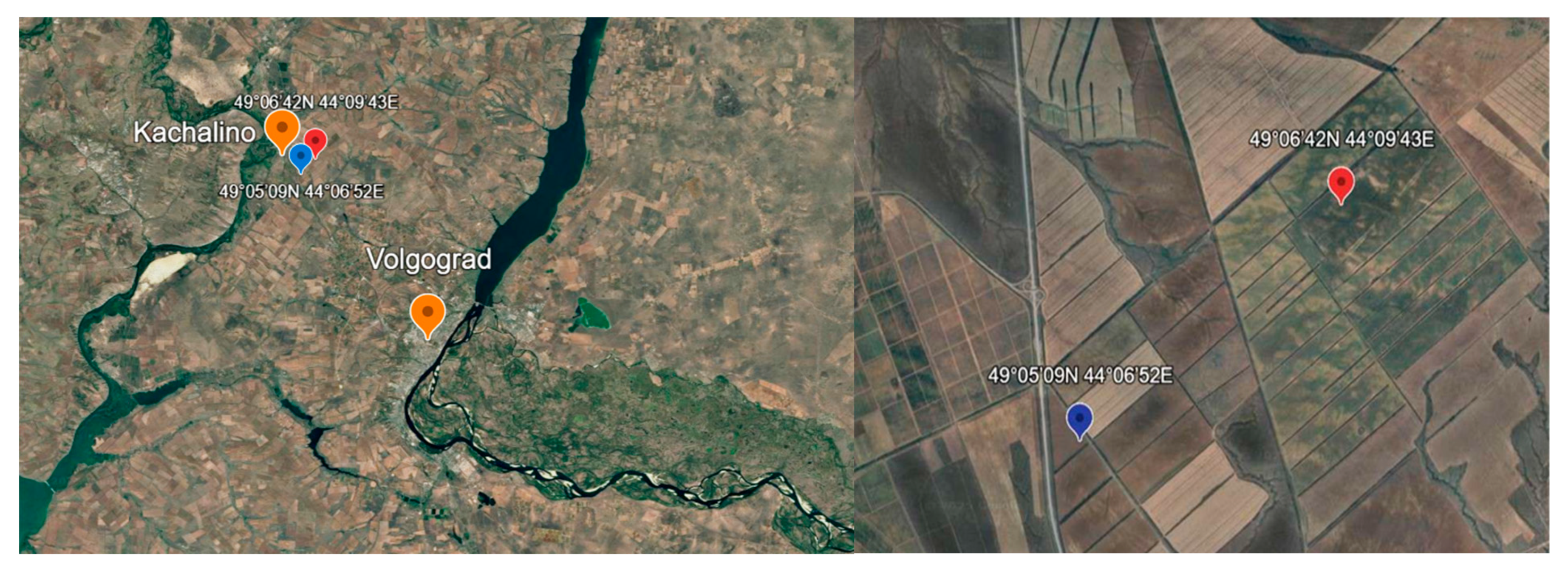
Samples of chestnut soils (WRB, 2006, Haplic Kastanozems; FAO, 1988, Haplic Kastanozems) were collected at the test site of the Federal State Budgetary Scientific Institution, “Federal Research Center of Agroecology, Integrated Land Reclamation and Protective Afforestation of the Russian Academy of Sciences” (FSC Agroecology RAS), “Kachalino”, in the Ilovlya district of Volgograd region from two pits located on fallow land (more than 30 years old; 49°06′42 N, 44°09′43 E) and on arable soil under grain crop rotation (49°05′09 N, 44°06′52 E; Figure 1). The names of the genetic horizons of soils are given in accordance with the field guide for Russian soils [34].
Sampling was carried out on test sites, taking into account the uniformity of meso- and micro-relief, with a size of 10 by 10 m by the envelope method, while a full-profile soil section was laid in the center of the site. Samples along the horizons were taken in 5 replicates according to ISO 18400-101:2017 [35].
The arable soil (Table 1) is characterized by a lumpy, blocky structure of the arable (P) horizon (0–25 cm), and a blocky prismatic columnar structure of the structural metamorphic (BM) horizon (25–40 cm). Starting from a depth of 40 cm, inclusions of carbonate neoformations appear in the CAT1 (the textural carbonate horizon containing many carbonate concretions) horizon, and from 106 cm (C ca cs: parent loam material with carbonate and gypsum concretions, 106 cm and below), gypsum.
In the soil under the fallow land, changes in the former arable horizon have occurred over 30 years, forming AJ, a light-colored humic horizon (0–9 cm) with a granular lumpy structure, and BMK/BM, a xerometamorphic horizon with a typical large prismatic nutty structure.
The vegetation cover of the fallow land is represented by grassland vegetation used for pasture or haymaking. The soil-forming rocks are loess-like saline carbonate loams. The average amount of precipitation is 380 mm/year. The mineralogical composition of the fraction of less than 1 μm of soils in the region is represented by tri- and di-octahedral hydromicas, chlorite, kaolinite, and smectite phases [36].
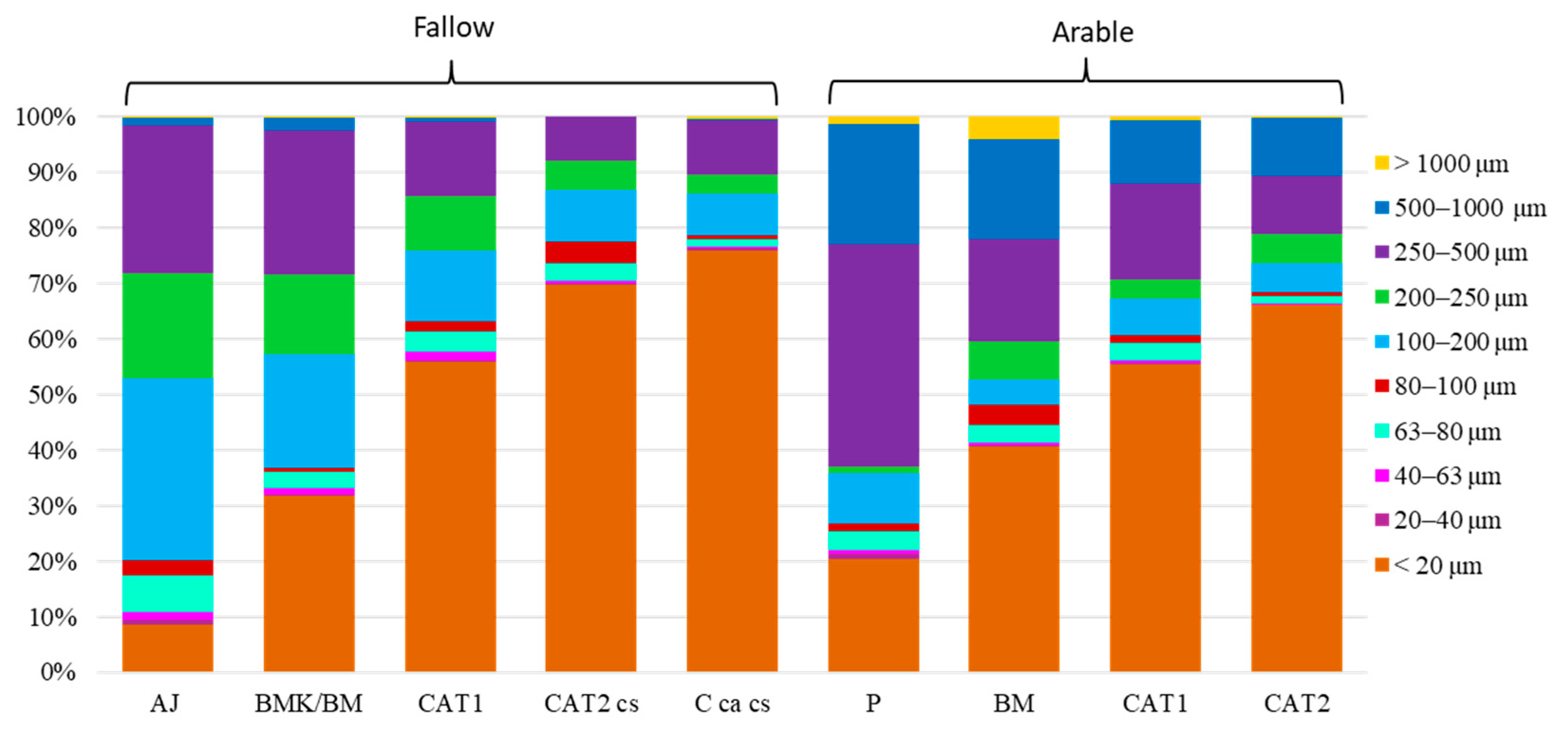
The soils of the arable land and the 30-year-old fallow soil clearly differ in the content of size fractions of waterproof microaggregates: in the AJ horizon of fallow soil, the predominant fractions are from 100 to 500 μm (in total about 80% of the total mass), of which about 30% are fractions of 100–200 µm and 250–500 µm, and about 20% are fractions of 200–250 µm. The smallest fraction of less than 20 µm is about 10%. Down the profile, the share of this fraction increases to 70–75% in CAT2 cs and C ca cs horizons.
Cropland soil in the upper arable horizon contains about 40% of waterproof aggregates of 250–500 μm and about 20% of aggregates of 500–1000 μm, and these fractions dominate. The finest fraction in the upper horizon is about 20%, and down the profile, its share increases to 65%.
The selected soil samples were air-dried without additional grinding. To separate the fractions of waterproof aggregates, a 50 g sample of the average sample was dispersed in stagnant water in a column of sieves with cell sizes of 1000 μm, 500 μm, 250 μm, 200 μm, 100 μm, 80 μm, 63 μm, 40 μm, and 20 μm. The aggregates remaining on the sieves were collected in evaporation bowls and dried at a temperature of 35 °C.
The method of sieving in water corresponded to [37] and consisted of placing a sample of dry aggregates on the upper 1000 µm sieve, the cells of which were pre-moistened (for this, the sieve was immersed in distilled water for 1 min and taken out without shaking). We waited until the water retained between the sieve cells moistened the sample of aggregates by capillary rise. If there was insufficient moisture on the sieve cells, over-moistened filter paper was applied to the sieve mesh from below (the paper was immersed in water, then excess water was allowed to drain off), and the aggregates were moistened to approximately the capillary moisture capacity. Then, the sieve with the aggregates was immersed in distilled water for 10 min. After this time, the sifting was carried out in water by moving the sieve up and down in the water 10 times. Fractionated structural units were dried and weighed, the suspension that remained in the vessel, containing particles smaller than 20 μm, was evaporated at a temperature of 45–50 °C, and the residue was weighed. The mass fractions of the fractions in the samples were estimated (Figure 2).

2.2. Reagents and Auxiliary Equipment

The following reagents and solvents were used: hydrochloric acid, density 1.18 g/cm3, chemically pure, GOST 3118-77 (Sigma Tek, Moscow, Russia); potassium chloride, chemically pure, GOST 4234-69 (REAKHIM, Ekaterinburg, Russia); sodium hydroxide, chemically pure, GOST 4328-77 (Komponent-Reaktiv, Moscow, Russia); potassium hydroxide, chemically pure, GOST 24363-80 (Lenreaktiv, St. Petersburg, Russia); hydrochloric acid, standard titer 0.1 mol/dm3 (0.1 N), TU 2642-001-33813273-97 (Uralkhiminvest, Ufa, Russia); sodium hydroxide, standard titer 0.1 mol/dm3 (0.1 N), TU 2642-001-33813273-97 (Uralkhiminvest, Ufa, Russia); ferrous ammonium sulfate double salt (Mohr’s salt; FeSO4(NH4)2SO4 × 6H2O, 0.1 mol/dm3 (0.1 N)), TU 2642-001-56278322-2008 (Ekroskhim LLC, St. Petersburg, Russia); potassium dichromate, 1/6 K2Cr2O7 0.1 mol/dm3 (0.1 N), TU 2642-001-33813273-97 (Ekroskhim LLC, St. Petersburg, Russia); sulfuric acid, high purity, CAS #7664-93-9 (JSC Ecos-1, Moscow, Russia); phenolphthalein 4,4′-dihydroxyphthalophenone, TU 6-09-5360-88; phenylanthranilic acid, TU 6-09-3592-87. Deionized water (Type I, 18.2 MΩ cm at 25 °C) from a Milli-Q Academic system (Merck Millipore, Darmstadt, Germany) was used throughout.

2.3. Humic Substance Isolation

First, a soil sample (mass, 2 kg) was decalcified by HCl (1 mol/dm3) to a pH 1.0–2.0, followed by diluted HCl (0.1 mol/dm3) to the ratio of soil-to-solution of 1:10 w/w. For 6 h, the suspension was stirred several times and then left. After 24 h, the supernatant liquid was decanted. After that, the soil sample was treated with NaOH (1 mol/dm3) to pH 7.0, followed by diluted NaOH (0.1 mol/dm3) to pH 12. For 6 h, the formed suspension was stirred several times and left. After 24 h, the supernatant liquid was decanted and subjected to centrifugation (3000 rpm) for 5 min.
To separate from fulvic acids, the centrifugated alkaline extract was subjected to acidification (HCl, 6 mol/dm3) to pH 1.0–2.0. The formed suspension of humic substances was centrifugated (3000 rpm, 5 min). Then, the precipitate was redissolved in a slight volume of KOH (0.1 mol/dm3), then to coagulate finely dispersed mineral matter, KCl was added to a total potassium concentration of 0.3 mol/dm3. Next, the precipitate was centrifugated (3000 rpm, 5 min). After that, it was treated with a mixture of HCl (0.1 mol/dm3) and HF (0.3 mol/dm3) to remove Si-containing substances and other impurities. Finally, the suspension was purified by dialysis, dried in a rotovap (40 °C), and gathered in a glass vessel. The preparate was stored in the dark. Other details are given elsewhere [38].

2.4. Soil Parameters

Carbonate equivalent (CaCO3) was measured using the acid-neutralization (calcimetric) method based on the reaction with HCl and back-titration with NaOH. A 2 g soil sample crushed to a particle size of less than 0.25 mm was poured with 25.00 mL of 0.1000 M HCl solution, 25.00 mL of distilled water was added, and the solution was left for 24 h. After 24 h, the excess HCl that had not reacted with carbonates was titrated with 0.1000 M NaOH and the carbonate content in the sample was calculated.
Soil organic matter (SOM) content was estimated using the Tyurin wet dichromatic oxidation titrimetric method: 0.2–0.5 g of a soil sample or fraction was placed in 100 mL Erlenmeyer flasks, then 10 mL of a 0.4 M 1/6 K2Cr2O7 solution in H2SO4 diluted with distilled water in a 1:1 w/w ratio was added. The prepared samples were boiled on a hotplate with a closed coil for 5 min, ensuring gentle boiling. After cooling, 10 mL of distilled water was added. Excess potassium dichromate was titrated with a solution of Mohr’s salt (0.2000 M ½ FeSO4 solution in 1 M ½ H2SO4) with phenylanthranilic acid as an indicator [39].

2.5. Instrumentation

A Vertex 70 single-beam FTIR spectrometer (Bruker Optik GmbH, Ettlingen, Germany) equipped with a wide-range room-temperature DTGS detector and a liquid-nitrogen-cooled photovoltaic MCT detector was used throughout. A PrayingMantisTM (Harrick Scientific Products, Inc., Pleasantville, NJ, USA) was used for DRIFT measurements, and a GladiATRTM (Pike Technologies, Madison, WI, USA) for ATR measurements (Table 2). Thresholds for transmittance or reflectance were 0.001% (a KM value of ca. 500), and other conditions and data handling operations are summed up in Table 2. The spectrometer and accessories were continuously purged by a flow of 500 L/h of air (a PG28L Purge Gas Generator, PEAK Scientific, Glasgow, United Kingdom; a −70 °C dew point). The environment temperature was maintained at 23 ± 1 °C (using an air conditioner).
The primary data handling was performed using OPUS Software version 8.5 (SP1) build 8, 7, 10 (Bruker Optik GmbH, Ettlingen, Germany). The OPUS built-in method of finding the x-value of an interpolated extremum was used, the y-value of the found position was treated as the band intensity (algorithm sensitivity parameter was set from 5% to 20% depending on the band).
The 2DCOS calculations were implemented using the OriginLab OriginPro 2021 (64-bit) 9.8.0.200 (Northampton, MA, USA) 2D Correlation Spectroscopy Analysis app. Matrix spectra (assemblies) for 2DCOS were assembled in OPUS with the fraction size as an external perturbation (spectra-changing factor), and the average of the fraction size was taken as the perturbation variable. Spectra were normalized for characteristic bands or regions, taking the smoothed reference band as 1 and recalculating all other bands (OriginLab Origin, Northampton, MA, USA).
Element analysis was performed with an ICP–AES 720 spectrometer (Agilent Technologies, Santa Clara, CA, USA) according to the previously developed procedure [42,43]. The details are given in the Supplementary Materials.
Titrations were performed with a KEM AT-710M automatic potentiometric titrator with a pH electrode (KEM Glass electrode C-171), both from Kyoto Electronic Manufacturing, Kyoto, Japan.

3. Results

3.1. Characteristic Band Assignment

Kastanozem fraction spectra in the whole IR range (4000–100 cm−1) were obtained both in DRIFT and ATR modalities—the noisy and noninformational spectra were discarded (3 spectra of 144, corresponding to the coarsest fraction 500–1000 μm). The spectra were processed according to subranges of hydrogen bonds (4000–3100 cm−1), DRIFT, and ATR, CH stretch (3100–2800 cm−1) and DRIFT only (ATR was noninformative), SOM (2800–1200 cm−1), DRIFT, and ATR, and matrix ranges (1200–100 cm−1). These subranges corresponded to the dominating types of functional, matrix, or SOM structural groups, and the selection was described previously for silicate soils [21,41,44,45].
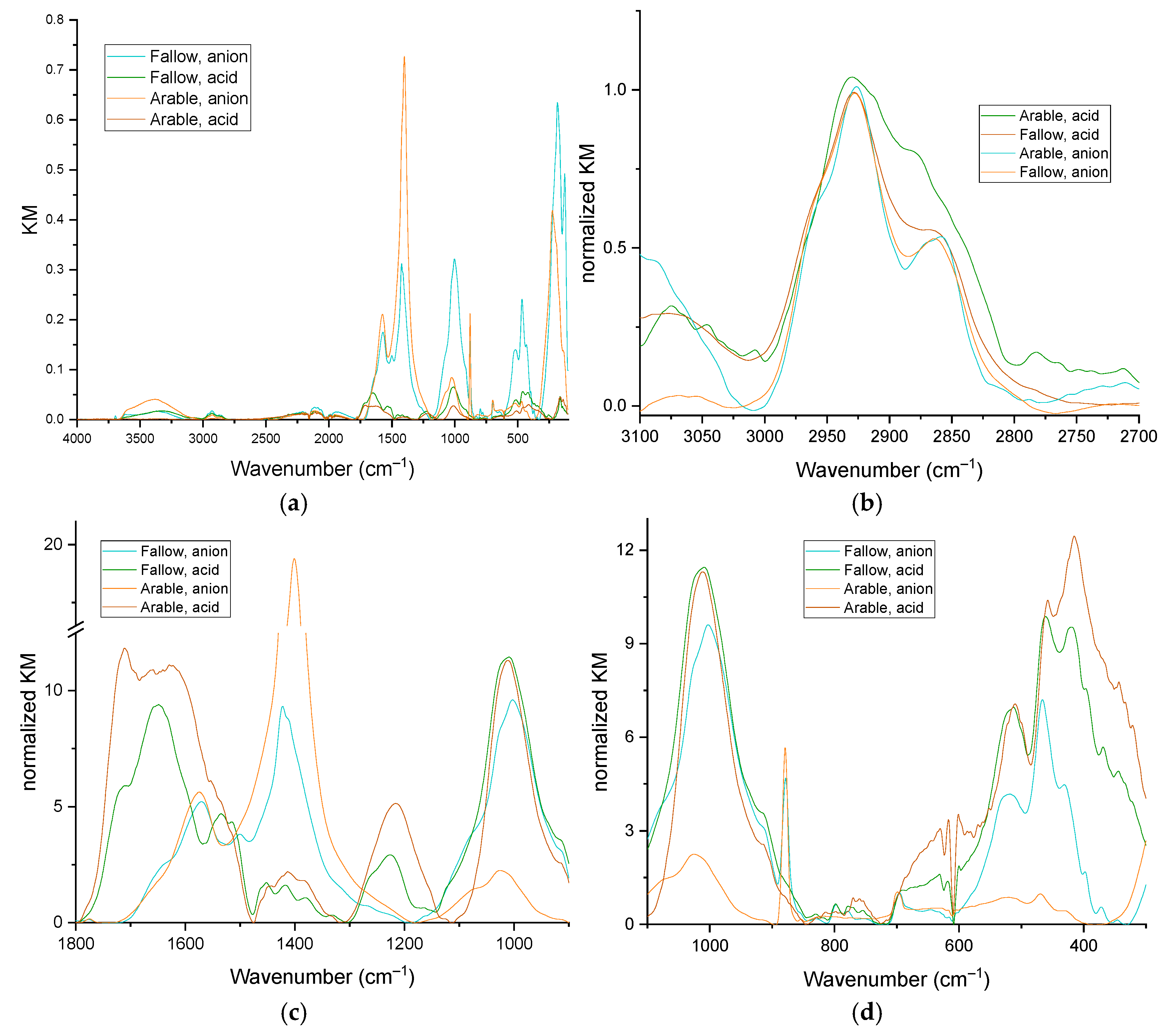
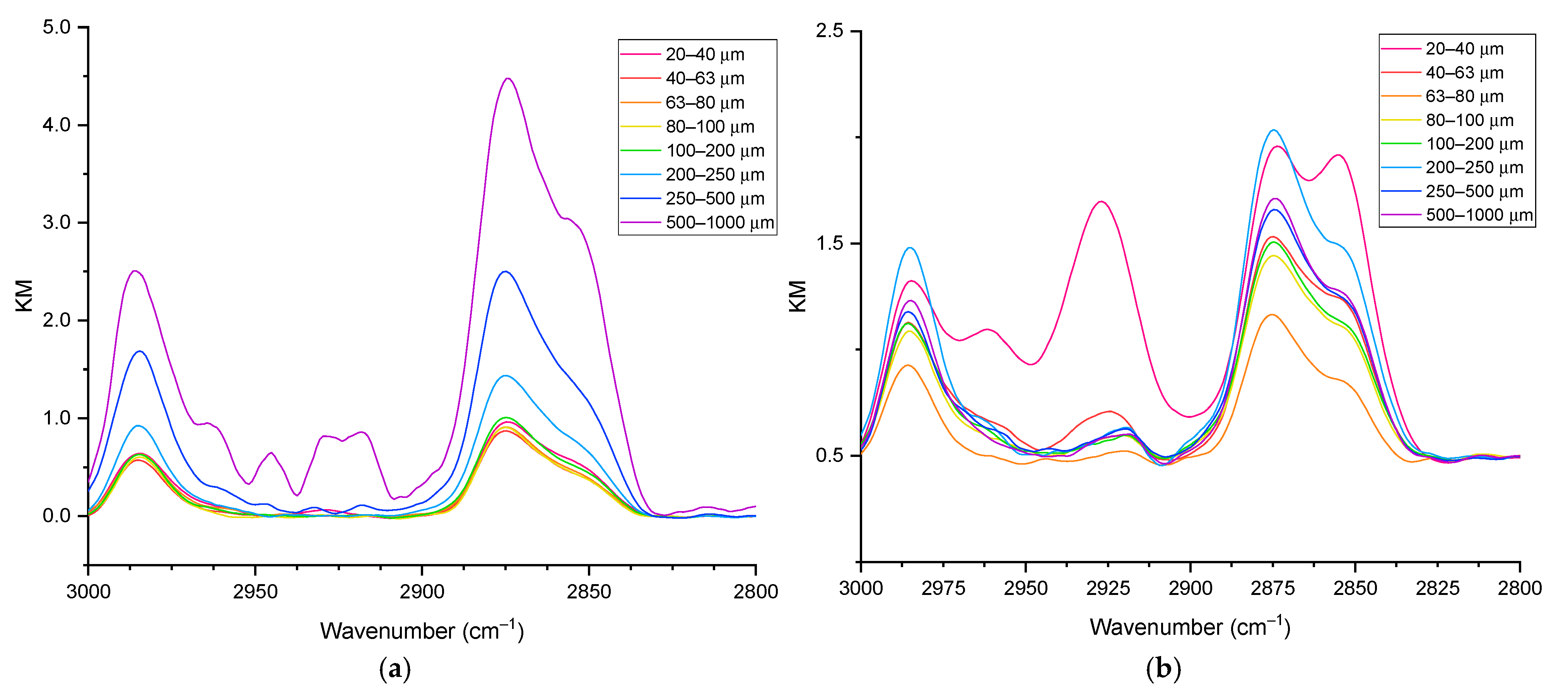
The whole spectra of Kastanozem soils are given in the Supplementary Materials (Figures S1 and S2), and the characteristic parts are given below. The ATR spectra of humic substances extracted from studied Kastanozem soils are summed up in Figure 3. Table 3 contains the main bands in ATR and DRIFT modes and general trends in band intensities in fractions within a horizon, a general comparison of fallow and arable-land spectra, and the trend in band intensities with the depth of horizon.
In the 4000–3600 cm−1 range, the only bands found in both modalities (Table 3) are 3695 and 3625–3620 cm−1 that correspond to hydrogen-bonded SiO–HH2O species and two large broad bands at 3400–3250 cm−1, antisymmetric and symmetric stretch of condensed-phase hydrogen-bond ensembles (Figures S1 and S2). These bands are barely seen in the spectra of isolated HS (Figure 3) and only for the fallow soil.
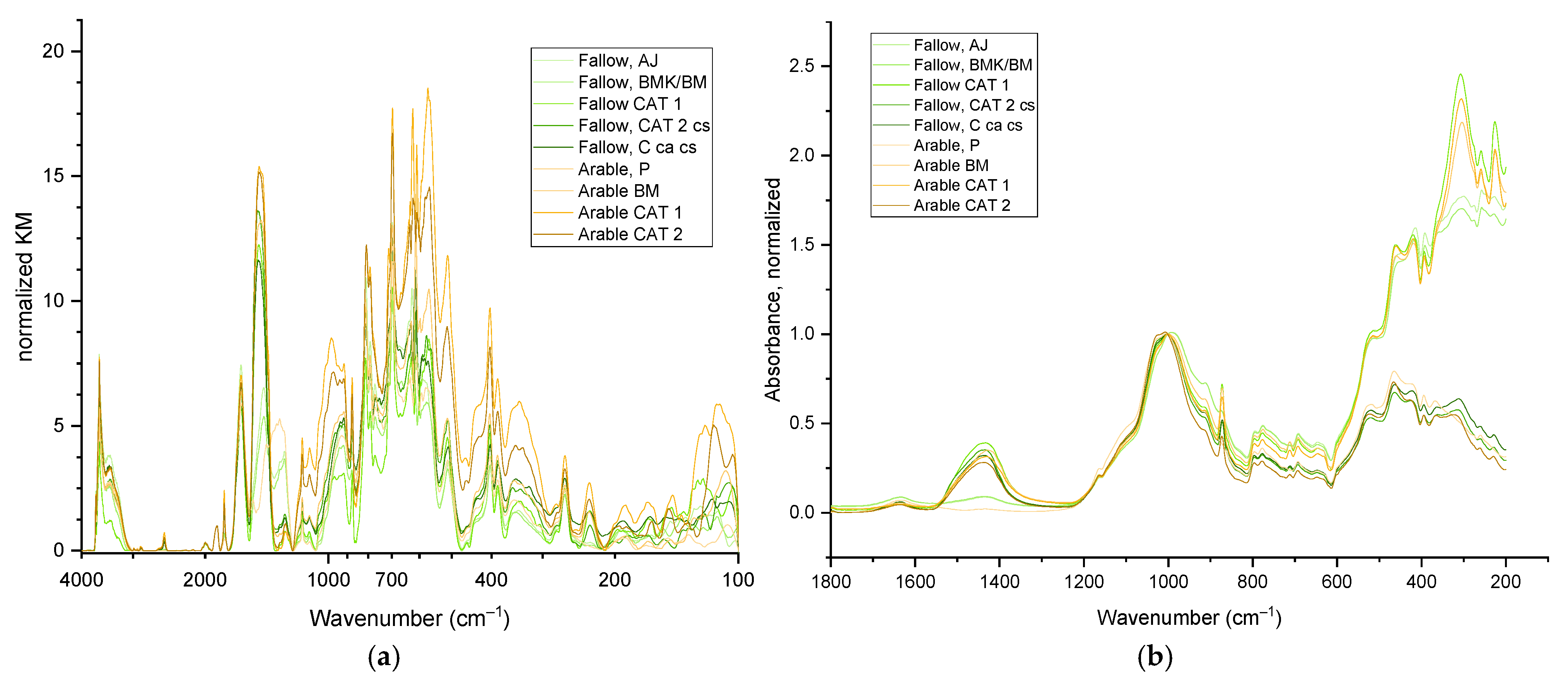
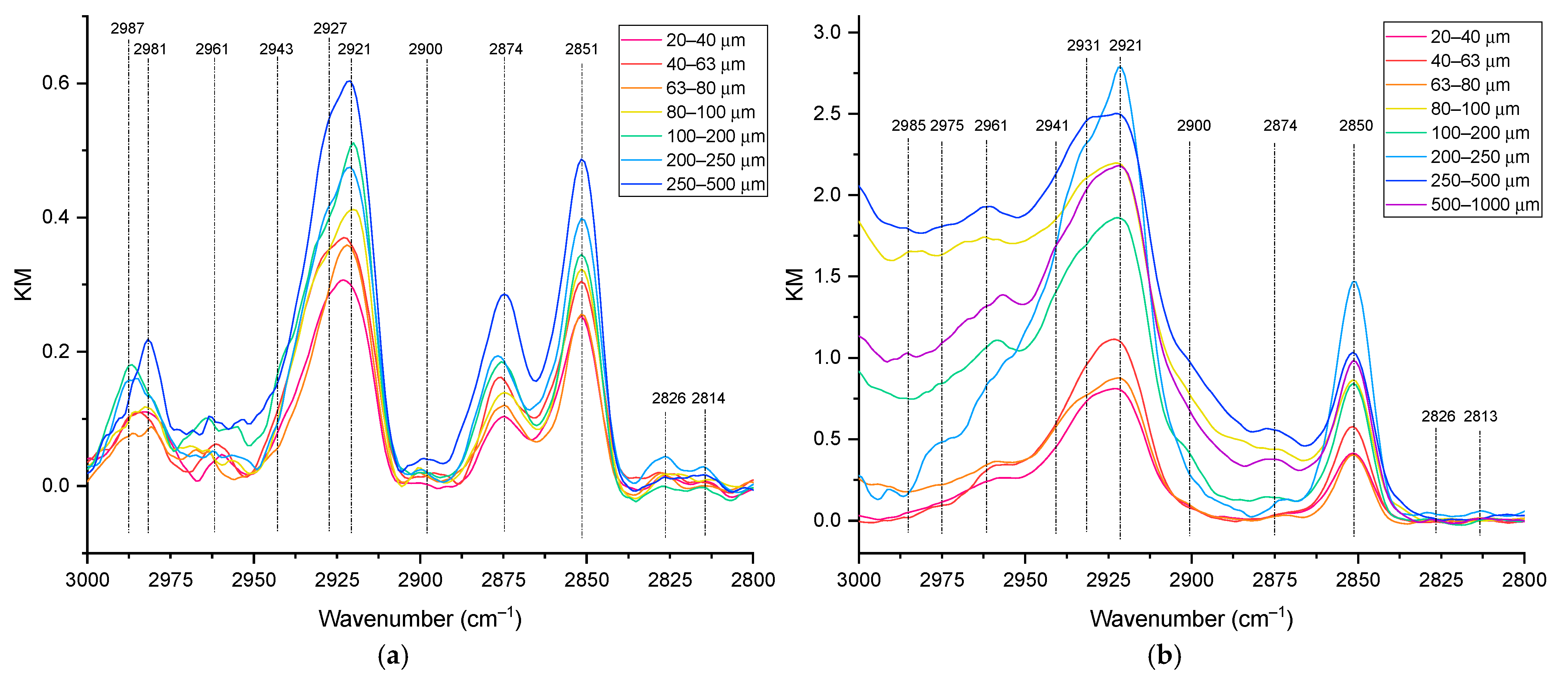
The CH stretch range 3100–2800 cm−1 is reliably detected only by the DRIFT modality, and its leftmost (high-energy) part (3100–3000 cm−1) has no detectable bands due to the strong wing of the hydrogen-bond continuum. The spectra in this range are much richer than corresponding spectra of Chernozem soils [21,41,45], and while bands of CHx groups sit on the right shoulder of the OH continuum band, they are detectable and reproducible. They show alkene methyl stretch bands and antisymmetric and symmetric stretch vibrations of methyl groups, where the main ones are 2985 and 2875 cm−1, 2930 and 2855 cm−1, and the antisymmetric and symmetric stretch of methylene groups are 2940–2930 and 2855 cm−1. The spectra in this subrange are quite different in fallow and arable lands (especially upper horizons; Figure 4) and in each horizon (Figure 5). ATR spectra of the whole soils are much less informative in this range (Figure S1), but the spectra of isolated HS (Figure 3b) show a very similar picture as described above for the whole soils.
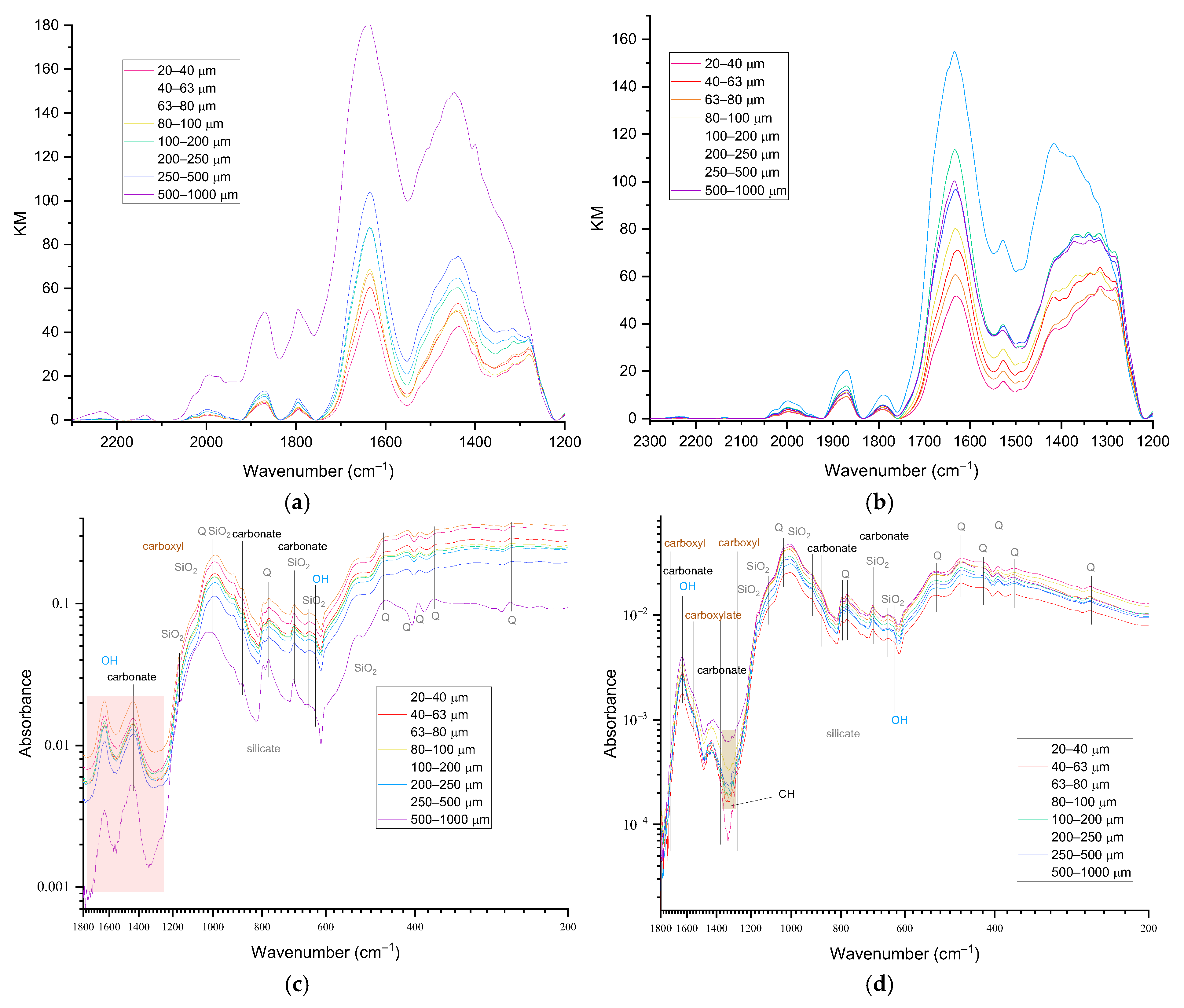
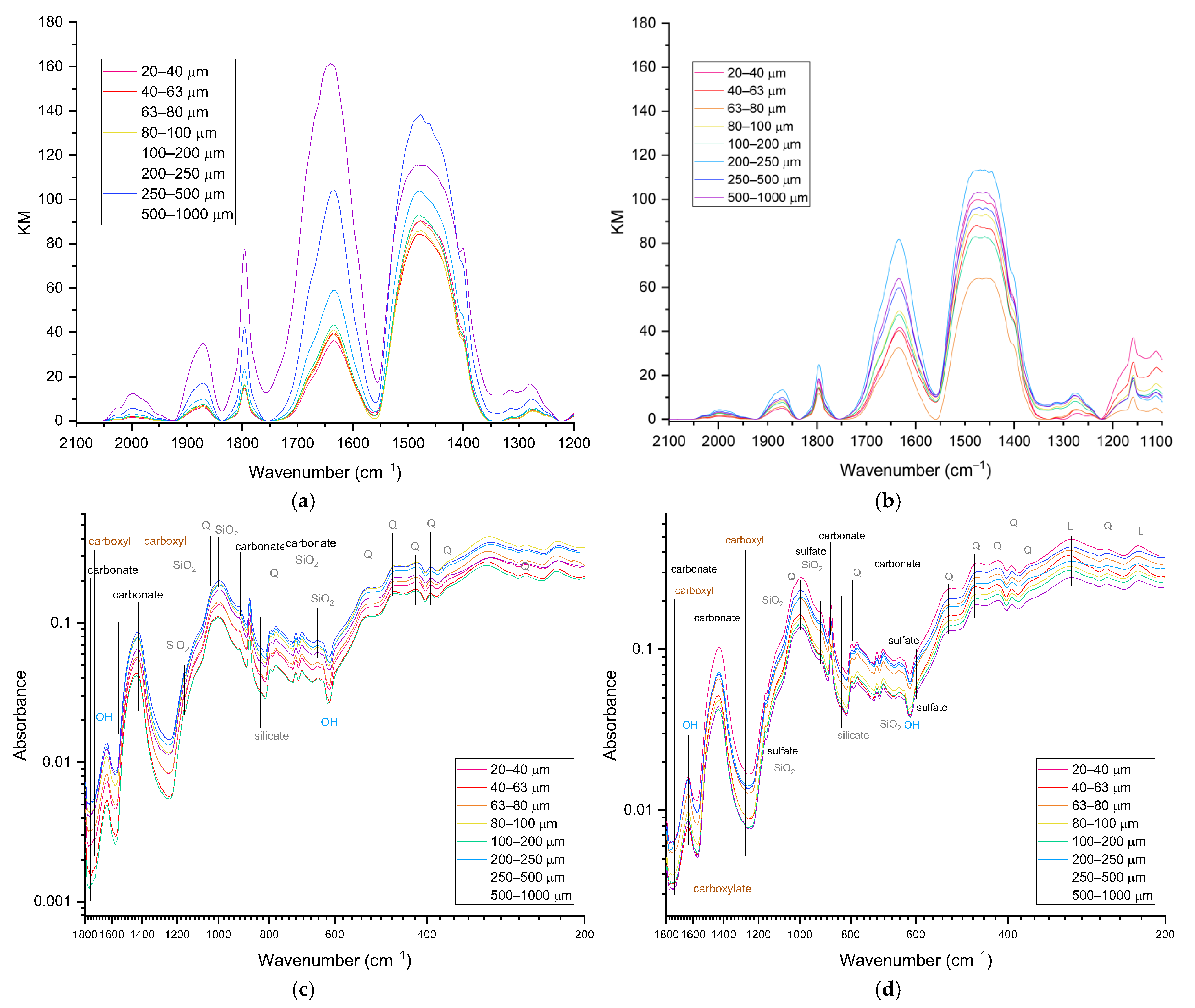
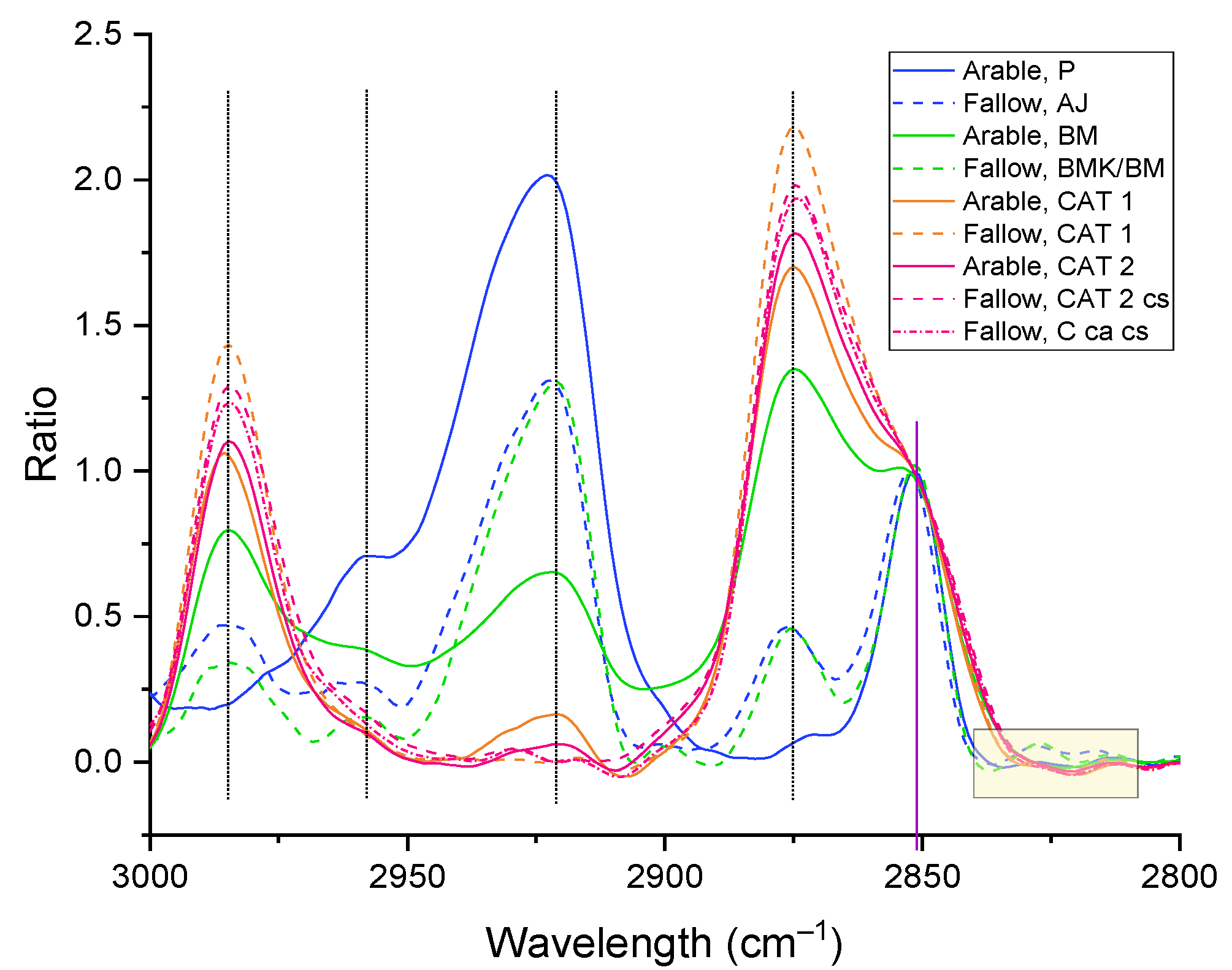
In the SOM range (2800–1200 cm−1), both DRIFT and ATR modalities show rich and intense spectra (Table 3; Figure 6 and Figure 7). In the high-wavenumber range (2800–2000 cm−1), see Figures S1 and S2, most intense bands agree with carbonate in calcite (2590 and 2520–2510 cm−1). Also, spectra of Kastanozem soil samples in the CH range normalized by the band at 2851 cm−1 (methylene band as the most prominent band) are given in Figure 8.
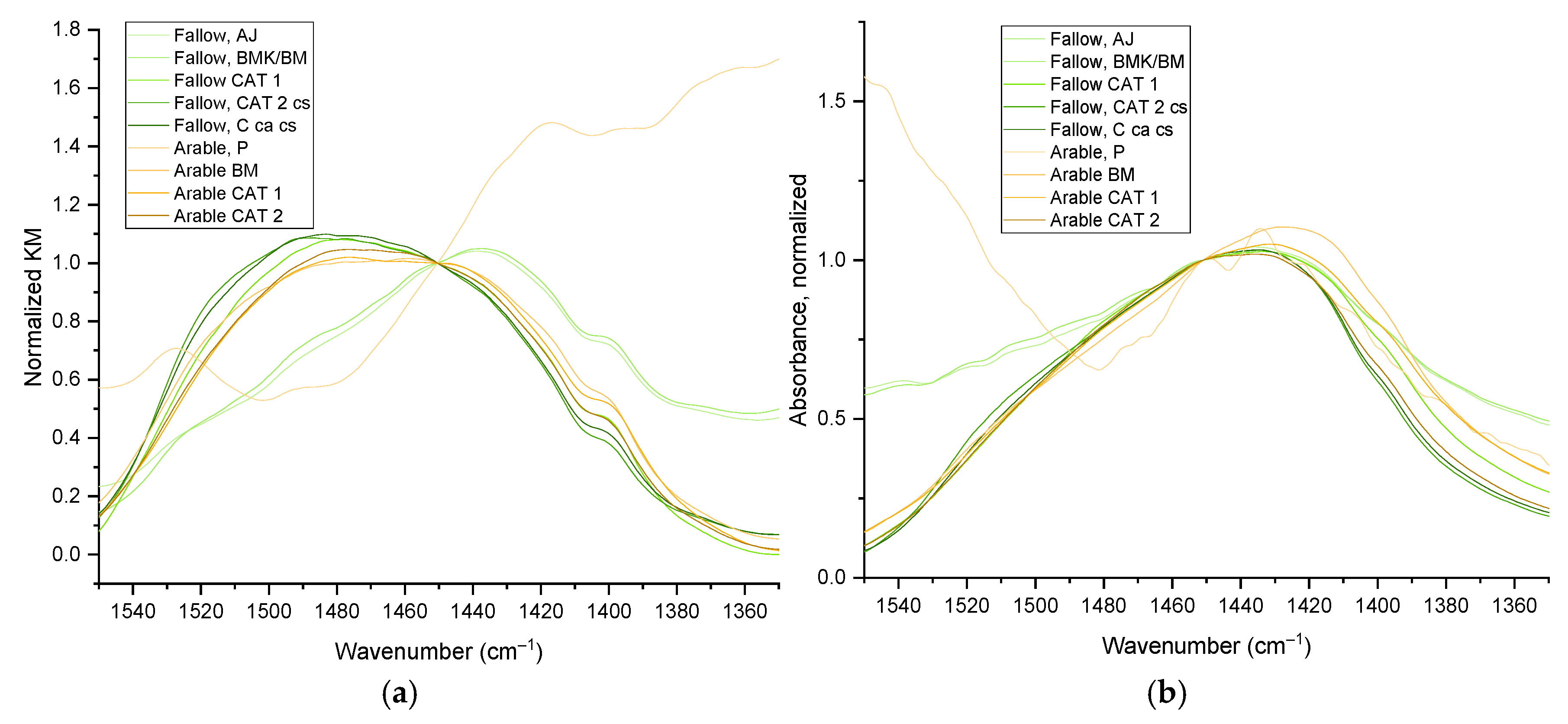
In the DRIFT modality, signature quartz overtones are visible (Figure 6a,b and Figure 7a,b) for both soils, at 1990, 1870, and 1790 cm−1 [53,66]. The overtone band at 1790 cm−1 shows an overlapped carbonate component at 1805 cm−1, which is also detectable in the ATR modality. Other matrix bands are 1460–1435 and 1410 cm−1 (antisymmetric carbonate stretch vibrations in various minerals). The band at 1645–1640 cm−1 is various OH species, mainly absorbed water and matrix-bonded water. Spectra of isolated HS in this range are not informative.
SOM bands correspond to C–H bands 1480–1460, 1350, 1330, and 1315 cm−1 (the latter three form a hardly distinguishable complex band), see Figure 6c,d and Figure 7c,d. These bands are overlapped with four bands of carboxyl (1680 and 1280 cm−1) and carboxylate (1560 and 1395 cm−1), although the latter pair of bands can be seen only in arable-land topsoil horizons (P and BM), and only the band at 1280 cm−1 remains in lower horizons, though it is extremely weak. The deconvolution of the range of 1450–1300 cm−1 in arable upper horizons shows a band at 1390 cm−1, which may be the manifestation of nitrate from nitrogen fertilizers [71]. Spectra of HS isolated from these soils (Figure 3c) show more distinct bands of carboxyl and carboxylate, hydrogen-bonded stretch at 1610 cm−1, and a series of bands corresponding to CH at 1500–1300 cm−1.
The matrix range of 1200–800 cm−1 contains the rest of the carbonate stretch vibrations at 1090, 875, and 715 cm−1 and characteristic bands of sulfate (1160 and 1120–1100 cm−1), which are very sharp. The band at 1160 cm−1 is a complex band with a sharp sulfate component and the broader silicate component (Table 3 and Figure 6c,d and Figure 7c,d). The rest of the matrix shows a broad band at 1150–1070 cm−1, mainly Si–O vibrations in crystalline and amorphous SiO2 species, bands at 1035 and 1010 cm−1 of quartz lattice O–Si–O stretch, and silicate anion bands at 912 and 840 cm−1 (weak shoulder) [49]. HS isolated and specially purified from the inorganic compounds expectedly show much poorer spectra (Figure 3d). They show only main bands at 1010, 875, 796, 697, and bands below 600 cm−1.
In the matrix range below 800 cm−1, most bands belong to quartz lattice (797 and 775 cm−1 (shoulder), 697 and 510 cm−1, 450 cm−1 (shoulder), and 440–430 cm−1; Table 3). Sulfate bands at 650, 600, and 415 cm−1 [74] are all distinguishable. The bands below 300 cm−1 belong to crystalline matrix (clay or carbonate) minerals [81].

3.2. Fraction-Size Comparison

The analysis of IR spectra as a function of the fraction size (Table 3 and Figures S1 and S2) shows that no significant changes appear for all the studied sets in the ranges corresponding to the silicate matrix component, especially biogenic silicon. The range of 4000–3000 cm−1 is not informative, showing almost the same patterns, and no information on fraction difference can be found in this range. On the contrary, almost all carbonate matrix bands increase in large fractions, especially in upper horizons. Some silicate bands also show a trend of increase in the large factions.
Also, in CH bands, mainly corresponding to methyl, no methylene groups also tend to increase in large fractions. Although some bands can be assumed to be aromatic compounds (Table 3), no bands proving it are found in any fractions, and no trends on these bands in fractions can be revealed.
Nevertheless, the largest fraction (500–1000 µm) in all sample sets is as different as possible from all the other fractions, usually showing high-intensity bands and, at the same time, high noise values.

3.3. Horizon Comparison

The spectra for the same fine fraction of 40–63 µm are shown in Figure 9. Other sets of all the horizons for a single fraction (except for the largest) show similar pictures. As a general trend, upper horizons differ more significantly than deeper horizons. More crystalline quartz is found in deeper horizons (fundamental vibrations of quartz below 300 cm−1). Intensities of all carbonate bands increase in deeper horizons.
In terms of SOM, the antisymmetric and symmetric stretch of methyl groups and the band at 1480 cm−1 increases with the horizon depth, while the intensities of all other SOM bands in the ranges of 3000–2800 cm−1 and 1350–1300 cm−1, as well as carboxyl/carboxylate bands, decrease from upper to deeper horizons. Similarly to SOM, bands attributed to biogenic silicon (1070, 1010, and 810 cm−1) also decrease with depth.
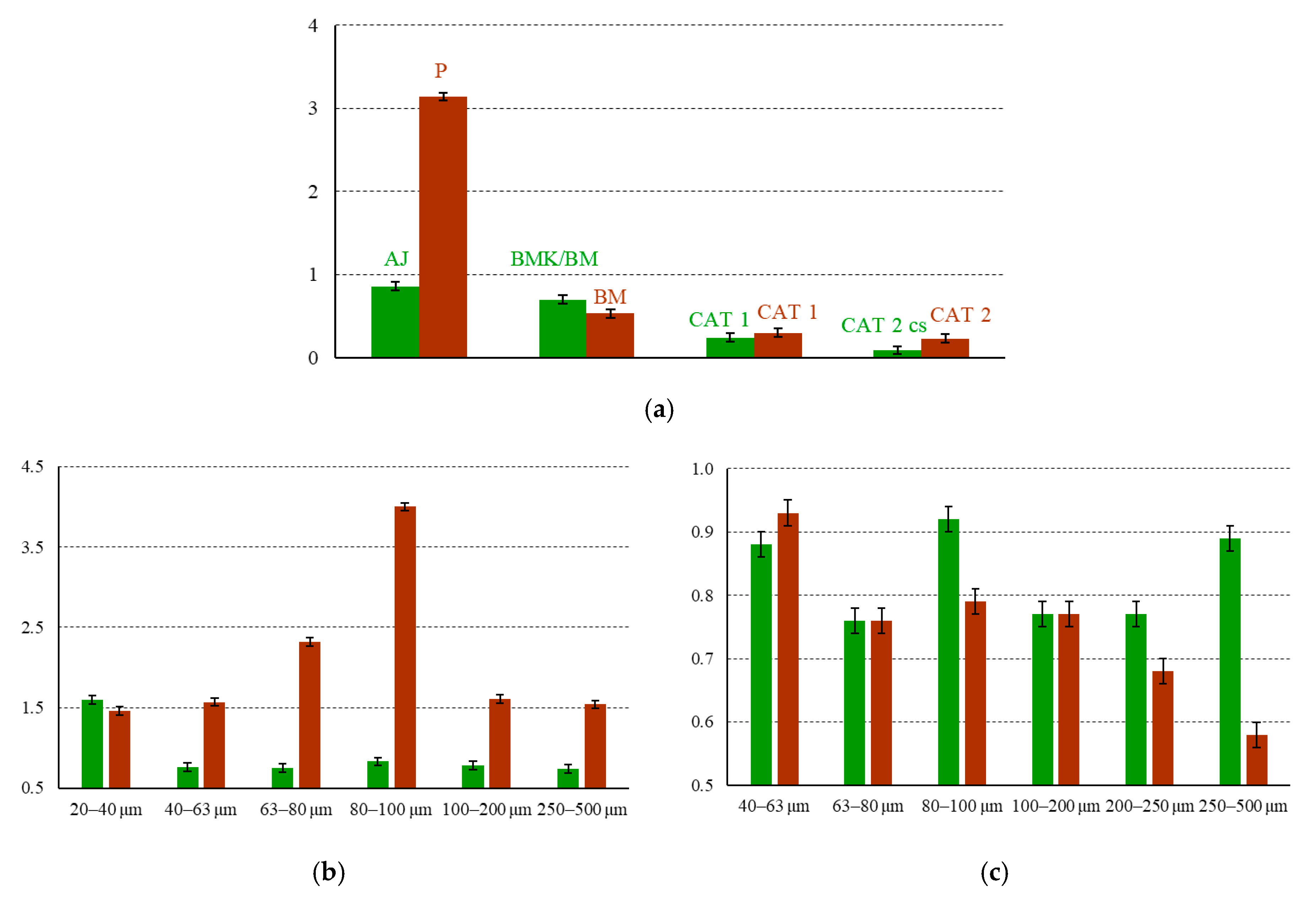
In arable land, the second upper horizon, the BM horizon, is much poorer in SOM compared to the upper horizon P (Figure 10 and Figure 11), otherwise they show similar spectra. On the contrary, in the fallow sample, the upper horizons of AJ and BMK/BM show similar values of total SOM contents (Figure 11) and their IR spectra are almost identical (by the DRIFT modality; Figure 10).
In CAT1 horizons in the sample of both agricultural uses, the spectra are quite similar, and the CAT1 horizon of arable land is close to CAT2/CAT2 cs horizons, but new bands in the range of 1400–1200 cm−1 increase, probably due to the SOM difference.
In the next pair, CAT2/CAT2 cs horizons, in arable land, there is significantly less calcium and carbonate than in the upper horizons. Also, in the CAT2 horizon of arable land, there is significantly less aliphatic substances than in the upper horizons for both land-use sets.
All the stretch, bend, and libration bands of OH as well as hydrogen-bond bands (Table 3) do not show any significant changes along with the depth profile. The exception is the complex band at 1630 cm−1, which decreases, but this may be due to components in the band different from water OH.
Upper horizons, AJ and BMK/BM, of the fallow and P of the arable land show the carbonate band peak shifted to 1420–1415 cm−1 related to 1460–1450 cm−1 in other, lower horizons (Table 3 and Figure 10). This can result from an increase in calcite and ammonium carbonate contents (the latter may be partially responsible for the overall band decrease in the range of 1400–1350 cm−1 in lower horizons).

3.4. Land-Use Comparison

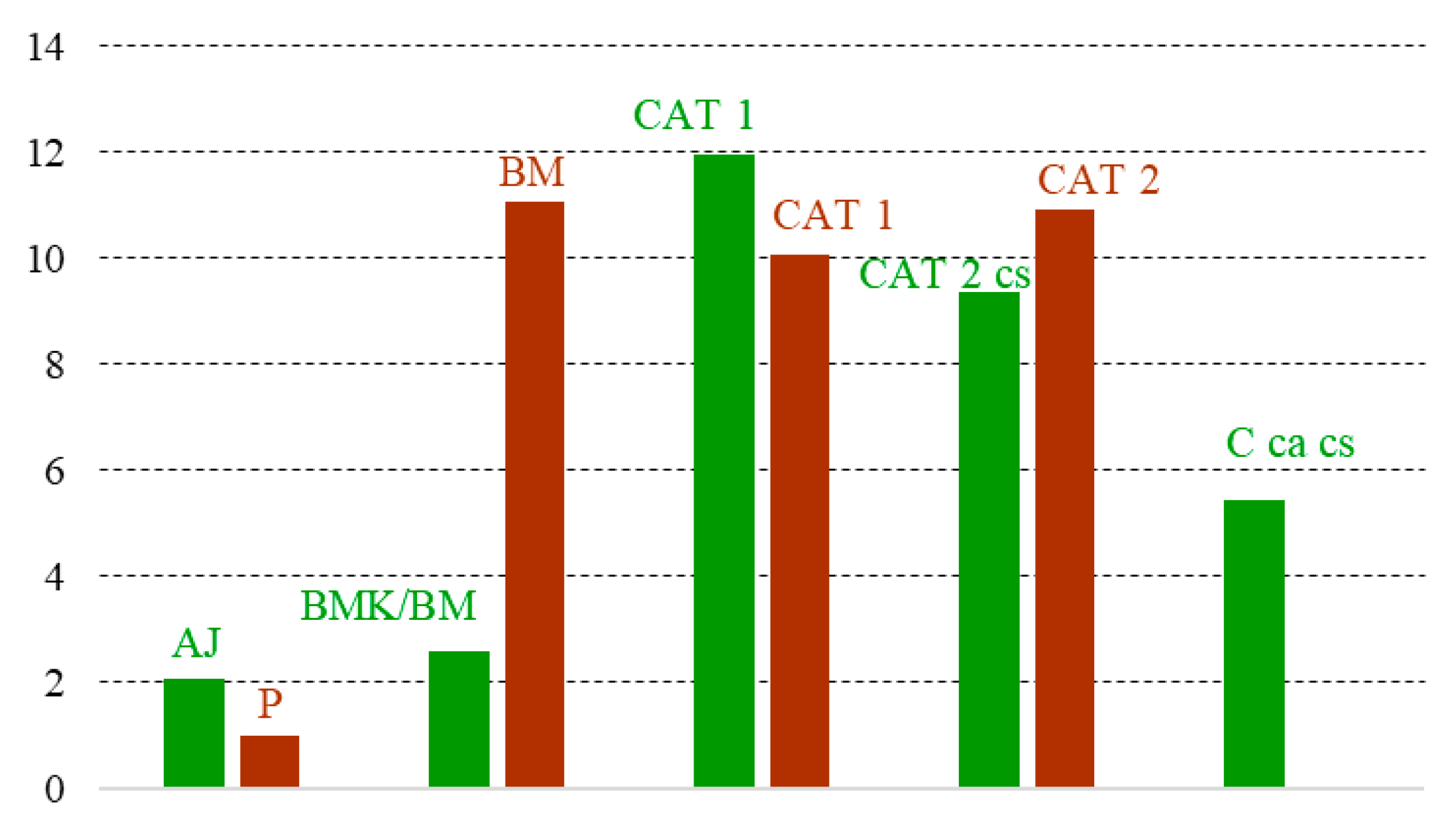
The spectra for different land-use samples (Table 3 and Figure 9) show differences in several ranges, namely, 3000–2800 cm−1 (all CH bands), 1700–1300 cm−1 (all CH and carboxyl bands), and 1100–850 cm−1 (sulfate and carbonate bands). The largest difference between the horizons AJ and BMK/BM of the fallow and P and BM of arable land is in the range of 1600–1100 cm−1. Most carbonate bands have higher intensities in the arable land. This is supported by Figure 12 and Figures S5 (as calcium) and S6 (as recalculated to carbonate) of the Supplementary Materials, which sum up, respectively, the results of carbonate measurements by titration and Ca contents using ICP–AES. All these methods show a large increase in calcium carbonate in deeper horizons, and similar contents in the pairs BMK/BM–BM, CAT1–CAT1, and CAT 2 cs–CAT.
Generally, the arable land is greatly depleted by long-chain aliphatic substances. Methylene groups are preserved in fallow horizon AJ, while in other horizons they are mainly in the fine fractions of 20–40 and 40–63 μm. The horizons of CAT1 and CAT2 pairs of the fallow and arable land are almost identical. In the CAT2 cs horizon of the fallow, there is slightly more SOM than in the CAT2 horizon of arable land.
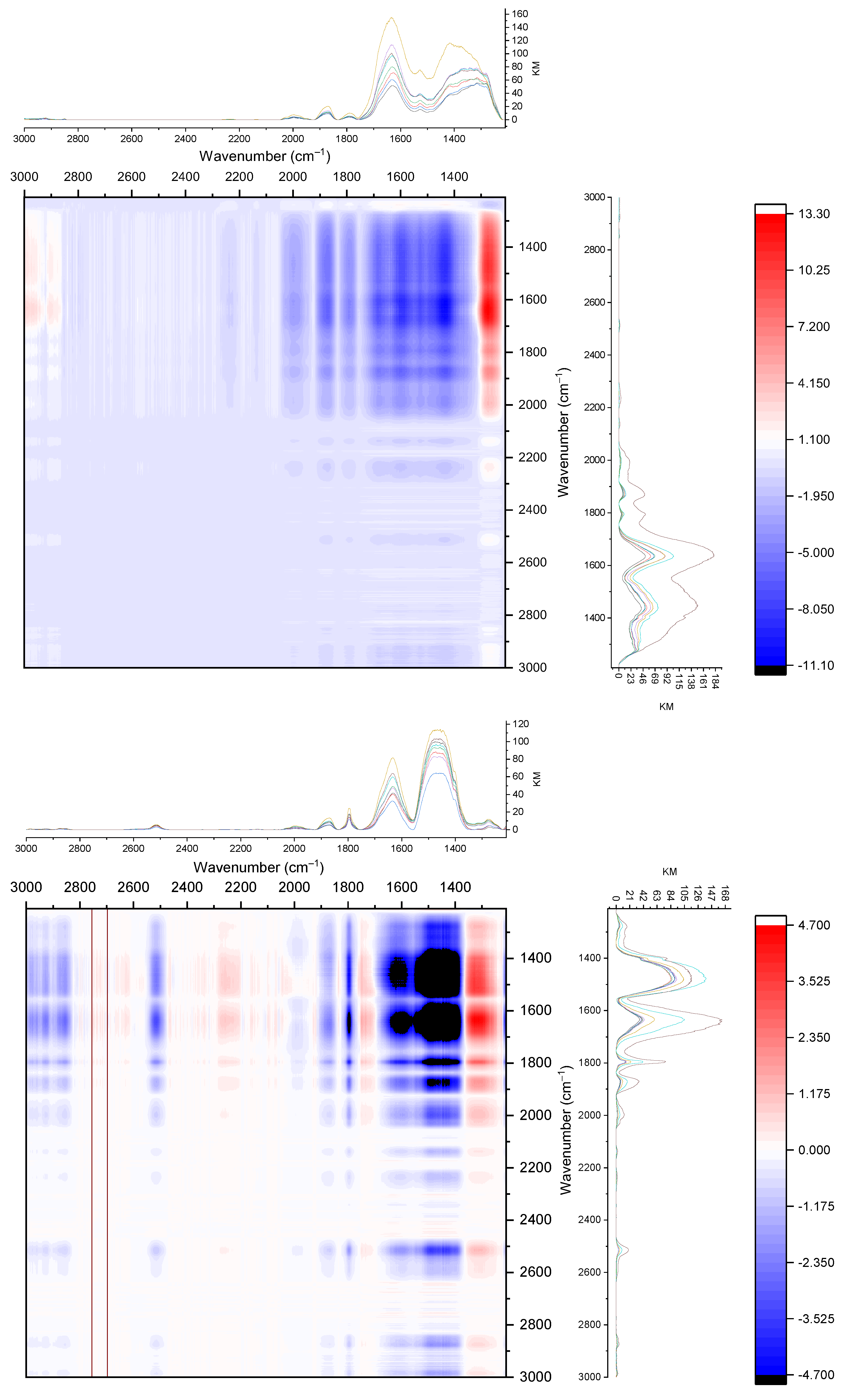
Homospectral 2DCOS correlations for all the fractions are uninformative, and synchronous spectra show the correlations of mineral matrix bands, being extra proof of their assignment. The same is correct for CH bands (Figure S3), which show the correlation between all the stretch bands. This is probably due to the quite different intensities of spectra in the different parts of the spectra for all the modalities. As in Chernozem soils [83], matrix correlations in homospectral 2DCOS show narrower lines compared to SOM.
More informative is the heterospectral 2DCOS (Figure 13), as it provides extra correlations between land-use samples. All the paired horizons (P and AJ and CAT1) show that the fallow soil shows higher contents in SOM (blue correlation zones in Figure 13), while arable land shows many more matrix minerals (silicate, carbonate, and sulfate). This situation is characteristic of all the horizons, but more definite in the upper horizons.
Atomic emission spectroscopy-normalized profiles of elements (except calcium) along the horizons are shown in Figure S4 (Supplementary Materials), while calcium levels, as they are of different and larger values, are given separately in Figure S5 for a better view of other elements. These data show that all the profiles show approximately the same level in all the horizons, however, the amounts of Ca, Mg, Sr (these three elements, most seriously), P, and Zr slightly increase with depth in the fallow soil (Figure S4), and the same, but more distinct, process is revealed in the arable soil (except Zr; Figure S4). On the contrary, the relative amounts of Al, Cu, Fe, K, Mn, and Ti decrease with depth, and this process is less reflected in the arable soil.
The correlations of elements within each profile, separated as fine and coarse groups of fractions, performed for upper horizons showing the most valuable differences, are summarized in Tables S2–S5 (Supplementary Materials). These tables show that there is a main negative correlation between Ca and Si, with Si tending to be an antagonist of all other elements (less in microaggregates, more in macroaggregates), followed by Cu as the close next element that forms negative correlations with the rest of the elements. As a general trend, macroaggregates show higher values of both positive and negative correlations. Most positive correlations are among Al, Mg, K, V, Ca, and Fe. The correlations between elements and organic carbon are with Cu and Zr (negative) and P and Ti (positive), and for macroaggregates, the correlations of SOM with most other elements are close to 1 (Tables S3 and S5).
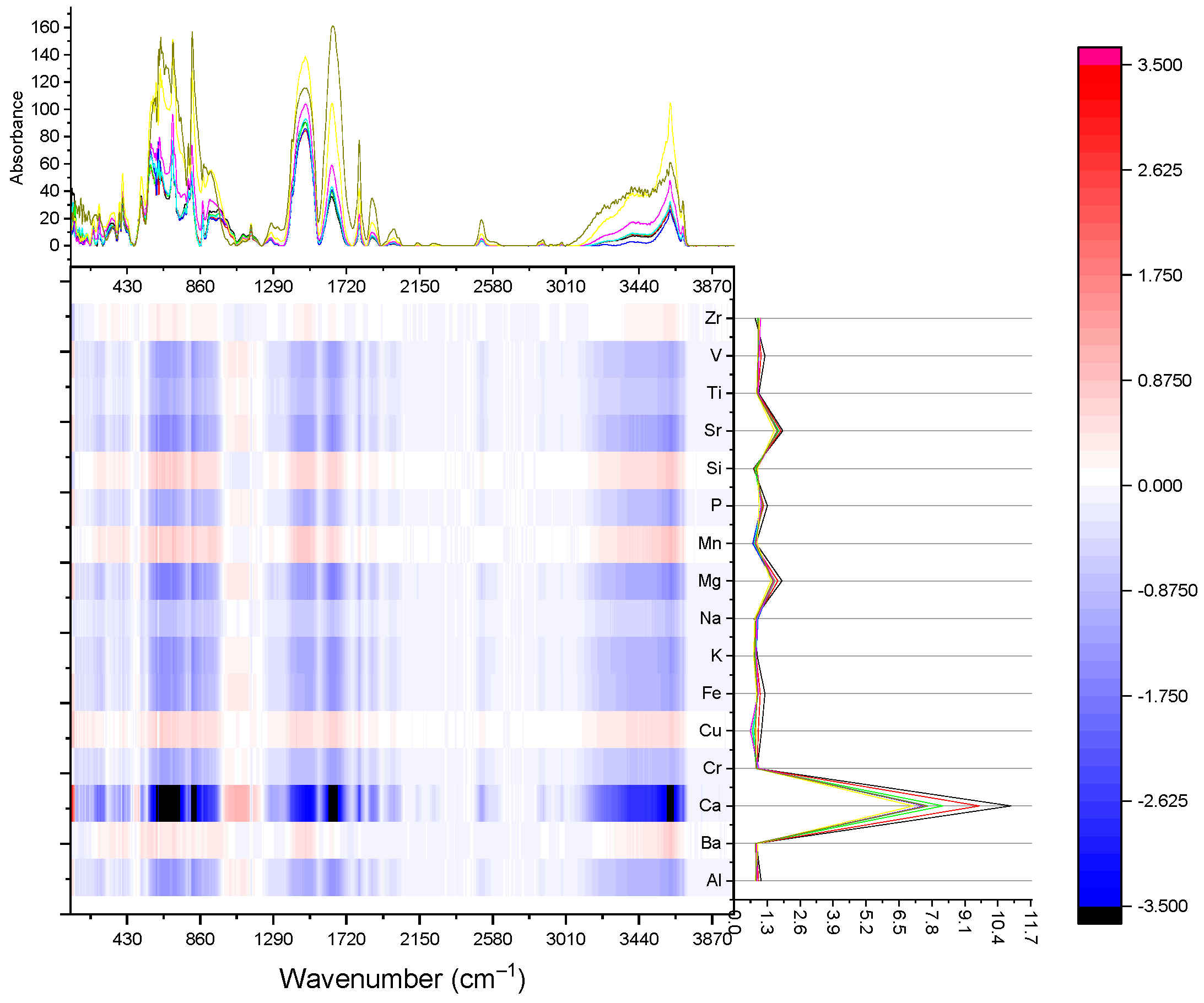
The correlations between essential element composition found by ICP–AES and the functional group analysis were subjected to heterospectral (two-method) two-dimensional correlation analysis (Figure 14).

4. Discussion

From the viewpoint of fraction sizes, FTIR of soil requires fine fractions to obtain more reliable results and compare them [84]. The reproducibility of the band shapes and positions and integral areas of almost all IR bands of Kastanozem soils in both modalities are higher for fine fractions, and the amount of the fraction of 20–40 μm is large in all the samples (Figure 2). The fraction of 20–40 μm of both land-use set samples provides almost the same information as other fractions and whole soils; thus, this fraction may represent the whole soil. Nevertheless, FTIR measurement reproducibility showed no significant changes for larger fractions from the viewpoint of the information content, which allowed us to confirm the trends in both fractions and horizons by the next fine and abundant fraction (40–63 μm) and to apply 2DCOS functionality.
The composition of Kastanozems found by FTIR is considerably richer than Chernozem soils [85]. Previous FTIR studies (mostly DRIFT) showed that chestnut soils typically contain a higher proportion of labile and diverse organic compounds [86], compared to Chernozems that display dominance of stable, aromatic, and hydrophobic humic components [87,88].
The formation of Kastanozem soil in arid climates is associated with sharp continentality, significantly higher average temperatures of the warm period, sometimes extremely low winter temperatures, and almost half as much precipitation [89,90]. The conditions for the formation of Chernozems are much milder and associated with forest steppe and steppe biocenoses, characterized by abundant herbaceous vegetation, broad-leaved tree species, moderate temperatures in the warm period, and relatively mild winters, with sufficient precipitation in summer and snow cover in winter [91,92,93].
This is indeed due to a more diverse composition of the mineral matrix, as spectra show all the characteristic and distinct bands of sulfate and carbonate (Figure 6 and Figure 7). That is, both carbonate and gypsum contractions and neoplasms, in contrast to Chernozems, for which gypsum inclusions are not characteristic [85]. This is well supported by the data obtained for carbonated by titration, and for Ca and S by ICP–AES.

4.1. SOM Comparison

Bands that can be attributed to SOM (Table 3) within each sample show very few organic carbonyl groups and aromatic substances, which distinguish them from Chernozem [21]. In both fallow and arable lands, upper horizons of Kastanozem soils show low amounts of SOM.
However, SOM composition in the studied Kastanozem soil samples is much more diverse compared to Chernozems, especially due to the presence of fulvic acids and less humification compared to Chernozems [94]. This is obviously due to the climate aridity and the peculiarities of the transformation (humification and mineralization) of the incoming plant material. It is noted that the cultivation of virgin Kastanozems led to a decrease in the content of organic matter with a simultaneous decrease in the proportion of humic acids and an increase in the proportion of fulvic acids, which indicates a high intensity of mineralization of soil organic matter in the dry steppe. This is confirmed in this study with a rich composition of CHx and many SOM bands (Figure 8) and the almost the same composition of the bands in the spectra of HS isolated from these soils (Figure 3b).
In the topsoil horizon of the arable land P, the ratio of methyl to methylene (2875/2851) is 0.1, and may be explained by a large amount of plant residues, since the sampling was performed during the growing season with agricultural technologies that increase the fertility of the arable soils. In addition, there are a lot of small roots and other plant residues in the arable land, which somewhat overestimate the result obtained for the humification degree. This ratio increases to 0.5 in the next horizon, BM, and becomes the same with the fallow horizon AJ, which forms a perennial undisturbed organogenic horizon, into which the bulk of non-agricultural plant litter enters. In total, these three horizons (Figure 8) form a rather high degree of humification according to FTIR studies [94].
For all other horizons, the ratio of methyl to methylene (2875/2851 cm−1) is above 1, reaching the value of 2 for deeper horizons, which is a manifestation of mainly fulvic composition of SOM [95]. Deeper horizons are mainly the same from the viewpoint of this ratio of methyl to methylene. However, Figure 3b and Figure 8 show more diverse bands at 3000–2950 cm−1, which can be attributed to methoxy (or methylene close to functional groups like carboxyl or carbonyl) [96], which is also potential evidence of shorter hydrocarbon chains in SOM in this sample, and there is a correlation of the intensity of this band with the band of 2975 cm−1.
It is also interesting that topsoil horizons show a series of weak bands in the range 2840–2800 cm−1 (a light-yellow rectangle in Figure 8), which may be a manifestation of aldehyde/ketone components, which disappear in lower horizon samples. The same picture is seen for isolated HS, mainly for arable soil (Figure 3b). All the above obviously reflects the processes of mineralization of organic matter in these soils [94].

4.2. Land-Use Samples

Overall, the difference between uncultivated (fallow) and cultivated (arable) Kastanozem soils found by ICP–AES and FTIR is rather distinct, and more pronounced compared to same land-use Chernozem samples [21,83,97]. The content of organic carbon and other elements in microaggregates depends on the method of separation of these particles [98]. It is assumed that by isolating microaggregates by wet sifting from air-dried samples, we obtain information about the content of stable, slightly water-soluble soil organic matter [99]. At the same time, the review in [100] provides a large number of examples that make it possible to assess the distributions of SOM content in the fractions of microaggregates of the upper horizons of arable and fallow Kastanozem soils from the viewpoint of the turnover of macroaggregates and the chemical agents contained in them.
Thus, in the upper horizon, AJ, of the fallow, the prevailing fractions are 100–200 μm > 250–500 μm > 200–250 μm. At the same time, the differences in the content of these fractions are only within 5–10%. This indicates a low turnover between the fractions of macroaggregates (250–500 μm) and microaggregates (smaller than 250 μm). Larger waterproof aggregated structures have not been identified. The content of SOM is maximum in the finest fraction, which characterizes it as belonging to the most stable SOM pool. Its content in the soil generally corresponds to the average abundance in chestnut soils of the sampling area (0.8–2.7%) according to [90].
In the arable soil, the distribution of prevailing aggregates is different: 250–500 μm >> 500–1000 μm ≈ up to 20 μm, which indicates a high turnover of macroaggregates and their transformation into microaggregates, i.e., a high rate of transformation of fresh OM crops coming with plant material [100]. This conclusion is quite consistent with the distribution of the SOM content in the fractions of arable soil aggregates with a maximum content (about 4%) in the fraction of 80–100 μm.
Fallow soil shows a less substantial decrease in SOM amounts with depth (Figure 11a). Long-term lack of ploughing corresponds to the continuous restoration of the natural soil formation processes for 30 years—newly formed organic matter is not removed, it is humified and accumulated naturally. Higher amounts of SOM in the BMK/BM horizon compared to deeper horizons and the BM arable-land horizon are probably associated with SOM transfer to organo-clayey cutans, which establish the textural differentiation of alkaline Kastanozem soils [101]. Vertical migration of organic matter is apparently facilitated by an increase in the alkalinity index of soils in the studied area [90]. The authors showed that the content of exchangeable sodium increased significantly compared to the data obtained during the survey in 1987, while in fallow soils, it was higher than in arable analogs. Our data also indicate the presence of hydrogen carbonates in the lower parts of the profiles.
From the viewpoint of matrix components, there are trends common for both land uses. First, upper horizons (arable P, 0–25 cm, fallow AJ, 0–9 cm, and BMK/BM, 9–34 cm) contain rather less intense carbonate peaks (Figure 9), which is fully supported by AES data and titration (Figure 12 and Figure S6). The arable BM horizon has a 5-fold higher amount of calcium carbonate than the fallow BMK/BM horizon. Then, in the transition from CAT1–CAT1 to the CAT2–CAT2 cs pair, the amounts of carbonate increase 6–7-fold (Figure 12) and intensities of almost all the carbonate IR bands increase by ca. 10–15 times, which is confirmed by AES intensities of calcium bands and then 2-fold decreases toward the deeper C ca cs (134 cm) horizon. Changes in the composition of the lowest horizons of both fallow and arable land (except for the CHx content discussed above) are slight.
Possibly, with depth, the contents of hydrogen carbonates increase (increase in intensity of the band attributed to C–OH groups at 2600–2500 cm−1). The accumulation of carbonates in CAT horizons is morphologically approved by a change in the carbonate being plowed from the underlying layer. Carbonate in the fallow AJ horizon is relatively low and represented by calcite (Table 3), and lower horizons of both samples show a blue-shifted band of calcium carbonate (1450 cm−1) attributed to dolomite [69], characteristic for the underlying rock formations in the sampling area [85].
Overall, the difference between uncultivated (fallow) and arable Kastanozems is rather distinct, and even more pronounced compared to the same land-use Chernozem samples [21,83,97]. The fallow soils across the whole depth profile exhibit considerably higher levels of SOM with methylene groups (bands at 2930 and 2855 cm−1), indicating longer hydrocarbon chains (Figure 8) in the range of 1170–900 cm−1, a more significant growth along with the profile compared to SOM [102]. Thus, the impact of agricultural management and landscape position influence Kastanozem SOM properties, but the intrinsic chemical diversity tends to be higher compared to Chernozems.

4.3. Correlations of Elements and SOM

To assess the features of the gross elemental composition of the selected fractions, we conditionally divided them into two groups: microaggregates smaller than 200 μm and macroaggregates larger than 200 μm, in accordance with the study in [100]. The correlation tables are given in the Supplementary Materials (Tables S2–S5).
In the fallow soil, in the fractions of microaggregates (fractions smaller than 200 μm), we do not see high positive correlations between the content of SOC and other elements, except for phosphorus, iron, and to a much lesser extent aluminum and sodium (Tables S2 and S3). We attribute this to the peculiarities of the material composition of SOM in microaggregates, namely, the predominance of stable aromatic structures in its composition. In fractions larger than 200 μm, the SOC content shows very high correlations with almost all elements, except for zirconium and copper. At the same time, the presence of correlations with Na for all size fractions can explain the vertical migration of SOM in the form of sodium salts and their detection by IR spectroscopy in the lower part of the profile. This confirms the theory of the formation of SOM from biotic organic matter under the conditions of the formation of macroaggregates, which then, because of humification and mineralization of this OM, are destroyed with the formation of microaggregates. In steppe and desert soils, most of the elements are strongly associated with highly dispersive particles, and a smaller part with organic matter [103].
The silicon content in the fractions of microaggregates does not have high correlations with any specific elements, but it is positively correlated with copper, manganese, zirconium, and to a lesser extent with calcium and chromium. We believe that, together with the negative correlation of medium strength with aluminum, this may indicate a very low content of clayey aluminosilicates in the mineral phase, since in fact the test sample is not a silt fraction consisting of particles smaller than 1–2 μm, but rather a sum of fractions up to 200 μm belonging to dusty and fine-sandy sizes, which mainly contain primary silicates in soils of arid and semi-arid regions [104,105]. It is obvious that in addition to primary aluminosilicates, the presence of which is evidenced by high correlations of aluminum with K, Na, and Mg, there are mineral phases (amorphous and crystallized) of SiO2 in the fractions.
Tables S2 and S3 show Ba–Al correlations for the sums of fractions less than 200 μm and more than 200 μm in fallow land, which are high and amount to 0.95 and 1, respectively. Certainly, an increase in the sample could have a slight effect on the numerical value of the calculated value, but they are high in any case [106] and are the main sources of Ba in soils [107]. It should also be noted that the correlation coefficients of Ba with K for this soil (0.98–0.99) are high, which confirms this conclusion. The obtained correlations are confirmed by the previous data [108], which, based on the analysis of more than 120 soil samples differing in both classification and granulometric composition, obtained a high coefficient of 0.93 for correlation of Ba with Al. For the upper horizon of arable soil (Tables S4 and S5), high correlation coefficients of Ba with Al are found for large water-tolerant aggregates larger than 200 μm, while fine particles appear to contain less aluminosilicate-bound barium, containing it in the forms of other compounds because of regular agrogenic influences.
High correlations between Fe and almost all the test elements in macroaggregates indicate that in these soils, non-silicate minerals of iron oxides play the role of both the main sorbent, a carrier of other trace elements, and the cementing agent of macroaggregates [109]. The bonds between alkaline-earth elements—calcium, strontium, and magnesium—that form geochemical associates and provinces, are also high [110], and the Ca/Sr ratios are quite high: 50–80 in the fractions of the upper horizon.
In arable land, the C content of microaggregates is positively correlated with Mn and P, to a lesser extent with Fe, V, and Mg, and there is also a very weak positive correlation with other biophilic elements like K, Si, Ca, and Al. We attribute this to a higher rate of circulation of aggregates and the associated processes of mineralization of organic matter in regularly cultivated soil: aerated due to annual plowing, with the application of a significant amount of fertilizer, containing a significantly higher amount of post-mortem plant residues and a developed microbiota compared to the fallow soil. At the same time, the formed SOM contains a greater number of aliphatic fragments and functional groups that allow the formation of compounds with the listed cations.
This is confirmed by the presence of absolute correlations (r = 1) of SOC with all defined elements except Zr and Si for macroaggregates. The high values of negative correlations of silicon with all other elements (r ranges from −0.7 to −1) except Zr (r = 0.38) indicate a multiple predominance of mineral phases of SiO2 over aluminosilicates. In the composition of microaggregates, the proportion of aluminosilicates is apparently higher.
In comparison with the fallow soil, the macroaggregates of arable soil show positive correlations of Cu with almost all elements except Zr, which indicates its agrochemical nature (intake as part of fertilizers and with plant residues).
Also, calcium distribution shows differences in the upper horizons that are associated with the regular removal of carbonates (and less capillary pulling due to the destruction of capillary pores) during plowing. The accumulation of carbonates in the subsurface horizon of 25–40 cm (Figure 7, Figure 12 and Figures S5 and S6) is obvious. In lower horizons, the nature of the distribution of carbonates of the two soils becomes the same.
The profile distribution of magnesium and strontium naturally coincides with that of calcium since these elements are associated with calcium [107]. It should be noted that the topsoil arable horizon P is relatively enriched in strontium, the Ca:Sr ratio in it is within the range of 50–60, while in the AJ and BMK/BM horizons of the fallow it is twice as high. Such ratios are typical for the material of the Earth’s crust in general and for unpolluted soils in particular [110,111]. Lower in profile, this ratio grows, ranging from 200 to 350, which is associated with a significant increase in the content of calcium carbonate minerals, visualized in the form of abundant neoplasms.
To further compare land-use samples, the horizon-to-horizon comparisons were made using discrete 2DCOS (Figure S7), with fraction size as a signal generation (perturbation) variable. It reveals that the contents of Si, Ca, Na, Ba, Cu, and P are mainly well correlated in between counterpart horizons, with main differences in the contents of Mn, V, Cr, and Fe (the latter in the topsoil horizons only).
Finally, we established the possible correlations between essential element composition (by ICP–AES) and the functional group analysis by two-method 2DCOS (Figure 14). As far as we are concerned, such application of 2DCOS for heterospectral atomic spectroscopy and molecular spectroscopy techniques was used for soil samples for the first time.
In fact, for all the samples (horizons P and CAT1 of the arable soil, and horizons AJ and CAT1 of the fallow), the results of 2DCOS show the same picture: a rather strong correlation with Si and Ca. The contents of Si by ICP–AES rather strongly correlate (red areas) with quartz/silicate bands in FTIR spectra, while calcium with carbonate and sulfate peaks. The 2DCOS maps show a very strong (especially for Ca) negative correlation between the bands attributed to the corresponding element (Si with carbonate and sulfate and Ca with silicates). Certainly, the interelement correlations discussed above result in, as we believe, secondary, indirect correlations between silicate in FTIR with Ba, Cu, and Mn, and carbonate and sulfate with Fe, Mg, Sr, and V. The FTIR ranges with wide bands and purely SOM bands, as expected, show no correlation with ICP–AES.

5. Conclusions

Thus, despite a more diverse matrix composition compared to silicate soils [21,41,45], comparison analysis of microaggregates of Kastanozem soil fractionated with two modalities of FTIR along with ICP–AES was used to assess the changes in the soil composition for various land uses as well as changes along the depth profile. For Kastanozem soils, the abundance and diversity of matrix components (carbonate, silicate, and sulfate) proved to be a benefit, showing the reference points for a more complicated and delicate FTIR analysis of SOM than for purely silicate soils. In our opinion, the use of two-dimensional correlation spectroscopy for AES and IR data proved to be a rather valuable tool for attributing matrix and SOM components in such complex matrices. Also, FTIR combined with AES provided screening of soil samples, assessing factors affecting SOM contents and composition resulting from intensive farming or other agricultural practices (degradation). Certainly, analysis of SOM using other modalities of molecular spectroscopy is needed for a more detailed picture, as FTIR alone cannot fully distinguish the structure of SOM and assess minor but still essential functional groups. For this purpose, GC/MS methods with corresponding sample preparation may be the most suitable. However, the proposed FTIR approach can complement these highly informative methods and provide a large volume of information without sample decomposition or other chemical sample preparation.

Supplementary Materials

The following supporting information can be downloaded at: https://www.mdpi.com/article/10.3390/soilsystems10020025/s1. Table S1: Measurement parameters by ICP–AES. Figure S1: ATR spectra of chestnut soils. Left column: arable land horizon P, arable land horizon BM, arable land horizon CAT1, and arable land horizon CAT2. Right column: fallow horizon AJ, fallow horizon BMK/BM, fallow horizon CAT1, fallow horizon CAT2, and fallow horizon C ca cs. Figure S2: DRIFT spectra of chestnut soils. Left column: arable land horizon P, arable land horizon BM, arable land horizon CAT1, and arable land horizon CAT2. Right column: fallow horizon AJ, fallow horizon BMK/BM, fallow horizon CAT1, fallow horizon CAT2, and fallow horizon C ca cs. Figure S3: Homospectral synchronous 2DCOS or arable-land horizon P in the CH stretch range (non-smoothed data). Figure S4: Average normalized concentrations of elements (except Ca) in Kastanozem fractions in horizons (the percentage in the upper horizons was considered as 1). Upper panel is fallow soil, and lower panel is arable-land soil. Figure S5: Average concentration of Ca in Kastanozem fractions in horizons (the percentage in the upper horizons was considered as 1). Figure S6: Calcium carbonate contents in the studied Kastanozem soils by atomic emission spectrometry, with the total values in horizons (see Table 1 in the main text for horizon parameters). Table S2: Correlation of the fallow soil fractions < 200 μm in the AJ fallow horizon. Table S3: Correlation of the fallow soil fractions ≥ 200 μm in the AJ fallow horizon. Table S4: Correlation of the arable-land soil fractions < 200 μm in the P horizon. Table S5: Correlation of the arable-land soil fractions ≥ 200 μm in the P horizon. Figure S7: Heterospectral synchronous 2DCOS maps of ICP–AES element profiles for the P–AJ horizon pair (upper panel) and CAT1–CAT1 pair of horizons (lower panel: horizons of the arable land are plotted on the X-axis (1st spectral variable) and horizons of fallow are on the Y-axis (2nd spectral variable)).

Author Contributions

Conceptualization, M.A.P.; methodology, D.S.V. and O.B.R.; formal analysis, M.A.P., O.B.R. and D.S.V.; investigation, D.S.V. and O.B.R.; resources, D.S.V.; data curation, D.S.V.; writing—original draft preparation, M.A.P.; writing—review and editing, M.A.P., D.S.V. and O.B.R.; visualization, D.S.V.; supervision, M.A.P.; project administration, M.A.P.; funding acquisition, M.A.P. All authors have read and agreed to the published version of the manuscript.

Funding

This work was supported by the Russian Science Foundation, Grant No. 25-13-00088.

Institutional Review Board Statement

Not applicable.

Informed Consent Statement

Not applicable.

Data Availability Statement

The original contributions presented in the study are included in the article/Supplementary Materials. Further inquiries can be directed to the corresponding author.

Conflicts of Interest

The authors declare no conflicts of interest.

References

  1. Junior, C.R.P.; Tavares, T.R.; de Oliveira, F.S.; dos Santos, O.A.Q.; Demattê, J.A.M.; García, A.C.; dos Anjos, L.H.C.; Pereira, M.G. Black soils in the Araripe basin, Northeast Brazil: Organic and inorganic carbon accumulation in a Chernozem-Kastanozem-Phaeozem sequence. J. S. Am. Earth Sci. 2022, 116, 103789. [Google Scholar] [CrossRef]
  2. Gorokhova, I.; Khitrov, N.; Tarnopolsky, L. Identification of Surface-Carbonate Soils and Soils with Variegated Underlying Rocks in the South of Volga Upland on Satellite Images. Eurasian Soil Sci. 2024, 57, 1297–1307. [Google Scholar] [CrossRef]
  3. Chimitdorzhieva, E.O.; Korsunova, T.D.T.; Chimitdorzhieva, G.D.; Tsybikova, E.V. Chestnut Soils of the Southern Steppes of Western Transbaikalia: Bioproductivity, C-Biomass, and Humic Acids. Contemp. Probl. Ecol. 2025, 18, 207–214. [Google Scholar] [CrossRef]
  4. Sablina, O.A. Ecological State of Dark Chestnut Soil in Agrogene-transformed Ecosystems of Orenburg Zauralye. Live Bio-Abiotic Syst. 2014, 10, 3. [Google Scholar] [CrossRef]
  5. Kuznetsova, I.; Azovtseva, N.; Bondarev, A. Norms of change of physical properties of soils of steppe, arid and se, mi-desert zones of european russian territories. Dokuchaev Soil Bull. 2011, 67, 3–19. [Google Scholar] [CrossRef]
  6. Ospanbayev, Z.; Doszhanova, A.; Abdrazakov, Y.; Zhapayev, R.; Sembayeva, A.; Zakieva, A.; Yertayeva, Z. Tillage system and cover crop effects on organic carbon and available nutrient contents in light chestnut soil. Eurasian J. Soil Sci. 2023, 12, 238–243. [Google Scholar] [CrossRef]
  7. Iljina, L.; Sushko, K.; Shmatko, V.Y. The content and composition of humus of chestnut saline soils of various agricultural uses in the conditions of the dry steppe of the Western Manych valley. In Proceedings of the E3S Web of Conferences; EDP Sciences: Paris, France, 2025; p. 02015. [Google Scholar]
  8. Semenov, V.; Ivannikova, L.; Kuznetsova, T.; Semenova, N.; Tulina, A. Mineralization of organic matter and the carbon sequestration capacity of zonal soils. Eurasian Soil Sci. 2008, 41, 717–730. [Google Scholar] [CrossRef]
  9. Polyakov, V.; Nizamutdinov, T.; Abakumov, E. Molecular Composition of Humic Acids of Different Aged Fallow Lands and Soils of Different Types of Use in Northwest of Russia. Agronomy 2024, 14, 996. [Google Scholar] [CrossRef]
  10. Lodygin, E. Frontier studies in composition of humic substances and soil organic matter. Agronomy 2023, 13, 188. [Google Scholar] [CrossRef]
  11. Wiesmeier, M.; Urbanski, L.; Hobley, E.; Lang, B.; von Lützow, M.; Marin-Spiotta, E.; van Wesemael, B.; Rabot, E.; Ließ, M.; Garcia-Franco, N. Soil organic carbon storage as a key function of soils-A review of drivers and indicators at various scales. Geoderma 2019, 333, 149–162. [Google Scholar] [CrossRef]
  12. Kholodov, V.; Yaroslavtseva, N.; Yashin, M.; Farkhodov, Y.R.; Ilyin, B.; Lazarev, V. Contents of organic carbon and nitrogen in particle-size fractions of aggregates of typical chernozems (Protocalcic Chernozems). Eurasian Soil Sci. 2021, 54, 366–371. [Google Scholar] [CrossRef]
  13. Morgun, E.; Boutton, T.; Jessip, K. Assessment of the mobility and time of renewal of the densimetric fractions of organic matter in chestnut soils from the ratio of stable carbon isotopes. Eurasian Soil Sci. 2010, 43, 533–540. [Google Scholar] [CrossRef]
  14. Kholodov, V.; Farkhodov, Y.; Yaroslavtseva, N.; Ziganshina, A.; Maksimovich, S. Heterogeneity of organic matter of aggregates of protocalcic chernozems. Eurasian Soil Sci. 2022, 55, 998–1004. [Google Scholar] [CrossRef]
  15. Wasner, D.; Abramoff, R.; Griepentrog, M.; Venegas, E.Z.; Boeckx, P.; Doetterl, S. The role of climate, mineralogy and stable aggregates for soil organic carbon dynamics along a geoclimatic gradient. Global Biogeochem. Cycles 2024, 38, e2023GB007934. [Google Scholar] [CrossRef]
  16. Fultz, L.M.; Moore-Kucera, J.; Calderón, F.; Acosta-Martínez, V. Using Fourier-Transform Mid-Infrared Spectroscopy to Distinguish Soil Organic Matter Composition Dynamics in Aggregate Fractions of Two Agroecosystems. Soil Sci. Soc. Am. J. 2014, 78, 1940–1948. [Google Scholar] [CrossRef]
  17. Ge, Y.; Thomasson, J.A.; Morgan, C.L.S. Mid-infrared attenuated total reflectance spectroscopy for soil carbon and particle size determination. Geoderma 2014, 213, 57–63. [Google Scholar] [CrossRef]
  18. Tinti, A.; Tugnoli, V.; Bonora, S.; Francioso, O. Recent applications of vibrational mid-Infrared (IR) spectroscopy for studying soil components: A review. J. Cent. Eur. Agric. 2015, 16, 1–22. [Google Scholar] [CrossRef]
  19. Linker, R. Application of FTIR spectroscopy to agricultural soils analysis. In Fourier Transform—New Anal. Approaches FTIR Strateg; InTechOpen: London, UK, 2011; Chapter 18; pp. 385–404. [Google Scholar]
  20. Pasieczna-Patkowska, S.; Madej, J. Comparison of photoacoustic, diffuse reflectance, attenuated total reflectance and transmission infrared spectroscopy for the study of biochars. Pol. J. Chem. Technol. 2018, 20, 75–83. [Google Scholar] [CrossRef]
  21. Krivoshein, P.K.; Volkov, D.S.; Rogova, O.B.; Proskurnin, M.A. FTIR photoacoustic spectroscopy for identification and assessment of soil components: Chernozems and their size fractions. Photoacoustics 2020, 18, 100162. [Google Scholar] [CrossRef]
  22. Qi, M.; Chen, S.; Wei, Y.; Zhou, H.; Zhang, S.; Wang, M.; Zheng, J.; Viscarra Rossel, R.A.; Chang, J.; Shi, Z.; et al. Using visible-near infrared spectroscopy to estimate whole-profile soil organic carbon and its fractions. Soil Environ. Health 2024, 2, 100100. [Google Scholar] [CrossRef]
  23. Tang, K.; Zhao, X.; Xu, Z.; Sun, H. A stacking ensemble model for predicting soil organic carbon content based on visible and near-infrared spectroscopy. Infrared Phys. Technol. 2024, 140, 105404. [Google Scholar] [CrossRef]
  24. Thabit, F.N.; Negim, O.I.A.; AbdelRahman, M.A.E.; Scopa, A.; Moursy, A.R.A. Using Various Models for Predicting Soil Organic Carbon Based on DRIFT-FTIR and Chemical Analysis. Soil Syst. 2024, 8, 22. [Google Scholar] [CrossRef]
  25. Christensen, B.T. Physical Fractionation of Soil and Organic Matter in Primary Particle Size and Density Separates. In Soil Restoration; Stewart, B.A., Ed.; Advances in Soil Science; Springer: New York, NY, USA, 1992; pp. 1–90. [Google Scholar]
  26. Pansu, M.; Gautheyrou, J. Characterization of Humic Compounds. In Handbook of Soil Analysis; Springer: Berlin/Heidelberg, Germany, 2006; pp. 399–451. [Google Scholar]
  27. Leuthold, S.; Lavallee, J.M.; Haddix, M.L.; Cotrufo, M.F. Contrasting properties of soil organic matter fractions isolated by different physical separation methodologies. Geoderma 2024, 445, 116870. [Google Scholar] [CrossRef]
  28. Takeda, A.; Kimura, K.; Yamasaki, S.-i. Analysis of 57 elements in Japanese soils, with special reference to soil group and agricultural use. Geoderma 2004, 119, 291–307. [Google Scholar] [CrossRef]
  29. Entwistle, J.A.; Abrahams, P.W.; Dodgshon, R.A. Multi-Element Analysis of Soils from Scottish Historical Sites. Interpreting Land-Use History Through the Physical and Geochemical Analysis of Soil. J. Archaeol. Sci. 1998, 25, 53–68. [Google Scholar] [CrossRef]
  30. Baize, D. Soil Science Analyses: A Guide to Current Use; Wiley: Hoboken, NJ, USA, 1993. [Google Scholar]
  31. Pansu, M.; Gautheyrou, J. Handbook of Soil Analysis: Mineralogical, Organic and Inorganic Methods; Springer: Berlin/Heidelberg, Germany, 2007. [Google Scholar]
  32. Wan, J.; Tyliszczak, T.; Tokunaga, T.K. Organic carbon distribution, speciation, and elemental correlations within soil microaggregates: Applications of STXM and NEXAFS spectroscopy. Geochim. Cosmochim. Acta 2007, 71, 5439–5449. [Google Scholar] [CrossRef]
  33. Wang, S.; Zhou, P.; Luo, B.; Ye, S. Stoichiometric characteristics of medium- and micro-elements (Ca, Mg, Fe, and Mn) in soil aggregates as affected by stand age in Chinese fir plantations. Land Degrad. Dev. 2022, 33, 3991–4003. [Google Scholar] [CrossRef]
  34. Dokuchaev Soil Science Institute. Field Guide for Russian Soils; Dokuchaev Soil Science Institute: Moscow, Russia, 2008; p. 182. (In Russian) [Google Scholar]
  35. International Standard ISO 18400-101:2017; Soil Quality—Sampling—Part 101: Framework for the Preparation and Application of a Sampling Plan, Edition 1 2017-01. ISO: Geneva, Switzerland, 2017.
  36. Agadzhanova, N.V.; Konyushkova, M.V.; Krasilnikov, P.V. Pedogenetic Analysis of Xerometamorphic Horizons of Chestnut Soils of the Northern Caspian Sea Plain. Mosc. Univ. Soil Sci. Bull. 2024, 79, 550–567. [Google Scholar] [CrossRef]
  37. Kholodov, V.; Yaroslavtseva, N.; Lazarev, V.; Frid, A. Interpretation of data on the aggregate composition of typical chernozems under different land use by cluster and principal component analyses. Eurasian Soil Sci. 2016, 49, 1026–1032. [Google Scholar] [CrossRef]
  38. Frid, A.S.; Kholodov, V.A.; Perminova, I.V.; Yaroslavtseva, N.V.; Kulikova, N.A.; Farkhodov, Y.R.; Kogut, B.M. УНИФИЦИРОВАННЫЙ ОБРАЗЕЦ ГУМИНОВЫХ КИСЛОТ ЧЕРНОЗЕМА: ИЗГОТОВЛЕНИЕ, ВНУТРИ-И МЕЖЛАБОРАТОРНАЯ МЕТРОЛОГИЧЕСКАЯ ХАРАКТЕРИСТИКА СОСТАВА. Агрoхимия 2022, 11, 80–93. [Google Scholar] [CrossRef]
  39. Arinushkina, E.V. Guide on the Chemical Analysis of Soils; Moscow State University: Moscow, Russia, 1970; p. 488. (In Russian) [Google Scholar]
  40. Simon Nunn, K.N. Advanced ATR Correction Algorithm. In Thermo Fisher Scientific Application Note; Thermo Fisher Scientific: Madison, WI, USA, 2008. [Google Scholar]
  41. Volkov, D.; Rogova, O.; Proskurnin, M. Organic Matter and Mineral Composition of Silicate Soils: FTIR Comparison Study by Photoacoustic, Diffuse Reflectance, and Attenuated Total Reflection Modalities. Agronomy 2021, 11, 1879. [Google Scholar] [CrossRef]
  42. Karpukhina, E.; Mikheev, I.; Perminova, I.; Volkov, D.; Proskurnin, M. Rapid quantification of humic components in concentrated humate fertilizer solutions by FTIR spectroscopy. J. Soils Sed. 2018, 19, 2729–2739. [Google Scholar] [CrossRef]
  43. Karpukhina, E.A.; Vlasova, E.A.; Volkov, D.S.; Proskurnin, M.A. Comparative Study of Sample-Preparation Techniques for Quantitative Analysis of the Mineral Composition of Humic Substances by Inductively Coupled Plasma Atomic Emission Spectroscopy. Agronomy 2021, 11, 2453. [Google Scholar] [CrossRef]
  44. Volkov, D.; Rogova, O.; Proskurnin, M. Temperature Dependences of IR Spectra of Humic Substances of Brown Coal. Agronomy 2021, 11, 1822. [Google Scholar] [CrossRef]
  45. Krivoshein, P.K.; Volkov, D.S.; Rogova, O.B.; Proskurnin, M.A. FTIR Photoacoustic and ATR Spectroscopies of Soils with Aggregate Size Fractionation by Dry Sieving. ACS Omega 2022, 7, 2177–2197. [Google Scholar] [CrossRef]
  46. Koike, C.; Noguchi, R.; Chihara, H.; Suto, H.; Ohtaka, O.; Imai, Y.; Matsumoto, T.; Tsuchiyama, A. Infrared Spectra of Silica Polymorphs and the Conditions of Their Formation. Astrophys. J. 2013, 778, 60. [Google Scholar] [CrossRef]
  47. Yu, H.-G.; Nyman, G. The Infrared and Uv-Visible Spectra of Polycyclic Aromatic Hydrocarbons Containing (5, 7)-Member Ring Defects: A Theoretical Study. Astrophys. J. 2012, 751, 3. [Google Scholar] [CrossRef]
  48. Changwen, D.; Jianmin, Z.; Goyne, K.W. Organic and inorganic carbon in paddy soil as evaluated by mid-infrared photoacoustic spectroscopy. PLoS ONE 2012, 7, e43368. [Google Scholar] [CrossRef][Green Version]
  49. Lucas, S.; Tognonvi, M.T.; Gelet, J.L.; Soro, J.; Rossignol, S. Interactions between silica sand and sodium silicate solution during consolidation process. J. Non-Cryst. Solids 2011, 357, 1310–1318. [Google Scholar] [CrossRef]
  50. Changwen, D.; Jing, D.; Jianmin, Z.; Huoyan, W.; Xiaoqin, C. Characterization of Greenhouse Soil Properties Using Mid-infrared Photoacoustic Spectroscopy. Spectrosc. Lett. 2011, 44, 359–368. [Google Scholar] [CrossRef]
  51. Calderón, F.J.; Reeves, J.B.; Collins, H.P.; Paul, E.A. Chemical Differences in Soil Organic Matter Fractions Determined by Diffuse-Reflectance Mid-Infrared Spectroscopy. Soil Sci. Soc. Am. J. 2011, 75, 568–579. [Google Scholar] [CrossRef]
  52. Calderón, F.J.; Mikha, M.M.; Vigil, M.F.; Nielsen, D.C.; Benjamin, J.G.; Reeves, J.B. Diffuse-Reflectance Mid-infrared Spectral Properties of Soils under Alternative Crop Rotations in a Semi-arid Climate. Commun. Soil Sci. Plant Anal. 2011, 42, 2143–2159. [Google Scholar] [CrossRef]
  53. Hofmeister, A.M.; Bowey, J.E. Quantitative Infrared Spectra of Hydrosilicates and Related Minerals. Mon. Not. R. Astron. Soc. 2006, 367, 577–591. [Google Scholar] [CrossRef]
  54. Tan, C.Z. Optical interference in overtones and combination bands in α-quartz. J. Phys. Chem. Solids 2003, 64, 121–125. [Google Scholar] [CrossRef]
  55. Madejová, J.; Komadel, P. Baseline Studies of the Clay Minerals Society Source Clays: Infrared Methods. Clays Clay Miner. 2024, 49, 410–432. [Google Scholar] [CrossRef]
  56. Russell, J.D.; Fraser, A.R. Infrared methods. In Clay Mineralogy: Spectroscopic and Chemical Determinative Methods; Wilson, M.J., Ed.; Springer: Dordrecht, The Netherlands, 1994; pp. 11–67. [Google Scholar]
  57. Kronenberg, A.K. Chapter 4. Hydrogen speciation and chemical weakening of quartz. In Silica; De Gruyter: Berlin, Germany, 1994; pp. 123–176. [Google Scholar]
  58. Nguyen, T.T.; Janik, L.J.; Raupach, M. Diffuse reflectance infrared fourier transform (DRIFT) spectroscopy in soil studies. Aust. J. Soil Res. 1991, 29, 49–67. [Google Scholar] [CrossRef]
  59. Lin-Vien, D.; Colthup, N.B.; Fateley, W.G.; Grasselli, J.G. The Handbook of Infrared and Raman Characteristic Frequencies of Organic Molecules; Elsevier Science: Amsterdam, The Netherlands, 1991. [Google Scholar]
  60. Colthup, N.B.; Daly, L.H.; Wiberley, S.E. Introduction to Infrared and Raman Spectroscopy; Elsevier Science: Amsterdam, The Netherlands, 1990. [Google Scholar]
  61. Asselin, M.; Sandorfy, C. Anharmonicity and Hydrogen Bonding. The in-plane OH Bending and its Combination with the OH Stretching Vibration. Can. J. Chem. 1971, 49, 1539–1544. [Google Scholar] [CrossRef]
  62. Bock, J.A.N.; Su, G.J. Interpretation of the Infrared Spectra of Fused Silica. J. Am. Ceram. Soc. 1970, 53, 69–73. [Google Scholar] [CrossRef]
  63. Spitzer, W.G.; Kleinman, D.A. Infrared Lattice Bands of Quartz. Phys. Rev. 1961, 121, 1324–1335. [Google Scholar] [CrossRef]
  64. So, R.T.; Blair, N.E.; Masterson, A.L. Carbonate mineral identification and quantification in sediment matrices using diffuse reflectance infrared Fourier transform spectroscopy. Environ. Chem. Lett. 2020, 18, 1725–1730. [Google Scholar] [CrossRef]
  65. Schütz, M.K.; Lopes, N.F.; Cenci, A.; Ketzer, J.M.M.; Einloft, S.; Dullius, J.; Ligabue, R. Influence of Alkaline Additives and Buffers on Mineral Trapping of CO2 under Mild Conditions. Chem. Eng. Technol. 2018, 41, 573–579. [Google Scholar] [CrossRef]
  66. Volkov, D.S.; Rogova, O.B.; Proskurnin, M.A. Photoacoustic and photothermal methods in spectroscopy and characterization of soils and soil organic matter. Photoacoustics 2020, 17, 100151. [Google Scholar] [CrossRef]
  67. Max, J.J.; Chapados, C. Isotope effects in liquid water by infrared spectroscopy. III. H2O and D2O spectra from 6000 to 0 cm−1. J. Chem. Phys. 2009, 131, 184505. [Google Scholar] [CrossRef]
  68. Invernizzi, C.; Rovetta, T.; Licchelli, M.; Malagodi, M. Mid and Near-Infrared Reflection Spectral Database of Natural Organic Materials in the Cultural Heritage Field. Int. J. Anal. Chem. 2018, 2018, 7823248. [Google Scholar] [CrossRef]
  69. Gunasekaran, S.; Anbalagan, G.; Pandi, S. Raman and infrared spectra of carbonates of calcite structure. J. Raman Spectrosc. 2006, 37, 892–899. [Google Scholar] [CrossRef]
  70. Myszka, B.; Schussler, M.; Hurle, K.; Demmert, B.; Detsch, R.; Boccaccini, A.R.; Wolf, S.E. Phase-specific bioactivity and altered Ostwald ripening pathways of calcium carbonate polymorphs in simulated body fluid. RSC Adv. 2019, 9, 18232–18244. [Google Scholar] [CrossRef]
  71. Rogovska, N.; Laird, D.A.; Chiou, C.-P.; Bond, L.J. Development of field mobile soil nitrate sensor technology to facilitate precision fertilizer management. Precis. Agric. 2018, 20, 40–55. [Google Scholar] [CrossRef]
  72. Coates, J. Interpretation of Infrared Spectra, A Practical Approach. In Encyclopedia of Analytical Chemistry; Meyers, R.A., McKelvy, M.L., Eds.; Wiley: Hoboken, NJ, USA, 2000. [Google Scholar]
  73. Traore, M.; Kaal, J.; Martinez Cortizas, A. Differentiation between pine woods according to species and growing location using FTIR-ATR. Wood Sci. Technol. 2018, 52, 487–504. [Google Scholar] [CrossRef]
  74. Bishop, J.L.; Lane, M.D.; Dyar, M.D.; King, S.J.; Brown, A.J.; Swayze, G.A. Spectral properties of Ca-sulfates: Gypsum, bassanite, and anhydrite. Am. Mineral. 2014, 99, 2105–2115. [Google Scholar] [CrossRef]
  75. Kunimatsu, K.; Samant, M.G.; Seki, H. In-situ FT-IR spectroscopic study of bisulfate and sulfate adsorption on platinum electrodes. J. Electroanal. Chem. Interfacial Electrochem. 1989, 258, 163–177. [Google Scholar] [CrossRef]
  76. Ellerbrock, R.; Stein, M.; Schaller, J. Comparing amorphous silica, short-range-ordered silicates and silicic acid species by FTIR. Sci. Rep. 2022, 12, 11708. [Google Scholar] [CrossRef]
  77. Ellerbrock, R.H.; Stein, M.; Schaller, J. Comparing silicon mineral species of different crystallinity using Fourier transform infrared spectroscopy. Front. Environ. Chem. 2024, 5, 1462678. [Google Scholar] [CrossRef]
  78. Launer, P.; Barry, A. Infrared Analysis of Organosilicon Compounds. In Silicon Compounds: Silanes & Silicones, 3rd ed.; Gelest Inc.: Morrisville, PA, USA, 2013. [Google Scholar]
  79. Hofmeister, A.M.; Keppel, E.; Speck, A.K. Absorption and reflection infrared spectra of MgO and other diatomic compounds. Mon. Not. R. Astron. Soc. 2003, 345, 16–38. [Google Scholar] [CrossRef]
  80. Taylor, W.R. Application of infrared spectroscopy to studies of silicate glass structure: Examples from the melilite glasses and the systems Na2O-SiO2 and Na2O-Al2O3-SiO2. J. Earth Syst. Sci. 1990, 99, 99–117. [Google Scholar] [CrossRef]
  81. Brusentsova, T.N.; Peale, R.E.; Maukonen, D.; Harlow, G.E.; Boesenberg, J.S.; Ebel, D. Far infrared spectroscopy of carbonate minerals. Am. Mineral. 2010, 95, 1515–1522. [Google Scholar] [CrossRef]
  82. Rodionov, A.N. Vibration Spectra and Structures of the Simplest Aromatic Derivatives of Group I–VI Elements. Russ. Chem. Rev. 1973, 42, 998–1010. [Google Scholar] [CrossRef]
  83. Proskurnin, M.A.; Volkov, D.S.; Rogova, O.B. Two-Dimensional Correlation IR Spectroscopy of Humic Substances of Chernozem Size Fractions of Different Land Use. Agronomy 2023, 13, 1696. [Google Scholar] [CrossRef]
  84. Udvardi, B.; Kovacs, I.J.; Fancsik, T.; Konya, P.; Batori, M.; Stercel, F.; Falus, G.; Szalai, Z. Effects of Particle Size on the Attenuated Total Reflection Spectrum of Minerals. Appl. Spectrosc. 2017, 71, 1157–1168. [Google Scholar] [CrossRef]
  85. Kalinin, P.I.; Kudrevatykh, I.Y.; Malyshev, V.V.; Pilguy, L.S.; Buhonov, A.V.; Mitenko, G.V.; Alekseev, A.O. Chemical weathering in semi-arid soils of the Russian plain. Catena 2021, 206, 105554. [Google Scholar] [CrossRef]
  86. Zavyalova, A.P.; Chupakhina, V.V.; Stoupakova, A.V.; Gatovsky, J.A.; Kalmykov, G.A.; Korobova, N.I.; Suslova, A.A.; Bolshakova, M.A.; Sannikova, I.A.; Kalmykov, A.G. Comparison of the Domanic Outcrops in the Volga-Ural and Timan-Pechora Basins. Mosc. Univ. Geol. Bull. 2019, 74, 56–72. [Google Scholar] [CrossRef]
  87. Acksel, A.; Amelung, W.; Kühn, P.; Gehrt, E.; Regier, T.; Leinweber, P. Soil organic matter characteristics as indicator of Chernozem genesis in the Baltic Sea region. Geoderma Reg. 2016, 7, 187–200. [Google Scholar] [CrossRef]
  88. Rodionov, A.; Amelung, W.; Haumaier, L.; Urusevskaja, I.; Zech, W. Black carbon in the zonal steppe soils of Russia. J. Plant Nutr. Soil Sci. 2006, 169, 363–369. [Google Scholar] [CrossRef]
  89. Reshetnikova, R.; Kovaleva, N. Dynamics of the Lower Volga region agricultural landscapes under the influence of climate change. E3S Web Conf. 2024, 548, 04020. [Google Scholar] [CrossRef]
  90. Kriuchkov, N.R.; Makarov, O.A. The assessment of soil and land degradation in Volgograd region, the case of agricultural farm Donskoe. IOP Conf. Ser. Earth Environ. Sci. 2021, 862, 012100. [Google Scholar] [CrossRef]
  91. Altermann, M.; Rinklebe, J.; Merbach, I.; Körschens, M.; Langer, U.; Hofmann, B. Chernozem—Soil of the Year 2005. J. Plant Nutr. Soil Sci. 2005, 168, 725–740. [Google Scholar] [CrossRef]
  92. Dokuchaev, V.V. Russian Chernozem; Israel Program for Scientific Translations: Jerusalem, Israel, 1967. [Google Scholar]
  93. Krupenikov, I.A.; Boincean, B.P.; Dent, D. The Chernozem Family. In The Black Earth; Springer: Dordrecht, The Netherlands, 2011; pp. 77–88. [Google Scholar]
  94. Pronko, V.V.; Zhuravlev, D.Y.; Yaroshenko, T.M.; Klimova, N.F. Fertility Decline in Arable Chernozem and Chestnut Soils in Volga Steppes Versus Their Virgin Analogues. In Advances in Understanding Soil Degradation; Saljnikov, E., Mueller, L., Lavrishchev, A., Eulenstein, F., Eds.; Innovations in Landscape Research; Springer International Publishing: Cham, Switzerland, 2022; pp. 649–665. [Google Scholar]
  95. Wu, D.; Lu, Y.; Ma, L.; Cheng, J.; Wang, X. Preparation and Molecular Structural Characterization of Fulvic Acid Extracted from Different Types of Peat. Molecules 2023, 28, 6780. [Google Scholar] [CrossRef]
  96. Gonzalez-Gutierrez, J.P.; Castillo-Rios, D.; Rios-Campos, V.; Gonzalez-Gutierrez, I.A.; Flores Melivilu, D.; Hormazabal Uribe, E.; Moraga-Nicolas, F.; Segura, K.; Hernandez, V.; Farias-Cea, A.; et al. Design, Synthesis, and Evaluation of 1-Benzylpiperidine and 1-Benzoylpiperidine Derivatives as Dual-Target Inhibitors of Acetylcholinesterase and Serotonin Transporter for Alzheimer’s Disease. Molecules 2025, 30, 3047. [Google Scholar] [CrossRef]
  97. Proskurnin, M.A.; Volkov, D.S.; Timofeev, Y.V.; Fomin, D.S.; Rogova, O.B. Chernozem Land Use Differentiation by Temperature-Dependent IR Spectra. Agronomy 2023, 13, 1967. [Google Scholar] [CrossRef]
  98. Ashman, M.R.; Hallett, P.D.; Brookes, P.C. Are the links between soil aggregate size class, soil organic matter and respiration rate artefacts of the fractionation procedure? Soil Biol. Biochem. 2003, 35, 435–444. [Google Scholar] [CrossRef]
  99. Six, J.; Paustian, K. Aggregate-associated soil organic matter as an ecosystem property and a measurement tool. Soil Biol. Biochem. 2014, 68, A4–A9. [Google Scholar] [CrossRef]
  100. Six, J.; Bossuyt, H.; Degryze, S.; Denef, K. A history of research on the link between (micro)aggregates, soil biota, and soil organic matter dynamics. Soil Tillage Res. 2004, 79, 7–31. [Google Scholar] [CrossRef]
  101. Gorbunova, I.A.; Puzanova, T.A. System study of arid territories and genetic features and classification criteria for separation of arid soils in the territory of Russia. Arid. Ecosyst. 2006, 2006, 12. [Google Scholar]
  102. Liu, X.; Colman, S.M.; Brown, E.T.; Minor, E.C.; Li, H. Estimation of carbonate, total organic carbon, and biogenic silica content by FTIR and XRF techniques in lacustrine sediments. J. Paleolimnol. 2013, 50, 387–398. [Google Scholar] [CrossRef]
  103. Dobrovolsky, V.V. Geochemistry of Soils and Landscapes; Scientific World: Moscow, Russia, 2009; Volume 2. [Google Scholar]
  104. Varlamov, E.B.; Lebedeva, M.P.; Churilin, N.A.; Churilina, A.E. Profile distribution of minerals in textural fractions of different dimensions in the solonets in dry steppe zone of Russia. Dokuchaev Soil Bull. 2018, 93, 144–168. [Google Scholar] [CrossRef]
  105. Mamontov, V.G.; Chinilin, A.V.; Rogova, O.B. Chemical and mineralogical composition of different grain size fractions of Typical Chernozems in Kursk region. Izv. Timiryazevskoy Sel’skhozyaystvennoy Akad. 2018, 6, 5–16. [Google Scholar] [CrossRef]
  106. Chizhikova, N.P.; Baranovskaya, V.A.; Khitrov, N.B. The Effect of Long-Term Irrigation on the State of Aggregation and Mineralogical Composition of the Silt Fraction of Kastanozems in the Trans-Volga Region. Eurasian Soil Sci. 2011, 44, 978–994. [Google Scholar] [CrossRef]
  107. Kabata-Pendias, A. Trace Elements in Soils and Plants; CRC Press: Boca Raton, FL, USA, 2010; pp. 1–520. [Google Scholar]
  108. Dudka, S.; Markert, B. Baseline concentrations of As, Ba, Be, Li, Nb, Sr and V in surface soils of Poland. Sci. Total Environ. 1992, 122, 279–290. [Google Scholar] [CrossRef]
  109. Sorokin, A.S.; Abrosimov, K.N.; Lebedeva, M.P.; Kust, G.S. Composition and structure of aggregates from compacted soil horizons in the southern steppe zone of European Russia. Eurasian Soil Sci. 2016, 49, 326–337. [Google Scholar] [CrossRef]
  110. Shacklette, H.T.; Boerngen, J.G. Element Concentrations in Soils and Other Surficial Materials of the Conterminous United States; U.S. Geological Survey; US Government Printing Office: Washington, DC, USA, 1984; pp. 1–105.
  111. Rudnick, R.L.; Gao, S. Composition of the Continental Crust. In Treatise on Geochemistry; Holland, H.D., Turekian, K.K., Eds.; Pergamon: Oxford, UK, 2003; pp. 1–64. [Google Scholar]
Figure 1. Location of Kastanozem soil sampling sites. Red marks show fallow land, and blue marks, arable land.
Soilsystems 10 00025 g001
Figure 2. Distribution of waterproof microaggregates by Kastanozem soil horizons.
Soilsystems 10 00025 g002
Figure 3. ATR spectra of humic substances separated from Kastanozem soils: (a) full ATR- and background-corrected spectra, (b) spectra normalized by 2975 cm−1 (CH range), (c) spectra normalized by 697 cm−1 (SOM range), and (d) spectra normalized by 697 cm−1 (silicate matrix range).
Soilsystems 10 00025 g003
Figure 4. Diffuse reflectance Kastanozem spectra: (a) fallow horizon AJ and (b) arable-land horizon P. The wavenumber range is 3000–2800 cm−1.
Soilsystems 10 00025 g004
Figure 5. Diffuse reflectance Kastanozem spectra: (a) fallow horizon CAT1 and (b) arable-land horizon CAT1. The wavenumber range is 3000–2800 cm−1.
Soilsystems 10 00025 g005
Figure 6. Diffuse reflectance, 2300–1200 cm−1 (a,b), and ATR, 1800–200 cm−1 (log–log scale) (c,d), Kastanozem spectra: (a,c) fallow topsoil horizon AJ and (b,d) arable-land topsoil horizon P. The red rectangle in (c) is the range of C–H vibration, and the brown rectangle in (d) is the range, showing no bands on SOM.
Soilsystems 10 00025 g006
Figure 7. Diffuse reflectance, 2300–1200 cm−1 (the same scale, a,b), and ATR, 1800–200 cm−1 (log–log scale, c,d) Kastanozem spectra: (a,c) fallow horizon CAT1 and (b,d) arable-land horizon CAT1.
Soilsystems 10 00025 g007
Figure 8. Normalized spectra of Kastanozem soil samples in the CH range, a fraction of 20–40 µm: spectra are normalized by the band at 2851 cm−1 (the ratio to methylene).
Soilsystems 10 00025 g008
Figure 9. Normalized spectra of Kastanozem soils, at a fraction of 40–63 µm: (a) DRIFT spectra are normalized by the band intensity at 1869 cm−1 (log-scale X-axis) and (b) ATR by the band intensity at 1000 cm−1. Arable land is denoted by brown–orange colors, and fallow by green colors.
Soilsystems 10 00025 g009
Figure 10. Normalized spectra of Kastanozem soils, at a fraction of 20–40 µm: (a) DRIFT spectra are normalized by the band at 1450 cm−1 and (b) ATR by 1450 cm−1. Arable land is denoted by brown–orange colors, and fallow by green colors.
Soilsystems 10 00025 g010
Figure 11. SOM contents in the studied Kastanozem soils: (a) the total values in horizons (see Table 1 for horizon parameters), and (b) fraction comparisons for fallow AJ and arable P horizons and (c) for fallow BMK/BM and arable BM horizons. Fallow horizons are marked green and arable-land horizons are marked brown.
Soilsystems 10 00025 g011
Figure 12. Calcium carbonate contents in the studied Kastanozem soils, and the total values in horizons (see Table 1 for horizon parameters).
Soilsystems 10 00025 g012
Figure 13. Heterospectral synchronous 2DCOS maps of (upper) upper horizons of Kastanozem soils, arable-land horizon P (X axis), and fallow horizon AJ (Y-axis), and (lower) CAT1 horizons, arable-land horizon (X-axis), and fallow horizon (Y axis). CH stretch and SOM ranges (3000–1300 cm−1)—non-smoothed data.
Soilsystems 10 00025 g013
Figure 14. Heterospectral two-method synchronous 2DCOS maps of the CAT1 horizon of the arable-land DRIFT FTIR data (X-axis) and the element profile (Y axis)—non-smoothed data.
Soilsystems 10 00025 g014
Table 1. Scheme of Kastanozem soil profile structure.
Depth, cmFallowArableDepth, cm
0–9AJP0–25
9–34 (40)BMK/BMBM25–40
40–90CAT1CAT140–80
90–134CAT2 csCAT280–106
134 ↓C ca csC ca cs106 ↓
AJ, light-colored humic horizon; P, arable horizon; BMK, xerometamorphic horizon; BM, structural metamorphic horizon; CAT, textural carbonate horizon containing many carbonate concretions; CAT cs, textural carbonate horizon with gypsum concretions; C ca cs, parent loam material with carbonate and gypsum concretions. ↓ means: and deeper.
Table 2. Parameters of measurements and data handling of IR spectra.
DRIFTATR
AccessoryPrayingMantisTMGladiATRTM single reflection with a diamond crystal
Beam splitterWide-range silicon beam splitter, 4000–100 cm−1Wide-range silicon beam splitter, 4000–100 cm−1
Spectra measurementsResolution, 1 cm−1; scanner velocity, 10 kHz; sample scan numbers, 128; acquisition mode, double-sided, forward–backwardResolution, 1 cm−1; scanner velocity, 10 kHz; sample scan numbers, 128; acquisition mode, double-sided, forward–backward
Background measurementsBackground scan numbers, 128; no automatic background correction; a background signal was recorded prior to each sampleBackground scan numbers, 128
Spectra post-handlingAutomatic conversion using the Kubelka–Munk (KM) conversion (OPUS software)Standard extended ATR correction (OPUS software) [40] (ATR crystal diamond, radiation incidence angle 45 degrees, number of ATR reflections, 1)
Background correctionSubtraction of the background signal (tilted alignment accessory mirror measurements (OPUS software)) [41]Concave rubberband correction (OPUS software)
SmoothingSavitsky–Golay, 3rd order, window of 25 points (OriginPro software)Savitsky–Golay, 3rd order, window of 20 points (OriginPro software)
Peak MarkingAutomatic (OPUS software) and by residuals after 1st derivative (Origin Pro software)Automatic (OPUS software) and by residuals after 1st derivative (Origin Pro software)
Complex band deconvolutionFit peak procedure, Gaussian, peaks with 2% height criterion, constant background, and the residual after 1st derivative search
(Origin Pro software)
Fit peak procedure, Gaussian, peaks with 2% height criterion, constant background, and the residual after 1st derivative search (Origin Pro software)
Table 3. Band assignments for Kastanozem soils [46,47,48,49,50,51,52,53,54,55,56,57,58,59,60,61,62,63,64,65,66,67,68,69,70,71,72,73,74,75,76,77,78,79,80,81,82].
WavenumberAssignmentATRDRIFTFraction
Difference
Horizon
Difference
3695–3690unbonded SiO–H stretch, tilted (kaolinite, clay) [57]WMn/fn/f
3625–3620hydrogen-bonded SiO–HH2O stretch (amorphous species) [55,56]SSn/fn/f
3390 and 3270antisymmetric and symmetric hydrogen-bond ensemblesSSincreases in large fractionsn/f
2985
and 2875–2870
antisymmetric and symmetric stretch of methyl groups [48,50,51,52]W–n/dMincreases in large fractionsincreases with depth
2960antisymmetric stretch of (alkene) methylene groupsn/dWn/fdecreases with depth
2940–2920 and
2855–2850
antisymmetric and symmetric stretch of methylene groups [48,50,51,52]W–n/dMn/fdecreases with depth
2830–2810(?) C–H stretching adjacent to carbonylsW–n/dW–n/ddecreases in large fractionsdecreases with depth
2590Carbonate, calcite/dolomite, overtone/combination of CO3 internal modes [64,65]n/dMshincreases in large fractionsincreases with depth
2520–2510Carbonate, calcite/dolomite, overtone/combination of CO3 internal modes [64,65]WSincreases in large fractionsincreases with depth
2380Ambient CO2WWn/fn/f
2340Ambient CO2WWshn/fn/f
2240SiO2 overtone
overtone of the SO42− antisymmetric stretch
W–n/dWincreases in large fractionsn/f
2140–2130combination of the H–O–H bending and librationsWWn/fn/f
2040(?) quartz matrix overtoneWWshn/fn/f
1990, 1870, 1790quartz matrix overtone signature [53,66]n/dMzn/fincreases with depth
1805carbonate, antisymmetric stretching carbonate ion,
(?) carbonyl stretch
WWn/fn/f
1680carboxyl, antisymmetric stretch or Amide I
alkene –C=C– stretch,
(?) substituted aromatics
WM *n/fdecreases with depth
1645–1630bend (v2) of the covalent bonds of liquid absorbed water [67] and OH groups, O–H stretchSSn/fdecreases with depth
1620–1615Hydrogen-bonded SiOHH2O, HO–H stretch (amorphous) [57]W *–n/dS *n/fn/f
1560Carboxylate, antisymmetric stretchM–WSsh *n/fn/f
1520aromatic C=C stretch,
Amide II band (primarily –N–H bending and C–N stretching),
SiO2 combination band [54]
WshMshn/fn/f
1480–1460scissoring C–H bend (deformation),
antisymmetric bending in –CH3 [68],
(?) C=C stretching and ring breathing vibrations in aromatic compounds
W–n/dM *n/fincreases with depth
1450–1440carbonate, antisymmetric stretch [58], dolomite [69]MM *increases in large fractionsincreases with depth, shifts
1415–1405carbonate, antisymmetric stretch calcite [70], clay or carbonate minerals [53]WM *n/fincreases with depth, shifts
1395carboxylate, symmetric stretch
nitrate from nitrogen fertilizers [71],
symmetric bend in –CH3 [72]
M-n/dMn/fdecreases with depth
1350–C–H bend (deformation) vibrations,
non-carboxyl C–O–H in-plane bend [61]
W-n/dMincreases in large fractionsdecreases with depth
1330–C–H bend (deformation) vibrations, including amorphous and crystalline cellulose [73]W-n/dMincreases in large fractionsdecreases with depth
1315–C–H bend (deformation) vibrations, including amorphous and crystalline cellulose [73]W-n/dMincreases in large fractionsdecreases with depth
1280carboxyl, antisymmetric stretch,
or SiO2 combination band
WW *n/fdecreases with depth
1160sulfate, gypsum [74,75], and SiO2 lattice [63]MMz + Wn/fn/f
1120–1100sulfate, gypsum [74,75], and O–Si–O stretch in crystalline/amorphous SiO2 speciesWshWn/fn/f
1090carbonate, symmetric stretch [70]SshWzn/fn/f
1070–1050SiO2 (kaolinite, illite),
O–Si–O lattice antisymmetric stretch [63,76,77]
n/dWshn/fdecreases with depth
1035quartz lattice O–Si–O stretchSMshn/fincreases with depth
1010Si–O–Si stretch [76,77]SMshn/fdecreases with depth
975amorphous silica, Si–OH, including biogenic [76,77]SshMn/fn/f
930Silicate, aluminosilicate, overtone [62]M *Mincreases in large fractionsn/f
912–Si–O [49]MshMincreases in large fractionsn/f
875carbonate, out-of-plane bend [70]MzMzn/fincreases with depth
840–Si–O [49]WshM *n/fn/f
810–805symmetric stretching vibration Si–O–Si, silica, amorphous [46]MSn/fdecreases with depth
797O–Si–O stretchMSincreases in large fractionsn/f
775O–Si–O stretchMMn/fn/f
750crystalline matrix (clay or carbonate minerals),
Si–CH3 rocking or wagging in organosilicon compounds [78];
(?) –C–H out-of-plane bending, polyaromatic [47]
WshWincreases in large fractionsn/f
715carbonate, in-plane bend [70]MzSzn/fincreases with depth
697Si–O–Si bendMSn/fdecreases with depth
650sulfate, gypsum [74]MMn/fn/f
630–620water librations or bentonite [52]MSn/fn/f
600sulfate, gypsum [74]MSn/fn/f
570(?) Mg–O in minerals [79]WshSn/fn/f
525–520silicate O–Si–O bend [63], including bending or deformation modes of silicate frameworks or associated alumina environments in complex silicates [80];
(?) iron oxides
SMn/fn/f
510O–Si–O or Si–O–Si bending in both crystalline and amorphous silica species MSn/fn/f
460–450O–Si–O bending of bridging oxygens SSn/fincreases with depth
430O–Si–O bending of bridging oxygensSMshn/fn/f
415sulfate, gypsum [74]WWn/fn/f
404SiO2 O–Si–O bend lattice [63]SSn/fn/f
388SiO2 O–Si–O bend lattice [63]SSn/fn/f
360R(SiO4)[53]; amorphous silica [62]WWn/fdecreases with depth
308crystalline matrix (clay or carbonate minerals) [81]Wn/dn/fincreases with depth
280crystalline matrix (clay or carbonate minerals) [81]WWshn/fincreases with depth
263α-quartz [46]MWn/fincreases with depth
250crystalline matrix (clay or carbonate minerals) [81]WWn/fdecreases with depth
225lattice vibrational modes in minerals and crystalline materials (involving collective movement of atoms or ions in the crystal lattice) [82]WWn/fincreases with depth
200–190crystalline matrix (clay or carbonate minerals) [81]Wn/dn/fn/f
180crystalline matrix (clay or carbonate minerals)Wn/dn/fn/f
160crystalline matrix (clay or carbonate minerals)Wn/dn/fn/f
130crystalline matrix (clay or carbonate minerals)Wn/dn/fn/f
W, weak; M, medium; S, strong, intense; z, sharp; sh, shoulder; n/d, not detected; (?), probable/alternate band assignment; *, found by deconvolution only; n/f, no significant difference found.
Disclaimer/Publisher’s Note: The statements, opinions and data contained in all publications are solely those of the individual author(s) and contributor(s) and not of MDPI and/or the editor(s). MDPI and/or the editor(s) disclaim responsibility for any injury to people or property resulting from any ideas, methods, instructions or products referred to in the content.