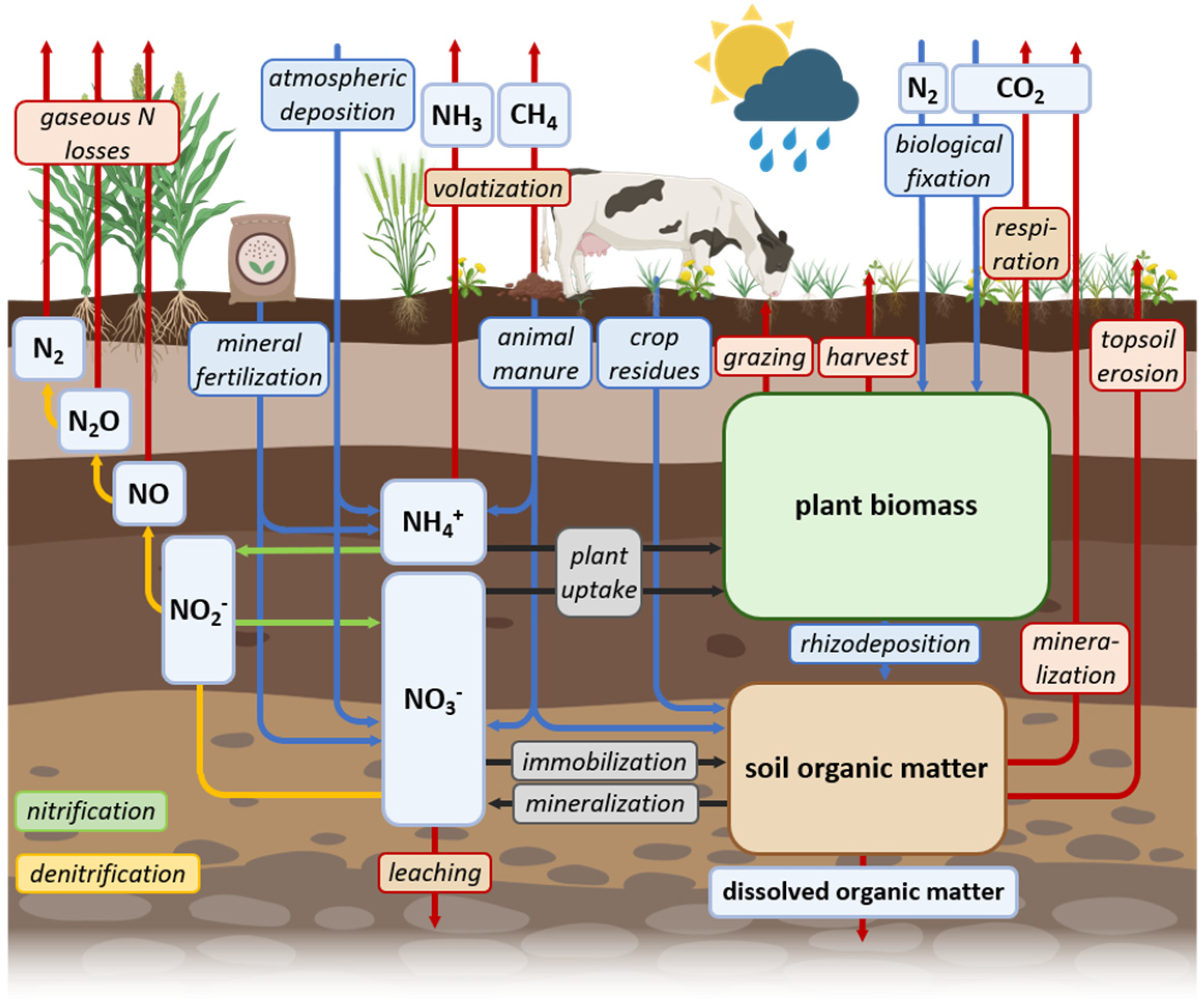

Comparison of Chemical Soil Properties of Temperate Grassland and Arable Land—A Review


Abstract
1. Introduction
2. Results and Synthesis: Chemical Soil Properties
2.1. Comparative Patterns of Soil Organic Carbon Under Grassland and Arable Land
2.1.1. Processes Mediating Changes in Carbon Stocks
Specific Surface of Mineral Particles
Input and Output Rates of SOC
Biochemical Decomposability of SOC
Stabilisation in Soil Aggregates
2.1.2. Vertical Distribution and Incorporation of SOC into the Subsoil
Tillage
Bioturbation
2.1.3. Response of Land Use Change on C Balance and SOC Stocks
Dynamic Equilibrium
SOC Content at Equilibrium
2.2. Comparative Nitrogen Dynamics Under Grassland and Arable Land
2.2.1. Land-Use-Related Changes in Nitrogen Content
Total N Stocks
Available N
2.2.2. Nitrogen Leaching Potential
N Input and Uptake
Soil Water Availability and Permeability
N Immobilisation
Plant Diversity
2.2.3. Gaseous Nitrogen Emissions
N Fertilisation
Aeration, Tillage and Land Cover
2.3. Land-Use Effects on Soil Phosphorus Under Grassland and Arable Land
2.3.1. Uptake by Harvest or Grazing
2.3.2. Fertilisation and Animal Excreta
2.3.3. Losses by Leaching and Erosion
2.4. Contrasting pH Regulation in Grassland and Arable Soils
2.4.1. Mineralogical Composition
2.4.2. Fertiliser Application and Liming
2.4.3. Plant Cover
3. Summary and Conclusions
4. Recommendations
- Increase OM inputs on arable land by retaining crop residues, alternating grassland phases within an arable rotation and substituting mineral fertilisers with organic fertilisers;
- Determine organic fertiliser inputs based on N and P requirement to avoid N and P overfertilisation and supply the remaining requirement for N and P through mineral fertilisers;
- Include legumes in crop rotations and grassland mixtures to increase biogenic N fixation and reduce N fertiliser requirements;
- Improve nutrient cycling by fostering a diverse vegetation and avoiding monocultures;
- Reduce erosion by avoiding bare periods on arable land by planting catch crops and implementing reduced and conservation tillage;
- Reduce leaching by avoiding tillage during the wet season from autumn to winter, especially when soil mineral N is high;
- Prefer grazing over mowing on grassland, but also avoid overstocking;
- Monitoring soil pH, especially if acidifying fertilisers are applied, and liming the soil if necessary to counteract acidification.
Author Contributions
Funding
Data Availability Statement
Conflicts of Interest
Abbreviations
| AL | Arable Land |
| C | Carbon |
| CO2 | Carbon Dioxide |
| GHG | Greenhouse Gases |
| GL | Grassland |
| OM | Organic Matter |
| N | Nitrogen |
| N2 | atmospheric Nitrogen |
| NH3 | Ammonia |
| NH4+ | Ammonium |
| NO | Nitrous Oxide |
| NO3− | Nitrate |
| N2O | Nitrous Oxide |
| P | Phosphorus |
| SOC | Soil Organic Carbon |
| SOM | Soil Organic Matter |
| WRB | World Reference Base for Soil Resources |
References
- Raghavendra, M.; Sharma, M.P.; Ramesh, A.; Richa, A.; Billore, S.D.; Verma, R.K. Soil Health Indicators: Methods and Applications. In Soil Analysis: Recent Trends and Applications; Rakshit, A., Ghosh, S., Chakraborty, S., Philip, V., Datta, A., Eds.; Springer: Singapore, 2020; pp. 221–253. [Google Scholar] [CrossRef]
- Toor, G.S.; Yang, Y.-Y.; Das, S.; Dorsey, S.; Felton, G. Chapter Four—Soil health in agricultural ecosystems: Current status and future perspectives. Adv. Agron. 2021, 168, 157–201. [Google Scholar] [CrossRef]
- Rillig, M.C.; van der Heijden, M.G.A.; Berdugo, M.; Liu, Y.-R.; Riedo, J.; Sanz-Lazaro, C.; Moreno-Jiménez, E.; Romero, F.; Tedersoo, L.; Delgado-Baquerizo, M. Increasing the number of stressors reduces soil ecosystem services worldwide. Nat. Clim. Change 2023, 13, 478–483. [Google Scholar] [CrossRef] [PubMed]
- Baer, S.; Birgé, H. Soil Ecosystem Services: An Overview; Burleigh Dodds Science Publishing: Cambridge, UK, 2018; pp. 17–38. [Google Scholar] [CrossRef]
- Hasan, S.S.; Zhen, L.; Miah, M.G.; Ahamed, T.; Samie, A. Impact of land use change on ecosystem services: A review. Environ. Dev. 2020, 34, 100527. [Google Scholar] [CrossRef]
- Banerjee, S.; van der Heijden, M.G.A. Soil microbiomes and one health. Nat. Rev. Microbiol. 2023, 21, 6–20. [Google Scholar] [CrossRef]
- Mayel, S.; Jarrah, M.; Kuka, K. How does grassland management affect physical and biochemical properties of temperate grassland soils? A review study. Grass Forage Sci. 2021, 76, 215–244. [Google Scholar] [CrossRef]
- van Beek, C.; Tóth, G. Risk Assessment Methodologies of Soil Threats in Europe: Status and Options for Harmonization for Risks by Erosion, Compaction, Salinization, Organic Matter Decline and Landslides; Publications Office of the European Union: Luxembourg, 2012.
- Tesfai, M.; Øygarden, L.; Hessel, R.; Panagos, P.; Kværnø, S.; Verheijen, F.; Ballabio, C.; Stolte, J.; Keizer, J. Soil Threats in Europe; AARHUS University: Aarhus, Denmark, 2015. [Google Scholar] [CrossRef]
- Wuana, R.A.; Okieimen, F.E.; Montuelle, B.; Steinman, A.D. Heavy Metals in Contaminated Soils: A Review of Sources, Chemistry, Risks and Best Available Strategies for Remediation. ISRN Ecol. 2011, 2011, 402647. [Google Scholar] [CrossRef]
- Singh, A. Soil salinization management for sustainable development: A review. J. Environ. Manag. 2021, 277, 111383. [Google Scholar] [CrossRef]
- Yadav, D.S.; Jaiswal, B.; Gautam, M.; Agrawal, M. Soil Acidification and its Impact on Plants. In Plant Responses to Soil Pollution; Singh, P., Singh, S.K., Prasad, S.M., Eds.; Springer: Singapore, 2020; pp. 1–26. [Google Scholar] [CrossRef]
- Taube, F.; Gierus, M.; Hermann, A.; Loges, R.; Schonbach, P. Grassland and globalization—Challenges for northwest European grass and forage research. Grass Forage Sci. 2014, 69, 2–16. [Google Scholar] [CrossRef]
- Reinsch, T.; Loges, R.; Kluss, C.; Taube, F. Effect of grassland ploughing and reseeding on CO2 emissions and soil carbon stocks. Agric. Ecosyst. Environ. 2018, 265, 374–383. [Google Scholar] [CrossRef]
- Gosling, P.; van der Gast, C.; Bending, G.D. Converting highly productive arable cropland in Europe to grassland: –a poor candidate for carbon sequestration. Sci. Rep. 2017, 7, 12. [Google Scholar] [CrossRef]
- Bengtsson, J.; Bullock, J.M.; Egoh, B.; Everson, C.; Everson, T.; O’Connor, T.; O’Farrell, P.J.; Smith, H.G.; Lindborg, R. Grasslands—More important for ecosystem services than you might think. Ecosphere 2019, 10, e02582. [Google Scholar] [CrossRef]
- Jaeger, M.; Brugemann, K.; Brandt, H.; Konig, S. Associations between precision sensor data with productivity, health and welfare indicator traits in native black and white dual-purpose cattle under grazing conditions. Appl. Anim. Behav. Sci. 2019, 212, 9–18. [Google Scholar] [CrossRef]
- Kauppinen, T.; Valros, A.; Vesala, K.M. Attitudes of Dairy Farmers toward Cow Welfare in Relation to Housing, Management and Productivity. Anthrozoos 2013, 26, 405–420. [Google Scholar] [CrossRef]
- Costa, J.H.C.; Hotzel, M.J.; Longo, C.; Balcao, L.F. A survey of management practices that influence production and welfare of dairy cattle on family farms in southern Brazil. J. Dairy Sci. 2013, 96, 307–317. [Google Scholar] [CrossRef]
- Zhao, Y.; Liu, Z.; Wu, J. Grassland ecosystem services: A systematic review of research advances and future directions. Landsc. Ecol. 2020, 35, 793–814. [Google Scholar] [CrossRef]
- Paudel, S.; Cobb, A.B.; Boughton, E.H.; Spiegal, S.; Boughton, R.K.; Silveira, M.L.; Swain, H.M.; Reuter, R.; Goodman, L.E.; Steiner, J.L. A framework for sustainable management of ecosystem services and disservices in perennial grassland agroecosystems. Ecosphere 2021, 12, e03837. [Google Scholar] [CrossRef]
- Hoekstra, N.J.; de Long, J.R.; Jansma, A.P.; Iepema, G.; Manhoudt, A.; van Eekeren, N. Differences in grassland sward biodiversity and management regime lead to mixed effects on ecosystem services. Eur. J. Agron. 2023, 149, 126886. [Google Scholar] [CrossRef]
- Takatsuka, Y.; Cullen, R.; Wilson, M.; Wratten, S. Values of Ecosystem Services on Arable Land and the Role of Organic Farming. In Proceedings of the 2005 NZARES Conference, Nelson, New Zealand, 26–27 August 2005. [Google Scholar] [CrossRef]
- Fischer, C.; Gayer, C.; Kurucz, K.; Riesch, F.; Tscharntke, T.; Batáry, P. Ecosystem services and disservices provided by small rodents in arable fields: Effects of local and landscape management. J. Appl. Ecol. 2018, 55, 548–558. [Google Scholar] [CrossRef]
- Sandhu, H.S.; Wratten, S.D.; Cullen, R. The role of supporting ecosystem services in conventional and organic arable farmland. Ecol. Complex. 2010, 7, 302–310. [Google Scholar] [CrossRef]
- Vidaller, C.; Dutoit, T. Ecosystem services in conventional farming systems. A review. Agron. Sustain. Dev. 2022, 42, 22. [Google Scholar] [CrossRef]
- van Vooren, L.; Reubens, B.; Broekx, S.; De Frenne, P.; Nelissen, V.; Pardon, P.; Verheyen, K. Ecosystem service delivery of agri-environment measures: A synthesis for hedgerows and grass strips on arable land. Agric. Ecosyst. Environ. 2017, 244, 32–51. [Google Scholar] [CrossRef]
- Power, A.G. Ecosystem services and agriculture: Tradeoffs and synergies. Phil. Trans. R. Soc. B 2010, 365, 2959–2971. [Google Scholar] [CrossRef] [PubMed]
- van Hal, O.; Boer, I.J.M.; de Muller, A.; De Vries, S.; Erb, K.H.; Schader, C.; Gerrits, W.J.J.; van Zanten, H.H.E. Upcycling food leftovers and grass resources through livestock: Impact of livestock system and productivity. J. Clean. Prod. 2019, 219, 485–496. [Google Scholar] [CrossRef]
- Freibauer, A.; Rounsevell, M.D.A.; Smith, P.; Verhagen, J. Carbon sequestration in the agricultural soils of Europe. Geoderma 2004, 122, 1–23. [Google Scholar] [CrossRef]
- Papini, R.; Valboa, G.; Favilli, F.; L’Abate, G. Influence of land use on organic carbon pool and chemical properties of Vertic Cambisols in central and southern Italy. Agric. Ecosyst. Environ. 2011, 140, 68–79. [Google Scholar] [CrossRef]
- Chen, Y.; Ju, W.; Groisman, P.; Li, J.; Propastin, P.; Xu, X.; Zhou, W.; Ruan, H. Quantitative assessment of carbon sequestration reduction induced by disturbances in temperate Eurasian steppe. Environ. Res. Lett. 2017, 12, 115005. [Google Scholar] [CrossRef]
- Goossens, A.; De Visscher, A.; Boeckx, P.; van Cleemput, O. Two-year field study on the emission of N2O from coarse and middle-textured Belgian soils with different land use. Nutr. Cycl. Agroecosyst. 2001, 60, 23–34. [Google Scholar] [CrossRef]
- Skiba, U.; Drewer, J.; Tang, Y.S.; van Dijk, N.; Helfter, C.; Nemitz, E.; Famulari, D.; Cape, J.N.; Jones, S.K.; Twigg, M.; et al. Biosphere-atmosphere exchange of reactive nitrogen and greenhouse gases at the NitroEurope core flux measurement sites: Measurement strategy and first data sets. Agric. Ecosyst. Environ. 2009, 133, 139–149. [Google Scholar] [CrossRef]
- Kunrath, T.R.; de Berranger, C.; Charrier, X.; Gastal, F.; de Faccio Carvalho, P.C.; Lemaire, G.; Emile, J.-C.; Durand, J.-L. How much do sod-based rotations reduce nitrate leaching in a cereal cropping system? Agric. Water Manag. 2015, 150, 46–56. [Google Scholar] [CrossRef]
- Buchen, C.; Well, R.; Helfrich, M.; Fuss, R.; Kayser, M.; Gensior, A.; Benke, M.; Flessa, H. Soil mineral N dynamics and N2O emissions following grassland renewal. Agric. Ecosyst. Environ. 2017, 246, 325–342. [Google Scholar] [CrossRef]
- Wang, C.; Lamb, E.; Zhang, W.; Li, X.; Zhao, C.; Li, C.; Wu, J. Meta-analysis shows plant diversity enhances grassland carbon and nitrogen cycles. Authorea 2020. preprint. [Google Scholar] [CrossRef]
- Ekholm, P.; Turtola, E.; Grönroos, J.; Seuri, P.; Ylivainio, K. Phosphorus loss from different farming systems estimated from soil surface phosphorus balance. Agric. Ecosyst. Environ. 2005, 110, 266–278. [Google Scholar] [CrossRef]
- Makkar, H.P.S. Review: Feed demand landscape and implications of food-not feed strategy for food security and climate change. Animal 2018, 12, 1744–1754. [Google Scholar] [CrossRef] [PubMed]
- Post, W.M.; Kwon, K.C. Soil carbon sequestration and land-use change: Processes and potential. Glob. Change Biol. 2000, 6, 317–327. [Google Scholar] [CrossRef]
- Schulze, E.; Luyssaert, S.; Ciais, P.; Freibauer, A.; Janssens, I.; Soussana, J.-F.; Smith, P.; Grace, J.; Levin, I.; Thiruchittampalam, B.; et al. Importance of methane and nitrous oxide for Europe’s terrestrial greenhouse-gas balance. Nat. Geosci. 2009, 2, 842–850. [Google Scholar] [CrossRef]
- Janssens, I.A.; Freibauer, A.; Ciais, P.; Smith, P.; Nabuurs, G.J.; Folberth, G.; Schlamadinger, B.; Hutjes, R.W.A.; Ceulemans, R.; Schulze, E.D.; et al. Europe’s terrestrial biosphere absorbs 7 to 12% of European anthropogenic CO2 emissions. Science 2003, 300, 1538–1542. [Google Scholar] [CrossRef]
- Soussana, J.-F.; Tallec, T.; Blanfort, V. Mitigating the greenhouse gas balance of ruminant production systems through carbon sequestration in grasslands. Anim. Int. J. Anim. Biosci. 2010, 4, 334–350. [Google Scholar] [CrossRef]
- Launay, C.; Constantin, J.; Chlebowski, F.; Houot, S.; Graux, A.-I.; Klumpp, K.; Martin, R.; Mary, B.; Pellerin, S.; Therond, O. Estimating the carbon storage potential and greenhouse gas emissions of French arable cropland using high-resolution modeling. Glob. Change Biol. 2021, 27, 1645–1661. [Google Scholar] [CrossRef]
- Boke Olén, N.; Roger, F.; Brady, M.V.; Larsson, C.; Andersson, G.; Ekroos, J.; Caplat, P.; Smith, H.G.; Dänhardt, J.; Clough, Y. Effects of farm type on food production, landscape openness, grassland biodiversity, and greenhouse gas emissions in mixed agricultural-forestry regions. Agric. Syst. 2021, 189, 103071. [Google Scholar] [CrossRef]
- Brilli, L.; Bechini, L.; Bindi, M.; Carozzi, M.; Cavalli, D.; Conant, R.; Dorich, C.D.; Doro, L.; Ehrhardt, F.; Farina, R.; et al. Review and analysis of strengths and weaknesses of agro-ecosystem models for simulating C and N fluxes. Sci. Total Environ. 2017, 598, 445–470. [Google Scholar] [CrossRef]
- IPCC. IPCC Guidelines for National Greenhouse Gas Inventories; Institute for Global Environmental Strategies (IGES): Hayama, Japan, 2006. [Google Scholar]
- IPCC (Ed.) Climate Change 2014: Synthesis Report; Intergovernmental Panel on Climate Change; IPCC: Geneva, Switzerland, 2015. [Google Scholar]
- Wiesmeier, M.; Mayer, S.; Paul, C.; Helming, K.; Don, A.; Franko, U.; Steffens, M.; Kögel-Knabner, I. CO2 certificates for carbon sequestration in soils: Methods, management practices and limitations. BonaRes Ser. (BonaRes Data Cent.) 2020, 23. [Google Scholar] [CrossRef]
- Poeplau, C.; Don, A. Sensitivity of soil organic carbon stocks and fractions to different land-use changes across Europe. Geoderma 2013, 192, 189–201. [Google Scholar] [CrossRef]
- Skadell, L.E.; Schneider, F.; Gocke, M.I.; Guigue, J.; Amelung, W.; Bauke, S.L.; Hobley, E.U.; Barkusky, D.; Honermeier, B.; Kögel-Knabner, I.; et al. Twenty percent of agricultural management effects on organic carbon stocks occur in subsoils—Results of ten long-term experiments. Agric. Ecosyst. Environ. 2023, 356, 108619. [Google Scholar] [CrossRef]
- MacDonald, J.D.; Rochette, P.; Chantigny, M.H.; Angers, D.A.; Royer, I.; Gasser, M.-O. Ploughing a poorly drained grassland reduced N2O emissions compared to chemical fallow. Soil Tillage Res. 2011, 111, 123–132. [Google Scholar] [CrossRef]
- Gregory, A.S.; Dungait, J.A.J.; Watts, C.W.; Bol, R.; Dixon, E.R.; White, R.P.; Whitmore, A.P. Long-term management changes topsoil and subsoil organic carbon and nitrogen dynamics in a temperate agricultural system. Eur. J. Soil Sci. 2016, 67, 421–430. [Google Scholar] [CrossRef] [PubMed]
- Walia, M.K.; Baer, S.G.; Krausz, R.; Cook, R.L. Deep soil carbon after 44 years of tillage and fertilizer management in southern Illinois compared to forest and restored prairie soils. J. Soil Water Conserv. 2017, 72, 405–415. [Google Scholar] [CrossRef]
- Franzluebbers, A.J.; Stuedemann, J.A.; Schomberg, H.H.; Wilkinson, S.R. Soil organic C and N pools under long-term pasture management in the Southern Piedmont USA. Soil Biol. Biochem. 2000, 32, 469–478. [Google Scholar] [CrossRef]
- Conant, R.T.; Paustian, K.; Elliott, E.T. Grassland management and conversion into grassland: Effects on soil carbon. Ecol. Appl. 2001, 11, 343–355. [Google Scholar] [CrossRef]
- IUSS Working Group WRB. World Reference Base for Soil Resources: International Soil Classification System for Naming Soils and Creating Legends for Soil Maps, 4th ed.; IUSS Working Group WRB: Vienna, Austria, 2022. [Google Scholar]
- Attard, E.; Le Roux, X.; Charrier, X.; Delfosse, O.; Guillaumaud, N.; Lemaire, G.; Recous, S. Delayed and asymmetric responses of soil C pools and N fluxes to grassland/cropland conversions. Soil Biol. Biochem. 2016, 97, 31–39. [Google Scholar] [CrossRef]
- Chapman, S.J.; Bell, J.S.; Campbell, C.D.; Hudson, G.; Lilly, A.; Nolan, A.J.; Robertson, A.H.J.; Potts, J.M.; Towers, W. Comparison of soil carbon stocks in Scottish soils between 1978 and 2009. Eur. J. Soil Sci 2013, 64, 455–465. [Google Scholar] [CrossRef]
- Di, H.J.; Cameron, K.C. Nitrate leaching in temperate agroecosystems: Sources, factors and mitigating strategies. Nutr. Cycl. Agroecosyst. 2002, 64, 237–256. [Google Scholar] [CrossRef]
- Haynes, R.J.; Francis, G.S. Effects of mixed cropping farming systems on changes in soils properties in the Canterburry plains. N. Z. J. Ecol. 1990, 14, 73–82. [Google Scholar]
- Horrocks, C.A.; Heal, K.V.; Harvie, B.; Tallowin, J.B.; Cardenas, L.M.; Dungait, J.A.J. Can species-rich grasslands be established on former intensively managed arable soils? Agric. Ecosyst. Environ. 2016, 217, 59–67. [Google Scholar] [CrossRef]
- McLauchlan, K. The Nature and Longevity of Agricultural Impacts on Soil Carbon and Nutrients: A Review. Ecosystems 2006, 9, 1364–1382. [Google Scholar] [CrossRef]
- Mori, A.; Hojito, M. Grassland renovation increases N2O emission from a volcanic grassland soil in Nasu, Japan. Soil Sci. Plant Nutr. 2007, 53, 812–818. [Google Scholar] [CrossRef]
- Panettieri, M.; Rumpel, C.; Dignac, M.F.; Chabbi, A. Does grassland introduction into cropping cycles affect carbon dynamics through changes of allocation of soil organic matter within aggregate fractions? Sci. Total Environ. 2017, 576, 251–263. [Google Scholar] [CrossRef]
- Rumpel, C.; Crème, A.; Ngo, P.; Velásquez, G.; Mora, M.L.; Chabbi, A. The impact of grassland management on biogeochemical cycles involving carbon, nitrogen and phosphorus. J. Soil Sci. Plant Nutr. 2015, 15, 353–371. [Google Scholar] [CrossRef]
- Schlesinger, W.H.; Winkler, J.P.; Megonigal, J.P. Soils and the Global Carbon Cycle. In The Carbon Cycle; Schimel, D.S., Wigley, T.M.L., Eds.; Cambridge University Press: Cambridge, UK, 2000; pp. 93–101. [Google Scholar] [CrossRef]
- Soussana, J.F.; Loiseau, P.; Vuichard, N.; Ceschia, E.; Balesdent, J.; Chevallier, T.; Arrouays, D. Carbon cycling and sequestration opportunities in temperate grasslands. Soil Use Manag. 2004, 20, 219–230. [Google Scholar] [CrossRef]
- Wang, Y.; Bölter, M.; Chang, Q.; Duttmann, R.; Marx, K.; Petersen, J.F.; Wang, Z. Functional dependencies of soil CO2 emissions on soil biological properties in northern German agricultural soils derived from a glacial till. Acta Agric. Scand. Sect. B—Soil Plant Sci. 2015, 65, 233–245. [Google Scholar] [CrossRef]
- Wiesmeier, M.; Spörlein, P.; Geuß, U.; Hangen, E.; Haug, S.; Reischl, A.; Schilling, B.; Lützow, M.; Kögel-Knabner, I. Soil organic carbon stocks in southeast Germany (Bavaria) as affected by land use, soil type and sampling depth. Glob. Change Biol. 2012, 18, 2233–2245. [Google Scholar] [CrossRef]
- Lal, R. Carbon sequestration in soil. CABI Rev. 2008, 3, 20. [Google Scholar] [CrossRef]
- Abbasi, M.K.; Rasool, G. Effects of different land-use types on soil quality in the hilly area of Rawalakot Azad Jammu and Kashmir. Acta Agric. Scand. Sect. B—Soil Plant Sci. 2005, 55, 221–228. [Google Scholar] [CrossRef]
- Abbasi, M.K.; Zafar, M.; Khan, S.R. Influence of different land-cover types on the changes of selected soil properties in the mountain region of Rawalakot Azad Jammu and Kashmir. Nutr. Cycl. Agroecosyst. 2007, 78, 97–110. [Google Scholar] [CrossRef]
- Li, W.; Ciais, P.; Guenet, B.; Peng, S.; Chang, J.; Chaplot, V.; Khudyaev, S.; Peregon, A.; Piao, S.; Wang, Y.; et al. Temporal response of soil organic carbon after grassland-related land-use change. Glob. Change Biol. 2018, 24, 4731–4746. [Google Scholar] [CrossRef] [PubMed]
- Kodešová, R.; Rohošková, M.; Žigová, A. Comparison of aggregate stability within six soil profiles under conventional tillage using various laboratory tests. Biologia 2009, 64, 550–554. [Google Scholar] [CrossRef]
- Jones, R.J.A.; Hiederer, R.; Rusco, E.; Montanarella, L. Estimating organic carbon in the soils of Europe for policy support. Eur. J. Soil Sci. 2005, 56, 655–671. [Google Scholar] [CrossRef]
- McGechan, M.B.; Henshall, J.K.; Vinten, A.J.A. Cultivation and Soil Organic Matter Management in Low Input Cereal Production following the Ploughing out of Grass Leys. Biosyst. Eng. 2005, 90, 85–101. [Google Scholar] [CrossRef]
- Don, A.; Scholten, T.; Schulze, E.-D. Conversion of cropland into grassland: Implications for soil organic-carbon stocks in two soils with different texture. J. Plant Nutr. Soil Sci. 2009, 172, 53–62. [Google Scholar] [CrossRef]
- Guo, L.B.; Gifford, R.M. Soil carbon stocks and land use change: A meta analysis. Glob. Change Biol. 2002, 8, 345–360. [Google Scholar] [CrossRef]
- Smith, P.; Andrén, O.; Karlsson, T.; Perälä, P.; Regina, K.; Rounsevell, M.; van Wesemael, B. Carbon sequestration potential in European croplands has been overestimated. Glob. Change Biol. 2005, 11, 2153–2163. [Google Scholar] [CrossRef]
- Tang, S.; Guo, J.; Li, S.; Li, J.; Xie, S.; Zhai, X.; Wang, C.; Zhang, Y.; Wang, K. Synthesis of soil carbon losses in response to conversion of grassland to agriculture land. Soil Tillage Res. 2019, 185, 29–35. [Google Scholar] [CrossRef]
- DuPont, S.T.; Culman, S.W.; Ferris, H.; Buckley, D.H.; Glover, J.D. No-tillage conversion of harvested perennial grassland to annual cropland reduces root biomass, decreases active carbon stocks, and impacts soil biota. Agric. Ecosyst. Environ. 2010, 137, 25–32. [Google Scholar] [CrossRef]
- Jozefowska, A.; Miechowka, A.; Frouz, J. Comparison of earthworm populations in arable and grassland fields in the Outer Western Carpathians, South Poland. Biologia 2016, 71, 316–322. [Google Scholar] [CrossRef]
- Arai, M.; Miura, T.; Tsuzura, H.; Minamiya, Y.; Kaneko, N. Two-year responses of earthworm abundance, soil aggregates, and soil carbon to no-tillage and fertilization. Geoderma 2018, 332, 135–141. [Google Scholar] [CrossRef]
- Baddeley, J.A.; Edwards, A.C.; Watson, C.A. Changes in soil C and N stocks and C N stoichiometry 21 years after land use change on an arable mineral topsoil. Geoderma 2017, 303, 19–26. [Google Scholar] [CrossRef]
- Başaran, M.; Erpul, G.; Tercan, A.E.; Çanga, M.R. The effects of land use changes on some soil properties in İndağı Mountain Pass—Çankırı, Turkey. Environ. Monit. Assess. 2008, 136, 101–119. [Google Scholar] [CrossRef]
- DuPont, S.T.; Beniston, J.; Glover, J.D.; Hodson, A.; Culman, S.W.; Lal, R.; Ferris, H. Root traits and soil properties in harvested perennial grassland, annual wheat, and never-tilled annual wheat. Plant Soil 2014, 381, 405–420. [Google Scholar] [CrossRef]
- Gajic, B. Physical properties and organic matter of Fluvisols under forest, grassland, and 100 years of conventional tillage. Geoderma 2013, 200, 114–119. [Google Scholar] [CrossRef]
- Goidts, E.; van Wesemael, B. Regional assessment of soil organic carbon changes under agriculture in Southern Belgium (1955–2005). Geoderma 2007, 141, 341–354. [Google Scholar] [CrossRef]
- Hermle, S.; Anken, T.; Leifeld, J.; Weisskopf, P. The effect of the tillage system on soil organic carbon content under moist, cold-temperate conditions. Soil Tillage Res. 2008, 98, 94–105. [Google Scholar] [CrossRef]
- Horakova, E.; Pospisilova, L.; Vlcek, V. Selected Soil Properties Under Different Types of Management. Ph.D. Thesis, Mendel University Brno, Faculty of Agronomy, Brno, Czech Republic, 2017. [Google Scholar]
- Kämpf, I.; Hölzel, N.; Störrle, M.; Broll, G.; Kiehl, K. Potential of temperate agricultural soils for carbon sequestration: A meta-analysis of land-use effects. Sci. Total Environ. 2016, 566, 428–435. [Google Scholar] [CrossRef] [PubMed]
- Loges, R.; Bunne, I.; Reinsch, T.; Malisch, C.; Kluss, C.; Herrmann, A.; Taube, F. Forage production in rotational systems generates similar yields compared to maize monocultures but improves soil carbon stocks. Eur. J. Agron. 2018, 97, 11–19. [Google Scholar] [CrossRef]
- Oberholzer, H.R.; Leifeld, J.; Mayer, J. Changes in soil carbon and crop yield over 60 years in the Zurich Organic Fertilization Experiment, following land-use change from grassland to cropland. J. Plant Nutr. Soil Sci. 2014, 177, 696–704. [Google Scholar] [CrossRef]
- Poeplau, C.; Don, A.; Vesterdal, L.; Leifeld, J.; van Wesemael, B.; Schumacher, J.; Gensior, A. Temporal dynamics of soil organic carbon after land-use change in the temperate zone—Carbon response functions as a model approach. Glob. Change Biol. 2011, 17, 2415–2427. [Google Scholar] [CrossRef]
- Pospisilova, L.; Formanek, P.; Kucerik, J.; Liptaj, T.; Losak, T.; Martensson, A. Land use effects on carbon quality and soil biological properties in Eutric Cambisol. Acta Agric. Scand. Sect. B—Soil Plant Sci. 2011, 61, 661–669. [Google Scholar] [CrossRef]
- Six, J.; Elliott, E.T.; Paustian, K.; Doran, J.W. Aggregation and Soil Organic Matter Accumulation in Cultivated and Native Grassland Soils. Soil Sci. Soc. Am. J. 1998, 62, 1367–1377. [Google Scholar] [CrossRef]
- Sparling, G.; Schipper, L. Soil quality monitoring in New Zealand: Trends and issues arising from a broad-scale survey. Agric. Ecosyst. Environ. 2004, 104, 545–552. [Google Scholar] [CrossRef]
- Springob, G.; Brinkmann, S.; Engel, N.; Kirchmann, H.; Bottcher, J. Organic C levels of Ap horizons in North German Pleistocene sands as influenced by climate, texture, and history of land-use. J. Plant Nutr. Soil Sci. 2001, 164, 681–690. [Google Scholar] [CrossRef]
- van Eekeren, N.; Bommelé, L.; Bloem, J.; Schouten, T.; Rutgers, M.; de Goede, R.; Reheul, D.; Brussaard, L. Soil biological quality after 36 years of ley-arable cropping, permanent grassland and permanent arable cropping. Appl. Soil Ecol. 2008, 40, 432–446. [Google Scholar] [CrossRef]
- Wiesmeier, M.; Hübner, R.; Barthold, F.; Spörlein, P.; Geuß, U.; Hangen, E.; Reischl, A.; Schilling, B.; von Lützow, M.; Kögel-Knabner, I. Amount, distribution and driving factors of soil organic carbon and nitrogen in cropland and grassland soils of southeast Germany (Bavaria). Agric. Ecosyst. Environ. 2013, 176, 39–52. [Google Scholar] [CrossRef]
- Zhang, Z.-H.; Li, X.-Y.; Jiang, Z.-Y.; Peng, H.-Y.; Li, L.; Zhao, G.-Q. Changes in some soil properties induced by re-conversion of cropland into grassland in the semiarid steppe zone of Inner Mongolia, China. Plant Soil 2013, 373, 89–106. [Google Scholar] [CrossRef]
- Jensen, J.L.; Schjønning, P.; Watts, C.W.; Christensen, B.T.; Obour, P.B.; Munkholm, L.J. Soil degradation and recovery—Changes in organic matter fractions and structural stability. Geoderma 2020, 364, 114181. [Google Scholar] [CrossRef]
- Liaudanskiene, I.; Slepetiene, A.; Slepetys, J.; Stukonis, V. Evaluation of soil organic carbon stability in grasslands of protected areas and arable lands applying chemo-destructive fractionation. Zemdirbyste 2013, 100, 339–348. [Google Scholar] [CrossRef]
- Saha, D.; Kukal, S.S.; Sharma, S. Landuse impacts on SOC fractions and aggregate stability in typic ustochrepts of Northwest India. Plant Soil 2011, 339, 457–470. [Google Scholar] [CrossRef]
- Seremesic, S.; Nesic, L.; Ciric, V.; Vasin, J.; Djalovic, I.; Marinkovic, J.; Vojnov, B. Soil organic carbon fractions in different land use systems of Chernozem soil. Zb. Matice Srp. Za Prir. Nauk. 2020, 138, 31–39. [Google Scholar] [CrossRef]
- Gosling, P.; Parsons, N.; Bending, G.D. What are the primary factors controlling the light fraction and particulate soil organic matter content of agricultural soils? Biol. Fertil. Soils 2013, 49, 1001–1014. [Google Scholar] [CrossRef]
- Rodríguez-Albarracín, H.S.; Demattê, J.A.; Rosin, N.A.; Contreras, A.E.D.; Silvero, N.E.; Cerri, C.E.P.; Mendes, W.d.S.; Tayebi, M. Potential of soil minerals to sequester soil organic carbon. Geoderma 2023, 436, 116549. [Google Scholar] [CrossRef]
- Cai, A.; Feng, W.; Zhang, W.; Xu, M. Climate, soil texture, and soil types affect the contributions of fine-fraction-stabilized carbon to total soil organic carbon in different land uses across China. J. Environ. Manag. 2016, 172, 2–9. [Google Scholar] [CrossRef] [PubMed]
- John, B.; Yamashita, T.; Ludwig, B.; Flessa, H. Storage of organic carbon in aggregate and density fractions of silty soils under different types of land use. Geoderma 2005, 128, 63–79. [Google Scholar] [CrossRef]
- Rees, R.M.; Bingham, I.J.; Baddeley, J.A.; Watson, C.A. The role of plants and land management in sequestering soil carbon in temperate arable and grassland ecosystems. Geoderma 2005, 128, 130–154. [Google Scholar] [CrossRef]
- Pausch, J.; Kuzyakov, Y. Carbon input by roots into the soil: Quantification of rhizodeposition from root to ecosystem scale. Glob. Change Biol. 2018, 24, 1–12. [Google Scholar] [CrossRef]
- Yang, X.; Wang, B.; Fakher, A.; An, S.; Kuzyakov, Y. Contribution of roots to soil organic carbon: From growth to decomposition experiment. Catena 2023, 231, 107317. [Google Scholar] [CrossRef]
- Poeplau, C. Grassland soil organic carbon stocks along management intensity and warming gradients. Grass Forage Sci. 2021, 76, 186–195. [Google Scholar] [CrossRef]
- Adewopo, J.B.; Silveira, M.L.; Xu, S.; Gerber, S.; Sollenberger, L.E.; Martin, T.A. Management Intensification Impacts on Soil and Ecosystem Carbon Stocks in Subtropical Grasslands. Soil Sci. Soc. Am. J. 2014, 78, 977–986. [Google Scholar] [CrossRef]
- Nüsse, A.; Linsler, D.; Loges, R.; Reinsch, T.; Taube, F.; Ludwig, B. Effect of grassland harvesting frequency and N-fertilization on stocks and dynamics of soil organic matter in the temperate climate. Arch. Agron. Soil Sci. 2018, 64, 1925–1931. [Google Scholar] [CrossRef]
- Liao, Y.; Wu, W.L.; Meng, F.Q.; Smith, P.; Lal, R. Increase in soil organic carbon by agricultural intensification in northern China. Biogeosciences 2015, 12, 1403–1413. [Google Scholar] [CrossRef]
- Jacobs, A.; Poeplau, C.; Weiser, C.; Fahrion-Nitschke, A.; Don, A. Exports and inputs of organic carbon on agricultural soils in Germany. Nutr. Cycl. Agroecosyst. 2020, 118, 249–271. [Google Scholar] [CrossRef]
- Maltas, A.; Kebli, H.; Oberholzer, H.R.; Weisskopf, P.; Sinaj, S. The effects of organic and mineral fertilizers on carbon sequestration, soil properties, and crop yields from a long-term field experiment under a Swiss conventional farming system. Land Degrad. Dev. 2018, 29, 926–938. [Google Scholar] [CrossRef]
- Poeplau, C.; Zopf, D.; Greiner, B.; Geerts, R.; Korvaar, H.; Thumm, U.; Don, M.; Heidkamp, A.; Flessa, H. Why does mineral fertilization increase soil carbon stocks in temperate grasslands? Agric. Ecosyst. Environ. 2018, 265, 144–155. [Google Scholar] [CrossRef]
- Batlle-Aguilar, J.; Brovelli, A.; Porporato, A.; Barry, D.A. Modelling soil carbon and nitrogen cycles during land use change. A review. Agron. Sustain. Dev. 2011, 31, 251–274. [Google Scholar] [CrossRef]
- Dilly, O.; Blume, H.P.; Sehy, U.; Jimenez, M.; Munch, J.C. Variation of stabilised, microbial and biologically active carbon and nitrogen in soil under contrasting land use and agricultural management practices. Chemosphere 2003, 52, 557–569. [Google Scholar] [CrossRef]
- Bai, X.; Tang, J.; Wang, W.; Ma, J.; Shi, J.; Ren, W. Organic amendment effects on cropland soil organic carbon and its implications: A global synthesis. Catena 2023, 231, 107343. [Google Scholar] [CrossRef]
- Bo, B.; Zhao, R.; Wang, Y.; Li, C.; Xie, Z.; Zhao, R. Effect of crop type shift on soil C:N:P stoichiometry in a typical Yellow River irrigated district. Sci. Rep. 2025, 15, 30136. [Google Scholar] [CrossRef] [PubMed]
- Panagea, I.; Quataert, P.; Alonso-Ayuso, M.; Gómez de la Bárcena, T.; de Boever, M.; Diacono, M.; Jacobs, A.; Jensen, J.L.; Seidel, F.; Seitz, D.; et al. Forage vs. Grain Legumes: Contrasting Effects on Soil Organic Carbon Stocks–Evidence from 30 European Field Experiments. Eur. J. Soil Sci. 2025, 76, e70086. [Google Scholar] [CrossRef]
- Chen, J.; Luo, Y.; van Groenigen, K.J.; Hungate, B.A.; Cao, J.; Zhou, X.; Wang, R.-W. A keystone microbial enzyme for nitrogen control of soil carbon storage. Sci. Adv. 2018, 4, eaaq1689. [Google Scholar] [CrossRef] [PubMed]
- Fu, Z.; Hu, W.; Beare, M.; Baird, D.; Li, S. Response of soil organic carbon stock to land use is modulated by soil hydraulic properties. Soil Tillage Res. 2023, 233, 105793. [Google Scholar] [CrossRef]
- Linsler, D.; Taube, F.; Geisseler, D.; Joergensen, R.G.; Ludwig, B. Temporal variations of the distribution of water-stable aggregates, microbial biomass and ergosterol in temperate grassland soils with different cultivation histories. Geoderma 2015, 241, 221–229. [Google Scholar] [CrossRef]
- Scartazza, A.; Gavrichkova, O.; Pini, R.; D’Acqui, L.P. Physically protected organic matter drives soil carbon sequestration potential of a managed grassland ecosystem in Italian Alps. Geoderma Reg. 2023, 34, e00686. [Google Scholar] [CrossRef]
- Yamashita, T.; Flessa, H.; John, B.; Helfrich, M.; Ludwig, B. Organic matter in density fractions of water-stable aggregates in silty soils: Effect of land use. Soil Biol. Biochem. 2006, 38, 3222–3234. [Google Scholar] [CrossRef]
- Kodesova, R.; Jirku, V.; Kodes, V.; Muhlhanselova, M.; Nikodem, A.; Zigova, A. Soil structure and soil hydraulic properties of Haplic Luvisol used as arable land and grassland. Soil Tillage Res. 2011, 111, 154–161. [Google Scholar] [CrossRef]
- Low, A.J. The effect of cultivation on the structure and other physical characteristics of grassland and arable soils (1945–1970). Eur. J. Soil Sci. 1972, 23, 363–380. [Google Scholar] [CrossRef]
- Spurgeon, D.J.; Keith, A.M.; Schmidt, O.; Lammertsma, D.R.; Faber, J.H. Land-use and land-management change: Relationships with earthworm and fungi communities and soil structural properties. BMC Ecol. 2013, 13, 13. [Google Scholar] [CrossRef]
- Ball, B.C.; Campbell, D.J.; Douglas, J.T.; Henshall, J.K.; O’Sullivan, M.F. Soil structural quality, compaction and land management. Eur. J. Soil Sci. 1997, 48, 593–601. [Google Scholar] [CrossRef] [PubMed]
- Tang, S.; Cheng, W.; Hu, R.; Nakajima, M.; Guigue, J.; Kimani, S.M.; Sato, S.; Tawaraya, K.; Xu, X. Decomposition of soil organic carbon influenced by soil temperature and moisture in Andisol and Inceptisol paddy soils in a cold temperate region of Japan. J. Soils Sediments 2017, 17, 1843–1851. [Google Scholar] [CrossRef]
- Pallandt, M.; Ahrens, B.; Koirala, S.; Lange, H.; Reichstein, M.; Schrumpf, M.; Zaehle, S. Vertically Divergent Responses of SOC Decomposition to Soil Moisture in a Changing Climate. J. Geophys. Res. Biogeosci. 2022, 127, e2021JG006684. [Google Scholar] [CrossRef]
- Leifeld, J.; Ammann, C.; Neftel, A.; Fuhrer, J. A comparison of repeated soil inventory and carbon flux budget to detect soil carbon stock changes after conversion from cropland to grasslands. Glob. Change Biol. 2011, 17, 3366–3375. [Google Scholar] [CrossRef]
- Chantigny, M.H. Dissolved and water-extractable organic matter in soils: A review on the influence of land use and management practices. Geoderma 2003, 113, 357–380. [Google Scholar] [CrossRef]
- Emde, D.; Poeplau, C.; Don, A.; Heilek, S.; Schneider, F. The centennial legacy of land-use change on organic carbon stocks of German agricultural soils. Glob. Change Biol. 2024, 30, e17444. [Google Scholar] [CrossRef]
- Feng, Q.; An, C.; Chen, Z.; Wang, Z. Can deep tillage enhance carbon sequestration in soils? A meta-analysis towards GHG mitigation and sustainable agricultural management. Renew. Sustain. Energy Rev. 2020, 133, 110293. [Google Scholar] [CrossRef]
- Alcántara, V.; Don, A.; Well, R.; Nieder, R. Deep ploughing increases agricultural soil organic matter stocks. Glob. Change Biol. 2016, 22, 2939–2956. [Google Scholar] [CrossRef]
- Lawrence-Smith, E.J.; Curtin, D.; Beare, M.H.; McNally, S.R.; Kelliher, F.M.; Calvelo Pereira, R.; Hedley, M.J. Full inversion tillage during pasture renewal to increase soil carbon storage: New Zealand as a case study. Glob. Change Biol. 2021, 27, 1998–2010. [Google Scholar] [CrossRef] [PubMed]
- Madigan, A.P.; Zimmermann, J.; Krol, D.J.; Williams, M.; Jones, M.B. Full Inversion Tillage (FIT) during pasture renewal as a potential management strategy for enhanced carbon sequestration and storage in Irish grassland soils. Sci. Total Environ. 2022, 805, 150342. [Google Scholar] [CrossRef] [PubMed]
- Schiedung, M.; Tregurtha, C.S.; Beare, M.H.; Thomas, S.M.; Don, A. Deep soil flipping increases carbon stocks of New Zealand grasslands. Glob. Change Biol. 2019, 25, 2296–2309. [Google Scholar] [CrossRef]
- Nieminen, M.; Ketoja, E.; Mikola, J.; Terhivuo, J.; Siren, T.; Nuutinen, V. Local land use effects and regional environmental limits on earthworm communities in Finnish arable landscapes. Ecol. Appl. 2011, 21, 3162–3177. [Google Scholar] [CrossRef]
- Czerwinski, M.; Woodcock, B.A.; Golinska, B.; Kotowski, W. The effect of tillage management and its interaction with site conditions and plant functional traits on plant species establishment during meadow restoration. Ecol. Eng. 2018, 117, 28–37. [Google Scholar] [CrossRef]
- Kapas, R.E.; Plue, J.; Kimberley, A.; Cousins, S.A.O. Grazing livestock increases both vegetation and seed bank diversity in remnant and restored grasslands. J. Veg. Sci. 2020, 31, 1053–1065. [Google Scholar] [CrossRef]
- Pardo, A.; Rolo, V.; Concepcion, E.D.; Diaz, M.; Kazakova, Y.; Stefanova, V.; Marsden, K.; Brandt, K.; Jay, M.; Piskol, S.; et al. To what extent does the European common agricultural policy affect key landscape determinants of biodiversity? Environ. Sci. Policy 2020, 114, 595–605. [Google Scholar] [CrossRef]
- Lange, M.; Habekost, M.; Eisenhauer, N.; Roscher, C.; Bessler, H.; Engels, C.; Oelmann, Y.; Scheu, S.; Wilcke, W.; Schulze, E.D.; et al. Biotic and Abiotic Properties Mediating Plant Diversity Effects on Soil Microbial Communities in an Experimental Grassland. PLoS ONE 2014, 9, e96182. [Google Scholar] [CrossRef]
- Strecker, T.; Mace, O.G.; Scheu, S.; Eisenhauer, N. Functional composition of plant communities determines the spatial and temporal stability of soil microbial properties in a long-term plant diversity experiment. Oikos 2016, 125, 1743–1754. [Google Scholar] [CrossRef]
- van Lanen, H.A.J.; Reinds, G.J.; Boersma, O.H.; Bouma, J. Impact of soil management systems on soil structure and physical properties in a clay loam soil, and the simulated effects on water deficits, soil aeration and workability. Soil Tillage Res. 1992, 23, 203–220. [Google Scholar] [CrossRef]
- Forey, E.; Dutoit, T. Vegetation, soils and seed banks of limestone grasslands are still impacted by former cultivation one century after abandonment. Community Ecol. 2012, 13, 194–202. [Google Scholar] [CrossRef]
- Schuster, J.; Hagn, L.; Mittermayer, M.; Hülsbergen, K.-J. After effects of historical grassland on soil organic carbon content and plant growth in croplands in southern Germany determined using satellite data. Sci. Total Environ. 2024, 947, 174507. [Google Scholar] [CrossRef] [PubMed]
- Jones, M.B.; Donnelly, A. Carbon sequestration in temperate grassland ecosystems and the influence of management, climate and elevated CO2. New Phytol. 2004, 164, 423–439. [Google Scholar] [CrossRef]
- Smith, P. Carbon sequestration in croplands: The potential in Europe and the global context. Eur. J. Agron. 2004, 20, 229–236. [Google Scholar] [CrossRef]
- Smith, P. Engineered biological sinks on land. In The Global Carbon Cycle; Integrating Humans, Climate, and the Natural World; SCOPE: Berlin, Germany, 2004; pp. 479–491. [Google Scholar]
- Knops, J.M.H.; Tilman, D. Dynamics of soil nitrogen and carbon accumulation for 61 years after agricultural abandonment. Ecology 2000, 81, 88–98. [Google Scholar] [CrossRef]
- Bouwman, A.F.; Beusen, A.H.W.; Billen, G. Human alteration of the global nitrogen and phosphorus soil balances for the period 1970–2050. Glob. Biogeochem. Cycle 2009, 23, GB0A04, 16pp. [Google Scholar] [CrossRef]
- Luo, L.; Ran, L.; Rasool, Q.Z.; Cohan, D.S. Integrated Modeling of, U.S. Agricultural Soil Emissions of Reactive Nitrogen and Associated Impacts on Air Pollution, Health, and Climate. Environ. Sci. Technol. 2022, 56, 9265–9276. [Google Scholar] [CrossRef]
- Scheer, C.; Fuchs, K.; Pelster, D.E.; Butterbach-Bahl, K. Estimating global terrestrial denitrification from measured N2O:(N2O + N2) product ratios. Curr. Opin. Environ. Sustain. 2020, 47, 72–80. [Google Scholar] [CrossRef]
- Congreves, K.A.; Dutta, B.; Grant, B.B.; Smith, W.N.; Desjardins, R.L.; Wagner-Riddle, C. How does climate variability influence nitrogen loss in temperate agroecosystems under contrasting management systems? Agric. Ecosyst. Environ. 2016, 227, 33–41. [Google Scholar] [CrossRef]
- Bouwman, L.; Goldewijk, K.K.; van der Hoek, K.W.; Beusen, A.H.W.; van Vuuren, D.P.; Willems, J.; Rufino, M.C.; Stehfest, E. Exploring global changes in nitrogen and phosphorus cycles in agriculture induced by livestock production over the 1900–2050 period. Proc. Natl. Acad. Sci. USA 2013, 110, 20882–20887. [Google Scholar] [CrossRef]
- Conijn, J.G.; Bindraban, P.S.; Schroder, J.J.; Jongschaap, R.E.E. Can our global food system meet food demand within planetary boundaries? Agric. Ecosyst. Environ. 2018, 251, 244–256. [Google Scholar] [CrossRef]
- Robertson, F.; Myers, R.J.K.; Saffigna, P.G. Dynamics of carbon and nitrogen in a long-term cropping system and permanent pasture system. Aust. J. Agric. Res. 1994, 45, 211–221. [Google Scholar] [CrossRef]
- Dupas, R.; Parnaudeau, V.; Reau, R.; Jeuffroy, M.-H.; Durand, P.; Gascuel-Odoux, C. Integrating local knowledge and biophysical modeling to assess nitrate losses from cropping systems in drinking water protection areas. Environ. Model. Softw. 2015, 69, 101–110. [Google Scholar] [CrossRef]
- Wang, M.M.; Chen, H.S.; Zhang, W.; Wang, K.L. Soil nutrients and stoichiometric ratios as affected by land use and lithology at county scale in a karst area, southwest China. Sci. Total Environ. 2018, 619, 1299–1307. [Google Scholar] [CrossRef]
- Dupas, R.; Mellander, P.E.; Gascuel-Odoux, C.; Fovet, O.; McAleer, E.B.; McDonald, N.T.; Shore, M.; Jordan, P. The role of mobilisation and delivery processes on contrasting dissolved nitrogen and phosphorus exports in groundwater fed catchments. Sci. Total Environ. 2017, 599, 1275–1287. [Google Scholar] [CrossRef]
- Fraters, D.; van Leeuwen, T.; Boumans, L.; Reijs, J. Use of long-term monitoring data to derive a relationship between nitrogen surplus and nitrate leaching for grassland and arable land on well-drained sandy soils in the Netherlands. Acta Agric. Scand. Sect. B—Soil Plant Sci. 2015, 65, 144–154. [Google Scholar] [CrossRef]
- Kvítek, T.; Žlábek, P.; Bystřický, V.; Fučík, P.; Lexa, M.; Gergel, J.; Novák, P.; Ondr, P. Changes of nitrate concentrations in surface waters influenced by land use in the crystalline complex of the Czech Republic. Phys. Chem. Earth Parts A B C 2009, 34, 541–551. [Google Scholar] [CrossRef]
- Leimer, S.; Oelmann, Y.; Wirth, C.; Wilcke, W. Time matters for plant diversity effects on nitrate leaching from temperate grassland. Agric. Ecosyst. Environ. 2015, 211, 155–163. [Google Scholar] [CrossRef]
- Oelmann, Y.; Buchmann, N.; Gleixner, G.; Habekost, M.; Roscher, C.; Rosenkranz, S.; Schulze, E.D.; Steinbeiss, S.; Temperton, V.M.; Weigelt, A.; et al. Plant diversity effects on aboveground and belowground N pools in temperate grassland ecosystems: Development in the first 5 years after establishment. Glob. Biogeochem. Cycle 2011, 25, 11. [Google Scholar] [CrossRef]
- Grandy, A.S.; Robertson, G.P. Initial cultivation of a temperate-region soil immediately accelerates aggregate turnover and CO2 and N2O fluxes. Glob. Change Biol. 2006, 12, 1507–1520. [Google Scholar] [CrossRef]
- Reinsch, T.; Loges, R.; Kluss, C.; Taube, F. Renovation and conversion of permanent grass-clover swards to pasture or crops: Effects on annual N2O emissions in the year after ploughing. Soil Tillage Res. 2018, 175, 119–129. [Google Scholar] [CrossRef]
- Buchen, C.; Lewicka-Szczebak, D.; Fuss, R.; Helfrich, M.; Flessa, H.; Well, R. Fluxes of N-2 and N2O and contributing processes in summer after grassland renewal and grassland conversion to maize cropping on a Plaggic Anthrosol and a Histic Gleysol. Soil Biol. Biochem. 2016, 101, 6–19. [Google Scholar] [CrossRef]
- Cookson, W.R.; Osman, M.; Marschner, P.; Abaye, D.A.; Clark, I.; Murphy, D.V.; Stockdale, E.A.; Watson, C.A. Controls on soil nitrogen cycling and microbial community composition across land use and incubation temperature. Soil Biol. Biochem. 2007, 39, 744–756. [Google Scholar] [CrossRef]
- Barrett, J.E.; Burke, I.C. Potential nitrogen immobilization in grassland soils across a soil organic matter gradient. Soil Biol. Biochem. 2000, 32, 1707–1716. [Google Scholar] [CrossRef]
- Garten, C.T.; Ashwood, T.L. Landscape level differences in soil carbon and nitrogen: Implications for soil carbon sequestration. Glob. Biogeochem. Cycle 2002, 16, 61-1–61-14. [Google Scholar] [CrossRef]
- Eriksen, J.; Askegaard, M.; Søegaard, K. Residual effect and nitrate leaching in grass-arable rotations: Effect of grassland proportion, sward type and fertilizer history. Soil Use Manag. 2008, 24, 373–382. [Google Scholar] [CrossRef]
- Sharma, T.; Arya, V.M.; Sharma, V.; Sharma, S.; Popescu, S.M.; Thakur, N.; Iqbal, J.M.; El-Sheikh, M.A.; Baath, G.S. Impact of cropping intensity on soil nitrogen and phosphorus for sustainable agricultural management. J. King Saud. Univ.-Sci. 2024, 36, 103244. [Google Scholar] [CrossRef]
- Nevens, F.; Reheul, D. Permanent grassland and 3-year leys alternating with 3 years of arable land: 31 years of comparison. Eur. J. Agron. 2003, 19, 77–90. [Google Scholar] [CrossRef]
- Krol, D.J.; Jones, M.B.; Williams, M.; Richards, K.G.; Bourdin, F.; Lanigan, G.J. The effect of renovation of long-term temperate grassland on N2O emissions and N leaching from contrasting soils. Sci. Total Environ. 2016, 560–561, 233–240. [Google Scholar] [CrossRef]
- Rodrigo, A.; Recous, S.; Neel, C.; Mary, B. Modelling temperature and moisture effects on C–N transformations in soils: Comparison of nine models. Ecol. Model. 1997, 102, 325–339. [Google Scholar] [CrossRef]
- McDowell, R.W.; Moreau, P.; Salmon-Monviola, J.; Durand, P.; Leterme, P.; Merot, P. Contrasting the spatial management of nitrogen and phosphorus for improved water quality: Modelling studies in New Zealand and France. Eur. J. Agron. 2014, 57, 52–61. [Google Scholar] [CrossRef]
- Moreau, P.; Ruiz, L.; Raimbault, T.; Vertès, F.; Cordier, M.O.; Gascuel-Odoux, C.; Masson, V.; Salmon-Monviola, J.; Durand, P. Modeling the potential benefits of catch-crop introduction in fodder crop rotations in a Western Europe landscape. Sci. Total Environ. 2012, 437, 276–284. [Google Scholar] [CrossRef] [PubMed]
- Segato, S.; Marchesini, G.; Andrighetto, I. A comparison of nitrogen use efficiency and surplus in two dairy farms typologies. Ital. J. Anim. Sci. 2009, 8, 178–180. [Google Scholar] [CrossRef]
- Sapkota, T.B.; Askegaard, M.; Lægdsmand, M.; Olesen, J.E. Effects of catch crop type and root depth on nitrogen leaching and yield of spring barley. Field Crops Res. 2012, 125, 129–138. [Google Scholar] [CrossRef]
- Kayser, M.; Müller, J.; Seidel, K. The effect of the succeeding crop and the level of N fertilization on N leaching losses after grassland ploughing on three different sandy soils. Eur. J. Agron. 2004, 29, 200–207. [Google Scholar] [CrossRef]
- Zhao, J.; de Notaris, C.; Olesen, J.E. Autumn-based vegetation indices for estimating nitrate leaching during autumn and winter in arable cropping systems. Agric. Ecosyst. Environ. 2020, 290, 106786. [Google Scholar] [CrossRef]
- Attard, E.; Poly, F.; Commeaux, C.; Laurent, F.; Terada, A.; Smets, B.F.; Recous, S.; Le Roux, X. Shifts between Nitrospira- and Nitrobacter-like nitrite oxidizers underlie the response of soil potential nitrite oxidation to changes in tillage practices. Environ. Microbiol. 2010, 12, 315–326. [Google Scholar] [CrossRef]
- Simonin, M.; Le Roux, X.; Poly, F.; Lerondelle, C.; Hungate, B.A.; Nunan, N.; Niboyet, A. Coupling Between and Among Ammonia Oxidizers and Nitrite Oxidizers in Grassland Mesocosms Submitted to Elevated CO2 and Nitrogen Supply. Microb. Ecol. 2015, 70, 809–818. [Google Scholar] [CrossRef]
- Yan, J.; Hou, J.H.; Zhao, J.H.; Yang, W.Z. Cropland age from grassland conversion to cropland affects nitrous oxide emissions. Acta Agric. Scand. Sect. B—Soil Plant Sci. 2015, 65, 566–574. [Google Scholar] [CrossRef]
- Cookson, W.R.; Rowarth, J.S.; Cameron, K.C. The effect of autumn applied 15N-labelled fertilizer on nitrate leaching in a cultivated soil during winter. Nutr. Cycl. Agroecosyst. 2000, 56, 99–107. [Google Scholar] [CrossRef]
- Smit, H.P.J.; Reinsch, T.; Kluß, C.; Loges, R.; Taube, F. Very Low Nitrogen Leaching in Grazed Ley-Arable-Systems in Northwest Europe. Agronomy 2021, 11, 2155. [Google Scholar] [CrossRef]
- Kahle, P.; Bauwe, A.; Lennartz, B. Overview about investigations on nutrient losses in the tile-drained lowland catchment Zarnow (Mecklenburg-Western Pomerania). Hydrol. Wasserbewirtsch. 2018, 62, 159–172. [Google Scholar] [CrossRef]
- Shepherd, M.A.; Hatch, D.J.; Jarvis, S.C.; Bhogal, A. Nitrate leaching from reseeded pasture. Soil Use Manag. 2001, 17, 97–105. [Google Scholar] [CrossRef]
- Bormann, H.; Klaassen, K. Seasonal and land use dependent variability of soil hydraulic and soil hydrological properties of two Northern German soils. Geoderma 2008, 145, 295–302. [Google Scholar] [CrossRef]
- Luxhøi, J.; Fillery, I.R.P.; Murphy, D.V.; Bruun, S.; Jensen, L.S.; Recous, S. Distribution and controls on gross N mineralization-immobilization-turnover in soil subjected to zero tillage. Eur. J. Soil Sci. 2008, 59, 190–197. [Google Scholar] [CrossRef]
- Köbke, S.; Senbayram, M.; Pfeiffer, B.; Nacke, H.; Dittert, K. Post-harvest N2O and CO2 emissions related to plant residue incorporation of oilseed rape and barley straw depend on soil NO3− content. Soil Tillage Res. 2018, 179, 105–113. [Google Scholar] [CrossRef]
- Mulder, C.; Jumpponen, A.; Högberg, P.; Huss-Danell, K. How plant diversity and legumes affect nitrogen dynamics in experimental grassland communities. Oecologia 2002, 133, 412–421. [Google Scholar] [CrossRef]
- Herr, C.; Mannheim, T.; Müller, T.; Ruser, R. Effect of cattle slurry application techniques on N 2 O and NH 3 emissions from a loamy soil. J. Plant Nutr. Soil Sci. 2019, 182, 964–979. [Google Scholar] [CrossRef]
- Fan, X.; Chen, X.; Chen, T.; Liu, X.; Song, Y.; Tan, S.; Chen, Y.; Yan, P.; Wang, X. Effects of substituting synthetic nitrogen with organic amendments on crop yield, net greenhouse gas emissions and carbon footprint: A global meta-analysis. Field Crops Res. 2023, 301, 109035. [Google Scholar] [CrossRef]
- Necpálová, M.; Casey, I.; Humphreys, J. Effect of ploughing and reseeding of permanent grassland on soil, N.; N leaching and nitrous oxide emissions from a clay-loam soil. Nutr. Cycl. Agroecosyst. 2013, 95, 305–317. [Google Scholar] [CrossRef]
- Kandel, T.P.; Laerke, P.E.; Elsgaard, L. Annual emissions of CO2, CH4 and N2O from a temperate peat bog: Comparison of an undrained and four drained sites under permanent grass and arable crop rotations with cereals and potato. Agric. For. Meteorol. 2018, 256, 470–481. [Google Scholar] [CrossRef]
- Smil, V. Phosphorus in the environment: Natural flows and human interferences. Annu. Rev. Energy Environ. 2000, 25, 53–88. [Google Scholar] [CrossRef]
- Hathaway-Jenkins, L.J.; Sakrabani, R.; Pearce, B.; Whitmore, A.P.; Godwin, R.J. A comparison of soil and water properties in organic and conventional farming systems in England. Soil Use Manag. 2011, 27, 133–142. [Google Scholar] [CrossRef]
- Ohm, M.; Schüler, M.; Fystro, G.; Paulsen, H.M. Redistribution of soil phosphorus from grassland to cropland in an organic dairy farm. J. Appl. Agric. For. Res. 2015, 65, 193–204. [Google Scholar] [CrossRef]
- Ohm, M.; Paulsen, H.M.; Moos, J.H.; Eichler-Löbermann, B. Long-term negative phosphorus budgets in organic crop rotations deplete plant-available phosphorus from soil. Agron. Sustain. Dev. 2017, 37, 17. [Google Scholar] [CrossRef]
- Sattari, S.Z.; Bouwman, A.F.; Martinez Rodríguez, R.; Beusen, A.H.W.; van Ittersum, M.K. Negative global phosphorus budgets challenge sustainable intensification of grasslands. Nat. Commun. 2016, 7, 10696. [Google Scholar] [CrossRef]
- Möller, K. Inner farm nutrient flows between arable land and permanent grassland via the stable in organic cropping systems. Eur. J. Agron. 2009, 31, 204–212. [Google Scholar] [CrossRef]
- Fagan, K.C.; Pywell, R.F.; Bullock, J.M.; Marrs, R.H. Do restored calcareous grasslands on former arable fields resemble ancient targets?: The effect of time, methods and environment on outcomes. J. Appl. Ecol. 2008, 45, 1293–1303. [Google Scholar] [CrossRef]
- Liu, Q.; Wang, J.; Bai, Z.; Ma, L.; Oenema, O. Global animal production and nitrogen and phosphorus flows. Soil Res. 2017, 55, 451. [Google Scholar] [CrossRef]
- Cao, X.; Chen, Y.; Wang, X.; Deng, X. Effects of redox potential and pH value on the release of rare earth elements from soil. Chemosphere 2001, 44, 655–661. [Google Scholar] [CrossRef]
- Müller, T.S.; Dechow, R.; Flessa, H. Inventory and assessment of pH in cropland and grassland soils in Germany. J. Plant Nutr. Soil Sci. 2022, 185, 145–158. [Google Scholar] [CrossRef]
- Goulding, K.W.T. Soil acidification and the importance of liming agricultural soils with particular reference to the United Kingdom. Soil Use Manag. 2016, 32, 390–399. [Google Scholar] [CrossRef] [PubMed]
- Bedano, J.C.; Cantu, M.P.; Doucet, M.E. Influence of three different land management practices on soil mite (Arachnida: Acari) densities in relation to a natural soil. Appl. Soil Ecol. 2006, 32, 293–304. [Google Scholar] [CrossRef]
- Hodgson, J.G.; Grime, J.P.; Wilson, P.J.; Thompson, K.; Band, S.R. The impacts of agricultural change (1963–2003) on the grassland flora of Central England: Processes and prospects. Basic Appl. Ecol. 2005, 6, 107–118. [Google Scholar] [CrossRef]
- Griffiths, P.; Nendel, C.; Pickert, J.; Hostert, P. Towards national-scale characterization of grassland use intensity from integrated Sentinel-2 and Landsat time series. Remote Sens. Environ. 2020, 238, 111124. [Google Scholar] [CrossRef]
- Holland, J.E.; Bennett, A.E.; Newton, A.C.; White, P.J.; McKenzie, B.M.; George, T.S.; Pakeman, R.J.; Bailey, J.S.; Fornara, D.A.; Hayes, R.C. Liming impacts on soils, crops and biodiversity in the UK: A review. Sci. Total Environ. 2018, 610–611, 316–332. [Google Scholar] [CrossRef]
- Tibbett, M.; Gil-Martínez, M.; Fraser, T.; Green, I.D.; Duddigan, S.; de Oliveira, V.H.; Raulund-Rasmussen, K.; Sizmur, T.; Diaz, A. Long-term acidification of pH neutral grasslands affects soil biodiversity, fertility and function in a heathland restoration. Catena 2019, 180, 401–415. [Google Scholar] [CrossRef]
- Bolan, N.; Hedley, M.; Rengel, Z. Role of carbon, nitrogen, and sulfur cycles in soil acidification. In Handbook of Soil Acidity, 1st ed.; Bolan, N., Hedley, M., Eds.; CRC Press: Boca Raton, FL, USA, 2003; Volume 94, pp. 29–56. [Google Scholar]
- Chambers, B.J.; Garwood, T.W.D. Lime loss rates from arable and grassland soils. J. Agric. Sci. 1998, 131, 455–464. [Google Scholar] [CrossRef]


| Property | Relation | Number of Sites | Sampling Strategy | Sampling Time | Depth [cm] | Soil Type/Texture Class | Study Region | Reference |
|---|---|---|---|---|---|---|---|---|
| SOC/SOM | GL = AL | 2 | paired sites, repeated sampling | June 2006–June 2007 | 0–100 | Cumulic Phaeozem | Ottawa County, Kansas, USA | [82] |
| 6 | chronosequence | 2008–2009 | 0–30 | Silt, clay, clay loam, silty loam | Wellesbourne, England | [15] 1 | ||
| 8 | paired sites, chronosequence | March and July 2010 and 2011 | 0–10 | Silty loam, Brown Earth | Southeastern Scotland | [62] | ||
| 12 | paired sites | n. a. | 0–30 | Gleyic/Haplic Leptosols, Haplic/Stagnic Cambisols | Outer Western Carpathians, Poland | [83] | ||
| GL > AL | 2 | paired sites | July 2004–May 2005 | 0–30 | n. a. | Northeast Pakistan | [73] | |
| 4 | paired sites | n. a. | 0–5 | n. a. | Central Japan | [84] | ||
| 4 | paired sites, repeated sampling | 2005–2008 (36 months) | 0–10 | Cambisol | Lusignan, France | [58] | ||
| 1 | repeated sampling | 1991–2012 | 0–15 | Dystric Cambisol | Aberdeen, NE Scotland | [85] | ||
| 1 | repeated sampling | n. a. | 0–20 | Clay loam | Indagai Mountain Pass, Cankiri, Turkey | [86] | ||
| 179 | paired sites, repeated sampling | 1978–1988, 2007–2009 | 0–100 | Alluvial soils, Brown Earths, Gleys, Peats, Podsols and Rankers | Scotland | [59] | ||
| 4 | paired sites | May 2004 | 0–50 | Stagnic Vertisol, Arenosol | Thuringia, Germany | [78] | ||
| 2 | paired sites | May and June 2008 | 0–20 | n. a. | North Central Kansas, USA | [87] | ||
| 2 | chronosequence | May 1997 | 0–20 | Sandy loam, loam, clay loam | Watkinsville, Georgia, USA | [55] | ||
| 18 | paired sites | 2008 | 0–30 | Fluvisol | Kolubara Valley, Western Serbia | [88] | ||
| n. a. | repeated sampling | 1955–2005 | 0–30 | Varying | Southern Belgium | [89] | ||
| 74 studies | meta-analysis (paired sites, chronosequence, repeated sampling) | n. a. | n. a. | n. a. | 16 countries, focusing on Australia, Brazil, New Zealand, USA | [79] | ||
| 2 | paired sites, repeated sampling | October 2008 | 0–75 | Chromic Luvisol (silty clay loam) | Rothamstedt, Harpenden, UK | [53] | ||
| n. a. | review | n. a. | n. a. | n. a. | New Zealand | [61] | ||
| 3 | repeated sampling | 1987–2006 | 0–40 | Orthic Luvisol (sandy loam) | Tänikon, Switzerland | [90] | ||
| 3 | paired sites, repeated sampling | 2014–2016 | 0–30 | Haplic Luvisol | Uhřice, Czech Republic | [91] | ||
| n. a. | meta-analysis | n. a. | n. a. | n. a. | Europe | [42] | ||
| 273 (65 studies) | meta-analysis (paired sites) | n. a. | 0–20 | Terrestrial mineral soils of the temperate zone | Northern Hemisphere (Central Europe, North America, Russia) | [92] | ||
| 836 (235 studies) | meta-analysis (paired sites) | n. a. | 0–100+ | n. a. | Mostly south and north temperate zone | [74] | ||
| 6 | paired sites, repeated sampling | 2010–2017 | 0–30 | Eutric Luvisol/Cambisol | Northern Germany | [93] | ||
| 12 | paired sites, repeated sampling | 1949–2009 | 0–20 | Luvisol | Zurich, Switzerland | [94] | ||
| 6 | paired sites | n. a. | 0–30 | Vertic Cambisol | Calabria, Italy | [31] | ||
| 24 | paired sites, chronosequence | n. a. | 0–80 | Varying | Europe | [50] | ||
| 322 (95 studies) | meta-analysis (mostly paired sites) | n. a. | 0–30 (±6) | n. a. | Temperate zone, Worldwide | [95] | ||
| 2 | paired sites, repeated sampling | 1999–2010 | 0–20 | Eutric Cambisol | Czech Moravian Upland | [96] | ||
| 3 | paired sites | November 1995 | 0–20 | Fine-silty loam | Sydney, Australia | [97] | ||
| 313 | chronosequence | 1995–2001 | 0–10 | n. a. | New Zealand | [98] | ||
| 11 | chronosequence | before 1995, 1995–2000 | top horizon | Sandy (predominant), silty | Northwest Germany | [99] 2 | ||
| 398 (81 studies) | meta-analysis | n. a. | 0–100+ | n. a. | Worldwide | [81] | ||
| 4 | paired sites | October 2002–October 2004 | 0–10 | Sandy loam | Melle, Belgium | [100] | ||
| 717 | chronosequence | 2000 and 2004 | top horizon | Cambisols (mostly), Leptosols, Regosols, Stagnosols, Albeluvisols, Planosols, Gleysols | Bavaria, Germany | [70] | ||
| 717 | chronosequence | Collected after 1990, main part between 2000 and 2004 | 0–100+ | Cambisols (mostly), Leptosols, Regosols, Stagnosols, Albeluvisols, Planosols, Gleysols | Bavaria, Germany | [101] | ||
| 6 | chronosequence | July 2012 | 0–10 | Calcic-Orthic Aridisols (sandy loam) | Inner Mongolia, Northern China | [102] | ||
| Stable OM | GL > AL | 4 | paired sites | March 2015 | 6–15 cm | Chromic Luvisol (silty clay loam) | Rothamstedt, Harpenden, UK | [103] |
| 8 | paired sites | 2012 | 0–30 | Cambisols and Fluvisols | Klamputė and Dembava, Central Lithuania | [104] | ||
| 6 | paired sites | n. a. | 0–30 | Sandy soils | Hoshiarpur, Northwest India | [105] | ||
| 5 | paired sites | May and October 2012 | 0–30 | Calcic Chernozem | Novi Sad, Serbia | [106] | ||
| Light fraction OM | GL > AL | 154 (28 Studies) | meta-analysis | n. a. | n. a. | n. a. | n. a. | [107] |
| 5 | paired sites | May and October 2012 | 0–30 | Calcic Chernozem | Novi Sad, Serbia | [106] |
| Property | Relation | Number of Sites | Sampling Strategy | Sampling Time | Depth [cm] | Soil Type/Texture Class | Study Region | Reference |
|---|---|---|---|---|---|---|---|---|
| Total N | GL = AL | 2 | paired sites, repeated sampling | June 2006–June 2007 | 0–100 | Cumulic Phaeozem | Ottawa County, Kansas, USA | [82] |
| 8 | paired sites, chronosequence | March and July 2010 and 2011 | 0–10 | Silty loam, Brown Earth | Southeastern Scotland | [62] | ||
| GL > AL | 2 | paired sites | July 2004–May 2005 | 0–30 | n. a. | Northeast Pakistan | [73] | |
| 1 | repeated sampling | 1991–2012 | 0–15 | Dystric Cambisol | Aberdeen, NE Scotland | [85] | ||
| 2 | paired sites, repeated sampling | October 2008 | 0–75 | Chromic Luvisol (silty clay loam) | Rothamstedt, Harpenden, UK | [53] | ||
| 12 | paired sites | n. a. | 0–30 | Gleyic/Haplic Leptosols, Haplic/Stagnic Cambisols | Outer Western Carpathians, Poland | [83] | ||
| 22 | chronosequence, repeated sampling | 1945–1970 | n. a. | Varying | East central England | [132] | ||
| 2 | paired sites | November 1984–May 1986 | 0–28 | Clay | South-East Queensland, Australia | [164] | ||
| 313 | chronosequence | 1995–2001 | 0–10 | n. a. | New Zealand | [98] | ||
| 160 | paired sites, chronosequence | March and June 2015 | 0–15 | Lithology: Karst dolomite and limestone, non-karst clasolite | Southwest China | [166] | ||
| 717 | chronosequence | 2000 and 2004 | top horizon | Cambisols (mostly), Leptosols, Regosols, Stagnosols, Albeluvisols, Planosols, Gleysols | Bavaria, Germany | [101] 1 | ||
| 6 | chronosequence | July 2012 | 0–10 | Calcic-Orthic Aridisols (sandy loam) | Inner Mongolia, Northern China | [102] | ||
| Available N | GL = AL | 8 | paired sites, chronosequence | March and July 2010 and 2011 | 0–10 | Silty loam, Brown Earth | Southeastern Scotland | [62] |
| n. a. | review (chronosequence, repeated sampling) | n. a. | n. a. | n. a. | Worldwide | [63] | ||
| 398 (81 studies) | meta-analysis | n. a. | 0–100+ | n. a. | Worldwide | [81] | ||
| N leaching | GL < AL | 4 | paired sites, repeated sampling | April 2014–May 2015 | 0–10 | Histic Gleysol, Plaggic Anthrosol | Lower Saxony, Germany | [36] |
| n. a. | review | n. a. | n. a. | Varying | n. a. | [60] | ||
| 2 | repeated sampling | October 2010–September 2015 | 0–15 | Silt, loam | Cork, Ireland; Brittany, France | [167] | ||
| 250 | meta-analysis | 1991–2009 | n. a. | Sandy soils | Netherlands | [168] | ||
| 6 | paired sites | April 2005–June 2012 | 105 | Cambisol | Lusignan, France | [35] | ||
| 31 | paired sites, repeated sampling | 1986–2005 | n. a. | Mostly Cambisol, Planosol, Gleysol | Cesky Krumlov district, Czech Republic | [169] | ||
| 62 | paired sites, repeated sampling | 2003–2006 | 0–30 | Eutric Fluvisol | Jena, Germany | [170] | ||
| 82 | paired sites, repeated sampling | 2003–2007 | 0–15 | Eutric Fluvisol | Jena, Germany | [171] | ||
| 2 | paired sites | November 1984–May 1986 | 0–28 | Clay | South-East Queensland, Australia | [164] | ||
| N2O emissions | GL < AL | 2 | paired sites, repeated sampling | June 2002–September 2004 | 0–20 | Alfisol | Southwest Michigan, USA | [172] |
| 6 | paired sites | 2007–2008 | 0–10 | Silty clay loam | Québec City, Canada | [52] | ||
| 4 | paired sites | 2010–2011 | 0–10 | Eutric Luvisol | Kiel, Germany | [173] | ||
| GL = AL | 6 | paired sites, repeated sampling | May–July 2014 | 0–30 | Histic Gleysol, Plaggic Anthrosol | Lower Saxony, Germany | [174] | |
| GL > AL | 6 | paired sites | April 1997–February 1998 | 0–15 | Loamy sand, sand, silty loam, sandy loam | Belgium | [33] |
| Property | Relation | Number of Sites | Sampling Strategy | Sampling Time | Depth [cm] | Soil Type/Texture Class | Study Region | Reference |
|---|---|---|---|---|---|---|---|---|
| Available P | GL < AL | 6 | chronosequence | 2008–2009 | 0–30 | Silt, clay, clay loam, silty loam | Wellesbourne, England | [15] |
| GL = AL | 8 | paired sites, chronosequence | March and July 2010 and 2011 | 0–10 | Silty loam, Brown Earth | Southeastern Scotland | [62] | |
| GL > AL | 2 | paired sites | n. a. | 0–15 | n. a. | Northeast Pakistan | [72] | |
| 2 | paired sites | July 2004–May 2005 | 0–30 | n. a. | Northeast Pakistan | [73] | ||
| Total P | GL < AL | 6 | chronosequence | 2008–2009 | 0–30 | Silt, clay, clay loam, silty loam | Wellesbourne, England | [15] |
| 160 | paired sites, chronosequence | March and June 2015 | 0–15 | Lithology: Karst dolomite and limestone, non-karst clasolite | Southwest China | [166] | ||
| GL = AL | 2 | paired sites, repeated sampling | June 2006–June 2007 | 0–100 | Cumulic Phaeozem | Ottawa County, Kansas, USA | [82] | |
| 64 | paired sites, chronosequence | March and April 2007 | 0–20 | Varying | England | [205] | ||
| 8 | paired sites, chronosequence | March and July 2010 and 2011 | 0–10 | Silty loam, Brown Earth | Southeastern Scotland | [62] |
| Property | Relation | Number of Sites | Sampling Strategy | Sampling Time | Depth [cm] | Soil Type/Texture Class | Study Region | Reference |
|---|---|---|---|---|---|---|---|---|
| pH level | GL < AL | 2 | paired sites | n. a. | 0–15 | n. a. | Northeast Pakistan | [72] |
| 2 | paired sites | July 2004–May 2005 | 0–30 | n. a. | Northeast Pakistan | [73] | ||
| 1 | repeated sampling | n. a. | 0–20 | Clay loam | Indagai Mountain Pass, Cankiri, Turkey | [86] | ||
| 4 | paired sites | August 1999–June 2001 | 0–10 | Typic Hapludoll (coarse-loamy) | Córdoba, Argentina | [215] | ||
| 3009 | meta-analysis | 2011–2018 | 0–50 | Varying | Germany | [213] | ||
| 6 | paired sites | n. a. | 0–30 | Vertic Cambisol | Calabria, Italy | [31] | ||
| 313 | chronosequence | 1995–2001 | 0–10 | n. a. | New Zealand | [98] | ||
| 4 | paired sites | October 2002–October 2004 | 0–10 | Sandy loam | Melle, Belgium | [100] | ||
| 717 | chronosequence | 2000 and 2004 | top horizon | Cambisols (mostly), Leptosols, Regosols, Stagnosols, Albeluvisols, Planosols, Gleysols | Bavaria, Germany | [70] | ||
| GL = AL | 4 | paired sites | May 2004 | 0–50 | Stagnic Vertisol, Arenosol | Thuringia, Germany | [78] | |
| 6 | chronosequence | 2008–2009 | 0–30 | Silt, clay, clay loam, silty loam | Wellesbourne, England | [15] |
Disclaimer/Publisher’s Note: The statements, opinions and data contained in all publications are solely those of the individual author(s) and contributor(s) and not of MDPI and/or the editor(s). MDPI and/or the editor(s) disclaim responsibility for any injury to people or property resulting from any ideas, methods, instructions or products referred to in the content. |
© 2026 by the authors. Licensee MDPI, Basel, Switzerland. This article is an open access article distributed under the terms and conditions of the Creative Commons Attribution (CC BY) license.
Share and Cite
Filipiak, M.; Kuka, K. Comparison of Chemical Soil Properties of Temperate Grassland and Arable Land—A Review. Soil Syst. 2026, 10, 20. https://doi.org/10.3390/soilsystems10010020
Filipiak M, Kuka K. Comparison of Chemical Soil Properties of Temperate Grassland and Arable Land—A Review. Soil Systems. 2026; 10(1):20. https://doi.org/10.3390/soilsystems10010020
Chicago/Turabian StyleFilipiak, Matthias, and Katrin Kuka. 2026. "Comparison of Chemical Soil Properties of Temperate Grassland and Arable Land—A Review" Soil Systems 10, no. 1: 20. https://doi.org/10.3390/soilsystems10010020
APA StyleFilipiak, M., & Kuka, K. (2026). Comparison of Chemical Soil Properties of Temperate Grassland and Arable Land—A Review. Soil Systems, 10(1), 20. https://doi.org/10.3390/soilsystems10010020