Article

Association Between Dyspeptic Symptoms and Helicobacter pylori Stool Antigen Positivity: A Retrospective Study


1
Chiropractic Department, Keiser University, West Palm Beach, FL 33411, USA
2
College of Osteopathic Medicine, LECOM University, Bradenton, FL 34211, USA
3
Walgreens, West Palm Beach, FL 33441, USA
*
Authors to whom correspondence should be addressed.
Reports 2026, 9(3), 230; https://doi.org/10.3390/reports9030230

Submission received: 28 May 2026 / Revised: 10 July 2026 / Accepted: 15 July 2026 / Published: 19 July 2026
(This article belongs to the Section Gastroenterology)

Abstract

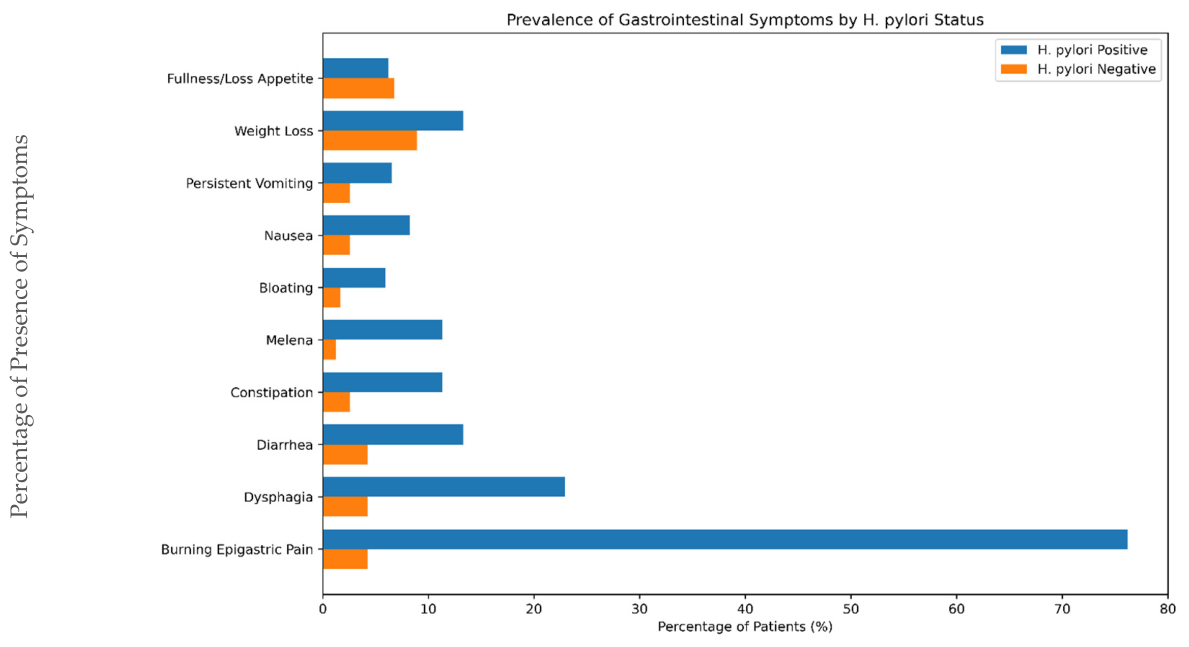
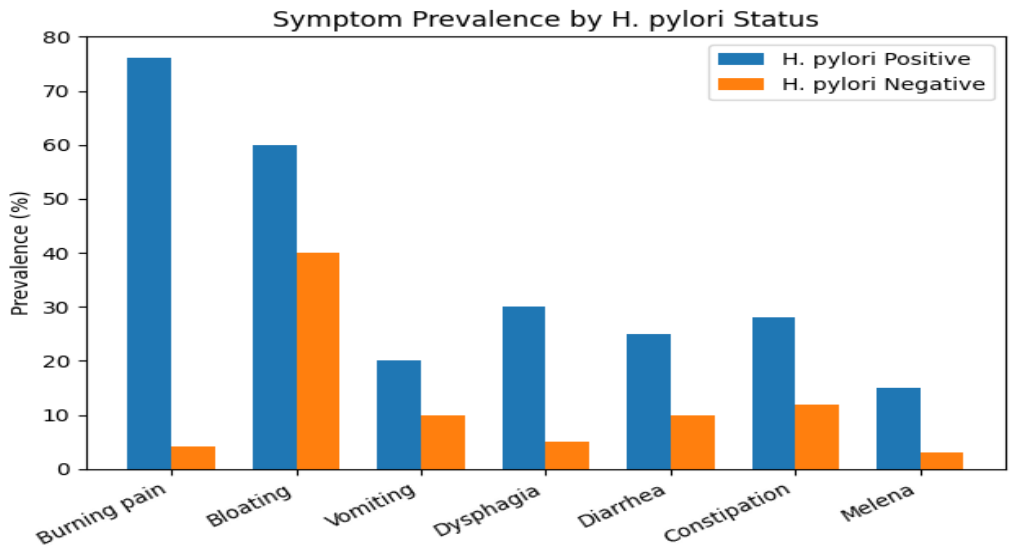
Background/Objectives: Helicobacter pylori infection is a major cause of chronic gastritis, peptic ulcer disease, and gastric cancer. Although accurate diagnostic tests are available, their cost, accessibility, and invasiveness may limit their routine use, particularly in resource-limited settings. Because dyspeptic symptoms are frequently used to guide testing decisions, identifying symptom patterns associated with H. pylori infection may improve patient selection for diagnostic testing. This study evaluated the association between gastrointestinal symptoms, particularly burning epigastric pain that worsens on an empty stomach, and H. pylori stool antigen positivity. Methods: This retrospective observational study included 589 adults who underwent H. pylori stool antigen testing at a private laboratory in Tehran, Iran, between May 2021 and June 2022. Patients were classified as H. pylori-positive (n = 353) or H. pylori-negative (n = 236) based on stool antigen test results. Gastrointestinal symptoms documented in patient records were compared between groups using chi-square analysis. The sensitivity, specificity, positive predictive value (PPV), and negative predictive value (NPV) of burning epigastric pain were also calculated. Results: Burning epigastric pain that worsens on an empty stomach was significantly more common in H. pylori-positive than H. pylori-negative patients (76.2% vs. 4.2%; p < 0.00001). Significant associations were also observed for bloating, persistent vomiting, dysphagia, diarrhea, constipation, and melena. Burning epigastric pain demonstrated a sensitivity of 76.2%, specificity of 95.8%, PPV of 96.4%, and NPV of 72.9%. Overall, 99.7% of H. pylori-positive patients reported at least one gastrointestinal symptom compared with 35.2% of H. pylori-negative patients. Conclusions: Burning epigastric pain that worsens on an empty stomach was strongly associated with H. pylori stool antigen positivity and may help clinicians identify patients who are more likely to benefit from diagnostic testing. However, symptoms alone are insufficient for diagnosis and should complement, rather than replace, established diagnostic methods. Prospective studies using standardized symptom assessment and multiple diagnostic modalities are needed to validate these findings.
Keywords: Helicobacter pylori; stool antigen test; epigastric pain; dyspepsia; gastrointestinal symptoms; retrospective study Helicobacter pylori; stool antigen test; epigastric pain; dyspepsia; gastrointestinal symptoms; retrospective study