Article

Hospitalized Patients with Oral Cavity Cancer and Ulcerative Mucositis: Implications for Key Cost Drivers and Disparities


1
Department of Medicine, University at Buffalo, Buffalo, NY 14203, USA
2
Division of Hematology and Oncology, Department of Medicine, University at Buffalo, Buffalo, NY 14203, USA
3
City of Hope Comprehensive Cancer Center, Duarte CA and Samuel Oschin Comprehensive Cancer Institute, Cedars-Sinai Medical System, Los Angeles, CA 90048, USA
4
Jacobs School of Medicine and Biomedical Sciences, Buffalo, NY 14203, USA
5
College of Dental Medicine, Nova Southeastern University, Davie, FL 33328, USA
6
UConn Health: Neag Comprehensive Cancer Center, University of Connecticut, 135 Dowling Way 4th Floor, Farmington, CT 06030, USA
*
Author to whom correspondence should be addressed.
Reports 2026, 9(3), 203; https://doi.org/10.3390/reports9030203
Submission received: 1 May 2026 / Revised: 19 June 2026 / Accepted: 22 June 2026 / Published: 26 June 2026

Abstract

Background: Cancer treatment-induced ulcerative mucositis (UM) is a debilitating toxicity in patients with cancers of the lip, oral cavity, and pharynx (CLOP). This study evaluated the association of chemotherapy-induced (CT-UM) and radiotherapy-induced ulcerative mucositis (RT-UM) with burden of illness (BOI), focusing on hospital length of stay (LOS) and total charges, and examined disparities in outcomes. Methods: This retrospective cohort study analyzed 2019 National Inpatient Sample (NIS) data. Adult patients (≥18 years) hospitalized with CLOP (ICD-10-CM C00–C14) undergoing inpatient surgery, chemotherapy, or radiotherapy were included. CT-UM (K12.31) and RT-UM (K12.33) were identified as secondary diagnoses. Survey-weighted generalized linear models (negative binomial for LOS; gamma for charges) adjusted for demographics, comorbidities (Elixhauser score), insurance, income, and Diagnosis-Related Groups (DRG; surgical vs. medical) were used. Results: Among 59,710 weighted CLOP hospitalizations, 820 had CT-UM and 1010 had RT-UM. Patients with UM were younger and had varying comorbidity burdens. Unadjusted analyses showed prolonged geometric mean LOS for CT-UM (5.66 vs. 3.81 days, p < 0.001) and RT-UM (4.95 vs. 3.81 days, p = 0.001), with lower total charges ($48,645 and $42,938 vs. $56,267). Multivariable analyses confirmed RT-UM was associated with increased LOS (adjusted coefficient 1.33, 95% CI 1.14–1.55) but lower charges (0.67, 95% CI 0.56–0.81). In patients >50 years, CT-UM showed stronger effects (LOS 1.80, 95% CI 1.49–2.15; charges 0.79, 95% CI 0.65–0.98). Significant disparities were observed: females, Black and Hispanic patients, and Medicaid beneficiaries experienced greater BOI (prolonged LOS and/or higher charges in subgroups). Associations persisted in DRG- and procedure-stratified sensitivity analyses, suggesting treatment interruptions as a key driver. Conclusions: Ulcerative mucositis in hospitalized CLOP patients is associated with prolonged LOS but lower charges, likely due to treatment modifications, and disproportionately affects vulnerable populations. These findings highlight the need for proactive oral care protocols, multidisciplinary integration, and equity-focused interventions to reduce the burden of this toxicity and improve cancer treatment outcomes.

1. Introduction and Clinical Significance

Cancer treatment-induced ulcerative mucositis (UM) is a major dose-limiting toxicity of chemotherapy (CT) and radiotherapy (RT) in patients with cancers of the lip, oral cavity, and pharynx (CLOP) [1,2,3,4]. It severely impairs quality of life, nutrition, and treatment tolerance, often causing unplanned interruptions, dose reductions, and increased healthcare utilization [1,5,6,7,8]. Prospective studies in head and neck squamous cell carcinoma (HNSCC) show that grade 3 toxicities and weight loss during RT or chemoradiotherapy are primary drivers of treatment breaks, with UM serving as a strong predictor in both RT and combined regimens [2,6,7,8]. Oral ulcerative mucositis must be differentiated from other causes of oral ulceration, including infectious stomatitis (e.g., herpes simplex virus and candidiasis), autoimmune conditions (oral lichen planus and pemphigus), traumatic or aphthous ulcers, and systemic manifestations such as graft-versus-host disease (GVHD) in transplant recipients [3,9,10]. Pre-existing conditions like poor dentition or periodontal disease can exacerbate or mimic these changes, highlighting the need for baseline dental assessment [3,9,10].
Mucositis-related treatment interruptions remain underexplored in many trials despite their impact [7,8]. Hospitalization rates for radiotherapy complications, including severe mucositis, rose 1.3-fold from 2005 to 2016 [11]. In real-world settings, UM drives prolonged length of stay (LOS), higher costs, and outcome disparities, especially in underserved groups [12,13,14]. Systemic effects include dehydration, malnutrition, sepsis, cachexia, and reduced survival, amplified in CLOP patients receiving multimodal therapy [1,3,12,13]. This short report examines the association of chemotherapy-induced (CT-UM) and radiotherapy-induced ulcerative mucositis (RT-UM) with burden of illness (BOI)—primarily LOS and total hospital charges—among hospitalized CLOP patients using 2019 National Inpatient Sample (NIS) data. We hypothesized that UM contributes to adverse outcomes, including treatment modifications and disparities by age, sex, race/ethnicity, insurance, and socioeconomic status.
Administrative datasets like NIS capture severe inpatient cases but may underestimate milder outpatient-managed mucositis. By applying specific ICD-10-CM codes (C00–C14 for CLOP; K12.31 for CT-UM; K12.33 for RT-UM) in treatment contexts, this analysis offers valuable insights into inpatient burden. Such evidence supports multidisciplinary preventive strategies, including proactive oral care, photobiomodulation, nutritional support, and risk-stratified interventions, to improve therapy tolerance, quality of life, and health equity [15,16,17,18,19]. Integrating oral medicine specialists into oncology and palliative teams is essential. Baseline optimization, validated monitoring (e.g., MASCC/ISOO scales), and culturally tailored care can mitigate toxicity and reduce systemic/economic burdens in vulnerable populations [12,13,14,15,17,19].

2. Methods

This retrospective cohort study analyzed data from the 2019 National Inpatient Sample (NIS), the largest publicly available all-payer inpatient database in the United States, maintained by the Agency for Healthcare Research and Quality (AHRQ) as part of the Healthcare Cost and Utilization Project (HCUP) [20]. The NIS is a 20% stratified sample of hospitalizations from community hospitals, designed to produce nationally representative estimates when appropriate discharge weights are applied [20].
Inclusion and Exclusion Criteria: Adult patients (≥18 years) hospitalized with cancers of the lip, oral cavity, and pharynx (CLOP; ICD-10-CM codes C00.0–C14.9) who underwent inpatient surgery, chemotherapy, or radiotherapy were included. Chemotherapy-induced ulcerative mucositis (CT-UM) was identified by the secondary diagnosis code K12.31 (Oral mucositis [ulcerative] due to antineoplastic therapy) and radiotherapy-induced ulcerative mucositis (RT-UM) by K12.33 (Oral mucositis [ulcerative] due to radiation). These codes were restricted to index admissions involving relevant treatment procedures (identified via ICD-10-PCS and CCS codes) to ensure context of treatment-related toxicity. Exclusion criteria included patients under 18 years of age, elective admissions lacking treatment codes, and cases where mucositis was coded as the primary diagnosis without associated antineoplastic therapy. Survey weights were applied throughout to generate national estimates [20].
Data Elements and Outcomes: The primary outcomes representing burden of illness (BOI) were hospital length of stay (LOS) in days and total hospital charges (in US dollars). Covariates included patient demographics (age, sex, race/ethnicity, insurance status, median household income quartile); clinical factors (weighted Elixhauser comorbidity index); hospital characteristics (bed size, teaching status, region, urban-rural location); and admission-related variables (Diagnosis-Related Group [DRG] category: surgical vs. medical; major head and neck procedures) [20]. Race/ethnicity was categorized as White, Black, Hispanic, Asian/Other based on NIS documentation.
Statistical Analysis: Univariate comparisons between groups (with vs. without CT-UM or RT-UM) were performed using Rao-Scott chi-square tests for categorical variables and t-tests for continuous variables, accounting for the complex survey design. Multivariable survey-weighted generalized linear models (GLMs) were employed: negative binomial regression for LOS (to handle over-dispersion) and gamma distribution with log link for total charges. Models were adjusted for the covariates listed above, with inclusion of interaction terms where relevant (e.g., age × UM status). Prespecified subgroup analysis was conducted for patients older than 50 years. Sensitivity analyses included DRG stratification, major procedure adjustment, and broader mucositis codes (K12.30, K12.32). All analyses were two-tailed, with statistical significance set at p < 0.05. Results are reported as adjusted coefficients with 95% confidence intervals (CIs).
This study was exempt from Institutional Review Board (IRB) review because it utilized publicly available, de-identified data consistent with HCUP’s limited dataset provisions under the HIPAA Privacy Rule [20]. No patient consent was required.
Limitations: The NIS captures only inpatient encounters, potentially underestimating milder outpatient-managed cases. Reliance on administrative coding may result in under-ascertainment of mucositis severity, and detailed clinical variables such as dental status, specific treatment regimens, or outpatient follow-up are unavailable.

3. Results

In 2019, a total of 59,710 weighted hospitalizations involving patients with cancers of the lip, oral cavity, and pharynx (CLOP; ICD-10-CM C00–C14) who underwent inpatient surgery, chemotherapy, or radiotherapy were identified in the National Inpatient Sample. Among these, 820 patients had chemotherapy-induced ulcerative mucositis (CT-UM; K12.31), and 1010 had radiotherapy-induced ulcerative mucositis (RT-UM; K12.33) documented as secondary diagnoses during the index admission.
Description of Baseline Characteristics (Table 1): Table 1 presents the weighted baseline characteristics of CLOP patients stratified by the presence of CT-UM or RT-UM. Patients with CT-UM were significantly younger than those without (mean age 61.84 ± 11.40 vs. 64.49 ± 12.24 years, p = 0.004) and exhibited higher comorbidity burden as measured by the weighted Elixhauser score (18.02 ± 8.66 vs. 16.22 ± 9.80, p = 0.009). Demographically, the CT-UM group had a lower proportion of females (23.8% vs. 29.6%, p = 0.12), higher representation of White patients (82.5% vs. 76.0%), and notably higher rates of private insurance (39.6% vs. 27.9%). They were also more likely to reside in higher income quartiles and less likely to be transferred out of the hospital (9.1% vs. 18.9%, p < 0.001).
Similar trends were observed in the RT-UM cohort, though age difference was not statistically significant (63.50 ± 11.87 vs. 64.47 ± 12.24 years, p = 0.24). RT-UM patients also showed higher White race proportion (83.6% vs. 75.9%) and private insurance coverage (31.2% vs. 28.0%). Comorbidity scores were comparable (16.95 ± 8.96 vs. 16.23 ± 9.80, p = 0.26). Both UM groups had lower rates of hospital transfer-out, potentially reflecting more complex in-hospital management needs. Patient location (urban-rural) and other hospital characteristics showed minor variations without consistent patterns across groups. These baseline differences underscore the importance of multivariable adjustment in subsequent analyses.
Unadjusted Analyses: Unadjusted outcomes revealed substantial burden associated with ulcerative mucositis. For CT-UM, geometric mean length of stay (LOS) was markedly prolonged by 5.66 days compared to 3.81 days in non-CT-UM patients (p < 0.001). Total hospital charges were lower ($48,645 vs. $56,267, p = 0.05). For RT-UM, LOS was 4.95 days vs. 3.81 days (p = 0.001), with even lower charges ($42,938 vs. $56,267, p < 0.001). These patterns suggest that while mucositis extends hospitalization duration—likely due to supportive care needs, nutritional support, pain management, and treatment interruptions—it is associated with reduced daily procedural intensity and overall charges, possibly from de-escalation of antineoplastic therapy.
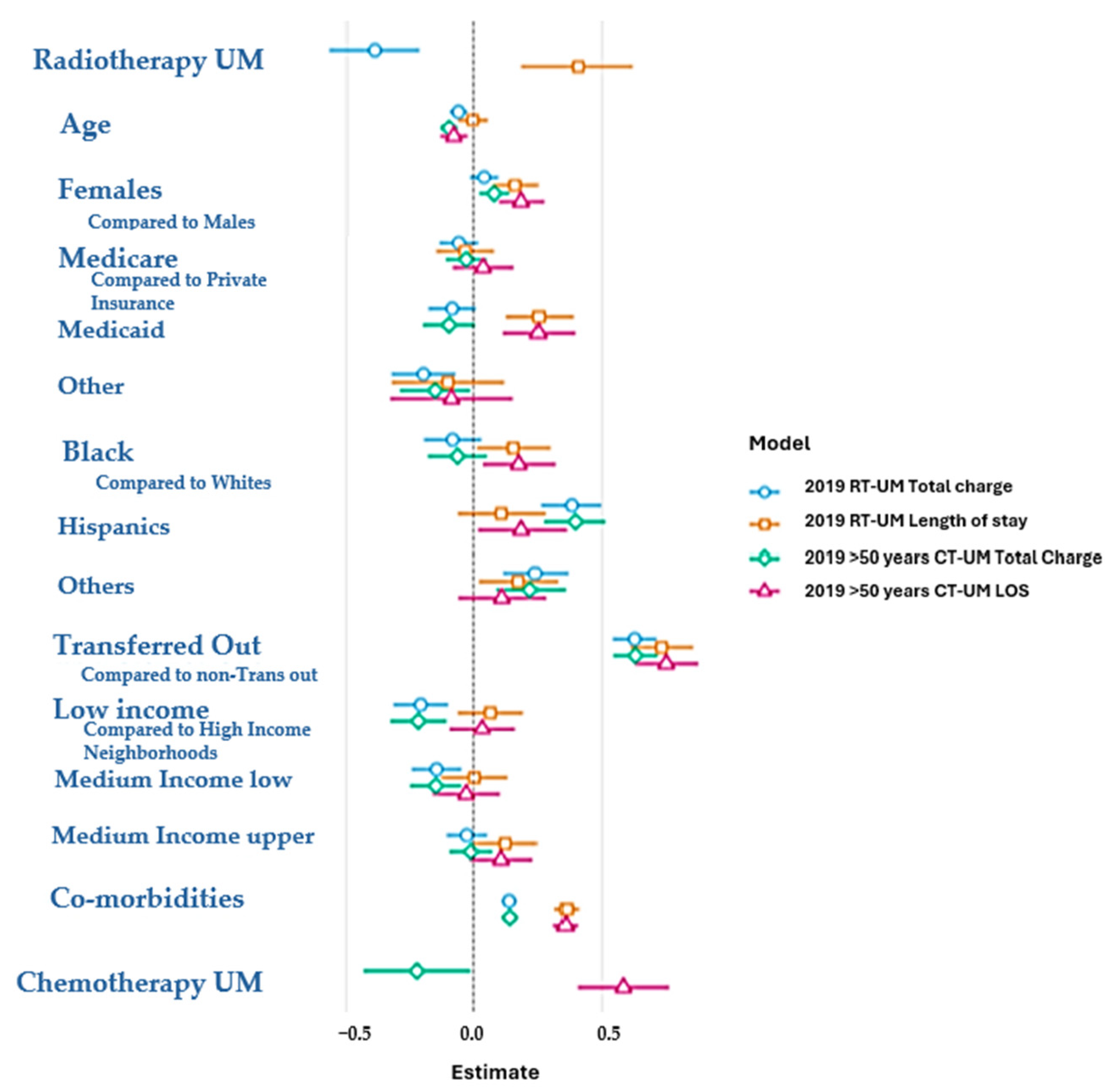
Adjusted Multivariable Analyses (Figure 1): The figure represents survey-weighted generalized linear models (GLMs) with appropriate distributions (negative binomial for LOS; gamma with log link for charges) that were adjusted for key confounders, including age, sex, race/ethnicity, insurance status, median household income quartile, weighted Elixhauser comorbidity score, hospital teaching status, bed size, region, and Diagnosis-Related Group (DRG) category (surgical vs. medical). Sensitivity analyses further incorporated major head and neck procedure indicators (ICD-10-PCS) and interaction terms.
RT-UM remained independently associated with increased LOS (adjusted coefficient 1.33, 95% CI 1.14–1.55) but significantly lower total charges (coefficient 0.67, 95% CI 0.56–0.81). Overall, CT-UM was associated with longer LOS (coefficient 1.54, 95% CI 1.36–1.74). In the prespecified subgroup analysis of patients older than 50 years, CT-UM demonstrated amplified effects: LOS coefficient 1.80 (95% CI 1.49–2.15) and reduced charges (coefficient 0.79, 95% CI 0.65–0.98). These associations were robust in DRG-stratified and procedure-adjusted models, supporting the interpretation that mucositis-related treatment interruptions contribute independently to prolonged supportive care admissions with lower per diem costs.
Disparities in Burden of Illness: Important disparities emerged. Females had consistently longer LOS across both UM cohorts (adjusted coefficient 1.13, 95% CI 1.06–1.19). Racial/ethnic differences were pronounced: Hispanic patients experienced higher total charges in RT-UM (coefficient 1.48, 95% CI 1.30–1.64) and older CT-UM subgroups (coefficient 1.46, 95% CI 1.31–1.67), along with longer LOS in the latter (coefficient 1.21, 95% CI 1.02–1.43). Black patients showed prolonged LOS in RT-UM (coefficient 1.17, 95% CI 1.01–1.35) and older CT-UM cohorts (coefficient 1.19, 95% CI 1.04–1.38) compared to White patients. Medicaid beneficiaries had independently longer LOS (coefficient 1.19 in RT-UM; 1.29 in older CT-UM), highlighting systemic barriers such as post-acute care placement challenges.
All analyses were two-tailed, with statistical significance set at p < 0.05. Table 1 provides complete weighted frequencies, percentages, and p-values for all variables. These findings quantify the substantial inpatient burden of ulcerative mucositis in CLOP and emphasize equity considerations.

4. Discussion

This nationwide analysis of hospitalized patients with cancers of the lip, oral cavity, and pharynx (CLOP) demonstrates that ulcerative mucositis (UM) is associated with prolonged hospital length of stay (LOS) but also with lower total charges, likely reflecting clinically meaningful treatment interruptions or modifications due to toxicity. These findings align with prior evidence that UM is a dose-limiting toxicity leading to unplanned breaks in radiotherapy (RT) and chemotherapy (CT), which compromise disease control and increase supportive care needs [1,3,7,8,12,13,21]. The paradoxical combination of extended LOS with reduced charges is particularly noteworthy. While longer hospitalizations intuitively increase costs, our multivariable models—adjusted for Diagnosis-Related Groups (DRG; surgical vs. medical), major head and neck procedures, and other confounders—show that RT-UM and, in older patients, CT-UM are independently linked to this pattern. This suggests that mucositis often prompts de-escalation of high-intensity antineoplastic interventions (e.g., reduced RT fractions, delayed or omitted CT cycles) in favor of prolonged supportive care admissions focused on pain management, nutritional support, hydration, and infection control [12,13,22,23,24,25]. Such interruptions are well-documented in prospective head and neck cohorts, where grade 3+ mucositis correlates with higher rates of treatment breaks [3,7,8].
Local and Systemic Factors Influencing Mucositis: Both local and general factors significantly modulate mucositis severity and downstream outcomes. Local factors include poor dentition, periodontal disease, pre-existing oral infections, sinusitis, and chronic irritation from ill-fitting prostheses or xerogenic medications. These can exacerbate mucosal injury, impair healing, and increase susceptibility to secondary bacterial or fungal infections [4,15,17,19]. For instance, poor oral hygiene and dental foci have been associated with higher mucositis incidence and complications such as febrile neutropenia in cancer patients [22,23,26]. Systemic contributors encompass advanced age, comorbidities (e.g., diabetes, malnutrition), smoking, dehydration, low body mass index, and pharmacogenomic variations affecting drug metabolism or mucosal repair [1,4,21,26,27].
In our cohort, higher Elixhauser comorbidity scores in UM patients support the role of these multifactorial influences. Unfortunately, administrative datasets like the NIS lack granular data on baseline dental status or specific medication use, representing a key limitation [20]. Future studies integrating electronic health records with dental evaluations could better quantify these contributions. Clinically, proactive pre-treatment dental optimization and management of sinusitis or xerogenic drugs remain critical, consistent with MASCC/ISOO guidelines [15,17,19].
Disparities in Burden of Illness: Our analysis highlights pronounced disparities. Women, Black and Hispanic patients, and Medicaid beneficiaries experienced greater increases in LOS and, in some subgroups, charges [21]. These patterns likely stem from structural barriers—including limited access to outpatient supportive care, transportation challenges, lower health literacy, food insecurity, and implicit bias in pain/discharge planning—compounded by higher baseline comorbidity burdens in underserved populations [21,28,29,30,31,32]. Medicaid insurance, more prevalent among minority groups, is associated with post-acute care placement delays, prolonging acute hospitalizations [28,29,32].
Biologically, differences in mucosal repair capacity, pharmacogenomics, and comorbidity profiles (e.g., higher diabetes and cardiovascular disease prevalence) may amplify toxicity risk. These disparities extend broader inequities in head and neck cancer outcomes, where Black patients often face worse survival [30,31]. Our findings underscore the urgent need for culturally tailored interventions, such as community-based oral care navigation programs (e.g., through initiatives like NICE), to mitigate these gaps [21,31].
Clinical and Economic Implications: The inpatient focus of this study captures the most severe, resource-intensive UM cases. While overall charges appear lower due to treatment de-escalation, the true economic burden is substantial when considering downstream effects: increased infection risk, readmissions, and lost productivity [12,13,14,22,23,24,25,33]. Prior estimates place the incremental cost of severe mucositis at $5000–$30,000 per patient in RT settings and even higher in transplant populations. Preventing severe UM could yield significant savings and improve oncologic outcomes by minimizing treatment interruptions [12,15,16,17,18,25]. The strengths of this study include its use of a large, nationally representative dataset, specific ICD-10-CM coding for CT-UM versus RT-UM, robust adjustment for confounders including DRG, and explicit examination of disparities. Limitations include potential under-coding of milder cases, lack of outpatient data, absence of detailed treatment dosimetry or dental variables, and the cross-sectional nature of NIS records, which precludes causality assessment [20].
Future Directions and Recommendations: These results support the implementation of standardized proactive oral care protocols: baseline dental evaluation, weekly mucositis risk screening with validated tools (e.g., MASCC/ISOO scales), photobiomodulation therapy, high-potency rinses, cryotherapy, and early multidisciplinary involvement of oral medicine specialists, nutritionists, and palliative care teams [15,16,17,18,19]. Risk-stratified pathways for high-risk groups (older adults, racial/ethnic minorities, and Medicaid-insured) should incorporate pre-treatment optimization and nutritional rehabilitation [21,28,29,30,31,32]. Hospitals should adopt quality metrics tracking mucositis-related LOS and treatment interruptions. Future research should link NIS with outpatient claims, incorporate real-world dental and salivary biomarker data, and evaluate AI-driven predictive models (e.g., nomograms) for personalized prevention [34,35]. Longitudinal studies examining long-term survival impacts of UM-driven interruptions are also warranted [7,8,9,10,27].

5. Conclusions

Ulcerative mucositis in CLOP patients drives prolonged hospitalizations and reveals important disparities. By addressing modifiable local and systemic factors and implementing equitable supportive care strategies, clinicians and health systems can reduce the burden of this debilitating toxicity, improve treatment tolerance, and advance health equity in oncology.

Author Contributions

L.R. contributed to critical revision of the manuscript; R.P. contributed to the design; J.B.E. contributed to the design and revision of the manuscript; K.A. contributed to critical revision of the manuscript; D.C. contributed to critical revision of the manuscript; R.R. contributed to the literature review; K.M. contributed to critical revision of the manuscript; P.S.S. contributed to the design, conception, acquisition, interpretation of data, drafting, and original draft and critical revision of the manuscript. All authors have read and agreed to the published version of the manuscript.

Funding

Funding for Poolakkad S. Satheeshkumar (Kaleida Troup Funding, number: 030GRT00000091).

Institutional Review Board Statement

1. This study is not required or mandated by the Institutional Review Board approval because it used publicly available data that had been de-identified or contains a limited dataset (The Healthcare Cost and Utilization Project (HCUP) does not require that users receive IRB review from their institutions). Hence, patient consent is not possible. Further, this study included only adults >18 years of age. 2. As per the HCUP agreement, it is not required that users receive IRB review from their institutions; the HCUP Data Use Agreement (DUA) provides the proof of compliance with the HIPAA privacy rule. In addition, the HCUP databases are consistent with the definition of “limited data sets” (https://www.hcup-us.ahrq.gov/team/NationwideDUA.jsp, accessed 6 June 2023) under the HIPAA Privacy Rule. They contain no direct patient identifiers, and completion of both the HCUP Data Use Agreement (DUA) training (https://www.hcup-us.ahrq.gov/tech_assist/dua.jsp) (accessed 6 June 2023) and a signed or electronically submitted DUA is required to obtain the HCUP databases.

Informed Consent Statement

Not applicable.

Data Availability Statement

We used data from the United States’ 2019 National Inpatient Sample database obtained from Healthcare Cost and Utilization Project (HCUP) of the Agency for Healthcare Research and Quality (AHRQ).

Acknowledgments

Vipanchika S for organizing the tables and grammatical corrections, and Ishan S for organizing the tables.

Conflicts of Interest

The authors declare no conflicts of interest.

Abbreviations

The following abbreviations are used in this manuscript:
BOIBurden of illness
CIConfidence interval
CLOPCancers of the lip, oral cavity, and pharynx
CoeffCoefficient
CTChemotherapy
CT-UMChemotherapy-induced oral ulcerative mucositis
LOSLength of stay
RTRadiotherapy
RT-UMRadiotherapy-induced oral ulcerative mucositis
UMUlcerative mucositis

References

  1. Lalla, R.V.; Brennan, M.T.; Gordon, S.M.; Sonis, S.T.; Rosenthal, D.I.; Keefe, D.M. Oral Mucositis Due to High-Dose Chemotherapy and/or Head and Neck Radiation Therapy. J. Natl. Cancer Inst. Monogr. 2019, 2019, lgz011. [Google Scholar] [CrossRef] [Scilit] [PubMed]
  2. Lalla, R.V.; Saunders, D.P.; Peterson, D.E. Chemotherapy or radiation-induced oral mucositis. Dent. Clin. N. Am. 2014, 58, 341–349. [Google Scholar] [CrossRef] [Scilit] [PubMed]
  3. Trotti, A.; Bellm, L.A.; Epstein, J.B.; Frame, D.; Fuchs, H.J.; Gwede, C.K.; Komaroff, E.; Nalysnyk, L.; Zilberberg, M.D. Mucositis incidence, severity and associated outcomes in patients with head and neck cancer receiving radiotherapy with or without chemotherapy: A systematic literature review. Radiother. Oncol. 2003, 66, 253–262. [Google Scholar] [CrossRef] [Scilit] [PubMed]
  4. Sroussi, H.Y.; Epstein, J.B.; Bensadoun, R.J.; Saunders, D.P.; Lalla, R.V.; Migliorati, C.A.; Heaivilin, N.; Zumsteg, Z.S. Common oral complications of head and neck cancer radiation therapy: Mucositis, infections, saliva change, fibrosis, sensory dysfunctions, dental caries, periodontal disease, and osteoradionecrosis. Cancer Med. 2017, 6, 2918–2931. [Google Scholar] [CrossRef] [Scilit] [PubMed]
  5. Vera-Llonch, M.; Oster, G.; Hagiwara, M.; Sonis, S. Oral mucositis in patients undergoing radiation treatment for head and neck carcinoma. Cancer 2006, 106, 329–336. [Google Scholar] [CrossRef] [Scilit] [PubMed]
  6. Elting, L.S.; Keefe, D.M.; Sonis, S.T.; Garden, A.S.; Spijkervet, F.K.; Barasch, A.; Tishler, R.B.; Canty, T.P.; Kudrimoti, M.K.; Vera-Llonch, M. Patient-reported measurements of oral mucositis in head and neck cancer patients treated with radiotherapy with or without chemotherapy: Demonstration of increased frequency, severity, resistance to palliation, and impact on quality of life. Cancer 2008, 113, 2704–2713. [Google Scholar] [CrossRef] [Scilit] [PubMed]
  7. Russo, G.; Haddad, R.; Posner, M.; Machtay, M. Radiation treatment breaks and ulcerative mucositis in head and neck cancer. Oncologist 2008, 13, 886–898. [Google Scholar] [CrossRef] [Scilit] [PubMed]
  8. Rosenthal, D.I. Consequences of mucositis-induced treatment breaks and dose reductions on head and neck cancer treatment outcomes. J. Support. Oncol. 2007, 5, 23–31. [Google Scholar] [PubMed]
  9. Rybkin, A.; Kang, J.J.; Lee, A.; Kitpanit, S.; Fan, M.; Mohamed, N.; Cartano, O.; Zakeri, K.; Gelblum, D.; Sherman, E.; et al. The effect of short radiation treatment breaks on chemo-radiotherapy for oropharyngeal cancers. Head Neck 2021, 43, 3796–3809. [Google Scholar] [CrossRef] [Scilit] [PubMed]
  10. Graboyes, E.M.; Kompelli, A.R.; Neskey, D.M.; Brennan, E.; Nguyen, S.; Sterba, K.R.; Warren, G.W.; Hughes-Halbert, C.; Nussenbaum, B.; Day, T.A. Association of Treatment Delays With Survival for Patients With Head and Neck Cancer: A Systematic Review. JAMA Otolaryngol. Head Neck Surg. 2019, 145, 166–177. [Google Scholar] [CrossRef] [Scilit] [PubMed]
  11. Tonse, R.; Ramamoorthy, V.; Rubens, M.; Saxena, A.; McGranaghan, P.; Veledar, E.; Hall, M.D.; Chuong, M.D.; Ahluwalia, M.S.; Mehta, M.P.; et al. Hospitalization rates from radiotherapy complications in the United States. Sci. Rep. 2022, 12, 4371. [Google Scholar] [CrossRef] [Scilit] [PubMed]
  12. Elting, L.S.; Cooksley, C.D.; Chambers, M.S.; Garden, A.S. Risk, outcomes, and costs of radiation-induced oral mucositis among patients with head-and-neck malignancies. Int. J. Radiat. Oncol. Biol. Phys. 2007, 68, 1110–1120. [Google Scholar] [CrossRef] [Scilit] [PubMed]
  13. Murphy, B.A.; Beaumont, J.L.; Isitt, J.; Garden, A.S.; Gwede, C.K.; Trotti, A.M.; Meredith, R.F.; Epstein, J.B.; Le, Q.T.; Brizel, D.M.; et al. Mucositis-related morbidity and resource utilization in head and neck cancer patients receiving radiation therapy with or without chemotherapy. J. Pain. Symptom Manag. 2009, 38, 522–532. [Google Scholar] [CrossRef] [Scilit] [PubMed]
  14. Carlotto, A.; Hogsett, V.L.; Maiorini, E.M.; Razulis, J.G.; Sonis, S.T. The economic burden of toxicities associated with cancer treatment: Review of the literature and analysis of nausea and vomiting, diarrhoea, oral mucositis and fatigue. Pharmacoeconomics 2013, 31, 753–766. [Google Scholar] [CrossRef] [Scilit] [PubMed]
  15. Elad, S.; Cheng, K.K.F.; Lalla, R.V.; Yarom, N.; Hong, C.; Logan, R.M.; Bowen, J.; Gibson, R.; Saunders, D.P.; Zadik, Y.; et al. MASCC/ISOO clinical practice guidelines for the management of mucositis secondary to cancer therapy. Cancer 2020, 126, 4423–4431. [Google Scholar] [CrossRef] [Scilit] [PubMed]
  16. Zadik, Y.; Arany, P.R.; Fregnani, E.R.; Bossi, P.; Antunes, H.S.; Bensadoun, R.J.; Gueiros, L.A.; Majorana, A.; Nair, R.G.; Ranna, V.; et al. Systematic review of photobiomodulation for the management of oral mucositis in cancer patients and clinical practice guidelines. Support. Care Cancer 2019, 27, 3969–3983. [Google Scholar] [CrossRef] [Scilit] [PubMed]
  17. Hong, C.H.L.; Gueiros, L.A.; Fulton, J.S.; Cheng, K.K.; Kandwal, A.; Galiti, D.; Fall-Dickson, J.M.; Johansen, J.; Ameringer, S.; Kataoka, T.; et al. Systematic review of basic oral care for the management of oral mucositis in cancer patients and clinical practice guidelines. Support. Care Cancer 2019, 27, 3949–3967. [Google Scholar] [CrossRef] [Scilit] [PubMed]
  18. Correa, M.E.P.; Cheng, K.K.F.; Chiang, K.; Kandwal, A.; Loprinzi, C.L.; Mori, T.; Potting, C.; Rouleau, T.; Toro, J.J.; Ranna, V.; et al. Systematic review of oral cryotherapy for the management of oral mucositis in cancer patients and clinical practice guidelines. Support. Care Cancer 2020, 28, 2449–2456. [Google Scholar] [CrossRef] [Scilit] [PubMed]
  19. Kawashita, Y.; Soutome, S.; Umeda, M.; Saito, T. Oral management strategies for radiotherapy of head and neck cancer. Jpn. Dent. Sci. Rev. 2020, 56, 62–67. [Google Scholar] [CrossRef] [Scilit] [PubMed]
  20. Healthcare Cost and Utilization Project (HCUP). NIS Database Documentation; Agency for Healthcare Research and Quality: Rockville, MD, USA, 2015. Available online: https://hcup-us.ahrq.gov/db/nation/nis/nisdbdocumentation.jsp (accessed on 6 June 2023).
  21. Mohan, M.P.; Pili, R.; Epstein, J.B.; Rudin, L.; Eichhorn, S.; Satheeshkumar, P.S. Cancer treatment-induced ulcerative mucositis serves as a significant predictor of burden of illness including dysphagia, and associated disparities among hospitalized cancer patients. Support. Care Cancer 2024, 33, 22. [Google Scholar] [CrossRef] [Scilit] [PubMed]
  22. Satheeshkumar, P.S.; Mohan, M.P. Association and risk factors of healthcare-associated infection and burden of illness among chemotherapy-induced ulcerative mucositis patients. Clin. Oral Investig. 2022, 26, 1323–1332. [Google Scholar] [CrossRef] [Scilit] [PubMed]
  23. Satheeshkumar, P.S.; Blijlevens, N.; Sonis, S.T. Application of big data analyses to compare the impact of oral and gastrointestinal mucositis on risks and outcomes of febrile neutropenia and septicemia among patients hospitalized for the treatment of leukemia or multiple myeloma. Support. Care Cancer 2023, 31, 199. [Google Scholar] [CrossRef] [Scilit] [PubMed]
  24. Mohan, M.P.; Epstein, J.B.; Meleveedu, K.S.; Padhi, P.; Pili, R.; Satheeshkumar, P.S. Hospitalized Cancer Patients with Opioid Management for Chemo-Induced Ulcerative Mucositis Lessens the Patients’ Overall Burden of Illness. Pharmaceuticals 2025, 18, 536. [Google Scholar] [CrossRef] [Scilit] [PubMed]
  25. Elting, L.S.; Chang, Y.C. Costs of Oral Complications of Cancer Therapies: Estimates and a Blueprint for Future Study. J. Natl. Cancer Inst. Monogr. 2019, 2019, lgz010. [Google Scholar] [CrossRef] [Scilit] [PubMed]
  26. Eichhorn, S.; Rudin, L.; Ramasamy, C.; Varsani, R.; Padhi, P.; Nassour, N.; Meleveedu, K.; Epstein, J.B.; Semegran, B.; Pili, R. Elevated likelihood of infectious complications related to oral mucositis after hematopoietic stem cell transplantation: A systematic review and meta-analysis of outcomes and risk factors. Cancers 2025, 17, 2657. [Google Scholar] [CrossRef] [Scilit] [PubMed]
  27. Satheeshkumar, P.S.; Gopalakrishnan, V.; Epstein, J.B.; Pili, R. Long-term clinical consequences of severe oral mucositis in survivors of lip, oral cavity, and pharynx cancer versus leukemia: A propensity-score-matched comparative cohort study using real-world data. Med. Sci. 2026, 14, 142. [Google Scholar] [CrossRef] [Scilit] [PubMed]
  28. Naghavi, A.O.; Echevarria, M.I.; Grass, G.D.; Strom, T.J.; Abuodeh, Y.A.; Ahmed, K.A.; Kim, Y.; Trotti, A.M.; Harrison, L.B.; Yamoah, K.; et al. Having Medicaid insurance negatively impacts outcomes in patients with head and neck malignancies. Cancer 2016, 122, 3529–3537. [Google Scholar] [CrossRef] [Scilit] [PubMed]
  29. Subramanian, S.; Chen, A. Treatment patterns and survival among low-income Medicaid patients with head and neck cancer. JAMA Otolaryngol. Head Neck Surg. 2013, 139, 489–495. [Google Scholar] [CrossRef] [Scilit] [PubMed]
  30. Baliga, S.; Yildiz, V.O.; Bazan, J.; Palmer, J.D.; Jhawar, S.R.; Konieczkowski, D.J.; Grecula, J.; Blakaj, D.M.; Mitchell, D.; Henson, C.; et al. Disparities in survival outcomes among racial/ethnic minorities with head and neck squamous cell cancer in the United States. Cancers 2023, 15, 1781. [Google Scholar] [CrossRef] [Scilit] [PubMed]
  31. Nallani, R.; Subramanian, T.L.; Ferguson-Square, K.M.; Smith, J.B.; White, J.; Chiu, A.G.; Francis, C.L.; Sykes, K.J. A systematic review of head and neck cancer health disparities: A call for innovative research. Otolaryngol. Head Neck Surg. 2022, 166, 1238–1248. [Google Scholar] [CrossRef] [Scilit] [PubMed]
  32. Tranby, E.P.; Heaton, L.J.; Tomar, S.L.; Kelly, A.L.; Fager, G.L.; Backley, M.; Frantsve-Hawley, J. Oral cancer prevalence, mortality, and costs in Medicaid and commercial insurance claims data. Cancer Epidemiol. Biomark. Prev. 2022, 31, 1849–1857. [Google Scholar] [CrossRef] [Scilit] [PubMed]
  33. Sonis, S.T.; Oster, G.; Fuchs, H.; Bellm, L.; Bradford, W.Z.; Edelsberg, J.; Hayden, V.; Eilers, J.; Epstein, J.B.; LeVeque, F.G.; et al. Oral mucositis and the clinical and economic outcomes of hematopoietic stem-cell transplantation. J. Clin. Oncol. 2001, 19, 2201–2205. [Google Scholar] [CrossRef] [Scilit] [PubMed]
  34. Satheeshkumar, P.S.; El-Dallal, M.; Mohan, M.P. Feature selection and predicting chemotherapy-induced ulcerative mucositis using machine learning methods. Int. J. Med. Inform. 2021, 154, 104563. [Google Scholar] [CrossRef] [Scilit] [PubMed]
  35. Satheeshkumar, P.S.; Epstein, J.B.; Kewlani, D.; Pili, R. Guided supportive care may benefit from predicting cancer treatment-induced toxicity—A methodology paper on utilization of nomograms to predict severe oral mucositis, Part I. Support. Care Cancer 2025, 33, 651. [Google Scholar] [CrossRef] [Scilit] [PubMed]
Figure 1. Generalized linear models estimating total charge variation among ulcerative mucositis (UM) patients.
Reports 09 00203 g001
Table 1. Baseline characteristics of patients with CLOP in 2019 with and without ulcerative mucositis.
Patients Without
Chemo-Ulcerative Mucositis *
(Weighted)
Patients with
Chemo-Ulcerative Mucositis *
(Weighted)
Patients Without
RT-Ulcerative Mucositis *
(Weighted)
Patients with
RT-Ulcerative Mucositis *
(Weighted)
n58,89082058,7001010
Age (mean (SD *))64.49 (12.24)61.84 (11.40)
p = 0.004
64.47 (12.24)63.50 (11.87)
p = 0.24
Sex (%)
Female17,435.0 (29.6)195.0 (23.8)
p = 0.12
17,330 (29.5)300 (29.7)
p = 0.96
Race (%)
White43,835.0 (76.0)660.0 (82.5)43,680 (75.9)815 (83.6)
Black6125.0 (10.6)55.0 (6.9)6115 (10.6)65 (6.7)
Hispanic3845.0 (6.7)35.0 (4.4)3820 (6.6)60 (6.2)
Asian and Others3905.0 (6.8)50.0 (6.3)
p = 0.22
3920 (6.8)35 (3.6)
p = 0.66
Median household income
(based on current year)
0–25th percentile16,665.0 (28.8)145.0 (17.9)16,555 (28.7)255 (25.6)
26th to 50th percentile14,145.0 (24.5)235.0 (29.0)14,150 (24.5)230 (23.1)
51st to 75th percentile14,710.0 (25.4)245.0 (30.2)14,685 (25.5)270 (27.1)
76th to 100th percentile12,305.0 (21.3)185.0 (22.8)
p = 0.02
12250 (21.3)240 (24.1)
p = 0.64
Expected primary payer (%)
Medicare30180.0 (51.3)325.0 (39.6)29970 (51.1)535 (53.0)
Medicaid8665.0 (14.7)115.0 (14.0)8660 (14.8)120 (11.9)
Private insurance16,400.0 (27.9)325.0 (39.6)16,410 (28.0)315 (31.2)
Self-pay, no charge, and other3560.0 (6.1)55.0 (6.7)
p = 0.007
3575 (6.1)40 (4.0)
p = 0.31
Patient Location:
NCHS * Urban-Rural Code (%)
“Central” counties of metro areas of ≥1 million population16,620.0 (28.3)230.0 (28.0)16,585 (28.4)265 (26.2)
“Fringe” counties of metro areas of ≥1 million population14,930.0 (25.5)270.0 (32.9)14,915 (25.5)285 (28.2)
Counties in metro areas of 250,000–999,999 population12,320.0 (21.0)110.0 (13.4)12,255 (21.0)175 (17.3)
Counties in metro areas of 50,000–249,999 population5470.0 (9.3)110.0 (13.4)5490 (9.4)90 (8.9)
Micropolitan counties5395.0 (9.2)60.0 (7.3)5320 (9.1)135 (13.4)
Not metropolitan or micropolitan counties3890.0 (6.6)40.0 (4.9)
p = 0.07
3870 (6.6)60 (5.9)
p = 0.34
Indicator of a transfer out of the hospital
Transferred out11,110.0 (18.9)75.0 (9.1)
p < 0.001
11,060 (18.8)125 (12.4)
p = 0.02
Weighted Elixir score mean (SD)16.22 (9.80)18.02 (8.66)
p = 0.009
16.23 (9.80)16.95 (8.96)
p = 0.26
Length of Stay (Geometric mean)3.81 days 5.66 days
p < 0.001
3.81 days 4.95 days
p = 0.001
Total charge (Geometric mean) *$56,267$48,645,
p = 0.05
$56,267$42,938,
p < 0.001
* Abbreviations: SD, Standard deviation; NCHS, National Center for Health Statistics; $, United States’ Dollar; RT, Radiation therapy; Chemo, Chemotherapy; Note: All frequencies and percentages are weighed.
Disclaimer/Publisher’s Note: The statements, opinions and data contained in all publications are solely those of the individual author(s) and contributor(s) and not of MDPI and/or the editor(s). MDPI and/or the editor(s) disclaim responsibility for any injury to people or property resulting from any ideas, methods, instructions or products referred to in the content.