


Predictive Analysis of Extubation Failure in the Paediatric Intensive Care Unit in Bloemfontein, South Africa

Abstract
1. Introduction
2. Materials and Methods
2.1. Study Design
2.2. Study Site
2.3. Study Population
- ‑
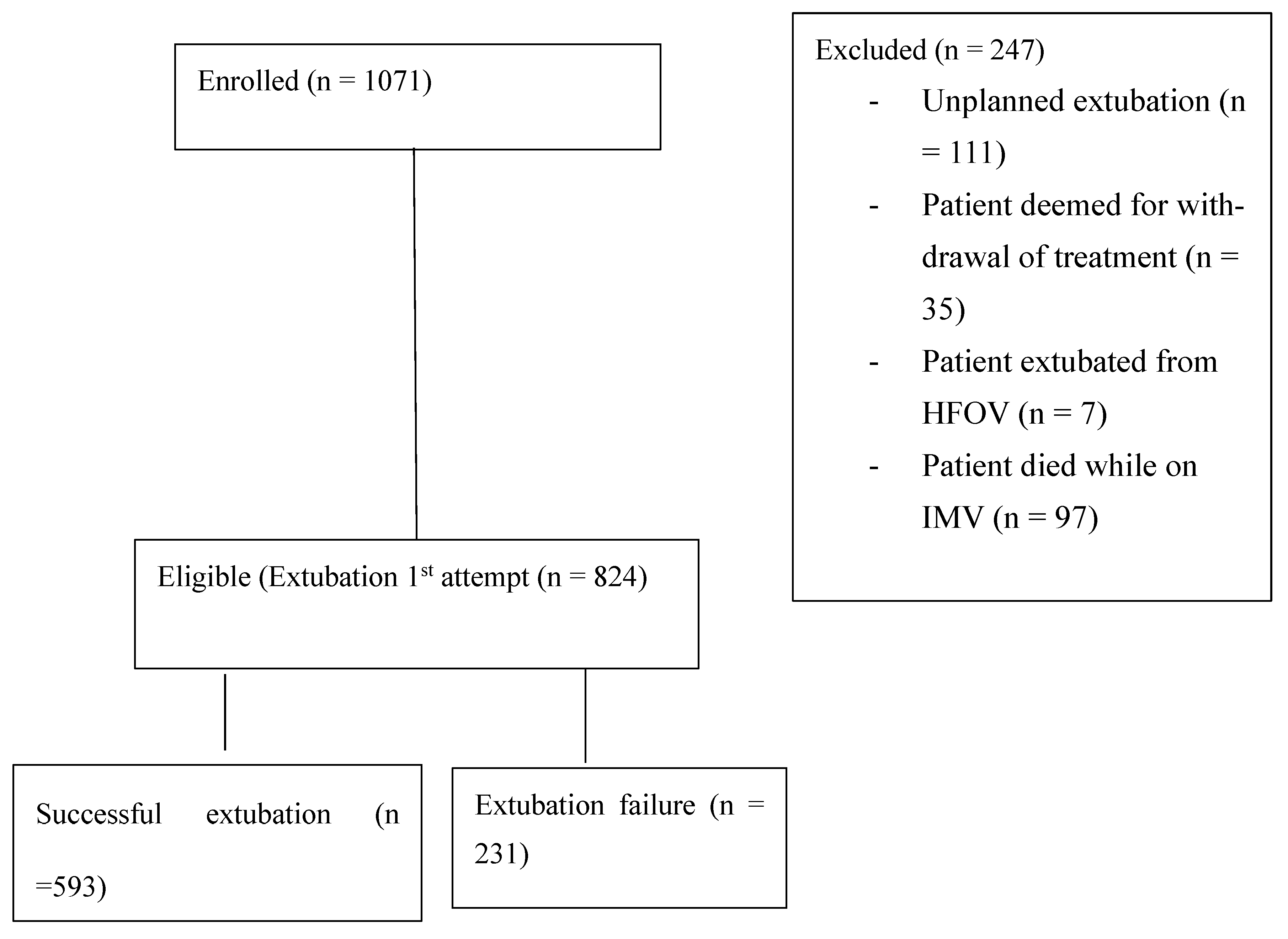
- Patients who self-extubated.
- ‑
- Patients who were deemed for withdrawal of treatment.
- ‑
- Patients with congenital upper airway obstruction.
- ‑
- Patients extubated from high frequency oscillatory ventilation (HFOV).
- ‑
- Patients with incomplete medical records.
- ‑
- Patients who died while still on the ventilator.
2.4. Outcomes and Predictors of Extubation Failure
2.5. Data Collection
- ‑
- Demographic data: Age, sex, referral source, weight, height and nutritional status (classified according to WHO criteria).
- ‑
- Clinical data: PIM-3 mortality risk, diagnosis, comorbidities, neuromuscular blockade (NMB), vasoactive medication, and details of mechanical ventilation (mode, duration, PIP, PEEP, respiratory rate, FiO2).
- ‑
- Extubation details: Timing of extubation, reasons for EF, and outcomes.
- ‑
- Laboratory data: Relevant haematologic and biochemical markers, including blood gas and septic marker (procalcitonin or C-reactive protein).
2.6. Statistical Analysis
2.7. Model Development
2.8. Ethical Considerations
3. Results
3.1. Prediction Model Performance
3.2. Performance Metrics: AUCROC and AUCPRC
3.3. Calibration Metrics
3.4. Model Selection
4. Discussion
4.1. Demographic and Clinical Characteristics
4.2. Predictors of Extubation Failure (EF)
4.3. Causes of Extubation Failure
4.4. Indications for Admission to PICU
4.5. Comorbidities
4.6. Machine Learning Models
4.7. Clinical Implications
5. Conclusions
6. Limitations
- The retrospective design of this study may introduce biases for data recording and data availability.
- Most respiratory parameters and ventilator settings were not included in the analysis.
- The duration and types of neuromuscular blockades and vasopressors/inotropes were not considered in this study.
- Model calibration was moderate at best. Increased data size may be required to improve this metric.
- The dataset was too small for predictive modelling. While cross-validation was used in model evaluation, the validation of this model is limited. As such, the generalizability of these models is uncertain, and their translational readiness is low. The small sample size further increases the risk of overfitting at various levels; as such, retraining on a larger data set and further validation, particularly on external data, are required before progressing to studies of their clinical use. What is demonstrated, however, is that the features studied are informative and that discriminative models can be developed to predict extubation failure. This publication also demonstrates that interpretable algorithms such as LR, DT and RF offer similar discrimination while providing explainable predictions for this application.
Supplementary Materials
Author Contributions
Funding
Institutional Review Board Statement
Informed Consent Statement
Data Availability Statement
Conflicts of Interest
References
- Toida, C.; Muguruma, T.; Miyamoto, M. Detection and validation of predictors of successful extubation in critically ill children. PLoS ONE 2017, 12, e0189787. [Google Scholar] [CrossRef]
- Kilba, M.C.F.; Salie, S.; Morrow, B.M. Risk factors and outcomes of extubation failure in a South African tertiary paediatric intensive care unit. S. Afr. J. Crit. Care 2022, 38, 26–32. [Google Scholar] [CrossRef]
- Wunsch, H.; Linde-Zwirble, W.T.; Angus, D.C.; Hartman, M.E.; Milbrandt, E.B.; Kahn, J.M. The epidemiology of mechanical ventilation se in the United States. Crit. Care Med. 2010, 38, 1947–1953. Available online: https://www.ncbi.nlm.nih.gov/pubmed/20639743 (accessed on 13 September 2025). [CrossRef]
- Igarashi, Y.; Ogawa, K.; Nishimura, K.; Osawa, S.; Ohwada, H.; Yokobori, S. Machine learning for predicting successful extubation in patients receiving mechanical ventilation. Front. Med. 2022, 9, 961252. [Google Scholar] [CrossRef] [PubMed]
- Chen, T.; Xu, J.; Ying, H.; Chen, X.; Feng, R.; Fang, X.; Gao, H.; Wu, J. Prediction of Extubation Failure for Intensive Care Unit Patients Using Light Gradient Boosting Machine. IEEE Access 2019, 7, 150960–150968. [Google Scholar] [CrossRef]
- Fleuren, L.M.; Dam, T.A.; Tonutti, M.; de Bruin, D.P.; Lalisang, R.C.A.; Gommers, D.; Cremer, O.L.; Bosman, R.J.; Rigter, S.; Wils, E.J.; et al. Predictors for extubation failure in COVID-19 patients using a machine learning approach. Crit. Care 2021, 25, 448. [Google Scholar] [CrossRef] [PubMed]
- Tanaka, A.; Kabata, D.; Hirao, O.; Kosaka, J.; Furushima, N.; Maki, Y.; Uchiyama, A.; Egi, M.; Shintani, A.; Morimatsu, H.; et al. Prediction Model of Extubation Outcomes in Critically Ill Patients: A Multicenter Prospective Cohort Study. J. Clin. Med. 2022, 11, 2520. [Google Scholar] [CrossRef]
- Egbuta, C.; Evans, F. Weaning from ventilation and extubation of children in critical care. BJA Educ. 2022, 22, 104–110. [Google Scholar] [CrossRef]
- Newth, C.J.L.; Hotz, J.C.; Khemani, R.G. Ventilator liberation in the Pediatric ICU. Respir. Care. 2020, 65, 1601–1610. [Google Scholar] [CrossRef]
- Zhao, Q.Y.; Wang, H.; Luo, J.C.; Luo, M.H.; Liu, L.P.; Yu, S.J.; Liu, K.; Zhang, Y.J.; Sun, P.; Tu, G.W.; et al. Development and Validation of a Machine-Learning Model for Prediction of Extubation Failure in Intensive Care Units. Front. Med. 2021, 8, 676343. [Google Scholar] [CrossRef]
- Cheng, Z.; Dong, Z.; Zhao, Q.; Zhang, J.; Han, S.; Gong, J.; Wang, Y. A Prediction Model of Extubation Failure Risk in Preterm Infants. Front. Pediatr. 2021, 9, 693320. [Google Scholar] [CrossRef]
- Liu, Y.; Cuevas-Asturias, S.; Alexander, E.C.; Ormond, J.; Aw, T.C.; Aramburo, A. Machine Learning Models for dynamic assessment of extubation readiness in Pediatric critical care. medRxiv 2025. [Google Scholar] [CrossRef]
- Moore, M.; Prabhakaran, P.; Yi, N.; Loberger, J.M. 711: Predicting pediatric extubation failure using machine learning. Crit. Care Med. 2023, 52, S328. [Google Scholar] [CrossRef]
- Tu, C.S.; Chang, C.H.; Chang, S.C.; Lee, C.S.; Chang, C.T. A Decision for Predicting Successful Extubation of Patients in Intensive Care Unit. Biomed. Res. Int. 2018, 2018, 6820975. [Google Scholar] [CrossRef]
- Rooney, S.R.; Reynolds, E.L.; Banerjee, M.; Pasquali, S.K.; Charpie, J.R.; Gaies, M.G.; Owens, G.E. Prediction of extubation failure in the paediatric cardiac ICU using machine learning and high-frequency physiologic data. Cardiol. Young 2021, 32, 1649–1656. [Google Scholar] [CrossRef] [PubMed]
- Asch, M. Chapter 5: Machine Learning. In A Toolbox for Digital Twins: From Model-Based to Data-Driven; Society for Industrial and Applied Mathematics: Philadelphia, PA, USA, 2022; pp. 327–448. Available online: https://epubs.siam.org/doi/pdf/10.1137/1.9781611976977.fm (accessed on 12 November 2025).
- Zou, H.; Hastie, T. Regularization and Variable Selection Via the Elastic Net. J. R. Stat. Soc. Ser. B Stat. Methodol. 2005, 67, 301–320. Available online: https://academic.oup.com/jrsssb/article/67/2/301/7109482 (accessed on 18 November 2025). [CrossRef]
- Kluyver, T.; Ragan-Kelley, B.; Pérez, F.; Granger, B.; Bussonnier, M.; Frederic, J.; Kelley, K.; Hamrick, J.; Grout, J.; Corlay, S.; et al. Jupyter Notebooks—A publishing format for reproducible computational workflows. In Positioning and Power in Academic Publishing: Players, Agents and Agendas; IOS Press: Amsterdam, The Netherlands, 2016; pp. 87–90. [Google Scholar] [CrossRef]
- Python Software Foundation. Python, Version 3.x; Python Software Foundation: Beaverton, OR, USA, 2023. Available online: https://www.python.org (accessed on 5 May 2026).
- Available online: https://hylkedonker.gitlab.io/statkit (accessed on 5 December 2025).
- Scikit-learn: Machine Learning in Python. J. Mach. Learn. Res. 2011, 12, 2825–2830.
- Van Buuren, S.; Groothuis-Oudshoorn, K. Mice: Multivariate Imputation by Chained Equations in R. J. Stat. Softw. 2011, 45, 1–67. [Google Scholar] [CrossRef]
- Available online: https://www.tensorflow.org/tutorials/structured_data/imbalanced_data (accessed on 6 December 2025).
- Mogase, L.G.; Koto, M.Z. Failed extubation in a tertiary level hospital intensive care unit, Pretoria, South Africa. S. Afr. J. Crit. Care 2021, 37, 86–89. [Google Scholar] [CrossRef] [PubMed]
- Khemani, R.G.; Sekayan, T.; Hotz, J.; Flink, R.C.; Rafferty, G.F.; Iyer, N.; Newth, C.J. Risk factors for pediatric extubation failure: The importance of respiratory muscle strength. Crit. Care Med. 2017, 45, e798–805. [Google Scholar] [CrossRef]
- Carvalho, H.; Fioretto, J.; Thomazi, L.; Carpi, M.; Bonatto, R.; Santos, B.; Martin, J.G.; Campos, F.J. Fatores de risco relacionados à falha de extubação em unidade de terapia intensiva pediátrica. Residência Pediátrica 2022, 12, 1–6. [Google Scholar] [CrossRef]
- Grippa, R.B.; Silva, P.S.; Barbosa, E.; Bresolin, N.L.; Mehta, N.M.; Moreno, Y.M.F. Nutritional status as a predictor of duration of mechanical ventilation in critically ill children. Nutrition 2017, 33, 91–95. [Google Scholar] [CrossRef]
- Mehta, N.M.; Bechard, L.J.; Cahill, N.; Wang, M.; Day, A.; Duggan, C.P.; Heyland, D.K. Nutritional practices and their relationship to clinical outcomes in critically ill children-An international multicenter cohort study. Crit. Care Med. 2012, 40, 2204–2211. [Google Scholar] [CrossRef]
- Liu, Y.; Wang, Q.; Hu, J.; Zhou, F.; Liu, C.; Li, J.; Fu, Y.; Dang, H. Characteristics and Risk Factors of Children Requiring Prolonged Mechanical Ventilation vs. Non-prolonged Mechanical Ventilation in the PICU: A Prospective Single-Center Study. Front. Pediatr. 2022, 10, 830075. [Google Scholar] [CrossRef] [PubMed]
- Lewis, D.; Khalsa, D.D.; Cummings, A.; Schneider, J.; Shah, S. Factors Associated with Post-Extubation Stridor in Infants Intubated in the Pediatric ICU. J. Intensive Care Med. 2024, 39, 336–340. [Google Scholar] [CrossRef]
- Al-Sofyani, K.A. Predictors and outcomes of extubation failures in a pediatric intensive care unit: A retrospective study. J. Taibah Univ. Med. Sci. 2024, 19, 516–523. [Google Scholar] [CrossRef]
- Simonassi, J.; Bonora Sanso, J.P. Prevalence of extubation and associated risk factors at a tertiary care pediatric intensive care unit. Arch. Argent. Pediatr. 2019, 117, 87–92. [Google Scholar] [CrossRef] [PubMed]
- Abu-Sultaneh, S.; Iyer, N.P.; Fernández, A.; Gaies, M.; González-Dambrauskas, S.; Hotz, J.C.; Kneyber, M.C.; López-Fernández, Y.M.; Rotta, A.T.; Werho, D.K.; et al. Executive Summary: International Clinical Practice Guidelines for Pediatric Ventilator Liberation, A Pediatric Acute Lung Injury and Sepsis Investigators (PALISI) Network Document. Am. J. Respir. Crit. Care Med. 2023, 207, 17–28. [Google Scholar] [CrossRef] [PubMed] [PubMed Central]
- Tao, Y.; Ding, X.; Guo, W.L. Using machine-learning models to predict extubation failure in neonates with bronchopulmonary dysplasia. BMC Pulm. Med. 2024, 24, 308. [Google Scholar] [CrossRef] [PubMed]
- Hsieh, M.H.; Hsieh, M.J.; Chen, C.M.; Hsieh, C.C.; Chao, C.M.; Lai, C.C. An artificial neural network model for predicting successful extubation in intensive care units. J. Clin. Med. 2018, 7, 240. [Google Scholar] [CrossRef]
- Vickers, A.J.; Elkin, E.B. Decision curve analysis: A novel method for evaluating prediction models. Med. Decis. Mak. 2006, 26, 565–574. [Google Scholar] [CrossRef] [PubMed] [PubMed Central]

| Characteristic | aOR | 95% CI | p-Value |
|---|---|---|---|
| Days of ventilation | 22.6 | 11.4–50.6 | <0.001 |
| PIM-3 score | 4.44 | 0.78–25.2 | 0.092 |
| Vasopressors/inotropes use | 2.06 | 1.26–3.37 | 0.004 |
| Neuromuscular blockade use | 3.73 | 1.75–8.39 | <0.001 |
| Corticosteroids pre-extubation | 1.64 | 0.82–3.31 | 0.2 |
| Fluid balance | 1.47 | 1.07–2.05 | 0.020 |
| Base Excess (BE) | 1.07 | 0.90–1.28 | 0.4 |
| Respiratory support after extubation | 1.17 | 0.83–1.65 | 0.4 |
| Mode of ventilation | 0.75 | 0.60–0.94 | 0.012 |
| Lactate | 1.18 | 0.96–1.53 | 0.14 |
| Urea | 0.94 | 0.72–1.24 | 0.7 |
| Creatinine | 1.48 | 0.78–3.12 | 0.3 |
| Haemoglobin | 0.82 | 0.69–0.97 | 0.022 |
| Total | Overall | Success Extubation | Extubation Failure | p-Value 1 | |
|---|---|---|---|---|---|
| N | 824 | 593 | 231 | ||
| Age in month | 824 | 0.1 | |||
| Median age (IQR) | 9 (2–48) | 10 (2–54) | 6 (2–37) | ||
| Sex | 823 | 0.7 | |||
| Male | 488 (59.3) | 348 (58.8) | 140 (60.6) | ||
| Female | 335 (40.7) | 244 (41.2) | 91 (39.4) | ||
| Source of admission | 823 | <0.001 | |||
| In hospital admission | 585 (71.1) | 409 (69.1) | 176 (76.2) | ||
| Out of hospital admission | 238 (28.9) | 183 (30.9) | 55 (23.8) | ||
| Nutritional status | 820 | 0.029 | |||
| Normal nutrition | 656 (80.0) | 481 (81.7) | 175 (75.8) | ||
| Undernutrition | 158 (19.3) | 102 (17.3) | 56 (24.2) | ||
| Overnutrition | 6 (0.7) | 6 (1.0) | 0 (0.0) | ||
| Days of ventilation | 823 | <0.001 | |||
| Median (IQR) | 3 (2–3) | 2 (2–3) | 3 (3–3) | ||
| Reason for EF | 824 | ||||
| Upper airway obstruction | 185 (22.5) | 1 (0.2) | 184 (79.7) | <0.001 | |
| Increased work of breath. | 163 (19.8) | 0 (0.0) | 163 (70.6) | <0.001 | |
| Sepsis/septic shock | 12 (1.5) | 0 (0.0) | 12 (5.2) | <0.001 | |
| Severe apnoea | 25 (3.0) | 0 (0.0) | 25 (10.8) | <0.001 | |
| Neuromuscular weakness | 17 (2.1) | 0 (0.0) | 17 (7.4) | <0.001 | |
| Admission diagnosis | 824 | ||||
| Respiratory pathology | 354 (43.0) | 244 (41.1) | 110 (47.6) | 0.10 | |
| Surgical and trauma | 183 (22.2) | 137 (23.1) | 46 (19.9) | 0.4 | |
| Sepsis and septic shock | 118 (14.3) | 81 (13.7) | 37 (16.0) | 0.4 | |
| Central nervous system | 121 (14.7) | 90 (15.2) | 31 (13.4) | 0.6 | |
| Comorbidities | 824 | ||||
| Congenital abnormalities | 66 (8.0) | 44 (7.4) | 22 (9.5) | 0.3 | |
| Renal disease | 16 (1.9) | 11 (1.9) | 5 (2.2) | 0.8 | |
| Oncology/haematology | 34 (4.1) | 22 (3.7) | 12 (5.2) | 0.3 | |
| Metabolic disease | 12 (1.5) | 9 (1.5) | 3 (1.3) | >0.9 | |
| Cardiovascular disease | 61 (7.4) | 41 (6.9) | 20 (8.7) | 0.4 | |
| Central nervous disease | 43 (5.2) | 24 (4.0) | 19 (8.2) | 0.022 | |
| Others | 152 (18.4) | 101 (17.0) | 51 (22.1) | 0.11 | |
| No comorbidity | 445 (54.0) | 347 (58.5) | 98 (42.4) | <0.001 | |
| Planned extubation. | 824 | 824 (100.0) | 593 (100.0) | 231 (100.0) | |
| PIM-3 mortality risk | 822 | 0.04 (0.02–0.07) | 0.04 (0.02–0.06) | 0.04 (0.02–0.09) | 0.022 |
| Procalcitonin (PCT) | 822 | 0.80 (0.60–1.00) | 0.80 (0.58–1.00) | 0.84 (0.67–1.20) | <0.001 |
Disclaimer/Publisher’s Note: The statements, opinions and data contained in all publications are solely those of the individual author(s) and contributor(s) and not of MDPI and/or the editor(s). MDPI and/or the editor(s) disclaim responsibility for any injury to people or property resulting from any ideas, methods, instructions or products referred to in the content. |
© 2026 by the authors. Licensee MDPI, Basel, Switzerland. This article is an open access article distributed under the terms and conditions of the Creative Commons Attribution (CC BY) license.
Share and Cite
Buankuna, M.; Sempa, J.B.; Khaliq, O.P.; Pienaar, M.A. Predictive Analysis of Extubation Failure in the Paediatric Intensive Care Unit in Bloemfontein, South Africa. Reports 2026, 9, 169. https://doi.org/10.3390/reports9020169
Buankuna M, Sempa JB, Khaliq OP, Pienaar MA. Predictive Analysis of Extubation Failure in the Paediatric Intensive Care Unit in Bloemfontein, South Africa. Reports. 2026; 9(2):169. https://doi.org/10.3390/reports9020169
Chicago/Turabian StyleBuankuna, Mbaya, Joseph B. Sempa, Olive P. Khaliq, and Michael A. Pienaar. 2026. "Predictive Analysis of Extubation Failure in the Paediatric Intensive Care Unit in Bloemfontein, South Africa" Reports 9, no. 2: 169. https://doi.org/10.3390/reports9020169
APA StyleBuankuna, M., Sempa, J. B., Khaliq, O. P., & Pienaar, M. A. (2026). Predictive Analysis of Extubation Failure in the Paediatric Intensive Care Unit in Bloemfontein, South Africa. Reports, 9(2), 169. https://doi.org/10.3390/reports9020169

