


Abstract
The study of Ultra-High-Energy Cosmic Rays is made possible by space telescopes that allow for the recording of signals generated by Extensive Air Showers (EAS) on the night side of the Earth’s atmosphere. One of the requirements for these telescopes is the detection of very low photon fluxes, achievable using the latest generation SiPMs characterized by high intrinsic gains, low power consumption, low weight, and robustness against accidental exposure to light. Despite these advantages, some technological issues still need to be addressed, such as the radiation hardness for operation in space. Therefore, the design of a SiPM-based focal surface for UHECR detection must consider the space qualification of SiPM arrays, with the development of compact arrays optimized for low dead-area focal surfaces. SiSMUV (SiPM-based Space Monitor for UV light) is a project dedicated to developing a compact and modular UV detector for use in space telescopes designed to study the fluorescence and Cherenkov signals produced by Ultra-High-Energy Cosmic Rays (UHECRs). Each SiSMUV module incorporates a matrix of SiPMs, a readout ASIC (Radioroc by Weeroc), and an FPGA into a monolithic block. This design enables the acquisition and processing of signals from the sensors. The system can connect to a PC for standalone operation or with back-end electronics for integration into more complex systems. In this paper, we will describe the prototype electronics, the experimental setup and the measurements performed to obtain parameters such as the gain of the SiPMs, and their photon detection efficiency (PDE). We will also present the firmware developed to interface with the readout ASIC and to transmit data to other peripherals.
Keywords:
detector; astroparticle physics; electronics; daq; trigger; data acquisition; front-end electronics 1. Introduction
Space-based observatories can detect Ultra-High-Energy Cosmic Rays (UHECRs) by the signals they produce when Extensive Air Showers (EAS) develop on the Earth’s night side. Missions in high-energy astrophysics and astroparticle physics must be capable of measuring extremely low photon fluxes [1]. Operating in space provides a unique advantage for monitoring EAS generated by UHECRs, as it offers a very large target volume along with nearly full-sky coverage. This broader perspective enhances statistics, making it possible to identify particles with fluxes as low as 1 particle per 100 km2 per year, or those with very small interaction cross-sections, such as high-energy neutrinos.
Photon-sensitive detectors on such instruments capture two principal emission components from EAS:
- A weak, nearly isotropic fluorescence signal emitted by atmospheric nitrogen excited by the shower particles, typically in the 300–500 nm wavelength band.
- A stronger, forward-directed Cherenkov emission.
The fluorescence signal originates from the de-excitation of nitrogen molecules excited by the passage of charged particles in the air shower. It is emitted isotropically, has a relatively long duration (10–100 µs), and lies predominantly in the UV band. In contrast, the Cherenkov emission is a short (few-nanosecond) and highly collimated optical flash produced by relativistic charged particles. Together, these two signals provide complementary information: the fluorescence light traces the longitudinal development of the shower, while the Cherenkov component enhances the timing and geometrical reconstruction.
Observing these phenomena from orbit offers significant advantages. The field of view of a space-based telescope encompasses a much larger atmospheric volume than any ground-based detector, resulting in a dramatic increase in exposure and enabling nearly full-sky coverage. However, the large distance between the detector and the emission region implies fewer photons reaching the focal surface, thus requiring an optical system with a large collecting area and a highly segmented, fast, and sensitive photon detector.
To fulfill these requirements, the detection system must combine a wide field of view with single-photon sensitivity, nanosecond-scale time resolution, and low power consumption. Furthermore, the readout electronics must be modular, lightweight, and capable of handling hundreds of thousands of channels with minimal dead time.
In summary, an instrument designed to effectively observe UHECRs from space must incorporate:
- An optical system with a large light-collecting aperture.
- A finely segmented focal plane detector with excellent time resolution.
- Fast, modular trigger and read-out electronics.
These requirements are consistent with those identified in recent studies of SiPM-based focal surfaces for space telescopes [2].
Recent progress in Silicon Photomultipliers (SiPMs) makes them strong candidates for use in space-based UHECR telescopes. They offer high gain, low power requirements, and resilience against accidental exposure to bright light, though challenges remain, particularly regarding radiation tolerance, thermal stability, and long-term gain uniformity in space environments [2,3]. One critical need is a high Photon Detection Efficiency (PDE) in the ultraviolet range to enable reliable measurement of the weak signals associated with UHECR and neutrino-induced showers [4].
Advancements in SiPM design have now pushed PDE levels close to those of high-performance photomultiplier tubes (PMTs) [2]. For focal surfaces relying on SiPM technology, essential developments include space qualification of SiPM arrays, compact designs with minimal dead area, and the creation of optimized front-end application-specific integrated circuits (ASICs).
The first phase of the SiSMUV characterization campaign was carried out using a laser source at 405 nm. This wavelength was selected as a practical starting point because it lies near the upper edge of the ultraviolet range and is relevant for both fluorescence and Cherenkov emission studies. Moreover, 405 nm laser diodes provide a stable and well-calibrated source for initial system validation. However, a full characterization of the Photon Detection Efficiency (PDE) as a function of wavelength, analogous to a quantum efficiency curve, is planned to extend across the 300–500 nm interval of physical interest. This range covers both the dominant fluorescence bands of atmospheric nitrogen and the shorter-wavelength Cherenkov component. Future measurements will employ additional laser lines and a monochromator-based setup to refine the spectral response characterization and ensure precise calibration of the input wavelength.
2. The SiSMUV Project
The SiSMUV (SiPM-based Space Monitor for UV-light) project aims to develop a compact and modular ultraviolet detector optimized for space applications. Each detector module incorporates a SiPM array, an ASIC for multi-channel signal readout, and an FPGA board responsible for system control, triggering, and on-board data processing. To ensure reliability in orbit, the design takes into account challenges such as mechanical stress during launch, strict power limitations, and exposure to harsh environmental conditions through careful engineering and comprehensive environmental qualification tests.
Beyond hardware development, SiSMUV serves as a technological pathfinder for future space missions devoted to UHECR and transient luminous phenomena detection. Its modular approach allows scalability from single detector units to large focal surfaces composed of hundreds of identical modules, facilitating redundancy and simplified maintenance. The project also aims to raise the Technology Readiness Level (TRL) of SiPM-based detection systems through dedicated environmental qualification campaigns, including thermal-vacuum cycling, vibration tests, and radiation exposure. These activities will provide crucial data for the integration of SiPM technology into future balloon and satellite missions, such as the PoEMMA Balloon with Radio (PBR) [5,6].
3. The Detector Prototype
The detector prototype integrates Silicon Photomultipliers (SiPMs), front-end ASICs, and FPGA logic into a single compact unit, significantly reducing both mass and power consumption—parameters that are critical for spaceborne instruments. The prototype employs a 64-pixel Multi-Pixel Photon Counter (MPPC) developed by Hamamatsu [7], in combination with a RADIOROC ASIC and a Xilinx Artix FPGA for data acquisition and real-time signal processing.
The SiPM matrices, specifically the Hamamatsu S13361-3050-NE-08 model, were chosen for their low afterpulsing and crosstalk probabilities, high photon detection efficiency (PDE) in the ultraviolet band, and demonstrated radiation hardness [3]. Each matrix consists of:
- An 8 × 8 SiPM array.
- A photosensitive area of per element.
- A 50 µm microcell pitch.
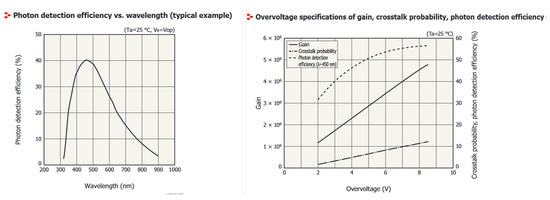
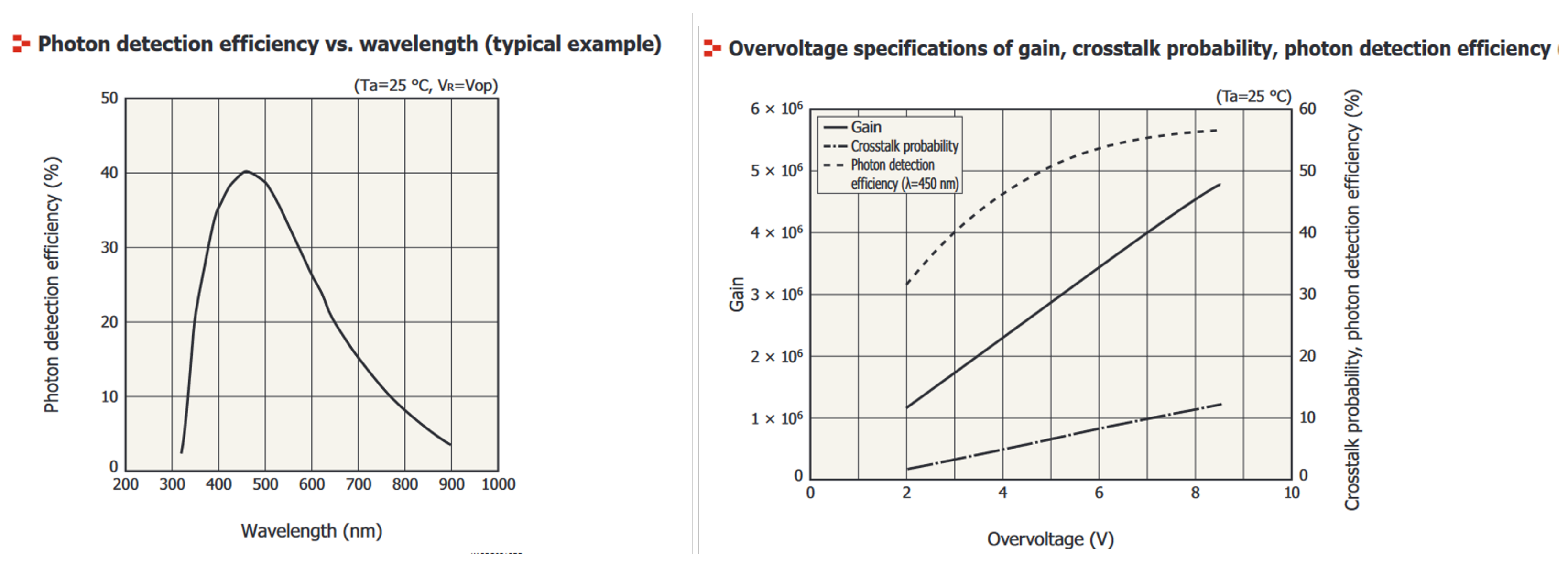
The active area of each SiPM aligns well with the Point Spread Function (PSF) typical of most space telescope optical systems. Figure 1 presents the Photon Detection Efficiency (PDE) as a function of wavelength and the Gain as a function of overvoltage for the Hamamatsu S13361-3050-NE-08 device [7].
Figure 1.
Photon Detection Efficiency (PDE) as a function of wavelength and the Gain as a function of overvoltage for the Hamamatsu S13361-3050-NE-08 device, from [7].
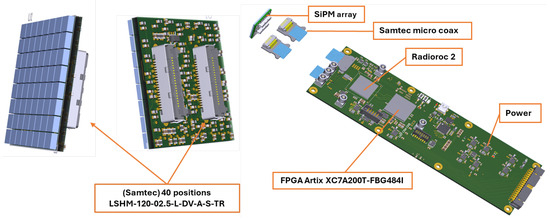
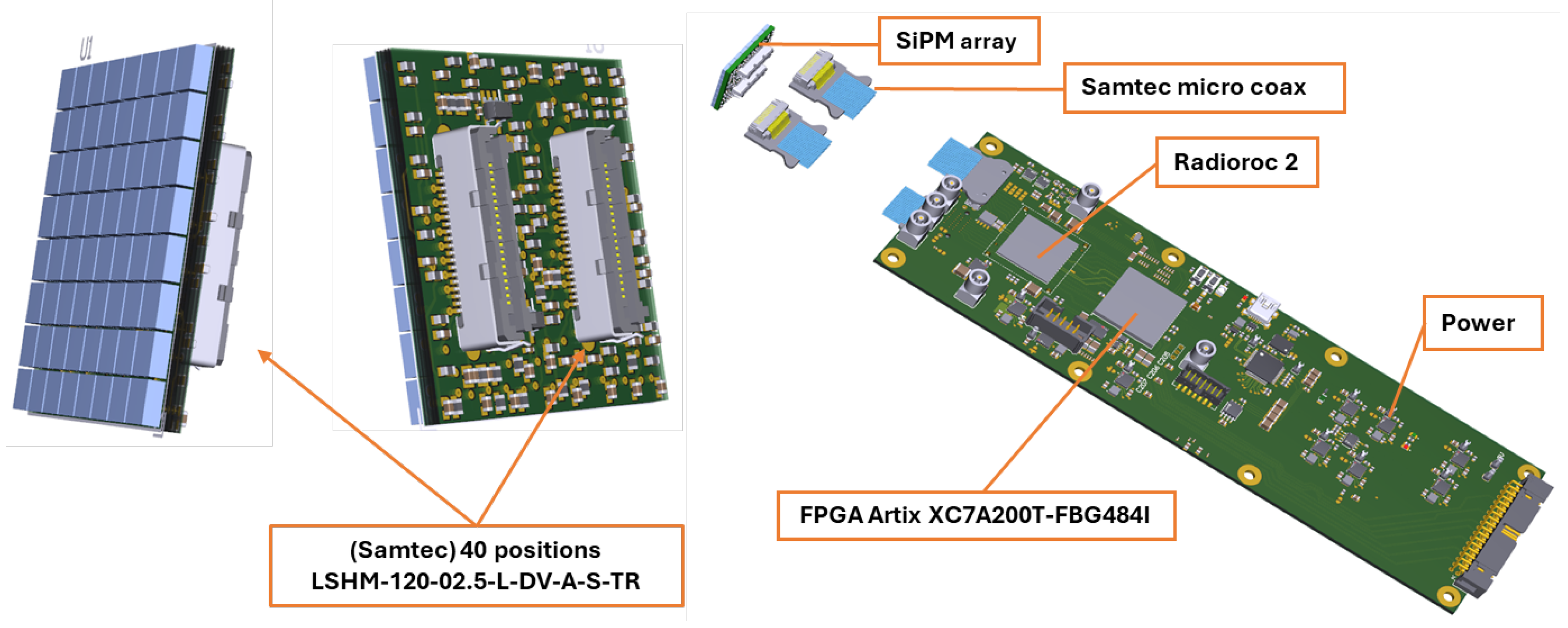
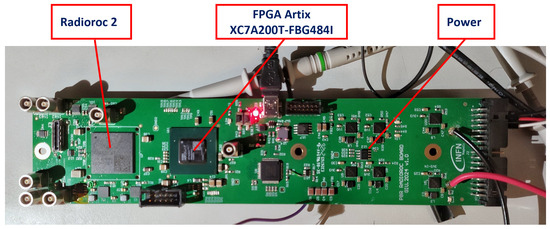
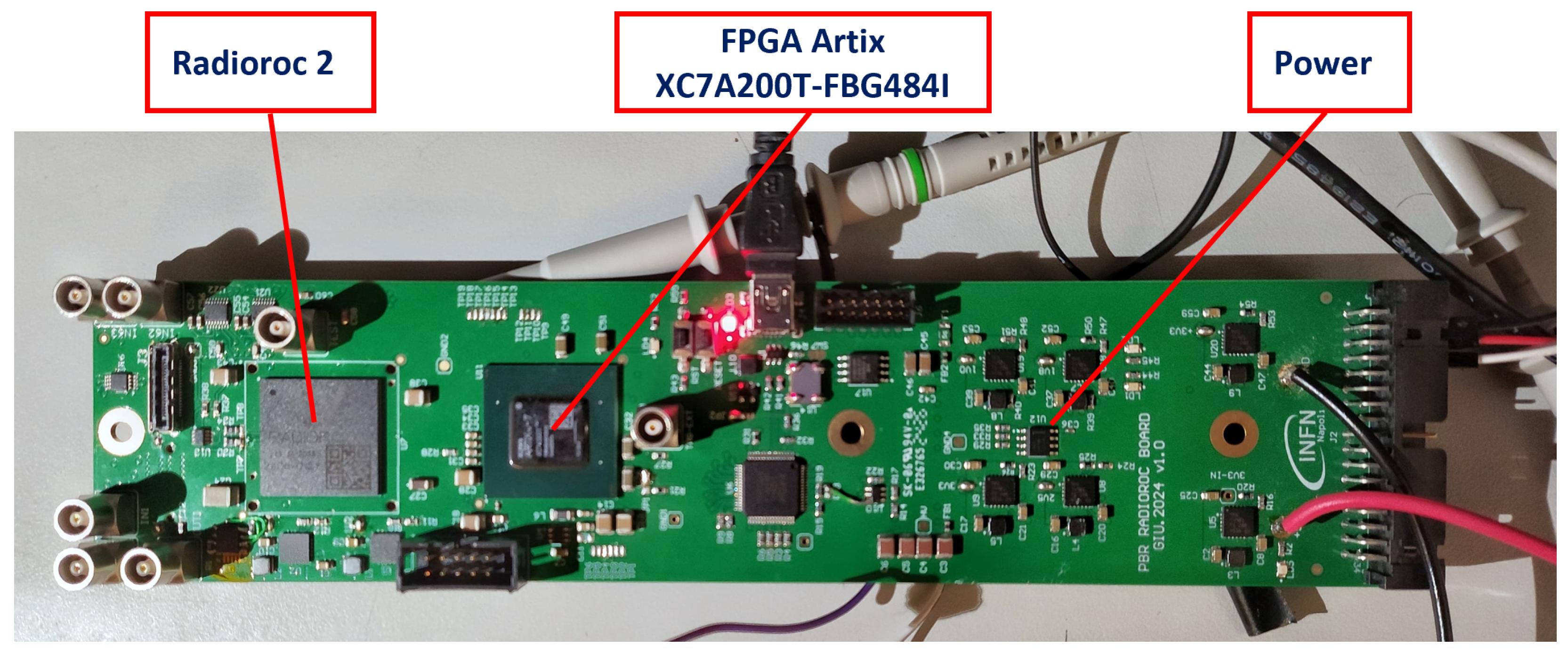
Figure 2 presents the CAD rendering of the SiSMUV detector module, highlighting the integration of the SiPM array, readout electronics, and cabling optimized for curved focal planes. Figure 3 displays a photograph of the first acquisition board prototype.
Figure 2.
CAD rendering of the SiSMUV detector unit, illustrating the modular design of the SiPM array, readout electronics, and cabling adapted for spherical focal surfaces.
Figure 3.
Photograph of the first acquisition board prototype. The board integrates a RADIOROC 2 ASIC for SiPM readout, a Xilinx Artix-7 FPGA for real-time processing and triggering, and a CAEN A7585DU module providing high-voltage bias.
The RADIOROC ASIC enables individual channel voltage tuning to correct gain variations across the SiPM array. Key advantages of the RADIOROC ASIC include:
- Channel-by-channel HV adjustment: fine-tuning of the SiPM gain to correct for non-uniformity across channels.
- Dual-gain energy measurement: enhancing precision and dynamic range.
- High sensitivity, with triggering thresholds down to 1/3 photoelectron with double threshold.
- Excellent linearity (within 1%) for signals up to 2000 photoelectrons.
These capabilities enhance the performance of SiPM arrays in detecting low photon fluxes, improving overall energy resolution, and minimizing background noise.
FPGA-based processing enables the implementation of sophisticated triggering algorithms, including potential integration of machine learning methods. The combination of front-end ASICs and FPGA-based data handling has proven highly efficient for SiPM-based space instruments, supporting low-power scalable detector architectures.
The first mechanical prototype of the UV detector was designed with several engineering constraints:
- Compatibility with spherical focal plane geometries.
- Mechanical robustness to withstand launch vibrations and stresses.
- Reliable operation across wide temperature ranges under vacuum conditions.
The electrical connection between the SiPM sensors and readout electronics is achieved using micro-coaxial cables (Samtec), which maximize available space behind the detector matrix and allow for dense packing of the SiPM modules with minimal gaps between them.
4. Prototype Characterization
The functional characterization of the SiSMUV detector prototype focuses on the evaluation of the gain, photon detection efficiency (PDE), and crosstalk probability of the SiPM array [8].
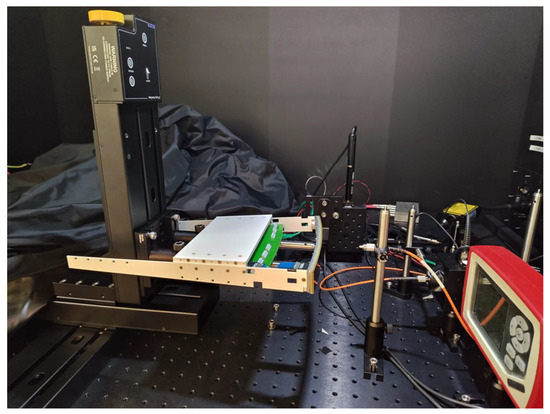
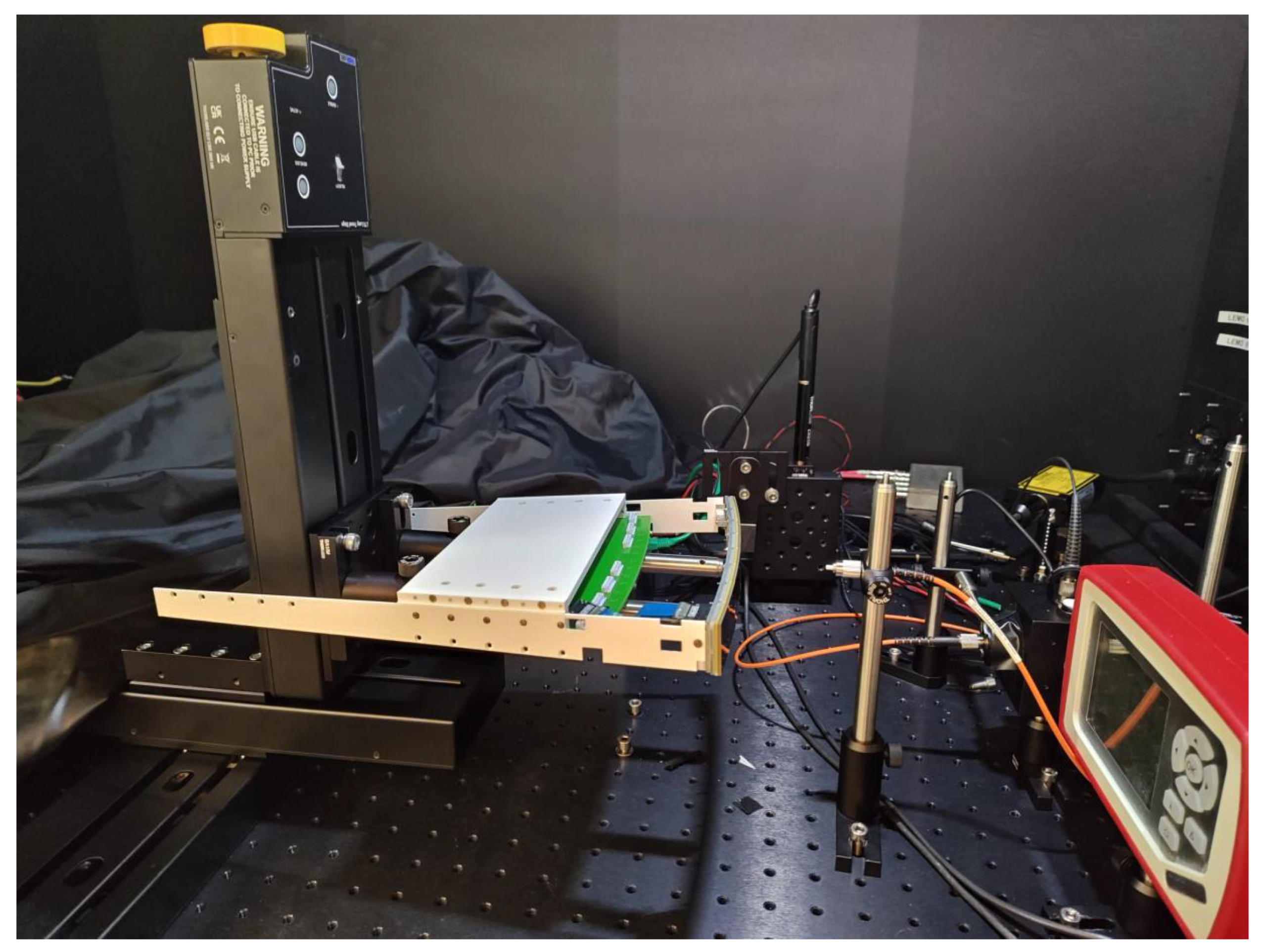
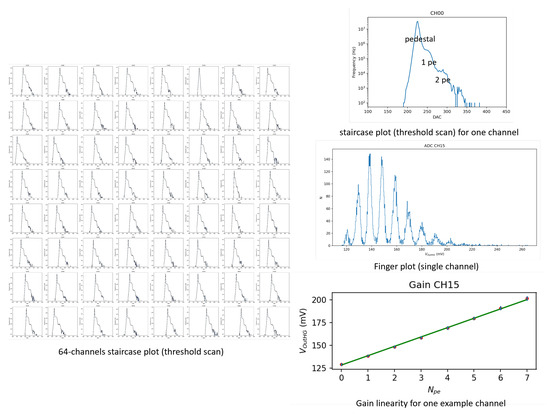
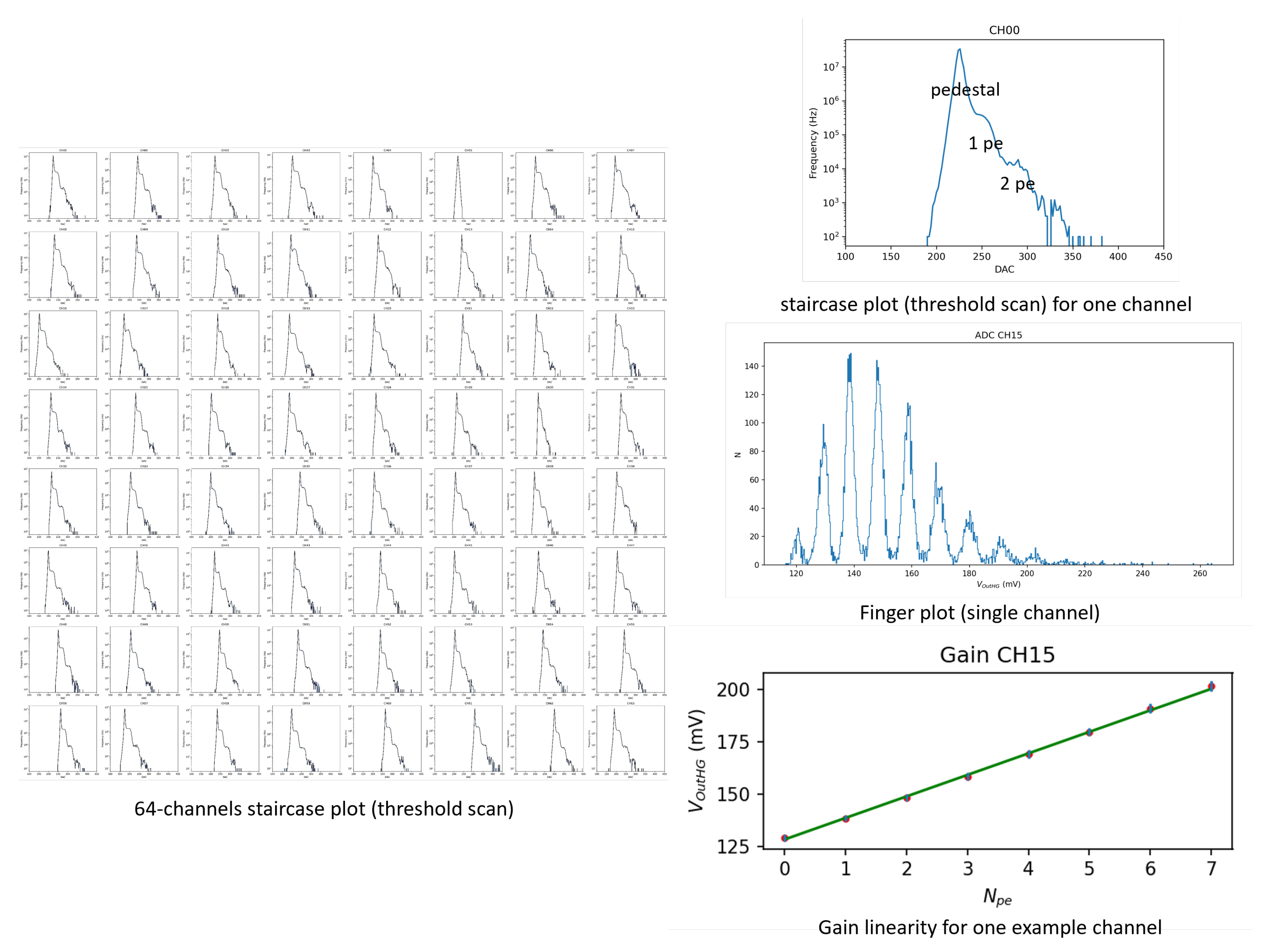
Measurements were performed in a dark-box setup equipped with an integrating sphere (Thorlabs IS236-A4), a Hamamatsu PLP-10 pulsed laser diode emitting at 405 nm, and a calibrated photodetector for reference. A 3-axis motorized stage ensured accurate positioning of the optical fiber and allowed sequential illumination of individual pixels across the 8 × 8 SiPM matrix. The setup is shown in Figure 4, while Figure 5 shows preliminary results from the characterization of the SiSMUV detector. For each channel is possible to obtain pedestal, finger, and gain plots.
Figure 4.
Dark-box test facility used to derive PDE and gain uniformity for the functional characterization of the SiSMUV detector. A 405 nm Hamamatsu PLP-10 laser diode delivers pulsed light via optical fiber to an integrating sphere for uniform light distribution. A calibrated photodiode and pinhole aperture allow for precise illumination of individual SiPM pixels. The setup includes a 3-axis motorized stage for precise positioning and environmental shielding to suppress background light and noise.
Figure 5.
Preliminary results from the characterization of the SiSMUV detector. The left panel shows the staircase plot for all 64 channels, while the right panel displays the pedestal, finger, and gain plots for a sample channel.
Initially, the PDE was evaluated using a calibrated photodiode (Hamamatsu S150C) as the reference detector; however, this configuration exhibited significant systematic uncertainty in flux calibration. To improve measurement reliability, the photodiode was replaced with a calibrated photomultiplier tube (BND 2125 PMT), allowing for a more precise comparison of photon fluxes and significantly enhancing the consistency of PDE results. All measurements were conducted under controlled environmental conditions, maintaining a temperature of 25 ± 1 °C.
For a representative pixel (D7, corresponding to channel 6 of the matrix), the PDE was determined to be at a bias voltage of 55.2 V. Repeated measurements over multiple sessions yielded a mean PDE for all pixels of at 405 nm, confirming both statistical stability and intrinsic uniformity of the SiPM array. The observed PDE values are consistent with the expected quantum efficiency of the Hamamatsu S13361-3050-NE-08 series (see Figure 1) for this wavelength, demonstrating optimal performance for Cherenkov and fluorescence light detection.
In parallel, a verification of the operational integrity of several SiPM matrices was performed. Uniform illumination tests confirmed that all pixels responded nominally, with the exception of a single inactive channel. Subsequent investigations attributed this behavior to a readout board connection issue rather than a defect in the SiPM device itself, thus validating the robustness of the sensors and confirming the need for minor hardware optimization of the acquisition board.
Additional PDE measurements confirmed consistent detector performance across multiple MPPC samples (S13361 and S14161 series). The results also showed less than 5% variation when moving the light source by 1 mm, the minimum adjustment we can make with the 3-axis motorized stage, confirming good spatial uniformity of the SiPM response.
These results collectively demonstrate that the SiSMUV detector architecture, which combines RADIOROC ASIC-based readout and FPGA-controlled acquisition, achieves excellent stability, reproducibility, and sensitivity for low-light measurements in the ultraviolet range.
In addition, preparatory work has been performed to measure the (I–V) curves and the multi-peak spectra for a single SiPM tile, inferring the basic SiPM parameters and their behavior as a function of temperature using a climate chamber. Complete measurements of the multi-peak spectrum at different temperatures (−20 °C, +40 °C, at 10 °C steps) have already been accomplished for one Hamamatsu SiPM S13361-3050-NE-08 [9]. The next steps include measurements with the developed read-out electronics.
5. Simulations
Accurate simulation of the detector response is essential for evaluating performance, optimizing design parameters, and reducing systematic uncertainties in data analysis. To this end, we are developing a comprehensive model of the detector response to incident ultraviolet and Cherenkov light. The simulation reproduces the PDE of individual Multi-Pixel Photon Counter (MPPC) channels as a function of wavelength, their temporal response to single photons, and the gain characteristics of the readout chain, expressed in ADC counts per photo-electron, under different environmental and operating conditions.
5.1. SiPM Microcell Simulation
A dedicated SiPM simulation module is being implemented within the OffLine detector framework [10], following the approach introduced in [11]. The model represents each SiPM pixel as an ensemble of avalanche photo-diode (APD) microcells described by an equivalent RC circuit that includes the breakdown voltage, quenching resistor, and intrinsic capacitance. When the bias voltage exceeds the breakdown voltage, the simulation reproduces Geiger-mode behavior, including the discharge and recharge time constants that define the temporal shape of the current pulse. The model also accounts for correlated and uncorrelated noise sources, dark counts, optical crosstalk, and afterpulses, each with probabilities that depend on the overvoltage and the microcell geometry.
To capture saturation effects, the simulation tracks photon-induced photo-electrons randomly assigned to individual microcells, ensuring that multiple photons incident on the same cell within the integration window contribute non-linearly to the total current. Recursive functions model the chain of secondary avalanches generated by crosstalk and afterpulses. The integrated current from all microcells is then digitized to reproduce the ADC signal expected from the readout electronics.
Validation of the simulation is performed by reproducing the laboratory test setup, in which SiPMs are illuminated with a 405 nm laser through an integrating sphere. The digitized waveforms from these tests are analyzed using a global Gaussian-mixture fit based on the expectation-maximization algorithm, allowing precise extraction of the gain, pedestal position, and variance of the single-photo-electron response. These parameters are used as inputs to the simulation to ensure consistency between modeled and measured detector behavior, details on the simulation can be found in [11].
5.2. End-to-End Detector Simulation
Once fully validated, this module will be integrated into the full telescope simulation chain, enabling studies of detector performance for Extensive Air Shower (EAS) reconstruction and Cherenkov light detection. The resulting framework will allow realistic end-to-end modeling—from photon arrival at the optics to the digitized SiPM signal—thereby providing a reliable tool for instrument optimization and event reconstruction.
6. Discussion
The characterization campaign confirms that the SiSMUV prototype meets the core requirements for a compact UV-sensitive focal plane detector for space-based astroparticle experiments. The measured PDE of approximately 35% at 405 nm aligns with the performance targets for fluorescence and Cherenkov light detection and validates the suitability of the Hamamatsu S13361-3050-NE-08 SiPM array under standard operating conditions. The reproducibility of the PDE measurements, with standard deviations below 0.4%, highlights the reliability of the optical calibration and the overall system design.
The transition from photodiode-based to PMT-based photon flux calibration significantly improved the accuracy and repeatability of the PDE measurements, establishing a robust methodology for future sensor qualification campaigns. Moreover, the identification and resolution of minor readout anomalies during matrix verification demonstrate the effectiveness of the current diagnostic procedures and the importance of thorough electronics validation.
Future work will extend the PDE characterization to all pixels of the SiPM matrix to improve statistical coverage and assess inter-pixel variability. The next phase of development includes hardware upgrades to enable simultaneous multi-channel readout for larger SiPM matrices, improving scalability and system modularity.
In addition to mechanical and thermal qualification, future development stages will include radiation hardness studies to evaluate detector performance under the total ionizing dose (TID) and displacement damage expected in low-Earth orbit. These tests aim to characterize potential changes in gain stability, increases in dark count rate, and degradation of SiPM microcell recovery time following exposure to proton and gamma irradiation. Preliminary plans include proton irradiation at INFN-LNL facilities and Co-60 source testing to assess the long-term stability of both the SiPMs and the RADIOROC ASIC. The results of these studies will inform the selection of components and the design of shielding for the flight versions of the detector.
A full detector simulation using Geant4 is in progress, leveraging CAD models. The simulation of a single pixel and its read-out chain has been compared with the data acquired with the described setup and shows good agreement. A direct comparison between experimental measurements and the SiPM simulation confirms the accuracy of the developed model. The single-photoelectron spectra obtained from the INFN Napoli test setup were reproduced within statistical uncertainties by the OffLine-based simulation, with the simulated gain differing by less than 5% from measured values and the pedestal variance matching within 3%.
SiSMUV advances SiPM-based focal plane technologies for next-generation space telescopes studying fluorescence and Cherenkov emissions. Its modularity and low power consumption make it ideal for scalable space applications. These advancements will prepare the SiSMUV system for deployment in Cherenkov and fluorescence camera prototypes, contributing to the development of next-generation SiPM-based focal surfaces for missions such as the PoEMMA Balloon with Radio (PBR) mission [5,6].
Future work will focus on extending the characterization campaign to include radiation-hardness measurements, ensuring operational reliability in orbit.
Author Contributions
Conceptualization, V.S. and G.O.; methodology, V.S., G.O. and M.M.; software, M.M. and I.B.; validation, all; investigation, all; data curation, M.M. and I.B.; writing—original draft preparation, V.S.; writing—review and editing, all; visualization, M.M., I.B. and H.A.Q.; supervision, V.S., G.O. and R.M.; project administration, V.S.; funding acquisition, V.S. All authors have read and agreed to the published version of the manuscript.
Funding
This research was funded by the Italian Ministry of University and Research as a PRIN project under Grant CUP E53D23000610001.
Data Availability Statement
Dataset available on request from the authors.
Conflicts of Interest
The authors declare no conflicts of interest.
References
- Olinto, A.V.; Krizmanic, J.; Adams, J.H.; Aloisio, R.; Anchordoqui, L.A.; Anzalone, A.; Bagheri, M.; Barghini, D.; Battisti, M.; Bergman, D.R.; et al. The POEMMA (Probe of Extreme Multi-Messenger Astrophysics) Observatory. arXiv 2021, arXiv:2012.07945. [Google Scholar] [CrossRef] [Scilit]
- Contino, G.; Catalano, O.; Sottile, G.; Sangiorgi, P.; Capalbi, M.; Osteria, G.; Scotti, V.; Miyamoto, H.; Vigorito, C.; Casolino, M.; et al. An ASIC front-end for fluorescence and Cherenkov light detection with SiPM for space and ground applications. Nucl. Instruments Methods Phys. Res. Sect. A Accel. Spectrometers Detect. Assoc. Equip. 2020, 980, 164510. [Google Scholar] [CrossRef] [Scilit]
- Kapusta, F.; Mazur, D.; de Mello Neto, J.; Porcelli, A. SiPMs for astroparticle physics: Performance and radiation hardness. Nucl. Instruments Methods Phys. Res. Sect. A Accel. Spectrometers Detect. Assoc. Equip. 2021, 985, 164651. [Google Scholar] [CrossRef] [Scilit]
- Neronov, A.; Semikoz, D.; Kachelrieß, M.; Taylor, A. Cosmic rays and high-energy neutrinos with the POEMMA space mission. Adv. Space Res. 2022, 70, 2838–2846. [Google Scholar] [CrossRef] [Scilit]
- Scotti, V.; Anastasio, A.; Bertaina, M.E.; Boiano, A.; Caruso, R.; Santis, C.D.; Masone, V.; Mese, M.; Osteria, G.; Panico, B.; et al. The Cherenkov Camera for the PBR mission. In Proceedings of the 39th International Cosmic Ray Conference (ICRC2025), Geneva, Switzerland, 15–24 July 2025. [Google Scholar] [CrossRef] [Scilit]
- Eser, J.; Mayotte, E.; Olinto, A.V.; Osteria, G. POEMMA-Balloon with Radio, towards a space-based Multi-Messenger Observatory. In Proceedings of the 7th International Symposium on Ultra High Energy Cosmic Rays, Malargüe, Mendoza, Argentina, 17–21 November 2024. [Google Scholar] [CrossRef] [Scilit]
- Photonics, H. MPPC S13361-3050 Series Datasheet. Available online: https://www.hamamatsu.com/content/dam/hamamatsu-photonics/sites/documents/99_SALES_LIBRARY/ssd/s13361-3050_series_kapd1054e.pdf (accessed on 18 November 2025).
- Acerbi, F.; Gundacker, S. Understanding and simulating SiPMs. Nucl. Instruments Methods Phys. Res. Sect. A Accel. Spectrometers Detect. Assoc. Equip. 2019, 926, 16–35. [Google Scholar] [CrossRef] [Scilit]
- Caruso, R. The test and calibration system for the Elementary Cells of the Cherenkov Camera in the PBR Mission. In Proceedings of the 39th International Cosmic Ray Conference (ICRC2025), Geneva, Switzerland, 15–24 July 2025. [Google Scholar] [CrossRef] [Scilit]
- Abe, S.; Adams, J.H., Jr.; Allard, D.; Alldredge, P.; Aloisio, R.; Anchordoqui, L.; Anzalone, A.; Arnone, E.; Baret, B.; Barghini, D.; et al. EUSO-Offline: A comprehensive simulation and analysis framework. J. Instrum. 2024, 19, P01007. [Google Scholar] [CrossRef] [Scilit]
- Buckland, I. Simulation of a SiPM Based Cherenkov Camera. In Proceedings of the Advances in Space AstroParticle Physics (ASAPP2025), Catalonia, Spain, 12–16 May 2025. [Google Scholar]
Disclaimer/Publisher’s Note: The statements, opinions and data contained in all publications are solely those of the individual author(s) and contributor(s) and not of MDPI and/or the editor(s). MDPI and/or the editor(s) disclaim responsibility for any injury to people or property resulting from any ideas, methods, instructions or products referred to in the content. |
© 2025 by the authors. Licensee MDPI, Basel, Switzerland. This article is an open access article distributed under the terms and conditions of the Creative Commons Attribution (CC BY) license (https://creativecommons.org/licenses/by/4.0/).