

The EPSI R&D: Development of an Innovative Electron–Positron Discrimination Technique for Space Applications

 , , , , , , , , , , ,
  and
and
Abstract
1. Introduction
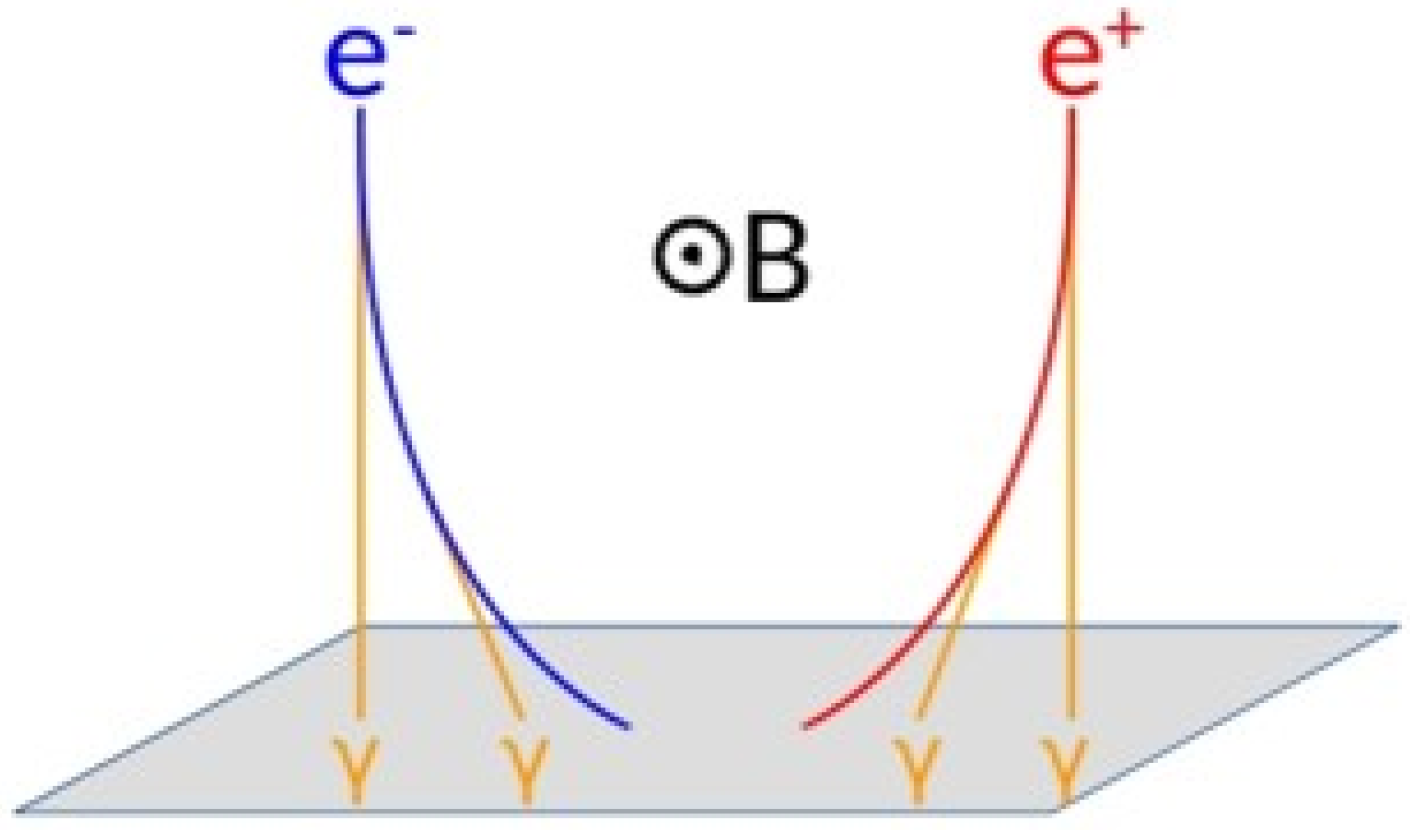
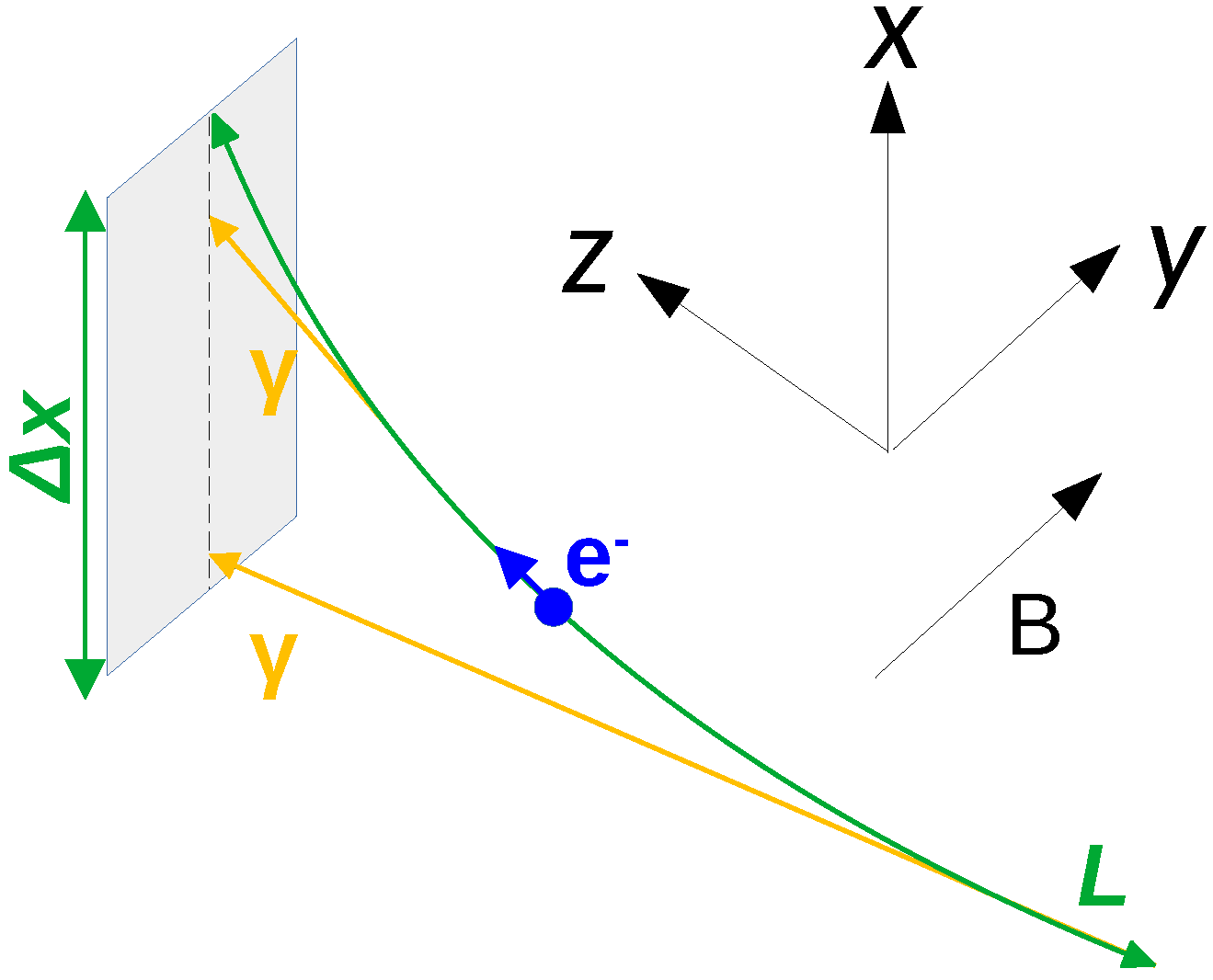
2. Detection Principle
3. Synchrotron Radiation
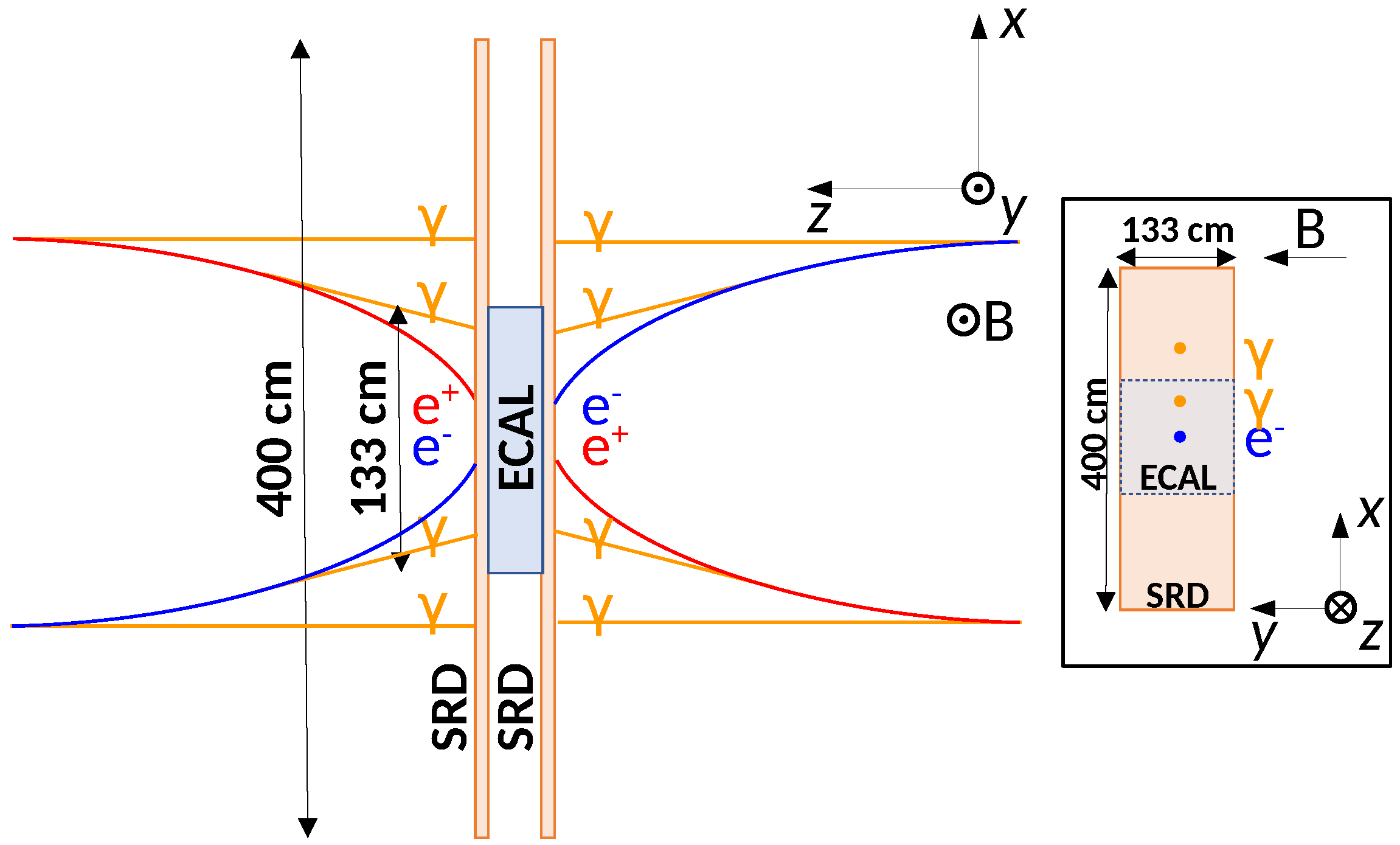
4. Concept of the Space Instrument
4.1. The Electromagnetic CALorimeter (ECAL)
4.2. The Synchrotron Radiation Detector (SRD)
- High detection efficiency: the SRD must achieve a detection efficiency of at least in the 5–100 keV range, to ensure the detection of at least two synchrotron photons aligned with the electron-bending plane, necessary for charge-sign discrimination;
- Low energy coverage: expanding the operating range below 5 keV, ideally down to 1 keV, is important to extend charge-sign identification to electrons of a few hundreds of GeV, increasing the overlap with the geomagnetic East–West asymmetry technique;
- Fine spatial segmentation: a granularity of the order of 1 cm × 1 cm is necessary to separate synchrotron photons from diffuse astrophysical X-ray background, by exploiting their narrow dispersion with respect to the bending plane;
- Fast time signal: a signal duration of a few microseconds or, even better, a few hundreds of nanoseconds is important to further suppress the random coincidences from astrophysical background associated with an electron trigger;
- Large area scalability: given the large area of the SRD, the single cell must be cheap enough to allow for the construction of a large array at a reduced cost and compliant with space applications, especially considering power consumption and detector mass.
4.3. Background for Charge-Sign Reconstruction
4.4. Background for Electron Identification
4.5. Instrument Orbit
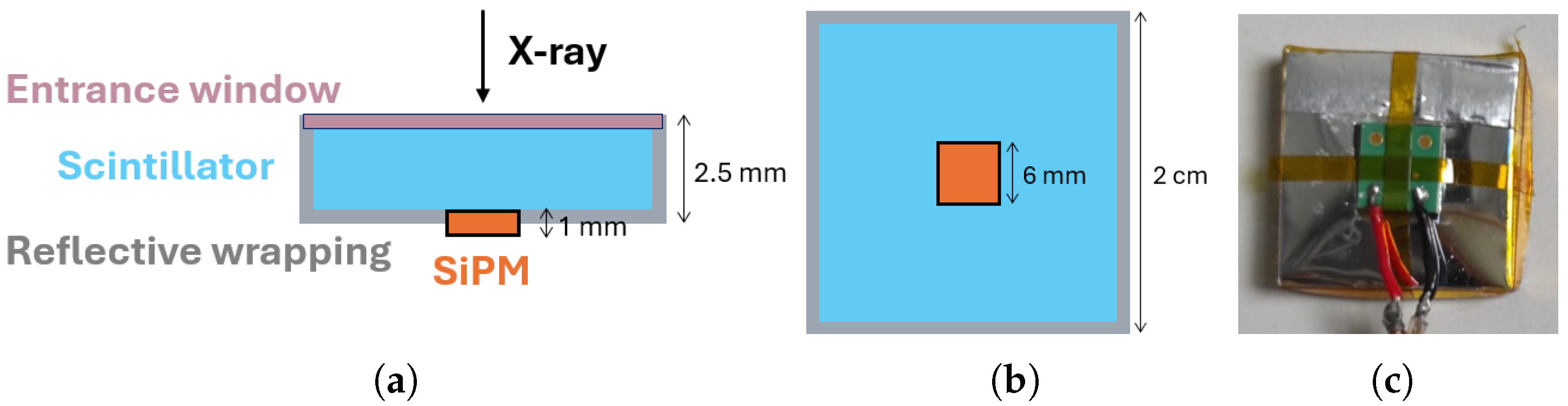
5. Design of the Detection Cell
6. Laboratory Characterization
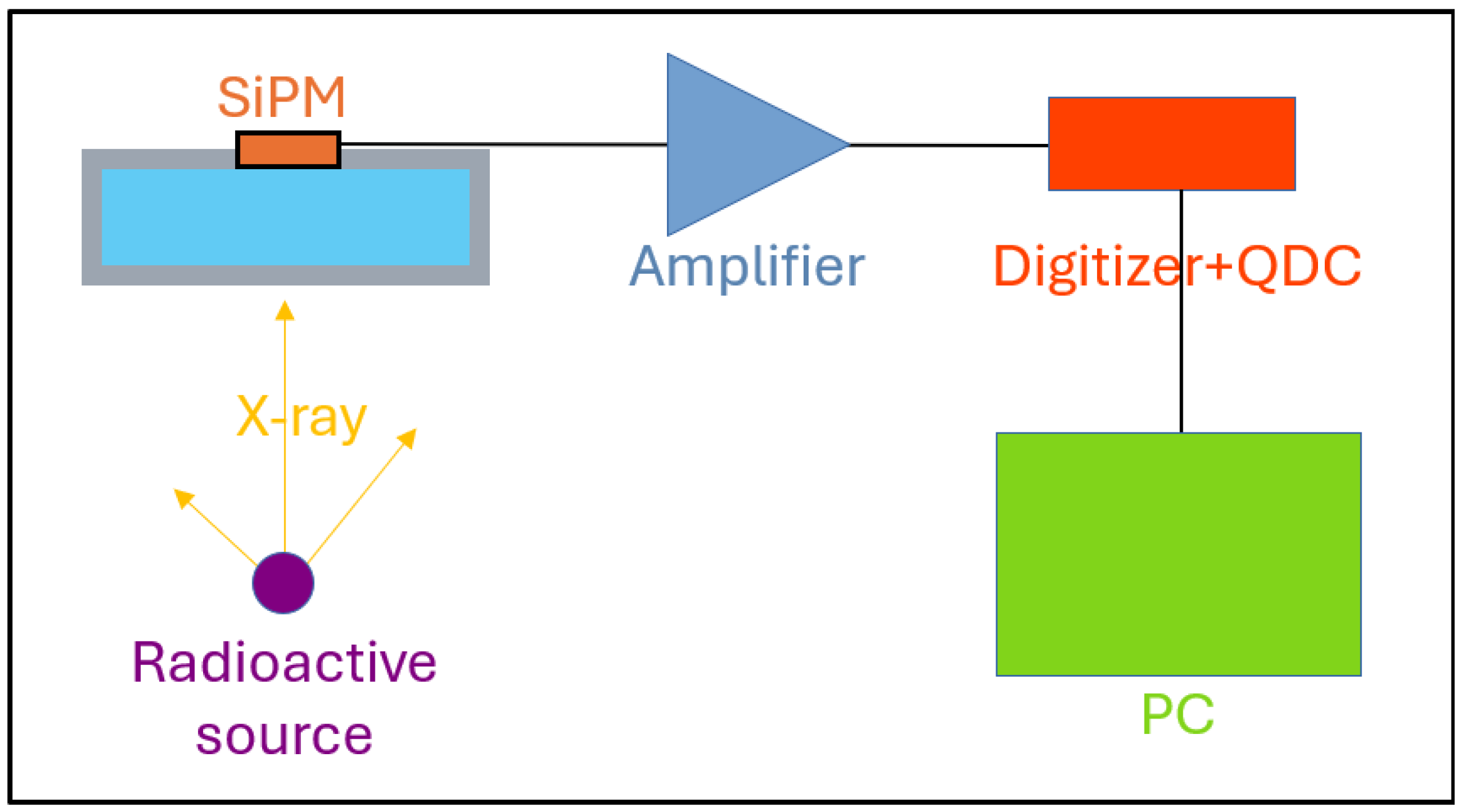
6.1. Experimental Setup
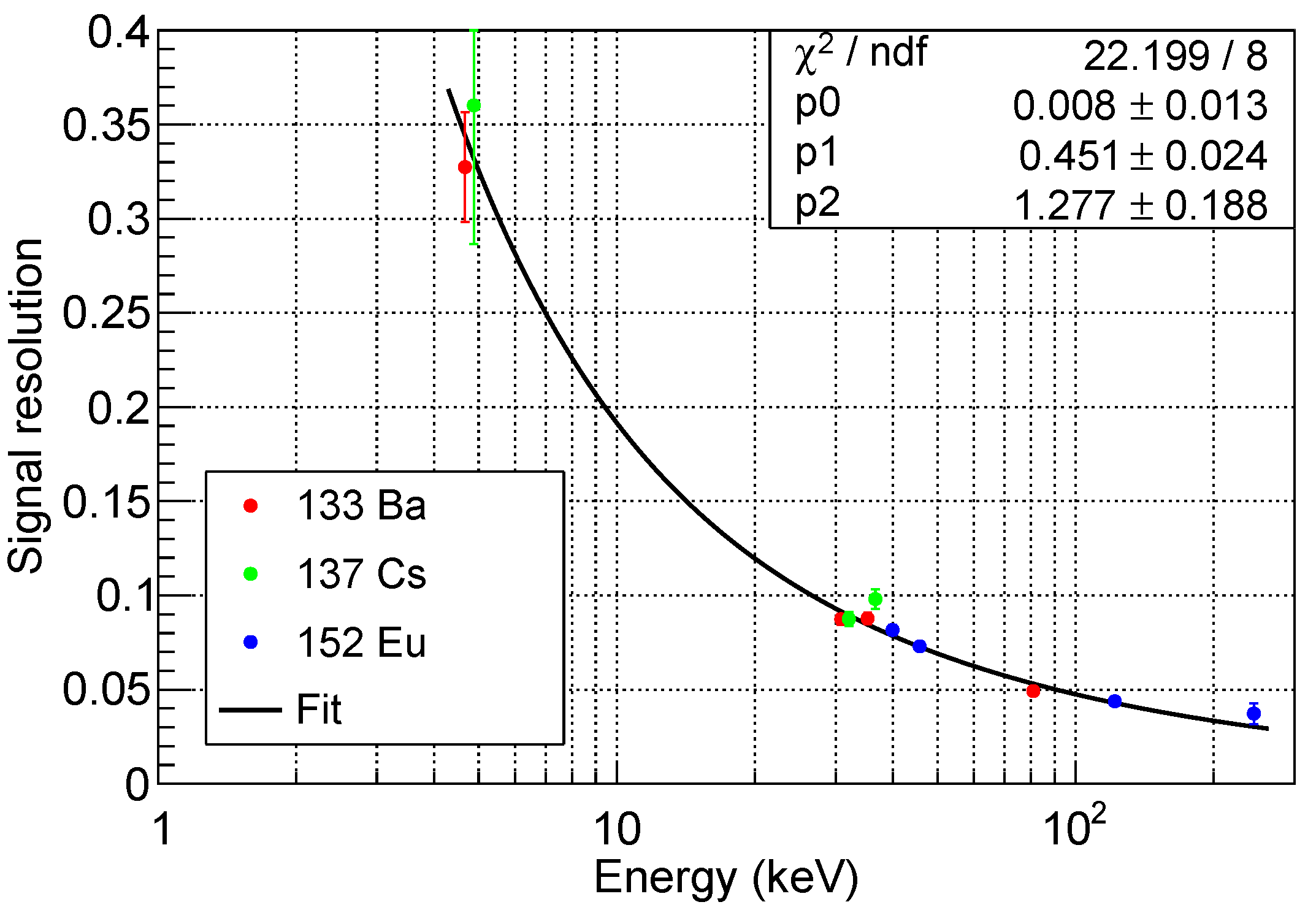
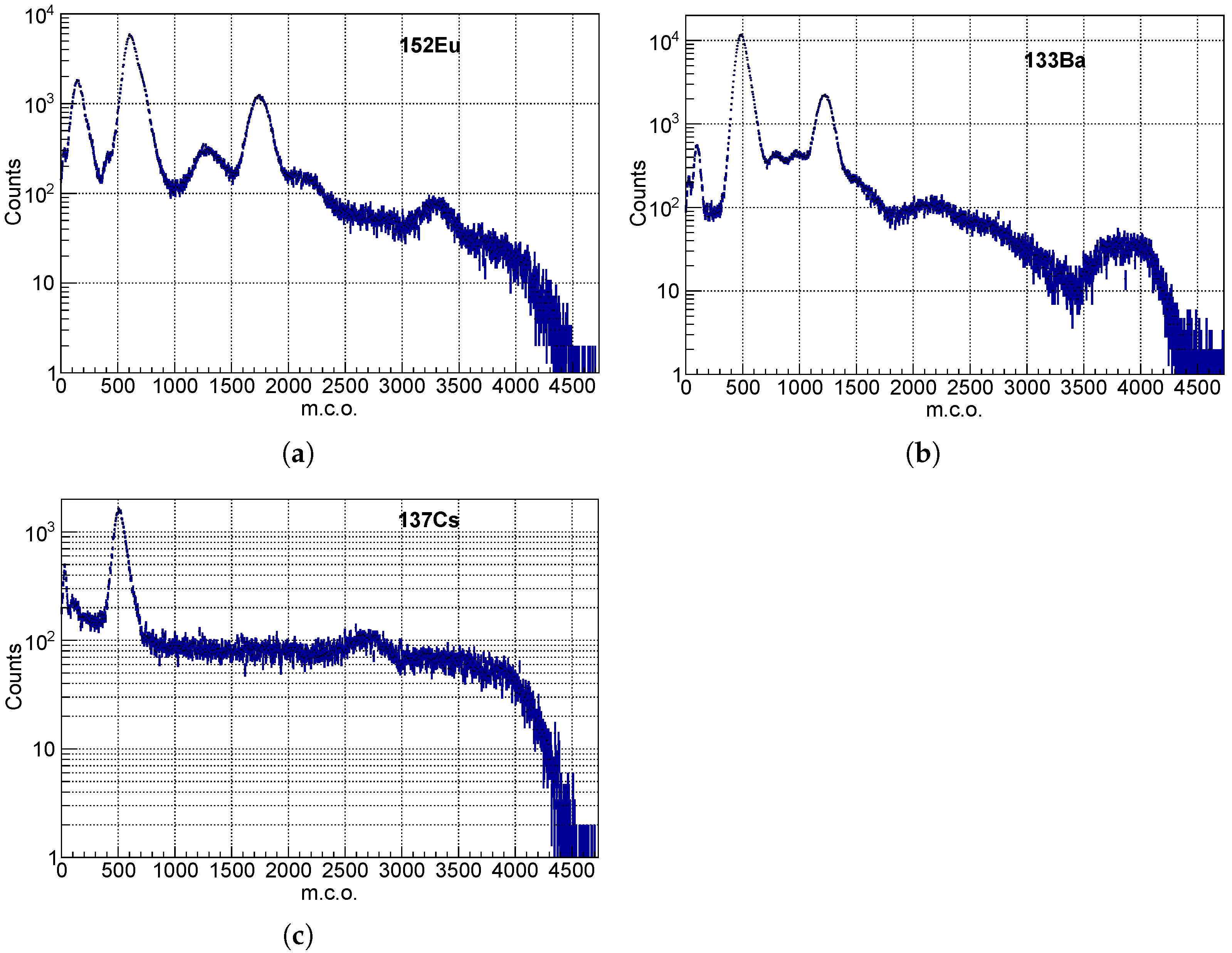
6.2. Detector Calibration
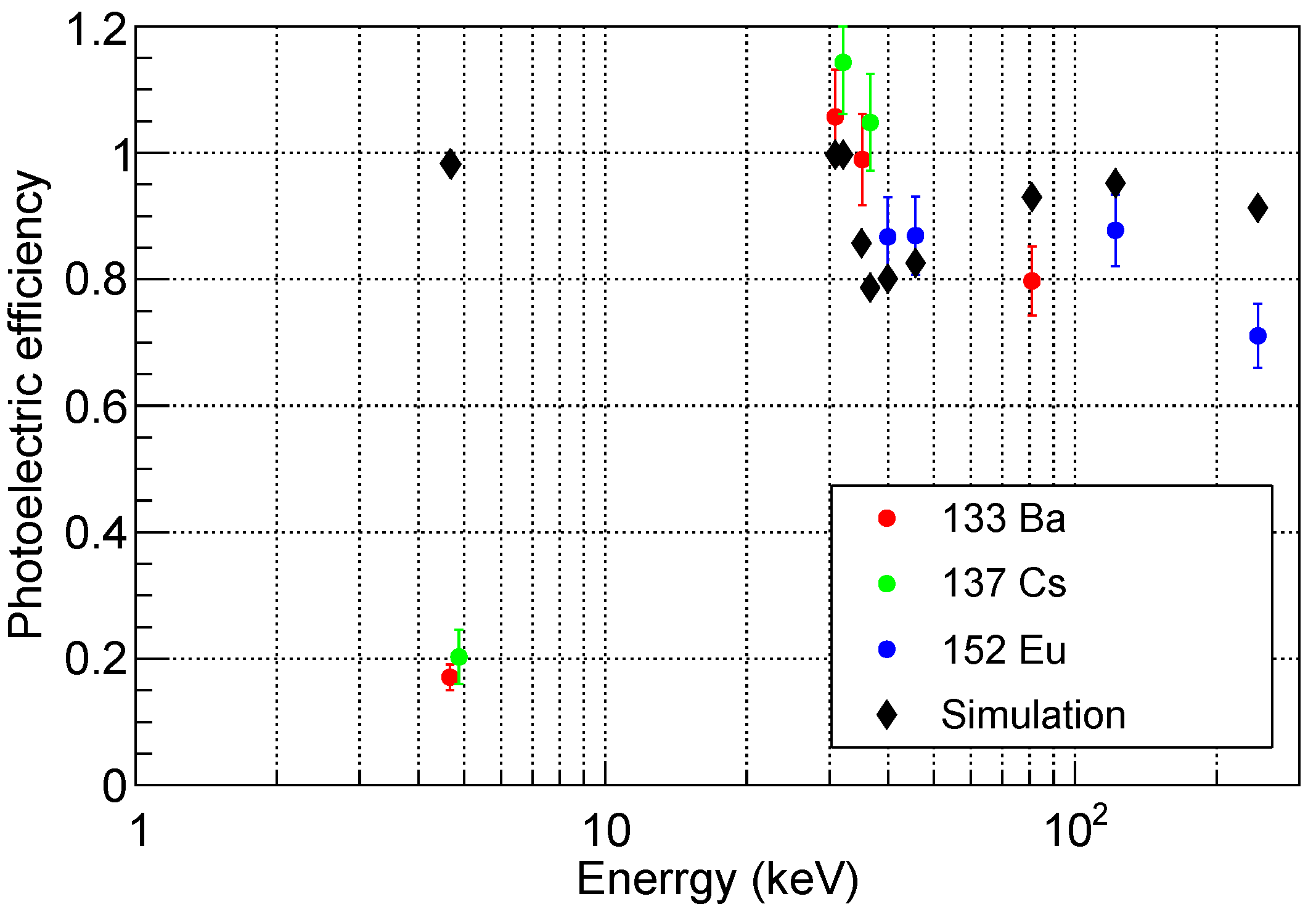
6.3. Prototype Results
7. Ongoing and Future Work
8. Conclusions
Author Contributions
Funding
Data Availability Statement
Conflicts of Interest
References
- Adriani, O.; Barbarino, G.C.; Bazilevskaya, G.A.; Bellotti, R.; Boezio, M.; Bogomolov, E.A.; Bonechi, L.; Bongi, M.; Bonvicini, V.; Bottai, S.; et al. An anomalous positron abundance in cosmic rays with energies 1.5–100 GeV. Nature 2009, 458, 607–609. [Google Scholar] [CrossRef] [PubMed]
- Ackermann, M.; Ajello, M.; Allafort, A.; Atwood, W.B.; Baldini, L.; Barbiellini, G.; Bastieri, D.; Bechtol, K.; Bellazzini, R.; Fermi LAT Collaboration. Measurement of separate cosmic-ray electron and positron spectra with the Fermi Large Area Telescope. Phys. Rev. Lett. 2012, 108, 011103. [Google Scholar] [CrossRef] [PubMed]
- Aguilar, M.; Cavasonza, L.A.; Ambrosi, G.; Arruda, L.; Attig, N.; Azzarello, P.; Bachlechner, A.; Barao, F.; Barrau, A.; AMS Collaboration. Towards Understanding the Origin of Cosmic-Ray Positrons. Phys. Rev. Lett. 2019, 122, 041102. [Google Scholar] [CrossRef] [PubMed]
- Gabici, S.; Evoli, C.; Gaggero, D.; Lipari, P.; Mertsch, P.; Orlando, E.; Strong, A.; Vittino, A. The origin of Galactic cosmic rays: Challenges to the standard paradigm. Int. J. Mod. Phys. D 2019, 28, 1930022. [Google Scholar] [CrossRef]
- DAMPE Collaboration. Direct detection of a break in the teraelectronvolt cosmic-ray spectrum of electrons and positrons. Nature 2017, 552, 63–66. [Google Scholar] [CrossRef]
- Adriani, O.; Akaike, Y.; Asano, K.; Asaoka, Y.; Berti, E.; Bigongiari, G.; Binns, W.R.; Bongi, M.; Brogi, P.; CALET Collaboration. Direct Measurement of the Spectral Structure of Cosmic-Ray Electrons+Positrons in the TeV Region with CALET on the International Space Station. Phys. Rev. Lett. 2023, 131, 191001. [Google Scholar] [CrossRef]
- Adriani, O.; Altomare, C.; Ambrosi, G.; Azzarello, P.; Barbato, F.C.T.; Battiston, R.; Baudouy, B.; Bergmann, B.; Berti, E.; Bertucci, B.; et al. Design of an Antimatter Large Acceptance Detector In Orbit (ALADInO). Instruments 2022, 6, 19. [Google Scholar] [CrossRef]
- Schael, S.; Atanasyan, A.; Berdugo, J.; Bretz, T.; Czupalla, M.; Dachwald, B.; von Doetinchem, P.; Duranti, M.; Gast, H.; Karpinski, W.; et al. AMS-100: The next generation magnetic spectrometer in space—An international science platform for physics and astrophysics at Lagrange point 2. Nucl. Instrum. Meth. A 2019, 944, 162561. [Google Scholar] [CrossRef]
- Prilutskij, O. The possibility of registering primary cosmic electrons by means of synchrotron radiation in the geomagnetic field. Sov. J. Exp. Theor. Phys. Lett. 1972, 16, 320–321. [Google Scholar]
- Stephens, S.; Balasubrahmanyan, V. Earth’s magnetic field as a radiator to detect cosmic ray electrons of energy >1012 eV. J. Geophys. Res. Space Phys. 1983, 88, 7811–7822. [Google Scholar] [CrossRef]
- Hofer, H.; Pohl, M. Charge determination of high-energy electrons and nuclei by synchrotron radiation with AMS. Nucl. Instruments Methods Phys. Res. Sect. A Accel. Spectrometers Detect. Assoc. Equip. 1998, 416, 59–63. [Google Scholar] [CrossRef]
- Anderhub, H.; Bates, J.; Bätzner, D.; Baumgartner, S.; Biland, A.; Camps, C.; Capell, M.; Commichau, V.; Djambazov, L.; Fanchiang, Y.J.; et al. Design and construction of the prototype synchrotron radiation detector. Nucl. Instruments Methods Phys. Res. Sect. A Accel. Spectrometers Detect. Assoc. Equip. 2002, 491, 98–112. [Google Scholar] [CrossRef]
- Yagi, A.; Bower, C.; Childers, J.T.; Coutu, S.; Du Vernois, M.; Martell, A.; Müller, D.; Musser, J.; Nutter, S.; Park, N.; et al. CREST: A Cosmic-Ray Electron Synchrotron Telescope to measure TeV Electrons. In Proceedings of the 29th International Cosmic Ray Conference (ICRC2005), Pune, India, 3–10 August 2005; Volume 3, pp. 425–428. [Google Scholar]
- Galper, A.; Koldashov, S.; Mikhailov, V.; Prilutskii, O. High energy positron detection via synchrotron emission in magnetosphere. J. Phys. Conf. Ser. 2017, 798, 012176. [Google Scholar] [CrossRef]
- Anderhub, H.; Bates, J.; Bätzner, D.; Baumgartner, S.; Biland, A.; Camps, C.; Capell, M.; Commichau, V.; Djambazov, L.; Fanchiang, Y.J.; et al. Preliminary results from the prototype synchrotron radiation detector on space shuttle mission STS-108. Nucl. Phys. B-Proc. Suppl. 2002, 113, 166–169. [Google Scholar] [CrossRef]
- Musser, J.; Bower, C.; Coutu, S.; Gennaro, J.; Geske, M.; Müller, D.; Nutter, S.; Park, N.; Schubnell, M.; Tarlé, G.; et al. Limits on the Multi-TeV Cosmic Ray Electron Flux from CREST (Cosmic Ray Electron Synchrotron Telescope). In Proceedings of the 34th International Cosmic Ray Conference (ICRC2015), The Hague, The Netherlands, 30 July–6 August 2015; Volume 34, p. 415. [Google Scholar]
- Landau, L.D.; Lifshitz, E.M. The Classical Theory of Fields, Course of Theoretical Physics, 4th ed.; Butterworth-Heinemann: Oxford, UK, 1975; Volume 2. [Google Scholar]
- Adriani, O.; Albergo, S.; Auditore, L.; Basti, A.; Berti, E.; Bigongiari, G.; Bonechi, L.; Bongi, M.; Bonvicini, V.; Bottai, S.; et al. The CALOCUBE project for a space based cosmic ray experiment: Design, construction, and first performance of a high granularity calorimeter prototype. J. Instrum. 2019, 14, P11004. [Google Scholar] [CrossRef]
- Adriani, O.; Agnesi, A.; Albergo, S.; Antonelli, M.; Auditore, L.; Basti, A.; Berti, E.; Bigongiari, G.; Bonechi, L.; Bongi, M.; et al. The CaloCube calorimeter for high-energy cosmic-ray measurements in space: Performance of a large-scale prototype. J. Instrum. 2021, 16, P10024. [Google Scholar] [CrossRef]
- Adriani, O.; Agnesi, A.; Albergo, S.; Antonelli, M.; Auditore, L.; Basti, A.; Betti, P.; Berti, E.; Bigongiari, G.; Bonechi, L.; et al. The CaloCube calorimeter for high-energy cosmic-ray measurements in space: Response of a large-scale prototype to protons. Nucl. Instrum. Meth. A 2024, 1061, 169079. [Google Scholar] [CrossRef]
- Abdollahi, S.; Ackermann, M.; Ajello, M.; Atwood, W.B.; Baldini, L.; Barbiellini, G.; Bastieri, D.; Bellazzini, R.; Bloom, E.D.; Bonino, R.; et al. Cosmic-ray electron-positron spectrum from 7 GeV to 2 TeV with the Fermi Large Area Telescope. Phys. Rev. D 2017, 95, 082007. [Google Scholar] [CrossRef]
- Adriani, O.; Albergo, S.; Auditore, L.; Basti, A.; Berti, E.; Bigongiari, G.; Bonechi, L.; Bonechi, S.; Bongi, M.; Bonvicini, V.; et al. CaloCube: An isotropic spaceborne calorimeter for high-energy cosmic rays. Optimization of the detector performance for protons and nuclei. Astropart. Phys. 2017, 96, 11–17. [Google Scholar] [CrossRef]
- Adriani, O.; Berti, E.; Betti, P.; Bigongiari, G.; Bonechi, L.; Bongi, M.; Bottai, S.; Brogi, P.; Castellini, G.; Checchia, C.; et al. Light yield non-proportionality of inorganic crystals and its effect on cosmic-ray measurements. J. Instrum. 2022, 17, P08014. [Google Scholar] [CrossRef]
- Peres, G.; Orlando, S.; Reale, F.; Rosner, R.; Hudson, H. The Sun as an X-ray star. II. Using the Yohkoh/Soft X-ray telescope-derived solar emission measure versus temperature to interpret stellar X-ray observations. Astrophys. J. 2000, 528, 537. [Google Scholar] [CrossRef]
- Gruber, D.; Matteson, J.; Peterson, L.; Jung, G. The spectrum of diffuse cosmic hard X-rays measured with HEAO 1. Astrophys. J. 1999, 520, 124. [Google Scholar] [CrossRef]
- Wood, K.; Meekins, J.; Yentis, D.; Smathers, H.; McNutt, D.; Bleach, R.; Byram, E.; Chupp, T.; Friedman, H.; Meidav, M. The HEAO A-1 X-ray source catalog. Astrophys. J. Suppl. Ser. 1984, 56, 507–649. [Google Scholar] [CrossRef]
- Türler, M.; Chernyakova, M.; Courvoisier, T.L.; Lubiński, P.; Neronov, A.; Produit, N.; Walter, R. INTEGRAL hard X-ray spectra of the cosmic X-ray background and Galactic ridge emission. Astron. Astrophys. 2010, 512, A49. [Google Scholar] [CrossRef]
- Krivonos, R.; Shtykovskaya, E.; Sazonov, S. The properties of the Galactic hard X-ray and soft γ-ray background based on 20 years of INTEGRAL/IBIS observations. J. High Energy Astrophys. 2025, 45, 96–104. [Google Scholar] [CrossRef]
- Campana, R.; Feroci, M.; Del Monte, E.; Mineo, T.; Lund, N.; Fraser, G.W. Background simulations for the Large Area Detector onboard LOFT. Exp. Astron. 2013, 36, 451–477. [Google Scholar] [CrossRef]
- Hubbell, J.H.; Seltzer, S.M. Tables of X-ray Mass Attenuation Coefficients and Mass Energy-Absorption Coefficients 1 keV to 20 MeV for Elements Z = 1 to 92 and 48 Additional Substances of Dosimetric Interest. NISTIR 5632, National Institute of Standards and Technology, 1995. Available online: https://physics.nist.gov/PhysRefData/XrayMassCoef/tab4.html (accessed on 18 September 2025).
- Aguilar, M.; Aisa, D.; Alpat, B.; Alvino, A.; Ambrosi, G.; Andeen, K.; Arruda, L.; Attig, N.; Azzarello, P.; Bachlechner, A.; et al. Precision measurement of the proton flux in primary cosmic rays from rigidity 1 GV to 1.8 TV with the Alpha Magnetic Spectrometer on the International Space Station. Phys. Rev. Lett. 2015, 114, 171103. [Google Scholar] [CrossRef]
- Gleeson, L.; Axford, W. Solar modulation of galactic cosmic rays. Astrophys. J. 1968, 154, 1011. [Google Scholar] [CrossRef]
- Moiseev, A.A.; Ormes, J.F.; Hartman, R.C.; Johnson, T.E.; Mitchell, J.W.; Thompson, D.J. Observation and simulations of the backsplash effects in high-energy γ-ray telescopes containing a massive calorimeter. Astropart. Phys. 2004, 22, 275–283. [Google Scholar] [CrossRef]
- Cowardin, H. Orbital Debris Quarterly News. In Orbital Debris Q. News; 25 August 2023. Available online: https://ntrs.nasa.gov/citations/20230011750 (accessed on 11 November 2025).
- ESA—Space Debris by the Numbers. Available online: https://www.esa.int/Space_Safety/Space_Debris/Space_debris_by_the_numbers (accessed on 11 November 2025).
- Syntfeld, A.; Moszynski, M.; Swiderski, T.; Klamra, W.; Nassalski, A. Light Pulse Shape Dependence on γ-Ray Energy in CsI(Tl). Nucl. Sci. IEEE Trans. 2008, 55, 1246–1250. [Google Scholar] [CrossRef]
- Chiari, M.; Barone, S.; Bombini, A.; Calzolai, G.; Carraresi, L.; Castelli, L.; Czelusniak, C.; Fedi, M.; Gelli, N.; Giambi, F.; et al. LABEC, the INFN ion beam laboratory of nuclear techniques for environment and cultural heritage. Eur. Phys. J. Plus 2021, 136, 472. [Google Scholar] [CrossRef]
- Ferrari, A.; Ranft, J.; Sala, P.R.; Fassò, A. FLUKA: A Multi-Particle Transport Code (Program Version 2005); Number CERN-2005-10; Cern: Geneva, Switzerland, 2005. [Google Scholar]
- NuDat 3. Available online: https://www.nndc.bnl.gov/nudat3/ (accessed on 11 September 2025).
- Swiderski, L.; Marcinkowski, R.; Szawlowski, M.; Moszynski, M.; Czarnacki, W.; Syntfeld-Kazuch, A.; Szczesniak, T.; Pausch, G.; Plettner, C.; Roemer, K. Non-proportionality of electron response and energy resolution of Compton electrons in scintillators. IEEE Trans. Nucl. Sci. 2012, 59, 222–229. [Google Scholar] [CrossRef]
- Grupen, C.; Shwartz, B. Particle Detectors; Cambridge University Press: Cambridge, UK, 2008. [Google Scholar]
- Campana, R.; Evola, C.; Labanti, C.; Ferro, L.; Moita, M.; Virgilli, E.; Marchesini, E.J.; Frontera, F.; Rosati, P. Measurement of the non-linearity in the γ-ray response of the GAGG: Ce inorganic scintillator. Nucl. Instruments Methods Phys. Res. Sect. A Accel. Spectrometers Detect. Assoc. Equip. 2023, 1056, 168587. [Google Scholar] [CrossRef]
- Calzolai, G.; Tapinassi, S.; Chiari, M.; Giannoni, M.; Nava, S.; Pazzi, G.; Lucarelli, F. Silicon Drift Detector response function for PIXE spectra fitting. Nucl. Instruments Methods Phys. Res. Sect. B 2018, 417, 51–55. [Google Scholar] [CrossRef]






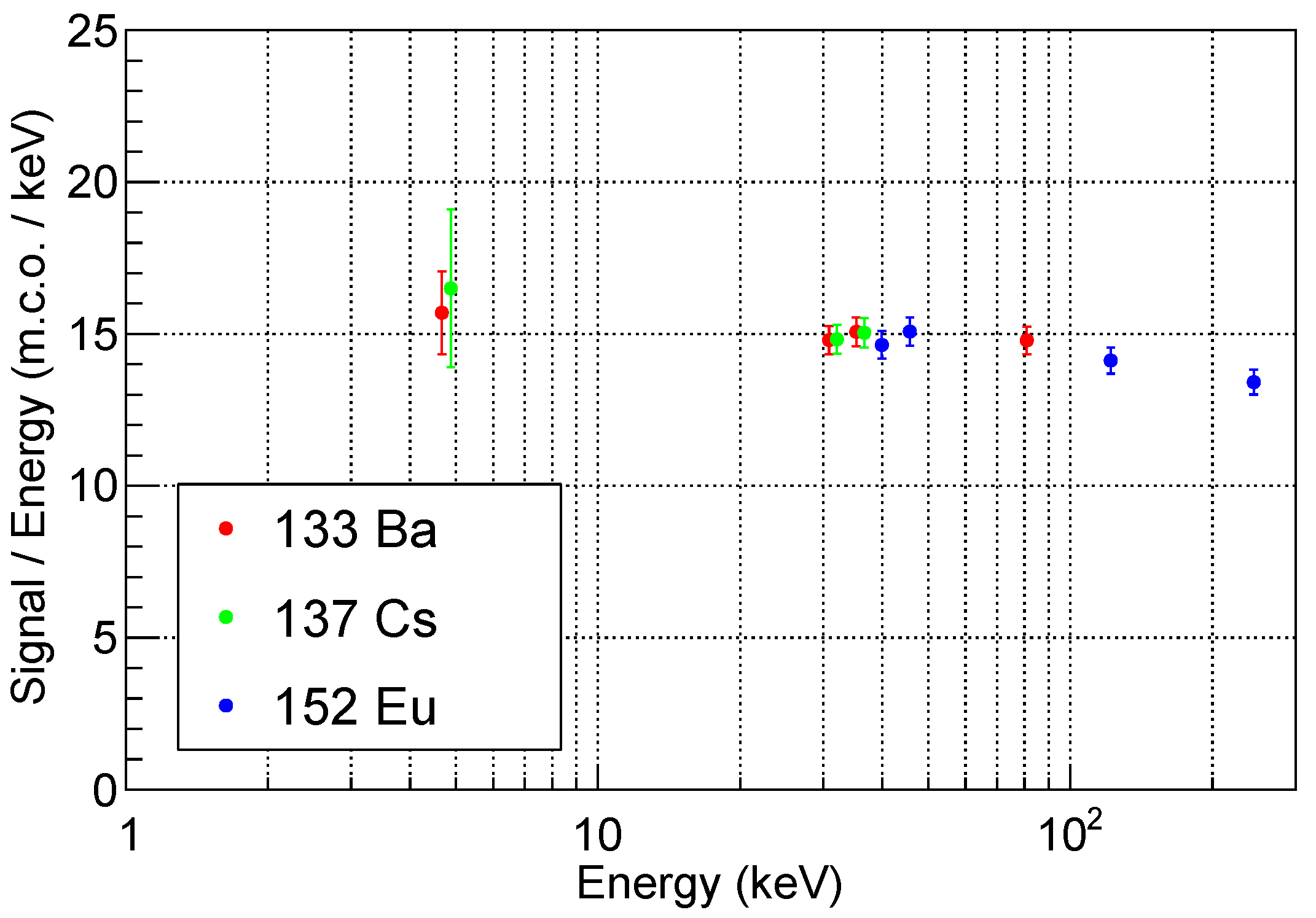
| Energy (keV) | 4.67 | 30.85 | 35.22 | 80.90 | 4.88 | 32.06 | 36.62 | 39.91 | 45.73 | 121.78 | 244.70 |
Disclaimer/Publisher’s Note: The statements, opinions and data contained in all publications are solely those of the individual author(s) and contributor(s) and not of MDPI and/or the editor(s). MDPI and/or the editor(s) disclaim responsibility for any injury to people or property resulting from any ideas, methods, instructions or products referred to in the content. |
© 2025 by the authors. Licensee MDPI, Basel, Switzerland. This article is an open access article distributed under the terms and conditions of the Creative Commons Attribution (CC BY) license (https://creativecommons.org/licenses/by/4.0/).
Share and Cite
Adriani, O.; Baldesi, L.; Berti, E.; Betti, P.; Bongi, M.; Camaiani, A.; Chiari, M.; D’Alessandro, R.; De Giorgi, G.; Finetti, N.; et al. The EPSI R&D: Development of an Innovative Electron–Positron Discrimination Technique for Space Applications. Particles 2025, 8, 101. https://doi.org/10.3390/particles8040101
Adriani O, Baldesi L, Berti E, Betti P, Bongi M, Camaiani A, Chiari M, D’Alessandro R, De Giorgi G, Finetti N, et al. The EPSI R&D: Development of an Innovative Electron–Positron Discrimination Technique for Space Applications. Particles. 2025; 8(4):101. https://doi.org/10.3390/particles8040101
Chicago/Turabian StyleAdriani, Oscar, Lucia Baldesi, Eugenio Berti, Pietro Betti, Massimo Bongi, Alberto Camaiani, Massimo Chiari, Raffaello D’Alessandro, Giacomo De Giorgi, Noemi Finetti, and et al. 2025. "The EPSI R&D: Development of an Innovative Electron–Positron Discrimination Technique for Space Applications" Particles 8, no. 4: 101. https://doi.org/10.3390/particles8040101
APA StyleAdriani, O., Baldesi, L., Berti, E., Betti, P., Bongi, M., Camaiani, A., Chiari, M., D’Alessandro, R., De Giorgi, G., Finetti, N., Forcieri, L., Gensini, E., Paccagnella, A., Pacini, L., Papini, P., Starodubtsev, O., Vinattieri, A., & Volpato, C. (2025). The EPSI R&D: Development of an Innovative Electron–Positron Discrimination Technique for Space Applications. Particles, 8(4), 101. https://doi.org/10.3390/particles8040101