
Recent Developments in and Applications of the Relativistic Chiral Nuclear Force



Abstract
1. Introduction
2. Why a Relativistic Chiral Nuclear Force
3. How to Construct a Relativistic Chiral Nuclear Force
- 1.
- One first needs to construct the covariant chiral effective Lagrangians that satisfy chiral symmetry, parity, charge conjugation, Hermitian conjugation, and time-reversal invariance. Most importantly, the Lagrangians should be Lorentz scalars. The chiral order of each building block in the covariant Lagrangians is listed in Table 1Note that one should adopt the complete form of Dirac spinors and Clifford algebra instead of non-relativistic wave functions and Pauli matrices. The Dirac spinor is given by:
- 2.
- Employing a covariant power counting instead of the traditional Weinberg power counting ensures the Lorentz invariance of the interaction vertices and the scattering amplitude. When chiral effective field theory is applied to baryon systems, the power counting rule developed based on naive dimensional analysis is broken due to the non-zero baryon mass in the chiral limit. This is because the non-zero baryon mass makes the covariant derivative of the baryon field no longer a strictly small quantity [108]. To address this problem, one extends the covariant EOMS scheme [109,110], which has been widely adopted in the one-baryon system, to nucleon–nucleon interactions [111].
- 3.
- One should solve the covariant scattering equation instead of the non-relativistic Lippmann–Schwinger equation. The covariant scattering equation is expressed aswhereis the relativistic propagator of nucleons.However, when the complex, realistic nuclear force is taken as the kernel, the aforementioned four-dimensional Bethe–Salpeter equation is difficult to solve strictly. Various strategies have been proposed to conduct a three-dimensional reduction, which result in, e.g., the Blankenbecler–Sugar equation [112] or the Kadyshevsky equation [113] for practical applications.
4. The First High-Precision Relativistic Chiral Nuclear Force
- 1.
- Contact Lagrangians [75], which describe the short-range interactions between nucleons.
- 2.
- 3.


5. Progress in Higher-Order Relativistic Chiral Nuclear Forces
- 1.
- Contact terms: 23 contact terms have been identified and included, encompassing scalar, vector, axial-vector, and tensor interactions [75].
- 2.
- One-pion exchanges (1): The one-pion exchange potential is expanded aswith contributions up to N3LO fully considered. Isospin-breaking effects from the mass difference between charged and neutral pions in the one-pion exchange potential are explicitly incorporated. The contributions from higher-order OPE can be completely absorbed by taking , and that of , , and can be taken care of by using their physical values. Such a treatment is equivalent to the non-relativistic treatments [36,124] and it is valid up to N3LO.
- 3.
- Two-pion exchanges (2): The two-pion exchange potential is expressed asincluding both one-loop and two-loop contributions. The two-loop diagrams are the most challenging part, so we adopt the spectral representation method (dispersion relation/Mandelstam representation) instead of dimensional regularization—an approach more suitable for massive fermions in nuclear forces, which has also been successfully applied in recent developments of non-relativistic nuclear forces.
- 4.
- Three-pion exchanges (3): The three-pion exchange potential starts at N3LOand is found to be negligible, thus completely absorbed in the higher-order corrections, at least in non-relativistic studies. We temporarily adopt such a treatment.
- 5.
- Isospin breaking effects: All isospin breaking effects—including charge-independence breaking (CIB), charge-symmetry breaking (CSB), and the Coulomb force for pp interactions—are included to ensure the accuracy of the force in describing isospin-asymmetric nuclear systems. Two additional charge-dependent contact operators are also incorporated to further improve precision.
Progress in the Development of Relativistic Three-Body Scattering Equation


6. Recent Applications in Nuclear and Hypernuclear Systems
6.1. Symmetric Nuclear Matter
6.2. Finite Nuclei
6.3. Hypernuclear Systems
- 1.
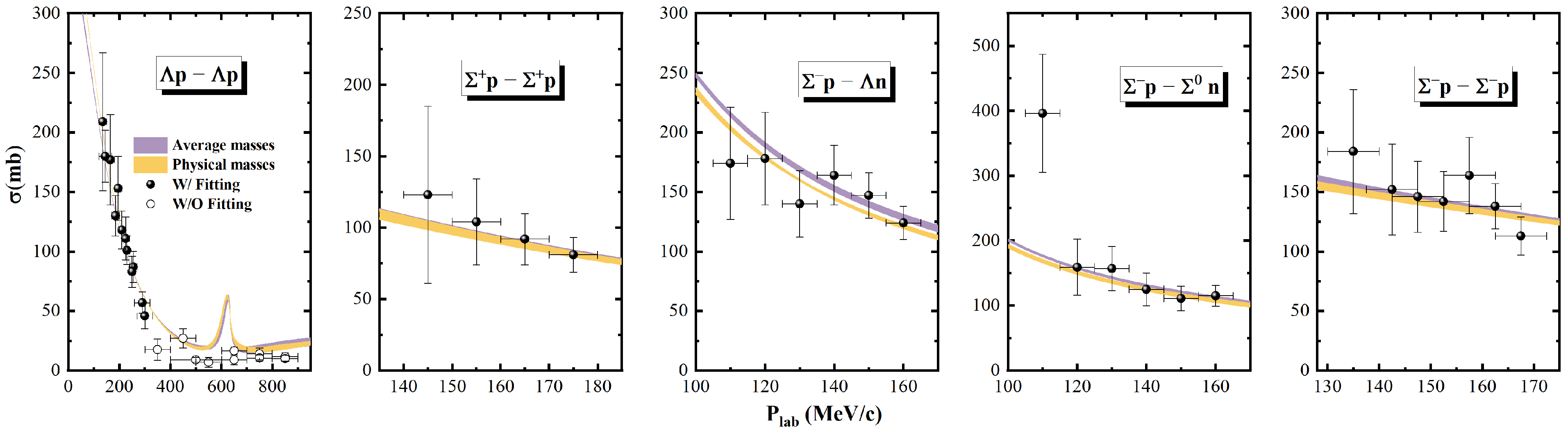
- An update of the relativistic chiral YN forces using physical baryon masses instead of average ones [151], which is necessary for studying the in-medium interaction within the relativistic Brueckner–Hartree–Fock (RBHF) framework. The cross sections obtained with either physical masses or average masses are shown in Figure 11. Our results for the , , and reactions show an overall downward shift compared to the case of average masses. The cross sections for agree with the data even up to the threshold. For below 200 MeV/c, the agreement with the experimental central values is improved using physical masses compared to average masses. For the , the physical masses result in better agreement with the experimental data for below 130 MeV/c.
- 2.
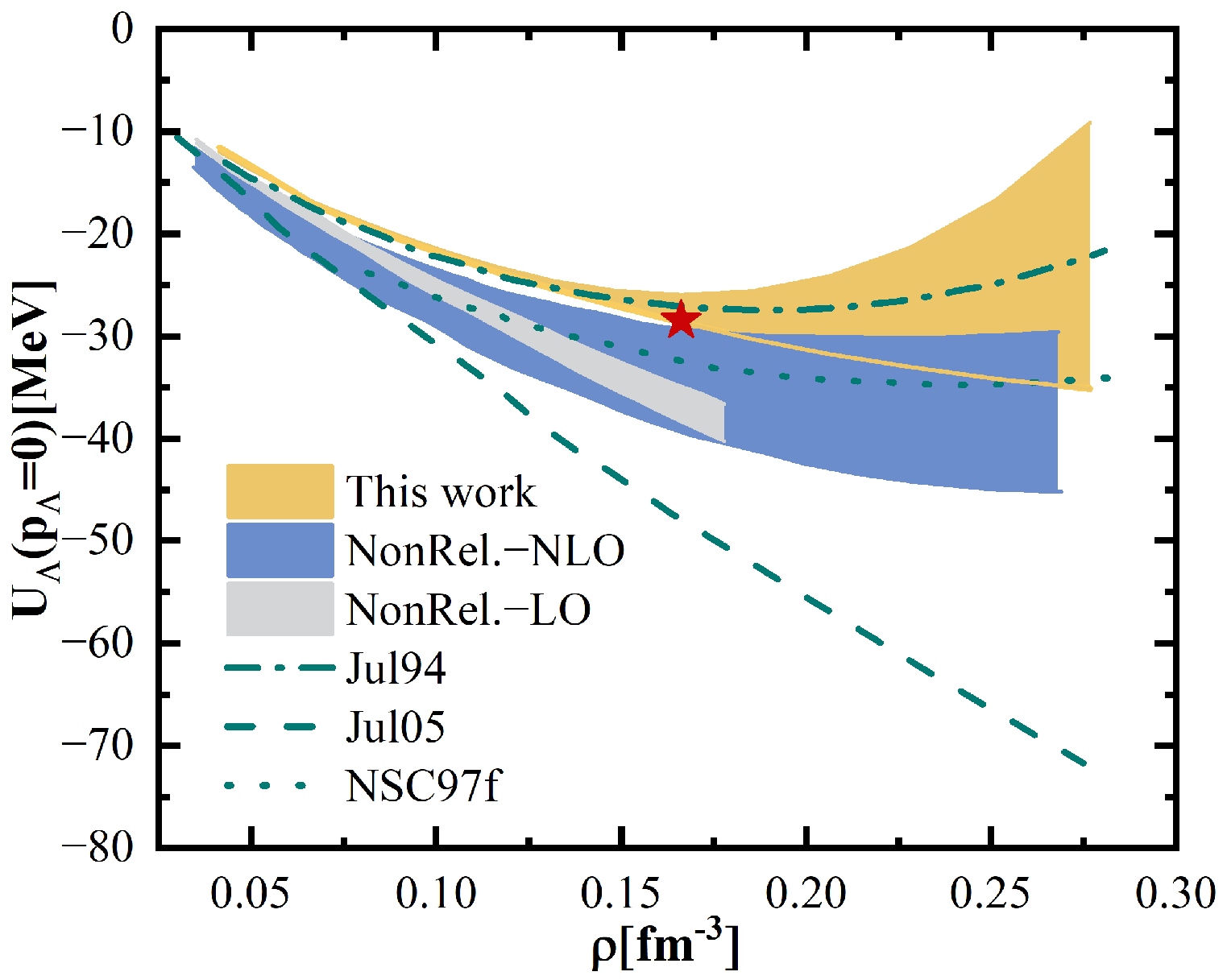
- Calculation of the single-particle potential within the RBHF framework combined with the relativistic chiral YN interactions. As shown in Figure 12, the relativistic results are in better agreement with experimental data and other advanced theoretical models (such as Jul94) compared with the non-relativistic chiral YN force, where higher-order two-body chiral forces are generally required to achieve comparable agreement.
- 3.
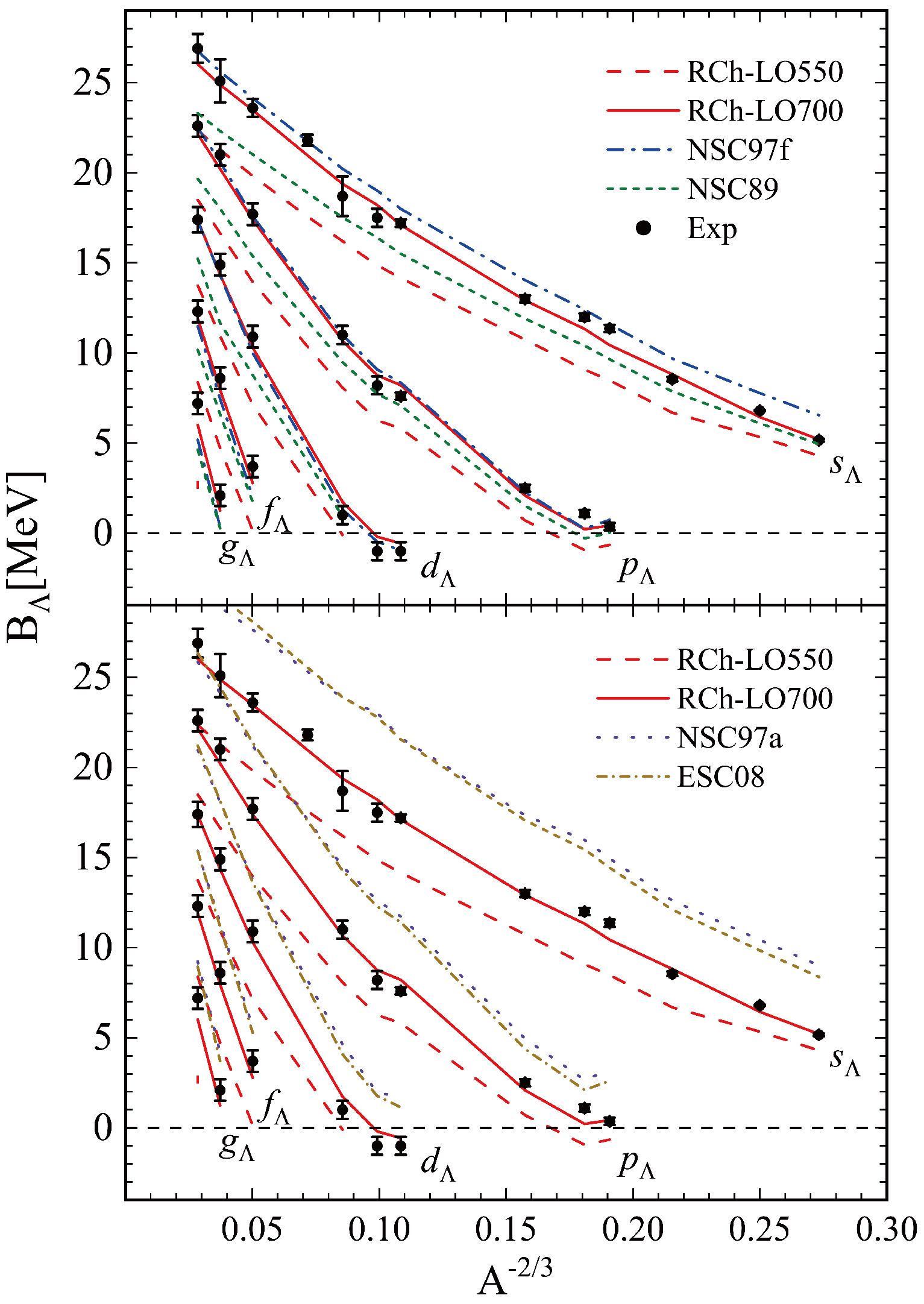
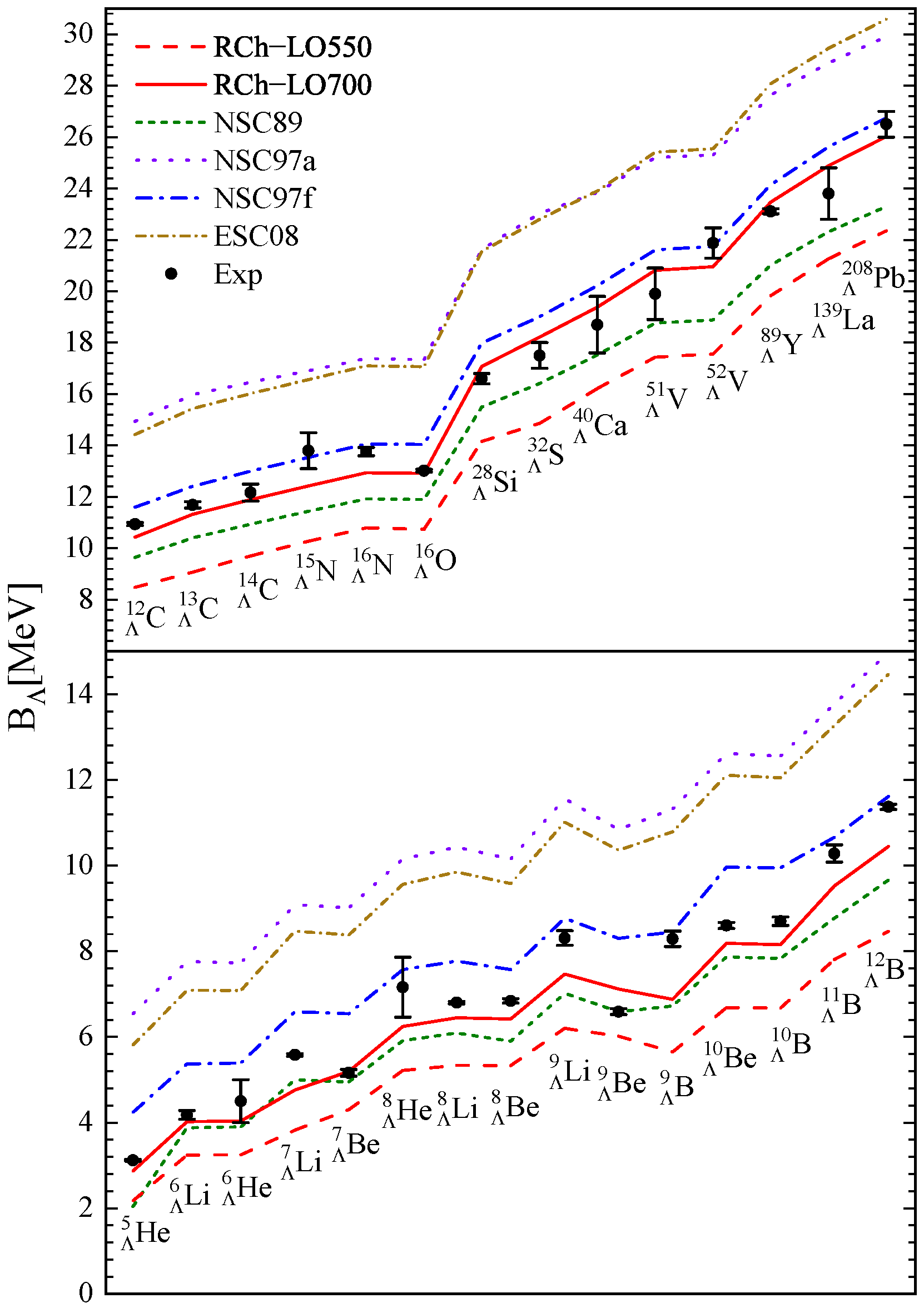
- Studies on hypernuclear structure within the Skyrme–Hartree–Fock approach are combined with the above-mentioned in-medium interactions, including hyperon binding energies and energy levels of single-particle major shells, as shown in Figure 13 and Figure 14. The results indicate that, without adjustable parameters, relativistic chiral YN forces can provide a natural and accurate description of hypernuclear properties, which is crucial for understanding the structure and dynamics of hypernuclei.
7. Summary and Outlook
- 1.
- We have clarified the necessity of relativistic/covariant theories for describing nuclear interactions, highlighting their advantages in satisfying Lorentz invariance and explaining fine structures in various systems. Relativistic frameworks have also been shown to offer a complementary approach to addressing longstanding challenges in ab initio nuclear studies.
- 2.
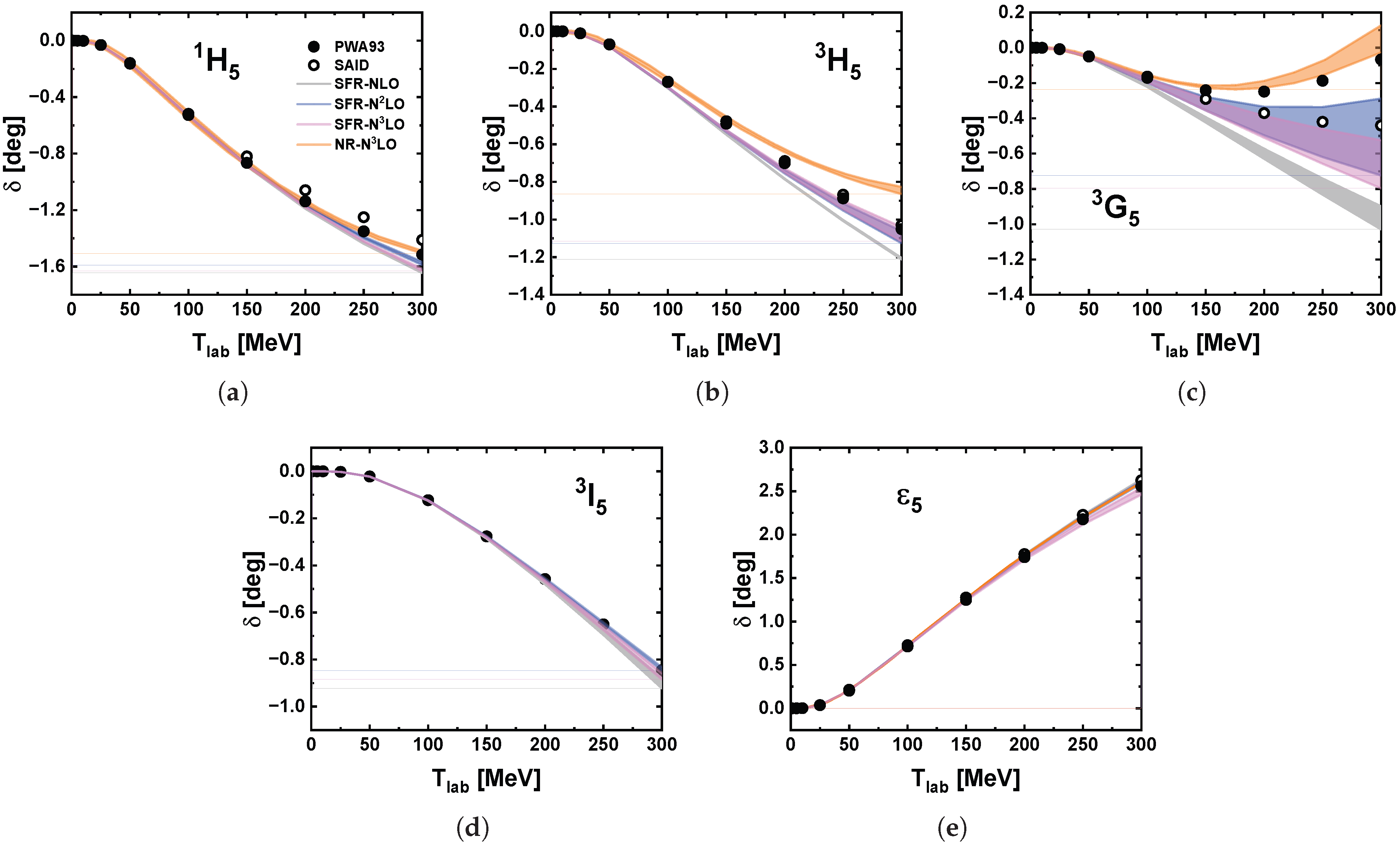
- We have constructed the first high-precision relativistic chiral NN force up to NNLO, which exhibits improved renormalizability, faster convergence, and a more natural description than its non-relativistic counterparts.
- 3.
- We are currently constructing relativistic chiral NN forces up to N3LO and have resolved the key technical complexities—including the handling of two-loop diagrams using the spectral representation method.
- 4.
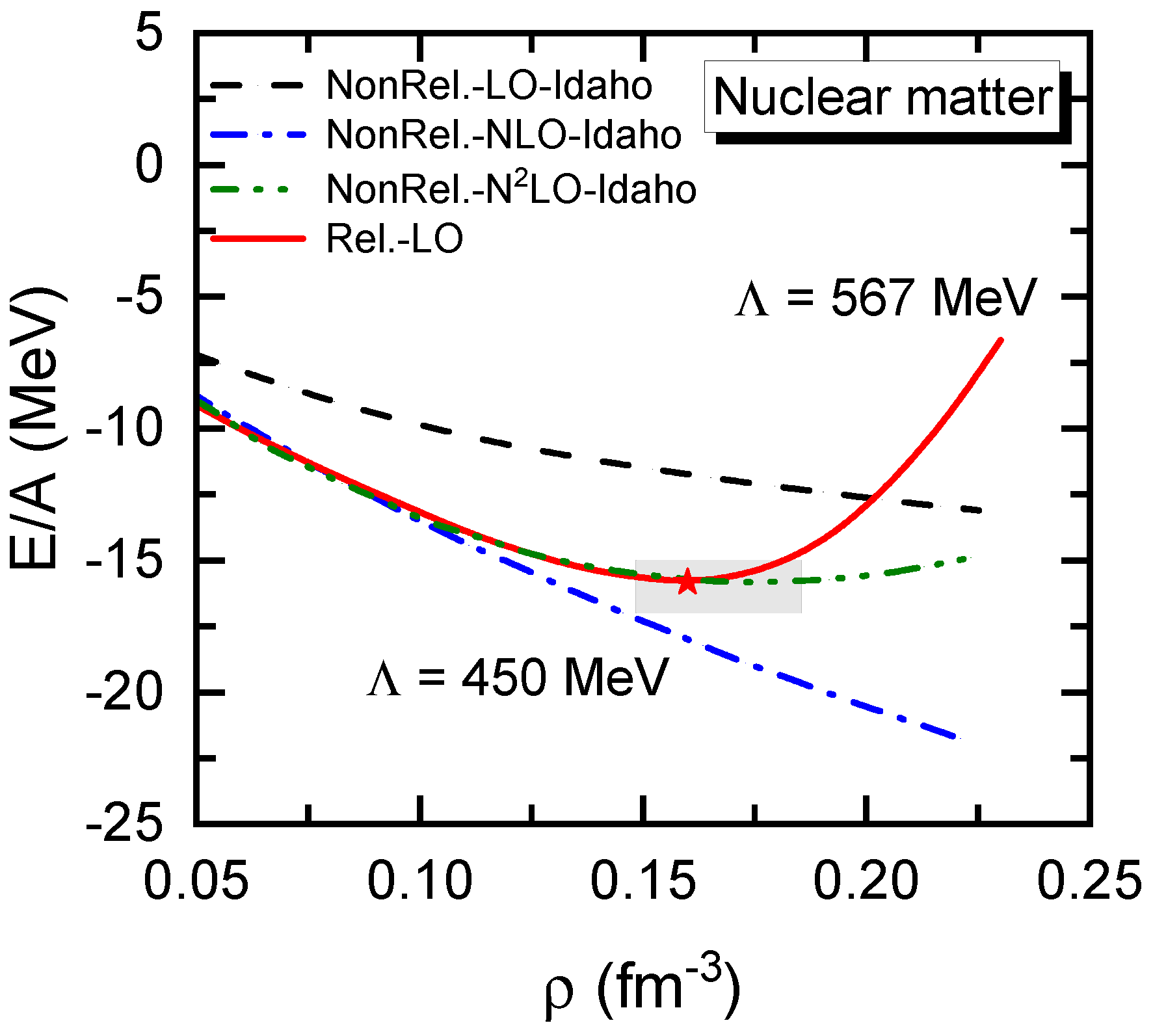
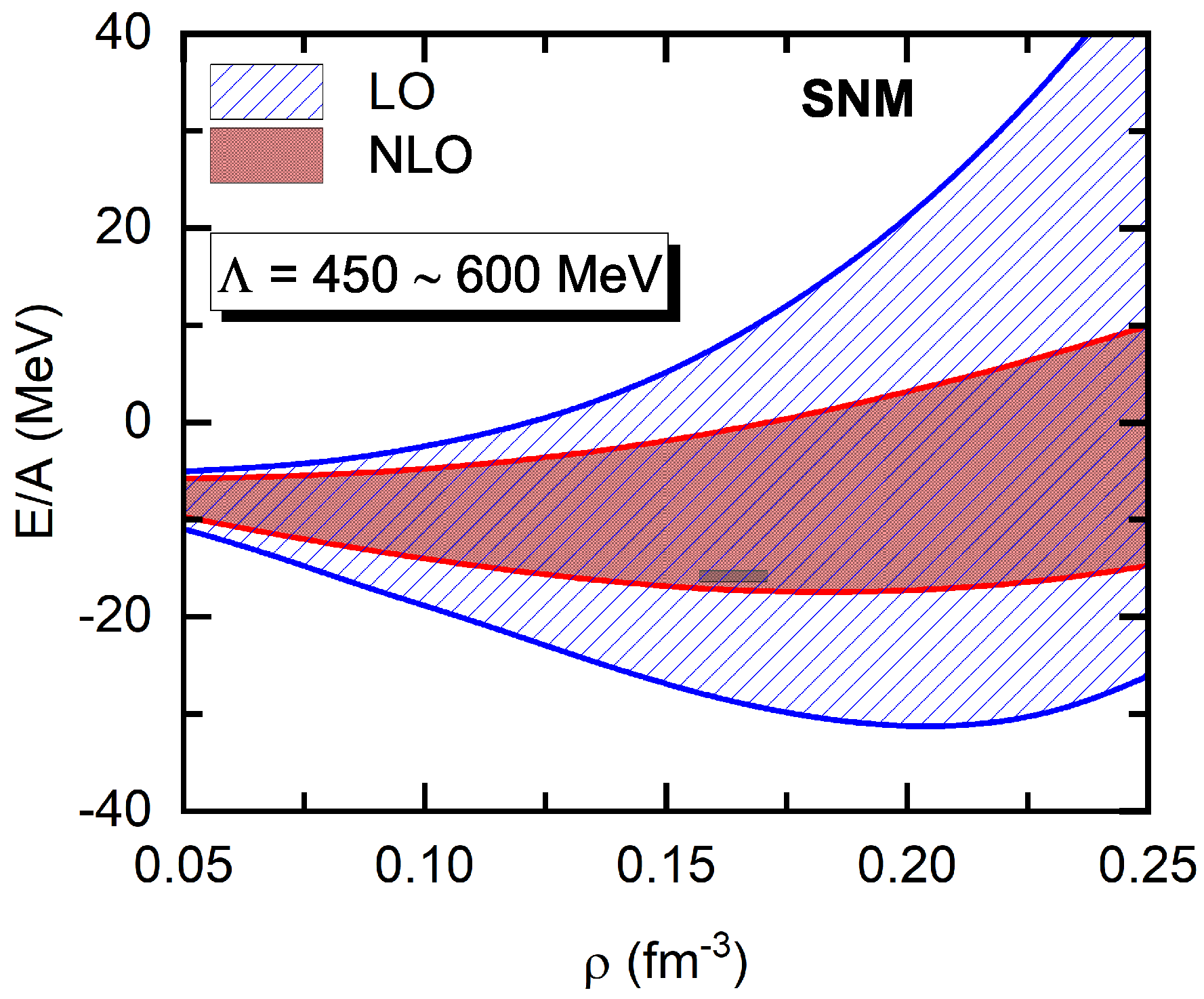
- We have applied relativistic chiral NN and YN forces to study symmetric nuclear matter, finite nuclei, and hypernuclear systems, yielding results that are in good agreement with experimental data. Our findings are consistent with recent relativistic ab initio studies that have reproduced nuclear matter saturation and improved the “Coester line” for medium-mass nuclei.
- 1.
- Complete the construction and fitting of relativistic chiral NN forces up to N3LO, to check their convergence and improve the accuracy of high-energy scattering descriptions.
- 2.
- Develop a fully self-consistent relativistic three-body scattering framework and apply it to understand scattering and improve the description of three-body systems.
- 3.
- Extend relativistic chiral nuclear forces to isospin-asymmetric nuclear systems and rare isotope nuclei, and apply them to study the origin of heavy elements in astrophysics. We will further refine the treatment of isospin-breaking effects to more accurately describe charge-dependent nuclear properties.
- 4.
- Further explore the applications of relativistic chiral nuclear forces in hypernuclear systems and baryon–baryon scattering processes, and deepen our understanding of the strong interaction in low-energy regions.
Author Contributions
Funding
Data Availability Statement
Acknowledgments
Conflicts of Interest
References
- Yano, Y. The RIKEN RI Beam Factory Project: A status report. Nucl. Instrum. Meth. B 2007, 261, 1009–1013. [Google Scholar] [CrossRef]
- Xia, J.W.; Xiao, G.Q.; Xu, H.S.; Zhao, H.W.; Zhou, X.H.; Ma, X.W.; He, Y.; Ma, L.Z.; Gao, D.Q.; Meng, J.; et al. High Intensity heavy ion Accelerator Facility (HIAF) in China. Nucl. Instrum. Meth. B 2013, 317, 263–265. [Google Scholar] [CrossRef]
- Gade, A.; Sherrill, B.M. NSCL and FRIB at Michigan State University: Nuclear science at the limits of stability. Phys. Scripta 2016, 91, 053003. [Google Scholar] [CrossRef]
- Yukawa, H. On the Interaction of Elementary Particles I. Proc. Phys. Math. Soc. Jap. 1935, 17, 48–57. [Google Scholar] [CrossRef]
- De Tourreil, R.; Rouben, B.; Sprung, D.W.L. Supersoft Core Nucleon-Nucleon Interaction with pi-, rho- and omega Exchange Contributions. Nucl. Phys. A 1975, 242, 445–460. [Google Scholar] [CrossRef]
- Holinde, K.; Machleidt, R. OBEP and eikonal form factor. Nucl. Phys. A 1976, 256, 497–508. [Google Scholar] [CrossRef]
- Nagels, M.M.; Rijken, T.A.; de Swart, J.J. A Low-Energy Nucleon-Nucleon Potential from Regge Pole Theory. Phys. Rev. D 1978, 17, 768. [Google Scholar] [CrossRef]
- Gross, D.J.; Wilczek, F. Ultraviolet Behavior of Nonabelian Gauge Theories. Phys. Rev. Lett. 1973, 30, 1343–1346. [Google Scholar] [CrossRef]
- Politzer, H.D. Reliable Perturbative Results for Strong Interactions? Phys. Rev. Lett. 1973, 30, 1346–1349. [Google Scholar] [CrossRef]
- Oka, M.; Yazaki, K. Nuclear Force in a Quark Model. Phys. Lett. B 1980, 90, 41–44. [Google Scholar] [CrossRef]
- Faessler, A.; Fernandez, F.; Lubeck, G.; Shimizu, K. The Quark Model and the Nature of the Repulsive Core of the Nucleon Nucleon Interaction. Phys. Lett. B 1982, 112, 201–205. [Google Scholar] [CrossRef]
- Shimizu, K. Study of Baryon Baryon Interactions and Nuclear Properties in the Quark Cluster Model. Rept. Prog. Phys. 1989, 52, 1–56. [Google Scholar] [CrossRef]
- Valcarce, A.; Garcilazo, H.; Fernandez, F.; Gonzalez, P. Quark-model study of few-baryon systems. Rept. Prog. Phys. 2005, 68, 965–1042. [Google Scholar] [CrossRef]
- Straub, U.; Zhang, Z.Y.; Brauer, K.; Faessler, A.; Khadkikar, S.B.; Lubeck, G. Hyperon Nucleon Interaction in the Quark Cluster Model. Nucl. Phys. A 1988, 483, 686–710. [Google Scholar] [CrossRef]
- Zhang, Z.Y.; Faessler, A.; Straub, U.; Glozman, L.Y. The Baryon baryon interaction in a modified quark model. Nucl. Phys. A 1994, 578, 573–585. [Google Scholar] [CrossRef]
- Zhang, Z.Y.; Yu, Y.W.; Shen, P.N.; Dai, L.R.; Faessler, A.; Straub, U. Hyperon nucleon interactions in a chiral SU(3) quark model. Nucl. Phys. A 1997, 625, 59–70. [Google Scholar] [CrossRef]
- Dai, L.R.; Zhang, Z.Y.; Yu, Y.W.; Wang, P. N N interactions in the extended chiral SU(3) quark model. Nucl. Phys. A 2003, 727, 321–332. [Google Scholar] [CrossRef]
- Wang, F.; Wu, G.H.; Teng, L.J.; Goldman, J.T. Quark delocalization, color screening, and nuclear intermediate range attraction. Phys. Rev. Lett. 1992, 69, 2901–2904. [Google Scholar] [CrossRef]
- Wu, G.H.; Teng, L.J.; Ping, J.L.; Wang, F.; Goldman, J.T. Quark delocalization, color screening, and N N intermediate range attraction: P waves. Phys. Rev. C 1996, 53, 1161–1166. [Google Scholar] [CrossRef]
- Ping, J.L.; Wang, F.; Goldman, J.T. Effective baryon baryon potentials in the quark delocalization and color screening model. Nucl. Phys. A 1999, 657, 95–109. [Google Scholar] [CrossRef]
- Wu, G.h.; Ping, J.L.; Teng, L.j.; Wang, F.; Goldman, J.T. Quark delocalization, color screening model and nucleon baryon scattering. Nucl. Phys. A 2000, 673, 279–297. [Google Scholar] [CrossRef]
- Pang, H.R.; Ping, J.L.; Wang, F.; Goldman, J.T. Phenomenological study of hadron interaction models. Phys. Rev. C 2002, 65, 014003. [Google Scholar] [CrossRef]
- Fujiwara, Y.; Nakamoto, C.; Suzuki, Y. RGM study of the hyperon - nucleon interaction in the SU(6) quark model. 1: Analysis of N N and Sigma p systems. Prog. Theor. Phys. 1995, 94, 215–232. [Google Scholar] [CrossRef]
- Fujiwara, Y.; Nakamoto, C.; Suzuki, Y. A Unified description of N N and Y N interactions in a quark model with effective meson exchange potentials. Phys. Rev. Lett. 1996, 76, 2242–2245. [Google Scholar] [CrossRef] [PubMed]
- Fujiwara, Y.; Nakamoto, C.; Suzuki, Y. Effective meson exchange potentials in the SU(6) quark model for N N and Y N interactions. Phys. Rev. C 1996, 54, 2180–2200. [Google Scholar] [CrossRef]
- Fujita, T.; Fujiwara, Y.; Nakamoto, C.; Suzuki, Y. Scattering observables of the N N and Y N interactions in the SU(6) quark model. Prog. Theor. Phys. 1998, 100, 931–955. [Google Scholar] [CrossRef]
- Weinberg, S. Nuclear forces from chiral Lagrangians. Phys. Lett. B 1990, 251, 288–292. [Google Scholar] [CrossRef]
- Weinberg, S. Effective chiral Lagrangians for nucleon - pion interactions and nuclear forces. Nucl. Phys. B 1991, 363, 3–18. [Google Scholar] [CrossRef]
- Weinberg, S. Three body interactions among nucleons and pions. Phys. Lett. B 1992, 295, 114–121. [Google Scholar] [CrossRef]
- Wiringa, R.B.; Stoks, V.G.J.; Schiavilla, R. An Accurate nucleon-nucleon potential with charge independence breaking. Phys. Rev. C 1995, 51, 38–51. [Google Scholar] [CrossRef]
- Stoks, V.G.J.; Klomp, R.A.M.; Terheggen, C.P.F.; de Swart, J.J. Construction of high quality N N potential models. Phys. Rev. C 1994, 49, 2950–2962. [Google Scholar] [CrossRef] [PubMed]
- Machleidt, R. The High precision, charge dependent Bonn nucleon-nucleon potential (CD-Bonn). Phys. Rev. C 2001, 63, 024001. [Google Scholar] [CrossRef]
- Epelbaum, E.; Hammer, H.W.; Meißner, U.G. Modern Theory of Nuclear Forces. Rev. Mod. Phys. 2009, 81, 1773–1825. [Google Scholar] [CrossRef]
- Hammer, H.W.; König, S.; van Kolck, U. Nuclear effective field theory: Status and perspectives. Rev. Mod. Phys. 2020, 92, 025004. [Google Scholar] [CrossRef]
- Hebeler, K. Three-nucleon forces: Implementation and applications to atomic nuclei and dense matter. Phys. Rept. 2021, 890, 1–116. [Google Scholar] [CrossRef]
- Machleidt, R.; Entem, D.R. Chiral effective field theory and nuclear forces. Phys. Rept. 2011, 503, 1–75. [Google Scholar] [CrossRef]
- Machleidt, R.; Sammarruca, F. Recent advances in chiral EFT based nuclear forces and their applications. Prog. Part. Nucl. Phys. 2024, 137, 104117. [Google Scholar] [CrossRef]
- Ordonez, C.; Ray, L.; van Kolck, U. Nucleon-nucleon potential from an effective chiral Lagrangian. Phys. Rev. Lett. 1994, 72, 1982–1985. [Google Scholar] [CrossRef]
- Ordonez, C.; Ray, L.; van Kolck, U. The Two nucleon potential from chiral Lagrangians. Phys. Rev. C 1996, 53, 2086–2105. [Google Scholar] [CrossRef]
- Epelbaum, E.; Gloeckle, W.; Meißner, U.G. Nuclear forces from chiral Lagrangians using the method of unitary transformation. 1. Formalism. Nucl. Phys. A 1998, 637, 107–134. [Google Scholar] [CrossRef]
- Epelbaum, E.; Gloeckle, W.; Meißner, U.G. Nuclear forces from chiral Lagrangians using the method of unitary transformation. 2. The two nucleon system. Nucl. Phys. A 2000, 671, 295–331. [Google Scholar] [CrossRef]
- Epelbaum, E.; Gloeckle, W.; Meißner, U.G. Improving the convergence of the chiral expansion for nuclear forces. 1. Peripheral phases. Eur. Phys. J. A 2004, 19, 125–137. [Google Scholar] [CrossRef]
- Epelbaum, E.; Gloeckle, W.; Meißner, U.G. Improving the convergence of the chiral expansion for nuclear forces. 2. Low phases and the deuteron. Eur. Phys. J. A 2004, 19, 401–412. [Google Scholar] [CrossRef]
- Entem, D.R.; Machleidt, R. Accurate charge dependent nucleon nucleon potential at fourth order of chiral perturbation theory. Phys. Rev. C 2003, 68, 041001. [Google Scholar] [CrossRef]
- Epelbaum, E.; Glockle, W.; Meißner, U.G. The Two-nucleon system at next-to-next-to-next-to-leading order. Nucl. Phys. A 2005, 747, 362–424. [Google Scholar] [CrossRef]
- Epelbaum, E.; Krebs, H.; Meißner, U.G. Improved chiral nucleon-nucleon potential up to next-to-next-to-next-to-leading order. Eur. Phys. J. A 2015, 51, 53. [Google Scholar] [CrossRef]
- Saha, S.K.; Entem, D.R.; Machleidt, R.; Nosyk, Y. Local position-space two-nucleon potentials from leading to fourth order of chiral effective field theory. Phys. Rev. C 2023, 107, 034002. [Google Scholar] [CrossRef]
- Reinert, P.; Krebs, H.; Epelbaum, E. Semilocal momentum-space regularized chiral two-nucleon potentials up to fifth order. Eur. Phys. J. A 2018, 54, 86. [Google Scholar] [CrossRef]
- Entem, D.R.; Kaiser, N.; Machleidt, R.; Nosyk, Y. Dominant contributions to the nucleon-nucleon interaction at sixth order of chiral perturbation theory. Phys. Rev. C 2015, 92, 064001. [Google Scholar] [CrossRef]
- Epelbaum, E.; Golak, J.; Hebeler, K.; Kamada, H.; Krebs, H.; Meißner, U.G.; Nogga, A.; Reinert, P.; Skibiński, R.; Topolnicki, K.; et al. Towards high-order calculations of three-nucleon scattering in chiral effective field theory. Eur. Phys. J. A 2020, 56, 92. [Google Scholar] [CrossRef]
- Epelbaum, E.; Gasparyan, A.M.; Gegelia, J.; Meißner, U.G. How (not) to renormalize integral equations with singular potentials in effective field theory. Eur. Phys. J. A 2018, 54, 186. [Google Scholar] [CrossRef]
- Epelbaum, E.; Krebs, H.; Reinert, P. High-precision nuclear forces from chiral EFT: State-of-the-art, challenges and outlook. Front. Phys. 2020, 8, 98. [Google Scholar] [CrossRef]
- Epelbaum, E.; Krebs, H.; Reinert, P. Semi-local Nuclear Forces From Chiral EFT: State-of-the-Art and Challenges. arXiv 2022, arXiv:2206.07072. [Google Scholar]
- Machleidt, R. What is ab initio? Few Body Syst. 2023, 64, 77. [Google Scholar] [CrossRef]
- Bedaque, P.F.; van Kolck, U. Effective field theory for few nucleon systems. Ann. Rev. Nucl. Part. Sci. 2002, 52, 339–396. [Google Scholar] [CrossRef]
- Kaiser, N.; Gerstendorfer, S.; Weise, W. Peripheral NN scattering: Role of delta excitation, correlated two pion and vector meson exchange. Nucl. Phys. A 1998, 637, 395–420. [Google Scholar] [CrossRef]
- Krebs, H.; Epelbaum, E.; Meißner, U.G. Nuclear forces with Delta-excitations up to next-to-next-to-leading order. I. Peripheral nucleon-nucleon waves. Eur. Phys. J. A 2007, 32, 127–137. [Google Scholar] [CrossRef]
- Epelbaum, E.; Krebs, H.; Meißner, U.G. Isospin-breaking two-nucleon force with explicit Delta-excitations. Phys. Rev. C 2008, 77, 034006. [Google Scholar] [CrossRef]
- Piarulli, M.; Girlanda, L.; Schiavilla, R.; Navarro Pérez, R.; Amaro, J.E.; Ruiz Arriola, E. Minimally nonlocal nucleon-nucleon potentials with chiral two-pion exchange including Δ resonances. Phys. Rev. C 2015, 91, 024003. [Google Scholar] [CrossRef]
- Ekström, A.; Hagen, G.; Morris, T.D.; Papenbrock, T.; Schwartz, P.D. Δ isobars and nuclear saturation. Phys. Rev. C 2018, 97, 024332. [Google Scholar] [CrossRef]
- Strohmeier, S.; Kaiser, N. Nucleon-Nucleon Scattering with Coupled Nucleon-Delta Channels in Chiral Effective Field Theory. Nucl. Phys. A 2020, 1002, 121980. [Google Scholar] [CrossRef]
- Nosyk, Y.; Entem, D.R.; Machleidt, R. Nucleon-nucleon potentials from Δ-full chiral effective-field-theory and implications. Phys. Rev. C 2021, 104, 054001. [Google Scholar] [CrossRef]
- van Kolck, U. Few nucleon forces from chiral Lagrangians. Phys. Rev. C 1994, 49, 2932–2941. [Google Scholar] [CrossRef]
- Pandharipande, V.R.; Phillips, D.R.; van Kolck, U. Delta effects in pion-nucleon scattering and the strength of the two-pion-exchange three-nucleon interaction. Phys. Rev. C 2005, 71, 064002. [Google Scholar] [CrossRef]
- Epelbaum, E.; Krebs, H.; Meißner, U.G. Delta-excitations and the three-nucleon force. Nucl. Phys. A 2008, 806, 65–78. [Google Scholar] [CrossRef]
- Kaiser, N. Three-pion exchange nucleon-nucleon potentials with virtual Δ-isobar excitation. Phys. Rev. C 2015, 92, 024002. [Google Scholar] [CrossRef]
- Krebs, H.; Gasparyan, A.M.; Epelbaum, E. Three-nucleon force in chiral EFT with explicit Δ(1232) degrees of freedom: Longest-range contributions at fourth order. Phys. Rev. C 2018, 98, 014003. [Google Scholar] [CrossRef]
- Xiao, Y.; Geng, L.S.; van Kolck, U. Two-Pion Exchange Contributions to the Nucleon-Nucleon Interaction from the Roper Resonance. arXiv 2026, arXiv:2602.11815. [Google Scholar]
- Kaiser, N. Two-pion exchange nucleon-nucleon potentials with Roper resonance excitation. arXiv 2026, arXiv:2602.18664. [Google Scholar]
- Nogga, A.; Timmermans, R.G.E.; van Kolck, U. Renormalization of one-pion exchange and power counting. Phys. Rev. C 2005, 72, 054006. [Google Scholar] [CrossRef]
- Birse, M.C. Power counting with one-pion exchange. Phys. Rev. C 2006, 74, 014003. [Google Scholar] [CrossRef]
- Valderrama, M.P.; Phillips, D.R. Power Counting of Contact-Range Currents in Effective Field Theory. Phys. Rev. Lett. 2015, 114, 082502. [Google Scholar] [CrossRef]
- Kievsky, A.; Viviani, M.; Gattobigio, M.; Girlanda, L. Implications of Efimov physics for the description of three and four nucleons in chiral effective field theory. Phys. Rev. C 2017, 95, 024001. [Google Scholar] [CrossRef]
- Ren, X.L.; Li, K.W.; Geng, L.S.; Long, B.W.; Ring, P.; Meng, J. Leading order relativistic chiral nucleon-nucleon interaction. Chin. Phys. C 2018, 42, 014103. [Google Scholar] [CrossRef]
- Xiao, Y.; Geng, L.S.; Ren, X.L. Covariant chiral nucleon-nucleon contact Lagrangian up to order O(q4). Phys. Rev. C 2019, 99, 024004. [Google Scholar] [CrossRef]
- Xiao, Y.; Wang, C.X.; Lu, J.X.; Geng, L.S. Two-pion exchange contributions to the nucleon-nucleon interaction in covariant baryon chiral perturbation theory. Phys. Rev. C 2020, 102, 054001. [Google Scholar] [CrossRef]
- Wang, C.X.; Lu, J.X.; Xiao, Y.; Geng, L.S. Nonperturbative two-pion exchange contributions to the nucleon-nucleon interaction in covariant baryon chiral perturbation theory. Phys. Rev. C 2022, 105, 014003. [Google Scholar] [CrossRef]
- Lu, J.X.; Wang, C.X.; Xiao, Y.; Geng, L.S.; Meng, J.; Ring, P. Accurate Relativistic Chiral Nucleon-Nucleon Interaction up to Next-to-Next-to-Leading Order. Phys. Rev. Lett. 2022, 128, 142002. [Google Scholar] [CrossRef]
- Lu, J.X.; Geng, L.S. Two-pion exchange contributions to the relativistic chiral nuclear force at N3LO. arXiv 2025, arXiv:2511.18023. [Google Scholar]
- Desclaux, J. Chapter 1-Tour Historique. In Relativistic Electronic Structure Theory; Schwerdtfeger, P., Ed.; Elsevier: Amsterdam, The Netherlands, 2002; Volume 11, pp. 1–22. [Google Scholar] [CrossRef]
- Liang, H.; Meng, J.; Zhou, S.G. Hidden pseudospin and spin symmetries and their origins in atomic nuclei. Phys. Rept. 2015, 570, 1–84. [Google Scholar] [CrossRef]
- Ren, X.L.; Geng, L.S.; Martin Camalich, J.; Meng, J.; Toki, H. Octet baryon masses in next-to-next-to-next-to-leading order covariant baryon chiral perturbation theory. J. High Energy Phys. 2012, 12, 073. [Google Scholar] [CrossRef]
- Ren, X.L.; Geng, L.S.; Meng, J. Decuplet baryon masses in covariant baryon chiral perturbation theory. Phys. Rev. D 2014, 89, 054034. [Google Scholar] [CrossRef]
- Ren, X.L.; Geng, L.S.; Meng, J. Baryon chiral perturbation theory with Wilson fermions up to O(a2) and discretization effects of latest nf = 2 + 1 LQCD octet baryon masses. Eur. Phys. J. C 2014, 74, 2754. [Google Scholar] [CrossRef]
- Ren, X.L.; Geng, L.; Meng, J.; Toki, H. Virtual decuplet effects on octet baryon masses in covariant baryon chiral perturbation theory. Phys. Rev. D 2013, 87, 074001. [Google Scholar] [CrossRef]
- Ren, X.L.; Alvarez-Ruso, L.; Geng, L.S.; Ledwig, T.; Meng, J.; Vicente Vacas, M.J. Consistency between SU(3) and SU(2) covariant baryon chiral perturbation theory for the nucleon mass. Phys. Lett. B 2017, 766, 325–333. [Google Scholar] [CrossRef]
- Chen, L.B.; Hu, S.; Jia, Y.; Mo, Z. Light quark mass dependence of nucleon mass to two-loop order. arXiv 2024, arXiv:2406.04124. [Google Scholar] [CrossRef]
- Liang, Z.R.; Chen, H.X.; Guo, F.K.; Guo, Z.H.; Yao, D.L. Chiral representation of the nucleon mass at leading two-loop order. J. High Energy Phys. 2025, 04, 192. [Google Scholar] [CrossRef]
- Ren, X.L.; Geng, L.S.; Meng, J. Scalar strangeness content of the nucleon and baryon sigma terms. Phys. Rev. D 2015, 91, 051502. [Google Scholar] [CrossRef]
- Ren, X.L.; Ling, X.Z.; Geng, L.S. Pion–nucleon sigma term revisited in covariant baryon chiral perturbation theory. Phys. Lett. B 2018, 783, 7–12. [Google Scholar] [CrossRef]
- Liang, Z.R.; Chen, H.X.; Guo, F.K.; Guo, Z.H.; Yao, D.L. Two-Loop Extraction of the Pion-Nucleon Sigma Term. arXiv 2025, arXiv:2508.11435. [Google Scholar]
- Geng, L.S.; Martin Camalich, J.; Alvarez-Ruso, L.; Vicente Vacas, M.J. Leading SU(3)-breaking corrections to the baryon magnetic moments in Chiral Perturbation Theory. Phys. Rev. Lett. 2008, 101, 222002. [Google Scholar] [CrossRef] [PubMed]
- Liu, M.Z.; Xiao, Y.; Geng, L.S. Magnetic moments of the spin-1/2 doubly charmed baryons in covariant baryon chiral perturbation theory. Phys. Rev. D 2018, 98, 014040. [Google Scholar] [CrossRef]
- Shi, R.X.; Xiao, Y.; Geng, L.S. Magnetic moments of the spin-1/2 singly charmed baryons in covariant baryon chiral perturbation theory. Phys. Rev. D 2019, 100, 054019. [Google Scholar] [CrossRef]
- Xiao, Y.; Ren, X.L.; Lu, J.X.; Geng, L.S.; Meißner, U.G. Octet baryon magnetic moments at next-to-next-to-leading order in covariant chiral perturbation theory. Eur. Phys. J. C 2018, 78, 489. [Google Scholar] [CrossRef]
- Shi, R.X.; Geng, L.S. Magnetic moments of the spin-32 doubly charmed baryons in covariant baryon chiral perturbation theory. Phys. Rev. D 2021, 103, 114004. [Google Scholar] [CrossRef]
- Siemens, D.; Bernard, V.; Epelbaum, E.; Gasparyan, A.; Krebs, H.; Meißner, U.G. Elastic pion-nucleon scattering in chiral perturbation theory: A fresh look. Phys. Rev. C 2016, 94, 014620. [Google Scholar] [CrossRef]
- Lu, J.X.; Geng, L.S.; Doering, M.; Mai, M. Cross-Channel Constraints on Resonant Antikaon-Nucleon Scattering. Phys. Rev. Lett. 2023, 130, 071902. [Google Scholar] [CrossRef]
- Shi, R.X.; Li, S.Y.; Lu, J.X.; Geng, L.S. Weak radiative hyperon decays in covariant baryon chiral perturbation theory. Sci. Bull. 2022, 67, 2298–2304. [Google Scholar] [CrossRef]
- Kaplan, D.B. Convergence of nuclear effective field theory with perturbative pions. Phys. Rev. C 2020, 102, 034004. [Google Scholar] [CrossRef]
- Baru, V.; Epelbaum, E.; Gegelia, J.; Ren, X.L. Towards baryon-baryon scattering in manifestly Lorentz-invariant formulation of SU(3) baryon chiral perturbation theory. Phys. Lett. B 2019, 798, 134987. [Google Scholar] [CrossRef]
- Ekström, A.; Jansen, G.R.; Wendt, K.A.; Hagen, G.; Papenbrock, T.; Carlsson, B.D.; Forssén, C.; Hjorth-Jensen, M.; Navrátil, P.; Nazarewicz, W. Accurate nuclear radii and binding energies from a chiral interaction. Phys. Rev. C 2015, 91, 051301. [Google Scholar] [CrossRef]
- Ekström, A.; Baardsen, G.; Forssén, C.; Hagen, G.; Hjorth-Jensen, M.; Jansen, G.R.; Machleidt, R.; Nazarewicz, W.; Papenbrock, T.; Sarich, J.; et al. Optimized Chiral Nucleon-Nucleon Interaction at Next-to-Next-to-Leading Order. Phys. Rev. Lett. 2013, 110, 192502. [Google Scholar] [CrossRef] [PubMed]
- Carlsson, B.D.; Ekström, A.; Forssén, C.; Strömberg, D.F.; Jansen, G.R.; Lilja, O.; Lindby, M.; Mattsson, B.A.; Wendt, K.A. Uncertainty analysis and order-by-order optimization of chiral nuclear interactions. Phys. Rev. X 2016, 6, 011019. [Google Scholar] [CrossRef]
- Drischler, C.; Hebeler, K.; Schwenk, A. Chiral interactions up to next-to-next-to-next-to-leading order and nuclear saturation. Phys. Rev. Lett. 2019, 122, 042501. [Google Scholar] [CrossRef] [PubMed]
- Hüther, T.; Vobig, K.; Hebeler, K.; Machleidt, R.; Roth, R. Family of Chiral Two- plus Three-Nucleon Interactions for Accurate Nuclear Structure Studies. Phys. Lett. B 2020, 808, 135651. [Google Scholar] [CrossRef]
- Li, K.W.; Ren, X.L.; Geng, L.S.; Long, B.W. Leading order relativistic hyperon-nucleon interactions in chiral effective field theory. Chin. Phys. C 2018, 42, 014105. [Google Scholar] [CrossRef]
- Scherer, S. Introduction to chiral perturbation theory. Adv. Nucl. Phys. 2003, 27, 277. [Google Scholar]
- Fuchs, T.; Gegelia, J.; Japaridze, G.; Scherer, S. Renormalization of relativistic baryon chiral perturbation theory and power counting. Phys. Rev. D 2003, 68, 056005. [Google Scholar] [CrossRef]
- Geng, L. Recent developments in SU(3) covariant baryon chiral perturbation theory. Front. Phys. 2013, 8, 328–348. [Google Scholar] [CrossRef]
- Lu, J.X.; Xiao, Y.; Liu, Z.W.; Geng, L.S. Relativistic chiral nuclear forces: Status and prospects. Int. J. Mod. Phys. E 2025, 34, 2543007. [Google Scholar] [CrossRef]
- Blankenbecler, R.; Sugar, R. Linear integral equations for relativistic multichannel scattering. Phys. Rev. 1966, 142, 1051–1059. [Google Scholar] [CrossRef]
- Kadyshevsky, V.G. Quasipotential type equation for the relativistic scattering amplitude. Nucl. Phys. B 1968, 6, 125–148. [Google Scholar] [CrossRef]
- Lu, J.X.; Geng, L.S.; Ren, X.L.; Du, M.L. Meson-baryon scattering up to the next-to-next-to-leading order in covariant baryon chiral perturbation theory. Phys. Rev. D 2019, 99, 054024. [Google Scholar] [CrossRef]
- Furnstahl, R.J.; Klco, N.; Phillips, D.R.; Wesolowski, S. Quantifying truncation errors in effective field theory. Phys. Rev. C 2015, 92, 024005. [Google Scholar] [CrossRef]
- Melendez, J.A.; Wesolowski, S.; Furnstahl, R.J. Bayesian truncation errors in chiral effective field theory: Nucleon-nucleon observables. Phys. Rev. C 2017, 96, 024003. [Google Scholar] [CrossRef]
- Melendez, J.A.; Furnstahl, R.J.; Phillips, D.R.; Pratola, M.T.; Wesolowski, S. Quantifying Correlated Truncation Errors in Effective Field Theory. Phys. Rev. C 2019, 100, 044001. [Google Scholar] [CrossRef]
- Epelbaum, E.; Krebs, H.; Meißner, U.G. Precision nucleon-nucleon potential at fifth order in the chiral expansion. Phys. Rev. Lett. 2015, 115, 122301. [Google Scholar] [CrossRef]
- Ren, X.L.; Wang, C.X.; Li, K.W.; Geng, L.S.; Meng, J. Relativistic Chiral Description of the 1 S 0 Nucleon–Nucleon Scattering. Chin. Phys. Lett. 2021, 38, 062101. [Google Scholar] [CrossRef]
- Zou, W.J.; Lu, J.X.; Zhao, P.W.; Geng, L.S.; Meng, J. Saturation of nuclear matter in the relativistic Brueckner-Hatree-Fock approach with a leading order covariant chiral nuclear force. Phys. Lett. B 2024, 854, 138732. [Google Scholar] [CrossRef]
- Zou, W.J.; Yang, Y.L.; Lu, J.X.; Zhao, P.W.; Geng, L.S.; Meng, J. Nuclear and neutron matter in the relativistic Brueckner-Hartree-Fock theory with a next-to-leading-order covariant chiral nuclear force. Phys. Rev. C 2026, 113, 014311. [Google Scholar] [CrossRef]
- Shen, S.; Lu, J.X.; Geng, L.S.; Meng, J.; Zou, W.J. From bare two-nucleon interaction to nuclear matter and finite nuclei in a relativistic framework. arXiv 2025, arXiv:2507.01257. [Google Scholar] [CrossRef]
- Stoks, V.G.J.; Klomp, R.A.M.; Rentmeester, M.C.M.; de Swart, J.J. Partial wave analaysis of all nucleon-nucleon scattering data below 350-MeV. Phys. Rev. C 1993, 48, 792–815. [Google Scholar] [CrossRef]
- Epelbaum, E.; Meißner, U.G.; Gloeckle, W. Nuclear forces in the chiral limit. Nucl. Phys. A 2003, 714, 535–574. [Google Scholar] [CrossRef]
- Entem, D.R.; Kaiser, N.; Machleidt, R.; Nosyk, Y. Peripheral nucleon-nucleon scattering at fifth order of chiral perturbation theory. Phys. Rev. C 2015, 91, 014002. [Google Scholar] [CrossRef]
- Rupp, G.; Tjon, J.A. Bethe-Salpeter Calculation of Three Nucleon Observables With Rank One Separable Potentials. Phys. Rev. C 1988, 37, 1729. [Google Scholar] [CrossRef]
- Rupp, G.; Tjon, J.A. Bethe-Salpeter calculation of three nucleon observables with multirank separable interactions. Phys. Rev. C 1992, 45, 2133. [Google Scholar] [CrossRef]
- Arndt, R.A.; Strakovsky, I.I.; Workman, R.L. An Updated analysis of N N elastic scattering data to 1.6-GeV. Phys. Rev. C 1994, 50, 2731–2741. [Google Scholar] [CrossRef]
- Arndt, R.A.; Briscoe, W.J.; Strakovsky, I.I.; Workman, R.L. Updated analysis of NN elastic scattering to 3-GeV. Phys. Rev. C 2007, 76, 025209. [Google Scholar] [CrossRef]
- Zhai, Q.Y.; Lu, J.X.; Geng, L.S. nd scattering in a relativistic framework. arXiv 2025, arXiv:2511.18023. [Google Scholar]
- Otuka, N.; Dupont, E.; Semkova, V.; Pritychenko, B.; Blokhin, A.I.; Aikawa, M.; Babykina, S.; Bossant, M.; Chen, G.; Dunaeva, S.; et al. Towards a More Complete and Accurate Experimental Nuclear Reaction Data Library (EXFOR): International Collaboration Between Nuclear Reaction Data Centres (NRDC). Nucl. Data Sheets 2014, 120, 272–276. [Google Scholar] [CrossRef]
- Berick, A.C.; Riddle, R.A.J.; York, C.M. Elastic Scattering of 14-MeV Neutrons by Deuterons. Phys. Rev. 1968, 174, 1105–1111. [Google Scholar] [CrossRef]
- Romero, J.L.; Ullmann, J.L.; Brady, F.P.; Carlson, J.D.; Fitzgerald, D.H.; Sagle, A.L.; Subramanian, T.S.; Zanelli, C.I. Neutron-deuteron analyzing power measurements at 50 MeV. 1. Backward angles. Phys. Rev. C 1982, 25, 2214–2218. [Google Scholar] [CrossRef]
- Watson, J.W.; Garrett, R.; Brady, F.P.; Fitzgerald, D.H.; Romero, J.L.; Ullmann, J.L.; Zanelli, C.I. Neutron-deuteron analyzing power measurements at 50 MeV. 2. Forward angles. Phys. Rev. C 1982, 25, 2219–2221. [Google Scholar] [CrossRef]
- Sammarruca, F.; Millerson, R. Overview of symmetric nuclear matter properties from chiral interactions up to fourth order of the chiral expansion. Phys. Rev. C 2021, 104, 064312. [Google Scholar] [CrossRef]
- Bethe, H.A. Theory of nuclear matter. Rev. Nucl. Sci. 1971, 21, 93–244. [Google Scholar] [CrossRef]
- Sprung, D.W.L. Nuclear Matter Calculations. In Advances in Nuclear Physics; Baranger, M., Vogt, E., Eds.; Springer: Boston, MA, USA, 1972; Volume 5, pp. 225–343. [Google Scholar] [CrossRef]
- Binder, S.; Langhammer, J.; Calci, A.; Roth, R. ab initio Path to Heavy Nuclei. Phys. Lett. B 2014, 736, 119–123. [Google Scholar] [CrossRef]
- Morris, T.D.; Simonis, J.; Stroberg, S.R.; Stumpf, C.; Hagen, G.; Holt, J.D.; Jansen, G.R.; Papenbrock, T.; Roth, R.; Schwenk, A. Structure of the lightest tin isotopes. Phys. Rev. Lett. 2018, 120, 152503. [Google Scholar] [CrossRef]
- Simonis, J.; Stroberg, S.R.; Hebeler, K.; Holt, J.D.; Schwenk, A. Saturation with chiral interactions and consequences for finite nuclei. Phys. Rev. C 2017, 96, 014303. [Google Scholar] [CrossRef]
- Jiang, W.G.; Ekström, A.; Forssén, C.; Hagen, G.; Jansen, G.R.; Papenbrock, T. Accurate bulk properties of nuclei from A = 2 to ∞ from potentials with Δ isobars. Phys. Rev. C 2020, 102, 054301. [Google Scholar] [CrossRef]
- Maris, P.; Roth, R.; Epelbaum, E.; Furnstahl, R.J.; Golak, J.; Hebeler, K.; Hüther, T.; Kamada, H.; Krebs, H.; Krebs, H.; et al. Nuclear properties with semilocal momentum-space regularized chiral interactions beyond N2LO. Phys. Rev. C 2022, 106, 064002. [Google Scholar] [CrossRef]
- Wang, M.; Huang, W.J.; Kondev, F.G.; Audi, G.; Naimi, S. The AME 2020 atomic mass evaluation (II). Tables, graphs and references. Chin. Phys. C 2021, 45, 030003. [Google Scholar] [CrossRef]
- Angeli, I.; Marinova, K.P. Table of experimental nuclear ground state charge radii: An update. Atom. Data Nucl. Data Tables 2013, 99, 69–95. [Google Scholar] [CrossRef]
- Hoppe, J.; Drischler, C.; Hebeler, K.; Schwenk, A.; Simonis, J. Probing chiral interactions up to next-to-next-to-next-to-leading order in medium-mass nuclei. Phys. Rev. C 2019, 100, 024318. [Google Scholar] [CrossRef]
- Hergert, H.; Bogner, S.K.; Binder, S.; Calci, A.; Langhammer, J.; Roth, R.; Schwenk, A. In-Medium Similarity Renormalization Group with Chiral Two- Plus Three-Nucleon Interactions. Phys. Rev. C 2013, 87, 034307. [Google Scholar] [CrossRef]
- Heinz, M.; Miyagi, T.; Stroberg, S.R.; Tichai, A.; Hebeler, K.; Schwenk, A. Improved structure of calcium isotopes from ab initio calculations. Phys. Rev. C 2025, 111, 034311. [Google Scholar] [CrossRef]
- Elhatisari, S.; Bovermann, L.; Ma, Y.Z.; Epelbaum, E.; Frame, D.; Hildenbr, F.; Stellin, G. Wavefunction matching for solving quantum many-body problems. Nature 2024, 630, 59–63. [Google Scholar] [CrossRef]
- De Vries, H.; De Jager, C.W.; De Vries, C. Nuclear charge and magnetization density distribution parameters from elastic electron scattering. Atom. Data Nucl. Data Tables 1987, 36, 495–536. [Google Scholar] [CrossRef]
- Zou, W.J.; Yang, Y.L.; Shen, S.; Meng, J. Nuclear Matter in Relativistic Brueckner–Hartree–Fock Theory Using the Leading Order Covariant Chiral Interactions with Local and Nonlocal Regulators. Chin. Phys. Lett. 2025, 42, 080101. [Google Scholar] [CrossRef]
- Zheng, R.Y.; Liu, Z.W.; Geng, L.S.; Hu, J.N.; Wang, S. In-medium ΛN interactions with leading order covariant chiral hyperon/nucleon-nucleon forces. Phys. Lett. B 2025, 864, 139416. [Google Scholar] [CrossRef]
- Liu, Z.W.; Song, J.; Li, K.W.; Geng, L.S. Strangeness S = −3 and S = −4 baryon-baryon interactions in relativistic chiral effective field theory. Phys. Rev. C 2021, 103, 025201. [Google Scholar] [CrossRef]
- Engelmann, R.; Filthuth, H.; Hepp, V.; Kluge, E. Inelastic Σ −p-interactions at low momenta. Phys. Lett. 1966, 21, 587–589. [Google Scholar] [CrossRef]
- Sechi-Zorn, B.; Kehoe, B.; Twitty, J.; Burnstein, R.A. Low-energy lambda-proton elastic scattering. Phys. Rev. 1968, 175, 1735–1740. [Google Scholar] [CrossRef]
- Alexander, G.; Karshon, U.; Shapira, A.; Yekutieli, G.; Engelmann, R.; Filthuth, H.; Lughofer, W. Study of the lambda-n system in low-energy lambda-p elastic scattering. Phys. Rev. 1968, 173, 1452–1460. [Google Scholar] [CrossRef]
- Eisele, F.; Filthuth, H.; Foehlisch, W.; Hepp, V.; Zech, G. Elastic sigma+- p scattering at low energies. Phys. Lett. B 1971, 37, 204–206. [Google Scholar] [CrossRef]
- Kadyk, J.A.; Alexander, G.; Chan, J.H.; Gaposchkin, P.; Trilling, G.H. Lambda p interactions in momentum range 300 to 1500 mev/c. Nucl. Phys. B 1971, 27, 13–22. [Google Scholar] [CrossRef]
- Hauptman, J.M.; Kadyk, J.A.; Trilling, G.H. Experimental Study of Lambda p and xi0 p Interactions in the Range 1-GeV/c-10-GeV/c. Nucl. Phys. B 1977, 125, 29–51. [Google Scholar] [CrossRef]
- Haidenbauer, J.; Meißner, U.G. A study of hyperons in nuclear matter based on chiral effective field theory. Nucl. Phys. A 2015, 936, 29–44. [Google Scholar] [CrossRef]
- Haidenbauer, J.; Meißner, U.G.; Nogga, A. Hyperon–nucleon interaction within chiral effective field theory revisited. Eur. Phys. J. A 2020, 56, 91. [Google Scholar] [CrossRef]
- Hu, J.; Hiyama, E.; Toki, H. Effective ΛN potential from relativistic Brueckner-Hartree-Fock theory. Phys. Rev. C 2014, 90, 014309. [Google Scholar] [CrossRef]
- Rijken, T.A.; Stoks, V.G.J.; Yamamoto, Y. Soft core hyperon-nucleon potentials. Phys. Rev. C 1999, 59, 21–40. [Google Scholar] [CrossRef]
- Yamamoto, Y.; Nishizaki, S.; Takatsuka, T. Single-particle potentials and effective masses of hyperons in hyperonic nuclear systems. Prog. Theor. Phys. 2000, 103, 981–1000. [Google Scholar] [CrossRef]
- Zeng, X.; Zheng, R.Y.; Liu, Z.W.; Geng, L.S.; Zhou, X.R. Hypernuclear structure with a new leading-order covariant chiral hyperon-nucleon force. Phys. Rev. C 2026, 113, 014310. [Google Scholar] [CrossRef]





| Building Blocks | 1 | |||||||
|---|---|---|---|---|---|---|---|---|
| + | − | + | − | + | − | + | + | |
| + | + | − | + | − | + | − | + | |
| h.c. | + | − | + | + | + | + | − | + |
| Chiral Order | 0 | 1 | 0 | 0 | 0 | − | 0 | 1 |
Disclaimer/Publisher’s Note: The statements, opinions and data contained in all publications are solely those of the individual author(s) and contributor(s) and not of MDPI and/or the editor(s). MDPI and/or the editor(s) disclaim responsibility for any injury to people or property resulting from any ideas, methods, instructions or products referred to in the content. |
© 2026 by the authors. Licensee MDPI, Basel, Switzerland. This article is an open access article distributed under the terms and conditions of the Creative Commons Attribution (CC BY) license.
Share and Cite
Geng, L.-S.; Lu, J.-X.; Zhai, Q.-Y.; Liu, Z.-W.; Shen, S.-H. Recent Developments in and Applications of the Relativistic Chiral Nuclear Force. Particles 2026, 9, 38. https://doi.org/10.3390/particles9020038
Geng L-S, Lu J-X, Zhai Q-Y, Liu Z-W, Shen S-H. Recent Developments in and Applications of the Relativistic Chiral Nuclear Force. Particles. 2026; 9(2):38. https://doi.org/10.3390/particles9020038
Chicago/Turabian StyleGeng, Li-Sheng, Jun-Xu Lu, Qing-Yu Zhai, Zhi-Wei Liu, and Shi-Hang Shen. 2026. "Recent Developments in and Applications of the Relativistic Chiral Nuclear Force" Particles 9, no. 2: 38. https://doi.org/10.3390/particles9020038
APA StyleGeng, L.-S., Lu, J.-X., Zhai, Q.-Y., Liu, Z.-W., & Shen, S.-H. (2026). Recent Developments in and Applications of the Relativistic Chiral Nuclear Force. Particles, 9(2), 38. https://doi.org/10.3390/particles9020038