All articles published by MDPI are made immediately available worldwide under an open access license. No special
permission is required to reuse all or part of the article published by MDPI, including figures and tables. For
articles published under an open access Creative Common CC BY license, any part of the article may be reused without
permission provided that the original article is clearly cited. For more information, please refer to
https://www.mdpi.com/openaccess.
Feature papers represent the most advanced research with significant potential for high impact in the field. A Feature
Paper should be a substantial original Article that involves several techniques or approaches, provides an outlook for
future research directions and describes possible research applications.
Feature papers are submitted upon individual invitation or recommendation by the scientific editors and must receive
positive feedback from the reviewers.
Editor’s Choice articles are based on recommendations by the scientific editors of MDPI journals from around the world.
Editors select a small number of articles recently published in the journal that they believe will be particularly
interesting to readers, or important in the respective research area. The aim is to provide a snapshot of some of the
most exciting work published in the various research areas of the journal.
Experimentally, the state was first discovered, and subsequently, its partner state , with the same quark content and quantum number was also observed. Inspired by this pattern, we systematically investigate the newly discovered state and its possible partner, the system with the same quark content . Within the framework of the chiral quark model, we perform a comprehensive study of the bound and resonance states of using the Gaussian expansion method (GEM). Two quark configurations, the molecular structure and the diquark structure, are considered in our calculations. Our results indicate the existence of a shallow bound state dominated by the channel, which is analogous to the experimentally observed , as well as two compact resonant states with narrow widths around 4.5 GeV. To avoid the influence of model parameters on the results, we additionally fitted a new set of parameters and obtained consistent conclusions. According to our calculation results, although the color-octet and diquark configurations have relatively high energies, the channel-coupling effects induced by them play a crucial role in the formation of these stable states. We strongly encourage experimental efforts to search for the stable states predicted in the system.
Benefiting from experimental observations of numerous new states in various processes, the study of hadron spectra has achieved significant success over the past two decades. In particular, in the heavy flavor sector, a large number of so-called X [1], Y [2,3,4], and Z [5] states have emerged as candidates for exotic hadrons, which may possess more complicated multi-quark structures [6,7,8] than those predicted by the conventional quark model. Among the various approaches for studying multi-quark states, QCD-inspired quark models remain the primary tool for investigating hadron–hadron interactions and multi-quark states. These quark models provide valuable insights into the internal structure of hadrons, thus enhancing our understanding of quantum chromodynamics (QCD).
In the hidden-charm quark system, the first exotic state discovered was the [1], whose primary component is the S-wave [9]. Subsequently, several years later, the partner of the , the [2], was observed, with its main component being the S-wave [10]. Recently, the LHCb collaboration reported an exotic state in the open-charm quark system, the [11], whose primary component is , sparking a new wave of research interest in the open-charm quark system. However, the accompanying state, ’s partner, the (here we designate the exotic state with a primary component of as ), has been largely overlooked in the research.
In the open-charm quark system, current research primarily focuses on the study of the [12,13,14,15,16,17,18,19,20,21]. For example, in ref. [12], the authors relate the coupling constants of with and to its binding energy and the mixing angle of the two components using a coupled-channel effective field theory, favoring the as a dominated bound state. Through a unitary coupled channel, the authors of [13] systematically studied the and interactions and obtained conclusions consistent with those in [12]. In a non-relativistic quark model, the authors of [14] found that with the help of meson exchange forces and coupled-channel effects, the can transition from an unbound molecular state to a shallow bound state . Ref. [15] treats as a molecular state such as and calculates the NLO decay widths for the most important decay channels, namely, , , and , which agree well with experimental results. However, some researchers suggest that could be a compact tetraquark structure [16,17]. For instance, in an improved chromomagnetic interaction model, the authors found several compact and stable bound states, one of which—the state—has a mass consistent with the recent measurement of . Their conclusions were supported by ref. [17], where the authors, using the QCD two-point sum rule method and taking into account quark, gluon, and mixed condensates up to dimension 10, obtained similar results. Based on the dynamical diquark model, the authors in [18] studied the mass spectra and sizes of the doubly charmed and charged tetraquark states denoted as . The authors of [19] investigated the internal structure of open- and hidden-charmed () molecules within a unified framework. They first fitted the experimentally observed state to extract the interaction potential, and subsequently explored the exotic states X(3872) and X(3940). In dense nuclear matter, the authors in [20] analyzed the properties of the tetraquark-like and states. By performing an EFT-based analysis of the LQCD data, the authors in [21] revealed that a proper chiral extrapolation leads to a pole compatible with experimental measurements. However, theoretical studies on the are still limited. In [22], the authors construct axialvector-diquark-axialvector-antidiquark type currents to interpolate scalar, axialvector, vector, and tensor doubly charmed tetraquark states, and study them systematically using QCD sum rules, carrying out the operator product expansion up to vacuum condensates of dimension 10 in a consistent manner. They obtained the mass of the () state as GeV.
In this paper, we employ a constituent quark model to systematically investigate the states ( system) with using the Gaussian expansion method (GEM). All possible color and spin configurations are considered in the calculation. Furthermore, we account for two structures: meson–meson and diquark–antidiquark, including their mixing. While a single structure can be complete if all excitations are included, this approach is too complex for practical use. Therefore, we combine different structures, maintaining only the low-lying states, to simplify the calculation. To eliminate virtual energy levels and identify stable resonant states in the system, we introduce the real-scaling method (RSM) [23], a powerful technique for locating resonances. This method allows us to simultaneously obtain both bound states and resonances in our calculations.
The structure of this paper is as follows. After the Introduction, Section 2 provides a brief description of the quark model, the construction of wave functions, and an overview of Section 3. Our numerical results and related discussions are presented in Section 4. Finally, a summary is given in Section 5.
2. Model Setup
2.1. Chiral Quark Model
In this work, the chiral quark model is employed to investigate the system. Due to its successful description of a large number of experimental data, the chiral quark model [24,25,26] has become one of the most widely used potential models. It includes mass terms, kinetic energy terms (T), the one-gluon exchange potential (), pseudoscalar meson exchange (), and scalar meson exchange (), which can be written as
where is the kinetic energy operator for the center-of-mass motion of the system, and refers to the distances between the quarks. In contrast to our previous work [6], to resolve the - mass reversal problem in the quark model, scalar meson exchanges (i.e., , , and ) were incorporated into the present quark model, and the model parameters were refitted accordingly. In the quark model, the meson actually includes the mixing effects of and , and this mixing effect is primarily provided by spin–orbitcoupling interactions. Therefore, the Hamiltonian used in this work not only includes central potential terms but also incorporates spin–orbit coupling interactions.
is the confinement potential, which primarily simulates the quark confinement effect in QCD. It not only has a central force form, , but also includes the spin–orbit force . In the quark model, since the confinement potential is not directly derived from field theory, it has three common forms: the linear confinement [8], the quadratic confinement [6], and the color-screened confinement [24]. All of these forms effectively describe the energies of ground-state hadrons. In this work, we adopt the quadratic confinement form, which differs from models incorporating relativistic effects that typically employ linear confinement potentials. As demonstrated in earlier studies [27], within the framework of relativistic first-order differential dynamics, an interaction energy that varies linearly with the distance between fermions allows for a broad regime where the harmonic approximation is applicable in the second-order (Feynman–Gell-Mann) reduction of the equations of motion. Moreover, hadrons are generally characterized by small spatial extents; within such ranges, the discrepancy between quadratic and linear confinement potentials is negligible. Furthermore, any residual differences can be absorbed into the parameters and embedded in the quadratic potential. The quadratic confinement potential is given by
where , and is a model parameter that governs the mixing ratio between the scalar and vector components of the confinement potential.
The second potential, , is the one-gluon exchange interaction, which simulates the asymptotic freedom in QCD. The term contains the central force and the spin–orbit force .
The notations and represent the Pauli matrices and color Gell-Mann matrices, respectively. The parameter denotes the Gaussian distribution radius of the gluon field, which is dependent on the scaling parameter . For the quark–quark interaction, is defined as the reduced mass of the i-th and j-th quarks in the tetraquark system, and the corresponding scaled radius is given by . The strong coupling constant is determined by fitting the experimental meson spectrum. It follows an effective scale-dependent running coupling formula, which is written as
Here, the parameters and are taken from ref. [24], and their specific numerical values are listed in Table 1 for clarity and completeness.
The third property of QCD is chiral symmetry spontaneous breaking, which corresponds to the Goldstone boson exchange potential in the chiral quark model. In this work, we decompose the Goldstone boson exchange potential and the -meson exchange into pseudoscalar meson exchange (with ) and scalar meson exchange (with ). The term contains the central force, while the term consists of both central force and spin–orbit contributions.
where denotes the SU(3) flavor Gell-Mann matrices, and the parameter is normalized to guarantee the SU(3) symmetry, i.e., . represents the masses of the Goldstone bosons, denotes the corresponding cutoff parameters, and is the Goldstone-quark coupling constant. Finally, is the standard Yukawa function, defined as , while is a related function given by . After fitting the ground states of light mesons and baryons, all the model parameters are determined and collected in Table 1, while the corresponding fit results are presented in Table 2. It is worth noting that, to ensure the stability and reliability of our results, we have refitted a new set of model parameters, also listed in Table 1. The distinct components between the two parameter sets are separated by a slash “/”. The average value of the results obtained from the two parameter sets (presented in Table 2) is taken as the central value of our calculation. Furthermore, the deviations between the central value and the results calculated from each individual parameter set are adopted as the uncertainty range of our calculation.
2.2. The Wave Function of the System
In the system studied in this paper, the total tetraquark wave function is constructed by the direct product of the spatial wave function (where L denotes the orbital quantum number), the spin wave function (where S denotes the spin quantum number), the flavor wave function (where I denotes the isospin quantum number), and the color wave function (where c denotes the color-singlet state). Each index i, j, k, and l represents the i-th spatial wave function, the j-th spin wave function, the k-th flavor wave function, and the l-th color wave function, respectively. The total tetraquark wave function is then multiplied by the antisymmetrization operator to ensure proper symmetry as
The antisymmetrization operator () takes the form
where stands for the permutation of the i-th and j-th constituent particles.
Its color structure is crucial, as the terms and in the Hamiltonian of the quark model contain color operators, which often play an important role in the formation of resonant states. In the quark model, the color wave functions of the system must satisfy the color-neutrality requirement. Therefore, for their molecular state structures, there are two possible configurations: and . For the diquark–antidiquark structure, the two possible configurations are and . For the convenience of the present study, we denote the color structure as , as , as , and as .
For the spins of the quark and antiquark, they are indistinguishable, regardless of whether the system is in a diquark or molecular structure. Therefore, the spin wave functions for the subclusters are given below:
where and represent the third component of quark spin, taking values of and , respectively. By coupling the spin wave functions of the two subclusters with Clebsch–Gordan coefficients, the total spin wave function can be written as
In this work, we consider two possible structures for the system: the molecular state structure - and the diquark structure -. Consequently, for the flavor wave functions, we have two forms:
Finally, for the spatial wave function of the system, we consider two possible configurations: the diquark structure and the molecular structure. The primary distinction between their spatial wave functions lies in the arrangement of the constituent quarks. In the molecular structure, the four-quark spatial wave function is encoded as - , while in the diquark structure, it is encoded as - . In this study, we assign the orbital angular momentum of the second subcluster to 1 and that of the first subcluster to 0. By coupling these, we obtain the orbital quantum number . We then couple this spatial wave function with the relative motion wave function to determine the total orbital wave function . The expressions for the total wave functions are
To describe each relative motion wave function, we employ the Gaussian expansion method (GEM), given by
where are the normalization constants,
The coefficients are variational parameters determined dynamically. The Gaussian size parameters are chosen according to the geometric progression
Finally, by applying the Rayleigh–Ritz variational principle to the Schrödinger equation, we obtain the generalized eigenvalue equation:
Here, represents the Hamiltonian matrix element, denotes the overlap (normalization) matrix element, and corresponds to the variational expansion coefficients. The core ingredients of the Rayleigh–Ritz variational principle consist of the trial wavefunction, the Hamiltonian operator, the normalization constraint of the wavefunction, and the optimization of the number of basis functions.
3. Real-Scaling Method
The real-scaling method, originally introduced by Taylor [28] to estimate the energies of long-lived metastable states in electron–atom, electron–molecule, and atom–diatom complexes, has since been extended for resonance-state studies. Jack Simons [23] applied this method to investigate resonance states, and Emiko Hiyama et al. [29] were among the first to implement the real-scaling method within the quark model to search for states in the system.
Unlike other resonance computation methods based on stabilized eigenvectors, the real-scaling method enables direct estimation of decay widths from the stabilization graph. It involves systematically scaling the width of Gaussian functions between two groups using a scaling factor, denoted by . This is achieved by multiplying all range parameters by , resulting in a transformation of . As increases, the width of the Gaussian functions expands, leading to variations in the system’s intrinsic energy. If a stable structure is present, it remains unaffected by changes in the Gaussian function widths. The persistence of this stable structure is reflected in the real-scaling diagram, which is why the method is referred to as the “real-scaling method”.
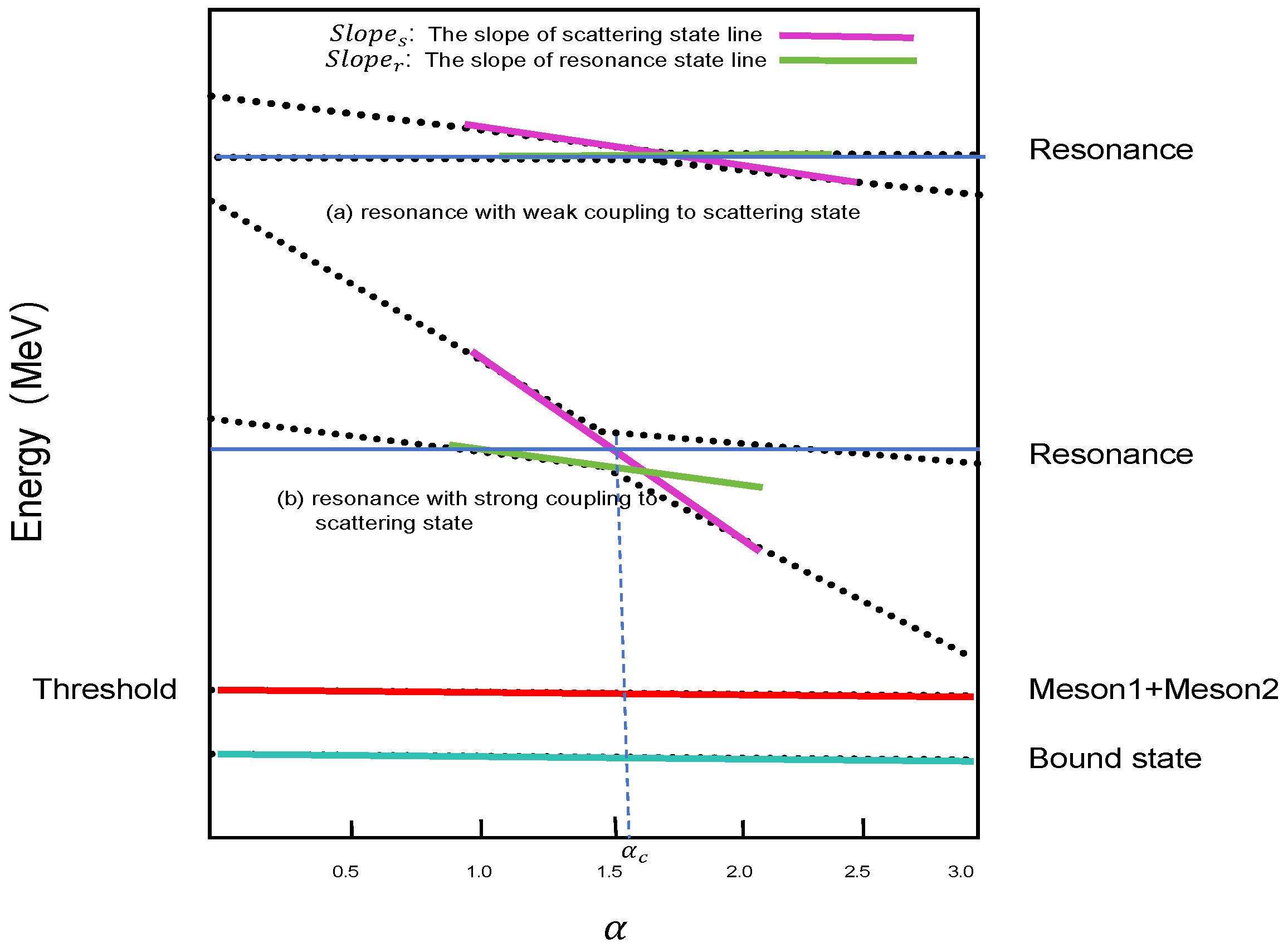
In this approach, false resonant states, typically represented by superabundant colorful subclusters (such as molecular hidden-color states or diquark structures), collapse to the corresponding threshold. On the other hand, genuine resonances persist after coupling to the scattering states and remain stable as increases. Genuine resonances manifest in two distinct forms:
1.
Weak Coupling: If the energy of a scattering state significantly differs from the resonance energy, indicating weak or no coupling between the resonance and the scattering state, the resonance appears as a stable straight line, as shown in Figure 1a.
2.
Strong Coupling: When the energy of a scattering state approaches that of the resonance, indicating strong coupling, an avoided crossing structure appears between the two declining lines, as shown in Figure 1b.
The decay width [30] can be estimated from the slopes of the resonance and scattering states using the following formula:
In this equation, represents the slope of the resonance, is the slope of the scattering state, and denotes the energy difference between the resonance and the scattering state. As increases, the avoided crossing structure repeats, providing valuable insights into the resonance behavior.
4. Results and Discussion
In this section, we present and discuss the bound- and resonance-state calculations for the four-quark system. For the bound-state calculations, we focus on the binding energy of each state, as well as the results from the complete channel-coupling calculations. In the resonance-state calculations, we take full advantage of the real-scaling method, systematically searching for possible resonance and bound states, and calculating the decay widths of the resonances. Finally, we employ root mean square (RMS) distance analysis to reveal the internal structure of the obtained resonance states.
4.1. Bound-State Calculation
The goal of this study is to predict the orbital excitation state of the experimentally observed , which is considered a four-quark system with and in the quark model, to its state. In our approach, we assume that the four-quark state has the total orbital angular momentum as defined in Equation (11) and the total spin as specified in Equation (8).
Table 3 lists our calculated results for the lowest-lying tetraquark states. The first column presents the allowed molecular and diquark configurations. The second column gives the corresponding indices of the wave functions, while the third column shows the energies of each physical channel. The fourth column displays the component percentages of the lowest-lying energy state obtained from the complete coupled-channel calculations. The last row indicates the lowest threshold of the tetraquark system. As shown in Table 3, five molecular channels, , , , , and , are investigated in both color-singlet and color-octet configurations, together with four diquark–antidiquark channels (denoted as -). According to our calculations, the color-singlet molecular configurations exhibit relatively lower energies, ranging from 4.3 to 4.5 GeV, all of which correspond to scattering states. In contrast, the color-octet and diquark configurations lie higher in energy, around 4.5 to 4.7 GeV. When the channel-coupling effects are taken into account, a bound state emerges with a total energy of MeV, corresponding to a binding energy of approximately 8 MeV. Because of the considerable energy gap between the color-singlet and color-nonsinglet (color-octet and diquark) components, this bound state is dominated by the color-singlet configuration, while the color-nonsinglet components contribute only about %.
We note that each color-singlet configuration is not a bound state, yet a stable bound state can be obtained after complete coupled-channel calculations, with its dominant components being (), (), and (). To investigate the underlying reason for this phenomenon, we perform channel-coupling calculations for the dominant components , , and of this bound state. The results, as shown in Table 4, indicate that these components do not form a bound state by themselves, but their energies are extremely close to the final threshold (). We argue that although the color-nonsinglet components in the system account for only , they play a crucial role in the formation of the final bound state. To further explore the mechanism underlying the formation of this bound state, we investigate the contribution of each Hamiltonian term to the bound state. Table 5 presents the values obtained by subtracting the Hamiltonian terms at the threshold from those in the bound state, where positive values indicate a repulsive effect of the corresponding term, while negative values signify an attractive effect. It can be seen that the attractive interaction is dominated by meson exchanges involving the , , and mesons, which implies that this bound state has a loose structure. This result is consistent with our calculation of the root mean square (RMS) distance presented in Table 6, which shows that the inter-cluster rms distance of the state is slightly larger than 1 fm.
4.2. Resonance-State Calculations
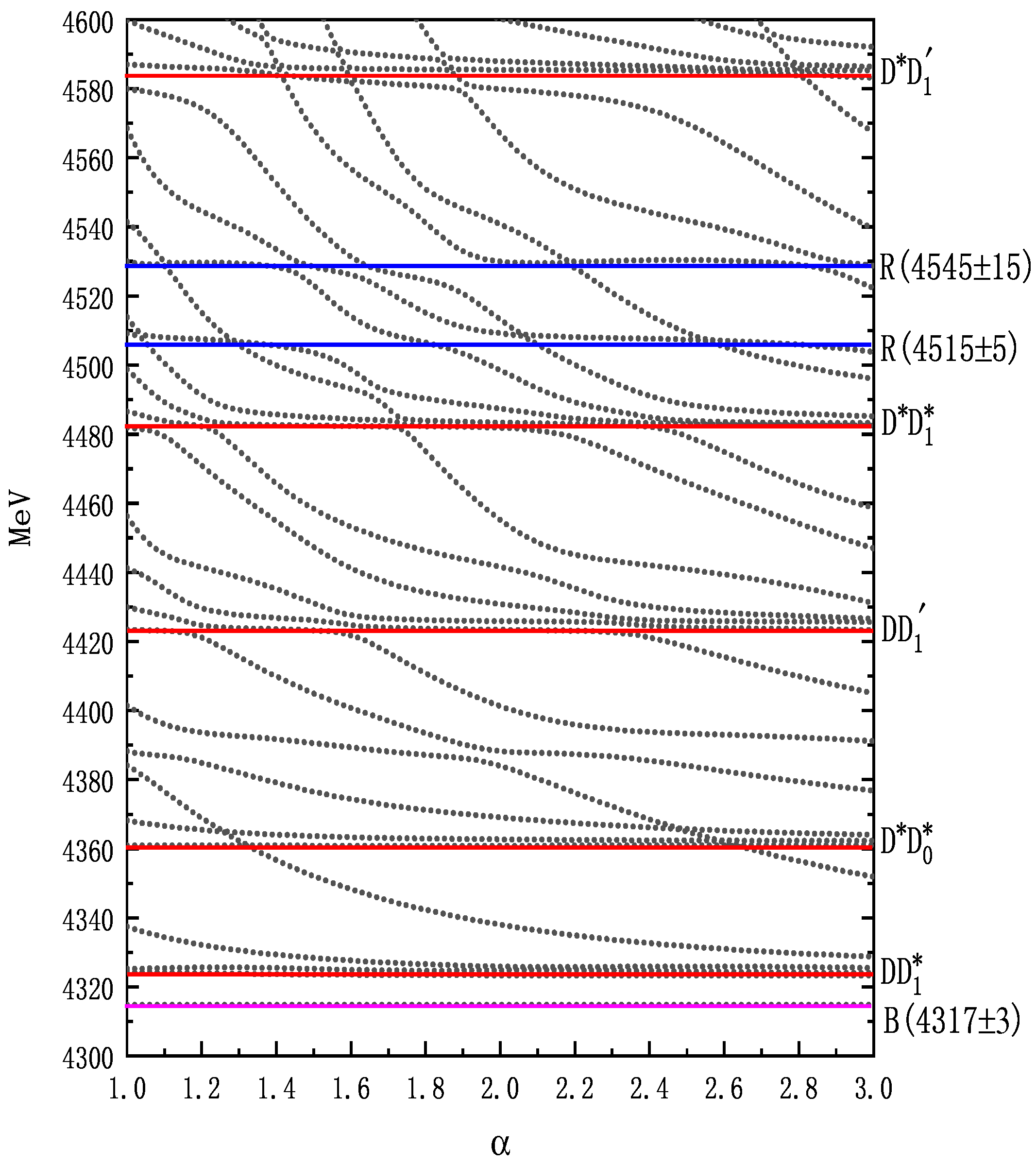
In the system, there are a total of nine colorful structures, including four diquark configurations and five color-octet states. Strong attraction exists within these structures, providing a resonant mechanism for the formation of resonance states. Within the framework of the real-scaling method, we performed complete coupled-channel calculations, incorporating these color configurations and five color-singlet states: , , , , and . We obtained two resonance states, denoted as and , with energies around 4.5 GeV, and a bound state with energy near 4.3 GeV, which are shown in Figure 2. According to our component analysis (Table 7), both resonance states are primarily dominated by the color-octet structures, contributing approximately , and both also contain significant contributions from the good diquark components, ranging from to . Furthermore, the root mean square (RMS) distance analysis (Table 6) shows that both resonance states are compact tetraquark structures with inter-quark distances around 1 fm. Utilizing Equation (16), we also find that their decay widths are relatively narrow, both being less than 3 MeV. Therefore, we conclude that the two resonance states we obtained are likely degenerate states.
5. Summary
In the framework of the chiral quark model, we performed bound- and resonance-state calculations for the system. With the help of the Gaussian expansion method, we considered two types of quark configurations: the molecular structure, which includes five molecular states and their corresponding color-octet states, and the diquark structure, which includes four physical channels. We then performed a coupled-channel calculation of these two structures.
Our bound-state calculation shows that we obtained a stable bound state with a binding energy of approximately 8 MeV, mainly composed of (about %). This result is similar to the state reported by the LHCb experiment, where the main component is . Regarding our resonance-state calculations, we obtained two stable resonance states, which are mainly composed of color structures (color-octet and diquark structures), with the “good diquark” (-) playing a significant role. Due to the strong attraction within the color structure, the inter-quark distance for both resonance states is around 1 fm. Given the similarity in mass, width, and composition of these two resonance states, we suggest that they are degenerate states.
Considering that the state was experimentally discovered first, followed by the discovery of its partner , we suggest that related experiments be conducted to search for the predicted bound states and resonances in the and systems.
Author Contributions
Conceptualization, Y.T. and Y.W.; methodology, Y.T.; software, L.L. and Y.X.; validation, Y.W., X.W. and Y.X.; formal analysis, Y.W.; investigation, Y.W., L.L., Y.X., X.W. and Y.T.; resources, Y.T.; data curation, L.L. and Y.X.; writing—original draft preparation, Y.W. and L.L.; writing—review and editing, Y.T. and X.W.; visualization, Y.X. and X.W.; supervision, Y.T.; project administration, Y.T.; funding acquisition, Y.T. and Y.W. All authors have read and agreed to the published version of the manuscript.
Funding
This work is supported partly by the National Science Foundation of China under Contract No. 12205249. Y.T. is supported by the Funding for School-Level Research Projects of Yancheng Institute of Technology under Grant Nos. xjr2022039 and 2025010, and the Qinglan Project of Jiangsu Province of China.
Data Availability Statement
The original contributions presented in this study are included in the article. Further inquiries can be directed to the corresponding authors.
Conflicts of Interest
The authors declare no conflicts of interest.
References
Choi, S.-K.; Olsen, S.L.; Abe, K.; Abe, T.; Adachi, I.; Ahn, B.S.; Aihara, H.; Akai, K.; Akatsu, M.; Belle Collaboration. Observation of a narrow charmonium-like state in exclusive B± → K±π+π−J/ψ decays. Phys. Rev. Lett.2003, 91, 262001. [Google Scholar] [CrossRef]
Aubert, B.; Barate, R.; Boutigny, D.; Couderc, F.; Karyotakis, Y.; Lees, J.P.; Poireau, V.; Tisserand1, V.; Zghiche, A.; BABAR Collaboration. Observation of a broad structure in the π+π−J/ψ mass spectrum around 4.26-GeV/c2. Phys. Rev. Lett.2005, 95, 142001. [Google Scholar] [CrossRef]
Lees, J.; Poireau, V.; Tisserand, V.; Tico, J.G.; Grauges, E.; Palano, A.; Eigen, G.; Stugu, B.; Brown, D.; BaBar Collaboration. Study of the reaction e+e− → ψ(2S)π−π− via initial-state radiation at BaBar. Phys. Rev. D2014, 89, 111103. [Google Scholar] [CrossRef]
Jia, S.; Shen, C.; Yuan, C.; Wang, X.; Adachi, I.; Aihara, H.; Asner, D.; Atmacan, H.; Aulchenko, V.; Belle Collaboration. Observation of a vector charmoniumlike state in e+e− → Ds1(2536)− + c.c. Phys. Rev. D2019, 100, 111103. [Google Scholar] [CrossRef]
Bondar, A.; Garmash, A.; Mizuk, R.; Santel, D.; Kinoshita, K.; Adachi, I.; Aihara, H.; Arinstein, K.; Asner, D.M.; Belle Collaboration. Observation of two charged bottomonium-like resonances in Y(5S) decays. Phys. Rev. Lett.2012, 108, 122001. [Google Scholar] [CrossRef] [PubMed]
Tan, Y.; Ping, J. X(3872) in an unquenched quark model. Phys. Rev. D2019, 100, 034022. [Google Scholar] [CrossRef]
Tan, Y.; Ping, J. Y(4626) in a chiral constituent quark model. Phys. Rev. D2020, 101, 054010. [Google Scholar] [CrossRef]
Yang, Y.; Ping, J.; Deng, C.; Zong, H.S. Possible interpretation of the Zb(10610) and Zb(10650) in a chiral quark model. J. Phys. G Nucl. Part. Phys.2012, 39, 105001. [Google Scholar] [CrossRef]
Tornqvist, N.A. Isospin breaking of the narrow charmonium state of Belle at 3872-MeV as a deuson. Phys. Lett. B2004, 590, 209–215. [Google Scholar] [CrossRef]
Qin, W.; Xue, S.R.; Zhao, Q. Probing Y(4260) as the + c.c. Hadronic Molecule State in e+e− Annihilations. JPS Conf. Proc.2017, 13, 020022. [Google Scholar] [CrossRef]
Aaij, R.; LHCb Collaboration. Study of the doubly charmed tetraquark . Nat. Commun.2022, 13, 3351. [Google Scholar] [CrossRef]
Meng, L.; Wang, G.J.; Wang, B.; Zhu, S.L. Probing the long-range structure of the Tcc+ with the strong and electromagnetic decays. Phys. Rev. D2021, 104, 051502. [Google Scholar] [CrossRef]
Feijoo, A.; Liang, W.H.; Oset, E. D0D0π+ mass distribution in the production of the Tcc exotic state. Phys. Rev. D2021, 104, 114015. [Google Scholar] [CrossRef]
Deng, C.; Zhu, S.L. Tcc+ and its partners. Phys. Rev. D2022, 105, 054015. [Google Scholar] [CrossRef]
Yan, M.J.; Valderrama, M.P. Subleading contributions to the decay width of the Tcc+ tetraquark. Phys. Rev. D2022, 105, 014007. [Google Scholar] [CrossRef]
Guo, T.; Li, J.; Zhao, J.; He, L. Mass spectra of doubly heavy tetraquarks in an improved chromomagnetic interaction model. Phys. Rev. D2022, 105, 014021. [Google Scholar] [CrossRef]
Mutuk, H. Doubly-charged Tcc++ states in the dynamical diquark model. Phys. Rev. D2024, 110, 034025. [Google Scholar] [CrossRef]
Wang, G.J.; Yang, Z.; Wu, J.J.; Oka, M.; Zhu, S.L. New insight into the exotic states strongly coupled with the DD* from the Tcc+. Sci. Bull.2024, 69, 3036–3041. [Google Scholar] [CrossRef]
Montesinos, V.; Albaladejo, M.; Nieves, J.; Tolos, L. Properties of the Tcc(3875)+ and Tc−c−(3875)− and their heavy-quark spin partners in nuclear matter. Phys. Rev. C2023, 108, 035205. [Google Scholar] [CrossRef]
Gil-Domínguez, F.; Giachino, A.; Molina, R. Quark mass dependence of the Tcc(3875)+ pole. Phys. Rev. C2025, 111, 016029. [Google Scholar] [CrossRef]
Wang, Z.G.; Yan, Z.H. Analysis of the scalar, axialvector, vector, tensor doubly charmed tetraquark states with QCD sum rules. Eur. Phys. J. C2018, 78, 19. [Google Scholar] [CrossRef]
Simons, J. Resonance state lifetimes from stabilization graphs. J. Chem. Phys.1981, 75, 2465. [Google Scholar] [CrossRef]
Vijande, J.; Fernandez, F.; Valcarce, A. Constituent quark model study of the meson spectra. J. Phys. G2005, 31, 481. [Google Scholar] [CrossRef]
Tan, Y.; Liu, X.; Chen, X.; Yang, Y.; Huang, H.; Ping, J. Dynamical study of D*DK and D*DD− systems at quark level. Phys. Rev. D2024, 110, 016005. [Google Scholar] [CrossRef]
Tan, Y.; Liu, X.; Chen, X.; Wu, Y.; Huang, H.; Ping, J. Equivalence among color-singlet, color-octet, and diquark structures in a chiral quark model. Phys. Rev. D2024, 109, 076026. [Google Scholar] [CrossRef]
Goldman, J.T.; Yankielowicz, S. Comment on Charmonium Bound State Calculations Using Potentials. Phys. Rev. D1975, 12, 2910. [Google Scholar] [CrossRef]
Taylor, H.S. Interpretations, and Calculations Concerning Resonant Electron Scattering Processes in Atoms and Molecules. Adv. Chem. Phys.1970, 18, 91–147. [Google Scholar]
Hiyama, E.; Hosaka, A.; Oka, M.; Richard, J.M. Quark model estimate of hidden-charm pentaquark resonances. Phys. Rev. C2018, 98, 045208. [Google Scholar] [CrossRef]
Lin, L.; Hu, X.; Wu, Y.X.X.; Xu, N.; Zhu, Y.; Tan, Y.; Wu, Y. Search for Possible Stable Structures in the System. Atoms2026, 14, 6. [Google Scholar] [CrossRef]
Figure 1.
Two types of resonance states: (a) resonance with weak coupling (or no coupling) to the scattering states; (b) resonance with strong coupling to the scattering states.
Figure 1.
Two types of resonance states: (a) resonance with weak coupling (or no coupling) to the scattering states; (b) resonance with strong coupling to the scattering states.
Figure 2.
Real-scaling results for the four-quark system.
Figure 2.
Real-scaling results for the four-quark system.
Table 1.
Quark model parameters ( , , , ).There are two sets of chiral quark model parameters, the different parts of which are separated by “/”.
Table 1.
Quark model parameters ( , , , ).There are two sets of chiral quark model parameters, the different parts of which are separated by “/”.
Quark masses
(MeV)
490/485
(MeV)
1650/1750
Goldstone bosons
3.5
2.2
7.0
2.5
1.2
0.54
−15
Confinement
(MeV)
98/96
(MeV)
−18.1/−30.1
OGE
0.69
0.85/0.88
0.95
(MeV)
80.9
Table 2.
Mass of D-meson family. QM denotes the results of the present model, while QM (mixed) denotes the mass of the states after a coupled-channel calculation between and , which have the same .
Table 2.
Mass of D-meson family. QM denotes the results of the present model, while QM (mixed) denotes the mass of the states after a coupled-channel calculation between and , which have the same .
Spin
State
QM
QM (Mix)
0
0
1
0
1
1
Table 3.
Results of the bound-state calculations for the system. The indices i, j, k, and l represent the orbital, spin, flavor, and color quantum numbers, respectively (unit: MeV).
Table 3.
Results of the bound-state calculations for the system. The indices i, j, k, and l represent the orbital, spin, flavor, and color quantum numbers, respectively (unit: MeV).
Channel
E
Percent
-
-
-
-
Complete coupled channels:
Threshold (D + ):
Table 4.
Results of the bound-state calculations for the system, covering the three channels: , , and . The indices i, j, k, and l represent the orbital, spin, flavor, and color quantum numbers, respectively (unit: MeV).
Table 4.
Results of the bound-state calculations for the system, covering the three channels: , , and . The indices i, j, k, and l represent the orbital, spin, flavor, and color quantum numbers, respectively (unit: MeV).
Channel
E
Percent
Complete coupled channels:
Threshold (D + ):
Table 5.
The contributions of all potentials to the binding energy (unit: MeV) in the system.
Table 5.
The contributions of all potentials to the binding energy (unit: MeV) in the system.
kinetic
con
oge
Table 6.
The root mean square distances and widths (unit: fm) of stable states in the four-quark systems.
Table 6.
The root mean square distances and widths (unit: fm) of stable states in the four-quark systems.
-
2.2
0.8
Table 7.
Results of the resonance calculations in the system (unit: MeV).
Table 7.
Results of the resonance calculations in the system (unit: MeV).
-
-
-
-
Disclaimer/Publisher’s Note: The statements, opinions and data contained in all publications are solely those of the individual author(s) and contributor(s) and not of MDPI and/or the editor(s). MDPI and/or the editor(s) disclaim responsibility for any injury to people or property resulting from any ideas, methods, instructions or products referred to in the content.
Wu, Y.; Li, L.; Xing, Y.; Wu, X.; Tan, Y.
Searching for Stable States in the TDD1 Systems Based on a Chiral Quark Model. Particles2026, 9, 35.
https://doi.org/10.3390/particles9020035
AMA Style
Wu Y, Li L, Xing Y, Wu X, Tan Y.
Searching for Stable States in the TDD1 Systems Based on a Chiral Quark Model. Particles. 2026; 9(2):35.
https://doi.org/10.3390/particles9020035
Chicago/Turabian Style
Wu, Yuheng, Linkai Li, Yuheng Xing, Xinxing Wu, and Yue Tan.
2026. "Searching for Stable States in the TDD1 Systems Based on a Chiral Quark Model" Particles 9, no. 2: 35.
https://doi.org/10.3390/particles9020035
APA Style
Wu, Y., Li, L., Xing, Y., Wu, X., & Tan, Y.
(2026). Searching for Stable States in the TDD1 Systems Based on a Chiral Quark Model. Particles, 9(2), 35.
https://doi.org/10.3390/particles9020035
Article Metrics
No
No
Article Access Statistics
For more information on the journal statistics, click here.
Multiple requests from the same IP address are counted as one view.
Wu, Y.; Li, L.; Xing, Y.; Wu, X.; Tan, Y.
Searching for Stable States in the TDD1 Systems Based on a Chiral Quark Model. Particles2026, 9, 35.
https://doi.org/10.3390/particles9020035
AMA Style
Wu Y, Li L, Xing Y, Wu X, Tan Y.
Searching for Stable States in the TDD1 Systems Based on a Chiral Quark Model. Particles. 2026; 9(2):35.
https://doi.org/10.3390/particles9020035
Chicago/Turabian Style
Wu, Yuheng, Linkai Li, Yuheng Xing, Xinxing Wu, and Yue Tan.
2026. "Searching for Stable States in the TDD1 Systems Based on a Chiral Quark Model" Particles 9, no. 2: 35.
https://doi.org/10.3390/particles9020035
APA Style
Wu, Y., Li, L., Xing, Y., Wu, X., & Tan, Y.
(2026). Searching for Stable States in the TDD1 Systems Based on a Chiral Quark Model. Particles, 9(2), 35.
https://doi.org/10.3390/particles9020035