


An Empirical Consistent Redshift Bias: A Possible Direct Observation of Zwicky’s TL Theory


Abstract
1. Introduction
2. A Possible Link between Galaxy Rotational Velocity and Redshift
3. Analysis of HSC DR3 Galaxies
4. Verification Using a Third-Party Dataset
5. Possible Link to Zwicky’s “Tired-Light” Model
6. Conclusions
Funding
Data Availability Statement
Acknowledgments
Conflicts of Interest
References
- Curtis-Lake, E.; Carniani, S.; Cameron, A.; Charlot, S.; Jakobsen, P.; Maiolino, R.; Bunker, A.; Witstok, J.; Smit, R.; Chevallard, J.; et al. Spectroscopic confirmation of four metal-poor galaxies at z= 10.3–13.2. Nat. Astron. 2023, 7, 622–632. [Google Scholar] [CrossRef]
- Whitler, L.; Endsley, R.; Stark, D.P.; Topping, M.; Chen, Z.; Charlot, S. On the ages of bright galaxies 500 Myr after the big bang: Insights into star formation activity at z>15 with JWST. Mon. Not. R. Astron. Soc. 2023, 519, 157–171. [Google Scholar] [CrossRef]
- Cowley, W.I.; Baugh, C.M.; Cole, S.; Frenk, C.S.; Lacey, C.G. Predictions for deep galaxy surveys with JWST from ΛCDM. Mon. Not. R. Astron. Soc. 2018, 474, 2352–2372. [Google Scholar] [CrossRef]
- Glazebrook, K.; Nanayakkara, T.; Schreiber, C.; Lagos, C.; Kawinwanichakij, L.; Jacobs, C.; Chittenden, H.; Brammer, G.; Kacprzak, G.G.; Labbe, I.; et al. A massive galaxy that formed its stars at z˜ 11. Nature 2024, 628, 277–281. [Google Scholar] [CrossRef]
- Neeleman, M.; Prochaska, J.X.; Kanekar, N.; Rafelski, M. A cold, massive, rotating disk galaxy 1.5 billion years after the Big Bang. Nature 2020, 581, 269–272. [Google Scholar] [CrossRef] [PubMed]
- Wu, H.Y.; Huterer, D. Sample variance in the local measurements of the Hubble constant. Mon. Not. R. Astron. Soc. 2017, 471, 4946–4955. [Google Scholar] [CrossRef]
- Mörtsell, E.; Dhawan, S. Does the Hubble constant tension call for new physics? J. Cosmol. Astropart. Phys. 2018, 2018, 025. [Google Scholar] [CrossRef]
- Bolejko, K. Emerging spatial curvature can resolve the tension between high-redshift CMB and low-redshift distance ladder measurements of the Hubble constant. Phys. Rev. D 2018, 97, 103529. [Google Scholar] [CrossRef]
- Davis, T.M.; Hinton, S.R.; Howlett, C.; Calcino, J. Can redshift errors bias measurements of the Hubble Constant? Mon. Not. R. Astron. Soc. 2019, 490, 2948–2957. [Google Scholar] [CrossRef]
- Pandey, S.; Raveri, M.; Jain, B. Model independent comparison of supernova and strong lensing cosmography: Implications for the Hubble constant tension. Phys. Rev. D 2020, 102, 023505. [Google Scholar] [CrossRef]
- Camarena, D.; Marra, V. Local determination of the Hubble constant and the deceleration parameter. Phys. Rev. Res. 2020, 2, 013028. [Google Scholar] [CrossRef]
- Di Valentino, E.; Mena, O.; Pan, S.; Visinelli, L.; Yang, W.; Melchiorri, A.; Mota, D.F.; Riess, A.G.; Silk, J. In the realm of the Hubble tension—A review of solutions. Class. Quantum Gravity 2021, 38, 153001. [Google Scholar] [CrossRef]
- Riess, A.G.; Yuan, W.; Macri, L.M.; Scolnic, D.; Brout, D.; Casertano, S.; Jones, D.O.; Murakami, Y.; Anand, G.S.; Breuval, L.; et al. A comprehensive measurement of the local value of the Hubble constant with 1 km s−1 Mpc−1 uncertainty from the Hubble Space Telescope and the SH0ES team. Astrophys. J. Lett. 2022, 934, L7. [Google Scholar] [CrossRef]
- Crawford, D.F. Curvature pressure in a cosmology with a tired-light redshift. Aust. J. Phys. 1999, 52, 753–777. [Google Scholar] [CrossRef]
- Pletcher, A.E. Why Mature Galaxies Seem to have Filled the Universe shortly after the Big Bang. Qeios 2023. [Google Scholar]
- Gupta, R. JWST early Universe observations and ΛCDM cosmology. Mon. Not. R. Astron. Soc. 2023, 524, 3385–3395. [Google Scholar] [CrossRef]
- Lee, S. The cosmological evolution condition of the Planck constant in the varying speed of light models through adiabatic expansion. Phys. Dark Universe 2023, 42, 101286. [Google Scholar] [CrossRef]
- Lovyagin, N.; Raikov, A.; Yershov, V.; Lovyagin, Y. Cosmological model tests with JWST. Galaxies 2022, 10, 108. [Google Scholar] [CrossRef]
- Marrucci, L. Spinning the Doppler effect. Science 2013, 341, 464–465. [Google Scholar] [CrossRef]
- Lavery, M.P.; Barnett, S.M.; Speirits, F.C.; Padgett, M.J. Observation of the rotational Doppler shift of a white-light, orbital-angular-momentum-carrying beam backscattered from a rotating body. Optica 2014, 1, 1–4. [Google Scholar] [CrossRef]
- Liu, B.; Chu, H.; Giddens, H.; Li, R.; Hao, Y. Experimental observation of linear and rotational Doppler shifts from several designer surfaces. Sci. Rep. 2019, 9, 8971. [Google Scholar] [CrossRef]
- Oort, J.H. Some Problems Concerning the Structure and Dynamics of the Galactic System and the Elliptical Nebulae NGC 3115 and 4494. Astrophys. J. 1940, 91, 273. [Google Scholar] [CrossRef]
- Rubin, V.C. The rotation of spiral galaxies. Science 1983, 220, 1339–1344. [Google Scholar] [CrossRef] [PubMed]
- El-Neaj, Y.A.; Alpigiani, C.; Amairi-Pyka, S.; Araújo, H.; Balaž, A.; Bassi, A.; Bathe-Peters, L.; Battelier, B.; Belić, A.; Bentine, E.; et al. AEDGE: Atomic experiment for dark matter and gravity exploration in space. EPJ Quantum Technol. 2020, 7, 1–27. [Google Scholar] [CrossRef]
- Milgrom, M. A modification of the Newtonian dynamics as a possible alternative to the hidden mass hypothesis. Astrophys. J. 1983, 270, 365–370. [Google Scholar] [CrossRef]
- Sanders, R. Mass discrepancies in galaxies: Dark matter and alternatives. Astron. Astrophys. Rev. 1990, 2, 1–28. [Google Scholar] [CrossRef]
- Capozziello, S.; De Laurentis, M. The dark matter problem from f (R) gravity viewpoint. Ann. Phys. 2012, 524, 545–578. [Google Scholar] [CrossRef]
- Chadwick, E.A.; Hodgkinson, T.F.; McDonald, G.S. Gravitational theoretical development supporting MOND. Phys. Rev. D 2013, 88, 024036. [Google Scholar] [CrossRef]
- Farnes, J.S. A unifying theory of dark energy and dark matter: Negative masses and matter creation within a modified ΛCDM framework. Astron. Astrophys. 2018, 620, A92. [Google Scholar] [CrossRef]
- Rivera, P.C. An Alternative Model of Rotation Curve that Explains Anomalous Orbital Velocity, Mass Discrepancy and Structure of Some Galaxies. Am. J. Astron. Astrophys. 2020, 7, 73–79. [Google Scholar] [CrossRef]
- Nagao, S. Galactic Evolution Showing a Constant Circulating Speed of Stars in a Galactic Disc without Requiring Dark Matter. Rep. Adv. Phys. Sci. 2020, 4, 2050004. [Google Scholar] [CrossRef]
- Blake, B.C. Relativistic Beaming of Gravity and the Missing Mass Problem. J. Cosmol. 2022, 26, 15390–15409. [Google Scholar]
- Gomel, R.; Zimmerman, T. The Effects of Inertial Forces on the Dynamics of Disk Galaxies. Galaxies 2021, 9, 34. [Google Scholar] [CrossRef]
- Skordis, C.; Złośnik, T. New relativistic theory for modified Newtonian dynamics. Pattern Recognit. Lett. 2021, 127, 161302. [Google Scholar] [CrossRef] [PubMed]
- Larin, S.A. Towards the Explanation of Flatness of Galaxies Rotation Curves. Universe 2022, 8, 632. [Google Scholar] [CrossRef]
- Mannheim, P.D. Alternatives to dark matter and dark energy. Prog. Part. Nucl. Phys. 2006, 56, 340–445. [Google Scholar] [CrossRef]
- Kroupa, P. The dark matter crisis: Falsification of the current standard model of cosmology. Publ. Astron. Soc. Aust. 2012, 29, 395–433. [Google Scholar] [CrossRef]
- Kroupa, P.; Pawlowski, M.; Milgrom, M. The failures of the standard model of cosmology require a new paradigm. Int. J. Mod. Phys. D 2012, 21, 1230003. [Google Scholar] [CrossRef]
- Kroupa, P. Galaxies as simple dynamical systems: Observational data disfavor dark matter and stochastic star formation. Can. J. Phys. 2015, 93, 169–202. [Google Scholar] [CrossRef]
- Arun, K.; Gudennavar, S.; Sivaram, C. Dark matter, dark energy, and alternate models: A review. Adv. Space Res. 2017, 60, 166–186. [Google Scholar] [CrossRef]
- Akerib, D.S.; Alsum, S.; Araújo, H.M.; Bai, X.; Bailey, A.J.; Balajthy, J.; Beltrame, P.; Bernard, E.P.; Bernstein, A.; Biesiadzinski, T.P.; et al. Results from a Search for Dark Matter in the Complete LUX Exposure. Phys. Rev. Lett. 2017, 118, 021303. [Google Scholar] [CrossRef]
- Bertone, G.; Tait, T.M. A new era in the search for dark matter. Nature 2018, 562, 51–56. [Google Scholar] [CrossRef]
- Aprile, E.; Aalbers, J.; Agostini, F.; Alfonsi, M.; Althueser, L.; Amaro, F.D.; Anthony, M.; Arneodo, F.; Baudis, L.; Bauermeister, B.; et al. Dark Matter Search Results from a One Ton-Year Exposure of XENON1T. Phys. Rev. Lett. 2018, 121, 111302. [Google Scholar] [CrossRef] [PubMed]
- Skordis, C.; Złośnik, T. Gravitational alternatives to dark matter with tensor mode speed equaling the speed of light. Phys. Rev. D 2019, 100, 104013. [Google Scholar] [CrossRef]
- Sivaram, C.; Arun, K.; Rebecca, L. MOND, MONG, MORG as alternatives to dark matter and dark energy, and consequences for cosmic structures. J. Astrophys. Astron. 2020, 41, 1–6. [Google Scholar] [CrossRef]
- Hofmeister, A.M.; Criss, R.E. Debate on the Physics of Galactic Rotation and the Existence of Dark Matter. Galaxies 2020, 8, 54. [Google Scholar] [CrossRef]
- Byrd, G.; Howard, S. Spiral galaxies when disks dominate their halos (using arm pitches and rotation curves). J. Wash. Acad. Sci. 2021, 107, 1. [Google Scholar]
- Haslbauer, M.; Banik, I.; Kroupa, P.; Wittenburg, N.; Javanmardi, B. The high fraction of thin disk galaxies continues to challenge ΛCDM cosmology. Astrophys. J. 2022, 925, 183. [Google Scholar] [CrossRef]
- Haslbauer, M.; Kroupa, P.; Zonoozi, A.H.; Haghi, H. Has JWST already falsified dark-matter-driven galaxy formation? Astrophys. J. Lett. 2022, 939, L31. [Google Scholar] [CrossRef]
- Shamir, L. A Simple Direct Empirical Observation of Systematic Bias of the Redshift as a Distance Indicator. Universe 2024, 10, 129. [Google Scholar] [CrossRef]
- Buta, R.J.; Byrd, G.G.; Freeman, T. The ringed spiral galaxy NGC 4622. I. Photometry, kinematics, and the case for two strong leading outer spiral arms. Astron. J. 2003, 125, 634. [Google Scholar] [CrossRef]
- Shamir, L. Ganalyzer: A tool for automatic galaxy image analysis. Astrophys. J. 2011, 736, 141. [Google Scholar] [CrossRef]
- Shamir, L. Ganalyzer: A tool for automatic galaxy image analysis. ASCL 2011, ascl:1105.011. [Google Scholar]
- Davis, D.R.; Hayes, W.B. SpArcFiRe: Scalable Automated Detection of Spiral Galaxy Arm Segments. Astrophys. J. 2014, 790, 87. [Google Scholar] [CrossRef]
- Davis, D.; Hayes, W. SpArcFiRe: SPiral ARC FInder and REporter. Astrophys. Source Code Libr. 2021, ascl:2107.010. [Google Scholar]
- Lintott, C.J.; Schawinski, K.; Slosar, A.; Land, K.; Bamford, S.; Thomas, D.; Raddick, M.J.; Nichol, R.C.; Szalay, A.; Andreescu, D.; et al. Galaxy Zoo: Morphologies derived from visual inspection of galaxies from the Sloan Digital Sky Survey. Mon. Not. R. Astron. Soc. 2008, 389, 1179–1189. [Google Scholar] [CrossRef]
- Hayes, W.B.; Davis, D.; Silva, P. On the nature and correction of the spurious S-wise spiral galaxy winding bias in Galaxy Zoo 1. Mon. Not. R. Astron. Soc. 2017, 466, 3928–3936. [Google Scholar] [CrossRef]
- Shamir, L. Analysis of the alignment of non-random patterns of spin directions in populations of spiral galaxies. Particles 2021, 4, 11–28. [Google Scholar] [CrossRef]
- Shamir, L. Analysis of spin directions of galaxies in the DESI Legacy Survey. Mon. Not. R. Astron. Soc. 2022, 516, 2281–2291. [Google Scholar] [CrossRef]
- Longo, M.J. Detection of a Dipole in the Handedness of Spiral Galaxies with Redshifts z 0.04. Phys. Lett. B 2011, 699, 224–229. [Google Scholar] [CrossRef]
- Zwicky, F. On the redshift of spectral lines through interstellar space. Proc. Natl. Acad. Sci. USA 1929, 15, 773–779. [Google Scholar] [CrossRef] [PubMed]
- Yourgrau, W.; Woodward, J. Tired light and the missing mass problem. Acta Phys. Acad. Sci. Hung. 1971, 30, 323–329. [Google Scholar] [CrossRef]
- Vigier, J.P. Cosmological Implications of Non-Velocity Redshifts—A Tired-Light Mechanism. In Cosmology, History, and Theology; Springer: Berlin/Heidelberg, Germany, 1977; pp. 141–157. [Google Scholar]
- Shao, M.H. The energy loss of photons and cosmological redshift. Phys. Essays 2013, 26, 183–190. [Google Scholar] [CrossRef]
- Kragh, H. Is the universe expanding? Fritz Zwicky and early tired-light hypotheses. J. Astron. Hist. Herit. 2017, 20, 2–12. [Google Scholar] [CrossRef]
- Shao, M.H.; Wang, N.; Gao, Z.F. Tired light denies the big bang. In Redefining Standard Model Cosmology; IntechOpen: London, UK, 2018; pp. 13–29. [Google Scholar]
- Sato, M. Tired light: An alternative interpretation of the accelerating universe. Phys. Essays 2019, 32, 43–47. [Google Scholar] [CrossRef]
- LaViolette, P.A. Expanding or static Universe: Emergence of a new paradigm. Int. J. Astron. Astrophys. 2021, 11, 190–231. [Google Scholar] [CrossRef]
- Lopez-Corredoira, M. History and Problems of the Standard Model in Cosmology. arXiv 2023, arXiv:2307.10606. [Google Scholar]
- Gupta, R.P. On Dark Matter and Dark Energy in CCC+ TL Cosmology. Universe 2024, 10, 266. [Google Scholar] [CrossRef]
- Shamir, L. Galaxy spin direction asymmetry in JWST deep fields. Publ. Astron. Soc. Aust. 2024, 41, e038. [Google Scholar] [CrossRef]
- Shamir, L. Patterns of galaxy spin directions in SDSS and Pan-STARRS show parity violation and multipoles. Astrophys. Space Sci. 2020, 365, 136. [Google Scholar] [CrossRef]
- Shamir, L. Large-scale asymmetry in galaxy spin directions: Analysis of galaxies with spectra in DES, SDSS, and DESI Legacy Survey. Astron. Notes 2022, 343, e20220010. [Google Scholar] [CrossRef]
- Stodden, V.; Seiler, J.; Ma, Z. An empirical analysis of journal policy effectiveness for computational reproducibility. Proc. Natl. Acad. Sci. USA 2018, 115, 2584–2589. [Google Scholar] [CrossRef] [PubMed]
- Baker, M. Reproducibility crisis. Nature 2016, 533, 353–366. [Google Scholar]
- Miyakawa, T. No raw data, no science: Another possible source of the reproducibility crisis. Mol. Brain 2020, 13, 24. [Google Scholar] [CrossRef]
- Sayre, F.; Riegelman, A. The reproducibility crisis and academic libraries. Coll. Res. Libr. 2018, 79, 2. [Google Scholar] [CrossRef]
- Ball, P. Is AI leading to a reproducibility crisis in science? Nature 2023, 624, 22–25. [Google Scholar] [CrossRef]
- Opik, E. An estimate of the distance of the Andromeda Nebula. Astrophys. J. 1922, 55, 406–410. [Google Scholar] [CrossRef]
- Babcock, H.W. The rotation of the Andromeda Nebula. Lick Obs. Bull. 1939, 19, 41–51. [Google Scholar] [CrossRef]
- Rubin, V.C.; Ford, W.K., Jr. Rotation of the Andromeda nebula from a spectroscopic survey of emission regions. Astrophys. J. 1970, 159, 379. [Google Scholar] [CrossRef]
- Rubin, V.C.; Ford, W.K., Jr.; Thonnard, N. Extended rotation curves of high-luminosity spiral galaxies. IV-Systematic dynamical properties, SA through SC. Astrophys. J. 1978, 225, L107–L111. [Google Scholar] [CrossRef]
- Rubin, V.C.; Ford, W.K., Jr.; Thonnard, N. Rotational properties of 21 SC galaxies with a large range of luminosities and radii, from NGC 4605/R= 4kpc/to UGC 2885/R= 122 kpc. Astrophys. J. 1980, 238, 471–487. [Google Scholar] [CrossRef]
- Rubin, V.C.; Burstein, D.; Ford, W.K., Jr.; Thonnard, N. Rotation velocities of 16 Sa galaxies and a comparison of Sa, Sb, and Sc rotation properties. Astrophys. J. 1985, 289, 81–98. [Google Scholar] [CrossRef]
- Sofue, Y.; Rubin, V. Rotation curves of spiral galaxies. Annu. Rev. Astron. Astrophys. 2001, 39, 137–174. [Google Scholar] [CrossRef]
- Khetan, N.; Izzo, L.; Branchesi, M.; Wojtak, R.; Cantiello, M.; Murugeshan, C.; Agnello, A.; Cappellaro, E.; Della Valle, M.; Gall, C.; et al. A new measurement of the Hubble constant using Type Ia supernovae calibrated with surface brightness fluctuations. Astron. Astrophys. 2021, 647, A72. [Google Scholar] [CrossRef]
- McAdam, D.; Shamir, L. Asymmetry between galaxy apparent magnitudes shows a possible tension between physical properties of galaxies and their rotational velocity. Symmetry 2023, 15, 1190. [Google Scholar] [CrossRef]
- Vagnozzi, S. Seven hints that early-time new physics alone is not sufficient to solve the Hubble tension. Universe 2023, 9, 393. [Google Scholar] [CrossRef]
- Javanmardi, B.; Porciani, C.; Kroupa, P.; Pflam-Altenburg, J. Probing the isotropy of cosmic acceleration traced by type Ia supernovae. Astrophys. J. 2015, 810, 47. [Google Scholar] [CrossRef]
- Krishnan, C.; Mohayaee, R.; Colgáin, E.Ó.; Sheikh-Jabbari, M.; Yin, L. Hints of FLRW breakdown from supernovae. Phys. Rev. D 2022, 105, 063514. [Google Scholar] [CrossRef]
- Cowell, J.A.; Dhawan, S.; Macpherson, H.J. Potential signature of a quadrupolar Hubble expansion in Pantheon+ supernovae. arXiv 2022, arXiv:2212.13569. [Google Scholar] [CrossRef]
- McConville, R.; Colgain, E. Anisotropic distance ladder in Pantheon+ supernovae. arXiv 2023, arXiv:2304.02718. [Google Scholar]
- Aluri, P.K.; Cea, P.; Chingangbam, P.; Chu, M.C.; Clowes, R.G.; Hutsemékers, D.; Kochappan, J.P.; Krasiński, A.; Lopez, A.M.; Liu, L.; et al. Is the observable Universe consistent with the cosmological principle? Class. Quantum Gravity 2023, 40, 094001. [Google Scholar] [CrossRef]
- d’Assignies D, W.; Chisari, N.E.; Hamaus, N.; Singh, S. Intrinsic alignments of galaxies around cosmic voids. Mon. Not. R. Astron. Soc. 2022, 509, 1985–1994. [Google Scholar] [CrossRef]
- Kraljic, K.; Davé, R.; Pichon, C. And yet it flips: Connecting galactic spin and the cosmic web. Mon. Not. R. Astron. Soc. 2020, 493, 362–381. [Google Scholar] [CrossRef]
- Ebrahimian, E.; Krishnan, C.; Mondol, R.; Sheikh-Jabbari, M. Towards a realistic dipole cosmology: The dipole ΛCDM model. arXiv 2023, arXiv:2305.16177. [Google Scholar]
- Krishnan, C.; Mondol, R.; Sheikh-Jabbari, M. A Tilt Instability in the Cosmological Principle. arXiv 2022, arXiv:2211.08093. [Google Scholar] [CrossRef]
- Allahyari, A.; Ebrahimian, E.; Mondol, R.; Sheikh-Jabbari, M. Big Bang in Dipole Cosmology. arXiv 2023, arXiv:2307.15791. [Google Scholar]
- Krishnan, C.; Mondol, R.; Sheikh-Jabbari, M. Dipole cosmology: The Copernican paradigm beyond FLRW. J. Cosmol. Astropart. Phys. 2023, 2023, 020. [Google Scholar] [CrossRef]
- Krishnan, C.; Mondol, R.; Jabbari, M.S. Copernican paradigm beyond FLRW. Symmetry 2023, 15, 428. [Google Scholar] [CrossRef]
- Gödel, K. An example of a new type of cosmological solutions of Einstein’s field equations of gravitation. Rev. Mod. Phys. 1949, 21, 447. [Google Scholar] [CrossRef]
- Ozsváth, I.; Schücking, E. Finite rotating universe. Nature 1962, 193, 1168–1169. [Google Scholar] [CrossRef]
- Gödel, K. Rotating universes in general relativity theory. Gen. Relativ. Gravit. 2000, 32, 1419–1427. [Google Scholar] [CrossRef]
- Chechin, L. Rotation of the Universe at different cosmological epochs. Astron. Rep. 2016, 60, 535–541. [Google Scholar] [CrossRef]
- Campanelli, L. A conjecture on the neutrality of matter. Found. Phys. 2021, 51, 56. [Google Scholar] [CrossRef]
- Pathria, R. The universe as a black hole. Nature 1972, 240, 298–299. [Google Scholar] [CrossRef]
- Stuckey, W. The observable universe inside a black hole. Am. J. Phys. 1994, 62, 788–795. [Google Scholar] [CrossRef]
- Easson, D.A.; Brandenberger, R.H. Universe generation from black hole interiors. J. High Energy Phys. 2001, 2001, 024. [Google Scholar] [CrossRef]
- Popławski, N.J. Radial motion into an Einstein–Rosen bridge. Phys. Lett. B 2010, 687, 110–113. [Google Scholar] [CrossRef]
- Christillin, P. The Machian origin of linear inertial forces from our gravitationally radiating black hole Universe. Eur. Phys. J. Plus 2014, 129, 1–3. [Google Scholar] [CrossRef]
- Dymnikova, I. Universes Inside a Black Hole with the de Sitter Interior. Universe 2019, 5, 111. [Google Scholar] [CrossRef]
- Chakrabarty, H.; Abdujabbarov, A.; Malafarina, D.; Bambi, C. A toy model for a baby universe inside a black hole. Eur. Phys. J. C 2020, 80, 1–10. [Google Scholar] [CrossRef]
- Popławski, N.J. A nonsingular, anisotropic universe in a black hole with torsion and particle production. Gen. Relativ. Gravit. 2021, 53, 1–14. [Google Scholar] [CrossRef]
- Gaztanaga, E. The Black Hole Universe, part I. Symmetry 2022, 14, 1849. [Google Scholar] [CrossRef]
- Gaztanaga, E. The Black Hole Universe, Part II. Symmetry 2022, 14, 1984. [Google Scholar] [CrossRef]
- Campanelli, L.; Cea, P.; Tedesco, L. Ellipsoidal universe can solve the cosmic microwave background quadrupole problem. Phys. Rev. Lett. 2006, 97, 131302. [Google Scholar] [CrossRef]
- Campanelli, L.; Cea, P.; Tedesco, L. Cosmic microwave background quadrupole and ellipsoidal universe. Phys. Rev. D 2007, 76, 063007. [Google Scholar] [CrossRef]
- Gruppuso, A. Complete statistical analysis for the quadrupole amplitude in an ellipsoidal universe. Phys. Rev. D 2007, 76, 083010. [Google Scholar] [CrossRef]
- Campanelli, L.; Cea, P.; Fogli, G.; Tedesco, L. Cosmic parallax in ellipsoidal universe. Mod. Phys. Lett. A 2011, 26, 1169–1181. [Google Scholar] [CrossRef]
- Cea, P. The ellipsoidal universe in the Planck satellite era. Mon. Not. R. Astron. Soc. 2014, 441, 1646–1661. [Google Scholar] [CrossRef]
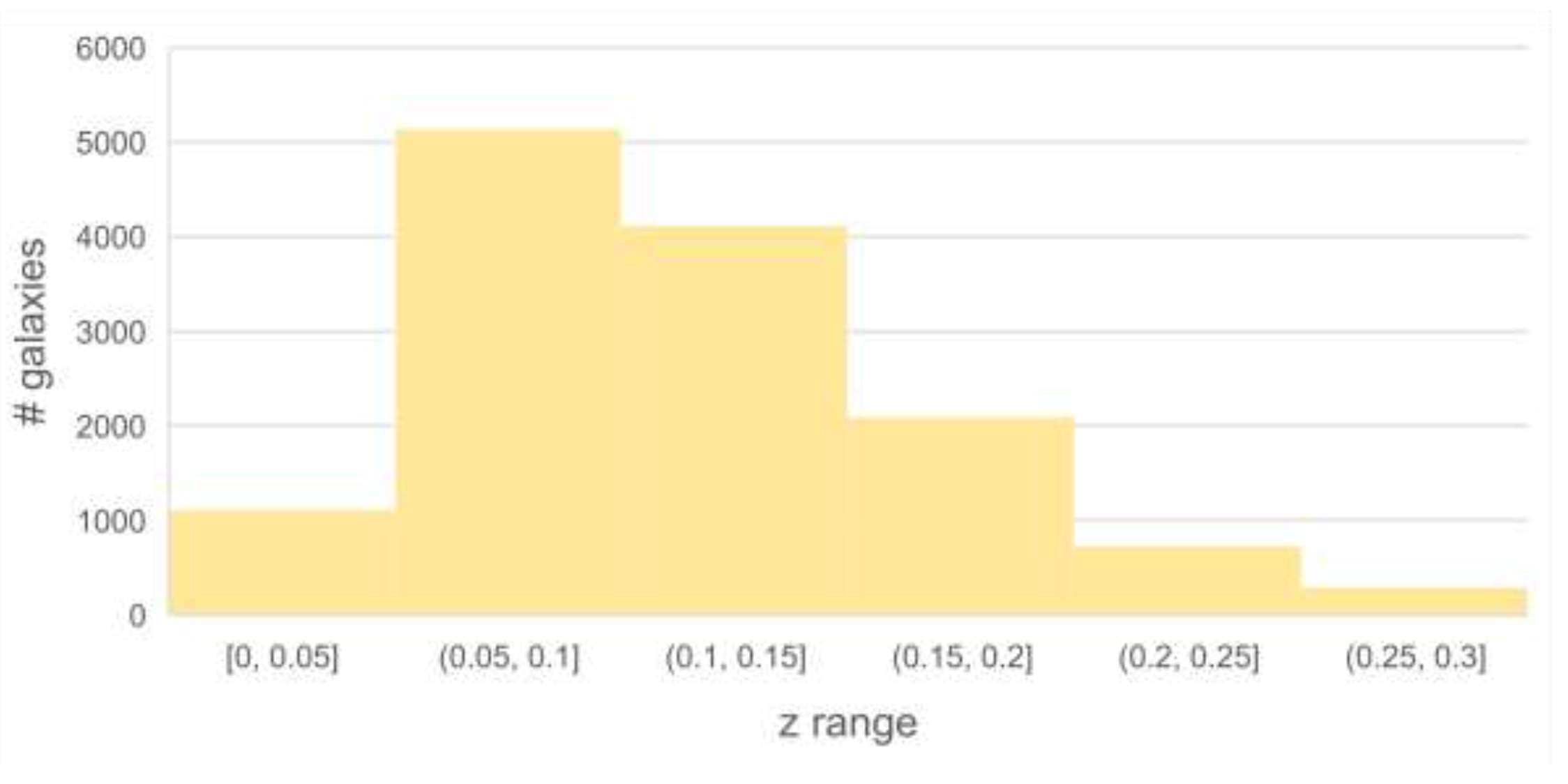
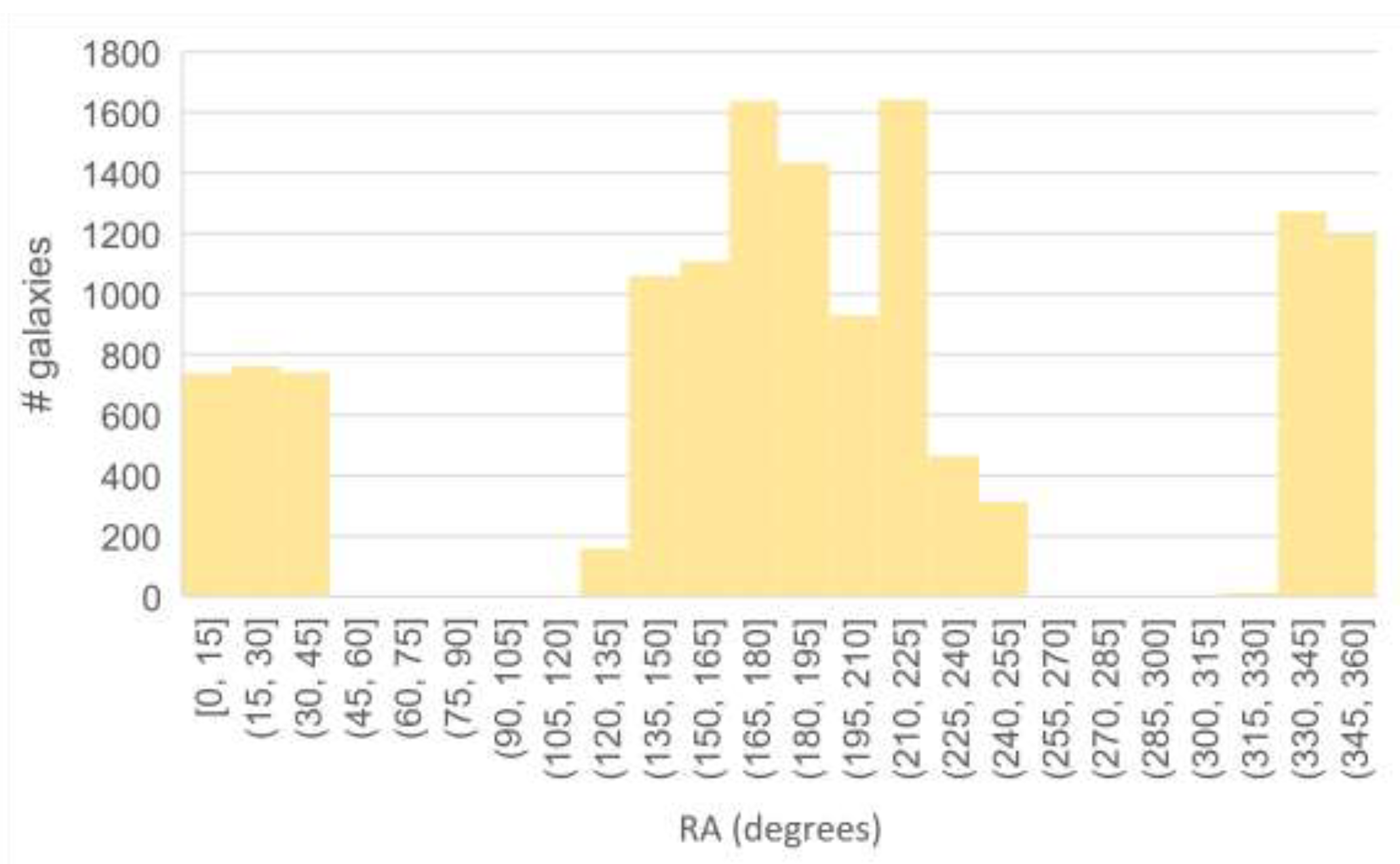
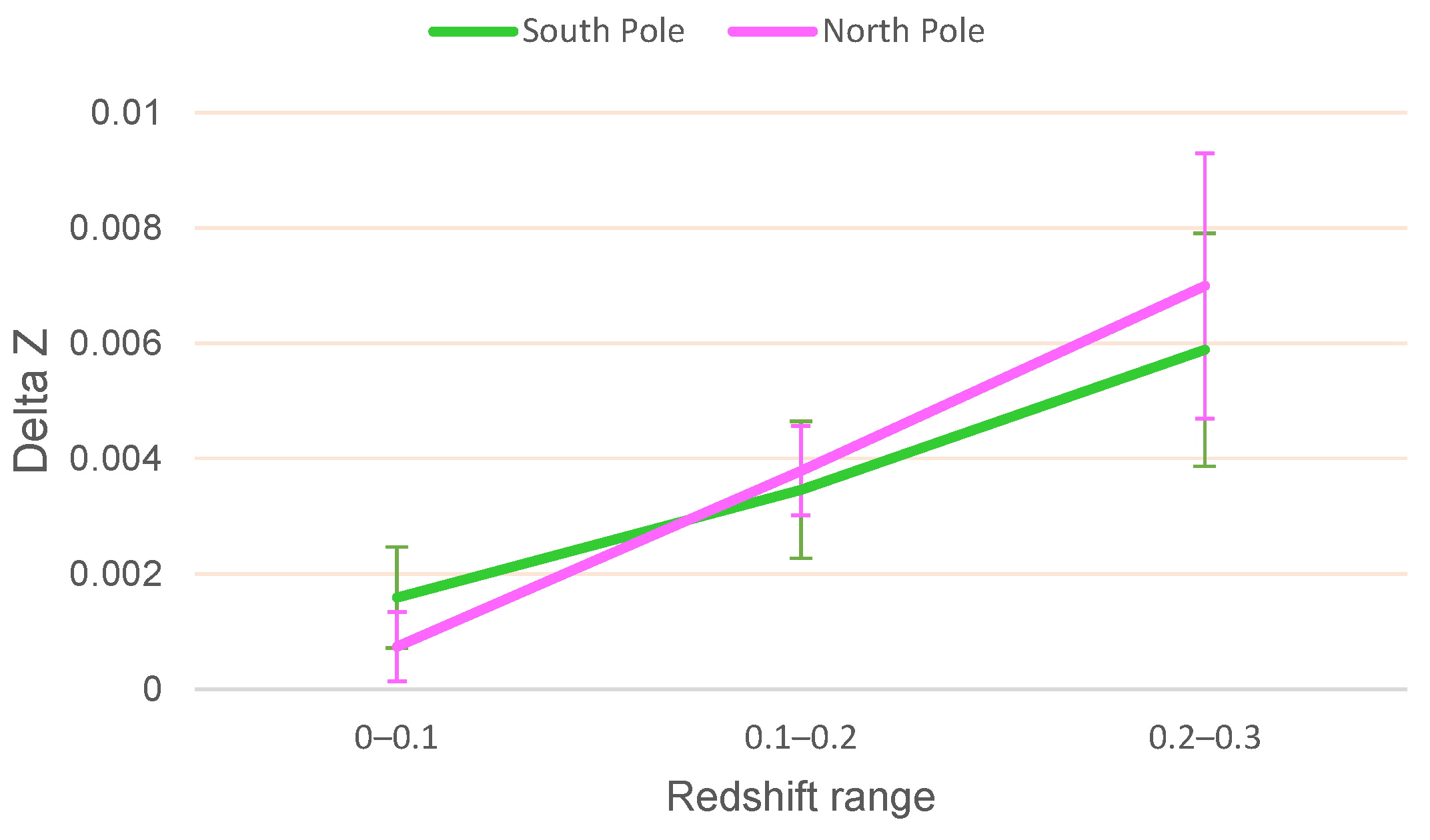
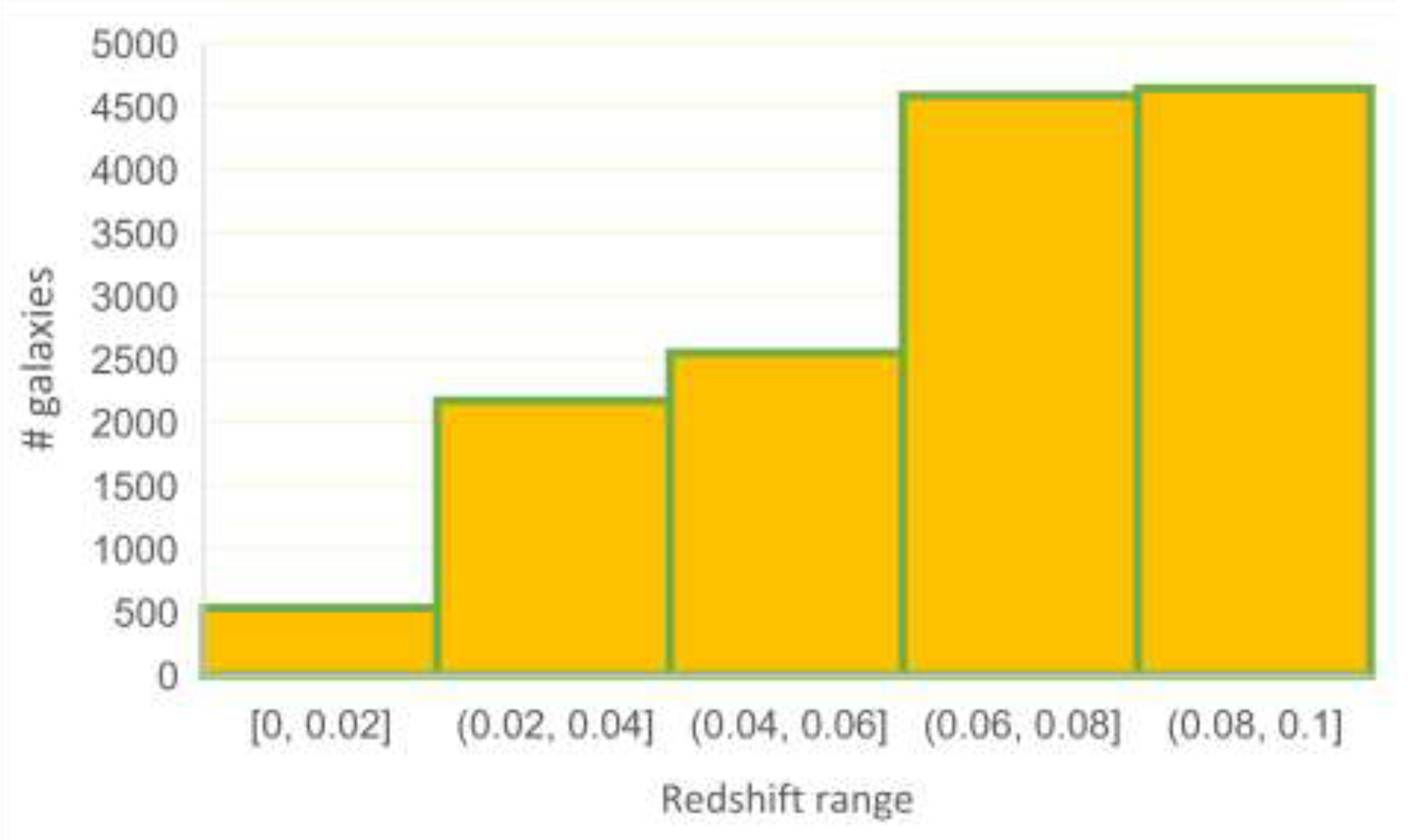

| Survey | Pole | Field Size (∘) | Annotation | # MW | # OMW | z | t-Test p | ||
|---|---|---|---|---|---|---|---|---|---|
| SDSS | North | 10 × 10 | Ganalyzer | 204 | 202 | 0.0996 ± 0.0036 | 0.08774 ± 0.0036 | 0.01185 ± 0.005 | 0.01 |
| SDSS | North | 20 × 20 | Ganalyzer | 817 | 825 | 0.09545 ± 0.0017 | 0.08895 ± 0.0016 | 0.0065 ± 0.0023 | 0.0029 |
| SDSS | North | 20 × 20 | Galaxy Zoo | 154 | 135 | 0.07384 ± 0.004 | 0.06829 ± 0.0035 | 0.0056 ± 0.0053 | 0.15 |
| SDSS | North | 10 × 10 | SpArcFiRe | 710 | 732 | 0.07197 ± 0.0015 | 0.06234 ± 0.0014 | 0.00963 ± 0.002 | <0.0001 |
| SDSS | North | 10 × 10 | SpArcFiRe | 728 | 709 | 0.06375 ± 0.0014 | 0.07191 ± 0.0014 | −0.00816 ± 0.002 | <0.0001 |
| Mirrored | |||||||||
| SDSS | North | 20 × 20 | SpArcFiRe | 2903 | 2976 | 0.07285 ± 0.0007 | 0.07116 ± 0.0007 | 0.00169 ± 0.001 | 0.04 |
| SDSS | North | 20 × 20 | SpArcFiRe | 3003 | 2914 | 0.07113 ± 0.0007 | 0.07271 ± 0.0007 | −0.00158 ± 0.001 | 0.05 |
| Mirrored | |||||||||
| DESI | South | 10 × 10 | Ganalyzer | 414 | 376 | 0.1352 ± 0.0027 | 0.1270 ± 0.0025 | 0.0082 ± 0.0036 | 0.018 |
| DESI | South | 20 × 20 | Ganalyzer | 1702 | 1681 | 0.1317 ± 0.0013 | 0.1273 ± 0.0014 | 0.0044 ± 0.0018 | 0.008 |
| Band | MW | OMW | t-Test p | |
|---|---|---|---|---|
| spectroFlux_g | 25.969 ± 0.8669 | 28.554 ± 1.0918 | −2.585 | 0.063 |
| spectroFlux_r | 53.2433 ± 1.765 | 58.6214 ± 2.3422 | −5.378 | 0.066 |
| spectroFlux_i | 77.4189 ± 2.513 | 85.0868 ± 3.407 | −7.667 | 0.067 |
| z Range | # MW | # OMW | z | t-Test p | ||
|---|---|---|---|---|---|---|
| 0–0.1 | 871 | 917 | 0.072788 ± 0.0006 | 0.071198 ± 0.0006 | 0.001589 ± 0.0009 | 0.03 |
| 0.1–0.2 | 1100 | 1144 | 0.149292 ± 0.0008 | 0.145834 ± 0.0008 | 0.003458 ± 0.001 | 0.001 |
| 0.2–0.3 | 342 | 350 | 0.242174 ± 0.0015 | 0.236287 ± 0.001 | 0.005886 ± 0.002 | 0.0006 |
| All | 2313 | 2411 | 0.13421 ± 0.001 | 0.13058 ± 0.001 | 0.00363 ± 0.0014 | 0.005 |
| z Range | # MW | # OMW | z | t-Test p | ||
|---|---|---|---|---|---|---|
| 0–0.1 | 2202 | 2255 | 0.070232 ± 0.0004 | 0.069493 ± 0.0004 | 0.000739 ± 0.0006 | 0.095 |
| 0.1–0.2 | 1949 | 2021 | 0.138494 ± 0.0006 | 0.134705 ± 0.0005 | 0.003789 ± 0.0008 | 0.00005 |
| 0.2–0.3 | 166 | 160 | 0.228586 ± 0.0018 | 0.221593 ± 0.0014 | 0.006993 ± 0.0023 | 0.0012 |
| All | 4317 | 4436 | 0.10714 ± 0.0006 | 0.104689 ± 0.0006 | 0.002451 ± 0.0008 | 0.0019 |
| Hemisphere | # MW | # OMW | z | t-Test p Values | ||
|---|---|---|---|---|---|---|
| North | 6450 | 6573 | 0.06598 ± 0.0003 | 0.06498 ± 0.0003 | 0.001 ± 0.0004 | 0.01 |
| South | 722 | 717 | 0.06516 ± 0.0008 | 0.06469 ± 0.0009 | 0.00047 ± 0.0012 | 0.34 |
Disclaimer/Publisher’s Note: The statements, opinions and data contained in all publications are solely those of the individual author(s) and contributor(s) and not of MDPI and/or the editor(s). MDPI and/or the editor(s) disclaim responsibility for any injury to people or property resulting from any ideas, methods, instructions or products referred to in the content. |
© 2024 by the author. Licensee MDPI, Basel, Switzerland. This article is an open access article distributed under the terms and conditions of the Creative Commons Attribution (CC BY) license (https://creativecommons.org/licenses/by/4.0/).
Share and Cite
Shamir, L. An Empirical Consistent Redshift Bias: A Possible Direct Observation of Zwicky’s TL Theory. Particles 2024, 7, 703-716. https://doi.org/10.3390/particles7030041
Shamir L. An Empirical Consistent Redshift Bias: A Possible Direct Observation of Zwicky’s TL Theory. Particles. 2024; 7(3):703-716. https://doi.org/10.3390/particles7030041
Chicago/Turabian StyleShamir, Lior. 2024. "An Empirical Consistent Redshift Bias: A Possible Direct Observation of Zwicky’s TL Theory" Particles 7, no. 3: 703-716. https://doi.org/10.3390/particles7030041
APA StyleShamir, L. (2024). An Empirical Consistent Redshift Bias: A Possible Direct Observation of Zwicky’s TL Theory. Particles, 7(3), 703-716. https://doi.org/10.3390/particles7030041

